TSTL: Original Sin

 TSTL:  “Thus saith the LORD” or perhaps it should be TSTY for “Thus saith YHWH.”  

Christianity teaches that every person born since the first couple ‘Adam and Eve’ are tainted with “original sin,”  a condition that all have inherited like a spiritual DNA.  All are helpless and will die with it and be damned eternally in hell. . . . unless a choice is made to believe in the Christian Savior, man-God Jesus Christ.  

What does the LORD YHWH say in the foundational scriptures of Israel about individual sin—-does one inherit his father’s iniquity?

Ezekiel 18

18:4 Behold, all souls are mine; as the soul of the father, so also the soul of the son is mine: the soul that sinneth, it shall die.

Re: The righteous father

18:5 But if a man be just, and do that which is lawful and right, 18:6 And hath not eaten upon the mountains, neither hath lifted up his eyes to the idols of the house of Israel, neither hath defiled his neighbour’s wife, neither hath come near to a menstruous woman, 18:7 And hath not oppressed any, but hath restored to the debtor his pledge, hath spoiled none by violence, hath given his bread to the hungry, and hath covered the naked with a garment; 18:8 He that hath not given forth upon usury, neither hath taken any increase, that hath withdrawn his hand from iniquity, hath executed true judgment between man and man, 18:9 Hath walked in my statutes, and hath kept my judgments, to deal truly; he is just, he shall surely live, saith the Lord GOD.

Re:  The violent son

18:10 If he beget a son that is a robber, a shedder of blood, and that doeth the like to any one of these things, 18:11 And that doeth not any of those duties, but even hath eaten upon the mountains, and defiled his neighbour’s wife, 18:12 Hath oppressed the poor and needy, hath spoiled by violence, hath not restored the pledge, and hath lifted up his eyes to the idols, hath committed abomination, 18:13 Hath given forth upon usury, and hath taken increase: shall he then live? he shall not live: he hath done all these abominations; he shall surely die; his blood shall be upon him.

Re: The righteous grandson

18:14 Now, lo, if he beget a son, that seeth all his father’s sins which he hath done, and considereth, and doeth not such like, 18:15 That hath not eaten upon the mountains, neither hath lifted up his eyes to the idols of the house of Israel, hath not defiled his neighbour’s wife, 18:16 Neither hath oppressed any, hath not withholden the pledge, neither hath spoiled by violence, but hath given his bread to the hungry, and hath covered the naked with a garment, 18:17 That hath taken off his hand from the poor, that hath not received usury nor increase, hath executed my judgments, hath walked in my statutes; he shall not die for the iniquity of his father, he shall surely live.

Re:  The soul that sins . . .

18:18 As for his father, because he cruelly oppressed, spoiled his brother by violence, and did that which is not good among his people, lo, even he shall die in his iniquity.

18:19 Yet say ye, Why? doth not the son bear the iniquity of the father? When the son hath done that which is lawful and right, and hath kept all my statutes, and hath done them, he shall surely live.

18:20 The soul that sinneth, it shall die. The son shall not bear the iniquity of the father, neither shall the father bear the iniquity of the son: the righteousness of the righteous shall be upon him, and the wickedness of the wicked shall be upon him.

Re:  Repentance

18:21 But if the wicked will turn from all his sins that he hath committed, and keep all my statutes, and do that which is lawful and right, he shall surely live, he shall not die.

18:22 All his transgressions that he hath committed, they shall not be mentioned unto him: in his righteousness that he hath done he shall live.

18:23 Have I any pleasure at all that the wicked should die? saith the Lord GOD: and not that he should return from his ways, and live? 18:24 But when the righteous turneth away from his righteousness, and committeth iniquity, and doeth according to all the abominations that the wicked man doeth, shall he live? All his righteousness that he hath done shall not be mentioned: in his trespass that he hath trespassed, and in his sin that he hath sinned, in them shall he die.

18:25 Yet ye say, The way of the LORD is not equal. Hear now, O house of Israel; Is not my way equal? are not your ways unequal? 18:26 When a righteous man turneth away from his righteousness, and committeth iniquity, and dieth in them; for his iniquity that he hath done shall he die.

18:27 Again, when the wicked man turneth away from his wickedness that he hath committed, and doeth that which is lawful and right, he shall save his soul alive.

18:28 Because he considereth, and turneth away from all his transgressions that he hath committed, he shall surely live, he shall not die.

18:29 Yet saith the house of Israel, The way of the LORD is not equal. O house of Israel, are not my ways equal? are not your ways unequal? 18:30 Therefore I will judge you, O house of Israel, every one according to his ways, saith the Lord GOD. Repent, and turn yourselves from all your transgressions; so iniquity shall not be your ruin.

18:31 Cast away from you all your transgressions, whereby ye have transgressed; and make you a new heart and a new spirit: for why will ye die, O house of Israel? 18:32 For I have no pleasure in the death of him that dieth, saith the Lord GOD: wherefore turn yourselves, and live ye.

[From http://www.jewishvirtuallibrary.org/jsource/Bible/Ezekiel18.html

Sources: Portions copyright © 1997 by Benyamin Pilant, All Rights Reserved
JPS Electronic Edition Copyright © 1998 by Larry Nelson, All Rights Reserved
Jewish Bible]


Exodus/Shemoth 1: "Now Yosef died, and all his brothers, and all that generation."

[Translation and commentary by EF/Everett Fox, The Five Books of Moses.  Additional elected commentary from RA/Robert Alter, and Pentateuch and Haftorahs, ed. Dr. J.H.Hertz, and REF/Richard Elliott Friedman, Commentary on the Torah.]

Exodus/Shemoth 1


[REF]The book of Exodus tells the story of the birth of a nation in slavery and ends with the nation’s establishment of its own center, leaders, and symbols in freedom.  Genesis involves a continuing narrowing of attention from the universe to the earth to humanity to a particular family; Exodus begins to broaden the circumference of attention again as the family grows into a nation—and comes into conflict with another nation.  Whereas Genesis sets the rest of the books of the Bible in context, Exodus does not set them in context so much as introduce fundamental components that will function centrally in almost all the coming books of the Bible. Exodus introduces the nation of Israel.  It introduces prophecy.  It introduces law.  Arguably most important of all, it introduces the theme of YHWH’s becoming known to the world.


[EF] Prologue in Egypt (1): Rather than being presented as a totally separate story the book of Exodus opens as a continuation of the Genesis saga.  This is true both specifically and generally: the first five verses echo and compress the information about the descent of Yaakov’s family into Egypt that was given in Gen. 46:8-27, while “Now these are the names” (v. 1) recalls the oft-repeated formula “Now these were the beginnings,” which forms the structural background of Genesis.  At the same time one might note that the main subject matter of our chapter life and death (or, threatened continuity) is central to the thematic content of Genesis.


Pharaoh’s paranoid fears about Israel’s growth—What for God was a sign of blessing is for Pharaoh a sign of disaster, a feeling of being overwhelmed by what is alien.  The birth of the Israelite nation is thus placed in a vivid context, completely physical in its description.  And because birth, and not the economic aspects of slavery is central, the actual description of the oppression of the Hebrews has been reduced to a bare minimum here.  . . . It is the experience of being a stranger in Egypt that the Bible has chosen to focus on, rather than on the horrors of slave labor.


In Exodus, the Egyptians cannot stand having aliens among them. . .  they dread their presence and fear their increase.  A natural plan of attack, to stem the human tide, is genocide.  Ironically, because of his fear of war Pharaoh concentrates his worries around the males, ignoring the true source of fecundity.


1:1 Now these are the names of the children of Israel coming to Egypt, 


with Yaakov, each-man and his household they came:

[EF]  children of Israel: Or “sons,” though it should be noted that the Hebrew b’nei can denote members of a group in general, not just family.  In this verse, “children” has been printed with a lowercase “c”; v. 7 the whole expression comes to mean a nation, and so a capital “C” has been utilized (Hebrew writing does not make this distinction).  


2 Re’uven, Shim’on, Levi and Yehuda,
3 Yissakhar, Zevulun and Binyamin,
4 Dan and Naftali, Gad and Asher.
5 So all the persons, those issuing from Yaakov’s loins, were seventy persons,


-Yosef was (already) in Egypt.

[REF]  seventy. Septuagint and Qumran texts read “seventy-five.”  The difference of five reflects Joseph’s sons Ephraim and Manasseh plus Manasseh’s son and Ephraim’s two sons.  These are named in Gen. 46:20 in the Septuagint but not in the Masoretic Text. The problem is that the children of Israel are identified here in v. 1 as those “who came to Egypt,” which would exclude Joseph’s chidlren and grandchildren because they do not come to Egypt; they are born there.  But the people are identified in v. 5 as “all the persons coming out from Jacob’s thigh,” which would include Joseph’s offspring no matter where they were born.  It appears that each scribe used the number that fit what he understood to be the logic of the text.


(Small differences of a few letters in the text such as this occur throughout the Torah.  They show that schemes that count the letters of the Bible to uncover hidden “codes” are nonsense.  Such codes became popular recently but were carried out by persons who were unqualified to do this serious study of the text of the Torah in all its versions.  Examination of their misuse of statistical analysis further undermined their claims, which unfortunately misled sincere people.  Let us hope that the repudiation of such popular schemes will serve to remind people anew that what is great in the Torah is in what it says, not in secret patterns in its letters.)


6 Now Yosef died, and all his brothers, and all that generation.
7 Yet the Children of Israel bore fruit, they swarmed, they became many, they grew mighty (in number)-exceedingly, yes, exceedingly;
the land filled up with them.


[EF]  Yet:  Despite the disappearance of the political influential generation of Yosef, the Israelites’ success continues (Cassuto). swarmed: This verb is usuall applied to animals (See Gen. 1:20). Here the term is positive, as part of God’s plan; shortly, it will carry a negative connotation for Pharaoh. grew mighty in number: This reflects the promise of God to Avraham in Gen. 18:18 (to become “a mighty nation”) (Keil and Deslitzsch).


[RA] the sons of Israel. Though the phrase is identical with the one used at the beginning of verse 1, historical time has been telescoped and so the meaning of the phrase has shifted;  now it signifies not the actual sons of Israel/Jacob but Israelites, the members of the nation to which the first Israel gave his name.  In subsequent occurrences this translation will use “Israelites.”

8 Now a new king arose over Egypt, who had not known Yosef.


[EF] a new king:  His name is not given, even though later biblical books do refer to foreign rulers by name.  this is perhaps another example of the biblical text’s playing down history in favor of stressing teh story and its lesson.  who had not known Yosef:  Just as his successor will say “I do not know YHWH” )5:2), and will continue the oppression begun here.


[REF[ a new king. There are five PHaraohs in the Torah: the Pharaoh who thought Sarah was Abraham’s sister, the Pharaoh who knew Joseph, the Pharaoh who did not know Joseph, the Pharaoh who sought to kill Moses (who may or may not be the same Pharaoh who did not know Joseph), and the Pharaoh of the exodus.  Why are none of their names given?  Names of Pharaohs (Shishak, Neco) are given in later books.  Their absence in the Torah gives the narrative a nonhistorical quality, which is contrary to the manifest aim of the Torah to present history.  One might argue that this is evidence that the stories are not true, that they were made up by writers who could not name these kings because they had no idea of the names of ancient Pharaohs.  In the case of the two Pharaohs in Genesis, we have hardly any evidence to argue for or against this.  But in the case of the Exodus Pharaohs, I think that there is sufficient likelihood that the oppression and exodus are historical, so there must be some other reason why the Pharaohs are not named.  My friend Jonathan Saville suggests that perhaps the reason, consciously or not, is to downgrade the Pharaoh, as when people sometimes avoid saying the name of someone toward whom they feel hostile.  Or perhaps the names of the Pharaohs were no longer preserved in the tradition by the time the stories came to be written.

9 He said to his people: 
Here, (this) people, the Children of Israel, is many-more and mightier (in number) than we!

[EF] his people . . . (this) people:  Pharaoh states the case as the conflict between one national entity and another.

[RA] the people of the sons of Israel. This oddly redundant phrase—it should be either “sons of Israel” or “people of Israel”—is explained by Pharaoh’s alarmed recognition that the sons, the lineal descendants, of Israel have swelled to a people.

10 Come-now, let us use-our-wits against it, 
lest it become many-more, 
and then, if war should occur,
it too be added to our enemies 
and make war upon us 
or go up away from the land!

[EF]  use-our-wits: Others, “We must be prudent,” “Let us deal shrewdly.”

[REF[ will be added. The Hebrew is punningt on the name of Joseph, meaning “may He add.”  The Pharaoh does not know Joseph, but when he is pictured as worrying that the people “will be added” this summons Joseph back to mind. This pun is not merely wordplay for its own sake.  The notation that this is a Pharaoh who does not know Joseph makes a strong break at the beginning of Exodus from what has come before this in Genesis.  The reminder of Joseph’s presence reconnects this phase of the story to everything that has come before it.  Even stronger connections are coming.

11 So they set gang-captains over it, to afflict it with their burdens. 
It built storage-cities for Pharaoh-Pitom and Ra’amses.


[EF] afflict: Or “oppress.” Pharaoh: Heb. Par’o.  This is an Egyptian title, “(Lord of) the Great House,” and not a proper name.


[REF] work-companies.  The Hebrew term, missim, refers not to individually owned household slaves but to a policy of forced labor imposed on an entire community (a corvée). The Israelites built whole cities, and they all live in a particular region of Egypt (Goshen), separate from the Egyptian population (Exod. 8:18;9:26).


Centuries later, King Solomon imposes missim on Israel, requiring, in addition to monetary taxes, a period of labor on national projects.  This so infuriates the Israelites that they stone to death the king’s minister of missim (1 Kings 5:27-28;12:18).  Israelites will bear taxation, but the requirement of forced labor implies control over people’s bodies by the government.  This is appalling to a people whose recollection of having been slaves is a central doctrine to their understanding of themselves and their history.


12 But as they afflicted it, so did it become many, so did it burst forth. 


And they felt dread before the Children of Israel.

[RA]  as they abused them, so did they multiply.  Like a force of nature (compare v. 7), the Israelites respond to oppression by redoubling their procreative surge.

and they came to loathe the Israelites.  William H.C. Propp has made the ingenious suggestion that the loathing is a response to the reptilian “swarming” of reproductive activity exhibited by the Israelites.


13 So they, Egypt, made the Children of Israel subservient with crushing-labor;


[EF] crushing-labor: A rare Hebrew word, here translated according to early rabbinic tradition, perekh is used rhetorically three times in Lev. 25 (vv.45,46, and 53), where the Israelites are given laws about how to deal with their impoverished countrymen (v. 43, “you are not to oppress him with crushing-labor”).


[RA] at crushing labor. The Hebrew is an adverbial form derived from a root that means “to break into pieces,” “to pulverize.”


14 they embittered their lives with hard servitude in loam and in bricks and with all kinds of servitude in the field- 
all their service in which they made them subservient with crushing-labor.

[RA] work. . .  work . . . work. Following a prevalent stylistic practice of Hebrew narrative, the writer underscores his main topic, the harshness of slavery, by repeating a central thematic keyword. Indeed, the Hebrew literally says, “their crushing work that they worked,” but in English that cognate accusative form sounds awkward for a limited number of idioms (e.g. “sing a song”).


15 Now the king of Egypt said to the midwives of the Hebrews
-the name of the first one was Shifra, the name of the second was Pu’a-

[EF] midwives of the Hebrews:  The ambiguity of this phrase raises an ancient question: were they Hebrew or Egyptian? The names seem Semitic (and hence unEgyptian); then, too, the use of “Hebrew” in the Bible usually occurs when a foreigner is talking about Israelites. Yet the owmen’s answer in v. 19 suggests that they are in fact Egyptians.  Abravanel notes that Hebrew women would not be likely to kill Hebrew babies.


[RA] Shiphrah . . . Puah. The first name suggests “beauty,” the second name, as the Ugaritic texts indicate, might originally have meant “fragrant blossom” and hence “girl.”  But since the root pa’ah can also mean “to murmur” or “to gurgle,” Rahsi inventively suggests it is the sound a nurturing woman makes to soothe an infant.  In any case, the introduction of just two heroic midwives reflects the way this entire narrative, in contrast to Genesis, has been stylized and simplified.  Abraham ibn Ezra appears to grasp this principle of schematization when he proposes that Shiphrah and Puah in fact would have had to be supervisors of whole battalions of midwives.


[REF] Hebrew midwives.  The Hebrew may be read as “Hebrew midwives,” meaning that these two women were Israelites; or it may be “midwives of the Hebrews,” in which case one cannot know whether or not they themselves are Israelites.  “Hebrew midwives” is more likely because the Israelites are never referred to as “the Hebrews” by the narrator of the Torah.  It is a term used in quotation when speaking to foreigners (Gen 40:15; Exod 5:3) or as an adjective in the fixed phrase “Hebrew slave”.  Here, too, it may be such an adjectival usage.  this is supported by the fact that these names are much more likely to be Semitic than Egyptian, implying that the midwives are Israelites.


16 he said: 
When you help the Hebrew women give birth, see the supporting-stones: 
if he be a son, put him to death,
but if she be a daughter, she may live.

[REF] the two stones.  This is often understood to mean some sort of birthing stool made of two stones, but the more natural understanding here in the context of identifying boys is that the two stones refers to the testicles.

17 But the midwives held God in awe, 
and they did not do as the king of Egypt had spoken to them,
they let the (male) children live.
18 The king of Egypt called for the midwives and said to them: 
Why have you done this thing, you have let the children live!
19 The midwives said to Pharaoh:
Indeed, not like the Egyptian (women) are the Hebrew (women),
indeed, they are lively: 
before the midwife comes to them, they have given birth!
[REF] they’re animals! The vowels inserted in the Masoretic Text would make this an adjective (“they’re lively”), but that form of the word does not occur anywhere else in the Bible.  I think that it is more likely that the midwives were meant to be speaking in this negative way about the Israelite women in order to hide their own violation of the king’s order.
20 God dealt well with the midwives. 
And the people became many and grew exceedingly mighty
(in number).
21 It was, since the midwives held God in awe, that he made them households.


[RA] He made households for them. Although some have seen Pharaoh as the antecedent of “he,” God seems considerably most likely.  The sense would then be that they were rewarded for their virtue with social standing, establishing their own families, or  something of the sort.

22 Now Pharaoh commanded all his people, saying:
Every son that is born, throw him into the Nile,
but let every daughter live.

[EF] Nile. Heb. ye’or,  Egyptian itrw, “the great river.”


[RA] Pharaoh charged his whole people. Despairing of cooperation from the Hebrew midwives in his genocidal project, Pharaoh now enlists the entire Egyptian population in a search-and-destroy operation.


Every boy . . . you shall fling into the Nile, and every girl you shall let live. The schematic—as against historical even historylike—character of the narrative is evident int his folktale antithetical symmetry.  The idea is presumably that the people would be eradicated by cutting off all male progeny while the girls could be raised for sexual exploitation and domestic service of the Egyptians, by whom they would of course be rapidly assimilated.  Pharaoh’s scheme will again be frustrated, as the future liberator of the Hebrews will be placed (not flung) in the Nile and emerge eventually to cause grief to Egypt.  There is also an echo here of Abram’s words to Sarai when they come down to Egypt, adumbrating the destiny of their descendants, during a famine:  “they will kill me while you they will let live” (Genesis 12:12).

Genesis/Bereshith to Exodus/Shemoth

[Translation:  EF/Everett Fox, The Five Books of Moses.]

At the conclusion of Genesis 50, Joseph, his brothers and an Egyptian entourage journeyed from Egypt to Canaan to bury Jacob in the cave of the Machpelah field . . . then they returned to Egypt.  The brothers then realized that with their father gone, Joseph might still have leftover bitterness in his heart toward them so they humbled themselves again and offered to be his slaves.

 These brothers never seem to learn their lesson, still underestimating the character of Joseph in spite of everything Joseph had already done for them!

What a consistently righteous man this by now matured and wise Joseph turned out to be, evidenced in his response: 

19 But Yosef said to them: 
 Do not be afraid! For am I in place of God?
 20 Now you, you planned ill against me, 
 (but) God planned-it-over for good,
 in order to do (as is) this very day- 
 to keep many people alive.
 21 So now, do not be afraid! 
 I myself will sustain you and your little-ones! 
 And he comforted them and spoke to their hearts.

He lived 110 years, and saw 3 generations through Ephraim and Manasseh, then reminds his brothers:  

24 Yosef said to his brothers: 
 I am dying,
 but God will take account, yes, account of you, 
 he will bring you up from this land 
 to the land about which he swore
 to Avraham, to Yitzhak, and to Yaakov.

Then expresses his own desire for his bones to be brought out of Egypt . . . whenever that would happen.  Did he think, just like Jacob, that he might have a funeral entourage back to the Land of Canaan? If anyone deserved it, certainly Joseph did!   

Image from www.galaxie.com

Genesis 50:26:  

26 And Yosef died, a hundred and ten years old. 
 They embalmed him and they put him in a coffin 
 in Egypt.

Did that Egyptian practice of embalming the dead see his remains through four centuries that would change the fortunes of the Jacobites/Israelites? 

Exodus/Shemoth 1:1-7 records the passing of the entire generation of 70 who went to Egypt: 

1 Now these are the names of the children of Israel coming to Egypt, 
with Yaakov, each-man and his household they came:
2 Re’uven, Shim’on, Levi and Yehuda,
3 Yissakhar, Zevulun and Binyamin,
4 Dan and Naftali, Gad and Asher.
5 So all the persons, those issuing from Yaakov’s loins, were seventy persons,
-Yosef was (already) in Egypt.
6 Now Yosef died, and all his brothers, and all that generation.
7 Yet the Children of Israel bore fruit, they swarmed, they became many, they grew mighty (in number)-exceedingly, yes, exceedingly;
the land filled up with them.
8 Now a new king arose over Egypt, who had not known Yosef.
9 He said to his people: 
Here, (this) people, the Children of Israel, is many-more and mightier (in number) than we!
10 Come-now, let us use-our-wits against it, 
lest it become many-more, 
and then, if war should occur,
it too be added to our enemies 
and make war upon us 
or go up away from the land!
11 So they set gang-captains over it, to afflict it with their burdens. 
It built storage-cities for Pharaoh-Pitom and Ra’amses.
12 But as they afflicted it, so did it become many, so did it burst forth. 
And they felt dread before the Children of Israel.
13 So they, Egypt, made the Children of Israel subservient with crushing-labor;
14 they embittered their lives with hard servitude in loam and in bricks and with all kinds of servitude in the field- 
all their service in which they made them subservient with crushing-labor.

Nagging questions:

  • With the transition of Israelites from welcome aliens living separately in the land of Goshen from the Egyptian population, to a multiplying people beginning to outnumber the population of Egypt, and with their changing status now as unwelcome immigrants taking up land space and resources, could they have impacted the culture and religion of Egypt with the belief of their patriarchs Abraham, Isaac and Jacob in the God who spoke to their forefathers?  
  • Did they even have some kind of organized system of beliefs that they might have inherited from the last patriarch from whom they all descended? 
  • Did Jacob impart his faith in the God he personally experienced to his progeny?
  • Did this multiplying population have any idea about the promises God made to Abraham, repeated to Isaac, as well as to Jacob?  
  • Did any of the 12 sons know enough to pass on to their individual descendants?
  • What did the Hebrew slaves know about the God of Abraham?  If they knew or did not know, would they have eventually been drawn to the gods of Egypt since evidently, the God they heard about seemed to have forgotten them?
  • How much of Egypt’s polytheistic religion become ingrained in their consciousness?  Did they worship Egypt’s gods?

The text does not elaborate. 

NSB@S6K

———————————————————-

 [As if here is not enough work to do in sharing three commentaries, would you believe we’re adding one more:  Richard Elliott Friedman, Commentary on the Torah.For starters, here’s a short introduction to the Book of Exodus:

The book of Exodus tells the story of the birth of a nation in slavery and ends with the nation’s establishment of its own center, leaders, and symbols in freedom.  Genesis involves a continuous narrowing of attention from the universe to the earth to humanity to a particular family; Exodus begins to broaden the circumference of attention again as the family grows into a nation.  Whereas Genesis sets the rest of the books of the Bible in context, Exodus does not set them in context so much as introduce fundamental components that will function centrally in almost all the coming books of the Bible.  Exodus introduces the nation of Israel.  It introduces prophecy.  It introduces law.  Arguably most important of all, it introduces the theme of YHWH’s becoming known to the world.

Image from www.damascusroadchurch.org640


Genesis/Bereshith 50 – "And Yosef died . . . they put him in a coffin in Egypt."

This chapter concludes the Book of Beginnings.


A commentator noted how gloriously this book began with the Creator speaking “In the beginning . . . “ and how the book sadly ended with this final phrase:  “a coffin in Egypt.”  Thus ends the story of the patriarchal stage in the formation of a people ‘set apart’ for YHWH, to play a specific role in His ultimate plan for the whole world.


Reviewing the life of Yosef . . .a ‘savior’ of ‘start-up’ Israel . . . is he a sample study for predestination, the theory that some select individuals or people, no matter what they do or do not do, have a distinct destiny?  Was Yosef simply a victim of unfortunate circumstances one after another?  To some extent he was, even if he made right choices which positively influenced how he would spend his sojourn in Egypt.


When you think more deeply about his stay in Egypt—actually the rest of his lifetime—he was exposed to a culture that countered what he might have been taught by his father Yaakov, who like Abraham and Isaac, were divinely-picked beneficiaries of divine instructions regarding a way of life.


From where came his strength of character, his integrity?  This takes him from the bottom of Egypt’s society — an alien and a prisoner at that  —- right into the seat of power, in Pharaoh’s court.  In the end, he not only saves his family, he is also the ‘savior’ of Egypt!  Through his interpretation of Pharaoh’s dreams which positions him to prepare Egypt for the coming drought and its consequences, he becomes CEO of Pharaoh’s court, surely that is power in his hands which, because of his character, he chooses to use for good. Egypt benefits as much as Yaakov’s tribe of 70 who migrate there.


In a way, Yosef is savior of both Israel and Egypt, thanks to Divine Providence as well as his own will to do the right thing each step of the way, all the way to his forgiveness of the brothers.  As in Esau’s case, good fortune does much to influence one’s attitude in a positive way.  A confluence of unfortunate circumstances and fortunate personal decisions plus and above all, let us not forget the invisible Divine Hand orchestrating in the background—all knitted strangely and harmoniously together in the tapestry depicting Yosef’s life.


Below, we’ve chosen an Egyptian-looking handsome image of Yosef, the Hebrew/Yaakovite/Israelite.   Why? To serve as the final impression in our biblical memory that Egypt in Yosef’s time did have a good and benevolent Pharaoh . . . quite a contrast indeed to the situation of Israel after 400 years with a different kind of Pharaoh. Was Yosef still a Hebrew at heart, an heir of Yaakov/Israel’s upbringing with faith in his God —-beneath the trappings of Egyptian culture? And what does that really mean in terms of living through the realities of the life of a ‘stranger’ in Egypt?


Yaakov dies in Egypt but is buried in Canaan.  Yosef dies in Egypt . . . and the history of the chosen people continues, thanks to one good Pharaoh but no thanks to the last Pharaoh at the time the chosen people are delivered from bondage.


What happened between the arrival and the departure besides ‘go and multiply/?  Did Israelites remember or forget the God of their Patriarchs?  Did Egypt’s culture and religion and worship of multiple gods of nature rub off on them? Were they more ‘Egyptian’ than ‘Israelite’ in thinking, diet, and all other ways? Did they assimilate ‘Egypt’ despite the fact they were separated from the Egyptian population because they were slaves?


Was there a distinct Israelite identity at that time or does that develop after deliverance and wilderness wandering, in the promised land? Think and ponder . . . .


NSB@S6K


———————————-


[Unbracketed comments from Pentateuch and Haftorahs, ed. Dr. J.H. Hertz; additional commentary by RA/Robert Alter and from EF/Everett Fox, translator of The Five Books of Moses.—Admin1.]


Genesis/Bereshith 50

 
JACOB’S BURIAL.  THE DEATH OF JOSEPH
 
[EF] Yaakov’s Burial (50:1-14):  The funeral of Yaakov seems to presage the Exodus from Egypt—here with Pharaoh’s permission and a large royal escort (including “chariots and horsemen,” who in several generations will pursue Yaakov’s descendants into the sea).
 

Interestingly, the Iliad also ends with an elaborate burial scene.  The contrast is instructive:  the Homeric epic celebrates the deeds and mourns the lost youth of a hero (Hector); Genesis reflects Yosef’s standing at court and the desire to bury Yaakov in the land of Canaan, in the family plot.  Note too that Genesis has two more scenes, tending to lessen the impact of this impressive funeral sequence.


The End of the Matter (50:15-26):  Drawing out the tension inherent in the Patriarch’s family relationships to the very end, the text repeats an earlier situation in Yaakov’s life—his brother’s feelings of “grudge” and threats to kill him—in the guise of his sons’ fears toward Yosef.  Here, however, there can be no question of personal vengeance, since Yosef sees the brothers’ betrayal of him as but part of a larger purpose.  In his words of v. 20, “God planned-it-over as good . . . to keep many people alive,” the text resolves two of the great hanging issues that have persisted throughout Genesis: sibling hatred and the threat to generational continuity.


Left hanging, of course, is the issue of the promised land, since the narrative concludes “in Egypt,” but these final chapters lead to the assurance that God will “take account” (vv.24-25) of the Sons of Israel, as they are soon to be termed.

 
1 Yosef flung himself on his father’s face, 
he wept over him and kissed him.


and Joseph. This does not imply that the other children of Jacob did not do even as Joseph did.


[RA] And Joseph flung himself on his father’s face and wept over him and kissed him.  These three gestures by now are strongly associated with Joseph’s character.  In the great recognition scene in chapter 45, he flings himself on Benjamin’s neck, embraces and kisses him, and then does the same with his ten half brothers, and before this he has wept three times over the encounter with his brothers.  Joseph is at once the intellectual, dispassionate interpreter of dreams and central economic planner, and the man of powerful spontaneous feeling. At his father’s deathbed, he only weeps, he does not speak.

 
2 Then Yosef charged his servants, the physicians, to embalm his father, 
and the physicians embalmed Yisrael.


to embalm his father.  Not in imitation of the custom of the Egyptians, who took care to preserve the body after death and keep it ready for occupation by the soul.  Joseph’s purpose was merely to preserve it from dissolution before it reached the Cave of Machpelah.


[RA] his servants the physicians. Although the Hebrew term means “healer,” these are obviously experts in the intricate process of mummification, and the wording indicates that Joseph had such specialists on his personal staff.  Mummification would be dictated by Jacob’s status as father of the viceroy of Egypt and also by the practical necessity of carrying the body on the long trek to central Canaan.

 
3 A full forty days were required for him, 
for thus are fulfilled the days of embalming. 
And the Egyptians wept for him for seventy days.


the Egyptians wept for him.  Out of respect for Joseph.  Probably the forty days of embalming formed part of the seventy days (Rashi).


forty full days. A Hebrew formulaic number is used rather than the number of days prescribed by Egyptian practice.

seventy days. Evidently the Egyptian period of mourning for a royal personage, seventy-two days, has been rounded off to the Hebrew formulaic seventy.

 
4 Now when the days of weeping for him had passed, 
Yosef spoke to Pharaoh’s household, saying: 
Pray, if I have found favor in your eyes, pray speak in the ears of Pharaoh, saying:


unto the house of Pharaoh.  Joseph, as a mourner, would not approach in the king in person.


Joseph spoke to the household of Pharaoh. It is a little puzzling that Joseph, as Pharaoh’s right-hand man, is compelled to approach him through intermediaries.  Some commentators have explained this by invoking Joseph’s condition as mourner, which, it is claimed, would prohibit him from coming directly into Pharaoh’s presence.  A more reliable key to his recourse to go-betweens may be provided by the language of imploring deference with which he introduces his message to Pharaoh—“If, pray, I have found favor in your eyes, speak, pray . . .” Joseph is something extraordinary in asking permission to go up to Canaan with his entire clan, for Pharaoh might be apprehensive that the real aim was repatriation, which would cost him his indispensable viceroy and a whole guild of valued shepherds.  Joseph consequently decides to send his petition through the channel of Pharaoh’s trusted courtiers, to whom he turns in deferential court language.

 
5 My father had me swear, saying:
Here, I am dying- 
in my burial-site which I dug for myself in the land of Canaan,
there you are to bury me! 
So now, 
pray let me go up, bury my father, and return.


which I have digged.  ‘Which I have prepared’ (Onkelos).  It is quite likely that Jacob had prepared the grave for his own interment, next tot he grave of Leah in the Cave of Machpelah.

and I will come back.  Joseph assures Pharaoh that he intends to return to Egypt.


In the grave I readied me. The usual meaning of the Hebrew verb karah is “to dig,” though it can also mean “to purchase.” The latter sense is unlikely here because it would be confusing to use karah for buying a grave, when it is so naturally applied to digging the grave.  But since the burial site in question is actually a cave, one must assume an extrapolation from the primary meaning of the verb to any preparation of a place for burial.

and come back.  This final verb is of course a crucial consideration for Pharaoh.

 
6 Pharaoh said: 
Go up and bury your father, as he had you swear.


7 So Yosef went up to bury his father; 
and with him went up all of Pharaoh’s servants, 
the elders of his household and all the elders of the land of Egypt,


the elders.  The respect shown to Jacob is evidently due to the great position occupied by Joseph in Egypt.  Such processions as described in our text are frequently represented on Egyptian tombs.


[RA] and all Pharaoh’s servants, the elders of his household, and all the elders of the land of Egypt, went up with him.  This vast entourage of Egyptian dignitaries betokens Pharaoh’s desire to accord royal honors to Jacob.  the presence of chariots and horsemen (verse 9) might also serve as protection against hostile Canaanites, but the whole grand Egyptian procession is surely an effective means for ensuring that Joseph and his father’s clan will return to Egypt.

 
8 all of Yosef’s household,
his brothers and his father’s household. 
Only their little-ones, their sheep, and their oxen did they leave behind in the region of Goshen.


only their little ones . . . they left in the land of Goshen.  Because unable to endure the fatigue of travel to Canaan.


[RA] Only their little ones. The children and flocks are left behind as a guarantee of the adults’ return.

 
9 And along with him went up chariots as well, and horsemen as well- 
the company was an exceedingly heavy one.


chariots and horsemen.  To protect the procession.


[EF] heavy: Three times through v.11.  The root k-b-d connotes “honor,” “importance,” “weight,” and is central here perhaps to emphasize the respect shown to Yaakov.

 
10 They came as far as Goren Ha-Atad/Bramble Threshing-Floor, which is in (the country) across the Jordan, 
and there they took up lament, an exceedingly great and heavy lament, 
and he held mourning for his father, for seven days.


the threshing-floor of Atad.  The place Atad has not been identified.


beyond the Jordan.  This cannot mean east of the Jordan, as it is unthinkable that in going to the cave of Machpelah at Hebron the company would take the circuitous route round the Dead Sea.  All difficulties disappear when we remember that to Moses and the Israelites in the land of Moab, the words ‘beyond Jordan’ meant west of Jordan.  This phrase therefore is another incidental confirmation of the Mosaic authorship of Genesis (W.H. Green).


seven days. This is still the Jewish period of mourning for the dead.  The sacred institution of Shivah in its essence thus goes back to Patriarchal times.


[RA] Goren ha-Atad.  The place name means “threshing-floor of the bramble.”


across the Jordan.  The logical route from Egypt would be along the Mediterranean coast, which would necessitate construing this phrase from the perspective of someone standing to the eat of the Jordan.  That, however, is implausible because “across the Jordan” in biblical usage generally means just what we mean by trans-Jordan in modern usage—the territory east of the Jordan.  Perhaps a circuitous route through the Sinai to the east and then back across the Jordan is intended to prefigure the itinerary of the future exodus and return to Canaan.  Perhaps local traditions for the etiology of a place-name Abel-Mizraim in trans-Jordan led to the intimation of this unlikely route.

 
11 Now when the settled-folk of the land, the Canaanites, saw the mourning at Bramble Threshing-Floor, 
they said: 
This is such a heavy mourning/evel for Egypt! 
Therefore its name was called: Meadow/avel of Egypt,
which is in (the country) across the Jordan.


a grievous mourning. Or, ‘an honourable mourning.’

[RA[ Abel-Misraim.  This is construed in the folk etymology as “mourning of Egypt,” though ‘abel is actually a watercourse.  Mizraim means “Egypt.”

 
12 So his sons did thus for him, as he had commanded them:
13 his sons carried him back to the land of Canaan 
and buried him in the cave in the field of Makhpela.
-Avraham had acquired that field as a burial holding from Efron the Hittite, (the field) facing Mamre.


[EF]  the cave in the filed of Makhpelah: Despite God’s continual promise of the land throughout the book, this is practically all that the Patriarchs possess at the end of Genesis.

 
14 Then Yosef returned to Egypt, 
he and his brothers and all who had gone up with him to bury his father,
after he had buried his father.
15 When Yosef’s brothers saw that their father was dead, they said: 
What if Yosef holds a grudge against us 
and repays, yes, repays us for all the ill that we caused him!


Joseph will hate us. A notable example of the never-to-be-silenced voice of the guilty conscience.

 
16 So they charged Yosef, saying: 
Your father commanded before his death, saying:


thy father did command.  An unrecorded message.


[RA] And they charged Joseph. The verb, which most commonly refers either to giving instructions or delivering the terms of a last will and testament, is a little peculiar.  If the received text is reliable here, the choice of verb would be influenced by the fact that the brothers are conveying to Joseph the terms of what they claim (perhaps dubiously) is their father’s “charge” before his death.  In any case, they send this message through an intermediary, for only in verse 18 are they represented as coming before Joseph—“And his brothers then [gam] came” —so perhaps the odd use of the verb indicates indirection here.

 
17 Say thus to Yosef: 
Ah, pray forgive your brothers’ offense and their sin, that they caused you ill! 
Now, pray forgive the offense of the servants of your father’s God! 
Yosef wept as they spoke to him.


servants of the God of thy father. Though thy father is dead, the God of thy father liveth (Rashi).  They ask for his forgiveness, basing their plea on the claims of brotherhood of Faith.  A fine religious appeal.


Joseph wept.  Because of their want of confidence in him.

[RA] the servants of your father’s God.  In the imploring language of their plea for forgiveness, they conclude by calling themselves not his brothers but the faithful servants of the God of Jacob.  Rashi nicely observes, “if your father is dead, his God exists, and they are his servants.”

 
18 And his brothers themselves came, they flung themselves down before him and said:
Here we are, servants to you!


and his brethren also went.  Having originally sent others on their behalf, see v. 16, they now come in person to plead with Joseph.

behold, we are thy bondmen.  Again fulfilling the old dreams, see XXXVII,6f.

 
19 But Yosef said to them: 
Do not be afraid! For am I in place of God?


It is quite impossible for any man to counteract the Divine plan.

 
20 Now you, you planned ill against me, 
(but) God planned-it-over for good,
in order to do (as is) this very day- 
to keep many people alive.


ye meant evil.  Man proposes, but God disposes. ‘To me it appears that the sale of Joseph was the work of Providence, not only for him who was to be advanced to an exalted station, but also in the benign care that resulted from it for the whole people of Israel.  Therefore, Joseph’s brethren were not deserving punishment; on the contrary, Joseph repeatedly declares that in whatever they had done, they were unwittingly carrying out the design of Providence’ (Abarbanel).


save much people alive.  Not only the Egyptians and the children of Israel, but other people who came to Egypt to buy corn in the time of famine.


[RA[ While you meant evil toward me, God meant it for good. This whole final scene between Joseph and his brothers is a recapitulation, after Jacob’s death, of the recognition scene in Egypt.  Once more the brothers feel guilt and fear.  Once more Joseph weeps because of them.  Once more they offer to become his slaves.  (The physical act of prostration, as the early-twentieth-century German scholar Herman Gunkel observes, carries us back full circle to Joseph’s two dreams at the beginning of the story.)  And once more Joseph assures them that it has been God’s purpose all along to turn evil into good, for the end of “keeping many people alive,” with Joseph continuing in his role as sustainer of the entire clan.

 
21 So now, do not be afraid! 
I myself will sustain you and your little-ones! 
And he comforted them and spoke to their hearts.


 spoke kindly unto them.  lit. ‘and he spoke to their heart’.

 
22 So Yosef stayed in Egypt, he and his father’s household. 
Yosef lived a hundred and ten years;


a hundred and ten years.  He survived his father fifty-four years.  In Egyptian writings the age of 110 years is spoken of as an ideal lifetime.


[EF]  a hundred and ten years:  The ideal Egyptian life span.

 
23 Yosef saw from Efrayim sons of the third generation, 
and also the sons of Makhir son of Menashe were born on Yosef’s knees.


Machir.  The most powerful of the clans of Manasseh; see Judg. V,14.


born upon Joseph’s knees.  The symbolical act of adoption.

[EF] born on Yosef’s knees:  Considered his own, see 30:3.

[RA] were born on Joseph’s knees.  This gesture serves either as a ritual of adoption or of legitimation.

 
24 Yosef said to his brothers: 
I am dying,
but God will take account, yes, account of you, 
he will bring you up from this land 
to the land about which he swore
to Avraham, to Yitzhak, and to Yaakov.


brethren.  Not necessarily brothers; near relatives is the meaning in our context.


which He swore.  See XXII,16; XXVI,3.


[EF] brothers: Presumably meant in the sense of “family.”

[RA] God will surely single you out and take you up from this land.  The ground is laid at the end of Genesis for the great movement out of Egypt in Exodus.

 
25 Yosef had the Sons of Israel swear, saying:
When God takes account, yes, account of you,
bring my bones up from here!


and ye shall carry up my bones from hence.  He has faith in the Divine promise to redeem His people.  Joseph’s bones are to participate in the return to Canaan, and to rest there.  The promise was fulfilled; see Exod. XIII,19, and Josh. XXIV,32.


[EF] Sons of Israel:  They are no longer merely the sons of one man but are now on their way to becoming a people.


[RA] take up my bones.  Although Joseph knows that Egyptian science will turn his body into a mummy, he still thinks of his remains in Hebrew terms as he invokes his eventual restoration to the land of the Hebrews.

 
26 And Yosef died, a hundred and ten years old. 
They embalmed him and they put him in a coffin 
in Egypt.


coffin.  Heb. aron. The same Heb. word is used of the receptacle of the Tables of the Law.  This is significant.  Judaism preaches respect for human personality as a duty, because man has it in his power to become a living embodiment of the Moral Law.  The Rabbis tell:  The nations wondered why the Children of Israel, in their wanderings through the desert, carried with them the bones of Joseph in a similar ark and in the same reverential manner as they did the Tables of the Covenant.  ‘He whose remains are preserved in the one ark,’ they answered, ‘loyally obeyed the Divine commands enshrined in the other.’


in Egypt.  These last words prepare the mind for the new era that awaits Israel in Egypt, and for the eventful story of the Exodus.

According to Jewish custom, the completion of any of the Five Books of the Torah is marked in the Synagogue by the congregation exclaiming ‘Be strong, be strong, and let us strengthen one another—an echo of the words of the ancient warrior, ‘Be of good courage, and let us prove strong for our people, and for the cities of our God’ (II Sam. X,12).  Be strong. i.e. to carry out the teaching contained in the Book just completed.  


The Masoretic Note states the number of verses in Genesis to be 1,534; its Sedrahs (parshiyyoth) 12; its Sedarim, smaller divisions according to the Triennial Cycle, 43; and its Chapters 50.


[RA] a hundred and ten years.  This is a last Egyptian touch, since this is the ideal Egyptian life span, as against 120 in the Hebrew tradition.


and he was put in a coffin in Egypt.  The book that began with an image of God’s breath moving across the vast expanses of the primordial deep to bring the world and all life into being ends with this image of a body in a box, mummy in a coffin.  (The Hebrews in Canaan appear not to have used coffins, and the term occurs only here.) Out of the contraction of this moment of mortuary enclosure, a new expansion, and new births, will follow.  Exodus begins with a proliferation of births, a pointed repetition of the primeval blessing to be fruitful and multiply, and jsut as the survival of the Flood was represented as a second creation, the leader who is to forge the creation of the nation will be borne on the water in a little box—not the ‘aron, “the coffin,” of the end of Genesis but the tevah, “the ark,” that keeps Noah and his seed alive.

Image from freerepublic.com

Genesis/Bereshith 49:10 – ALLEGED CHRISTOLOGICAL REFERENCES IN SCRIPTURE.

[This was referred to in the previous post, Genesis/Bereshith 49 —

Genesis/Bereshith 49: Jacob/Israel’s Legacy and Last Farewell:

9 A lion’s whelp, Yehuda- 

from torn-prey, my son, you have gone up! 

He squats, he crouches, 

like the lion, like the king-of-beasts,

who dares rouse him up?


 lion’s whelp.  According to the Midrash, the emblem of the tribe of judah was a lion.  The metaphor suggests the vigour and nobility of Judah and his offspring; and the habitual swiftness and force of their military movements.


thou art gone up. The emblem of kingship.


from between his feet.  The figure is that of an Oriental king sitting, with the ruler’s staff between his knees; as can be seen on Assyrian and Persian monuments.


as long as men come to Shiloh.  Heb. ad ki yabo shiloh; ilit. ‘until Shiloh come”; or, ‘until that which is his shall come’; i.e. Judah’s rule shall continue till he comes to his own, and the obedience of all the tribes is his.  This translation may also mean that when the tribe of Judah has come into its own, the sceptre shall be taken out of its hands.


The explanation of this verse, especially of the Hebrew words is very difficult.  Some Jewish commentators have given it a Messianic meaning.  For the interpretation that it has been given in the Church, please read the subsequent post titled: 

Genesis/Bereshith 49:10 – ALLEGED CHRISTOLOGICAL REFERENCES IN SCRIPTURE.


the peoples. i.e. the tribes of Israel, as in Deut. XXXIII,3,19.

[EF] lion:  Eventually the symbol of the (Judahite) monarchy.

[RA] from the prey, O my son, you mount. Amos Funkenstein has astutely suggested to me that there is an ingenious double meaning here.  The Hebrew could also be construed as “from the prey of my son you mounted,” introducing a shadow reference to Judah’s leading part in the plan to pass off Joseph as dead.  When the bloodied tunic was brought to Jacob, he cried out, “Joseph is torn to shreds” (tarof toraf), and the term for “prey” here is teref.


you mount. This is the same verb that is used above for Reuben’s act of sexual violation, but here it refers to the lion springing up from the prey it has slain.  The proposal that the verb means “to grow” is forced, with little warrant elsewhere in the Bible.

the king of beasts.  this English kenning is necessary in the poetic parallelism because there are no English synonyms for “lion.” whereas biblical Hebrew has four different terms for the same beast.


10 The scepter shall not depart from Yehuda, 

nor the staff-of-command from between his legs,

until they bring him tribute, 

-the obedience of peoples is his.


[EF] until they bring . . .: Hebrew difficult; others use “until Shiloh comes.”  The phrase is an old and unsolved problem for interpreter and translator alike.


[RA] mace.  The Hebrew meoqeq refers to a ruler’s long staff, a clear parallel to “scepter.”  There is no reason to construe it, as some have done, as a euphemism for the phallus, though the image of the mace between the legs surely suggests virile power in political leadership.


that tribute to him may come. This is a notorious crux.  The Masoretic Text seems to read “until he comes to Shiloh,” a dark phrase that has inspired much messianic interpretation.  The present translation follows an exegetical tradition that goes back to the Middle Ages, which breaks up the word “Shiloh” and vocalizes it differently as shai lo.—Admin1.]


ALLEGED CHRISTOLOGICAL REFERENCES IN SCRIPTURE.


The first of these references is alleged to be in the words often translated by “Until Shiloh come’ in Gen. XLIX,10,  Most of the ancient and modern explanations of this verse turn upon the Heb. word rendered by Shiloh.  


Image from www.revivalministries.org.au

I.  It is a strange circumstance that the older Jewish Versions and commentators (Septuagint, Targums, Saadyah and Rashi) read this word without a yod, as if it is the archaic form for ‘his’; or, as if it were a poetic form for ‘peace’.


(a) The translation, ‘until that which is his shall come,’ is derived from the Septuagint.  Its meaning is, The sceptre shall not depart from Judah till all that is reserved for him shall have been fulfilled.

(b)  ‘Till he come whose it (the kingdom) is’ (Onkelos and Jerusalem Targum, Saadyah, Rashi and other Jewish commentators).

 (c)  ‘Till peace cometh’  (M. Friedlander).


II.  Most commentators, however, take the word as the name of a place or person.


(a) ‘As long as men come to Shiloh’ (to worship).  Shiloh was the location of the sanctuary in the days of the Prophet Samuel, before Jerusalem became the centre of Jewish worship.  As the outstanding superiority of the tribe of Judah only began after the Temple was built at Jerusalem, this interpretation is unsatisfactory.

(b) ‘Till he of Shiloh cometh, and the obedience of the peoples be turned to him.”  Mendelssohn and Zunz see in the verse a prediction of the event described in 1 Kings XI,29 f. Ahijah, the Prophet of Shiloh, foretold to Jeroboam that a part of the Kingdom would be taken from Solomon and transferred to him; that ten tribes of Israel (here called ‘peoples’, see Gen. XLVIII,4) would break away from the House of David, and submit to his rule.  This ingenious explanation fails to satisfy for various reasons.  ‘He of Shiloh’ —the tribes were not turned to the Prophet of Shiloh but to Jeroboam; and the utterance would have been quite unintelligible to Judah.

Image from www.anazitisirecords.com

(c)  ‘Till Shiloh come.’ This is the rendering of the Authorised Version, and assumes that Shiloh is a personal name or a Messianic title.  Although this assumption finds support in Rabbinic literature, it is there only a homiletic comment without official and binding authority.  Despite the fact that nowhere in Scripture is that term applied to the Messiah, Christian theologians assume that Shiloh is a name of the Founder of Christianity.  In this sense, ‘Till Shiloh come’ is a favourite text of Christian missionaries in attempting to convert illiterate Jews or those ignorant of Scripture.  It is noteworthy that this translation only dates from the year 1534, and is found for the first time in the German Bible of Sebastian Munster.  Although it is retained in the text of the Revised Version, it is now rejected by all those who have a scholarly acquaintance with the subject.  Even a loyal Bishop of the Church of England, the late Dean of Westminster, wrote, ‘The improbability of this later interpretation is so great that it may be dismissed from consideration’ (Ryle).

Such likewise is the judgment which must be passed on the translations of all the other alleged Christological passages which missionaries to the Jews are fond of quoting.  Christian scholars of repute are gradually giving up such partisan interpretations.  Thus Psalm II,12 is translated in the Authorised Version as ‘Kiss the Son,’ with the obvious Christian reference.  In the Revised Version text, however, this is softened to “Kiss the son’; while the Margin gives, ‘Worship in purity.’  This latter is in agreement with Jewish authorities.

Image from www.conspirazzi.com

Similarly, in connection with Isaiah VII,14, ‘A virgin shall conceive,’ Christian scholars today admit that ‘virgin’ is a mistranslation for the Heb. word almah, in that verse.  A ‘maid’ or ‘unmarried woman is expressed in Hebrew by bethulah.  The word almah in Isaiah VII,14 means no more than a young woman of age to be a mother, whether she be married or not.


The most famous passage of this class is the Fifty-third chapter of Isaiah.  For eighteen hundred years Christian theologians have passionately maintained that it is a Prophetic anticipation of the life of the Founder of their Faith.  An impartial examination of the chapter, however, shows that the Prophet is speaking of a past historical fact, and is describing one who had already been smitten to death.  Consequently, a reference to an event which is said to have happened many centuries later is excluded.

These three instances may be taken as typical.  Modern scholarship has shattered the arguments from the Scriptures which missionaries have tried, and are still trying, to impose upon Ignorant Jews.

Genesis/Bereshith 49: Jacob/Israel's Legacy and Last Farewell

[For gentiles like us to read these blessings, we feel like someone eavesdropping on a phone conversation where we can hear only one side and we don’t know what they’re talking about.  What is Jacob referring to in some of these blessings?  We don’t dare make bigger fools of ourselves, this is where we defer to the more knowledgeable Jewish sages.  Unbracketed commentary is from Pentateuch and Haftorahs, ed. Dr. J.H.Hertz; additional commentary from RA/Robert Alter; and EF/Everett Fox, translator of The Five Books of Moses. –Admin1.]
——————————-


Genesis/Bereshith 49


THE BLESSING OF JACOB


Image from www.lds.org


[EF]  Yaakov’s Testament and Death:  In this ancient piece of poetry, Yaakov addresses his sons, not as they are, but as they will be.  There is little resemblance, for instance, between the Binyamin as the beloved and protected youngest son of the Yosef story and the preying wolf of v.27, but the Benjaminites were later known for their military skills.  Scholars have therefore seen the entire poem as a retrojection of Israel as it came to be on the days of the Patriarchs.


As in the fuller Yosef narrative, the first three sons are quickly disqualified from active leadership, paving the way for the rise of Yehuda (the tribe from which sprang David and the royal house of Israel).  Despite this, Yosef still receives the richest blessing.


The chapter is textually among the most difficult in the Torah.  Many passages are simply obscure, leaving the translator to make at best educated guesses.


[RA]  AS WITH the life-stories of Moses and David, the extended narrative of Jacob and his sons (with the entire Patriarchal Tale behind it) is given literary closure by the introduction of a long poem.  Although the poem chiefly looks forward to the future tribal history of Jacob’s twelve sons, it begins by harking back to incidents in the preceding narrative and so preserves some sense of the sons as individual characters, not merely eponymous founders of the tribes.  There is debate among scholars as to whether the poem is a single composition or rather a kind of cento of poetic fragments about the fate of the various tribes that were in circulation in the early phase of Israelite history.  It is generally agreed, however, that this is one of the oldest extended texts in the Bible.  The representation of Levi as a tribe deprived of inheritance, with no hint of the sacerdotal function and concomitant privileges, suggests a very early date—conceivably even before the completion of the conquest and settlement, as Nahum Sarna has proposed.  The royal imagery on the other hand, associated with Judah seems to reflect a moment after David’s founding of his dynasty shortly before 1000 B.C.E.  In any case, the antiquity of the poem, as well as the fact that it may be a collage of fragments, means that there are words, phrases, and occasionally whole clauses that are not very well understood. Sometimes this is because of the use of a rare, presumably archaic, term, though there are also at least a few points where the received text looks defective.  Differences of interpretive opinion are such that in two instances there is no agreement about whether the language refers to animal, vegetable, or mineral!  At such junctures, a translator can do no more than an educated guess.  In any event, the poetic beauty and power of Jacob’s testament cannot be separated from its lofty antique style—its archaic grammatical forms and strange turns of syntax, its rare poetic terms, its animal and vegetal imagery, at some points recalling the old Ugaritic poems—and an English version should seek at least to intimate these qualities.


Image from levechad.blogspot.com


1 Now Yaakov called his sons and said: 

Gather round, that I may tell you 

what will befall you in the aftertime of days.


Jacob called unto his sons.  His other sons who were not present when Jacob blessed Ephraim and Manasseh.


shall befall you. Jacob’s words are prophetic anticipations of the future destinies of his children.  The counsel and benediction which Israel imparts to them are such that their descendants have remained ‘Children of Israel’ for all time.


in the end of days. i.e. in the distant future.  In the Prophets, this phrase is used to express the Messianic age.


2 Come together and hearken, sons of Yaakov, 

hearken to Yisrael your father.


The Blessing is in poetic form, and therefore marked by parallelism, or ‘thought rhythm’, which is a characteristic of all Hebrew poetry.  This verse forms an introduction to the main theme of the chapter.  Jacob demands their earnest attention because of the fateful message he has to convey to them.


[RA]  Assemble and hearken . . . hearken.  It is a common convention of biblical poetry to begin with a formal exhortation for those addressed to listen closely.  What is slightly odd about the opening line here is that “hearken” is repeated in the second half of the line instead of introducing a synonym like “give ear” (compare the beginning of Lamech’s poem, Genesis 4:23).


3 Re’uven,

my firstborn, you, 

my might, first-fruit of my vigor! 

Surpassing in loftiness, surpassing in force!
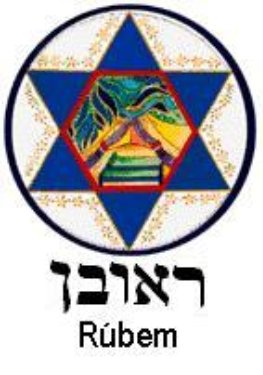


Image from www.israel-a-history-of.com

3-4.  REUBEN.  my first-born.  Reuben’s natural rights have been forfeited.  He has birth, dignity, opportunity; but no strength of character.  In the Scripture narrative, he appears as a man who begins good actions, but does not complete them.  Thus, he plans to save Joseph, and he actually prevents the murder, but Joseph is sold nevertheless.  Reuben’s descendants in Jewish history remain true to ancestral type.  When Deborah unfurled the banner of Israelitish independence in the days of the Judges, the tribes rallied round her.  In the camp of Reuben, however, there were great deliberations and mighty searchings of heart, but no action; see Judges v. 15.  Subsequently, the tribe of Reuben is rarely mentioned in Israel’s history.


my might. ‘As the first-born, Reuben is endowed with a superabundant vitality, which is the cause at once of his pre-eminence and his undoing’ (Skinner).


the excellency of dignity.  A Hebraism for ‘superior in dignity.’  Superiority in dignity and power belonged to the first-born.  Onkelos renders, ‘For thee it was provided to receive three portions, the right of first-born, the priesthood, and the kingdom.’  The first of these was given to Joseph, I Chron. V,1; the priesthood was given to Levi, Num. III,41; the kingly power or headship was allotted to Judah, see v. 8.


[RA] first yield of my manhood.  The word for “manhood,” ‘on, means “vigor,” but it is particularly associated with male potency.  “First yield,” rei’shit, is a word also used for crops.  The biological image of Reuben as the product of Jacob’s first inseminating seed sharpens the evocation in the next line of his violation of his father’s concubine.


4 Headlong like water-surpass no more!

For when you mounted your father’s bed,

then you defiled it-he mounted the couch!


 unstable as water.  Any breeze can ruffle its surface.  Or, ‘bubbling over like water,’ in uncontrolled vehemence of passion.  Reuben’s cardinal sin, says Jacob, was weakness of will, lack of self-control and firmness of purpose.


The Heb. word for ‘unstable’, pachaz,  means recklessness; the same root in Aramaic means ‘to be lascivious’.


have not thou the excellency.  i.e. ‘thou shalt forfeit thy privileges’ as the first-born.  None of the descendants of Reuben ever became Judge, Prophet, or leader.  Here Scripture stresses the idea that moral character is a more important factor than hereditary right.


he went up to my couch. The sudden change from the second tot he third person is due to Jacob’s loathing at the mere memory of Reuben’s offence; see on XXXV,22.


[EF] when you mounted . . .: Alluding to 35:21-22.

[RA] you’ll no more prevail! The verb here may rather mean “you’ll not remain” (or pun on that meaning)—a reference to the early disappearance of the tribe of Reuben, perhaps before the period of the monarchy.


the place where your father lay. The plural form used, mishkevei ‘avikha, has an explicitly sexual connotation, whereas the singualr mishkav can also mean simply a place where one sleeps.

you profaned my couch, you mounted!  The translation here emends ‘alah  (“he mounted”) to alita (“you mounted”), though there is some possibility that the archaic poetic style permitted this sort of abrupt switch in pronominal reference.


5 Shim’on and Levi, 

such brothers, 

wronging weapons are their ties-of-kinship!


Image from en.wikipedia.org

5-7. SIMEON AND LEVI

Simeon and Levi are brethren.  In violence.  See XXXIV,26f.  Moffatt translates:  ;Simeon and Levi are a pair.’

weapons of violence their kinship.  The phrase is also rendered, ‘instruments of cruelty are in their habitations’ (Onkelos, Kimchi, and AV).  The reference is evidently to their dealings in Shechem; see XXXIV.


[EF] ties-of-kinship: Hebrew obscure. Others use “weapons,” “swords” (B-R uses “mattocks”).


[RA]  their trade.  The meaning of mekheroteyhem is highly uncertain.  The translation here conjecturally links the term with the root m-kh-r, “to sell.”


6 To their council may my being never come,

in their assembly may my person never unite!

For in their anger they kill men,

in their self-will they maim bulls.


council. Or, ‘secret’l i.e. secret confederacy.


my glory. i.e. my soul; as in Psalm XVI,9. What lofty conception of both glory and soul, to make them synonymous as the Heb. language does!


men. The Heb. is in the singular, the word being used collectively.

they houghed oxen. A figure of vindictive destructiveness such as is recounted in XXXIV,28,29.  To ‘hough’ is to sever certain sinews and so render the animal helpless.  The mutilation of animals is not recorded in that chapter.  Many Versions therefore render, ‘they digged down a wall’ referring to the destrucgion of Shechem.  The Heb. words for ‘ox’ and ‘wall’ differ only in one dot.


[EF] in their anger they kill men: See 34:25-26.


[RA] let me never set foot.  Literally, “let my person not come.”

their assembly my presence shun. The Hebrew says literally, “in their assembly let my presence not join,” but this is clumsy as English, and in any case the point is that Jacob  is ostracizing the two brothers.’


they tore down ramparts. With many critics, the translation here reads shur, a poetic term for “wall,” instead of shor, “ox,” as the Masoretic Text has it.  The verb, if it refers to oxen, would mean “to maim” or “to hamstring.”  It was sometimes the ancient practice to hamstring the capture warhorses of an enemy, but it would have been foolish to hamstring captured oxen, which could be put to peaceful use.  Moreover, since Jacob is speaking of the massacre at Shechem, the narrative there explicitly noted that the cattle and other livestock were carried off, not maimed.


7 Damned be their anger, that it is so fierce!

Their fury, that it is so harsh!

I will split them up in Yaakov, 

I will scatter them in Yisrael.


cursed be their anger.  Jacob does not curse them but their sin, of which he could not have given a stronger condemnation.  It is characteristic of the untrustworthiness of the Samaritan text that instead of reading ‘Cursed be their anger, it has ‘How splendid is their anger!’


I will divide them in Jacob.  Fulfilled by the intermingling of the Simeonites in the inheritance of Judah (see Josh. XIX,1), and by the dispersion of the tribe of Levi among the other tribes of Israel.


8 Yehuda,

you-your brothers will praise you, 

your hand on the neck of your enemies! 

Your father’s sons will bow down to you.


8-12. JUDAH

Contrast the characterization of Reuben with Jacob’s jubilant praise of Judah.  Unlike Reuben, Judah has neither birthright nor the dignity or opportunity of the firstborn, but he has both strength and consistency of purpose. He knows his enemy, and—whether it be a person, an evil, or a cause—his hand is upon the enemy’s neck.  Capable indeed of falling into grievous error and sin, he is yet true at heart.  Judah’s character fits him to take the lead and rule.  He is the worthy ancestor of David, Isaiah and Nehemiah, the father of the royal tribe that led in the conquest of the Promised Land.


Judah, thee shall thy brethren praise.  Foretells Judah’s military glory in subduing the enemies of his brethren, the Philistines and Edomites, resulting in the acknowledgement of Judah as the national leader, or king.


[EF] Yehuda . . . enemies:  Heb. yehuda/atta yodukha ahikha/yadekha al oref oyevekha.


[RA]  Judah, you, shall your brothers acclaim. This line in the Hebrew is a fanfare of sound-play, including a pun on Judah’s name, Yehudah, ‘atah yodukha ‘aekha.  Up to this point, Jacob’s testament to his first three sons has actually been nothing but curses.  Rashi neatly catches the transitional force of “Judah, you . . .” when he notes, “Inasmuch as he had heaped condemnations on the previous ones, Judah began to back away and his father called to him with words of encouragement, ‘Judah, you are not like them.'”  Judah now displaces the three brothers born before him, and his claim to preeminence (“your brothers accalim”) is founded on his miltiary prowess (“your hand on your enemies nape”).  All this has a distinctly Davidic coloration.”Acclaim” is a more precise equivalent for the verb in context than the usual “praise” because what is involved is recognition of Judah’s royal status.


9 A lion’s whelp, Yehuda- 

from torn-prey, my son, you have gone up! 

He squats, he crouches, 

like the lion, like the king-of-beasts,

who dares rouse him up?


 lion’s whelp.  According to the Midrash, the emblem of the tribe of judah was a lion.  The metaphor suggests the vigour and nobility of Judah and his offspring; and the habitual swiftness and force of their military movements.


thou art gone up. The emblem of kingship.


from between his feet.  The figure is that of an Oriental king sitting, with the ruler’s staff between his knees; as can be seen on Assyrian and Persian monuments.


as long as men come to Shiloh.  Heb. ad ki yabo shiloh; ilit. ‘until Shiloh come”; or, ‘until that which is his shall come’; i.e. Judah’s rule shall continue till he comes to his own, and the obedience of all the tribes is his.  This translation may also mean that when the tribe of Judah has come into its own, the sceptre shall be taken out of its hands.


The explanation of this verse, especially of the Hebrew words is very difficult.  Some Jewish commentators have given it a Messianic meaning.  For the interpretation that it has been given in the Church, please read the subsequent post titled: 

Genesis/Bereshith 49:10 – ALLEGED CHRISTOLOGICAL REFERENCES IN SCRIPTURE.


the peoples. i.e. the tribes of Israel, as in Deut. XXXIII,3,19.

[EF] lion:  Eventually the symbol of the (Judahite) monarchy.

[RA] from the prey, O my son, you mount. Amos Funkenstein has astutely suggested to me that there is an ingenious double meaning here.  The Hebrew could also be construed as “from the prey of my son you mounted,” introducing a shadow reference to Judah’s leading part in the plan to pass off Joseph as dead.  When the bloodied tunic was brought to Jacob, he cried out, “Joseph is torn to shreds” (tarof toraf), and the term for “prey” here is teref.


you mount. This is the same verb that is used above for Reuben’s act of sexual violation, but here it refers to the lion springing up from the prey it has slain.  The proposal that the verb means “to grow” is forced, with little warrant elsewhere in the Bible.

the king of beasts.  this English kenning is necessary in the poetic parallelism because there are no English synonyms for “lion.” whereas biblical Hebrew has four different terms for the same beast.


10 The scepter shall not depart from Yehuda, 

nor the staff-of-command from between his legs,

until they bring him tribute, 

-the obedience of peoples is his.


[EF] until they bring . . .: Hebrew difficult; others use “until Shiloh comes.”  The phrase is an old and unsolved problem for interpreter and translator alike.


[RA] mace.  The Hebrew meoqeq refers to a ruler’s long staff, a clear parallel to “scepter.”  There is no reason to construe it, as some have done, as a euphemism for the phallus, though the image of the mace between the legs surely suggests virile power in political leadership.


that tribute to him may come. This is a notorious crux.  The Masoretic Text seems to read “until he comes to Shiloh,” a dark phrase that has inspired much messianic interpretation.  The present translation follows an exegetical tradition that goes back to the Middle Ages, which breaks up the word “Shiloh” and vocalizes it differently as shai lo.


11 He ties up his foal to a vine,

his young colt to a crimson tendril; 

he washes his raiment in wine, 

his mantle in the blood of grapes;


Instead of the translation, ‘Binding his foal unto the vine (also AV and RV), which would make Judah out to be a fool, render:

‘Harnessing his foal for (the produce of) one vine,

‘And his ass’s colt for (the produce of) one choice vine’–

which brings out in a striking figure the fruitfulness of Judah’s land: one ass is required to carry away the produce of one vine; and even one choice vine yields enough fruit for the load of an ass’s colt. This translation, founded on the interpretation of the Rabbis, is plainly indicated in Rashi and Rashbam; yet it has been overlooked by subsequent commentaries (Marcus Jastrow).

choice vine.  Heb. sorek, produced sweet grapes of superior quality. Grapes are to be abundant that the people of Judah might wash their garments in them.


[EF] colt: Of a donkey.


[RA] He binds to the vine his ass. The hyperbole has been explained most plausibly by Abraham ibn Ezra, “The yield of his vineyards will be so abundant that his ass can turn aside to the vine and he won’t care if it eats the grapes.”  this explanation jibes nicely with the next image of washing garments in wine—the wine will be so plentiful that it can be treated as water.

the blood of the grape.  This vivid poetic epithet for wine, with its intensifying effect, is reminiscent of the Ugaritic kenning for wine, “blood of the tree,” and hence a token of the stylistic antiquity of the poem.


12 his eyes, darker than wine,

his teeth, whiter than milk.


his eyes shall be red with wine.  This rendering is absurd.  According to it, Judah’s eyes are red from excessive drinking, and Jacob’s blessing is that judah should be a drunkard!  The word rendered ‘red’, however, means ‘sparkling’ (Septuagint, Gunkel, Gressman); and the correct translation of the verse is: ‘his eyes are more sparkling than wine.’


his teeth white with milk’  Does drinking milk produce white teeth?  The correct translation (Septuagint, Vulgate, Saadyah, Jastrow) is, ‘his teeth are whiter than milk’.


[RA] O eyes that are darker than wine.  The Hebrew, like this English version, gives no pronoun references for these striking images, though they presumably refer to Judah, whose descendants will flourish in beauty in the midst of their viticultural abundance.  The word for “darker,” akhlili, is still another rare poetic term, cognate with the Akkadian elelu “to be dark.”


13 Zevulun, 

on the shore of the sea he dwells;

he is a haven-shore for boats, 

his flank upon Tzidon.


13. ZEBULUN.  The favourable geographical position of Zebulun’s territory is described.


a shore for ships. To which they may come in safety.


Zidon.  The actual territory of Zebulum stretched from the Sea of Galilee to Mt. Carmel, close under Tyre and Zidon.


[EF] Tzidon:  Sidon, the important Phoenician city (north of Israel).


14 Yissakhar, 

a bone-strong donkey,

crouching among the fire-places.


14-15. ISSACHAR

large-boned ass. Indicating great physical power.


Image from www.marysrosaries.com

[RA] hearths.  The term occurs only here and in Judges 5:16.  Because of the pastoral setting of the latter text, it is frequently construed as “sheepfolds,” but the verbal stem from which it appears to derive means “to set a pot on the fire.”


15 When he saw how good the resting-place was, 

and how pleasant was the land, 

he bent his shoulder to bearing 

and so became a laboring serf.  


A resting-place.  As opposed to the wandering life of nomads (Ryle).


task work. Or, ‘tribute.’  Issachar, possessed of rich territory, preferred rather to submit to tribute than to leave his ploughshare and take up the sword.  See Deut. XXXIII,18.  Zunz translates ‘and yieldeth himself to the service of the labourer.’


 [EF]  laboring serf:  The Hebrew mas ‘oved denotes forced labor.


16 Dan,

his people will mete-out-judgment, 

(to all) of Israel’s branches together.


Image from mdiggs1234.hubpages.com

16-18.  DAN

shall judge.  Or, ‘shall defend,’ or, ‘avenge.’  Onkelos understood this to refer to the tribe of Dan in the days of Samson (Judg. XV,20).

his people. The tribe of Dan.


[EF] mete-out-judgment:  Others use “will endure.”


[RA] Dan, his folk will judge.  Dan has always been construed as the subject of the verb “judge” (or “govern”), not its object.  But Hebrew grammar makes it equally possible to read “Dan” as object of the verb, and that would explain the otherwise obscure second clause: in historical fact, the tribe of Dan, far from assuming a role of leadership, was obliged to migrate from south to north.  Despite its marginal existence, the Israelite people will judge or govern it as one of Israel’s tribes.


17 May Dan be a snake on the wayside, 

a horned-viper on the path, 

who bites the horse’s heels 

so that his rider tumbles backward.


a horned snake.  Is small, but highly venomous; it coils itself in the sand and, if disturbed, darts out upon any passing animal.  Dan will prove dangerous to his foes by ambuscades and guerilla warfare.


[RA] Let Dan be a snake on the road.  The sudden lethal attack from below on the roadside is an image of the tactic of ambush in guerilla warfare adopted against invaders by the Danite fighters.  Again, the image suggests that this tribe, unlike the others, did not enjoy the security of fortified settlement.


18 I wait-in-hope for your deliverance, O YHVH!


I wait for Thy salvation. Is probably intended as part of the blessing bestowed upon Dan, who was in the most exposed position among all the tribes of Israel.


Thy salvation. i.e. deliverance wrought by Thee.


[EF] I wait-in-hope . . .: Either a deathbed cry of possibly the cry of a falling rider (see the preceding line) (Ehrlich).


19 Gad, 

goading robber-band will goad him, 

yet he will goad at their heel.


19.  GAD

a troop shall troop. There is here, as in previous verses, a play upon the name.  Perhaps the translation should be ‘a raiding band raids him, but he will band himself against their heel’.

Gad succeeded in repelling the Ammonites, Moabites, and Arameans, who were constantly raiding his borders.  Jepththah was of this tribe.


[EF]  goad:  Lit. “attack”; a play on “Gad” (Heb. gad gedud yegudennu).


[RA] Gad shall be goaded by raiders. The sound-play in the Hebrew is gad gedud yegudenu.


yet he shall goad their heel. The phrase may be a reminiscence of “and you shall bite his heel,” which is addressed to the serpent in the Garden.  There would be a carryover, then, from the snake imagery of the preceding lines.  The snake, one should keep in mind, is not “demonic” but an image of darting, agile, lethal assault.


20 Asher, 

his nourishment is rich, 

he gives forth king’s dainties.


20.  ASHER

Asher.  The name Asher means ‘happy’ or ‘fortunate’ (see XXX,13); and this meaning is reflected in the blessing bestowed upon him.  The land of Asher was prosperous or happy; cf. Arabia Felix.


Image from ruthferraz.blogspot.com

royal dainties. Delicacies fit for the table of kings.  The allusion is probably to an export trade carried on by the men of Asher.


[RA]  Asher’s bread.  The Masoretic Text reads “from Asher, his bread,” but several ancient versions, quite plausibly, attach the initial consonant mem (“from”) to the end of the preceding word ‘aqev (“heel”), turning it into “their heel.”


21 Naftali, 

a hind let loose,

he who gives forth lovely fawns.


21.  NAPHTALI

hind let loose.  An image of swiftness and grace in movement.

he giveth goodly words. Refers to the tribe’s reputation for eloquence, and the great victory of Barak, a Naphtalite, which was followed by the glorious Song of Deborah (Kimchi).  Another translation is, “Napthtali is a slender terebinth, which putteth forth goodly branches.’ Joseph, too (next verse), is compared to a vine.


[RA] lovely fawns.  The Hebrew ‘imrei shafer is in doubt.  The translation follows one prevalent conjecture in deriving the first word from the Aramaic ‘imeir, which usually means “lamb.”


22 Young wild-ass, 

Yosef, 

young wild-ass along a spring,

donkeys along a wall.


22-26.  JOSEPH

Jacob reserves his softest and most loving accents for Joseph, who united whatever is best and noblest in both Reuben and Judah.  He is the man of vision, the man of dreams; but to this he joins moral and spiritual strength in all the vicissitudes of life.  He is the ideal son, the ideal brother, the ideal servant, the ideal administrator.  His character and story have from of old been held to be typical of the character and story of Israel.  Like Joseph, the Jew has been the dreamer of the ages, dreaming Israel’s dream of universal justice and peace and brotherhood. LIke Joseph, he has everywhere been the helpless victim of the hatred of his step-brethren, hatred that drove him from home and doomed him to Exile.  In that Exile, he has, like Joseph, times without number resisted the Great Temptation of disloyalty to the God of his fathers.  In the dreams of Joseph, the sun, the moon, the eleven stars bowed down to him.  It is the stars that bow to him, and not he to the stars. This is characteristic of both Joseph and Israel. Says Rabbi Yochanan . . . An Israelite should be ashamed to blame his star, his environment, or any outward circumstance for his moral downfall or his religious apostasy.  Man is captain of his own soul; and wherever there is a will to Judaism, there is a way to lead the Jewish life.


by a fountain. Cf. Psalm I,3; the proximity of water is a necessary condition, if the tree is to grow and bear fruit.


[RA] A fruitful son. The morphology of the reiterated noun in this line is so peculiar that some scholars have imagined a reference to branches, others to a wild ass.  There is little philological warrant for the former, and the connection between the term used here, porat, and pere’, “wild ass,” seems strained (The main argument for the wild ass is that it preserves the animal imagery, but there are several other tribes in the poem that have no animal icons.) A link between porat and the root p-r-h, “to be fruitful” is less of a grammatical stretch, and is encouraged by Joseph’s play on that same root in naming his son Ephraim.  Joseph and Judah, as the dominant tribes of the north and the south respectively, get far more elaborate attention in the poem than do any of their brothers.


daughters strode.  This is another crux because the verb “strode” appears to be in the feminine singular.  But there are good grounds to assume that the verbal suffix ah, which in normative grammar signals third-person feminine singular perfect tense, was also an archaic third-person plural feminine form.  There are a number of instances in which the consonantal texgt (ketiv) shows this form with a plural subject and the Masoretes correct it in the qeri (the indicated pronunciation) to normative grammar: e.g. Deuteronomy 21:7, “Our hands did not shed [ketiv:shafkhah] this blood.”  Without emendation, then, the text suggests that Joseph has the twin blessing of fruitfulness and military security.  The young women of the tribe can walk in safety alongside the rampart because they will be protected by Joseph’s valorous skill in battle (verses 23-24).


by a rampart.  This is the same word as the one at the end of verse 6.  There is scant warrant for extending it metonymically to “hillside,” as some translators have done.


23 Bitterly they shot at him,

the archers assailed him,


the archers.  His brethren.


dealt bitterly.  Harassed by hostile action.  In spite of attack, the strength of Joseph and his descendants is unimpaired, because the Almighty is with him.


24 yet firm remained his bow, 

and agile stayed his arms and hands- 

by means of the hands of Yaakov’s Champion, 

up there, 

the Shepherd, the Stone of Yisrael.


abode firm. i.e. continued strong.


made supple. Harassed by hostile action.  In spite of attack, the strength of Joseph and his descendants is unimpaired, because the Almighty is with him.


by the hands. Indicating the source of Joseph’s salvation.

the Mighty One of Jacob. A title of God.  see Is. I,24.

from thence. From the Mighty One of Jacob.


the Stone of Israel. A rare parallel to the better known ‘Rock of Israel’.


[EF]  arms and hands:  Lit. “arms of his hands.”


[RA] taut was his bow,/his arms ever-moving.  There is some doubt about “taut,” though the context makes this a reasonable educated guess.  There is also some dispute over the verb represented here as “ever-moving,” but its likely literal meaning is “to move about rapidly,” “to be nimble.”


through the hands. This picks up the previous phrase, referring to Joseph, which is literally, “the arms of his hands” (unless “of his hands” is a scribal slip, a dittography of the next word in the text).  In any case, the idea is that the hands of the human warrior are given strength by God’s hands.


through the name. Along with some of the ancient versions, the translation here reads mishem for the Masoretic misham, “from there,” which is obscure.


25 By your father’s God- 

may he help you, 

and Shaddai,

may he give-you-blessing: 

Blessings of the heavens,from above,

blessings of Ocean crouching below,

blessings of breasts and womb!


Three blessings are mentioned.


blessings of heaven. Rain and dew, sunshine and wind.

the deep. The subterranean reservoir of waters beneath, from which springs fertility to the soil.

the breasts. The fruitfulness of the familly.


[EF] Shaddai:  Once again connected to fertility (note the content of the following lines). give-you-blessing: Just as Yaakov had blessed Yosef’s sons, so Yosef is the only one of the twelve brothers to whom Yaakov applies the term.


[RA] blessings of breasts and womb.  The fertility of the female body is aligned with the fertility of creation, the heavens aboe and the deep below—a correspondence not lost on the bawdy fourteenth-century Hebrew poet Emanuel of Rome, who exploited this verse in an erotic poem.


26 May the blessings of your father transcend 

the blessings of mountains eternal, 

the bounds of hills without age. 

May they fall upon the head of Yosef, 

on the crown of the consecrated-one among his brothers.


are mighty beyond. The verse states that the blessings received by Jacob surpass the blessings vouchsafed to Jacob’s fathers.  Jacob now bestows these enhanced blessings upon Joseph, thereby making him the heir both of himself and of his ancestors.

unto the utmost bound of the everlasting hills.  As high above the blessings bestowed on Jacob’s father as the hills are above the plains.


prince. lit. ‘that is separate from his brethren’, i.e. apart from eminent, among his brethren.


[EF]  mountains:  Reading hararet for the traditional Hebrew horei, “parents” on the basis of Hab. 3:6.

[RA] the blessings of timeless heights,/the bounty of hills everlasting.  The Masoretic Text is not really intelligible at this point, and this English version follows the Septuagint for the first part of the verse, which has the double virtue of coherence and of resembling several similar parallel locutions elsewhere in biblical poetry.  Instead of the Masoretic Text’s horai ‘ad (“my forebears” [?] “until” [?], the Septuagint has the equivalent in Greek of the idiomatic harerei ‘ad (“timeless heights”).  The noun ta’awat that immediately follows may also reflect a defective text but it could mean “that which is desired,” hence, “bounty” or “riches.”  The apparent sense of the whole line is: the blessings granted Joseph and his fathers will be even greater than the blessings manifested throughout time in the natural world, as seen in the verdant, fruit-bearing hillsides.

the brow. The Hebrew is actually a poetic synonym for “head” (something like “pate”), but “brow” is used here for the sake of the English idiom of blessings, or honors, resting on that part of the anatomy.


27 Binyamin, 

a wolf that tears-to-pieces! 

In the morning he devours prey, 

and then, in the evening, divides up the spoil.


27.  BENJAMIN

Image from www.marysrosaries.com

a wolf that raveneth.  Or, ‘that teareth,’ referring tot he warlike character of the tribe; see Judg. v, 15 and XX,16.  


[RA] Benjamin, ravening wolf.  The last brief vignette of the poem, for the youngest of the twelve sons, is one of its sharpest images of death-dealing animals, and later biblical accounts, especially in Judges, indicate that the tribe of Benjamin was renowned for its martial prowess.

the spoils. The rare noun ‘ad has been variously construed as “prey” (because of the wolf image) and “enemy,” and the compactness of the line even leaves doubt as to whether it is a noun and not an adverb (revocalizing ‘ad as ‘od,  “still”).  But both its sole other occurrence in the Bible (Isaiah 33:23) and the poetic parallelism argue for the sense of spoils.


28 All these are the tribes of Israel, twelve, 

and this is what their father spoke to them; 

he blessed them, 

according to what belonged to each as blessing, he blessed them.


twelve tribes. Joseph, and not his sons, receives the blessings.  Jacob in blessing his sons was at the same time blessing the future tribes.


every one. Received his appropriate blessing.  The future would prove the prophetic nature of their father’s benediction.

[EF] tribes:  Heb. shevatim, “staffs,” which symbolized the tribes.


29 And he commanded them, saying to them:

I am now about to be gathered to my kinspeople;

bury me by my fathers,

in the cave that is in the field of Efron the Hittite,


in the cave that is in the field of Ephron the Hittite. Jacob in his last words to his sons exhibits an elaborate consciousness of the legal transaction between his grandfather and Ephron the Hittite.  Like the account of the purchase in chapter 25, he emphasizes the previous owner, the exact location of the property, and the fact that it was acquired as a permanent holding.  Thus, at the end of Genesis, legal language is used to resume a great theme—that Abraham’s offspring are legitimately bound to the land God promised them, and that the descent into Egypt is no more than a sojourn.


30 at the cave that is in the field of Makhpela, that faces Mamre, in the land of Canaan. 

-Avraham had acquired that field from Efron the Hittite, as a burial holding.

31 There they buried Avraham and Sara his wife, 

there they buried Yitzhak and Rivka his wife, 

there I buried Lea-


[EF] Lea: Not called “my wife.”  Again the old feelings remain vivid.


32 an acquisition, the field and the cave that is in it, from the Sons of Het.


purchased from the children of Heth. With their knowledge and consent (Abarbanel).  Joseph, having been away from Canaan for so many years receives explicit directions as to the spot where his father is to be buried.  This verse implies a deed of purchase.


33 When Yaakov had finished commanding his sons,

he gathered up his feet onto the bed and expired, 

and was gathered to his kinspeople.


gathered up his feet.  He had been sitting; he now lay down in bed.

and was gathered unto his people. This passage shows that not burial of the body is meant but the soul’s departure to join the souls of those who had gone before.



Genesis/Bereshith 48 – “Here, I am dying, but God will be with you . . .”

[As usual, in our thinking aloud while rereading the final chapters in this book of beginnings . . .
  • Here is yet another switching of the younger for the older son in the bestowal of blessing upon the firstborn.  
  • As dim as the eyes of Jacob were and even with Joseph’s guidance on which grandson to place his right hand, still he knew which grandson would fulfill the tribal destiny for greatness and switches his hands upon the grandsons. 
  • Then he claims these two sons of Joseph—that adds up to 14, with Joseph getting additional portions besides his own. 

— as his own, 

—with rights equal to the 12. 

  • ArtScroll Comment: “The blessing included a major change in the composition of the Jewish people, in that Jacob elevated Manasseh and Ephraim to the status of his own sons — in effect adopting them as his own — thereby removing the firstborn status from the tribe of Reuben and giving it to Joseph’s offspring. . . [prayer of blessing] Jewish parents will always remember that Joseph’s sons were elevated to the status of full-fledged tribal fathers.”
  • S6K Comment:  Wouldn’t that make his brothers even more jealous now, And what about all the other grandchildren listed among the 66, what effect would this have on their thinking if any?

—except that they’re still in grateful-mode 

—plus they have their past evil deeds to make up to Joseph, 

—and they’re now the beggars, who are they to complain?

—-Plus the children yet to be born from Joseph?

We have to ask, what exactly is Jacob bequeathing to his progeny?   What is there to inherit at this point in their history?  

They are on foreign soil, whatever possessions they did have would go to buying food during the famine.

And the land they had just left behind —Canaan—was not yet theirs.  While Ur and Haran were ‘home’ 2-3 generations ago, surely there’s no returning to scheming grand-uncle Laban.   If you were in Ephraim and Manasseh’s situation—-

—half-breeds, 

—Egypt-born,

—brought up in relative comfort and prosperity 

—by a honcho Hebrew father and Egyptian mother

—exposed to Egyptian culture and way of life, 

what would you be thinking?  Your father looks more Egyptian than Hebrew in your eyes,  that is why your uncles didn’t even recognize him.  And now, since Goshen is where all your father’s people will live as shepherds,  are you going to live there too?

Are we allowed to speculate this much when we read these biblical narratives?  Isn’t this what the rabbis do?  As long as we don’t transmit it as ‘gospel truth,’ if it helps other readers to understand that even with different social and cultural and historical-time orientations, people share common sentiments when it comes to family relationships, inheritance rights, sibling rivalry and power play. The “I” part always gets in the way, as in “what’s in it for me?”


Joseph is one of the few biblical characters (like Joshua and Daniel) who have no blights on their record. Even his deception of his brothers was meant for good!  Of the 12, he personally experienced and understood divine providence and attributed his bad and good fortune, and all his giftings, talents, opportunities and blessings to the Elohiym of Jacob, Isaac, and Abraham.


Unbracketed commentary is from Pentateuch and Haftorahs, ed. Dr. J.H. Hertz;  additional commentary from RA/Robert Alter and  EF/Everett Fox, translator of The Five Books of Moses.]

———————

Genesis/Bereshith 48


[EF]  Yosef’s Sons Blessed: Yaakov, near to death, blesses his grandsons (Rahel’s!) in moving terms, bringing full circle many of the motifs of his life.  Elder and younger sons are switched by the blind Patriarch, who this time, though, is one who is fully aware of their identities.  As in both literature and life, a dying man sees both past (here) and future (the next chapter) with great clarity, as in a vision.
1 Now after these events it was
that they said to Yosef: 
Here, your father has taken sick! 
So he took his two sons with him, Menashe and Efrayim. . . .

took with him his two sons. That Jacob might bless them before his death.

[RA] And he took his two sons with him. Joseph, even before he receives any word from his father in this regard, anticipates that Jacob will confer some sort of special eminence on his own two sons in a deathbed blessing, and so he brings them with him.

2 When they told Yaakov, saying: Here, your son Yosef is coming to you, 
Yisrael gathered his strength and sat up in the bed.

Israel strengthened himself.  He exerted himself and sat up, with his feet on the ground.

3 Yaakov said to Yosef: 
God Shaddai was seen by me 
in Luz, in the land of Canaan; 
he blessed me

God Almighty. Heb. ‘El Shaddai’.

Luz. i.e. Beth-el, see XXVIII,19.

[RA] Luz.  This is the older name for Beth-El, where Jacob was vouchsafed his dream-vision of divine messengers ascending and descending the ramp to heaven.

4 and he said to me:
Here, I will make you bear fruit and will make you many, 
and will make you into a host of peoples; 
I will give this land to your seed after you, as a holding for the ages!

an everlasting possession. In spite of temporary loss, the children of Israel have an inalienable right tot he Land of promise.

5 So now, 
your two sons who were born to you in the land of Egypt
before I came to you in Egypt, 
they are mine,
Efrayim and Menashe,
like Re’uven and Shim’on, let them be mine!

and now. Jacob adopts the two sons of Joseph, Ephraim and Manasseh, born before he came to Egypt, thus making them equal to any of his other sons.  By giving him  a double portion of his inheritance, he transferred to Joseph the rights of the true firstborn.

[EF] they are mine:  As it were, adopted.  Efrayim and Menashe:  Note how Yaakov reverses the order of birth, see. vv14:17-19.

[RA] your two sons . . . shall be mine—Ephraim and Manasseh, like Reuben and Simeon, shall be mine.  These words are equally fraught with thematic and legal implications.  Jacob explicitly equates Joseph’s two sons with his own firstborn and second-born, intimating that the former are to have as good an inheritance, or better, as the latter, and once more invokes the great Genesis theme of the reversal of primogeniture.  (Note that he already places Ephraim, the younger, before Manasseh when he names Joseph’s sons.)  The fact that Reuben has violated Jacob’s concubine and Simeon (with Levi) has initiated the massacre at Shechem may suggest that they are deemed unworthy to be undisputed first and second in line among Jacob’s inheritors.  The language Jacob uses, moreover, is a formula of legal adoption, just as the gesture of placing the boys on the old man’s knees (see verse 12) is a ritual gesture of adoption.  The adoption is dictated by the fact that Ephraim and Manasseh will become tribes, just as if they were sons of Jacob.

6 But your begotten sons, whom you will beget after them,
let them be yours;
by their brothers’ names let them be called, respecting their inheritance.

called after the name of their brethren.  They will be included in the tribe of Ephraim or in the tribe of Manasseh.

[RA]  And those you begot after them.  It is difficult to square this phrase with the narrative as we have it, which indicates that Joseph has only two sons.  The efforts of some commentators to make the verb a future is not at all warranted by the Hebrew grammar, and, in any case, Joseph has been married more than twenty-five years.

by their brothers’ names they shall be called in their inheritance.  Although the idiom is familiar, the meaning is not entirely transparent.  What Jacob probably is saying is that it is Ephraim and Manasseh who will have tribal status in the future nation, and thus any other sons of Joseph would be “called by their name,” would have claim to land that was part of the tribal inheritance of Ephraim and Manasseh and so designated.

7 While I-
when I came back from that country,
Rahel died on me,
in the land of Canaan,
on the way, with still a stretch of land left to come to Efrat.
There I buried her, on the way to Efrat-that is now Bet-lehem.

Rachel.  These words, it seems, Jacob spoke to himslef; otherwise he would have said, ‘thy mother.’  It is to honour Rachel, the sorrow of whose loss haunts him all his life, that Jacob adopts her grandchildren as his own sons.  Instead of being the mother of only two tribes, she will now be accounted the ancestress of three, her honour and esteem increasing accordingly (Herxheimer, S.R. Hirsch).

unto me. Or, ‘to my sorrow’ (RV); cf. XXXIII,13.

[EF] Rahel died on me:  The memory is still painful to Yaakov, even after many years.

[RA] As for me, when I was coming from Paddan, Rachel died.  This verse is one of several elements in this chapter that have been seized on by textual critics as evidence of its highly composite nature and of what is claimed to be a concomitant incoherence in its articulations.  But such conclusions seriously underestimate the degree of integrative narrative logic that the writer—or perhaps one must say, the redactor—exhibits.  At first glance Jacob’s comment about the death of his beloved Rachel in the midst of blessing his grandsons seems a non sequitur.  It is, however, a loss to which he has never been reconciled (witness his extravagant favoritism toward Rachel’s firstborn). His vivid sense of anguish, after all these decades, is registered in the single word ‘alai (“to my grief,” but literally, “on me,” the same word he uses in 42:36, when he says in 42:36, when he says that all the burden of bereavement is on him), and this loss is surely uppermost in his mind when he tells Pharaoh that his days have been few and evil.  On this deathbed, then, Jacob reverts obsessively to the loss of Rachel, who perished in childbirth leaving behind only two sons, and his impulse to adopt Rachel’s two grandsons by her firstborn expresses a desire to compensate, symbolically and legally, for the additional sons she did not live to bear.

8 When Yisrael saw Yosef’s sons, he said:
Who are these?

beheld.  He is on his deathbed with eyes dimmed by the mist that would soon close them forever.  He does not know his grandchildren who accompany their father.  He discerned faintly the figures of the young men but could not distinguish their features; see v. 10.

[RA]  Who are these? Perhaps as several commentators have proposed, he could barely make out their features because he was virtually blind (see verse 10).  “And Israel saw,” then, would mean something like “he dimly perceived,” and it need not be an out-and-out contradiction of the indication of blindness in verse 10.  But the question he asks might also be the opening formula in the ceremony of adoption.

9 Yosef said to his father:
They are my sons, whom God has given me here.
He said:
Pray take them over to me, that I may give-them-blessing.
10 Now Yisrael’s eyes were heavy with age, he was not able to see.
He brought them close to him,
and he kissed them and embraced them.

could not seeClearly; hence his question when seeing Joseph’s sons, ‘Who are these?’

11 Yisrael said to Yosef:
I never thought to see your face (again),
and here, God has let me see your seed as well!

[EF] your face: The final and more powerful occurrence of the term.

12 Yosef took them from between his knees
and they bowed low, their brows to the ground.

from between his knees. To place a child upon the knees was the symbol of adoption.  Joseph’s sons had thus been placed upon or between the knees of Jacob.  This having been done, Joseph removes them.

fell down on his face.  In gratitude to his father.

13 Yosef took the two of them,
Efrayim with his right-hand, to Yisrael’s left,
and Menashe with his left-hand, to Yisrael’s right,
and brought them close to him.

Jacob was now to bless the lads.  Joseph places Manasseh, the first-born, opposite to Jacob’s right hand. This position was the station of honour.

14 But Yisrael stretched out his right-hand and put it on the head of Efrayim-yet he was the younger!-
and his left-hand on the head of Menashe;
he crossed his arms, although Menashe was the firstborn.

guiding his hands wittingly.  Jacob against Joseph’s wish, places the younger above the elder.  This is the first instance in Scripture of the laying on of the hands in blessing.

[RA] he crossed his hands. This image, extended in the exchange with Joseph in which the old man says he knows what he is doing, is a kind of summarizing thematic idiogram of the Book of Genesis:  the right hand of the father conferring the blessing reaches across to embrace the head of the younger brother, and the elder, his head covered by the old man’s left hand, receives a lesser blessing.

15 Then he blessed Yosef and said:
The God
in whose presence my fathers walked,
Avraham and Yitzhak,
the God
who has tended me
ever since I was (born), until this day-

blessed JosephBy blessing his children (Rashbam).

[EF] tended: Or “shepherded.”

[RA] the name of my fathers, Abraham and Isaac,’let them teem multitudinousJacob after recapitulating the story of his personal providence in the first line of the blessing-poem, invokes the benediction of the patriarchal line, and then, going back still further in the biblical history, the promise or injunction, of fertility from the Creation story.

16 the messenger
who has redeemed me from all ill-fortune,
may he bless the lads!
May my name continue to be called through them
and the name of my fathers, Avraham and Yitzhak!
May they teem-like-fish to (become) many in the midst of the land!

the angel. This verse is connected with the preceding verse.  The Jonathan Targum paraphrases:  “The God whom my fathers Abraham and Isaac worshipped, the God who hath nourished me all my life long unto this day—may it be Thy will that the angel whom Thou didst appoint to redeem me from all evil, bless the lads.’

let my name be named in them. i.e., ‘may they be worthy of having their names coupled with my own, and those of my ancestors Abraham and Isaac’ (Sforno).

[EF] redeemed me from all ill-fortune: Despite his words in 47:9, perhaps Yaakov achieves a measure of peace in the end.  my name continue to be called through them:  My line continue through them.  teem-like-fish: Others use “become teeming (multitudes).”

17 Now when Yosef saw that his father had put his right hand on Efrayim’s head,
it sat ill in his eyes,
and he laid hold of his father’s hand, to turn it from Efrayim’s head to Menashe’s head.

it displeased himSeeing his father place the younger son above the elder.  What is narrated in v. 17-19 happened before the blessing was given (Rashbam).

he held up. He grasped.

18 Yosef said to his father:
Not so, father, indeed, this one is the firstborn, place your hand on his head!
19 But his father refused and said:
I know, my son, I know-
he too will be a people, he too will be great,
yet his younger brother will be greater than he, and his seed will become a full-measure of nations!

I know it. ‘That Manasseh is the firstborn’ (Rashi).

his younger brother shall be greater.  Just as if he had been endowed with his birthright.  The younger brother in Scripture is at times preferred to the elder.  Abel, Abraham, Isaac, Moses and DAvid afford striking instances of this fact.

a multitude. lit. ‘fullness’,

[EF] I know:  Though blind, Yaakov knows exactly what he is doing, unlike his father in Chap. 27.

20 So he blessed them on that day,
saying:
By you shall Israel give-blessings, saying:
God make you like Efrayim and Menashe!
Thus he made Efrayim go before Menashe.

By thee shall Israel bless. To this day, every pious Jewish father on Sabbath eve places his hands on the head of his son, and blesses him in the words: ‘God make thee as Ephraim and Manasseh’ (Authorised Prayer Book, p. 122).  Ephraim and Manasseh would not barter away their ‘Jewishness’ for the most exalted social position, or the most enviable political career, in the Egyptian state.  They volunterily gave up their place in the higher Egyptian aristocracy, and openly identified themselves with their ‘alien’ kinsmen, the despised shepherd-immigrants.  Every Jewish parent may well pray that his children show the same loyalty to their father and their father’s God as did Ephraim and Manasseh.

[RA] And he blessed them that day. The introduction of a second blessing is hardly evidence of a glitch in textual transmission.  After the exchange with Joseph, which follows the full-scale blessing and also explains its implications, Jacob reaffirms his giving precedence to Ephraim over Manasseh (a real datum of later tribal history) by stating a kind of summary blessing in which the name of the younger precedes the name of the elder.  “By you shall Israel bless” is meant quite literally: when the future people of Israel want to invoke a blessing, they will do it by reciting the words, “May God set you as Ephraim and Manasseh.”

21 Then Yisrael said to Yosef:
Here, I am dying,
but God will be with you,
he will have you return to the land of your fathers.
22 And I, I give you
one portion over and above your brothers,
which I took away from the Amorite,
with my sword, with my bow.

This verse is the blessing addressed to Joseph personally.

portion. Heb. shechem. The reference is to the plot of ground purchased by Jacob from Hamor at Shechem; see XXXIII,19.  It seems from the context that this plot of land had fallen into the hands of the Amorites, and had been retaken from them by force of arms.  Jacob’s military exploit is not elsewhere mentioned.

above thy brethren.  i.e. more than thy brethren.  Some commentators explain the exgtra portion bestowed upon Joseph as referring to the privilege accorded to his two sons in being accounted equals of the other tribes.

[EF] one portion over and above:  Hebrew unclear.  We do not know to what event Yaakov is referring in this entire verse.  took away:  Others use “will take,” “must take.”

[RA] I have given you with single intent over your brothers what I took from the hand of the Emorite. The phrase represented here by “with single intent” is a notorious crux, but previous interpreters may have been misled by assuming it must be the object of the verb “have given.”  The Hebrew shekhem ‘aad means literally “one shoulder.”  Many commentators and translators, with an eye to the immediate context of inheritance, have construed this as “one portion,” but the evidence elsewhere in the Bible that shekhem means “portion” is weak.  Others have proposed, without much more warrant than the shape of the shoulder, that the word here means “mountain slope.”  A substantial number of scholars, medieval and modern, read this as a proper noun, the city of Shechem, encouraged by the fact that the Joseph tribes settled in the vicinity of Shechem. That construction, however, entails two difficulties:  if the city were referred to, a feminine form of the word for “one” (not ‘aad but ‘aat) would be required; and at least according to the preceding narrative, Jacob, far from having conquered Shechem with his own sword, was horrified by the massacre his sons perpetrated there.  But the very phrase used here, shekhem ‘aad, occurs at one other place in the Bible, Zephaniah 3:9, where it is used adverbially in an idiomatic sense made clar by the immediate context:  “for all of them to invoke the name of the LORD,/to serve Him shekhem ead [King James Version, with one consent; Revised English Bible and New Jewish Publication Society Bible, with one accord].”  This is then, an expression that indicates concerted unswerving intention and execution, and as such is perfectly appropriate to the legal pronouncement of legacy by Jacob in which it appears.  Once the phrase is seen as adverbial, the relative clause, “what I took . . .,” falls into place with grammatical preciseness as the object of the verb “have given,” and in this reading, no particular city or region need be specified.

Test Of True Greatness

[This is from a former Christian pastor whose teachings to his flock have been shared with Sinaite BAN.  He has been a regular contributor, please read his previous posts:
The original format which was in the form of preaching notes has been revised according to S6K format. The opinions expressed are the Pastor’s and not necessarily S6K.–Admin1.]

Sabbath 3-29-2014

Lesson Notes of Ricky Samson

Gen 22 – Test Of True Greatness

Image from www.ligonier.org

Genesis 22:1-2 NKJV

1]  Now it came to pass after these things that God tested Abraham, and said to him, “Abraham!” And he said, “Here I am.”

2]  Then He said, “Take now your son, your only son Isaac, whom you love, and go to the land of Moriah, and offer him there as a burnt offering on one of the mountains of which I shall tell you.”

Genesis 22:1-2 AHRC-RMT (Ancient Hebrew Research Center- Revised Mechanical Translation)

1]  and it came to pass after these words and the Elohiym [Powers]greatly tested Avraham [Father lifted] and he said to him, Avraham [Father lifted], and he said here am I,

2]  and he said, please take your son, your solitary one which you love, Yits’hhaq [He laughs] and you will walk to the land of Moriyah [Appearance of Yah] and make him go up there for a rising upon one of the hills which I will say to you,

Key Questions:

  • 25 years after calling Avraham out of Ur, YHWH gave him a son, Isaac.
  • 13 years later, YHWH greatly tested Avraham … his final exam… why?
  • YHWH asked Abraham to offer his son Isaac as a burnt offering …
  • Is this test consistent with the character of God?
  • How is this related to YHWH’s promise in Bereshit 12 when He called Abram out of Ur?

Genesis 12:1-3 NKJV

1]  Now the LORD [YHWH] had said to Abram: “Get out of your country, From your family And from your father’s house, To a land that I will show you.

2]  I will make you a great nation; I will bless you And make your name great; And you shall be a blessing.

3]  I will bless those who bless you, And I will curse him who curses you; And in you all the families of the earth shall be blessed.”

Torah Insights:

Bereshit 22 is actually a fulfillment of the promises YHWH made to Abraham in Bereshit 12 when He called Abram out of his country.

For 38 long years, YHWH was moulding Abraham to true greatness.

We discover that YHWH is not only interested in declaring Abram righteous (Bereshit 15:6)  – which is the focus of most man-made “religions” —

Bereshit 22 shows us that The Ultimate Goal of YHWH is to show to the world that Abraham, representing His  covenant people, has reached True Greatness!

Truly Great people are willing to obey YHWH

no matter what the cost!

~~~~~~~~~~~~~~~~~~~~~~~~~~~~~~~~~~~~~~

Hebrew Word Study:

~~~~~~~~~~~~~~~~~~~~~~~~~~~~~~~~~~~~~~

“Tested” — Strong’s H5254

נסה  nâsâh

BDB (Brown-Driver-Briggs) Definition:

1) to test, try, prove, tempt, assay, put to the proof or test

~~~~~~~~~~~~~~~~~~~~~~~~~~~~~~~~~~~~~~

Hebrew Ancient Pictograph of  נסה  nâsâh

1314) action: Lift concrete: Standard (flag) abstract: Refuge:

The pictograph n is a picture of a seed representing continuance,

the x is a picture of a thorn representing the idea of grabbing hold.

Combined these mean “continue to grab hold”.

The tribal flag that is hung from a horizontal pole and lifted up high

and seen from a distance.

H) action: Test co: ? ab: ?: A test to prove one is deserved of being lifted up.

~~~~~~~~~~~~~~~~~~~~~~~~~~~~~~~~~~~~~~

World’s Concept of Greatness

~~~~~~~~~~~~~~~~~~~~~~~~~~~~~~~~~~~~~~

When we talk of greatness, we have to make sure that we are looking at this from YHWH’s perspective rather than the world’s perspective.

Once again, the perspective of the world is very different from the perspective of YHWH

In the world’s perspective, greatness is associated with a great career or performance like that of an athlete.  Think of the basketball “great” Michael Jordan – or the boxing “great” M Ali – Or Pop star Michael Jackson –

The following are the world’s characteristics of greatness:

1] Based on the performance of a person in comparison to the performance of others in the same field at the same time.

2] Whether someone is great or not is determined by other people who “judge” their performance.

Therefore, by definition, only a “few” can be great. A competition means there is only one winner.

Therefore, the majority of people become spectators who simply “identify” with their “great heroes”. They imagine that whatever their hero does, they also do.  They are the ones scoring the points. But in reality they are just spectators!

In many ways,  church services have become a spectator sport.

Great preachers are “applauded”. Not so great preachers are “criticized”.  Worshippers sit on pews, expecting to be entertained by the “worship leader”.

In contrast, Abraham was all alone on the stage of YHWH.

There were no “spectators” to applaud or boo him. Only YHWH’s eyes and judgment were important.

In contrast to the world’s perspective, Abraham was very old, 113 years old!

Most of the world’s great are retired by 30!


YHWH’s test of greatness was not related to a skill that Abraham had.

It was not related to the amount of wealth that Abraham possessed.

It was not related to the amount of knowledge in Abraham’s head.

It was not related to Abraham’s age.


YHWH’s test of greatness was related to Abraham’s heart.

It was related to Abraham’s RELATIONSHIP with YHWH.

~~~~~~~~~~~~~~~~~~~~~~~~~~~~~~~~~~~~~~

Purpose of YHWH’s Test:

~~~~~~~~~~~~~~~~~~~~~~~~~~~~~~~~~~~~~~

Genesis 22:11-12 NKJV

11]  But the Angel of the LORD [YHWH] called to him from heaven and said, “Abraham, Abraham!” So he said, “Here I am.”

12]  And He said, “Do not lay your hand on the lad, or do anything to him;for now I know that you fear God, since you have not withheld your son, your only son, from Me.”

YHWH tests His people to expose what is really in their hearts.

YHWH wants to know if His people “fear” Him / love Him.

Will they obey Him fully despite any obstacle?

YHWH’s “tests” are not the same as the tests we used to have in school.

YHWH’s tests are NOT MEANT to fail us or embarrass us!

In school, we could fail the tests!

We cannot fail YHWH’s tests.

YHWH prepares us, like a refinery,  to make sure that by His grace,

we will pass His test with flying colors!

An important thought to consider is that in school, we could pass the test by “cheating”.  We cannot cheat YHWH’s tests.  Unlike our school teachers, YHWH sees everything we do.

From this we can deduce that to YHWH,  the “externals” –  the way we look, the way we dress, the rites/rituals we perform are less important to YHWH.

It is what is in our hearts that is important.

This deduction is confirmed in other parts of Scripture. Here is the advice that YHWH gives to the prophet Samuel when Samuel was ordered to select a king for Israel:

1 Samuel 16:7 NKJV

7]  But the LORD [YHWH] said to Samuel, “Do not look at his appearance or at his physical stature, because I have refused him. For the LORD [YHWH] does not see as man sees; for man looks at the outward appearance, but the LORD [YHWH] looks at the heart.”

King David understood YHWH well and in his “confession” psalm, he prayed:

Psalms 51:6, 16-17 NKJV

6]  Behold, You desire truth in the inward parts, And in the hidden part You will make me to know wisdom.

16]  For You do not desire sacrifice, or else I would give it; You do not delight in burnt offering.

17]  The sacrifices of God are a broken spirit, A broken and a contrite heart– These, O God, You will not despise.


Therefore, if one’s heart is not right, his sacrifices and prayers are an abomination to YHWH who sees what is in his heart. King Solomon, son of King David, understood this principle well:

Proverbs 15:8-9 NKJV

8]  The sacrifice of the wicked is an abomination to the LORD [YHWH] , But the prayer of the upright is His delight.

9]  The way of the wicked is an abomination to the LORD [YHWH], But He loves him who follows righteousness.

All of YHWH’s people will go through similar tests as Abraham.

Moses clearly taught this concept of testing:

Deuteronomy 8:2-3 NKJV

2]  And you shall remember that the LORD  [YHWH]your God led you all the way these forty years in the wilderness, to humble you and test you, to know what was in your heart, whether you would keep His commandments or not.

3]  So He humbled you, allowed you to hunger, and fed you with manna which you did not know nor did your fathers know, that He might make you know that man shall not live by bread alone; but man lives by every word that proceeds from the mouth of the LORD.

King David also understood this concept of “testing”:

Psalms 11:5 NKJV

5]  The LORD [YHWH] tests the righteous,
But the wicked and the one who loves violence His soul hates.

Psalms 17:3 NKJV

3]  You have tested my heart; You have visited me in the night; You have tried me and have found nothing; I have purposed that my mouth shall not transgress.

 Psalms 66:10 NKJV

10]  For You, O God, have tested us;
You have refined us as silver is refined.

David’s son, King Solomon, the wisest of all men, also understood:

Proverbs 17:3 NKJV

3]  The refining pot is for silver and the furnace for gold,
But the LORD [YHWH] tests the hearts.

The prophet Isaiah predicts this testing:

Isaiah 48:10-11 NKJV

10]  Behold, I have refined you, but not as silver; I have tested you in the furnace of affliction.

11]  For My own sake, for My own sake, I will do it; For how should My name be profaned? And I will not give My glory to another.

The prophet Zechariah talks about this testing in the “end times”

Zechariah 13:9 NKJV

9]  I will bring the one-third through the fire, Will refine them as silver is refined, And test them as gold is tested. They will call on My name, And I will answer them. I will say, ‘This is My people’; And each one will say,’The LORD [YHWH] is my God.’ “

 ———————————————————————

Side Note: How is Silver Refined?

Silver is purified through a somewhat complicated chemical process. First, the processed silver is covered in nitric acid. Next, it is heated, strained, and added to cold water. It is filtered again, and then copper is inserted into the liquid to extract the pure silver.

Reference: www.amateurpyro.com

It is burned in the hottest part of the fire. If the silver is left in the fire to long it will be completely destroyed. Heat is the purifier.

http://answers.ask.com/Society/Other/how_is_silver...

~~~~~~~~~~~~~~~~~~~~~~~~~~~~~~~~~~~~~~

THE FOCUS OF SCRIPTURE

~~~~~~~~~~~~~~~~~~~~~~~~~~~~~~~~~~~~~~

Did you notice the focus of scripture?

It is on YHWH refining His people so that they will love Him with all their hearts, soul, and strength and demonstrate this love with 100% obedience!

This is in contrast to the focus of modern day religion which is trying to focus us on a Messiah that is EXTERNAL to us and on the  sacrifice of this Messiah rather than on focussing on our obedience to YHWH!

Focussing on someone else’s sacrifice, no matter how great that sacrifice is, will not lead anyone to greatness. People become SPECTATORS.

The focus on obedience to YHWH will lead to greatness.

The main characteristic of those who make it to YHWH’s hall of fame is their FAITH IN YHWH THAT LEADS THEM TO OBEDIENCE EVEN THOUGH YHWH’S COMMAND DOES NOT MAKE ANY “HUMAN SENSE”.

Here is a warning from the Torah about people who lead you to focus on another “god” that is different from YHWH, even if this person performs “signs and wonders”:

Deuteronomy 13:1-18 NKJV

1]  “If there arises among you a prophet or a dreamer of dreams, and he gives you a sign or a wonder,

2]  and the sign or the wonder comes to pass, of which he spoke to you, saying, ‘Let us go after other gods’–which you have not known–‘and let us serve them,’

3]  you shall not listen to the words of that prophet or that dreamer of dreams, for the LORD your God is testing you to know whether you love the LORD your God with all your heart and with all your soul.

4]  You shall walk after the LORD [YHWH] your God and fear Him, and keep His commandments and obey His voice; you shall serve Him and hold fast to Him.

5]  But that prophet or that dreamer of dreams shall be put to death, because he has spoken in order to turn you away from the LORD [YHWH] your God, who brought you out of the land of Egypt and redeemed you from the house of bondage, to entice you from the way in which the LORD [YHWH] your God commanded you to walk. So you shall put away the evil from your midst.

6]  “If your brother, the son of your mother, your son or your daughter, the wife of your bosom, or your friend who is as your own soul, secretly entices you, saying, ‘Let us go and serve other gods,’ which you [the Jews] have not known, neither you nor your fathers,

7]  of the gods of the people which are all around you, near to you or far off from you, from one end of the earth to the other end of the earth,

8]  you shall not consent to him or listen to him, nor shall your eye pity him, nor shall you spare him or conceal him;

9]  but you shall surely kill him; your hand shall be first against him to put him to death, and afterward the hand of all the people.

10]  And you shall stone him with stones until he dies, because he sought to entice you away from the LORD [yhwh] your God, who brought you out of the land of Egypt, from the house of bondage.

11]  So all Israel shall hear and fear, and not again do such wickedness as this among you.

12]  “If you hear someone in one of your cities, which the LORD your God gives you to dwell in, saying,

13]  ‘Corrupt men have gone out from among you and enticed the inhabitants of their city, saying, “Let us go and serve other gods” ‘–which you have not known–

14]  then you shall inquire, search out, and ask diligently. And if it is indeed true and certain that such an abomination was committed among you,

15]  you shall surely strike the inhabitants of that city with the edge of the sword, utterly destroying it, all that is in it and its livestock–with the edge of the sword.

16]  And you shall gather all its plunder into the middle of the street, and completely burn with fire the city and all its plunder, for the LORD your God. It shall be a heap forever; it shall not be built again.

17]  So none of the accursed things shall remain in your hand, that the LORD may turn from the fierceness of His anger and show you mercy, have compassion on you and multiply you, just as He swore to your fathers,

18]  because you have listened to the voice of the LORD [YHWH] your God, to keep all His commandments which I command you today, to do what is right in the eyes of the LORD [YHWH] your God.

~~~~~~~~~~~~~~~~~~~~~~~~~~~~~~~~~~~~~~

Results When Avraham passed his test:

~~~~~~~~~~~~~~~~~~~~~~~~~~~~~~~~~~~~~~

Genesis 22:15-18 NKJV

15]  Then the Angel of the LORD [YHWH] called to Abraham a second time out of heaven,

16]  and said: “By Myself I have sworn, says the LORD [YHWH], because you have done this thing, and have not withheld your son, your only son–

17]  blessing I will bless you, and multiplying I will multiply your descendants as the stars of the heaven and as the sand which is on the seashore; and your descendants shall possess the gate of their enemies.

18]  In your seed all the nations of the earth shall be blessed, because you have obeyed My voice.” 

The obedience of Abraham to YHWH brings blessings far into the future!

Our obedience to YHWH will also impact future generations with blessings!

~~~~~~~~~~~~~~~~~~~~~~~~~~~~~~~~~~~~~~

APPLICATION TO US

~~~~~~~~~~~~~~~~~~~~~~~~~~~~~~~~~~~~~~

1.  Revise your view about “afflictions” in your life.

Let us view them as they really are:  “tests” of YHWH to refine us, to make us great.

2. Rejoice and be thankful. YHWH is wanting to lift up your banner.

We are YHWH’s covenant people. Our afflictions are designed by YHWH to bring out the greatness in all of us! So instead of complaining about our “afflictions” let us rejoice and thank YHWH for them.

3. Focus your life and your childrens’ lives on loving YHWH with all your heart, all your soul and all your strength. These are probably the 7 most important verses in the Torah:

Deuteronomy 6:1-7 NKJV

1]  “Now this is the commandment, and these are the statutes and judgments which the LORD [YHWH] your God has commanded to teach you, that you may observe them in the land which you are crossing over to possess,

2]  that you may fear the LORD  [YHWH] your God, to keep all His statutes and His commandments which I command you, you and your son and your grandson, all the days of your life, and that your days may be prolonged.

3]  Therefore hear, O Israel, and be careful to observe it, that it may be well with you, and that you may multiply greatly as the LORD  [YHWH] God of your fathers has promised you– ‘a land flowing with milk and honey.’

4]  “Hear, O Israel: The LORD  [YHWH] our God, the LORD  [YHWH] is one!

5]  You shall love the LORD  [YHWH] your God with all your heart, with all your soul, and with all your strength.

6]  “And these words which I command you today shall be in your heart.

7]  You shall teach them diligently to your children, and shall talk of them when you sit in your house, when you walk by the way, when you lie down, and when you rise up.

A practical application of this is in obeying YHWH’s command to keep the 7th day  Sabbath and His “feasts” (moedim = appointed times).

Leviticus 23:2-3 NKJV

2]  “Speak to the children of Israel, and say to them: ‘The feasts of the LORD [YHWH] , which you shall proclaim to be holy convocations, these are My feasts.

3]  ‘Six days shall work be done, but the seventh day is a Sabbath of solemn rest, a holy convocation. You shall do no work on it; it is the Sabbath of the LORD in all your dwellings.

Note that the weekly Sabbath is one of YHWH’s appointed times!

We are commanded to have a “holy convocation” which means a public gathering, (as opposed to a private meeting in our home).

Often our  “testing”  comes in the form of a “conflict” of schedules.

There will be an “important occasion” or “family gathering” or “important business meeting” during the Sabbath.

Instead of meeting YHWH at His appointed time, we cancel YHWH’s appointment in favor of another human appointment. We are afraid of “What will people say if we don’t attend their “party”?

The better question is “What will YHWH say?”

Abraham was prepared to kill his son Isaac, because YHWH commanded him to do so.  He was prepared to obey at all costs.

I pray that one day, we all will be able to do the same.

By the way, please never say “sorry” to me for missing the Sabbath appointment.  It is not to me that you should say “sorry” but to YHWH.

HaleluYAH!

If you have questions or need for clarification please contact me at my new email.

Ricky Samson

email – rickysamson.YHWH@imb0ss.com

(Note the “0” is a number not a letter)

Genesis/Bereshith 37 – “Yisrael loved Yosef above all his sons”

[Unbracketed commentary and chapter title are from Pentateuch and Haftorahs, ed. Dr. J.H. Hertz. An update about this particular commentary in case you, reader, have not read it in previous posts: P&H is a composite/collection of many commentators, and so many names are mentioned .  The editor, Dr. Hertz, makes clear that the best of Jewish scholars (Rabbinical) as well as a few gentile input, are included in his collection. We benefit much from this valuable resource and we share it with all in our posts but this does not mean we agree with the commentary all the time. 

Additional commentary come from RA/Robert Alter as well as EF/Everett Fox whose translation, The Five Books of Moses is featured here.—Admin1.]

———————————————————-

The stories of Genesis, and especially the story of Joseph, have at all times called forth the admiration of mankind.  Dealing with the profoundest thoughts in terms of everyday life, yet a child is thrilled by the story; and at the same time the greatest thinkers are continually finding in it fresh depths of unexpected meaning (Ryle).  Like summer and the starry skies, like joy and childhood, these stories touch and enthrall the human soul with their sublime simplicity, high seriousness and marvelous beauty.  And they are absolutely irreplaceable in the moral and religious training of children. The fact that, after having been repeated for three thousand years and longer, these stories still possess an eternal freshness to children of all races and climes, proves that there is in them something of imperishable worth.  There is no other literature in the world which offers that something.  This is recognized even in educational circles that are far removed not only from the Traditional attitude towards the Bible, but even from the religious outlook.  The uniqueness of these stories consists in the fact that there is in them a sense of overruling the Divine Providence realizing its purpose through the complex interaction of human motives.  They are saturated with the moral spirit. Duty, guilt and its punishment, the conflict of conscience with inclination, the triumph of moral and spiritual forces amidst the vicissitudes of human affairs—are the leading themes.  And what is pre-eminently true of Genesis applies to the whole of Bible history.  Not by means of abstract formulae does it bring God and duty to the soul of man, but by means of lives of human beings who feel and fail, who stumble and sin as we do; yet who, in their darkest groping, remain conscious of the one true way—and rise again.  Witness the conduct of the brothers of Joseph when they had fully grasped the enormity of their crime.


Asked the agnostic T.H. Huxley:

 ‘By the study of what other book, could children be so much humanized and made to feel that each figure in the vast procession of history fills, like themselves, but a momentary space in the interval between the eternities; and earns the blessings or the curses of all time according to its effort to do good and hate evil?’


Genesis/Bereshith 37

JOSEPH’S DREAMS


1 Yaakov settled in the land of his father’s sojournings, in the land of Canaan. 


After a brief enumeration of Esau’s descendants, without giving their history, Scripture resumes the account of the fortunes of Jacob and his sons.


[RA] 1-2.  And Jacob dwelled in the land of . . . Canaan. This is the lineage of Jacob.  The aptness of these verses as a transition from the genealogy of Esau to the story of Joseph is nicely observed by Abraham ibn Ezra: “The text reports that the chieftains of Esau dwelled in the high country of Seir and Jacob dwelled in the Chosen Land.  And the meaning of ‘This is the lineage of Jacob’ is, ‘These are the events that happened to him and the incidents that befell him.”  Ibn Ezra’s remark demonstrates that there is no need to attach these two verses to the end of the preceding genealogy, as some modern scholars have argued.  The writer exploits the flexibility of the Hebrew toledot,  a term that can equally refer to genealogical list and to story, in order to line up the beginning of the Joseph story with the toledot passage that immediately precedes it.


2 These are the begettings of Yaakov.
Yosef, seventeen years old, used to tend the sheep along with his brothers,
for he was serving-lad with the sons of Bilha and the sons of Zilpa, his father’s wives. 
And Yosef brought a report of them, an ill one, to their father. 

the generations. Joseph alone is mentioned because he is the centre of the narrative which fills the remainder of Genesis, and forms its notable climax.


feeding. Or, ‘supervising.’ The picture of Joseph doing the same work as his brothers is out of accord with what is told in the next verse.  Erlich therefore translates:  ‘Joseph, being seventeen yiers old, used to supervise—although only a lad—his brethren, viz., the sons of Bilhah and the sons of Zilpah (when they were) with the sheep.’ <span  style=”color: #000000;”>Joseph would thus be placed in charge of only the sons of the handmaids.

evil report of them. Probably, their inattention to duty.

[EF] begettings: In the sense of “family history.”  As noted above, the Yosef story is a continuation of the Yaakov saga. seventeen: Together  with 47;28, this provides another example of numerical balance in these stories.  Yosef lives with Yaakov for the first seventeen years of his life and for the last seventeen of his father’s.  along with his brothers: A hint that he would one day “shepherd” (rule) his brothers?  The Hebrew is open to that interpretation (Redford).  brought a report: Or “gossip.”  Although the doting father’s love is crucial, it seems really to be Yosef’s own behavior (which precedes the information about his coat) that causes his abuse by the brothers.


[RA] assisting. The literal meaning of the Hebrew is “he was a lad with the sons of Bilhah.” But the Hebrew for “lad,” na’ar, has a secondary meaning, clearly salient here, of assistant or subaltern.  The adolescent Joseph is working as a kind of apprentice shepherd with his older brothers.


brought ill report. The first revelation of Joseph’s character suggests a spoiled younger child who is a tattletale.  The next revelation, in the dreams, intimates adolescent narcissism, even if the grandiosity eventually is justified by events.


3 Now Yisrael loved Yosef above all his sons, for he was a son of old age to him, so he made 
him an ornamented coat.

he was the son of his old age. At this time Benjamin was but an infant, and the father’s affections were centered in Joseph.  However, when the latter was sold, Jacob’s whole life was bound up with Benjamin (XVIV,20,30).


coat of many colours.  This translation is based on the Septuagint, Targum Jonathan and Kimchi.  People have often wondered why a trifle liket his gaudy garment should have provoked the murderous hatred of all the brethren.  We now know from the painted Tombs of the Bene Hassein in Egypt that, in the Patriarchal age, Semitic chiefs wore coats of many colours as insignia of rulership.  Joseph had made himself disliked by his brothers for reporting on them; and Jacob, in giving him a coat of many colours, marked him for the chieftainship of the tribes at his father’s death.  Add to this the lad’s vanity in telling his dreams, and the rage of the brethren becomes intelligible.  This sign of rulership and royalty was still in use in the household of King David, as is seen from II Sam. XIII,18, though the chronicler must explain this strange fashion in dress. The fact that in the Joseph story no such explanatory gloss is given is proof of the antiquity of the narrative.  When it was first written its implications were perfectly intelligible (M.H.Kyle).


[EF] ornamented: Hebrew obscure. B-R uses “ankle-length.”


[RA] And Israel loved Joseph . . . for he was the child of his old age.  The explanation is a little odd, both because the fact that Joseph is the son of the beloved Rachel is unmentioned and because it is the last-born Benjamin who is the real child of Jacob’s old age.  It is noteworthy that Jacob’s favoritism toward Joseph is mentioned immediately after the report of questionable behavior on Joseph’s part.  One recalls that Jacob was the object of his mother’s unexplained favoritism.


an ornamented tunic. The only clue about the nature of the garment is offered by the one other mention of it in the Bible, in the story of the rape of Tamar (2 Samuel 13), in which, incidentally, tehre is a whole network of pointed allusions to the Joseph story.  There we are told that the ketonet pasim was worn by virgin princesses.  It is thus a unisex garment and a product of ancient haute couture. E.A. Speiser cites a cuneiform text with an apparently cognate phrase that seems to indicate a tunic with appliqué ornamentation.  Other scholars have pointed to a fourteenth-century B.C.E. Egyptian fresco showing captive Canaanite nobleman adorned with tunics made of longitudinal panels sewn together.

 
Image from Pinterest

Image from Pinterest

4 When his brothers saw that it was he whom their father loved above all his brothers,
they hated him,
and could not speak to him in peace. 


[EF] hated: Such a violent emotion nevertheless has once before (with Lea in 29:31) led not to disaster but to the fulfillment of the divine plan (there, the hatred results in the competition to have chidlren). in peace: Or “civilly”—again the key Yaakov word, “peace.”


5 Now Yosef dreamt a dream, and told it to his brothers
—from then on they hated him still more—

[RA] And Joseph dreamed.  As has often been noted, the dreams in the Joseph story reflect its most secular orientation in comparison with the preceding narratives in Genesis.  They are not direct messages from God, like His appearance in the dream-visions to Abimelech and to Jacob: they may be literally portentous, but they require human interpretation (here the meaning is obvious enough), and they may also express the hidden desires and self-perception of the dreamer.


6 he said to them:
Pray hear this dream that I have dreamt:

[EF]  hear: Which can also mean “understand’ in biblical Hebrew.


[RA] Listen, pray, to this dream that I dreamed.  In keeping with the rule about the revelatory force of a character’s first words, this whole speech shows us a young Joseph who is self-absorbed, blithely assuming everyone will be fascinated by the details of his dreams.

7 Here,
we were binding sheaf-bundles out in the field,
and here, my sheaf arose, it was standing upright,
and here, your sheaves were circling round and bowing down to my sheaf! 


[RA] And, look. It is standard technique for the dreamer reporting his dream to use the presentative hineh, “look,” to introduce what he has “seen” in the dream.  But Joseph repeats the term three times in a single sentence, betraying his own wide-eyed amazement, and perhaps his naïveté.  The same attitude is reflected in his exclamatory “arose and actually stood up.”

8 His brothers said to him:
Would you be king, yes, king over us?
Or would you really rule, yes, rule us?
From then on they hated him still more-for his dreams, for his words. 


[EF] king, yes, king . . . rule, yes, rule: The doubling might reflect the brothers’ astonishment and bitterness.  See also v.10.


[RA] for his dreams and for his words.  It is misguided to construe this as a hendiadys (“for speaking about his dreams”) since the sharp point is that they hated him both for having such dreams and for insisting on talking about them.


9 But he dreamt still another dream, and recounted it to his brothers,
he said:
Here, I have dreamt still (another) dream:
Here,
the sun and the moon and eleven stars were bowing down to me! 


[RA] And he dreamed yet another dream. Later (41:32) we shall learn that the doubling of the dream is a sign that what it portends will really happen, but it should also be observed that doublets are a recurrent principle of organization in the Joseph story, just as binary divisions are an organizing principle in the Jacob story.  Joseph and Pharaoh have double dreams; the chief butler and the chief baker dream their pair of seemingly parallel, actually antithetical dreams.  Joseph is first flung into a pit and later into the prison-house.  The brothers make two trips down to Egypt, with one of their number seemingly at risk on each occasion.  And their descent to Egypt with goods and silver mirrors the descent of the merchant caravan, bearing the same items, that first brought Joseph down to Egypt.


the sun and the moon and eleven stars. Both Hermann Gunkel and Gerhard von Rad have proposed that the eleven stars are actually the eleven constellations known in the ancient Near East, but these should then be twelve, not eleven, and at least in the biblical record, knowledge of definite constellations is reflected only in postexilic literature.  The two parallel dreams operate on different levels of intensity.  The agricultural setting of the first one reflects the actual setting—Freud’s “day residue”—in which Joseph does his dreaming, and so is attached to the first part of the story, even if the brothers detect in it aspirations to regal grandeur.  The second dream shifts the setting upward to the heavens and in this way is an apt adumbration of the brilliant sphere of the Egyptian imperial court over which Joseph will one day preside.  From a strict monotheistic view, the second dream teeters on the brink of blasphemy.


10 When he recounted it to his father and his brothers,
his father rebuked him and said to him: 
What kind of dream is this that you have dreamt!
Shall we come, yes, come, I, your mother and your brothers,
to bow down to you to the ground?

to his father. Joseph is at first the clever child of a large family, too untutored in life to veil his superiority (Moulton).

rebuked him. Because his words were deepening the ill-will against him among his brothers.

thy mother. Who was dead.

[EF] your mother: The fact that she had died in Chap. 35does not detract from the symbol of the dream.

[RA]  and your mother. This particular episode seems to assume, in flat contradiction of the preceding narrative, that Rachel is still alive, though Benjamin has already been born (there are eleven brothers in the dream bowing to Joseph).  Attempts to rescue consistency on the ground that dreams may contain incoherent elements are unconvincing, because it is a perfect lucid Jacob who assumes here that Rachel is still alive.

11 His brothers envied him,
while his father kept the matter in mind. 

envied. The repetition of the dream was a sign to them that it was more than a dream.  They envied him his assured greatness.  And now that envy was added to hatred, they were in a mental state to do him violence.  One of the hardest things to learn is to recognize without envy the superiority of a younger brother.


kept the saying in mind. He noted with satisfaction that his designation of Joseph as the future ruler of the family seemed to have the Divine approval.

[EF] remembered: Or “kept in mind.”

12 His brothers went to tend their father’s sheep in Shekhem.

in Shechem.  Meaning in the region of Shechem, which was a fertile plain.  It would appear hazardous for Jacob’s sons to venture thither after what is narrated in Chap. XXXIV.  But we are expressly told in XXXV,5, that God inspired fear in the peoples, which caused Jacob to be unmolested.


[EF] Shekhem: In our text this city’s name (three times here) reminds the reader of the disastrous events of Chapter 34.

[RA] Shechem. As several medieval commentators note, Shechem has already been linked with disaster in these stories.

13 Yisrael said to Yosef:
Are not your brothers tending sheep in Shekhem?
Come, I will send you to them!
He said to him:
Here I am.

[EF] Come: Repeated in vv. 20 and 27; it is ironically Yaakov’s decision to send Yosef to his brothers that sets this part of the plot into action.

14 And he said to him:
Come, pray, look into the well-being of your brothers and into the well-being of the sheep,
and bring me back word.  
So he sent him out from the valley of Hevron, and he came to Shekhem.

Hebron. The residence of Jacob, XXXV,27.  The city lies low down on the sloping sides of a narrow valley of its mountainous setting.

[EF] well-being: Heb. shalom, itranslated as “peace” in v. 4 and elsewhere.

[RA] the valley of Hebron.  The validity of this designation can be defended only through ingenious explanation because Hebron stands on a height.

15 And a man came upon him-here, he was roaming in the field;
the man asked him, saying: 
What do you seek?

[EF] a man: Possibly another divine messenger (like the “man” in 32:25).  See also the note to “roming” in 20:13.

[RA] And a man found him.  The specificity of this exchange with an unnamed stranger is enigmatic.  Efforts to see the “man” as an angel or messenger of fate have little textual warrant.  What is safe to say is that the question and answer in a field outside Shechem reinforce the sense that Joseph is being directed, unwitting, to a disastrous encounter.

16 He said:
I seek my brothers,
pray tell me where they are tending-sheep. 
17 The man said:
They have moved on from here,
indeed, I heard them say: Let us go to Dotan. 
Yosef went after his brothers and came upon them in Dotan. 

Dothan. The modern name is Tel-Dothan. It has a rich pasturage.

[RA] that dream-master! Although time-honored tradition renders this in English simply as “dreamer,” the Hebrew term ba’al haalomot is stronger, and thus in context more sarcastic. The ba’al component suggests someone who has a special proprietary relation to, or mastery of, the noun that follows it.

18 They saw him from afar,
and before he had gotten near them, they plotted-cunningly against him to cause his death.
19 They said each man to his brother:
Here comes the master dreamer! 

dreamer.  lit. ‘master of dreams’; this is only the Heb. idiom for ‘dreamer’.  The brothers speak of him with a bitter derision which bodes ill for him.

20 So now, come, let us kill him and throw him into one of these pits
and say: An ill-tempered beast has devoured him!
Then we will see what becomes of his dreams!

pits. Or, ‘cisterns,’ where water was stored; these are still in common use in the East.  The opening is narrow, so that any one imprisoned in them could not get out unassisted.

and we shall see.  The Midrash regards these words as the comment of God upon the brother’s declaration, ‘let us slay him.’ The Divine reply is to the effect:  We shall see whose counsel will stand, Mine or theirs.  The Midrash furthermore states that it was Simeon who first made the fratricidal proposal. This explains Joseph’s procedure later in XLII,24.

[EF] ill-tempered: Others, “wild.”

[RA] let us kill him and fling him into one of the pits.  The flinging after the killing underscores the naked brutality of the brothers’ intentions. The denial of proper burial was among the Hebrews as among the Greeks deeply felt as an atrocity.

21 When Re’uven heard it he tried to rescue him from their hand, he said:
Let us not take his life! 

[EF]  take his life; Lit. “strike him mortally.”

[RA] 21-22.  We must not take his life . . . shed no blood! Reuben eschews the two verbs for killing used respectively by the narrator and the brothers and instead invokes language echoing the primal taboo against taking–literally, “striking down”–life and spilling human blood (compare the powerful prohibition in 9:6).  In the event, the substitute blood of the slaughtered kid will figure prominently in the brothers’ course of action.

Fling him into this pit.  At the same time, Reuben tries not to contradict the violence of his brothers’ feelings toward Joseph and uses the same phrase, to fling him into a pit, with the crucial difference that in his proposal it is a live Joseph who will be cast into the pit.  This is precisely the verb used for Hagar (21;15) when she flings Ishmael under a bush in the wilderness.

22 And Re’uven said to them:
Do not shed blood!
Cast him into this pit that is in the wilderness,
but do not lay a hand upon him!
—in order that he might save him from their hand, to return him to his father. 

shed no blood. Reuben’s first appeal of ‘No murder” fell on deaf ears (see XLII,220; he then hopes to outwit them by a stratagem.  He appeals to them that at least they need not shed any blood, hoping later to rescue Joseph and bring him back to Jacob, against whom he had previously so grievously sinned (Nachmanides, Abarbanel).

23 So it was, when Yosef came to his brothers,
that they stripped Yosef of his coat,
the ornamented coat that he had on,

stripped. Tore off with violence.  What Joseph’s words were in connection with this unnatural conduct of his brethren, we only indirectly know from XLII,21; just as we were left to gather Jacob’s feelings at the death of Rachel from the pathetic references in XLVIII,7.  The reserve of the Scripture narrative in this chapter, as in XXII, represents the acme of literary art (Steinthal).

[RA] his tunic, the ornamented tunic that he had on him. Only now do we learn that Joseph has the bad judgment to wear on his errand the garment that was the extravagant token of his father’s favoritism.  Thus he provokes the brothers’ anger, and they strip him—not part of their original plan—and thus take hold of what will be made into the false evidence of his death as their plan changes.

24 and took him and cast him into the pit.
Now the pit was empty-no water in it. 

no water in it.  But it did contain serpents and scorpions (Rashi).

[RA] they…flung him into the pit.  Contrary to the original plan, they do not kill him straight away.  Perhaps they have decided instead to let him perish trapped in the pit.

the pit was empty, there was no water in it.  Deep cisterns of this sort—too deep to climb out of—were commonly used for water storage.

25 And they sat down to eat bread.
They lifted up their eyes and saw:
there was a caravan of Yishmaelites coming from Gil’ad,
their camels carrying balm, balsam, and ladanum,
traveling to take them down to Egypt. 

to eat bread. While the piercing cries of their doomed brother were still ringing in their ears.  Nothing can more forcibly paint the callousness to all human feeling which comes from slavery to hate.

caravan. Such a caravan would be in the clear air of Palestine be seen many miles away.  It might take two or three hours before it came up to the brothers.  Dothan lay in the trade-route from Gilead, the country east of the Jordan, across the Valley of Jezreel, along the Philistine coast to Egypt.

balm. For which Gilead was proverbially famous.

[EF] bread: Or “food.”

[RA] Ishmaelites.  This is a generic term for the seminomadic traders of Arab stock whose homeland was east of the Jordan, but it is also an anachronism, since at the time of the story, the eponymous Ishmael, the great-uncle of the twelve brothers, was still alive (though he would be near the end of his 127-year life span), and the only “Ishmaelites” would be their second cousins.

gum and balm and ladanum. The precise identity of these plant extracts used for medicinal purposes and as perfume is doubt, but it is clear that they are costly export items.

26 Now Yehuda said to his brothers:
What gain is there
if we kill our brother and cover up his blood?

[RA]  What gain is there if we kill our brother and cover up his blood?  Judah’s argument for sparing Joseph’s life—which most scholars regard as the manifestation of an originally different version of the story from the one in which the firstborn Reuben tries to save Joseph—is based on the consideration of gain, not on the horror of the taboo against shedding blood that Reuben invokes.  To cover up blood means to conceal bloodguilt.

27 Come, let us sell him to the Yishmaelites—
but let not our hand be upon him,
for he is our brother, our flesh!
And his brothers listened to him. 

hearkened unto him. The horror of their contemplated murder by starvation dawns upon them; they agree to a less violent scheme. Reuben keeps his counsel.

[RA] for he is our brother, our own flesh.  It is, of course, a dubious expression of brotherhood to sell someone into the ignominy and perilously uncertain future of slavery.

28 Meanwhile, some Midyanite men, merchants, passed by;
they hauled up Yosef from the pit 
and sold Yosef to the Yishmaelites, for twenty pieces-of-silver.
They brought Yosef to Egypt. 
 

Image from jw-archive.wikispaces.com

Midianites.  In the meantime, while the brethren were at the meal, some Midianite merchants, casually passing by and hearing human  cries from the pit near the roadside, carry off Joseph and sell him to the caravan going to Egypt.  The brothers did not thus actually sell Joseph.  He was ‘stolen away’ as he himself says in XL,15 (Rashbam, Luzzatto).

[RA] And Midianite merchantmen … pulled Joseph out of the pit and sold Joseph to the Ishmaelites. This is the one single moment when the two literary strands out of which the story is woven seem awkwardly spliced.  Up to this point, no Midianites have been mentioned.  Elsewhere, Midianites and Ishmaelites appear to be terms from different periods designating the selfsame people (compare Judges 89:22 and 24), so the selling of Joseph to the Ishmaelites looks like a strained attempt to blend two versions that respectively used the two different terms.  And the Midianite intervention contradicts the just stated intention of the brothers to pull Joseph out of the pit themselves and sell Joseph to the Ishmaelites for profit.

29 When Re’uven returned to the pit:
here, Yosef was no more in the pit!
He rent his garments 

Reuben, who, it seems, did not participate in the meal, v. 25, had intended to remove Joseph from the pit and bring him back to his father.  He finds the pit empty and no trace of Joseph.  Soem wild beast, he thinks, has carried him off.

[EF] rent his garments:  The tearing of clothing was a customary sign of mourning.

[RA] And Reuben came back to the pit. The contradiction between the two version continues, since one is driven to presume that Reuven was not present at the fraternal meal during which the selling of Joseph was discussed, though there is no textual indication of his absence.

30 and returned to his brothers and said:
The child is no more!
And I—where am I to go?

whither shall I go? As the first-born, the father would hold him morally responsible. ‘Whither shall I flee from my father’s grief?’ (Rashi).

[EF]  And  . . . : Heb. va-ani, ana ani va. The sound expresses the emotions. where am I to go: I.e., what will become of me?

[RA] The boys is gone.  The Hebrew says literally, the boy is not.”  The phrase could be a euphemism for death or could merely indicate disappearance.  It is a crucial ambiguity the brothers themselves will exploit much later in the story.

31 But they took Yosef’s coat,
they slew a hairy goat
and dipped the coat in the blood. 

they took. The brothers, however, were not displeased to be rid of Joseph.

[RA] slaughtered a kid and dipped the tunic in blood. Jacob had used both a slaughtered kid and a garment in the deception he perpetrated on his own father.

32 They had the ornamented coat sent out
and had it brought to their father and said:
We found this;
pray recognize whether it is your son’s coat or not! 

they sent.  Through others; i.e. they arranged taht people should bring the coat to Jacob (Rashbam).

they said. Those who brought the coat.

[EF] pray recognize: See 27:23, where Yitzhak did not “recognize” Yaakov.  Yaakov’s youth returns to haunt him, in a sense.

[RA] they sent…and had it brought. The brothers operate indirectly, through the agency of a messenger, letting the doctored evidence of the blood-soaked tunic speak for itself.

Recognize.  When the disguised Jacob deceived his father, we were told, “he did not recognize him.”

33 He recognized it
and said:
My son’s coat!
An ill-tempered beast has devoured him!
Yosef is torn, torn-to-pieces!

The lit. translation of the Heb. is ‘My son’s coat! a wild beast hath eaten him! torn, torn is Joseph!’—a reproduction of the father’s anguish that is as natural as nature.

[EF] My son’s coat: With the omission of “It is,” the shock is conveyed more dramatically.  Some ancient versions, however, include the phrase.  An ill-tempered beast …torn-to-pieces: The Hebrew breaks into verse structure, with three word-beats per line: haya va’a akhalat’hu/ tarof toraf Yosef (Alter 1981).

[RA] And he recognized it, and he said…”A vicious beast has devoured him.”  Jacob’s paternal anxiety turns him into the puppet of his sons’ plotting.  Not only does he at once draw the intended false conclusion, but he uses the very words of their original plan, “a vicious beast has devoured him.” It is noteworthy that his cry of grief takes the form of a line of formal verse, a kind of compact elegy that jibes with the mourning rituals which follow it.

Image from natmadesomething.com

34 Yaakov rent his clothes,
he put sackcloth on his loins
and mourned his son for many days. 

rent his garments. The traditional mourning rite on the loss of a near relative, Keriah.

many days. A long time; two and twenty years.

35 All his sons and daughters arose to comfort him,
but he refused to be comforted.
He said:
No, 
I will go down to my son
in mourning, to Sheol! Thus his father wept for him. 

daughters.  Includes granddaughters and daughters-in-law, as ‘sons’ may include grandsons.

grave. Heb. ‘Sheol’, the name of the abode of the dead.  Jacob’s words mean either that he will mourn his son all his life, or that even in the grave he will continue to mourn him.

[EF] Sheol: The biblical underworld: others (and B-R) use “the grave.”

[RA] 33-35. All this language of mourning and grieving suggests a certain extravagance, perhaps something histrionic.  As the next verse tersely indicates, at the very moment Jacob is bewailing his purportedly dead son, Joseph is sold into the household of a high Egyptian official.

36 Meanwhile, the Midyanites had sold him into Egypt
to Potifar, Pharaoh’s court-official,
Chief of the (palace) Guard.

into Egypt. Through the Ishmaelite caravan.

Potiphar. The name means, ‘The gift of Ra,’ the sun-god.

officer. The Heb. word came to have the general significance of ‘court official’.

Pharaoh. The title of the Egyptian Sovereign.

captain of the guard.  Or, ‘chief of the executioners’.

[EF] Midyanites: The Hebrew has “Medianites.” court-official: Lit. “eunuch,” a common ancient Near Eastern title for such a position.  Originally the term was applied literally, although alter on the person was not necessarily a eunuch.

[RA] Pharaoh’s courtier, the high chamberlain.  The word for “courtier” in other contexts can also mean “eunuch,” but the evidence suggests that the original use was as the title of a court official and that the sense of “eunuch” became associated with the term secondarily because of an occasional Mesopotamian practice of placing eunuchs in court positions.  (The Hebrew saris is a loanword from the Akkadian sa resi, “royal official.”) The second title attached to Potiphar is associated with a root involving slaughter and in consequence sometimes with cooking (hence the “chief steward” or, alternately, “chief executioner” of various English versions). The actual responsibilities of this high imperial post remain unclear.

Image from www.howgodprovides.com

Genesis/Bereshith 34 – "Should our sister then be treated like a whore? "

[This was first posted September 2012; revised and updated for reposting. The first commentary is from S6K discussions of the chapter;  additionally we feature three commentaries which overlap sometimes, but complement each other most of the time.  Why three (which means more work for admin1)? There is much to learn from all of them even if the comments might be redundant and the wordings sometimes do not match the official translation we use. These comments are interspersed within the verses;  readers can easily connect the meaning even if phrasing and terms are different from the official translation.  Unbracketed commentary is from Pentateuch and Haftorahs, ed. Dr. J.H. Hertz;  additional commentary by RA/Robert Alter and EF/Everett Fox, whose translation  The First Five Books of Moses is featured here.–Admin1.]

——————————————————–

The Genesis narratives following the ups and downs of Jacob/Israel and his family places this poignant story about the violation of Jacob’s only daughter Dinah—

  • immediately after a high point in this patriarch’s life—reconciliation with Esau;
  • and before yet another significant encounter with the God of his forebears, Abraham and Isaac, Who has become his God as well.

In the book Torah for Dummies by Arthur Kurzweil, readers are reminded of this: 

The Torah isn’t a history book.  A fundamental principle regarding the Five Books of Moses is expressed in this well-known saying among Torah scholars.  ”There is no earlier or later in the Torah.”  It means that the Torah isn’t a historical narration and isn’t in chronological order.

That noted, in effect we should not place any significance to the placement of this incident in the journey of the Jacob family back to the homeland where he left Isaac and Rebecca some 20+ years ago.  In other words, treat it as another incident, albeit sad and tragic, in the saga of this Patriarch’s tribe; an incident that will have repercussions beyond their generation.

The focus should be on the one and only daughter of Jacob/Yaakov (still named Jacob in this text).  But unfortunately, the narrative does not elaborate on Dinah as a prized daughter/sister/beautiful young woman, only that she was from Jacob’s union with first and less-loved wife Leah, and how she innocently wandered off to see other young women in the land.  If the prince of the land who was enamored of her had wooed her instead of violating her, this story would read like a fairy tale and who knows, they might have lived happily ever after . . . then maybe not.  

As far as we’ve read, we have not yet encountered any prohibitions against intermarriage; that would come later as YHWH separates his chosen people from the nations, and the separation is intended to keep them identifiable as representing Him and His prescribe Way of living. Further, this Jacob’s family is still just a family with 4th generation 12 sons yet to develop into tribal lines into a nation, though the translation already uses “Ysrael.” We think, however, that even if Jacob has been renamed Israel, there is no nation yet in existence at this time.  That nation would officially be birthed on Sinai after the exodus from Egypt.  So let’s keep our timeline and thinking straight this far into the book of Genesis/Bereshith.

This chapter reads clearly and needs no interpretation, just a few observations: 

  • Prince Shekem starts a crisis for the two people groups; like a spoiled brat, he takes what he sees and wants, then leaves it to his father to fix the problem;
  • Shekem’s father Chamor has to do the difficult work of approaching another father to deliver the message that his son wishes to marry Dinah after violating her;
  • Jacob who has learned patience in the 2 decades with Laban remains cool and self-controlled, his feelings as a father doesn’t have to be dramatized but just like every father, he must have had his own wishes for his one and only daughter but it is not for her to be disgraced; 

    Image from www.artvalue.com

  • His sons, the blood brothers of Dinah from the same mother, Simeon and Levi,  are “livid”  and rightly so; but they manage to remain cool themselves plot and wait for a more opportune time to exact revenge; 
  • Circumcision is the sign of the covenant with Abraham; his progeny including Ishmael and Esau who are not of the promised line observed the rite; 
  • The lines drawn that separate Jacob/Israel’s family so far are about: Jacob and the brothers use circumcision as a requirement of any male marrying into their family; 
    • family or bloodline and outsiders; 
    • circumcised and uncircumcised;
  • Shekem not only agrees for himself, but requires it of the men among his people;
  • Trust and betrayal, themes that continue to run through the Jacob story.
  • As a result, Jacob’s starter family does not get absorbed and disappear through intermarriage with the Hivvites.

NSB@S6K

————————————————-

This chapter is an exception to the series of peaceful scenes from Patriarchal life and character—a tale of dishonour, wild revenge, and indiscriminate slaughter.

Genesis/Bereshith 34 

1 Now Dina, Lea’s daughter, whom she had borne to Yaakov, went out to see the women of the 
land. 

to see.  ‘and be seen,’ is added in the Samaritan text.  The Heb. idiom ‘to see, to look upon’ means ‘to make friendship with’.  If was wrong of Jacob to suffer his daughter alone and unprotected to visit the daughters of the land (Adam Clarke).

[EF] to see: To visit.

[RA] to go seeing among the daughters of the land.  The infinitive in the Hebrew is literally “to see,” followed not by a direct object, as one might expect, but by a partitive (the particle be), which suggests “among” or “some of.”  Although the sense of the verb in context may be something like “to make the acquaintance of” or “travel around among,” the decision of several modern translations to render it as “to visit” is misconceived.  Not only does that term convey anachronistic notions of calling cards and tea, but it obliterates an important repetition of terms.  This is one of those episodes in which the biblical practice of using the same word over and over with different subjects and objects and a high tension of semantic difference is especially crucial.  Two such terms are introduced in the first sentence of the story: “to see” and “daughter.”  Dinah, Jacob’s daughter, goes out among the daughters of the land, an identity of terms that might suggest a symmetry of position, but the fact that she is an immigrant’s daughter, not a daughter of the land, makes her a ready target for rape.  (In the Hebrew, moreover, “sons,” and “daughers,” banim and banot, are differently inflected versions of the same word, so Dinah’s filial relation to Jacob is immediately played against Shechem’s filial relation to Hamor, and that in turn will be pointedly juxtaposed with the relation between Jacob and his sons.) Shechem’s lustful “seeing” of Dinah is immediately superimposed on her “seeing” the daughters of the land.

2 And Shekhem son of Hamor the Hivvite, the prince of the land, saw her:
he took her and lay with her, forcing her. 

humbled.  i.e. dishonoured; the Heb. implies by force.

[EF] Hamor: Heb. “donkey.”  Some take the name to prove that they were donkey-drivers, while others see it as an insult to the character.  forcing: Or “humbling.”

Image from en.wikipedia.org

[RA] saw…took…lay with…abused.  As elsewhere in Genesis, the chain of uninterrupted verbs conveys the precipitousness of the action.  Took” will become another thematically loaded reiterated term.  “Lay with” is more brutal in the Hebrew because instead of being followed by the preposition “with” (as, for example, in Rachel’s words to Leah in 30:15), it is followed by a direct object–if the Masoretic vocalization is authentic–and in this form may denote rape.

3 But his emotions clung to Dina, Yaakov’s daughter-he loved the girl,
and he spoke to the heart of the girl. 

comfortingly. lit. ‘spoke to the heart’ of the damsel; Isaiah XL,2.  He tried to console her by his words of love, and his declared wish to make her his wife.

[RA]  his very self clung.  The Hebrew nefesh (life-breath) is used here as an intensifying synonym of the personal pronoun.  (“His very self” in verse 8 represents the same Hebrew usage.)  The psychology of this rapist is precisely the opposite of Amnon’s in 2 Samuel 13, who, after having consummated his lust for his sister by raping her, despises her.  Here, the fulfillment of the impulse of unrestrained desire is followed by love, which complicates the moral balance of the story.

4 So Shekhem said to Hamor his father, saying:
Take me this girl as a wife! 

 get me this damsel.  It was the parent’s duty to secure a wife for the son; cf. XXI,21.

[RA] Take this girl. “Take,” which indicated violent action in the narrator’s report of the rape, now recurs in a decorous social sense—the action initiated by the father of the groom in arranging a proper marriage for his son.  In verse 17, Jacob’s sons will threaten to “take” Dinah away if the townsmen refuse to be circumcised, and in the report of the massacre, they take first their swords and then the booty.  Shechem refers to Dinah as yaldah,  “girl” or “child,” a term that equally suggests her vulnerability and the tenderness he now feels for her.

5 Now Yaakov had heard that he had defiled Dina his daughter,
but since his sons were with his livestock in the fields, Yaakov kept silent until they came home. 
6 Hamor, Shekhem’s father, went out to Yaakov, to speak with him. 
7 But Yaakov’s sons came back from the fields when they heard,
and the men were pained, they were exceedingly upset,
for he had done a disgrace in Israel by lying with Yaakov’s daughter,
such (a thing) is not to be done! 

vile deed Or, ‘folly’ (RV).  The Heb. word translated by ‘folly’ means senseless wickedness, total insensibility to moral distinctions.

in Israel. Since the word means ‘the people of Israel’, it is strictly an anachronism, because the nation was not yet in existence.  The latter part of this sentence must therefore be regarded not as spoken by Jacob’s sons, but as the reflection of Scripture on the incident, wherein it points out that in the homes of the Patriarchs high conceptions of morality were entertained, and the defilement of a daughter was looked upon as an outrage against family honour and morality that demanded stern retribution.

[EF] disgrace: A different Hebrew word from the one rendered “disgraced” in 15:2.

[RA] a scurrilous thing in Israel. This use of this idiom here is a kind of pun.  “A scurrilous thing in Israel” (nevalah beYisra’el) is in later tribal history any shocking act that the colelctive “Israel” deems reprehensible (most often a sexual act).  But at this narrative juncture, “Israel” is only the other name of the father of these twelve chidlren, and so the phrase also means “a scurrilous thing against Israel.”

for he had done a scurrilous thing in Israel by lying with Jacob’s daughter, such as ought not be done. This entire clause is a rare instance in biblical narrative of free indirect discourse, or narrated monologue.  That is, the narrator conveys the tenor of Jacob’s sons’ anger by reporting in the third person the kind of language they would have spoken silently, or to each other.  It is a technical means for strongly imprinting the rage of Jacob’s sons in the presence of their father who has kept silent and, even now, gives no voice to his feelings about the violation of his daughter.

8 Hamor spoke with them, saying:
My son Shekhem—
his emotions are so attached to your daughter,
(so) pray give her to him as a wife! 

[EF] his emotions are so attached:  Speiser uses “has his heart set on.” pray give: The repetition of “give” suggests a greediness on their part.

9 And make marriage-alliances with us:
give us your daughters, and our daughters take for yourselves, 
10 and settle among us!
The land shall be before you:
settle down, travel about it, obtain holdings in it! 

The cordiality of Hamor’s invitation is to be contrasted with what he told his townsmen in v. 23.  To induce them to adopt his suggestion, he promises that it would be profitable to them, and they would gradually absorb the rich possessions of Jacob’s household.

[EF] travel about: Or “trade.”

[RA] go about it. The Hebrew verb saar has the basic meaning of “to go around in a circle” and the extended meaning of “to trade.”  But at this early point of tribal history, Jacob and his sons are seminomadic herdsmen, not at all merchants, so the commercial denotation of the term seems unlikely in context.

11 And Shekhem said to her father and to her brothers:
May I only find favor in your eyes! 
However much you say to me, I will give-in-payment, 

[RA]  And Shechem said . . .” . . . what ever you say to me, I will give.” The father had begun the negotiations by asking for Dinah as wife for his son and then immediately opened up the larger issue of general marriage-alliances with Jacob’s clan and the acquisition of settlement rights by the newcomers.  Shechem now enters the discussion to speak more personally of the marriage and the bride-price.  (According to biblical law, a man who raped an unbetrothed girl had to pay a high fine to her father and was obliged to marry her.) After the two instances of “taking” earlier in the story, he insists here on “giving”: he will give whatever the brothers stipulate in the expectation that they will give him Dinah as wife.

12 to whatever extreme you multiply the bride-price and the marriage-gift,
I will give however much you say to me—
only give me the girl as a wife! 

dowry. The purchase price, mohar, given to the father and brothers of the bride.

gift. Personal presents to the bride.

[RA] give me the young woman. Addressing the brothers, Shechem does not refer to Dinah now as yaldah, “girl, but as “na’arah, the proper term for a nubile young woman.

13 But Yaakov’s sons answered Shekhem and Hamor his father with deceit,
speaking (thus) because he had defiled Dina their sister, 

with guile.  Knowing that they were outnumbered by the citizens of Shechem, Jacob’s sons resort to devious methods to carry out their determination to avenge their sister’s dishonour.  Their proposal would, if adopted, render the male population weak and helpless for a time; and this would give them the opportunity of making a successful attack.  But why should all the men of the city suffer for the misdeed of one of their number?  The sons of Jacob certainly acted in a treacherous and godless manner.  Jacob did not forgive them to his dying day; see XLIX,7.

[EF] with deceit: Another example of a key word in the Yaakov stories; see 27:35 and 29:35.

[RA] deceitfully. This is the same term, mirmah, that was first attached to Jacob’s action in stealing the blessing, then used by Jacob to upbraid Laban after the switching of the brides.

they spoke as they did because he had defiled Dinah their sister. “As they did because” is merely a syntactically ambiguous “that” in the Hebrew—quite possibly a means for introducing another small piece of free indirect discourse.

14 they said to them:
We cannot do this thing,
give our sister to a man who has a foreskin,
for that would be a reproach for us! 

[RA] We cannot do this thing. They begin as though their response were a flat refusal.  Then they ignore the offer of generous payment and instead stipulate circumcision—to be sure, a physical sign of their collective identity, but also the infliction of pain on what is in this case the offending organ.

15 Only on this (condition) will we comply with you:
if you become like us, by having every male among you circumcised. 
16 Then we will give you our daughters, and your daughters we will take for ourselves,
and we will settle among you, so that we become a single people. 

[RA] become one folk. This ultimate horizon of ethnic unification was perhaps implied but certainly not spelled out in Hamor’s speech.

17 But if you do not hearken to us, to be circumcised,
we will take our daughter and go. 
18 Their words seemed good in the eyes of Hamor and in the eyes of Shekhem son of Hamor, 
19 and the young man did not hesitate to do the thing, f
or he desired Yaakov’s daughter.
Now he carried more weight than anyone in his father’s house. 

[EF] desired:  Not the same Hebrew term as in 2:9. carried more weight: I.e. was more respected.

[RA] the lad. There was no previous indication of Shekhem’s age.  The term na’ar is the masculine counterpart of the term he used for Dinah in verse 12 and suggests that he, too, is probably an adolescent.

20 When Hamor and Shekhem his son came back to the gate of their city,
they spoke to the men 
of their city, saying: 

unto the gate.  The usual place of assembly

21 These men are peaceably disposed toward us;
let them settle in the land and travel about in it, 
for the land is certainly wide-reaching enough for them!
Let us take their daughters as wives for ourselves, and let us give them our daughters. 

[EF] peaceably disposed: Or “friendly,” “honest.”

[RA] Their possessions in livestock and all their cattle. Although, in keeping with the biblical convention of near verbatim repetition, Hamor’s speech repeats the language used by the sons of Jacob, there had been no mention before of the Hivites becoming masters of the newcomers’ livestock.  This may reflect a tactic of persuasion on the part of Hamor; it may equally reflect the Hivites’ cupidity.

22 But only on this (condition) will the men comply with us, to settle among us, to become a 
single people:
that every male among us be circumcised, as they are circumcised. 
23 Their acquired livestock, their acquired property and all their beasts-will they not then 
become ours?!
Let us only comply with them, that they may settle among us! 

be ours.  This argument proves Hamor’s disingenuousness.

24 So they hearkened to Hamor and to Shekhem his son, all who go out (to war) from the gate of 
his city:
all the males were circumcised, all who go out (to war) from the gate of his city. 

all that went out of the gate.  Cf. on XXIII, 10.  Probably the able-bodied men, to the exclusion of the old men and boys, who would not be affected by the proposal of intermarriage.

[EF] all who go out . . .: I.e., all able-bodied men.

[RA] all who sallied forth. In Abraham’s negotiations with the Hittites in chapter 23, the town elders or members of the city council are referred to as “all the assembled [or, those who come in] in the gate of [the] town.”  Here they are designated as “all who go out from the gate.”  There are good grounds to suppose that the latter idiom has a military connotation: troops came out of the gates of walled cities to attack besiegers or to set out on campaigns, and “to go out and come in” is an idiom that means “to maneuver in battle.”  The reference to the Hivites as fighting men makes sense in context because they are about to render themselves temporarily helpless against attack through the mass circumcision.

25 But on the third day it was, when they were still hurting,
that two of Yaakov’s sons, Shim’on and Levi, Dina’s full-brothers, took each man his sword,
they came upon the city (feeling) secure, and killed all the males, 

Dinah’s brethren. These words are added to emphasize that Simeon, Levi and Dinah were children of the same mother, and therefore they felt the more acutely the insult and the desire for revenge.

[EF] Shim’on and Levi: They are condemned for this incident by Yaakov in 49:5-7.

26 and Hamor and Shekhem his son they killed by the sword.
Then they took Dina from Shekhem’s house and went off. 

[RA] by the edge of the sword.  The Hebrew idiom is literally “the mouth of the sword”—hence the sword is said to “consume” or “eat” in biblical language.

and they took Dinah from the house of Shechem.  Meir Sternberg (1985), who provides illuminating commentary on the interplay of opposing moral claims in this story, shrewdly notes that this is a shocking revelation just before the end of the story: we might have imagined that Shechem was petitioning in good faith for Dinah’s hand; now it emerges that he has been holding her captive in his house after having raped her.

27 Yaakov’s (other) sons came up upon the corpses and plundered the city,
because they had defiled their sister. 

[RA] for they had defiled their sister. This angry phrase becomes a kind of refrain in the story.  Again, it sounds like the free indirect discourse of Simeon and Levi, offered as a justification for the massacre they have perpetrated.  Precisely in this regard, the element of exaggeration in these words should be noted: only one man defiled Dinah, but here a plural is used, as though all the males of the town could in fact be held accountable for the rape.

28 Their sheep, their oxen, their donkeys—whatever was inside the city and out in the field, they 
took, 
29 all their riches, all their little-ones and their wives they captured and plundered,
as well as all that was in the houses. 
30 But Yaakov said to Shim’on and to Levi:
You have stirred-up-trouble for me,
making me reek among the settled-folk of the land, the Canaanites and the Perizzites!
For I have menfolk few in number;
they will band together against me and strike me,
and I will be destroyed, I and my household! 

Jacob has been criticized for merely rebuking his sons because their action might cause him personal danger, and not pointing out the heinous crime they had done in taking advantage of the helplessness of men with whom they had made a pact of friendship.  Scripture, however, often lets facts speak for themselves, and does not always append the moral or the warning to a tale.  Moreover, this chapter is supplemented by Jacob’s Blessing in XLIX,5 f.  In reference to Simeon and Levi, the dying Patriarch there exclaims:  ‘Simeon and Levi are brethren; weapons of violence their kinship… Cursed be their anger, for it was fierce, and their wrath, for it was cruel.’

[RA] stirred up trouble. The root meaning of the verb is “to muddy.”

31 But they said:
Should our sister then be treated like a whore? 

Jacob’s sons reply that the dishonour of their sister had to be avenged, and there was only one course of action to follow.  High-spirited and martial men have among all nations and throughout history often yielded to blind cruelty when dealing with an outrage of this nature.

Image from blogs.christianpost.com

[RA] Like a whore should our sister be treated? The very last words of the story are still another expression—and the crudest one—of the brothers’ anger and their commitment to exact the most extravagant price in vindication of what they consider the family’s honor. (The Hebrew might also be rendered as “shall he treat our sister,” referring to Shechem, but the third-person singular does sometimes function in place of a passive.) It is surely significant that Jacob, who earlier “kept his peace” and was notable for his failure of response, has nothing to say, or is reported saying nothing, to these last angry words of his sons. (Only on his deathbed will he answer them.) This moment becomes the turning point in the story of Jacob.  In the next chapter, he will follow God’s injunction to return to Bethel and reconfirm the covenant, but henceforth he will lose much of his paternal power and will be seen repeatedly at the mercy of his sons, more the master of self-dramatizing sorrow than of his own family.  This same pattern will be invoked in the David story: the father who fails to take action after the rape of his daughter and then becomes victim of the fratricidal and rebellious impulses of his sons.