Genesis/Bereshith 20: "My Lord, Would you kill a nation, though it be innocent?"

[Hmmmmm . . .  you might pause and think about the details we fail to take into consideration when we simply rush through reading these chapters because we’ve read it a few times or, even for the first time, we think—what is the relevance of this to me? 


When you imagine Abraham and Sarah in their old age, I mean really, not only ‘senior’ but maybe ‘elderly’, comparing them to the generations we see who belong to their age group, you would think as we did: aside from the divinely-promised son to come from this union, the reality is — it’s like looking at great grandparents with a baby! As if that’s not difficult enough to imagine, here we read that Abimelech actually desires Sarah in her old age! Wow, would that octagenarians and nonagenarians among the female population would still be desired by males; instead what you see are aging men with young women and if it’s the other way around, older women with young men are not only frowned upon but called the uncomplimentary term “cougar”.  But as the Scripture says, Abimelech found Sarah still quite attractive in her old age and so must she have been.  Probably in those days when longevity was the norm, the environment was invigorating, food was nutritious and health-promoting, no toxins at all to ruin the complexion of people — one could look as beautiful in old age like Sarah . . . and so we looked for the most complimentary illustration for her here.


As for Abraham’s 2nd-time-around cowardly behavior as a husband, he’s just trying to survive right?  Men would probably agree, but please don’t bother asking a woman what she thinks of Abraham both times. Let’s just be kind and imagine that perhaps, the culture then allowed such faint-hearted men to use their wives for self-preservation.  As we’re constantly reminded by the Rabbis, the Scriptures ‘say it like it is’, includes the strength as well as the weakness of biblical figures; after all, they’re just like the rest of us with human frailties.  What we should look at is the pattern in their choices in life, the overall picture and not one or two failures during moments of weakness.  Relevant enough?


Unbracketted commentary is from Pentateuch and Haftorah’s, ed. Dr. J.H. Hertz; translation is Everett Fox The Five Books of Moses with commentary indicated by “EF” and additional commentary from “RA” for Robert Alter whose translation of the TORAH bears the same title as Fox.Admin1.]

Genesis/Beresith 20

ABIMELECH

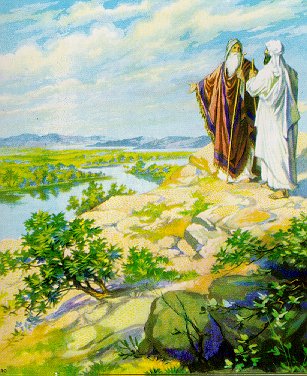
The promise of a son seems to have a rejuvenated Sarah.  She is taken into the harem of the king of Gerar.

Image from www.gpdiworld.us

[EF] The Wife—II (20): The second occurrence of “The Matriarch Protected” comes immediately before the story of Yitzhak’s birth, as if to emphasize God’s hand in the process one more time.  In this long variation on the theme, God is most active and Avraham most revealing of his past.  He emerges from danger as a man who clearly enjoys God’s full protection and bounty.

The story almost draws a web of magic around Sara.  Avimelekh is nearly killed by God, and Sara’s childlessness is inflicted upon all the women int he king’s household—even though there is not the slightest doubt of his innocence (he “had not come near her”).


1 Avraham traveled from there to the Negev, and settled between Kadesh and Shur, sojourning
in Gerar.

from thence.  From the terebinths of Mamre; see XVIII,1.

South.  The Negeb; see XII,9.

Kadesh and Shur. See XIV,7 and XVI,7.

Gerar.  Probably the Wady Jerur, 13 miles S.W. of Kadesh.

[RA]  And Abraham journeyed onward from there to the Negeb region.  This second instance of the sister-wife type-scene is in several ways fashioned to fit the particular narrative context in which it is inserted.  The emphatic foreshadowing of the sojourn in Egypt of the episode in chapter 12 is deleted.  Here there is no mention of a famine as the cause of the patriarch’s migration, and the place he comes to is not Egypt but Gerar, a Canaanite city-state in the western Negeb.


2 Avraham said of Sara his wife: She is my sister.
So Avimelekh king of Gerar sent and had Sara taken.

my sister.  Abraham adopts the same precautions as when he was in Egypt: XII,13.

Abimelech. Abimilki is the name of the Egyptian governor of Tyre in the Tell-el-Amarna tablets.

and took Sarah.  Had her brought to his harem.

3 But God came to Avimelekh in a dream of the night and said to him:
Here, you must die because of the woman whom you have taken,
for she is a wedded wife! 

[EF]  wedded wife: Heb.  be’ulat ba’aal.

[RA]  And God came to Abimelech. This potentate is immediately given a higher moral status than Pharaoh in chapter 12: to Pharaoh God speaks only through plagues, whereas Abimelech is vouchsafed direct address from God in a night-vision.

You are a dead man. Or, “you are about to die.”  Abimelech’s distressed response to this peremptory death sentence is understandable, and leads back to the preceding episodes in the narrative chain.

4 Avimelekh had not come near her. He said:
My Lord,
Would you kill a nation, though it be innocent?

A righteous nation.  “innocent folk’ (Moffatt).

[RA]  will you slay a nation even if innocent? This phrase, which might also be construed “slay a nation even with the innocent,” sounds as peculiar in Hebrew as in translation, and has led some critics to see the word “nation” (goy) as a scribal error.  But the apparent deformation of idiom has a shart thematic point.  “Innocent” (tsadiq) is the very term Abraham insisted on in questioning God as to whether He would really slay the innocent together with the guilty in destroying the entire nation of Sodom.  If the king of Gerar choses, oddly, to refer to himslef as “nation,” leaning on the traditional identification of monarch with people, it is because he is, in effect, repeating Abraham’s question to God: will not the Judge of all the earth do justice?

5 Did he not say to me: She is my sister, and also she, she said: He is my brother! With a whole
heart and with clean hands have I done this.
 

[EF] With a whole heart: Lit. “In the wholeness of my heart.”

[RA]  and she, she, too.  This repetitive splutter of indignation is vividly registered in the Hebrew, though the existing translations smooth it over.

6 God said to him in the dream:
I also know that it was with a whole heart that you did this,
and so I also held you back from being at fault against me,
therefore I did not let you touch her.

[EF] being at fault: Or, “sinning,” which is perhaps too theological a translation.

[RA]  I have not allowed you to touch her. The means by which consummation is prevented is intimated, cannily, only at the very end of the story.

7 But now, return the man’s wife
—indeed, he is a prophet, he can intercede for you—
and live!
But if you do not return her:
know that you must die, yes, die, you and all that is yours!
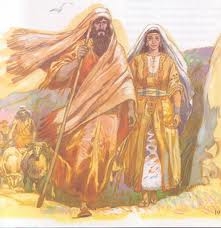
Image from alaymanlooksattheword.blogspot.com

a prophet. This is the first time the word occurs in the Bible.  It is here used to denote a man who stands in a specially near relationship to God, and is consequently under the Divine protection.

8 Early in the morning Avimelekh called all his servants,
he spoke all these words in their ears, and the men became exceedingly afraid. 

[EF] morning:  Heb. boker sometimes has this more general meaning.

9 Then Avimelekh had Avraham called and said to him:
What have you done to us?
In what did I fail you,
that you have brought me and my kingdom into such great fault?
Deeds which are not to be done, you have done to me! 
 

[RA] 9-10.  And Abimelech . . . said . . . and Abimelech said.  The repetition of the formula for introducing direct speech, with no intervening response from Abraham, is pointedly expressive.  Abimelech vehemently castigates Abraham (with good reason), and Abraham stands silent, not knowing what to say.  And so Abimelech repeats his upbraiding, in shorter form (verse 10).

10 And Avimelekh said to Avraham:
What did you foresee, that you did this thing?

what sawest thou?  i.e. what hadst thou in view?

11 Avraham said:
Indeed, I said to myself:
Surely there is no awe of God in this place,
they will  kill me on account of my wife! 

[EF] awe: Others, “fear.”

[RA] 11-12.  When Abraham finally speaks up, his words have the ring of a speaker floundering for self-justification. Introducing the explanation of Sarah’s half-sister status—there might be a Mesopotamian legal background to such a semi-incestuous marriage—he uses a windy argumentative locution, wegam ‘omnah,  “and, in point of fact,” that may hint at a note of special pleading.


and they will kill me because of my wife. What Abraham fears is that Gerar, without “fear of God,” will prove to be another Sodom.  In Sodom, two strangers came into town and immediately became objects of sexual assault for the whole male population.  Here again, two strangers come into town, one male and one female, and Abraham assumes the latter will be an object of sexual appropriation, the former the target of murder.  In the event, he is entirely wrong:  Abimelech is a decent, even noble, man; and the category of “Sodom” is not to be projected onto everything that is not the seed of Abraham.  On the contrary, later biblical writers will suggest how easily Israel turns itself into Sodom.

12 Then, too, she is truly my sister, my father’s daughter,
however not my mother’s daughter-so she became my wife.

Image from celeam.empowernetwork.com

daughter of my father.  The Bible sometimes uses ‘son’ and ‘daughter’ to denote a grandson or granddaughter (IX,24).  Sarah may well have been Terah’s granddaughter and Abraham’s niece.  Nachmanides, in his Commentary, severely denounces the Patriarch’s conduct on the ground that it again imperiled his wife: and he adds that it makes no difference whether Abraham told Abimelech the truth in calling Sarah his ‘sister’, inasmuch as he suppressed the all-important fact that she was also his wife.  Scripture impartially relates both the failings and the virtues of its heroes.

13 Now it was, when the Power-of-god caused me to roam from my father’s house,
that I said to her:
Let this be the faithfulness that you do me:
in every place that we come, say of me: He is my brother.

God caused me to wander.  The verb is in the plural, which is sometimes used when an Israelite speaks to a heathen; XXXI,52.  It may also be the ‘plural of majesty’, I,26.

[EF] roam: A word which in Genesis suggests a wandering that is nevertheless directed by God.  See 21:14 and 37:15 for other examples.  This passage gives us a fascinating glimpse of Avraham;s own percetption of the events in Chap. 12.  It is not unusual for the biblical storyteller to give out information in this manner (in a later speech of the protagonist).  faithfulness:  Or “favor.”

[RA]  the gods made me a wanderer.  The word ‘elohim, which normally takes a singular verb (though it has a plural suffix) when it refers to God, as everywhere else in this episode, is here linked with a plural verb.  Conventional translation procedure renders this as “God,” or “Heaven,” but Abraham, after all, is addressing a pagan who knows nothing of this strange new idea of monotheism, and it is perfectly appropriate that he should choose his words accordingly, settling on a designation of the deity that ambiguously straddles polytheism and monotheism.  It is also noteworthy that Abraham, far from suggesting that God has directed him to a promised land, stresses to the native king that the gods have imposed upon him a destiny of wandering.


in every place to which we come. The writer, quite aware that this episode approximately repeats the one in chapter 12, introduces into Abraham’s dialogue a motivation for the repetition:  this is what we must do (whatever the problematic consequences) in order to survive wherever we go.

14 Avimelekh took sheep and oxen, servants and maids, and gave them to Avraham,
and returned Sara his wife to him.

[RA]  And Abimelech took sheep and cattle. Unlike Pharaoh in chapter 12, who bestows gifts on Abraham as a kind of bride-price, the noble Abimelech offers all this bounty after Sarah leaves his harem, as an act of restitution.

15 Avimelekh said:
Here, my land is before you,
settle wherever seems good in your eyes

my land.  This offer is to be contrasted with the action of Pharaoh in II,19.

16 And to Sara he said:
Here, I have given a thousand pieces of silver to your brother,
here, it shall serve you as a covering for the eyes for all who are with you
and with everyone, that you have been decided for.

a thousand pieces of silver.  This is not mentioned in v. 14; probably an additional personal gift.

a covering of the eyes.  Figurative for ‘justification’; to make them blind to the wrong which had been done her.

[EF]  a covering for the eyes: Heb. obscure; apparently it has legal connotations (see also “decided for” at the end of the verse).

17 Avraham interceded with God
and God healed Avimelekh: his wife and his slave-women, so
that they gave birth.
18 For YHVH had obstructed, obstructed every womb in Avimelekh’s household
on account of Sara, the wife of Avraham.

[EF] YHWH had obstructed: On account of Sara, the “obstructed” one of 16:2.

[RA]  For the LORD had shut fast every womb.  Contrary to some textual critics who conjecture that this verse was inadvertently displaced from an earlier point in the story, it is a lovely piece of delayed narrative exposition.  Shutting up the womb is a standard idiom for infertility, which ancient Hebrew culture, at least on the proverbial level, attributes to the woman, not to the man.  But given the earlier reference to Abimelech’s having been prevented from touching Sarah, this looks suspiciously like an epidemic of impotence that has struck Abimelech and his people—an idea not devoid of comic implications—from which the Gerarite women would then suffer as the languishing partners of the deflected sexual unions.  (Nahmanides sees an allusion to impotence here.)  It is noteworthy that only in this version of the sister-wife story is the motif of infertility introduced.  Its presence nicely aligns the Abimelech episode what precedes and what follows.  That is, first we have the implausible promise of a son to the aged Sarah; then a whole people is wiped out; then the desperate act of procreation by Lot’s daughters in a world seemingly emptied of men; and now an entire kingdom blighted with an interruption of procreation.  The very next words of the story—one must remember that there were not chapter breaks in the original Hebrew text, for both chapter and verse divisions were introduce only in the late Middle Ages—are the fulfillment of the promise of progeny to Sarah: “And the LORD singled out Sarah as He had said.”  As several medieval Hebrew commentators note, the plague of infertility also guarantees that Abimelech cannot be imagined as the begetter of Isaac.

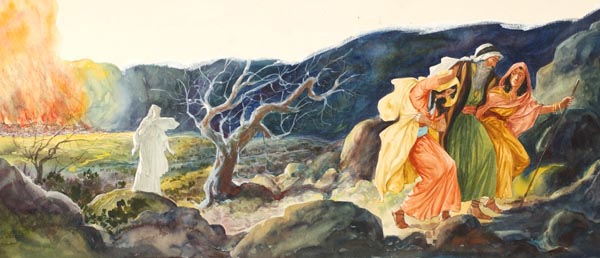
Genesis/Bereshith 19: "But YHWH rained down brimstone and fire upon Sedom and Amora, coming from YHVH, from the heavens"

[What a strange society and culture Sodom/Gomorrah had!
It appears that the whole male population were  . . . well, what exactly should we call them?  Sodomists? That term is defined as “intercourse involving anal or oral copulation.”  Are sodomists simply sexually aberrant while being straight or are they always homosexual in gender preference? Are sodomists always male or could females also be such?  Have you ever thought that possibly, there was just a shortage of females in Sodom and Gomorrah, such that the male population turned on each other? Or, was the situation such that despite the availability of female sexual partners, the male population simply preferred male sex partners?  And, are they tired of copulating with one another that they go for strangers who happen to visit their turf.


And as for Lot offering his VIRGIN DAUGHTERS who were engaged, this is a sick, sick, sick society indeed!  No wonder the fiances did not want to leave with Lot and his daughters. And later the daughters decide to procreate with their father Lot!  All this in the TORAH of YHWH!!!???


Is this kind of talk disturbing to your sensibility?  If the Hebrew Scriptures devotes a chapter on the reason for the destruction of a city with fire and brimstone (more locally controllable than a flood), then there must be a point to its inclusion.  Could the lesson be: does the Creator of male and female not only frown upon but hate and will judge any departure from His natural intention?  As we said in the Noah series, if only one gender boarded the ark, even if there were two of the same gender, that would still have been the end of all the species that require male and female to recreate their kind.  Goodbye world, indeed!


So, what is the message?  Religionists try to get around the burning issue of same gender sex/marriage and its acceptabillity in society by teaching ‘hate the sin but love the sinner.”  Well, gay libbers do not consider their gender preference ‘sin’, excusez moi! They claim they were born that way.  We do not understand how the Creator could make human male and female at the beginning of our species, and later we humans recreate ourselves into —- well, still male and female, except that individual preferences have changed in terms of sexual partner and marriage partner. Gay or lesbian, the individual may still dress as male or female, act macho or feminine, could still indulge in any sexual behavior in privacy —- the burning issue is same sex marriage.  Is that a problem with the Creator of two sexes Who gave commandments about procreating our species, multiplying and populating the whole earth?  If the whole world suddenly turned gay and lesbian and the new normal is same-sex marriage and the whole world population go that route, let’s just say that would definitely take care of population explosion.
So what’s the point?  Well, read this chapter and see how the Creator feels about the issue.


Another point: Verse 24. 24 But YHVH rained down brimstone and fire upon Sedom and Amora, coming from YHVH, from the heavens,. Our former messianic teacher uses this verse as prooftext for the Trinity, claiming that the Father in heaven and the Son on earth (or was it vice versa?) worked together in the destruction of Sodom and Gomorrah. We consider the way it is phrased as  simply a characteristic of the Hebrew language.  Here’s the NIV translation:  Then the LORD rained down burning sulfur on Sodom and Gomorrah–from the LORD out of the heavens.


If you did an illustration of the verse, there’s the Lord raining down the sulfur—and the Lord doing it out of the heavens.  How does that add up to two Lords and a Father and a Son? Actually it boils down to this:  IF you believe there is only ONE GOD, this is simply a Hebraism; but if you believe in a trinitarian godhead, yes, you could pounce on this one verse as one prooftext and stretch its meaning.  That doesn’t help, does it?  You have to decide for yourself what it is you believe.  Is YHWH a threesome or a Unity as in One and Only God?


Notice that when the Creator decides to bring on destruction anywhere on earth, He simply uses what’s already available in His created world.  Deluge in Noah’s time from the release of water from the atmosphere and from below the earth, and now, fire and brimstone from heaven . . . from man’s point of observation, it might look like it’s from heaven and the figurative language says so, but as scientists have scrutinized these ‘biblical miraculous events’, scientists themselves explain how natural forces are responsible for such happenings described in scripture.
 
Volcanic eruption spew out fire and brimstone; Lot’s wife turning into a pillar of salt is a natural phenomenon reasonably explained in the Rabbinic commentary here.  The only factor scientists can’t figure out is—as we keep bringing up—the ‘timing’ of the natural calamity according to God’s forecasted clockwork.  Surely, that must be divinely arranged, eh? If not, what’s your take?


Unbracketted commentary is from Pentateuch and Haftorah’s, ed. Dr. J.H. Hertz; translation is Everett Fox with commentary “EF” and additional commentary by “RA” for Robert alter.
-–Admin1.]

—————————————–

Genesis/Bereshith 19
THE ANGELS, SODOM AND LOT
1 The two messengers came to Sedom at sunset,
as Lot was sitting at the gate of Sedom.
When Lot saw them, he arose to meet them and bowed low, brow to the ground

angels.  This is the first time the visitors are referred to by this term.

in the gate of Sodom. i.e. the passage beneath the city-wall, where people congregate in the East to converse, transact business, or have their disputes adjudicated.

[EF] YHWH went: See note on 17:22.

[RA] came into Sodom at evening, when Lot was sitting in the gate. The whole episode is framed in an elegant series of parallels and antitheses to Abraham’s hospitality scene at the beginning of chapter 18.  Both men are sitting at an entrance—the identical participial clause with the same verb—when the visitors appear.  Lot’s entrance is the city gate: he can sit “in” it because Canaanite cities had what amounted to a large chamber at the gateway; here people gathered to gossip, to do business, and above all, to conduct justice; the gate would have given on the town square, the area referred to by the messengers in verse 2.  There is an antipodal thematic distance from tent flap to city gate, as the narrative quickly makes clear.  Abraham’s visitors, moreover, arrive at midday, whereas Lot’s visitors come as darkness falls—a time when it is as dangerous to be out in the streets of Sodom as in those of any modern inner city.

2 and said:
Now pray, my lords,
pray turn aside to your servant’s house,
spend the night, wash your feet;
(starting-early) you may go on your way.
They said: No, rather we will spend the night in the square. 

your servant’s house. Being a resident of a city, Lot dwelt in a ‘house’, whereas Abraham’s abode was a ‘tent’.

broad place.  The ‘square’ of the city; and the climate being warm, it would be a natural place where a homeless visitor would spend the night.

[RA] turn aside. Lot resembles his uncle in the gesture of hospitality.  He uses the verb “turn aside” (sur) instead of Abraham’s “go on past” (‘avar) because, unlike the solitary tent in the desert, there are many habitations here, in addition to the public space of the square.

set off early.  This may merely be to emphasize that he will not delay them unduly, but it could hint that they can depart at daybreak before running into trouble with any of the townsfolk.

3 But he pressed them exceedingly hard,
so they turned in to him and came into his house.
He made them a meal-with-drink and baked flat-cakes, and they ate

 unleavened bread.  Which could be baked rapidly.

[EF] we want to knkow them: The meaning is unmistakably sexual.

[RA] a feast . . . flatbread. Perhaps an ellipsis is to be inferred, but this is a scanty-looking “feast.”  In contrast to Abraham’s sumptuous menu, the only item mentioned is the lowly unleavened bread (matsot) of everyday fare, not even the loaves from fine flour that Sarah prepares.

4 They had not yet lain down, when the men of the city, the men of Sedom, encircled the house,
from young lad to old man, all the people (even) from the outskirts. 

all the people.  Emphasis is here laid on the fact that the inhabitants were all addicted to unnatural depravity.  The rejection of Abraham’s plea was, therefore, justified.

[RA] 4-5. the men of the city, the men of Sodom . . . Where are the men. Throughout this sequence there is an ironic interplay between the “men” of Sodom, whose manliness is expressed in the universal impulse to homosexual gang rape, and the divine visitors who only seem to be “men.”

5 They called out to Lot and said to him:
Where are the men who came to you tonight?
Bring them out to us, we want to know them!
6 Lot went out to them, to the entrance, shutting the door behind him 

7 and said:

Pray, brothers, do not be so wicked! 

[RA] brothers.  Or “kinsmen,” an appellation the Sodomites will vehemently reject in verse 9.

8 Now pray, I have two daughters who have never known a man, pray let me bring them out to 
you, and you may deal with them however seems good in your eyes;
only to these men do nothing,
for they have, after all, come under the shadow of my roof-beam!

my roof.  The duty of protecting a guest is sacred in the East.  As soon as a stranger had touched the tent-rope, he could claim guest-right.  But the price which Lot was prepared to pay is unthinkable in our eyes, though a different view would present itself to the Oriental in those times.

[EF] pray let me bring them out to you . . .: For a similar story, see Judg. 19. There the offer of rape is accepted by the townspeople.

[RA] I have two daughters who have known no man. Lot’s shocking offer, about which the narrator, characteristically, makes no explicit judgment, is too patly explained as the reflex of ancient Near Eastern code in which the sacredness of the host-guest bond took precedence over all other obligations.  Lot surely is inciting the lust of the would-be rapists in using the same verb of sexual “knowledge” they had applied to the visitors in order to proffer the virginity of his daughters for their pleasure.  The concluding episode of this chapter, in which the drunken Lot unwittingly takes the virginity of both the daughters, suggests measure-for-measure justice meted out for his rash offer.


for have they not come under the shadow of my roof-beam? This looks like a proverbial expression for entering into someone’s home and so into the bonds of the host-guest relationship.  But “roof-beam” implies a fixed structure and so accords with the urban setting of Lot’s effort at hospitality; Abraham, living in a tent, in the parallel expression in his hospitality scene, merely says, “for have you not come by your servant?”

9  But they said:
Step aside! 
and said:
This one came to sojourn and (wants to ) judge, play-the-judge?
Now we will do worse to you than (to) them!
And they pressed exceedingly hard against the man, against Lot, and stepped closer to break down the door.

 this one fellow. An expression of contempt.

to sojourn. i.e. this newcomer presumes to judge our actions, and interfere with our customs!

[EF]  judge, play-the-judge: Heb. va-yishpot shafot.

[RA] came as a sojourner . . . sets himself up to judge! The verb “to sojourn” is the one technically used for resident aliens.  “Judge,” emphatically repeated in an infinitive absolute (wayishpot shafot), picks up the thematic words of judge and just from God’s monologue and His dialogue with Abraham in chapter 18.

10  But the men put out their hand and brought Lot in to them, into the house, and shut the door.

[EF] the men: The messengers.

11 And the men who were at the entrance to the house, they struck with dazzling-light—(all men) great and small,
so that they were unable to find the entrance.  

blindness. The Heb. word occurs again only in II Kings VI,18, and denotes a temporary loss of vision.

[EF] (all men) great and small: Lit. “from small to great.”

12  The men said to Lot:
Whom else have you here—a son-in-law, sons, daughters?
Bring anyone whom you have in the city out of the place!  

any besides. Lot’s household is to be saved with him.

[RA] Your sons and your daughters. The Masoretic Text prefaces these words with “son-in-law” (in the singular); but as numerous critics have observed, this makes no grammatical sense, and this particular term would not belong at the head of the list, before sons and daughters.  It seems quite likely that the word was erroneously transcribed from verse 14 and was not part of the original text.

13  For we are about to bring ruin on this place,
for how great is their outcry before YHWH!
And YHWH has sent us to bring it to ruin.

[RA]  the outcry. This term is a pointed repetition of the word God uses twice in His initial speech about Sodom.

14  Lot went out to speak to his sons-in-law, those who had taken his daughters (in marriage), and said:  
Up, out of this place, for YHWH is about to bring ruin on the city!  
But in the eyes of his sons-in-law, he was like one who jests.

[RA]  his sons-in-law who had married his daughters. Especially because of the reference to the two virgin daughters in the next verse as ones “who remain with you” (literally, “are found with you”), it appears that Lot had other daughters already married, and not that the two in the house were betrothed but still unmarried.


he seemed to his sons-in-law to be joking.  The verb, though in a different conjugation, is the same as the one used for Sarah’s and Abraham’s “laughter.” It is, of course, a wry echo—the laughter of disbelief of those about to be divinely blessed, the false perception of mocking laughter by those about to be destroyed.  The common denominator in the antithetical usages is skepticism about divine intentions, for good and for evil.

15 Now when the dawn came up,
the messengers pushed Lot on, saying:
Up, take your wife and your two daughters who are here, lest you be swept away in the iniquity of the city! 

iniquity.  As in IV,13, the Heb. word for ‘iniquity’ means also its consequence, ‘punishment.’

16 When he lingered, the men seized his hand, his wife’s hand, and the hand of his two 

daughters -because YHVH’S pity was upon him- and, bringing him out, they left him outside the city.

but he lingered. Either to collect his valuables, or he was reluctant to leave.  All that Scripture tells of Lot is characteristic of a weak, irresolute character.

17 It was, when they had brought him outside, that (one of them) said: 
Escape for your life, do not gaze behind you, do not stand still anywhere in the plain:
to the hill-country escape, lest you be swept away!  

that he said. The angel whose mission it was to rescue Lot.

the Plain.  See on XIII,10.

the mountain. See on XIV,10.

[EF]  Escape: Heb. himmalet, use five times here.  Perhaps it is a pun on Lot’s name; he is “the escaper” in a number of situations.

[RA] he said. The reader is meant to infer: one of the two of them.

18 Lot said to them:
No, pray, my lord! 
19 Now pray, your servant has found favor in your eyes,
you have shown great faithfulness in  how you have dealt with me, keeping me alive–
but I, I am not able to escape to the hill-country,
lest the wickedness cling to me, and I die!

the evil. The disaster.

[EF] lest the wickedness cling to me: The expression of an idea common to many cultures that evil is like a disease, a physical rather than purely moral entity.

[RA] I cannot flee to the high country.  Lot seems a weak character—he was to be led out by the hand from the city—and his zigzagging determinations of flight make psychological sense.  Accustomed to an urban setting, he is terrified at the idea of trying to survive in the forbidding landscape of cliffs and caves to the south and east of the Dead Sea.  But once having settled in the little town of Zoar (verse 30), he has understandable premonitions of another cataclysm and so decides that, after all, the rocky wilderness is the lesser of two evils.

20 Now pray, that town is near enough to flee to, and it is so tiny;
pray let me escape there-is it not tiny?-and stay alive! 

a little one. It is so insignificant in size: and, therefore, it is a small favour he is asking for, when pleading that it be spared.

and my soul shall live. i.e.my life be spared.

[EF] tiny: Or “a trifle.”

[RA]  a small palce.  The Hebrew miz’ar plays on the name Zoar and for once this could be a correct etymology.  Lot’s point is that it is, after all, only a piddling town and so it would not be asking a great deal to spare it form destruction.

Image from graceelgin.org
21 He said to him:
Here then, I lift up your face in this matter as well,
by not overturning this town of which you speak. 

[EF] lift up your face: A similar Assyrian phrase means “save” or “cheer.” overturning: Overthrowing. The word is used later in the Bible to describe the fate of the two cities again (e.g. Lamentations 4:6).

[RA] overthrow. This is the physical image presented by the Hebrew verb, though the obvious sense of the word throughout the story (and in later biblical references to Sodom) is something like “destroy by sudden cataclysm.”

22 Make haste, escape there,
for I am not able to do anything until you come there.
Therefore the name of the town was called: Tzo’ar/Tiny. 

[EF]  I am not able . . . until you come there: In deference to Avraham (see v. 29).

23 (Now) the sun was going out over the earth as Lot came to Tzo’ar.
24 But YHVH rained down brimstone and fire upon Sedom and Amora, coming from YHVH, 

from the heavens,

[RA] rained . . . brimstone and fire from the LORD from the heavens.  The slightly awkward repetition of “from the LORD” with the added phrase “from the heavens” taken together with the verb “to rain” (himtir), underscores the connection with the Deluge story.  Moshe Weinfeld has aptly observed a whole series of parallels between the two stories.  In each case, God wipes out a whole population because of epidemic moral perversion, marking one family for survival.  In each case, the idiom “to keep alive seed” is used for survival.  In each case, the male survivor becomes drunk and is somehow sexually violated by his offspring, though only Lot is unambiguously represented as the object of an incestuous advance.  One might add that the phrase used by the elder sister, “there is no man on earth [or, “in the land,” ba’arets] to come to bed with us” (verse 31), equally reinforces the connectiion with the global cataclysm of the Flood story: she looks out upon the desolate landscape after the destruction of the cities of the plain and imagines that she, her sister, and their father are the sole survivors of humankind.

25 he overturned those cities and all of the plain, all those settled in the cities and the vegetation 

of the soil. 

26 Now his wife gazed behind him, and she became a pillar of salt.

 
Image from www.newtonbrook.ca

a pillar of salt. She looked back and lingered behind, to be overtaken by the brimstone and fire from which the others escaped.  A similar fate befell lingering refugees at Pompeii.  ‘Her body  became encrusted and saturated with a nitrous and saline substance, that very likely preserved it for some time from decay’ (De Sola).  Ancient writers refer to this pillar as being still in existence.  Josephus claims to have seen it.

[EF] she became a pillar of salt: An old folklore motif of what happens when humans see God (or his actions), made popular by the many mineral pillars in the region around the Dead Sea.

[RA] And his wife looked back and she became a pillar of salt.  As has often been observed, this tale looks doubly archaic, incorporating both an etiological story about a gynemorphic rock formation in the Dead Sea region and an old mythic motif (as in the story of Orpheus an Euridyce) of a taboo against looking back in fleeing from a place of doom.  But the blighted looking of Lot’s wife is antithetically integrated with the “looking out” (a different verb) of Abraham in the next two verses over the scene of destruction from his safe vantage on the heights of Hebron.

27  Avraham started-early in the morning to the place where he had stood in YHWH’s presence,

Abraham. After a restless night, his heart heavy with the knowledge of what was about to befall the five cities, he rises early in the morning to gaze with compassionate eyes upon the fulfillment of the Divine decree.

[RA] early in the morning. There is a nice temporal dovetailing of the two scenes.  Down in the plain, just as the sun rises, the LORD rains brimstone and fire.  A few minutes later, still early in the morning, Abraham hurries to take in the awful panorama.

28 he looked down upon the face of Sedom and Amora and upon the whole face of the plain country
and saw:
here, the dense-smoke of the land went up like the dense-smoke of a furnace!  

Archeological exploration has established the existence of an early Canaanite civilization in the Plain.  Many scholars today locate Sodom four miles northeast of the Dead Sea: formerly they located it to the south of the Dead Sea (Albright).

[RA] he saw and, look, smoke was rising. The visual setup also represents the tight closing of an envelope structure.  The Sodom episode began with Abraham’s dialogue with God on the heights of Hebron.  Now at the end, in a definition of visual perspective unusual for biblical narrative, Abraham, standing in the same place, makes out from a distance of forty or more miles the cloud of smoke rising from the incinerated cities.

29  Thus it was, when God brought ruin on the cities of the plain,
that God kept Avraham in mind and sent out Lot from the overturning,
when he overturned the cities where Lot had settled.

remembered Abraham. Gives the reason why Lot had been spared.

[RA]  30-38.  The narrator witholds all comment on the incestuous enterprise of the two virgin sisters.  Perhaps the story may draw on old pre-Israelite?–traditions in which the supposed origins of these two peoples in incest were understood as evidence of their purity, or their vitality.  (One recalls that Tamar, the progenitrix of the future kings of Judea, became pregnant by her father-in-law through pretending to be a whore.) But from the Israelite perspective, this story might well have cast a shadow of ambiguity over these two enemy peoples.  Both names are etymologized to refer to incest;  Moab (which probably means “desired place”) is construed as me-‘ab, “from the father,” and Ben-Ammi (yielding the gentilic benei-‘ammon)is construed as “my own kinsman’s son.”

30 Lot went up from Tzo’ar and settled in the hill-country, his two daughters with him,
for he was afraid to settle in Tzo’ar.
So he settled in a cave, he and his two daughters. 

he feared.  That God might yet include Zoar in the general destruction originally intended for all the five cities: and it seems that after his departure it was likewise destroyed by fire.

31 Now the firstborn said to the younger:
Our father is old,
and there is no man in the land to come in to us as befits the way of all the earth! 

there is not a man. Some commentators state that Lot’s daughters believed that the destruction had been universal, and that but for them the world would be completely depopulated.  This explanation is untenable, seeing that they had just left Zoar.  Their conduct does not admit of any extenuation; they were true children of Sodom.

32 Come, let us have our father drink wine and lie with him so that we may keep seed alive by 

our father. 

wine. The mountainous country of Moab is full of caves; and the Midrash states that the inhabitants used to store their wines in such caves.

[RA]  let us lie with him.  Although “lie with” is a somewhat euphemistic reference to coitus in English, its uses in Scripture suggest it is a rather coarse (though not obscene) verb for sexual intercourse in biblical Hebrew.  Two linked sexual assailants, the Egyptian woman in Genesis 39 and Amnon in 2 Samuel 13, use it in urging the objects of their lust to submit to them.  When the verb is followed by a direct object in sexual contexts, the meaning seems close to “rape.”  Ironically, the more decorous verb “to know” is used twice here asexually (verse 33 and 35) to indicate the drunken Lot’s unconscious state as he deflowers each of his daughters.

33 So they had their father drink wine that night,
then the firstborn went in and lay with her father—
but he knew nothing of her lying down or her rising up. 

34 It was on the morrow that the firstborn said to the younger:

Here, yesternight I lay with father.
Let us have him drink wine tonight as well, then you go in and lie with him, so that we may 

keep seed alive by our father. 

35 They had their father drink wine that night as well,

then the younger arose and lay with him, 

but he knew nothing of her lying down or her rising up. 

[EF]  but he knew nothing . . .: The repetition of the phrase from v33 is meant either to absolve lot or to ridicule him.

36 And Lot’s two daughters became pregnant by their father. 

37 The firstborn bore a son and called his name: Mo’av/By Father,

he is the tribal-father of Mo’av of today. 

Moab.  The name is explained as though it were the equivalent of me-ab, ‘from a father.’

[EF] Mo’av: Trad. English “Moab.”

[RA] of our days  The literal sense of the Hebrew is “to this day.”

38 The younger also bore a son, and called his name: Ben-ammi/Son of My Kinspeople,
he is the tribal-father of the children of Ammon of today

Ben-ammi. ‘The son of my people,’ or, ‘the son of my father’s kin.’


Genesis/Bereshith 17: "as for Yishmael, I hearken to you . . .but my covenant I will establish with Yitzhak"

[YHWH’s covenant with Abraham—let us not miss the point that this covenant is intended to be a blessing to ALL of humankind except that the process will take centuries, if not millennia for its final fulfillment.  But it starts with this covenant that creates an exclusive lineage that will lead to the establishment of a people specifically chosen to represent the One True God and His prescribed way of living which is given as THE Revelation on Sinai. 


The son promised to Abraham and Sarah is Yitzchak and not Yshmael; yet, the gracious and merciful Divine Father YHWH accedes to father Abraham’s plea that his firstborn through Hagar will also receive a blessing.  Strangely the son through the slave woman will also have 12 offsprings or ‘princes’ and will also become a ‘great nation’ (check out http://en.wikipedia.org/wiki/Ishmael), talk about equality and equal opportunity except for the factor of ‘chosenness’.  


More strangely, in the New Testament book of Galatians 4:24, the ‘Hebrew of Hebrews’ Pharisaic Paul transforms the story of Abraham’s two firstborn sons from wife and servant-girl into an allegory of two covenants.  Read through these commentaries from Christian translations (sorry, lost the website source, will fill in later):


New International Version
These things are being taken figuratively: The women represent two covenants. One covenant is from Mount Sinai and bears children who are to be slaves: This is Hagar.

New Living Translation
These two women serve as an illustration of God’s two covenants. The first woman, Hagar, represents Mount Sinai where people received the law that enslaved them.

English Standard Version
Now this may be interpreted allegorically: these women are two covenants. One is from Mount Sinai, bearing children for slavery; she is Hagar.

New American Standard Bible 
This is allegorically speaking, for these women are two covenants: one proceeding from Mount Sinai bearing children who are to be slaves; she is Hagar.

King James Bible
Which things are an allegory: for these are the two covenants; the one from the mount Sinai, which gendereth to bondage, which is Agar.

Holman Christian Standard Bible
These things are illustrations, for the women represent the two covenants. One is from Mount Sinai and bears children into slavery–this is Hagar.

International Standard Version
This is being said as an allegory, for these women represent two covenants. The one woman, Hagar, is from Mount Sinai, and her children are born into slavery.

NET Bible
These things may be treated as an allegory, for these women represent two covenants. One is from Mount Sinai bearing children for slavery; this is Hagar.

Aramaic Bible in Plain English
But these are illustrations of the two Covenants, the one that is from Mount Sinai begets to bondage, which is Hagar.

GOD’S WORD® Translation
I’m going to use these historical events as an illustration. The women illustrate two arrangements. The one woman, Hagar, is the arrangement made on Mount Sinai. Her children are born into slavery.

Jubilee Bible 2000
Which things are an allegory; for these women are the two covenants: the one from the Mount Sinai, which begat unto slavery, which is Hagar.

King James 2000 Bible
Which things are an allegory: for these are the two covenants; the one from mount Sinai, which brings forth to bondage, which is Hagar.

American King James Version
Which things are an allegory: for these are the two covenants; the one from the mount Sinai, which engenders to bondage, which is Agar.

American Standard Version
Which things contain an allegory: for these women are two covenants; one from mount Sinai, bearing children unto bondage, which is Hagar.

Douay-Rheims Bible
Which things are said by an allegory. For these are the two testaments. The one from mount Sina, engendering unto bondage; which is Agar:

Darby Bible Translation
Which things have an allegorical sense; for these are two covenants: one from mount Sinai, gendering to bondage, which is Hagar.

English Revised Version
Which things contain an allegory: for these women are two covenants; one from mount Sinai, bearing children unto bondage, which is Hagar.

Webster’s Bible Translation
Which things are an allegory: for these are the two covenants; the one from the mount Sinai, which gendereth to bondage, which is Agar.

Weymouth New Testament
All this is allegorical; for the women represent two Covenants. One has its origin on Mount Sinai, and bears children destined for slavery.

World English Bible
These things contain an allegory, for these are two covenants. One is from Mount Sinai, bearing children to bondage, which is Hagar.

Young’s Literal Translation
which things are allegorized, for these are the two covenants: one, indeed, from mount Sinai, to servitude bringing forth, which is Hagar;

🙄  WHAT???!!!!! The covenant that God makes with His chosen people which He starts forming through Abraham, then Isaac and Jacob, the Patriarchs of Israel is referred to derisively as ‘slavery’ and ‘bondage’ to LAW? In contrast to the non-existent ‘new covenant’ with the ‘New Israel-Christian church/religion’ which is a ‘covenant of GRACE’?  As we keep reiterating, Law IS Grace and further,  there was never a ‘new covenant’ with a ‘new Israel’ if the basis is Jeremiah 31:31-34 which simply renews the same covenant on Sinai,  

  • made between the same parties (YHWH and Israel/Judah),
  • regarding the same ‘Law” –the Torah,
  • which will thenceforth be written not on tablets of stone but on the hearts of all humankind.

This strange supersessionist doctrine coming from a diaspora Jew who claims to be a Pharisee dares to discount and discredit  the very revelation of YHWH on Sinai and in fact considers it passé and obsolete, not to be obeyed anymore except by Jews who are supposedly deliberately kept ‘in the dark’ by the very God of Israel!  Paul teaches in the book of Romans 11:25  – that blindness in part is happened to Israel, until the fulness of the Gentiles be come in” (RED for caution!)  ‘Oy vey’ as the Jews would say or in Paul’s known expression, ‘heaven forbid!’ or “may it not be so!’ and indeed, IT IS NOT SO!


How dare a Jew and a Pharisee at that do such a disservice to his own people and insult the God of Israel, the God of the Nations, the God of Abraham, Isaac and Jacob!  Such teaching led to a major world religion based on a ‘new’ testament that has distorted if not displaced not only all the teachings of YHWH, but replaced YHWH HIMSELF with a ‘trinitarian godhead’ with one person out of three receiving all the glory and honor and power and being proclaimed no less as Creator himself as well as the Revelator on Sinai!

Is this not what the Torah would consider ‘blasphemy’?

Seriously, dear reader, think about it and make your stand.  As for us, Sinaites, we declare with Yahushuwah:  

Image from vinylgiftsandmore.com

Commentary is from Pentateuch and Haftorah’s, ed. Dr. J.H. Hertz; translation by Everett Fox, The Five Books of Moses with commentary indicated by “EF”;  additional commentary by Robert Alter “RA” whose translation is similarly titled The Five Books of Moses.Admin1.]

——————————————-

Genesis/Bereshith 17

THE COVENANT OF ABRAHAM

Image from vimeo.com

1  Now when Avram was ninety years and nine years old
YHWH was seen by Avram and said to him:  
I am God Shaddai.
 Walk in my presence!  And be wholehearted!

I am God Almighty.  Heb. El Shaddai; Exod. VI,3, ‘and I appeared unto Abraham, unto Isaac, and unto Jacob as God Almighty.’  The derivation of the Divine Name, Shaddai, is uncertain.  The usual translation, ‘Almighty,’ is due to the Vulgate (the Latin version of the Bible).  The realization of Abram’s hopes must often have appeared dim and distant to him.  Here he is reassured: nothing is impossible to God Almighty.  Shaddai has also been derived from a root meaning ‘to heap benefits’, the Friend who shepherds the Patriarchs and preserves them from all harm; see Numbers I,5.


whole-hearted.  i.e. place implicit and undivided confidence in God alone.  the Rabbis connect this exhortation with the Covenant of Circumcision, which was about to be instituted, and thus indicate the moral ideal which underlies the ritual act.

make My covenant. lit. ‘I will give (i.e. grant) My covenant.’ What follows is not a compact between God and the Patriarch, but a statement of the plans which He had designed for Abram and his descendants.

[EF] Ninety years and nine years:  Thirteen years have elapsed since the events of the previous chapter.  Now that Yishmael is entering puberty, God can no longer conceal that he is not the promised heir.  See vv: 16,18.  Shaddai: Hebrew obscure.  Traditionally translated “Almighty”; others use “of the mountains.”  In Genesis the name is most often tied to promises of human fertility, as in v. 2.  Walk . . . be wholehearted: Contrasted to Noah (6:9), Avram is a genuine religious man who lives his faith actively.

[RA] El Shaddai. The first term, as in El Elyon (chapter 14), means God.  Scholarship has been unable to determine the origins or precise meaning of the second term—tenuous associations have been proposed with a Semitic word meaning “mountain” and with fertility.  What is clear (compare Exodus 6:3) is that the biblical writers considered it an archaic name of God.

Walk in My presence.  Or “before me.”  In verse 18, the same preposition manifestly has the idiomatic sense of “in Your favor.”  The verb is the same used for Enoch’s walking with God, but there the Hebrew preposition is actually “with.”  The meaning of this idiom is “to be devoted to the service of.”

2  I set my covenant between me and you,
I will make you exceedingly, exceedingly many.

[EF] Set:  Heb. va-ettena. The root n-t-n  is repeated throughout the chapter (as “make” in vv.5 and 6, and as “give” in vv8 and 16).

[RA] My covenant. The articulation of the covenant in this chapter is organized in three distinct units—first the promise of progeny and land, then the commandment of circumcision as sign of the covenant, then the promise of Sarah’s maternity.  The politics of the promise is now brought to the foreground as for the first time it is stipulated that both Abraham and Sarah will be progenitors of kings.  Source critics have observed that this second covenantal episode, attributed to Priestly circles, abandons the sense of an almost equal pact between two parties of chapter 15 and gives us an Abraham who is merely a silent listener, flinging himself to the ground in fear and trembling as God makes His rather lengthy pronouncements.  But Abraham’s emphatic skepticism in verses 17-18 suggests that there is more complexity in his characterization here than such readings allow.

3.  Avram fell upon his face.
God spoke with him,
saying:

and Abram fell on his face.  The Oriental mode of expressing gratitude.

4  As for me,
here, my covenant is with you, 
so that you will become the father of a throng of nations.

as for Me.  Introducing God’s part of the covenant, as contrasted with ‘And as for thee’ in v. 9.

a multitude of nations. The Israelites; the Arabs, descended from Ishmael; and the tribes enumerated in XXV,1.

[EF} throng:  The word suggests the sound of a crowd, rather than merely a large number.

5  No longer shall your name be called Avram,
rather shall your name be Avraham,
for I will make you av Hamon Goyyim/Father of a Throng of Nations!

Abraham . . . multitude of nations. Ab means ‘father’ and raham, the second half of the new name, is an Arabic word for ‘multitude’.  The change of name emphasizes the mission of Abraham, which is ‘To bring all the peoples under the wings of the Shechinah’.

[EF] Avraham: Trad. English “Abraham.”

[RA] Abram . . . Abraham. The meaning of both versions of the name is something like “exalted father.”  The longer form is evidently no more than a dialectical variant of the shorter one.  The real point is that Abraham should undergo a name change—like a king assuming the throne, it has been proposed—as he undertakes the full burden of the covenant.  Similarly in verse 15, the only difference between Sarai and Sarah is that the former reflects an archaic feminine suffix, the latter, the normative feminine suffix:  both versions of the name mean “princess.”

6  I will cause you to bear fruit exceedingly, exceedingly,
I will make nations of you,
(yes,) kings will go out from you!
7  I establish my covenant between me and you and your seed after you, throughout their generations as a covenant for the ages,
to be God to you and to your seed after you.
8  I will give to you and to your seed after you, the land of your sojournings, all the land of Canaan, as a holding for the ages,
and I will be God to them.

the land of thy sojournings.  The land in which Abraham dwelt only as ‘a sojourner’.

[EF] I will be God to them: Often reiterated as part of the biblical account (e.g., 28:21).

9.  God said to Avraham:  
As for you,
you are to keep my covenant, you and your seed after you, throughout their generations.
10  This is my covenant which you are to keep, between me and you and your seed after you:  
every male among you shall be circumcised.

this is My covenant which ye shall keep.  The meaning is not that the Covenant is to consist in the rite of circumcision, but that circumcision is to be the external sign of the Covenant.  As the following verse declares, ‘it shall be a token of a covenant,’ just as the rainbow was the token of the covenant with Noah.  And even as the rainbow had existed before Noah, this rite had been practised among other peoples before Israel.  To whatever origin and purpose it might be traced—whether as a measure safeguarding cleanliness and health (Philo), or to counteract excessive lust (Maimonides), or as a sacrificial symbol—for Abraham and his descendants all these conceptions are supplanted, and the rite is the abiding symbol of the consecration of the Children of Abraham to the God of Abraham.  It is the rite of the covenant; and unbounded has been the loyalty and devotion with which this vital and fundamental institution of the Jewish Faith has been and is being observed.  Jewish men and women have in all ages been ready to lay down their lives in its defence.  The Maccabean martyrs died for it. The officers of King Antiochus put to death the mothers who initiated their children into the Covenant—‘and they hanged their babes about their necks’ (I Maccabees I,61).  The same readiness for self-immolation in defence of this sacred rite we find in the times of the Hadrianic persecution, in the dread days of the Inquisition, yea, whenever and wherever tyrants undertook to uproot the Jewish Faith.  Even an excommunicated semi-apostate like Benedict Spinoza declares: ‘Such great importance do I attach to the sign of the Covenant, that I am persuaded that it is sufficient by itself to maintain the separate existence of the nation for ever.’


[RA]  every male among you must be circumcised. Circumcision was practiced among several of the West Semitic peoples and at least in the priestly class in Egypt, as a bas-relief at Karnach makes clear in surgical detail.  To Abraham the immigrant from Mesopotamia, E.A. Speiser notes, it would have been a new procedure to adopt, as this episode indicates.  The stipulation of circumcision on the eighth day after birth dissociates it from its common function elsewhere as a puberty rite, and the notion of its use as an apotropaic measure (compare Exodus 4) is not intimated here.  A covenant sealed on the organ of generation may connect circumcision with fertility—and the threat against fertility—which is repeatedly stressed in the immediately preceding and following passages.  The contractual cutting up of animals in chapter 15 is now followed by a cutting of human flesh.

11  You shall circumcise the flesh of your foreskin,
so that it may serve as a sign of the covenant between me and you.
12  At eight days old, every male among you shall be circumcised, throughout your generations,
whether house-born or bought with money from any foreigner,
who is not your seed.

he that is born in the house.  i.e. the child of a slave; see on XIV,14.  Salves were regarded as part of the household.

[EF] house-born or bought with money: I.e. slaves.  The entire household, as an extension of the man’s personality is to be brought into the covenant.

13  Circumcised, yes, circumcised shall be your house-born and your money-bought (slaves),
so that my covenant may be in your flesh as a covenant for the ages.

[RA] silver. If the language of the text reflects the realia of the Patriarchal period, the term would refer to silver weights.  If it reflects the writer’s period, it would refer to money, since by then coins had been introduced. The weighing-out of silver by Abraham ion chapter 23 argues for the likelihood of the former possibility.

14  But a foreskinned male,
who does not have the foreskin of his flesh circumcised,
that person shall be cut off from his kinspeople—
he has violated my covenant!

cut off from his people.  Either through punishment at the hands of God; or through expulsion from the community.

15 God said to Avraham:
As for Sarai your wife—you shall not call her name Sarai,
for Sara/Princess is her name!

Sarah.  Brings out more forcibly the meaning ‘Princess’ than the archaic form Sarai.

[EF] you shall not call her name Sarai: Significantly, Sara is the only woman in the Bible to have her name changed by God.

16  I will bless her, and I will give you a son from her,
I will bless her,
so that she becomes nations,
kings of all peoples shall come from her!
 

[EF] so that she becomes nations: Sara in essence shares the blessing of God.  She is not merely the biological means for its fulfillment.

[RA] and I will bless him. The Masoretic Text has “bless her,” evidently to make the verb agree with the following clause, but this looks like a redundance in light of the beginning of the verse, and several ancient versions plausibly read here “bless him.”

17  But Avraham fell on his face and laughed,
he said in his heart:  
To a hundred-year-old man shall there be (children) born?  
Or shall ninety-year-old Sara give birth?

and laughed. The Targum renders ‘and rejoiced’, to imply that he laughed for joy, not from incredulity.  What follows would accordingly not be a question, but an exclamation of surprise.

[EF] laughed: Laughter becomes the key word of most of the stories about Yitzhak.

[RA] and he laughed. The verb yitsaq is identical with the Hebrew form of the name Isaac that will be introduced in verse 19.  The laughter here—hardly the expected response of a man flinging himself on his face—is in disbelief, perhaps edged with bitterness.  In the subsequent chapters, the narrative will ring the changes on this Hebrew verb, the meanings of which include joyous laughter, bitter laughter, mockery, and sexual dalliance.


to a hundred-year-old. Abraham’s interior monologue is represented as a line of verse that neatly illustrates the pattern of heightening or intensification from first to second verset characteristic of biblical poetry: here, unusually (but in accord with the narrative data), the numbers go down from first to second verset, but the point is that, as incredible as it would be for a hundred-year-old to father a child, it would be for a hundred-year-old to father a child, it would be even more incredible for a ninety-year-old woman, decades past menopause, to become a mother.  The Abraham who has been overpowered by two successive epiphanies in this chapter is now seen as someone living within a human horizon of expectations.  In the very moment of prostration, he laughs, wondering whether God is not playing a cruel joke on him in these repeated promises of fertility as time passes and he and his wife approach fabulous old age.  He would be content, he goes on to say, to have Ishmael carry on his line with God’s blessing.

Image from iamachild.wordpress.com

18  Avraham said to God:  
If only Yishmael might live in your presence!

Ishmael might live. Abraham, despairing of the possibility of having issue by Sarah, expresses the hope that Ishmael ‘might live before Thee’, in order that the promises made to Abraham might be fulfilled through him.  It is also possible to understand it as a prayer that, though Ishmael is excluded from the spiritual heritage, he may yet live under the Divine care and blessing.

19  God said:
Nevertheless,
Sara your wife is to bear you a son,
you shall call his name: Yitzhak/He Laughs.  
I will establish my covenant with him as a covenant for the ages,
for his seed after him.

[EF] Yitzhak: Traditional English “Isaac.”

20  And as for Yishmael, I hearken to you:  
Here, I will make him blessed, I will make him bear fruit, I will make him many, exceedingly, exceedingly—
he will beget twelve (tribal) leaders, and I will make a great nation out of him.

twelve princes.  They are enumerated in XXV,13-16.

[EF] make him blessed . . . make him bear fuit. . . make him many:  Heb. berakhti oto ve-hifretti oto vehirbeiti oto.  twelve princes: Thus equaling the twelve sons/tribes of Israel?

[RA] As for Ishmael, I have heard you.  Once again, the etymology of the name is highlighted.  These seven English words reflect just two Hebrew words in immediate sequence, uleyishma’el shema’tikha, with the root shm-‘ evident in both.

21  But my covenant I will establish with Yitzhak, whom Sara will bear to you at this set-time, another year hence.

[EF] another year: Not nine months (Sara does not immediately become pregnant).  Again the events seem to take place in a realistic framework, rather than in a strictly supernatural one.

22  When he had finished speaking with Avraham,
God went up, from beside Avraham.

[EF] God went up, from beside Avraham: Perhaps a formula used to signify the end of the conversation.

23  Avraham took Yishmael his son and all those born in his house and all those bought with his money,
all the males among Avraham’s household people,
and circumcised the flesh of their foreskins on that same day,
as God had spoken to him.

[EF] on that same day:  Underlining Avraham’s customary obedience. as God had spoken to him: Like Noah in 6:22,7:5 and 7:9, Avraham scrupulously follows God’s commands without question (so too in 21:4 and 22:3).

24  Avraham has ninety-nine years old when he had the flesh of his foreskin circumcised,

25  and Yishmael his son was thirteen years old when he had the flesh of his foreskin circumcised.

26  On that same day
were circumcised Avraham and Yishmael his son,

27  and all his household people, whether house-born or money-bought from a foreigner, were circumcised with him.


Genesis/Bereshith 16: "Avram hearkened to Sarai's voice"

[Oy vey as the Jews would say . . . let us rethink verse 2:  
Avram hearkened to Sarai’s voice. 


Just one chapter ago, Abram believed YHWH and that was credited to him as righteousness.  If Abram believed YHWH, why was he even listening to and obeying the voice of who?  Saray? Why? Evidently they both were tired of waiting for the ‘child of promise’ in their old age, or at least Saray was and therefore resorted to plan B.  That Abram so easily gave in is the bigger surprise; wasn’t he the one being addressed to by God from the very start? Shades of Adam and Eve, a deja vu in fact.  Woman proposes, man willingly complies without as much as a protest! Did we hear from Adam, ‘stop Eve, God said . . .’ and when Eve went ahead anyway and offered him a bite of the forbidden fruit, did we hear ‘NO, you violated the command, I will not do as you did!’  What about Abram? ‘Yes dear, as you wish!’ instead of ‘NO Saray, YHWH promised a son from you!’  Unfortunately, Abram listened to and obeyed his wife.


 Two records in Scripture of woman initiating disobedience and man going along, yet it is the men to whom instructions were given both times.  Who is the more culpable, woman or man?  Go figure. . . but if you read this post Revisited: The “I” in Image vs. the “I” in Idolatry,  you know that ultimately for each individual, the voice he listens to is coming from within himself: his wants, the ‘I’ that wills for one self that ignores the ‘I’ that wills to obey God’s will.  Bereshith 3 represented this “i” as the serpent within each person, except in that context it was within Eve who gave in to her “I” first, and Adam followed suit, giving in to his “I”.  But back to Saray’s “I” and let’s not forget, Abraham’s “I”.


As if that wasn’t bad enough, Saray does not stop there; to add insult to injury, next Saray cannot stand the consequence of her own scheme so she schemes again to get rid of the prospective mother who will give birth to the child she (Saray) schemed to be the substitute for God’s promised son. The commentators attempt to explain this away by placing the blame on Hagar’s insolence and Abram’s passive behavior.


Inspite of this obvious lack of faith, trust, belief in God’s promise — God treats this ‘trinity’ with kid gloves for now, but there are consequences for the future generations.


Commentary is from Pentateuch and Haftorah’s, ed. Dr. J.H. Hertz; translation is Everett Fox The Five Books of Moses, with his own commentary “EF”; additional commentary by “RA”, Robert Altar, translator of The Five Books of Moses..Admin1.]


Genesis/Bereshith 16

HAGAR AND ISHMAEL

1  Now Sarai, Avram’s wife, had not borne him (children).  
She had an Egyptian maid—her name was Hagar.

Image from www.baruchdesigns.com

no children.  In the ancient Orient, childlessness was a calamity and a disgrace to a woman.


an Egyptian. Sarai probably acquired her during the stay in Egypt described in Chap. XII.  Such female slaves remained the property of the wife solely.


[RA] slavegirl. Hebrew shifah. The tradition of English versions that render this as “maid” or “handmaiden” imposes a misleading sense of European gentility on the sociology of the story.  The point is that Hagar belongs to Sarai as property, and the ensuing complications of their relationship build on that fundamental fact.  Later on, Hagar will also be referred to as ‘amah. The two terms designate precisely the same social status.  The only evident difference is that of ‘amah, the more international of the two terms, is often used in administrative lists whereas shifhah occurs in contexts that are more narrative and popular in character.

 
2  Sarai said to Avram: Now here, YHWH has obstructed me from bearing; pray come in to my maid, perhaps I may be built-up-with-sons through her! Avram hearkened to Sarai’s voice:

the LORD hath restrained me. In Scripture the hand of God is traced in every occurrence of life.  Even what we should call ‘natural phenomena’ are ascribed to Divine agency.


unto my handmaid.  It was the legalized custom in Babylon, the homeland of Abram and Sarai, that if a man’s wife was childless, he was allowed to take a concubine, but he was not to place her upon an equal footing with his first wife.


be builded up through her. By the adoption of Hagar’s children as her own.  The literal translation of the phrase is, ‘he builded by her.’  The family was pictured by the Hebrews under the image of a house; and the Rabbis speak of the wife as the husband’s ‘house’.


[EF] built-up-with-sons: Heb. ibbane, a play on bano (build) and ben (son).


[RA] And Sarai said.  Sarai-Sarah’s first reported speech, like that of Rachel later on in the cycle, is a complaint about her childlessness.  The institution of surrogate maternity to which she resorts is by no means her invention, being well attested in ancient near Eastern legal documents.  Living with the human consequences of the institution could be quite another matter, as the writer shrewdly understands:  Sarai’s first two-sided dialogue with her husband (verses 5-6) vividly represents the first domestic squabble—her bitterness and her resentment against the husband who, after all, has only complied with her request; his willingness to buy conjugal peace at almost any price.


be built up through her.  The Hebrew ‘ibaneh  pus on ben, “son,” and so also means, “I will be sonned through her.”

3  Sarai, Avram’s wife, took Hagar the Egyptian-woman, her maid,
at the end of ten years of Avram’s being settled in the land of Canaan,
and gave her to her husband Avram as a wife for him.

[EF] wife: Or “concubine.”

[RA] as a wife. Mosst English versions, following the logic of the context, render this as “concubine.”  The word used, however, is not pilegesh but ‘ishah, the same term that identifies Sarai at the beginning of the verse.  The terminological equation of the two women is surely intended, and sets up an ironic backdrop for Sarai’s abuse of Hagar.

4  He came in to Hagar, and she became pregnant.  
But when she saw that she was pregnant, her mistress became of light-worth in her eyes.

her mistress was despised in her eyes. Hagar, who was still a slave, behaved in a disrespectful and ungrateful manner towards her mistress.

[EF] became of light-worth in her eyes: A Hebrew idiom. JPS: “was lowered in her esteem.”

[RA]  in her eyes.  It is best to leave the Hebrew idiom literally in place in English because Hagar’s sight will again be at issue in her naming of the divinity after the epiphany in the wilderness.

5  Sarai said to Avram:
“The wrong done me is upon you!
I myself gave my maid into your bosom,
but now that she sees that she is pregnant, I have become of light-worth in her eyes.  
May YHWH see-justice-done between me and you!

my wrong be upon thee. i.e. thine is the responsibility for the wrong done to me by Hagar.  Sarai’s reproach is that he did not check Hagar’s haughtiness towards her.

[RA] your embrace.  Literally, “your lap,” often a euphemism for the genital area.  The emphasis is pointedly sexual.

6  Avram said to Sarai:  
Here, your maid is in your hand, deal with her however seems good in your eyes.  
Sarai afflicted her, so taht she had to flee from her.

in thy hand.  In thy power.  From his knowledge of Sarai, he thought she would aim merely to bring Hagar back to proper behavior.

harshly.  Sarai probably imposed heavy tasks upon her.  ‘Sarah our Mother acted sinfully in thus ill-treating Hagar, and also Abram in permitting ill-treating Hagar, and also Abram in permitting it; therefore, God heard her affliction and gave her a son who became the ancestor of a ferocious race that was destined to deal harshly with the descendants of Abram and Sarai’ (Nachmanides).  Some modern commentators, however, admit that ‘few women would have borne the insolence of Hagar’.

[EF] afflicted: Or “abused,” “maltreated.”

7  But YHWH’s messenger found her by a spring of water in the wilderness, by the spring on the way to Shur.

the angel of the LORD found her.  ‘The narrative, like XXI,16-19, illustrates beautifully the Divine regard for the forlorn and desolate soul’ (Driver).  This is the first time that an ‘angel’ is mentioned in the Bible.  The Hebrew word, like the English ‘angel’, originally means ‘messenger’, and is applied to any agent or missioner of God.  The phrase ‘angel of the Lord’, however, is sometimes used to denote God Himself.

Shur. lit.  ‘the wall’, or fortification which protected Egypt on the East from the incursion of raiding Bedouins.  Hagar, in her flight through the wilderness, wanders in the direction of her native land.

[EF] YHWH’s messenger: Traditionally “angel,” but the English word stems from the Greek angelos, which also means “messenger.”  In Genesis God’s messengers seem to be quite human in appearance, and are sometimes taken for God himself (see 18:2).

[RA] the LORD’s messenger. This is the first occurrence of an “angel” (Hebrew, mal’akh, Greek, angelos) in Genesis, though “the sons of God,” the members of the divine entourage, are mentioned in chapter 6.  “Messenger,” or one who carries out a designated task, is the primary meaning of the Hebrew term, and there are abundant biblical instances of ma’akhim who are strictly human emissaries.  One assumes that the divine messenger in these stories is supposed to look just like a human being, and all postbiblical associations with wings, halos, and glorious raiment must be firmly excluded.  One should note that the divine speaker here begins as an angel but ends up (verse 13) being referred to as though he were God Himself.  Gerhard von Rad and others have proposed that the angel as intermediary was superimposed on the earliest biblical tradition in order to mitigate what may have seemed an excessively anthropomorphic representation of the deity.  But it is anyone’s guess how the Hebrew imagination conceived agents of the LORD three thousand years ago, and it is certainly possible that the original traditions had a blurry notion of differentiation between God’s own interventions in human life and those of His emissaries.  Richard Elliott Friedman has actually proposed that the angels are entities split off, or emanated, from God, and that no clear-cut distinction between God and angel is intended.


in the wilderness. . . . on the way to Shur.  Hagar is in the Negeb, headed south, evidently back toward her native Egypt.  Shur means “wall” in Hebrew, and scholars have linked the name with the line of fortifications the Egyptians built on their northern border.  But the same word could also be construed as a verb that occurs in poetic texts, “to see’ (or perhaps, more loftily, “to espy”), and may relate to the thematics of seeing in Hagar’s story.

8.  He said:  
Hagar, Sarai’s maid, whence do you come, whither are you going?
 She said:  
I am fleeing from Sarai my mistress.  

Hagar, Sarai’s handmaid. Reminding Hagar of the duty she owed her mistress.

whence camest thou?  A leading question, not seeking for information, but giving Hagar an opportunity of unburdening her heart.

9  YHWH’s messenger said to her:  
Return to your mistress and let yourself be afflicted under her hand!
10  And YHWH’s messenger said to her:  
I will make your seed many, yes, many, it will be too many to count!

[EF] too many to count: Apparently fulfilling God’s blessing and promise to Avram in 15:5.  Until 17:16, nothing indicates taht Yishmael is not Avram’s long-awaited heir.

11  And YHWH’s messenger said to her:
 Here, you are pregnant,
you will bear a son:
call his name: Yishmael!/God Hearkens,
for God has hearkened to your being afflicted.

affliction.  The use of this word clearly indicates the Divine disapproval of Sarah’s treatment of Hagar.  In ancient Israel, the servant is quite other than the ‘helot’ in Greece, or the ‘slave’ in Rome.  Underlying the Hagar narrative is the assumption that fair and friendly treatment should be shown even to an alien bondwoman; the position of Eliezer in Abraham’s household.

[EF] Yishmael: Trad. English “Ishmael.”

[RA] Ishmael. The name means “God has heard,” as the messenger proceeds to explain.  The previous occurrence of hearing in the story is Abram’s “heeding” (shama’, the same story is Abram’s “heeding’ (shama’, the same verb) Sarai’s voice.  God’s hearing is then complemented by His and Hagar’s seeing (verse 13).

your suffering. The noun derives from the same root as the verb of abuse (or, harassment, harsh handling, humiliation) used for Sarai’s mistreatment of Hagar.

12  He shall be a wild-ass of a man, his hand against all, hand of all against him, yet in the presence of all his brothers shall he dwell.

a wild ass of a man. A vivid description of ‘the sons of the desert, owning no authority save that of their own chief, reckless of life, treacherous towards strangers, ever ready for war or pillage’ (Driver).

[RA] his hand against all. Although this may be a somewhat ambiguous blessing, it does celebrate the untamed power—also intimated in the image of the wild ass or onager—of the future Ishmaelites to thrive under the bellicose conditions of their nomadic existence.

in despite of. The Hebrew idiom suggests defiance, as E.A. Speiser has persuasively shown.

13  Now she called the name of YHWH, the one who was speaking to her:  
You God of Seeing!
For she said:
Have I actually gone on seeing here
after his seeing me? 

a God of seeing. i.e. a God who deigns to take notice of the plight of His creatures, and sends them succour in the hour of their need.

[Hagar+und+El+Roi.jpg]

Image from thinklaughweepworship.blogspot.com

even here.  In the desert, a ‘God-forsaken place’!

[EF]  Have I actually gone on seeing . . .:  Heb. obscure.  Hagar possibly is expressing surprise, that she survived her encounter with God.

[RA] El-Roi. The most evident meaning of the Hebrew name would be “God Who sees me.”  Hagar’s words in explanation of the name are rather cryptic in the Hebrew.  The translation reflects a scholarly consensus that what is at issue is a general Israelite terror that no one can survive having seen God.  Hagar, then, would be expressing grateful relief that she has survived her epiphany.  Though this might well be a somewhat garbled etiological tale to account for the place-name Beer-Lahai-Roi (understood by the writer to mean “Well of the living One Who Sees Me”), it is made to serve the larger ends of Hagar’s story:  the outcast slavegirl is vouchsafed a revelation which she survives, and is assured that, as Abram’s wife, she will be progenitrix of a great people.

14  Therefore the well was called:  
Well of the Living-One Who-Sees-Me.  
Here, it is between Kadesh and Bered.
15  Hagar bore Avram a son,
and Avram called the name of the son whom Hagar bore:
Yishmael.

and Abram called. On Hagar’s return to her mistress, Abram learned all that had occurred; and he accordingly gave the child the name ordained for him.

16  Avram was eighty years and six years old when Hagar bore Yishmael to Avram.
 
Additional Commentary by EF:  The Firstborn Son (16):  In the ace of Sarai’s inability to bear children, Avram is given the legitimate option of producing an heir through her maid, Hagar.  Somewhat embarrassing to later interpreters, this practice was nevertheless common in the ancient Near East. Hagar abuses her temporarily exalted position (as her son Yishmael apparently does in a parallel story, in Chap. 21), but is saved by God’s intervention.  The motif of “affliction”is continued from Chap. 15 (here, in vv. 6,9,and 11); also mentioned three times is God’s “hearkening” (hence the name Yishmael/God Hearkens).  Buber understood this vocabulary to allude to the Exodus story, which in its early chapters uses the same terms.
 
Although Yishmael is not ultimately the chosen heir, he is nonetheless protected by God (see 21:20) and is eventually made into “a great nation” (17:20), as befits a child of Avram.

Genesis/Bereshith 14: " Now Malki-Tzedek, king of Salem . . . he was priest of God Most-High, "

[To what lengths does Abraham go in looking after the safety and protection of his nephew Lot?  In this chapter, Abraham goes to war against four kings to rescue Lot, what a great uncle to have!


In this chapter, we meet that ‘mysterious’ king of righteousness that we, as Christian/Messianic teachers used to teach in connection with the NT book of Hebrews which claims that Jesus was a priest not in the order of Levi but of Melchizedek.  It is difficult not to keep looking back to teaching we regret, but what did we know then?  What we know now, we correct — hence, this series of ‘revisits’ and ‘reviews’ minus the Jesus factor in reading the Hebrew Scriptures.  Follow our lead and you’ll discover the same ‘old’ and ‘original’ truths that you miss when you wear ‘Christ-centered’ lenses reading ‘re-dogmatized’ OT to fit NT theology.  The ‘new’ should conform to the ‘old’ and ‘original’, not the other way around.

Commentary is from Pentateuch and Haftorah’s, ed. Dr. J.H. Hertz; translation is Everett Fox’s The Five Books of Moses with commentary designated by “EF”; additional commentary by “RA” Robert Alter from his translation, also titled The Five Books of Moses.Admin1.]

Bere’shiyth 14

THE WAR OF THE KINGS

Much has been written on this chapter during the last century.  This chapter does not fit in with any of the so-called ‘sources’ of the Bible critics; hence their determined attacks on its veracity.  Its historical accuracy has, however, been strikingly confirmed by recent discoveries, which conclusively show that the age of Abraham was a literary age with a developed historic sense (Sayce).


[EF]  War and Rescue (14):  Abruptly Avram is presented in a new light:  that of successful warrior.  Consistent with his character as we will come to know it, he stands by his kinsman, acts intrepidly, and refuses the spoils of war.  Equally important, he is respected by foreigners, a theme that will return both in Genesis and later.  Perhaps this very different story has been included here as part of the early sections of the cycle in order to establish Avram’s status and stature.  He is no longer merely a wanderer but well on the road to becoming a powerful local figure.


Whether the events described in this chapter are historical or part of an elaborate symbolic or mythical scheme has been the subject of debate among biblical scholars.  The issue, barring unexpected archeological finds, is likely to remain unsolved.


The story is constructed around a geographical framework, using the formula “—that is now x—” to identify older sites for a contemporary audience.  The one place which is not identified, the “Shalem” of verse 18, may well be Jerusalem.  If so, this would substantiate the city’s claim to holiness.  Historically it was not conquered until King David’s reign in the tenth century B.C.E.

Image from www.foundationsforfreedom.net

1-17.  ABRAM RESCUES LOT

1  Now it was in the days of Amrafel king of Shinar, Aryokh king of Ellasar, Kedoria’ omer king of Elam, and Tidal king of Goyim:

Amraphel.  Usually identified with Hammurabi, a great and enlightened king of Babylon.  He finally united all the city-states of North and South   Babylonia into one strong centralized empire, defeated the Elamites, and extended his rule to the shores of the Mediterranean.  He undertook the codification of Babylonian law, and his Code was rediscovered at the beginning of this century.  The date of his reign is 1945-1902 before the Christian era.  The final consonant in the Heb. form of the name probably corresponds to the ending el, ‘God,’ in Biblical names.

Shinar. The Targum reads ‘Babylon’l it seems to have been one of the Egyptian names for Babylonia.  The word may possibly be identical with Sumir; see X,10.

Arioch king of Allasar. i.e. Eriaku, king of Larsa, midway between Babylon and the mouth of the Euphrates.

Chedorlaomer. A Hebraized form of Kudur, ‘servant of,’ and Lagamar, the name of an Elamite deity.

Elam. See on ,22.  It was at this time in possession of Babylonia, and therefore also of Canaan, which was under Babylonian supremacy.

Tidal king of Golim. Tudghula of the cuneiform texts, who was king of the ‘hordes’ of Northern Kurdish nations mentioned from time t time in the inscriptions as invading Assyria (Sayce).  Some explain Goiim as the Heb. form of Gutium, Kurdistan.


[RA] And it happened in the days of. This introductory formula (just two words in the Hebrew, wayehi biymey) signals a drastic stylistic shift to an annalistic narrative.  Because verse 2 has no explicit subject, E.A. Speiser followed by later scholars, has conjectured that the first two Hebrew words of the text are a somewhat awkward Hebrew translation of an Akkadian idiom used at the beginning of literary narratives that simply means “when.”  This solution is a little strained, and would compromise the effect of introducing the audience to a historical account that is conveyed by the formula “And it happened in the days of such-and-such a king, or kings.”  Scholarship is virtually unanimous in identifying this chapter as the product of a different literary source from the three principal strands out of which Genesis is woven.  The whole episode is in fact a prime instance of the technique of literary collage that is characteristic of biblical narrative.  Abram, having been promised national tenure in the land in the immediately preceding episode, is now placed at the center of a different kind of narrative that makes him a figure on the international scene, doing battle with monarchs from the far-flung corners of Mesopotamia and treating with the king of Jerusalem (Salem), one of the principal cities of Canaan.  The dating of the narrative is in dispute, but there are good arguments for its relative antiquity: at least four of the five invading kings have authentic Akkadian, Elamite, or Hittite names; and the repeated glossing of place-names (“Bela, that is, Zoar”) suggests an old document that invoked certain names which usage had replaced by the time this text was woven into the larger Abraham narrative.

2  They prepared for battle against Bera king of Sedom, Birsha king of Amora, Shinav king of Adma, Shemever king of Tzevoyim, and the king of Bela000that is now Tzo’ar.

Bera, etc. The names of these kings (like the ‘kings’ in Joshua, petty princes of Canaanite towns) are discussed in W.T. Pilter’s monumental work on Genesis XIV, ‘The Pentateuch, a Historicla Record, 1928,’ Chap. X..

3  All these joined together in the valley of Siddim/Limestone—
that is now the Sea of Salt.

vale of Siddim.  The name does not occur elsewhere.

Salt Sea. Deservedly so called.  Whereas ordinary seawater contains 6% of salt, its waters have four times that quantity.  the Church Fathers named it ‘the Dead Sea’.

[EF] The Sea of Salt: The Dead Sea.

[RA]  joined forces.  The verb is a technical military term and initiates a whole chain of military or political terms not evident in the surrounding Patriarchal narratives:  “had been subject,” “rebelled” (verse 4), “joined battle” (verse 8), “marshaled his retainers” (verse 14), “fanned out against them” (verse 15).  The narrative perspective is geostrategic, and there is no dramatic engagement of characters in dialogue until the rather ceremonial didactic exchange between Melchizedek and Abram at the end.

4  For twelve years they had been subservient to Kedorla’ omer,
and in the thirteenth year they had revolted,

they served.  i.e. they paid tribute; withholding the annual payment was the act of rebellion.

5.   but then in the fourteenth year came Kedorla’omer and the kings who were with him,
they struck the Refa’ites in Ashterot-Karnayim, the Zuzites

The peoples named in this verse—Rephaim, Zuzim, Emim, Horites—are the aboriginal inhabitants of the regions afterwards occupied by Edom, Moab and Ammon; see Deut. II,9.

Ashteroth-karnaim.  A hill 21 miles E. of the Sea of Galilee.  The names means ‘Astarte of the two horns’, derived in all probability from a local Sanctuary of that goddess, whose symbol was the crescent of the two-horned moon.

Ham.  The primitive name of the Ammonite capital Rabbah, 25 miles N.E. of the upper end of the Dead Sea.

Shaveh-kiriathaim.  Lit. ‘the plain of the two towns’. Usually identified with the modern Kureyat, 10 miles E. of the Dead Sea.

6. in Ham, the Emites to Shaveh-Kiryatayim,/and the Horites in their hill-country of Se’ir near El Paran,
which is by the wilderness.

Seir. The mountainous district S.E. of the Dead Sea.

El-paran. Probably the port at the Northern extremity of the Gulf of Akaba, Red Sea.

the wilderness.  The bare plateau of limestone between Canaan and Egypt.

7  As they returned, they came to EnMishpat/Judgment Spring—that is ow Kadesh,
and struck all the territory of the Amalekites and also the Amorites, who were settled in Hatzatzon-Tamar.

they turned back.  Their march had hitherto been towards the South; but they now turned to the N.W.

En-mishpat. That is, ‘the well of judgment,’ probably the seat of an oracle to which disputants resorted for the settlement of their claims.

the same is Kadesh.  Usually ‘Kadesh-Barnea’ (Deut. I,2,46). It is situated on the S.E. frontier of Judah.

all the country of the Amalekites. More accurately, ‘the field of the Amalekites,’ a nomad people living between Palestine and Egypt, and later on attempting to prevent the Israelites from entering the peninsula of Sinai (Exod. XVII,8).  The phrase, ‘all the country of the Amalekites,’ must be understood to mean, ‘the country afterwards inhabited by the Amalekites’ (Midrash, Rashi).  Esau’s grandson was named after a chieftain Amalek who had founded the Amalekite people (Nachmanides).

the Amorites. Denoting generally the pre-Israelite population of Canaan.

Hazazon-tamar.  At the mouth of the deep gorge which runs into the Dead Sea, about half-way down the western shore.

8  Then out marched the king of Sedom, the king of Amora, the king of Adma, the king of Tzevoyim, and the king of Bela—that is now Tzo’ar;
they set-their-ranks against them in war in the valley of Sddim,
9  against Kedorla’omer king of Elam, Tidal king of Goyim, Amrafel king of Shinar, and Aryokh king of Ellasar—
four kings against the five.
10  Now the valley of Siddim is pit after pit of bitumen,
and when the kings of Sedom and Amora fled, they flung themselves therein, while those who remained fled to the hill-country.

full of slime pits.  i.e. wells of bitumen.  These pits hampered the flight of the defeated army.

and they fell there, etc. The subject of the verb is vaguely expressed.  The kings of Sodom and Gomorrah fell into the pits, whereas the remainder (i.e. the other three kings) made good their escape.  From v. 17 we learn that the king of Sodom must have been rescued from the slime pits.

to the mountain. Of Moab, to the E. of the Dead Sea.

[EF] bitumen: Asphalt.  flung themselves: Others use “fell.”

[RA] the four kings.  The subject is supplied for clarity by the translation:  the Hebrew simply says “they.” A similar employment of a verb without a stipulated subject, not uncommon in biblical usage, occurs at the end of verse 20, where the Hebrew does not state what the context implies, that it is Abram who gives the tithe.

11  And they took all the property of Sedom and Amora and all their food, and went away.

12  and they took Lot and all his property—the son of Avram’s brother—and went away,
for he had settled in Sedom.

who dwelt in Sodom.  It was because of Lot’s willingness to live with evil-doers, that this misfortune befell him (Rashi).

[EF]—the son of Avram’s brother—: The Hebrew places the phrase after “property,” not after “Lot,” as would be comfortable in English.  for he had settled: The story abounds in similar explanatory phrases, which could almost be put in parentheses.


13  One who escaped came and told Avram the Hebrew—h
e was dwelling by the Oaks of Mamre the Amorite, brother of Eshcol and brother of Aner,
they were Avram’s covenant-allies.


the Hebrew.  This is the first time this word occurs in the Bible, where it is a title used of Israelites either by foreigners or in speaking of them to foreigners, or in contrast to foreigners.  After the exile of the Ten Tribes, when the tribe of Judah (Yehudah) remained the principal branch of Israel, the name Yehudim (translated Judaioi, Judaei, Juden, Jews) came into general use.  The Rabbis, also modern scholars, are divided as to the origin of the name Hebrew.  Either the word is to be connected with Eber (see X,21;XI,16) and signifies ‘a descendant of Eber’; or it means ‘one from the other side’, in accordance with the statement, ‘And I took your father Abraham from the other side of the River (Euphrates)’ (Josh. XXIV,3).  It is also claimed that the name is identical with that of the Habiri, a nomad people mentioned in the Tell-el-Amarna Tablets (see on v. 18 below) as making war upon the Canaanite towns and population.


[RA]  Abram the Hebrew.  Only here is he given this designation.  Although scholars have argued whether “Hebrew” is an ethnic or social term or even the name for a warrior class, it is clear that it is invoked only in contexts when Abraham and his descendants stand in relation to members of other national groups.

14  When Avram heard that his brother had been taken prisoner,
he drew out his retainers, his house-born slaves, eighteen and three hundred, and went in pursuit as far as Dan.

When Abram heard.  The Midrash describes his emotions on hearing the news, in the words of Psalm CXII,7, ‘He shall not be afraid of evil tidings; his heart is steadfast, trusting in the LORD.’  With gentleness and reasonableness of disposition, there were united in Abraham the most conspicuous courage and decision.

his brother. i.e. his kinsman, as in XIII,8.

Image fromheidelberg26.wordpress.com

he led forth. ‘He emptied’: it therefore signifies that he called upon every one of his dependants to aid him in the attempt to rescue Lot.

born in his house. i.e. slaves reared in the Patriarch’s home; and, therefore, feeling a greater attachment to their master.

Dan. The name is given to the place by anticipation.  Formerly it was called Leshem (Josh. XIX,47) or Laish (Judg. XVIII,29).  It is in the extreme North of Palestine.

[RA]  he marshaled his retainers.  The noun and the verb in this particular sense occur only here.  The former may derive from a root that means “to train,” and thus might imply “trained fighters.”  The latter is applied elsewhere to unsheathing a sword, and thus may be metaphorically extended to the “unsheathing” of warriors.

three hundred and eighteen.  This number sounds quite realistic, whereas the geographical origins and the huge sweeping itinerary of the four kings, coming hundreds of miles to subdue five petty princelets in eastern Canaan, sound legendary.

15  He split-up (his forces) against them in the night, he and his servants, and struck them and pursued them as far as Hova, which is to the north of Damascus.

divided himself.  He formed his men into several bodies, which attacked the enemy in the dark from different directions.  The suddenness of the onslaught, and the assault in several places simultaneously would enable small bands of men to throw a far larger force into panic.  The same strategy was used by Gideon (Judg. VII,16).

Hobah. 50 miles N. of Damascus.

Damascus. An important political and commercial city from the earliest times; mentioned in Egyptian inscriptions of the 16th century B.C.E.

[EF] north: Lit. “left.”

16  But he returned all the property, and he also returned his brother Lot and his property, and also the women and the (other) people.

all the goods. As the captor, Abram could have taken undisputed possession of the spoils. The manner of their disposal affords fresh illustration of his magnanimous nature.

17  The king of Sedom went out to meet him upon his return from the strike against Kedorla’omer and against the kings that were with him, to the valley of Shaveh—that is now the King’s Valley.

the king of Sodom. See on v. 10.

from the slaughter of. Better, ‘from the smiting of.’ The Heb. only signifies the defeat of the enemy.

King’s Vale.  Mentioned in II Sam. XVIII,18, in connection with Absalom.

Image from possessthevision.wordpress.com18-20. ABRAM AND MELCHIZEDEK.


18-20. ABRAM AND MELCHIZEDEK.

18 Now Malki-Tzedek, king of Salem, brought out bread and wine,
—for he was priest of God Most-High, 

This name (which may mean ‘My King is righteousness’) is mentioned elsewhere in the Bible only in Psalm CX,4, ‘Thou art a priest for ever after the manner of Melchizedek,’ the reference being to the offices of king and priest combined in one man.  In the light of recent excavations, every reasonable doubt as to the authenticity of the account of Melchizedek is removed.  Among the ‘Tell-el-Amarna tablets are letters to the Egyptian government, written in the 15th pre-Christian century by the vassal king of Jerusalem, or ‘Urusalim’.  Like Melchizedek, he was a priest-king.  For the name ‘Adoni-zedek, king of Jerusalem’ (Josh.X,1).  (As repeated reference is made to the Tell-el-Amarna tablets or letters, a few words must be said of this most remarkable archeological find.  The last Pharaoh of the powerful and mighty 18th Dynasty was Amenophis IV or Ikhnaten, the so-called Heretic King, who undertook to replace the Egyptian religion by a monotheism in which the sun was to be worshipped as the sole god.  He moved his capital from Thebes to the modern Tell-el-Amarna in Middle Egypt.  His reformation was a failure; he died circa 1350 B.C.E. amidst the curses of his subjects.  The capital returned to Thebes, and the place where he dwelt was abandoned because it was regarded as haunted by evil demons.  And as a result of this belief, the complete royal archives, his own and his father’s diplomatic correspondence, were preserved in the ruins of Tell-el-Amarna, where they were found 3,200 years later in 1887).

Salem. An earlier, or poetic, designation for Jerusalem.

bread and wine. A token of friendship and hospitality.

God the Most High. Heb. El Elyon. The phrase occurs again in Scripture only in Psalm LXXVIII,35, but the Ras Shamra tablets show that it was quite a familiar appellation of Deity in pre-Mosaic Canaan.  Melchizedek was evidently a convert of Abraham’s.  A Talmudic tradition makes Melchizedek the head of a school for the propagation of the knowledge of God.

maker.  lit. ‘possessor’.  The word combines the ideas of making, creating, and owning.  The phrase “Maker of heaven and earth has been embodied in the Liturgy.

[EF] Malki-Tzedek: Trad. English “Melchizedek.”  The name is a Hebrew one, and the character appears as if from nowhere.  Shalem:  Identified with the later Jerusalem.  God Most-High: Heb. El Elyon.

[RA]  Melchizedek.  The name means “righteous king,” which has suggested to many commentators a Dividide agenda in this tale of the founder of the people of Israel in ceremonial encounter with a priest-king of Jerusalem.

19  and gave him blessing and said:
 Blessed be Avram by God Most-High,
Founder of Heaven and Earth!

and he blessed him. In his capacity as priest, Melchizedek invokes the Divine blessing upon Abram for his chivalrous action.

[RA] possessor.  Although conventional Semitic lexicography claims that the original meaning of this verb, qanah, is “to make,” the overwhelming majority of biblical occurrences reflect the meaning “to buy,” “to acquire,” “to gain possession,” which is the standard acceptation of the word in postbiblical Hebrew.

20  And blessed be God Most-High,
who has delivered your oppressors into your hands!  
He gave him a tenth of everything..

and he gave him a tenth. Abram acknowledges Melchizedek as priest of the Most High, and gives him tithe of the spoil as a thanksgiving offering.

[EF] a tenth: Like the tithe later given to Israelite priests.

[RA] 19-20.  El Elyon.  El is the proper name of the sky god in the Canaanite pantheon, and Elyon is evidently a distinct, associated deity, though there the two appear as a compound name.  But the two terms are also plain Hebrew words that mean “God the Most High,” and elsewhere are used separately or (once) together as designations of the God of Israel.  Whatever Melchizedek’s theology, Abram elegantly co-opts him for monotheism by using El Elyon in its orthodox Israelite sense (verse 22) when he addresses the king of Sodom.

21  The king of Sedom said to Avram:
Give me the persons, and the property take for yourself.

give me the persons.  As the victor, Abram had the right to dispose of the people he had rescued in any manner he desired.  He could have retained them as his slaves, sold them into bondage, or demanded a ransom.  But he spurns the doctrine, To the victor belong the spoils.

22  Avram said to the king of Sedom:  
I raise my hand in the presence of YHWH, God Most High,
Founder of Heaven and Earth,

I have lifted up my hand unto the LORD.  Malbim explains that the purpose of this act was to declare that ‘the victory is His, and the spoil therefore does not belong to me . . . . and it (my hand) shall not say: I have made Abraham rich’; Deut. VIII,17, ‘and thou say in thy heart: My power and the might of my hand hath gotten me this wealth.’

[EF] I raise my hand:  I swear.

23  if from a thread to a sandal-strap—if I should take from anything that is yours. . . !  
So that you should not say: I made Avram rich.

nor a shoe-latchet. His fine sense of independence would not permit him to benefit in the slightest degree by the rescue of his kinsmen.

[EF] from a thread to a sandal-strap:  As in “from A to Z,” or “anything at all.”

24  Nothing for me!  
Only what the lads have consumed,
and the share of the men who went with me—Aner, Eshcol, and Mamre,
let them take their share.

He felt, however, that he had no right to penalize those who had shared the dangers of the campaign with him.  His followers should receive their rations, and an equitable share of the spoil should go to his confederates.

[EF] lads: Servants.

[RA] lads.  The primary meaning of the word is “lads” but it also has a technical military sense of picked fighters.  Its use here makes a neat contrast with “the men,” who do not belong to Abram’s household and are entitled to a share of the booty.

In all this, it is a little surprising that Abram should figure as a military hero, and some scholars (most forcefully, Yochanan Muffs) have seen this story as an Israelite adaptation of an old Akkadian literary form, the naru, a historical romance meant to glorify kings.  One should note, however, that the military exploit—apparently, a surprise attack by night—is dispatched very quickly while the main emphasis is placed on the victorious Abram’s magnanimity and disinterestedness.  Thus the idea of the patriarch’s maintaining fair and proper relations with the peoples of the land, already intimated in his dealings with Lot in the previous chapter, comes to displace the image of mere martial prowess.

Genesis/Bereshith 13: "Avram called out the name of YHWH"

[Lot the nephew of Abram belongs to that category of biblical characters who have no virtue of their own but who are well-connected or related to some Divinely-chosen figure and as such, benefit from Divine grace.  Others are the three sons of Noah and their wives who are saved in the ark.  It is presumed that by proximity, they share the faith of the patriarch or even if they don’t, they will serve as an example by contrast as in the case of Lot, and Ham. By reading about these peripheral characters, we are given the hope that our loved ones, members of our family who are exposed to our personal faith in God are influenced enough by us to merit Divine grace, mercy, protection, patience . . . though for sure, in due time and according to their individual choice, they will be subjected to judgment as well.  


In the case of Lot, since he was only a nephew and not a son, it says something about Abram to treat him so well, in fact like his own son if he had one.  This is not surprising, we forget Abram was childless so it’s natural that Lot fills in the vacuum.  What Abram does for Lot is quite admirable but for all the virtues of this patriarch that Lot is exposed to, he doesn’t seem to learn much.  Sometimes these narratives sound like they are contrived rather than historical, for the very lessons we learn from such characters as Lot.  


Main commentary is from Pentateuch and Haftorahs, ed. Dr. J.H.Hertz; additional commentary by “EF” Everett Fox which is now our official translation from The Five Books of Moses; commentary indicated by “RA” is by Robert Alter, The Five Books of Moses..–Admin1.]

Genesis/Bereshith 13

1 Avram traveled up from Egypt, he and his wife and all that was his, and lot with him to the Negev.  

Lot with him. Lot is here explicitly named because of the incident which follows.

2  And Avram was exceedingly heavily laden with livestock, with silver and with gold.

Image from ebctransit.blogspot.com

rich.  Lit. ‘heavy,’ i.e laden with possessions.

3  He went on his journeyings from the Negev as far as Bet-El, as far as the place where his tent had been at the first, between Bet-El and Ai,

and he went on his journeys. The Heb. implies that he travelled by stages, covering much the same ground as on the outward journey.

4 to the place of the slaughter-site that he had made there at the beginning.  
There Avram called out the name of YHWH.

at the first. Rashi renders: ‘Unto the place of the altar which he had made there at the first, and where Abram had called on the name of the Lord.’  See XII,8.

5  Now also Lot, who had gone with Avram, had sheep and oxen and tents.

6  And the land could not support them, to settle together,
for their property was so great that they were not able to settle together.

not able to bear them. i.e. there was insufficient pasturage and water for their numerous herds.

7  So there was a quarrel between the herdsmen of Avram’s livestock and the herdsmen of Lot’s livestock.  
Now the Canaanite and the Perizzite were then settled in the land.

the Canaanite and the Perizzite dwelt then in the land. This seemingly superfluous clause explains how so large a tract of country could not supply sufficient pasturage for the flocks of Abram and Lot.  The older inhabitants would naturally have taken possession of the fertile districts.

[RA] The Canaanite and the Perizzite.  This second notation of the indigenous population of Canaan, at the moment of friction between two immigrants from Mesopotamia, suggests that they can scarcely afford such divisiveness when they are surrounded by potential enemies. (In the next episode, Abram will be compelled to bring military aid to his nephew.)  There may also be a hint of irony in their dividing up a land here that already has inhabitants.

8  Avram said to Lot:  Pray let there be no quarreling between me and you between my herdsmen and your herdsmen,
for we are brother men!

no strife.  Abram’s conduct is both self-denying and peace-loving.

for we are brethren. i.e. kinsmen.  Strife would be especially unseemly among relations.

[EF] brother men: Relatives.

9  Is not all the land before you?
 Pray part from me!
 If to the left, then I go to the right,
if to the right, then I go to the left.

the whole land before thee.  Although the Canaanites and the Perizzites inhabit the country, there are several unoccupied sites available.  In the interests of peace, Abram waives his right, as the elder, to make the selection, and allows Lot to choose in which direction he will go.

[EF] before you: Possibly, a legal term concerning boundaries.  left . . .right: North and south.

[RA]  8-9.  This is only the second of direct speech of Abram.  The first, his address to Sarai as they are about to enter Egypt, reveals a man fearful about his own survival.  Here we get a very different image of Abram as the reasonable peacemaker and as a man conscious of family bonds in alien surroundings.  The language in which he addresses Lot is clear, firm, and polite.

9.  Pray, let us part company. The Hebrew is cast in the form of a polite imperative, literally:  “Kindly part from me.”

10  Lot lifted up his eyes and saw all the plain of the Jordan—
how well-watered was it all, before YHWH brought ruin upon Sedom and Amora,
like YHWH’s garden, like the land of Egypt, as you come toward Tzo’ar.

the plain of the Jordan. Lit. ‘the circle of the Jordan,’ is the specific name for the land on both sides of the lower Jordan valley.  ‘A large part of this valley is of exuberant fertility . . . Wherever water comes, the flowers rise to the knee, and the herbage to the shoulder’ (G.A. Smith).


well watered.  By the Jordan and its tributaries.

like the garden of the LORD. i.e. Eden and its river (II,10).

like the land of Egypt.  Watered by the Nile.

as thou goest unto Zoar.  Better, as thou camest unto Zoar.  This is one of the MOsaic ‘touches’ in Genesis (Naville).  Zoar is not the town near Sodom.  It is the name of an ancient Egyptian frontier fortress. Speaking to men who had come out of Egypt, Scripture compares the fertility of the Plain of Jordan to the verdure and richness of Egypt ‘as thou camest unto Zoar’, on the edge of the barren desert and sands.

[EF]  YHWH brought ruin:  See Chap. 19. Sedom and Amora: Trad. English “Sodom and Gomorrah.”

[RA]  saw that all of it was well-watered.  There is no repetition of “saw” in the Hebrew; Hebrew grammar allows the single verb to govern simultaneously the direct object (“the whole plain of the Jordan”) and the relative clause that modifies the direct object.  What is significant thematically is that the point of view of the entire clause is Lot’s.  The writer may well have drawn on a tradition that the whole plain of Jordan down to the Dead Sea, before some remembered cataclysm, was abundantly fertile, but it is Lot who sees the plain in hyperbolic terms, likening it to “the garden of the LORD”—presumably, Eden, far to the east—and to the fabulously irrigated Egypt to the south.  (Archeologists have in fact discovered traces of an ancient irrigation system in the plain of Jordan.)

11  So Lot chose for himself all the plain of the Jordan.
Lot journeyed eastward, and they parted, each man from the other.

Image from blog.daum.net

Lot chose him all the plain of the Jordan. ‘He chose the rich soil, and with it the corrupt civilization which had grown up in the rank climate of that deep descent; . . . and left to Abraham the hardship, the glopry, and the virtues of the rugged hills, the sea-breezes, and the inexhaustible future of Western Palestine’ (Stanley).

12  Avram settled in the land of Canaan, while Lot settled in the cities of the plain, pitching-his-tent near Sedom.

in the land of Canaan. i.e. the remainder of the land.

[RA]  dwelled in the cities . . . set up his tent.  At least in this first phase of his habitation of the plain, Lot is represented ambiguously either living in a town or camping near one.  From the writer’s perspective, abandoning the seminomadic life for urban existence can only spell trouble.  The verb ‘ahal derived from the noun “tent” is relatively rare, and seems to mean both to set up a tent (verse 18) to fold up a tent in preparation for moving on.

13  Now the men of Sedom were exceedingly wicked and sinful before YHWH.

men of Sodom. The fertility of the soil, with the luxurious and enervating character of the climate, rapidly developed the sensual vices of this early civilized but depraved race; Ezek. XVI,49.  For all that, Lot was willing to dwell amongst them.  The material attractions of the locality overbore his fear of moral contamination.  This statement also prepares us for their destruction narrated in Chap. XIX.

wicked and sinners. Wicked—heartless and inhuman in their dealings with their fellowmen; and sinners—abandoning themselves to nameless abominations and depravities.

against the LORD. Their immoral conduct was an offence to God.

[RA] Now the people of Sodom. This brief observation, as many commentators have noted, suggests that Lot has made a very bad choice.  The consequences will become manifest in chapter 19.

14  YHWH said to Avram, after Lot had parted from him:  
Pray lift up your eyes and see from the place where you are,
to the north, to the Negev, to the east, to the Sea:

Lot was separated from him.  God chose that moment to renew His assurance to Abram, because he may then have been depressed by the departure of his nephew, whom, in default of a son, he had regarded as his probably heir, through whom the Divine promise was to be fulfilled.

from the place where thou art.  The spot near Bethel where he was standing commands a wonderful view of the whole country.  Travellers speak in glowing terms of the panorama which this holy place affords.

[RA]  And the LORD had said to Abram. Although all previous translations treat this as a simple past, the word order—subject before verb—and the use of the suffix conjugation instead of the prefix conjugation that is ordinarily employed for past actions indicate a pluperfect.  The definition of a temporal frame is pointed and precise: once Lot actually parts from Abram, heading down to his fatal involvement in the cities of the plain, God proceeds to address His promise of the land to Abram.  The utterance of the promise is already an accomplished fact as Lot takes up settlement in the plain to the east.

Raise your eyes and look. The location between Bethel and Ai is in fact a spectacular lookout point, and the already implicit contrast between Abram and Lot is extended—Abram on the heights, Lot down in the sunken plain.

15  indeed, all the land that you see, I give it to you
and to your seed, for the ages.

for ever.  ‘It will be theirs for ever, even though they may not always be in possession of it; even as it was given to Abraham, without his being in actual possession of it’ (S.R. Hirsch).

16  I will make your seed like the dust of the ground,
so that if a man were able to measure the dust of the ground, so too could your seed be measured.

as the dust.  ‘As the dust of the earth extends from one end of the world to the other, so will thy seed be dispersed throughout all lands.  And as the dust causes even metals to decay but itself endures, sop will all worshippers of idolatry perish, but Israel will continue forever’ (Midrash).

[RA]  could a man count the dust of the earth.  Unusually for the use of simile in the Bible, the meaning of the simile is spelled out after the image is introduced.  Perhaps this reflects the high didactic solemnity of the moment of promise, though the comparison with dust might also raise negative associations that would have to be excluded.  (The great Yiddish poet Yakov Glatstein wrote a bitter poem after the Nazi genocide which proposes that indeed the seed of Abraham has become like the dust of the earth.)

17.  Up, walk about through the land in its length and in its breadth,
for I give it to you.

arise, walk through the land. The act of walking through the land was a legal formality denoting acquisition.

[RA]  walk about the land through its length and its breadth.  Walking around the perimeter of a piece of property was a common legal ritual in the ancient Near East for taking final possession, and the formula “I have given it to So-and-so and to his sons forever” is a well-attested legal formula in the region for conveyance of property going back as far as the Ugaritic texts, composed in the 14th and 13th centuries B.C.E.

18  Avram moved-his-tent and came and settled by the oaks of Mamre, which are by Hevron.  
There he built a slaughter-site to YHWH.

Hebron. Josephus speaks of it as a ‘more ancient city than Memphis in Egypt’.  Of the oak-tree he says, ‘Report goes, that this tree has continued since the creation of the world.’

Genesis/Bereshith 12: " All the clans of the soil will find blessing through you! "

[Abrahamic faith — what is it exactly?  Three of the world’s monotheistic religions trace their roots to Abraham: Judaism, Christianity, Islam . . . and obviously that is about all they share, their roots. How could these world religions differ so much in belief, practice and most importantly, their GOD, was Abraham a religious schizophrenic or do men, as men are wont to do, women too, make up their religion as they go along?  


The foundational pillar of ABRAHAMIC FAITH is to know the Creator.” — a quote from our series of posts based on our MUST READ/MUST OWN book James D. Tabor: Restoring Abrahamic Faith.  There is a whole series on this but here are the first three posts if you care to review them:

 This chapter begins the Abraham narratives.  Reading through this chapter alone, some questions come to mind:  why leave Ur when the whole world was idolatrous anyway?  Everywhere Abraham went, everyone else had their pantheon of gods or natural religion.  Did Abraham ever ‘convert’ anybody?  Well, read through the narratives and find out for yourself!

Commentary is from Pentateuch and Haftorah’s, ed. Dr. J.H. Hertz; translation is Everett Fox, The Five Books of Moses.—Admin1.]

———————————————————————

Genesis/Bereshith 12

HISTORY OF THE PATRIARCHS

THE CALL OF ABRAHAM

Image from vovatia.wordpress.com

1  YHWH said to Avram:
Go-you-forth
from your land,
from your kindred,
from your father’s house,
to the land that I will let you see.

out of thy country. ‘In this land of idol worship thou art not worthy to rear sons to the service of God’ (Rashi)—the evil surroundings would contaminate them.  The Midrash explains that the command was issued for the benefit of his fellowmen.  ‘When a flask of balsam is sealed and stored away, its fragrance is not perceptible; but, opened and moved about, its sweet odour is widely diffused.’


thy country . . . thy kindred . . . thy father’s house. These are the main influences which mould a person’s thoughts and actions.  The words also indicate the severity of the trial which was being imposed upon him.  He was to cut himself completely adrift from all associations that could possibly hinder his mission.  A similar ‘call’ comes to Abraham’s descendants in every age and clime, to separate themselves from all associations and influences that are inimical to their Faith and Destiny.


thy country.  Babylonia, which was then the most powerful empire in the world, with a highly developed city-civilization, commercial society, and literary culture.


land that I will show thee.   The destination of the journey is not specified, to increase the test of Abram’s faith in the Divine call.  He was to follow whithersoever the will of God would direct him.

 2  I will make a great nation of you
and will give-you-blessing
and will make your name great.
 Be a blessing!  

I will bless thee.  With all good.

make thy name great. Although at first he would be unknown, a stranger in a strange land.


be thou a blessing.  These words contain the ideal which Abram was to set himself, to become a blessing to humanity by the beneficent influence of his godly life and by turning others to a knowledge of God.  With the change of one vowel, says the Midrash, the Hebrew word for ‘blessing’ means ‘spring of water’.  Even as a spring purifies the defiled, so do thou attract those who are far from the knowledge of God and purify them for their Heavenly Father.  And such has indeed been the role played  by the children of Abraham on the stage of human history.  ‘The Jew is that sacred being,’ says Tolstoy, ‘who has brought down from heaven the everlasting fire, and has ilumined with it the entire world.  He is the religious source, spring, and fountain out of which all the rest of the peoples have drawn their beliefs and their religions.

3  I will bless those who bless you,
he who curses you, I will damn,
All the clans of the soil will find blessing through you!  

I will bless.  They who follow Abram’s teachings will, like him, enjoy God’s favour.

him that curseth thee.  ‘The story of European history during the past centuries teaches one uniform lesson.  That the nations which have received in any way dealt fairly and mercifully with the Jew have prospered–and that the nations that have tortured and oppressed him have written out their own curse’ (Olive Schreiner).


all the families of the earth be blessed.  Israel shall be ‘a light of the nations’ (Isa. XLII,6).  Through him, all men were to be taught the existence of the Most High God, and the love of righteousness, thereby opening for themselves the same treasury of blessings which he enjoyed.  ‘The germ of the idea underlying the fuller conception of a Messianic Age was in existence from the time of the founders of the race o Israel.  In thy seed shall all the families of the earth be blessed, was the promise that reached far beyond the lifetime of each, farther than the limits of the temporal kingdom their descendants founded; that has obtained but partial fulfilment up to our time, and looks for fullest realization to that future towards which each of us in his measure my contribute his share’ (S. Singer).

4  Avram went, as YHWH ha spoken to him, and Lot went with him.  
And Avram was five years and seventy years old when he went out of Harran.  

as the LORD has spoken. In obedience to the Heavenly voice, he leaves the land of his birth and all the glamour and worldly prosperity of his native place; he becomes a pilgrim for life, enduring trials, famines, privations; wandering into Canaan as a sojourner into Egypt as a refugee, and back again into Canaan—all for the sake of humanity, that it might share the blessing of his knowledge of God and Righteousness.


Lot went with him.  Lot was a mere follower, and does not seem to have been inspired with the same ideals as prompted Abram’s departure.

5  Avram took Sarai his wife and Lot his brother’s son all their property that they had gained, and the persons whom they had made-their-own in Harran,
and they went out to go to the land of Canaan.  
When they came to the land of Canaan,

their substance.  Their worldly goods, moveable property.

the souls. i.e. their slaves and dependents. The Rabbis take the word ‘souls’ to mean the proselytes whom Abram made among the men, and Sarai among the women.  These converts became subservient to God’s law and followed their master in his spiritual adventure.

gotten. lit. ‘made’; for, declare the Rabbis, he who wins over an idolater to the service of God is as though he had created him anew.

Image from www.the-truth-seekers.or

6  Avram passed through the land, as far as the Place of Shekhem,as far as the Oak of Moreh.  
Now the Canaanite was then in the land. 

Schechem. The modern Nablus, 30 miles N. of Jerusalem.  It is one of the oldest cities of Palestine.


terebinth of Moreh. Some translate, ‘the directing terebinth,’ i.e. the oracular tree held sacred by the tree-worshipping Canaanites.  Such trees were attended by priests, who interpreted the answers of the oracle to those who came to consult it.  The terebinth (or turpentine-tree) grows to a height of from 20 to 40 feet, and may therefore well have served as a landmark.


the Canaanite was then in the land.  i.e. was already in the land. ‘Before the age of Abraham, the Canaanites had already settled in the lowlands of Palestine–Canaan, be it noted, signified Lowlands’ (Sayce).  The interpretation of this verse as meaning that the Canaanites were at that time in the land, but were no longer so at the time when Genesis was written (an interpretation which misled even Ibn Ezra), is quite impossible.  The Canaanites formed part of the population down to the days of the later Kings.

7  YHWH was seen by Avram and said:
 I give this land to your seed!  
He built a slaughter-site there to YHWH who had been seen by him.

unto thy seed.  In spite of its possession by the warlike and radically alien Canaanite (X,6).

8  He moved on from there to the mountain-country, east of Bet-EL, and spread his tent, Bet-EL toward the sea and Ai toward the east.  

Beth-el. In Central Palestine, the modern Beitin, 10 miles N. of Jerusalem.  The place is here called by the name given to it by Jacob, XXVIII,19.

Ai.  Probably the modern Haiyan, about two miles E. of Bethel.

called upon the name of the LORD. The Targum renders, ‘and prayed in the name of the LORD.’  He proclaimed the knowledge of the true God (Talmud).  He had the moral courage to preach his conception of God and duty in the very face of the soul-degrading ideas of divine worship and human duty held by the peoples then inhabiting Canaan.

9. ‘Abram journeyed on, still going toward the south.
There he built a slaughter-site to YHWH and called out the name of YHWH.  

going on still.  The Hebrew indicates travelling by stages, after the manner of nomads.

the South. Or, ‘the Negeb,’ the name by which the Southern district of Judah is known.  The Midrash explains that Abram was being drawn towards the city of Jerusalem, which is in the south of Palestine.

10-20. ABRAM IN EGYPT

9  Then Avram journeyed on, continually journeying to the Negev.  
10  Now there was a famine in the land,
and Avram went down to Egypt to sojourn there,
for the famine was heavy in the land.


a famine in the land.  Owing to the scarcity of rivers and lack of irrigation, the country was subject to famine if the rainy seasons failed.  Palestine nomads would then seek safety in Egypt.  A famine drove Abram to Egypt, and the same cause was again to bring his descendants to that land.  As the Rabbis say, ‘The lives of the Patriarchs foreshadow the story of their descendants.’

to sojourn there.  For a temporary stay only.

11  It was when he came near to Egypt that he said to Sarai his wife:  
Now here, I know well that you are a woman fair to look at.
12  It will be, when the Egyptians see you and say: She is his wife,
that they will kill me, but you they will allow to live.  

they will kill me. To kill the husband in order to possess himself of his wife seems to have been a common royal custom in those days.  A papyrus tells of a Pharaoh who, acting on the advice of one of his princes, sent armed men to fetch a beautiful woman and make away with her husband.  Another Pharaoh is promised by his priest on his tombstone that even after death he will kill Palestinian sheiks and include their wives in his harem.

13  Pray say that you are my sister
so that it may go well with me on your account, that I myself may live thanks to you.  

Once or twice Abram falls a prey to fear and plays with the truth in order to preserve his life.  Though merely an episode with him, natural enough in an ordinary man, it is quite unworthy of his majestic soul.  It is the glory of the Bible that it shows no partiality towards its heroes; they are not superhuman, sinless beings.  And when they err—for ‘there is no man on earth who doeth good always and sinneth never’–Scripture does not gloss over their faults.  The great Jewish commentator Nachmanides refers to Abram’s action as ‘a great sin’.

my sister. The statement was partly true; see XX,12.

that it may be well with me. He would escape death.  The same though is repeated in the following clause.

my soul may live. The Heb. idiomatic way of saying, ‘I may live.’

14  It was when Avram came to Egypt, that the Egyptians saw how exceedingly fair the woman was;

very fair.  Sarai was then in middle age, and apparently had retained her youthful beauty.;

15  when Pharaoh’s courtiers saw her, they praised her to Pharaoh,
and the woman was taken away into Pharaoh’s house.  

Pharaoh. The Heb. transcription of Pr-‘0, the Egyptian title of the king of the country.  It signifies ‘Great House’.  The statement of some writers that the title did not come into use till much later is innacurate.  In the days of the 19th Dynasty, the age of Moses, the word is the usual reverential designation of the King.

Image from www.womeninthebible.net

16  It went well with Avram on her account,
sheep and oxen, donkeys, servants and maids, she-asses and camels, became his.  
 
and he had. And he came to have.  In this verse we have enumerated what was then considered true wealth.  Note the omission of silver and gold; Job I,3.
 
17  But YHWH plagued Pharaoh with great plagues and also his household, because of Sarai, Avram’s wife.  

plagued. A mysterious sickness fell upon Pharaoh and his house, which aroused suspicion and led to enquiries that resulted in the discovery of the truth (Driver).  According tot he Rabbis,t he nature of the plague was such as to constitute a safeguard to Sarai’s honour.

and his house. i.e. his household.

18  Pharaoh had Avram called, and said:
What is this that you have done to me!  
Why did you not tell me that she is your wife!  

what is this that thou hast done unto me? ‘Pharaoh, justly incensed with Abram, sternly reproves him and dismisses him with abruptness.’  This is the usual non-Jewish comment on this verse. Yet Pharaoh, in whose land the husband of a beautiful wife might be taken into the royal harem, was hardly justified in his moral indignation towards Abraham.  Pharaoh’s was largely the blame for the shortcoming on the part of the patriarch.

19  Why did you say: She is my sister?
—So I took her for myslef as a wife.  
But now, here is your wife, take her and go!  
20  So Pharaoh put men in charge of him, who escorted him and his wife and all that was his.


Genesis/Bereshith 11: " its name was called Bavel for there YHWH baffled the language of all the earth-folk."

[We have written an earlier post on this chapter, asking the question:

So what’s wrong with building a high tower?:

More questions that need to be asked are:

  • what is wrong with unity, harmony, working together, making a name for a people-group who want to build a tower?  
  • Isn’t that what Elohiym required of the people he formed for generations out of three patriarchs?  
  • Did He not want them to be unified, harmoniously working with each other, to establish themselves in a land He had chosen for them?  
  • If that divine agenda was alright for Israel, why the divine displeasure with the tower builders? 

General commentary here is from Pentateuch and Haftorah’s, ed. Dr. J.H. Hertz; translation Everett Fox, The Five Books of Moses, additional commentary  indicated by “EF” and “RA” for Robert Alter, The Five Books of Moses.Admin1.]

——————————————————————-


Genesis/Bereshith 11

THE TOWER OF BABEL AND THE DIVERSITY OF LANGUAGES

One explanation (of this chapter) is that it continues the theme of the preceding section that indicates that the Divine ideal was One Humanity united by one universal language.  In view of the division of mankind by diversity of tongue, which has ever been a source of misunderstanding, hostility and war, this chapter answers the question how the original Divinely-ordained unity of language, that indispensable link for the unity of mankind, was lost.  Only a great transgression—-an enterprise colossal in its insolent ziggurats, the Mesopotamian temple-towers, rising to an immense height oas if intended to scale Heaven.


The building of the greatest of these towers was associated with Babylon, the centre of ancient luxury and power.  The Rabbis assert that the builders of this Tower of Babel wished to storm the heavens in order to wage war against the Deity; and ‘as the highest stage in an Asyrian or Babylon ziggurat was surmounted by a shrine of the Deity, there is perhaps less fancifulness in these words than is often suspected’ (Ryle).  Jewish legend tells of the godlessness and inhumanity of these tower-builders.  If, in the course of the construction of the Tower, a man fell down and met his death, none paid heed to it; but if a brick fell down and broke into fragments, they were grieved and even shed tears—a graphic summing up of heathen civilization, ancient or modern.  Such an enterprise provoked Divine punishment; and that insolence and power were broken by lasting division occasioned by diversity of language.


Quite a different interpretation of this chapter is given by Ibn Ezra: ‘The purpose of the builders was simply to prevent their becoming separated, and to secure their dwelling together.  But as this purpose was contrary to the design of Providence (IX,1; I,28) that the whole earth would be inhabited, it was frustrated.  the expression ‘with its top in heaven’ must accordingly be interpreted that that tower was to be of very great height, so that it would be visible at a considerable distance and become a rallying point to all people.


[RA] 1-9.  The story of the Tower of Babel transforms the Mesopotamian ziggurat, built with bricks (in contrast to Canaanite stone structures) and one of the wonders of ancient technology, into a monotheistic fable.  Although there is a long exegetical tradition that imagines the building of the Tower as an attempt to scale the heights of heaven, the text does not really suggest that.  “Its top in the heavens” is a hyperbole found in Mesopotamian inscriptions for celebrating high towers, and to make or leave a “name” for oneself by erecting a lasting monument is a recurrent notion in ancient Hebrew culture.  The polemic thrust of the story is against urbanism and the overweening confidence of humanity in the feats of technology.  This polemic, in turn, is lined up with the stories of the tree of life and the Nephilim in which humankind is seen aspiring to transcend the limits of its creaturely condition.  As in those earlier moments, one glimpses here the vestiges of a mythological background in which God addresses an unspecified celestial entourage in the first-person plural as He considers how to respond to man’s presumption.

 
1  Now all the earth was of one language an one set-of-words.

one speech. Better, ‘few words’. i.e. they had but a small vocabulary (Malbim).

[EF] language. Lit. “lip.”

2  And it was when they migrated to the east that they found a valley in the land of Shinar and settled there.

plain.  The territory of Babylon consisted of an almost unbroken plain.

Shinar.  X,10..  It is more and more coming to be regarded as the cradle of the earliest civilization.

[EF] a valley in the land of Shinar.  The Hebrew for “valley” might also mean “plain,” as was recognized as long ago as Abraham ibn Ezra in the twelfth century.  That would fit the Mesopotamian setting better.

3  They said, each man to his neighbor:  Come now!  Let us bake bricks and let us burn them well-burnt!  
So for them brick-stone was like building-stone, and raw-bitumen was for them like red-mortar.

brick.  In Babylon, clay-bricks were the material for building.

burn them thoroughly.  Bricks were usually sun-dried; but in order to make these more durable, they were put through a process of burning by fire.

slime. Bitumen.

[EF]  so . . . brick-stone . . .: An explanation of Mesopotamian building techniques for the Hebrew audience. The text plays on sound (levena . .  le-aven, hemer . . . la-homer); raw-bitumen: Asphalt, used for making cement.

[RA] Come, let us. As many commentators have noted, the story exhibits an intricate antithetical symmetry that embodies the idea of “man proposes, God disposes.”  The builders say, “Come let us bake bricks,” God says, “Come, let us go down” they are concerned “lest we be scattered,” and God responds by scattering them.  The story is an extreme example of the stylistic predisposition of biblical narrative to exploit interechoing words and to work with a deliberately restricted vocabulary.  The word “language” occurs five times in this brief text as does the phrase “all the earth” (and the “land” of Shinar is the same Hebrew word as that for earth).  The prose turns language itself into a game of mirrors.


bake bricks and burn them hard.  A literal rendering of the Hebrew would be something like “brick bricks and burn for a burning.”  This fusion of words reflects the striking tendency of the story as a whole to make words flow into each other.  “Bitumen,” eimar, becomes omer, “mortar.”  The reiterated “there,” sham, is the first syllable of shamayim, “heavens,” as well as an odd echo of shem, “name.” Meaning in language, as the biblical writer realized long before the influential Swiss linguist Ferdinand de Saussure, is made possible through differences between terms in the linguistic system.  Here difference is subverted in the very style of the story, with the blurring of lexical boundaries culminating in God’s confounding of tongues.  The Hebrew balal, to “mix” or “confuse,” represented in this translation by “baffle” and “babble,” is a polemic pun on the Akkadian “Babel,” which might actually mean “gate of the god.”  As for the phonetic kinship of babble and balal, Webster’s New World Dictionary of the American Language (1966) notes that a word like “babble” occurs in a wide spectrum of languages from Greek, Latin, and Sanskrit to Norwegian, and prudently concludes, “of echoic origin; probably not of continuous derivation but recoined from common experience.”

4  And they said:  Come-now! Let us build ourselves a city and a tower, its top in the heavens,
and let us make ourselves a name,
lest we be scattered over the face of all the earth!

with its top in heaven. An exaggerated statement; Deut. I,28, ‘the cities are great and fortified up to heaven.’

a name. If they all dwelt together, they would be powerful and become renowned.

[EF] make . . . a name: That is, make sure that we and our works will endure.

Image from thefunambulist.net

5  But YHWH came down to look over the city and the tower that the humans were building. 

came down. So again XVIII,21.  An anthropomorphic expression.  The Rabbis deduce from this the rule that a judge should never condemn an offender without first seeing for himself both him and the nature of the offence.

6  YHWH said:  
Here, (they are) one people with one language for them all, and this is merely the first of their doings—
now there will be no barrier for them in all that they scheme to do!

begin to do. At this early stage in human history, men are led to combine by an unworthy motive.  If their design is not frustrated, they might employ their united strength for outrageous purposes.  All human effort is both futile and empty, if dictated by self-exaltation, and divorced from acknowledgement of God.

7  Come-now!  Let u go down and there let us baffle their language,
so that no man will understand the language of his neighbor.

let us go down. The plural of Majesty, as in I,26.

8  So YHWH scattered them from there over the face of all the earth, and they had to stop building the city.

9  Therefore its name was called Bavel/Babble,
for there YHWH baffled the language of all the earth-folk,
and from there, YHWH scattered them over the face of all the earth.

Babel. This is an instance of popular etymology based on resemblance of sound and is frequently found in Scripture.  The Assyrian name for Babel means ‘Gate of God.’


Genesis/Bereshith 10: ". . . these are the begetting of the sons of Noah. . . Sons were born to them after the Deluge."

[We are all descendants of Noah and his three sons. . . . think about the implications of that.  If the Creator saw fit to start over and repopulate the earth with the only ‘righteous’ man worth saving in his generation, then what would be the proverbial fly in the ointment?  Well as it turns out, one son, Ham.  

From this chapter, try to figure out which of the three sons did you descend from.  Does descending from Ham’s line mean anything at all?  Is it even important to know?  ‘Oy vey’ as the Jews would say! In terms of generational passing on of morals and ethics and righteousness, wrong and right choices — read Ezekiel 18. 


General commentary is from Pentateuch and Haftorahs, ed. Dr. J.H. Hertz; translation by Everett Fox, The Five Books of Moses, additional commentary to be indicated by “EF.”  Additional commentary is by “RA”/Robert Alter, The Five Books of Moses.Admin1.


——————————————————-


Genesis/Bereshith 10


THE FAMILY OF THE NATIONS


This chapter traces the nations of the earth to the sons of Noah.  The principal races and peoples known to the Israelites are arranged as if they were different branches of one great family.  Thus, all the nations are represented as having sprung from the same ancestry.  All men are therefore brothers.  This sublime conception of the Unity of the Human Race logically follows from the belief in the Unity of God, and like it, forms one of the cornerstones of the edifice of Judaism.  Polytheism could never rise to the idea of Humanity; heathen society ‘was vitiated by failure to recognize the moral obligation involved in our common humanity’ (Elmslie).  There is, therefore, no parallel to this chapter in the literature of any other ancient people.  It has been rightly called a Messianic document.


While the surpassing importance of this wonderful chapter is religious, ‘the so-called table of the nations remains, according to all results of archeological exploration, an ethnographic original document of the first rank which nothing can replace’ (Kautzsch).  In all essential details, its trustworthiness has been strikingly vindicated by the new light from ancient monuments.


[EF]  The Table of the Nations (10):  Genesis, with its typically ancient Near Eastern emphasis on “begettings,” now traces the development of humanity from the sons of Noah.  The key formula throughout is “their lands, their nations.”  Commentators have noted numerical unity in the list, citing a total of seventy nations (once repetitions are omitted) laid out in multiples of seven.  That number, as we have indicated, represents the concept of totality and perfection in the Bible.  Thus the stage is set for the Babel story of the next chapter, with its condemnation of humanity’s attempt to forestall the divinely willed “scattering” into a well-ordered world.


Many of the names in this chapter have been identified, but some are still not known with certainty.  Israel is conspicuous in its absence; despite the biblical narrative’s ability to trace Israel’s origins, those origins are meant to be seen not solely in biological terms but rather in terms of God’s choice.  Similarly, Israel arises from women who begin as barren—-thus pointing to divine intervention in history, rather than the perfectly normal account that we have here.

 
1  Now these are the begetting of the sons of Noah, Shem, Ham, and Yefet.  
Sons were born to them after the Deluge.
 

[RA]  As elsewhere, genealogy adopted as a means of schematizing complex historical evolution, and thus the terms “father of” and “begot” are essentially metaphors for historical concatenation.  The total number of figures in the Table of Nations (excluding Nimrod) comes to seventy, the biblical formulaic number for a sizeable and complete contingent of any sort.  It should be observed that representing the origins of nations as a genealogical scheme preserves a thematic continuity with the divine injunction after creation to be fruitful and multiply and sets the stage for the history of the one people whose propagation is repeatedly promised but continually threatened.


In keeping with the universalist perspective of Genesis, the Table of Nations is a serious attempt unprecedented in the ancient Near East, to sketch a panorama of all known human cultures—from Greece and Crete in the west through Asia Minor and Iran and down through Mesopotamia and the Arabian Peninsula to northwestern Africa.  This chapter has been a happy hunting ground for scholars armed with the tools of archeology, and in fact an impressive proportion of these names have analogues in inscriptions and tablets in other ancient Near Eastern cultures.  The Table mingles geographic, ethnic, and linguistic criteria for defining nations, and the list intersperses place-names and gentilic designations (the latter appearing first in plural forms and beginning with verse 16 in singular forms).  Some analysts have argued for a splicing together of two different lists of nations.  One may infer that the Table assumes a natural evolutionary explanation for the multiplicity of languages that does not involve an act of divine intervention of the sort that will be narrated in the next episode, the Tower of Babel.


Image from www.ngabo.org


2  The Sons of Yefet are Gomer and Magog, Madai, Yavan and Tuval, Meshekh and Tiras.


Contains the names of peoples in Asia Minor.


Gomer. The Cimmerians, on the shores of the Caspian Sea.


Magog. The Scythians, whose territory lay on the borders of the Caucasus.


Madai.  The Medes.


Javan.  The Greeks (Ionians: in the older language, Iawones).


[EF] Sons: Here, and later, it may mean “descendants.”


3  The Sons of Gomer are Ashkenaz, Rifat, and Togarma.


Ashkenaz.  They lived in the neighborhood of Ararat, Armenia.  In later Jewish literaature, Ashkenaz is used to denote Germany; hence, Ashkenazim, Jews hailing from Germanic countries.

Rpath and Togarmah. Peoples of Asia Minor.


4. The sons of Yauan: ‘Eliyshah, Tarshiysh, Kittiy, and Rodaniym,


Elishah. Most scholars see the word ‘Hellas’ in the name.  Others identify it with Southern Italy, Sicily or Cyprus.


Tarshish.  Frequently mentioned in the Bible as a flourishing and wealthy seaport.  It is generally identified with Tartessus in ancient Spain.


Kittim.  A race inhabiting part of the island of Cyprus, of Phoenician extraction.


Dodanim. In I Chron. I,4-25 (with which this chapter should be compared) it is written Rodanim, i.e. the inhabitants of the Rhodian islands in the Aegean Sea.  Both forms are shortened forms as given in Targum Jonathan, and refer to Dardania in the region of Troy (Luzzatto).

 
5  From these the seacoast nations were divided by their lands,
each one after its own tongue:  
according to their clans, by their nations.


of these.  From these, i.e. the sons of Javan enumerated in the preceding verse.


divided.  As separate countries, because of their distinctive populations.


after his tongue.  The differentiation of language is accounted for in the next chapter.  The Rabbis explain that the narratives in Scripture are not always in strict chronological order.  Sometimes an event is anticipated, at other times it is told in connection with a later event.


[RA]  the Sea Peoples. The probable reference is to the migrants from the Greek islands (“Javan” is Ion, or Greece) who established a foothold in the coastal region of Palestine during the 12th century B.C.E.


These are the sons of Japheth.  These words do not occur in the Masoretic Text, but the scholarly consensus is that there is a scribal omission here, as this is part of the formula used in verse 20 and 31 to summarize the list of the descendants of each of Noah’s other two sons.


6  The Sons of Ham are Cush and Mitzrayim, Put and Canaan.


Ham. The most ancient name for Egypt was ‘Chem’, meaning ‘black’, alluding no doubt to the division into Upper and Lower Egypt.


Put.  Lybia.


Canaan. The word is probably derived from a root meaning ‘to be low’ and Canaan was the term originally applied to the lowland of the coast of Phoenicia and the land of the Philistines.  The name was afterwards extended to the whole of Western Palestine.  According to this verse, Mizraim and Canaan were ‘brothers’; i.e. Palestine and Egypt were provinces of the same Empire.  This was the case only in the time of the 19th Dynasty, the age of Moses (Sayce).  It was quite untrue of the time of the Exile, when the alleged author of ‘P’ is said to have lived.  The name ‘Persians’ does not occur in the chapter, because in the days of Moses these did not yet exist.


[EF] Mitzrayim: The biblical name for Egypt (the modern Egyptian name is Misr.)

 
7  The Sons of Cush are Seva and Havila, Savta, Ra’ma, and Saavtekha;
the Sons of Ra’ma–Sheva and Dedan.


Tribes and places on the African coast of the Red Sea, or on the opposite shore of Arabia.


Sheba. A great commercial state in Southern Arabia.  The Queen of Sheba visited King Solomon (I Kings X).


8  Cush begot Nimrod; he was the first mighty man on earth.  


Nimrod.  Nimrod is a descendant of Ham.  It is now established that the original founders of Babylonian civilization, the Sumerians, were a people of non-Semitic stock.


a mighty one. He acquired dominion and ascendancy by conquest and by the terror he inspired.


[EF] mighty man: Three times here; clearly Nimrod was well known as an ancient hero.


[RA]  He was the first mighty man on earth.  The Hebrew, which says literally, “he began to be a mighty man,” uses the same idiom that is invoked for Noah’s planting a vineyard.  The implication, then, is that Nimrod, too, was the founder of an archetypal human occupation.  The next verse suggests that this occupation is that of hunter, with his founding of a great Mesopotamian empire than introduced in verses 10-12 as an ancillary fact.  Perhaps his prowess as hunter is put forth as evidence of the martial prowess that enabled him to conquer kingdoms, since the two skills are often associated in the ruling classes of older civilizations.  Numerous Neo-Assyrian bas-reliefs depict royal lion hunts or royal bull hunts.  Nimrod has been conjecturally identified with the 13th century B.C.E. Tukulti-Ninurta I, the first Assyrian conqueror of Babylonia.

 
9  He was a mighty hunter before YHWH,
therefore the saying is:  
Like Nimrod, a mighty hunter before YHWH.


a mighty hunter. lit. ‘a hero of the chase.’ The Assyrian monuments often depict monarchs and nobles in the act of hunting.


before the LORD.  This phrase is an expression of emphasis, ‘a very great hunter’; Jonah III,3, ‘Nineveh was an exceeding great city.


wherefore it is said. A formula introducing a proverb; XXII,14, Num. XXI,14, etc. Nimrod’s exploits became proverbial.


10  His kingdom, at the beginning was Bavel, and Erekh, Accad and 


beginning of his kingdom. When he commenced to reign, his dominion extended over the cities here enumerated.


Babel. Babylon; its building is described in the next chapter.  It was the centre of the ancient Orient, and for many centuries, the mistress of the world.


Erech. The Babylonian city ‘Uruk’, now called ‘Warka’, on the left bank of the lower Euphrates.


Accad. Name of a city, Agade; also of the land of Accad, Northern Babylonia.


Shinar.  A Heb. name for Babylonia; XIV,1,9; Joshua VII,21, etc.  Some identify Shinar with ‘Sumir’, the land of the Sumerians (Delizsch, Jampel).


[RA] all of them. This translation adopts a commonly accepted emendation wekhulanah, instead of the Masoretic Text’s wekhalneh, ‘and Calneh.”


11  Calne, in the land of Shinar; from this land Ashur went forth and built Nineveh—along with 


went forth Asshur.  Archeology confirms the Biblical statement that the cities of Assyria owed their existence to the development of Babylonian power by conquest and colonization.


Nineveh.  The capital of Assyria.


[EF] Calne: Some read cullana, “all of them.”


12  the city squares and Calah,/and Resen between Nineveh and Calah—that is the great city.


great city. i.e. Nineveh together with the other three places constituted one great city (Jonah III,3).


13  Mitzrayim begot the Ludites, the Anamites, the Lehavites,


Lehabim. The Lybians.


Naphtuhim. The dwellers of the Nile Delta.


14  the Naftuhites,/Patrusites, and the Casluhites, from where the Philistines come, and the Caftorites.


Pathrusim. The population of upper Egypt, Pathros.


whence went forth the Phiistines.  A difficulty arises from the fact that in Deut. II,23, Amos IX,7, the Philistines are spoken of as coming from Caphtor, i.e. Crete.  The explanation may be that there were two immigrations of Philistines, one by way of the Egyptian sea-coast and the other from Crete.  They have given their name to the land, ‘Palestine.”


Caphtorim. The inhabitants of Crete.

 
15/16  Canaan begot Tzidon his firstborn and He,/along with the
17  Yevusite, the Amorite and the Girgashite, /the Hivvite,
18 the Arkite and the Sinite,/the Arvadite, the Tzemarite and the Hamatite.  
Afterward the Canaanite clans were scattered abroad.


Zidon his first born. ‘First-born,’ the oldest settlement of the Canaanites.  Zidon, the capital of ancient Phoenicia, stands for the whole country.


Heth. The Hittites, a powerful and warlike nation who held sway in Syria and Asia Minor from 1800 to 900 B.C.E.  Wonderful remains of their civilization have been unearthed since the beginning of this century, and their language is now deciphered.

Jebusite. This tribe dwelt in and around Jerusalem, which was originally known as Jebus.


Amorite.  This term is sometimes used to denote all the inhabitants of Canaan before the coming of the Israelites, and sometimes one particular warlike tribe amongst the Canaanites.


Girgashite.  One of the peoples driven from Canaan by the Israelites (XV,21).


The tribes mentioned in this and in the following verse lived in greater or less proximity to Mt. Lebanon.


Hamathite.  Hamath, in Syria, was at one time the capital of a strong kingdom (Is. XXXVII,13).


spread abroad. They extended into the territory mentioned in the next verse.


19  And the Canaanite territory went from Tzidon, then as you come toward Gerar, as far as Gaza, then as you come toward Sedom and Amora, Adma, and Tzevoyim, a far as Lasha.


The border of the Canaanites was originally within the limits stated in this verse—from Zidon in the North to Gaza in the South, and from Sodom and Gomorrah in the South-east to Lasha in the North-east of Palestine.


20  These are the sons of Ham after their clans, after their tongues, by their lands, by their nations.

21  (Children) were born to Shem,
the father of all the sons of Ever (and) Yefet’s older brother.


22-24.  According to this genealogical table, Eber was the great-grandson of Shem; but he was the ancestor of Abram, who is called Ha-ibri (XIV,13).  From “Eber’ is formed the word ‘Hebrew’, the name by which the Israelites were known to foreign peoples.  Special stress is here laid on Eber because he is, through Abram, the ancestor of the people of Israel.


22  The Sons of Shem are Elam and Ashur, Arpakhshad, Lud, and Aram.


Elam. The name of a land and people beyond Babylonia and the Persian Gulf—the easternmost people with which the descendants of Shem were brought into contact.  As the Elam of history is Aryan, the correctness of the Biblical view that Elam is a son of Shem was questioned.  The French exploration at Susa, however, has shown that the oldest Elamite inscriptions are written in Babylonian, which proves that early Elam was peopled by Semites.  Bible critics did not relish the idea of being robbed of one of their stock arguments against the trustworthiness of this chapter.  But as they are forced to admit that the statement in regard to Elam is correct, they add:  ‘The fact [that his statement is correct] is not one which the writer of the verse is very likely to have known’ (Driver).  No clearer proof is needed of the negative dogmatism of Bible critics.


Asshur. Assyria, the most powerful of the Semitic peoples.


Arpachshad.  Sayce explains the name as ‘the territory of the Chasd’ (Ur of the Casdim, i.e. Chaldeans).


Lud. The Lydians of Asia Minor.


Aram. The Aramean or Syrian people, whose territory included Mesopotamia (‘Aram of the two Rivers’).  Both the Aramean people and language were destined to exert great influence in Jewish history.


23  The Sons of Aram are Utz and Hul, Geter and Mash.


Uz.  The land where Job lived (Job,I). In Lam. IV,21, the Edomites are mentioned as dwelling in the land of Uz.


Hul, Gether, Mash. Unidentified localities in Syria.


24  Arpakhshad begot Shelah, Shelah begot Ever.


[RA] Eber. He is the eponymous father of the Hebrews, ‘ibrim.  Whatever the actual original meanings of the names, there is a clear tendency in the Table to intimate exemplary meanings in the names of these mythic founders:  elsewhere, “Eber” is explicitly linked with the term that means “from the other side” (of the river).

 
25  Two sons were born to Ever:  
the name of the first one was Peleg/Splitting, for in his days the earth-folk were split up,
and his brother’s name was Yoktan.


divided.  By ‘earth’ is meant the population of the earth.  The allusion is probably to the scattering of the peoples described in the next chapter.


Peleg.  In Assyrian, palgu means ‘canal’; and Sayce believes the ‘division of the land’ to refer to the introduction of a system of canals into Babylonia.


[RA]  Peleg . . . in his days the earth split apart.  The three consonants of the name Peleg, which as a common noun means “brook,” form the verbal root that means “to split.”  It is a stronger verb than “divide,” the term used by most English translators.  Rabbinic tradition construes the splitting here as a reference to the Tower of Babel, but it is at least as plausible to see it as an allusion to an entirely different epochal event of “division,” such as a cataclysmic earthquake.


26/27  Yoktan begot Almodad and Shelef, Hatzarmavet and Yera,/


Joktan. Regarded as the progenitor of the Southern Arabs.


Hazarmaveth. The land of Hadramaut, in Southern Arabia.


28/29  Hadoram, Uzal and Dikla,Oval, Avimael and Sheva,/ Ofir, Havila, and Yovav—all these are the Sons of Yoktan.


Ophir.  Famed for its gold (I Kings IX,28 and XXII,49).


30  Now their settlements went from Mesha, then as you come toward Sefar, to the mountain-country of the east.


The identification of these Arabian landmarks is uncertain.

 
31  These are the Sons of Shem after their clans, after their tongues, by their lands, after their nations.  
From these the nations were divided on earth after the Deluge.

www.bible-truth.org

32  These are the clan-groupings of the Sons of Noah, after their begettings, by their nations.  
From these the nations were divided on earth after the Deluge.


[RA] branched out.  Literally, the Hebrew verb means “separated.”  The whole Table of Nations is devised to explain how the many separate nations came into being.  The immediately following verse, which begins the tale of the Tower of Babel, announces a primeval unity of all people on earth.  This seeming flat contradiction might reflect a characteristically biblical way of playing dialectically with alternative possibilities:  humankind is many and divided, as a consequence of natural history; and, alternately, humankind was once one, as a consequence of having been made by the same Creator, but this God-given oneness was lost through man’s presumption in trying to overreach his place in the divine scheme.


Genesis/Bereshith 9: “My bow I set in the clouds, so that it may serve as a sign of the covenant between me and the earth”

Image from themonastery.org

Image from themonastery.org

[PEACE between Heaven and earth . . .Divinity and humanity . . .wrongdoing thrives on earth which angers Heaven, so the Deluge.  But after judgment and widespread destruction, the dove symbol appears for the first time (unless it has been in widespread use in myths and legends of antiquity).  Here, it is used in the Noah narrative for a practical purpose: to find out if the waters have subsided enough for the survivors, human and beast, to safely dis-emb-ARK. 


What about the rainbow?  That is probably the better known ‘sign’ and yet, how many actually think back to Noah and the Flood? Do non-bible-reading people know what the rainbow signifies, at least in this narrative? For those of us in the know, we should think back to the covenant God made—not only with Noah but with all living creatures—- that never again will the Creator bring forth destruction in the form of a worldwide deluge.  It should remind us as well that our this covenant-making Creator is faithful to the promises He makes.  Not to forget, it should serve as a lesson about man’s folly since, in this chapter the impressive record of Noah’s obedience to the last detail of God’s instructions before, during and after the flood is marred by a temporary loss of self-control which opens an opportunity for his son Ham to dishonor him. . . and that had consequences for Ham’s progeny and puts a blight on the future inhabitants of the Land before it was ‘promised’ to Israel. (Read at the end of this chapter a comment by Everett Fox on what might have been the real act of dishonoring his father by Ham.)


We have heard of the seven ‘Noachide Laws’ which chronologically precede the 10 Declarations given on Sinai.  From the term ‘Noachide” we connect these with Noah, but reading this chapter, we do not actually find an explicit ordered set of seven commandments of ‘thou shalt’ and ‘thou shalt not’.  So where did the idea come from? Supposedly, all of humankind outside of Israel, are expected to live by these laws, did the generations that originated from Noah and his three sons who repopulated the earth know these laws and did they live by them?  From the biblical record, we don’t get that impression, so again, where did the ‘Noachide Laws’ come from?  

The Commentary we’ve been featuring here — Pentateuch and Haftorahs by Dr. J.H. Hertz — explains:


Rabbinic interpretation of these verses (1-17) deduced seven fundamental laws from them; viz.
(1)  the establishment of courts of justice;
(2) the prohibition of blasphemy
(3)  of idolatry
(4) of incest
(5) of bloodshed
(6) of robbery
(7) of eating flesh cut from a living animal.


The Rabbis called these seven laws the ‘Seven Commandments given to the descendants of Noah’.

These constitute what we might call Natural Religion, as they are vital to the existence of human society.  Whereas an Israelite was to carry out all the precepts of the Torah, obedience to these Seven Commandments alone was in ancient times required of non-Jews living among Israelites, or attaching themselves to the Jewish community.


Translation and commentary is from EF/Everett Fox The Five Books of Moses.  Be reminded that there is a discrepancy in the wording of the commentary and the translation because Pentateuch and Haftorahs use a different version; still, the phrasing is easy to connect. The basic commentary is from P&H, but when additional comments are inserted from Everett Fox, it is indicated by (EF). Robert Alter’s (RA) translation of The Five Books of Moses is provided at the end of this post, in straight narrative, without commentary.—Admin1.]


———————————–


THE COVENANT WITH NOAH, THE SEVEN COMMANDMENTS FOR MAN


Genesis/Bereshith 9


[P&H] 1-2.  The blessing which was bestowed on Adam (I,28) is repeated, since Noah and his sons were the heads of a new race.  The Divine benediction would hearten them to undertake the task of rebuilding a ruined world.

[RA]  God’s first postdiluvian speech to Noah affirms that man’s solidarity with the rest of the animal kingdom—the covenant He goes on to spell out is, emphatically, with all flesh, not just with humankind—but also modifies the arrangement stipulated in the Creation story.  Vegetarian man of the Garden is now allowed a carnivores’ diet (this might conceivably be intended as an outlet for his violent impulses), and in consonance with that change, man does not merely rule over the animal kingdom but inspires it with fear.

AND ‘

1  God blessed Noah and his sons and said to them:
Bear fruit and be many and fill the earth!
 
2   Fear-of-you, dread-of-you shall be upon all the wildlife of the earth and upon all the fowl of the heavens,
 all that crawls on the soil and all the fish of the sea—
 into your hand they are given.

3  All things crawling about that live, its blood, you are not to eat!

every moving thing. The term i here used in a wide sense to include beast, fish and fowl.

as the green herb.  The meaning is that just as the green herb was granted to man as food by God, (I,29), so now permission is given him to partake of the flesh of animals.

4  However: flesh with its life, its blood, you are not to eat!

blood.  In the Biblical conception, the blood is identified with life; Deut. XII,23, ‘for the blood is the life.’  This thought was the obvious deduction from the fact that as the blood is drained from the body, the vitality weakens until it ceases altogether.  Life, in every form, has in it an element of holiness, since God is the source of all life.  Therefore, although permission was given to eat the flesh of an animal, this was done with one special restriction; viz.  life must altogether have departed from the animal before man partakes of the flesh.  According to Rashi, the restriction was of a twofold nature.

  • It, firstly, forbade ‘cutting a limb from a live animal’—a barbarous practice common among primitive races;

    Image from www.atlanteanconspiracy.com

  • and secondly, the blood must not on any account be eaten since it was the seat of life.
  • This double prohibition, of cruelty to animals and the partaking of blood, is the basis of most of the rules of the Jewish slaughter (kashering) of meats, which have been observed by Jews from time immemorial.
5. However, too: for your blood of your own lives, I will demand-satisfaction—
from all wild-animals I will demand it,
and from humankind, from every man regarding his brother,
demand-satisfaction for human life.

your blood of your lives, lit. ‘your blood, according to your own souls.’  The Rabbis understood these words literally, i.e. your life-blood, and based on them the prohibition of suicide.

will I require.  i.e. will I exact punishment for it.

beast. If an animal killed a man, it must be put to death; see Exod. XXI,28-32 for the law concerning an ox which gored a man.

at the hand of every man’s brother. Better, at the hand of his brother-man (M. Friedlander).  This clause emphasizes the preceding phrase, ‘and at the hand of man.’  If God seeks the blood of a man at the hand of a beast which kills him, how much more will He exact vengeance from a human being who murders his brother-man!

6. Whoever now sheds human blood,
for that human shall his blood be shed,
 for in God’s image he made humankind.

by man.  This is usually understood, as the Targum has it, through the agency of man, viz. by judges or by an avenger.

for in the image of God.  See I,27.  We have here a declaration of the native dignity of man, irrespective of his race or creed.  Because man is created in the image of God, he can never be reduced to the level of a thing or chattel; he remains a personality, with inalienable human rights.  To rob a man of these inalienable rights constitutes an outrage against God.  It is upon this thought that the Jewish conception of Justice, as respect for human personality, rests; see Deut. XVI,20.


[EF] Whoever . . .: A poem that plays on the sounds of “humankind” (adam) and “blood” (dam): Shofekh dam ha-adam/ba-adam damo yishafekh. for that human: Or, “by humans.”

[RA]  He who sheds human blood/by humans his blood shall be shed.  “by humans” might alternately mean “on account of the human.”  In either case, a system of retributive justice is suggested.  As many analysts of the Hebrew have noted, there is an emphatic play on dam, “blood,” and ‘adam, “human,” and the chiastic word order of the Hebrew formally mirrors the idea of measure for measure: shofekh [spills] dam [blood] ha’adam [of the human], ba’adam [by the human] damo [his blood] yishafekh [will be spilled] (=A B C C’ B’ A’).  Perhaps the ban on bloodshed at this point suggests that murder was the endemic vice of the antediluvians.

7  As for you—bear fruit and be many, swarm on earth and become many on it!

This verse is not a superfluous repetition of v.1.  It gives a further reason why God holds bloodshed in such abhorrence.  It is His desire that life should be multiplied, and not diminished through murder.  The Talmud founded on this verse its strong condemnation of him who does not fulfill the command to found a family.

Rabbinic interpretation of these verses deduced seven fundamental laws from them;  

(1) the establishment of courts of justice;
(2) the prohibition of blasphemy;
(3) of idolatry;
(4) of incest;
(5) of bloodshed;
(6) of robbery; (
7) of eating flesh cut from a living animal.  

The Rabbis called these seven laws the ‘Seven Commandments given to the descendants of Noah’. These constitute what we might call Natural Religion, as they are vital to the existence of human society.  Whereas an Israelite was to carry out all the precepts of the Torah, obedience to these Seven Commandments alone was in ancient times required of non-Jews living among Israelites, or attaching themselves to the Jewish community.

8.  God said to Noah and to his sons with him, saying:

9  As for me—here, I am about to establish my covenant with you and with your seed after you,

as for Me. If man, by avoiding homicide, will do his part not to destroy human life, God will never send another Flood.

establish. i.e. confirm.  The covenant is that mentioned in VI,18.

10  and with all living beings that are with you:  fowl, herd -animals, and all the wildlife of the earth with you;
 all those going out of the Ark, of all the living -things of the earth,
 
11  I will establish my covenant with you:  
 All flesh shall never be cut off again by waters of the Deluge,
 never again shall there be Deluge, to bring the earth to ruin!
 
12  And God said:
This is the sign of the covenant which I set
 between me and you and all living beings that are with you, for ageless generations:

[P&H] token. The visible sign of the permanence of the covenant.

[RA]  and God said.  This is the first instance of a common convention of biblical narrative:  when a speaker addresses someone and the formula for introducing speech is repeated with no intervening response from the interlocutor, it generally indicates silence—a failure to comprehend, a resistance to the speaker’s words and so forth.  Here God first flatly states His promise never to destroy the world again.  The flood-battered Noah evidently needs further assistance, so God goes on, with a second formula for introducing speech, to offer the rainbow as an outward token of His covenant.  The third occurrence of the wayomer formula at the beginning of verse 17, introduces a confirming summary of the rainbow as sign of the covenant.

13.  My bow I set in the clouds,
 so that it may serve as a sign of the covenant between me and the earth,

I have set My bow.  This does not imply that the rainbow was then for the first time instituted; it merely assumed a new role as a token of the Divine pledge that there would never again be a world-devastating Deluge.  ‘We must explain the verse as saying, The bow which I have set in the clouds from the day of creation shall henceforth be a token of the covenant between Me and you . . . a covenant of peace’ (Nachmanides).  The same commentator further asserts, ‘We must accept the view of the Greeks that the rainbow is the result of the reflection of the sun in the moist atmosphere,’ i.e. the refraction and reflection light.

14.  It shall be:
 when I becloud the earth with clouds
 and in the clouds the bow is seen,

Image from Image from www.picstopin.com

 15.I will call to mind my covenant
that is between me and you and all living beings—all flesh: never again shall the waters become a Deluge, to bring all flesh to ruin!
 
16. When the bow is in the clouds,
 I will look at it,
 to call to mind the age-old covenant
 between God and all living beings—
 all flesh that is upon the earth.

I will look upon it. The Midrashic comment is:  ‘When the attribute of Justice comes to accuse you and hold you guilty of offending, then I will look upon the bow and remember the covenant.’

17.  God said to Noah:
 This is the sign of the covenant that I have established between me and all flesh that is upon the earth.

This concluding verse of the paragraph stresses the idea that the covenant was not only with Noah but with ‘all flesh that is upon the earth’.

18-29.  PLANTING A VINEYARD

18.   Noah’s sons who went out of the Ark were Shem, Ham, and Yefet.  
 Now Ham is the father of Canaan.

The historical thread of the main narrative—which is the story of the Human Family—is now resumed, after the digression on the symbolic meaning of the rainbow.  Shem, Ham and Japheth are the fathers of the races from which the whole of mankind has descended.

Canaan. This is mentioned because of the narrative which follows.  From a father showing such a fundamental lack of moral sense

[EF]  Now Ham is the father of Canaan: See repetition in the story to follow, vv. 20-27.

19.  These three were Noah’s sons, and from these were scattered abroad all the earth-folk.

overspread.  Heb. ‘the whole earth was dispersed’; the word ‘earth’ here meaning ‘the population of the earth’ as in VI,11; XI,1.

20. And Noah was the first man of the soil; he planted a vineyard.

began.  The Heb. word has also the meaning of ‘being profane’.  Hence, Rashi’s comment:—‘Noah made himself profane, degraded himself.  He should have planted anything but the vine,’ which is the source of so much sin and crime among the children of men.

[RA]  20-27.  Like the story of the Nephilim, this episode alludes cryptically to narrative material that may have been familiar to the ancient audience but must have seemed to the monotheistic writer dangerous to spell out.  The big difference is that, for the first time in Genesis, the horizon of the story is the national history of Israel: Ham, the perpetrator of the act of violation, is mysteriously displaced in the curse by his son Canaan, and thus the whole story is made to justify the—merely hoped for—subject status of the Canaanites in relation to the descendants of Shem, the Israelites.  (Ham also now figures as the youngest son, not the middle one.)  No one has ever figured out exactly what it is that Ham does to Noah.  Some, as early as the classical Midrash, have glimpsed here a Zeus-Chronos story in which the son castrates the father or, alternately, penetrates him sexually.  The latter possibility is reinforced by the fact that “to see the nakedness of” frequently means “to copulate with,” and it is noteworthy that the Hebrews associated the Canaanites with lasciviousness (see for example, the rape of Dinah, Genesis 34).  Lot’s daughters, of course, take advantage of his drunkenness to have sex with him.  But it is entirely possible that the mere seeing of a father’s nakedness was thought of as a terrible taboo, so that Ham’s failure to avert his eyes would itself have earned him the curse.

21.When he drank from the wine, he became drunk and exposed himself in the middle of his tent.

uncovered.  ‘Scripture shows in this narrative what shame and evil can through drunkenness befall even a man like Noah, who was otherwise found righteous and blameless before God.  Some commentators, however, explain that as Noah was the first to cultivate the vine, he was ignorant of the intoxicating effect of its fruit.  What happened to him is therefore a warning to mankind’ (Luzzatto).

22. Ham, the father of Canaan, saw his father’s nakedness and told his two brothers outside.

Ham, the father of Canaan. This vague narrative refers to some abominable deed in which Canaan seems to have been implicated.

told his two brethren. Instead of showing filial respect and covering his father, Ham deemed the occasion food for laughter, and mockingly repeated the incident to his brothers.


23.  Then Shem and Yefet took a cloak, they put it on the shoulder of the two of them,
and walked backward, to cover their father’s nakedness.  
—Their faces were turned backward, their father’s nakedness
they did not see.

garment. Heb. ‘an outer cloak.’

Some Jewish and non-Jewish teachers omit this story in children’s Bible classes.  Yet, it is of deep significance in a child’s moral training.  An intelligent child cannot help now and then detecting a fault or something to laugh at in his parents; but instead of mockery or callous exposure, it is for him to throw the mantle of filial love over the fault and turn away his face.  ‘Am I the one to judge my parents?’ a child should ask himself (F. Adler).  Few Jewish children have parents who are drunkards, but there is a great number of whose fathers and mothers do not, e.g. speak the language of the land as fluently as they do.  Instead of laughing at them, Jewish children should be taught to feel: ‘Have my parents had the opportunities in life that they have given me?’

Image from www.art.com

24.  When Noah awoke from his wine, it became known (to him) what his littlest son had done to him.

youngest son.  Heb. beno hak-katan, which might also mean ‘grandson’, like the French petit fils Wogue).  The reference is evidently to Canaan.

[EF] littlest: Or “youngest,” difficult in the light of v. 18.

25.  He said:
Damned be Canaan,
servant of servants may he be to his brothers!

cursed be Canaan. It was firmly held in ancient times (XLVIII and XLIX) that the blessing or curse which a father pronounced upon a child affected the latter’s descendants.  We, therefore, have here in effect a forecast of the future, that the Canaanites would be a servile and degraded race.

servant of servants. A Hebraism expressing the superlative degree; the meanest, most degraded, servant’ “Song of Songs’; i.e. the most beautiful song.

26. Hand he said:
Blessed be YHWH God of Shem,
but may Canaan be servant to them!

the God of Shem. The meaning is, Blessed be the God who will, in the days to come, keep His promise to the descendants of Shem—the Israelites—the promise to give unto them the land of Canaan for a possession, and to be their God and their Guide.

[EF] to them: Others use “to him.”

27. May God extend/yaft
Yefet,
let him dwell in the tents of Shem,
but may Canaan be servant to them!

God enlarge Japheth. A play on the root-meaning of the name, which may mean ‘enlargement’.  Japheth, the progenitor of the Indo-European or Aryan peoples, receives the blessing of worldly prosperity and widespread dominion, but he was to dwell ‘in the tents of Shem’.  Friendly relations should subsist between the Semitic and Japhetic races.  This is the first of the universalist forecasts in Scripture of the day when enmity between nations will be forgotten, and they will unite in acknowledgement of the God of Israel.

The word Japheth may also mean ‘beauty’.  The Rabbis conceived of beauty under the category of purity; and longed for Japheth, i.e. the beauty of Greece, to dwell in the tents of Shem.

[RA] enlarge Japheth.  The Hebrew involves a pun: yaft leyafet.

28.  And Noah lived after the Deluge three hundred years and fifty years.

29.  And all the days of Noah were nine hundred years and fifty years,
then he died.

[EF] Drunkeness and Nakedness (9:20-29):  From the lofty poetry of God’s blessings and promises, we encounter an all-too-brief description of a bizarre event.  The soil, which evidently has not entirely shaken off its primeval curse, proves once again to be a source of trouble.  The nature of the crime mentioned here (“seeing the father’s nakedness”) has been variously interpreted:  Buber and others see in it a reference to the sexual “immorality” of the Canaanites, which the Israelites found particularly abhorrent.  This would explain the emphasis on the son of the culprit in the story, rather than on the perpetrator.

A similar undistinguished anscestry is traced in Chap. 19, referring to the incestuous origins of Israel’s neighbors and frequent enemies, the Moabites and Ammonites.

[RA] 28-29.  These verses resume the precise verbal formulas of the antediluvian genealogy in chapter 5.  The story of Noah is given formal closure with this recording of his age, and the stage is set for the Table of Nations of the next chapter, which will constitute a historical divider between the tale of the Flood and the next narrative episode, the Tower of Babel.


——————

[Straight Text, No Commentary]

ROBERT ALTER’S THE FIVE BOOKS OF MOSES

GENESIS

CHAPTER 9
And God blessed Noah and his sons and He said to them, “Be fruitful and multiply and fill the earth. And the dread and fear of you shall be upon all the beasts of the field and all the fowl of the heavens, in all that crawls on the ground and in all the fish of the sea, In your hand they are given. All stirring things that are alive, yours shall be for food, like the green plants, I have given all to you. But flesh with its lifeblood still in it you shall not eat. And just so, your lifeblood I will requite, from every beast I will requite it, and from humankind, from every man’s brother, I will requite human life.
 
He who sheds human blood
by humans his blood shall be shed,
for in the image of God
He made humankind.
 
As for you, be fruitful and multiply,
Swarm through the earth, and hold sway over it.”
 
And God said to Noah and to his sons with him, “And I, I am about to establish My covenant with you and with your seed after you, and with every living creature that is with you, the fowl and the cattle and every beast of the earth with you, all that have come out of the ark, every beast of the earth. And I will establish My covenant with you, that never again shall all flesh be cut off by the waters of the Flood, and never again shall there be a Flood to destroy the earth.” And God said, “This is the sign of the covenant that I set between Me and you and every living creature that is with you, for everlasting generations: My bow I have set in the clouds to be sign of the covenant between Me and the earth, and so, when I send clouds over the earth, the bow will appear in the cloud. Then I will remember My covenant, between Me and you and every living creature of all flesh. And the bow shall be in the cloud and I will see it, to remember the everlasting covenant between God and all living creatures, all flesh that is on the earth.” And God said to Noah, “This is the sign of the covenant I have established between Me and all flesh that is on the earth.”
 
And the sons of Noah who came out from the ark were Shem and Ham and Japhets and Ham was the father of Canaan. These three were the sons of Noah, and from these the whole earth spread out. And Noah, a man of the soil, was the first to plant a vineyard. And he drank of the wine and became drunk, and exposed himself within his tent. And Ham the father of Canaan saw his father’s nakedness and told his two brothers outside. And Shem and Japheth took a cloak and put it over both their shoulders and walked backward and covered their father’s nakedness, their faces turned backward so they did not see their father’s nakedness, their faces turned backward so they did not see their father’s nakedness. And Noah woke from his wine and he knew what his youngest son had done to him. And he said,
 
“Cursed be Canaan,
he lowliest slave shall he be to
his brothers.”
 
And he said,
 
“Blessed be the LORD
The God of Shem,
Unto them shall Canaan be slave.
May God enlarge Japheth’s
may he dwell in the tents of Shem,
unto them shall Canaan be slave.”
 
And Noah lived after the Flood three hundred and fifty years. And all the days of Noah were nine hundred and fifty years. Then he died.