Numbers/Bamidbar 36: "So will no inheritance transfer from one tribe to another tribe"

[In the broadway musical ‘Fiddler on the Roof’, one of the 3 daughters of Tevye falls in love with a Russian soldier and that poses a problem for this Jewish family. The disapproval of intermarriage of an Israelite with a non-Israelite is understandable in light of preservation of the covenant people, their cultural and religious distinction.  


Now imagine being a young woman belonging to one tribe, then falling in love with a young man from another tribe.  Both are of Israel; yet, because of tribal inheritance laws, true love cannot end up in tribal intermarriage. With tribal territories well delineated by land boundaries, what is the likelihood of intertribal romance even happening?  As this chapter spells it out quite plainly, the daughters end up marrying sons of their uncles; hopefully, there was love involved more than just tribal matchmaking effort.  It is strange that such a special provision is included because of the case of the daughters of Zelophehad; how providential that there was such a case at such a time to result in a specific law for heiresses.  Today, this would be easily resolved with modern day contracts to be signed by parties about to be married:  the pre-nuptial agreement.


Commentary is from Pentateuch and Haftorahs, ed. Dr. J.H.Hertz; translation is EF/Everett Fox The Five Booksof Moses.–Admin1.]

LAW OF HEIRESSES

In XXVII,1-11, the law was laid down that permitted daughters to inherit property in the absence of male issue.  But there was a danger that if such heiresses married men belonging to other tribes, their inheritance might pass out of their particular tribe.  To guard against this contingency, the ruling in the present chapter is given.  The question was raised by the chiefs of the clan of Machir of the half-tribe of Manasseh, whose allotted territory was in Gilead.


Numbers/Bamidbar 36

Image from blog.sbu.edu

1 Now there came-near the heads of the Fathers’ (Houses) of a clan of the Sons of Gil’ad son of Makhir son of Menashe, of the clans of the Sons of Yosef, 
they spoke before Moshe and before the leaders,
the heads of the Father(s’ Houses) of the Children of Israel,

father’s houses.  Their septs, subdivisions of the clan.  Both ‘family’ and ‘father’s house’ have each a wider and a narrower sense.

2 they said: 
It is my lord that YHVH has commanded to give out the land in inheritance, by lot, to the Children of Israel, 
and my lord was commanded by YHVH to give out the inheritance of Tzelofhad our brother, to his daughters.
3 Now should they be for one of the members of (another) tribe of the Children of Israel as wives, their inheritance will be taken-away from the inheritance of their fathers 
and be added to the inheritance of the tribe for whom they become (wives); 
from our allotted inheritance it will be taken-away!

be taken away. Because their male issue who will be their heirs will be reckoned to the tribe of their father, and thus the property will pass into the possession of another tribe.

4 And when there is a Homebringing for the Children of Israel 
and their inheritance is added to the inheritance of the tribe for which they are (wives) 
from the inheritance of our fathers’ tribe, 
their inheritance will be taken-away!

the jubilee.  The provisions of the law of Jubilee are given in Lev. XXI.  But it was only purchased land that had to be returned to its original owner or his descendant in the Jubilee.  Inherited land, such as that belonging to the daughters of Zelophehad, would be outside the provisions of that law;  so that, once these women married into another tribe, there was no hope for their property ever returning to their own tribe.

5 So Moshe commanded the Children of Israel by order of YHVH, saying:
Rightfully has the tribe of the Sons of Yosef spoken!
6 This is the word that YHVH commands concerning the daughters of Tzelofhad, saying:
for those good in their eyes, they may become wives,
however, (only) for a clan from the tribe of their father, may they become wives.
7 The inheritance of the Children of Israel is not to go round from tribe to tribe;
indeed, each-one to the inheritance of his father’s tribe is to cleave, (among) the Children of Israel.
8 And every daughter who comes-into-possession of inheritance from the tribes of the Children of Israel-
for someone from the clan of her father’s tribe she must become a wife, 
in order that the Children of Israel may remain-in-possession, each-man, of the inheritance of his fathers.
9 There shall not go round the inheritance of a tribe to another tribe,
indeed, each-one to his inheritance is to cleave, (among) the tribes of the Children of Israel.
10 As YHVH had commanded Moshe, 
thus did the daughters of Tzelofhad.
11 They became, Mahla, Tirtza, Hogla, Milka and No’a, the daughters of Tzelofhad, wives for the sons of their uncles,
12 in the clans of the Sons of Menashe son of Yosef they became wives,
so that their inheritance went along with the tribe of the clan of their father.

remained in the tribe. Thus each tribe preserved its own full inheritance.

13 These are the commandments and the regulations
that YHVH commanded by the hand of Moshe to the Children of Israel,
in the Plains of Moav, by Jordan-jericho.

these are the commandments.  The subscription to the laws in VII-XXXVI.

End of Numbers/Bemidbar  


Numbers/Bamidbar 34: ". . .this is the land that will fall to you for an inheritance"

[Inheritance—unworked for ownership of any asset, sometimes undeserved—is undoubtedly a blessing.  

Land occupied by another people, someone else’s territory such as the land of the Canaanites—promised to the patriarchs of a nation of slaves, landless, with no territorial claim to any property on earth except by Divine promise—this is the land that is surrounded with so much controversy to this day.  With the history of this piece of real estate recorded only in Israel’s sacred scriptures as rightfully Israel’s by Divine promise and bestowal, is it any wonder that there are people today — not only occupants of the the Land renamed ‘Palestine’ —who question Israel’s right to be re-established as a nation there?  
 
The UN, Jews and Christians acknowledge Israel’s right to the Land it was granted to occupy . . . but who else does? Does the declaration of the God of Israel many millennia ago and recorded by the current occupants count any more or at all in this day and age?  Is the God of Israel the God of Islam? Is the God of Israel the God of Christianity? Is the God of Israel acknowledged by other people as the One True God?  Who can say to skeptics and angry Palestinians, “just read the TNK to correct your wrong perception on who is entitled to the LAND!”
 
Just some thoughts to mull over while reading this chapter.
 
Commentary is from Pentateuch and Haftorahs, ed. Dr. J.H. Hertz; translation is EF/Everett Fox The Five Books of Moses..-Admin1.]

———————————————–

XXXIV, 1-29.  THE BOUNDARIES OF THE HOLY LAND

This chapter indicates the ideal limits of the Holy Land.  ‘These, the providential (Gen. XV,18,Ex. XXIII,31) and in some sense natural, boundaries of the territory of Israel, were only attained for a brief period during the reigns of David and Solomon’ (Dummelow).  Great uncertainty exists in regard to many of the geographical terms, especially those connected with the Northern border.  S.H. Isaacs, The True Boundaries of the Holy Land, Chicago, 1917, is a valuable contribution to the solution of a difficult problem, and has been followed in these comments.]
 

Numbers/Bamidbar 34

1 YHVH spoke to Moshe, saying:
2 Command the Children of Israel and say to them:
When you enter the land, Canaan,
this is the land that will fall to you as an inheritance,
the land of Canaan by its borders:

shall fall unto you.  This expression of the Dead Sea, it proceeded in a S.W. direction to the region south of Kadesh-barnea; thence to the Brook of Egypt; and then north-westwards to the Mediterranean.

3 the Negev limit will be for you from the Wilderness of Tzyn alongside Edom; 
the Negev border will be for you from the edge of the Sea of Salt, on the east;

by the side of Edom.  Along the western border of Edom.

south side. i.e. your southern boundary.

the Salt Sea.  The Dead Sea.

eastward.  On its eastern end.

4 the border will then turn for you from the Negev-side of Scorpions’ Pass, crossing on to Tzyn; its outer-lines will be from the Negev-side of Kadesh Barne’a,
(then) going out to Hatzar Addar and crossing on to Atzmon.

of Akrabiim. lit. ‘of scorpions’; one of the passes that lead to the northern slope of the Wady-el-Fikreh.

Kadesh-barnea.  The modern Ain Quadis.  ‘Then your frontier shall turn south of the Scorpion Pass and along to Zin, coming out of Kadesh-barnea, stretching to Hazaraddar, and along to Azmon’ (Moffatt).

5 The border will then turn from Atzmon toward the Wadi of Egypt,
its outer-lines will be at the Sea.

Brook of Egypt.  The Wady-el-Arish, flowing into the Mediterranean about 20 miles south of Gaza.

and the goings out thereof shall be at the Sea. ‘At end at the Mediterranean Sea’ (Moffatt).

6.  THE WESTERN BORDER

6 As the seaward border will be for you the Great Sea and (its own) border;
this will be for you
the seaward border.

the Great Sea.  The Mediterranean Sea.

shall be your west border.  The western border of Palestine is to be the Mediterranean coast. ‘The Great Sea—that is the whole eastern flank of the Great Sea from its south-eastern to its north-eastern corner—shall be the western boundary of the land.  If any point on the coast between these two corners were meant, the Text would surely have designated that point.  As it did not, the whole eastern shore of the Mediterranean must be intended.  The western border of the Holy Land, therefore, begins at the southeast corner of the Mediterranean where the “Brook of Egypt” falls into it; thence it runs northward, passing Mount Carmel, Tyre, Zidon, the Lebanons, unto the north-eastern border of the Bay of Alexandretta’ (S.H. Isaacs).

7-9.  THE NORTHERN BOUNDARY

ye shall mark out your line.  ‘‘Ye shall draw your boundary-line’ (Kennedy).

mount Hor.  This is quite distinct from the mountain of the same name in the Wilderness of Zin, where Aaron died; but no two geographers can be said to agree where it was.  Isaacs follows Jewish tradition.  He writes: ‘If the starting point of the northern border is the north-eastern corner of the Sea, and the direction of the line is eastward, this line will strike on its way the Mountain of Amanus.’

Targum Jonathan and the Tosefa also identify this Mount Hor with Mount Amanus.  Mount Amanus is the modern Giaour Dagh.

7 And this will be for you the northern border: 
from the Great Sea you are to mark yourselves (a line) to Hill’s Hill.
8 From Hill’s Hill you are to mark going to Hamat, 
and the outer-lines of the border shall be at Tzedad.

the entrance to Hamath.  The Pass accross Mount Amanus to the territory of Hamath.  Zedad is identified with Baghche Pass.

9 Then the border will go out to Zifron,
 
and its outer-lines will be Hatzar Einan;
 
this will be for you the northern border.

Ziphron. Afrin, on the river of the same name.

Hazar-enan.  Aintab.  This last-named brings us to lands inhabited in ancient times by Hittites.  ‘Numerous mounds covering the remains of Hittite and other towns attest its former settlement and cultivation’ (Sir. Chas. Wilson).  This accords with Josh. I,4; ‘All the land of the Hittites, and unto the Great Sea toward the going down of the sun, shall be your border.’

10-12. THE EASTERN BOUNDARY

10 And you are to mark for yourselves, for the border eastward:
from Hatzar Einan to Shefam.

Shepham.   Apamea, east of the lower valley of the Orontes; now known as Kulat-el-Mudik.

11 And the border will go down from Shefam to Rivla, on the east of Ayin/The Spring,
then the border will go down and brush the shoulder of the Sea of Kinneret, eastward,

sea of Chinnereth.  Lake of Galilee, or Lake of Tiberias.

12 then the border will go down along the Jordan, 
its outer-lines will be the Sea of Salt. 
This will be for you the land, in all its borders round about!
13 So Moshe commanded the Children of Israel, saying: 
This is the land for which you are to arrange-inheritance by lot,
that YHVH commanded to be given to the nine tribes and the half tribe.
14 For the tribe of the Sons of the Re’uvenites, according to their Fathers’ House, 
and the tribe of the Sons of the Gadites, according to their Fathers’ House, 
and half of the tribe of Menashe
have (already) taken their inheritance;
15 two tribes and the half tribe 
have taken their inheritance across from Jordan-jericho, 
eastward, toward sunrise.

16-29.  Ten princes are appointed to superintend the allotment of Western Palestine.

16 YHVH spoke to Moshe, saying:
17 These are the names of the men that will arrange-for-your-inheritance of the land:
El’azar the priest and Yehoshua son of Nun,
18 and one leader, one leader per tribe you are to take for arranging-inheritance of the land.
19 And these are the names of the men: 
of the tribe of Yehuda: Calev son of Yefunne

and these are the names of the men.  These men were the successors of the ‘princes’ or heads of the tribes referred to in I,5-16, also in VII,12-38.  The first three were probably not ‘princes’, hence they are not given that title.

It was the Divine wish that Caleb, though not a ‘prince’, should be given the honour of being among those who superintend the allotment of Canaan, on account of the distinguished part he had hitherto played in the history of Israel; and the two men mentioned in v.20 and 21 were probably friends of Caleb (Luzzatto).

20 Of the tribe of the Sons of Shim’on: Shemuel son of Ammihud.
21 Of the tribe of Binyamin: Elidad son of Kislon.
22 Of the tribe of the Sons of Dan, leader: Bukki son of Yogli.
23 Of the Sons of Yosef: 
of the tribe of the Sons of Menashe, leader: Hanniel son of Efod,

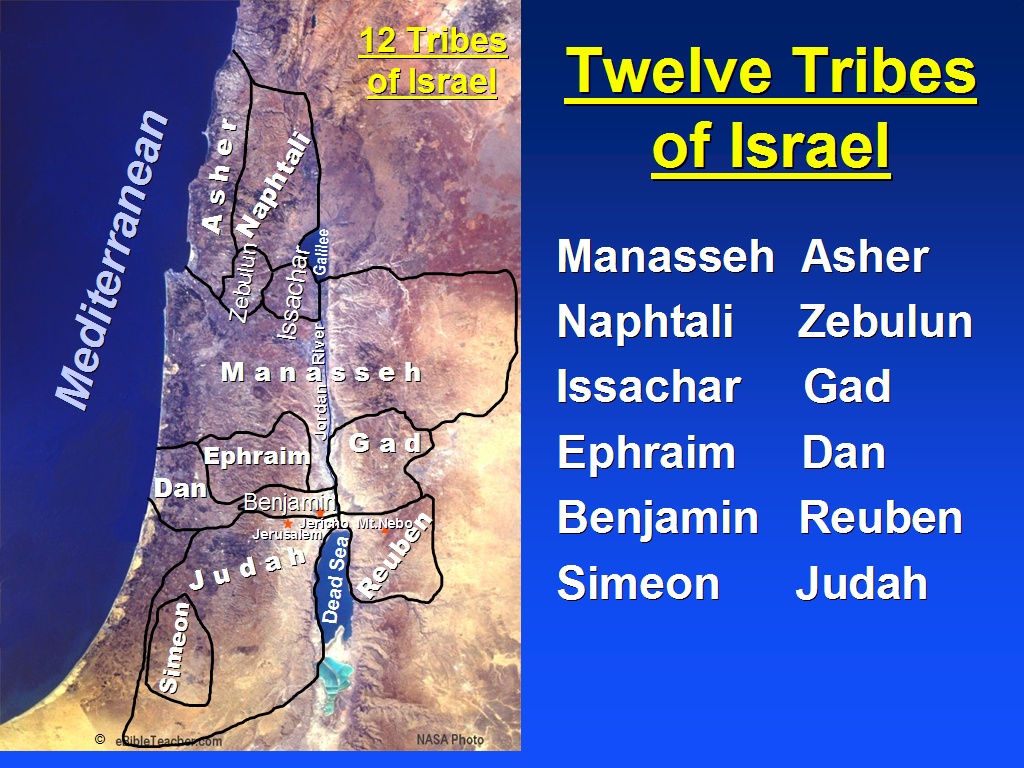
Image from ebibleteacher.com

24 of the tribe of the Sons of Efrayim, leader: Kemiel son of Shiftan.
25 Of the tribe of the Sons of Zevulun, leader: Elitzafan son of Parnakh.
26 Of the tribe of the Sons of Yissakhar, leader: Paltiel son of Azzan.
27 Of the tribe of the Sons of Asher, leader: Ahihud son of Shelomi.
28 Of the tribe of the Sons of Naftali, leader: Pedah’el son of Ammihud.
29 These (are they) whom YHVH commanded to parcel-out-inheritance for the Children of Israel, in the land of Canaan.


Numbers/Bamidbar 33: "and it shall be: as I thought to do to them, so I will do to you!"

[Imagine yourself among the 2nd generation of Israelites:  

  • you were born in the wilderness,
  • you were born free unlike your slave-parents who have already died,
    • never catching a glimpse of the Land,
    • much like all their contemporaries
    • except for Mosheh who sees the Land from a distance before he dies,
    • and except for Yahushuwah and Caleb
    • who will lead you into the conquest of your inheritance.  

Surely you heard over and over during your 39 years of journeying,

  • not only the anecdotes connected with the exodus,
  • but also the miracles your God performed as needed,
  • climaxing in meeting HIM on Sinai,
    • the covenant and the commandments,
  • blessings received as well as disciplines imposed along the way,
  • and just as important, a look back at the journey in terms of territory covered. 

This chapter reads like a travelogue, a review of how far Israel has come, as the opening line states:  

1 These are the marching-stages of the Children of Israel that they went on 
from the land of Egypt, by their forces,
 through the hand of Moshe and Aharon.

 
But while it is a look-back, it is also a look-forward in terms of the stern instructions regarding how to deal with the inhabitants of the Land, the Canaanites and the justification, but worse:  if they do not do as told, they will suffer the same way as the inhabitants.  How clear is YHWH about His instructions?  He makes sure no one will misunderstand! 
 
51. Speak to the sons of Yisra’el, and say to them: When you pass over the Yarden into the land of Kena’an, 

  • 52. then you will drive out all the populace of the land from before you,
  • and destroy all their figured stones,
  • and destroy all their molten images,
  • and demolish all their high places:

55. But if you will not drive out the populace of the land from before you,

  • then with those that you let remain of them be as pricks in your eyes,
  • and as thorns in your sides,
  • and they will trouble you in the land where you dwell.

56. And it will come to pass that, as I thought to do to them, so I will do to you.

 Commentary is from Pentateuch and Haftorahs, ed. Dr. J.H. Hertz; translation is EF/Everett Fox The Five Books of Moses.Admin1.]

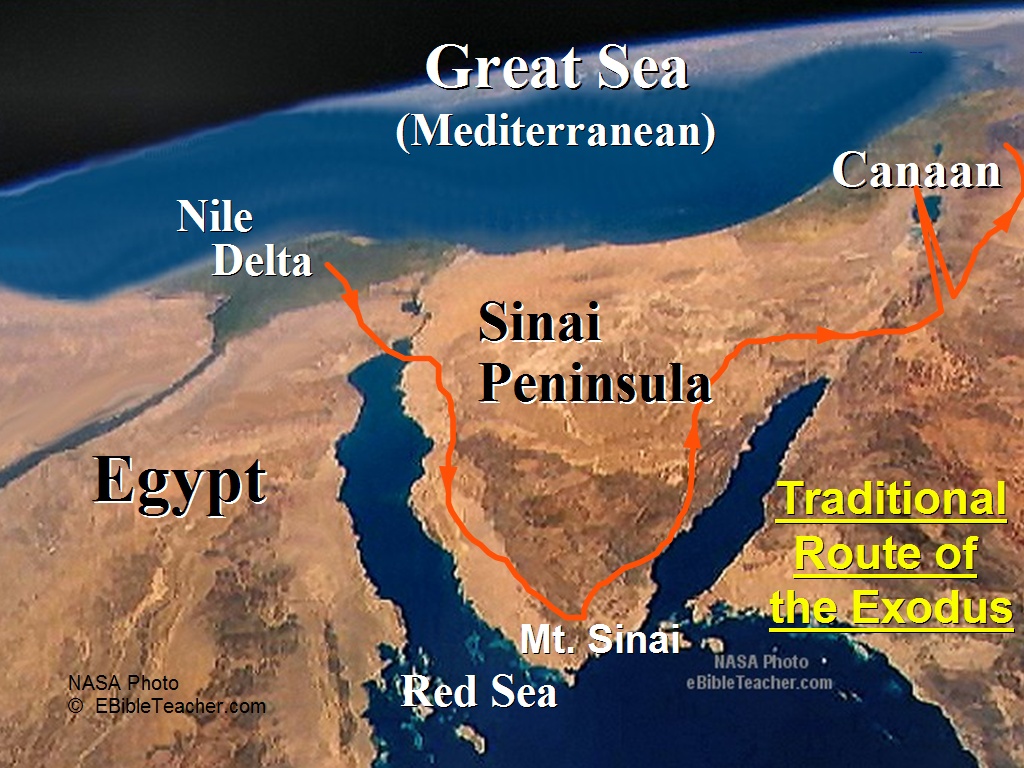
Image from garvandwane.com

XXXIII,1-49.  ITINERARY FROM EGYPT TO JORDAN

This chapter supplies us with the stages of the journey of the Israelites from Egypt to the Plains of Moab.  It was written to serve as a memorial not only of historical interest but of deep religious significance.  Every journey and every halting-place had its suggestions for the instruction, admonition, or encouragement of Israel.  The Midrash says, ‘It may be likened unto a king who had taken his ailing son to a distant place to be cured. On the return journey, the king would lovingly recount to the lad all the experiences they went through at each of their halting-places. “At this spot we slept; at that, we had a cool resting-place from the heat; at the other, you were overcome with pains in the head!”  Israel is God’s child, upon whom He bestows compassion, even as a father bestows compassion on his son.’


Numbers/Bamidbar 33

1 These are the marching-stages of the Children of Israel that they went on 
from the land of Egypt, by their forces,
 through the hand of Moshe and Aharon.
2 Moshe wrote down their departures, by their marching-stages, by order of YHVH.
 Now these are their marching-stages, by their departures:

goings forth.  i.e. each place from which they went forth to proceed to another place.

3 They marched from Ra’mses, in the first New-moon, 
on the fifteenth day after the first New-moon;
 on the morrow of the Passover-meal
 the Children of Israel departed with a high hand, before the eyes of all Egypt,

with a high hand.  See Exod. XIV,8.

in the sight of all the Egyptians.  The departure was public.  There was nothing clandestine or ignominious in the way in which they left the land of their oppressors.

4 while Egypt was burying those that YHVH had struck-dead among them, all the firstborn, 
and on their gods, YHVH had rendered judgment.

burying.  Israel was joyous and strong whilst his erstwhile master, Egypt, was bent low and broken.

upon the gods.  See on Exod. XII,12 for the meaning of this phrase.  The false deities of Egypt were made contemptible in the eyes of their worshippers.

5-15.  These verses detail the stages of the journey from Rameses in Egypt to the Wilderness of Sinai.  This is related in Exod. XII,37 and XIX,2.  Two stations, Dophkah and Alush, are not mentioned in Exodus.

5 And the Children of Israel marched on from Ra’mses, and encamped at Sukkot;
6 they marched on from Sukkot and encamped at Eitam, which is at the edge of the wilderness.
7 And they marched on from Eitam and turned toward Pi-ha-hirot, that (runs) along the face of Baal Tzefon, 
and encamped before Migdol.
8 They marched on from Penei Ha-Hirot and crossed in the midst of the Sea into the wilderness; then they marched a journey of three days into the Wilderness of Eitam, 
and encamped at Mara.
9 They marched on from Mara and came to Eilim; 
now in Eilim (were) twelve springs of water and seventy palms, 
and they encamped there.
10 They marched on from Eilim and encamped by the Sea of Reeds.
11 They marched on from the Sea of Reeds and encamped in the Wilderness of Syn.
12 They marched on from the Wilderness of Syn and encamped at Dofka.
13 They marched on from Dofka and encamped at Alush.
14 They marched on from Alush and encamped at Refidim,
 but there was no water there for the people to drink.
15 They marched on from Refidim and encamped in the Wilderness of Sinai.

16-36.  At this distance it is exceedingly difficult to identify the exact route of march, more especially as the names were not names of cities or conspicuous landmarks.  They have changed with the centuries, and the designation of the temporary landmarks was forgotten (Dummelow).

16 They marched on from the Wilderness of Sinai and encamped at Kivrot Ha-Taava.
17 They marched on from Kivrot Ha-Taava and encamped at Hatzerot.
18 They marched on from Hatzerot and encamped at Ritma.
19 They marched on from Ritma and encamped at Rimmon Peretz.
20 They marched on from Rimmon Peretz and encamped at Livna.
21 They marched on from Livna and encamped at Rissa.
22 They marched on from Rissa and encamped at Kehelata.
23 They marched on from Kehelata and encamped at Mount Shefer.
24 They marched on from Mount Shefer and encamped at Harada.
25 They marched on from Harada and encamped at Mak’helot.
26 They marched on from Mak’helot and encamped at Tahat.
27 They marched on from Tahat and encamped at Terah.
28 They marched on from Terah and encamped at Mitka.
29 They marched on from Mitka and encamped at Hashmona.
30 They marched on from Hashmona and encamped at Moserot.
31 They marched on from Moserot and encamped at Benei Ya’kan.
32 They marched on from Benei Ya’kan and encamped at Hor Ha-Gidgad.
33 They marched on from Hor Ha-Gidgad and encamped at Yotvata.
34 They marched on from Yotvata and encamped at Avrona.
35 They marched on from Avrona and encamped at Etzyon Gever.
36 They marched on from Etzyon Gever and encamped in the Wilderness of Tzyn-that is
Kadesh.

37-49.  This section deals with the march, in the fortieth year, to the borders of Moab and the fords of the Jordan.

37 They marched on from Kadesh and encamped at Hill’s Hill, at the edge of the land of Edom.
38 Now Aharon the priest went up on Hill’s Hill, by order of YHVH, 
and died there, in the fortieth year after the going-out of the Children of Israel from the land of Egypt,
 in the fifth New-moon, on the first of the New-moon.
39 Aharon was three and twenty and a hundred years old 
when he died at Hill’s Hill.
40 Now the Canaanite, the king of Arad 
-he sat-as-ruler in the Negev, in the land of Canaan-heard of the coming of the Children of Israel.
41 They marched on from Hill’s Hill and encamped at Tzalmona.
42 They marched on from Tzalmona and encamped at Punon.
43 They marched on from Punon and encamped at Ovot.
44 They marched on from Ovot and encamped at Iyyei Ha-Avarim, in the territory of Moav.
45 They marched on from Iyyim and encamped at Divon Gad.
46 They marched on from Divon Gad and encamped at Almon Divlatayim.
47 They marched on from Almon Divlatayim and encamped in the hills of Avarim/The Region-Across, facing Nevo.
48 They marched on from the hills of the Avarim and encamped in the Plains of Moav, by Jordan-jericho.
49 And they encamped along the Jordan, from Bet Yeshimot as far as Avel Shittim/Acacia Meadow, 
in the Plains of Moav.

50-56.  COMMANDS WITH REGARD TO THE SETTLEMENT IN CANAAN

50 Now YHVH spoke to Moshe in the Plains of Moav, 
by Jordan-jericho, saying:
51 Speak to the Children of Israel, and say to them:
 When you cross the Jordan into the land of Canaan,
52 you are to dispossess all the settled-folk of the land from before you. 
You are to destroy all their figured-objects, 
all their molten images you are to destroy, 
all their high-places you are to annihilate,

drive out.  i.e. dispossess.  The reason given for this command is that no inducements to idolatry remain in the Promised Land (see Exod. XXIII, 31-33, XXXIV,11-17).

their figured stones. See Lev.XXVI,1.

their high places.  The altars and sanctuaries erected on hills and natural mounds, as was the practice of the Canaanites.

Everything that savoured of idolatry was to be swept away, as being offensive to God and religiously perilous to the Israelites.

53 that you may take-possession of the land and settle in it, 
for to you I have given the land, to possess it.

unto you have I given the land.  The Land is not man’s, but God’s.  ‘The earth is the LORD’s, and the fulness thereof’ (Ps. XXIV,1).  God has a right to do what He will with His own.

54 You shall arrange-inheritance of the land by lots, according to your clans: 
for the many, you are to make-much their inheritance,
 for the few, you are to make-little their inheritance, 
wherever the lot comes out for them there, (so) shall theirs be; 
by the tribes of your fathers you are to receive-inheritance.

by lot. The system of dividing land by lot persisted down to Roman times.  It was in practice in Palestine in the days of R. Jose, a tanna of the second century (contra Kennett, Schweich Lectures 1931, p. 76).

55 But if you do not dispossess the settled-folk of the land from before you,
 those who are left of them shall be 
as barbs in your eyes, as spines in your sides;
 they will assault you on the land that you are settling in,

as pricks in your sides.  A source of continual and unabated vexation.

56 and it shall be: 
as I thought to do to them, so I will do to you!

so will I do unto you.  If they left the Canaanites unexpelled, the end would be the expulsion of Israel.

Numbers/Bamidbar 32: "Will your brothers go to the war, and you will sit here?"

 [Let’s be honest.  How many readers of the Hebrew Scriptures REALLY bother to look at and study the geography described in the journey of Israel and final conquest of the Land? Unless one has a STUDY BIBLE where the designers have taken pains to include maps and illustrations, does the average reader do the research on his own?  And yet, one’s understanding is greatly enhanced when we do take the time and effort to do the extra research.  
 
Interestingly, we have found NO version of the Hebrew Scriptures that provides these extra visual aids and understandably so; if Jews write for Jews, they are expected to know their history and their Land.
 
This chapter is best understood if you check out the territory being described and why some tribes preferred to claim it as their inheritance . . . and the problem that their preference posed for the other tribes who have yet to fight and claim their territories.  
 
Now here’s a question:  if the God of Israel had promised this land of Canaan to Abraham, Isaac and Jacob and the tribes that composed the nation of Israel, why did He not just hand it to them as promised?  
 
‘What?! We have to fight for the Promised Land? Isn’t it already OURS by Divine bestowal?’  
 
Not so fast, Israelites, the Land happens to be inhabited by Canaanites; eliminate them, cleanse the land of their abominations, and then you deserve the set-apart for YHWH and yourselves, ‘Holy’ Land.  
 
And so the saga continues . . . . Commentary is, as usual, from Pentateuch and Haftorahs, ed. Dr. J.H. Hertz, and translation is EF/Everett Fox The Five Books of Moses. —Admin1.]

TRIBES REMAINING EAST OF THE JORDAN

The tribes of Reuben, Gad, and the half-tribe of Manasseh desire to settle east of the Jordan.  They protest their willingness to accompany the other tribes until Canaan is conquered.

Eastern or Transjordanic Palestine is 150 miles long; its breadth varies from thirty to eighty miles.  It is throughout over 2.000 feet above sea level, with a temperate climate, a land of health and fertility.  The middle region—Gilead—bore perfume and medicine for the whole Eastern world.  Gilead is covered with forests; and its valleys, by orchards and vineyards.  Even more famous was its pasture.  ‘Flocks and pastures have ever been the wealth, the charm, the temptation of Eastern Palestine—a land of opulence and insecurity’ (George Adam Smith).


Numbers/Bamidbar 32

1 Now many livestock had the Sons of Re’uven and the Sons of Gad, 
an exceedingly mighty (amount);
and they saw the land of Ya’zer in the land of Gil’ad:
here, the place was a place (fit) for livestock.

the land of Jazer.  Referred to in XXI,32 as having been captured by Moses from the Amorites.

Gilead.  Gilead sometimes stands for the whole territory east of the Jordan (e.g. in v. 29) that was occupied by the Israelites.  Sometimes, however, as in v.39, it denotes only the land north of the river Jabbok, as far as the river Jarmuk.

2 So the Sons of Re’uven and the Sons of Gad came 
and said to Moshe, to El’azar the priest and to the leaders of the community, saying:
3 Atarot and Divon, Ya’zer and Nimra, 
Heshbon and El’aleh, 
Sevam, Nevo and Be’on,
4 the land that YHVH has struck before the community of Israel-
it is a land for livestock, 
and your servants have livestock.
5 And they said:
If we have found favor in your eyes,
let this land be given to your servants as a holding; 
do not make us cross the Jordan!
6 Moshe said to the Sons of Gad and to the Sons of Re’uven: 
Should your brothers go out to war, 
and you, you stay here?
7 Why would you constrain the will of the Children of Israel
from crossing into the land that YHVH has given them?

turn away the heart.  Their request, if granted, would dishearten the other tribes, as it would reduce the fighting strength of Israel.

8 Thus did your fathers, when I sent them out of Kadesh Barne’a to see the land:
9 they went up as far as Wadi Eshkol and saw the land, 
then they constrained the will of the Children of Israel 
so they did not come into the land that YHVH had given them.
10 And the anger of YHVH flared up on that day, 
and he swore, saying:
11 If they should see, the men who went up from Egypt, 
-from the age of twenty and upward- 
the soil about which I swore to Avraham, to Yitzhak and to Yaakov . . . ! 
For they did not follow-fully after me,
12 excepting Calev son of Yefunne, the Kenizzite, and Yehoshua son of Nun,
for they followed-fully after YHVH.
13 And the anger of YHVH flared up against Israel,
and he had them wander in the wilderness, for forty years, 
until it came-to-an-end, that whole generation that was doing what was ill in the eyes of YHVH.
14 Now here, you have arisen in place of your fathers, 
a brood of sinning men,
to add further to the flaming anger of YHVH against Israel.
15 If you turn away from him, 
he will add further to leave them in the wilderness, 
and you will bring-ruin-upon this whole people!

destroy all this people.  The unworthy desires of these might infect the other tribes, and thus the whole nation would be shut out from entering Canaan and perish.

16 They came close to him and said:
Sheep fences we will build, for our livestock here,
and towns for our little-ones;
17 and as for us, we shall be drafted hastily before the Children of Israel, 
until we have brought them to their region. 
But our little-ones will stay in towns fortified against the inhabitants of the land.

before the children of Israel.  They will march in the van of the Israelites’ army.

fortified cities. To protect them from attack by the neighbouring populations whilst they are away on active service.

18 We will not return to our houses until the Children of Israel have inherited each-man his inheritance.
19 For we will not take-inheritance with them across the Jordan and further (on),
for our inheritance has become ours
across the Jordan, toward sunrise.
20 Moshe said to them:
If you do this thing,
if you are drafted before YHVH for war,
21 and you cross the Jordan, every hand-picked man, before YHVH,
until he has dispossessed his enemies from before him,
22 and the land is subdued before YHVH, 
afterward you may return,
and (then) you will be clear (of obligation) before YHVH and before Israel;
this land will be for you as a holding before YHVH.

clear before the LORD, and before Israel.  The idea contained in this phrase became a general moral maxim among the Rabbis.  ‘Man should be clear not only before God but also in the estimation of his fellowmen.’  It is not enough that a man’s conscience is pure.  He must strive to make even his outward actions irreproachable and above suspicion.  A man should avoid doing things that appear wrong.

23 But if you do not do thus: 
here: you will have sinned against YHVH, 
and know your sin-that (it) will overtake you!

And know ye your sin—i.e. the punishment for your sin, which will find you.  The rendering of the RV, which has passed into a proverbial expression in the English language, is based upon an ancient notion that sin, like a curse, has, so to speak, an individual existence.  The sinner cannot escape its consequence; it will seek and find him out.

24 Build yourselves towns for your little-ones and fences for your flocks, 
and what has gone out of your mouths, do!
25 Then said the Sons of Gad and the Sons of Re’uven to Moshe, saying: 
Your servants will do as my lord commands:
26 our little-ones, our wives, our livestock and all our animals 
will stay there in the towns of Gil’ad;
27 your servants will cross over, every drafted (member) of the armed-forces, before YHVH, in war,
as my lord has spoken.
28 So Moshe commanded El’azar the priest concerning them
and Yehoshua son of Nun 
and the heads of the Fathers of the tribes of the Children of Israel,
29 and Moshe said to them:
If the Sons of Gad and the Sons of Re’uven cross over the Jordan with you, 
everyone drafted for war, before YHVH, 
and the land is subdued before you, 
you may give them the land of Gil’ad as an inheritance.
30 But if the drafted (warriors) do not cross over with you,
they will receive-holdings with you in the land of Canaan.

among you in the land of Canaan.  They would then be forced to evacuate their possession in Gilead, and fight for territory on the west of Jordan.

31 The Sons of Gad and the Sons of Re’uven answered, saying:
What YHVH has spoken to your servants, thus will we do:
32 we ourselves will cross over, as drafted men, before YHVH, into the land of Canaan, (remaining) with us (will be) our inherited holding, across the Jordan.
33 So Moshe gave to them, to the Sons of Gad, the Sons of Re’uven, and half the tribe of Menashe son of Yosef, 
the kingdom of Sihon king of the Amorites,
and the kingdom of Og king of Bashan, 
the land as regards its towns in the territories, the towns of the land all around.

half-tribe of Manasseh.  The sub-tribes of Manasseh were pure warriors, who had taken the most prominent part in the conquest of the Gileadite districts.  The word ‘half’ in the phrase ‘half-tribe of Manasseh’ is not to be taken in a precise arithmetical sense.  it denotes a section.  According to XXVI,29-32, there were eight sub-tribes of Manasseh, six of whom were allotted territory on the west of Jordan.

34 And the Sons of Gad rebuilt Divon, Atarot, and Aro’er,

built Dibon. i.e. rebuilt it; fortified it so as to make it a place of safety for their families; thus also in v.37.

35 Aterot Shofan, and Ya’zer and Yogbeha,
36 and Bet Nimra and Bet Haran, 
as fortified cities and as fences for flocks.
37 And the Sons of Re’uven rebuilt Heshbon and El’alei 
and Kiryatayim,
38 and Nevo and Baal Me’on-of changed name- 
and Sivma; 
and they called them by (other) names, 
the names of the towns that they built.

changed.  As they were names of two heathen deities.

39 Then went out the Sons of Makhir son of Menashe, to Gil’ad, 
they conquered it
and dispossessed the Amorites that were in it
40 And Moshe gave Gil’ad to Makhir son of Menashe, 
and he settled there.

unto Machir. i.e. unto the clans of Machir.

41 And Ya’ir son of Menashe marched out
and conquered their villages, 
he called them Havvot-ya’ir/Fortified-villages of Ya’ir.

Havvoth-fair. i.e. the towns of Jair.

42 And Novah went out 
and conquered Kenat and its daughter-towns, 
and he called it Novah,
after his (own) name.

Numbers/Bamidbar 31: ". . .Seek-vengeance, the vengeance of the Children of Israel from the Midyanites"

 [War waged by Israel against their enemy upon orders of their God is one of the issues raised by agnostics/atheists as to why they refuse to believe in the God of the Old Testament.  It is likewise used by Christians as an argument for their NT version of God, who is full of grace and mercy unlike this angry, vengeful OT God.
 
As the Jewish commentators themselves confess in the introduction to this chapter,  “We are no longer acquainted with the circumstances that justified the ruthlessness with which it was waged, and therefore we cannot satisfactorily meet the various objections that have been raised in that connection.”
 
We Sinaites have agreed not to question Israel’s battles fought in defense during their wilderness wandering, nor in offense during the conquest of the Promised Land. We never experienced the perversities and abominations oft-mentioned in these biblical historical narratives.  Suffice it to say that we do watch in horror how Hollywood presents the brutality of warring factions in its historical films, whether it be among Vikings, Crusades, Islamic terrorists, Vietnamese, Germans, Japanese, or the American Civil War.  
 
Man’s inhumanity to fellowman perceived as the enemy is forever etched in the memories of the vanquished and the victims.  And even in the absence of war, just look at what is happening in civilized societies, in urban centers, horrific crimes perpetrated against people who happen to be in the wrong place at the wrong time.
 
No, Israel was no more or less different from the nations in defense or offense, though we tend to think it should be, since it supposedly operates on a higher moral standard as dictated by its Divine Commander in Chief.  
 
There is not much commentary offered in Pentateuch and Haftorahs, ed. Dr. J.H. Hertz. Translation is by EF/Everett Fox The Five Books of Moses..– Admin1]

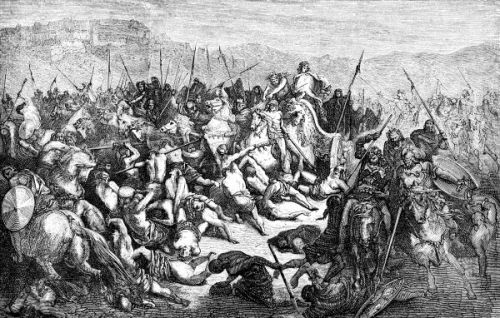
THE WAR AGAINST THE MIDIANITES In XXV,16-18, Moses is bidden to smite the Midianites because they had enticed the Israelites to the licentious and idolatrous worship of Baal-Peor.  In the present chapter, he is ordered to carry out the command forthwith; and we are given full details of the campaign.

Image from gci.org

The war against the Midianites presents peculiar difficulties.  We are no longer acquainted with the circumstances that justified the ruthlessness with which it was waged, and therefore we cannot satisfactorily meet the various objections that have been raised in that connection.  ‘Perhaps the recollection of what took place after the Indian Mutiny, when Great britain was in the same temper, may throw light on this question.  The soldiers then, bent on punishing the cruelty and lust of the rebels, partly in patriotism, partly in revenge, set mercy altogether aside’ (Expositor’s Bible).  The Midianites affected were only the clans that lived in the neighbourhood of Moab.  This accounts for the persistence of Midianites in later periods of Israelite history.
 

Numbers/Bamidbar 31

1 YHVH spoke to Moshe, saying: 2 Seek-vengeance, the vengeance of the Children of Israel from the Midyanites;
afterward you will be gathered to your kinspeople. 3 Moshe spoke to the people, saying:
Draft from among you men for the attack-force,
let them be against Midyan, 
to exact the vengeance of YHVH upon Midyan.

execute the LORD’s vengeance.  The preceding v. refers to Israel’s vengeance on Midian.  Both mean the same thing.  The cause of Israel is the cause of God.  ‘Vengeance’ is here used in the broad sense of retributory punishment.

4 A thousand per tribe, a thousand per tribe for each of the tribes of Israel, 
you are to send out to the attack-force.

5-18. THE EXPEDITION

5 There were mustered, from the divisions of Israel, a thousand per tribe, 
twelve thousand (men) drafted for the attack-force.

delivered.  i.e. placed at the disposal of Moses by the leaders of each tribe.

6 Moshe sent them out, a thousand per tribe, to the attack-force,
them and Pin’has son of El’azar, priest to the armed-forces,
the holy implements and the trumpets for (sounding) trilling-blasts in his hand.

Phinehas the son of Eleazar the priest.  Phinehas, says Rashi, was especially qualified for this task by the part he played in the Zimri incident (XXV,14,15).  His role was that of the priest referred to in Deut. XX,2, whose duty it was to go before the Israelites in battle.

the holy vessels.  The Ark and its contents often accompanied the Israelites on their military expeditions; I Sam.IV,3.

in his hand.  i.e. at his disposal.

7 They arrayed-their-forces against Midyan,
as YHVH had commanded Moshe,
and they killed every male,

every male.  Every adult male.

8 and the kings of Midyan they killed, along with the (other) slain: 
Evi and Rekem, Tzur, Hur and Reva,
the five kings of Midyan; 
and Bil’am son of Be’or they killed with the sword.

Balaam.  On his way to his home in Mesopotamia, he must have remained for some time with the Midianites and been their adviser in the matter of Baal-Peor.

with the sword.  The Rabbis say that he was slain after a trial by a Beth Din (Sifri).

9 Now the Children of Israel captured the women of Midyan, and their little-ones,
and their animals and all their acquired-wealth, 
and all their goods they took-as-plunder. 10 And all their towns, among their settlements, and all their tent-villages, they burned with fire. 11 They took all the booty and all those-taken, among man and among beast.

prey. Booty in livestock; spoil, in goods.

12 They brought to Moshe and to El’azar the priest, and to the community of the Children of Israel 
the captives and those-taken and the booty, to the camp,
to the Plains of Moav, that are by Jordan-jericho. 13 Now Moshe and El’azar the priest and all the leaders of the community, came out to meet them, 
outside the camp. 14 And Moshe was furious with the commanders of the military, the officers of thousands and
the officers of hundreds, 
who had come back from the armed-force in war; 15 Moshe said to them: 
You have left-alive all the females! 16 Here, they were (the cause) for the Children of Israel-through the word of Bil’am,
of turning away from YHVH, in the matter of Pe’or, 
so that a plague came against the community of YHVH! 17 So now,
kill every male among the little-ones,
and every woman who has known a man by lying with a male, kill (as well)! 18 But all the younger-ones among the women who have not known lying with a male-  you may keep them alive for yourselves.

for yourselves. To employ them as domestic servants.

19-24.  PURIFICATION OF THE WARRIORS

19 As for you: pitch-camp outside the camp, for seven days; everyone who killed a person or
everyone who touched a corpse- 
decontaminate-yourselves on the third day and on the seventh day, 
you and your captives.

without the camp seven days. An enforcement of the law of seven days’ defilement and segregation as laid down in XIX,11.

and your captives.  In order to prevent the spread of their contamination by the Israelites’ contact with their garments.

20 And every garment and every vessel of animal-skin and everything made of goats’-hair and every wooden vessel, 
you are to decontaminate.

as to every garment.  Everything that had come in contact with a corpse required purifying.

21 El’azar the priest said to the men of the armed-force who came back from the war: 
This is the legal Instruction that YHVH had commanded Moshe:

the statute of the law.  Contained in XIX, Eleazar now proceeds to enlarge this ‘statute’ of the law in order to meet the present circumstances.

22 However, gold and silver, 
bronze, iron, tin and lead
23 -anything that can come through fire-
 you are to pass through fire, then it will be pure;
 however, in Waters Kept-Apart it is to be decontaminated. 
And everything that cannot come through fire, you are to pass through water.

everything that may abide the fire.  The Talmud understands these laws to mean that every household utensil which, when employed for preparing food, comes into direct contact with fire, must be cleansed with fire.  For others, purification by water is sufficient.

water of sprinkling. See XIX,9.

24 You are to scrub your garments on the seventh day, then you will be purified; 
afterward you may come back into the camp.

25-34.  APPORTIONMENT OF SPOIL

25 YHVH said to Moshe, saying:
26 Take up the head-count of those taken captive, 
among man and among beast, 
you and El’azar the priest and the heads of the fathers of the community.
27 You are to halve (equally) the taken-loot
 between those wielding (swords skillfully) in war, those going-out to the armed-forces, 
and the entire community.

into two parts.  Those who fought and those who remained behind were to receive equal shares; and from each of these shares, a tax was levied for the priests and the Levites.

28 And you are to raise a levy for YHVH 
from the men of war, those going-out to the armed-forces, 
one life out of five hundred, 
from humans and from cattle, from donkeys and from sheep.

one soul.  i.e. one individual, or, ‘head of cattle.’  One five-hundredth was to be paid by the soldiers for the benefit of the priests; whilst one-fiftieth of the congregation’s share was to go to the support of the Levites.

29 From their half-share you are to take
 and give to El’azar the priest a contribution to YHVH.
30 And from the half-share of the Children of Israel you are to take one, withheld from the fifty, from humans and from cattle, from donkeys and from sheep,
 from all domestic-animals,
 and you are to give them to the Levites, 
those charged with the charge of YHVH’S Dwelling.
31 Moshe and El’azar the priest did 
as YHVH had commanded Moshe.
32 Now what was taken, over-and-above the plunder that the people from the armed-forces plundered, 
were sheep, six hundred thousand and seventy thousand and five thousand,
33 and cattle, two and seventy thousand,

beeves.  Old English plural of ‘beef’; used for live animals.

34 and donkeys, one and sixty thousand;
35 and human persons, 
of women who had not known lying with a male,
 all the persons: two and thirty thousand.
36 And the half-share, the portion of those going-out to the armed-forces, 
the number of sheep: three hundred thousand and thirty thousand and seven thousand and five hundred.
37 And the levy for YHVH from the sheep was 
six hundred and five and seventy,
38 and (from) the cattle, six and thirty thousand, 
and their levy for YHVH, two and seventy,

Image from christianimagesource.com

39 and (from) the donkeys, thirty thousand and five hundred,
 and their levy for YHVH, one and sixty;
40 and (from) human persons, sixteen thousand, 
and their levy for YHVH, two and thirty persons.
41 Moshe gave the levy of the contribution of YHVH to El’azar the priest, 
as YHVH had commanded Moshe.
42 Now from the half-share of the Children of Israel
that Moshe had halved, from the men who served-as-armed-forces,
43 the half-share for the community, from the sheep-
 three hundred thousand and thirty thousand and seven thousand and five hundred;
44 and cattle six and thirty thousand;
45 and donkeys thirty thousand and five hundred;
46 and human persons sixteen thousand.
47 Moshe took from the half-share of the Children of Israel, one withheld out of fifty, 
among man and among beast, 
and gave them to the Levites, those charged with the duties of the Dwelling of
YHVH, 
as YHVH had commanded Moshe.
48 Now there came-near to Moshe the commanders that belonged to the divisions of the armed-forces, 
officers of thousands and officers of hundreds,
49 they said to Moshe: 
Your servants have taken up the head-count of the men of war that are under our hand,
 there has not gone uncounted of us a (single) man!
50 And we have brought-near a near-offering for YHVH 
(from) any man who found a vessel of gold, armlets or bracelets, 
rings, earrings, or ornaments, 
to effect-ransom for our lives, before the presence of YHVH.

offering.  Of thanksgiving for their victory and safe return home.  Ornaments of gold were worn by roving nomads and traders (Gen. XXXVII,28).

atonement.  See Exod. XXX,15.

51 So Moshe and El’azar the priest took the gold from them, 
all kinds of implements of fine-workmanship.
52 Now all the gold of the contribution, that they set-aside for YHVH:
 sixteen thousand and seven hundred and fifty shekels,
from the officers of thousands and from the officers of hundreds.
53 The men of the armed-forces kept-as-plunder, each-man (what) was his.
54 And Moshe and El’azar the priest took the gold 
from the officers of thousands and the officers of hundreds, 
and brought it to the Tent of Appointment, 
(as) a reminder for the Children of Israel, before the presence of YHVH.

into the tent of meeting.  And placed it in the treasury of the Tabernacle; Exod. XXX,16; Josh. VI,24.

Numbers/Bamidbar 30: "(Any) man who vows a vow to YHVH . . . he is not to desecrate his word, according to all that goes out of his mouth, he is to do."

[Hmmmm, just thinking . . .  a whole chapter devoted to vows included in the Torah.  Vow-making and vow-breaking must have been a problem in those days so that it had to be regulated.  What vows do people make today?
 
 I know of a Catholic friend whose faith in God includes making such vows in exchange for favors asked and guess what?  I have yet to hear of a prayer not granted.  What does she offer in exchange? Mostly self-denial from food indulgences — no dessert for a month, no coke for a week, fasting from favorite foods — all of which gives her an added benefit of losing weight!  I’ve often wondered why God grants her requests while my few and far between supplications have remained unrequited, so much so I don’t bargain with God any more . . . which is fine because according to Judaism, Scripture discourages vowing.  
 
On second thought, perhaps I did not fulfill my vows as perfectly as my Catholic friend did hers.  Oh well . . . .please read the ‘VOWS AND VOWING IN THE LIGHT OF JUDAISM’ at the end of this chapter.  
 
Commentary is from Pentateuch and Haftorahs, ed. Dr. J.H. Hertz; translation isEF/Everett Fox The Five Books of Moses.Admin1]

CONCERNING VOWS

This chapter emphasizes the solemnity and binding character of religious vows, and in what circumstances vows of women can be annulled by the father or husband.


Numbers/Bamidbar 30

1 So Moshe declared to the Children of Israel 
according to all that YHVH had commanded Moshe.

2-3.  SACREDNESS OF VOWS.

2 Now Moshe spoke to the heads of the tribes of the Children of Israel, saying: 
This is the word that YHVH has commanded:
3 (Any) man who vows a vow to YHVH 
or swears a sworn-oath, to bind himself by a binding-obligation:
he is not to desecrate his word, 
according to all that goes out of his mouth, he is to do.

he is not to desecrate his word, 

according to all that goes out of his mouth, he is to do.

voweth a vow.  Heb. neder; denotes a solemn promise to consecrate something to God, or do something in His service or His honour.  A vow was usually made in a time of distress, and its motive was the desire to secure Divine help; Gen. XXVIII,20-22.  Or it might be an expression of gratitude for Divine aid received.  ‘The manifest emotion with which many a singer in the Psalter records his gratitude to God as he pays his vows, shows that they must often have represented a warm and genuine religious experience’ (McFadyen).

a bond.  Heb. issar.  In contrast to neder, this may be called a negative vow:  a self-imposed pledge to abstain from doing or enjoying something that is perfectly allowable.

break his word.  lit. ‘profane his word’.  The violation of a vow or ‘bond’ is at once an offence before God, and an act of profanation of man’s personality.

according to all that proceedeth out of his mouth.  There is a tendency in human nature to forget in health and security the vows that were made in sickness and danger; but the rule remains,, Whatever a man has promised unto God, that he must fulfill.

4-6.  VOWS OF A YOUNG UNMARRIED WOMAN

After laying down the general principle, Scripture proceeds to qualify it in three special cases of vows made by women under authority: viz. (a) women before marriage; (b) married women; (c) women after marriage, i.e. widows and divorced women.

4 And a woman, when she vows a vow to YHVH 
or binds (herself) by a binding-obligation in her father’s house, in her youth,

in her youth.  A young unmarried woman still under her father’s guardianship; i.e., till the age of adolescence.

5 and her father hears her vow, or her binding-obligation by which she has bound herself, 
and her father is silent to her:
all her vows, they shall be upheld, 
and all her binding-obligations by which she has bound herself shall be upheld.

holdeth his peace. The father’s silence amounts to a ratification of the vow.

6 Now if her father constrains her at the time that he hears it,
all her vows and her binding-obligations by which she binds herself shall not be upheld,
and YHVH will grant-her-pardon,
for her father has constrained her.

disallow her.  If the father verbally disapproves of her vow on the day he hears of it, such disapproval amounts to a veto and the vow becomes annulled; see v. 13.

7-9.  CASE OF A MARRIED WOMAN WHO MADE THE VOW WHILST SINGLE

7 But if she becomes-married, becomes-married to a man
while her vows are upon her, 
or the rash-statement of her lips by which she has bound herself,

Image from rhr.org

while her vows are upon her.  This is the second of the three afore-mentioned cases; viz. the vow of a woman who marries whilst under a vow made by her before marriage, whether during the stage of adolescence and with the requisite approval of the father, or when she was a full-grown woman and outside the range of her father’s veto.

8 and her husband hears, 
(and) at the time that he hears he is silent to her, 
her vows shall be upheld. 
All her binding-obligations by which she has bound herself shall be upheld.

and hold his peace.  As in v. 5.

9 Now if at the time that her husband hears, he constrains her,
he annulls her vow that is upon her 
as well as the rash-statement of her lips by which she has bound herself,
and YHVH will grant-her-pardon.

disallow her. By verbal disapproval, as in v. 6.

10-16.  VOWS OF A WIDOW AND DIVORCED WOMAN

10 Now the vow of a widow or a divorcée, 
anything by which she has bound herself,
shall be upheld regarding her.

widow, or . . .  divorced.  The vows of such women are fully binding.  They fall under the general principle in v. 3.

11 If in the house of her husband she made-a-vow 
or bound, bound herself by a sworn-oath,

in her husband’s house.  In this instance, the husband has the same authority to allow or disallow the vow, as the father had in regard to his young adolescent daughter.

12 and her husband heard, and was silent to her, 
not constraining her, 
all her vows, they shall be upheld, 
and all the binding-obligations by which she bound herself shall be upheld.
13 But if her husband annulled, yes, annulled them at the time of his hearing it, 
all that went out of her lips as her vows, as her binding of herself-
it shall not be upheld, 
her husband has annulled them, 
and YHVH will grant-her-pardon.

will forgive her. As it was no fault of hers, if the husband or father cancelled her vow.

14 Every vow and every sworn binding, for afflicting her self: 
her husband may uphold, her husband may annul it.

to afflict the soul. By fasting or any kind of abstinence.

15 But if her husband is silent, yes, silent to her, from (one) day to the (next) day, 
(then) he has upheld all her vows and all her binding-obligations that are upon her,
he has them upheld, 
since he was silent to her at the time of his hearing it.
16 Now if he annuls, yes, annuls it after his hearing it, 
he shall bear her iniquity.

he shall bear her iniquity. If the husband tacitly consented to the vow in the first instance, and afterwards forbade her to fulfil it, then the guilt rests upon him.

17 These are the laws that YHVH commanded Moshe
between a man and his wife,
between a father and his daughter
in her youth, (in) the house of her father.

————————————————————-

VOWS AND VOWING IN THE LIGHT OF JUDAISM

The Rabbis fully endorsed the Biblical demand for man uncompromisingly to honour his word, whether accompanied by a vow or not.  Their position on this matter is absolutely clear:  ‘Let thy yea be yea, and thy nay be nay.  He who changes his word commits as heavy a sin as he who worships idols; and he who utters an untruth, is excluded from the Divine Presence.’
 
A vow to be valid must be uttered aloud; it must be made voluntarily, without any compulsion from without; and the person making it must be fully conscious of its scope and implications.  A man may impose a restriction upon himself by vow; he cannot so restrict others.  Vows whose fulfillment is rendered impossible by force majeure are void.
 
Scripture discourages vowing.  ‘If thou shalt forbear to vow, it shall be no sin in thee’ (Deut. XXIII,23): ‘Be not rash with thy mouth . . . Better is it that thou shouldest not vow, than that thou shouldest vow and not pay‘ (Eccl.V,1,4).  The post-Biblical teachers, whether in Alexandria, Palestine, or Babylon, shared this attitude towards vows.  Philo declares:  ‘The word of the good man should be his oath, firm and unchangeable, founded steadfastly in truth.  Therefore vow and oaths should be superfluous.  Some men make vows out of wicked hatred of their fellow men; swearing, for example, that they will not admit this or that man to sit at the same table with them, or to come under the same roof.  Such men should seek to propitiate the mercy of God, so that they may find some cure for the diseases of their souls.’  The Rabbis were equally zealous in their attempt to dissuade men from vowing.  ‘Do not form a habit of making vows,’ was an ancient Tannaite teaching; while Samuel, the great teacher in Babylon, roundly declared:  ‘He who makes a vow, even though he fulfil it, is called a rosho, a wicked man.’  In the time of the Mishnah, the habit of taking vows was considered a sign of bad breeding, and affected the honour of the vower’s parents, just as swearing would nowadays point to a man’s low origin.  One exception was admitted.  The making of vows ws tolerated, when it was done in order to rid oneself of bad habits, or in order to encourage oneself to do good; but—says the Shulchan Aruch—even in such cases one should strive for the desired end without the aid of vows.  ‘Even vows for charitable purposes are not desirable.  If one has the money, let him give it straightway without a vow; and if not, let him defer his vow until he have it.’
 
The fact must, however, be recorded that the mass of the people did not rise to these moral heights, and the popular Oriental passion for vow-making continued unabated. And just because the Rabbis assigned such sacredness to the spoken word, they were faced with a grave problem.  For altogether aside from imbecile and rash minds, men in time of danger or under momentary impulse would make vows which they could not fulfil.  These self-imposed obligations or abstentions might clash with man’s domestic duties, or interfere with his proper relations to his neighbours.  In such cases, the Rabbis would consider it their duty to afford a man the facility, under certain definite conditions and restrictions, of annulling his thoughtless or impossible vows.  Such annulment could never be effected by himself, but only by a Beth Din of three learned men in Law, after they had carefully investigated the nature and bearing of the vow, and had become convinced that its purpose was not, on the one hand, self-improvement; nor did it, on the other, infringe upon the rights of others.  For not all vows or oaths could be absolved.  A vow or oath that was made to another person, even be that person a child or a heathen, could not be annulled except in the presence of that person and with his consent; while an oath which a man had taken in a court of justice could not be absolved by any other authority in the world.  Far from being animated by a loose regard for morality, the annulment of vows ordained by the Rabbis has an ethical intent, that of saving persons who have made virtually impracticable vows from the guilt of breaking them, and of preventing the hardship and injustice which their fulfilment would entail upon others (Z. Frankel, Schechter).

Numbers/Bamidbar 28-29: "Of my near-offering, my food, as my fire-offerings, my soothing savor, you are to be-in-charge, bringing-it-near to me at its appointed-time."

[These chapters are most probably glossed over by readers/students of the Hebrew Bible.  We admit that we tend to do the same, specially now that we have decided that these are to be read in the context of covenant stipulations specific to Israel, not only during their wilderness wandering with the portable Tabernacle in their midst, but also during their occupation of the Promised Land and the Temple in Jerusalem as their center of worship.


 For us, not of Israel, these chapters are informative not so much about Israel but more so about the God of Israel Who WAS and IS a God of details; miss one and suffer the consequence as forwarned.  Just imagine the mindboggling logistics involved in complying with these requirements, indeed the Levitical priesthood was kept busy just dealing with daily and festival offerings.


There isn’t much given in the commentary of Pentateuch and Haftorahs, ed. Dr. J.H. Hertz, except for explanations of details not familiar with modern readers and understandably so.  Translation is EF/Everett Fox The Five Books of Moses..–Admin1]


PUBLIC DAILY AND FESTIVAL OFFERINGS

Image from: www.google.com.ph/search?q=Images+for+Tabernacle+in+the+wilderness+offerings

[Israel had once more been numbered, and a Leader selected for the conquest of the land.  In this and the following chapter, we have a detailed description of the public sacrifices to be brought at the Sanctuary, whether in the daily offering or on each of the Festivals.  The sacrifices in these chapters may be regarded as supplementary to Lev. XXIII.  The offerings are of four kinds, viz. burnt-offerings, meal-offerings, drink-offerings, and sin-offerings.


Numbers/Bamidbar 28-29

2-8.  DAILY OFFERINGS

The daily continual (Heb. tamid) offering was in later times called ‘the Tamid’.  Offered throughout the year, it was’ the centre and core of public worship in Judaism’ (Kennedy_.

1 YHVH spoke to Moshe, saying:
2 Command the Children of Israel and say to them: 
Of my near-offering, my food, as my fire-offerings, my soothing savor, 
you are to be-in-charge, 
bringing-it-near to me at its appointed-time.

food.  See Lev. III,11 and XXI,6.

made by fire. See Lev. I,9.

of a sweet savour.  See Lev. I,9.

3 And you are to say to them: 
This is the fire-offering that you are to bring-near to YHVH: 
lambs a year in age, wholly-sound, 
two per day, (as) a regular offering-up.
4 The one lamb you are to sacrifice in the morning, 
and the second lamb you are to sacrifice between the setting- t
imes;

at dusk.  Better, towards even; see Exod. XII,6.

5 and a tenth of an efa of flour, as a grain-gift, 
mixed with oil, crushed, a fourth of a hin

tenth part of an ephah.  The ‘ephah’ was the standard dry measure. The corresponding measure in liquids was the ‘hin’.  The ‘ephah’ measured about 70 pints.  The ‘hin’ held nearly 12 pints.

6 -the regular offering-up s
acrificed at Mount Sinai- 
as a soothing savor, a fire-offering for YHVH.

it is a continual burnt-offering. Resembling the one which was ordained in Exod. XXIX, 38-42, following upon the consecration of Aaron and his sons as priests.

7 And its poured-offering (is): a fourth of a hin for the first lamb; 
in the Holy-shrine you are to pour-it-out as a poured-offering of intoxicant for YHVH.

in the holy place.  Or, ‘within the sacred court.’  According to Rabbinic tradition, over the Altar of Sacrifice.

a drink offering. Of undiluted wine.

8 And the second lamb you are to sacrifice between the setting-times; 
like the morning grain-gift and like its poured-offering you are to sacrifice it, 
 fire-offering of soothing savor for YHVH.
9 And on the day of the Sabbath: 
two lambs, a year in age, wholly-sound,
and two tenth-measures of flour, for a grain-gift, mixed with oil, and its poured-offering,
10 the Sabbath offering-up on its Sabbah, 
as well as the regular offering-up, and its poured-offering.

of every sabbath.  It was offered after the daily sacrifice.  The same rule applies to all the sacrifices on special occasions.

11-15.  NEW MOON OFFERINGS

11 And on the heads of your New-moons, 
you are to bring-near an offering-up to YHVH: 
Two bulls, young of the herd, one ram, 
ambs a year in age-seven, wholly-sound,

your new moons.  In pre-Exilic times, the New Moon was celebrated as a minor Festival; see I Sam. XX,5; II Kings, IV,23.

12 and three tenth-measures of flour as a grain-gift, mixed with oil, 
for (each) one bull, 
and two tenth-measures of flour as a grain-gift, mixed with oil, 
for (each) one ram,
13 a tenth, a tenth (each) of flour, as a grain-gift, mixed with oil, for (each) one lamb, 
as) an offering-up, a soothing savor, fire-offering for YHVH,
14 with their poured-offerings: 
half a hin shall be for the bull and a third of a hin for the ram, and a fourth of a hin for the lamb, 
of wine. 
That is the new-monthly offering-up on its New-moon 
for the New-moons of the year.
15 And one hairy goat as a hattat-offering for YHVH 
as well as the regular offering-up is to be sacrificed, 
and its poured-offering.

a sin-offering.  Offered on all the Feasts (except the Sabbath) as an expiatory sacrifice to atone for any sin of levitical uncleanness committed unwittingly in connection with the Sanctuary or its sacred vessels (Mishnah).


16 In the first New-moon, on the fourteenth day after the New-moon 
 
is Passover to YHVH.

the LORD’s passover.  Better, a passover unto the LORD.

16-25.  PASSOVER OFFERINGS

17 And on the fifteenth day after this New-moon: a pilgrimage-celebration! 
For seven days, matzot are to be eaten:

a holy convocation. See Lev. XXIII,2.

servile work. See Lev. XXIII,7.

18 on the first day, a proclamation of holiness; 
any-kind of servile work is not to be done.
19 You are to bring-near a fire-offering, as an offering-up for YHVH: 
bulls, young of the herd-two, and one ram, 
and seven lambs a year in age, 
wholly-sound are they to be for you;
20 and their grain-gift- 
flour mixed with oil: 
three tenth-measures for the bull and two tenth-measures for the ram, you are to sacrifice.
21 A tenth, a tenth-measure you are to sacrifice 
for (each) one lamb, for the seven lambs;
22 and one goat as a hattat-offering to effect-purgation for you,
23 aside from the morning offering-up that belongs to the regular offering-up; 
you are to sacrifice these.
24 Like these you are to sacrifice per day, for the seven days, 
as food, a fire-offering of soothing savor for YHVH, 
along with the regular offering-up you are to sacrifice it and its poured-offering.
25 Now on the seventh day, 
a proclamation of holiness there is to be for you, 
any-kind of servile work you are not to do!

26-31.  OFFERINGS FOR THE FEAST OF WEEKS

26 And on the Day of the Firstfruits, 
at your bringing-near a new grain-gift for YHVH on your Feast-of-weeks, 
a proclamation of holiness there is to be for you, 
any-kind of servile work you are not to do!

of the first fruits. Of the harvesting of the wheat at Pentecost; Exod. XXXIV,22.

a new meal-offering. See Lev. XXIII,16.

27 You are to bring-near an offering-up, as a soothing savor for YHVH: 
bulls, young of the herd-two, one ram, 
seven lambs a year in age,
28 and their grain-gift, flour mixed with oil: 
hree tenth-measures for (each) one bull, 
two tenth-measures for (each) one ram,
29 a tenth, a tenth-measure for (each) one lamb, 
for the seven lambs;
30 one hairy goat to effect-purgation for you,
31 aside from the regular offering-up and its grain-gift you are to sacrifice; 
wholly-sound are they to be for you, with their poured-offerings.

Numbers/Bamidbar 29

1-11.  NEW YEAR AND DAY OF ATONEMENT OFFERINGS

1 And in the seventh New-moon, on (day) one of the New-moon,
a proclamation of holiness there is to be for you, 
any-kind of servile work you are not to do.
A day of (horn-)blasts it is to be for you.
2 You are to sacrifice an offering-up, as a soothing savor for YHVH:
one bull, a young of the herd, one ram, 
lambs a year in age seven, wholly-sound,
3 and their grain-gift, flour mixed with oil:
three tenth-measures per bull,
two tenth-measures per ram,
4 one tenth-measure per (each) one lamb,
for the seven lambs,
5 and one hairy goat for a hattat-offering, to effect-purgation for you,
6 aside from the New-moon offering-up and its grain-gift, 
and the regular offering-up and its grain-gift 
and their poured-offerings, according to their regulation, 
as a soothing savor, fire-offering for YHVH.
7 And on the tenth after this seventh New-moon,
a proclamation of holiness there is to be for you, 
you are to afflict your selves, 
any-kind of work you are not to do!

ye shall afflict your souls.  A phrase denoting the self-denial and abstention accompanying a fast.  Isaiah LVIII, which has always been taken as referring to the Day of Atonement, designates it repeatedly as a ‘fast’, and emphasizes not only its religious but also its social message to the Jewish life.  See Lev. XVI,29,XXIII,27-9.

no manner of work.  See Lev. XXIII,28.

8 You are to bring-near an offering-up for YHVH, as a soothing savor: 
one bull, a young of the herd, one ram,
lambs a year in age seven, 
wholly-sound shall they be for you;
9 and their grain-gift, flour mixed with oil:
three tenth-measures per bull, 
two tenth-measures per (each) one ram,
0 a tenth, a tenth-measure per (each) one lamb,
for the seven lambs,
11 one hairy goat for a hattat-offering, aside from the Hattat- offering of Atonement, 
and the regular offering-up, its grain-gift, and their poured-offerings.

of atonement.  See Lev. XVI,15.

12-38.  OFFERINGS FOR THE FEAST OF TABERNACLES

As it was the Harvest Festival, the joys associated with it found expression in a profusion of offerings to God, the bounteous Giver of the harvest. The numbers of bullocks, totalling seventy altogether, corresponded to the seventy nations of the world, and they were intended as an atonement for all mankind.

12 And on the fifteenth day after the seventh New-moon, 
a proclamation of holiness there is to be for you,
any-kind of servile work you are not to do! 
You are to celebrate-a-pilgrimage, a pilgrimage-festival to YHVH, for seven days.
13 You are to bring-near an offering-up, a fire-offering, soothing savor for YHVH:
bulls, young of the herd thirteen, rams two, 
lambs a year in age fourteen; 
wholly-sound are they to be.
14 And their grain-gift, flour mixed with oil:
three tenth-measures for (each) one bull of the thirteen bulls,
two tenth-measures for (each) one ram of the two rams,
15 a tenth, a tenth-measure for (each) one lamb, for the fourteen lambs,
16 and one hairy goat as a hattat-offering,
aside from the regular offering-up, its grain-gift, and its poured-offerings.
17 Now on the second day:
bulls, young of the herd twelve, rams two,
lambs a year in age fourteen, wholly-sound,
18 and their grain-gift as well as their poured-offerings 
for the bulls, for the rams and for the lambs, 
by their number, according to the regulation;
19 and one hairy goat as a hattat-offering, 
aside from the regular offering-up, its grain-gift, and their poured-offerings.
20 Now on the third day: 
bulls eleven, rams two, 
lambs a year in age fourteen, wholly-sound,
21 and their grain-gift as well as their poured-offerings 
for the bulls, for the rams and for the lambs, 
by their number, according to the regulation;
22 and one hairy goat as a hattat-offering, 
aside from the regular offering-up, its grain-gift, and its poured-offering.
23 Now on the fourth day: 
bulls ten, rams two, 
lambs a year in age fourteen, wholly-sound,
24 and their grain-gift as well as their poured-offerings
for the bulls, for the rams and for the lambs,
by their number, according to the regulation;
25 and one hairy goat as a hattat-offering, 
aside from the regular offering-up, its grain-gift, and its poured-offering.
26 Now on the fifth day:
bulls nine, rams two,
lambs a year in age fourteen, wholly-sound,
27 and their grain-gift as well as their poured-offerings
for the bulls, for the rams and for the lambs,
by their number, according to the regulation;
28 and one hairy goat as a hattat-offering, 
aside from the regular offering-up, its grain-gift, and its poured-offering.
29 Now on the sixth day:
bulls eight, rams two, 
lambs a year in age fourteen, wholly-sound,
30 and their grain-gift as well as their poured-offerings
for the bulls, for the rams and for the lambs,
by their number, according to the regulation;
31 and one hairy (goat) as a hattat-offering, 
aside from the regular offering-up, its grain-gift, and its poured-offering.
32 Now on the seventh day: 
bulls seven, rams two, 
lambs a year in age fourteen, wholly-sound,
33 and their grain-gift as well as their poured-offerings
for the bulls, for the rams and for the lambs, 
by their number, according to the regulation;
34 and one hairy goat as a hattat-offering, 
aside from the regular offering-up, its grain-gift, and its poured-offering.

on the eighth day.  See on Lev. XXIII,36.

35 On the eighth day:
Restraint there is to be for you, 
any-kind of servile work you are not to do!
36 You are to bring-near an offering-up, a fire-offering of soothing savor for YHVH: 
one bull, one ram, 
lambs a year in age seven, wholly-sound,
37 their grain-gift as well as their poured-offerings,
for (each) bull, for (each) ram, and for the lambs, 
by their number, according to the regulation,
38 and one hairy-one as a hattat-offering, 
aside from the regular offering-up, its grain-gift, and its poured-offering.
39 These you are to sacrifice to YHVH at your appointed-times, 
aside from your vow-offerings and your freewill-offerings,
whether your offerings-up or your grain-gifts,
nyour poured-offerings or your shalom-offerings.


Numbers/Bamidbar 27: "Take yourself Yehoshua son of Nun, a man in whom the spirit is, and lean your hand upon him."

[Of all the divinely-handpicked personages in the lineup of Israel’s hall of fame, Joshua—together with Caleb—stand out as models of faithful service to nation and God with spotless track records; no mention of momentary lapse resulting in unwise decisions with repercussions upon others (unlike Noah, or Abraham, or Jacob).


Joseph might similarly be cited except that rabbis considered as ‘negatives’ his failure to inform his father he was still alive, and a passive accommodation into Egypt’s way of life that has been taken for weakness, even if such passivity landed Joseph right in Pharaoh’s trusted aides.  But not Joshua, the warrior who acted as Moshe’s constant companion and bodyguard, quite a privileged position of apprenticeship. A warrior who has fought battles during Israel’s wilderness wandering made him perfect for the final conquest of the Land that still needed to be cleared of idolatrous Canaanites.


In the Divine plan, how fitting and timely indeed that such an apprentice-warrior-leader from the first generation would be readily available when the second generation has been prepared for the aggressive stage in their arrival: the Land has been promised, but they have to fight for it.


Please remember once again that the commentary featured here includes a lot of rabbinical interpretation which sometimes go beyond what the text specifically says.  Source is Pentateuch and Haftorahs, ed. Dr. J.H. Hertz; translation is EF/Everett Fox The Five Books of Moses..–Admin1.]


Numbers/Bamidbar 27

LAWS OF INHERITANCE, JOSHUA THE SUCCESSOR OF MOSES

1-11.  THE DAUGHTERS OF ZELOPHEHAD

Landed property was not to be alienated from the family or tribe to which it belonged.  However, in the absence of a male heir to an estate, its legal possession by a female heir might on the latter’s marriage cause such alienation.  Hence the necessity for definite regulation of this question.


1 Now there came-near the daughters of Tzelofhad son of Hefer son of Gil’ad son of Makhir son of Menashe, 
of the clan of Menashe son of Yosef, 
and these are the names of his daughters: 
Mahla, No’a, Hogla, Milka and Tirtza.
2 They stood before Moshe and before El’azar the priest 
and before the leaders and the entire community, 
at the entrance to the Tent of Appointment, saying:
3 Our father died in the wilderness. 
He was not in the midst of the community that came-together against YHVH, 
in the community of Korah; 
rather, for his own sin he died, 
and sons he did not have.

our father died in the wilderness.  Prior to the arrival of the Israelites in the Plains of Moab.

he died in his own sin.  Like the rest of his generation, upon whom the general sentence was pronounced that they would die in the wilderness; XIV,29.

4 Why should the name of our father be taken-away from the midst of his clan, 
(just) because he has no son? 
Give us a holding in the midst of our father’s brothers!

be done away.  Why should our father’s rights be done away with because, instead of sons, eh left daughters behind him?

among the brethren of our father.  Accord unto us the same right of territorial possession as that which applies tot he male members of our tribe.

5 Moshe brought-near their case, before the presence of YHVH.

before the LORD.  He submitted their contention to the judgment of god, presumably by going into the ‘tent of meeting’ and awaiting the revelation of the Divine Will; Exod.XVIII,19.  This is what the daughters of Zelophehad desired.  They said: ‘God’s love is not like the love of a mortal father; the latter prefers his sons to his daughters, but He that created the world extends His love to all His children.  His tender mercies are over all His works’ (Midrash).

6 And YHVH said to Moshe, saying:
7 Rightfully speak the daughters of Tzelofhad! 
You are to give, yes, give them a hereditary holding in the midst of their father’s brothers, 
you are to transfer the inheritance of their father to them.

the daughters of Zelophehad speak right.  ‘Happy is that mortal, whose words are acknowledged to be true by God’ (Rashi).

8 And to the Children of Israel you are to speak, saying: 
 Any-man, when he dies and a son he does not have, 
 you are to transfer his inheritance to his daughter.

if a man die, and have no son. A general statement of the law of inheritance is now promulgated.  Land was in every case so to pass that the name and fame of the deceased might be, as far as possible, perpetuated.

9 And if he has no daughter, 
you are to give his inheritance to his brothers.
10 And if he has no brothers, 
you are to give his inheritance to his father’s brothers.
11 And if no brothers has his father, 
you are to give his inheritance to his kin that is nearest to him from his clan, 
and he is to take-possession of it; it shall be for the Children of Israel as a law of procedure, 
as YHVH commanded Moshe.

statute of judgment.  A fixed and authoritative custome; see further XXXVI.

‘The Order of Inheritance as developed by later Jewish Law is as follows:

(1)  sons and their descendants;

(2) daughters and their descendants;

(3) the father;

(4) brothers and their descendants;

(5) sisters and their descendants;

(6) the father’s father;

(7) the father’s brothers and their descendants;

(8) the father’s sisters and their descendants;

(9) the great-grandfather and his collateral descendants; and so on.


 To this list, the Rabbis added another legal heir, the husband.  Each of the sons of the deceased receives an equal share of the estate of his father or of his mother, except the first-born of the father, who receives a double share.  In the case of the death of a son during his father’s life, his children inherit his portion of the estate.  The Rabbis, while denying the daughters a share in the inheritance where there are sons, still make ample provision for their maintenance and support, as long as they remain unmarried.  The cost and provision of such maintenance constitute the first charge upon the estate of the deceased.  In case the estate was small, the principle was laid down:  ‘The daughters must be supported, even if the sons are reduced to beggary.’]


12-23.  JOSHUA APPOINTED SUCCESSOR OF MOSES

Moses is commanded to view the Land of Promise, which he may not enter, and is given an intimation of his approaching death.  This command is repeated in Deut. XXXII, and its fulfilment related in XXXIV, the last chapter of the Torah.  In the interval, Moses delivered the laws contained in the remaining chapters of Numbers and the addresses that constitute the Book of Deuteronomy—besides the sacred war against Midian.  the Midrash accounts for the insertion here of his summons to die int he following way: Moses had jsut received the Divine instructions concerning the ways in which the Promised Land was to be distributed amongst the tribes, and he said to himself:  “Peradventure I too may be allotted a share.  Peradventure the Divine decree forbidding me to enter the Promsied Land has now been revoked.’  But God said unto him, ‘My decree stands unchanged.’

12 YHVH said to Moshe: 
Go up these Mountains of Avarim/The-region-across 
and see the land that I am giving to the Children of Israel.

mountain of Abarim.  The top of Pisgah, one of the peaks of Mt. Nebo.

and behold the land. Moses had already been told that he should not enter the Promised Land (XX,12), yet he is allowed the consolation of seeing it with his eyes before his death.  Furthermore, Moses was to see how near Israel was now to the Promised Land, and hence his labours had not been in vain.

13 When you have seen it, 
you will be gathered to your kinspeople, even you, 
as Aharon your brother was gathered;

As Aaron thy brother. The Rabbis explain this to mean that like aaron he was to die ‘by the mouth of the LORD’, i.e. his also would be ‘death by a Divine kiss’.

14 since you rebelled against my order in the Wilderness of Tzyn
 -when the community quarreled- 
o treat-me-as-holy through water before their eyes; 
they are the waters of Merivat Kadesh/Quarreling at Kadesh, in the Wilderness of Tzyn.

because ye rebelled.  See on , 12,13.

15 Then Moshe spoke to YHVH, saying:

Moses spoke unto the LORD.  Rashi remarks, ‘This verse tells us the praise of righteous men, who at the hour of their departure from the world abandon all thought of their own wants and think only of the wants of the community.’ The solicitude of Moses for the appointment of his successor is singularly and touchingly disinterested.

16 Let YHVH, the God of the spirits of all flesh, designate a man over the community

the God of the spirits of all flesh.  ‘God, Who knows the varying spirits of men, and Who therefore knows what type of spirit is required in the man who is to fill the place of Moses’ (Ibn Ezra).  This same phrase occurs in XVI,22. According tot he Midrash, Moses prayed:  ‘Sovereign of the universe, Thou knowest the minds of all men, and how the mind of one man differs from that of another.  Appoint over them a leader who will be able to bear with the differing minds of every one of thy children.’

17 who will go out before them, who will come back before them, 
who will lead them out, who will bring them back; 
so that the community of YHVH will not be like a flock that has no shepherd.

go out . . . come in. Who combines the capacity of leadership in warfare with the vigorous prosecution of the general duties that devolve upon the head of a nation.

lead . . . bring them in. The image is that of a shepherd and his flock.

which have no shepherd.  And are therefore scattered and helpless, exposed to attack on all sides and at all times.

18 YHVH said to Moshe:
Take yourself Yehoshua son of Nun, 
a man in whom the spirit is, 
and lean your hand upon him.

Joshua the son of Nun.  Saying to him, ‘Happy art thou inasmuch as thou hast merited to become the leader of the children of God’ (Rashi).

in whom is spirit.  i.e. wisdom, piety, courage, capacity.

lay thine hand upon him.  A symbolic action to show the transference of his authority to Joshua.  From this Heb. word is derived the noun Semicha, the act of admission in the Talmudic age to the rights and duties of a Rabbi—ordination.  In modern times, when ordination in the olden sense has lapsed, the certificate of admission to the Rabbinate is still called Semicha, as well as by the more general designation Hatarath Horaah—‘permission to render decisions on ritual questions.’

19 community, and you are to commission him before their eyes.

give him a charge. i.e. instruct him publicly in the duties appertaining to his great and sacred office.

20 You are to put of your majesty upon him, in order that they may hearken, the entire community of the Children of Israel.

of thy honour upon him. i.e. Moses was to confer honour and dignity upon Joshua publicly; so that, when the peoples saw the high esteem in which he was held by Moses, they would feel it incumbent upon them to honour him likewise, as well as to obey him.  The lit. translation is ‘put some of thy majesty upon him,’ as no man was worthy to receive the whole of Moses’ majesty.

21 Before El’azar the priest he is to stand, 
he will seek judgment for him of the Urim, before the presence of YHVH, 
by his order he will go out and by his order he will come back, 
he and all the Children of Israel with him, and the entire community.

stand before Eleazar the priest. Unlike Moses, he was not to receive Divine communications directly, but indirectly through the medium of Eleazar, the High Priest, after the latter’s consultation with God by means of the Urim and Thummim; see Exod. XXVIII,30.

at his word.  Eleazar’s.

Image from: https://www.google.com.ph/search?q=images+of+Moses+and+Joshua

laid his hands.  Moses is Divinely bidden to lay his hand upon Joshua (v. 18).  But Moses goes beyond the Divine command, and lays both his hands upon him.  So great was his solicitude for the usefulness and success of the man who was to succeed him (Midrash).

22 Moshe did as YHVH had commanded him; 
he took Yehoshua 
and had him stand before El’azar the priest, and before the entire community.
23 He leaned his hands upon him and commisioned him 
as YHVH had spoken by the hand of Moshe.

Numbers/Bamidbar 25-26: " the people began to play the harlot " and a timely census

[The covenant YHWH had with Israel is often figuratively referred to as a “marriage”, so every so often, depending on the context, the metaphor for Israel shifts from “firstborn son” to “wife”.  In fact, because of Israel’s unfaithfulness to the covenant, “adulterous wife” or, depending on the translator, “harlot” is used with “whoring” and other terms that often do not sit well with readers.  So here’s one of the many such references that will reverberate all the way into Israel’s ‘future history’ if there’s such a contradictory phrase, but you know what it means.  


The commentary is from Pentateuch and Haftoras, ed. Dr. J.H. Hertz; the translation is EF/Everett Fox The Five Books of Moses.—Admin1]


Numbers/Bamidbar 25

XXV.1-15. PHINEHAS’ REWARD

Filled with unsparing hatred of evil and burning indignation against a deed that was a monstrous profanation of God’s holy Name, Phinehas executed summary vengeance on Zimri and Cozbi.  That action gained Phinehas the reward of hereditary High Priesthood.


1 Israel stayed in Shittim/Acacias, 
and the people began to whore with the women of Moav.
2 They called the people for slaughter-offerings to their gods; 
the people ate and prostrated themselves to their gods
3 Now Israel yoked themselves to the Baal of Pe’or, 
so the anger of YHVH flared up against Israel;
4 YHVH said to Moshe: 
Take all the heads of the people and impale them to YHVH, 
facing the sun, 
so that the flaming anger of YHVH may turn from Israel.
5 Moshe said to the officials of Israel: 
Let each-man kill (those of) his men who yoked themselves to the Baal of Pe’or!
6 Now here, a man of the Children of Israel had come 
and had brought-near to his brothers a (certain) Midyanitess, 
before the eyes of Moshe and before the eyes of the entire 
community of the Children of Israel 
while they were (all) weeping at the entrance to the Tent of Appointment.
7 When Pin’has son of El’azar son of Aharon the priest saw (it), he arose from the midst of the community, taking a spear in his hand;
8 he came after the man of Israel into the private-chamber, 
and he thrust through the two of them, 
the man of Israel and the woman, in her private-parts, 
and the plague was held-back from the Children of Israel.
9 Now those that died of the plague were four and twenty thousand.
10 Now YHVH spoke to Moshe, saying:
11 Pin’has son of El’azar son of Aharon the priest has turned my venomous-anger from the Children of Israel in his being-zealous with my jealousy in their midst, 
so that I did not finish off the Children of Israel in my jealousy.

very jealous for My sake.  Zimiri’s conduct within the sacred precincts of the camp was a combination of idolatry and immorality.  By his promptness and righteous zeal, Phinehas stayed the moral plague that threatened to destroy the character of Israel.  The Rabbis have a saying: ‘Phinehas is Elijah’; and in this fearless deed, inspired by motives absolutely pure and holy, he is certainly a counterpart of the Prophet of storm and fire.

12 Therefore say: 
Here, I give him my covenant of shalom;

My covenant of peace.  lit. ‘My covenant, the covenant of peace’; i.e. I assure him of My friendly attitude towards him (Rashi, Gray).  Phinehas should be free from any fear of retalization by the brethren of Zimri, who being princes, possessed great power (Ibn Ezra).  The word ‘covenant’ is here used, not in the sense of a compact between two persons but as an unconditional proise on God’s part.  In addition to the Divine blessing with which Phinehas’ action was rewarded, it received the grateful admiration of succeeding ages.  In Psalm CVI, we read that his zeal ‘was counted unto him for righteousness, unto all generations for ever’.

13 it shall be for him and for his seed after him a covenant of everlasting priesthood- 
because that he was zealous for his God and effected-appeasement for the Children of Israel.

an everlasting priesthood.  A second promise to Phinehas on God’s part—the dignity of the High Priesthood is to be the posession of his descendants.  With the exception of a brief interruption in Eli’s days, it continued in his family until the fall of the Jewish state.

atonement for the children of Israel.  The act of Phinehas was accepted by God as a national atonement, i.e., a ‘covering’ of the nation’s sin.

14 Now the name of the man of Israel, the one struck-dead, 
the one struck-dead with the Midyanitess (was):
 Zimri son of Salu,
leader of a Fathers’ House of the Shim’onites.

the name of the man.  Just as in the case of good men, so also are the names and families of evil-doers recorded—an imortality of infamy is theirs.

a prince.  Of one of the five ‘fathers’ houses’ comprised in the tribe of Simeon (XXVI,12). ‘The fact that Zimri was the prince of a great house was nothing to Phinehas when punishment had to be meted out and the honour of God vindicated’ (Rashi).

15 And the name of the woman who was struck-dead, the Midyanitess: 
Kozbi daughter of Tzur; 
ribal head of the Fathers’ House of Midyan is he.

Zur.  One of the Midianite kings; XXXI,8.

head of the people of a fathers’ house.  That the daughter of such a man should have consented to play so immoral a role is an indication of the dangerous lengths to which the Midianites would resort in their efforts to destroy the Israelites through sin (Rashi).

16-18.  WAR DECLARED AGAINST THE MIDIANITES

16 Now YHVH spoke to Moshe, saying:
17 Attack the Midyanites and strike them,

harass the Midianies. i.e. count them as dangerous enemies and smite them.  The Israelites, who had been seduced into sin, had been severely visited by God.  And now, as was just, the Midianites too are to be punished; see XXXI,1.  No punishment is meted out to the Moabites—the Rabbis explain—because these had at least the excuse of fear for their infamous conduct towards the Israelites; whereas the Midianites were actuated by pure hatred.

18 for they attacked you with their craftiness, with which they were crafty with you in the matter of Pe’or, 
in the matter of Kozbi daughter of the leader of Midyan, their sister, 
the one struck-dead at the time of the plague in the matter of Pe’or.

XXV,19-XXVI.  THE SECOND CENSUS

Nearly forty years had passed since the first numbering of the Israelites, and a new census had become a necessity.  The Land was shortly to be divided amongst the tribes for an inheritance; and the exact number of fighting men and families had to be known.

after the plague.  It had seriously diminished the numbers of at least one of the tribes.  ‘The Divine command to number the Israelites at this juncture may be likened to the case of a shepherd whose flocks have been depleted by an inrush of wolves.  When the catastrophe is over, the shepherd lovingly counts his sheep in order to know how many are left alive’ (Rashi).

Numbers/Bamidbar 26

1 Now it was after the plague
2 that YHVH said to Moshe and to El’azar son of Aharon the priest, saying: 
Take up the head-count of the entire community of the Children of Israel, 
from the age of twenty years and upward, according to their Fathers’ House, 
everyone going out to the armed-forces in Israel.
3 Moshe spoke, and El’azar the priest, to them in the Plains of Moav, 
by Jordan-jericho, saying:

spoke with them. i.e. with the responsible chiefs of each tribe.

4 From the age of twenty years and upward . . . ! 
as YHVH commanded Moshe and the Children of Israel, 
those going out of the land of Egypt:

5-51.  The census is taken of all the tribes, with the exception of Levi.  The families are named for hte most part after the descendants of Jacob enumerated in Gen. XLVI, 8-27.

5 Re’uven, the firstborn of Israel: 
The Sons of Re’uven: (of) Hanokh, the Hanokhite clan, 
of Pallu, the Pallite clan,
6 of Hetzron, the Hetzronite clan, 
of Karmi, the Karmite clan.
7 These are the Re’uvenite clans; 
and their count was: three and forty thousand, and seven hundred and thirty.
8 The sons of Pallu: Eliav;
 the sons of Eliav: Nemuel, Datan and Aviram 
-that is the Datan and Aviram, those Called by the Community, 
who struggled against Moshe and against Aharon, among the community of Korah 
when they struggled against YHVH
10 and the earth opened its mouth and swallowed them and Korah, 
at the death of the community, 
at the consuming by fire of the fifty and two hundred men: 
they became a signal-of-warning;

became a sign.  A warning for all time to others.

11 but the sons of Korah did not die.

the sons of Korah died not.  See on XVI,11.  ‘From the earthquake and the consuming flame and the raging plague that put an end to the schemes of those who took counsel together against the chosen of the LORD, the sons of Korah survived—survived to become the founders of a whole family or guild of Psalmists, whose meditations are still with us’ (Singer).

12 The Sons of Shim’on according to their clans: 
of Nemuel, the Nemuelite clan, of Yamin, the Yaminite clan, 
of Yakhin, the Yakhinite clan,
13 of Zerah, the Zarhite clan, 
of Sha’ul, the Sha’ulite clan.
14 These are the Shim’onite clans, 
two and twenty thousand, and two hundred.
15 The Sons of Gad according to their clans: 
of Tzefon, the Tzefonite clan, 
of Haggi, the Haggite clan, 
of Shuni, the Shunite clan,
16 of Ozni, the Oznite clan, 
of Eri, the Erite clan,
17 of Arod, the Arodite clan. 
of Areli, the Arelite clan.
18 These are the clans of the Sons of Gad by their accountings: forty thousand and five hundred.
19 The sons of Yehuda: Er and Onan; but Er and Onan 
died in the land of Canaan.
20 Now the Sons of Yehuda, according to their clans, were: 
of Shela, the Shelanite clans, 
of Peretz, the Partzite clan, 
of Zerah, the Zarhite clan.
21 The Sons of Peretz: 
of Hetzron, the Hetzronite clan, 
of Hamul, the Hamulite clan.
22 These are the clans of Yehuda, by their accountings: 
six and seventy thousand, 
and five hundred.
23 The Sons of Yissakhar, according to their clans: 
Tola, the Tolaite clan, 
of Puvva, the Punite clan,
24 of Yashuv, the Yashuvite clan, 
of Shimron, the Shimronite clan.
25 These are the clans of Yissakhar, by their accountings: 
four and sixty thousand, and three hundred.
26 The Sons of Zevulun, according to their clans: 
of Sered, the Sardite clan, 
of Elon, the Elonite clan, 
of Yahle’el, the Yahle’elite clan.
27 These are the clans of the Zevulunites, by their accountings: 
sixty thousand and five hundred.
28 The Sons of Yosef, according to their clans: 
Menashe and Efrayim.
29 The Sons of Menashe: 
of Makhir, the Makhirite clan, 
-now Makhir begot Gil’ad- 
of Gil’ad, the Gil’adite clan.
30 These are the Sons of Gil’ad:
of I’ezer, the I’ezrite clan, 
of Helek, the Helkite clan,
31 of Asriel, the Asrielite clan, 
of Shekhem, the Shikhmite clan,
32 of Shemida, the Shemida’ite clan, 
of Hefer, the Hefrite clan;
33 now Tzelofhad son of Hefer had no sons, 
only daughters; 
the name of the daughters of Tzelofhad: Mahla and No’a, Hogla, 
Milka and Tirtza.

had no sons, but daughters.  This fact is mentioned here because the question of their inheritance will come up in the next chapter.

34 These are the clans of Menashe, 
and their accountings: two and fifty thousand, and seven hundred.
35 These are the Sons of Efrayim, according to their clans: 
of Shutelah, the Shutalhite clan, 
of Bekher, the Bakhrite clan, 
of Tahan, the Tahanite clan.
36 These are the Sons of Shutelah: 
of Eiran the Eiranite clan.
37 These are the clans of the Sons of Efrayim, according to their accountings: 
two and thirty thousand, and five hundred; 
these are the Sons of Yosef according to their clans.
38 The Sons of Binyamin, according to their clans: 
of Bela, the Bal’ite clan, 
of Ashbel, the Ashbelite clan, 
of Ahiram, the Ahiramite clan,
39 of Shefufam, the Shufamite clan, 
of Hufam, the Hufamite clan.
40 The Sons of Bela were: Ard and Naaman. . . . , the Ardite clan, 
of Naaman, the Naamite clan.
41 These are the Sons of Binyamin according to their clans, 
heir accountings: five and forty thousand, and six hundred.
42 These are the Sons of Dan according to their clans: 
0f Shuham, the Shuhamite clan. 
These are the clans of Dan, according to their clans;
43 all the Shuhamite clans, according to their accountings: 
four and sixty thousand, and four hundred.
44 The Sons of Asher, according to their clans: 
of Yimna, the Yimna clan, 
of Yishvi, the Yishvite clan, o
f Beri’a, the Beri’ite clan.
45 For the Sons of Beri’a: of Hever, the Hevrite clan, 
of Malkiel, the Malkielite clan.
46 Now the name of Asher’s daughter (was) Serah.
47 These are the clans of the Sons of Asher, according to their accountings: three and fifty thousand, and four hundred.
48 The Sons of Naftali, according to their clans: 
of Yahtze’el, the Yahtze’elite clan, 
of Guni, the Gunite clan,
49 of Yetzer, the Yitzrite clan, 
of Shillem, the Shillemite clan.
50 These are the clans of Naftali, according to their clans, 
their accountings: five and forty thousand, and four hundred.
51 These are the accountings of the Children of Israel: 
six hundred thousand and a thousand, seven hundred and thirty.

numbered of the children of Israel.  The Levites are excluded from this total of 601,730, which is 1,820 less than the total 38 years before.  While the nation as a whole remained nearly stationary, the various tribes show many striking variations.  Reuben, Simeon, Gad, Ephraim, and Naphtali decreased in numbers.

57-62.  CENSUS OF THE LEVITES

A separate census was necessary, as the Levites were numbered from the age of one month, whilst the other tribes were counted from 20 years of age, as only to such was a parcel of land to be apportioned.

52 And YHVH spoke to Moshe, saying:
53 To these shall the land be portioned-out as an inheritance, 
by the enumerated names;
54 to the many you are to give-much as their inheritance, 
to the few you are to give-little as their inheritance, 
each-one according to its count is to be given its inheritance.
55 However, by lot the land is to be apportioned, 
by the listed-names of their ancestral tribes they are to inherit (it).
56 By means of the lot is its inheritance to be apportioned, 
between the many and the few.
57 And these are the accountings of the Levites, according to their clans: 
of Gershon, the Gershonite clan, 
of Kehat, the Kehatite clan, 
of Merari, the Merarite clan.
58 These are the clans of Levi: the Livnite clan, 
the Hevronite clan, the Mahlite clan, 
the Mushite clan, the Korhite clan. 
Now Kehat begot Amram;

the families of Levi. The families enumerated in this verse are the issue of the three Levitical families, viz. the Gershonites, the Kohathites, and the Merarites, mentioned in the preceding verse.  The Libnites were the descendants of the Gershonites (III,21); the Hebronites were Kohathites (III,19); and the Mahlites and Mushites, Merarites (III,20,33).  Two other families, viz.  the Shimelites (III,21), and Uzzielites (III,27), as well as a few others, are omitted in the present enumeration, possibly because they had died out.

59 the name of Amram’s wife was Yokheved daughter of Levi, 
who bore her to Levi in Egypt; 
she bore to Amram: Aharon and Moshe,
 and Miryam their sister.
60 There were born to Aharon: Nadav and Avihu, El’azar and Itamar.
61 Now Nadav and Avihu had died 
when they brought-near outside fire before the presence of YHVH.
62 And their accounting was: three and twenty thousand, all males from the age of a month and upward, for they had not been counted in the midst of the Children of Israel, 
for they were not given an inheritance in the midst of the Children of Israel.

offered strange fire.  See Lev.X,1-7.

62 And their accounting was: three and twenty thousand, all males from the age of a month and upward, for they had not been counted in the midst of the Children of Israel, 
for they were not given an inheritance in the midst of the Children of Israel.

were twenty and three thousand.  This increase of only 1,000 over the former census (see III,39) is surprisingly small.  It is probable that the Levites suffered a large diminution in number on account of their participation in the rebellion of korah.

63 These are those-counted by Moshe and El’azar the priest that they counted (of) the Children of Israel in the Plains of Moav, by Jordan-jericho.
64 Among these there was not a man of those counted by Moshe and Aharon the priest 
when they counted the Children of Israel in the Wilderness of Sinai.
65 For YHVH had said to them: 
They are to die, yes, die in the wilderness, 
there will not be-left of them a man 
except for Calev son of Yefunne and Yehoshua son of Nun.


Numbers/Bamidbar 22-23-24: "I behold him: here, a people, alone-in-security it dwells, among the nations it does not need to come-to-reckoning."

[This is a LONNNNGGGG  READ, sorry to lump 3 chapters all in one, but they are interconnected and should be read straight through, so be patient and DO READ straight through.  


As you must have already noticed from reading through the middle books of Wayyiqrah and Bamidbar, except for occasional insights we have to contribute, the Commentary is from Pentateuch & Haftorahs, ed. Dr. J.H. Hertz.  What is great about this commentary is its variety of opinions on how should the verses be read and interpreted.  Many opinions are put together, from rabbinic sages and Jewish translators and you get exposed to names like Onkelos, etc.  Though the translation here is EF/Everett Fox, The Five Books of Moses, despite the difference in wording and phrasing, you can easily make the connection.  True study is never that easy, folks, we have to stick our necks out a little even if we’re being spoon-fed!–Admin1.]


THE BOOK OF BALAAM

The Israelites now enter upon the last stage of their journey to the Promised Land. They are within sight of their goal.


We see an irresistible People about to undertake the conquest of its national home, and a renowned heathen prophet giving solemn testimony to its sublime destiny.  Such tribute to Israel’s unique character is all the more impressive, as it is that of a stranger, speaking against his intention and interest, under the compulsion of a Higher Power.  He proclaims the utter futility of all attempts on the part of man to foil the purposes of God in regard to that People; and in rapturous strains, he foretells the glorious future which awaits Israel.  Such is the burden of chapters XXII-XXIV, probably known in ancient times as ‘The Book of Balaam’ . . . .


CHARACTER OF BALAAM

Balaam’s personality is an old enigma, which has baffled the skill of commentators.  It seems probable that he had from the first learned some elements of pure and true religion in his home in Mesopotamia, the cradle of the ancestors of Israel.  He thus belongs, with Melchizedek, Job, and Jethro, to the scattered worshippers of the True God, who are unconnected with Israel.  But unlike these, he is represented in Scripture as at the same time heathen sorcerer, true Prophet, and the perverter who suggested a peculiarly abhorrent means of bringing about the ruin of Israel.  Because of these fundamental contradictions in character, Bible Critics assume that the Scriptural account of Balaam is a combination of two or three varying traditions belonging to different periods.  This is quite unconvincing; it is as if we were to maintain that the current life-story of Francis Bacon, for example, was due to the combination of two or three varying traditions belonging to different periods of English history, since no one man could at the same time be an illustrious philosopher, a great statesman, and ‘the meanest of mankind’.  Such a view betrays a slight knowledge of the fearful complexity of the mind and soul of man.  It is only in the realm of the Fable that men and women display, as it were in a single flash of light, some one aspect of human nature.  It is otherwise in real life.  ‘The heart is deceitful above all things, and it is exceeding weak–who can know it?” (Jeremiah XVII,9) is, alas, a far truer summary of human psychology.


In post-Biblical times, most Jewish authorities represent Balaam in an unfavourable, and often in a detestable light.  Although his utterances are a rhapsodic praise of Israel, they pay regard to his intention, which was to curse and not to bless.  They therefore speak of him as Balaam the Wicked.  An evil eye, a haughty mind, and a proud spirit—they declare—mark his disciples.  With Amalek and Haman, he is a permanent type of the enmity of the impious against Israel.  All the more noteworthy is the fact that some Jewish opinions are decidedly and emphatically favourable.  According to these opinions, he is as a prophet on a level with Moses; and his story is of such importance that it is given in the Law, the Prophets (Micah, VI), and the ‘sacred Writings’ (Neh. III).  There was even a suggestion that the utterances of Balaam should find a place in the Shema.  Although this was not done, one noted saying of his (“How goodly are thy tents, O Jacob, thy dwellings, O Israel”) forms the opening sentence of every Synagogue service.


In the early Church, the view taken of Balaam is one of unrelieved blackness; he is the embodiment of avarice and unholy ambition. Modern Christian theologians have depicted him as a warning example of self-deception, which persuades man in every case that the sin which he commits may be brought within the rules of conscience and revelation; and as the combination of the purest form of religious belief with a standard of conduct immeasurably below it.  A violent reaction of his favour set in with Lessing and Herder, long before the rise of the Critical School; and among these newer estimates we may mention that of Kalisch, who considers Balaam faultless in character and his utterances unsurpassed for poetic beauty in the whole of Scripture: ‘firm and inexorable like eternal Fate, he regards himself solely as an instrument of that Omnipotence which guides the destinies of nations by its unerring wisdom.  Free from all human passion, he is like a mysterious spirit from a higher and nobler world.’ Careful reading of chapters XXII-XXIV, however, shows that those who approve of everything Balaam says or does, are as from far a true estimate of him as those to whom he is a semi-diabolical being.]


Number/Bamidbar 22

2-4. BALAK KING OF MOAB

The Israelites, fresh from victory over the Amorite kings, were now settled on the border of Moab, and filled both king and people of Moab with dread.

1 And the Children of Israel marched on and encamped in the Plains of Moav, across from Jordan-jericho.
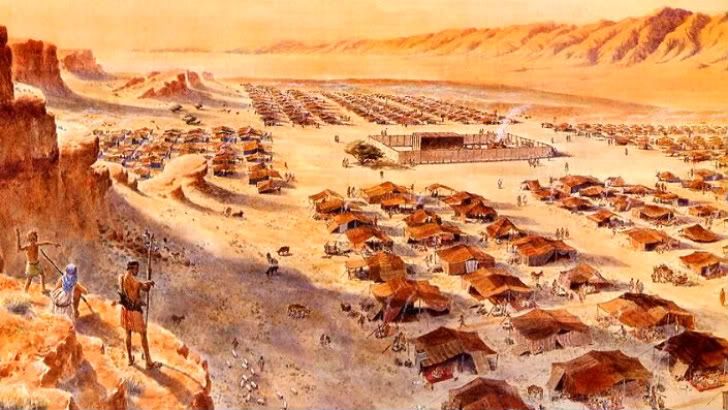
Image from photobucket.com

2 Now Balak son of Tzippor saw all that Israel had done to the Amorites,
3 and Moav was in exceeding fear before the people, since they were so many; 
they felt dread before the Children of Israel.

was overcome with dread.  Or, ‘loathed’; because they hated the children of Israel, they had a horror of them.

4 Moav said to the elders of Midyan:
Look now, this assembly will lick up everything around us like an ox licks up the green-things of the field! 
Now Balak son of Tzippor was king of Moav at that time.

elders of Midian.  Who conducted the general affairs of the desert tribes that had their origin in Midian, east of the Gulf of Akaba.  There was no enmity on the part of Israel towards Moab (Deut. II,29).  Neither did Israel in any way cross the path of the Midianites or harbour any ill0will against them.  Moses had spent many years in Midian; and Jethro, the Midianite priest, was an honoured guest in Israel’s tents.  The plot of the Moabites and Midianites against israel was thus the outcome of ’causeless hatred’, the source of the most terrible cruelties in human relations.

5-14. THE FIRST DEPUTATION TO BALAAM

They place their hope in Balaam, far-famed throughout the East as a soothsayer whose curse is irresistible.  Balak sends messengers to Balaam inviting him to cast a baneful spell upon this rising People of the desert.  In a vision, God forbids Balaam to accompany them.

5 He sent messengers to Bil’am son of Be’or, to Petor, which is beside the River (in) the land of the sons of his kinspeople,
to call him, saying:
Here, a people has come up out of Egypt,
here, it covers the aspect of the land, 
it has settled hard upon me!

Balaam. Heb. “Bileam’, probably a shortened form of ‘lord of the people’ (Kalisch).

Pethor. Pitru, a town in Mesopotamia, mentioned in Babylonian and Egyptian inscriptions.  It was from the land of magic that the great magician was to be brought.

the River.  i.e. the Euphrates; Deut I,7.

land of the children of his people. According to Heb. idiom this means Balaam’s native land (Nachmanides).  Midrash and Rashi, however, refer it to Balak, and deem him a foreign conqueror of Moab.

 6 Now then, pray go, damn this people for me, 
 for it is too mighty (in number) for me!
 Perhaps I will prevail: we will strike it, so that I drive it from the land.
 For I know that whomever you bless is blessed,
 whomever you damn is damned!

come now.  The curse cannot be pronounced at a distance.  The diviner must behold those whom he is to blight by his incantations.

curse me this people. The whole ancient world, Greece and Rome no less than the Near Eastern nations, had a firm belief in the real power of blessings and curses.  This was especially so in Mesopotamia.  Babylonian religion was rooted in demonology.  It taught that certain persons had the power of directing or changing the decree of the gods, and could by their spells and incantations secure prosperity or call forth calamity.  These masters of magic were employed to discover secrets, to foretell the future, to bless an undertaking, or to bring ruin upon an enemy.

too mighty for me.  Exod. I,9.  Balak’s phraseology, as well as his whole attitude, is reminiscent of Pharaoh—both illustrating the fatal madness of those who oppose God’s purposes (Gray).

preadventure.  ‘Hesitancy and assurance, despondency and reckless courage, struggle in his uneasy and foreboding mind’ (Kalisch).

whom thou blessest is blessed.  An expression of Balak’s profound belief in the efficacy of curses; also the language of flattery with the object of securing the expert soothsayer’s services before he—Balak—undertakes to fight the Israelites.

7 The elders of Moav and the elders of Midyan went,
 tokens-of-augury in their hand, 
 they came to Bil’am and spoke Balak’s words to him.

the rewards of divination.  lit. ‘the instruments of the diviner’s art’; here, the reward or pay to be given him (Samuel Hanaggid, the famous Spanish Talmudist, poet and statesman).

8 He said to them: 
 Spend the night here tonight,
 then I will bring back to you whatever word YHVH speaks to me. 
 The nobles of Moav stayed with Bil’am.

lodge here this night.  Balaam is not disinclined to follow the invitation.  The name ‘Israel’ has not even been mentioned.  To judge by Balaam’s surprise when he caught his first glimpse of the Israelites, his knowledge of them could not have been extensive.

as the LORD may speak unto me.  Balaam is a prophet of the true God, in familiar intercourse with Him, and expects to receive some Divine communication in a dream or a vision of the night; Gen. XX,3.  ‘This recognition of God’s revelation of His purposes concerning Israel to a non-Israelite is striking evidence of the universality of Judaism’ (Stanley).

9 Now God came to Bil’am and said:
Who are these men with you?

what men are these? A leading question (Ibn Ezra, Mendelssohn); Gen. III,11.

10 Bil’am said to God: 
Balak son of Tzippor, king of Moav, has sent to me:
11 Here, the people that came out of Egypt, it covers the aspect of the land! 
Now then, pray go, revile it for me, 
perhaps I will be able to make war upon it and drive it away!
12 God said to Bil’am:
You are not to go with them, 
you are not to damn the people, 
for it is blessed!
13 Bil’am arose at daybreak and said to Balak’s nobles:
Go to your land,
for YHVH refuses to give-me-leave to go with you.

the LORD refuseth. Balaam suppresses the fact that God had forbidden him to curse Israel.

15-20. A SECOND DEPUTATION

Balak thought that the seer’s motive for refusing was to elicit higher reward for his services.

14 The nobles from Moav arose, they came to Balak and said:
Bil’am refuses to go with us!
15 So Balak once again sent nobles,
greater and more honored than those;
16 they came to Bil’am 
and said to him: 
Thus says Balak son of Tzippor:
Pray do not hold back from going to me;
17 indeed, I will honor, yes, honor you exceedingly- 
anything that you say to me, I will do.
Only: pray go, revile for me this people!
18 Bil’am answered,
he said to the servants of Balak:
If Balak were to give me his house’s fill of silver and gold 
I would not be able to cross the order of YHVH my God
to do (anything) small or great!

to do anything small or great; i.e. to do anything at all against the Divine will.

19 So now,
pray stay here, you as well, tonight, 
that I may know what YHVH will once again speak with me.

tarry ye also here this night. ‘A thorough honest man would without hesitation have repeated his former answer that he would not be guilty of so infamous a degradation of the sacred character with which he was invested, as to curse those whom he knew to be blessed.  But instead of this, he desires the princes of Moab to tarry that night with him also; and for the sake of the reward deliberates whether he might not be able to obtain leave to do that which had been before revealed to him to be contrary to the will of God’ (Joseph Butler).

that I may know.  After God had distinctly said unto him ‘thou shalt not curse this people,’ what need was there for him to say, ‘that I may know what the LORD will speak unto me more’? It is evident that he harboured evil thoughts in his heart (Ibn Ezra).  ‘Balaam said, Perhaps I may persuade Him, and He will agree that I should curse’ (Rashi).

20 And God came to Bil’am at night,
 he said to him:
 Since it is to call you that the men have come, 
 arise, go with them; but-only the word that I speak to you,
 that (alone) may you do.

 rise up, go with them. ‘Audacity may prevail even before God.  Balaam’s steadfast insistence upon his wish wrested from God His consent to Balaam’s journey to Moab.  He warned him of its consequences, saying to him, I take no pleasure in the destruction of sinners, but if thou art bound to go to thy destruction, do so’ (Talmud).

BALAAM AND THE ASS

We now come to the best-known episode in the story of Balaam:  viz. the speaking ass.  God makes the dumb animal rebuke the blindness and obstinacy of man.  Balaam, like many a one before and after him, is saved from dishonour by unforseen hindrance, and brought to reason through means which human pride despises.

Many expositors, both in ancient and modern times. take the account of the miracle in these verses literally.  Nothing is impossible to Omnipotence, they hold; and a speaking ass is no more marvellous than a speaking serpent or any of the other miracles.  In the Ethics of the Fathers, the mouth of the earth that swallowed Korah (XVI,32), the mouth of the well, and the mouth of Balaam’s ass, are classed among those strange and wonderful phenomena that had their origin in the interval between the close of the work of Creation and the commencement of the Sabbath.  In this way the Rabbis gave expression to their conception of the miraculous in the scheme of things.  Miracles, they held, were not interruptions of Nature’s laws; for at Creation, God had provided for them in advance, as part of the cosmic plan.  ‘The Fathers of the Mishnah, who taught that Balaam’s ass was created on the eve of the Sabbath, in the twilight, were not fantastic fools, but subtle philosophers, discovering the reign of universal law through the exceptions, the miracles that had to be created specially and were still a part of the order of the world, bound to appear in due time much as apparently erratic comets are’ (Zangwill).

For over a thousand years, however, the literal has largely given place to other interpretations of this incident.  One of these explanations—that of Saadyah and Maimonides—considers v. 22-34 as enacted in a dream, or vision of the night.  Thsi would account for the many incongruous things in these verses.  Thus, Balaam appears with but two attendants, and travelling alone, without the brilliant accompaniment of princes and ‘honourable’ ambassadors.  Again, he does not show the least astonishment at the startling fact of the ass speaking.  In the light of this interpretation, v. 22-34 depict the continuance on the subconscious plane of the mental and moral conflict in Balaam’s soul; and the dream-apparition of the angel and the speaking ass is but a further warning to Balaam against being misled through avarice to violate God’s command.  Another explanation holds that the Text nowhere states that the ass gave utterance to human sounds.  Its weird behaviour in the presence of the angel and its wild cries at the cruel beatings, were understood by Balaam to mean the words given in the Text (Luzzatto).

In brief, there is not in Judaism any one authoritative interpretation of the Book of Balaam; and ‘in regard to its narrative, readers are free to think what they please’ (Josephus).  Therefore, those who do not deem any of the above interpretations acceptable, should feel too deeply the essential veracity of the story to be troubled overmuch with minute questions about its details.  In whatever way we conceive of the narrative, its representation of the strivings of conscience is of permanent human and spiritual value.

21-35. THE JOURNEY

21 Bil’am arose at daybreak, 
he saddled his she-ass, 
and went with the nobles of Moav.
22 But YHVH’S anger flared up because he was going, so YHVH’S messenger stationed himself in the way as an adversary to him. Now he was riding on his she-ass, his two serving-lads with him.

God’s anger was kindled.  This seems to contradict what is said in v. 20, that God gave him permission to go.  But that permission was conditional.  He might go, but he must speak only what is given him to say.  Balaam gladly seized the opportunity of going, for he was hankering after the reward.  For the present, he ignored the condition.  In his heart he hoped to evade it and satisfy Balak.  But God, who is the discerner of the thoughts and intents of the heart, sees the double-mindedness of Balaam and lets him know that there must be no trifling (Dummelow).

angel of the LORD.  ‘This was an angel of mercy, who desired to restrain him from committing a sin and perishing’ (Midrash).  ‘In many unforeseen, singular, and often homely ways, men are checked in the endeavor to carry out the schemes which ambition and avarice prompt.  The angel of the LORD who opposes one bent on a bad enterprise often appears in familiar guise.  To some men their wives stand in their way, some are challenged by their children’ (Expositor’s Bible).

an adversary against him.  i.e. against Balaam’s evil self. The angel tried to save Balaam from rushing to his own destruction.

23 Now the she-ass saw YHVH’S messenger stationed in the way, his sword drawn in his hand, so the she-ass turned aside from the way and went into the field. And Bil’am struck the she-ass to turn her back onto the way.
24 But YHVH’S messenger stood in the furrow (between) the vineyards, a fence here and a fence there.
25 Now the she-ass saw YHVH’S messenger,
so she pressed herself against the wall, pressing Bil’am’s foot against the wall; and once again he struck her.
26 But YHVH’S messenger once again crossed over,
standing in a narrow place
where there was no pathway to turn, right or left.
27 Now the she-ass saw YHVH’S messenger,
so she crouched down beneath Bil’am. 
And Bil’am’s anger flared up;
he struck the she-ass with his staff.
28 Then YHVH opened the mouth of the she-ass
and she said to Bil’am: 
What have I done to you
that you have struck me (on) these three occasions?

three times. ‘‘The narrator of this tale had a heart full of pity for the groans of the poor creature’ (Holzinger).

29 Bil’am said:
Because you have been capricious with me! 
If a sword had been in my hand,
by now I would have killed you!

I had killed thee.  ‘At this, the ass laughed.  He is intent on destroying a whole people by word of mouth; and to slay a poor ass he requires a sword’ (Midrash).

30 The she-ass said to Bil’am: Am I not your she-ass upon whom you have ridden from your past until this day? Have I ever been accustomed, accustomed to do thus to you? He said: No.
31 Then YHVH uncovered Bil’am’s eyes
and he saw YHVH’S messenger stationed in the way, his sword drawn in his hand; 
he bowed and prostrated himself, to his brow.
32 YHVH’S messenger said to him:
For what (cause) did you strike your she-ass (on) these three occasions?
Here, I came out as an adversary,
or the way was rushed out against me.

wherefore hast thou smitten thine ass. ‘I have been commissioned to demand restitution from thee for the injustice thou hast offered to the ass’ (Midrash).  This v. is a classical text for the preaching of humane treatment of animals.  ‘There is a rule laid down by our Sages, that it is directly prohibited in the Torah to cause pain to an animal and that rule is based on the words Wherefore hast thou smitten thine ass?’ (Maimonides).

33 Now the she-ass saw me, 
so she turned aside before me (on) these three occasions. 
Had she not turned aside from me, 
by now, (it is) you I would have killed; but her I would have left-alive!
34 Bil’am said to YHVH’S messenger:
I have sinned,
for I did not know that you were stationed to meet me in the way. 
But now, if it is ill in your eyes, I will head back.

I have sinned.  In cruelly beating the animal.  ‘Balaam knew that Divine punishment could be averted only by penitence, and that the angels have no power to touch a man who, after sinning, says “I have sinned”‘ (Midrash).

I will get me back. Balaam was now convinced that it was useless hoping to bend God’s will to his, and wished to have nothing more to do with Balak.  But Balaam must now go as God’s messenger and bless Israel.

35 YHVH’S messenger said to Bil’am:
Go with the men, 
but only the word that I speak to you,
that (alone) may you speak. And so Bil’am went with Balak’s nobles.

So Balaam went. Resolved strictly to adhere to the Divine communications that were to be made to him.  Having thus changed his disposition, he received God’s revelation and was endowed with the Divine Spirit (Ewald).

36-40.  ARRIVAL AND RECEPTION

36 When Balak heard that Bil’am was coming, 
he went out to meet him,
to Ir/Town of Moav that is by the Arnon border, 
that is at the far-edge of the border.

unto Ir-moab.  Probably the same as the Ar mentioned in XXI, 15.

37 And Balak said to Bil’am:
Did I not send, yes, send to you, to call you! 
Why did you not go to me? 
Am I truly not able to honor you?

to promote thee.  Balak seems surprised that his power to reward the prophet had not secured immediate compliance with his request.  He is the type of worldly-minded man who thinks that blessings and curses, nay all things in heaven and on earth, can be bought, if only the buyer will pay a high enough price for them.

38 Bil’am said to Balak:
Here, I have come to you;
but now, 
am I able, able to speak anything (myself)?
The word that God puts in my mouth,
that (alone) may I speak.
39 Now Bil’am went with Balak;
they came to the village of Hutzot/Streets.

Kiriath-huzoth. Its site is unknown.

40 Balak slaughtered oxen and sheep, 
and sent them out to Bil’am and to the nobles that were with him.

and sent to Balaam. As a sign of hospitality to his honoured guest.

XXII, 41-XXIII,6.  PREPARATION FOR THE GREAT INCANTATION

Balaam prepares for his work more after the fashion of a Babylonian soothsayer than in accordance with the spiritual ideas of Hebrew prophecy.

41 Now it was at daybreak: 
Balak took Bil’am and had him go up on the Heights of Baal,
so that he could see from there the edge of the people.

Bamoth-baal.  Either the name of a place or, more probably, some local sanctuary of Baal.

the utmost part.  The outermost part.


Numbers/Bamidbar 23

1 Bil’am said to Balak: 
Build me here seven slaughter-sites, 
and prepare for me here seven bulls and seven rams.

build me.  The altar had to be erected by the person for whom the divining was done.

2 Balak did as Bil’am had spoken to him; 
then Bil’am and Balak offered up a bull and a ram on (each) slaughter-site.

Balak and Balaam. Both had to be engaged in the sacrifice.  This is in accordance with the Babylonian practice of soothsaying (Daiches).

3 Bil’am said to Balak: 
Station yourself beside your offering-up, and I will go: 
perhaps YHVH will encounter me in an encounter, 
the word of whatever he lets me see, I will report to you. So he went off by-himself.

stand by.  Balak had to remain by the burnt-offering, while the diviner did his work.

I will go.  To perform the divination ceremonies.

to a bare height.  Or, ‘alone’ (Onkelos).  The Heb has also been taken as an abbreviation of the words ‘to inquire of the mouth of the LORD.’

4 Now God did encounter Bil’am, 
he said to him: 
The seven slaughter-sites I have arranged, 
and I have offered-up a bull and a ram on (each) slaughter-site.
5 YHVH put words in Bil’am’s mouth and said: 
Return to Balak, and thus shall you speak.
6 So he returned to him, 
and here: he was standing alongside his offering-up, 
he and all the nobles of Moav.

7-10.  BALAAM’S FIRST PROPHECY

When Balaam returns to Balak and his princes, he can but break forth no instinted blessing of Israel. ‘It is a marvellous people, with a unique destiny!’

7 He took up his parable and said:
 From Aram Balak led me, 
Moav’s king from the hills of Kedem: 
Go, damn Yaakov for me, 
go, execrate Israel!

parable.  here in the meaning of ‘oracular utterance’.

Aram.  Usually denotes Syria, here Mesopotamia, and the equivalent of ‘Aram-Naharaim’; Gen. XXIV,10.

mountains of the East.  The high ranges of Mesopotamia.

execrate.  i.e. provoke against him the anger of God.

8 How shall I revile (him) 
whom God has not reviled, h
ow shall I execrate (him) 
whom YHVH has not execrated?
9 Indeed, from the top of crags I see him: 
from hills I behold him:
 here, a people, alone-in-security it dwells,
among the nations it does not need to come-to-reckoning.

from the top of the rocks I see him.  Standing on the mountain peak, and looking not with the eyes of fear or envy, he is overpowered by the view he has of Israel below.  Curse he cannot.  He feels compelled by an irresistible Divine impulse to break forth into jubilant praise.

that shall dwell alone.  Israel has always been a people apart, a people isolated and distinguished from other peoples by its religious and moral laws, by the fact that it has been chosen as the instrument of a Divine Purpose.

shall not be reckoned among the nations.  The Heb. is in the Histhpael and occurs only here in Scripture; lit. ‘does not reckon itself among the nations’.  A notable alternative rendering was proposed by Marcus Jastrow.  He showed that in Neo-Hebrew the Hithpael of the root signifies ‘to conspire’ (see his Talmudic Dictionary,I, 508), and believes that this is the meaning intended here.  ‘Israel is a people that dwelleth alone; it does not conspire against the nations,’ exclaims Balaam; why then shall he be cursed?

10. Who can count the dust of Ya’aqob, or number a quarter of Yisra’el? Let my nephesh die the death of the righteous and let my end be like him!

who hath counted the dust of Jacob.  An expression of amazement at the mighty multitude he sees before him.

the stock.  Heb. lit. ‘fourth part’.  Balaam’s poetic parable is marked by parallelism or ‘thought-rhythm’ between the two parts of a verse.  Now, neither ‘stock’ nor ‘fourth part’ corresponds to the word ‘dust’ in the first half of the verse.  And yet the parallelism between the two halves of the verse is perfect:  forty years ago, a wandering scholar called my attention tothe fact that the true meaning of the word is ‘ashes’, and that therefore the correct rendering of the verse is: —

‘Who can count the dust of Jacob,
Or, by number, the ashes of Israel?’

This meaning is attested by the Samaritan Targum of ‘I am but dust and ashes’ in Gen. XVIII,27.  In 1902, B. Jacob found that also in the Aramaic of the Palestinian Christians, the word is a synonym of ‘dust’.  Nothing is, of course, more natural than that Balaam, the Aramean, should have made use of an Aramaism in his poetic outburst.
Image from israel-a-history-of.com

die the death of the righteous.  That wish was not to be fulfilled;  see XXXI,9.  It would have been better, had he said: ‘Let me live the life of the righteous.’ That is the only way to die their death.

11-17.  NEW ARRANGEMENTS

[What Balaam had seen of the camp of Israel had so impressed him with the numbers, power and unity of Israel that he found it impossible to curse them.  The distracted king changes the seer’s place of outlook, and to this Balaam consents.]

10 Who can measure the dust of Yaakov, ‘
or (find a) number (for) the dust-clouds of Israel? 
May I die the death of the upright, 
may my future be like his!
11 Balak said to Bil’am: 
What have you done to me? 
To revile my foes I took you on, 
and here, you have blessed, yes, blessed (them)!
12 He answered and said: 
is it not whatever YHVH puts in my mouth, 
that (alone) I must take-care to speak?
13 Balak said to him: 
Pray go with me to another place from where you can see them: 
only their edge will you see, all of them you will not see -revile them for me from there!
14 So he took him to the Field of Watchmen, to the top of the summit. 
He built seven slaughter-sites a
nd offered-up a bull and a ram on (each) slaughter-site.

field of Zophim.  i.e. the field of watchers.  Probably a plot of high ground used as a post for sentinels.

top of Psgah.  See on XXI,20.

15 Then he said to Balak: 
Stand here, alongside your offering-up; 
as for me, I will seek-an-encounter there.

here.  Better, thus;  Balaam shows Balak how to stand at the offering of the sacrifice (Daiches)

16 YHVH let himself be encountered by Bil’am 
and put words in his mouth, 
he said: 
Return to Balak, and thus shall you speak.
17 He came to him: 
here, he was standing alongside his offering-up, 
the nobles of Moav with him.
 Balak said to him: What did YHVH speak?

what hath the LORD spoken?  Balak is impatient, and asks for the result as soon as Balaam returns.

18-24.  BALAAM’S SECOND PROPHECY

The change of place has all been in vain.  Balaam, despite himself, must confirm and even transcend his former blessing;  God is unchangeable in His purpose to bless His people.  There is neither iniquity nor perverseness in Israel, and no magical arts can avail against him.  With God as Defender, Israel is certain to be victorious.

18 He took up his parable and said: 
Arise, Balak, and hearken, 
turn-ear toward me, O son of Tzippor:

arise, Balak. The soothsayer while giving his answer has to address the person for whom he divines (Daiches).

19 No man is God, that he should lie, 
or a human being, that he should retract.
 He, should he say and not do, 
speak and not fulfill?

God is not a man.  With this first utterance Balaam dashes Balak’s hopes to the ground.  Man breaks his word:  but God is not a man.

the son of man.  Better, a son of man; i.e. a mere mortal.

repent.  The Heb. denotes change of mind or purpose.

20 Here, to bless I was taken on, 
when he blesses, I cannot reverse it.
21 He spies no evil in Yaakov, 
he sees no trouble in Israel, 
YHVH their God is with them, 
fanfare for the king, among them!

iniquity in Jacob.  Israel is here, as in v. 10, spoken of ideally as a nation without spot or stain.  Israel hath not committed any such wrong as would warrant God’s withdrawal of His blessing from them, much less His permitting them to suffer destruction.

perverseness.  This is the translation of Septuagint and Ibn Ezra; but the Heb. means also calamity—and the phrase may indicate the absence of disasters in Israel.  ‘The Israelites are with God—hence there is among them no iniquity; and God is with the Israelites—therefore they are free from calamity’ (Kalisch).

the LORD his God is with him.  Israel enjoys the fellowship of God; and hence no weapon hurled against him can prosper.

the shouting for the King.  Better, the trumpet call of the King; i.e. they are constantly reminded of the dominion of their God, and summoned to His worship, by the solemn sound of the Shofar, which they obey with a joyful readiness, proving the sincerity of their faith and devotion (Kalisch).  All holy seasons were announced and all public sacrifices accompanied by the ‘blast of the trumpet’.

22 The God who brought them out of Egypt like the horns of the wild-ox for him.

brought them forth.  lit. ‘is bringing them forth’, representing the Exodus as still in progress, and lasting up to the entrance of Canaan (Gray).

is for them . . . wild-ox.  Or, ‘in Jacob.’  In Israel men do not resort to oracles, enchantments, or magic arts (Rashi).  The next half-verse gives the reason.  Some translate:  ‘no enchantment prevails against Jacob (Mendelssohn, Luzzatto, Malbim), implying that the arts of the magician and all the ways of divination are powerless against Israel.

now. Heb. ‘at the right time’ (Septuagint); ‘whenever required’ (Rashi).  Kalisch translates these two verses as follows —

‘In due time it is told to Jacob
And to Israel what God doeth.’

what God hath wrought.  This translation is that of the Septuagint, Rashi, Ibn Ezra, Rashbam. ‘The poet reckons it among the advantages of Israel that whenever it is fitting, God causes to be announced what he intends to do’ (Kuenen).  Another translation is; ‘Now one can only say concerning Israel, What hath God wrought!’ i.e. everything concerning Israel is irrevocably settled by Divine Will, and one can only exclaim in wonder at God’s dealings with His people (Dillmann).

23 For there is no divination in Yaakov, 
and no augury in Israel; 
at once it is said to Yaakov, 
to Israel, what God intends.
24 Here, a people arises like a king-of-beasts, l
ike a lion it lifts itself up: 
it does not lie down till it eats (its) prey, 
and the blood of the slain it drinks.

riseth up as a lioness.  Figurative description of an invincible hero (Gen. XLIX,9), and general prediction of the strength that would mark Israel’s progress in coming times.

XXIII,25-XXIV,2.  REMONSTRANCES AND NEW PREPARATIONS

25 Balak said to Bil’am: 
If you just cannot revile, revile them,
 just do not bless, bless them!

neither curse them at all.  Balak abandons the hope of a curse, and would be satisfied if the prophet witheld his blessing from Israel.  But hoping against hope, he invites Balaam to make a third attempt.

26 Bil’am spoke up and said to Balak: 
Did I not speak to you (before), saying: 
All that God speaks- 
that (alone) may I do?!
27 Balak said to Bil’am:
Pray go, I will take you to another place; 
perhaps it will be right in God’s eyes that you will revile them for me from there.

unto another place.  Change of place, thought Balak, might mean a change of fortune!

28 So Balak took Bil’am to the top of Pe’or that overlooks the wasteland.

the top of  Peor.  A mountain in the neighbourhood of Pisgah (Deut. III. 27-29).

29 Bil’am said to Balak: 
Build me here seven slaughter-sites 
nd prepare for me here seven bulls and seven rams.
30 So Balak did as Bil’am had said; 
and he offered-up a bull and a ram on (each) slaughter-site.


Numbers/Bamidbar 24

1 Now Bil’am saw 
that it was good in the eyes of YHVH to bless Israel, 
and so he did not go forth as time and time (before) to encounter divination-meetings; 
but he set his face toward the wilderness.

[enchantmens. Or, ‘omens.’  He would no longer, even outwardly act the sorcerer and retire to a lonely mountain peak for his auguries. He would remain in the presence of Balak, and there and then speak as the Spirit of God moved him.  ‘He now rose from the character of heathen seer to that of true prophet’ (Abarbanel).

his face toward the wilderness.  i.e. towards the plain where the Israelites were encamped.

2 And Bil’am lifted up his eyes and saw Israel, 
dwelling by their tribes, 
and there came upon him the spirit of God.

tribe by tribe.  In orderly encampment.

the spirit of God came upon him.  His conscience is now stirred to its depths.  He no longer addresses Balak, as he did when he announced the results of a divination:  he speaks to the future, and to all mankind.

3-9.  BALAAM’S THIRD PROPHECY.

3 He took up his parable and said: 
Utters Bil’am the son of Be’or, 
utters the man of the open eye,

whose eye is opened.  See note on next v.

4 utters the hearer of Godly sayings 
who envisages a vision of Shaddai, 
bowed, but with eyes uncovered:

fallen down, yet with opened eyes.  Overpowered by the inrush of the Divine Spirit, which renders the recipient weak and unable to stand on his feet.  It is spiritual ecstasy; when the bodily senses become numbed, and only the eyes of the mind are opened to see the Divine vision and to comprehend the Prophetic message.

5 How goodly are your tents, O Yaakov, 
your dwellings, O Israel,

how goodly are thy tents, O Jacob.  He is swept away in rapt admiration of the Israelite encampments and homes arrayed harmoniously and peacefully, a picture of idyllic happiness and prosperity.  According to the Rabbinic interpretation, the ‘tents’ are the ‘tents of Torah’, and the ‘tabernacles’ (lit. ‘homes’) are the Synagogues.  There loomed up before Balaam’s mental vision the school-houses and synagogues which have ever been the source and secret of Israel’s spiritual strength.

6 like groves stretched out, 
like gardens beside a river,
 like aloes planted by YHVH, 
like cedars beside the water;

as valleys.  The encampment of Israel is like a series of vast fertile plains, stretching away into the far distance and watered by running streams.

as aloes.  The simile of luxuriant prosperity.  The aloe-tree furnished one of the most precious of spices.

planted of the LORD.  Israel’s heritage in Canaan is compared to a Paradise, with wonderful trees of God’s own planting.

cedars beside the waters.  An image of strength and beauty in combination.

7 dripping water from their boughs, 
their seed in many waters! 
Their king will rise above Agag, 
their kingdom be exalted.

water shall flow from his branches.  He is blessed with an abundant supply of water.

in many waters. In well-watered ground, and thus yield a plentiful harvest.

higher than Agag. ‘Agag was a title common to all Amalekite kings, as ‘Pharaoh’ was to those of Egypt; probably a metaphor for power and might.

8 The God who brought them out of Egypt 
like the horns of the wild-ox for him! 
They will consume enemy nations, 
their bones they will crush; 
their arrows they will smash!

like the lofty horns of the wild-ox.  See on XXIII,22.

9 They crouch, they lie down like a lion, 
like the king-of-beasts-who will (dare) rouse him? 
Those who bless you–blessed, 
those who damn you-damned!

lay down as a lion.  This figure describes the majesty of Israel in time of peace, as XXIII,24 described his terrific might in war.

blessed be every one that blesseth thee.  Far from being affected by blessings and cursings from without, Israel would himself be a source of blessing or cursing to others, according as they treated him.  Hence let Balak and all Israel’s enemies be warned!

10-14.  BALAK’S ANGER

Balaam, having disappointed the king three times, is dismissed by him in anger.  In parting, Balaam reveals to him the fate in store for Moab.

10 Balak’s anger flared up at Bil’am, 
he smacked his hands (together). 
Balak said to Bil’am: 
To revile my enemies I had you called, 
and here: you have blessed, yes, blessed them, t
hese three times!
11 So now, hasten back to your (own) place! 
I had said: I will honor, yes, honor you; 
but here: YHVH has denied you honor!
12 Bil’am said to Balak: 
Didn’t I speak also to the messengers that you sent to me, saying:
13 If Balak were to give me his house’s fill of silver and gold, 
I would not be able to cross the order of YHVH,
to do good or ill from my (own) heart? 
What YHVH speaks, that (alone) may I speak!
14 So now, 
here, I am going (back) to my people; 
come, I will advise you 
as to what this people will do to your people in future days.

announce.  The Heb is literally ‘I will advise thee.’

in the end of days.  ‘The final period of the future so far as it falls within the range of the speaker’s perspective’ (Driver); Gen.XLIX,1.

15 So he took up his parable and said: 
Utters Bil’am the son of Be’or, 
utters the man of open eye,

15-17. A vision of Israel’s future.  Balaam foretells the rise of an Illustrious King who will put an end to the independence of Moab.

16 utters the hearer of Godly sayings, 
who knows the knowledge of the Most-high, e
nvisaging a vision of Shaddai, 
bowed, but with eyes uncovered:

knoweth the knowledge of the Most High.  To whom God reveals His secret; Amos III,7.

17 I see it, but not now, 
I behold it, but not soon: 
There goes forth a star from Yaakov, 
there arises a meteor from Israel,
 it smashes the pate of Moav, 
the crown of all the Children of Shet.

not now.  But as he will be at some distant date in the future.

a star out of Jacob.  The reference is probably to King David, the first monarch to reduce Moab to subjection; II Sam. VIII,2.  In the reign of the Emperor Hadrian, this verse was applied to Bar Cozeba, the leader of the last Jewish War of Independence, whose name was consequently changed to Bar Cocheba, ‘the Son or a Star.’  His most noted follower was Rabbi Akiba, and the entire Jewish Diaspora seems to have supported the movement.  Julius Severus was sent from Britain to quell the Jewish forces.  Judea was brought to the lowest ebb; Jerusalem became a heathen city, even its name being changed to Aelia Capitolina; and a Jew was prohibited from entering it on pain fo death.  Bar Cocheba was slain in 135 A.C.E.

a sceptre. i.e. the holder of a sceptre, a ruler of men.

the corners.  lit. ‘the two temples.’  Moab is spoken of under the figure of a human head.  He shall smite through its ‘two sides’; i.e. he shall crush it on either side.

the sons of Sheth.  Probably the name of one of the leading tribes of Moab; RV Text translates:  ‘the sons of tumult.’

18-24.  ORACLES CONCERNING THE NATIONS

In prophetic ecstasy, Balaam now sees the foes of Israel fall helpless all around, until the vision fades away in the far horizon of history.

18 Edom becomes a possession, 
a possession becomes Se’ir of its enemies, 
but Israel does valiantly.

shall be a possession.  i.e. shall be a conquered state.  The reference is probably to David’s subjugation of Edom.  On this and the succeeding v. cf. The Book of Obadiah.

Seir also.  Seir (Gen. XXXIII,4, or Mount Seir, Gen. XXXVI,8) was an old name for Edom.

his enemies.  Stands in apposition to Edom and Seir, both being the enemies of Israel.

doeth valiantly.  Is strong and prosperous.

19 There rules (one) from Yaakov, 
destroying the remnant of Ir.

out of Jacob shall one have dominion.  There shall arise in Jacob a powerful ruler.

from the city.  Better, from the cities, as the Heb. is used collectively.  Probably a reference to Joab’s action narrated in I Kings XI,16 (Ibn Ezra).

20 He saw Amalek, 
and he took up his parable and said: 
Premier of nations, Amalek, but its future: near to oblivion!

looked on Amalek.  ‘The country of the Amalekites and that of the Kenites (v. 21) might just be visible from the Moabite hills, lying far to the south and southwest’ (McNeile).

first of the nations. To attack Israel (Onkelos).

come to destruction.  In the days of Saul (I Sam.XV,8); a remnant was subdued by David (II Sam.VIII,12).

21 He saw the Kenites, 
 and he took up his parable, and said: 
 Secure (is) your settlement, set in the clefts (is) your nest,

Kenite.  According to Judges I,16, Jethro, the father-in-law of Moses, belonged to the Kenites, who must originally have formed part of the Medianites.

though firm be thy dwelling-place.  Or, ‘ever-enduring is thy habitation’ (Gray).  A reference to the wellnigh inaccessible rock-dwellings of the Kenites.

22 but ablaze will be Kayin, 
when Ashur takes-you-captive.

Kain.  The poetical name of the tribe.

how long?  Before your final doom comes?  Assyria will enslave and crush you, and carry you away into captivity.  It is, however, possible that (as in Gen. XXV,18) the reference here is not to Assyria, but to Ashurim (Gen. XXV,3).

23 And he took up his parable and said: 
Alas, who can remain-alive whom God has condemned!

who shall live. i.e. who can live.

after God hath appointed him.  An obscure verse.  Its probably meaning is. Who will be able to survive the terrible catastrophes wrought in Israel by Assyria (Isa. X,5) appointed by God to be the ‘rod’ of His anger?

24 Ships (come) from Kittite shore, 
they afflict Ashur, they afflict Ever, 
but they too: near to oblivion!

from the cost of Kittim. Kittim (derived from Kition, a town of Cyprus) was a name also used for Greece.  There is here a possible reference to those Mediterranean lands from which later were to come the conquerors of the empires of the East.

afflict. i.e. bring low, subjugate.  Divine justice would finally call the Assyrian oppressor himself to account when his allotted work should be done.

Eber.  This name is paraphrased by Onkelos as ‘beyond the Euphrates’; i.e. all the regions on the other side of the Euphrates. Asshur and Eber would thus denote the World Powers of the East, to whom retribution would be meted out by God.

and he also. ‘Asshur and Eber are regarded as a single idea ‘ (Gray).

25 Then Bil’am arose and went, returning to his place; 
and also Balak went on his way.

returned to his place.  As Balaam was slain among the Midianites shortly after (XXXI,8), he must have set off homewards, but tarried at the headquarters of the Midianites, where he met his end.