The “lamb” in TNK vs. the “Lamb of God” in NT

[We offer no discussion here, simply Scripture verses.  Translations:  For the Torah, Everett Fox, The Five Books of Moses; for the TNK, AST/Artscroll Tanach, for the New Testament, ESV/English Standard Version.]

Genesis/Bereshith 22:7-8 

7 Yitzhak said to Avraham his father, he said:  
Father!
He said:
Here I am, 
He said:  Here are the fire and the wood, 
but where is the lamb for the offering-up? 
8 Avraham said:
God will see-for-himself to the lamb for the offering-up,
my son.  
Thus the two of them went together.
9 They came to the place that God had told him of;
there Avraham built the slaughter-site
and arranged the wood
and bound Yitzhak his son
and placed him on the slaughter-site atop the wood.
10 And Avraham stretched out his hand,
he took the knife to slay his son.
11 But YHVH’S messenger called to him from heaven
and said:
Avraham! Avraham!
He said:
Here I am.
12 He said: Do not stretch out your hand against the lad,
do not do anything to him! 
For now I know
that you are in awe of God—-
you have not withheld your son, your only-one, from me.
my son.
 
13 Avraham lifted up his eyes and saw: 
there, a ram was caught behind in the thicket by its horns!
Avraham went,
he took the ram
and offered it up as an offering-up in place of his son.
14 Avraham called the name of that place: YHVH Sees.
As the saying is today: On YHVH’S mountain (it) is seen.
 

Exodus/Shemoth 12:3-11

Image from www.sheepfood.com

3 Speak to the entire community of Israel, saying: 
On the tenth day after this New-moon
they are to take them, each-man, a lamb,
according to their Fathers’ House, a lamb per household. 
4 And if there be too few in the house for a lamb,
he is to take (it), he and his neighbor who is near his house, by the computation according to the (total number of) persons;
each-man according to what he can eat you are to compute for the lamb.
5 A wholly-sound male, year-old lamb shall be yours, from the sheep and from the goats are you
to take it.
6 It shall be for you in safekeeping, until the fourteenth day after this New-moon,
and they are to slay it-the entire assembly of the community of Israel-between the setting-times.
7 They are to take some of the blood and put it onto the two posts and onto the lintel,
onto the houses in which they eat it.
8 They are to eat the flesh on that night, roasted in fire,
and matzot,
with bitter-herbs they are to eat it.
9 Do not eat any of it raw, or boiled, boiled in water,
but rather roasted in fire, its head along with its legs, along with its innards.
10 You are not to leave any of it until morning;
what is left of it until morning, with fire you are to burn.
11 And thus you are to eat it:
your hips girded, your sandals on your feet, your sticks in your
hand;
you are to eat it in trepidation—
it is a Passover-meal to YHVH.

Exodus/ Shemoth 13:11-13

11 It shall be,  
when YHVH brings you to the land of the Canaanite, as he swore to you and to your fathers, 
 and gives it to you, 
12 you are to transfer every breacher of a womb to YHVH, every breacher, offspring of a beast that belongs to you, 
 the males (are) for YHVH. 
13 Every breacher of a donkey you are to redeem with a lamb; 
 if you do not redeem (it), you are to break-its-neck. 
And every firstborn of men, among your sons, you are to redeem

Leviticus/Wayyiqrah 14:  1-2, 10, -13

1 YHVH spoke to Moshe, saying:
2 This is to be the Instruction for the one-with-tzaraat, on the day of his being-purified:
he is to be brought to the priest.
 
10  On the eighth day he is to take two lambs, wholly-sound,
and one lamb in its (first) year, wholly sound,
and three tenth-measures of flour as a grain-gift, mixed with oil and one log of oil.  
11 The priest making-purification is to stand the man to-be-purified and them
before the presence of YHWH, at the entrance to the Tent of Appointment:  
12  the priest is to take the one lamb and is to bring-it-near as an asham-offering, with the log of oil,
and is to elevate them as an elevation-offering, before the presence of YHWH.  
13  Then he is to slay the lamb in the place where one slays the hattat-offering  and the offering-up,
in a holy place,
for like the hattat-offering, the asham-offering is the priest’s,
it is a holiest holy-portion.

Exodus/Shemoth. 29:38-43

38 And this is what you are to sacrifice on the slaughter-site: year-old lambs, two for each day, 
regularly.
39 The first lamb you are to sacrifice at daybreak,
and the second lamb you are to sacrifice between the setting-times.
40  A tenth-measure of fine-meal, mixed with beaten oil, a quarter of a hin,
and (as) poured-offering, a quarter of a hin of wine—for the first lamb.
41  And the second lamb you are to sacrifice between the setting times,
like the grain-gift of morning, and like its poured-offering (that) you make-ready for it,
for a soothing savor, 
a fire-offering for YHWH;
42 a regular offering-up, throughout your generations, 
at the entrance to the Tent of Apppointment, before the presence of YHWH;
for I will appoint-meeting with you there
with the Children of Israel,
and it will be hallowed
by my Glory.

Leviticus/Wayyiqrah 4:27-32  

27  Now if any person sins in error, from among the people of the land,
by doing one (thing) regarding the commandments of YHWH that should not be done,
and incurs guilt,
28 or it is made known to him the sin that he sinned:  
he is to bring his near-offering a hairiy-one of goats, wholly sound, female, for the sin whereby he sinned.
29  He is to lean his hand on the head of the hattat-offering
and is to slay the hattat-offering, at the place of the offering=up.
30  The priest is to take some of the blood of the hattat-offering with his finger
and is to put (it) on the horns of the slaughter-site of offering-up; 
all (the rest of) its blood he is to pour out at the foundation of the slaughter-site of offering-up.
31  All of its fat, he is to remove, as was removed the fat from upon the slaughter-offering of shalom
and the priest is to turn it into smoke on the slaughter-site,
as a soothing savor for YHWH; 
thus the priest is to effect-purgation for him,
and he shall be granted-pardon.
32  If (it is) a sheep he brings as his near-offering for a hattat-offering,
a female, wholly-sound, he is to bring. 

Leviticus/Wayyiqrah 23:

You are to perform a sacrifice on the day of your elevating the sheaf:
a sheep, wholly sound, in its (first) year, as an offering-up to YHWH.
 

Numbers/Bemidbar 15:11-16

11 Thus is to be sacrificed with (each) one ox or with (each) one ram or with (any) lamb among the sheep or among the goats, 
12  according to the number that you sacrifice;
thus are you to sacrifice for (each) one, according to their number.
13 Every native is to sacrifice these thus,
to bring-near a fire-offering of soothing savor for YHWH.
14  Now when there sojourns with you a sojourner,
or (one) that has been in your midst, throughout your generations,
and he sacrifices a fire-offering of soothing savor for YHWH; 
as you sacrifice (it), thus is he to sacrifice (it).
15 Assembly!
One law for you and for the sojourner that takes-up-sojourn,
a law for the ages, throughout your generations:
as (it is for) you, so will it be (for) the sojourner before the presence of YHWH.
16  One instruction, one regulation shall there be for you
and for the sojourner that takes-up-sojourn with you!

[AST] Jeremiah/Yirmeyahu 11:17-22

17  And HASHEM [YHWH], Master of Legions, the One Who planted you, has declared evil upon you, because of the evil of the House of Israel and the House of Judah, which they committed in order to anger Me, by sacrificing to Baal.
18  HASHEM [YHWH] informed me, so I would know—then You showed me their deeds.  19  I am like a choice sheep led to the slaughter; I did not know that they devised schemes against me; “Let us destroy (him by placing] tree-poison in his food and cut him off from the land of the living, so that his name will not be remembered any more.”  20  But HASHEM [YHWH} Master of Legions, righteous Judge, Who examines innermost thoughts and feelings, let me see Your vengeance against hem, for i have revealed my grievance to You.
21  Therefore, thus said HASHEM [YHWH], concerning the men of Anathoth who seek your life, saying:  “Do not prophecy in the Name of HASHEM [YHWH], so that you not die at our hand”—22 Therefore, thus said HASHEM [YHWH], Master of Legions:  “Behold, I shall punish them: the young men will die by the sword, their daughters will die in the famine.  23 There will be no remnant of them, for I shall bring evil upon the men of Anathoth [in] the year of their punishment.

Ezekiel 45:13-17

13 “This is the portion that you shall set aside: a sixth of an ephah from the chomer of wheat and shall take a sixth of an ephah from a chomer of barley.  14  The law of the oil:  The bath [is the measure for] the oil; the bath shall be a tenth of the koi [which is] ten bath, a chomer for ten bath are a chomer.  15 And one lamb from the flock out of two hundred, from Israel’s fatted animals.  [These are all] for a meal-offering, a burnt-offering, and a peace-offering to atone for you—the word of the Lord, HASHEM[YHWH]/ELOHIM. 16 The entire people of the land shall join in this donation with the prince in Israel.
17  Upon the prince shall be [the responsibility for]the burnt-offerings, the meal-offering, and the libation, on the festivals, on the New Moons, and on the Sabbaths, on all the appointed times of the House of Israel; he shall prepare the sin-offering, the meal-offering, the burnt-offering, and the peace-offering to atone on behalf of the House of Israel.”

Ezekiel 46: 3-16

3 The people of the land shall prostrate themselves before HASHEM[YHWH] at the entrance of that gate on the Sabbaths and on the New Moons.
4  “And [this is] the burnt-offering that the prince shall bring for HASHEM[YHWH] on the Sabbath day, six unblemished sheep and an unblemished  ram 5 and a meal-offering of one ephah for the ram and a meal-offering of whatever his hand gives for the sheep, with a hin of oil  for each ephah, 6 on the day of the New Moon an unblemished bull from the herd and six sheep and a ram, they shall be unblemished, 7 and he shall make an ephah for the bull and an ephah for the ram as a meal-offering, and for the sheep according to his means, with a hin of oil per ephah.
8  “When the prince enters, he shall enter by way of the hall of the gate, and by the same way he shall leave.  9 But when the populace comes before HASHEM[YHWH] on the appointed days, whoever comes in by way of the northern gate to prostrate himself shall go out by way of the southern gate, and whoever comes in by way of the southern gate shall go out by way of the northern gate.  He shall not return by way of the gate through which he came in; rather he shall go out opposite it  10 And the prince : He shall enter among them when they enter, and when they leave he shall leave.  11  On the festivals and at the appointed times, the meal offering shall be an ephah for a bull and an ephah for a ram, and for the sheelp, whatever his hand gives, with a hin of oil per ephah.
12  When the prince makes a free-will offering, a burnt-offering or a peace-offering as a free-will offering for HASHEM[YHWH], they shall open for him the gate that faces eastward, and he shall make his burnt-offering and his peace-offerings as he does on the Sabbath day, then he shall go out, and they shall close the gate after his departure.
13  “You shall prepare a sheep in its first year, unblemished, as a daily burnt-offering for HASHEM[YHWH]; you shall make it every morning.” 14 And you shall bring a meal-offering with it every morning, a sixth of an ephah, a third of a hin of oil with which to mix the flour; it is a meal-offering to HASHEM.  As an eternal portion [to be offered] continually, 15 they shall make the sheep and the meal-offering and the oil every morning as a continual burnt-offering.
16  Thus said the LORD HASHEM[YHWH]/ELOHIM:  “If the prince makes a gift to one of his sons, since it is his inheritance that will belong to his sons, it is their possession by inheritance.  
 

 New Testament 

Image from www.brittonchurch.com


John 1:29 

The next day he beheld Jesus coming toward him, and he said: “See, the Lamb of God that takes away the sin of the world!

1 Pet. 1:19 

But it was with precious blood, like that of an unblemished and spotless lamb, even Christ’s.

Image from vimeo.com

Revelation 5:8 

And when he took the scroll, the four living creatures and the twenty-four elders fell down before the Lamb, having each one a harp and golden bowls that were full of incense, and the [incense] means the prayers of the holy ones.

Rev. 5:12 

saying with a loud voice: “The Lamb that was slaughtered is worthy to receive the power and riches and wisdom and strength and honor and glory and blessing.

Revelation 5:13 

And every creature that is in heaven and on earth and underneath the earth and on the sea, and all the things in them, I heard saying: “To the One sitting on the throne and to the Lamb be the blessing and the honor and the glory and the might forever and ever.”

Revelation 6:1 

And I saw when the Lamb opened one of the seven seals, and I heard one of the four living creatures say with a voice as of thunder: “Come!”

Revelation 6:16 

And they keep saying to the mountains and to the rock-masses: “Fall over us and hide us from the face of the One seated on the throne and from the wrath of the Lamb.

Image from vimeo.com


In Search of the Historical Jesus – 4 – Crucifixion, Questions on Resurrection/Ascension

Image from amazon.com

Image from amazon.com

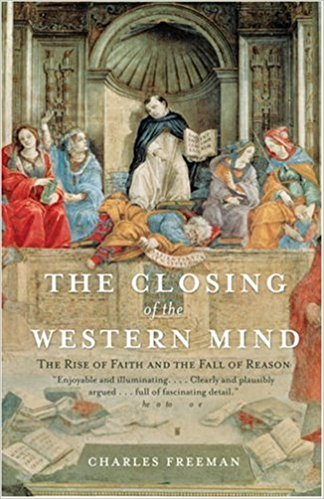
[This concludes Chapter 8: Jesus of Charles Freeman’s The Closing of the Western Mind:  The Rise of Faith and the Fall of Reason.  Related articles from this MUST READ book are:

—Admin1.]


—————————-


Whatever he may have claimed to be, Jesus was bound to provoke reaction from the authorities.  He was a highly popular leader, and although he never appears to have counseled any kind of active resistance to the governing group, crowds following charismatic men who appear to have miraculous powers are always a concern to authorities, especially at times of social unrest.  


Herod Antipas had already, after all, executed John the Baptist, whose teachings on the coming of the kingdom he appears to have seen as insurrectionary.  There was also the underlying antagonism of local Pharisees, who were understandably wary of any teacher who claimed to have his own interpretation of the Law.  In particular, Jesus’ teaching that sinners would be welcomed in heaven even if they have not repented through the making of a sacrifice offended traditionalists.


Clearly Jesus was vulnerable, and it may have been a growing sense of insecurity that drove him with his immediate followers from Galilee into the Roman province of Judaea, perhaps in A.D. 30 (although other dates between 29 and 33 have been proposed), and then to Jerusalem, where they arrived in time for the feast of Passover.  (John, however, suggests that Jesus had made several previous journeys to Jerusalem, as indeed would have been expected of a conventional Jew.)  However, the journey to Jerusalem may also have been deliberately planned as the next step in his ministry, the culmination of his mission, even to the extent of bringing him into confrontation with the Temple authorities.  


Jesus’ arrival was certainly greeted in the city as if it were about to inaugurate some kind of political or religious transformation in fulfillment of ancient prophecies.  He rode in on a donkey as if to fulfill the prophecy that “a king’ would enter Jerusalem on a donkey (Zechariah 9:9), and according to Mark (11:9) the crowd shouted, “Blessings on the coming kingdom of our father, David.”  In Matthew (21:9) the crowds actually call Jesus “Son of David.”


As the great crowds of pilgrims in Jerusalem gathered for the Passover, the tension can only have been raised by the presence, with his troops, of the Roman governor Pontius Pilate, who had come inland from Caesarea, the seat of Roman government of the province, to make sure that order was maintained.  This year there had already been trouble, some form of insurrection within the city, and one of its leaders, Barabbas, was in custody and facing almost certain execution.  The official responsible to the Romans for good order was Caiaphas, the high priest.  Now in his 12th year of office, he was highly experienced and must have been a consummate political operator to have maintained the support of the Jews for so long while at the same time satisfying his Roman overlords.  Pilate, who, as we have seen, had already shown himself to be erratic, cruel and insensitive to Jewish feeling, would have required very careful handling.


So then, among the mass of pilgrims, arrives an itinerant preacher from Galilee, an outsider who brings his followers, with their distinctive accents, with him.  He enters on a donkey with the crowds shouting that he is perhaps the Messiah, or at least a member of “the House of David.”  In itself, his arrival might have been containable, but then comes the incident that tips the balance, Jesus’ entry into the Temple, where he overthrows the tables of the money lenders and may have spoken of the later destruction of the Temple.  There is no hint in the Gospel accounts that any of Jesus’ followers were involved with him in this, understandably perhaps in view of the immense significance the Temple held for Jews.  


What Jesus meant to achieve by this provocative action has been endlessly debated.  His gesture may have been a symbolic one, a recognition of the passing of the old order –and the Temple with it—at the coming of “the new kingdom,” but he may also have had the more overtly political aim of expressing popular disquiet with the ruling elite.  The intrusion was too threatening for the priests to overlook, and Caiaphas had little option but to take the initiative in dealing with it.  There could have been many motives for his action — fear that disorder would spread if Jesus was not dealt with promptly, a need to be seen to be supporting his fellow priests in the Temple at one of the most sacred moments in the year when good order was essential, even a desire to show Pilate that he could act decisively if he needed to.  John specifically notes that one of the fears of “the chief priests and Pharisees was that Jesus’ teachings would bring Roman retaliation” (John 11:46-48), and if so Caiaphas had little alternative.  There may have been other motives.  The crowds in Jerusalem were restless and might be more so if Barabbas was executed.  It could be that Caiaphas decided to exploit the custom that a prisoner be set free at Passover to release Barabbas, thus avoiding the displeasure of the local crowds, while offering Jesus to the Roman authorities in his place as evidence that the Jewish authorities were committed to good order.  “It was Caiaphas who had suggested to the Jews, ‘It is better for one man to die for the people,’ “ notes John in his Gospel (18:14).  So the chief priests and the elders “persuaded the crowd to demand the release of Barabbas and the execution of Jesus” (Matthew 27:20).  In short, Jesus the outsider was being used by the authorities in their quest for overall good order within the city.


Having decided to offer Jesus for execution, Caiaphas’ problem was finding a reason for doing so; the varied debates outlined in the Gospels show that this was not easy.  Attempts were made to make Jesus incriminate himself through admitting he was the Messiah or “the son of God,” and stress was laid on the disorder he was provoking.  Eventually he was handed over to Pilate, who acquiesced in the accusation that Jesus had called himself “King of the Jews” and ordered the crucifixion.  It seems likely that Pilate saw Jesus’ mission primarily as a political issue–there is also evidence from John’s account that he was influenced by threats of disorder from the crowd and fears that he would be denounced as disloyal to the emperor if he did not crucify Jesus (19:12-16).  As we have seen, “good” emperors recognized that it made more sense to replace an unpopular governor than risk stirring up a major popular revolt.  In the light of his unhappy experiences early in his rule, Pilate was probably acutely vulnerable to such threats.  With such powerful considerations in mind, it is unlikely that a man so apparently insensitive would have hesitated long over ordering another crucifixion.  


One remarkable thing about the trial and execution of Jesus is that neither the Jewish nor the Roman authorities followed it up with a move against Jesus’ followers.  There was no action on the suspicion that Peter was one of his adherents, and the disciples were left free to visit his tomb without hindrance.  This tends to support the view that Caiaphas kept his response to Jesus to the minimum necessary (and also that it was Jesus’ solitary intrusion into the Temple that was the catalyst for his arrest).  Caiaphas presumably gauged, rightly as it turned out, that the Romans and the Temple officials would be satisfied with Jesus’ crucifixion, and that he would not be faced with further disruption.


What Caiaphas could not have foreseen was the aftermath of the death for Jesus followers.  A charismatic leader who had made great promises of the coming of God’s kingdom for the poor, who might even be the Messiah and thus royalty, come in triumph to Jerusalem to establish his rule, had been swept aside by the Roman administration backed by the Jewish hierarchy as if he had been no more than a minor political nuisance.  One of his followers (Judas) had betrayed him, and the others had dispersed.  


One can only begin to imagine the psychological devastation of the disciples.  Those close to him had spent months with him, sharing the dangers of the road and the tension of opposition, dealing with the crush of crowds and the emotional power of his teachings, a range of experiences unlike any they could have undergone before.  His execution brought much more than the shock and emptiness of any sudden and unexpected death of a close companion. With the loss went the apparent destruction of all their hopes for the coming of the promised kingdom. The ritual humiliation inherent in crucifixion, the stripping naked and very public death agony, was particularly devastating.  The point was underscored by the label on the cross, INRI, Jesus of Nazareth, King of the Jews.  We are familiar with the image of the crucifixion now, but for nearly 400 years Christians could not bring themselves to represent Jesus nailed on the cross.


The resurrection experiences reported in the Gospels and the letters of Paul have to be set within the context of this trauma and despair.  As might be expected from the circumstances, the accounts of these experiences are confused and contradictory.  Mark ends his original account with the empty tomb, and it seems that it was not until the 2nd century that his version of Jesus’ appearances was added.  In his account Jesus appears first to Mary Magdalene, then to two of the disciples, then to all 11 “at table” before being taken up to heaven. (Mark does not make clear where these appearances take place.)  Matthew reports one appearance near the tomb and then a single meeting with the 11 disciples at a mountain in Galilee, where Jesus had agreed to meet them.  In Luke Jesus’ appearances all occur in or near Jerusalem, but Jesus is not always immediately recognizable (24:16).  John also credits Mary Magdalene with the first vision and reports two appearances to the gathered disciples in Jerusalem as well as one at the Sea of Galilee.


Separate from the Gospel accounts is that of the Apostle Paul.  Paul had received a vision of Jesus as a blinding light on the road to Damascus, but he later returned to Jerusalem to meet Jesus’ disciples. (According to Galatians 1:18, he was there with Peter for 15 days).  The date, perhaps in the mid 30s, is not certain, but what is important is that Paul had direct contact with Peter only a few years after Jesus’ crucifixion, and he records his own interpretation of the resurrection in the early 50s, at least 20 years before the Gospels or any other surviving sources.  


In his 1st letter to the Corinthians, Paul tells how it was Peter who experienced the first appearance, then the 12 disciples, then a meeting of 500, next James and then the Apostles and finally Paul himself, an appearance which Paul doubtless wishing to reinforce his authority (hotly disputed as it was) with the Corinthians, equates with those earlier ones.  Mary Magdalene is not mentioned, and one wonders whether this appearance to a “mere” woman was deliberately obliterated by either Peter or Paul.  But what did Paul understand as having been seen?  He goes on in his letter to stress the difference between the perishable human body and the body in which Jesus appeared, so it can be assumed that he believed that the resurrected Jesus was not a resuscitated corpse but some kind of spiritual being.  In John’s much later account, Jesus is able to pass through closed doors and to disappear into heaven.  The first appearance of Jesus (by the tomb) and the last (the Ascension) take place in or near Jerusalem.  Yet Jesus was also seen in Galilee.  There is no record of any journey there or back. This suggests a series of distinct and unconnected apparitions and not Jesus living on earth as if his body had simply been restored to life.


In Matthew, John (Chapter 21), and possibly Mark’s account, the disciples initially went home to Galilee, but they returned to Jerusalem, probably in the belief that the promised kingdom would still materialize there.  From this time, when they strike out as independent preachers, one can call them Apostles, “those who are sent,” and their activities are recorded in the Acts of the Apostles (whose author is, according to tradition, Luke, author of the 3rd Gospel).  It is certainly true that the imminent arrival of the kingdom dominated their thoughts, and under the leadership of Peter they began preaching their continued belief in Jesus and his promised return.  As the followers of a man who had been condemned to death, they were under suspicion and experienced some harassment.  However, they still saw themselves as part of Judaism, continued to frequent the Temple and observe Jewish rituals.  


As the second coming failed to materialize, they began to reflect on how Jesus could be interpreted within Jewish tradition.  The idea that he might have been divine was too much for any Jew to grasp, as it was completely alien to any orthodox Jewish belief, but Jesus could be seen as one through whom God worked (as with the earlier Jewish prophets) and who had been exalted by God through his death.  Peter put it as follows (Acts 2:22-24): “Jesus the Nazarene was a man [sic] commended to you by God by the miracles and portents and signs that God worked through him when he was among you . . . . You killed him, but God raised him to life, freeing him from the pangs of Hades [Sheol, the underworld.]”  


Jesus was still referred to as the Messiah, but how could he be accepted as a Messiah when his earthly life had ended not in the prophesied triumph but in tragedy?  The only possible way to explain the crucifixion was to draw on different prophecies.  The prophet Isaiah talks, for instance, of a servant of God who was “torn away from the land of the living, for our faults struck down in death.  If he offers his life in atonement . . . he shall have a long life and through him what God wishes will be done” (53:8-10).  Such texts were used by Christians to create the idea of a “suffering Messiah,” who had died for the sins of mankind.  This was very far from the most popular interpretation of Messiah as one coming in triumph, but it was enough for Jesus’ followers to be able to call him Christos, the anointed one.  The first recorded us of “Christians” to describe Jesus’ followers comes not from Jerusalem but from Antioch in Syria (Acts 11:26).


If we return to the question of whether the historical Jesus can be identified, the answer must be “only with the greatest difficulty.”  Although this chapter has tried to set out what appear to be the developments in his life and the elements of his teaching about which there is some consensus, virtually every point will still be challenged by one scholar or another.  


Jesus’ charisma, the brutality of his death and stories of a resurrection had such an impact that they passed quickly into myth, and this myth was soon being used by those committed to his memory in a wide variety of ways. (The word “myth” is used here not pejoratively but as the expression of a living “truth” that can function, as it certainly has done in Jesus case, at different levels for different audiences.  Apart from Christianity itself, the impact of Jesus can be gauged from the number of spiritual movements outside Christianity—Gnosticism, followers of theos hypsistos, Manicheism, and, later, Islam—that recognized him as a spiritual leader.)

No one can be sure where the boundary between Matthew (and the other Gospel writers) and Jesus’ original words should be drawn.  This left and still leaves Jesus’ life, death and teachings open to a wide variety of interpretations and uses by those who followed him.  Nevertheless, the trend in recent scholarship towards relating Jesus to the tensions of the 1st-century Galilee, in particular as a leader who appealed to the burdened peasant communities of the countryside and reinforced rather than threatened traditional Jewish values, has much to support it.


As Christian communities established themselves, it was perhaps inevitable that there would be tensions between those who remained traditional Jews, focusing on the Temple, and those who, perhaps drawing on Jesus prophecy of the Temple’s destruction, were more openly hostile to the Temple and all that it represented symbolically in terms of wealth and power.  The Acts of the Apostles tell of one Stephen, a Hellenized Jew, who took the provocative line that the Temple should never have existed at all and that the God of Jesus stood independently of it (Acts 7).  These assertions were treated by the Jews as blasphemy.  Stephen was stoned to death and thus earned himself a revered place within the Christian tradition as the first martyr.  Acts records that a man called Saul, or Paul as he was to become better known, watched over the outer clothes of those who carried out the stoning.

“Superstar” – Confessions of an Idolater

[We are into the Resurrection celebration culminating Christianity’s week-long Easter observance ,  so  here’s a resurrected post from  2012, reposted every Holy Week celebration.  You’ll understand why.—Admin1.]

——————————–


JCS – “Jesus Christ Superstar”

 
Image from Pinterest

Image from Pinterest

Andrew Lloyd Webber is such a musical genius whose contribution to musical theater includes Evita, Cats, The Phantom of the Opera, and two biblically-based musicals Joseph and the Amazing Technicolor Dreamcoat and his classic rock opera Jesus Christ Superstar.


When JCS first appeared on broadway in 1970 and immediately became a huge success particularly among the ‘flower children’, I refused to see its local college campus production because as a closed-minded Catholic then, I thought it was sacrilegious to turn the crucified Savior into a rock-singing cult hero surrounded by hippies.  I hadn’t yet realized how effective it was to resort to evangelism via entertainment; I mean, if you can’t convince the masses to go to mass, you can bring your mass to the masses; much like what they’re doing at the malls today, making it convenient to attend mass while ‘malling.’ Better yet, if you can’t keep your congregants from falling asleep at church service, liven up your service with audio-visual aids—dancers, singers, bands–and just watch the masses flock to your revivals, or end up with a televised service so your flock can enjoy the comforts of home and feel they have “churched” on Sunday!


About 1973 the broadway musical was immortalized on film and was directed by Norman Jewison (often mistaken for being Jewish because of his surname although he was a Protestant and a Canadian).


By 1975 when I was fast deteriorating into a nominal Catholic and happened to be a graduate student in fine arts, majoring in dance at SMU in Dallas, TX, JCS was shown in the local movie theater.  I went to see it initially to watch the choreography; then I went back to rewatch the choreography, the 2nd time around I found myself listening to the rock music; went back a 3rd time and started listening intently to the lyrics; but truth to tell, the real reason I kept going back was because I was smitten with the actor-singer who played Jesus—Ted Neeley.  I fell in love with Jesus because of Ted Neeley, or perhaps I fell in love with Ted Neeley who I imagined would have been exactly what Jesus would have looked like.  I left my catholic faith and became an evangelical Christian after that and was in love with Ted Neeley’s Jesus eversince.


Little did I realize I was an idolater! I praised the Lord for bringing Jesus into my life through Ted Neeley. Each time the movie would be resurrected for showing on “Holy Week” or Easter, I would go see my idol, never missing a year.


Come 1996, I was a mother of three teenage sons who I wanted to expose to musical theater. I figured their best introduction would be what else, my favorite rock opera! Ipods and portable CD players were already affordable and my boys easily took to JCS in eardrum-splitting volume through earphones.  It so happened during a family vacation visit to my husband’s kin in North Carolina, the summer production of JCS would be shown in Greensboro, NC; Ted Neeley was the star, so off I went with sons in tow.  We went backstage after the performance, Ted always met with his fans and gave all the adoring female fans (of differing ages) a hug. I got mine plus an autographed souvenir program.


TedHugNeneFast forward to June 2007, Ted Neeley was to make his farewell JCS performance in San Francisco, CA.  By then, my grown-up sons had been exposed to a lot of broadway musicals and did develop the same passion for live theater as I had, so since we lived nearby in wine country, Santa Rosa, CA at the time, we all went to see the show one last time. [I know, this is beginning to sound like a tour of the U.S. of A.; in fact I was certain at the time there was a Divine Hand arranging all these “coincidences” in my spiritual wandering].  Of course we did line up to see Ted again backstage. I had a chance to tell him how many times I had seen his movie, how I saw him perform in Greensboro with my sons; we all had our picture taken with him and of course, I got my looonnnnnng linnnnngerinnnnnng hug (picture proof frozen in time).  By then, we both had obviously aged; he didn’t sing as well as he did in his movie debut (vocal chords about to retire), but had Jesus lived to age 60-something, he’d have grown older just as handsomely as my stage matinee idol.  It felt like I’ve had a 4-decade albeit one-sided love affair with this actor who best personalized and humanized Jesus for me. 


What is the point of this confession?


As an evangelical Christian, I recounted this as my testimony many a time, that I came to love Jesus as my Lord and Savior because of Ted Neeley through whom I gradually started seeing a very human Jesus; his divinity was never a problem for me, his humanity was.  


Andrew Lloyd Webber had depicted him as a puzzled and reluctant messiah, one who didn’t understand his divine mission, who enjoyed the attention of his followers and adoring crowds but felt overwhelmed by lepers and the more difficult part of his ministry (all the demands for miracles on the spot!).  


When he eventually gives in to the Father’s will, the lyricist gives him the striking line “alright, I’ll die, watch me die . . . take me now, before I change my mind.”  


Image from www.steelopus.com

Image from www.steelopus.com

Webber explained in one of his interviews that JCS was not so much about Jesus as it was about Judas being used by God to fulfill a betrayer’s role, like a pawn in the hands of the divine puppeteer.  I was mystified at how man makes choices and yet plays right into the drama scripted by God Himself but I clearly understood why a God who becomes human is more appealing to us, because we can more easily relate to him when he looks like one of us and might even be as cute and can sing like Ted Neeley.   We lovestruck women age only on the outside; as my own mother confessed when she was pushing 80, she had always felt 26 and had crushes through each decade of her life on Elvis Presley, Bruce Lee, Neil Diamond and Edmund Purdom [lip-sync-ing Mario Lanza’s voice] in the Student Prince, what a strange lineup! 


What is even more strange which I didn’t expect is this:  when I finally discovered the historical Jesus was only human and not divine, I suddenly got over Ted Neeley and I doubt I will go to another showing of JCS!


Now the tables have turned . . . I don’t have a problem with Jesus’ humanity, it’s his divinity I no longer accept.


The lyrics of JCS (placed in the mouth of Judas the betrayer who did make it to HIPPIE- HEAVEN) make more sense to me now; no doubt Andrew Lloyd Webber was way ahead of me in spiritual discernment or skepticism or plain common sense:


“Jesus Christ, Jesus Christ, who are you, what have you sacrificed?
Jesus Christ Superstar, Do you think you’re what they say you are?” 


Sig-4_16colors

logo

MUST READ: Was Christ our Passover?

 [First posted April 15, 2014.   It is never too late to learn ‘new’ truths

Image from https://int.search.tb.ask.com

Image from https://int.search.tb.ask.com

which are really ‘old’ if we had just understood them with fresh eyes and clear minds instead of reading with religious baggage bogging down the progress of understanding and learning.  This is from one of our favorite resources:  Synagogue Without Walls.  It is listed on our links: http://rootsoffaith.org.   Reformatting and images added.—Admin1.]

 ————————-

ROSS  K.  NICHOLS

 Inspiring People to live a more authentically biblical lifestyle —

ROOTS OF THE FAITH,

ANCIENT TRUTH FOR A MODERN WORLD

On a positive note, more and more Christians are searching Scripture in an effort to orient themselves towards a more Hebraic understanding.  Non-Jews are celebrating biblical festivals, taking up dietary rules prescribed in the Torah, abandoning their previously learned anti-nomian beliefs, learning Hebrew, and returning to the Hebraic roots of their faith. These people are good and sincere souls seeking deliverance from nearly two thousand years of spiritual slavery, during which, false religious teachers have held them captive and oppressed them.

A modern day Moses might well go forth today with a message to modern day pharaohs saying “Let my people KNOW!” No doubt there will be those who do not wish to leave the comfort of their Egypt, desiring the onions and leeks served daily in the only home they have known, but others are willing to endure the hardships of a new Exodus.  It is for these who seek deliverance that the present article is written.  Christians have inherited lies, vanity and things wherein there is no profit, when it comes to a true and biblical understanding of Passover.

In a text attributed to the apostle Paul, we learn that Christians are encouraged to participate in Passover.

Your boasting is not good. Do you not know that a little leaven leavens the whole lump? Cleanse out the old leaven that you may be a new lump, as you really are unleavened. For Christ, our Passover lamb has been sacrificed. Let us, therefore, celebrate the festival, not with the old leaven, the leaven of malice and evil, but with the unleavened bread of sincerity and truth (I Corinthians 5:6-8).


Based upon this text and the gospel accounts associated with what are referred to as the passion narratives, Christians have come to certain conclusions that support their theology.

  • The messiah, or Christ as the Greek puts it, becomes a sort of symbolic Passover lamb.
  • The Passover lamb is then presented as merely a shadow of things to come, finding its real meaning in the death of Jesus.
  • The writer of John’s gospel in fact lends support to this comparison when John the baptizer sees an approaching Jesus and is made to say,

“Behold, the lamb of God, who takes away the sin of the world”(John 1:29b).

Searching for more similarities, Christians often point out that according to the gospel narratives,

  • Jesus arrives in Jerusalem four days before Passover and is examined by the priests.
  • This they argue fulfills the Torah’s obligation to “take a lamb” on the tenth day of the first month, and “keep watch over it until the fourteenth day” (Exodus 12:3-6).
  • The purpose? Leaving aside the age of the lamb, and the fact that it can be taken “from the sheep or the goats,” it is to prove whether or not the lamb is “without blemish” (Exodus 12:5).
  • Jesus was killed on the day of preparation, between the evenings, and yet despite the horrors of crucifixion, not a bone was broken (John 19:14, 32, 33, 36).
  • So too, these reports seem to fulfill certain requirements for the Passover lamb (Exodus 12:46, Numbers 9:12, cf. Psalm 34:20).

Participants in messianic circles will likely learn that every aspect of the seder also point to Jesus.

  • They are often shown the matzah and told that this bread, with piercings and stripes, represents the body of Jesus that was wounded for them, though the manufactured and boxed up bread today probably looks far different than the unleavened bread of antiquity.
  • Further, they may be taught that the 3 matzos known as the afikomen represent a triune God, and that the symbolic meaning of taking the middle piece, wrapping it in linen, hiding it, and bringing it back also point to the death, burial, and resurrection of Jesus.
  • The meal then, is presented as a teaching tool to share the deeper meaning of an ancient Hebrew Festival, which sadly and evidently has been kept from the ones who were charged to “keep” it in the first place!

So what’s so wrong with a seder such as is taught by Messianic Jews as advertised in this video? Just about everything.

Much of what is taught has no connection with the first Passover described in the book of Exodus. Many of the teaching points are based upon traditional Passover meals, some of which find no direct support in the biblical texts.

When it comes to making Jesus the Passover lamb, there are some difficulties as well.

  • One difficulty is sorting out the last supper. Was it a seder as is commonly taught, or a meal eaten the prior day?
  • The original Passover meal was eaten AFTER the lamb was killed since the lamb was one of the key components to the meal.
  • In other words, if Jesus is representative of the Passover lamb, he must be killed before the meal.
  • The writer of John’s gospel suggests that this meal took place on the day of preparation, BEFORE the Passover (John 13:1; 18:28; 19:14, 42).

Other problems exist in making the Passover about the death of Jesus.

  • The lamb had nothing at all to do with sin.
  • The fact that the bones were unbroken aside, the year-old lamb was to be taken from “the sheep or the goats,” roasted and eaten.
  • What about the blood? The blood of the sacrifice was to be applied to the doorways of the Israelites for one reason and one reason only. “For when YHVH goes through to smite the Egyptians, He will see the blood on the lintel and the two doorposts, and YHVH will pass over the door and not let the destroyer enter and smite your home” (Exodus 12:23).
  • This leads to perhaps the biggest error in associating the death of Jesus with the redemption brought about through the Festival of Passover as taught in the Torah.

While Christians teach that the Passover is a picture of the death of God’s son, the Torah teaches the exact opposite!

  • The Hebrew Bible recognizes that God has a son and this is an essential part of the authentic Passover message.
  • The story of Passover however is not about God’s son dying, but about God’s son NOT dying while the sons of the oppressing nation are killed.
  • As Moses prepares to go before Pharaoh the first time, we read the message that he is charged to deliver.

Thus says YHVH, Israel is my firstborn son. I have said to you, ‘Let my son go, that he may worship me, yet you refuse to let him go. Now I will slay your firstborn son’” (Exodus 4:22-23)!

  • A careful reading of the narrative of Passover affirms this in several places (Exodus 12:12, 27, 29; 13:15).


While Christianity teaches that “in Christ Jesus neither circumcision nor uncircumcision counts for anything”(Galatians 5:6), the Torah says the opposite.

  • Circumcision is required of any male that will eat the Passover.
  • It’s not enough, as Paul would have us believe to be circumcised inwardly (Romans 2:28).
  • As far as a matter of the heart, the Hebrew Bible would agree (Deuteronomy 10:12-16; 30:1-6; Jeremiah 4:1-4), but this does not negate the clear language concerning the requirement for a circumcision “of the flesh” (Exodus 12:43-49).

As a faithful Jew, the historical Jesus likely kept the Passover Festival every year of his life (Luke 2:41). We do believe that Jesus was killed at the precise time and day that the lambs were killed. This finds support in the gospel narratives as well as a reference in the Talmud, which says, “On the eve of Passover, they hanged Yeshu” (Sanhedrin 43a).

If truth be told, it is improbable that the hateful Pontius Pilate had a custom to release any Jew at any time, let alone during Israel’s festival of freedom. It is more probable that in some way he was pleased to put one of Jacob’s sons to death at the very time when they would be speaking of their deliverance from oppression.

The prophesied salvation of Israel is what must have been on the mind of Jesus on the final day of his life, Passover day in year 30 of the Common Era.  Perhaps his cryptic answer about one coming on the clouds, clearly a reference from Daniel chapter 7, was intended to declare his unwavering faith in the ancient prophecies of his people. This passage, though understood to be a prophecy about a messiah that would come on the clouds of heaven, is about restoring the kingdom to the people for which it was intended. If it is messianic at all, it has to do with a corporate messiah represented by the people of Israel (Psalm 105:12-15).

Passover is indeed a story of salvation and deliverance. It is meant to symbolize forever the redemption of God’s son, who does not die but is preserved alive. This is the only meaning that any child of Israel, including Jesus of Nazareth has ever known.


Let us therefore celebrate the festival, not with the old leaven, the leaven of malice and evil, but with the unleavened bread of sincerity and truth.

References and Further Reading

___________________


Passages from the Hebrew Bible related to Passover

Exodus 12-13; 23:15; 34:18;

Leviticus 23:4-8;

Numbers 9:1-15, 28:16-25, 33:3;

Deuteronomy 16:1-8;

Joshua 5:10-15;

2 Kings 23:10-14;

Ezekiel 45:2;

Ezra 6:19-22;

2 Chronicles 30:1-27, 35:1-9


Passages from the New Testament related to Passover and Jesus

Mark 14:1-57;

Matthew 26:1-46;

Luke 2:41, 22:1-53;

John 11:55, 12:1; 13:1-38, 18:28;

I Corinthians 5:7-8

Please check out ADDITIONAL POSTS from their website:

Understanding Christianity and Jesus of Nazareth – A Jewish Perspective

Image from momstransformed.blogspot.com

[First posted in 2014.  A calming and conciliatory voice so badly needed in these troubled times and confusing age, Rabbi Harold S. Kushner has authored some bestsellers that we highly recommend:

  • When Bad Things Happen to Good People,
  • When All You Ever Wanted Isn’t Enough,
  • Who Needs God,

His books are insightful and helpful to both Jew and Christian who wish to gain an understanding of God who is, after all,  the God of all humanity except that sometimes, religions get in the way of that understanding. Among the Jewish voices that call for interfaith discourse, we are featuring Jews and Christians in Today’s World, the 11th chapter from his book To Life!, another MUST READ in our RESOURCES.  After reading this one chapter, you will realize this book is a MUST OWN, whether you’re Jew or Christian or neither. Reformatting and highlights added.—Admin1.]


——————————————–


CHRISTIANS need to understand Judaism theologically, even if they never meet a live Jew. They need to understand what God had in mind when He entered into a Covenant with the Jewish people, and how that was changed by the birth and death of Jesus.


Jews don’t need to understand Christianity theologically, but we need to understand it practically, sociologically. We need to figure out what it means to live as Jews in a society where 90 percent of our neighbors are Christians, basing their religion partly on Hebrew Scriptures and partly on texts and traditions that go beyond them.


  • How shall we understand Christianity?
  • How shall we regard Jesus, who was born a Jew and is now regarded as the Divine Savior, Son of God, by so many of our neighbors?
  • And how shall we understand the historical developments that saw Christianity begin as a tiny sect within Judaism and go on to become the religion of half the world?

If we worship the same God and revere the same Bible, why are so many people sitting in their section of the bleachers and so few in ours?


Let me emphasize that this chapter is not a scholarly history of Christianity or an introduction to its theology. Neither is it an attempt to suggest to a Christian reader of this book that his beliefs may be wrong. It is a Jewish perspective on the phenomenon of Christianity emerging from Jewish roots.


Image from www.humanjourney.us

Image from www.humanjourney.us

We begin with the historical setting in which Christianity arose. What we now think of as the first century of the Christian era, the century in which Jesus lived and died, was a time of messianic ferment in the Roman province of Judea.


  • In biblical times, that land had been called Israel.
  • It would later be called Palestine, as the Romans tried to erase the memory of a Jewish presence by naming it after the seafaring Mediterranean people who had briefly inhabited the coast around 1100 B.C.
  • Since 1948, it has been called Israel again.

The Roman rulers were cruel and greedy, collecting outrageous sums in takes to finance their empire and putting to death anyone suspected of being a potential troublemaker. Times were so hard that people believed God would imminently intervene to save them as He had in Egypt. They compared the pain of their situation to the travail of a woman giving birth; the pains are most intense just before delivery. They not only prayed for a messianic redeemer; they expected his arrival daily.


Image from pixgood.com

Image from pixgood.com

The Hebrew word Messiah was originally a synonym for the king. The word means “king,” the one who was crowned by having the anointing oil poured on his head. (It literally means “the anointed one,” as does the Greek christos.). In biblical times, the Messiah for whom the people prayed was a just and honest king, more decent and effective than the one currently ruling them. Like all legitimate kings of Israel, he would be a descendant of King David, but he was not seen as having any superhuman powers. The prophet Isaiah describes him this way:


There shall come forth a shoot from the stump of Jesse [David’s father], and a branch shall grow out of its roots. And the spirit of the Lord shall be upon him, the spirit of wisdom and understanding, the spirit of counsel and might, the spirit of knowledge and the fear of the Lord. He shall not judge by what his eyes see, or decide by what his ears hear. With righteousness shall he judge the poor, and decide with equity for the meek of the earth.[Isaiah 11:1-4]


In other words, if we could just have a good, honest, inspired king, he would solve all our problems.


Eight hundred years after Isaiah spoke, the land of the Jews, like most of Europe and the Middle East, had become part of the Roman Empire. Now it was not enough to hope for a fair and honest ruler. Before a Jewish king could begin judging the poor righteously, he first had to chase away the Roman occupier, and that would require divine intervention on a miraculous scale. Now the Messiah had to be a superhuman figure—not the Son of God or the Redeemer from Sin (those are non-Jewish concepts introduced by early Christianity), but a person capable of leading the Jews to victory over the greatest military force in the world.


It was into this setting that Jesus of Nazareth was born. We don’t know anything for certain about his life. All we know about him comes from accounts written two generations later by people who believed that he was the Messiah and wanted to persuade others of that fact. But the following seems to be a plausible outline of his career:


He was born into a working-class family in Nazareth, a rural city in Galilee in northern Israel, far from the centers of learning and political power. Later Christian sources would add an account of his parents traveling to Bethlehem when he was due to be born, because Bethlehem was King David’s hometown and there was a tradition that the Messiah would come from there. But many Jewish and Christian scholars doubt that.


The young man (whose Hebrew name meant “God will save”) grew up to be a compelling and charismatic teacher and preacher, offering a view of Judaism (shared with many of the leading Jewish teachers of that time) that emphasized inward perfection more than external performance. Albert Schweitzer has suggested that the central idea in Jesus’ teaching was the conviction that the world was going to end very soon, probably in his lifetime. Everyone, therefore, needed to put aside all other concerns (getting married, earning a living) and prepare for the End of Days and the Judgment. That is why he preached an ethic (turn the other cheek, don’t hate or covet, don’t worry about your parents or family), that people might be able to follow in the short run but not for a lifetime.


Many responded to his message and his effective way of presenting it, and he began to develop a reputation and a following. Because he had this gift of making people want to follow him and do what he asked them to do, some people began to wonder if he might be the heaven-sent redeemer.

What follows is a personal, somewhat unconventional but plausible interpretation of the Gospel accounts in the New Testament. One day, someone asked him,


“Master, shall we pay our taxes to Rome?” In other words, “Shall we rise in revolt?” Stopping the flow of taxes was the traditional way of beginning a revolt. Jesus held up a coin and asked, “Whose likeness is this coin?” “Caesar’s,” the people answered. “Then render unto Caesar what is Caesar, and unto God what is God’s.”

That is, pay your taxes; the revolution I have come to call for is a spiritual one, not a political one. In the next verse (Matthew 22:22), “When they heard these words, they marvelled and left him and went on their way.” I take that to mean that they were disappointed that he did not promise to expel the Romans, and stopped following him.

Shortly after that, Jesus and a few disciples made their way to Jerusalem for Passover. As we remember from our discussion of the pilgrim festivals, every Jew who was physically able to do so would travel to Jerusalem to celebrate Passover at the Temple. I can imagine that this made the Roman authorities nervous. First of all, the streets were crowded with tens of thousands of pilgrims who might easily become an uncontrollable mob.
Second, the message of Passover, a message of divinely assisted liberation, was likely to inspire some hotheaded Jews to rise in revolt. I can believe that the Roman authorities adopted a policy of “crack down first and investigate later.

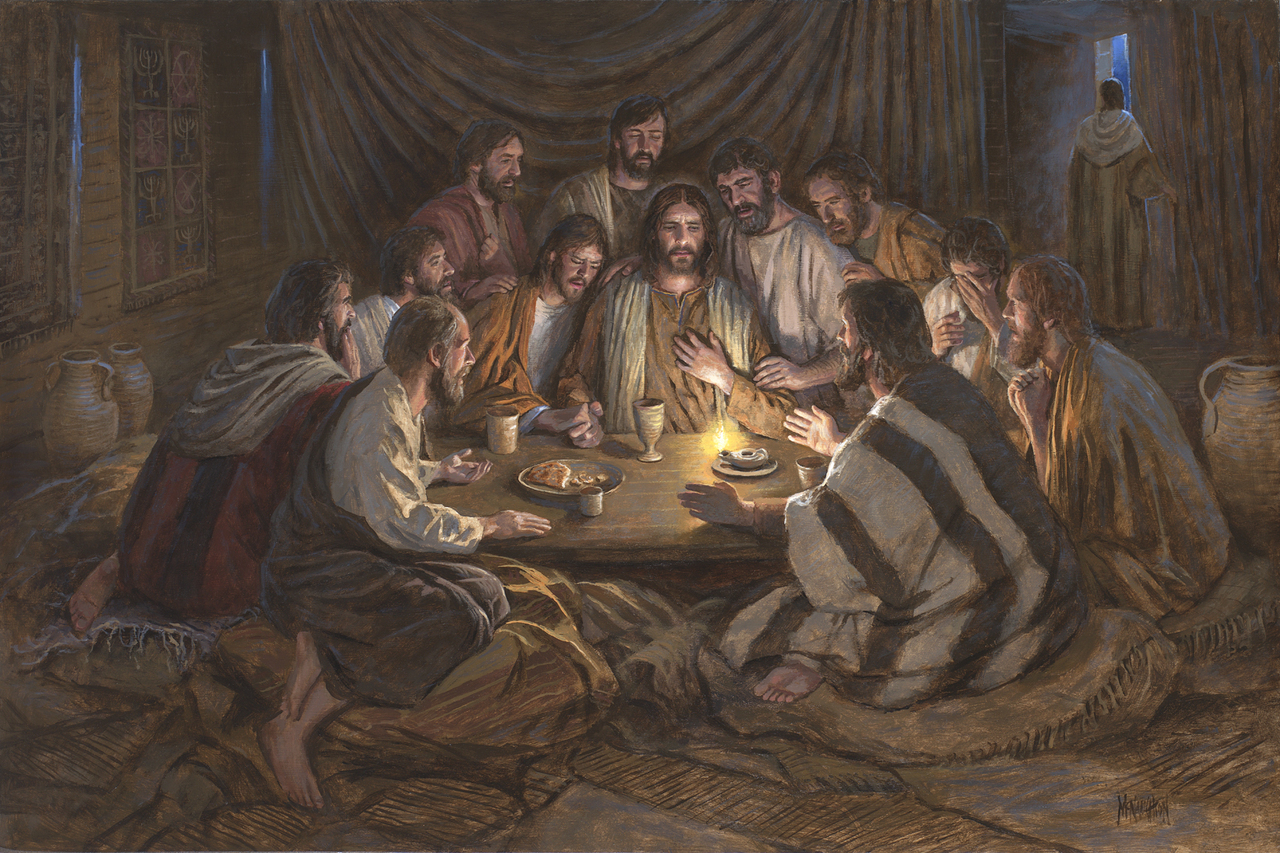
Jesus celebrated what has become known as the Last Supper (it may or may not have been a Passover Seder) with a dozen of his followers, and after that was arrested and brought before the High Priest and the elders of the Jewish community.
Image from www.jonmcnaughton.com

Image from www.jonmcnaughton.com


The New Testament account, written years later and slanted to impress a Roman audience, tells of the Jewish authorities convicting him of blasphemy and turning him over to the Romans for punishment. But I am attracted to the theory of Israeli Supreme Court Justice Haim Cohen, who suggests that Jesus was brought before the Jewish authorities not to judge him or condemn him (Jewish courts did not meet at night or on the eve of holidays, and if the Last Supper was a Seder, it is inconceivable that the Jewish court would meet on Passover) but to warn him.
Here was this popular, gifted young Jewish teacher from a small town in the Galilee who did not realize what a dangerous place Jerusalem was at Passover time. Make yourself too conspicuous, I can picture the elders telling him, attract large crowds, and the Romans will see you as a potential troublemaker.


Image from www.wikiart.org

Image from www.wikiart.org

A day or two later, Jesus was put to death by crucifixion, a particularly cruel form of execution. It is very clear from all accounts that he was killed by the Romans, not by Jews, and that he was one of many people crucified by the Romans in Judea. After his death, his closest friends and followers began to see visions of him (it is not unusual for people to dream or daydream about someone they loved and lost; it has happened to me) and began to believe that he had risen from the dead and must indeed have been the Messiah.

At this point, we begin to move from the religion of Jesus (love your neighbor, turn the other cheek, prepare for the End of Days) to the religion about Jesus (he was the Son of God who died to absolve us of our sins). The key figure in this shift was a Jew named Paul, known in Christian tradition as Saint Paul, author of many of the books of the New Testament.


Jesus’ disciples, all of whom were Jewish, tried to persuade their fellow Jews that the young teacher who had been put to death was the Messiah. They had very little success doing so.
Image from www.religionfacts.com

Image from www.religionfacts.com

Paul, who had never met Jesus but became convinced of his divine mission, found the non-Jewish world more receptive. He brilliantly combined the strenuous moral teachings of the Jewish tradition with familiar elements of pagan religion that had not been part of Jesus’ original message—the leader, born of a divine father and human mother, who dies and comes back to life. Perhaps out of conflicts within his own personality, he crafted the very non-Jewish notion of Original Sin, that because none of us is perfect, we are all condemned to hell and only the willing sacrifice of a perfect, sinless man (God come down in human form) can save us.


Within three hundred years, Christianity went from being a handful of individuals within Judaism to being a persecuted sect, to being a tolerated sect, and finally to becoming the official religion of the Roman Empire. Why did Christianity succeed in winning the hearts of tens of millions of people while Judaism, which was an energetically missionary religion at that time, remained the inheritance of a much smaller population?


When I was in Hebrew School, I was taught that Christianity was more attractive because it was easier:
  • no dietary laws,
  • no Sabbath observance,
  • no need to circumcise male converts.

But it was not that easy to be a Christian in the first or second century. (Remember all those movies where Christians are thrown to the lions to entertain Roman audiences?)


Image from www.barnesandnoble.com

Image from www.barnesandnoble.com

Part of the answer lies in the fact that in the year 67 and again in the year 135 (the Bar Kochba rebellion), the Jews rose in revolt against Rome, seeking their freedom. Both times, they fought heroically, and both revolts were put down with great loss of life. The Romans were so angry at having to send troops to put down these revolts that they tried to crush Judaism in Judea, forbidding its teaching or practice. That was when they destroyed the Second Temple and changed the name of Judea to Palestine, and that is why the definitive Talmud, the commentary on how the laws of the Torah were to be lived, was written in Babylonia rather than in Judea. As a result, Judaism was physically and emotionally depleted at home, and had the image of being a nation of losers and troublemakers throughout the empire.


But mostly, the question “Why Christianity rather than Judaism?” is the wrong question.


The real question is “Why Christianity rather than paganism?”


Image from www.audible.com

Image from www.audible.com

The people of the Roman Empire did not have to choose between Judaism and Christianity. They had a third option: remaining pagans, worshiping the nature-gods of the old religions. Why did so many of them choose Christianity? Having the emperor designate it the official religion of the empire certainly helped. But I believe that there is something in the human soul that responds to the call to righteousness, the summons to be moral. We intuitively know that we are different from the animals, and that this difference is located in our ability to know right from wrong. We want to believe that our moral choices are taken seriously, and only biblical monotheism, whether in its Jewish or its Christian formulation, offered that message.


How shall we, twentieth-century Jews, regard Jesus and how shall we regard Christianity?


To be sure, if we are Jewish, we cannot regard Jesus as having been divine. Jews who accept Jesus as their Savior are not “Jews for Jesus”; they are Christians, in the same way that Christians who convert to Judaism are Jews, not “Christians who deny Christ.”


We can overlook his Jewish origins and the Jewish roots of much that he taught, and see Jesus merely as the central figure of someone else’s religion, as we see Mohammed, Confucius, and the Buddha. But my position would be to see Jesus and Paul as people used by God to bring the monotheism and the moral message of Judaism to the world, and to teach the world that the God discovered and worshipped by the Jews was the only true God.


Earlier in this century there lived a brilliant young German-Jewish scholar named Franz Rosenzweig. He grew up with minimal Jewish knowledge, became involved with Judaism as an adult, and died at a tragically young age, but in a few years produced a life’s work of books, essays, and projects. Rosenzweig was loyally Jewish but he recognized the spiritual depth and beauty of Christianity and the saintly lives of many of his Christian friends. He knew too many devout Christians to be able to claim that if one religion is true, the other had to be false. He came up with the “two covenant” theory, a way of affirming the religious validity of both Judaism and Christianity.


Judaism and Christianity, he taught, needed each other, and God’s plan for humanity needs them both. Christianity grew to be a religion of more than a billion people by absorbing great masses of pagans, sometimes converting entire nations en masse. In the process, these new Christians brought some of their pagan rituals and superstitions into Christianity, diluting its monotheistic message. Adoration of the Virgin Mary sometimes bordered on turning her into a goddess like the mother-goddesses of paganism. Christmas was celebrated with evergreen trees and other winter festival symbols; Easter was observed with eggs, rabbits, and other spring symbols of fertility. Christianity needs Judaism to remind it of what pure, uncompromised ethical monotheism looks like. As a counterpoint to the Christian notion of Original Sin, the idea that no human being can live up to all of God’s expectations, Christianity need the example of the Jewish community actually striving to do what the Torah calls upon us to do.


But Judaism needs Christianity to remind us that the word of God is not meant to be kept for ourselves alone. We are on not merely to live by God’s ways, but to do it in such manner that the world will be persuaded to turn to God.


Had Judaism been as successful in winning converts as Christianity was eighteen hundred years ago, it would have stopped being Judaism. It would have lost the sense of community and shares responsibility that only a small group can maintain. It would inevitably have absorbed many of the superstitions and habits of nature-worship brought by former (and to that point incompletely digested) pagan converts. And yet had the Bible, and the God of the Bible, remained the exclusive property of a few thousand families in and around Jerusalem, God’s ultimate plan for the world would have been frustrated. In that way, we Jews can see Christianity as God’s chosen instrument for redeeming the world from paganism, and Christians can recognize their obligation to preach the message of Christianity to the world, but not to the Jewish people, who had that message before they did.


Significant differences remain, but they are less important than what we share. Some years ago, I was invited to speak to the women’s group of the local Methodist Church. The talk was advertised locally, causing one of my congregants to say to me after Sabbath services, “I see you’re speaking for the competition Tuesday.” I smiled, because I realized he intended his words as a joke, not as a theological statement. But in my mind, my response was—


“No, Christianity is not the competition.
Apathy and selfishness and a neo-paganism that sees Man as an animal and his every urge as legitimate—they are the competition.
And the church and the synagogue are allies, on the same side of the battle.”


HOLY WEEK

[First posted 2012, when Sinai 6000 started this website.  A timely article which gives a glimpse of the religious traditions of the country where the core community of Sinaites are based.  This was contributed by Sinaite DVE@S6K/Admin2..–Admin1.]


Image from tx.english-ch.com

Image from tx.english-ch.com

It’s the time of the year again when most Filipinos are gearing up for another vacation trek to beaches, to Baguio, to Palawan, to Boracay, Subic, and other popular vacation spots and resorts all over the Philippines. 


Juxtaposed with this time is the LENTEN SEASON or HOLY WEEK of this mostly Catholic-devotees nation.  There are quaint customs that are practiced in this country, foremost of which is abstention from eating meat and fasting during this season.  Even fast-foodchains jump into the bandwagon by offering non-meat options in their menu.  Then there is the “Visita Iglesia” [church visit] done every Maundy Thursday where it is a custom to visit at least seven different churches on this day.  Even Filipino families have traditional Good Friday fare that is served, the most popular being “Bacalao”, a dish prepared with dried cod fish. 


Image from tx.english-ch.com

Image from tx.english-ch.com

Then there is the flogging and carrying and dragging of wooden crosses by penitents and even literal crucifixion on crosses.  These events have been extensively covered by National Geographic in a documentary.  Then on Easter Sunday, at dawn, there is the “Salubong” [meeting, welcoming] tradition where the “Virgin” Mother meets the Risen Christ.


These are my memories of “Holy Week”; as I matured in my spiritual walk, I understood that these practices are not even mentioned in the Tanakh, and all of them have pagan origins. 


Ask most Catholics, and even Christians, how these practices and traditions came about and you will surely get a blank stare or a shrug.  The following paragraphs will de-mystify these traditions and allow us to understand more fully that trusting the one, TRUE GOD, YHWH, is so simple and straight-forward:


Isaiah 56:13-17:   

Bring no more vain oblations; it is an offering of abomination to me; new moon and Sabbath, the holding of convocations-I cannot endure iniquity along with the solemn assembly.  Your new moons and your appointed seasons My soul hates; they are a burden to Me, I am weary to bear them, and when you spread forth your hands, I will hide My eyes from you, yes, when you make many prayers, I will not hear; your hands are full of blood.  Wash and make yourself clean, put away your evil doings before My eyes, cease to do evil, Learn to do well; seek justice, relieve the oppressed, judge the fatherless, plead for the widow.


EASTER/EASTER EGGS


 The word “Easter” is culled from Eastre, the Anglo-Saxon/Teutonic goddess of spring and fertility. A festival was held in her honor every year at the vernal equinox.  Easter Sunday is set on the first Sunday after the full moon after the vernal Equinox on March 21.  On Easter Sunday, it is typical to hunt for eggs, and

Image from www.shutterstock.com

Image from www.shutterstock.com

rabbits are symbols that mark the day.  Why is this done?  The Easter Bunny is a rabbit-spirit. Long ago, he was called the “Easter Hare”, hares and rabbits have frequent multiple births so they became a symbol of fertility. The custom of an Easter egg hunt began because children believed that hares laid eggs in the grass. The Romans believed that “All life comes from an egg.” Christians consider eggs to be “the seed of life” and so they are symbolic of the resurrection of Jesus Christ. In one way or another all the customs are a “salute to spring” marking re-birth.  (Source:  Mary Bellis, About.com Guide)


Image from primeross.blogspot.com

Another view on these practices during Holy Week traces them back to pagan celebrations and beliefs. “Ishtar”, which is pronounced “Easter” was a day that commemorated the resurrection of one of their gods that they called “Tammuz”, who was believed to be the only begotten son of the moon-goddess (Semiramis/Ishtar), and the sun-god (Nimrod/Baal).  When Semiramis/Ishtar became queen due to the death of her son Tammuz, she proclaimed a forty day period of time of sorrow each year prior to the anniversary of the death of Tammuz.  During this time, no meat was to be eaten.  Worshippers were to meditate upon the sacred mysteries of Baal and Tammuz, and to make the sign of the “T” in front of their hearts as they worshipped.  They also ate sacred cakes with the marking of a “T” or cross on the top.  Every year, on the first Sunday after the first full moon after the spring equinox, a celebration was made.  It was Ishtar’s Sunday and was celebrated with rabbits and eggs.  Ishtar also proclaimed that because Tammuz was killed by a pig, that a pig must be eaten on that Sunday.  (Source:  David J. Meyer,  Last Trumpet Ministries)


Image from www.redicecreations.com

Image from www.redicecreations.com


From these sources,

we can clearly see

that these practices

are not in any way

connected

to worshipping

the ONE, TRUE GOD,

YHWH.


Holy Week? Really?


DVE@S6K

logo-e1422801044622


HOLY WEEK

[First posted 2012, when Sinai 6000 started this website.  A timely article which gives a glimpse of the religious traditions of the country where the core community of Sinaites are based.  This was contributed by Sinaite DVE@S6K/Admin2..–Admin1.]


Image from tx.english-ch.com

Image from tx.english-ch.com

It’s the time of the year again when most Filipinos are gearing up for another vacation trek to beaches, to Baguio, to Palawan, to Boracay, Subic, and other popular vacation spots and resorts all over the Philippines. 


Juxtaposed with this time is the LENTEN SEASON or HOLY WEEK of this mostly Catholic-devotees nation.  There are quaint customs that are practiced in this country, foremost of which is abstention from eating meat and fasting during this season.  Even fast-foodchains jump into the bandwagon by offering non-meat options in their menu.  Then there is the “Visita Iglesia” [church visit] done every Maundy Thursday where it is a custom to visit at least seven different churches on this day.  Even Filipino families have traditional Good Friday fare that is served, the most popular being “Bacalao”, a dish prepared with dried cod fish. 


Image from tx.english-ch.com

Image from tx.english-ch.com

Then there is the flogging and carrying and dragging of wooden crosses by penitents and even literal crucifixion on crosses.  These events have been extensively covered by National Geographic in a documentary.  Then on Easter Sunday, at dawn, there is the “Salubong” [meeting, welcoming] tradition where the “Virgin” Mother meets the Risen Christ.


These are my memories of “Holy Week”; as I matured in my spiritual walk, I understood that these practices are not even mentioned in the Tanakh, and all of them have pagan origins. 


Ask most Catholics, and even Christians, how these practices and traditions came about and you will surely get a blank stare or a shrug.  The following paragraphs will de-mystify these traditions and allow us to understand more fully that trusting the one, TRUE GOD, YHWH, is so simple and straight-forward:


Isaiah 56:13-17:   

Bring no more vain oblations; it is an offering of abomination to me; new moon and Sabbath, the holding of convocations-I cannot endure iniquity along with the solemn assembly.  Your new moons and your appointed seasons My soul hates; they are a burden to Me, I am weary to bear them, and when you spread forth your hands, I will hide My eyes from you, yes, when you make many prayers, I will not hear; your hands are full of blood.  Wash and make yourself clean, put away your evil doings before My eyes, cease to do evil, Learn to do well; seek justice, relieve the oppressed, judge the fatherless, plead for the widow.


EASTER/EASTER EGGS


 The word “Easter” is culled from Eastre, the Anglo-Saxon/Teutonic goddess of spring and fertility. A festival was held in her honor every year at the vernal equinox.  Easter Sunday is set on the first Sunday after the full moon after the vernal Equinox on March 21.  On Easter Sunday, it is typical to hunt for eggs, and

Image from www.shutterstock.com

Image from www.shutterstock.com

rabbits are symbols that mark the day.  Why is this done?  The Easter Bunny is a rabbit-spirit. Long ago, he was called the “Easter Hare”, hares and rabbits have frequent multiple births so they became a symbol of fertility. The custom of an Easter egg hunt began because children believed that hares laid eggs in the grass. The Romans believed that “All life comes from an egg.” Christians consider eggs to be “the seed of life” and so they are symbolic of the resurrection of Jesus Christ. In one way or another all the customs are a “salute to spring” marking re-birth.  (Source:  Mary Bellis, About.com Guide)


Image from primeross.blogspot.com

Another view on these practices during Holy Week traces them back to pagan celebrations and beliefs. “Ishtar”, which is pronounced “Easter” was a day that commemorated the resurrection of one of their gods that they called “Tammuz”, who was believed to be the only begotten son of the moon-goddess (Semiramis/Ishtar), and the sun-god (Nimrod/Baal).  When Semiramis/Ishtar became queen due to the death of her son Tammuz, she proclaimed a forty day period of time of sorrow each year prior to the anniversary of the death of Tammuz.  During this time, no meat was to be eaten.  Worshippers were to meditate upon the sacred mysteries of Baal and Tammuz, and to make the sign of the “T” in front of their hearts as they worshipped.  They also ate sacred cakes with the marking of a “T” or cross on the top.  Every year, on the first Sunday after the first full moon after the spring equinox, a celebration was made.  It was Ishtar’s Sunday and was celebrated with rabbits and eggs.  Ishtar also proclaimed that because Tammuz was killed by a pig, that a pig must be eaten on that Sunday.  (Source:  David J. Meyer,  Last Trumpet Ministries)


Image from www.redicecreations.com

Image from www.redicecreations.com


From these sources,

we can clearly see

that these practices

are not in any way

connected

to worshipping

the ONE, TRUE GOD,

YHWH.


Holy Week? Really?


DVE@S6K

logo-e1422801044622


Genesis/Bereshith 32: "Now why do you ask after my name? "

[First posted in 2014.  Despite attempts of commentators to explain this chapter, for us these questions remain unresolved:

  • How does a man ‘wrestle’ with a ‘Divine Being’ and prevail’?  
  • Is the ‘Divine Being’ here a messenger/angel  . . . or God Himself? 
  • Image from Pinterest

    Image from Pinterest

    Is this image of two beings (human and divine) a physical wrestling match (which is unreal), or is this just another figure of speech to reflect a human’s inner conflict, or spiritual struggle between one’s will and the Divine’s expressed will which is more credible so that we can all relate to it?

  • If it is figurative, then Jacob’s struggle is much the same as the struggle of any individual who has difficulty submitting his will to the Will of a Higher Power, much like each one of us, whenever we confront a ‘truth’ that we have to either accept or refuse.  
  • Atheists and agnostics most likely do not have this struggle within, since they consider themselves the highest authority over their lives and make their choices accordingly; so the ‘struggle’ is only when an individual has to make a crucial decision:  my will or submit to Another’s Will expressed in a book of antiquity to another people alien to my context.

Since this is in the Patriarchal narratives which at this point explains the roots of yet a future nation, a people that will struggle with the God of its Scriptures, then the name ‘Israel’ is indeed apt. Jacob, his descendants, Israelites of old, Israel today — reflect all the implications that connect with the name of this third patriarch.  Their history will bear it out and their continued existence and place in world politics today evokes all the undercurrents associated with Jacob who emerges as Israel here.  


One more item in this chapter to think about:  after Jacob is renamed, he asks the name of the Being and the answer?  Read  the title of this Chapter, it comes from verse 30. Is this where Jews got the habit of answering a question with another question? Unbracketed commentary is from Pentateuch and Haftorahs, ed. Dr. J.H. Hertz; additional commentary by EF/Everett Fox and RA/Robert Alter who both published their translations with the same title: The Five Books of Moses.  Our translation of choice is EF.— Admin 1]


—————-


Genesis/Bereshith 32

1 Lavan started-early in the morning, kissed his grandchildren and his daughters and blessed 
them,
and Lavan went to return to his place. 

his sons. i.e. his grandchildren.

[EF] Lavan (started-early) . . . : The verse numbering follows the Hebrew; some English translations number 32:1 as 31:55.

[RA] The verse numbering reflects the conventional division used in Hebrew bibles.  The King James Version, followed by some modern English Bibles, places the first verse here as a fifty-fifth verse in chapter 31, and then has verses 1-32 corresponding to verses 2-33 in the present version.

2 As Yaakov went on his way,
messengers of God encountered him. 

went on his way. To Bethel, whither God had sent him to fulfill his vow. This vision assured him that God was mindful of His promises.

[EF] messengers of God accosted him.  There is a marked narrative symmetry between Jacob’s departure from Canaan, when he had his dream of angels at Bethel, and his return, when again he encounters a company of angels.  That symmetry will be unsettled when later in the chapter he finds himself in fateful conflict with a single divine being.

God’s camp . . . Mahanaim.  The Hebrew for “camp” is maaneh.  Mahanaim is the same word with a dual suffix and thus means twin camps, a signification that will be played out in a second narrative etymology when Jacob divides his family and flocks into two camps.  The entire episode is notable for its dense exploitation of what Martin Buber and Franz Rosenzweig called Leitwortstil, key-word style. J.P. Fokkelman (1975) has provided particularly helpful commentary on this aspect of our text.  The crucial repeated terms are maaneh, “camp,” which is played against minah, “tribute” panim, “face,” which recurs not only as a noun but also as a component of the reiterated preposition “before,” a word that can be etymologically broken down in the Hebrew as “to the face of” and ‘avar, “cross over” (in one instance here, the translation, yielding to the requirements of the context, renders this as “pass”).

3 Yaakov said when he saw them:
This is a camp of God!
And he called the name of that place: Mahanayim/Double-camp. 

Mahanaim. i.e. two camps; the company of the angels and Laban’s camp.

4 Now Yaakov sent messengers on ahead of him to Esav his brother in the land of Se’ir, in the 
territory of Edom, 

As Jacob approaches his homeland, the fear of his brother revives in him.  Twenty years had passed, but Esau might still wreak vengeance on Jacob and his dependents.  Jacob well knew that some men nurse their anger, so that it should not die down or out.

field. i.e. territory.

[EF] Jacob sent messengers before him. These are of course human messengers, but, in keeping with a common principle of composition in biblical narrative, the repetition of the term effects a linkage with the immediately preceding episode, in which the messengers, mal’akhim, are angels.

5 and commanded them, saying:
Thus say to my lord, to Esav:
Thus says your servant Yaakov:
have sojourned with Lavan and have tarried until now. 

Jacob frames his message in the most humble and conciliatory words.

I have sojourned.  Rashi takes these words to mean: ‘I have not become a prince but am only a “sojourner”; therefore thou hast no cause to hate me because of my father’s blessing, in which I was promised to be made greater than thou.  It has not been fulfilled.’  Since the letters of the Hebrew word ” I have sojourned’ correspond to the numerals denoting 613, the number of Pentateuchal commandments, the Midrash comments:  ‘With Laban I sojourned, but the 613 Commandments I observed’ —an exhortation to Jacob’s descendants to be faithful to the Torah even when living in a non-Jewish environment.

[RA] Thus shall you say.  The syntactic division indicated by the cantillation markings in the Masoretic Text is: “Thus shall you say to my lord Esau.”  But E.A. Speiser has convincingly demonstrated that “To my lord Esau, thus says your servant Jacob,” precisely follows the formula for the salutation or heading in ancient Near Eastern letters and so must be part of the text of the message.

my lord Esau . . . your servant Jacob. The narrator had referred to Esau as Jacob’s “brother,” as will the messengers.  An elaborate irony of terms underlies the entire reunion of the twins: Jacob, destined by prenatal oracle and paternal blessing to be overlord to his brother, who is to be subject (‘eved) to him, repeatedly designates himself ‘eved and his brother, lord (‘adon). The formulas of deferential address of ancient Hebrew usage are thus made to serve a complex thematic end.

6 Ox and donkey, sheep and servant and maid have become mine.
I have sent to tell my lord, to find favor in your eyes. 

to tell my lord.  that I am on my way home, and am desirous of finding ‘favour in thy sight’.

7 The messengers returned to Yaakov, saying:
We came to your brother, to Esav—
but he is already coming to meet you, and four hundred men are with him! 

to thy brother Esau.  lit. ‘to thy brother, to Esau’; which the Rabbis explain to mean, ‘We came to him whom thou hast called “brother”, but we found that we had come to “Esau”, to one who still hates thee.’

four hundred men. A considerable following; which naturally alarmed Jacob as to his brother’s intentions.

[EF] four hundred men: A considerable fighting force.  Even if the number is schematic (as ten times forty), it still represents something formidable.

[RA] he is actually coming . . . and four hundred men are with him.  There is no verbal response from Esau, who has by now established himself as a potentate in the trans-Jordanian region of Edom, but the rapid approach with four hundred men looks ominous, especially since that is a standard number for a regiment or raiding party, as several military episodes in 1 and 2 Samuel indicate.

8 Yaakov became exceedingly afraid and was distressed.
He divided the people that were with him and the sheep and the oxen and the camels into two camps, 

greatly afraid.  Lest he and his be slain.

and was distressed.  Even greater anguish possessed him at the thought that he might be compelled to slay (Midrash). He does not, however, give way to despair,  but takes all possible steps to safeguard himself and those with him.  He adopted three methods for overcoming the evil intentions of his brother.  His first defence was prayer to God for His protection (v. 10-13); the second was to turn Esau’s hate into goodwill by gifts (v. 14-22); his third and last resource was to stand his ground and fight (XXXIII,1-3).

[RA] two camps.  A law of binary division runs through the whole Jacob story: twin brothers struggling over a blessing that cannot be halved, two sisters struggling over a husband’s love, flocks divided into unicolored and particolored animals, Jacob’s material blessing now divided into two camps.

9 saying to himself:
Should Esav come against the one camp and strike it, the camp that is left will escape. 
 
10 Then Yaakov said:
God of my father Avraham,
God of my father Yitzhak,
O YHVH, who said to me: Return to your land, to your kindred, and I will deal well with you!—

Jacob’s prayer, showing his humility and gratitude, is proof that misfortune had developed the nobler impulses of his heart.  Twenty years of fixed principle, steadfast purpose, and resolute sacrifice of present for future, purify and ennoble.  It proves that even from the first, though he may appear self-centered, Jacob is yet delicately sensitive to spiritual realities and capable of genuine reformation.  And the truly penitent—declare the Rabbis—come nearer unto God than even those who have never stumbled or fallen i to sin.

who saidst unto me.  See XXXI,3.

[RA] and I will deal well with you. The first part of the sentence is in fact a direct quotation of God’s words to Jacob in 31:3 deleting only “of your fathers.”  But for God’s general reassurance, “I will be with you,” Jacob, in keeping with his stance as bargainer (who at Bethel stipulated that God must provide him food and clothing) substitutes a verb that suggests material bounty.

11 Too small am I for all the faithfulness and trust that you have shown your servant.
For with only my rod did I cross this Jordan, and now I have become two camps. 

truth. i.e. faithfulness.

staff.  Such as a lonely wanderer would use on his journey.

[EF] Too small:  This is the first indication of the change in Yaakov’s personality.  Now he relies on God (although he still uses his wits, by diplomatically and strategically preparing for his meeting with Esav).

12 Pray save me from the hand of my brother, from the hand of Esav!
For I am in fear of him, 
lest he come and strike me down, mothers and children alike! 

the mother with the children.  lit. ‘the mother upon the children’ — a vivid picture of the mother placing herself in front of her children to shield them, so that she is slain upon them.  The phrase is apparently a proverbial expression to describe a pitiless massacre;  like a pogrom in our own times, not sparing the weak and helpless.

13 But you, you have said:
I will deal well, well with you,
I will make your seed like the sand of the sea, which is too much to count! 

as the sand of the sea.  Jacob was thinking of the promise to his forefathers (XXII,17).

[EF] you have said: I.e., you have promised.  See also note on 31:10.  like the sand:  In fact, this is God’s promise to Avraham, in 22:17.

14 Spending the night there that night,
he took a gift from what was at hand, for Esav his brother: 

[RA] a tribute. The Hebrew minah also means “gift” (and, in cultic contexts, “sacrifice”), but it has the technical sense of a tribute paid by a subject people to its overlord and everything about the narrative circumstances of this “gift” indicates it is conceived as the payment of a tribute. Note, for instance, the constellation of political terms in verse 19: “They are your servant Jacob’s, a tribute sent to my lord Esau.”

15 she-goats, two hundred, and kids, twenty,
ewes, two hundred, and rams, twenty, 

15-21. Jacob hopes by the succession of gifts to pacify Esau’s wrath against him.

[EF] she-goats . . .: The gift is a special one, promising increase (females with their young).

16 nursing camels and their young, thirty,
cows, forty, and bulls, ten, she-asses, twenty, and colts, ten; 
17 he handed them over to his servants, herd by herd separately,
and said to his servants:
Cross on ahead of me, and leave room between herd and herd. 
18 He charged the first group, saying:
When Esav my brother meets you
and asks you, saying: To whom do you belong, where are you going, and to whom do these ahead of you belong? 
19 Then say:
—to your servant, to Yaakov, it is a gift sent to my lord, to Esav, and here, he 
himself is also behind us. 
20 Thus he charged the second, and thus the third, and thus all that were walking behind the herds, saying:
According to this word shall you speak to Esav when you come upon him: 
21 You shall say: Also—here, your servant Yaakov is behind us.
For he said to himself:
I will wipe (the anger from) his face
with the gift that goes ahead of my face;
afterward, when I see his face, 
perhaps he will lift up my face! 
 

appease him. lit. ‘cover his face’; so that he no longer sees any cause for being angry with me; the phrase used in XX,16.

accept me. lit. ‘lift up my face’, i.e. receive me favourably.

[EF] lift up my face: Or “be gracious to me.”

[RA]  Let me placate him with the tribute that goes before me, and after I shall look on his face, perhaps he will show me a kindly face. The Hebrew actually as “face” four times in this brief speech.  “Placate” is literally “cover over his face” (presumably, angry face); and “before me” can be broken down as “to my face.”  To “look on his face” is a locution generally used for entering the presence of royalty; and “show me a kind face,” an idiom that denotes forgiveness, is literally “lift up my face” (presumably, my “fallen” or dejected face).

22 The gift crossed over ahead of his face,
but he spent the night on that night in the camp. 

23-33.  JACOB BECOMES ISRAEL

This passage represents the crisis in Jacob’s spiritual history.  It records his meeting with a Heavenly Being, the change of his name to Israel, the blessing of the Being that wrestled with him, and the consequent transformation of his character.

 Maimonides is of opinion that the whole incident was a ‘prophetic vision’; and other commentators likewise have in all ages regarded the contest as symbolic, the outward manifestation of the struggle within the Patriarch, as in every mortal, between his baser passions and his nobler ideals.  In the dead of night he had sent his wives and sons and all that he had across the river.  Jacob was left alone—with God.  There, in the darkness, given over to anxious fears, God’s Messenger was wrestling with him who had so often wrestled with men and had won by sheer energy, persistency and superior wit.  In the words of the Prophet chosen as the Haftorah for this Sedrah, ‘He (Jacob) strove with an angel, and prevailed: he (Jacob) wept, and made supplication unto him.’  That supplication for mercy, forgiveness and Divine protection is heard.  Jacob, the Supplanter, becomes Israel, Prince of God.  ‘This mysterious encounter of the Patriarch has become the universal human allegory of the struggles and wrestlings on the eve of some dreadful crisis, in the solitude and darkness of some overhanging trial’ (Stanley).

23 He arose during that night,
took his two wives, his two maids, and his eleven children
to cross the Yabbok crossing. 

Jabbok.  A tributary of the jOrdan,m halfway between the Dead Sea and the Sea of Galilee.

[EF] Yabbok: A traditional natural boundary, it creates a wild gorge which is the perfect setting for this incident.

[RA] the Jabbok ford.  The word for “ford,” ma’avar, is a noun derived from the reiterated verb ‘avar, “to cross over.”  The Jabbok is a tributary of the Jordan running from east to west.  Jacob has been travelling south from the high country of Gilead, Esau is heading north from Edom to meet him.

24 He took them and brought them across the river; he brought across what belonged to him. 
25 And Yaakov was left alone—
Now a man wrestled with him until the coming up of dawn. 


26 When he saw that he could not prevail against him,
he touched the socket of his thigh;
the socket of Yaakov’s thigh had been dislocated as he wrestled with him. 

touched the hollow of his thigh. This is usually interpreted as a final effort of the assailant to overcome Jacob.

[EF] touched: Perhaps in homage, for the injury had already occurred (Ehrlich).


[RA] he touched his hip socket.  The inclination  of modern translations to render the verb here as “struck” is unwarranted, being influenced either by the context or by the cognate noun nega’, which means “plague” or “affliction.”  But the verb naga’ in the qal conjugation always means “to touch,” even “to barely touch,” and only in the pi’el conjugation can it mean “to afflict.”  The adversary maims Jacob with a magic touch, or, if one prefers, by skillful pressure on a pressure point.

 
27 Then he said:
Let me go,
for dawn has come up!
But he said:
I will not let you go
unless you bless me. 

The opponent’s anxiety to escape before ‘the day breaketh’ suggested to the Patriarch’s mind that he was a supernatural Being.  Jacob, therefore, demanded a blessing as the price of release.

[EF] dawn has come up: In folklore, supernatural beings often must disappear with the break of day.

[RA] Let me go, for dawn is breaking. The folkloric character of this haunting episode becomes especially clear at this point.  The notion of a night spirit that loses its power or is not permitted to go about in daylight is common to many folk traditions, as is the troll or guardian figure who blocks access to a ford or bridge.  This temporal limitation of activity suggests that the “man” is certainly not God Himself and probably not an angel in the ordinary sense.  It has led Claus Westermann to conclude that the nameless wrestler must be thought of as some sort of demon.  Nahum Sarna, following the Midrash, flatly identifies the wrestler as the tutelary spirit (sar) of Esau.  But the real point, as Jacob’s adversary himself suggests when he refuses to reveal his name, is that he resists identification.  Appearing to Jacob in the dark of the night, before the morning when Esau will be reconciled with Jacob, he is the embodiment of portentous antagonism in Jacob’s dark night of the soul.  He is obviously in some sense a doubling of Esau as adversary, but he is also a doubling of all with whom Jacob has had to contend, and he may equally well be an externalization of all that Jacob has to wrestle with within himself.  A powerful physical metaphor is intimated by the story of wrestling:  Jacob, whose name can be construed as “he who acts crookedly,” is bent, permanently lamed, by his nameless adversary in order to be made straight before his reunion with Esau.

28 He said to him:
What is your name?
And he said: Yaakov. 

what is thy name? A rhetorical question not seeking information.  As indicated on XVII,5, a name in Scripture is more than a label; it possesses significance.

[EF]  28-29 What is your name? . . .Not as Yaakov: As if to say “You cannot be blessed with such a name!” The “man” in effect removes Esav’s curse.

29 Then he said:
Not as Yaakov/Heel-sneak shall your name be henceforth uttered,
but rather as Yisrael/God-fighter,
for you have fought with God and men
and have prevailed. 

no more Jacob.  That is, ‘the Supplanter,’ prevailing over opponents by deceit.

Israel. The name is clearly a title of victory; probably ‘a champion of God’.  The children of the Patriarch are Israelites, Champions of God, Contenders for the Divine, conquering by strength from Above.

striven.  The Septuagint and Vulgate translate, ‘Thou didst prevail with God, and thou shalt prevail against men.’

with God. Hosea XII,4.  We have here another instance of ‘God’ interchanging with ‘angel of God’, as in XVI,7, XXXI,11.

with men.  Laban and Esau.

[EF] God-Fighter: The name may actually mean “God fights.”  Buber further conjectured that it means “God rules,” containing the kernel of ancient Israel’s concept of itself, but he retained “Fighter of God” in the translation.

[RA]  Not Jacob . . . but Israel. Abraham’s change of name was a mere rhetorical flourish compared to this one, for of all the patriarchs Jacob is the one whose life is entangled in moral ambiguities.  Rashi beautifully catches the resonance of the name change: “It will no longer be said that the blessings came to you through deviousness [‘oqbah, a word suggested by the radical of “crookedness” in the name Jacob] but instead through lordliness [serarah, a root that can be extracted from the name Israel] and openness.”  It is nevertheless noteworthy—and to my knowledge has not been noted—that the pronouncement about the new name is not completely fulfilled.  Whereas Abraham is invariably called “Abraham” once the name is changed from “Abram,” the narrative continues to refer to this patriarch in most instances as “Jacob.”  Thus, “Israel” does not really replace his name but becomes a synonym for it—a practice reflected in the parallelism of biblical poetry, where “Jacob” is always used in the first half of the line and “Israel,” the poetic variation, in the second half.

striven with God. The Hebrew term ‘elohim is a high concentration point of lexical ambiguity that serves the enigmatic character of the story very well.  It is not the term that means “divine messenger” but it can refer to divine beings, whether or not it is prefixed by “sons of” (as in Genesis 6).  It can also mean simply “God,” and in some contexts—could this be one? —it means “gods.”  In a few cases, it also designates something like “princes” or “judges,” but that is precluded here by its being antithetically paired with “men.”  It is not clear whether the anonymous adversary is referring to himself when he says ‘elohim or to more-than-human agents encountered by Jacob throughout his career.  In any case, he etymologizes the name Yisra’el, Israel, as “he strives with God.”  In fact, names with the ‘el ending generally make God the subject, not the object, of the verb in the name.  This particular verb, sarah, is a rare one, and there is some question about its meaning, though an educated guess about the original sense of the name would be: “God will rule,” or perhaps, “God will prevail.”


and won out.  In almost all his dealings, Jacob the bargainer, trader, wrestler, and heel-grabber has managed to win out His winning out against the mysterious stranger consists in having fought to a kind of tie:  the adversary has been unable to best him, and though he has hurt Jacob, he cannot break loose from Jacob’s grip.

30 Then Yaakov asked and said:
Pray tell me your name!
But he said:
Now why do you ask after my name?
And he gave him farewell-blessing there. 

As in Judg. XIII,17, the angel refuses to disclose his name, because it was something mysterious.

31 Yaakov called the name of the place: Peniel/Face of God,
for: I have seen God,
face to face, 
and my life has been saved. 

I have seen God face to face. The Targum translates, ‘I have seen angels of God face to face.’

my life is preserved.  Jacob had seen an angel, a Divine Being, and yet lives; Exod. XXXIII,20.

[EF] Peniel/Face of God:  See v.21, and 33:10, for the important allusions.

[RA] Peniel. The name builds on “face to face” (panim’el panim), the “face” component being quite transparent in Hebrew.

God. Again the term is ‘elohim, and there is no way of knowing whether it is singular or plural.

I came out alive.  The Hebrew says literally: “My life [or, life-breath] was saved.”

32 The sun rose on him as he crossed by Penuel,
and he was limping on his thigh. 

limped.  The struggle left its mark, but Jacob issued from the contest victor, redeemed and transformed by the contest.  So it has ever been with the People called by his name.

[EF] The sun rose: A sign of favor.  Penuel: A variant spelling of Peniel.


[RA] And the sun rose upon him. There is another antithetical symmetry with the early part of the Jacob story, which has been nicely observed by Nahum Sarna: “Jacob’s ignominious flight from home was appropriately marked by the setting of the sun; fittingly, the radiance of the sun greets the patriarch as he crosses back into his native land.”


he was limping on his hip. The encounter with the unfathomable Other leaves a lasting mark on Jacob.  This physical note resonates with the larger sense of a man’s life powerfully recorded in his story:  experience exacts many prices, and he bears his inward scars as he lives onward—his memory of fleeing alone across the Jordan, his fear of the brother he has wronged, and, before long, his grief for the beloved wife he loses, and then, for the beloved son he thinks he has lost.

33 —Therefore the Children of Israel do not eat the sinew that is on the socket of the thigh until 
this day,
for he had touched the socket of Yaakov’s thigh at the sinew. 


thigh-vein. The sciatic nerve.  This, together with other arteries and tendons, must be removed from the slaughtered animal, before that portion of the animal can be ritually prepared for Jewish consumption.  This precept is a constant reminder of the Divine Providence to Israel as exemplified in the experience of the Patriarch.

Image from www.healthinessbox.com

[EF] sinew: The sciatic nerve.

[RA] Therefore the children of Israel do not eat the sinew.  This concluding etiological notice is more than a mechanical reflex.  For the first time, after the naming-story, the Hebrews are referred to as “the children of Israel,” and this dietary prohibition observed by the audience of the story “to this day” marks a direct identification with, or reverence for, the eponymous ancestor who wrestled through the night with a man who was no man.

Did Israel fail as YHWH’s ‘Light to the Gentiles’?

Image from heartofgodisrael.org

Image from heartofgodisrael.org

[First posted in  2012; updated in 2016, and definitely due for a repost in year 2019 when Israel continues to be at the center of almost any controversy whether or not it has something to do with anything remotely connected.  Guess what is the answer to the question?—Admin1]


———————


The gentile prophet Balaam spoke only as YHWH’s ‘mouthpiece’  to declare to the gentile king Balak:    [AST] Numbers 23:9 


Behold!  It is a nation that will dwell in solitude

and not to be reckoned among the nations. 


In the biblical world, as presented in the TNK, it would appear that there are only two categories of people: the chosen, and the others.


Prior to the people of Israel—

  • individuals like Adam and Eve were spoken to and given specific commands.  
  • Cain the firstborn in the second generation was specifically warned to dominate his natural instincts or he would commit something called “sin”.
  •  Later, individuals like Noah and Abraham were “called” to carry out specific assignments.
  • And of course from a particular bloodline of Abraham’s descendants [Isaac, then Jacob] was formed the people of Israel;

—-formed first but already chosen,

—destined to bear the responsibility of being light-bearer for the Creator of the universe.  


For what purpose? To live and model His lifestyle intended for every person made in His image—that would be everyone else “in the dark”—the Gentiles, the nations.


Gentiles exist only from the perspective of the people of Israel,  an “us” and “them” or “we” and “they” ethnic separation.   People never know they’re “gentile” until they start reading the Bible.   And most people are clueless who’s an Israelite and who’s not.    In fact, most readers think Adam and Eve and everyone else singled out and named in the Bible is Jewish.  It’s not surprising, because there are articles from Jewish websites that have titles like “Abraham, the First Jew.”  


Abraham was called a “Hebrew” but that word meant “one who has crossed over” which is what Abraham did, crossing over from Ur of the Chaldees through Haran to the Land he was told to go to.  Etymologists also think Hebrew came from Eber, a great-grandson of Noah’s son Shem from whom the word Shemite/Semite/Semitic originated. 


At least this is how the Bible unfolds it:

  • The first Jew would be Jacob who was renamed “Israel”.  
  • And strictly speaking, his line should be called “Israelite “up till the time of the loss of the land of Israel to Gentile powers, when the upper kingdom called Israel was no longer existing, and the lower kingdom of Judea was occupied by the Romans.  
  • From Yhudah, Judah came the word “Jew”.

 It is important to use the proper ethnic designation so that people are not confused, especially in bible study. 


Non-Israelites, non-Jews, or gentiles like ourselves who read the Hebrew Scriptures struggle to understand how a people handpicked by the God of the universe could possibly ignore, disobey and rebel as much as their history records expose that they did, particularly when the blessings for obedience were jaw-dropping incentives enough, even without the “OR ELSE” — the curses for disobedience —which were horrendous enough to make even the hardest criminal want to reform! 


It’s one thing to make that judgment in hindsight, knowing what we know now; and another thing to live through ancient history in cultures and under pressures we can hardly relate to.  You would think that with a dismal historical record like Kings and Chronicles in the TNK, Israel’s scribes would expunge all the self-damning misconduct from their national record to save themselves the embarrassment of being chastised by unchosen people and judged for being “stiff-necked” generation after generation!  But to their credit, they recognized their divine-ordained existence; and that truth is truth, history is history . . . and as YHWH’s chosen people, theirs is not just a nation’s history but “Scripture,” where words of blessing, as well as curses from the very mouth of YHWH, are embedded in their historical documents.


The nations, we gentiles, are immensely blessed if we read the Hebrew Scriptures. There we discover —

  • the God of Israel,
  • the God of all people
  • and His revelation for all humanity, the Torah.

If we had been previously misled by man-made scriptures or man-sourced religious teaching, here is the standard against which all teachings claiming to be God-sourced are to be measured.  The Christian New Testament claims no less; in fact, the early church fathers deemed it necessary to append the Hebrew Scriptures as a “prequel” because, without it, the sequel “New” cannot stand alone!  And yet how far does the “New”  depart and deviate from the original “Old”?


So, back to the question:  


Did Israel fail to be YHWH’s

“light to the Gentiles”?  


Image from www.studyjesus.com

Image from www.studyjesus.com

First of all, how would we even know about YHWH today if it were not for Israel?  

  • They left the best legacy to humankind, their Hebrew Scriptures.  It is up for any gentile now to read and study and learn and apply!
  • The chosen people have fulfilled their divine mandate in simply recording the Way, God’s Way to Live, YHWH’s Torah.
  • Prophecies recorded about their future, Neviim is now history.
  • Inspired writings such as the Psalms and Proverbs collected in the third part of their Scriptures, the Ketuvim, are widely used by other major world religions.   
  • Today, modern Israel functions as a miraculous state backed by their “stiff-necked” will to survive in this world where there is such great pressure to annihilate them again, still a Jewish David among  Gentile Goliaths.
 

And needless to say but we’ll say it so nobody misses the obvious: the same God Who backed them up from the time He chose them some six millennia ago has never abandoned them, even if it appeared so in their darkest hour.  Granted, not all Jews are Torah observant, but the restored nation functions today applying Torah principles in government, use of land resources, in dealing with their enemy, the only nation that obeys the Sabbath commandment.


Are the 10 commandments enshrined in the laws of democratic nations? The ‘light-bearer’ reached almost all corners of the earth in their exile.  


Chosen Israel has done its part;  the time has come for the UNchosen, the Gentile nations,  to now learn from Israel and their Hebrew Scriptures and to get to know the God Who still speaks through its pages but more importantly, it is time for all, chosen or unchosen, to recognize HIM as the One True GOD/Elohim, and choose HIM as LORD/Adonai:


www.youtube.com

www.youtube.com

Image from fineartamerica.com

Image from fineartamerica.com


Sig-4_16colors

 logo

Q: ” “a 15th century rabbi claimed adam and eve had the faces of monkeys”

[First posted in 2014.  This Q was an entry in ‘search terms’ dated 4/28/14:   “a 15th century rabbi claimed adam and eve had the faces of monkeys” – and so we dealt with it in Yo Searchers! Can we help you? – April 2014.-Admin 1]
——————————————–
Image from www.mattcalcavecchia.com

Image from www.mattcalcavecchia.com

A:  Really? That sounds more like the image created by evolutionists rather than a rabbi.

Some humans not only like to reconfigure God but strangely have such a low opinion of humanity.  They can’t believe humans are the epitome of creation, the last of living creatures to be designed with a life-nurturing environment already perfectly set up by the Designer of all existence to sustain them. If it was truly a rabbi who said that, then he needs to review his scriptural legacy, the Torah, and align his thinking with it instead of speculating outside of the text.

Would the Creator who designs the first human who is later split into two—perfectly designed in all ways,  endowed with free will, PLUS bear the stamp of His ‘Image’— choose to make them look like the ape species He had already designed as a different and unique animal species with some variations (gorilla, orangutan, monkey, etc.)?  Aw, come on, let’s give the Creator all the credit He deserves.

When we look at the diversity of God’s creation, each species remains the same, identifiable in characteristics and function; that is why scientists can come to final and predictable conclusions and not guess forever what a creature would evolve into next. True, the germ and virus and other organisms mutate so that their species could survive, but they do not evolve into the next level of created species and still remain as germs and viruses; perhaps their immune system become stronger because all living things are programmed to survive even if the rule of life is the survival of the fittest. Yet and unfortunately, many species have become extinct because the two-legged animals with the brains do not heed the command of the Creator to ‘tend the garden.’

Do we see any current species evolving into the next level today?  Yes there are freaks of nature but they can hardly be categorized as the organism between one species and another.  Have they discovered “missing links” at every stage of the supposed evolutionary process?
Unless scientists tamper with the balance of nature and recreate mixed species (prohibited in Torah), most of nature, including humanity, remain as originally created— “good” and “very good” . . . NOT “could be better” or “improve later.”  And when humans so decide to “improve” the original (usually for commercial gain and out of greed), there are consequences to health and environment.  Genetically modified organisms are perfect examples. Man recreates and ends up with Frankenstein . . . is that an improvement?

 So, would the Creator make His crown of creation — humanity — look like the species that almost look human but fall short for obvious reasons?  Each person simply must decide whose word will he believe, man ‘s or God’s.

Here are additional posts:  

NSB@S6K

logo 


Postscript:


And just for amusement, here’s a link that isn’t missing the point:  http://www.garyleonjohnson.com/2012/10/the-missing-link.html,


Tuesday, October 9, 2012


THE MISSING LINK DISCOVERED


All works are original unless stated otherwise. Feel free to remix, distribute, display and share my work, as long as you mention me via a link and don’t use my work for commercial use.


I am of the opinion that evolution is no longer a theory. It is a proven thing. A virus can evolve from one type into another in the matter of a few months.To prove my point I would like to share with you the evolution chart of a pig.
 
 
Could it be true?  The missing link is akin to link sausage?
 
 
*photo found on the internet G.L.J., the wisecrack?
 

About Me

All works are original unless stated otherwise. Feel free to remix, distribute, display and share my work, as long as you mention me via a link and don’t use my work for commercial use.