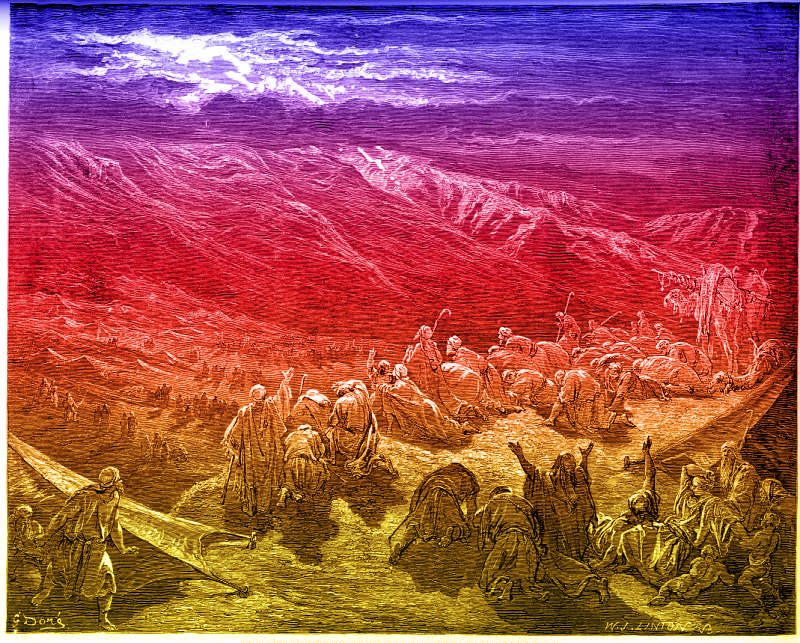
Why give the Torah in the desert?

[First posted in 2014.  Some of the time, in a post where the same topic has been written about by Sinaites or Jewish websites, we refer the reader to those posts; we are never sure if readers do bother to check them out.  So occasionally, we simply feature those posts in a separate article.


This one is a MUST READ, published in one of our links Jewish World Review. It answers the question in our title — why indeed does the Torah-Giver choose to address thousands of this mixed multitude of Israelites and non-Israelites in ‘no man’s land’? The answer is right there: because it is ‘no man’s land’ and all its implications.

Can we hear God amidst the noise of our society today where He has to compete with real and virtual voices in our digital toys and appliances? “Be still and know that I am God” — is that possible in concrete jungles of today’s modern society? How does one find solitude in our artificial world of man-designed, man-built cities?  Actually the only voice God has to compete with in being ‘heard’ and ‘obeyed’ is the voice of the ‘I’ in I-dolatry that is I-centered, whether in the city or the dessert.


When we get stumped by a question that needs a better answer than the obvious, we check out Jewish teaching, they’ve been studying the Torah for four millennia and are way ahead of us; we do keep in mind that Jews write for Jews and we’re outsiders looking in.


Here, Rabbi Nathan Lopes Cardozo explains “Why the giving of the document that would permanently change the world could only be done in desolation . . . “


A side comment: “At Shavous, in which Jews recreate the Revelation at Sinai, a world-renowned philosopher offers a meditation on religion abuse.”


JWR contributor Rabbi Rabbi Nathan Lopes Cardozo is a world-renowned lecturer and ambassador for Judaism, the Jewish people, the State of Israel and Sephardic Heritage.

Reformatting and highlights added.Admin 1.]


poe-desert shot POST

poe-desert shot POST

http://www.JewishWorldReview.com | A desert is a lonely place, completely forsaken. There is neither food, nor water, nor any other form of sustaining substance. There is only the unbearable sun and its heat. There is no grass, and there are no trees. There are only deadly snakes and scorpions. In a desert, death stares you in the face. It is a dangerous place, unlivable and outrageous.


But the desert is also a magnificent place, filled with grandeur and full of life. It is a place where many things can happen which are not possible in any other location.


  • First and foremost, it is a place of authenticity. Because it is a place where a sound, a Voice, can travel as in no other place. It has all the sound options that a musician can dream of. It can reach the deepest of its meanings and the highest of its dreams. In a desert a sound can travel to the end of the world. There are no obstacles standing in its way. In a desert a Voice can turn in any direction it desires and take on any dimension with no fear of corruption.


In a desert there are no walls by which the sound will be cut short. It is, above all, a place where a sound will not be disturbed or troubled by other sounds that may overwhelm it or even silence it.

Why? Because a desert is a place of devastating silence. There are no distractions; there is no clash of voices. No “voice competition”.

If there is ever to be an authentic Voice to be heard, it is here in the desert. It can’t be undermined and falsified, using it for selfish purposes. It is because of the desert’s thundering silence that it is possible to hear a “still voice” with no obstruction. It cannot bear mediocrity, even when it is original and thought of as novel. Instead, it seeks singular excellence even when most men cannot recognize it as such. It protests against those who are appeased when they can find something old in the new, whereas it is clear that this old could not have given birth to this new.

The Egyptian French poet, Edward Jabes, noted the relationship between the Hebrew words “dabar“, word, and “midbar“, desert. This, he claims, goes to the core of what a Jew is all about:

“With exemplary regularity the Jew chooses to set out for the desert, to go toward a renewed word that has become his origin… A wandering word is the word of God. It has for its echo the word of wandering people. No oasis for it, no shadow, no peace. Only the immense, thirsty desert, only the book of his thirst….” (From The Book to the Book, Wesleyan University Press, 1991, pp 166-7)


Here, in the emptiness and silence of the desert, the authentic Word can be heard. A Word stripped of all distractions. Naked, without any excuse.

  • But it can only be heard by a people of the wilderness;
    • a people who are not rooted in a substance of physical limitations and borders;
    • a people who are not entirely fixed by an earthly point, even while living in a homeland.
    • Their spirit reaches far beyond the borders of any restricted place.
    • They are particularistic so as to be universalistic.
    • They are never satisfied with their spiritual conditions and are therefore always on the road, looking for more.
    • A wandering people carried by a wandering Word which can never permanently land because the runway is too narrow and they cannot fit into any end destination.
    • A people who always experience unrest because they carry the Word which doesn’t fit anywhere and wanders in the existential condition of an unlimited desert.


A Word which unnerves because it is rooted in the desert where, if not properly handled, it becomes deadly


    • It needs a people who received the Word before having received their land.
    • More than that, a people to whom the Word itself gave birth.
    • The Word is the mother of the people.
    • A people who can make their land into a portable homeland, carrying it to any corner of the earth because their land is a Word.
    • It is the land which depends on the Word and not the Word which depends on the land.
    • Here the Word is the author of the people; the people are not the author of the Word.
    • The homeland is the “Text”- the Word. (George Steiner) They dwell in the Word and become real, because the Word is the father of its readers and not vice versa.


A desert is even more. It is a place where nothing can be achieved. In a desert man cannot prove himself, at least not in the conventional sense of the word. It doesn’t offer jobs that people can fight over and compete for. It has no factories, offices or department stores. There are no bosses to order us around and no fellow workers with whom we are in competition. It is “prestige deprived”. In a desert there is no “kavod/honor” to be obtained. It doesn’t have cities, homes, fences. Once it has these, it is no longer a desert. Human achievements will end its desert status and will undermine and destroy the grandeur of its might and beauty.


Man can only “be” but never “have” anything in a desert.


There is no food to be eaten but the manna, the soul food, and one can easily walk in the same shoes for 40 years because authenticity does not wear out. Men’s garments grow with them and do not need changing or cleaning because they are as pure as can be. And that which is pure continues to grow and stays clean.


The desert is therefore a state of mind.


It removes the walls in our subconscious, and even in our conscious way of thinking. It is an “out of the box” realm. In a desert one can think unlimitedly. As such, one is open to the “impossible” and hears murmurs of another world which one can never hear in the city or on a job. The desert allows for authentic thinking, without obstacles, and therefore it is able to break through and remove from us any artificial thoughts which do not identify with our deeper souls. Nothing spiritual gets lost in us, because the fences of our thoughts become neutralized and no longer bar the way to our inner life. It is ultimate liberty. It teaches us that openness does not mean surrender to what is most “in”, or powerful. Nor does it consist of vulgar successes made into a principle.


This is the reason why the Torah could only have been given in a desert – Midbar.


Why did the Divine not give the Torah in a civilized place? Had He given it on Wall Street, He would have had to decide who would sit on the Board of Investors. He would have had to deal with the “politics of friendships” and personal agendas of how much interest to give and where to invest.


The Divine didn’t want shareholders or agendas to pollute His words and make them “user friendly” in ways which would compromise His very Word. So He chose the desert. A place without any personal motives.


The ideal place to fall in love because there is no competition. And because love is the irresistible desire to be desired irresistibly (Louis Ginsberg), only a Midbar can become the home of lovers – the Giver of the Word and the receivers of the Voice to be married under the canopy of authenticity.


“Anyone who does not make himself open to all (“hefker”, ownerless), like a wilderness, cannot gain wisdom and Torah”—-(Bamidbar Rabbah, 1:7)— say the Sages.


With this statement the Sages introduce a most important insight concerning the Almighty, the nature of Torah and the desert. They cannot bear artificial, unauthentic ideas which are sold in the superficiality of this world.


In a Midbar one can hear an authentic Voice and immediately distinguish it from the artificial word, because the authentic Voice will protest without delay. It has no place to hide, so it will run up against a wall and instead of being silenced will become nearly violent and unrelenting. The wall will start to shake and will ultimately collapse because it is not really rooted in a desert


The “authentic” is perhaps not to be found when deliberately pursued, but there is no missing it when it is present. As such, it will become a “commanding voice” which can make us nervous since it becomes disturbing and unbearable. It becomes a deadly, poisonous snake for those who have not shaped themselves as desert people.


A desert is still more. It is also a place where the word cannot be caught and locked up. In can’t be framed and manipulated. Yes, to activate the world and make an imprint on it, it has to come down and respond to the “here and now”. It must allow for fences and limitations whenever needed. Limitations can be great emancipators. But it must always carry the “tomorrow and over there”.


To have any effect, it must borrow from the world of man and his language. But it needs to have an escape. It must be like a fishnet which captures its mundane needs, but with holes so that the ongoing flow of water will not get caught up in the net itself. It must be a thoroughfare for all genuine thoughts, always looking for a new destination.


The only quality which can save us from the snakes in this desert is the awe of Heaven. Only this quality can save us from falling into the hands of the serpent. But it can be done and therefore it must be done so as to reveal the Word given in the desert and to allow it all the space it deserves.


Abraham found the Divine in the desert and so the people of Israel received the Torah in a place of ultimate authenticity: The Desert of devastating conditions and great opportunities. It is a dangerous place, but a desert it must be.


Whoever thinks that the Divine Word is commonplace and easily lived by, has never been in the Ultimate desert of his life.


Who do you think you are . . .

Image from arouda.blogspot.com

Image from arouda.blogspot.com

[In 2010 at the start of our Sinaite’s spiritual pilgrimage to biblical Mt. Sinai, i.e., the Revelation of YHWH, we encountered a lot of opposition and criticism from our Christian colleagues . . . understandably.  This article —first posted in 2012 —was in answer to the exact words in the title. We add this to our current series explaining our beginnings on the occasion of our 7th anniversary reflections during this season of the year which always brings us back to the beginnings of what our former Christian colleagues refer to as  our   “apostasy”.  After reading this article, what would you think, dear reader, apostasy from man-made religion and its version of God . . . or spiritual awakening to search out the forgotten One True God?—Admin1.]


————————–


WHO do you think you are . . . to question centuries of biblical scholarship attesting to the veracity, divine source, and canonicity of the New Testament, “the very words of God”?


This is a question commonly asked by Christian colleagues who are incredulous at our proclamation that we have left Christianity based on our conviction that the New Testament is man-sourced, not divinely-authored.  We have explained how we have arrived at this conviction [and all its implications] in many articles posted in this website. Visitors to this website do not know Sinaites on a personal level, only what we project in the articles that declare the basics of our belief.  Some know who we are, specifically the other person who debates one of us in posted discourses.  


Our Christians friends echo the same questions, the same counter-arguments, the same verses as prooftexts.  Our Christian colleagues would know that we are not blind, unthinking, spoon-fed, disciples who just swallow teachings without question.  If we journeyed through previous stages in various sects within Christianity, it is only because it has been our nature to seriously examine beliefs we have embraced at each stage of our spiritual growth.  They would know that we would not resort to a “drastic” turnabout in direction without having thoroughly weighed the consequences.


Indeed, who are we to think we know better than the theological giants of the Christian faith, all of whom confirm just the opposite of what we question?  Actually we are nobodies compared to them, but these are what we Sinaites share in common: 


1.  Just like our Christian colleagues, we love God so much we continue to seek Him in all the sources, we deem, best teach us about Him.  

2.  Just like our Christian colleagues, we are independent-minded, will rely on teachers only to a certain extent, but also and at the same time do our own research and study, checking out the teaching as well as the scriptural basis for it.

3.  Just like some of our Christian colleagues, we do not limit our research to books and sources from Christian bookstores; we venture out into perspectives and opinions outside of Christian thinking, outside of the box.

4.  While we settled into each religious persuasion for a time [Catholicism, Protestantism, Evangelicalism, Messianism], when we were confronted with more truth about the questionable foundations of beliefs we embraced,  we unhesitatingly moved on, once convinced there was more to explore or something to take out of our belief system.

5.  We are not afraid of transition, paradigm shift, loss of all former religious affiliation and association, as long as we are convinced we are moving toward the right direction and that is toward the One True God.

6.  We agree on the following:

    • How can anyone go wrong, lose one’s salvation, when one returns to the GOD revealed in the foundational scriptures of Israel, the Tanakh?
    • Once you get to know the God of the Hebrew Scriptures from His own declarations about Himself, any deviation cannot possibly be of HIM.
    • HE has spoken very clearly, making sure anyone who seriously undertakes a Truth quest will end up right at His doorstep.
    • What HE is like. His attributes and characteristics HIS ONE-ness are all associated with the NAME HE reveals —YHWH —“I will be who I will be.” Christians might jump at that translation of THE NAME with “aha, see, YHWH can be anything He wants to be, even a trinity!”  No way.
Who do we think we are to challenge the best of Christian scholarship through centuries?


Image from www.spiritualresearchfoundation.org

Image from www.spiritualresearchfoundation.org

We are simple truth-seekers, wondering why the most brilliant minds in Christianity did not see what we saw simply by reading the history and roots of Christianity.  

  • Perhaps information was not available to them;  
  • perhaps they were convinced as we once were so as not to look any further;
  • perhaps they knew  but were not convicted;
  • perhaps they were convicted . . . but chose not to change course.  


Ultimately each of us are  accountable to our Creator for how we react to and act on His revelation.  Christians and Sinaites will never see eye to eye as long as we are arguing from two differing scriptural bases.   On our part, we are certain that we cannot ever return to Christianity and worship a Jew transformed by Christian scriptures into the Creator God, YHWH Himself.   Or, worship the “Father” in the Trinitarian Godhead, who shares his throne with two other divine ‘persons’;   that is not the God we have come to know in the Hebrew Scriptures.


Who do we think we are?  
 
  • Grateful, humble Truth-seekers who have arrived at the sanctified place of divine revelation, Spiritual Sinai —, and therefore have become worshippers of YHWH, the Law-giver, the Author of the TORAH.
  • When God seeks us out asking the same question he asked Adam and Eve, and Cain, “Where are you?”  
    • We can confidently say:  We have found the Way, retracing our steps back where the forked road misled us to the wrong direction.
    • We have gotten on the road less travelled, the same pathway long trodden by the chosen people of Israel.
    • Yes, we are starting over and yes, as our messianic teacher has mockingly suggested, we’re taking a few more laps toward and around Sinai because it IS good for our spiritual health which enhances our physical health;
    • in fact we’re taking as many laps as are needed to get into our thick skulls the long neglected truths issued by the God Who spoke on Sinai.


What is there to be afraid of?  We’re going back to the Source of the historic, one-time, complete Revelation and that Source is YHWH.  


We are grateful to Israel, the Jews, for preserving the Ten Words, and more.  Truly Israel has lived up to its anointing as YHWH’s light to the gentiles, to the nations.  They left their legacy to the world, the Hebrew Scriptures for all to learn from, closely examine, make a decision whether to believe or not, live or not.  Their light as biblical people surviving to this day continues to shine simply by their very presence today, in the Land promised to them by their God, by the God of Abraham, the Revelator on Sinai.


Any world religion that uses the Hebrew Scriptures as the foundation and base of their beliefs must be true to the original and not spin off from it any strange doctrines that do not conform with YHWH’s foundational truths.


If they do, who do they think they are? 
 Sig-4_16colors

logofor Sinai 6000

Core Community


Need NOT Read – What did God do before He created?

Image from azquotes.com

Image from azquotes.com

[This was originally accidentally post ed in May 2017.  It caught my attention when a reader recently clicked it, so I reviewed it since I thought I had trashed it and wondered how it got posted without my noticing it.   After reviewing, I realized that I had completely left out the title and author of the book, so it never landed on our MUST READ category.   I’m thinking, was it THAT BAD that I even forgot that most important detail?


 Here’s the original introduction:

 This book was in the back burner for a year; we’ve been reluctant to feature it, you’ll understand why.  The hypothetical title should be enough to pique anyone’s curiosity to either invest or waste money in buying it.  Human nature being naturally curious, our added negative comment, instead of discouraging,  probably further strengthens the ‘come on’.  Remember,  Eve was drawn to the one ‘NO-NO’ tree in the garden of Eden in such a way she simply had to satisfy her urge to ‘know’ why it’s forbidden . . . and that’s the conundrum:  ‘know the NONO’ becomes a KNOW-Why-NO!  It is only humanly natural to want to know what is ‘behind curtain number 2’, what’s in a gift box, a package, a closed door, Pandora’s box, in short, the UNKNOWN.  That’s how and where scientific discoveries begin:  square one; ‘don’t know’. . . but will soon find out regardless of the cost, for good or ill.  That’s how all religions begin, the human urge to know an UNKNOWN INVISIBLE GOD that one senses or rationalizes EXISTS.  


We will be curious how many of you, our readers, did succumb just like Eve, to this non-recommendation; remember, it’s not a prohibition.  What is your inclination? If you did not heed our suggestion on the title “Need NOT Read”, please let us know by leaving a comment on the box below or by writing us at sinai6000@gmail.com.  Now if you really care to know if we invested or wasted money on this book, if you have gained a sense of what Sinai6000 is all about by reading through our over 1000 articles, you need not wonder, right?


apologyI bet just like me, you looked for it in amazon.com and did not find it.  Now, aren’t we all really, really curious . . . just as I am now? Because after re-reading my non-recommendation, I realized this book is right along ‘our’ alley, that of Sinai 6000, a renegade non-religious ex-Christians continuing to journey toward the Sinai revelation and the God who gave it to Israel and the ‘mixed’ Gentiles among them.  After being closed-minded or tunnel-visioned as former Christ-worshippers tend to be because . . . well, our truth is THE truth or so we believe . . . .we’re just the opposite!   We’re so open-minded now, enough to listen to other open-minded searchers of God and Truth, such as the author of this book seems to be!  If any of you, readers, find this book, please drop us a line and thank you in advance!Admin1.]


—————————-


BOOK SUMMARY


What did God do before he created?


A book as you have wished for long time! – A book which will simply blow you away.


A book for all people of good will who have for a long time searched for a coherent world view which is not at loggerheads with our previous knowledge like the numerous big and small religions.


Not suited for esoteric dreamers, no playground for mystical apparitions, but an upright clarity which is truly enlightening.


No snag, no double moral standards, no association, no sect, no guru, no membership fee.


The Bible of the new millennium which outlines in which direction humanity shall evolve itself in the coming time in order to be finally able to get out of the current absolutely poor form.


The author defies all those who stand in the way of this target, from the established religions via the financial sharks to the truly mighty ones on this planet – not the politicians as puppets but the powerful ones in the background.


A sweeping attack which nevertheless hits each bull’s eye. A genuine revelation which originates from an ordinary boy and was transformed by Martin Weise into a fiery speech or a technician’s factual description.


Not everything contained in this book is destined for everyone, but everyone will find everything which he always wanted to know. A fantastic and unique but on the other hand captivatingly simple, coherent and logical world view. Quantum leaps in your database of knowledge are consequently not excluded. The creation as a real thought experiment of the one who always existed, with all the possibilities and meanders which still await their implementation.  A God who is not absolutely flawless and who is heading for perfection by gaining experiences.


With plenty of divine humour the author explains the actual state and the target and does not forget to emphasize that he cannot prove anything and that you consequently do not have to believe him. The same applies to the Medicine of God where you do not have to believe anything because it can be proven in the next best case and therefore you may question everything as long as you can substantiate at least to some point that you are clearly more right.


This book answers many open questions which have been answered by hardly anyone in such a comprehensible and clear way. Moreover, it spares you the reading of 20 specialist books; it is thus a book not for scholars but for people like you and me.


The approaches concerning God and his creation are logically comprehensible but rather unconventional. There are many things which had not yet been written about in this way. The few genuine esoterics who can remember former reincarnations or even the stages between them confirm what Martin Weise has learned from his paranormal foster child Theo.


Even if your breath might be taken away sometimes as soon as your previous religions convictions are getting caught in the cross fire: do not believe this book but accept it as a hypothesis and afterwards test – slowly, step by step and very carefully. Then you might ask yourself what seems more probable to you:


Our current and rather distorted image of the past or the bright future of a new era.


A new book – unprecedented – provocative – unique – brilliant.


The second edition which is published mainly as an e-book complements the discoveries which are meanwhile five years old, with recent scientific findings and specifies them in a few points:


Two physicists have dared to carry out a backward calculation behind the big bang and, lo and behold, there existed (at least) one preceding universe which they had calculated with the help of the spatial structure in the fourth dimension. Many esoterics are unmasked as ignorant persons who are unable to cope with life and who try to veil their incapacity with plenty of nice sounding words.


Crop circle pictures liven up the whole book even though the latest dual crop circle with the face on the Shroud of Turin from August 2010 is unfortunately not contained in it. In exchange, the book describes in detail how the Vatican falsified the facts in order to keep its power structure further alive. That the church which is currently led by the Pope who is reigned by the forbidden high financial lodge P2 and the grand lodge of the Opus Dei is driven into the ground or into the abyss is a different kettle of fish. The motto “If you want to build a new temple, you need to demolish the old one first” applies here as well.


It has already been well known that the present nutrition sciences lead directly to illnesses. A novelty in this book is the representation of the entire climate hysteria. From the ozone hole which is allegedly caused by the CFCs, via the so called ecological cleaning – a drastic step backward! – or the substances which are on account of manipulated laboratory tests demonized as cancer-producing the global warming lie finally escalates into the CO2 hysteria.


These are nothing but lies and deception because carbon dioxide is heavier than air and only a share of three per mil exists in the earth atmosphere. Without carbon dioxide there would be no life on this planet and the reduction of carbon dioxide which costs several billions of Dollars is nothing but an enormous suicide programme.


If one views the predicted flooding disasters more closely from a scientific standpoint, they also would melt away like the icebergs which float around in the sea. Moreover, science has in the meantime discovered a “climate seesaw” which ensures a long term balance between north and south. After the real estate bubble and the banking crisis the climate bubble which has for a long time been overheated has now also burst when one dared to approach it armed with the truth.


Of course only a part of the readers will be interested to find out that the Bible of the Old Testament – as many had assumed long before – was retroactively written, rewritten or complemented accordingly a few centuries after the events described in it so that it actually only represents merely a book of poems for which the following statement applies: “Even if it is not the truth, it has at least been well thought out.”


Due to this back projection of beliefs over the millennia the Jews have succeeded in converting JHWH, a small provincial God including his wife, the Canaanite mother goddess Asherah, into the Almighty God, the creator of heaven and earth. And to such a dubious history is the chosen people referring.


In chapter 6 extensive space is devoted to the moral component of our monetary economy and the question of the compound interest curve. A separate subchapter 19 “The crash and the monetary system of the future” describes in detail how things shall continue after the crash that still inundates us in waves, so that humanity will in the truest sense be put back on the path to a promising future.


Everyone knows how things do not work but no one has yet revealed to us how things could work in a reasonable way. This book ventures an attempt to explain how the insights of Silvio Gesell about the nature of money could be put into the reality of a future monetary economy on the computer. It goes without saying that the powerful self-proclaimed world elite will put up a fierce struggle against this and that not a stone will be left standing. However, the idea that a “Golden Age” will rain down on us like April showers without this creative destruction is just some clueless esoterics’ illusion.

Journey of Faith – Whose test of faith, Abraham’s or Isaac’s?

[This was first posted in 2012;  reposting to raise the issue of “human sacrifice”. The updated commentary here is from the Sinaite’s perspective.—Admin1.]


——————————


What else could we possibly add to everything that has already been written about the test of Abraham’s faith  except to focus, for a change, on the would-be-sacrificed promised heir?   And specifically the ordeal he might have gone through?


Isaac/Yitzak is not to be considered a “sacrificial lamb” (‘human sacrifice’ he might have become, but lamb, he definitely was not).   No ifs and buts about it, he was to be offered as an actual human sacrifice.  


What???   Isn’t human sacrifice  an abomination to the God of the TNK!? So why does He require it from the first of Israel’s Patriarchs from whom would issue a special line of people yet to be formed into the nation of Israel?  Why nip the bud in the 2nd generation? Precisely . . . surely Abraham must have thought the same.


Already, many questions crop up,  for starters:

  • What was the purpose of ‘offering’ a ‘firstborn’?
  • Isaac is the first of the 2nd generation that was supposed to perpetuate the chosen line.
  • Was Abraham so certain it was only a test and therefore goes through the motions just to show his faith in this God who is now requiring him to give up a promised son?
  • Did Sarah know about this at all and what could she have thought as the only unfertile woman in her old age, in her generation, in her culture, who miraculously gave birth to a son; was her faith in Abraham’s God as strong and logical as husband’s? 
  • And what about Isaac, what was he thinking all the while, for according to the text, he did not know until  . . .well . . .until he was being placed on the altar as THE sacrifice? 


Let us remember that at this time the Torah had not yet been given and no Tabernacle existed where ‘offerings’ were required for different reasons (read Leviticus and Numbers for details).  So what would have been the purpose this early?


The pagan cultures were all into ‘sacrifices’ and particularly the sacrifice of innocent babies and virgins to appease their gods. The God of Israel hated all of these ignorant offerings and that is why He would straighten it all out in the Torah at the proper time with the chosen custodians of His detailed instructions, if only to both accommodate their tendency for offering but regulate it and eventually redirect it when the Temple itself would be taken out of Jerusalem.


But before we lose the focus on the specific topic here — let’s go back to the timing of the required ‘human offering’ of Isaac—

  • pre-Sinai Revelation
  • and pre-Torah
  • and pre-Sanctuary and pre-Levitical priesthood times.
 

Picture Isaac, not a small innocent child as usually depicted, but according to accepted chronology, he was already 37 years old at this time.  


  Genesis/Bereshith 22

 [Translation is Everett Fox, The Five Books of Moses]


Image from biblestudynpt.wordpress.com

1 Now after these events it was
that God tested Avraham
and said to him:
Avraham!
He said:

Here I am.

2 He said:

Pray take your son,
your only-one,
whom you love,
Yitzhak,
and go-you-forth to the land of Moriyya/Seeing,
and offer him up there as an offering-up
upon one of the mountains
that I will tell you of.

3 Avraham started-early in the morning,

he saddled his donkey,
he took his two serving-lads with him and Yitzhak his son,
he split wood for the offering-up
and arose and went to the place that God had told him of. 
4 On the third day Avraham lifted up his eyes
and saw the place from afar.

5 Avraham said to his lads:

You stay here with the donkey,
and I and the lad wish to go yonder,

we wish to bow down and then return to you.

6 Avraham took the wood for the offering-up,

he placed them upon Yitzhak his son,
in his hand he took the fire and the knife.
Thus the two of them went together.


The wording here is “offering-up” while the Artscroll [AS] merely says “offering.”  


For now, without consulting outside sources except the text, the very word used and the place Abraham was directed to go for the offering tells us it’s up on a mountain in the region of Moriah.  


Later on throughout the TNK, God speaks in anger about His people seeking other gods and sacrificing on elevated areas so the practice of going up to mountain tops must have been common.  But there must be more to the word use of “elevation” than the simple height of an actual  mountain.   In Abraham’s case, he is now being required to offer to YHWH:  Pray take your son, your only-one, whom you love . . . think about it, that is indeed an ‘elevated’ offering to the utmost, the supreme sacrifice to be asked of any father.  


As for Isaac,  to be worthy of being elevated as an offering must mean that Isaac was spiritually fit, uncorrupted, a ‘clean’ offering at age 37; credit him and his parents for that. . . unless that was not a requirement and we are reading back into the text something that is not even hinted at.  We do have to shed our ‘Christian baggage’ when we go back to the Hebrew Scriptures with fresh reading lenses and a clean ‘slate and state’ of mind.


We would expect that Abraham who bargained for mercy upon the righteous in Sodom to likewise bargain for Isaac’s life, but strangely he does not, he simply obeys.  Hint, hint!


To echo Job’s words, “the Lord giveth. . . . “


Some commentaries point out that this is because Abraham had heard the promises enough and he knew his God enough at this point to just trust and obey.


 Easy for him to figure that out, but what about poor Isaac? 

 
7 Yitzhak said to Avraham his father, he said:
Father!
He said:
Here I am, my son.
He said:

Here are the fire and the wood,

but where is the lamb for the offering-up?

8 Avraham said:

God will see-for-himself to the lamb for the offering-up,
my son.
Thus the two of them went together.

9 They came to the place that God had told him of;

there Avraham built the slaughter-site
and arranged the wood
and bound Yitzhak his son
and placed him on the slaughter-site atop the wood.


Whoa!  Isaac thinks, Isaac asks, Isaac allows himself to be bound and lain on the altar . . . a young man watching his 137+old father do all this?   By the time Abraham takes hold of a knife, Isaac has figured out what’s going on, but where is his instinctive sense of self-preservation? 


Isaac is a second generation receiver of Abraham’s promises from their family’s God; presumably his faith is not built up to the level of the faith of his father; isn’t he being too acquiescent here?


 If there’s a real hero in this scenario, wouldn’t we agree it’s Isaac? And yet Abraham always gets the acclamation just because he passed the ‘trust test’.

 
10 And Avraham stretched out his hand,
he took the knife to slay his son.

11 But YHVH’S messenger called to him from heaven

and said:
Avraham! Avraham!
He said:

Here I am.

12 He said:

Do not stretch out your hand against the lad,
do not do anything to him!
For now I know
that you are in awe of God—
you have not withheld your son, your only-one, from me.

13 Avraham lifted up his eyes and saw:

here, a ram was caught behind in the thicket by its horns!
Avraham went,
he took the ram
and offered it up as an offering-up in place of his son.

14 Avraham called the name of that place: YHVH Sees.

As the saying is today: On YHVH’S mountain (it) is seen.


For more background on the name ‘YHWH Yireh’, please check outwww.myredeemerlives.com/namesofgod/yhwh-jireh.html where ‘yireh‘ is further explained as ‘forsee’ . . . The Lord sees, the Lord provides, the Lord will provide.  


Abraham has experienced enough in his faith journey and knows the God who speaks to him constantly, so that he is expected to pass such an extreme test . . . okay, but what about Isaac?  How could he have been prepared for this?   Not even Abraham anticipated such an unusual divine command. . . unless Abraham knew all along that YHWH hates human sacrifice and there is just no way He would be pleased with the offering of Isaac.  Did he assure Isaac there is nothing to be afraid of? The text does not indicate so.


All throughout TNK it is reiterated how YHWH hates the way of the nations sacrificing their children and virgin daughters to their gods.  We readers know that, and even without any explicit text proving it, Abraham must have been primed of it as the father of many nations and the progenitor of  2 more patriarchs from whom Israel will descend.

 
15 Now YHVH’S messenger called to Avraham a second time from heaven

16 and said:

By myself I swear
—YHVH’S utterance—
indeed, because you have done this thing, have not withheld your son, your only-one,

17 indeed, I will bless you, bless you,

I will make your seed many, yes,
many, like the stars of the heavens and like the sand that is on the shore of the sea;
your seed shall inherit the gate of their enemies,

18 all the nations of the earth shall enjoy blessing through your seed, in consequence of your hearkening to my voice.


A note from Artscroll Tanach:


 “God did not say, ‘Slaughter him,’ because He did not intend for Isaac to be slaughtered, but only that he be brought up to the mountain and be prepared as an offering.  


Whew!  But who knew?


Mount Moriah is the Temple Mount in Jerusalem.

 
19  Avraham returned to his lads,
they arose and went together to Be’er-Sheva.
And Avraham stayed in Be-ersheva.

Now here comes the abrupt no-big-deal transition from this excruciating account to what happens next:  Vs. 20, the last verse in this chapter appears anti-climactic, like —’ OK, life’s back to normal’, there’s news about Abraham’s brother Nachor and Milkah, and their genealogy is given.  


We must remember that the original writings were not divided in chapters nor numbered in verses;  “The person credited with dividing the Bible into chapters is Stephen Langton, the Archbishop of Canterbury from 1207-1228. While Langton’s isn’t the only organizational scheme that was devised, it is his chapter breakdown that has survived.”  


The worse part is, often as you will notice, the chapter divisions are even badly organized!  


For more details, check out http://www.biblegateway.com/blog/2010/10/bible-trivia-where-did-chapter-and-verse-numbers-come-from/.


20 Now after these events it was, that it was told to Avraham, saying:
Here, Milca too has borne, sons to Nahor your brother:

21 Utz his firstborn and Buz his brother, Kemuel father of

22 Aram, /and Cesed, Hazo, Pildash, Yidlaf, and Betuel.

23 Now Betuel begot Rivka.—

These eight Milca bore to Nahor, Avraham’s brother.

24 And his concubine-her name was Re’uma-bore too: Tevah, Gaham, Tahash, and Maakha.

That’s it???


Yup, that’s about it!


logo


"The Moment at Sinai" — An Essay by Abraham Joshua Heschel

51+Z6LNg1-L._SY346_[First posted 2012; one of 40 essays written by Abraham Joshua Heschel (AJH) circa 1953, in a collection edited by his daughter Susannah Heschel, titled:  Moral Grandeur and Spiritual Audacity;  another excellent MUST READ/MUST OWN for serious students of the “Bible”.


What AJH calls “the Bible” is only the TNK, the Hebrew Scriptures, not the Christian Bible, and not even its “Old Testament”.  Consider that as a Jewish philosopher, he addresses primarily the people he proudly belongs to, though gentiles have much to learn and absorb from his wisdom and unique understanding of what happened on Sinai. In fact, this is the other book that was instrumental in our decision to connect with the Revelator on Sinai and choose the revelation there (Torah) not only as the main source of spiritual illumination and redirection of our way of life, but as the only source for “the very words of God”, at least the One we recognize as God—YHWH.


Where does an ex-Christian go when you don’t want to join Judaism, but still be focused on the Hebrew Scriptures, particularly the Torah of YHWH? Our chosen recourse?  Sinai, a neutral place chosen by the Creator to reveal Himself to a ‘mixed multitude’. Think of yourself among the ‘mix’, the gentile among Israelites, the odd-man out, but represented nevertheless on that crucial moment in biblical-historical time. Non-Israelite slaves took advantage and joined the exodus, leaving the place of bondage and idolatry to wander in the wilderness toward a Liberator who gives instructions on how to live in the world He created. The Covenant was with Israel, but the prescribed Way of life is for all nations. Gentiles represented the ‘stranger among you’ in Numbers 9:


 There shall be one law for you,

whether stranger or citizen of the country.”


The excerpts have been reformatted and highlighted for this post; consider it as though you’re reading through a Sinaite’s notes from a lecture. [EF] is Everett Fox, translator of our choice, The Five Books of Moses.—Admin1.]

 
Image from www.kingjamesbibleonline.org

Image from www.kingjamesbibleonline.org


The Bible reflects its divine as well as its human authorship;


    • expressed in the language of a particular age, it addresses itself to all ages;
    • disclosed in particular acts, its content is everlasting.  


The word of God is in time and in eternity.  

    • It preceded the creation of the world, the beginning of time,
    • and is given to us in the setting of time.
    •  It is therefore continually in need of new understanding.


The Bible is not a system of abstract ideas but a record of happenings in history.  Indeed, some of the biblical maxims and principles may be found or could have been conceived elsewhere.


  •  Without parallel in the world are the events it tells about and the fact of taking these events as the points where God and man meet.
  •  Events rather than abstractions of the mind are the basic categories by which the biblical man lives; they are to his existence what axioms are to measuring and weighing.  Man does not steal because of a timeless imperative but because he was told by God not to steal; the Sabbath is kept not because it is of timeless value—because it is good to rest—but because God commanded us to rest.

————————————

The God of the philosopher is a concept derived from abstract ideas; the God of the prophets is derived from acts and events.  

————————————–


The root of Jewish faith is, therefore, not a comprehension of abstract principles but an inner attachment to those events;  to believe is to remember, not merely to accept the truth of a set of dogmas.  


Our attachment is expressed—

    • by our way of celebrating them,
    • by the weekly reading of the Pentateuch rather than by the recital of a creed.  

To ignore these events and to pay attention only to what Israel was taught in these events is like tearing out a piece of flesh from a living body.


AN AESTHETIC experience leaves behind the memory of a perception and enjoyment; a prophetic experience leaves behind the memory of a commitment, not only of a perception.  

  • Revelation was not an act of enjoyment.  God spoke and man not only perceived but also accepted the will of God.  Revelation lasts a moment, acceptance continues.
  • Biblical revelation must be understood as an event, not as a process.   What is the difference between process and event?
    • A process happens regularly, following a relatively permanent pattern; an event is extraordinary, irregular.
    • A process may be continuous, steady, uniform; events happen, intermittently, occasionally.  The term “continuous revelation” is as logical as the term “a round square.”
    • Processes are typical; events are unique.
    • A process follows a law; events create a precedent.
    • Nature is made up of processes—organic life, for example, may be described as consisting of the processes of birth, growth, and decay; history consists primarily of events . . . .
  • The term “event” is a pseudonym for “mystery.”  
    • An event is a happening that cannot be reduced to a part of a process.
    • It is something we can neither predict nor fully explain.  
    • To speak of events is to imply that there are happenings in the world that are beyond the reach of our explanations.  
    • What the consciousness of events implies, the belief in revelation claims explicitly, namely, that there is a voice of God in the worldnot in heaven or in any unknown sphere—that pleads with man to do His will.
  • What do we mean by “the world”?
    • If we mean an ultimate, closed, fixed, and self-sufficient system of phenomena behaving in accord with the laws known to us, then such a concept would exclude the possibility of admitting any super-mundane intervention or penetration by a voice not accounted for by these laws.  Indeed, if the world as described by natural science is regarded as the ultimate, then there is no sense in searching for the divine which is by definition the ultimate.  How could there be one ultimate within the other?

The claim of the Bible is absurd, unless we are ready to comprehend that the world as scrutinized and depicted by science is but a thin surface of undisclosed depths.  Order is only one of the aspects of nature; its reality is a mystery given but not known.  Countless relations that determine our life in history are neither known nor predictable.  What history does with the laws of nature cannot be expressed by a law of nature.


Revelation is not an act of interfering with the normal course of natural events but the act of instilling a new creative moment into the course of natural events.


  • An event . . .  retains its significance even after it has passed;  it remains important because and regardless of its effects.   Great events, just like great works of art, are significant in themselves.  Our interest in them endures long after they are gone.
  • The decisive event in the spiritual history of our people was the act that occurred at Sinai.  It had a two-fold significance.
    • One in opening up a new relationship of God with man, in engaging Him intimately to the people of Israel,
    • and second in Israel’s accepting that relationship, that engagement to God.
  • It is an event in which both God and Israel were partners.  
    • God gave His word to the people, and the people gave its word of honor to God.
    • That word of honor was not given by one generation alone.
    • All generations of Israel were present at Sinai.
    •  It was an event that happened at a particular time and also one that happened for all time.

“Not is it with you only that I make this sworn covenant, but with him who is not here with us this day as well as with him who stands here with us this day before the Lord our God” (Deuteronomy 29:13-14).

[EF]:  “Not with you-alone

do I cut this covenant and this oath,

but with the one that is here, standing with us today

before the presence of YHWH our God,

and (also) with the one that is not here with us today. 


    •  It was an act of transcending the present, history in reverse: thinking of the future in the present tense.  
    • It was a prophetic foresight, for to be a prophet is to be ahead of other people’s time, is to speak of the future in the present tense.

The contemporaries of Moses succeeded in transcending the present and committed subsequent generations to follow the word of God, because of their ability to think of life in terms of time.  

    • They had no space,
    • they had no land,
    • all they had was time
    • and the promise of a land.

Their future depended upon God’s loyalty to His own promise, and their loyalty to the prophetic events was the essence of their future. . . .


The Bible teaches that life without a commitment is not worth living, that thinking without roots will bear flowers but no fruit.  Our commitment is to God, and our roots are in the prophetic events of Israel.


  • In the light of the Bible, history, then, is not a mere succession of faits accomplis, things done and no longer worth arguing against.
  • In the eyes of God nothing is ever lost; the past is always present.
  • Though events do not run according to a predestined plan, and though the ultimate goal can never be expressed in one word or in words at all, we believe that history as a whole has a meaning that transcends that of its parts.
 

We must remember that God is involved in our doings, that meaning is given here and now.  Great are man’s possibilities. For time is but a little lower than eternity, and history is a drama in which both man and God have a stake.  In its happenings we hear the voice as well as the silence of God.


What is the spirit of the Bible?


  •  Its concern is not with the abstract concept of disembodied values, detached from concrete existence.  
  • Its concern is with man and his relation to the will of God.  
  • The Bible  is the quest for the righteous man, for a righteous people.  

“The Lord looks down from heaven upon the children of man, to see if there are any that act wisely, that seek after God.  They have all gone astray, they are all alike corrupt; there is none that does good, no, not one” (Psalms 14:2-3).


  • To the discerning eye the incidents recorded in the Bible are episodes of one great drama:
      • the quest of God for man,
      • His search of man,
      • and man’s flight from Him.

———————————–


Judaism is a way of thinking, not only a way of living.  And this is one of its cardinal premises:  


The source of truth is found not in “a process forever unfolded in the heart of man” but in unique events that happened at a particular moment in history.  

There are no substitutes for revelation, for prophetic events.

 Jewish thought is not guided by abstract ideas, by a generalized morality.

At Sinai we have learned that spiritual values are not only aspirations in us but a response to a transcendent appeal addressed to us.  Greek philosophy is concerned with values; Jewish thought dwells on mitzvot.


The movement of revelation must not be separated from the content of revelation.  Loyalty to what was uttered in the event is as essential as the belief in the reality of the event.  The event must be fulfilled, not only believed in.  


Revelation is the beginning,

our deeds must continue,

our lives must fulfill it. 


Yet we must not idolize the moment or the event.  The will of God is eternal, transcending all moments, all events, including acts of revelation.  


The significance of time depends upon what is done in time in relation to His will.  


The moment at Sinai depends for its fulfillment upon this present moment, upon all moments.  


Goldencalf (1)

 The

tablets 

are

broken

whenever 

the

Golden

Calf

is

called

 into

being. 


We believe that every hour is endowed with the power to lend meaning to or withhold meaning from all other hours.  No moment is as a moment able to bestow ultimate meaning upon all other moments.  No moment is the absolute center of history.


Time is a circle whose center is everywhere and whose periphery is nowhere.


Abraham Joshua Heschel

1953


Are there no more ‘biblical’ miracles today?

Image from stevenhartman.com

Image from stevenhartman.com

[First posted in 2016; we haven’t changed our perspective on this topic.—Admin1.]


———–


Look at that book, some of us Sinaites might learn something from taking that course or simply ordering the book.


There has been, for 7 years now, an ongoing debate among Sinaites about the topic suggested in the title of this post.  Majority of us do not believe that biblical miracles still occur today, and note please that the defining word is “biblical”.


We do have one faithful Mormon who opens her testimony with “in my simple thinking”,  regarding how prayerful life is rewarded with positive answers or so she claims;  she is exasperated with our skepticism because she definitely believes that God has worked miracle after miracle for her.  She considers ‘answered prayer’ as ‘miracle’.


Others are non-committal, because hey, God might not grant them a miracle if and when they desperately need one.  The key phrase as our Sinaite-Mormon says is “just believe” and “have enough faith” — typical of Christian orientation.  In fact, we have not forgotten the stock Christian teaching that God always answers prayers—

  • but not always with a yes;
  • sometimes it’s a no;
  • and other times it’s ‘maybe’ or ‘wait’ or ‘not now’.

But let us not confuse answered prayer (the positive one) with miracle.


I for one have become a skeptic because after years of praying not so much for miracles but even just small divine interventions, I have waited in vain.  I accede to the thinking that coincidences might indeed be considered answered prayer but honestly, if I did not act and move on the problem, nothing would have happened.  In short, miracles just don’t fall on our lap! God gave us a brain, the Torah for wisdom, plain common sense, opportunities to hit or miss, use or misuse, and depending on serendipity, yes, everything might just fall in place for our benefit.


Don’t I have enough faith?  I sure do, but I have studied the Torah and YHWH’s dealing with Israel enough to not expect Him to do for me what He did and continues to do for Israel.   I do not expect God to do what He expects me to do for myself and even when I’ve done everything on my end,  I should not be disappointed if He still doesn’t bail me out.  So far, I’ve arrived at my own solutions from my God-given brain plus lifelong lessons learned from plain common sense.  Now, if I have not acted and done nothing and God surprises me with something totally unexpected, I might change my mind about answered prayer but when it comes to miracles today?


What do we mean or understand by the word “miracle”?  It is casually used in normal conversation to refer to anything unusual, beyond one’s ability to effect,  perhaps an unexpected blessing (but never a misfortune) that comes our way and yes, often, answered prayer about something the pray-or wants so badly but could not accomplish on his/her own.


Some dictionary definitions:

  1. an extraordinary and welcome event that is not explicable by natural or scientific laws and is therefore attributed to a divine agency;
  2. a remarkable event or development that brings very welcome consequences;

  3. an exceptional product or achievement, or an outstanding example of something.


Most answered prayer belongs to #2 or #3 but #1 should be the agreed-upon understanding when we use the word “miracle”.


That clear, here’s a post from Chabad. org that puts that specific category in the Jewish perspective:


http://www.chabad.org/parshah/article_cdo/aid/3375779/jewish/Why-No-Biblical-Miracles-Today.htm


And just for balance, here’s a Christian perspective that is much different from the way most miracle-demanding Christians think and that is why I chose to feature it:


http://christianity.stackexchange.com/questions/27615/why-are-there-no-longer-large-scale-miracles-from-god


Let’s get something straight; what Sinaites do agree on is this:  the Torah is full of ‘biblical’ miracles the God of Israel accomplished on its behalf.    After all,   YHWH consistently calls Israel  “My firstborn”,  “My son”,  “My servant”,

  • the only nation initiated and formed and birthed by YHWH Himself,
  • Who committed Himself to be faithful because He loved their patriarchs,
  • Who was ‘personally’ involved in their past, present and future to see through its fruition His pre-destined plans,
  • even if they did not initially seriously obediently responded in action, even as they verbally said “we will obey” but often did not as their national history, enshrined in their Scriptures attest to.


For those who are incredulous about whether or not the God of Israel still performing miracles for His Chosen Nation today, take time out to watch this video:

http://jewtube.tv/israel-conflict/amazing-miracles-war-gaza-probably-havent-heard-yet/

As we have learned from a lifetime of bible study,  and as we continue to believe, the God of Israel is committed His promises to His servant-son Israel till the end of the age.  It is evident that  the God of Israel continues to aid His chosen son-servant-nation.   This inspires awe in the belief system of  ‘outsiders’,  gentiles like us; we take notice when we learn about modern wars waged against but which do not vanquish Israel,  a small yet surviving people/reborn-nation that has learned from millennia of anti-semitism to protect themselves and the borders of the small piece of territory allotted to them by the United Nations in 1947.  Yes they are back in the land, a strange phenomenon for skeptics but not for prophecy-watchers who connect it with Isaiah 66:8:  


“Who has heard such a thing?

Who has seen such things?

Can a land be born in one day?

Can a nation be brought forth all at once? 


OK, OK!  I do believe in miracles. . . but only for Israel, then and now.


Now what about us, gentiles, outside of the “chosen” ?  Can we expect miracles from the God of all nations, the same God of Israel, Creator/Revelator on Sinai? Has He made any commitment to ‘outsiders’, gentiles?


First of all, do the Hebrew Scriptures record miracles performed by the God of Israel for non-Israelites?  If so, what might have been the purpose then?


Well, come to think of it, there are examples of miracles performed for non-Israelites.   To be technical about it (the Rabbis won’t like this), remember that Abraham was the first of the patriarchs of Israel; he was gentile, and the God who spoke to him performed the miracle of birth in old age for this man of faith through his skeptical wife Sarah.  Everyone else before Jacob the first Israelite, was gentile, from Adam and Eve to Noah.  What miracles can be noted for those generations before Abraham?


The 2nd generation patriarch Isaac was the father of Jacob whose name was changed to Israel, and if we’re going to be persnickety about this, the nation/people of Israel descended from him through his 12 sons who became the 12 tribes, etc. etc.    But since all three patriarchs are considered progenitors, yes they could be referred to generally as ‘Israel’, from Abraham to the Jews today; in fact, Abraham has been referred to  the first “Jew”  which again, is neither accurate nor proper, what with the descendants of Ysmael also tracing their roots back to Abraham.


Technically, the term “Jew” wasn’t used until much much later when Israel was already occupying the land and divisions had resulted between the 10 tribes occupying the upper kingdom called “Israel” (to confuse us further!) and lower kingdom “Judah” (2 tribes of Judah and Benjamin).


To save myself the trouble of further explaining here, please go to this link:


  http://www.jewfaq.org/whoisjew.htm


Now back to the question — did the God of Israel ever perform miracles for the benefit of non-Israelites? Go to a related article, click this link:

The UNchosen:  What if you were a gentile slave in Egypt?


Sig-4_16colors


logo

The First Torah-based Religion – Judaism

[First posted December 9, 2014:

Continuing the discussion on world religions, specifically monotheisms that trace their roots to Abrahamic faith, this is from chapter 6 of MUST READ/MUST OWN Who are the REAL Chosen People? – by Reuven Firestone.  The chapter’s title:  Chosenness and Covenant in Rabbinic Literature.  Reformatted and highlighted for this post.—Admin1]

Image from www.threefaithsonegod.com

Image from www.threefaithsonegod.com

The claim for continuity


As mentioned previously, rabbinic Judaism represents a new expression of biblical religion, but unlike either Christianity or Islam, it never claimed that status. Its position, rather, was that it was biblical religion , but with some adjustments after the Roman destruction of its Temple in Jerusalem, and therefore, the forced termination of its ancient mode of worshiping God through animal sacrifice. Rather than claim a new dispensation as did Christianity, or a correction of the errors of the old as did Islam, rabbinic Judaism claimed continuity with the original and authentic monotheism represented by Abraham and the biblical patriarchs, Moses at Mount Sinai, David and Solomon, who built up Jerusalem and  established God’s Temple  there, and the great prophets of Israel.


Judaism, therefore, was not static but continued to evolve, and its evolution included the emergence of a body of literature in the Talmud that was so deeply linked with the scripture of the Bible that it developed a scriptural status itself. The emergence of the Talmud took centuries. Its earliest parts date from a century or more before Jesus, and its end-date was in the period shortly before the Arab Muslim conquest of the seventh century. The Talmud is so thoroughly integrated with the Hebrew Bible that the biblical subtext of any passage is usually included as part of the text itself. This can be observed quite clearly in the passages that treat chosenness.


The following section from the Talmud (Avodah Zarah 2a-b) is fully caught up in the argument over who best merits God’s love for living out the divine will, and who best merits God’s reward for doing so:

In times to come the Holy One will bring a Torah scroll, embrace it to His chest and say,“Whoever has been occupied with this come forth and receive its reward!“ Immediately, all the idolaters will gather together in confusion, as it is said (Isaiah 43:9), All the nations gathered together. The Holy One will say to hem, “Do not gather before Me in confusion. Let each nation enter separately with its scribes, as it is said (in the continuation of Isaiah 43:9), and let the peoples be gathered together. . . The Holy One will say to [the Romans who come first], “How have you been occupying yourselves?” They will answer, “Lord of the Universe, we have established many marketplaces, we have built many baths, we have accumulated much gold and silver. We did this only [to support the Jews] so that they could devote themselves to the study of Torah.” The Holy One will reply, “You fools! All that you did was only for your own sake. You have established marketplaces to provide whores, baths to revel with them, and as for the silver and gold, it is Mine, as it is written (Hag. 2:8), The silver and the gold are Mine, says the Lord of Hosts.

Then the Persians step forward and make the case for carrying out God’s design by supporting the Jews so that they can live out God’s will. But they, too, are chastised for being selfish and thinking only of themselves. All the nations do likewise and all are invalidated for not personally taking responsibility for engaging in Torah as did the Jews. The nations then argue a different position to God. “But [the Gentiles] will argue, ‘How can You blame us for not carrying out the Torah when we never agreed to accept it?’ The response that follows is, ‘Then why did you not accept it?’”


The passage then goes on to state that the other nations took on the responsibility to observe a much reduced version of the Torah that the Talmud refers to as “the Seven Commandments given to Noah,” but even these they failed to obey. The chosen status of the Jews is thus proven through the invalidation of all other communities.


This is an interesting passage for a number of reasons.

    • First, it serves as a consolation to the Jews, who had suffered the destruction of the Temple, dispersion into exile, and insult and mistreatment after the ascendance of Christianity. How could they continue to see themselves as God’s favored people when they are in such straits and their competitors the Christians seem to bask in the light of God after the Christianization of the Roman Empire in the fourth century?
    • Christianity is not openly condemned in this passage, but it was dangerous for a despised and powerless minority to criticize the religion of the empire. Rome, therefore, became a code word for “Christianity” in rabbinic literature because the Roman Empire did Christianize.
    • It should also be noted that after Christianity became the religion of the empire, Jews had to self-censure their criticism of Christians to protect themselves.
Image from mudpreacher.org

Image from mudpreacher.org

Chosenness as Consolation


Many Talmudic passages that treat Israel’s chosenness are forms of consolation. The following coveys two reassuring messages about the important role of the Jews for the world’s well-being:

  • Resh Lakish said, Why is there an additional letter “hey” in It was evening and then morning, the sixth day (Gen. 1:31)? This teaches that the Holy One stipulated with works of Creation by saying to them, “If Israel accepts the Torah, you will exist, but if not I will turn you back into emptiness and formlessness.” (Shabbat 88a)

The first message is to the Jews—

    • and it tells them to hold fast to their religion, despite their humiliation,
    • for God is willing to keep the world in existence only on account of Israel’s loyalty to God
    • through observing the Torah.
    • That is to say, Israel is still God’s chosen despite the Jews’ current degradation.
 

The second message is directed to the entire world, including those who are in superior political and social position to the Jews.  That message asserts that the very existence of those who degrade the Jews is ironically dependent upon the Jews whom they despise.


Of course, that audience is not reading this text anyway, so the message is really directed internally. It provides Jews hope for a day in which God will redeem them from their unhappy state.


It should be noted that rabbinic literature in the Talmud and related literatures is a large collection of tradition. Various positions and opinions are presented in ways that are not intended to be absolutely consistent, so anyone reading through the material will observe differing positions and many issues and variant interpretations of biblical verses.


In one series of biblical interpretations, it is maintained that God loves Israel even more than God loves the divine angels. A rabbinic midrash (exposition) from the eighth century cities many cases from the Bible where the same word refers to Israel and to God’s angels. With poetic symmetry, the work sets out to prove that the ways in which those words are used shows that God loves his chosen people Israel more than his angelic servants: 


Israel is called “servants,” as it is said, For to Me Israel are servants (Lev. 25:55), and the ministering angels are called servants, as it is said, And if He cannot trust His own servants (and casts reproach on his angels) (Job 4:18). How do you know who is more beloved? [God] says, They are my servants whom I freed from the land of Egypt (Lev. 25:55). Israel, you are more beloved to Me than the ministering angels. 


Israel is called “children,” as it is said, You are children of the Lord your God (Deut. 14:1), and the ministering angels are called “children,” as it is said, The children of divined beings came to God (Job 1:6). How do you know who is more beloved? [God] says, Israel is My firstborn son (Exod. 4:22). Israel, you are more beloved to Me than the ministering angels.


Israel is called “kings” …and ministering angels are called “kings” …Israel, you are more honored by Me than the ministering angels.


Israel is called “hosts” and the ministering angels are called “host”…Israel, you are greater to Me than the ministering angels. 


Israel is called “holy” and the ministering angels are called “holy” …Israel, you are more holy to Me than the ministering angels. 


This exegesis sets out to show how God could not possibly have stopped loving Israel. Israel is more beloved to God even than the ministering angels, thus showing God’s love for the Jews as unique and everlasting. This consolation takes on particular meaning as we observe how the positions of Jews and Christians were reversed in the fourth century. Judaism had been favored by the pagan Roman Empire early on, while Christianity was brutally persecuted. Subsequently, both Jews and Christians represented threats to the empire and both were persecuted. But when the empire Christianized, the tables were completely turned. With that change, Christianity represented the establishment religion, after which Judaism was depicted by Christians as a despised religion. 


Rabbi Elazar Ben Azaria … said, You have affirmed this day that the Lord is your God … and the Lord had affirmed this day that you are, as He promised you, His treasured people (Deut. 26:17-18). The Holy One said to Israel, “You have made Me the sole object of your love, as it is written, Hear O Israel, the Lord our God is One (Deut. 6:4). And I will make you the sole object of love, as it is said, Who is like Your people, Israel, a unique nation on earth (1 Chron. 17:21). (Talmud, Hag. 3a-b)


In the rabbinic model, therefore, despite the profound decline of the Jews with the destruction of the beloved Jerusalem Temple and their persecution by the pagan Roman Empire, their institutionalized discrimination by the Christianized Roman Empire of Byzantium, and the dispersion of Jews throughout the Mediterranean world and beyond, God never rejected His “chosen people.”


The Jews never lost their exceptional status. Although they may continue to suffer, their suffering is a suffering of love (yisurey ahavah) that would end in some unknown future when the true messiah will come to redeem Israel, and through that redemption, redeem the entire world.

Oy Searchers, need help? October 2017

Image from https://www.lovethispic.com/tag/october

Image from https://www.lovethispic.com/tag/october

[Visitors, please click Site Map first and if you can’t find the topic you’re searching for, leave a message below in JOIN THE CONVERSATION/POST MESSAGE.—Admin1.]


10/24/17 “Harvesting of vital organs from comatose patient to donate and prolong life of needy recipient” —We had not seriously thought about this topic until we learned about grown children of a middle aged mother who succumbed to brain aneurysm, suddenly having to give consent to the hospital to conduct the procedure.


Way back in the mid 1990s,  the wife of a seminary president talked about having to wait for someone with a healthy heart to die so she could benefit from organ transplant.  We were simply happy for her extension of life then, not pondering whether such medical procedures violate biblical principles, for surely, we thought, the Creator of Life honors  human efforts to extend life, even at the cost of tampering with His original creation.  After all, did He not create the human body with possibilities that medical science could tap into for the noble objective of saving lives?  What think you, dear reader?


10/21/17 “what is uncircumsised lips in exodus6” [sic] – 


10/19/17 – “sons of abraham” –


10/13/17 – The superstitious will note that this date falls on a Friday and well, Friday the 13th is a date feared “just in case” . . . just in case what? It’s just another day/date.  How did the fear of it develop?  Blame religion.   To the curious, here’s an interesting writeup:  abhttp://people.howstuffworks.com/friday-thirteenth1.htmout it: 

And here’s a tidbit to chew on:

“The fear of Friday the 13th stems from two separate fears — the fear of the number 13 and the fear of Fridays. Both fears have deep roots in Western culture, most notably in Christian theology.  Thirteen is significant to Christians because it is the number of people who were present at the Last Supper (Jesus and his 12 apostles). Judas, the apostle w­ho betrayed Jesus, was the 13th member of the party to arrive.


Today, (10/01/17) in the words of a blood-donor, “Oct. 1 will never be forgotten in the history of USA”.  What happened?  It is “pure evil” (touche, in the words of US President Trump).  What has been visited upon thousands of innocent concert-goers in Las Vegas? By now you should know, dear reader, since media has dropped all other “atrocities” happening in the world to focus on this latest!  The perpetrator fits no psychological or criminal profile, investigators are stumped!  Does he fit a biblical profile?  Check in later, will add to this initial input as we get more details from news coverage.


Update Oct.7:  Today, the names and profiles of the murdered victims of what has been called “the worst mass murder in American history” were aired . . . and guess what?  From the short biography of each,  it appears every single victim was a wonderful individual positively contributing to the welfare of partner, family, workplace, community.   Strangely, not a single one was portrayed as bad or evil, deserving of the fate he/she was dealt with, and that he/she would not be missed and society is better off without him/her!  Except of course for the mass murderer who should not have died so soon, so that he could live long enough to see how much harm, suffering, and hurt he caused unnecessarily and for what? Investigators continue to unravel the ‘what’ but nobody but the murderer knows the ‘why’.

Again, we ask: “Does he fit a biblical profile”? 


—————————


Welcome dear visitors to Sinai 6000!  This post is intended to help new searchers who land on this website either accidentally or intentionally.  This post leads you to the exact post that might answer your question/curiosity about a particular topic.  And while we’re waiting for October entries, here’s October trivia:


Ever heard a song about October?  Hardly, perhaps none! The month of October simply does not inspire sentimental feelings like September or even November.  And perhaps except  for Halloween which children of all ages look forward to, there is nothing special about ho-hum October.


FYI from https://www.almanac.com/content/month-october-2017-holidays-fun-facts-folklore:


  • October was the name of the eighth month of the year in the ancient Roman calendar. In Latin, octo means eight. When the Romans converted to a 12-month calendar, the name October stuck, even though it’s now the 10th month.
  • The early Roman calendar, thought to have been introduced by Rome’s first king, Romulus (around 753 b.c) was a lunar calendar! This ancient timekeeping system contained these 10 months: Martius, Aprilis, Maius, Iunius, Quintilis, Sextilis, September, October (the eighth month), November, and December. Martius, Maius, Quintilis, and October contained 31 days, while the other months had 30, for a total of 304 days. In winter, the days were not counted for two lunar cycles.
  • It wasn’t until about 713 b.c. that a calendar reform, attributed to the second Roman king, Numa Pompilius, added the months Ianuarius and Februarius. Some historians think that both months were placed at the end of the year, while others believe that Ianuarius became the first month and Februarius the last. Later reforms organized the months as they are arranged today in the Gregorian calendar, whereby October became the 10th month in spite of its name.

Even the FYI websites that focus on months are hardput at making October sound exciting!  Here’s the best they can do:


1. The Anglo-Saxons called October Winterfylleth, meaning the ‘fullness’ of winter.

2. The Welsh for October is Hydref (originally Hyddfref), a word signifying the lowing of cattle.

3. The ‘October Revolution’ in Russia in 1917 took place in November, but at the time Russians had not yet changed from the Julian calendar.

4. The Hunt For Red October, with Sean Connery, is the only film with ‘October’ in its title ever to win an Oscar (for best sound editing).

5. More US presidents have been born in October than in any other month.

6. October in the UK is the Awareness Month for Lupus, breast cancer, national cyber security and domestic violence.

7. It is also National Cholesterol Month, Black History Month, International Walk to School Month and International School Library Month.

8. In the US, October is National Pizza Month, Popcorn Month, Pork Month and Sausage Month.

9. October is not mentioned in any Shakespeare play or sonnet.

10. “I’m so glad I live in a world where there are Octobers,” (Lucy Maud Montgomery, Anne Of Green Gables).


Does the Torah prohibit belief in “ghosts”?

We have a whole series debunking the belief in the devil,  fallen angels, demonic spirits—yes, despite the teaching of Paul of Tarsus and their existence, prominence and predominance in the life of the Christian Savior Jesus in-the-flesh in the gospels and the resurrected triumphant Jesus in battle with Satan in the last book of Revelation.


Now we are tackling the belief in “ghosts” or the spirits of the dead coming back to earth to appear to the living.


Image from lisamorton.com

Image from lisamorton.com

Besides talk about women in white showing up in certain ‘haunted places’ because they supposedly died in an accident or were murdered, there are the ‘haunted houses’ where spooks ‘show up’ as see-through whitish shapes on camera.  Our devout Mormon friend who attends erev Shabbat with us  repeatedly recounts how, while driving at dusk, she saw a woman in white floating with feet in white socks hardly touching the ground.  Why should she see something like that, she asks?


She also believes in the account of her Spanish friends, two sisters, one of whom was hospitalized.   The other sister came to visit and while approaching her sister’s room, she met an elderly couple walking out of the adjacent room and recognized the female as the patient occupying it for the time she had been previously visiting her sister.  When the nurse came to administer medication to her sister, she remarked that the neighboring patient seemed to have fully recovered and had left the hospital with her husband.  The puzzled nurse corrected her saying that the woman had died in the night and that her husband had been long dead.


She also believes the story relayed by the children of another friend that the daughter who had been taking care of the mother ‘saw’ the spirit of her long-dead father picking up the spirit of her mother while she was dying.  When I clarified this story with the brother, all he said was the sister recounted that the mother in her last moments before dying was pleading to their father to pick her up because she was ready to join him.


At our Torah discussion about the non-existence of devils and ghosts where we share similar stories that have been passed around among the superstitious,  including Christians (because the New Testament scriptures do mention them), our Mormon friend continues to challenge us to explain the strange encounters people have had with what they believe are spirits of the dead.


Without casting doubt as to the reality of these experiences, our standard answer is:


What would YHWH’s  purpose  be

for allowing the living to witness

the reappearance of dead people

either as seemingly in-the-flesh or as spectres?


Think about it, why would the God of Israel who gives specific commands against superstitious beliefs allow any of us to see the dead . . . ?  And why do they appear only to some people and not to all?


Let us recall Isaiah 8:20


To the law and to the testimony! if they speak not according to this word, surely there is no morning for them.


What does YHWH, the Revelator on Sinai  and Law-Giver say?


6 And the person who turns-his-face to ghosts or to familiar-spirits, to whore after them,
 I will direct my face against that person 
and will cut him off from amid his kinspeople! [Leviticus 20:6]


The context of this, strangely, is a whole series of prohibitions relating to dishonoring parents, adultery, homosexuality, incest or sexual relations among kin, child sacrifice, and bestiality.  The Law-Giver would not be so specific in His prohibitions if these were not rampant practices normal to the conduct of the ‘nations’ or the ‘gentiles’ among whom Israel had lived or had been exposed to.  Israelites most likely were just as guilty,  for ALL humanity at that time were still ignorant of what is RIGHT and WRONG in the eyes of the Creator God of the universe who sets the STANDARD of conduct for all people.  In His wisdom, His strategy was to start with His chosen nation to be His model for the whole world.  His guidelines for living are enshrined in the Torah.


Here’s the chapter to study for this:


Sig-4_16colors

logo


Sinai 6000 – Our 7th Year

Image from Huffington Post

Image from Huffington Post

So here we are approaching the Jewish celebration of their new year “Rosh Hashanah” . . . significantly the same season in year 2010 when Sinai 6000 was conceived and birthed in a short span of time,  a “reawakening” of sorts.  But . . .  re-awakened to what . . . or more appropriately,  to Whom?


We’ve recorded our progress year after year, check out these links if you haven’t done so:

So now Sinai 6000 reaches its seventh year:   Seven—the biblical number of completion/perfection.   So are we there . . . complete/perfect?   And if so, in what way? And if not, why not?


Image from Pinterest

Image from Pinterest

Not that we’ve ever considered ourselves “churchy”, measuring success thru increase in membership  because as far as numbers, we’ve flunked that test! Like the Jews, we don’t “evangelize”, we have no “missionary zeal”, we simply live the Torah and if anybody bothers to ask us what is our “religion” or what “church” do we attend “Sunday service” at or where do we “fellowship” — all we can say is, we’re not into “religion” and we don’t attend “church”.  So ‘what are you’ is the next question and when we say ‘we’re Sinai 6000’, that is followed by ‘what is that?’  And when we attempt to explain, we lose the acquaintance, the friend, the family member and get labeled and shunned like we have spiritual leprosy!


In fact, rather than addition, we’re in subtraction mode, having lost a few ‘pilgrims’ on the way to Spiritual Sinai.  We happily think of their demise not so much as failing to finish the journey we started together, but rather,  reaching our common destination by getting there way ahead of us.   They’re in the ‘finish line’ waiting for the rest of us to catch up.


We started out as a core community of 8,

  • with about 5 on the periphery (out of towners),
  • and another 6 committed to weekly Torah study who also consider themselves “Sinaites”.


We lost 3 who entered their final Sabbath Rest;

  • one could no longer join us because of old age disability-lack of mobility;
  • and we’re down to 4 in our core community —
  • and disappointingly, one of our measly 4 remains on square one, still clueless what Sinai 6000 is about but to her credit, she has loved God all her life and and sought Him in religion and attended Bible Studies but clings to her personal configuration of a God that nobody should question,  88 years old but still stuck in  a simple childlike faith, nothing wrong with that.

So, ff we’re measuring success through growth in numbers, we’ve obviously flunked that test!  Our tribe did not only NOT increase, we even decreased, at least in the core community.  Thankfully, one outreach group of 6 are dedicated, faithfully attending  our weekly Torah study and even managed to draw 4 recruits who are reawakening as well to the Sinai Revelation even as they remain within their Christian religion/church/fellowship.


Occasionally,  Christian pastors would check us out but that’s about the extent of their interest; give us a hearing,  then — thanks but no thanks.


What about you,  curious one reading this commemorative post —where are you in your faith-journey, if you’re in one at all?


On behalf of the original core community of Sinai 6000,


NSB@S6K


logo-e1422801044622