Paul 3 – Trouble in missionary journeys

Image from amazon.com

Image from amazon.com

[From it’s first posting in 2012, part of the series on Paul, revived during Christianity’s lenten season.  Continuing “What did Paul Achieve,” Chapter 5 of Charles Freeman’s A New History of Early Christianity; condensed and slightly edited. Please get a copy of the book for your library—Admin1].


——————


The problem [of Paul’s journeys] lay in the task he set himself.  

Paul would always face opposition from a variety of groups.


  • First there were traditional Jews – the Jews of the diaspora who were to be found in virtually every city of the east.  They were deeply suspicious of the semi-divine status that Christians appeared to give to Jesus.  For them he was not the Messiah and, in so far as Jesus himself may never have claimed to be, their stance was understandable.  With his message to Gentiles, Paul also threatened to undermine the relationship between Jews and God-fearers which was so crucial to the political and social survival of the Jewish communities. 
  • Then there were the Jewish Christians.  Some had been scattered after the stoning of Stephen, others appeared to be undertaking missionary journeys of their own.  Whatever agreement Paul thought he had made in Jerusalem it was hardly likely to be recognised elsewhere.  He would often be in competition with the Jewish Christians for converts but their direct links to the original disciples would have given them an immense advantage.

Paul did not help himself.  He boasts in an emotional outburst to the Corinthians (1 Corinthians 9:19-23) that he tries to be all things to all men, a recipe for confusion that can hardly have earned him any respect.  He appears to have had a penchant for being provocative, stirring up unrest and this would often attract the attention of the city magistrates.  It is no wonder that Paul describes how his travels were filled with imprisonments and beatings at the hands of the Jews.  As a result his stays in cities were often curtailed.  In the Galatian cities he may have stayed no more than a few days.


This was hardly a strategy that could succeed. Paul claimed to be a Jew but he was extending Judaism into a new context in which the dominant force was now Christ and his imminent coming.  What this meant for those who gave his movement their allegiance was not clear, perhaps even to Paul himself.  When Paul said that Christ had transcended the Law, he left it unclear how ‘his’ Christians should behave without its restraining force.  Paul craved acceptance as leader of an admiring community but, in practice, there were too many obstacles, the fluidity of his own beliefs and his own inability to establish effective leadership among them.  In one of the most revealing passages in his Second Letter to the Corinthians (2 Corinthians 10:10) he records the criticism that has been made of him that he has no presence and is beneath contempt as a speaker.


Possbily around AD 48, Paul is recorded as leaving Antioch in the company of Barnabas.  Their initial stop as they travelled west from the Syrian coast was Cyprus, the home of Barnabas.  He, rather than Paul, was taking the lead in this enterprise.  Here they were summoned to the local Roman governor, the proconsul Sergius Paullus.  Acts tells us that Sergius became a believer (after Paul struck a member of his retinue, a ‘sorcerer’, blind – a reminder that not all reported Christian miracles are benign) and it is just at this point that Luke replaces the name Saul by Paul in his narrative.  The success of this meeting was crucial as it won Sergius’ patronage for Paul’s activities, a patronage that Saul, as he then was, repaid by adopting Sergius’ cognomen (family name) as his own.  It also explains why Paul and Barnabas ventured into Galatia when they landed from Cyprus.  It would have made more sense to launch their mission in the cities of Pamphylia along the cost of Asia Minor.  Instead, they headed to Pisidian Antioch, the hometown of Sergius’ family, doubtless because they carried introductions from Sergius.


Next:  Revisit: Paul 4 – You foolish Galatians!


Paul 2 – From Saul to Paul, from historic Jesus to cosmic Christ

Image from amazon.com

Image from amazon.com

[First posted in 2012; revived on the occasion of Christianity’s lenten season.  This picks up from  “What did Paul Achieve,” Chapter 5 of Charles Freeman’s A New History of Early Christianity; condensed and slightly edited. We highly recommend this book for the   library of all serious students of religion, particularly the Christian religion.–Admin1.].


——————-


Paul first appears in Acts as Saul.  His name probably derives from Saul, the first king of Israel, the most prominent member of his tribe, that of Benjamin.  It is under this name that he holds the coats of those stoning Stephen.  His zeal for his Jewish faith has turned him into a vigilante ready to exploit the growing unease with the emerging Christian communities.  He comes across as an outspoken and violent protagonist, something of a loner (there is no evidence that he ever married and he is puritanical about sex) and probably obsessive about the mastering of texts.  It is a type one can recognise but no one could have predicted the way in which his life was to be transformed by Christ.


The dramatic moment of his conversion comes, perhaps in 34, on the road to Damascus, where Paul was planning to extend his campaign against the Christians.  Christ appears as if in a vision, berating Paul for his persecutions.  All the accounts, in the letters and ini Acts, date from more than 20 years later but they retain the abruptness of the event. ‘I was apprehended by Christ Jesus,” as Paul puts it in Philemon.  It is impossible to retrieve the psychological underpinnings of the conversion but a powerful and influential element of the experience as Paul reflects on it was that he, an undoubted sinner, perhaps already wracked with guilt, had been picked out for salvation. He equates his own vision of Christ with that of the apostles.  Paul’s seems a far-fetched, even contrived, interpretation but it was his confidence in his personal mission that was to drive his activities in the years to come.  He believed that he was the agent through whom the divine plan would unfold.


The conversion of Paul did not involve a change from one religion to another.  If Paul had not considered himself still a Jew he would never, as a Roman citizen, have submitted himself to Jewish floggings as he did, nor refer, in Galatians (3:28-9), to all believers in Christ as ‘Abraham’s offspring’.  


Although Paul’s relationship with Judaism, and certainly with Jews, was to become tortuous, he remained a Jew who attempted to portray Christ as some kind of fulfillment of Jewish history, one which would extend beyond the Law and the requirements of circumcision and Jewish diet into the Gentile world.  


He believed passionately that the Second Coming was imminent and that it was possible to find a place for Gentiles in salvation.  

There is no longer Jew or Greek, there is no longer slave or free, there is no longer male or female; for all of you are one in Jesus Christ,” 

—-as the famous passage in Galatians (3:28) puts it.  In this he was venturing beyond the margins of conventional Judaism.  He was in a theological no-man’s-land and the boundaries between traditional Judaism, Jewish Christianity as it was emerging in Jerusalem and his own teachings remained without clear definition.  It was an extraordinary position to be in, one which exposed Paul to ostracism from Jews and hardly ensured a welcome from more than a tiny minority of Gentiles.


Three years after his conversion Paul made a visit to Jerusalem to meet Peter and James.  It must have been an uneasy occasion.  Peter and James had unchallengeable status as the chosen companions of Jesus and founders of the movement in his memory. There was little role for an outsider in their circle, especially one who had persecuted Christians, other than as repentant disciple. Were they even able to communicate with each other in a shared language, let alone understand each other’s perspectives?  The Jerusalem apostles had known Jesus intimately as a human being; Paul could only contribute an apparent vision of Jesus as the Christ.  Even if Paul did learn something of Jesus’ life it made little impact on him. There is scarcely a reference in any of the letters to any of Jesus’ teachings, other than, perhaps signiificantly to his prohibition of divorce.


At some point Paul must have shifted his focus to the symbolic importance of Christ’s death and resurrection.  His psychological make-up may have been of crucial importance here.  Paul identifies strongly with Jesus alone in agony on the cross, a reflection perhaps of his own isolation.  Yet here was a theological impasse.  Like other Christians Paul had to confront the problem of a messiah who had broken with conventional expectations of messiahship by dying.  


By the time he writes Galatians, Paul has transformed Jesus into a form of messiah who is radically different from the one expected.  Rather than triumphing on earth through his majesty he had chosen to die because humankind was sinful (see Galatians 1;4, 2;20).  He had risen to his Father in heaven, his humanity transformed in the process (see later Romans 1:3-4) but his return to earth was imminent.

This personal and deeply felt response by Paul did not gain him any standing with the Jerusalem Christians.  He left after a fortnight. There is now a long gap in the record, from, say AD 37, when he met the disciples in Jerusalem to 48.  It remains uncharted.  


Paul may have mastered his trade as a tent maker, made incipient ‘missionary’ journeys or returned to Tarsus to further his education.  He must have had some reputation by the end of the period as it was in his home city that he was tracked down by a fellow Christian, Barnabas, described in Acts as a Hellenised Jew from Cyprus, and taken to Antioch where he preached for a year.  From Antioch Barnabas took Paul back to Jerusalem.  Here an agreement was made with the apostles that he should preach to the Gentiles while they would continue to work only with the Jews.  In return Paul agreed that he would collect offerings for the Jerusalem church.  The desire to collect offerings is hard to explain but it can perhaps be seen as evidence of Paul’s wish to keep some form of communication between the two worlds of Christianity, as they were in the process of becoming.  Maintaining some form of relationship with the Jerusalem Christians was, after all, one of the few days he could preserve some credibility as an apostle.


Now began Paul’s missionary journeys.  They were extraordinary in terms of the physical demands made on him.  It is possible to reconstruct the day-to-day walks that the overland routes described in Acts (if these are accurate) would have required.  A single day’s walk of over 20, or even up to 30, miles between cities was often unavoidable and this pace was kept up for days at a time.  This was on unmade roads, some of them mountainous and beset with the dangers of brigands and wild animals.  Paul must often have sought out caravans of traders for protection.  Even a city had been safely  reached, paul was often greeted at best with distrust and often hostility.  There is little wonder that he has achieved a heroic status among his admirers.  Yet, as the analysis of his journeys below will suggest, his strategy may have been misguided.


Next:

Yo Searchers! Need help? – March 2016

Image from www.greensoulliving.com

Image from www.greensoulliving.com

03/20/16  “does g-d hashem answer gentiles prayers” – Q&A: “How does a gentile pray to Hashem?”


03/15/16  YAY, the first entry under search term appears mid-March!

“The origins of prophecy is veiled in obscurity. evaluate” – 

Q&A: “Israel prophecy” – “veiled in obscurity”?


Next to our Lord YHWH and His Torah, our next topic of interest–ironically,  to the unhealthy ‘OCD’ degree– is nutrition and how it positively impacts human health.  So, since March has been called “nutrition month” among other designations, we will fill this post with ‘FYIs’ on a health plan that claims to be not only biblically based but also scientifically proven:  The MAKER’S DIET by Jordan Rubin.  That is, if fewer and fewer ‘search terms’ show up on our SITESTAT which has been the trend for a few months now, which makes this post almost useless for lack of content.


But first, some trivia that interested us about this month as compiled by Maria Vultaggio [http://www.ibtimes.com/march-facts-2015-fun-trivia-about-third-month-1828758] who attributes the info to Fun TriviaExpress.co.uk and Ducksters:


  1.  March was the first month of the year until the Gregorian calendar began to be used in 1752.
  2. Not only is March Women’s History Month, but it’s also—
    • American Red Cross Month
    • Fire Prevention Month
    •  Read Across America (March 2, which is Dr. Seuss’ birthday)
    • St. Patrick’s Day (March 17)
    • Pi Day (March 14)
    • Daylights Saving Day,
    • Purim
    • and sometimes Easter even happens during the month.
  3. People born in the beginning and middle of March are Pisces. Those born from March 21 on are Aries. Pisces are ruled by Neptune, which makes them dreamy, creative and intuitive. Aries are ruled by Mars, which makes them energetic, daring and spontaneous.
  4. Aquamarine and the bloodstone are the birthstones for March. Both stones stand for courage.
  5. There are different reports about the true “birth flower.” Some says it’s the daffodil and others say it’s violet.

The WAY of SALVATION in TNK – 2: "The Fundamental Flaw of Christianity"

Image from amazon.com

Image from amazon.com

[This is one of the timely resurrections from articles first posted in year 2012 when we started this website.


 James Tabor [Restoring Abrahamic Faith] gives his analysis of where Christianity deviates from the foundational teachings of the Hebrew Scriptures.   Chapter 5 is titled “Turning to God” —a fitting finale to his thesis on returning to the simplicity of Abrahamic faith.   A Christian reading this might think, “but that is what I have done all my life, turned to God!” Well, we have repeatedly emphasized in this website that many God-seekers call on ‘God’ or the God of their religion.  Pause and reflect on what this chapter presents, just as we did at the fork on the road we faced while travelling the ‘religious’ pathway’ called Christianity.  


We had to ask ourselves:


“Who is my God” 

“What is His Name?”

“Is my God the One True God?”

“How do I know?”

“What is the source and basis of my belief?”  


Reformatting and highlights ours.–Admin1]


————————–


Christianity, while claiming to be thoroughly Biblical, nonetheless represents a fundamental departure from the HEBREW FAITH in these areas.  Note how evangelist Billy Graham sums up his understanding of the uniqueness of Christianity:


“Christ was unique first of all in his person.  The Bible’s consistent testimony is that Jesus was not like any other person who has ever lived—because he was God in human flesh.  Yes, that’s hard to understand.  But the Bible tells us that God loves us, and he expressed that love to us by coming down to earth.  God took upon himself human flesh, walking on this earth to show his love and concern for us.  Christ is unique also because of his mission.  Yes, he did some of the things other religious leaders have done.  But Christ came primarily to bring salvation and he did this by becoming the complete and final sacrifice for our sins through his death on the cross.  Christ died for us and rose again to give us eternal life and to come into our lives right now to change us.  My prayer is that you would understand who Christ is and what he has done for you — and then that you would open your heart to him and become a Christian.  Turn to Christ today. [Source;  a syndicated daily newspaper column.]


From the perspective of the Hebrew Bible this typical expression of popular Christianity is off the mark at every point.  


  • First, it compromises the fundamental idea of the ONE GOD, which Jesus himself constantly affirmed, and it imports the pagan idea of the God-Man coming to earth.  
  • Second, it ignores the vital, dynamic, Biblical concept of the Kingdom of God on earth,  which Jesus and the Prophets always associate with the messianic mission.  The result is that “salvation” is reduced to an individual attempt to “save one’s soul” and escape this world for heaven.  
  • Finally, it tells people to “turn to Christ,” compromising the clear Biblical teaching that we are to turn to YHVH God alone.


The Bible says that Abraham put his faith in YHVH God, kept His laws, commandments, and ordinances, and taught that WAY to his children (Genesis 15:6; 26;5; 18:19).  He relied on YHVH’s promises that his descendants would become a great nation in the land of Israel and ultimately bless the entire earth. He is the “father of all the faithful,” that is, those who share his Faith.


 Each of these fundamental elements of BIBLICAL FAITH stands in sharp contrast to what Billy Graham presents here.  Dr. Graham’s message ignores the great doctrines of the ONE GOD, the revelation of the TORAH, the centrality of Israel, and God’s messianic PLAN for the Kingdom of God to be realized on this earth and not in heaven.  I am sure that Dr. Graham would immediately respond that he does believe such things.  But the point here is a simple one:  All the fundamentals of the ABRAHAMIC FAITH are missing from his summary of what he considers most vital to Christianity.  And yet, the substance of Dr. Graham’s summary is the lifeblood of the evangelical Christian message.


Traditional Christianity, in all of its forms, Roman and Greek Catholic, as well as Protestant, is far removed from ABRAHAMIC FAITH.  By the end of the first century C.E., the battle was largely lost.  Those original followers of Jesus, who remained faithful to TORAH and Prophets, had become almost completely marginalized.  What emerged, particularly by the third century C.E., was a new, almost wholly pagan, Hellenistic, quasi-Gnostic, anti-Jewish amalgamation.  Although Christianity held on to the so-called “Old Testament,” fundamentally a great apostasy, or “falling away” occurred.  


There are three great pillars of BIBLICAL FAITH: God, TORAH, and Israel.  Christianity repudiated all three.  It is no surprise, accordingly, that Jews repudiated Christianity.  How could they do otherwise?


The clear teaching of the TORAH and Prophets of the ONE Creator God was recast in various ways, whether as the Trinitarian idea of God in three Persons with Jesus declared to be YHVH born in the flesh, or the adoptionist notion that the human Jesus became God.  Surely no one would maintain that Noah, Abraham, Moses or any of the Prophets had such ideas, and our most reliable sources on the historical Jesus indicate that he would have repudiated such views as well.  As we have seen earlier, Jesus affirmed the Shema and rebuked those who called him “good.”  One must go to ancient Greek, Egyptian, or ancient Babylonian traditions for tales about human beings fathered by gods, or of mortals assuming the status of divinity.  There is not the slightest hint of the God-Man idea in the texts of the Hebrew Bible. 


The TORAH, declared to be the definitive revelation of God according to the Hebrew Bible, was pronounced “null and void,” abrogated, obsolete.  David had written,


 Oh how I love Your TORAH, it is my meditation all the day, 


and millions of Christians were taught to actually despise the TORAH as an inferior “Jewish” stage of primitive religion.  It was characterised as harsh, restrictive, and lacking in spirituality.  


Jesus had declared that not a letter of TORAH would be abrogated, and not even the least of the commandments (mitzvot) would pass away, but his words were either ignored or reinterpreted. Christians who did continue to observe the Sabbath Day, the Holy Days, or follow the dietary laws were condemned as “Judaizers” and put out of the Church.  The “Old Testament” was relegated to inferior status, and in popular Christian thinking the “loving Heavenly Father” was contrasted to the harsh and fiery Jewish God YHVH.  Christians largely lost touch with the Hebrew language, Hebrew modes of thought, and any connection with the rich history of the Jewish interpretation of Scripture.


The people of Israel, known to the Church as “the Jews,” were totally displaced and replaced  with the doctrine of the new “spiritual Israel,” the largely Gentile Christian Church.  All the promises of the Prophets about God’s PLAN for the Restoration of Israel were now applied allegorically to the Christians.  The Jews were seen as a despised, pitiful, God-forsaken race, possessing no spirituality, and hopelessly damned for their rejection of Christ.  The teaching about the Kingdom of God on earth, so tightly bound together in Scripture with the fortunes of Israel, was made into a dualistic, Hellenistic, “hope of heaven” after death.


As time went on, Christianity took up every pagan way with a vengeance:  holidays, customs, dress, habits, rituals, polity, and superstitions.  The list is endless.  Jesus the Nazarene, the observant Jew, was transformed into “Christ,” the Hellenistic, Serapis-like Savior God with long hair and effeminate features.  The mikvah , or ritual immersion, became “baptism,” a mystical initiation into the cosmic body of Christ.  The kiddush,  a blessing of wine and bread to begin a meal, became the Mass—eating the body and blood of God.  Churches became indistinguishable from the idolatrous temples of Greco-Roman culture.  The Spring fertility festival became Easter; the Winter Solstice celebration became Christmas; and the Sabbath became Sunday.  God’s Holy Days, such as Passover and Pentecost, were negatively labeled as “Jewish.”  The host of quasi-deified “Saints” began to function much like a pagan panoply of ancient gods who could be supplicated for various needs and requests.


By TORAH standards Christianity in its full Roman/Greek dress represented a kind of “new Babylon,” as Alexander Hislop’s classic work, The Two Babylons has documented. 


The Evangelical Christians, through their Biblical orientation, made a partial return to a more BIBLICAL FAITH.  The Reformers (Huss, Luther, Zwingli) rejected many of the more pagan elements of the Roman and Greek Catholic tradition.  However, they did not advocate a full return to the ancient HEBREW FAITH of Jesus and his early Jewish followers.  Most Protestant churches continue to affirm the Trinity, with Jesus worshipped as God.  Indeed, they often make the confession of the “Deity of Christ” the test of the faith.  They hold that the “Old Testament,” or TORAH, as a spiritual way of life has been replaced by the New, even while remaining “inspired” Scripture.  Yet if one tried to actually follow the TORAH, as a spiritual way of life, he or she would be seen as “Judaizing” or trying to “earn salvation by the Law.”  Many would maintain that the Church has replaced “physical” Israel, and that Jews who do not believe in Christ are damned to Hell.


The message of the Kingdom of God on earth is largely lost, replaced a Hellenistic dualistic message of escape to heaven.  Salvation has come to mean saving your soul, and as many other souls as you can, as quickly as you can.  All who “receive Christ,” which means asking him to come into your heart as personal Lord and Savior, have instant eternal life.  Those who “reject Christ” are eternally doomed in Hell.  The figure of Christ and what one believes about him, becomes the one great question of life —Was he God in the flesh who died for sins to bring salvation to those who believe in him?


There are many segments and pockets of the evangelical Christian spectrum that have gone further in a return to the ancient Hebrew roots of Christianity.  Some have rejected, or seriously modified, the “Jesus as God” doctrine, but they are usually labeled as heretical and dangerous by the mainstream. [See Anthony Buzzard and Charles F. Hunting, The Doctrine of the Trinity: Christianity’s Self-Inflicted Wound (Latham, MD: University Press of America , 1998).


Others affirm that God’s promises to “physical” Israel continue to be valid, and accordingly, rejoice in the return of the Jews to Israel in this century, heralding it as the beginnings of the Restoration spoken of by the Prophets.  A few are beginning to seriously explore the Hebraic, Judaic, roots of early Christianity and are trying to recover, both in faith and practice, some of those lost and forgotten practices and perspectives.


 . . . Were Jesus to return to our culture as an ordinary human, transported from the first century, would he feel more comfortable in a Sunday morning Southern Baptist worship service, a Roman Catholic mass, or at a Jewish Synagogue on the Sabbath?   . . . the answer is obvious.


In the final analysis there is only one fundamental flaw of Christianity.  It has cast all its doctrines in terms of the “other world.”  At the heart of it all is the heavenly Divine Christ who deals with “spiritual” Israel, and seeks to save souls for eternal life in heaven.  BIBLICAL FAITH has a heavenly dimension, but it is always cast in the opposite direction.


 The whole perspective and goal is that God’s will be done on earth, and that HIS PLAN be realized in history.  


His WAY is a way of life here and now, not a preparation for death.  


[Footnote:  For a general very reliable introduction to Judaism, which stresses this objective, (read) Herman Wouk, This Is My God.]


 As Moses told ancient Israel 3500 years ago:  


For this commandment that I command you today is not too wondrous (i.e., hard, difficult) for you, nor is it far off.  It is not in heaven, that you should say, “Who will ascend into heaven for us and bring it to us, that we may hear and do it?” . . . But the word is very near you, in your mouth and in your heart, that you may do it.  See, I have set before you today life and good, death and evil . . . therefore choose life that you and your descendants may live (Deuteronomy 30:11-19).


It is noteworthy that the Christian Holy Bible ends with what is called the “Old Testament” in contrast to the last line of the Hebrew Bible.  Both the “Old Testament” and the Hebrew Bible or Tanakh, contain precisely the same books but arranged in a different order.  The Christian “Old Testament” ends with the book of Malachi, whose last words are:  


Behold I will send you Elijah the prophet before the great and awesome day of YHVH comes.  And he will turn the hearts of fathers to their children and the hearts ochildren to their fathers, lest I come and strike the land with a decree of utter destruction (Malachi 4:5-6).


In contrast the Hebrew Bible ends with one of the latest books of the canon, 1 & 2 Chronicles (which were counted as a single “book”).  The last verse is quoting the Persian King Cyrus (Hebrew Koresh), whom YHVH calls “His messiah” or anointed one (Isaiah 45:1).  The final words simply invite all who will return to the land:  


Whoever is among you of all his people,

may YHVH his God be with him.

 LET HIM GO UP.


There is a world of difference in meaning between these two endings.  One puts us on the edge of our “apocalyptic chairs,” waiting for the next event to unfold in God’s prophetic PLAN, while the other bids us to act with practicality and intentionality, and throw ourselves into participation in the PLAN.  It is a practical and immediate call, as if the dramatic and the apocalyptic might depend first on us carrying out the practical task “at hand.”  For as Moses said in his final words about the TEACHING, 


It is not in heaven.


This is indeed a fitting ending for a book on Restoring Abrahamic Faith, since Abram of old was told to leave his homeland and “go up” to the Promised Land, sight unseen.  He had no dramatic signs from heaven, no miracles and wonders along the way, and according to the narrative in Genesis, the VOICE that called him at age 75 he did not hear again until he was age 99.  Yes, that is truly ABRAHAMIC FAITH—strong, practical, immediate, and steadfast.  May it serve to inspire all those “children of Abraham,” in flesh and in spirit, even in our time: 


“Let him go up.”

A Sinaite’s Liturgy – 3rd Sabbath of March, after Purim

 [At the culmination of creation week, the Sabbath which was modeled as a day of cessation from work by the Creator Himself — was chosen as the ‘sign of the Covenant’ between Israel and the Creator/Revelator on Sinai Who declared His Name as YHWH.  

After featuring prayers from world religions on the first Sabbath of March, this time we feature the Jewish prayer tradition since Jewry have just celebrated the festival of Purim.   Selections below are from The Jewish Prayer Book and My People’s Prayer Book and The Expanded ArtScroll SIDDUR.  Translation is by Everett Fox, The Five Books of Moses.


Please bear in mind — we declare the Name of YHWH in this website as a sign of reverence and awe for the God we love and worship; so even if these prayers are from traditional Jewish prayerful expressions which avoid the Tetragrammaton Name, it is important to us that we name the God to Whom these Sabbath prayers are lovingly directed by His chosen. The language has also been modernized from archaic expressions “Thy, Thee, Thou, reignest, etc.”—Admin1.]
 

Image from www.kibitzspot.com

Image from www.kibitzspot.com

KINDLE THE SABBATH LIGHTS


Blessed are You, YHWH our God,  King of the universe,

who has sanctified us by Your  commandments,

and commanded us to kindle the Sabbath lights.


Exodus/Shemoth 31:12-13, 16-17

YHWH said to Moshe:  And you, speak to the Children of Israel, saying:
However: my Sabbaths you are to keep! 

For it is a sign

between me and you,

throughout your generations,

to know that I, YHWH, hallow you. 


 The Children of Israel are to keep the Sabbath,

to make the Sabbath-observance throughout their generations

as a covenant for the ages;

 between me and the Children of Israel, 

a sign it is, for the ages,

for in six days YHWH made the heavens and the earth,

but on the seventh day he ceased and paused-for-breath.


Image from fineartamerica.com

Image from fineartamerica.com

“Come, my friend, to meet the bride;

let us welcome the presence of the Sabbath.”

“Observe” and “Remember the Sabbath day,”

the only God caused us to hear in a single utterance:

the LORD [YHWH] is One,

and His name is One to His renown and His glory and His praise.


Come, let us go to meet the Sabbath,

for it is a well-spring of blessing;

from the beginning from of old it was ordained—

last in production, first in thought.


Come in peace, thou crown of thy husband,

with rejoicing and with cheerfulness, in the midst of the faithful of the chosen people:

come O bride, come , O bride.

Come my friend to meet the bride; let us welcome the presence of the Sabbath. 

Leader:  Bless the LORD [YHWH] who is to be blessed.


ALL:  Blessed, praised, glorified, exalted and extolled 

be the name of the supreme King of kings,

the Holy One, blessed be He, who is the first and the last,

and beside Him there is no God.  

Extol Him that rides upon the heavens by His name YAH,

and rejoice before Him.  

His name is exalted above all blessing and praise.  

Blessed be His Name, whose glorious kingdom is for ever and ever.

 Let the Name of the Lord  [YHWH] be blessed

from this time forth and forevermore.


Leader and All:  Blessed is the LORD [YHWH]  who is to be blessed for ever and ever.


Blessed are You O LORD [YHWH] our God, King of the universe,

who at Your word brings on the evening twilight,

with wisdom opens the gates of the heavens,

and with understanding changes times and varies the seasons,

and arranges the stars in their watches in the sky,

according to Your will.  

You create day and night; You roll away the light from before the darkness,

and the darkness from before the light;

You make the day to pass and the night to approach, You divide the day from the night,

the LORD [YHWH] of hosts is Your name; a God living and enduring continually,

may You reign over us for ever and ever.

 Blessed are You, O LORD [YHWH] who brings on the evening twilight. 

With everlasting love You have loved the house of Israel, Your people;

a Law and commandments, statutes and judgments have You taught us.

Therefore. O LORD [YHWH] our God,

when we lie down and when we rise up we will meditate on Your statutes:

yea,  we will rejoice in the words of Your Law and in Your commandments for ever; 

for they are our life and the length of our days

and we will meditate on them day and night.  

And may You never take away Your  love from us.

Blessed are You, O LORD [YHWH] who loves Your people Israel.


BLESSINGS


Image from www.kibitzspot.com

Image from www.kibitzspot.com

Blessed are You, YHWH, our God, King of the universe,

Who creates the fruit of the vine.

Blessed are You, YHWH, our God, King of the universe,

Who creates species of nourishment: 

the fruit of the tree, the fruit of the ground,

through Whose word everything came to be.

Blessed are You, YHWH our God, King of the universe,

who feeds the entire world in Your goodness—-

with love, kindness, and mercy.  

You give food to all people, because Your kindness lasts forever.

May the Merciful God let us inherit the Shabbat of the World to Come,

which will be a complete rest day forever.


FAMILY BLESSINGS


The Way of the Righteous Man


Blessed is the man who walks not in the counsel of the ungodly,

Nor stands in the path of sinners,

Nor sits in the seat of the scornful;

But his delight is in the Law of YHWH,

And in His law he meditates day and night.

He shall be like a tree planted by the rivers of water,

That brings forth its fruit in its season,

Whose leaf also shall not wither; 

And whatever he does shall prosper. . . .

For YHWH knows the way of the righteous.


A Woman of Valor


Who can find a capable wife? Her value is far beyond that of pearls.

Her husband trusts her from his heart, and she will prove a great asset to him.

She works to bring him good, not harm, all the days of her life. . . .

Clothed with strength and dignity, she can laugh at the days to come.

When she opens her mouth, she speaks wisely; 

on her tongue is loving instruction.

She watches how things go in her house,

not eating the bread of idleness.

Her children arise; they make her happy;

Her husband too, as he praises her:

“Many women have done wonderful things,

but you surpass them all!”

Charm can lie, beauty can vanish,

but a woman who fears YHWH should be praised.

Give her a share in what she produces;

let her works speak her praises at the city gates.

Image from rlst2500-fall2014.blogspot.com

Image from rlst2500-fall2014.blogspot.com

Sons:  May YHWH make you like Ephraim and Menashe: (name them)

Daughters:  May YHWH make you like Sara, Rebecca, Rachel, and Leah: (name them)

Image from messianicpublications.com

Image from messianicpublications.com

HAVDALAH


Blessed be the Lord [YHWH]  by day;  blessed be the Lord [YHWH] by night; 

Blessed be the Lord [YHWH] when we lie down; blessed be the Lord [YHWH]  when we rise up. 

For in Your hand are the souls of the living and the dead, as it is said.

In Your hands is the soul of every living thing, and the spirit of all human flesh.

Into Your hand I commend my spirit; 

You have redeemed me, O YHWH God of truth.

Our God who are in heaven, assert the unity of Your Name, 

and establish Your kingdom continually, and reign over us for ever and ever.

May our eyes behold, our hearts rejoice, and our souls be glad in Your true salvation, 

when it shall be said unto Zion, Your God reigns.

The Lord [YHWH]  reigns; the Lord [YHWH] has reigned; the Lord [YHWH] shall reign forever and ever:

for the kingdom is Yours, and to everlasting You will reign in glory; 

for we have no king but You.

Blessed are You, O YHWH the King, 

who constantly in Your glory will reign over us

and over all Your works forever and ever.  

deuteronomy-6-verse-4maxresdefault

Torah is isolating in a world of man-made traditions.


Image from www.jantoo.com

Image from www.jantoo.com

[This was originally posted in 2014; absolutely relevant to those in transition from former religions to a Torah lifestyle;  specifically those who do not wish to  join yet another religion . . . just like us, Sinaites. —Admin1.]


———–


It was Balaam, the gentile prophet, who aptly described to Balak the newly-formed nation of Israel, early in their desert-wandering in Numbers/Bemidbar 23:9:


[AST] For from its origins, I see it rock-like, and from hills do I see it.  Behold!  It is a nation that will dwell in solitude and not be reckoned among the nations.


[P&H] For from the top of the rocks I see him,
And from the hills I behold him:
Lo it is a people that shall dwell alone,
And shall not be reckoned among the nations.


Notice the word used in reference to the people/nation of Israel:

    • “it” in AST
    • “him” in P&H, singular, as one.  

But notice that as early as its formation, the nation/people of Israel who have been set apart for YHWH’s purposes will


  • dwell in solitude”
  • “remain separate”
  • “dwell alone”,
  • not to be “reckoned” or“assimilated” among the nations.  


P&H Commentary:

  • from the top of the rocks I see him.  Standing on the mountain peak, and looking not with the eyes of fear or envy, he is overpowered by the view he has of Israel below.  Curse he cannot.  He feels compelled by an irresistible Divine impulse to break forth into jubilant praise.
  • that shall dwell alone. Israel has always been a people set apart, a people isolated and distinguished from other peoples by its religious and moral laws, by the fact that it has been chosen as the instrument of a Divine purpose.
  • shall not be reckoned among the nations. The Heb. is in the Hithpael and occurs only here in Scripture; lit. ‘does not reckon itself among the nations’.  A notable alternative rendering was proposed by Marcus Jastrow.  He showed that in Neo-Hebrew the Hithpael of the root signifies ‘to conspire’ (see his Talmudic Dictionary, I, 508), and believes that this is the meaning intended here.  ‘Israel is a people that dwelleth alone; 
  • it does not conspire against the nations,‘ exclaims Balaam; why then shall he be cursed?


Exactly what is so “isolating” about these people?  


As gentiles who have joined observant Jews in obeying the TORAH of YHWH,  we experience that ‘isolating’ effect or consequence of living TORAH in a TORAH-less or TORAH-ignorant or non-TORAH-observant context which is everywhere else except in the Land occupied by Israelis/Jews.   Of course we also recognize and acknowledge that there are individuals who have never read TORAH, yet live by its ethical and moral values, principles and standards, since in every human being,  the inclination to do good balances the inclination to do evil so that whichever path is taken in life is a matter of personal choice.


Now, what part of TORAH living is discoverable only by reading TORAH? 


THAT part is what is so isolating about YHWH’s TORAH, to mention only three: 

    • Sabbath observance in a Sunday world system, for one;
    • Leviticus 11’s dietary prescriptions that define what is “food” to properly fuel the human body, for another;
    • Leviticus 23 which describes “My feasts” or the feasts of YHWH
    • as well as the biblical calendar that observant Jews continue to celebrate.


For Jews in community with other Jews, there is no problem in living TORAH.   But for gentiles like us Sinaites who have become aware of TORAH and who have chosen to live it within our gentile context, we find ourselves like ‘the odd man out’, no longer fitting in as comfortably in situations that we never had to even think about before. 


Examples:  


    • Finding something ‘kosher’ to eat at festive meals full of sumptuous dishes from the meat of unclean animals is at the least limiting in selections one could eat, and at the most embarrassing because the host is offended that we don’t even wish to sample what he/she went to so much trouble to prepare.  At buffets, we are so limited in what we can sample, eating what’s equivalent to a child’s plate while paying the full price!  Palates retrained for kosher-food get to the point that what we had previously craved and savored have become unpalatable, distasteful, and even disgusting to the taste in due time (yes, gourmands, your tastebuds will eventually adjust to biblically-sanctioned flesh of clean animals and you will actually find unclean meat unpalatable).  Good health is worth the sacrifice of  an adjustment;  in fact,  our taste buds have become accustomed to real good food, as fresh and as natural as we can consume it. 
    • Taking the Sabbath off in a six-day workweek is impossible for Sabbath-keepers if they wish to keep their jobs. The solution?  Since Friday sundown is the beginning of Sabbath, we take advantage of that by turning our Friday dinner into special family meals welcoming the Sabbath, borrowing some wonderful Jewish traditions and prayers that bless each member of the family.  We are able to claim at least 2/3 of our Sabbath, and report for 8 hours at our workplaces, with a consciousness of how special the day is even when spent at work in service to our Sunday-observant employers.  We incorporate at lunch break, an hour of worship. God knows the inclination of the heart; even slaves in Egypt could be Sabbath-observant if their hearts and minds were inclined towards their God, even as their bodies continued to labor, for lack of freedom of choice.
    • What about the “Feasts” of YHWH?  We choose to follow the biblical calendar in our reckoning of time for special appointed times declared as celebrations or commemorations in Leviticus 23.  As gentiles conscious of these dates in the biblical year, we respect the traditions of men by celebrating with them (knowing better!), but celebrate the biblical feasts in ways that we can. [Read: So, do Sinaites celebrate Christmas?]   As a community, we welcome the “head of the year” on Rosh Hashanah.  We find nothing wrong in celebrating with the world which goes by the Gregorian calendar, welcoming the new year on the first day of its first month named after Janus the Roman god [www.pantheon.org/”January Named after the Roman god of beginnings and endings Janus (the month Januarius)”].  
    • Update 2015: We have also determined that only 3 of the 7 feasts in Leviticus 23 apply to gentiles: the weekly Sabbath since it was ordained as early as day 7 of  Creation week; Shavuot or the anniversary of the giving of the Torah to the mixed multitude where gentiles were present with the Israelites; and Yom Kippur since all need to atone for sins committed against fellowman and against God.


The “isolation” occurs during specific times when man-made traditions, superstition, cultural practices rule over any occasion.  At a recent wake of a highly educated man, non-family sympathizers could not even pay their respects to the dearly departed because the tribal priest had to officially declare the person “dead” (3 days after death!).  Then family members could not attend the burial rites ‘according to tribal tradition’; sympathizers had to wait hours after the announced time for the necrological service because the tribal chiefs also had to fulfill the slaughtering of pigs right at that time. Then that was followed by a Catholic mass where ‘holy water’ was sprinkled on the coffin among other rites based on Catholic beliefs.  


What a strange mixing of religious traditions on the occasion of the death of an individual born in one faith but embraced another.  No longer able to make decisions for the disposal of his remains, others made the decision for him.  Just as his coffin was being lowered into the freshly dug grave, yet another tribal requirement was imposed—that the coffin top be removed so that the body could be covered with earth.  

    • Henry Wadsworth Longfellow: “dust thou art, to dust returneth was not spoken of the soul” ; 
    •  Ecclesiastes 12:7  “and the dust returns to the ground it came from, and the spirit returns to God who gave it.” 


 Ironically, all such death traditions are really for the benefit of the living— the tribal elders and the surviving relatives who were made to conform to such cultural rites—- more than the person who had passed away.


What to do in such situations?  Be respectful of the different ‘other’ and always show loving concern for others of differing faiths.  Be thankful that YHWH’s Truth and Way do set us free from manmade ways! Until others become aware of YHWH’s TORAH, be patient and kind and appreciate the fact that at least they are believing in God.  Perhaps they too will discover the same path we’ve found ourselves on and have been travelling for 5 years now. We are of course ever mindful of the fact that our former Christian colleagues look at us with pity if not regret for having lost our ‘salvation’ since we left our former Christian faith, but that is to be expected, we understand, we once thought ‘that way’ too!


Ultimately, what does it matter that TORAH is isolating as long as it brings one closer to the One True God by living His TORAH, for in effect,  that is what true biblical faith is all about.   


Sig-4_16colors

logo

Must Read: Reuven Firestone – 4 – Chosenness in the Ancient Near East

Image from amazon.com

Image from amazon.com

[First posted august 20, 2014, reposted September 17, 2015; part of a series of post featuring this MUST READ/MUST OWN book.

This chapter best explains in a way it has never been explained and understood before, that chosenness was actually not unique to Israel. Read on to find out more. We will feature only two chapters from this book, enough to get you interested in adding a copy to your library. It should be available, hard copy or ebook, on amazon.com or Ebay. If you cannot find a copy for yourself, email us and we will feature more chapters of this book. Images, editing and reformatting added.—Admin1]


——————————-


The Ancient Near Eastern Context


Ancient Near East is a slippery term because it overlaps with other terms such as Middle East, Fertile Crescent, and Mesopotamia. The area of the ancient Near East corresponds roughly with that of today’s eastern Mediterranean, from Greece in the west to Iran in the east, and Turkey in the north to Arabia and Egypt in the south. This area includes today’s countries of Turkey, Syria, Lebanon, Israel, Palestine, Egypt, Jordan, Arabia, and Iraq. The time period of the ancient Near East ranges from as early as we have record until the cultural penetration of Greece and then Rome in the third century BCE. All the monotheistic religions find their roots in the cultures, languages and religious ideas of the ancient Near East.


In this ancient human environment, the world and nature were understood to function under the powers of deities. Some of those deities had special jurisdiction over parts of nature, such as the weather, the waters, or the fertility of crops and herds. Others had special jurisdiction over groups of people organized around kinship. In the ancient Near East, national groups were organized through large kinship networks. Members of tribal nations belonged to nuclear families which functioned as parts of larger extended family clans, which in turn were parts of much larger extended kinship groups that we call tribes.


  As in the case of biblical Israel, related tribes made up a “nation” or a people, and in the ancient Near East, every national unit seems to have had its own national goddess or god.


There were other divine powers besides the national god, but each nation had a unique relationship with its “own” god. If you were a Moabite, for example your national god was Kemosh. Kemosh protected you and your kin. He would also make sure your crops and your flocks were fertile, and protect you and your family and tribe from attack by foreigners. In return, you make offerings to him and demonstrated your loyalty and that of your family to him. The gods of other nations would normally take no interest in you, nor you in them. Born a Moabite, you were born into a community that worshipped its Moabite god, Kemosh. You could no easier change gods or religions than you could change your family history.     Nevertheless, if you were in a foreign land, you would most likely make an offering to the local god as a form of respect and a means of gaining needed temporary protection in the area under the god’s jurisdiction. Because there were many deities that powered the world, you might wish to hedge your bets and make sure that offerings were made to certain foreign gods as well as your own national deity even when not traveling.


One particular feature of religious life in the ancient Near East is that all believers were “chosen” by their national gods. While believing in other divine powers that inhabited sacred areas or protected other peoples, every nation had its own exclusive relationship with its own national god.
 
Image from psbobby.wordpress.com

Image from psbobby.wordpress.com

The god of the Hebrew Bible is sometimes called the “God of Israel” (Gen. 33:20), but it also had a personal name, like all other gods. As mentioned in Chapter 1, that name conveyed a meaning similar to “being” or “existence.” Although the name was no doubt pronounced at one time, its articulation was eventually forbidden. The reason for this prohibition is probably associated with issues of relationship and power. If you know someone’s name, you have a certain advantage, even power, over them, particularly if they do not know yours . . . . In some traditional societies, people change the name of sick children in order to confuse the angel of death or demon who might take the child. Without knowing the child’s name, the demon doesn’t have the power to take him or her.


In polytheistic systems, humans try to influence the gods through persuasion or manipulation—sometimes even through magic. In the polytheism practiced in the ancient Near East, people knew the names of their gods and used the names for this persuasion and manipulation. But in monotheism there is only one great Creator-God, the one all-powerful God of all. Humans could not possibly have the power or strength to manipulate the awesome God of all creation. It therefore became strange to refer to the One Great God by a personal name.
Image from thinknet.wordpress.com

Image from thinknet.wordpress.com

Biblical scholars agree that the Israelites once related to their God of Israel like other tribal nations related to their own national gods. Each god had a name and each was limited in power.  But the Israelites made the transition from polytheism to monotheism, and the God of Israel transformed in the eyes of the Israelites to become the God of the entire universe. Although God did not change, the human conception of God changed during this transition period. So the once-named God became known as “the Lord” or simply “God”—the source of being, the all. After that transition occurred, it seemed impossible for humans to pronounce God’s name.


  Keep in mind also that in the old polytheistic religions knowing and uttering a god’s name was thought to release some of its power. With that notion in the background, uttering the name of the One Great God might endanger the entire community by releasing some of God’s unlimited power. That notion seemed to linger among the ancient Israelites, so it evolved into the belief that you would have to be extremely powerful and protected in order to mention God’s name without being consumed by the very force that might be released.


While the Jerusalem Temple was still standing, ancient Israel had a ritual ceremony in which the name of God was actually uttered, but this was done in a carefully controlled manner. In fact, according to the second-century book of Jewish tradition called the Mishnah (Yoma 6:2), it actually became an annual ritual requirement that took place on the most sacred day in the calendar, Yom Kippur (the Day of Atonement). This most sacred utterance of the divine name could be pronounced only on the holiest day of the year. It had to be pronounced in the most sacred location on earth—the inner sanctum of the Jerusalem Temple, known as the Kodesh Kodashim (the Holy of Holies). And it could be uttered only by the most highly consecrated individual on earth—the high priest, who had to endure a period of careful physical and spiritual preparation in order to attain the required state of absolute ritual purity.  According to rabbinic tradition, a rope was tied around the high priest’s ankle in the event that he was not properly prepared, ritually and spiritually, for the uttering of the divine name. If he failed, he would be burned up within the Hoy of Holies and his body could only be retrieved by having it dragged out. In the event of such a catastrophe, a second high priest went through the same preparatory process in order to be prepared to utter the divine name in his place.


So the pronunciation of the name of the God of Israel became forbidden and eventually lost. But for centuries before the transition to monotheism, the ‘God of Israel” was exactly that—limited to the Israelites (see Exod. 5:1, for example).
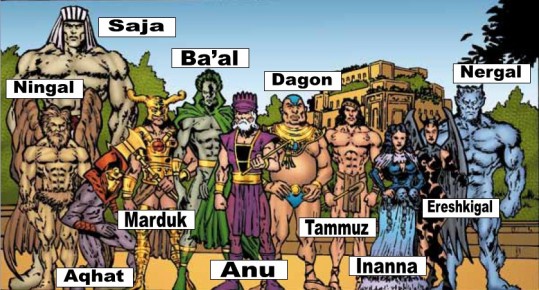
 
Image from www.marvunapp.com

Image from www.marvunapp.com

As noted, the Moabites who lived next to Israelites, in the hill country to the east (today’s central Jordan), had their own national deity named Kemosh (Num. 21:29).


North of the Moabites were the Ammonites, whose national god was Milkom (1 Kings 11:6).


The Philistines, who lived on the plain to the west of ancient Israel between today’s Gaza and Tel Aviv, had Dagon as their god (1 Sam. 5),  and further up the coast, the inhabitants of Tyre had a goddess named Ashtoret (2 Kings 23;13).


  Each ethnic community had a unique relationship with its god. They were “chosen” for each other. The god protected its community, provided for it, and fought for it. In return, it was worshiped and offerings were made to it.     In the ancient world, the normal tensions that arose between ethnic or national communities were often mirrored by tension between their gods. An oracle to King Esarhaddon, who ruled the Assyrian Empire from 680 to 669 BCE, demonstrates the protector role not only of the gods, but also of the goddesses. The god’s personal name was always given to identify the specific source of the power: “Esarhaddon, king of the lands, fear not! That wind which blows against you— I need only say a word and I can bring it to an end. Your enemies, like a young boar in the month of Simanu, will flee even at your approach. I am the breat Belet—I am the goddess Ishtar of Arbela, she who destroyed your enemies at your mere approach.” Wars between nations may have been fought by tribal soldiers, but victory or defeat was determined by national gods. Wars were won or lost according to the fighters’ ability to please their gods.


The God of Israel was assumed to have fought along with the Israelite people in their own wars. In the victory song intoned after the defeat of Pharaoh’s armies in the Red Sea, God is praised as ish milchamah (the warrior; literally, “Man of War,” Exod. 15:3). And when Israel is preparing to conquer the land of Canaan under God’s direction, they are reassured:


When you take the field against your enemies and see horses and chariots—forces larger than yours—have no fear of them for the Lord your God who brought you from the land of Egypt is with you….Do not be in fear or in panic or in dread of them, for it is the Lord your God who marches with you to do battle for you against your enemy, to bring you victory! (Deut. 20:1-4)


We must keep in mind that the Hebrew word that is translated as “Lord” is actually the four letters that make up the “personal name” of the God of Israel. “Lord your God” in this passage originally would be rendered by God’s personal name, followed by the description, “your God,” so the reassurance was given in the actual name of Israel’s own national deity.


  The Hebrew Bible contains a number of stories that demonstrate the special relationship of a god with its people in time of war. One particular interesting example is a war between the Moabites and Israelites. This story is especially important because it is recorded both in the Bible, in 2 Kings 3, and in another ancient Near Eastern text, a stone monument called the Mesha Stele (for Moabite Stone). The Mesha Stele is an ancient basalt table written for the Moabite king Mesha in about 850 BCE; it was written in Moabite, a language so close to Hebrew that they can be understood as dialects of the same language. It records the same story found in 2 Kings, but from the Moabite perspective. The two sources tell us that the war actually happened, but provide two conflicting versions of the outcome. In the following two versions of the story, if you substitute an actual divine name for “the Lord” in the Bible version, or if you substitute “the Lord” for the name Kemosh in the Mesha version, you can see how similar the styles of the two versions are.


According to the Bible, the Moabites were weaker than the Israelite and had fallen under Israelite rule. As a result, they paid heavy taxes to Israel. But the king of Israel “did evil in the sight of the Lord,” for which the God of Israel allowed the Moabite king Mesha to rebel. In response, the Israelites assembled a coalition of three kings with their armies and set out to reconquer the Moabites. They expected to find water in a certain ravine to resupply their troops near the field of battle, but found the water source to be dry. This became a key issue in the battle that followed.


“Alas!” cried the king of Israel. “The Lord has brought these three kings together only to deliver them into the hands of Moab!” But when the Israelite leaders consulted a prophet of God to determine whether God would support them, the prophet went into an oracular trance and proclaimed, “Thus says the Lord: This ravine shall be full of pools. For thus said the Lord: You shall see no wind, you shall see no rain, and yet the ravine shall be filled with water; and you and your cattle and your pack animals shall drink. And this is but a slight thing in the sight of the Lord, for He will also deliver Moab into your hands” (2 Kings 3:10-18).


As the holy man prophesied, water began to flow and the Israelites were refreshed. The Moabites were then tricked into attacking the Israelite camp but were routed. The Israelites overpowered all the Moabite cities and pushed the remaining army into the walled city of Kir Hareshet. Things did not get any better for the Moabites there. They became trapped behind the walls of their own fortress when they failed in their attempt to send a column for help. Suddenly, after that sacrifice, the Israelites withdrew and the story ends.


  It is not clear from the biblical text exactly what happened as a result of the sacrifice. The literal translation of the Hebrew is,

So [King Mesha] took his firstborn son, who was to succeed him as king, and offered him up on the wall as a burnt offering. A great wrath came upon Israel, so they withdrew from him and returned to [their own] land” (2 Kings 3:27).

    The Mesha Stele tells a different version of the story. According to this version written by King Mesha, the king of Israel “oppressed Moab for many days”:


for [the Moabite god] Kemosh was angry with his land ….But Kemosh restored it in my days … the king of Israel built [the city of] Atarot for himself, and I fought against the city and captured it. And I killed all the people of the city as a sacrifice for Kemosh and for Moab. And I brought back the fire-hearth of his uncle from there; and I brought it before the face of Kemosh in Qeriot … and Kemosh said to me, “Go, take [the city of] Nebo from Israel.” And I went in the night and fought against it from the daybreak until midday, and I took it and I killed the whole population … and from there I took the vessels of YHWH [the four-letter name of the Israelite god preserved in the stone tablet], and I presented them before the face of Kemosh. And the king of Israel had built [the city of] Yahaz, and he stayed there throughout his campaign against me; and Kemosh drove him away before my face.


Each version of this story has a particular point of view and tells the tale as a partisan advocate. There is clearly no interest or attempt to offer a neutral report, but it is clear that from the perspective of each side, it is the relationship with the national god that is key to winning wars.


  The Bible often relates to the God of Israel from a parochial perspective, though as the notion of the God of Israel expanded to the notion of a single God of the entire world, the perspective changes.  Some biblical texts depict a global perspective where, for example, the God of Israel destroys all the gods of the Egyptians: “I shall execute judgment, I the Lord, against all the gods of Egypt” (Exod. 12:12). In others, God uses the Assyrians or Babylonians as a tool to punish Israel when it is sinful, even to the extent of destroying the northern kingdom of Israel by the hand of Assyria (2 Kings 17). By the time God is understood in purely monotheistic terms, the gods of Babylonia or other competing nations no longer figure in the narrative. They have dropped out because they are no longer considered to exist.
 
Image from veritasdomain.wordpress.com

Image from veritasdomain.wordpress.com

Choosing Religion


  Because Israel seems to have been the only community to make the transition from polytheism to monotheism in this period, it saw itself situated in a world of false gods. In such a religious environment where a person naturally remained loyal to his or her ethnic religion and national deity, Israel remained loyal to the “God of Israel,” whom they also saw as the God of the entire universe. Even (or perhaps especially) after the transition to monotheism, absolute loyalty to their God became critical. Disloyalty did not mean simply abandoning one god for another, for that was impossible. In their world, disloyalty meant continuing to hedge their bets as in the old polytheistic world, when the God of Israel was understood to be the one and only God of the universe. It meant making offerings to other powers in addition to worshipping the One Great God, the God of Israel.


  We can imagine the enormity of difference between Israelite religion and the religious practices of all its neighbors if we think about all the various ethno-religious communities of the ancient Near East as practicing one overarching religion. The Moabites and the Ammonites and the Kenites and the Jebusites may have worshipped different gods, but they all followed the same assumptions about how those gods functioned and how religion worked. They were all practicing the same religion even if their worship was directed toward different deities. Israel was the only community that practiced according to a different religious concept.


  It might appear odd that Israelites did not proselytize. Although the Bible records how the transition from polytheism to monotheism took time and was sometimes rocky (see, for example, all the polytheistic practices that were removed from Jerusalem by King Josiah in 2 Kings 23:4-15), the Israelites eventually became confident in their monotheism and deeply faithful to God. Yet, it seems they did not try to bring the “good news” to others steeped in the falsity of idolatry. This may seem strange from our perspective, but the truth of the matter is that mission was not really a possibility in those days. The religious environment of the ancient Near East was radically different from ours today, where religions openly compete with one another for members in a “free market” of religions. In the ancient world of ethnic religion, it was simply impossible to abandon your national god. In those days, the notion that you could believe or disbelieve in a religion was not a conceptual option. The world was perceived as functioning according to the divine powers that ran it, and there was no possibility to even conceive of something different.


In fact, the notion that you could scope out religious options and choose the one that made most sense was not a conceptual possibility in the Near East until the Greeks imported the notion through their interest in philosophy. It was the Greeks who developed philosophical schools, each of which offered a different way of making sense of the world. In the great Greek cities, you could attend various schools, learn their philosophies, and consider which to subscribe to. These were philosophies rather than religions, but it was simple enough for people to apply the notion of deciding which philosophical system made most sense to which religious system made most sense. This idea would not come to the land of Israel, however, until later. Before the Greeks brought Hellenism with them from within the borders of Hellas to the rest of the Near East, religious affiliation was a national affair.


    The God of Israel had been understood by Israelites in the early period of their history to be a tribal god parallel to the tribal gods of neighboring peoples. Israel’s god was (hopefully) more powerful than other gods, as seems to be the sense of Exodus 15:16: “Lord, who is like You among the gods? Who is like You, majestic in holiness, worthy of awe and praise, worker of wonders?” (see also Exod. 12;12, Num. 33:4). But in the early period, the God of Israel functioned very much like the gods of the neighboring peoples, the “gods of the nations” (Ps. 96:5).


For some reason or reasons that remain matters of debate among theologians and historians of religion alike, religious ideas began to change among the Israelites. This seismic shift seems to have occurred during the period of the great classical prophets (roughly, the eighth to the sixth centuries BCE). The prophets insisted that the God of Israel was also the God of the entire universe. By the time of Isaiah, Jeremiah, and Ezekiel, Israelite religion held firmly that the God of Israel was actually the only God: “I am the Lord, and there is none other; apart from Me there is no god” (Isa. 45:5).
Image from christiandc.net

Image from christiandc.net

  The Emergence of Monotheism


  Although it is perhaps surprising, Israel was not the only community to have arrived at the notion of monotheism, and it may not have been the first. Other monotheisms or proto-monotheisms such as that of the Egyptian pharaoh Akhenaten, may have existed for a limited time, but they could not be sustained. Israel was the only community that sucessfully held on to this view in the ancient Near East. Because it was the lone monotheist community, it was constantly on the defensive in a world full of enticements to engage in worship of foreign gods (Num. 25:1-9; 2 Kings 23:4-15).


  Once the God of Israel was known as the God of the universe, it became absolutely forbidden to engage in any activity that smacked of worshipping other gods. The old habit of hedging your bets by making offerings to other deities or powers in nature became strictly forbidden. Infidelity to the God of Israel is referred to in the Bible as straying after or worshipping other gods. (Exod. 20:2, 23;13; Deut. 5:6, 6:14, 11;16; Jer. 1L16, 7:6).


  The transition to monotheism, however, was neither smooth nor total. Not everyone in the Israelite community was completely convinced that the old, premonotheistic Israelite religious practices of its earliest days were necessarily false or useless. The emergence of monotheism seems to have been a process, and the Bible itself is witness to movements to ban polytheism and countermovements to reestablish it. As noted above, a partial menu of the kinds of polytheistic practices that were available to ancient Israel can be seen in 2 Kings 23:4-15, a chapter that details King Josiah’s religious reforms. It mentions many of the old practices by listing all the popular and varied types of polytheistic worship that Josiah destroyed. He smashed the objects made for the Canaanite gods, Ba’al and Asherah and the Host of heaven, he suppressed the idolatrous priests throughout the land who made offerings to Ba’al and to the sun and moon and constellations. He tore down the cubicles of the male religious prostitutes that were situated within the Temple itself, and destroyed many altars and shrines, including the Tofeth in Gey Ben-Hinnom, where people sacrificed their children (they “passed their sons or daughters through fire”) to Molekh. He also destroyed the horses dedicated to the sun and burned the chariots of the sun, defiled shrines built for the goddess Ashtoret and the god Kemosh on the Mount of the Destroyer, and shattered the sacred pillars and posts.


  According to the direction of current biblical scholarship, there were not merely foreign deities, the gods of the hated Canaanites. Some were actually gods traditionally worshiped by Israel. Biblical scholars such as Niels Peter Lemche have shown that Canaan refers more to a geographical area than a people, a land in which lived a variety of peoples that we know from biblical texts as Hittites, Girgashites, Emorites, Perizites, Hivites, and the like, often lumped together in the Bible (and Egyptian and Mesopotamian texts) as Canaanites. The Israelites lived there too.


  Israel, it now appears, may have actually emerged as a distinct people out of the land called Canaan. According to many scholars of the Bible today (and putting it bluntly), Israelites were Canaanites, in the direction of an innovative religious idea that was becoming what we would later call monotheism. The Bible itself witnesses the bumpy road to the realization of that religious idea.


  In the system articulated in the Hebrew Bible, responsibility to follow the revealed will of God found in the Torah is not a universal responsibility. It is directed specifically to Israel. It may seem strange to us that a religion espousing a concept of a universal God would appear to be unconcerned about the religious warfare and practices of those situated outside the receiving group, but recall that in the ancient Near East, religion was by definition distinctly ethnic. Each ethnic of national group had its own god or pantheon, and each national god had a unique relationship with its ethnic community.


  The God of Israel may have become conceptualized as the one and universal God that created and now powers the heavens and the earth, but it was intimately known as the God of Israel, and it retained that distinctive relationship with its people. It would simply seem strange to Israelite and non-Israelite alike for this tribal organization of monotheists to try to convince other tribal organizations to abandon their gods for the God of Israel.


  On the other hand, because of Israel’s unique position as the only monotheist community in the ancient Near East, intermarriage with peoples professing other religions was strictly forbidden. Such intermingling was liable to distract from the austere practices of monotheism among a small group living in a world of many peoples and nations, each associated with colorful, multiple deities and enticing worship rituals. The Moabites and Midianites seem to have been two of the biggest threats to Israel in this regard, and God warns Israel repeatedly not to follow the whims—or the women—of these neighboring peoples (Numbers 25).


  Aside from the Israelites, however, intermarriage between peoples representing different religions may not have represented a significant theological problem in the polytheistic ancient Near East. If you traveled across national boundaries, you would pass from place to place but often find very similar gods. Those gods might have had different names, but they were easily recognizable by strangers because they occupied a similar or identical place on what you might call “the food chain of divinity.”


  In virtually every ethno-religious system, for example, there was a god associated with fertility. That god may have different names in different places, but its job description was just about the same everywhere.  Among the Israelites, on the other hand, one God was understood to control all aspects of nature and time, and Israel was permitted to worship only this only this one God, this “zealous god” (Exod. 20:4, 34:14; Deut. 4:24,5:8,15), who would tolerate no confusion or association with other deities. Intermarriage with people who worshiped their own national gods was always a threat to the unity and survival of this one small community. Even with those groups such as the Egyptians and Edomites, among whom the Israelites were permitted by biblical scripture to marry, intermarriage was allowed only after three generations of the foreigners had assimilated into the Israelite cultural and religious system (Deut. 23:8-9).


  Israel was only one small ethno-religious people among the many peoples and religions of the ancient world. According to the sentiment expressed repeatedly in the Bible, Israelite religious leaders felt the stress of the theological insistence on monotheism in a world of multiple deities. Some neighboring religious systems, for example, had enticing ritual practices such as sacred prostitution, most likely human sympathetic acts such of public coitus in order to stimulate the gods to do the same and thus provide fertility to their people’s pastoral or agricultural economics (1 Kings 14:24; Hos. 4:12-19; Ezek 23:5-10). As Deuteronomy articulates the relationship,


[Many nations] … will draw your children away from the Lord to serve other gods …for you are a people holy to the Lord your God, and He has chosen you out of all peoples on earth to be his special possession.

It was not because you are more numerous than any other nation that the Lord cared for you and chose you, for you are the smallest of all nations; it was because the Lord loved you and stood by His oath to your forefathers, that He brought you out with His strong hand and redeemed you from the place of slavery, from the power of Pharaoh, king of Egypt.

Know then that the Lord your God is God; the steadfast God with those who lover Him and keep His commandments. He keeps covenant and faith for a thousand generations, but those who defy and reflect Him He repays with destruction ….Therefore, observe commandments the Instruction—the laws and the rules —with which I charge you today (Deut.7:6-11)


Chosenness in Historical Context


  This citation from Deuteronomy is interesting for a number of reasons, but in order to arrive at a better sense of its meaning we need to consider the Hebrew language of the original. The text uses the verb bachar (choose) two times. The literal meaning of the Hebrew in verse 6 is:

“For you are a holy people to the Lord your God; the Lord God chose you [the you is emphasized in the Hebrew] for Him as a treasured people from all the peoples on the face of the earth.”


And in verse 9, the Hebrew literally reads,

“Know then that YHWH [the four consonants that make up the name of the God of Israel], your god, is The God, the [truly] trustworthy god, keeping the covenant of loyalty with those who love Him and those who keep His commandments to the thousandth generation.”


This foundational message has two parts.

  • First, the God of Israel is the only true god.
  • Second, that one true God chose Israel from all the peoples of the earth to be God’s own.
 

We have seen how this sense of unique relationship is natural in the ancient Near East.  In the premonotheistic period, the tribal confederation known as Israel had a unique relationship with its own tribal god, known at one time by a personal name made up of four letters. It was, of course, logical for that tribal group to be the most beloved by its own tribal deity. When that god became conceived of as the One Great God of the universe, it was instinctive for the people to retain that feeling of special relationship between deity and tribe. In fact, being the lone community that revered the only real deity, the One Great God, probably enhanced the sense of special and unique relationship.


  The term to choose is not the only reference to the special relationship between God and Israel indicated in the Hebrew Bible. The prophet Amos refers to the relationship with the Hebrew verb yada’, meaning “to know intimately”: “You alone have I known among all the families of the earth” (Amos 3:2). The language here is personal, with the word mishpachot (families) in place of the more common ‘amin (peoples).


  “A people holy to the Lord …” in verse 6 of the Deuteronomy passage above (Deut. 7:6) is rendered in the Hebrew as ‘am qadosh …l’adonai. The root meaning of qadosh is “to separate, put aside or consider unique.”


  In the religious context of the premonotheistic ancient Near East, Israel was probably no more unique in relation to its tribal God than any other ethno-religious unit was in relation to its own tribal deities. But when Israel had reached the point where it truly considered its god to be the One Great God of the universe, the relationship had indeed become unique. Given the reality of all other peoples recognizing multiple deities, the contextual environment required that Israel remain separate in order to survive under the heavy pressure toward religious assimilation.


  In other words, the notion of chosenness originated simply as a natural part of old tribal religion. When Israel’s concept of divinity became one of universal monotheism, it was natural to continue to feel the special relationship.   After all, the God of the universe is also known in the Bible as the “God of Israel.” That natural sense of chosenness also became a convenient and effective strategy to maintain a unique religious system despite the many temptations of polytheism.


  All religionists of the period felt that they were “chosen” by their gods. But as we will observe in more detail below, every one of the Near Eastern tribal religions died out, leaving only the Israelites retaining the traditional sense of a “chosen” relationship with its once-tribal, now-universal God.


  This does not mean that ancient Israelites necessarily felt smug about their chosenness, for even that they had consistent definition for it. The Hebrew Bible itself expresses disagreement over the meaning and responsibility associated with chosenness. Some references relate to the election of Israel as a unique privilege and benefit that God gave freely to Abraham and his progeny:


The LORD said to Abram, “Leave your own country, your kin, and your father’s house, and go to a country that I will show you. I shall make you into a great nation; I shall bless you and make your name so great that it will be used in blessings: those who bless you, I shall bless; those who curse you, I shall curse. All the peoples on earth will wish to be blessed as you are blessed.” (Gen. 12:1-3; cf. Exod. 19:1-6; Deut. 14:2).


Other biblical verses suggest that the Israelites earned their unique relationship through their merit. God said to Abraham after he proved willing to sacrifice his son in response to God’s command: This is the word of the Lord:


“By my own self I swear that because you have done this and have not withheld your son, your only son, I shall bless you abundantly and make your descendants as numerous as the stars in the sky or the grains of the sand on the seashore. Your descendants will possess the cities of their enemies. All the nations on earth will wish to be blessed as your descendants are blessed, because you have been obedient to me.” (Gen. 22:15-18; cf. Exod. 24:3-8).


Still other verses consider the status to be one requiring great responsibility and extraordinary behavior:


“You alone I have known [intimately] among all the families of the earth; that is why I shall punish you for al your wrongdoing” (Amos 3:2).


And other texts seem to render the chosenness of Israel as only a relative term, for God has chosen other peoples as well:


When that day comes Israel will rank as a third with Egypt and Assyria and be a blessing in the world. This is the blessing the Lord of Hosts will give: ‘Blessed be Egypt My people, Assyria My handiwork, and Israel My possession'” (Isa. 19:24).


“Are not you Israelites like the Cushites to Me?’ Says the Lord. ‘Did I not bring Israel up from Egypt, and the Philistines from Caphtor, the Aramaeans from Kir?'” (Amos 9:7).


Because all ethnic religions in the ancient Near East considered themselves unique on account of their special association with their ethnic gods, the familiar human tendency toward ethnic elitism was naturally expressed through religious elitism as well.  Conquering peoples often insisted that local populations include worship of the gods of the conquerors in local ritual.


The Assyrian king Tiglath-Pileser III (744-727 BCE), for example, had the following written about his conquest of Gaza: “As to Hanno of Gaza who had fled before my army and run away to Egypt [I conquered] the town of Gaza . . . his personal property, his images . . . [I placed (?) 9 the images of ) y [ . . . gods] and my royal image in his own palace . . . and declared (them) to be (thenceforward) the gods of their country.”


When the great Persian king Cyrus (557-529 BCE) conquered Babylon, he justified his conquest, in part, on account of the sin of the Babylonian king Nabonidus, who refused to worship the local Babylonian god, Marduk.


The lord of the gods (i.e. Marduk) became terribly angry and [he departed from] their region . . . . He scanned and looked (through) all the countries, searching for a righteous ruler willing to lead them (in the annual procession). (Then) he pronounced the name of Cyrus, king of Anshan, declared him to be the rule of the world . . . . I resettled upon the command of Marduk, the great lord, all the gods of Sumer and Akkad, whom Nabonidus has brought into Babylon to the anger of the lord of the gods, unharmed, in their (former) chapels, the places which make them happy. May all the gods whom I have resettled in their sacred cities ask daily (the gods) Bel and Nebo for a long life for me and may they recommend me.


Sometimes conquering peoples merged their own gods with local gods that had parallel “job descriptions.” Gods of the conquerors that were associated with certain attributes were sometimes fused with local gods having similar traits. When the Greeks conquered Egypt, for example, they simply merged their own system into the systems already in place in Egypt under the pharaohs.
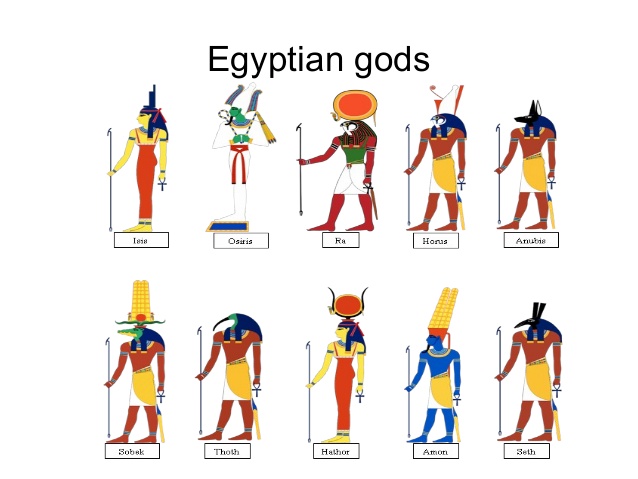
Image from www.slideshare.net

Image from www.slideshare.net

The Greek kings then fancied themselves as pharaohs as well, with the result that the Egyptian god Osiris, for example, was merged with the Greek God Dionysis, and the Egyptian god Thoth with the Greek god Hermes. The result was the weakening of the local religions and assimilation to a system that was closer to the religion of the conquerors.

 
Image from www.sporcle.com

Image from www.sporcle.com

The Greeks brought not only their gods, but also their culture. The power and popularity of Hellenic culture influenced local cultures and “hellenized” them. This resulted in the emergence of what historians call “Hellenism,” a synthesis of pure Greek (Hellenic) culture with the local Near Eastern cultures.  Many locals learned the Greek language and integrated their traditional indigenous cultures with that of the Greeks. They were inevitably attracted to the Greek religious system as well. Because of the overwhelming and unifying power of Hellenism, local tribal religions began to lose some of the distinctiveness of their culture. Eventually, the independent integrity of the local Near Eastern religious systems would die out entirely to this assimilation, though that process would not be complete until the arrival of the Romans.


  The assimilation process encouraged by the Greek and Roman conquerors was not successful, however, under the strident monotheism of Israel. By the time the Greeks had come to the area, the Israelites had become localized in a region called Judea and increasingly referred to themselves as Judeans, from which we get the term Jew. One of the problems that Jews faced after the Greek conquest was that they were expected, like all foreign peoples, to make offerings to the Greek gods. Because they simply and adamantly refused to do so, a compromise was eventually reached that allowed the Jews to worship in their own unique manner and make donations to their temple in Jerusalem.
Image from store.metmuseum.org

Image from store.metmuseum.org

When the Romans took over, they imposed their own religious system, requiring that subjugated peoples make offerings to the Roman gods, including, eventually, the figure of the Roman emperor. The traditional ethnic religions that were organized around local gods could not compete against the cultural might and attractiveness of the Romans and their gods. Because the local religions were organized around the idea that many gods existed and powered the universe, it became easy for them to make offerings to the Roman gods as well.     Like the Greeks before them, the Romans unified the region culturally, and local tribal nations and religions naturally integrated with that of the conquerors. Under the Romans, many indigenous communities lost most of their unique cultural and religious identities, succumbing to the imperial system and assimilating to it.


As with the Greeks, however, the monotheistic Jews could not assimilate into the Roman system. They were “grandfathered” by the Romans based on the policy of their Greek predecessors, and thus remained exempt from worshipping the Roman gods and emperors.


  The Emergence of Christianity


  We have noted how this period of Late Antiquity was a time of religious consolidation. The Romans had conquered many local peoples and their gods and assimilated them into the Roman system. But it was also a period of religious diffusion. The Roman system did not satisfy the religious and spiritual needs of many in the empire.  As a result, new religious movements began to emerge.


  One category of these new religions is sometimes referred to as “mystery cults,” such as Eleusinian mysteries. Mithraic mysteries (or Mithraism), and Orphic mysteries. Even the native Judeans, most of whom were steadfast in their monotheism, were profoundly affected by the powerful intellectual and cultural influence of Greece and Rome.


A number of movements began to develop within the monotheist framework that was later called Judaism. Pharisees, Saducees, Essenes, and other groups emerged during this time, including movements that expected a messianic figure to lead the Jews out from under the yoke of the Roman Empire.   Adherents of these various groups argued with one another over their ideas and their positions on Jewish practice theology, and the meaning of scripture and God’s expectations for Jews and humanity at large.

 
Image from www.bible-reflections.net

Image from www.bible-reflections.net

One of the most significant new movements to emerge out of Judean monotheism formed around the leadership of an extraordinary Jewish preacher who eventually became known as “Jesus, the messiah”—“Jesus Christ.” Like the other monotheistic movements, this group refused to recognize the Roman gods or worship the emperor. We do not now exactly how and when it happened, but this group, now often referred to in scholarship as the Jesus movement, came to be recognized as distinct from other Judean monotheistic movements. This prevented it from being grandfathered by the empire as was Judaism, which had been previously recognized by the Greeks.


    The Jesus movement grew quickly. It was eventually considered a threat to the empire and was brutally persecuted. Yet Christian monotheism, like the other monotheist movements, could not compromise the exclusive relationship with its singular God. The stubbornness of the early Christians illustrates what became a phenomenon of monotheism: an absolute requirement of undivided bond between monotheists and their God.


  The ancient feeling of chosenness between a nation and its deity among polytheistic religions had become weakened when the local gods were so thoroughly defeated by the gods of Greece and Rome. Many local polytheists were able to make the transition to the dominant religious system, partly because of their aspiration to be accepted by the empire and eventually become Roman citizens. But the exclusive relationship between monotheists and their universal god never weakened.


The One Great God was always unique, different, and greater than any and all of the national gods, even the gods of the empire. Harassment and persecution by the forces of the empire did not prove the weakening of the monotheistic God.  On the contrary, monotheists believed that God would bring about divine judgment against all the empires and redemption for the chosen few who followed the truth of their faith.   God may be testing the chosen ones, even sometimes through great pain and suffering, but they would never be abandoned.


Image from thecrackeddoor.com

Image from thecrackeddoor.com

One final observation must be included here: the monotheistic requirement of exclusive relationship became experienced by some believers as a social truth. That is to say, people within monotheistic communities have tended to understand their chosenness not simply as a theological relationship, but also as a social and human value. they sometimes considered their special relationship with God to indicate or even epitomize their status as inherently better, more civilized or virtuous, than other among God’s human creations.


  Perhaps as a people suffered for their exclusive loyalty to the One Great God, they came to feel that their special relationship made them inherently more godly and righteous than others. That association among some monotheists of chosenness with arrogance and self-importance would sometimes result in terrible abuse of others who were not considered part of God’s chosen community.

Image from seongdo.blogspot.com

Image from seongdo.blogspot.com

  In any event, by the emergence of Christianity, a process that began in the ancient world had reached its natural conclusion. The notion of chosenness emerged in the ancient Near East, where ethnic polytheists naturally felt a unique relationship with their national gods. It was as if each nation’s god had chosen a single people for a unique, symbiotic relationship in which the people fed the god through sacrificial worship, and the god fed the people through providing fertility and protection.


  In the earliest period, the Israelites were like other polytheistic peoples and had their own special bond with their God of Israel. That feeling of unique attachment continued among the Israelites even as they became believers in monotheism and the old symbiosis dissolved. No longer would God need the worship of believers, but believers would always need the worshipful relationship with God. Their organic sense of being chosen by the One Great God served also as a survival mechanism for Israelite monotheism in an overwhelmingly polytheistic world. By the Roman period and the decline and eventual extinction of ethnic polytheistic religions, that ancient sense of chosenness had become a trait that was deeply associated with belief in one God. It would become a defining trait of all subsequent expressions of monotheism.

How now do we observe Biblical Feasts? – 2

[First posted November 3, 2014.  Please refer to the previous post:  

Looking back to where Sinaites were September 2012, this and part I demonstrate we had started shedding our Jew-wannabe initial tendency;  we have managed to wean ourselves from what we started recognizing as more ‘Jewish’ than ‘scriptural’.  Today, we have distinctly identified ourselves as gentiles who observe Torah but differently from the Jews.  This explains some of the ‘why’s’.—Admin1]


————————————-


First, a look at existing observances by religions which claim their celebrations are biblically-based. These are strictly from a layman’s point of view, and loosely described:


  • Expectedly, Judaism which is based on its Sacred Scriptures, the TNK, observes Leviticus 23 (and some extra feasts like Purim and Hanukkah, commemorating significant times in their history after the closing of the TNK canon).   Temple-less, the Jews now center their study/worship at the Synagogue; while some celebrations like the Pesach and erev Shabbat are family-celebrations in the home setting.  Understandably, over centuries they have built up traditions around these feasts, and in their peculiarly Jewish way some cultural elements have been added to biblical basics. 
    • The Weekly Sabbath (Friday sundown erev Shabbat to Saturday sundown havdalah);
    • Spring festivals – Pesach (Passover), Hag Hamatzot (Unleavened Bread), Bikkurim (First Fruits), Shavuot (Pentecost)
    • Fall Feasts:  Rosh haShanah/Yom Teruah (New Year, Feast of Trumpets), Yom Kippur (Day of Atonement), Sukkot (Feast of Booths)
    • Non-biblical but historical/cultural celebrations:  Hanukkah, Purim.
  • Christianity’s religious observances did not take off from the TNK even as it appended the Hebrew Scriptures as “Old” to its “New”.  Instead, since everything was “new” from the covenant to the scriptures to the theology, “holy days of obligation” and celebrations center around the life and ministry, death and resurrection of their Savior.  Strangely though, the timing of Easter/Holy Week somehow coincides with the Biblical spring festivals, while the timing of Christmas is close to the Jewish celebration of the ‘Festival of Lights’ Hannukah.  
Image from www.sabbathherald.com

Image from www.sabbathherald.com


  • Sunday–The Lord’s Day—- is the weekly day of rest for church worship/fellowship/Holy Sacrifice of the Mass; in fact this Sunday system is adopted worldwide except in Israel where the Sabbath remains as the set apart biblical day.  
  • Holy Week — reflecting the Passion of Jesus on his last week of life is commemorated by Palm Sunday, Maundy Thursday, Good Friday, Black Saturday, Resurrection Sunday.
  • Pentecost
  • Christmas
  • And special celebrations related to the Virgin Mother and saints.


  • Messianics observe Leviticus 23 feasts, just like Judaism, but with a special Christian touch. They use Hebrew names and titles; they use David Stern’s Complete Jewish Bible which is OT and NT full of Hebrew words; they pick up many Jewish traditions, they sing Jewish songs, their prayers are even in Hebrew though concluded “In Yeshua’s Name.” If you happen to walk into a Messianic feast celebration, you would almost think you’re in a Jewish context, because they even wear traditional Jewish garb (kippa, tzitzit), and use Jewish symbols like the menorah, shofar, star of David, including the Israeli flag. . . . until you hear “In Yeshua’s mighty Name.”

How about non-Jews, non-Christians, non-Messianics, simply gentile worshippers of YHWH and observers of His TORAH, where do we now fit? 


First of all, we go along with the Jewish sages’ teaching that while the Torah gives commandments and instructions, some give specific details while others are general statements. Where instructions are specific, simply obey; where instructions are generalities, we have the freedom to interpret according to the “spirit of the law,” adapt to the culture and to the times.   


For example, the weekly Sabbath is Saturday, the 7th day of the week, not the 1st (Sunday), so that is the calendar day we set apart and prepare for.  How to observe it other than simple cessation of work? Nothing more is detailed. Jews have built up their own  traditional observances on how to spend the day.  We love the family get-together on sundown Friday (erev Shabbat)  to welcome the Sabbath as well as sundown Saturday for the havdalah or saying goodbye to the Queen of Days.  In our family gatherings, we follow the traditional lighting of the Shabbat candles by the mother, the saying of blessings by the father upon the wine and bread.  We have embraced this beautiful Jewish tradition because we have discovered it to be such a joyous and special family time.  

Image from heartcheckreality.blogspot.com

Image from heartcheckreality.blogspot.com


“Remember the Sabbath to keep it holy . . . ” is a beautiful song composed by a Seventh Day Adventist musician, we have added it to our hymnbook.  Indeed, Sabbath celebration has become the peak of our week, we count the days “6 days before, 5 days before . . .”  On the Sabbath, those of us who are able to come together to worship do so, or have a Torah study and a fellowship meal.  Nothing has been required, just something we have decided to do to make the Sabbath truly a set-apart day, different from the other days of the week.  Some us have to work on Saturday and can’t get time off, so we do welcome the Sabbath at the end of our workday Friday and start our rest and special time with the Lord; on Saturday we spend our lunch hour to worship together.  Unfortunately, we are caught in a Sunday system  so we do the best that we can, not out of duty or obligation, but out of our love for YHWH’s Sabbath.  


How about the other Leviticus 23 feasts?  Since they are “My appointed times”says YHWH,  we obey and observe them.  But how?  In a way that is meaningful to us individually as well as in community.  


We’re not Jews so we don’t feel obligated to do the Jewish way; it doesn’t mean we wouldn’t do it at all, in fact we started out doing it their way if only to gain understanding of the significance and meaning of the feast in their cultural and historical context. We’ve even learned Jewish prayers and Jewish songs. For now, while in transition, we have decided to leave our options open . . . we do think knowing the Jewish way is valuable. Their historical context allowed the Israelites to do exactly as YHWH commanded, their whole life revolved around His commandments. Theirs was a theocracy at first, then a monarchy that still revolved around TORAH life. Even if modern Israel is a secular state, still it would be convenient to live there where we expect these feasts to be holidays, non-working days, days of rest, at least among the religious Jews.  


We have decided, after a close reading of the specific commandments on the feasts, that except for the Passover which has specific instructions already incorporated in the celebration, we are given freedom to assimilate as much as we can of Jewish traditions or resort to what we are able to accommodate within the limitations of our culture and our times.  Meaning . . . if a poor Asian farmer and his family cannot have wine and bread, whatever they have — rice and fish — is a celebration of YHWH’s blessing.  While we believe that we could use all the help we can get by seeing how the Jews have celebrated,  unless the Bible is specific in order to communicate truths through symbols used in celebrations, we may acculturate, adapt to our specific circumstances.


A specific example is this:  when we follow the Haggadah for the Passover Seder, we understand why the prayers would refer back to Israel’s redemption from bondage to Egypt.  While we can relate to the mixed multitude in that event in biblical history, we relate more now to our current exodus from Christ-centered religion (our “Egypt”)  to biblical faith in YHWH (our “Sinai” encounter).  


This is how to make these feasts meaningful for ourselves, individually and in community without losing sight of the essence of the celebrations.  We should endeavor to understand why the TORAH Giver YHWH emphasizes the remembrance of His acts in the history of Israel, for the learning of the nations, the gentiles.  We interpret “appointed times,” to mean that our Lord YHWH commits Himself to being present at His feasts in a special way. . . whether or not we show up.  Let us not stand him up!   


Image from www.papermasters.com

Image from www.papermasters.com

One last  point that some purists might disagree with:  Are we celebrating holidays such as Christmas and the pagan celebration of Halloween? Why not, we live in a country whose vacation days incorporate Christmas, it’s a fun holiday gift-giving time, when families reunite, when employers are generous, when people just feel festive while they start looking forward to the end of another year.  Before we discovered there was no Devil and demonic spirits, we shunned Halloween which made my agnostic brother call us “killjoys” for preventing our kids to have fun;  now, it’s just another time to party and and allow kids to go with their friends trick-or-treating, as long as they are taught that these are nothing more than fun times to wear costumes . . . just like New Year.  Why exclude ourselves from such times that have meaning for our Christian or non-religious counterparts?


 Our faith in YHWH is hardly threatened when we show consideration and respect for the celebrations of people of other faiths.


logoNSB@S6K

for Sinai 6000

Core Community


Why Sinai, not Jerusalem?

[This was first posted as We have heard it said – A Sinaite’s Apologetics – 3; updated with insights gained from many years of Torah study applicable to gentile truth-seekers.  Self-explanatory why we keep reposting.Admin1.]


—————————–


One of our Messianic critics point out:

 
  • Do they accept Sinai (in Arabia) as more important than Jerusalem (in Israel) 
  • where additional revelations were given 
  • and where the rest of Israel’s History “actually” happened (after 40 years in the wilderness)?”
 7-940x332-939x332


We equate Mount Sinai with YHWH and His Torah.  The wilderness of Sinai is neutral territory belonging to no one, save God.


We equate Jerusalem with Israel ‘the promised land,’  with Israelites/Jews  ‘the chosen people’ who were to be the “Light to the Nations.


Ponder this:

Why is Sinai the site where the Creator God chose to reveal Himself and to make His Name known?

Think:

The very choice of Sinai where the Self-Revealing God gave His guidelines for living is significant in itself.


What happened on Sinai is one of the most momentous events that would leave an impact on all humanity, not only on Israel. We might refer to it as the “First Coming,”  the descent of the God of the universe Who manifested His presence first to Moses in the burning bush; then later to a people who never saw Him, but heard His spoken Words amidst thunder and lightning.


Had the Torah been given in Jerusalem, it would indeed appear (as Christians claim) that it was meant only for Israel.  But in His wisdom and foresight, the Lord YHWH chose to issue the Decalogue to representatives of the two categories of people in the ‘mixed multitude’:

  • Israelites and
  • non-Israelites (gentiles) among them.

By the very fact that the God chose to give His Torah on Sinai all the more emphasizes the universality of the Torah, initially condensed in the 10 Commandments that were written by ‘the very finger of YHWH’ on two tablets of stone.


YHWH’S INSTRUCTIONS, His GUIDELINES FOR LIVING, were not meant to be applied only to Israel; they were intended for all humanity.


The TORAH is all one needs to know about what God requires of man. In it He defines His standards for human behavior in the context of relationships.  His standards are absolute. He has the right to define what is “right.” He has not left humanity in ignorance about His requirements.


By the time the second generation of Israelites were ready to enter the Land with Caleb and Joshua 40 years after Sinai, the instructions given to Moses had been completed and placed exactly where YHWH specified:  the 2nd set of tablets inside the Ark of the Covenant, the book of instructions in a separate compartment in the Ark.


True, Israel’s history continued after the Torah was completed in the Book of Deuteronomy, just before the second generation entered the Land with Joshua and Caleb.  In fact the rest of the Hebrew Scriptures after the Torah record their failures and successes in living out the Torah. God continued communicating through His mouthpieces, the Prophets of Israel.


“Thus saith the Lord” mostly called for a return to YHWH and His Torah. Amidst those proclamations were judgments on gentile kings as well as projections into future events relating to Israel and the nations, all culminating to a time when all nations would know YHWH and live His Torah.


With continuing research and updates on the Hebrew Scriptures and when/where they were recorded/rewritten/put together in the canon of 24 books that now composes the TNK, truth-seekers are constantly confronted by ‘doubting Thomases’ and results of their scholarly studies.  At some point, one simply has to decide on the foundations of his faith.


Sinaites have decided to remain solely with the Torah, the five books whose authorship is attributed to Moses. These books contain everything one needs to know about—

  • how to relate with the Creator/God on Sinai/YHWH,
  • and how to live in community.

The specific teachings, instructions are not always applicable to all cultures and times; many are—-

  • time-bound,
  • culture-bound,
  • Israel-in-the-wilderness-bound;

—-nevertheless there are basics that do not change.


Gentiles seeking YHWH’s Truth have no book to claim for themselves; even the Christian scriptures called the New Testament had to append itself to the Hebrew Scriptures on which it supposedly based its claim to validity.


Like those non-Israelites, the gentiles in the mixed multitude that stood on Sinai with the Israelites, we claim the universal Torah for all humanity as our own as well.


Sinai IS the place of revelation, not Jerusalem.  Its revelation is complete, read the end of the last book in the Torah.


Without a standard to guide human behavior, people resort to relativism, the doctrine that knowledge, truth, and morality exist in relation to culture, society, or historical context, and are not absolute but subject to change.  Just look at how values and morality have changed just in the last century and the atrocities the world have witnessed in cultures that have not heard or have heard but ignore the ‘other’-centeredness stressed in YHWH’s TORAH.


If only all people and all nations were Torah-observant, it would be a totally different world indeed!  But alas, another religion emerged that taught the Torah was “obsolete” and “only for Jews”. They should review in the “Old” or the foundational portion of their two testaments what their most literary version says so well and succinctly:


[KJV] Isaiah 8:20: 

To the law and to the testimony:

if they speak not according to this word,

it is because there is no light in them.


In behalf of Sinai 6000 Core Community,

Sig-4_16colors

logo


How now do we observe "My" feasts?

Image from billyhollandministries.wordpress.com

[This was originally posted two years ago, September 26, 2013, reposted September 6, 2015.  This is a timely revisit since we are into the spring festivals commanded to Israel in  Leviticus 23, specifically Pesach (Passover) Chag HaMatzot, (Unleavened Bread), Shavuot (Pentecost).  Originally this post was timed for the autumn feasts of Trumpets (Yom Teruah), Day of Atonement (Yom Kippur), and Feast of Booths (Sukkot).


In the first two years of our pilgrimage, we were not sure how non-Israelites or gentiles like ourselves were to observe these feasts.  At that time, we decided to ‘play it safe’; in other words, ‘just do it!’  As we continued to study the Torah, and discussed where do gentiles fit into the plan of YHWH for all humanity, we started shifting into a different conclusion. This is one of the posts where we explain our position.


TRANSLATIONS: Unless otherwise stated, we are using  [AST] or ArtScroll Tanach for the Hebrew Scriptures; and for Christian OT, the  [ESV] English Standard Version.—Admin 1]


——————————


The springboard for revisiting this topic is twofold:

  •  It is timely, i.e. the ‘fall festivals’ of Leviticus 23 were scheduled during the shifting from the month of Elul to Tishrei, when three festivals are celebrated;

—starting with Yom Teruah (feast of trumpets) which is also Rosh Hashanah (new year),

—followed in 10 days by Yom Kippur (day of atonement),

—and in 5 days by Sukkot (feast of booths or tabernacles).


  • It is timely in terms of group retrospection:

—at about this time of the year,

—Sinai 6000 emerged informally as a core group of ‘Truth-seekers’

—who, two years ago, had dropped all previous religious affiliation

—to backtrack to the original pathway long trodden by Israel

—that led to the Sinai revelation.


Having riveted our focus on Sinai as the site and source of divine revelation, from the start we had chosen to call our Truth-quest a ‘pilgrimage’ of sorts, learning step by step how to react to that revelation we recognize and accept as YHWH’s gift to all humanity— the Torah,

—alternatively known to Jews in the Hebrew as Chumash,

—and to Christians in Greek as the Pentateuch.


Here’s a timely reminder from an article in aish.com, by Dovid Rosenfeld/Simchat Torah: Just You and Me: 


“Every one of us has his personal story, how he came to be who he is today and what the Torah means to him.  For the Torah is the possession of all of us. No one has the monopoly on God’s wisdom.  It is wisdom we can all study and grow from – and recognize its personal message to us.” 

 
Amen!  Agree!  “The Torah is the possession of all of us”  —- the Israelite and non-Israelite, for the Jew and for the Gentile.  We settled that issue from the start.


So what’s the problem? 


Well, the continuing nagging question is this: 

How does a non-Israelite, a non-Jew, a gentile,

“react” to that revelation in this day and age

and in the non-Torah cultures where we belong? 


From our experience— initially upon learning that gentiles were among the Israelite population of the “mixed multitude” that left Egypt, we were elated to learn that non-Israelites were represented at Sinai even if the covenant was specifically with Israel.  So without thinking, we claimed not only our ‘place’ but our ‘obligation’ to observe Torah.  Simple? Well, not quite, not so fast.


As any gentile soon discovers upon embarking on a serious study of Torah, it is not as easy as reading ‘dos’ and ‘don’ts’, no questions asked, just obey.  


Why not?

  • For one, the whole Torah is addressed, understandably, to guess who? Israel of course.  So from the time Torah is given on Sinai, you feel like an outsider looking in. You could relate to “In the beginning” with Adam and Eve, Cain and Abel, Noah, Abraham, even Isaac and Jacob before he becomes Israel. (Jewish writers refer to them all as “Jews” but we don’t agree but that requires another article.) 
  • For another, the context in which the instructions are given is specific:  

—during their wilderness wanderings,

—with projections to the Israelites’ future

—when they enter and conquer the Land,

—and settle themselves there according to tribal assignments.

  • If there were references to gentiles, they were not at all complimentary, 

—particularly when referring to the idolatrous nations

—who ignorantly worshipped the creation rather than the Creator

—and who were notorious for abominable practices

—that Israel was constantly warned against following.

  • The gentler references were towards—

—‘foreigners’ or ‘strangers’ in their midst

—who were to be treated kindly

—just like ‘widows’ and ‘orphans’ and the ‘poor’

—but were excluded from certain observances that were strictly for the ‘circumcised’. 


As such, much of Torah leaves a gentile perplexed, so that the question we often ask:  

  • “how does this apply to me in my context — today in my culture, my nationality, my personal identity?”
  • or more specifically, “how could I possibly apply what I read and learn —

—in the context of the times I live in,

—the culture,

—the world system that operates not only differently

—but is not evenTorah-friendly”?


Jews who live the Torah way are ‘set apart’ from the larger community not necessarily in terms of separating themselves physically but in terms of showing a distinct cultural if not religious identity, from the food they eat, to the day they congregate, to the place identified specifically with them — the synagogue, to the symbols and trappings characteristically theirs or associated with them, as well as the festivals they celebrate, and much more. 


The gentile communities among whom Jews live are aware of them and their ‘distinctiveness’.  In the Land where areas are under Israeli control, Jews are free to practice their religion, customs and traditions; the laws of the Land so to speak, are ‘Torah-friendly’.


But what about the gentile who embraces the Torah and the God Who prescribed it as a way of life? Where does a gentile go? What does a gentile do? Is the natural consequence isolation?  Separation from former religious affiliations which is what we do experience?  Or eventually join Judaism?  Could a gentile live Torah without resorting to copying Jewish traditional ways?  How much of Torah could and should  a gentile apply to his/her life?  Surely, there are many more questions that come up as one reads through the Chumash. But let’s keep it simple for now.


This much we have understood and decided upon as individuals as well as a small start-up community:

  • Of the 613 do’s and don’ts in the Torah, you will notice—

—some are specific to Israel,

—to Israel in the Land,

—to a specific tribe such as Levi,

—to women, or men,

—to masters or slaves,  etc.


Understand the intention: to regulate Israel’s life while in the wilderness and eventually in the Land.  


Therefore, which ones are applicable to us, gentiles living in this day and age? A few easy answers that universally apply:

  • Health laws such as Leviticus 11 – the diet prescribed for human consumption are relevant; unclean animals were created “good” and “very good” and still fulfill their scavenger assignment to clean up the earth, but don’t eat them if you want to remain healthy from birth to old age.  
  • Sanitation laws:  modern medicine caught up with Torah’s quarantine of infectious diseases; hygienic practices of burying human waste under the soil; drinking water from running water, etc.
  • Kind treatment of the underprivileged: widows, orphans, the poor, strangers and foreigners.
  • Laws generally adopted in democratic societies (individual freedom, rights and responsibilities; equal justice for all, and so on.)


There are many more, but we have to move on to the topic of this post.


—————————————————————–


What about Leviticus 23, which YHWH calls “My” feasts? If it were “your” feasts, we could interpret them to mean they’re intended only for Israel. 


[ESV] Leviticus 23:1-2

The Lord spoke to Moses, saying, “Speak to the people of Israel and say to them, These are the appointed feasts of the Lord that you shall proclaim as holy convocations; they are my appointed feasts.”


[AST] Leviticus 23:1-2

HASHEM spoke to Moses, saying:  Speak to the Children of Israel and say to them:  HASHEM’s [YHWH] appointed festivals that you are to designate as holy convocations—-these are My appointed festivals.


If these feasts are the YHWH’s “appointed times” should not all humanity observe them? At first glance, it would appear so . . . but ponder this:


As former Christians/Messianics, some of us had not only celebrated Passover, Shavuot and Sukkot, but observed these festivals according to the Jewish tradition, following the Haggadah for Passover but incorporating Messianic theology which connects Jesus to all of them.  


As Sinaites, we continued to celebrate these feasts with the Jews, dropping the superimposed Christian connection with Jesus and reverting to the Jewish traditional ways of celebrating them.  Knowing no other way, we figured just obey until we know more, better safe in ignorance than sorry in violation.  


Every year, we revisit the festivals and this year, we came to a different conclusion.  We noticed that there were three agricultural festivals when Israelite men were required to be present at the temple in Jerusalem; these were:  

  • Passover (Pesach, including Unleavened Bread and First Fruits), 3 in 1;
  • and Shavuot (Pentecost) for the spring festivals;
  • and Sukkot (Feast of Booths/ Tabernacles) in the fall festivals.


Wondering why only three and not all seven (not included is the weekly Sabbath and Yom Kippur or Day of Atonement), we figured that the three festivals look back to significant happenings in the national history of Israel:  


  • Pesach/Unleavened Bread/First Fruits — exodus or liberation from bondage;
  • Shavuot — Covenant on Sinai, giving of the Torah;
  • Sukkot — lived in tents in the wilderness wanderings, as the God of Israel lived among them.


Through the celebration of these particular feasts, Israelites would remember their roots, their identity, how their God provided for them in the wilderness, their chosen-ness, and their commitment to obey their God and live His Torah.  These festivals are specific to Israel’s national experience. They should celebrate these five festivals, as well as the other two listed in Leviticus 23: the weekly sabbath, and Yom Kippur, the day of atonement. All seven feasts apply to them.

What about us, gentiles?  We propose that while it is educational and informative for us to celebrate the five festivals that are specific to Israel, we are not obligated to do so. They are not in our national experience, they are not in our history, whatever country or nationality we belong to.  They are peculiarly and identifiably Israel’s.  


However . . . the weekly Sabbath was instituted as a feast for all created humanity to remember Who is the Creator, as early as Bereshiyth/Genesis 2:1-3:         


[AST] Thus the heaven and the earth were finished, and all their array.  By the seventh day God completed His work that He had done, and He abstained on the seventh day from all His work that He had done.  God blessed the seventh day and sanctified it because on it, He abstained from all His work that God created to make.


Before there was Israel, there was the Sabbath.


Before the giving of the Torah on Sinai, there was the Sabbath.


On the way to Sinai, Israel’s God trained the mixed multitude to observe the seventh day by teaching them to take two day’s portion of manna on the 6th day, so that they could rest on the 7th:


[AST]  Exodus 16: 4-5  HASHEM [YHWH] said to Moses, “Behold!—I shall rain down for you food from heaven; let the people go out and pick each day’s portion on its day, so that I can test them, whether they will follow My teaching or not.  And it shall be that on the sixth day when they prepare what they bring, it will be double what they pick everyday.


25-30  Moses said, “Eat it today, for today is a Sabbath for HASHEM [YHWH] ; today you shall not find it in the field.  Six days shall you gather it, but the seventh day is a Sabbath, on it there will be none. It happened on the seventh day that some of the people went out to gather, and they did not find.  HASHEM [YHWH] said to Moses, “How long will you refuse to observe My commandments and My teachings?  See that HASHEM [YHWH] has given you the Sabbath; that is why He gives you on the sixth day a two-day portion of bread.  Let every man remain in his place; let no man leave his place on the seventh day.”  The people rested on the seventh day.


The Sabbath is experientially taught to the mixed multitude; they did not have to “leave” their place on the seventh day, only because they were supposed to have already gathered their double portion of manna the day before.  Some observant Jews (because they ARE of Israel) take this to mean they do not leave their homes on the Sabbath; well, this is in their national experience and they are probably playing safe by applying it to themselves even today. 


Finally on Sinai, the 10 “Words” were inscribed on tablets of stone and the 4th was the Sabbath . . . it officially became Law:


[AST] Shemoth/Exodus 20:8-11

Remember the Sabbath day to sanctify it.  Six days shall you work and accomplish all your work; but the seventh day is Sabbath to HASHEM [YHWH], your God; you shall not do any work—you, your son, your daughter, your slave, your maidservant your animal, and your convert within your gates—-for in six days HASHEM [YHWH] made the heavens and the earth, the sea and all that is in them, and He rested on the seventh day.  Therefore, HASHEM [YHWH] blessed the Sabbath day and sanctified it.


Later as Israel fails to live up to the Torah and is warned by prophet after prophet to mend its ways and return to YHWH,  Isaiah adds this:  


[58:13-14]  

If you restrain your foot because it is the Sabbath; refrain from accomplishing your own needs on My holy day; if you proclaim the Sabbath a delight, and the holy [day] of HASHEM [YHWH]  ‘honored,’ and you honor it by not engaging in your own affairs, from seeking your own needs or discussing the forbidden—then you will delight in HASHEM [YHWH], and I will mount you astride the heights of the world; I will provide you the heritage of your forefather Jacob, for the mouth of HASHEM [YHWH] has spoken.


And still speaking to Israel, the universal scope of Sabbath observance is emphasized:


[56:1-8] 

Thus said HASHEM [YHWH]:  Observe justice and perform righteousness, for My salvation is soon to come and My righteousness to be revealed.  Praiseworthy is the man who does this and the person who grasps it tightly:  who guards the Sabbath against desecrating it and guards his hand against doing any evil.  

Note vs. 3:  

Let not the foreigner, who has joined himself to HASHEM [YHWH], speak, saying, ‘HASHEM [YHWH] will utterly separate me from His people’; and let not the barren one say, ‘Behold I am a shriveled tree.’  For thus said HASHEM [YHWH] to the barren ones who observe My Sabbaths and choose what I desire, and grasp My covenant tightly:  In My house and within My walls I will give them a place of honor and renown, which is better than sons and daughters; eternal renown will I give them, which will never be terminated.  

And vs.6:  

And the foreigners who join themselves to HASHEM [YHWH] to serve Him and to love the Name of HASHEM [YHWH] to become servants unto Him, all who guard the Sabbath against desecration, and grasp My covenant tightly—I will bring them to My holy mountain, and I will gladden them in My house of prayer; their elevation-offerings and their feast-offerings will find favor on My Altar, for My house will be called a house of prayer for all the peoples.  


That clear, how now does a gentile observe the Sabbath?  


If you check out the Jewish observance, they have their traditional ways— from the welcoming of the “queen of days” on “erev shabbat” or Friday sundown, to saying goodbye at “havdalah” or Saturday sundown.  Some go to extremes, observant Jews are meticulous as they feel they should be.  The Jewish websites on our link are full of instructions but remember, Jews write for Jews, not for gentiles.


What about us . . .  non-Jews?  


For now, our Sinaite core group have decided on the following:

  • The essence of the Sabbath is to spend the day fully concentrating on YHWH and His Torah.
  • We obey the command to “cease” from doing what we normally do six days a week,
    • that is, as much as it is possible for us to do so in a Sunday-world-system when some of us have jobs that require us to work on the Sabbath.
  • We welcome the sabbath on ‘erev’ like the Jews do, either individually, with family, or with community.
  • We take our 6-8 hours sleep the rest of that evening.
  • Those of us who don’t work spend Saturday AM hours in study, prayer, devotional time.
  • Those of us who work take our noon lunch-hour off to worship together and read Torah; we figure we’ve already observed 16 hours of the Sabbath as best as we could within the Sunday system we are caught in; we dedicate our work-hours ever-conscious of our Creator God and grateful for all He has done for us the past week, if not for all of our lifetime.
  • Those of us who are free all day come together (Saturday PM hours) to a fellowship meal and study Torah together; regarding this —- we’ve been made conscious by a Jewish friend that all we’ve done is move our Sunday activities to Saturday, but we find nothing wrong with coming together because our God is the God of the Sabbath, and because we do not see each other all week so what better day to enjoy one another than His appointed day?
  • When we break up at ‘havdalah’ like the Jews, we say goodbye to the Sabbath and look forward to the next.


We ‘delight’ in the Sabbath because He declares it as an “appointment” with Him.  So instead of finding it as a restrictive day where we can’t do anything “as usual”,  it is a day to enjoy the blessings of a ‘date’ with YHWH, and do whatever we can to honor Him and HIs day.  It is “My” appointed time when He commits Himself to meeting with Sabbath-keepers . . . and so we meet with Him individually, with family, with community. 


That settles the Sabbath.


What about the other “My” feast that all people — Jew and Gentile are obligated to observe?  


Does everybody sin?  Yes. . .  


Does everybody need to observe the day of atonement? Yes! 


So what about Yom Kippur?  Please read the sequel to be written later.


logoNSB@S6K

For Sinai 6000 Core Community