
[First posted in 2012. Commentary by S6K; translation: EF/Everett Fox, The Five Books of Moses—Admin 1.]
If we’re thinking post 9/11, any edifice that is touted to be the “tallest building in the world” probably obsesses some fanatic or lunatic to reduce it to smithereens. History is replete with examples of ambitious man-made projects that meet up with some counter-force that brings them to ruin or disaster, if not by simple neglect for lack of resources to sustain them: Titanic, Hindenberg, Chernobyl, natural tsunamis that wipe out whole cities, hurricanes, flash floods, killer tornadoes, earthquakes, uncontrollable forest fires, volcanic eruptions that bury whole cities.
Does the tower of Babel belong to this list?
Strangely, for the first tower ever to be built with an important enough lesson to merit inclusion in the book of beginnings, it is neither nature nor humans that are involved in its downfall; rather Elohiym Himself frustrates the first united human effort to ‘elevate’ themselves and attempt to reach the heavenly heights. Why should God frustrate such a plan? What is wrong with it?
[EF] Genesis/Bereshith 11:1-8
Now all the earth was of one language and one set-of-words.
And it was when they migrated to the east that they found a valley in the land of Shinar and settled there.
They said, each man to his neighbor:
Come-now! Let us bake bricks and let us burn them well-burnt!
So for them brick-stone was like building stone, and raw-bitumen was for them like red-mortar.
And they said:
Come-now! Let us build ourselves a city and a tower, its top in the heavens,
and let us make ourselves a name,
lest we be scattered over the face of all the earth!
But YHWH came down to look over the city and the tower that the humans were building.
YHWH said:
Here, (they are) one people with one language for them all, and this is merely the first of their doings—
now there will be no barrier for them in all that they scheme to do!
Come now! Let us go down and there left us baffle their language,
so that no man will understand the language of his neighbor.
So YHWH scattered them from there over the face of all the earth,
and they ha to stop building the city.
First, some preliminary notes on the text’s placement or the literary context:
- These 8 lines about the first tower are sandwiched between two genealogies recording the repopulation of the earth from Noah’s family of 8;
- Preceding: the genealogies of Noah’s three sons, Japheth, Ham, and Shem;
- Following: the genealogy of Shem is repeated and further elaborated on.
- In the preceding genealogy, one particular descendant from Ham (Cush) gets special mention:
each one after its own tongue: according to their clans, by their nations.
6 The Sons of Ham are Cush and Mitzrayim, Put and Canaan.
7 The Sons of Cush are Seva and Havila, Savta, Ra’ma, and Savtekha;
the Sons of Ra’ma-Sheva and Dedan.
8 Cush begot Nimrod; he was the first mighty man on earth.
9 He was a mighty hunter before YHVH, therefore the saying is
Like Nimrod, a mighty hunter before YHVH.
10 His kingdom, at the beginning, was Bavel,
and Erekh, Accad and
11 Calne, in the land of Shinar; from this land Ashur went forth and built Nineveh-along with
12 the city squares and Calah,/and Resen between Nineveh and Calah-that is the great city.
13 Mitzrayim begot the Ludites, the Anamites, the Lehavites,
14 the Naftuhites,/the Patrusites, and the Casluhites,
from where the Philistines come, and the Caftorites.
15 /16 Canaan begot Tzidon his firstborn and Het,/along with the
17 Yevusite, the Amorite and the Girgashite,/ the Hivvite,
18 the Arkite and the Sinite,/the Arvadite, the Tzemarite and the Hamatite.
Afterward the Canaanite clans were scattered abroad.
19 And the Canaanite territory went from Tzidon,
then as you come toward Gerar, as far as Gaza,
then as you come toward Sedom and Amora, Adma, and Tzevoyim, as far as Lasha.
20 These are the Sons of Ham after their clans,
after their tongues, by their lands, by their nations.
Just so the discussion doesn’t get derailed by the “let us” in the statement of Elohiym which Trinitarians jump on as a prooftext, please read “Let US make man in OUR image” for those who continue to have a problem with the recurrence of “us” in TNK.
More than the “us,” the questions that need to be asked are:
- what is wrong with unity, harmony, working together, making a name for a people-group who want to build a tower?
- Isn’t that what Elohiym required of the people he formed for generations out of three Patriarchs?
- Did He not want them to be unified, harmoniously working with each other, to establish themselves in a land He had chosen for them?
- If that divine agenda was alright for Israel, why the divine displeasure with the tower builders?
Two perspectives:
- [Christian] NASB Study Bible /Notes on Genesis 11:1-9:
Chronologically earlier than ch. 10, this section provides the main reason for the scattering of the peoples listed there. . . . The people’s plans were egotistical and proud. The typical Mesopotamian temple-tower, known as a ziggurat, was square at the base and had sloping stepped sides that led upward to a small shrine at the top. . . meant to serve as staircases from earth to heaven . . . at Babel rebellious man undertook a united and godless effort to establish for himself by a titanic human enterprise, world renown by which he would dominate God’s creation. . . If the whole human race remained united in the proud attempt to take its destiny into its own hands and, by its man-centered efforts, to seize the reins of history, there would be no limit to its unrestrained rebellion against God. The kingdom of man would displace and exclude the kingdom of God. . . God dispersed the people because of their rebellious pride. Even the greatest of human powers cannot defy God and long survive. Babel. That is Babylon. The word is of Akkadian origin and means “gateway to a god”.
- [Jewish} The ArtScroll Tanach/Notes:
The Tower of Babel and the Dispersion. Ramban in Moreh Nevuchim states that a fundamental principle of the Torah is that the universe was created ex nihilo, and Adam was the forerunner of all people. Since the human race was later dispersed over all the earth, and divided into different families speaking dissimilar languages, people might come to doubt that they could all have originated from one person. Therefore the Torah records the genealogy of the nations, and explains why they were dispersed, and the reason God gave them different languages. . . . According to the Sages, Nimrod was the primary force behind this rebellion The Midrashim explain his sinister motive. He planned to build a tower ascending to Heaven and from it wage war against God.
Perhaps the answer is the same as that reached in the previous articles about the tree of knowledge of good and evil and the bronze serpent; the problem is not the building of towers but the motives in men’s hearts. Israel built structures according to divine specifications: the tabernacle, the temple in Jerusalem symbolizing YHWH’s Presence among His people. All other people-groups build structures according to their own agenda. In the case of the tower, the post-flood generation wanted to remain in one place, build their city and make a name for themselves. This much we can deduce from the text and context. And yet, to Noah and his sons, among other DOs:
[AST/Genesis 9:7]
And you, be fruitful and multiply; teem on the earth and multiply on it.”
“Teem on the earth,” not only on the plain of Shinar where the Babel population wanted to stay. This is similar to our overcrowded urban centers where people flock, while there are vast uninhabited areas needing development. Too many people in too little space cause problems.
The placement of the text right after tracing the line of Cush and introducing the presumptuous Nimrod—connects the Tower of Babel with his ambition to equal himself to God. And so the self-serving plan of post-flood humankind was frustrated by God Himself.
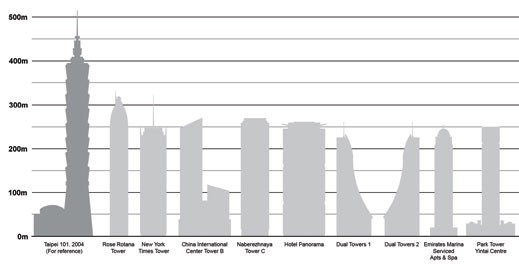
Did that stop men from being even more ambitious, out-towering every next attempt to land on Guinness World Records? The Twin Towers are gone from the skyline of lower Manhattan but look at the list of 100 tallest structures, courtesy of http://www.infoplease.com/ipa/A0001338.html
World’s Tallest Buildings1
The following table lists the tallest buildings in the world by height. The Burj Khalifa, completed in January 2010, tops the list. NOTE: This list includes only buildings.2 For towers, see World’s Tallest Towers. See also Skyscraper History, Skyscraper Facts, and America’s Favorite Structures.
 |
| Building, city | Year | Stories | Height | ||
|---|---|---|---|---|---|
| Rank | m | ft | |||
| 1. | Burj Khalifa (formerly Burj Dubai), Dubai, The United Arab Emirates | 2010 | 160 | 828 | 2,716 |
| 2. | Taipei 101, Taipei, Taiwan | 2004 | 101 | 508 | 1,667 |
| 3. | World Financial Center, Shanghai, China | 2008 | 101 | 492 | 1,614 |
| 4. | Petronas Tower 1, Kuala Lumpur, Malaysia | 1998 | 88 | 452 | 1,483 |
| 5. | Petronas Tower 2, Kuala Lumpur, Malaysia | 1998 | 88 | 452 | 1,483 |
| 6. | Greenland Financial Center, Nanjing, China | 2009 | 66 | 450 | 1,476 |
| 7. | Sears Tower, Chicago | 1974 | 110 | 442 | 1,451 |
| 8. | Guangzhou West Tower, Guangzhou, China | 2009 | 103 | 438 | 1,435 |
| 9. | Jin Mao Building, Shanghai, China | 1999 | 88 | 421 | 1,381 |
| 10. | Two International Finance Centre, Hong Kong | 2003 | 88 | 415 | 1,362 |
| 11. | Trump International Hotel, Chicago, U.S. | 2009 | 96 | 415 | 1,362 |
| 12. | CITIC Plaza, Guangzhou, China | 1996 | 80 | 391 | 1,283 |
| 13. | Shun Hing Square, Shenzhen, China | 1996 | 69 | 384 | 1,260 |
| 14. | Empire State Building, New York | 1931 | 102 | 381 | 1,250 |
| 15. | Central Plaza, Hong Kong | 1992 | 78 | 374 | 1,227 |
| 16. | Bank of China Tower, Hong Kong | 1989 | 70 | 367 | 1,205 |
| 17. | Bank of America Tower, New York City, U.S. | 2009 | 54 | 366 | 1,200 |
| 18. | Almas Tower, Dubai, United Arab Emirates | 2009 | 68 | 363 | 1,191 |
| 19. | Emirates Tower One, Dubai, United Arab Emirates | 1999 | 54 | 355 | 1,165 |
| 20. | Tuntex Sky Tower, Kaohsiung, Taiwan | 1997 | 85 | 348 | 1,140 |
| 21. | Aon Centre, Chicago | 1973 | 80 | 346 | 1,136 |
| 22. | The Center, Hong Kong | 1998 | 73 | 346 | 1,135 |
| 23. | John Hancock Center, Chicago | 1969 | 100 | 344 | 1,127 |
| 24. | Rose Tower, Dubai | 2007 | 72 | 333 | 1,093 |
| 25. | Shimao International Plaza, Shanghai | 2006 | 60 | 333 | 1,093 |
| 26. | Minsheng Bank Building, Wuhan, China | 2007 | 68 | 331 | 1,087 |
| 27. | Ryugyong Hotel, Pyongyang, N. Korea | 1995 | 105 | 330 | 1,083 |
| 28. | China World Trade Center, Beijing, China | 2009 | 74 | 330 | 1,083 |
| 29. | The Index, Dubai, United Arab Emirates | 2009 | 80 | 328 | 1,076 |
| 30. | Q1, Gold Coast, Australia | 2005 | 78 | 323 | 1,058 |
| 31. | Burj al Arab Hotel, Dubai | 1999 | 60 | 321 | 1,053 |
| 32. | Chrysler Building, New York | 1930 | 77 | 319 | 1,046 |
| 33. | Nina Tower I, Hong Kong | 2006 | 80 | 319 | 1,046 |
| 34. | New York Times Building, New York | 2007 | 52 | 319 | 1,046 |
| 35. | Bank of America Plaza, Atlanta | 1993 | 55 | 317 | 1,039 |
| 36. | U.S. Bank Tower, Los Angeles | 1990 | 73 | 310 | 1,018 |
| 37. | Menara Telekom Headquarters, Kuala Lumpur, Malaysia | 1999 | 55 | 310 | 1,017 |
| 38. | Emirates Tower Two, Dubai | 2000 | 56 | 309 | 1,014 |
| 39. | AT&T Corporate Center, Chicago | 1989 | 60 | 307 | 1,007 |
| 40. | The Address Downtown Burj Dubai, Dubai, U.A.E. | 2008 | 63 | 306 | 1,004 |
| 41. | JP Morgan Chase Tower, Houston | 1982 | 75 | 305 | 1,002 |
| 42. | Baiyoke Tower II, Bangkok | 1997 | 85 | 304 | 997 |
| 43. | Two Prudential Plaza, Chicago | 1990 | 64 | 303 | 995 |
| 44. | Wells Fargo Plaza, Houston | 1983 | 71 | 302 | 992 |
| 45. | Kingdom Centre, Riyadh | 2002 | 41 | 302 | 992 |
| 46. | Aspire Tower, Doha | 2006 | 36 | 300 | 984 |
| 47. | Arraya 2, Kuwait City, Kuwait | 2009 | 56 | 300 | 984 |
| 48. | One Island East Centre, Hong Kong, China | 2008 | 69 | 298 | 979 |
| 49. | First Bank Tower, Toronto | 1975 | 72 | 298 | 978 |
| 50. | Shanghai Wheelock Square, Shanghai, China | 2009 | 58 | 298 | 978 |
| 51. | Eureka Tower, Melbourne | 2006 | 91 | 297 | 975 |
| 52. | Comcast Center, Philadelphia, U.S. | 2008 | 57 | 297 | 975 |
| 53. | Landmark Tower, Yokohama, Japan | 1993 | 73 | 296 | 971 |
| 54. | Emirates Crown, Dubai, U.A.E | 2008 | 63 | 296 | 971 |
| 55. | 311 South Wacker Drive, Chicago | 1990 | 65 | 293 | 961 |
| 56. | SEG Plaza, Shenzhen, China | 2000 | 71 | 292 | 957 |
| 57. | American International Building, New York | 1932 | 67 | 290 | 952 |
| 58. | Key Tower, Cleveland | 1991 | 57 | 289 | 947 |
| 59. | Plaza 66, Shanghai | 2001 | 66 | 288 | 945 |
| 60. | One Liberty Place, Philadelphia | 1987 | 61 | 288 | 945 |
| 61. | Columbia Center, Seattle, U.S. | 1985 | 76 | 285 | 937 |
| 62. | Millennium Tower, Dubai | 2006 | 59 | 285 | 935 |
| 63. | Sunjoy Tomorrow Square, Shanghai | 2003 | 55 | 285 | 934 |
| 64. | Chongqing World Trade Center, Chongqing, China | 2005 | 60 | 283 | 929 |
| 65. | Cheung Kong Center, Hong Kong | 1999 | 63 | 283 | 929 |
| 66. | The Trump Building, New York | 1930 | 71 | 283 | 927 |
| 67. | Bank of America Plaza, Dallas | 1985 | 72 | 281 | 921 |
| 68. | United Overseas Bank Plaza, Singapore | 1992 | 66 | 280 | 919 |
| 69. | Republic Plaza, Singapore | 1995 | 66 | 280 | 919 |
| 70. | Overseas Union Bank Centre, Singapore | 1986 | 63 | 280 | 919 |
| 71. | Citigroup Center, New York | 1977 | 59 | 279 | 915 |
| 72. | Hong Kong New World Tower, Shanghai | 2002 | 61 | 278 | 913 |
| 73. | Diwang International Commerce Center, Nanning, China | 2006 | 54 | 276 | 906 |
| 74. | Scotia Plaza, Toronto | 1989 | 68 | 275 | 902 |
| 75. | Williams Tower, Houston | 1983 | 64 | 275 | 901 |
| 76. | Moscow, Moscow | 2009 | 73 | 274 | 900 |
| 77. | Wuhan World Trade Tower, Wuhan, China | 1998 | 60 | 273 | 896 |
| 78. | Cullinan North Tower, Hong Kong | 2007 | 68 | 270 | 886 |
| 79. | Cullinan South Tower, Hong Kong | 2007 | 68 | 270 | 886 |
| 80. | Renaissance Tower, Dallas | 1975 | 56 | 270 | 886 |
| 81. | China International Center Tower B, Guangzhou, China | 2007 | 62 | 270 | 884 |
| 82. | Dapeng International Plaza, Guangzhou, China | 2006 | 56 | 269 | 883 |
| 83. | One Luijiazui, Shanghai, China | 2008 | 47 | 269 | 883 |
| 84. | 21st Century Tower, Dubai | 2003 | 55 | 269 | 883 |
| 85. | Naberezhnaya Tower C, Moscow | 2007 | 61 | 268 | 881 |
| 86. | Al Faisaliah Center, Riyadh | 2000 | 30 | 267 | 876 |
| 87. | 900 North Michigan Ave., Chicago | 1989 | 66 | 265 | 871 |
| 88. | Bank of America Corporate Center, Charlotte | 1992 | 60 | 265 | 871 |
| 89. | SunTrust Plaza, Atlanta | 1992 | 60 | 265 | 871 |
| 90. | Al Kazim Tower 1, Dubai, U.A.E | 2008 | 53 | 265 | 871 |
| 91. | Al Kazim Tower 2, Dubai, U.A.E | 2008 | 53 | 265 | 871 |
| 92. | BOCOM Financial Towers, Shanghai | 1999 | 52 | 265 | 869 |
| 93. | 120 Collins Street, Melbourne | 1991 | 52 | 265 | 869 |
| 94. | Triumph Palace, Moscow | 2005 | 57 | 264 | 866 |
| 95. | Tower Palace Three, Tower G, Seoul | 2004 | 73 | 264 | 865 |
| 96. | Trump World Tower, New York | 2001 | 72 | 262 | 861 |
| 97. | Shenzhen Special Zone Daily Tower, Shenzhen, China | 1998 | 48 | 262 | 860 |
| 98. | Water Tower Place, Chicago | 1976 | 74 | 262 | 859 |
| 99. | Grand Gateway Plaza I, Shanghai | 2005 | 52 | 262 | 859 |
| 100. | Grand Gateway Plaza II, Shanghai | 2005 | 52 | 262 | 859 |
NOTES:
Criteria for Inclusion on the List of 100 Tallest Buildings by the Council on Tall Buildings and Urban Habitat
This data was gathered and/or supplied by members and representatives of the Council on Tall Buildings and Urban Habitat who represent world leaders in the field of the built environment, including research, industry, and education.
What defines a building (as opposed to a tower)? A “building” is considered to be a structure that is designed for residential, business, or manufacturing purposes. An essential characteristic of a building is that it has floors. Note that towers are NOT included in the list. Although a number of tall buildings on this list have “Tower” in their name—the famous Petronas Towers, for example—none are technically towers.
When does a building appear on the list? When a building is “topped out”—the point of construction when the structure has met its proposed structural top (see height definition below)—the building is officially ranked and is placed on the list.
Height The height of a building is measured from the sidewalk level of the main entrance to the structural top of the building. This includes spires but does not include television antennas, radio antennas, or flag poles. Height is listed in both meters and feet and is rounded to the nearest integer. This is the official criterion used by the Council in determining ranking.
In many cases, the height of a building is supplied to the Council using only one unit of measure (either feet or meters). Based on the exact value of the unit supplied, the other unit’s value is mathematically calculated, then rounded to the nearest integer. The final determinant in ranking a building’s height is the footage—not meters—because of footage’s smaller (and therefore more precise) incremental value.
Rank Ranking is determined by height to the structural top of the building (see above). If there is a tie, the building with the larger number of stories is ranked higher. If a tie still remains, the building which was completed first is ranked higher. If a tie would still remain, the buildings would be ranked alphabetically.
Year The year in which construction of the building was officially completed. “UC” stands for Under Construction. For a building that is currently under construction to appear on the list it must be “topped out.”
Read more: World’s Tallest Buildings — Infoplease.com http://www.infoplease.com/ipa/A0001338.html#ixzz21nTonRuY
NSB@S6K

logo art by BBB@S6K
Reader Comments