Genesis/Bereshith 8: “I will never curse the soil again on humankind’s account.”

[Little do readers of the Hebrew Scriptures realize that on top of communication from the Revelator on Sinai regarding teachings and instructions for mankind, we would learn about earthly time and seasons, regional flora and fauna, differences between raven and dove, things that biblical figures like Noah would automatically know but that we would most likely miss simply because we do not live in the fertile crescent region or the geographical setting of this biblical narrative.  


YHWH said in his heart:  I will never curse the soil again on humankind’s account, since what the human heart forms is evil from its youth; I will never again strike down all living-things, as I have done;


—‘the imagination of mankind’s heart is evil and wicked from his youth’ might appear like a confirmation of the doctrine of ‘original sin’ . . . .but thankfully, the Jewish commentators are quick to explain the meaning in this context.  Find out for yourself!


Commentary is from Pentateuch and Haftorahs, ed. Dr. J.H. Hertz; translation with commentary from EF/Everett Fox, The Five Books of Moses; supplemented by commentary from RA/Robert Alter’s The Five Books of Moses.Admin1]


————————————————-


Genesis/Bereshith 8


THE DIMINUTION OF WATERS

1  But God paid mind to Noah and all living-things, all the animals that were with him in the Ark,
and God brought a rushing-wind across the earth, so that the waters abated.
 

[P&H]  God remembered.  His covenanted promise to Noah that He would preserve him, and all that were with him in the ark (Ibn Ezra).  The animals are expressly included in the kindly thought of God.  As there is no forgetfulness with God, so we cannot really apply the term remembrance to him (Kimchi).  This phrase, which is in continual use in devotion, is only a human way of speaking of the Divine.

assuaged. The Heb. verb is used of anger being calmed down (Esther II,1).  The waters grew calm after the fury of the storm.

[EF] paid mind:  More than merely “remembered.”  rushing wind:  Reminiscent of the “rushing-spirit of God” at creation.

2  The well-springs of Ocean and the sluices of the heavens were dammed up,
and the torrent from the heavens was held back.
 

[RA] the wellsprings of the deep  . . . and te casements of the heavens, the rain.  In keeping with the stately symmetry that governs the style of the whole Flood narrative, the ending of the Flood precisely echoes the terms in which its beginning was represented, in the same order:  the poetic inset of 7:11 immediately followed by “rain” at the beginning of 7:12.

 
3  The waters returned from upon the earth, continually advancing and returning,
and the waters diinished at the end of a hundred and fifty days.

[P&H]  returned . . . . continually. i.e. kept gradually diminishing.

a and fifty days. VII,24. The Flood commenced on the 17th day of the second month (VII,11); and 150 days later, on the 17th of the seventh month, the waters had decreased to such an extent that the ark grounded on the mountains of Ararat.

4  And the Ark came to rest in the seventh New-Moon, on the seventeenth day after the New-Moon, upon the mountains of Ararat.  

[P&H]  the mountains of Ararat. Ararat is the name of a country; see Isa. XXXVII,38, where the Septuagint translates Ararat by Armenia.  Assyrian inscriptions also speak of Armenia as ‘Urartu’.  Mount Ararat is 17,000 feet high.

The waters continued to decrease for a further period of 73 days, and then the tops of ordinary mountains, as contrasted with Ararat, became visible.

5  Now the waters continued to advance and diminish until the tenth New-Moon.  
On the tenth, on the first day of the New-Moon, the tops of the mountains could be seen.

[EF] advancing and returning . . . advance and diminish:  Again, as in 7:17-20, the motion of the waters is suggested by means of sound.

[RA] the mountaintops appeared.  There is an echo here of “that the dry land will appear” of 1:9.

6-14.  THE RAVEN AND THE DOVE

6  At the end of forty days it was:  Noah opened the window of 

[P&H]  at the end of forty days. i.e. after the first day of the tenth month, referred to in the last verse.

window. lit. ‘aperture.’ The Heb. is a different word from that used in VI,16.

[RA] at the end of forty days.  After the ark comes to rest, not the forty days of deluge.

7  the Ark that he had made, and sent out a raven;
it went off, going off, and returning, until the waters were dried up from the earth.

[P&H]  a raven. He selected the raven because, as a bird of prey, the raven would sustain itself by feeding on carrion which would abound if the earth were dry.

[EF] sent out: Or, “released.”

8.  Then he sent out a dove from him, to see whether the waters had subsided from the face of the soil.

[P&H]  sent forth a dove. Rashi explains that between the sending forth of the raven and the sending forth of the dove there was an interval of seven days, since in v. 10 it is stated ‘he stayed yet another seven days.’ Noah changed his scout, because the action of the dove would give more reliable information.  The dove fed on vegetation; and should it find food, Noah would have the sign for which he was waiting.

[EF] dove: This bird is portrayed in the bible as beautiful (even pure) and delicate.  From this passage of course, stems the popular use of the dove as the symbol of peace.

9  But the dove found no resting-place for the sole of her foot,
so she returned to him into the Ark,
for there was water upon the face of all the earth.  
He sent forth his hand and took her, and brought her to him into the Ark. 

10  Then he waited yet another seven days and sent out the dove yet again from the Ark.

Image from www.keyway.ca

11  The dove came back to him at eventime,
and here—a freshly plucked olive leaf in her beak!  
So Noah knew
that the waters had subsided from upon the earth.

[P&H] at eventide.  Noah had presumably let the dove out in the morning. It must therefore have flown a considerable distance if it did not return until the evening. The inference was that the earth all around was covered by water.


olive leaf.  Since the olive tree grew to no great height, Noah understood that the waters had almost disappeared, though not completely.  The Rabbis have a beautiful comment on the fact that the dove comes back to Noah with the bitter olive leaf in its mouth.  ‘Better,’ it seemed to say, ‘bitter food that comes from God than the sweetest food at the hands of man.’

12  Then he waited yet another seven days
and sent out the dove,
but she returned to him again no more.
 
13  And so it was in the six hundred and first year, in the beginning-month on the first day of the New-Moon,
that the waters left firm ground upon the earth.  
Noah remove the covering of the Ark an saw:
here, the face of the soil was firm.

[P&H]  first month.  Two months after the tops of the mountains had become visible (v.5).

removed the covering. He took off part of the roof so as to get a view of what was outside.

the ground was dried. i.e the water had drained away from the surface of the ground; but the surrounding earth must have been a mass of marsh and bog, and it was unsafe to step upon the ground.

[EF] left firm ground: Or “were fully dried up.”

[RA]  in the six hundred and first year.  Of Noah’s life.  The Septuagint adds these words, through whether that reflects a gloss or a more reliable text at this point is unclear.

ground.  The Hebrew is ‘adamah, the word that also means “soil” and that figures importantly in the Garden story and its immediate aftermath.  It recurs again in verse 21 in God’s vow not to destroy the earth again.

14  Now in the second New-Moon, on the twenty-seventh day after the New-Moon, the earth was (completely) dry.

[[P&H]  dry. A different Heb. word from that used in the previous verse.  It denotes that the ground had become hard, and could bear the weight of the inhabitants of the ark.

[RA]  completely dry. There is no “completely” in Hebrew but that may be implied by the verb used.  The verb for “was dry” in the preceding verse is arev; the verb here is yavesh. The two are occasionally paired in poetic parallelism (e.g., Hosea 13:15), but they also occur twice in what looks like a temporal sequence (Isaiah 19:5 and Job 14:11): first a water source dries up (arev), then it is in a state of complete dryness (yavesh).

15-22.  LEAVING THE ARK, AND BUILDING AN ALTAR

15  God spoke to Noah, saying:

16  Go out of the Ark, you and your wife, your sons and your sons’ wives with you, that they may swarm on earth, that they may bear fruit and become many upon the earth.
 
17  All living-things that are with you, all flesh—fowl, animals, and all crawling things that crawl about upon the earth,
have them go out with you,
that they may swarm on earth, that they may bear fruit and become many upon the earth.

[P&H]  swarm. ‘Breed abundantly’ (RV).  The Heb. word denotes a moving about from place to place.

18  So Noah went out, his sons, his wife, and his sons’ wives with  him,

19  all living-things—all crawling things, and all fowl, all that crawl about upon the earth,
according to their clans they went out of the Ark.

[P&H]  families. i.e. species, as in Jer. XV,3.

[EF]  clans:  Classifications.

[RA]  The verb ramas and the noun remes usually refer to crawling life-forms, but there are a few contexts in which they appear to designate any kind of moving creature. (The meaning of the root is probably linked with minute movement, shuffling, or trampling.)  In Genesis 9:3, remes must indicate all kinds of animals because Noah’s diet is surely not restricted to reptiles and insects.  Here, the initial romes seems to mean “crawling things,” because it stands in contradistinction to “every beast,” whereas romes in the next clause summarizes the catalogue that precedes it, which includes birds.

20  Noah built a slaughter-site to YHWH.  
He took from all pure animals and fom all pure fowl
and offered up offerings upon the slaughter-site.

[P&H]  builded an altar. Noah feels moved to express his gratitude to God. He is the pioneer of all the altar-builders of the Bible.

burnt offerings. A burnt-offering was entirely consumed by fire on the altar, and no part eaten by the priest or the bringer of the sacrifice.

[EF] slaughter-site:  Etymologically the word mizbe’ah hearkens back to a time when such sites were used mainly for animal sacrifice; the Bible cites other uses such as libations and cereal offerings.  offered up: The Hebrew verb (‘alo) implies upward movement.

21  And when YHWH smelled the soothing savor
YHWH said in his heart:
 I will never curse the soil again on humankind’s account, since what the human heart forms is evil from its youth;
I will never again sgtrike down all living-things, as I have done; 

[P&H]  the sweet savour. The sacrifice offered by Noah was as agreeable to the Deity, humanly speaking, as sweet odours are to a man.  To avoid the anthropomorphism, the Targum renders ‘And the Lord accepted with pleasure the sweet savour’.

in His heart.  The Heb. is ‘to His heart’, i.e. to Himself.  The phrase means simply, ‘God resolved.’

I will not again curse.  There will be no repetition of the curse pronounced in the days of Adam (see III,17).  In all probability, the ‘curse’ of the Flood is also implied.  A world-catastrophe will in such measure never recur.

for man’s sake. Better, for Adam’s sake.

of man’s heart.  Better, of Adam’s heart.

imagination. The Evil Inclination in man, Yetzer hara, which too often gains the mastery over the Good inclination, Yetzer tob.

from his youth. i.e. from the dawn of his knowledge of good and evil.

as I have done. In the future, God will punish the individual sinners, and not the human family as a body.

[EF] smelled the soothing savor: Conveyed by the sound in Hebrew, va-yarah et re’ah ha-niho’ah. evil from its youth: That is, evil already begins in what we might call adolescence.  But Speiser renders it “from the start.”

[RA] And the LORD smelled the fragrant odor.  Noah has followed in the literary footsteps of the hero of the Mesopotamian Flood stories in offering thanksgiving sacrifice after the waters recede. The frankly anthropomorphic imagination that informs Genesis has no difficulty in conceiving God’s enjoying the aroma of the burnt offerings.  What is rigorously excluded from the monotheistic version of the sotry is any suggestion that God eats the sacrifice—in the Mesopotamian traditions, the gods are thought to be dependent on the food men provide them through the sacrifices, and they swoop down on the postdiluvian offering “like flies.”  The word for “fragrance” (or perhaps, something pleasing or soothing), nioa, is always attached to “odor” as a technical term linked with sacrifices, and it probably puns here on the name Noah.


The thanksgiving sacrifice is evidently a requisite narrative motif taken from the Mesopotamian antecedents, but the Hebrew writer’s attitude toward it may be more complicated than meets the eye.  The first reported animal sacrifice, though equally pleasing to God, led to the murder of the sacrificer.  Noah is about to be warned about the mortal danger of bloodguilt, and he himself will become the victim of an act of violation, though not as a consequence of his sacrifice.  In any case, divine acceptance of ritual offerings does nothing to mitigate man’s dangerous impulses.


and the LORD said in His heart.  The idiom means “said to himself” but it is important to preserve the literal wording because it pointedly echoes 6:6, “and was grieved to the heart,” just as “the devisings of the human heart are evil” explicitly echoes 6:5.  The Flood story is thus enclosed by mutually mirroring reports of God’s musings on human nature.  Whether the addition here of “from youth” means, as some commentators claim, that God now has a more qualified view of the human potential for evil, is questionable.  But after the Flood, God, once more recognizing evil of which man is capable, concludes that, given what man is all too likely disposed to do, it is scarcely worth destroying the whole world again on his account.


damn.  The Hebrew verb, from a root associated with the idea of lack of importance, or contemptibility, may occasionally mean “to curse,” as in the Balaam story, but its usual meaning is to denigrate or vilify.  Perhaps both senses are intimated here.


I will not again.  The repetition of this phrase may reflect, as Rashi suggests, a formal oath, the solemnity of which would then be capped by the poetic inset at the end (which uses an unconventional short-line form, with only two accents in each verset).  What is peculiar is that this is a pledge that God makes to Himself, not out loud to Noah.  The complementary promise to Noah, in the next chapter, will be accompanied by the external sign of the rainbow.  The silent promise in God’s interior monologue invokes no external signs, only the seamless cycle of the seasons that will continue as long as the earth.

22  (never) again, all the days of the earth, shall
sowing and harvest,
cold and heat,
summer and winter,
day and night
ever cease!

[P&H]  The regular change of the seasons will not again be suspended.  According to the Talmud, these six terms here enumerated mark the actual divisions of the year, each being of two months.

[EF] sowing an harvest . . .: The solemn promise is expressed in verse.

Image from mytop10listof.blogspot.com


[Straight Text, No Commentary]
ROBERT ALTER’S THE FIVE BOOKS OF MOSES
GENESIS
CHAPTER 8
 
And God remembered Noah and all the beast and all the cattle that were with him in the ark. And God sent a wind over the earth and the waters subsided. And the wellsprings of the deep were dammed up, and the casements of the heavens, the rain from the heavens held back. And the waters receded fro the earth little by little, and the waters ebbed. At the end of a hundred and fifty days the ark came to rest, on the seventeenth day of the seventh month, on the mountains of Ararat. The waters continued to ebb, until the tenth month, on the first day of the tenth month, the mountaintops appeared. And it happened, at the end of forty days, that Noah opened the window of the ark he had made. And he sent out the raven and it went forth to and fro until the waters should dry up from the earth. And he sent out the dove to see whether the waters had abated from the surface of the ground. But the dove found no resting place for its foot and it returned to him to the ark, for the waters were over all the earth. And he reached out and took it and brought it back to him into the ark. Then he waited another seven days and again sent the dove out from the ark. And the dove came back to him at eventide and, look, at plucked olive leaf was in its bill, and Noah took off the covering of the ark and he saw and, look, the surface of the ground was dry. And in the second month, on the twenty-seventh day of the month, the earth was completely dry. And God spoke to Noah saying, “Go out the ark, you and your wife and your sons and your son’s wives, with you. All the animals that area with you of all flesh fowl and cattle and every crawling thing that crawls on the earth, take out with you, and let them swarm through the earth and be fruitful and multiply on the earth.”
And Noah went out, his sons and his wife and his sons’ wives with him.
Every best, every crawling thing, and every fowl, everything that stirs on the earth, by their families, came out of the ark. And Noah built an altar to the LORD and he took from every clean cattle and every clean fowl and offered burnt offerings on the altar. And the LORD smelled the fragrant odor and the LORD said in His heart, “I will not again damn the soil on humankinds’ score. For the devising of the human hearth are evil from youth. And I will not again strike down all living things as I did. As long as all the days of the earth—
 
 
seedtime and harvest
and cold and heat
and summer and winter
and day and night
shall not cease.”

Genesis/Bereshith 7: “The Deluge was forty days upon the earth.”

[In this sixth millennium when the world has witnessed and experienced tidal waves, tsunamis and sea surge “of biblical flood proportions” the releasing of water from the heavens as well as from the deep is no longer inconceivable.  Blow by blow accounts presented by international media on television screens and cellphone videos taken by survivors of natural calamities make us realize the destructive power potential of unleashed forces of nature.  For sure the Creator of the heavens and the earth did not have to resort to extra H20 to bring on this flood during the time of Noah; like His ‘miracles’ recorded in Scripture and investigated and studied endlessly by skeptics including scientists, climatologists, meteorologists, etc.—surely the God Who controls and sustains His universe uses natural means in bringing on what human limited thinking perceive to be ‘miracles’.  Scientists now better understand how the universe functions and can attest to cause and effect phenomena that the more ignorant among us attribute to the workings of the gods.  Even if one could perfectly explain away the science behind ‘miracles’, there is still that strange factor of ‘timing’ . . . let’s call it ‘Divine Clockwork’ for now. 


There is discussion as to whether this was a worldwide phenomenon or confined to this area in the biblical account. With archeological evidence plus mention of ‘a flood’ in the records of primitive people, one can arrive at conclusions—accept or reject the historicity of this narrative.  


Commentary is from P&H/Pentateuch and Haftorahs, ed. Dr. J.H. Hertz; translation with commentary is from EF/Everett Fox, The Five Books of Moses plus additional commentary from RA/Robert Alter, The Five Books of Moses;  Alter’s translation in prose narrative has been added in the end for straight reading.–Admin1]


————————————————–


Genesis/Bereshith 7

ENTERING THE ARK

Image from www.agenteeteen.com

1  YHWH said to Noah:  
Come, you and all your household, into the Ark!  
For you I have seen as righteous before me in this generation.

[P&H]  righteous.  In VI,9, Noah was described as ‘righteous and blameless.’  Since the present verse was addressed to Noah, whereas VI,9 was spoken of him in his absence, the Rabbis deduced the rule: ‘Utter only a part of a man’s praise in his presence, bt thou mayest speak the whole of a man’s praise in his absence.’  Most people unfortunately give utterance to the whole of a man’s blame in his absence, graciously contenting themselves with only a portion of such blame in his presence.

[RA]  for it is you I have seen righteous before me in this generation. God’s words here reflect a frequently used technique of biblical narrative, in which the narrator’s report or evaluation is confirmed by a near verbatim repetition in dialogue, or vice versa.  The judgment that Noah is “righteous in this generation” explicitly echoes the narrator’s declaration in 6:9 that Noah is “a righteous man . . . blamless in his time” (the Hebrew for “time” is literally “generations”).

2  From all (ritually) pure animals you are to take seven and seven (each), a male and his mate,
and from all the animals that are not pure, two (each), a male and his mate,

[P&H]  clean beast. According to Rashi, this means ‘of every beast which at a later period would be considered clean by the people of Israel’ (Lev. XI and Deut XIV).  But more probably, the distinction between clean and unclean in this passage is based on the fitness of the animal to be used as a sacrifice to God; VIII,20, where it is narrated that Noah offered upon the altar ‘of every clean beast, and of every clean fowl’.


seven and seven. i.e. seven pairs; seven males and seven females.  The general direction in VI,19 to take a pair of each kind of animal into the ark in order to preserve alive the various species, is here supplemented by the more specific injunction, when the time arrived for entering the ark, that of the clean beasts, there shall be seven of each species.  As Rashi points out, he required additional clean animals for sacrifice on leaving the ark.  From the phrasing of the verse, Malbim shows that the command is concerning Noah’s domestic animals.


beasts that are not clean. Of Noah’s domestic animals—such as hares, asses, camels–he was to take two each.  The phrase ‘that are not clean’ is itself noteworthy.  It is a circumlocution which might have been avoided by the use of the simple word ‘unclean’.  The Talmud bases on this verse its admonition to avoid impure and unrefined language in conversation.


[EF] (ritually) pure:  An anachronism, referring to later Israelite laws about sacrifice and eating.  seven and seen each: The contradiction between this and 6:39 has led scholars to post two different sources for the story.  male: Lit.”a man.”

[RA]  Of every clean animal take you seven pairs.  Clean and unclean evidently refer to fitness for sacrificial use, not for eating, as in the later dietary prohibitions.  As scholarship has often noted, two versions of the Flood story, the Priestly and the Yahwistic, are intertwined in a somewhat confusing fashion. According to the former, two of each species are to be brought into the ark and no distinction is made between clean and unclean.  According to the latter, seven paris of clean animals and one pair of unclean are to be saved.  Abraham ibn Ezra and other medieval exegetes rescue consistency by proposing that when God directed attention to the clean-unclean distinction, He had to add the difference in the numbers because more animals were needed to be sacrificed. (Noah, like his counterpart in the Mesopotamian Flood stores, does in fact offer a thanksgiving sacrifice after the waters recede.)  But the tensions between the two versions, including how they record the time span of the Flood, persist, and there are some indications that the editor himself struggled to harmonize them.


3  and also from the fowl of the heavens, seven and seven (each), male and female,
to keep seed alive upon the face of all the earth.

[RA] seed.  The Hebrew term means both semen and the offspring that is its product.  It is a very concrete way of conceiving propagation and the survival of a line, and seems worth preserving in a literal English rendering.

4  For in yet seven days
I will make it rain upon the earth for forty days and forty nights and will blot out all eixsting-things that I have made, from the face of the soil.

[P&H]  for yet seven days. To give Noah time to carry out the instructions which had been given him.

{EF] in yet seen days: Seven days from now. forty: Used in the Bible to denote long periods of time; also a favorite patterned number.

5  Noah did it, according to all that YHWH had commanded him.

[P&H] according unto all. VI,22. There it refers to the construction of the ark; here it implies the strict fulfilment of the directions enumerated in the preceding verses.

6  Noah was six hundred years old when the Deluge occurred, water upon the earth; 

7  and Noah came, his sons and his wife and his sons’ wives with him, into the Ark before the waters of the Deluge.

8  From the pure animals and from the animals that are not pure and from the fowl and all that crawls about on the soil–

9  two and two (each) came to Noah, into the Ark, male and female, as God had commanded Noah.

[P&H]  two and two. In couples.

10-24.  ‘THE WINDOWS OF HEAVEN WERE OPENED’

10.  After the seven days it was
that the waters of the deluge were upon the earth.
 
11  In the six hundredth year of Noah’s life, in the second New-Moon, on the seventeenth day after the New-Moon,
on that day:
then burst all the well-springs of the great Ocean
and the sluices of the heavens opened up.

[P&H] in the second month.  The Rabbis differ as to whether the year here reckoned as beginning in Nisan or Tishri.  On the view that the year commenced with Tishri, the Flood began about November, which is the time of the rainy season.  More probably, the Flood began in May, which is the time of the inundation of the Babylonian plain.

the great deep.  The tehom of I,2.  There was a seismic upheaval; the earth was swept by a gigantic tidal wave, and simultaneously there was a torrential downpour of rain.

windows of heaven. For the expression, II Kings VII,2,19; Mal III,10; as if the vast reservoirs of water thought of as stored above the sky (I,7) were coming down through special openings, constantly and in resistless strength.

[EF] then burst . . .: Cassuto (1972) suggests that the poetic verses here and elsewhere in the Flood story are fragments of an Israelite epic.  well-springs . . . sluices:  The normal sources of rain function here without any restraint (Cassuto).  Ocean: The world returns to the primeval chaos of 1:2.

12  The torrent was upon the earth for forty days and forty nights.

[P&H]  rain. lit. ‘heavy rain.’ There was a continuous downpour for the period of time specified.

13  On that very day came Noah, and Shem Ham, and Yefet, Noah’s sons and Noah’s wife and his three sons’ wives with them, into the Ark, 

[P&H]  After a summary of the Flood-story (v. 6-12) we have a more detailed description of the event.

selfsame day. i.e. the day determined by God.

14  they and all wildlife after their kind, all herd-animals after their kind, all crawling things that crawl upon the earth after their kind, all fowl after their kind, all chirping-things, all winged-things;

[P&H]  every bird of every sort. lit. ‘every bird of every wing’; i.e. every species of winged creatures.

15  they came to Noah, into the Ark, two and two (each) from all flesh in which there is the rush of life.

16  And those that came, male and female from all flesh they came,
as God had commanded him.  
YHWH closed (the door) upon him. 

[P&H]  The LORD shut him in. This means either literally that God fastened the door so that it withstood the violence of the storm; or it is a beautifully naive figure of speech to denote the Divine protection which encompassed Noah.  Hence the employment of the term Lord, Adonay, for this act of Divine mercy (II,4).

[EF] YHWH closed: Another sign of God’s control over the events (and his protection of Noah).

17  The Deluge was forty days upon the earth.  
The waters increased and lifted the Ark, so that it was raised above the earth;

[P&H]  the waters increased.  After it had rained for forty days, the waters were sufficiently deep to bear the ark, which, as Rashi remarks, had previously been like a heavily-laden ship struck in shallow water and unable to move.

[EF] 17-20  increased . . . swelled and increased exceedingly . . . swelled exceedingly, yes, exceedingly . . . swelled:  The structure here mirrors the action: the surging and growing of the waters.

18.  the waters swelled and increased exceedingly upon the earth, so that the Ark floated upon the face of the waters.

[P&H]  the waters prevailed.  They covered the earth.  It will be noted that there were three stages in the increase of the waters.

  • The first was marked by the lifting of the Ark (v. 17);
  • the second by the floating of the ark (v. 18);
  • the third by the total submergence of the mountains (v. 19).

[EF] swelled: Lit. “grew mighty.” floated:  Lit. “went”.

19  When the waters had swelled exceedingly, yes exceedingly over the earth, all high mountains that were under all the heavens were covered.

20  Fifteen cubits upward swelled the waters, thus the mountains were covered.

[P&H]  fifteen cubits upward.  This means that the waters rose 22 1/2 feet above the top of the highest mountain.

Image from webgardi.yjc.ir –

21  Then expired all flesh that crawls about upon the earth—fowl, herd-animals, wildlife, and all swarming things that swarm upon the earth,
and all humans;

 [P&H] What had been foretold in VI,17 was literally fulfilled.

every man. i.e. the entire human race outside the ark.

22  all that had the breath of the rush of life in their nostrils,
all that were on firm-ground, died.
 

[RA] the quickening breath of life.  The Hebrew, nishmat rua ahim, is unusual, the first two terms in a way doubling each other (“the breath of the breath of life”).  Some recent scholars construe this as a minimizing idiom that implies something like “the faintest breath of life.”  But the one other occurrence of the phrase nishmat rua, in David’s victory psalm (2 Samuel 22:16), is part of an anthropomorphic vision of God breathing fire on the battlefield (“From the LORD’s roaring,/the blast of his nostril’s breath”); and so it is more plausible that the doubled terms are intensifiers, underlining the physical exhalation of breath from the nostrils that is the sign of life.  In fact, we shall encounter other instances, in the Plagues narrative and in the Sinai epiphany in Exodus, where two synonyms joined together in the construct state signify intensification.

 
23  He blotted out all existing things that were on the face of the soil,
from man to beast, to crawling and to fowl of the heavens,
they were blotted out from the earth.

[EF] blotted out: Twice repeated, echoing God’s promise in 6:7.

24  The waters swelled upon the earth for a hundred and fifty days.

[P&H]  prevailed.  Dominated the earth.  After 40 days’ downpour, the waters reached their highest point, and remained so for a period of 110 days. After 150 days had passed from the commencement of the Flood, the waters began to diminish.

vipasstothespiritworld.blogspot.com


[Straight Text, No Commentary]
ROBERT ALTER’S THE FIVE BOOKS OF MOSES
GENESIS
CHAPTER 7


And the LORD said to Noah, “Come into the ark, you and all your household, for it is you I have seen righteous before Me in this generation. Of every clean animal take you seven pairs, each with its mate, and of every animal that is not clean, one pair, each with its mate. Of the fowl of the heavens as well seven pairs, male and female, to keep seed alive over all the earth. For in seven days’ time I will make it rain on the earth forty days and forty nights and I will wipe out from the face of the earth al existing things that I have made.” Noah did all that the Lord commanded him.
 
Noah was six hundred years old when the Flood came, water over the earth. And Noah and his sons and his wife and his sons wives came into the ark because of the waters of the Flood. Of the clean animals and of the animals that were not clean and of the fowl and of all that crawls upon the ground two each came to Noah into the ark, male and female, as God had commanded Noah. And it happened after seven days, that the waters of the Flood were over the earth. In the six hundredth year of Noah’s life, in the second month, on the seventeenth day of the month, on that day,
 
            All the wellsprings of the great deep burst
            and the casements of the heavens were opened.
 
And the rain was over the earth forty days and forty nights. That very day, Noah and Shem and Ham and Japheth, the sons of Noah, and Noah’s wife, and the three wives of his sons together with them, came into the ark, they as well as beasts of each kind and cattle of each kind of bird, each winged thing. They came to Noah into the ark, two by two of all flesh that has the breath of life within it. And those that came in, male and female of all flesh they came, as God had commanded him, and the LORD shut him in. And the Flood was forty days over the earth, and the waters multiplied and bore the ark upward and it rose above the earth. And the waters surged and multiplied mightily over the earth, and the ark went on the surface of the water. And the waters surged most mightily over the earth, and all the high mountains under the heavens were covered. Fifteen cubits above them the waters surged as the mountains were covered. And all flesh that stirs on the earth perished, the fowl and the cattle and the beasts and all swarming things that swarm upon the earth, and all humankind. All that had the quickening breath of life in its nostrils, of all that was on dry land, died. And he wiped out all existing things from the face of the earth, from humans to cattle to crawling things to the fowl of the heavens they were wiped out from the earth. And Noah alone remained, and those with him in the ark. And the waters surged over the earth one hundred and fifty days.


Genesis/Bereshith 6: "in accord with God did Noah walk"

[A child’s exposure to bible stories surely includes the account of Noah and the Ark. It is so easy to visualize, what with the ark’s design and best of all, the parade of animals boarding the vessel.  We wonder how they would all fit in, what they would eat for 40 days and nights, the mess they would make to get rid of food!  Not to worry, said one bible storyteller, God put all the animals in hibernation, so no problem for the Noah family.  The feminists complain that the account never names the wives, only Noah and his three sons.  Oh well . . . . We’ve heard the basic story enough that often we miss details that surface only after a closer reading of this chapter.  For instance, we always thought that the distinction between ‘clean’ and ‘unclean’ animals was only taught in Wai’qrah/Leviticus 11; well, it turns out that Noah already knew the difference since the instructions to him was a pair of unclean and 7 pairs of clean animals.  For what? Presumably for the beginning of the consumption of meat in man’s diet, as well as for sacrifice or ‘offering’ to God which would have been observed by Noah’s time.  What about the dinosaurs and their ilk? The Regan cartoon took care of that, see Revisited: No wonder they’re extinct . . .


The commentary here is, as usual, from Pentateuch and Haftorahs, ed. Dr. J.H. Hertz; translation and extra commentary by EF/Everett Fox, The Five Books of Moses and RA/Robert Alter, The Five Books of Moses..—Admin1.]

——————————————————-

Genesis/Bereshith 6

THE GROWING CORRUPTION OF MANKIND

1  Now it was when humans first became many on the face of the soil
and women were born to them,
2  that the divine beings saw how beautiful the human women were,
so they took themselves wives, whomever they chose.

[P&H]  sons of God.  Is the literal translation of the Heb. phrase beney Elohim.

[ET]  divine beings:  Or “godlings.”

Image from blogs.yahoo.co.jp

[P&H]  Among several ancient peoples there was a belief that there once existed a race of men of gigantic strength and stature, who were the offspring of human mothers and celestial fathers, and we are supposed to have an echo of that legend in this Biblical passage. Philo, Josephus and the author of the Book of Jubilees were misled into this interpretation by the analogy of these heathen fables.  There is, however, no trace in Genesis of ‘fallen angels’ or rebellious angels; and the idea of inter-marriage of angels and human beings is altogether foreign to Hebrew thought.  The mythological explanation of this passage was in all ages repelled by a large body of Jewish and non-Jewish commentators, though it has been revived by many moderns.


Others render beney Elohim by ‘sons of the great’ (in poetic Hebrew, elohim often means ‘mighty, Ps. XXIX,1).  This verse would thus state that the sons of the nobles took them wives of the daughters of the people, who were powerless to resist.  These marriages were the result of the licence and oppression in that time.


‘Sons of God’ may, however, also mean those who serve God and obey Him, those nourished and brought up in the love of Him as their Father and Benefactor (Exod. IV,22; Deut. XIC, I; XXXII,5; Isa. I,2; Hos. II,1).  It is quite in accord with Biblical usage that those who adhered to the true worship of God—the children of seth—are called ‘sons of God’;  and that, in contrast to these, the daughters of the line of Cain should be spoken of as ‘daughters of men’ (Ibn Ezra, Mendelssohn, S.R. Hirsch, W.H. Green).


Verses 1-4 would then point out the calamitous consequences to mankind with the pious sons of Seth merged with those who had developed a Godless civilization and who, with all their progress in arts and inventions, had ended in depravity and despair.  ‘Through intermarriage, the sons of Seth sink to the level of the ungodly race; and likewise deserved the doom that, with the exception of one family, was to overtake mankind.  These verses are thus the first warning in the Torah against intermarriage with idolaters.

3  YHWH said:  
My rushing-spirit shall not remain in humankind for ages, for they too are flesh;
let their days be then a hundred and twenty years!


[P&H]  abide in.  The above interpretation is borne out by this verse.  For, if ‘fallen angels’ were in question, and if it was wrong for them to marry human women, the angels surely were the chief offenders; and yet the sentence falls exclusively upon man.  ‘In God’s judgments there is no unrighteousness, partiality, or even the appearance of partiality’ (Keil).


for that he also is flesh.  Another translation is, ‘by reason of their going astray they are flesh.’ Despite the fact that man is created in the Divine image, he has proved by his proneness to err that he is ‘flesh’; i.e. his days are numbered: but I will not at once destroy him.  ‘There shall be yet an interval of 120 years, before I bring the Deluge upon mankind (Targum); a respite to the human race to give them time for repentance (Ibn Ezra).


[EF]  for they too are flesh:  Hebrew difficult.  The text uses the singular.  a hundred and twenty years:  Some early interpreters take this to specify a “grace period’ for humanity before the Flood.  The text seems to be setting the limits of the human life span.

4  The giants were on earth in those days,
and afterward as well,
when the divine beings came in to the human women
and they bore them (children)—
they were the heroes who were of former ages, the men of name.

[P&H]  Nephilim. Or, ‘giants.’ They existed before the intermarriages took place.  The mention of Nephilim in Num. XIII,33 is no reason to assume that they survived the Flood.  The excited imagination of the Spies expresses its terror at the men of great stature whom they saw at Hebron, by saying that they must be the old antediluvian giants (W.H. Green).

men of renown.  By reason of their abnormal physical strength, they gained for themselves a reputation as heroes.  But enduring fame does not rest upon such qualifications as these Nephilim possessed.  Their fate was to disappear from the earth, and humanity was to continue through Noah, ‘a righteous man, and blameless in his generation.’

[EF]  came in to: The common biblical term for sexual intercourse.  The concept, also expressed in Arabic, is of the man entering the woman’s tent for the purpose of sex.

[RA]  1-4.This whole passage is obviously archaic and mythological.  The idea of male gods coupling with mortal women whose beauty ignites their desire is a commonplace of Greek myth, and E.A. Speiser has proposed that both the Greek and the Semitic stories may have a common source in the Hittite traditions of Asia Minor.  The entourage of celestial beings obscurely implied in God’ use of the first-person plural in the Garden story (compare 3:22) here produces, however fleetingly, active agents in the narrative.  As with the prospect that man and woman might eat from the tree of life, God sees this intermingling of human and divine as the crossing of a necessary line of human limitation, and He responds by setting a new retracted limit (three times the formulaic forty) to human life span.  Once more human mortality is confirmed, this time in quantitative terms.


Nephilim. The only obvious meaning of this Hebrew term is “fallen ones”—perhaps, those who have come down from the realm of the gods; but then the word might conceivably reflect an entirely different, un-Hebraic background.  In any case, the notion of semidivine, heroic figures—in Numbers the Nephilim are thought of as giants who are offspring of miscegenation between gods and women—again touches on common ground with Greek and other mythologies.

5  And YHWH saw
that great was humankind’s evildoing on earth
and every form of their heart’s planning was only evil all the day.

[P&H]  wickedness. This verse and the two that follow form the climax to the previous four verses, in which the moral depravity of the age is depicted.  Retribution is swiftly coming.

imagination. The desires; the whole bent of his thoughts.

heart. In Heb. the heart is the seat of the mind, intellect, purpose.

[EF]  And YHWH saw . . . evildoing. In contrast to the refrain of Chapter I, “God saw that it was good.”  every form of their heart’s planning:  This lengthy phrase indicates human imagination (Spenser: “every scheme that his mind devised”).  “Heart” (Heb. lev or levav) often expresses the concept of “mind” in the Bible.

[RA]  heart’s devising.  In the Bible the heart is usually thought of as the seat of intelligence, only occasionally as the seat of emotion; thus many modern translators use “mind” here.  But man’s evil heart is pointedly meant to stand in contrast to God’s grieving heart (the same Hebrew word) in the next verse.

6.  Then YHWH was sorry
that he had made humankind on earth,
and it pained his heart. 

[P&H]  repented.  (Note from II,2:  This ascribing of human actions to God is called anthropomorphism, and is employed in the Bible to make things intelligible to the finite human mind that which relates to the infinite.  The Talmudic saying, ‘The Torah speaks the ordinary language of men,’ became a leading principle in later Jewish interpretation of Scripture.) Here the feelings of a human being are ascribed to God. ‘He who destroys his own work seems to repent of having made it’ (Ibn Ezra).

grieved Him. A touching indication of the Divine love for His creation.

7  YHWH said:
 I will blot out humankind, whom I have created, from the face of the soil,
from man to beast, to crawling thing and to the fowl of the heavens,
for I am sorry that I made them. 

[EF] man to beast: Or, “human to animal.”

8  But Noah found favor in the eyes of YHWH.

9  These are the begettings of Noah.  
Noah was a righteous, wholehearted man in his generation,
in accord with God did Noah walk.
 

[P&H]  these are the generations. i.e. this is the story of Noah.  This phrase, as in II,4, introduces a new section of the history.

righteous.  In his actions, in his relationship with his fellows.

wholehearted.  ‘Blameless’ (RV); faultless.

in his generations.  The Rabbis point out that these words may be understood as stating that, despite the depravity which raged around him, he remained unspotted and untainted by corruption.  It may, however, also mean that in his generations, i.e. judged by the low standard of his age, Noah was righteous; but had he lived in the period of Abraham, he would not have been conspicuous for goodness.


Noah walked with God.  But Abraham, Scripture later tells us, walked before God.  A father takes his young child by the hand, so that the latter walks with him, but he allows an older, maturer child to walk before him.  In moral strength, Abraham was the superior of Noah (Midrash).


[EF]  righteous: A term with legal connotations, “in the right” or “just.”  righteous, wholehearted: Foreshadowing Avraham, of whom similar vocabulary will be used (17:1).  “Whole” (below “wholly-sound”) is used of animals fit for sacrifice.  Others, “perfect” or “unblemished.”

[RA] lineage.  The listing of Noah’s three sons in the next verse supports this sense of toledot, but it might also mean “story.”

10  Noah begot three sons: Shem, Ham, and Yefet.

[P&H]  A new section begins with v. 9.  Hence the sons who had been enumerated in v. 32 are again referred to, because they figure in the story which forms the theme of this section.

11  Now the earth had gone-to-ruin before God, the earth was filled with wrongdoing.

[P&H]  the earth. i.e. the inhabitants of the earth.  So again, in XLI,57.

corrupt.  The Rabbis understand this as an allusion to gross immorality.

before God. Either in open and flagrant defiance of God, or what they did was an offence in the sight of God.

violence.  Ruthless outrage of the rights of the weak by the strong.

[EF] 11-12  Now the earth . . .: A poetic summary of the situation.  before God: In his sight.

[RA] filled with outrage. Humankind had been enjoined to multiply and fill the earth, but the proliferation of human population leads to a proliferation of lawless behavior.  This is one of several verbal echoes of the Creation story, suggesting, first, a perversion of creation by man and, then, a reversal of creation by God.

12  God saw the earth, and here:  it had gone-to-ruin
for all flesh had ruined its way upon the earth.

[P&H]  all flesh. Including the animals. Their corruption manifested itself in the development of ferocity.

way. Manner of life, conduct.

[EF]God saw the earth, and here:  it had gone-to-ruin: A bitter echo of 1:31, “Now God saw all that he had made,/ and here: it was exceedingly good!”

13 God said to Noah:
 An end of all flesh has come before me,
for the earth is filled with wrongdoing through them;
here, I am about to bring-ruin upon them, along with the earth.

[P&H]  is come before Me. i.e. has come before God’s mind, has been determined by Him.

with the earth. With the things that are upon the surface of the earth.

[EF] has come before me: Has been determined by me.

[RA] 13-21.  God’s pronouncement of imminent doom and His instructions about the ark are the longest continuous speech up to this point in Genesis, considerably exceeding the triple curse in chapter 3.  Most of the length is dictated by the necessity to provide specifications for the construction of the ark and the arrangements for the animals.  But the writer also uses the speech as a vehicle for realizing God’s awesome presence in the story:  the language is not arranged in actual verse but it sounds a drumroll of grand formal cadences, stressing repeated terms and phrases that rhythmically or semantically parallel.

14  Make yourself an Ark of gofer wood,
with reeds make the Ark,
and cover it within and without with a covering-of-pitch.

Image from www.rochaferida.com

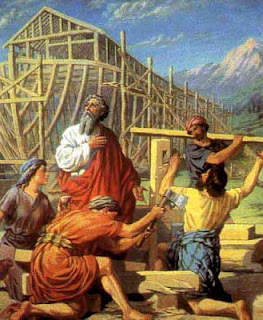
[P&H]  make thee an ark. i.e. a ship. The Rabbis say that the construction of the Ark occupied Noah for 120 years, in order to give his contemporaries an opportunity to repent.  Their curiosity would naturally be aroused by what Noah was doing; and he would answer their inquiry by warning them of the judgment which God was bringing on mankind.  They, however, scoffed at him and gave  no heed to his words.

gopher wood. A resinous wood, which would not admit the water; probably the cypress.

rooms.  lit. ‘nests’; separate stalls for the different species of animals.

[EF] Ark: English as well as Hebrew etymology points to a box or chest, not strictly a boat.  God, not human engineering, is the source of survival in the story. gofer: Identification unknown.  reeds: Reading Heb. kanim for traditional text’s kinnim (“compartments).

15  And this is how you are to make it:  
Three hundred cubits the length of the Ark, fifty cubits its breadth, and thirty cubits its height. 

[P&H]  this is how. These are the measurements and directions.

a cubit.  Roughly 18 inches. [EF] cubits: A cubit equaled a man’s forearm in length, about 17 1/2 inches.

16  A skylight you are to make for the Ark, finishing it to a cubit upward.  
The entrance of the Ark you are to set in its side;
with a lower, a second, and a third deck you are to make it.

[P&H]  a light. The unusual word here used for light means in the plural (dual) ‘noon’.  Legend relates that it was a precious stone, which illuminated the whole interior of the Ark. [EF] skylight: Hebrew obscure, including the end of the phrase.

to a cubit. The precise meaning of these words is doubtful.  The ‘light’ (which must be thought of as a kind of casement near to the roof) was to measure a cubit in height; or there was to be a space of a cubit between the roof and the top of the casement.

17  As for me,
here, I am about to bring on the Deluge, water upon the earth, to bring ruin upon all flesh that has rush of life in it, from under the heavens,
all that is on earth will perish.

[P&H]  and I, behold I. These emphatic words bring out the thought of the terrible necessity of the Flood.

[EF] Deluge:  Heb. mabbul.  Others suggest the more conventional word “Flood,” but the term may be an Assyrian loan-word.

18  But I will establish my covenant with you: you are to come into the Ark, you and your sons and your wife, and your sons’ wives with you, 

[P&H]  covenant.  A covenant means an agreement or compact between two parties, for the observance of which pledges are given. Here it is used in the simple sense of a promise.  God will fulfill His promise to spare Noah and his family.

[EF] covenant: An agreement or pact, most notably (in the Bible) one between God and individuals or between him and the people of Israel.

Image from jewellpage.wordpress.com

19  and from all living-things, from all flesh, you are to bring two from all into the Ark, to remain alive with you.
 They are to be a male and a female (each),
 
20  from fowl after their kind, from herd-animals after their kind,
from all crawling things of the soil after their kind,
two from all are to come to you, to remain alive.
 
21  As for you,
take for yourself from all edible-things that are eaten and gather it to you,
it shall be for you and for them, for eating.
 
22  Noah did it,
according to all that God commanded him, so he did.

[P&H]  thus did Noah. i.e. he made the ark and collected provisions.  The act of bringing the animals into the ark is described in the next chapter.

———————————————-

On the Flood and its parallels in Babylonian literature, additional background.

The primeval traditions recorded in the early chapters of Genesis stretch away into prehistoric times, and enshrine, in outline, great universal truths that touch the origin and meaning of Life and Man.  The Rabbis tell us that the Patriarch Jacob spent 14 years in the centres of ancient Semitic learning, the ‘academies of Shem and Eber’, acquiring the ancient traditions which he handed on to his descendants.  Among these was the memory of a fearful upheaval with an all-destroying Flood that caused a complete breach in the continuity of civilization in the primitive dwelling-place of mankind.  Striking evidence is now at hand that the Bible story of the Flood is an event in historic times, approximately about the year 3800 before the Common Era.  ‘New discoveries have brought history so close to the Flood period and have produced so many phenomena requiring for their explanation just such an event as the Flood is supposed to have been, that the a priori denial of the Flood becomes thoroughly unscientific.  We are justified in asking for more evidence, but there can be little doubt which way that evidence will trend’ (L. Woolley).  As it was recounted in the families of the Patriarchs, the story of that Flood is of great ethical and religious value.  The Deluge was a Divine judgment upon an age in which might was right, and depravity degraded and enslaved the children of men.  There were giants on earth in those days; they were the ‘men of renown’; and life to these super-men meant unscrupulous selfishess and the deification of power and pleasure.


Among these men of violence, one man alone was upright and blameless, Noah, who believed in justice and practised mercy.  He preached to the men of his generation—the Rabbis tell us—and warned them that a Deluge was coming, peradventure they might desist from iniquity and turn to righteousness.  In vain.  He saw that entire generation swept away; but he also lived to see the Rainbow of Promise, and the beginnings of a better world that was eventually to gain in strength, and to find lasting expression in Abraham and his descendants.

Genesis/Bereshith 5: "one in his likeness, according to his image"

Image from sites.google.com

[The first verse that caught our attention in this chapter is the one about Seth being in the image of Adam. Sorry to keep referring back to what we used to teach as Christians, this is our way of correcting former mistakes.   We would say without thinking:  ‘Adam was made in the image of God, but after the fall, his son was made in his image.’ Not one listener would correct the statement:  ‘er, uhm, excuse me, but there is some mistake:  Seth is third from firstborn Cain and second-born Abel. If original sin made Adam and Eve’s descendants resemble them in terms of ‘fallenness’ and no longer in God’s image, then it should be Cain who is in Adam’s image and thereafter, everyone else.


We actually posted this question under Q&A:  


 Q&A: Why is Seth the one “in the likeness of Adam” instead of firstborn son Cain? The wonder of it is, the two commentaries we feature here don’t even bother to deal with it; in short, it’s no big deal to them, so no use making a fuss over it.  As someone suggested, perhaps Seth just physically resembled his father Adam, no more. no less, end of speculation.


The second:  As for the explanation of Enosh not going through death like all mortals, we go along with the idea that he died just like everyone else, but there are euphemistic ways of expressing the demise of a man if one is avoiding the simple ‘he died’: ‘he moved on’, ‘he went to the great beyond’, ‘he was not’, ‘he passed away’, and so on; no big deal as far as Enosh is concerned. The problem is, with not much to go by except for ‘he walked with God’ then ‘is no more’ — a lot of other figures in the Hebrew Scriptures were also described as righteous men but they all died. So it is best to always go with the most natural explanation, it makes the most sense! As for Elijah going to heaven in a chariot of fire, well we will deal with that text when we get there


The third:  As for the long life of these earliest generations, it is believable that with the pristine conditions of the world during their lifetime — clean air, clean environment, pure water, super-nutritious raw foods, rich soil, etc. —when humankind had not yet ruined everything for every creature on earth, such longevity was probably more the norm than the exception.  Today a shortened life expectancy of 120 years is possible for those who have good genes, live in unpolluted environment, eat healthy diets, are not stressed, sleep well, and all the other factors that contribute to longevity.


Commentary is from [E&H] Pentateuch and Haftorahs, ed. Dr. J.H. Hertz; translation is [EF] Everett Fox, The Five Books of Moses  Additional commentary from RA/Robert Alter, The Five Books of Moses and Alter’s translation in prose narrative is added at the end..–Admin1].


————————————

Genesis/Bereshith 5


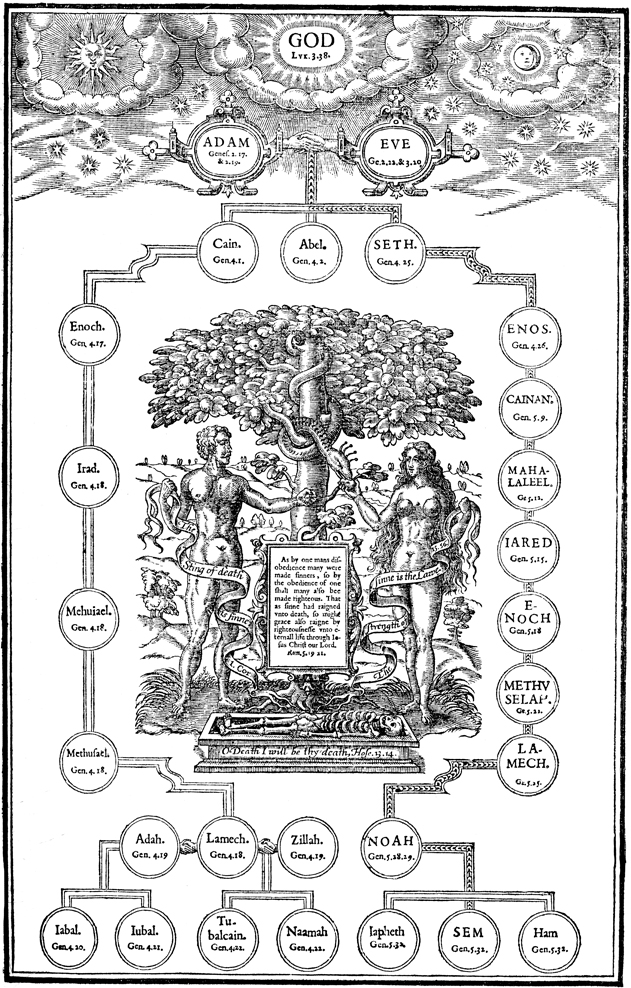
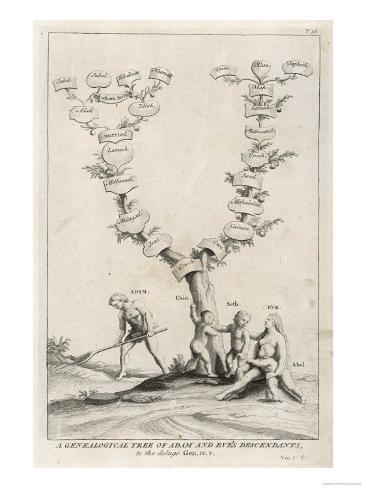
[RA]  Nothing reveals the difference of the biblical conception of literature from later Western ones more strikingly than the biblical use of genealogies as an intrinsic element of literary structure.  As J.P. Fokkelman (1987) has noted, the genealogicla lists or “begats” (toledo) in Gnesis are carefully placed compositional units that mark off one large narrative segment from another:  here, the story of Creation and the antediluvian founding figures from the Deluge story.  As Fokkelman also observes, the begettings of the genealogical lists are linked thematically with the initial injunction to be fruitful and multiply and with all the subsequent stories of a threatened or thwarted procreative drive.


Repetition of formula dominates the genealogical list stylistically.  Here the procreative act and life span of each figure are conveyed in identical language, and when there is a divergence from the formula, in the case of Enoch, it is very significant.  Formulaic numbers as well are characteristically used by the biblical writer to give order and coherence to the narrated world.  The seven generations from Adam to Noah of Chapter 4 are here displaced by a different formulaic number, ten. (Some critics have argued that the two lists reflect competing versions that deploy the same group of fathers and sons in different patterns:  some of the names are identical in both lists, others—like Cain-Kenan, Irad-Jared—may well be variants of each other).  The list incorporates both of the formulaic numbers:  Lamech, the last of the antediluvians before Noah lives 777 years; Noah, unlike his predecessors, becomes a begetter at the age of 500, halfway through a round millennium, which is the ten of the ten generations with two decimal places added.  A millennium is the age most of the antediluvians come close to but never attain, as befits their mortality.


Surely part of the intention in using the genealogy is to give the history the look of authentically archaic documentation.  If, as many assume, Priestly circles in the Second Temple period were ultimately responsible for the list here, they did not hesitate to include the fabulous ages of the antediluvians, which must have had their origins in hoary Semitic antiquity (as the old Mesopotamian parallels suggest), as well as the strange, evidently mythic fragment about Enoch, which could scarcely have been a late invention.


1  This is the record of the begettings of Adam/Humankind.  

At the time of God’s creating humankind,

in the likeness of God did he then make it,


[P&H]  this is the book.  Heb. sefer does not always mean a volume; it may be used of any written document.  Rabbinic tradition states the Torah is not one continuous work, written at one definite moment.  ‘The Torah was given to Moses in separate scrolls’.  The formula, ‘These are the generations,’ which occurs 10 times in Genesis, each time beginning a new section, would mark the beginning of such scroll or ‘book’.  This explains why some sections, as this Chapter, have introductory verses which recall or summarize facts mentioned in earlier sections.


The book of the generations of Adam.  One of the early Rabbis, Ben Azzai, translated these words, ‘This is the book of the generations of Man,’ and declared them to be ‘a great, fundamental teaching of the Torah’.  As all human beings are traced back to one parent, he taught, they must proclaim the vital truth of the Unity of the Human Race, and the consequent doctrine of the Brotherhood of Man.  ‘This is the book of the generations of Man’—not black, not white, not great, not small, but Man.  In these Scriptural words we have a concept quite unknown in the ancient world—Humanity.  And only the belief in One God could lead to such a clear affirmation of the unity of mankind.


in the likeness. A reminder of the dignity of man’s nature.

[EF] At the time . . .: The language is reminiscent of the earlier poem in 1:27.  In this case, however, the Hebrew creates a rhyming effect.  The cola of the poem here end thus: bera’am / otam / shenam / Adam / hibare’am.  Such a rhyming scheme is rare in biblical Hebrew, and usually endows a passage with particular significance (see also, for instance, II Sam. 12:11).


[RA]  This is the book.  The Hebrew sefer, which some render as “record,” is anything written down, presumably in the form of a scroll.  In any case, the introductory formula clearly announces this as a separate document.


Adam. The lack of a definite article would seem to indicate that the term is being used as a proper name.  But the two subsequent occurrences of ‘adam, here and in the next verse, equally lack the definite article and yet clearly refer to “the human creature” or “humankind.”  God’s calling “them” by the name ‘adam (verse 2) is also an explicit indication that the term is not exclusively masculine, and so it is misleading to render it as “man.”


2 male and female he created them and gave blessing to them and called their name: Humankind!


[RA] in the image of God . . . Male and female He created them. The pointed citation of the account in chapter 1 ties in the genealogical list with the initial story of human origins: creation is recapitulated, and continues.


3  When Adam had lived thirty and a hundred years,

he begot one in his likeness, according to his image,

and called his name Shet.


[RA] in his likeness by his image. Adam, then, replicates God’s making of the human being (with the order of “likeness” and “image” reversed) in his own act of procreation.


4  Adam’s days after he begot Shet were eight hundred years, and he begot (other) sons and daughters.

5.  And all the days that Adam lived were nine hundred years and thirty years,

then he died.


Various theories have been propounded to explain the abnormally long lives of these antediluvians.  Maimonides holds that only the distinguished individuals named in this chapter lived these long years, but others lived a more or less normal span.  The idea that men in primeval times lived extraordinarily long lives is common to the traditions of most ancient peoples.

Two names in this series of descendants of Seth, Enoch and Lamech are identical with those among the children of Cain.  In both cases, however, the connection makes it evident that they represent different characters.


6.  When Shet had lived fie hundred years and a hundred years, he begot Enosh.

7  and Shet lived after he begot Enosh seven years and eight hundred years, and begot (other) sons and daughters.

8  And all the days of Shet were twelve years and in hundred years, then he died.

9  When Enosh had lived ninety years, he begot Kenan.

10  and Enosh lived after he begot Kenan,

fifteen years and eight hundred years, and begot (other) sons and daughters.

11  And all the days of Enosh were five years and nine hundred years,

then he died.

12  When Kenan had lived seventy years, he begot Mehalalel,

13  and Kenan lived after he begot Mehalalel forty years and eight hundred years, and begot (other) sons and daughters.

14  And all the days of Kenan were ten years and nine hundred years,

and he died.

Image from www.allposters.com

15  When Mehalalel had lived five years and sixty years, he begot Yered.

16  and Mehalalel lived after he begot Yered thirty years and eight hundred years, and begot (other) sons and daughters.

17And all the days of Mehalalel were ninety-five years and eight hundred years,

then he died.

18  When Yered had lived sixty-two years and a hundred years, he begot Hankoh,

19  and Yered lived after he begot Hanokh eight hundred years, and begot (other) sons and daughters.

20  And all the days of Yered were sixty-two years and nine hundred years,

then he died.

21  When Hanokh had lived sixty-five years, he begot Metushelah.

22  and Hanokh walked in accord with God after he begot Metushelah three hundred years, and begot (other) sons and daughters.


[P&H]  walked with God.  To avoid the anthropomorphism, Onkelos readers, ‘Enoch walked in the fear of God,’ and the Jerusalem Targum, ‘served in truth before the Lord.’  Whereas the other men enumerated merely existed and preserved the race physically, Enoch led a life of intimate companionship with God in that morally deteriorating age.  The Heb. idiom ‘to walk with God’ is employed to express a righteous course of life, as though the man who is thus described walked with and was accompanied by his Maker.  A similar phrase is used concerning Noah (VO,9).


[EF]  and Hanokh walked in accord with God . . . three hundred years:  The variation from the rigid formulations of this chapter draws attention to this key figure, the first pious man (similarly with Noah, 5:29).  “Walked in accord with God” means walked in God’s ways, led a righteous life.


[RA]  And Enoch walked with God.  This cryptic verse has generated mountains of speculative commentary, not to speak of two whole books of the Apocrypha.  The reflexive form of the verb “to walk” that occurs here is the same form used for God’s walking about in the Garden.  Instead of the flat report of death, as in the case of the other antediluvians, the euphemism “was no more” (literally “was not”), which is also applied to Joseph, merely supposed by his brothers to be dead, is used.  “Walked with” surely implies some sort of special intimate relationship with God, but what that might be is anyone’s guess.  This is one of several instances in the early chapters of Genesis of a teasing vestige of a tradition for which the context is lost.  Enoch is the seventh generation from Adam, and some scholars have seen an instructive analogy in a Mesopotamian list of kings before the Deluge, in which the seventh antediluvian king, a certain Enmeduranki, is taken up to sit before the gods Shamash and Adad, and is granted preternatural wisdom.  Shamash is the sun god, and the biblical Enoch lives as many years as the days of the solar year.


23  And all the days of Hanokh were sixty-five years and three hundred years.

24  Now Hanokh walked in accord with God,

then he was no more,

for God had taken him. 
 

[P&H]  and he was not.  These words may mean either that, as a reward for his piety, Enoch did not meet with the ordinary fate of mortals, but, like Elijah, was taken to Heaven without the agony of death; or, that Enoch died prematurely, Rashi explains that although Enoch was pious, he was weak and liable to go astray.  To avert such a calamity, he was removed from earth.

for God took him. This description of death is profoundly significant.  We come from God, and to Him do we return.  To die is to be taken by God, in whose Presence there is life eternal.

Rabbinical legend was very busy with the story of Enoch.  He was the repository of the mysteries of the universe; and even higher honours were later accorded to him in the circles of the Jewish mystics.


[EF]  then he was no more.  He died. Later interpreters found the phrase ambiguous, an fantastic postbiblical legends arose concerning Hanokh.


25  When Metushelah had lived eighty-seven years and a hundred years, he begot Lemekh, 

26  and Metushelah lived after he begot Lemekh eighty-two years and seven hundred years, and begot (other) sons and daughters.

27  And all the days of Metushelah were sixty-nine years and nine hundred years,

then he died.

28. When Lemekh had lived eighty-two years and a hundred years, he begot a son.

29  He called his name: Noah! saying:  

Zeh yenahamenu/  May this-one comfort-our-sorrow

from our soil, from the pains of our hands

coming from the soil, which YHWH has damned.


[P&H] comfort.  See III,17.  Only as long as Adam lived was the earth under a curse; and as, according to the chronology of this chapter, Adam, his birth becomes the presage of a new age to mankind (B. Jacob).  Instead of ‘comfort us’, Rashi translates ‘shall give us rest’—referring to the invention  of the plough, that was attributed to Noah, by which human labour was much lightened.


[RA] This one will console us.  As usual, the sound-play on the name Noah, which lacks the final mem of the word for “console,” naem, is loose phonetic association.  What the nature of the consolation might be is a cloudier issue.  Rashi’s proposal that Noah was the inventor of the plow has scant support in the subsequent text.  Others, more plausibly, have linked the consolation with Noah’s role as the first cultivator of the vine.  the idea that wine provides the poor man respite from his drudgery (see Proverbs 31:6-7) is common enough in the biblical world.  Wine, then, might have been thought of as a palliative to the curse of hard labor, which is also the curse of the soil: the language of Genesis 3:17-18 is explicitly echoed here.


the pain in our hands’ work. Most translations render this as “our toil, our work” or something equivalent.  But the second term ‘itsavon, does not mean “labor” but rather “pain,” and is the crucial word at the heart of Adam’s curse and Eve’s.  Given that allusion, the two terms in the Hebrew—which reads literally, “our work and the pain of our hands”—are surely to be construed as a hendiadys, a pair of terms for a single concept indicating “painful labor.”  It should be noted that the “work of our hands” is a common biblical collocation while “pain of our hands” occurs only here, evidently under the gravitational pull of “work” with which it is paired as a compound idiom.  Equally noteworthy is that the word ‘itsavon appears only three times in the Bible (other nominal forms of the root being relatively common)—first for Eve, then for Adam, and now for Noah.


30  And Lemekh lived after he begot Noah ninety-five years and five hundred years, and begot (other) sons and daughters.

31  And all the days of Lemekh were seventy-seven years and seven hundred years,

then he died.


[EF]  seventy-seven years and seven hundred years. As in 4:24, a man named Lemekh is linked to multiples of seven.


32  When Noah was five hundred years old,

Noah begot Shem, Ham, and Yefet.

———————

[Straight Text, No Commentary]

ROBERT ALTER’S THE FIVE BOOKS OF MOSES

GENESIS

CHAPTER 5
 

This is the book of the lineage of Adam: On the day God created the human, ion the image of God He created him. Male and female He created them, and He blessed them and called their name humankind n the day they were created. And Adam lived a hundred and thirty years and begot in his likeness by his image and called his name Seth. And the days of Adam after he begot Seth were eight hundred years, and he begot sons and daughters. And all the days Adam lived were nine hundred and thirty years. Then he died. And Seth lived a hundred and five years and he begot Enosh. And Seth lived after he begot Enosh eight hundred and seven years, and he begot sons and daughters. And all the days of Seth were nine hundred and twelve years. Then he died. And Enosh lived ninety years and he begot Kenan. And Enosh lived after he begot Kenan eight hundred and fifteen years, and he begot sons and daughters. And all the days of Enosh were nine hundred and five years. Then he died. And kenan lived seventy years and he begot Mahalalel. And Kenan lived after he begot Mahalalel. And Kenan lived seventy years and he begot Mahalalel. And Kenan lived after he begot Mahalalel eight hundred and forty years, and he begot sons and daughters. And all the days of Kenan were nine hundred and ten year. Then he died. And Mahalalel lived sixty-five years and he begot Jared. And Mahalalel lived after he begot Jared eight hundred and thirty years, and he begot sons and daughters. And all the days of Mahalalel were eight hundred and ninety-five years. Then he died. And Jared lived a hundred and sixty-two years and he begot Enoch. And Jared lived after he begot Enoch eight hundred years, and he begot sons and daughters. And all the days of Jared were nine hundred and sixty-two years. Then he died. And Enoch lived sixty-five years. And Enoch walked with God and he was no more, for God took him. And Methuselah lived a hundred and eighty-seven years and he begot Lamech. And Methuselah lived a hundred and eighty-seven years and he begot Lamech. And Methuselah lived after he begot Lamech seven hundred and eighty-two years and he begot a son. And he called his name Noah, as to say, “This one will console us for the pain of our hand’s work from the soil which the LORD cursed.” And Lamech lived after he begot Noah five hundred and ninety-five years, and he begot sons and daughters. And all the days of Lamech were seven hundred and seventy-seven years. Then he died. And Noah was five hundred years old and he begot Shem, Ham, and Japheth


Genesis/Bereshith 3: THE TRIAL OF MAN’S FREEDOM

[If there is a chapter so controversial that it requires rereading, restudying and reinterpretation—this would be it!


It is interesting to read—for a change—the comments of Jewish sages featured in our valuable resource book P&H/Pentateuch and Haftarahs, ed. Dr. J.H. Hertz; they know their Hebrew terms and the original text; they correct or give alternatives to mistranslations done by non-Jewish renderings which we’ve gotten so used to that we don’t bother to question because we don’t know any differently.  Please do not neglect to read the additional article at the end of this chapter:  “The Jewish View of the ‘Fall of Man'” which we completely agree with.  Commentary from P&H is not enclosed in brackets.


As to the interpretations presented by the commentary on each verse, we do not always agree with; however, it helps to know about the original wording of significant mistranslated verses that are sometimes intentionally twisted to support a religious doctrine or theological position. We are quite settled in our understanding of this chapter and have written articles on it, please check out if you haven’t done so: 


A major change in year II: Our translation of choice in this website has been changed to Everett Fox’s The Five Books of Moses.  The translation differs from that of the P&H commentary but it’s easy to make the connection; one more difference, EF lays out his translation in verse form. Since he has written a commentary, whenever relevant or additional insight helps us to understand the verse, his comment is enclosed in parenthesis. To add to more insights in reading, we’re featuring also “RA’ or Robert Alter who has come up with his own translation of The Five Books of Moses. Consider this series under TORAH STUDY as though you were sharing a Sinaite’s notebook; we love to share everything we discover that would help in understanding YHWH’s TORAH.—Admin1.]

Bere’shiyth 3

THE TRIAL OF MAN’S FREEDOM
1  Now the snake was more shrewd than all the living-things of the field that YHWH, God, had made.  
It said tot he woman:  
Even though God said:  You are not to eat from any of the trees in the garden . . . !

the serpent. According to the Rabbinic legend, the serpent in its original state had the power of speech, and its intellectual powers exceeded those of all other animals, and it was envy of man that made it plot his downfall.

Image from www.deviantart.com

subtle.  The same Heb. root signifies both ‘naked’ and ‘subtle, clever, mischievous’.  Seeming simplicity is often the most dangerous weapon of cunning.  The gliding stealthy movement of the serpent is a fitting symbol of the insidious progress of temptation.

yea, hath God said. lit. ‘Is it really so, that God (Elohim) hath said’—a statement expressing surprise and incredulity with the object of creating doubt in the reasonableness of the Divine prohibition.

 [EF]  Even though God said:  Others use “Did God really say . . .?” In the garden . . .! Such an uncompleted phrase, known as aposeopesis, leaves it to the reader to complete the speaker’s thought which in the Bible is usually an oath or a threat.

[RA]  cunning.  In the kind of pun in which the ancient Hebrew writers delighted, ‘arum, “cunning,” plays against ‘arumim, “naked,” of the previous verse.

2  The woman said to the snake:  
From the fruit of the (other) trees in the garden we may eat,

the woman. Guileless and unsuspecting, she falls into the trap—even enlarges on God’s command.

[RA]  as E.A. Speiser has noted, the subordinate conjunction that introduces the serpent’s first utterance does not have the sense of “truly” that most translators assign it, and is better construed as the beginning of a (false) statement that is cut off in midsentence by Eve’s objection that the ban is not on all the trees of the Garden.

3  but from the fruit of the tree that is in the midst of the garden,
God has said:  
You are not to eat from it and you are not to touch it,
lest you die.

neither shall ye touch it.  There is no word concerning ‘touching in the original prohibition. This exaggeration on the part of the woman, says the Midrash, was the cause of her fall.

[RA]  But, as many commentators have observed, Eve enlarges the divine prohibition in another direction, adding a ban on touching to the one on eating, and so perhaps setting herself up for transgression:  having touched the fruit, and seeing no ill effect, she may proceed to eat.

4  The snake said to the woman:  
Die, you will not die!

ye shall not surely die. The serpent boldly denies the validity of God’s threat.

5  Rather, God knows
that on the day that you eat from it, your eyes will be opened
and you will become like gods, knowing good and evil.

God assigned no reason for the command; the serpent suggests one; viz. when God gave His order, it was not for man’s benefit, but because God was envious of what man would become, if he ate the forbidden fruit.

opened. To new sources of knowledge, hidden from ordinary sight—a strong appeal to the curiosity of the woman.

Image from lucidhealing.wordpress.com

as God. i.e. you will become endowed with a power which is at present reserved exclusively to Himself, viz. omniscience, you will be in a position to repudiate His authority.

[EF  you: Plural.  like gods: Or “like God.”

good and evil. A Heb. idiom for ‘all things’ (Cheyne, Ehrlich); II Sam. X”IV,17.  The same Heb. idiom occurs in a negative form in XXIV, 50 and XXI,24,29, where it means ‘nothing at all’.  The ordinary explanation of the phrase ‘good and evil’ in the literal sense assumes that God would for any reason withhold from man the ability to discern between what is morally right and wrong—a view which contradicts the spirit of Scripture.  Moreover, Adam would not have been made ‘in the image of God; if he did not from the first possess the faculty of distinguishing between good and evil.  And if he lacked such faculty, his obedience or disobedience to any command whatsoever could have no moral significance.  None of these objections holds good in regard to the temporary withholding of ordinary knowledge from Adam, pending his decision to work with or against God.

6  The woman saw
that the tree was good for eating
and that it was a delight to the eyes,
and the tree was desirable to contemplate.
 She took from its fruit and ate
and gave also to her husband beside her,
and he ate.

the woman saw.  Though the tempter did not tell the woman to eat the fruit, he had woven the spell.  The woman looked upon the tree with a new longing—it was good to eat, a delight to the eyes, and it would give wisdom.  She turns her back upon the impulses of gratitude, love and duty to God.  The story mirrors human experience.


with her.  Either, ‘who was with her,’ or ‘to eat with her.’ The desire for companionship in guilt is characteristic of sin.

[RA]  lust to the eyes.  There is a long tradition of rendering the first term here, ta’awah, according to English idiom and local biblical context, as “delight” or something similar.  But ta’awah means “that which is intensely desired,” “appetite,” and sometimes specifically “lust.”  Eyes have just been mentioned in the serpent’s promise that they will be wondrously opened; now they are linked to intense desire.  In the event, they will be opened chiefly to see nakedness.  Ta’awah is semantically bracketed with the next term attached to the tree, “lovely,” nemad, which literally means “that which is desired.”


to look at.  A venerable tradition renders this verb, lehaskil, as “to make one wise.”  But Amos Funkenstein has astutely observed to me that there is an internal parallelism in the verse, “lust to the eyes . . . lovely to look at.”  Though the usual sense of lehaksil in the hiph’il conjugation does involve the exercise of wisdom, Funkenstein’s suggestion leans on the meaning of the same root in the hitpa’el conjugation in postbiblical Hebrew and Aramaic, “to look.”  And in fact, the Aramaic Targums of both Onkelos and Yonatan ben Uziel render this as le’istakala beih, “to look at.”  At least one other biblical occurrence is almost certainly in the sense of look, the beginning of  Psalm 41:  “Happy is he who maskil to the poor man”—surely, who looks at, has regard for, the poor man.  A correlation between verbs of seeing and verbs of knowledge or understanding is common to many languages.

7  The eyes of the two of them were opened
and they knew then
that they were nude.  
They sewed fig leaves together and made themselves loincloths.

were opened.  The knowledge attained is neither of happiness, wisdom, or power, but of consciousness of sin and its conflict with the will of God (Ryle).  Next come shame, fear, and the attempt to hide.


naked.  They forfeited their innocence.  Rashi gives a metaphorical interpretation to the words: ‘They knew that they were naked’ — naked of all sense of gratitude and obedience to the Divine will: one precept alone had they been asked to obey, and even this proved too much for them.

fig-leaves. Because they were the largest and best suited for a loin covering.

8  Now they heard the sound of YHWH, God, (who was) walking about in the garden at the breezy-time of the day.  
And the human and his wife hid themselves from the face of YHWH, God, amid the trees of the garden.

the voice.  Or, ‘sound.’

toward the cool of the day.  i.e. towards evening, when, in the Orient, a cooling breeze arises (Song of Songs II,17).  It was this evening wind that carried to Adam and Eve the sound which heralded the approach of God.


hid themselves. Conscience makes cowards of them.

[EF]  breezy time:  Evening.  face of YHWH:  The “face” or presence of God is a dmonating theme in many biblical stories and in the book of Psalms.  People seek God’s face or hide from it; God reveals it to them or hides it from them.]

9-21.  THE SENTENCE

9  YHWH, God, called to the human and said to him:
Where are you?
where art thou?  The Midrash explains that this question was asked out of consideration for Adam, to afford him time to recover his self-possession.  ‘Where art thou? is the call which, after every sin, resounds in the ears of the man who seeks to deceive himself and others concerning his sin (Dillmann).
 
10  He said:
I heard the sound of you in the garden and I was afraid, because I am nude, 
and so I hid myself.

because I was naked.  The Rabbis maintain that ‘one sin leads to another sin’.  Adam commits a further offence by attempting to conceal the truth by means of this excuse.

11  He said:  
Who told you that you are nude?  
From the tree about which I command you not to eat,
have you eaten?

hast thou eaten? An opportunity is given Adam for full confession and expression of contrition.  A sin unconfessed and unrepented is a sin constantly committed.

12  The human said:  
The woman whom you gave to be beside me, she gave me from the tree,
and so I ate.

Finding his excuse useless, Adam throws the blame upon everybody but himself. First of all it is ‘the woman’; then he insolently fixes a share of the responsibility upon God—whom Thou gavest to be with me.’

[EF]  gave to be: Put.

[RA]  gave by me, she gave me.  The repeated verb nicely catches the way the first man passes the buck, not only blaming the woman for giving him the fruit but virtually blaming God for giving him the woman.  She in turn of course blames the serpent.  God’s curse, framed in verse, follows the reverse order, from serpent to woman to man.

13  YHWH, God, said to the woman:  
What is this that you have done?  
The woman said:  
The snake enticed me,
and so I ate.

Instead of a question, the words may be taken as an exclamation, ‘What is this thou hast done!’

14  YHWH, God, said to the snake:

the serpent.  As the tempter and instigator of the offence, sentence is passed upon it first; and as the tempter, the serpent is cursed, and not its dupes and victims.

Because you have done this,
damned be you from all the animals and from all the living-things of the field; upon your belly shall you walk and dust shall you eat, all the days of your life.

shalt thou go . . . shalt thou eat. Better, upon thy belly thou goest and dust thou eatest. ‘Till the 18th century it was the general belief that the serpent had been walking upright and was not reduced to crawling.  This is quite un-Biblical.  The meaning is, Continue to crawl on thy belly and eat dust.  Henceforth it will be regarded as a curse, recalling to men thy attempt to drag them to the dust’ (B. Jacob).

All the days of thy life.  As long as thy species lasts.

15  I put enmity between you and the woman, between your seed and her seed;
they will bruise you on the head, you will bruise them in the heel.

enmity.  The sight of the serpent will create loathing in man, and fear of its deadly sting will call forth an instinctive desire to destroy it.

[EF] seed: Offspring, descendants.

bruise.  Because of its position on the ground, the serpent strikes at the heel of man; while the man deals the fatal blow by crushing its head.  Therefore the victory will rest with man.

[RA]  Enmity.  Although the serpent is by no means “satanic,” as in the lens of later Judeo-Christian traditions, the curse records a primal horror of humankind before this slithering, viscous-looking, and poisonous representative of the animal realm.  It is the first moment in which a split between man and the rest of the animal kingdom is recorded.  Behind it may stand, at a long distance of cultural mediation, Canaanite myths of a primordial sea serpent.

boot . . . bite.  The Hebrew uses what appears to be homonyms, the first verb meaning “to trample,” the second, identical in form, probably referring to the hissing sound of the snake just before it bites.

 
16  To the woman he said:  
I will multiply, multiply your pain (from) your pregnancy, with pains shall you bear children.  
Toward your husband will be your lust, yet he will rule over you.

greatly multiply . . . over thee.  Better, Much, much will I make thy pain and thy travail; in pain wilt thou bring forth children, and thy desire is unto thy husband and he ruleth over thee.  (B. Jacob).  This is no sentence upon the woman.  It does not contain the term ‘cursed’.  Moreover, God himself pronounced the fruitfulness of man a blessing (I,28), and therewith woman’s pain and travail are inextricably bound up, being part of woman’s physical being.  The words addressed to the woman are therefore parenthetical, and signifying in effect:

Thee I need not punish.  A sufficiency of woe and suffering is thine because of thy physical being’ (B. Jacob).

thy desire.  In spite of the pangs of travail, the longing for motherhood remains the most powerful instinct in woman.

17  To Adam he said:  
Because you have hearkened to the voice of your wife
and have eaten from the tree about which I commanded you, saying:  
You are not to eat from it!  
Damned be the soil on your account, with painstaking-labor shall you eat from it, all the days of your life.

cursed is the ground.  It was Adam’s duty from the beginning to till the ground (II,15): but the work would now become much more laborious.  The soil would henceforth yield its produce only as the result of hard and unceasing toil.

[EF] painstaking-labor:  Hebitzavon. Man and woman bring receive equal curses (see vs. 16, “pain . . .pains”).

for thy sake. Only as long as Adam lived was the earth under a curse; see on v. 29, and VIII,21.

[RA] to the human.  The Masoretic Text vocalizes le’adam without the definite article, which would make it mean “to Adam.”  But since Eve in the parallel curse is still called “the woman,” it seems better to assume the definite article here.

with pangs shall you eat.  The noun ‘itsavon is the same used for the woman’s birth pangs, confirming the lot of painful labor that is to be shared by man and woman.

18  Thorn and sting-shrub let it spring up for you,
when you (seek to) eat the plants of the field!

thou shalt eat the herb.  Render, ‘whereas thou eatest the herb of the field.’  The spontaneous growth of the soil will be weeds, which are unsuitable for human consumption.  Man’s food is the herb, which he can only acquire by toil.

[RA]  The vista of thorn and thistle is diametrically opposed to the luscious vegetation of the garden and already intimates the verdict of banishment that will be carried out in verses 23-24.

19  By the sweat of your brow shall you eat bread,
until you return to the soil,
for from it you were taken,
For you are dust, and to dust shall you return.

in the sweat.  ‘The necessity of labour has proved man’s greatest blessing, and has been the cause of all progress and improvement’ (Ryle).

20  The human called his wife’s name:  Havva/Life-giver!  
For she became the mother of all the living.

the mother of all living.  This translation is incorrect. Render, the mother of all humankind.  Otherwise, some word must be supplied after ‘living’, so as to exclude animal life (Onkelos, Saadyah).  W. Robertson Smith has shown that the word in the text, which is here wrongly translated ‘living’ is the primitive Semitic word for ‘clan’; Eve was the mother of every human clan, the mother of mankind.  In this sense, occurs also in I Sam. XVIII,18 (‘Who am I, and who are my kinsfolk, or my father’s family, etc.’ RV Margin).

[EF]  Havva: Traditional English “Eve”.

[RA]  Eve . . . all that lives.  Like most of the explanations of names in Genesis, this is probably based on folk etymology or an imaginative playing with sound.  The most searching explanation of these poetic etymologies in the Bible has been offered by Herbert Marks, who observes, “In a verisimilar narrative, naming establishes and fixes identity as something tautologically itself; etymology, by returning ti to the trials of language, compromises it, complicates it, renders it, potentially mobile.”  In the Hebrew here, the phonetic similarity is between awah, “Eve,” and the verbal root ayah, “to live.”  It has been proposed that Eve’s name conceals very different origins, for it sounds suspiciously like the Aramaic word for “serpent.”  Could she have been given the name by the contagious contiguity with her wily interlocutor, or, on the contrary, might there lurk behind the name a very different evaluation of the serpent as a creature associated with the origins of life?

21  Now YHWH, God, made Adam and his wife coats of skin and clothed them.

The LORD  God made.  Despite their sin, God had not withdrawn His care from them.  Divine punishment is at once followed by Divine pity.

garments of skin.  Better suited for the rough life in front of them than the apron of leaves they were wearing.

and clothed them. This is one of the passages on which the Rabbis base the Jewish ideal of Imitatio Dei, the duty of imitating God’s ways of loving-kindness and pity.  ‘The beginning and the end of the Torah is the bestowal of loving-kindness,’ they say; ‘at the beginning of the Torah, God cloths Adam; and at its end, He buries Moses.’

[EF]  God . . . clothed them:  Once punishment has been pronounced, God cares for the man and the woman.  Both aspects of God comprise the biblical understanding of his nature, and they are not exclusive of each other.

22-24. THE EXPULSION FROM EDEN

22  YHWH, God, said:  
Here, the human has become like one of us, in knowing good and evil.  
So now, lest he send forth his hand
and take also from the Tree of Life
and eat and live throughout the ages . . . !


man is become as one of us.  As one of the angels; or, ‘us’ is a plural of Majesty (I,26), meaning, man is become as God—omniscient.  Man having through disobedience secured the faculty of unlimited knowledge, there was real danger that his knowledge would outstrip his sense of obedience to Divine Law.  In our own day, we see that deep insight into Nature’s secrets, if unrestrained by considerations of humanity, may threaten the very existence of humankind, e.g. through chemical warfare.


live for ever.  Through further disobedience he could secure deathlessness.  Immortality, however, that had been secured through disobedience and lived in sin, an immortal life of Intellect without Conscience, would defeat the purpose of man’s creation (Sforno).  Therefore, not only for his punishment, but for his salvation, to bring him back from the sinister course on which he had entered, God sent man forth from the Garden.  Man, having sunk into sin, must rise again through the spiritual purification of suffering and death (Strack).

Image from www.japlandic.com

23  So YHWH, God, sent him away from the garden of Eden, to work the soil from which he had been taken.

[RA] the soil from which he had been taken.  This reminder of the first man’s clayey creatureliness occurs as a kind of refrain in this chapter, first in the act of God’s fashioning man, then in God’s curse, and now in the banishment.  It is a mere thing shaped from clay that has aspired to be like a god.

24  He drove the human out and caused to dwell, eastward of the garden of Eden, the winged sphinxes and the flashing, ever-turning sword to watch over the way to the Tree of Life.

drove out.  Sin drives man from God’s presence; and when man banishes God from his world, he dwells in a wilderness instead of a Garden of Eden.

at the east.  Either because man dwelt to the east of the Garden, or because the entrance was on that side.

cherubim.  What these really were is a matter of uncertainty.  According to Rashi, they were ‘angels of destruction’.  The first man was forbidden to enter the Garden again, and the slightest attempt on his part to do so would bring down upon him instant destruction.  In the Bible generally, the cherubim are symbols of God’s presence (Exod. XXV,18).

[EF] winged sphinxes: Mythical ancient creatures, also represented on the Ark of the Covenant (Ex. 25:18).  “Cherubim,” the traditional English rendering, has come to denote chubby, red-cheeked baby angels in Western art, an image utterly foreign to the ancient Near East.

to keep the way.  Though the entrance to Eden was guarded by the angels with the flaming sword, the gentler angel of mercy did not forsake them in their exile.  Adam and Eve discovered Repentance—the Rabbis tell us—and thereby they came nearer to God outside of Eden than when in Eden.

[RA]  The cherubim, a common feature of ancient Near East mythology, are not to be confused with the round-cheeked darlings of Renaissance iconography.  The root of the term either means “hybrid” or, by an inversion of consonants, “mount,” “steed,” and they are the winged beasts, probably of awesome aspect,  on which the sky god of the old Canaanite myths and of the poetry of Psalms goes riding through the air.  The fiery sword, not mentioned elsewhere but referred to with the definite article as though it were a familiar image, is a suitable weapon to set alongside the formidable cherubim.

———————————————–

JEWISH VIEW OF THE ‘FALL OF MAN’

Strange and sombre doctrines have been built on this chapter of the Garden of Eden, such as the Christian doctrine of Original Sin (e.g. ‘In Adam’s fall, we sinned all’—New England Primer.  ‘The condition of man after the fall of Adam is such that he cannot turn and prepare himself by his own natural strength and good works to faith and calling upon God’—Art. X, Free Will, of the 39 Articles).  This Christian dogma of Original Sin is throughout the Middle Ages accompanied by an unbelievable vilification of Woman, as the authoress of death and all our earthly woe.  Judaism rejects these doctrines.  Man was mortal from the first, and death did not enter the world through the transgression of Eve.  Stray Rabbinic utterances to the contrary are merely homiletic, and possess no binding authority in Judaism.  There is no loss of the God-likeness of man, nor of man’s ability to do right in the eyes of God; and no such loss has been transmitted to his latest descendants.  Although a few of the Rabbis occasionally lament Eve’s share in the poisoning of the human race by the Serpent, event they declare that the antidote to such poison has been found at Sinai; rightly holding that the Law of God is the bulwark against the devastations of animalism and godlessness.  The Psalmist often speak of sin and guilt; but never is there a reference to this chapter or to what Christian Theology calls ‘The Fall’.  One searches in vain the Prayer Book, of even the Days of Penitence, for the slightest echo of the doctrine of the Fall of man.  ‘My God, the soul which Thou hast given me is pure,’ is the Jew’s daily morning prayer.  ‘Even as the soul is pure when entering upon its earthly career, so can man return it pure to his Maker’ (Midrash).


Instead of the Fall of man (in the sense of humanity as a whole), Judaism preaches the Rise of man; and instead of Original Sin, it stresses Original Virtue, the beneficent hereditary influence of righteous ancestors upon their descendants.’  There is no generation without its Abraham, Moses or Samuel,’ says the Midrash; i.e. each age is capable of realizing the highest potentialities of the moral and spiritual life.  Judaism clings to the idea of Progress.  The Golden Age of Humanity is not in the past, but in the future (Isaiah II and XI); and all the children of men are destined to help in the establishment of that Kingdom of God on earth.

————————-

[Straight Text/No Commentary]

ROBERT ALTER’S THE FIVE BOOKS OF MOSES/GENESIS

CHAPTER 3
Now the serpent was most cunning of all the beast of the field that the LORD God had made. And he said to the woman, “Though God said, you shall not eat from any tree of the garden—“ And the woman said to the serpent, “From the fruit of the garden’s trees we may eat, but from the fruit of the tree in the midst of the garden God had said, ‘You shall not eat from it and you shall not touch it, lest you die. “And the serpent said to the woman, You shall not be doomed to die. For God knows that on the day you eat of it your eyes will be opened and you will become as gods knowing good and evil.” And the woman saw that the tree was good for eating and that it was lust to the eyes and the tree was lovely to look at, and she took of its fruit and ate, and she also gave to her man, and he ate. And the eyes of the two were opened, and they knew they were naked, and they sewed fig leave and made themselves loincloths.
 
And they heard the sound of the LORD God walking about in the garden in the evening breeze, and the human and his woman hid from the LORD God in the midst of the trees of the garden. And the LORD God called the human and said to him, “Where are you?” and he said, “I heard Your sound in the garden and I was afraid, for I was naked, and I hid. And He said, “Who told you that you were naked? From the tree I commanded you not to eat have you eaten?” And the human said, “The woman whom you gave by me, she gave me from the tree, and I ate.” And the LORD God said to the woman, “What is this you have done?” And the woman said, “The spent beguiled me and I ate.” And the LORD God said to the serpent, “Because you have done this,
 
Cursed be you
Of all cattle and all beasts of the field.
On our belly shall you go
And dust shall you eat all the days of your life.
Enmity will I set between you and the woman,
Between your seed and hers.
He will bite his heel.”
 
To the woman He said,
 
“I will terribly sharpen your birth pangs, in pain shall bear children.
and for your man shall be your longing,
and he shall rule over you.”
 
And to the human He said, “Because you listened to the voice of your wife and ate from the tree that I commanded you, ‘You shall not eat from it,’
 
            Cursed be the soil for your sake,
            With pangs shall you eat from it all the days of your life.
Thorn and thistle shall it sprout for you
and you shall eat the plants of the field.
By the sweat of your brow shall you eat bread
till you return to the soil,
for from there were you taken,
for dust you are
and to dust shall you return.”
Reach out and take as well from the tree of life and live forever.” And the LORD God sent him from the garden of Eden to till the soil from which he had been taken. And he drove out the human and set up east of the garden of Eden the cherubim and the flame of the whirling sword to guard the way to the tree of life.

Genesis/Bereshith 12: JOURNEY OF FAITH – AVRAM

[With 3 commentaries being interspersed in these texts, readers benefit but might get confused.  Our own notes are indicated by “S6K” and “EF” stands for Everett Fox, from his translation/commentary The Five Books of Moses; “RA” for Robert Alter, The Five Books of Moses.  We have separated the commentary from Pentateuch and Haftorahs in another post.
 
Please be guided accordingly; sorry if it gets confused, what readers/students are after is as much information as can be provided; it’s just that we want to give credit where it’s due and format these chapters like a bible student’s notebook.Admin1.] 

————————————————————–

THE PATRIARCHAL NARRATIVES

(Commentary by Everett Fox)

THE STORIES ABOUT THE FATHERS AND MOTHERS OF ISRAEL, AS A COLLECTION, are almost contrapuntal in their richness.  Life experiences are repeated and common themes recur; yet at the same time there is a remarkable variety of personalities.
 
Two prominent themes throughout are God’s promises (of land and descendants) and his blessing.  The texts revolve around the question of whether and how God will fulfill his promises, and how people will effect the transfer of the blessing.  Each generation portrayed in the narratives must deal with the inherent tensions raised by these questions, since their resolution does not occur easily.
 
The stories are also marked by each figure’s struggle to develop a concept of the religious life, of “walking in accord with God.”  Each one carves out his own distinct path, to arrive at a mature understanding of what it means to be a father of the people of Israel.  In order to bring about such an understanding, God apparently  ”tests” them in both obvious and more oblique ways, often against a backdrop of bitter sibling rivalry.  One also observes a physical unsettledness about the Patriarchs’ quest; only Yitzak is spared the wanderings that occur so regularly in the stories.
 
Rather interestingly, although the texts purport to be about the “fathers,” it is God himself who most consistently fits that role for the characters.  Go acts in loco parentis  for each of the Patriarchs, always, significantly, after the loss of the human father.  He first appears to Avraham after the death of Terah; to Yitzhak after that of Avraham; to Yaakov after he leaves home (and a seemingly dying father); and he helps Yosef directly, after he has left his father’s home.
 
Numbers play an important role in the Patriarchal stories, a they did in Part I.  It has been pointed out that the life spans of the Patriarchs fit into a highly ordered pattern.  Avraham lives for 175 years, or 3 X 72; Yitzhak, for 180 years, equaling 5 X 62;  and Yaakov, for 147 years, or 3 X 72.  This is unmistakably a purposeful scheme, meant to convey that human history is orderly and meaningful.  Similarly an examination of the stories reveals that Avraham lives for 75 years in the lifetime of his father and 75 years in the lifetime of his son, while Yaakov spends 20 years away from his father, with Yosef roughly following suit in the next generation.
 
Last, it should be noted that the Patriarchal stories in various details anticipate the later Exodus of the Israelites from Egypt.  The specific references will be mentioned in the Notes.
 

AVRAHAM 

(Genesis/Bereshith 12-25:18)

Image from www.bible-history.com

ALTHOUGH AVRAHAM IS THE BIOLOGICAL FATHER OF ISRAEL, THE DIVERSE TRADITIONS about him which have been collected and connected to form a cycle of stories give evidence of much more.  The cycle portrays an active Homo religiosis who converses with God, sometimes with an air of doubt and questioning, who proclaims God’s name at various sacred sites, who is concerned about justice and the treatment of the oppressed, and who makes dramatic life decisions without flinching.  The stories thus reveal struggle, despite the fact that Avraham often appears to be the “perfect” man, always obeying God’s bidding and prospering.


Buber (1982), noting the unifying effect of the verb “see” throughout the cycle, understood Avraham as the father of the Prophets of Israel (formerly called “seers”).  He also viewed the cycle as based around the series that Avraham must undergo, tests quite different, we might add, from the labors of Hercules and other such ancient challenges.


Other than “see,”  a number of leading-words launch the major concerns of the Patriarchs:  “bless,” “seed,” and “land.”  At the same time the cycle contains previously encountered motifs, albeit with interesting refinements:  punishment for sin (this time with human questioning), intimacy with God (here through visions), and sibling rivalry (with more complex results than murder).  Above all we note the singling out of one man to perform the will of God, a man very different from the rather passive Noah.


Avraham stands at the core of the entire book of Genesis, as his experiences will in many ways be reflected in those who follow him.  At the core of both the book and the cycle looms the disturbing Chapter 22, which brings together and resolves, for the moment, the major themes encountered so far.

————————————————–

[EF]  The Call and the Journey (12:1-9).  The Avraham cycle begins decisively , with a command from God to leave the pat behind and go to an unnamed land.  Prominent in this speech, clearly, is the concept of blessing, which will be realized by the gifts of land (Canaan) and seed (Yitzhak, the son).


The classic mythological motif of the journey, where the hero meets such dangers as monsters and giants, has here been avoided.  All that the text wishes to know about is God’s speech and Avram’s immediate obedience; as in Chap. 22, all other details of the actual trip have been omitted.

1  YHWH said to Avram:
Go-you-forth
from your land,
from your kindred,
from your father’s house,
to the land that I will let you see.

[EF] kindred: Others use “birthplace.”

[RA] Go forth from your land . . . to the land I will show you. Abram, a mere figure in a notation of genealogy and migration in the preceding passage, becomes an individual character, and begins the Patriarchal narratives, when he is here addressed by God, though he himself as yet says nothing, responding only by obedience.  The name Canaan is never mentioned, and the divine imperative to head out for an unspecified place resembles, as Rashi observes, God’s terrible call to Abraham in Chapter 22 to sacrifice his son on a mountain God will show him.  Rashi also draws a shrewd connection between the triplet here—“your land and your birthplace and your father’s house”—with the triplet in Chapter 22—“your son, your only one, whom you love.”  The series in each case focuses the utterance more specifically from one term to the next.  Thus the Hebrew moledet almost certainly has its usual sense of “birthplace” and not its occasional sense of “kinfolk,” which would turn it into a loose synonym of “father’s hosue” (beyt ‘av, a fixed term for the family social unit).  In 11:28 moledet appears as part of a genetive construction ‘erets moladeto, “land of his birth.”  Here those two terms are broken out from each other to yield the focusing sequence:  land–birthplace–father’s house.


 2  I will make a great nation of you
and will give-you-blessing
and will make your name great.
 Be a blessing!  

[RA]  you shall be a blessing. The verb here as vocalized in the Masoretic Text literally means, “Be you a blessing,” which makes the Hebrew syntax somewhat problematic.  A change in vocalization would yield, “and it [your name] will be a blessing.”  The Israeli biblical scholar Moshe Weinfeld has aptly noted that after the string of curses that begins with Adam and Eve, human history reaches a turning point with Abraham, as blessings instead of curses are emphatically promised.

3  I will bless those who bless you,
he who curses you, I will damn,
All the clans of the soil will find blessing through you!  

[EF] find blessing: Or “seek to be blessed (as you).”

[RA] those who damn you.  The Masoretic Text uses a singular form, but the plural, attested in several manuscripts and ancient versions, make better sense as parallelism.  The balanced formulation of this and the preceding verse are almost scannable as poetry.

4  Avram went, as YHWH ha spoken to him, and Lot went with him.  
And Avram was five years and seventy years old when he went out of Harran.  
5  Avram took Sarai his wife and Lot his brother’s son all their property that they had gained, and the persons whom they had made-their-own in Harran,
and they went out to go to the land of Canaan.  
When they came to the land of Canaan,

[RA] the folk they had bought in Haran. Slavery was a common institution throughout the ancient Near East.  As subsequent stories in Genesis make clear, this was not the sort of chattel slavery later practiced in North America.  These slaves had certain limited rights, could be given great responsibility, and were not thought to lose their personhood.


6  Avram passed through the land, as far as the Place of Shekhem,as far as the Oak of Moreh.  
Now the Canaanite was then in the land.  

[EF]  Place: Possibly with the implication of “sacred place.” Oak: Some read “valley.” the Canaanite: The peoples inhabiting the land at the time of the Israelite conquest under Joshua.

[RA] The Canaanite was then in the land. Abraham ibn Ezra famously detected a hint here that at the time of writing this was no longer the case.  In any event, the point of the notation, as Gerhard von Rad has seen, is to introduce a certain tension with the immediately following promise that the land will be given to Abram’s offspring.

7  YHWH was seen by Avram and said:
 I give this land to your seed!  
He built a slaughter-site there to YHWH who had been seen by him.

[EF]  was seen:  Others use “appeared to” which is more comfortable in English.  “See” has been kept here as a leading word in the Avraham cycle.

8  He moved on from there to the mountain-country, east of Bet-EL, and spread his tent, Bet-EL toward the sea and Ai toward the east.  

[EF]  toward the sea: West.

[RA] And he pulled up his stakes.  The Hebrew vocabulary (here, the verb waya’teq) in this sequence is meticulous in reflecting the procedures of nomadic life.  The verb for “journey” in verse 9 also derives from another term for the pulling up of tent stakes, and the progressive form in which it is cast is a precise indication of movement through successive encampments.

There he built a slaughter-site to YHWH and called out the name of YHWH.  
9  Then Avram journeyed on, continually journeying to the Negev.  

[EF]  the Negev: The “dry,” southern portion of the land of Israel.

[EF]  The Wife—I (1210-20):  Almost immediately upon his arrival in the promised land Avram is forced to leave it.  It will be his son Yitzhak’s task to remain there on a more permanent basis.


This is the first of three such stories which are practically identical (see Chaps. 20 and 26).  All pose a challenge for the interpreter.  An honored man of God seeks to save his own skin by passing his wife off as his sister; in each case the Patriarch emerges safely and with increased wealth.


Speiser has tried to use the analogy of Hurrian (i.e.from Harran) law in which a wife can be elevated to the status of “sister” as one element in the expansion of her status.  The legal background, however, is unclear and may not be decisive here.  Coming as it does after God’s promise to biologically found “a great nation” (v.2) through Avram, the story in its first version is probably best understood as an example of God’s protection not only of the key male figure, but of the Matriarch as well.  Harming Sarai, or even the threat of violating her sexuality, brings with it divine punishment.  In addition the story also enables Avram to expand his wealth—itself a sign of God’s favor and the Patriarch’s importance or “weightiness.”

10  Now there was a famine in the land,
and Avram went down to Egypt to sojourn there,
for the famine was heavy in the land.  

[EF] sojourn: To reside temporarily, as an alien. heavy: severe.

image from www.bible-history.com

[RA] And there was famine in the land. The puzzling story of the sister-wife occurs three times in Genesis (here, chapter 20, and chapter 26:1-12).  It is the first instance of type-scene in biblical narrative, in which the writer invokes a fixed sequence of narrative motifs, familiar as a convention to his audience, while pointedly modifying them in keeping with the needs of the immediate narrative context.  The Midrash recognized that the tale of going down to Egypt at a time of famine was a foreshadowing of the sojourn in Egypt (“the actions of the fathers are a sign for the sons”).  But in contrast to the versions in chapters 20 and 26,, here, at the beginning of the whole Patriarchal cycle, the writer goes out of his way to heighten the connections with the Exodus story.  Only here is the land of sojourn Egypt and only here is the foreign potentate Pharaoh.  Only here does the narrator speak explicitly of “plagues” (though a different term is used in Exodus).  Only here is the danger of the husband’s death set off by the phrase “you they will let live” attached to the wife, a pointed echo of Exodus 1:22, “Every boy that is born you shall fling into the Nile, and every girl you shall let live.”  This is also the most compact, and the most archetypal, of the three versions; the other two will elaborate and complicate the basic scheme, each in its own way.

11  It was when he came near to Egypt that he said to Sarai his wife:  

Now here, I know well that you are a woman fair to look at.

[RA] I know.  This is the construal of yada’ti according to normative Hebrew grammar.  But the ti ending could be an archaic second-person singular feminine, and “you know” would make better conversational sense here. 

12  It will be, when the Egyptians see you and say: She is his wife,
that they will kill me, but you they will allow to live.  
13  Pray say that you are my sister
so that it may go well with me on your account, that I myself may live thanks to you.  

[RA] my sister. Chapter 20 reveals that Sarah is actually Abraham’s half sister.  It is not clear whether the writer means to endorse the peculiar stratagem of the patriarch in any of these three stories.

14  It was when Avram came to Egypt, that the Egyptians saw how exceedingly fair the woman was;
15  when Pharaoh’s courtiers saw her, they praised her to Pharaoh,
and the woman was taken away into Pharaoh’s house.  

[EF] Pharaoh:  Heb. Par’o. This is an Egyptian title, “(Lord of) the Great House,” and not a name.

16  It went well with Avram on her account,
sheep and oxen, donkeys, servants and maids, she-asses and camels, became his.  
17  But YHWH plagued Pharaoh with great plagues and also his household, because of Sarai, Avram’s wife.  

[RA] plagues.  The nature of the afflictions is not spelled out. Rashi’s inference of a genital disorder preventing intercourse is not unreasonable.  In that case, one might imagine a tense exchange between Pharaoh and Sarai ending in a confession by Sarai of her status as Abram’s wife.  In the laconic narrative art of the Hebrew writer, this is left as a gap for us to fill in by an indeterminate compound of careful deduction and imaginative reconstruction.

18  Pharaoh had Avram called, and said:
What is this that you have done to me!  
Why did you not tell me that she is your wife!  
19  Why did you say: She is my sister?
—So I took her for myslef as a wife.  
But now, here is your wife, take her and go!  

[RA]  Take her and get out!  “Her” is merely implied in the Hebrew, which gives us three abrupt syllables, two of them accented:  qákh walékh.  There may be an intended counterpoint between the patient brusqueness of this imperative, lekh, and the same imperative, softened by an ethical dative, lekh lekha, “go forth” (literally, “go you”), in God’s words to Abram that inaugurate the Patriarchal cycle.

20  So Pharaoh put men in charge of him, who escorted him and his wife and all that was his.

—————————————–

S6K: Additional Commentary 

Chapter 12 begins with what is termed as “the call of Abram,” the details being:

1.  First encounter between YHWH and Abraham

  • Go —to the land that “I will show you.”
    • Go “for yourself”
    • away from—
      • country
      • relatives
      • father’s house
  • 1st mention of the Promise:
    • make you a great nation;
    • make your name great;
    • you will be a blessing;
    • those who bless you will be blessed;
    • those who curse you will be cursed;
    • in you all families of the earth will be blessed.
  • Abram was 75 years old when he left Charan;
    • he took Saray, Lot and a retinue acquired in Charan
    • he passes through Shechem, to the oak or terebinth tree of Moreh
    • Canaanites were still in the land of Canaan.

2.  2nd Appearance of YHVH

  • land promised to Abram’s seed
  • Abram built altar to יהוה.
  • Pitched his tent between Bethel and Ai
  • built an altar and called on the Name of יהוה.

3.  Oppressive famine drives Abram to Egypt and that whole pretense about not being Saray’s husband shows YHWH’s continued protection of Abram despite his un-husbandly behavior to protect his wife.  As a result, he accumulates more wealth to where he and his nephew Lot resort to parting of ways, dividing and claiming their chosen portion of the land, with Lot given first choice so he goes for the visually inviting Jordan valley including Sodom where the text says men were wicked.

4.  YHVH reiterates promised land

  • “for all the land which you see I will give to you and to your seed beyond the field of even time and space.”
  • descendants will multiply
  • Abram moves to Mamre, builds another altar.

5.  Interlude involving the war among the kings, the kidnapping of Lot, Abram’s coming to the rescue of his nephew, accumulates more wealth.

6.  Another interlude with Melchizedek, King of Salem

7.  YHVH in a vision with more promises—

  • Assurance of YHWH being his Shield and Defender
  • Promise of an heir through Saray
  •  And he believed יהוה, and He counted it to him as righteousness.
  • Unconditional Covenant while Abraham slept
  • Prophecy on descendants being slaves in a foreign land for 400 years; enslaving nation will be judged; descendants will be released with possessions; death in old age; 4th generation will return

8.  Saray and Hagar, birth of Ishmael when Abraham was 86 years old.

———————————————————————————————

This first part of Abram’s journey gives us the following insights:

  • He starts out not perfect, makes some unwise decisions at this early stage; that is typical of us all, until we start knowing more about God and what He requires of us.
  • Like Noah, he hears God’s call, follows instructions because why not, who can refuse the incentives given by YHWH Himself.
  • He’s a worshipper, builds altar after altar wherever he encounters God, evidence of the beginning of a monotheistic faith.
  • He doesn’t always act honorably (Pharaoh and Saray),
  • Like Adam [and probably any husband who can’t pass up an unusual offer from a wife) he listens to Saray’s alternative plan to have an heir thru Hagar instead of standing on YHWH’s promise.
  • He protects his kin (rescue of Lot).
  • He’s mindful and considerate of family (allows Lot to take first choice; leaves Haran after father’s death)
  • He pays his respects to  Melchizedek, king of Salem and a priest of El Elyon; this figure must have been prominent in Abraham’s day, for him to not only visit but give a “tenth”.  Who the god of Melchizedek is, we can only deduce from the title “el elyon”  usually translated “God most high.”  And this is the problem with titles, they don’t really identify God by name. If Abraham who has met the True God pays his respects to this king-priest Melchizedek, perhaps Abraham knew something we don’t, the text doesn’t say.  Presumably, he thinks they worship the same God . . . but again, this is speculation.

Casual readers of the Bible have the mistaken notion that “Old Testament” figures were all “Jews.”  Some Jewish teachers call Abraham the first Jew. But if we will be true to the text at this point of the Bere’shiyth narratives, there is no Israelite or Jew yet.  The call of Abraham is the beginning of setting a man apart from whom will descend a particular bloodline devoted to YHWH.

Yo Searchers! Can we help you? – November 2013

[This post started as an aid for searchers with specific topics in mind who land on our website. This is updated daily; if you failed to find your post today, come back—we give a helpful FYI on it; you might learn a thing or two from the short comments here. – Admin1]

————————————————-

11/30  “regan cartoon” – Revisited: No wonder they’re extinct . . .

This cartoon is so well thought out,, we’ve decided to revive it and add more of our 2-cents worth. . .

There are other meanings one can add to it, not just that the real dinosaurs might have missed the boat in Noah’s day. . . but that perhaps to this day, the religious dinosaurs keep  missing the boat, i.e. the original Revelation on Sinai that has never been replaced by any addendum or amendment if we are to take the last verses of Deuteronomy seriously.
 
Take the 7th day for instance, it’s SATURDAY, not SUNDAY . . . the CREATOR inhabits earth time on “MY appointed times” . . .  Abraham Joshua Heschel has the perfect phrase for it: a  ”Sanctuary in Time”.
 
The LORD of the SABBATH meets with all Sabbath-keepers, so that is the time to gather family and friends to make this special appointment with the One and Only TRUE GOD:

  • who rested from His creative work on the 7th day;
  • who taught the Israelites to rest from picking up manna on the 7th during their wilderness wandering;
  • who legislated the 7th into Commandment no. 4 on Sinai.

All Jewry, Seventh Day Adventists, Jehovah Witnesses, Messianics, Sinaites — all Sabbath keepers, we are indeed under Grace AND Law, we are IN HIS TIME.  Let us savor every moment of it!  What a privilege to be in the Presence of the Creator Who set aside the Sabbath Day for Himself and Who inhabits this earthly sanctuary in time.  Only He and He alone is the LORD of the Sabbath!

Shabbat Shalom!


11/28  “what happens to evil people when they die” – Q&A: If there’s no hell as eternal punishment, what happens to evil people after they die?

11/28  “sinai 6000 articles about hanukkah holiday”  – Gentiles of the Nations – Come celebrate ‘Thanksgivukkah’!

11/27   “why noahides celebrate hanukkah by sinai 6000” – Noachides have no reason to celebrate Hanukkah since this is a strictly Jewish feast, not included in the Leviticus 23 list of seven feasts commanded by Israel’s God; however we have posts that explain why we, Sinaites (we’re not Noachides) choose to celebrate Hanukkah with Jewry:

11/27  “bracketing in biblical poetry” – Biblical Poetry, anyone?

11/24   “what are the symbols in the shema? –  Signs and Symbols from the SHEMA;

1/21  “what are symbols found in the shema”; “symbols found in the shema” – Signs and Symbols from the SHEMA

11/20 “the jewish mystique van den haag” – MUST READ – The Jewish Mystique by Ernest Van Den Haag1

11/18  “jew visa to rp” –  This is not our area of expertise, but since we just “imported” a Jew from Texas, he was told by the Philippine Consulate in San Francisco, CA that he could fly directly to RP, immigration would allow him entry without a visa but depending on his purpose, would limit his stay, renewable for 2 years, after which he would have to exit but will be allowed to enter again.  To be able to legally stay in RP there are options: working visa, student visa, marriage to a Filipino citizen.

11/18  “goodsalt.com pictures” – wrong landing, sorry.

11/17  “israelite camp & tabernacle” – במדבר Bemidbar/Numbers – 2 – “So they camped by their standards . . .”

11/17  “breishit 1 chizkuni eve punish”- 

11/17  “two symbols found in the shema” – Signs and Symbols from the SHEMA
11/17  “symbol for hebrew word shema” – SHEMA – Perspective from Judaism
11/16  “revelations in a nut shell” – Revelation in a Nutshell

11/16  “god’s self description” – Abrahamic Faith – 3 – The Awesome Self-Description of God

11/14 “exodus 3 7 22 literary terms” – A Literary Approach to the book of Shemoth/Exodus

11/13  “devout morality” – Check out these posts:

11/11   “neil gillmans theological argument “god is more powerful than death”‘ –  Neil GillmanMust Read: The Death of Death

11/11   “bamidbar, how did they all hear the trumpet” – במדבר Bemidbar/Numbers -10- Two silver trumpets, not the Shofar . . .

11/11   “the book of exodus and irony” – Dramatic Ironies in the Book of Exodus

11/10  “what does uncircumcised lips means?” – Exodus/Shemoth 6-b: Do you have “uncircumcised lips”?

11/10   “sermon on the mount vs mount sinai” – The Sermon on Sinai vs. The Sermon on the Mount

11/09 “sermons on mt. sinai” – There was no “sermon” on Mt. Sinai, there was something better—Divine Revelation! We have posts explaining this:

11/09  “how do noahides celebrate hanukkah” – this query has been addressed, see entry on 11/08.

11/09  “how gentiles celebrate hanukkah according to sinai 6000” – Gentiles who wish to celebrate this Jewish feast can celebrate it any way they wish, but the Jews have a specific way of celebrating —and it’s nice to know what, how and why they do what they do:   Is Hanukkah a “biblical” feast or is it a festival for the Jews only?

11/08 “two symbols found in the shema” – Signs and Symbols from the SHEMA

11/08  “where is god’s self description in the bible” – The God of Israel not only reveals Himself in theophanies of burning bush, pillar of fire, shekinah cloud but in words revealing His Names and his attributes—all these in the Torah and through the Prophets of Israel.  Here’s a sampling of texts from the TNK:  YHWH, according to YHWH and a chapter from our favorite sourcebook byJames Tabor:  Abrahamic Faith – 3 – The Awesome Self-Description of God

11/08  “why do noahides celebrate hanukkah by sinai 6000″ – Noachides probably do not celebrate Hanukkah, since it is a Jewish festival; remember that Noahides connect with the 7 universal laws of morality, as explained by the Judaism, please check this link:

11/07  “hebrew roots examples: yhwh(tetragrammaton), halleluyah, hear o’ israel.., messianic nazarene judaism, …” – This is a hodgepodge so perhaps we could split them up according to search term:

  • hebrew roots examples – this is too vague an entry.
  • yhwh(tetragrammaton) – Revisited: YHWH – Not The Name, but only one of many appellations for the One True God?
  • halleluyah – Not “Hallelujah” . . . but HALELUW יה
  •  hear o’ israel.. – if this is about the website of Benmara, then here’s the link: Hear O Yisra’el; if it’s about Debariym/Deuteronomy 6 or the Shema, here’s the most recent post: SHEMA – Perspective from Judaism
  • messianic nazarene judaism, – As far as we know, coming from “Messianic Judaism” ourselves, this is not Judaism at all and on the contrary, all its teachings go against Judaism’s foundational beliefs.  The reason the word “messianic” is attached is because it is Christocentric in its theology, except that it embraces Jewish roots, focuses on “OT”, believes in progressive revelation—that OT is prophetic while NT is fulfillment and they use OT proof-texts to show Jesus is the long-awaited Jewish messiah.  As for “nazarene” they claim that they were the spinoff from the original group of Jesus and his disciples, not Christianity which officially became a religion in 4th century; there’s a whole book about the Nazarenes as the MJs today.
  • As far as the Jewish rabbis are concerned, they are more offended by MJ than Christianity because MJ masquerades as Christianity in Jewish dress, while Christianity flat out claims OT is passe, NT is new Israel, etc.etc.   MJ’s mission or one of them is to convince Jews that Jesus is the Jewish messiah and YHWH Himself!  MJs look more Jewish than Jews since they embrace all the trappings of Jewish culture; in fact you would almost mistake them as Jews because they wear the kippa and the shawl and put tzitzit in their belt, and sell lots of books on Messianic theology and jewelry with cross superimposed on the star of David or the menorrah. They look more like Jew-wannabe’s than Sinaites, because we are content in remaining gentiles and delineate between what’s scriptural (Hebrew Scriptures) and what’s Jewish, as you might have gleaned from our articles.
  • What is the origin of the “messiah” in TNK? The Messiahs – 1 – The Origin of the Messiah Idea

11/06  “mal’akiym of qadows” – “malakiym” in Hebrew means messenger and is usually applied to what are called “angels” while “qadows” is probably “qodesh” which means “holy” or set apart.  .  They are created beings, spirits, who have no free will so therefore, they cannot make choices, they simply obey their Creator’s commands.  ‘Ha satan’ or ‘the adversary’ is oft mentioned in the Hebrew Scriptures as one who has specific missions relating to humankind; this being is not the “devil” or “Satan” of Christian beliefs. There are many posts explaining this.

11/06  “irony in the book of exodus” – Dramatic Ironies in the Book of Exodus

11/06 “religious isolationism by heschel” – No Religion is an Island – Abraham Joshua Heschel

11/05 – “how do noahides celebrate hanukkah” – Noachides as far as we know do not celebrate Hanukkah . . . why should they?  It’s a Jewish feast related to Israel’s history.  Please go to this link: http://www.jewfaq.org/holiday7.htm and we do have a post about our perspective: Is Hanukkah a “biblical” feast or is it a festival for the Jews only?

11/05  “meaning of nodaiah” – Will check this out.

11/05  “tribe of levi age 30 – 50” – במדבר Bemidbar/Numbers – 4 – Levites ages 30 to 50 . . .serve in the Sanctuary

11/05 “do we agreed that christianity does not have external requirements for conversion? if not why” – Hmm, if you think of what Christianity requires for conversion to its belief system, it requires a series of DO’s:  first is believe in Jesus Christ as Lord and Savior and the whole package that goes with that one; then some Christian sects require baptism; next is church membership and complying with rules to remain within the church.  That short list alone sounds like “external requirements” don’t you think?

11/04  “joshua 1 8-9” – Reprinting our answer from last month:

10/19  ”joshua 1:8″ – This verse has landed in ‘search engine terms’ repeatedly; we do not have a post on it, but let me write some thoughts here since it will most likely be showing up often.  Why?  Because it is a key verse emphasizing the importance of the Torah in the historical context of the chosen people’s beginnings.  The time-frame of this verse is at the end of the wilderness wandering of 40 years when a new generation was about to enter and conquer the Land.  Moses, their leader/prophet/mediator had finished his assignment from YHWH and a new leader, this time a warrior, would lead the 2nd generation who were born free in the wilderness.  Yehuwshuwa/Joshua (together with Caleb) was of the first generation that left Egypt but all have died including Moses, before entering the Promised Land.  What was given to the first generation who stood on Sinai to accept the Covenant with YHWH as well as Israel’s Book of instructions and laws to live by, is passed on to the 2nd generation who are reminded by the same God of their fathers to live by the same guidelines and commandments.

 
Notice the key words:  contemplate/observe/do=successful/act wisely; strong/courageous, why? ”For YHWH is with you. . . .”

[AST] This Book of the Torah shall not depart from your mouth; rather you should contemplate it day and night in order that you observe to do according to all that is written in it; for then you will make your way successful, and then you will act wisely.  Behold, I have commanded you, ‘Be strong and courageous,’ do not lose resolve, for HASHEM, your God, is with you wherever you will go.”

[HNT]  8. This Çepher haTowrah [Scroll; Writings of the Teachings; Instructions] will not depart out of your mouth, but you will meditate on it day and night that you may observe to do according to all that is written. Your way will push forward and then you will be mindful.  9. Have I not commanded you? Be strong and alert; do not be afraid, nor dismayed, for יהוה your ‘Elohiym [Mighty One] is with you wherever you walk.

11/04  “aish cult buster” – Is Sinai 6000 just another ‘cult’?

11/03  “saul and medium chabad” –  First, about ‘chabad’ here’s the link: Chabad.or [Official homepage for worldwide Chabad-Lubavitch movement that promotes Judaism and provides daily Torah lectures and Jewish insights. Chabad-Lubavitch ...]

Next, about “saul and medium”:

11/01  “heschel the god of israel and christian renewal” – Not sure if “christian renewal” fits in with the other two categories lumped together here (Heschel and the God of Israel), for renewal requires that you simply renew your faith in the same God of your faith. As we’ve explained repeatedly in this website, the Christian God is not the God of Israel unless you keep trying to fit a square peg in a round hole without adjusting one to fit the other. The God of the Christian Bible, particularly the New Testament is a clear departure from the God of the Hebrew Scriptures.  The Christian ‘Old Testament’ is used to prove they are one and the same, but they are not.  The following posts might help clear this confusion:

11/01  “kjv bible / is hanukkah a biblical feast or pagan celebration” – There are 2 parts to this searcher’s entry:

  • “kjv bible” — the King James Bible, 1611, check out : www.kingjamesbibleonline.org.  
  • “is hanukkah a biblical feast or pagan celebration”  http://www.jewfaq.org/holiday7.htm“Chanukkah, the Jewish festival of rededication, also known as the festival of lights, is an eight day festival beginning on the 25th day of the Jewish month of Kislev.Chanukkah is probably one of the best known Jewish holidays, not because of any great religious significance, but because of its proximity to Christmas. Many non-Jews (and even many assimilated Jews!) think of this holiday as the Jewish Christmas, adopting many of the Christmas customs, such as elaborate gift-giving and decoration. It is bitterly ironic that this holiday, which has its roots in a revolution against assimilation and the suppression of Jewish religion, has become the most assimilated, secular holiday on our calendar.”Please go to the link for the complete background of Hanukkah.


Gentiles of the Nations – Come celebrate ‘Thanksgivukkah’!

Image from arleneyolles.com

[This year— 5774 in the biblical reckoning of time, 2013 according to the Gregorian calendar — Israel’s ‘Festival of Lights’ or Hanukkah’s first of its 8-day celebration falls on USA’s Thanksgiving Day, Thursday.


According to Rabbi Benjamin Blech of aish.com, to commemorate this unusual coincidence, a new descriptive word has been coined:  “Thanksgivukkah.” He adds it will never happen again in our lifetime unless we are still alive 70,000 years from now.


Normally the feast of Hanukkah occurs in December and this is why it has flippantly been referred to as ‘the Jewish Christmas’, a connection that is inappropriate. Historically, the reason why the Jewish world celebrates the feast of Hanukkah is because it commemorates the victory of the Maccabean revolt against the Seleucid Empire in 2nd century B.C.E. in reclaiming the Temple for Israel’s God;  notice that the date precedes the ‘reason for the season’ —the birth of Christianity’s Man-God, Jesus Christ.  No, Hanukkah is not the ‘Jewish Christmas’ any more than Christmas is the ‘Christian Hanukkah’; to each its own reason for being.


So, for the rest of the world who are neither Jewish nor Christian, what’s our excuse for celebrating Hanukkah or/and Christmas?  Who needs one? Any occasion to remember the One True God and recognize His Hand upon our lives is a good enough reason to join in any joyful celebration that remembers gratefully that there is indeed a Lord and Master responsible for this created universe!  


While we Sinaites are neither Jewish nor American, still we want to give thanks to our Creator God by celebrating this feast of lights unique to Israel. Why not? The more occasions to bless God, the better; in fact we don’t even need an occasion to do so! 


Psalm100:4:

“Enter into His gates with thanksgiving, and into His courts with praise: be thankful unto Him, and bless His name.”


We have already settled the issue of which feasts do gentiles celebrate (How now do we observe “My” feasts?). In fact since family and friends all celebrate Christmas, we will join in the merrymaking all through this year-end ‘good-will season’.  Not all who celebrate Christmas do it for the same reason that Christians do; just look at the mishmash of holiday symbols from nativity displays to Santa/elves/Rudolph/Frosty, etc. Perhaps because it occurs in the last month of the year and runs into welcoming the new year, people are in a celebrating mood, what does it matter what the occasion is.  


To us,  Hanukkah is a joyful celebration and since we Sinaites, do not have any traditions of our own, we find nothing wrong in embracing cultural and religious traditions that we find meaningful for us.  In fact, while once we thought Halloween was ‘demonic’, now that we don’t believe a ‘Devil’ exists, Halloween has become just another fun holiday when people go to such lengths to dress up in freaky costumes and simply have a good time.  Live and let live, as long as it does not violateTorah.


If we truly understand the God of Israel, the God of all nations, He is the epitome of ‘religious tolerance’, think about that and let’s thank Him for being the God of all people, even those who are willfully ignorant of Him or worse, are knowledgeable about Him and His Torah, yet refuse to yield to His sovereignty and consider His Torah as ‘old’ and in fact ‘obsolete’.  A loving God, merciful and kind, righteous and just, allowing judgment for sinful behavior to spill over to only 6 generations (hopefully less, read Ezekiel 18), but whose mercy knows no bounds, granting forgiveness to repentant souls to a thousand generations.  That’s His own words, not simply hyperbole.


Rabbi Blech of aish.com has more to say about why ‘Thanksgivukkah’ should be celebrated:


In all seriousness, a “coincidence” of this magnitude requires some reflection. This is a perfect time to give some thought to the essential difference between the motivation for the American day of expressing gratitude to God and the Jewish rationale for our Festival of Lights. Because although thankfulness is the theme behind both of these holidays, they are significantly unlike each other in their emphasis on the particular reason that calls forth our response of appreciation to the Almighty.

As human beings we have two basic needs. One is physical. Because we are flesh and blood we require food to sustain us. Without sustenance we could not live. That is why there is a biblical obligation to bless God at the conclusion of every full meal, defined as one in which we have partaken of bread, the biblical staff of life. “And you shall eat, and you should be satiated, and you shall bless the Lord your God” (Deut. 9:7).


That is one of only two biblically mandated blessings. The other? The blessing over the study of Torah. Food is essential for our bodies but Torah is at least just as important for the preservation of our souls. Food allows us to live; Torah gives us a reason for living. Food satisfies our physical cravings; Torah responds to our deeper need for purpose and meaning to our existence.


We are a duality going back to the story of the creation of Adam who was formed from the dust of the earth and the breath of the divine. We need our bodies to house our souls; we need our souls to validate our presence in the world.


All other blessings in Jewish tradition come by way of rabbinic obligation. They are post-biblical efforts on the part of the rabbis to ensure greater awareness of God in our daily lives. But the Torah is primarily concerned with human recognition of the two major mainstays of our existence. We need to acknowledge the great gifts that make possible our physical as well as our spiritual survival – our daily bread and our opportunity to peruse the words of God’s Torah.


It is no coincidence then that holidays reflect sensitivity to these two different divine favors that we have found bestowed upon us in special moments of history.


Amen and amen! We share below a Sinaite’s celebration of Thanksgivukkah. With regard the borrowed tunes from our Christian hymn heritage, we’ve revised the lyrics that now express a Sinaite’s creed. We apologize for borrowing music we’ve known from our former faith but as we have repeatedly justified it, ‘imitation is the best compliment.’ –Admin1.]

Image from www.utsandiego.com

Gentiles of the Nations

Chanukkah meets thanksgiving,

It’s a time to be grateful

Come celebrate Hanukkah with Israel!


LIGHTING OF THE HANUKKAH 

SERVANT LIGHT


Oh YHWH,

God of Israel,

We bless You for blessing the nations

with knowledge of You

and Your Torah,

the true Revelation that Israel was privileged to be given

as part of its Covenant with You on Sinai.

We bless Israel for sharing with the nations,

the Hebrew Scriptures

which record their failures and successes,

their losses and their victories,

for us to learn from.

Through Your Revelation on Sinai,

and Your interaction with Your chosen people,

 we have gained knowledge of You

the One True God,

the God of Israel,

the God of the nations.

May Israel’s servant light continue to shine

that the whole world may be illumined

by the Light of Your Torah,

and may we gentiles who have seen Your Light,

through Your servant’s light,

become sparks and lamps ourselves

to help dispel the darkness

in the minds and hearts of humankind,

Oh YHWH,

Revelator on Sinai,

God of our Sinai community . . .

As we come together to delight in Israel’s festival of Lights,

We remember all the miracles You wrought on their behalf,

And yet it is evident to all who have eyes to see,

that you continue to work miracles for one nation and one nation only,

to which You committed Yourself to see them through

from their birth on Sinai to the end of the age.

Outside of the timeline of the canon of the TNK,

this Jewish feast of Hanukkah recalls yet another miracle

not recorded in the Hebrew Scriptures though surely,

recorded in the mind, heart, and spirit of every Jew

who look back on the reclaiming of the Temple for You,

their God, their Liberator not only from Egypt,

but from all other nations that have since oppressed them

over six millennia of their existence on Your earth . . .

and yet they have survived, to this day

to be a nation-witness to the covenant

You made with them on Sinai.

We light the Hannukiah,

and join the celebration of Israel,

Your chosen people

who continue to be sustained by Your grace and mercy,

Your prophetic utterances through your mouthpieces,

not because they are worthy, but because You are faithful to Your declarations.

“You will be My people, and I will be Your God.”

We are not of Israel, but we count ourselves among Your people,

for we embrace You as Creator, Revelator, the God of Israel,

Who revealed Your Name as YHWH, the Eternal,

Who changes not, but will be Whom You choose to be.

We love Your Torah, we love Your chosen people,

We count ourselves truly blessed to be counted among them.

for You have said,

I will bless those who bless you” . . . .

As these hanukkah lights illuminate the darkness around us,

May we be as lamps for Your sake, and Your Torah,

by the very life we live, which we rededicate to You,

on this meaningful commemorative time,

when Israel celebrates their festival of Lights,

O Light of the world,

YHWH, Israel’s Adonai and Elohiym..

God of the Nations,

Our God.


BLESSINGS


Blessed are You,

O YHWH, Creator of the universe,

 the Source of all Joy in our lives.

For all the years we sought You, the One True God,

Even as we did not know You like we know You now,

Still the joy of seeking You and serving You and loving You

was always present in our lives.

As we partake of this fruit of the vine

we drink to Your Life in us,

and Your Light that shines upon us,

and for the sheer joy of finally knowing You.

L’Chaim, to Life!


Blessed are You, Adonai our Elohim,

for sustaining us all our years on this earth,

with the staff of life,

for food on our tables,

 the nourishment of our bodies,

food or our souls, Your Torah,

for the nourishment of our souls.


**Music accompaniment to be uploaded later.


[Tune:  Give thanks, revised lyrics for Sinaites]


Give thanks with a grateful heart

Give thanks to the Holy One

Give thanks because He’s given

His True Word, the Way,

Give thanks for the LIFE we live,

Give thanks for the LOVE He gives,

Give thanks to Him Who guides us

every moment, every day

And now, let the weak say ‘I am strong’,

Let the poor say ‘I am rich’,

Because of all that YHWH does for us,

And now let the blind say ‘I can see’

Let the deaf say ‘I can hear’

Because He’s opened eyes and ears

to know Him best, In Him rest.

Give HIm thanks.

—————————


[Tune:  What a friend we have in Jesus/revised lyrics for Sinaites]


1.  What great friends we have been given

By the God who sees through all,

He’s the One Who puts together

Those of us who hear His call.

Strangers once were we, unknowing,

He would link our chain of lives.

One connection to another,

All relationships survive.


2.  Central is He to relations,

Family or friends we be,

Work might be our sole connection,

Yet how fortunate are we

to be linked by our dear Father

in our family of faith,

We will never ever sever

from our God Who birthed our faith.


3.  Should we ever have to part ways,

Rest assured we’re still all one,

One connected to another

Even when we have moved on.

Chosen, handpicked, special people,

by our Great Almighty King,

Gracious God to all who choose Him,

Grateful friends, to Him we sing.

Image from www.giftsofart.com

HAVDALAH


As we each go our separate ways

at the end of this joyful feast of Thanksgivukkah,

May the Light of YHWH,

the lights of Israel’s hanukkiah,

and the lamp of Torah

illuminate our way

not only for the 8 days of Israel’s festival of lights,

but throughout our continuing pilgrimage

on the one true pathway

toward Sinai,

the Mountain of Revelation

the Site of the Covenant,

the Source of Torah Light

toward YHWH,

the One True God.


Shabbat shalom!  

NSB@S6K

logo

MUST OWN: PENTATEUCH AND HAFTORAHS – Versions and Commentators Consulted

[It is not only fair but necessary to provide all the sources/resources cited in the Commentary that has been featured in the last three books of the Torah.  For readers who have consistently followed chapter after chapter of Waiqrah, Bemidbar and Dabariym, you will have noticed names of Jewish sages, scholars and commentators, many Europeans though probably European-based Jews, some Christian scholars as well.  You are probably wondering who were all those names—Onkelos, Friedlander, Nachmanides, etc.  


This post provides you with information regarding them and their writings as well as the times during which they lived.  It is an eyeopener, undoubtedly a great introduction to past scholarship that has already been done on the Hebrew Scriptures, particular the Torah. The editor of PENTATEUCH AND HAFTORAHS,  Rabbi/Dr. J.H.Hertz accomplished a Herculean task in putting together the best of Jewish and and non-Jewish minds in his resource book; we have benefitted immensely from it and have shared as much as we could with serious students of the Hebrew Bible who have no access to some of the resources on our MUST BUY/MUST READ.  


With deep admiration and appreciation of all the great minds of the past and present who have served to make the Torah of YHWH understandable to us and to all who would venture into its pages; admittedly it is not an easy read, but it is not beyond understanding. Thanks to these scholars who have trailblazed for the rest of us, what a treasure of a legacy they have left behind, and how convenient that their studies have all been collected in one book!—Admin1.]

VERSIONS AND COMMENTATORS CONSULTED

Image from www.themonastery.org

A.  ANCIENT VERSIONS AND AUTHORITIES

Jerusalem Targum, see Targum.

Jonathan Targum, see Targum.

Josephus, Flavius (37-95 A.C.E.)  Jewish historian and apologist.  ‘Antiquities of the Jews.’

Massorah. lit. ‘The Tradition”. The original Bible text was unvowelled.

The Massoretes fixed the Traditional reading of the Sacred Text and its exact pronunciation, largely by means of vowel-points.  Their activity began after the Talmudic period, and extended to the tenth century.

Mechilta. Oldest Rabbinic Commentary on Exodus.

Midrash. The ancient homiletical expositions of the Torah, the Five Scrolls (i.e. Song of Songs, Ruth, Lamentations, Ecclesiastes, and Esther), and other portions of Scripture.

Onkelos, see Targum.

Philo Judaeus (20 B.C.E.-40 A.C.E.).  Renowned Jewish philosopher in Alexandria. Author of allegorical commentaries on the Pentateuch.

Rabbis, the.  The religious authorities in the Talmudim and Midrashim.

Samaritan Pentateuch.  The Samaritan adaptation of the Hebrew Text; see also Targum.

Septuagint.  The Greek translation of the Bible made by the Jews in Egypt in the third century B.C.E.  The word Septuagint means seventy, because it was believed to be the work of seventy-two scholars selected for that purpose by one of the Ptolemy rulers.

Sifra.  Oldest Rabbinic Commentary on Leviticus.

Symmachus. A literal Greek version of the Pentateuch by a Hellenistic

Jew of the second century.

Targum. Ancient translations or paraphrases of the Bible into the Aramaic vernacular then spoken by the Jews.  The most important of these is the translation of the Pentateuch, that is ascribed to Onkelos, the Proselte, a Mishnah teacher of the first century. The Jonathan Targum is a freer paraphrase of the Bible, ascribed to Jonathan ben Uzziel, a pupil of Hillel.  An earlier and fragmentary version of this paraphrase is known as the Jerusalem Targum.  The Samaritans also have an Aramaic Targum, embodying their traditional interpretation of the Torah.

Talmud.  Body of Jewish law and legend comprising the Mishnah and Gemara, and containing the authoritative explanation of the Torah by the Rabbis of Palestine and Babylon, from the years 100 B.C.E. to 500 A.C.E.


B.  MEDIEVAL JEWISH AUTHORITIES AND COMMENTATORS

Abarbanel (or, Abrabanel), Don Isaac (1437-1509).  Spanish exegete and statesman.

Bechor Shor, Joseph.  French exegete of the 12th century.

Chizkuni. 13th century French commentator.

Gersonides, see Ralbag.

Hallevi, Yehudah (1085-1140).  Religious philosopher and greatest medieval Hebrew poet.  ‘The Cuzari.’

Ibn Ezra, Abraham (1092-1167).  Famous Spanish-Jewish grammarian, Bible exegete, philosopher, traveller, and poet.

Kimchi, David (1160-1235).  Franco-Spanish exegete and grammarian.  His commentary profoundly influenced the Authorized Version of 1611.

Maimonides, Moses (1135-1204). Foremost medieval Jewish philosopher. In his ‘Guide for the Perplexed’, he deals with difficult Bible terms and conceptions.

Nachmanides, Moses (1194-1268). Great Spanish Talmudist, Bible commentator, and mystic.

Ralbag.  i.e. Rabbi Levi ben Gerson (1288-1344).  Rashi’s grandson.  Stresses the ‘plain, natural sense’ in his commentaries.

Rashi. i.e. Rabbi Solomon Ben Isaac of Troyes (1040-1105).  French Bible exegete and greatest commentator on the Talmud.  No other commentary on the Pentateuch has had a more enduring popularity or exerted an equal influence in Jewry.

Saadyah, Gaon (882-942), born in Egypt.  Religious philosopher and exegete. Translator of Bible into Arabic.

Sforno, Obadiah.  (1475-1550).  Italian physician and exegete, Teacher of Reuchlin.

Shulchan Aruch.  Authoritative code of Rabbinic Judaism compiled by Joseph Karo, 1564, and enlarged by Moses Isserles, 1587.

Zohar. Mystical commentary on the Pentateuch.  Probably 13th century.


C. MODERN VERSIONS IN ENGLISH

Authorized Version.  Also known as the King James Version, 1611–Of unsurpassed literary beauty.

Benisch, Abraham. (1811-1878). ‘Jewish School and Family Bible,’ 4 vols. London, 1851-1861.

Leeser, Isaac (1805-1868).  The 24 Books of the Holy Scriptures, Philadelphia, 1853—This work and that of Benisch were the first Jewish versions in English of the entire Bible.

Revised Version, 1884.  Preserves the beauties of the Authorized Version, but corrects its mistakes in the light of modern scholarship.

M. Friedlander.  A Jewish Appendix to the Revised Version, 1896.

American Jewish Version.  ‘With the aid of previous versions and with constant consultation of Jewish Authorities.  Jewish Publication Society of America, Philadelphia, 1917.

Moffatt, James.  A New Translation of the Bible, 1925—in colloquial English.


D.  MODERN COMMENTATORS, TRANSLATORS, AND WRITERS ON BIBLE SUBJECTS—-JEWISH

Only the principal names referred to are given, and only works consulted in the preparation of this Volume

Abrahams, Israel (1858-1925). Anglo-Jewish scholar.

Adler, Hermann (1839-1911). Chief Rabbi.

Altschul, David.  17th century. ‘Metzudath David’ and ‘Metzudath Tziyon’, popular commentaries on the Prophetical books.

Blau, Ludwig (!861-1936).  Hungarian Bible Scholar. ‘Zur Einleitung in die Heilige Schrift.’ ‘Masoretische Studien.’

Bloch, J.S. (1850-1923). Austrian-Jewish apologist.

Buchler, A.  (1867-1939).  Principal of Jews’ College, London. ‘Studies in Sin and Atonement.’

Cassuto, Umberto (1883-1951). Italian Jewish scholar.

Cohen, Hermann ((1842-1918). Kantian philosopher of religion.  ‘Juedische Schriften.’ ‘Religion der Vernunfit aus den Quellen de Judentums.’

Daiches, Samuel (1878-1949).  Anglo-Jewish scholar.

Darmesteter, James (1849-1894). French Orientalist, ‘The Prophets of Israel.’

Erlich, A.B. (1848-1920). Russian-American exegete. ‘Mikra ki-Pheschuto.’ ‘Rnagdlossen.’

Frankel, Z (1801-1875).  First Principal of Breslau Seminary.  ‘Mosaisch-talmudisches Eherecht.’

Friedlander, Michael (1833-1910).  English scholar and commentator.  ‘The Jewish Religion.’

Geiger, Abraham (1810-1874).  Rector of Rabbinical Semianry, Budapest.  ‘Das Judentum und die Umwelt.’

Herxheimer, S. (1801-1884).  Author of complete commentary on the Holy Scriptures.

Hirsch, Samson R. (1808-1888).  German religious leader and commentator.

Hoffmann, David (1843-1921).  Bible and Talmud scholar.  ‘Leviticus.’ “Deuteronomium.’

Jacob, Benno (1862-1945). German Bible exegete.

Jacobs, Joseph (1854-1916).  Anglo-Jewish scholar. ‘Jewish Ideals.’

Jampel, S. (1874-1934).  German exegete and popular writer on Bible archeology.  ‘Die Hagada aus Aegypten.’

Jastrow, Marcus (1829-1903).  American Bible scholar and Talmudist.

Joseph, morris (1848-1930).  Anglo-Jewish Minister, ‘Judaism as Life and Creed.”

Kalisch, M.M. (1828-1885). English Bible commentator.

Kohler, Kaufmann (1843-1926).  German-american scholar. ‘Jewish Theology.’

Krauss, samuel (1866-1948).  Bible and Talmud scholar.

Leeser, Isaac (1806-1868).  American Bible translatpr and author of exegetical glosses.

Lencziz, Ephraim.  Early 17th century. Polish-Bohemian preacher and commentator.

Low, Leopold (1811-1875).  Theologian and Talmudist. ”Eherechtiche Studien.’

Luzzatto, S.D. (1800-1865).  Great Italian Hebraist and commentator.

Mahler, Eduard (1857-1945).  Hungarian Orientalist and authority on Jewish chronology.

Malbim, M.L. (1809-1879).  Russian Rabbi and exegete.

Margolis, Max L. (1866-1932).  American scholar and Bible translator.  ‘The Book of Micah.’

Mendelssohn, Moses (1729-1786).  German philosopher, Bible translator and commentator (Biur).

Montefiore, C.G.  (1858-1938). Hibbert Lecturer, 1892. ‘The Synoptic Gospels.’

Mueller, D.H. (1846-1912).  Austrian Assyriologist.

Philippson, Ludwig (1811-1889).  German preacher and commentator.

Reggio, Isaac Samuel (1784-1855).  Austro-Italian scholar.

Schechter, S. (1847-1915).  Theologian, Talmudist, and Essayist. ‘Aspects of Rabbinic Theology.’

Steinthal, H. (1823-1899).  German philosopher.  ‘Zu Bibel u. Religionphilosophie.’

Sulzberger, Mayer (1843-1923). American jurist.

Szold, Benjamin (182901902).  American Bible scholar.

Wesseley, N.H. (1725-1805). Hebraist.  ‘Leviticus’ in Mendelssohn’s edition of the Pentateuch.

Wiener, H.M. (1874-1929).  English Bible scholar. ‘Essays in Pentateuchal Criticism.’

Wogue, Lazare (1817-1897). French scholar and exegete.

Yahuda, A.S. (1877-1951).  English Egyptologist.  ‘The Language of the Pentateuch.’

Zanwill, Israel (1864-1926).  English man of letters.  ‘The Voice of Jerusalem,’ ‘Children of the Ghetto.

Zunz, Leopold (1794-1886).  Founder of the New Jewish Learning.  Edited the Bible translation that is most in use among German-speaking Jews.


E.  MODERN COMMENTATORS, TRANSLATORS, AND WRITERS ON BIBLE SUBJECTS—NON-JEWISH

Only the principal names referred to are given, and only works consulted in the preparation of this Volume

Baxter, W.L. (1841-1937).  Scottish Bible scholar. ‘Sanctuary and Sacrifice.’

Cheyne, T.K. (1841-1915).  English Bible critic, ‘Isaiah,’ ‘Hosea,’ ‘Micah.’

Cornill, C.H. (1854-19200.  German exegete.  ‘Jeremias.’ ‘The Prophets of Israel.

Delitzsch, Franz (1813-1890).  Rabbinic scholar and commentator. ‘Genesis.’ ‘Jesaia.’

Dillmann, A .  (1823-1894).  German philologist and exegete. ‘Pentateuch.’ ‘Jesaia.’

Driver, S.R. (1846-1914).  English Bible commentator.

Ewald, Heinrich (1803-1875). German historian and exegete.

Garstang, John (1876-1956).  British Archeologist. ‘The Foundations of Bible History: Joshua, Judges.’

Green, W.H. (1825-1900).  American Hebraist.

Hall, R.H. (1873-1930).  British archeologist.

Herford, R. Travers *1860-1950).  Rabbinic scholar. ‘The Pharisees.’

Hommel, Fritz (1854-1937).  German Orientalist. ‘Ancient Hebrew Tradition.’

Kittel, Gerhard (1888-1948).  German Rabbinic scholar.  ‘Die Probleme des pal. Spatjudentums.’

Kittel, Rudolf (1853-1933).  Bible historian.

Koenig, Eduard (1846-1936).  German Hebraist. ‘Genesis.’ ‘Das Deuteronomium.’

Milman, Dean (1791-1868). English historian. ‘The History of the Jews.’

Moore, G.F. (1851-1931).  American Bible scholar.

Naville, Edouard (1844-1930). Swiss Egyptologist.

Orr, James.  Scottish Bible schlar. ‘The Problem of the Old Testament.’

Otto, Rudolf (1869-1937).  German philosopher of religion.  ‘The idea of the Holy.’

Petrie, Flinders (1853-1942).  English Egyptologist.

Robinson, T.H.  (1881-    ).  English Bible scholar.

Sayce, A.H. (1845-1933).  British Orientalist.

Smith, G.A.  (1856-1942).  Scottish Bible scholar.

Stanley, Dean (1815-1881).  English Divine.  ‘History of the Jewish Church.’

Welch, Adam C. *1864-1943). Scottish Hebraist. ‘The Code of Deuteronomy.’


In addition to the works of the Jewish and non-Jewish authors mentioned above, the standard commentaries on the books of the Pentateuch and on the Prophets were consulted; also various volumes in the Cambridge Bible for Schools, the Temple, the Century, the Modern Reader’s, and Expositor’s Bible, as well as the One Volume (Dummelow), New (Guillaume), Pulpit, and Speaker’s Commentaries.


Deuteronomy/Davarim 34: "But there arose no further prophet in Israel like Moshe, whom YHVH knew face to face"

 [What does it matter where the ‘remains’ of the earthly part of man ultimately rests?  

  • Bereshiyth 3:19 says:  for dust thou art, and unto dust shalt thou return. 
  • Ecclesiastes 12:7the dust returns to the ground it came from, and the spirit returns to God who gave it.

    Image from souljournaler.blogspot.com

We tend to hang on to the material and that is understandable; hence, graves and cemeteries and markers.  Those who have lost loved ones for whatever reason, never retrieving the remains, never have closure . . . those who have loved ones perish in watery graves go through rituals of throwing flowers on seawaters.  There is that need to connect somehow, with those who have moved on to that unknown dimension, beyond the end of this life; we hang on to what’s left.  But really and truly, the only material place where the memory of a deceased loved one truly belongs is at ‘home’ in the human heart, and fond remembrance always is in the mind. 


For Moses, it is fitting that the God he served the last 40 years of his life would ‘take care’ of his remains; in His wisdom, and with the human tendency to turn the material into idols, Israel would have done with Moses’ remains what it did with vestiges of what it holds dear, such as the bronze serpent.


Commentary here is from the best of Jewish minds as collected in one resource book by Dr. J.H. Hertz, Pentateuch and Haftorahs; please keep in mind when reading commentary that sometimes they go beyond what the text says and appear like a reinterpretation (in a commentator’s imagination) of the event described.  There is for instance the issue of ‘who’ could have written the verses about the death of Moses since obviously, he could not have; so naturally, the commentators fill in the blanks, so to speak and elaborate on the original.  Such ‘extensions’ are sometimes introduced by “according to Jewish tradition” though sometimes no such indicator is given—-so reader, be discerning.


Our translation of choice isEF/Everett Fox, The Five Books of Moses.Admin1.]

———————————————

Deuteronomy/Davarim 34

THE DEATH OF MOSES

Before his eyes closed forever, Moses beholds from afar the Promised Land from the top of Pisgah, and dies there according to God’s decree.  His incomparable rank as a prophet and unique place in the history of Israel.

1 Now Moshe went up from the Plains of Moav
 to Mount Nevo, at the top of the Pisga (Range)
 that faces Jericho;
 and YHVH let him see all the land: 
Gil’ad as far as Dan,
 

went up . . . Nebo. From that height he came down no more.

‘Amidst the tears of the people, the women beating their breasts and the children giving way to uncontrolled wailing, he withdrew.  At a certain point in his ascent he made a sign to the weeping multitude to advance no further, taking with him only the elders, the high priest Eleazar and the general Joshua.  At the top of the mountain, he dismissed the elders, and then, as he was embracing Eleazar and Joshua, and still speaking to them, a cloud suddenly stood over him, and he vanished in a deep valley’ (Josephus).

unto mount Nebo, to the top of Pisgah. ‘Pisgah’ was the specific name for a series of mountain-ranges in the high plateau of Moab.  In Deut. XXXII,49, as well as in Num. XXVII,12, these ranges are designated by the more general name ‘the mountain of the regions beyond’.  Nebo was the special name for one of these mountain ranges (Num. XXI,20).

even Gilead as far as Dan. Better, all the land—-Gilead unto Dan (G.A. Smith).

In the clear air of Palestine, he saw the Land lying before him.  From the top of Pisgah all Western Palestine is in sight—the undulating forests of Southern Gilead, the snow-clad top of Hermon, mounts Tabor and Gilboa, Ebal and Gerizim, the heights of Benjamin and Judah, the Mount of Olives, and Zion, Bethlehem and Hebron and Beersheba.  Sifri states that Moses was given something more than a mere physical glimpse of the Holy Land.  He was shown all the land of Israel as it then was in its prosperity, and as it would be in the days of its adversity.  He was given a prophetic vision of the main episodes in the future history of Israel; so that he saw Samson and Gideon, Deborah and David, taking up his unfinished task of leadership, and was vouchsafed a vision of all that would happen unto Israel till the Judgment Day.


2 and all Naftali, and the land of Efrayim and Menashe,
 and all the land of Yehuda,
 as far asthe Hindmost Sea,
3 and the Negev 
and the round-plain, the cleft of Jericho, the town of palms, as far as Tzo’ar.

the South.  The Negeb; southern Judea.

valley of Jericho.  The Plain through which Jordan flows into the Dead Sea.

4 And YHVH said to him: 
This is the land 
that I swore to Avraham, to Yitzhak, and to Yaakov, saying:
 To your seed I give it! 
I have let you see it with your eyes,
 but there you shall not cross!

thou shalt not go over thither.  ‘To labour and not to see the end of our labours; to sow and not to reap; to be removed from this earthly scene before our work has been appreciated, and when it will be carried on not by ourselves but brothers—is a law so common in the highest characters of history, that none can be said to be altogether exempt from its operation’ (Stanley).

5 So there died there Moshe, servant of YHVH, 
in the land of Moav,
 at the order of YHVH.

so Moses the servant of the LORD.  Ibn Ezra remarks that even in the act of dying Moses was still the servant of God, obeying the command of the Master.

Image from maeona-maeonasart.blogspot.com

died there.  Scripture thus stresses the fact that Moses was human in regard to death, even as he was as to birth; Exod. II,1.

according to the word of the LORD.  lit. ‘at the mouth of the LORD’.  God, say the Rabbis, spares the righteous the bitterness of death, and takes away their souls with a kiss.

6 He buried him 
in a valley in the land of Moav, 
opposite Bet Pe’or, 
and no man has knowledge of the site of his burial-place until this day.

he was buried in the valley.  In some depression on the Pisgah range.  According to Rabbinic legend, God buried Moses in a grave that had been prepared for him at Creation (Ethics of the Fathers, v. 6).

no one knoweth of his sepulchre.  It has been hidden from human ken, say the Rabbis, so that it might not become a place of pilgrimage for those who deify national heroes.  He lies in an unknown sepulchre and unvisited tomb.  It is the seal of his self-effacement.

unto this day. These words, like the whole of the latter portion of this chapter, were added by Joshua.  This is the opinion of Rabbi Judah.  Poetic and touchingly beautiful are the words of Rabbi Meir:  ‘These verses the Holy One, blessed be He, dictated, and Moses wrote them down in tears.’  Such also was the view of Philo:–‘The Divine Spirit fell upon him, and he prophesied with discernment, while still alive, the story of his own death; told, ere the end, how the end came; told how he was buried with non present, surely by no mortal hands but by immortal powers; . . . how all the nation wept and mourned for him a whole month and made open display, private and public, of their sorrow, in memory of his vast benevolence and watchful care for each of them and for all.’

7 Now Moshe was a hundred and twenty years old at his death; 
his eye had not grown-dim, 
his vigor had not fled.

nor his natural force abated.  lit. ‘neither had his freshness fled’.  He suffered none of the infirmities of age, and the natural freshness of his body had not become dried up.

8 The Children of Israel wept for Moshe in the Plains of Moav for thirty days. 
Then the days of weeping in mourning for Moshe were ended.

the mourning for Moses were ended.  The days of mourning even for the best men must have an end.  It is wrong unduly to prolong them.  The workman passes, but the work must be continued.  ‘No sooner did the sun of Moses set, than the sun of Joshua rose’ (Talmud).

9 Now Yehoshua son of Nun was filled with the spirit of wisdom, 
for Moshe had leaned his hands upon him, 
and (so) the Children of Israel hearkened to him and did as YHVH had commanded Moshe.

spirit of wisdom.  But another name for the Spirit of God (Ibn Ezra).

Moses had laid his hands upon him. Thus endowing him with a portion of his spirit, and imparting the necessary qualification to be his successor; Num. XXVII,18.

10 But there arose no further prophet in Israel like Moshe, 
whom YHVH knew face to face,

and there hath not risen . . . like unto Moses.  The pre-eminence of Moses is one of the Articles of Maimonides’ Creed.  ‘To lead into freedom a people long crushed by tyranny; to discipline and order such a mighty host; to harden them into fighting men, before whom warlike tribes quailed and walled cities went down; to repress discontent and jealousy and mutiny . . . require some towering character—a character blending in highest expression the qualities of politician, patriot, philosopher, and statesman—the union of the wisdom of the Egyptian with the unselfish devotion of the meekest of men . . . .  To dispute about the inspiration of such a man were to dispute about words.  From the depths of the Unseen such characters must draw their strength; from fountains that flow only to the pure in heart must come their wisdom.  Of something more real than matter; of something higher than the stars; of a light that will endure when suns are dead and dark; of a purpose of which the physical universe is but a passing phase, such lives ell’ (Henry George).

face to face.  num. XII,8.

11 in all the signs and portents 
that YHVH sent him to do in the land of Egypt, 
to Pharaoh and to all his servants, and to all his land;
12 and in all the strong hand 
and in all the great, awe-inspiring (acts) 
that Moshe did before the eyes of all Israel.

In the sight of all Israel. ‘Such was the end of the Hebrew Lawgiver—a man who, considered merely in an historical light, without any reference to his Divine inspiration, has exercised a more extensive and permanent influence over the destinies of his own nation and mankind at large than any other individual recorded in the annals of the world’ (Milman).

According to Jewish custom, the completion of any of the Five Books of the Torah is marked in the Synagogue by the congregation exclaiming ‘Be strong, be strong, and let us strengthen one another.’  Be strong. i.e. to carry out the teaching contained in the Book just completed.

The Masoretic notes state the number of verses in the Book of Deuteronomy to be 955; its Sedrahs (parshiyoth) 11; its chapters 34; and the number of verses in thew hole Torah to be 5,845.

Chapters XXXIII and XXXIV form the Reading for Rejoicing of the Law.  When the last verses of XXXIV have been read, the Torah is immediately begun again by the reading of Gen. I-!!,3.

End of Deuteronomy/Davarim.