Deuteronomy/Davarim 33: "who is like you, a people delivered by YHVH"

[And so the great prophet of Israel concludes his final discourse to 2nd generation Israel with blessings upon each of the 12 tribes descended from Jacob’s 12 sons.


They have kept their tribal lines in tact for the four centuries of slavery in Egypt; each tribe is identifiable and recognizable through the census taken at the beginning of their journey and again before they fight their battles to conquer the land promised to their Patriarchs.  


What a day this must have been for this generation: their leader Moshe will be ‘no more’ and the leadership mantle passes on to the next anointed, this time a warrior.  For now, in this chapter, the blessing for each tribe provides insights regarding the character of the tribe. Interesting is the territory given to Benjamin, the future site of the Temple built by Solomon.


Commentary here is from the best of Jewish minds as collected in one resource book by Dr. J.H. Hertz, Pentateuch and Haftorahs; our translation of choice is EF/Everett Fox, The Five Books of Moses.—Admin1.]

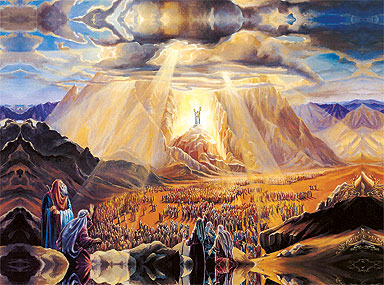
Image from www.peterolsenart.com

Deuteronomy/Davarim 33

THE BLESSING OF MOSES

The Song opens the final day of Deuteronomy, and in the course of that day the long-expected summons comes.  ‘The whole people understand the mysterious doom, and line the route by which Moses sets out on the journey from which there will be no return.  Like a father laying his hands from a death-bed on the heads of the children, the departing Leader blesses the several tribes, as he passes along; then turning to behold the whole multitude for the last time, Moses lifts his hands in general blessing:

“There is none like unto God, O Jeshurun,
Who rideth upon the heaven as thy help,
And in His excellency on the skies.  
The eternal God is a dwelling place,
And underneath are the everlasting arms.”
 

Simple, bare prose tells the rest: the solitary ascent into the mount the long gaze over the Land of Promise, the death.  But no wealth of poetic imagination could have made a close for Deuteronomy more harmonious with the body of the book.  The life of the lonely Leader has passed out into solitude: and “no man knoweth of his sepulchre unto this day”‘ (Moulton).


1 Now this is the blessing 
with which Moshe the man of God blessed the Children of Israel 
before his death.

and this is the blessing.  This blessing is a complement as well as a counterpart to the Song in the preceding chapter. Whereas the Song is an admonition, depicting the calamities that were to befall a wayward and disloyal Israel, here is all blessing, foreshadowing a bright and happy destiny.  As to form and contents, it is modelled on the Blessing of Jacob; Gen. XLIX.

the man of God. Moses is given this title in Josh. XIV,6, and in the heading of Psalm XC, ‘A Prayer of Moses the Man of God.’ The title is sometimes applied to the Prophets; e.g. I Sam. IX,6.

before his death.  Just prior to his death, probably the very day on which he died; Gen. XXVII,7.

2-5.  INTRODUCTION

God, revealing Himself majestically unto His people in the desert, gave them a Law through Moses, and united the tribes with God as their king.  A similar opening is found in Judges V, Habakkuk III, and Psalm LXVIII.

The happiness and felicity of the tribes of Israel is all traced back to the Divine Revelation which God bestowed upon His people, as He came with them through the wilderness.

2 He said: 
YHVH from Sinai came, 
he shone forth from Se’ir for them, 
radiating from Mount Paran, 
approaching from Rivevot Kodesh, 
at his right-hand, a fiery stream for them.

the LORD came from Sinai. The mountain of Revelation, to make His abode in Israel’s midst. Sinai was the starting-point in the manifestation of the Divine glory to Israel.

and rose.  A metaphor of sunrise.  God had ‘dawned’ on them; had ‘risen’ for them, and had shed forth the light of His Law upon Israel, so that henceforth they walked in His light.

from Seir.  The hill-country of Edom, to the east of Sinai.

mount Paran.  Perhaps the mountain-range forming the southern boundary of Canaan.  The Divine Presence journeyed, as it were, with Israel from Sinai, through Seir, through Paran, and then finally through the desert; aiding and guarding them even until they became established in the good inheritance Divinely promised to the Fathers.

holy.  Better, of holy ones. As in Psalm LXVIII,18, God is here poetically depicted as coming forth from the angelic hosts that surround His throne.

a fiery law.  A Law given out of the midst of the fire (Deut. V,19-23, Targum); ‘a Law of fire’ (Mendelssohn, Hirsch).  This translation takes the Heb. with the Massoretes, as two words. The second of three words, ‘Law’, however, occurs only in the latest books of Scripture.  Many translators, therefore, follow the Kethib and translate the phrase ‘at His right hand were streams for them.’

3  Though he has-affection-for the peoples, 
all his holy-ones (are) in your hand,
they place themselves at your feet, 
bearing your words.

He loveth the peoples, i.e. the tribes of Israel; Gen. XXVIII,3.  If the word ‘peoples’ is taken literally, the meaning is that, although the Divine Law was given to Israel alone, God’s love embraces all peoples.  ‘The LORD is good to all; and his tender mercies are over all His works’ (Ps. CXLV,9).

His holy ones.  Either of the ‘tribes’, or of the peoples.  If the latter, then the good and pious of all nations are meant, as well as of Israel.  RV has ‘his saints’; i.e.  Israel’s Saints.

are in Thy hand. Under Thy protection and guardianship.

they sit down at Thy feet.  Like pupils in the presence of the master, ready to receive instruction.

receiving of Thy words. The next v. defines ‘Thy words’, i.e. ‘the Law which Moses commanded us, as an inheritance of the congregation of Jacob.’

4  Instruction did Moshe command us, 
a possession the assembly of Yaakov.

inheritance.  ‘Better, heritage. The latter may be spent by the heir at his discretion.  An inheritance, however, is an entailed estate, inalienable, and must remain in the family, to be handed on from father to son undiminished.  Such is the Torah unto Israel.  It is transmitted from age to age and generation to generation, so that it is never forgotten.

the congregation of Jacob.  The words of this verse have deservedly become a national motto in Israel.  They form part of the little child’s Morning Prayer.

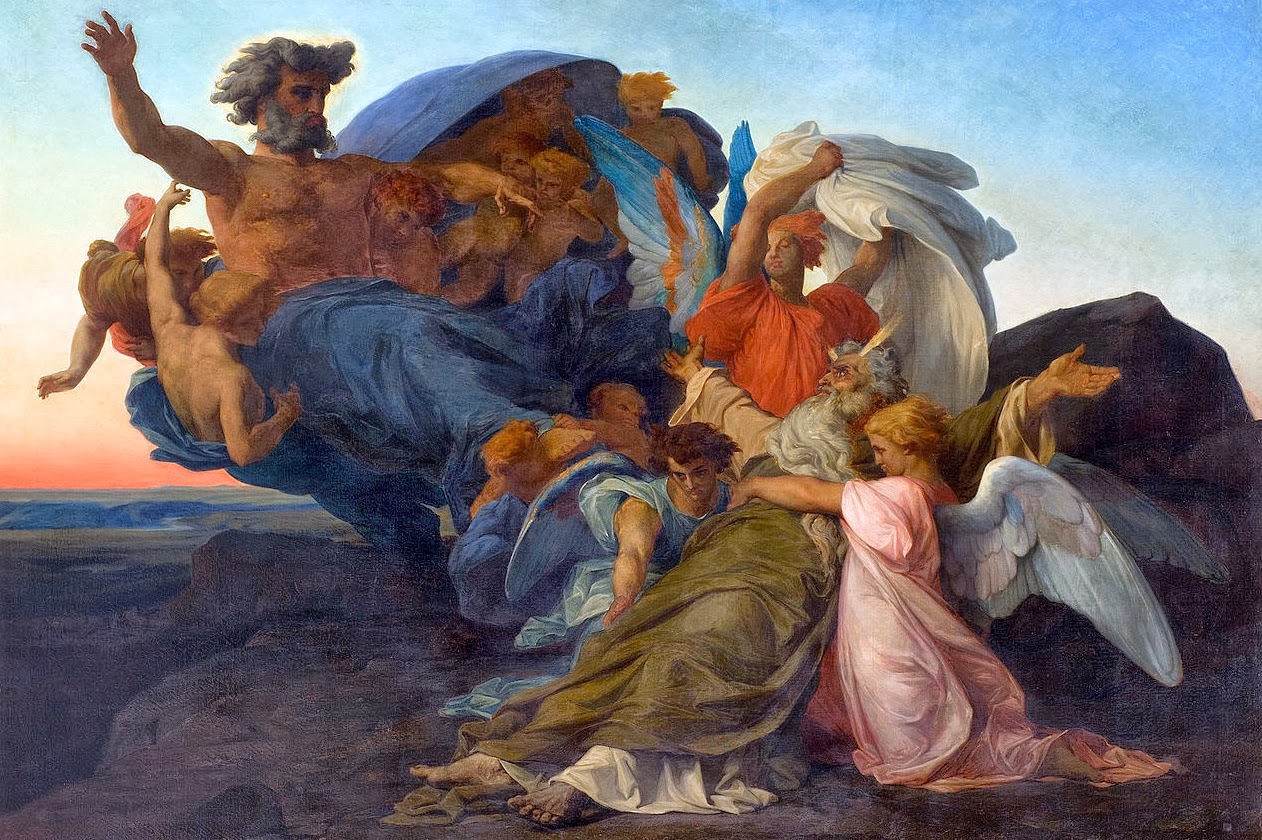
5  Now he became king in Yeshurun 
when there gathered the heads of the people, 
together, the tribes of Israel!

and there was a king in Jeshurun.  Thus began God’s Kingdom over Israel.

all the tribes of Israel together.  In the presence of the whole People gathered together to enter into the covenant at Sinai.

The above section, especially v. 1-3 is among the most difficult passages in Scripture.  The different translations are, therefore, both numerous and uncertain.  In a popular commentary it is not possible to take note of them all.

6-25.  the blessings of the tribes
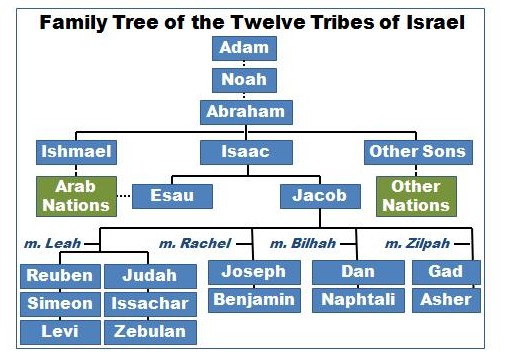
Image from www.picstopin.com

6.  Reuben

6  May Re’uven live and not die, 
but let his menfolk be few-in-number.

let Reuben live.  The Heb. idiom is equivalent to ‘long live Reuben’, or, ‘God save Reuben’ (as in I Kings I,25).

and not die. Living in Transjordania, he was exposed to constant attacks from numerous enemies.

n that his men become few.  Let not the death of Reuben take place through a diminution in his numbers.  At the first census taken in the time of Moses, the number of Reubenites capable of bearing arms was 46,500 men (Num. I,21). At the second, it had dwindled to 43,730 men (Num. XXVI,7).  In David’s time much of their territory was conquered by the Moabites.  Mesha, in the 9th century, B.C.E., when describing his victories against the Eastern tribes, does not even mention the tribe of Reuben.

7.  JUDAH

7 And this to Yehuda, he said: 
Hearken, O YHVH, to the voice of Yehuda, 
to his kinspeoplebring him, 
his hands’-strength great for him. 
A help against his foes may you be!

hear, LORD, thew voice of Judah. ‘Hear, O LORD, the prayer of Judah when he goeth forth to battle; and bring him back to his people in peace’ (Onkelos).  Judah was the first to undertake the conquest of the unconquered portion of Palestine; and for some time, his posessions were an enclave, surrounded by the Canaanites.  Hence this prayer that he be united to the other tribes.

his hands shall contend for him.  He needs and deserves Divine help, as he will be fighting the fight of all Israel.

8-11. LEVI

We note the omission of Simeon, who is joined with Levi in Jacob’s Blessing, Gen. XLIX,5.  The probable explanation is that Jacob had foretold that both Simeon and Levi should have their territories divided up among the other tribes.  As Simeon’s possessions consisted of only 19 unconnected cities within the territory of Judah (Josh. XIX,2-9), the tribe of Simeon was regarded as included in Judah.

In blessing Levi, Moses prays that the privilege of guarding the Urim and the Thummim may remain with Levi, who had proved his fidelity to the Divine cause in the Wilderness.

8 To Levi he said: 
Your Tummim and your Urim for your loyal man,
 whom you tested at Massa/Testing, 
you quarreled with him by the waters of Meriva/Quarreling.

thy Thummim and thy Urim.  Objects connected with the breast-plate of the High Priest.

holy one. i.e. the tribe of Levi, personified as an individual.

didst prove.  At Massah (Exod. XVII,1-7) and at Meribah (Num. ,1-13), when the piety of Moses and Aaron, the two great sons of Levi, was put to a severe test.

9  Who says of his father and of his mother: I have not seen them, 
his brother he does not recognize, 
and his children he does not acknowledge- 
for they have guarded your sayings, 
your covenant they have watched over.

who said of his father . . . children. This describes in emphatic language the disinterested spirit in which the tribe of Levi discharges its office: the disregard of even the closest family ties when they interfere with the performance of religious duties.  Thus, the Levites slew every man his companion and every man his neighbour, as a punishment for their worship of the Golden Calf; Exod. XXXII,27.

and keep Thy covenant. See Mal. II,5-7 (‘My covenant was with him of life and peace . . . The law of truth was in his mouth, and unrighteousness was not found in his lips; he walked with Me in peace and uprightness, and did turn away many from iniquity.  For the priest’s lips should keep knowledge, and they should seek the law at his mouth’).

10 Let them instruct your regulations to Yaakov, 
your Instruction to Israel, 
putting smoking-incense in your nostrils, 
and complete-offerings on your slaughter-site.

Thine ordinances. Such being the Levites’ record, they are worthy of having the prerogative of teaching Israel the precepts of God as laid down in the Torah, and designed for the maintenance of justice between man and man.  The God of Israel ‘is distinguished from the gods of Israel’s neighbours, and towers above them as the God in Whose name justice was administered, and of Whom it could be said that He was not known where the laws of honour and good faith were violated.  The priest, His interpreter, is the bearer and appointed upholder of right’ (Kuenen).

they shall put . . . upon Thine altar. In addition to being the guardians and teachers of right in Israel, theirs is the charge of the Altar.

11  Bless, O YHVH, his wherewithal, 
and the works of his hands, accept-with-favor; 
smash the loins of those rising up against him, 
those hating him, from rising up!

his substance. Better, his might (Driver); i.e. his ability for the efficient performance of his duties.

the loins.  The seat of bodily strength.

them that hate him. Those whoa re opposed to the priestly prerogative, like Korah (Num. XVI).

12.  BENJAMIN

12  To Binyamin he said 
The beloved of YHVH! He dwells securely upon him,
 he surrounds him every day, 
as between his shoulders he dwells.

the beloved of the LORD.  Even as Benjamin was the favourite of Jacob, Moses sees in that parental love for Benjamin a reflection of God’s love for that tribe.

shall dwell in safety by Him.  God shall ever be at the side of Benjamin to aid and shield him. Rashi explains this ‘nearness’ of Benjamin to God to mean that the Temple would be situated in his territory. The Temple itself was just within the rocky border of Benjamin, whilst its courts were in Judah.

He covereth him. As with a canopy.

all the day.  For ever.  Once Jerusalem—which was in Benjamin’s territory—had been chosen as the spot for the Sanctuary, the Shechinah never left it for another spot.

between his shoulders. Josh. XV,8 uses the same Hebrew word for ‘shoulder’ to denote the side of the hill on which Jerusalem and the Temple were to stand.

13-17. JOSEPH

The twin tribe, Ephraim and Manasseh, receives the temporal blessings of fertility of soil and military prowess, accompanied by uninterrupted enjoyment of the Divine favour.

13 To Yosef he said :
Blessed by YHVH be his land, 
from the excellence of the heavens, from dew,
from Ocean crouching below,

the precious things of heaven. The gifts of nature—rain, sunshine, warmth—that are indispensable for fertility.

for the dew. Isaac’s blessing of Jacob (Gen. XXVII,28). ‘God gave thee of the dew of heaven.;

for the deep. The fountains and floods which spring up from the depths of the earth.

coucheth. Old English for ‘croucheth’.

14 from excellence of the sun’s produce
from excellence of the moon’s crop.

fruits of the sun. Every form of yearly produce matured by the light and warmth of the sun.

yield of the moons. ‘The produce of the months’; i.e. the fruit and vegetation of successive seasons.

15  And from the tops of the ancient hills, 
from the excellence of the age-old mountains,

tops of the ancient mountains. The vegetation which so luxuriantly adorns the peaks and slopes of the mountain-ranges of Palestine.

16  from the excellence of the land and its fullness, 
the favor of the Seneh-bush Dweller; 
may it come on the head of Yosef, 
on the brow of the consecrated-one among his brothers.

precious things of the earth. After speaking of the fertility of the hills and mountains, the Seer turns to the precious products of the plains and valleys.

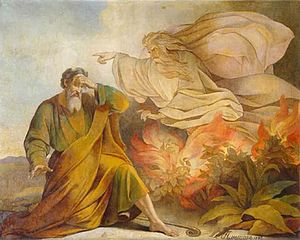
that dwelt in the bush. See Exod. III,2-10, where God after making Himself known to Moses ‘in a flame of fire out of the midst of a bush’, promises to become the Redeemer of Israel.

prince among his brethren. Eminent among his brethren; the last two lines (in the English) are a quotation from Gen. XLIX,26.

17  His firstling bull-it has splendor, 
the horns of the wild-ox, his horns;
 with them he shall gore the peoples together, the ends of the earth. 
They are the myriads of Efrayim, they are the thousands of Menashe.

firstling bullock. i.e. Ephraim, to whom Jacob had given the precedence over the elder brother Manasseh; Gen. XLVIII,19.

and his horns. The figure of the bull is here employed as the emblem of strength.

wild-ox. See on Num. XXIII,22.

he shall gore.  Ephraim shall extend his conquests over remote peoples.

and they are. Better, and these be; i.e. the reference to the myriads of the men of Ephraim, and the thousands of the men of Manasseh.

18a.  ZEBULUN

18 To Zevulun he said :
Rejoice, O Zevulun, in your going-out, 
and Yissakhar, in your tents.

going out. i.e. general activity; here probably a reference to the maritime enterprises of the tribe.  The territory of Zebulun stretched from what is now known as Lake Tiberias to the Mediterranean, which fact gave it an active share in the sea-traffic.  Jacob’s blessing is: ‘Zebulun shall dwell at the shore of the sea, and he shall be a shore for ships.’

18b. ISSACHAR

in thy tents.  In the enjoyment of rest; in the quiet pursuit of a peaceful life, possibly an agricultural one.  While Zebulun chose adventure and enterprise, Issachar preferred a ‘stay-at-home’ existence.  The Talmud interprets ‘tents’ as homes for the study of the Law.  In I Chron.XII,32, the men of Issachar are said to have been the religious teachers in Israel. Scripture here links Zebulun, the merchant and man of action, with Issachar, the student, the man of spirit; as if to show how necessary it is that these two types should always work in cooperation.

19  Peoples they will call to the hills, 
there they will slaughter slaughter-offerings of victory,
 for the abundance of the seas they will suck, 
the hidden treasures of the sand.

call peoples.  They shall invite the tribes to join them in thanksgiving to God.

the mountain. Zion, the place which God shall choose as His sanctuary.  This is nowhere expressly named in Deuteronomy, and is here likewise left undefined.

sacrifices of righteousness.  Due, fitting, legal sacrifices; Ps. IV,6.

for. Gives the reasons why the two tribes invite ‘the peoples’ to worship; it is because of the rich blessings which Zebulun and Issachar enjoy.

suck . . . the seas. A reference to Zebulun’s fishing and sea-carrying trade.

hidden treasures of the sand. Probably a reference to Issachar’s manufacture of glass which, according to Josephus, Targum Jonathan and Talmud, took place on the sands of Acre.

20-21. GAD

20 To Gad he said:
Blessed be he that expands Gad, 
like a king-of-beasts he dwells, 
tearing arm, yes, (and) brow.

that enlargeth God. Gad’s territory was east of Jordan—the territory of Sihon, king of the Amorites, and was larger than the territory of any of the Western tribes. Gad’s ‘enlarger’ is God.

as a lioness. Gad was famed for courage and success in war; I Chron. II,9.

arm . . . crown.  The hosts of his enemies . . . and their leaders.

21  He selected a premier-part for himself, 
for there a portion for a ruler was reserved; 
he approached (with) the heads of the people,
the justice of YHVH did he do, his regulations along with Israel.

and he chose a first part. Gad is praised for his foresight in being the first of all the tribes to choose his territory; Num. XXXII,1.

portion of a ruler. Or, ‘commander’s portion,’ a district worthy of a martial leader.  The meaning of this and the following line is very uncertain.

there came the heads. He took his part in the conquest of Western Palestine.

he executed the righteousness of the LORD. He (Gad) fulfilled that which he had promised; viz.  to cross the Jordan and assist the other tribes to dispossess their enemies (Num. XXXII,31).  This is probably a case of the Perfect of certainty–the future action being viewed as past.  In this way he did his duty in carrying out the righteous will and ordinances of God, who had decreed that Israel should inherit the land of Canaan.

22.  DAN

22  To Dan he said: 
Dan is a whelp of lions leaping forth from Bashan.

lion’s whelp.  In the Blessing of Jacob (Gen. XLIX,17), Dan is compared to a serpent for mischievous subtlety. Here he is spoken of as a lion for agility, as a young lion leaping forth from the crevices and caves of the rocks of Bashan, a land celebrated for the size and strength of its cattle (Deut. XXXII,14).  Both similes refer to the nimbleness and adventurous spirit for which the tribe of Dan was celebrated.  Samson was a Danite.

23.  NAPHTALI

23  To Naftali he said: 
Naftali is sated with favor, 
full with the blessing of YHVH; 
(of) sea and southland taking-possession!

satisfied with favour. Satiated with good will. ‘Ancient and modern writers vie with one another in praising the soil and climate of the territory owned by Naphtali’ (Driver).

possess thou the sea. The sea of Kinnereth; i.e. Lake Tiberias.

the south. On the west side of the sea of Kinnereth, Naphtali’s territory was ‘so styled in contrast to the main possessions of the tribe which were further north’ (Driver).  Its soil was specially fruitful in the region of Hulch and on the shore of the sea.  The ‘fruits of Kinnereth’ are celebrated in the Talmud.

24-25. ASHER

24  To Asher he said: 
Most blessed of sons, Asher! 
May he be the favored-one of his brothers, 
dipping his foot in oil.

blessed be Asher above sons. An exposition of the meaning of the name Asher (‘happy’).  He was to be blessed ‘above sons’; i.e. to enjoy exceptional prosperity.

the favoured. Favoured of his brethren, so that they delight in his good fortune.

dip his foot in oil. A metaphor for great abundance.  The olive tree was specially fruitful in the territory of Asher.

25  Iron and bronze your bolts, 
and as your days, your strength

iron and brass shall be thy bars. Asher’s dwelling shall be impregnable. His territory being in the far north and also on the sea-coast, it needed to be strongly fortified.

as thy days, so shall thy strength be.  ‘May your strength last like your days’ (Moffatt); or, ‘as thy younger days, so shall thy old age be’ (Leeser).

26-29. EPILOGUE: GOD, THE ABIDING SOURCE OF ISRAEL’S SECURITY, PROSPERITY AND VICTORY

Like the introductory section, v.2-6, the epilogue celebrates the felicity, material and spiritual of the nation as a whole, through the goodness and protecting care of God.

26  There is none like God, O Yeshurun, 
riding (through) the heavens to your help, 
in his majesty in the skies.

there is none like unto God, O Jeshurun. ‘There is no God but the God of Israel’ (Onkelos).

rideth upon the heaven as thy help. The Seer compares God to a king in his chariot, and he sees God ride upon the heavens to bring victory to Israel.

in His excellency.  In His loftiness and surpassing grandeur.

27  A shelter is the Ancient God, 
beneath, the arms of the Ageless-one. 
He drove out from before you the enemy, 
saying, “Destroy!”

the eternal God is a dwelling-place. He is Israel’s home and refuge; even, as Moses himself declares, ‘Lord, Thou has been our dwelling place in all generations’ (Ps. XC,1).

the everlasting arms. i.e. arms whose strength shall never be exhausted.  He who is enthroned in heaven above is also the God who is with His people below. ‘When thou passest through the waters, I will be with thee, and through the rivers, they shall not overflow thee; when thou walkest through the fire, thou shalt not be urned, neither shall the flame kindle upon thee ‘ (Isa. XI, III,2).  Not only is God a dwelling-place for His people, He is their unfailing support.  His everlasting arms, which do not grow weary, are ever bearing them up and sustaining them.

He thrust out the enemy from before thee.  God proved that He is His people’s everlasting Friend and Helper by the fact that He dislodged their enemies.

28 So Israel will dwell in security,
 alone, the fountain of Yaakov,
in a land of grain and new-wine;
 yes, his heavens drop down dew.

dwelleth in safety  . . alone. ‘Every individual Israelite would dwell in isolated security each one singly under his vine and under his fig-tree.  There would be no need to mass themselves together for self-protection against any external enemy’ (Rashi)

the fountain of Jacob.  ‘The succession of generations in Israel figured as a stream ever welling forth freshly from its source’ (Driver).

29 O your happiness, Israel, 
who is like you, a people delivered by YHVH, 
your helping shield, who is your majestic sword! 
Your enemies shall come-cringing to you, 
and you-on their backs you will tread!

Image from amazon.com –

who is like unto thee?  What nation on earth is like unto Israel! A unique people, in the are of a unique God.

saved. Victorious, and not by the weapons of war, but by the protecting love of God.

that is the sword of thy excellency. God’s protection of Israel is Israel’s excellent and triumphant sword.

shall dwindle away. Or, ‘shall yield feigned obedience’ (RV); the insincere homage rendered by the vanquished to the conqueror.

tread upon their high places. See on XXXII,13.

‘With such golden words Moses takes leave of his people.  Israel should have been a brave mountaineer people, if Moses’ will had been fulfilled.  The land lies apart, surrounded by mountains, seas and deserts—a Divinely blessed corner of the earth that, with industrious cultivation and the security that comes from unity, could have flourished wonderfully. To the north and south of Judea were the trade routes of the ancient world.  By its very position alone, it could have become the happiest people of the world, if it had made use of its position and remained faithful to the spirit of its Laws’ (Herder).
Deuteronomy/Davarim 32: "at-a-distance you shall see the land, but there you shall not enter"

[Just as Miriam broke out in song during the exodus, here Moshe does the same. This song, says the commentator, is a ‘didactic ode’.  


Man oh man, what a cultured and educated leader was Moshe and why should he not be?  After all he grew up in the Pharaoh’s palace, was a prince of Egypt before his fortune changed to being a refugee from justice; then became a shepherd, then was called to be the leader of Israel and spokesman for God.  He could read, he could write not only laws and instructions dictated by the Revelator; in time he could orate and by the end of his life he’s writing a ‘didactic ode’, a ‘song of praise and triumph’!  


Could the Revelator, the God of Israel, have chosen a better mouthpiece-mediator-prophet?  From babyhood, it seems Moshe was prepared for this very role for 80 years (40 in palace, 40 as shepherd) prior to his call.  

Image from nataliehart.com

Sinaites had a discussion about ‘destiny’ or ‘fate’ and self-determination.  Was Moses destined for this very role? It appears so, after all he was saved from death by the choice of 2 Hebrew midwives.  After all he did not choose to be adopted by an Egyptian princess that was the princess’ choice; and being placed on water for the princess to discover him was his mother’s choice.  Later he did choose to get himself out of his privileged position by killing an Egyptian which made him flee into the wilderness and live the life of a shepherd.  Then he saw the burning bush, met YHWH, was commissioned to liberate and lead the children of Israel.  


Destiny or self-determination? 

In our individual lives we see a confluence of both . . . God’s hand as well as our hand at different points of our journey.  We figure, anyone who is God-conscious seeks God actively and will eventually be used for His purposes.  


We Sinites have ventured into one religion to another and ventured out of religion altogether to return to the God who spoke on Sinai.  To this day, we are still listening to the Words of YHWH, through His mouthpiece Moshe.  Are we in the same position as Moshe, be mouthpieces for our God?  Of course, given any opportunity to explain or defend our faith to whoever is genuinely interested, though there are few takers in our circles of influence; hence this website.


While this chapter as well as the whole Torah is all about Israel, as gentiles looking in and learning from Israel’s ups and downs, victories and failures, interrelationship with their God and the leader appointed till this point of their nation’s history, there is so much to learn.  


More than knowing about Israel, the biggest blessing is getting to know Israel’s God, the best knowledge anyone could possibly gain.  There is no need to speculate about the nature, attributes, names, character of this God — He is talkative ! He is not secretive!  What He wants man to know, He says so, not once, not twice, but repeatedly through His mouthpieces all over the Hebrew Scriptures.  There is no shortage of revelation about Him, except for that He chooses not to reveal in His Wisdom.  But for guidance for all humanity?  He’s spoken loud and clear.  Hear, HEAR, HEAR!


Commentary here is from the best of Jewish minds as collected in one resource book by Dr. J.H. Hertz, Pentateuch and Haftorahs; our translation of choice is EF/Everett Fox, The Five Books of Moses.Admin1.]

——————————————–

Dabariym 32

THE SONG OF MOSES

1-44.  Moses began his ministry at the Red Sea with a song of praise and triumph, and he ends his life of service to God and Israel with another hymn of joy on the banks of Jordan, and in view of the Promised possession.  Both songs are an anticipation of the glorious future beyond the wilderness-life.  The majestic Farewell Song, distinguished by fire, force, and the sweep of its rhetoric, is a didactic ode.  Moses takes his stand in the spirit at a point of time long subsequent to his own death: he makes a retrospective survey of Israel’s history, and develops the lessons deducible from it.  The result is a vindication of the ways of God in His relations to Israel.  The Divine lovingkindness and unchanging faithfulness are contrasted with Israel’s faithlessness and ingratitude.  God is the loving father, whereas Israel is the wayward, disobedient child.  The successive disasters which would befall Israel are a just retribution for his senseless and ungrateful conduct.  But let not the heathen exult and say that Israel lies helpless and crushed.  God would in the end intervene for Israel, and the Lawgiver calls upon the nations to rejoice in the salvation of the People of God.


1-3.  APPEAL TO UNIVERSE FOR ATTENTION

Give ear, O heavens, that I may speak, 
hear, O earth, the utterance of my mouth.

give ear ye heavens, and I will speak. He appeals to heaven and earth as eternal witnesses of the Divine truths he is about to declare; see XXX,19; Isa. I,2.

Image from www.phistars.com

2 Let my teaching drip like rain, 
let my words flow like dew,
like droplets on new-growth, 
like showers on grass.

doctrine. Better, teaching, message or instruction; Prov. IV,2.  The message conveyed by the Song shall, like rain and dew falling on plants, penetrate to the hearts of the Israelites; refresh, stimulate, and give birth to a new spiritual life.  The Song, therefore, is not only one of warning, but of comfort also, to awaken new hope in a suffering Israel.

distil as the dew.  God’s word is as the dew which, though it falls gently and unheard, yet has a wonderful reviving power; Micah V,6.

small rain. The tender grass needs the small drops for its revival.  Even so is the Divine teaching tempered to meet the wants of the weak and the young.

showers upon the herb.  The grown-up grass need the strong forceful showers.

3 For the name of YHVH I proclaim, 
give greatness to our God! 

the name of the LORD. This v. states the reason of the invoking of heaven and earth in v. 1, and the wish expressed in v. 2.  He will proclaim the Name of the LORD; i.e. His character as revealed in His dealings with Israel.

4-6.  GOD’S FAITHFULNESS AND ISRAEL’S FOLLY

A contrast between the unchangeable rectitude of God and the fickle behavior of His people.

4 The Rock, whole-and-perfect are his deeds, 
for all his ways are just. A God steadfast, (with) no corruption, 
equitable and upright is he.

‘This v. gives a concise and forcible declaration of the ethical perfection of God, maintained by Him uniformly in His moral government of the world’ (Driver).

the Rock.  ‘Nine times in the course of this single hymn is repeated this most expressive figure, taken from the granite crags of Sinai, and carried thence through psalms and hymns of all nations, like one of the huge fragments which it represents, to regions as remote in aspect as in distance from its original birthplace’ (Stanley).  It denotes the Divine unchangeableness and its refuge for men.  Ages pass away, but the rock remains a place of safety in time of storm and flood.

perfect. Irreproachable.

a God of faithfulness.  ‘Faithful to give the righteous his due reward in the life after death.  Even though to our seeming this reward be unduly delayed in its coming, God will certainly keep faith in bringing it to pass’ (Rashi).

iniquity. Better, injustice.  Maimonides makes the recognition of the justice of God one of the fundamental principles of the Jewish Faith, even as the Rabbis make it one of the fundamental duties of the Jew.

5 His children have wrought-ruin toward him-a defect in them, 
a generation crooked and twisted!

His children’s is the blemish.  The Heb. Text is very difficult, and the Ancient Versions render little help.  M. Friedlander took a parallel form  with the meaning of ‘fault-laden’: ‘Is corruption His? No, O ye His fault-laden children, ye perverse and crooked generation.’

The sinning of Israel is not a blemish upon the goodness of God.  He gave them a Law which would render them happy, but they chose sin and its subsequent sorrows (Leeser).

6 (Is it) YHVH whom you (thus) pay back, 
O people foolish and not wise? I
s he not your father, your creator, 
he (who) made you and established you?

requite. Will ye thus treat your Father and Benefactor?

gotten thee.  lit. ‘acquired thee,’ by delivering them out of Egypt.

hath He not made thee? Constituted thee a nation (Rashi).

and established thee.  Set thee upon a firm basis, so as to play a great and lasting part in world-history.

7-14.  THE LESSON OF HISTORY

7 Regard the days of ages-past, 
understand the years of generation and generation (ago);
 ask your father, he will tell you, your elders, 
they will declare it to you:

the days of old.  The story of Israel’s birth as a nation.

many generations.  Or, ‘each generation.’

father . . . elders.  The depositaries of religious tradition.

[S6K note:  See post THE HALLOWING OF HISTORY]

8-14.  THE ANSWER OF THE FATHERS AND ELDERS

When God first allotted the nations a place and a heritage, as described in Gen. X and XI, He had respect to the special necessities of the Israelites.

8 When the Most-high gave nations (their) inheritances, 
at his dividing the human-race, 
he stationed boundaries for peoples 
by the number of the gods.
9 Indeed, the portion of YHVH became his people, 
Yaakov, the lot of his inheritance.

for the portion of the LORD is His people. Israel belonged to God in a more intimate sense than any other ethnic group.

10 He found him in a wilderness land, 
in a waste, a howling desert. 
He surrounded him, he paid-him-regard, 
he guarded him like the pupil of his eye;

He found him in a desert land.  This v. and those immediately following depict God’s fatherly care of Israel.  Israel is represented as an abandoned, starving child left to die in the wilderness (Ezekiel XVI,3-6).  God finds and rescues him.  Israel’s history begins with the forty years’ march through the desert—where he must have perished, had not God supplied the food and the necessary protection.

howling wilderness.  Where wild beasts howl.

compassed him about. By a pillar of cloud by day, and a pillar of fire by night.

cared for him.  Or, ‘gave him understanding’ (Onkelos, Rashi); Israel’s spiritual wants were cared for, inasmuch as he received the Law in that desert.

the apple of His eye. The pupil of his eye; the Heb. phrase is equivalent to the English ‘as his very life.’

11 like an eagle protecting its nest, 
over its young-birds hovering, 
he spread out his wings, he took him, 
bearing him on his pinions.

as an eagle. God’s loving care for Israel is likened to the tender affection that is shown by the eagle towards its young when it teaches them to fly.

stirreth up her nest.  When the time comes for the young to leave the nest, the mother-bird does not rouse them suddenly, but strikes her wings against the surrounding branches.  Having thus gently awakened them, she ‘stirs up’ the nest, and allures them to imitate her fluttering in flight.

hovereth over her young. She hovers over them in loving solicitude, and has her wings in readiness to catch them, should they become exhausted.

spreadeth abroad her wings, taketh them. If the young are too weak or too timid to fly, the eagle takes them upon her outspread wings and carries them—a picture of the fostering care, the discipline and training to independence, that Israel received at the Divine hands.

12 YHVH alone did lead them,
 not with him any foreign god!

13-14.  Israel would enjoy all the luxuries of a pastoral people in abundance.

13 He had them mount on the high-places of the land, 
he fed them the crops of the field; 
he suckled them with honey from a boulder, with oil from a flinty rock;

ride on the high places.  A figure of speech denoting the triumphant and undisputed possession of the land, even of its high mountain fastnesses, which the Prophet-poet foresees as an accomplished fact.

of the earth.  Better, of the land.

honey . . . rock.  Even from the rocks He had given them honey, and the flinty soil produced the olive tree.  Palestine is by its flora (it has 3,000 species of flowers), and by its innumerable caves and fissures of the dry limestone rocks, well suited to honey-culture.

suck. Enjoy with relish.

14 on curds of cattle and milk of sheep, 
along with the milk of lambs and rams, 
of the young of Bashan and he-goats, 
along with the kidney fat of wheat, 
and blood of grapes, you drank fermented (wine).

curd of kine . . . wine.  The very products for which the Trans-Jordanic lands they had just conquered were famous.

Bashan. Famous for its cattle.

the kidney-fat of wheat.  The best and the most nutritious wheat, even as the fat of the kidneys is the choicest of fat.

15-18.  ISRAEL’S INGRATITUDE

15 But Yeshurun grew fat and kicked, 
you were fat, you were gross, you were gorged, 
he forsook the God that made him, 
and treated-like-a-fool the Rock of his deliverance.

Jeshurun. This title of honour for Israel is formed from the root ‘to be righteous,’ and designates Israel under its ideal character as’ the Upright One’.  It is used here ironically as a rebuke to Israel’s ingratitude and perfidy.

waxed fat, and kicked.  Like an ox grown intractable through good feeding, and refusing to bear the yoke of the master.

become gross. Or, ‘wast gorged with food’ (Driver).

contemned. lit. ‘and treated as ‘a senseless person who only deserves contempt. ‘How often in their superstition do men act as if God could be tricked; and in their immorality, as if He were senseless’ (G.A. Smith).

16 They made-him-jealous with alien (gods), 
with abominations they vexed him.

roused Him to jealousy.  See IV, 24.  

strange gods.  False gods, served with ‘abominations’, i.e. wicked and idolatrous practices.

17 They slaughtered (offerings) to demons, no-gods, 
gods they had not known; n
ew-ones from nearby came, 
of whom your fathers had no idea.

demons.  In Assyrian, shidu are the demi-gods usually represented by the bull-colossi in front of palaces.

new gods. Upstart deities recently invented or imported.

dreaded not.  The Heb. verb is from the root ‘hair’; gods in whose presence your fathers ‘shuddered’ not, and the hair of their head did not stand on end (Sifri, Rashi).

18 The Rock that birthed you, you neglected, 
you forgot the God that produced-you-in-labor.

of the Rock that begot thee. . . bore thee.  A figure as bold as it is beautiful.  God is represented as a Father, to whom Israel owed its existence as a people; and, at the same time, as a Mother, travailing with her infant, and forever watching over it with tender affection.

19-25.  THE MERITED PUNISHMENT

19 When YHVH saw, he spurned (you), 
from the vexation of his sons and daughters.

provoking.  Vexation, disappointment at the unmerited dishonour.

20 He said: I will conceal my face from them, 
I will see what is their future.
Indeed, a generation of overturning are they, 
children in whom one cannot trust.

hide My face.  Leave them to themselves.

a froward generation. lit. ‘a generation given to perverseness,’ i.e. evasions of truth and right; a falsehood-loving race (Driver).

no faithfulness.  No loyalty to a tender Parent.

21 They made-me-jealous with a no-god, 
vexed me with their nothingnesses; 
so I will make-them-jealous with a no-people, 
with a nation of fools I will vex them!

vanities.  lit. ‘breaths’—something insubstantial, vaporous, unreal; hence false gods.

no people.  Measure for measure.  Just as they had angered God by adopting a no-god, so would God anger them by bringing against them a no-people; i.e. a horde of barbarians.

a vile nation. Or, ‘foolish nation’ (RV).  Ignorant, and hence, barbarous and inhuman in its habits and methods (Ibn Ezra). And this people will win successes over Israel!

22 For fire is kindled in my nostrils, 
it burns (down) to Sheol, below, 
devouring the earth and its yield, 
setting-ablaze the hills’ foundations.

setteth ablaze. . . mountains.  Possibly a reference to volcanic activity, conceived as an expression of Divine anger.

23 I will sweep them away with evils, 
my arrows I will spend against them.

spend Mine arrows. Exhaust the whole quiverful of evils upon them.  ‘The evils, like arrows, fall suddenly upon their unprotected victims’ (Ibn. Ezra).

24 Drained by Famine, 
deprived-of-food by Fiery-plague and Bitter Pestilence; 
the teeth of beasts I will send out against them, 
along with the hot-venom of crawlers in the dust.

fiery bolt.  Of fever. Others understand as fiery darts that produce pestilence; Hab. III,5.

bitter destruction. Deadlly pestilence and malignant plague.

25 Outside, the sword bereaves, 
in rooms-within, Terror! 
(Destroying) young-men and virgins alike, 
nurselings along with men of gray-hair.

without  . . . terror.  War, the climax to these natural horrors.  Death will stalk through the streets and invade the homes.  Neither age nor sex is spared.

26-33.  THE STAY OF GOD’S VENGEANCE

God’s resolve on Israel’s annihilation was stayed by the consideration of the adversaries’ taunts.  Nothing could save Israel, but God’s respect for His own Name.

26 I would have said: I will cleave-them-in-pieces, 
I will make their memory cease from mortals,

I thought. Better,  I would have said.

make an end. Or, ‘cleave them in pieces.’

27 -except that I feared the vexation from the enemy, 
lest their foes misconstrue, 
lest they say: Our hand is raised-high,
 not YHVH wrought all this!

enemy’s provocation. The taunts of Israel’s foes.  They would fail to see God’s retributive justice in it all.

misdeem.  Misapprehend.

28 For a nation straying from counsel are they, 
in them there is no understanding.
29 If (only) they were wise, they would contemplate this, 
hey would understand their future!

If they were wise. If those enemies were wise, they would look at things in the right light, past their temporary triumph over Israel.  They would see their own inevitable undoing, as soon as Israel returned to God.

30 How can one pursue a thousand, 
two put a myriad to flight,
 unless their Rock had sold them out,
 YHVH had handed them over?

how should one chase a thousand. Their victory over Israel is not their work.  How should Israel be so completely crushed unless it were that God had abandoned His people?

31 For not like their rock is our Rock,
 though our enemies so-assess-it; 
indeed, from the vine of Sedom is their vine,

for their rock is not as our Rock.  ‘All this the heathens have understood; viz. that God had delivered Israel into their hands and that, therefore, the victory belonged neither to them nor to their gods’ (Rashi).

themselves being judges.  They must admit that such deeds as were performed by Israel’s God stand unrivaled; Exod. XIV,25.

32 from the fields of Amora, 
their grapes are grapes of poison,
 clusters bitter for them,

the vine of Sodom.  Neither is the victory over Israel due to God’s approval of the deeds and spirit of the heathens.  They are corrupt in root and fruit.  The nations are compared to a vine whose stock is derived from Sodom and Gomorrah; hence, tainted by the corruption of which these cities are a type.  Ancient writers (Strabo, Pliny, and TAcitus) speak of apples of Sodom that ‘have a colour as if they were fit to be eaten, but, if you pluck them with your hands, they dissolve into smoke and ashes’ (Josephus).

gall. Poison; XXIX,17.  The grapes on a vine of Sodom, are a mockery—fair outside, but ashes within.

33 the hot-venom of serpents their wine, 
the cruel poison of vipers.

asps.  Cobras, poisonous snakes.

34-43. THE LOT OF ISRAEL’S ENEMIES

34 Is this not laid up in store with me, 
sealed up in my treasuries:

is not this laid up in store with Me.  Such corruption and moral poison as is the life and example of the heathens could not remain forever unpunished.  God would, therefore, interpose on His people’s behalf.  The punishment to be meted out to Israel’s enemies has been duly written down and sealed in the Divine archives.

35 mine are vengeance and payback, 
at the time when their foot slips, 
for near is the day of their calamity,
 making haste, the things impending for them.

vengeance.  Is here used in the general sense of punishment.  God’s long-suffering towards the heathen doers of evil must not be taken for forgetfulness on His part.  Retribution would assuredly come.

against the time when.  As soon as.

the day of their calamity. The occasion of their sudden and irreparable disaster.

36-42.  Hitherto Moses spoke to the Israelites words of warning, so that the Song might testify against them in the day of their calamity.  In the remainder of this Song, he utters words of consolation—what would befall them, if they turned from their evil ways in consequence of the calamities that befell them (Rashi).

36 But YHVH will judge (in favor of) his people, 
regarding his servants he will relent, 
when he sees that strength-of-hand is gone, 
naught (left) of (both) fettered and free.

for the LORD will judge His people.  The very extremity of Israel’s need will move Him to vindicate Israel against foes and detractors.

and repent Himself for His servants. Or, have compassion on his servants,’ in their desolate and downtrodden state.

none remaining . . . large.  ‘Nothing is left, except the things imprisoned or abandoned’ (Luzatto).

shut up or left at large. Or, ‘bond or free’ (Gesenius).

37-39.  God would speak to them through the extremity of their need, bring them to own, by the logic of facts, that the gods in whom they trusted were unworthy of their regard, and so make it possible for Himself to interpose on their behalf (Driver).  Moses endeavours to strengthen ‘their faith in a moral government of the world . . . . In spite of the conditions which might well make men despair, the world was one in a Divine purpose.  And Israel, to whom this Divine purpose had been revealed, could endure through this dark night of the world.  It alone had hope, and men who can hope can endure’ (Welch).

37 He will say: Where are its gods, 
the rock in whom it sought-refuge,
38 that devoured the fat of their slaughtered-offerings, 
drank the wine of their poured-offerings? 
Let them rise up and help you, 
let them be over you a shelter!
39 See now that I, I am he, 
there is no god beside me; 
I myself bring-death, bestow-life,
 I wound and I myself heal,
 and there is from my hand no rescuing!

see now that I, even I, am He.  Let Israel now see from the calamities it has suffered and from what it has learnt of the utter helplessness of the idols and their worshippers, that the God of Israel is the only true God; and that with Him alone is the power of life and death.

40-42.  DIVINE RETRIBUTION ON ISRAEL’S FOES

40 For I lift up my hand to the heavens, 
and say: As I live, for the ages-

I lift up My hand to heaven. Equivalent to ‘I swear.’

as I live for ever. An emphatic variation of the usual phrasing of an oath, As I live.

41 when I sharpen my lightning sword, 
my hand seizes judgment, 
I will return vengeance on my foes, 
and those who hate me, I will pay back.

if.  When.

take hold on judgment. The figure is that of God marching forth as a warrior with justice (‘judgment’) as his invincible weapon.  the ‘judgment’ over the foes would be remorseless and complete.

that hate Me. Israel’s enemies are God’s enemies.

42 I will make my arrows drunk with blood, 
my sword devour flesh, 
with the blood of the slain and the captives, 
from the head thick-with-locks of the enemy.

43.  CONCLUSION OF THE SONG

43 Shout-for-joy, O nations, (over) his people, 
for the blood of his servants he will avenge. 
Vengeance he will return upon his foes, 
effecting-atonement for the soil of his people!

sing aloud, O ye nations, of His people.  The Poet calls upon the nations to join Israel in its song of deliverance.  That deliverance has been so great that even the heathen, seeing it, must rejoice at it and celebrate it in song.  ‘They will see His justice and His faithfulness and will gain new confidence in the stability and moral character of the forces which rule the world’ (Harper).

His adversaries.  They alone who had brought Israel to the brink of destruction are threatened with vengeance, and not the heathen in general, who are invited to rejoice with Israel.

and doth make expiation for the land of His people.  The expiation is for the massacred innocent Israelites whose blood was in the land of Israel, and for other defilements wrought either by enemies or earlier by backsliding Israelites on the soil of the Promised Land.

44 Moshe came 
and spoke all the words of this song in the ears of the people, 
he and Hoshe’a son of Nun.

Hoshea the son of Nun.  Hoshea, the original name of Joshua, before he came into prominence as Moses’ lieutenant and future successor (Num. XIII,16), was still the name by which he was popularly known.  ‘Why is Joshua here called Hoshea? It is to show us his modesty.  Although he was now about to become the Divinely-appointed Leader of Israel, he still felt himself the same humble youth that he was in the days of his obscurity’ (Sifri).

45-47.  THE LAW IS ISRAEL’S LIFE

45 When Moshe had finished speaking all these words to all Israel,
46 he said to them: 
 
Set your hearts toward all these words which I call-as-witness among you today, 
 
that you may command your children to carefully observe all the words of this Instruction.


that ye may charge.  One more reference to the duty of impressing the coming generation with the necessity of observing the Torah.

47 Indeed, no empty word is it for you, 
indeed, it is your (very) life; 
through this word you shall prolong (your) days upon the soil 
that you are crossing over the Jordan to possess.

no vain thing. Or, ‘no empty thing’; the Torah is no mere book of empty words, without meaning or message.

ye shall prolong your days. Obedience to the Torah tends to length of life, in that it restrains from sin, which shortens it.  A life led in harmony with the demands of the Torah is a life of health and cheerfulness and holiness.  ‘The fear of the LORD prolongeth days; but the years of the wicked shall be shortened’ (Prov. X,27).

48-52. MOSES ORDERED TO ASCEND MOUNT NEBO

48 Now YHVH spoke to Moshe on that same day, saying:

that selfsame day. The day on which Moses rehearsed the Song in the hearing of the people.

49 Go up these heights of Avarim/The-region-across, Mount Nevo
 that is in the land of Moav,
 that faces Jericho,
 and see the land of Canaan that I am giving to the Children of Israel for a holding.

into this mountain of Abarim. The mountain range in the northwest of Moab, overlooking the north end of the Dead Sea.

unto mount Nebo.  The summit of the aforementioned range of mountains.

50 You are to die on the mountain that you are going up, 
and are to be gathered to your kinspeople,
 as Aharon your brother died on Hill’s Hill 
and was gathered to his kinspeople

and be gathered unto thy people.  Be joined in soul to the souls of thy people who have preceded thee.  A similar expression is used of the death of Abraham (Gen. XXV,8) and of Jacob (Gen. XLIX,33).

as Aaron thy brother died.  Moses had witnessed the passing of Aaron on Mount Hor.

51 -because you (both) broke-faith with me 
in the midst of the Children of Israel 
at the waters of Merivat Kadesh, in the Wilderness of Tzyn, 
because you did not treat-me-as-holy 
in the midst of the Children of Israel.

ye trespassed against Me. lit. ‘ye brake faith with Me’ ; see Numbers XX,12.

Image from vassaloftheking.blogspot.com

in the midst of the children of Israel. It seems that these words are intended to be emphatic.  Moses had made Pharaoh acknowledge the greatness of God; the chiefs of Edom and mighty men of Moab trembled at this achievement (Exod. XV,15)–but all this was among those outside Israel.  In Israel itself, both princes and masses remained unimpressed.  Moses’ work, therefore, was in this sense not a success—‘ye sanctified me not in the midst of the children of Israel’; see Lev. XXII,32.

52 Indeed, at-a-distance you shall see the land, 
but there you shall not enter, 
the land that I am giving to the Children of Israel.

 afar off.  From a distance.

Deuteronomy/Davarim 31: "Here, you are about to lie beside your fathers"

[It is encouraging to hear these words:  you are about to lie beside your fathers.  


The Hebrew Scriptures are not ‘other-life’-centered.  The religion that sprung from it—Judaism—therefore focuses on what man can do in his lifetime, not to earn points for the next life or be assured of making it into ‘heaven’, but to be relevant to his time and the people in his lifetime.  


The Giver of LIfe is clear in His declarations that if we choose life (i.e., obey His commandments, live His Torah), that we need not worry about the afterlife, and we all should leave it at that.  

Image from www.ucg.org


It is not only Moshe who has been told this — the Patriarchs of Israel were also described as joining their fathers.  This gives us hope that yes, the Lord of Life Who placed us in our circumstances of family and friends while on this earth, people we love and know, with whom we would want to reconcile after losing them in death — that it would be possible in the afterlife.  How? We don’t know and should not bother speculating.  No one has come back from the ‘beyond’ even if many claim that’s what they have done and have written books and gotten rich from films about their return-from-death experience.  


More than words of men, let’s just trust the words of the Eternal One who lives beyond earthly time.  If He tells Moshe “you will sleep with your fathers” instead of “you will die and be no more”, there’s already a hint that death is ‘rest’ and ‘sleep’ a ‘sabbath’, and not the last word for those who, like Moshe, made their choice in life. 


Commentary here is from the best of Jewish minds as collected in one resource book by Dr. J.H. Hertz, Pentateuch and Haftorahs; our translation of choice is EF/Everett Fox, The Five Books of Moses.Admin1.]

——————————————

Deuteronomy/Davarim 31

E.  THE LAST DAYS OF MOSES (CHAPTERS XXXI-XXXIV)

The remainder of the Book deals with the close of Moses’ life, and incorporates his Farewell Song and Blessing, which recapitulate and enshrine in poetry his message unto Israel.  One other Song of Moses, Psalm XC, the ‘Prayer of Moses the Man of God,’ may likewise have been the product of the latest period of the Lawgiver’s life.  It is a meditation on the lot of humanity, and contrasts the fleeting generations of man with the mountains at whose feet the Israelites wandered, and with the eternity of Him who existed before ever those mountains were brought forth.  Stanley speaks of it as ‘the funeral hymn of the world’; and in Watts’ noble version it has become a cherished spiritual possession of the English-speaking race:—

O God, our help in ages past, our hope for years to come;
Our shelter from the stormy blast, and our eternal home.
Before the hills in order stood, or earth received her frame.
From everlasting Thou art God to endless years the same.
A thousand ages in Thy sight are like an evening gone;
Short as the watch that ends the night before the rising sun.

———————————————————-


(1)  COMMITTAL OF THE LAW TO THE KEEPING OF THE PRIESTS

1-8.  APPOINTMENT OF JOSHUA

Moses announces the approaching close of his leadership and the appointment of his successor.

1 Now Moshe went 
and spoke these words to all Israel,
2 he said to them: 
A hundred and twenty years old am I today; 
I am no longer able to go-out and to come-in, 
and YHVH has said to me: 
you are not to cross over this Jordan!

go out and come in.  Though, when he died, his eye had not become dim, nor had his natural strength abated, he could no longer attend to the activities of public life.

and the LORD hath said unto me.  See III,27.  This is referred to five times by Moses, and comes again and again as a pathetic break in the majesty of his periods.  It forms a most important thread of connection through the different parts of the book (Moulton).

thou shalt not go over this Jordan.  Even though I were yet capable to ‘go out and come in’, I must bow to the Divine decree (Biur).

3 YHVH your God, he will cross over before you, 
he will destroy those nations from before you, so that you may dispossess them; 
Yehoshua, he will cross over before you, as YHVH has promised.

he will go over. You need have no fear that my impending death will weaken you.  Joshua will lead you in warfare under Divine guidance.

4 YHVH will do to them as he did to Sihon and to Og, the kings of the Amorites, and to their land, that he destroyed them.
5 YHVH will give them before you
and you will do to them 
according to all the command that I have commanded you.

do unto them.  See VII,1; XX,16.

6 Be strong, be courageous, 
do not be overawed, do not be terrified before them, 
for YHVH your God, he is the one who goes with you,
 he will not let-go-of you, he will not abandon you!

not fail thee.  See IV,31.

7 Then Moshe called Yehoshua 
and said to him, before the eyes of all Israel: 
Be strong, be courageous, 
or you yourself will enter with this people 
the land about which YHVH swore to your fathers, to give them; 
you yourself will allot-it-as-inheritance to them.

in the sight of all Israel.  So that Joshua’s authority might not henceforth be questioned.  Moses now repeats before all Israel the words he had formerly spoken to Joshua alone; III,28.

8 ail you, he will not abandon you; 
you are not to be overawed, you are not to be shattered!

Image from www.zazzle.ca

9-13.  PUBLIC READING OF THE TORAH

Moses, having committed the Torah to writing, delivers it into the hands of the priests and elders—the religious and secular heads of the nation—and enjoins upon them to have it read periodically to the assembled people.  Religion in Judaism was not to be the concern of the priests only, who are to share in its truths with a small esoteric circle of political leaders.  the priests are merely its guardians and teachers, and the whole body of religious truth is intended to be the everlasting possession of the entire people.  This commandment strikes the keynote of the spiritual democracy established by Moses.  The Torah is the heritage of the congregation of Jacob; XXXIII,4.

9 Now Moshe wrote down this Instruction 
and gave it to the priests, the Sons of Levi, 
those carrying the coffer of the Covenant of YHVH, 
and to all the elders of Israel.
10 And Moshe commanded them, saying: 
At the end of seven years, at the appointed-time of the Year of Release, on the pilgrimage-
festival of Sukkot,

in the set time of the year of release.  According to Tradition, the reference here is to the ‘Sabbatical year’, called in XV,9 ‘the year of release’.  The Feast of Tabernacles referred to is that immediately following the conclusion of the Sabbatical year.  And there seems to be a special reason why that period was chosen for this public reading of the Law.  It was in order to testify that, although there had been neither sowing nor reaping during that year, the Israelites were nevertheless sustained by the mercies of God, to Whose word they were resolved ever to remain loyal, whether in prosperity or adversity (Hoffmann).

11 when all Israel comes 
to be seen at the presence of YHVH your God, 
at the place that he chooses, 
you are to proclaim this Instruction 
in front of all Israel, in their ears.

thou shalt read. This is addressed to the nation, which delegates the performance of this duty to its representatives (Hirsch).  In the days of Josephus, it was done by the High Priest.  An early Mishnah declares it to be the function of the King.

this law.  Rabbinic Tradition reports that the King read from the beginning of Deuteronomy to the end of the first section of the Shema (I-VI,9), the second section of the Shema (XI,13-21), and concluded with XIV,22 to the end of XXVIII.

12 Assemble the people, 
the men, the women, and the little-ones, 
and your sojourner that is in your gates, 
in order that they may hearken, in order that they may learn 
and have-awe-for YHVH your God, 
to carefully observe all the words of this Instruction;

men and the women and the little ones.  ‘The men were assembled,’ says Rashi, quoting the Talmud, “to learn”; the women,m “to hear”; the little ones, “to cause recompense to those who bring them.”‘  ‘Let neither woman nor child be excluded from this audience, nay, nor yet the slaves.  For it is good that these laws should be so graven on their hearts and stored in the memory that they can never be effaced.  Let your children also begin by learning the laws, most beautiful of lessons and a source of felicity’ (Josephus).  None realized more clearly than the Rabbis the spiritual power that comes from the mouth of babes and sucklings (Psalm VIII,3). ‘The moral universe rests upon the breath of school children,’ is one of their deep sayings.

hear . . . learn . . . observe.  Merely ‘to hear’ the Torah read once every seven years in a public assembly would not be sufficient.  It was to be ‘learnt’; i.e. made an object of study.  Further, the Torah must be made the rule of life, and its teachings ‘observed’.

13 and (that) their children, who do not know,
 may hearken and learn
 to have-awe-for YHVH your God,
 all the days that you remain-alive on the soil 
that you are crossing over the Jordan to possess.

and that their children . . . may hear, and learn. The ‘children’ are identical with ‘the little ones’ in the preceding verse. Their presence in such an assembly would mean their initiation into the knowledge of the Torah, and of the duties which it prescribes.  Here we have another instance of the vital importance of religious education, so characteristic of the Book of the Farewell Orations of the Lawgiver.  The Rabbis worked in the spirit of the Lawgiver when they determined to make the Torah the Book of the People by translating it into the vernacular, and expounding it for the masses.  They went far beyond the requirement of reading to the people a portion of Deuteronomy every seven years.  They divided the Torah in 156 portions, and had a portion read on each Sabbath in the Synagogue, so as to cover the whole Torah in three years.  In the large and influential Jewry of Babylon, the custom prevailed of completing the whole of the Torah in the course of one year; and this eventually became the rule throughout the Diaspora.  An appropriate selection from the Prophets—the Haftorah—early accompanied the Pentateuchal lesson on Sabbaths, Festivals, and Fasts.

14-23.  INTRODUCTION TO THE SONG OF MOSES

The purpose of the Song, and the circumstances in which Moses received the command to compose and teach it.

14 YHVH said to Moshe: 
Here, your days are drawing-near to die. 
Call Yehoshua and station yourselves at the Tent of Appointment, 
that I may command him. 
So Moshe went, along with Yehoshua, 
they stationed themselves at the Tent of Appointment.

give him a charge. lit. ‘command him,’ appoint him to the office of Leader.

15 And YHVH was seen at the Tent of Appointment, in a column of cloud, 
and the column of cloud stood over the entrance to the Tent of Appointment.

Image from commons.wikimedia.org

16 Now YHVH said to Moshe: 
Here, you are about to lie beside your fathers; 
now this people will proceed 
to go whoring after the gods of the foreigner of the land 
that they are entering in his midst, 
they will abandon me
 and violate my covenant that I have cut with them.

 fathers. See on Gen. XLVII: but when I sleep with my fathers (Jacob).

go astray.  The lit. meaning of the verb indicates the immorality of heathen worship.

whither they go to be among them.  The land amidst whose people the Israelites go to dwell.

17 And my anger will flare up against them on that day. 
I will abandon them and I will conceal my face from them; 
 (they) will be (ripe) for devouring, 
and there will befall them many and troubling ills. 
And they will say on that day: 
Was it not because God was not in my midst 
(that) there have befallen me these ills?

because our God is not among us? An acknowledgement of their guilt and of the justice of their punishment.

18 But I, I will conceal, yes, conceal my face on that day, 
because of all the ill that they have done, 
for they faced-about to other gods!
19 But now, write yourselves down this song, 
teach it to the Children of Israel, putting it in their mouths,
 in order that this song may be for you as a witness against the Children of Israel.

write ye this song for you. The Song in the following chapter.  Moses and Joshua were both to write it.  According to Ibn Ezra, this command is addressed to each Israelite.  The Rabbis deduced from this the recommendation to each Israelite that he write for himself a copy of the Torah.  In recent centuries, the custom has grown up for the sopher (scribe) who completes the writing of a Scroll to trace the final sentences of the Torah in outline merely. At the festive celebration, called the Siyyum, each letter in those sentences is filled in by a different man, who thereby symbolically takes part in the writing of a Sacred Scroll.

put it in their mouths.  Let them know it by heart.

20 When I bring them to the soil about which I swore to their fathers, 
a land flowing with milk and honey, 
and they eat, and are satisfied, and grow fat, 
and they face-about to other gods, and serve them, 
spurning me and violating my covenant:

into the land . . . and waxen fat.  The comfort and luxury of such a land would probably demoralize them, and cause them to go astray.

and despised Me.  Or, ‘and provoked Me to anger’ (Targum, Rashi).

21 it will be, 
when there befall them many and troubling ills, 
this song will speak up before their presence as a witness,
 for it will not be forgotten from the mouths of their seed. 
Indeed, I know the plans that they are making today,
 (even) before I bring them into the land about which I swore!

as a witness.  For God. Whenever the people murmur and ask, ‘Why has all this evil befallen us?’ it will vindicate the retributive justice of God.

for it shall not be forgotten. A Divine assurance that, be Israel’s misfortunes what they may, Israel will never altogether forget its destiny, and cease to be ‘the people of the Book’.

their imagination. Their imaginings—in an undesirable sense; their evil passions and tendencies.

22 So Moshe wrote down this song on that day, 
and he taught it to the Children of Israel.
23 Now he commanded Yehoshua son of Nun 
and said: 
Be strong, be courageous, 
for you will bring the Children of Israel
 to the land about which I swore to them;
 and I myself will be-there with you.

and he gave. Better, and He gave.  This continues v. 15.  the subject is God (Rashi).

24-30.  MOSES HANDS THE LAW TO THE LEVITES TO BE DEPOSITED IN THE ARK

24 And it was, when Moshe had finished writing down the words of 
this Instruction in a document, until they were ended,
25 Moshe commanded the Levites, 
those carrying the coffer of the Covenant of YHVH, 
saying:
26 Take this document of Instruction 
 and place it beside the coffer of the Covenant of YHVH your God, 
let it be there among you as a witness.
27 For I myself know your rebelliousness, 
and your hard neck; 
here, while I am yet alive with you today, 
you have been rebellious against YHVH- 
even (more) so after my death!

by the side of the ark. In the Ark were the Ten Words, the ten foundation principles of the Sinaitic Covenant.  The entire Book of the Law, which contained both the laws of the Sinai Covenant and those of the Covenant in the Plains of Moab (XXVIII,69), was placed by the side of the Ark (Koenig).

The Traditional explanation is that the Sefer was placed on a ledge projecting from the Ark; others hold that it was placed within the Ark, by the side of the Tables of Testimony.

for a witness. When in the days of Josiah (II Kings XXII,8-17) this Book of the Law was found in the Temple, it was indeed a witness for God in Israel, and instrumental in bringing Israel back to his Father Who is in Heaven.

27 For I myself know your rebelliousness, 
and your hard neck; 
here, while I am yet alive with you today, 
you have been rebellious against YHVH- 
even (more) so after my death!
28 Assemble to me all the elders of your tribes, and your officials,
 that I may speak in their ears these words, 
that I may call-to-witness against them the heavens and the earth.

and call heaven and earth to witness.  A reference to the opening words of the Song in the next chapter.

29 For I know: 
after my death, indeed, you will wreak ruin, yes, ruin, 
turning-aside from the way that I have commanded you, 
and calling down upon yourselves evil in future days;
 for you will do what is evil in the eyes of YHVH, 
vexing him through the doings of your hands!

in the end of days.  A phrase indicating some distant future; Gen. XLIX,1.  The apostasy here predicated became widespread in the days of some of the Judges; Judges II,11-16; III,7.

through the work of your hands. This does not mean ‘your actions’; but, by analogy of IV,28, it refers to the idols, the product of their hands.

30 So Moshe spoke in the ears of the entire assembly of Israel 
the words of this song, until they were ended:

all the assembly of Israel. Gathered for the purpose.  This v. forms the transition to the Song.

Deuteronomy/Davarim 30: "Rather, near to you is the word, exceedingly, in your mouth and in your heart, to observe it!"

[Having come from Christian/Messianic ROOTS, it is difficult NOT to keep connecting what we have been taught by man-made religion, and what we have learned —not from ‘religion’ but from the Revelation given on Sinai, the Torah.


Truly, how does one reconcile the declarations of YHWH in this chapter with the Christian teaching that —-

  • man is utterly helpless and definitely hopeless because of ‘original sin’;
  • that man cannot rise above his inherited depraved nature
  • because he has no ‘power’ within himself;
  • that self-changing power is not internal but external,
  • has to come from above, i.e. Holy Spirit;  
  • and that 3rd person HS inhabits only those who believe in the 2nd person of the Trinitarian God, Jesus Christ;
  • and only then is one ‘enabled’ to obey.  

Okay, but obey what?  If the inventor of Christian theology, Paul of Tarsus, declares ‘we are under grace, not law’, then what are adherents of NT theology supposed to obey?  Certainly not the Torah of YHWH, since that is obsolete and passé, says Paul.
 

So, obey what or obey who?  If not YHWH of the “OT”, then who? Who else, or what else—the teachings of Christianity’s Man-God Jesus.  


But think about it,  who was Jesus?  

A Jew who would have obeyed the Torah, in fact according to the gospels, who declared in Matthew 5:17-18: 

Think not that I came to destroy the law or the prophets; I came not to destroy, but to fulfill. For verily I say unto you, till heaven and earth pass away, one jot or one tittle shall in no wise pass away from the law, till all things be accomplished.” 


And supposedly according to the teaching, ‘all things’ was accomplished at his sacrificial death on the cross as the Paschal Lamb of God, etc. etc.  Please read other posts in this website if you need to be clarified because you’re still confused, or if you’re in shock to hear this for the first time.


The very fact that the 10 commandments (edited according to which Christian sect is using it),or the ‘decalogue’ has been adopted by Christianity as part of its commandments means it borrowed from the original teaching.  


Where did it come from? Where else, the Old Testament that was retitled “old” to suggest obsolescence and that it is for the Jew and not for the Christian.


Really?  The Decalogue states the ten foundation principles of the Sinaitic Covenant, intended for ALL people. Sometimes one has to wonder if the religion of the NT is indeed the ‘New Israel’ . . . when it sounds more like the ‘New Babylon’.


But back to this chapter:  The Lawgiver (YHWH, not Moses) Himself assures the recipients that REALLY FOLKS, the commandments are not too hard nor too difficult to understand and apply.  


The problem is NOT the commandments, the problem is the heart of each person who hears, hopefully understands, either accepts or refuses.  The commandments are DOABLE! But unfortunately, even just the dietary prescriptions become a big issue; and the Sabbath . . . goodness gracious . . . man prefers to embrace a religion that caters to his convenience. Oh well . . . .to each his choice, that’s why the Creator endowed humanity with freedom of the will, but be ready to face the consequences of choosing SELF over the CREATOR of SELF.


INFORMED CHOICE:  that is what we recommend in this website. We are a ‘resource center’ for seekers of Truth.  Read, chew, then take it or leave it, digest or spit out! Never mind our words, but do not ignore YHWH’s WORDS of Life, the Torah, the Tree of Life.  Choose life.


Commentary here is from the best of Jewish minds as collected in one resource book by Dr. J.H. Hertz, Pentateuch and Haftorahs; our translation of choice is EF/Everett Fox, The Five Books of Moses.Admin1.]


Deuteronomy/Davarim 30

MOSES’ THIRD DISCOURSE: CONCLUDED

1-10.  OMNIPOTENCE OF REPENTANCE:  RETURN FROM EXILE

A fuller restatement of the vital lesson taught in IV,29-31.  Punishment is not God’s last word unto Israel.  If Israel seeks God, Israel will find mercy at the hands of the LORD, and be brought back to the Land of his fathers.


1 Now it shall be: when there come upon you all these things, 
the blessing and the curse that I have set before you, 
and you take them to your heart 
among all the nations where YHVH your God has thrust-you- away,

and thou shalt bethink thyself.  A consoling prediction that Israel’s woes would lead to Israel’s betterment.

2 and you return to YHVH your God and hearken to his voice, 
according to all that I command you today, 
you and your children, 
with all your heart and with all your being,

shalt return.  Israel would take to heart the hard lessons taught him by his exile.

3 YHVH your God will restore your fortunes, and have-compassion on you: 
he will return to collect you from all the peoples 
wherein YHVH your God has scattered you.

God will turn thy captivity. He will change thy fortune, restore thee to thy former happy state (Luzzatto, Ewald).  The Talmud renders it, ‘And the LORD thy God will return with thy captivity.’  When Israel was in exile, God was, so to speak, in exile along with him.  The Divine Cause which it is Israel’s mission to champion was in eclipse.

4-6.  Though the Israelites be scattered to the four winds of heaven, yet will God reunite them in the Land of the Fathers, and work in Israel a change of heart.

4 If you be thrust-away to the ends of the heavens, 
from there YHVH your God will collect you, from there he will take you,
5 and YHVH your God will bring you 
to the land that your fathers possessed, and you shall possess it,
he will do-well by you and make you many-more than your fathers.
6 YHVH your God will circumcise your heart and the heart of your seed, 
to love YHVH your God with all your heart and with all your being,
 in order that you may live.

open thy heart.  So that it be no longer closed up, impenetrable, and unreceptive of spiritual teaching.  God would help Israel to fulfil his ideal of duty.  The words of Jer. XXXI,32, “I will put my law in their inward parts, and in their heart will I write it,’ are taken by Nachmanides to express this particular teaching of Deuteronomy.

7-10.  Israel will again enjoy the blessings of obedience on his own land.

7 YHVH your God will place all those threats upon your enemies
 and on those-that-hate-you, that pursue you;
8 and you, (if) you return and hearken to the voice of YHVH 
and observe all his commandments that I command you today:
9 YHVH your God will make you excel in all the doings of your hands, 
in the fruit of your womb and in the fruit of your animals, and in the fruit of your soil, to good-measure, 
indeed, YHVH will return to delighting in you, to (your) good,
 as he delighted in your fathers-
10 if you hearken to the voice of YHVH your God, 
by keeping his commandments and his laws-what is written in this document of Instruction- 
if you return to YHVH your God with all your heart and with all your being.

11-14.  THE NATURE OF GOD’S COMMANDMENT

God’s commandment is not too hard nor distant; but nigh, clear, and practicable.  Sheer life and death, good and evil, are set before Israel.  Obedience means blessing; disobedience, destruction.

11 For the commandment that I command you this day:
it is not too extraordinary for you,
 it is not too far away!

this commandment. In the collective sense, meaning all the laws in Deuteronomy.

too hard.  Or, ‘too wonderful’ to understand and beyond one’s power to do; nothing abstruse or esoteric, like the heathen mysteries (Hirsch).

neither is it far off.  Out of reach, out of ken, far removed from the sphere of ordinary life.

12 It is not in the heavens, 
(for you) to say:
Who will go up for us to the heavens and get it for us 
and have us hear it, that we may observe it?

it is not in heaven.  It is not something inaccessible or supernatural, making it necessary for a man to scale the heights of heaven to find it, and bring it down to earth!

13 And it is not across the sea, 
(for you) to say: 
Who will cross for us, across the sea, and get it for us 
and have us hear it, that we may observe it?

beyond the sea.  In some distant land, among strange peoples.

14 Rather, near to you is the word, exceedingly, 

in your mouth and in your heart, to observe it!
 

the word is very nigh.  The word of god is on the lips of fathers and children, teachers and taught.  Man can carry the Torah, unlike the Sanctuary, everywhere with him.  ‘When thou walkest, it shall lead thee, when thou liest down, it shall watch over thee; and when thou awakest, it shall talk with thee‘ (Prov. VI,22).  R. Jose, son of Kisma applied those words to the Torah, thus:

 when thou walkest, it shall lead the—in this world;

when thou liest down, it shall watch over thee—in the grave;

 and when thou wakest, it shall talk with thee—in the world to come.

that thou mayest do it.  Moses does not say it is easy, ‘but more justly and finely, that it carries with it the conscience and provocation to its fulfillment by man’ (G.A. Smith).

15-20.  PERORATION TO THE DISCOURSES OF DEUTERONOMY

A final reminder, as in XI,26, that two ways lie before them, one leading to life and good, the other to death and evil.  The choice lies in their own hands.  Only if they choose wisely will they enjoy long life and prosperity upon the land which they were about to inherit.

15 See, I set before you today 
life and good, and death and ill:
16 in that I command you today 
to love YHVH your God, 
to walk in his ways and to keep his commandments, his laws and his regulations, that you may stay-alive and become-many 
and YHVH your God may bless you
 in the land that you are entering to possess.
17 Now if your heart should face-about, and you do not hearken, 
and you thrust-yourself-away and prostrate yourselves to other gods, and serve them,
18 I announce to you today 
that perish, you will perish, 
you will not prolong days on the soil that you are crossing the Jordan to enter, to possess.
19 I call-as-witness against you today the heavens and the earth: 
life and death I place before you, blessing and curse; 
now choose life, in order that you may stay-alive, you and your seed,

I call heaven and earth to witness. Heaven and earth are chosen as witnesses because they abide for ever, outlasting all the changes of human life; IV,26, Micah VI,1.


FREE WILL IN JUDAISM

therefore choose life.  Jewish ethics is rooted in the doctrine of human responsibility, that is, freedom of the will.  ‘All is in the hands of God, except the fear of God,’ is an undisputed maxim of the Rabbis.  And ‘to subject our will to the will of our father in Heaven’ is the great purpose of man’s life on earth.  Josephus states that the doctrine of Free-Will was maintained by the Pharisees both against the Sadducees, who attributed everything to chance, and the Essenes, who ascribed all the actions of man to predestination and Divine Providence.  ‘Free will is granted to every man.  If he desires to incline towards the good way, and be righteous, he has the power to do so; and if he desires to incline towards the unrighteous way, and be a wicked man, he has also the power to do so.  Since this power of doing good and evil is in our own hands, and since all the wicked deeds which we have committed have been committed with our full consciousness, it befits us to turn in penitence and forsake our evil deeds; the power of doing so being still in our hands.  Now this matter is a very important principle:  nay, it is the pillar of the Law and of the commandments’ (Maimonides).


We are free agents in so far as our choice between good and evil is concerned.  This is an undeniable fact of human nature; but it is an equally undeniable fact that the sphere in which that choice is exercised is limited for us by heredity and environment.  As the earth follows the sun in its vast sweep through heavenly space, and yet at the same time daily revolves on its axis, even so man, in the midst of the larger national and cultural whole of which he is a part, ever revolves in his own orbit.  His sphere of individual conduct is largely of man’s own making.  It depends upon him alone whether his life be a cosmos—order, law, unity ruling in it; or whether it be chaos—desolate, void, and darkness for evermore hovering over it.  Thus, in the moral universe man ever remains his own master.  Though man cannot always even half control his destiny, God has given the reins of man’s conduct altogether into his hands.  See Exod. XX,11.

20 by loving YHVH your God, 
by hearkening to his voice and by cleaving to him, 
for he is your life and the length of your days, 
to be settled on the soil
 that YHVH swore to your fathers, to Avraham, to Yitzhak and to Yaakov, 
to give them!

Deuteronomy/Davarim 29: "But YHVH has not given you a mind to know or eyes to see or ears to hear, until this day."

[This chapter ends with one of the ‘OT’ verses we used to commit to memory as Christians/Messianics; we should continue to keep it in mind, now that we have seriously taken YHWH’s TORAH as the one and only ‘very words of God’.  


The Revelator on Sinai has given humankind only the instructions relevant to relationships—with Him, with fellowmen, with the rest of creation. Ironically, even with these instructions alone—there is failure in obedience on a grand scale, judging from the history of humankind and from what is observable in the world today. 


There is no more reason in this age of computerized information technology, to remain ignorant of the TORAH.  It is no longer a matter of information reaching every human being; it is a matter of choice:  either one cares to know what God’s will is on every matter of life on earth; either one believes the God of Torah, or not.  


Informed Israel (except for the remnant faithful)  and uninformed non-Israelites (except for gentiles who have embraced Him and His Way) have all but ignored Divine revelation; yet, the instructions  of YHWH are do-able. Part of the problem is the theology of one of the three major world religions that trace its roots to Abraham and the Hebrew Scriptures: Christianity.  The teaching that springs from Paul who claims to be the ‘pharisee of pharisees’, who claims to be a Jew, has written the very words that deny the instructions of his own God: ‘we are under grace, not Law.’  


What did he and all the followers of his teaching miss?  LAW is GRACE!


 The LawGiver taught humankind His Way so that we could navigate our journey in life doing what is RIGHT toward Him, our fellowmen, and the created world. 

To stress the last and final verse of this chapter, hereunder is reproduced both the verse as well as the commentary, just in case some readers give up reading halfway through this post:

28 The hidden things are for YHVH our God, 
but the revealed-things are for us and for our children, for the ages, 
to observe all the words of this Instruction.

the secret things . . . that we may do. ‘The secret things (of the sin) are for God to discover, but the judgment when revealed is before us for ever as a warning’ (Moulton).

In Jewish thought, this v. has been made into a great law of life.

  • There are limits to what mortal beings can know.
  • Certain things are in the hands of God alone, and must be left with Him.
  • But there are other things which are ‘revealed’ — the words and ordinances of the Torah
    • and to these we and all successive generations must render willing obedience.

Benjamin Szold pointed out that the accentuation likewise emphasizes this truth.  If we follow the accents, this v. reads:

‘The secrets things belong to the LORD our God and the revealed things;
for us and our children it is to carry out all the words of this Law.’

This v. is one of the 15 passages of the Bible in which words are dotted.  The most probably explanation of these dots is, that they were intended to call attention to important homiletical teachings in connection with the words thus dotted.

 
Commentary here is from the best of Jewish minds as collected in one resource book by Dr. J.H. Hertz, Pentateuch and Haftorahs; our translation of choice is EF/Everett Fox,The Five Books of Moses.Admin1.]

Image from www.frontporchrepublic.com

Deuteronomy/Davarim 29

In this and the succeeding chapters, Moses sums up the argument in the previous discourses.  He reviews the journey of Israel from Egypt to Moab.  Israel now stands ready to enter God’s Covenant; let none dream to escape the curse of disobedience. God’s wrath will be manifest to all in Israel’s Exile.  Yet even then, Repentance will bring return from Exile. Let Israel note the simplicity of the Divine Commandment, and the issues of life and death dependent on obedience or disobedience to it.


1 Now Moshe called all Israel (together) and said to them: 
You yourselves have seen 
all that YHVH did before your eyes in the land of Egypt, 
to Pharaoh, to all his servants and to all his land,

seen all that the LORD did.  They had been witnesses of God’s special watchfulness over them, in guiding them safely through the wilderness, and in aiding them to crush their enemies.

2 the great trials that your eyes saw,
those great signs and portents.

great trials. See IV, 34.

3 But YHVH has not given you a mind to know or eyes to see or ears to hear,
until this day.

a heart to know. The constant succession of God’s mercies had no proper effect on them, as the spiritual power was not theirs to appreciate the full meaning of Israel’s history;  . . . [fast-forward to Isaiah VI,9 and10:

hear ye indeed.  The great failing of the inhabitants of Judah and Jerusalem during the prosperous reign of Uzziah was an insensibility to God and Divine things; they did not miss God, and therefore they were not prepared to seek Him. To such a generation, the first effect of Isaiah’s message of the holiness of god and His absolute sovereignty over their lives, would be to increase their blindness and obduracy.  It would tend to ‘harden their hearts’; see on Exod. IV,21.  Most of his hearers would stubbornly reject his message; they will harden their hearts; and the fuller the teachings imparted to them, the deeper will be the guilt of rejecting them. This tragic effect of his message Isaiah is clearly shown on the very threshold of his ministry and the ‘result  of the prophet’s ministration is described as though it were its purpose’ (Skinner).]

4 Now I had you travel for forty years in the wilderness; t
here did not wear-out your garments from upon you, 
your sandal did not wear-out from upon your foot,

led you forty years.  The narrative here suddenly changes to the first person singular, with God as the speaker.

your clothes are not waxen old.  You had no need to trouble yourselves with material cares.

5 bread you did not eat, 
wine and intoxicant you did not drink, 
in order that you might know 
that I am YHVH your God.

that ye . . . LORD.  To teach you dependence on God’s guidance and sustaining care.

6 When you came to this place, 
Sihon king of Heshbon and Og king of Bashan came-out to meet you in war, 
but we struck them down,
7 we took away their land and gave it as an inheritance
 to the Re’uvenites and to the Gadites, and to half the Menashite 
tribe.
8 So you are to be-careful regarding the words of this covenant, 
and are to observe them, 
in order that you may act-wisely in all that you do.

observe therefore the words of this covenant.  Now that you have succeeded, be humble even in the midst of your triumphs; observe all the words of the Covenant, and do them.

9-28.  MOSES’ THIRD DISCOURSE CONTINUED

Moses reviews the different orders of people before him, all assembled to enter into a Covenant with God: heads of tribes, elders, officers, all the men of Israel, the little ones, the wives, the strangers; he thinks of others who shall hereafter take part in such solemn acts.  He warns every man or woman, every family or tribe, against nourishing evil in their hearts, and trusting to escape in the general righteousness.  He proclaims how the sinful individual shall be separated for doom, the land of a sinful tribe overthrown in a curse.  But he adds words of mercy; and he makes solemn appeals to choose life and not death (Moulton).

9 You are stationed today, all of you, 
before the presence of YHVH your God: 
your heads, your tribes, your elders and your officials, 
all the men of Israel,

standing this day all of you.  Moses spoke these words to the multitudes of Israel, whom he had assembled to stand before God on the day of his death (Rashi).

your heads, your tribes. i.e. the heads of your tribes (Rashi, Ibn Ezra).

10 your little-ones, your wives, your sojourner that is amid your encampments, 
 from your woodchopper to your waterhauler,

thy stranger. The non-Israelite element that accompanied them out of Egypt; Exod. XII,38; Num. XI,4.

hewer of thy wood . . . water.  The strangers performing menial duties for the individual Israelites.  Thus, all classes of the population are to be included in the Covenant.

11 for you to cross over into the covenant of YHVH your God, and 
into his oath-of-fealty 
that YHVH your God is cutting with you today-

and into His oath. A covenant sealed by an oath; Gen. XXVI,28.

12 in order that he may establish you today for him as a people, 
with him being for you as a god, 
as he promised you 
and as he swore to your fathers, to Avraham, to Yitzhak, and to Yaakov.

13-28. ISRAEL, PRESENT AND FUTURE, IS A UNITY

The Covenant is one which must be held to bind not only the living who were present that day, but their distant posterity as well.

13 Not with you, you-alone 
do I cut this covenant and this oath,
14 but with the one that is here, standing with us today 
before the presence of YHVH our God, 
and (also) with the one that is not here with us today.
15 Indeed, you yourselves know 
how we were settled in the land of Egypt, 
and how we crossed amid the nations that you crossed;

for ye to know.  ‘For ye have experience of the idolatry rife both in Egypt and among the other nations bordering on Canaan; and can judge consequently of the necessity of including future generations in the terms of the obligation’ (Driver).

came through the midst of the nations. The trying experiences they endured in their contact with Edom and Ammon, Moab and Midian.

16 you saw their detestable-things and their idol-clods,
 of wood and stone, of silver and of gold, that were with them-

detestable things. A contemptuous designation for idols, with an implied reference to the immoral rites that went hand in hand with idol-worship.

their idols. lit. ‘inanimate blocks’, fetishes.

silver and gold. The costly ornaments with which their worshippers beautified them (Talmud).

17 (beware) lest there be among you a man or a woman, a clan or a tribe 
whose heart faces away today from YHVH our God 
by going to serve the gods of those nations, 
lest there be among you a root bearing-fruit of wormwood and poison-herb;

lest there should be among you. An elliptical phrase.  The full sense is: “I adjure you to enter into this oath and covenant, for fear lest there should be among you . . . .’

gall. Heb. rosh, a poisonous herb.

gall and wormwood. Poison and bitterness—the consequences of idolatry.  The sinner is here pictured as a bitter root among deadly fruit, destroying the life of a nation.

18 for it shall be 
when he hears the words of this oath 
and blesses himself in his heart, saying: 
I will have shalom,
 though in the stubbornness of my heart I will walk- 
with the result of “sweeping away the watered and the parched 
(alike),”

bless himself in his heart.  Congratulate or delude himself.  Because of God’s oath to Israel, this man flatters himself that he is secure, no matter how recklessly he indulges in evil.

in the stubbornness of my heart.  ‘Though I persist in the strong wayward impulses of my heart Jer. XXIII,17.

that the watered be swept away with the dry. Or, ‘to sweep away the well-watered soil with the dry’; a proverbial phrase, denoting a hurricane of destruction that would annihilate the community through the sinfulness of individual members here and there.  As often in Scripture, the consequences of the idolater’s self-congratulation are here represented ironically as his purpose. Other’s translate:  ‘to add drunkenness to thirst’; i.e. to increase desire by indulgence; as indulgence increases desire, and desire in turn hastens to satisfy itself by indulgence (Maimonides, M. Lazarus).

19 (that) YHVH will not consent to grant-him-pardon, 
rather, then the anger of YHVH will smoke, along with his jealousy,
 against that man, 
and there will crouch upon him all the oath-curse 
that is written in this document,
 and YHVH will blot-out his name from under the heavens.

shall be kindled. i.e. shall break forth in a destructive fire; Psalm XVIII,9.

shall lie upon him. The Heb. root of this word is used to denote the crouching of a wild beast at the moment of pouncing upon its prey.  So here, retribution will pounce upon the evil-doer unawares.

20 YHVH will separate him for ill from all the tribes of Israel, 
according to all the oath-curses of the covenant 
that are written in this document of Instruction.

shall separate him.  ‘If the sinners be a whole tribe, then shall it be sundered from the other tribes, and its members carried away into exile’ (Ibn Exra)—a fate which later befell the Ten Tribes (II Kings XVII,6).

21-28.  The whole land and people will suffer for apostasy, and future generations and the most distant nations will learn with horror God’s judgment upon the depopulated land.

21 Then shall say a later generation,
your children who arise after you 
and the foreigner that comes from a land far-off, 
when they see the blows (dealt) this land 
and its sicknesses with which YHVH has made-it-sick:
22 by brimstone and salt, is all its land burnt, 
it cannot be sown, it cannot sprout (anything),
 there cannot spring up in it any herbage- 
like the overturning of Sedom and Amora, Adma and Tzvoyim
 that YHVH overturned in his anger, in his venemous-wrath.

brimstone . . . wrath. The imagery is drawn from the desolate surroundings of the Dead Sea; Gen. XIX,24-29.

Admah and Zeboiim. See Gn. XIV,2.

23 Then shall say all the nations: 
For what (reason) did YHVH do thus to this land, 
(for) what was this great flaming anger?
24 And they shall say (in reply): 
Because they abandoned the covenant of YHVH the God of their fathers
 that he cut with them when he took them out of the land of Egypt:
25 they went and served other gods and prostrated-themselves to them, 
gods they had not known and that he had not apportioned to them.
26 So the anger of YHVH flared up against that land, 
to bring upon it all the curse that is written in this document.

not allotted unto them. See IV,19.

26 So the anger of YHVH flared up against that land, 
to bring upon it all the curse that is written in this document.
27 So YHVH uprooted them from their soil 
in anger, wrath, and great fury, 
and he cast them into another land, as (is) this day.

as it is to this day.  As we see it to be the case now; II,30.

28 The hidden things are for YHVH our God, 
but the revealed-things are for us and for our children, for the ages, 
to observe all the words of this Instruction.

Image from www.chabadnj.org

the secret things . . . that we may do. ‘The secret things (of the sin) are for God to discover, but the judgment when revealed is before us for ever as a warning’ (Moulton).  In Jewish thought, this v. has been made into a great law of life.  There are limits to what mortal beings can know.  Certain things are in the hands of God alone, and must be left with Him.  But there are other things which are ‘revealed’ — the words and ordinances of the Torah—and to these we and all successive generations must render willing obedience.  Benjamin Szold pointed out that the accentuation likewise emphasizes this truth.  If we follow the accents, this v. reads: ‘The secrets things belong to the LORD our God and the revealed things; for us and our children it is to carry out all the words of this Law.’

This v. is one of the 15 passages of the Bible in which words are dotted.  The most probably explanation of these dots is, that they were intended to call attention to important homiletical teachings in connection with the words thus dotted.

Deuteronomy/Davarim 27: First duty in the Land: build an altar to YHWH

[When the Catholic faithful hear the world ‘altar’, they tend to connect it with the structure at the front of their church where the priest conducts the ‘holy sacrifice of the mass’.  Protestants have a similar area at the front of their church, although an ‘altar’ is not in place, usually a lectern or dais where the preacher delivers his message.  Other Christian denominations devise their own version of their worship or fellowship place. Jewish synagogues have their central area of focus where the Torah and the Menorrah are prominently set up. 

Image from www.boxedart.com

In a way, it is helpful for passersby to see a religious building because it reminds them of a God; not only religious structures but symbols as well. The cross is prominent in Christian jewelry; in Messianic, the cross superimposed on the star of David, symbolic of Israel. How important is it to be reminded that a God exists? Or that the God of a particular religion is the True God who saves ONLY the flock of that religion? 


In the United States, religious symbols have been banned from public places. Even crosses in military graveyards have been changed with simple blocks of stone, or, as it is now in modern cemeteries, flat slabs of metal on the ground.  


Israel is given their first duty upon entering the Land: build an altar to their God.  That was the custom of the Patriarchs before such instructions were given. There is in man an urge to worship something, someone, even a god they do not know.  Notice how, during an earthquake, tornado, hurricane and other destructive forces of nature, the words that are mindlessly uttered even by skeptics and unbelievers are: “Oh my God!”  That reflects human instinct, what’s in his unconscious mind! The Creator has put in place such forces of nature from the beginning of earthly time, and those forces continue to work together to benefit mankind or wreak havoc, yet serve their purpose: to remind the intentionally clueless that there is a Higher Power responsible for sustaining this vast universe.


Sinai perspective:  That ‘altar’ in these instructions should be built in the one and only earthly place where it belongs:  in the heart of man from whence the love of YHWH is birthed once the mind recognizes, learns and understands the importance of the knowledge of the One True God. One cannot truly love what one does not know . . . but once introduced to the Creator and Master of the universe through His revelation on Sinai, that altar in the heart is automatically built. . . and then true worship begins, not at church, not in front of an altar, but in outward expressions of what is in the heart, simply living the Torah with an ever-conscious appreciation of this benevolent and gracious God!


Commentary here is from the best of Jewish minds as collected in one resource book by Dr. J.H. Hertz, Pentateuch and Haftorahs; our translation of choice is EF/Everett Fox, The Five Books of Moses..Admin1.]


MOSES’ THIRD DISCOURSE

ENFORCEMENT OF THE LAW


Deuteronomy/Davarim  27

PROCEDURE ON CROSSING THE JORDAN

The nation, upon entering the land, was to declare the terms of its tenure by expressive ceremonies.  These are four in number.  The Law was to be written on twelve stones at Mt. Ebal; an Altar was to be erected there; the Covenant was to be ratified on Ebal and Gerizim; and twelve dooms on various malefactors were to be pronounced; see Josh VIII,30-35.

1-4.  Erection of stones for the inscription of the Law—a symbolic act, declaring that the Israelites took possession of the land by virtue of their covenant with God, and on condition of their own faithfulness thereto.


1 Now it shall be: when there come upon you all these things, 
the blessing and the curse that I have set before you, 
and you take them to your heart 
among all the nations where YHVH your God has thrust-you- away,

the elders.  They are here associated with Moses, because upon them would soon devolve the responsibility of securing the fulfilment of the Law.

commanded the people.  ‘It thus becomes the duty of each individual Israelite to guard and defend the precepts of the Torah and to secure their observance’ (Hirsch).

2 and you return to YHVH your God and hearken to his voice, 
according to all that I command you today, 
you and your children, 
with all your heart and with all your being,

on the day. At the time; i.e. after the crossing of the Jordan.  Many commentators see in this a reference to the twelve stones taken out of Jordan by Joshua (IV,3).

great stones.  As they were to contain ‘all the words of this law’.  Some commentators have held that only a brief summary of the Law could have been inscribed on the stones. However, since the discovery of the Hammurabi Code, consisting of 232 paragraphs, with a lengthy introduction and conclusion, in all but 8000 words, engraved on one block of diorite, it is seen that the laws of Deuteronomy, or even the whole Torah, could have been written on twelve stones.  The Behistun inscription of Darius is, in its triple form, twice as long as the Code (XII,XXXVI), and is carved on the solid rock.  There is, therefore, no reasonable doubt that, as Saadyah and Ibn Ezra hold, the 613 Precepts of the Torah were inscribed on those great stones.

with plaster. A coating of lime or chalk as a background for writing in black or another colour.  This was quite usual in Egypt.  Such writing would not long survive the winter rainstorms of Palestine; but the purpose was not so much permanency, as that the Law be before the eyes of the Israelites at the time when they heard the Blessings and the Curses.

3 YHVH your God will restore your fortunes, and have-compassion on you: 
he will return to collect you from all the peoples 
wherein YHVH your God has scattered you.
4 If you be thrust-away to the ends of the heavens, 
from there YHVH your God will collect you, from there he will take you,

5-8.  BUILDING AN ALTAR

This command is not contrary to chap. XII, that an Altar be erected only in the Central Sanctuary, as the latter law came into force only after the conquest of the Holy Land.

It is noteworthy that the building of an Altar, i.e. the institution of Public Worship, was to be the first duty of the Israelites on their entering into Canaan.  Throughout the ages, provision for public worship and the religious instruction of the children was ever the first care of the loyal Jew on coming into a new land.

5 and YHVH your God will bring you 
to the land that your fathers possessed, and you shall possess it,
he will do-well by you and make you many-more than your fathers.

no iron tool.  See Exod. XX,22. ‘The purpose of the Altar is to promote peace between Israel and his Father in Heaven.  Let it not, therefore, be polluted by the touch of an iron tool, the symbol of division and destruction’ (Talmud).

6 YHVH your God will circumcise your heart and the heart of your seed, 
to love YHVH your God with all your heart and with all your being,
 in order that you may live.

Image from nabataea.net

unhewn stones. lit. ‘whole’ or, ‘peaceful stones,’ the adjective being of the same root as ‘peace.’  The Altar, whose purpose is the expiation of sin, can only fulfill its mission when peace and brotherhood reign in Israel.

7 YHVH your God will place all those threats upon your enemies
 and on those-that-hate-you, that pursue you;

peace-offerings.  An emblem of Israel’s peaceful association with God.

shall eat there. The sacrificial meal was to form part of the ceremony of ratification; Exod. XXIV,11.

8 and you, (if) you return and hearken to the voice of YHVH 
and observe all his commandments that I command you today:

upon the stones.  Not on the stones of the Altar, which were rough and unhewn, but upon those of v. 4.

very plainly.  So that the words of the Law could be easily read and understood.  ‘In 70 languages,’ is the deep comment of the Rabbis, as its message for all the children of men.  They welcomed any serious attempt to make the Scriptures known and understood by those enabled to read the Hebrew Original.  ‘The words baer hetev, demanding that the words on the stones of the Altar be lucidly explained, gave rise to the School of Sopherim, the Scribes, whose office was to read the Book of the Law of God, distinctly, giving the sense, and causing the people to understand the reading (Nehemiah VIII,8).  In time, this activity resulted in the various Targumim, the versions in the Aramaic vernacular of Onkelos and Jonathan Ben Uzziel, and in the Greek of Aquila, the pupil of Akiba.  In the course of the ages, the Scribe of old became the Rabbi of today.  He expounds the Law at the solemn convocations in the synagogue, applies it to the everyday needs and problems besetting the lives of the worshipper, and perpetuates it by teaching it diligently to the children of the community under his guidance’ (Shechter).

The fulfilment of the command concerning the stones and Altar is given in Josh. VIII, 30-32.

9-10.  ‘NOBLESSE OBLIGE’

9 YHVH your God will make you excel in all the doings of your hands, 
in the fruit of your womb and in the fruit of your animals, and in the fruit of your soil, to good-measure, 
indeed, YHVH will return to delighting in you, to (your) good,
 as he delighted in your fathers-

this day.  The erection of the Altar and the initiation of the sacrificial rites connected therewith, that were to take effect on the Israelites’ entry into Canaan, made them become God’s people, charged with the obligation of fulfilling His commandments and statutes.  The consequences of obedience and disobedience are given in the next chapter.

10 if you hearken to the voice of YHVH your God, 
by keeping his commandments and his laws-what is written in this document of Instruction- 
if you return to YHVH your God with all your heart and with all your being.

11-14.  MANNER OF THE SOLEMN BLESSING AND DOOM

The ceremony was antiphonal in character, the Levites speaking, and the people responding with an Amen.  According to Tradition, the Levites stood round the Ark in some spot in the valley, midway between Gerizim and Ebal.  They would first turn towards Gerizim and pronounce the Blessing, and the whole multitude on the slopes answered Amen. Turning then to Ebal, they would pronounce the Doom, followed by the same response.  ‘Never did human imagination conceive a scene so imposing, so solemn, so likely to impress the whole people with deep and enduring awe, as the final ratification of their polity commanded by the dying Lawgiver’ (Milman).

11 For the commandment that I command you this day:
it is not too extraordinary for you,
 it is not too far away!
12 It is not in the heavens, 
(for you) to say:
Who will go up for us to the heavens and get it for us 
and have us hear it, that we may observe it?

to bless.  The Blessings, however, are not mentioned.  According to the Talmud, a Blessing and a Doom were pronounced alternately, the Blessing being in each case the negative form of the Doom.  Thus the first Blessing would be, ‘Blessed is the man who maketh not a graven or molten image,’ and so on.

13 And it is not across the sea, 
(for you) to say: 
Who will cross for us, across the sea, and get it for us 
and have us hear it, that we may observe it?
14 Rather, near to you is the word, exceedingly, 
in your mouth and in your heart, to observe it!

the Levites.  The Levitical priests.

speak.  Solemnly pronounce.

15-26.  THE SOLEMN DOOMS

In their clarity and succinctness, these denunciations recall the Decalogue.  They relate to extreme cases of irreligion and immorality: (1) idolatry; (2) dishonour of the parents; (3) removal of landmarks; (4) want of humanity to the blind; (5) injustice to the helpless; (6-9) incest and immorality; (10) murder; (11) bribery; and (12) general disobedience of the Law.  The offences selected are such as could not readily be brought to justice before a human tribunal.

15 See, I set before you today 
life and good, and death and ill:

cursed be.  Or, ‘cursed is.”  The words announce the inevitable result in God’s righteous government of a certain line of conduct.

Amen. ‘So be it’, original meaning.  A solemn affirmation to a preceding statement.  Whosoever answers Amen to an oath, it is as if he had himself pronounced the oath.  In alter times, Amen becomes in the Synagogue—as distinct from the Temple—the regular liturgical response of the worshipers.  It was often doubled at the end of a psalm or prayer.  Great spiritual value was attached by the Rabbis to the reverent response of Amen in prayer.  ‘Whosoever says Amen with all his strength, to him the gates of Paradise shall be opened.’ Amen is now one of the commonest words of human speech.  Three great Religions have brought it into the daily lives of men of all races, climes, and cultures.

16 in that I command you today 
to love YHVH your God, 
to walk in his ways and to keep his commandments, his laws and his regulations, that you may stay-alive and become-many 
and YHVH your God may bless you
 in the land that you are entering to possess.

dishonoureth.  The Heb. is the exact opposite of ‘honour thy father and they mother’; Exod. XXI,17; Lev. XX,9.

17 Now if your heart should face-about, and you do not hearken, 
and you thrust-yourself-away and prostrate yourselves to other gods, and serve them,

his neighbour’s landmark.  See Deut. XIX,14.

18 I announce to you today 
that perish, you will perish, 
you will not prolong days on the soil that you are crossing the Jordan to enter, to possess.

the blind.  This includes the inexperienced and morally weak, who by disingenuous advice can be led to commit irretrievable, or even fatal, mistakes (Rashi). [Lev. XIX,14. nor put a stumbling block before the blind. ‘Trip up a blind man’ (Moffatt), either in sport or malice.  Alas for the prevalence of human callousness and cruelty that render the formulation of such a precept necessary.  ‘Deaf’ and ‘blind’ are typical figures of all misfortune, inexperience, and moral weakness.  This verse is a warning against leading the young and morally weak into sin, or provoking them to make irretrievable mistakes.

19 I call-as-witness against you today the heavens and the earth: 
life and death I place before you, blessing and curse; 
now choose life, in order that you may stay-alive, you and your seed,

that perverteth the justice.  See Deut. XXIV,17.  Moffatt renders, ‘A curse on the man who tampers with the rights of an alien, an orphan, or a widow.

20 by loving YHVH your God, 
by hearkening to his voice and by cleaving to him, 
for he is your life and the length of your days, 
to be settled on the soil
 that YHVH swore to your fathers, to Avraham, to Yitzhak and to Yaakov, 
to give them!

his father’s skirt.  See on Deut. XXIII,1; Lev. XVIII,8.

21 Damned be 
he that lies with any animal! 
And all the people are to say: Amen!

any manner of beast. See Lev. XVIII,23.

22 Damned be 
he that lies with his sister, 
the daughter of his father or the daughter of his mother!
 And all the people are to say: Amen!

with his sister.  By either parent; Lev. XVIII,9,17.  As such marriages were often contracted before the Giving of the Torah, it was necessary to emphasize their heinousness.

23 Damned be 
he that lies with his mother-in-law! 
And all the people are to say: Amen!

mother-in-law. The Persians married their nearest blood-relatives; thus, Cambyses had two of his sisters in his harem.

24 Damned be 
he that strikes down his neighbor in secret! 
And all the people are to say: Amen!

smiteth his neighbour.  ‘By calumny’ (Rashi), which smites the honour, peace, and happiness of one’s neighbour; Exod. XXI,12.

25 Damned be 
he that takes a bribe, 
(thus) striking-down a life (through) innocent blood! 
And all the people are to say: Amen!

bribe. Exod. XXIII,8; Deut. XVI,19.

26 Damned be 
he that does not fulfill the words of this Instruction, to observe them! 
And all the people are to say: Amen!

that confirmeth not. ‘A comprehensive summing p of the foregoing in general terms, making the Torah, as a whole, binding on every individual Israelite. as contrasted with Israel’ (Wiener).


Deuteronomy/Davarim 26: Recognition of God is the Source of All Blessings

[First fruits:  specifically, wheat, barley, vines, figs, pomegranates, olives, and date-honey” — who would have guessed that even the kind of fruit is regulated for offerings?  Couldn’t you just bring apples and strawberries and mangoes? If you did not have the specific ‘fruits’ on the list but truly wanted to bring an offering, would God not accept any offering that comes from a sincere heart? Might that have been the problem with Cain’s offering, or was it the condition of his heart?


How specific is Israel’s God, the Creator and the Revelator on Sinai?


When we were yet evangelical Christians, there was an issue similar to this, in connection with the symbols used in communion.  A well-known figure from Reform Protestantism (R. C. Sproul) was asked: if communion required wine and bread, and those were not available in certain areas, could they substitute something else?  The ‘asker’ got flippant, like hamburger and coke?  Of course the Lecturer got all upset, in fact went ballistic explaining how SPECIFIC is God!  


Well, we swallowed this lecture hook, line, and sinker. . . except as we progressed in our non-stop studying of Scripture (NT only then), we discovered that the Christian fellowships did not truly adhere to the true requirement which was supposedly wine and unleavened bread. Some would have grape juice and crackers, or loaf bread. The stricter sects resorted to unleavened rounded hosts, like those used in Catholic communion. Would that suffice?  Then the Messianics went even farther backward according to OT — unleavened wafers (Matzo) kosher to be sure, and grape juice. There was discussion about whether the drink should be fermented grapes or not, etc. etc.


Aaarggghhh, enough!!! Isaiah 8:20: To the teaching and to the testimony! If they will not speak according to this word, it is because they have no dawn . . . .


Yes indeed, why not just look at the ORIGINAL teaching? This chapter more or less covers the requirement for “first fruits” offering, one of the bloodless offerings required for specific feasts and purposes.  With the Temple no longer existing in Yerushalayim, surely the Rabbis have figured substitutions for this commandment.  Remember to always read in context of culture and history.


This chapter, as all the previous ones, is an eye-opener again, in terms of the Torah requirements in the treatment of all of God’s creatures.  Commentary here is from the best of Jewish minds as collected in one resource book by Dr. J.H. Hertz, Pentateuch and Haftorahs; our translation of choice is EF/Everett Fox, The Five Books of Moses..Admin1.]

Image from cfijerusalem.org

Deuteronomy/Davarim 26

(5)  CONCLUSION OF CODE

1-11.  FIRST FRUITS AND ACKNOWLEDGMENT OF DIVINE PROVIDENCE

The present chapter prescribes the rituals that were to accompany the presentation of the first-fruits and the tithe at the Sanctuary. It was to be an occasion of thanksgiving to God, by whose favour the Israelites had been rescued from the hardships of the past, and raised to become a great nation that dwelt in comfort in a rich and fertile land.  This beautiful prayer leads us to believe that other sacrifices at the Sanctuary were likewise not offered in silence; Joel II,17.


1 Now it shall be: when you enter the land 
that YHVH your God is giving you as an inheritance, 
and you possess it and settle in it,
2 you are to take from the premier-part of all the fruit of the soil 
that you produce from your land that YHVH your God is giving you; 
you are to put it in a basket 
and are to go to the place 
that YHVH your God chooses to have his name dwell.

of the first of all the fruit.  Not the first of every kind of fruit, but only of the seven kinds mentioned in Deut. VIII,8 as typical of the fruitfulness of the Land.  These are:—wheat, barley, vines, figs, pomegranates, olives, and date-honey.

3 You are to come to the priest that is (there) in those days, 
and you are to say to him: 
“I announce today to YHVH your God 
that I have entered the land that YHVH swore to our fathers, to give us.”

I profess.  Heb. ‘I solemnly proclaim.’  Vs. 5-10 are a brief epitome of early Jewish history, and constitute the ‘profession’.  The Rabbis made the exposition of these verses an important part of the Passover Haggadah.

thy God. Thy is used because the priest is here conceived as standing in a special relationship to God; ‘The God of Abraham,’ in the Liturgy.

I am come.  The thank-offering would be the visible proof that the land was now in the possession of the Israelites, and that the Divine Promise had been faithfully fulfilled.

4 Then the priest is to take the basket from your hand 
and is to deposit it before the slaughter-site of YHVH your God.
5 And you are to speak up and say, before the presence of YHVH your God: 
“An Aramean Astray my Ancestor; 
he went down to Egypt and sojourned there, as menfolk few-in-number, 
but he became there a nation, great, mighty (in number) and many.

speak. Testify.  This prayer (v 5-10) had to be recited in the Hebrew language.  Those who could not do so repeated it after the priest.  To avoid putting anyone to shame, it was eventually ruled that all must repeat the words after the priest.

a wandering Aramean. Or, ‘a nomad Aramean.’  Ibn Ezra, Rashbam, and Sforno refer this to Jacob, because of his straying and unsettled life; ‘Jacob fled into the field of Aram’ (Hosea XII,13). The Heb. for wandering often means ‘astray’, ‘ready to perish’; Psalm CXIX end.  The Passover Haggadah renders it, ‘An Aramean (i.e. Laban) sought to destroy my father.’

few in number.  Seventy souls in all.

6 Now the Egyptians dealt-ill with us And afflicted us, 
and placed upon us hard servitude.

7-8.  God’s anger is but momentary; Psalm XXX,6.  Although the years of the Exile seemed interminably long, they will prove but a brief space in the vast sweep of Israel’s history.

7 We cried out to YHVH, the God of our fathers, 
and YHVH hearkened to our voice: 
he saw our affliction, and our strain, and our oppression,

our affliction.  See Exod. I,11.

8 and YHVH took us out from Egypt, 
with a strong hand and with an outstretched arm, 
with great awe-inspiring (acts) 
and with signs and portents,

9-10. Yet another utterance of comfort.

9 and he brought us to this place 
and gave us this land, 
a land flowing with milk and honey.

for this. i.e. The exile and the comfort.  The Exile is compared to the Flood; and the comfort, to the Divine promise that the Flood should never recur.

milk and honey.  This further brings out the contrast with the state of nomads.

10 So now- 
here, I have brought the premier-part of the fruits of the soil 
that you have given me, O YHVH!” 
Then you are to deposit it before the presence of YHVH your 
God 
and you are to prostrate-yourself before the presence of YHVH your God;

which Thou, O LORD, hast given me.  Refers to the Land and not to the fruits.  The above prayer contains two features that are characteristic of all Jewish prayer:  (1)  recognition of Israel’s historic relationship to God; (2) recognition of God is the Source of all blessings.

thou shalt set it down.  The bringer of the first fruits would resume hold of the basket whilst making the declaration contained in v. 5-10, and would now, once again, solemnly deposit it before the Altar.

11 you are to rejoice in all the good-things that YHVH your God has 
given you and your household, 
you and the Levite and the sojourner that is in your midst.

thou shalt rejoice.  The yearly dedication of the first-fruits must be made a family festivity, in which, as in the case of the fixed annual Feasts mentioned in XVI, 9-17, the Levite, who had no portion in the land, as well as the ‘stranger’, were to participate.

The following description of the Procession of the first-fruits to the Temple is given in the Mishnah:—-


‘How do they set apart the first-fruits? When a man goes down to his field and sees for the first time a ripe fig or a ripe cluster of grapes or a ripe pomegranate, he binds it round with reed-grass and says, “Lo, these are first-fruits.”

Image from www.bbgsusa.com

‘How do they take up the first-fruits to Jerusalem?  The men of all smaller towns that belonged to the Maamad (i.e. the local delegation to the Temple) gathered together in the town of the Maamad, and spent the night in the open place of the town. Early in the morning the officer of the Maamad said, ‘Arise ye, and let us go up to Zion, unto the LORD our God.”

‘They that were near to Jerusalem brought fresh figs and grapes and they that were far off brought dried figs and raisins.  Before them went the ox, having its horns overlaid with gold and a wreath of olive-leaves on its head.  The flute was played before them until they drew nigh to Jerusalem.  When they had drawn nigh to Jerusalem, they sent messengers before them and bedecked their first-fruits.  The rulers and the prefects and the treasurers of the Temple went forth to meet them.  According to the honour due to them that came in, used they to go forth.  And all the craftsmen in Jerusalem used to rise up before them and greet them, saying, “Brethren, men of such-and-such a place, ye are welcome.”


‘The flute was played before them until they reached the Temple Mount.  When they reached the Temple Mount, even Agrippa the king would take his basket on his shoulder and enter in as far as the Temple Court.  When they reached the Temple Court, the Levites sang the song, “I will exalt thee, O LORD, for thou hast raised me up, and not made mine enemies to triumph over me.”


‘While the basket was yet on his shoulder, a man would recite the passage from I profess this day unto the LORD, thy God, until he reached the end of the passage. R. Judah says, Until he reached the words, A wandering Aramean was my father. When he reached the word Aramean, he took down the basket from his shoulder and held it by the rim.  And the priest put his hand beneath it and waved it; and the man then recited the words from A wandering Aramean until he finished the passage.  Then he left the basket by the side of the Altar, and bowed himself down and went his way.


‘The rich brought their first-fruits in baskets overlaid in silver and gold, while the poor brought them in wicker baskets of peeled willow-branches: and baskets and first-fruits were given to the priests’.


12-15.  TRIENNIAL DISTRIBUTION OF TITHES AND PRAYER

There were three tithes.  The first tithe was applied to the maintenance of the landless Levites; Num. XVIII,21-32.  The second tithe was taken by the owner to Jerusalem, where he and the members of his family consumed it, or else redeemed it for money; Deut. XIV,22.  In the third year, this second tithe was devoted entirely to the poor and dependent classes (XIV,29), whose sufferings so often excite the compassion or indignation of the Prophets and Psalmists.  It was later called ‘the tithe of the poor.’ The third year was also known as ‘the year of removal’.  In it the landowner had to remove all his tithes out of the house; that is, pay all his arrears.  This ‘removal’ was accompanied by a solemn declaration, and a prayer for Divine blessing on Israel.

12 When you finish tithing all the tithe of your produce 
in the third year, the year of the tithe, 
you are to give (it) to the Levite, to the sojourner, to the orphan and to the widow; 
that they may eat (it) within your gates, and be-satisfied.

the year of tithing.  Of the poor-tithe.

13 And you are to say, before the presence of YHVH your God: 
“I have removed the holy-part from the house, 
I have also given (it) to the Levite, to the sojourner, to the orphan and to the widow, 
according to all your command that you have commanded me; 
I have not crossed-over away from your commandments, I have not forgotten:

put away the hallowed things.  ‘I have removed the tithe out of my house.  I have not secretly kept it back for personal use, but have given it away to those to whom the Torah charges me to give it.’

the hallowed things. Heb. kodesh; i.e. the tithe, as holy to God.

14 I have not eaten of it while in sorrow, 
I have not removed any of it (while) tamei, 
I have not given any of it to the dead! 
I have hearkened to the voice of YHVH my God, 
I have done according to all that you have commanded me!

in my mourning. lit. ‘as a mourner’.  The second tithe, like all sacrificial meats, had to be eaten in a spirit of joy.

being unclean.  In that state it was unlawful to eat anything that was hallowed.

nor given thereof for the dead. Not used any part of the tithe to provide a coffin or grave-clothes for a dead person (Sifri), or towards a meal in the house of mourning.  Some commentators refer these words to the Egyptian custom of placing articles of food inside the tomb. According to others, the allusion is to actual sacrifices offered to the dead in order to render them propitious to the survivors.  However, the cult of the dead is opposed to both the letter and spirit of the Torah; see XVIII,11 and Psalm CVI,28.

15 Look down from your holy abode, from heaven, 
and bless your people, Israel, 
and the soil that you have given us, 
as you swore to our fathers, 
a land flowing with milk and honey.”

look forth.  ‘Even as we have fulfilled our obligations unto Thee, O God, so do Thou fulfil Thy promise unto us, by blessing us and making the land Thou has given us a land flowing with milk and honey.’

16-19.  FORMULATION OF THE COVENANT BETWEEN GOD AND ISRAEL

16 This day 
YHVH your God commands you to observe these laws and the regulations; 
you are to take-care and observe them 
with all your heart and with all your being.
17 YHVH you have declared today, to be for you a god, 
 to walk in his ways and to keep his
laws, his commandments and his regulations, 
and to hearken to his voice.

avouched.  Avowed, acknowledged; lit. ‘thou hast caused the LORD to say’ (Herxheimer); probably a technical legal term by which either of the two parties to a covenant made the other utter a declaration of his obligation under it.  Israel, by pledging himself to obedience to all that God hath enjoined, has given occasion to Him to declare Himself to be Israel’s God.

18 And YHVH has declared you today, to be for him a specially-
treasured people, 
as he promised you, 
to be-careful (regarding) all his commandments,

the LORD hath avouched thee. In the same way, God hath given occasion to the Israelites to say that they were His treasured People, in accordance with Exodus XIX,5,6.

19 and to set you most-high above all the nations that he has made, 
for praise, for fame, and for honor, 
for you to be a people holy to YHVH your God, 
as he promised. 

make thee high above all nations.  Such is the glorious distinction in store for an Israel that is obedient and loyal.  The idea is elaborated in XXVIII,10, ‘And all the peoples of the earth shall see that the name of the LORD is called upon thee.’

as He hath spoken.  See Exodus XIX,6, ‘And ye shall be unto me a kingdom of priests, and a holy nation.’

Deuteronomy/Davarim 25: "you are to blot out the name of Amalek from under the heavens; you are not to forget!"

[If the maltreatment of prisoners and animals are perpetuated to this day such that international laws have been set up to prevent cruelty and ensure humane and kind treatment of humans and beasts, all the more similar laws were needed in days of antiquity when barbaric acts were the order of the day.  


The Torah regulates human behavior —although in this chapter, there is the specific commandment about the Amalekites and Israel’s duty to annihilate them and all other nation groups that have no fear of God. Such orders from a God of Shalom is incomprehensible to agnostics and atheists as well as anti-Torah religionists who use these verses to explain why they cannot believe in such a God.


This chapter, as all the previous ones, is an eye-opener again, in terms of the Torah requirements in the treatment of all of God’s creatures.  Commentary here is from the best of Jewish minds as collected in one resource book by Dr. J.H. Hertz, Pentateuch and Haftorahs; our translation of choice is EF/Everett Fox, The Five Books of Moses..Admin1.]

——————————————————

Image from www.thegodmurders.com

Deuteronomy/Davarim 25

1-3.  AGAINST EXCESSIVE PUNISHMENT

In ancient societies, that had no system of imprisonment for lighter crimes, corporal punishment was of necessity much more frequent than in modern times.  There was, therefore, great need for regulating it, if its possible barbarities were to be prevented.


1 When there is a legal-quarrel between men, 
they are to approach the court-of-justice, and they are to render-
justice to them; 
they are to declare-innocent the innocent-one, and to declare-guilty the guilty-one.

controversy.  Litigation.

justifying the righteous.  Acquit the innocent.

2 And it shall be: 
if deserving of strokes is the guilty-one, 
the judge is to have him lie-fallen and is to have him struck, in his presence, 
according to his guilt, by number.

to be beaten. No stripes were to be inflicted before or during the investigation; and the application of torture to extort confession from a criminal (or evidence from witnesses) was unknown in Israel.  Only after he was found guilty was the punishment to take place.

judge . . . before his face.  In his presence, as a precaution against indiscriminate or unlimited flogging.

by number.  The literal meaning is; the number is to be proportionate to his wickedness (Ibn Ezra, Mendelssohn, and all moderns).  The Traditional explanation combines the last Heb. word of v. 2 with the first word of v. 3, and deduces therefrom that the 39 stripes are to be carefully counted, and the number inflicted to be in accordance with the physical strength of the offender.

3 Forty (times) he is to be struck, not adding (any),
 lest you add, by striking him, (too) many strokes to these, 
and your brother be worthy-of-insult in your eyes.

stripes.  By means of a leathern belt, and not by rods or any instrument that might prove fatal.

he shall not succeed.  The Rabbis fixed the maximum at 39, for fear of exceeding the legal number by miscount.

be dishonoured.  Or, ‘seem vile.’  Become an object of contempt, by destroying his human dignity which must be respected even in a criminal.  The Rabbis point out that ‘previous to receiving his punishment, the wrong-doer is termed the wicked man, but that after being punished he is designated thy brother.  Once a man has expiated his offence, let his past be entirely forgotten; and let him be received once again into the brotherhood of Israel!’  That punishment must have a decidedly moral aim; viz. the improvement of the criminal.  ‘It may in some cases be a man’s duty to punish, and in other cases to pardon, but it is in all cases a man’s duty to be merciful to a criminal’ (Seeley).  The wonderful spirit of humanity of this Biblical law is quite absent from the codes of ancient and even relatively modern times.  In nearly all those codes, the intention seems to be both to humiliate the offender and to inflict torment.

4.  KINDNESS TO ANIMALS

The love of God regards not only the poor and the slave, but takes account also of the lower animals.

4 You are not to muzzle an ox while it is threshing (grain).

not muzzle the ox. This prohibition applies to all animals employed in labour, and not to the ox alone.  ‘A righteous man regardeth the life of his beast’ (Prov. XII,10)–he has consideration for its feelings and needs.  It is a refinement of cruelty to excite the animal’s desire for food and to prevent its satisfaction. Prof. Cornill writes:—‘


What a truly humanitarian sentiment finds expression in the law, Thou shalt not muzzle the ox when he treadeth out the corn.  The brute should not perform hard labour, and at the same time have food before its eyes without the possibility of eating therefrom.  I remember some time ago to have read that one of the richest Italian real-estate owners, at the grape-harvest fastened iron muzzles to his miserable, fever-stricken workmen, so that it might not occur to these poor peasants, working for starvation wages under the glowing sun of Southern Italy, to satiate their burning thirst and their gnawing hunger with a few of the millions of grapes of the owner.’  Jewish legislation extended the prohibition of muzzling the ox to workmen employed on production of articles of food; they must not be prevented from eating them.


The claims of the lower animals on human pity and consideration are characteristic of the Hebrew Scriptures.  In Psalm XXXVI,7, there is an implication that, morally speaking, there is no complete break of continuity in the scale of sentient life; and (Gen. VIII,1; Jer. XXI,6) the domesticated animals that labour with and for man have their share of Sabbath rest, and the produce of the fields during the Sabbatical year (Exod. XXIII,11) is to be for them as for the poor’ (Harper).

The duties to our dumb friends have been strangely overlooked in most ethical systems, not excluding Christianity.  Paul dismisses as an idle sentimentalism the notion of man’s duty to animals.  ‘Is it for oxen that God careth?’ he asks mockingly.  And this remained the attitude of the Church till recent times.  ‘In the range and circle of duties,’ says the historian Lecky,’inculcated by the early Fathers, those to animals had no place.’  In the Talmud, however, kindness to animals becomes the basis of a whole code of laws.  A great Rabbi is said to have been punished with long and continued physical pain because, when a calf which was about to be killed ran to him bleating for protection, he repulsed the animal, exclaiming ‘Go, that is thy destiny.’ In a beautiful legend which the poet Coleridge has paraphrased, the Rabbis tell how Moses, while he was still Jethro’s shepherd, seeks out a stray lamb and tenderly carries the tired creature in his arms back to the fold, and how a voice from Heaven cries, ‘Thou art worthy to be My people’s pastor.’ ‘This sympathy for the dumb animals is all the more remarkable because the terrible scenes in the Roman arena are only too clear an indication of the inhumanity which prevailed in the civilized world during the Talmudic period’ (M. Joseph).


It is only in our day that legislation at long last forbade cruelty to animals.  Until the middle of the 19th century, it was nowhere illegal–except in Jewish law.  It is, therefore, but another of the ‘conventional lies of our civilization’, if the duty of preventing cruelty to animals is invoked against one of the major requirements of Jewish life—Shechitah.


As is well known, the Rabbinical regulations concerning Shechitah, the Jewish mode of slaughtering animals intended for food, are in part due to a desire to prevent the slightest unnecessary suffering to the animal. ‘Since the need of procuring food necessitates the slaying of animals, the Law enjoins that the death of the animal should be easiest.  It is not allowed to torment the animal by cutting the throat in a clumsy manner, by pole-axing, or by cutting of a limb while the animal is still alive’ (Maimonides).  The Jewish method of slaughter is one continuous cut with the sharpest of knives, applied by a skilled operator.  Such cut severs all the great blood-vessels of the neck, and produces instantaneous insensibility in the animal.  A leading physiologist declares: ‘I should be happy to think that my own end were likely to be as swift and painless as the end of these cattle killed in this way undoubtedly is’ (Prof. C. Lovatt Evans).  Similar opinions in regard to Shechitah have been given some years ago by no less than 446 non-Jewish Professors of physiology and veterinary surgeons in the principal European countries.  If, nevertheless, Shechitah is prohibited in enlightened lands like Switzerland and Norway, this is due to the ignorance on the part of the electorate as to what the Jewish method of slaughter actually is.  In Nazi Germany such prohibition was enacted not so much out of sympathy with the beast, as out of a desire to inflict pain on human beings: ‘they that sacrifice men kiss calves’ (Hosea XIII,2).

(h) 5-10.  LEVIRATE MARRIAGE


Levirate marriage (in Latin, levir is a husband’s brother) is the technical name for the marriage with the widow of a childless brother.  To avert the calamity of the family line becoming extinct, of a man’s name perishing and his property going to others, the surviving brother of such a childless man was required to marry the widow, so as to raise up an heir to that man’s name.  This custom occurs in various forms among many ancient peoples.  It existed in Israel in Patriarchal times (Gen. XXXVIII), but is here modified in important particulars.

5 When brothers dwell together 
and one of them dies, and a son he does not have, 
the wife of the dead-man is not to go outside (in marriage), to a strange man: 
her brother-in-law is to come to her and take her for himself as a wife, doing-the-brother-in-law’s-duty by her.

dwell together. Not necessarily in the same community, but at the same time (Talmud).

no child. Heb. ben, in the sense of child, whether male or female.  The Rabbis extended its meaning in this instance to grandchild, from this or any other wife.

married abroad. One who is outside the family.

the place of the husband’s brother. He shall take the place of the dead brother; i.e. he shall ‘build up the house’ which the deceased had begun, and perpetuate his name.

6 Now it shall be that the firstborn that she bears will be established under the name of his dead brother, that his name not be blotted-out from Israel.
7 But if the man does not wish to take his sister-in-law (in marriage), 
his sister-in-law is to go up to the gate, to the elders, and say: 
My brother-in-law refuses to establish for his brother a name in Israel, 
he will not consent to do-a-brother-in-law’s-duty by me!
8 Then the elders of his town are to call for him and are to speak to him; 
and if he stands (there) and says: I do not wish to take her,

speak unto him.  ‘The elders counsel him as to what is the best course for him to follow’ (Sifri).  There are cases in which the levirate marriage was inadvisable, and they counselled that the rite of Chalitzah take its place.  The latter course has been almost universally followed in later centuries, especially after the formal excommunication of all polygamists by Rabbenu Gershom in the year 1000.

9 his sister-in-law is to approach him before the eyes of the elders, 
she is to draw off his sandal from his foot and is to spit in his face, 
then she is to speak up and say:
 Thus shall be done to the man that does not build up the house of his brother!

lose his shoe. Or, ‘strip his sandal.’  The loosening of one’s shoe by another was emblematic of the transfer of property.  It betokened the giving up to that other of some property or right’ Ruth IV,7.

spit before him. This is a departure from the rendering of AJ, as of RV, as their rendering is contrary to both fact and Heb. idiom.  Spitting before him ‘on the ground’ (Talmud, Rashi) was to symbolize the contempt for the man who brings disgrace upon himself and his family by refusing the privilege to raise up unto his brother a name in Israel.

answer.  Solemnly assert.

10 His name is to be called in Israel: The House of the (One with the) Drawn-off Sandal.

had his shoe loosed.  Or,’whose sandal was stripped off.’  After that, he could nevermore marry her, nor could any of his brothers.  She was free to marry ‘a stranger’.

11-12.  FLAGRANT IMMODESTY

Even in extenuating circumstances, flagrant immodesty is to be dealt with without pity.

11 When men scuffle together, a man and his brother, 
and the wife of one of them comes-near to rescue her husband
from the hand of him that is striking him, 
and she stretches out her hand and seizes (him) by his genitals:

strive together. lit. ‘are wrestling together.’

taketh. Seizes with violence.

12 you are to chop off her hand, your eye is not to have-pity!
cut off. 

The Rabbis commuted this severe penalty into a money-fine, varying ‘in accordance with the status of the culprit and the victim’.  There is no other case of mutilation in the Torah.

13-16.  HONEST WEIGHTS AND MEASURES

13 You are not to have in your purse stone-weight and stone-weight, 
(both) large and small.

diverse weights. A large one for buying, and a small one for selling.

14 You are not to have in your house efa and efa, (both) large and small.
15 A stone-weight perfect and equal shall you have, an efa perfect and equal shall you have, 
in order that your days may be prolonged on the soil that YHVH your God is giving you.

thy days may be long. Fair dealing, integrity in trade, must necessarily promote social happiness and prolong the life of a nation.  ‘It is a known fact that every kingdom based on justice will stand.  Justice is like a building.  Injustice is like the cracks in that building, which cause it to fall without a moment’s warning’ (Ibn Ezra).  ‘A false balance is an abomination to the LORD: but a perfect weight is His delight’ (Prov. XI,1).

16 For an abomination to YHVH your God is everyone doing these, 
everyone committing corruption!

all that do unrighteously. A comprehensive summing-up.  ‘All that do unrighteously either by mouth or deed, in secret or in open’ (Ibn Ezra).

17-19.  REMEMBERING AMALEK

Whilst Israel was to make justice and brotherly love its guiding rule, it was not to forget that Amalek had perpetrated a cowardly and unprovoked attack on the feeble and hindmost, when the Israelites were marching from Egypt; Exod. XVII,8-16.

17 Bear-in-mind what Amalek did to you 
on the way, at your going-out from Egypt,
18 how he encountered you on the way 
and attacked-your-tail-all the beaten-down-ones at your rear- while you (were) weary and faint, and (thus) he did not stand-in-awe of God.

met thee.  Better, fell on thee.

smote the hindmost.  He attacked the rear of the Israelites, the faint and weary stragglers enfeebled by the march.

Image from jhom.com

he feared not God. He was devoid of pity and fundamental humanity. [Exod. I,17. feared God. The expression of fearing God in Scripture is used in connection with heathens to denote the feeling which humanizes man’s dealings with foreigners, even where national interests are supposed to be at stake.  Thus when Amalek attacked Israel, not in open warfare but stealthily, from the rear, slaying the old and feeble, showing himself devoid of this natural piety and fundamental humanity, Scripture says of him, ‘and he feared not God’.  The midwives (in Egypt) were required by their king to act barbarously towards ‘aliens’.  But they preferred to obey the voice of human kindliness, the voice of conscience; ‘the midwives feared God’.]

19 So it shall be: 
when YHVH your God gives-you-rest from all your enemies round about 
in the land that YHVH your God is giving you as an inheritance, to possess it, 
you are to blot out the name of Amalek from under the heavens; you are not to forget!

blot out. A people so devoid of natural religion as to kill non-combatants had forfeited all claim to mercy.


Deuteronomy/Davarim 21: "you are not to leave his carcass overnight on the stake, rather, you are bury him on that (very) day, for an insult to God is a hanging-person "

[So this is where the New Testament verse comes from, about taking down from the cross the dead body of the crucified Jesus.  


Read the last verses under: LAWS OF KINDNESS, THE EXPOSED CORPSE OF A CRIMINAL.  And yet John 19:38-42 adds a strange phrase “but secretly for fear of the Jews” . . . why? If it was the commandment stated in this chapter, it should have been the most natural thing to do for the body of a crucified Jew. Really, would the Jews have objected? Why does the NT make the Jews appear so hateful?

38 And after these things Joseph of Arimathaea, being a disciple of Jesus, but secretly for fear of the Jews, asked of Pilate that he might take away the body of Jesus: and Pilate gave him leave. He came therefore, and took away his body.
39 And there came also Nicodemus, he who at the first came to him by night, bringing a mixture of myrrh and aloes, about a hundred pounds.
40 So they took the body of Jesus, and bound it in linen cloths with the spices, as the custom of the Jews is to bury.
41 Now in the place where he was crucified there was a garden; and in the garden a new tomb wherein was never man yet laid.
42 There then because of the Jews’ Preparation (for the tomb was nigh at hand) they laid Jesus.
File:La descente de croix Rubens.jpg
Image from Deposition by Rubens, (Lille)./File:La descente de croix Rubens.jpg

Commentary here comes from the best of Jewish minds, as collected by Dr. J.H. Hertz in his excellent resource Pentateuch and Haftorahs; this website uses EF/Everett Fox, The Five Books of Moses..Admin1.]


Deuteronomy/Davarim 21

This chapter contains various laws concerning the sacredness of human life, and regard for the rights and dignity of human nature.

1-9.  ON THE EXPIATION OF AN UNTRACTED MURDER

If a slain man be round in the open country, the murderer being unknown, the elders of the nearest town shall slay a young heifer in an uncultivated valley with a stream, and testify that they neither shed this blood nor saw it shed, and pray for forgiveness.  In Israel, murder is not only a crime committed against fellowman, but also a sin against God, in whose image man was made; hence, no money-compensation was permitted in the case of the wilful murderer (Num. XXXV,33), ‘for the soul is not the possession of the nearest of kin, but of the Holy One, blessed be He’ (Maimonides).  ‘According to the oldest Hellenic idea, the murderer violated only the family sphere.  Mosaism, however, by virtue of its conception of the human being as of Divine image, recognized in murder above all a sin against the Holy God, the Creator and Master of human life, Gen. IX,5-6, which sin has to be atoned for by the extermination of the guilty murderer from the Holy Land defiled by blood-guilt’ (Oehler).  When the murderer is not known, the whole community is held responsible for the crime perpetrated on one of its members; see v. 7.


1 If there be found a corpse 
on the soil that YHVH your God is giving you to possess, 
fallen in the field,
(it) not having-become-known who struck-it-down,

in the field. The open country.

2 your elders and your judges are to go out 
and measure-the-distance to the towns that are around the corpse.

thy elders. Of the towns in the vicinity.

thy judges. Each village would naturally desire to get rid of the responsibility of providing a heifer, and its elders would be apt to exaggerate the distance between their home and the body.  Hence, the presence of the judges was required, as arbiters and overseers, that all matters connected with the measurement and resultant responsibility are equitably settled (Welch).

3 And it shall be that the town nearest to the corpse-
the elders of that town are to take a she-calf of the herd, 
with which no work has (ever) been done, which has never pulled a yoke;

not been wrought with.  i.e. not been used for ploughing or subjected to any forced labour; and, therefore, unprofaned by common use.

4 the elders of that town are to bring-down that she-calf to an ever-flowing wadi 
which has never had work done on it, and has never been sown, 
and are to break-the-neck of the she-calf there, in the wadi.

a rough valley. lit. ‘a strong valley’; i.e. a rough, uncultivated, unfrequented territory, with a perennial brook.  Its running water would carry away the blood of the heifer, and thus symbolize the removal of the defilement from the land.

The Rabbis’ explanation of these ceremonies is, ‘Let the heifer which has never produced fruit (i.e. which has never been set to do any work) be killed in a spot which has never produced fruit (i.e. a rough, uncultivated ground), to atone for the death of a man who was debarred (through being prematurely made to die) from producing fruit.’ According to Maimonides, the object of this rite was to assist in the discovery of the murderer by the publicity attending the performance thereof.

5 Then they are to approach, the priests, the Sons of Levi 
-for YHVH your God has chosen (them) to attend on him and to give-blessing in YHVH’S name, and by their statement shall be (settled) every legal-quarrel and every case-of-assault-

the priests. Their presence is to impart a religious character to the ceremony.

controversy . . . stroke. See XVII,8.

6 and all the elders of that town, the ones nearest the corpse, 
are to wash their hands
 over the neck-broken calf at the wadi;

wash their hands. Innocent blood shed by violence sticks to the hands of the murderer, and all the seas cannot wash away its stain.  It is otherwise with those who–the actual murderer being unknown–are held to be only morally responsible for the crime.  In their case, the washing of the hands is a symbolic act to disown the community’s guilt; Ps. XXVI,6.  No trace of this symbolic action is found in Greek or Roman life (contra Matth. XXVII,24).

7 then they are to speak up and say: 
Our hands did not shed this blood, 
our eyes did not see!

speak. Respond liturgically.

our hands . . . eyes. ‘Could it possibly occur to anyone to suspect the elders of murder? No! By this avowal the elders of the town declare, He did not come to us hungry, and we failed to feed him; he did not come to us friendless, and we failed to befriend him’ (Sifri).  Thus did the Rabbis bring home to the people the great principle of mutual responsibility and moral interdependence of men and classes.

8 O purge your people Israel that you redeemed, O YHVH,
 do not put innocent blood amid your people Israel! 
So shall they be atoned of the blood,

forgive.  This is spoken by the priests.  They ask forgiveness because the people of the vicinity had sinned in failing adequately to safeguard the roads against danger (Ibn Ezra).

9 and so shall you yourself burn out the innocent blood from your midst-
 for you are to do what-is-right in the eyes of YHVH!

so shalt thou put away. If the murderer is discovered after the ceremony had been performed, he must be put to death.  ‘Then shalt thou be doing that which is right in the eyes of the LORD.’

innocent blood.  Which cries to God for vengeance against the murderer; Gen. IV,10; Job XVI,18.

(4)  LAWS OF DOMESTIC LIFE AND HUMAN KINDNESS

(a)  FAMILY LAWS

10-14. MARRIAGE WITH A CAPTIVE OF WAR

A female war-captive was not to be made a concubine till after an interval of a month.  The bitter moments of the captive’s first grief has to be respected.  She must not subsequently be sold or treated as a slave.

10 When you go-out to war against your enemies 
and YHVH your God gives him into your hand, and you take-captive his captives,

goest forth to battle. Outside Palestine.

11 and you see among the captives a woman fair of form, 
and you desire her,
 and would take her for yourself as a wife:
12 you are to bring her into the midst of your house,
 she is to shave her head and to do her nails,
bring her home. 

This law inculcates thoughtfulness and forbearance under circumstances in which the warrior, elated by victory, might deem himself at liberty to act as he pleased (Driver).  ‘After the countless rapes of conquered women with which recent history has made us so painfully familiar, it is like hearing soft music to read of the warrior’s duty to the enemy woman, of the necessary marriage with its set ritual and its due delay.  And the Legislator proceeds to trace the course of the husband’s duty in the event of the conquered alien woman failing to bring him the expected delight.  “Then thou shalt let her go whither she will; but thou shalt not sell her at all for money, thou shalt not deal with her as a slave, because thou hast humbled her”‘ (Zangwill).

shave . . . nails. Rites of purification and renunciation of her former heathendom, so as to render herself fit and worthy of acceptance in the fold of Israel; Lev. XIV,9. Onkelos translates, ‘she shall suffer her nails to grow’; and the Rabbis explain the whole procedure as designed to render her unattractive to the captor, and deter him from marrying her; see v. 14.

13 she is to put off her garments of captivity from herself
and is to sit in your house, 
weeping for her father and her mother, for a month of days; 
after that you may come in to her and espouse her, 
and she may become your wife.

raiment of her captivity. The clothes worn when she was taken captive were to be laid aside by reason of their heathen impurity.

a full month. For the grief to spend itself and to accustom herself to her new condition of life.

she shall be thy wife. And enjoy the full rights and duties of a Jewish wife; Exod. XXI,10.

14 Now it shall be: 
If you are not pleased with her, 
you must send-her-free, in her person,
 but sell, you may not sell her, for silver, 
you are not to deal-treacherously with her, since you have humbled her!

no delight in her. i.e. no longer any delight in her. The Rabbis deemed such a marriage a concession to human weakness, as a preventive against worse manifestations of the unbridled passions of man.  Even though permissible, such an alliance should be discouraged. ‘Holy Writ,’ they say, ‘here clearly indicates that a wife taken in this fashion will probably end up by becoming an object of aversion to her husband.’

let her go. Divorce her; and, if she should be ill, he must not do so before her complete recovery (Sifri).

whither she will. As she will.  She has complete freedom.

not sell her. Nor by any other method dispose of her (Ibn Ezra); see Exod. XXI,8.

deal with her as a slave. ‘Make merchandise of her;’ (AV). He must not reduce her in the home to the level of a bondwoman (Sifri).

humbled her. Dishonoured her.

15-17. THE RIGHT OF THE FIRSTBORN

Succession to property is a source of discord in a family, as is the favoritism of parents.  But the double portion due to the firstborn son is inalienable, though his mother be the less loved wife.

15 When a man has two wives, the one loved and the other hated, 
and they bear him sons, the loved-one and the hated-one,
 and the firstborn son is the hated-one’s-

beloved . . . hated. Relative terms only, denoting that one is preferred to the other, as Leah and Rachel (it is in this sense that Mal.I,2,3, is to be understood).  Rabbi Ishmael said, ‘Human experience shows that, in every bigamous marriage, one wife is always more loved than the other.’

16 it shall be, at the time of giving-as-inheritance to his sons what he has, 
he must not treat-as-firstborn the son of the loved-one,
 in the living-presence of the son of the hated-one, the firstborn.

in the day.  Not necessarily at the approach of death, but at any time when he announces what the division of his property is to be at his death. The Rabbis forbid a man to distribute his possessions, Lear-like, in his lifetime; and they also warn against any discrimination between his children, aside from the privileges of the firstborn.

he may not make. He is legally incapable of making.

before. In preference to.

17 Rather, the (actual) firstborn, the son of the hated-one, he is to recognize (as such),
 by giving him two-thirds of all that is found with him,
 for he is the firstfruit of his vigor,
 for him is the regulation of the firstborn-right.

acknowledge. lit. ‘recognize’.

double portion. Twice as much as any of the other sons.

of all that he hath. The Talmud deduces from this that the firstborn is not entitled to claim a double portion from the estate that will accrue after the father’s death.

firstfruits of his strength. Gen. XLIX,3.

18-21.  A DISOBEDIENT SON

Israelite parents were particularly affectionate, and even indulgent.  However, an incorrigible son, whom milder measures failed to reclaim, might be tried by the elders at the gate, and was liable to death by stoning.

18 When a man has a son, a stubborn-one and a rebel 
-he does not hearken to the voice of his father or to the voice of his mother-
 and they discipline him, but he (still) does not hearken to them,

stubborn and rebellious.  A son who throws off the authority of his parents as well as of God.

father  . . . mother. Mark the equality of the parents, as in the Fifth Commandment.

chasten. See VIII,5.

19 his father and his mother are to seize him 
and are to bring him out to the elders of his town, to the gate of his place;

unto the gate.  The gateway; the Oriental forum.

20 then they are to say to the elders of his town:
 Our son, this-one, is a stubborn-one and a rebel 
-he does not hearken to our voice- 
a glutton and a drunkard!

glutton. Includes not only gluttony, but is a term for general debauchee, ‘riotous liver’ (RV).

21 Then all the men of the town are to pelt him with stones, 
so that he dies.
 So you shall burn out the evil from your midst,
 and all Israel will hear and be-awed!

all the men . . . stone him. The Hebrew parent did not possess the power of life and death over his child.  In Greece, weak children were exposed, i.e. left on a lonely mountain to perish; and in Rome, a father could at will put even a grown-up son to death.  In Israel, however, even when vice and insubordination in an adolescent son had become intolerable, the parents must appeal to the decision of an impartial tribunal.  The death penalty could only be inflicted by the community, with the sanction of the elders of the city.

The Rabbis tell us that this law was never once carried out; and, by the regulations with which the infliction of the death penalty was in this case surrounded, it could not be carried out  (see also XXII,22).  Its presence in the Torah was merely to serve as a warning, and bring out with the strongest possible emphasis the heinous crime of disobedience to parents.

(b)  LAWS OF KINDNESS

22-23.  THE EXPOSED CORPSE OF A CRIMINAL

22 Now when a man has sin-guilt, (resulting in) a sentence of death, 
and is put-to-death, 
and you hang him up on a wooden-stake,

a sin worthy of death.  lit. ‘a sin of judgment of death’, if a man lies under sentence of death.

and thou hang him. After he had been put to death; the fiendish punishment of crucifying men alive, nailing them to the cross and prolonging their death agonies for days, was a Roman invention.  There were four methods of execution in ancient Israel—stoning, burning, the sword, and strangulation.  Hanging was sometimes added after death, in token of infamy, or as a further deterrent; Josh. X,26.

23 you are not to leave his carcass overnight on the stake,
 rather, you are to bury, yes, bury him on that (very) day,
 for an insult to God is a hanging-person
 -that you not render your soil tamei 
that YHVH your God is giving you as an inheritance.

bury him. Burial, and not cremation, is the Jewish method of disposal of the dead.

a reproach unto God. Or, ‘involves the cursing of the judges’ (Rashbam), by his relations.  The former explanation is the more probable. ‘It is a slight to the King, because man is made in the Divine image’ (Rashi); and the dignity of humanity must be respected even in a criminal. Death, Judaism teaches, atones his sin; therefore his body shall, at the earliest moment, receive the same reverent treatment that is due to any other deceased.  The hanging was delayed till near sunset, so that the body might without delay be taken down for burial.

defile not thy land. A corpse is the primary source of ritual impurity; and, if the corpse were permitted to remain on the tree till it decomposes and falls apart, or it becomes food to the birds, such impurity would spread far and wide (Luzzatto).

Deuteronomy/Davarim 20: "When you draw-near to a town, to wage-war against it, you are to call out to it terms-of-peace."

[In the past chapters, we heard from the God of Israel who instructs His chosen people how to worship, what to eat, how to weave cloths, even gives prohibition on transgender dressing, etc.; and now here are instructions regarding conquest of the Land or ‘laws of warfare’:  first offer ‘shalom’ and if the perceived enemy ‘shaloms’ back, spare them; but if they do not, go ahead and destroy them.  


Then, total destruction is commanded for the nation groups with abominable religious practices and the specific reason is given: 

In order that they not teach you to do 
according to all their abominations that they do with their gods, 
and you sin against YHVH your God.


How particular and specific is the True God in His instructions regarding worship of non-gods? Should we re-examine ourselves in terms of the object of our worship?  Are we worshipping the God Who gave such instructions recorded the Hebrew Scriptures?  Do we know Him as He revealed Himself on Sinai as recorded in the Torah? Or do we worship gods according to our convenience?


Commentary here comes from the best of Jewish minds, as collected by Dr. J.H. Hertz in his excellent resource Pentateuch and Haftorahs; this website uses EF/Everett Fox The Five Books of Moses..Admin1.]

——————————

Deuteronomy/Davarim 20

(b)  LAWS OF WARFARE

Israel is bidden to display human kindness even in wartime; thus, the betrothed is to be exempt from service; offers of peace are to be made to every city attacked; and fruit-trees are not to be destroyed during a siege.  The conduct of war is to be guided by reason and mercy.  Israelite kings were famed for their humanity (I Kings XX,31); while contemporary Assyrian monarchs delighted in inhuman savagery, and made it a rule to devastate forests and cultivated fields; Isa. XIV,8.

1-9.  EXEMPTION FROM SERVICE

Image from www.ldmark.com

1 When you go out to war against your enemies
and you see horses and chariots, fighting-people many-more than you,
do not be overawed by them, 
for YHVH your God is with you,
the one who brought you up from the land of Egypt!

horses.  The Heb. is in the singular, used in a collective sense. ‘In Mine eyes their multitude of horses are as one horse; hence, fear not’ (Rashi).

more than thou. lit. ‘a people too great for thee.’

who brought thee out. The recollection of God’s work for Israel in the past is a pledge of what He will do for them in the future.

2 And it shall be:
when you draw-near for war,

the priest. Specially appointed for the purpose, and designated in Rabbinical literature as ‘the priest anointed for the war.’

fear not. In your hearts.

neither be ye affrighted. In action.

3 the priest is to approach and speak to the people / and say to them:
Hearken, O Israel! 
You are drawing-near today to war against your enemies. 
Let not your heart be soft, 
do not be afraid, do not be in-trepidation,
do not be-terrified before them!
4 For YHVH your God
is the one who goes with you, to wage-war for you against your enemies,
to deliver you!
5 Then the officials are to speak to the people, saying:
Who is the man
that has built a new house and has not (yet) dedicated it?
Let him go and return to his house,
lest he die in the war 
and another man dedicate it!

dedicated it. Rashi renders, ‘and hath not begun to live in it.’ His heart will be set upon his house, and not upon the battle.  Hence he may flee from battle and cause his companions to do likewise.

6 And who is the man
that has planted a vineyard and has not (yet) made-common-use of it? 
Let him go and return to his house,
lest he die in the war
and another man make-common-use-of it!

not used the fruit thereof. lit. ‘hath not made it profane’, by common use.  According to Lev. XIX,23-25, the produce of any fruit-tree was not to be used during its first three years.  In the fourth year, the fruit was to be dedicated to God.  In the fifth year, the fruit became ‘profane’; i.e. it was permitted to be eaten.  Hence the words ‘he hath not made it profane’ mean no more than ‘he hath not used the fruit thereof.’

7 And who is the man 
that has betrothed a woman and has not (yet) taken her (in marriage)?
Let him go and return to his house, 
lest he die in the war
and another man take her!
8 And the officers are to continue to speak to the people,
they are to say:
Who is the man,
the one afraid and soft of heart? 
Let him go and return to his house, 
so that he does not melt the heart of his brothers, like his heart!

faint-hearted.  Fear is infectious, and the presence of such persons in the host would be a source of weakness and danger.

In these verses, 1-8, we have ‘a shrewed psychological understanding of the dangerous contagion of cowardice, as well as of its probable self-conquest, if given freedom of choice.  The contagion of courage would then probably act upon the trembler, and the fear of confessing himself faint-hearted might nerve him to bravery. Compare this genial wisdom with the grim ‘Shot at dawn’ of contemporary military law; with that stark brutality of the ritual of Molech which has sent shell-shocked conscripts in their teens to a dishonoured grave.  The Jewish law, at once more merciful and more intelligent, is the combination of universal service with freedom; making militarism its salve, and not its master’ (Zangwill).

9 And it shall be, 
when the officials finish speaking to the people,
the commanders of the armed-forces are to count by head the fighting-people.

captains of hosts.  The army was to be divided into detachments, with a captain for each.

10-18.  CAPTURE OF HEATHEN CITIES

10 When you draw-near to a town, to wage-war against it, 
you are to call out to it terms-of-peace.

proclaim peace unto it.  War is to be regarded as the last resort.  First of all there must be offers of peace.  If these are accepted, no one is to be harmed in person or in possession: the city becomes tributary to Israel.  All Traditional commentaries agree that these offers of peace had to be made to all enemy cities, to those of the Canaanites as well.  the latter were, in addition, to abandon idolatry and adhere to the Seven Commandments given to the descendants of Noah (i.e. the establishment of courts of justice, and the prohibition of blasphemy, idolatry, incest, murder, robbery and unnatural cruelty).

11 And it shall be:
if peace is what it answers you, and it opens (its gates) to you,
then it shall be that all the people that are found in it shall belong to you as forced-laborers, 
and they shall serve you.
12 But if they do not make-peace with you, and make war against you, 
you may besiege it.
13 And when YHVH your God gives it into your hand, 
you are to strike-down all its males with the edge of the sword.
14 Only: the women and the infants and the animals,
everything that is within the town, all its booty, you may take-as-plunder for yourself;
you may consume the booty of your enemies 
that YHVH your God gives you.
15 Thus you are to do to all the towns,
those exceedingly far from you,
that are not of the towns of those nations.

very far off. Which do not belong to the nations mentioned in v. 17 (and also in VII,1-3).

16 Only: in the towns of those peoples 
that YHVH your God is giving you as an inheritance, 
you are not to leave-alive any breath;

nothing that breatheth.  If they refuse the offers of peace, and are unwilling to give up idolatry and observe the precepts of Natural Religion; see on v. 10.

17 but: you are to devote-them-to-destruction, yes, destruction, 
the Hittite, the Amorite, the Canaanite, the Perizzite, the Hivvite and the Yevusite,
as YHVH your God has commanded you.

Hittite . . . Jebusite. Only six nations are mentioned here, whereas on VII,1-3 seven nations are named.  Ibn Ezra accounts for the omission of “Girgashite’ here because it was the smallest of the seven nations, and negligible.  The Jerusalem Talmud states: ‘A three-fold message Joshua sent to the Promised Land before the Israelites entered it.  It was to the following effect: “Whosoever wishes to leave the country, let him do so; whosoever desires to make peace, his desire will be granted; and whosoever is determined on war, battle will be joined with him.” The Girgashites left Canaan, and migrated to North Africa; the Gibeonites made peace; and the 31 kings of the cities of Canaan chose to make war, and fell.’  It is clear from Joshua XI,19 that peace-offers were made in every case.  The strategem of the Gibeonites may have been due to a desire to obtain some extra privileges.

18 -In order that they not teach you to do 
according to all their abominations that they do with their gods, 
and you sin against YHVH your God.

that they teach you not. ‘This plainly indicates that, if they are willing to give up their idolatrous abominations, they are to be spared’ (Sifri).


BANNING THE CANAANITES

The moral difficulty in v. 10-18 has been variously met by Jewish and non-Jewish authorities.  The traditional Jewish view is sufficiently indicated in the comments above.  Non-Jewish exegetes of the older school point out that the ban was a pre-Mosaic institution, not confined to the Semitic world.  It is found in peoples as far apart as the Romans and the Mexicans: among them all it was but an exhibition of cruelty for cruelty’s sake.  In Israel alone was it moralized—turned into a potent and terrible weapon for the safe-guarding of the Sacred Cause entrusted to Israel’s keeping. Israel’s preservation from depravity and decay was the main anxiety of the Lawgiver.  Just as in modern days the preservation of the State is reckoned in every country the supreme law which overrides every other consideration, so was in Israel the preservation of Israel’s religious character.  And rightly so, for the whole moral and spiritual future of mankind was involved in that preservation.


Furthermore, the search for a new homeland, and the conquest of such homeland, are not isolated phenomena in World History.  The fact is that the population of nearly every European country today had conquered its present homeland and largely destroyed the original inhabitants. Thus, the Saxons all but exterminated the Romanized Celts; and, in turn, the Saxons were ‘harried’ by the Normans in their conquest of England.  Even more dreadful was the enslavement or extermination of the native races by both Catholic and Protestant settlers in their Overseas possessions.  Now, no nation has ever been called upon to justify the taking of such lands, or its conduct towards the natives who thus passed under its control.  The peoples exhaust the vocabulary of praise for those of their national heroes who secured that homeland or colonial possessions for them.  Israel alone has such an ethical justification for the conquest of Canaan and the banning of its inhabitants.  In Lev. XVII, dealing with the bestialities and moral depravities of the Canaanites, we read: v. 26-28, ‘Ye shall not do any of these abominations . . . (for all these abominations have the men of the land done,which were before you, and the land is defiled); that the land vomit not you out also, when ye defile it, as it vomited out the nation that was before you.’

It is thus seen that the Canaanites were put under the ban, not for false belief but for vile action; because of the human sacrifices and foul immorality of their gruesome cults.  The judicial extirpation of the Canaanites is but another instance of the fact that the interests of man’s moral progress occasionally demand the employment of stern and relentless methods.  ‘Here is no partiality of a merely national God befriending His worshippers at the expense of others, without regard to justice; here rather is a Power making for righteousness and against iniquity; yea, a Power acting with a beneficent regard to the good of humanity, burying a putrefying carcass out of sight, lest it should taint the air.  In the execution of His righteous purposes, Almighty God is guided by one supreme aim, namely, the elevation of human character.  It is to be observed, that Israel itself is threatened with a similar judgment, in the event of its yielding to the depraved rites and practices of heathendom’ (Bruce).


19-20.  DESTRUCTION OF TREES

A precautionary warning to Israel—in view of such practices by nomadic warriors—not to devastate the land they are setting out to conquer.

19 When you besiege a town for many days,
waging-war against it, to seize it: 
you are not to bring-ruin on its trees, by swinging-away (with) an ax against them,
for from them you eat,
them you are not to cut-down-
for are the trees of the field human beings, (able) to come against you in a siege?

is the tree . . . man? The trees of a besieged city must not be cut down, because they are vital to man (Ibn Ezra).  The Rabbis deduce from this v. a prohibition of the wanton destruction of anything useful to man.

20 Only those trees of which you know that they are not trees for eating,
them you may bring-to-ruin and cut-down,
that you may build siege-works against the town that is making war against you, until its downfall.

not trees for food. Should the trees, however, not be fruit-bearing, and hence not vital to man, then by all means let them be cut down, if military necessity demands it.