How does one ‘get right’ with God?

Image from 108.9.155.188

Image from 108.9.155.188

[This was posted April 16, 2015 on the occasion of the Christian feast called “Easter” which commemorates the death and resurrection of the Christian Savior Jesus Christ.  Why are we reposting at this time?  To prepare for “My” or YHWH’s feasts commanded in Leviticus 23; specifically Yom Kippur, the day of atonement, scheduled this year starting October 11 and ending October 12. This was written by Sinaite BAN who was a devout Christian active in ministry with husband VAN for over half a century of her life, so she knows what of she speaks.—Admin1]


—————————-


Easter week has just ended, a time when Christendom commemorated the life, passion and death by crucifixion of Jesus Christ.  For Christians believe that by his death, he has saved humanity from eternal damnation and therefore have the assurance of eternal life.  To all Christians, to believe and accept what Jesus did, is the only way to be RIGHT WITH GOD, this is the salvation theology of Christians who accept Jesus as their Saviour and Lord. This theology is validated in New Testament verses

primarily by:  (John 3:16/NASB)


For God so loved the world, that He gave HIS only begotten Son, that whoever believes in Him should not perish, but have eternal life.


The core of Christianity’s theology is the issue of atonement.  To be right with God can be summarized in four statements:


1.  As a result of Adam’s sin, man is inherently depraved and is therefore damned to eternal punishment.
2.  Because of man’s sinful nature, no action on his part can be counted as righteous before God, citing, Isaiah 64:6:
But we are all like an unclean thing.  
And all our righteousness are like filthy rags.
3. That the blood sacrificial system is man’s only conduit to atonement and insist that there can be no forgiveness
          of sin without the shedding of blood, citing Leviticus 17:11:
This is because the life of the flesh is in the blood, and I have
given it to you upon the altar to make atonement for your souls; for it is the blood that makes atonement for the soul.
4.  The only blood sacrifice that has the power to redeem man from the stain of Adam’s sin, is the blood of Jesus.


Let us examine the Old Testament, the foundational scripture,  to see what our God, Yahweh  say about these ideas.
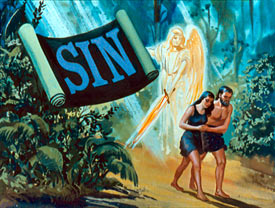
 

Image from ubdavid.org

Image from ubdavid.org

1.  The first statement about the bad  effects of Adam’s sin upon the nature of his descendants, is partially supported by scripture.  Take a closer look at what scripture teaches about the depraved state of man.


Scripture teaches that all created beings are imperfect before God.  Angels, the heavens, sun, moon and stars are all impure in God’s eyes., as attested in  Job 4;17-18; 15:14-16; 25:4-6.  Man, as a created being, is also inherently imperfect.


There are many verses in scripture that remind us of this concept.


For there is no righteous one on earth who does good, and does not sin.  (Ecclesiastes 7:20)
How can one born of a woman be righteous?  (Job 15:14)


Scripture fully teaches the imperfection of man.


Christianity rejects this basic  concept by claiming the “sinlessness” of Jesus, ignoring the word of God that tells us that one born of a woman can never be utterly righteous.  When Adam sinned, sinfulness was imputed to the very fabric of man’s nature.  Scripture records that God pronounced three curses upon Adam and his descendants.  Since these 3 curses are still in effect, we assume that redemption from Adam’s sin is yet to occur.
l.  Death
2.  Pain of childbirth
3.  Man has to work to obtain food


Christianity’s claim that as a result of the sin of Adam, all men are doomed to hell has no scriptural basis, there is no need to refute this.  Those who have faith in Yahweh’s Word are never threatened by Christianity’s claim.
And the kindness of the Lord (Yahweh) is from everlasting to everlasting upon those who fear HIM, and HIS righteousness to children’s children.  To those who keep HIS covenant, and to those remember HIS command– to do them.
(Psalm 103:17-18)


The  statements mentioned above that summarizes the Christian belief about atonement are not compatible with scripture and are not accepted by believers who have faith in the Lord, Yahweh’s revelation in Sinai.   The concept that no human action can be counted as righteous before God is as non-scriptural as it is evil.  It is difficult to think of an idea that would be more contradictory to scripture.  The most prevalent theme in the Old Testament is that God relates to people according to their deeds., both good and evil.  The sinful nature of man does not cancel out any good that we do.
In the days of Noah, Yahweh chose to save life on this earth through Noah.  The ark was built through Noah’s obedient action,  and the earth was renewed.  The message is clear:
And the righteous one is the foundation of the world.
(Proverbs 10:25)


The narratives about the OT (Torah) patriarchs affirm that though man is under the curse of death, still the actions of men, find favor in God’s eyes. (Genesis 26:4)


The lesson of the tabernacle is the same.  The fact that the people’s dedication of their possessions, skills, and power,  merited the manifestation of God’s presence, tells us how the Lord, Yahweh, values these expressions of love and obedience.


Blood sacrifice, which Christianity claims as its foundation, tells us how Yahweh looks favorably at human action.  A blood sacrifice is essentially a human action that expresses submission and humility towards God.  The Christian doctrine says Yahweh rejects every human action; if so,  then, they should reject the blood sacrifice of Jesus Christ,  as well.


Yahweh points to David as an example of righteousness that others should follow .
Then it should be, if you heed all that I command you , walk in My ways, and do what is right in My sight, to keep My statutes and My commandments, as My servant, David did, then I will be with you and build for you an enduring house, as I built for David, and will give Israel to you.
(I Kings 11:38)


This does not mean that David was sinless, he was not.  But it does mean that his sins did not nullify the good that he did.


Christianity rejects the teaching that God allows the righteous to reap the fruit of their deed.
Say to the righteous, that it shall be well with them,
For they shall reap the fruit of their doings.
(Isaiah 3:10)


Scripture leaves no room for doubt that inspite of man’s impurity, his righteous deeds done with sincerity will find favor in God’s eyes.   Why is this so?  It is simply  because God willed it so.  If a man were to live a totally righteous life, a life of total dedication to the service of God.  And this man would voluntarily die a martyr’s death, for the honor of God’s name, God would still owe this man nothing.  This man did not give God anything that did not already belong to God. To think otherwise is to deny the absolute sovereignty of God.  So if God were to act according to the strictest sense of justice, no living being is deserving of reward.   But it is God’s attribute of mercy which rewards men for obeying HIM.
And (Abraham) believed in the LORD, and HE accounted it him for righteousness.
(Genesis 15:16


Christianity claims through this verse, that God counted Abraham’s faith as righteousness, that it earned Abraham the blessing of God’s favor, that it is only faith and not good works which can bring upon man the grace of God.  This is not true.  The verse does not say that anything else Abraham did was not counted as righteous before God.  God tells us in Genesis 18:19:
For I have known him, in order that he may command his children and his household after him, that they keep the way of the LORD, to do righteousness and justice, that the LORD may bring to Abraham what HE has spoken to him.
(Genesis 26:5)
. . . because Abraham obeyed My voice and kept My charge, My commandments, My statutes, and My laws.


The fact that Abraham obediently did God’s will was essential in securing God’s favor.  It is clear that human action (obedience) can be counted by God as righteousness as well as faith.  The simple point is , the OT  belief system is the belief system which advocates faith in the same one on whom Abraham placed his trust.  It is faith in the words of the God of Abraham which leads us to believe all that God has taught us. To have faith in one whom Abraham never heard of is rejecting the faith of Abraham.


Even if scripture is clear on this matter, Christianity tries to bring scriptural support for its belief.  Two verses quoted, to support its contention that it is faithful to scripture are:
First:    (Isaiah 64:5)
 . . . and all our righteousness are as filthy rags.


This verse is one phrase of a long prayer of confession.  In the same prayer, Isaiah beseeches God —
(Isaiah 63:17)
. . . return for the sake of your servants the tribes of your inheritance.


Isaiah was asking God to have mercy in the merit of the righteous sons of  Jacob.  Obviously, Isaiah believed that these men were righteous before God.  It is only in reference to a sinful generation and as part of a humble confession, that Isaiah compares the righteousness of men to filthy rags.


Second verse quoted by Christians to support the doctrine of the worthlessness of man’s action is —
(Psalm 14:2-3)
The LORD looks down from heaven upon the children of men,
To see if there are any who understand, who seek God.
They have all turned aside.
They have together become corrupt;
There is none who does good,
No, not one.


This seems to be telling us that God can see no good in man.  But the Psalm does not end there.  It continues—
Have all the workers of iniquity no knowledge,
Who eat up my people as they eat bread.
And do not call on the LORD?


It is clear that although the psalmist uses the general term “children of men” or the word  “all”, he is only talking about the “workers” of iniquity, and is clearly excluding “my people.”  So we see, that not only are these quotations being taken out of the general context of scripture, but also being taken out of their immediate context.


BLOOD SACRIFICE:


Christianity’s claim that there is no scriptural means for the remission of sin other blood sacrifice.  The one verse cited in support of this position is —
(Leviticus l7:11)
For the life of the flesh is in the blood, and I have given it to you upon the altar for  atonement for your souls; for it is the blood that makes atonement for the soul.


Christianity teaches that it is only the blood that has the power to atone for the soul.  The phrase “for it is the blood that atones” seems to be excluding any other means of atonement.  The passage in which we find this verse is speaking about the prohibition to eat blood.  God is saying that although He allowed the eating of the flesh of   animal,  blood  is not for us to eat.  The only usage we may obtain from the blood of the animal is the expiation of  sin.


By putting the blood on God’s altar as a visible expression of submission to God,  the blood is  used  correctly.  It  is used directly in the service of God. The verse teaches that of all parts of the animal, the one that can effect atonement, is the blood.  But it does not mean that outside of the realm of animal sacrifice, there is no atonement of sin.  This verse does tell us that the blood that effects atonement, is given upon the altar.  To place blood anywhere else is excluded from the atonement of which this verse speaks.
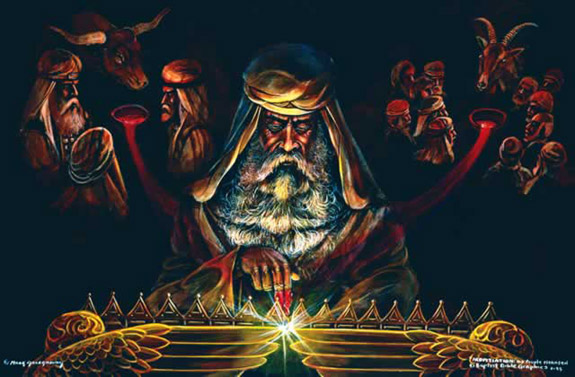
Image from www.biblegraphics.com

Image from www.biblegraphics.com

Since the blood of Jesus, was never placed upon the altar, it cannot be included in the blood atonement of Leviticus 17:11.  The claim that the cross in a figurative sense, can be considered an altar is very original.  The consequences of speaking in a figurative sense are that nothing has to mean anything, and anything can mean everything (We are trying to stick to the plain meaning of the text).  The “sacrifice” of Jesus is disqualified by the very words of the verse upon which it claims its foundation.


The biblically qualified blood offering is in a sense meaningless to Christianity.  The animal offerings of scripture have no use to the Christian other than serving as a crude symbol to the demise of their god.  For Torah observant Jews, animal sacrifice is as real as it is in scripture.  They pray everyday that God re-establish this means of expressing devotion to HIM.  God promised that this will be restored as it says, in Isaiah 56:7. 60:7; Jeremiah 33:15; Ezekiel20:41, 44:15, Zechariah14:21, and Malachi 3:4;  all predicted that God will restore the sacrificial system to its former place.


This makes no sense for Christian.   If the entire system of animal sacrifice was only put there as a portent to the death of Jesus,  then what need is there for animal sacrifice in the messianic era? Christians are shocked to learn that the sacrificial system is coming back.  Some try to avoid the implications of these prophecies by making the  unfounded claim that these prophecies refer to a temple of the anti-Christ.  This is not validated by scripture text.


Who then, has the faith in God’s word concerning the blood sacrifice?  Is it the Christian believers of Paul when he says that the temple sacrifices never atoned for sin?  Or it is the Old Testament  believer who faithfully awaits the day when offering will be pleasing to God as in the days of old?


Let us return to  Christianity’s claim that there is no scriptural means for effecting atonement other than blood sacrifice.  Even within the sacrificial system, there  are methods of achieving atonement without the use of blood.  The verses in —
(Leviticus 5:11-13)
But if he is not able to bring two turtledoves or two young pigeons, then he who sinned shall bring for his offering one tenth of an ephah of fine flour as a sin offering.  He shall put no oil on it nor shall he put frankincense on it, for it is a sin offering.
The priest shall make atonement for him, for his sin that he has committed in any of these matters and it shall  be forgiven him.  The rest shall be the priest’s as a grain offering.


The verses tell us that in some instances a flour offering can take the place of an animal offering and bring about remission from sin.  In Numbers 17:12 we see Aaron using an offering of incense to gain forgiveness for the sins of the Jewish people.


Atonement is not limited to the sacrificial system at all.  Repentance, turning back to God is what God desires from us.  Repentance is what wipes the slate clean.  God’s promise to the sinner who turns back to HIM with a sincere heart, is that none of his sins will be remembered.


(Ezekiel 33:16)
None of his sins which he has committed shall be remembered against him; he has done what is lawful and right, he shall surely live.


All the other scriptural methods of atonement (blood sacrifice, prayer, and charity) are only part of the general framework of repentance.  The prophets remind us that the path to God is repentance.  Some of the scriptural references are:
(Isaiah 55:7)
Let the wicked forsake his way,
And the unrighteous man his thoughts.
Let him return to the LORD
And HE will have mercy on him;
And to our God
For HE will abundantly pardon.
(Ezekiel 18:21-23)
But if a wicked man turns from all his sins, which he has committed, keeps all MY statues, and does what is lawful and right, he shall he surely live; he shall not die.
None of the transgressions which he has committed shall be remembered against him, because of the righteousness which he has done, he shall live.
Do I have any pleasure at all that the wicked should die?” says the LORD God “and not that he should turn from his ways and live?”


And the book of Jonah.  All of these passages tell us how God does not spurn a broken and a contrite heart.
(Psalm 51:17)
The sacrifices of God are a broken spirit,
A broken and a contrite heart
These, O God, You will not despise.


None of these passages say a word about the necessity of blood sacrifice in order for God to grant forgiveness.  The story of Nineveh as recorded in the book of Jonah, tells us how the sinful people of that city repented and God accepted their repentance even though it was not accompanied by a blood sacrifice.


Chapter 33 in the book of Ezekiel is placed among other prophecies which were spoken after the destruction of the Temple – when the Jewish people were no longer able to bring animal offerings, yet God assures the people that their repentance will be accepted.


An expression of a repentant heart prayer, can bring about forgiveness for sin.  Psalm 107, Proverbs 15:8, I Kings 8:46-50, II Chronicles 7:14 are some repentant heart prayers.  Truth, justice, and charity also work atonement for sin.
(Micah 6:6-8)
With what shall I come before the LORD
And bow myself before the High God?
Shall I bring before Him with burnt offerings?
With calves a year old?
Will the LORD be pleased with thousands of rams
Ten thousand rivers of oil?
 Shall I give my firstborn for my transgressions?
The fruit of my body for the sin of my soul?
He has shown you O man, what is good.
And what does the LORD require of you
But to do justly
To love mercy,
And to walk humbly with your God.


These verses in Micah are specially significant because they tell us that all that God requires from us is justice, lovingkindness and walking humbly with God.  Nothing else is necessary.  The word of  God stands forever.  All the energy Christians exert in their effort to nullify the clear message of scripture is in vain.


As we have seen, the “shedding of blood” is not a requirement for the forgiveness of sins; specifically the blood that Jesus shed on the cross.  Furthermore, John 3:16 is a false statement.  The New Testament writers created the idea that Jesus had to die, in order to remove the sins of mankind.  I end with these words from Psalms.


          Psalm 51:16-17
For YOU do not desire sacrifice, or else I would give it
YOU do not delight in burnt offerings.
The sacrifices of GOD are a broken spirit,
A broken spirit and a contrite heart
These O GOD, YOU will not despise.


This is the way to be RIGHT WITH GOD.


BAN@S6K
 logo
Image from www.mixcloud.com

Image from www.mixcloud.com

“Uncircumcised Lips” . . . “Lashon Hara”?

Image from Jar of Quotes

[First posted in 2015; ‘lashon hara’ is the Hebrew equivalent for evil speech or evil tongue.  How do we know if we’re guilty of such?—Admin1.]


————————-


A ‘search term’ most frequently entered in this website is the phrase “uncircumcised lips”.  And of course, we do have a post with that phrase in the title which is not originally ours; it comes from a man recorded to have said it first, referring to himself:  Moses.   Later, the prophet Isaiah would use the same term, also referring to himself.


What? ?!! Handpicked mouthpieces of YHWH feel unworthy to utter ‘the very words of God’?  Who chose them in the first place, shouldn’t that make them say “Who, me? How privileged am I!”  Yet one sees their humility when they say instead, but I am a man of uncircumcised lips!”


Moses and Isaiah, two towering figures in the Hebrew Scriptures you would least accuse of having “uncircumcised lips” . . . so what could it possibly mean?  To save us from explaining and encourage you to do your homework, read this post first:


The first thing that should come to mind in our generation, living several millennia later is this:  if we had the same assignment as Moses and we felt we were not a ‘fit vessel’ to deliver a message from no less than God Himself who appears as a ‘burning bush‘, would we use the same terms as Moses did?  “Uncircumcised lips”? Most likely not;  in fact that is why we think the post with those naughty words in the title is so popular with searchers, it is clicked so frequently.


The word ‘circumcision’ referring to a medical procedure applied to human genitalia is not normally nor casually used in our language and particularly applied to another part of the human body!  Truly,  how often would we use the term except to refer to the medical procedure that is performed only in cultures or religions that require it?  And for what? These days there are pros and cons on circumcision being medically and hygienically beneficial to sexual partners regardless of different or same gender. But let us not get into that diversion here.


The word “circumcision” has been metaphorically applied such as “circumcision of the heart” and let’s not forget “people of the circumcision” (Israel) and “the uncircumcised” (Gentiles), specifically used at a time when Israel was identifiable specifically with that requirement for the male population.  Movies about the holocaust use that same identifying process when Germans search out Jews from among the occupied European countries.   (Note:  Circumcision is the sign of the covenant with Abraham; and it was kept by both Isaac and Ishmael, and presumably the generations that were born and grew up in Egypt and all generations from observant Israel thereafter, presumably to this day.)


David says it dramatically before he slingshots Goliath,


for who is this uncircumcised Philistine,

that he should defy the armies of the living God?” 

[1 Samuel 17:26].


Why so graphic a term is used in biblical language should not surprise us; the Creator/Revelator/God of Israel who designed the human anatomy finds nothing wrong in using words we might not want to utter in polite conversation, if and specially if the meaning hits home like a bullseye, no further explanation needed;  though understandably, the unschooled in literary or figurative speech struggle with such metaphoric use of  words avoided in polite society.  Examples are found in some prophets who used such words about idolatrous Israel as “whoring” and “lifting up your skirt” in sexually characterizing them as being unfaithful to their husband, YHWH.  Whew, talk about “uncircumcised lips” indeed, we might say today to the foul-mouthed,  “gargle with spiritual chlorox” instead of “circumcise your lips!”


How unfit are we to speak God’s words to others?


What about the Hebrew phrase  lashon hara or evil speech/evil speaking?  Is it the same as “uncircumcised lips”?  When does speech become evil?  When do we cross the line?


We know lying in all forms is lashon hara but when does speaking the truth become evil speech?  We know the Torah is all and always about our treatment of ‘the other’ which includes friend and foe.  When words hurt ‘the other’, is that a no-no? What are the criteria for one to cross the line in speaking the truth because it’s the wrong context?


Most of us who think we’re not the ones being addressed by most of the Decalogue would think:

  •  “well, I’m right with God in terms of commandments #1-3;
  • I’m a Sabbath-keeper so I’m OK with #4;
  • I honor my parents so I’m fine with #5;
  • I don’t murder, commit adultery in keeping with #6 and #7;
  • I don’t covet my neighbor’s spouse or goods, so there’s #9 and #10.
  • What did I miss? #8—

Thou shalt not bear false witness against thy neighbor.  


No problem, what I do say about my neighbor is all true! How could that be a violation? 


Of course, there are contexts where the truth should be told regardless of the hurt it will cause another;  such as —

  • testifying in court;
  • exposing wrongdoing for the good of another, if not the majority;
  • protecting the interests of others (lies being said of an innocent party; spouse cheating on your friend or kin; etc.)
  • you can think of other situations where truth must be told despite the hurt it will cost another, particularly if the purpose and the end is for the good of the innocent ‘other’ and justice is served the guilty ‘other’.


Now, are there circumstances and times when Truth should be withheld?  The key to Torah-observance, besides obedience to God is to be ‘other-conscious’ and ‘other-centered’.  So when does telling the truth hurt the other?


Ponder the message in this image:

Image from www.torahtrendy.com

Image from www.torahtrendy.com

Here  is a Jewish perspective (always good to eventually check them out as the first or last recourse) from an article published: April 25, 2015 in one of our favorite Jewish websites listed on our link, aish.com:


http://www.aish.com/ci/s/Robert-Downey-Jrs-Awkward-Interview.htmlwritten  

by .


. . .  many of us instinctively understand that words hurt and can do as much damage – or more – as physical harm. The Torah juxtaposes both types of harm: physical and verbal. After listing a long litany of ways that it is prohibited to cause another person financial or physical damage, the Torah admonishes—


“And you shall not wrong one another,

but shall fear your God…” (Leviticus 25:17).


To “wrong” in this context means to wound with words, and it’s considered infinitely worse than causing financial harm, for financial losses can be reversed, while emotional damage can be impossible to undo.


The Talmud provides a concrete example of what it means to wound with words:


“One must not say to someone who has changed their ways: Remember your former deeds” (Bava Metzia 58b).


Jewish law prohibits us to humiliate someone by bringing up his or her checkered past. People can change and their past no longer represents who they are now. It’s demeaning to straightjacket people with any label, all the more so with negative, outdated ones.


It’s easy to try to justify our speech by saying that our intentions were good, that we only brought up painful or awkward subjects in order to accomplish something important. That’s why the verse warning against humiliating another person concludes with the words “you shall fear your God.” The Almighty knows our true intentions. We can’t fool him.


So back to our title:  “uncircumcised lips” in the context of Moses is not the same as “lashon hara” because he himself explains, he merely has a speech impediment and feels inferiority in speaking for YHWH God of Israel, to deliver a message to Pharaoh to let God’s people go.  So elder brother Aaron is commissioned to be the spokesman and scripture records something unusual that Israel’s God YHWH said:


Is there not Aharon your brother, the Levite- 
I know that he can speak, yes, speak well, 
and here, he is even going out to meet you; 
when he sees you, he will rejoice in his heart.
15 You shall speak to him, 
you shall put the words in his mouth! 
I myself will be-there with your mouth and with his mouth, 
and will instruct you as to what you shall do.
16 He shall speak for you to the people, 
he, he shall be for you a mouth, and you, you shall be for him a god.


Imagine that . . .  you shall be for him a ‘god’; in Hebrew, you shall be for him “elohim” . . .  plural ‘elohim‘ . . . .  But Moses is one and not three-in-one . . . get it?


If not,  good excuse to suggest one more post:  Exodus/Shemoth 4 – Excuses, Excuses.


NSB@S6K


logo

Guess who wrote this?

[First posted December 29, 2013; reposting on the occasion of the writer’s death anniversary on December 30, 1896, the date he was executed by firing squad upon being accused of treason by Spanish colonial authorities.–Admin1]


——————————–


“Through reasoning and by necessity, rather than faith, do I firmly believe in the existence of a creative Being. Who is he? I do not know. 


What human sounds, what accents are we to use in pronouncing the name of this Being whose works overwhelm the imagination? Can anyone give him an adequate name. . . We call him Dios but this only comes from the Latin deus and ultimately from the Greek Zeus. What kind of being is he? 


I would attribute to him, to an infinite degree, all the beautiful and holy qualities my mind can think of, but the fear of my ignorance constrains me. . . Even so I venture to think of him as infinitely wise, mighty, good. . . when I behold the wonders of his works, the order that reigns over the universe, the magnificence and expanse of creation, and the goodness that shines in all. . .The thought of him humbles me and sends my mind reeling; and whenever my reason rises to reach this Being, who created planets, suns, worlds and galaxies without number, it falls back stunned, puzzled and crushed. Fear overcomes me and I rather remain silent. . .


Filled by this vague but irresistible sentiment in face of the inconceivable, the superhuman, the infinite, I leave this study to brighter intelligences and hold in abeyance what the religions have to say. Unable to pass judgment on what surpasses my powers, I settle for studying God in his creatures like myself and in the voice of my conscience, which only can have come from him. 


I strive to read and find his will in all the surrounds me and in the mysterious sentiment speaking from within me, which I strive to purify above all else. The various religions claim to have God’s will condensed and written in books and dogmas; but apart from the many contradictions, conflicting interpretations of words and many obscure and untenable points I find in them, my conscience, my reason cannot admit that he, who like a wise father had provided his creatures with everything necessary for this life, proceeded to bury what was necessary for eternal life in the obscurities of language unknown to the rest of the world and hide it behind metaphors and deeds that go against the very laws of nature. . .


But I do not mean by this that I completely disregard what the sacred books, religious precepts and religious dogmas have to say. On the contrary these books are, in the final analysis, the insights of men and whole generations put down in writing. . . When there arises a conflict among them, I decide in favor of that which most conforms with nature’s law because for me nature is the only divine book of unquestionable legitimacy, the sole manifestation of the Creator that we have here in this life – clear, perennial, living, powerful, capable of overcoming our blunders and errors, incorruptible, one that cannot play false in spite of human caprice, with its laws constant and unchangeable in all places and for all times.”


Dr. Jose P. Rizal,

Philippine National Hero


[Source:  Father Raul J. Bonoan, S.J.  The Rizal-Pastells Correspondence, the Hitherto Unpublished Letters of Jose Rizal and Portions of Fr. Pablo Pastells Fourth Letter and Translation of the Correspondence, together with a Historical Background and Theological Critique. (1994)]

Image from brokenarrowlove.wordpress.com

———————————————–


“I go where there are no slaves,

hangmen or oppressors;

Where faith does not kill;

where the one who reigns is God.” 


Mi Ultimo Adios” st. 13 – poem written on the eve of his execution

(29 December 1896) 


————————————————————


Collage: The World of 1898: The Spanish American War

“The war of the United States with Spain was very brief.

Its results were many, startling, and of world-wide meaning.”
–Henry Cabot Lodge

Hispanic Division, Library of Congress

From :  http://www.loc.gov/rr/hispanic/1898/rizal.html

José Rizal  1861-1896


José Rizal, son of a Filipino father and a Chinese mother, came from a wealthy family. Despite his family’s wealth, they suffered discrimination because neither parent was born in the peninsula. Rizal studied at the Ateneo, a private high school, and then to the University of St. Thomas in Manila. He did his post graduate work at the University of Madrid in 1882. For the next five years, he wandered through Europe discussing politics wherever he went. In 1886, he studied medicine at the University of Heidelberg and wrote his classic novel Noli me Tangere, which condemned the Catholic Church in the Philippines for its promotion of Spanish colonialism. Immediately upon its publication, he became a target for the police who even shadowed him when he returned to the Philippines in 1887. He left his country shortly thereafter to return to Spain where he wrote a second novel, El Filibusterismo (1891), and many articles in his support of Filipino nationalism and his crusade to include representatives from his homeland in the Spanish Cortes.

He returned to Manila in 1892 and created the Liga Filipina, a political group that called for peace change for the islands. Nevertheless, Spanish officials were displeased and exiled Rizal to the island of Mindanao. During his four years there, he practiced medicine, taught students, and collected local examples of flora and fauna while recording his discoveries. Even though he lost touched with others who were working for Filipino independence, he quickly denounced the movement when it became violent and revolutionary. After Andrés Bonifacio issued the Grito de Balintawak in 1896, Rizal was arrested, convicted of sedition, and executed by firing squad on December 30, 1896.


Image from www.photoworldmanila.com


Following the revolution, Rizal was made a saint by many religious cults while the United States authorities seized on his non-violent stance and emphasized his views on Filipino nationalism rather than those of the more action-oriented Emilio Aguinaldo and Andrés Bonifacio.


And when my grave by all is no more remembered,
With neither cross nor stone to mark its place,
Let it be ploughed by man,  
with spade let it be scattered

And my ashes ere to nothingness are restored,
Let them turn to dust to cover thy earthly space.

. . . Farewell to all I love; to die is to rest.


Image from www.gov.ph

     “Mi Último Adiós”
Adios, Patria adorada, region del sol querida,
Perla del Mar de Oriente, nuestro perdido eden,
A darte voy alegre, la triste, mustia vida;
Ya fuera mas brillante, mas fresca mas florida,
También por ti la diera, la diera por tu bien.

En campos de batalla, luchando, con delirio,
Otros te dan sus vidas, sin dudas, sin pesar.
El sitio nada importa: ciprés, laurel o lirio,
Cadalso o campo abierto combate o cruel martirio,
Lo mismo es si lo piden la Patria y el hogar.

Yo muero, cuando veo que el cielo se colora
Y al fin anuncia el día, tras lóbrego capuz;
Si grana necesitas, para teñir tu aurora,
Vierte la sangre mia, derramala en buen hora,
Y dorela un reflejo de su naciente luz!

Mis sueños, cuando apenas muchacho adolescente,
Mis sueños cuando joven, ya lleno de vigor,
Fueron el verte un dia, joya del mar de Oriente,
Secos los negros ojos, alta la tersa frente,
Sin ceño, sin arrugas, sin manchas de rubor.

Ensueño de mi vida, mi ardiente vivo anhelo,
¡Salud! te grita el alma, que pronto va a partir;
¡Salud! ah, que es hermoso caer por darte vuelo,
Morir por darte vida, morir bajo tu cielo,
Y en tu encantada tierra la eternidad dormir!

Si sobre mi sepulcro vieres brotar, un dia,
Entre la espesa yerba sencilla humilde flor,
Acercala a tus labios y besa al alma mia,
Y sienta yo en mi frente, bajo la tumba fria,
De tu ternura el soplo, de tu hálito el calor.

Deja a la luna verme, con luz tranquila y suave,
Deja que el elba envie su resplandor fugas;
Deja gemir al viento, con su murmullo grave;
Y si desciende y posa sobre mi cruz un ave,
Deja que el ave entone su cántico de paz.

Deja que el sol, ardiendo, las lluvias evapore,
Y al cielo tornen puras, con mi clamor en pos;
Deja que un ser amigo mi fin temprano llore;
Y en las serenas tardes, cuando por mi alguien ore,
Ora también, ¡oh Patria!, por mi descanso a Dios.

Ora por todos cuantos murieron sin ventura;
Por cuantos padecieron tormentos sin igual;
Por nuestras pobres madres, que gimen su amargura;
Por huerfanos y viudas, por presos entortura;
Y ora por ti, que veas tu redención final.

Y cuando, en noche oscura, se envuela el cementerio,
Y solos solo muertos queden velando alli,
No turbes su reposo, no turbes el misterio;
Tal ves acordes oigas de citara o salterio;
Soy yo, querida Patria, yo que te canto a ti.

Y cuando ya mi tumba, de todas olvidada,
No tenga cruz ni piedra que marquen su lugar,
Deja que la are el hombre, la esparza con la azada,
Y mis cenizas, antes que vuelvan a la nada,
El polvo de tu alfombra que vayan a formar.

Entonces nada importa me pongas en olvido,
Tu atmósfera, tu espacio, tus valles cruzaré;
Vibrante y limpia nota sere para tu oido;
Aroma, luz, colores, rumor, canto, gemido,
Constante repitiendo la esencia de mi fe.

Mi Patria idolatrada, dolor de mis dolores,
Querida Filipinas, oye el postrer adois.
Ahi, te dejo todo: mis padres, mis amores.
Voy donde no hay esclavos, verdugos ni opresores;
Donde la fe no mata, donde el que reina es Dios.

Adios, padres y hermanos, trozos del alma mia,
Amigos de la infrancia, en el perdido hogar;
Dal gracias, que descanso del fatigoso dia;
Adios, dulce extranjera, mi amiga, mi alegria;
Adios, queridos seres. Morir es descansar.


Jose Rizal

Spanish (Original Version)

Image from www.hollandamericablog.com

Image from www.hollandamericablog.com

Words from the Wise: Maimonides, 12th Century

Image from www.chabad.org

Image from www.chabad.org

“From Moses [of the Torah]

to Moses [Maimonides]

there was none like Moses.” 


Who was Maimonides?  

“If one did not know that Maimonides was the name of a man, Abraham Joshua Heschel wrote, one would assume it was the name of a university. The writings and achievements of this twelfth­century Jewish sage seem to cover an impossibly large number of activities. Maimonides was the first person to write a systematic code of all Jewish law, the Mishneh Torah; he produced one of the great philosophic statements of Judaism, TheGuide to the Perplexed; published a commentary on the entire Mishna; served as physician to the sultan of Egypt; wrote numerous books on medicine; and, in his “spare time,” served as leader of Cairo’s Jewish community.

More about Maimonides in :

http://www.jewishvirtuallibrary.org/jsource/biography/Maimonides.html

~~~~~~~~~~~~~~~~~~~~~


Free will is given to every human being.  If we wish to incline ourselves toward goodness and righteousness, we are free to do so; and if we wish to include ourselves toward evil, we are also free to do that.  From Scripture (Genesis 3:22) we learn that the human species, with its knowledge of good and evil, is unique among all earth’s creatures.  Of our own accord, by our own faculty of intelligence and understanding, we can distinguish between good and evil, doing as we choose.  Nothing holds us back from making this choice between good and evil—the power is in our hands.


~~~~~~~~~~~~~~~~~~


Do not imagine that character is determined at birth.  We have been given free will.  Any person can become as righteous as Moses or as wicked as Jeroboam.  We ourselves must decide whether to make ourselves learned or ignorant, compassionate or cruel, generous or miserly.  No one forces us, no one decides for us, no one drags us along one path or the other; we ourselves, by our own volition, choose our own way.


~~~~~~~~~~~~~~~~~~


In connection with the Mitzvah of following the right path, it has been taught:  As God is called gracious, so must you be gracious; as God is compassionate, so must you be; as God is holy, so must you follow the path of holiness.  Therefore the prophets described God as possessing these attributes:  endlessly patient and loving, just and upright, wholehearted, and the like.  Their intention was to teach us that these are the good and praiseworthy paths for us to follow as we attempt, according to our capacities, to imitate God.


~~~~~~~~~~~~~~~~~~


With regard to all human traits, the middle of the road is the right path.  For example:  Do not be hot-tempered, easily angered.  Nor, on the other hand, should you be unfeeling like a corpse.  Rather, take the middle of the road:  keep an even disposition, reserving your anger for occasions when it is truly warranted.  Similarly, do not cultivate a desire for luxuries; keep your eye fixed only on genuine necessities.  In giving to others, do not hold back what you can afford, but do not give so lavishly that you yourself will be impoverished.  Avoid both hysterical gaiety and somber dejection, and instead be calmly joyful always, showing a cheerful countenance.  Act similarly with regard to all the dispositions.  This is the path followed by the wise.


~~~~~~~~~~~~~~~~~~~


How do we fix these traits into our character?  By repeatedly doing them, returning to them until they become second nature.  And because these attributes are divine, this path, the one that avoids extremes, is called the ‘path of God,’ and Abraham taught his descendants to follow it.  Whoever follows it gains goodness and blessing, as it is said:


 “For I have known him, that he might command his children and those who follow him to keep the Lord’s path, doing justice and right, that the Lord may fulfill for Abraham the divine purpose (Genesis 18:19).


~~~~~~~~~~~~~~~~~~~~~~


Smooth speech and deceptions are forbidden us.  Our words must not differ from our thoughts; the inner and outer person must be the same; what is in the heart should be on the lips.  We are forbidden to deceive anyone, Jew or Gentile, even in seemingly small matters.  For example, one must not urge food on another, knowing that the other cannot eat it; one must not offer gifts that cannot be accepted; a storekeeper opening a bottle in order to sell its contents must not pretend to be opening it in honor of a particular person, and the like.  Honest speech, integrity, and a pure heart–that is what is required of us.


~~~~~~~~~~~~~~~~~~~~~~~


If you see a friend sinning or pursuing an unworthy life, it is a Mitzvah to try to restore that person to the right path.  Let your friend know that wrong actions are self-inflicted hurts, but speak softly and gently, making it clear that you speak only because of your concern for your friend’s well-being.


~~~~~~~~~~~~~~~~~~~~


Our sages taught:  One who shames another in public has no share in the world-to-come.  Therefore one must take great care not to shame another in public, whether young or old, either by shameful name-calling or tale-bearing.


~~~~~~~~~~~~~~~~~~~~


Every human being has merits and faults.  The righteous person has more merits than faults, the wicked one more faults than merits.  The average person is (more or less) evenly balanced between the two.  A community, too, is judged in this matter:  if the merits of its citizens outweigh their faults, it is called righteous:  if their faults outweigh their merits, it is called wicked.


~~~~~~~~~~~~~~~~~~~~


Do not think you are obliged to repent only for transgressions involving acts, such as stealing, robbing, and sexual immorality.  Just as we must repent such acts, so must we examine our evil feelings and repent our anger, our jealousy, our mocking thoughts, our excessive ambition and greed.  We must repent all these.  Therefore it is written:


“Let the wicked forsake their ways, the unrighteous their thoughts” (Isaiah 55:7)

~~~~~~~~~~~~~~~~~~~~


2nd hand book purchased at Burlingame Public Library for $2.

The source of these quotes? A second hand book I picked up from the Burlingame (CA) Public Library which cost me a measly $2, one of my unexpected treasure finds:


GATES OF REPENTANCE: The New Union Prayer Book for the Days of Awe,  a publication resulting from the CENTRAL CONFERENCE OF AMERICAN RABBIS, NY 1978 [5738], Revised 1996.


Sig-4_16colors


logo

The Soul of Evil

Image from Understanding the Word of God for Your Profiting

Image from Understanding the Word of God for Your Profiting

 [First posted in 2013. We are into what might be called the “days of darkness” — Halloween, All Souls Day, where imaginary creatures, ghosts and spirits, figures characterizing evil and darkness dominate the thematic landscape. We will repost a series of articles connected with this theme of “dark forces”.


This is an excellent article we read in aish.com which reprinted it from meaningfullife.com which granted us permission to republish.  Reformatting and highlights ours.—Admin1.]


—————————


ESSAY: The Soul of Evil


The secret that terrified Moses and liberated the soul of man—


And G-d said to Moses: “Come to Pharaoh; for I have hardened his heart and the hearts of his servants in order that I might show My signs in their midst…”  [Exodus 10:1]


Why does it say, “Come to Pharaoh”?   It should have said, “Go to Pharaoh” …. But G-d brought Moses into a chamber within a chamber, to the… supernal and mighty serpent from which many levels evolve…which Moses feared to approach himself... [Zohar, part II, 34a]


Among the fifty-three sections of the Torah, several stand out as milestones in its narrative of the history of humanity and of the people of Israel. The section of Bereishit recounts G-d’s creation of the world in six days and Adam’s banishment from Eden; Lech Lecha describes Abraham’s journeys to bring the truth of the One G-d to a pagan world;  Yitro includes the revelation at Sinai and the giving of the Torah to Israel; and so on.


A list of pivotal Torah sections would certainly include the section of Bo (Exodus 10–13), which tells of the exodus of the children of Israel from the land of Egypt. The Exodus marked our birth as a people,


[1]   and we are enjoined to “Remember the day that you went out of Egypt, all the days of your life.”

[2]   Indeed, when G-d revealed Himself to us at Sinai, He introduced Himself not as the Creator of heaven and earth, but as  “…your G-d, who has taken you out of the land of Egypt”

[3]   For the defining element of our relationship with G-d is not that we are beings created by Him (of which there are many others in G-d’s world), but that we are free beings—beings in whom He has invested of His own infinity and eternity, beings empowered by Him to transcend the constraints of the material world and the limits of their own natures.


The Name

Bo means “come.” The name derives from the section’s opening verse, in which G-d instructs Moses to “come to Pharaoh”  to warn him of the seventh plague (the plague of locusts) and once again deliver the divine demand that the ruler of Egypt set free the children of Israel. 

The Torah considers the name of a thing to be the articulation of its essence;

[4] certainly, such is the case with the Torah’s own names for itself and its components. The name of a Torah section always conveys its primary message and the common theme of all its subsections and narratives.

[5]  One would therefore expect the section of the Exodus to be called “Exodus,”  “Freedom,” or some other name that expresses the significance of this defining event in the history of Israel. Instead, it derives its name from Moses’ coming to Pharaoh—an event that seems but a preliminary to the Exodus. Indeed, the concept of the leader of Israel coming to Pharaoh’s palace to petition him to let the Jewish people go—implying that the Jews are still subservient to Egypt and its ruler—seems the very antithesis of the Exodus!


The phrase “Come to Pharaoh” also evokes much discussion in the commentaries. Why does G-d tell Moses to come to Pharaoh? Would it not have been more appropriate to say, “Go to Pharaoh”?


The Zohar explains that Moses feared confronting Pharaoh inside his palace, at the hub of his power. (On earlier occasions,  Moses had been directed to meet Pharaoh in other places, such as on the king’s morning excursions to the Nile[6]).   So G-d promised Moses that He Himself would accompany him to Pharaoh. The word “come” is thus to be understood in the sense of “come with me”;  G-d is saying to Moses, “Come with Me to Pharaoh.”


The Zohar goes on to say that Moses is being invited by G-d to meet with the innermost essence of Egypt’s ruler and god. Thus we have another meaning of the phrase “Come to Pharaoh”—“come” in the sense of “enter within.”   To liberate the people of Israel from the “great and mighty serpent,”  it was not enough to merely go to Pharaoh; Moses had to enter into the core of Pharaoh, into the very root of his power.


My River


Image from Ashraf Ezzat - WordPress.com

Image from Ashraf Ezzat – WordPress.com

Who is Pharaoh and what does he represent? What is his “innermost essence”? Why did Moses dread confronting Pharaoh in his palace if G-d Himself had sent him there?  And how does “coming into Pharaoh” hold the key for the Exodus from Egypt and the liberation of the soul of man?


The prophet Ezekiel describes Pharaoh as

“the great serpent who couches in the midst of his streams, who says: ‘My river is my own, and I have made myself.’[7] 


In other words, the evil of Pharaoh is not defined by the promiscuity that characterized the pagan cults of Egypt;

  • not by his enslavement and torture of millions;
  • not by his bathing in the blood of slaughtered children;
  • but by his egocentrism,
  • by his regarding his own self as the source and standard for everything.


For this is the root of all evil.   Self-centeredness might seem a benign sin compared to the acts of cruelty and depravity to which man can sink, but it is the source and essence of them all.   When a person considers the self and its needs to be the ultimate arbiter of right and wrong, his morality—and he might initially be the most moral of men—is devoid of significance.   Such a person is ultimately capable of committing any act, should he regard it as crucial to himself or to his self-defined vision of reality.


Ultimately, every good deed is an act of self-abnegation, and every evil deed is an act of self-deification.


When a person does a good deed—whether it involves contributing a single coin to charity or devoting an entire lifetime to a G-dly cause—he is saying:  there is something greater than myself to which I am committed.   When a person violates the divine will—whether with a minor transgression or with the most heinous of crimes—he is saying:  


“My river is my own, and I have made myself”;    

good is what is good to me,

evil is what is contrary to my will;

I am the master of my reality, I am god.


The Secret


So is the ego evil?  Is this fundamental component of our soul an alien implant that must be uprooted and discarded in our quest for goodness and truth?


In the final analysis, it is not. For the cardinal law of reality is that “There is none else besides Him”[8]—that nothing is contrary to, or even separate from, the Creator and Source of all.  The ego, the sense of self with which we are born, also derives from G-d; indeed, it is a reflection of the divine “ego.” Because G-d knows Himself as the only true existence, we, who were created in His image, possess an intimation of His “sense of self” in the form of our own concept of the self as the core of all existence.


It is not the ego that is evil, but the divorcing of the ego from its source. When we recognize our own ego as a reflection of G-d’s “ego” and make it subservient to His, it becomes the driving force in our efforts to make the world a better, more G-dly place. But the same ego, severed from its divine moorings, begets the most monstrous of evils.


When G-d commanded Moses to “Come to Pharaoh,” Moses had already been going to Pharaoh for many months. But he had been dealing with Pharaoh in his various manifestations: Pharaoh the pagan, Pharaoh the oppressor of Israel, Pharaoh the self-styled god. Now he was being told to enter into the essence of Pharaoh, into the soul of evil. Now he was being told to penetrate beyond the evil of Pharaoh, beyond the mega-ego that insists “I have created Myself,” to confront Pharaoh’s quintessence: the naked “I” that stems from the very “self” of G-d.


Moses did not fear the evil of Pharaoh.   If G-d had sent him, G-d would protect him.   But when G-d told him to enter into the essence of Pharaoh, he was terrified. How can a human being behold such a pure manifestation of the divine truth? A manifestation so sublime that it transcends good and evil and is equally the source of both?
Said G-d to Moses: “Come to Pharaoh.”   

  • Come with Me, and together we will enter the great serpent’s palace.
  • Together we will penetrate the self-worship that is the heart of evil.
  • Together we will discover that there is neither substance nor reality to evil—that all it is, is the misappropriation of the divine in man.


If this truth is too terrifying for a human being to confront on his own,  come with Me,  and I will guide you.  I will take you into the innermost chamber of Pharaoh’s soul, until you come face to face with evil’s most zealously guarded secret:  that it does not, in truth, exist.
When you learn this secret, no evil will ever defeat you. When you learn this secret, you and your people will be free.


—————————


Based on an address by the Rebbe, Shabbat Bo, 5752 (January 11,  1992)[9]


[1]. Ezekiel 16. Cf. Mechilta, Beshalach 14:30; Midrash Tehillim 107:4; Yalkut Shimoni on Deuteronomy 4:34; et al.

[2]. Deuteronomy 16:3—a commandment we fulfill by reciting the third section of the Shema (Numbers 15:37-41) every morning and evening (see Passover Haggadah, s.v. Amar Rabbi Elazar; see also Talmud, Pesachim 116b).

[3]. The first of the Ten Commandments, Exodus 20:2.

[4]. See Genesis 2:19; Midrashim and commentaries on verse; Tanya, part II, ch. 1.

[5]. Often, the name of a Torah section seems to merely derive from its opening verses, with little visible connection to its overall contents. For example, Chayei Sarah (“The Life of Sarah”) actually begins with Sarah’s death and burial, and goes on to recount events occurring after her demise. But an in-depth examination and analysis of a section’s contents always reveal that its common theme and axial principle are expressed by its name (see Likkutei Sichot, vol. V, p. 57ff.; vol. XV, p. 145ff.; vol. XVI, p. 200ff.; et al. See also The Human Story in Twelve Words, WIR, vol. IX, no. 15).

[6]. Cf. Exodus 7:15, 8:17, et al.

[7]. Ezekiel 29:3.

[8]. Deuteronomy 4:35.

[9]. Sefer HaSichot 5752, vol. I, pp. 280ff.

Messianic Pastor’s Clarification on Christianity’s Wrong Celebration of Christmas

Image from YouTube

Image from YouTube

[First posted during the Christmas season, year 2017.  Why are we posting an article like this which goes against everything we believe in and teach in this website?  For one, it comes from a Christian-Messianic pastor/teacher who first corrected our ‘wrong’ Christian orientation for decades that we believed and trusted in his personal research and deviation from mainstream Christianity’s teaching.   For another,  we were inspired by his zeal for truth which influenced our zeal for truth so much so we even veered from his interpretation of truth and gotten off his pathway to find our way to the original pathway to YHWH’s Revelation on Sinai.  Then we left his Messianic Congregation, to his and our messianic colleague’s dismay (not to forget condemnation and judgment that we’ve lost our salvation and are hell-bound).  So back to the question, why post a correction of the Christmas Story we don’t even believe in? Because it was still sent to us despite knowing fully well we are off that old trail;  perhaps in an attempt to redirect us to return to Christ-centered religion/belief system.  


We have repeatedly announced there is no turning back for us, over and over again, but that doesn’t sit well with our well-meaning Christian friends who don’t give up on evangelizing the “lost” or “damned” because they sincerely and truly care about the eternal destiny of unbelievers, that’s now the category we belong to. Anyway, this is a reminder to Sinaites of what we used to swallow about Christmas and the correction of our former teacher of everything wrong with the traditional teaching about Christmas.  Wow, how far have we indeed travelled from such ‘truth’ and thinking!  Indeed, there is NO TURNING BACK! But we’re giving our former teacher his chance to convince our web-visitors, since we are fair and believe in equal opportunity in this discourse and we trust that  our web-visitors have learned to decide for themselves what to believe. . . . right?  Related articles are the following: 

The original text has been reformatted for this post. Merry Christmas to our Christian colleagues, we celebrate the holiday for different reasons!—Admin1]


——————————-


YESHUA’S BIRTH

By Roger W. Walkwitz

[Founder of Asia-Pacific Messianic Congregation]


The following gives the most likely time, from the Bible, when the Body for Yeshua was delivered.


Image from FilCatholic

Image from FilCatholic

It is well known that Yeshua was NOT born on December 25! The birth of Yeshua was not celebrated for several hundred years after Yeshua! Then the gentile dominated RC [Roman Catholic] Church decided to join the pagans in the popular celebration of their god Saturn in December, but called it instead Christ’s Mass or Christmas and designated it the birth of Jesus, with no historical data whatever to back it up.


“The Church” decides! Christmas Tradition is so entrenched that most do not even want to know its origin. Many who do know, continue the tradition anyway, for various reasons. It is a time also when Jews have been persecuted in many “Christian” countries.


It would please the LORD if we would do and celebrate what He has designated, the Appointed Times of the

LORD (Moedim) found in Leviticus 23, rather than what man decides.


The clue is in Luke 1:5. Zechariah, father of John the baptizer, was a priest of the division of Abijah. When

King David reorganized the priesthood, as related in 1 Chronicles 24, the numerous priests were divided into

24 divisions. According to Josephus, one division should minister to God eight days, from Sabbath to Sabbath, with two divisions serving on each Shabbat. Each priest served with his division for eight days, then again six months later for another eight days. All of the priests, however, served during the busy times of the Passover season and Sukkot (Festival of Booths or Tabernacles). All 52 weeks in the year were then taken care of.


For our study, let us take the year 2000-2001, Jewish year 5760-5761.


  • The division of Abijah was 8th in order. Exodus 12 makes Nisan (Abib) the first month of the year. Nisan 1, 5760 corresponds to April 6, 2000.
  • Passover/Unleavened Bread is from Nisan 14 – 22, or April 19 – 27, 2000. The first division of the priests would start on Shabbat, Nisan 24 (April 29) and serve through Iyar 1 (May 6). Division 2 would share with division 1 on this Shabbat, and continue for their 8 day service. Division 8 would begin on Sivan 14 (June 17) and complete their service at the conclusion of Sivan 21 (June 24).
  • During this week Zechariah is visited by the angel and told about the birth of his son by Elizabeth, to be named John. On Sivan 22 he goes home. Elizabeth had already passed menopause long ago. Normally she would get pregnant anytime during the first few weeks that Zechariah was home, but this was to be an unusual birth. Nine months from this time brings us up to the time of Passover, which is always Nisan 14 – 22, corresponding this time to April 7 – 15, 2001. John the baptizer was therefore born at the time of Passover/Unleavened Bread.
  • Mary was told by Gabriel that she would get pregnant without the benefit of a man, and that her relative Elizabeth was already 6 months pregnant. Therefore, the Body that God prepared for Yeshua to enter would be delivered 6 months after John’s birth, at the time of Sukkot, always Tishri 15 – 23, corresponding to October 2 – 10, 2001. (Since each course served twice a year, 6 months apart, it could be reversed, John born at Sukkot and Yeshua at Passover.
  • However, Yeshua taught for 3.5 years, beginning when He was 30 years old and was crucified at Passover time, so Mary’s delivery of His Body at Sukkot fits the data.)
  • At Sukkot and at Passover, Jerusalem and its suburbs such as Bethlehem were crowded with worshipers who came for the required three pilgrimage Festivals. That is the main reason there was no room for them in the inn, not just the census.
  • Shepherds are not in the fields with their sheep during the cold, winter months of December through February.
  • Sometimes it snows at the altitude of Bethlehem and Jerusalem, as this is also rainy season.
  • Yeshua was a fully human being as Adam was before he sinned, termed the 2nd Adam (1 Corinthians 15:47).
  • Yeshua was not in the belly of Mary for nine months. Yeshua continued as Deity but laid aside His glory as YHVH and entered the Body that Mary had prepared for Him as it was being delivered or as it took its first breath.
  • Yeshua was called Imanu El, God (El) with us (Matthew 1:23). His Body was conceived miraculously with no human male sperm or female egg, as both are contaminated by sin, and delivered normally.
  • He lived a miraculous life, and His death and Resurrection were miraculous.
  • His Return will also be miraculous, so let us not worship Him with the tinsel of paganism, but in spirit and truth according to the evidence given to us.

The hand that rocked baby Jesus’ cradle

 [First posted in December 2014, time for a revisit.  If God-the-Son was supposedly born on December 25 coincidental with the birth of the worshipped sun-god Mithra, then his virgin mother would have conceived nine-months before which would be timed about April of that year on the Gregorian calendar which would be . . . well . . . year 0?   When we were Christians, we taught that it wasn’t the birth that was unusual; the baby God-Son was born the normal way just like all other human babies work their way out of the womb; what was miraculous was the supposed impregnation of Mother Mary by the 3rd Person of the Christian Trinitarian Godhead, as the Apostle’s Creed succinctly says: “who was  conceived by the Holy Ghost.”   ‘Tis the season of revisits and reposts and since we are into the Christian celebration of the birth of the Christian Divine Messiah, this was first posted May 16, 2012 ; it is thought-provoking if not controversial.—Admin1]


————————————–

 
Image from demo.smartaddons.com

Image from demo.smartaddons.com

The hand that rocked the infant Jesus’ cradle belonged to a young virgin mother.  Virgin motherhood might have been impossible in the first century but it certainly is possible today when artificial insemination is an available option for women, virgins included,  who wish to have children through a medical procedure rather than the natural way. [In fact there is now a popular television series titled “The Virgin” and it’s not about Mama Mary.]


That said, when you google “virgin mother,” what pops up is a wide range of articles,  from Catholic Christianity’s Virgin Mother cult to paganism’s virgin mother cults.  Instead of using internet sources like wikipedia, featured here are excerpts from an authoritative scholarly source—historian Charles Freeman—who wrote a well-researched book with an intriguing title:  The Closing of the Western Mind:  The Rise of Faith and the Fall of Reason. 


This particular excerpt is from Chapter 16 entitled “The Ascetic Odyssey” which explores the complex phenomenon known as asceticism which encouraged the celibate life among monks and priests, and which encouraged virginity among women of the faith.


————————————————————


Hand in hand with the elevation of virginity in these years came the development of the cult of the Virgin Mary.  She was now placed on a pedestal as the ideal of virgin womanhood, “alone of all her sex she pleased the Lord,” as Caelius Sedulius put it.   


The references to Mary in the Gospels are relatively few; John does not even mention her by name.  


A particular emphasis on her virginity first arose when a verse in Isaiah, “Behold a virgin will conceive,” was interpreted as prophesying the birth of Christ and hence inspired or corroborated the Gospel accounts of the virgin birth.  This interpretation, however, was drawn from the Septuagint (Greek) version, which had used the word parthenos to render the Hebrew for almah, which meant no more than a young girl, so the scriptural base of Mary’s virginity was shaky, especially as the Gospels specifically mention that Jesus had brothers and sisters–this was a point made by Julian in his Contra Galilaeos.  


The earliest references by the Church Fathers (Tertullian and Irenaeus, for instance) concentrate on contrasting Mary with the fallen Eve, and it is only the fourth century that sees the development of a cult of Mary as perpetually virgin—Athanasius was among the first to use the term “ever virgin.”  The cult took its strength from the need for a symbol of female virginity, and its power is evident in the way the interpretation of the scriptures was distorted to support it.  Jerome, in his commentary on Isaiah, even went so far as to argue that here if nowhere else the Septuagint version was superior to the original Hebrew, and Jesus’ brothers and sisters were now recast as “cousins,” “brethren,” or even children of Joseph by an earlier marriage.  


Once the doctrine of Mary’s perpetual virginity was accepted as unassailable, it was possible for Augustine, for instance, to develop the argument that Jesus had been born of a virgin so as to escape the taint of sin which would have been absorbed if the sexual act was involved—an approach which only served to reinforce Augustine’s view that those conceived in the normal way were corrupted by sin.  This concern with the physical elements of Mary’s virginity became so intense that it was even argued that she gave birth without losing her virginity.  


Once again Jerome produced an appropriate verse in support, in the prophet Ezekiel:  

“This gate will be kept shut.  No one will open it to go through it, since Yahweh, the God of Israel has been through it, and so it must be kept shut” (44:2).

 Doctrinally, the cult reached its climax with the declaration that Mary was Theotokos, Mother of God (still her preferred title in the eastern church), which was proclaimed at the Council of Ephesus in 431.


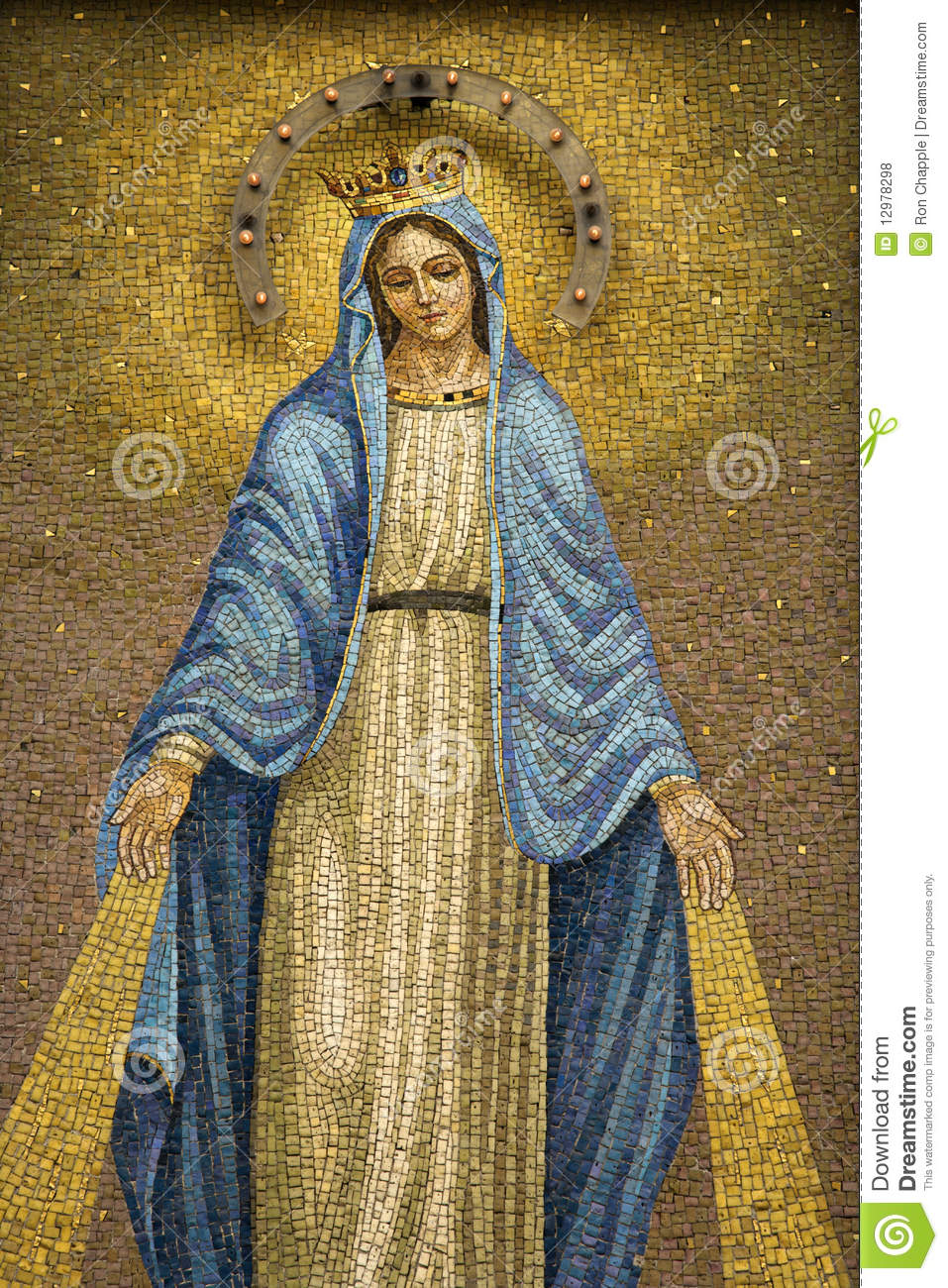
Image from www.dreamstime.com600

The cult of Mary was not confined to ascetic intellectuals.  The need for a goddess figure was profound in a religion founded by Jesus and shaped by Paul, two unmarried men, and at the popular level there are numerous apocryphal stories about Mary’s parents, childhood and upbringing and her assumption into heaven.  The idea that she might have died and her body become corrupted became unimaginable, hence her “assumption” into heaven, noted in apocryphal sources for the first time in the late fourth century.  In the east the emphasis was on “a dormition” (a falling asleep).  


Mary came to absorb the attributes of pagan goddesses.  Vasiliki Limberis shows how the goddesses Rhea and Tyche, to whom temples had been built by Constantine in Constantinople, gradually became transformed into Mary, the Virgin Mother of God, as Christianity ousted the remnants of paganism in the city in the fourth century.  It helped that Rhea, like many other goddesses, was herself associated with “virgin birth” stories.  


Image from www.eyeofhorus.biz

Image from www.eyeofhorus.biz

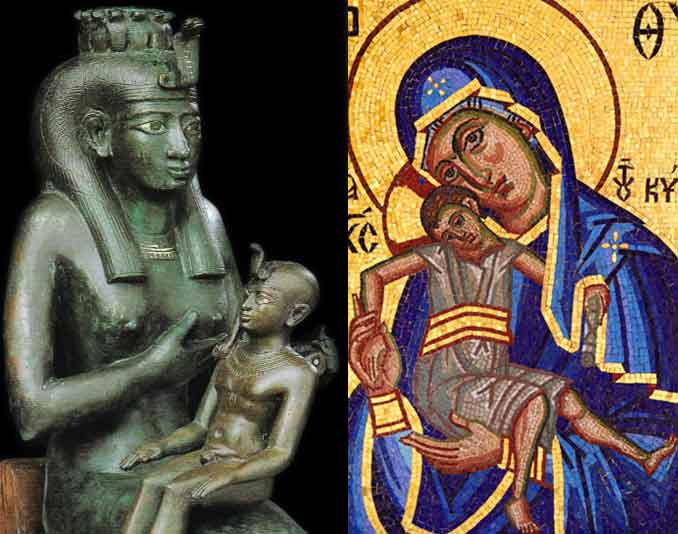
A particularly fruitful source was the Egyptian goddess Isis, who had become a universal mother goddess in her own right.  Isis had developed the role of protector of sailors just at the time when her cult was transferred from Egypt to the Aegean by merchants.  Mary too becomes a protector of sailors, the “star of the sea.”  Isis’ emblem was the rose, and this too is appropriated by Mary, while representations of Isis with her baby son Horus on her knee seem to provide the iconic background for those of Mary and the baby Jesus.  These representations, richly developed in Christian art, suggest a yearning for tenderness that had not previously satisfied.


So the cult of the Virgin Mary developed much deeper populist roots than many others and was strengthened by support at the highest levels of the church (as it still is in Roman Catholic Christianity).  A good example of how the apocryphal stories about Mary were adopted by the church hierarchy can be seen in the fifth-century mosaics of S. Maria Maggiore in Rome.  The basilica was built by Sixtus III in the 430s in celebration of the declaration of the Council of Ephesus that Mary was the Mother of God.  In the Annunciation scene, which presents Mary in great splendour arrayed as a Byzantine princess, she is shown to have been spinning–drawing on an apocryphal story that she was in service in the Temple where she wove a veil for the Holy of Holies.  Here Sixtus has appropriated a story with no scriptural support at all in order to make contact with popular devotion.


One of the results of the elevation of virginity was to transform women who did not espouse it into temptresses, the “dancing girls” of Jerome’s vision.  While Mary was contrasted with Eve, women as a whole were equated with Eve, perpetuating her guilt through the temptation they offer to men.  “Do you not realise that Eve is you?” inveighed the tempestuous Tertullian.  “The curse God pronounced on your sex weighs still on the world . . . You are the devil’s gateway, you desecrated the fatal tree, you first betrayed the law of God, you who softened up with your cajoling words the man against whom the devil could not prevail by force . . .”  So arises the dichotomy between virgin and whore, allowing no acceptable expression of female sexuality in between.


Excerpt from Chapter 17: Eastern Christianity and the Emergence of the Byzantine Empire, 395-600


[Note:  The reference to Mary in this chapter came about in the context of the debate about the dual nature of Jesus as human and divine.  Evidently this dichotomy was questioned as early as the first few centuries when Christianity as a religious political power came into prominence.]


If Jesus was fully man when he suffered, was he still man when he worked a miracle, or was he then acting in his divine role?  What form of humanity did he take—man as before the fall, man as now lost in sin or man as he would be when redeemed?  If Jesus was created as a perfect man, what did Luke mean when he wrote (2:52) that “Jesus increased in wisdom, stature and in favour with God and men”?  Surely an “increase” implied that he was at some point an undeveloped human being, but was this possible?  It could be assumed that he was not man in any way before the Incarnation, but after his resurrection did he revert to being only God, or did he retain some of his humanity? (Hilary of Poitiers argued that he remained both perfect man, fully human but without sin, and perfect God.)  Connected to these debates was the status of the Virgin Mary.  She was now the object of growing personal devotion, and her status rested on her role as the mother of Jesus.  Yet was she the bearer of God (Theotokos) or of a man (Anthropotokos)?


The person around whom the debate was to crystallize was Nestorius, appointed bishop of Constantinople in 428. Nestorius had shown concern at the use of the title of Theotokos for Mary.  He felt that this title denied the human nature of Jesus altogether and would have preferred to see Mary as Anthropotokos, though he was prepared to compromise on Christotokos, “bearer of Christ.”  After all, Mary had given birth as a human being to a man who was capable of suffering and dying, although he was, of course, the divine logos as well.  Calling Mary Theotokos risked falling into the heresy of denying Jesus’ humanity.  Where Nestorius, like everyone else, experienced difficulty was in finding a formula which could explain how Jesus’ two natures, human and divine, could co-exist.  He favoured the term “conjunction” rather than “union,” but his theological fumblings made him vulnerable to the new bishop of Alexandria, Theopilus’ nephew Cyril.  Cyril championed the Theotokos formula, and he saw the issue as one through which he could undermine Nestorius and humble the see of Constantinople. He prepared his ground carefully.  He circulated a pastoral letter to his local bishops explaining that since the promulgation of the Nicene Creed as orthodoxy the only possible title for Mary was “bearer of God,” and he then persuaded the bishop of Rome, Celestine, a natural supporter of Alexandria against Constantinople, to agree to this formulation.  Next he won over Pulcheria, the powerful elder sister of the young emperor Theodosius (who had succeeded Arcadius in 408).  Pulcheria, who ruled as Theodosius’ regent, had a personal devotion to Mary, and Nestorius had offended her by refusing to allow her to take communion alongside the clergy in the sanctuary of his church.  (A similar standoff took place between Theodosius and Ambrose in Milan.)


. . . .Even if, after 381, Christ and the Holy Spirit were fully incorporated into the Godhead, Christianity could provide a mass of figures who had some form of “divine” status in the afterlife as companions of God, such as the Virgin Mary, the saints and the martyrs.  Then there were the angels and demons whose combined presence filled the Christian world with as many supernatural presences as there had been in earlier times.  It needs to be remembered that Christians continued to believe in the existence of the pagan gods—as demons.  None of this would have been alien to pagans.  G. W. Bowerstock describes a number of instances, from Syria and Mesopotamia in particular, of gods being worshipped in groups of three.


—————————————————


If these excerpts have piqued your curiosity enough to want to know more not only about this topic but also how early Christianity developed it’s doctrines over centuries, then please get a copy of Charles Freeman’s book.  It is available on kindle edition from amazon.com.


NSB@S6K


logo


Is it wrong to shortcut “X” for “Christ” and “Xmas” for “Christmas”?

Image from blog.dictionary.com

Image from blog.dictionary.com

[A revisit, first posted December 26,2012, reposted 2015.  You might be surprised at the answer to the title’s question.—Admin1]


——————–


S6K:  “Christ-mas” by the very name of this holiday is all about the “Christ”.  But where does that term come from and what does it mean?


Online Etymology Dictionary explains: 

[http://www.etymonline.com/index.php?term=christ] 

 
  • Christ Look up Christ at Dictionary.com –  title given to Jesus of Nazareth, 
  • Old English crist, from Latin Christus, 
  • from Greek khristos “the anointed” (translation of Hebrew mashiah; see messiah), 
  • verbal adjective ofkhriein “to rub, anoint” (see chrism). 
  • The Latin term drove out Old English hæland “healer” as the preferred descriptive term for Jesus. 
  • A title, treated as a proper name in Old English, 
  • but not regularly capitalized until 17c. 
  • Pronunciation with long -i- is result of Irish missionary work in England, 7c.-8c. 
  • The ch-form, regular since c.1500, was rare before. 
  • Capitalization of the word begins 14c. but is not fixed until 17c.

Wikipedia elaborates:

 
  • Christ (/krst/) (ancient GreekΧριστόςChristós, meaning ‘anointed‘) is a translation of the Hebrew מָשִׁיחַ (Māšîaḥ), the Messiah, and is used as a title for Jesus in the New Testament.[3]
  • The followers of Jesus became known as Christians (as in Acts 11:26) because they believed Jesus to be the Messiah (Christosprophesied in the Hebrew Bible
    • Christians designate him Jesus Christ, meaning Jesus the Christos.[4] 
  • Christ was originally a title, In common usage “Christ” is generally treated as synonymous with “Jesus of Nazareth”.[6]
    • but later became part of the name “Jesus Christ”,
    •  though it is still also used as a title, 
    • in the reciprocal use Christ Jesus, meaning “The Messiah Jesus”.[5] 
 
  • Jesus is not accepted by the majority of Jews as their Messiah.[7] 
    • The Jewish people still await the Messiah’s first coming, 
    • while Christians await his second coming
      • when they believe he will fulfill those parts of Messianic prophecy left unfulfilled in the first century AD.
 

The area of Christian theology called Christology is primarily concerned with the nature and person of Jesus Christ as recorded in the Canonical gospels and the letters of the New Testament.[8]


S6K:  If that one part of the term “christ”-mas has that much historical development in usage, what about the 2nd part of “Christ”-“mas”?


Wikipedia continues: 

 
  • Xmas is a common abbreviation of the word Christmas
  • It is sometimes pronounced /ˈɛksməs/, but it, and variants such as Xtemass, originated as handwriting abbreviations for the typical pronunciation /ˈkrɪsməs/
  • The “-mas” part is from the Latin-derived Old Englishword for Mass,[1] 
  • while the “X” comes from the Greek letter Chi, which is the first letter of the Greek word Χριστός, translated as “Christ“.[2]
 

There is a common misconception that the word Xmas stems from a secular attempt to remove the religious tradition from Christmas[3]by taking the “Christ” out of “Christmas”.

History

Use in English


“Xmas” used on a Christmas postcard, 1910
Early use of “Xmas” includes Bernard Ward’s History of St. Edmund’s college, Old Hall (originally published circa 1755).[9] An earlier version, “X’temmas”, dates to 1551.[9] Around 1100 the term was written as “Xp̄es mæsse” in the Anglo-Saxon Chronicle.[2] “Xmas” is found in a letter from George Woodward in 1753.[10] Lord Byron used the term in 1811,[11] as did Samuel Coleridge (1801)[5] and Lewis Carroll (1864).[11] In the United States, Oliver Wendell Holmes, Jr. used the term in a letter dated 1923.[11] Since at least the late 19th century, “Xmas” has been in use in various other English-language nations. Quotations with the word can be found in texts written in Canada,[12] and the word has been used in Australia,[7] and in the Caribbean.[13] Merriam-Webster’s Dictionary of English Usage stated that modern use of the term is largely limited to advertisements, headlines and banners, where its conciseness is valued. The association with commerce “has done nothing for its reputation”, according to the dictionary.[11] 

In the United Kingdom, the former Church of England Bishop of BlackburnAlan Chesters, recommended to his clergy that they avoid the spelling.[5] In the United States, in 1977 New Hampshire Governor Meldrim Thomson sent out a press release saying that he wanted journalists to keep the “Christ” in Christmas, and not call it Xmas—which he asserted was a “pagan” spelling of Christmas.[14]


Use of “X” for “Christ”

 
For the article about the χρ symbol, see Chi Rho.

The labarum, often called the Chi-Rho, is a Christian symbol representing Christ.

The abbreviation of Christmas as “Xmas” is the source of disagreement among Christians who observe the holiday. Dennis Bratcher, writing for a website for Christians, states “there are always those who loudly decry the use of the abbreviation ‘Xmas’ as some kind of blasphemy against Christ and Christianity”.[15] Among them are evangelist Franklin Graham and CNN journalist Roland S. Martin. Graham stated in an interview: for us as Christians, this is one of the most holy of the holidays, the birth of our savior Jesus Christ. And for people to take Christ out of Christmas. They’re happy to say merry Xmas. Let’s just take Jesus out. And really, I think, a war against the name of Jesus Christ.[16]


Martin likewise relates the use of “Xmas” to his growing concerns of increasing commercialization and secularization of one of Christianity’s highest holy days.[17] Bratcher posits that those who dislike abbreviating the word are unfamiliar with a long history of Christians using X in place of “Christ” for various purposes.


The word “Christ” and its compounds, including “Christmas”, have been abbreviated in English for at least the past 1,000 years, long before the modern “Xmas” was commonly used.


The Oxford English Dictionary (OED) and the OED Supplement have cited usages of “X-” or “Xp-” for “Christ-” as early as 1485.

  • The terms “Xtian” and less commonly “Xpian” have also been used for “Christian”. 
  • The OED further cites usage of “Xtianity” for “Christianity” from 1634.[2] 
  • According to Merriam-Webster’s Dictionary of English Usage, most of the evidence for these words comes from “educated Englishmen who knew their Greek”.[11]
 

In ancient Christian art, χ and χρ are abbreviations for Christ’s name.[19] In many manuscripts of the New Testament and icons, Χ is an abbreviation for Χριστος[20], as is XC (the first and last letters in Greek, using the lunate sigma);[21] compare IC for Jesus in Greek.


Other uses of “X(t)” for “Chris(t)-“


Other proper names containing the name “Christ” besides those mentioned above are sometimes abbreviated similarly, either as “X” or “Xt”, both of which have been used historically,[22] e.g., “Xtopher” or “Xopher” for “Christopher”, or “Xtina” or “Xina” for the name “Christina”.


In the 17th and 18th centuries, “Xene” and “Exene” were common spellings for the given name Christine. The American singer Christina Aguilera has sometimes gone by the name “Xtina”. Similarly, Exene Cervenka has been a noted American singer-songwriter since 1977.


This usage of “X” to spell the syllable “kris” (rather than the sounds “ks”) has extended to “xtal” for “crystal“, and on florists‘ signs to “xant” for “chrysanthemum“,[23] even though these words are not etymologically related to “Christ”: “crystal” comes from a Greek word meaning “ice” (and not even using the letter χ), and “chrysanthemum” comes from Greek words meaning “golden flower”, while “Christ” comes from a Greek word meaning “anointed.”


S6K:  For the FULL DISCUSSION of the acceptable use of X — please go to  [http://en.wikipedia.org/wiki/Xmas].

So, do Sinaites celebrate Christmas?

Image from remit2homeblog.wordpress.com

Image from remit2homeblog.wordpress.com

[First posted in 2012 and reposted every  season when the Filipino tradition of “simbang gabi” or midnight mass begins with the ringing of church bells.  ‘Tis the season to remind one and all to respect one another’s freedom to practice his/her religion of choice.—Admin1.]


———————————-


Q: Do Sinaites celebrate Christmas?

A:  Sure . . . why not?  Surprised?


We have had a history of celebrating Christmas when we were Catholic, then Evangelical, then  Messianic, and to this day when we no longer regard it to have any specific religious significance—at least for us.


We belong to those parts of the world that have calendared Christmastime as a holiday season with distinctive traditions intended to generate goodwill and peace among mankind, never mind that its roots are questionable.


 For a culminating celebration timed at the turning of the year, even in countries without 4 seasons, or the tropics without a winter though still experiencing solstice, it is associated with gift-giving, family reunions, savoring the final week of the year with some introspection, aside from the Christian designation as the birthday of one acclaimed Jewish ‘Messiah’.


Even if we no longer believe the “reason for the season” we still recognize it as a time full of merry-making and joy-full traditions:

  • when people who are not in talking terms are moved to reconcile; 
  • when employers exhibit generosity by giving year-end bonuses; 
  • when offices and schools hold holiday parties in anticipation of the transition to a new year. 

It is a time to remember the neglected with greeting cards and an occasion to show appreciation in any meaningful way.  If there was negligence to do this during the year, Christmas is the catch-up and make-up time.  We turn into gift-giving Santas as well as gift-anticipating “children” at any age.


In fact for so long now, Christians have lamented that “Christ” has practically been taken out of “Christmas” and it has turned into one big secular holiday where commercial establishments make a killing selling decorations, gifts, holiday wear, seasonal music, etc.  Give the business people a break, it IS a good time for business indeed! It could be an appropriate time to unstress except that so much last-minute preparation and shopping craziness cause unnecessary stress.  It is also a time when amidst the merrymaking, the lonely are affected by depression on the one hand, while revelers throw all caution away by eating and drinking too much. Not even these negatives succeed in dampening the annual celebration and every year-end it starts all over again this crazy season.


Image from unrealfacts.com

Image from unrealfacts.com

If you’ve read the article Who really was born on December 25?,  you will discover that there have been attempts by religious purists and ‘the intolerant of other faiths’ to censor the religious holiday since its roots are pagan, but without lasting success.   Culture, tradition and habit are stronger incentives to continue the celebration and there are fewer purists and fundamentalists than there are liberal-minded people.  After all, what is so wrong with generosity, goodwill and—let’s not forget—a really good time for people of all ages?  When do we ever see these 3 “G”s come together on any holiday in the year?  


Keep Christmas, it is a GOOD holiday season for all humanity, regardless of what religionists turn it to be for their flock and regardless of others’ non-recognition of the religious reason.


Tolerance and respect for all faiths is good to cultivate, there is no harm in ‘live and let live’; Christians, Jews, Moslems and atheists each have their differing ways of observing or not observing this festive time of the year.  What does it matter anymore, what the cause for celebrating is?  Does it bring blessing, happiness and joy even temporarily in the lives of the celebrants?  Then so be it!  Each individual knows why he/she chooses to join the throng or not, let’s be thankful we have that freedom to believe in what we choose to believe, as long as it does not cause harm to our neighbor.   


Lord [YHWH]
my strength and my fortress,
    my refuge in time of distress,
to you the nations will come
    from the ends of the earth and say,
“Our ancestors possessed nothing but false gods,
    worthless idols that did them no good.
 Do people make their own gods?
    Yes, but they are not gods!” 
Jeremiah 16:19-20 [NIV]


We Sinaites are well aware that there is no God but YHWH Who has no beginning and has no end.  Aside from religious or observant Jews, how many recognize and worship YHWH as the True God? How many call on His Name? Well, add Sinaites to that minority!  


Does that prevent us from celebrating a season held dear by our Christian friends and families?  It need not.  We celebrate the joy of knowing the truth about Christmas, of recognizing we are all journeying on the same path among God-seekers, of respecting the diversity of God-centered religions, and of people who live the TORAH life even if they’re not aware of it because it IS written in each heart by the Giver of TORAH . . . . and that is a good reason enough for us to celebrate!


Jean Isenberg, 2007

Jean Isenberg, 2007

This is a story I share in tribute to a Jewish atheist named Jean Isenberg who had become my friend when I was living in Santa Rosa, CA, circa 2000-2007.  In his senior years, he played the violin to entertain the elderly at senior homes; I had worked as a recreation director in one “Assisted Living” facility and met him.  Besides our common ministry toward seniors and love for music, we connected on different levels and became dear friends.   I was still messianic in belief, but we celebrated Passover together with my three sons— he according to Jewish tradition, and I according to the Christ-centered messianic tradition. The one Christmas tradition he never failed to join year after year was the “Singalong Messiah” where every musician who played any instrument at all and every singer who knows Handel’s “MESSIAH” came together to play/sing the whole composition under one conductor who led the unrehearsed but much anticipated musical celebration year after year.  I was part of the audience who couldn’t sing and was familiar only with the Hallelujah Chorus and not much else.  It was attended by people of all faiths and no faith, like my atheist Jewish dear friend.  He has since passed away but I fondly look back to that one memory of a Jew who didn’t even believe in the claims of the Hebrew Scriptures, much less the Christian Bible . . . and yet enjoyed every aspect of this year-end joyous celebration with his fellowmen, giving a musical tribute to a God whose existence he did not acknowledge in belief, but this is the wonder of it . . . even as an atheist, he nevertheless lived TORAH!  That is love and respect for your neighbor’s convictions, something religionists need to learn and cultivate.


Would that people of differing beliefs could all come together under the Baton of the OneTrue God to play the ultimate cantata and join the chorus in one beautiful harmony of different notes, praising “Ha Shem” — THE NAME — symbolized for now in the Tetragrammaton YHWH.  Some know His ineffable Name but don’t dare utter it; others call Him by other names.  Since there is no God but YHWH, the all-Merciful, all-Gracious, full of Loving Kindness, Righteous and Just God — He most probably tolerates man’s ignorance for a while, knowing He has left His Signature all over His creation and His Revelation for Israel to share and for all mankind to discover.  It is only a matter of time for each searching heart to find Him and acknowledge Him . . .and so we wait for each other and prod each other along the way . . . in our pilgrimage.  We earnestly believe if we are seeking, we will find Him, that is the promise!


Tis the Season animated emoticonGoodwill toward humankind and peace in our hearts as a result of knowing ‘Christmas’ truth, indeed we join the merrymaking but for a different reason!  


On December 25, I received this text message from the president of the Jewish club in our city: “Feliz Navidad.” I texted back, “that is a strange greeting from a Jew.” His answer: “Hey, if it makes one a better person, then all religion is good.”


A  merry Christ-mas to our Christ-ian and Messianic friends, 

and happy holidays and a joyful year-end celebration

to all others like us, Sinaites, who are celebrating

the meaning of the words associated with this season:

joy, love, peace of heart and mind,

and good will to one and all!


NSB@S6K


 logo


Numbers/Bamidbar 8 – ‘the Light of the world with Whom light dwelleth . . . ‘

[First posted August 13, 2014.  We are into the ‘season of light’, more like the season of artificial lights.  Man-made spectacles using light dominate this month of December—enjoyable, impressive maybe, but never reaching the level of “awesome” even if that word is quite overused and in fact badly or wrongly or mindlessly used.  What exactly might deserve the proper use of that word?  Read on.

The symbolism of light in Hebrew Scripture begins as early as Creation day one . . . 


“Let there be light and there was light.”   

 
Image from www.kingjamesbibleonline.org

Image from www.kingjamesbibleonline.org

Casual readers sometimes miss the point that since the heavenly visible sources of light such as the sun, moon and stars were not created until day four, not much thought goes into the ‘light’ that appeared as early as  day one.


Think about this:  the phenomenon of light truly overpowers and dominates any space it could penetrate through, so that in total

darkness, a mere matchstick is immediately visible . . . and yet in the light-space, you cannot have the same effect of the opposite of a matchstick.  In effect, light overcomes and overpowers darkness and for darkness to appear, light has to withdraw from that space, or not be allowed to get through.

Image from flickrhivemind.net

Image from flickrhivemind.net


Then light symbolism also extends beyond the visual.  YHWH manifests in the TNK as light, or fire or glory cloud (Shekinah), NEVER as a human being, regardless of what Christian interpreters claim such as, for instance, one of the ‘3 men’ who show up at Abraham’s camp before the destruction of Sodom and Gomorrah.  Fire and brimstone from heaven do their destructive work.  When YHWH’s light withdraws, this world is indeed left in darkness.  When man withdraws from YHWH’s LIGHT as in belief that God exists or ignorance of the TORAH, or worse, rejection of the TORAH by claiming it is irrelevant, antiquated, obsolete, only for the Jews and not for the world—darkness in mind and heart leads to the domination of man’s ways, each human decides what is right, there is no standard of right.  Truth and Right become relative, to each his own.  


YHWH is the LIGHT of the world; and His Torah is light and life-giving, and His chosen servant, Israel, is the light-bearer which delivers the Torah to the nations.


Whoever clings to YHWH as  Lord and God, and lives YHWH’s Torah, becomes a light-bearer just like Israel.  What a privilege indeed and what a beautiful image for any Torah-observant gentile who, just like the Moabitess Ruth chooses to embrace Israel’s God as her God.


This chapter is self-explanatory but we include the commentary of Pentateuch and Haftarah, ed. Dr. J.H.Hertz, as usual and our translation is EF/Everett Fox The Five Books of Moses.–Admin1]

 
Image from www.nccg.org

Image from www.nccg.org


NumbersBamidbar 8


THE MENORAH

VIIII, 1-4.  The making of the Menorah is described in Exod. XXV.  The command to light the lamps in the Tabernacle had been given briefly in Exod. XXV,37; and in Exod. XXVII,21 Aaron and his sons are specially entrusted with that duty.


 YHVH spoke to Moshe, saying:
2 Speak to Aharon and say to him;
When you draw up the lampwicks,
toward the front of the lampstand let the seven lampwicks give light.


when thou lightest the lamps. lit. ‘when thou causest the lamps to go up”; .i.e. when thou causest the flame of the lamps to go up.

‘Why does this command follow immediately after the consecration of the Altar?’  asks the Midrash.  The answer is: when Aaron saw the rich gifts which the princes offered on that occasion, his heart grew faint that neither he nor his tribe had a part in that consecration.  Thereupon the Holy One, blessed be He, reassured him in the words, ‘By thy life, thine is greater glory than theirs, for thou lightest the Menorah.’ There is a further Rabbinical saying: “The Sanctuary will on another occasion also be dedicated by kindling the lights, and then it will be done by thy descendants, the Hasmoneans.  Thus greater glory is destined for thee than for the princes.  Their offerings to the Sanctuary will be employed only as long as it endures, but the lights of the Chanukah festival shall shine for ever.’


give light in front of the candlestick.  Aaron is here bidden to arrange the wicks of the seven lamps in such a way that they shall give out one combined blaze of light over against the central shaft of the candelabrum itself (Talmud).  Israel said before the God:  “LORD of the Universe, Thou commandest us to illumine before Thee; art Thou not the Light of the world, and with Whom light dwelleth?”  ‘Not that I require your light,’ was the Divine reply, ‘but that you may perpetuate the light which I conferred on you as an example to the nations of the world’ (Talmud).


The Menorah is one of the favourite symbols of Judaism.  Through its association with Chanukah, the Menorah has come to typify spiritual conquest, and that spiritual conquest is achieved neither by might nor by power, but by God’s spirit. . . . Israel, as the Servant of the LORD, is to perform his Divine task without violence.  He is not to strive nor cry: ‘a bruised reed shall he not break, and the dimly burning wick shall he not quench’ (Isa. XLII,3).  The image employed by Isaiah to describe Israel’s mission is the gentle agency of light, with its irresistible illumination of the surrounding darkness. ‘This is among the loftiest conceptions of all human thought.  How new an idea it was, is measured by the length of time it has taken before the idea began slowly to make its way that force cannot conquer spirit’ (Moulton).

 
3 Aharon did thus;
toward the front of the lampstand he drew up the lampwicks, 
as YHVH had commanded Moshe.
4 Now this (was) the constructed-pattern of the lampstand: 
hammered-work of gold, 
(even) up to its stem, up to its petals, it was hammered-work. 
According to the vision that YHVH had Moshe see, thus the lampstand was made.


5-26.  DEDICATION OF THE LEVITES

The choice of the Levites for the service of the Sanctuary is given in III,5-10 and their duties are detailed in IV.  In view of the impending breakup of the camp, it was now necessary formally to dedicate them to the duties upon which they were about to enter.

 
5 Now YHVH spoke to Moshe, saying:
6 Take the Levites from the midst of the Children of Israel, 
and purify them.


take the Levites.  ‘With kind words.  Say unto them, Happy are ye inasmuch as ye have been found worthy to be servants to the Omnipresent’ (Rashi).  ‘For God elevates no man to an office unless He has tried him and found him worthy of his calling.  He did not say, “and the Levites shall be Mine,” before had tried this tribe and found them worthy.  In Egypt none but the tribe of Levi observed the Torah, and clung to the token of the Abrahamic covenant; while the other tribes abandoning both Torah and token of covenant, like the Egyptians, practised idolatry.  In the desert, also, it was this tribe alone that did not take part in the worship of the Golden Calf.  Justly, therefore, did God’s choice fall upon this godly tribe, who on this day were considered as the servants of God and His sanctuary’ (Midrash).


cleanse them. Purify them from ritual uncleanness.

 
7 Thus you are to do to them, in order to purify them: 
sprinkle on them Water of Hattat/decontamination;
they are to pass a razor across their whole body, 
and are to scrub their garments- then they will have purified themselves.


sprinkle.  The Heb. is the infinitive.  It does not, therefore, denote an act which Moses is ordered to perform himself—an act that would have taken one person many months—but an act which he is to order to be performed (Ehrlich).


water of purification.  lit. ‘water of sin’; i.e. water which removes sin; according to Rashi, it was the water used in the rites connected with the ordinance of the Red Heifer (XIX,9) for the removal of the defilement due to contact with a dead body.  Among the large number of Levites to be consecrated some must have required such purification.


and let them wash their clothes.  An act enjoined in Scripture as a preparation for any special religious service; Gen.XXXV,2; Exod. XIX,10.  This ceremonial cleansing symbolized the inward purity required of those who bore the vessels of the Sanctuary.

 
8 They are to take a bull, a young of the herd, and its grain-gift, 
 flour mixed with oil, 
 and a second bull, a young of the herd, you are to take for the hattat-offering.
9 You are to have the Levites come-near before the Tent of Appointment;
 then you are to assemble the entire community of the Children of Israel.
10 You are to have the Levites come-near, before the presence of YHVH, 
 and the Children of Israel are to lean their hands upon the Levites.


before the LORD. Before the Altar of sacrifice.

lay their hands upon the Levites.  The representatives of the Israelites laid their hands upon the representatives of the Levites, in order to indicate that the whole community offered them to the service of God; Lev.I,4.

 
11 Aharon is to elevate the Levites as an elevation-offering, before 
the presence of YHVH, on behalf of the Children of Israel, that they may serve the serving-tasks of YHVH.


offer.  lit. ‘wave’, so also in v. 13, 15 and 21.

a wave offering.  The Levites were probably led backwards and forwards by Aaron in the direction of the Holy of Holies, or he may have only waved his hand over them.  The idea underlying was unmistakable.  This is:  having been given by the Israelites to God, the Levites were given back to the Israelites, whose servants they were to be in all matters appertaining to the Sanctuary.’

 
12 Then the Levites are to lean their hands on the head of the bulls; 
they are to assign the one as a hattat-offering and the other as an offering-up to YHVH
to effect-ransom for the Levites.


and the Levites. i.e. the chosen representatives of the Levites.

 
13 Thus you are to have the Levites stand before Aharon and before his sons 
and are to elevate them as an elevation-offering to YHVH.
14 Now you are to separate the Levites from the midst of the Children of Israel, 
mine are the Levites to be!
15 After that the Levites may enter into the service of the Tent of Appointment, 
when you have purified them and elevated them as an elevation-offering.
16 For given-over, given-over are they to me from the midst of the Children of Israel,
in place of the breacher of every womb, the firstborn of every one of the Children of Israel;
I have taken them for myself.


for they are wholly given.  lit. ‘for they are given, given’; given, for carrying the Tabernacle and its furniture; and given, for singing the chants of the Sanctuary (Rashi).

 
17 For mine is every firstborn among the Children of Israel, 
of man and of beast;
at the time that I struck down every firstborn in the land of Egypt, 
I declared-them-holy for myself.
18 Now I take the Levites
in place of every firstborn from the Children of Israel,
19 and I give-over the Levites, (to be) given-over to Aharon and to his sons 
from the midst of the Children of Israel,
to serve the serving-tasks of the Children of Israel in the Tent of Appointment, and to effect-ransom for the Children of Israel, that there not be among the Children of Israel (any) plague when the Children of Israel encroach on the holy-things.


the children of Israel.  The five-fold repetition of these words in this verse indicates the love felt by God towards the bearers of the name of Israel (Midrash).


atonement.  Here used not in the usual sense of making propitiation, but in the sense of ‘covering’, a meaning inherent in the Heb. root. The Levites were to form a sort of protective cordon for the Sanctuary.


no plague.  The explanation is indicated in Rashi’s comment, which in effect states:  “I have appointed the Levites to take over the service of the Sanctuary from the children of Israel, upon whom it had hitherto devolved, and thereby to prevent a plague amongst the latter; because if they came near the Sanctuary, there would certainly be a plague amongst them, since they have proved themselves unworthy of the priestly office.’

 
20 Moshe, Aharon, and the entire community of Israel did regarding the Levites
according to all that YHVH had commanded Moshe regarding the Levites, 
thus they did regarding them, the Children of Israel.
21 The Levites decontaminated-themselves and scrubbed their garments;
Aharon elevated them as an elevation-offering before the presence of YHVH,
and Aharon effected-purgation for them, to purify them.


purified themselves.  By having the ‘water of expiation’ sprinkled upon them; v.7.

 
22 After that the Levites entered to serve their serving-tasks in the Tent of Appointment,
in the presence of Aharon and in the presence of his sons:
as YHVH had commanded Moshe regarding the Levites, thus they did regarding them.
23 YHVH spoke to Moshe, saying:


23-26.  The Levites’ Period of Service.  Additional regulations to those in IV, including a probationary period from the age of 25 to 30, as well as the regulations for Levites over 50 years of age.

 
24 This is what (is to be done) regarding the Levites:
from the age of five and twenty years and upward,
they are to enter the working-force, to join-the-force in the serving-tasks of the Tent of Appointment;


twenty and five years old and upward. ‘Then years of twenty-five to thirty were for initiation in connection with the lighter labours in the Sanctuary’ (Sifri).

 
25 and from the age of fifty years,
they are to retire from being-on-the-force for the serving-tasks,
and shall not serve anymore.


return from the service. Retire from active service in connection with the Sanctuary.

 
26 They may attend upon their brothers in the Tent of Appointment,
to keep the maintenance-duty,
but serving-tasks they are not to serve.


Thus are you to do regarding the Levites in reference to their duties minister with their brethren.  Assist their younger fellow-Levites, but shall do no essential or responsible service.  According to the Rabbis, their work was that of closing the gates of the Sanctuary and assisting in the choral singing.
 

keep the charge.  Assist in the dismantling and erecting the Tent of Meeting at the beginning or end of a journey (Rashi).  A superannuated life need not be a useless life.