The Sinaite’s Musical Liturgy – 1st Sabbath of July

Image from sayingimages.com

Image from sayingimages.com

[Every other Sabbath,

we sing our Liturgy;

we have no original music of or own;

our roots are Christian

and we are familiar with their hymnody,

 so we borrow their music.  

When the lyrics reflect our belief system,

we leave them as originally written;

otherwise, we make minor revisions,

if not do a total rewrite,

reflecting the Sinaite’s Creed.  

Needless to say,

but we’ll say it anyway,

we are grateful to Christian composers

for their music. —Admin1]


———————-


Kindle the Sabbath Lights


Immortal, Invisible God,

Blessed are You, the Source of Light!

As we kindle our Sabbath candles

on the eve of Your Holy Day,

We thank You for being the source of our spiritual illumination.

Your blessed Torah, Your instructions for life, Your guidelines for living,

lights up our pathway in our life’s journey.

Blessed are You, YHWH our God,

King of the Universe,

Who has blessed us with Your Torah

for knowledge, understanding and wisdom,

if we would partake of its fruit!

Blessed are You, YHWH, our God,

King of the universe,

true Lord of the Sabbath,

Who has gifted us with the Queen of days, 

Your set-apart Sabbath, our day of rest.


Image from www.pinterest.com

Image from www.pinterest.com


[O God our Help in Ages Past,

Music by Isaac Watts/Lyrics by William Croft

Original Lyrics]

1. O God, our help in ages past,
our hope for years to come,
our shelter from the stormy blast,
and our eternal home.


2. Before the hills in order stood,
or earth received her frame,
from everlasting, thou art God,
to endless years the same.


3. A thousand ages, in thy sight,
are like an evening gone;
short as the watch that ends the night,
before the rising sun.


4. Time, like an ever rolling stream,
bears all who breathe away;
they fly forgotten, as a dream
dies at the opening day.


5. O God, our help in ages past,
our hope for years to come;
be thou our guide while life shall last,
and our eternal home.

Image from vimeo

Image from vimeo


Praise the Lord Ye Heavens Adore Him,

Music by Prince Albert (Gotha)

[Revised Lyrics to reflect the Sinaite’s Creed]

 Praise YAHUWAH, magnify His Name;
Praise Him, angels, in the heights;
Sun and moon, shine bright, make known His Fame,
Sparkle all ye stars at night;
Listen to His voice thunder to our days,

He hath spoken to humankind,

Rules, commandments, life instructions,

For our guidance all His Laws He hath made.


2. Praise YAHUWAH,  He is glorious;
Never shall His promises fail:
Over all He is victorious;  evil, never shall it prevail.
Praise YAHUWAH, Lord God Almighty;
Hosts on high, His power proclaim;
Heaven,  earth and all creation,
Laud, magnify His Name, His awesome Name!


3.  Worship, honor, glory, blessing,

Lord we offer these unto Thee!

Young and old Thy praise expressing,

In glad homage bend the knee!

All creation bow, worship only Thou,

Thus do we, before Thy Throne.

As in heaven, where Thou rulest,

So on this earth we pray

‘Thy Will shall be done’!

Torah Reading:  Deuteronomy 11:18-20, 26-28,32


You are to place  these my words upon your heart

and upon your being;

you are to tie them as a sign on your hand,

let them be as bands between your eyes;

you are to teach them to your children,

by speaking of them

in your sitting in your house,

in your walking on the way,

in your lying-down,

in your rising-up.

You are to write them upon the doorposts of your house,

and on your gates,

in order that your days may be many,

along with the days of your children . . . .

See, 

I place before you today a blessing or a curse: 

the blessing,

(provided) that you hearken to the commandments of YHWH your God that I command you today, 

and the curse,

if you do not hearken to the commandments of YHWH your God,

and turn-aside from the way that I command you today . . . .

You are to take-care to observe all the laws and the regulations that I place before you today.


prayerSweet Hour of Prayer,

William W. Walford,

[Revised Lyrics

to reflect

the Sinaite’s Creed]


Sweet hour of prayer! Sweet hour of prayer!
That calls me out from a world of care,
And bids me at YAHUWAH’s throne
Make all concerns and all wishes known.
In seasons of distress and grief,
My soul has often found relief,
In knowing that my God does care

to hear me during my time of prayer!


The joy I feel, the bliss I share,

When I thank Him and when I declare:
His NAME to those who never heard,

from teachers, preachers who teach His Word.

YAHUWAH is the NAME I know,

He knows how much I love Him so . . . 

I lift my loved ones to His Throne,

In doing so, I am not alone.


Sweet hour of prayer! Sweet hour of prayer!

Its wings shall soar, my petition bear–
To Him whose Truth and Faithfulness

engage the waiting soul to bless.

And since He bids me seek His face,
Believe His Word, accept His Grace,
I long to meet Him everywhere,
but mostly in my sweet hour of prayer!


[Pray for your loved ones, name them individually:

parents, spouse, children, siblings, extended kin, friends, special people.]


Image from Pinterest

Image from Pinterest

Image from freewebs.com

Image from freewebs.com


HAVDALAH


Lord, Dismiss Us with Your Blessing

Music by Jean-Jacques Rousseau, 1712–1778

 [Revised Lyrics to reflect the Sinaite’s Creed]

LORD, dismiss us with your love, Your blessing,
Fill our hearts with Your joy, Your peace.
Let each one of us, Your love possessing,

live Your Way, never let it cease;

Would You please inspire us;  strengthen us, refresh us,
Journey with us through our earthly wilderness.


Thanks we give with heartfelt adoration

for Your Presence this Sabbath day.

May this week before next celebration,

prove us fruitful in every way!

Ever ever fruit-full, always ever faithful,

from Your Torah Life and Truth,

may we not stray.


YAHUWAH, if ever You shall call us now,

 from our pilgrimage, on this day;

Let not fear of death deter us, show us how,

all your summons must we obey!

May we ever be with, finally to be with,
You and only You on our last Sabbath Day.


Image from Pinterest

Image from Pinterest


logo-e1422801044622

Sig-4_16colors

Image from pinterest.com

Image from pinterest.com

Adam the First Father

[This was first posted in 2012, reposted every year on the occasion of Father’s Day.—Admin1]


——————————-


Image from antsyfather.wordpress.com

Image from antsyfather.wordpress.com

Since we did an article in May on the track record of mothers in the bible on the occasion of ‘Mother’s Day” [The hand that rocks the cradle . . .], on the occasion of ‘Father’s Day” it is only fair to check out if the biblical fathers fared any better [or worse].


The biblical culture being patriarchal and patrilineal—the prominence of men and the tracing of the tribal line through fathers and sons, it is natural to expect more from the male figures in the biblical narratives though let us not forget, men are only human and just as fallible as women;  that’s real equality of the sexes.


Let us not be hard on Adam.  He was not born, he was not created from nothing, he was made from something already existing in creation—-dust—that’s what his name means in Hebrew, “adamah.” He had no “parents” to teach him, but never mind, how could any earthly parent compare with the best fathering Adam could possibly have from the Creator God Himself. 


Genesis 2:24 is a strange text to suddenly appear out of the blue after the description of how woman was made from the rib of man:  


Therefore shall a man leave his father and mother, and shall  cleave unto his wife, and they shall be one flesh. 


At this point, the first couple had no parents to leave behind; and Adam did not know Eve as “wife” but as “help meet”, as the other creature like him but not quite.  Marriage had not been introduced but the first couple had no problem obeying the command to procreate even if they failed the test to not eat from the fruit of the Tree of Knowledge of Good and evil.
Adam sired Cain and Abel but what kind of a father was he toward them?  We’ll never know because the text doesn’t say.  Often we judge according to results.


Presumably, since the brothers made offerings to God early on in the text, we could surmise that they were simply doing what they were taught to do by their parents, be grateful to God and show it through offerings.  We know how the story of Cain and Abel progressed and ended.   After Cain went out from the presence of the Lord, and dwelt in the land of Nod, on the east of Eden, he had a son named Enoch, and his line of descendants is given.  


Then the narrative goes back to Adam who had another son named Seth who becomes the father of Enosh.  [It’s easy to get confused with biblical names, Cain had Enoch while Seth had Enosh.]  Seth supposedly replaces Abel to continue the lineage from which Noah will descend.


“The generations of Adam” is given but not before a distinction is made about Adam having been made in the likeness of God” while Seth was a son in Adam’s own likeness, after his image.  This difference is specifically emphasized as a Christian prooftext for the doctrine of original sin.  Adam in his innocent pre-fall state was made in the image of God; but after “the fall,” Seth was begotten in the likeness and after the image of Adam,  meaning,  Seth was tainted with original sin, so the image of God had been marred, and all mankind would be mired in a fallen nature that dominates them, that they cannot overcome.  


Not so fast . . . if Adam’s “original sin” would taint all his descendants, then it should have been first-born Cain who should have been described immediately as made in Adam’s likeness and image, not the third son.  And let us forget there was a son in between, Abel.  If both Abel and Seth are projected as good apples and only Cain was a bad apple so to speak, then original sin is not a universal inheritance.  In fact, each individual is really responsible for his choice and its consequences.  The rest of the TNK would reinforce that.


We asked the rabbis why it was Seth who was described as made in Adam’s likeness and image and guess what was the answer?  So simple, why did we not think of it:  because of the three sons so far named, it was Seth who looked like Adam, as in father-son physical resemblance, plain and simple.  


We have to learn not to infuse New Testament theology when we read the Hebrew Scriptures; we should not jump to “AHA”-conclusions to make the Old fit the New.  


So back to Adam, how do we rate him as the first father?  If we’re judging him based simply on his obedience to the commandment “Be fruitful, and multiply” he succeeded.  And that’s about all we can deduce from the text.  


Disappointed?


NSB@S6K

Sig-4_16colors

logo

Q&A: That recurring question about Israel’s ‘chosen-ness’…

[First posted in 2012, shortly after we started this website.  When a visitor clicks old posts, it gives us the opportunity to review it and decide if it is still relevant to our ever-developing current understanding and convictions. This week, Israel is again in the news, battling it out with an old old enemy that refuses to allow it to exist.  Hence, this repost.—Admin1.]


—————————

Question:  

What are we Gentiles supposed to be doing in the meantime?? That is, while we’re waiting for the the Jews to get their act together and save the world…


Answer: Sinai 6000 Perspective


For starters, let’s get a few things straight. This is how we have figured it out for our group:


  •  Israel was not “chosen” to “save the world”  but to model the lifestyle God requires for people to be able to live together in harmony and peace, with an OTHER-centeredness and GOD-centeredness.  TORAH spells that out;  take care of the underprivileged, the poor, the stranger among you, the widows, the children, be kind to your slaves, etc.   The reason for having wealth is to be in the position to bless others; that’s how God takes care of His world.
  • Israel’s “chosen-ness” is spelled out as early as Deuteronomy 7 and 9, nothing about them deserves being chosen; it’s GOD’s sovereign choice, He formed them historically and genealogically; they didn’t “get it” until after they lost the land, the Temple, the kingdom during the Babylonian exile, when the only thing they did have was the Torah.  And that’s when the pendulum swung the other way; they got totally Torah-focused, observant, fenced God’s commandments with their own man-made rules and traditions to avoid violating them.  Eventually they did fulfill their mandate to be the ‘light to the gentiles” . . . the Hebrew Bible was attached to the “New Testament” and is there to be read by all; unfortunately, who’s REALLY reading, and if they are, who TRULY UNDERSTANDS?
  • With chosen-ness is grave responsibility . . . as it is with freedom is responsibility . . . Israel fails over and over, according to their own history recorded in the Hebrew Scriptures. What nation would write about their failures the way Israel has done in TNK?  You’d think they’d edit that to make themselves look good, instead they look sooooooooo bad! By the time they do get it right, the persecution gets worse and guess who does the persecuting worse than anyone else, the Christians! Hitler points to Christian writers like Martin Luther, etc. to justify his agenda to annihilate the Jews
  • An excellent book to read on the heavy responsibility of being God’s Light-bearer to the gentiles is Jonathan Sack’s To Heal a Fractured World:  The Ethics of Responsibility.

Q:  So while Jews can’t get their act together what do we gentiles do? 


If we’ve learned TORAH, we obey! It’s as simple as that.  For every little thing you learn and do, that’s one more person doing what’s right, whether or not Jews get their act together. You become a light-bearer yourself.


Hanukkah, the Jewish festival is not one of the original 7 feasts of Leviticus but—if you truly understand its significance not only to Jews but to gentiles, this festival of lights is a good introduction to deeper truths.  The hanukkiah menorah [9 stem] has that center light which is called the “servant candle” or if done with original olive oil, it’s the “servant light.”  The servant [Isaiah 40-50] is Israel, God’s light-bearer.  They did succeed through the preservation of God’s original revelation in Torah [5 books of Moses], and through the witness of their history and position in world current affairs, that the God on Sinai continues to work His Will through them.  The re-established nation of Israel is secular, yet it is the only country that observes Shabbat — the commandment that testifies to Who is the Creator, the same self-revealing God on Sinai.


Our problem is, our exposure to Torah has been through Christian teaching, infused with New Testament theology that goes TOTALLY counter to original Torah. Christianity invented original sin, need for a savior, Satan and fallen angels, virgin birth, etc. ,  an EXCLUSIVE theology decided upon by councils of men.


Jesus supposedly teaches in the Gospels that if you as much as look at another woman, you’ve already committed adultery . . . not so . . . we’re always exposed to temptations around us, so thoughts and inclinations will crop up all the time but we don’t have to succumb. We are given FREE WILL and FREE CHOICE, just like Adam and Eve, Cain . . . God’s warning to Cain says it all  . . . sin is crouching at your door . . . but you can dominate it . . . God didn’t say you are helpless because you inherited Adam’s sinful nature, etc. etc.   {Read Ezekiel 18 that says children don’t inherit their father’s sins, each is responsible for his own].


Deuteronomy and Joshua say “choose today whom you will serve” . . . it’s always a choice.  But people have to be enlightened with Torah to have a choice, and to understand it.  You’ll never understand “Old Testament” as taught by Christianity, you will understand many ways to understand OT through Jewish teaching.  And that’s why it’s good to start over and learn from the rabbis. Our Sinai 6000 group have gone the rounds in Jewish websites; we don’t get “confused” at all, the Jewish perspective is simply so different from the Christian. It’s time to start learning from them.  But your study should not end there, with the Jews . . . we are gentiles; there are instructions specific to Jews and there are others that are universal to all nations, to gentiles.  Learn which is which by reading the context of isolated passages used as prooftext.  We have many articles here to help you through that process of relearning how to read the Hebrew Scriptures.  Please avail of them.


NSB@S6K

logo

If there’s no Devil, then there’s no hell?

Simply follow the logical progression:


  • If man is the only created being made in God’s image and given free will, then man is the only one who can use that free will for good or for bad, for right and for wrong, for compliance with God as well as against God’s will.  Only man is capable of committing “sin” or “missing the mark”.
  • If angels have not been given free will, then angels cannot go against their Creator’s will; in fact they are most commonly depicted as messengers of God who are sent on errands, protecting and guiding humans and carrying out God’s tasks. So if angels cannot commit sin, then they cannot fall; so there are no such beings as “fallen angels” headed by the supposed leader Satan/Devil/Lucifer.  
    • Encyclopedia:  The Bible uses the terms מלאך אלהים (mal’akh Elohim; messenger of God), מלאך יהוה (mal’akh YHWH; messenger of the Lord), בני אלהים (b’nai Elohim; sons of God) and הקודשים (ha-qodeshim; the holy ones) to refer to beings traditionally interpreted as angels. Later texts use other terms, such as העליונים (ha’elyoneem; the upper ones).


  • If so, where does the belief in fallen angels come from? Certainly not from the Hebrew Bible although the New Testament is full of them. Therefore, if angels cannot sin and cannot fall, then there is no such place as “hell” for them to go to, to torture and torment human beings who were not “saved” by belief in Christianity’s Savior. 
    • Encyclopedia:  This conception of angels is best understood in contrast to demons and is often thought to be “influenced by the ancient Persian religious tradition of Zoroastrianism, which viewed the world as a battleground between forces of good and forces of evil, between light and darkness.”


  • So if there’s no “hell” for evil people to suffer for eternity, what happens to them? Where do they go?
  • Is there no judgment, where righteous believers in YHWH are rewarded, while the unrighteous are punished for all eternity?

This post is intended to provoke our website visitors, readers to give their input, for or against what has just been presented.

What do YOU, our readers,  THINK?


Oy Searchers, need help? – June 2018

Image from Pinterest

Image from Pinterest

06/09/18 . “what does Torah say about suicide?” – Nothing.  .  . unless suicide is relegated under the 6th commandment:  Thou shalt not murder.  For that is virtually what it amounts to, the snuffing out of the “breath of life” of another individual or of oneself.  Suicide — the murder of the self.  Is that a “sin”? Is that “evil”?  Do we have the right to end our own life?  We will devote a whole article on this.


06/06/18 “faraona israel” – So sorry, we have no idea what this searcher is referring to; we have no post about this topic at this time but we will do some research and get back to this searcher. We did google it and found some individuals that carry the first name, all on FaceBook.  Perhaps this searcher should go to Facebook to get some answers.


06/06/18 –   “meaningful life”  – We have this on our list of linked websites we recommend to our readers:  meaningfullife.com.


06/03/18 –  “names of god” –

sinai6000.net/the-names-of-god-perspective-of-a-noahide/


06/02/18 – Hey visitors from Paranaque, Lipa, Wilmington, Beijing, USA, United Kingdom, etc.,  we see you in Visitors Statistics and the number of times you check in!  Drop us a line, and thank you for your interest in our website!


06/01/18
“June is bustin’ out all over’ — the opening lyrics of a song in the broadway musical CAROUSEL by Richard Rodgers and Oscar Hammerstein II.   Both lyrics and music are indeed a jubilant tribute to what the month of June ushers in, climatewise, weatherwise, the beginning of summer in some parts of the globe.  However, while one side is welcoming a  hot dry season that allows outdoor activities, the other side connects June with the beginning of the rainy season when monsoons and storms literally dampen daily life!  And that is the design of the CREATOR, no complaints please!  As declared in Genesis creation week,  His design is good and very good!  Weathermen understand that the intricacies of weather patterns according to the seasons have purpose; the rest of us simply go by their pronouncements and arrange our schedule according to fair or foul weather if we have the freedom to do so.   Praise YHWH for function and variety in His overall design of the planet intended to sustain all forms of life.sinai6000.net/the-names-of-god-perspective-of-a-noahide/


june_born_inFor the June-born, some trivia , there might be some truth to it, who knows:   ALL ABOUT JUNE  by Dixie Allen

from the website:  www.thoughtco.com/june-fun-facts-3456082


June, named after Juno, the goddess of marriage, is the sixth month of the year, and is one of the four months with a length of 30 days. Just like the month of May, no other month begins on the same day as June. This is also the month with the longest daylight hours of the year.


June’s birthstones are the Alexandrite, the Moonstone, and the Pearl. Alexandrite represents health and longevity. Moonstones represents change, new beginnings and the shifting tides of emotion and can help a wearer to alleviate stress, especially due to sudden changes in life. Moonstone is also believed to increase intuition and aid in lucid dreaming. Pearls symbolize purity of heart and faith, as well as growth and transformation through difficult circumstances.

Its birth flowers are the honeysuckle and the rose. Honeysuckle traditionally stands for bonds of devotion, love, fidelity and generosity. Few flowers have as many meanings attributed to them as the rose. Depending on the type of rose, roses can indicate romantic love, secrecy, desire, gratitude, mourning, impossible hopes, modesty, joy, love at first sight, innocence, sacrifice and much more. In the traditional language of flowers, roses are among the most important flowers.


Gemini and Cancer are the astrological signs for June. Birthdays from June 1 through the 20 fall under the sign of Gemini while June 21 through the 30 birthdays fall under the sign of Cancer.


A Bug Named June?

The June Bug, also known as June beetle, is the name for several large beetles seen in the United States during May and June. They are usually seen at night when the light attracts them.

June bugs eat the young leaves of trees and plants. They deposit their eggs in the ground and the young larvae bury themselves in the soil in the autumn and stay there two years. They then come out in May or June as adult beetles.


June Holidays

  • International Men’s Month
  • National Seafood Month
  • National Candy Month
  • National Dairy Month
  • National Iced Tea Month
  • 5 World Environment Day
  • 6 D Day, WWII
  • 14 Flag Day
  • 15 Father’s Day – third Sunday
  • 19 Juneteenth Day
  • 21 Summer Solstice, the longest day of the year.

Here are a few interesting things and the month of June along with some events that fall during this month:

  • De Soto claimed Florida for Spain, June 3, 1539.
  • U.S. Senator Robert F. Kennedy was shot by an assassin on June 5, 1968 and he died the following day.
  • The YMCA was organized in London on June 6, 1844.
  • The Continental Congress adopted the Flag of the United States on June 14, 1777.
  • Charles Goodyear was granted a patent for rubber vulcanization, June 15, 1844.
  • The Ford Motor Company was founded on June 16, 1903.
  • Congress adopted the design for the Great Seal of the United States on June 20, 1782.
  • Eli Whitney applied for a patent on the cotton gin, June 20, 1793.
  • President Andrew Johnson announced the purchase of Alaska from Russia, June 20, 1867.
  • Daniel Carter Beard, founder of Boy Scouts of America, was born on June 21, 1850.
  • Cyrus McCormick was granted a patent for the reaper on June 21, 1834.
  • The United Nations Charter was signed by delegates from 50 nations at San Francisco on June 26, 1945.

The Ever-Renewed Covenant

Image from www.christianbooks.co.za

[First posted 2015.  The “new”covenant claimed by Christianity as God’s covenant with the Church is found nowhere in the Hebrew Scriptures, even as Jeremiah 31:30-33 is cited as the ‘Old Testament’ prooftext.  When you read those verses carefully and closely, you will discover that the same parties that cut a covenant at Sinai are named as covenant-partners:  YHWH, and Israel.  When you read further what the covenant is about,  you will find out it is about the same “law” or Torah given on Sinai.  


What is different is clearly stated, instead of the Law or Torah being written on tablets of stone, this is what the God of Israel says:


I will place My Torah within them

and I will write it onto their heart;

I will be a God for them

and they will be a people for Me.  

They will no longer teach —

each man his fellow, each man his brother

—saying ‘Know YHWH!”

For all of them will know Me,

from their smallest to their greatest

—the word of YHWH —

when I will forgive their iniquity

and will no longer recall their sin.


Who is being referred to by  ‘they’, ‘their’ and ‘them’? Vs 30:

 ‘when I will seal a new covenant

with the House of Israel and

with the House of Judah.

When?  

‘Behold, the days are coming” and

For this is the covenant that I shall seal

with the House of Israel after those days’. 


Who are YHWH’s ‘covenant people’?  

The same chosen people with whom

the Covenant on Sinai was made and

renewed in the prophet Jeremiah’s time.  


How long will this covenant between YHWH and Israel about His Torah last?  Are His Laws to be done away with, replaced by ‘grace’?


vs. 35  If these laws could be removed

from before Me –the word of YHWH —

so could the seed of Israel cease

from being a people before me forever.  


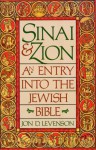
This is chapter 11 of Jon D. Levenson’s Sinai and Zion, our MUST READ/MUST OWN feature.  It is downloadable as ebook from amazon.com for those who have gotten curious enough to want to read the whole book! It is worth not only the expense but more importantly the time spent on reading from beginning to end.  Additional posts from this same source are: 

Reformatting and highlights ours.—Admin1.]


Image from www.cswisdom.com

Image from www.cswisdom.com

The renewal of covenant was a central aspect of Israel’s worship in biblical times. Psalm 81, chanted today on Thursday mornings, seems to have related the Sinaitic experience in some kind of regular liturgical celebration, also in its original setting. Although much of this psalm is obscure, v 4 would seem to locate its context in the celebration of the first day of the lunar month, on analogy with the celebration of New Year’s Day (Rosh HaShanah) so well known from later tradition, and comparable festivities for the day of the full moon, two weeks later.


What is most pertinent to us is that the liturgy for these holy days seems to have stressed the Decalogue. Vv 10-11 are a transparent restatement of the Second and First Commandments, according to the Jewish enumeration. Vv 6b-8, in which YHWH becomes the speaker, perhaps through the mouth of a priest or prophet, and v 17 restate the historical prologue, with its emphasis upon all that the suzerain, in his graciousness, has done for his vassal.  The curses of covenant can be heard in vv 12-13, in which YHWH disowns a disobedient people, but in vv 14-16, the blessings balance this with their promise of victory if only Israel walks YHWH’s path. In short, Psalm 81 evidences a regular liturgical occasion in which the Sinaitic covenant and the great choice it entails were represented to the Israelite congregation.


In the case of the book of Deuteronomy, the book of covenant par excellence, this insistence upon the relevance of the covenant of Sinai (“Horeb” in Deuteronomy) to the present  generation reaches a pitch of intensity:


1  Moses called together all Israel and said to them:

Hear, Israel,

the laws and ordinances which I am proclaiming to you personally today.

Study them,

observe them,

put them into practice.

2  YHWH our God made a covenant with us on Horeb.

3  It was not with our fathers that YHWH made this covenant,

but with us—us!—those who are there today, all of us, the living.

4  Face to face YHWH spoke with you on the mountain, from the midst of the fire.

(Deut 5:1-4)


The concern in this passage is that Israel may come to think of themselves as obliged in a distant way by the covenant of Sinai/Horeb, but not as direct partners in it.  Lest the freshness of the experience be lost, v 3 hammers home the theme of contemporaneity in staccato fashion, with no fewer than six separate expressions:

with us”

“us!”

“those who are here”

“today”

“all of us”

“the living.”   

The goal of this speech, as of the covenant renewal ceremony in which it probably originated, is to induce Israel to step into the position of the generation of Sinai, in other words, to actualize the past so that this new generation will become the Israel of the classic covenant relationship (cf. Deut 30:19-20). Thus, life in covenant is not something merely granted, but something won anew, rekindled and reconsecrated in the heart of each Israelite in every generation.


Covenant is not only imposed,

but also accepted.


It calls with both the stern voice of duty and the tender accents of the lover, with both stick (curse, death) and carrot (blessing, life) in hand. But it biases the choice in favor of life (Deut 30:19).


It is conventional to trace the influence of the covenant renewal ceremony and the formulary until the time of the disappearance of the Dead Sea community (first century C.E.) and no further. The tacit assumption is that these institutions did not survive into the next phase of Jewish history, the rabbinic era. In this, there is a certain truth. The idea of covenant does not seem to have had in rabbinic religion the centrality it had held since at least the promulgation of Deuteronomy in the seventh century B.C.E., although its importance for the rabbis must not be minimized. There is no rabbinic ceremony in which the Jews are said explicitly to be renewing their partnership in the Sinaitic covenant, as the eight day old boy is said, for example, to be entering the covenant of Abraham (Gen. 17:1-14) during his circumcision. There is, however, a text which is central to the rabbinic liturgy, in fact arguably the central text of the rabbinic liturgy, which is composed of three Pentateuchal passages (Deut 6:4-9; 11:13-21; Num 15:37-41) expressive of the classical covenant theology.


The prayer is known as the Shma, after its first word.  The first verse of the Shma is correctly rendered,

“Listen, Israel:

YHWH is our God,

YHWH alone”

(Deut 6:4).

Image from www.shemayisrael.net

Image from www.shemayisrael.net

It is manifestly an echo of the requirement of the old suzerainty treaties to recognize one lord alone. Since in the biblical case the lord is divine, the verse is a classic statement of covenantal monotheism, i.e., the prohibition upon the service of other suzerains.

In fact, we sense apprehension about the possibility of just such defection in each of the three paragraphs.


In the second one, we hear of the danger of seduction, in language that recalls the career of Hosea (Deut 11:16-17), and in the last paragraph, such defection is termed “whoring” (Num 15:39). It is the passage from Numbers which establishes the ground of obedience to YHWH precisely where we expect it, in the redemption from Egypt (v 41). This verse, like the First Commandment of the Decalogue (Exod 20:2), is a condensation of the historical prologue.


The central stipulation of the Shma is one familiar to any student of Near Eastern covenants,

the obligation to love YHWH,

which is inextricable from the requirement

to carry out all his commandments.


As we shall see, the rabbis, like the more ancient architects of covenant, saw in the acclamation of divine lordship and the love commandment of the first paragraph the basis for the acceptance of all other commandments.


The second paragraph, which stresses performance of the stipulations, derives mostly from the blessings and curses of the covenant formulary.  


Fidelity to YHWH

and the exclusive service of him

will bring abundance;

defection will result

in drought, famine, and death.


Finally, we should note that the insistence that the “words” be—


  • constantly recited,
  • bound to one’s body,
  • written upon one’s house,
  • and the commandments symbolized in one’s clothes,

—is also a reflex of part of the covenant formulary, the deposition of the text and the requirement for its periodic reading. In short, the idiom and the theology of covenant permeate the Shma.


What is interesting in light of the putative disappearance of the covenant renewal ceremony is that the rabbis selected these three texts to make up one prayer, for the three are not contiguous in the Torah, and the first of them there, Num 15:37-41, appears last here. What links the three paragraphs is that they constitute the basic affirmation of covenant. They confront us with the underpinnings of the entire Sinaitic dimension of the religion of Israel. The link between them is theological, and it is that theology that the rabbis considered basic to their own appropriation and adaptation of the biblical heritage.  For they made the Shma a staple in the liturgy they wove for Jewry.  


In the requirement to “recite them…when you lie down and when you get up,” they saw a mitzvah to recite the Shma twice daily, in the morning and evening every day of the year. The Shma thus became one of the pillars around which those two services developed.


What, precisely, did the rabbis think happened when one recites the Shma? We find an answer in the reply of the Tannaitic master Rabbi Joshua ben Korhah to the question of why Deut 6:4-9 is positioned before 11:13-21:


  • so that one might accept upon himself the yoke of the kingdom of heaven first;
  • afterwards, he accepts upon himself the yoke of the commandments.


“Heaven” in Talmudic language is usually a more delicate way of saying “God.” Rabbi Joshua sees the Shma, therefore, as the acclamation of God’s kingship.  Only in light of such an acclamation do the mitsvot make sense. In light of the biblical ideas, we can say that one must first accept the suzerainty of the great king, the fact of covenant; only then can he embrace the particulars which the new lord enjoins upon him, the stipulations.  If God is suzerain, his orders stand. But his suzerainty is not something irrational and threatening. It follows from his gracious character:


I am the Lord Thy God.


Why were the Ten Commandments not said at the beginning of the Torah?  They give a parable. To what may this be compared?  To the following:


A king who entered a province said to the people: May I be your king? But the people said to him: Have you done anything good for us that you should rule over us? What did he do then? He built the city wall for them, he brought in the water supply for them, and he fought their battles. Then when he said to them: May I be your king? They said to him: Yes, Yes. Likewise, God…


His past grace grounds his present demand. To respond wholeheartedly to that demand, to accept the yoke of the kingdom of heaven, is to make a radical change, a change at the roots of one’s being.  To undertake to live according to Halakhah is not a question of merely raising one’s moral aspirations or of affirming “Jewish values,” whatever that means.


To recite the Shma and mean it is to enter a supra-mundane sovereignty, to become a citizen of the kingdom of God, not simply in the messianic future to which that term also refers (e.g., Dan 2:44), but also in the historical present. Thus, one can understand the horror a rabbinic Jew would have of failing to say the Shma, as exemplified in this story: There was a law that a bridegroom was exempt from the commandment to recite the Shma, probably because he was in no mental condition to give the prayer the concentration it required. But concerning one early rabbi, we read this exchange in the Mishnah:


It happened that Rabban Gamaliel got married and recited the Shma on the first night. His students said to him, “Our master, have you not taught us that a bridegroom is exempt from the recitation of the Shma on the first night?” He said to them, “I am not going to listen to you and annul the kingdom of Heaven from myself for even a moment!”


In other words, one who neglects the Shma when its recitation is due is rebelling against the sovereignty/suzerainty of God.  Or, to put it positively, the Shma is the rabbinic way of actualizing the moment at Sinai when Israel answered the divine offer of covenant with the words—


“All that YHWH has spoken we will do” (Exod 19:8).


In short, the recitation of the Shma is the rabbinic covenantal renewal ceremony. It is the portal to continuing life in covenant.


There is, therefore, no voice more central to Judaism than the voice heard on Mount Sinai.  Sinai confronts anyone who would live as a Jew with an awesome choice, which, once encountered, cannot be evaded—the choice of whether to obey God or to stray from him, of whether to observe the commandments or to let them lapse.


Ultimately, the issue is whether God is or is not king, for there is no king without subjects, no suzerain without vassals. In short,


Sinai demands that

the Torah be taken

with radical seriousness.


But alongside the burden of choice lies a balm that soothes the pain of decision.


  • The balm is the history of redemption, which grounds the commandments and insures that this would-be king is a gracious and loving lord and that to choose to obey him is not a leap into the absurd.
  • The balm is the surprising love of YHWH for Israel, of a passionate groom for his bride, a love ever fresh and never dulled by the frustrations of a stormy courtship.

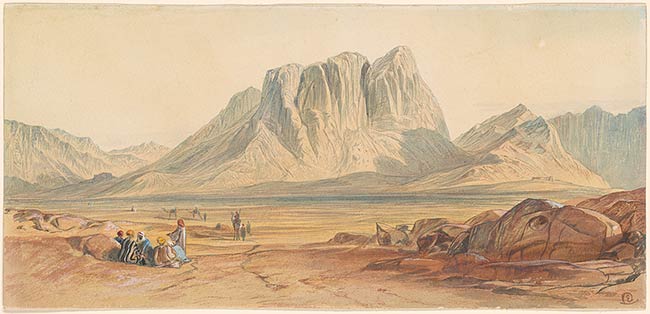
Mount Sinai is the intersection of —

  • love and law,
  • of gift and demand,
  • the link between a past together and a future together.
Image by Edward Lear, from www.wikigallery.org

Image by Edward Lear, from www.wikigallery.org

Why Anti-Semitism?

61XHIVkINxL._AA160_[This was first posted in 2013; we are revisiting as a result of many searchers interested in  The Jewish Mystique by Ernest Van Den Haag.  Sharing Chapter 5 of this MUST READ book.  For visuals connected to this topic, check this link:  http://www.tabletmag.com/jewish-arts-and-culture/155833/postcards-anti-semitic—-Admin1]


————————–


 WHY ANTI-SEMITISM?


 Jews “cause” both anti-Semitism and pro-Semitism; without them we would have neither, since both are reactions to Jews. The Jews are the cause of anti-Semitism in the sense–no more, no less–in which marriage is the cause of divorce. No divorce without marriage. No anti-Semitism without Jews. But to end in divorce, there must be specific elements in one or both partners of the marriage, or in their relationship to each other, or to other persons, that lead to divorce. So with the relationship of Jews to their environment. The Jews are necessary to anti-Semitism–but not sufficient. Why is the relationship what it is? Why is it so often hostile?


An anti-Semite is hostile to Jews because of some characteristics which he dislikes and which he thinks Jews have exclusively, or in greater measure than non-Jews. Whether they do or do not have these traits (and whether one regards them as valuable or vile), there must be something in the Jews, or in their situation, that invites the attribution of these characteristics to them rather than to bicyclists; in addition, there must be something in the character of anti-Semites that makes it possible, or necessary, for them to associate Jews with disliked characteristics, or to dislike characteristics which Jews have because it is they who have them.


The characteristics attributed to “witches” burned in the seventeenth century, though sometimes accepted by the “witches” themselves, were the products of the fantasy of their persecutors. But there also was something in the personalities of those singled out as witches, or in their relationship to the world, which invited the attribution; just as there was something in the personalities of the witch-hunters which convinced them of the need to fear and hunt witches. The only thing we can be sure of is that the “something” was not that the women actually were “witches”. Similarly we can be sure that what arouses anti-Semitism is not what Jews actually are; it is, as it were, the negative part of their mystique.


To say that the victim had some characteristics that led to his victimization, is not to excuse, or justify, those who victimized him any more than it excuses, or justifies, a murderer to point out what characteristics of the victim caused the murderer to single him out and kill him. It means, however, that there was something about the victim–actual or, if the murderer is insane or misled, only believed–that led the murderer to select him. It may be a “good” or “bad” characteristics or a neutral one: political prominence, virginity, promiscuity, beauty, or wealth, may happen to attract the murderer, and may lead him to kill the victim.


There certainly are traits, actual or putative, that distinguish Jews. If one loves or hates a person or group, one has oneself the ability to do so, and one’s object has the ability to arouse and focus these feelings–whether because of actual or of putative qualities. What Gentiles see in seeing Jews is likely to be a compound of the Gentile mystique about Jews and of reality–the latter being shaped by both the Gentile and the Jewish mystique.


PRE-CHRISTIAN ANTI-SEMITISM


Fundamental to either view or feeling, though seldom explicit and conscious, is hostility to the Jewish belief in one God, a belief to which anti-Semites very reluctantly converted and which they never ceased to resist. Anti-Semitism is one form this resistance takes. Those who originated this burdensome religion–and yet rejected the version to which the Gentiles were converted–easily became the target of the resentment. One cannot dare to be hostile to one’s all-powerful God. But one can to those who generated Him, to whom He revealed Himself and who caused others to accept Him. The Jewish God is invisible and unrepresentable, even unmentionable, a power beyond imagination, a law beyond scrutiny. He is universal, holding power over everybody and demanding obedience and worship from all. Nonetheless, He entered history and listened to, argued with, and chose the Jews–and the Jews alone. They are His people (though He must have known that He would be in for an endless argument). No wonder they also are the target of all those who resent His domination.


The Jewish God was both universal–the only real God–and tribal: He had chosen the Jewish people and in exchange bound them to worship Him exclusively. Thus the Jews invented both monotheism and religious intolerance, or at least a passive form of it.* They had the only true religion, the only true promise; the only real God had chosen them–leaving the rest of the world to be comforted by false gods and messiahs. The Jews have suffered from their own invention ever since; but they have never given it up, for it is, after all, what makes the Jews Jewish. The Christians, when they became dominant, transformed the passive Jewish intolerance into active Christianity intolerance–of which the Jews became the first victim.


[*The Jews did not actively object to what non-Jews believed. They merely thought the beliefs wrong–to us a very tolerant view. In the context of antiquity it seemed arrogant and ill-mannered. The passivity itself rested on arrogance.]


The ancients had many gods. These gods were powerful to an unspecified degree, and loved, hated, intrigued, and fought with each other, just as mortals did. They even competed for the devotion of the people who worshiped them. People thus had a choice as to which god to appeal to on each occasion–and they attributed their victories and defeats to the relative strength and benevolence of the tutelary deities invoked. No god had a monopoly: worshippers of one god recognized the existence of others, and did what was necessary to pay their respects and to conciliate them.


Each tribe or nation was quite willing to acknowledge not only the actual existence, but also the power of the gods of other tribes or nations, though every nation usually retained a preference for the home-grown deity. The recognition was quite sincere, for the ancients found the existence of diverse tribal and specialized deities quite as natural as the existence of diverse tribes or occupations.


It was regarded both as prudent and as a matter of common courtesy to honor the gods worshiped by others. One joined in the appropriate rituals and sacrifices when meeting with aliens who worshiped alien gods. Further, the gods served as political symbols. To accept the political domination of Rome did not mean that the subject peoples had to give up their customs, language, and culture. On the contrary, these were often accepted by the Romans. It meant an exchange: the subject people would add the Roman gods to their own and recognize them, at least as honored guests in their midst.


The vast religious tolerance prevalent in antiquity went far beyond what we conceive of as tolerance today. People not only granted the right to others to keep their own religion; they were convinced that the religion of the others was no less true than their own, their gods no less real–though each people hoped that their gods were the most powerful where it counted.


The Jewish religion did not fit into this framework at all. It made the Jews misfits in the world of the ancients and probably was one cause for the ultimate destruction of their country and their dispersal by the Romans.


The Romans treated the Jews tolerantly enough; but as victors, they insisted on those of their customs which symbolized submission to Roman power. Symbols of the Roman Empire–statues of Roman gods and semi-divine emperors–had been accepted everywhere else without difficulty. But to the Jews the statues were a blasphemous abomination, because of the Mosaic commandment that enjoins against making “any likeness of anything,” and against “bowing down thyself to them or serving them.” Hence the Jews rebelled with religious zeal again and again, until their community was finally destroyed.


Later indeed the Jews destroyed the Roman framework that had made them misfits: their own religion, or much of it, was universally accepted, with the exception of the troublesome commandment against likeness (although there have been iconoclastic moments in Christian history). But the Jews managed not to fit into the new Christian framework–so largely their own creation–any better. The Jewish Messiah the Gentiles recognized was not recognized as genuine by the Jews. He was not good enough for them–a view the Gentiles rather resented.* The gods the others believed in remained false gods to the Jews. He had revealed Himself to them only and He had chosen them alone. Which left the rest of the world out in the cold.


[*The Jews, of course, merely maintained that he was not genuine.]


The religion of the Jews appeared to Gentiles absurd as well as outrageous; and ridiculous, too, if one considered that it was the religion of a small, insignificant, rustic nation, not distinguished for any major contribution to civilization. The Jewish views were certainly neither diplomatic nor endearing, and in the framework of antiquity, unreasonable, intolerant, and irrational. A tolerant and cultivated man, the emperor Julian Apostata, plaintively wrote of the Jews: “While striving to gratify their own God, they do not, at the same time, serve the others.” This, according to Julian, was “their error.” Politically, it was. And Jewish views were held with unaccustomed fanaticism. For the Jewish God did not serve His people. His people served Him–a wholly unancient conception.


Not content with holding such absurd and intolerant beliefs–which, at best, could provoke only the ridicule, and, at worst, the hostility of all other peoples–the Jews rigidly refused even to tolerate the reasonable beliefs of others. The Romans had conquered them; but the Jews had the audacity to object to any attempt of the Romans to allow their soldiers to worship in their own fashion. All this in the name of what the Jews declared to be God’s law against erecting false idols. It was as though the American Indians were to try to prohibit their conquerors from engaging in Christian worship in America. Such intolerance and apparent arrogance could not but provoke hostility. It did. Of course, in their view, the Jews merely objected to desecration of their holy sites. But try explaining that to a Roman.


Pre-Christian anti-Semitism was reinforced by a number of other Jewish traits. Their all-power God was invisible. He had forbidden the making of images not only of Himself but even of humans, let alone other gods. This prohibition helped to protect the belief in one God, for images soon come to be worshiped themselves, and different images would develop into different gods. Images of human beings could easily assume divine stature. And they could be used for magical purposes. Thus the Jewish religion differed from the others in kind; it did not compete with them, or recognize them, or have different rituals of the same genre. It was sui generis, a different kind of religion altogether, and it set its chosen people apart.


This “apartheid” was enjoined on the Jews as a moral duty, too. They were not meant to mingle with non-Jews and did not, to the extent to which they followed their religious leaders. To be sure, tribal pride and its enlargement, nationalism, as well as insistence on the superiority and preservation of one’s culture, have always been with us. But these elements were religiously elaborated and adhered to by the Jews in far greater measure than by any other people–if such things can be measured. The Greeks did not think highly of “Barbarians” either. But the Jews went further and were more exclusive.


The Romans were hospitable to other cultures, religions, and peoples: not without grumbling, but still they were about as hospitable as present-day Americans. The Jews were stiff-necked, literal minded, bothersome, and unrealistic. They refused to make the slightest concession, objecting even to Roman money because it bore the portraits of the emperors. In short, they gave no end of trouble–willfully, the Romans must have thought.


Most unpleasant, their invisible God not only insisted on being the one and only and all-powerful God–creator and lord of everything and the only rightful claimant to worship–He also developed into a moral God.


This, too, distinguished Him, and his worshipers, from the deities familiar to the pre-Christian world. These gods usually were personifications of the forces of nature, such as fertility; or of elements of the human personality, such as cunning; or of the social environment, such as war, craftsmanship, or art. Often these elements were blended, and the gods assumed magnified human personalities or natural powers; a moral element was present at times, but no more so than it is in most human beings. And one invoked the help of these gods by pleading, currying favor, and bribing them through sacrifices and through the fulfillment of their special demands.


The God of Israel, though only slowly shedding these elements, developed into something far more demanding, far harder to understand and obey. He developed from a natural into a truly supernatural spirit, and He demanded that his people follow moral rules and live a righteous life, in obedience to His law. Unlike the gods of others, who represented and accepted all parts of the human personality as they coexisted, fused, or struggled with each other, the God of the Jews came to represent a stern, dominating, and demanding paternal Superego–long before one of His chosen people invented, fathered (or at least baptized) the superego. The Jews exclusively worshiped a father God–not, as others did, a family of gods. This, too, set the Jews apart, not just because of their beliefs, but also because of the style of life that these beliefs enjoined.


The gods of the ancients were more or less helpful to, and protective of, their devotees, and were worshiped and sacrificed to for that reason. The Jews too had been chosen to receive certain promises from their God. But their choice involved incessant fidelity on the part of the Chosen, whose major preoccupation became the interpretation and fulfillment of their part of the bargain–the Law. Jewish life became God-centered, dominated by a priesthood which insisted on rituals and sacrifices, and by prophets who called on the people and their leaders to return to the spirit of Jehovah’s laws; they interpreted all misfortunes as deserved punishments for disobedience, inflicted by an angry God. Jehovah exacted His end of the bargain and was not satisfied with anything but full value.


The Jews were constantly driven by their God, as His perpetual debtors. Their whole life revolved about doing His will, performing their duties to Him, attempting to satisfy Him. But speaking through His prophets, God spoke only of His displeasure. His Chosen People were dutiful enough; they were ungrateful, faithless–in short, their God acted as an insatiable Superego. And the God of Israel punished His people accordingly with wars, floods, bondage, and famines, though saving them at the last moment, despite their sinfulness, because of the merits of one or two among them. He was infinitely merciful, this awe-inspiring father. He had to be, for in His eyes His people were infinitely guilty.


All this was hard to understand for the more easygoing ancients, and struck them as superstitious, a little ridiculous, ignorant, and unrealistic, as, indeed, it often strikes today’s easygoing sophisticates, who may regards the whole business as “neurotic.” The Jewish law seemed almost perverse in the value it placed on the invisible benefits of moral righteousness relative to the accessible pleasures of the senses. And yet, the Jews seemed uncanny. For there was no denying the moral fervor with which they stuck to their supernatural beliefs in the midst of a world concerned with quite different things. (In a similar way, the Roman Catholic Church, which certainly understands the power of more ascendency, has gained much from the almost eerie respect  the ordinary man pays to the priest whose choice it is, on religious grounds alone, to live in celibacy.)


CHRISTIAN ANTI-SEMITISM


Pre-Christian anti-Semitism is explained largely by the Jews’ contempt for Gentile gods and values, and by their continued insistence that they had a monopoly on the true God, and had been chosen by means of a special covenant. It is all right to love one’s own God. It is certainly dangerous, however, to assert that the gods worshiped by others are false, and that their worshipers are being fooled–and to insist further that, unlike oneself, these worshipers of other gods were not chosen by the only true God, as evidenced by the unalterable fact of being born into the wrong group. Too bad for them.


When expressed by a small and powerless people, such as the Jews, such ideas cannot but lead to hostility and ridicule. When held by a dominant one, such ideas can lead to, or be used for, all the evils of racism. Which is what happened. The anti-Gentilism of the Jews was as real as–and preceded–the anti-Semitism of the Gentiles. But the Gentiles were materially stronger. The Jews were hoist by their own petard in more senses than one.


Christianity added elements to anti-Semitism which have their roots in the historical relationship between the Christian and the Jewish religions. Yet the Christian anti-Semites were no more conscious of the nature of these elements than the Jews. As was pre-Christian anti-Semitism, so Christian hostility to the Jews was overdetermined: in addition to the historical-religious, many other elements contributed to it; each of these, economic, religious, political, or psychological, might itself be a sufficient cause of anti-Semitism.


Christianity accused the Jews of having slain God. (As late as Vatican II, this accusation was seriously discussed, and cardinals of the Roman Catholic Church were on both sides of the question.) Deicide was attributed to the Jews because one of them, who proclaimed himself the Messiah and later was deified by His followers, was crucified in Jerusalem. The execution was carried out in the Roman manner (crucifixion was not a Jewish manner of execution) by the Roman troops occupying Jerusalem, probably because Jesus, as did other religious leaders of the time, appeared to the Romans as a dangerous subversive who might stir up the people against the Romans.


The Gospel tales–written long after the events–which have the arrest made and the death sentence pronounced at the behest of the Jewish Sanhedrin are scarcely plausible from a legal or historical viewpoint. The writers of the Gospels knew that Christianity was not making much headway among the Jews, whereas the number of Gentile converts, particularly Roman converts, was steadily mounting. It would have been undiplomatic, therefore, to saddle the Romans with deicide–while to accuse the Jews of hating the new God who came from their midst was to make that God more acceptable to the Romans. We don’t know whether such considerations actually entered the minds of the Gospel writers. But these considerations would plausibly explain why the Jews, and not the Romans, were accused of what certainly must have been a Roman action– the condemnation and execution of Jesus.


It is quite likely, however, that the Jewish authorities did not greatly oppose the anti-subversive measures of the Romans. They, no less than the Romans, were opposed to whatever might stir up the people and lead them to attempt armed rebellion. For they saw–and history proved them right–that such a rebellion was quite hopeless. The prophets who arose from the people had little grasp of the distribution of power and relied, more than did the priestly hierarchy which dominated the Sanhedrin, on supposed divine revelation–which had led to disastrous adventures in the past. The many sects, the many enthusiasts, the many would-be prophets, the many fanatics and anti-Romans kept the established authorities, both Jewish and Roman, quite busy. If the Roman authorities wanted to avoid trouble, so did the Jewish authorities, for they feared the defeat which would–and in the end did–cost them the remnants of their independence. So much for the history of the matter, which is perhaps less important than the psychological genesis of anti-Semitism.


The Jews were accused of having killed God. Actually, the hostility to them may be based as much on having given birth to Him. For the Messiah, too, was a demanding and moral god who exacted sacrifices undreamed of before Christianity. Those making these sacrifices may well have turned into unconscious resentment not against the Savior–clearly an impossibility–but against His progenitors and relatives. After all, these relatives had mistreated the Savior, and murdered Him–which rationalizes any amount of hostility.


Further, the Jews remained faithful to their old God and repudiated His son. By this faithfulness, they show that they regard themselves still as chosen–and that the Christians worship a false god, a phony Messiah. Theirs remained a Father religion. Christianity became a Son religion. By their rejection of the Son, the Jews identified themselves with the Father, thus calling upon themselves all the resentment–all the ambivalence, at least–that comes with being identified with the Father.


But there is more. According to Freud, the Jews probably murdered not the Son, but God the Father–symbolized by Moses, the man who led them out of Egypt and out of the wilderness and gave them their Law. The grave of the father of Judaism was never found. According to Freud’s speculation, the Jews in one of their many rebellions against his leadership actually murdered Moses. They never overcame their guilt feelings and became zealous and obedient sons to the father they had slain.


Even if Freud’s speculation is no more than Freud’s own fantasy, it seems a fantasy that meets, articulates, and explains, if not the facts, the conscious and unconscious fantasies of mankind and certainly of the Jews. The idea of parricide, and of expiation by the guilt-ridden sons through sacrifice of one of their own, was widespread among Oriental peoples, and quite popularly accepted among the Romans at the time the Gospels were created.


The Christians, through acknowledging the hereditary sin against God the Father, were purified of it and made, they thought, reacceptable to Him by their identification with the sacrifice of the Son. Jesus voluntarily allowed Himself to be slain. He was sent by His Father to redeem the world. The people who actually killed Him, according to the Gospels, however, did not accept their Oedipal guilt, and, above all, the expiatory sacrifice of Jesus. Thus they were not redeemed. They continued to refuse purification, and thus to bear their sin, and, by their insistence that Jesus was a false Messiah, to add to it.


This insistence on the invalidity of Christ’s redemptory sacrifice–for the sake of which the Jews suffered so much–could not but throw some doubt on the certainty of salvation. There were some–the Jews–that denied that Jesus had saved anyone; they were willing themselves to die for the sake of this denial. Thus in Christian eyes the Jews became representatives of the offended, vengeful, and, according to them, unappeased Father.


In sort, the Jews repeated – however involuntarily and unwittingly – in the Christian world the arrogance which had caused the ancient world to hate them. They told the Christians that they had fallen for phony Messiah, just as they had told the ancients that they worshiped false gods.* They, the Jews, alone were in possession of the true religion. What chutzpah.


[*Perhaps “signified”–by  their very existence and beliefs–is a better word than “told”: the Jews did not proselytize, but their beliefs could not be ignored either.]


But the Christians understandably were far more irked than the ancients. To the ancients, the Jewish religion was arrogant, foolish, and alien. To the Christians, it cast doubts on their most cherished beliefs. For many centuries Christians regarded the promise of life everlasting–paradise–as the most important thing on earth. Yet doubt was thrown on their belief in their salvation out of the same tradition from which the belief itself sprung, by the very people among whom the Messiah had arisen. An uncomfortable situation. It is not astonishing that the Jews were treated as one is always tempted to treat those who arouse doubts about one’s own most cherished beliefs.


Things would have been different if one of them, Paul, had not decided that the Messiah rejected by the Jews could be accepted by the Gentiles, provided they would not first have to become Jews and be circumcised. The story of salvation could be universalized. Paul proceeded to do this quite successfully.


Thus Gentiles accepted what the Jews had rejected and, in turn, rejected the people that did not want to give up being chosen. The Jews were burdened thenceforth not only with the sin which is the heritage of mankind, but also with their refusal to accept redemption, with slaying Him who wanted to redeem mankind, and finally with casting unrepentant doubt on the genuineness of the salvation vouch-safed the Gentiles.


The Christians now felt they could do to the representatives of the Father, in the name of the Son, what Christians would normally be punished for–were it not that the Son had removed the credentials of these representatives, the unredeemed Jews, and thus allowed them to be punished. To the Jews were attributed, unconsciously and sometimes consciously, all the things the sons fear: the father will castrate and kill them. And vengeance was taken on the Jews for these dreaded paternal intentions and fantasied deeds.


The Jews obdurately denied their share of guilt and their need for salvation and insisted that they had a special arrangement with God, the Father, which would save them and (the Christians thought) nobody else. If the Jews were right to extent, the many renunciations that Christianity had imposed on its Gentile converts were in vain. The pleasures of this world would have been renounced for the sake of a paradise which was, after all, reserved for Jews.


No wonder the very existence of the Jews became a thorn in the side of Christianity. A useful thorn, as it were. For the Jews, by attracting hostility to themselves, solidified the identification of Christians with each other. Nothing does as much for internal solidarity as the existence of an external enemy. To the enemy, the group can attribute whatever it fears or detests in itself. Against him it can unite. Against him it can discharge hostility. As the chastity of nineteenth-century women required prostitutes, so the purity of Christian faith required Jews.


THE JEWISH CONSPIRACY: AN ANTI – SEMITIC FANTASY


In the primitive way in which they conceive it, the community of attitudes and characteristics among Jews was a myth invented by the Nazis for their own convenience. Radical parties, right or left, always simplify experience, however illegitimately, so as to manipulate a series of stereotypes in the end. It is their way of making life intelligible–and of proving that they could change it for the better and, therefore, ought to be on top.


Above all, Nazis, contrary to logic and fact, believed that the common attributes of the Jews (some real and some imagined for convenience) would lead to concerted actions and common purposes, to a conspiracy aimed at dominating and exploiting Gentiles. This “theory” was occasionally supported by faked documents–e.g., the “Protocols of the Elders of Zion.”


Support for this sort of idea is produced by the general human inclination to attribute whatever is unpleasant or undesired to malevolent demons. With increasing secularization, the demons have been replaced by malevolent human groups–e.g., Jews, or capitalists. Witches form the bridge between these two versions. Thus the Germans, according to Hitler, did not lose World War I because they had been defeated by their enemies–an unacceptable blow to their superiority feelings–but because they were stabbed in the back by the Jews. And again, the Great Depression of the 1930’s was caused by Wall Street Jews somehow acting in concert with Communists, who were also, it seems, Jews. And so on.


The Nazis were not very original in these fantasies. One model of the technique had been furnished – in secular form – by Karl Marx, a Jew. Of course, the Nazis are right: Jews are on all sides. The Nazis were wrong only in believing that they act in common: Germans, too, may be on all sides and so may women.


Marx attributed all the evils of the world to the capitalistic system; his less sophisticated followers (at times including Marx himself) went on to attribute the evils of the world directly to the malevolence of capitalists. They humanized the theory, as Madison Avenue would say. Hitler blamed “the system,” and “the Jews” who were supposed to be dominating it, for every wrong. Marx before him had blamed the capitalist system and “the capitalists” who were supposed to be dominating it. The “logical” structure is the same.


The socialist leader August Bebel – a German who died long before Hitler became known – was more accurate than he realized when he said: “Anti-Semitism is the socialism of the lower middle class.” Psychologically it is indeed the equivalent of socialism, and takes its place for those to whom socialism is, or, as a result of its failures, becomes, unacceptable. (All utopian systems, and all systems supported by utopian enthusiasts, “fail”: nothing ever lives up to our fantasy.) The symbols are different by the psychological essence of either ideology is the same: the evils of the world are presumed to be caused by a wrong system maintained by a small group who benefit from it and deliberately use the system to exploit the great majority. That majority – the people – are actually superior to the exploiters, either by virtue of their “race” and historical mission (Hitler) or by virtue of their “proletarian” descent, economic position, and historical mission (Marx).* The superior majority has the historical mission of eliminating the historically or racially corrupt minority, after which the millennium begins.


[*Marx was considerably more sophisticated than Hitler and, above all, unlike Hitler, he was part of the rationalistic humanitarian tradition even though he repudiated it as sentimental in favor of science. Wherefore he appeals more to intellectuals. But his popular appeal has the same source as Hitler’s: secularized Manichaean eschatology.]


The origins of this conspiracy theory are found in primitive anthropomorphism. A traffic accident, or for that matter, a war, an economic depression, low farm prices, or the obsolescence of a given industry–all these things happen without being necessarily willed by anyone; yet they may injure or damage almost everyone, although in different degrees. As everyone pursues his course, the collision happens. As every farmer produces, prices fall, given certain circumstances. As each nation tries to achieve goals regarded as necessary by its government, it may collide with another nation pursuing its goals. An industry becomes obsolete because of technological developments not necessarily aimed at making it obsolete.


However, all of us find it hard to accept that anything really occurs without anyone willing it. Human beings usually have, or think they have, a purpose in their actions. They tend, therefore, to ascribe purposes to the world at large and to nature – and even more to actions undertaken or set in motion by fellow humans, such as wars or traffic collisions. It is hard for us to see that these may be simply the unintended result of deliberate acts. When these results are particularly unpleasant, they are ascribed to malevolent spirits and–with the secularization of our imagination – to malevolent people. Jews, for the reasons given, were easily the most likely malefactors.


Long after Marx, and not so long after Hitler, new versions of this ever-popular story, which in the childhood of the human race started with myths of demons and their human servants, abound. What else is C. Wright Mills’ fascinating fable of the “power elite”?* In each of these versions, the believer has discovered that there are men more powerful than others, and that they often have more prestige and income than others, too. He then discovers that men outstanding in one activity are or become important in others, too: generals become corporate directors, directors of one corporation become directors of another, a man powerful in California may be influential in Washington and New York. The believer then concludes that these people, who have in common the fact that they are powerful, have little to divide them from each other, and that they share an overriding aim: to act in concert to their advantage and to the detriment of the less powerful. And that explains whatever happens that is unpleasant. “They” done it, whatever it is: started the war, or lost it… caused the depression, or the inflation… brought about the imperialistic expansion, or the cowardly retrenchment.


[*Mills updated the matter: since the nation is more prosperous, it is harder for most people to believe that economic circumstances determine everything; they have found otherwise. Hence the “power elite” is not, in the main, an economic class. It is a status group.]


Just as Hitler and C. Wright Mills did, I too have come to the conclusion that we are dominated and exploited by a “power elite.” Only, unlike my fellow scholars, I don’t identify the members as either rich or Jewish. Upon extensive research, I found that we are dominated by men wearing glasses; they succeed in getting each other into corporate directorships, become generals, music critics, stockbrokers, senators, Supreme Court justices, and cabinet members. They conspire against anyone not shortsighted. I can prove that easily. (For statistical tables about eyeglasses worn by men in leading positions, which clearly demonstrate my theory, see Appendix.)


Until Hitler nearly killed them all, the Jews were excellent targets for this sort of thing. To Gentiles, they were strange and uncanny: in, but not really accepted as part of, the society in which they lived. They were active, often reached outstanding positions, yet were different and therefore did not quite belong. And they certainly had something in common that could not be denied and that differentiated them: they were Jews. It is as though they were some kind of family mysterious to nonmembers, some kind of network with an eerie communications system, omnipresent, powerful, sinister, and yet almost anonymous at the center of the body politic. Were they not on all sides? Did they not therefore cause everything? It is the “therefore,” of course, that constituents the fallacy: men with glasses are prominent on all sides but do not “therefore” act in common to cause everything. Even if people have things in common, it does not follow that they will act in common, let alone conspire. But it’s too nice a theory just to drop.


Among many widely recognized and ambivalently admired characteristics of the Jews are a desire for education, a low rate of alcoholism, an almost invisible rate of what we not call juvenile delinquency (“radical” activity is the Jewish form of defying authority). These characteristics do not make the anti-Semites like Jews – on the contrary. After all, such traits can be explained: the desire for education is part of Jewish pushiness and of the plan for world domination; if you are engaged in a serious conspiracy, you can’t afford to get drunk–in vino veritas: people who have so much to hide won’t dare to get drunk; and there is no need for juvenile delinquency if you, together with your parents, are conspiring to do in the rest of the world.


The interesting thing is that all of these paranoid fantasies are also negative versions of half-truths: Jews are ambitious; they have messianic dreams; and their abstemiousness may have something to do with fear of baring guilty secrets to a hostile world. These semiconscious Jewish feelings are perceived by anti-Semites and projected as realities. Thus, anti-Semitism on the psychological level is the product of a cooperative effort involving Jews and their enemies; on a rational level it is nonsense, a pseudo explanation of history which, particularly in time of distress, helps people shift the blame from themselves.


This nonsense was accepted by enough people to make possible the horrors of concentration camps and the murder of six million Jews. It is hard to believe in God; it is harder still to believe in human rationality.

Is our God a “jealous, wrathful, and a vengeful God”?

Image from newcreeations.org

Image from newcreeations.org

[First posted in 2013.  Why is there a misperception that the God of the “Old Testament” is anything other than how He describes Himself as “merciful and gracious” ? Because part of that self-description is His balancing act, being “righteous and just” Who rewards obedience but punishes wrongdoing.  And of course, in the conquest of the Promised Land by the 2nd generation led by the only surviving 1st generation who stood on Sinai —Joshua and Caleb—the marching orders of the God of Israel sound brutal in translation . . . and that is what registers in the minds of casual readers, or listeners of such hearsay from casual readers.  They miss the more important tactical order—offer peace first and if the population refuse, then conquer. Of course,  there is much controversy surrounding Israel’s claim to the Promised Land, then or now . . . . Anyway, here’s a sober article contributed by Sinaite BAN attempting to correct the bad reputation imputed upon the “OT God”. —Admin1].


———————————


Is our God, a jealous, wrathful, and a vengeful God? This is a perplexing question asked by  believers and non-believers alike, not only in our times but in times past.  It causes a lot of pondering and discomfort for many, and historically, a source of derision and disapproval. 


Why do we ask such a question? I  believe the answer lies in our understanding of the words used to describe God with our 21st century comprehension.  It is through a misinterpretation of the words that causes us to attribute these words when describing God.  We have to remember that the prophets wrote the scriptures during a period when gods were perceived by the ancient near east culture as gods who can be capricious depending on their whims.


This issue is most of the time stated as a contrast between “God’s wrath and vengeance in the OT” as against “God’s love as exemplified in the NT”.  Unfortunately, the use of the words wrathful, angry, jealous, and vengeful are clouded by the English language and western culture of today, since the concepts involved in the biblical portrayal of God in which these words are used, are difficult to translate into single words.  For our times,  the best recourse is to examine the words as used in its context at the time of writing.  The three terms as used in Nahum 1:2 represents it best:


“The Lord is a jealous and avenging God;  the Lord takes vengeance and is filled with wrath.  The Lord takes vengeance on his foes and maintains his wrath against his enemies.”
 
A reading of the OT consistently portrays God as a passionate Being where the inner experiences of love, compassion, grief, delight, joy, peace, anguish and moral outrage at atrocity dwarfs ours in the extreme.  The bible speaks unashamedly of God’s passion, presenting him as an intense and passionate Being, very much involved in the world of man.  There is no embarrassment in God’s expressing emotions; rather, it is celebrated (2 Sam. 8:9-16, Ps. 145:8). 


The God of the OT desired fellowship and interaction with people in HIs World, but that He is a person and anger is part of the actualization of His desire.  This is fundamental to understanding the bible and to knowing God.  Emotions can be appropriate responses to given situations. For instance, the bible argues that just like us people, emotions are not mutually exclusive and exhaustive at any given moment.  Just as our parents could have felt anger, compassion, etc. all at the same moment, so too can we, and so too can God. God is described in these terms in the Prophets in his love for His people, Israel (compassion and affection) is also simultaneous with his feeling of anger at their atrocities against each other ad His hopefulness that they will end up treating one another better in keeping with the covenant contract they signed as a community. 


Hosea 11 is so vivid in showing the struggle in God’s heart.  There is no contradiction in ascribing multiple emotional stress to a person since we consistently experience these in our lives.   And God is apparently no different in that respect. 
Image from www.wheatandtares.org

Image from www.wheatandtares.org

As an example, God is said to be angry with the wicked everyday.  Wickedness in biblical term is generally related to treachery, atrocity, and oppression.  Of course, God is disturbed by this, at the same time, the bible says, God is patient, hoping the wicked will come around and rejoin the community in love, even nurturing them and influencing them in that direction.  His moral anger at personal evil has nothing to do with His being caught “off guard” or surprised by it.  His response is in the treachery involved, not the circumstance of it.  Same with us, if we read about human atrocity, in individual or group scale, there is no element of surprise in our response but still, we get upset.

 
JEALOUSY:  In biblical sense, this is essentially a passionate commitment to someone and his/her wellbeing.  The word refers to an exclusive single-mindedness of emotion which may be morally blameworthy or praiseworthy depending on whether the object of the jealousy is the self or some cause beyond the self.  In the former, the result is envy, or hatred of others, (Gen. 30:1, Priv. 3:31, Ezk. 31:9) which for the NT is the lack of love and therefore the enemy of a true believer’s fellowship.  However, the OT also presents the other possibility which is divine jealousy.
 
Divine jealousy is a consuming single-minded pursuit of a good end, (1King 19:10, Exo. 20:5)  This positive usage is frequently associated with the marriage relationship where a jealousy for the exclusiveness of the relationship is the necessary condition of its permanence (Numbers 5:11ff, Ezk. 16:38)
 
Jealousy is used solely of God, primarily in His self-revelation at Sinai (Exo. 20:5, 34:14).  Against this covenantal background, it denotes the Lord’s deep, fiercely protective commitment to his people and His exclusive claim to obedience and reciprocal commitment (Deut.4:24, 5:9).  When this reciprocal commitment is threatened either by Israel”s unfaithfulness or by foreign oppression, the inevitable expressions of such jealousy are “vengeance and wrath” directed to restoring that relationship. (Numbers 25:11).
 
Jealousy can be morally good or bad, depending on the motive behind the zeal.  As stated above, it refers to single-mindedness of emotion which may be morally blameworthy or praiseworthy depending on whether the object of jealousy is self or some other causes beyond self.
 
God is often presented as a jealous God in the OT.  Jealousy in essence is intolerance of rivals.  It can be a virtue or sin depending on the legitimacy of the rival.  God would allow no rivals in the covenant between Him and Israel.  He bound Israel exclusively to His service and swore to protect them against all enemies (Nahum 1).  It is important to note that divine jealousy is part of the “fire” that is ardent love.  Song of Solomon 8:6ff – the beloved’s desire to be the cause of such jealous zeal.
 
“Place me like a seal over your heart, like a seal on your arm; for love is as strong death,  its jealousy unyielding as the grave.  It burns like blazing fire, like a mighty flame.  Many waters cannot quench love; rivers cannot wash it away.  If one were to give all the wealth  of his  house for love, it would be utterly scorned.”
 
In OT times, a seal was used to indicate ownership of a person’s valued possessions.   So the beloved asked to be her lover’s most valued possession that would influence his thoughts (over your heart) his actions (over your arm). 
  • Verses 8:6-7 sum up the nature and power of the love depicted in the song.  It is as universal and irresistible as death, exclusive and possessive (in the sense of being genuinely concerned of the one loved) as the grave, passionate as blazing fire, and as invincible and persevering as many waters ad rivers or all of this is true because love is supported by the Creator who possesses all power.  The words like a mighty flame are like the very flame of the Lord.  Thus, the Lord is portrayed as the source of this powerful love. 
  • Verse 8:7. The final statement about love depicted in the song is that it is priceless.  All one’s wealth would be totally inadequate to purchase such love.  In fact such love would be scorned because love cannot be bought.  If love is priceless, the answer is, it must be given, ultimately love is a gift of God.
This is a picture of the love God has and puts “jealousy” into a different light.  It is not insecurity or self-interest, but a powerful emotion in support of loyalty and intimacy.  We often fail to appreciate the intensity of this yearning of God’s heart for us, but OT prophets understood.  Hosea gives us a disturbing look at the inside of God’s heart.  But besides using the picture of marriage, Hosea uses the picture of a father to describe God’s unfathomable love for Israel, whom He loved in Egypt and drew to himself with bonds of love(Hosea11:1ff).  Israel turned away, so Hosea pictured the struggle which he saw as going inside God’s heart as that between the jealous wrath of a deceived father and His glowing love (Hosea 11:8ff) and shows the zealous and passionate love of God.  The love of God does not show destructive power, but tender and compassionate love, which suffers thru the faithlessness of His people and does not hand them to ultimate ruin.
 
Too often, our English language makes “jealous of” the default meaning of jealousy instead of the biblical “jealous for”.  Jealous of is envy and is not ascribed to God.  The “jealous for” means jealous for protecting and maintaining our enjoyable and fruitful relationship of intimacy.  “Jealous for” in context of His love for His people is used predominantly of God.
 
Joel 2:18ff:  “Then the LORD will be jealous for His land and on His people.  The LORD will reply to them:  I am sending you grain, new wine and oil enough  to satisfy you fully; never again will make you an object of scorn to the nations. (See the link between and pity)
Zechariah 1:14ff:  Then the angel who was speaking to me said, “Proclaim this word, This what the LORD Almighty says:  “I am very jealous for Jerusalem and Zion but very angry with the nations. that feel secure.  I was only a little angry but they added to the calamity. 
Therefore, this is what the LORD says, I will  return to Jerusalem with mercy, and there my house be rebuilt.  And the measuring line will be stretched out over Jerusalem, declares the LORD Almighty.
 Proclaim further,  This is what the LORD Almighty says:  My towns will again overflow with prosperity, and the LORD will again comfort Zion and choose Jerusalem (Note the contrast between “very jealous” and “very angry” and that it is aimed at mercy and blessing for His people)
 Zechariah 8:1ff:  Again, the word of the LORD Almighty came to me.  This what the LORD Almighty says:  “I am very jealous for Zion; I am burning with jealousy for her.”
This is what the LORD says; I will return to Zion and dwell in Jerusalem.  Then Jerusalem will be called the City of truth and the mountain of the LORD Almighty will be called the Holy Mountain. 
This is what the LORD Almighty says;  Once again men and women of ripe old age will sit in the streets of Jerusalem, each with cane in hand because of his age. City streets will be filled with boys and girls playing there.  (Note that this jealousy produces closeness with God and benefits for His people)
 
We can appreciate how different the meaning of “jealousy” in the OT is, from our modern, negative sense.  It is a beautiful passionate commitment to someone, not a petty, insecure, suspicious outrage.  What is clear in biblical usage of jealousy is not equal to modern use.  What we have is not our customary meaning of jealousy but an expression showing commitment, intense ardor and protective love.,  God’s jealousy is a guarantee that we do not drift away.  He is our good shepherd and loving spouse.  This kind of intense and loyal and active trustworthy love is sought by all.


God’s wrath is often a topic of discussion.  As we read the OT about God’s wrath, we will come to a conclusion that it is not generally an emotion ascribed to God.  Most of the time, we compare God’s wrath to human anger.  The wrath of God in the OT is not the same as human anger.


As Abraham Heschel had written in his book, The Prophets, “it is essentially in some respects the difference between “passion and pathos.” 


  • Passion can be understood as an emotional combustion  which makes it impossible to exercise free  consideration of principles and the determination of conduct in accordance with them.  The OT discusses human anger much less frequently than divine wrath.  It shows human anger as a loss of self control and censures it as shown in the Wisdom writings. (Prov. 14:29, 16:32. 19:19, 29:22, 30:33. eccl. 7:9
  •  “Pathos on the other hand is an act formed with care and intention, the result of determination and decision.  It is not a “fever of the mind” that disregards standards of justice and ends in irrational and irresponsible action.  It is righteous indignation.  The wrath of God tends to be portrayed this way in the OT, especially in the Prophets, it seems not be an essential attribute or fundamental characteristic of Yahweh’s persona but an expression of His will;  it is a reaction to human history, an attitude called forth by human misconduct.”


 In the ancient near east, this kind of wrath was divine responsibility which the ANE (Ancient Near East) kings or gods carried out  to their human community as an act of judicial sentencing.  God is portrayed as angry with Israel for its repeated violation of its covenant obligations.  The driving force is duty to uphold moral foundation for human life. 


Wrath of God results because of His commitment to His people and not sudden rage.  Wrath of God is equal with the implementation of God’s judgment.  This judgment is not an angry response but judgment proceeding from a just legal context.  In justification of God’s wrath, the motive has rationality.  It helps us understand why God is angry.  It provides motivation for proper behavior. 


This leads us to the goal and purpose of God carrying out the judicial sentence; fulfilling His duty to His subjects/community, to intervene in support of the community welfare and moral stability of the group.  In short, the purpose for which royal wrath  is to re-instate the moral, civil, just order, by a restructuring event or series of events, primarily  dealing with removal of power or existence of the oppressors and or treacherous.
 
Various means are used to depict God’s wrath, but it always threatens the existence of those concerned.  The final aim of divine wrath is total destruction in the form of historical defeat and banishment from the land, this dealing with internal and nearby oppressors.
 
Note that the first OT occurrence of God exhibiting anger appears in passages intimately tied to God’s deliverance of the Israelites from Egyptian bondage (Exodus 15:7)  God’s divine anger first appears as God’s response not to generic human sinfulness but to whatever would impede efforts to free the Israelites from Egyptian enslavement.  Note that the restructuring is aimed at freedom for the oppressed Israelites.  Once done, the wrath is no longer active or needed.
 
The failure to provide the social justice implicit within the stipulations of the covenant also makes Israel liable to divine wrath (Ps. 50:21-22, Isaiah 1:23-24; 42:24-25, Amos 8:3-10; Micah 6) which is designed to lift up the poor and needy in the land.  Thus God’s wrath is righteous because it destroys the wickedness that impedes deliverance, (isaiah 34:2) and for this reason, the psalmists repeatedly yearn for it. (Ps. 59:14)  It is a means to an end—the goal is deliverance.
 
God’s anger is always a lawful reaction to the violation of a law or to opposition against his historically determined activity, in which God not only requires the violation or opposition, but also wills to effect the restoration and maintenance of the order, he has set between Him and man.
 
Reluctance in the performance of God’s duty is always evident.  God is often portrayed tempering his anger against Israel with compassion and love (Exodus 32:12-14, Isaiah 54:7-8, Hosea 11:8, Micah 7:18)  God is depicted as having the desire to restrain His anger.  God is slow to anger and abounding in steadfast love.  Despite its tragic necessity, God’s anger is not depicted as an emotion God delights in, it grieves God to be angry.  God does not give free rein to wrath, but is long suffering.  He warns people to repent as the writings of the prophets bear witness.  He is quick to show clemency, He exercises restraint as in the case of Nineveh.
 
Hence, wrath is associated not so much with final judgment as with the expression of divine judgment within history.  The biblical usage of wrath is the vigorous and welfare motivated intervention by God in breaking oppression and delivering His people, by forceful removal of the habitually and aggressively treacherous from their lives, and by a restructured reality, characterized by blessing and peace for the good.  This is indeed the hope of the abused, the exploited, the victimized, the violated everywhere that the good hearted God would see all this in history and say once again with reference to a wider group —


I have indeed seen the misery of my people in Egypt.  I have heard them crying out because of their slave drivers, and I am concerned about their suffering.  So I have come down to rescue them from the hand of the Egyptians and to bring them up out of that land into a good and spacious land.”


BAN@S6K
logo

“Who’s Afraid of the Old Testament God?” 1

Image from amazon.com

Image from amazon.com

[This 3-part series about the ‘Old Testament God’ was first posted in August 2012, These posts are worth revisiting since the message is still and ever will be relevant, particularly to those with open minds, with eyes ready to see and ears willing to hear a different ‘truth’ from what they’ve heard before.  For the strongly convicted Christ-centered believer, these posts will be difficult to chew and digest but as it is with free will, everyone has a choice to swallow or spit out . . . however, we hope you will read through and process and give another ‘truth’ different from what you’ve been taught, a chance.  Always a good thing to do for seekers after the One True God, that is, if they’re REALLY seeking!

Check out the sequels to this post:
—-Admin1.]


                                                      ————————————


Who’s Afraid of the Old Testament God? This is the title of a book by Alden Thompson, a Christian pastor.
 
Neither title nor content come as a surprise to us Sinaites who, since we have reread and reviewed and finally understood the original Hebrew Scriptures,  found ourselves bowing down in awe of and reverence to the God of Israel, the God of Creation, the self-revealing God of Sinai, the God of the nations, of both Jew and gentile. That God of the Christian ‘Old Testament’—-YHWH– we have discovered, is nothing like the God imagined by those ignorant of Him.  And that included us once upon a time.  
 
Now why should the average NT-focused Christian ignore reading the foundational portion of our Christian Bible? Is that the normal thing to do for readers starting to leaf through any other book?  Do we jump to the conclusion of a mystery book first before reading the first few chapters to get a grip on the plot, and where all the significant characters are introduced?  Why do Christians treat their 2-part Bible any differently?  Why do they neglect such a basic prerequisite of reading any book that lays the groundwork for a sequel, that occupies 2/3 of the version of the Bible that Christians carry?
 
Part of the answer is because Christian pastors and teachers themselves barely go there and therefore do not lead their flock there; not only because of the general perception that after all—


  • the OT is for Jews,
  • the OT laws are passe,
  • but also because the OT scriptures are difficult to process

and besides, the OT God comes through as a strange deity compared to the gentle all so human Jesus, 2nd Person of the NT Trinitarian Godhead.
 
But why should we speak for Christian pastors, let them speak for themselves.
 
First, here are complete endorsements of this book by Christian pastors; you will notice that one thread runs through the comments—ignorance of the very crucial Part I of the Christian Bible.
 
[Reformat and highlights mine].
 
Arthur Patrick, Honorary Senior Research Fellow Avondale College, Australia:  

By the end of the 19th century, biblical scholars were posing so many important questions about the Old Testament that most conservative Christians were retreating from effective dialogue. By 1970s the questions were still there, and too important to ignore. Alden Thompson undertook Old Testament and Judaic Studies at St. Andrews in Scotland and then, with a newly-minted PhD, committed himself to offering answers that ordinary Christians could appreciate.  The outcome has been a fascinating, fruitful career.  Since 1988, Thompson’s early book Who’s Afraid of the Old Testament God? has been a reliable reference for Christians who are determined to understand the best insights of biblical scholarship and cherish a high view of Scripture.  Yes, there is a dark side to Scripture, but with Thompson’s searchlight we discern “the grandeur and nearness of God, his holiness and his friendliness.” In nearly 40 years of ministry and teaching, I have been trying to “listen” to congregants and students, and “hear” the Word of God.  What I had thought was a gap in between pew and academy was actually a chasm.  Thompson’s book helps bridge that chasm.  His writing is reliably informed, honest, and accessible.  A new edition will win another generation of readers by reason of Thompson’s deep understanding of Scripture, his transparency, and winsomeness.

 
Peggy Corbett, teacher British Columbia, Canada:  

When Martin Luther read the Book of Romans, his discovery of a loving God turned the world upside down.  Love like that is powerful and life changing. But how did Paul come to know the God that captured Luther’s heart?  On what Scriptures did he base his interpretations?  None other than the Old Testament, the only Scriptures available at the time.  For many contemporary believers, however, the God of the Hebrew Scriptures is the “persona non grata” of the Christian faith.  We know he exists but few delight in a relationship with him.  The blood, death, and slaughter found int he Old Testament narratives baffle us.  [This book] guides us through some of the most difficult passages, and points us to the gracious God Paul discovered following his life-changing experience on the road to Damascus. Thompson is a good tour guide for this journey through the Old Testament.  He writes with a mind of an informed scholar but with the heart of a pastor carefully guiding God’s sheep toward the good news about God. This book is a tour de force that will challenge what you thought about the Old Testament and introduces you to a loving savior.

 
Tito Correa, pastor, Oslo Norway Doctoral candidate, University of Cambridge, UK:   

For nearly 2000 years, Christians have struggled with much of the Old Testament because its portrayal of God seems to contrast so drastically with the gentle, loving, compassionate Jesus of the New Testament.  Thus we read the first testament selectively, ignoring or misinterpreting the challenging portions in order to make sense of our belief that Scripture in its totality is the Word of God.  Thompson helps us out of this quandary by giving us a glimpse into the world of Hebrew scripture as well as into the minds of the recipients and authors.  He helps us to see a God who works in context and yet who is at the same time just, loving and kind.  One cannot help but not be afraid of the Old Testament God after reading this work.

 
Pedrito U. Maynard-Reid, Walla Walla University, aughor of Complete Evangelism:  The Luke-Acts Model; Diverse Worship: African-American, Caribbean and Hispanic Perspectives:   

It is well known that many Christians never or seldom read the Old Testament.  Many of the stories remind them too much of values that are the direct opposite of those presented by Jesus in The New Testament.  How can one harmonize the avenging God in the Old Testament who bade his followers kill unbelievers, with the words of Jesus who commends everyone to love their enemies?  How is it possible to construct such opposing statements, and still attribute them to the same God?  What greater justification does one need for simply discarding the whole idea of the Christian God and all of Christianity?  Before those valid questions can be fully answered, however, some basic questions need to be addressed:  


  • What kind of book is the Bible?  
  • Who were the writers?  
  • What was their background and why did they write?  


These and many other questions are answered in [this book].  For me the book was a real eye-opener, the best book I know on the topic.  I always recommend it to others when discussions of God in the Old Testament occur.  In my own experience the book came as a rescue to me. I grew up as a Christian, became a pastor and later worked in Christian radio and TV in Norway.  I had, of course, read my Bible.  But when I started hearing what the Old Testament actually said, I was appalled.  In many of the stories God appeared to me as a primitive Viking god, like the mythical Tor and Odin, in no way similar to the much more thought-provoking and reflective Jesus.  And to make matters worse, this Jesus claimed to be the god of the Old Testament.  Suddenly I confronted a scary thought: It doesn’t matter at all what the book says, because religious people will always be “clever” enough to interpret it to fit their own views, or they’ll just take the stand that God is God and can do whatever he wants without questions from humans.  Both views scared the wits out of me.  Could the atheists be right when they say that if you want to prevent people from becoming Christians, just give them the Old Testament and let them read it alone?  Yes, I also read the beautiful stories that describe God as full of love and patience.  But I would then suddenly confront him as a blood-thirsty, avenging being a God to fear for the wrong reasons, as one fears a psychopath.  One moment he is the most loving and sympathetic person, but in the next he is mercilessly cruel.  To some degree I can understand those who have grown up as Christians who simply say that they trust God and will wait until they get to heaven to get answers to these hard questions.  But what about people who do not have the same natural ties to Christianity and who view that faith as only one of many options in the religious market? [This] is an important book. For some it might be crucial reading. To me it was an answer to my prayers when I needed it most. 

 
Yngvar Borresen, pastor, Norway:   

[This book] squarely and honestly confronts the particular problems which conservative Christians will face if they wish to actually read and understand the Old Testament, rather than to simply be content with the “toned-down” version too often prevalent in this community.  Thompson certainly succeeds in his aim “to show that it is possible to stand within a conservative Christian tradition and still be able to read the Old Testament for the purpose of discovering its most likely original meaning.”  It is unlikely that the argument of the book will be convincing to non-Christians, but this is not the audience addressed.  Nevertheless, the book would be of considerable value to first-year undergraduate students of theology and religious studies whatever their own religious or non-religious background.  The problems dealt with are real ones for any serious reader of the OT.

 
Peter Hayman, School of Divinity, University of Edinburgh:  

A helpful resource for me as I wrestled with the theological issues when ministering in an ‘Old Testament,’ cross-cultural situation.  An important book for all who take seriously the authority of Scripture and God’s reputation.

 
Ray Roennfeldt, President, Avondale College, Australia:  

For 2 decades, my copy has been used, referenced, loaned out, and given away time and time again.  It’s the most helpful book I have for helping people understand the God of the Old Testament.

 
Llewellyn Edwards, Seventh-day Adventist pastor, church administrator, Egypt: 

I could not solve some heavy biblical passages until this book found me. Now I know that God is my personal Friend who will use a radical touch to reach those far from him.


Alin Apostol, former student of Thompson’s, pastor and leader of a 100-voice male chorus, Romania: Thompson finds God’s compassion and wisdom in the most perplexing Old Testament stories. He teaches us to be faithful to the Bible ‘as it reads’ and to be confident in the God who inspired it.

 
John McLarty, pastor, author, editor, Washington State, USA: 

In simple language, the book addresses the question:  Why is the Old Testament God so different from the God revealed in Jesus Christ?  Thompson shows that God has never changed — and that’s why he goes to such lengths to reach people who do.

 
Kristen Falch Jakobsen, translator of the Norwegian edition, Norway:  

With openness, honesty and without glossing over the troubling parts, the author addresses the sharp contrast between the story of Jesus and the stories in Jesus’ Bible. The reader will be richly rewarded with an entirely new view of the God of the Old Testament.

 
Nils Detlefsen, hish school teacher, Switzerland:  

Thompson leads his readers into the very heart of difficult terrain.  His balanced, faithful, and courageous exploration ultimately makes it possible for us to read all of the Old Testament with anticipation rather than fear.

 
Paul Dybdahl, Biblical Studies, Walla Walla University:

This book was published in Russia at just the right moment and has attracted both atheists and believers.  The question of “extremism” in Scripture has tiggered heated discussions and awkward silence at the same time and we had no good answers. [This book] brings us back to the Bible’s message.

 
Andrei Bogoslovsky, EXMO Publishers, Russia:

I’ve appreciated how this book deals openly and frankly with those situations and stories which, to our “New Testament mind,” appear most objectionable.  Especially helpful were the discussions of how God meets people at the level of their barbaric customs, but always in order to lead them to higher ground.

 
Lasse Stolen, pastor, publisher of Norwegian edition, Norway:  

The book helps us understand the Old Testament within the context of its own culture.  The author’s clear style will be appreciated not only by serious Bible students, but also by those who may have dismissed the Old Testament for the New.  This work brings the testaments together.

 
To be continued in “Who’s Afraid of the Old Testament God?” 2


NSB@S6K

logo


The fruit of the righteous is a tree of life – Proverbs 11:30

Source: jewishlearningworks.org

Source: jewishlearningworks.org

[First posted on June 7, 2012.


The Hebrew Scriptures often communicate divine truths in fictional as well as historical narratives.  We read story after story about God in conversation or interacting with men from Genesis through Deuteronomy. Teachings, instructions and laws as well as examples are embedded in these stories.  That is why they are so much easier to grasp and remember than theological treatises full of abstract words.   Many stories follow one after the other so that sometimes, readers do not know how to distinguish what are historical narratives as well as who are historical figures as opposed to  prototypes, archetypes, metaphors, parables.


Christians/Messianics tend to read the bible literally while Jews warn against doing so, teaching instead how to learn to distinguish literal from figurative, to recognize when the language switches from one to the other.  Easy for Jews to do that, they read in the original biblical language of Hebrew while we read it in translation.


To 21st century readers, the Torah sometimes reads like a fairy tale told with childlike simplicity. Many find it difficult to relate to details that are not in contemporary experience. For instance, the story about Adam and Eve, the talking serpent, 2 trees.  The better way to approach biblical narratives is to expect both literal and figurative within the same story, and learn to determine when you’re moving from one to the other.


We won’t try to elaborate on that rule of thumb here, but try applying it on verses that stump you. In this story of Adam and Eve, think of it as a way of explaining how the first man and woman violated a commandment which resulted in some consequences for them.  That the commandment involves a forbidden tree, the name of which immediately gives us a clue that the story is figurative; we see no such tree in this world but we can relate to the temptation to go against a divine commandment and suffer consequences.  The other tree mentioned in the story, we also don’t recognize among tree species; however its very name points to a quality and quantity of life if we partake of its fruit.  


Here’s an interesting perspective offered by a Jewish website that teaches Torah living as well as how to read and understand Hebrew. –Admin1].


————————–


What will give us eternity?


The tree of life appears in two aspects in the Hebrew Bible.


For me until now, as a Biblical Hebrew teacher, I was thinking only about the first one that is found in the Garden of Eden’s story. The eternity is the option to live forever, the option of immortality, the outcome of eating two fruits, the forbidden one and the one that we couldn’t reach.


 When you read the story in Genesis 2-3,  the tree of life is not the hero.  We can find the tree of life three times in the story.


The first time is in Genesis 2:9:


“וַיַּצְמַח יְהוָה אֱלֹהִים, מִן-הָאֲדָמָה, כָּל-עֵץ נֶחְמָד לְמַרְאֶה, וְטוֹב לְמַאֲכָל–וְעֵץ הַחַיִּים, בְּתוֹךְ

הַגָּן, וְעֵץ, הַדַּעַת טוֹב וָרָע.”

“And out of the ground made the LORD God to grow every tree that is pleasant to the sight, and good for food; the tree of life also in the midst of the garden, and the tree of the knowledge of good and evil.”


The tree of life is found between two trees, The one Adam could eat and the one that he couldn’t.  The only information about this tree we can assume is its location in the garden.  He is not an outsider;  he is inside the garden without any doubt.


Rashi mentioned in his commentary that the tree is the middle of the garden. Ramban added that the tree of knowledge was also located there and that the tree of life has fruits that gave long life and not eternity.   One of the sages of Israel said in Genesis  Rabbah that the tree could live for 500 years  (the long life is actually for the tree and not for the man!)


When the story ends the tree appears one more time as written in Genesis 3:22-24

“וַיֹּאמֶר יְהוָה אֱלֹהִים, הֵן הָאָדָם הָיָה כְּאַחַד מִמֶּנּוּ, לָדַעַת, טוֹב וָרָע; וְעַתָּה פֶּן-יִשְׁלַח יָדוֹ, וְלָקַח גַּם מֵעֵץ הַחַיִּים, וְאָכַל, וָחַי לְעֹלָם. וַיְשַׁלְּחֵהוּ יְהוָה אֱלֹהִים, מִגַּן-עֵדֶן–לַעֲבֹד, אֶת-הָאֲדָמָה, אֲשֶׁר לֻקַּח, מִשָּׁם. וַיְגָרֶשׁ, אֶת-הָאָדָם; וַיַּשְׁכֵּן מִקֶּדֶם לְגַן-עֵדֶן אֶת-הַכְּרֻבִים,

וְאֵת לַהַט הַחֶרֶב הַמִּתְהַפֶּכֶת, לִשְׁמֹר, אֶת-דֶּרֶךְ עֵץ הַחַיִּים”


“And the LORD God said, Behold, the man is become as one of us, to know good and evil: and now, lest he put forth his hand, and take also of the tree of life, and eat, and live for ever: Therefore the LORD God sent him forth from the garden of Eden, to till the ground from whence he was taken. So he drove out the man; and he placed at the east of the garden of Eden Cherubims, and a flaming sword which turned every way, to keep the way of the tree of life.”


Here it states clearly that if the man would eat from the tree, he will live forever and would be as G-d and as his angels.  Therefore, G-d prevents man of two things: the attendance in the garden itself and the arrival to the tree of life.


However, always the question of how can we live forever is asked.
At the same time, when Plato wrote his beautiful words and fables, sat down another wise man, according to the tradition that was Solomon, and wrote the same idea in the book of Proverbs.


In Proverbs 3:15 it is written: 

“עֵץ-חַיִּים הִיא, לַמַּחֲזִיקִים בָּהּ; וְתֹמְכֶיהָ מְאֻשָּׁר”

“She is a tree of life to them that lay hold upon her, and happy is every one that holdest her fast”


‘She’ is the wisdom and the one who holds it is ‘a tree of life’.   


From that verse, I understood that the wisdom has some kind of eternity. When you will learn Biblical Hebrew, you will see that is the difference between the definite article and the indefinite article.  However, in this verse, it doesn’t matter– the eternity remains!
The same idea, by the way, appears also in Proverbs 11:30

“פְּרִי-צַדִּיק, עֵץ חַיִּים…”

“The fruit of the righteous is a tree of life…”


When a person is wise and righteous he lives forever, even if he is not with us.   His ideas, his actions and his behavior were, are and will be a model to us!