Exodus/Shemoth 4b – "Thus says YHVH: "My son, my firstborn, is Israel!"

[In the previous post on this chapter, we featured commentary from Pentateuch & Haftorahs, ed. Dr. J.H.Hertz as well as Sinaite’s discussion; here, the commentary is from EF/Everett Fox, RA/Robert Alter, whose translations are similarly titled The Five Books of Moses; additional commentary is from REF/Richard Elliott Friedman. When there are more than one commentators featured, there is a tendency for redundance; we are choosing only those comments that do not duplicate another, since it is tedious work to be typing these comments line by line on verse after verse.

Why do we dot this?  Consider these posts on the TORAH as a Sinaite’s notebook being shared with any and all who are interested but have no resources as those we have already accumulated in our library and have highly and repeatedly recommended as MUST OWN in your personal library. We are a RESOURCE website, we are learners and teachers and sharers all in one.  You get the benefit of all this work!

Reformatted and highlighted for this post.—Admin1]

—————————————————–


Introductory Notes:


EF:  The Journey Back (4:18-31): It is clear that something has been inserted into the normal course of our narrative. What follows v.20 should be v.27; Moshe, ready to go back to Egypt, is met by Aharon in the wilderness, and they subsequently announce their mission to the children of Israel. However, the editor has prefaced the brothers’ meeting, first with a warning to Moshe that his mission will be strongly resisted by Pharaoh, and a warning that Moshe is to deliver to Pharaoh.


Then follows a bizarre episode, which, like the name passage discussed above, has provoked centuries of comment and attempts to explain it what are we to make of the circumstances story here, especially the last scene which is unclear not only in important but in details such as pronouns as well?Buber (1988) explains it as an event that sometimes occurs  in hero stories the deity appears as “divine demon” and threatens the hero’s life . Perhaps this underlines the dangerous side of contact between the human and the divine. But there seem to be other reasons for the passage’s inclusion at this point in the text:
  • First; it serves as an end bracket to Moshe’s sojourn in Midyan. As mentioned  earlier, Moshe flees Egypt under pain of death b( 2:15; here, on his  return, he is in mortal danger once more.
  • Second, our passage seems to be an inclusion or bracketing passage for the entire Plague Narrative (Kosmala and others) this is confirmed by the use of vv.21-23 as an introduction God, designating Israel his firstborn and alluding to the future killing of Pharaoh’s/Egypt’s first born sons, demonstrate his power as life-taker, to be pacified or turned away only by a ceremonial blood-smearing—parallel to the Israelite s smearing of blood on their doorposts when their own firstborn are threatened by the Tenth plague (12:12-13)


Two final points should be noted here.

First, it is with the act of his son’s circumstance that Moshe finally becomes a true Israelite (that, after all, was the major term of God’s covenant with Abraham in Gen. 17). Similarly, Yehoshua (Joshua), Moshe’s Successor, will circumcise the nest generation of Israelite s in the process of conquering the Promised Land (Josh.5:2).

And second, it is telling again, that the person who saves Moshe’s life in adulthood is a woman. In a sense Moshe’s early life is now over, having come full circle.


Exodus/Shemoth 4

1 Moshe spoke up, he said: 
But they will not trust me, and will not hearken to my voice, 


indeed, they will say: YHVH has not been seen by you. . . !


REF: they won’t listen to my voice. Moses’ third response is surprising because he appears to doubt even to contradict what God has already told him explicitly.  YHWH instructs him to gather the elders of Israel and tell them that their ancestors’ God has appeared to him and is going to take them out of Egypt, and YHWH informs him directly that “They’ll listen to your voice” (3:18).  God then goes on for five verses with details of what Moses should say to the king of Egypt, what the king’s response will be, what YHWH will do in return, and how Israel will leave and despoil Egypt.  But Moses, appearing to have missed the content of these last five verses, questions the earlier point, the last point that directly referred to him himself.  He says, “And here, they won’t believe me and won’t listen to my voice” (4:1).  This can also be understood to mean “And what if they will not believe me and will not listen to my voice.”  Even on this understanding, it is remarkable.  Either way, it is depicting Moses as questioning what God has just told him.  When God Himself tells a human, “They’ll listen to you,” we do not normally expect the human to say, But what if they don’t?”  Again YHWH does not answer the question but instead responds directly to the problem at hand.  That is, instead of telling Moses what to do if they do not listen, God gives Moses three miraculous signs, which will guarantee that they will listen.


2 YHVH said to him: 
What is that in your hand? 
He said: 
A staff.

RA: What is that in your hand? The Shepherd’s staff is his familiar possession and constant practical tool.  Its sudden metamorphosis into a reptile is thus a dramatic demonstration to Moses of God’s power to intervene in the order of nature that will be repeatedly manifested in the Plagues narrative.  The staff itself will be wielded by Moses as a magician’s wand, and Moses’s mission to Egypt, an international capital of the technology of magic, will be implemented through the exercise of divinely enabled magic.  In verse 20, the staff will be called “God’s staff,” not because it is a staff belonging to God that was given to Moses, as some scholars have contended, but because from this moment of the Horeb epiphany, the simple shepherd’s staff has been transmuted into both the theater and the conduit of divine power.


3 He said: 
Throw it to the ground! 
He threw it to the ground, and it became a snake, 
and Moshe fled from its face.

RA: Fling it to the ground. There is an odd semantic “rhyming” in the recycling for the staff of the violent verb that Pharaoh used for the Hebrew male infants (1:22).

it became a snake and Moses fled. The trusty support turns into something dangerous and alien triggering a primal fear in Moses–the very fear that is figured in the primordial reptile of the Garden story (Genesis 3:15).  Although this particular transformation has the look of a conjuror’s trick (and Pharaoh’s soothsayers will replicate it), it is an intimation of the awesome power to unleash the zoological and meteorological realms that God will manifest in Egypt.


4 YHVH said to Moshe: 
Send forth your hand! Seize it by its tail! 
-He sent forth his hand, took hold of it, and it became a staff in his fist-

grasp its tail. As has often been noted, this is the most dangerous place to seize a venomous snake, and thus requires Moses to trust implicitly that God will keep him from harm.

5 so that they may trust that YHVH, the God of their fathers, 
the God of Avraham, the God of Yitzhak, and the God of Yaakov, has been seen by you.
6 YHVH said further to him: 
Pray put your hand in your bosom! 
He put his hand in his bosom, then he took it out, 
and here: his hand had tzaraat, like snow!

EF:  had tzaraat: Trad. “was leprous,” but tzaraat is now understood as a kind of skin disease, not as serious as true leprosy.  In the Bible, it was, however, often taken as a sign from God of wrongdoing on the part of the victim.

RA: his hand was blanched like snow. The Hebrew metsora’at, here represented as “blanched,” is rendered as “leprous” in many older translations but the modern scholarly consensus is that what is involved is some disfiguring skin disease other than leprosy.  The comparison with snow would not refer to flaking, as some have claimed, because “like snow” is a known biblical simile for total whiteness–in the case of skin, loss of all pigmentation  A skin disease will figure among the plagues with which God will strike the Egyptians and so is the second of the two metamorphic “signs” here.  God appropriately is both a sudden bringer of disease and a healer.


7 Now he said: 
Return your hand to your bosom! –
He returned his hand to his bosom, then he took it out of his bosom, 
and here: it had returned (to be) like his (other) flesh.
8 So it shall be, if they do not trust you, and do not hearken to the voice of the former sign,
 that they will put their trust in the voice of the latter sign.

EF: voice: Meaning “message” as in Ugaritic usage.  sign: These were often required or used by prophets in the Bible.

RA: heed the voice of the first sign. Signs don’t have voices, but the formulation is determined by the momentum of the idiom “heed the voice.”  It is a case, as Abraham ibn Ezra observes, when “Torah speaks like the language of humankind.”


9 And it shall be, if they do not put their trust in even these two signs, and do not hearken to your voice: 
then take some of the water of the Nile 
and pour it out on the dry-land, 
and the water that you take from the Nile will become blood on the dry-land.

EF: blood:  Since the Nile was regarded as divine by the Egyptians, not only would such a plague be miraculous and devastating but it would also be a direct swipe at the Egyptian religion.

RA: the water that you take from the Nile will become blood. Thus, the enactment of this third sign coincides with the implementation of the first plague.  If the metamorphoses of Moses’s own staff and hand do not convince the Hebrews, the spectacular transformation of the Nile–an Egyptian deity, as Rashi notes, and the very source of life in Egypt–will eliminate any lingering skepticism.  The predominance of blood in this entire narrative should be observed.  Moses has already spilled Egyptian blood (the phrase is not used, but it is a fixed biblical idiom for both manslaughter and murder).  The Ten Plagues will begin with a plague of blood and end with one in which blood is heavily involved.  On the way to Egypt (verses 24-26), Moses’s life will be saved by a rite carried out through blood.  The story of liberation from Egyptian bondage is consistently imagined as a process of violent oppression to be broken only by violent counterstrokes.  The portent here seems to be to turn the Nile water into blood when it is scooped up and scattered on dry land.  In the event, a more cataclysmic turning of the water of the river in its channel into blood will take place.  “Dry land” and “water” prefigure the Sea of Reeds miracle.

REF: two signs. The two signs are that the staff becomes a snake and his hand becomes leprous as snow.  Why these two things?  They foreshadow coming events: the snake on a pole (Num 21:5-9) and Miriam’s being leprous as snow (Num 12:10).


10 Moshe said to YHVH:
 Please, my Lord, 
no man of words am I, 
not from yesterday, not from the day-before, not (even) since you have spoken to your servant, 
for heavy of mouth and heavy of tongue am I!

EF: no man of words am I:  Yet this is exactly the quality that Moshe’s mission requires (Greenberg 1969). Similarly, Jeremiah (1:6) seeks to evade the call, although his refusal is based more on inexperience than on lack of eloquence.  yesterday . . . the ay before:  A Hebrew idiom for “the past.”  heavy of mouth and heavy of tongue: The nature of Moshe’s speech impediment i not clear.  Curiously, write Buber (1988), it is the stammerer whose task it is to bring down God’s word to the human world.


RA: heavy-mouthed and heavy-tongued.  It seems futile to speculate, as so many commentators have, whether Moses suffered from an actual speech impediment or merely was unaccustomed to public speaking.  The point is that he invokes these Hebrew idioms for impeded speech–whether as hyperbole or as physiological fact scarcely matters—to express his feeling of incapacity for the mission, which is his new reason for refusal now that God has settled the question of the skepticism of the Israelites. In the subsequent narrative, Moses actually appears to be capable of considerable eloquence.


REF: I’m not a man of words. These words, Moses’ fourth response, will reverberate at the beginning of Moses’ last speech. (See the comment on Deut. 1:1.)


heavy of mouth and heavy of tongue.  This is frequently taken to mean some sort of speech defect.  It is frequently translated as “slow of speech”; and a famous midrash goes so far as to recount the origin of Moses’ speech impediment in a story that pictures him burning his tongue in his infancy in the Egyptian palace.  More cautiously, we are best advised to seek the meaning of a biblical idiom by, first of all, observing where else it occurs in Scripture.  “Heavy of tongue” occurs in one other place Ezek 3:5-7.  There YHWH tells Ezekiel that he is not being sent to peoples who are “deep of lip and heavy of tongue,”whose words Ezekiel cannot understand.  YHWH says, ironically, that such peoples would listen, but the house of Israel will not listen!  In that context, “heavy of tongue” refers to nations who speak foreign languages.  It has therefore been suggested that Moses’ protest here in Exodus is that he does not speak Egyptian. This is difficult to defend, though given the explicit report in Exodus 2 that Moses has been raised in the Egyptian court.  Still, the meaning of “heavy of tongue” as referring to speaking a foreign language fits our context in Exodus 4, I believe, because YHWH has told Moses to gather and speak to the elders of Israel. Moses’ protest may perhaps be best understood, then, as being on the grounds that he does not yet speak Hebrew! God’s response in fact confirms that the problem for Moses is speaking “to the people,” not to the Egyptians (4:16).  And the final confirmation is that in the first meeting with the people’s elders “Aaron spoke all the words that YHWH had spoken to Moses” (4:30); but in the first meeting with Pharaoh, both Moses and Aaron speak (5:1,3).


nor since you spoke to your servant.  Another understanding of “I’m not a man of words” and “heavy of mouth and heavy of tongue” is that Moses is saying that he is not eloquent.  And this is a wonderful irony, because his humble wording here is in fact an eloquent formulation (“Neither yesterday nor the day before–nor since you spoke to your servant!”)  Moses, as it were, undermines his own denial.


Whether “heavy of mouth and heavy of tongue” means a speech defect, a foreign language, or a lack of eloquence, a question remains:  why choose a man who has a speaking problem for a task that requires speaking?! The lesson may be (as with Jacob) that God can work through anyone.  Or it may be that it takes divine insight to comprehend what would make someone the best person for a task.  Perhaps it is precisely Moses’ heaviness of mouth that makes his acts most impressive in Egypt, rather than their being performed by a person who heralds each of the miraculous plagues with a grand speech. And perhaps such a greater speaker would shift the focus too much from God to the human himself.  Also, one can learn from the divine choice that one should not judge a person’s ability to do a task too hastily or by the most obvious characteristics.  Even an individual who has a disadvantage may be the best suited to be successful.


11 YHVH said to him: 
Who placed a mouth in human beings
 or who (is it that) makes one mute or deaf 
or open-eyed or blind? 
Is it not I, YHVH?
12 So now, go! 
I myself will be-there with your mouth 
and will instruct you as to what you are to speak.

RA: I Myself will be with your mouth. This rather unusual idiom is a way of focusing in on God’s initial promise that He will be with Moses.  Since Moses has now made an issue of his mouth and tongue, God assures him that the promised divine sustaining aid will be specifically palpable in the organ of speech.


REF: I’ll be. Hebrew ‘HYH. Note the significance of the first recurrence of the word here.  It also came in 3:12, before the revelation of the divine name.  It will come again in 4:15.  So the answer to Moses’ first, second, third, and fourth responses is, in essence, the same:  ‘HYH. I Am. I’ll Be with you.


13 But he said: 
Please, my Lord, 
pray send by whose hand you will send!

EF:  pray send by whose hand you will send:  That is, find someone else!

RA: send, pray, by the hand of him You would send. The implication, of course, is: but not me. Moses resorts to this vague and slightly cryptic phrase because he doesn’t dare to say in so many words that he is still unwilling.  But God immediately recognizes this as a refusal–hence the flare-up of anger in His immediate response.


REF: send by the hand you’ll send. There are two opposite meanings that this strange clause may have.  It may mean: send whoever—which is to say, anyone but me.  Or it may mean that Moses now acquiesces to the divine will, in the sense of “Very well, then, send the one you want.”  The fact that God is angry at Moses in the next verse fits more naturally with the former meaning.  In either case, the one common element of the two meanings is:  they both denote that Moses is out of excuses.  God has nullified each of his four attempts to avoid this task.  He can only acquiesce or beg off.  He cannot raise problems or objections.  This is also further evidence that fear of the task is what has motivated Moses all along.  He is forced now to the essential point.  It is not “Who am I” or “What shall I tell them?” or “They won’t believe me.”  It is Moses’ reluctance about the hand whom God has chosen to send.


Through all five responses, Moses’ reluctance stands out and perhaps comes as a surprise to many who find it difficult to imagine someone’s receiving a prophetic commission directly from God and trying to avoid it.  Yet this image of the reluctant prophet recurs in several other places in the Bible (Elijah, Jonah, Jeremiah).  It does not appear to me to be simply a recurring literary motif in the way that some understand, for example, the “wise courtier” theme.  It seems rather to reflect a shared conviction, by a number of the biblical authors, that it is not necessarily an honor or a joy to be a prophet.  It is a burden, almost beyond human endurance.  Here, in the book that introduces the role of the prophet as the individual who brings a revelation to a community, we learn from the beginning that this is not attractive.  To hear the voice of God is frightening.  To experience the divine power is terrifying.  To deliver a divine message to the community is thankless, frustrating, and occasionally even dangerous.


14 YHVH’S anger flared up against Moshe, 
he said: 
Is there not Aharon your brother, the Levite- 
I know that he can speak, yes, speak well, 
and here, he is even going out to meet you; 
when he sees you, he will rejoice in his heart.

EF: flared up:  Literally, burned, the normal biblical metaphor for anger.  Aharon: Trad. English “Aaron.”  This is the first mention of the brother whom we later find out was the firstborn.  the Levite:  Why this designation here?  Some theorize that it means “joiner” while others see it as a tracing of Levite roots as spokespeople in Israel.  The phrase could also be translated as “Is not your brother Aharon the Levite?”


RA: Is there not Aaron the Levite, your brother? The innocent reader might be impelled to ask, “Is there?”, since no previous report of Aaron’s existence had been made. The account of Moses’s conception and birth in 2:2 is elliptic because it is made to sound as though they directly followed the marriage of his parents, whereas Moses is actually the youngest of three siblings, Miriam being the oldest.


his heart will rejoice.  Are we to infer that the brothers had secret contact and hence an established fraternal bond during the years that Moses was growing up as the Egyptian princess’s adopted son?  The narrative data provided in chapter 2 at least allow the possibility that Moses’s family could have found ways to stay in touch with him, and this in turn would explain why he felt a sense of identification with his Hebrew “brothers” when he witnessed the beating of the Hebrew slave by the Egyptian taskmaster.  In any case,, Aaron’s joy at the brothers’ reunion after Moses’s years as a fugitive suggests that the two will work together in fraternal unison.


REF: your Levite brother. This means a fellow Levite.  The text does not yet identify Aaron as Moses’ actual brother.  That is not stated explicitly until Exod. 6:20. After that, Aaron is referred to as “your brother” (&:1,2) and never again as “your Levite brother.”


I knew that he will speak! This has usually been taken to mean only that God is aware that Aaron is a capable speaker.  But the tenses and context possibly indicate that it is much stronger: that God is informing Moses that He knew all along that Aaron would have to do the talking for Moses.  This would only be a case of divine foreknowledge (knowing something in advance), not of God preordaining or manipulating human affairs.  This in turn opens the question of why God would be angry at Moses’ protest.  The ambiguity here is tied to the complexity of Hebrew verb tenses (which are not simply past, present and future, as they are often taught), and so the meaning of this verse remains uncertain.


15 You shall speak to him, 
you shall put the words in his mouth! 
I myself will be-there with your mouth and with his mouth, 
and will instruct you as to what you shall do.

EF:  you shall put . . .:  Moshe is to Aharon as God is to a prophet; the latter is to serve principally as a mouthpiece.

16 He shall speak for you to the people, 
he, he shall be for you a mouth, and you, you shall be for him a god.

EF: a god: Others, “an oracle.”

RA: you will be for him like a god.  Moses will convey “oracular” messages to Aaron who will transmit them as official spokesman to the people.  This rather audacious way of stating the communications relay is enabled by the fact that ‘elohim, which was the primary meaning of “god,” extends to merely angelic divine beings and even to human eminences.

REF: you will become a god for him. No matter how figuratively we take this image, it is extraordinary.  To speak of a human, Moses, in terms of the divine is awesome, and it will recur later when God tells Moses, “Ive made you a god to Pharaoh!” (7:1).  The idea that Moses will in any way be godlike in other humans’ perceptions sets up a theme that will continue after the exodus:  Moses must repeatedly insist to the people that their complaints are against God and not against him. This in turn recalls Joseph’s insistence to the wine steward, the baker, and Pharaoh that “Not I. God will answer. . .” (Gen 41:16).


17 And this staff, take in your hand, 
with which you shall do the signs.
18 Moshe went and returned to Yitro his father-in-law 
and said to him: 
Pray let me go and return to my brothers that are in Egypt, 
that I may see whether they are still alive. 
Yitro said to Moshe: 
Go in peace!

EF: Yitro:  Here his name appears as Yeter in Hebrew. Pray let me go: B-R: “Now I will go.”  my brothers: This concern has not been heard from Moshe during his years in Midyan, nor has he mentioned his past at all.  whether they are still alive: “Reminiscent of Yosef’s cry in Gen. 45:3 “Is my father still alive?” Note that Moshe says nothing to Yitro about what happened to him on the mountain.


RA: Jether. This is a variant form of Jethro, which is more often used in the narrative.


return to my brothers who are in Egypt that I may see whether they still live.  Moses does not mention that he had fled Egypt for having committed a capital crime, and perhaps one may infer that he never divulged that part of his Egyptian past to his father-in-law.  In the very next verse, God will give Moses assurance that he no longer is in danger of execution for the act of manslaughter.  The last clause here is a pointed allusion to Joseph’s anxious question to his brothers (Genesis 45:3) about whether his father is still alive: the familial bond that induced Joseph to bring his father and brothers down to Egypt will ow be manifested in Moses’s actions as he sets out to reverse the process, bringing his “brothers” up out of Egypt and back to Canaan.  His wondering whether his brothers still live is more than a way of saying that he wants to find out how they are faring because he is aware that they have been the target of a genocidal plan.


REF: Jether. His name is Jethro.  The change to yeter here may be part of a wordplay to come later.


19 Now YHVH said to Moshe in Midyan: 
Go, return to Egypt, 
for all the men who sought (to take) your life have died.

EF:  all the men: Moshe need no longer fear for his life at Pharaoh’s hands, but he will shortly be threatened by God himself (see vv. 24-26).

20 So Moshe took his wife and his sons and mounted them upon a donkey, to return to the land of Egypt, 
and Moshe took the staff of God in his hand.

EF:  mounted them upon a donkey: A stereotyped biblical way of describing setting out on a journey.  staff of God:  In standard hero stories, one would expect to hear a good deal more about this object which would normally possess magical powers.  Here, as usual, such a motif has been suppressed.  It surfaces later in Jewish legend, in full mythical garb.  The staff is mentioned in this verse, possibly to provide a dramatic conclusion to the entire revelation account:  Moshe sets out for Egypt armed, as it were, with a token from God.  This was the missing piece in his activity in Egypt.

RA: his sons. Only one son was previously mentioned, and only one son figures in verses 24-26.  Some textual critics, noting an ambiguity in early Hebrew orthography propose “his son” as the original reading.


21 YHVH said to Moshe: 
When you go to return to Egypt, 
see: 
All the portents that I have put in your hand, you are to do before Pharaoh, 
but I will make his heart strong-willed, so that he will not send the people free.

EF: portents:  Signs, wonders.  send . . . free: Others, “let . . . go.”

RA: But I on My part shall toughen his heart.  This phrase, which with two synonymous variants punctuates the Plagues narrative, has been the source of endless theological debate over whether Pharaoh is exercising free will or whether God is playing him as a puppet and then punishing him for his puppet’s performance.  The latter alternative surely states matters too crudely.  The heart in biblical idiom is the seat of understanding, feeling, and intention.  The verb rendered here as “toughen” (King James Version, “harden”) has the primary meaning of “strengthen,” and the most frequent synonym of this idiom as it occurs later in the story means literally “to make heavy.”  God needs Pharaoh’s recalcitrance in order that He may deploy the plagues, one after another, thus humiliating the great imperial power of Egypt—the burden of the triumphalist narrative we have already noted–and demonstrating the impotence of all the gods of Egypt.  But Pharaoh is presumably manifesting his own character: callousness, resistance to instruction, and arrogance would all be implied by the toughening of the heart.  God is not so much pulling a marionette’s strings as allowing, or perhaps encouraging, the oppressor-king to persist in his habitual harsh willfulness and presumption..


22 Then you are to say to Pharaoh: 
Thus says YHVH: 
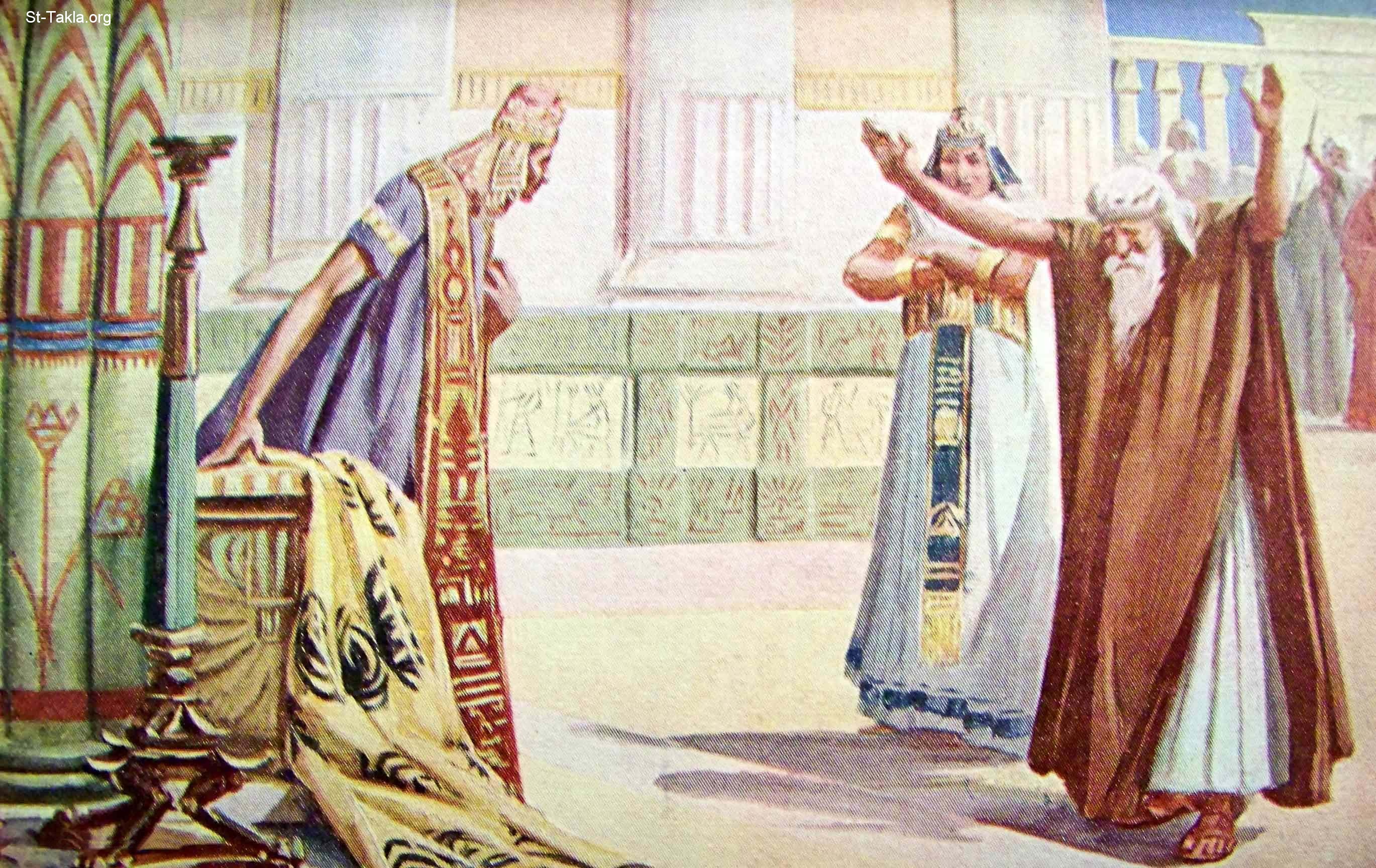
My son, my firstborn, is Israel!

EF:  Thus says YHWH: A formula often used by the prophets to open their pronouncements. The context is similar as well: the prophets stand frequently against the kings of Israel and Judah, arguing for an end to oppression.  my firstborn: The use of this image is a statement of emotional force, not actual primacy of birth or antiquity, as Israel was a comparative latecomer in the ancient Near East.

RA:  My son, my firstborn son is Israel. Framing the relationship in these terms lays the ground in measure-for-measure justice for the lethal tenth plague predicted at the end of the next verse, since Pharaoh has sought to destroy Israel.


REF: My child, my firstborn is Israel. God tells Moses to say this to Pharaoh, but Moses is never reported as saying it.  He is also never reported as saying the rest of this message:  “Should you refuse to let it go, here:  I’m killing your child, your firstborn!”  Why does he not say this to Pharaoh? It is apparently because his first words to Pharaoh do not work.  Moses begins by speaking strongly to Pharaoh: “YHWH said, ‘Let my people go.'” But Pharaoh unmoved, replies, “I don’t know YHWH, and I won’t let Israel go.”  Moses then changes his approach dramatically.  He starts over and this time does not use the commanding wording (the imperative), but rather the polite particle of request (Hebrew na’) and the gentler form:  “please that we might go” (the cohortative).  Moses has backed off somewhat and taken a more conciliatory approach rather than taking the even tougher approach of threatening Pharaoh with the death of his own son.  This conciliatory wording is given to Moses at the burning bush as well (3:18), so it appears that God is giving Moses both the tough and the gentle options.  In any negotiation–in law, business, or anhy human relationship, including marriage–one must use wisdom to know when to exercise each approach.


23 I said to you: Send free my son, that he may serve me,
 but you have refused to send him free, 
so) here: I will kill your son, your firstborn!

RA: to kill your son, your firstborn. This dire threat, to be fulfilled in the tenth plague, also inducts us to the narrative episode that follows in the next three verses, in which the LORD seeks to kill Moses, and the blood of the firstborn intercedes.


24 Now it was on the journey, at the night-camp,

EF: to make him die: To kill him, the means is not specified, but one could surmise that illness is meant.

RA: on the way at the night camp that the LORD . . . sought to put him to death.  This elliptic story is the most enigmatic episode in all of Exodus.  It seems unlikely that we will ever resolve the enigmas it poses, but it nevertheless plays a pivotal role in the larger narrative, and it is worth pondering why such a haunting and bewildering story should have been introduced at this juncture.  There is something starkly archaic about the whole episode.  The LORD here is not a voice from an incandescent bush announcing that this is holy ground but an uncanny silent stranger who “encounters” Moses, like the mysterious stranger who confronts Jacob at the Jabbok ford in the dark of the night (the Hebrew for “place of encampment” is phonetically linked to laylah, “night”).  One may infer that both the deity here and the rite of circumcision carried out by Zipporah belong to an archaic–perhaps even premonotheistic–stratum of Hebrew culture, though both are brought into telling alignment with the story that follows.  The potently anthropomorphic and mythic character of the episode generates a crabbed style, as though the writer were afraid to spell out its real content, and thus even the referents of pronominal forms are ambiguous.  Traditional Jewish commentators seek to naturalize the story to a more normative monotheism by claiming that Moses has neglected the commandment to circumcise his son (sons?), and that is why the LORD threatens his life.  What seems more plausible is that Zipporah’s act reflects an older rationale for circumcision among the West Semitic peoples than the covenantal one enunciated in Genesis 17.  Here circumcision serves as an apotropaic device, to ward off the hostility of a dangerous deity by offering him a bloody scrap of the son’s flesh, a kind of symbolic synedoche of human sacrifice.  The circumciser, moreover, is the mother, and not the father, as enjoined in Genesis.  The story is an archaic cousin of the repeated biblical stories of life-threatening trial in the wilderness, and, as modern critics have often noted, it corresponds to the folktale pattern of a perilous rite of passage that the hero must undergo before embarking on his mission proper.  The more domesticated God of verse 19 has just assured Moses that he can return to Egypt “for all the men who sought your life are dead.”  The fierce uncanny YHWH of this episode promptly seeks to kill Moses (the same verb “seek”), just as in the previous verse He had promised to kill Pharaoh’s firstborn.  (Here, the more judicial verb himit, “to put to death,” is used instead of the blunt harag, “kill.”)  The ambiguity of reference has led some commentators to see the son as the object of this lethal intention, though that seems unlikely because the (unspecified) object of the first verb “encountered” is almost certainly Moses.  Confusions then multiply in the nocturnal murk of the language.  Whose feet are touched with the bloody foreskin?  Perhaps Moses’s, but it could be the boy’s or even the LORD’s.  The scholarly claim, moreover, that “feet” is a euphemism for the genitals cannot be dismissed.  There are again three male candidates in the scene for the obscure epithet “bridegroom of blood,” though Moses strikes me as the most probable.  William H.C. Propp correctly recognizes that the plural form for blood used here, damim, generally means “bloodshed” or “violence” (though in the archaic language of this text it may merely reflect that the deity assaults Moses because he still bears the bloodguilt for the act of involuntary manslaughter he has committed, and it is for this that the circumcision must serve as expiation. All this may leave us in a dark thicket of bewildering possibilities, yet the story is strikingly apt as the tonal and motivic introduction to the Exodus narrative.  The deity that appears here on the threshold of the return to Egypt is dark and dangerous a potential killer of father or son.  Blood in the same double function it will serve in the Plagues narrative is set starkly in the foreground: the blood of violent eath, and blood as the apotropaic stuff that wards off death—the bloody foreskin of the son will be matched in the tenth plague by the blood smeared on the lintel to ward off the epidemic of death visiting the firstborn sons.  With this troubling mythic encounter, we are ready for the descent into Egypt.


REF: he asked to kill him. No one knows what the episode at the lodging place means.  The explanation that accounts for more of the connections than any other is that of my colleague William Propp:  The reason that God seeks to put Moses to death is because Moses still bears the bloodguilt for having killed an Egyptian.  The blood of the circumcision serves to expiate the guilt, making it possible for Moses to live and return to Egypt. The word for “blood” in this story is the plural damim, which is associated with bloodguilt.  The word for “bridegroom” also means “circumcision” in Arabic (and in some cultures circumcision is performed just before marriage).  Propp suggests that the original bridegroom/circumcision connection had been lost by the time this story was composed, and so it was created to explain an old expression: hatan damim, “bridegroom of blood.  Also, this use of blood to avert death is a foreshadowing of the tenth plague in Egypt.


Still, like all explanations I have seen, this leaves the question of why God would choose Moses make a miraculous appearance to him, insist on his going to Egypt despite his five attempts to avoid it, and then seek to kill him.  I therefore understand the confused use of the pronoun “he” in this story in a different way.  All commentators recognize that it is unclear when it refers to God, to Moses, or to Moses’ son.  But they all take the first “he” to refer to God: He (God) sought to kill Moses.  I am raising the possibility (reflected in my translation: “he asked to kill  him”) that it means that Moses is asking God to take his life (rather than send him to Egypt).  This is consistent with another time in Moses’ life when he will ask God to kill him (Num. 11:15, where he says emphatically: “Kill me!”).  And it fits with a model of prophets who ask God to take their lives–Elijah (1 Kings 19:4) and Jonah (4:4)—or say that they prefer death to being prophets—Jeremiah (20:14-18).  (Note that these are the same three prophets who, like Moses are famous for being reluctant).


If Moses is seeking his own death here, then Zipporah’s action might be understood as her passionate response to her husband’s wish to die: You have a wife! You have a son, who should live to marry and be a part of the covenant!

25 Tzippora took a flint and cut off her son’s foreskin,
she touched it to his legs and said: 
Indeed, a bridegroom of blood are you to me!

EF: his: Whose? Presumably those of Moshe, who is then “released” by God.


26 Thereupon he released him. 
Then she said, “a bridegroom of blood” upon the circumcision-cuttings.

EF: released him: Or “relaxed (his hold upon) him.” circumcision-cuttings: Others, “on account of the circumcision,” “because of the circumcision,” “referring to the circumcision.”

REF: And he held back from him. Meaning that Moses stopped asking God to kill him.


27 Now YHVH said to Aharon: 
Go to meet Moshe in the wilderness! 
He went, he encountered him at the mountain of God 
and he kissed him.

RA: And the LORD said to Aaron. We return to the welcome sphere of a God Who speaks, and directs men to act through speech.  After the reunion of the brothers, they will promptly implement God’s instructions as Moses imparts the words to Aaron and Aaron then speaks the words to the people.


28 And Moshe told Aharon all YHVH’S words with which he had sent him 
and all the signs with which he had charged him.
29 Moshe and Aharon went, 
they gathered all the elders of the Children of Israel,
30 and Aharon spoke all the words which YHVH had spoken to Moshe, 
he did the signs before the people’s eyes.
31 The people trusted, 
they hearkened
 that YHVH had taken account of the Children of Israel, 
that he had seen their affliction. 
And they bowed low and did homage.

EF: The people trusted . . .: For the first time in the Torah, Israel responds to God’s promises in a positive manner, something which will rarely happen again.  The vocabulary and attitude form an inclusio (a bracket) with the end of the Liberation Narrative, 14:30-31 (the verbs “trust” and “see”).


RA: And the people believed and heeded.  In the event the two signs of the staff and the hand are sufficient to win their trust (“believe” does not have any doctrinal sense here) and the third sign, of water turned to blood, can be reserved for the first plague.


Wow, a quantum physicist's perspective on . . . – 1

[If you haven’t checked out this MUST READ resource in our library, here are two posts from the book we’re revisiting here: Gerald L. Schroeder [A Physicist Proves We’ve Been Wrong About God All Along]

MUST READ: God According to God, Gerald L. Schroeder


Image from bigthink.com

Image from bigthink.com

You will be surprised at what you will read in this series of excerpted chapters from this book.  Normally, we would not expect such perspectives to be coming from scientific minds such as this quantum physicist but read on and be surprised! Our intent in featuring excerpts from books we recommend is that our readers will become interested enough in wanting to know more and will purchase a copy of the book for your own library.  If not, there’s enough to learn from the excerpts.

 
This turned out to be longer than intended; started out to choose excerpts but since the flow of discussion could not be interrupted and cut short, the whole chapter is practically featured here. The long read is worth typing to the end.-Admin1]
———————————————-
 
NATURE REBELS
God Grants Nature a Mind of its Own
[Excerpts from Chapter Four]
And God saw all that He had made, and behold it was very good.  And there was evening and there was morning, the sixth day” (Gen. 1:31).  
 
This, the closing verse of the first chapter of Genesis, the celebrated evocative creation chapter of the Bible, summarizes the results of the first six days of the universe:  all was “very good.”  But was it all really “very good”?  I wonder by what standards it was very good.
 . . . The universe had been meticulously made ready for life.  But life, especially human life, seems not to have been ready for the responsibilities assigned to it. God had created Adam and Eve and “blessed them . . . and placed them in the Garden of Eden . . . saying, of every tree in the Garden you must eat, but of the Tree of Knowledge of Good and Evil you shall not eat” (1:27-28;2:15-17).  Eden was literally paradise on earth.  Except for the one forbidden fruit, everything should have been “very good.”  Yet just two chapters after this heartwarming news of all being good, Adam and Eve rebelled against God, ate from the forbidden tree, and were expelled from Eden.  A few verses farther on, Adam and Eve’s firstborn murdered their younger son. Not just simple murder, but fratricide!  That doesn’t sound very good to me.  A mere two more chapters pass, and God, with “a saddened heart,” disgusted with the decay of society, throws in the towel and brings on the Flood to destroy all life, for God regretted having made them” (6:7). Sounds like things weren’t “very good” by God’s standards either.


If God is supposed to be great, couldn’t God have controlled events a bit more strictly or at least realized that the entire project was a no-go right from the start? What was the Author of the Bible—and even more than the Author of the Bible, the Creator of the universe and life itself—thinking about when informing us that all was “very good”?


Henry Youngman the late gifted comedian, said that after reading about the evils of alcohol, carefully reviewing all the documentation on the subject he could find, he decided to give up reading.  That’s called cognitive dissonance.  I see the facts, but I’ve got my own ideas, so please don’t confuse me with those facts.  I prefer my personal take on reality.


I want a God that acts in a way I assume God should act, predictable according to my human logic.  When the God of the Bible tells me all is very good, I expect all to be good.  But then the Bible tells me not to count on it and lists disaster after disaster.  So why was I told just the opposite?  It’s a hard truth to accept, and in our typically human desire to resolve cognitive dissonance, we argue all the way.  But what we learn in the very opening chapters of the Bible is that the God of the Bible is not a predictable, static Divinity.  That conventional but ill-conceived description totally misses the biblical reality.


We discover the startling truth of God’s character in Exodus, the second book of the Bible.  Exodus 3:14 is a verse often mistranslated and yet pivotal in understanding God’s sometimes less than manifest immanence in the world it created.  Moses, having been confronted by God at the burning bush, asks God’s name (3:13).  In reply, “God said to Moses, ‘I will be that which I will be’ [ehe’ye  (I will be) asher (that which) ehe’ye  (I will be)] ….  This is My name forever” (3:14-15).  This meaning of the Hebrew text is vastly different from the King James rendering of that verse, “I am that I am.”  The erroneous King James version (ca. 1611) is based on the fourth-century Latin Vulgate, which in turn was based on the six-hundred-years earlier Greek translation (the Septuagint).  The irony of this ongoing error is that the exact Hebrew word in question, ehe’ye, appears just two verses earlier in  Exodus 3:12, and both the Latin and the Greek translations render this “I will be,” not “I am.”  But “I am” is so much more predictable, more appealing to our preconceived notions of God than “I will be” that the translators actually changed the meaning of the biblical text!


Why belabor the point?  Because what we discover here is that the God of the Bible is not a static Divinity, able to be pigeonholed into how we think God should act.  Ehe’ye is not a present-tense verb or a noun, with all the implications of stasis, but a genderless verb actively projecting into the future.  As we will learn in the following pages, the God of the Bible is a dynamic Force with options, contingency plans, a manifestation that changes to fit the changing needs of the dynamic world it created.  Ehe’ye is the perfect description of the God of the Bible.  We expect an “I am,” but instead the God of the Bible self-identifies as “I will be.”


If we are to treat the Bible as a valid source of information about God’s role in our lives, then looking closely at the text is a prerequisite.  As King Solomon urged in Proverbs (25:11), we must seek the “apples of gold in the dish of silver”—the deeper truths sequestered within the literal text.  To help us do that, throughout this book I will be using the major ancient Hebrew commentaries.


Among the oldest of these works is the Talmud (redacted ca. 400).  It is a compendium of biblical commentary and exegesis from the four-hundred-year period prior to its redaction.  Most of the text is in the form of debates between scholars seeking the correct interpretation of the Bible’s wording, which, as we’ve seen, can be very subtle.
  • Rashi (1040-1105), a scholar considered to be the interpreter of biblical Hebrew par excellence, lived in southern France.  He was also a vintner.  Yet for all the demands of the wine industry, Rashi was able to compose precise commentaries on much of the Talmud, a text having over five thousand pages plus the primary Hebrew commentary on the Torah.  
  • The philosopher and theologian Maimonides (1135-1204), while living in what is now Egypt, was chief physician to the ruler of that country (a post that had its very real dangers). He compiled a codification of the laws found in the Torah with a commentary that exceeded nineteen volumes. An example of his philosophical work is The Guide for the Perplexed (1190), which deals with many aspects of the Bible that seemed to conflict with how the world was perceived.
  • Nachmanides (ca. 1195-1270) was a kabalist who offered insights about the Bible that he learned from his teachers.  The Hebrew root of the word “Kabala” means “to receive.”  The received wisdom of Kabala is considered to be the spiritual physics of the world, essentially how an infinite eternal nonphysical Creator interacts with the finite physical world it created.  Kabala itself is not mysticism. However, the sensation one may get when internalizing the information can lead to what might be called a mystical experience.

There are many commentaries and commentators on the Bible.  These are at the top of the list.  Being ancient, the perspectives that they bring are not biased by the discoveries of modern science.  The antiquity of these sources ensures that there has been no attempt to bend the biblical text to match science.  In this they offer us a unique and invaluable vantage point.  And for that reason, only ancient commentaries are used in this book as authoritative sources of biblical insight.

 
The first 6 days as described in Genesis 1 take us from the creation of the universe to the creation of humanity.  The entire account is described in a mere 31 verses.  At M.I.T.’s Hayden library, we probably have 20,000 books on the events covered in those 6 days—not from a theological perspective but from a scientific one that deals with the cosmology, physics, and biology of a universe created with energy capable of producing life, brain, and sentient mind.  Up the Charles River from M.I.T., at Harvard’s Weidner library there are probably 50,000 books on these topics.  With only 31 verses in the first chapter of Genesis, we shouldn’t expect each Divine detail in the cosmic development described there to leap off the biblical pages.  If we are to reap the golden apples within the silver dish of the Bible, we’ll have to reach out.  It is worth the effort.


The flow of events during the first 6 days of creation is driven by the recurring Divine command “And God said . . .” This directive, which appears 9 times in the first chapter and a 10th in the second, presages the unfolding drama of a universe in the making.  With God so intimately in control we should expect smooth sailing in that most amazing of cosmic voyages.  Surprisingly, according to the biblical account of those events, that seems not to have been the case.  The very fact that in those 31 verses the Bible felt it necessary to enlighten us 7 times over that God saw “it was good” and even “very good” might imply that perhaps at times it was not so good. Of course that would be absurd according to the image we project of an infinite, always-in-control God, the father figure of the Bible, creator of the heavens and the earth.  But let’s see what the Bible has to say.


On the third day of the creation, we are told that God commanded the earth to bring forth the first forms of plant life, vegetation.  It’s interesting that the word “creation” does not appear on day three.  Creation would signify that something entirely new, an entity unable to be made from the materials already present, was needed.  No mention of creation means that nothing totally new was needed to bring life into the universe.  The big-bang creation produced the physical basis for all the materials required for life.  This inherent potential for life to flourish on earth led Nobel laureate, organic chemist, and authority on origin of life studies Professor Christian de Duve to write in Tour of a Living Cell:
 “If you equate the probability of the birth of a bacteria cell to chance assembly of its atoms, eternity will not suffice to produce one….  Faced with the enormous sum of lucky draws behind the success of the evolutionary game, one may legitimately wonder to what extent this success is actually written into the fabric of the Universe.”


What was needed to spin out the fabric’s potential for life was the Divine command,
“And God said …”And God said let the earth sprout vegetation, herbs yielding seed, fruit trees yielding fruit each after its own kind with its seed in it …” (Gen. 1:11).  
That verse is the statement of the Divine command for the earth to produce the first forms of life.  The description of nature’s execution of the command follows in the next verse.  
“And the earth brought forth vegetation, herbs yielding seeds of its kind and trees yielding fruit with its seed in it after its kind …” (1:12).  
The execution of the command seems essentially the same as the command itself.  Seems the same, that is, until we read the words more closely with the help of Rashi’s decisive ancient commentary.  God’s command asked for “fruit trees yielding fruit,” but the earth produced “trees yielding fruit.”


A miniscule, seemingly insignificant divergence but an astonishing implication is revealed to us by Rashi.  Fruit trees yielding fruit has a superfluous adjective, the word “fruit” modifying “trees.”  The text might have simply stated “trees yielding fruit” or, equally descriptive, “fruit trees.”  That would have been sufficient to indicate the directive for the earth to produce trees bearing fruit.  The ancient commentaries, upon which I am basing the intention of the biblical text, accepted that seemingly superfluous words, especially when presented or omitted in successive verses such as here in verses 11-12, come to bring one of the “golden apples in the silver dish” of the Bible.  Rashi wrote that the earth was commanded to produce fruit trees yielding fruit in order that the taste of the tree or its bark as well as the fruit that hung from its branches would have the taste of the fruit.  But the earth did not comply.  The earth rebelled. Instead, the earth brought forth trees bearing fruit, not fruit trees bearing fruit, the wood or bark of which would also be as a fruit.


Perhaps God’s demand exceeded nature’s potential.  Can the wood of a tree ever be a fruit?


In the family orchard of my parents, of blessed memory, we had mostly apple trees, plus several quince, peach, and pear trees, and two cherry trees (which year after year the birds harvested before we could).  Though I occasionally chewed on a branch as I was working at the yearly pruning, regardless which of those trees it was, the wood always tasted like wood and never like the fruit of that tree.  Except for the cinnamon tree, the bark of which is the “fruit,” hence making it a “fruit tree,” we might have thought that such a thing as “tasty wood” would be an impossibility.  Not so.  Nature simply failed to comply with God’s command.


And even the cinnamon tree did not succeed in completing the Divine command.  Although it is indeed a “fruit tree” because its bark is a spice, it does not also yield a separate fruit to become “a fruit tree yielding fruit.”


The Torah didn’t have to tell us of this rebellion.  If nature’s mutiny had been kept a secret, all we would know is trees of wood.  But the Bible comes to teach reality, not some fantasy we might have desired of a story-book God orchestrating a make-believe world.  Rashi makes a point of informing us about this rebellion to break that image of an always controlling Master, a superpowerful father image.  Such a God makes a lovely, heartwarming, even reassuring fable, but unless the Bible got it all wrong, the ever hands-on God of our childlike imaginations is not the Deity of the Bible active in our world.


The Bible in these verses tells us an almost incomprehensible fact.  Nature, purportedly bound by unbending “laws of nature,” which were themselves created by God, somehow was able to do the unimaginable.  Nature was able to go against God’s explicit command.  Nature rebelled.  If someone of less stature than Rashi had made this biblical “accusation” it would have been dismissed as trivial nit-picking.  But Rashi is the foremost of all Hebrew commentators on the Bible.


And more intriguing, this three-thousand-year-old biblical claim of nature rebelling against the command of God, of nature having a “mind of its own,” is eerily similar to modern-day observations of quantum physics.  As noted previously, Sir James Jeans, knighted mathematician and physicist who helped develop our understanding of the evolution of stars more than seventy years ago, wrote in his book The Mysterious Universe:  
“There is a wide measure of agreement, which, on the physical side of science approaches almost unanimity, that the stream of knowledge is heading towards a non-mechanical reality; the universe begins to look more like a great thought than a great machine.  Mind no longer appears as an accidental intruder into the realm of matter.  We are beginning to suspect that we ought rather to hail mind as the creator and governor of the realm of matter” (emphasis added.)


Does this imply that something akin to mind exists throughout all of nature, some phenomenon along the lines of Nobel laureate Wald’s previously quoted epiphany?  And that this “mind,” which of course finds its origins in the Divine creation of the world, could have allowed the earth to rebel?  Sounds preposterous.  To the uninitiated. But not to those who struggle to conceptualize the quantum reality of existence.  To what level of existence does mind, and all the implications of what mind brings, including a level of self-awareness, extend?  Humans of course have it.  What about dogs and cats?  Pass a few hours in any public park, and from the way dogs and cats react you realize that dogs know that they are dogs and not cats.  But these are all mammals. What about other forms of life?  Do they too have mind?


While driving in Holland with my family, we noticed a huge nest mounted on what appeared to be a utility pole.  I asked a local resident and was told it was a stork’s nest, occupied each summer by what appears to be the same bird as it completes its annual multi-thousand mile migration from northern Europe in the fall to sunny Africa and its return as the seasons reverse.  I’d heard of that navigational feat.  But until I met naturalist Rabbi Shmuel Silinsky I’d never internalized what a navigational achievement this represented.  Just ponder, he said, how many rooftops and utility poles are there in Holland.  I couldn’t find our way without a map and road signs, but the stork’s bird brain does it just fine, as do monarch butterflies in their flight from Mexico to Alaska and back, even though their migration takes several generations in each direction.


A review article in National Geographic surveyed the level of cognition within a range of animals.  Scientists from such esteemed universities as Stanford Duke, Harvard, and Brandeis describe the extraordinary level of awareness, including self-awareness and episodic memory (the cognitive ability to mentally travel back in time), in animals as different as elephants and birds.  Parrots, Irene Pepperberg of Harvard and Brandeis points out, are especially interesting because parrots can learn to speak.  Her colleague during 31 years of research, Alex, an African gray parrot did exactly that, identifying shape and color and numbers, even asking for breakfast and a view out of a window in another room—not in symbols, but in English words.


Animals have it, but what about microbes?  Do they communicate in a meaningful way, a way that can actually transfer information?  If we are claiming that mind, rebellious or not, exists in the seemingly inert earth itself, then we should be able to identify its presence in the most basic forms of life.
 
In the treatment of several recalcitrant microbial infections vancomycin is often the antibiotic of last resort.  Its powerful sword beat back a brutal illness, extending the life of my late father-in-law, of blessed memory.  Bacteria that can outsmart many of our medical weapons often fall prey to this brilliant product of biotechnology.  Vancomycin does its work by attacking the cells first line of defense, the cell wall.


The bacterial cell wall differs from that of multicellular life-forms in that it has an external scaffolding that helps the single-celled critters maintain their shape.  The structure of cells in multicellular life, such as humans, is established by a system of internal (rather than external) microtubules.  In that difference lies the basis of vancomycin’s effectiveness.  It disrupts the construction of the bacteria’s cell wall while not affecting the cells of the multicellular life-forms, such as humans who might happen to be the unfortunate hosts of the infecting microbes. What the bacteria had to do was to change ever so slightly the molecular structure of their cell wall, so that the vancomycin could no longer recognize and attack them.  And change they did.


The chosen alteration is brilliantly subtle and eminently effective.  The bacteria replace one of the usual cell-wall amino acids, alanine, with lactic acid, a molecule sufficiently similar to the alanine so that it fits easily into the structure, but sufficiently dissimilar so that the vancomycin can no longer do its job.  Lactic acid substitution is a logical choice.  It’s already a common metabolic product, being produced as an end product when the digestion of glucose occurs in the absence of oxygen.  So there’s nothing new about the presence of lactic acid in a cell.  The sore muscles we get when overexercising result in part from the accumulation of lactic acid in our muscle tissues. As with alanine, the lactic acid molecule has three carbon atoms, one methyl group, and one double-bonded oxygen atom.  The significant change is that the amine group of alanine is gone.


To accomplish the alanine-lactic acid switch the bacteria assembled a genetic unit referred to as a plasmid, a snip of DNA in this case housing nine separate genes.  (If you are seeking the hint of a cunning strategem within bacteria, here it comes.) [We will skip the explanation—admin1.]


And all that wisdom-like ability is stuffed into a bacterium approximately a millionth of a meter long and a third as wide.  Observing that this level of “mind” extends to the simplest form of life makes the biblical inference that the earth has the trait of mind less of a leap.  But then in the very first words of the Bible, we read, “With a first cause that was wisdom God created the heavens and the earth.”  All aspects of creation are imbued, actually permeated, with the potential for mind.  Over three millennia ago, the Bible taught this truth in black fire written on white fire, provided that we read both the black of the written words and the white of the wonders of nature as one integrated whole.


It’s hard to accept that a form of life as “simple” or primitive as a bacterium might actually exhibit traits of brainlike shrewdness.  Not so for neurosurgeon Frank Vertosick, Jr. In his excellent book The Genius Within, he places reality before us:
If I speak with admiration for these creatures [bacteria] it’s because I’ve won and lost many battles like [the late] Stephen Jay Gould or Richard Dawkins, physicians like myself enter the competitive arena and do battle with supposedly unintelligent beasts like bacteria and cancer cells. Darwin observed the creatures of the world with a keen eye, but he never fought them one on one.  For those of us who stare into the shining eyes of the world’s predators, we know how cunning they are at what they do ….The genes and enzymes and bacteria in this saga are but cogs in the greater communal machine, the microbial mind.
 
Freeman Dyson is a physicist at the Institute for Advanced Study in Princeton, New Jersey.  According to Dyson (and others): “Atoms are weird stuff, behaving like active agents rather than inert substances.  They make unpredictable choices between alternative possibilities according to the laws of quantum mechanics.  It appears that mind as manifested by the capacity to make choices, is to some extent inherent in every atom.  The universe is also weird, with its laws of nature that make it hospitable to the growth of mind.
 
These scientists did not live or practice their professions in a vacuum.  When they published statements such as these, not only did these thoughts have to pass the editorial review, but also these scientists had to face their colleagues and defend their positions. In short, to proffer such a diversion from the conventional material myth, Vertosick and Dyson had to be secure in their evaluations of reality.
 
If mind, or wisdom as biblically noted, is indeed the inherent essence of all existence, then the “mind” in nature, which of course is the product of God, could conceivably rebel, deviate from the word of God.  Hitherto I thought only humans had that ability.  We call it our free will.  Yet if the Bible’s description of reality is valid, then apparently I learned wrong.


When Adam and Eve are reprimanded for having eaten of the forbidden fruit of the Tree of Knowledge in the Garden of Eden, God also punishes the ground.
 “And to Adam He said, ‘Because you listened to the voice of your wife and ate from the tree which I commanded you saying you shall not eat from it, cursed is the ground because of you” (Gen. 3:17).  
There is a non sequitur here.  Adam and Eve ate the forbidden fruit and God cursed the ground!  Why punish the ground at this point?  It was Adam and Eve who ate the fruit.  The ground was totally passive here.  I can imagine the ground pleading with God at this point:  “What did I do?  You, God, planted the forbidden tree in the Garden.  You made it fantastically ‘appealing to the eye’ [Gen. 3:6].  They eat of the fruit and you punish me?  Why punish me?”  There is, however, a common theme between the eating of the forbidden fruit and the ground not fulfilling its calling.  And that theme is rebellion.  First, on day three the “inanimate” ground rebelled by not “minding” God’s command and then later in Eden the first humans rebelled by deliberately disobeying God’s command.  Rebellion was in the air, and God chose to nip it in the bud.  But He didn’t, did He? As we learn a few chapters farther on in the biblical text free will and rebellion remained facts of existence.


We are learning that the “Lord” of the Bible does not at all fit the usual concept of an all-controlling “Lord.”  But the Bible has already made this clear by the two primary names it uses for God.  Elokiim relates to God as made manifest in nature.  As such Elokiim is the only name used for God in Genesis 1, the creation chapter.  There we read of the physical development of the world. We will discover that nature is not as firmly bound by unyielding “laws of nature” as we might expect.  In Genesis 2, the event more fully describe interactions between God and Adam and between Adam and Eve.  From this point on in addition to Elokiim, we find the fundamental four-letter name of God, a word that has an approximate transliteration of the Hebrew as Ja/ko/vah.  Of course the continuing paradox remains: both Elokiim and Ja/ko/vah  are the one God that chooses to manifest Itself in very different ways.  We were told:  “I will be that which I will be.”


Recalling that Elokiim, God’s control as made manifest in nature, is the only name for God used in Genesis 1, the creation chapter, could nature’s ability to rebel be the source of the rare negative genetic mutations that mar what might otherwise be a properly formed baby at birth or allow for cancer to run rampant as it does today?


The screening and repair mechanisms in cell structure and function approach perfection.  With only a small Divine increase in the molecular skill of cell repair, no mutations would succeed.  There would be no malformed children and also perhaps no cancer.  Yet mutations, those that are not detrimental are what allow different forms of life to develop.  They play a crucial role in forming the nuanced variety we observe within any community of living organisms.  Variety is more than merely the spice of life.  Variety within a species allows that species to adapt to changes in the environment an aspect of life so essential for its robust and vigorous flow.  Mutations act as a two-edged sword.


God created our universe with its inherent ability to diverge from God’s Divine plan.  In the opening chapter of Genesis we are explicitly instructed by God to have dominion over the world (1:28).  By giving us such authority, God has placed with us the responsibility to repair the errors brought about by the vicissitudes of nature.  An example of success in fulfilling this communal responsibility is found in medicine.  The mortality rate of childhood oncology less than a century ago approached 100 percent.  Today and for much of the past decade, the survival rate exceeds 90 percent in leading hospitals.  That success was the result of the combined efforts of many disciplines.  God has designed a world in which we are in truth our brothers’ and sisters’ keepers.  A less auspicious incident in the book of Joshua makes this absolutely clear.


After the Israelites had walked in the desert for 40 years, Joshua was charged with the task of leading this people into the Promised Land.  Jericho, a fortified city located just west of the Jordan River confronted their entry.  Because of the rampant abominations practiced by its inhabitants, God demanded that the city be conquered.  Taking booty in any form was forbidden (Josh. 6).  Unfortunately the temptation for the gold and silver overwhelmed the prudence of one warrior:
“Akhan the son of Karmi, the son of Zavdi the son of Zerah, of the tribe of Judah took for himself from the prohibited treasure” (7:1).
At the following battle with the city of Ay though it was a small town, the Israelites suffered a severe loss when the army was totally routed:
And the men of Ay smote about 36 of them and chased them from before the gate as far as Shevarim and smote them at the descent” (7:5).


Joshua realized that such total defeat could not be explained merely in military terms.  It had to be Divine punishment.  To discover the cause of the calamity, Joshua cast lots, choosing, by the roll of a series of dice, first from among the 12 tribes then family by family within the “chosen” tribe, and finally person by person.  At each roll, the choice came closer to and finally rested on Akhan:  
“And Joshua said to Akhan, ‘My son . . . tell what you have done.’ And Akhan answered Joshua and said, ‘Indeed I have sinned against God. When I saw among the spoil a fine cloak and 200 shekels of silver and a block of gold of 50 shekels weight, I craved them and took them.  They are hidden in the earth within my tent'” (7:19-21).


One person erred, and many suffered.  The Bible describes the beginning of all humanity as stemming from a single couple.  Accordingly, in the world God designed communal responsibility is not bounded by tribe or geography.
 
Could God as described in the Bible run every detail of existence?  Could God, for example, have forced the ground to bring forth fruit trees bearing fruit?  The conventional answer is obviously yes.  The Creator of this grand universe must certainly be able to control every aspect of its functioning down to each blade of grass.  Yet, notwithstanding this common perception of God being infinitely powerful and ever in control, every indication in the Bible is that God has chosen not to control all events.  Biblically, this lacuna arises by Divine fiat and not by Divine necessity.  Whether by fiat or necessity, the fact of this Divine decrease in control and its effect on society remain.


When going to war, just prior to entering battle, the combatants are asked:
 “What man is there that has built a house and has not yet dedicated it?  He should go and return to his house lest he die in battle and another man dedicate it . . . . And is there a man who is engaged to a woman and has not yet wed her?  He should go and return to his home lest he die in battle and another man wed her” (Deut. 20:5-7).
Lest he die in battle? Couldn’t God protect these particular soldiers?  We’ll deal with accidents in a later chapter.  Here, however, we seen an aspect of reality far more fundamental:  there is no guarantee of survival to the individual, even though only a few verses earlier, the soldiers were told
“Fear not . . . for the Eternal your God goes with you to fight against your enemies to save you” (20:3-4).  
God may fight for national survival.  That notwithstanding, individual cannot rely on a miracle to save them.  God has the eternal option of stepping back and allowing nature and people to take their course.  As God told Moses at the burning bush, “I will be that which I will be” (Ehe’ye asher ehe’ye).


The Divinely imbued autonomy at all levels of nature from earth to Adam, narrow though it may be provides the potential for paths to be followed that may be less than beneficial.  Quite simply, events occur that God would rather not occur.  With this comes the latent possibility for undeserved and unexpected tragedy and even evil to enter our lives.  Can it be that God forsees the trouble in the offing and nonetheless allows it to occur?  In general God lets us travel the route we seek.


Prior to entering Canaan the recently liberated Israelites of the Exodus asked Moses to send scouts into Canaan to reconnoiter the Promised Land (Deut. 1:22). God realized this was not a good idea.  What if the report the scouts brought back was disappointing?  But the people really wanted it.  And so when okaying the plan,
God spoke to Moses saying, ‘Send for yourself men to scout out the land of Canaan that I give to the children of Israel'” (Num. 13:1-2).
 God was saying, “Send for yourself and not for Me. You are courting trouble.”  And trouble came.  The scouts returned 40 days later and reported that the land was great, but the inhabitants were too powerful to confront.  The people rebelled.  Their rejection of the land that God had promised resulted in their being subjected to their 40-year trek in the desert; one year for each day the scouts had been in the land.  Did God forsee the rebellion  We cannot know.  But the wording of the Bible makes it clear that God did not like the plan and hence, “Send for yourself.”  God allows us to traverse the course we choose even though it may not be the most opportune option available.  When Moses asked God to appoint people to help in the task of guiding the Israelites, God approved of the plan and so it is written, “And God said to Moses, Choose for Me 70 men . . .'” (Num. 11:16). “Choose for Me as well as for you.”


This granted latitude in Divine control is less of a surprise, once we become familiar with the biblical description of what creation actually engenders.  Biblically, we see creation as something, the universe, arising from the totally nonphysical we refer to as the Eternal Creator.  But that is our view from within the physical side of creation looking toward the metaphysical.  From the opposite perspective, from that of the Divine metaphysical viewing the physical, the perception of creation is quite different.


Speaking through the prophet Isaiah, God defines the Divine act of creation: “I am the Eternal and there is nothing else beside me.  I form light and create darkness, I make peace and create evil. I the Eternal do all these” (45:6-7).
 “I form  light and create darkness.”  One of the metaphors for God in the Bible is light:  “By Your light we see light” (Ps. 36:9); “You wrap Yourself in light” (Ps. 104:2).  God, the source of all spiritual light, “creates” spiritual darkness by withdrawing some of the Divine light:  “I make peace and create  evil.”
 
 One of God’s names is Peace, shalom, shlaimoot, “wholeness,” “harmony.”  To have evil, discord, in a world constructed of peace, some of that peace must be withdrawn.  From God’s vantage point the act of creation, in Hebrew, ba’re’ah, entails a lessening of God’s manifest presence and control.  Creation according to the Bible is God’s spiritual contraction.  In Hebrew the term to describe this Divine contraction is tzimtzum,  which literally means “to contract” or “to withdraw,” in this case a partial withdrawal of God’s evident spiritual presence.  In essence, God hides God’s face.  What once might have been a simple unified whole becomes multifaceted, moving in a multitude of paths, not all of which are necessarily spiritually compatible.  Tzimtzum provides spiritual space for all aspects o existence as we now it.


The first creation, and hence the first tzimtzum God’s creating the heavens and the earth (Gen. 1:1), brought into being the physical world with its time-space-matter, a single fabric interwoven by the laws of nature.  The laws of nature are indeed “laws.”  However, sequestered within is a quantum slack, a leeway in those laws that control nature.  At the subatomic level, identical causes do not yield identical effects.  That also is the message of the tzimtzum  of creation.  Einstein is quoted as having said in response to this quantum uncertainty that he could not believe that God played dice with the universe.  Einstein was correct.  God does not play dice with the universe, but God allows the universe to play dice.


According to all ancient Hebrew commentaries, the creation of the universe described in the opening verse of Genesis was the only physical creation.  One physical creation is also the message of science.  We call it the big bang.  Everything that ever was or will be is made from the light of that first creation.  Thus wrote the kabalist Nahmanides 800 years ago and so teach the discoveries of cosmology today.  That creation shattered an undifferentiated whole and produced the potential for the variety we see in our world.


The second creation, and hence the second tzimtzum, occurred on day 5 of the 6 Genesis days (1:21) and relates to the creation of the animals.  This was not the creation of their bodies—those were made from the already existing material—but the creation of the wholly etherial nefesh,  the soul of animal life.  The nefesh gives animals a level of choice and motion not found in plants.  Animals choose among foods, driven in part by instinct.  They can learn, navigate through a maze, and make tools.  But the nefesh is totally self-centered, driven toward maximizing pleasure, survival, and progeny.  The world, according to the nefesh‘s view, is there to be exploited for the self’s own needs.


The creation of Adam, recorded on the 6th day involves the neshamathe soul of human life.  The neshama attempts to change fundamentally the drives of the human animal.  The neshama realizes that a spiritual unity pervades and unites all existence.  This unity will eventually be spelled out as the central concept of biblical monotheism, “The Eternal is One” (Deut. 6:4; Mark 12:29).  The neshama  apprehends this ultimate message.  Each person has a window of choice from within which he or she decides.  Just as no two people are identical, so no two windows of choice are identical.  But every person’s neshama  evaluates every choice made to determine if an act will move the individual closer to or farther from that Unity, the Oneness of existence.  Reaching that Unity is the ultimate pleasure of life.


Each act of creation during the 6 days of creation was a further tzimtzum by God, a further allowing of ever more freedom in the manner by which God’s commands were executed.  The earth, acting within this relaxation of control, could in a sense “choose” to produce trees bearing fruit rather than fruit trees that also bore fruit (Gen. 1:11-12).  And at the other end of the scale of freedom, Cain could choose to murder his brother, Abel (4:8).


Whether, according to the Bible or science, there is an actual consciousness of “choice” at the level of complexity of the earth or a tree is moot.  We don’t speak the language of soil or plants.  The autonomy inherent at the physical level of the quantum, while not proving the existence of free will, opens the possibility for the concept of choice even in the assumedly inanimate world of atoms and molecules.  After all, it is the same protons, neutrons, and electrons in differing combinations that make up all material existence from earth to Adam.  At some point along this gradation of complexity, manifest consciousness has emerged.  The question is not “if” self-awareness can arise from a particular mix of these seemingly inanimate subatomic particles.  We are living proof that it can and did.  The problem is to identify at what level of complexity sentience and choice and mind come quantifiably online.  By the time we reach the third of the creations, that of the neshama  of humans, our free will is at such an advanced level that the Divine leeway of tzimtzum  has actually granted us license to choose between life and death, that of others and even of our own.


“I call heaven and earth to witness with you today, life and death I have placed before you, the blessing and the curse.  Choose life in order that you may live, you and your children” (Deut. 30:19).  
This is a peculiar admonition by God.  Wouldn’t we assume that people normally choose life?  Apparently God did not think so.
 
 In the Garden of Eden, 2,448 years prior to this revelation at Sinai, Adam and Eve were confronted with identical options.  There, two sources of food were specifically offered:  the Tree of Life and the Tree of the Knowledge of Good and Evil.  Eating from the latter would bring upon them their spiritual death.  In contrast, the Tree of Life, from which they were told that they must eat (the verb in the Hebrew is doubled, implying a direct demand), represented the source of eternal Divine life.  This first couple on earth to have the soul of humankind, the neshama, actually chose knowledge of good and evil over Divine life.
 
 In the two and a half millennia between Eden and the revelation at Sinai, human nature had not changed.  God now had learned the disposition of His creations and therefore urged that we make the choice that on the surface would seem obvious, but apparently was not so:  we should go for a dynamic meaningful life over the stagnation of death.  In a world where subjective feelings of pleasant and not pleasant blur interpretations of right and wrong, the right path is not always obvious.


In the creative act of God’s tzimtzum, this withdrawal of absolute Divine control, we discover the source of chance and choice within our world.  And to our astonishment, this granted autonomy extends throughout all levels of existence.  Considering God’s reaction to the rebellion of the “inanimate” earth at the incident of the fruit trees, and much later to the murder of Abel by brother Cain, anthropomorphically speaking, one is led to wonder whether the scope of Divinely granted freedom was more than God had  originally bargained for.  Some online revisions in the Divine management of the world were in order.  With the failure of God’s contingency “plan A,” in which the first humans were to be nurtured in Eden, “plan B” was inaugurated.  Adam and Eve were expelled from the Garden.  Perhaps being exposed to the outside world would be more instructive.  


Unfortunately that approach also didn’t fare any better.  Within ten generations, society had so fully deteriorated that it needed the washout of the Flood.  Once again God changed the venue for life.  Is this a Divine learning process or is it more accurately described as God’s very essence, the core meaning of “I will be that which I will be”?


Next:  A Repentant God?
How to Understand a God That has Regrets


A World of Deceptions and Forgeries – 4

Excerpts from MOTIVATIONS FOR FORGERY

IF, AS I SHOW LATER, forgery was widely condemned why did people do it?  And how did they justify what they were doing in their own eyes? . . . The question of “why” they did it is a bit complicated, and here I need to differentiate between two ideas that people sometimes confuse in their minds. . . .


These are the notions of “intention,” on the one hand, and “motivation” on the other. . . . Intentions are not the same a motivations. The “intention” is what you want to accomplish; the “motivation” is the reason you want to accomplish it.


This is also the case when it come to forgers and their forgeries.  There is a difference between a forger’s intention and motivation. A forger’s intention, in almost every instance, is to deceive readers about his identity, that is to make readers believe that he is someone other than who he is.  But he may have lots of different reasons (motivations) for wanting to do that.


Authors have always had numerous reasons for wanting to write a forgery.


  1. In the modern world, as we have already seen, the principal motivation is to make money . . . This does not appear to be the main reason for forgeries back in antiquity.  The market for such “original books” was limited then, because the book-selling industry was so modest—books could not be mass-produced and widely published.  Still, there were instances in which forged books could turn a profit. . . .
  2. Political forgeries were usually not treated kindly. But sometimes they worked. . . .
  3. Sometimes the motivation for a forgery was less political than religious—to defend religious institutions or practices or to defend one’s religious claims against those of opponents.


An example of a Jewish forgery created to support Judaism can be found in the famous Letter of Aristeas.  Aristeas was allegedly a pagan member of the court of the Egyptian king Ptolemy II Philadelphus (285-246 BCE). In this letter “Aristeas” describes how the king decided to include a copy of the Jewish Scriptures in his expanding library, and so he made arrangements with the Jewish high priest in Israel to send scholars to Egypt who could translate the sacred texts fro their original Hebrew language into Greek.  Seventy-two scholars were sent, and through miraculous divine intervention they managed to produce, individually, precisely the same wording for their translations of the Scriptures.  Since the Letter of Aristeas is allegedly by a non-Jew, giving a more or less “disinterested” account of how the Hebrew Bible was translated into Greek, it has all the appearance of stating the facts “as they really were.”  But in reality, the letter is a forgery, written by a Jew in Alexandria in the second century BCE.  It was written, in part, in order to show the divine inspiration of the Jewish sacred texts, even in their Greek translation.


4.  [S]ometimes forgeries were created with the express purpose of making a personal enemy look bad or getting an opponent into serious trouble.  As it turns out, this is one of the best-attested motivations for creating forgeries in the ancient world.

5.  Other forgers produced their work for more noble ends, for example, to provide hope for their readers.


One of the most common forms of forgery in Jewish writings around the time of early Christianity is the literary genre known as the apocalypse.  An Apocalypse (from the Greek meaning a “revealing” or an “unveiling”) is a text that reveals the truth of the heavenly realm to mortals to help them make sense of what is happening here on earth.  Sometimes this truth is revealed through bizarre and highly symbolic visions that the author allegedly sees and that are explained by some kind of angelic interpreter.


    • An example is the book of Daniel in the Hebrew Bible.  At other times the author is said to be taken up to heaven to see the ultimate truths of the divine realm that make sense of the horrible events transpiring here on earth.
    • A Christian example is the book of Revelation in the New Testament.


  • These books are meant to inspire hope in their readers.  Even though things seem to be completely out of control here on earth even though there is rampant pain and misery and suffering, even though wars, famines, epidemics, and natural disasters are crushing the human race, even though things seem to be completely removed from God’s hand—despite all this, everything is going according to plan.  God will soon make right all that is wrong.  If people will simply hold on for a little while longer, their trust in God will be vindicated, and he will intervene in the course of things here on earth to restore peace, justice, and joy forever.


Apocalypses are almost always written pseudonymously in the name of some renowned religious figure of the past.  In Christian circles we have apocalypses in the names of Peter, Paul and the prophet Isaiah.  In Jewish circles we have apocalypses in the names of Daniel, Enoch Abraham, and even Adam! Scholars typically claim that these books cannot be considered forgeries, because writing them pseudonymously was all part of the task; the literary genre requires them, more or less, to be written by someone who would “know” such things, that is, someone highly favored by God.  But I think this view is too simplistic.  The reality is that ancient people really did believe that they were written by the people who claimed to be writing them, as seen repeatedly in the ancient testimonies.  The authors of these books knew it too.  They assumed false names precisely because their writings would prove more effective that way.


This relates to the single most important motivation for authors to claim they were someone else in antiquity. Quite simply, it was to get a hearing for their views.  If you were an unknown person but had something really important to say and wanted people to hear you—not so they could praise you, but so they could learn the truth—one way to make that happen was to pretend you were someone else, a well-known author, a famous figure, an authority.


Thus, for example, if you wanted to write a philosophical treatise in which you dealt with some of the most confounding ethical problems facing the world, but you were not a famous philosopher you might write the treatise and claim that you were, signing it Plato or Aristotle.  If you wanted to produce an apocalypse explaining that suffering here on earth is only temporary and that God would soon intervene to overthrow the forces of evil in this world,, and you wanted people to realize this was a message that needed to be heard and proclaimed, you wouldn’t sign your own name (the Apocalypse of Joe), but the name of a famous religious figure (the Apocalypse of Daniel).  If you wanted to narrate a Gospel of Jesus’ most important teachings, but in fact were living a hundred years after Jesus and didn’t have any real access to what Jesus said, you would write down the sayings you found most compelling and claim to be someone who had actually heard Jesus speak, calling your book the Gospel of Thomas or the Gospel of Philip.


The motivation was at work in both Christian and non-Christian circles.  We know this because ancient authors actually tell us so.  For example, a commentator on the writings of Aristotle, a pagan scholar named David, indicated: “If someone is uninfluential and unknown yet wants his writing to be read, he writes in the name of someone who came before him and was influential, so that through his influence he can get his work accepted.


This is the case with the one instance we have of a Christian forger who was caught and who later explained in writing what he did. In the 5th century a church leader named Salvian lived in Marseille.  As did many others in his day Salvian decided, with his wife, to express his devotion to God by renouncing the world and taking on an ascetic form of life.  Salvian was outraged by the worldliness of the church and by church members who were more concerned with personal comfort and wealth than with the demands of the gospel.  So he wrote a letter called Timothy to the Church. Written in an authoritative style, the letter seemed to its readers actually to have been written by Timothy, the famous companion of the apostle Paul four hundred years earlier.  But somehow Salvian’s bishop came to suspect that Salvian had written it.  He confronted Salvian with the matter and Salvian admitted that he had done it.


But Salvian was a defensive fellow, and so he wrote an explanation for why he had produced a pseudonymous letter.  As defensive individuals often do, Salvian made lots of excuses.  The name Timothy, for example, literally means “honored by God,” and so, he said, he used that name to show that he wrote for the honor of God.  His main defense though, was that he was a nobody, and if he himself wrote a letter to the churches, no one would pay attention.  Or as he put it in his written defense, the author had “wisely selected a pseudonym for his book for the obvious reason that he did not wish the obscurity of his own person to detract from the influence of his otherwise valuable book.”


By writing in the name of Timothy, on the other hand, he hoped to get a reading.  His views were important enough for him to adopt a false name.  There is nothing in the story to suggest that Salvian’s bishop accepted this excuse with equanimity (the story is related to us by Salvian, not his bishop).  On the contrary, if the bishop was like every other reader from the ancient world who comments on such things, he was not at all pleased that Salvian had lied about his identity.

A World of Deceptions and Forgeries – 2

[Please read part 1 of Chapter One of Bart D. Ehrman’s book Forged: A World of Deceptions and Forgeries – 1  This continues that discussion. Reformatted and highlighted for post.–Admin1.]


Image from www.alwaysbeready.com

Image from www.alwaysbeready.com

EARLY CHRISTIAN FORGERIES

MOST OF THE INSTANCES I have mentioned are forgeries from after the days of the apostles themselves, from the second, third, and fourth Christian centuries.  Most of the books of the New Testament, on the other hand, were written during the first century.  Is there any evidence that forgery was happening in this earlier period?  In fact, there is very good evidence indeed, and it comes to us from the pages of the New Testament itself.


There are thirteen letters in the New Testament that claim to be written by Paul, including two to the Thessalonians.  


  • In the Second Letter to the Thessalonians we find a most intriguing verse in which the author tells his readers that they are not to be led astray by a letter “as if by us” indicating that the “day of the Lord” is almost here (2:2).  The author in other words, knows of a letter in circulation claiming to be by Paul that is not really by Paul.  This other letter allegedly teaches an idea that Paul himself opposes.  Who would create such a forged letter?  Obviously someone who wanted to advance his own views about when the end would come and decided to do so with the authority of Paul, even though he was not Paul. But there is a terrifically interesting irony connected with this passage
    • Second Thessalonians, in which the passage appears, is itself widely thought among scholars not to be by Paul, even though it claims to be written by him (we’ll see the reasons for thinking this in Chapter 3).  
    • Is 2 Thessalonians itself a forgery in Paul’s name?  If so, why would it warn a forgery in Paul’s name?  There can be little doubt about the answer:  one of the “tricks” used by ancient forgers to assure readers that their own writings were authentic was to warn against writings that were not authentic.  Readers naturally assume that the author is not doing precisely what he condemns. We have other interesting instances of this phenomenon in early Christian literature.  
  • Three hundred years later, at the end of the fourth century, there appeared a book that scholars have called the Apostolic Constitutions.  This lengthy book, in eight volumes, gives instructions concerning how the church is to be organized and run by its leaders.  The book claims to be written by a man named Clement, who was allegedly the fourth bishop of Rome (i.e., an early “pope”), appointed by the apostle Peter himself to lead the great church.  But in reality the book was written three centuries or so after Clement himself was in the grave.  That is, it is a forgery.  
    • More than that, the book is called “apostolic” Constitutions because it passes along the advice and instructions of the apostles of Jesus themselves, often in the first person:  “I, Peter,” say to you this; “I, John,” say to you this; “I James,” say to you this, and so on.  One of the most fascinating instructions of the real-life author of this book (we don’t know who actually wrote it) comes at the end, where he warns his readers not to read books that claim to be written by apostles, but are not.  In other words, he’s telling his readers not to read books such as the one they are reading, an apostolic forgery.  Why insert this instruction  Once again, as with 2 Thessalonians, it is because by doing so he throws his readers off the scent of his own deceit.  
  • With 2 Thessalonians we are presented with a particularly interesting situation. No matter how one understands the matter, the book shows that there were almost certainly forgeries in Paul’s name in circulation all the way back during the time of the New Testament writings.  If scholars who think that 2 Thessalonians was not written by Paul are wrong—that is, if Paul really wrote it—then it shows that Paul himself knew of a forgery in his name that had come to the Thessalonian church. But if the other scholars are right, that Paul did not compose 2 Thessalonians, then this book itself is a forgery in Paul’s name that was floating around
  • in the church.  Either way, there must have been Pauline forgeries already in the first century.  
  • Are there other forgeries from the earliest of Christian times?  I deal with this question at length later in the book, looking into evidence that a number of the books of the New Testament were not written by people who are claimed to be their authors.  For now I’m interested in noting that this is not simply a finding of modern scholarship.  A number of the books of the New Testament were disputed already in early Christianity, among the Christian scholars of the second to the fourth centuries, who were arguing over which books should be included in Scripture.  
  • The most famous instance is the book of Revelation.  A third-century Christian scholar of Aexandria, Egypt, named Dionysius, argued that the book was not actually written by Jesus’ disciple John, the son of Zebedee. Dionysius’s argument was compelling and continues to be compelling to scholars today.  He maintained that the writing style of the book is so different fro that of the Gospel of John that they could not have been written by the same person (modern scholars differ fro Dionysius only in thinking that the Gospel too was probably not written by John.) Dionysius thought there must have been two authors of the same name who later came to be confused as the same person.  But it is interesting that Dionysius, according to the church father Eusebius, ha a number of predecessors who had argued that Revelation was written not by a different man named John, but by a heretic named Cerinthus, who forged the account in order to promote his false teaching that there would be a literal future paradise of a thousand years here on earth.  
  • The small letter of Jude, allegedly written by Jesus’s own brother, was also debated in the early church.  Some Christians argued that it was not authentic, in part, according to the famous fourth-century Christian scholar Jerome, because the book quotes an apocryphal book called Enoch as if it were authoritative Scripture.  
  • The book of 2 Peter was rejected by a number of early church fathers, as discussed by both Jerome and Eusebius, but none more straightforwardly than the notable Christian teacher of Alexandria Didymus the Blind, who argued that “the letter is false and so is not to be in the canon.”  Peter, in other words, did not actually write it according to Didymus, even though the author claimed to be Peter.
  • Other Christian teachers disputed whether 1 and 2 Timothy were actually by Paul, some claiming that their contents showed that he did not write them.  
  • The book of Hebrews was particularly debated; the book does not explicitly claim to be written by Paul, but there are hints at the end that the author wants readers to think that he’s Paul (see 13:22-25). For centuries its Pauline authorship was a matter of dispute.  The book was finally admitted into the canon only when nearly everyone came to think Paul must have written it.   In short, there were long, protracted, and often heated debates in the early church over forged documents.  


Early Christians realized that there were numerous forgeries in circulation, and they wanted to know which books were written by their alleged authors and which were not.  As we will see more fully later, practically no one approved of the practice of forgery; on the contrary, it was widely condemned, even in books that were themselves forged (such as 2 Thessalonians and the Apostolic Constitutions).  


Most of this book will focus on examples of forgery in early Christianity.  To make sense of the early Christian forgeries, however, we need to take a step back and consider the phenomenon of forgery in the ancient world more broadly.  That will be the focus of the rest of this chapter.  We begin with a very important discussion of the terms I will be using.  


Part III: The Terms of the Debate  

Deuteronomy/Davarim: Forgotten in the Kingdom Period

[Imagine . . . the last book of the Torah of YHWH was closed with the final warning about adding to or subtracting from the Sinai Revelation. The Israelites were reminded over and over about keeping the Law, choosing Life, motivated by the blessings for obedience, and passing on to the future generations all that they were taught by Moshe.  You would think that they would forever treasure the very words of their God, all through the centuries, through the generations, through the reigns of their kings.  Unfortunately, that is not what happened.  And you would have to read Kings and Chronicles and the Prophets to follow the failure of Israel’s kings to uphold or even simply keep copies of the Torah of YHWH as they were commanded to do.


Image from www.visualsermons.co.uk

Then as if it weren’t enough that Israel ‘forgot’,  when it finally did treasure and in fact canonized the Torah with the Prophetic books (Neviim) and Inspired Writings (Ketuviim), the non-Jewish world, particularly biblical scholars, questioned the authenticity of Deuteronomy.  One could say to critics that it is their prerogative as true scholars to question the claims of Scripture as God’s word, and to be simplistic as to say that the Torah books have to be accepted as a matter of ‘faith’.  But as we’ve repeatedly emphasized in our posts, a reasoning faith and not simply blind faith is what is required for TRUE faith.


The God of Israel appeals to reason, not blind acceptance. The apologists for the authenticity of Deuteronomy come out in fighting form in this backgrounder on the debate between skeptics and defenders. We all learn much just by sitting on the sideline, just by reading the arguments of each side. 


This background is from additional notes: Pentateuch and Haftorahs, ed. J.H. Hertz; reformatting and highlighting added for this post.—Admin1.]


————————————————-

DEUTERONOMY:  ITS ANTIQUITY AND MOSAIC AUTHORSHIP 1.  DEUTERONOMY AND THE RELIGIOUS REVIVAL UNDER KING JOSIAH (621 B.C.E.)


King Josiah was the grandson of idolatrous King Manasseh, whose reign of 55 years was the longest in the annals of the Jewish People, and the darkest.


Manasseh was swayed by a fanatical hatred for the Faith of his fathers.  He nearly succeeded in uprooting True Religion in Israel, and flooded the land with obscene and gruesome idolatries.  The Temple itself did not escape profanation; the sacred Altar was desecrated; the Ark itself was removed from out of the Holy of Holies; and new altars were erected for various weird cults.  His years were one long Reign of Terror to the loyal minority who attempted to withstand the tide of religious barbarism.


‘Manasseh shed innocent blood very much, till he had filled Jerusalem from one end to another,’ says the author of the Book of Kings; and, according to a tradition preserved by Josephus, day by day a fresh batch of the Prophetic Order was led to execution.

The aged Isaiah, it is said, met a martyr’s death by being sawn asunder in a forest-tree in which he hid himself when attempting to escape from the fury of the tyrant.


No wonder that when, two years after the death of Manasseh, Josiah, a child of eight, came to the throne, the sacred books and teachings of Israel’s Faith had been all but forgotten.  However, in the group of influential persons responsible for the education and policy of the young King, there was a strong revulsion of fleeing from the apostasy of the previous two generations, and a sincere yearning for a return to the historical Jewish national worship.  It was, no doubt, due to the fact of having grown to manhood under such influences, that Josiah decided in the 18th year of his reign to repair the Temple, which had been permitted under his predecessors to fall into a shameful state of neglect.


In the course of this restoration of the Temple, a discovery was made that was to prove of far-reaching importance for the spiritual revival of Israel. Under the accumulated rubbish and ruins of the decayed Temple-walls, Hilkiah the High Priest came upon a scroll, which he handed to the King’s scribe with the words, ‘I have found the book of the law in the house of the LORD.’ The behaviour of the King— he is stirred to the depths of his being by the message of the Book, and yet that message is new to him—is easy of explanation.


Though during the half-century and longer of the royal apostasy the public reading of the Torah had been interrupted, and though the Book itself had disappeared or had been destroyed by idolatrous priests, men still knew of the existence of such a Book, and had sufficient idea of its contents to be able to recognize it when the old Temple copy was suddenly brought to light.  But so little were its contents common knowledge that, on its first reading, the King was struck with terror at its solemn prediction of the evils which would overtake a sinful Israel.


 ‘The ignorance of the King, brought up by the priesthood, may well be accounted for by supposing him to have been vaguely taught the general precepts of the Law, but to have seen or heard for the first time this special Book’ (Milman).

Ancient and medieval history records several instances of codes of law or sacred documents disappearing, and of their rediscovery generations, and even centuries, later.  Such, for example, was the fate that overtook the code of Charlemagne in the 9th century.


‘Before the close of the century in which he died, the whole body of his laws had fallen into utter disuse throughout the whole extent of his dominions.  The charters, laws and chronicles of the later Carlovingian princes indicate either an absolute ignorance or an entire forgetfulness of the legislation of Charlemagne’ (Sir James Stephen).

The general neglect of the Scriptures in the age before the Reformation furnishes a partial illustration of the disappearance of Deuteronomy; even as the recovery, at the time of the Renaissance, of the original Hebrew Text of the Bible for the Western peoples is a parallel to its re-emergence under Josiah.

In our own day, wherever the extirpation of religion is part of the State policy, as in Soviet Russia, we can quite imagine men and women who may have superficial knowledge of the observances and beliefs of Judaism, but who had never read, or heard of, Deuteronomy, or any other Scripture. 2.


DOUBTS IN REGARD TO THE DISCOVERY OF DEUTERONOMY


Nothing could be simpler than the above explanation of the finding of the scroll of Deuteronomy during the repair of the Temple.  Bible Critics think otherwise.  For over 150 years, they have declared that Deuteronomy, the Book of the Farewell Orations of Moses, was not the work of the Lawgiver, but was a spurious production written during the generation of Josiah.  Some of them maintain further that this spurious work was hidden in the Temple with the intention that it should be brought to light, reach the King, and influence him in a definite way. Not a word of all this appears in II KIngs XXII, which describes the finding of the Book of the Law in the Temple; and there is nothing in that account that can justifiably serve as a basis for so strange a hypothesis.


Hilkiah speaks of ‘the book of the law’, i.e. the well-known Torah.  He could not have used such a phrase—it would not have been understood—if it were not known that such a book had been in existence before.  It is clear that the finding of the book was regarded as the discovery of an old lost Scripture, a book of the Law of Moses.  It was this fact alone which gave it authority.


The King, when the book had been read to him, rent his garments, and sent to Inquire of the LORD what it portended for him and his people; for ‘great is the wrath of the LORD that it is kindled against us because our fathers have not hearkened unto the words of this book’.


The King was thus convinced of the Divine character of the Book, and also of its existence in the time of his forefathers.  And it was this conviction alone that led to the religious revolution associated with his name—a revolution which succeeded despite all the machinery of heathenism that would recoil from nothing to thwart it.


Not a whisper of doubt as to the Mosaic origin of the book is heard on any side, not from priests, whose revenues it seriously interfered with, nor from prophets, on many of whom it bore hardly less severely.


‘It is plainly inconceivable that the whole nation should have at once adopted, without objection or criticism, a book of the existence of which no one knew anything before that time, a book which demanded radical modification of worship as well as of the whole religious life’ (B. Jacob).

Though many of the Critics do not hesitate to bring the grave moral charge of forgery in connection with the Book, they are themselves no at all agreed on the question whether the author belonged to the prophetic circle or to the priestly class; whether the Book was the work of one man, or of a ‘school’; whether it was produced in the time of Josiah, Manasseh, Hezekiah or even earlier; whether it originally was the same as we now have it, or it consisted of merely the code of laws—the historical orations having been added later; whether that code of laws came from one hand, or represented the gradual growth of centuries; whether some portion of the Book was Mosaic, or none of it; and whether it even claimed to be a work of Moses, or it made no such claim.


It was the English deists of the 16th century who first set afloat the theory that Deuteronomy was an essential forgery of the subtle priest, Hilkiah.  That theory will not bear serious examination.


This priest, whose ministrations in the Zion Sanctuary are not marked by any particular devotion or zeal, would not be the man to undertake to make it the one and only Place of Worship in Israel; neither was he the man to write those exhortations to godliness and humanity that have made Deuteronomy pure stream of righteousness to the children of men.  And surely this crafty ecclesiastic would not have invented laws (Deuteronomy XVIII,6) which seriously infringed the vested privileges of the Jerusalem priesthood—unless we are to attribute to him a height of folly that would be psychologically inexplicable.


In our generation, W.R. Smith, Dillman, Kittel, Driver and many others have repudiated this absurd theory. Even less convincing, but far more shocking to the moral sense, is the attempt to find the forger among the prophets.


A pioneer of 19th century Bible criticism in England, Bishop Colenso, thinks it likely that Jeremiah was the falsifier.


 ‘What the inner voice ordered him to do,’ Colenso has the shamelessness to write,’he would do without hesitation, as by direct command of God, and all considerations of morality or immorality would not be entertained.’

Verily, there are some things that do not deserve to be refuted: they should be exorcized. It is refreshing to turn to the words of Rudolf Kittel, written in 1925:


‘There is no real evidence to prove that a pious or impious deceit was practised on Josiah.  the assumption of forgery may be one of those hypotheses which, once set up, is so often repeated that finally every one believes it has been proven.  Then one seems ultra-conservative and unscientific not to believe it.  Who, nowadays, would take upon  himself the odium of being behind the times?”

3.  INTERNAL EVIDENCE AS TO THE ANTIQUITY OF DEUTERONOMY


The internal evidence against the late composition of Deuteronomy and for its Mosaic authorship, is overwhelming.  From whatever side the question is examined, we find that the Book and the history of Josiah’s times do not fit each other. To take a few examples.


  • In the reign of Josiah, or in that of his immediate predecessors, the injunction to exterminate the Canaanites (XX,16-18) and the Amalekites (XXV,17-19), who had long since disappeared, would have been as utterly out of date as a royal proclamation in Great Britain at the present day ordering the expulsion of the Danes (W.H. Green).


  •  And how can a Code belong to the time of Josiah which, while it provides for the possible selection of a king in the future, nowhere implies an actual monarchical government?  It finds it necessary to ordain that the king must be a native and not a foreigner (XVII,15), when the undisputed line of succession had for ages been fixed in the family of David.


  • It furthermore prescribes that the king must not ’cause the people to return to Egypt’, as they seemed ready to do on every grievance in the days of Moses (Num. XIV,4), but which no one ever dreamed of doing after they were fairly established in Canaan.


  •  In brief, regarding this whole law of monarchy, H.M. Wiener rightly says, ‘As part of the work of Moses, all is clear; place it in a later age, all is confusion.’


This same judgment must be pronounced in regard to dozens of other matters in Deuteronomy.


  • Thus, Israel is treated in its unbroken unity as a nation: one Israel is spoken of.
    • There is not the slightest hint of the great secession of the Ten Tribes, which had rent Israel in twain.
  • Furthermore, in Deuteronomy the hope and the promise is that Israel is to be ‘high above all nations and the Law actually contemplates foreign wars (XX,10-15).
    • This is quite understandable of the Mosaic generation, just about to embark on the conquest of Canaan.
    • In the days of Josiah, however, it was a question whether Judah could even maintain its own existence.  It had been brought to the edge of ruin by the Assyrian world-power, and within two decades of Josiah’s day, its inhabitants were to be exiled to the banks of the Euphrates.
  •  Again, Edom is mentioned as the people to be most favoured by Israel; whereas from the time of David onwards, Edom was Judah’s bitterest enemy, and is unsparingly denounced by Jeremiah, as by Isaiah  before him.
  • Lastly, in a book assumed to be specially produced to effect reformation in worship, how are we to explain the presence of such laws as regulate birds’ nests or parapets upon a roof?”  Or, for that matter, what relevancy is there, for such a purpose, in Moses’ historical retrospect?


‘As part of the work of Moses, all is clear; place it in a later age, all is confusion.’

4.  CENTRALIZATION OF WORSHIP


The above considerations, and scores more of the same force and moment, have long been urged against the hypothesis of the late production of Deuteronomy.  How is it that they have made so little impression upon the minds of the Critics?


The reason is as follows:  the assumption that Deuteronomy is a product of Josiah’s age is the basis of the theory on which the Critics have built their whole reconstruction of Bible history and religion.  That history—viz. the Centralization of Worship in ancient Israel—they have raised to a dogma, which it is in their opinion sheer heresy to question.


Till the time of Josiah, they tell us, the ancient Israelite could sacrifice at any place he desired;  numberless local shrines, ‘high places,’ dotted the land; and, though there was a good deal of pagan revelry, natural piety was a living thing among the people.  But with the appearance of Deuteronomy the local cults were uprooted, religion was separated from ‘life’, and worship was centered in Jerusalem.


There arose the idea of a Church; religion was now contained in a book; and it became an object of study, a theology.  All these things, we are told, flowed from the centralization of worship; and such centralization was the result exclusively of the finding of Deuteronomy in the days of Josiah.


What is the truth in regard to centralization of worship, and these claims of the Wellhausen school of Bible Critics? Briefly, not a single one of the Critical claims in connection with their dogma of centralization is in agreement with historical facts.  Centralization of worship did not originate in the age of Josiah; it was not the dominant motive of his reformation; neither was there any freedom of indiscriminate sacrifice before his day.


(a)  Centralization of worship did not originate in the age of Josiah. 

It was present from the beginnings of Israel as a nation (Baxter).  One need not be a great Bible scholar to know that, 400 years before Josiah, the splendid Temple of Solomon was built on Mount Zion.  That Temple was built by ‘a levy out of all Israel’ (I Kings V,27); and for its dedication, Solomon assembles ‘the elders of Israel and all the heads of the tribes’ (VIII,1).  It is the central shrine of the whole House of Israel.


(Wellhausen says, ‘this view of Solomon’s Temple is unhistorical,’ because no king after Solomon is left uncensured for having tolerated the continuance of ‘the high places’.  It is the old familiar argument—that the Law could not have existed because it can be shown that it was broken!  According to such logic, there could never have been any Prohibition law in America).


And for centuries before Solomon, there was the Central Sanctuary at Shiloh.  Elkanah, the father of Samuel, ‘went up out of his city from year to year to worship and to sacrifice unto the LORD of hosts in Shiloh’ (I Samuel I,3).  We are told of ‘all the Israelites coming thither (II,14); and that the presiding priest represented ‘all the tribes of Israel’.


But even centuries before Shiloh, we have the Sanctuary at Sinai.  Nothing in Scripture is more minutely or more solemnly described than the building of the Mosaic tabernacle.  Hypercritics have, in obedience to their programme, denied its existence.  However, the study of comparative religions and their sacred structures has rendered their position absurd.  Kittel’s considered opinion is: ‘It is part of the knowledge which has been confirmed in recent times, that in Moses’ day and during the Desert wanderings there was a sacred tent (Tent of Meeting), which was the religious centre of the congregation in the Desert.


(b)  Centralization of worship was not the dominant motive in Josiah’s reformation. 


Josiah’s reformation from beginning to end was a crusade against the idolatry which had flooded the land, the Jerusalem sanctuary included; and the ‘high places’ were put down as part of the stern suppression of all idolatrous practices.  Of a movement of centralization of worship as such, the narrative gives not a single hint.


The whole condition of Jerusalem and Judah, as described in II Kings XXIII, was in flagrant violation of far more fundamental statutes than that of the central Sanctuary in Deuteronomy.  And it cannot be repeated with sufficient emphasis that there are far more fundamental laws in Deuteronomy than this law concerning the Sanctuary.  It has its place in Chap. XII, and recurs in the regulations for feasts, tithing, and priestly duty; but it is quite incorrect to say that this is the one grand idea which inspires the Book.


(c)  There was no freedom of indiscriminate altar-building in early Israel. The alleged legitimacy, before the reformation of Josiah, of sacrificing wherever one desired is based upon a wrong interpretation of Exodus XX,21 (in English Bibles, XX,24).


 ‘An altar of earth thou shalt make unto Me, and shalt sacrifice thereon thy burnt-offerings and thy peace-offerings, thy sheep, and thine oxen; in every place  where I cause My name to be mentioned I will come unto thee and bless thee’ (the last clause should be translated, ”in whatever place I record My name, I will come unto thee, and will bless thee’).


This law does not authorize worship ‘at the altars of earth and unhewn stones in all corners of the land’, as claimed by W. Robertson Smith and those of his school. The law does not speak of ‘altars’, but only of ‘an altar’; and that altar was to be erected ‘in whatever place I record My name’: i.e., in any place sanctified by a special revelation of God.


There is here nothing that conflicts with the command concerning centralization of worship in Deut. XII.  There we have the general rule of worship at the Central Sanctuary; but that general rule does not forbid that, under proper Divine authority, exceptional sacrifices might be offered elsewhere.


The clearest proof of this is that Deuteronomy itself orders the building of an Altar on Mount Ebal, precisely in the manner of Exodus XX,21.  Critics unanimously assign Exod. XXX,21 to what they call ‘the Book of the Covenant’, which they deem to be many centuries older than Josiah.  But the ‘Book of the Covenant’ has the same ideal of centralization as Deuteronomy!  It takes for granted a Central Shrine, and prescribes that three times in the year all males shall present themselves there before the Lord (Exod. XXIII,17).


In view of all the above, one need not be surprised to learn that the alleged evil effects which followed the eventual enforcement of this ancient law of centralization of worship are purely imaginary.


‘Centralization is the necessary consequence of monotheism and of the actual or ideal unity of Israel.  The regulation of life according to Divine Law, the rise of a canon and a theology are incidental to the development of every religion that has ever controlled and modified the life of a people’ (B. Jacob).


Not all Scholars have remained blind to the true facts regarding the alleged lateness of the law of Centralization summarized above.  From the very first, the hollowness of the Critical hypothesis was recognized by Sayce (Oxford), Hoffmann (Berlin), Naville (Geneva), Roberson (Glassgow), and W.H. Green (Princeton).  Their protests were disregarded, but new recruits were found in Hommel, Dahse, Wiener, Moeller, Orr, Jacob and many others.  In recent years, several outstanding Critics—Max Lohr, Th. Oesterreicher, W. Staaerk–have come to realize that especially this fundamental pillar of the Bible Critical view has proved a delusion and a snare.


In 1924, W. Staerk wrote:—


‘For over 100 years Old Testament studies have been under the spell of this hypothesis (i.e. centralization of worship) which in its results has been fatal to the proper understanding of Israel’s religion.’


5.  THE UNITY AND MOSAICITY OF DEUTERONOMY


No book of the Bible bears on its face a stronger impress of unity—unity of thought, language, style, and spirit—than Deuteronomy.  And there is no reason to doubt that the various Discourses proceed from one hand, and that the same hand was responsible for the Code of laws.


The alleged discrepancies between some of its statements and those in other books of the Pentateuch are largely the result of what Delitzsch called ‘hunting for contradictions’.  These alleged differences between the historical accounts in the earlier books and the rhetorical presentation of the same matter in the Farewell Addresses of the dying Lawgiver are all of them capable of a natural explanation.


In recent decades, attention has been called to the fact that in some portions of Deuteronomy Israel is addressed in the singular (collectively), and in other portions in the plural; and it is urged that this is evidence of dual authorship.


Anyone who is familiar with the Prophetic writings knows that the singular and the plural constantly interchange.  This feature is found likewise in other literatures, English included.  H.M. Wiener adduces the following from Sir Walter Scott’s ‘St. Ronan’s Well’ (the italics are Wiener’s):


‘Why, thou suspicious monitor, have I not repeated a hundred times . . . And what need you come upon me, with your long lesson. Thou art, indeed a curious animal.  No man like you for stealing other men’s inventions, and cooking them up in your own way.  However, Harry, bating a little self-conceit and assumption, thou art as honest a fellow as ever man put faith in–clever, too, in your own style, though not quite the genius you would fain pas for.  Come on thine own terms, and come as speedily as thou canst.’

 
As to the Mosaic authorship, the discoveries, since the beginning of this century, of the ancient Semitic codes confirm the antiquity of Deuteronomy.  Thus, when King Amaziah punished his father’s murderers, he refrained from having their families killed with them (II Kings XIV,6), because the Law of Moses (Deut. XXIV,16) forbade such procedure.  Today we know that the old Hittite law of the 15th pre-Christian century—contemporaneous with Moses—contains this same principle.


Furthermore, the law concerning the rape of a betrothed or married woman in Deuteronomy has striking similarities to the law on the subject in the Hammurabi, the Hittite, and the Assyrian Codes. What reason, therefore, is there to assume that these laws of Deuteronomy are later than the Mosaic period?


Paul Volz, who—together with Benno Jacob and Umberto Cassuto–has recently dealt a staggering blow to the Documentary Theory by demolishing all proof for the so-called Elohist source, has once again recorded his conviction that, on the strictly scientific evidence now available, Moses must have been a genius of the first order, a supreme Lawgiver who shaped an inchoate human mass into a great spiritual nation.  Can we deny such a genius the ability to deliver his Farewell Discourses?


‘When we carefully examine the arguments that have been collected in the work of more than a century of criticism, we find that not a shadow of a case can be made against the authenticity of the Mosaic speeches’ (Wiener).

The same holds true in reference to the Code of Laws.  Max Lohr and W. Staerk see no valid reason why the Deuteronomic legislation should not be Mosaic.  And they are not the only scholars who have come to see the force of Dean Milman’s words:


‘If there are difficulties in connection with the Mosaic date of Deuteronomy, endeavour to assign Deuteronomy to any other period in the Jewish annals, and judge whether difficulties do not accumulate twentyfold.’

Die-hard adherents of the Wellhausen school of Pentateuch criticism may derive what comfort they may from the following two concluding selections.  the first is:


‘Speaking for all branches of science, we may say that a hypothesis which has stood for half a century has done its duty.  Measured by this standard, Wellhausen’s theory is as good as the best.  However, there is increasing evidence that it has had its day; and that those scholars who, from the first, expressed serious doubts of it are right’ (Kittel).

The other selection cuts at the root of the whole method of deciding historical questions merely by so-called literary tests.  It reads as follows:


‘Must there not be something essentially illusory in a method which never gives, or can give any independent proofs of its conclusions; and which too leads each new set of inquirers to reject what their next predecessors had been thought to have most clearly established?’ (Speaker’s Commentary).

Genesis/Bereshith 47 – The Good Pharaoh

[This is a wild guess, but there must have been 8 or more pharaohs throughout the whole 430 years that the Israelites were destined to live in Egypt. Why 8 and not 5,  wouldn’t the pharaohs have enjoyed longevity just like other biblical figures? They could, if they followed the biblical diet.  

 
A medical science book claims that a study of mummies in Egypt showed that they died of the same disease moderns are prematurely dying of, because of their diet of unclean animals. Anyway, what are we getting at? Regardless of how many pharaohs there were during the Israelites’ prophesied stay in Egypt, the only 2 pharaohs who matter in the history of the chosen people are the first and the last, neither of whom are named. We can characterize this one as the good pharaoh and the latter one as the bad pharaoh.
 
This pharaoh has reason to be good; Joseph is the only Hebrew in his court, and a most beneficial servant at that, honest and trustworthy, who not only interprets dreams but manages the survival of Egypt through drought and the lean years.  The good pharaoh must have figured that if one of the family is a good apple, surely the root, the tree and the fruit must be the same.  And so Jacob/Israel’s whole family of 66 are welcomed in Egypt and are accommodated in pasture land that best suits their occupation.  
 
Reading the exchange between this pharaoh and Jacob when they first meet, the 2 questions pharaoh asks are— how old are you and what is your line of work? Sounds like a job interview.  The answer— shepherds, and because they are, they had to live separately from Egyptians.  We had hinted earlier that the lamb/ram figure in the animal worship of Egyptians who have their own pantheon of gods.  (A separate article will place this in proper perspective.)  
 
For now suffice it to say the move to Egypt is so far propitious; not only does father and long lost son reconcile, the survival of the whole tribe hinges on the divinely-arranged set of circumstances that lead them to this host country, not yet hostile to the presence of these strangers.
 
Translation:  Everett Fox, The Five Books of Moses with commentary “EF”.  Additional commentary from Pentateuch and Haftorahs, ed. Dr. J.H.Hertz; and RA/Robert Alter.—Admin1]
———————————————————–
 
Genesis/Bereshith 47
 
This is the crucial test of Joseph’s character.  For the Viceroy of Egypt to acknowledge his own brothers the rude Canaanite shepherds, who had besides given him every reason for repudiating them, called for the highest loyalty and devotion.  ‘Many men resist the temptations of youth, and attain to positions of eminence, and then fail to pay the debt which they owe to their own humble kinsmen who have helped them to success.  With Joseph the debt, if any, was small.  There was also no absolute necessity of revealing his identity, much less of inviting his uncouth kinsmen to the land of Egypt.  His action, therefore, shows a simple nobility of character rarely equalled in the past or present’ (C.F. Kent).
 
1 So Yosef came and told Pharaoh, he said: 
My father and my brothers, their sheep and their oxen and all that is theirs, have come from the land of Canaan, 
and here, they are in the region of Goshen!
2 Now from the circle of his brothers he had picked out five men and had set them in Pharaoh’s presence.


Image from www.picstopin.com


[RA] And from the pick of his brothers.  The Hebrew prepositional phrase, miqtseh ‘eaw, has elicited puzzlement, or evasion, from most commentators.  The common meaning of miqtseh is “at the end of,” but it is also occasionally used in the sense of “from the best of” or “from the pick of,” which would be appropriate here, since Joseph wants to introduce the most presentable of his brothers to Pharaoh.  The use of miqtseh in Judges 18:2 in reference to elite soldiers nicely illustrates the likely meaning in our own text:  “and the Danites sent from their clan five men of their pick [miqtsotam,] capable men . . . to spy out the land.”  It might be noted that this term in Judges is associated with “capable men” (benel ayil) —a phrase that in a military context might also be rendered “valiant men”—just as an equivalent phrase, ‘ansei ayil,  is associated with Josephs brothers at this point.  There are, however, other occurrences of miqtseh or miqtsot that suggest it might also have the sense of “a representative sample.”


five men. The insistence of various modern commentators that “rive” both here and earlier in the story really means “several” is not especially convincing.  One should note that the whole Joseph story exhibits a fondness for playing with recurrent numbers:  the fraternal twelve, first signaled in Joseph’s dreams, then subtracted from by his disappearance, with the full sum made up at the end; the triple pairs of seven.  Five is one half the number of the brothers who enslaved Joseph; Benjamin was given a fivefold portion at Joseph’s feast and five changes of garments; and the Egyptians are obliged to pay a tax of one-fifth of their harvest.

 
3 Pharaoh said to his brothers:
What is it that you do? 
They said to Pharaoh: 
Your servants are shepherds of flocks, so we, so our fathers.
4 And they said to Pharaoh:
It is to sojourn in the land that we have come, 
for there is no grazing for the flocks that are your servants’,
for the famine is heavy in the land of Canaan. 
So now, pray let your servants settle in the region of Goshen!

[EF] It is to sojourn:  Are they still sensitive to the accusation in 42:12. “For it is the nakedness of the land that you have come to see?”


[RA] to sojourn in the land . . . dwell in the land. First they use a verb of temporary residence, then one of fixed settlement.

 
5 Pharaoh said to Yosef, saying: 
(So) your father and your brothers have come to you:

[RA] 5a-6b. The Masoretic Text is clearly problematic at this point because it has Pharaoh speaking to Joseph, appearing to ignore the brothers who have just addressed a petition to him, and also announcing, quite superfluously in light of verse 1, “Your father and your brothers have come to you.”  Coherence in the sequence of dialogues is improved by inserting the clauses italicized here, which are reflected in the Septuagint and by changing the order of the verses.

 
6 the land of Egypt is before you; 
in the goodliest-part of the land, settle your father and your brothers,
let them settle in the region of Goshen. 
And if you know that there are able men among them, 
make them chiefs of livestock over what is mine.

the best of the land. Is to be placed at their disposal.  This was Pharaoh’s gratitude to Joseph for his eminent services to Egypt.

make them rulers over my cattle.  A further sign of the king’s gratitude.  Joseph’s relatives are to be appointed royal officers, superintendents of the king’s herdsmen.

 
7 Yosef brought Yaakov his father and had him stand in Pharaoh’s presence. 
And Yaakov gave Pharaoh a blessing-of-greeting.

7-11.   Joseph presents his father to the king.

set him. Or, ‘presented him.”


Jacob blessed Pharaoh.  The aged Patriarch asks the blessing of God for the king who had befriended his beloved son.

[RA] and Jacob blessed Pharaoh. The Hebrew verb here also has the simple meaning of “to greet,” but it seems likely that in this context it straddles both senses.  Jacob of course accords Pharaoh the deferential greeting owed to a monarch, but it would be entirely in keeping with his own highly developed sense of his patriarchal role that he–a mere Semitic herdsman chief addressing the head of the mighty Egyptian empire—should pronounce a blessing on Pharaoh.

 
8 Pharaoh said to Yaakov:
How many are the days and years of your life?

[EF] days and years: See the note on 25;7.

 
9 Yaakov said to Pharaoh: 
The days and years of my sojourn are thirty and a hundred years; 
few and ill-fated have been the days and years of my life, 
they have not attained the days and years of my fathers’ lives in the days of their sojourn.

sojournings. Jacob does not say ‘my life’.  ‘All the days of my life I have been a sojourner’ (Rashi).  To the Patriarch this earthly life is but a pilgrimage, the real life is Beyond; cf. Ps. XXXIX,13.

few and evil. ‘Few’, as compared with the long life of his father and grandfather; ‘evil,’ sad or unhappy.


[EF] in the days of: Others use “during.”


[RA] The days of the years of my sojourning. The last noun here probably has a double connotation:  Jacob’s life has been a series of wanderings or “sojournings,” not a sedentary existence in one place,, and human existence is by nature a sojourning, a temporary dwelling between non-being and extinction.


Few and evil have been the days of the years of my life. Jacob’s somber summary of his own life echoes with a kind of complex solemnity against all that we have seen him undergo.  He has, after all, achieved everything he aspired to achieve:  the birthright, the blessing, marriage with his beloved Rachel, progeny, and wealth.  But one measure of the profound moral realism of the story is that although he gets everything he wanted, it is not in the way he would have wanted, and the consequence is far more pain than contentment.  From his “clashing” (25:22) with his twin in the womb, everything has been a struggle.  He displaces Esau, but only at the price of fear and lingering guilt and long exile.  He gets Rachel, but only by having Leah imposed on him, with all the domestic strife that entails, and he loses Rachel early in childbirth.  He is given a new name by his divine adversary, but comes away with a permanent wound.  He gets the full solar-year number of twelve sons, but there is enmity among them (for which he bears some responsibility), and he spends twenty-two years continually grieving over his favorite son, who he believes is dead.  This is, in sum, a story with a happy ending that witholds any simple feeling of happiness at the end.


and they have not attained the days of the years of my fathers. In fact, Jacob, long-lived as he is, will not attain the prodigious life spans of Abraham and Isaac.  At this point, however, he can scarcely know how much longer he has to live (seventeen years, as it turns out ), and so his words must reflect that feeling of having one foot in the grave that he has repeatedly expressed before.  One should not exclude the possibility that Jacob is playing up the sense of contradiction, making a calcualted impression on Pharaoh, in dismissing his own 130 years as “few.”  The ideal life span for the Egyptians was 110.

 
10 Yaakov gave Pharaoh a blessing-of-farewell 
and went out from Pharaoh’s presence.
11 So Yosef settled his father and his brothers,
giving them holdings in the land of Egypt, 
in the goodliest-part of the land, in the region of Ra’meses, as Pharaoh had commanded.

and Joseph placed.  Or, ‘settled.’


in the land of Rameses.  i.e. the district round the town Rameses.  This town is mentioned in Ex. I,11.  Its name was given to it in the reign of Ramesis II, who is held by some to be the Pharaoh of the Oppression.


[RA]  the land of Rameses. Medieval and modern commentators agree that this designation is a synonym for Goshen.  The term looks like an anachronism because Rameses is the city later built with Israelite slave labor.  Perhaps its use here is intended to foreshadow the future oppression.

 
12 Yosef sustained his father, his brothers, and his father’s entire household with bread, in proportion to the little-ones.

sustained.  Supported.

 
13 But bread there was none in all the land,
for the famine was exceedingly heavy, 
and the land of Egypt and the land of Canaan were exhausted by the famine.

13-17.  The famine in Egypt.

in all the land. lit. ‘in all the earth’.


Image from boldlyproclaimingchrist.wordpress.com

languished. Dean Stanley recalls the descriptions of similar famines in Egypt, which enable us to realize the calamity from which Joseph delivered the country.  ‘The eating of human flesh became so common as to excite no surprise,’ writes a medieval eyewitness of one of these famines; ‘the road between Syria and Egypt was like a vast field sown with human bodies.’


[RA] And there was no bread in all the earth. The tension with the preceding verse, in which Joseph is reported sustaining his whole clan, down to the little ones, with bread, is of course pointed, and recalls a similar surface contradiction between verses 54 and 55 in chapter 41.  The writer shuttles here between the two common meanings of ‘erets, “earth” and “land,” as in his previous accounts of the famine.

 
14 Yosef had collected all the silver that was to be found in the land of Egypt and in the land of Canaan, from the rations that they had bought, 
and Yosef had brought the silver into Pharaoh’s house.

Pharaoh’s house. i.e. the royal treasury.

 
15 When the silver in the land of Egypt and in the land of Canaan had run out, 
all the Egyptians came to Yosef, saying: 
Come-now, (let us have) bread!
Why should we die in front of you, because the silver is gone?

faileth.  lit. ‘is at an end.’


[RA] why should we die before your eyes?  The last term in the Hebrew is literally “opposite you.”  In the parallel speech in verse 19, the Egyptians actually say “before your eyes.”

 
16 Yosef said: 
Come-now, (let me have) your livestock, and I will give you (bread) for your livestock, since the silver is gone.

for your cattle.  In exchange for your cattle.

 
17 So they brought their livestock to Yosef, and Yosef gave them bread (in exchange) for the horses, the sheep-livestock, the oxen-livestock, and the donkeys; 
he got-them-through with bread (in exchange) for all their livestock in that year.

horses.  As articles of luxury, the horses are mentioned first.

[EF] got-them-through: Lit. “led them.”


[RA] he carried them forward with bread.  The usual meaning of the verb is “to lead” the context here suggests it may also mean something like “to sustain.”

 
18 But when that year had run out, they came back to him in the second year and said to him: 
We cannot hide from my lord 
that if the silver has run out and the animal-stocks are my lord’s, 
nothing remains for my lord except for our bodies and our soil!

the second year.  The year following the year after the five years, i.e., the seventh year (Luzzatto).


our bodies, and our lands.  Which they offer in exchange for bread.


[RA] our carcasses and our farmland. Previous translations have rendered the first of these terms blandly as “our bodies” or “our persons.”  But the Hebrew gewiyah refers specifically to a dead body and is often used in quite negative contexts.  The Egyptians here are speaking sardonically of their own miserable condition: they have nothing left but their carcasses, they have been reduced to walking corpses.  The present translation uses “farmland” for the Hebrew ‘adamah.  That term usually means arable land—it is the reiterated “soil” of the Garden story—but “soil” would be a little off in these sentences.  It cannot be rendered throughout simply as “land” because that would create a confusion with “land” (‘erets), which is also used here several times to refer to Egypt as a country.  The act that the farmland referred to by the Egyptians is not yielding much produce suggests that in their eyes it is scarcely worth more than the “carcasses” with which it is bracketed.

 
19 Why should we die before your eyes, so we, so our soil?
Acquire us and our soil for bread, 
and we and our soil will become servants to Pharaoh. 
Give (us) seed-for-sowing 
that we may live and not die, 
that the soil may not become desolate!

both we and our land.  ‘The old feudal nobility of Egypt disappeared in the Hyksos period, and from the time of the eighteenth Dynasty onward we find the land, which had formerly been held by local proprietors, belonging either to the Pharaoh or to the temples.  At the same time public granaries make their appearance, the superintendent of which became one of the most important of Egyptian officials’ (Sayce).


[RA] slaves to Pharaoh. The reduction of the entire population to a condition of virtual serfdom to the crown in all likelihood was meant to be construed not as an act of ruthlessness by Joseph but as an instance of his administrative brilliance.  The subordination of the Egyptian peasantry to the central government, with the 20 percent tax on agriculture, was a known fact, and our story provides an explanation (however unhistorical) for its origins.


that the farmland not turn to desert.  As the famine continues, without seed-grain to replant the soil, the land will turn to desert.

 
20 So Yosef acquired all the soil of Egypt for Pharaoh 
-for each of the Egyptians sold his field, for the famine was strong upon them-
and the land went over to Pharaoh.

bought all the land of Egypt.  In this manner Pharaoh became the feudal lord of all Egypt.

 
21 As for the people, he transferred them into the cities, from one edge of Egypt’s border to its other edge.

city by city.  The cities became depots for facilitating the distribution of food.


[EF]  transferred them: Hebrew difficult; some read “enslaved them.”


[RA] And the people he moved town by town.  Despite many English versions, it is problematic to construe the last term as “into the towns,” for it would make no sense to move all the farmers into the cities of there are to be crops in the future, unless one imagines a temporary gathering of the rural population in the towns for the distribution of food.  But the Hebrew particle le in le’arim can also have the sense of “according to”—that is, Joseph rounded up rural populations in groups according to their distribution around the principal towns and resettled them elsewhere.  The purpose would be to sever them from their hereditary lands and locate them on other lands that they knew were theirs to till only by the grace of Pharaoh, to whom the land now belonged.

 
22 Only the soil of the priests he did not acquire, 
for the priests had a prescribed-allocation from Pharaoh, and they ate from their allocation which Pharaoh had given them, therefore they did not sell their soil.

only the land of the priests. The priests had a fixed portion from the royal granaries; so there was no occasion for them to sell their lands.

 
23 Yosef said to the people: 
Now that I have acquired you and your soil today for Pharaoh,
here, you have seed, sow the soil!
24 But it shall be at the ingatherings, that you shall give a fifth to Pharaoh, 
the four other parts being for you 
as seed for the field and for your eating-needs, for those in your households, and for feeding your little-ones.

a fifth.  This tax was not excessive.  The Jews, in the time of the Maccabees, paid the Syrian government one-third of the seed (I Macc. X,30).


[RA] a fifth: Here is the ubiquitous “five” again.

 
25 They said: 
You have saved our lives!
May we find favor in my lord’s eyes: we will become servants to Pharaoh.

Pharaoh’s bondmen.  To pay the tax as ordained (Rashi).

[RA] in being Pharaoh’s slaves. Most translations construe this as a future verb “we shall be.” But the introductory clause of obeisance, “May we find favor . . .” does not necessarily preface a declaration about a future action, and the Egyptians are already Pharaoh’s slaves, both by their own declaration (verse 19) and Joseph’s (verse 23).  In point of historical fact, Egypt’s centralization of power, so unlike tribal Israel and Canaan with its city-states, must have astounded and perhaps also troubled the Hebrew writer.

 
26 And Yosef made it a prescribed-law until this day, concerning the soil of Egypt: For Pharaoh every fifth part!
Only the soil of the priests, that alone did not go over to Pharaoh.

unto this day. In the days of Moses, the arrangement described was still in force.

 
27 Now Yisrael stayed in the land of Egypt, in the region of Goshen;
they obtained holdings in it, bore fruit, and became exceedingly many.

got them possessions.  Acquired property by purchase (Kimchi).

In this concluding Sedrah of Genesis, we see the sunset of Jacob’s career.  We behold this storm-tossed soul on his deathbed, blessing his children.  He is not afraid to die: ‘I will sleep with my fathers,’ he says.  He is at peace with God.  II wait for Thy salvation O LORD,’ are among the last words he utters.  He knows that he can never travel beyond God’s care.  He is at peace with man.  Esau, Dinah, Joseph—what a world of strife and suffering and anguish did each of these tragedies bring him—and yet he dies blessing.  Though starting as ‘a plain man dwelling in tents’, his is no cloistered virtue, and he certainly is no sinless being.  But he possesses the rare art of extracting good from every buffeting of Destiny. He errs and he stumbles, but he ever rises again; and on the anvil of affliction his soul is forged.

 
28 And Yaakov lived in the land of Egypt for seventeen years. 
And the days of Yaakov, the years of his life, were seven years and a hundred and forty years.

And Jacob lived.  Heb. Of how few men, asks a famous modern Jewish preacher, can we repeat a phrase like, ‘And jacob lived”? When many a man dies, a death-notice; because but for it, the world would never have known that man had ever been alive.  Only he who has a force for human goodness, and abides in hearts and souls made better by his presence during his pilgrimage on earth, can be said to have lived, only such a one is heir to immortality.


[RA] And Jacob lived in the land of Egypt seventeen. The symmetry with Joseph’s seventeen years until he has sold into Egypt was aptly observed in the Middle Ages by David Kimhi:  “Just as Joseph was in the lap of Jacob seventeen years, Jacob was in the lap of Joseph seventeen years.”

 
29 Now when Yisrael’s days drew near to death, 
he called his son Yosef and said to him:
Pray, if I have found favor in your eyes, 
pray put your hand under my thigh- 
deal with me faithfully and truly: 
pray do not bury me in Egypt!

and the time drew near.  lit. ‘and the days of Israel drew near to die’.  The ‘days’ play an important part int he story of Jacob.  He lived every day; every moment counted.


kindly and truly.  Heb. ‘chesed ve-emess’.  ‘Deal in true kindness with me even after my death by carrying out my wishes as regards my burial.’ ‘Which is the highest form of lovingkindess?’ ask the Rabbis.  ‘The kindness shown to one who is dead.’

bury me not, I pray thee, in Egypt.  His one thought, oftentimes repeated, was that his bones should not rest in that strange land; not in pyramid or painted chamber, but in the cell that he had digged for himself in the primitive sepulchre of his fathers (Stanley).

 
30 When I lie down with my fathers, 
carry me out of Egypt, and bury me in their burial-site! 
He said: 
I will do according to your words.

but when I sleep with my fathers.  Better, so that I sleep with my fathers.  His burial in Canaan would keep alive the wish of his descendants to return to the Promised Land.

 
31 But he said: 
Swear to me!
So he swore to him. 
Then Yisrael bowed, at the head of the bed.

Image from www.chabad.org

swear unto me. The actual oath seems to be independent of the ceremony of placing the hand under the thigh, in v. 29.  The oath was to enable Joseph to overcome any objections that might be raised by Pharaoh.


bowed down upon the bed’s head, i.e. he worshipped God on the pillow of the bed.  During the taking of the oath, Jacob was sitting up in bed.  He now lies down again in his bed, and thanks God for the assurance given by Joseph to bury him in Canaan (Ibn Ezra, Sforno).


A Sinaite's Musical Liturgy – 4th Sabbath of May

  [Sinaites enjoy singing the Sabbath liturgy. Since we don’t have our own music, we borrow from Christianity’s rich and varied hymnody.  The music we love, the lyrics we can no longer agree with so we’ve made up our own lyrics. If you’re not familiar with the music, reciting the lyrics is the next best thing.—Admin1.]
————————————————- 
 

A SINAITE’S MUSICAL SABBATH 

KINDLE THE SABBATH LIGHTS

[Tune:  Come thou long expected Jesus; revised lyrics]

1.  Let us kindle the Sabbath candles
allow their glow to brighten our eyes,
Like the gleam from the Light of Torah
which reaches deep in heart and mind.
CHO:  When the darkness fades in the distance
as kindled lights move to take its place,
Shadow and dimness that darken the heart and mind of man
brighten up when His Word is heard.
 
2. Let us kindle the Light of Torah
to guide our pathway day after day.
Let our minds be enlightened daily by words of life,
from the Giver of Life.
CHO: Sabbath lights in our home and hearth
keep on glowing long after sunset has come,
Torah continues to brighten our way through each new day,
through the week till next Sabbath comes.


 “YHWH is His NAME”

[Tune: Are you washed in the blood of the Lamb? Revised Lyrics and Retitled]

1.  Have you been to Sinai where the One True God
Gave His Name, His ineffable Name,
Which His chosen people dare not say out loud,
Out of reverence and awe for His Name.
 So they called Him ‘Adonai’ and ‘Elohim’,
And devised other titles for Him,
And in time it happened that not one could say
how the Name is pronounced to this day. 
CHO:  Yod Heh Vav Heh, Yod Heh Vav Heh,
Yah forgive, we don’t know how to say—
Yah-weh, Ya-hu-weh,Ye-ho-vah, Ya-hu-wah,
There’s a blessing in saying His Name. 
2.  So He’s known by many other titles like
El Shaddai, Eluheinu, HaShem,
He’s Creator, Master of the universe,
He’s the Rock, He’s Provider, He’s God.
 How can anyone who’s never heard His Name
ever call on a God they don’t know?
Are they faulted for not knowing to this day,
When they can’t read His Name in HIS BOOK?
CHO: Ya-hu-wah, Ya-hu-wah,
Is it so wrong to call on His Name,
All the world will never know the One True God,
If we don’t say ‘Yahuwah’s HIs Name!’

SABBATH BLESSINGS

[Tune:  Oh how He loves you and me]

1.  For all the joys of our days,
For untold blessings always,
This wine we drink symbolizes our joy,
Bless You, dear Father,
Bless one another,
For joys we share on this day.
2.  Thank You for bread that we share,
all Your provisions and care,
We bless You back for the blessings You give,
How can we love You, just like You love us,
Oh how He loves you and me.  

SABBATH MEAL

  TORAH STUDY

 
 HAVDALAH

[Tune:  Lead me to Calvary, Revised Lyrics]

1.  Lord of my life, please light my way, all through the darkness be,
Lest I get lost, can’t find my way, over my life, please be!
Thou art my Shepherd, lead me to pastures of green to feed.
Call out my name that I may hear warnings that I should heed.
 
CHO:  Lest I forget Thy voice I heard, lest I remember not Thy word,
Lest I forsake the True Path I’ve tread,
Lead me back, LORD, to Thee. 
2.  Teach me just like the Israelites all that I need to be,
Show me just how to sacrifice, show me what pleases Thee.
Best of all that I own and have, unworthy tho’ they be,
Best of my mind and soul and will, all are reserved for Thee. 
CHO:  Lest I fall short of Thy command, lest I let go of Thy precious Hand,
Light up my path, my eyes, my life,
Lead me back, Lord, to Thee. 
 SHABBAT SHALOM! 


A Sinaite's Liturgy — 3rd Sabbath of May

[For this Sabbath’s liturgy, we borrowed some prayers from the Baccalaureate Service of “UC” —a University in our city base, prayers written by two Sinaites who have granted permission.—Admin1]


——————————–

 
Image from creativedesignsbyteresa.com

Image from creativedesignsbyteresa.com

O GOD of Creation,

You are the Master of time and all that time produces;

Designer of all created order:  all that sustain life, all works, all gifts, all callings and missions, all history, all institutions, all laws, all righteousness.


You are the ETERNAL,

Governor of time past, of our present, and of the future.


O GIVER and SUSTAINER of LIFE

You sanctify the ordinary experiences of each day by Your mercy and grace,

and by Your providential care of all,

to whom You have granted Your ‘breath of life’.


You have given us talents and resources, opportunities and benefits

You dispense Truth and Wisdom,

and have made known Your Way of life, so that humanity might learn to live with one another in peace and harmony, with justice and righteousness, with compassion and care for the less privileged.


For all these and more we are grateful and give You praise.


KINDLE THE SABBATH LIGHTS

 
Image from palmettorabbi.com

Image from palmettorabbi.com


As Your magnificent sun fades from view on our horizon,

we kindle the sabbath lights once again to serve as a reminder

that Your SUN never fades from our vision;

we have Your Sinai revelation recorded in the Hebrew Scriptures,

the Light of Your Torah guides our lives day after day,

from the rising of Your sun to its setting.

It gives us guidance in right living through the darkness of the world systems that know You not,

yet the wonder is that even in their ignorance,

they apply basic Torah values which attest, O Lord,

to Your declaration that Your Torah is written in the tablet of every heart and mind of every individual who lives on this earth.


BLESSINGS

 
Image from chefronlock.com

Image from chefronlock.com

Blessed are You, Lord YHWH, our God,

King of the universe Who has blessed us with life,

Who has directed us to the pathway

that leads to Your Way of Life,

Who has granted us the gift of procreation,

the gift of children—sons and daughters,

the gift of succeeding generations and extended families.

May each of them learn to anchor their faith in You,

and in humankind made in Your image,

May You guide their path toward what is right

in the eyes of men and in Your eyes.


And as we share the Sabbath wine and bread,

symbols of Your provisions for each day of our life,

symbols of joy and delight in entering

Your Sabbath Sanctuary in time,

we say with sheer joy and delight,

“To Life,” Your Life,

and join Your chosen people in saying, l’chaim!


SABBATH MEAL

Image from www.hebrewcatholic.net

Image from www.hebrewcatholic.net


TORAH STUDY


HAVDALAH


 SONG OF DEDICATION

(F. Havergal, Arr. T. Fettke)

[For those not familiar with the tune, reciting the lyrics works as well.]


Image from margaretfeinberg.com

Image from margaretfeinberg.com

Take my life and let it be

consecrated Lord to Thee,

Take my hands and let them move

at the impulse of Thy love.

Take my feet and let them be

swift and beautiful for Thee,

Take my voice and let me sing

always, only for my King.


Cho:  Lord, I give my life to Thee,

Thine forevermore to be.  [Repeat]


Take my silver and my gold,

not a mite would I withhold;

Take my moments and my days,

let them flow in ceaseless praise

Take my will and make it Thine;

It shall be no longer mine,

Take my heart it is Thine own

It shall be Thy royal throne.

Thine forevermore to be.


SHABBAT SHALOM!

NSB@S6K


Biblical Diet 2—UNclean Meat

In the first article on Biblical Diet, I mentioned a great source book that should be in every family library: The Maker’s Diet, by Dr. Jordan Rubin. 
 
The following excerpt from Dr. Rubin’s book is intended to whet your appetite enough to make you want to get your own copy of the book, since it will make you seriously consider whether or not you should continue to indulge your appetite for the flesh of unclean animals: 

Elmer Josephson . . . was a pastor, missionary, and cancer survivor.  In his landmark volume God’s Key to Health and Happiness, he wrote:


“Some ask, why did the Lord make the unclean animals?  They were created as scavengers.  As a rule they are meat-eating animals that clean up anything that is left dead in the fields, etc.  But scavengers were never created for human consumption.  The flesh of the swine is said by many authorities to be the prime cause of much ill health, causing blood diseases, weakness of the stomach, liver troubles, eczema, consumption, tumors, cancer, etc.


“The scaleless fish and all shell fish including the oyster, clam, lobster, shrimp, etc., modern science discovers to be but lumps of devitalized and disease producing filth, because of inadequate excretion.  These are the scavengers, the garbage containers of the waters and the seas.”


Image from laurelsnyder.com

Pork products in particular top the list of favorite foods for many. . . Some don’t even realize their favorite snacks or food items come from swine.  The pig did not make the Creator’s list of ‘clean’ animals for very good reason.  Clean animals that chew the cud have an alimentary canal and a secondary end receptacle.  Essentially, they have three stomachs available to process and refine their clean, vegetation-based food into “flesh” in a process that takes more than twenty-four hours in general.


Pig or swine, on the other hand, never limit their diet to vegetation.  They will eat anything they can find—including their own young and sick or dead pigs from the same pen.


Josephson claimed the pig’s single stomach arrangement was very simple in design and function and that it was combined with limited excretory organ system:  “four hours after the pig has eaten his polluted swill and other putrid, offensive matter, man may eat the same [swill} second handed off the ribs of the pig.”


With impeccable logic, Josephson adds, “Did anything biologically happen to the swine [since Biblical times], or did the digestive tract of man have some kind of miracle transformation?  No, the Bible, science and experience have all proven the contrary.


Regarding scavengers of the sea, we see media warnings about toxic crabs, clams, and oysters  . . . Why?  Scientists literally gauge the contaminate levels of our oceans, bays, rivers, and lakes by measuring the mercury and biological toxin levels in the flesh of crabs, clams, oysters, and lobsters.


Consider Dr. [Peter] Rothchild’s explanation of the toxic effects of what the Bible calls “unclean” foods:


Do not consume any meat of scavenger animals comprising pork, all shell fish varieties, skin fish which are scale-less fish, scavenger birds, snakes and most reptiles.  The reason for this [biblical] prohibition is dual.


The first consists in that the meat of such animals is about ten times more perishable, difficult to preserve, than that of the allowed animals.  Frequently people do not realize a piece of meat is already poisonously spoiled until they perceive the toxic symptoms . . . [and have already] ingested it.


The second reason consists in the scary fact that the  . . . by-products that originate from digesting such scavenger meat are highly poisonous.  We’re referring specifically to the so-called death enzymes, such as cadaverine, putrescine . . . these death enzymes are extraordinarily useful in nature.  Without their assistance no flesh would revert to dust . . . they are extremely useful to break down a corpse, but terribly inconvenient in a living human body.


 [From an unpublished book entitled The Art of Health]

 
Dr. Rothschild considered God as  “the greatest master nutritionist of all times” who gave mankind an all-purpose diet more than 3000 years ago.
 
Our 3rd article will be on CLEAN animals, according to Leviticus 11.  Information that’s good for the gut should be ingested in chewable digestible doses; hence this continuing series on the Biblical Diet.  Actually, if you have a bible [any version/translation will do], go ahead and start reading Leviticus 11.

NSB@S6K

A Sinaite’s Liturgy – 2nd Sabbath of May

Image from veganloveinn.blogspot.com

Image from veganloveinn.blogspot.com

KINDLE THE SABBATH LIGHTS


O YHWH,

our God, Lord, and Creator,

You perfected Your universe on day six

culminating in the ‘crown’ of Your creative work

—humankind—

then You set aside a seventh day.


If You chose to set apart this day for rest,

it behooves us who are made in Your image,

to do the same,

not simply to rest from our weekly chores,

but to take delight in the difference

of what we choose to do on this day,

a day set aside for You,

which makes this seventh day special for us.

 
Image from www.chagim.org.i

Image from www.chagim.org.i

O CREATOR of LIGHT,

in the meaningful family tradition of Your chosen people,

the matriarch of the family

kindles the Sabbath lights 

and speaks the blessing:


Blessed are You,

YHWH, our God, 

King of the Universe,

Who sanctified us with Your commandments 

and commanded us to “sanctify the Sabbath.”


As the world celebrates motherhood,

we reflect on this fitting tribute —that

“God could not be present for every child born in this world,

and so God created mothers.”


You have designed woman

to be the perfect vessel

to carry and nurture new life 

until she births a new person 

from the darkness of her womb

to see the light of day;

and thereon to nurture that life

with selfless dedication 

until she is ready to release this beloved part of her ‘self’

to take his own direction in life

in a world ridden with choices.


Bless all mothers, O GIVER of LIFE,

for their special role in the lives of children,

providing never-ending unconditional love to them;

may children young and old,

see in mothers that very image of You,

a loving God Who cares that each child

fulfills the purpose for which he was created:

to come to know You,

yet freely choose his destiny,

with You or without You in it.

May he choose ‘Life’,

Your Life,

for in doing so, his destiny is rightly directed.

and that brings great comfort to every mother’s heart.

 
Image from www.treatmetoafeast.com

Image from www.treatmetoafeast.com

Proverbs 31:28-31


Her children have risen and praised her;

her husband and he extolled her:

“Many women have amassed achievement, but you surpassed them all.”

Grace is false, and beauty vain;

a woman who fears YHWH, 

she should be praised.

Give her the fruits of her hands;

and let her be praised in the gates

by her very own deeds. 


BLESSINGS


O YHWH, 

You perfectly designed the world we live in

to sustain all life—with sunshine and air,

water and a variety of nourishment.


We bless You for blessing us

with fruit from the vine and bread from wheat,

daily provisions that nourish body and soul.


In Your Tabernacle in the wilderness,

You consistently stressed two items together:

the Ark of the Covenant

which contained Your revelation on two tablets of stone,

and the table of shewbread

which was replaced every Sabbath.

Image from rastafarimidrashim.wordpress.com

Image from rastafarimidrashim.wordpress.com

How could we miss the connection: 

that as we delight in nourishing our physical life,

we nurture our spiritual life by ‘feeding’ on Your Torah,

both, a joy and delight not only on Sabbath,

but as often as we desire food for body and soul.


We celebrate motherhood,

and ask for blessings upon all women 

who deliver Your gift of life to each of their children;

may they be rewarded in the desires of the heart

that their children no matter how old,

will find joy and happiness

from the Source of it all—

You, YHWH, our Lord and our God,

their Creator and their very Source of life.


Image from www.accessgenealogy.com

Image from www.accessgenealogy.com

We ask for blessings upon our family,

fathers, mothers and children,

the blessing of lives

not only well-lived

but rightly-lived, 

because of a special connection with You 

Who determines length of life

and gives meaning for being born,

for being,

for existing

and even for the ending

of a lifetime.


May none of us waste precious time,

for every second and every minute is forever gone,

and none of us know the length of life

You have allotted each of us on this earth.


For the precious gift of time,

O YHWH,

GIVER of the breath of life, 

we are thankful and celebrate Life!  

To Life, l’chaim!


Image from www.jewishsxm.com

Image from www.jewishsxm.com

SABBATH MEAL

TORAH DISCUSSION

Image from www.wunderland.com

Image from www.wunderland.com


HAVDALAH


Image from www.123greetings.com

Image from www.123greetings.com

Shabbat shalom!

NSB@S6K