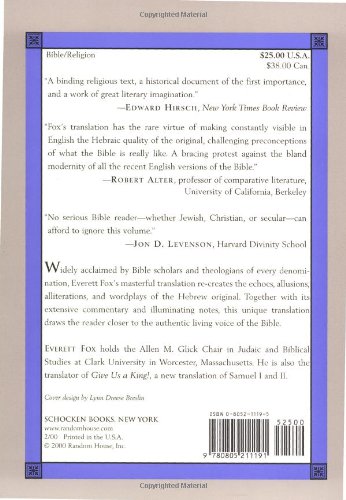
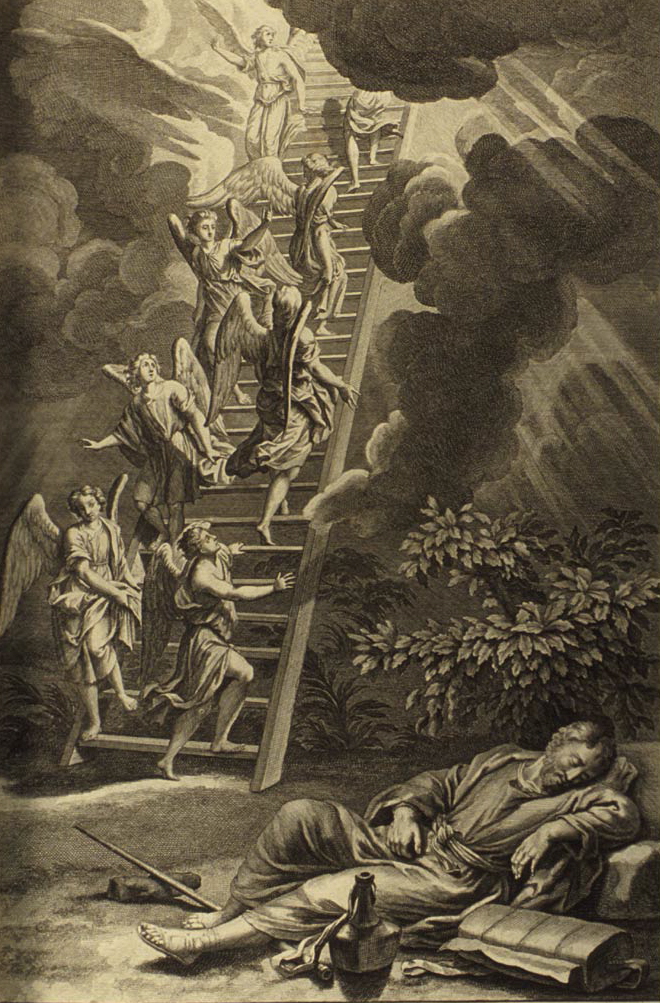
MUST READ/MUST OWN: The Five Books of Moses by Everett Fox – 2

[If you haven’t read the prequel to this,  please go to:

 MUST READ/MUST HAVE: The Five Books of Moses by Everett Fox – 1

To encourage our visitors to get a copy of the book recommended here for their personal library, we are featuring excerpts from TRANSLATOR’S PREFACE and ON THE NAME OF GOD AND ITS TRANSLATION.  When you browse a bookstore for books you’re not familiar with, it is always good to check out the author’s background, his works, and if there is enough time to read through Introduction/Preface/Prologue and sometimes even Epilogue/Conclusion; these ‘bookends’ provide a window into what to expect from any book.  

What drew us to Everett Fox’s translation is its literary merit, first and foremost—quite a big difference in the translation from what we had been so used to; it gave us a ‘feel’ of reading in English what we might have read in the original language, if we could read Hebrew. Names were different.  And now that our Sinaite focus is on the Name of God and its use in English versions or translations, this book clinches it for us. We wish, however, that just like the CJB/Complete Jewish Bible by David Stern who simply superimposed Hebrew terms and names on the English equivalent, that Fox had used more Hebrew words but. . .  obviously we can’t have it all. The translator does explain why he didn’t go far enough with using Hebrew terms.  And so, we are content with what we can have, for now, until another better one surfaces and we move on. Literary critics of biblical language however agree that Everett Fox and Robert Alter’s versions which share the same title, The Five Books of Moses, are two of the best and most reliable versions available today.—Admin1.]

————————————————-

The title page:

THE FIVE BOOKS OF MOSES 

Genesis, Exodus, Leviticus, Numbers, Deuteronomy

A NEW TRANSLATION WITH INTRODUCTIONS, COMMENTARY, AND NOTES BY EVERETT FOX

Illustrations by Schwebel

Publisher:  SCHOCKEN BOOKS, New York

Copyright 1983,1986,1990,1995 by Schocken Books Inc.

Illustrations copyright 1997 by Schwebel

———————————————

CONTENTS

Translator’s Preface

Acknowledgements

On the Name of God and Its Translation

Guide to the Pronunciation of Hebrew Names

To Aid the Reader of Genesis and Exodus

—————————————————

GENESIS:  AT THE BEGINNING

On the Book of Genesis and Its Structure

PART I:  THE PRIMEVAL HISTORY (I-II)

THE PATRIARCHAL NARRATIVES

PART II:  AVRAHAM (12-25:18)

PART III:  YAAKOV (25:19-36:43)

PART IV: YOSEF (37-50)

——————————————————-

EXODUS: NOW THESE ARE THE NAMES

On the Book of Exodus and Its Structure

PART I:  THE DELIVERANCE NARRATIVE (1-15:21)

THE EARLY LIFE OF MOSHE AND RELIGIOUS BIOGRAPHY

ON THE JOURNEY MOTIF

MOSHE BEFORE PHARAOH: THE PLAGUE NARRATIVE (5-11)

PART II: IN THE WILDERNESS (15:22-18:27)

PART III:  THE MEETING AND COVENANT AT SINAI (19-24)

ON COVENANT

ON BIBLICAL LAW

PART IV: THE INSTRUCTIONS FOR THE DWELLING AND THE CULT (25-31)

PART V: THE COVENANT BROKEN AND RESTORED (32-34)

PART VI:  THE BUILDING OF THE DWELLING (35-40)

APPENDIX: SCHEMATIC FLOOR PLAN OF THE DWELLING

To Aid the Reader of Leviticus-Numbers- Deuteronomy

——————————————————-

LEVITICUS: NOW HE CALLED

On Translating Leviticus

On the Book of Leviticus and Its Structure

PART I: THE CULT AND THE PRIESTHOOD (1-10)

ON ANIMAL SACRIFICE

PART II:  RITUAL POLLUTION AND PURIFICATION (11-17)

ON THE DIETARY RULES

ON THE RITUAL POLLUTION OF THE BODY

PART III:  HOLINESS (18-26)

AN APPENDED CHAPTER (27)

———————————————–

NUMBERS:  IN THE WILDERNESS

On the Book of Numbers and Its Structure

PART I: THE WILDERNESS CAMP (1-10)

PART II:  THE REBELLION NARRATIVES (11-25)

ON BIL’AM

PART III:  THE PREPARATIONS FOR CONQUEST (26-36)

————————————————————–

DEUTERONOMY: THESE ARE THE WORDS

On the Book of Deuteronomy and Its Structure

PART I:  HISTORICAL REVIEW (1-4:43)

PART II:  OPENING EXHORTATION (4L44-11:32)

PART III:  THE TERMS OF THE COVENANT (12-28)

PART IV:  CONCLUDING EXHORTATION (29-30)

PART V: FINAL MATTERS (31-34)

Suggestions for Further Reading

—————————————————-

[Excerpts from . . . ]

TRANSLATOR’S PREFACE

. . . read the Bible as though it were something entirely unfamiliar, as though it had not been set before you ready-made. . . . Face the book with a new attitude as something new . . . . Let whatever may happen occur between yourself and it.  You do not know which of its sayings and images will overwhelm and mold you . . . . But hold yourself open.  Do not believe anything a priori; do not disbelieve anything a priori.  Read aloud the words written in the book in front of you; hear the word you utter and let it reach you.

—-adapted from a lecture of Martin Buber, 1926

THE PURPOSE OF THIS WORK IS TO DRAW THE READER INTO THE WORLD OF THE HEBREW BIBLE through the power of its language.  While this sounds simple enough, it is not usually possible in translation.  Indeed, the premise of almost all Bible translations, past and present, is that the “meaning” of the text should be conveyed in as clear and comfortable a manner as possible in one’s own language.  Yet the truth is that the Bible was not written in English in the twentieth or even the seventeenth century; it is ancient, sometimes obscure, and speaks in a way quite different from ours.  Accordingly, I have sought here primarily to echo the style of the original, believing that the Bible is best approached, at least at the beginning, on its own terms.  So I have presented the text in English dress but with a Hebraic voice.

The result looks and sounds very different from what we are accustomed to encountering as the Bible, whether in the much-loved grandeur of the King James Version or the clarity and easy fluency of the many recent attempts.  There are no old friends here; Eve will not, as in old paintings, give Adam an apple (nor will she be called “Eve”), nor will Moses speak of himself as “a stranger in a strange land,” as beautiful as that sounds.  Instead, the reader will encounter a text which challenges him or her to rethink what these ancient books are and what they mean, and will hopefully be encouraged to become an active listener rather than a passive receiver.

This translation is guided by the principle that the Hebrew Bible, like much of the literature of antiquity, was meant to be read aloud, and that consequently it must be translated with careful attention to rhythm and sound.  The translation therefore tries to mimic the particular rhetoric of the Hebrew whenever possible, preserving such devices as repetition, allusion, alliteration, and wordplay.  It is intended to echo the Hebrew, and to lead the reader back to the sound structure and form of the original.

Such an approach was first espoused by Martin Buber and Franz Rosenzweig in their monumental German translation of the Bible (1925-1962) and in subsequent interpretive essays.  The Five Books of Moses is in many respects an offshoot of the Buber-Rozenweig translation (hereafter abbreviated as B-R).  I began with their principles:  that translations of individual words should reflect “primal” root meanings, that translations of phrases, lines, and whole verses should mimic the syntax of the Hebrew, and that the vast web of allusions and wordplays present in the text should be somehow perceivable in the target language (for a full exposition in English, see now Buber and Rozenzweig 1994).  In all these areas I have taken a more moderate view than my German mentors, partly because I think there are limitations to these principles and partly because recent scholarship points in broader directions.  As a result, my translation is on the whole less radical and less strange in English than B-R was in German.  This, however, does not mean that it is less different from conventional translations, or that I have abandoned the good fight for a fresh look at the Bible’s verbal power.

Buber and Rosenzweig based their approach on the Romantic nineteenth-century notion that the Bible was essentially oral literature written down.  In the present century there have been Bible scholars who have found this view attractive; on the other hand, there has been little agreement on how oral roots manifest themselves in the text.  One cannot suggest that the Bible is a classic work of oral literature in the same sense as the Iliad or Beowulf.  It does not employ regular meter or rhyme, even in sections that are clearly formal poetry.  The text of the Bible that we possess is most likely a mixture of oral and written materials from a variety of periods and sources, and recovering anything resembling original oral forms would seem to be impossible.  This is particularly true given the considerable chronological and cultural distance at which we stand from the text, which does not permit us to know how it was performed in ancient times.

A more fruitful approach, less dependent upon theories whose historical accuracy is unprovable, might be to focus on the way in which the biblical text, once completed, was copied and read.  Recent research reveals that virtually all literature in Greek and Roman times—the period when the Hebrew Bible was put into more or less the form in which it has come down to us (but not the period of its composition)—was read aloud.  This holds for the process of copying or writing, and also, surprisingly, for solitary reading.  As late as the last decade of the fourth century, Saint Augustine expressed surprise at finding a sage who read silently. Such practices and attitudes seem strange to us, for whom the very definition of a library, for instance, is a place where people have to keep quiet.  But it was a routine in the world of antiquity, as many sources attest.

So the Bible, if not an oral document, is certainly an aural one; it would have been read aloud as a matter of course.  But the implications of this for understanding the text are considerable.  The rhetoric of the text is such that many passages and sections are understandable in depth only when they are analyzed as they are heard.  Using echoes, allusions, and powerful inner structures of sound, the text is often able to convey ideas in a manner that vocabulary alone cannot do.  A few illustrations may suffice to introduce this phenomenon to the reader; it will be encountered constantly throughout this volume.

[Several paragraphs to illustrate samples of previous translations; and the difference when the Hebrew original is translated with sound or aural effect in mind, as opposed to simply being read.]

2

Excerpt:  Once the spokenness of the Bible is understood as a critical factor in the translation process, a number of practical steps become necessary which constitute radical changes from past translation practices.  Buber and Rosenzweig introduced three major innovations into their work:  the form in which the text is laid out, the reproduction of biblical names and their meanings, and the “leading-word” technique by means of which important repetitions in the Hebrew are retained in translation.

3

Excerpt:  Reading the Bible in the literary, rhetorical manner  . . . is grounded in certain assumptions about the text.  The Five Books of Moses stays close to the basic “masoretic” text-type of the Torah, that is, the vocalized text that has been with us for certain for about a millennium.  Deviations from that form, in the interest of solving textual problems, are duly mentioned in the Notes.  In following the traditional Hebrew text, I am presenting to the English reader an unreconstructed book, but one whose form is at least verifiable in a long-standing tradition.  This translation, therefore, is not a translation of some imagined “original” text, or of the Torah of Moses or Solomon’s or even Jeremiah’s time.  These documents, could they be shown to have existed for certain or in recognizable form, have not been found, and give little promise of ever being found.  The Five Books of Moses is, rather, a translation of the biblical text as it might have been known in the formative, postbiblical period of Judaism and early Christianity (the Roman era).  As far as the prehistory of the text is concerned, readers who have some familiarity with biblical criticism will note that in my Commentary I have made scant reference to the by-now classic dissection of the Torah into clear-cut prior “sources” (designated J,E,P, and D by the Bible scholars of the past century).  Such analysis has been dealt with comprehensively by others . . . . In addition, it remains a theoretical construct, and the nature of biblical texts militates against recovering the exact process by which the Bible came into being.  In any event, virtually all the standard introductions of the Bible deal with this topic;  beyond these, readers may find Friedman (1989) of particular clarity and usefulness.

Given the text that i am using, what has interested me here is chiefly the final form of the Torah books, how they fit together as artistic entities, and how they have combined traditions to present a coherent religious message.  This was surely the goal of the final “redactor(s),” but it was not until recently a major goal of biblical scholars.  While, therefore, I am not committed to refuting the tenets of source criticism in the strident manner of Benno Jacob and Umberto Cassuto, I have concentrated in this volume on the “wholeness” of the biblical texts, rather than on their growth out of fragments.  My commentary is aimed at helping the reader to search for unities and thematic development.

At the same time, in recent years I have found it increasingly fascinating to encounter the text’s complex layering.  It appears that every time a biblical story or law was put in a new setting or redaction, its meaning, and the meaning of the whole, must have been somewhat altered.  A chorus of different periods and concerns is often discernible, however faintly.  Sometimes these functions to “deconstruct” each other, and sometimes they actually create a new text.  In offering a rendition that does not try to gloss over stylistic differences, I hope that this book will make it possible for the inquisitive reader to sense that process at work. . . .

5

Excerpts:   Over the past two decades, there has been an explosion of “literary” study of the Bible.  Numerous scholars have turned their attention to the form and rhetoric of the biblical text, concentrating on its finished form rather than on trying to reconstruct history or the development of the text.  Such an approach is hardly new.  Already in late antiquity, Jewish interpretation of the Bible often centered around the style and precise wording of the text, especially as heard when read aloud.  Similarly, the medieval Jewish commentators of Spain and France showed great sensitivity to the linguistic aspects of the Bible.  In both cases, however, no systematic approach was developed; literary interpretation remained interwoven with very different concerns such as homiletics, mysticism, and philosophy.

It has remained for twentieth century scholars, reacting partly against what they perceived to be the excessive historicizing of German Biblical scholarship, to press for a literary reading of the Bible. . . . [This translation] is akin to many of these efforts, and has benefited directly from them.  Although I began my work independently of the literary movement, I have come to feel a kinship with it, and regard my text as one that may be used to study the Bible in a manner consistent with its findings.  At the same time, I am not committed to throwing out historical scholarship wholesale.  It would be a mistake to set up the two disciplines in an adversarial relationship, as has often been done.  The Hebrew Bible is by nature a complex and multi-faceted literature, in both its origins and the history of its use and interpretation.  No one “school” can hope to illuminate more than part of the whole picture, and even then, one’s efforts are bound to be fragmentary.  Probably, only a synthesis of all fruitful approaches available into a fully interdisciplinary methodology will provide a satisfactory overview of the biblical text . . . In this respect, approaching the Bible is analogous to dealing with the arts in general, where a multitude of disciplines from aesthetics to the social and natural sciences is needed to flesh out the whole.  I hope [this] will make a contribution toward this process, by providing an English text, and an underlying reading of the Hebrew, that balances what has appeared previously. . . .

6

Excerpts:  To what extent can any translation of the Bible be said to be more “authentic” than another?  Because of lack of information about the various original audiences of our text, the translator can only try to be as faithful as the information will allow.  This is particularly true where a work as universally known as the Bible is concerned.  Even if the precise circumstances surrounding its writing and editing were known, the text would still be affected by the interpretations of the centuries.  It is as if a Beethoven symphony were to be performed on period instruments, using nineteenth-century performance techniques:  would it still sound as fresh and radical to us as it did in Beethoven’s own day?  Thus I would suggest that it is almost impossible to reproduce the Bible’s impact on its contemporaries; all that the translator can do is to perform the task with as much honesty as possible, with a belief in one’s artistic intuition and a consciousness of one’s limitations.

Yet how are we to distinguish the point where explication ends and personal interpretation begins?  From the very moment of the Bible’s editing and promulgation, there began the historical process of interpretation, a process which has at times led to violent disagreement between individuals and even nations.  Everyone who has ever taken the Bible seriously has staked so much on a particular interpretation of the text that altering it has become close to a matter of life and death.  Nothing can be done about this situation, unfortunately, and once again the translator must do the best he or she can.  Art, by its very nature, gives rise to interpretation—else it is not great art.  The complexity and ambiguity of great literature invites interpretation, just as the complexities and ambiguities of its interpreters encourage a wide range of perspectives.  The Hebrew Bible, in which very diverse material has been juxtaposed in a far-ranging collection spanning centuries, rightly or wrongly pushes the commentator and reader to make inner connections and draw overarching conclusions.  My interpretations in this book stem from this state of affairs.  I have tried to do my work as carefully and as conscientiously as I can, recognizing the problems inherent in this kind of enterprise.  I hope the result is not too far from what the biblical editors had intended.

My ultimate goal in this volume has been to show that reading the Hebrew Bible is a process, in the same sense that performing a piece of music is a process.  Rather than carrying across (“translating”) the content of the text from one linguistic realm to another, I have tried to involve the reader in the experience of giving it back (“rendering”), of returning to the source and recreating some of its richness.  My task has been to present the raw material of the text as best as I can in English, and to point out some of the method that may be fruitfully employed in wrestling with it.

Buber and Rosenzweig translated the Bible out of the deep conviction that language has the power to bridge worlds and to redeem human beings.  They both, separately and together, fought to restore the power of the ancient words and to speak modern ones with wholeness and genuineness.  Despite the barriers in their own lives—Buber’e early disappointment, Rosenzweig’s struggle with german idealism and later with a terrible paralysis that left him unable to speak—they each came to see dialogue as a central fact of interhuman and human-divine relations.

[Fox then speaks of the time since 1933 when human  language was debased and trivialized –Stalin, Hitler speeches; Orwellian visions; Vietnam war jargon, TV and advertisement babble.]

Yet Buber and Rosenzweig knew that language lives only in the mouths of speakers, human beings who face each other and who at every moment of conversation and contact literally translate for one another.  The reading of the Bible is hopefully a cultural means for reawakening that conversation, for in the struggle to understand and apply these texts, one may come to perceive the importance of real words.  A Bible translation should be the occasion for reaffirming the human desire to speak and be heard, for encouraging people to view their lives as a series of statements and responses—conversations, really.  In sending the reader back to the text, the Buber-Rosenzweig Bible sought to counter the deadness of contemporary language and contemporary living which were all too apparent at the turn of the century, even before war and genocide began to take their toll.  As we approach the end of that century [20th century], the same problems remain, altered further by the present revolution in communications.  Amid the overcrowded air of cyberspace, the Hebrew Bible may still come to tell us that we do not live by bread alone, and that careful and loving attention to ancient words may help us to form the modern ones that we need.

Everett Fox

Clark University

Worcester, Massachusetts

January 1995/Shevat 5755

The Book of Job – Annotated & Explained

[As it is our practice, we are featuring only the FOREWORD and the INTRODUCTION, enough to give the curious the push and the shove to purchase your personal copy of this book. This is a christian perspective on the Book of Job; it treats the book not as a true story about a literal/historical figure, but as a literary piece that tackles the difficult problem of why bad things happen to good people.


It is our presumption that few visitors to this website have neither patience nor time to read our lonnnnggggg articles and this is one of them; we could chop them up into a series which we do to some, but the trend of thought is interrupted when we do that and some don’t bother to go to the sequels.  So for those who might give up, here’s the concluding statement of this book which is our way of encouraging you to persevere and read this whole post but better yet, get a copy and read the book recommended here:


  • For readers who do not believe in God, the moral is that true religious belief does not, and cannot, mean believing what is not only false but what also goes against the very evidence that is in front of our faces.
  • For readers who do believe in God, the warning is even more severe.  We cannot—we must not—ever think that we are the guardians of God’s reputation.
  • We must speak the truth, even if it seems damaging to our beliefs.  If God’s ultimate values include truth, then we cannot base our faith in God on something that is false.  Learning the truth can only ultimately bring us closer to God, no matter how far away from us God may seem in that moment when we learn a new truth.
  • God will have the truth, and God will not accept anything less than whatever truth we can perceive, and we cannot run counter to that reality.


Encouraged?  Hopefully so, get started and remember not to forget reading JOB in the Ketuvim portion of the TNK, the Hebrew Scriptures.—Admin1]

Image from shareaverse.wordpress.com

Translation & Annotation by Donald Kraus, Foreword by Dr. Marc Brettler

Jewish Lights Publishing:  For People of All Faiths, All Backgrounds

[Downloadable as ebook/kindlebook from amazon.com]


FOREWORD [reformatted for post]


Job’s name in Hebrew may be aptly translated as “Where is the (heavenly) father?” and no other biblical book deals so powerfully with the problem of suffering of the righteous individual in a theistic world.  The majority of the book, composed of about 39 of the most difficult but beautiful chapters of Hebrew poetry of the Bible, is structured in dialogue form:  dialogues between Job and his three friends; responses to Job by the mysterious Elihu; and two concluding chapters between Job and God, where, quite surprisingly, Job has the last word.  Yet these are not dialogues in the sense that we are familiar with; Job does not respond to the content of his friends; speeches, nor do God and Job address each other’s claims in a straightforward way.  Perhaps the poet of Job means to suggest that there is no simple, straightforward answer to the profound questions that the book raises.


The majestic poetry is surrounded by a 2-chapter prose introduction and a brief 11-verse conclusion (42:7-17).  The prose presents a simply but disturbing theology:  All of Job’s tribulations are the result of God talking too much.  Twice God says to the Provoker (or Adversary; Hebrew ha-satan), a member of the divine council, 


Have you laid heart to my servant Job?  

He has no equal in the world, downright upright,

holding me in awe, turning from evil (1:8, 2:3)


This conversation provokes the Adversary, who asks and gains permission to harm Job’s property and family, and eventually Job himself.   In the final chapter, Job is restored; his property is doubled, and a “new” set of children, including three most beautiful daughters are born to him.  Indeed, a very loose translation of the book’s last two verses would be:


And Job lived happily ever after. 


Indeed.  This prose suggests that there may be “blips” in the system of divine retribution, but the person who is patient will ultimately be rewarded properly in this world.  These blips are significant—the theology here is not that the righteous always prosper and the wicked are always punished, but that this is ultimately the case.  And the exceptions have reasons:  God’s heavenly court is run better than its human counterpart, but is not run perfectly.  

The book of Job is considered, like Proverbs and Ecclesiastes, a wisdom book, the product of a group of ancient Israelite sages.  Yet the world goes awry when God does not listen to wisdom advice such as Proverbs 17:28


Even fools who keep silent are considered wise;

when they close their lips, they are deemed intelligent.


 After all, the text suggests that had God not engaged the Provoker, showing off how righteous God’s “servant” Job was, none of these catastrophes would have befallen him.


The poetical center will not have any of this simple argument.  Job and his friends present certain main arguments.  Job insists that the righteous do suffer and that God abuses God’s great power.  The friends argue the opposite—only the wicked suffer, and God uses the divine power beneficently.   (It is quite striking that no one in the book argues that God is not powerful and in control of the world.)    After three cycles of speeches, where they each adduce their personal experiences and perceptions, they are all worn out, and we expect God to respond to Job’s insistent demand:  


Let the Mighty One answer!

Let God issue the indictment,

this opposing counsel! (31:35)


But instead we get Elihu.  Elihu present significant interpretive problems, and many modern biblical scholars excise his speeches, claiming they are secondary. He can’t shut up, is very wordy, and presents himself as full of gas:


For I am full of words;

the wind within me distresses me 

(32:18, author’s translation).  


To make matters worse, the following speeches of God from the storm pick up on the vocabulary and ideas that Elihu expresses.   Does Elihu thus foreshadow God or undermine God’s speeches?

The language of the divine speeches is exquisite, and much more clear than the very difficult poetry elsewhere in the book.  They are among the most beautiful in the Bible, but they never directly address Job’s situation.  

  • The first, in chapters 38-39, is composed of tens of rhetorical questions that focus on God’s power.  They thus address a shared premise of Job and his friends—that God is powerful—but do not clearly note whether this power is always used for good or not, the issue that Job and his friends debated.  
  • The second speech (40:6-41:26) is even more puzzling—its main focus is two creatures:  Behemoth, a mythologized hippopotamus, and Leviathan, a mythologized crocodile.  How do they relate to the main themes of the book?  Does God indeed answer Job’s questions and beasts—and if so, what does this answer mean?—or is God merely interested in bullying Job into submission?  Scholars are deeply divided over these issues.


Perhaps Job’s final words may provide some insight into the book and its ultimate meaning.  But here, too, we run into an interpretive difficulty.  Is Job capitulating, as suggested in most translations, including the NRSV’s:


 Therefore I despise myself, and repent in dust and ashes (42:6),


—-or has, for example, contemporary scholar and translator Stephen Mitchell properly captured the nuance of the Hebrew: 


Therefore I will be quiet,

comforted that I am dust?


Perhaps the material in Job has been organized to suggest that there is no easy, obvious answer to life’s most difficult questions, and this is what has made Job such a popular book.  Professional Bible scholars and others, such as the ancient Greek work  “The Testament of Job,”  William Blake in his remarkable drawings, and Archibald MacLeish in his play JB, have attempted to offer compelling interpretations.  No one has yet succeeded, but the book, through its engaging style and important message, continues to help generation after generation address the “simple” question asked in Jeremiah 12:1


Why does the way of the guilty prosper? 


Job also shows that even though recent times may be the first to have evoked very large-scale human killing, we must remember the life of every single human individual, for that is the level on which Job offers its powerful, though ambiguous, message.


Dr. Marc Brettler, Brandeis University


INTRODUCTION


The Book of Job, a theological and spiritual masterpiece as well as a classic of world literature, is a poetical expression of the human effort to understand why we suffer.  Job, a righteous and innocent man, becomes the victim of a plot between God and a heavenly being who tests human integrity—a plot that, as it develops, becomes little more than a cruel joke.  As a result, Job loses everything he has, even his children, and finally his health; he thereby becomes an exemplar of undeserved suffering. Throughout most of the book he sits despairing among the ashes of his former life, visited by no one but his “comforters,” who only make things worse by trying to persuade him that his misfortune must make sense.  That is why the book of Job is so compelling in our own day.  More than any other biblical text, Job wrestles with the difficulties of the human condition, the inexplicable nature of the good or evil that can befall anyone, and the inevitable question, “Why?”


After a brief, even perfunctory, opening to set the scene and create the situation, the unknown poet who created this literary classic unleashes the power of expressive language to give shape to humanity’s deepest sorrows.  In chapter upon chapter, with explosive imagery, dismissing the feeble, petulant, moralizing arguments from his friends, Job curses his conception and birth, his suffering, his friends for blaming him for his sorrow—he demands answers from them and, ultimately, justice from God.  He describes, and perhaps mourns, the difficulty of finding wisdom in the world we know.  Finally, except for a long interruption from the character Elihu (which may have been added later by someone other than the original author), Job, by the power of his speech and his unanswerable questions, silences the friends and sits quietly by himself.


God does then speak to Job—but does not answer Job’s questions or even allude to Job’s accusations.  God provides no explanation at all.  Instead, in poetry at least equal to the passion of Job’s outbursts, God describes a universe so deeply mysterious and so far beyond human comprehension that Job could not possibly understand an answer even if it were given to him.  The God of these speeches thunders profoundly and sarcastically hurls questions back at Job’s questions, moving the entire debate onto another level—not “Why did this happen?  What did I do to deserve this?” but “What kind of a world is this?  Does it even have a meaning that I can understand?”


For those who believe in God, the questions that Job raises (including the books’ refusal to answer any questions) can be both a connection with and a separation from the divine realm.  Meaning and existence seem split apart, and that split calls into question not only God’s goodness but also the rational expectation that God’s creation will ultimately make sense.


For those who do not believe in God, Job’s questions are the ultimate challenge both to the universe and to our unbelief.  They challenge the universe by laying bare the fact of meaningless existence, and they test our lack of belief because the very terms of the challenge presume a meaning these questions then deny.  It does not good to scream out for fairness in a world where the words “fair” and “foul” may have no meaning, or to cry out for justice when there is no being with the power or authority to establish a standard of right or wrong.  And it provides no satisfaction to deny God’s existence and then to be furiously angry with God for not existing.


The book of Job, thus, is the kind of masterpiece that leaves us with discontent rather than contentment and with more questions than answers.  For many present-day readers, it is also a difficult book to read and appreciate.  There are several reasons for this, and so it is important to begin with some examination of what the book of Job is, why it may be difficult, and how we can prepare to overcome the barriers that it puts in our way.


What is the Book of Job?


In the Hebrew Bible, Job is included in a section known as “the Writings” (Hebrew Ketuvim), the third part of the Bible (the first part, Genesis through Deuteronomy, is the Torah or “Teaching,” and the second, Nevi’im or “Prophets,” includes not only what modern translations treat as the prophets such as Isaiah and Jeremiah, but also the historical narratives contained in Joshua, Judges, Samuel and Kings).  The Writings are a very diverse group, including (among other books) Chronicles, Daniel, Psalms, Proverbs, and Ecclesiastes.  Placing Job in this mixed assortment does not, unfortunately, give us much help in deciding what kind of literature it is.  It is generally grouped with Proverbs and Ecclesiastes in the category of “wisdom” literature, and that can help us in determining some of its possible claims.  But there is nothing else in the Bible quite like Job, and therefore it is necessary to look outside the collection of biblical literature to make a decision about how we will approach the book.


Except for brief narratives at the beginning and the end of the book, Job is entirely made up of speeches.  One character speaks, another responds, and so on through a bit more than 38 chapters.  If it is a play, however, it is a rather unsatisfactory one because it lacks dramatic action. In the section of speeches, no one does anything; in fact, hardly anyone even moves.  Lack of action is only part of the difficulty; there is also no character development.  The argument moves from issue to issue, but none of the speakers seems to change in any way.  Drama, in fact, is entirely confined to argument.


A better analogy for Job is the ancient literary form known as the diatribe.  In our language, “diatribe” usually means an attack or a denunciation.  In the ancient Near East, however, as well as in the classical world of Greece and Rome, “diatribe” meant a discourse or an argument among various participants.  It served as one of the means by which a philosophical examination of an issue would be presented and took the form of a dialogue between two or more speakers, one of whom would be the author’s mouthpiece, and the other or others the proponents of views that the author was determined to refute.  Job seems to be a writing of this type.  That is why the presentation of the situation in the opening chapters is there mostly to provide the basis for the dueling speeches that follow, and the speeches serve as an explication of alternative ways of understanding (or failing to understand) the problem of human suffering.  The friends offer conventional understandings of the meaning of suffering, and Job rejects these.  Thus the issue is argued out, in a form that, as it came into sue around the Mediterranean world, may have been the foundation of the dialogues of Plato.


Being aware of the type of literature that the book of Job represents will save us from having expectations that it was not designed to meet.  It is not a realistic narrative, and is not meant to persuade the reader that the events in it actually took place.  It does not show any psychological character development such as we would see in a Greek tragedy, nor does it narrate exciting events (other than the disasters in the opening scenes) in the manner of the Homeric epics.  Instead, it focuses exclusively on the presentation of clashing viewpoints.


When and Where was Job Written?


Job is “set” in what seems to be the time of the patriarchs, a time when there were owners of large herds and agricultural estates—perhaps around 2000 BCE or so—and when human life was believed to be considerably longer than the 70 or so years in the normal span (Job, already an adult with grown children, lives 140 years after the events and speeches in the book).  So the story looks back to an idealized but indefinite past.  Could it have been written during the time in which it is set?  Almost certainly not.  Job’s language and its approach to the problem of the suffering of the innocent indicate that it is likely written much later, during the Persian period, which lasted roughly from the mid-530s BCE to the mid-330s BCE—from the time beginning when Cyrus of Persia allowed the return of the exiled Israelites to their land to the time of the conquests of Alexander, and the Hellenization of the Mediterranean world, in the late 4th century BCE.  The language of Job contains word borrowed from other, related languages (which is one of the reasons it is difficult to interpret) and seems to deal with ideas that were prevalent in the wider world of the ancient Near East during that time.  But any attempt to specify a date for the writing of Job is guesswork and can only be approximate.


As with the date of composition, so the place where Job was written is unknown and probably unknowable.  The book sets its narrative outside of Israel, in the land of Uz, and though it is written in Hebrew, some of the characters have Hebrew names and the God of the book is clearly identified with the God found in the rest of the Hebrew Bible—the creator, the source of righteousness, the epitome of strength, and so on—it is not concerned with many of the central biblical texts.  It is at least possible that the author lived outside Israel or had spent time elsewhere, but nothing is known of the writer’s identity and the text gives no clues.


What is the Relationship between Job and Other “Wisdom” Writings in the Hebrew Bible?


The wisdom writings of the Bible—Job, Proverbs, and Ecclesiastes, plus some of the psalms, such as Psalm 119—stand in a tradition of literature that is found elsewhere in the ancient Near East.  In the Bible, the wisdom writings have certain common features, such as their lack of emphasis on God’s covenant with Israel, the Temple, and the Exodus, for instance, and in the case of Proverbs, a countervailing weight on the importance of right behavior for the good life.  Ecclesiastes and Job, unlike Proverbs, deny any connection between right behavior and prosperity or honor.


As contemporary readers, we must remind ourselves that at the time these books were written, there was no belief in the afterlife in which the injustices of the world would be put to rights.  Ancient Israelite religion had no heaven to which human beings would be admitted;  heaven was the dwelling place of God and of God’s assistants, the “sons of God” or heavenly beings who were charged with carrying out God’s will.  But heaven was not a realm in which human beings, or their souls or resurrected bodies, would ever live.  The only “afterlife” in the early biblical texts is a shadowy place as Sheol, which resembles more closely the Greek idea of Hades, the abode of the dead.  It is significant that in both Hades and Sheol, the inhabitants are regarded as “dead.”  They can speak under certain circumstances (usually occult or forbidden ones), and they have some sort of wraithlike existence, but they are not really alive.  The inhabitants of Sheol, among other things, cannot praise God.  There is no such thing as an “immortal soul” in early biblical literature—nothing about a human being is immortal, because the only immortal being is God.


This conviction—that when we are dead, we are dead, with no opportunity for further redress either of our goodness that went unrewarded or of our wickedness that went unpunished—lies at the heart of the arguments in the main part of the book of Job.  It throws the entire burden of “virtue rewarded, vice punished” on what happens during a person’s human life. This is the reason for the urgency of the arguments and for the position of the book of Proverbs that virtue will be rewarded with happiness, prosperity, and honor.


For us today, this view seems naive in the extreme, but that is probably a superficial reading of the wisdom teaching in Proverbs.  It understands that all other things being equal, a life of temperance, moderation, care for others, and uprightness of life will result in better health, better relationships with others, and a happier existence.  Of course, in life all other things never are equal, and those who live ethically can end up in dire situations through no fault of their own.  Still, this form of wisdom holds that the virtuous would still be better off than if they had lived a life of irresponsibiilty and dissipation.


Furthermore, whether life is fair or not, if we are wise we will live as if the reward of virtue is God’s blessing on us.  This is partly because we need to keep “in training” with our behavior.  Just as scientists maintain that “chance favors the prepared mind,” meaning that we can take advantage of a lucky break only if we recognize it when it comes, so for life as a whole, we can act ethically in difficult situations only if we have practiced ethically in general.  It is also because, in the scheme of thought represented by the book of Proverbs, we honor our commitment to God by our right actions, whatever the consequences might be.


The Argument in the Book of Job


How does the book of Job hold together? One way to understand it is as follows.  The prose framework describing Job’s downfall and final restitution, with its simple scheme of virtue and reward, represents how we wish the universe would work and how it should exemplify God’s justice.  Job’s anger—and ours, in the case of our own suffering—when virtue is not in fact rewarded is witness to our sense that the universe should play fair, whether it actually does so or not.  The demand for fairness is itself an indication:  it speaks to our faith that something like fairness in fact exists and is a standard that can be appealed to.


But the book of Job does not present this argument in a straightforward fashion, and that is a part of its artistry.  The opening story, with its cartoonish characters—the pious Job, the shallow and boastful God, and the devious Adversary or Provoker—is only the first of a series of viewpoints to which we as readers are invited to subscribe, only to have the ground pulled out from under us.  Job’s curse in chapter 3, in which he claims not only the day he was born but also the night on which he was conceived, leads to the absurd conclusion that he would have been better off if he had never existed.  In what sense anyone can be said to be “better off” if there is no person there to experience this “better” state is left unsaid.


Then come the arguments of the friends.  Repetitively, monotonously, they ring the variations on their favorite themes:  God does indeed reward the pious and punish the wicked.  Maybe not right away, and maybe not in any way that you can see, but rest assured the wicked do not ultimately triumph, and the righteous do.  And along with that argument comes the corollary:  If you are suffering—and this goes for Job and for the members of his family—you must have done something wrong.  Maybe it’s not obvious, and maybe you don’t even know what it is you’ve done wrong, but if God sends this suffering, then you must deserve it somehow.


Job’s responses to these linked assertions basically amount to “You think so?  Look around you!”  Can you honestly say, Job asks over and over, that the wicked are invariably brought to justice and the righteous always triumph?  If you’ll only pay attention to reality, you’ll see case after case in which wicked people live full lives, surrounded by family and friends, enjoying their ill-gotten gains, and when they finally die, they are accompanied to their graves by crowds of mourners and well-wishers.  And as for the triumph of the righteous, once again all that is needed is a little dose of reality.  Plenty of people die alone, in poverty, having never experienced all the joys of life, even though they have lived upright and moral lives.  They have been as virtuous as you could wish, and they have gotten nothing for it.  Job also describes his own life: his charitable deeds, his piety, his rendering of judgments in the civic life of his town, the respect in which all around him would hold him, and the deference that they would pay him.  In all of this, Job maintains, there was proof that he was, in fact, leading the life that God had meant him to lead, and he was remaining faithful to the teachings of his religious tradition.


Job’s responses, as repetitive as the arguments of the friends in their own way, illustrate another aspect of the artistry of the book.  One of the facts of suffering—whether it is physical suffering, pain, nagging discomfort, or debility of a person’s physical being, or whether it is mental distress, depression, obsession, betrayal, grief, or unrequited love—is the tendency of the mind to return, again and again, to the fact of pain. To be in pain, in fact, is to be forced to think of pain over and over again.  That is one of the painful aspects, so to speak, of pain itself.  It is obvious even in relatively minor physical ailments like muscle pain: if the pain is at all severe, it tends to drive out any other thoughts.  So much the more is it the case with severe pain, with depression or obsession, and with deep remorse or disappointment.  Try as we might, we cannot escape the thought of the torment we are in.  Our mind continually returns to the sorrow, the painful thought, or whatever the distress consists of.


This is reflected in the structure of Job’s arguments.  Over and over again, the same topics are raised and knocked down.  In this sense, the book represents not an argument among several human beings, but the mental process that can take place when a person tries to come to terms with a painful situation:  “Did I do something wrong?”  “Is this my fault?”  “Did I deserve this?”  “Could I have prevented this?”  No matter how many times we review the evidence—and whether the situation was partly our fault or whether we have been stricken “out of the blue” seems to make no difference—the questions arise again and again.

This is part of the “realism” of the text:  the reality of Job does not reside in the characters or the situation, both of which are presented in a conventional manner, but in the representation in a literary form of the mental carousel on which most thinking human beings have found themselves at one time or another.


The Wisdom Poem 


. . . “Wisdom—where is it found?”—the poem implicitly compares the enormous efforts and risks that human beings will undertake to find precious gems or metals with our lack of effort in seeking after wisdom.  Without saying so directly, the poem argues that wisdom is far more valuable than gold or gems, and so it criticizes the human reluctance to expend even a fraction of our time or energy on attaining wisdom, as compared with our strenuous efforts to seek wealth.


Without any connection to the argument that has gone before—and with no very clear connection to the parts of the book that follow—the wisdom poem nevertheless introduces a perspective that we as its readers are being subtly urged to keep in mind.  “What are you willing to do to become wise?  Look at the risks people take to find gems or gold—are you willing to take any risk at all to gain the valuable prize of wisdom?”  Such a question does not answer the problem of suffering but looks at it from a different perspective.  “What if, through suffering, you can gain insight that you might obtain in no other way?  Would it be worth it?  Underground the miner braves darkness and danger, even risks death, in the hope of material reward—are you also willing to risk pain and suffering in a quest for deeper insight and knowledge?”


The poem does not answer the question, because it is not a question that can be answered in the abstract.  It is an existential question that can only be answered in the context of an individual, lived human life.  And, by its very nature, it may well be answerable only at the end of life—or not at all.  “Was it worth it?” is a very different question from “Will it be worth it?”  And in any case we may never know.


[S6K:  The Elihu speeches are discussed here as questionable, a “misfit thematically” and judged to be poetically inferior to the speeches of Job and his friends, of God, and of the wisdom poem in chapter 28. ] 


The only structural significance of the Elihu material, in fact, is that it provides a transition between arguments about affirming or denying a moral order in the universe to those about the grandeur of creation and the awe-inspiring majesty of God that form the core of the final chapters, the speeches that God makes at the climax of the book.  But in what might be an ironic statement about the quality of Elihu’s arguments, he backs into this point, raising it only as it develops out of his previous assertion that God judges and punishes the wicked.  “God can do anything,” Elihu argues, in effect.  “Look!  God even creates thunderstorms!”  And, in a passage typical of his style, Elihu spends the entirety of chapter 37 elaborating on the image of the thunderstorm, repeating the word “voice” five times.  In a final burst of argument, Elihu maintains once more that God is far beyond human understanding, and our only choice is to stand before God in awe, because even the height of human wisdom is as nothing to God.  And then Elihu vanishes, never to be mentioned again.


God’s Speeches from the Storm


In his speeches Elihu brought up the thunderstorm as if to validate that point, the poem presents God as speaking from amid the storm.  But unlike Elihu or Job’s friends, God does not argue about the rightness or wrongness of a moral order in creation.  Instead, God bases the entirety of the argument on the awe-inspiring nature of creation itself, and the complexity and power of its operations.

From the opening question, “Who is this?” (38:2) to the sarcastic catalogue beginning, “Where were you when I formed the Earth?” (38:4), to the closing line that Leviathan, such a powerful part of creation that he is subject to God but to nothing else, is “king over all the children of pride” (41:34), God’s speeches relentlessly press one point:


 “You can’t possibly have an answer from me because it would be utterly beyond your comprehension.”


 It would be fair to summarize these speeches as saying, “it’s a God thing—you couldn’t understand.”  The effect of this could be to leave the impression that God is dodging the question.  The piling up of instance upon instance of the wonders of creation, however, along with God’s questions to Job probing the limits of his experience in the whole reach of creation, and the final introduction of Behemoth and Leviathan—those marvels of creation who are untamable and incomprehensible, and who express the utter mysteriousness of reality itself—instead serve to move the entire conversation onto another level.  The wisdom poem of chapter 28 implies an existential question:


 “How much are you willing to undergo in order to gain wisdom?”  


Elihu asks explicitly,


How long can you possibly put yourself on the same footing as God?”  


God’s argument takes this point from Elihu and makes it a final terminus for the whole discussion.  What is the use of asking whether this whole operation has a point or of asking for the meaning of creation?  If there is such a meaning, if there is any point to all of this—if the question even has a meaning that you can grasp—you are simply not among the group that could understand the answer, if in fact there is an answer.  Only God can ask the question, not merely because only God can answer it, but also because only God could understand whatever answer there might be. 


Problems with the Form of the Book of Job


Problem 1:  HOW DOES THE PROSE FRAME STORY FIT WITH THE POETICAL SECTIONS?


The prose framework tells the story, in the manner of a folktale, of a very righteous man who is the subject, unknown to himself, of what amounts to a bet between God and a heavenly being called “the Satan,” the accuser, the opponent.  Thought greatly provoked—he loses wealth, children, and health—this Job character does not offer any criticism of the suffering to which he has been subjected and defends God’s provision of good and evil.  In the end, as Job holds steadfast, God rewards him with another family and more possessions than he had lost, including new children to replace the ones who had been killed in the beginning section.


It is clear that the prose frame establishes, once and for all, that Job is not a historical narrative but a tale told to make a point. Any suggestion that the story is actually true would involve its readers in trying to defend and explain a god who is morally monstrous, evil, shallow, and obtuse.  The offense is not lessened—in fact, it is compounded—by the concluding section, in which the tale essentially presents the gift of new children as compensation for the loss of children in chapter 1.  Such an ending verges on the grotesque.


Problem 2:  HOW IS THE CHARACTER OF JOB PRESENTED IN DIFFERENT PARTS OF THE BOOK?


Job himself is a different character in the frame and in the dialogue.  In the frame, he is pious and submissive, saying very little; in the dialogue, he is irreverent and assertive, with plenty to say.  Thus the Job of the dialogue is a much more appealing character than the Job of the prose frame.


The question is whether the prose portions were part of the original composition—written by the author of the dialogue in a “folklore” style in order to set the scene, or perhaps an actual folktale that was simply taken over by the author—or whether it was added by a later and perhaps imperceptive editor to the poetical dialogue.  This kind of supplemental editing is not unusual in the different books of the Bible as they were handed down, compiled, and collected through the centuries.  It is not possible to come to a final determination about this, but the prose tale does serve some functions:  it establishes a situation, provides a moral framework, raises the issues to be discussed, and in general situates the poetical dialogue in an account that helps it make sense.


Problem 3:  HOW IS THE CHARACTER OF GOD PRESENTED IN DIFFERENT PARTS OF THE BOOK?


God, too, is a different character in the prose frame and in the poetical dialogue.  It is impossible to identify the God of chapters 38-41 with the empty and foolish character of the prose frame.  The God who in chapter 1 asks the Satan, in effect, “Don’t you think my worshiper Job is terrific?”—like some proud parent with a wallet full of photographs—is simply not the same as the one who thunders, “Where were you when I formed Earth?” (38:4).


Problem 4:  WHAT HAPPENS TO THE SATAN CHARACTER?


The Satan is prominent in the first two chapters, setting the whole story in motion, but then disappears, never to be seen or heard from again.


Problem 5:  HOW ARE THE PARTS OF THE POETICAL DIALOGUES MEANT TO CONNECT?


Chapter 28, which is Job’s speech on the difficulty of finding wisdom, does not seem connected to any of the material before or after it.  Elihu’s speeches, chapters 32-37, do have a connection to the preceding dialogue, but nothing that follows them seems attached to them.  Furthermore, no other character, including God, mentions Elihu or his arguments


Problems Arising from Defects in Transmission


In addition to these five problems with Job as a poetical composition, there are places where the biblical text itself may be damaged.  Some problems that seem to have arisen from its transmission—copying errors, missing text, and so on—are treated in the comments.


Problem 1:  WHAT HAPPENED TO THE THIRD POETICAL DIALOGUE?


As the outline of Job indicated, the third dialogue is defective, containing no speech by Zophar and therefore no reply from Job.  In addition, Bildad’s speech in this cycle is very short (only 6 verses) and seems to have lost some of its text.


Problem 2:  IS JOB INCONSISTENT?


Throughout the dialogues, Job maintains that he has not been treated justly and that, in fact, the world does not show any moral order or any way of rewarding the good and punishing the wicked.  Yet in chapter 26, Job seems to change his position:  he is praising God, exalting God’s power, and maintaining that our knowledge of God is merely knowledge of the very edges of God’s being.  In chapter 27, after restating at the beginning his conviction that he has done nothing wrong, Job continues in a very different way, maintaining that the wicked are indeed punished at the hands of God.  It may be that this speech, in fact, contains no only Job’s words but also those originally written for one of the friends.


Does the Book of Job have a Theological Point?


Some of the difficulties in the text of Job—omissions, additions and insertions, disorganization, and possible rewritings—seem to be the result of discomfort on the part of the various copyists and editors who had a part in shaping the book into the final form we have before us today.  They may have had problems with the arguments, imagery, piety, and language of the poetry itself.  Some passages may have been tampered with because these scribes and editors found them blasphemous or insufficiently respectful of God.  But in another sense, we can ask the question as well.  Is the book of Job really a theological argument that grapples with the problem of suffering and evil in a world created by God?  To look at this question is to recognize that we must ask another question first:  What would the world look like if it conformed to the religious beliefs of Job’s friends, and to the implicit beliefs of Job himself as they are revealed in his protests against what is actually happening to him?


The critique of the world as it stands—and the furious, though futile, defense of moral order that is waged by Job’s friends—implies a vision of how the world should work.  That vision essentially says that if you worship God (and not any other power or any idol); if you are charitable with whatever wealth you may possess or earn; if you raise your children to be respectful and pious themselves; if you side with the poor and oppressed, feed the hungry, clothe the naked, and house the homeless—if you live in this way, you will be rewarded (or should be) with long life, prosperity, a happy family, and social honors and deference.  We can leave aside the objection that if everyone were moral and therefore prosperous, there would be no oppressed or poor people to whom we could be charitable.  The point of the vision is not to describe what would happen, but what ought to happen.  Instead, we can ask ourselves:  Well, if the world worked that way, what would it mean?


It would mean, among other things, that a guaranteed way to gain a long life, a happy family, and wealth for yourself and your offspring is to act in certain ways.  Acting charitably and relieving distress would, in essence, be a sure way to gain prosperity.  For at least some of us, therefore, helping the hungry and homeless wouldn’t be something we do because it is ethical and right, but because it would make us rich, happy, and long-lived.  The danger of a universe like that, set up to reward virtuous behavior a matter of self-interest rather than of character.  In other words, we would act virtuously not because virtue is good in itself and we should practice it no matter what the consequences, but because virtue would result in a good external to itself.


Ultimately, then, the critique of the book of Job, though it starts out by saying that life is unfair, turns into a much deeper critique—one that asks why we want life to be fair.  Do we value fairness for its own sake?  Or do we want fairness to result in something else that we value more, which is wealth, happiness, and a long life?


The theological point of the book of Job, therefore, if it can be said to have a theology, is to make us aware of the impossibility of creating a moral universe that at one and the same time would bring us to desire goodness for its own sake and reward us extrinsically for being good.  this is the book of Job’s unique moral insight.  Acting justly and generously can, of course, end up benefiting the person who acts as well as those who benefit from such behavior.  But it cannot invariably do so without the unintended consequence that we will act in virtuous ways for the sake of rewards that have nothing to do with virtue  Even God cannot square that circle.


The End of It


The final chapter of Job seems to undercut everything that has gone before.  After all those chapters of argument, cursing, refuation, and blame—“Life is fair!” versus “Life is not fair!”—God ends up rewarding Job with twice the possessions and all of the family that he ahd before.

Has the book, therefore, fumbled its very point, the very reason it seems to have been written?  Has it made the point that we must not expect virtue to lead inevitably to prosperity, only to turn around and provide an ending to the story that implies exactly the opposite?


It would seem that the book of Job has knocked down its main point in just this way.  But that is not all there is to ti.  Job is not being rewarded for his good deeds before calamity struck, but for something else.  That something else is his refusal to blind himself to reality, and to lie about what he knew to be true, simply to protect what he thought of as God’s good reputation.  this is what Job’s comforters have done, and it lies behind God’s denunciation of them as having spoken untruthfully about God’s self.  In a final ironic twist, the friends themselves are judged harshly and are only rescued by the prayer of a virtuous man:  


My servant Job will pray for you; I will countenance his prayer and not treat you according to your folly; because you have not spoken rightly about me, as my servant Job has(42:8).


This is exactly the situation described by Eliphaz in his final speech in chapter 22. So the final lesson which God leaves the friends, and us, is the exhortation “Don’t tell lies about me!  Even if you think my reputation is at stake, speak the truth!”


God rebukes Job in the speeches in chapters 38-41.  But the essence of the rebuke is that Job has asked for answers that he cannot possibly understand.  Nevertheless, given the light that he has, Job has remained faithful to the light and has not attempted to blind himself to the limited truth that he is able to see.  Therefore Job is better off than his friends, and Job’s seeming blasphemy is more pleasing to God than the friends’ conventional piety.


For readers who do not believe in God, the moral is that true religious belief does not, and cannot, mean believing what is not only false but what also goes against the very evidence that is in front of our faces.  For readers who do believe in God, the warning is even more severe.  We cannot—we must not—ever think that we are the guardians of God’s reputation.  We must speak the truth, even if it seems damaging to our beliefs.  If God’s ultimate values include truth, then we cannot base our faith in God on something that is false.  Learning the truth can only ultimately bring us closer to God, no matter how far away from us God may seem in that moment when we learn a new truth.  God will have the truth, and God will not accept anything less than whatever truth we can perceive, and we cannot run counter to that reality.


Except for brief responses to God, this is the end:


 “Job’s words cease.”



Genesis/Bereshith 33: "I have plenty, my brother, let what is yours remain yours. "

[Esau . . . the last words we heard from his mouth was revenge:  

27:41 Now Esav held a grudge against Yaakov
because of the blessing with which his father had blessed him.
Esav said in his heart:
Let the days of mourning for my father draw near
and then I will kill Yaakov my brother! 

If you were Yaakov/Yisrael and those words were all you can associate with your twin whose rights of primogeniture you divested him of . . . and all these years you have not asked forgiveness nor made up for his loss, you should be dreading this first encounter with a brother you unjustly wronged!  And it is not as though the meeting is simply a private confrontation twin to twin, brother to brother, man to man, but 400 men on Esau’s side;  and wives, concubines, children and servants on Yaakov’s side; quite a spectacle to behold!


But surprise, surprise, thanks to Esau who himself has undergone a character change (without a name change), there is forgiveness, reconciliation and peace instead of ‘even-ing’ up an old grudge. This twin emerges as the better man, truly deserving of a firstborn’s rights . . . and yet none of that matters anymore; his life has been blessed:  

33:11 “God has shown me favor . . . I have everything.”  

What is it about Esau that’s not to like? Too bad he’s not the right ‘twin’ in the line of the ‘chosen’.


Whatever happens in future history (is that a contradiction?) between Israel and the Edomites, well that is between the descendants of the twins.  But for sure if the story of Yaakov’s cheating Esau of his birthright had been handed down from generation after generation, ‘tribal’ mentality somehow takes over and whatever fraternal love might have existed between Esau and Yaakov in this meeting did not spill over to the generations down the line, as it understandably happens in real life.

Unbracketed commentary is from Pentateuch and Haftorahs, ed. Dr. J.H. Hertz; additional commentary from RA/Robert Alter and EF/Everett Fox, the latter’s translation The Five Books of Moses is our choice  for this website,  —Admin1]

Genesis/Bereshith 33

THE MEETING OF JACOB AND ESAU

[EF] Resolution (33:1-17):  Once the Yabbok crisis is past, there is hope for reconciliation of the brothers.  Even so, Yaakov exercises caution, behaving like a man who is presenting tribute to a king.  The narrative is brought full circle in vv. 10 and 11, where “face” is once again highlighted and where Yaakov’s gift is termed a “token-of-blessing.”  At last the tension of Yaakov’s early life seems resolved.

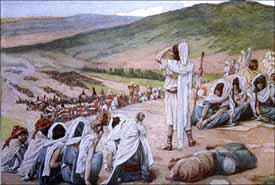
Image from www.jesuswalk.com

1 Yaakov lifted up his eyes and saw:
there was Esav coming, and with him, four hundred men! 
He divided the children among Lea, Rahel, and the two maids: 

came. Or, ‘was coming.’

[RA] he divided the children between Leah and RAchel. Again, the principle of binary division running through the whole story comes into play.  Here, there is a binary split between two wives on one side and the two concubines on the other.  The former of these categories is itself split between Rachel and Leah.

Although the division at this point, unlike the previous day’s division into two camps, appears to be for purposes of display, not defense, it looks as though Jacob retains a residual fear of assault, and so he puts the two concubines and their children first, then Leah and her children, and Rachel and Joseph at the very rear.

2 he put the maids and their children first,
Lea and her children behind them,
and Rahel and Yosef behind them, 

 hindermost.  Placing those he loved best in as secure a position as possible.

[RA] Leah and her children after them.  The Masoretic Text reads “last” instead of “after them” (in the Hebrew merely the difference of a suffix ), but the context requires “after them,” a reading that is supported by at least one ancient version.

3 while he himself advanced ahead of them.
And he bowed low to the ground seven times, until he had come close to him, to his brother.

passed over before them. To conciliate his brother if possible, or to bear the brunt of the attack, and thus help his wives and children to escape.

seven times. In ancient inscriptions, the phrase, ‘at the feet of my lord, seven times and seven times I fall,’ frequently occurs.

[RA] bowed to the ground seven times until he drew near.  This practice of bowing seven times as one approaches a monarch from a distance was common court ritual, as parallels in the Amarna letters and the Ugaritic documents, (both from the middle of the second millennium B.C.E.) indicate.

4 Esav ran to meet him,
he embraced him,flung himself upon his neck,and kissed him.
And they wept. 

Image from tomsdesk.blogspot.com

kissed him. Esau proved both good-natured and forgiving.  He fell on Jacob’s neck, kissed Jacob, and they wept with the strong emotion of Orientals.  Yet, the word for ‘and kissed him’ is marked in the Heb. text with dots on every letter.  The Rabbis doubted whether the kiss of Esau was genuine or not.  Esau’s conduct is certainly strange.  If his intentions were friendly from the first, why was he accompanied by so considerable a force as four hundred armed men?  And if he had started out with a resolve to injure his brother, how account for the warm greeting immediately on coming face to face with him?  This was in answer to Jacob’s prayer, the Rabbis say.  God had turned Esau’s hate to love.  Be that as it may, we have here another instance of the splendid impartiality of Scripture.  The ancestor of Israel’s hereditary enemy, the Edomites, is presented as a chivalrous and dignified, full of magnanimity and generosity.


[RA] Esau ran to meet him and embraced him and fell upon his neck.  This is, of course, the big surprise in the story of the twins: instead of lethal grappling, Esau embraces Jacob in fraternal affection.  The Masoretic Text has both brothers weeping, the verb showing a plural inflection, but some scholars have conjectured that the plural waw at the end of the verb is a scribal error, duplicated from the first letter of the next word in the text, and that Esau alone weeps, Jacob remaining impassive.

5 Then he lifted up his eyes and saw the women and the children, and said:
What are these to you?
He said:
—the children with whom God has favored your servant. 

[RA] The children.  Jacob’s response makes no mention of the women.  It would have been self-evident that the women were the mothers of the children and hence his wives, and one senses that he feels impelled to answer his brother as tersely as possible, not spelling out what can be clearly inferred.

6 Then the maids came close, they and their children, and bowed low. 
7 Then Lea and her children came close and bowed low.
Afterward Yosef and Rahel came close and bowed low. 
8 He said:
What to you is all this camp that I have met?
He said:
—to find favor in my lord’s eyes. 

camp.  i.e. the droves sent ahead as a gift to Esau.  See XXXII,17.

[EF] What to you is: I.e., What does it mean to you?

[RA] What do you mean by all this camp.  The Hebrew is literally, “Who to you is all this camp,” but both “who to you” (mi lekha) and “what to you” (mah lekha) have the idiomatic sense of, what do you mean, or want.  “Camp” in this context means something like “retinue” or “procession of people,” but the continuity with the twin camps of the preceding episode is obviously important for the writer.

9 Esav said:
I have plenty, my brother, let what is yours remain yours. 

Image from www.goodsalt.com

I have enough.  lit. ‘I have much.’  Esau’s reluctance to accept the gift was probably only another illustration of Oriental courtesy; see Chap. XXIII.

[EF] my brother: The phrase suggests that they are now reconciled.

[RA] I have much, my brother. Esau in fact has become a kind of prince, despite his loss of birthright and blessing, and he can speak to Jacob in princely generosity.  It is striking that he addresses Jacob as “my brother”—the familial term with the first-person possessive suffix is generally a form of affectionate address in biblical Hebrew—while Jacob continues to call him “my lord,” never swerving from the deferential terms of court etiquette.

10 Yaakov said:
No, I pray!
Pray, if I have found favor in your eyes,
then take this gift from my hand.
For I have, after all, seen your face, as one sees the face of God,
and you have been gracious to me. 

seen thy face.  The phrase ‘to see the face’ expresses the idea of being favourably received.  Jacob accordingly meant, ‘I have been graciously pardoned by you, as I would have received forgiveness from God, had I appeared before Him in the humble spirit and with tokens of contrition wherewith I approach you.  Regard, then, my gift as a minchah, an offering.

[RA] for have I not seen your face as one might see God’s face, and you received me in kindness?  This most extravagant turn in the rhetoric of deferential address pointedly carries us back to Jacob’s reflection on his nocturnal wrestling with the nameless stranger:  “for I have seen God face to face and I came out alive.”  “And you received me in kindness” (just one word in the Hebrew) is significantly substituted for “I came out alive,” the very thing Jacob feared he might not do when he met his brother.

11 Pray take my token-of-blessing that is brought to you,
for God has shown me favor—for I have everything.
And he pressed him, so he took it. 

my gift.  lit. ‘my blessing’, the gift being the outward manifestation of the goodwill in the giver’s heart.

I have enough. lit. ‘all’, Jacob has ‘all’ now that the danger of being slain by a brother, or of slaying a brother, is over; (see XXXII,8).  Whereas Esau has ‘much’; therefore, he is quite willing to have ‘more’.

[RA] take my blessing. The word for “blessing,” berakhah, obviously has the meaning in context of “my gift,” or, as Rashi interestingly proposes, invoking as an Old French equivalent, mon salud, my gift of greeting.  But the term chosen brilliantly echoes a phrase Jacob could not have actually heard, which Esau pronounced to their father two decades earlier:  “he’s taken my blessing” (27:36).  In offering the tribute, Jacob is making restitution for his primal theft, unwittingly using language that confirms the act of restitution.

I have everything. Jacob of course means “I have everything I need.”  But there is a nice discrepancy between his words and the parallel ones of his brother that is obscured by all English translators (with the exception of Everett Fox), who use some term like “enough” in both instances.  Esau says he has plenty; Jacob says he has everything—on the surface, simply declaring that he doesn’t need the flocks he is offering as a gift, but implicitly “outbidding” his brother, obliquely referring to the comprehensiveness of the blessing he received from their father.

12 Then he said:
Let us travel on, and I will go on at your side. 

I will go before thee. Esau offers him his armed men.

13 But he said to him:
My lord knows
that the children are frail,
and the sheep and the oxen are suckling in my care;
if we were to push them for a single day, all the animals would die! 

Jacob, knowing the unstable character of Esau, is anxious that they should part company as quickly as possible.

tender. i.e. unequal to the fatigues of travel.

[RA] are my burden.  The Hebrew says literally, “are upon me.”

14 Pray let my lord cross on ahead of his servant,
while as for me, I will travel slowly,
at the pace of the gear ahead of me and at the pace of the children,
until I come to my lord, at Se’ir. 

the cattle. lit. ‘the work’; the use of the word in Gen. II,2, where it refers to, among other things, the creatures that God had made.  The Heb. word for ‘work’ might here also mean ‘property’, as in Exod. XXII,7.10.

unto Seir.  There is no record that Jacob went to Seir to see his brother.  But, add the Rabbis, Jacob will yet visit Esau in the day of the Messiah, when the reconciliation between Israel and Edom will be complete.

[RA] at the heels.  Literally, “at the foot.”

till I come to my lord in Seir.  This is a “diplomatic” offer, for in fact Jacob will head back northward to Succoth, in the opposite direction from Seir.

15 Esav said:
Pray let me leave with you some of the people who are mine.
But he said:
For what reason?
May I only find favor in my lord’s eyes!

Jacob prudently declines the offer.

[EF]  leave with you: Or “station with you,” “put at your disposal.” mine: Lit. “with me.” For what reason?: Yaakov still seems cautious.

[RA] Why should I find such favor in the eyes of my lord?  In this protestation of unworthiness, Jacob preserves the perfect decorum of deferential address to the very end of his dialogue with his brother.  Clearly, he is declining the offer of Esau’s retainers because he still doesn’t trust Esau and intends to put a large distance between himself and Esau or any of Esau’s men.  One should note that the very last word (one word in the Hebrew) spoken by Jacob to Esau that is reported in the story is “my lord.”

16 So Esav started back that same day on his journey to Se’ir, 
 17 while Yaakov traveled to Succot.
He built himself a house there, and for his livestock he made sheds.
Therefore they called the name of the place: Succot/Sheds. 

Succoth.  The exact site is unknown.  It was part of the territory of the tribe of Gad, West of the Jordan (Josh. XIII,27).  Jacob must have stayed some years in Succoth.

[RA] Succoth. The Hebrew sukkot means “sheds.”

18-20.  AT SHECHEM

[EF] Home: Peace and Violence (33:18-34:31):  “Yaakov came home in peace to the city of Shekhem” (33:18 continues the theme of resolution.  Not only has Esav accepted his gift, but Yaakov has arrived home safely, in fulfillment of his prayer in 28:21.  Like Avraham he purchases land; again like him he builds an altar.

18 Yaakov came home in peace to the city of Shekhem, which is in the land of Canaan, on his homecoming from the country of Aram,
and he encamped facing the city. 

in peace. i.e. peaceably, with peaceable intentions.  Since the word also has the meaning ‘complete, whole’ we have various Midrashic interpretations; such as, recovered from his lameness; and perfect in his knowledge of Torah, which he had not forgotten during his way with Laban.

Shechem.  See XII,6.

before the city. i.e. to the east of the city. About a mile from the city there is still shown Jacob’s well.

[RA] came in peace.  The adjective shalem elsewhere means “whole,” and this has led many interpreters to understand it here as “safe and sound.”  A tradition going back to the Septuagint, and sustained by Claus Westermann among modern commentators, construes this word as the name of a town, Salem, understood to be a synonym for Shechem.  (The claim has been made that a tell aabout two and a half miles from the site of Shechem is the biblical Salem.)  But the Salem where Abraham meets Melchisedek is at an entirely different location, and if that were also a designation for Shechem, one would expect here at the very least the explanatory gloss, “Salem, that is, the town of Shechem” (Shalem, hi’ ‘ir Shekhem).  Because these three verses are an introduction to the story of the rape of Dinah, where in fact Hamor and Shechem say of the sons of Jacob, “these men come in peace (sheleimim) to us,” it is more likely that “came in peace” is the sense here.  Abraham ibn Ezra argues for this meaning, similarly noting the link between the two passages.

when he came from Paddan-Aram. Now that Jacob has at last crossed the Jordan (Succoth is in trans-Jordan) and has taken up residence outside a Canaanite town, the long trajectory of his journey home is completed.

19 And he acquired the piece of territory where he had spread out his tent, from the Sons
of Hamor, Shekhem’s father, for a hundred lambs’-worth.

he brought.  The Patriarchs display their independent spirit by establishing an inalienable right to their land by means of purchase.  See Chap. XXIII.

children of Hamor. People of the clan of Hamor.

Shechem’s father.  The founder, or chieftain, of the city of Shechem.

[EF] he acquired: Like his grandfather Avraham, Yaakov must purchase the land. lambs’-worth: Hebrew obscure.

[RA] a hundred kesitahs.  These are either measures of weight for gold and silver, or units for the barter of livestock, or a term derived from the latter which has been transferred to the former.  The purchase of real estate, as with Abraham at Hebron, signals making a claim to permanent residence.

20 There he set up a slaughter-site
and called it: El/God, the God of Yisrael! 

altar.  In gratitude to God, who had permitted him to return in safety to the land of his fathers.

El-elohe-Israel. A profession of faith in the one true God, made at the moment when Jacob comes to dwell among the heathen Canaanites (Ryle).

[RA]  El-Elohei-Israel. The name means “El/God, God of Israel.”  Claus Westermann makes the interesting argument that Jacob marks his taking up residence in Canaan by subsuming the Canaanite sky god in his monotheistic cult: “El, the creator God, the supreme God in the Canaanite pantheon, now becomes the God of the people of Israel.”

Image from kumi07.wordpress.com

Yo Searchers! Can we help you? – January 2014

[The one thing we will never get back is every minute that ticks away.  Past is past, future is a tick away, what we have at all times is each moment and yet that is so . . . ‘momentary’?  One tick and it’s gone and time continues to tick away.  If you are the kind of person who habitually procrastinates, thinking there might be yet another time, another chance, another opportunity to do something you can and ought to do now, right this minute—then truly the road leading to regrets for lost opportunities is paved with good intentions.  Here’s a new year resolution:  “If I can say ‘I’m sorry” or ‘forgive me’ or ‘I love you’ to the person who deserves to hear it—-I should say it now, for there might not be another time. Better yet, if I can do a good deed to my neighbor in any way I can, I should do it now.”  The key is NOW,  TODAY, THIS MOMENT . . . not later or another time. If you’ve been following this post updated daily of each new month for a new year, then you know this is about helping searchers who type in terms which land them on this website. Some look-see, some linger, some get interested enough to return and keep returning to become Sinai6000 habitues.  All are welcome, you’ll learn a thing or two if you have an open mind and a hungry heart and a resolve to expand your mind to the unfamiliar which might even be uncomfortable.  Some search entries might not have specific posts that answer their inquiry but for sure, we’ll help you navigate your way toward finding a satisfactory answer, even away from here!  Good enough?–Admin1.]

——————————————–

1/31 “yhwh revelation for march 2014”- What???! YHWH has a revelation for March 2014? Where in the TNK does it say that? The revelation on Sinai is all man needs to know about how to relate to neighbor/fellowman, whether it’s spouse, parent, child, friend, employee/employer, enemy, stranger, foreigner, Jew, Gentile.  No need for special revelations, just read the Torah of YHWH which is good for all time, for all cultures, for all people of all ages.  No kid, check it out.

1/31 “uncircimcised lips” –  Exodus/Shemoth 6-b: Do you have “uncircumcised lips”?

1/30  “what are jewish wannabes called” – We’d be offended if this weren’t so laughable.  ‘Jew wannabes’ are called exactly that, ‘Jew wannabes’.  But we have a post that explains why people mistakenly think we are ‘Jew wannabe’s’ — no, we do not want to become ‘Jews’, nor ‘Jewish’; we want to be Torah-observant.  Israel and Jews do not have a monopoly of the God Who revealed Himself to them, according to their Scriptures . . .  that God is the universal God of all nations; one does not have to be a Jew-wannabe, nor Jewish, nor join Judaism, to love, worship and serve that God.  That is why we are Sinaites. Check this out:  Are you Jew-wannabes? If not, what are you?

1/29  “old testament examples of study of comparative literature in the bible” – The Bible as “Literature” – 2 – Introduction to the ‘Old Testament’

1/29 “7 shepherds throughout tanach” – Who is the Shepherd in the TANACH?

1/29  “uncircumcised lips” – Exodus/Shemoth 6-b: Do you have “uncircumcised lips”?

1/29 “what does the tanakh say about the nephilism” – Not gonna pretend to know the word “nephilism” as even the dictionary does not have it . . . unless it was mispelled and the searcher meant “nephilim”?

1/28  “how to obey torah” – How does one understand and obey the TORAH of YHWH in this day and age?

1/27  “the jewish mystique” – MUST READ – The Jewish Mystique by Ernest Van Den Haag

1/25  “israelite woman seed genesis 3:15” – This is a perfect example of reading something into a verse that is not there, and it all comes from preconceived ideas (from self or taught by religious orientation).  We have emphasized over and over the basic reading rule: stick to the text within the context.  Genesis 3:15 is the perfect example of reading with too much religious baggage stuck in one’s mind.  The woman in that verse should be interpreted as the only woman so far mentioned since the beginning of earthly time and who would that be?  To superimpose the Catholic Virgin Mary, or the evangelical Christian Church, or in the case of this searcher, Israel —- on the women of Gen. 3:15 — is like forcing a square peg into a round hole. Keep it simple, folks; the Revelator communicates in clear terms!  Don’t complicate the plain meaning of the text.  – Prooftext 1a – Genesis 3:15 – Who is the “woman”?

1/25  “in search of historical jesus movie” – We don’t have a post about the movie but we have a series of posts on the book, so check these out:

1/25  “sermon on mount sinai” – The Sermon on Sinai vs. The Sermon on the Mount

1/24 “must-read hyphenated” – Rabbi Shmuley Boteach

1/24 “‘bible’ ‘`ashtĕroth qarnayim’ ‘seed of satan’ – Like the Jews, we do not believe in the existence of a Devil, demonic spirits, fallen angels and their ilk.  The TORAH/TNK does not teach that angels without free will can make choices and ‘sin’ or ‘fall from grace’). Therefore the ‘seed of satan’ in the understanding of Christians from the New Testament scriptures is not taught in this website; however we have many articles correcting the wrong perception of ‘ha satan’ or ‘the adversary’ which might interest this searcher.  Please check out these posts:

Prooftext 1: Genesis 3:15 – Seed of the Woman vs. Seed of the Serpent

1/24 “why does genesis specify that seth was born in the image and likrness of adam” – Q&A: Why is Seth the one “in the likeness of Adam” instead of firstborn son Cain?


1/23 “1 samuel 16:14 mistranslated?” – 1 Samuel 16:14-23 – “an evil spirit from God”?

1/22  “deborah-sexton.hubpages.com/hub/Why-Jews-Dont-Become-Christians” – This appeared in the ‘search engine’ category, evidently it was an article but if you click the link, the page says the article has been unpublished either by the author or by the editors of HUBPAGES.  It would have been an interesting article to read; however, for the same topic, you could check out these links which we highly recommend: Lost in Translation 3

1/22 “evidential support to justify your position on the trinity in genesis 3:15” –

1/22  “the fruit of the righteous is a tree of life” – The fruit of the righteous is a tree of life – Proverbs 11:30

1/22  “how did these nations serve the gods” – דברים Dabariym 12: “How do these foreign nations serve their gods?”

1/21  “a book for all people” – A Book for All People

1/21  “his name tanakh” – Q&A: His Name Tanakh – Translator’s Notes

1/17  “yom kippur goats or lambs” – Sacrificial goat, Scapegoat . . . what about the Lamb? Not on Yom Kippur. Note:  There has been confusion in the teaching of Christianity regarding their symbolism of Jesus as the “sacrificial lamb” of God who takes away the sin(s) of the world.  By appending the Hebrew Scriptures retitled as “Old Testament” as the foundation of the “New Testament”, then the metaphors and symbols must correspond in both testaments.  But plain reading of the Hebrew Scriptures shows that the lamb is not sacrificed on yom kippur; instead it is the animal roasted and eaten during Passover. There’s so much more about such confusion, we have posts that address this.

1/16 “the deuteronomist’s prophet : narrative control of approval and disapproval in the story of jehu (2 kings 9 and 10)” – A Literary Approach to 1 and 2nd Kings/Melekiym

1/16  “the binding of Isaac: a religious model of disobedience –by omri boehm2” – On the Binding of Isaac (Akedah)

1/16  “matthew 15:10-20 bible study” – Please check out:  Revisited: Understanding Christianity and Jesus of Nazareth – A Jewish Perspective

Note:  This verse is about Jesus explaining ‘clean’ and ‘unclean’ by saying it is not what goes into the mouth that is ‘unclean’, it is what comes out of the mouth that is ‘unclean’. The gospel writers always pitted Jesus against the pharisees, making the latter appear mean, blind, ‘legalistic’, not understanding the true meaning of God’s Law.

 In this context Jesus adds (red for caution):

13 He replied, “Every plant that my heavenly Father has not planted will be pulled up by the roots. 14 Leave them; they are blind guides.[a] If the blind lead the blind, both will fall into a pit.”

Yes, Jesus is right in saying abominations of the heart and mind are worse than ‘unclean’ food or failing to wash hands before eating, but is it wrong to observe sanitary habits such as washing hands before eating?  In fact washing hands today is a MUST to avoid contracting disease. As for eating unclean meat, go ahead and eat swine flesh, crabs, clams, etc. that YHWH in Leviticus 11 prohibits — and see how your health suffers in time.  The Creator Himself teaches us what is fit for human consumption, should we ignore His instructions?  We have many posts explaining Leviticus 11, please check those out or violate the Maker’s Diet at your own peril.

1/15  “sacks conveniant conversation” – The Creator 3 – “Covenant and Conversation” – Chief Rabbi Jonathan Sacks

1/15  “dovid usiskin” – Can’t help this searcher.

1/14  an israelite who took a vow to be specially dedicated to god by not touching a dead body, not consuming wine or strong drink or grape products, and not cutting one’s hair (as, for example, samson) – 
“NAZIRITE. NAZIRITE, person who vows for a specific period to abstain from partaking of grapes or any of its products whether intoxicating or not, cutting his hair, …”  Please check out this Jewish website: Nazirite – Jewish Virtual Library/www.jewishvirtuallibrary.org/jsource/…/ejud_0002_0015_0_14638.html

1/13  “exodus 6 uncircumsized lips” – Exodus/Shemoth 6-b: Do you have “uncircumcised lips”?

1/13  “rabbi on 1 samuel 13” – working on this one.

1/13 “zakhar and nekevah revealed” – Can’t help this searcher.

1/12  Israel means, “he will rule as god.” and so the question is, who will rule as god? people who have repeatedly, throughout history, abandoned their covenant with god? people who may have been born under a certain genetic lineage? people who futilely put their hope in perfect obedience to an impossible set of laws? —  

S6K:  Thank you for your comment, quite a provocative thought!  

As far as we know (from translations and word etymology provided by Jewish sources themselves), the Hebrew word Yisrael means “he wrestles with God.” And in scripture account, it was originally and initially applied to Jacob.  The website jewfaq.com explains:  “Jacob demanded a blessing from the man, and the ‘man’ revealed himself as an angel. He blessed Jacob and gave him the name “Israel” (Yisrael), meaning ‘the one who wrestled with G-d’ or ‘the Champion of G-d.’  

Now think:  Jacob AKA Israel fathered 12 sons who developed into 12 tribes and eventually into a nation that carried his name, he being the root of them all.  Would that mean the nation then, and throughout the centuries and even today —would that mean this nation Israel would prophetically fulfill the meaning of their patriarch’s name?  

Some people would think so, they are a people that was given a destiny by the God of Israel; to this day the prophecies declared in relation to them are closely watched by those who believe those prophecies. The Hebrew meaning of “Yisrael” as applied to Jacob initially could be applied to his progeny; the people do wrestle with the declarations about them in their own Scripture.  And if you will consider WHO keeps the Torah and lives its principles, that would be the adherents to the religion associated with Israel, Judaism.

 Does the modern nation of Israel obeyTorah?  Watch and observe, and ponder! But be fair in choosing your choice of media coverage, and balance your choices of news sources and commentary, because you will discover that there is an anti-Israel (as in the old anti-semitic) bias in much of western media. Check out websites that provide the balance.

Additionally, sometimes the very existence of something (be it an object, a place, a nation) evokes thoughts associated with it.  The very existence of Israel as a nation today, back in the Land promised to them in their Scriptures, controversial ALL THE TIME, hated by surrounding nations, criticized even by those who claim to be neutral — there’s something about Israel that is almost inexplicable.  When you say the word Israel, what comes to mind?  Among many other thoughts, most likely — the “chosen” —then the person starts from there.  Who chose them? Who is that God? Why should He choose them? Should I take Him and that chosen-ness status seriously? Already, that connection is made. Israel serves a divine purpose no matter how you look at it.

1/11 the symbol shema prayer” – Signs and Symbols from the SHEMA

1/11 “why two goats not two lambs” –  ויקרא Leviticus/Wa’iyqrah 16 – What? They cast lots for a sacrificial goat and a scapegoat, wasn’t ‘Blood Atonement’ all about a “Sacrificial Lamb”?

1/10 “qyid est veritas dec, 2013″ – Revisited: “Quid est veritas?” – 6 – Can you explain ‘God’?

:1/8 “what is the third monotheistick religion” –   If you read our posts on the speciifc chapters of Bereshiyth/Genesis that focus on the Abraham narratives, the commentary give credit to Abraham as a major biblical figure to break away from polytheistic religion of his times. Abraham believed in one God and no other, the God who spoke to him with prophetic declarations about a line of people coming from him to eventually form the nation of Israel.  Monotheism, belief in one God is claimed by three major world religions today — Judaism, Christianity, and Islam.  The monotheism claimed by Christianity for its Trinitarian Godhead has been questioned not only by us but by many of its own adherents who have left the faith. As for Islam, here’s a post: What about the 3rd world monotheistic religion, Islam? Further, check out this post and scroll down to the end, and you will see a book title that makes a strange claim beyond the 3 religions named here: Revisited: בראשית Bere’shiyth 25a: ‘Look unto the rock whence ye were hewn . . . look into Abraham your father’

1/8 “prologue must be past tense” –  At first, I got stumped with this search entry, but perhaps he/she’s referring to this post which sounds close enough:   Must Read: Future Tense – Prologue

1/8 “club-asiatopic” – Sorry, can’t help this searcher.

1/7 “biblical scripture mna leaving the house sepration from skirt” – hmmm, can’t figure out this searcher’s terms, appears to be 3 parts:  (1) biblical scripture, (2) ‘mna’ leaving the house, (3) separation from skirt????  Sorry, can’t refer to any post, but hey, all our posts are worth reading so take your pick!

1/7  “what were the entrails of animals sacrified by the hebrewvs at sinai?” –  Having been exposed to Egyptian religious worship of many gods, the Hebrews would have done “as the Romans do when in Rome”, so to speak.  What is recorded in Shemoth is that while they were on Sinai, they made an idol, a golden calf, but the record does not go into specifics of ‘entrails of animals’, it simply said they made an idol and worshipped it. Here’s a source for this searcher:  Animal Sacrifice – Pagan Institute, www.paganinstitute.org/PIR/animal_sacrifice.shtml. For an understanding of why the God on Sinai initially required animal offerings at the Sanctuary in the wildnerness, here’s an explanation:   TORAH 101: What were the animal sacrifices all about? – Jewish Perspective 1/6  “tanakh propetic promises” – Exodus/Shemoth: 3 – Promises, Promises

1/6 “ancient egyptian worship sheep or lamb” – The Lamb/Ram in Egypt’s Pantheon

1/6  “sabbath year 2014” – 1st Sabbath of January – Year 2014

1/6  “sinai 6000″/“what is sinai 6000” – 4 searches on “Sinai 6000” and one “What is Sinai 6000” — for starters:

1/5  “meaning of uncircumsized lips of moses” – Exodus/Shemoth 6-b: Do you have “uncircumcised lips”?

1/5 – “how to say in hebrew tallest tower amongst the flock” – Hmmm, not sure how to help this searcher but—we do have an article about the Tower of Babel and man’s obsession to build towers and wondering what’s wrong with building higher and higher edifices; check out:  So what’s wrong with building a high tower?

1/5 “joseph telushkin the stranger” – TORAH 101 – Rabbi Joseph Telushkin on TANAKH

1.5  “sinai 6000 in philippines” – Yup, we’re the only Sinai 6000 as far as we know, and we are based in Baguio City, Philippines.  Welcome searcher who typed this in!

1/5  “joseph telushkin the stranger” – TORAH 101 – Rabbi Joseph Telushkin on TANAKH

1/4 “who worship on every sabbath expect for the fifth sabbath of the month” – 5th Sabbath of the Month? A Musical Bonus!

1/3 “and the seventh day shall be a day of rest to hashem. you shall perform no work on it, neither you, nor your son or your daughter, nor your man servant or your maid servant” – 

1/3  “is not vindictive or wrathful” – 

1/2  “nehemiah finale ch 11″ – A Literary Approach to Ezra and Nehemiah 1/2 “free printable lessons for adults wilderness wandering numbers chapters 1-5 questions and answers” – Please feel free to print any article posted in this website; the whole book of Bemidbar/Numbers is featured, perhaps this searcher can find answers there.

1/1  “zadok’s historical formula on the identification of the biblical sabbath day now revealed, how is it that judaism’s sabbath occurs neatly on the gregorian saturday?” – Perhaps these post can clear up the ‘fog’.

1/1  “jewish midwife + birth art” – ART by BBB@S6K – Hebrew Midwives: Shiphrah and Puah

1/1  “I am of uncircumcised lips” – Exodus/Shemoth 6-b: Do you have “uncircumcised lips”?


Revisit: Lost in Translation

Image from United Church of God

Image from United Church of God

[First posted in 2014.  The Sinaite’s Library is full of every translation available of the book that claims to be “the very words of God.”  Understandably such a claim draws the skepticism and scrutiny of those who challenge that claim.  Religionists simply swallow it and consider the challengers as irreverent, irreligious, blasphemous, anti-Christs, etc.  And to their credit, publishers and sincere translators specially of the Christian 2-part bible keep improving their product as new “truths” and discoveries arise that clarify our understanding of  . . . well, “the very words of God”!  Here is one more of many attempts on our part to explain ourselves to our former Christian colleagues as well as to the unbelievers out there who simply won’t accept any book as God’s words.  Indeed, too many human hands have been involved and possibly the original has undergone through much tampering over six millennia of passing on the Message which has not been a simple message because . . .  in our view, translators with a religious agenda have made it so complicated!—Admin1]


————————–


Languages are said to mirror the character of the peoples who speak them . . . .” – P.A. Bien, translator of Nikos Kazantzakis’ The Last Temptation of Christ.

He is reflecting not only his own difficulty in translating the original Greek language of the said novel into English, but also the experience of Kazantzakis himself in translating the great works of antiquity (Homer’s Odyssey and Dante Alighieri’s La Divina Comedia) into English. Bien explains “demotic Greek shows us a race to whom imagination and audacity come before precision and efficiency.” Presumably, demotic Greek is what New Testament teachers call Koine or the Greek of the marketplace, the Greek spoken by ordinary people, used in everyday speech and writing. Lucky for Bien, he only has to translate once; this is not so in the case of translators of the Bible.

 
Bible publishers continue to issue updated editions: from ASB to NASB, KJV to NKJVNIV, NRSV. After updating to a “new,” in the case of the KJV, it is said the publishers realized their “new” did not sit well with majority of KJV readers plus, the new was not a better translation and consequently went through further revisions.

 
If bible publishers keep updating (which is good), at some point they will exhaust the comparative and superlative adjectives and resort to a totally different marketing label. Let us not suspect all their efforts are simply part of normal business tactics, as in hi-tech toys in the market that keep upgrading to the newer version, convincing the consumer to suddenly become discontented with his perfectly working simple cellphone or computer and get hooked, believe the line, and sink their hard-earned money into a gadget only the truly hi-tech can use to its full working capability.

 
Let us think nothing of hidden motives, bible translators really do keep upgrading because that is the nature of language, that translations do not and can never reflect the original 100% and there will never be a perfect translation. With new discoveries in biblical archeology, it is only natural to keep up with new information. There was a time our translations were 3-times divorced from the original Hebrew, what does that mean? The Hebrew TNK was translated into the Greek Septuagint which was translated to the Latin Vulgate on which the English translations were based. The updated versions have gone back to the original Hebrew. But just think about how truth can change from translation to translation, much like the whispering game or actual rumor-mongering, where the end-message differs from the beginning message. If this could happen in current or on-the-spot transmission of information among people who speak the same language, think of what has transpired through centuries or millennia from the original TNK. And translating from Hebrew to Greek is not a mere matter of linguistics but of culture and mores and ethics and national character; indeed Bien said it right, “Languages are said to mirror the character of the peoples who speak them . . . .

 
For the curious, here’s an interesting link :[www.apbrown2.net/web/TranslationComparisonChart.htm] which gives you a word-for-word/thought-for-thought chart of bible translations, the differences in each, sample verses, etc. Publishers have even issued bibles with 4 versions side by side.

 
An interesting bible is the red-letter edition where the words of Jesus are printed in red; if you have such a bible, be curious enough to check if there are any red-lettered texts in the ‘Old’ testament portion; if there are none, then what conclusion should you reach? If yours does happen to have it, leave a note in the reader’s reply box below, as we would like to know how far Trinitarians have gone into claiming the very words of YHWH as that of the Jesus of Christianity. As far as we know, this has not been done.

 
Only bilinguals or people who can speak multiple languages can relate to translators because definitely, much is lost in translation. That is how we feel as truth-seekers journeying through the unfamiliar territory of the Hebrew Scriptures, dependent on translators to interpret the map (text) for us.

Why is it so? Aside from obvious differences in word meanings plus many synonyms to choose from, there is frame of reference —

  • first of the biblical figures,
  • then of the modern day Hebrew (or Christian) translator,
  • and then our own.


All that and more add to the haziness in understanding because some words have different connotations when used not only in different time frames but also in different cultures. For example: if you use the word “salvage” in the USA, it means ‘save whatever you can’; if you use it in the Philippines, it’s criminal lingo for ‘kill off the s.o.b’, total opposites, just like the word “cleave” (stick to and sever). These days you can no longer say ‘I’m happy and gay’ if you’re not in fact . . . you know.

Context greatly helps to clear up the foggiest idea but the best resort is of course to learn Hebrew. There are Jewish websites that offer online courses in Biblical Hebrew. Ultimately, we simply have to trust that The Divine Revelator Who is most interested in getting His message across gets it through to receptive hearts and open minds despite the limitations of human languages.

 
This particular series “Lost in Translation” will be a continuing feature on this website, dealing with specific texts in the Christian Old Testament that appear to have been mistranslated from the original Hebrew text. (For this, we depend on information provided by anti-missionary Jewish websites which have already done extensive research and best explain the meaning of the original texts under scrutiny.) We originally presumed these texts were mistranslated innocently, but some appear to be intentionally translated to turn them into messianic prooftexts.
Sig-4_16colors
AIbEiAIAAABDCNPkvrXuucmdeSILdmNhcmRfcGhvdG8qKGJkZTc0YTk3NmUxMGM4OTAzZjk5MDhkMjdkZDI2ODQ3OTliYmQ2MDkwAe5UdNp0lvYvCf8bjAFEJOY_fdsj


Postscript: You might want to continue reading the sequels to this first post:


And, guess what?


YET a new translation will be added to our original choice, Everette Fox’s translation:  this is Robert Alter’s The Five Books of Moses with Commentary.  We will feature his INTRODUCTION explaining why all the previous translations and versions have been faulty. He considers only one other translation of the TORAH/Pentateuch/Five Books of Moses as worthy and closest to its original Hebrew—Everett Fox’s 1995 version of the TORAH.


Obsessive as we are in getting to the best and most accurate English translation of the TORAH, would that we have many more years in our lifetime to explore all these in our effort to get a handle on the original Hebrew text! You might say ‘wouldn’t it be better to just learn biblical Hebrew’? . . . oh well, yes, if we were in the spring of our lifetime instead of winter; wish we had done that over half a century ago!

Q&A: "Israel means, 'he will rule as god' and so the question is . . ."

One of the longest ‘search terms’ landed on our website on 1/12/14.  Automatically, it was added to the daily updated post intended as aid for searchers:  Yo Searchers! Can we help you? – January 2014.  Since it was in the form of a question which had ‘loaded’ implications coming from a mindset that was obviously Christian-oriented, I wrote a short reply instead of directing the searcher to a whole bunch of articles we had already written.  However, upon rereading I realized I had not REALLY addressed all aspects of the question,  so this is a follow-up.

The Q has been reformatted according to points that need to be elaborated on:

Q:   Israel means, “he will rule as god.”

*and so the question is, who will rule as god?

[searcher answers his own question with presumptions]:

  1. people who have repeatedly, throughout history, abandoned their covenant with god?
  2.  people who may have been born under a certain genetic lineage?
  3. people who futilely put their hope in perfect obedience to an impossible set of laws? 

A.  Admin1, for S6K:

Let’s start with point # 2 first, that’s the easiest:

2.  people who may have been born under a certain genetic lineage?

  • genetic lineage — referring to the people who issued from 3 generational line of patriarchs:
    • Abraham,
    • Isaac (not Yishmael), and
    • Yaakov (not Esau).
      • the 12 sons of Yaaov AKA Yisrael
        • 1he 12 tribes

The name “Yisrael” was given only to the 3rd patriarch, Yaakov in Bereshiyth/Genesis 31. Please do your homework and read that chapter and previous ones, to understand the reason for renaming “Yaakov” (heel, supplanter) at this crucial point in his life.  Not all biblical figures were renamed; only ones who underwent a change in character or awakening or assignment as well as other reasons.

Most translators claim ‘Yisrael’ means ‘he wrestles with God’; jewfaq.com says it means “the one who wrestled with G-d” or “the champion of G-d.”

Later in the Hebrew scriptures, certain names interchange in referring to the chosen people—sometimes it is “Yaakov”, sometimes “Yisrael”.  The point? It is about the people who descended from this renamed patriarch.

Does the meaning of the name carry over to them?

This is the difficulty the searcher was facing; how could these people be so-called when they have shown no reason to deserve the name? Well, since the searcher’s definition of ‘Israel’ is “he will rule as god”, it is understandable why he had difficulty swallowing what he considered as ‘predestination’ of the people of Israel.

But since the real definition according to Jewish sources is “he wrestles with God”, that is not too difficult to swallow.  In fact,  the name could indeed be prophetic and yes,  the ‘chosen people’ do wrestle with what is expected of them because of the meaning of the name they inherited from the renaming of Yaakov, their progenitor.  On the other hand, just as Mr. ‘Ugly’ bore children who carry his name ‘Ugly’, that’s just an identifying name; the children may be anything but ugly.

However, when you truly follow the destiny of the chosen people who inherited the name of Yaakov AKA Yisrael, there does appear to be a connection with their history and ‘reborn Israel’ that is back in some parts of the Land promised to them by their God. Students of biblical prophecy closely watch how the modern state of Israel is somehow always dragged into world affairs whether or not they are even involved. Ultimately what they struggle with is the world’s expectations of them, a world that is skeptical of the claims of the Hebrew Scriptures for them; not to forget a major world religion has discredited them, their covenant, their God, and their Torah.

As for presumption no. 1: people who have repeatedly, throughout history, abandoned their covenant with god?


If being disobedient to the God who made a covenant with Israel on Sinai is tantamount to abandoning their covenant with God, no, we don’t agree.

  • Yes the Israelites had difficulty obeying the Torah of YHWH. (Don’t some of us have the same difficulty with some commandments today?)
    • The first generation who died in the wilderness were judged for that very reason (except for Joshua and Caleb);
    • the 2nd generation who were born free, in the wilderness—-did enter, conquered the land and divided it according to divine instructions.  While they  endeavored to obey the Torah of YHWH, as the books of Kings and Chronicles attest—
      • there was failure of king after king to legislate and enforce the Torah as Israel’s way of life,
      • and generation after generation of Israelites likewise failed to be faithful to their God and their Covenant with Him.
    • one might conclude Israel virtually abandoned their covenant with YHWH.
  • Since the covenant on Sinai was ‘conditional’ —
    • IF you do this, the result is this, if not the result is that;
    • actually it was as simple as —-
      • obey and receive blessing,
      • OR disobey and do not receive blessing;
    • in fact the withholding of blessing might even result in ‘curses’ since the English text spells it out as specifically that.
  • Later texts add meaning to ‘obedience’ by implying it redounds to this:  ‘choose life’.
    • There is the right way, and that is the Torah Way.
    •  Choose the opposite, as in disobey, then there is danger and darkness and automatic consequences connected with disobedience. ‘Curse’ is a pretty strong if not frightful word for the consequence of disobedience.
  • Now, failure to obey is not tantamount to abandoning a master or lord or father; is it?  it simply means the subject (the child or an Israelite or any one of us) has difficulty aligning his moment by moment choices that eventually become a pattern that ultimately define his life, for whatever reason causes his failure.  We know many people who have the best intentions and constantly resolve to change or do better; in fact this happens year after year with ‘new year resolutions’.  From the simplest to the most difficult resolutions, people fail . . . not because they wish to abandon the higher power but simply because they give in to moments of  weakness, and make wrong choices willfully or unintentionally, and sometimes leave circumstances to chance.
  • When Israel failed individually or corporately, they simply failed; but that should not be read as abandoning the covenant.

As for God, did He abandon that covenant inspite of His chosen people’s failure to keep it? Absolutely not!   In fact, He renews it by the time of Jeremiah, with the same chosen people, about the same Torah to be internalized in hearts and not simply etched on external surfaces as reminder.

The Divine Hand was always and ever extended toward Israel which says much about the God of Israel; He is faithful to His covenant even if the other party was not always faithful.

Israel’s record of shame indeed, is a blight on their record as the chosen people and yet, you have to admire them nevertheless for recording their failures for all the world to read in no less than their history and sacred scriptures.  Now nobody would have known about it had their Scriptures remained in purely Jewish hands; who else would be interested anyway, and what business is it of anyone else who does not even believe in Israel’s God nor swallow the claim that Israel is the chosen people of this God Who figures prominently only in the Hebrew Scriptures?  Well, that national failure became known worldwide when the Hebrew Scriptures  (TNK) was later appended to the Christian New Testament as a prequel and re-titled “Old Testament” and retaught as obsolete and passe, yet the Jews were still blinded in observing them.

As for presumption 3, “people who futilely put their hope in perfect obedience to an impossible set of laws”

  • “futilely” 
    •  this derives from a common misconception, identifiably Christian, that it is futile to try to obey the set of laws given by the God on Sinai to the mixed multitude. Why do they think it is ‘futile’?
      • For one, because they think humans are simply not programmed to be able to obey the Torah because humanity is under the curse of ‘original sin’ which places every person born in ‘damnation’ and ‘destined for hell’ and ‘automatically cut off from God’.
      • For another, there is a misconception that the Old Testament God who is ‘angry and vindictive and full of vengeance’ conceived of laws that are impossible for man to obey,
        • partly because man is ‘hopeless and helpless’ in his born state of inherited original sin,
        • and partly because if man does not believe in the Christian Savior and his work on the cross and believe in, claim and appropriate for himself all the benefits of the suffering/crucifixion/death of this Second Person of the Christian Trinitarian Godhead, then man does not receive ‘salvation’ and its accompanying ‘bonus’ the Holy Spirit, 3rd person of the Godhead, Who now enables and empowers the believer to rise from his fallenness and inability to obey any of God’s commandments.
  • put their “hope”
    • this is only a ‘hope’ and a desire’ for oneself
  • in “perfect obedience”
    • obedience that is ‘perfect’ must mean that on a scale of 1 to 10, if 10 is perfection, then all conditions 1-10 have to be fulfilled, that means this God of Israel demands absolute obedience.
    • While that is true, absolute obedience is a must —-just study that God who gave His Torah on Sinai, and look at the record of Abraham, Yitzchak, Yaakov, Mosheh — did those Patriarchs demonstrate perfect obedience? The obvious answer is no,  and yet, were they damned to hell by their God? No. Did they obey as best as they possibly could?  Not always.

The God revealed in the Hebrew Scriptures is exactly as He self-describes and self-reveals His name, nature, attributes, actions, conditions as well as unconditional declarations!

Such as —

    • One, the First and the Last, there is no Other;
      • Merciful and just, righteous
      • a covenant-making God Who is faithful to His covenant; Who declares what He will do if He makes unconditional promises, and what He requires as conditions before He bestows blessing and fulfillment.
      • Let us not forget the attribute of this God that is a blessing to sinful man —He is MERCIFUL, and forgives the TRULY REPENTANT; review Ezekiel 18.
  • to an “impossible set of laws”?
    • What is so impossible with the Torah laws, ordinances, statutes, etc.?
    • Would the God in the Hebrew Bible really be so ‘unrealistic’ and ‘inconsiderate’ and ‘mean’ so as to impose  an “Impossible set of laws” upon His chosen people, and for what purpose? For what, to show that they are puppets in the hands of a manipulative deity, made fools of after being told how He loves them as His firstborn and suffering servant, only to be replaced by a future NT firstborn son and suffering servant?  Aw come on, give the God of Israel, the God in the TNK more credit than that!  This is small-mindedness, showing ignorance or little understanding of the God on Sinai!  This comes from replacement theology and supersessionist doctrine, typical of Christian teaching.
    • And where does it come from? This human judgment of the God of Israel is a result of the teaching of Paul in the books attributed to him in the ‘New Testament’, particularly the Book of Romans. It also results from the NT Book of “Hebrews” which promotes the same thinking; there is more to this than we can write here, please refer to all other posts that have already explained these in detail and at length.
    •  MUST READ: Paul and Jesus: How the Apostle Transformed Christianity

Genesis/Bereshith 31: ". . . whatever God has said to you, do! "

[Read the title of this post, who would you think spoke these words to Yaakov?

Surprise, surprise, his two sister-wives Leah and Rachel, vs. 16..  Actually it should not be a surprise: Adam listened to Eve’s voice, Abram listened to Sarai’s voice, Yaakov listened to Rebekah’s voice.  This is contrary to the status of women in cultures today that still require women to wear veils over their faces or heads, are not allowed to get formal education, cannot drive and other deprivations that seem out of sync with the ultra-liberated feminist movement in our modern age.  It appears the women—mothers or at least wife number one in the Hebrew Scriptures not only had a voice but were actually listened to and heeded by the men, the patriarchs of Israel no less!

This chapter continues the interaction between Yaakov and Lavan, all quite self-explanatory. Unbracketed commentary is from Pentateuch and Haftorahs, ed. Dr. J.H. Hertz; additional comments are provided by EF/Everett Fox and RA/Robert Alter, both are translators of the TORAH whose titles are the same: The Five Books of Moses –Admin1.]

——————————————————

Genesis/Bereshith 31

THE FLIGHT OF JACOB

1 Now he heard the words of Lavan’s sons, (that they) said:
Yaakov has taken away all that was our father’s, and from what was our father’s
he has made all this weighty-wealth!

Laban’s sons.  See XXX,35.  Jacob’s prosperity bred jealousy among his relatives.

[RA] the words of Laban’s sons. It is a reflection of the drastic efficiency of biblical narrative that Laban’s sons, who play only a peripheral role in the story, are not introduced at all until the point where they serve the unfolding of plot and theme.  They are never given names or individual characters, and the first mention of them is in the previous chapter when Laban places the segregated particolored flocks in their charge.  Here they are used to dramatize in a single quick stroke the atmosphere of suspicion and jealousy in Laban’s household:  they make the extravagant claim that the visibly prospering Jacob “has taken everything of our father’s,” thus leaving them nothing.  The anonymous sons would presumably be members of the pursuit party Laban forms to go after the fleeing Jacob.

2  And Yaakov saw by Lavan’s face:
he was no longer with him as the day before.

[EF] he was no longer with him: Others use “Lavan’s lmanner toward him was no longer . . . “

[RA] Jacob saw Laban’s face. The physical concreteness of the image should not be obscured, as many modern translators are wont to do, by rendering this as “manner” or “attitude.”  Although the Hebrew panim does have a variety of extended or figurative meanings, the point is that Jacob looks at his father-in-law’s face and sees in it a new and disquieting expression of hostility and suspicion.

3  And YHVH said to Yaakov:
return to the land of your fathers, to your kindred!  I will be with you!

said unto Jacob.  In a dream, see v. 11.

[EF] land of your fathers. . . your kindred: Here, unlike 12:1, the land is Canaan, not Haran; I will be with you: Heb.  ehye immakh, interpreted here and throughout by B-R as “I will be there with you,” stressing that it is God’s presence that is indicated by the verb hyh, “to be.”  See especially Ex. 3:14.

[RA] and I will be with you.  God’s words recall the language of the divine promise to Jacob in the dream-vision at Bethel.

Image from www.archaeologyillustrated.com

the land of thy fathers.  Canaan.

4 So Yaakov sent and had Rahel and Lea called to the field, to his animals,

Rachel and Leah. Another instance of the dignified position of woman in ancient Israel.  The Patriarchs do nothing without consulting their wives, whom they regard as their equals.

to the field. To speak with them in private.  As the Midrash states, ‘Walls have ears.’

[EF] to the field:  As a place where such conversations would be certain to be private.

[RA] Jacob sent and called Rachel and Leah out to the field.  Jacob proceeds in this fashion not only because he is busy tending the flocks, as he himself repeatedly reminds us in the dialogue, but also because he needs to confer with his wives in a safe location beyond earshot of Laban and his sons.

5  and said to them:  
I see by your father’s face:
indeed he is no longer toward me as yesterday and the day-before.
But the God of my father has been with me!
6  You yourselves know that I have served your father with all my might,
7  but you father has cheated me and has changed my wages ten times over,
yet God has not allowed him to do me ill.

my wages.  See XXIX,15.

ten times.  The phrase only means ‘several times’.  Laban would naturally make attempt after attempt to alter the conditions in his favour when he found they were against him.  The story here supplements what was related in the lat chapter.

[EF] ten times: Many times.

8  If he said thus: the speckled ones shall be your wages,
all the animals would bear speckled ones,
and if he said thus:  all the streaked ones will be your wages,
all the animals would bear streaked ones.
9 So God has snatched away your father’s livestock and given them to me. 
10 Now it was at the time of the animals’ being in heat
that I lifted up my eyes and saw in a dream:
here, the he-goats that mount the animals-streaked, speckled, and spotted!

[EF] Now it was . . . in a dream: Several times in this chapter we hear of important events secondhand, in speech rather than in action.  See note to 20:13.  streaked, speckled, and spotted:  Heb. akkudim, nekuddim, u-veruddim. The rhyme (rare in biblical Hebrew) suggests a vision or a dream.

 
11 And God’s messenger said to me in the dream: Yaakov!
I said: Here I am.

angel of God.   In v. 3, it is ‘The LORD said’.  The interchange of ‘God’ and ‘angel of God’ is frequent.

[RA] God’s messenger said to me in the dream. According to the source critics, divine communication to men through dream-vision is a hallmark of the Elohist, whereas the direct narrative report of the Speckled Flock story in the previous chapter makes no mention of either a dream or divine instructions and is to be attributed to the Yahwist.  Whatever the validity of such identifications, they tend to scant the narrative integrity of the completed text, the ability of the biblical Arranger—to borrow a term from the criticism of Joyce’s Ulysses—to orchestrate his sources.  Jacob wants to make it vividly clear to his wives at this tense juncture of imminent flight that God has been with him and will continue to be with him.  It serves this purpose to explain his spectacular prosperity not as the consequence of his own ingenuity as animal breeder but as the revelation of an angel of God.  It thus makes perfect narrative sense that he should omit all mention of the elaborate stratagem of the peeled rods in the troughs.

12 He said:
Pray lift up your eyes and see:
All the he-goats that mount the animals-streaked, speckled, and spotted!
For I have seen all that Lavan is doing to you. 13 I am the God of Bet-el,
where you anointed the pillar,
where you vowed a vow to me.
So-now, arise,
get out of this land,
return to the land of your kindred!

The God of Bethel.  The God who appeared unto thee at Bethel, see XXVIII.

[RA] the God who appeared to you at Bethel.  The Masoretic Text lacks “who appeared to you at” (which in Hebrew would be just two words plus a particle), but both major Aramaic Targums, that of Onkelos and Yonatan ben Uziel, reflect this phrase, as does the Septuagint.  Although the Targums are often predisposed to explanatory paraphrase, in this instance the Masoretic Hebrew sounds grammatically off, and it seems likely that they were faithfully representing a phrase that was later lost in transmission.  (The Targums, which translated the Bible into the Aramaic that had become the vernacular of Palestinian Jewry, were completed in the early centuries of the Christian Era—Onkelos perhaps in the third century and Targum Yonatan at least a century later.)

14 Rahel and Lea answered him, they said to him:
Do we still have a share, an inheritance in our father’s house?

[RA]  any share in the inheritance.  The Hebrew, literally, “share and inheritance,” is a hendiadys (two words for one concept, like “part and parcel”), with a denotative meaning as translated here and a connotation something like “any part at all.”

15 Is it not as strangers that we are thought of by him?
For he has sold us and eaten up, yes, 
eaten up our purchase-price! 

strangers.  He has not allowed us and our children to enjoy some of the prosperity which accrued during Jacob’s 14 years of labour for us.  And now he begrudges what our husband has gained by his toil.

[RA] for he has sold us, and he has wholly consumed our money. In a socially decorous marriage, a large part of the bride-price would go to the bride.  Laban, who first appeared in the narrative (chapter 24) eyeing the possible profit to himself in a betrothal transaction, has evidently pocketed all of the fruits of Jacob’s fourteen years of labor.  His daughters thus see themselves reduced to chattel by their father, not married off but rather sold for profit, as though they were not his flesh and blood.

16 Indeed, all the riches that God has snatched away from our father—
they belong to us and to our children.
So now, whatever God has said to you, do! 
17 So Yaakov arose, he lifted his children and his wives onto the camels 

his sons.  The word should be rendered here, ‘his children’.

18 and led away all his livestock, all his property that he had gained,
the acquired-livestock of his own acquiring which he had gained in the country of Aram,
to come home to Yitzhak his father in the land of Canaan. 

the cattle of his getting.  i.e. which he had purchased; viz. camels and asses, XXX,43.

19 Now Lavan had gone to shear his flock;
Rahel, meanwhile, stole the terafim that belonged to her father. 

gone to shear his sheep.  The occasion of sheep-shearing was a time of feasting, and lasted several days.

teraphim. Images kept in the house, perhaps corresponding tot he Roman penates, to bring protection and good fortune.  Laban calls them ‘my gods’ (v. 30).  Why did Rachel carry them off?  The Midrash answers, to prevent her father from worshipping them.

[EF]  terafim:  Hebrew obscure; apparently some sort of idols.  Others use “household gods.”

[RA]  Laban had gone to shear his flocks.  Rashi reminds us that Laban had earlier set a precedent of grazing his herds at a distance of three days’ journey from Jacob’s herds.  In any case, other references to shearing of the flocks in the Bible indicate it was a very elaborate procedure involving large numbers of men, and accompanied by feasting, and so would have provided an excellent cover for Jacob’s flight.

Rachel stole the household gods.  The household gods, or terafim (the etymology of the term is still in doubt), are small figurines representing the deities responsible for the well-being and prosperity of the household.  The often-cited parallel with the Roman penates seems quite pertinent.  There is no reason to assume taht Rachel would have become a strict monotheist through her marriage, and so it is perfectly understandable that she would want to take with her in her emigration the icons of these tutelary spirits, or perhaps, symbols of possession.

20 Now Yaakov stole the wits of Lavan the Aramean,
by not telling him that he was about to flee.

[EF] stole-the-wits: Fooled, hoodwinked.

[RA] Jacob deceived Laban.  Rachel makes off with, or steals, the household gods; Jacob deceives—literlly, “steals the heart of Laban” (the heart being the organ of attentiveness or understanding).  This verb, ganav, which suggests appropriating someone else’s property by deception or stealth, will echo through the denouement of the story.  Jacob, in his response to Laban, will use a second verb, gazal, which suggests taking property by force, “to rob.”  In heading for Canaan with his wives, children, and flocks, Jacob is actually taking what is rightly his (note the emphasis of legitimate possession in verse 18), but he has good reason to fear that the grasping Laban will renege on their agreement, and so he feels compelled to flee in stealth, making off not with Laban’s property but with his “heart.”

21 And flee he did,
he and all that was his;
he arose and crossed the River, setting his face toward the hill-country of Gil’ad. 

passed over the River. Euphrates.

[RA] the Euphrates. The Hebrew says “the River,” a term which refers specifically to the Euphrates.

the high country of Gilead. The region in question is east of the Jordan, a little south of Lake Tiberias, and was part of Israelite territory in the First Commonwealth period.  It is thus quite plausible as the setting for a border encounter between Laban the Aramean and Jacob the Hebrew.

22-54.  LABAN’S PURSUIT

22 Lavan was told on the third day that Yaakov had fled; 
23 he took his tribal-brothers with him and pursued him, a seven-days’ journey,
and caught up with him in the hill-country of Gil’ad.

the mountain of Gilead.  Or, ‘the hill-country of Gilead,’ the region E. of Jordan.

brethren.  Men of his clan.

[RA] pursued him a seven days’ journey.  Although it would have taken Jacob, encumbered with his flocks and family, far longer to cross this distance of nearly three hundred miles, it might have been feasible for a pursuit party traveling lightly, and so the formulaic seven days actually serves to convey the terrific speed of the chase.  Jacob himself will allude to this speed when instead of the more usual verb for pursuit, he refers to Laban’s “racing” after him (dalaq, a term that also means “to burn” and appears to derive from the rapid movement of fire).

Image from www.howgodprovides.com

 24 But God came to Lavan the Aramean in a dream of the night and said to him:
Be on your watch
lest you speak to Yaakov, be it good or ill! 

either good or bad. i.e. anything, as in XXIV,50.  The phrase is the same Heb. phrase and idiom as in II,17,III,5 and 22, where it means, ‘all things.’  Here it is in negative form and means, ‘not anything.’  Laban was neither to entice him by offers of kindness, nor force him to return by threats.

[EF] be it good or ill: Lit. “from good to ill.”

[RA] either good or evil.  Asin 24:50, the idiom means “lest you speak . . . anything at all.”

25 When Lavan caught up with Yaakov,
–Yaakov had pegged his tent in the mountains, and Lavan along with his brothers had pegged (his tent) in the hill-country of Gil’ad—
26 Lavan said to Yaakov:
What did you mean to do
by stealing my wits and leading my daughters away like captives of the sword?

as though captives of the sword.  Without allowing them an opportunity of taking farewell of their father and brothers. Laban strikes the note of injured innocence.

[RA] driving my daughters. The common translation carrying off” fudges the brutality of Laban’s language.  The verb nahag is most often used for the driving of animals and is in fact the same term used in verse 18 to report Jacob/s driving his livestock.

like captives of the sword? The daughters had spoken of their father’s treating them like chattel.  Laban on his part chooses a simile with ominous military implications, suggesting that Jacob has behaved like a marauding army that seizes the young women to serve as sexual and domestic slaves.  It is surely not lost on Jacob that Laban is leading a group of armed men (“My hand has the might to do you harm”).

27  Why did you secretly flee and steal away on me, without even telling me,
–for I would have sent you off with joy and with song, with drum and with lyre–
 

sons.  i.e. grandsons (see on XX,12), and daughters may include Rachel, Leah and Laban’s granddaughters.

[RA] deceive me. At this point, Laban drops the object “heart” from the ver “to steal” or “to make off with,” and says instead “me,” either because he is using the idiom elliptically, or because he wants to say more boldly to Jacob, you have not merely deceived me (“stolen my heart”) but despoiled me (“Stolen me”).

with festive songs, with timbrel and lyre. The extravagance of this fantastic scene conjured up by a past master of fleecing is self-evident.  “Festive songs” is a hendiadys: the Hebrew is literally “with festivity and with songs.”

28 and you did not even allow me to kiss my grandchildren and my daughters?
You have done foolishly now!

[EF] kiss: Upon leaving, “kiss good-bye.”

[RA] my sons. In this case, the reference would have to be to grandsons, despite the fact that the term is bracketed with “my daughters,” which would refer to Rachel and Leah.

29 It lies in my hand’s power to do (all of) you ill!
But yesterday night the God of your father said to me, saying:
Be on your watch from speaking to Yaakov, be it good or ill!

to do you hurt.  It would thus seem that Laban was accompanied by a large band, which outnumbered Jacob and his servants.

30 Well now, you had to go, yes, go, since you longed, longed for your father’s house—
Why did you steal my gods?

[EF]  you had to go: Or, “Suppose you had to go.”

[RA] but why did you steal my gods?  Laban once more invokes the crucial verb ganav at the very end of his speech.  Now the object is something that really has been stolen, through Jacob has no idea this is so.  Laban refers to the missing figurines not as terafim, a term that may conceivably have a pejorative connotation, but as ‘elohai, “my gods,” real deities.

 
31 Yaakov answered and said to Lavan:
Indeed, I was afraid, for I said to myself: Perhaps you will even rob me of your daughters! 

This verse answers the first point mentioned by Laban, viz. the secrecy with which Jacob left him.

{EF} Indeed I was afraid: Yaakov seems to be explaining why he “had to go” first, and then answering Lavan’s question in vs. 32.

32 With whomever you find your gods-he shall not live;
here in front of our brothers, (see if) you recognize anything of yours with me, and take it!
Yaakov did not know that Rahel had stolen them.

shall not live. The Patriarch does not mean that he will himself kill the culprit, but the wrongdoer’s life will be placed in Laban’s hands; XLIV,9.

[EF] with me: In my possession.

[RA] that person shall not live.  Jacob does not imagine that anyone in his household could be guilty of the theft.  If he is not unwittingly condemning Rachel to death, his peremptory words at least foreshadow her premature death in childbirth.

make recognition.  The thematically fraught verb haker, which previously figured in Jacob’s deception of Isaac, will return to haunt Jacob, in precisely the imperative form in which it occurs here.

 33 Lavan came into Yaakov’s tent and into Lea’s tent and into the tents of the two maids, but he did not find anything.
Then he went out of Lea’s tent and came into Rahel’s tent. 

Nachmanides explains that Laban’s search was in the following order:  Jacob, Leah, Rachel, and lastly the handmaids. The narrative, however, reserves the mention of Rachel for the last, because it is upon her that interest is centred.

34 Now Rahel had taken the terafim and had put them in the basket-saddle of the camels, and had sat down upon them.
Lavan felt all around the tent, but he did not find anything. 

saddle.  The word is better translated ‘palanguin’—a sort of compartment, tied on the saddle, covered with an awning, and surrounded with curtains, in which Oriental women travel.

[EF] sat down upon them: Ridiculing the pagan gods, at least to the audience. felt all around: Recalling the “feeling” of Yitzhak in Chap. 27.

[RA] pu them in the camel cushion and sat on them. The camel cushion may be a good hiding place, but Rachel’s sitting on the terafim is also a kind of satiric glance by the monotheistic writer on the cult of figurines, as necessity compels Rachel to assume this irreverent posture toward them.

35 She said to her father:
Do not let upset be in my lord’s eyes that I am not able to rise in your presence,
for the manner of women is upon me.
So he searched, but he did not find the terafim.

rise.  A child had to stand up when the father entered the room.

[EF] manner of women: The menstrual period.

[RA] for the way of women is upon me.  The impotence of the irate father vis-àvis his biologically mature daughter is comically caught in the device she hits upon, of pleading her period, in order to stay seated on the concealed figurines. Her invention involves an ironic double take because it invokes all those years of uninterrupted menses before she was at last able to conceive and bear her only son. 

36  And Yaakov became upset and took up quarrel with Lavan,
Yaakov spoke up, saying to Lavan:
 What is my offense, what is my sin
that you have dashed hotly after me?

wroth. The Patriarch’s indignation is aroused when his innocence is established; and he accuses Laban of fabricating the charge of stealing the teraphim as a pretext to search his possessions.

answered. i.e. replied to Laban’s accusations.

[RA] voiced his grievance.  The verb here (there is no object noun in Hebrew) is cognate with riv, a grievance brought to a court of law.  Jacob’s speech is manifestly cast as a rhetorically devised plea of defense against a false accusation.  Although previous commentators have noted that his language is “elevated” (Gerhard von Rad), it has not been observed that Jacob’s plea is actually formulated as poetry, following the general conventions of parallelism of biblical verse.

What is my crime, what is my guilt . . .? These cadenced parallel questions signal the beginning of the formal plea of defense.

37  that you have felt all through my wares?  
What have you found from all your household wares?  
Set it here in front of you brothers and my brothers,
that they may decide between us two!

have not cast their young. Due to the skill and assiduity of the shepherd.

[EF] felt all through: Or “rifled.”

38  It has been twenty years now that I have been under you:
your ewes and your she-goats have never miscarried,
the rams from your flock I have never eaten.
39 none torn-by-beasts have I ever brought you–
I would make good the loss,
at my hand you would seek it,
stolen by day or stolen by night.

or by night.  In these words lies the bitterness of reproach.  A shepherd was entitled to his rest at night, and he could not in justice be held responsible if the damage was then done by prowling beasts, provided reasonable precautions had been taken.

According to the code of Hammurabi, which was the Common Law in Mesopotamia at the time, the shepherd gave a receipt for the animals entrusted to him, and was bound to return them with reasonable increase.  He was allowed to use a certain number for food, and was not responsible for those killed by lion or lightning.  Any loss due to his carelessness he had to repay tenfold.  All this throws wonderful light on the relations between Jacob and Laban.

[EF] seek: I.e., seek restitution.

[RA]  What was torn up by beasts . . . I bore the loss. After stating in the previous verse that he took exemplary care of the flocks, Jacob goes on to declare that he assumed a degree of responsibility above and beyond what the law requires of a shepherd.  Both biblical and other ancient Near Eastern codes indicate that a shepherd was not obliged to make good losses caused by beasts of prey and thieves, where no negligence was involved.

what was stolen by day and stolen by night.  Again, the key verb ganav is invoked.  The grammatical form of the construct state here—genuvati—uses an archaic suffix that is a linguistic marker of poetic diction.

40 (Thus) I was:
by day, parching-heat consumed me, and cold by night,
and my sleep eluded my eyes.
 

[RA] Often.  The Hebrew is literally “I was,” but as E.A. Speiser notes, this verb at the beginning of a clause can be used to impart the iterative sense to what follows.

sleep was a stranger to my eyes.  The Hebrew says literally, “sleep wandered from my eyes.”  It is a general idiom for insomnia.

41 It is twenty years for me now in your house:
I have served you fourteen years for your two daughters, and six years for your animals,
yet you have changed my wages ten times over.

[EF] twenty years:  Yosef will be away from Yaakov for approximately the same period of time.

[RA]  These twenty years in your household. When Jacob begins to work out the calculation of how many years he has served Laban in return for what, he switches from verse to prose. This enables him to repeat verbatim the words he had used in his (prose) dialogue with his wives, when he said that Laban had “switched my wages ten times over.”  Understandably, what he deletes from that earlier speech is the blunt accusation that Laban “tricked me.”

 
42 Had not the God of my father,
the God of Avraham and the Terror of Yitzhak, been-there for me,
indeed, you would have sent me off now, empty-handed!
But God has seen my being afflicted and the toil of my hands,
and yesterday night he decided.

Fear of Isaac. Or, ‘Awe of Isaac’; i.e. He whom Isaac feared.  The noun, in this special use as a Divine appellation, occurs again in v. 53.  See Isaiah VIII,13, where a synonymous word is used.

gave judgment. See v. 29.

[EF] terror:  The intent of the Hebrew is unclear; it could be something like “Yitzhak’s champion” or “the One who inspired terror in Yitzhak.”

[RA] He determined in my favor.  Jacob uses the same verb of legal vindication that he invoked in his poetic self-defense—“they shall determine between us two.”

43 Lavan gave answer, he said to Yaakov:
The daughters are my daughters,
the children are my children,
the animals are my animals—
all that you see, it is mine!
But to my daughters-what can I do to them today, or to their children whom they have borne?

Laban is unable to answer Jacob’s reproaches, and therefore repeats the claim based on primitive usage, whereby the head of the family is the nominal possessor of all that belonged to its members.  He then pretends to be solicitous for the welfare of his daughters and grandchildren.

[EF]  to my daughters:  Others use “for my daughters.”

[RA] The daughters are my daughters. Laban begins his response by refusing to yield an inch in point of legal prerogative.  But he concedes that there is nothing he can do about his daughters and all his grandsons—on the face of it, because of their evident attachment to Jacob, and, perhaps, because he fears to use the force he possesses against Jacob after the divine warning in the night-vision.

44 So now, come,
let us cut a covenant, I and you,
and let (something here) serve as a witness between me and you. 
45 Yaakov took a stone and erected it as a standing-pillar

[RA] Jacob took a stone.  Invited to make a pact, Jacob immediately resorts to the language of stones, as after the Bethel epiphany and ink his first encounter with Rachel at the well.  Thus, in sequence, the stones are associated with religious experience, personal experience, and now politics.  Here, there is a doubling in the use of stones:  a large stone as a commemorative pillar (and border marker) and a pile of smaller stones as a commemorative mound. 

46 And Yaakov said to his brothers:
Collect stones!
They fetched stones and made a mound. And they ate there by the mound.

heap. Or, ‘cairn.’

they did eat.  The meal was part of the ceremony of the covenant of friendship.

[EF]  And they ate: See note to 26:30.

47 Now Lavan called it: Yegar Sahaduta,
while Yaakov called it: Gal-ed. 
 

[EF] Yegar Sahaduta: Aramaic for “Mound-Witness” (Yaakov’s Gal Ed of the next verse.) Aramaic was the lingua franca of the area from the First Millennium B.C.E. on and is still spoken in some Syrian villages.

[RA] Yegar-Sahadutha . . . Gal-Ed.  The international character of the transaction is nicely caught in Laban the Aramean’s use of an Aramaic term while Jacob uses Hebrew.  Both names mean “mound of witness.”

Image from www.bible-history.com

48 Lavan said:
This mound is witness between me and you from today.
Therefore they called its name: Gal-ed/Mound-witness,
49 and also: Mitzpa/Guardpost,
because he said:
May YHVH keep guard between me and you, when we are hidden from one another!

[EF] when we are hidden:  Even when I cannot verify your behavior.

[RA] and Mizpah. This is an alternate name for the height of Gilead.  The meaning is “lookout point,” as Laban’s next words make etymologically clear.


50 If you should ever afflict my daughters,
if you should ever take wives besides my daughters . . . !
No man is here with us,
(but) see, God is witness between me and you!

Laban still keeps up the pretext that the pact made between him and Jacob is for the protection of his daughters; but he immediately proceeds to set up another heap and pillar to safeguard himself from any aggression on Jacob’s part in the future.

[EF] God: Or “a god.”

51 And Lavan said to Yaakov:
Here is this mound, here is the pillar that I have sunk between me and you:
52 witness is this mound, witness is the pillar
that I will not cross over this mound to you and you will not cross over this mound and this pillar to me,
for ill!

[RA] 51-52.  Look, this mound, and, look, the pillar . . . witness be the mound and witness the pillar.  The studied repetitions and rhetorical flourishes that characterize Laban’s speech throughout reflect its function as a performative speech-act, stipulating the binding terms of the treaty.

I will not cross over to you . . . past this pillar. At this point, the story of bitter familial struggle is also made an etiology for political history.  What Laban is designating here is clearly an international border.

 
53 May the God of Avraham and the God of Nahor keep-justice between us-the God of their father.
And Yaakov swore by the Terror of his father Yitzhak.

Laban, being a descendant of Nahor (XXII,20), calls upon the deity worshipped by his family as well as upon the God worshipped by Jacob’s family to witness the covenant; but Jacob, who refuses to acknowlege the ‘god of Nahor’, swears only by the’ Fear of Isaac.’

God of their father.  Each one swears by the God of his father (Nachmanides).

[RA] the gods of their fathers.  These words, with the pronoun referent “they,” could not be part of Laban’s dialogue and so must be a gloss, perhaps occasioned by the discomfort of a scribe or editor with the exact grammatical equation between the god of Abraham and the god of Nahor in Laban’s oath.

Jacob swore by the Terror of his father Isaac. This denomination of the deity, which occurs only in this episode, is strange enough to have prompted some biblical scholars to argue, unconvincingly, that the name has nothing to do with terror or fear.  What is noteworthy is that Jacob resists the universal Semitic term for God, ‘elohim, and the equation between the gods of Nahor and Abraham.  He himself does not presume to go back as far as Abraham, but in the God of his father Isaac he senses something numinous, awesome, frightening.

54 Then Yaakov slaughtered a slaughter-meal on the mountain and called his brothers to eat bread.
They ate bread and spent the night on the mountain.

offered a sacrifice.  Of thanksgiving to God.

[EF] bread: Or more generally, “food.”

[RA]  offered sacrifice . . . ate bread.  The treaty-vow is solemnly confirmed by a sacred meal.  The term zeva refers both to a ceremonial meal of meat and to sacrifice.  In effect, the two are combined: the fat of the animal is burned as an offering, the meat is consumed by those who offer the sacrifice.  As frequently elsewhere in biblical usage, “bread” is a synecdoche for the whole meal.


Genesis/Bereshith 30: Battle for Babies and Battle of the Wits

[The title of this post states exactly what this chapter is about:

Image from asinusspinasmasticans.wordpress.com

One.  Yaakov’s sister-wives try to out-baby each other going to the point of using their maidservants as surrogate mothers. What is it about having babies that obsess these rival sister-wives? It couldn’t possibly be a scramble to fulfill prophecy; it must simply be that the culture in those days regarded female fertility as a super-plus, so that women themselves thought their be-all and end-all was to be prolific baby machines and produce children non-stop.  No wonder barrenness or infertility had to be the bane of the wives of Israel’s patriarchs, if only for Israel’s God to intervene and open the womb so that the promised child could be evident as a miraculously conceived and born. 

Two.  Yaakov and Laban . . . 2 wits . . . outwitters . . . nitwits. This chapter says it all.

Unbracketted commentary is from Pentateuch and Haftorahs, ed. Dr. J.H.Hertz; translation is Everett Fox, The Five Books of Moses with commentary in “EF”; additional commentary from “RA” Robert Alter.—Admin1.]

————————————————-

Genesis/Bereshith 30

1 Now when Rahel saw that she could not bear (children) to Yaakov, 
Rahel envied her sister. 
She said to Yaakov: 
Come-now, (give) me children! 
If not, I will die!

else I die.  Of grief and shame.

[RA]  Give me sons, for if you don’t I’m a dead woman!  It is a general principle of biblical narrative that a character’s first recorded speech has particular defining force as characterization.  Surprisingly, although Rachel has been part of the story for more than a decade of narrated time, this is the first piece of dialogue assigned to her.  It is a sudden revelation of her simmering frustration and her impulsivity:  in fact, she speaks with an impetuousness reminiscent of her brother-in-law Esau, who also announced to Jacob that he was on the point of death if Jacob did not immediately give him what he wanted.

2 Yaakov’s anger flared up against Rahel, 
he said: 
Am I in place of God, 
who has denied you fruit of the body?

am I in God’s stead?  In His hands alone are the issues of life and death.

[EF]  Yaakov’s anger flared up: The usual biblical expression for anger; lit. Yaakov’s nostril(s) flamed.”

[RA] Am I instead of God. Through Jacob’s words, the writer shrewdly invokes a fateful deflection of the anunciation type-scene.  According to the convention of the annunciation story, the barren wife should go to an oracle or be visited by a divine messenger or a man of God to be told that she will give birth to a son.  Rachel instead importunes her husband, who properly responds that he cannot play the role of God in the bestowal of fertility, or in the annunciation narrative.  Rachel is then forced to fall back on the strategy of surrogate maternity, like Sarai with Hagar.  One should note that she demands “sons,” not a son.  Eventually, she will have two sons, but will die in giving birth to the second one.  Perhaps her rash words here, “Give me sons, for if you don’t, I’m a dead woman,” are meant to foreshadow her premature death.

3 She said: 
Here is my slave-girl Bilha; 
come in to her, so that she may give birth upon my knees, 
so that I too may be built-up-with-sons through her.

behold my maid. Rachel resorts to the same expedient as Sarah.

upon my knees.   A figurative expression denoting the adoption of a child.

be builded up. As in XVI,2.  She can thus have ‘sons whom I may nurse and rear as my own’ (Targum).

[EF] give birth upon my knees: An idiom for legal adoption (here, by Rahel).

[RA]  give birth on my knees. Placing the newborn on someone’s knees was a gesture of adoption.

built up through her. As with Sarai in chapter 16, the verb ‘ibaneh, puns on ben, “son.”

4 She gave him Bilha her maid as a wife, 
and Yaakov came in to her.
5 Bilha became pregnant and bore Yaakov a son.
6 Rahel said: 
God has done-me-justice; yes, he has heard my voice! 
He has given me a son! 
Therefore she called his name: Dan/He-has-done-justice.

judged me. God has decided in her favour.

[RA] God granted my cause.  The verb dan suggests vindication of a legal plea, and is offered as the etymology of the name Dan.


7 And Bilha, Rahel’s maid, became pregnant again and bore a second son to Yaakov.
8 Rahel said: 
A struggle of God have I struggled with my sister; yes, I have prevailed! 
So she called his name: Naftali/My Struggle.


mighty wrestlings. lit. ‘wrestlings of God’, where ‘of God’ is merely the Heb. idiom for the superlative.

[RA] grapplings.  The Hebrew naftulim plays on Napthtali.  It is noteworthy that Rachel chooses an image of wrestling for her relationship with her sister that marks a correspondence to the relationship of Jacob, the “heel-grabber,” with his older sibling.

9. When Leah saw that she had ceased bearing, she took Zilpah her handmaid, and gave her to Ya’aqob as a wife.
10. And Zilpah the handmaid of Leah bore Ya’aqob a son.
11. And Leah said: Fortunate and she called his name Gad.

Fortune is come. This translation is according to the traditional Reading, the Kre.

[RA] Good luck has come.  The translation follows a long-established practice in separating the enigmatic single word of the Masoretic text, bagad, into ba’gad.

12 And Zilpa, Lea’s maid, bore a second son to Yaakov.
13 Lea said: 
What happiness! 
For women will deem me happy. 
So she called his name: Asher/Happiness.

[EF] What happiness: Others use “Happy am I!”

[RA] What good fortune!  For the girls have acclaimed me fortunate.  Asher’s name is derived from ‘osher, “good fortune,” and the entire naming is thus closely parallel to the naming of Gad. This noun ‘osher produces a common biblical verb, ‘isher, the basic meaning of which is to call out to a lucky person, ‘ashrei, “happy is he” (or, here, “happy is she”).

14 Now Re’uven went in the days of the wheat-harvest and found some love-apples in the field, and brought them to Lea his mother. 
Rahel said to Lea: 
Pray give me (some) of your son’s love-apples!
 

mandrakes. Or, as the RV Margin translates, ‘love-apples.’  The fruit is of the size of a large plum, quite round, yellow and full of soft pulp.  The fruit is still considered in the East as a love-charm.  This explains Rachel’s anxiety to obtain it.

[EF] love-apples: Heb. dada’im; a plant believed to have aphrodisiac powers.  Others use “mandrakes.”

[RA] mandrakes. As in other, later cultures, these plants with tomato-shaped fruit were used for medicinal purposes and were thought to be aphrodisiac, and also to have the virtue of promoting fertility, which seems to be what Rachel has in mind.  The aphrodisiac association is reinforced in the Hebrew by a similarity of sound (exploited in the Song of Songs) between duda’im, “mandrakes,” and dodim, “lovemaking.”

Image from rastafarirenaissance.wordpress.com

15 She said to her: 
Is your taking away my husband such a small thing 
that you would now take away my son’s love-apples? 
Rahel said: 
Very well, he may lie with you tonight in exchange for your son’s love-apples.

thou hast taken away. By holding first place in his affections.

[EF] taking away: The theme of “taking,” so prominent to Chap. 27, returns, in the context of sibling rivalry again.

[RA] Is it not enough that you have taken my husband. The narrator has mentioned Rachel’s jealousy of Leah, and Rachel has referred to “grappling” with her sister, but this is the first actual dialogue between the sisters.  It vividly etches the bitterness between the two, on the part of the unloved Leah as well as of the barren Rachel.  In still another correspondence with the story of Jacob and Esau, one sibling barters a privilege for a plant product, though here the one who sells off the privilege is the younger, not the elder.

16 So when Yaakov came home from the fields in the evening, Lea went out to meet him and said: 
You must come in to me, 
for I have hired, yes, hired you for my son’s love-apples. 
So he lay with her that night.

[EF] With me you will come to bed . . . And he lay with her that night.  In his transactions with these two imperious, embittered women, Jacob seems chiefly acquiescent, perhaps resigned.  When Rachel instructs him to consort with her slavegirl, he immediately complies as he does here when Leah tells him it is she who is to share his bed this night.  In neither instance is there any report of response on his part in dialogue.  The fact that Leah uses his particular idiom for sexual intercourse (literally, “to me you will come”), ordinarily used for intercourse with a woman the man has not previously enjoyed, is a strong indication that Jacob has been sexually boycotting Leah.  That could be precisely what she is referring to when she says to Rachel, “You have taken my husband.”

17 And God hearkened to Lea, 
so that she became pregnant and bore Yaakov a fifth son.
18 Lea said: 
God has given me my hired-wages, 
because I gave my maid to my husband! 
So she called his name: Yissakhar/There-is-hire.

[EF] hired-wages:  “Wages” recurs as a theme throughout this part of the Yaakov cycle (Fokkelman).  It is perhaps a veiled portrayal of the events of Yaakov’s adulthood as “payment” for what he did to his brother.  Yissakhar: Trad. English “Issachar.”

[RA]  God has given my wages. In this case, as again with the birth of Joseph, there is a double pun in the naming-speech.  The word for “wages” (or, “reward”) is sakhar, which also means a fee paid for hiring something.  Leah uses this same root when she tells Jacob (verse 16) that she has “clearly hired” him (sakhor sekhartikha). Thus Issachar’s name is derived from both the circumstances of his  conception and his mother’s sense of receiving a reward in his birth.  All this suggests that the naming etymologies may not have figured so literally in the ancient Hebrew imagination as moderns tend to imagine:  the name is taken as a trigger of sound associations, releasing not absolute meaning but possible meaning, and in some instances, a cluster of complementary or even contradictory meanings.

19 Once again Lea became pregnant, and she bore a sixth son to Yaakov.
20 Lea said: 
God has presented me with a good present, 
this time my husband will prize me- 
for I have borne him six sons! 
So she called his name: Zevulun/Prince.

[EF] this time my husband will prize me: Lea’s six pregnancies and birthings are bracketed by  this verse and 29:32. “Now my husband will love me.” Zevulun: Trad. English “Zebulun.”

[RA] a goodly gift . . . my husband will exalt me. The naming of Zebulun illustrates how free the phonetic associations can be in the naming-speeches.  Zebulun and zebed (“gift”) share only the first two consonants.  The verb for “exalt” (this meaning is no more than an educated guess), zabal, then exhibits a fuller phonetic correspondence to Zebulun and evidently represents an alternative etymology of the name.

This time my husband will exalt me. Having borne Jacob half a dozen sons, half of the sanctified tribal grouping of twelve, Leah indulges one last time in the poignant illusion that her husband will now love her.

21 Afterward she bore a daughter, and called her name Dina.

and she called her name Dinah.  The absence of a naming etymology for Dinah is by no means an indication, as has often been claimed, that this verse derives from a different source.  There is no naming-speech for Dinah because she is a daughter and will not be the eponymous founder of a tribe.

22 But God kept Rahel in mind, 
God hearkened to her and opened her womb,
 
 
God hearkened.  To her prayers.

[RA] 22-23.  After the long years of frustrated hopes and prayers (the latter intimated by God’s “hearing” Rachel), the gift of fertility is represented in a rapid-fire chain of uninterrupted verbs: remembered, heard, opened, conceived, bore.

23 so that she became pregnant and bore a son. 
She said: 
God has removed/asaf 
my reproach!

my reproach. Of being left childless.  The Heb. name has the double sense of ‘taking away’ (the reproach) and of ‘adding’ (to her another son).

[EF] 23-24  removed . . . add:  Yosef’s naming prefigures his destiny as a son lost and found.

[RA] taken away my shame. “Taken away,” ‘asaf, is proposed as an etymology of Yosef, Joseph.

Image from rastafarirenaissance.wordpress.com

24-43.  JACOB’S WAGES

24 So she called his name: Yosef, 
saying: 
May YHVH add/yosef 
another son to me!

[EF] Yosef:Trad. English “Joseph.”

[RA] May the LORD add me another son. “Add,” yosef, Rachel’s second etymology, is a perfect homonym in Hebrew for Joseph (and hence the odd name used among American Puritans, Increase).  Leah’s double etymology for Issachar had referred in sequence to conception and birth.  Rachel’s double etymology refers to birth and, prospectively to a future son.  She remains true to the character of her initial speech to Jacob, where she demanded of him not a son but sons.  She will be granted the second son she seeks, but at the cost of her life.

25 Now it was, once Rahel had borne Yosef, that Yaakov said to Lavan: 
Send me free, that I may go back to my place, to my land,

send me away.  It would thus seem that the fourteen years’ service terminated shortly after Joseph’s birth.

26 give over my wives and my children, 
for whom I have served you, 
and I will go. 
Indeed, you yourself know my service that I have served you

give me my wives.  In spite of Jacob’s completed service the wives and children were in the legal power of Laban, who could refuse to hand them over to Jacob; see XXXI,43.

[EF] give over my wives and my children: In the law of the region, slaves did not retain control of their families. Does this suggest something about Yaakov’s treatment by Lavan?  (Speiser).

[RA] for whom I have served you . . . for you know the service that I have done you.  Jacob’s speech repeatedly insists on the service (‘avodah) he has performed for Laban, the same word used in the agreement about the double bride-price.  He has worked seven years before marrying the two sisters and, given Leah’s seven childbirths with a few years’ hiatus between the fourth and fifth sons, several years beyond the second seven he owed Laban as Rachel’s bride-price.

 
27 Lavan said to him: 
Pray, if I have found favor in your eyes . . . 
I have become wealthy, 
and YHVH has blessed me on account of you.

found favour in thine eyes. Laban wishes to retain Jacob.

[EF] Pray, if I have found: Or, “May I now find.” I have become wealthy,/ and YHAH . . .: Some interpret this as “I have divined that YHWH . . .”

[RA] If, pray, I have found favor in your eyes.  This formula of deference is normally followed by a request. If the text is reliable here, Laban begins with the deferential flourish and then, having mentioned how he has been blessed through Jacob, lets his voice trail off.  A second formula for the introduction of speech (“and he said”) is inserted, and only then does he proceed to his request: “Name me your wages.”  Could the thought of the prosperity he has enjoyed through Jacob’s supervision of his flocks lead to this self-interruption, a kind of hesitation before he asks Jacob to name the separation pay that he knows he owes his nephew?

I have prospered.  Everywhere else in the Bible, the verb niesh means “to divine,” but that makes little sense here, and so there is plausibility in the proposal of comparative semiticists that this particular usage reflects an Akkadian cognate meaning “to prosper.”

28 And he said: Specify the wages due you from me, and I will give you payment.
29 He said to him: 
You yourself know 
how I have served you, 
and how it has gone with your livestock in my charge

with me. Under my care.

30 For you had but few before me, 
and they have since burst out into a multitude. 
Thus has YHVH blessed you at my every step! 
But now, when may I too do something for my household?

withersoever I turned.  lit. ‘at my foot’, i.e. either ‘at every step I took’; or (so the Midrash), ‘at my coming’ into thy house.

provide for mine own house.  His wives and children now belong to him, and he feels the responsibility of making provision for their future.

Image from www.essex1.com

31 He said:
What shall I give you? 
Yaakov said: 
You are not to give me anything- 
only do this thing for me, 
then I will return, I will tend your flock, I will keep watch:

Jacob, still feeling sore at the way he had been outwitted by Laban over the matter of Rachel, determines to put to good use his exceptional knowledge and skill as a shepherd.

[RA] You need give me nothing. In a classic bargainer’s ploy, Jacob begins by making it sound as though Laban will owe him nothing.  As he goes on to name his terms, it seems as though he is asking for next to nothing: most sheep are white, not dark-colored; most goats are black, not speckled; and, Laban, by first removing all the animals with the recessive traits from the flocks, will appear to have reduced to nil Jacob’s chances of acquiring any substantial number of livestock.  One should note that, as in the stealing of the blessing, Jacob is embarked on a plan of deception that involves goats.

32 Let me go over your whole flock today 
removing from there every speckled and dappled head; 
and every dark head among the lambs, and each dappled and speckled-one among the goats-they shall be my wages

The sheep in Syria are white and the goats black.  Jacob asks as his wages the sheep which are not white and the goats which are not black.  Laban considers the request fair and, to him, profitable.

of such shall be my hire.  These, and the lambs and kids subsequently born with the same peculiarity, should belong to him.

[EF] Let me go: Some read “Go.” every speckled . . . : This would appeal to Lavan, since such animals would be in the minority.

33 And may my honesty plead for me on a future day: 
when you come-to-check my wages (that are) before you, 
whatever is not speckled or dappled among the goats, or dark among the lambs, it will be as though stolen by me.

righteousness.  ‘In this way my honesty will tell, when you come to cast your eye over my share; any goat in my lot that is not speckled or spotted, any sheep that is not black, you may consider to have been stolen’ (Moffatt).

The compact is all in Laban’s favour; but, crafty, selfish and grasping, he starts to circumvent Jacob, by preventing the increase of any speckled or brown cattle.

34 Lavan said: 
Good, let it be according to your words.
35 And on that (very) day he removed the streaked and dappled he-goats 
and every speckled and dappled she-goat, every one that had any white on it, 
and every dark-one among the lambs, 
and handed them over to his sons.

[EF]  white: Heb. lavan.  Also the word “poplar” in v. 37 is a play on Lvan (livne).  The conniving father-in-law is tricked with words resembling his own name.

[RA] 35-36.  And he removed . . . the spotted and speckled . . .And he put three days’ journey between himself and Jacob. Laban, taking Jacob at his word, seeks to eliminate any possibility of crossbreeding between the unicolored animals and the others by putting a long distance between the spotted ones and the main herds.

that had white on it. The Hebrew “white,” lavan, is identical with the name Laban.  As Nahum Sarna puts it, Jacob is beating Laban at his own game—or, with his own name-color.


36 Then he put a three-days’ journey between himself and Yaakov. 
Now Yaakov was tending Lavan’s remaining flock

three days’ journey. A phrase denoting a considerable distance; Exod. III,18.

 37 Yaakov took himself rods from moist poplar, almond, and plane trees 

streaks.  Jacob devises three plans for the purpose of frustrating Laban.  He placed streaked rods over against the ewes.  The sight of these rods would affect the colouring of the young about to be born.  ‘He did not resort tot his device the first year, and thereafter only in connection with his own flock; otherwise it would have been flagrant dishonesty’ (Kimchi).

38 then he presented the rods that he had peeled in the gutters, in the water troughs where the flock would come to drink, in front of the flock. 
Now they would be in heat as they came to drink;

[RA] he stood the rods he had peeled in the troughs . . . opposite the flocks, which went into heat.  The mechanism of Jacob’s ingenious scheme has long perplexed commentators.  At least on the surface, it appears to involve the age-old belief that sensory impressions at the moment of conception affect the embryo—here, the peeled rods, with their strips of white against the dark bark, would impart the trait of spots or brindle markings to the offspring conceived.  (The same effect would then be achieved for the sheep by making them face the flocks of speckled goats during their own mating time.)  Yehuda Feliks, an authority on biblical flora and fauna, has proposed that the peeled rods are only a dodge, a gesture to popular belief, while Jacob is actually practicing sound principles of animal breeding.  Using a Mendelian table, Feliks argues that the recessive traits would have shown up in 25 percent of the animals born in the first breeding season, 12.5 percent in the second season, and 6.25 percent in the third season. Jacob is, moreover, careful to encourage the breeding only of the more vigorous animals, which, according to Feliks, would be more likely to be heterozygotes, bearing the recessive genes.  It is noteworthy that Jacob makes no mention of the peeled rods when in the next chapter he tells his wives how he acquired the flocks.

39 thus the flock came to be in heat by the rods, 
and the flock bore streaked, speckled, and dappled (young).
 

Image from spaceghetto.us

40 But the sheep, Yaakov set apart, 
and gave position among the flock to each streaked-one and every dark-one among Lavan’s flocks; 
thus he made special herds for himself, but did not make them for Lavan’s flock.

The second plan was, Jacob separates the newly-born spotted lambs and kids from the rest of the flock, but so arranges them that there should be a further tendency to bear spotted young.

[EF] gave position: Following the interpretation of Fokkelman.

41 So it was that whenever the robust flock-animals were in heat, 
Yaakov would put the rods in sight of the flock-animals, in the gutters, to make them be in heat next to the rods.

He arranges to secure for his own share the young of the strongest animals.

42 But when the flock-animals were feeble, he would not put them there. 
And so it was that the feeble-ones became Lavan’s, and the robust-ones, Yaakov’s.
43 The man burst-forth-with-wealth exceedingly, yes, exceedingly, he came to have many flock-animals and maids and servants, and camels and donkeys

[EF] he came to have many flock-animals: Like his father (26:14) and grandfather (12:16).


Genesis/Bereshith 29: The deceiver is deceived.

[Let us not forget why Yaakov is on this journey . . . search for a wife is the official reason, but mother Rebekah has decided it would be best for her favored twin to be away from father Yitzchak they both had deceived and twin Esau who was angry over losing his birthright.  The journey is not a waste of time, it becomes a search for a suitable wife from within the kinfolk of Rebekah.  The search ends with not one wife, but two; sisters Leah and Rachel.  And the time it takes is many years.  By the end of the chapter, three of the 12 sons that would issue from Yaakov are born. And sibling rivalry, this time between the sister-wives, continues.  Evidently the culture of the times allowed not only for multiple wives but also children from maidservants of wives, all very strange and alien to us living in cultures where monogamy is the norm though sexual fidelity is no different. 

Unbracketted commentary is from Pentateuch and Haftorahs, ed. Dr. J.H. Hertz; for those who notice a difference in the words and phrases explained in the commentaries and our translation of choice—The Five Books of Torah by Everett Fox.—it is not that difficult to figure out the equivalent in meaning.  The reason we Everett Fox is our choice is because he uses the Name YHWH and some Hebraic names and titles plus — we get the feel and flow of the original Hebrew text since his format is poetry. Additional commentary from “RA,” Robert Alter.—Admin1.]

—————————————————-

Genesis/Bereshith 29

JACOB AND LABAN

[EF] Arrival in Aram (29:1-14):  As one might expect from the usual biblical pattern, Yaakov meets his bride-to-be at a well.  As in other ancient stories (see also Ex. 2;15-17) the hero performs a feat of physical strength, this time with a large stone—continuing the use of stones as a motif in the Yaakov stories.

Lavan is once again the chief representative of the family, as he was in the betrothal account of Chap. 24.

1 Yaakov lifted his feet and went to the land of the Easterners. 

children of the east.  A term to denote generally the Arab tribes located E. and N.E. of Palestine.

[EF] lifted his feet: Colloquially, “picked up and went.”

[RA] lifted his feet.  Although eyes are frequently lifted or raised in these narratives, the idiom of lifting the feet occurs only here.  Rashi suggests that Jacob’s eleation after the Bethel epiphany to the movement of his feet as he began his long trek to the east.  Perhaps this is a general idiom for beginning a particularly arduous journey on foot.  In any case, a symmetry of phrasing is created when, at the end of the journey, having discovered Rachel, Jacob “lifted his voice and wept.”

2 He looked around him, and there: a well in the field, and there were three herds of sheep 
crouching near it,
for from that well they used to give the herds to drink.
Now the stone on the mouth of the well was large, 

Image from ubdavid.org

the stone upon the well’s mouth.  In the East, wells are still covered over with a large boulder to prevent the water from becoming polluted.

[RA] And he saw, and, look, . . . These sentences are an interesting interweave of Jacob’s perspective and the narrator’s.  It is Jacob who sees first the well, then the flocks.  It is the narrator who intervenes to explain that from this well the flocks are watered, but it is in all likelihood Jacob who sees the stone, notes its bigness, observes how it covers the mouth of the well (the order of perception is precisely indicated by the word order. Then, in verse 3, the narrator again speaks out to explain the habitual procedures of the Haranites with the stone and the well.

3 so when all the herds were gathered there, they used to roll the stone from the mouth of the well, give the sheep to drink, and put the stone back on the mouth of the well in its place.

gathered.  The verbs are ‘frequentative’, and should be rendered ‘All the flocks used to gather together . . . used to roll . . . and water’ (Rashi).

4 Now Yaakov said to them: Brothers, where are you from? They said: We are from Harran.

my brethren.  Evidently a common form of address.

5 He said to them:
Do you know Lavan, son of Nahor?
They said:
We know him.

the son of Nahor.  Laban was Nahor’s grandson; see XX,12.

we know him. There is no word in Biblical Hebrew corresponding to our ‘yes’; consequently the answer to a question is a repetition of the word or words in the affirmative or negative.

[EF] We know him: Biblical Hebrew expresses the idea “yes” by repeating the words of the question.  See also v. 6 and 24:58.

6 He said to them:
Is all well with him?
They said:
It is well—
and here comes Rahel his daughter with the sheep!

is it well with him?  lit. ‘is there peace to him?’

cometh. lit. ‘is coming’.

[EF]  Rahel:  Trad. English “Rachel. The name means “ewe.”

7 He said:
Indeed, it is still broad daylight,
it is not time to gather in the livestock,
so give the sheep to drink and go back, tend them. 

[EF] to gather in:  For the night.

[RA] Look, the day is still long. Jacob’s scrupulousness about the shepherd’s obligation to take full advantage of the daylight for grazing the flocks prefigures his own dedication to the shepherd’s calling and his later self-justification that he has observed all his responsibilities punctiliously.

8 But they said:
We cannot, until all the herds have been gathered;
only then do they roll the stone from the mouth of the well, and then we give the sheep to drink

They wait for others to arrive, so that by their combined effort they remove the stone; or, possibly, because it would be unwise to remove the stone until all the flocks were there, lest in the interval the wind blew dust and sand into the well.

9 While he was still speaking with them,
Rahel came with the sheep that were her father’s
—for she was a shepherdess.

Image from www.inkwellinspirations.com

tended them. To this day it would not be considered derogatory for an Arab Sheik’s daughter to be his shepherdess.

10 Now it was when Yaakov saw Rahel, the daughter of Lavan
and the sheep of Lavan his mother’s brother,
that Yaakov came close,
he rolled the stone from the mouth of the well
and gave drink to the sheep of Lavan his mother’s brother.

Jacob disregards the local custom, and by a feat of great personal strength removes the stone.  The phrase ‘his mother’s brother’ is used three times in this verse, to denote the joy Jacob felt in meeting and helping a member of his mother’s family.

[EF] his mother’s brother: Three times here, to accentuate the familial ties.

[RA]  he stepped forward and rolled the stone from the mouth of the well and watered the sheep.  The “Homeric” feat of strength in rolling away the huge stone single-handedly is the counterpart to his mother’s feat of carrying up water for ten thirsty camels.  Though Jacob is not a man of the open field, like Esau, we now see that he is formidably powerful—and so perhaps Rebekah was not unrealistic in fearing the twins would kill each other should they come to blows.  The drawing of water after encountering a maiden at a well in a foreign land signals to the audience that a betrothal type-scene is unfolding.  But Jacob is the antithesis of his father: instead of a surrogate, the bridegroom himself is present at the well, and it is he, not the maiden, who draws the water; in order to do so, he must contend with a stone, the motif that is his narrative signature.  If, as seems entirely likely, the well in the foreign land is associated with fertility and the otherness of the female body to the bridegroom, it is especially fitting that this well should be blocked by a stone, as Rachel’s womb will be “shut up” over long years of marriage.

11 Then Yaakov kissed Rahel, and lifted up his voice and wept.

kissed.  When the Heb. verb is, as here, not followed by the accusative case, it denotes kissing the hand as a respectful simulation (Ibn Ezra).

and wept. ‘The demonstrative display of feeling is Homeric in its simplicity’ (Ryle).

[RA] And Jacob kissed Rachel.  As Nahum Sarna notes, there is a pun between “he watered’ (wayashq) and “he kissed” (wayishaq).  The same pun is played on by the poet of the Song of Songs.

12 And Yaakov told Rahel
 
that he was her father’s brother
and that he was Rivka’s son.
She ran and told her father. 

her father’s brother. i.e. her relative.

told her father. Her mother having died (Midrash).

[EF] brother: Relative (so also v. 15).

[RA] and she ran and told. The hurrying to bring hom the news of the guest’s arrival, generally with the verb ruts, (“to run”) as here, is another conventional requirement of the betrothal type-scene.

13 Now it was, as soon as Lavan heard the tidings concerning Yaakov, his sister’s son,
that he 
ran to meet him, embraced him and kissed him, and brought him into his house.
And he recounted all these events to Lavan.

embraced him. The effusive welcome stands in sharp contrast to Laban’s later treatment of Jacob.  The Rabbis doubted its genuineness.

all these things. i.e. that Rebekah had sent him because of the wrath of Esau.

[RA] he ran toward him. This may be standard hospitality, but Rashi, exercising his own hermeneutics of suspicion, shrewdly notes that Laban could be recalling that the last time someone came from the emigrant branch of the family in Canaan, he brought ten heavily laden camels with him.  Rashi pursues this idea by proposing that Laban’s embrace was to see if Jacob had gold secreted on his person.

14 Lavan said to him:
Without doubt you are my bone, my flesh!
And he stayed with him the days of a Renewing-of-the-moon.

my bone and my flesh.  As his near kinsman, he is welcome to his home.

[EF] Renewing-of-the-month: Heb. hodesh, a month.

15 Lavan said to Yaakov:
Just because you are my brother, should you serve me for nothing? 
Tell me, what shall your wages be? 

wages. Jacob from the outset seems to have decided not to be indebted to his uncle but to earn his maintenance.

[EF] Deception Repaid (29:15-30): The language of the text here, as well as the tenor of the situation, suggest that the Bible has set up Yaakov’s punishment for having stolen Yitzhak’s blessing from his brother: “Deceived” (v. 25) and “younger firstborn” (v. 26) echo the Chap. 27 narrative, and provide another example of biblical justice.

[RA]  Because you are my kin, should you serve me for nothing?  In a neat deployment of delayed revelation, a device of which the biblical writers were fond, we now learn that this “bone and flesh” of Laban’s has already been put to work by his gracious host for a month’s time.

16 Now Lavan had two daughters: the name of the elder was Lea, the name of the younger was Rahel. 

[EF] Lea: Or “Le’a,” trad. English “Leah.” The name means”wild cow.”

17 Lea’s eyes were delicate, but Rahel was fair of form and fair to look at. 

weak. Better, tender, which the Targum understands in the sense of ‘beautiful’.

[EF] delicate:  Others use “weak.” Either the term is meant negatively or else Lea is being praised for one attribute but Rahel for total beauty.

[RA] Leah’s eyes were tender.  The precise meaning of the context of the adjective is uncertain.  Generally, the word rakh is antonym of “hard” and means “soft,” “gentle,” “tender,” or in a few instances “weak.”  The claim that here it refers to dullness, or a lusterless quality, is pure translation by immediate context because rakh nowhere else has that meaning.  Still, there is no way of confidently deciding whether the word indicates some sort of impairment (“weak” eyes or perhaps odd-looking eyes0 or rather suggests that Leah has sweet eyes that are her one asset of appearance, in contrast to her beautiful sister.

18 And Yaakov fell in love with Rahel.
He said:
I will serve you seven years for Rahel, your younger daughter.

Image from mymorningmeditations.com

for Rachel. See on XXIV,53.  It is still the custom in the East for a man who cannot provide money or cattle to offer his labour as a substitute for such compensation.

[EF] seven: Aside from forty, this is the other schematic number found often in Genesis and elsewhere (for instance, as the basic number of the biblical calendar, in days, months, and years).

[RA]  seven years for Rachel your younger daughter.  True to legalistic form, Jacob carefully stipulates the duration of the labor (in lieu of a bride-price that he does not possess), the name of the daughter, and the fact that she is the younger daughter.  In the event, none of this avails.

19 Lavan said: My giving her to you is better than my giving her to another man; stay with me. 

to thee.  A relative; it was considered preferable for husband and wife to belong tot he same family.

[EF] with me: Or “in my service, ” “under me.”

20 So Yaakov served seven years for Rahel,
yet they were in his eyes as but a few days, because of his love for her. 

and they seemed unto him but a few days, for the love had had to her.  The six Heb. words of which this is the transition condense a world of affection and tenderest love.  They are unsurpassed in the whole literature of romantic love.

[RA] they seemed in his eyes but a few days in his love for her.  The writer’s eloquent economy scarcely needs comment, but it should be observed that “a few days” (or, “a while,” yamim aadim) is exactly the phrase his mother had used in advising him to go off to stay with her brother (27:44).

21 Then Yaakov said to Lavan:
Come-now, (give me) my wife, for my days-of-labor have been fulfilled,
so that I may come in to her. 

my wife. i.e. the woman who was betrothed to him as his wife.

[EF] fulfilled: I.e., over, completed.

[RA} and let me come to bed with her. The explicitness of Jacob’s statement is sufficiently abrupt to have triggered maneuvers of exegetical justification in the Midrash, but it is clearly meant to express his—understandable—sexual impatience, which is about to be given a quite unexpected outlet.

22 Lavan gathered all the people of the place together and made a drinking-feast. 
23 Now in the evening
he took Lea his daughter and brought her to him,
and he came in to her. 

he took Leah. Heavily veiled and in the dark.  This fraud may be regarded as a retribution for the deception which Jacob himself practised upon his father.

24 Lavan also gave her Zilpa his maid,
for Lea his daughter as a maid. 
25 Now in the morning:
here, she was Lea!
He said to Lavan:
What is this that you have done to me!
Was it not for Rahel that I served you?
Why have you deceived me? 

[RA]  why have you deceived me?  The verb Jacob uses to upbraid Laban reflects the same root as the key noun Isaac used when he said to Esau, “Your brother has come in deceit and has taken hyour blessing” (27:35).

26 Lavan said:
Such is not done in our place, giving away the younger before the firstborn; 

give the younger. A feined excuse, since the feast was for the maiden for whom Jacob had served.

[RA] It is not done thus in our place, to give the younger girl before the firstborn. Laban is an instrument of dramatic irony: his perfectly natural reference to “our place” has the effect of touching a nerve of guilt consciousness in Jacob, who in his place acted to put the younger before the firstborn.  This effect is reinforced by Laban’s referring to Leah not as the elder but as the firstborn (bekhirah). It has been clearly recognized since late antiquity that the whole story of the switched brides is a meting out of poetic justice to Jacob—the deceiver deceived, deprived by darkness of the sense of sight as his father is by blindness, relying, like his father, on the misleading sense of touch.  The Midrash Bereishit Rabba vividly represents the correspondence between the two episodes: “And all that night he cried out to her, ‘Rachel!’ and she answered him.  In the morning, ‘and,  . . . look, she was Leah.’  He said to her, ‘Why did you deceive me, daughter of a deceiver?  Didn’t I call out Rachel in the night, and you answered me!” She said:  ‘There is never a bad barber who doesn’t have disciples.  Isn’t this how your father cried out Esau, and you answered him?”

27 just fill out the bridal-week for this one, then we shall give you that one also,
for the service which you will serve me for yet another seven years

fulfil the week of this one. i.e. do not repudiate the marriage with Leah.  the wedding celebrations usually lasted a week; Judges XIV,12.

we will give thee. i.e. Laban and his family will give; XXIV,50.

28 Yaakov did so-he fulfilled the bridal-week for this one,
and then he gave him Rahel his daughter as a wife. 

and he gave him Rachel. Eight days after Leah, on the understanding that Jacob was to serve Laban for another seven years.  After the Giving of the Law at Sinai, the marrying of two sisters was forbidden.

29 Lavan also gave Rahel his daughter Bilha his maid,
for her as a maid. 
30 So he came in to Rahel also,
and he loved Rahel also,
more than Lea.
Then he served him for yet another seven years. 

Seven other years. The Midrash comments that Jacob served the second term as conscientiously as the first, although he was labouring under a sense of grievance against his uncle.

31 Now when YHVH saw that Lea was hated,
he opened her womb,
while Rahel was barren. 

hated.  The word here only means ‘less loved’—not that Jacob had an aversion to her, but that he preferred Leah; Deut. XXI,15.

[EF] hated:  Others use “rejected,” “unloved.”

[RA] Leah was despised and He opened her womb, but Rachel was barren.  The Hebrew term for “despised” (or “hated”) seems to have emotional implications, as Leah’s words in verse 33 suggest, but it is also a technical, legal term for the unfavored co-wife.  The pairing of an unloved wife who is fertile with a barren, beloved co-wife sets the stage for a familiar variant of the annunciation type-scene (as in the story of Peninah and Hannah in 1 Samuel 1). But, as we shall see, in Rachel’s case the annunciation is deflected.

32 So Lea became pregnant and bore a son;
she called his name: Re’uven/See, a Son!
for she said:
Indeed, YHVH has seen my being afflicted,
indeed, now my husband will love me! 

Reuben.  In this and the following names, the meaning is derived by the resemblance of the name in sound to the words which explain it.

will love me. The birth of a son raised the wife in the esteem of her husband.

[EF] Re’uven: Trad. English “Reuben.”

[RA] Reuben . . . seen my suffering.  All of the etymologies put forth for the names of the sons are ad hoc improvisations by the mother who does the naming—essentially, midrashic play on the sounds of the names.  Thus “Reuben” is construed as re’u ben, “see, a son,” but Leah immediately converts the verb into God’s seeing her suffering.  The narrative definition of character and relationship continues through the naming-speeches, as, here, the emotionally neglected Leah sees a kind of vindication in having borne a son and desperately imagines her husband will now finally love her.

Image from www.pinterest.com

33 She became pregnant again and bore a son,
and said:
Indeed, YHVH has heard that I am hated,
so he has given me this one as well!
And she called his name: Shim’on/Hearing. 

hath heard.  Better, knows.

[EF] Shimon: Trad. English “Simeon.”

[RA]  the LORD has heard . . . Simeon. The naming plays on shama’, “has heard,” and Shim’on. It is noteworthy that Jacob’s first two sons are named after sight and sound, the two senses that might have detected him in his deception of his father, were not Isaac deprived of sight and had not the evidence of touch and smell led him to disregard the evidence of sound.  Leah’s illusion that bearing a son would bring her Jacob’s love has been painfully disabused, for here she herself proclaims that she is “despised” and that God has given her another son as compensation.

 
34 She became pregnant again and bore a son,
and said:
Now this time my husband will be joined to me,
for I have borne him three sons! Therefore they called his name: Levi/Joining. 

 [RA] my husband will join me . . . Levi.  The naming plays on yilaveh, “will join,” and Levi.  Once more, Leah voices the desperate hope that her bearing sons to Jacob will bring him to love her.

35 She became pregnant again and bore a son,
and said:
This time I will give thanks to YHVH! 
Therefore she called his name: Yehuda/Giving-thanks.
Then she stopped giving birth.

Judah. Heb. Yehudah. The name of the members of the tribe was later extended to all the descendants of Jacob, Yehudim.

[EF]  Yehuda: Trad. English Judah.”

[RA]  Sing praise . . . Judah. The naming plays on ‘odeh, “sing praise,” and Yehudah, “Judah.”  The verb Leah invokes is one that frequently figures in thanksgiving psalms.  With the birth of her fourth son, she no longer expresses hope of winning her husband’s affection but instead simply gives thanks to God for granting her male offspring.

she ceased bearing children.  This may be merely the consequence of natural process, though one possible reading of the mandrakes episode in the next chapter is not that the two sisters had their conjugal turns but rather that Jacob has ceased for a long period to cohabit with Leah.


Genesis/Bereshith 28: "YHVH is in this place, and I, I did not know it!"

[Seriously, my first exposure to this story is through what used to be called “Negro Spirituals”; the lyrics went like this:

 “Jacob dreamt he saw a ladder reachin’ to the sky; 
angels comin’ up and downin’; 
climb up chil’lun climb!”

Image from www.urbanpasturesart.com

I’m not sure if race sensitivity has changed what is considered as offensive language from “Negro Spirituals” to “African-American Spirituals”  but no matter;  to children of all races, the simple tune and words are memorable. Had I listened to a story instead of learned to sing a song that told the same story, I would most likely have already forgotten it.  So therefore, it is good to expose young children to bible stories, and specially through song.  When one hears the music, the lyrics come to mind so naturally;  that seems to be how the Creator has programmed our mental faculties with musical memories, praise Him for His ingenuity, He thought of everything.


The simplicity of the images in the story begins to sink in  as you ponder what’s going on.  There’s a ladder.  And Jacob who has yet to earn his stripes to deserve being the 3rd generation of the Patriarchs of Israel.  There are spiritual beings who are climbing and descending.  What is it all about?  Perhaps simply, that Heaven is open to all who would like to know more about where the ladder leads to—especially the likes of Yaakov who will father 12 sons from whom descend 12 tribes of a chosen-people-yet-to-be.


Now remember, this is not a ‘vision’ as in the prophet Isaiah’s glimpse of heaven and heavenly creatures, but rather a ‘dream’.  The difference?  Well, for one, awake vs. asleep; for another, Divine revelation vs. human subconscious absorption of reality uncontrolled by self-will.  Think of your own dreams and how you’ve wondered what they mean; if they mean anything more than data you’ve filed in there like a mental computer, unsystematized, unorganized, then there is not much meaning to them. In biblical narratives, dreams seem to be a medium for Divine messages, hence the need for interpreters like Joseph and Daniel.

At the end of the chapter, Yaakov makes a ‘tithe’ commitment though it seems to be conditional:

20 And Yaakov vowed a vow, saying:
If God will be with me
and will watch over me on this way that I go
and will give me food to eat and a garment to wear, 
21 and if I come back in peace to my father’s house—
YHVH shall be God to me, 
22 and this stone that I have set up as a standing-pillar shall become a house of God,
and everything that you give me
I shall tithe, tithe it to you.

Unbracketted ommentary is from Pentateuch and Haftorahs, ed. J.H. Hertz; translation and commentary “EF” is by Everett Fox, The Five Books of Moses; additional commentary by “RA” for Robert Alter.–Admin1.]

————————————————-

Genesis/Beresith 28

1 So Yitzhak called for Yaakov,
he blessed him and commanded him, saying to him:
You are not to take a wife from the women of Canaan;

[EF] arise, go to the country of Aram:  It is curious that Yitzhak sends his son on a journey that he himself had been forbidden to undertake.

[RA] and blessed him. The Hebrew berekh also has the more everyday sense of “too greet,” but it is quite unnecessary to construe it in that sense here, as some scholars have proposed.  Isaac’s clear intention is to give his son a parting blessing: the instructions about taking a wife from Mesopotamia intervene in the last half of this verse and in verse 2 before we reach the actual words of the blessing in verses 3 and 4, but this sort of proleptic introduction of a key verb is entirely in accordance with Hebrew literary usage.

2 arise, go to the country of Aram, to the house of Betuel, your mother’s father, and take 
yourself a wife from there, from the daughters of Lavan, your mother’s brother. 

Paddan-aram.  See XXV,20.

[EF]  arise, go to the country of Aram:  It is curious that Yitzhak sends his son on a journey that he himself had been forbidden to undertake.

3 May God Shaddai bless you, may he make you bear fruit and make you many, so that you 
become a host of peoples.

God Almighty.  See XVII,1.

4 And may he give you the blessing of Avraham, to you and to your seed with you, for you to 
inherit the land of your sojournings, which God gave to Avraham.

the blessing of Abraham.  XXXV,20.

[EF] seed . . . land:  Again the two elements of the blessing given to Avraham.

[RA]  And may He grant you the blessing of Abraham, to you and your seed as well. Documentary critics assign 27:46-28:9 to the Priestly source and argue that it contradicts the logic of the story told in chapter 27.  Such readings, however, reflect an unfortunate tendency to construe any sign of tension in a narrative as an irreconcilable contradiction, and underestimate the resourcefulness of the Priestly writers in making their own version artfully answer the versions of antecedent traditions.  Sending Jacob off to Paddan-Sram to find a wife and Jacob’s flight from his vengeful brother are not alternate explanations for his departure: the bride search is clearly presented as an excuse for what is actually his flight, an excuse ably engineered by Rebekah with her melodramatic complaint (27:46).  now Isaac, whatever misgivings he may have about Jacob’s act of deception, knows that his younger son has irrevocably received the blessing, and he has no choice but to reiterate it at the moment of parting.  He does so at this point in the lofty language of procreation and proliferation and inheritance, harking back to the first Creation story, that is characteristic of the Priestly style, which is in a different register from the earthy and political language of the blessing articulated in the previous chapter.  But far from contradicting or needlessly duplicating the earlier blessing, this scene is a pointed, low-key replay of the scene in the tent.  When Isaac tells Jacob he will become an assembly of peoples and his seed will take possession of the land promised to Abraham, he is manifestly conferring on him the blessing that is the prerogative of the elder son—something he would have no warrant to do were h not simply confirming the blessing he has already been led to pronounce, through Jacob’s subterfuge, upon his younger son.  Esau once again fails to get things right.  Overhearing Isaac’s warning to Jacob about exogamous unions, he behaves as though endogamy were a sufficient condition for obtaining the blessing, and so after the fact of his two marriages with Hittite women—perhaps even many years after the fact—he, too, takes a cousin as bride.  There is no indication of his father’s response to this initiative, but the marriage is an echo in action of his plaintive cry, “Do you have but one blessing, my Father?  Bless me, too, Father.”

5 So Yitzhak sent Yaakov off;
he went to the country of Aram, to Lavan son of Betuel the Aramean,
the brother of Rivka, the mother of Yaakov and Esav. 

[EF] YAAKOV AND ESAV:  In the end, the oracle to Rivka is confirmed, with the younger son superseding elder.

6 Now Esav saw
that Yitzhak had given Yaakov farewell-blessing and had sent him to the 
country of Aram, to take himself a wife from there,
(and that) when he had given him blessing, he had commanded him, saying: You are not to take a wife from the women of Canaan! 
7 And Yaakov had listened to his father and his mother and had gone to the country of Aram. 
8 And Esav saw
that the women of Canaan were bad in the eyes of Yitzhak his father, 
9 so Esav went to Yishmael and took Mahalat daughter of Yishmael son of Avraham, sister of Nevayot, in addition to his wives as a wife. 

unto the wives.  In addition to those mentioned in XXVI,34.  It seems that he married his cousin in order to propitiate his parents, who were grieved at his alien wives.

JACOB’S DREAM

10 Yaakov went out from Be’er-sheva and went toward Harran

went out from Beersheba.  Why is this mentioned—ask the Rabbis—since it would have been sufficient to state, ‘Jacob went towards Haran’?  They reply that the departure of a righteous man from any place diminishes its importance, and should be keenly felt by its inhabitants.

11 and encountered a certain place. He had to spend the night there, for the sun had come in. 
Now he took one of the stones of the place and set it at his head and lay down in that place.

and he lighted.  Since the same Heb. word signifies ‘to entreat’, the Talmud deduces from this passage that Jacob prayed there for Divine protection, and thus instituted the Evening prayer (See XXIV,63).

the place.  The Rabbis stress the definite article in the Heb. idiom, and state that it was Mount Moriah.

[RA] a certain place. Though archeological evidence indicates that Bethel had been a cultic site for the Canaanites centuries before the patriarchs, this pagan background, as Nahum Sarna argues, is entirely occluded: the site is no more than an anonymous “place” where Jacob decides to spend the night. Repetition of a term is usually a thematic marker in biblical narrative, and it is noteworthy that “place” (maqom) occurs six times in this brief story.  In part, this is the tale of the transformation of an anonymous place through vision into Bethel, a “house of God.”

one of the stones of the place.  There is scant evidence elsewhere of a general (and uncomfortable) ancient Near Eastern practice of using stones as pillows. Rashi, followed by some modern scholars, proposes that the stone is not placed under Jacob’s head but alongside it, as a kind of protective barrier.  The stone by which Jacob’s head rests as he dreams his vision will become the pillar, the commemorative of cultic marker (matsevah) at the end of the story.  J.P. Fokkelman (1975) astutely notes that stones are Jacob’s personal motif:  from the stone at his head to the stone marker, then the stone upon the well he will roll away, and the pile of stones he will set up to mark his treaty with Laban.

12 And he dreamt:
Here, a ladder was set up on the earth,
its top reaching the heavens,
and here: messengers of God were going up and down on it. 
 

The description of Jacob’s dream is among the most beautiful in literature (Hazlitt).  We have here wonderful imagery which, in its symbolism, speaks to each man according to his mental and spiritual outlook.  Its message to Jacob is its message to all men in all ages—that the earth is full of the glory of God, that He is not far off in His heavenly abode and heedless of what men do on earth.  Every spot on earth may be for man ‘the gate of heaven’.

ascending and descending.  It is to be noted that the angels are first mentioned as ascending, as though they had been accompanying the Patriarch on his journey.  He may have been without human friends;  but, unseen, there had been angels by his side to protect and encourage him.

[EF] Here: The word (three times) emphasizes the immediacy of the report; it is the vocabulary of dreams, as in 37:7 (Andersen).  ladder: Others use “ramp” or “stairway.”

[RA] a ramp.  The Hebrew terms occurs only here.  Although its etymology is doubtful, the traditional rendering of “ladder” is unlikely.  As has often been observed, the references to both “its top reaching the heavens” and “the gate of the heavens” use phrases associated with the Mesopotamian ziggurat, and so the structure envisioned is probably a vast ramp with terraced landings.  There is a certain appropriateness in the Mesopotamian motif, given the destination of Jacob’s journey.  Jacob in general is represented as a border crosser, a man of liminal experiences: here, then in his return trip when he is confronted by Laban, and in the nocturnal encounter at the ford of the Jabbok.

Image from en.wikipedia.org

13 And here:
YHVH was standing over against him.
He said:
I am YHVH, the God of Avraham your father and the God of Yitzhak.
The land on which you lie
I give to you and to your seed. 

beside him. Or, ‘above it,’ i.e. the ladder. The translation, ‘beside him,’ is supported by many Jewish commentators and is to be preferred.

thy father. i.e. thy ancestor.  Jacob’s relationship with Abraham is referred to because it was to him that the original promise had been made which Jacob was now told he would inherit.

[EF] over against:  see note to 18:2.  the land, etc.: Once again Yaakov receives the blessing of Avraham “his father” (!).  See 13;14-16.

[RA] the LORD was poised over him. The syntactic reference of “over him” is ambiguous, and the phrase could equally be construed to mean “on it” (i.e., on the ramp).

14 Your seed will be like the dust of the earth;
you will burst forth, to the Sea, to the east, to the north, to the Negev.
All the clans of the soil will find blessing through you and through your seed!

spread abroad.  lit. ‘break forth’, i.e. burst the narrow boundaries.

be blessed.  See on XII,3.

[RA]  And your seed shall be like the dust of the earth.  God in effect offers divine confirmation of Isaac’s blessing (verse 3 and 4) in language that is more vivid—indeed, hyperbolic.

15 Here, I am with you,
I will watch over you wherever you go
and will bring you back to this soil;
indeed, I will not leave you
until I have done what I have spoken to you. 

I am with thee.  Therefore Jacob need have no fear of the threats of Esau.

16 Yaakov awoke from his sleep
and said:
Why,
YHVH is in this place,
and I,
I did not know it!

I knew it not.  In popular belief the presence of God was restricted to ‘sacred places’.  Many people still confine religion to sacred occasions and the sacred locality which is their place of worship, instead of looking upon religion as a continuously active influence and regulative principle in their daily life.

17 He was awestruck and said:
How awe-inspiring is this place!
This is none other than a house of God,
and that is the gate of heaven!

full of awe.  The Heb word mora signifies, inspiring reverential awe.

18 Yaakov started-early in the morning,
he took the stone that he had set at his head
and set it up as a standing-pillar and poured oil on top of it.

for a pillar. Not intended as an altar or as an act of worship, but to mark the spot where he had had the fateful dream-vision.  He hopes, however, at a later time to erect a Sanctuary on the spot (see v. 22).

poured out.  To distinguish that stone from the rest, so that Jacob might recognize it on his return (Ibn. Ezra).

[EF] standing-pillar:  A stone marker, common to the culture of the region.

[RA]  took the stone . . . and he set it as a pillar.  Cultic pilars—Jacob ritually dedicates this one as such by pouring oil over its top—were generally several feet high.  If that is the case here, it would have required, as Gerhard von Rad notes, Herculean strength to lift the stone.  We are then prepared for Jacob’s feat with a massive weight of stone in the next episode.

19 And he called the name of the place: Bet-el/House of God—
however, Luz was the name of the city in former times.

Luz.  The holy place Bethel was outside the old city of Luz.  Jacob did not spend the night in Luz but on its outskirts.  We learn from Chap. XIX of the dangers which might attend a traveller who entered a strange town at night.

[EF] Bet-El: The English “Beth El.”

20 And Yaakov vowed a vow, saying:
If God will be with me
and will watch over me on this way that I go
and will give me food to eat and a garment to wear,

vowed.  Jacob resolved to devote a part of the prosperity which God had promised him to His service.  This is the first mention of a vow in the Bible.

[EF] If the LORD be with me. The conditional form of the vow–if the other party does such and such, then I on my part will do such and such in return—is well attested elsewhere in the bible and in other ancient Near Eastern texts.  But its use by Jacob has a characterizing particularity.  God has already promised him in the dream that He will do all this things for him.  Jacob, however, remains the suspicious bargainer—a “wrestler” with words and conditions just as he is a physical wrestler, a heel-grabber.  He carefully stipulated conditions of sale to the famished Esau; he was leery that he would be found out when Rebekah proposed her strategem of deception to him; now he wants to be sure God will fulfill His side of the bargain before he commits himself to God’s service; and later he will prove to be a sharp dealer in his transactions with his uncle Laban.

on this way that I am going. The “way” replicates the mission of Abraham’s servant in chapter 24—to find a bride among his kinfolk in Mesopotamia.  But unlike the servant, who crosses the desert in grand style with a retinue of camels and underlings, Jacob is fleeing alone on foot—in fact, it is a very dangerous journey.  He will invoke an emblematic image of himself as refugee and pedestrian border crosser in his reunion with Esau years later: “For with my staff I crossed this Jordan” (32:11).

21 and if I come back in peace to my father’s house—
YHVH shall be God to me, 

then shall the LORD be my God. i.e. in gratitude for His care and protection, I will dedicate my life to Him.

[EF] in peace: Or “safely.”  This functions as a key word in the Yaakov cycle, extending onto the Yosef story as well.  Yaakov, the “sneak” and wanderer, seeks peace and safety; he does not find it until the end of his life, albeit in a foreign land.

22 and this stone that I have set up as a standing-pillar shall become a house of God,
and 
everything that you give me
I shall tithe, tithe it to you.

tenth.  XIV,20.  The tithe figures later in the laws of the Israelite people.  To this day pious Jews spend a tenth of their earnings in charity.

[EF] tithe: See note to 14:20.