Judas – did he really exist?

[This was first posted 2014, reposted every ‘UnHoly’ Week. 


The betrayal of the Christian Savior by one of his 12 is part of the Passion Week narrative.  The name “Judas” has become synonymous with words like traitor, back-stabber, snake in the grass, etc.  What parents would name their child ‘Judas’, anathema, second only to ‘Lucifer’?


Image from www.bartdehrman.com

Image from www.bartdehrman.com

Ever wonder what the acronym INRI on the upper part of the crucifix stands for?

 “Iesus Nazarenus, Rex Iudaeorum”

or “Jesus the Nazarene, King of the Jews.”  


Here’s food for thought: 

  • There being no letter “J” till the middle ages,
  • “Judas” would have been spelled “Iudas” (guessing),
  • but let’s connect the dots:  
  • Judas/Iudas, Judea/Iudaea, Jews/Iudaeorum.  

Is it mere coincidence that the betrayer of “Iesus” was named “Iudas” that sounds like “Jew-das”?  Remember that biblical names were not mere names but descriptive attributions to character, if not destiny.


Rabbi Schmuley Boteach whose book Kosher Jesus is on our MUST READ continues to analyze key figures in the Gospels of the New Testament.  Please read the previous posts featuring other chapters from this book. The book is downloadable in ebook format from amazon.com. Reformatted and highlighted for this post.—Admin1.]


————————————–


Chapter 11:  Did Judas Really Exist?


As Peter’s brand of anti-Semitism gathered force over the years, Judas Iscariot became a favorite figure for Christian thinkers and writers intent on castigating the Jews.  A perfect villain, the former apostle was willing to sell his teacher for a couple of gold coins.  To many anti-Semitic Christians, he seemed the very model of the money-grubbing perfidious Jew – and for that, they made him famous.


These thinkers found it easy to smear the Jews by pointing to the dichotomy of the figures of Peter and Judas.  Peter was a representative of the Church, while Judas stood in for the Jews.  Augustine of Hippo set the stage for centuries of anti-Jewish feeling by writing, “One wicked man [Judas] represents the whole body of the wicked; in the same way as Peter, the whole body of the good, yea, the body of the Church.”  Similarly, Saint Jerome (374-419 CE) used judas to associate Jews with the treacherous serpent in the Garden of Eden, denouncing Jews as “Judaic serpents of whom Judas was the model.”


In dramatic literature and art Judas embodies the anti-Jewish

polemic. Artists usually endow Judas with grossly exaggerated

Image from smurf

Semitic features, such as a giant nose, and he is often grubby and dirty.  His love for money and readiness to sell out his most vital interests for cash serve as a model for several other anti-Semitic caricatures, most notably Shakespeare’s miserly Shylock.  As early as the fourth century, Pope Gelasius I summed up how many Christians still view Judas:  “In the Bible, the whole is often named after the part:  as Judas was called a devil and the devil’s workman, he gives his name to the whole race.”


It’s not hard to see where this idea originated.  In the New Testament itself, Judas is frequently shown as a conduit of Satan.  In the Book of Luke, it is casually stated, “Then Satan entered Judas, called Iscariot.” In another variation on that same idea, the Book of John notes, As soon as Judas took the bread, Satan entered into him.”  Before the Last Supper, John informs us, “The devil had already prompted Judas, the son of Simon Iscariot, to betray Jesus.”


Alone among the other Gospels, the Book of John goes a step further, stitching Judas’ obsession with money into the story.  In the Gospel of John, Judas is the treasurer of Jesus’ organization and embezzles from the common funds.  According to one story, “Then Mary took about a pint of pure nard, an expensive perfume; she poured it on Jesus feet and wiped his feet with her hair.  And the house was filled with the fragrance of the perfume.  But one of his disciples, Judas Iscariot, who was later to betray him, objected, ‘Why wasn’t this perfume sold and the monty given to the poor?  It was worth a years’ wages.'” Naturally, Judas does not say this because he cares about the poor.  In John’s eyes, he is a thief.  As keeper of the purse, he has already been seen helping himself to its contents, and he wants to make sure he won’t miss a single coin.

 
Image from www.zianet.com

Image from www.zianet.com

Even isolated as it is in the Gospel of John, this portrayal of Judas’ supposedly acquisitive ways had real and lasting consequences for the Jewish community.  For, as Hyam Maccoby has observed, “The association of Christian society to drive the Jews into money-lending as their sole permitted occupation, owes much to this emblematic portrayal of Judas.”


It is already suspicious that this story occurs in only one out of four Gospels.  And other signs of editorial meddling are immediately in evidence.  As Maccoby demonstrates, this story seems to be a simple amalgamation of two earlier stories found elsewhere.  “The first (Mark 14:3-9; Matthew 26:6-11; Luke 7:37) also takes place in Bethany.  An unnamed woman pours precious ointment on Jesus’ head, and is reproved – not by Judas Iscariot, but by ‘some of the present’ (Mark) or by the ‘disciples’ (Matthew) – for wasting ointment that could have been sold to benefit the poor… The second story (Luke 10:38-42) concerns the two sisters Martha and Mary, but it is situated in ‘a certain village,’ not Bethany, nor does it refer to precious ointment.”  It seems clear that this tale of Judas’ corruption so vital to smearing the Jews as money-grubbers, is a fabrication, and one that falls apart after the merest scrutiny.


Today, most Christians remember Judas as the betrayer of Jesus.  Here is John’s retelling of that event:


When he had finished praying, Jesus left with his disciples and crossed the Kidron Valley.  On the other side there was a garden, and he and his disciples went into it.  Now Judas, who betrayed him, knew the place, because Jesus had often met there with his disciples.  So Judas came to the garden, guiding a detachment of soldiers and some officials from the chief priests and the Pharisees.  They were carrying torches, lanterns and weapons.  Jesus, knowing all that was going to happen to him, went out and asked them, “Who is it you want?”  


“Jesus of Nazareth,” they replied, “I am he,” Jesus said. (And Judas the traitor was standing there with them.)


After that, we hear nothing further of Judas.  As far as John’s Gospel is concerned, Judas has proven himself evil incarnate.  Having betrayed Jesus, he loses his identity and is no longer of interest.  But there is something startling in this story if only we look closer.


Only in this fragment of John does the true story come out.  Jesus, a rebellious Jew, has been arrested by the Roman troops.  They arrested him with the assistance of Jewish collaborators.  Judas among them, intent on betraying the leader of the Jewish resistance to the Roman occupation.  What makes the story so remarkable is that anywhere else, the Book of John takes great pains to demonstrate that Jesus had no political mission whatsoever.  So why does the real story suddenly emerge here of all places?  Incomplete and careless editing has allowed a sliver of the undeniable truth to remain:  Jesus was already arrested not by henchmen of the high priests but by Roman troops, enforcers against sedition.


Judas the Symbolic Figure


Many scholars now believe Judas Iscariot never existed in the first place, and was written into the story solely to incriminate the Jews.  Among others, leading Christian scholar Raymond Brown matter-of-factly writes in The Death of the Messiah that many scholars believe that Judas never existed but was a symbolic figure.


The first and most compelling reason to think so is the simple fact of Judas’ name.  That the apostle whose very name literally means “Jew” is the one to turn in Jesus seems contrived in the extreme.


Also, if Judas did exist, it is shocking that Paul never mentions him throughout all of his works.  Paul revels in the death of Jesus, modeling his entire spiritual-philosophical system after the events of the crucifixion.  If a man named Judas were involved he would have certainly used such a story in his proselytizing.  Yet he does not even mention the apostle who allegedly betrayed Jesus above all others.  This glaring omission seems utterly baffling until we consider that Paul’s epistles were written before the Gospels.  It seems very plausible that the story of Judas took root only after Paul’s death.  He gives it absolutely no mention because Judas hasn’t yet been invented.


Giving further credence to this concept are the number of early Gospel iterations in which Judas is missing, despite being present in later Gospel versions.  These scenes, too, bear clear marks of substantial rewriting.


Peter’s uncanonized gospel refers to the presence of twelve apostles even after Jesus’ death.  “Now it was the last day of the unleavened bread, and many are going forth, returning to their homes, as the feast has ended.  But we, the twelve disciples of the Lord, wept and were grieved; and each one, being grieved for that which has come to pass, departed to his home.”  Hyam Maccaby has pointed out that whoever wrote the Gospel of Peter must have been unaware that Judas supposedly had already left Jesus’ inner circle, according to accounts in the accepted Gospels.  This discrepancy also supports the idea that the entire character of judas was a fabrication.


Yet among the most convincing indications that Judas was fictional is his biblical precursor.  Most Christian readers will be unaware of the Hebrew Bible story of Ahitophel, King David’s treacherous adviser.  Yet the similarities between Ahitophel and Judas are glaringly conspicuous.  These shared elements point to a deliberate attempt to make Jesus look like David, the first messianic king, and to cast the Jews as traitors responsible for the murder of Jesus.


Both Ahitophel and Judas are traitors, leading armies to the man they are betraying.  The Second Book of Samuel describes the scene.  Ahitophel says to Absalom, David’s son, who has rebelled and usurped the throne and seeks his father’s life:

“I would choose twelve thousand men and set out tonight in pursuit of David.  I would attack him while he is weary and weak.  I would strike him with terror, and then all the people with him will flee.  I would strike down only the king and bring all the people back to you.  The death of the man you seek will mean the return of all; all the people will be unharmed.”


If we compare this passage to the story of Judas as related in the Gospel of Mark, parallels swiftly become apparent:

 “Just as he was speaking, Judas, one of the Twelve appeared.  With him was a crowd armed with swords and clubs, sent from the chief priests, the teachers of the law, and the elders.  Now the betrayer had arranged a signal with them: ‘The one I kiss is the man, arrest him and lead him away under guard.’  Going at once to Jesus, Judas said, ‘Rabbi!’ and kissed him.” 

Ahitophel and Judas, betrayers of Jewish kings for personal interest, seem cut from the same cloth.


Judas and Ahitophel are also drawn together by the fact that both commit suidcide.  The Hebrew Bible describes the scene:

 “When Judas, who had betrayed him, saw that Jesus was condemned he was seized with remorse and returned the thirty silver coins to the chief priests and the elders . .. So Judas threw the money into the temple and left.  Then he went away and hanged himself.”


To sum up, Ahitophel and Judas are both treacherous disciples who lead armies to capture their former masters and commit suicide by hanging themselves.


Indeed, the story of Judas kissing Jesus in an act of betrayal seems reminiscent of an earlier biblical story as well.  As Maccoby writes:


It has been suggested that the story was influenced by the Hebrew Bible story of Joab and Amasa, the two rival generals of King David.  Joab falls into disfavor with the king, and was replaced as commander-in-chief by Amasa.  But when he was charged with leading reinforcement troops to help Amasa.  Joab treacherously contrived to assassinate him.

‘And Joab said to Amasa, ‘Is it well with thee, my brother?’ And Joab took Amasa by the beard with his right hand to kiss him.”


Image: Kiss of Judas by DjoleProlece Digital Art / Drawings & Paintings / Illustrations / Technical©2009-2014 DjoleProlece

Image: Kiss of Judas
by DjoleProlece
Digital Art / Drawings & Paintings / Illustrations / Technical©2009-2014 DjoleProlece

The image of betrayal by a kiss is undoubtedly there in both stories, and it is clearly a story-motif common in the East.  It is expressed also in the Hebrew Bible in the form of a proverb:  

“The blows of a friend are well-meant, but the kisses of an enemy are perfidious.” (Proverbs 27:6).


With each detail it seems ever more clear that, between his textual forebears and his transparently concocted name, Judas is none other than a literary creation.


But the greatest piece of evidence for the nonexistence of Judas is the fact that the New Testament later gives a completely different story of how Judas died.  The story quoted above, describing Judas’ hanging, is directly contradicted by the Book of Acts, in which Judas dies due to a horrible divine punishment.


————————————-


judas_iscariotP.S.  Here’s another book that will either challenge or confirm Rabbi Schmuley Boteach’s thesis, authored by New Testament Professor-turned-atheist Bart D. Ehrman, whose book Forged has been featured among our MUST READ list.  Once we get our copy, we will feature excerpted chapters.

Did Jesus ever claim to be ‘divine’?

Image from stpeterstoronto.ca

Image from stpeterstoronto.ca

[I started to write an article with exactly this title, only to discover we had already posted one on April 29,2014 from our MUST READ book: Kosher Jesus, by Rabbi Shmuley Boteach, specifically Chapter * with the original title “Jesus Never Claimed to be Divine.”  Who better than a Rabbi is qualified to make such an analysis, right? So here’s a revisit.


Other posts from this book are:

Reformatted and highlighted for this post. —-Admin1]

———————————-


Whether or not the miracles attributed to Jesus actually occurred, what is clear is that as a devout Pharisee and rabbi, he would have been appalled at how his followers would later define him.  No doubt Jesus hoped and believed he was the messiah sent by God to save his suffering people.  However, he understood his own messiahship in traditional and biblical terms.  He was a Jewish king who sought to eliminate Roman rule and reestablish an independent Jewish commonwealth, as in the days of his ancestor King David.  He was a redeemer.  But he absolutely did not consider himself divine.


Nearly all the expressions Christians use to prove that Jesus declared himself God are textual misunderstandings.


For example, the phrase “son of man” occurs frequently in this usage.  Christian texts capitalize the word man, as if it refers to a deity.  This is actually a common expression, employed many times by other Jewish prophets.  Ezekiel, for example, uses the term repeatedly — literally translated from the Hebrew as “son of Adam,” the first man.  Adam was not a deity.  The capitalization of the term is erroneous and misleading.  By referring to himself as the “son of man,” Jesus joins a longstanding tradition among Jewish prophets.


Similarly, when Jesus speaks in the first-person singular in God’s name, it is not a declaration of his own divinity.  Moses does the same in Deuteronomy, when he tells the Jews that if they obey the word of God, “I,” Moses, will give them material wealth.


Prophets speaking in the name of God often sound as though they are channeling the deity.  This is not to be confused with their being divine.  It is commonplace for prophets not to distinguish themselves and God in their speech.  We have no reason to believe Jesus ever thought of himself as a deity.  As a Jew, he surely would have regarded any such interpretation as blasphemous.


Prevailing currents in religious thought may have injected such thinking into Jesus’ teachings.  As Hyam Maccoby explains, Gnostic religious beliefs, which pervaded the Middle East in Jesus’ era, maintained that the world was created by a demiurge, or sub-God, who was evil.  The true good god was too important to concern himself with human beings.  These Gnostic sects believed the god of goodness would send down an incarnation of himself to lead human beings toward goodness and away from the demiurge.  And this is not the only tradition of corporeal gods.  Much of the Greek Pantheon included beings that were part human.


The emergence of Jesus as a deity mimicked Gnostic and pagan beliefs and began decades after his death.  It culminated in the Council of Nicaea in the fourth century, when the Church declared it heretical to believe that Jesus was mortal.  This gathering of men decided, some might argue almost arbitrarily, which believes constituted the truth about their religion’s namesake.  Among these ideas was that besides being wholly human, Jesus was also divine—an ironic decision given the earthly and political nature of many of Jesus’ central concerns.


Jesus the Politician


From the time of Abraham, the figure of the Hebrew prophet stood at the forefront of two fights.  One was against oppression, injustice, and immorality.  The other was for self-determination and the actualization of one’s unique potential in the service of God.


The greatest prophet was Moses, who led the Jews from slavery and the grasp of the tyrant Pharaoh to Mount Sinai so they could each hear God directly.  His successors fought an array of oppressors that brutalized the innocent and the helpless.  Jesus undoubtedly saw himself as part of this tradition as he protested against eh Roman occupiers.


Taken at face value, the Gospel’s characterization  of Jesus has him unconcerned with early goings-on.  His saintly character makes him seem oblivious to the oppression of the Jews.  But how could a man such as Jesus remain so aloof?  He was by all accounts a holy and wholesome man, focused on the real practice and enactment of justice.  It is therefore impossible to picture Jesus without imagining his political nature.


An examination of the evidence suggests that after Jesus’ death, editors removed his political diatribes against Rome from his life story.  Indeed as Hyam Maccoby insightfully notes, they removed the Romans themselves almost completely.


Think about it.  The Romans were militarily occupying Judea.  They had won over an entire religious faction, the Sadducees, to ensure their continued dominance in the region.  They had the most powerful army in the world occupying the Holy Land.  Yet where are the Romans in the Gospels?  They are barely seen at all.  And when they do appear, they are described as uncharacteristically virtuous and passive.  The Book of Matthew tells the story of Jesus healing the servant of a Roman centurion and marvelling at the man’s faith.  “Truly I tell you,” he says to his apostles, “I have not found anyone in Israel with such great faith.”  A Roman soldier tasked with oppressing the Jews also had great faith?  Hard to believe, yet Luke expands on this idea.


The Messiahs – 6 – Was Jesus the Nazarene the Messiah?

Image from ratiochristi.org

[Since we have resurrected the whole series on the origins of the messiah idea, this is revived from its 2013 first posting.  This is part of the series about the Jewish messiah and whether the Christian messiah fulfills the original criteria. Here’s part of the introduction:


Finally, the pièce de résistance!  The question is answered by James D. Tabor in his usual ‘it’s-not-that-simple’ way, because it has to be qualified first.  This whole chapter that we have featured in 6 parts is only one of the many mind-boggling chapters of this MUST READ/MUST HAVE book, Restoring Abrahamic Faith. In fact, with all the controversial statements this author makes in chapter after chapter, it is no wonder that our Messianic teacher who called this book “demonic” and warned others about it,  as well as  Christian friends to whom we have given copies have difficulty getting past the Introduction or if they have, are not convinced of the compelling arguments for a back-to-basics Biblical Faith consistently advocated by its author.


Like any Truth-claim that a seeker is confronted with, it is not only incumbent but wise to check it out for oneself. This website simply provides “another side” to the usual reading of the Bible.  Hopefully, visitors to this website who continue to read through all the articles are getting into the good habit of checking out and confirming for themselves the teachings here especially if it runs counter to what they have been taught.  Reformatted and highlights added.–Admin1.]


——————————————-


 Millions of Christians press this question upon Jews and other non-Christians—-

do you believe that Jesus is the Messiah? 


It may sound like a simple question, however, it is not so easily addressed as one might imagine, given 1900 years of Christian history.


Maybe this is also the wrong question.  A more effective query might be:


Did Jesus fulfill what all the Prophets declare the Davidic King will accomplish?  


The answer to that question is clearly “no.”

Christians and Jews should be able to agree on the doctrine of the Messiah if they will stay with the clear prophetic teaching of the Scriptures.


When a descendant of David

  • appears in the world,
  • regather the Tribes of Israel,
  • disarms the nations of the world,
  • restores the Temple with the Presence of YHVH,
  • and sets up a world-wide government
  • in which the TORAH is taught to all nations
  • —-surely all can agree that such a one is the long awaited Messiah ben David. 


If that one turns out to be Jesus the Nazarene, then so be it.  If not, even the most die-hard Christian believer will have to rework his or her messianic faith.  No Jew would object, if Jesus did somehow “return” and concretely fulfil the Biblical tasks of Messiah.  They simply consider such a possibility as highly unlikely.

What Jews have historically had problems with when it comes to Jesus as Messiah, are the declarations that—

  • he has already fulfilled his messianic role,
  • that his rule is over a spiritual Kingdom in heaven,
  • and that he is to be worshipped as God.
  • If one then adds to these ideas the notion that the TORAH is abrogated
  • and that the Jewish people have lost their covenant with God

—it is not hard to imagine why Jews have rejected Christianity and resisted conversion, forced or otherwise.

The standard Christian view of “Christ” does not reflect the view of the Messiah that one finds in the Hebrew Prophets.


The typical Christian evangelistic message is that

  • one must “accept Christ”
  • in order to be forgiven of sins
  • and go to heaven.
  • All who fail to “receive” Christ in this way,
  • even if they have never heard of him,
  • are doomed to eternal Hell.

Such ideas, no matter how familiar to Christian ears, have nothing to do with knowing and following the TORAH in the way that the historical Jesus advocated.

Jesus proclaimed the Kingdom of God and upheld the Prophetic vision of the Messiah;

while, in contrast, the later Christian Church proclaimed “Jesus” as heavenly Savior, as God the Son, and totally ignored his message and his TORAH based teachings.

As Rudolf Bultman so well put it,


“the Proclaimer

[of the Kingdom of God]

became the Proclaimed.”

Accordingly, to confess Jesus as Messiah has little connection with the original Hebrew expectation of what the Messiah is all about.  Millions who mouth that phrase, and somehow think they are “saved” while others are damned to Hell, have not the slightest understanding of Jesus as a Jew, nor of the Prophetic vision of the Messiah and the Kingdom of God for which he lived and died.  So, what is the point of such confessions?  The Jews have rightly rejected the whole pagan Christian agenda in this regard.

Jesus taught the same WAY of Salvation

as that found in TORAH and Prophets—

heartfelt repentance of sins,

turning directly to YHVH God in faith,

forgiveness and salvation through  His grace,

and obedience to all the commandments of TORAH  (Matthew 5:17-20; Luke 18:9-14).


He constantly proclaimed the Prophetic vision of the Messiah and the Kingdom of God.

The only legitimate message “in his name” is the one he preached: 

God’s love for sinners,

repentance and forgiveness of sins,

obedience to TORAH,

the call to be a suffering servant,

and the good news of the coming Kingdom.

Image from www.quora.com

Image from www.quora.com

My friend and teacher, the late David Horowitz, often remarked that both Christians and Jews will likely be surprised by the Messiah.  In other words, he will probably not conform to anyone’s expectations.  I rather think he is right.

Christians are sure “Jesus is the Messiah,” but the question is, what do they mean by “Jesus?”  It is certain that the “Jesus” of popular Christian imagination and dogma is not the Messiah.

The problem between Christians and Jews is really not Jesus, and whether or not he will turn out to be the Messiah.  The problem is that Christianity denies the pillars of the BIBLICAL FAITH:

  • God,
  • TORAH,
  • and Israel.

If one counters by charging that Jews have rejected “Jesus,” it must be asked—-which Jesus have they rejected?  Surely they were correct to reject the only Jesus known to them, the Hellenized God-Man of the Christian Church.  One thing is certain, when the Messiah comes, whoever he turns out to be, he will uphold these essential teachings of Scripture.


Can we do anything less?

The Ark of the Covenant: Was it in the Holy of Holies on the day Jesus died?

Image from chapelofhopestories.com

Image from chapelofhopestories.com

[Originally posted in 2012, reposted 2015.  We revisit every Holy Week.—Admin 1.]


—————–


Matthew 27:50  

And Jesus cried out again with a loud voice, and yielded up His spirit.   And behold, the veil of the temple was torn in two from top to bottom . . . . 


What does this NT verse have to do with the Ark of the Covenant? 


From the time the Ark was first constructed according to the instructions given to Moses, the Ark was situated in the Holy of Holies, behind the curtain [veil] in the Tabernacle in the wilderness.  Only the High Priest was allowed to enter once a year at Yom Kippur [Day of Atonement] to sprinkle the blood of the goat upon the mercy seat.


It remained in the Temple built by Solomon until the Babylonians came, destroyed the Temple, and carried off the Temple artifacts as part of their spoils.  There is no mention of the Ark of the Covenant thereafter; whatever happened to it is the subject of much speculation. 


With that in mind, the logical question is:  if there was no Ark in the rebuilt Temple at the time Jesus was crucified, why would the “veil of the temple be torn in two from top to bottom” according to the gospel of Matthew?   It has been taught that Jesus is the Way, and that nobody comes to the Father except through him.  This tearing of the temple curtain is supposed to be the sign that the Way has been opened by the sacrifice/shedding of blood/death of Jesus which is the only payment for sin acceptable to the Father.  


Really?   A human sacrifice? What does YHWH say about that? Where in the Tanach does it say that YHWH is pleased with human sacrifices?  On the contrary it is an abomination to Him!  More of this in:   Q: Where in the original revelation of God does He ever express His demand for human sacrifice?


Think about it — if the Ark is not even at the Temple, and the Glory of Adonai withdrew from the Temple before the Babylonians came (as per one of the visions described by the prophet Ezekiel 10:17-18),  this verse and the NT interpretation of it just does not make sense! 


God’s Glory Exits the Temple
17   When the cherubim stood still, the wheels would stand still; and when they rose up, the wheels would rise with them, for the spirit of the living beings was in them.

18   Then the glory of the LORD departed from the threshold of the temple and stood over the cherubim.

19   When the cherubim departed, they lifted their wings and rose up from the earth in my sight with the wheels beside them; and they stood still at the entrance of the east gate of the LORD’S house, and the glory of the God of Israel hovered over them.…


Please read the rest of Ezekiel to understand the context of why YHWH’s Glory departed and withdrew from the very place where He has emphasized will bear His Name. and where His Presence would dwell among His chosen people in the Land of Promise and specifically the city of Yerushalayim/Jerusalem.


Image from st-takla.org

Image from st-takla.org

Let us therefore try to understand what the Ark of the Covenant was all about in the Tanach.    Some verses refer to it as the Ark of the Testimony because the 2nd set of tablets (10 commandments)  as well as the Book of the Law were placed in the Ark.  


Please note when you read the Hebrew Scriptures that there is something consistent you might almost miss :   you will find no trace of anything related to or representing YHWH that might be turned into an object of worship.  Why?


Because man is so inclined to venerate material “sacred” things!   Even the bronze serpent [Numbers 21:4-9 ] had to be destroyed because it became an idol to Israelites [2 Kings 18:1-6].  Thankfully, only God knows where Moses was buried or that would have turned into another shrine.  


Worse, just look at the idolatry relating to Jesus since Christianity decided YHWH was human-divine in His Son, the second person of the Trinity.  Once that Pandora’s box was opened, a church-tolerated idolatry was unleashed! People are so prone to idolizing man-made representations of not only Jesus, but his mother, step-father, apostles, or anyone else remotely related, who was a devout worshipper, died and then canonized as a saint . . . who all are imagined to be omnipresent, omniscient, omnipotent enough to answer prayers of anyone at anytime, anywhere! 


We have emphasized over and over that Truth-quest is a personal journey each seeker must undertake for himself.  Self-study is ideal, and bible study with other like-minded independent thinkers is even better because a healthy exchange of diverse ideas provides balance.  


This website simply offers alternatives to centuries-old teachings to open up other possibilities from the traditional or unquestioned way of interpreting verses .   Also, reading the Hebrew-English Translation is better than the Christian Old Testament version; the Jewish translation here is ArtScroll Tanach [AST].  [Note: We have yet to fill in the translation of Robert Alter; unfortunately,Everett Fox has not finished his translation of the whole TNK.].


Sig-4_16colors

 logo


———————————–


ARK OF THE COVENANT / ARK OF TESTIMONY
 
  Exodus 16:34 As HASHEM had commanded Moses, Aaron placed it before the Ark of Testimony for a safekeeping.
 
 
  Exodus 25:22It is there that I will set My meetings with you, and I shall speak with you from atop the Cover, from between the two Cherubim that are on the Ark of the Testimonial-tablets, everything that I shall command you to the Children of Israel.
 
  Exodus 26:33-34You shall put the Partition under the hooks. You shall bring there, inside the Partition, the Ark of the Testimonial-tablets, and the Partition shall separate for you between the Holy and the Holy of Holies. You shall put the Cover upon the Ark of the Testimonial-tablets in the Holy of Holies.
 
 
  Exodus 30:6 You shall place it before the Partition that is by the Ark of the Testimonial-tablets, in front of the Cover that is on the Testimonial-tablets, where I shall set My meetings with you.


Exodus 30:26 –With it you shall anoint the Tent of Meeting and the Ark of Testimonial-tablets . . 


Exodus 40:3,5,21 – There you shall place the Ark of Testimony and screen the Ark with the Partition. You shall place the Gold Altar for incense in front of the Ark of Testimony, and emplace the Curtain of the entrance of the Tabernacle. He brought the Ark into the Tabernacle and emplaced the Partition sheltering the Ark of Testimony, as HASHEM  had commanded Moses.
 
 
 Numbers 7:89When Moses arrived at the Tent of Meeting to speak with Him, he heard the Voice speaking to him from atop the Cover that was upon the Ark of the Testimony, from between the two Cherubim, and He spoke to him.
 
 
  Numbers 10:33They journeyed from the Mountain of HASHEM a three-day distance, and the Ark of the covenant of HASHEM journeyed before them a three-day distance to search out for them a resting place.
 
 
  Number 14:44 But they defiantly ascended to the mountaintop, while the Ark of HASHEM’s covenant and Moses did not move from the midst of the camp.
 
 
Deuteronomy 10:8 – At that time, HASHEM set apart the tribe of Levi to carry the Ark of the covenant of HASHEM, to stand before HASHEM to minister to Him and to bless in His Name until this day.
 
 
Deuteronomy 31:9 – Moses wrote this Torah and gave it to the Kohanim, the sons of Levi, the bearers of the Ark of the covenant of HASHEM, and to all the elders of Israel.
 
 
Deuteronomy 31:25,26 – Moses commanded the Levites, the bearers of the Ark of the Covenant of HASHEM, saying, “Take this book of the Torah and place it at the side of the Ark of the Covenant of HASHEM, your God, and it shall be there for you as a witness.
 
 
  Joshua 3:3They commanded the people, saying, “When you see the Ark of the Covenant of HASHEM , your God, and the Kohanim, the Levites , carrying it, then you shall move from your place and follow it.
 
 
  Joshua 3:6,8Joshua then spoke to the Kohanim, saying, “Carry the Ark of the Covenant and pass before the people”; so they carried the Ark of the Covenant and went before the people. You shall command the Kohanim, bearers of the Ark of the Covenant, saying, “When you come to the edge of the waters of the Jordan, you shall stand in the Jordan.’”


Joshua 3:11,14,17 – Behold, the Ark of the Covenant of the Master of all the earth is passing before you in the Jordan. . . .It happened when the people moved from their tents to cross the Jordan, and the Kohanim, the bearers of the Ark of the Covenant, were in front of the people: . . . The Kohanim, the bearers of the Ark of the Covenant of HASHEM, stood firmly on dry ground, in the middle of the Jordan, all Israel crossing on dry ground until the entire nation finished crossing the Jordan.


Joshua 4:7,9,18 – You shall tell them, ‘[They signify] that the waters of the Jordan were cut off before the Ark of the Covenant of HASHEM – when it crossed the Jordan the waters of the Jordan were cut off’ – and these stones shall remain a remembrance for the Children of Israel forever.” . . .  Joshua erected twelve [other] stones in the middle of the Jordan, under the station of the feet of the Kohanim, the bearers of the Ark of the Covenant; and they remained there to this day. . . . . It happened when the Kohanim, the bearers of the Ark of the Covenant of HASHEM, ascended from the middle of the Jordan and the soles of the Kohanim’s feet were removed to the dry ground: The waters of the Jordan returned to their place and flowed – as [they had] yesterday and before yesterday – upon all its banks.
 
 
Joshua 6:6 – Joshua son of Nun summoned the Kohanim and said to them, “Carry the Ark of the Covenant, and seven Kohanim shall carry seven ram-shofars before the Ark of HASHEM.”
 
  Joshua 8:33And all Israel and its elders and officers and its judges stood on this [side] and that of the Ark opposite the Kohanim, the Levites, bearers of the Ark of the Covenant of HASHEM, proselyte and native alike, half of them on the slope of Mount Gerizim and half of them on the slope of Mount Ebal, as Moses the servant of HASHEM had commanded, to first bless the people of Israel.


Judges 20:27 – The Children of Israel then inquired of HASHEM (the Ark of the Covenant of God was there in those days…


1 Samuel 4:3-5 – The people came to the camp, and the elders of Israel said, “Why did HASHEM smite us today before the Philistines? Let us take with us from Shiloh the Ark of the Covenant of HASHEM that He may come in our midst and save us from the hands of our enemies!” So the people sent to Shiloh and carried from there the Ark of the Covenant of HASHEM, Master of Legions, Who dwells atop the Cherubim, and the two sons of Eli – Hophni and Phinehas – were there along with the Ark of the Covenant of God. When the Ark of the Covenant of HASHEM arrived at the camp, all of Israel sounded a great shofar blast and the ground shook.


2 Samuel 15:24 – Behold, Zadok and all the Levites with him were carrying the Ark of the Covenant of God. They set down the Ark of God – and Abiathar came up [as well] – until all the people of the city finished passing from the city.
 
1 Kings 3:15 – Sol′o·mon awoke, and behold, it had been a dream. When he came to Jerusalem, he stood before the Ark of the Covenant of the Lord and brought up elevation-offerings and offered peace-offerings; and he made a feast for all of his servants.
 
 1 King 6:16-19   . . . he built them for it on the inside as an inner sanctuary . . .Then he prepared an inner sanctuary within the house in order to place there the ark of the covenant of the Lord.


1 Kings 8:1- Then Solomon gathered together the elders of Israel and all the heads of the tribes, the leaders of the ancestral families of the Children of Israel, to King Solomon in Jerusalem, to bring up the Ark of the Covenant of HASHEM from the City of David, which is Zion.


1 Chronicles 15:25,26 – David and the elders of Israel and the officers of thousands who went to bring up the Ark of the Covenant of HASHEM from Obed-edom’s house were exuberant. It happened that because God helped the Levites who were carrying the Ark of the Covenant of HASHEM, they offered as sacrifices seven bulls and seven rams.
 

1 Chronicles 16:6and Benaiah and Jahaziel, the Kohanim, always being with the trumpets before the Ark of the Covenant of God.


1 Chronicles 16:37 [David] left Asaph and his kinsmen there before the Ark of the Covenant of HASHEM to minister before the Ark permanently, each day according to what was appropriate on that day, 1 Chron. 16:37 – So he left Asaph and his relatives there before the ark of the covenant of the Lord to minister before the ark continually, as every day’s work required;


1 Chronicles 17:1It happened after David was settled into his home that David said to Nathan the prophet, “Behold I am living in a house of cedar while the Ark of the Covenant of HASHEM dwells under curtains!”


1 Chronicles 22:19Now apply your heart and soul to seek HASHEM, your God; get up and build the Sanctuary of HASHEM, God, to bring the Ark of the Covenant of HASHEM and the sacred vessels of God into the Temple that will be built for the sake of HASHEM.    


1 Chronicles 28:18 and refined gold for the Altar of Incense by weight; and for the image of the Chariot, the golden Cherubim that spread out [their wings] and covered the Ark of the Covenant of HASHEM.  


2 Chronicles 5:2Then Solomon gathered together the elders of Israel, all the heads of the tribes and the leaders of the ancestral families of the Children of Israel to Jerusalem, to bring up the Ark of the Covenant of HASHEM from the City of David, which is Zion.      


THE NEW TESTAMENT


Hebrews 9:4 having a golden altar of incense and the ark of the covenant covered on all sides with gold, in which was a golden jar holding the manna, and Aaron’s rod which budded, and the tables of the covenant;


Revelation 11:19 – And the temple of God which is in heaven was opened; and at the ark of His covenant appeared in His temple, and there were flashes of lightning and sounds and peals of thunder and an earthquake and a great hailstorm.

What!? There’s a Gospel of Judas?

Image from amazon.com

Image from amazon.com

[First posted in 2015, one of our resurrected posts discussing Christianity’s “Easter” Story which includes a betrayal of the Savior by one of the 12.  Here’s the original introduction:

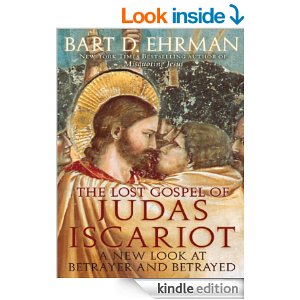
“What could possibly be ‘good news’ coming from ‘bad news’ Judas,  the infamous betrayer of the Christian Savior who ‘ID-d’ his Master with a kiss?  This Foreword by author Bart D. Ehrman is copy-pasted from the  preview of the book available at amazon.com.” —Admin1]

———————–

FOREWORD

BART D. EHRMAN

In fall 2004 I received several unexpected and rather mysterious phone calls. The first was from a professional friend of mine, Sheila, who has for years worked on biblical archaeology in Israel. After a brief chat about her next dig, she raised the question that had prompted her call: Had I ever heard of a Gospel of Judas?


I had only a vague recollection of the book: It was one of the gospels that was mentioned by some of the early church fathers, but that had evidently been destroyed, or at least lost, many centuries ago. It is included in none of the standard reference works of the early Christian “apocrypha”—that is, the surviving gospels, acts, epistles, and apocalypses that were not included in the New Testament. I wasn’t able to tell Sheila much more about it.


Her question struck me as odd—why would she be asking me about a gospel that hardly anyone had ever heard of, and that no one had ever seen? I decided to reread the ancient discussions of the Gospel of Judas, just to refresh my memory. It did not take long, as the gospel is mentioned in only a couple of ancient sources.


The earliest is the church father Irenaeus, who in 180 CE wrote a five-volume refutation of different Christian “heretics” (that is, those who held to the “wrong beliefs”), especially groups of gnostics. The gnostics believed that the way to salvation was not through belief in the death and resurrection of Jesus, but through the secret knowledge (gnosis is the Greek word for knowledge) that Jesus delivered, not to the crowds but to his inner circle. This secret knowledge revealed how people can escape the prisons of their material bodies to return to the spiritual realm whence they came. Some gnostic groups had highly esoteric and mysterious views of the world. In one of the most important archaeological discoveries of the twentieth century, a collection of gnostic writings was uncovered in 1945 near the Egyptian town of Nag Hammadi. These Nag Hammadi documents included a number of previously lost gospels—including the Gospel of Thomas and the Gospel of Philip—but they did not contain a copy of the Gospel of Judas.


In any event, Irenaeus does indicate that the Gospel of Judas was used by a group of gnostics called the Cainites. These people believed that the world had been created not by the One True God, but by a lesser, ignorant deity—the God of the Old Testament, who was not to be trusted or followed. The true God was above the inferior God of the Jews. And so, according to the Cainites, anyone who opposed the God of the Jews by breaking his law—as done, for example, by Cain, the first fratricide, and the men of Sodom and Gomorrah—was actually standing for the truth. The Cainites allegedly had a gospel that supported their rather peculiar theology. This gospel was written in the name of Judas Iscariot, known throughout Christian history as the traitor, the one disciple of Jesus who had turned evil and betrayed his master. According to the Cainites, however, what Judas had done was not evil. He alone was the one who understood the mysteries of Jesus and did Jesus’ will. All the other disciples, who worshiped the false Jewish God, failed to understand the truth of Jesus.


After doing this research on the lost Gospel of Judas, I received a second phone call. This one was from a woman who worked for the National Geographic Society. She too wanted to know about the Gospel of Judas. This time I was better prepared and could tell her all that we knew—or that I thought we knew—about the gospel. After a brief discussion, she wanted to know if I thought it would be a significant discovery if the Gospel of Judas were to turn up. I wondered, of course, why she was asking. Rarely does anyone call a scholar to pose a purely hypothetical question about an unlikely discovery. Had the book been found?


I was cautious in my response. In my opinion, if the Gospel of Judas turned up, it would undoubtedly be very interesting for scholars of ancient Christianity. But would it be headline news? It depended entirely on what was in the gospel. If, for example, the gospel was like most of the writings discovered near Nag Hammadi, a book that explained how the world came into existence and how people might escape their entrapment in matter, that would further our knowledge about early Christian gnosticism—obviously a very good thing, but not earth-shattering. If, on the other hand, this gospel included an ancient version of the story of Jesus from the perspective of Judas himself and embraced a view at odds with the one that became “orthodox” throughout the history of the Christian church—a discovery of that kind would be absolutely phenomenal. It would be one of the most significant archaeological discoveries of modern times, certainly the most important of the past sixty years.


She thanked me for the information and we ended the call.


A few days later, she called back with stunning information. As it turns out, the Gospel of Judas had turned up in Egypt, in a manuscript written in Coptic (the ancient Egyptian language that the Nag Hammadi documents were also written in). It was in the possession of a group in Switzerland called the Maecenas Foundation, which was interested in involving National Geographic in the publication and dissemination of the text. In response, the Society was concerned, first off, to learn if this was the real thing or a later forgery.

There was a range of interrelated questions: Was this new discovery the gospel that Irenaeus and other church fathers had castigated as a gnostic creation, telling the story of Jesus from Judas’s perspective? How old was the manuscript that contained the gospel? And when was the gospel itself originally composed? National Geographic needed an expert to verify the discovered text and wanted to know if I could help.


To say I was thrilled would be a profound understatement. Few scholars have the chance to be on the ground floor of a significant discovery. And this might be just that. Of course, it might also be a hoax. Hence the need to verify the facts.

I agreed to help. What the Society wanted was my expertise on early Christianity, to help them see the broad historical significance of a text like this. They were also planning to secure the services of a scientist who could provide a carbon-14 dating of the manuscript. I told them that they would also need a Coptologist—someone whose expertise was in ancient Coptic (my own research specialty is ancient Greek manuscripts). A good Coptologist could examine the text and give an estimate of its date simply based on the style of handwriting. And so, a three-person team was assembled: Tim Jull, director of the National Science Foundation–Arizona Accelerator Mass Spectrometer Facility in Tucson, the expert in carbon-14 dating; Stephen Emmel, an American-born professor of Coptic at the University of Münster in Germany; and myself, historian of early Christianity.


We flew to Geneva in December 2004 and under secretive conditions were shown the documents. They surpassed even our most sanguine expectations. There was no doubt in my mind that this was the real thing. Even though my expertise is Greek rather than Coptic, I have read enough ancient manuscripts to know one when I see one. The form of the manuscript and the style of writing looked very similar to what you can find in Greek manuscripts of the fourth century. My best guess at first glance was that this was from that period. Could it be a modern forgery? Not a chance.


Everyone on the team had lots of questions. Foremost for me was the content of the document. Turning to the final page, I could see the title (titles come at the end of documents in ancient texts):Peuaggelion Nioudas, Coptic for “The Gospel of Judas.” And I could make out a bit of the Coptic at the conclusion where the text indicates that “he handed him over to them.” But what was the rest of it about? Was it a gospel that took Judas’s side in the story of the betrayal, answering why he had done it? Or was it another gnostic text filled almost entirely with mystical reflections about the divine realm and about how this world came to be, with Judas playing at best a minor role? The significance of the document hung on these questions.


There were yet other pressing questions. Where was the text found? Who discovered it? When? Where had it been in all the years since its discovery? Why had none of us heard about it? Who so far had seen it? How did it come to be in the possession of the Maecenas Foundation, the group that evidently owned it? Could they be trusted to make the text available to the rest of the world, scholars and nonscholars alike? How would they publish it? Who would translate it? And so on.


These questions are answered in the present book—a riveting account by Herb Krosney, who first alerted the National Geographic Society to the existence of the document and convinced the Society to consider seriously its possible publication.  More than anyone else, Herb has pursued the question of the document’s discovery some three decades ago and its very peculiar pilgrimage in the intervening years.  With the tenacity of a top-flight investigative reporter, he pursued every facet of the discovery and reclamation of the text.  With an uncanny knack for piecing together isolated data, Herb has provided us with scores of details that, were it not for his efforts, would have been lost forever. This book provides far more information about the discovery, fate, and ultimate publication of the Gospel of Judas than we have for any other archaeological discovery of modern times—including such significant finds as the Dead Sea Scrolls and the Nag Hammadi library.


The most significant factor, of course, is the content of the newly discovered document. As it turns out, my highest hopes have been realized. For this is a gospel that tells the tale of Jesus from the viewpoint of Judas Iscariot himself, the one who allegedly betrayed him. As one might expect, this perspective is completely different from what one finds in the canonical accounts of the New Testament Gospels. In the books of Matthew, Mark, Luke, and John, Judas is the villain. In this newly discovered gospel, he is the hero.


It is worth noting that even though the Gospels of the New Testament agree in vilifying Judas, they do not agree on many of the details of his betrayal. The first Gospel to be written was that of Mark, from about 65 or 70 CE (35–40 years after the death of Jesus), and in that account, there is no clue given as to why Judas decided to turn Jesus over to the authorities, leading to his trial and crucifixion. Written somewhat later (80–85 CE), the Gospel of Matthew indicates that Judas did it for money: He was paid thirty pieces of silver for his foul deed. But when he saw that Jesus was condemned, Judas repented and hanged himself out of remorse. Written at about the same time as Matthew, the Gospel of Luke suggests that Judas was inspired by the Devil, so the betrayal was a Satanic act against the Son of God. The final Gospel to be written was John’s, in which Judas himself is said to have been “a devil.”


In all these accounts, Judas is the fallen disciple, the one betrayer of the cause, the traitor. Yet there are details within these accounts that are difficult—well nigh impossible, in fact—to reconcile with one another. For example, among the Gospels, only Matthew indicates that Judas killed himself. The author of the Gospel of Luke, however, also wrote the Book of Acts, and there we have a different version of Judas’s death—we are told that he fell headlong and his “bowels burst open.” Moreover, in Matthew’s gospel the “blood money” that Judas had returned to the priests out of remorse was used to buy a field to bury strangers in—hence it was called the “Field of Blood” (having come from blood money); in the account in Acts, it is Judas himself who bought the field, which was given its name because he poured out his blood on it.


My point is that each of the individual authors of the New Testament had his own perspective on Judas and told the stories about him in light of that perspective. That continued to be true after the time of the New Testament, as legends about Judas circulated widely. Among the most nefarious of these legends are the ones that paid close attention to the name “Judas,” a name etymologically related to the word Jew. Judas, by the Middle Ages, became synonymous with the “faithless Jew”—the one who was a greedy, money-hungry, thieving, deceitful, treacherous “Christ-killer.”


Some modern scholars have tried to resuscitate the reputation of Judas, but on rather unconvincing textual evidence. Our early records all portray him as the villain in the story of Jesus. But what if there were other portrayals of Judas available that cast him in a more positive light, that interpret his actions differently from the way they are portrayed in the four Gospels that happened to make it into the New Testament?


Now we do have a different depiction.


The Gospel of Judas is a gnostic document, and as such explains in some detail how our evil material world came into being and how we came to be entrapped here. This explanation is understood to be mysterious and secret—it is not for everyone to hear, only the insiders. But the Gospel of Judas is more than simply an additional gnostic text. It is an early gospel that provides an alternative understanding of Jesus, told from the point of view of his betrayer. In this account, Judas is the consummate insider, the one to whom Jesus delivers his secret revelation. Judas is the one faithful disciple, the one who understands Jesus, the one who receives salvation. The other disciples, and the religion they represent, are rooted in ignorance.


As these brief remarks should make clear, this gospel does not conform to traditional Christianity as it emerged in the early centuries to become the most important religious movement in the history of Western civilization. It is an alternative vision of what it means to follow Christ and to be faithful to his teachings.


In this book we learn about how, when, and where this vision was discovered, how it came into the hands of antiquities dealers and how it finally ended up with competent experts who have spent years piecing together the fragmentary text and making it available to us in a modern translation. All of us should be grateful not only for the superb efforts of the translator of this text—the Swiss Coptic scholar Rodolphe Kasser—and the work of the National Geographic Society for putting in the time and expense to make it widely available, but also to Herb Krosney, who has made the story of the Gospel’s discovery and history now accessible to everyone.


WHO’S WHO IN THE LOST GOSPEL


ANCIENT

Jesus

Judas Iscariot

St. Irenaeus, early church father and author ofAgainst Heresies

St. Athanasius, bishop of Alexandria

MODERN

Am Samiah (pseudonym), Egyptian villager

Hanna Asabil (pseudonym), antiquities dealer, Egypt

Ludwig Koenen, papyrologist, U.S.

Nicolas Koutoulakis, antiquities dealer, Switzerland

Yannis Perdios, antiquities collector, Greece

James M. Robinson, early Christianity scholar, U.S.

Stephen Emmel, Coptic scholar, Germany

Boutros (pseudonym), Egyptian villager

Frieda Tchacos Nussberger, antiquities dealer, Switzerland

Father Gabriel Abdel Sayed, Coptic priest, U.S.

Hans P. Kraus, rare book dealer, U.S.

Joanna Landis (pseudonym), Alexandria resident, Egypt

Roger Bagnall, classics scholar, U.S.

Martin Schoyen, antiquities collector, Norway

Bruce Ferrini, antiquities dealer, U.S.

William Veres, antiquities dealer, U.K.

James Ferrell, antiquities collector, U.S.

Mario J. Roberty, lawyer, Switzerland

Michel van Rijn, antiquities blogger, U.K.

Rodolphe Kasser, Coptic scholar, Switzerland

Florence Darbre, manuscript restorer, Switzerland

Charles Hedrick, Coptic scholar, U.S.

Bart D. Ehrman, early Christianity scholar, U.S.

A. J. Timothy Jull, radiocarbon-dating scientist, U.S.

PROLOGUE

Truly, truly I say to you, the man who betrays the Son of God, it is better that he had never been born.

—THE BOOK OF MATTHEW

He’s one of the most hated men in history—the apostle who betrayed Jesus Christ. Judas Iscariot. For centuries, his name has been synonymous with treachery and deceit.


In the mid- to late 1970s, hidden for more than fifteen hundred years, an ancient text emerged from the sands of Egypt. Near the banks of the Nile River, some Egyptian peasants, fellahin, stumbled upon a cavern. In biblical times, such chambers had been used to bury the dead. The peasants entered the cave, seeking ancient gold or jewelry, anything of value that they could sell. Instead, among a pile of human bones, they discovered a crumbling limestone box. Inside it, they came upon an unexpected find—a mysterious leather-bound book, a codex. The illiterate peasants couldn’t decipher the ancient text, but they knew that old books fetched a good price in Cairo’s antiquities markets. This one was made of papyrus, ancient Egypt’s form of paper.


The fellahin had no idea that what they were holding was one of the greatest prizes of biblical archaeology: A document stained by the label “heresy” and condemned eighteen hundred years ago.


In April 2000, approximately twenty-two years later, antiquities dealer Frieda Tchacos Nussberger was headed to John F. Kennedy International Airport in New York when she received some stunning news. She’d recently bought the ancient codex from an Egyptian dealer and had taken it to Yale University to have it examined. Now, on her cell phone, a manuscripts expert at Yale dropped a bombshell. “Frieda, it’s fantastic!” he said in an extremely emotional voice. “This is a very important document. I think it’s the Gospel of Judas!”


For Nussberger, it was the payoff for years of pursuit. She had become obsessed with the mysterious codex without ever knowing what it contained. Could there really be a Gospel of Judas?


Oddly, for someone so notorious, we know very few facts about Judas Iscariot. He was one of the Twelve Apostles. He most likely came from Judea, not Galilee like Jesus and the others. Judas was the apostles’ treasurer and, by some gospel accounts, Jesus’ most trusted ally, making his betrayal all the more contemptible.


But if the details of his life are murky, there’s no question about Judas’s place in history. “He’s the one who handed over his friend,” Marvin Meyer, one of the translators of the newly discovered gospel, explained. “He’s the one who brought about the Crucifixion, and he’s the one who’s damned for all time.” In Dante’s Inferno, Judas is condemned to the lowest pits of hell, where he is eaten, head first, by a giant raptor belonging to Lucifer himself.


“Generally today people think of Judas principally as the betrayer of Jesus, somebody who was a traitor to the cause,” scholar Bart Ehrman, noted for his studies of early Christianity, remarked recently. “Often they think of him as somebody who was greedy, avaricious, and who was more interested in making money than in being faithful to his master.”


“The word itself is despised,” Dr. William Klassen added. “I think virtually throughout the Western world, you wouldn’t even call your dog that. And in Germany, of course, it is illegal to name your child Judas.”


Christ and his apostles were all observant Jews, Orthodox by today’s standards. But in time Judas’s dark deed came to represent the supposed villainy of their entire faith. “Traditionally in Christian circles, Judas in fact has been associated with Jews,” Ehrman notes. “Not just because of his name, but also because of these characteristics that became stereotypes for Jews in the Middle Ages—this stereotype of being traitors, avaricious, who betray Jesus. And this portrayal of Judas, of course, also leads then to horrendous acts of anti-Semitism through the centuries.”


The stain that marks him is based on just twenty-four lines in the Gospels. As C. Stephen Evans, professor of philosophy at Baylor University, said: “Judas Iscariot in the New Testament doesn’t appear much, and I think it’s because he’s an embarrassment. What little is said about him is very sinister, so he’s portrayed in increasingly villainous terms as a thief who steals from the money box. Indeed, even as a person who was influenced by Satan.”


History, however, records that there was once another written source of information about Judas Iscariot. Around 180 CE, Irenaeus, a church father in what is now France, wrote a scathing attack against a Greek text entitled the Gospel of Judas. “This gospel was about the relationship between Jesus and Judas, and indicated that Judas didn’t actually betray Jesus, but did what Jesus wanted him to do, because Judas was the one who really knew the truth, as Jesus wanted it communicated,” Ehrman said.


This version of Judas’s story was too controversial for early Church leaders like Irenaeus. By condemning it, they erased it from history, never to be seen again.

But never is a long time, and the gospel was suppressed only until it could be found again. At least one copy of it had survived, laying dormant in a lightless vault in the arid Egyptian desert for most of two millennia until it was suddenly brought forth again, eventually finding its way decades later into Frieda Nussberger’s custody.


This codex—one of the greatest discoveries in Judeo-Christian archaeology—did not head straight to a museum, nor even to the library of a rich collector. The gospel’s removal from its burial place was just the beginning of a bizarre cloak-and-dagger journey. The Gospel of Judas, treated like a piece of merchandise, would be shopped around on three continents over the course of the next twenty-five years, its contents glimpsed only a few times between long periods of inactivity in far from ideal storage conditions. Every step of the way the precious document would deteriorate, until much of it was reduced to fragments of papyrus fibers.


The people who discovered it, bound together with three other texts, knew only that it was very old and would be worth good money. They sold it to a dealer in Cairo, who couldn’t read the ancient Coptic either, but knew that it was extremely valuable if only he could find the right buyer.


The humid air of Egypt’s capital city contrasts sharply with the arid climate of the desert where the codex was found, and humidity, combined with heat, is a factor that contributes greatly to the deterioration of perishable matter. The papyrus documents would languish while the dealer demanded millions of dollars for their purchase.


The manuscripts were then stolen and landed in Europe—more precisely, Switzerland—where, exposed to the Alpine air, the process of deterioration would continue. Not for the last time, the texts were left to molder in a bank vault. They were subsequently examined by experts who flew in from the United States to determine their authenticity. Already at that stage, warnings were raised about their state of deterioration. The scholars wanted the damage brought under control through careful management and the provision of proper environmental conditions, but that would be years in coming.


The codex next journeyed to the United States for a possible sale. A famous manuscript dealer in New York examined the text yet again but, uncomfortable with the Egyptian seller’s price and the cost of restoration, decided against buying them. Despairing, the Cairo dealer finally put the documents in a bank vault on suburban Long Island, where no one had any idea of their condition or even their existence. There they would deteriorate for sixteen long years.

At last, Nussberger rescued them from the bank vault and turned them over to Yale University to be translated. There, a scholar identified the subject of the texts and some of what they said. For a brief period it seemed the codex—its importance discovered—had found a home at last. Yet Nussberger has spoken of the text as “a curse,” and it did seem that way. The stigma of the great betrayer would linger on long after the discovery of the manuscript. It was almost as though the text didn’t want to be read.


Despite the fact that they contained the fabled Gospel of Judas, Yale was worried about possible legal issues and declined to buy them. Instead they were sold to an antiquities dealer in Ohio. They disintegrated further when they were briefly stored in the freezer compartment of a refrigerator.


A botched sale led to the manuscript’s return to Nussberger and Switzerland, where they would finally find a home where ambient conditions would be adjusted to ensure their future preservation. By this time the fragile papyrus had deteriorated dramatically, with fragments dropping off at the touch. Not only that, but scholars found that pages of the priceless texts were missing, ripped out, possibly to be sold separately.


Each stage of this journey had brought additional damage. Each stage caused the increasingly frail strands of papyrus to deteriorate further, threatening the loss of additional letters, words, and sentences of the ancient texts. Each stage of the journey might cause the voice of Judas Iscariot, now arisen from its centuries-old tomb, to be degraded to the point where it might never be heard.


From the moment Frieda Tchacos Nussberger had learned from the Yale experts what was contained in the mysterious codex, she had been in a race against time to find a buyer who would be able to preserve its pages before they turned to dust. She eventually turned it over to the Maecenas Foundation of Ancient Art in Basel, Switzerland, which specializes in supporting archaeological study projects in ancient cultures or antiquities such as this. Together with Maecenas she engaged Rodolphe Kasser, one of the world’s preeminent translators and scholars of Coptic, the rare and ancient language in which the text is written. Seeing how badly it had deteriorated, he joined forces with a superb document restorer, Florence Darbre.


In 2002, in her studio in Switzerland, Darbre opened the box containing the Gospel of Judas for the very first time. “I had to look at it. I had to open and close the box several times,” she said. “One often needs to have nerves of steel in order to touch certain objects.” In thirty years of work, she had never seen an ancient document in such bad condition. Its fragile papyrus pages had broken into thousands of fragments. “Whatever document you work with, there is always a story. One always wonders who wrote it, where did it go, who had it, and who read it?”


End of this sample Kindle book.


Enjoyed the preview?

Buy with 1-Click

or

See details for this book in the Kindle Store

Book Description

Publication Date: July 4, 2006

Judas Iscariot.

He’s been hated and reviled through the ages as Jesus Christ’s betrayer– the close friend who sells him out for 30 pieces of silver.

But history also records other information about Judas Iscariot. One such reference was written in 180 by an influential Church Father named St. Irenaeus who railed against the Gospel of Judas for depicting the last days of Jesus from the perspective of the disgraced apostle. In its pages, Judas is Christ’s favorite. 

It’s a startlingly different story than the one handed down through the ages. Once it was denounced as heresy, the Gospel of Judas faded from sight. It became one of history’s forgotten manuscripts. 

Until now.

In this compelling and exhaustively researched account, Herbert Krosney unravels how the Gospel of Judas was found and its meaning painstakingly teased from the ancient Coptic script that had hid its message for centuries. With all the skills of an investigative journalist and master storyteller, Krosney traces the forgotten gospel’s improbable journey across three continents, a trek that would take it through the netherworld of the international antiquities trade, until the crumbling papyrus is finally made to give up its secrets. The race to discover the Gospel of Judas will go down as one of the great detective stories of biblical archaeology.

 Show more

MUST READ: Was Christ our Passover?

Image from https://int.search.tb.ask.com

Image from https://int.search.tb.ask.com

[This is from one of our favorite resources:  Synagogue Without Walls.  It is listed on our links: http://rootsoffaith.org.  

When we read articles we’re dying to share, we feature them here among the posts written by our core community and a few guest contributors. Aside from this article, we’ve listed at the end more articles from this website. Please check them all out.  Reformatting and images added.—Admin1.]

 ————————-

ROSS  K.  NICHOLS

 Inspiring People to live a more authentically biblical lifestyle —

ROOTS OF THE FAITH,

ANCIENT TRUTH FOR A MODERN WORLD

On a positive note, more and more Christians are searching Scripture in an effort to orient themselves towards a more Hebraic understanding.  Non-Jews are celebrating biblical festivals, taking up dietary rules prescribed in the Torah, abandoning their previously learned anti-nomian beliefs, learning Hebrew, and returning to the Hebraic roots of their faith. These people are good and sincere souls seeking deliverance from nearly two thousand years of spiritual slavery, during which, false religious teachers have held them captive and oppressed them.

A modern day Moses might well go forth today with a message to modern day pharaohs saying “Let my people KNOW!” No doubt there will be those who do not wish to leave the comfort of their Egypt, desiring the onions and leeks served daily in the only home they have known, but others are willing to endure the hardships of a new Exodus.  It is for these who seek deliverance that the present article is written.  Christians have inherited lies, vanity and things wherein there is no profit, when it comes to a true and biblical understanding of Passover.


In a text attributed to the apostle Paul, we learn that Christians are encouraged to participate in Passover.

Your boasting is not good. Do you not know that a little leaven leavens the whole lump? Cleanse out the old leaven that you may be a new lump, as you really are unleavened. For Christ, our Passover lamb has been sacrificed. Let us therefore celebrate the festival, not with the old leaven, the leaven of malice and evil, but with the unleavened bread of sincerity and truth (I Corinthians 5:6-8).

Based upon this text and the gospel accounts associated with what is referred to as the passion narratives, Christians have come to certain conclusions that support their theology.

  • The Messiah, or Christ as the Greek puts it, becomes a sort of symbolic Passover lamb.
  • The Passover lamb is then presented as merely a shadow of things to come, finding its real meaning in the death of Jesus.
  • The writer of John’s gospel, in fact, lends support to this comparison when John the baptizer sees an approaching Jesus and is made to say,


“Behold, the lamb of God, who takes away the sin of the world” (John 1:29b).

Searching for more similarities, Christians often point out that according to the gospel narratives,

  • Jesus arrives in Jerusalem four days before Passover and is examined by the priests.
  • This they argue fulfills the Torah’s obligation to “take a lamb” on the tenth day of the first month, and “keep watch over it until the fourteenth day” (Exodus 12:3-6).
  • The purpose? Leaving aside the age of the lamb, and the fact that it can be taken “from the sheep or the goats,” it is to prove whether or not the lamb is “without blemish” (Exodus 12:5).
  • Jesus was killed on the day of preparation, between the evenings, and yet despite the horrors of crucifixion, not a bone was broken (John 19:14, 32, 33, 36).
  • So too, these reports seem to fulfill certain requirements for the Passover lamb (Exodus 12:46, Numbers 9:12, cf. Psalm 34:20).

Participants in messianic circles will likely learn that every aspect of the seder also points to Jesus.

  • They are often shown the matzah and told that this bread, with piercings and stripes, represents the body of Jesus that was wounded for them, though the manufactured and boxed up bread today probably looks far different than the unleavened bread of antiquity.
  • Further, they may be taught that the 3 matzos known as the afikomen represent a triune God and that the symbolic meaning of taking the middle piece, wrapping it in linen, hiding it, and bringing it back also point to the death, burial, and resurrection of Jesus.
  • The meal then is presented as a teaching tool to share the deeper meaning of an ancient Hebrew Festival, which sadly and evidently has been kept from the ones who were charged to “keep” it in the first place!

So what’s so wrong with a seder such as is taught by Messianic Jews as advertised in this video? Just about everything.

Much of what is taught has no connection with the first Passover described in the book of Exodus. Many of the teaching points are based upon traditional Passover meals, some of which find no direct support in the biblical texts.

When it comes to making Jesus the Passover lamb, there are some difficulties as well.

  • One difficulty is sorting out the last supper. Was it a seder as is commonly taught, or a meal eaten the prior day?
  • The original Passover meal was eaten AFTER the lamb was killed since the lamb was one of the key components to the meal.
  • In other words, if Jesus is representative of the Passover lamb, he must be killed before the meal.
  • The writer of John’s gospel suggests that this meal took place on the day of preparation, BEFORE the Passover (John 13:1; 18:28; 19:14, 42).

Other problems exist in making the Passover about the death of Jesus.

  • The lamb had nothing at all to do with sin.
  • The fact that the bones were unbroken aside, the year-old lamb was to be taken from “the sheep or the goats,” roasted and eaten.
  • What about the blood? The blood of the sacrifice was to be applied to the doorways of the Israelites for one reason and one reason only. “For when YHVH goes through to smite the Egyptians, He will see the blood on the lintel and the two doorposts, and YHVH will pass over the door and not let the destroyer enter and smite your home” (Exodus 12:23).
  • This leads to perhaps the biggest error in associating the death of Jesus with the redemption brought about through the Festival of Passover as taught in the Torah.

While Christians teach that the Passover is a picture of the death of God’s son, the Torah teaches the exact opposite!

  • The Hebrew Bible recognizes that God has a son and this is an essential part of the authentic Passover message.
  • The story of Passover, however, is not about God’s son dying, but about God’s son NOT dying while the sons of the oppressing nation are killed.
  • As Moses prepares to go before Pharaoh the first time, we read the message that he is charged to deliver. “Thus says YHVH, Israel is my firstborn son. I have said to you, ‘Let my son go, that he may worship me, yet you refuse to let him go. Now I will slay your firstborn son’” (Exodus 4:22-23)!
  • A careful reading of the narrative of Passover affirms this in several places (Exodus 12:12, 27, 29; 13:15).

While Christianity teaches that “in Christ Jesus, neither circumcision nor uncircumcision counts for anything” (Galatians 5:6), the Torah says the opposite.

  • Circumcision is required of any male that will eat the Passover.
  • It’s not enough, as Paul would have us believe to be circumcised inwardly (Romans 2:28).
  • As far as a matter of the heart, the Hebrew Bible would agree (Deuteronomy 10:12-16; 30:1-6; Jeremiah 4:1-4), but this does not negate the clear language concerning the requirement for a circumcision “of the flesh” (Exodus 12:43-49).

As a faithful Jew, the historical Jesus likely kept the Passover Festival every year of his life (Luke 2:41). We do believe that Jesus was killed at the precise time and day that the lambs were killed. This finds support in the gospel narratives as well as a reference in the Talmud, which says, “On the eve of Passover, they hanged Yeshu” (Sanhedrin 43a).

If truth be told, it is improbable that the hateful Pontius Pilate had a custom to release any Jew at any time, let alone during Israel’s festival of freedom. It is more probable that in some way he was pleased to put one of Jacob’s sons to death at the very time when they would be speaking of their deliverance from oppression.

The prophesied salvation of Israel is what must have been on the mind of Jesus on the final day of his life, Passover day in year 30 of the Common Era.  Perhaps his cryptic answer about one coming on the clouds, clearly a reference from Daniel chapter 7, was intended to declare his unwavering faith in the ancient prophecies of his people. This passage,  though understood to be a prophecy about a messiah that would come on the clouds of heaven, is about restoring the kingdom to the people for which it was intended. If it is messianic at all, it has to do with a corporate messiah represented by the people of Israel (Psalm 105:12-15).

Passover is indeed a story of salvation and deliverance. It is meant to symbolize forever the redemption of God’s son, who does not die but is preserved alive. This is the only meaning that any child of Israel, including Jesus of Nazareth has ever known.

Let us therefore celebrate the festival, not with the old leaven, the leaven of malice and evil, but with the unleavened bread of sincerity and truth.

References and Further Reading

___________________

Exodus 12-13; 23:15; 34:18;

Leviticus 23:4-8;

Numbers 9:1-15, 28:16-25, 33:3;

Deuteronomy 16:1-8;

Joshua 5:10-15;

2 Kings 23:10-14;

Ezekiel 45:2;

Ezra 6:19-22;

2 Chronicles 30:1-27, 35:1-9

Passages from the New Testament related to Passover and Jesus

Mark 14:1-57;

Matthew 26:1-46;

Luke 2:41, 22:1-53;

John 11:55, 12:1; 13:1-38, 18:28;

I Corinthians 5:7-8


Please check out ADDITIONAL POSTS from their website:

Revisit: The “lamb” in TNK vs. the “Lamb of God” in NT

[We offer no discussion here, simply Scripture verses.  Translations:  For the Torah, Everett Fox, The Five Books of Moses; for the TNK, AST/Artscroll Tanach, for the New Testament, ESV/English Standard Version.]

Genesis/Bereshith 22:7-8 

7 Yitzhak said to Avraham his father, he said:  
Father!
He said:
Here I am, 
He said:  Here are the fire and the wood, 
but where is the lamb for the offering-up? 
8 Avraham said:
God will see-for-himself to the lamb for the offering-up,
my son.  
Thus the two of them went together.
9 They came to the place that God had told him of;
there Avraham built the slaughter-site
and arranged the wood
and bound Yitzhak his son
and placed him on the slaughter-site atop the wood.
10 And Avraham stretched out his hand,
he took the knife to slay his son.
11 But YHVH’S messenger called to him from heaven
and said:
Avraham! Avraham!
He said:
Here I am.
12 He said: Do not stretch out your hand against the lad,
do not do anything to him! 
For now I know
that you are in awe of God—-
you have not withheld your son, your only-one, from me.
my son.
 
13 Avraham lifted up his eyes and saw: 
there, a ram was caught behind in the thicket by its horns!
Avraham went,
he took the ram
and offered it up as an offering-up in place of his son.
14 Avraham called the name of that place: YHVH Sees.
As the saying is today: On YHVH’S mountain (it) is seen.
 

Exodus/Shemoth 12:3-11

Image from www.sheepfood.com

3 Speak to the entire community of Israel, saying: 
On the tenth day after this New-moon
they are to take them, each-man, a lamb,
according to their Fathers’ House, a lamb per household. 
4 And if there be too few in the house for a lamb,
he is to take (it), he and his neighbor who is near his house, by the computation according to the (total number of) persons;
each-man according to what he can eat you are to compute for the lamb.
5 A wholly-sound male, year-old lamb shall be yours, from the sheep and from the goats are you
to take it.
6 It shall be for you in safekeeping, until the fourteenth day after this New-moon,
and they are to slay it-the entire assembly of the community of Israel-between the setting-times.
7 They are to take some of the blood and put it onto the two posts and onto the lintel,
onto the houses in which they eat it.
8 They are to eat the flesh on that night, roasted in fire,
and matzot,
with bitter-herbs they are to eat it.
9 Do not eat any of it raw, or boiled, boiled in water,
but rather roasted in fire, its head along with its legs, along with its innards.
10 You are not to leave any of it until morning;
what is left of it until morning, with fire you are to burn.
11 And thus you are to eat it:
your hips girded, your sandals on your feet, your sticks in your
hand;
you are to eat it in trepidation—
it is a Passover-meal to YHVH.

Exodus/ Shemoth 13:11-13

11 It shall be,  
when YHVH brings you to the land of the Canaanite, as he swore to you and to your fathers, 
 and gives it to you, 
12 you are to transfer every breacher of a womb to YHVH, every breacher, offspring of a beast that belongs to you, 
 the males (are) for YHVH. 
13 Every breacher of a donkey you are to redeem with a lamb; 
 if you do not redeem (it), you are to break-its-neck. 
And every firstborn of men, among your sons, you are to redeem

Leviticus/Wayyiqrah 14:  1-2, 10, -13

1 YHVH spoke to Moshe, saying:
2 This is to be the Instruction for the one-with-tzaraat, on the day of his being-purified:
he is to be brought to the priest.
 
10  On the eighth day he is to take two lambs, wholly-sound,
and one lamb in its (first) year, wholly sound,
and three tenth-measures of flour as a grain-gift, mixed with oil and one log of oil.  
11 The priest making-purification is to stand the man to-be-purified and them
before the presence of YHWH, at the entrance to the Tent of Appointment:  
12  the priest is to take the one lamb and is to bring-it-near as an asham-offering, with the log of oil,
and is to elevate them as an elevation-offering, before the presence of YHWH.  
13  Then he is to slay the lamb in the place where one slays the hattat-offering  and the offering-up,
in a holy place,
for like the hattat-offering, the asham-offering is the priest’s,
it is a holiest holy-portion.

Exodus/Shemoth. 29:38-43

38 And this is what you are to sacrifice on the slaughter-site: year-old lambs, two for each day, 
regularly.
39 The first lamb you are to sacrifice at daybreak,
and the second lamb you are to sacrifice between the setting-times.
40  A tenth-measure of fine-meal, mixed with beaten oil, a quarter of a hin,
and (as) poured-offering, a quarter of a hin of wine—for the first lamb.
41  And the second lamb you are to sacrifice between the setting times,
like the grain-gift of morning, and like its poured-offering (that) you make-ready for it,
for a soothing savor, 
a fire-offering for YHWH;
42 a regular offering-up, throughout your generations, 
at the entrance to the Tent of Apppointment, before the presence of YHWH;
for I will appoint-meeting with you there
with the Children of Israel,
and it will be hallowed
by my Glory.

Leviticus/Wayyiqrah 4:27-32  

27  Now if any person sins in error, from among the people of the land,
by doing one (thing) regarding the commandments of YHWH that should not be done,
and incurs guilt,
28 or it is made known to him the sin that he sinned:  
he is to bring his near-offering a hairiy-one of goats, wholly sound, female, for the sin whereby he sinned.
29  He is to lean his hand on the head of the hattat-offering
and is to slay the hattat-offering, at the place of the offering=up.
30  The priest is to take some of the blood of the hattat-offering with his finger
and is to put (it) on the horns of the slaughter-site of offering-up; 
all (the rest of) its blood he is to pour out at the foundation of the slaughter-site of offering-up.
31  All of its fat, he is to remove, as was removed the fat from upon the slaughter-offering of shalom
and the priest is to turn it into smoke on the slaughter-site,
as a soothing savor for YHWH; 
thus the priest is to effect-purgation for him,
and he shall be granted-pardon.
32  If (it is) a sheep he brings as his near-offering for a hattat-offering,
a female, wholly-sound, he is to bring. 

Leviticus/Wayyiqrah 23:

You are to perform a sacrifice on the day of your elevating the sheaf:
a sheep, wholly sound, in its (first) year, as an offering-up to YHWH.
 

Numbers/Bemidbar 15:11-16

11 Thus is to be sacrificed with (each) one ox or with (each) one ram or with (any) lamb among the sheep or among the goats, 
12  according to the number that you sacrifice;
thus are you to sacrifice for (each) one, according to their number.
13 Every native is to sacrifice these thus,
to bring-near a fire-offering of soothing savor for YHWH.
14  Now when there sojourns with you a sojourner,
or (one) that has been in your midst, throughout your generations,
and he sacrifices a fire-offering of soothing savor for YHWH; 
as you sacrifice (it), thus is he to sacrifice (it).
15 Assembly!
One law for you and for the sojourner that takes-up-sojourn,
a law for the ages, throughout your generations:
as (it is for) you, so will it be (for) the sojourner before the presence of YHWH.
16  One instruction, one regulation shall there be for you
and for the sojourner that takes-up-sojourn with you!

[AST] Jeremiah/Yirmeyahu 11:17-22

17  And HASHEM [YHWH], Master of Legions, the One Who planted you, has declared evil upon you, because of the evil of the House of Israel and the House of Judah, which they committed in order to anger Me, by sacrificing to Baal.
18  HASHEM [YHWH] informed me, so I would know—then You showed me their deeds.  19  I am like a choice sheep led to the slaughter; I did not know that they devised schemes against me; “Let us destroy (him by placing] tree-poison in his food and cut him off from the land of the living, so that his name will not be remembered any more.”  20  But HASHEM [YHWH} Master of Legions, righteous Judge, Who examines innermost thoughts and feelings, let me see Your vengeance against hem, for i have revealed my grievance to You.
21  Therefore, thus said HASHEM [YHWH], concerning the men of Anathoth who seek your life, saying:  “Do not prophecy in the Name of HASHEM [YHWH], so that you not die at our hand”—22 Therefore, thus said HASHEM [YHWH], Master of Legions:  “Behold, I shall punish them: the young men will die by the sword, their daughters will die in the famine.  23 There will be no remnant of them, for I shall bring evil upon the men of Anathoth [in] the year of their punishment.

Ezekiel 45:13-17

13 “This is the portion that you shall set aside: a sixth of an ephah from the chomer of wheat and shall take a sixth of an ephah from a chomer of barley.  14  The law of the oil:  The bath [is the measure for] the oil; the bath shall be a tenth of the koi [which is] ten bath, a chomer for ten bath are a chomer.  15 And one lamb from the flock out of two hundred, from Israel’s fatted animals.  [These are all] for a meal-offering, a burnt-offering, and a peace-offering to atone for you—the word of the Lord, HASHEM[YHWH]/ELOHIM. 16 The entire people of the land shall join in this donation with the prince in Israel.
17  Upon the prince shall be [the responsibility for]the burnt-offerings, the meal-offering, and the libation, on the festivals, on the New Moons, and on the Sabbaths, on all the appointed times of the House of Israel; he shall prepare the sin-offering, the meal-offering, the burnt-offering, and the peace-offering to atone on behalf of the House of Israel.”

Ezekiel 46: 3-16

3 The people of the land shall prostrate themselves before HASHEM[YHWH] at the entrance of that gate on the Sabbaths and on the New Moons.
4  “And [this is] the burnt-offering that the prince shall bring for HASHEM[YHWH] on the Sabbath day, six unblemished sheep and an unblemished  ram 5 and a meal-offering of one ephah for the ram and a meal-offering of whatever his hand gives for the sheep, with a hin of oil  for each ephah, 6 on the day of the New Moon an unblemished bull from the herd and six sheep and a ram, they shall be unblemished, 7 and he shall make an ephah for the bull and an ephah for the ram as a meal-offering, and for the sheep according to his means, with a hin of oil per ephah.
8  “When the prince enters, he shall enter by way of the hall of the gate, and by the same way he shall leave.  9 But when the populace comes before HASHEM[YHWH] on the appointed days, whoever comes in by way of the northern gate to prostrate himself shall go out by way of the southern gate, and whoever comes in by way of the southern gate shall go out by way of the northern gate.  He shall not return by way of the gate through which he came in; rather he shall go out opposite it  10 And the prince : He shall enter among them when they enter, and when they leave he shall leave.  11  On the festivals and at the appointed times, the meal offering shall be an ephah for a bull and an ephah for a ram, and for the sheelp, whatever his hand gives, with a hin of oil per ephah.
12  When the prince makes a free-will offering, a burnt-offering or a peace-offering as a free-will offering for HASHEM[YHWH], they shall open for him the gate that faces eastward, and he shall make his burnt-offering and his peace-offerings as he does on the Sabbath day, then he shall go out, and they shall close the gate after his departure.
13  “You shall prepare a sheep in its first year, unblemished, as a daily burnt-offering for HASHEM[YHWH]; you shall make it every morning.” 14 And you shall bring a meal-offering with it every morning, a sixth of an ephah, a third of a hin of oil with which to mix the flour; it is a meal-offering to HASHEM.  As an eternal portion [to be offered] continually, 15 they shall make the sheep and the meal-offering and the oil every morning as a continual burnt-offering.
16  Thus said the LORD HASHEM[YHWH]/ELOHIM:  “If the prince makes a gift to one of his sons, since it is his inheritance that will belong to his sons, it is their possession by inheritance.  
 

 New Testament 

Image from www.brittonchurch.com


John 1:29 

The next day he beheld Jesus coming toward him, and he said: “See, the Lamb of God that takes away the sin of the world!

1 Pet. 1:19 

But it was with precious blood, like that of an unblemished and spotless lamb, even Christ’s.

Image from vimeo.com

Revelation 5:8 

And when he took the scroll, the four living creatures and the twenty-four elders fell down before the Lamb, having each one a harp and golden bowls that were full of incense, and the [incense] means the prayers of the holy ones.

Rev. 5:12 

saying with a loud voice: “The Lamb that was slaughtered is worthy to receive the power and riches and wisdom and strength and honor and glory and blessing.

Revelation 5:13 

And every creature that is in heaven and on earth and underneath the earth and on the sea, and all the things in them, I heard saying: “To the One sitting on the throne and to the Lamb be the blessing and the honor and the glory and the might forever and ever.”

Revelation 6:1 

And I saw when the Lamb opened one of the seven seals, and I heard one of the four living creatures say with a voice as of thunder: “Come!”

Revelation 6:16 

And they keep saying to the mountains and to the rock-masses: “Fall over us and hide us from the face of the One seated on the throne and from the wrath of the Lamb.

Image from vimeo.com


Revisit: The UNchosen: What if you were a gentile slave in Egypt?

Image from Pinterest

Image from Pinterest

[This is part of our series on THE OTHER, i.e. the UNchosen or anyone who is not in the line of the CHOSEN, the line of Jacob/Israel.  Related posts:

We Sinaites connect with the UNchosen who nevertheless ended up choosing the “God of Israel”  and choosing to worship Him,  YHWH, the God of the Chosen, Who is the God of all humanity, Jew and Gentile, Israel and the Nations.  Why do we always go to so much trouble and repetition in identifying this God by His Name and His role in biblical history (Torah)?  Because Name and Identity is Key, in our thinking; as we always say, ‘name your God and let’s see if we’re on the same page’.  As for identifying with those who were not chosen?  One simply needs to understand why there has to be a ‘chosen’ people and to disabuse your mind of misconceptions about that, please read this series:  

Admin1]


———————-


This is the gentile version of:   What if you were a Hebrew slave in Egypt?

Image from www.alamy.com

Image from www.alamy.com

Do the Hebrew Scriptures record any miracles wrought in behalf of non-Israelites?   And if so, what would have been the purpose?  Because that is the question we should ask each time we hear about a ‘miracle’ happening then or now.


Should YHWH the God of Israel and the nations perform one today— the purpose would be to bolster the faith of both believer and unbeliever, including accidental, disinterested, indifferent bystander-witnesses.  Faith in what or in whom?  Obviously, faith in Him, the One True God who has to compete with false gods and false teaching, false religions,  false scriptures, agnostics and atheists, indifference.


Here’s one example of miracles where non-Israelites also reaped benefit and blessing.


YHWH through His emissary and mouthpiece Moses attempted to turn around the obstinate Pharoah through unmistakable signs although these were not so much for Pharoah’s sake as they were to authenticate Moses as YHWH’s handpicked emissary and chosen spokesman.


It was also for the sake of others, namely:

  • the Hebrew slaves for whom Moses was negotiating a temporary release so they could worship their God out in the wilderness;
  • the unmentioned-because-overlooked/forgotten-but-presumed population of non-Israelites who would have been observing from the sidelines, (i.e.,  gentile slaves from different captive nations interacting and working side by side with Hebrew slaves);
  • as well as  the rest of the Egyptian non-slave population, (nobility, commoner).

Surely, word would have gotten around about this Pharaoh challenging the God of Moses with these arrogant words:


 Who is YHWH that I should obey him and let Israel go?

I do not know YHWH and I will not let Israel go.”  

[Exodus 5:2]


Well, we know how that back and forth warning and rebuff progressed to its inevitable climax and if you don’t, please read the rest of Exodus.  In fact,  why not do virtual time-travel and place yourself in the sandals of a gentile slave and imagine what might have gone through your mind at the time you heard about preparations in the Hebrew Ghettoes for their liberation from Egyptian bondage by their God .


As a gentile slave, would you not start wondering if the God of Israel might consider including you?  What if you believe in His message, unlike Pharaoh?  You have witnessed the strange phenomena happening one after another in the land of Egypt, affecting the Egyptian population but not the Israelites who appear to be exempt from the consequences of the plagues. Have you yourself been affected . . . like the Egyptian . . . or not affected like  the Israelite?  Surely, you as a non-Egyptian, non-Israelite,  gentile-bystander now find yourself caught between the God of Israel and the non-gods in Egypt’s pantheon (who are probably your own gods if you belonged to the ‘nations’).  You could remain neutral . . . but is that an option?  Does a slave have a choice?  Why not make a decision? You have nothing to lose as a slave and who knows what is in store for believers in a God who does wonders and liberates slaves?  Freedom by itself sounds good!


So after hearing about and observing so many unusual happenings around you, your decision is —

  • believe in the messenger of this God, Moses,  who was raised in the palace of pharaoh until he fled and disappeared for 40 years (or so you heard from rumors going around);
  • believe that this God of Israel will liberate His people;
  • believe that if you follow all the instructions for ‘liberation day’ (or Passover night), you could join their exodus;
  • believe that this new god will do all that he says he will do because you have already witnessed the fulfillment of all his pronouncements to Pharaoh.

Wonders, signs, miracles in those days (as in these days) should make anyone pause and ponder:  who is causing these unusual phenomena?  And if it’s undeniably clear that a certain god of a people you’ve slaved away with is responsible for these out-of-the-ordinary happenings, you have to

decide which god to believe in:  Egypt’s? Your nation’s gods? Or this god who communicates through Moses? It is  typical of human nature to self-preserve and connect with the more powerful deity who manifests bigger and better miracles, particularly a god who promises liberation from bondage.


So, what to do next?  Listen to the specific instructions for the final plague;  then do exactly as the Hebrew slaves do.  That lamb’s blood on your lintel and doorpost is the protective sign for the angel of death to spare your home and as well as your firstborn.  Has it occurred to you that if an Egyptian had made the same decision as you, his son might be spared too?  Isn’t it all about belief in the Hebrews’ God and in following His instructions?


As the Hebrews start moving out of Egypt at the appointed time,  so should you.   Would that God of Israel allow you and accept you if you are not among His chosen but you took a leap of faith and chose HIM?


37 Now the sons of Israel journeyed from Rameses to Succoth,

about six hundred thousand men on foot, aside from children.

38 A mixed multitude also went up with them,

along with flocks and herds, a very large number of livestock.

[Exodus 12:38].


So, there’s your answer, you got included in that “mixed multitude” mentioned separately from the “sons of Israel”.  In effect, the miracles experienced by Israel in their wilderness wandering benefitted the gentiles among them as well.  And that is why instructions issued from Sinai include how Israelites are to treat “the stranger among you.”  That would be you, the gentile slave who earned your freedom by believing in the God of Israel while Pharoah did not.


So the lesson for us today?  Even if the God of Israel did not choose us, gentiles, but we choose Him, we benefit from the teachings, instructions, His Torah, issued from Israel.  The greatest blessing is knowing Him through His original revelation on Sinai, issued to and intended for both Israel and the non-Israelites among the “mixed multitude” who left Egypt.


We are in good company; there are others who placed their faith in YHWH according to the Hebrew Scriptures—

And so, how fortunate and blessed are those who rediscover the ancient paths leading to the One True God.


—————————


Hereunder is the concluding portion of  What if you were a Hebrew slave in Egypt?:


Who was it who said ‘You shall know the truth the truth will set you free?‘ The answer? Jesus, picked up by Dr. Martin Luther King for his freedom march.


Sinaites have come to know the Truth about the One True God and this Truth has indeed set us free! Free from what?


Let’s start with the obvious: IGNORANCE!  And the second obvious:  MANMADE ‘TRUTHS’!


The God we have sought all our lives is the God who commissioned Israel to declare Him to gentiles like ourselves; we have come to believe in the original ‘good news’.


YHWH reigns today and as foretold by the prophet Zechariah 14:9:


And the LORD shall be King over all the earth;

in that day shall the LORD be One, and His name one.


You shall know the truth and the truth shall set you free.


He liberates all who are in bondage to ignorance and falsehood but there is a condition to such freedom:  one must decide, just like the Hebrew slave, just like the gentile slave, to believe in this God and and what He has promised to all who seek Him, take Him at His Word, and let Him have the last word:


Do not add to what I command you

and do not subtract from it,

but keep the commands of the LORD your God

that I give you.

(Deuteronomy 4:2)


But if from there you seek the LORD your God,

you will find him if you seek him

with all your heart and with all your soul.  

(Deuteronomy 4:29)


Then you will call on me and come and pray to me,

and I will listen to you.

You will seek me and find me

when you seek me with all your heart.

I will be found by you,”

(Jeremiah 29:12-14)


Hear, and more importantly, HEED,

O Jew, O Gentile:


 “when you seek Me

with all your heart . . .

I will be found by you!”


Sig-4_16colors

logo

A Rabbi analyzes the Crucifixion

Image from amazon.com

Image from amazon.com

[We have entered the Christian season of Lent, leading to its culminating  Passion Week and 4 days of Easter.  This article first posted in  2014 , reposting every year.  It is part of the series MUST READ/MUST OWN resource, Rabbi Schmuley Boteach’s Kosher Jesus.  Please refer to earlier posts from this same book.-

This ebook is downloadable from amazon.com if you wish to have your own copy.  Reformatted and highlighted for this post; New Testament verses are coded red for caution.–Admin1]


——————————————-


Chapter 10: The Crucifixion


The story of Jesus’ crucifixion is one of the best-known stories in human history.  Even the most casual New Testament reader is familiar with the general outline: Jesus was betrayed by his follower Judas, extended clemency by Pontius Pilate, but then denounced by the Pharisees and Jewish onlookers, after which he was nailed to a cross, dying on what would become to be known as Good Friday.

 
Image from www.testimoniesofheavenandhell.com

Image from www.testimoniesofheavenandhell.com


Yet, if we’ve learned anything about our study of Jesus’ life, it’s that there is often more to it than meets the eye.  Embedded in the various Gospel versions of this well-worn story are a number of substantive contradictions that call into question the very fundamentals of its retelling.  In these disagreements we get a clear view of the machinations of New Testament editors as they found it necessary to rewrite history.


The first three Gospels — Matthew, Mark, and Luke — all focus on Jesus’ victimhood at the hands of Jews and Romans.  Yet in the Book of John, the story is reversed.


The last of the Gospels to be written, John tells an almost unrecognizably different story.


Jesus actually volunteers to lay down his life.

 In complete control of the situation, Jesus says to the people, including Pontius Pilate, that the only reason the Romans can put him to death is because he himself wills it. 

John even gives the impression that Jesus experiences no pain.

From the outset, he is a lamb that goes to the slaughter willingly and does not suffer.


This could not be more in conflict with the account given by Matthew, in which Jesus suffers terribly on the cross.  He cries out, “My God, my God, why have you forsaken me?” These are words of unspeakable anguish and abandonment — certainly not words that would be spoken by someone willingly submitting to torture and death.


The other two Gospels portray the horror and misery of this event in unstinting detail.  Mark describes a scene in which Jesus is mocked and brutalized by Roman soldiers:


“The soldiers led Jesus into the palace . . . They put a purple robe on him, then twisted together a crown of thorns and set it on him. And they began to call out to him, ‘Hail, king of the Jews!’  Again and again they struck him on the head with a staff and spit on him.  Falling on their knees, they paid homage to him.  And when they had mocked him, they took off the purple robe and put his own clothes on him.  Then they led him out to crucify him.”  

Luke paints a picture of Jesus crucified alongside two criminals, as onlookers taunted.  


“The people stood watching, and the rulers even sneered at him. They said, ‘He saved others; let him save himself if he is God’s Messiah, the Chosen One.'”


The obvious question that arises is, simply, what changed ?  How did the Gospels contort Jesus’ crucifixion from the pathos of Mark, Matthew, and Luke to the strange detachment described by John?


It seems clear that this was a rewriting calculated to appeal to Roman readers after Jesus’ death.  The culture of Rome thrived on power and masculine virility.  The Roman people would never have been impressed with a weak Jesus, as he was described in the first three Gospels.  Though the idea of victimhood and martyrdom would have appealed to the Jews who were themselves victims of Roman brutality, the Romans could never relate to a deity that gets beaten up and crucified by centurions.  They were the strongest people on earth!  They revered aggression, not weakness.  Any deity pathetic enough to be put to death by low-ranking Roman soldiers could not be a deity at all.


The editor of the Book of John, last of the Gospels, faces a quandary.  He cannot change the facts.  They have already been reported in historical accounts and other Gospels.  Jesus had been crucified by the Romans — case closed.  But since he must do something to rescue Jesus’ virility, he changes the mechanics and motivations of the story.  The most important verse in all of John, so crucial that we shall devote later chapters to understanding its ramifications, should be familiar to all Christians:


 “For God so loved the world that he gave his one and only Son, that whoever believes in him shall not perish but have eternal life.”


John envisages Jesus as an all-powerful deity who willingly laid down his life to atone for the sins of mankind.  Hence, Jesus barely suffers throughout the Passion.  It is all part of a divine plan.


This isn’t the only discrepancy that John introduces.  Six hundred Roman soldiers come to arrest Jesus but end up bowing at his feet.  Not only that, he receives a royal burial.  Jesus even exhibits awareness of his predestined fate when he tells Pilate,


“You would have no power over me if it were not given to you, from above.”


How different this is from the other three Gospels.


The many significant discrepancies in the crucifixion story suggest alterations by multiple editors and authors.  These disagreements include the fact that Mark has three women going to anoint the body of Jesus.  Very early on the first day of the week, just after sunrise, they were on their way to the tomb and they asked each other,


“Who will roll the stone away from the entrance of the tomb?” But when they looked up, they saw that the stone, which was very large, had been rolled away.”


Yet Matthew says only two women went:


“After the Sabbath, at dawn on the first day of the week, Mary Magdalene and the other Mary went to look at the tomb.”  


Note they were only going to see the tomb, not to anoint Jesus.  In John’s telling, the number of visitors changes yet again.


“Early on the first day of the week, while it was still dark, Mary Magdalene went to the tomb and saw that the stone had been removed from the entrance.”


Something doesn’t quite add up.


We all know the Romans hated the early Christians.  In his palace, the Roman emperor Nero burned Christians alive for amusement.  The Romans fed Christians to lions a a form of entertainment at the Colosseum.  So why should we believe the New Testament’s assertion that the Jews tried to kill Jesus and his disciples while the Romans admired them?


We cannot accept this version – the crude picture of evil Jews plotting the death of one of their own, nor the propagandistic description of the impotent Romans innocent of the brutality meted out on the central figure of Christianity.


Indeed, the discrepancies between the Passion narratives and the lack of historical evidence have led many prominent scholars of the Christian Bible and its history to conclude decisively that these narratives were later additions – adaptations made to redefine Christianity and help it survive in new, changing political and social circumstances.


Peter Accuses the Jews

 
Image from www.junglekey.fr

Image from www.junglekey.fr

Further proof of this concerted effort to exonerate the Romans and implicate the Jews in the death of Jesus comes from the Gospel of Peter.  Though it was ultimately declared apocryphal and left out of the biblical canon, Peter’s story was very influential during Christianity’s formative years.


A profoundly anti-Semitic document, this Gospel was written by the same Peter who denied knowing Jesus three times when confronted by the Romans.  Amazingly, Peter claims it was the Jews who crucified Christ – the Jews not only handed Jesus over to the Romans, they actually carried out the crucifixion.


According to Peter’s uncanonized gospel, the Romans and Pontius Pilate withdrew completely from the trial of Jesus, leaving Herod Antipas and the Jews themselves to crucify him.

“But of the Jews none washed their hands, neither Herod nor any of his judges. And as they would not wash, Pilate arose.  And then Herod the king commanded that the Lord should be marched off, saying to them, ‘What I have commanded you to do him, do ye,’ . . . And he delivered him to the people on the day before the unleavened bread, their feast.”


Elsewhere in the Book of Acts, Peter twice accuses the Jews of having killed Jesus.  He makes no mention of the Romans when he denounces the Jews, saying,


“Therefore let all Israel be assured of this:  God has made this Jesus whom you crucified, both Lord and Messiah.”  


Later Peter tells members of the Jewish councils:


“The God of our ancestors raised Jesus from the dead – whom you killed by hanging him on a cross.”


Only once does he deign to mention the involvement of the Romans.  Even when he does, he takes pains to inoculate Pontius Pilate from criticism:

“The God of Abraham, Isaac, and Jacob, the God of our fathers, has glorified his servant Jesus.  You handed him over to be killed, and you disowned him before Pilate, though he had decided to let him go.


Can we believe Peter when he claims the Jews killed Jesus or at the very least handed him over to the Romans?  Should we take as gospel his abject whitewashing of the behavior of Pontius Pilate?  No, absolutely not.


Peter’s allegedly eyewitness testimony contains many problems.  At the top of the list is the fact that Jesus himself accused Peter of being a liar.  Jesus told Peter the night before he died, in one of the best-known stories of the New Testament, that before the next morning Peter would deny him three times:

“Jesus told them, ‘This very night you will all fall away on account of me,’ . . . Peter replied, ‘Even if all fall away on account of you, I never will.’ ‘Truly, I tell you,’ Jesus answered, ‘this very night, before the rooster crows, you will disown me three times.'”


Just as Jesus predicts, when a servant girl approaches him and asserts he was among Jesus’ followers, Peter say,


“I don’t know what you’re talking about.”  


She accuses him again before a crowd, and he denies it again.  It even happens a third time:


“After a little while, those standing there went up to Peter and said,’Surely you are one of them; your accent gives you away.’ Then he began to call down curses, and he swore to them, ‘I don’t know the man!'”


Peter denies Jesus in order to save his own skin, leaving his master to be murdered.


Jesus’ serious misgivings about Peter’s character are already in evidence in his prediction that Peter will turn out to be a liar.  Peter’s abandonment of Jesus at his most desperate moment in order to save himself is even more troubling, especially given that Peter would eventually succeed to the leadership of the Church.  It seems impossible that a brazen coward, whom Jesus himself knew would lie about their relationship, would be taken seriously when he later accuses the Jews of having killed Jesus.  We know that, according to Jesus, Peter would say anything to save himself.  And if that entails appeasing the Romans by selling out the Jews as well, we shouldn’t be surprised that Peter is prepared to do that, too.


Peter seems to be trying to use the Jews as a scapegoat for his own failure to protect his master.  He knows he should have stood by Jesus.  But rather than take responsibility for his betrayal, he blames someone else.  His moral failures certainly cast doubt on anything he says about Jewish involvement in the murder of Jesus.


Like Jesus, the Jews were fearless in the face of almost certain death at the hands of their cruel Roman overlords. Respected Jews like Jesus and the other Pharisaic rabbis were known for their courage in confronting the Romans.  The Talmud is replete with stories of great Jewish sages, tortured by Romans in the most horrific ways because of their opposition to the emperor’s brutal rule.  But Peter watches the Romans arrest his teacher, and not only does he not protest, he actually denies even knowing him.  Humiliated, he chooses to shift the blame and indict those who were so much more courageous in order to exonerate himself.


Importantly, Peter’s testimony of the Jews actually killing Jesus directly contradicts the New Testament.  As we have seen, all four gospels are adamant that, whatever role the Gospels insist the Jews played in agitating for Jesus’ death, it was most certainly the Romans who actually crucified him.


Indeed, the New Testament goes so far as to tell us explicitly that not only did the Pharisees not kill Jesus, they actually tried to save his life.  At the very beginning of Jesus’ preaching, when Herod wants to kill him for sedition, the rabbis inform Jesus of the threat to his life and order him to flee:


“At that time some Pharisees came to Jesus and said to him, ‘Leave this place and go somewhere else.  Herod wants to kill you.'”

Only by wilfully ignoring the established facts about Jesus’ death could Peter have come up with his anti-Semitic falsehoods.

In Search of the Historical Jesus – 4 – Crucifixion, Questions on Resurrection/Ascension

Image from amazon.com

Image from amazon.com

[This concludes Chapter 8: Jesus of Charles Freeman’s The Closing of the Western Mind:  The Rise of Faith and the Fall of Reason.  Related articles from this MUST READ book are:

—Admin1.]


—————————-


Whatever he may have claimed to be, Jesus was bound to provoke reaction from the authorities.  He was a highly popular leader, and although he never appears to have counseled any kind of active resistance to the governing group, crowds following charismatic men who appear to have miraculous powers are always a concern to authorities, especially at times of social unrest.  


Herod Antipas had already, after all, executed John the Baptist, whose teachings on the coming of the kingdom he appears to have seen as insurrectionary.  There was also the underlying antagonism of local Pharisees, who were understandably wary of any teacher who claimed to have his own interpretation of the Law.  In particular, Jesus’ teaching that sinners would be welcomed in heaven even if they have not repented through the making of a sacrifice offended traditionalists.


Clearly Jesus was vulnerable, and it may have been a growing sense of insecurity that drove him with his immediate followers from Galilee into the Roman province of Judaea, perhaps in A.D. 30 (although other dates between 29 and 33 have been proposed), and then to Jerusalem, where they arrived in time for the feast of Passover.  (John, however, suggests that Jesus had made several previous journeys to Jerusalem, as indeed would have been expected of a conventional Jew.)  However, the journey to Jerusalem may also have been deliberately planned as the next step in his ministry, the culmination of his mission, even to the extent of bringing him into confrontation with the Temple authorities.  


Jesus’ arrival was certainly greeted in the city as if it were about to inaugurate some kind of political or religious transformation in fulfillment of ancient prophecies.  He rode in on a donkey as if to fulfill the prophecy that “a king’ would enter Jerusalem on a donkey (Zechariah 9:9), and according to Mark (11:9) the crowd shouted, “Blessings on the coming kingdom of our father, David.”  In Matthew (21:9) the crowds actually call Jesus “Son of David.”


As the great crowds of pilgrims in Jerusalem gathered for the Passover, the tension can only have been raised by the presence, with his troops, of the Roman governor Pontius Pilate, who had come inland from Caesarea, the seat of Roman government of the province, to make sure that order was maintained.  This year there had already been trouble, some form of insurrection within the city, and one of its leaders, Barabbas, was in custody and facing almost certain execution.  The official responsible to the Romans for good order was Caiaphas, the high priest.  Now in his 12th year of office, he was highly experienced and must have been a consummate political operator to have maintained the support of the Jews for so long while at the same time satisfying his Roman overlords.  Pilate, who, as we have seen, had already shown himself to be erratic, cruel and insensitive to Jewish feeling, would have required very careful handling.


So then, among the mass of pilgrims, arrives an itinerant preacher from Galilee, an outsider who brings his followers, with their distinctive accents, with him.  He enters on a donkey with the crowds shouting that he is perhaps the Messiah, or at least a member of “the House of David.”  In itself, his arrival might have been containable, but then comes the incident that tips the balance, Jesus’ entry into the Temple, where he overthrows the tables of the money lenders and may have spoken of the later destruction of the Temple.  There is no hint in the Gospel accounts that any of Jesus’ followers were involved with him in this, understandably perhaps in view of the immense significance the Temple held for Jews.  


What Jesus meant to achieve by this provocative action has been endlessly debated.  His gesture may have been a symbolic one, a recognition of the passing of the old order –and the Temple with it—at the coming of “the new kingdom,” but he may also have had the more overtly political aim of expressing popular disquiet with the ruling elite.  The intrusion was too threatening for the priests to overlook, and Caiaphas had little option but to take the initiative in dealing with it.  There could have been many motives for his action — fear that disorder would spread if Jesus was not dealt with promptly, a need to be seen to be supporting his fellow priests in the Temple at one of the most sacred moments in the year when good order was essential, even a desire to show Pilate that he could act decisively if he needed to.  John specifically notes that one of the fears of “the chief priests and Pharisees was that Jesus’ teachings would bring Roman retaliation” (John 11:46-48), and if so Caiaphas had little alternative.  There may have been other motives.  The crowds in Jerusalem were restless and might be more so if Barabbas was executed.  It could be that Caiaphas decided to exploit the custom that a prisoner be set free at Passover to release Barabbas, thus avoiding the displeasure of the local crowds, while offering Jesus to the Roman authorities in his place as evidence that the Jewish authorities were committed to good order.  “It was Caiaphas who had suggested to the Jews, ‘It is better for one man to die for the people,’ “ notes John in his Gospel (18:14).  So the chief priests and the elders “persuaded the crowd to demand the release of Barabbas and the execution of Jesus” (Matthew 27:20).  In short, Jesus the outsider was being used by the authorities in their quest for overall good order within the city.


Having decided to offer Jesus for execution, Caiaphas’ problem was finding a reason for doing so; the varied debates outlined in the Gospels show that this was not easy.  Attempts were made to make Jesus incriminate himself through admitting he was the Messiah or “the son of God,” and stress was laid on the disorder he was provoking.  Eventually he was handed over to Pilate, who acquiesced in the accusation that Jesus had called himself “King of the Jews” and ordered the crucifixion.  It seems likely that Pilate saw Jesus’ mission primarily as a political issue–there is also evidence from John’s account that he was influenced by threats of disorder from the crowd and fears that he would be denounced as disloyal to the emperor if he did not crucify Jesus (19:12-16).  As we have seen, “good” emperors recognized that it made more sense to replace an unpopular governor than risk stirring up a major popular revolt.  In the light of his unhappy experiences early in his rule, Pilate was probably acutely vulnerable to such threats.  With such powerful considerations in mind, it is unlikely that a man so apparently insensitive would have hesitated long over ordering another crucifixion.  


One remarkable thing about the trial and execution of Jesus is that neither the Jewish nor the Roman authorities followed it up with a move against Jesus’ followers.  There was no action on the suspicion that Peter was one of his adherents, and the disciples were left free to visit his tomb without hindrance.  This tends to support the view that Caiaphas kept his response to Jesus to the minimum necessary (and also that it was Jesus’ solitary intrusion into the Temple that was the catalyst for his arrest).  Caiaphas presumably gauged, rightly as it turned out, that the Romans and the Temple officials would be satisfied with Jesus’ crucifixion, and that he would not be faced with further disruption.


What Caiaphas could not have foreseen was the aftermath of the death for Jesus followers.  A charismatic leader who had made great promises of the coming of God’s kingdom for the poor, who might even be the Messiah and thus royalty, come in triumph to Jerusalem to establish his rule, had been swept aside by the Roman administration backed by the Jewish hierarchy as if he had been no more than a minor political nuisance.  One of his followers (Judas) had betrayed him, and the others had dispersed.  


One can only begin to imagine the psychological devastation of the disciples.  Those close to him had spent months with him, sharing the dangers of the road and the tension of opposition, dealing with the crush of crowds and the emotional power of his teachings, a range of experiences unlike any they could have undergone before.  His execution brought much more than the shock and emptiness of any sudden and unexpected death of a close companion. With the loss went the apparent destruction of all their hopes for the coming of the promised kingdom. The ritual humiliation inherent in crucifixion, the stripping naked and very public death agony, was particularly devastating.  The point was underscored by the label on the cross, INRI, Jesus of Nazareth, King of the Jews.  We are familiar with the image of the crucifixion now, but for nearly 400 years Christians could not bring themselves to represent Jesus nailed on the cross.


The resurrection experiences reported in the Gospels and the letters of Paul have to be set within the context of this trauma and despair.  As might be expected from the circumstances, the accounts of these experiences are confused and contradictory.  Mark ends his original account with the empty tomb, and it seems that it was not until the 2nd century that his version of Jesus’ appearances was added.  In his account Jesus appears first to Mary Magdalene, then to two of the disciples, then to all 11 “at table” before being taken up to heaven. (Mark does not make clear where these appearances take place.)  Matthew reports one appearance near the tomb and then a single meeting with the 11 disciples at a mountain in Galilee, where Jesus had agreed to meet them.  In Luke Jesus’ appearances all occur in or near Jerusalem, but Jesus is not always immediately recognizable (24:16).  John also credits Mary Magdalene with the first vision and reports two appearances to the gathered disciples in Jerusalem as well as one at the Sea of Galilee.


Separate from the Gospel accounts is that of the Apostle Paul.  Paul had received a vision of Jesus as a blinding light on the road to Damascus, but he later returned to Jerusalem to meet Jesus’ disciples. (According to Galatians 1:18, he was there with Peter for 15 days).  The date, perhaps in the mid 30s, is not certain, but what is important is that Paul had direct contact with Peter only a few years after Jesus’ crucifixion, and he records his own interpretation of the resurrection in the early 50s, at least 20 years before the Gospels or any other surviving sources.  


In his 1st letter to the Corinthians, Paul tells how it was Peter who experienced the first appearance, then the 12 disciples, then a meeting of 500, next James and then the Apostles and finally Paul himself, an appearance which Paul doubtless wishing to reinforce his authority (hotly disputed as it was) with the Corinthians, equates with those earlier ones.  Mary Magdalene is not mentioned, and one wonders whether this appearance to a “mere” woman was deliberately obliterated by either Peter or Paul.  But what did Paul understand as having been seen?  He goes on in his letter to stress the difference between the perishable human body and the body in which Jesus appeared, so it can be assumed that he believed that the resurrected Jesus was not a resuscitated corpse but some kind of spiritual being.  In John’s much later account, Jesus is able to pass through closed doors and to disappear into heaven.  The first appearance of Jesus (by the tomb) and the last (the Ascension) take place in or near Jerusalem.  Yet Jesus was also seen in Galilee.  There is no record of any journey there or back. This suggests a series of distinct and unconnected apparitions and not Jesus living on earth as if his body had simply been restored to life.


In Matthew, John (Chapter 21), and possibly Mark’s account, the disciples initially went home to Galilee, but they returned to Jerusalem, probably in the belief that the promised kingdom would still materialize there.  From this time, when they strike out as independent preachers, one can call them Apostles, “those who are sent,” and their activities are recorded in the Acts of the Apostles (whose author is, according to tradition, Luke, author of the 3rd Gospel).  It is certainly true that the imminent arrival of the kingdom dominated their thoughts, and under the leadership of Peter they began preaching their continued belief in Jesus and his promised return.  As the followers of a man who had been condemned to death, they were under suspicion and experienced some harassment.  However, they still saw themselves as part of Judaism, continued to frequent the Temple and observe Jewish rituals.  


As the second coming failed to materialize, they began to reflect on how Jesus could be interpreted within Jewish tradition.  The idea that he might have been divine was too much for any Jew to grasp, as it was completely alien to any orthodox Jewish belief, but Jesus could be seen as one through whom God worked (as with the earlier Jewish prophets) and who had been exalted by God through his death.  Peter put it as follows (Acts 2:22-24): “Jesus the Nazarene was a man [sic] commended to you by God by the miracles and portents and signs that God worked through him when he was among you . . . . You killed him, but God raised him to life, freeing him from the pangs of Hades [Sheol, the underworld.]”  


Jesus was still referred to as the Messiah, but how could he be accepted as a Messiah when his earthly life had ended not in the prophesied triumph but in tragedy?  The only possible way to explain the crucifixion was to draw on different prophecies.  The prophet Isaiah talks, for instance, of a servant of God who was “torn away from the land of the living, for our faults struck down in death.  If he offers his life in atonement . . . he shall have a long life and through him what God wishes will be done” (53:8-10).  Such texts were used by Christians to create the idea of a “suffering Messiah,” who had died for the sins of mankind.  This was very far from the most popular interpretation of Messiah as one coming in triumph, but it was enough for Jesus’ followers to be able to call him Christos, the anointed one.  The first recorded us of “Christians” to describe Jesus’ followers comes not from Jerusalem but from Antioch in Syria (Acts 11:26).


If we return to the question of whether the historical Jesus can be identified, the answer must be “only with the greatest difficulty.”  Although this chapter has tried to set out what appear to be the developments in his life and the elements of his teaching about which there is some consensus, virtually every point will still be challenged by one scholar or another.  


Jesus’ charisma, the brutality of his death and stories of a resurrection had such an impact that they passed quickly into myth, and this myth was soon being used by those committed to his memory in a wide variety of ways. (The word “myth” is used here not pejoratively but as the expression of a living “truth” that can function, as it certainly has done in Jesus case, at different levels for different audiences.  Apart from Christianity itself, the impact of Jesus can be gauged from the number of spiritual movements outside Christianity—Gnosticism, followers of theos hypsistos, Manicheism, and, later, Islam—that recognized him as a spiritual leader.)

No one can be sure where the boundary between Matthew (and the other Gospel writers) and Jesus’ original words should be drawn.  This left and still leaves Jesus’ life, death and teachings open to a wide variety of interpretations and uses by those who followed him.  Nevertheless, the trend in recent scholarship towards relating Jesus to the tensions of the 1st-century Galilee, in particular as a leader who appealed to the burdened peasant communities of the countryside and reinforced rather than threatened traditional Jewish values, has much to support it.


As Christian communities established themselves, it was perhaps inevitable that there would be tensions between those who remained traditional Jews, focusing on the Temple, and those who, perhaps drawing on Jesus prophecy of the Temple’s destruction, were more openly hostile to the Temple and all that it represented symbolically in terms of wealth and power.  The Acts of the Apostles tell of one Stephen, a Hellenized Jew, who took the provocative line that the Temple should never have existed at all and that the God of Jesus stood independently of it (Acts 7).  These assertions were treated by the Jews as blasphemy.  Stephen was stoned to death and thus earned himself a revered place within the Christian tradition as the first martyr.  Acts records that a man called Saul, or Paul as he was to become better known, watched over the outer clothes of those who carried out the stoning.