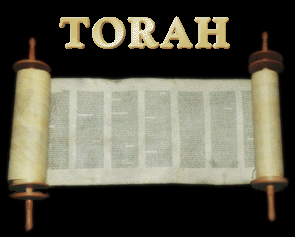
THE TORAH – DEUTERONOMY/Chapter by Chapter

[This is a work in progress; simply featuring the translation of Everett Fox’s THE FIVE BOOKS OF MOSES.  It does not include all the commentaries we usually insert after each verse, from PENTATEUCH AND HAFTORAHS, Everett Fox’s as well as Robert Alter whose translation is the same title as Fox.  We hope we can finish adding the commentary this year, but for now, for the serious student of the TORAH who has no access to Everett Fox’s translation, this is the alternative source.  We do urge all to secure a copy of it, whether by ebook or hard copy, it is worth the cost!—Admin1]


——————————–


Deuteronomy/Dabarim

Revisit: Is God the author of “evil”?

Image from www.hippoquotes.com

Image from www.hippoquotes.com

[First posted in 2012.  What prompted this repost is the series of mass killings, all occurring in the “land of the free”,  the great USA.   After the mass murder during a concert in Las Vegas, and the vehicle rampage in New York, the latest tragedy  has just occurred in a First Baptist church in a small town in  Texas.  Where in this ‘world-gone-mad’  is it safe to enjoy music, walk in a park, or worship in church? The question that’s in believers’ minds is usually:  Where is God in all this? Why is He so quiet, not preventing, not interfering? And since the latest act of violence was against worshippers of God in the ‘house’ of worship, why did God not intervene to protect worshippers of Him?


Let us not forget that all the evil is perpetrated by who else?   The only creature–

  • endowed with brains for reasoning and logic, 
  • made in the “image” of the Creator,
  • with free will to go against the laws for human relationships written in heart and conscience of the “I” in the “Image”;
  • who follows instead,  the “I-Me-Myself,” or simply the “I” in the “Idol”. 


Here’s the original introduction in 2012:


When we look at the current state of affairs everywhere in the world today, we start wondering if God is “in control” as we often hear from the mouths of die-hard religionists.  Nothing wrong with that, except we forget that the Giver of the gift of free will to humankind does not interfere with each individual’s use of that precious gift.  What He has done is to give instructions and commandments that would direct the only creature made in “His Image” to properly use His gift of free will, to make responsible choices, those aligned with His will, those that benefit fellowmen and this world the most, for that is what the TORAH teaches.


So where does evil come from?  For individuals to ‘make a choice’ there has to be not one, but at least two options to exercise that choice.  To be human is to be self-conscious and actually self-centered first (observe children); we have to be taught to be other-centered.


Ultimately, the answer is the misuse of this God-given gift.  Blame the Creator for giving humanity this gift?  No, instead, look in the mirror.  Enough people misusing the gift creates human-caused evil.  As for natural calamities, well, that is part of the natural workings in this created world.  Preventable? Sometimes. —Admin1.)


—————————————


If there is no evil being as a devil, and there are no demonic spirits wreaking havoc in our lives, then where is the evil coming from that we see in the world?


If it is caused by people, then we lay the blame there.  If it is caused by natural forces, since we cannot control nature, we live with precaution and safety-consciousness in a world of earthquakes, tornadoes, hurricanes, landslides and other natural calamities; after all, these are simply part of nature adjusting itself to maintain the balance the Creator set from the beginning of His designed order.  Everything else that does not fall under manmade causes and natural causes could ultimately be called, to borrow a phrase from insurance contracts, “an act of God.”


Many writers have seriously explored the problem of evil in the world and have arrived at different conclusions, depending on their system of belief.  Prime examples:


419gm2pappl-_ac_us240_ql65_Rabbi Harold Kushner’s When Bad Things Happen to Good People presents Reconstructionist Judaism’s point of view that horrible things do happen on a daily basis in this world, but gives a perspective that you would simply have to read in his book.


417ldjme7dl-_ac_us240_ql65_Atheist-turned-Christian C.S. Lewis struggled with the tension between belief and reality and a God who can allow so much suffering in his book The Problem of Pain; nevertheless, he never lost his faith in the Christian God.


51m6xalwgql-_sx329_bo1204203200_ In contrast, Bart Ehrman, NT scholar turned atheist because, as he explains in his book God’s Problem, the Bible fails to answer our most important question—why we suffer.


The worst thing you can tell relatives of a good person who was tortured and brutally murdered by strangers is— “it’s God’s will.”  That would make anyone turn against God, because why should God–the source of all good–will evil in the lives of good people?


So what’s the answer?  Where’s the answer? If one believes in God, turn to the Good Book and see what God Himself says.There are no simple answers but there is a verse that invites further exploration:  


[NIV]:  7 I form the light and create darkness, 
   I bring prosperity and create disaster; 
[KJV]     I, the LORD, do all these things. 7I form the light, and create darkness: I make peace, and create evil: I the LORD do all these things.


[ESV] I form light and create darkness, I make well-being and create calamity, I am the LORD, who does all these things.


Isaiah 45:7 [I am the One] Who forms light and creates darkness; Who makes peace and creates evil; I am HaShem, Maker of all these. — [ArtScroll Tanach/AST]


Please read the whole chapter of Isaiah 45 to get the context; better yet, start reading the whole book of Isaiah to truly understand what chapter 45 is all about. As we keep reiterating, verses isolated from context, Context, CONTEXT are easily misinterpreted.


One attempt to explain this particular verse went to such lengths to find out how many times the original Hebrew word for evil– “rah” —was used in the Hebrew Bible, counting the times “rah” meant “evil” and the times it meant “calamity, adversity, affliction, trouble” etc.  In this particular context of Isaiah 45, “evil” is used for trouble, calamity, and not moral evil which God by His nature, is never capable of causing.  (If you’re thinking of the book of Job, that’s another story;  please read the posts:


An even better explanation connects the verse to the religious historical context:  the Persian king Cyrus is used by YHWH as His anointed, His messiah, His instrument to enable the Israelites in exile to return to Jerusalem and rebuild the Temple. The prevalent belief among the Persians and followers of the Magian religion is dualism –that there are two supreme, independent, co-existing and eternal causes always acting in opposition to each other:  the author of good and the author of evil.  Adonai Elohim YHWH unequivocally states that He alone is the sovereign God, there is no other power that exists in opposition to Him; in that sense, everything occurs under His providential direction, whether good or evil.

Add to Isaiah the following verse from Amos:


Amos 3:6 – “Shall a trumpet be blown in the city, and the people not be afraid? shall there be evil in a city, and the LORD hath not done it?”


Just as darkness is the absence of light, evil is the absence of good.


When God withdraws from this world or conceals Himself, goodness, righteousness, justice and many more are at risk. God is the source of Light in all its metaphorical implications [spiritual understanding, biblical comprehension, enlightenment, wisdom]. God is the source of all that is associated with good — kindness, charity, mercy, justice, love, order etc.  Notice that those words reflect what is given in Commandments 5-10, all directed to levels of human relationship.


When people are ignorant of or are willfully violating God’s Torah, evil indeed triumphs.  In that sense and only in that indirect sense is God the author of evil.

 
Sig-4_16colors

AIbEiAIAAABDCNPkvrXuucmdeSILdmNhcmRfcGhvdG8qKGJkZTc0YTk3NmUxMGM4OTAzZjk5MDhkMjdkZDI2ODQ3OTliYmQ2MDkwAe5UdNp0lvYvCf8bjAFEJOY_fdsj

A Sinaite’s Liturgy – 3rd Sabbath of February

Image from www.youtube.com

Image from www.youtube.com

KINDLE THE SABBATH LIGHTS


From the heart of the Creator

Who shows His love for humankind

by preparing a universe

and a perfect environment to sustain all life,

what better message and best proof of Divine LOVE

could humanity expect than

His Created world which, in His Divine providence,

He designed not only as ‘good’ but ‘very good’!

 
Image from creativedesignsbyteresa.com

Image from creativedesignsbyteresa.com

The stage was set

before the the first of humanity entered the scene.

What an all wise Creator is our God of Love,

YHWH,

Blessed be His Holy Name!


With each setting of the life-nurturing and light-giving sun,

the Master Designer of the universe reminds us that a new day begins,

not facing a day’s labor but winding down to a good night’s rest.

And at the end of our six day work-week,

rises the Queen of Days just as His sun sinks in the horizon from our view,

signaling it is time to kindle the Sabbath lights,

and whether alone or together with family or friends,

reflect on the Wisdom of Divine Providence

that fill the days of our lives with messages of love

from the very heart of our great God

YHWH,

Praised be His Holy Name.

 And as if all that the Creator had prepared for humankind were not enough,

by His grace and because of His love for us,  

created beings He made in His image,

He did not leave us ignorant of His Will,

His Wishes

and His Way 

designed for humanity to live with one another,

connected always to Him

through His Tree of Life,

His Revelation in His TORAH,

which He gifted to humanity through His chosen people,

that they might live in peace and harmony in the Land of Promise,

where their way of life would be visible to the nations,

so that Gentiles in all nations would be drawn

to His Way,

and to HIM

Who expressed His Will and Wishes for all.  

Truly, our God YHWH, has shown His great love for us,

by blessing us with His TORAH.  

Praised be His Holy Name!


Psalm 145

 A song of Praise, of David

[revised and combined from ESV and AST]


I will exalt You, my God the King,

and I will bless Your Name forever and ever.

Every day I will bless You and praise Your Name forever and ever.

Great is YHWH, and greatly to be praised,

and His greatness is unsearchable.

Each generation will praise Your deeds to the next

and of Your mighty deeds they will tell;

On the glorious splendor of Your majesty,

and on Your wondrous deeds, I will meditate.

And of the might of Your awesome deeds they will speak,

and Your greatness I shall relate.

They shall pour forth the fame of Your abundant goodness

and shall sing aloud of Your righteousness.

YHWH is gracious and merciful,

slow to anger and abounding in steadfast love.

YHWH is good to all, and His mercies are all on His works.

All Your works shall thank You, O YHWH,

and your devout ones will bless You!

They shall speak of the glory of Your kingdom

and tell of Your power,

to make known to the children of man Your mighty deeds,

and the glorious splendor of Your kingdom.

Your Kingdom is an everlasting kingdom

and Your dominion endures throughout all generations.

[YHWH is faithful in all His words and kind in all His works.]

YHWH upholds all who are falling and raises up all who are bowed down.

The eyes of all look to You, and You give them their food in due season.

You open Your hand,

You satisfy the desire of every living thing.

YHWH is righteous in all His ways and kind in all His works.

YHWH is near to all who call on Him, to all who call on Him in Truth.

He fulfills the desire of those who fear Him;

He also hears their cry and saves them.

YHWH protects all who love Him,

but all the wicked He will destroy.

May my mouth declare the praise of YHWH,

and may all flesh bless His Holy Name forever and ever.

Image from www.lotterypost.com

Image from www.lotterypost.com

Come sip the wine, come taste the bread,

Come share the joy of Sabbath celebration,

all ye Gentiles of the nations, 

all Truth-seekers and true seekers of the One True God. . .

We seek YHWH’s blessings upon

our food, fellowship, and family.

Image from ovalezoval.blogspot.com

“Family is not always blood.

It’s the people in your life who want you in theirs.

the ones who accept you for who you are.

The ones who would do anything to see you smile

and love you no matter what.”

[Name your family members:  

parents,

siblings,

spouses,

children,

extended family.]

  May their names, and all our names, be written in the Book of Life!

May the breath of life from the Source of Life

sustain and nurture our life day by day,

week by week, from Sabbath to Sabbath,

until each of us have fulfilled our function on this earth, in this life.  

When we know Him, YHWH, as the One True God,

then we make His Name known to those who, like us,

seek with all their heart and all their mind and all their substance.  

They will find Him, just as we have found Him.  

Hear O Yisrael, hear O Gentiles of the Nations,

YHWH is LORD, YHWH is One.  

YHWH is the Creator, the Revelator on Sinai,

the God of Israel, the God of Sinaites,

God of the Nations,

whether they acknowledge Him or not,

YHWH is GOD!

Sabbath Meal

Image from ilearnch.com

Image from ilearnch.com

TORAH STUDY

 
Image from www.cllnswbpgfx.com

Image from www.cllnswbpgfx.com


HAVDALAH


Image from ovalezoval.blogspot.com

[Sonnet 43  was written by Elizabeth Barrett Browning;  we are borrowing her poetry to express our love for YHWH our God, but with revisions to suit a Sinaite’s creed]

How Do I Love Thee? 

How do I love Thee? Let me count the ways.


I love Thee to the depth and breadth and height my soul can reach,

when feeling out of sight, for the ends of being and ideal grace.


I love Thee to the level of every day’s most quiet need, by sun and candlelight.


I love Thee freely, as men strive for right;  


I love Thee purely, as they turn [to] praise.


I love Thee with the passion put to use in my old griefs, and with my childhood’s faith.


I love Thee with a love I seemed to [never have lost despite the passing of time];


I love Thee with the breath, smiles, tears, of all my life;


[and if Thou, YHWH so choose to grant me my eternal rest],

 I shall but love Thee [even to my] end in this life.

 
Image from www.scrapsyard.com

Image from www.scrapsyard.com


Shabbat shalom!


Sig-4_16colors

logo

A Sinaite’s Musical Liturgy – 2nd Sabbath of February 2019

[February being ‘heart month’, it is fitting to devote this 2nd Sabbath of the month to love for God and fellowman.  How  best to express it?  In song of course; and so, another musical celebration of the Queen of Days. Since we love Christian music which we’ve been used to when we belonged to that ‘religion’, we adapt the music but revise the lyrics to suit a Sinaite’s creed.   If you know the tune of the songs, a capella works; if not, reciting the lyrics also works, but there’s nothing like singing the hymns; after all, that’s why we alternate our recited and musical liturgies every other Sabbath. —Admin1.]

Image from www.mairie-sainttriviersurmoignans.fr

KINDLE THE SABBATH LIGHTS


 Music: As the Deer – Psalm 42


[As the Deer is a well-known praise and worship song by Martin J. Nystrom, a native of SeattleWashington. Written in 1981, this song is based on Psalm 42:1

 Music we love, words we expand in this rewrite of the lyrics.]


1.  As the deer pants for flowing streams, oh how my soul pants for You, my KING;

You alone fill my heart’s desire, praise for You, love for You, I sing!

You alone are my strength my shield, to You alone may my spirit yield,

YAHUWAH,  You’re my LORD and MASTER,

on Your words, my whole life I build.


2.   You are One and the Only GOD,  yes all the more You are my KING;

I love you, yes there is no other,  love You more than most anything.

You alone fill my heart, my mind, in You alone does my spirit find . . .

peace of heart and true peace of mind,  oh how I leave all my doubts behind.


3.  I want You more than gold or silver, only You can satisfy.

Only You are the real Joy-Giver; live without You, oh how could I.

Fill my life with Your Living Word;  oh fill my mind with Your Will, Your Word,

Love for You shows in how I live my life for You, only You, my LORD.

Soul Thirst

Water color art by Sinaite Dan R., now based in Houston TX


Deuteronomy 10:12-19


Fear YHWH~

12 And now, Israel,

what does YHWH your God ask of you

but to fear YHWH your God,

to walk in obedience to him,

to love him, to serve YHWH your God

with all your heart and with all your soul,

13 and to observe YHWH’s

commands and decrees

that I am giving you today for your own good?

14 To YHWH your God belong the heavens,

even the highest heavens,

the earth and everything in it.

15  Yet YHWH set his affection

on your ancestors and loved them,

and he chose you, their descendants,

above all the nations—as it is today.

16 Circumcise your hearts, therefore,

and do not be stiff-necked any longer.

17 For YHWH your God

is God of gods and Lord of lords,

the great God, mighty and awesome,

who shows no partiality and accepts no bribes.

18 He defends the cause of the fatherless and the widow,

and loves the foreigner residing among you,

giving them food and clothing.

19 And you are to love those who are foreigners,

for you yourselves were foreigners in Egypt.


Deuteronomy 11:13-22

13 So if you faithfully obey the commands

I am giving you today—

to love YHWH your God

and to serve him with all your heart

and with all your soul—

14  “then I will send rain on your land in its season,

both autumn and spring rains,

so that you may gather in your grain,

new wine and olive oil.

15  I will provide grass in the fields for your cattle,

and you will eat and be satisfied.

16  Be careful,

or you will be enticed to turn away

and worship other gods and bow down to them.”

17  Then YHWH’s anger will burn against you,

and He will shut up the heavens

so that it will not rain

and the ground will yield no produce,

and you will soon perish from the good land

YHWH is giving you.

18  Fix these words of mine in your hearts and minds;

tie them as symbols on your hands

and bind them on your foreheads.

19  Teach them to your children,

talking about them when you sit at home

and when you walk along the road,

when you lie down and when you get up.

20  Write them on the door-frames of your houses

and on your gates,

21  so that your days and the days of your children

may be many in the land

YHWH swore to give your ancestors,

as many as the days that the heavens are above the earth.

22  If you carefully observe all these commands

I am giving you to follow—

to love YHWH your God,

to walk in obedience to him

and to hold fast to him . . . .


“I Love You Lord”/Revised Lyrics

[For an interesting background of this song ” written by Laurie Klein:  aliveworshipexperience.blogspot.com/2007/12/test_9934.html‎.]


Vs. 1 [Original Lyrics]

I love You LORD

and I give my own to worship You,

O my soul rejoice

Take joy, my KING in what You hear,

Let it be a sweet, sweet sound in Your ear.


Vs. 2  [Sinaite]

How can I show my deep love for You,

do words suffice from a heart that’s true,

must action show all of what I know,

In my lifetime will I prove my true love for You.


BLESSINGS

Image from www.bellybytes.com

Image from www.bellybytes.com

[Original music: We Gather Together to Seek the Lord’s Blessing,

Revised Lyrics]


1.  We bless You YAHUWAH,  the Source of our joy

as we welcome Your Sabbath, the Queen of all days!

This wine that we drink and this bread we share together,

Like manna and the water that flowed from the Rock.


2.  Much joy to our lives does Your blessed Rest bring us,

We rest from our labor, we rest from our toil,

Just as You commanded, just as You modeled for us,

We bless Your Sabbath day, the Queen of all days.


 3. We thank You dear FATHER for blessing our family,

The husbands and wives who are with us today,

Beloved who’ve left us, our loved ones who are with us,

Our sons and daughters all, wherever they be.


4.  How bless-ed are we to be with one another,

Of one heart and mind, we’re devoted to You,

We honor Your Sabbath, You’re LORD of our Sabbath,

We bless Your Holy Name,

YAHUWAH our KING.

Image from www.topazhorizon.com

Sabbath-join-us
Image from www.wunderland.com

Image from www.wunderland.com


HAVDALAH


[ “Ceaseless Praise,” Music by Tom Fetke

Original Lyrics by Frances Ridley Havertal]


1.  Take my life and let it be consecrated LORD to Thee;

Take my hands and let them move at the impulse of Thy Love;

Take my feet and let them be swift and beautiful for Thee;

Take my voice and let me sing always only for my KING.


Cho:  LORD I give my life to Thee, Thine forever more to be (2X]

[pause for interlude before next stanza]

2.  Take my lips and let them be filled with messages from Thee;

Take my silver and my gold, not a mite would I withhold,

Take my love my God I pour at Thy feet its treasure store,

Take myself and I will be ever, only, all for Thee,

 Thine forevermore to be.


1101


Shabbat shalom!

Sig-4_16colors


 logo-e1422801044622


A Sinaite’s Liturgy – 1st Sabbath of February 2019

KINDLE THE SABBATH LIGHTS

As earthly time moves oisn

to the second month of the Gregorian calendar year,

we remember how the Creator instructed the Israelites to reckon time:

For the day it is the visual setting and rising of the sun,

from sundown to sundown.

For the week there is no visual reminder

except for the Sabbath keeper

to keep track of days one to six,

so that all may know that on the seventh,

we welcome the Queen of Days, 

we enter the dimension in time

of the TRUE LORD of the Sabbath, YHWH,

a ‘timely’ memorial to the Creator and His Creation,

Who ceased from His creative work,

not because He was tired or needed rest,

but because He had completed His Creation to perfection,

which He declared not only ‘good’ but ‘very good’!

It is a Sabbath as well for the first man and woman,

representative humanity,

a day to cease from earthly strivings and concerns, 

from labor and toil to provide rest for body and mind;

to remember and welcome

the Lord and His Sabbath into one’s heart and home,

in the company of family and loved ones,

in fellowship with like-minded believers

and worshippers of —

YHWH, Creator,

Lord of the Sabbath.

As for reckoning time according to the month,

it is the first sighting of a sliver of the silvery moon,

visible to primal humanity,

who had not yet learned how to deal with the passing of time on earth.

20180131135743_875033

[http://time.com/5126611/super-blue-blood-moon-pictures-2018/]

And as though it were not enough to take pleasure in viewing  the weekly, monthly, yearly spectacles in the visible heavens, 

that all living creatures could take pleasure viewing on ordinary nights,

our Creator surprises us with more naturally occurring phenomena 

such as the ‘Super Blue Blood Moon Eclipse’ which was visible on earth at this time in year 2018,

a rare celestial phenomenon that had not occurred since 1982,

that was viewed, ‘free for all’, 

by young and old, rich or poor!

Interested or not, it was there

for the ‘sighted’ who have eyes to see

and hopefully, with spiritual vision as well,

 FOR — what is the use of being endowed with eyes and brain,

if neither vision nor intellect recognize the existence of—

a Designer-Creator-First Cause-GOD,

Who has spoken to humanity from Sinai,

and continues to speak through His Creation —

YHWH is His Name!


Indeed, what a great God is our Creator,

Who existed before the beginning of earthly time,

Who spoke the world into existence in Genesis/Bereshith,

YHWH is His Name, 

Who cared about His crown of creation, humanity,

Who taught us how to live our precious lives

as measured and treasured moments on planet earth,

 according to predictable cycles of nature,

in seasons for agricultural guidance,

as early as the culmination of creation week.

As we begin a new month,

may we remember to praise 

the Creator of that moon and all the heavenly bodies,

Image from endtimepilgrim.org

the Designer of the luminaries in the heavens,

the Giver of Light to our darkened  world,

the Source of light that illuminates the pathway toward Him.

His other ‘light’ on earth is the Torah –

the Way to Life in the custody of His Chosen People,

His ‘light to the Gentiles.’


May the time come that all humanity will embrace the Torah

as their Guideline for living on this planet earth, 

so that all will call upon the Name YHWH,

as the prophets of Israel prophesied for the end of the age–

Indeed may that time come soon, according to His perfect timing!

Blessed be our Creator God, True Light of our life,

YHWH,

Blessed be His Holy Name!


Psalm 8


O YHWH, our Lord,

how majestic is Your Name in all the earth!

You have set Your glory in the heavens.

Through the praise of children and infants

You have established a stronghold against Your enemies,

to silence the foe and the avenger.

When I consider Your heavens, the work of Your fingers,

the moon and the stars, which You have set in place,

what is mankind that You are mindful of them,

human beings that you care for them?

You have made them a little lower than the angels

and crowned them with glory and honor.

You made them rulers over the works of Your hands;

You put everything under their feet: all flocks and herds,

and the animals of the wild, the birds in the sky,

and the fish in the sea, all that swim the paths of the seas.

O YHWH, our Lord, how majestic is Your name in all the earth!


 Psalm 8

—set to music by Tom Fettke and lyricist Linda Lee Johnson;

Listen to or sing along with this rendition by the UC (University of the Cordilleras) Chorale] as you read the lyrics:

When I gaze into the night skies and see the work of Your fingers;
The moon and stars suspended in space.

Oh what is man, of what is man that You are mindful of him?
You have given man a crown of glory and honor,
And have made him a little lower than the angels.
You have put him in charge of all creation:
the beasts of the field, the birds of the air, the fish of the sea.

O what is man, O what is man that You are mindful of him?

O Lord, our God the majesty and glory of Your Name
Transcends the earth and fills the heavens.
O Lord, our God; little children praise You perfectly,
And so would we, and so would we . . . .

Hallelu YAH, Hallelu YAH!

The majesty and glory of Your name;

Hallelu YAH, halleluYAH

The majesty and glory of Your name;

HalleluYAH, halleluYAH, halleluYAH, halleluYAH

HalleluYAH halleluYAH, hallelu . . . . .

hallelu YAH.


BLESSINGS

Image from ourmotherjerusalem.wordpress.com

Image from ourmotherjerusalem.wordpress.com

Blessed are You,

YHWH our God,

Who created the fruit of the vine,

symbolic of the joy we feel in knowing You,

and in blessing Your Name,

and the joy we derive in celebrating Your Sabbath,

the joy of fellowshipping with like-minded friends,

the joy from family,

the joy in savoring food to nourish our body,

the joy in living each day —

for the time You have allotted

to each one of us in our lifetime.

For the joy of living each precious day for You,

Who gives meaning to our very existence,

O YHWH,

our Lord and our God,

we thank You!  

To Life, l’chaim, mabuhay!

Image from caughtbetweenspaces.wordpress.com

Blessed are You, O YHWH our God,

Who has blessed generation after generation in our family:

[name them]

grandparents we had the privilege of knowing,

loving parents who participated in the miracle of giving life,

siblings with whom we shared our growing up years,

spouses with whom we united in marriage,

children who are blessings to our lives,

extended members of our family: in-laws, grandchildren 

 and household staff who attend to our needs,

May You continue to bless all of them,

including those who are not here with us.

It is our desire that all of them 

will come to know You,

love You,

and worship You,

just as we have been privileged 

to experience You in our lifetime.

Amen.


SABBATH MEAL

image from judaicafinearts.com

image from judaicafinearts.com

Image from www.haruth.com

Image from www.haruth.com


HAVDALAH


Today, may there be peace within:

peace of mind,

peace in  heart,

peace in hearth and home,

peace in our city,

peace in our country, 

and most importantly —

peace in the Land of Israel,

for all the mixed inhabitants who live there today.

May a true “sabbath” —a ceasing of hostility–

be observed among Israelis and non-Israelis,

and all mixed ethnic, cultural and religious groupings

who are based in the Land of Promise,

find true peace in their lives,

from now and for all time.


May the love of our ever gracious GOD,  LORD and KING,

fill our hearts so fully that it manifests in our daily life,

finding expressions in word as well as in deed,

in sharing of ourselves and of our resources

with those in need.

May we make a difference in the lives of others

that they might see the Source of our joy in simply knowing—

the God of Israel,

the God of all nations,

Creator,

Lord and Master of the universe,

Lord of the Sabbath.

Chosen God of Sinaites,

YHWH is His Name,

The Name above all names,

YHWH is LORD, YHWH is GOD,

YHWH is ONE.

Amen.


Image from margaretfeinberg.com

Image from margaretfeinberg.com

Shabbat Shalom

to Sinaites

all over the world,

and to our Christian

and Messianic friends

who celebrate

the True Sabbath,

on the Seventh day

of the week!

Sig-4_16colors


logo-e1422801044622

Must Read – 6 – Robert Shoen/The Torah and the Law; Jewish symbols

Image from amazon.com

Image from amazon.com

[This article, first posted in 2014, is the most frequently clicked out of our over 1000+ list.  It is the last in the series from the book authored by Robert Schoen.  

Earlier posts include: 

For the rest of the book chapters, you will have to get a copy for your library; that is why we do feature these MUST READ/MUST HAVE favorites in our library, to promote books you might otherwise not know about but could learn a lot from and would learn a lot more if you owned a copy.  It’s downloadable as an ebook or kindle book from amazon.com, worth the price!Admin1.]


——————————–


Image from www.hebroots.com

Image from www.hebroots.com

THE TORAH AND THE LAW


If you have ever been to a synagogue service or seen parts of a service on television or in a movie, you know that Jews read from a scroll.  This scroll is the Torah. .  In this day of sophisticated word processing and print technology, a highly trained scribe (sofer in Hebrew) still produces each scroll by hand.  The sofer writes on parchment using a quill and special ink in the same way and to the same exacting standards as has been done for centuries.


Specifically, the Torah refers to the Five Books of Moses (the Pentateuch).  Sometimes, however, people may use the word Torah in a general sense to refer to the entire Bible or to all the religious texts of the Jewish people.


The phrase “the Jewish Bible” refers to three distinct groups of Jewish writings.

  • First is the Torah (the Pentateuch).  These are the Five Books of Moses (Genesis, Exodus, Leviticus, Numbers, and Deuteronomy), recorded on the Torah scroll as described previously.  Portions are read each week during synagogue services.


  • The second section is known as the Prophets (in Hebrew Nevi’im) and includes the Books of Joshua, Judges, Samuel I and II, Kings I and II, Isaiah, Jeremiah, Ezekiel, and the twelve minor prophets, which count as one book (Hosea, Joel, Amos, Obadiah, Jonah, Micah, Nahum, Habakkuk, Zephaniah, Haggai, Zechariah, and Malachi).


  • The third section is variously known as the Writings, the Hagiographa, or Ketuvim, a Hebrew word.  This section includes the books of Psalms, Proverbs, Job, Song of Songs, Ruth, Lamentations, Ecclesiastes, Esther, Daniel, Ezra and Nehemiah  (these count as one book), and Chronicles I and II.


Using the first letters of the Torah and the Hebrew words for the other two books (Nevi’im and Ketuvim), you arrive at the acronym TNK, which is pronounced “Tanakh”and is what Jewish people call the Bible (the Holy Scriptures) in Hebrew.


Many of the laws, passages, and directives in the Torah are not fully explained, are confusing, or may seem contradictory.  Over the centuries, law based upon study and analysis of the Torah was passed down by word of mouth.  This oral law, which provided explanations and amplifications of the written law, was finally organized and written down by the earliest rabbinic scholars in the first through third centuries CE and is known as the Mishnah (Hebrew for “recapitulation”).


The Mishnah deals with temple rituals, holiday observances, agricultural issues, and family life, but it also contains many proverbs and philosophical observations.


As scholars studied the Mishnah, they wrote down their commentaries and discussions about it.


These commentaries, called the Gemara (Aramaic for “study”), are interspersed into each paragraph or section of the Mishnah and give insight into historical, spiritual, ethical, and legal issues.


The combination of the Mishnah and the Gemara is called the Talmud.  In case you’re not already confused, there are two versions of the Talmud:

  • the Jerusalem (or Palestinian) Talmud and
  • the Babylonian Talmud.

These days, when we refer to the Talmud, we refer to the Babylonian Talmud, which was completed about 500 CE.  Talmudic study, while quite difficult, opens a world of spiritual wisdom, humor and anecdote, and rabbinical arguments and puzzles.


As a matter of fact, the Talmud is a storehouse of advice, recommending that we always begin a lecture with a funny story, that we should never have more than twenty-five students in a classroom, and that we should always give a person the benefit of the doubt.  It also gives practical advice for otherwise arguable situations.


 For example, when is Shabbat over?  The answer is at the end of the day, when it is dark.  How dark must it be for the day to be ended?  The Talmud tells us that a person must be able to see three stars in the sky.  But what if it is a rainy or overcast night?  Consult the Talmud for the solution.


Throughout the ages, many illustrious and renowned Jewish scholars have contributed to the oral tradition, the Mishnah and the Talmud, and the Midrash, a collection of rabbinical questions and commentaries on the Bible (for example, “Why did God appear to Moses as a burning bush and not a tree?”).


Midrash is a Hebrew word meaning “investigation,” and passages in the Midrash often take the form of a story about whatever issue is being discussed or explained.


It is not unusual to refer to this group of rabbinical scholars as a source of information or authority when describing a particular law or practice in Judaism.

  • Some people believe that the first rabbis were the Pharisees, a Jewish group that lived in the Holy Land at the time of Jesus.  Their interpretation of the Torah was liberal for that day, and they introduced new ideas and concepts that were contrary to much of what was believed at the time.
  • For the next thousand years, these scholars, teachers, and philosophers—collectively referred to as “the Rabbis” or “the Sages” —worked on the religious books and documents that form the core of Jewish religious writings.


The entire body of Jewish law is known as Halachah, and it is this law that guides observant Jews through life, indicating what should be done at any given time or in a given situation as well as what should  not be done and what is not acceptable.


In other words, Halachah indicates patterns for behavior and for life in general.  the root of the word Halachah  means “to go” or “to walk,” and Halachah can be thought of as a person’s “path through life.”

Halachah, therefore, is a set of codes based on the Talmud that regulates family relationships, legal matters, education, diet, and personal and religious observances.


During the many years when Jews were self-governed in their own communities, these codes provided a legal system, which was a guide to what was acceptable and what was punishable as a crime.  After Jews were no longer subject to the discipline of their own community, the law of the land in which they lived took precedence, but the Halachah lived on as a guide to personal behavior.


Modern Jews continue to seek spiritual guidance as well as practical advice from their rabbis and scholars, just as people of other religious groups seek help and advice from their pastors, ministers, and priests.  While the Jewish tradition of law and commentaries on the Torah may not always be followed to the letter, these sources, spanning thousands of years and written and collected by the great minds of the ages, provide a wealth of guidance and wisdom from the past to be used in the present.


Issues covered by these writings vary in depth and importance, from marriage to divorce, from kosher kitchen practices to experimental scientific research, and from smoking in or near the synagogue to the introduction of female rabbis and cantors in congregations.  Whatever the question or issue, Jewish tradition, wisdom, and scholarship can often help solve contemporary problems.  While members of the different branches of Judaism follow these sources to different degrees (or not at all), they can be spiritual (as well as secular) guides if we wish them to be.


Image from www.chabad.org

Image from www.chabad.org


Prayers and Blessings


Any Jew can pray on his own.  However, to say certain prayers or to have what is considered a full worship service, there must be at least ten adults present.  This group is called a minyan.  The requirements for being a member of a minyan vary among different congregations.


  • Orthodox congregations require that the minyan comprise ten Jewish men over age thirteen.
  • Most Conservative congregations include women in the ten-person minyan.
  • Reform congregations generally do not require a minyan for group prayers.


It is considered somewhat of an honor to be the tenth person to join the group, since then the group can get to the business at hand.  I remember occasions when someone had to go hustle up a tenth member, often calling someone on the phone or snatching a person from his office.


The number ten appears quite a few times in Judaism:

  • ten commandments,
  • ten plagues,
  • Abraham’s ten tests of faith,
  • the ten righteous in Sodom and Gomorrah, and so forth.


The congregation of “ten” comes from the Book of Numbers: ten of Moses’ spies, returning from the Land of Canaan, had distorted the truth, whereupon God proclaims, “How long shall this wicked congregation complain against me?” (Numbers 14:27).


In services where we read from the Torah, it is customary that when the Torah “stands” (is held or raised), the congregants stand; when the Torah sits (is placed on the reading lectern or returned to the ark), the congregants sit.  Whenever the ark containing the Torah scrolls is open or when the scrolls are being carried, the congregants stand.  There are some exceptions, but those are the general rules.  Your physical abilities and health take precedence over these rules.


Traditional Orthodox Jews pray in the morning, in the afternoon, and again in the evening (although the afternoon and evening prayers are often said in succession).  Depending on how observant they are, other Jews may pray once a day, once a month, once a year, or only when they feel the need to express happiness, grief, or some other emotion.


I was always under the impression that a person “faces east” when praying.  In actuality, a person faces toward Jerusalem, specifically toward the site where the temple once stood. Thus, if you are in Turkey, you look at your compass and face south.


There are several prayers that are common to most services.  The first (from Deuteronomy 6:4) is the Shema, an affirmation that announces, “Hear O Israel:  The Lord is our God, the Lord is one.”


Liberal Jewish congregations now translate prayers so that they are gender-sensitive.  Here is such a version of the same :


Hear, O Israel, the Eternal One is our God, the Eternal God alone!  Blessed is God’s glorious majesty for ever and ever!
 

A second prayer basic to the service is the Amidah, generally recited silently while standing.  In this prayer we ask God to give us peace and help us solve many of the personal problems and difficulties we all face.


The Aleinu is a prayer that looks to the future as one of hope and peace while reminding us that it is incumbent upon us to give praise to God.


The Kaddish prayer, extolling God’s majesty and kingdom, is recited several times during a service.  Although having nothing to do with death, the Kaddish is traditionally recited while remembering the departed.  As I get older, I hear (and recite) this prayer more and more as friends and relatives die.


As you might expect, there are blessings for everyday routines, such as waking, eating, traveling, and retiring for the day. Most common is the Grace before Meals, known as the Motzi or HaMatzi  This prayer gives thanks for the “bread of the earth,” bread being symbolic of food in general:


We praise You, Eternal God, Sovereign of the universe,

for You cause bread to come forth from the Earth.


Another standard blessing is the blessing over wine, the Kiddush, giving thanks for “the fruit of the vine:


We praise You, Eternal God, Sovereign of the universe,

Creator of the fruit of the vine.


There is also a prayer of Grace after Meals as well as one that is recited before lighting the Shabbat candles.


After thousands of years, you can imagine that special prayers have developed to respond to special needs.  Some may be considered bizarre and some unnecessary.  Others may actually seem inappropriate or objectionable in this day and age (“Thank you, God, for not having created me a woman” [see “Women and Judaism”]).


Do all Jews recite all of these prayers? Hardly.  As I’ve said before, it all depends on a person’s level of religious observance.  Someone may use prayer time to offer up personal messages to God or to create his or her own individual devotions.  However, the list of available prayers in Judaism is extensive.


Special prayers can be created for special needs.  One special prayer thanks God for the creation of the rainbows.  Or, remember the scene in Fiddler on the Roof when the townspeople ask the rabbi if there is a blessing for the czar?  After a moment of reflection, the rabbi replies, “May the Lord bless and keep the czar . . . far away from us!”


Anyone who plays a reed instrument—clarinet, saxophone, oboe, or bassoon—knows the constant frustration of dealing with the fickle reeds.  I once asked a rabbi if there could possibly be a blessing made over a saxophone reed or if this was a sacrilegious request. “Nonsense,” he replied, and offered me a prayer using the Hebrew word for reeds, zufim, which is the word used to describe the Reed Sea.  I use the blessing now and am always happy to share it with my fellow musicians.  Reeds still drive me crazy, but the prayer thanks God for creating and giving us the reed, the bread, the fruit of the earth, the rainbow, or whatever.  The quality of the gift is not the primary issue.


Symbols—The Mezuzah and the Star of David


Image from micdsgashman.wikispaces.com

Image from micdsgashman.wikispaces.com

When you visit the homes of many Jews, you will find a small metal, wooden, glass, or ceramic case several inches in height called a mezuzah (literally, “doorpost”) fastened to the right doorpost of the front door.  Inside the mezuzah is a tiny handwritten parchment scroll (called a klaf) containing two paragraphs from the Torah (Deuteronomy 6:4-9 and 11:13-21) as well as three Hebrew letters that spell one of the names used for God.


The Bible instructs us to “write them [God’s Words] on the doorposts of your house and on your gates” (Deuteronomy 6:9).  As far back as two thousand years ago, Jews have chosen to follow this instruction using the mezuzah.


It is not uncommon for a person to kiss his or her fingertips and transfer the kiss to the mezuzah by touching it as he or she passes in and out of the home; others touch the mezuzah first and then kiss their fingers.  Many Jews have only one mezuzah in their home, but some have them affixed to the doorway of each bedroom or living area in the house.  Many people wear a small mezuzah on a chain around the neck as jewelry.


Like many customs, the fixing of the mezuzah is surrounded by tradition, mysticism, and a pinch of superstition.  Some say the letters on the scroll make up an acronym that gives protection to the home.  I know of a distinguished symphony conductor who delayed the move into his new house until the local rabbi could come to the home, certify that the scroll inside the mezuzah was proper, accurate, and legitimate, and conduct a formal ceremony at which the mezuzah was applied to the doorpost.  Many people take these things very seriously.


BadJews6Another symbol often seen in pieces of jewelry is the chai, made up of two Hebrew letters.  The word chai means “life,” just as the phrase (and song title), “L’Chaim!” (often used as a toast) means “to life.”  In addition, the two letters making up the word chai have a numerical equivalent of eighteen, giving this number a special significance to Jews. Multiples of eighteen dollars are often given as gifts or donations.


Image from www.fotolibra.com

Image from www.fotolibra.com

The six-pointed star, often called the Star of David, is commonly associated with Jews and Judaism.  In Hebrew, it is known as the Magen David, which means “the shield of David.”  Ironically, this symbol has been associated throughout the centuries not only with Jews, but with Muslims, Christians, and other groups.  However, as it came to be used more and more in the design of synagogues built in Europe over three hundred years ago, it became identified as a Jewish symbol.  It was so closely identified with Judaism that Nazis forced Jews to wear a yellow Star of David during the years of persecution and incarceration.


Now, the Star of David not only decorates jewelry, gifts, and other Judaica but also adorns the flag of the State of Israel.  Jews around the world consider the Star of David a proud symbol of Judaism.

Revisit: Is God the author of “evil”?

Image from www.hippoquotes.com

Image from www.hippoquotes.com

[First posted in 2012.  When we look at the current state of affairs everywhere in the world today, we start wondering if God is “in control” as we often hear from the mouths of die-hard religionists.  Nothing wrong with that, except we forget that the Giver of the gift of free will to humankind does not interfere with each individual’s use of that precious gift.  What He has done is to give instructions and commandments that would direct the only creature made in “His Image” to properly use His gift of free will, to make responsible choices, those aligned with His will, those that benefit fellowmen and this world the most, for that is what the TORAH teaches.


So where does evil come from?  What what does the word “evil” ultimately mean?  Are there degrees of evil-doing? Is evil-doing the same as wrong-doing?  At least wrong-doing can be defined as the opposite of doing right, or what is right, but right according to whom?  Of course, according to the God Who defines what is RIGHT in His Eyes. 


For individuals to ‘make a choice’ there has to be not one, but at least two options to exercise that choice.  To be human is to be self-conscious and actually self-centered first (observe children); we have to be taught to be other-centered.


Ultimately, the answer is the misuse of this God-given gift of choice.  Blame the Creator for giving humanity this gift?  No, instead, look in the mirror.  Enough people misusing the gift creates human-caused evil.  As for natural calamities, well, that is part of the natural workings in this created world.  Preventable? Sometimes. —Admin1.)


—————————————


If there is no evil being as a devil, and there are no demonic spirits wreaking havoc in our lives, then where is the evil coming from that we see in the world ?


If it is caused by people, then we lay the blame there.  If it is caused by natural forces, since we cannot control nature, we live with precaution and safety-consciousness in a world of earthquakes, tornadoes, hurricanes, landslides and other natural calamities; after all, these are simply part of nature adjusting itself to maintain the balance the Creator set from the beginning of His designed order.  Everything else that does not fall under manmade causes and natural causes could ultimately be called, to borrow a phrase from insurance contracts, “an act of God.”


Many writers have seriously explored the problem of evil in the world and have arrived at different conclusions, depending on their system of belief.  Prime examples:


419gm2pappl-_ac_us240_ql65_Rabbi Harold Kushner’s When Bad Things Happen to Good People presents Reconstructionist Judaism’s point of view that horrible things do happen on a daily basis in this world, but gives a perspective that you would simply have to read in his book.


417ldjme7dl-_ac_us240_ql65_Atheist-turned-Christian C.S. Lewis struggled with the tension between belief and reality and a God who can allow so much suffering in his book The Problem of Pain; nevertheless, he never lost his faith in the Christian God.


51m6xalwgql-_sx329_bo1204203200_ In contrast, Bart Ehrman, NT scholar turned atheist because, as he explains in his book God’s Problem, the Bible fails to answer our most important question—why we suffer.


The worst thing you can tell relatives of a good person who was tortured and brutally murdered by strangers is— “it’s God’s will.”  That would make anyone turn against God, because why should God–the source of all good–will evil in the lives of good people?


So what’s the answer?  Where’s the answer? If one believes in God, turn to the Good Book and see what God Himself says.There are no simple answers but there is a verse that invites further exploration:  


[NIV]:  7 I form the light and create darkness, 
   I bring prosperity and create disaster; 
[KJV]     I, the LORD, do all these things. 7I form the light, and create darkness: I make peace, and create evil: I the LORD do all these things.


[ESV] I form light and create darkness, I make well-being and create calamity, I am the LORD, who does all these things.


Isaiah 45:7 [I am the One] Who forms light and creates darkness; Who makes peace and creates evil; I am HaShem, Maker of all these. — [ArtScroll Tanach/AST]


Please read the whole chapter of Isaiah 45 to get the context; better yet, start reading the whole book of Isaiah to truly understand what chapter 45 is all about. As we keep reiterating, verses isolated from context, Context, CONTEXT are easily misinterpreted.


One attempt to explain this particular verse went to such lengths to find out how many times the original Hebrew word for evil– “rah” —was used in the Hebrew Bible, counting the times “rah” meant “evil” and the times it meant “calamity, adversity, affliction, trouble” etc.  In this particular context of Isaiah 45, “evil” is used for trouble, calamity, and not moral evil which God by His nature, is never capable of causing.  (If you’re thinking of the book of Job, that’s another story;  please read the posts:


An even better explanation connects the verse to the religious historical context:  the Persian king Cyrus is used by YHWH as His anointed, His messiah, His instrument to enable the Israelites in exile to return to Jerusalem and rebuild the Temple. The prevalent belief among the Persians and followers of the Magian religion is dualism –that there are two supreme, independent, co-existing and eternal causes always acting in opposition to each other:  the author of good and the author of evil.  Adonai Elohim YHWH unequivocally states that He alone is the sovereign God, there is no other power that exists in opposition to Him; in that sense, everything occurs under His providential direction, whether good or evil.


Add to Isaiah the following verse from Amos:


Amos 3:6 – “Shall a trumpet be blown in the city, and the people not be afraid? shall there be evil in a city, and the LORD hath not done it?”


Just as darkness is the absence of light, evil is the absence of good.


When God withdraws from this world or conceals Himself, goodness, righteousness, justice and many more are at risk. God is the source of Light in all its metaphorical implications [spiritual understanding, biblical comprehension, enlightenment, wisdom]. God is the source of all that is associated with good — kindness, charity, mercy, justice, love, order etc.  Notice that those words reflect what is given in Commandments 5-10, all directed to levels of human relationship.


When people are ignorant of or are willfully violating God’s Torah, evil indeed triumphs.  In that sense and only in that indirect sense is God the author of evil.


NSB@S6K

AIbEiAIAAABDCNPkvrXuucmdeSILdmNhcmRfcGhvdG8qKGJkZTc0YTk3NmUxMGM4OTAzZjk5MDhkMjdkZDI2ODQ3OTliYmQ2MDkwAe5UdNp0lvYvCf8bjAFEJOY_fdsj


Sig-4_16colors


Is God the author of “evil”?

Image from www.hippoquotes.com

Image from www.hippoquotes.com

[First posted in 2012.  When we look at the current state of affairs everywhere in the world today, we start wondering if God is “in control” as we often hear from the mouths of die-hard religionists.  Nothing wrong with that, except we forget that the Giver of the gift of free will to humankind does not interfere with each individual’s use of that precious gift.  What He has done is to give instructions and commandments that would direct the only creature made in “His Image” to properly use His gift of free will, to make responsible choices, those aligned with His will, those that benefit fellowmen and this world the most, for that is what the TORAH teaches.


So where does evil come from?  What what does the word “evil” ultimately mean?  Are there degrees of evil-doing? Is evil-doing the same as wrong-doing?  At least wrong-doing can be defined as the opposite of doing right, or what is right, but right according to whom?  Of course, according to the God Who defines what is RIGHT in His Eyes. 


For individuals to ‘make a choice’ there has to be not one, but at least two options to exercise that choice.  To be human is to be self-conscious and actually self-centered first (observe children); we have to be taught to be other-centered.


Ultimately, the answer is the misuse of this God-given gift of choice.  Blame the Creator for giving humanity this gift?  No, instead, look in the mirror.  Enough people misusing the gift creates human-caused evil.  As for natural calamities, well, that is part of the natural workings in this created world.  Preventable? Sometimes. —Admin1.)


—————————————


If there is no evil being as a devil, and there are no demonic spirits wreaking havoc in our lives, then where is the evil coming from that we see in the world ?


If it is caused by people, then we lay the blame there.  If it is caused by natural forces, since we cannot control nature, we live with precaution and safety-consciousness in a world of earthquakes, tornadoes, hurricanes, landslides and other natural calamities; after all, these are simply part of nature adjusting itself to maintain the balance the Creator set from the beginning of His designed order.  Everything else that does not fall under manmade causes and natural causes could ultimately be called, to borrow a phrase from insurance contracts, “an act of God.”


Many writers have seriously explored the problem of evil in the world and have arrived at different conclusions, depending on their system of belief.  Prime examples:


419gm2pappl-_ac_us240_ql65_Rabbi Harold Kushner’s When Bad Things Happen to Good People presents Reconstructionist Judaism’s point of view that horrible things do happen on a daily basis in this world, but gives a perspective that you would simply have to read in his book.


417ldjme7dl-_ac_us240_ql65_Atheist-turned-Christian C.S. Lewis struggled with the tension between belief and reality and a God who can allow so much suffering in his book The Problem of Pain; nevertheless, he never lost his faith in the Christian God.


51m6xalwgql-_sx329_bo1204203200_ In contrast, Bart Ehrman, NT scholar turned atheist because, as he explains in his book God’s Problem, the Bible fails to answer our most important question—why we suffer.


The worst thing you can tell relatives of a good person who was tortured and brutally murdered by strangers is— “it’s God’s will.”  That would make anyone turn against God, because why should God–the source of all good–will evil in the lives of good people?


So what’s the answer?  Where’s the answer? If one believes in God, turn to the Good Book and see what God Himself says.There are no simple answers but there is a verse that invites further exploration:  


[NIV]:  7 I form the light and create darkness, 
   I bring prosperity and create disaster; 
[KJV]     I, the LORD, do all these things. 7I form the light, and create darkness: I make peace, and create evil: I the LORD do all these things.


[ESV] I form light and create darkness, I make well-being and create calamity, I am the LORD, who does all these things.


Isaiah 45:7 [I am the One] Who forms light and creates darkness; Who makes peace and creates evil; I am HaShem, Maker of all these. — [ArtScroll Tanach/AST]


Please read the whole chapter of Isaiah 45 to get the context; better yet, start reading the whole book of Isaiah to truly understand what chapter 45 is all about. As we keep reiterating, verses isolated from context, Context, CONTEXT are easily misinterpreted.


One attempt to explain this particular verse went to such lengths to find out how many times the original Hebrew word for evil– “rah” —was used in the Hebrew Bible, counting the times “rah” meant “evil” and the times it meant “calamity, adversity, affliction, trouble” etc.  In this particular context of Isaiah 45, “evil” is used for trouble, calamity, and not moral evil which God by His nature, is never capable of causing.  (If you’re thinking of the book of Job, that’s another story;  please read the posts:


An even better explanation connects the verse to the religious historical context:  the Persian king Cyrus is used by YHWH as His anointed, His messiah, His instrument to enable the Israelites in exile to return to Jerusalem and rebuild the Temple. The prevalent belief among the Persians and followers of the Magian religion is dualism –that there are two supreme, independent, co-existing and eternal causes always acting in opposition to each other:  the author of good and the author of evil.  Adonai Elohim YHWH unequivocally states that He alone is the sovereign God, there is no other power that exists in opposition to Him; in that sense, everything occurs under His providential direction, whether good or evil.


Add to Isaiah the following verse from Amos:


Amos 3:6 – “Shall a trumpet be blown in the city, and the people not be afraid? shall there be evil in a city, and the LORD hath not done it?”


Just as darkness is the absence of light, evil is the absence of good.


When God withdraws from this world or conceals Himself, goodness, righteousness, justice and many more are at risk. God is the source of Light in all its metaphorical implications [spiritual understanding, biblical comprehension, enlightenment, wisdom]. God is the source of all that is associated with good — kindness, charity, mercy, justice, love, order etc.  Notice that those words reflect what is given in Commandments 5-10, all directed to levels of human relationship.


When people are ignorant of or are willfully violating God’s Torah, evil indeed triumphs.  In that sense and only in that indirect sense is God the author of evil.


NSB@S6K

AIbEiAIAAABDCNPkvrXuucmdeSILdmNhcmRfcGhvdG8qKGJkZTc0YTk3NmUxMGM4OTAzZjk5MDhkMjdkZDI2ODQ3OTliYmQ2MDkwAe5UdNp0lvYvCf8bjAFEJOY_fdsj


Sig-4_16colors


Revisit: Mourning Significant Others

[This revisit commemorates the passing on of one of Sinai 6000’s founding members on this month, year 2016;  here’s the original introduction:


The author of this post is Sinaite  LSS who, depending on the season of the year, resides where the good weather is; but when she’s ‘in town’,  she never misses attending Shabbat fellowship and catches up with the S6K core community current views. This is her tribute to our eldest Sinaite VAN who, we would like to think, fast-forwarded his trek from our long lonely journey from Sinai 6000 to meet the Sinai Revelator in his time and in His Time, January 23, 2016.


 Godspeed indeed!~ADMIN1]


——————


Image from true-blood.net

Image from true-blood.net

VAN was a good friend and co-trekker. He and his wife BAN, with NSB (founder of the Sinai6000 website)  had a common goal: to know God.


I had something in common with these Sinaites:  we started as Catholics, became Evangelical Christians, studied with the Messianics — which was already an attempt to fuse Old and New Testaments. We then went further on from there because of more unanswered questions.


The ongoing journey was to accommodate this incessant thirst for knowing just Who God is and what was wanted of us human beings — to whom freedom was given: freedom to think and freedom to be! I joined their studies whenever I could  — not only because it was lonesome trekking by myself, but because they were truth seekers who felt they had not yet arrived. I liked that about them (that they  knew they didn’t know it all).  And then, there was the fact of their being ongoing researchers. I was not as active as they. I was simply looking around for faith companionship of the same feathers when I alighted upon the Sinaites just forming.
I say VAN was a good friend because VAN has left our midst. The head chair that his wife, BAN, set for him in their living room during Erev Shabbat nights is noticeably empty. This Sinaite group regularly welcomes the Sabbath by sundown Friday, with

regular

celebration at VAN and BAN’s home. A home always bedecked by flowers when we walk in.

b457ad3d-b7e8-4d8e-bbb8-71efa5f9a7cfVAN’s wife BAN opens the ceremony by lighting two candles with a brief opening prayer welcoming the Queen of days. Then her husband VAN blesses the plate of bread and passes it around. VAN’s gourmet wife used to bake special bread for this occasion but now resorts to special bread from her freezer, such as heated ensaymadas purchased from a baker friend, wrapped in linen lace on a basket or silver platter.  Everyone politely takes a small piece except me. VAN chuckles when I feast over the leftover bread, just as he chuckles when I bring up feminist issues in the Bible that I have trouble with. He should be irritated by me because he is the typical macho man and I am your typical feminist woman, but I do not faze him. He is simply humored by that part of me. I appreciate that, and like that I can make him laugh. We do a lot of hysterical laughing in these sessions. It is the most joyful I have felt in my life.


[In the beginning, when BAN first met this Espanol mestizo, VAN was the epitome of the macho man. A lawyer by profession, his gracious wife (who is the epitome of the apostle Paul’s submissive wife but likewise also the true Proverbs 31 woman) transformed him into a gentler macho, who over time began pastoring other hungry male believers. He remained macho to the end.]


To go on with their ceremony, wine is poured in glasses as we pray blessings on our lives, families, children, grandchildren and friends. This is drank to a toast of L’Chaim (to life!)  Or Mabuhay! (Live!) — because we are not inherently Jews. We are inherently Filipinos looking deeply into the heritage of the Jews (as Israelites descended from Jacob who was renamed Israel) after wrestling with a formidable opponent– possibly God Himself/Herself.


We then proceed to a liturgy of prayer and songs –prepared by NSB, the talented musical literature major who has invested her gifts from YHWH (pronounced Yahuwah) by becoming the studious researcher that she is, then translating her learnings in words shared on the Sinai6000 website, not only through her heartfelt prayers but through beloved hymns of the centuries.  The songs become teaching hymns reflecting who God is to us, as manifested and revealed in the roots of Bibical Scripture. We sing accompanied by NSB’s piano-playing prowess, done digitally and transmitted to their Sinai6000 website, so we actually have music from the IPads or MacAirs we carry and read from, as our Shabbat missals.


IMG_0154We would then transfer to the elegantly set dining table — for a gourmet dinner prepared by BAN with her two assistant servers waiting upon us through dinner, after which we go back to their living room for a night of further studies and sharing.
VAN’s departing should not have been a surprise. But earthly death always is. It signals the end of our physical association with significant others. VAN was surely ready for it. He was 88 and struggling with a number of health issues, some age-appropriate, some of genetic nature. In fact, his triumphs over these health bouts, we simply attributed to miracles, coupled with VAN and BAN’s openness to natural health practices that came with educating themselves on clean and unclean foods as prescribed in Leviticus, as well as learnings from current researchers on health.


It seems VAN willed his departure and was ready for it.  He had not decided on what to do with his earthly remains until that week when he forewent his desire to be buried to finally agreeing to be cremated.


Image from Inscribed on My Heart

Image from Inscribed on My Heart

I heard he sang with gusto that night [Admin1: please check out the Havdalah song on that 3rd Sabbath of January, it could not have been more providential!

VAN pronounced his shortest Havdalah ever by reciting Israel Erev Shabbat’s Shema in Hebrew.


Early the following morning, his caregiver checked on him, he was asleep on his side. Around 8 a.m., his caregiver found him turned on his back, lifeless.


VAN would be pleased, timely meeting his Maker — who reserves Sabbath to be with Sabbath Keepers of the fourth commandment, a refreshment time for actual face-to-face worshipping of this Almighty Creator of our Universe.

Image from www.pinterest.com

Image from www.pinterest.com

I imagine VAN being welcomed with open arms. Mostly, the Sinaites simply ask to be included in the Book of Life, rethinking heaven and hell concepts. We like to think VAN has simply returned to the Maker who breathed life into us all.


————————–


To mourn VAN is to mourn two others who went before him. I don’t know if ‘mourn’ is the appropriate word but I went through the same feelings of loss when I learned of Sinaite  ELZ@S6K departure by stroke a day before the New Year of 2015.  I had met her after she had written her doctoral dissertation on Exodus in a nonsectarian educational setting. That made me want to know her more and pick her brains. She was of our questioning calibre. She taught seminarians. I had met her a few times during the Sinaite’s Erev Shabbat studies, and felt a sense of deep loss over our short-lived camaraderie. I envied her exploratory courage and accomplishment as a Bible teacher. I had looked forward to knowing her more. [God is near, do not fear . . . Friend, Sinaite, goodnight.]
The other was ‘Ciso’ whom I noticed during our Messianic studies at three consecutive conferences.  He and his wife had been Evangelical Christians. They had moved forwarded as Messianics. I never knew ‘Ciso’ but I admired his enthusiasm over what he was learning — so much so that he had began conducting formal Bible studies for his employees led by a Christian Bible teacher who had transformed into the Messianic faith. Ciso was into construction. He wanted to share his findings with his crew.  I noticed him because of his joie de vivre during the Messianic hymnnals. He would lapse into charismatic-controlled dancing movements with eyes reverently shut.   I heard he died like Vic, in his sleep, after joyously dancing during the hymnals celebrating the Feast of Tabernacles. What a way to go — meeting with the God of Israel who referred to the Leviticus 23 feasts as “MY feasts” and not “Israel’s feasts”; after all,  these people YHWH had chosen for specific reasons (to model His Way of life) was training to be His ‘light’ to other nations!  [“And He Called” 2 – Ciso’s Season of Joy]


L’Chaim! -To life! – Mabuhay! Indeed! as we are coming to know what life should be about!


LSS@S6K

logo


[From:  The AMIDAH, the ‘standing prayer’ of the Jews]

“Remember us for life,  

O King Who desires life,

and inscribe us in the Book of Life,

for Your sake,

O Living God.”


Mourning Significant Others

[This revisit commemorates the passing on of one of Sinai 6000’s founding members on this month, year 2016;  here’s the original introduction:


The author of this post is Sinaite  LSS who, depending on the season of the year, resides where the good weather is; but when she’s ‘in town’,  she never misses attending Shabbat fellowship and catches up with the S6K core community current views. This is her tribute to our eldest Sinaite VAN who, we would like to think, fast-forwarded his trek from our long lonely journey from Sinai 6000 to meet the Sinai Revelator in his time and in His Time, January 23, 2016.


 Godspeed indeed!~ADMIN1]


——————


Image from true-blood.net

Image from true-blood.net

VAN was a good friend and co-trekker. He and his wife BAN, with NSB (founder of the Sinai6000 website)  had a common goal: to know God.


I had something in common with these Sinaites:  we started as Catholics, became Evangelical Christians, studied with the Messianics — which was already an attempt to fuse Old and New Testaments. We then went further on from there because of more unanswered questions.


The ongoing journey was to accommodate this incessant thirst for knowing just Who God is and what was wanted of us human beings — to whom freedom was given: freedom to think and freedom to be! I joined their studies whenever I could  — not only because it was lonesome trekking by myself, but because they were truth seekers who felt they had not yet arrived. I liked that about them (that they  knew they didn’t know it all).  And then, there was the fact of their being ongoing researchers. I was not as active as they. I was simply looking around for faith companionship of the same feathers when I alighted upon the Sinaites just forming.
I say VAN was a good friend because VAN has left our midst. The head chair that his wife, BAN, set for him in their living room during Erev Shabbat nights is noticeably empty. This Sinaite group regularly welcomes the Sabbath by sundown Friday, with

regular

celebration at VAN and BAN’s home. A home always bedecked by flowers when we walk in.

b457ad3d-b7e8-4d8e-bbb8-71efa5f9a7cfVAN’s wife BAN opens the ceremony by lighting two candles with a brief opening prayer welcoming the Queen of days. Then her husband VAN blesses the plate of bread and passes it around. VAN’s gourmet wife used to bake special bread for this occasion but now resorts to special bread from her freezer, such as heated ensaymadas purchased from a baker friend, wrapped in linen lace on a basket or silver platter.  Everyone politely takes a small piece except me. VAN chuckles when I feast over the leftover bread, just as he chuckles when I bring up feminist issues in the Bible that I have trouble with. He should be irritated by me because he is the typical macho man and I am your typical feminist woman, but I do not faze him. He is simply humored by that part of me. I appreciate that, and like that I can make him laugh. We do a lot of hysterical laughing in these sessions. It is the most joyful I have felt in my life.


[In the beginning, when BAN first met this Espanol mestizo, VAN was the epitome of the macho man. A lawyer by profession, his gracious wife (who is the epitome of the apostle Paul’s submissive wife but likewise also the true Proverbs 31 woman) transformed him into a gentler macho, who over time began pastoring other hungry male believers. He remained macho to the end.]


To go on with their ceremony, wine is poured in glasses as we pray blessings on our lives, families, children, grandchildren and friends. This is drank to a toast of L’Chaim (to life!)  Or Mabuhay! (Live!) — because we are not inherently Jews. We are inherently Filipinos looking deeply into the heritage of the Jews (as Israelites descended from Jacob who was renamed Israel) after wrestling with a formidable opponent– possibly God Himself/Herself.


We then proceed to a liturgy of prayer and songs –prepared by NSB, the talented musical literature major who has invested her gifts from YHWH (pronounced Yahuwah) by becoming the studious researcher that she is, then translating her learnings in words shared on the Sinai6000 website, not only through her heartfelt prayers but through beloved hymns of the centuries.  The songs become teaching hymns reflecting who God is to us, as manifested and revealed in the roots of Bibical Scripture. We sing accompanied by NSB’s piano-playing prowess, done digitally and transmitted to their Sinai6000 website, so we actually have music from the IPads or MacAirs we carry and read from, as our Shabbat missals.


IMG_0154We would then transfer to the elegantly set dining table — for a gourmet dinner prepared by BAN with her two assistant servers waiting upon us through dinner, after which we go back to their living room for a night of further studies and sharing.
VAN’s departing should not have been a surprise. But earthly death always is. It signals the end of our physical association with significant others. VAN was surely ready for it. He was 88 and struggling with a number of health issues, some age-appropriate, some of genetic nature. In fact, his triumphs over these health bouts, we simply attributed to miracles, coupled with VAN and BAN’s openness to natural health practices that came with educating themselves on clean and unclean foods as prescribed in Leviticus, as well as learnings from current researchers on health.


It seems VAN willed his departure and was ready for it.  He had not decided on what to do with his earthly remains until that week when he forewent his desire to be buried to finally agreeing to be cremated.


Image from Inscribed on My Heart

Image from Inscribed on My Heart

I heard he sang with gusto that night [Admin1: please check out the Havdalah song on that 3rd Sabbath of January, it could not have been more providential!

VAN pronounced his shortest Havdalah ever by reciting Israel Erev Shabbat’s Shema in Hebrew.


Early the following morning, his caregiver checked on him, he was asleep on his side. Around 8 a.m., his caregiver found him turned on his back, lifeless.


VAN would be pleased, timely meeting his Maker — who reserves Sabbath to be with Sabbath Keepers of the fourth commandment, a refreshment time for actual face-to-face worshipping of this Almighty Creator of our Universe.

Image from www.pinterest.com

Image from www.pinterest.com

I imagine VAN being welcomed with open arms. Mostly, the Sinaites simply ask to be included in the Book of Life, rethinking heaven and hell concepts. We like to think VAN has simply returned to the Maker who breathed life into us all.


————————–


To mourn VAN is to mourn two others who went before him. I don’t know if ‘mourn’ is the appropriate word but I went through the same feelings of loss when I learned of Sinaite  ELZ@S6K departure by stroke a day before the New Year of 2015.  I had met her after she had written her doctoral dissertation on Exodus in a nonsectarian educational setting. That made me want to know her more and pick her brains. She was of our questioning calibre. She taught seminarians. I had met her a few times during the Sinaite’s Erev Shabbat studies, and felt a sense of deep loss over our short-lived camaraderie. I envied her exploratory courage and accomplishment as a Bible teacher. I had looked forward to knowing her more. [God is near, do not fear . . . Friend, Sinaite, goodnight.]
The other was ‘Ciso’ whom I noticed during our Messianic studies at three consecutive conferences.  He and his wife had been Evangelical Christians. They had moved forwarded as Messianics. I never knew ‘Ciso’ but I admired his enthusiasm over what he was learning — so much so that he had began conducting formal Bible studies for his employees led by a Christian Bible teacher who had transformed into the Messianic faith. Ciso was into construction. He wanted to share his findings with his crew.  I noticed him because of his joie de vivre during the Messianic hymnnals. He would lapse into charismatic-controlled dancing movements with eyes reverently shut.   I heard he died like Vic, in his sleep, after joyously dancing during the hymnals celebrating the Feast of Tabernacles. What a way to go — meeting with the God of Israel who referred to the Leviticus 23 feasts as “MY feasts” and not “Israel’s feasts”; after all,  these people YHWH had chosen for specific reasons (to model His Way of life) was training to be His ‘light’ to other nations!  [“And He Called” 2 – Ciso’s Season of Joy]


L’Chaim! -To life! – Mabuhay! Indeed! as we are coming to know what life should be about!


LSS@S6K

logo


[From:  The AMIDAH, the ‘standing prayer’ of the Jews]

“Remember us for life,  

O King Who desires life,

and inscribe us in the Book of Life,

for Your sake,

O Living God.”