An Inconvenient Truth for Ham

[First posted in 2012.   For those who can’t remember, who’s ‘Ham’?   Read on and find out.  In looking for images representing this son of Noah, it was surprising to see him portrayed as a black man because of the suggestion that the black race descended from him.  Nah. . . so, sorry, no image of Ham, we don’t want to promote that thinking!–Admi1]


———————–


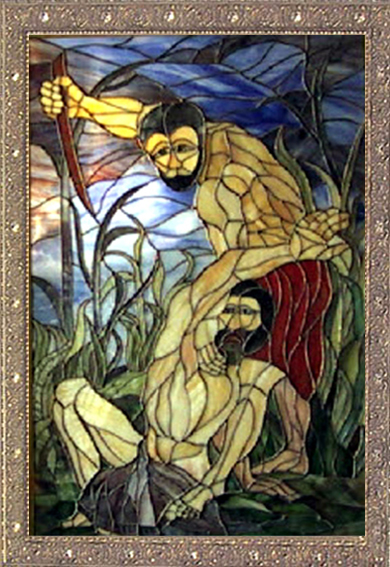
In the Genesis narrative about the flood that destroys all living creatures, only Noah’s family of eight and pairs of unclean and seven pairs of clean animals survived . . . a remnant of living creatures that will repopulate the earth.  Noah admirably behaves and obeys every instruction of God until the flood has subsided and life has normalized but then, he slips a little as head of the family.  Nothing wrong with planting a vineyard and fermenting grapes into wine and imbibing the “fruit of the vine” which symbolizes joy and in fact is part of Sabbath celebrations . . . it’s Noah’s lack of moderation in drinking that leads to intoxication and losing control until he passes out, and throws modesty aside.


So what? Unfortunately, this one and only father of the two-generation’ start-up’ family provided the occasion for a son to dishonor his parent.  An inebriated unconscious Noah arouses in his son Ham, something this son might have been harboring—or maybe not—he could have simply found amusement at the sight of his father, the text doesn’t say. The sight of his usually-in-charge parent opened for Ham an opportunity to have fun at his father’s expense.  The reaction of his brothers Shem and Japeth indicates to us that in Noah’s family, they have been taught to show respect no matter what. The 5th of the 10 commandments has not been officially given as Law until generations later, but even so, the brothers’ behavior indicates all 3 were aware of “honor thy father.”


If Ham did not realize then the gravity and consequence of his filial disrespect, he would realize it when a sober Noah pronounces a curse not on him but on his son Canaan.  


Genesis/Bereshith 9:20-27

20 And Noah was the first man of the soil; he planted a vineyard.  
When he drank from the wine, he became drunk and exposed himself in the middle of his tent.  
Ham, the father of Canaan, saw his father’s nakedness and told his two brothers outside.  
Then Shem and Yefet took a cloak, they put it on the shoulder of the two of them,
and walked backward, to cover their father’s nakedness.
—Their faces were turned backward, their father’s nakedness they did not see.  
When Noah awoke from his wine, it beame known (to him) what his littlest son had done to him.  
He said:
Damned be Canaan,
servant of servants may he be to his brothers!  
And he said;  
Blessed be YHWH, God of Shem,
but may Canaan be servant to them!  
May God extend/yaft
Yefet,
let him dwell in the tents of Shem,
but may Canaan be servant to them!


Now, this is really baffling to Bible students.  Is it fair for Canaan to reap the consequence of his father’s mistake?


Deuteronomy/Debari’ym 24:16.  Fathers are not to be put-to-death for sons, sons are not to be put-to-death for fathers; every-man for his own sin (alone) is to be put-to-death!


Doesn’t Ezekiel 18 painstakingly lay out the principle that each is responsible for his and only his own sin, that when the father eats sour grapes, the children’s teeth will not be on edge?


And yet other scriptures also seem to refer to inherited sin:


 Exodus/Shemot 34:5-9

 YHWH came down in the cloud,
he stationed himself beside him there
and called out the name of YHWH.  
And YHWH passed before his face
and called out:  
YHWH YHWH
God,
showing-mercy, showing-favor,
long-suffering in anger,
abundant in loyalty and faithfulness,
keeping loyalty to the thousandth (generation),
bearing iniquity, rebellion and sin,
yet not clearing, clearing (the guilty),
calling-to-account the iniquity of the fathers upon the sons and upon sons’ sons, to the third and fourth (generations)!  
Quickly Moshe did homage, on the ground, bowing low,
and said:
 Pray if I have found favor in your eyes,
O my Lord,
pray let my Lord go among us!  
Indeed, it is a hard-necked people—
so forgive our iniquity and our sin
and make-us-your-inheritance!


Deuteronomy/Debariym 5:8-10
You are not to make yourself a carved-image of any form
that is in the heavens above that is on the earth beneath, that is in the waters beneath the earth.  
You are not to prostrate yourselves to them, you are not to serve them,
for I, YHWH your God, am a jealous God,
calling-to-account the iniquity of the fathers upon the sons to the third and to the fourth (generation) of those that hate me,
but showing loyalty to thousands of those that love me, of those that keep my commandments.


How to resolve this seeming contradiction?


First, get to know the God of the Hebrew Scriptures!  It’s like knowing someone so well that you know that person’s likes, dislikes, what he would do and not do, say or not say . . . so that when you hear about something out of character being attributed to that person or something you just can’t believe he’s capable of doing, apply that to the God we know in the TNK.  It works the same way. If you know the self-revelation of the God Whose Name is YHWH not just through a few verses but the whole of TNK, then you would know He is a just God and will do what is right.  Seeming contradictions like these verses are explainable in context.


Second, the immediate context in Exodus and Deuteronomy have to do with warnings against idolatry. 


Third, notice the qualifiers and read these verses as a hyperbole [exaggerated statements or claims not meant to be taken literally]; a comparison of God’s judgment [3rd and 4th generation who hate Him and turn away from Him] and his mercy and grace [thousands that love Him and keep His commandments].

The placement of the verse in Exodus occurs after the golden calf episode when the Israelites so easily slip back to worshipping a god they can see so they have Aaron make one. After Moses pleads on behalf of the idolaters, LORD YHWH describes Himself to Moses—what a truly rare privilege this great leader had among all mankind! 


The placement of the verse in Deuteronomy is the final speech of Moses not to the original multitude that had left Egypt 40 years earlier, [that generation had died] but this time to the 2nd generation born during the 40-year wandering in the wilderness. This generation is being prepared to enter the promised land.  They were not present at the giving of the TORAH on Sinai, so they are reminded of everything their parents had heard and experienced.


 Debari’ym 29:13  

Not with you, you-alone
do I cut this covenant and this oath
but with the one that is here, standing with us today
before the presence of YHWH our God,
and (also) with the one that is not here with us today.


They have a fresh start, with the same guidelines regarding a lifestyle prescribed by their God whose self-description in Exodus is echoed by Moses here to remind them of generational transition of responsibility to be faithful to the Covenant and YHWH their God.  What each generation choose to do has consequences for later generations but even when they face judgment, still divine grace and mercy flow from the heart of this loving God toward the repentant.


The Shema emphasizes the responsibility of fathers to teach their children the Torah. Not nature but nurturance seems to wield a strong influence on young impressionable children. When fathers/parents are amiss in their responsibilities toward their children, there are consequences.  It’s a monkey-see-monkey-do kind of transference of values.  Sociologists/psychologists now see patterns of behavior within families, where battered children tend to become batterers themselves; sexually abused children become sexual deviants; attitudes of parents spilling over to the next generation until the pattern is broken by one who chooses to be different.


The context of these verses shows the “addressee” which is the nation of Israel. Israel is dealt with by God as a people, a nation, not individually; the nation as a whole suffers for the wrongdoing of majority, especially when it comes to the sin of idolatry and rebellion.


It will turn out that Noah’s curse on Canaan is prophetic; like father like son. The land promised to the nation of Israel is populated by the Canaanites, descendants of Canaan.  They are such an evil people that God commands the Israelites to cleanse the land of these inhabitants totally, but the Israelites failed to obey . . . and so until the exile, their generational sin of idolatry plagued the people.


Now back to the inconvenient truth for Ham — he forgot his father would sober up and  be incensed; and,  as biblical fathers usually pronounce blessings upon their children, Ham not only failed to get a blessing for himself but worse, hears a curse pronounced upon his son Canaan. Not fair to poor Canaan . . . but . . . a hard lesson to learn too late, for Ham!


[Translation:  EF/Everett Fox, The Five Books of Moses]


NSB@S6K


logo-e1422801044622


A Sinaite’s Musical Liturgy – 4th Sabbath of January

Image from www.patheos.com

[The ‘musical Sabbath’ . . . all it means is that instead of reciting prayers, we sing!  As we’ve repeatedly explained, from our Christian roots we have learned to love ImageChristian hymnody but since the lyrics no longer express our new-found faith, we have superimposed our lyrics which are more faithful to the Sinaite’s Creed as based on the teachings of the Torah and directed to YHWH, the Name we declare as the God we worship.  If you’re not familiar with the music, the instrumental accompaniment serves as guide; just make sure you dry-run the accompaniment earlier.   And if all else fails, just recite the lyrics, it works as well.  Have a joyful celebration, dear Sabbath Keeper!—Admin1].


————————————-


Kindle the Sabbath Lights


Blessed are You, YHWH, our God,

Creator of the universe, Revelator on Sinai,

LORD of the Sabbath,

Who sanctifies us by Your commandments, 

Who has commanded us to set apart a day of rest;

Who created the Sabbath Day,

that all humanity might cease from their daily striving,

so that all might spend the time

to reflect on the wonders of Your visible and invisible world,

to ponder the magnificence, marvels and majesty

of the Maker of all that exist;

to thank You,  O YHWH, Giver of Life,

for every breath we take as we live day by day, moment by moment,

on this life-sustaining and beautiful planet Earth!

As we kindle these Sabbath lights,

may we remember to be who we are

as reflectors of Your Light,

and live the life prescribed by Your Torah,

that we might please You in every aspect of our living,

and be a blessing to others,

Amen.


[Medley on original music of:  “Open our eyes, Lord”;/”Open my eyes that I may see”/REVISED LYRICS]

Open our eyes, LORD,

to truth we have known not

because we’ve been blinded,

because we have sought not,

Open our ears, Lord, and help us to listen,

the sound of Your True voice

for so long we’ve heard not,

———————

1.  Open my eyes that I may see,

glimpses of Truth Thou hast for me,

place in my hands the wonderful key,

Torah Truth that shall set me free,

silently now I wait for Thee, ready my God,

Thy Will to see,

Light from Thy Truth inspires in me, all I can be.


2.  Open my ears that I may hear

only the Truth Thou speakest clear,

and as Thy Words just fall on my ear,

false teachings all but disappear,

all I have learned in previous years, 

gladly I leave them without tears,

so much to hear, what’s there to fear,

God’s Truth—-hold dear.


3.  Open my mouth that I may say 

only Thy Truth, from day to day,

open my heart and let me prepare 

words Thou hast taught me thus to share,

so many searching hearts are there,  

seeking minds we find everywhere,

to them we bring Thy MESSAGE clear, 

that they may hear.


——————–

[JPS] Psalm 65

Praise befits You in Zion, O God;

vows are paid to You;

all mankind comes to You,

You who hear prayer.  

When all manner of sins overwhelm me,

it is You who forgive our iniquities.  

Happy is the man You choose and bring near

to dwell in Your courts;

may we be sated with the blessings of Your house,

Your holy temple.  

Answer us with victory through awesome deeds,

O God, our deliverer,

in whom all the ends of the earth

and the distant seas

put their trust;

who by His power fixed the mountains firmly,

who is girded with might,

who stills the raging seas,

the raging waves,

and tumultuous peoples.  

Those who live at the ends of the earth are awed by Your signs;

You make the lands of sunrise and sunset about for joy.  

You take care of the earth and irrigate it;

You enrich it greatly,

with the channel of God full of water;

You provide grain for men;

for so do You prepare it.  

Saturating its furrows,

leveling its ridges,

You soften it with showers,

You bless its growth.

You crown the year with Your bounty;

fatness is distilled in Your paths;

the pasturelands distill it;

the hills are girded with joy.  

The meadows are clothed with flocks,

the valleys mantled with grain;

they raise a shout, they break into song.

Image from www.pinterest.com

Image from www.pinterest.com


[“Breathe on me, Breath of God”Revised Lyrics]


1.  Symbol of joy, this wine,

‘joy’ from our Lord divine,

blessings in life are yours and mine,

let’s all drink  ‘to Life’ —  ‘L’chaim’!

Image from www.illustrationsof.com

Image from www.illustrationsof.com

2. This bread of life we share

nourishing daily fare,

sunshine and water, breath and air,

what more need we ask, it’s there.

3.  More than this wine, this bread,

fam’ly brings so much joy,

husbands and wives, and children dear,

wherever they are, they’re here.


4.  Always in mind and heart,

even though we’re apart,

loved ones are precious gifts from God,

From HIM, may they not depart.


pixrllittleshabbat

Image from www.cllnswbpgfx.com

Image from www.cllnswbpgfx.com


Havdalah

[Original Tune: Turn your eyes upon Jesus/Revised Lyrics]


1.  Dear seeker of God are you searching 

for truth, for more light, for THE WAY,

look back to the start of your journey,

the map that has always been there . . .

CHO:  Turn your eyes toward Sinai,

that’s where the Almighty was seen,

in the burning bush, in the flashing light

what a vision, a glorious sight!


2. If only the world would remember

the Words He had spoken back there,

in the wilderness, out in the desert,

the truth all humanity should hear . . .

CHO: Hear O Israel hear! [or ‘Hear, ye nations all, hear!]

YAHUWAH,  True God, He is One,

You shall love YAHUWAH with all your heart,

all your being,  and all of your might.


3.  His Words will not fail you—He promised,

believe and obey and be blessed,

but when there is failure, there’s pardon,

if you would but humbly repent . . .

CHO:  Turn your eyes on the TRUE ‘ONE’,

YAHUWAH the First and the Last,

No one comes before, there are not ‘two’ more,

HE was One, He’s still One, will be One!

Yes, YAHUWAH, Lord God, He’s the ONE!

Image from thejesusnamechurch.wordpress.com

Image from thejesusnamechurch.wordpress.com


Shabbat shalom!


NSB@S6K

logoSig-4_16colors


A Sinaite’s Liturgy – 3rd Sabbath of January 2019

KINDLE THE SABBATH LIGHTS

Image from borderlessnewsandviews.com


 O YHWH,

Primal LIGHT,

on the first days of Creation,

You illuminated a darkened universe, 

planetary systems, galaxies galore—

before the sun came ‘to be’ on day four.  

All came to be simply by Your command:

“Let there BE . . .”

“Let there be light and there was light.”


Those words reverberate through  millennia

since You first spoke them, 

recorded in the opening verses

of the Book of Beginnings,

Bereshith/Genesis.

Six millennia hence,

we see the brightness of your sun

that lights up our waking hours,

warms our planet earth,

promoting and sustaining life all around us

and bringing vitality and health to our bodies.

We’re cognizant of  the symbolism of  light in Your Revelation,

 our guiding lamp through life’s pathways,

Your Torah,

which we endeavor to learn, understand, and embrace as our way of life.

We bless Your ‘light to the Nations’, Your light to us Gentiles,

 Israel, the Jewish people

whether Torah-observant or not,

they are Your chosen,  Your firstborn son, Your suffering servant;

Your people who are back in the Land You had promised to them

but which they lost for reasons their nation’s history attest to;

an unexpected return,  indeed —


Who has heard such a thing?

Who has seen such things?

Shall a land be born in one day?


prophetically fulfilling the words of Your mouthpiece, Isaiah,

and the prophets of Israel

through whom You issued warnings

for disobedience as well as blessings for obedience,

drawing the attention of mindful, watchful and awakened Gentiles

who recognize Your Mighty Hand in the scripture-history of Your people,

for You are faithful to Your promises,

whether or not Your chosen have been faithful to You, 

You fulfill Your pronouncements through their very existence

 in a world ignorant of You,

hostile to them, 

unmindful of Your Torah.


Just as these Sabbath lights enter our vision,

Your Torah illuminates our minds;

just as these Sabbath lights illuminate and bring warmth to our sanctuary-home,

signalling our entrance into Your sanctuary-in-time,

Your Torah brings joy to our hearts,

fulfills our hunger for spiritual nourishment;

broadens our limited understanding,

imparting to us wisdom and growing knowledge of You,

comprehension of Your acts in history

recognizing Your guidance in our very lives.

For all these and so much more benevolence from Your Divine Providence,

we praise and thank You,

O YHWH,

LIGHT of our lives,

Whose Presence, we presume,

graces the gathering of Sabbath celebrants

all over the world.

Amen.


[JPS]  Tehillim/Psalm 4

1  For the Leader; with string-music.   A Psalm of David.

2  Answer me when I call, O God of my righteousness,
Thou who didst set me free when I was in distress;
Be gracious unto me, and hear my prayer.
3  O ye sons of men, how long shall My glory be put to shame,
In that ye love vanity, and seek after falsehood?  Selah
4  But know that YHWH hath set apart the godly man as His own;
YHWH will hear when I call unto Him.
5  Tremble, and sin not;
Commune with your own heart upon your bed, and be still.  Selah
6  Offer the sacrifices of righteousness,
And put your trust in YHWH.
7  Many there are that say: ‘Oh that we could see some good!’
YHWH,  lift Thou up the light of Thy countenance upon us.
8  Thou hast put gladness in my heart,
More than when their corn and their wine increase.
9  In peace will I both lay me down and sleep;
For Thou, YHWH,  makest me dwell alone in safety.
Image from www.adventistonline.com

Image from www.adventistonline.com


Blessed are You, YHWH,

Creator of the fruit of the vine,

Provider of food on our table symbolized by this bread.

We partake of wine and bread

to remind us of Your daily provisions,

and to thank You

for our —

giftings, talents,

enablements, opportunities,

second chances,

motivations, initiatives,

which inspire us to keep ourselves active and busy

through six days of our workweek,

which enable us to provide for ourselves and our family.


We delight in work, as much as we delight in rest,

We delight most of all in Your Sabbath Rest,

O YHWH, Lord of the Sabbath.

We raise our glasses of wine,

and partake of this bread of fellowship,

and say “To Life, L’Chaim!” “Mabuhay!”

Your gift of joy, O YHWH our Father,

includes the joy we derive from family.

We ask for Your blessings upon the husbands and wives here,

upon widows and widowers who have lost our spouses in death,

upon our children, our sons and daughters,

their spouses and their children.

May all our names be inscribed in Your Book of Life!


f148f88ce8e7a5c6bcbcc0f773390f52

Image from www.torahstudies.com

Image from www.torahstudies.com


Havdalah

[Tune:  “Precious Lord, Take my hand” – original lyrics]

1.  Precious Lord, take my hand, lead me on let me stand,

I am tired, I am weak, I am worn;

Through the storm, through the night, lead me on to the light;

Take my hand precious Lord, lead me home.


2.  When my way grows drear, precious Lord, linger near,

When my life is almost gone,

Hear my cry, hear my call, hold my hand lest I fall,

Take my hand precious Lord, lead me home.


3.  When the darkness appears, and the light draws near,

And the day is past and gone;

At the river I stand, guide my feet, hold my hand,

Take my hand, precious Lord, lead me home.


Image from quotesaboutloveweb.blogspot.com

Image from quotesaboutloveweb.blogspot.com


Shabbat shalom!


Sig-4_16colors

logo

A Sinaite’s Musical Liturgy – 2nd Sabbath in January 2019

[It has become traditional for Sinaites to add variation to our Sabbath celebration by singing our liturgy every other Shabbat.   As we have repeatedly explained, our worship music foundation comes from our Christian roots and so we merely borrow the music but revise the lyrics according to our Sinaite creed.  We are indebted to Christian hymnodists for their beautiful tunes that ever reverberate in our musical memory.  If you  are familiar with these tunes, sing them; if not, recite them.  Understandably,  if you’re familiar with the original lyrics, the change is at first uncomfortable, but we agree with Hymnodists that one of the best ways to teach is through the hymns we sing.   Shabbat shalom to all!—Admin1.]


————————-


KINDLE THE SABBATH LIGHTS


Image from myjewishlearning.com

Image from myjewishlearning.com

Blessed are You,

O YHWH our God,

King of the universe,

Who commanded us to set aside the Sabbath day,

to rest from our daily routine, 

from our six days of work.

As we kindle our Sabbath lights,

we bless You back for blessing us with vision to see through the darkness that spread with the setting of Your magnificent sun from our horizon, 

with hearts and minds that understand the need for Your Light to illumine our pathway through our life’s journey.

Your Torah is a light unto our path,

that brightens the way

that leads to our understanding of You

and who You are,

and how we are to relate to You,

and to ‘the other’,  our neighbor, our fellowmen.

Blessed are You,

O YHWH, our God,

The Source of all LIGHT in our lives.


flat,800x800,075,f.u6[Medley of Christian tunes, revised lyrics] 

1a)  Be still and know YAHUWAH  is GOD (3X).

1b) YAHUWAH’s the LORD that healeth Thee (3X).

1c)  In Thee Lord YAHUWAH, I put my trust (3X).

 2.  YHWH [YAHWEH] we love You we worship and adore You,

Glorify Your Name in all the earth,

glorify Your Name, glorify Your Name,

Magnify Your Name in all the earth.


3. We worship and adore You,

 bowing down before You,

Songs and praises ringing, all our voices singing:

Hallelu YAH, hallelu YAH, hallelu YAH,

Amen.


4. Be exalted, O KING, above the heavens.

Let Thy glory be all over the earth (Repeat 2X).


 Psalm 24: The King of Glory 

A Psalm of David.

The earth is YHWH’S, and the fulness thereof;
The world, and they that dwell therein.
2  For He hath founded it upon the seas,
And established it upon the floods.
3  Who shall ascend into the mountain of YHWH?
And who shall stand in His holy place?
4  He that hath clean hands, and a pure heart;
Who hath not taken My Name in vain,
And hath not sworn deceitfully.
5  He shall receive a blessing from YHWH,
And righteousness from the God of his salvation.
6  Such is the generation of them that seek after Him,
That seek Thy face, even Jacob.
Selah.
Image from www.freerepublic.com

Image from www.freerepublic.com

7  Lift up your heads, O ye gates,

And be ye lifted up, ye everlasting doors;
That the King of glory may come in.
8  ‘Who is the King of glory?’
‘YHWH strong and mighty,
YHWH mighty in battle.’
9  Lift up your heads, O ye gates,
Yea, lift them up, ye everlasting doors;
That the King of glory may come in.
10‘ Who then is the King of glory?’
‘YAHUWAH the LORD of hosts;
He is the King of glory.’
Image from www.essex1.com

Image from www.essex1.com

[Tune: Gracious Spirit fill Thou me/Revised Lyrics]


1.  Bless this wine O Lord we pray,

Symbol of our joy this day,

For we gather here to say,

‘Could we please You’ if we may

feel the joy of Sabbath day, be as joyful every day.


2.  Bless this bread of  life oh Lord,

Symbol of Your precious Word.

Food for body, food for soul,

Nourishment that makes us whole,

Thank You Lord for all You give,

You have taught us how to live.


3.  Bless the husbands, bless the wives,

‘Blessed Ones’ who’ve lost their lives.

Part of us once they have been,

They are with us though not seen,

In our memories, in our hearts,

Even when we’ve been apart.


4.  Bless our daughters, bless our sons,

Generations down the line.

May they come to know You Lord,

May they love You and Your Word,

May they choose to do what’s right,

And lead others to Your Light.

 
Image from yahuahshomemaker.wordpress.com

Image from yahuahshomemaker.wordpress.com


Image from www.beitsimcha.com

Image from www.beitsimcha.com


Havdalah


[Original Tune:  “Once in Royal David’s City”

Revised Lyrics]

1.When in Israel the king was Saul,

chosen as the first of Israel’s kings.  

War there was with all the Philistines,

none was fit to fight its biggest man.  

Fearsome was this giant Goliath,

boastful of his towering heigh-t!


2. Not of age for battle was this young lad,

youngest from among old Jesse’s sons.  

Youthful David raised to be a shepherd,

watching flock is one good training ground—

for anointed priests and kings,

for anointed yet-to-be young war-riors!


3.  Word came to this energetic shepherd

that his God he needed to defend.  

Unprepared, so small without an armor,

 just his courage, just his zeal—

for the honor of God’s armies,

with brave words he challenged this Goli-ath! 


Image from davidandtrisomy18.blogspot.com

Image from davidandtrisomy18.blogspot.com

4.   “Who is this uncircumcised Philistine,

who defies the GOD of Israel?”

Picked some rocks and put one in his slingshot,

twirled it round around and more ‘arounds’ . . .

target-ted Goliath’s head,

one big shot, and down fell this huge gi-ant!  


5.  All the Philistines were struck with terror

 at this harmless looking shepherd boy,

who brought down their great gigantic fighter

with no more than just a little toy.  

Never seen a slingshot weapon,

never thought that it could down a war-rior.  


6.  When we seek out to defend YAHUWAH,

 Rest assured He knows who’s on His side!  

It’s His honor and His reputation

and His Name on banners we’ve unfurled!

Let’s be dauntless just like David

when we face ‘Goli-aths’ of this world!

Image from www.farmgirlfollies.com

Image from www.farmgirlfollies.com

Shabbat shalom!


On behalf of Sinai 6000 Core Community,


NSB@S6K


AIbEiAIAAABDCNPkvrXuucmdeSILdmNhcmRfcGhvdG8qKGJkZTc0YTk3NmUxMGM4OTAzZjk5MDhkMjdkZDI2ODQ3OTliYmQ2MDkwAe5UdNp0lvYvCf8bjAFEJOY_fdsj


Sig-4_16colors

A Sinaite’s Liturgy – on the 1st Sabbath of a New Year

Image from www.lindakwertheimer.com

[If you haven’t yet entered “The Sabbath World”, this is as good a start as any. It has been called “a sanctuary in time” by Abraham Joshua Heschel and rightly so.  It is a dimension in time that the Lord of the Sabbath, YHWH, the Creator Himself set apart to rest from His creative work and, as Revelator on Sinai, enshrined into the 4th of His 10 Declarations etched on tablets of stone.Who are we to ignore this sacred appointed time with the Master of the universe who has commanded that we rest from our labors, delight in His day, be joyful with family and friends, or even spend alone in a different way from the way we spend the other six days of our daily routine?


To this day there is confusion about which day is the Sabbath day. Why? Who changed it from the original 7th, as in Saturday? For the answer, simply go to any history book or google it.  Now, as to HOW does one observe the Sabbath? Different religions have different traditions. The Jews have through the centuries developed their characteristic ways — it is family-oriented on erev (sundown Friday) and synagogue-centered on the Sabbath day.  The basics are:  YHWH,  rest,  joy, Torah.


Our little Sinaite community has settled into a Sabbath fellowship during which we initially incorporated some traditions of the Jewish Sabbath in our celebration.  Then,  just two months before the end of 2013, we added structured prayers and hymns before our meal and Torah study.  We have shared each ‘liturgy’  on this website, and we hope that you visitors are benefitting from it in some way.  For those who are exposed to our Sabbath liturgy for the first time, we reiterate that for the “musical” liturgy,  we simply rewrite the lyrics of Christian hymn music we have grown accustomed to for all the decades we were Christ-centered Church-goers. 


Shabbat Shalom to one and all, and have a YHWH-blessed 2019!–Admin1.]


———————————–


Image from www.chabad.org

Image from www.chabad.org

Kindle the Sabbath Lights

 O YHWH,  LORD of the Sabbath,

As we celebrate new beginnings this new year,

we look back to the beginning of this world You created

and marvel at how Your wisdom and Your Creative design is so perfect

such that everything works in harmony and balance,

that species continue to perpetuate their own kind,

multiplying as You commanded.

We look back to the beginning of earthly time:  

how You structured it according to

seconds, minutes, hours, days, weeks, months and years,

designing seasons for predictable agricultural guidance,

that tillers of the soil might continue to produce food for human sustenance,

that all Your creatures might be fed from the bounties of nature.

You gave humanity the responsibility to tend ‘the garden’

Your world, and care for all its creatures,

and learn to work with the natural order rather than against it.

You thought of everything that would sustain life on earth,

and especially the life of Your ‘crown’ of creation — humankind.

We look to You with heartfelt gratitude,

O Creator of the universe, 

for Your divine providence that benefit all living creatures and all humanity,

but specifically for the blessing You have been and continue to be

to all Sabbath-keepers who gather to remember

the first Sabbath that You celebrated

with the first man and woman,  representative humanity.

What a joy and delight they must have felt to be in Your Presence,

and yet it is the same joy we feel today,

for blessing comes with simple obedience,

and we presume Your Presence in every gathering of Torah-keepers

who enter Your Sabbath world, Your dimension in time,

Your sanctified holy seventh day.

You, YHWH, You alone,

are the TRUE LORD of the Sabbath.

We acknowledge You, YHWH,

 God of Israel, God of the nations,

LORD of lords, KING of kings,

as GOD and LORD of our Sinaite community.

Amen.


 ———————————-


The beginning of wisdom is reverence for God.

[Proverbs 1:7]


“Let not the wise man boast of his wisdom
or the strong man boast of his strength
or the rich man boast of his riches
But let him who boasts boast about this:
that he understands and knows
Me,
that I Am YHWH
Who exercises
kindness, justice and righteousness on earth,
for in these I delight,”
declares the LORD.  
(Jeremiah 9:23)


[Original Tune:  “O Danny Boy”, revised lyrics]

Image from theconversation.com

Image from theconversation.com

1.  I do not know why He, our God-Creator,

Whose words brought forth the universe we see,

All worlds in all the heavens, all the space between,

the skies above, the deep abyss, the sea.

Why God would make all humans in His image,

Why He would give free will, the right to choose,

to mortal men, with understanding limited,

Who could resist, defy, reject His Grace, His Will.


2.  I do not know why God Who filled the heavens,

With sun and moon and stars to give earth light,

Who parted land and sea, filled each dominion,

with fish and fowl, with creatures big and small.

Why this great God would grant the highest favor,

in vesting man with power and self-will

to make the choice to disobey commandments,

And choose his will against his Maker and his Lord.


3.  I do not know how God could love us sinners,

who hear His call,  yet choose to go our way,

who turn away from blessings for obedience,

who choose what’s wrong instead of choosing right.

And yet the Source of Love, the Source of all good things,

The Source or Life Himself, our very breath,

All that He asks is turn to Him, repent and change,

And be restored to where we were before we sinned.


4.  How can we serve, how can we love a God like this?

so filled with lovingkindness, endless grace,

Who tempers justice with so great a mercy,

Whose love for man, we cannot comprehend.

And yet we have within ourselves the will to turn

toward the path that leads us back to Him,

Repent and love Him, serve Him, please Him, live His Way,

For all He’s given, let us live for Him each day.

Image from teshuvaministries.net

Image from teshuvaministries.net

 O YHWH our God, we seek Your favor,

Your blessing upon our families —

[name them]

parents, husbands and wives, children, grandchildren, extended kin,

who are with us and those who are far away;  

we seek Your providence and protection

and thank You for the blessing they have been to us.  

We join Jewry and all gentile Sabbath-keepers in declaring:

“Blessed are You,

YHWH our God

King of the universe,

Creator of the fruit of the vine,

Creator of the bounties of nature that yield food for all creatures,

We thank You  specially

for the food we will share at our Sabbath meal,

and for those who prepared it.

We join the Jewish people in saying:

L’Chaim!  To life, and to the Giver of Life!


Sabbath Meal

Image from onehandedchef.wordpress.com

Image from onehandedchef.wordpress.com

Image from www.beitsimcha.com

Image from www.beitsimcha.com


HAVDALAH


imagesOh YHWH,

Eternal God of new beginnings:

You have configured  earthly time 

to signal to time-conscious and time-bound humanity

 that there are always  opportunities  to start over 

with a new day,  a new week,  a new month,  a new year;

whatever it is  that we need to stop doing and start doing,  

whatever it is in our life that we need to set aright, 

even if we have taken the wrong direction,

fallen into bad habits, made wrong decisions, 

been living unwisely resulting in unhappy and broken relationships,

stressing ourselves to the point it has negatively affected

our physical, mental, and spiritual health—

we can turn our direction around and start over.  


You have given us the precious gift of free will

with the sole power to wield it according to our own choice,

so that at any point in our lives,

we could remain where we are, following a self-destructive course

that negatively affects us and those around us,

or, 

we could repent of our wrongdoing and turn our course around

toward the right direction to the blessing of ourselves as well as others,

by aligning our will with Your Will.


As time continues to tick nonstop,

marking every second adding up to minutes and hours of each day,

may we ever be conscious that each moment instantly turns into a thing of the past,

and that we need to value the gift of the ‘present’  which is ever fleeting,

that we should not waste any precious moment—  

irreplaceable time You give us —

on wasted opportunities we might never recover,

on meaningless and fruitless endeavors

that lead nowhere,

or amount to nothing

and benefit no one;

may we endeavor to spend Your time allotted to each of us

more wisely—

whether time at home or time at work,

 time to keep busy and time for rest,

time alone and time with people,

 family time and time for friendships,

time to pause and cease from our strivings,

time to welcome Your Sabbath, the Queen of days,

time to seek You in prayer and in the study of Your Torah,

and simply time to be still and seriously ponder Your instructions for life,

where we have succeeded or failed in applying them.

May we spend more time studying Your Self-Revelation,

for there is no knowledge more important than the knowledge of You,

deeply appreciate Your goodness, loving-kindness and mercy,

reflect on Your Righteousness and Your Justice,

and be grateful for Your willingness to forgive the truly repentant soul.

O YHWH, Giver of second chances,

may we listen to Your Will for all humanity as expressed in Your Torah,

understand what it means to be truly considerate of others

and be ever conscious that we live in community,

thereby endeavor to be less self-centered and self-absorbed.

May we experience being in awe of who You are,

the Eternal and Timeless One,  Creator God,

to understand Your acts in history, 

be consciously aware of as many of Your attributes

as You have revealed in the Scriptures of Your chosen people,

that we might worship You and You alone

revere Your Name, YHWH,

and love You through our actions,  not merely through words,

through obedience to Your revealed Will,  

choosing to live Your Life

that we as Gentiles might also be bearers of Your Light,

to follow the mandate given to Israel in illuminating Your Way

so that others might discover the path leading to You 

and thereby abandon gods of man’s own making.

In so doing, may it be —

that You will be pleased with the lives we have lived

so that our names will be written in Your Book of Life.

Indeed, may it be so,

Amen.

Image from prayercommunicationwithgod.com

Image from prayercommunicationwithgod.com


 Shabbat shalom to Sabbath-Keepers

and a blessed new year to one and all!

In behalf of the Sinai 6000 Core Community,

NSB@S6K

logo

Sig-4_16colors


Genesis/Bereshith 4: ‘Am I my brother’s keeper?’

Image from members.chello.at

[First posted in 2013.  We used to teach from the standpoint of the Christian doctrine of ‘original sin’ that the proof is evident in this chapter:
—the firstborn of the first man and woman
—-who ‘fell from grace’
—-and ‘sent out of Eden
—-and directed away from the Tree of Life’
— produced a man
—-who allowed his envy, anger, resentment, bitterness, and jealousy to escalate to the taking of the life of his own brother:
—-the first fratricide.

What more proof do we need for original sin passed down to all humankind that would issue from the first couple?

Not so fast, think again, leaving ‘original sin’ behind, keeping it out of the picture totally and rereading carefully the interaction between the Creator and Cain/Qayin.  You will discover what the Christian doctrine fails to consider.

As God did when the first man and woman failed the test of obedience, first God seeks them out; then asks questions that would allow them to admit their failure to obey and only after failing to admit personal responsibility and repent over their disobedience do they undergo judgment. The previous chapter well explains the consequences for each of the three ‘characters’ in the story of the fall.  

God does exactly the same with Qayin: He seeks him out, warns him about potential sin crouching at the door.  Does that sound like the firstborn is damned with inherited original sin? Or does it sound like he, like his parents, was forewarned and given a choice?  Free will is a great gift IF handled responsibly, listening to specific directions from God, heeding warnings, making the right choice, aligning our will with His.  

Please reread previous posts on this:  

The commentary featured here is from P&H/Pentateuch and Haftorahs, ed. Dr. J.H. Hertz; translation is Everett Fox, EF/The Five Books of Moses.  Additional commentary is provided here from RA/Robert Alter, The Five Books of Moses and straight reading of Alter’s translation in prose narrative is added at the end.—Admin1.]

—————


Genesis/Bereshith  4


1-16.  CAIN AND ABEL

The narrative describes the spread of sin, issuing in violence and death.

Now the human knew Havva his wife,
 she became pregnant and bore Kayin.  
She said:  
Kaniti/I-have-gotten
a man, as has YHWH!

[P&H] gotten. The derivation is based on the resemblance of sound between Cain and the Heb. root kanah—to acquire.

with the help of the LORD.  The four Heb. words spoken by Eve are very obscure.  The traditional interpretation makes ‘a man’ refer to Cain; and the words, an expression of thanksgiving for her child.  Others refer ‘man’ to husband (XXIX,3).  The sequel to the act of disobedience in the Garden would have caused estrangement between husband and wife; and Eve rejoices in the birth of a child, because through Cain she wins back her husband.

[EF] knew: Intimately; a term for sexual intercourse.

Kayin: Trad. English “Cain.”  The name means “smith”.

[RA] knew.  The Hebrew verb suggests intimate knowledge and hence sexual possession.  Amos Funkenstein notes that it is the one term for sexual intercourse associated with legitimate possession—and in a few antithetical instances, with perverse violation of legitimate possession.  Given the clumsiness of modern English equivalents like “had experience of,” “cohabited with,” “was intimate with,” and, given the familiarity of the King James Version’s literal rendering, “to know” remains the least objectionable English solution.

I have got me a man with the LORD.  Eve’s naming speech puns on the verb qanah, “to get,” “to acquire,” or perhaps, “to make,” and qayin, “Cain.”  His name actually means “smith,” an etymology that will be reflected in his linear descendant Tubal-cain, the legendary first metalworker.  (“Tubal” also means “smith” in Sumerian and Akkadian.)  Eve, upon bringing forth the third human being, imagines herself as a kind of partner of God in man-making.

2  She continued bearing—his brother, Hevel.  
Now Hevel became a shepherd of flocks, and Kayin became a worker of the soil.

[P&H]  Abel.  In Assyrian, abiu means ‘son’.  The Heb. word signifies ‘a breath’, like his life, so tragically brief.  As the younger brother, Abel is given the lighter task of caring for the flocks; while Cain assists his father in the cultivation of the soil.

[EF]  Hevel:  The name suggests “something transitory.”

[RA]  Abel. No etymology is given, but it has been proposed that the Hebrew hevel, “vapor” or “puff of air,” may be associated with his fleeting life span.

3  Now it was, after the passing of days that Kayin brought, from the fruit of the soil, a gift to YHWH, 

[P&H]  an offering. This is the first mention of worship in Scripture.  The religious instinct is part of man’s nature, and sacrifice is the earliest outward expression of that worship.  Its purpose was to express acknowledgment of His bounty to the Giver of all.

[EF]  gift: Heb. minha, usually referring to sacrifices of grain.

4  and as for Hevel, he too brought—from the firstborn of his flock, from their fat-parts.  YHWH had regard for Hevel and his gift,  

[P&H]  firstlings. The most highly-prized among the flocks

the fat. The richest part of the animal.

had respect unto. i.e. accepted.

[EF]  fat-parts: i.e., the choicest.

[RA] 4-5.  The widespread culture-founding story of rivalry between herdsman and farmer is recast in a pattern that will dominate Genesis—the displacement of the firstborn by the younger son.  If there is any other reason intimated as to why God would favor Abel’s offering and not Cain’s, it would be in the narrator’s stipulation that Abel brings the very best of his flock to God.

5  for Kayin and his gift he had not regard.  
Kayin became exceedingly upset and his face fell.

[P&H]  but unto Cain. Unlike Abel’s, his sacrifice is rejected because of the difference of spirit in which it was offered.  The Lord looks to the heart.

Image from frmilovan.wordpress.com

his countenance fellIn disappointment and dejection.

6 YHWH said to Kayin:  Why are you so upset?  Why has your face fallen?

[RA]  6-7.  This is the first of two enigmatic and probably quite archaic poems in the chapter.  God’s initial words pick up the two locutions for dejection of the immediately preceding narrative report and turn them into the parallel utterances of formal verse.  The first clause of verse 7 is particularly elliptic in the Hebrew, and thus any construction is no more than an educated guess.  The narrative context of sacrifices may suggest that the cryptic s’eit (elsewhere, “preeminence”) might be related to mas’eit, a gift of cultic offering.

7  Is it not thus:  
If you intend good, bear-it-aloft,
but if you do not intend good,
at the entrance is sin, a crouching-demon,
toward you his lust—
but you can rule over him.

[P&H [shall it not be lifted up? Alluding to the ‘countenance’ that had fallen.  God mercifully intervenes to arrest the progress of evil thoughts.  Another interpretation is, ‘Shall there not be acceptance?’

sin croucheth.  Sin is compared to a ravenous beast lying in wait for its prey.  It crouches at the entrance of the house, to spring upon its victim as soon as the door is opened.  By harbouring feelings of vexation, Cain opened the door of his heart to the evil passions of envy, anger, violence, which eventually ended in murder.

and unto thee.  Passion and evil imagination are ever assaulting the heart of man; yet he can conquer them, if only he resist them with determination.

[EF]  Is it not thus . . . .: Hebrew obscure. bear-it-aloft: Others use “there is forgiveness,” “there is uplift.:  toward you his lust—/but you can rule over him:  Recalling God’s words to Havva in 3:16.

8  Kayin said to Hevel his brother . . .
But then it was, when they were out in the field,
that Kayin rose up against Hevel his brother
and he killed him.

[P&H]  and Cain spoke unto Abel.  What is said is not mentioned.  The ancient Versions supply some such words as, ‘let us go into the field.’ This is unnecessary, as Scripture often omits words (see II Chron. I,2) which are obvious, and can be gathered from the context (Ehrlich).

in the field. Far away from their parents’ home, where Cain had his brother at his mercy; Deut. XXII,25.

[EF]  Kayin said . . .: The verse appears incomplete.  Ancient versions add: “Come, let us go out into the field.”

[RA]  Let us go out to the field.  This sentence is missing in the Masoretic text but supplied in the Greek, Syriac, and Aramaic versions.

his brother.  In keeping with the biblical practice of using thematically fraught relational epithets, the victim of the first murder is twice called “his brother” here, and God will repeatedly refer to Abel in accusing Cain as “your brother.”

9  YHWH said to Kayin:  
Where is Hevel your brother?  
He said:
I do not know.  Am I the watcher of my brothr?

[P&H]  where is . . . brother?  As in III,9, the object of the question is not information, but to elicit a confession of guilt (Rashi).

am I my brother’s keeper? Cain’s answer is both false and insolent.  Only a murderer altogether renounces the obligations of brotherhood.

10  He said:  
What have you done!
 A sound—your brother’s blood cries out to me from the soil!

[P&H]  what hast thou done?  The note of interrogation should be replaced by a note of exclamation.  The meaning is:  What a deed of horror hast thou wrought!  This is further indicated by the fact that the word ‘brother’ is used no less than six times in verses 8-11.

blood. The Heb. word is in the plural.  In slaying Abel, Cain slew also Abel’s unborn descendants.  ‘He who destroys a single human life is as if he destroyed a whole world’ (Talmud).

Image from anokatony.wordpress.com

crieth unto Me.  For vengeance. See Job XVI, 18 ‘Oh, earth, cover not thou my blood, and let my cry have no resting-place.’

[EF]  A sound:  Or, ‘Hark!”

11  And now,
damned be you from the soil,
which opened up its mouth to receive your brother’s blood from your hand.

[P&H]  from the ground.  Or, ‘more than the ground,’ upon which a curse had been pronounced (III,17).

[RA] that gaped with its mouth to take your brother’s blood from your hand.  The image is strongly physical: a gaping mouth taking in blood from the murderer’s hand.

12 When you wish to work the soil
it will not henceforth give its strength to you:
wavering and wandering must you be on earth!

[P&H]  when thou tillest.  Wherever he lives, the curse will follow him and the soil will be barren for him.  The remainder of his existence will consequently be an unceasing vagabondage.

[RA] 9-12.  There are several verbal echoes of Adam’s interrogation by God and Adam’s curse, setting up a general biblical pattern in which history is seen as a cycle of approximate and significant recurrences.  Adam’s being driven from the garden to till a landscape of thorn and thistle is replayed here in God’s insistence that Cain is cursed by—the preposition also could men “of” or “from”—the soil (‘adamah) that had hitherto yielded its bounty to him.  The biblical imagination is equally preoccupied with the theme of exile (this is already the second expulsion) and with the arduousness or precariousness of agriculture, a blessing that easily turns into blight.

13 Kayin said to YHWH:
My iniquity is too great to be borne!

[P&H]  my punishment. The Heb. word means both consequences of a sin, i.e. punishment, and the sin itself.  The Targum renders ‘mine iniquity is too great to be pardoned’.  The Heb. word translated ‘than I can bear’ can also be rendered ‘to be forgiven’.  Rashi understands the phrase as a question, ‘Is my iniquity too great to be forgiven?’

14  Here, you drive me away today from the face of the soil, 
and from your face must I conceal myself,
I must be wavering and wandering on earth—
now it will be
that whoever comes upon me will kill me!

[P&H]  land.  He complains that he is banished into the desert, to share the fate of an outlaw.

and from Thy face.  To be ‘hidden from the face of God’ (Deut. XXXI,18) is to forfeit Divine protection.  ‘This anguished cry of Cain reveals him as a man not wholly bad, one to whom banishment from the Divine presence is a distinct ingredient in his cup of misery’ (Skinner).

whosoever findeth me.  Cain feared death at the hands of some future ‘avenger of blood’; Num. XXXV,10.

[RA] whoever finds me.  This, and the subsequent report of Cain with a wife in the land of Nod, are a famous inconsistency.  Either the writer was assuming knowledge of some other account of human origins involving more than a single founding family, or, because the schematic simplicity of the single nuclear-family plot impeded narrative development after Cain’s banishment, he decided not to bother with consistency.

15 YHWH said to him: 
No, therefore,
whoever kills Kayin, sevenfold will it be avenged!  
So YHWH set a sign for Kayin,
so that whoever came upon him would not strike him down.  

[P&H]  sevenfold.  The number ‘seven’ is occasionally used in the Bible to express an indefinite large number; Lev. XXVI,27; Prov. XXIV,16.  Cain’s murderer shall be visited with a punishment far greater than that exacted of Abel’s, as God had now made manifest His abhorrence of bloodshed to all.

set a sign for Cain. According to the Rabbis, Cain was a repentant sinner.  God, therefore, reassured him that he would not be regarded as a common, intentional murderer.  God’s mercy to the guilty who repents of his sin is infinitely greater than that of man.  The popular expression, the brand of Cain, in the sense of the sign of the murderer, arises from a complete misunderstanding of the passage.

[EF]  a sign:  The exact appearance of the sign is not specified.  It is a warning and a protection, not the punishment itself (which is specific).

[RA] a mark.  It is of course a mark of protection, not a stigma as the English idiom “mark of Cain” suggests.

16  Kayin went out from the face of YHWH and settled in the land of Nod/Wandering, east of Eden.

[P&H]  from the presence of the LORD. Having forfeited God’s favour, Cain withdraws from the neighbourhood of Eden, which was the special abode of the Divine Presence.

[RA]  the land of Nod.  Nod in Hebrew is cognate with “wanderer” in verse 12.

17-24.  DESCENDANTS OF CAIN

17  Kayin knew his wife: she became pregnant and bore Hanokh  Now he became the builder of a city and called the city’s name according to his son’s name, Hanokh.

[P&H]  his wife.  The marriage of brother and sister was quite common in primitive times, but the Hebrew people looked upon it with such abhorrence (Lev. XVIII,9) that Scripture makes no reference to the identity of the wife in this passage.

he builded a city.  lit.  ‘he was building a city’; did not necessarily complete it.  Cain said in his heart, ‘If it is decreed upon me to be a wanderer on the earth, the decree shall not apply to my offspring’ (Nachmanides).

[EF]  Now he:  “he” refers to Kayin.

[RA]  the builder of a city. The first recorded founder of a city is also the first murderer, a possible reflection of the antiurban bias in Genesis.

18  To Hanokh was born Irad,
Irad begot Mehuyael,
Mehuyael begot Metushael,
Metushael begot Lemekh.

[EF]  Mehuyael begot:  Heb. Mehiyael.

19  Lemekh took himself two wives,
the name of the (first) one was Ada, the name of the second was Tzilla. 

[P&H]  two wives.  This is especially mentioned, as it was a departure from the ideal expounded in II,24.

[EF]  Ad . . . Tzilla:  The names suggest “dawn” and “dusk” (Gaster).

20  Ada bore Yaval,
he was the father of those who sit amidst tent and herd.

[P&H]  father. i.e. the first, the originator of pastoral life.  Abel had been the keeper of sheep (v. 2) but Jabal widened the class of animals which could be domesticated.

[EF] father: Ancestor or founder.

[RA] he was the first. The Hebrew says literally “father of,” in keeping with the predisposition of the language and culture to imagine historically concatenation genealogically.

21 His brother’s name was Yuval,
he was the father of all those who play the lyre and the pipe.

[P&H]  harp and pipe. Music, according to Hebrew tradition, is thus the most ancient art, dating from the beginnings of the human race.

22  And Tzilla bore as well—Tuval-Kayin,
burnisher of every blade of bronze and iron.  
Tuval-Kayin’s sister was Naama.

[P&H]  brass. The Heb. is more accurately translated ‘copper’, since it was a metal dug from the earth (Deut. VIII,9).  Brass is an alloy.  The discovery of the use of metals forms an important step in the progress of civilization

Naamah.  The word means, ‘pleasant, gracious.’ Jewish legend states she became the wife of Noah.

[EF] burnisher . . .: Or, “craftsman of every cutting edge of copper and iron.”

[RA] Naamah. One might expect an identification that would align Naamah with her siblings as a founder of some basic activity of human culture, but if such an identification was part of the original epic roll call, it has been either lost or deleted.  The Midrash recognized that the root of her name can refer to song:  perhaps Naamah is meant to be associated with her half brother Jubal, the founder of instrumental music—he as accompanist, she as singer.

23-24.  A triumphal song in the invention of the weapons mentioned in the preceding verse.  Lamech possibly committed an act of involuntary homicide on some young person.  He turns to his wives and says boastfully, ‘See!  I have taken a man’s life, though he only inflicted a bruise on me.  Should the necessity arise, I feel able to lay low any assailant that crosses my path.  If Cain, though unarmed, was promised a sevenfold vengeance on a foe, I, equipped with the weapons invented by Tubal-Cain, will be able to exact a vengeance very much greater!’ This heathen song marks the growth of the spirit of Cain.

[RA] 23-24.  The narrative context of this poem is long lost, but it looks like a warrior’s triumphal song, cast as a boast to his wives.  Unlike the looser form of the earlier poetic insets, this poem follows the parallelistic pattern of biblical verse with exemplary rigor.  Every term in each initial verset has its semantic counterpart in the second verset.  In the Hebrew, the first pair of versets has four accented syllables in each; every subsequent verset has three accented syllables.  The last pair of versets, with its numbers, provides a paradigm case for poetic parallelism in the Bible:  when a number occurs in the first half of the line, it must be increased—by one, by a decimal, or by a decimal added to the original number, as here, in the second half of the line.  In the same ay, there is a pronounced tendency in the poetry to intensify semantic material as it is repeated in approximate synonymity.  Perhaps, then, what Lamech is saying (quite barbarically) is that not only has he killed a man for wounding him, he has not hesitated to kill a mere boy for hurting him.

23  Lemekh said to his wives:  
Ada and Tzilla, hearken to my voice,
wives of Lemekh, give ear to my saying:
Aye—a man I kill for wounding me, a lad for only bruising me!
 
24  Aye—if sevenfold vengeance be for Kayin,
then for Lemekh, seventy-sevenfold!
 
25  Adam knew his wife again, and she bore a son.  
She called his name: Shet/Granted-One!
meaning: God has granted me anotheer seed in place of Hevel,
for Kayin killed him. 

[RA] Seth  . . . granted me.  The naming pun plays on the similarity of sound between “Seth,” shet, and “granted,” shat.

26  To Shet as well a son was born,
he called his name: Enosh/Mortal.  
At that time they first called out the name of YHWH.

[P&H]  Enosh.  In Hebrew p[oetry, enosh means ‘man’.  (Ibn Ezra); or once more call upon God under the name Adonay, Lord, which seems to have been forgotten among the descendants of Cain (Hoffmann).

[EF] called out the name of YHWH: i.e. worshipped God.

[RA] Enosh. The name is also a common noun in Hebrew meaning “man,” and that conceivably might explain why, from the universalist perspective of the writer, the name YHWH began to be invoked in this generation.  In any case, the narrative unit that begins with one general term for human being, ‘adam, in verse 1, here concludes with another, ‘enosh, and those two worlds elsewhere are bracketed together in poetic parallelism.

the name of the LORD was first invoked.  That is, the distinctive Israelite designation for the deity, YHWH, represented in this translation, according to precedent in the King James Version, as the LORD.  The existence of primordial monotheism is an odd biblical notion that seeks to reinforce the universalism of the monotheistic idea.  The enigmatic claim, made here with an atypical and vague passive form of the verb, is contradicted by the report in Exodus that only with Moses was the name YHWH revealed to man. [underscore by S6K].

Chaps. II-IV record the sin of Adam and Eve, their expulsion from Eden, the murder of Abel, Cain’s descendants reaching in Lamech the climax of boastful and unrestrained violence.  Piety, however, does not perish with Abel, and it reaches a new development in the days of Enosh (W.H. Green).


————————–


[Straight Text/No Commentary]

ROBERT ALTER’S THE FIVE BOOKS OF MOSES

GENESIS

CHAPTER 4
 
And the human knew Eve his woman and she conceived and bore Cain, and she said, “I have got me a man with the LORD.” And she bore as well his brother, Abel, and Abel became a herder of sheep while Cain was a tiller of the soil. And it happened in the course of time that Cain brought from the fruit of the soil an offering to the LORD. And Abel too had brought from the choice firstlings of his flock, and the LORD regarded Abel and his offering but He did not regard Cain and his offering, and Cain was very incensed, and his face fell. And the LORD said to Cain.
 
            “Why are you incensed,
            And why is your face fallen?
            For whether you do not,
            At the tent flap sin crouches
            And for you is its longing
            But you will rule over it.”
 
And Cain said to Abel his brother, “Let us go out to the field.” And when they were in the field, Cain rose against Abel his brother and killed him. And the LORD said to Cain, “Where is Abel your brother?” And he said, “I do not know. Am I my brother’s keeper?” And He said,
“What have you done? Listen! Your brothers blood cries out to me from the soil. And so, cursed shall you be by the soil that gaped with its mouth to take your brother’s blood from your hand. If you till the soil, it will no longer give you its strength. A restless wanderer shall you be on the earth.” And Cain said to the LORD, “My punishment is too great to bear. Now that You have driven me this day from the soil and I must hide from Your presence, I shall be a restless wanderer on the earth and whoever finds me will kill me.” And the LORD said to him, “Therefore whoever kills Cain shall suffer sevenfold vengeance.” And the LORD set a mark upon Cain so that whoever found him would not slay him.
 
And  Cain went out from the Lord’s presence and dwelled in the land of Nod east of Eden. And Cain knew his wife and she conceived and bore Enoch. Then he became the builder of a city and called the name of the city, like his son’s name, Enoch. And Irad was born to Enoch, and Irad begot Mehujael and Mehujael begot Methusael and Methusael begot Lamech. And Lamech took him two wives, the name of the one was Adah and the name of the other was Zillah. And Adah bore Jabail: he was the first of tent dwellers with livestock. And his brother’s name was Jubal: he was the first of all who play on the lyre and pipe. As for Zillah, she bore Tubal-Cain, who forged every tool of copper and iron. And the sister of Tubal-Cain was Naamah. And Lamech said to his wives,
 
            “Adah and Zillah, O hearken my voice,
            You wives of Lamech, give ear to my speech.
            For a man have I slain for my wound,
            a boy for my bruising.
            For sevenfold Cain is avenged,
            And Lamech seventy and seven.”
 
 
And Adam again knew his wife and she bore a son and called his name Seth, as to say, “God has granted me other seed in place of Abel, for Cain has killed him.” As for Seth, to him, too, a son was born, and he called his name Enosh. It was then that the name of the LORD was first invoked.

Q&A: Why give the Torah in the desert?

Image from www.universtorah.com

Image from www.universtorah.com

[Some of the time, in a post where the same topic has been written about by Sinaites or Jewish websites, we refer the reader to those posts; we are never sure if readers do bother to check them out.  So occasionally, we simply feature those posts in a separate article.


This one is a MUST READ, published in one of our links Jewish World Review. It answers the question in our title — why indeed does the Torah-Giver choose to address thousands of this mixed multitude of Israelites and non-Israelites in ‘no man’s land’? The answer is right there: because it is ‘no man’s land’ and all its implications.

Can we hear God amidst the noise of our society today where He has to compete with real and virtual voices in our digital toys and appliances? “Be still and know that I am God” — is that possible in concrete jungles of today’s modern society? How does one find solitude in our artificial world of man-designed, man-built cities?  Actually the only voice God has to compete with in being ‘heard’ and ‘obeyed’ is the voice of the ‘I’ in I-dolatry that is I-centered, whether in the city or the desert wilderness.


When we get stumped by a question that needs a better answer than the obvious, we check out Jewish teaching;  they’ve been studying the Torah for four millennia and are way ahead of us; we do keep in mind that Jews write for Jews and we’re outsiders looking in.


Here, Rabbi Nathan Lopes Cardozo explains “Why the giving of the document that would permanently change the world could only be done in desolation . . . “


A side comment: “At Shavous, in which Jews recreate the Revelation at Sinai, a world-renowned philosopher offers a meditation on religion abuse.”


JWR contributor Rabbi Rabbi Nathan Lopes Cardozo is a world-renowned lecturer and ambassador for Judaism, the Jewish people, the State of Israel and Sephardic Heritage.

Reformatting and highlights added.Admin 1.]


——————————-


http://www.JewishWorldReview.com |

A desert is a lonely place, completely forsaken. There is neither food, nor water, nor any other form of sustaining substance. There is only the unbearable sun and its heat. There is no grass, and there are no trees. There are only deadly snakes and scorpions. In a desert, death stares you in the face. It is a dangerous place, unlivable and outrageous.


But the desert is also a magnificent place, filled with grandeur and full of life. It is a place where many things can happen which are not possible in any other location.


  • First and foremost, it is a place of authenticity. Because it is a place where a sound, a Voice, can travel as in no other place. It has all the sound options that a musician can dream of.  It can reach the deepest of its meanings and the highest of its dreams. In a desert a sound can travel to the end of the world. There are no obstacles standing in its way. In a desert a Voice can turn in any direction it desires and take on any dimension with no fear of corruption.


In a desert there are no walls by which the sound will be cut short. It is, above all, a place where a sound will not be disturbed or troubled by other sounds that may overwhelm it or even silence it.


Why? Because a desert is a place of devastating silence. There are no distractions; there is no clash of voices. No “voice competition”.  If there is ever to be an authentic Voice to be heard, it is here in the desert. It can’t be undermined and falsified, using it for selfish purposes. It is because of the desert’s thundering silence that it is possible to hear a “still voice” with no obstruction. It cannot bear mediocrity, even when it is original and thought of as novel. Instead, it seeks singular excellence even when most men cannot recognize it as such. It protests against those who are appeased when they can find something old in the new, whereas it is clear that this old could not have given birth to this new.


The Egyptian French poet, Edward Jabes, noted the relationship between the Hebrew words “dabar“, word, and “midbar“, desert. This, he claims, goes to the core of what a Jew is all about:


“With exemplary regularity the Jew chooses to set out for the desert, to go toward a renewed word that has become his origin… A wandering word is the word of God. It has for its echo the word of wandering people. No oasis for it, no shadow, no peace. Only the immense, thirsty desert, only the book of his thirst….” (From The Book to the Book, Wesleyan University Press, 1991, pp 166-7)


Here, in the emptiness and silence of the desert, the authentic Word can be heard. A Word stripped of all distractions. Naked, without any excuse.


  • But it can only be heard by a people of the wilderness;
    • a people who are not rooted in a substance of physical limitations and borders;
    • a people who are not entirely fixed by an earthly point, even while living in a homeland.
    • Their spirit reaches far beyond the borders of any restricted place.
    • They are particularistic so as to be universalistic.
    • They are never satisfied with their spiritual conditions and are therefore always on the road, looking for more.
    • A wandering people carried by a wandering Word which can never permanently land because the runway is too narrow and they cannot fit into any end destination.
    • A people who always experience unrest because they carry the Word which doesn’t fit anywhere and wanders in the existential condition of an unlimited desert.
Image from www.bridgesforpeace.com

Image from www.bridgesforpeace.com

A Word which unnerves because it is rooted in the desert where, if not properly handled, it becomes deadly


    • It needs a people who received the Word before having received their land.
    • More than that, a people to whom the Word itself gave birth.
    • The Word is the mother of the people.
    • A people who can make their land into a portable homeland, carrying it to any corner of the earth because their land is a Word.
    • It is the land which depends on the Word and not the Word which depends on the land.
    • Here the Word is the author of the people; the people are not the author of the Word.
    • The homeland is the “Text”- the Word. (George Steiner) They dwell in the Word and become real, because the Word is the father of its readers and not vice versa.


A desert is even more. It is a place where nothing can be achieved. In a desert man cannot prove himself, at least not in the conventional sense of the word. It doesn’t offer jobs that people can fight over and compete for. It has no factories, offices or department stores. There are no bosses to order us around and no fellow workers with whom we are in competition. It is “prestige deprived”. In a desert there is no “kavod/honor” to be obtained. It doesn’t have cities, homes, fences. Once it has these, it is no longer a desert. Human achievements will end its desert status and will undermine and destroy the grandeur of its might and beauty.


Man can only “be” but never “have” anything in a desert.


There is no food to be eaten but the manna, the soul food, and one can easily walk in the same shoes for 40 years because authenticity does not wear out. Men’s garments grow with them and do not need changing or cleaning because they are as pure as can be. And that which is pure continues to grow and stays clean.


The desert is therefore a state of mind.


It removes the walls in our subconscious, and even in our conscious way of thinking. It is an “out of the box” realm. In a desert one can think unlimitedly. As such, one is open to the “impossible” and hears murmurs of another world which one can never hear in the city or on a job. The desert allows for authentic thinking, without obstacles, and therefore it is able to break through and remove from us any artificial thoughts which do not identify with our deeper souls. Nothing spiritual gets lost in us, because the fences of our thoughts become neutralized and no longer bar the way to our inner life. It is ultimate liberty. It teaches us that openness does not mean surrender to what is most “in”, or powerful. Nor does it consist of vulgar successes made into a principle.


This is the reason why the Torah could only have been given in a desert – Midbar.


Why did the Divine not give the Torah in a civilized place? Had He given it on Wall Street, He would have had to decide who would sit on the Board of Investors. He would have had to deal with the “politics of friendships” and personal agendas of how much interest to give and where to invest.


The Divine didn’t want shareholders or agendas to pollute His words and make them “user friendly” in ways which would compromise His very Word. So He chose the desert. A place without any personal motives.


The ideal place to fall in love because there is no competition.


And because love is the irresistible desire to be desired irresistibly (Louis Ginsberg), only a Midbar can become the home of lovers – the Giver of the Word and the receivers of the Voice to be married under the canopy of authenticity.


“Anyone who does not make himself open to all

(“hefker”, ownerless), like a wilderness,

cannot gain wisdom and Torah”

—-(Bamidbar Rabbah, 1:7)— say the Sages.


With this statement the Sages introduce a most important insight concerning the Almighty, the nature of Torah and the desert. They cannot bear artificial, unauthentic ideas which are sold in the superficiality of this world.


In a Midbar one can hear an authentic Voice and immediately distinguish it from the artificial word, because the authentic Voice will protest without delay. It has no place to hide, so it will run up against a wall and instead of being silenced will become nearly violent and unrelenting. The wall will start to shake and will ultimately collapse because it is not really rooted in a desert


The “authentic” is perhaps not to be found when deliberately pursued, but there is no missing it when it is present. As such, it will become a “commanding voice” which can make us nervous since it becomes disturbing and unbearable. It becomes a deadly, poisonous snake for those who have not shaped themselves as desert people.


A desert is still more. It is also a place where the word cannot be caught and locked up. In can’t be framed and manipulated. Yes, to activate the world and make an imprint on it, it has to come down and respond to the “here and now”. It must allow for fences and limitations whenever needed. Limitations can be great emancipators. But it must always carry the “tomorrow and over there”.


To have any effect, it must borrow from the world of man and his language. But it needs to have an escape. It must be like a fishnet which captures its mundane needs, but with holes so that the ongoing flow of water will not get caught up in the net itself. It must be a thoroughfare for all genuine thoughts, always looking for a new destination.


The only quality which can save us from the snakes in this desert is the awe of Heaven. Only this quality can save us from falling into the hands of the serpent. But it can be done and therefore it must be done so as to reveal the Word given in the desert and to allow it all the space it deserves.


Abraham found the Divine in the desert and so the people of Israel received the Torah in a place of ultimate authenticity:


The Desert of devastating conditions

and great opportunities.

It is a dangerous place,

but a desert it must be.


Whoever thinks that the Divine Word is commonplace and easily lived by, has never been in the Ultimate desert of his life.


The ‘Redeemed’ and the ‘Elect’ in Judaism, Christianity, and Islam

Image from theAbysmal - WordPress.com

Image from theAbysmal – WordPress.com

[First posted December 9, 2014.  We are in the 6th millennium in the biblical/Jewish calendar as year 5777.  The Roman/Gregorian calendar which superseded the Julian calendar places us in year 2016, since that calendar was  reconfigured by the  Roman religious-political power under Pope Gregory.  That calendar did a countdown to year ‘0’ (a non-existent year), categorizing time as “B.C” or “Before Christ” and later  “BCE” or “Before the Common Era”.   Then  the count-up after year 0 was  categorized as “A.D” which Christians mistake as “After Death” when it is really “Anno Domini” for “Year of our Lord”, now changed to “C.E.” for “Common Era”.  Confused?  


So what does this piece of trivia have to do with this post’s topic?  Well, Sinaites follow the Jewish reckoning of time and the speculation that the Creator, Revelator on Sinai, the God with no beginning and no end, the God of Israel whose Name is YHWH, has given a clue to His people regarding the culmination of all meaning and all life.  We figure that since He seems to work with significant numbers,  then “7” as in “sabbath” is the key for His people to  speculate that the 7th millennium might just be the end of the age.  And if so, what is expected to happen then?


The end of the world . . . the end of the age . . .the end of days . . . each of the three monotheistic world religions has a belief system about what to expect.  This post tackles that in connection with the issues of redemption and election, as explained in our MUST READ/MUST OWN resource: Who are the REAL Chosen People? – by Reuven FirestoneReformating and highlights added.—Admin1]
 
Image from www.slideshare.net

Image from www.slideshare.net


Does Redemption require Election? 


The word redemption comes from the Latin redemptionem, meaning “a buying back, releasing, ransoming.” It means, literally, liberation by payment of a price or ransom. Just as one can redeem a debt by paying it off or redeem a slave by buying his or her freedom, religious meaning of redemption has a sense of ransoming from the inevitable bondage that results from sin.

This is not a neutral definition; it is a Christian definition.


Jews, Muslims, Hindus, and Buddhists also have notions of redemption in their religious traditions and literatures, but their versions do not work out exactly the same way as the classical Christian perspective, for reasons that we will examine below.


English speakers sometimes have difficulty understanding these kinds of religious differences because the English language has become Christianized over the centuries during which Christianity has become literally or virtually the national religion of English speakers. Because we formulate our complex thinking in language, the nature of the language we speak tends to influence our way of thinking and perceiving the world around us.


You may have associates and friends fluent in English whose native tongues are Chinese or Japanese or Hindi, and you may find an occasional slight miscommunication. Yet they are fluent in English. The reason may be, simply, that the two languages’ subtle meanings for key terms or concepts are different enough to cause a “disconnect” in language. It may not be big enough to even notice explicitly, but in some cases may cause some real consternation or even a barrier for deep friendship.


As I indicated at the very beginning of this book, I find Webster’s 1828 Dictionary of the English Language particularly interesting because its American definitions are often so unabashedly Christian and its examples drawn from biblical sources. For a definition of redemption, Webster writes,

“The purchase of God’s favor by the death and sufferings of Christ; the ransom or deliverance of sinners from  the bondage of sin and the penalties of God’s violated law by the atonement of Christ. ‘In whom we have redemption through his blood’ Eph. 1:7.”


The full passage of the King James Version of the Bible from which Webster quotes is, “In whom we have redemption through his blood, the forgiveness of sins, according to the riches of his grace. Wherein he hath abounded toward us in all wisdom and prudence” (Eph. 1:7-8).


The more contemporary Oxford Study Bible translation reads,

“In Christ our release is secured and our sins forgiven through the shedding of his blood. In the richness of his grace, God has lavished on us all wisdom and insight”.


Webster’s Dictionary does not define the meaning of redemption in either Judaism or Islam. 


Redemption has an English parallel in the word salvation, which also comes from the Latin.  Salvationem is a noun of action deriving from salvare, “to save.”


Our English word comes from the church Latin translation of the Greek, soteria, related to the Greek word soter, meaning “savior.”  Based on this word is an English term that is used to describe theologies of salvation: soteriology.


As in the definition of redemption, Webster’s definition of salvation has a strong Christian influence and does not define the meaning in Judaism or Islam:

“The redemption of man from the bondage of sin and liability to eternal death, and the conferring on him everlasting happiness. This is the great salvation.” 


————————————–


The Hebrew Bible: God as Redeemer 


Words that convey something like the English redemption and salvation also occur in biblical Hebrew, though the sense of saving from death or from sin is not operative there because the Christian notion of original sin is not found there directly.


A Hebrew term that is usually translated into English as “salvation” is the word yeshu’a, but that word describes the deliverance of the Israelites from the Egyptians (Exod. 14:13) and of deliverance generally from evil or danger.


Two words for redemption are used in the Hebrew Bible, constructed from the verbs podeh and go’el. As in the origin of the Latin parallels, their meanings are derived from ordinary human affairs. Podeh refers to paying for something to be released from the possession of one person and secured in the possession of another. It is a simple transaction in which ownership is transferred from one party to another. The person who carries out the transaction is called the podeh. Anyone can be a podeh.


The same word takes on ritual significance because of the rule in the Bible that all the firstborn, whether animal or human, belong to God. Some of these firstborn can be redeemed with a payment, and all firstborn humans (who in theory belong to God) must be redeemed as well (Exod. 13:1-2; Num. 18:15).


To this day there is a a ritual ceremony among some Jews based on this requirement called pidyon haben or “redemption of the [firstborn] son.” The ritual takes place on the thirty-first day after birth, based on Numbers 15:16, and it is a simple one during which certain blessings are recited and five silver dollars (or other currency) are given to a Cohen, a male whose lineage derives from ancient priestly families.


The word go’el is similar, but is used in the Bible in the context of kinship responsibility. The go’el is the male next of kin who takes special responsibility in the clan to protect clan property, support widows or orphans, and redeem family members who have been reduced to slavery through poverty.


“If your kinsman is in straits and has to sell part of his holdings, his nearest [relative acting as] redeemer (go’el) shall come and redeem what his kinsman has sold” (Lev. 24:25).


In the Bible God is both podeh and go’el. The classic case of God as podeh is the divine redemption of the Israelite from the slavery of Egypt.


“Remember that you were slaves in the land of Egypt and the Lord your God redeemed you” (Deut. 15:15).

But God also delivers individuals from worldly adversity, as in 2 Samuel 4:9 and 2 Kings 1:29, where David acknowledges God’s role in redeeming him from all his adversities. 


The other word, go’el, is common in the biblical prophetic writings and Psalms to convey the intimate relationship between God and his people. The word conveys the sense of family, almost as if God and Israel are together in the same family and God is the loving and responsible head of the tribe.


The prophet Isaiah recites the following words of God within his prophecies of comfort,

“Fear not, O [little] worm Jacob, O men of Israel, I will help you, declares the Lord, your Redeemer (go’el), the Holy One of Israel” (Isa. 41:14).

“Thus says the Lord, the King of Israel, their Redeemer (go’el), the Lord of Hosts, I am the first and I am the last, and there is no god but Me” (Isa. 44:4).

God is the redeemer of the orphan (Prov. 23:10-11) and of the persecuted (Job 23:25).


We need to keep in mind in our consideration of the Hebrew Bible that the notions of life after death or eternal salvation were not operative in ancient Israel, aside from the very end of the period represented by the end of the book of Daniel.


We have noted above that in Hebrew scripture God rewards and punishes on this earth rather than in a future world. The teachings about divine reward and punishment are articulated in group terms.


Our modern insistence on the rights and needs of the individual, sometimes even at the expense of the community, is not shared exactly in the Bible. It is true that individuals must be judged by the community for their own personal behaviors (Deut. 24:16), but the welfare of the community as a whole is determined in cosmic terms by its group behavior. Individual behaviors are judged by God as they are represented by the actions and conduct of the community as a whole. This requires that the individual take personal responsibility for the behavior of the group. The result is that the community of Israel as a whole is rewarded or punished.


This system is commendable ethically because it requires that individuals take full responsibility for the behaviors of the group. The problem with the system is that is seems impossible for the community as a whole to ever avoid divine retribution. No matter how much we try to behave ethically as a community, there will always be some individuals who will torpedo our best efforts.


Israel, therefore, often found itself punished with plague or conquest by foreign peoples, dispersed among the nations, downtrodden and unhappy. This unfortunate situation was considered to be God’s will, of course. It was also considered to be cleansing and purifying. The result was that a theology emerged in the Hebrew Bible teaching that a righteous remnant of the nation of Israel that remained true to the aspirations of monotheism would be redeemed, and along with it, the remainder of the world. 


Biblical notions of redemption, therefore, are for a future time on earth —

  • when life will be happy and peaceful for the community:
  • hunger will no longer exist,
  • bloodshed within the community will end,
  • and wars with other communities will cease.
  • It is a time when everyone will “sit under their own vine and fig tree, with nothing to fear” (Mic. 4:4),
  • and it will happen in this world rather than in any world to come.

There are many references to this future redemption, but the classic passage referring to such a future is Isaiah 65:17-25:


For behold! I am creating a new heaven and new earth. The former things shall not be remembered. They shall never come to mind. Be glad, then, and rejoice forever in what I am creating, for I shall create Jerusalem as a joy, and her people as a delight. And I will rejoice in Jerusalem and delight in her people. Never again shall be heard there the sounds of weeping and wailing. No more shall there be an infant or graybeard who does not live out his days. He who dies at a hundred years shall be reckoned a youth, and he who fails to reach a hundred shall be reckoned a youth, and he who fails to reach a hundred shall be reckoned accursed. They shall build houses and dwell in them. They shall plant vineyards and enjoy their fruit. They shall not build for others to dwell in, or plan for others to enjoy. For the days of My people shall be as long as the days of a tree, My chosen ones shall outlive the work of their hands. They shall not toil without purpose; they shall not bear children for terror, but they shall be a people blessed by the Lord and their offspring shall remain with them. Before they pray, I will answer. While they are still speaking, I will respond. The wolf and the lamb shall graze together, and the lion shall eat straw like the ox, and the serpent’s food shall be earth. In all My sacred mount nothing evil or vile shall be done.


This moving aspiration for a future earthly redemption is articulated first and foremost in terms of the nation of Israel. This should not be surprising, given the national nature of religion in the ancient Near East and the fact that only Israel was monotheistic at that time.


The future is articulated in reference to the past, so in the Hebrew Bible there is great aspiration for a time in which God will bring a final and great redemption for Israel,  just as God redeemed the Israelites from Egyptian slavery.


“Assuredly, a time is coming—declares the Lord—when it shall no more be said, ‘As the Lord lives, who brought the Israelite out of the land of Egypt,’ but rather,’ As the Lord lives, who brought out and led the offspring of the House of Israel from the northland and from all the lands to which I have banished them.’ And they shall dwell upon their own soil” (Jer. 23:7-8).


Just as the redemption from Egypt was wrought through violence and destruction of Israel’s Egyptian enemy, so too will the final redemption include the destruction of Israel’s current and future enemies.


The references are many and they are not all consistent, but the general thrust is clear:

  • Israel’s enemies will be crushed
  • while Israel will be restored to its privileged state.
  • In the final redemption at the End of Days, the Children of Israel will be gathered together from the four corners of the earth (Isa. 11:12),
  • the redeemed Israelite will experience everlasting joy (Isa. 51:11),
  • the kings of the nations will come to realize that they erred in their brutal treatment of Israel (Isa. 52:13-53:5),
  • the Jerusalem Temple will be rebuilt (Ezek. 40),
  • the ruined cities of Israel will be restored (Ezek. 16:55),
  • and all Israel will know God’s teachings (Jer. 31:33).
 

Although the joy and happiness of God’s redemption is centered on the one community of believers that recognize the One Great God, the entire world will also benefit.

  • The false idols worshipped by the nations will disappear
  • and only the One Great God will be worshipped (Isa. 2:17-18)

–remember that these texts emerged before any other forms of monotheism existed—

  • evil and tyranny will be overcome (Isa. 11:4),
  • weapons of war will be destroyed (Ezek. 39:9),
  • the many nations will voluntarily come streaming to the mountain of God’s house in Jerusalem (Mic. 4:1-2),
  • war will cease (Isa. 2:4),
  • and all humanity will live without fear (Mic. 4:4).


 Keep in mind that it is not required that all humanity become Israel. In today’s terms, that means that not all are required to become Jewish. They will simply realize the truth of monotheism.


And here is a critical distinction.  All humanity will recognize the unity of God as a result of the final redemption, not as a prerequisite for it. This reflects the nonexistence of mission in the Hebrew Bible.


Humanity will eventually come around to realizing the unity of God of its own accord. That realization of monotheism is paired organically with ethics, according to the Bible.


The rules for—

  • providing for the poor and the stranger,
  • demanding respect for parents,
  • requiring just weights and measures
  • and fair judgment in courts of law,
  • forbidding fraud and robbery and taking vengeance,

——are all followed by the phrase,“I am the Lord” (Leviticus 19).


The One Great God is simultaneously God of judgment and God of mercy, but never God of whim or caprice or fancy.  The God of the Hebrew Bible insists on ethical behavior and compassion to the needy.


True monotheists, therefore, must always aspire to these noble behaviors. There is a direct link between human behavior and reward or punishment.


Redemption is closely associated with the messianic hope. But in the Hebrew Bible, the messiah is a symbol of redemption rather than the bringer of redemption.

 

tallit-prayerThe Hebrew word for “messiah,” mashiach, means, “anointed one.” Anointing or rubbing the head or skin with oil was a way to heal damaged skin, treat wounds, or simply moisten chapped skin (Isa. 1:6; Amos 6:6). The Hebrew word for ointment, mishchah, comes from the same root. Oil was a valuable commodity during biblical times, and expensive to produce. Its pleasant nature and high value probably made it a logical sign of office, so anointing became a symbol for inducting—

  • priests (Exod. 28:41),
  • kings (1 Sam. 10:1),
  • and prophets (1 Kings 19:16).

All of these are servants of God in the Hebrew Bible. They all have a role in ensuring that the people act out the divine will.


Only God, however, will bring the final redemption.

  • That final act will include the coming of a righteous Israelite king from the line of David (Jer. 23:5-6),
  • but that messianic king will not bring the redemption himself.

Even in the most mystical references to the symbols associated with the birth of a future Davidic ruler, the messianic king and God are separate entities: “The Zeal of the Lord of Hosts shall bring this to pass” (Isa. 9:1-6).


——————————————-


The New Testament: Jesus as Redemptive Messiah


Redemption is understood rather differently in the New Testament, which understands that the messiah is both human and God the Redeemer.


The word Christ is a Greek translation of the Hebrew mashiach (anointed one). Christos is the actual term for mashiach used by the Jewish translators of the Hebrew Bible into the Greek version called the Septuagint that was translated some two centuries before the birth of Jesus, roughly during the second century BCE. In the Septuagint translation, each of the thirty-nine appearances of the Hebrew mashiach is rendered as christos.


The Greek and the Hebrew have exactly the same meaning there: anyone who is anointed with oil. Later, as Christianity emerged in the first century CE, Jesus was recognized as the anointed one who was also the incarnation of God. In Christian usage, and when referring to Jesus, Messiah is capitalized as a reference to God in human form.
 

Image from preacherwoman.wordpress.com

Image from preacherwoman.wordpress.com

In the Gospel of John, when Andrew meets Jesus, “the first thing he did was to find his brother Simon and sat to him ‘We have found the Messiah’” (John 2:41). According to the Gospel of John, that Messiah is God, as articulated through the mystical introduction in which the Word of God, which is God, became flesh (John 1:1-14). Later it in the same Gospel, Jesus is represented as one with the Father (John 10:37-38, 14:7-11, 17:5,11), which most Christians understand to mean that Jesus is God.


In the New Testament, therefore, Jesus, as both Messiah and God, is the bringer of redemption. Jesus himself is the divine Redeemer. He is understood to embody the fulfillment of the Hebrew Bible prophecies and paradigms, such as

  • the suffering of Israel (Isa. 52:12-53:13),
  • atonement for sin through sacrifice (Lev. 4, 5, 17:11),
  • and the coming of God the Redeemer (Isa. 49:7, 59:20).
 

The prophecies of the Hebrew Bible thus become harbingers of Jesus to Christians and also become realized through the birth, mission, and passion of Christ. But Jesus died before a final divinely wrought redemption took place, so it is understood that the final redemption will occur at a future time in relation to Jesus’s return as the redemptive Messiah, Christ the Redeemer. This is known in Greek as the Parousia, the “Second Coming of Christ.” 


There is a wide range of belief among Christian about what will occur in the process of that final divine redemption, but most agree that—

  • there will be a period of tribulation thorough which believers will experience worldwide persecution and be purified and strengthened by it, based on Matthew 24:15-22, Mark 13:14-20, and Luke 21:20-33.
  • Most Christians also believe that Jesus Christ the Redeemer will return in the Second Coming after that tribulation, based on 2 Thessalonians 2:1-4.
  • There will be a rapture, in which believers will be united with Jesus in heaven (1 Thess. 4:16-17).
  • There will also be a millennium, meaning a thousand-year period that will herald the imminent end of the world:
 

“Then I saw an angel coming down from heaven, holding in his hand the key of the bottomless pit and a great chain. And he seized the dragon, that ancient serpent, who is the Devil and Satan, and bound him for a thousand years, and threw him into the pit, and shut it and sealed it over him, the he should deceive the nations no more, till the thousand years were ended. After that he must be loosed for a little while…And when the thousand years are ended, Satan will be loosed from his prison and will come out to deceive the nations which are at the four corners of the earth” (Rev. 20:1-3, 7-8).


There are a number of differences among Christians beliefs over the order of events and the nature of the millennium described in the book of Revelation. This is an issue especially for conservative Protestants, whose different positions are sometimes identified as—

  • postmillennialism,
  • amillennialism,
  • and premillenialism.

We are not concerned with the details here, but with the results. Who will benefit from the final redemption that will be brought about by the Second Coming?


As in the Hebrew Bible, the New Testament stresses the redemption of the community of believers.

  • In some passages, only those who believe and are baptized will be saved, “but he who does not believe shall be condemned” (Mark 16:16).
  • Other passages would extend the benefits to those outside the immediate community of believers, “for all alike have sinned and are deprived of the divine glory; and all are justified by God’s free grace alone, through His act of liberation in the person Christ Jesus” (Rom. 3:23-24).
  • “The universe itself is to be freed from the shackles of mortality and is to enter upon the glorious liberty of the children of God” (Rom. 8:21).
 

Jesus’s crucifixion in the New Testament is a redemptive sacrifice reminiscent of the redemptive sacrifices called the “guilt offerings” and “sin offerings” of Leviticus chapters 4 and 5. But as we have noted in the case of “merit of the ancestors,” the redemption through Jesus’ merit and sacrifice is far greater than the redemption from the sacrificial offerings found in the Hebrew Bible.


Jesus gave his life “as a ransom for many” (Mark 10:45, Matt. 20:28). Some commentators have noted that “many” does not necessarily imply any kind of restriction, but the universal nature of this reception is stressed in some passages of the New Testament, such as 1 Timothy 2:5-6:


“For there is one God, and there is one mediator between God and man, Christ Jesus, himself man, who sacrificed himself to win freedom for all mankind, revealing God’s purpose at God’s good time.”


This sentiment is clear also in Acts 10:34-35:


“Peter began: ‘I now understand how it is that God has no favorites, but that in every nation those who are God-fearing and do what is right are acceptable to Him.”


———————————


Apocalyptic Revelation in the Qur’an 


The Qur’an also contains references to sacrifice. We have already considered the Intended Sacrifice of Abraham’s son. Sacrifice in the Qur’an, however,  is a minor motif in general, and aside from the story of the near-sacrifice of Abraham’s son, there is little emphasis on any redemptive nature of sacrifice. There are, however, a great number of references to the End of Days.


The Qur’an has a number of terms that relate to specific aspects of the End of Days, including —

  • the Last Day (al-yawm al-akhir),
  • Day of Judgment (yawn al-din),
  • and Day of Resurrection (yawn al-qiyama).

As within the ancient Near Eastern culture of the Hebrew Bible, the indigenous people of Arabia to whom Muhammad preached seem not to have been familiar with a concept of an afterlife. The revelation that Muhammad received had to emphasize the notion and repeat it in variety of ways in order to teach them the meaning of divine judgment and reward and punishment in the next world.


Some have likened the entire Qur’an to an apocalyptic revelation because apocalyptic images are so prominent in it. The Qur’an is not organized chronologically or topically however, so these many references occur throughout the scripture. Because they reflect a series of revelations that were given to Muhammad over some twenty-two years, they may appear at first to be somewhat inconsistent. Nevertheless, certain trends begin to emerge that may be summarized here. 


  • Image from www.themuslimtimes.org

    Image from www.themuslimtimes.org

    The End of Days will arrive amid great disruptions in the natural order of things.

  • The earth will convulse and shake (Qur’an 99),
  • and the heavens will be split in two (82) and be rolled up:

When the sun is darkened, and when the stars fall, and the mountains are set moving, and when the camels are neglected, when the wild beasts are herded, and when the oceans are flooded, when souls are reunited, and when the infant girl that was buried [alive] is asked for what sin she was killed , when the pages are laid open and when the sky is stripped, when the Fire is ignited and when the Garden in drawn near, every soul will know what it has brought about” (81:1-14).

  • Gog and Magog will be released (18:94),
  • God will bring forth a beast from the center of the earth who will speak (27:82),
  • and a trumpet or horn will sound
  • and the dead will be called out form their graves for judgment (27:87, 36:51).

There is a clear demarcation between heaven (often referred to as al-janna, the “Garden”) and hell (jahannum or al-nar, the “Fire”). Those who enter paradise are–

  • people who recognized God’s signs,
  • while those who reject them will experience eternal hellfire.


Recognizing the signs of God is an idiom in the Qur’an for —

  • acknowledging the truth of monotheism,
  • and this recognition includes more that simple faith.
  • It includes engaging in righteous behavior,
  • acting with integrity,
  • doing good works,
  • and praying to God.
 

Rejecting God’s signs is —

  • to deny God,
  • lack humility,
  • engage in evil behaviors,
  • and scoff at the notion of a final judgment.
 

Behavior is thus built into the notion of the recognition of the signs of God (7:35-58).


There is a strong view of resurrection in the Qur’an, and a detailed description of it can be found in chapter 39, verses 67-75 (and elsewhere). It includes—

  • a blowing of the trumpet (74:8)
  • and the return of all dead to life,
  • the gathering for judgment (6:38, 42:29)
  • when everyone’s personal book of behavior will be laid open (17:13-14, 52:2-3),
  • their deeds will be weighed on the scales of justice (7:8-9, 21:47),
  • and all God’s creatures will bear witness against themselves (6:130).
  • The result will then be entrance into heaven or hell.
  • In some passages, the judgment brings eternal damnation or salvation (4:169, 10:52, 25:15).
  • In others, the time in hell is unspecified, so later Islamic writings disagreed over whether the punishment of damnation is eternal.
 

We noted how the notion of salvation in the English language is strongly influenced by Christian theology, and that an exact equivalent for the word does not exist in the Hebrew Bible. Neither is it found in the Qur’an, but other words convey similar ideas.


  • One is the term al-fawz al-azim (supreme success):

“Whoever obeys God and His messenger will be entered into the Garden under which rivers flow, abiding there forever. That is the supreme success” (4:13).

“God promises the believers, men and women, Gardens under which rivers flow, abiding there forever, pleasant dwelling is the Gardens of Eden—God’s favor is best. This is the supreme success” (9:72).

Believers are therefore “the successful” (9:20).


Another term with a meaning similar to al-fawz al-azim is muflilun (the successful).


    • On the day God will call to them,
    • those who have repented, believed, and done righteous will be successful (28:67).
    • They are a community that calls to the good,
    • demanding good deeds and forbidding evil (2:104),
    • who follow the light that has been sent down (7:157),
    • and who seek God’s countenance (30:38).
    • God is pleased with them;
    • they are the party of God (hizbullah)
    • and will be brought into Gardens under which rivers flow, abiding there forever (59:22).


These descriptions apply most directly to the followers of divine revelation as articulated by his prophet Muhammad, but these are not only ones who will be favored by God.


According to the Qur’an, God saved all of his prophets. All these prophets besides Muhammad lived long before the Qur’an was revealed, and they include Abraham, Jonah, Moses, and Lot, along with others that are not known from the Bible. One such prophet is Hud, about whom the Qur’an mentions,


“We saved him and those with him by a mercy from Us, but We cut off the root of those who denied Our signs and were not believers” (7:72).


Other prophets that God saved along with the righteous among their people are Salih (11:66) and Shu’ayb (11:95). Even the wife of the evil Pharaoh was saved by her belief:


“God made an example with the wife of Pharaoh for those who believe, when she said, ‘My Lord, build me a house in Your presence in the Garden and save me from Pharaoh and his acts. Deliver me from the evil nation” (66:11).


This example and other verses extend redemption and salvation to righteous believers who are not official Muslims but who practice the same kind of ethical monotheism in their daily lives that is taught by Islam.


The heavy Qur’anic emphasis on redemption, judgment, and reward and punishment in an afterlife, and the varied language and images in these passages, have been read in a variety of ways by Muslim scholars. Some have come away from them with the belief that only those who follow God as articulated by the specific teachings of the Qur’an and the prophet Muhammad are entitled entry into heaven. Other learned scholars have understood the Qur’an to teach that anyone who does good works and believes in God and divine judgment merits entrance into paradise. Sometimes the same scriptural verses are cited to support both positions. 


——————————–


This phenomenon of inclusive redemption that extends beyond the immediate the immediate community of believers is common to all three families of monotheism.


In each case, scripture associates redemption first with the community of believers who have dedicated their lives and often suffered in their loyalty to their religion. Recall the scripture reflects the earliest historical period of merging religions when the believers suffered the most for their faithfulness and devotion to God and the emerging religious system. It is logical and reasonable for the authoritative core of the religious system to promise rewards for such dedicated allegiance and faithful devotion.


In each scripture, however, there is  also room for redemption or salvation for those who do not belong to the specific religious community. There is room in each to extend redemption beyond membership in the chosen community of God. 


The religious literatures that emerged to interpret scripture in the generations following the revelations sometimes expanded the pool of those available to redemption. Sometimes they narrowed it.


These are the interpretive literatures of Judaism, Christianity, and Islam, and they were always deeply influenced by the historical periods in which they were written.


As usual, when the religious thinkers whose views are represented in them lived in a world of scarcity and competition and when life was difficult, they tended to narrow their view of those worthy of redemption. But when they lived in a world of plenty when life was good, they tended to be more generous in their assessment of those worthy of salvation. Perhaps it was God’s design that every case of scriptural revelation allows for generosity or parsimoniousness.


If the Tanakh does not promote belief in fallen angels, why are they so prominent in the New Testament?

[First posted in 2012.  —Admin1]


————————


If angels cannot fall because they were not given free will like humankind, and there is no devil, no demonic spirits, no hell in the Hebrew Scriptures, then how do these evil creatures suddenly manifest themselves in the “New” Testament which is supposedly the sequel to the “Old”?  Who conjured them up from nowhere?  


There are so many questions to be asked so let’s get started since we don’t have answers in this article, just questions and a lot of thinking out loud.   If you believe in the Jesus of  ChTemptation-of-Christ-_Ary-Schefferristianity, then you have to believe everything the Gospel writers have recorded about him. It is perplexing to read in the Gospels how much Jesus interacted with “evil spirits” or, as hinted,  was persecuted by them through human agents like King Herod from the day he was born, and supposedly by the bedeviled Jews who demanded his death by crucifixion.  Supposedly what the devil thought was the Son-God’s defeat was really his triumph over evil.  But then we are getting ahead of ourselves.


In the gospels, Jesus just like Adam and Eve had to be tested.   Why?  If he’s the son of God, or God Himself, why undergo testing?  Of course we’re taught this is the 2nd person of the Trinity, fully human during his earthly ministry, divested of his divine glory and stripped of his supernatural power. And as man, he has to overcome temptation to which all men are prone.  Where the first couple failed and therefore left their progeny a legacy of original sin, this man-God will succeed and will not succumb to the tempter.


Matthew 4:1 Then Jesus was led up by the Spirit into the wilderness to be tempted by the devil.  Satan-Tried-To-Tempt-Jesus-_Tissot


Here the devil is characterized as a “tempter”, then  later Jesus addresses him as “Satan” in verse 10, as though that is this devil’s name. Remember that at the time Jesus lived, there was no “New Testament”, so that the bible that Jesus read as a Jew would have been the Tanakh.  So if Jesus knew the Hebrew Bible, he should have known that angels are simply messengers of Elohim and he would have known the meaning of the Hebrew words ha satan. In fact he should have known how he created angels to be without free will. But then again, he was supposedly functioning at this time with all the limitations of a human being, presumably without a divine memory.


In this interaction, the devil demonstrates he knows the Hebrew Scriptures too and even quotes from it.  Worse, [the gall!], he offers a bribe if Jesus would fall down and worship him! What? Doesn’t this fallen angel know he’s talking to the Creator of the universe, even if he’s in his 2nd Person of the Trinity for now?  And Jesus would have known that he  created all angels without free will? So why is Jesus bothering with this character? 


jesus-heals-the-demoniac-of-gadara-1-1-GoodSalt-prcas0610 Not only that, why was he exorcising people supposedly demon-possessed?  In Luke 8:30, he even deals with a man possessed by multiple demons named Legion.


Demons Cast into Pigs
29 For He had commanded the unclean spirit to come out of the man. For it had seized him many times; and he was bound with chains and shackles and kept under guard, and yet he would break his bonds and be driven by the demon into the desert. 30And Jesus asked him, “What is your name?” And he said, “Legion”; for many demons had entered him. 31They were imploring Him not to command them to go away into the abyss.…


Why did Jesus address poor Peter, the predecessor of all future Popes, Get thee behind me, Satan!  just because he didn’t want his Master to face his destined end? Does that loving concern of an apostle deserve such a harsh response, specially right after Peter had just been promised the keys of the kingdom because he gave the right answer to Who do you say that I am?  by declaring “Thou art the Christ, the Son of the Living God!” 


In fact, why is a big part of Jesus’ ministry interacting with demoniacs, demon-possessed people, and in one incident demonic spirits who occupy one human who name themselves “Legion”?  Supposedly the demonic spirits recognize who he is since they all come from the supernatural realm; well they should, if Jesus the Creator created them.


But let’s move on.  


In the book of Acts, one episode sticks out in Chapter 19, when Paul was at Ephesus, performing extraordinary miracles, expelling evil spirits who caused sickness in people.  There is mention of “Jewish exorcists” who went from place to place, attempted to name over those who had evil spirits the name of the Lord Jesus, saying, ‘I adjure you by Jesus whom Paul preaches’. This is laughable because of the evil spirit’s reply:


” I recognize Jesus, and I know about Paul, but who are you?” And the man, in whom was the evil spirit, leaped on them and subdued all of them, so that they fled out of that house naked and wounded.  


Really? “Jewish” exorcists trying to use the name of Jesus and Paul to liberate people from evil spirits? If we know the Tanach, we should know better.  


Why do the New Testament Scriptures make the Jews look either ridiculous or so bad from the gospels to the epistles?  If there is a prime source of anti-semitism toward the Jewish people in particular, the New Testament would be numero uno, followed by writings of Roman Catholics, Christian theologians like Luther, which led to labeling the Jews as “Christ-killers”.   

 
hookedonthebook.com

hookedonthebook.com

Paul’s epistles further reinforce this belief in evil spirits with some strange comments:

 
  • In 1 Corinthians 6:3, he teaches that the saints will judge the world, and will judge even the angels! Isn’t Adonai YHWH the only Judge since He is Omniscient and all Wise and knows the hearts of men?  
 
  • In 2 Corinthians 11:13-14, he warns:

For such men are false apostles, deceitful workers, disguising themselves as apostles of Christ. And no wonder, for even Satan disguises himself as an angel of light.


Lucifer! the bright morning star . . . please check out Isaiah  14:12  as well as Revelation 22:16 and decide to whom it refers.

  • Isaiah 14:12-15 is not about the Devil
  • 6 I Jesus have sent mine angel to testify unto you these things in the churches. I am the root and the offspring of David, and the bright and morning star.

    [(KJV) Revelation 22:16

 
  • 2 Corinthians 12:7

 . . .for this reason, to keep me from exalting myself, there was given me a thorn in the flesh, a messenger of Satan to buffet me—to keep me from exalting myself.


Paul’s thorn in the flesh must have been no less than a big ego, he needed a messenger from Satan to remind him to be humble.  In fact his epistles are full of ‘I, me, and myself’.

 
  • Ephesians 6:10-17:  

Put on the full armor of God, that you may be able to stand firm against the schemes of the devil.  For our struggle is not against flesh and blood, but against the rulers, against the powers, against the world forces of this darkness, against the spiritual forces of wickedness in the heavenly place.  Therefore, take up the full armor of God, that you may be able to resist in the evil day, and having done everything, to stand firm.  Stand therefore, having girded your loins with truth, and having put on the breastplate of righteousness, and having shod your feet with the preparation of the gospel of peace, in addition to all, taking up the shield of truth with which you will be able to extinguish all the flaming missiles of the evil one.  And take the helmet of salvation, and the sword of the Spirit, which is the Word of God.   


Our struggle is against flesh and blood, our own body and it’s natural and carnal desires first and foremost; and when we conquer that, we then contend with other people.  If more people would simply apply the Word of God to their lives, rather than keep fighting imaginary evil spirits, this world would definitely be a better place to live in.  Torah is for man to apply in his relationships to other men, and to his Creator.

 
  • 2 Thessalonians 4:7-12  

For the mystery of lawlessness is already at work; only he who now restrains will do so until he is taken out of the way.  And then that lawlessness will be revealed whom the Lord will slay with the breath of His mouth and bring to an end by the appearance of His coming: that is, the one whose coming is in accord with the activity of Satan, with all power and signs and false wonders, and with all the deception of wickedness for those who perish, because they did not receive the love of the truth so as to be saved.  And for this reason God will send upon them a deluding influence so that they might believe what is false, in order that they all may be judged who did not believe the truth, but took pleasure in wickedness.  


This is probably being applied to the likes of us Sinaites/ex-Christians who no longer believe in the ‘gospel truth’ as presented in the New Testament.  The foundational Scriptures, the Tanach, make more sense, is more understandable, so easily applicable to life than the confusing teachings of the likes of Paul.

 
  • 1 Timothy 4:1-2  

But the Spirit explicitly says that in later times some will fall away from the faith, paying attention to deceitful spirits and doctrines of demons, by means of the hypocrisy of liars seared in their own conscience as with a branding iron . . .


We did fall away from the Christian faith because we paid attention NOT  to deceitful spirits and doctrines of demons BUT  to the original revelation of Adonai Elohim YHWH in the TORAH.

 
  • 2 Timothy 2:24-26  

And the Lord’s bond-servant must not be quarrelsome, but be kind to all, able to teach, patient when wronged, with gentleness correcting those who are in opposition, if perhaps God may grant them repentance leading to the knowledge of the truth, and they may come to their senses and escape the snare of the devil, having been held captive by him to do his will.


There he goes again, suggesting we are “ensnared” by the devil, helpless as captives to do his will . . . Paul gives too much credit to the devil.  God gives man the credit to choose right and the fault when he chooses wrong.  To keep blaming the devil for our wrong choices is not fair to the devil.

 
  • The book of James tells believers to Resist the devil and he will flee from you.


Adonai told Cain that sin is crouching at the door but Cain can overcome it.  Temptation will always be around us but as long as we don’t succumb, we have not violated God’s commandment.

  
  • 1 Peter 5:8  

Be of sober spirit, be on the alert.  Your adversary, the devil, prowls about like a roaring lion, seeking someone to devour.  But resist him, firm in your faith . . .


This verse is mouthed by preachers and pastors to make their flock aware that there is indeed an evil figure, omnipresent at that, to tempt every person ever born in this earth.  So the consequence is — Christians tend to place the blame on the devil instead of human responsibility, for the evil they see around them.

 
  • 1 John 5:18-19  

We know that no one who is born of God sins; but He who was born of God keeps him and the evil one does not touch him.  We know that we are of God, and the whole world lies in the power of the evil one.


In fact, a lot of “born-again” do fall into sin, because it is not about being reborn because of belief in a Savior, it is about being enlightened with the Torah of YHWH and choosing to obey those commandments.  God gives us that capability to choose to believe and not believe, obey and not obey.  It IS as simple as that. Let us not keep putting the blame on the devil and demonic spirits; we are our worst enemy particularly when we make the wrong choices, going against the Torah of YHWH.


The Book of Revelation will require a separate article since it describes the final battle between good and evil, where the devil and 1/3 of the fallen angelic hosts who supposedly joined him in rebellion against God will be defeated and thrown in hell.


 It is uncanny how much focus and preoccupation the devil and evil spirits get in the New Testament and how so much evil in the world  is attributed to their workings, such as disease, persecution, accidents, insanity, etc.  People are depicted as helpless victims to these supernatural beings, as though people have no choice or participation or do not cause bad things to happen to themselves or others.  On the other hand, the Tanakh places on man the responsibility to choose right from wrong with the accompanying consequences of blessings or curses.  


Which testament do you choose to believe, dear reader: the “Old” or the “New”?


Sig-4_16colors

logo

God is near, do not fear . . . Friend, Sinaite, goodnight.

[This was first posted in tribute to the first Sinaite who passed away so unexpectedly in 2013.  Why do we repost every year? For one, in commemoration of a founding member of Sinai 6000; for another, there are lessons to learn from her past contributions.  We had lost a prolific writer who would have added so many more articles had she been given more years to live.—Admin1]

———————

In the words of a Spanish friend, “2013 – Un año de demasiado adioses.


Indeed, 2013 has been “a year of too many goodbyes”.

Our little community of Sinaites have talked almost month after month about friends, family and acquaintances who passed away—some ‘about time’, meaning they have lived a full life way into their old age; but some young whose parents lamented that children should bury parents and not the other way around. And then there are some  ‘untimely’ as in ‘so soon’, ‘too unexpected’, ‘please Lord, not now, not yet’.


Just about the end of this sad year, one we never had expected to overtake the ‘older’ Sinaites who have kidded each other about waiting ‘in the departure area’ —-that one was ELZ@S6K, who had contributed the following articles:


She and her husband had just celebrated their 40th wedding anniversary, such a joyful occasion that was attended by friends, family, colleagues and of course, Sinaites.  When asked why she chose to celebrate an odd number as ’40’ when celebrations usually are ’25 and ’50’ she kidded, “we may never reach our 50th!”


On the morning of December 31, 2013, she sent out this text to friends:

“We’ll start over with a blank slate this new year.

Let’s store in our minds only worthy memories and discard guilt, grudge and gossip.

Let’s fill the pages with honest, honorable and healthy endeavors.

Let’s be women of substance.

A most blessed new year to you!”


She was among the few we know who deserved the title “the woman of Proverbs 31:10-31.”


And so through this tribute, we join her bereaved husband, children and extended family to release her to that God on Sinai whom she loved and served all her life even when she had not known Him fully until the last two years of her life.  As her breath of life returned to her Lord of Life—YHWH—her ‘earthly remains’ . . . understandably remain with those who need time to learn to let go.


We read the words of ‘TAPS’ and sing it in our hearts and minds . . . a well-deserved rest for a loving servant of YHWH.  To her, we dedicate this song which we sang at Havdalah on her last Sabbath with us (3rd Sabbath of December); little did we realize it would be our farewell message to her.


A well deserved ‘rest’ for a totally dedicated and loving servant of YHWH; while she could have done so much more had she been given more time in this life, still, there is no better place to move on to than the true and timeless Sanctuary Beyond . . . we can just imagine her saying “Shabbat Shalom!” face to face with the LORD of the Sabbath!


Song: “Taps”


Day is done, gone the sun,
From the lake, from the hills, from the sky;
All is well, safely rest, God is nigh.


Fading light, dims the sight,

And a star gems the sky, gleaming bright.

From afar, drawing nigh, falls the night.


Thanks and praise, for our days,
‘Neath the sun, ‘neath the stars, neath the sky;
As we go, this we know, God is nigh.


While the light fades from sight,
And the stars gleaming rays softly send,
To thy hands we our souls, Lord, commend.


Then goodnight, peaceful night;
Till the light of the dawn shineth bright.
God is near, do not fear,

Friend, goodnight.


[TAPS – Original tune a bugle call known as ‘Scott Tattoo’ 1835-1860; rearranged tune by Daniel Butterfield; added lyrics by Horace Lorenzo Trim]


————————————————————


[From:  The AMIDAH, the ‘standing prayer’ of the Jews] 

Image from www.feduja.org


“Remember us

for life,  

O King

Who

desires

life,

and

inscribe us

in the

Book

of Life,

for Your sake,

O Living God.”


In behalf of the Sinai Core Community,

NSB@S6K

logo