A Sinaite’s Musical Liturgy – 2nd Sabbath of September

[This Sabbath liturgy is musical, intended to be sung — but if you’re not familiar with the music, reciting the lyrics works just as well.  Remember, the hymn title cited is the original Christian title; the lyrics are revised to reflect the Sinaite’s creed.  We use hymnology to reinforce teaching that is missed in study; not surprisingly it’s an effective tool!  Have a peaceful and rest-full 7th Day, Shabbat shalom to all!—Admin1.]

shabat
 

KINDLE THE SABBATH LIGHTS


[Tune:  Of the Father’s Love Begotten/revised lyrics]

1.  At the time before creation, ere the world began to be,

He is Alpha and Omega, He the Source,  Eternal One, He.

Of the things that were, that have become and shall be,

all the future years shall see,

Evermore and evermore.  


2.  O those first words ever spoken,

Words that brought this world to be,  

“Let there be light and there was light,” 

and in sequence all came to be:

heaven, earth, land, sea, and everything in between,

Oh how awesome He must be . . .

Evermore and evermore!


3.  Sun and moon and stars in heaven,

Day and night each one set apart,

Creatures of the land and waters, all in variation be.  

Balance, harmony, such beauty, diversity,

were the order of six days,

Evermore and evermore!


  4.  Then His Vision turned toward the dust,

This one He spoke not but He formed—

from the earth made, not created, breath of LIFE infused within.

This one given free choice, freedom of the will,  

yes the one and only one,

In God’s image ‘human’ was made.  


5.  Each day God declared how “It is good”

and declared the 6th “very good!”

Signifying satisfaction, and completion of His new world.  

Still He set apart a different kind of day,

yes,  this blessed Seventh Day,  

Rested Yahweh on His Sabbath.


[Tune:  Whiter than Snow/Revised Lyrics]

1.  Dear Lord how I long to be perfectly whole;

I beg for Your mercy and grace for my soul.

I broke down my idols cast out every foe,  

Forgive me, if there are more sins I don’t know.

2.  I made sure that no things ‘unholy’ remain,

I cleaned up my act and removed every stain;

To finish this cleansing, all sins I forgo—

forgive me, if I missed some sins I don’t know.

REFRAIN: What should I know, 

what more could I know,

Forgive me transgressions that I still don’t know.


3.  Dear God, please look down from Thy throne in the skies,

And help me to make a complete sacrifice.

I set right all wrongs, knowing I should let go,

I do this because truly, I love You so!

4.  Dear God, just to You do I humbly entreat,

I wait, blessed Lord, to kneel down at Your feet.

Repentance, confession, my tears surely show,

I do this because truly, I love You so!

REFRAIN:  Yes, I should know,

my sins, I should know,

Forgive my transgressions,

please Lord, make it so!


5.  It’s I who should change my own heart that You made,

There’s none who can save me, my debt can’t be paid.

I need to repent, I need to change ‘me’!

My will and my heart I should change, now I ‘see’!

REFRAIN:  Yes, I now see,

 it’s all up to me,

Forgive me for not being all I could be!


BLESSINGS


[Tune: In His Time/Revised Lyrics] 

Image from www.bdtrends.com

Image from www.bdtrends.com

All we are,  

All we have,

All we treasure surely come from Your Hand, 

Lord Yahuwah, we’re so blest,

 for this Sabbath, for our ‘Rest’,

Joyful sign, this bread and wine,

All is fine!


Bless each one of us here,

Bless our children, whether far, whether near,

Keep them safe where’er they are,

May they know just Who You Are,

May they choose to live Your Way,

In their time.

May we all choose Life, Your LIFE,

In Your Time.


SABBATH MEAL

img_2989

DVE@S6K/Sinaites on Erev Shabbat


TORAH STUDY 

Image from www.sabbathofrest.net


HAVDALAH

[Tune:  Lord, make us instruments of Your peace

/based on prayer of St. Francis of Assisi,

Original Lyrics]


REFRAIN:

 Lord, make us instruments of Your peace,

Where there is hatred, let Your love increase;

Lord, make us instruments of Your peace,

Walls of pride and prejudice shall cease

when we are Your instrument of peace.


1.   Where there is hatred, we will show His love;

Where there is injury, we will never judge;

Where there is striving, we will speak His peace

to the millions crying for release,

We will be His instruments of peace. 

[Repeat REFRAIN]


[For this last verse, sing a capella — no music accompaniment]

2.  Where there is blindness, we will pray for sight;

Where there is darkness, we will shine HIS LIGHT;

Where there is sadness, we will bear their grief

to the millions crying for relief,

We will be Your instruments of peace,

of Your peace, of Your peace, of Your peace.      
 
Image from www.pinterest.com

Image from www.pinterest.com


Shabbat

Shalom 

to

our

Christian,

Messianic

friends,

to

Sinaites,

and

all

worshippers

of

the

One

True

God,

YHWH—


On behalf of Sinai 6000

Core Community,


     NSB@S6K

logo-e1422801044622


Ever wonder about the Star of David symbol?

Image from www.vectorstock.com

Image from www.vectorstock.com

[First posted in 2012. Reposted on Israel’s celebration of its independence  day this year, April 19, 2018.

We are reposting at this time because of the recent uproar

caused by the moving of the US Embassy from Tel-Aviv, where most foreign consulates and embassies are based,  to Jerusalem.  It was a decision previously approved by the US Congress in 1995, but only finally executed  by the current US President,  Donald Trump who, as usual, got flack for simply doing his job.   Why the fuss?

Non-biblical reasons include decades-old, perhaps centuries old, maybe even millennia-old, very complicated international politics that have always placed  the Jewish people and the divided land of Israel at the  center of global and regional controversy.   But since we are among those who think of Israel from the perspective of the Hebrew Scriptures,  we simply recall the prophecy expressed by the Gentile visionary  Balaam :


“I behold him:  here, a people, alone-in-security it dwells,

among the nations it does not need to come-to-reckoning.”


So indeed, a timely repost and  here is the original introduction in 2012:


Ever wonder about the six-angled star symbol used for the reborn nation of Israel?  I overheard a discussion about it among some clueless gentiles:  one said “isn’t it known as ‘Mogen David'” and the other responded, “Nah, that’s a wine brand!”; another made a connection:  “it’s like the upside down or right side up of the Satanic star symbol”.   Let’s get it right,  time to clarify!


We’re featuring an informative article on the Star of David symbol written by Rabbi Shraga Simmons, an Orthodox Jewish rabbi, journalist and filmmaker involved in Orthodox Jewish outreach. He is the senior editor of Aish.com which is listed on our links, and the director of JewishPathways.com, both Jewish learning websites.  Highlights and reformatting ours.  


The Sinaites’ prayer for Israel:


Israel,

beloved of YHWH,

‘firstborn’, ‘son ‘and ‘servant’,

 chosen for a specific divine destiny—

we Sinaites salute you,  

and stand with you,

praying blessings of peace upon your people

and upon the Land of Promise to which your remnant have returned.  

May the nations come to recognize and acknowledge

the God of Israel,

as Creator, Lord and King of the universe,

as the God of all peoples, all nations!

May all of humanity come to know Him

and call upon His Name with reverence and awe,

and live the lifestyle He prescribed for all humanity,

through your light and the light of His Torah,

and be blessed,

just as we, Sinaites, have been blessed

since we have come to know Him, and His Name, YHWH,

indeed, all in His time.

Shalom, Israel!

In behalf of Sinai 6000 core community.—Admin1.]

—————————-


From the Holocaust to the Israeli flag, what is the deeper meaning of this six-pointed Jewish symbol?


In modern times, the Star of David has become a premier Jewish symbol. This six-pointed star (hexagram), made of two interlocking triangles, can be found on mezuzahs, menorahs, tallis bags and kipot. Ambulances in Israel bear the sign of the “Red Star of David,” and the flag of Israel has a blue Star of David planted squarely in the center.


What is the origin of this six-pointed symbol?


The six points symbolize God’s rule over the universe in all six directions.

Through the Jewish people’s long and often difficult history, we have come to the realization that our only hope is to place our trust in God. The six points of the Star of David symbolize God’s rule over the universe in all six directions: north, south, east, west, up and down.


Originally, the Hebrew name Magen David ― literally “Shield of David” ― poetically referred to God.


Image from www.thinkstockphotos.ca

Image from www.thinkstockphotos.ca

It acknowledges that our military hero, King David, did not win by his own might, but by the support of the Almighty. This is also alluded to in the third blessing after the Haftorah reading on Shabbat: “Blessed are you God, Shield of David.”


Suggested Symbolism


So when did the Star of David become adopted as a Jewish symbol? It is not referred to in the Bible or the Talmud, and was apparently adopted later in Jewish history. Still by exploring some various explanations on the meaning behind the Star of David, we can appreciate deep Jewish concepts.


One idea is that a six-pointed star receives form and substance from its solid center. This inner core represents the spiritual dimension, surrounded by the six universal directions. (A similar idea applies to Shabbat ― the seventh day which gives balance and perspective to the six weekdays.)


In Kabbalah, the two triangles represent the dichotomies inherent in man.

In Kabbalah, the two triangles represent the dichotomies inherent in man: good vs. evil, spiritual vs. physical, etc. The two triangles may also represent the reciprocal relationship between the Jewish people and God. The triangle pointing “up” symbolizes our good deeds which go up to heaven, and then activate a flow of goodness back down to the world, symbolized by the triangle pointing down.

Some note that the Star of David is a complicated interlocking figure which has not six (hexogram) but rather 12 (dodecogram) sides. One can consider it as composed of two overlapping triangles or as composed of six smaller triangles emerging from a central hexogram. Like the Jewish people, the star has 12 sides, representing the 12 tribes of Israel.


A more practical theory is that during the Bar Kochba rebellion (first century), a new technology was developed for shields using the inherent stability of the triangle. Behind the shield were two interlocking triangles, forming a hexagonal pattern of support points. (Buckminster Fuller showed how strong triangle-based designs are with his geodesics.)


One cynical suggestion is that the Star of David is an appropriate symbol for the internal strife that often afflicts Jewish nation: two triangles pointing in opposite directions!


The Star of David was also a sad symbol of the Holocaust.


The Star of David was a sad symbol of the Holocaust, when the Nazis forced Jews to wear an identifying yellow star. Actually, Jews were forced to wear special badges during the Middle Ages, both by Muslim and Christian authorities, and even in Israel under the Ottoman Empire.


So whether it is a blue star waving proudly on a flag, or a gold star adorning a synagogue’s entrance, the Star of David stands as a reminder that for the Jewish people… 

in God we trust.

Image from pillarofenoch.blogspot.com

Image from pillarofenoch.blogspot.com

No Religion is an Island – Conclusion – “Revelation to Israel continues as a revelation through Israel.”

[This is a revisit; first posted  2012; part of a series  from No Religion is an Island by Abraham Joshua Heschel (AJH).  Related posts are:

Our most recent acquisition by AJH is Man is not Alone: A Philosophy of Religion.  We will feature excerpts from that book soon.  


Meanwhile, here’s the original INTRODUCTION in 2012:

Image from www.quotessays.com

Image from www.quotessays.com

Words of great men preserved for posterity continue to teach later generations even when the speakers/writers have finished their appointed time on earth.  We are grateful to Susanah Heschel for the publication of the collection of essays and speeches of her father, Abraham Joshua Heschel, whose writings in Moral Grandeur and Spiritual Audacity have greatly inspired us to expand our thinking beyond the religious boundaries we finally overstepped and moved on from.  This concludes random excerpts from the speech delivered by AJH in 1965 to a congregation of Christian theologians. It is our hope that as we continue featuring the mind of this great Jewish philosopher through his words, readers will be curious to read more and purchase personal copies of his books.  Reformatting and highlighting  and chosen illustrations added. —Admin1.]


———————————


Image from ironline.american.edu

Image from ironline.american.edu

A major factor in our religious predicament is due to self-righteousness and to the assumption that faith is found only in him who has arrived, while it is absent in him who is on the way.  Religion is often inherently guilty of the sin of pride and presumption.  To paraphrase a prophet’s words, the exultant religion dwelt secure and said in her heart:  “I am, and there is no one besides me.”


Humility and contrition seem to be absent where most required—in theology.  But humility is the beginning and end of religious thinking, the secret test of faith.  There is no truth without humility, no certainty without contrition.


Ezra the Scribe, the great renovator of Judaism, of whom the rabbis said that he was worthy of receiving the Torah had it not been already given through Moses, confessed his lack of perfect faith.  He tells us that after he had received a royal firman from King Artaxerxes granting him permission to lead a group of exiles from Babylonia: 

I proclaimed a fast there at the river Ahava, that we might afflict ourselves before our God, to seek of Him a right way for us, and for our little ones, and for all substance.  For I was ashamed to require of the king a band of soldiers and horsemen to help us against the enemy in the way: because we had spoken unto the king, saying, “The hand of God is upon all them for good that seek Him” (8:21-220).


Human faith is never final, never an arrival, but rather an endless pilgrimage, a being on the way. We have no answers to all problems.  Even some of our sacred answers are both emphatic and qualified, final and tentative; final within our own position in history, tentative because we can speak only in the tentative language of man.


Heresy is often a roundabout expression of faith, and sojourning in the wilderness is a preparation for entering the Promised Land.


Is the failure, the impotence of all religions, due exclusively to human transgression?  Or perhaps to the mystery of God’s withholding His grace, of His concealing even while revealing?  Disclosing the fulness of His glory would be an impact that would surpass the power of human endurance.


His thoughts are not our thoughts.  Whatever is revealed is abundance compared with our soul and a pittance compared with His treasures.  No word is God’s last word, no word is God’s ultimate word.


Following the revelation at Sinai, the people said to Moses:

 You speak to us, and we will hear; let not God speak to us, lest we die (Exodus 20:19).


The Torah as given to Moses, an ancient rabbi maintains, is but an unripened fruit of the heavenly tree of wisdom.  At the end of days, much that is concealed will be revealed.


The mission to the Jews is a call to the individual Jew to betray the fellowship, the dignity, the sacred history of his people.  Very few Christians seem to comprehend what is morally and spiritually involved in supporting such activities.  We are Jews as we are men.  The alternative to our existence as Jews is spiritual suicide, extinction.  It is not a change into something else.  Judaism has allies but no substitutes.”


The wonder of Israel, the marvel of Jewish existence, the survival of holiness in the history of the Jews is a continuous verification of the marvel of the Bible.  Revelation to Israel continues as a revelation through Israel.


The Protestant pastor Christian Furchtegott Gellert was asked by Frederick the Great, “Herr Professor, give me proof of the Bible, but briefly, for I have little time.”  Gellert answered, “Your Majesty, the Jews.”


Indeed, is not the existence of the Jews a witness to the God of Abraham?  Is not our loyalty to the Law of Moses a light that continues to illumine the lives of those who observe it as well as the lives of those who are aware of it.


—————————————————


None of us pretends to be God’s accountant, and His design for history and redemption remains a mystery before which we must stand in awe.  It is as arrogant to maintain that the Jews’ refusal to accept Jesus as the Messiah is due to their stubbornness or blindness as it would be presumptuous for Jews not to acknowledge the glory and holiness in the lives of countless Christians.  

The Lord is near to all who call upon Him, to all who call upon Him in truth (Psalm 145:18).


. . .  The ancient rabbis proclaimed:  

“Pious men of all nations have a share in the life to come.” . . .  

Holiness is not the monopoly of any particular religion or tradition.  Wherever a deed is done in accord with the will of God, wherever a thought of man is directed toward Him, there is the holy.


The Jews do not maintain that the way of the Torah is the only way of serving God.

 Let all the peoples walk each one in the name of its god, but we will walk in the name of the Lord our God for ever and ever (Micah 4:5).


. . . Conversion to Judaism is no prerequisite for sanctity.  In His Code Maimonides asserts:

 “Not only is the tribe of Levi (God’s portion) sanctified in the highest degree, but any man among the dwellers on earth whose heart prompts him and whose mind instructs him to dedicate himself to the services of God and to walk uprightly as God intended him to and who disencumbers himself of the load of the many pursuits which men invent for themselves. . . God asks for the heart, everything depends upon the intention of the heart . . .  all men have a share in eternal life if they attain according to their ability knowledge of the Creator and have ennobled themselves by noble qualities.  There is no doubt that he who has thus trained himself morally and intellectually to acquire faith in the Creator will certainly have a share in the life to come.  This is why our rabbis taught:  A Gentile who studies the Torah of Moses is (spiritually) equal to the High Priest at the Temple in Jerusalem.”


—————————————–


Image from www.brandeis.edu

Image from www.brandeis.edu

Christianity and Islam, far from being accidents of history or purely human phenomena, are regarded as part of God’s design for the redemption of all men.  Christianity is accorded ultimate significance by acknowledging that

“all these matters relating to Jesus of Nazareth and [Mohammed]  . . . served to clear the way for King Messiah.”

 In addition to the role of these religions in the plan of redemption, their achievements within history are explicitly affirmed.  Through them

“the messianic hope, the Torah, and the commandments have become familiar topics . . . (among the inhabitants) of the far isles and many peoples.”  

Elsewhere Maimonides acknowledges that

“the Christians believe and profess that the Torah is God’s revelation (torah min ha-shamayim) and given to Moses in the form in which it has been preserved; they have it completely written down, though they frequently interpret it differently.”


.[Rabbi Jacob Emden]  

” . . they have emerged out of Judaism and accepted “the fundamentals of our divine religion . . . to make known God among the nations . . . to proclaim that there is a Master in heaven and earth, divine providence, reward and punishment . . . Who bestows the gift of prophecy . . . and communicates through the prophets laws and statutes to live by . . . This is why their community endures . . . . Since their intention is for the sake of heaven, reward will not be withheld from them.”  

He also praises many Christian scholars who have come to the rescue of Jews and their literature.


What, then, is the purpose of interreligious cooperation?


It is neither to flatter nor to refute one another, but to help one another; to share insight and learning, to cooperate in academic ventures on the highest scholarly level and, what is even more important, to search in the wilderness for wellsprings of devotion, for treasures of stillness, for the power of love and care for man.  What is urgently needed are ways of helping one another in the terrible predicament of here and now by the courage to believe that the word of the Lord endures forever as well as here and now; to cooperate in trying to bring about a resurrection of sensitivity, a revival of conscience; to keep alive the divine sparks in our souls, to nurture openness to the spirit of the Psalms, reverence for the words of the prophets, and faithfulness to the Living God.

HOW TO . . .101

[First posted in  2014, always a timely reminder not only for us Sinaites  but  for anyone in transition from one faith to another and is being shunned, ostracized, losing former colleagues, all the consequences of changing faith or changing one’s God!.—Admin1]


——————————–


If you’re becoming a frequent visitor to this website and are beginning to think differently from the way you’ve always thought [or been taught to think], then most likely, you’ve decided to do one of two things:


  • either you keep MUM about your new discoveries and what you’re digesting from the readings in this website, OR
  • if you’re a blabber and can’t keep things to yourself, you’re beginning to share your moment-by-moment shifting alliances with others who are now beginning to wonder ‘what the hell is wrong with you’!


Well, ‘what-the-heaven is right with you’  is that you’re not close-minded and are willing to hear another side, that’s the beginning of freedom from intolerance or bias or prejudice of any sort, and that’s good!


So, to help you out at this early stage of your search since we’ve been there and moved on, here’s a helpful book to read. Like most Jewish websites that categorize themselves as “anti-missionary” because it’s their chosen mission to alert Jewish people not to convert to Christianity, this book has the same approach.


The author Samuel Levine is listed in our RESOURCE SHARING; his book title: YOU TAKE JESUS, I’LL TAKE GOD.


Image from www.internationalpeaceandconflict.org504

Image from www.internationalpeaceandconflict.org504

We’re not copying the WHOLE book here, just an excerpt from his Introduction where he suggests 5 procedures to follow when dealing with a “prooftext” given for any Christian belief purportedly arising from the “Old Testament.” If you find this information helpful, then get a copy of his short book and learn more!


5 Procedures:

1. If they quote from the Old Testament, then—

(a) Look at the entire context of that verse–usually this alone will suffice.

(b) See if the verse has been mistranslated –you should always try to look up every quote in the original Hebrew. If you do not know Hebrew, find a friend who does.

(c) See if the verse seems to be misinterpreted — see if the interpretation is forced into the words artificially.

(d) See if the verse points exclusively to Jesus; see if the verse could apply to another person as well.

2. If [you’re warned] that you will burn in hell forever unless you accept Jesus, or if they try any other type of psychological trick, calmly ask them for logical proof for their beliefs. Insist on intellectual reasoning.


3. When [they] present one of their proofs, and meet a question in return, they often do not answer the question. Instead, they usually throw another verse at the person. When this occurs, calmly insist that they answer the question that was asked.


4. Try to speak as calmly as you can. [They] believe that only faith in Jesus will make a person calm, and so your getting excited will only reinforce them.


5. Never be on the defensive. Be aware that you are most probably dealing with brainwashed people, and not rational theologians. There is therefore no reason to feel defensive or uncomfortable if you disagree with them. If they interrupt the discussion and ask you if it would be all right for them to immediately pray for your soul, do not let it faze you. That is a psychological trick that they use, and you might want to respond to it by singing a song or praying for their soul in return.


The “I” in “Image” vs. the “I” in “Idolatry”

Image from lylemook.com

Image from lylemook.com

[First posted May 21, 2014. This article makes us rethink our understanding of the word ‘idolatry’.  In antiquity, it was simply the sin of worshipping another, whether a god of one’s imagination or anything that takes the place of the True God. What did they know, they were ignorant until the True God started revealing Himself.  Were they excused?  Wouldn’t you be if there was no way to know the One True God since He had not yet revealed Himself except perhaps in His created world? And even so, one would simply be guessing.


Think another way:  from biblical times on to our day, worship may not even be the issue at all.  

  • What or who takes pre-eminence in my life?
  • Who makes the decision to worship whom or what, or not to worship at all, particularly in this day and age of the worldwideweb when there is no more reason to be ignorant of any subject except by choice?


The title gives the clue.—Admin1].


———————-


Forget the New Testament teaching that every person born in this world is tainted with “original sin” inherited from the first couple in Eden; hence everyone is helpless and cannot save himself, that’s why he needs the Christian Savior. That faulty teaching removes personal responsibility and personal choice from man, making him hopeless in utter depravity and incapable of making right choices. It ignores the truth that man, being the only created being endowed with free will, is made in the image of God—the “I” in Image that endows him with the ability to make Godlike choices despite  the disobedience of the first couple for which only the first couple is accountable, not their progeny.


We’ve written articles about this subject so if you’re so inclined please check out the following posts:


Pay close attention to what is taught in  the Hebrew Scriptures (renamed Old Testament which is supposedly the foundation of the New Testament).  The Tanakh/Tanach teaches that man is born with two inclinations:

  • one that leans toward choosing to do Right,
  • another that leans toward choosing the opposite of Right.

To quote from our post:


In every individual there is that balance of the evil inclination, yetzer hara as the Jewish interpreters term it, with the good inclination.  It is all and always a matter of individual choice.

 Contrary to Christian teaching, we are not born condemned to nonexistent hell because we inherited original sin from Adam and Eve; each individual is  free to choose between the two inclinations within him/her-self that he/she constantly faces and struggles with. The potential to do good, to do what is right, balances the potential to do just the opposite. 

The “I, me and myself” tends to predominate unless it has been conditioned and disciplined or coerced to submit to another. 

As long as that power to choose has not been stripped from us by another authority, we are each individually responsible for each and every choice that we make.


What or who determines what is right? Who else but the God of Righteousness who is also the Revelator on Sinai, the God of Israel, the God of the Hebrew Scriptures.


“We are fully endowed to be able to know the truth. All we must do is make the effort,” is a timely reminder from Rabbi Abraham J. Twerski.


[EF] Deuteronomy/Davarim 30

15 See, I set before you today 
life and good, and death and ill:
16 in that I command you today 
to love YHVH your God, 
to walk in his ways and to keep his commandments, his laws and his regulations, that you may stay-alive and become-many 
and YHVH your God may bless you
 in the land that you are entering to possess.
17 Now if your heart should face-about, and you do not hearken, 
and you thrust-yourself-away and prostrate yourselves to other gods, and serve them,
18 I announce to you today 
that perish, you will perish, 
you will not prolong days on the soil that you are crossing the Jordan to enter, to possess.
19 I call-as-witness against you today the heavens and the earth: 
life and death I place before you, blessing and curse; 
now choose life, in order that you may stay-alive, you and your seed,
20 by loving YHVH your God, 
by hearkening to his voice and by cleaving to him, 
for he is your life and the length of your days, 
to be settled on the soil
 that YHVH swore to your fathers, to Avraham, to Yitzhak and to Yaakov, 
to give them!


Micah 6:8

It hath been told thee, O man, what is good,

and what YHWH doth require of thee:

only to do justly,

and to love mercy,

and to walk humbly with thy God.


Free will is a gift from God, given only to humankind.  The angelic spirits were not endowed with freedom of choice, surprised?  (So no possibility of fallen angels; don’t ever say “the devil made me do it.”).   How privileged indeed is man to be made in the ‘image” of God, the only Being who exercises free will, that is,  until He decided to gift it to humankind.


Question:  is there anything the Almighty God cannot do?  

Answer: Yes, only that which He restrains HIMself from doing . . . and one would be— never to interfere with nor violate man’s free will.  He could surround man with external influences to help man make the right choice;  He could also allow man to be tempted to test him as He did with the first couple but ultimately that choice is still for man to make.


So the “I” in Image chooses to do right.


———————


Rabbi Abraham J. Twerski elaborates (Growing Each DayAish.com):


He created him [Adam] in the image of God (Genesis 1:27).


Since God is not corporeal, the term “image of God” obviously refers to humanity’s capacity for Godliness, i.e. to share in the Divine attributes of rational thinking, spirituality, sanctity, creativity – attributes that distinguish us from all other living things. . .


The serpent seduced Adam and Eve to eat of the forbidden Tree of Knowledge by convincing them that doing so would enable them to become God-like (ibid. 3:5). Why did they succumb to this argument, since they already knew that they were created betzelem Elokim, with the capacity to be God-like?


That unique endowment did not disappear from the so-called “fall”, it is still in every human being born since the first man/woman; neither is it overpowered except when man chooses to give in to the other inclination that provides the balance, since to exercise freedom of the will there should be two equal competing influences within as well as without.


————————-


If the “I” in the “Image” tends toward Godliness, to doing what is right; the “I” in idolatry, leans toward doing just the opposite.

In essence, idolatry is the choice to follow another “god” that is not the One True God, YHWH.


Ponder this:

  •  Who makes the choice to follow someone or something other than God?  “I”, me, myself.
  • So when “I’ make the choice, “I” am guilty of idolatry.
  •  How so?  “I” follow my inclination to disobey God, therefore “I” make myself some kind of a god, one that competes with God.
  • In effect, when “I” decide to drop the True God and replace Him with an idol,

—-“I” am not really worshipping that idol,

—-“I” have dared to defy God and by doing so,

—-“I” have made myself the competing idol with God.


Rabbi Matthew Berkowitz in A Taste of Torah considers “habitual sinful behavior” as “idolatry of another sort” and he is right.  

  • When “I” indulge in habitual sinful behavior,
  • any sin that “I” keep doing over and over,
  • who is the “I” serving?  
  • I, me and myself, nobody else.
  • “I” serve my interest first and foremost, over and above anyone else,
  • over and above God Himself!


Who is God competing with in my life?

 “I”, me!


“I” have become my idol.


 NSB@S6K

 logo


Does manmade religion require the flock to check ‘independent thinking’ at the door?

www.pinterest.com

www.pinterest.com

[First posted in 2015;  our opinion/position has not changed, worth the revisit.—Admin1]].]


In our country base, we have a homegrown religion, notorious for complete control of its flock.  Well, not just one religion but it seems like our people have the tendency toward becoming fanatic followers of church leaders; in fact it is uncanny that we do have more than one denomination with hordes of followers who, when their leader says  “jump” the flock responds with “how high?”   Our populace, bless their spiritually-hungry hearts,  are zealous God-seekers and  soooo religiously inclined that they become gullible to the leading and dictation of both charismatic and non-descript religious leaders, even on the choice of church candidates in political elections.


It has always baffled us how religious leaders can have that kind of a mesmerizing effect on masses of people who act  like . . . well . . . blind sheep!  As a biblical metaphor this is apropos:  the sheep know the shepherd’s voice, hear his call, follow , no ifs or buts.


Not a problem when the teaching is in sync with YHWH’s TORAH, but it’s a problem when there is wrong interpretation according to their founders/leaders ‘honest’ misunderstanding and worse, when there is deliberate twisting of scripture to mislead the flock.


The ‘flock’, (isn’t that a perfect metaphor), convinced that all of scripture are ‘the very words of God’ do not dare question the claims of their leadership since that is tantamount to questioning God Himself!  How could they?  Many barely read or study scripture on their own, thinking that is the purview of pastors and bible teachers. So they are dependent on the ‘religious professionals’ for their spiritual feeding.  Consequently they are fed according to the denominational interpretive bent.


Having been-there-done-that, we’ll be the first to admit that it is not easy to read and understand a book of antiquity that claims to be divinely authored, not just divinely inspired.  And because of such a claim, there is non-stop investigation of its claims  by theologians, textual ‘detectives’, translators, archeologists, researchers from all fields of study.  Each generation of biblical scholars build upon the foundation laid out by forbears and this is great; there is no dearth of research/scholarly records on any area of biblical study.  But understandably, who bothers to check out any teaching, nor even have the capability to do so?  The flock tend to trust ‘religious authority’, that’s just the way it is.


That said, hereunder is an excellent article that has been in our backburner, forgotten; it was published in the Wall Street Journal (WSJ), August 24, 2012, authored by YORAM HAZONY. [Reformatted for this post.]
—Dr. Hazony is the author of “The Philosophy of Hebrew Scripture,” which has just been published by Cambridge University Press, listed on our MUST READ/MUST OWN category.

THE GOD OF INDEPENDENT MINDS


Is Religion the Enemy of Reason?

A look at the questioning, disobedient heroes of the Old Testament


Today’s debates over the place of religion in modern life often showcase the claim that belief in God stifles reason and science.

  • As Richard Dawkins writes in his best-seller “The God Delusion,” religious belief “discourages questioning by its very nature.”
  • In “The End of Faith,” his own New Atheist manifesto, Sam Harris writes that religion represents “a vanishing point beyond which rational discourse proves impossible.”

The argument that religion suppresses rational inquiry is often based on the idea that “reason” and “revelation” are opposites. On this view, shared by atheist crusaders and some believers as well, the whole point of the Bible is to provide divine knowledge for guiding our lives, so we don’t need questioning and independence of mind.


This dichotomy between reason and revelation has a great deal of history behind it, but I have never accepted it. In fact, as an Orthodox Jew, I often find the whole discussion quite frustrating. I will let Christians speak for their own sacred texts, but in the Hebrew Bible (or “Old Testament”) and the classical rabbinical sources that are the basis for my religion, one of the abiding themes is precisely the ever-urgent need for human beings, if they are to find what is true and just, to maintain their capacity for independent thought and action.


Almost every major hero and heroine of the Hebrew Bible is depicted as–

  • independent-minded,
  • disobedient,
  • even contentious.

Abraham, Isaac and Jacob, Joseph’s brothers, Moses and Aaron, Gideon and Samuel, prophets such as Elijah and Elisha, and exilic biblical figures such as Daniel, Mordechai and Esther—all are portrayed as confronting authority and breaking the laws and commands of kings.  And for this they are praised.


But aren’t these biblical figures just disobeying human institutions in response to commands from on high?  Not at all.  Very often the disobedience we see in Hebrew Scripture is initiated by human beings with no word from God at all.  

  • Thus the midwives Shifra and Pua resist Pharaoh’s decree to murder the Israelite children in the Exodus narrative.
  • And Moses’ mother and sister hide the infant boy, although it is against the law.
  • And Moses grows up and slays an Egyptian who is beating a Hebrew slave.


None of these deeds is initiated or guided by divine command.  Like many other stories in the Bible, they tell us about human beings who make their stand entirely on their own authority.


Some will want to object that the biblical heroes exhibit such independence of mind only with respect to other human beings, and that they become pushovers when God enters the picture.  But that isn’t right either.  Many biblical figures dare to extend their arguments and criticism to God himself.

  • Abraham is famous for challenging God over the fate of Sodom: “Will not the judge of all the earth do justice?”
  • Moses repeatedly argues against God’s intention to destroy Israel.
  • David is outraged over what he sees as God’s unjust killing of one of his men,
  • and similar arguments with God appear in Isaiah, Jeremiah, Ezekiel, Havakuk, Jonah and Job.


Nor do these biblical figures stop at just arguing with God.  They also disobey God.  

  • Abel disregards God’s instructions to go work the soil, while his brother Cain obeys—yet it is Abel whom God loves, not Cain.
  • Moses, too, directly disobeys God’s command to lead the people up to Canaan after the sin of the golden calf.
  • Aaron refuses to conduct the sacrificial service as commanded after God kills his two sons.
  • The daughters of Tzelofhad even demand that Moses alter God’s law because they deem it unjust.

And in all these cases, the biblical narrative endorses such resistance.


The Bible acknowledges this pattern explicitly when God gives the name “Israel” to Jacob and his descendants, saying:

“Your name will no more be called Jacob, but Israel, for you have contended with God and with men and have prevailed.”


Reread that last sentence.  It says that the God of Israel so cherishes independent-minded men and women that he himself names them Israel, meaning “will contend with God,” as a sign of his love and esteem.


The claim that the Hebrew Bible seeks to suppress inquiry and argument can be maintained only by way of colossal ignorance or willful distortion. In fact, no literary tradition of the pre-modern world—including Greek philosophy—was so effortlessly radical in its endorsement of human questioning, seeking and argument.  And few have rivaled it in modernity either.


Perhaps it is time for the participants in the great “religion wars” of our day to give the Hebrew Bible another read.


——————————


NSB@S6K: Amen to giving the Hebrew Bible another read!

We like the phrase, “the God of independent minds” . . . that is YHWH, the God of Israel, the God Sinaites have chosen to embrace, hear and heed, obey and worship, but only after we did our homework, a lot of it in fact, nonstop until we were convinced to change direction after over half a century of being  . . . well . . . blind followers of our former religion.  The turtle doesn’t progress further if it chooses to remain within the comfort zone of its very limited shell.

Image from izquotes.com

Image from izquotes.com

“Choose Life!” . . . how?

[This was first posted on April 19, 2012..  —Admin 1].


————————-


In the  article  — The Tree of Life is the Torah -2  the phrase “Choose Life!” was introduced and left hanging, so to speak. This article picks up where it left off.


 Much of the material here is from an excellent article written by Rabbi David Rosenfeld in his series on http://www.torah.org/learning/mlife/LOR5-3.html


Rabbi Rosenfeld explains that free will is fundamentally a pillar of the Torah.  Every human being since Adam and Eve has been given this gift which carries a tremendous responsibility. Of all of God’s creatures, including angelic beings, only man is given the privilege to make a choice.  


Image from www.123rf.com

Image from www.123rf.com

Now making a choice would require that a minimum of two options are available; otherwise, there is no choice, and freedom of the will is useless and one cannot be held responsible for making the one and only choice given the limitation—although if you REALLY think about that one, having only one choice, you do have another choice—-not to choose that one and only option, get it?  Because even with only one to choose from, your freedom to choose gives you the right to refuse choosing the one and only one available.  So freedom is still yours to exercise if you so wish, only that you don’t have more than one to exercise it on.  Is this getting confusing?  Freedom is yours, option is limited; that does not strip away your freedom.  As our illustration shows:  RIGHT/WRONG and a third is “It depends.”  On what?  One’s decision to exercise his freedom.  But before we lose the focus of this article . . . .


 Thank YHWH that in His foresight and wisdom, He made sure that man is not left ignorant of choices available to him during his lifetime in anything relating to what the Creator of man desires for His one and only creation endowed with free will.  Man knows that once he is born and is a living being, his fate at any point is—- death, the end of life, the absence of life.  So since he has no choice regarding his ultimate destiny, what choice does he have except to live?  


Deuteronomy 30:15,19:  See, I have placed before you today life and good, death and evil . . . [and you shall choose life]. 

Deuteronomy 11:26:  And it is written, ‘See, I place before you blessings and curses.”


Rabbi Rosenfeld explains:


“free will is in your hands and anything a person will desire to do of the acts of man he may do, whether good or evil. Because of this matter it is stated, Who would make it that they would [always] have this heart of theirs (that they currently have) [to fear me and to observe all my commandments all the days]’ (ibid. 5:26). This means that the Creator does not force people nor decree upon them to do good or evil. Rather their hearts are in their own hands (lit., ‘are given to them’).”


He then explains Rambam’s perspective:  


“There is no predestination. Man is free to to choose his actions and his fate, and to become as great or as evil as he wishes. And since it is in our ability to choose, G-d can command us to act properly — and punish us if we do not. Finally, since our actions are our own responsibility, it is up to us to repent our mistakes. We cannot blame anyone else for our failings — even if all sorts of outside factors did in honesty influence us for the better or worse. Ultimately, our decisions were our own; only we will stand judgment for them.”


Rambam backs up this same principle with key Scriptural verses, says Rosenfeld:


 “In Deuteronomy 30 G-d offers us the choice: good or evil, life or death. The two paths of life are laid out before us. G-d tells us the score,

He *urges us* to follow the path of good,

 He *wishes* that we would, 

but He does not and cannot force us. 

“For the world would be pointless if man had no choice, if we were just following some pre-written script without any say of our own. G-d had to leave our fates up to us. He presents us with the facts and tells us which path He would *like us* to traverse, but beyond that we are left on our own.”

 In explaining the language of the first verse quoted, [I have placed before you today life and good, death and evil.”] he notes how striking is the point made:


“The choice is not just one of good versus evil. It is life versus death. . . .that by choosing good one earns life and vice versa. But why are life and death mentioned *before* good and evil? Aren’t they simply the consequences?”


Rosenfeld further explains how profound is the thought presented by Rambam:  


“Choosing good is not just a matter of making good choices and earning reward. It is being alive. If we just follow our natural inclinations — if we just more or less follow the script — even if to some degree we were given good programming by our parents or environment, we are not really “alive”. We are just passive, allowing ourselves to be drawn wherever the outside world leads us. Perhaps an obedient horse we are, but such is not truly life in a spiritual sense.”


“When the Torah instructs us to choose life, the meaning is not simply that we behave. It means that we be alive — that we live with awareness. We must understand the gravity of life and recognize the significance of our actions. And however we decide to live, it must be a conscious decision. *We* took control and made our decision. We exercised our lives and vitality. We understood what life is all about and did something about it. Passivity — even more or less good passivity — is not life. Taking control of our fates — understanding the stakes of life and doing something about it — is what life really is.”


He gives an example of how we are somehow programmed as children to do what we are told; gives a sample of a Jewish child who grows up in a religious

environment and therefore follows the kosher diet, observes the Sabbath, goes to the synagogue with his parents, prepares for his Bar Mitzvah, etc.  While he has been following what he has been told, everything he has done so far was imposed upon him in his upbringing by his family environment.  


The question is:


In the process, did he make any decision for himself, to grow closer to God, or was it routine obedience?


Was there any inner conviction as he grew older and matured to do what is right?  


Rosenfeld makes a point that doing right, whether of one’s volition or not, is a good thing, has positive effects on the person; at least physically, a kosher diet makes one healthy, etc.  But the testing comes when the child is exposed to negative influence.


 Rosenfeld continues:  


Rather, true life is taking control — knowing the stakes of life, recognizing the challenges, and taking a stand. I’m alive when *I* do something, when *I* make a decision. The Torah does not exhort us to choose good but to choose life. Serve Me as a reflection of your inner conviction — because *you* wanted to, not because you allow yourself to be drawn in some positive direction when the winds happen to be blowing favorably.”


“Conversely, a person who sins is not merely doing bad actions. He’s choosing death — and not only as a consequence of his poor choices. He’s consciously choosing to pursue an illusion — the empty enjoyment of the pleasures of this world — as if there is anything of true worth other than following G-d. And this is not merely wrong. It is failing to live. It is allowing oneself to be drawn after whatever excites his fancy. It is living passively; being acted upon by the world at large and whatever it has to offer. It is not taking a stand and choosing, not truly waking up to what life is all about. It is not being alive.”


Rosenfeld then gives an example of 2 converts to faith in the God of Israel in the book of Ruth.  Naomi’s daughters-in-law –Ruth and Orpah — both were willing to return with Naomi to Bethlehem. In Naomi’s efforts to discourage them, Ruth insisted on going with Naomi while Orpah was persuaded to return to her people.   


His conclusion:  


“This, to wrap up, is the theme of the Rambam this week. Choosing, exercising our free will, is not about obeying G-d’s will. It is about being alive. What makes us alive, what give us life and vitality is consciously deciding. It is contemplation, recognizing the significance of life and determining just which path we want to take. And such can make us great — or terrible if we decide wrong. But just letting ourselves be drawn after whatever piques our interest, whatever our friends are doing, or whatever our elders tell us is not truly living. It is as a horse being driven by its rider. Only when we wake out and grab the reins are we truly alive.”

Exodus/Shemoth 23 – The God of Grace and Law

Image from Life, Hope & Truth

Image from Life, Hope & Truth

[First posted in 2014, part of  our series of commentaries on Torah, specifically the book of Exodus. 

When we were Christians, we were taught  that Christians are under “grace,  not “law”  because  of what the Christian Savior — God Himself as Son-Man, Jesus the Christ —  had accomplished on earth. 

What accomplishment is that?   Obeying the Old Testament Law perfectly which, Christians are told, nobody can  perfectly obey,  or even if we could, we still have “original sin” in our system that prevents us from approaching God at all!!   And since the Christian Savior  had done that, all are exempted from “bondage” to the  ‘Law’ and hence live by ‘Grace’.  So Christians live liberated from obedience to the Law . . . which was presented as a “yoke” around our neck! 

At that time, it just never hit us  that we still lived the 10 commandments anyway.  Beyond the 10 though, we are supposedly exempt from all other OT requirements, like what?  For one, the Leviticus 11 diet –as though pigs and shellfish and unclean animals changed their nature under New Testament times.  For another, we didn’t have to observe the Leviticus 23 “MY FEASTS” because that was for the Jew and not the Gentile.  And so on and so forth, we have other posts explaining the Sinaite’s understanding of “Old Testament” laws, please refer to those. —Admin1]

—————————

Continuing the listing of do’s and don’ts of behavior toward God’s creation — man, beast and land — take notice of specific instructions regarding —

  • giving the land time to replenish itself (vs. 11),
  • and the beasts of burden rest from their labors (vs. 12)
  • and the special regard for classes of people who are usually neglected—the poor and the ‘sojourner among you’.

The very fact that these are stressed in YHWH’s guidelines for living is evidence enough that then as it is now, there is the tendency to neglect or ignore the universal and practical value of ‘sabbaticals’ as well as the equal status of all individuals in the eyes of their Creator. 


The New Testament teaches that the ” OT Law” is no longer operative because after Jesus’s sacrifice, it has been done away with and NT is all about ‘GRACE.’  It calls obedience to Torah as “legalism”,  casting negative implications to obedience to law, and specifically God’s Law, and more specifically Law as given on Sinai in the retitled “Old” testament which was originally the TNK.  What is the word for a situation where nobody minds the law because it is obsolete. . . “lawlessness”? Is that the right way to live? 


Think about this as you continue reading through the 613 (the number of do’s and don’ts in Torah)—  what is it in these rules that say they are anything but the GRACE of YHWH the Law-Giver?  Is not YHWH full of GRACE, making sure that humans in community learn to treat each other graciously, with mutual respect, with regard for the other’s dignity whatever his stature is in life?  He does not require this at the cost of selflessness or giving up one’s own rights to make room for the other; it is ultimately all about what is JUST, as well as what is RIGHT for all parties.  Is that not GRACE?


Why would Christian teaching say we are under GRACE and not LAW?  By the grace of Divine Providence, He gave laws to regulate every aspect of human life; without Torah encapsulated in the 10 Declarations, look at Torah-ignorant or Torah-disobedient humanity and its dismal behavioral track record!


What would have worked in the wilderness community should work in every society, then as now.  These are universal and timeless teachings about interrelationships, a result of YHWH’s GRACE, who in His providence and wisdom, carefully and explicitly instructs all of humanity—- through this mixed multitude within Israel— what works best to the benefit of all.


Other-centeredness, that’s the greatest Torah instruction that every human should learn and apply.  That’s grace and law! Instead of claiming “we are under grace, not law”, Christians should praise the God of Grace and Law, YHWH,  for instructing all humanity how best to live with one another in His world.  


YHWH’s TORAH is GRACE and LAW!  


Sig-4_16colors

AIbEiAIAAABDCNPkvrXuucmdeSILdmNhcmRfcGhvdG8qKGJkZTc0YTk3NmUxMGM4OTAzZjk5MDhkMjdkZDI2ODQ3OTliYmQ2MDkwAe5UdNp0lvYvCf8bjAFEJOY_fdsj


————————-


[Translation: EF/Everett Fox, The Five Books of Moses.  Commentary are by S6K and  from AST/ArtScroll Tanach.—Admin1]


Image from The Grace Life Blog

Image from The Grace Life Blog

Exodus/Shemoth 23


1 You are not to take up an empty rumor.
 Do not put your hand (in) with a guilty person, to become a witness for wrongdoing.
2 You are not to go after many (people) to do evil. 
 And you are not to testify in a quarrel so as to turn aside toward many-(and thus) turn away.
3 Even a poor-man you are not to respect as regards his quarrel. [AST: Do not glorify a destitute person in his grievance.]
 4 (Now) when you encounter your enemy’s ox or his donkey straying, return it, return it to him.
5 (And) when you see the donkey of one who hates you crouching under its burden, restrain from abandoning it to him- 
 unbind, yes, unbind it together with him.
6 You are not to turn aside the rights of your needy as regards his quarrel.
7 From a false matter, you are to keep far!
 And (one) clear and innocent, do not kill,
 for I do not acquit a guilty-person.
 

 [AST: Distance yourself from a false word; do not execute the innocent or the righteous, for I shall not exonerate the wicked.]


8 A bribe you are not to take,
for a bribe blinds the open-eyed, 
and twists the words of the righteous.
9 A sojourner, you are not to oppress: 
you yourselves know (well) the feelings of the sojourner,
for sojourners were you in the land of Egypt.
10 For six years you are to sow your land and to gather in its produce,
11 but in the seventh, you are to let it go and to let it be, 
that the needy of your people may eat, 
and what they (allow to) remain, the wildlife of the field may eat.
Do thus with your vineyard, with your olive-grove.
12 For six days you are to make your labor, 
but on the seventh day, you are to cease, 
in order that your ox and your donkey may rest 
and the son of your handmaid and the sojourner may pause-for-breath.
13 In all that I say to you, take care! 
The name of other gods, you are not to mention, 
it is not to be heard in your mouth.
14 Three times you are to hold pilgrimage for me, every year.
15 The Pilgrimage-Festival of matzot you are to keep:
for seven days you are to eat matzot, as I commanded you, 
at the appointed-time of the New-moon of Ripe-grain- 
for in it you went out of Egypt, 
and no one is to be seen before my presence empty-handed;
16 and the Pilgrimage-festival of the Cutting, of the firstlings of your labor, of what you sow in the field;
and the Pilgrimage-festival of Ingathering, at the going-out of the year, 
when you gather in your labor’s (harvest) from the field.
17 At three points in the year 
are all your males to be seen
before the presence of the Lord, YHVH.
18 You are not to slaughter my blood offering with anything fermented. 
The fat of my festive-offering is not to remain overnight, until morning.
19 The choicest firstlings of your soil, you are to bring to the house of YHVH your God.
You are not to boil a kid in the milk of its mother.
 

AST Notes: 

  • The commandment of the first fruits applies to the seven species for which the Land of Israel is known:  wheat, barley, figs, grapes, pomegranates, olives, and dates.  Because bikkurim symbolize the Jew’s devotion of the first fruits of his labors to the service of God, the trip to Jerusalem was celebrated in every town along the way with music and parades.
  • The prohibition against cooking meat and milk applies to all ages and species of sheep (and cattle); Rabbinic law extended it to all kosher meat and fowl. the Torah mentions this prohibition three times, from which the Sages derive that there are three elements of the prohibition. It is forbidden to cook the mixture, to eat it, and even to benefit from it (Rashi).
  • The concepts symbolized by these festivals—freedom, the seasons, and prosperity—are at the root of human existence and happiness.  By celebrating them in Jerusalem at the resting place of God’s Presence and by bringing offerings to mark the occasions, we acknowledge Him as the Lord Who controls all aspects of life.


S6K:  A new reader of TORAH once wrote us, exasperated with all these rules he could not understand: “what has this not boiling of a kid in its mother’s milk got to do with us today?”


Frankly, we’re clueless ourselves, except to connect it with compassion for a young animal being prepared for human food, to at least respect the mother of the kid by not using her milk.  Still, it doesn’t make sense since neither the kid nor the mother goat is conscious of that artificial compassion, since the kid would be eaten after being cooked!  


Vegans, vegetarians claim that aside from the health benefits of eating no meat, there is that conscious respect for life that we can never replicate, that only the Creator can give, including animal life; why indeed should an animal be slaughtered to satisfy human appetite for meat? 


20 Here, I am sending a messenger before you
to care for you on the way, 
to bring you to the place that I have prepared.
21 Take-you-care in his presence, 
and hearken to his voice, 
do not be rebellious against him,
for he is not able to bear your transgressing, 
for my name is with him.
 

AST: Behold! I send an angel before you to protect you on the way, and to bring you to the place that I have made ready.  Beware of him—hearken to his voice, do not rebel against him, for he will not forgive your willful sin—for My Name is within him.


22 So then, hearken, hearken to his voice, 
and do all that I speak, 
and I will be-an-enemy to your enemies, 
and I will be-an-adversary to your adversaries.
23 When my messenger goes before you a
nd brings you 
to the Amorite, the Hittite, the Perizzite, and the Canaanite, the Hivvite and the Yevusite,
and I cause them to perish:
24 you are not to bow down to their gods, you are not to serve them, 
you are not to do according to what they do,
but: you are to tear, yes, tear them down, 
and are to smash, yes, smash their standing-stones.
 

S6K: mal’ak” for “angel” or “messenger”, those created spirit beings who carry out divine errands; that would include the ‘adversary’ or ‘ha satan’ who, as we have repeatedly explained, is an obedient mal’ak carrying out his assigned adversarial role in connection with humankind.  Notice the instructions to listen to the voice of this mal’ak, why? . .  for My Name is in him.. 


25 You are to serve YHVH your God! 
and he will give-blessing to your food and your water;
I will remove sickness from amongst you,
26 there will be no miscarrier or barren-one in your land,
(and) the number of your days I will make full.
27 My terror I will send on before you, 
I will panic all the peoples among whom you come, 
I will give all your enemies to you by the neck.
28 I will send Despair on before you 
so that it drives out the Hivvite, the Canaanite and the Hittite from before you.
29 I will not drive them out from before you in one year,
lest the land become desolate 
and the wildlife of the field become-many against you.
30 Little by little will I drive them out from before you,
until you have borne-fruit and possessed the land.
31 And I will make your territory
from the Sea of Reeds to the Sea of the Philistines,
from the Wilderness to the River. 
For I give into your hand the settled-folk of the land, that you may drive them
out from before you.
32 You are not to cut with them or with their gods any covenant,
33 they are not to stay in your land, lest they cause you to sin against me, 
indeed, you would serve their gods-
indeed, that would be a snare to you.
 

Q&A: Why did God take an animal’s life to provide covering for Adam and Eve?

[First posted in 2012.   An interesting point is raised in the answer given by  Rabbi M. Younger to the question raised here:  do you have to kill an animal to get its skin?  Are there animals that are designed in such  a way that they could  change/shed their skin without losing their life? Yup, there certainly are! And an animal that belongs to that category is, in fact, the only one and IN FACT the FIRST one introduced at this early stage of the account about the created world order, at least in this particular creation story. Jewish Rabbis have figured it out way before Christians reconfigured and influenced the thinking of Old Testament readers; after all, it is THEIR (Jews) Sacred Scriptures, originally communicated in THEIR language (Hebrew), reflecting THEIR way of figuring out the message of THEIR GOD!  Let us learn from these wise Jewish biblical scholars, whose Scriptures were borrowed and labeled ‘Old”, yet  appended to later scriptures that were labeled ‘new’ and wrongfully used to justify ‘new\ teachings totally contrary to the ‘old’!  Confused?—Admin1].


—————————–


Question:  Why did G-d take an animal’s life to provide clothing of skin for Adam and Eve?
What’s wrong with covering nakedness with leaves?


This gives Christians/Messianics a springboard to justify blood atonement that only Jesus could fulfill, “without the shedding of blood there is no forgiveness of sin.”


Answer: Rabbi M. Younger/Aish.com


Shalom –


Thank you for your note.

Our sages teach that it was not just any animal skin. Rather, it was snake skin!


This teaches that even when we sin, it itself can be a springboard for a rectification and even a new path with which to grow.


Regarding forgiveness there are four requirements when seeking atonement:


* Regret. Realizing the extent of the damage and feeling sincere regret.
* Cessation. Immediately stopping the harmful action.
* Confession. Articulating the mistake and ask for forgiveness.
* Resolution. Making a firm commitment not to repeat it in the future.


I think that the following article should help give us some insight into the matter:


The idea of how the animal offerings worked is most often misunderstood. Many believe that sacrifice was the only way to achieve atonement. Actually, atonement always was
accompanied by sincere prayer, teshuva (spiritual return), and charity. Hoshea (8:13) decries people bringing offerings without making an attempt to get closer to God. For this reason, their offerings were rejected.


The animal offering aided the atonement process, as it drove home the point that really the person deserved to be slaughtered, but an animal was being used in his/her place. The offering also helped atonement in many spiritual mystical ways. But we should not mistake the animal offering for more than what it is. It was an aid to atonement. It did not cause atonement.


Logically, how can one think that the death of an animal could atone for their sins? If a person were to commit an atrocity, such as murder, stealing, adultery, or even less severe sin, could one possibly think that slaughtering a cow and a sheep will atone for the sin? Of course not! God is not a child who is appeased by gifts and animal slaughter. God, the true judge, provides atonement for those who sincerely desire to fix their ways. An offering must be accompanied with the will to get closer to God (prayer), a promise to observe the words of the Torah more carefully (teshuva), and concern for God’s creation (charity).


The verse says: “The sacrifices of God are a broken spirit” (Psalms 51:19).
This teaches us that a person who does teshuva is regarded as if he had ascended to Jerusalem, built the Temple, erected the Altar, and offered all the offerings upon it. (Midrash – Vayikra Rabba 7:2)


When a person transgresses a mitzvah in the Torah, he destroys some of his inner holiness. He cuts himself off from the Godliness that lies at the essence of his soul. When a person does teshuva — “spiritual return” — he renews and rebuilds the inner world that he has destroyed. On one level, he is rebuilding his personal “Temple” so that God’s presence (so to speak) will return there to dwell.


Today, without the Temple service, one of the most powerful ways to teshuva is through the inspiration of prayer. In fact, the Talmud (Brachot 26b) says that’s why the main “Amidah” prayer is recited at the exact same time that the daily offerings weresacrificed!


The text of the “Amidah” was formulated by prophets who knew how to awaken deep yearnings within the Jewish soul. Through prayer, we are to achieve a spiritual desire for a full and total connection to God.


The following is from the Jewish prayer book:


“Master of the Universe, You commanded us to bring the Daily Offering at its appointed time; and have the Kohanim perform their service, and the Levites sing and play music at the platform, and the Israelites attend at their stations. And now, because of our sins, the Holy Temple is destroyed and the Daily Offering discontinued. We have neither a Kohen at his service, nor a Levite on his platform, nor an Israelite at his station.


However, you have said, ‘Let the offerings of our lips replace bulls.’ Therefore, let it be Your will, our God and the God of our ancestors, that the prayer of our lips be considered and accepted and regarded favorably before You as if we had offered the Daily Offering at its appointed time, and stood in attendance at its service.”


Also, the Jews have had an oral tradition from the time of Moses (when the sacrifices started) that God considers the study of offerings as if the offering was actually brought. This is evident from Leviticus 7:37 in which it states, “This is the Law of the elevation-offerings…” (Talmud – Menachot 110a)


(Additional sources: “Noda Beyehuda” I, O.C. 35; “Chatam Sofer” Y.D. 236 & 318; “Kovetz Teshuvot Chatam Sofer” 59.)


With blessings from the Holyland.


Must Read – 6 – Robert Shoen/The Torah and the Law; Jewish symbols

Image from amazon.com

Image from amazon.com

[First posted in 2014,  this article is the most frequently clicked  of our over 1000+  reading list.  It is the last in the series from the book authored by Robert Schoen.  

Earlier posts include: 

For the rest of the book chapters, you will have to get a copy for your library; that is why we do feature these MUST READ/MUST HAVE favorites in our library, to promote books you might otherwise not know about but could learn a lot from and would learn a lot more if you owned a copy.  It’s downloadable as an ebook or kindle book from amazon.com, worth the price! This is a timely repost on the anniversary of the giving of the Torah, the biblical feast called “Shavuot”.  The designated date for year 2018 is May 20.Admin1.]


——————————–


Image from www.hebroots.com

Image from www.hebroots.com

THE TORAH AND THE LAW


If you have ever been to a synagogue service or seen parts of a service on television or in a movie, you know that Jews read from a scroll.  This scroll is the Torah. .  In this day of sophisticated word processing and print technology, a highly trained scribe (sofer in Hebrew) still produces each scroll by hand.  The sofer writes on parchment using a quill and special ink in the same way and to the same exacting standards as has been done for centuries.


Specifically, the Torah refers to the Five Books of Moses (the Pentateuch).  Sometimes, however, people may use the word Torah in a general sense to refer to the entire Bible or to all the religious texts of the Jewish people.


The phrase “the Jewish Bible” refers to three distinct groups of Jewish writings.

  • First is the Torah (the Pentateuch).  These are the Five Books of Moses (Genesis, Exodus, Leviticus, Numbers, and Deuteronomy), recorded on the Torah scroll as described previously.  Portions are read each week during synagogue services.


  • The second section is known as the Prophets (in Hebrew Nevi’im) and includes the Books of Joshua, Judges, Samuel I and II, Kings I and II, Isaiah, Jeremiah, Ezekiel, and the twelve minor prophets, which count as one book (Hosea, Joel, Amos, Obadiah, Jonah, Micah, Nahum, Habakkuk, Zephaniah, Haggai, Zechariah, and Malachi).


  • The third section is variously known as the Writings, the Hagiographa, or Ketuvim, a Hebrew word.  This section includes the books of Psalms, Proverbs, Job, Song of Songs, Ruth, Lamentations, Ecclesiastes, Esther, Daniel, Ezra and Nehemiah  (these count as one book), and Chronicles I and II.


Using the first letters of the Torah and the Hebrew words for the other two books (Nevi’im and Ketuvim), you arrive at the acronym TNK, which is pronounced “Tanakh”and is what Jewish people call the Bible (the Holy Scriptures) in Hebrew.


Many of the laws, passages, and directives in the Torah are not fully explained, are confusing, or may seem contradictory.  Over the centuries, law based upon study and analysis of the Torah was passed down by word of mouth.  This oral law, which provided explanations and amplifications of the written law, was finally organized and written down by the earliest rabbinic scholars in the first through third centuries CE and is known as the Mishnah (Hebrew for “recapitulation”).


The Mishnah deals with temple rituals, holiday observances, agricultural issues, and family life, but it also contains many proverbs and philosophical observations.


As scholars studied the Mishnah, they wrote down their commentaries and discussions about it.


These commentaries, called the Gemara (Aramaic for “study”), are interspersed into each paragraph or section of the Mishnah and give insight into historical, spiritual, ethical, and legal issues.


The combination of the Mishnah and the Gemara is called the Talmud.  In case you’re not already confused, there are two versions of the Talmud:

  • the Jerusalem (or Palestinian) Talmud and
  • the Babylonian Talmud.

These days, when we refer to the Talmud, we refer to the Babylonian Talmud, which was completed about 500 CE.  Talmudic study, while quite difficult, opens a world of spiritual wisdom, humor and anecdote, and rabbinical arguments and puzzles.


As a matter of fact, the Talmud is a storehouse of advice, recommending that we always begin a lecture with a funny story, that we should never have more than twenty-five students in a classroom, and that we should always give a person the benefit of the doubt.  It also gives practical advice for otherwise arguable situations.


 For example, when is Shabbat over?  The answer is at the end of the day, when it is dark.  How dark must it be for the day to be ended?  The Talmud tells us that a person must be able to see three stars in the sky.  But what if it is a rainy or overcast night?  Consult the Talmud for the solution.


Throughout the ages, many illustrious and renowned Jewish scholars have contributed to the oral tradition, the Mishnah and the Talmud, and the Midrash, a collection of rabbinical questions and commentaries on the Bible (for example, “Why did God appear to Moses as a burning bush and not a tree?”).


Midrash is a Hebrew word meaning “investigation,” and passages in the Midrash often take the form of a story about whatever issue is being discussed or explained.


It is not unusual to refer to this group of rabbinical scholars as a source of information or authority when describing a particular law or practice in Judaism.

  • Some people believe that the first rabbis were the Pharisees, a Jewish group that lived in the Holy Land at the time of Jesus.  Their interpretation of the Torah was liberal for that day, and they introduced new ideas and concepts that were contrary to much of what was believed at the time.
  • For the next thousand years, these scholars, teachers, and philosophers—collectively referred to as “the Rabbis” or “the Sages” —worked on the religious books and documents that form the core of Jewish religious writings.


The entire body of Jewish law is known as Halachah, and it is this law that guides observant Jews through life, indicating what should be done at any given time or in a given situation as well as what should  not be done and what is not acceptable.


In other words, Halachah indicates patterns for behavior and for life in general.  the root of the word Halachah  means “to go” or “to walk,” and Halachah can be thought of as a person’s “path through life.”

Halachah, therefore, is a set of codes based on the Talmud that regulates family relationships, legal matters, education, diet, and personal and religious observances.


During the many years when Jews were self-governed in their own communities, these codes provided a legal system, which was a guide to what was acceptable and what was punishable as a crime.  After Jews were no longer subject to the discipline of their own community, the law of the land in which they lived took precedence, but the Halachah lived on as a guide to personal behavior.


Modern Jews continue to seek spiritual guidance as well as practical advice from their rabbis and scholars, just as people of other religious groups seek help and advice from their pastors, ministers, and priests.  While the Jewish tradition of law and commentaries on the Torah may not always be followed to the letter, these sources, spanning thousands of years and written and collected by the great minds of the ages, provide a wealth of guidance and wisdom from the past to be used in the present.


Issues covered by these writings vary in depth and importance, from marriage to divorce, from kosher kitchen practices to experimental scientific research, and from smoking in or near the synagogue to the introduction of female rabbis and cantors in congregations.  Whatever the question or issue, Jewish tradition, wisdom, and scholarship can often help solve contemporary problems.  While members of the different branches of Judaism follow these sources to different degrees (or not at all), they can be spiritual (as well as secular) guides if we wish them to be.
 

Image from www.chabad.org

Image from www.chabad.org


Prayers and Blessings


Any Jew can pray on his own.  However, to say certain prayers or to have what is considered a full worship service, there must be at least ten adults present.  This group is called a minyan.  The requirements for being a member of a minyan vary among different congregations.


  • Orthodox congregations require that the minyan comprise ten Jewish men over age thirteen.
  • Most Conservative congregations include women in the ten-person minyan.
  • Reform congregations generally do not require a minyan for group prayers.


It is considered somewhat of an honor to be the tenth person to join the group, since then the group can get to the business at hand.  I remember occasions when someone had to go hustle up a tenth member, often calling someone on the phone or snatching a person from his office.


The number ten appears quite a few times in Judaism:

  • ten commandments,
  • ten plagues,
  • Abraham’s ten tests of faith,
  • the ten righteous in Sodom and Gomorrah, and so forth.


The congregation of “ten” comes from the Book of Numbers: ten of Moses’ spies, returning from the Land of Canaan, had distorted the truth, whereupon God proclaims, “How long shall this wicked congregation complain against me?” (Numbers 14:27).


In services where we read from the Torah, it is customary that when the Torah “stands” (is held or raised), the congregants stand; when the Torah sits (is placed on the reading lectern or returned to the ark), the congregants sit.  Whenever the ark containing the Torah scrolls is open or when the scrolls are being carried, the congregants stand.  There are some exceptions, but those are the general rules.  Your physical abilities and health take precedence over these rules.


Traditional Orthodox Jews pray in the morning, in the afternoon, and again in the evening (although the afternoon and evening prayers are often said in succession).  Depending on how observant they are, other Jews may pray once a day, once a month, once a year, or only when they feel the need to express happiness, grief, or some other emotion.


I was always under the impression that a person “faces east” when praying.  In actuality, a person faces toward Jerusalem, specifically toward the site where the temple once stood. Thus, if you are in Turkey, you look at your compass and face south.


There are several prayers that are common to most services.  The first (from Deuteronomy 6:4) is the Shema, an affirmation that announces, “Hear O Israel:  The Lord is our God, the Lord is one.”


Liberal Jewish congregations now translate prayers so that they are gender-sensitive.  Here is such a version of the same :


Hear, O Israel, the Eternal One is our God, the Eternal God alone!  Blessed is God’s glorious majesty for ever and ever!
 

A second prayer basic to the service is the Amidah, generally recited silently while standing.  In this prayer we ask God to give us peace and help us solve many of the personal problems and difficulties we all face.


The Aleinu is a prayer that looks to the future as one of hope and peace while reminding us that it is incumbent upon us to give praise to God.


The Kaddish prayer, extolling God’s majesty and kingdom, is recited several times during a service.  Although having nothing to do with death, the Kaddish is traditionally recited while remembering the departed.  As I get older, I hear (and recite) this prayer more and more as friends and relatives die.


As you might expect, there are blessings for everyday routines, such as waking, eating, traveling, and retiring for the day. Most common is the Grace before Meals, known as the Motzi or HaMatzi  This prayer gives thanks for the “bread of the earth,” bread being symbolic of food in general:


We praise You, Eternal God, Sovereign of the universe,

for You cause bread to come forth from the Earth.


Another standard blessing is the blessing over wine, the Kiddush, giving thanks for “the fruit of the vine:


We praise You, Eternal God, Sovereign of the universe,

Creator of the fruit of the vine.


There is also a prayer of Grace after Meals as well as one that is recited before lighting the Shabbat candles.


After thousands of years, you can imagine that special prayers have developed to respond to special needs.  Some may be considered bizarre and some unnecessary.  Others may actually seem inappropriate or objectionable in this day and age (“Thank you, God, for not having created me a woman” [see “Women and Judaism”]).


Do all Jews recite all of these prayers? Hardly.  As I’ve said before, it all depends on a person’s level of religious observance.  Someone may use prayer time to offer up personal messages to God or to create his or her own individual devotions.  However, the list of available prayers in Judaism is extensive.


Special prayers can be created for special needs.  One special prayer thanks God for the creation of the rainbows.  Or, remember the scene in Fiddler on the Roof when the townspeople ask the rabbi if there is a blessing for the czar?  After a moment of reflection, the rabbi replies, “May the Lord bless and keep the czar . . . far away from us!”


Anyone who plays a reed instrument—clarinet, saxophone, oboe, or bassoon—knows the constant frustration of dealing with the fickle reeds.  I once asked a rabbi if there could possibly be a blessing made over a saxophone reed or if this was a sacrilegious request. “Nonsense,” he replied, and offered me a prayer using the Hebrew word for reeds, zufim, which is the word used to describe the Reed Sea.  I use the blessing now and am always happy to share it with my fellow musicians.  Reeds still drive me crazy, but the prayer thanks God for creating and giving us the reed, the bread, the fruit of the earth, the rainbow, or whatever.  The quality of the gift is not the primary issue.


Symbols—The Mezuzah and the Star of David
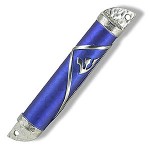
 

Image from micdsgashman.wikispaces.com

Image from micdsgashman.wikispaces.com

When you visit the homes of many Jews, you will find a small metal, wooden, glass, or ceramic case several inches in height called a mezuzah (literally, “doorpost”) fastened to the right doorpost of the front door.  Inside the mezuzah is a tiny handwritten parchment scroll (called a klaf) containing two paragraphs from the Torah (Deuteronomy 6:4-9 and 11:13-21) as well as three Hebrew letters that spell one of the names used for God.


The Bible instructs us to “write them [God’s Words] on the doorposts of your house and on your gates” (Deuteronomy 6:9).  As far back as two thousand years ago, Jews have chosen to follow this instruction using the mezuzah.


It is not uncommon for a person to kiss his or her fingertips and transfer the kiss to the mezuzah by touching it as he or she passes in and out of the home; others touch the mezuzah first and then kiss their fingers.  Many Jews have only one mezuzah in their home, but some have them affixed to the doorway of each bedroom or living area in the house.  Many people wear a small mezuzah on a chain around the neck as jewelry.


Like many customs, the fixing of the mezuzah is surrounded by tradition, mysticism, and a pinch of superstition.  Some say the letters on the scroll make up an acronym that gives protection to the home.  I know of a distinguished symphony conductor who delayed the move into his new house until the local rabbi could come to the home, certify that the scroll inside the mezuzah was proper, accurate, and legitimate, and conduct a formal ceremony at which the mezuzah was applied to the doorpost.  Many people take these things very seriously.
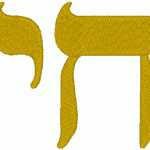
 

BadJews6Another symbol often seen in pieces of jewelry is the chai, made up of two Hebrew letters.  The word chai means “life,” just as the phrase (and song title), “L’Chaim!” (often used as a toast) means “to life.”  In addition, the two letters making up the word chai have a numerical equivalent of eighteen, giving this number a special significance to Jews. Multiples of eighteen dollars are often given as gifts or donations.
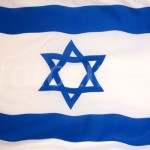
 

Image from www.fotolibra.com

Image from www.fotolibra.com

The six-pointed star, often called the Star of David, is commonly associated with Jews and Judaism.  In Hebrew, it is known as the Magen David, which means “the shield of David.”  Ironically, this symbol has been associated throughout the centuries not only with Jews, but with Muslims, Christians, and other groups.  However, as it came to be used more and more in the design of synagogues built in Europe over three hundred years ago, it became identified as a Jewish symbol.  It was so closely identified with Judaism that Nazis forced Jews to wear a yellow Star of David during the years of persecution and incarceration.


Now, the Star of David not only decorates jewelry, gifts, and other Judaica but also adorns the flag of the State of Israel.  Jews around the world consider the Star of David a proud symbol of Judaism.