Q: Why Sinai, not Jerusalem?

[This was first posted 2014,  as  We have heard it said – A Sinaite’s Apologetics – 3.  Reposting on the occasion of the feast of Shavuot which Sinaites celebrate with Jewry since Gentiles were among Israelites in the “mixed multitude” who left Egypt and stood at Sinai to receive YHWH’s Torah.Admin1.]


—————————


One of our critics point out:

 
  • Do they accept Sinai (in Arabia) as more important than Jerusalem (in Israel) 
  • where additional revelations were given 
  • and where the rest of Israel’s History “actually” happened (after 40 years in the wilderness)?”
 
Image from TheTorah.com

Image from TheTorah.com

We equate Mount Sinai with YHWH and His Torah.  The wilderness of Sinai is neutral territory belonging to no one, save God.


We equate Jerusalem with Israel ‘the promised land,’  with Israelites/Jews  ‘the chosen people’ who were to be the “Light to the Nations.”


Ever wonder why is Sinai the site where the Creator God chose to reveal Himself and to make His Name known?  The very choice of Sinai where the Self-Revealing God gave His guidelines for living is significant in itself.


What happened on Sinai is one of the most momentous events that would leave an impact on all humanity, not only on Israel. We might refer to it as the “First Coming,”  the descent of the God of the universe Who manifested His presence first to Moses in the burning bush; then later to a people who never saw Him, but heard His spoken Words amidst thunder and lightning.


Had the Torah been given in Jerusalem, it would indeed appear [as Christians claim] that it was meant only for Israel.  But in His wisdom, the Lord YHWH chose to issue the Decalogue to representatives of the two categories of people in the mixed multitude: Israelites and non-Israelites (gentiles) among them.  By the very fact that the Revelator-God  chose to give His Torah on Sinai all the more emphasizes the universality of the Torah, initially condensed in the 10 Commandments that were written by the very finger of YHWH on two tablets of stone.


God’s instructions, His guidelines for living, were not meant to be applied only to Israel; they were intended for all humanity.  The TORAH is all one needs to know about what God requires of man. In it He defines His standards for human behavior.   His standards are absolute. He has the right to define what is “right.” He has not left humanity in ignorance about His requirements for the only sentient creature made in His image.


By the time the second generation of Israelites were ready to enter the Land with Caleb and Joshua 40 years after Sinai, the instructions given to Moses had been completed and placed exactly where YHWH specified:  the 2nd set of tablets inside the Ark of the Covenant, the book of instructions in a separate compartment in the Ark.


True, Israel’s history continued after the Torah was completed in the Book of Deuteronomy, just before the second generation entered the Land with Joshua and Caleb.  In fact the rest of the Hebrew Scriptures after the Torah record their failures and successes in living out the Torah. God continued communicating through His mouthpieces, the Prophets of Israel.


“Thus saith the Lord” mostly called for a return to YHWH and His Torah. Amidst those proclamations were judgments on gentile kings as well as projections into future events relating to Israel and the nations, all culminating to a time when all nations would know YHWH and live His Torah.


With continuing research and updates on the Hebrew Scriptures and when/where they were recorded/rewritten/put together in the canon of 24 books that now composes the TNK, truth-seekers are constantly confronted by ‘doubting Thomases’ and results of their scholarly studies.  At some point, one simply has to decide on the foundations of his faith.


Sinaites have decided to remain solely with the Torah, the five books whose authorship is attributed to Moses. These books contain everything one needs to know about how to relate with the Creator/God on Sinai/YHWH, and how to live in community.  The specific teachings, instructions are not always applicable to all cultures and times; many are time-bound, culture-bound, Israel-in-the-wilderness-bound; nevertheless there are basics that do not change.


Gentiles seeking YHWH’s Truth have no book to claim for themselves; even the Christian scriptures called the New Testament had to append itself to the Hebrew Scriptures on which it supposedly based its claim to validity.


Like those non-Israelites, the gentiles in the mixed multitude that stood on Sinai with the Israelites, we claim the universal Torah for all humanity as our own as well.  Sinai IS the place of revelation, not Jerusalem.  Its revelation is complete, read the end of the last book in the Torah.


Without a standard to guide human behavior, people resort to relativism, the doctrine that knowledge, truth, and morality exist in relation to culture, society, or historical context, and are not absolute but subject to change.  Just look at how values and morality have changed just in the last century and the atrocities the world have witnessed in cultures that have not heard or have heard but ignore the ‘other’-centeredness stressed in YHWH’s TORAH.


If only all people and all nations were Torah-observant, it would be a totally different world indeed!  But alas, another religion emerged that taught the Torah was obsolete and only for Jews. They should review in the “Old” or the foundational portion of their two testaments what their most literary version says so well and succinctly:


[KJV] Isaiah 8:20: 

To the law and to the testimony:

if they speak not according to this word,

it is because there is no light in them.


Sig-4_16colors


logo


A Sinaite’s Musical Liturgy – 2nd Sabbath of April

[We are grateful to God-inspired and gifted composers of Christian hymns for their music that we proudly use for our “musical liturgy”;  the lyrics have been revised to reflect the Sinaite’s credo.—Admin1.]


Image from messianicpublications.com

Image from messianicpublications.com

KINDLE THE SABBATH LIGHTS


Blessed are You,

YHWH our GOD,

KING of the universe,

Who commanded us

to set apart a day of rest,

a day You created

for the blessing of all

who would obey

Your 4th commandment.  

Blessed are You,

YHWH,

LORD of the Sabbath.


[Original Music:   “Alleluia, Sing to Jesus”;

revised lyrics]

1. Let us kindle the Sabbath lights,

let their glow flow through our vision and sight.

Like the gleam from the Light of Torah 

which reaches deep in heart and in mind.

CHO: When the darkness fades in the distance 

as brightness follows to fill up its space,

Shadow and dimness that darken the heart and mind of man 

brighten up when His Word is heard.


2. Let us kindle the Light of Torah,

that ‘Tree of Life’ that nurtures our soul;

fill our minds, be enlightened daily 

by Words of LIFE that make us whole.

CHO:  ‘Hear” and “Heed’ are not just for Israel,

these are words for all Gentiles as well,

Blessings for those who obediently live the Torah life,

through life’s conflicts and through all strife.


3.  Let us kindle the love for others, 

enough to lead them toward the LIGHT:

light of Israel, light of Torah,

two lamps that lead the way to HIS LIGHT;

CHO:  Primal BRIGHTNESS was there 

before any sun, moon, stars ever lit up His sky, 

“Let there be light” for all seasons and signs to view at night,

how can anyone miss that sight!


4.  Let us worship the LORD of Sabbath, 

CREATOR,  GOD Who first led the Way:

Six day-workweek deserves a rest on the seventh day,

the true Sabbath day!

CHO:  Sabbath lights in our hearth and home

warm our hearts for knowing that ‘God’s Way is Best’;

May His Words linger for guidance each day and everyday, 

through the week till next Sabbath’s Rest.


Psalms 115


1  Not for our sake, YHWH, not for our sake,

but for Your Name’s sake give glory,

for Your kindness and for Your truth! 

2  Why should the nations say,

“Where now is their God?”  

3  Our God  is in the heavens,

whatever He pleases, He does!

4  Their gods are silver and gold,

the handiwork of man.

5  They have a mouth, but cannot speak;

they have eyes, but cannot see;

6  they have ears, but cannot hear;

they have a nose, but cannot smell.

7  Their hands—they cannot feel;

their feet–they cannot walk;

they cannot utter a sound from their throat.

8  Those who make them should become like them,

whoever trusts in them!

9  O Israel, trust in YHWH;

their help and their shield is He!

10  House of Aaron,

trust in YHWH; their help and their shield is He!

11  You who fear YHWH,

trust in YHWH; their help and their shield is He!

12  YHWH Who has remembered us will bless:  

He will bless the House of Israel,

He will bless the House of Aaron.

13  He will bless those who fear YHWH,

the small as well as the great.

14  May YHWH increase upon you,

upon you and upon your children!

15  You are blessed of YHWH,

Maker of heaven and earth.

16  As for the heavens, the heavens are YHWH’s,

but the earth, He has given to mankind.

17  Neither the dead can praise God,

nor any who descend into silence,

18  but we will bless God from this time and forever.

Halleluyah!


[Original Tune:  Beneath the Cross of Jesus/Revised Lyrics]

Image from Guide to the Pilgrims Progress|Christians return to the Way

Image from Guide to the Pilgrims Progress|Christians return to the Way

1.  Beneath that sacred mountain I virtually take my stand;

the shadow of a mighty Rock within a weary land;

a home within the wilderness, a rest upon the way,–

from the burning of the noontide heat, and the burden of the day.


2.  O safe and happy shelter, O refuge tried and sweet;

O trysting place where Heaven’s Love and Heaven’s Justice meet!

As Jacob in his wondrous dream had wrestled with the One,

A ladder full of angels going up and coming down.


3.  There lies beneath its shadow but on the further side;

The darkness of man’s ignorance that gapes both deep and wide;

But Light shines forth from Sinai’s peak,  a thunderous voice that speaks 

To multitudes of Israelites and Gentiles in their midst.


4.  Upon that sacred mountain,  my eye at times can see—

though centuries have passed and I was not and could not be —

among the generation that received His Covenant,

All that I need to do is read the Exodus account.


5.  I take Sinai, thy shadow for my abiding place;

I ask for nothing more than that I meet Him face to face,

I’ve journeyed for so long to know the One True God’s true Name,

YHWH is the God I worship, His the Name I claim!


Image from www.mastergreetings.com

Image from www.mastergreetings.com


[Borrowed Music:  “Oh how He loves you and me”/Revised Lyrics]


1.  For all the joys of our days,

For untold blessings always,

This wine we drink symbolizes our joy,

Thank You, dear Father, bless one another,

There’s more than what we can say.


2.  Thank You for bread that we share, 

You’ve shown us how much You care,

Bless our Beloved, they’re gifts from Your Heart,

How can we love You, just as You love us,

Oh,  how God loves you and me!


[Name your Beloved:  parents, siblings, spouse, sons, daughters, extended family, grandchildren]


SABBATH MEAL

Image from holisticnutritiondegree.org
Image from www.slideshare.net

Image from www.slideshare.net


HAVDALAH

[Borrowed Music:  “Lead me to Calvary”/Revised Lyrics]


1.  Lord of my life, please light my way all through the darkness be,

Lest I get lost, can’t find my way, over my life, please be!

Thou art my Shepherd, lead me to pastures of green to feed.

Call out my name that I may hear warnings that I should heed.


CHO:  Lest I forget Thy voice I heard,

lest I remember not Thy word,

Lest I forsake the True Path I’ve tread,

lead me back, LORD, to Thee.


2.  Teach me just like the Israelites, all that I need to be,

Show me just how to sacrifice, show me what pleases Thee.

Best of all that I own and have, unworthy though they be,

Best of my mind and soul and will, all are reserved for Thee.


CHO:  Lest I fall short of Thy command,

lest I let go of Thy precious Hand,

Light up my path, my eyes, my life,

lead me back, Lord, to Thee.


Image from madmimi.com

Image from madmimi.com


SHABBAT SHALOM!

Sig-4_16colors


logo

What?! There were resurrected saints at Jesus’ resurrection?

[First posted ,2012, reposting every Resurrection Sunday, the Christian “Sabbath” day for the very reason that the Savior supposedly rose from the dead on Sunday. This is one of those posts that simply ask a lot of questions but doesn’t provide an answer . . . to make a point. —Admin1.]


—————————–


There are two verses in the Gospel of Matthew that bible teachers have not satisfactorily explained if even addressed—well, two out of many others, but let’s just deal with this particular text now.


Matthew 27: 52-53  

The tombs were opened, and many bodies of the saints who had fallen asleep were raised; and coming out of the tombs after His resurrection they entered the holy city and appeared to many.


Signorelli_Resurrection-pano: Image from www.dodsonlumber.com

Signorelli_Resurrection-pano: Image from www.dodsonlumber.com


If the key to business success is location, location, location, so is the key to ferretting out the meaning of any text:  location, location, location . . . or more appropriately. . .  context, context, context.  Why say it three times?  

  • Because the first time it refers to the immediate text before and after it;
  • the second context is the whole chapter, if not the whole book where the verse occurs;
  • and the third context is in the case of bible verses, the whole Bible.  


These verses must have been mis-located  (misplaced) because they follow verse 50 where Jesus yielded up His spirit and died, then verse 51 where—

 “the veil of the temple was torn in two from top to bottom

and the earth shook and the rocks were split.”  

(Check out this link questioning this text:

 Revisit: The Ark of the Covenant:

Was it in the Holy of Holies on the day Jesus died?)


 On careless reading, because of the location of the verses, you might jump to the conclusion that the bodies of “saints” who had “fallen asleep” [euphemism for died] were raised at the moment Jesus died. A more careful reading corrects the actual timing of the misplaced verses which should have been on Resurrection Sunday:  “and coming out of the tombs after His resurrection.”  


This is not belaboring a minor point, this is what any reader of the bible should be doing, scrutinizing the text, specially if it makes claims that are out of the ordinary.  Since the Bible is full of “out of ordinary” phenomena, we should not be surprised about anything it claims; still, within the contexts already explained, it should make sense. And so, since such biblical happenings are not in our experience today, all the more we should endeavor to understand their meaning and their implication in our belief system today.


Upon reading these 2 verses, questions should pop up such as:

  • What does the word “saint” mean?
  • Who are these “saints”?
  • Were there “saints” in those times, as we understand “saints”?
  • What are “saints” to Jews?
  • What are “saints” to Roman Catholics?
  • What are “saints” to Protestant/Evangelicals?
  • Are “saints” alive or dead?
  • Obviously as the text says, these “saints” were dead; therefore, when they came out of their tombs, what did they look like?  Were they skeletal remains, in decomposing stage, recognizable in those conditions . . . or did they appear just like the resurrected Jesus, in ‘new’ resurrection bodies?
  • If they were called “saints” then they must have been ‘good’ people when they died, believers in Jesus Christ?
  • Did the author of Matthew witness this phenomenon himself or simply heard about it and believed it, enough to record it in his gospel?
  • Did the people these saints appeared to not only recognize them but welcomed them back to life?
  • Or were the people deathly scared of them, thinking they were ghosts come back to haunt them?
  • Did these resurrected “saints” live and die again, just like Lazarus?
  • Were people in Jerusalem not excited since, if this was true, so many more dead people, not just Jesus, resurrected from the dead right at that time?
  • Did people connect the resurrection of these saints to the resurrection of Jesus, and therefore believe all that Jesus said?
  • Or since others resurrected as well, Jesus’ resurrection was no longer a big a deal because he was not alone in rising from the dead?


failuretolisten.com

failuretolisten.com

If anyone reading this knows the answer to any or all the above questions, please post your comment here so Sinaites who are totally clueless can begin to understand verses that have baffled us as former Christians/Messianics.


Add to your explanation as well, the quote on the image: “Christianity begins where religion ends with the resurrection.”  Does that really make any sense?


Sig-4_16colors

logo


Update 7/19/14

P.S.  To provide a balance, here’s the Christian perspective from this website:  http://christianity.stackexchange.com/questions/17989/what-is-the-significance-of-dead-saints-being-resurrected-to-life-at-the-crucifixion


Christianity Stack Exchange is a question and answer site for committed Christians, experts in Christianity and those interested in learning more. It’s 100% free, no registration required.


Matthew records that immediately after the death of Jesus, many Old Testament saints who had died came back to life, went into Jerusalem, and appeared to many people.

51 And behold, the curtain of the temple was torn in two, from top to bottom. And the earth shook, and the rocks were split. 52 The tombs also were opened. And many bodies of the saints who had fallen asleep were raised, 53 and coming out of the tombs after his resurrection they went into the holy city and appeared to many. Matthew 27:51-53 NASB

I think it is interesting that this occurred at the death of Jesus and not the resurrection, and I’m not sure what the reason for this could be. My main question though is what the significance was of the Old Testament saints coming back to life physically at this time. This appears to be a sort of “Zeroth” resurrection (borrowing from the Zeroth Law of Thermodynamics, that was asserted after there was already a first and second).

shareimprove this question
1
Presumably such was a further confirming sign of “It is finished.” (Just as the spiritual Holy of Holies was “opened” to the people [see Heb. 10:19-20] with the curtain tearing as a sign, this resurrection would be a sign that Death was dealt the mortal blow at the cross.) This is not enough for an answer, but it might be a start for a helpful answer. –  Paul A. Clayton Jul 30 ’13 at 21:18

add comment

If we read the words carefully one interpretation has it that the graves were opened at his death but they were not raised out of them appearing to many people until ‘after Jesus’ resurrection’.

At that moment the curtain of the temple was torn in two from top to bottom. The earth shook, the rocks split and the tombs broke open. The bodies of many holy people who had died were raised to life. They came out of the tombs after Jesus’ resurrection and went into the holy city and appeared to many people. (NIV, The New International Version. (2011). Mt 27:51–53)

This is how Lange takes it:

The rising was the result, not the immediate accompaniment of the opening of the graves, and is mentioned here by Matthew in anticipation, but with the qualifying insertion: after His resurrection, to preven misunderstanding. Christ’s death opened their tombs. His resurrection raised them to life again, that He might be the first-born from the dead (Lange, J. P., & Schaff, P. (2008). A commentary on the Holy Scriptures: Matthew ,p. 528)

If we follow this logic is seems to fit well. There is an earthquake; it strikes the temple curtain symbolizing the breaking of the death that separated man from God and subjected him to the separation and curse under God’s holy laws. Removed the curse of law and death is opening a way to a new heaven and a new earth. The earthquake comes across the earth, including rocks and tombs, shattering the death that bound us. After his resurrection, whereby he presented the merits of his death and righteousness to God as our high priest, some sample saints come from out of the tombs, to symbolize the guarantee of our future bodily resurrection into life forever and ever.

shareimprove this answer
add comment

In addition to what’s been said already, this is a preview (mini-version) of Jesus’ second coming, when there will be a great earthquake on the Mt. of Olives (which is a giant cemetery even today) and the all the dead will rise from their graves.
shareimprove this answer
2
Welcome to the site. This is an interesting perspective. Do you have any quotes from some prominent theologians that support this? I mean the part about it being a “mini-version” of the second coming. –  fredsbend Dec 24 ’13 at 5:50

If you don’t believe in the Christian Savior, how can you be saved?

Image from LinkedIn

Image from LinkedIn

[This was first posted April 12, 2012; the article was written by a senior Sinaite who was a dedicated Christian and Messianic all her life until 2010; in fact she is a holder of masters degree in theology, from the Asian Theological Seminary.  She goes by the acronym BAN@S6K.  She has other posts, lots of discourses with  Christian missionary colleagues, check her out in the following posts:

Admin 1.]


—————————————


How can you be saved if you don’t believe in the “christian” Savior?


The Christian belief that atonement can only be through Yeshua runs counter to the provisions for atonement prescribed by the Hebrew Scriptures.  First and foremost, God and no one else provides the means of reconciliation and fellowship as attested by —


2 Chronicles 7:14: 

And my people upon whom My Name is proclaimed, humble themselves and pray and seek My Presence and repent of their evil ways — I will hear from heaven and forgive their sins and heal the land.  


This negates any claim of forgiveness through the death of anyone.


In contrast to the Christian concept that man is hopelessly entrapped in sin, the Hebrew Scriptures provide ample testimony that although man may have an inclination towards evil, as stated by—-


 Genesis 8:21 

Adonai smelled the pleasing aroma, and Adonai said in His heart, “I will not continue to curse again the ground because of man, since the imagery of man’s heart is evil from his youth, nor will I again continue to smite every living being as I have done.”


The means of personal reconciliation with God is always at hand as proclaimed by—


 Psalm 51:16-19

 Rescue me from blood guilt, O God, God of my salvation, let my tongue sing joyously of Your righteousness.  O Lord, open my lips, that my mouth may declare Your praise.  For You do not desire a sacrifice, else I would give it; a burnt offering You do not want.  The sacrifices of God are a broken spirit, a heart broken and humbled, O God, You will not despise. 


And Jeremiah 29:13 says—


You will seek Me and find Me, if you search for Me with all your heart.


Hosea 6:6:  


For I desire kindness and not sacrifice and knowledge of God more than burnt offerings.


The Christian’s proclamation “There is no salvation except in receiving Yeshua as Lord and Savior” has no basis in the Hebrew Scriptures.  Its origin lies in the New Testament and has no bearing in the spiritual life of a true believer in the One True God.


Through repentance, prayer, fasting, and doing what is right, the Scriptures teach that everyone has the ability to return to God directly.


BAN@S6K

logo-e1422801044622


—————————————


Ezekiel 33:8-20
[AST/ArtScroll Tanach]
vs. 8 When I say to the wicked, O wicked man, you shall surely die; if you do not speak to warn the wicked man to turn from his way, that wicked man shall die in his iniquity; but his blood will I require at your hand.
vs. 9 But, if you warn the wicked to turn from his way, and he does not turn from his way, he shall die in his iniquity; but you would have saved your soul.
vs 10  Therefore, O son of man, speak to the house of Israel; Speak thus, saying: if our transgressions and our sins are upon us, and we pine away in them, how should we then live?
vs. 11  Say to them, As I live, says the Lord God, I have no pleasure in the death of the wicked; but that the wicked should turn from his way and live; turn, turn from your evil ways; for why will you die, O house of Israel?
vs 12  Therefore, son of men, say to your people, The righteousness of the righteous shall not save him in the day of his transgression; as for the wickedness of the wicked, he shall not fall by it when he turns from his wickedness; nor shall the righteous be able to live for his righteousness in the day when he sins.
vs 13  When I shall say to the righteous, that he shall surely live; if he trusts in his own righteousness, and commits iniquity, all his righteousness shall not be remembered; for the iniquity that he has committed.
vs 14  And, when I say to the wicked, You shall surely die, if he turns away from his sin, and does that which is lawful and right;
vs 15  If the wicked restores the pledge, gives back what he has robbed, follow the statutes of life, without committing iniquity, he shall surely live, he shall not die.
vs 16  None of the sins that he has committed shall be remembered against him; he has done that which is lawful and right; he shall surely live.
vs. 17  Yet your people say, The way of the lord is unfair; but it is their way that is unfair.
vs 18  When the righteous turns from his righteousness, and commits iniquity, he shall die by it.
vs 19  But if the wicked turns away from his wickedness, and does that which is lawful and right, he shall live by it.
vs 20  Yet you say, The way of the Lord is unfair.  O you house of Israel, I will judge you, everyone according to his ways.
 

The Lamb/Ram in Egypt’s Pantheon

[First posted 2012.  Here is an article written by blogger who goes by “Frum Heretic” – frumheretic.blogspot.com, originally posted MARCH 31, 2009; reformatted for this post.  —Admin1.]


Image from www.essaysbyekowa.com

Image from www.essaysbyekowa.com


Sheep Worship in Ancient Egypt


Apropos to the upcoming Pesach holiday, a recent guest post on DovBear asked the question “why was a sheep chosen for the Passover sacrifice?”


I wanted to explore a bit some relevant passages in the Torah, not to answer this question per se (and thus I will not be discussing the important passages in Ex. 8:22 and Ex. 12 – especially 12:46 with ; regards to the prohibition to break the bones of the pascal lamb) but to look at some of the descriptions and commentaries related to sheep worship and shepherding in Egypt.


Rashi explains in the Joseph story as to why Egyptians found it distasteful to eat with Hebrews:


And Joseph made haste for his compassion towards his brothers had been stirred and he wanted to weep; so he entered his chamber, and wept there. And he washed his face, and came out; and he restrained himself, and said: ‘Set out bread.’ And they set for him by himself, and for them by themselves, for the Egyptians could not bear to eat bread with the Hebrews; for it is an abomination to the Egyptians. (Gen. 43:30-32).


Rashi comments only that Onkelos gives a reason for this behavior. The Artscroll Sapirstein mentions that there are two variants of Onkelos; one of which renders the targum as —“For the animal that the Egyptians worship the Hebrews eat”.


There are two major problems with this interpretation.

  • First, it is not implied by the text at all. The plain rendering is simply that the Egyptians found it offensive to eat with Hebrews (Hertz takes this approach here). Such behaviour would be typical of any xenophobic culture, and for millennia the people of Egypt believed themselves to be far superior to all of the surrounding nations.
  • The second problem is that the Egyptians themselves ate meat of animals that they worshiped (although saying that they actually worshiped animals is an oversimplification. It is more accurate to say that animals were symbolic of universal cosmic principles and manifestations of gods, rather than being worshiped as gods in their own right.)   Although meat was a delicacy in ancient Egypt and was mostly eaten by nobility, even the common people would feast on domesticated animals – such as sheep and goat – during festivals. Even pork – associated with the malevolent god Set – was eaten (the Jews in Goshen would have been well aware of this, for pig was widely consumed in Lower Egypt during the New Kingdom.) Probably the most well-known animal used by the Ancient Egyptians in religious ceremony was the Apis Bull, yet the upper classes would eat cattle meat as well.

The first passage that explicitly indicates that the Egyptians had a particular abhorrence towards shepherds is found in chapter46 after Joseph reveals himself to his brothers. He tells them that he will make especial mention of their occupation as shepherds:

And Joseph said to his brothers, and to his father’s household: I will go up, and tell Pharaoh, and will say to him: ‘My brothers and my father’s household who were in the land of Canaan have come to me; and the men are shepherds, for they have been keepers of cattle; and they have brought their flocks, and their herds, and all that they have.’(46:31-32)


Joseph then coaches them with instructions to tell Pharaoh a similar story when they are summoned before him:


And it shall come to pass, when Pharaoh shall call you, and shall say: ‘What is your occupation?’ then you will say ‘Your servants have been keepers of cattle from our youth even until now, both we, and our forefathers’; so that you may dwell in the land of Goshen; for every shepherd is an abomination to the Egyptians.(46:33-34)


There are some discrepancies between the two passages, notably the omission of the mentioning of flocks of sheep. (But more interestingly, and as an aside, note the use of “father’s household” in 46:31; there were obviously other family members present besides the brothers to whom Joseph was speaking!)


Rashi now explains that shepherds are an abomination to Egyptians because sheep are a deity to them. (Why he only hinted at this earlier by referencing Onkelos I don’t know.) The Sapirstein edition notes that either “abomination” is a euphemism for “pagan deity” per the Zohar, or because shepherds are considered abominable because they lack respect for the sheep, a pagan god of the Egyptians.


Returning to the text, Joseph then tells Pharaoh:

Then Joseph went in and told Pharaoh, and said: ‘My father and my brothers, and their flocks, and their herds, and all that they have, have come out of the land of Canaan; and, behold, they are in the land of Goshen.’(47:1)


Joseph presents five of the brothers to Pharaoh who asks them what their occupation is. They respond:


Your servants are shepherds [of sheep], both we, and our forefathers. And they said to Pharaoh: ‘We have come to sojourn in the land since there is no pasture for your servants’ flocks, for the famine is severe in the land of Canaan. Now therefore, we pray thee, allow your servants to dwell in the land of Goshen.’(47:3-4)


To which Pharaoh responds:


And Pharaoh spoke to Joseph, saying: ‘Your father and your brothers have come to you; the land of Egypt is before you – in the best of the land settle your father and your brothers; in the land of Goshen let them settle. And if you know any able men among them, then make them rulers over my livestock.’(47:5-6)


Again we have a discrepancy with the implication that shepherding was an objectionable livelihood to the Egyptians. Pharaoh obviously considered this a critical enough occupation to make mention of his need for skilled sheepherders to Joseph! Many people kept sheep in Egypt, but this would have been on very small-scale since appropriate pasture land was scarce (thus the scarcity of sheepherders and the particular attraction of Goshen for the Jews.)


An additional problem with the biblical insistence on an abhorrence towards shepherds is the fact that Osiris, god of the underworld and primary deity for much of ancient Egyptian history, is often depicted carry a shepherd’s crook. The linking of Pharaoh with Osiris meant that he, too, would carry a crook as a symbol of his office, as it “symbolizes his role as the shepherd of his people.” (wiki). The crook was thus one of the most important items associated with Pharaoh, often used during coronation and other ceremonial occasions. (Indeed, I probably don’t even need to link to a picture of King Tut’s sarcophagus as the image of his golden coffin with crook and flail is likely indelibly inscribed in your memory! But here it is anyway.)


To explain the supposed dislike for shepherds, one (religious) online commentary states that perhaps this —


“is a consequence of the Hyksos oppression, in which case these references in Genesis would be powerful arguments for a late date for the time of the Exodus”.


The writer is referring to the common translation of Hyksos as “shepherd kings”. (Interestingly, Hertz uses the same translation – typical of this time period – but he also assumes that the Hyksos were in power at this time and that they “inherited” the dislike of shepherds from the Egyptians.)  But this is a misnomer and indeed much of the “proof” for the Torah’s claim is based on a mistranslation!


 “The Jewish historian, Josephus, in his Contra Apionem, claims that Manetho was the first to use the Greek term, Hyksos, incorrectly translated as “shepherd-kings”. Contemporary Egyptians during the Hyksos invasion designated them as hikau khausut, which meant “rulers of foreign countries”, a term that originally only referred to the ruling caste of the invaders.” Source.


There are many indications that the “Israel in Egypt” stories accurately describe some details of Egyptian life and culture and likely reflect a first-person experience there (as Kenneth Kitchen, James Hoffmeier, and others loudly proclaim). Certainly any multi-source document theory regarding the Torah’s origins must admit to this.


A trivial (but admittedly weak) example is that the author(s) of the Torah apparently knew about a “sheep god”. Quite possibly this recalls Amun, one of the most important deities of ancient Egypt. Amun took on many forms, and as god of Thebes he was depicted as ram-headed. His worshipers sacrificed a ram once a year at which time its fleece would be used as clothing for a ram-headed idol.

Another Egyptian ram-headed god was Banebdjed, associated with Osiris (see above), who wore a crown with ram’s horns.


Yet it does seem that there is some confused narrative as well, as witnessed by the descriptions of the Egyptian attitudes towards shepherds and the implied abhorrence towards eating meat from animals that worshiped.  Perhaps one could make the argument that there was a different set of rules for foreigners regarding the latter, but I have never seen such a reference in any other historical document. Someone with greater knowledge in ancient Egyptian culture and/or archaeology is welcome to convince me otherwise.


—————————


[S6K:  Thanks to WIKIPEDIA for this chart on Egypt’s Animal worship]


Main article: Animal worship

Many animals were considered sacred to particular deities:

DeityAnimal
PtahBull
ThothIbis or Baboon
AmunRam
Horus or RaFalcon or Hawk
AnubisJackal or Dog
SobekCrocodile
HathorCow
SekhmetLioness
NekhbetVulture
Wadjet or EjoEgyptian cobra
KhepriScarab Beetle
GebEgyptian Goose or Snake
Bast or BastetCat

List of deities of Ancient Egypt

  • Aken – Ra as ferryman to the underworld became a separate deity subservient to Osiris
  • Aker – early deity of the horizon, later called, Ruti, two lions
  • Am-heh – minor underworld god, “devourer of millions”
  • Ammit – crocodile-headed female devourer in Duat, a funerary deity
  • Amun or Amen – “the hidden one”, a local creator deity at Thebes who rose in importance when it did, later married to Mutafter the rise
  • Amunet – the primordial goddess, the concept of air in the Ogdoad cosmogony; depicted as a cobra snake or a snake-headed woman
  • Andjety – god thought to be a precursor to Osiris
  • Anhur – god of war at Abydos and Thinis
  • Ankt – a minor war goddess
  • Anput – goddess who was the female aspect of Anubis, his wife
  • Anti – god of ferrymen, related to Horus
  • Anubis or Yinepu – dog or jackal god of embalming and tomb-caretaker who watches over the dead
  • Anuket – gazelle-headed goddess of the Nile River, the child of Satis, and among the Elephantine triad of deities
  • Apophis or Apep – evil serpent of the Underworld and enemy of Ra; formed from a length of Neith‘s spit during her creation of the world, chaos
  • Apis – bull deity worshipped in the Memphis region
  • Ash – god of oases and the vineyards of the western Nile Delta
  • The Aten – a sun god worshipped primarily during the period of Atenism in the eighteenth dynasty under PharaohAmenhotep IV (Akhenaten)
  • Atum – a creator deity, and the setting sun
  • Babi – baboon god associated with death and virility
  • Banebdjedet – ram god of fertility
  • Ba-Pef – minor underworld god
  • Bast or Bastet – protector of the pharaoh and solar goddess, depicted as a lionesshouse cat, cat-bodied or cat-headed woman
  • Bat – cow goddess who gave authority to the king, her cult originated in Hu and persisted widely until absorbed as an aspect of Hathor after the eleventh dynasty
  • Bata – bull god
  • Bes – dwarfed demigod associated with protection of the household, particularly childbirth, and entertainment
  • Chenti-cheti – crocodile god
  • Geb – god of the Earth, first ruler of Egypt and husband of Nut
  • Ha – god of the western deserts
  • Hapi or Hapy – deification of the annual flooding of the Nile, associated with fertility
  • Hathor or Hethert – cow or cow-goddess of the sky, fertility, love, beauty, and music
  • Hatmehit – fish goddess, originally a deification of the Nile River
  • Hedetet – scorpion goddess, later incorporated into Isis
  • Heka – deification of magic
  • Hemen – falcon god
  • Heqet – frog or a frog-headed goddess of childbirth and fertility
  • Hemsut – goddess of fate and protection
  • Heryshaf – ram god
  • Horus or Heru – falcon-headed god of the sky, pharaohs, war, and protection
  • The four sons of Horus – personifications of the four canopic jars
  • Hu – deification of the first word
  • Huh – deification of eternity
  • Iabet – goddess of the east, consort of Min, and cleanser of Ra
  • Iah – god of the moon
  • Iat – minor goddess of milk and, by association, of nurturing and childbirth
  • Imentet – goddess of the necropolis west of the Nile
  • Isis or Aset – goddess of magic, motherhood and fertility and consort of Osiris, represented as the throne
  • Iusaaset – a primal goddess described as “the grandmother of all of the deities”
  • Kauket – snake-headed personification of darkness, whose consort was the frog-headed Kuk
  • Kebechet – deification of embalming liquid
  • Khepri – the scarab beetle or scarab-headed god of rebirth and the sunrise
  • Kneph – a creator deity
  • Khnum – ram-headed creator god of the flooding of the Nile River
  • Khonsu – god of youth and the moon
  • Kuk – frog-headed personification of darkness, whose consort or female form was the snake-headed Kauket
  • Maahes – lion-headed god of war, weather
  • Ma’at – goddess who personified concept of truth, balance, justice, and order
  • Mafdet – goddess who protected against snakes and scorpions
  • Mehen – protective snake god which coils around the sun god Ra during his journey through the night
  • Menhit – goddess of war, associated with Sekhmet
  • Meret – goddess associated with rejoicing, singing, and dancing
  • Meretseger – cobra-goddess of tomb builders and protector of royal tombs
  • Meskhenet – goddess of childbirth and the creator of each person’s Ka, a part of their soul, which she breathed into them at the moment of birth
  • Min – god of fertility and lettuce, often represented as a man with an erect penis
  • Mnevis – the sacred bull of Heliopolis
  • Monthu – falcon god of war
  • Mut – mother goddess, associated with the waters from which everything was born
  • Nefertem – god of healing and beauty
  • Nehebkau – guardian of the entrance to the underworld
  • Neith – goddess of creation, war, weaving, and the dead
  • Nekhbet – vulture goddess, patron of pharaohs and Upper Egypt
  • Neper – androgynous deification of grain
  • Nephthys or Nebthet – goddess of death, night, and lamentation; the nursing mother of Horus and the pharaohs
  • Nu – deification of the primordial watery abyss
  • Nut – goddess of the sky and heavens
  • Osiris or Wesir – merciful judge of the dead in the afterlife and consort of Isis
  • Pakhet – a synthesis of Sekhmet and Bast
  • Petbe – god of revenge
  • Ptah – creator deity, also a god of craft
  • Qebui – god of the north wind
  • Ra – the sun, also a creator deity, whose chief cult center was based in Heliopolis
  • Rem – fish god who fertilizes the land with his tears
  • Renenutet – cobra or snake goddess worshiped in Lower Egypt, associated with Wadjet, fate, and deification of the act of giving a true name during birth, later Geb was her husband
  • Saa or Sia – deification of perception
  • Satet – goddess of war, hunting, fertility, and the flooding of the Nile River
  • Sekhmet – lioness goddess of destruction, pestilence, and war; fierce protector of the pharaoh, and later as an aspect ofHathor
  • Seker or Sokar – falcon god of the Memphite necropolis
  • Serket – scorpion goddess of healing stings and bites
  • Seshat – goddess of writing, astronomy, astrology, architecture, and mathematics; depicted as a scribe
  • Set or Seth – god of the desert, storms, and foreigners; later god of chaos
  • Shait or Shai – deification of the concept of fate
  • Shed – savior deity
  • Shezmu – god of execution, slaughter, blood, oil, and wine
  • Shu – god of the air
  • Sobek – crocodile god of the Nile, patron of the military
  • Sobkou – messenger god
  • Sopdet – goddess seen as the personification of the star Sothis, (Sirius)
  • Sopdu – personification of the scorching heat of the sun arriving after heliacal rising
  • Ta-Bitjet – scorpion goddess identified as the consort of Horus
  • Tatenen – god of the primordial mound
  • Taweret – hippopotamus goddess of pregnant women and protector during childbirth
  • Tefnut – goddess of moisture, moist air, dew, and rain.
  • Tenenet – goddess of beer
  • Thoth or Djehuty – ibis-headed god of the moon, drawing, writing, geometry, wisdom, medicine, music, astronomy and magic
  • Unut – snake goddess
  • Wadjet – snake goddess and protector of Lower Egypt
  • Wadj-wer – fertility god and personification of the Mediterranean Sea or lakes of the Nile Delta
  • Weneg – plant god supporting the heavens
  • Werethekau – goddess of supernatural powers and protection of the deceased, associated with the crowns
  • Wepwawet – jackal god of warfare and hunting
  • Wosret – a guardian goddess of Thebes whose cult became prominent widly, protector of the young god Horus, an early consort of Amun, later superseded by Mut

http://en.wikipedia.org/wiki/Plagues_of_Egypt

God ofNameAppearance
SunRahead of falcon and sun disk
MusicHathorhorns of cow and sun disk
DestructionSekhmethead of lion
SkyNutblue with golden stars
EarthGebcolour of plants and Nile mud
DeadOsirisdressed in white with crook and flail
DesertSethanimal head with long curved snout
PharoahHorushead of hawk and crown of Egypt
MagicIsisthrone on head or holding baby
WisdomThothhead of ibis
EmbalmingAnubishead of jackal
JusticeMa’atfeather in her hair
CreationAmuncrowned with feathers
CatsBastethead of cat
Symbol
White crown
Red crown
Eye of Horus
Feather of Ma’at
Ankh
Sceptre of Seth
Sun disk
Boat of Ra
Crook and flail
Scarab

Monsters
Ammit the destroyer
Apep the snake
Nature
Cobra
Falcon
Ibis
Scarab beetle
Moon
Ram
Ammonite

Egyptian
Numbers


How now do we Sinaites celebrate the Passover . . . or do we?

Image from Fr. Peter Preble

Image from Fr. Peter Preble

[First posted in 2014; a transitional time for Sinaites when we determined which of the 7 Feasts in Leviticus 23 truly apply to non-Israelites, Gentiles like ourselves.  The decision to discontinue celebrations that were in the experience of Israel alone and not applicable to us came after the writing of this post. Still, there is much to learn so read on.  Know however, that Sinaites observe only the following:  weekly Shabbat, Shavuot (giving of the Torah), Yom Kippur (Day of Atonement). We have articles explaining why and how we’ve arrived at this decision.  Please refer to the SiteMap.—Admin1]


—————————–


Passover or Pesach is celebrated on different dates every year; for year 2018 it begins March 30 and ends April 7.   Jewry  will celebrate it as they should, as they are commanded to, since it memorializes their freedom from bondage to Egypt.  There are years when the Christian Easter and the Jewish Passover coincide and this year, it’s a week apart.


As our title asks, do Sinaites celebrate Passover? 


Pesach or the Passover feast is one of the seven listed as ‘My feasts” in Leviticus 23.  Whose ‘feasts’?  “My” refers to the Speaker,

  • the God Who liberated Israel from Egyptian bondage,
  • Who revealed His Name to them through Moses as YHWH, and
  • Who is now giving specific instructions and guidelines to His chosen people during their wilderness wandering.

As Christians and Messianics, we Sinaites have celebrated this feast for almost three decades now. We were first introduced to it not by a Jew or a rabbi, but by our Christian Bible teacher whose focus was on correcting misconceptions and wrong teachings . . . such as what?  


For one,  the “Lord’s Supper” or the “Last Supper” which became “communion” was really the celebration of the Pesach or the Passover which commemorated events of the night of Israel’s exodus from Egypt. Don’t ask what the connection is between all those events and practices; suffice it to say we do owe this teacher our first introduction to this feast.  He introduced us to not only the scriptures recounting the original events in exodus, but he held a Seder every Passover, observing as closely as possible the Jewish traditional celebration, complete with the paraphernalia, Haggadah, symbolic food and props. For this early introduction to things Jewish, we owe this teacher and are grateful to him for focusing our interest to where it eventually gravitated in this stage of our faith journey. 


At about this time in year 2013, Sinaites who have been celebrating Passover started feeling like we were continuing a tradition we could not really relate to.  Was it only because we followed the Jewish Haggadah which was intended for Jews?  Partly, and to ‘fix’ that disconnect, we decided it was time to write our own liturgy for Passover.  


We would focus on our own liberation from bondage, bondage to what? We were never in Egypt exposed to Egyptian gods; but we were in another religion that worshipped a God different from the God we now worship. We felt we had wrongly accepted wrong beliefs for so long, never questioning the scriptures that served as the source of our faith. 

[Image from shiratdevorah.blogspot.com]


Unlike Messianics who do as the Jews do “[+]Jesus” in the Passover Seder, we Sinaites reverted back to the Jewish Seder as is, that is, “[-]Jesus”.  We would keep doing this until we were convinced from further study of the Torah what is required of non-Jews.


While we still believed we should celebrate the Passover, we felt no connection to the Jewish traditional celebration. It felt so much like we were back attending the Catholic mass before Vatican I and II, when all prayers were recited in Latin and we were participating in a worship alien to us.

Our basic problem as ‘do-not-wanna-be-Jews’: while the Seder was fun as a ‘teaching tool’ for non-Jew initiates and specially for children, we kept wondering why we had to go through recitations and rituals that had religious, cultural and historical significance for Jews but not for us gentiles.

Strangely, Christians and Messianics could actually find meaning in them because they believe in progressive revelation;  i.e.,  


  • Leviticus 23 feasts were supposedly all pointing to the Christian Messiah Jesus or Yeshua;
  • they connect the passover lamb to their “Lamb of God” and the exodus from bondage to their freedom from Mosaic law
  • , the unleavened bread to the communion wafer.
  • “When I see the blood, I will pass over you” is related to the shed blood of Jesus, the antidote to the ‘second death’ which is eternal damnation in hell with the Christian devil and his ilk.
  • (To correct such thinking, please read MUST READ: Was Christ our Passover?).


We were aware that non-Israelites were among the “mixed multitude” who were liberated from Egypt’s bondage and received theTorah on Sinai with the Israelites, and we do connect with them.  One of our Q&A rabbis pointed out to us that these non-Israelites were the rabble-rousers, the idol-worshippers, who were eliminated in judgments during the wilderness wanderings.  Another explained that non-Israelites were eventually assimilated within Israelites, that is why at some point scripture referred only to “Israel’. 


As Sinaites, if you haven’t noticed yet, we cling stubbornly to our gentile-ness and no, no, no, no, we keep correcting all, WE ARE NOT JEW-WANNABE’S, OK?!!! In fact we’ve shed all the Jewish trappings we used to cling to as former Messianics. 


 Surely, the God of Israel Who is the same God of the Nations respect and desire diversity (lesson from the Tower of Babel) and it is not His desire that the whole world become Jewish, what He desires is that the Nations know Him through Israel, and learn to live HisTorah.  How do we know?  He says so over and over in the Torah and through the prophets of Israel in Neviim.


Admittedly, those of our colleagues who are not based in our core community and are living elsewhere, could not find any faith group with whom they could celebrate the Sabbath and have Torah study except — in a Jewish Synagogue.  And so they felt it best to attend Synagogue Shabbat service and learn from the rabbis.  Some of them are moving on to being accepted and embraced as full-fledged members, if not, accepted as ‘Jews’ — there goes the ‘wannabe’ part. They are in the process of being assimilated.


For us though, stubbornly gentile but loving this God revealed in the Hebrew Scriptures, to solve our problem of not being able to relate to the Jewish Seder, we resolved to write a Seder of sorts for non-Jews, and that plan was left in the back-burner  . . . . until we got to the fall festivals of 2013 when we reviewed “My feasts”.  


On that umpteenth review of “My feasts”, we reached a conclusion that surprised even ourselves!  We analyzed that — of the seven feasts of Leviticus 23— really and truly — five of them were specific to Israel and is in Israel’s national experience and history, and no other nation’s.


This revisited article explains why we now think this way.  To fast-forward to the conclusion, we decided there are only two feasts that gentiles can relate to because they are universal and not particularly Israel’s; these are —- the weekly Sabbath, and the Day of Atonement or Yom Kippur. 

So, are we celebrating Pesach this year or are we celebrating this year? And what ARE we celebrating and commemorating?


We feel like we should but not out of obligation or need.  

As Sinaite VAN (in memoriam) well expressed our sentiments,


“we are grateful to YHWH

for ‘snatching’ us out of the bondage

to our previous religious affiliations

and their ‘God’

and for placing us on the RIGHT PATH

toward His Revelation on Sinai

and worshipping HIM,

and calling on His Name, YHWH.”


As we’ve written in a previous article,


“the TORAH is the map,

and that’s the real good news!”


We’ve been on “YHWH’s map” since 2010, shedding anything that goes against Torah, and learning new and wonderful lessons from the five books attributed to Moses which, we believe, contain YHWH’s declarations.  The Jewish guides are aplenty along the way; we check them out but stick stubbornly to being gentile on a universal pathway established by YHWH Himself for the nations, not only for Israel.  


To repeat:  are we celebrating the Passover this year? No.  


But on Passover week, we will have a Sabbath liturgy commemorating our own ‘liberation from bondage’—bondage to what?—

  • to a god different from YHWH,
  • to man-made religion,
  • to self-imposed ignorance,
  • to complacency in the religion we inherited from birth and staying under the umbrella of its general doctrinal statements even as we moved from one sect to another;
  • to intolerance of anything other than what that former faith taught;
    • because we were so sure then that it was right and all others were wrong,
    • because while we did a lot of self-study, we did not venture out to check the foundation Christianity claimed:  the “old” testament, the Hebrew Scriptures, the Torah books.
Image from HubPages

Image from HubPages

We thought about celebrating it on the true month of our liberation, that would be September . . . but it always coincides with the Day of Atonement, a time of self-examination and repentance, not a celebration.  So, we decided . . . let us follow the Jewish calendar but celebrate our own liberation our own way.  


And so have we celebrated it since. 


Happy Passover to our Jewish friends

and Happy Easter to our Christian friends.


In behalf of Sinai 6000 core community,


Sig-4_16colors

logo


A Sinaite’s Reason for Celebrating the Passover

[This is being reposted in memory of Sinaite VAN@S6K who entered his final Sabbath Rest in 2016.  Originally posted in 2013, our transitional year when our core group were still reviewing what in Torah is for the Jew and what is for the gentile,  at the beginning, we ‘played safe’, particularly because some of us had just exited from our Messianic re-orientation of the Old Testament.   We felt that until we had restudied the Torah, we would continue celebrating all the Leviticus 23 feasts of YHWH.  


As of 2013 however, we reached a decision that not all 7 of the Levitical feasts historically applied to anyone other than Israel, but that only 3 of them were universal:  

  • the weekly Sabbath,
  • the Day of  Atonement,
  • and the anniversary of the Sinai Revelation which is the feast of Shavuot, “Pentecost” in Christian terminology.

 The weekly Sabbath precedes the giving of the Law; everyone sins and should observe Day of Atonement; and we acknowledge only the Sinai Revelation as recorded in the Torah, as the ‘Word of YHWH.”  


Please check these posts that show the Sinaites’ journey and how we reached our conclusions on the Feasts of YHWH:


Image from clipartfest.com

Image from clipartfest.com


In Leviticus (Vayyikra) chapter 23 God’s (YHVH’S) “appointed times” (or “feasts”)  are listed for all Israelites and non-Israelites among them to observe.  


These are the following:

  1. Sabbath 
  2. Pesach or Passover,
  3. Unleavened Bread,Shavuot (Pentecost) 
  4. and Counting of the Omer (First Fruits)
  5. Yom Teruah (Trumpets)/
  6. Rosh Hashana (New Year) Yom Kippur (Day of Atonement), and 
  7. Sukkot (Tabernacles), Shemini Atzeret (8th Day)


We are approaching the second on the list, Pesach or Passover, the celebration of which falls on different times in the biblical as well as the Gregorian calendar.


The meaning and the observance of this festival is found in Exodus (Shemoth) chapters 12 & 13, where it was first instituted.


In these chapters the instructions are enumerated in detail as to how it is to be celebrated, such as,

  • the day was marked,
  • the lamb was chosen to be killed
  • and eaten with bitter herbs
  • and the unleavened bread.


The day – 14th day of the month at twilight, the feast of Pesach or Passover. And, the 15th day of the same month is the feast of Unleavened Bread.


The food – the lamb, a male, year old, unblemished, to be killed and roasted with fire and to be eaten with unleavened bread and bitter herbs.


The reason for the celebration – the day marks the deliverance of Israel from Egypt, not only from physical slavery but also from spiritual slavery.


It was also the beginning for Israel to be freed from all heathen influences and the beginning of the nation to be dedicated to the service of God (YHVH) as a nation of priests. From the worship of many gods to the worship of YHVH, the ONE TRUE GOD:


For I will go through the land of Egypt on that night

and I will strike down all the first- born in the land of Egypt, both man and beast; and against all the gods of Egypt

I will execute judgments:

I am the LORD (YHVH).

(Ex.12:12).

 The celebration of Pesach or Passover is a very meaningful experience for me.


It was for me a deliverance —

  • from the worship of ‘many gods’ (the Trinitarian God of my former Christian/Messianic belief)  
  • to the worship of YHVH, the One True God, the God of Abraham, the God of Isaac, and the God of Jacob.


Hence, I look forward to celebrating it with Israel and all other gentiles who have shared the Exodus experience, if only symbolically.


VAN@S6K

logo-e1422801044622


What’s good or bad about “religion”?

god-has-no-religion-gandhi[First posted  2012. To this day, Sinaites constantly correct the misperception that Sinai 6000 is a new ‘religion’ and therefore is relegated to ‘cult’, according to Christianity’s definition of what’s cultic, i.e., any deviation from the Christian doctrine.  We claim to be a way of life, following the commandments of the God we embrace.  Read on.—-Admin1]


———————


Sinaites define “religion” as a man-initiated attempt to relate to an unknown supernatural power.   Religion is human-sourced, based on man’s philosophical musings, speculations, logic, conclusions leading to beliefs and convictions about a supernatural entity whom man wants to know but cannot see or prove, but feel a spiritual link with.


This man-initiated attempt might begin with—

  • simply recognizing that there is a higher power,  
  • then move on to seeking to know him,  
  • and further to defining and naming him;   
  • and determining ways to please, placate, worship him;   
  • and finally to living according to how man thinks this god requires him to live.  

All beliefs in a deity might loosely fall under “religion.”  In this sense, religion is good, because at least there is an acknowledgment of God’s existence followed by accountability to God.  It should make a difference in how he lives his life on earth, how he uses his time, opportunities, giftings, etc. 


[AST]  Proverbs 9:10-11  

“The beginning of wisdom is fear of HaShem

and [the beginning of] understanding is

knowledge of the sacred.  

For through me your days will be increased,

and they will increase years of life for you.

 If you have become wise,

you have become wise for your own good,

and if you have scoffed,

you alone will bear [responsibility].”


Some people end their speculation with an awareness of God and go no further.  Others progress to the next step—how do I get to know this Being, this Entity?  


The normal route resorted to is—they turn to existing religious sects, small groupings or communities, persuaded that the leaders know more than they do about “the way” to God. There are many institutionalized religions that have world-wide reach and influence, one doesn’t have to stick his neck out to join any of them; they’re out to go after any seeker. 


The goal of a God-seeker is simply to know God, if that is at all possible.  It starts as a personal quest but as one starts relating to others with the same objective, they start connecting with other seekers. Before you  know it, they form fellowships, religious communities, then institutionalize into churches.  Each tends to have an exclusive claim to truth and to being the right religion and the only way to God. 


Image from quotesvalley.com

Image from quotesvalley.com

History has a sad record of the evils of religion, so that’s the BAD part of religion. It tends to promote self-righteousness, intolerance, exclusivism, bias towards others of different faiths, tunnel vision, persecution, fanaticism, to name a few. The Crusades and the Inquisition all but eliminated any opposition or challenge to the beliefs espoused by Catholicism.  Cultic leaders are able to influence their flock to practice polygamy, isolate themselves in communities to wait for the end of the world and worse, cultic leaders like Jim Jones was able to delude his flock towards mass suicide. Religious fanatics go so far as burning themselves in public for a cause and in the case of terrorists, suicide bombers are able to cause as much death and destruction to others.  [Update 2017:  The rise of fanatic terrorists with an agenda supposedly rooted in their religious affiliation which they justify for the use of brutality, destruction and mass murder is the most recent example of the evil resorted to by misquided religionists who do what they do in the name of their God.]


If there is a sure turnoff for the agnostics and atheists of the world, that would be religion and all the bad it does, ironically and unfortunately,  “in the Name of God.”


So where does a sincere God-seeker/Truth-seeker turn to, if not religion?  


Image from antinatalismo.blogspot.com

Image from antinatalismo.blogspot.com

For us,  after being in religion for majority of our lifetime and getting out of religion,  we have discovered that there IS another way:  studying for ourselves the original revelation of God . . . that would be the Sinai revelation recorded in the five books attributed to Moses—the Torah.   Get to know  the God Who revealed Himself, His Name, and His will for all humanity.  That God, we have decided for ourselves, is the God who spoke His Words and taught His Way from His Sinai Revelation.  His Name is YHWH.  We share  what we learn; we believe that relentless true God-seekers will eventually find Him just as we did . . . our search led us to Sinai, others’ might end up somewhere else.  God’s presence is limitless, He is discoverable even in nature where His Designer’s Fingerprint is obvious to minds that know and acknowledge that nothing exists without a ‘maker’.   One could speculate forever how to relate to this invisible God, that would be “religion”.  But one could also decide after much research and study to believe or not believe that an invisible God who created His visible world would want to communicate to His sentient creatures about who He is, what He’s like, and what He requires of the one He made in His image.  Studying His recorded ‘communication’ with man is the beginning of having a relationship with that God.  We have decided for ourselves that the One True God’s loving message to man is found in the Hebrew Scriptures, particularly in the Torah.


We believe that each individual’s goal in life is —

to personally know the One True God,

be in relationship with Him

by acknowledging Him as Lord and King;

then as His subject,  

live His Guidelines for Life,

Instructions for Living,  

His Torah . . .

not membership in a ‘religion’. 


Sig-4_16colors


logo

How does one ‘get right’ with God?

Image from 108.9.155.188

Image from 108.9.155.188

[This was first posted in 2015 on the occasion of the Christian feast called “Easter” which commemorates the death and resurrection of the Christian Savior Jesus Christ.  Time for a review written by Sinaite BAN who was a devout Christian active in ministry with husband VAN for over half a century of her life, so she knows what of she speaks.—Admin1]


—————————-


Easter week is a time when Christendom commemorate the life, passion and death by crucifixion of Jesus Christ.  For Christians believe that by his death, he has saved humanity from eternal damnation and therefore have the assurance of eternal life.  To all Christians, to believe and accept what Jesus did, is the only way to be RIGHT WITH GOD, this is the salvation theology of Christians who accept Jesus as their Saviour and Lord. This theology is validated in New Testament verses

primarily by:  (John 3:16/NASB)


For God so loved the world, that He gave HIS only begotten Son, that whoever believes in Him should not perish, but have eternal life.


The core of Christianity’s theology is the issue of atonement.  To be right with God can be summarized in four statements:


1.  As a result of Adam’s sin, man is inherently depraved and is therefore damned to eternal punishment.
2.  Because of man’s sinful nature, no action on his part can be counted as righteous before God, citing, Isaiah 64:6:
But we are all like an unclean thing.  
And all our righteousness are like filthy rags.
3. That the blood sacrificial system is man’s only conduit to atonement and insist that there can be no forgiveness
          of sin without the shedding of blood, citing Leviticus 17:11:
This is because the life of the flesh is in the blood, and I have
given it to you upon the altar to make atonement for your souls; for it is the blood that makes atonement for the soul.
4.  The only blood sacrifice that has the power to redeem man from the stain of Adam’s sin, is the blood of Jesus.


Let us examine the Old Testament, the foundational scripture,  to see what our God, Yahweh  say about these ideas.
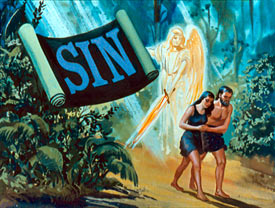
 

Image from ubdavid.org

Image from ubdavid.org

1.  The first statement about the bad  effects of Adam’s sin upon the nature of his descendants, is partially supported by scripture.  Take a closer look at what scripture teaches about the depraved state of man.


Scripture teaches that all created beings are imperfect before God.  Angels, the heavens, sun, moon and stars are all impure in God’s eyes., as attested in  Job 4;17-18; 15:14-16; 25:4-6.  Man, as a created being, is also inherently imperfect.


There are many verses in scripture that remind us of this concept.


For there is no righteous one on earth who does good, and does not sin.  (Ecclesiastes 7:20)
How can one born of a woman be righteous?  (Job 15:14)


Scripture fully teaches the imperfection of man.


Christianity rejects this basic  concept by claiming the “sinlessness” of Jesus, ignoring the word of God that tells us that one born of a woman can never be utterly righteous.  When Adam sinned, sinfulness was imputed to the very fabric of man’s nature.  Scripture records that God pronounced three curses upon Adam and his descendants.  Since these 3 curses are still in effect, we assume that redemption from Adam’s sin is yet to occur.
l.  Death
2.  Pain of childbirth
3.  Man has to work to obtain food


Christianity’s claim that as a result of the sin of Adam, all men are doomed to hell has no scriptural basis, there is no need to refute this.  Those who have faith in Yahweh’s Word are never threatened by Christianity’s claim.
And the kindness of the Lord (Yahweh) is from everlasting to everlasting upon those who fear HIM, and HIS righteousness to children’s children.  To those who keep HIS covenant, and to those remember HIS command– to do them.
(Psalm 103:17-18)


The  statements mentioned above that summarizes the Christian belief about atonement are not compatible with scripture and are not accepted by believers who have faith in the Lord, Yahweh’s revelation in Sinai.   The concept that no human action can be counted as righteous before God is as non-scriptural as it is evil.  It is difficult to think of an idea that would be more contradictory to scripture.  The most prevalent theme in the Old Testament is that God relates to people according to their deeds., both good and evil.  The sinful nature of man does not cancel out any good that we do.
In the days of Noah, Yahweh chose to save life on this earth through Noah.  The ark was built through Noah’s obedient action,  and the earth was renewed.  The message is clear:
And the righteous one is the foundation of the world.
(Proverbs 10:25)


The narratives about the OT (Torah) patriarchs affirm that though man is under the curse of death, still the actions of men, find favor in God’s eyes. (Genesis 26:4)


The lesson of the tabernacle is the same.  The fact that the people’s dedication of their possessions, skills, and power,  merited the manifestation of God’s presence, tells us how the Lord, Yahweh, values these expressions of love and obedience.


Blood sacrifice, which Christianity claims as its foundation, tells us how Yahweh looks favorably at human action.  A blood sacrifice is essentially a human action that expresses submission and humility towards God.  The Christian doctrine says Yahweh rejects every human action; if so,  then, they should reject the blood sacrifice of Jesus Christ,  as well.


Yahweh points to David as an example of righteousness that others should follow .
Then it should be, if you heed all that I command you , walk in My ways, and do what is right in My sight, to keep My statutes and My commandments, as My servant, David did, then I will be with you and build for you an enduring house, as I built for David, and will give Israel to you.
(I Kings 11:38)


This does not mean that David was sinless, he was not.  But it does mean that his sins did not nullify the good that he did.


Christianity rejects the teaching that God allows the righteous to reap the fruit of their deed.
Say to the righteous, that it shall be well with them,
For they shall reap the fruit of their doings.
(Isaiah 3:10)


Scripture leaves no room for doubt that inspite of man’s impurity, his righteous deeds done with sincerity will find favor in God’s eyes.   Why is this so?  It is simply  because God willed it so.  If a man were to live a totally righteous life, a life of total dedication to the service of God.  And this man would voluntarily die a martyr’s death, for the honor of God’s name, God would still owe this man nothing.  This man did not give God anything that did not already belong to God. To think otherwise is to deny the absolute sovereignty of God.  So if God were to act according to the strictest sense of justice, no living being is deserving of reward.   But it is God’s attribute of mercy which rewards men for obeying HIM.
And (Abraham) believed in the LORD, and HE accounted it him for righteousness.
(Genesis 15:16


Christianity claims through this verse, that God counted Abraham’s faith as righteousness, that it earned Abraham the blessing of God’s favor, that it is only faith and not good works which can bring upon man the grace of God.  This is not true.  The verse does not say that anything else Abraham did was not counted as righteous before God.  God tells us in Genesis 18:19:
For I have known him, in order that he may command his children and his household after him, that they keep the way of the LORD, to do righteousness and justice, that the LORD may bring to Abraham what HE has spoken to him.
(Genesis 26:5)
. . . because Abraham obeyed My voice and kept My charge, My commandments, My statutes, and My laws.


The fact that Abraham obediently did God’s will was essential in securing God’s favor.  It is clear that human action (obedience) can be counted by God as righteousness as well as faith.  The simple point is , the OT  belief system is the belief system which advocates faith in the same one on whom Abraham placed his trust.  It is faith in the words of the God of Abraham which leads us to believe all that God has taught us. To have faith in one whom Abraham never heard of is rejecting the faith of Abraham.


Even if scripture is clear on this matter, Christianity tries to bring scriptural support for its belief.  Two verses quoted, to support its contention that it is faithful to scripture are:
First:    (Isaiah 64:5)
 . . . and all our righteousness are as filthy rags.


This verse is one phrase of a long prayer of confession.  In the same prayer, Isaiah beseeches God —
(Isaiah 63:17)
. . . return for the sake of your servants the tribes of your inheritance.


Isaiah was asking God to have mercy in the merit of the righteous sons of  Jacob.  Obviously, Isaiah believed that these men were righteous before God.  It is only in reference to a sinful generation and as part of a humble confession, that Isaiah compares the righteousness of men to filthy rags.


Second verse quoted by Christians to support the doctrine of the worthlessness of man’s action is —
(Psalm 14:2-3)
The LORD looks down from heaven upon the children of men,
To see if there are any who understand, who seek God.
They have all turned aside.
They have together become corrupt;
There is none who does good,
No, not one.


This seems to be telling us that God can see no good in man.  But the Psalm does not end there.  It continues—
Have all the workers of iniquity no knowledge,
Who eat up my people as they eat bread.
And do not call on the LORD?


It is clear that although the psalmist uses the general term “children of men” or the word  “all”, he is only talking about the “workers” of iniquity, and is clearly excluding “my people.”  So we see, that not only are these quotations being taken out of the general context of scripture, but also being taken out of their immediate context.


BLOOD SACRIFICE:


Christianity’s claim that there is no scriptural means for the remission of sin other blood sacrifice.  The one verse cited in support of this position is —
(Leviticus l7:11)
For the life of the flesh is in the blood, and I have given it to you upon the altar for  atonement for your souls; for it is the blood that makes atonement for the soul.


Christianity teaches that it is only the blood that has the power to atone for the soul.  The phrase “for it is the blood that atones” seems to be excluding any other means of atonement.  The passage in which we find this verse is speaking about the prohibition to eat blood.  God is saying that although He allowed the eating of the flesh of   animal,  blood  is not for us to eat.  The only usage we may obtain from the blood of the animal is the expiation of  sin.


By putting the blood on God’s altar as a visible expression of submission to God,  the blood is  used  correctly.  It  is used directly in the service of God. The verse teaches that of all parts of the animal, the one that can effect atonement, is the blood.  But it does not mean that outside of the realm of animal sacrifice, there is no atonement of sin.  This verse does tell us that the blood that effects atonement, is given upon the altar.  To place blood anywhere else is excluded from the atonement of which this verse speaks.
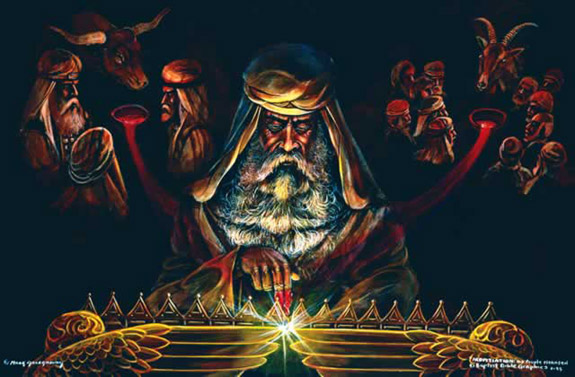
Image from www.biblegraphics.com

Image from www.biblegraphics.com

Since the blood of Jesus, was never placed upon the altar, it cannot be included in the blood atonement of Leviticus 17:11.  The claim that the cross in a figurative sense, can be considered an altar is very original.  The consequences of speaking in a figurative sense are that nothing has to mean anything, and anything can mean everything (We are trying to stick to the plain meaning of the text).  The “sacrifice” of Jesus is disqualified by the very words of the verse upon which it claims its foundation.


The biblically qualified blood offering is in a sense meaningless to Christianity.  The animal offerings of scripture have no use to the Christian other than serving as a crude symbol to the demise of their god.  For Torah observant Jews, animal sacrifice is as real as it is in scripture.  They pray everyday that God re-establish this means of expressing devotion to HIM.  God promised that this will be restored as it says, in Isaiah 56:7. 60:7; Jeremiah 33:15; Ezekiel20:41, 44:15, Zechariah14:21, and Malachi 3:4;  all predicted that God will restore the sacrificial system to its former place.


This makes no sense for Christian.   If the entire system of animal sacrifice was only put there as a portent to the death of Jesus,  then what need is there for animal sacrifice in the messianic era? Christians are shocked to learn that the sacrificial system is coming back.  Some try to avoid the implications of these prophecies by making the  unfounded claim that these prophecies refer to a temple of the anti-Christ.  This is not validated by scripture text.


Who then, has the faith in God’s word concerning the blood sacrifice?  Is it the Christian believers of Paul when he says that the temple sacrifices never atoned for sin?  Or it is the Old Testament  believer who faithfully awaits the day when offering will be pleasing to God as in the days of old?


Let us return to  Christianity’s claim that there is no scriptural means for effecting atonement other than blood sacrifice.  Even within the sacrificial system, there  are methods of achieving atonement without the use of blood.  The verses in —
(Leviticus 5:11-13)
But if he is not able to bring two turtledoves or two young pigeons, then he who sinned shall bring for his offering one tenth of an ephah of fine flour as a sin offering.  He shall put no oil on it nor shall he put frankincense on it, for it is a sin offering.
The priest shall make atonement for him, for his sin that he has committed in any of these matters and it shall  be forgiven him.  The rest shall be the priest’s as a grain offering.


The verses tell us that in some instances a flour offering can take the place of an animal offering and bring about remission from sin.  In Numbers 17:12 we see Aaron using an offering of incense to gain forgiveness for the sins of the Jewish people.


Atonement is not limited to the sacrificial system at all.  Repentance, turning back to God is what God desires from us.  Repentance is what wipes the slate clean.  God’s promise to the sinner who turns back to HIM with a sincere heart, is that none of his sins will be remembered.


(Ezekiel 33:16)
None of his sins which he has committed shall be remembered against him; he has done what is lawful and right, he shall surely live.


All the other scriptural methods of atonement (blood sacrifice, prayer, and charity) are only part of the general framework of repentance.  The prophets remind us that the path to God is repentance.  Some of the scriptural references are:
(Isaiah 55:7)
Let the wicked forsake his way,
And the unrighteous man his thoughts.
Let him return to the LORD
And HE will have mercy on him;
And to our God
For HE will abundantly pardon.
(Ezekiel 18:21-23)
But if a wicked man turns from all his sins, which he has committed, keeps all MY statues, and does what is lawful and right, he shall he surely live; he shall not die.
None of the transgressions which he has committed shall be remembered against him, because of the righteousness which he has done, he shall live.
Do I have any pleasure at all that the wicked should die?” says the LORD God “and not that he should turn from his ways and live?”


And the book of Jonah.  All of these passages tell us how God does not spurn a broken and a contrite heart.
(Psalm 51:17)
The sacrifices of God are a broken spirit,
A broken and a contrite heart
These, O God, You will not despise.


None of these passages say a word about the necessity of blood sacrifice in order for God to grant forgiveness.  The story of Nineveh as recorded in the book of Jonah, tells us how the sinful people of that city repented and God accepted their repentance even though it was not accompanied by a blood sacrifice.


Chapter 33 in the book of Ezekiel is placed among other prophecies which were spoken after the destruction of the Temple – when the Jewish people were no longer able to bring animal offerings, yet God assures the people that their repentance will be accepted.


An expression of a repentant heart prayer, can bring about forgiveness for sin.  Psalm 107, Proverbs 15:8, I Kings 8:46-50, II Chronicles 7:14 are some repentant heart prayers.  Truth, justice, and charity also work atonement for sin.
(Micah 6:6-8)
With what shall I come before the LORD
And bow myself before the High God?
Shall I bring before Him with burnt offerings?
With calves a year old?
Will the LORD be pleased with thousands of rams
Ten thousand rivers of oil?
 Shall I give my firstborn for my transgressions?
The fruit of my body for the sin of my soul?
He has shown you O man, what is good.
And what does the LORD require of you
But to do justly
To love mercy,
And to walk humbly with your God.


These verses in Micah are specially significant because they tell us that all that God requires from us is justice, lovingkindness and walking humbly with God.  Nothing else is necessary.  The word of  God stands forever.  All the energy Christians exert in their effort to nullify the clear message of scripture is in vain.


As we have seen, the “shedding of blood” is not a requirement for the forgiveness of sins; specifically the blood that Jesus shed on the cross.  Furthermore, John 3:16 is a false statement.  The New Testament writers created the idea that Jesus had to die, in order to remove the sins of mankind.  I end with these words from Psalms.


          Psalm 51:16-17
For YOU do not desire sacrifice, or else I would give it
YOU do not delight in burnt offerings.
The sacrifices of GOD are a broken spirit,
A broken spirit and a contrite heart
These O GOD, YOU will not despise.


This is the way to be RIGHT WITH GOD.


BAN@S6K
 logo
Image from www.mixcloud.com

Image from www.mixcloud.com

The WAY of YHVH – 4 – Observing the Seventh Day Sabbath

Image from amazon.com

Image from amazon.com

[First posted in 2012; Sinaites were already Sabbath observers before reading this, but this was still an eye-opener for us.  It is from our MUST READ/MUST OWN James Tabor’s Restoring Abrahamic Faith: THE WAY;  Chapter 2 — reformatted for this post.—Admin1.]


——————–


Remembering the seventh day (Saturday) Sabbath is a vital part of the restoration of true BIBLICAL FAITH.


This fourth commandment is not a minor statute or ordinance to be changed or abrogated with the passing of time.  It is an essential part of the TESTIMONY and every bit as important, and as universalas the commandments regarding murder, idolatry, or adultery.  To our human way of thinking this statement sounds extreme and even absurd.  But God’s “thoughts” are not our “thoughts” (Isaiah 55:8).  The Sabbath Day is vitally connected to knowng and understanding God as Creator and experiencing His Presence, as well as providing essential physical and spiritual rejuvenation to our busy lives.  Our loss of this vital pillar of the Faith has probably contributed more to our disconnection from the people of Israel, and thus to the Hebraic roots of BIBLICAL FAITH, than any other single factor.


The very fact that the Sabbath commandment is one of these great Ten “Matters” of YHVH clearly sets it apart as a major component of the WAY of YHVH.  It would not be included as part of this great Code, this awesome TESTIMONY of YHVH Himself, unless it was an indispensable part of God’s WAY for humankind.


Two of the Ten are stated in positive form:

  • Remember the Sabbath and
  • Honor your father and your mother;

—the remaining eight are prohibitions.

These two positive commandments are linked together in Leviticus 19:2-3 as an introduction to the description of true Holiness.  Notice:


You shall be holy, for I YHVH your God am holy.  Every one of you shall revere his mother and his father, and you shall keep my Sabbaths;  I am YHVH your God.


One is the foundation of God’s relationship with humans, the other the foundation of human relationships with one another.


There are two accounts of the TEN WORDS recorded in the TORAH.

  • The first is the original scene recorded in Exodus 20.
  • The second is in Deuteronomy 5, forty years later, where Moses reminds the new generation of that awesome face-to-face encounter with YHVH Himself at Sinai.


It is instructive to compare these two accounts of the Sabbath commandment side by side:


Remember the Sabbath day, to keep it holy.  Six days you shall labor, and do all your work; but the seventh day is the Sabbath of YHVH your God; in it you shall do no work . . . for in six days YHVH made the heavens and the earth, the sea, and all that is in them and rested the seventh day.  Therefore YHVH blessed the Sabbath day and made it holy. (Exodus 20:8-11)


Observe the Sabbath day, to keep it holy, as YHVH your God commanded you.  Six days you shall labor, and do all your work; but the seventh day is the Sabbath of YHVH your God, in it you shall not do any work . . . And remember that you were a slave in the land of Egypt, and YHVH your God brought you out from there by a mighty hand and by an outstretched arm; therefore YHVH your God commanded you to keep the Sabbath day (Deuteronomy 5:12-15).


The concluding phrases in both accounts are quite interesting.

  • In the Exodus account we are told why YHVH blessed the Sabbath and made it holy.
  •  In Moses’ summary account in Deuteronomy we are told why YHVH commanded the people of Israel to observe or keep the Sabbath day.


Both concepts are important to an understanding of this Commandment and its essential rationale.

Let’s begin with the point made in the Exodus account—that the Sabbath day goes back to Creation Week of Genesis 1:1-2:3.  we find the same essential thought:  Thus the heavens and the earth and all the host of them, were finished.  And on the seventh day God ended His work that He had done, and He rested (Hebrew verb Shabbat) —


on the seventh day form all His work which He had done.  Then God blessed the seventh day and made it holy because in it He rested from all His work that God had created to make (Genesis 2:1-3).


Here we see that the Sabbath day is grounded in the patterned activity of God Himself.  Just as God blessed humankind on the sixth day, telling them to be fruitful and multiply (Genesis 1:28), He also blessed the seventh day at the time of Creation, and made it holy.  He set it apart from the six other days of the week, sanctifying it as a sabbath or “rest” day.  


The Sabbath is a memorial of Creation.  It testifies to YHVH’s unique activity as the Creator of all things.  It is as universal as humankind.  YHVH, through Isaiah the prophet, declares:  


Blessed is the man . . . who keeps the Sabbath from profaning it and keeps his hand from doing any evil (Isaiah 56:2).


 In this section of Isaiah all humanity is addressed and the observance of the Sabbath is tightly linked with following the WAY of Righteousness more generally.  To remember the Sabbath day is to acknowledge YHVH as our great Creator and we humans as His creatures.  It is a fundamental step in the path of justice, love, and righteousness.


It is noteworthy that the Sabbath day itself

is the reason that many human cultures,

from antiquity to the present,

observe a seven-day week. 


Our other cycles of time—days, months, and years, are controlled by the movement of earth and moon in relationship to one another and to the sun. Yet there is no such seven-day cycle, or week, associated with our solar system.


The seven-day week is actually created 

by the cycle of the seventh day Sabbath.


This weekly cycle, signified by the Sabbath day, is reflected in the earliest narratives of the Hebrew Bible.

  • Cain and Abel bring their offerings at the end of days, probably referring to the seventh day Sabbath (Genesis 4:3 literal translation).  
  • Noah and his family enter the ark precisely seven days before the flood begins (Genesis 7:4,10).  
  • Later, when the Flood is over, Noah sends out the raven and the doves over a period of several weeks, following the same seven day weekly cycle (Genesis 8:10, 12).


Throughout the world, from ancient through modern times, the seven-day week has been known.  In fact, there is interesting linguistic evidence that the seventh day, from ancient times, was even called the “Sabbath” in most of the major language groups of humankind.


[Footnote:  Hundreds of languages, spread throughout the globe, actually name the seventh day of the week with some derivative form of the Hebrew word shabbat.  There are too many examples to cite here, but a selective sample would include :  Assyrian sabatu; Persian shambid; Caucasus region samat; Central Africa assebatu; North Africa assebt: West Africa essbi: Hungary szombat; Abyssinia sanbat; Java saptu; Afghanistan shamba; Malta issibt‘ Turkey essabt; Borneo sabtu; Arabic assbt.  Even the Romance languages of Europe, though eventually Christianized, still maintain this ancient “Jewish” designation for Saturday, the seventh day:

Latin sabbatum; French samedi; Italian sabbato; Romania sambata; German samstag.]


The point Moses makes in the second account, recorded in Deuteronomy 5, has to do with why the Sabbath day was specifically given to the people of Israel.

  •  Not only does the Sabbath day look back to YHVH as Creator,
  • but it also pictures the mighty redemptive acts of YHVH in releasing or bringing rest to the entire nation of Israel when they were suffering bitter bondage to Egypt.


In other words, the Sabbath day reminds us of the two most basic aspects of YHVH’s mighty acts:

  • Creation and
  • Redemption.


The Sabbath day is made a special sign between YHVH and the people of Israel, a perpetual covenant throughout their generations (Exodus 31:15-17).

They were to perpetually testify to that TESTIMONY spoken by YHVH Himself at Sinai, giving witness to the nations of the world to the One Creator God who works His redemptive PLAN in history.


There are two basic concepts associated with the Sabbath in these accounts—

  • to remember it,
  • and to observe (lit. “guard”) it, as holy or “set apart” from the rest of the week.


The instructions in Scripture on how to keep or observe the Sabbath day holy are few.  The literal meaning of the verb is “to stop.”  The basic idea is that one ceases (shabbat) from normal “activity,” setting the day apart (it was marked anciently “from evening to evening,” that is, from Friday sunset until Saturday sunset), as a time of physical and spiritual rest and refreshment, for humans as well as their animals.  In other words, one “keeps the Sabbath holy” by not treating this day as ordinary time—that is, as just one more day of the week.


Isaiah speaks of calling the Sabbath a delight, a day to be honored.  To “pursue one’s own affairs” is considered “trampling” on the day (Isaiah 58:13, see Nehemiah 13: 15-18).


The keynote of the Sabbath day is joy.  It is a wonderful “sanctuary in time” carved out of the profane and mundane activities and surroundings of our everyday lives. Those who have learned to truly remember and guard this holy day as a Sabbath can testify to the incredible blessing it brings upon family and friends as well as the profound and peaceful sense of the very presence of YHVH.


Imagine a world in which everyone on the planet, region by region, as Friday sunset arrived, simply “stopped” or “shut down,” to participate in a physical and spiritual break from our hectic everyday lives.  Anyone who has been in Jerusalem on a Friday afternoon has experienced a tiny taste of what this could be like.  The entire city simply shuts down, most traffic ceases, and people take to the streets with family and friends, enjoy special meals, with time for gatherings in synagogues or table conversations centering on the Torah reading for that particular week.  The collective effect is rather amazing, both for the individuals and the community as a whole.

The Rabbis say that rather than Israel keeping the Sabbath, the Sabbath has kept Israel.  There is great truth to this saying.

  • The seventh day Sabbath is the most ancient observance of humankind.
  • It has continued in an unbroken cycle from time immemorial.
  • It has always been a sign or mark between YHVH and His followers, who live in a covenant relationship with Him, testifying that He alone is Creator and Redeemer.


It is worth noting that historical research indicates the early followers of the Nazarene observed the seventh day Sabbath, not Sunday. It was only in the late 2nd century C.E., under the pressure of a strongly anti-Jewish, antinomian, pagan sentiment which had developed in the Western Christian churches, that “Christians” substituted Sunday for the Sabbath and began to lose touch with the Judaic or TORAH roots of the original Nazarene faith.  Recent scholarship has carefully documented this transition and the change from “Sabbath to Sunday” is one of the most significant developments in early Christianity.


[Footnote:  Samuele Bacchiocchi, Anti-Judaism and the Origin of Sunday (Rome: Pontifical Gregorian University Press, 1975) . . .  one of the very best popular accounts of the general departure of Christianity from its early Jewish roots is Hugh Schonfield, Those Incredible Christians (London: Hutchinson, 1968) and subsequent editions.]


In the same way, Mohammed, in the 7th century C.E., substituted Friday for Saturday as the holy day to be observed by his Muslim followers.  Observing either Sunday or Friday as a kind of “substitute Sabbath” robs one of the profound and positive impact of YHVH’s original TESTIMONY.


The TORAH specifies a specific day, the seventh of the week—not the first or the sixth.  It does make a difference which day is the Sabbath.  It is interesting to note that when Jeroboam broke with Solomon’s son and established the northern Kingdom of Israel the first thing he did was move the festival observances from the 7th month to the 8th month (1 Kings 12:32).  There are obviously profound cultural and social consequences when groups separate and begin to observe alternative festival cycles.


A return to the seventh day Sabbath puts one back in communion with the Jewish people who have kept this Commandment at the center of their religious life through the ages, as well as with multiple thousands of non-Jews who have begun to recover the Hebraic roots of the earliest followers of Jesus.  It is a matter of being in tune with the specific cycle of “rest” which represents the oldest religious observance on our planet.  In the days of Moses the observance of the Sabbath was a “test” commandment, signifying those who live in covenant relationship with the Creator God (Exodus 16:4, 26-30).  It is a vital part of the “restoration of all things” which lovers of the Bible have advocated since the days of the Reformation. . . . .millions of sincere Christians have never even considered the shift from Sabbath to Sunday in this regard, however, many who read the Ten Commandments have wondered about the reference to honoring “the seventh day as the Sabbath,” rather than Sunday as the first day of the week.  However, significant numbers of biblically oriented Christians are increasingly expressing a desire to return to the Hebraic roots of their faith, that would include a recovery of a Jewish Jesus who observed the Sabbath day as well as the other commandments of the TORAH.


The prophet Jeremiah urged his hearers to seek the—-

 “ancient paths where the good way is,

and walk therein,

and you will find rest for your souls”

(Jeremiah 6:16).


Those who have experienced the joy of Shabbat can truly testify that it is the “good way.”  Each Sabbath day, week by week, millions are brought together in a worldwide spiritual fellowship and solidarity that stretches back to Eden and forward to the coming Kingdom of God—when the whole world will experience the true Sabbath peace (Isaiah 66:22-23).


Next: