What does man learn from Natural Revelation?


Image from www.juststopandthink.com

Image from www.juststopandthink.com

[First posted in 2012.  This is part of

DIVINE REVELATION on Mount Sinai

, please check About Us.  


We realize there is so much to read and catch up on in this website; some visitors miss the categories listed above the Sinai active photographs and miss reading the articles there; others are not familiar with how to navigate through this website. The

Site Map shows a listing of all the articles, most recent first, and we’ve added

UPDATED SITE CONTENTS – November 2016 arranged according to category and most recent last..  


Here’s a  re-posting a portion of Revelation in a Nutshell in shorter digestible dosage.  It explains the most basic knowledge that man could possibly know, simply from mindful observance and close study of the world experienced by the senses, MINUS divine revelation as in TORAH.Admin1]  


NATURAL REVELATION


Upon reaching the age of self-consciousness and rationalization of the world man  perceives, man can go two ways:


One way is to deduce—-

  •  that man is the highest on the chain of beings,
  • and that there is no one higher than man to whom he will be held accountable;
  • the atheist, agnostic, skeptic, evolutionist—all decide that no one made this world, it simply exists, no further questions asked;
  • this person therefore does not seek,
  • is content with living his existence to the end of this life;
  • lives his life according to what he thinks is best for him;
  • because if this is all there is to his existence, then he is accountable to no one but himself;
  • for there is no higher authority;
  • he is on the top of the chain of beings,
  • the only one with brains!


The second way is just the opposite—man concludes that SOMEONE ELSE other than man—a Creator, a higher authority—-is responsible for this world.
 

Image from www.haikudeck.com

Image from www.haikudeck.com

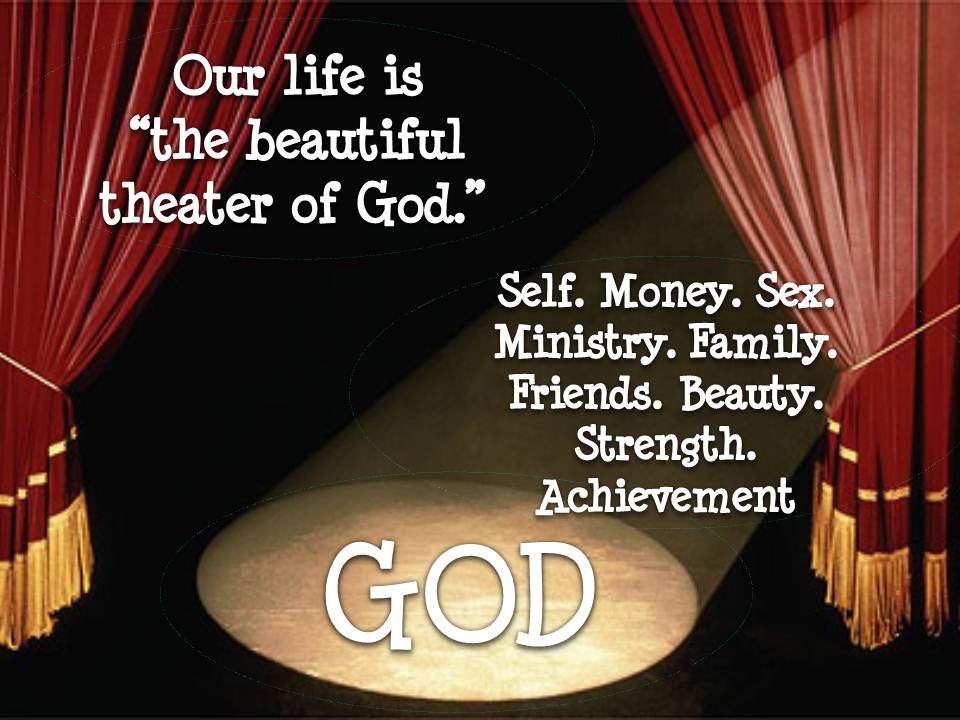
NATURAL REVELATION is the extent of what man can mentally and experientially determine about the Maker/Creator of the visible world he lives in.

  • On this level, man can perceive that there is indeed a Maker/Creator.
  • What this Being is like, man  could only conclude from observable phenomena.
  • Man could “guess-timate” that this Other Being creates with magnificence, grandeur, harmony, beauty,  variety, balance, ingenuity, coordination, perfection, logic, purpose, creativity, immense power, with intricate designs from barest simplicity to utmost complexity.

The courses offered in schools are results of man’s study of this world and the vast universe; knowledge that is obvious, predictable, dependable; courses such the natural sciences, physical sciences, mathematical sciences, etc. are exact, quantifiable and provable.  Other studies such as social sciences, humanities, psychology, behavioral sciences, are observable but inexact, unpredictable,  and just not conclusive.


Man knows there is a Maker but he doesn’t know what to do about this Maker—how to relate to Him—because he has no idea what this Maker is like.  He is fearful of this UNKNOWN BEING—-

    • and therefore devises ways and means of dealing with HIM
    • by devising RELIGION
    • which we define as man’s recourse to reach/relate to an unknown being he acknowledges as superior to man.

This unknown superior being, this Other-ness has been assigned different names in different cultures; the generic word is “god”.
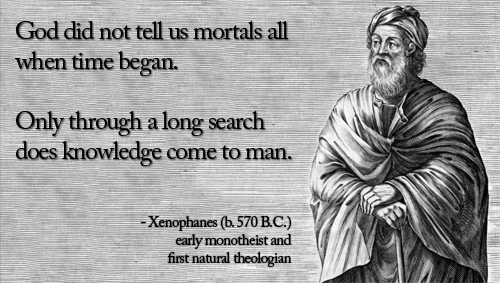
 

Image from www.haikudeck.com

Image from www.haikudeck.com

Man could only imagine what this Other is like, so he resorts to all kinds of religious expressions, attempts to worship, all based on man’s imagination of what this god might require.


IF man on this level of natural revelation is not further illuminated or enlightened by Divine Revelation, then man remains a worshipper in his ignorant/limited ways, and this results in mythology, legends, superstition, occult, fengshui, known world religions.


Man’s concept of god is usually based in natural phenomena —god of the sea, sun god, god of thunder and lightning, or figments of man’s own imagination.


As long as man is—

  • seeking GOD—
  • and worships according to his limited knowledge and left to his own devices—
  • as long as he remains unenlightened by the TRUE GOD but is acknowledging there is SOMEONE bigger and more powerful and on a higher level of being than man himself,
  • then . . . in GOD’s perfect justice, mercy,  wisdom, and love for mankind, GOD understands and honors true seekers and leads them on to paths that ultimately lead to HIM, even if they go through man-made religions, as long as they continue seeking until they meet HIM in the Hebrew Scriptures.

Psalm 103:14 

He knew our nature; He is mindful that we are dust.

An interesting passage is Malachi 1:11 

For from the rising of the sun to its setting, My Name is great among the nations, and in every place [where offerings] are presented to My Name,  and   pure meal-offerings, My Name is great among the nations, says YHWH, Master of Legions.


The context of this verse is post-Sinai in the biblical timeline.  Through HIS mouthpiece Malachi,  the last of Israel’s prophets, the LORD YHWH tells Israel that—-their imperfect sacrifices are not acceptable to HIM, because— they have beenTorah educated, forewarned, and knew better than to continue violating HIS commandments particularly with regards the Temple sacrificial system which, in the first place, is simply an accommodation to the Israelites’ exposure to the nations’ sacrificial systems.


Strangely enough, GOD then mentions worship and sacrifices being offered by the gentile nations— which were never reached by divine revelation, and thereby not illuminated by Torah guidelines, presumably these would be the rest of the inhabited world not within the vicinity of the Biblical nations, “those ‘who have not heard”. To GOD, those sacrifices are acceptable to HIM only because—-these were offered in ignorance, because these worshippers did not have the benefit of Divine Revelation. [Jonah was sent to Nineveh to teach them about True God].  In seeking to please the UNKNOWN GOD. these UN-enlightened worshippers were in effect worshipping the TRUE GOD,  they just didn’t know HIM.
 

Image from reneeemerson.com

Image from reneeemerson.com

Psalm 53:3  

From heaven God gazed down upon mankind, to see if there exists a reflective person who seeks out God.

Ezra 8:21-22  

. . . the hand of our God is benevolent to all who seek Him, and His might and anger befall all who forsake Him.


Question: What about the nation-groups in Exodus which Israel’s GOD commanded the Israelites to annihilate, they too were ignorantly worshipping gods of their making, why were they so harshly judged?


Answer:  The nations during the time of the Sinai Revelation were well aware of what the GOD of Israel had done in Egypt—news travelled around by word of mouth in those days; what happened in Egypt reached the nations/peoples in the area.


Rahab in Jericho said to the men:

“I know that YHWH has given you the land, and that fear of you has fallen upon us and all the inhabitants of the land have melted because of you, for we have heard how YHWH dried up the waters of the sea of Reeds for you when you went forth from Egypt and what you did to the two kings of the Amorites who were across the Jordan –to Sihon and to Og –whom you utterly destroyed.  We heard and our hearts melted — no spirit remained in any man because of you–for YHWH, your God, He is God in the heavens above and on the earth below. [Joshua 2:10-11]


Many were in awe of that newly-revealed GOD; they knew HIS NAME, as announced to the Pharaoh. Those nations were judged according to whether or not they took Israel’s GOD seriously. The Amalekites heard but did not heed, and so they were judged [Exodus 17:8-15/Numbers 24:20].

  “Amalek is the first among nations, but its end will be eternal destruction.” 

Other nations likewise heard but waged war with Israel [Numbers 21:21-35/22:5/24:18-24/31:1-11]

GOD cannot blame man for his ignorance at this level, if GOD has not taken the step to reveal HIMSELF to man. But thank GOD, HE did not leave man ignorant; HE spoke on SINAI and what HE said is recorded in the TORAH.


In behalf of  the Sinai 6000 community,

 

Sig-4_16colors

logo


The WAY of “SALVATION” in TNK

Image from amazon.com

Image from amazon.com

[This was first posted July 2,2012, , always a timely reminder, particularly during the Christian Lenten Season leading to Easter “Holy Week”.


  We are often asked by our former Christian colleagues, “so how are you now ‘saved’ if you no longer believe in Jesus Christ as God/Savior/Messiah?”  We don’t attempt to explain the long journey we’ve taken since we left Christianity ; we simply refer them to this website OR to the book recommended here as MUST READ.


 Here’s the original introduction to this post:  


Sinai 6000 is a RESOURCE CENTER for seekers after the ONE TRUE GOD.  It is not our intention to “evangelize” or “convert” others to any religion or system of belief.  What we do provide is information, as much as we have accumulated in our resources, our real and virtual library, including the information we have compiled in our collective minds and memory which we discuss every Shabbat.  We know for a fact and realize that the resources we have had access to are not so readily available or even accessible to other seekers, that is why we bother to type out articles and books to make it easy for website visitors to read as much as their minds can tolerate and process each visit.  We provide as many sources as we are able to, including uncertain and  differing opinions when we ourselves have not determined our own stand or position on any specific controversy.  


So here again, is one excellent source, already figured out and presented in a well-written organized chapter, from one of our favorite resource persons—James Tabor, Restoring Abrahamic Faith. This is from Chapter Five of that book, titled “Turning To God.”  How could we possibly improve on what Tabor has already written?  We cannot do better than this in explaining how people were saved before Christianity made salvation exclusive so we’re resorting to quoting from James Tabor extensively.


Some readers or our former Christian colleagues have the wrong impression that we are “Jesus-bashing”  . . . not at all;  it is not Jesus of Nazareth, the historical Jesus we are “bashing”;  rather we are re-examining the whole doctrinal theological system about him that emerged and has been perpetuated for two millennia;  we are endeavoring to re-educate Truth-seekers, specially those who do not have access to current biblical scholarship, or to published books that understandably do not make it into Christian bookstores.  Few venture outside of those boundaries of their beliefs so this website is a blessing from YHVH to us in this day and age of information technology when you can check out and learn as much as you want with the simple finger click of a  computer key.


Condensed and edited excerpts from this MUST HAVE book.—Admin1.]


———————————————-


YHVH is near to all who call upon Him, to all who call upon Him in faithfulness.  

(Psalm 145:18)


How does one appropriate ABRAHAMIC FAITH . . . how does one obtain a right relationship with YHVH, the Creator God and participate in His WAY and PLAN?


The answer is profoundly simple, so much so that it can be stated in a single verse spoken directly by YHVH Himself:  

Turn to Me and be saved, all the ends of the earth;

for I am God, and there is no other!

(Isaiah 45:22)


The way to come into Covenant relationship with YHVH has never changed:  one must directly call upon Him, in the most heartfelt and utterly sincere manner.  There is no other way.  


YHVH Himself says,  “TURN TO ME.”

 There is only ONE Rock, Redeemer, Savior, and King —YHVH the Eternal God of Hosts (Isaiah 44:6-8).


 Isaiah 43-45 makes this point repeatedly, in the most unequivocal language possible.  This “turning” includes the whole range of concepts related to “Knowing God.  It involves a deep fear and love of YHVH, which comes from a sense of Who He is, His unsearchable greatness and goodness.  The very notion of turning implies a profound experience of repentance from sins, and seeking God with all one’s heart.  We have all sinned and turned to our own ways, we have all failed to meet even our own best standards, much less God’s WAY.  


Note the following texts:


Thus says YHVH, “Return to Me,” says YHVH of Hosts, “and I will return to you,” says YHVH of Hosts . . . “Turn now from your evil ways and from your evil deeds” (Zecharaiah 1:3-4).


“Seek YHVH while He may be found, call upon Him while He is near.  Let the wicked forsake his way, and the unrighteous man his thoughts; Let him return to YHVH, and He will have mercy on him; and to our God, for He will abundantly pardon.  For My thoughts are not your thoughts, nor are your ways My WAYs,” says YHVH.  “For as the heavens are higher than the earth, so are My WAYs higher than your ways, and My thoughts than your thoughts” (Isaiah 55:6-9).


When anyone, Jew or Gentile, turns directly to YHVH in this way, God promises to hear, forgive and enter into an intimate partnership with such a one:  


YHVH is near to all who call upon Him, to all who call upon Him in faithfulness (Psalm 145:18).


This way of salvation  has never changed.  It transcends all the so-called “dispensations” of all the ages.  It is the way of grace through faith.  It was the same for Enoch, Noah, Job, and Abraham, as well as Moses and all the Prophets.


 Christians, particularly, should take note that this way of salvation was affirmed by the historical Jesus the Nazarene.  He taught that sinners are to turn directly  to God to receive forgiveness. For example, he relates the story of the two men who go up to the Temple to pray, one self-righteous, and the other a “sinner”  The sinner turns directly  to God in repentance and goes away justified (Luke 18:13).  The well-known story of the “prodigal son” makes the same point.  In dozens of saying, Jesus unambiguously affirms this point:  God hears sinners who turn to him in heartfelt repentance.  He is simply echoing the teachings of the Prophets.


[Footnote:  Since other statements attributed to Jesus contradict this concept, either his later followers added these as they began to exalt him to divine mediator status, or he himself spoke in a nonsensical way.]


Many have been taught that the “Old Testament” offered forgiveness of sins based on the blood of animal sacrifices.  This is a misunderstanding of the Scriptures.  All sin is ultimately against God.  


When David commits adultery with Bathsheva, and even has her husband murdered, he turns to God for forgiveness.  He prays,


 Against You and You only have I sinned, and done what is evil in Your sight (Psalm 51:4; cf. 2 Samuel 12:13).

This is consistent throughout the Scriptures ((see Genesis 20:6; 39:9; Numbers 5:5-7).  


God promises forgiveness based on His own compassion and goodness:


I, even I, am the One Who wipes out your transgressions for My own sake (Isaiah 43:25).


For as high as the heavens are above the earth, so great is His steadfast love (chesed) toward those who fear Him.  As far as the east is from the west, so far has He removed our transgressions from us.  Just as a father has compassion on his children, so YHVH has compassion on those who fear Him (Psalm 103:11-13).


In steadfast love and faithfulness is atonement (lit. “covering”) provided for iniquity; and by the fear of YHVH one departs from evil (Proverbs 16;6).


Psalm 103:8 mentions the precise “character description” which YHVH revealed to Moses in Exodus 34: 


YHVH is merciful and gracious, slow to anger and abounding in steadfast love and faithfulness  (vs. 8). 


This forgiveness is direct and unmediated, based on the tender mercies and loyal love of YHVH.  Forgiveness of sins is not some cosmic “balancing of the books,” some legal transaction of justice, for which a payment in blood is required.  


YHVH forgives as a father

forgives His own children,

out of love and concern for them.  

The only way of salvation is by grace through faith, based on a personal encounter with God.  As David put it:  


Blessed is he whose transgression is forgiven, whose sin is covered.  

Blessed is the man to who YHVH does not impute iniquity,

and in whose spirit there is no deceit (Psalm 32:1-2).


The animal sacrifices were connected with the Holiness of YHVH’s Presence in the Tabernacle.  But these offerings were never a substitute for repentance and restitution or reconciliation (Numbers 5:5-7).  Notice the oft-overlooked text in Jeremiah:  


Thus says YHVH of Hosts, the God of Israel, Add your burnt offerings to your sacrifices and eat flesh.  For I did not speak to your fathers or command them in the day that I brought them out of the land of Egypt, concerning burnt offerings and sacrifices.  But this is what I commanded them, saying, Obey My voice, and I will be your God and you will be My people (Jeremiah 7:21-23).


This is an extraordinary insight regarding God’s true intent for Israel.  Even at the giving of the TORAH at Sinai He did not really want, or require, animal sacrifices (see Amos 5:21-25).  He wanted their inner devotion, which is the basis for the covenantal relationship.  


The whole system of sacrifices was an accommodation to their weaknesses, and their lack of reverence for the holiness of YHVH (see Ezekiel 20:24-26).  What does YHVH truly want?  


The sacrifices of God are a broken spirit, a broken and contrite heart O God, You will not despise (Psalm 51:17).  


The Prophets constantly repeat this consistent theme:


With what shall I come before YHVH, and bow myself before the High God?  Shall I come before Him with burnt offering, with calves a year old?  Will YHVH be pleased with thousands of rams, then thousands of rivers of oil?  Shall I give my firstborn for my transgression, the fruit of my body for the sin of my soul?  He has shown you, O man, what is good, and what does YHVH require of you but to do justly and to love mercy, and to walk humbly with your God?  (Micah 6:6-8).


It has always been the same, from age to age.  YHVH the Creator, whose Hand has made all things, is greater than any Temple or system of worship.  


I shall desire loyal love (chesed), not sacrifice” says YHVH (Hosea 6:6).  


[Footnote:  This idea is found in many passages in the Hebrew bible, but particularly in the Psalms: see Psalms 27:6, 50:7-15; 69:29-31; 107:22; 141:2.  It is also worth noting that this verse is quoted by Jesus more often than any other single text of the Hebrew Bible (Matthew 9:13, 12;7).  


He responds directly to those who cry out to Him:  


Thus says YHVH, Heaven is My throne, and the earth is My footstool.  Where is a house you could build for Me? . . .  But to this one I will look, to him who is humble and contrite in spirit an who trembles at My Word (Isaiah 66:1-2).


 Burnt offering and sin offering You have not required . . .  Behold I come; in the scroll of the book it is written of me; I delight to do Your will, O my God; Your TORAH is within my heart (Psalm 40:6-8).


In point of fact, the animal sacrifices in the Temple were not for the forgiveness of sin in the first place.  The majority of them had to do with ritual defilement, offerings of thanksgiving, and fellowship meals.  Even those connected with “sin” were not some magical means of automatic forgiveness through blood.


 The one way of forgiveness has always been the same:  repentance, confession, and restitution (see Numbers 5:5-7).  Without repentance toward God there was no forgiveness.


 Ezekiel 18 sets forth the whole system of God’s justice and His mercy in the clearest possible way:  


The soul who sins shall die . . . . but if a wicked man turns from all his sins which he has committed, and keeps all My statutes, and does what is lawful and right, he shall surely live, he shall not die.  None of his transgressions which he has committed shall be remembered against him; because of the righteousness which he has done, he shall live.  Do I have any pleasure at all that the wicked should die?” says YHVH God, “and not that he should turn from his ways and live?” (Ezekiel 18:4, 21-23).


The blood of “covering” (atonement) was to reinforce upon the people the Holiness of God and the life and death issues involved in sin, but the “broken and contrite heart” is the only real “sacrifice” required.


Abraham “trusted in God, and it was counted to him as righteousness” (Genesis 15:6).


 “The righteous (the zadiq) shall live by faith” (Habakkuk 2:4).  


Any and all who fear, love, and obey Him, living that life of faith, are associated with Abraham in the promises of Genesis 12:1-3, and are fully a part of this broader “household of faith” (Genesis 18:19).  


To be continued in The WAY of SALVATION in TNK – 2: “The Fundamental Flaw of Christianity”


The "I" in Image vs. the "I" in Idolatry

Image from The Self-Centered God

Image from The Self-Centered God

[First posted in 2014.  What is really involved in “Idolatry” . . .  the worship of another god other than the One True God?  Or something else rooted in each individual who has free will to choose whom to serve:  God or the “I” who chooses to serve “me”?  —Admin1.]


—————————


Forget the New Testament teaching that every person born in this world—

  • is tainted by “original sin”
  • inherited from the first couple in Eden;
  • hence everyone is helpless
  • and cannot save himself,
  • that’s why he needs the Christian Savior.

This teaching—

  • removes personal responsibility and personal choice from man,
  • making him hopeless in utter depravity 
  • and incapable of making right choices.

It ignores the truth that man,

  • being the only created being endowed with free will,
  • is made in the image of God—
  • the “I” in Image that endows him with the ability to make Godlike choices
  • despite  the disobedience of the first couple
  • for which only the first couple is accountable,
  • not their progeny.


We’ve written articles about this subject so if you’re so inclined please check out the following posts:


Pay attention to what is taught in  the Hebrew Scriptures. The Tanakh/Tanach teaches that man is born with two inclinations:

  • one that leans toward choosing to do the right thing, and
  • another that leans toward choosing the opposite of right.

To quote from our post:


In every individual there is that balance of the evil inclination, yetzer hara as the Jewish interpreters term it, with the good inclination.  It is all and always a matter of individual choice.

 Contrary to Christian teaching, we are not born condemned to nonexistent hell because we inherited original sin from Adam and Eve; each individual is  free to choose between the two inclinations within him/her-self that he/she constantly faces and struggles with. The potential to do good, to do what is right, balances the potential to do just the opposite. 

The “I, me and myself” tends to predominate unless it has been conditioned and disciplined or coerced to submit to another. 

As long as that power to choose has not been stripped from us by another authority, we are each individually responsible for each and every choice that we make.


What or who determines what is right? Who else but the God of Righteousness who is also the Revelator on Sinai, the God of Israel.


“We are fully endowed to be able to know the truth. All we must do is make the effort,” is a timely reminder from Rabbi Abraham J. Twerski.


[EF] Deuteronomy/Davarim 30

15 See, I set before you today 
life and good, and death and ill:
16 in that I command you today 
to love YHVH your God, 
to walk in his ways and to keep his commandments, his laws and his regulations, that you may stay-alive and become-many 
and YHVH your God may bless you
 in the land that you are entering to possess.
17 Now if your heart should face-about, and you do not hearken, 
and you thrust-yourself-away and prostrate yourselves to other gods, and serve them,
18 I announce to you today 
that perish, you will perish, 
you will not prolong days on the soil that you are crossing the Jordan to enter, to possess.
19 I call-as-witness against you today the heavens and the earth: 
life and death I place before you, blessing and curse; 
now choose life, in order that you may stay-alive, you and your seed,
20 by loving YHVH your God, 
by hearkening to his voice and by cleaving to him, 
for he is your life and the length of your days, 
to be settled on the soil
 that YHVH swore to your fathers, to Avraham, to Yitzhak and to Yaakov, 
to give them!

Micah 6:8

It hath been told thee, O man, what is good, and what YHWH doth require of thee: only to do justly, and to love mercy, and to walk humbly with thy God.


Free will is a gift from God, given only to humankind.  The angelic spirits were not endowed with freedom of choice, surprised? (So no possibility of fallen angels; don’t ever say “the devil made me do it.”).  How privileged indeed is man to be made in the ‘image” of God, the only Being who exercises free will, that is,  until He decided to gift it to humankind.


Question:  is there anything the Almighty God cannot do?  

Answer: Yes, only that which He restrains HImself from doing . . . and one would be— never to interfere with or violate man’s free will. He could surround man with external influences to help man make the right choice; He could also allow man to be tempted to test him as He did with the first couple but ultimately that choice is still for man to make.


So the “I” in Image chooses to do right.


Rabbi Abraham J. Twerski elaborates (Growing Each DayAish.com):


He created him [Adam] in the image of God (Genesis 1:27).


Since God is not corporeal, the term “image of God” obviously refers to humanity’s capacity for Godliness, i.e. to share in the Divine attributes of rational thinking, spirituality, sanctity, creativity – attributes that distinguish us from all other living things. . .


The serpent seduced Adam and Eve to eat of the forbidden Tree of Knowledge by convincing them that doing so would enable them to become God-like (ibid. 3:5). Why did they succumb to this argument, since they already knew that they were created betzelem Elokim, with the capacity to be God-like?


That unique endowment did not disappear from the so-called “fall”, it is still in every human being born since the first man/woman; neither is it overpowered except when man chooses to give in to the other inclination that provides the balance, since to exercise freedom of the will there should be two equal competing influences within as well as without.


If the “I” in the “Image” tends toward Godliness, to doing what is right; the “I” in idolatry, leans toward doing just the opposite.

In essence, idolatry is the choice to follow another “god” that is not the One True God, YHWH.


Ponder this:  

  • who makes the choice to follow someone or something other than God?  “I”.  
  • So when “I’ make the choice, “I” am guilty of idolatry.  
  • How so?  “I” follow my inclination to disobey God, therefore “I” make myself some kind of a god, one that competes with God.
  • In effect, when “I” decide to drop the True God and replace Him with an idol, “I” am not really worshipping that idol;
  • “I” have dared to defy God and by doing so, have made myself the competing idol with God.


Rabbi Matthew Berkowitz in A Taste of Torah considers “habitual sinful behavior” as “idolatry of another sort” and he is right.  When “I” indulge in habitual sinful behavior, any sin that “I” keep doing over and over, who is the “I” serving?  “I” serve my interest first and foremost, over and above anyone else, over and above God Himself!


Who is God constantly competing with in my life?  “I”, me and myself, the basic and real TRINITY!


In effect, it is “I” who has become my idol. 


Sig-4_16colors

 logo


Quid est veritas?’ – 7 – “YHWH is near to all who call on him, to all who call on him in truth.”

[This is part of the series QUID EST VERITAS or “What is truth?” — first posted in 2013.  Other related posts:


We have taken the liberty of replacing “the LORD” with the Tetragrammaton Name YHWH, for surely, David would have been praising the God He knew and whose Name he would have uttered in prayer, just as we do!  In this world of many gods with different names being called on by those who believe in them as their god, we need to be more precise about whose Name are we calling?  If the Name of our God is YHWH, then call on YHWH, name Him . . . unless the name of your God is another or unless the God named YHWH prohibited the utterance of His Name which He never did.  Why should He? Commandment #3 prohibits “taking His Name in vain”, that is not what we do at this website.  We proudly declare the Name of our God, the God of Israel, the God of all nations.  He has revealed His Name as YHWH, how else would anyone have known, including Moses and the chosen people to whom He repeatedly declared it?—Admin1.]


———————–


Image from www.online-instagram.com

Image from www.online-instagram.com

The Psalms are said to be the prayers of Israel.  The writers were inspired to express their awe and reverence for YHWH and a deep consciousness of and concern for His TORAH.  Psalmists felt free to call upon the Name during times of difficulty or distress but more so to praise Him at all times and on all or no occasions.


One thing we do have to remember about the Psalms is that they are mere expressions of men, as men understood their God.  They might have been inspired by love of YHWH, but they are NOT in the category of “Divine Revelation” in the same way the Torah is.  They might contain divinely revealed truth, based on Torah, but no matter how lofty and poetic is their style, still, they are mere expressions of men. We do not build doctrines based on Psalms unless they are faithful to the Torah but, we presume, since the collection did make it into the canon of the Hebrew Scriptures, they do not contradict divinely revealed Truth. i.e., the TORAH of Israel’s God, YHWH.


There was a time when we considered the Psalms with the same regard we had for the whole Christian Bible from Genesis to Revelation, being made to believe that 37 ‘OT’ books and 27 ‘NT’ books were “the very words of God.”


We never questioned the claim that they were “God-breathed” even if we read them in translation instead of their original language. That belief was eventually abandoned as we began to research modern scholarship on the books composing the Bible.  Any book that claims to be the ‘word of God’ is bound to draw much skepticism accompanied by nonstop and endless scholarship, such that the Bible is probably the most studied book by textual critics, archeologists, hermeneutics experts, and historians.  And it is no big surprise that the Book is still the most printed-published-sold but probably least read, much less truly understood!


Eventually, the bible we considered “divine revelation” started shrinking, first from the whole “Christian Bible” to only the ‘Old Testament” and ultimately, after much study, discussion, deliberation and better understanding of how the canon was put together, discerning between the words of men and words of YHWH, our “bible” shrank to the Torah, the first five books that are foundational to the rest of the Hebrew Scriptures and, as even Christianity claims, their “Old” is foundational to their “New” Testament.


Regardless of their status, the Psalms which we shall now call by their Hebrew terms “Tehillim” — are beautiful expressions for personal and community prayer and it is not surprising that many Psalms do make it into the reading list of ‘literary masterpieces’. They belong to the category of “The Writings” or Ketuvim in the TNK, inspired writings but not ‘the very words of YHWH”.


———————————————-

Psalms/Tehillim  145


Great Is YHWH

A Song of Praise. Of David.

1  I will extol you, my God and King,

and bless your name forever and ever.

2 Every day I will bless you

land praise your name forever and ever.

3 Great is YHWH, and greatly to be praised,

and his greatness is unsearchable.

4  One generation shall commend your works to another,

and shall declare your mighty acts.

5 On the glorious splendor of your majesty,

and on your wondrous works, I will meditate.

6 They shall speak of the might of your awesome deeds,

and I will declare your greatness.

7 They shall pour forth the fame of your rabundant goodness

and shall sing aloud of your righteousness.

8  YHWH gracious and merciful,

slow to anger and abounding in steadfast love.

9  YHWH is good to all,

and his mercy is over all that he has made.

10 All your works shall give thanks to you, O Lord,

and all your saints shall bless you!

11 They shall speak of the glory of your kingdom

and tell of your power,

12 to make known to the children of man your mighty deeds,

and the glorious splendor of your kingdom.

13 Your kingdom is an everlasting kingdom,

and your dominion endures throughout all generations.

[YHWH  is faithful in all his words

and kind in all his works.]

14  YHWH upholds all who are falling

and braises up all who are bowed down.

15 The eyes of all look to you,

and you give them their food in due season.

16 You open your hand;

you satisfy the desire of every living thing.

17  YHWH is frighteous in all his ways

and kind in all his works.

18 YHWH is near to all who call on him,

to all who call on him in truth.

19  He fulfills the desire of those who fear him;

he also hears their cry and saves them.

20  YHWH preserves all who love him,

but all the wicked he will destroy.

21 My mouth will speak the praise of YHWH,

and let all flesh bless his holy name forever and ever.


It matters no longer who originally penned Psalm/Tehillim 145; it expresses the impact upon the psalmist of the awesome greatness of his God.  If we were reading the Christian, Messianic, or Jewish translation of this psalm, we could so easily attribute all the words of praise to the ‘deity’ of each religion cited.  


Ponder:


  • Is the god worshipped by Christians/Messianics and Jews one and the same??
  • Are the generic terms ‘god’ or ‘lord’ sufficient to address the One specifically being addressed in this psalm and all the150 psalms?  
  • Even if we connect ‘god’ and ‘lord’ to more qualifying terms such as ‘redeemer’, ‘savior’, ‘deliverer’, ‘creator’ and more descriptive nouns, do these specifically identify the specific deity being addressed?


The answer is no.  By not naming the ‘Lord’ being prayed to, each believer could turn the prayer into one that praises his specific ‘god’.  In the case of the Christian and Messianic, what ‘name’ would they be calling upon? And as for the Jew who dares not pronounce the name of his god, he knows whom he is addressing but for those who don’t know the name of his god, they might hazard a guess, but since he (Jew)  will not stand for the Name being uttered, specially by a gentile, would we dare say it to him?  And why not?


And this is why we have chosen a specific translation of the Hebrew Scriptures to consistently feature in this website.  How will anyone ever know the Name and the Truth associated with that Name–

  • unless we print THE NAME and not just “Ha Shem” or “the Name”?
  • and declare it to those who have not heard,
  • or might have heard but forgot,
  • or dare not utter,
  • or didn’t believe THAT was THE NAME because it sounds too strange, 
  • or had a name-change when the nature of God was changed?

Did the Elohim Who spoke and  revealed His Name to Moses and the mixed multitude ever say “I’ll tell you My Name but do not utter it, nor declare it to others, it’s a secret between us.”


Ridiculous?  Truly, how can people “call on the Name” without uttering the Name? 


Exodus/Shemoth 6:1-13


1 YHVH said to Moshe: 

Now you will see what I will do to Pharaoh: 

for with a strong hand he will send them free, 

and with a strong hand he will drive them out of his land.

2 God spoke to Moshe, 

he said to him: 

I  am YHVH.

3 I was seen by Avraham, by Yitzhak, and by Yaakov 

as God Shaddai, 

but (by) my name YHVH I was not known to them.

4 I also established my covenant with them, 

to give them the land of Canaan, 

the land of their sojournings, where they had sojourned.

5 And I have also heard the moaning of the Children of Israel, 

whom Egypt is holding-in-servitude, 

and I have called-to-mind my covenant.

6 Therefore, 

say to the Children of Israel:

 I am YHVH; 

I will bring you out

 from beneath the burdens of Egypt, 

I will rescue you

 from servitude to them,

I will redeem you 

with an outstretched arm, with great (acts of) judgment;

7 I will take you

 for me as a people, 

and I will be for you

 as a God; 

and you shall know 

that I am YHVH your God, 

who brings you out 

from beneath the burdens of Egypt.

8 I will bring you

 into the land (over) which I lifted my hand (in an oath) to give to Avraham, to Yitzhak, and to Yaakov. 

I will give it to you as a possession, 

I, YHVH.

9 Moshe spoke thus to the Children of Israel. 

But they did not hearken to Moshe, 

out of shortness of spirit and out of hard servitude.

10 YHVH spoke to Moshe, saying:

11 Go in, speak to Pharaoh king of Egypt, 

that he may send free the Children of Israel from his land.

12 Moshe spoke before YHVH, saying: 

Here, (if) the Children of Israel do not hearken to me, 

how will Pharaoh hearken to me? 

-and I am of foreskinned lips!

13 YHVH spoke to Moshe and to Aharon, 

and charged them to the Children of Israel and to Pharaoh king of Egypt, 

to bring the Children of Israel out of the land of Egypt.


How many times does YHVH/YHWH Himself emphasize—-

“I am YHWH”?


Surely repetition means ‘remember’ or ‘don’t forget’!  ‘Go ahead and call on my Name’, and  in fact ‘declare it to the nations’ to all who do not know or have never heard!  How else would they know ‘ME Whose Name is YHWH??


Well, we Sinaites heard loudly and clearly,  just like the translator of The Five Books of Moses, Everett Fox who made sure readers of his translation will know the Name of the True God.  


As the psalmist boldly declares:


18 YHWH is near to all who call on him,

to all who call on him in truth.


This brings us back to Pilate’s question: Quid est veritas?  

  • Who is my God, the one I refer to as ‘my Lord’?
  • Is my Lord the One True God?  
  • What is the Truth I’m supposed to know so I can call on Him “in truth”?
Image from www.snydertalk.com

Image from www.snydertalk.com

Let us call on the True Name of the True God, and know the truths He has revealed to Israel and to all humankind —-

  • regarding  Himself and how to relate to Him,
  • as well as truth regarding ourselves and how we are to relate to one another.


The basics and foundational teaching,  guidelines and instructions are all in the Torah.  There is no reason in this age of information to remain ignorant of anything . . . unless it is our choice.


Sig-4_16colors

logo

Taking the Sinai Revelation personally . . .

[This was first posted 2012.  It explains why we chose to call ourselves Sinaites and rooted our foundational beliefs on the Revelation on Sinai by the Creator-God who chose that neutral site and that time in history and the people He gathered there to declare His Name and His Way of life for all humanity.  Related posts:

Admin1.]

——————————-


While reading Rabbi Harold S. Kushner’s book To Life!, this paragraph leaped out of p. 124, in the chapter “Sanctuaries in Time: The Calendar.


I once heard Bishop James Pike define a Christian as a person who took the story of the Crucifixion and Resurrection personally.  He then went on to define a Jew as a person who took the story of the Exodus from Egypt personally.  In a real sense, Passover is where Judaism begins.  This is what turned the descendants of Abraham, Isaac, and Jacob into a people summoned by God, a people into whose collective life God suddenly erupted with His liberating message.


Just think . . . you are out of Christianity and not into Judaism; what significant act of YHWH do you personally take  as your springboard into a faith that falls under ‘neither of the above’?  We have always connected with Abrahamic faith, because obviously, Abraham was gentile, and while he received promises about his descendants and how a specific line through him would impact the nations, he was not the receiver of the TORAH.

 
Image from destination-yisrael.biblesearchers.com

Image from destination-yisrael.biblesearchers.com

So, in our thinking, the most significant event in the history of mankind’s existence on this planet earth is not the Creation, since no man was yet present there; it is the Sinai Revelation where the Creator officially presented Himself, declared His Name, made a covenant with representative humanity but specifically with a chosen people He formed, and to whom He gave His TORAH, His instructions or guidelines for life.  


On Mount Sinai

the God of all nations

and specifically of a chosen divinely-formed nation,

descended to make Himself

and His Way known. 


Until we came to a closer reading of the Hebrew Scriptures and surprise, surprise, saw the words “mixed multitude” in Exodus 12:38, we had missed that significant fact in all previous readings. You know how you keep reading the Bible over and over and wonder WHY DID I NOT SEE THAT BEFORE????”


Imagine, if a “mixed multitude” was allowed to leave Egypt, that would mean the slaves were not only from the 70 Jacobites who went there during the time of Joseph 430 years before.  Granted the story of the Exodus focuses only on the descendants of Jacob who had multiplied from their original number after so many generations later, you would think that the powerful nation of Egypt where the patriarchs of Israel “descended” to when they faced famine in Canaan would have accumulated slaves from different people-groups surrounding it. Egypt was not only a popular destination during times of famine as the Joseph story evinced; was it not the practice in those times of antiquity for the victors to enslave the people they defeat in battle?  


If you were a non-Israelite slave in Egypt and you not only heard about but witnessed and experienced the plagues reportedly caused by the miraculous power of the God of Moses and the Hebrews, would you not think:

“This God is more powerful

than our tribal gods or the gods of Egypt,

surely He must be God higher than all gods!

I better get to know him.”


And so you ask the Israelites—-

  • “Did your God specify He will deliver ‘only the people descended from Jacob’ or did he include ALL slaves in Egypt?  
  • “Exactly what instructions were given, may I execute them for my family too? Would we be liberated from bondage as well? 
  • “I’m desperate, whether or not I believe in your God, If I do as you do, whatever happens next, could I be part of it? May I come along wherever He leads you?”


And so you prepare to do exactly as instructed, perhaps even try to convince your good Egyptian masters to do the same if they don’t want their firstborn to die.  The instructions after all did not have exclusive application; surely anyone—Israelite, Egyptian, other nationalities—-

  • could believe in the God Who spoke to Moses,
  • have faith in what He warned would happen,
  • and obey to the last detail. 


If only the Israelites were allowed to leave Egypt and the Sinai experience was exclusive for the bloodline of Jacob, would not the Exodus story specifically have said so?  


What was the requirement, 100% pure Israelite? Perhaps not, for the tribal lines such as Joseph’s sons were from a mixed marriage.


The only requirement was probably a prelude and postlude to the Shema:

 Hear . . . and heed.

 God-Speaks

It is those gentiles who joined the Israelites that we relate to and connect with.  Surely, if they were amidst the Israelites and experienced redemption from slavery in Egypt by this powerful God, they would have witnessed the covenant and would have answered as the Israelites did:  

All the words which YHWH has spoken we will do!  


And the rest is . . . biblical history!


Well, not quite . . . there is a downside to this “mixed multitude.”  According to Rabbinic commentary, just like the gentile nations who were bad influences on the people of God, those within (mixed) were the ones who were the non-stop grumblers and who actually caused the Israelites to do abominable things, such as the construction of the golden calf during Moses’ 40 day absence.


Still, whether Israelite or gentile, this is probably the more believable version—(sorry for not remembering the source)—


It was easier to get Israel out of Egypt

than to get Egypt out of Israel.


 Figure that out. 


We hold on to later utterances through the mouth of Moses spoken to the generation born free in the wilderness of Sinai, who were in the ‘loins’ of their parents who stood on Sinai:


The LORD our God made a covenant with us at Horeb.

The LORD did not make this covenant with our fathers,

but with us,

with all those of us alive here today. 

 [Deuteronomy 5:2-3]


YHWH is Creator as well as Revelator on Sinai;

He wants all of humanity to–

  • know Him,
  • acknowledge Him
  • and worship Him as the God of all nations.  


He gathered representative humanity (“mixed multitude“) on Sinai to–

  • declare who He is,
  • what is His Name,
  • and His Way of living for Jew and Gentile.


 Israel, His chosen people, are to model His Torah for His divine purpose so clearly stated:


Keep them and do them,

for that will be your wisdom and your understanding

in the sight of the peoples, who,

when they hear all these statutes, will say,

‘Surely this great nation

is a wise and understanding people.’

[Deuteronomy 4:6/ESV]


What part of “hear” and “heed” don’t we understand, O Jew, O Gentile?


In behalf of  Sinai 6000 Core Community

Sig-4_16colors

AIbEiAIAAABDCNPkvrXuucmdeSILdmNhcmRfcGhvdG8qKGJkZTc0YTk3NmUxMGM4OTAzZjk5MDhkMjdkZDI2ODQ3OTliYmQ2MDkwAe5UdNp0lvYvCf8bjAFEJOY_fdsj


Update:  The UNchosen: What if you were a gentile slave in Egypt?

The Knowledge that Awakened Me

[It is time to “resurrect” this 4-year old post, still relevant today even if first published way back on March 25, 2013.  Here is the original introduction:

Some of our Sinaites teach college level courses as well as Torah classes outside of academe.  The essay featured here was submitted by a student of ELZ@S6K at the end of a course on “World Mythology and Folklore” as part of their final exams.  We thank this student for his permission for us to print his essay.  Reformatted and highlighted for this post. 

We may as well use this occasion to memorialize “ELZ”, one of our core members who contributed many articles to this website in the short time she was a “Sinaite”; get to know her through these articles:

Yet an apology is due the writer of this article who will remain unnamed, simply because we have no way of finding out for reasons already stated, the teacher has passed on.  Should he happen to read this post and recognize it as his, we hope he leaves a note in the space below under “Comments” so we can properly acknowledge him.  Here are sequels to this first installment:

Admin1.]


———————-


Every individual is born as a part or a member of a society.  That society will dictate what he will believe and the culture that he will carry.  However, time will come that what he believes and already knows will be challenged.  That time is when he enters school.  


Here are the three mythological knowledge that really disturbed or surprised me:

  • all societies have myths,
  • myths can enhance humanity,
  • and myth became a part of Christian worship.

At first, what I know is that myth only belongs to the primitive society, but I was wrong because the truth is, all societies have myths.  Thus, all countries of the world have their own precious myths: the vampires of Europe, Zeus of Greece ho became Jupiter of Rome and Osiris of Egypt.


Even, we, Filipinos also have our own myths.  We have the aswang, the tikbalang and all sorts.  Furthermore, even the modern society is filled with myths.  We can see people practicing feng shui and even astrology, such as horoscope [daily consultations].  Most of our buildings are designed with mythological symbols with the phalynx in the White House grounds and St. Peter’s Square, to cite a few.


As a modern man, I viewed myth as a disturbance or hindrance to progress.  The reason is that I often see families who became poor because of ancestor worship.  However, myth does not really stop there.  The truth is it can enhance humanity.  


One of the good things it can do is that it can promote unity among families and community.  In countries of Oceania, in Korea and in China, marriage is not only a simple union of the couple but of the whole family; thus, members of both families help each other to make the union a success.  

Through myth, nature can also be preserved.  African and Oceania people are animistic; thus, they revere everything.  As a result of their belief, mountains, rivers, and trees are protected.  


Most of all, through myth we can achieve peace.  Hindus believe in karma, wherein it says that you will reap what you sow.  This belief in karma can prevent people from doing what is bad.  

One more belief that can promote peace is what we call reincarnation.  Once a person believes in reincarnation, he will not do anything that is unpleasant for fear that he will turn in the lowest form of life like a cockroach in his next life.


Myth becoming a part of Christian worship is the mythological knowledge that really disturbed me most.  I really thought that Christian worship is purely Christian and not a mixture of different myths, but again I was wrong.  


Christmas, the most celebrated date of the year known as the birthday of the Messiah Jesus Christ was actually a pagan day.  It is actually the birthday of the Sun god, Sol.  Furthermore, farmers cannot go out to their farm at that time because it is winter.  Thus, the actual birth of the Messiah is August.  


We also have a lot of Christian festivals that are actually Christian at all.  One of which is Easter.  It was actually copied from Mesopotamia and their goddess Ishtar and was only modified in Europe.  They just added bunnies and eggs.  


One more festival is the Santa Cruzan, dedicated to the mother of Constantine, Elena.  Constantine was not a Christian; he was a pagan in the Mithra worship of the sun.  


Most of all is the so-called Trinity.  All myths have trinity; we have Seth, Isis, and Horus for Egypt.  Moreover, how could there be three Gods when in fact there is only one, Yahweh.  Most of what we believe as pure is actually a mixture of different myths, that’s what made it beautiful.


The knowledge that we already have about this world is not as solid as diamond.  Through learning, we can prove that all societies have myths and not only the primitive ones, myths can actually enhance humanity, and sometimes Christian worship is not Christian at all.  


As to these facts, as humans created with rational reasoning, we should be open to everything.  We must take note that there is no single means of probing the truth.  Thus, we should not settle on what we already know, and keep on probing the things that bother us.  The answers to those questions are floating in the open air.


My Life of Faith in the Lord is a Journey — BAN@S6K

FaithJourney_podcast-300x300[This was first posted April 6, 2012 when we had just started this website and the Core Community contributed articles regarding our individual pilgrimage to seeking God, usually in religions.  This one is by BAN@S6K.  When we finally got out of religion, our collective mindset was that our individual search for God was a journey that took a lifetime, since some of us shifted to our final pathway to YHWH, the Revelator on Sinai, in the autumn of our lives; some in the winter of their earth-years. 

Other posts under JOURNEYS, if you care to check them out:

Admin1.]


——————–


My life of faith in the LORD is a journey. God leads me to a path when I am ready to walk on it.


My journey began as a young girl in my school where the nuns taught me that the sole reason for life is to glorify God and to be happy with HIM forever in the next. To achieve this, it meant to obey God and to obey all the commandments of the Church. This I did to the utmost.


Many years later, as a young married woman, I became a “born again Christian”. In my enthusiasm to serve the LORD, I took another step. I enrolled in a Christian seminary where I got my Masters Degree in Church Studies. Studying the Word of God, a question in my mind would always crop up: ”Why did Jesus have to die for my sins?” And always the answer was: Jesus is the only way of salvation, God has provided for us to take. As taught by my professors, the New Testament attests to this, backed by Old Testament prophecies. This answer, though it did not satisfy me, kept me quiet.


Then, another path opened up for me. A missionary friend and teacher introduced me to a more thorough study of the Old Testament scriptures, emphasizing that the scriptures should be studied with a Hebrew mindset because the Hebrew Scriptures were given to the Jews, for the Jews, and written by Jews, as inspired by the Spirit of God. This, I realized, was true so that I embraced the Hebrew Scriptures with all of my mind, heart, and soul. The Hebrew Scriptures contain all the Truths that YAHWEH our God, has revealed for mankind to know and to follow.


The Word of God says,

You will seek me and find me,

when you search for me with all of your heart.”


In my search for Truth and in my desire to know more about the GOD I worship, the LORD allowed me to take another journey. Confined for seven weeks on my bed, with only the Bible, books and the internet for companions, the LORD, through His Spirit led me to the Truth: that there is only ONE TRUE GOD, the GOD of Abraham, Isaac, and Jacob, as He revealed in the Hebrew Scriptures.


Why I now do not acknowledge Jesus as my savior and Lord is because of knowing this truth. I believe, trust, and submit myself to the God of Abraham, Isaac, and Jacob. I will know Him and follow Him through how He has revealed Himself in the Tanach. I am thankful that my faith in Him is justified by knowledge in the veracity and witness of His revealed Word throughout the ages. This faith gives me the subjective trust that gives me eyes to see and a heart to believe that YAHWEH guides me in believing that what He says in the Tanach is true.


What about eternal consequences? I will claim Psalm 51, specially verses 16-17:


“For You do not desire sacrifice, or else I would give it.

You do not delight in burnt offering.

The sacrifices of God are a broken spirit.
A broken spirit and a contrite heart,
These, O God, You will not despise.”


I believe these words were true then and is still true now. And if true that Jesus points everyone to the Father, then He would be most happy that I go to the Father, for I believe He would never compete with the Father, if he is a true son.

So, this is where I am now. My full devotion is to the One True God, of both Jews and Gentiles. I am and will always be a God-fearer.


BAN@S6K

AIbEiAIAAABDCNPkvrXuucmdeSILdmNhcmRfcGhvdG8qKGJkZTc0YTk3NmUxMGM4OTAzZjk5MDhkMjdkZDI2ODQ3OTliYmQ2MDkwAe5UdNp0lvYvCf8bjAFEJOY_fdsj

The hand that rocks the cradle . . .

Image from www.sirc.org

Image from www.sirc.org


[First posted in 2014 on the occasion of  

Mother’s Day.  As the original introduction pointed out, “Mother’s Day follows Labor Day, makes you wonder if the holiday planners made an unconscious connection?”


We are reposting this in March, acknowledged as “Women’s Month”,  to  analyze how women in scripture fared as wives,  mothers, and other roles they assumed in the culture of their times. Not a surprise,  in patriarchal narratives women actually had a voice and in fact led men (fathers, husbands, brothers, sons) in decision-making. It did not always go well, but the record of their male counterparts were no less dismal; humans are prone to committing mistakes and making unwise decisions when we follow our will over and above the revealed Divine Will in any circumstance.   Here’s a short list of notable women in the Hebrew Scriptures, named and unnamed.—Admin1]


——————————


When we seek role models for mothers in the Bible, the track record of women who are mentioned for what they did or did not do, is not all that impressive in some cases though surprising in others.


Consider Eve. Not the best role model as the first woman or the first mother.  Her name in Hebrew is Hawwah –  “living one” or “source of life”.  “Eve” is from the Greek Eua, heua.  She was named by Adam, who was assigned by the Creator the privilege of naming all living creatures.  Hebrew names are usually descriptive, but to non-Hebrew speakers these descriptive words sound like names.  Eve is rightly named, for it is she (and all born female) who is given the privilege of carrying to full term and birthing humans though unfortunately after the ‘fall’,  according to Hebrew Scripture etiology  the curse of painful childbirth befall all of her gender.


Having been created an adult with no female parent to ‘role model’ motherhood, Eve produces firstborn Cain who turns into someone a mother would not wish for — the murderer of her other son.  Was Eve a failure motherwise?  We keep forgetting that while one son made wrong choices, another seemed to have done right, at least in the only act for which he is commended by the Creator Himself — a pleasing and acceptable offering of the best of his flock.  And there’s yet another son, Seth, from whom the line of other biblical figures like Noah and Abraham supposedly descended; again, as per Hebrew Scripture etiology.


The next mother figure is practically invisible in the flood narrative, this would be Noah’s wife.  And yet she  births and mothers three sons — Jepthah, Shem, and Ham —-who would repopulate the earth  after all living creatures including humankind have been wiped out.  The nameless wives of these sons are mentioned only in connection with their husbands, just like Mrs. Noah; not fair, don’t you think? After all, the surviving male population cannot reproduce all by themselves, that is why the command to Noah is to load the Ark with a pair of every species as the Creator-Designer had intended for ‘natural’ procreation and propagation of their kind, ‘male and female’ He did create them, not LGBT.  Enough said.


Mrs. Abraham, ‘Sarai’ later changed to ‘Sarah [princess]—physiologically could not become a mother without God’s intervention and promise to her husband Abraham.  She, like Eve, is not the best role model to emulate.  For one, she laughed at God’s promise that she would bear a child in her old age and consequently, tired of waiting, convinces Abraham to father a child through her maid Hagar.  Then she sends off Hagar not once, but twice.  She holds the track record as far as we know, of birthing a son way beyond normal child-bearing age, something she herself was incredulous about from the beginning.


To her credit, she did produce an obedient son, Isaac.  It has been speculated that her death was a result of Abraham’s willingness to sacrifice Isaac because the narrative mentions her death thereafter although as it is in simple biblical narrative, we have to guess at the time-span between the two cited incidents.  Rabbis connect the dots better than we do  as casual readers unlearned in the Hebrew literary traditions.


Rebecca is next in line.  She is sought out not by Isaac but by Abraham through his servant Eliezer.  She marries Isaac, bears him twins, and since Isaac favors the older twin Esau, she favors the younger twin Jacob.  She teaches Jacob to be conniving and together they manage to fool Isaac into giving the birthright and blessing of first-out-of-the-womb-firstborn Esau, to his younger twin. The rest of the story is recorded in Genesis 25-33.


The mothers of the 12 sons of Jacob get to be confusing if one reads casually.  There are two sisters,

  • Leah and
  • Rachel,

—-and two servant-concubines

  • Bilhah [Rachel’s] and
  • Zilpah [Leah’s].

From these four women are born the 12 sons of Israel:


  • Reuben, Simeon, Levi and Judah [Leah];
  • Dan and Napthali [Bilhah];
  • Gad and Asher [Zilpah];
  • Issachar and Zebulun [Leah];
  • Joseph and Benjamin [Rachel].


Such an extended family from the patriarch Jacob renamed Israel shows a complicated triad-relationship between husband/wives-sisters-mothers:

  • Rachel is more loved than Leah,
  • one is fertile while the other is barren, 
  • maidservants get into the picture due to the rivalry. 

The effect on the next generation is not discussed, but trouble in a family such as this is to be expected.


Two last tidbits related to subsequent generations:

  • there is one daughter born to Jacob and Leah, this is Dinah who is raped by Hamor, the prince of Shechem.  Simeon and Levi, her brothers, exact vengeance and this has consequences on their future.
  • Then there’s the firstborn of Jacob, Reuben, he defiled his father’s bed with Bilhah so he loses his birthright as firstborn to the sons of Joseph born in Egypt from an Egyptian mother.  

Read all about it in Genesis 34 and 35.


By the time we get to the Moses narratives, women are key to the early years of this greatest of biblical figures.  He owes his being born—-

  • first to YHWH of course,
  • then the midwives who did not obey Pharaoh’s orders to kill all the male babies,
  • then to Jochebed who gave him birth and put him on a floating cradle
  • with sister Miriam watching closeby
  • when the Egyptian princess discovers him and claims him as her adopted son.

Midwives, mother, sister, princess—save the life of the baby-son-brother-adopted child, to whom YHWH not only reveals His Name, but His Plan of Redemption for His yet-to-be-formed nation.


And then there’s wife Zipporah who connects Moses with the Midianites.  And Deborah in Judges 4 (no spoon-feeding here, do your homework!).


One more mother worth mentioning would be Naomi in the story of Ruth.  Bereft of husband and two sons who die in the land of Moab, she turns bitter and releases her daughters-in-law before returning to her homeland but one, Ruth, chooses to return with her, giving one of the best quotes for gentile proselytes:


“Your people will be my people,

your God will be my God.”  

Ruth marries Boaz and mothers Obed who is the ancestor of David.


Next in line would be Bathsheba who became David’s wife under most sinful circumstances (adultery and murder) and yet she mothers the third king of Israel, Solomon, to whom is given the privilege of building the magnificent Temple in Jerusalem. Unfortunately, despite the wisdom Solomon is given which he himself asked for, he hardly applied that wisdom as King, having ended up with roughly—700 wives and 300 concubines.  For other reasons related to the complication of fathering competing heirs, the united monarchy which he inherited from his father David split into two, not the greatest legacy for a supposed “wise” king.


So  . . . what is the influence of women and motherhood in a patriarchal society?  Did they make a difference in the lives of Israel’s patriarchs and their progeny?


Yes, of course . . . though it appears, at least in this short list of stories where some women contributed to making life complicated for their husbands and their sons, that unfortunately some hands that rocked the cradle also rocked the boat!


But let us not blame women altogether for the state of affairs in a world of two specifically-designed-natural-genders, there’s Father’s Day coming up next month . . . .


Sig-4_16colors
 logo

Not “original sin, ” only “evil inclination”

[Originally posted in 2014.—Admin1


Image from www.myartprints.com/ Image: Lucas Cranach the Elder - Fall of Man and release of the man

Image from www.myartprints.com/
Image: Lucas Cranach the Elder – Fall of Man and release of the man


If you have not disabused your mind about Christianity’s teaching that every baby born in this world is tainted with hand-me-down “original sin” from the first parents,  please check out these posts preliminary to reading this article:

For a thorough discussion from the Jewish perspective, this article explains not only why the doctrine of original sin is questionable but goes further on how New Testament writers specifically Paul and Matthew have either misquoted or deliberately omitted phrases from the original Hebrew texts:


——————————————-


Imagine yourself parent of a firstborn.  You want to teach this child everything he needs to know about rules to observe in your family/home. He fails to obey the one and only rule (a test for obedience, mind you) for which he was punished — by never being able to approach you ever again!  


Then you had another child.  Without this 2nd child being told the exact same rules you instructed your first son, nevertheless you treated this 2nd son the same way as your first,  not because this 2nd son failed, but because your first son failed.  And you do the same to your 3rd as well as 4th child and so on.


Sound ridiculous? Absolutely!  How does that behavior and judgment reflect on you as a parent? You appear unthinking, unfair, and do not deserve to have children!  Never mind you, how would your children feel about where they stand with one another?  Your eldest son would forever regret ever having made a mistake with consequences not only for himself but for his siblings.  His siblings, one after another, learning of their eldest brother’s mistake and punishment being unfairly applied to them would be resentful of their brother as well as of you for not giving them the chance to show you that perhaps they would have behaved differently, after learning from the deprivation their eldest brother experienced.  They love you but they have to live at a distance from ‘unapproachable’  you.  And they grow up with that childhood experience forever etched in their mind and soul, and it affects their own relationship with others, specifically their children. They either end up being like you, or swear they will never be like you and hopefully treat their children differently from the way you did.  If they chose to be different then the ‘curse’ is broken immediately in the 2nd generation.


Is this a preposterous analogy?  Not really, that is basically what the doctrine of original sin is about.  Is it fair to conclude that the all wise and all just God would impose something as unreasonable as that toward all humanity? Of course not! Surely some thinking people have already thought how irrational that doctrine is and most likely left the religion they have inherited from their parents and perhaps even became atheist because of it.  


Man-made doctrines taught in religions has that effect on thinking people, you know, except they (the ones who think outside of the religious box)  are usually looked upon as deluded instead of rational, unsaved by the Christian savior-messiah and destined for Christian hell.


As Catholics, we had never questioned that we all were born with “original sin” even if we silently thought how unfair it was that we never had a chance when we had not even made our first choice to obey or disobey.  As babies, we were tainted with it, and thanks to our Catholic parents, we were subjected to water baptism so that the ritual, according to the priest’s teaching and our parents acceptance of it, we as babies would be immediately cleansed of that original sin and start out pure, make our own choices as we grow up.  And every time we sin, we can run to the confessional and tell the priest what we did wrong so we could be absolved of each ‘venial’ or ‘mortal’ sin, but not without following the prescribed prayer or action to make up for it.  Depending on the religious orientation of the priest, we either got off easy by being told to recite “3 Hail Marys” and “1 Our Father” or worse, the whole rosary. Sometimes we were told to donate to charity, that was easy, just give up our day’s allowance and we were back to being ‘good’, enough to receive holy communion, till the next ‘sin’.


Evangelical Christianity had a slightly different perspective on original sin.  One would have to be consciously seeking God and sorry for sins after reaching the age of responsibility and understanding. Believing in Jesus as Savior, being cleansed of original sin as a result of that belief, and submitting to water baptism as a symbol of being “saved” and being part of the “body of Christ” (Christianity, or a particular church or fellowship) makes the “believer” identifiable as a “Christian” as in ‘saved’ by the sacrifice and blood of Jesus Christ.


The New Testament is full of scriptural support for the doctrine of original sin.  If that part of the Christian Bible is ALL that one manages to read (and that is the norm for most Christians), then one never discovers what was the original teaching in the “Old” Testament.


 If anyone manages to read OT, even in Christian translations, he would discover many verses that would or should make him rethink many Christian teachings, and particularly “original sin.”  But unfortunately, most Christians hardly venture into seriously studying that part of their Christian bible; even bible teachers and pastors barely truly understand it and go there only when they need a “prooftext” to bolster some NT “truth”.


If the ‘Old Testament’ is foundational to the ‘New’ so much so it was added as a prequel, then why are most Christians so ignorant of its basic teachings on the OT God and His instructions for all mankind?  And for those who do take the time and trouble to read through the OT, why is it that they don’t awaken to its truths? Christian scholars and translators have poured over those scriptures, as have many seminary students required to study them to qualify as pastors or missionaries.  So why do they miss understanding that there is no such thing as ‘original sin’ taught anywhere in OT?


The answer is:  Christians read their bible in reverse.  


Every prospective convert is led first to the Gospel of John which cements basic doctrines in the mind of the new believer.  It’s like being given spiritual eyeglasses programmed to make one see ONLY what Christianity wants one to see, so that even when you finally get to OT, all you see is what is taught for you to see.  The OT itself has been programmed to fit NT teaching instead of the other way around.  Everything becomes so clear, prophecy and fulfillment, all fit together so perfectly, thus claim the Christian Scriptures.


The articles on this website are intended to help you read through verses in the Torah of YHWH, and in the rest of the Hebrew Scriptures that will help you rethink your position on “original sin” as well as many other doctrines you might have swallowed without question, just like we Sinaites did for over half a century of our Christ-centered religious life. 


The God of Truth has spoken clearly since His revelation on Sinai; we need only to seriously take His declaration as the only “gospel truth.”  Is every person born after Adam and Eve tainted with ‘original sin’?  What is your conclusion, dear reader?


In behalf of Sinai 6000 Core Community,


Sig-4_16colors

logo

Prayer: The Rabbis’ Blessing for the Torah

Image from My Morning Meditations

Image from My Morning Meditations

Blessed are You

YHWH,

our God,

King of the universe,

Who gives us

the Torah of Truth

so that we may study,

live,

learn,

and be changed by it,

so that we may have righteous judgment

and Your spirit of love,

so that we may keep Your commandments,

do them,

and live in them,

and teach them to our children

and our children’s children forever.  

Amain!


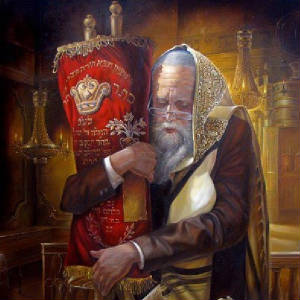
Sinaites were so touched by this prayer that we redesigned it, reformatted it, selected an image that so well reflects the Rabbi’s love for Torah.


Would that we could fulfil in our lives the heart’s longings and aspirations so simply expressed in  prayer and so intensely displayed by an old Rabbi’s image tightly embracing the physical Torah . . . . Indeed, often actions speak louder than words.


Here is the original source:


Image from SlideShare

Image from SlideShare


And of course the Rabbis also have a blessing after reading the Torah:


Image from www.templesinairi.org

Image from www.templesinairi.org