
The Messiahs – 3 – The Second Coming of YHVH

[First posted 2015.  Yes indeed, there was a first coming . . . that was on the mountain of Sinai, recorded in Shemoth/Exodus.  The Israelites and the mixed multitude among them who were liberated from bondage in Egypt arrived at the foot of Sinai to meet with their Liberator Who would make a ‘briyth’ or covenant with Israel and Who would give them His Ten Declarations written with His finger on tablets of stone.


 Is there a ‘second coming’?  According to James D. Tabor, yes there is! Isn’t that the TRUE GOOD NEWS and great reason to celebrate at any time, every day of our life until it happens on whichever generation is living at that time.  For the rest of us, we simply live our lives looking back to the ‘first coming’ and celebrating what happened there, and living the commandments as best we can.  It’s all recorded in the Torah, no need to guess.  What needs to be figured out is how to read and reinterpret and apply what is relevant to us and our times, in our age and our culture.  YHWH is a universal God, not just the God of Israel.  
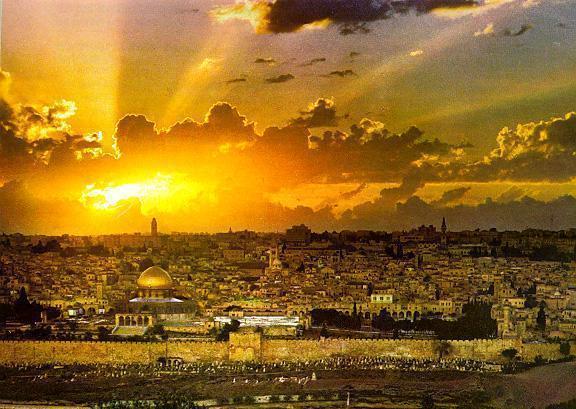
Jerusalem at dawn

Image from www.youtube.com


 Continuing Chapter 4 of James D. Tabor’s Restoring Abrahamic Faith titled “The Messiahs”, edited/condensed/reformatted. Please get a copy of this book for your library, it is the MUST READ/MUST OWN we persistently recommend as an eye-opener if there ever was one.  This is a 3rd revisit, last posted December 9, 2013.

Check out these related posts


——————————–


For centuries millions of Christians have focused on the so-called “Second Coming of Christ” as the central event that ushers in the Kingdom of God.  As surprising as this may sound, the “coming of the Messiah” is definitely not the major eschatological emphasis of the Prophets.  Only a dozen or so texts speak of the role of the coming Davidic King.  In contrast there are many hundreds of texts in the Hebrew Prophets that deal in the greatest detail with the end of the ages, the great Day of Judgment, and the arrival of the Kingdom of God.  In text after text the role of a Messiah is not even mentioned, much less emphasized.  This is not to minimize the Biblical doctrine of the Messiahs, but it does help to put things in balance.


However, there is another central event, a different “second coming,” that has been almost completely ignored, although it is mentioned in almost every single passage dealing with the future or “end times’ of human history.  I refer to the Second Coming of YHVH God Himself.

The Hebrew Prophets consistently emphasize the dramatic, awesome, earth-shaking, personal return of YHVH Himself to this planet.  They clearly intend to convey an actual, literal, historical event in the future, something that will be experienced by all the inhabitants of the earth.

Zechariah 14 is perhaps the most basic chapter in the Scriptures on this subject.  Note the language carefully:  


Behold, the day of YHVH is coming, and your spoil will be divided in your midst.  For I will gather all the nations to battle against Jerusalem; the city shall be taken, the houses rifled, and the women ravished.   Half the city shall go into captivity.  But the remnant of the people shall not be cut off from the city.  Then YHVH will go forth against those nations, as He fights in the day of battle.  And in that day His feet shall stand on the Mount of Olives, which faces Jerusalem on the east . . . Thus YHVH my God will come, and all the saints with You . . . And YHVH shall be King over all the earth, in that day it shall be —YHVH is One and His Name One . . . And it shall come to pass that everyone who is left of all the nations which came against Jerusalem shall go up from year to year to worship the king, YHVH of Hosts, and to keep the Feast of Tabernacles (Zechariah 14:1-4, 5b,9,16).

There are a number of remarkable features in this prophecy.  Despite what Christians so often assume, there is no mention whatsoever of the Messiah in this chapter. YHVH Himself appears, directly intervenes, and becomes King over all the earth.  The entire focus of the text is upon YHVH God.  I emphasize this point, not to deny or even downplay the role of the Davidic Messiah, but rather to stress that Zechariah is able to offer this rather detailed scenario of the “end of the age, and the arrival of the Kingdom of God without even mentioning the role of the Davidic King.  It seems that fact might help us to recover a bit of the Biblical perspective.

Also, despite any use of symbolic or metaphorical language (i.e., His feet standing on Mt. of Olives), the passage is full of historical and geographical details.  The prophet obviously intends to describe an actual, literal, historical event in the future history of Israel and Jerusalem.  The language itself resists allegorical interpretation.


Constantly the Prophets make this point that YHVH Himself will intervene, acting personally and directly, to punish the wicked and rule as King over all nations.  YHVH constantly calls Himself the Savior, Redeemer, Shepherd, and King—beside Whom there is no other.  Notice carefully the direct way these ideas are expressed in the following texts.  Despite their number, these are still only a sample among many others that one could cite on this subject.


 Again, I emphasize, in none of these passages is the role of Messiah mentioned:

A voice cries, “Prepare the way of YHVH in the wilderness; make straight in the desert a highway for our God.  Every valley shall be exalted and every mountain and hill brought low; the crooked places shall be made straight and the rough places smooth; the Glory of YHVH shall be revealed, and all flesh will see it together, for the mouth of YHVH has spoken (Isaiah 40:3-5). 


O Zion, you who bring good tidings, get up into the high mountain; O Jerusalem, you who bring good tidings, lift up your voice with strength, lift it up and be not afraid: Say to the cities of Judah, “Behold your God!”  Behold Lord YHVH shall come with a strong hand, and His arm shall rule for Him’ behold, His reward is with Him and His work before Him. He will feed His flock like a shepherd; He will gather the lambs with His arm, and carry them in His bosom, and gently lead those who are with young (Isaiah 40:9-11).


I, even I, am YHVH; and besides Me there is no Savior

Thus says YHVH, the King of Israel and his Redeemer, YHVH of Hosts:  I am the first and the last, besides Me there is no God (Isaiah 44:6).


Is there any God besides Me, or is there any other Rock?  I know of none (Isaiah 44:8).

I have sworn by Myself, The word has gone out of My mouth in righteousness and will not return, that to Me every knee shall bow, every tongue will take an oath. Only in YHVH, it shall be said of Me, are righteousness and strength (Isaiah 45:23-24).


How beautiful upon the mountains are the feet of him who brings good news, who proclaims peace, who brings glad tidings of good things, who proclaims salvation, who says to Zion, “Your God reigns!”  Your watchmen shall lift up their voices, with their voices they shall sing together; for they shall see eye to eye when YHVH brings back Zion . . . YHVH has made bare His holy arm in the sight of all the nations; and all the ends of the earth shall see the salvation of our God (Isaiah 52:7-8,10).


Notice that these passages speak of “good news.”  This is, indeed, the true Biblical Gospel—the good news of the coming reign of YHVH, the “Gospel of the Kingdom of God.”  The message includes, of course, the agency of the Messiahs, as we know from other passages.  However, its essential focus and emphasis, as these passages show, is not on a Messiah but on YHVH Himself and His reign when He returns.

He saw that there was no man, and wondered that there was no intercessor; Therefore His own arm brought salvation for Him; and His own righteousness, it sustained Him.  For He put on righteousness as a breastplate, and a helmet of salvation on His head; He put on the garments of vengeance for clothing, and was clad with zeal as a cloak.  According to their deeds, accordingly He will repay, fury to His adversaries, recompense to His enemies; the coastlands He will fully repay.  So shall they fear the Name of YHVH from the west, and His glory from the rising of the sun; for He will come like a rushing stream, which the wind of YHVH drives, and He will come to Zion as Redeemer, to those in Jacob who turn from transgression, says YHVH (Isaiah 59:16-20).


Who is this Who comes from Edom, with dyed garments from Bozrah, this One Who is glorious in His apparel, traveling in the greatness of His strength?  “I Who speak in righteousness, mighty to save.”  Why is Your apparel read, and Your garments like one who treads in the wine-press?  “I have trodden the wine-press alone, and from the peoples no one was with Me.  For I have trodden them in My anger, and trampled them in My fury; their blood is sprinkled on My garments, and I have stained all My robes.  For the day of vengeance is in My heart, and the year of My redemption has come.  I looked, and there was no one to help, and I wondered and there was no one to uphold; therefore My own arm brought salvation to Me; and My own fury, it sustained Me, I have trodden down the peoples in My anger, made them drunk, in My fury, and brought down their strength to the earth”


For behold, YHVH will come with fire and with His chariots, like a whirlwind, to render His anger with fury, and His rebuke with flames of fire.  For by fire and by His sword YHVH will judge all flesh; and those slain by YHVH will be many (Isaiah 66:15-16).


Enter into the rock and hide in the dust from the terror of YHVH and the glory of His majesty.  The lofty looks of men shall be humbled, the haughtiness of men shall be bowed low, and YHVH alone shall be exalted in that day . . . . They shall go into the holes of the rocks, and into the caves of the earth, from the terror of YHVH, and the glory of His majesty, when He arises to shake the earth mightily.  In that day a man will cast away his idols of silver and his idols of gold, which they made, each for himself to worship to the moles and bats, to go into the clefts of the rocks, and into the crags of the rugged rocks, from the terror of YHVH and the glory of His majesty, when He arises to shake the earth mightily (Isaiah 2:10-11,19-21).


Behold, YHVH makes the earth empty and makes it waste, distorts its surface, and scatters abroad its inhabitants . . . .They shall lift up their voice, they shall sing; for the majesty of YHVH they shall cry aloud from the sea. . . . It shall come to pass on that day, that YHVH will punish on high the host of exalted ones, and on the earth the kings of the earth . . . . Then the moon will be disgraced and the sun ashamed, For YHVH of Hosts will reign on Mount Zion and in Jerusalem, and before His elders gloriously (Isaiah 24:1, 14-15, 21-23).


Come My people, enter your chambers, and shut your doors behind you; hide yourself, as it were, for a little moment, until the indignation is past.  For behold, YHVH comes out of His place to punish the inhabitants of the earth for their iniquity; the earth will also disclose her blood, and will no more cover her slain (Isaiah 26:20-21).


For thus says YHVH God: “Indeed I Myself will search for My sheep and seek them out.  As a shepherd seeks out his flock on the day he is among his scattered sheep, so will I seek out My sheep and deliver them from all the places where they were scattered on a cloudy and dark day.  And I will bring them out from the peoples and gather them from the countries, and will bring them to their own land;  . . . . I will feed My flock, and I will make them to lie down,” says YHVH God . . . (Ezekiel 34:11-13,15).


Perhaps the reason the Messiah is not so heavily emphasized by the Hebrew Prophets goes all the way back the time when Israel first demanded a king (1 Samuel 8).  God tells the prophet Samuel that their desire for a king is fundamentally a rejection of His rule over them as King.  In the ideal future even through the Messiahs, both king and priest, are agents in bringing about the Kingdom of God, their subsidiary roles are always kept clear.  It is God Himself Who ultimately is King, Savior, Redeemer, and Lord.


A few Christian interpreters have nonetheless maintained that when texts of the Hebrew Bible speak of God Himself acting to bring about the final days of history, they are in fact referring to Jesus—whom they understand to be “God in the flesh.”  Even a text as clear as Zechariah 14:4   On that day His feet will stand upon the Mount of Olives,  is read as if it refers to the “Second Coming” of Jesus.  The problem with such a view is that the Hebrew Prophets always maintain a clear distinction between the coming of the LORD GOD YHVH and the arrival of His Messiah. The Two are obviously related, since the Messiah acts as YHVH’s chief agent, but they are nonetheless never confused or equated.


The Prophets understand this dramatic, personal, intervention of YHVH in history as a return or “second Coming” of YHVH Himself.  God declares, according to Haggai,


Once more in a little while, I am going to shake the heavens and the earth, the ” sea also and the dry land” (2:6).


 Isaiah yearns for this time to arrive:


Oh, that You would rend the heavens!  That You would come down!  That the mountains might shake at Your presence —as fire burns brushwood, as fire causes water to boil—to make Your Name known to Your adversaries, that the nations may tremble at Your presence!  When You did awesome things for which we did not look, You came down, the mountains shook at Your presence.  For since the beginning of the world, men have not heard nor perceived by the ear, nor has the eye seen any God besides You, Who acts for the one who waits for Him (Isaiah 64:1-4).


Both the prophets Haggai and Isaiah are thinking back to the unprecedented events at Mt. Sinai in the time of Moses when God dramatically judged Egypt and freed the entire nation of Israel from slavery. There all Israel experienced the awesome, visible, dramatic, direct manifestation of the Presence (literally “face”) of the Glory of YHVH Himself.  The TORAH is most explicit regarding this unprecedented experience.  Nothing like this had ever happened before, or has happened since.  YHVH Himself appeared to the people in a fiery cloud-like pillar;  they actually heard His voice and saw His Glory (Exodus 19:18-19; 20:18-21; 40:34-38; Numbers 14:14).  The very purpose of the Tabernacle (literally “dwelling place”) was to provide a locus for this extraordinary manifestation of YHVH in the days of Moses.


 Habakkuk also looks back on this extraordinary event in history:


O YHVH, I have heard the report of You, and Your work, O YHVH, do I fear.  In the midst of the years renew it; in the midst of the years make it known; in wrath remember mercy.  God came from Teman, the Holy One from Mount Paran.  His glory covered the heavens, and the earth was full of His praise.  His brightness was like the light; He had rays flashing from His hand, and there His power was hidden.  Before Him went pestilence, and fever followed at His feet (Habakkuk 3:2-5).


Ezekiel reports that this Presence (kavod) of YHVH departed shortly before the Exile.  He understands this in the most literal way, actually describing the cloud-like “Glory” moving through the Eastern Gate of Jerusalem, up the Mount of Olives, and away (Ezekiel 10:18-19; 11:22-23).  This “departure” is known as the “hiding of the Face of YHVH” (see Deuteronomy 31:17; compare Ezekiel 39:29).  


To understand this teaching of Scripture one has to make a distinction between the general presence of God, which is always with His creation, and this very specific, literal, awesome, visible, manifestation of the Divine Glory.  In that sense God departed from this planet, and in that sense the Prophets all tell of His return.  In other words, the Prophets predict a visible, awesome, literal, manifestation of the Glory of YHVH once again.  


This Day of YHVH,” as it is called, is attributed to God, but as with divine judgments chronicled in the Bible from the past, it will involve some sort of catastrophic consequences of our own way of life crashing down upon us.  Whether this crisis will be brought on by economic, military, or environmental factors, or some combination of all three, remains to be seen.  For the wicked this will cause trembling, terror, and fear of judgment, but for the righteous it will bring great rejoicing.  The Prophets describe this arrival of YHVH in specific details:


Arise, shine; for your light has come, and the glory of YHVH has risen upon you.  For behold, the darkness shall cover the earth, and deep darkness the people; but YHVH will arise over you, and His glory will be seen upon you (Isaiah 60:1-2).


Afterward he brought me to the gate, the gate that faces toward the east.  And behold the Glory of the God of Israel came from the way of the east.  And His voice was like the sound of many waters; and the earth shone with His Glory . . . . And the Glory of YHVH came into the house by the way of the gate facing toward the east . . . . And He said to me, “Son of man, this is the place of my throne and the place of the soles of My feet, where I will dwell in the midst of the children of Israel forever (Ezekiel 43:1-2,4,7).


Moreover I will make a covenant of peace with them, and it shall be an everlasting Covenant with them; I will establish them and multiply them, and I will set My sanctuary (miqdash) in their midst forevermore.  My tabernacle (mishkan) also shall be with them; indeed I will be their God, and they shall be My people.  The nations also will know that I, YHVH, sanctify Israel, when My sanctuary is in their midst forevermore (Ezekiel 37:26-28).

[Footnote:  Here both of the common Hebrew words for the Temple/Tabernacle are used: miqdash and mishkan.  The former comes from the verbal root “to make Holy” and the latter from the verbal root “to dwell.”  Both of these concepts are the basis of a Biblical understanding of the Temple.  It is the Holy Place of YHVH’s literal Presence.]
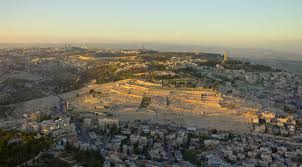
 

Image from en.wikipedia.org

Image from en.wikipedia.org

There is a definite focus in these Scriptures on the East. On the east side of Jerusalem is the eastern Gate of the Temple Mount, and east of that Gate, the Mount of Olives.  From this sacred area the Glory of YHVH departed, and it is here that the radiance will reappear.  This is clearly what lies behind the statement in Zechariah 14:4 that “on that day His feet will stand on the Mount of Olives.”  This area, east from the Temple Mount and including the Mount of Olives, is likely the El-Bethel (not the northern town of Bethel) where Jacob had his vision of the ladder to heaven.  He identifies the place as awesome and sacred, none other than the “gate of heaven.  He is lying on the Temple Mount, facing east, looking in his dream at the summit of the Mt. of Olives (Genesis 28:10-17; 35:5-8).

One point that emerges with absolute clarity from these Scriptures is that the identity of the Davidic Messiah is never confused with that of YHVH, the Eternal God of Israel.  To assert, as many Christians have, that the Messiah is YHVH God in the flesh, or even to equate the Messiah with YHVH, does violence to the plain expression of dozens of texts of the Hebrew Bible.


  • The Messiah is the one chosen and appointed by YHVH;
  • he is the chief agent of YHVH, who sits at His right hand.
  • He is, accordingly, YHVH’s anointed one.
  • As exalted as his role and mission is, he is, and always remains, YHVH’s faithful servant.  
  • He is a human being, of the physical lineage of David.

As Micah puts it,


He will arise and shepherd his flock in the strength of YHVH his God” (5:4).


 Recall the clear and unambiguous language of David:


 “Why do the Gentiles rage, against YHVH and against His Messiah (Psalm 2:1-22); or,


“YHVH spoke to my Lord [Messiah}, Sit at my right hand until I make your enemies a stool for your feet” (Psalm 110:1).  


YHVH speaks to the Messiah, exalts him, empowers him, and counts him as his beloved chosen one–but never is the Messiah confused with God.

Those who know and use the Divine Name (YHVH) recognizing that this is a Name, not a title such as LORD,  seldom have any problem distinguishing from YHVH’s Messiah.  In other words, the loss of the understanding of the Sacred Name has greatly contributed to the current the common error of confusing the LORD God and His Messiah.

The Messiah is also called “Son of God” as we have seen (Psalm 2:7).  This does not make him YHVH God. Rather it implies faithfulness and intimacy (see 2 Samuel 7:14).  The son remains just that, a “son.”  As such, he carries out the will of his Father, YHVH God.  Never are the roles confused.  The later Christian Church made a subtle but fateful shift in concept here: the Hebrew image of “Son of God” became God the Son, a “Second Person” of the Trinity or “Godhead.”  Such an idea is nowhere found in the Hebrew Scriptures.  The entire God-man idea, as developed in Christianity, is a pagan Hellenistic concept, completely foreign to Biblical Hebraic thought.


[Next:  The Messiahs – 4 – Restoring the Biblical Balance]


MUST READ: THE GENIUS OF JUDAISM, by Bernard-Henri Levy, Prologue

4178UuNa76L[This book was lent to me by the president of the Jewish Club in my city of residence.  I recognized the author from his photo on the inside cover flap as someone I had just recently watched being interviewed on CNN, possibly about this recent publication  dated 2017.  As we often do with MUST READ endorsements, we’re featuring here what we call the “bookends” — the Prologue and the Epilogue — to whet your appetite, dear reader.  Sometimes we add excerpts or whole chapters, although we would rather that you add this to your personal collection of worthwhile book acquisitions.—Admin1.]
————————
PROLOGUE
 
It was 1979.
  I was thirty years old.
  The revolutionary era had signed its last in the killing fields of Cambodia.
  A scent of dry powder hung in the air over the great capitals, mingling with an insouciant sense that it was a good time to be alive.
  We were sure that we were at the apogee of the age in which God had died.
  It had been beautiful.
  It had been huge.
  Rarely had humanity seemed so radiant as in this century of doubt and skepticism, during which we had burned all of our idols, all of our religions, in the joyful fire of atheism.
  Or, rather no.  The temples, the devourers of men and destinies, were the pyre.  From Giordano Bruno to Nietzsche, and then from the death of God to that of Divine Man, there had been intrepid liberators who faced the blaze, some burning, some wielding torches—and we felt we were their heirs.
  A moment of rejoicing.
  An unparalleled triumph of freedom.
  That triumph cost countless dead and wounded.  It had required unprecedented acts of heroism.  But God’s fire had gone out.  The ashes had been scattered.  And we found ourselves alone, finally alone, in a world more suited to our wishes because (we thought) we had disenchanted it and could now savor the pure pleasure of being ourselves without fearing the slings and arrows of the censors.
  Anything was possible.
  Everything seemed to be permitted.
  I recall that time as a long and languorous Sabbath of the spirit.


But doubt gripped the less credulous among us.
  What if this was a deception?
  A trap?
  What if the coin had another side?
  What if a shadow of doubt, a new kind of doubt, forced us to doubt our previous doubt?
  What if, behind the funeral pyre of subjugating religion, behind the celebration of the universal  federation in which the tree of life was to have triumphed over the vultures of the moral order, a worried eye could discern the silhouettes of other, more-ancient gods that one had given up for dead but that were creeping back into the world?
  It was during this time that I met Emmanuel Levinas.
  And then, in the United States, the Catholic philosopher Rene Girard.
  A little later, I encountered Franz Rosenzweig’s great work, which had finally been translated into French.
  This was the time when I began to wonder, with these thinkers, in their footsteps, whether humanity could do without gods, if it could topple the supreme god without risking the return of the others, all the others, all those gods of ancient Indo-European paganism the even more pernicious modern, political gods—- Thor, Wotan, Prometheus unchained, hydras and dragons, the gods of race and history, of scourging nature and of science without limits, the damming of whose bloody invasiveness had required the full strength of the One God but of which nothing now blocked the return.
  Above all it was the time when a growing number of texts and signs began to suggest that we should not rule out the possibility that yesterday’s Judeo-Christian inquisitors might once have been, and might once again become, the inventors, the liberators, the saviors of a fragile and constantly imperiled idea, an idea that was again being surrounded by the dark tide of neo-pagan bestiality: man, man alone, that Adam who new Jewish intellectuals insisted (but who was listening?) was tenable only if conceived simultaneously as adama born of the earth and its dust? and as bria, sekkhel, or yech me-ain (created anew as an emanation of an unknowable and immeasurable intelligence).
  This is the time when, seized by a part of me of which I was unaware, grasped by a force that was instantly familiar but to which I had never before been exposed in the course of my career as a speaking being, I turned to the subject of Judaism and wrote a book called Le Testament de Dieu (The Testament of God).


It turned my intellectual life upside down.
  Had I not discovered, with such wonder, the Torah and then the Talmud, I might not have been able to continue writing.
  It’s hard to express the shock I felt at realizing that I had before me books that my hands had never held, my eyes had never beheld, but in which my name, that most intimate of intimacies, found not the accident of an origin or an occupation (Smith the smith; Miller the miller…) but the necessity of a place that followed in turn from a long chain of meaning divided into verses,  other proper names, acts to be accomplished, arguments to make or refute: a book of life in which a place had been made for me, springing—yes—from my name.
  Another thing about which I have not said enough is the feeling of indescribable glory that coursed through me, like a ray of light from within an opaque shell, when I understood that those pages contained not only the entire mental apparatus needed by someone seeking to close the parentheses of philosophical and political atheism without yielding to the murky appeal of a return to magic, occultism, and, at bottom, religion but also the resolution of most of the impasses into which my young, self had strayed, the answer to so many questions that my theoretical work had left hanging.  They also contained provisions for the human and political adventure that I had begun in Bangladesh and that I sensed was gathering force.
  I spoke that glory in French.
  I would utter the words la gloire des juifs without provocation or vanity, steeping myself in that beautiful word gloire, one of the loveliest in the French language—that word of Bossuet’s, favored by Racine for moments of grace and by Corneille for moments of strength, that word of Bach and Vivaldi, which I was listening to in those years, that word used by Chateaubriand, whom I have never tired of reading and rereading.
  I would repeat la gloire des juifs, delighting in that red word, or orange-red, loving the feel of its guttural attack, with the hardest of our French consonants followed by the lightening the brightening of that “L”, which sparkled with so many poetic memories, then flaring through the “OI”, where French forgives itself for being nearly unaccented, and ending with the rugged “R”, as if to contain, after all, that effusion of light.
  But even though I was not yet speaking the phrase in Jewish terms, I had begun thinking it that way: awkwardly; painstakingly; putting the full resources of my soul into my first readings of Rashi and Maimonides and soon of Rabbi Chaim of Volozhin, Franz Rosenzweif, Nachman of Breslov, and many others.
  The hod of Jewish splendour.
  The karnei hod, the rays of light and glory, that flooded Moses’s face upon his descent from Mount Sinai.
  And the kavod, derived from kaved and also signifying glory, weight, and price—of a Jewish life not entirely unfulfilled.
  And the me’hail el hail, literally “from strength into strength”, that propels and accompanies the beauty, the brilliance, and (once again) the glory that emanate from destiny.
  And the blue of the sky and of the kings of Israel, with its lighter but ore volatile tint, the color of quivering air.
  And the imperceptible white of their crown.
  And the pale gold of the seraphim, or the purer, invisible gold of the cherubim on the cover of the holy ark.
  The glory of the Jews, like the light gleaming in lines of rain falling to the ground, like shafts of sun over a misty land, like the trail of sparks left by the masters whose wisdom I was absorbing.
  I knew that sense of glory would never leave me.
  I understood that I was experiencing a source of knowledge that would accompany me to the end of my days.
.    .   .
Indeed, it did  not stop.
  I remained faithful to the work of Levinas.
  I resumed my conversation with a young master, Benny Levy, a sort of Jewish imam who concealed himself for a generation.
  And then, in the company of several wise men who guided my first steps into the jungle of the text, I studied as much as I could, but not enough, never enough, with the handicap of not mastering the language, a language I still have not mastered.
  Nevertheless, the Talmud was mine.
The Bible was mine—-as jealous, demanding, and insatiable as she is for every man.
  When writing about Sartre or art, about The Iliad or The Odyssey of a novelistic hero in a race with the devil, about the decapitation of an American journalist in Karachi, about the United States, about Baudelaire, about France, or about Europe; when pursuing, from Bangladesh to Iraq and Afghanistan, from the Libyan desert to the mountains of Kurdistan, the dialogue with Islam that has been one of the most persistent themes of my life; or when embarking, in response to Frantz Fanon, in search of those wars that are forgotten only by those who have also forgotten the messianic music of the time, the Jewish thread was always there.
  And the truth is that almost nothing of what I said and did during those decades seems completely intelligible to me unless I include the inner work on Judaism that I was pursuing in parallel—-although not necessarily in secret.


It is the feeling of having “advanced”, as Benny Levy was saying to me in the last conversation of ours that I can recall?
  Is it the erosion of the Jewish exception, which I see wavering everywhere—not only, alas, among anti-Semites?
  Is it, in fact, the return of anti-Semitism?
  Is it the deepening of our misunderstanding with Muslims, my brothers in Adam?
  Is it fear in the face of creeping nihilism and the prospect of new waves of destruction?
  Or is it the feeling of having entered into one of those dark ages during which it becomes necessary to separate what must be separated and to reconcile what can be reconciled?
  Whatever the answer, I wanted to come back to this.
  I wanted to provoke a new encounter between my two tongues: the French of my mother and father and the Jewish language, which was theirs, as well, and which they spoke even more rarely than I.
  I decided, in other words, to return to the questions that had first taken hold of me almost forty years ago and never left.
  In these pages one will find reflections on the criminal fury of anti-Semitism that is brewing, on its new forms, and on the not in considerable fear that it inspires in me.
  As well as others on the State of Israel, on the reasons for defending it, and on why, having existed for a human lifetime, it is a litmus test for Jews and non-Jews alike.
  And, still more, I will try to untangle why I, a Jew put my head and body, not once but many times, into certain countries where no being is under greater threat than the Jew and where hostility to the Jew is like a second religion.
  But I will devote the essence of this book to the search for, and defense of, a certain idea of man and God, of history and time, of power, voice, light, sovereignty, revolt, memory, and nature—-an idea that contains what I call, in homage to one of the few really great writers to have understood some of its mystery, the genius of Judaism.   
[Here’s the text in the inside cover of the book jacket):
From world-renowned public intellectual
Bernard-Henri Levy comes an incisive and provocative look at the heart of Judaism.
For more than four decades, Bernard-Henri Levy has been a singular figure on the world stage—one of the great moral voices of our time.  Now Europe’s foremost philosopher and activist confronts his spiritual roots and the religion that has always inspired and shaped him—but that he has never fully reckoned with.
The Genius of Judaism is a breathtaking new vision and understanding of what it means to be a Jew, a vision quite different from the one we’re used to.  It is rooted in the Talmudic traditions of argument and conflict, rather than biblical commandments, borne out in struggle and study, not in blind observance.  At the very heart of the matter is an obligation to the other, to the dispossessed, and to the forgotten, an obligation that, as Levy vividly recounts, he has sought to embody over decades of championing “lost causes”, from Bosnia to Africa’s forgotten wars, from Libya to the Kurdish Peshmerga’s desperate fight against the Islamic State, a battle raging as we speak.  Levy offers a fresh, surprising critique of a new and stealthy form of anti-Semitism on the rise as well as a provocative defense of Israel from the left.  He reveals the overlooked Jewish roots of Western democratic ideals and confronts the current Islamist threat while intellectually dismantling it.  Jews are not a “chosen people”, Levy explains, but a “treasure” whose spirit must continue to inform moral thinking and courage today.
Levy’s  most passionate book, and in may ways his most personal, The Genius of Judaism is a great, profound, and hypnotic intellectual reckoning—indeed a call to arms—by one of the keenest and most insightful writers in the world. 

A Hollow Win

[This was first posted in 2012, reposted every year thereafter.  We’re approaching another Halloween trick or treat fright night when not only children but grownups party in ‘spook-tacular’ costumes.  Live and let live, we now say, since we discovered there is no devil, no demonic spirits, no ghosts to feel threatened by dressing up as imaginary characters of the ‘dark’.  Really, we ought to be more frightened of flesh and blood evil humanity who are the real threats to our safety and our lives. And we ought to be in awe of only one Being to Whom the word “awesome” should be applied and that is no other than the One True God Whose Name is YHWH!—Admin1.]


Image from www.macxdvd.com

Image from www.macxdvd.com

Ever wonder about the origin of what has become known as “Halloween,” the night of spooks, witches and devilish creatures?  


The short version:

  • Dictionary definition . . . Halloween |ˌhaləˈwēn; ˌhälə-; -ōˈēn| (also Hallowe’en) noun
    • the night of October 31, 
    • the eve of All Saints’ Day, 
    • commonly celebrated by children who dress in costume and solicit candy or other treats door-to-door.
  • ORIGIN late 18th cent.: contraction of All Hallow Even 
    • (see hallow hallow |ˈhalō|verb [ trans.] honor as holy : the Ganges is hallowed as a sacred, cleansing river | [as adj. ] (hallowed) hallowed ground.• formal make holy; consecrate.• [as adj. ] ( hallowed) greatly revered or respected : in keeping with a hallowed family tradition.noun archaica saint or holy person.ORIGIN Old English hālgian (verb), hālga (noun), of Germanic origin; related to Dutch and German heiligen, also to holy .
    • even 2 — noun archaic or poetic/literarythe end of the day; evening : bring it to my house this even.

One has to ask: how does a “holy” (hallow) “evening” become the weird ‘anything-but-hallowed’ festivity that it has transformed into in this day and age? How could the “fruit” stray so far from the “root”?  As it is with customs and traditions, someone started something ages ago and its perpetuation changed over centuries because of loose transmission or adaptation to the times. Often, the original practice has absolutely nothing to do with the later significance of the custom or tradition.  


The longer version about halloween traces it to  pagan customs celebrating the changing of the seasons, specifically from summer to autumn; [source: http://www.irish-genealogy-toolkit.com/origin-of-Halloween.html]:

  • Samhain,” a Celtic-sourced festival in Ireland.  
    • The word “sam” means summer;
    •  and “hain” or “fuin” means end; 
    • or end of summer (beginning of fall)
    •  which in that part of the world is on October 31. Other words are used in other Celtic countries. 


  • The Roman Autumn festival — Harvest was celebrated by the Romans with a festival dedicated to Pomona, the goddess of the fruits of the tree, especially apples. 
    • The origin of Halloween’s special menus, which usually involve apples (as do many party games), probably dates from this period. 
    • Pomona continued to be celebrated long after the arrival of Christianity in Roman Europe. 
    • So did Samhain in Ireland and it was inevitable that an alternative would be found to push pagan culture and lore into a more ‘acceptable’ Christian event.  
  • Sure enough, the 7th century Pope Boniface, attempting to lead his flock away from pagan celebrations and rituals, declared 1st November to be All Saints Day, also known as All Hallows Day.
  • The evening before became known as Hallows’ Eve, and from there the origin of Halloween, as a word, is clear. 

The well-meaning Pope Boniface might have succeeded in “christianizing” a pagan festival during the centuries when Vatican wielded political and religious influence over countries in Europe but just look at the world today.  If 14 centuries later, halloween continues to be part of seasonal celebrations so that not only kids are all excited about going trick-or-treating, but also adults who look for any excuse to party in ridiculous costumes, there’s the Pope’s hollow win!


Image from www.rwsentosa.com

Image from www.rwsentosa.com

People with creative imagination will turn any occasion to suit their particular self-serving interest.  Media and commercial establishments jump at every opportunity to hype up shoppers to buy stuff they don’t need, people want to get a break from the monotony of work routines, what’s so bad about having some fun on fright night. And as for remembering the dearly departed by trekking to cemeteries once a year, it’s a cultural tradition that make the living feel connected to their dead as well as to each other. Ever heard the joke that the cemetery is ‘the place that everyone is dying to go to ‘. . . .?


Image from www.steckeyecare.com

Image from www.steckeyecare.com

Some of the fondest memories my three sons have about their childhood is associated with halloween.  I used to spend time preparing their costumes and even presented them one time at their school as “the Boo-men” (to their embarrassment).


Yet, when I became seriously evangelical and was warned to stop celebrating this evil and pagan festival, I unquestioningly obeyed.   My agnostic brother called me and my evangelical friends “killjoys” for depriving our kids from having simple fun like all other kids, wondering what’s the big deal?


Well, that seems like ages ago.  Now that I’ve discovered there is no devil, no ghosts, witches, evil or dead spirits from reading and understanding YHWH’s TORAH, I have changed my mind and my attitude toward all the customs, traditions, belief systems of people, pagan or religious.  Hey, live and let live, most everything we do came from paganism at some point.


If you know the truth about the One True God, none of these are threatening to your faith, except when you allow them to dominate and control your behavior and your life and in turn you start controlling other people’s behavior and lives.  


Here comes the ‘sermon’:  there is only one Power to Whom we should subject ourselves and that is the Creator of humankind, the One Who truly does have power to control our lives if He wanted to but guess what, He’s given His manual for living, it is up for us to control ourselves.  He did not give us free will just to overstep the boundaries He Himself had set.


We have been given minds to inquire after truth, the ability to study and learn, reasoning and logic to apply in reaching conclusions, so we can make informed decisions. He has made known His revelation to the nations through Israel.  We could expose ourselves to all kinds of influences, deceptions, untruths, man-made teachings, but  if we know TORAH, we cannot possibly be misled.  TORAH is that standard of truth, that ‘ruler’ to measure all “truth claims” by.  We either believe God’s Revelation or not.  And if we believe it, then decide what to do with each TORAH truth we progressively learn. 


I googled the well known verse used by Dr. Martin Luther King Jr. in his crusade and was surprised at the trick-or-treat type of answer:  “You shall know the truth and the truth shall make you mad.”   This is not to make light of a verse attributed to Jesus in John 8:32 Ye shall know the truth and the truth shall make you free.   


Indeed, both were true for me: first the truth did make me “mad,” that I had spent decades of my life internalizing and teaching to others a whole belief system that turned out to be opposite of TORAH teaching; until I realized that the Jesus of John’s gospel did say it correctly, but you have to distinguish which “truth” to believe because for us at S6K, we KNOW that YHWH’s Truth and no other, is what truly sets you free!

 
Sig-4_16colors

logo


Exodus/Shemoth 5: Who is YHVH . . . I do not know YHVH

Image from www.brandedwithlove.com

Image from www.brandedwithlove.com

[An oversight, this chapter was not previously posted when we started the series on Torah books in 2014; we just discovered it was missing at this time while working on the current series of 2017 THE TORAH: Chapter by Chapter.  So, all there is here is plain text from our official translation, Everett Fox—no commentary as yet but understandable and clear as is, for now.  It is a crucial chapter, reflecting the stance of all those ignorant, just like pharaoh, of the One True God and His True Name, in this world full of gods of man’s making.  A reminder from Scripture:  The beginning of wisdom is reverence for God. –Proverbs 1:7.  Be blessed this year with that knowledge by going back to basics, the foundational truths in the original Revelation by the Law-Giver and Giver of Life, His name is YHWH.—Admin1]


———————–
1 Afterward Moshe and Aharon came and said to Pharaoh: 
Thus says YHVH, the God of Israel: 
Send free my people, that they may hold-a-festival to me in the wilderness!
Image from "Truth and Falsehood", www.perankhgroup.com

Image from “Truth and Falsehood”, www.perankhgroup.com

2 Pharaoh said:

 Who is YHVH, that I should hearken to his voice to send Israel free? 
I do not know YHVH,
 moreover, Israel I will not send free!
3 They said: 
The God of the Hebrews has met with us; 
pray let us go a three days’ journey into the wilderness, 
and let us slaughter (offerings) to YHVH our God, 
lest he confront us with the pestilence or the sword!
4 The king of Egypt said to them: 
For-what-reason, Moshe and Aharon, 
would you let the people loose from their tasks? 
Go back to your burdens!
5 Pharaoh said: 
Here, too many now are the people of the land, 
and you would have them cease from their burdens!
6 So that day Pharaoh commanded the slave-drivers of the people and its officers, saying:
7 You are no longer to give straw to the people to make the bricks as yesterday and the day-before; 
let it be them that go and gather straw for themselves!
8 But the (same) measure of bricks that they have been making, yesterday and the day-before. you are to impose on them, 
you are not to subtract from it! 
For they are lax- 
therefore they cry out, saying: Let us go, let us slaughter (offerings) to our God!
9 Let the servitude weigh-heavily on the men! 
They shall have to do it, so that they pay no more regard to false words!
10 The slave-drivers of the people and its officers went out 
and said to the people, saying: 
Thus says Pharaoh: 
I will not give you straw:
11 You go, get yourselves straw, wherever you can find (it), 
indeed, not one (load) is to be subtracted from your servitude!
12 The people scattered throughout all the land of Egypt, 
gathering stubble-gatherings for straw.
13 But the slave-drivers pressed them hard, saying: 
Finish your tasks, each-day’s work-load in its day, as when there was straw!
14 And the officers of the Children of Israel, whom Pharaoh’s slave-drivers had set over them, were beaten, 
they said (to them): 
For-what-reason have you not finished baking your allocation as yesterday and the day-before, 
so yesterday, so today?
15 The officers of the Children of Israel came and cried out to Pharaoh, saying: 
Why do you do thus to your servants?
16 No straw is being given to your servants, and as for bricks-they say to us, Make (them)! 
Here, your servants are being beaten, and the fault is your people’s!
17 But he said: 
Lax you are, lax, 
therefore you say: Let us go, let us slaughter (offerings) to YHVH-
18 so now, go-serve; 
no straw will be given to you, 
and the full-measure in bricks you must give back!
19 The officers of the Children of Israel saw that they were in an ill-plight,
having to say: Do not subtract from your bricks each-day’s work-load in its day!
20 They confronted Moshe and Aharon, stationing themselves to meet them when they came out from Pharaoh,
21 they said to them: 
May YHVH see you and judge, 
for having made our smell reek in the eyes of Pharaoh and in the eyes of his servants, 
giving a sword into their hand, to kill us!
22 Moshe returned to YHVH and said: 
My Lord, 
for-what-reason have you dealt so ill with this people? 
For-what-reason have you sent me?
23 Since I came to Pharaoh to speak in your name, he has dealt only ill with this people, 
and rescued-you have not rescued your people!

Must Read: The Death of Death

Image from Getty Images

Image from Getty Images

[First posted in 2012.  


In our country, almost a week before November 1 which is the designated day for “All Saints” followed by “All Souls”, cemeteries “come alive” so to speak.  A huge part of our cultural tradition is the converging of the living in graveyards to clean and spruce up the burial places of their dearly departed.  It becomes fiesta-like; eating, drinking, loud music, are part of family reunions.  Does anyone contemplate the  meaning of death during these times?  We doubt it; nevertheless its a good occasion to appreciate being alive, yes?—Admin1]


—————————


Title:  THE DEATH OF DEATH – Resurrection and Immortality in Jewish Thought

Author:  Neil Gillman

Jewish Lights Publishing, Woodstock, Vermont

[Downloadable as an ebook/kindlebook from amazon.com]

“Must reading.  It will stimulate your fatih, no matter what it may be.”  —-Bookviews


Does death end life, or is it the passage from one stage of life to another?

In The Death of Death, noted theologian Neil Gillman offers readers an original and compelling argument that Judaism, a religion often thought to pay little attention to the afterlife, not only presents us with rich ideas on this subject—but delivers a deathblow to death itself.


Combining astute scholarship with keen historical, theological and liturgical insights, Gillman outlines the evolution of Jewish thought about bodily resurrection and spiritual immortality.  Beginning with the near-silence of the Bible on the afterlife, he traces the development of these two doctrines through Jewish history.  He also describes why today, somewhat surprisingly, more contemporary Jewish scholars—including Gillman—have unabashedly reaffirmed the notion of bodily resurrection.

In this innovative and personal synthesis, Gillman creates a strikingly modern statement on resurrection and immortality.


The Death of Death gives new and fascinating life to an ancient debate.  This new work is an intellectual and spiritual milestone for all of us interested in the meaning of life, as well as the meaning of death. 

“The meaning of resurrection to twentieth-century Jews

leaps off the pages . . . crisp, concise . . .

Affirms the integrity of the human person, the fidelity of God

and the significance of human life.”

Professor of Biblical Studies in the Department of Theology,  Boston College

 Dedication:  “In Memory of Ernest and Rebecca Gillman and Harry Fisher, and in Tribute to Rose Fisher”

Then came the Blessed Holy One 

And slaughtered the angel of death . . . .

—Had Gadva (from the Passover Haggadah)

Excerpt from F O R E W O R D:  Finally, I am grateful that God has blessed me with the health and vigor which have enabled me to bring this project to completion.  The creative surge that I experience daily as I pursue my studies and my writing can only be God’s gracious gift to me.  I pray that I may continue to enjoy God’s manifold blessings as I now move on to other work.—-Hoshana Rabbah 5757, October 1996

————————————————————————————————————

The Death of Death

And death? Where is it?”

He searched for his accustomed fear of death and could not find it.  Where was death?  What death?  There was no fear because there was no death.  Instead of death there was light.  “So that’s it!”  he exclaimed.  “What bliss.”

All this happened in a single moment, but the significance of that moment was lasting.  For those present, his agony continued for another two hours.  Something rattled in his chest; his emaciated body twitched.  Then the rattling and wheezing gradually diminished.

“It is all over,” said someone standing beside him.

He heard these words and repeated them in his soul.

“Death is over,” he said to himself.  “There is no more death.”

He drew in a breath, broke off in the middle of it, stretched himself out, and died.

Leo Tolstoy, The Death of Ivan Ilyich

———————————————————————————————–

A realistic expectation . . . demands our acceptance that one’s allotted time on earth must be limited to an allowance consistent with the continuity of the existence of our species.  Mankind . . . is just as much a part of the ecosystem as is any other zoological or botanical form, and nature does not distinguish.  We die so that the world may continue to live.  We have been given the miracle of life because trillions upon trillions of living things have prepared thew ay for us and then have died—in a sense of us.  We die, in turn, so that others may live.  The tragedy of a single individual becomes, in the balance of natural things, the triumph of ongoing life.

Sherwin B. Nuland, How We Die

———————————————————————————————

CONTENTS

Foreword

I.  The Eschatological Impulse

II.  The Origins of Death

III.  Death in the Bible

IV.  Judaism on the Afterlife: The Early Sources

V.  Canonization of a Doctrine

VI.  Maimonides:  The Triumph of the Spiritual 

VII.  The Mystical Journey of the Soul

VIII.  The Encounter with Modernity

IX.  The Return to Resurrection

X.  What do Believe?

Notes

For Further Study

Index

———————————————————————————————

From AMAZON.COM Book Reviews


5.0 out of 5 stars 
A good summary of the Jewish view of life after death, February 2, 2011
By  Israel Drazin (Boca Raton, Florida) – See all my reviews

Neil Gillman offers his view of life after death in this National Jewish Book Award winning second printing of his book. He recognizes that the Hebrew Bible has no clear statement about life after death and that the concept was not introduced into Judaism until after the second century BCE. He cites the Jewish historian Josephus who writes that the more conservative Sadducees of the second century BCE rejected the notion of life after death, while the Pharisees, who stressed the existence of the Oral Torah, accepted the notion. He notes that the idea of a soul is not found in Pharisaic writings until a century later. Since Rabbinical Judaism developed from the Pharisaic teachings, the ideas of life after death and the soul achieved a kind of canonical status.


He points out that Jews and the rest of the western world took the notion of a soul and its survival after death from the Greek pagan philosopher Plato (429-347 BCE). The idea is discussed in detail in Plato’s description of the death of his teacher Socrates in Phaedo. (He does not mention that Plato’s student Aristotle, like the Jewish philosopher Maimonides [1138-1204] rejected the notion and used the term “soul” to denote all bodily functions that keep people alive, such as the nutritive and respiratory systems. All parts of the “soul” die when the body dies, they said, except for one system, intelligence, which joins, according to their science, “the active intellect.”)


He sees three biblical passages, none earlier than 200 BCE, that “unambiguously affirm that at least some individuals will live again after their death.” He notes that the Bible’s nefesh does not mean “soul,” but “life” or “person.” He dismisses Genesis 5:24 that “God took” Enoch and II Kings 2:11 that “Elijah went up to heaven in a whirlwind” as metaphors, which as other biblical metaphors, is not meant to be taken literally.


One passage is Daniel 12:2 and 9. The first verse reads: “Many of those who sleep in the dust of the earth will awake, some to eternal life, others to reproaches, to everlasting abhorrence.” Daniel 12:9 is: “But you, go on to your end; you shall rest, and arise to your destiny at the end of the days.” These may be the first mentions of life after death, but they do not speak of a soul. However, they may be metaphors: although the current generation may not see success against their Greek persecutors, later generations will triumph and the dead will be vindicated. In any event, the notion of life after death is in no Jewish writing before this time.


The other passages are Isaiah 25:7-8 and 26:18-19, which scholars date after 200 BCE. The first says that God “will destroy death forever” and the second says: “let Your dead revive.” These passages may express the belief in everlasting life, but many scholars read them as hopes against “the kind of mass dying caused by warfare.”


The idea of resurrection – the reemergence of body and soul on earth after death – is totally distinct from the notion of a continued life after death in an undisclosed place. Gillman suggests that Jews took the idea from Christians who took it from Egypt and Persia, most likely from Zoroastrianism. It is not even hinted in the Hebrew Bible.


Gillman offers many other ideas. He discusses the views of mystics concerning what transpires between death and resurrection. He examines some modern views on the subjects. He admits that he does not know if there is life after death. He speaks of “My hope for the hereafter.” He writes: “That kind of hope takes me beyond the conclusion of my rational self.” Noting that Judaism offers no clear answer, he asks: why be Jewish? And he answers: “Not because it is `the’ Truth, not because it originated in the explicit word and will of God, but rather because of its intrinsic richness, its ability to help us cope with life, to make sense of our world.”


Good History, Questionable Theology, August 15, 2006

In the Death of Death, Conservative Jewish theologian Neil Gillman writes a history of the development of Jewish views about the afterlife. He begins by explaining that what Orthodox Jews consider history is in fact simply “myth.” Gillman is quite clear that he does not believe that God revealed His word to His special people, but that Judaism is rather the result of some men grasping to understand God. He affirms belief in God and believes that God has sown knowledge of Himself throughout his creation, but to believe that God has revealed Himself to man is to engage in idolatry. This position is much more assumed than demonstrated.


Most of the rest of the book is a much more straightforward presentation of the history of Jewish views on the afterlife. Like most scholars, Gillman finds little evidence of firm views on any kind of afterlife in the earlier books of the Old Testament. His review of the relevant passages is informative as he traces an increased concern for the afterlife, culminating in the affirmation of bodily resurrection. Although Gillman entertains the possibility that foreign influence was at least partly responsible for the development of resurrection belief, he seems to lean towards it being a natural outgrowth of core Jewish belief.


As we move beyond the Old Testament, Gillman continues tracing Jewish beliefs, noting the introduction of the concept of the immortality of the spirit. His use of sources is somewhat less helpful here. Although Jewish sources are reviewed proficiently, he gives insufficient attention to first century Christian sources. While lamenting a lack of sources about the Pharisees – and dismissing the Torah as a credible source for their beliefs – he gives short shrift to valuable Christian sources from the time period, such as Paul’s letters and Acts.


Gillman then charts the “Canonization” of bodily resurrection in Jewish thought through the Talmud and into the Middle Ages. He spends an entire chapter on Maimonides, a Jewish philosopher whom he credits with moving Judaism away from bodily resurrection to an emphasis on spiritual resurrection. Thereafter, he discusses the mystics, who also played a role in spiritualizing Jewish afterlife belief. Add in the Enlightenment and Jewish intellectual, though not religious, assimilation into modern Europe, and the Reform and Conservative Judaism of the 19th century has largely abandoned bodily resurrection, once the cornerstone of its faith, in favor of spiritual immortality, the hallmark of Judaism’s long-time competitor, Greek philosophy. Little space is given to the Orthodox.


But Gillman’s book is not just about history, it is about the present. He sees a return to an emphasis on bodily resurrection in Reform and Conservative Judaism, though still couched in terms such as “symbol” and “myth.” The return to an emphasis on bodily resurrection is explained well as a return to Judaism’s emphasis on God’s concern for the present life and his power to shape our futures. But as with the author’s own apparent re-embrace of bodily resurrection, it is unclear just what is meant. It is accepted, but only as “myth” and “symbol.” To Gilman, to believe it is literally true is to “trivialize” God. This assertion, like the one that to believe God revealed His word to Moses is to engage in anti-Jewish idolatry, are disappointingly conclusory. It comes across more as one mired in quasi-naturalistic assumptions than a rigorous theological or even philosophical conclusion.


The history in the book, with the exception of neglecting Christian sources and the knowledge they can shed on Second Temple Jewish afterlife beliefs, is well presented. Gillman ably covers 3,000 years of Jewish attitudes on the afterlife. Also well presented is the reasoning behind certain shifts in beliefs and the leading thinkers behind those shifts. The book, however, is steeped in the author’s less-than-adequately-explained use of terms such as “symbol” and “myth” and “literal,” that left this reader at times wondering just what it is that was really believed. Put another way, what do you really believe if you say you believe in bodily resurrection but only as a “symbol” and not as a “literal” redemption? In what way does that give hope and affirm God’s goodness and value for the present human condition? There may be answers to these questions but I did not find them in this book.


4.0 out of 5 stars An Objective Consideration of Immortality, April 24, 2005
By 
A. J. Valasek (Clemmons, NC United States) – See all my reviews
(REAL NAME)   
 

I liked this book because it presented a fairly objective historicist approach of the subject of immortality and the afterlife throughout the age of literature.


The author discusses the impact that Platonian and Socratic thought had on the subject of the immortality of the soul and how this notion in conjuction with the Hebraic notion of resurrection gave rise to a whole new theology.


The beginning few chapters dealing with the “original sin” and the purpose of death were intriguing and would be a great subject of debate in any arena of thought.


Medieval thought through the influence of Maimonides is disussed in fairly comprehensive terms and the adoption of logical thought and the age of reason becomes obvious as its influence is spread throughout the centuries.


Overall, a decent argument is presented on how the transformation of religious thought to answer questions introduced through critical thinking of the afterlife.


5.0 out of 5 stars Enlightening history of resurrection/immortal soul doctrine, June 4, 2002
By T. Nelson (Warren, Michigan United States) – See all my reviews
 

Professor Gillman gives us an excellent history of the origin and development of two doctrines relating to the afterlife, bodily resurrection and the concept of the immortal soul. In the use of Hebrew biblical reference, (before reading his book I never realized there were so few), he reviews the seeming contradictions between the more numerous texts which describe immediate human fate after death versus bodily resurrection. He also reviews the Platonic/Hellenist origin of the immortal soul doctrine which has high influence on current Jewish thought in reformed and conservative circles to this day. He reveals however that there is recent development among Jewish scholars challenging this concept and reviews these arguments as well. There are various interesting side topics touched on such as the Noahide commandments and the suffering servant of Isaiah 53. As a non-Jew, I found it refreshing that in Prof. Gillman’s conclusions he finds the doctrine to be universally applicable to all peoples; not a salvation exclusive only to one who is born Jewish. This book is certainly worth reading to anyone interested in the subject. The only area I found somewhat scanty was the time period from Daniel to Josephus as far as the doctrinal position of the developing pharisaic movement (perhaps because there is not much available writing on the doctrine from that time).


5.0 out of 5 stars Fascinating Survey of Jewish Development of Afterlife, July 2, 2000
By  David E. Levine (Peekskill , NY USA) – See all my reviews
 

Rabbi Gilman starts out with the proposition that an afterlifeis a Jewish concept but that the development of this concept is postbiblical. In other words, for the most part, the Jewish Bible implies that the soul does not live on after death with the possible exceptions of references made in the books of Daniel and Ezikiel. However, in post Biblical tradition, the concept of after life takes two forms, first, the body and soul die but are later resurrected. The second concept is that of the soul living on in an afterlife. Rabbi Gilamn concludes his fascinating study by giving a view of each of the branches’ of Judaism stands on the issue. Each branch, even the Reform, acknowledge some form of afterlife. This book is fascinating and I highly recommend it to those interested in the subject.


“Sometimes There is no Reason”

[The author of Ecclesiastes 3:1-8, known as “Koheles (Koheleth), son of David, king in Jerusalem” — presumed to be the wise Solomon — writes about the reality as well as the enigma of life on earth:  
“Everything has its season, and there is a time for everything under the heaven:  
A time to be born and a time to die;
a time to plant and a time to uproot the planted.  
A time to kill and a time to heal;
a time to wreck and a time to build.
A time to weep and a time to laugh;
a time to wail and a time to dance.
A time to scatter stones and a time to gather stones;
a time to embrace and a time to shun embraces.
A time to seek and a time to lose;
a time to keep and a time to discard.
A time to rend and a time to mend;
a time to be silent and a time to speak.
A time to love and a time to hate; 
a time for war and a time for peace.
“PP&M”, folksingers during the 60’s Hippie-generation made it famous, set in melancholic music with the  refrain:
“to everything, turn, turn, turn,
there is a season, turn, turn, turn,
 and a time for every purpose under heaven”
—reflecting the cycles of predictable and unpredictable repetition of the ‘ups and downs’ in human experience, generation after generation.  We all know it, we all go through it, and yet we wonder why this world has to be the way it functions. . . . well, not the ‘world’ but spefically the world of humanity.  Death is the inevitable end of Life, that’s an accepted fact; what is difficult to accept relates to “when” and “how”,  “untimely”, “unseemly”, “unexpected”, and worse,  “brutal”, “unfair”, “horrifying”. . .  the tragic end.


In this 6th millennium, year 2017, we have seen the worst that humanity is capable of doing not only to Earth but to its creatures as well and worse, to its own kind.  Perhaps it has been the same since man was driven out of an  Edenic perfect world, the heart of man has not changed, it still has the same propensity for evil as well as for good:  the “I” in the Idol and the “I” in the Image  [Revisit: The “I” in Image vs. the “I” in Idolatry].


How to make sense of a world gone berserk?  One lunatic, or three terrorists, or a whole army of jihadists wreak havoc in different countries one after another,  resulting in the death of innocent lives and injury to countless victims whose only fault happens to be being in the wrong place at the wrong time.  And the slaughter keeps going on and on and still counting; surely we have not seen the last of such terrorism that seems to have become an expectation since the 9/11 Twin Towers surreal horrific attack at the turn of the millennium.  (Update: Add the latest mass murder in Las Vegas, perpetrated by a lone white retired accountant who doesn’t fit any profile except perhaps the ‘biblical profile’ of the self-willed  lunatic who violates the one commandment on which the whole Torah is based: ‘love thy neighbor’.


We have tackled the question “why” in other posts, never resolving nor satisfactorily answering even for ourselves, knowing that the answer lies somewhere in the Book of Job but finding it inadequate.
 Related posts:
The title of this post comes from a Chapter of our latest MUST READ/MUST OWN.  Perhaps there is no answer to “why” . . . though one Jewish writer, Harold Kushner attempts to answer in his two books:
  • When Bad Things Happen to Good People
  • Nine Essential Things I’ve Learned About Life

It is our practice to feature whole chapters of books, sometimes ‘book-ends’ (first and last chapters), sometimes a handful of chapters, enough to whet a reader’s appetite for more and  therefore encourage all to add the book to their personal library. —Admin1.]


————————


Image from amazon.com

Image from amazon.com

SOMETIMES THERE IS NO REASON


“If the bad things that happen to us are the results of bad luck, and not the will of God,” a woman asked me one evening after I had delivered a lecture on my theology, “what makes bad luck happen?” I was stumped for an answer. My instinctive response was that nothing makes bad lack happen; it just happens. But I suspected that there must be more to it than that.


This is perhaps the philosophical idea which is the key to everything else I am suggesting in this book. Can you accept the idea that some things happen for no reason, that there is randomness in the universe? Some people cannot handle that idea. They look for connections, striving desperately to make sense of all that happens. They convince themselves that God is cruel, or that they are sinners, rather than accept randomness. Sometimes, when they have made sense of ninety percent of everything they know, they let themselves assume that the other ten percent makes sense also, but lies beyond the reach of their understanding. But why do we have to insist on everything being reasonable? Why must everything happen for a specific reason? Why can’t we let the universe have a few rough edges?


I can more or less understand why a man’s mind might suddenly snap, so that he grabs a shotgun and runs out into the street, shooting at strangers. Perhaps he is an army veteran, haunted by memories of things he has seen and done in combat. Perhaps he has encountered more frustration and rejection than he can bear at home and at work. He has been treated like a “nonperson”, someone who does not have to be taken seriously, until his rage boils over and he decides, “I’ll show them that I matter after all”.


To grab a gun and shoot at innocent people is irrational, unreasonable behavior, but I can understand it. What I cannot understand it why Mrs. Smith should be walking on that street at that moment, while Mrs. Brown chooses to step into a shop on a whim and saves her life. Why should Mr. Jones happen to be crossing the street, presenting a perfect target to the mad marksman, while Mr. Green, who never has more than one cup of coffee for breakfast, chooses to linger over a second cup that morning and is still indoors when the shooting starts? The lives of dozens of people will be affected by such trivial, unplanned decisions.


I understand that hot, dry weather, weeks without rain, increases the danger of forest fire, so that a spark, a match, or sunlight focused on a shard of glass, can set a forest ablaze. I understand that the course of that fire will be determined by, among other things, the direction in which the wind blows. But is there a sensible explanation for why wind and weather combine to direct a forest fire on a given day toward certain homes rather than others, trapping some people inside and sparing others? Or is it just a matter of pure luck?


When a man and a woman join in making love, the man’s ejaculate swarms with tens of millions of sperm cells, each one carrying a slightly different set of biologically inherited characteristics. No moral intelligence decides which one of those teeming millions will fertilize a waiting egg. Some of the sperm cells will cause a child to be born with a physical handicap, perhaps a fatal malady. Others will give him not only good health, but superior athletic or musical ability, or creative intelligence. A child’s life will be wholly shaped, the lives of parents and relatives will be deeply affected, by the random determination of that race.


Sometimes many more lives may be affected. Robert and Suzanne Massie, parents of a boy with hemophilia, did what most parents of afflicted children do. They read everything they could about their son’s ailment. They learned that the only son of the last Czar of Russia was a hemophiliac, and in Robert’s book Nicholas and Alexandra, he speculated on whether the child’s illness, the result of the random mating of the “wrong” sperm with the “wrong” egg, might have distracted and upset the royal parents and affected their ability to govern, bringing on the Bolshevik Revolution. He suggested that Europe’s most populous nation may have changed its form of government, affecting the lives of everyone in this century, because of that random genetic occurrence.


Some people will find the hand of God behind everything that happens. I visit a woman in the hospital whose case was run into by a drunken driven running a red light. Her vehicle was totally demolished, but miraculously she escaped with only two cracked ribs and a few superficial cuts from flying glass. She looks up at me from her hospital bed and says, “Now I know there is a God. If I could come out of that alive and in one piece, it must be because He is looking out for me up there”. I smile and keep quiet, running the risk of letting her think that I agree with her (what rabbi would be opposed to belief in God?), because it is not the time or place for a theology seminar. But my mind goes back to a funeral I conducted two weeks earlier, for a young husband and father who died in a similar drunk-driver collision; and I remember another case, a child killed by a hit-and-run driven while roller-skating; and all the newspaper accounts of lives cut short in automobile accidents. The woman before me may believe that she is alive because God wanted her to survive, and I am not inclined to talk her out of it, but what would she or I say to those other families? That they were less worthy than she, less valuable in God’s sight? That God wanted them to die at that particular time and manner, and did not choose to spare them?


Remember our discussion in chapter 1 of Thornton Wilder’s Bridge of San Luis Rey? When five people fall to their deaths, Brother Juniper investigates and learns that each of the five had recently  “put things together” in his life. He is tempted to conclude that the rope bridge’s breaking was not an accident, but an aspect of God’s providence. There are no accidents. But when laws of physics and metal fatigue cause a wing to fall off an airplane, or when human carelessness causes engine failure, so that a plane crashes, killing two hundred people, was it God’s will that those two hundred should chance to be on a doomed plane that day? And if the two hundred and first passenger had a flat tire on the way to the airport and missed the flight, grumbling and cursing his luck as he saw the plane take off without him, was it God’s will that he should live while the others died? If it were, I would have to wonder about what kind of message God was sending us with His apparently arbitrary acts of condemning and saving.


When Martin Luther King, Jr., was killed in April 1968, much was made of the fact that he had passed his peak as a black leader. Many alluded to the speech he gave the night before his death, in which he said that, like Loses, he had “been to the mountaintop and seen the Promised Land”, implying that, like Moses, he would die before he reached it. Rather than accept his death as a senseless tragedy, many, like Wilder’s Brother Juniper, saw evidence that God took Martin Luther King at just the right moment, to spare him the agony of living out his years as a “has-been”, a rejected prophet. I could never accept that line of reasoning. I would like to think that God is concerned, not only with the ego of one black leader, but with the needs of tens of millions of black men, women, and children. It would be hard to explain in what way they were better off for Dr. King’s having been murdered. Why can’t we acknowledge that the assassination was an affront to God, even as it was to us, and a sidetracking of His purposes, rather than strain our imaginations to find evidence of God’s fingerprints on the murder weapon


Soldiers in combat fire their weapons at an anonymous, faceless enemy. They know that they cannot let themselves be distracted by thinking that the soldier on the other side may be a nice, decent person with a loving family and a promising career waiting at home. Soldiers understand that a speeding bullet has no conscience, that a falling mortar shell cannot discriminate between those whose death would be a tragedy and those who would never be missed. That is why soldiers develop a certain fatalism about their chances, speaking of the bullet with their name on it, of their number coming up, rather than calculating whether they deserve to die or not. That is why the Army will not send the sole surviving son of a bereaved family into combat, because the Army understands that it cannot rely on God to make things come out fairly, even as the Bible long ago ordered home from the army every man who had just betrothed a wife or built a new home, lest he die in battle and never come to enjoy them. The ancient Israelite’s, for all their profound faith in God, knew that they could not depend on God to impose a morally acceptable pattern on where the arrows landed.


Let us ask again: Is there always a reason, or do some things just happen at random, for no cause?


“In the beginning”, the Bible tells us, “God created the heaven and the earth. The earth was formless and chaotic, with darkness covering everything.”  Then God began to work His creative magic on the chaos, sorting things out, imposing older where there had been randomness before.  He separated the light from the darkness, the earth from the sky, the dry land from the sea. This is what it means to create: not to make something out of nothing, but to make order out of chaos. A creative scientist or historian does not make up facts but orders facts; he sees connections between them rather than seeing them as random data. A creative writer does not make up new words but arranges familiar words in patterns which say something fresh to us.


So it was with God, fashioning a world whose overriding principle was orderliness, predictability, in place of the chaos with which He started: regular sunrise and sunsets, regular tides, plants and animals that bore seeds inside them so that they could reproduce themselves, each after its own kind. By the end of the sixth day, God had finished the world He had set out to make, and on the seventh day He rested.


But suppose God didn’t quite finish by closing time on the afternoon of the sixth day? We know today that the world took billions of years to take shape, not six days. The Creation story in Genesis is a very important one and has much to say to us, but its six-day time frame is not meant to be taken literally. Suppose that Creation, the process of replacing chaos with order, were still going on. What would that mean? In the biblical metaphor of the six days of Creation, we would find ourselves somewhere in the middle of Friday afternoon. Man was just created a few “hours” ago. The world is mostly an orderly, predictable place, showing ample evidence of God’s thoroughness and handiwork, but pockets of chaos remain. Most of the time, the events of the universe follow firm natural laws. But every now and then, things happen out contrary to those laws of nature but outside them. Things happen which could just as easily have happened differently.


Even as I write this, the newscasts carry reports of a massive hurricane in the Caribbean. Meteorologists are at a loss to predict whether it will spin out to sea or crash into populated areas of the Texas-Louisiana coastline. The biblical mind saw the earthquake that overthrew Sodom and Gomorrah as God’s way of punishing the people of those cities for their depravities. Some medieval and Victorian thinkers saw the eruption of Vesuvius and the destruction of Pompeii as a way of putting an end to that society’s immorality. Even today, the earthquakes in California are interpreted by some as God’s way of expressing His displeasure with the alleged homosexual excesses of San Francisco or the heterosexual ones of Los Angeles. But most of us today see a hurricane, an earthquake, a volcano as having no conscience. I would not venture to predict the path of a hurricane on the basis of which communities deserve to be lashed and which ones to be spared.


A change of wind direction or the shifting of a tectonic plate can cause a hurricane or earthquake to move toward a populated area instead of out into an uninhabited stretch of land. Why? A random shift in weather patterns causes to much or too little rain over a farming area, and a year’s harvest is destroyed. A drunken driver steers his car over the center line of the highway and collides with the green Chevrolet instead of the red Ford fifty feet farther away. An engine bolt breaks on flight 205 instead of on flight 209, inflicting tragedy on one random group of families rather than another. There is no message in all of that. There is no reason for those particular people to be afflicted rather than others. These events do not reflect God’s choices. They happen at random, and randomness is another name for chaos, in those corners of the universe where God’s creative light has not yet penetrated. And chaos is evil; not wrong, not malevolent, but evil nonetheless, because by causing tragedies at random, it prevents people from believing in God’s goodness.


I once asked a friend of mine, an accomplished physicist, whether from a scientific perspective the world was becoming a more orderly place, whether randomness was increasing or decreasing with time. He replied by citing the second law of thermodynamics, the law of entropy:   Every system left to itself will change in such a way as to approach equilibrium.  He explained that this meant the world was changing in the direction of more randomness. Think of a group of marbles in a jar, carefully arranged by size and color. The more you shake the jar, the more that neat arrangement will give way to random distribution, until it will be only a coincidence to find one marble next to another of the same color. This, he said, is what is happening to the world. One hurricane might veer off to sea, sparing the coastal cities, but it would be a mistake to see any evidence of pattern or purpose to that. Over the course of time, some hurricanes will blow harmlessly out to sea, while others will head into populated areas and cause devastation. The longer you keep track of such things, the less of a pattern you will find.


I told him that I had been hoping for a different answer. I had hoped for a scientific equivalent of the first chapter of the Bible, telling me that with every passing “day” the realm of chaos was diminishing, and more of the universe was yielding to the rule of order. He told me that if it made me feel any better, Albert Einstein had the same problem. Einstein was uncomfortable with quantum physics and tried for years to disprove it, because it based itself on the hypothesis of things happening at random. Einstein preferred to believe that “God does not play dice with the cosmos.”


It may be that Einstein and the Book of Genesis are right. A system left to itself may evolve in the direction of randomness. On the other hand, our world may not be a system left to itself. There may in fact be a creative impulse acting on it, the Spirit of God hovering over the dark waters, operating over the course of millennia to bring order out of the chaos. It may yet to come to pass that, as “Friday afternoon” of the world’s evolution ticks toward the Great Sabbath which is the End of Days, the impact of random evil will be diminished.


Or it may be that God finished His work of creating eons ago, and left the rest to us.  Residual chaos, chance and mischance, things happening for no reason, will continue to be with us, the kind of evil that Milton Steinberg has called “the still unremoved scaffolding of the edifice of God’s creativity”.  In that case, we will simply have to learn to live with it, sustained and comforted by the knowledge that the earthquake and the accident, like the murder and the robbery, are not the will of God, but represent that aspect of reality which stands independent of His will, and which angers and saddens God even as it angers and saddens us.

Learning How to Learn – 10 Suggestions

Image from EDEN - Garden of Learning

Image from EDEN – Garden of Learning


 Tell me and I forget, 

teach me and I remember, 

involve me and I learn.

 – Benjamin Franklin


Let your home

be a meeting place

for sages. 

– Pirkei Avot 1:4


 Ask a question

and you’re a fool for three minutes – 

don’t ask a question

and you’re a fool all your life. 

– Chinese proverb


A shy person

cannot learn. 

– Pirkei Avot, 2:6


 Children are like wet cement: 

whatever falls on them

makes an impression. 

– Dr. Chaim Ginott,

Israeli early-education pioneer


It’s not that I’m so smart, 

it’s just that I stay with problems

longer. 

– Albert Einstein


 Rabbi Hillel says …

do not say

‘When I am free I will study’, 

for perhaps you will not become free. 

– Pirkei Avot 2:6


 Perfect is the enemy of good. 

– Voltaire


It’s the mark of an educated mind

 to be able to entertain a thought 

without accepting it. 

– Aristotle


Ben Zoma says: 

Who is wise? 

He who learns from every person. 

– Pirkei Avot 4:1

Image from cityscoop.us

Image from cityscoop.us

Are you among those who ‘hear voices’ in your head?

[This was first posted October 2012, reposted a few more times whenever another act of terror by someone claiming to hear voices in his head is what compelled him to commit mass murder.  Lately, international media have been busy covering such horrific acts by lone perpetrators against untold numbers of innocent victims.  Is this the new normal in this 6th millennium?   


This is the original  introduction in our  4th repost in January 2017; it is from Exodus/Shemoth 6: Who’s Who! 


What triggered reposting this excerpt is the latest ‘terroristic’ act of yet another lone gunman who fired his legal firearm at hapless travellers in Fort Lauderdale, FLA, USA, killing 5 and wounding 8, as of last report.  This man claimed to be hearing voices in his head, except the instructions were about joining ISIS, according to news reports.  Military, police, and medical authorities to whom he submitted himself for psychological evaluation all declared him mentally fit enough to continue with life and in fact allowed him to continue owning and carrying his legal firearm.  


Well . . . from what resulted in the loss of lives, we wonder whose voice was he hearing? Is ‘hearing voices’ normal in human experience?  What do you think? This post simply speculates on that question, revised and expanded for this posting.Admin1.]


——————————–


Image from slideplayer.com

Image from slideplayer.com


If you suddenly heard an audible voice speaking to you from out of nowhere (not just in your head), what would you think?  How would you react?  Would you conclude it’s God speaking to you?  If there is not a soul around, you might, but it depends on the message.


If you know the True God and what He has said as recorded in the Hebrew Scriptures, you would recognize His “voice” through His “message.”  So how vital is it to know that message, that original revelation?


Now if you were a Christian believing in the devil and his heirarchy of demonic spirits, there are books and books about deception coming from that “demonic” realm so you’d have to be discerning about who’s speaking to you, might be the ENEMY of your soul.   That “Christian Devil” as Sinaites call him is well caricatured only in the New Testament scriptures, enough to be recognizable.   Just make sure you’re not hearing your own deluded thinking  because as our 13-post series on ‘guess what? the ‘devil’ does not exist!‘, we posit all the arguments based on reason (and the Hebrew Bible, i.e. the ‘old’ testament) that the devil is a figment of imagination of those who produced the NT scriptures.


When we receive a phone-call, isn’t the first thing we ask if the voice is unfamiliar, “who is this please?” But the biblical narratives thus far make it appear that hearing God’s voice was the most natural thing for these biblical figures to experience, so they interact with that speaking God . . . just like Moses [in Exodus 6].


Here’s an enigma:

Has any other god (of man’s imagination) ever spoken to humankind except in legends and myths passed on by word of mouth or in written literature  (man-made scriptures included) and unquestioningly accepted by generation after generation?


Why should the One True God even feel threatened by the non-existence of non-gods?   What other god exists to compete with Him?  Obviously none . . . except that He has to constantly compete with gods in men’s minds and belief systems.


How ironic, God creates humankind, and humankind create their gods, subjecting themselves to ideas that control their behaviour by superstition, myths and legends, and scriptures of questionable sources.


Agnostics and atheists are way ahead of religionists.


The study of world religions is truly fascinating, one man or a group of men decide who god is, what god is like, then make rules, convince or coerce others to believe, and a religious system is born.  (Please read this post:  Revisit: A Crash Course in Comparative Religion).


When you look at the pantheon of any belief system’s gods, could you really believe that men would worship created things, are men that gullible?  Especially if the Creator has taken pains to add to the witness of His awesome creation that He indeed exists, His Revelation which now we read in His TORAH, in this time and age?


But alas, who bothers to read the TORAH of YHWH? Out of the manyJews we personally have met, only two, though of course the internet is full of Jewish websites teaching Torah.


As for gentiles, what do you think, dear reader? If you think you’re hearing “God’s voice” in this day and age, you better make sure the message jibes with what He has already said once and for all in His Sinai Revelation.  If you haven’t read it, click our current posts on THE TORAH: Chapter by Chapter and start getting to know and hear the true voice through the true message of the One True God.  His Name is YHWH, we declare that in this website with all reverence and awe!


Sig-4_16colors

AIbEiAIAAABDCNPkvrXuucmdeSILdmNhcmRfcGhvdG8qKGJkZTc0YTk3NmUxMGM4OTAzZjk5MDhkMjdkZDI2ODQ3OTliYmQ2MDkwAe5UdNp0lvYvCf8bjAFEJOY_fdsj

Why bother with “Discourse” between opposing theologies?

Image from 4 Disputes - WordPress.com

Image from 4 Disputes – WordPress.com

[This was first posted in 2012, it is now 2017.  The relevance?  The Great Divide.  What was the Sinaite position 5 years ago has not changed, despite continuing efforts of our Christian colleagues to convince us to change course, back to our roots:  Christianity.  To the credit of some of them, they continue to be concerned about our eternal destiny while we’re not; we simply hold on to YHWH’s promise of “blessings for obedience” and His teachings in His Torah.


Now why do Christian friends not give up on us? Because of their belief that no one is “saved” outside of the Christian faith, a sincere messianic zeal that dominates the Christian mind and heart, to spread their “saving faith” to all others they consider “lost”, if not destined for eternity in Christ-less hell.   As we keep answering them, “been there done that”—that is, Christianity, not non-existent hell.  Read on.—Admin1]


————————


Those who have followed the “Discourse: Sinaite/Christian”are probably wondering why we bother to continue this exchange when we are sure the Sinaite will never return to the faith she’s gotten out of, while the Christian will never leave the faith she’s in.  The discourse has reached its #24 post and will probably keep going until one gives up on the other should that ever happen. In short, they will never see eye-to-eye at least as far as the foundations of their beliefs are concerned. It is actually interesting to follow how long the warmth of their friendship can be sustained by email, and if the friendship survives as the exchange gets deeper into conflicts in interpretation of scripture. 


The purpose for carrying on such a discourse is not to convince the other to switch over to one’s convictions; in this case as it is in all other verbal and unposted exchanges, a Sinaite’s purpose is simply to explain to former colleagues why he/she has left the Christian faith. There is nothing more a Christian can teach those who have been in the same faith for decades, yet have chosen to leave; perhaps a Christian can come to understand the reasons why, whether or not he/she agrees.  


So let’s get one thing straight: there would be no discourse IF. . .  those in Christ-centered theology make claims that their theology is based purely on the canon of the 27 books of the New Testament.  We have no problem with Christianity’s whole theology of salvation,  interpretation of God as a trinity, not even the divinity it imposes upon the 2nd Person Son of God, Jesus Christ. Any historical religion such as Christianity has doctrines by which its flock live by. As long as their beliefs are based on their acknowledged source of truth, in this case the New Testament, they are free to believe what they want, it is their version of truth. Nothing wrong with that.


Judaism adheres to its beliefs based on its scriptures the TNK; Islam adheres to the teachings of Mohammed based on its sacred scriptures, the Koran.  Live and let live.  Believe and leave others in their belief, for each believer, Christian, Messianic, or Sinaite, is a work in progress. They differ in many ways though the one thing they do share in common is:  they love and zealously serve the God they know. Oh, and let’s not forget that each one believes his truth is THE TRUTH.  [Please scroll up to the prayer on our banner, regarding the problem with the thinking that one has a monopoly on truth.]


What we do have a big problem with is when Christianity makes claims that its theology is actually based and founded on yet another sacred scripture aside from its NT; sourcing itself to an earlier one, the Scriptures of another people with another belief system.  Even with that claim, there still is nothing wrong,  provided their later Scripture (NT) does not contradict the earlier foundational Scripture, in this case the “Old” which is a reworked version of the Hebrew Scriptures.


The Revelation on Sinai is the “T” of the TNK, the TORAH. The “N” for NEVI’IM are recorded declarations of YHWH’s chosen mouthpieces, the prophets of Israel, while the “K” for KETUVIM are inspired writings that the Jewish Sages saw fit to include in their canon of 24 books.  


If the Jews had nothing more than the TORAH, that is sufficient truth from the God of Israel, in fact they have books that contain only the TORAH.  The N and the K do not deviate in teaching from the basic TORAH. The Jews have many more inspired writings that they chose not to include in their canon; they have taken meticulous care to ensure that their Scriptures are consistent with the Sinai Revelation. Any writings that did not conform with the TORAH did not make it into their canon. 


When a later religion such as Christianity develops and chooses from among contemporary writings of its times to constitute its sacred canon on which to base its theology, and then resorts to a strange decision to attach another people’s scriptures and worse, tampers with those scriptures by changing its name, rearranging its order of books, , and worst of all,  misapplying verses by taking them out of their context to validate its contradictory NT theology, what reaction should the people of the Book, the Jews,  have toward such audacity?  Can the Jewish websites be blamed for counteracting missionary’s efforts to use the Hebrew Scriptures as a magician’s hat from which to pull out “messianic prooftexts” to validate the divinity of Jesus? That is an insult to YHWH who gave His special revelation for all humankind, through them. 


Which brings us to the point of this article:  the only reason we continue the ‘discourse series’ with Christians and Messianics is for the same reason that Jewish websites endeavor to disprove that there even exists a connection of YHWH’s original revelation recorded in the TORAH, with the two parts of the Christian Bible.  Certainly the NT disregards the relevance of the “Old” TORAH of YHWH to Christian life and applies a derogatory term “legalism” to those who live it; and certainly the Jews do not and will never recognize the NT as an extension or a continuation of their Hebrew Scriptures.  As for the Christian version of TNK, their OT, you have to start seriously comparing the two (TNK and OT) to notice the many differences between the original revelation of YHWH and the Christianized version of the OT.  There are articles posted here that have dealt with these differences, the latest of which is the “Lost in Translation” series.  


So, on with the discourse! And learn from each side, for indeed, the discourse has informative, educational, and spiritual value. Don’t just swallow the arguments of either side, always check these out for yourself and to your satisfaction. But don’t just stay on the sidelines, or be a fence-sitter; at some point you will have to make a decision for yourself. The issue boils down to WHO is the TRUE GOD, the CREATOR, and what is HIS NAME?


The discourse series help you make that decision.


Sig-4_16colors


AIbEiAIAAABDCNPkvrXuucmdeSILdmNhcmRfcGhvdG8qKGJkZTc0YTk3NmUxMGM4OTAzZjk5MDhkMjdkZDI2ODQ3OTliYmQ2MDkwAe5UdNp0lvYvCf8bjAFEJOY_fdsj

MUST OWN: Robert Alter – The Five Books of Moses

Image from amazon.com

Image from amazon.com

Why feature yet another translation of the Torah?  Are we not content with our translation of choice, Everett Fox’s THE FIVE BOOKS OF MOSES?


As we have previously announced, once we are able to secure a copy of THE FIVE BOOKS OF MOSES by Robert Alter (RA), we will feature it as well, to further complement Fox’s.   Why not? The more translations we can compare with each other, the better for all, specially those who cannot read the original Torah in biblical Hebrew . . . which includes all of our Sinaite core community and most likely, majority of our web visitors.


As we have mentioned in our introduction to Revisit: MUST OWN: The Five Books of Moses by Everett Fox – 1:


We will “Alter”-nate with Robert Alter’s THE FIVE BOOKS OF MOSES, also with commentary; this is another MUST HAVE for your personal library, Alter’s literary language is ‘par excellence’.  The reason we chose Fox over Alter is the NAME — Fox uses it all over while Alter does not.


Back Page Text


Winner of the PEN Center USA Literary Award for Translation


Winner of the Koret Jewish Book Award for Translation


====================

Through a distinguished career of critical scholarship and translation, Robert Alter has equipped us to read the Hebrew Bible as a powerful, cohesive work of literature.  In this landmark work, Alter’s masterly translation and probing commentary combine to give contemporary readers the definitive edition of The Five Books of Moses.


“Thrilling and constantly illuminating.

After the still, small voices of so many tepid modern translations,

here is a whirlwind.”

—Michael Dirda, Washington Post


“A masterpiece:

Robert Alter’s translation of the Five Books of Moses

is the crown of this distinguished scholar’s career.

This superb book is a cause for celebration,

an act of faith that merits our study, our devotion,

and our thanks.”

Robert Fagles, translator of THE ILIAD, THE ODYSSEY and THE AENEID


“The poets will rejoice.

Alter’s language ascends to a rare purity

through a plainness that equals the plainness of the Hebrew.”

—Cynthia Ozick, NEW REPUBLIC


“Alter’s translation can be fairly described as godsend.  The foundational texts are here

given their due in prose

at once modern and magnificently cadenced.  Immediately readable,

immensely learned,

an education and a restitution.”

—Seamus Heaney, TIMES LITERARY SUPPLEMENT


ROBERT ALTER is the class of 1937 Professor of Hebrew and Comparative Literature at the University of California, Berkeley.  He has published many acclaimed works on the Bible literary modernism, and contemporary Hebrew literature.  His other translations include The David Story, The Book of Psalms, and The Wisdom Books:  Job, Proverbs, and Ecclesiastes.


==================


Image from amazon.com

Image from amazon.com

Here are more praises for Robert Alter’s translation:


“[An] astonishing translation.  Out of mr. Alter’s close reading and translation, something grander really does take shape, along with a conviction that the Bible is not just incidentally mysterious, posing challenges because of its antique references and sources.  It is essentially mysterious.”

—Edward Rothstein, New York Times


“[A] remarkable new translation of the Pentateuch, a monument of scholarship . . . . The result greatly refreshes, sometimes productively estranges, words that may now be too familiar to those who grew up with the King James Bible . . . .  Alter’s translation brings delight because it follows the precepts of the committee of King James, but is founded on a greatly deeper conversance with Hebrew than the great 17th century scholars could summon.  And Alter . . . brings to his own English a scholarly comprehension of the capacities of literary usage. . . . Especially fine is the way Alter seems to dig into the earth of the Hebrew to recover, in English, its fearless tactility.”

—James Wood, London Review of Books


“In the ancient Hebrew, Alter discovers a profound music.  He can raise an already beloved text to new heights of resonance and reality . . . .  Alter’s combination of a freshly minted text and splendidly concise commentaries makes the biblical words resonate.”

—-Thomas D’Evelyn, Christian Science Monitor


“This is a masterpiece of clarity, erudition, and synthesis.  Alter uses his talent as a literary critic to inspire in the reader a passion for studying the text . . . . This work abounds in stimulating thinking and eloquent writing. He honors those he invites not just to follow him but to accompany him.:

—-Elie Wiesel, Bible Review


“The arrival of this new translation of The Five Books of Moses—a heroic and literary achievement that captures in almost standard English the rhythms, repetition, and beauty of the Hebrew original—is cause for celebration . . . [This translation] well might become the definitive text for readers and scholars alike.”

—-Pearl Abraham, The Forward


“Alter has admirably—one could say miraculously—succeeded.” —-Earl Dachslager, Houston Chroicle

“The renowned scholar Robert Alter has produced a fresh translation [and] backed it up with an enlightening commentary.  The result offers Old Testament newcomers, long-term absentees, and veterans a compelling reading experience.”

—-Matt Love, Sunday Oregonian


The Five Books of Moses is a fine work that deserves admiration for it sheer scale and literary power.  The commentary is at least as important as the translation, and the two together make up a unique contribution both to biblical studies and to the understanding and appreciation of a text that is central to Western culture.”

—-John Barton, Times Literary Supplement


“Magisterial . . . an extraordinary achievement by any measure.  Alter is indeed a magician with words.”—-Diana Lipton, Booklog


“Alter has succeeded admirably in conveying to English readers something of the flair, mystery, majesty, and power of the original Hebrew.”

—-John W. Rogerson, Church Times


“Has a story ever been at once so comprehensive, so intricate, and so integral as the one Alter gives us here?  One is tempted to call it inspired.

—-Alan Jacobs, First Things


“Alter demonstrates a general reverence for literature that is complete, and his reverence for the power of the original text is compelling as well.  The thrill of discovery occurs often.”

—-David M. Levine, Congress Monthly


“Alter’s accomplishment is immense.  He has produced a translation of the Pentateuch that respects and captures the beauty and majesty of the original.” —Eric Ormsby, New Criterion


In the sequels to this introductory post, we will feature excerpts from the INTRODUCTION by Robert Alter himself, according to following sub-titles:


I.  Approaching the Five Books

II.  The Bible in English and the Heresy of Explanation

III.  On Translating the Names of God

IV.  About the Commentary


RA’s commentary verse by verse will be added to those of EF and the Pentateuch & Haftorahs [P&H], edited by Dr. J.H. Hertz.  By doing ALL this painstaking work for our own benefit and yet shared with our web visitors in this website, we are serving our God YHWH,  the Revelator on Sinai whose Guidelines for Living known as the Torah will hopefully be disseminated to  as many hungry or curious seekers of Truth who might otherwise have no access to the books we have featured in our category MUST READ/MUST OWN.


NSB@S6K

logo