Who are the Jews and What Were They Chosen For?


———————–


The stubborn, clumsy, almost absurd integrity of the Jews was no doubt one of the reasons why James Joyce in Ulysses made Leopold Bloom his Homeric hero:  not a Greek, or an Irishman, but a Jew. Yet Bloom is not very “Jewish”. Many emancipated Jews are not. This too is a frequent Jewish trait: a reaction to their ethnocentric past. Bloom does not seem religious; he is not very involved with other Jews, apart from his wife; he does not engage in any particularly Jewish activity. He is Jewish only in one thing: it does not occur to him not to be a Jew. To cease being a Jew, to become something else in religion or nationality, is inconceivable to him—though one does not know why.
 
No doubt, Bloom stands for humanity on its voyage of discovery.  In one day he experiences the human career on earth and symbolizes the human, not the Jewish, predicament.  But he is a Jew.  Nobody is a Jew by accident.  Joyce chose a Jew to stand for humanity. He makes him suffer indignities—self-inflicted in a way. But even when grovelling obscenely, Bloom retains some sort of stubborn dignity. No, that is not the word. Humanity is better.
 
Where does it come from? Jews are human, we all are, but Jews are in a sense more human than any one else: they have witnessed and taken part in more of the human career, they have recorded more of it, shaped more of it, originated and developed more of it, above all, suffered more of it, than any other people.  No other nation has witnessed so much, argued and bargained so much, and yet clung to its own inner core as much as the Jews have. They are the perennial fathers, accused, ritually murdered, yet always revived by or reincarnated in the sons who have violently slain them.
 
For over 2000 years now they have dazed, dazzled, and befuddled the world. They gave our civilization its preeminent religion—but refused to share it, suggesting that this Messiah was for the goyim only. A better one would come—but only for them—at a later time. They have been waiting stubbornly since. A patient people; or are they?
 
They have given the world some more Messiahs while waiting. And they had a few spurious ones of their own. They gave us Karl Marx, who wanted to save the world by socialism; but Marx was anti-Semitic. He saw Jews as creatures of capitalism, and he hated them also for more personal reasons. They gave the world Sigmund Freud, but, in effect, refused to hire him at the University ofJerusalem.
 
Not only are Jews ambiguous about their own great men; they are ambiguous even about their own existence.  At times they deny that Jewishness is a religion, a race, a nationality, or even a culture—and nearly pretend that it is just something invented by anti-Semites.   At other times they imply that non-Jews must be tolerated—God created them too, but why?—although not taken seriously.
 
Who, then, are the Jews—since, despite all arguments to the contrary, they do exist palpably enough to be killed by a Hitler?   Negroes can be recognized by the color of their skin.   Not so Jews—they are of all colors. Above all, Jews are ambivalent, almost coquettish. They will go to great lengths and give you numberless instances (though telling you in the same breath that “for instance’ is no proof”) to show that there is no Jewish physical type: German Jews look like Germans and French Jews like Frenchmen.   Of course, Jews also say that they can recognize a Jew just by looking at him.   The only thing they won’t be is pinned down: experience has taught them that to be pinned down is dangerous.
 
Is there a Jewish mentality? character? spirit? Heaven forbid! some Jews will exclaim, insisting that Jews are just like other people only they call their church a synagogue (a Greek word) or schul (a German word). Other Jews—or sometimes the same ones in a different mood—will say that there are Jewish character traits—nice ones, of course.   And they will explain what makes the Jews so Jewish.  Which would be fine, except that just as sometimes they claim nothing for themselves and deny even that they exist as a group, at these times they claim everything: everybody outstanding is either Jewish or ought to be. As the  mother of a good friend of mine used to say of anyone she regarded with favour: he must be Jewish.
 
Having lost their original geographic home, the Jews clung to their spiritual home—their laws, customs, and beliefs—and to each other.  They identified with one another through their common background; they distilled the essential identification into personality, intellect, and social life.  Without an earthly location of their own, they clung to their heavenly destination, the God who chose them—a universal God, the only true God, and yet their God, by mutual choice.
 
Just a their God is universal, yet peculiarly theirs, so are many other values.  The Jews have clung to and insisted on reason as a universal criterion applicable in all situations.  Irrationality has been their enemy.  So has tradition.  Reason has been their weapon against the traditions, institutions, and superstitions of the Gentile world—for all these served to exclude them. The Jews have been egalitarians—for inequality placed them in the inferior position. They have learned to identify with the oppressed, the humiliated, the suffering—for usually they have been among them.
 
And yet, no people is more traditional or clings more stubbornly to its customs; no people is more parochial and discriminatory in its feelings and attitudes than the Jewish people.  The temper is dogmatic.  So is the rationalism.  Even Jewish liberals are dogmatically tolerant (and quite intolerant of those who are not, or who tolerate different things).  How else could they have survived with their Jewish identity intact?  It is this combination of dogmatic traditionalism about anything else, that made it possible for these people to survive as Jews, to reject the traditions that might absorb them, and to retain their own.
 
A paradox?  Yes, perhaps, and essential to the Jewish character, which is an incarnation of the problem inherent in rationalism and dealt with by ambivalence—or, if it is to be avoided, by polarization.  To admit that reason does not and cannot explain and, above all, replace the experience of the human career seems perilously near to abdicating and inviting unreason.  To pretend that reason can do what it cannot do is to deceive oneself and to refuse to perceive what one cannot understand; it is to deny experience.  Such presumptuousness might invite worse dogma than the mysticism risked by acknowledging the limits of reason.  Thus the Jews, ferociously rational, reserved one corner of the universe to tradition:  theirs.
 
All religions have attempted to avoid the horns of the rational-mystical dilemma.  And all have reserved mystical corners to themselves while challenging others to defend their faith by reasoned argument.  In this the Jews were no exception.  But from the viewpoint of rational defense,  they had some practical advantages.  Their own original faith was in no need of defense: it was shared by their adversaries.  The Jews just rejected certain developments of it: Christianity. These additions and changes were as hard—though no harder—to justify by reason as was the original faith; and they, too, were universally shared—but not quite; for the Jews rejected them.  Defense against the Jews, the fathers who had repudiated their offspring, was imperative for Christianity.  Subsequent centuries responded with anti-Semitism, which finally developed into the prevalently negative yet ambivalent Jewish mystique produced by the Gentiles.
 
As for the Jews, no other group’s fate has been so affected by the mystique it created for itself, and by the effects of the mystique created by others.  Jews (like the devil) became both ridiculous and powerful, contemptible and uncanny, superior and inferior, feared, despised, and sought-after.  Despite their importance to Christianity, they became and remained nearly unknown to most Christians.
 
The question, What is a Jew? has puzzled Jews and Gentiles alike. The latter have sometimes found it easier to kill those called Jews than to define what makes them Jews. And the Jews all too often have been content to be defined by their enemies—as victims.
 
For Jean Paul Sartre, Jews do not exist: “It is not the Jewish character that provokes anti-Semitism,” he says with perhaps more generosity than accuracy, “but rather anti-Semites who create the Jew”.   Sure; and Jews, when speaking to their enemies, seem to agree. Properly speaking, they say, there aren’t any Jews. People like Hitler imagined them.   (Unfortunately, Hitler killed real people).   Jewishness is not a religion, the argument continues, and never, but never, a race, or even a culture.   These “enlightened” Jews find odd allies for this opinion among the rigidly orthodox Hassidic sect.   To the Hassidim, who believe that Jewishness is at once a religion, a race, a people, and a culture, modern emancipated Jews do not exist as Jews at all (much as the Mormons call Christians who do  not believe in the prophecy of Joseph Smith “Gentiles”, strangers outside the fold).
 
The problem of definition is no easier for non-Jews.  To some Nazis, Jesus was not really a Jew, but Roosevelt was.  To others, Jesus was a Jew, wherefore Christianity was tainted and had to be abandoned.  To some Jews, such as Sigmund Freud, Moses was not really a Jew (he was an Egyptian), and the Mosaic religion (like all others) was no more than an anodyne and a collective neurosis.  Karl Marx, as anti-Semitic a storm trooper (and as vulgar when, for instance, he called his rival Lasalle a “nigger Jew”), defined Jewishness as a particular kind of nastiness, bound to disappear when capitalism does.
 
His followers in the Soviet Union agree and are not above helping the disappearance along by giving Jews a push into oblivion here and there.  liked to do so physically.  To be fair, his successors prefer to exterminate Jewish culture while sparing its bearers. They say to the Jews: if you only stop being Jewish, you can be one of us.  The gambit is age-old and was refused steadfastly in the past.  To be sure, unlike the Nazis, the Communists persecute Jews for religious and not for racial reasons—a distinction which must seem rather subtle to the victims.
 
Of course, Marx’s enemies regarded him as a Jew, though his father, who was not religious and didn’t care one way or the other, had converted to Lutheranism for convenience.  Jewish Marxists abound, but so do Jewish anti-Marxists; many leading Bolshevists were of Jewish descent, but so are many of the leading anti-Communists in the United States and Russia.  The Jewish Marxists who defined Jewishness as a religion, and thought themselves at last rid of it when they became atheists, just brought a grim smile to the lips of their enemies—they had become Jewish atheists.  To be a Jew is clearly not just a matter of religion.
 
Repudiation of what they have given—even self-repudiation—seems a Jewish characteristic.  Religion is one of the main instances.  There is no people historically more concerned with religion than the Jews, who first made the Bible out of their lives and then made their lives out of the Bible.  Yet great numbers of the most famous men the Jews have given to the world either repudiated  their own religion for another or repudiated all religion—though many of them continued to feel as Jews and all of them to be counted as Jews.
 
If Jewishness is not, or not entirely, a matter of religion, what is it then?  Is it a felling?  I think the answer here is at least a partial “yes”.  More perhaps than anything else, a man’s feeling that he is, like it or not, Jewish makes him a Jew.  This feeling, even when ambiguous, even when unconscious, often makes others feel so, too—regardless of denial, conversion, or apostasy.  The feeling justifies itself.  Should it be so?  I can only give a Jewish answer:  why ask me?  Is it so? On the whole, and instances to the contrary notwithstanding, yes.
 
The feeling cannot be willed.  You can become a Catholic by conversion.  But a Jew?  Does anyone regard Marilyn Monroe or Elizabeth Taylor as Jewish? Did they care seriously?  To be sure, they did rhetorically.  But the will took the place of what was willed.  They wanted to be Jewish (i.e., accepted by their husbands) and though that made them Jewish. But Jews are born, not made.
 
Legalisms apart, a Jew is counted as one, regardless of baptism or atheism, if he comes from a Jewish family. (This is not true, however, in Israel, where to count as a Jew he must not have converted to Christianity.  Jews are but a series of exceptions.)  This was one part of the complicated truth which the Nazis grasped. (Enemies are often more clear-sighted than friends.) But in their own distorted way, the Nazis went on to say that a man was Jewish even if only one of his eight great-grandparents had been Jewish, and even if he was not considered Jewish by other Jews.  The Nazis deemed him Jewish even if his family had been Christian for many generations. (If this seems odd, consider popular feelings about what percentage of “blood” makes one a Negro.)  Distinctions and definitions can become absurd when pushed too far—which does not detract from their soundness on a common-sense level.  And on that level, a Jew is a person of predominantly Jewish descent.
 
This is a social as distinguished from a racial or religious or cultural definition—for clearly, many people whose ancestors were religious Jews are themselves not.  The South African tycoon Oppenheimer (DeBeers diamonds, Anglo-American Corp., etc.) is an Episcopalian.  Einstein was not a believer although, like Freud, he regarded himself as Jewish.  Marx, as we said, was Protestant.  Clearly they are all Jews.  And what about Barry Goldwater?  But Sammy Davis, Jr., can’t make it, no matter how much he would like to be a Jew.  And Marilyn Monroe just married one; she would have liked to marry his background and religion as well, but couldn’t do it. Neither Davis nor Marilyn Monroe could feel Jewish. But even if by some miracle they could, they would never be regarded as Jews by Jews.
 
The Jews are nonevangelical and rather discourage would-be converts.  Disavowals notwithstanding, Judaism has essentially remained a tribal religion—even though the Jews invented the most evangelical of the non-tribal religions.  When the Apostle Paul made a Jewish sect into a universal religion, he had given up hope for Jewish conversion.  And once Christianity was preached to the Gentiles, chances for the conversion of the Jews were reduced to near zero. They would not join a religion that denied their chosenness.
 
It is often believed (particularly by their friends) that Jews share physical characteristics more with the inhabitants of the country in which they live than with Jews from other countries—German Jews seem more German than Jewish, Italian Jews more Italian than Jewish, Yemenite Jews more Arab than Jewish.  But this is only partially true: true often enough to be believed generally, but not generally true.  It would stand to reason, of course, owing to long residence and similar geographic, nutritional, and social environment, let alone intermarriage.  Indeed, German Jews can be very Germanic (in the eyes of non-Germans) and Russian Jews very Russian (in the eyes of non-Russians).
 
But what stands to reason seldom works with Jews. Tests made in Israel show quite definitely that if one considers blood type frequency, or types of fingerprint whorls, Yemenite Jews, though separated from them for thousands of years, have more in common with German Jews than German Jews have with non-Jewish Yemenites.  In short, the inherited characteristics of Jews—genotype—seem quite well preserved, at least in these specific respects.  How important this is for less easily measured, but more important characteristics such as psychic ones, which may be acquired more often than inherited, is hard to say.  But to the extent that one can speak of a genotype, one can speak of a Jewish genotype, and one can say that in comparative terms, it is remarkably pure.  It seems that Jews have, on the whole, followed the Biblical injunction to keep to themselves and to shun intermarriage.  Up to now.
 
Scattered among alien cultures as they have been now for over two thousand years, how are we to explain this remarkable homogeneity of the Jews?  The answer is, in the first place, religion—religion as an all-pervasive norm of conduct and regulation of daily activity.  And second, Jews kept their identity because they were not allowed to forget it.  A hostile environment took care of that.  In the past, their religion distinguished them and led to discrimination against them in the same fundamental way in which skin color today distinguishes Negroes; for his religion was regarded as part of a man’s existence, character, status, and predicament the way skin color has been.
 
To the Jews religion quite strongly retained its literal meaning ofre-ligare, to re-link.  As constantly expounded, interpreted, and elaborated by the rabbis, the Jewish religion became The Law, organizing and regulating every detail of Jewish life in such a way as to keep Jews apart from any other group, strengthening their solidarity and continuing their existence as a sharply identifiable community.  External pressures against this alien body, the unending Christian hostility to the Jews, who refused conversion, who lived in their midst but repudiated the essence of the faith which they had generated, merely hardened the institutional structure of the Jewish community.
 
Christian hostility caused untold suffering borne patiently by the Jews—there was little else they could do other than be converted—but above all, it led to their isolation from the non-Jewish world.  Thus their identity was preserved with the help of those who worked to destroy it.


Without hostility, they will survive in greater material comfort and security—but will they remain Jews now that they are no longer forced to be either Christians or Jews?


Although regarded as innovators and anti-traditionalists, the Jews are the most tradition-minded and conservative of all peoples.  To be Jewish is to cling to a set of practices and rituals, sacred and profane, to a set of activities and institutions, religious and secular, to a set of attitudes more than to any elaborate beliefs.  Above all, the Jews cling to the promise their God made them—even when they no longer believe in God.  The promissory note is to be redeemed even after the maker has died—it is a lien on his wealth. Because of the promise, the Jews cleaved to their God.  Because of cleaving to their God, they remained Jews.  And to remain Jews, they had to do and omit all the things they did and omitted.
 
In a sense, the promise was fulfilled.  They survived where others perished.  And they survived as Jews. They even managed to compel the admiration and acceptance of the Gentile world, in which they now occupy leading positions in nearly any branch of activity.  Had they not been traditionalists clinging to every law, they could not have remained Jews.  And yet, had they not been innovators, unfettered by tradition, creating and utilizing new devices, they could not have survived, let alone achieved what they did achieve.
 
And innovators they were.  There is no new industry, or science, no new movement in art or literature, no new theory in psychology or physics, no new movement in politics or religion in which Jews do not play a prominent part.  One simple explanation is, of course, that a high proportion of Jews are intellectually gifted and highly educated. Intellectuals are by definition critical and innovative.  Education usually renews tradition as much as it transmits it. However, the highly educated Jew is probably more ready for innovation, on the average, than the highly educated and equally gifted Gentile.
 
The Jew receives his education in a culture which, though it originated in great part in his own religious tradition, in its secular form is quite different from his own.  And he receives it in schools that are dominated by these partly alien traditions, and attended mainly by non-Jewish pupils.  He accepts consciously both the people and the traditions, and excels in the skills.  But there may well remain a spirit of opposition, an ambivalence in the acceptance that implies a rejection at the same time.  And that rejection may well take the form of innovation—for to innovate is always, if  not to reject, psychologically at least to overcome, to discard the old.
 
Einstein was quite dissatisfied with the German Gymnasium he attended.  There was little anti-Semitism at the time—at least he did not complain about it in his later autobiographical writings—and he had not come from a piously Jewish home.  Nonetheless he found the Gymnasium’s atmosphere uncongenial to his Jewish sensibility.  Later, in Switzerland, he absorbed Newtonian physics.  Whereupon he went beyond it, to show that Newton’s physics applied only to a special case which Einstein’s physics could include, but did transcend.
 
Freud studied and learned the neurology and psychology he was taught in Vienna, but was not content with it.  He went to France to study the new ideas of Charcot and Bernstein and returned finally to explore wholly unexplored parts of the human psyche and to develop a revolutionary theory of personality.
 
One may find in the Jewish tradition itself an innovatory as well as a traditional spirit.  It is a tradition oddly polarized and balanced between the absolute authority of the law and freedom of cumulative interpretation and adaptation; between the immense authority of the interpreting rabbi and the minimal institutional framework of that authority.
 
Few are the nations whose recorded history goes back so far and is so complete as that of the Jews; their written history starts with the creation of the world: Genesis.  And it includes the wanderings, the battles, politics, family trees and family skeletons, social policies, economics, the successes and failures, and above all, the moral history of this people which believed itself chosen by God for a special destiny, and which—because of that belief—suffered a remarkable fate.
 
What were they chosen for?  Certainly the Jews have been “chosen”, if only for suffering and for survival as an identifiable and continuous group.  The Egypt of the Pharaohs which kept them in bondage—where is it now?  Mummified in museums, remembered by matzo balls.  (Egypt never seems to have been lucky with the Jews—though it is too early still to decide by what dish to remember Nasser.)  Babylon vanished; so did the Assyrians. Imperial Rome conquered Jerusalem and vanished—as did the glory that was Greece.  Tribes such as the Moabites or Philistines are remembered now only because they fought the Jews, because they became part of Jewish history.
 
The languages of these civilizations are, at best, preserved only in academic spirits; but Hebrew is still chanted and spoken.  It is today once more the language of a country, of the state of Israel—a state which already twice defeated the surrounding Arab tribes, including, this time, Egypt for good measure. Conquered, their capital laid waste, their temple burned, banned from their land, dispersed through history and scattered over the world without king or country, everywhere persecuted, declared enemies of mankind and murderers of God—the Jews remain.  And remain Jews.  They still believe themselves the Chosen People, even though, contemplating their long history, one may well ask, “Chosen for what?”
 
As I am writing, the Jews merrily celebrate their 5730th year.  For most of these 5730 years, they lived in circumstances so adverse as to defy the imagination. They survived; most of their tormentors did not.  Still, even with the patience of Job, they nay well begin to suspect that they were chosen for suffering.  Nor has their suffering ended. Nazism is gone and Hitler is dead.  But so are six million Jews.
 
Myths and the mystique that compounds them can become part of the reality they are meant to suggest. Indeed some of the more sanguine philosophers of Madison Avenue claim that the images they fashion become part of the product they advertise.  They certainly try to fuse—or confuse—the image and its object, and occasionally they succeed.
 
Sometimes such a fusion, off Madison Avenue, is quite unavoidable.  The images created by poets and historians, for instance, are naturally and spontaneously related to their object.  The poet’s image of the world necessarily affects the world to which it holds up the mirror: readers will experience the world, and react to it, through the literary image, and they may even act to make the world conform to the poet’s image.
 
Historians, on the other hand, are convinced that their image of the past is quite like the past.  Luckily for them, their image is the only means through which we can experience the past.  And although history may be “the bunk” as Henry Ford is supposed to have said, historians must and do make sense of it; they must give it significance—or else they could not write anything intelligible: they would have to list an endless series of facts without thyme or reason, without distinguishing the “important” from the “unimportant”.  The world always has been full of facts.  To write about it is to select, to decide what is important, which means to have decided what it is important to, and for—or to give history meaning.  In our own life we select, each of us, analogously what is significant.  Our individual selection largely depends on our culture, which is characterized by its selections.
 
It is the Jews who have given the essential meaning to the last two thousand years of Western history.  They started by attempting to give meaning to their own life, to create a mystique for their own use.  It had a great deal in common with the mystique of other peoples, but it was distinctive, if not unique, in several respects that remained part of the Jewish religion. Ultimately, a Jewish interpretation of human destiny came to be almost universally accepted—only to be repudiated by the Jews, who were unwilling to lose their group identity by participating as individuals in a larger group; they clung to their group identity, thereby confronting hardships, hostility, and even hatred.  Their choice cost them an immense price paid over the past two thousand years.  But it was a bargain nonetheless, for it helped unite the Jews and keep them a cohesive, identifiable group.  One needn’t be a Jew to understand why Jews value what has cost them so much.
 
Voltaire once pointed out that Christian historians seem to suggest “that everything in the world had been done on behalf of the Jewish people. . . if God gave the Babylonians authority over Asia, He did so to punish the Jews; if God sent the Romans, He did so to punish [the Jews] once more…” He went on to ask: “Why should the world be made to rotate around the insignificant pimple of Jewry?”
 
Voltaire did not try to answer his own obviously rhetorical question.  Yet it might be asked seriously.  For the history of the Jews is still more widely read and known than any other, and it is incomparably the most influential of the histories of the Western world.  For centuries it has been a source of inspiration: the history of the Jews became the Bible.  It has been used to make the world intelligible, to justify the universe and its Creator, not only to the Jews before and after Christ, but to Christianity and Islam as well.  The Bible is not only the best-selling book of all time, but also the most widely read.
 
Most peoples see themselves as the center of the universe.  But why did the rest of humanity finally share the Jewish version of the world history?  Why did they all believe the world rotated around the Jews?  Why did Jewish history become the prototype for the history of the world?  If the Jews are as “insignificant” as the nonbeliever Voltaire suggests, why did this numerically tiny and powerless people loom so large in Western history?
 
To believers, the answer is plain.  The Jews were important to God, so they must be important to all who believe in Him.  But many nonbelievers, too, such as Hitler, thought the Jews important and powerful beyond their numbers.  Why are they believed to be important not only by their friends, but even more so by all their enemies?  Their existence itself seems uncanny, as does their relationship to the rest of the world.  How did they arouse—and survive—so much hostility?  Will they survive emancipation?  Now that they have their own territorial state once more, will they survive as a cultural and spiritual entity?  The question sounds paradoxical.  But Jews are but a series of paradoxes.
 
The Jews are and were at various times in history the most despised and the most sought-after and needed people.  They were constantly expelled from Christian countries only to be reinvited, constantly robbed only to become rich again, curbed and oppressed only to be suspected of secretly running the world and, of course, of causing all that goes wrong with it.  Much of this was done in the name of one of their own.
 
For though they did not recognize Jesus as the Redeemer, He certainly was a Jew, as were His apostles.  The Jews suffered through many centuries for refusing to accept their own kin as  mankind’s Redeemer.  But to this people, often regarded as overly materialistic or rationalistic, the price never seemed too high.  They have refused to this day the acceptance which would have ended their sufferings, for to accept Him would be to end their existence as an identifiable group, as the Chosen People.  No wonder that a legend should have grown about a people so ubiquitous and well known yet so mysterious and full of contradictions, so shrouded in mystery yet bathed in the glare of historical records better known than those of any other people. 

A Sinaite’s Sabbath Liturgy – 3rd Sabbath in November

Image from galleryhip.com

Image from galleryhip.com

KINDLE THE SABBATH LIGHTS


As sundown is once again upon our earth, 

signalling the beginning of Your 7th Day,

our anticipated Day of Rest, our Shabbat —-

As  earthly time continues to march on,

moving from season to season,

according to Your natural design

in forecast-able weather patterns

and predictable climate changes–

We reflect on You “WHO CHANGEST NOT”

and thankfully depend

on Your UNCHANGING NATURE:

not wondering and guessing

according to limitations of our imagination

which brings You down to our level of understanding.

Forgive us LORD YHWH,

for recreating YOU in our image,

for truly,  how could we even begin to fathom 

what You the One True God is like? . . .

when all we could go by is our experiential knowledge

and limited understanding of 

how man could possibly be  created in Your ‘image’?

Forgive us for failing to understand

that none of your omni-attributes

are shared with humankind, 

and yet You chose to take the risk

to grant us

what You in Your Divine Wisdom

determined as an attribute

that best reflects You as GOD —

that precious gift of CHOICE, 

indeed, of FREE WILL!

Could humanity responsibly wield this gift,

within our human limitations,

with no foreknowledge such as Yours,

but with full control only

over our very use of this Divine gift;

Truly a Godly prerogative,

which no other created living breathing being

has been endowed with,

certainly none of the beasts

and down to the tiniest life-form

have any more than instinct and natural inclination, 

by Divine Design.

How privileged is humankind, 

to be created in Your Image!


Indeed, You are GOD, there is no other —

GOD Who has declared Yourself in no uncertain terms,

so that no one need remain in ignorance,

except by choice,

in this day and age

when knowledge is so readily available, 

if any earnest seeker of You wishes to know and learn

and be certain beyond this world full of man-sourced belief systems,

imagining and inventing gods made in the image of man . . .

Living in an age of information technology

when no one can claim any more excuse

not to know of You,

not to know You,

not to know Your Name,

O YHWH!

Your Sinai Revelation enshrined in the TORAH,

has long been  recorded

and made known to the nations,

beyond the nation-custodian Israel,

thanks to the recognition given to its Divine Source

by three major world religions — Judaism, Christianity, and Islam.

Thank You, Lord YHWH, 

for being patient with any and every individual,

born in ignorance of You,

yet aware and acknowledging that a Creator God exists,

and chooses to start a search for the One True God,

though diverted by man-made religions,

but eventually, according to Your promise,

finds You,

because he/she  seeks You with all heart and soul:

“I will be found by you.”

Image from pastormikescorner.blogspot.com

Image from pastormikescorner.blogspot.com


WORDS OF THANKSGIVING

FROM THE PSALMS

[Take turns reciting the following excerpts.]

Open for me the gates of the righteous;

I will enter and give thanks to the Lord.

Psalm 118:19


Come, let us sing for joy to the Lord;

let us shout aloud to the Rock of our salvation.

Let us come before him with thanksgiving

and extol him with music and song.

Psalm 95:1-2


Let them give thanks to the Lord for his unfailing love

and his wonderful deeds for mankind,

9 for he satisfies the thirsty

and fills the hungry with good things.

Psalm 107:8-9


I will give thanks to the Lord

because of his righteousness;

I will sing the name of the Lord Most High.

Psalm 7:17


I thank you, Lord, with all my heart;

I sing praise to you before the gods.

I face your holy Temple, bow down, and praise your name

because of your constant love and faithfulness,

because you have shown that your name

and your commands are supreme.

Psalm 138: 1-2


I will extol the Lord at all times;

His praise will always be on my lips.

I will glory in the Lord;

let the afflicted hear and rejoice.

Glorify the Lord with me;

let us exalt his name together.

Psalm 34:1-3


Give praise to the Lord, proclaim his name;

make known among the nations what he has done.

Sing to him, sing praise to him;

tell of all his wonderful acts.

Glory in his holy name;

let the hearts of those who seek the Lord

rejoice!

Psalm 105:1-3


Here are the top 10 Biblical verses about Thanksgiving:


When you have eaten your fill,

give thanks to Hashem your God

for the good land which He has given you.” 

 – Deuteronomy 8:10


“In that day, you shall say:

‘I give thanks to You, Hashem!’”

– Isaiah 12:1


“The living, only the living

can give thanks to You.

Fathers relate to children

Your acts of grace.”

– Isaiah 38:19


“Gladness and joy shall abide there,

Thanksgiving and the sound of music.”

– Isaiah 51:3


“From them shall issue thanksgiving

and the sound of dancers.” 

– Jeremiah 30:19

“Give thanks to God of Hosts,

for Hashem is good,

for His kindness is everlasting!”

– Jeremiah 33:11


“I wash my hands in innocence,

and walk around Your mizbayach,

Hashem,

raising my voice in thanksgiving,

and telling all Your wonders.”

– Psalms 26:6


“I, with loud thanksgiving,

Will sacrifice to You.” 

 Yonah 2:10


“I acknowledge and praise You,

O God of my fathers,

You who have given me wisdom and power.

 Daniel 2:23


“Praise Hashem for He is good;

His steadfast love is eternal.” 

 Chronicles 16:24


Image from quotesaboutloveweb.blogspot.com

Image from quotesaboutloveweb.blogspot.com

 BLESSINGS


Lord God YHWH,
In this season of ‘Thanksgiving’,
we simply repeat the prayer we recite every Sabbath—
Thanking You for our knowledge of You,
for discovering Your Name, YHWH,
and having the privilege of declaring Your Name
to all who would listen and believe
and join us in worshipping You,
as the One and Only True God!


We thank You for birthing us in our individual family —
[name them] —
father, mother,
sisters-brothers,
extended kin.
We thank You for the family
we each participated in recreating—with our spouse,
and the gift of children — sons and daughters,
and on to the generations that issued from us:
grandchildren, great grandchildren.
We thank You for friendships
we have cultivated in our lifetime–
for those who have gone ahead of us,
for those who are still with us.
We thank You for working relationships,
in our occupations,
our employers
and employees,
our co-workers—
Please bless them all
in the ways that matter to them,
meeting their specific needs.
But most specially,
please bless them
the way You have blessed us:
with  knowledge of You,
and Your blessed Name, O YHWH!
May all of them discover You
in the same way we have,
first in Your Created world,
and ultimately in Your TORAH.
Amen!
Image from www.messianicjudaism.me

Image from www.messianicjudaism.me

HAVDALAH
How abundant are the good things
that you have stored up for those who fear you,
that you bestow in the sight of all,
on those who take refuge in you.
In the shelter of your presence
you hide them from all human intrigues;
you keep them safe in your dwelling
from accusing tongues.
— Psalm 31:19-20


O nations of the world,

recognize the Lord,

recognize that the Lord is glorious and strong.

Give to the Lord the glory he deserves!

Bring your offering and come into his presence.

Worship the Lord in all his holy splendor.

Let all the earth  tremble before him.

The world stands firm and cannot be shaken.

Give thanks to the Lord, for he is good!

His faithful love endures forever.

– 1 Chronicles 16:28-30,34.


Yours, O LORD,

is the greatness and the power

and the glory and the majesty

and the splendor,

for everything in heaven and earth is yours.

Yours, O LORD, is the kingdom;

you are exalted as head over all.

– Chronicles 29:11-13.

Weve-Much-To-Thank-God-For-The-Blessed-Life


Shabbat Shalom to all Sinaites

and our Messianic/Christian/Unaffiliated friends,

worshippers of the One True God,

YHWH is His Name!


In behalf of Sinai 6000 Core Community,


NSB@S6K

logo-e1422801044622


A Sinaite’s Liturgy – 2nd Sabbath of November 2018

Image from www.farmgirlfollies.com

Image from www.farmgirlfollies.com

Kindle the Sabbath Lights


Oh YHWH,

God of Israel,

We bless You for blessing the nations

with knowledge of You

and Your Torah,

the true Revelation that Israel was privileged

to be given

as part of its Covenant with You

on Sinai.


We bless Israel for sharing with the nations,

the Hebrew Scriptures

which record both their failures and successes,

their losses and their victories,

for us to learn from.


Through Your Revelation on Sinai,

and Your interaction with Your chosen people,

 we have gained knowledge of You—

the One True God,

the God of Israel,

the God of the nations.


May Israel’s ‘servant light’ continue to shine

that the whole world may be illumined

by the Light of Your Torah,

and may we Gentiles who have seen Your LIGHT,

through Your servant’s light,

become sparks and lamps ourselves

to help dispel the darkness

in the minds and hearts of humankind.


Oh YHWH, Revelator on Sinai,

God of our Sinai community . . . .

God of all those who acknowledge You as the One True God,

The One and Only God, none before and none after,

YHWH, self-revealing God in the Hebrew Scriptures!

As we come together to delight

in this 2nd Sabbath of this month,

We remember all the miracles

You wrought in Israel’s behalf.

And yet it is evident to all

who have eyes to see,

that you continue to work miracles

for one nation and one nation only,

to which You committed Yourself

to see them through

from their birth on Sinai 

to the end of the age.


Outside of the timeline of the canon of the TNK,

the feasts celebrated by the nation of Israel

recorded in the Hebrew Scriptures though surely,

recorded in the mind, heart, and spirit of every Jew,

who look back on their national history,

when they reclaimed the Temple in Jerusalem for You,

their God, their Liberator not only from Egypt,

but from all other nations that have since oppressed them

over six millennia of their existence on Your earth;

and yet they have survived to this day

to be a Nation-Witness to the Covenant

You made with them on Sinai.


We kindle our Sabbath lights

and join this weekly celebration of Israel,

Your chosen people, Your  ‘Sabbath people’, 

who continue to be sustained

by Your grace and mercy,

and Your prophetic utterances

through your human mouthpieces,

not because they have successfully obeyed Your Torah,

but because You are faithful to Your declaration:

“You will be My people,

and I will be Your God.”


We are not of Israel,

but we count ourselves among Your people,

for we embrace You as our God,

O Creator, Revelator, God of Israel,

Who revealed Your Name as YHWH, the Eternal,

Who changes not, but will be as You choose to be.


We love Your Torah, we love Your chosen people,

We count ourselves truly blessed

to be counted among those who pray for them,

who pray for peace in Your land of promise,

for You have said,

“I will bless those

who bless you” . . . .


As these Sabbath lights

illuminate the darkness around us,

May we be as lamps for Your sake,

and for Your Torah,

by the very life we live,

which we rededicate to You,

on this culminating day of the week, the Sabbath.

O LIGHT of the world, YHWH,

Israel’s Adonai and Elohim,

God of the Nations,

Our LORD and our GOD.


Image from www.juliesanders.org

Image from www.juliesanders.org

Psalm 33 [NIV]

Sing joyfully to the Lord, you righteous;
    it is fitting for the upright to praise him.
Praise the Lord with the harp;
    make music to him on the ten-stringed lyre.
Sing to him a new song;
    play skillfully, and shout for joy.

For the word of the Lord is right and true;
    he is faithful in all he does.
The Lord loves righteousness and justice;
    the earth is full of his unfailing love.

By the word of the Lord the heavens were made,
    their starry host by the breath of his mouth.
He gathers the waters of the sea into jars[a];
    he puts the deep into storehouses.
Let all the earth fear the Lord;
    let all the people of the world revere him.
For he spoke, and it came to be;
    he commanded, and it stood firm.

10 The Lord foils the plans of the nations;
    he thwarts the purposes of the peoples.
11 But the plans of the Lord stand firm forever,
    the purposes of his heart through all generations.

12 Blessed is the nation whose God is the Lord,
    the people he chose for his inheritance.
13 From heaven the Lord looks down
    and sees all mankind;
14 from his dwelling place he watches
    all who live on earth—
15 he who forms the hearts of all,
    who considers everything they do.

16 No king is saved by the size of his army;
    no warrior escapes by his great strength.
17 A horse is a vain hope for deliverance;
    despite all its great strength it cannot save.
18 But the eyes of the Lord are on those who fear him,
    on those whose hope is in his unfailing love,
19 to deliver them from death
    and keep them alive in famine.

20 We wait in hope for the Lord;
    he is our help and our shield.
21 In him our hearts rejoice,
    for we trust in his holy name.
22 May your unfailing love be with us, Lord,
    even as we put our hope in you.


strivingfortruth.com

strivingfortruth.com


Blessed are You, 

O YHWH,

Creator of the universe,

 the Source of all Joy in our lives.

For all the years we sought You,

the One True God,

Even as we did not know You

like we know You now,

Still the joy of seeking You

and serving You

and loving You

was always the purpose of our lives.

As we partake of this fruit of the vine

we drink to Your Life in us,

and Your Light that shines upon us,

and hopefully through us.

We drink this wine,

symbol of the sheer joy

of finally knowing You.

L’Chaim, to Life, Mabuhay!


Blessed are You, YHWH,

Adonai our Elohim,

for sustaining us all our years on this earth,

with the staff of life,

for food on our tables,

 the nourishment of our bodies,

food for the soul, Your Torah,

the true nourishment of our spirit.

[OriginalTune:  ‘Give Thanks’/revised lyrics]

Give thanks with a grateful heart

Give thanks to Yahuwah God,

Give thanks because He’s given

His TRUE WORD, His TRUE WAY,

Give thanks for the LIFE we live,

Give thanks for the LOVE He gives,

Give thanks for His provisions

every moment, every day—

And now, may we give back to our Lord,

all that He requires from us,

to simply live His Life, His Torah life,

Make known, Who He is, declare His Name,

so that all might come to know,

how He revealed Himself to Israel,

Give Him thanks . . . heartfelt thanks . . .

endless thanks.


[Lift up in prayer your loved ones — name them one by one, remembering those who have moved on from this life — parents, spouse, siblings, children, extended kin, friends, special people, co-workers, etc.]


Image from bibletalkbydave.com

Image from bibletalkbydave.com

Image from Beth Moshe Congregation

Image from Beth Moshe Congregation


HAVDALAH


As we each go our separate ways

looking forward to celebrating 

the next Sabbath in seven days, 

May the Light of YHWH,

the light of Israel,

and the lamp of Torah

illuminate our way

throughout our continuing spiritual pilgrimage

on the one true pathway toward Sinai,

the Mountain of Revelation

the Site of the One and Only Covenant,

the Source of Torah Light. . .

Toward YHWH,

the True LIGHT of the world,

the One and Only True God.

 Amen.

Image from www.pinterest.com

Image from www.pinterest.com


Shabbat Shalom

In behalf  of Sinai 6000 Core Community,

Sig-4_16colorslogo

JOURNEYS 2012

Image from thetorah.com

Image from thetorah.com

[This was an opening article together with other ‘who are we’ and ‘what is sinai.6000’ posts at the inception of this website in year 2012.  Reviewing it six years later for reposting places us back to that time when we decided to share the individual faith journey of our very small circle of awakened God-seekers who never stopped seeking the One True God .  That God we found finally, back on the mountain of Revelation, Sinai . . . where the Torah has given to Israel with gentiles among them. —-Admin1.]

————————-


Journey

[https://sinai6000.net/about-us/journeys/]


For God-seekers/Truth-seekers, life is a pilgrimage.


We journey through each phase of our earthly life, choosing pathways we think will lead us to our destination . . . only to face that fork on the road that gives us pause. Those who don’t wish to stray from ‘the familiar’ continue on the same convenient and comfortable pathway; after all, they have been convinced that the map they’ve depended on has been reliable. Few dare to stray into the unknown, unbeaten path.

Thankfully, many of us did and have been blessed for doing so, for in checking what was on the “other pathway” that diverged from the road widely travelled—the beaten path—we learned, we matured, we became progressively more discerning; best of all, we got biblically educated!


Some of us have spent almost a lifetime journeying toward that “Sacred Place” where we expect to meet the ONE TRUE GOD. On that journey, we made a thoughtful decision every time we faced a fork on the road. That fork showed up not once, not twice, but thrice on this pilgrimage.

Some of us started out as children inheriting the religious choices of our parents, baptized in the Roman Catholic Church; then, discontented with mere tradition, ritual and unquestioned dogma, we turned to seeking God in what we were told contained His complete revelation—The Christian Bible.

So we ended up in one of the “protestant” sects or turned to one of the many evangelical fellowships where we listened to preachings from “The Word of God”, except much of that preaching/teaching focused only on the newer testament. Many of us organized into weekly bible study groups and got involved in churches/fellowships.


While comfortable and content in following that map provided by The Christian Bible, later in the journey, we faced yet another fork on the road. This time, the alternative led us to a closer look into the neglected part of the Christian Bible —the so-called “Old” Testament. Messianic Theology introduced us to the Hebraic roots of our Christian Faith.


Well and good, most of us felt we had finally arrived. . .only to encounter one more fork on the road . . . one that challenged us not only to venture more deeply into the foundational Hebrew Scriptures on which the supposedly newer testament was based, but also to question the very foundations of our Christian heritage.

 
It is this latter investigation that shook up the very core of our God-search, for we discovered that what we had unquestioningly accepted as God-given Truth turned out to be man-made doctrine hatched in mere councils of men within the first three centuries of millennium 4 in the Biblical reckoning of time, though in the Gregorian calendar, it would be the first thousand years after the supposed birth of Christianity’s Savior — Jesus Christ.

 
Jesus of Nazareth, Yeshua–like any Jew in his time —was raised and educated in the Hebrew Scriptures, lived Torah, worshipped the God of Israel. Other than that, there isn’t much written in historical records about this man; much of what we know about him comes from “New” Testament books.

 
We who have awakened to the consistent message of the Hebrew Scriptures about the self-revelation of the God on Sinai have followed Jesus out of Christianity into his faith in Israel’s God, whose self-revealed Name is YHWH. The faith of Jesus is not the same as faith in Jesus. With all due respect, this is where we now depart from our former Christ-centered colleagues, friends, teachers and pastors. Contrary to misunderstandings about our faith, we are not joining Judaism; we are gentiles drawn to the God of Abraham, Moses, Israel, and Jesus of history.

 
Our former co-travellers on this journey [committed and dedicated Christ-worshippers] who are befuddled at our turnabout from a whole belief system we had embraced all our lives, have understandably reacted in various ways—ranging from pity that we’ve lost our salvation, to active resistance by warning others and labelling us “apostates”, “bastards” and “anti-christs”. Such negative reactions hardly threaten our resolve to continue on this last and final lap of our pilgrimage.

 
This pathway has led us back to the place of Divine Revelation:


  • geographically, that place is Mount Sinai;
  • historically, that time is recorded in Exodus . .
  • literarily, that “place” is the repository of the True Revelation—the Hebrew Scriptures, the TNK, but specifically the TORAH.


The journey’s length depends on the God-seeker . . . for the True Revelator had given His directions as early as that historical point in time to Moses and the mixed multitude. That Revelation has been accessible to all mankind for 6 millennia now, but it has taken each one of us almost a lifetime to get to it.

 
Why?


That is a question each one must answer for himself.


There is nothing to lose in pursuing this path. We all have already known the other side; all our lives have been spent on studying its theological/scriptural/doctrinal implications and conclusions.
All we can say at this point is — none of us regret ever returning to the original Way. We wish we had discovered this Way so much earlier, so that we could have worshipped, served, and made known the One True God in the spring instead of the autumn of our lives. It is not too late for the youth among us; we trust they will carry on our legacy.

 
Blessed be the God we have come to know, love and serve—His Name is YHWH.


In behalf of Sinai 6000 Core Community,


NSB@S6K
logo


The Ever-Renewed Covenant

Image from www.christianbooks.co.za

[First posted 2015.  The “new”covenant claimed by Christianity as God’s covenant with the Church is found nowhere in the Hebrew Scriptures, even as Jeremiah 31:30-33 is cited as the ‘Old Testament’ prooftext.  When you read those verses carefully and closely, you will discover that the same parties that cut a covenant at Sinai are named as covenant-partners:  YHWH, and Israel.  When you read further what the covenant is about,  you will find out it is about the same “law” or Torah given on Sinai.  


What is different is clearly stated, instead of the Law or Torah being written on tablets of stone, this is what the God of Israel says:


I will place My Torah within them

and I will write it onto their heart;

I will be a God for them

and they will be a people for Me.  

They will no longer teach —

each man his fellow, each man his brother

—saying ‘Know YHWH!”

For all of them will know Me,

from their smallest to their greatest

—the word of YHWH —

when I will forgive their iniquity

and will no longer recall their sin.


Who is being referred to by  ‘they’, ‘their’ and ‘them’? Vs 30:

 ‘when I will seal a new covenant

with the House of Israel and

with the House of Judah.

When?  

‘Behold, the days are coming” and

For this is the covenant that I shall seal

with the House of Israel after those days’. 


Who are YHWH’s ‘covenant people’?  

The same chosen people with whom

the Covenant on Sinai was made and

renewed in the prophet Jeremiah’s time.  


How long will this covenant between YHWH and Israel about His Torah last?  Are His Laws to be done away with, replaced by ‘grace’?


vs. 35  If these laws could be removed

from before Me –the word of YHWH —

so could the seed of Israel cease

from being a people before me forever.  


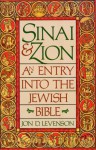
This is chapter 11 of Jon D. Levenson’s Sinai and Zion, our MUST READ/MUST OWN feature.  It is downloadable as ebook from amazon.com for those who have gotten curious enough to want to read the whole book! It is worth not only the expense but more importantly the time spent on reading from beginning to end.  Additional posts from this same source are: 

Reformatting and highlights ours.—Admin1.]


Image from www.cswisdom.com

Image from www.cswisdom.com

The renewal of covenant was a central aspect of Israel’s worship in biblical times. Psalm 81, chanted today on Thursday mornings, seems to have related the Sinaitic experience in some kind of regular liturgical celebration, also in its original setting. Although much of this psalm is obscure, v 4 would seem to locate its context in the celebration of the first day of the lunar month, on analogy with the celebration of New Year’s Day (Rosh HaShanah) so well known from later tradition, and comparable festivities for the day of the full moon, two weeks later.


What is most pertinent to us is that the liturgy for these holy days seems to have stressed the Decalogue. Vv 10-11 are a transparent restatement of the Second and First Commandments, according to the Jewish enumeration. Vv 6b-8, in which YHWH becomes the speaker, perhaps through the mouth of a priest or prophet, and v 17 restate the historical prologue, with its emphasis upon all that the suzerain, in his graciousness, has done for his vassal.  The curses of covenant can be heard in vv 12-13, in which YHWH disowns a disobedient people, but in vv 14-16, the blessings balance this with their promise of victory if only Israel walks YHWH’s path. In short, Psalm 81 evidences a regular liturgical occasion in which the Sinaitic covenant and the great choice it entails were represented to the Israelite congregation.


In the case of the book of Deuteronomy, the book of covenant par excellence, this insistence upon the relevance of the covenant of Sinai (“Horeb” in Deuteronomy) to the present  generation reaches a pitch of intensity:


1  Moses called together all Israel and said to them:

Hear, Israel,

the laws and ordinances which I am proclaiming to you personally today.

Study them,

observe them,

put them into practice.

2  YHWH our God made a covenant with us on Horeb.

3  It was not with our fathers that YHWH made this covenant,

but with us—us!—those who are there today, all of us, the living.

4  Face to face YHWH spoke with you on the mountain, from the midst of the fire.

(Deut 5:1-4)


The concern in this passage is that Israel may come to think of themselves as obliged in a distant way by the covenant of Sinai/Horeb, but not as direct partners in it.  Lest the freshness of the experience be lost, v 3 hammers home the theme of contemporaneity in staccato fashion, with no fewer than six separate expressions:

with us”

“us!”

“those who are here”

“today”

“all of us”

“the living.”   

The goal of this speech, as of the covenant renewal ceremony in which it probably originated, is to induce Israel to step into the position of the generation of Sinai, in other words, to actualize the past so that this new generation will become the Israel of the classic covenant relationship (cf. Deut 30:19-20). Thus, life in covenant is not something merely granted, but something won anew, rekindled and reconsecrated in the heart of each Israelite in every generation.


Covenant is not only imposed,

but also accepted.


It calls with both the stern voice of duty and the tender accents of the lover, with both stick (curse, death) and carrot (blessing, life) in hand. But it biases the choice in favor of life (Deut 30:19).


It is conventional to trace the influence of the covenant renewal ceremony and the formulary until the time of the disappearance of the Dead Sea community (first century C.E.) and no further. The tacit assumption is that these institutions did not survive into the next phase of Jewish history, the rabbinic era. In this, there is a certain truth. The idea of covenant does not seem to have had in rabbinic religion the centrality it had held since at least the promulgation of Deuteronomy in the seventh century B.C.E., although its importance for the rabbis must not be minimized. There is no rabbinic ceremony in which the Jews are said explicitly to be renewing their partnership in the Sinaitic covenant, as the eight day old boy is said, for example, to be entering the covenant of Abraham (Gen. 17:1-14) during his circumcision. There is, however, a text which is central to the rabbinic liturgy, in fact arguably the central text of the rabbinic liturgy, which is composed of three Pentateuchal passages (Deut 6:4-9; 11:13-21; Num 15:37-41) expressive of the classical covenant theology.


The prayer is known as the Shma, after its first word.  The first verse of the Shma is correctly rendered,

“Listen, Israel:

YHWH is our God,

YHWH alone”

(Deut 6:4).

Image from www.shemayisrael.net

Image from www.shemayisrael.net

It is manifestly an echo of the requirement of the old suzerainty treaties to recognize one lord alone. Since in the biblical case the lord is divine, the verse is a classic statement of covenantal monotheism, i.e., the prohibition upon the service of other suzerains.

In fact, we sense apprehension about the possibility of just such defection in each of the three paragraphs.


In the second one, we hear of the danger of seduction, in language that recalls the career of Hosea (Deut 11:16-17), and in the last paragraph, such defection is termed “whoring” (Num 15:39). It is the passage from Numbers which establishes the ground of obedience to YHWH precisely where we expect it, in the redemption from Egypt (v 41). This verse, like the First Commandment of the Decalogue (Exod 20:2), is a condensation of the historical prologue.


The central stipulation of the Shma is one familiar to any student of Near Eastern covenants,

the obligation to love YHWH,

which is inextricable from the requirement

to carry out all his commandments.


As we shall see, the rabbis, like the more ancient architects of covenant, saw in the acclamation of divine lordship and the love commandment of the first paragraph the basis for the acceptance of all other commandments.


The second paragraph, which stresses performance of the stipulations, derives mostly from the blessings and curses of the covenant formulary.  


Fidelity to YHWH

and the exclusive service of him

will bring abundance;

defection will result

in drought, famine, and death.


Finally, we should note that the insistence that the “words” be—


  • constantly recited,
  • bound to one’s body,
  • written upon one’s house,
  • and the commandments symbolized in one’s clothes,

—is also a reflex of part of the covenant formulary, the deposition of the text and the requirement for its periodic reading. In short, the idiom and the theology of covenant permeate the Shma.


What is interesting in light of the putative disappearance of the covenant renewal ceremony is that the rabbis selected these three texts to make up one prayer, for the three are not contiguous in the Torah, and the first of them there, Num 15:37-41, appears last here. What links the three paragraphs is that they constitute the basic affirmation of covenant. They confront us with the underpinnings of the entire Sinaitic dimension of the religion of Israel. The link between them is theological, and it is that theology that the rabbis considered basic to their own appropriation and adaptation of the biblical heritage.  For they made the Shma a staple in the liturgy they wove for Jewry.  


In the requirement to “recite them…when you lie down and when you get up,” they saw a mitzvah to recite the Shma twice daily, in the morning and evening every day of the year. The Shma thus became one of the pillars around which those two services developed.


What, precisely, did the rabbis think happened when one recites the Shma? We find an answer in the reply of the Tannaitic master Rabbi Joshua ben Korhah to the question of why Deut 6:4-9 is positioned before 11:13-21:


  • so that one might accept upon himself the yoke of the kingdom of heaven first;
  • afterwards, he accepts upon himself the yoke of the commandments.


“Heaven” in Talmudic language is usually a more delicate way of saying “God.” Rabbi Joshua sees the Shma, therefore, as the acclamation of God’s kingship.  Only in light of such an acclamation do the mitsvot make sense. In light of the biblical ideas, we can say that one must first accept the suzerainty of the great king, the fact of covenant; only then can he embrace the particulars which the new lord enjoins upon him, the stipulations.  If God is suzerain, his orders stand. But his suzerainty is not something irrational and threatening. It follows from his gracious character:


I am the Lord Thy God.


Why were the Ten Commandments not said at the beginning of the Torah?  They give a parable. To what may this be compared?  To the following:


A king who entered a province said to the people: May I be your king? But the people said to him: Have you done anything good for us that you should rule over us? What did he do then? He built the city wall for them, he brought in the water supply for them, and he fought their battles. Then when he said to them: May I be your king? They said to him: Yes, Yes. Likewise, God…


His past grace grounds his present demand. To respond wholeheartedly to that demand, to accept the yoke of the kingdom of heaven, is to make a radical change, a change at the roots of one’s being.  To undertake to live according to Halakhah is not a question of merely raising one’s moral aspirations or of affirming “Jewish values,” whatever that means.


To recite the Shma and mean it is to enter a supra-mundane sovereignty, to become a citizen of the kingdom of God, not simply in the messianic future to which that term also refers (e.g., Dan 2:44), but also in the historical present. Thus, one can understand the horror a rabbinic Jew would have of failing to say the Shma, as exemplified in this story: There was a law that a bridegroom was exempt from the commandment to recite the Shma, probably because he was in no mental condition to give the prayer the concentration it required. But concerning one early rabbi, we read this exchange in the Mishnah:


It happened that Rabban Gamaliel got married and recited the Shma on the first night. His students said to him, “Our master, have you not taught us that a bridegroom is exempt from the recitation of the Shma on the first night?” He said to them, “I am not going to listen to you and annul the kingdom of Heaven from myself for even a moment!”


In other words, one who neglects the Shma when its recitation is due is rebelling against the sovereignty/suzerainty of God.  Or, to put it positively, the Shma is the rabbinic way of actualizing the moment at Sinai when Israel answered the divine offer of covenant with the words—


“All that YHWH has spoken we will do” (Exod 19:8).


In short, the recitation of the Shma is the rabbinic covenantal renewal ceremony. It is the portal to continuing life in covenant.


There is, therefore, no voice more central to Judaism than the voice heard on Mount Sinai.  Sinai confronts anyone who would live as a Jew with an awesome choice, which, once encountered, cannot be evaded—the choice of whether to obey God or to stray from him, of whether to observe the commandments or to let them lapse.


Ultimately, the issue is whether God is or is not king, for there is no king without subjects, no suzerain without vassals. In short,


Sinai demands that

the Torah be taken

with radical seriousness.


But alongside the burden of choice lies a balm that soothes the pain of decision.


  • The balm is the history of redemption, which grounds the commandments and insures that this would-be king is a gracious and loving lord and that to choose to obey him is not a leap into the absurd.
  • The balm is the surprising love of YHWH for Israel, of a passionate groom for his bride, a love ever fresh and never dulled by the frustrations of a stormy courtship.

Mount Sinai is the intersection of —

  • love and law,
  • of gift and demand,
  • the link between a past together and a future together.
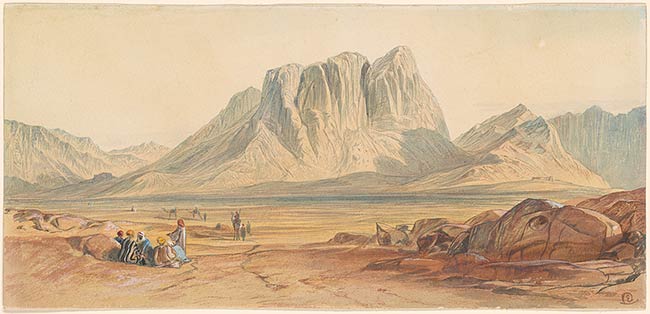
Image by Edward Lear, from www.wikigallery.org

Image by Edward Lear, from www.wikigallery.org

DISCOURSE: Christian/Sinaite – How differing faith choices affect friendship – 2018

Image from 4 Disputes - WordPress.com

Image from 4 Disputes – WordPress.com

[This is a ‘sequel’ to a ‘prequel’,  please read a previous article originally posted circa  2015, reposted January 2017:

The background to this current series of exchanges  is  this:   In December 2017,  Sinaite “N”  spent the Christmas holidays with family based in San Francisco, CA, USA;  she  made a side trip to her former city of residence in Santa Rosa which had been affected by neighborhood fires and wildfires.  She checked on the safety of  friends and former co-workers based there and included of course, is her Christian friend “J”.  They were not able to meet but they picked up communication via email.  All went well for weeks until  Sinaite “N”  concluded her Saturday email with the well-meaning concluding phrase:  “Happy Sabbath or as we say, Shabbat Shalom!”.    Now why would a simple concluding greeting like that cause a problem?  We present all sides of any issue in this website for our readers to make decisions for themselves, so read on.  Admin1,]


—————————————


CHRISTIAN “J”


BTW, who’s “we” when you say “Shabbat Shalom?” I know practicing Jews use that term. I thought you were a Christian who accepted Jesus Christ as Savior and Lord, the Messiah that the Jews refused to believe in and still don’t.  Am I missing something?

Christians are under a new covenant; we are no longer under the law. The Law was given for the Jews, and is there to point up sin, not cover it. So Sabbath-keeping is not consistent with biblical New Testament teaching. And true Sabbath-keeping is far more than setting aside sun-down on Fri. to sun-down on Sat. to gather together.

“Shabbot Shalom” is not used by Christians, so I can only assume you have traded your relationship with Jesus Christ as Savior, for Jewish practices. I don’t want you to think I accept this greeting or buy into it. If you were a practicing Jew, fine. But I thought you were a bible-believing Christian.

Your use of “or as we say…” kind of made me wonder. I just thought I’d try to clear this up once and for all.


SINAITE “N”


Good Sunday morning,  . . . just woke up and  read your email.
I am surprised that you have forgotten the reason you stopped communicating with me years ago, before we resumed this year.  If you will recall, it was because I shared with you my journey of faith which made me investigate the roots of Christianity and as a result, made me go back further —- not to Judaism — but to the scriptures that Christianity claims as its foundation — the Hebrew Scriptures which it renamed “Old Testament”.   I will no longer go further than this reminder, since we wrote each other back and forth until we simply parted ways, mostly because of your strong reaction to my leaving Christianity.
That is why sometimes during this resumed communication, I was surprised you would state and restate the Christian gospel which I know full well, having taught it for decades in my bible studies .
if this leads to a parting of ways again because truthfully, I doubt neither you nor I have the energy nor interest to have a discourse on email about our differing ‘religious’ beliefs, it’s entirely your call.  I will understand why you wouldn’t want to continue this; no further communication from you will indicate so, unless you want to have the last word and I’ll give you that.


CHRISTIAN “J”


I see no reason why this should result in our parting ways.

However with that said, I certainly do remember what and why our email friendship ended. But as I recall you became very militant in your new belief system that is definitely in opposition to biblical New Testament Christianity. You even invited me to become an opposing view on your website or whatever it was. I found it pure and simple an attack on Christianity and wanted no part of it. You were virtually unrelenting. There was no purpose at that time in continuing to have “fellowship” with you.

I thought given the passing of time you would respect  me and not cram your stuff down my throat, which you have subtely done by sending a rabbi’s writings and the constant “Shabbat Shalom” when you sign off on a certain day of the week. Just curious, do you do that with [another friend “S”]  and others you communicate with on Saturdays?  And furthermore, why are you even communicating on the “Day of Rest?”

But I digress: when you stated “as WE say” I needed to clarify that I do not buy into Judaism, the Hebraic Roots movement, or whatever it is that you believe.

That is why I brought this up now.

If you would prefer that I do not mention anything as pertains to my faith in the Lord Jesus Christ or His death on the Cross as the only means of salvation, I will honor that. But I honestly thought we were on the same page as regards Jesus. I am surprised to hear you say that you are surprised that I would on occasion state my faith when it was appropriate.

I have no intention of ending our friendship over this, but your continued use of “Shabbat Shalom” is an offense and I would appreciate that you would please not sign off that way. When you wonder why I would continue to share the Christian gospel, I wonder why you would continue to share your Hebraic roots when you know full well I do not ascribe to it.


Actually, the ball is in your court, not mine. I’m fine with whatever you decide you must do.


And do we really need to wish each other “Happy whatever day it is” as a religious gesture, unless we are wishing one another a happy holiday whether it be Easter, Thanksgiving, Christmas or Happy New Year?

That’s why I said I wanted to clear this up once and for all, when you know full well I don’t ascribe to your belief system, yet you used the term “we.”

Again, I ask: do you barrage others that you email with, with your religious belief system. If not, why do you want to do it with me?
It is you that brought up ending our friendship, not me.


SINAITE “N”


“Sorry, I didn’t realize that a simple greeting that I do send friends on a Saturday is taken by you as offensive; got it!” 

[Note:  The rest of this email went to discussion of other topics, not relevant to this discussion.]

CHRISTIAN “J”

To me Shabbat Shalom isn’t a “simple greeting.”
 #1  it is evidence of your departure from bibilical NT Christianity that you and I once shared.

And #2:   it is a sentiment that is indicative of Judaism, and spoken on  Fri into Sat. to delineate Sabbath-keeping, which you were well  aware of that I do not ascribe to as a Christian.

 It would not be offensive if you, or anyone else, said “God bless you” to me. It is something I can relate to. Enough said.


CHRISTIAN “J”


This is what I read. It is all I need to know about the “movement” you believe in, and in which you are involved. Pretty much what I thought it was about.

This is my take on God’s plan for mankind: God didn’t call us Gentiles to become Jews; He came to the Jews as their Messiah and they were to convert the Gentiles. They failed and are still failing in recognizing Jesus as Savior and Lord. God came to His own and His own knew him not, so he grafted in a new branch. He had to do for the Gentile what the Jew failed to do. He died for all, both Jew and Gentile.

I don’t promote one church, one denomination or one belief system. I have always reduced my faith to this: I am a sinner and Christ is my Savior. That is what I live by and that is what I have to share with those who do not know Jesus Christ.
Very serious error,  “N” to embrace this false teaching which is rooted in the failure of the Jews to recognize their Messiah, and instead embrace the Mosaic Law, which came after Abraham. We are to be of Abraham’s seed through the death of Jesus Christ.


You may have studied the New Testament and taught what you call the “Christian gospel” but you have rejected the truth for a lie. The gospel is THE GOOD NEWS!  Why do you think the news is so good? So that we can go back under the law? And “we” weren’t even under the law; the Jews were!


I am sticking my neck out here, “N”. But I am not going to let this go. This is very serious. Your jumping from one religion to another has shown your boys that having a personal relationship with  Jesus Christ is not important and unnecessary. You will be held accountable for what you believe and the influence it has had on your sons for not making Jesus their Savior and Lord. They are as lost as you are in this error.


And by the way, I have noticed how liberal most Jews are. Especially the American Jews. There is a gal on the QVC forums that I used to participate in who posts a Shabbat Shalom thread every Friday. Of course, there is a welcome mat for ALL to participate on the thread “regardless of who they believe in or who they pray to.” In that thread are many obvious practicing Jews. They are the most liberal woman on that board! They are always slyly pushing their liberalism in subtle way. One example is: praying that the children with be reunited with their families (referring to the illegals being separated at the border.) They are lost! They are not God-fearing! They have their own brand of religious ideology. And it is not consistent with the Bible, and neither is this Hebraic Roots movement!


I could not go to sleep without getting this off my chest. I cannot overlook this and pretend it’s O.K. It’s O.K. if you chose to continue in it, but it’s not O.K. to say you have went back to the roots of Christianity and the keeping of the Torah is the way to live, unless you want to try to become a Jew, which in no way is the plan of God for the Gentile.


It’s error, plain and simple. It’s false teaching, plain and simple. It’s ungodly and anti-Christ, plain and simple. It’s a tool of Satan, our adversary, plain and simple. It’s against the Great Commission, plain and simple. It’s against God’s plan for mankind, plain and simple.
It’s spiritual blindness you are in,  “N”. There is no leading of the Holy Spirit in this. The Holy Spirit was sent after Christ was resurrected to lead us into all TRUTH. This “movement” is devoid of the Holy Spirit!!!


This is serious! This could mean your soul and the souls of your boys and anyone else you have influenced by turning your back on Christ and Him Crucified.


May God have mercy on your soul,


Love in Christ, “J”


SINAITE “N”

I am not into Hebraic roots movement; I am not into Judaism. I am an independent believer in God. I investigate belief systems based on the scriptures they claim.

I love God just as much as anybody does, and live the life prescribed by the God on Sinai. I respect the beliefs of others and do not judge nor condemn them for differing from mine.
Thank you for asking God to have mercy on my soul, I am in right relationship with Him.
Goodbye.

CHRISTIAN “J”
Romans 8:2:  For the law of the Spirit of life in Christ Jesus, hath made me free from the law of sin and death.

Galatians 5:4″ .  Christ is become of no effect unto you, whosoever of you who are justified by the law; ye are fallen from grace.

Jesus Christ is God come in the flesh. He is Lord! The Law given on Mt. Sinai will not save. It only points up sin; it does not cover it.

Your response only shows how lost you are.  We are not to judge, condemn or be intolerant to others for what they chose to believe. However, the whole Bible points up the truth of salvation in Jesus Christ.  If you chose to reject that, fine. I will not condemn you, but you are already judged by the Law and condemned if you chose to reject Christ and His Great Salvation.

This battle is not ours, but the Lord’s.  We will both have to give an account one day before the Lord. I will stand for the God of the Bible and His Son any day, before I’ll defend someone’s errant belief system.  Christ came not to abolish the Law, but to fulfill it. Your investigation of belief systems should end with Christ and His death on the Cross. Period.   End of story.   Actually that’s where our story begins; when we accepted Jesus Christ and became born again.

If you chose to end our friendship over this, so be it. It is clear to me that has been your desire all along.   But like the true passive-aggressive that you are, you had to make me out the bad guy in your diatribe about how good you are in being tolerant of people’s beliefs other than yours. And how you are in right relationship with God by living under the Law given at Mt. Sinai.

It’s either Law or Grace.  You’ve chosen the Law.  You better be sure to keep it all and to the letter!


I will not say “good-bye” but rather, may God bless you and keep you in His care. You will be in my prayers, dear Nell. God’s mercy and grace be upon you.

Love,  “J”


P.S. And don’t look at this as me having the last word;  the Lord God Almighty will have the last word.  And let’s hope and pray it’s “Well done, thou good and faithful servant”  spoken by the Lord Jesus Christ.

A Sinaite’s Liturgy – 4th Sabbath of October 2018

The CREATOR Kindles His Sabbath Lights!

Image from www.paintingyouwithwords.com

Image from www.paintingyouwithwords.com

Blessed are You, YHWH, Eternal God,

Who was and is and will be as You choose to be–
God of Israel, 
God of All Humanity, Gentiles of the Nations,
God of Sinaites.
Blessed are You, YHWH, All-Existent-One 
Who has no beginning and no end,
Whose Wisdom designed earthly time
and heavenly space,
which you did not leave empty,
but filled with breathtaking sights
for all with eyes to see! 


As we  marvel at  Your heavenly spectacle, 
we remember how You taught Your chosen people
to track the heavenly bodies and their movements,
for the first sighting of a sliver of the moon,
to mark the passage of time by lunar cycles,
 “for signs, seasons, and appointed times”
a constant reminder of your perfect clockwork.


Your universe has functioned consistently 
in exactly the same way
from the time of Creation week,
from sundown to sundown,
on to our days and on to the end of days;
all according to Your design and divine purpose.
May this Sabbath Day be for us,
a renewal of our love and devotion toward You,
and a time to further grow
in our knowledge of You,
so that we might be fruitful—
not only for ourselves,
but also for one another,
as well as for others not with us;
and particularly for the unknown seekers of Your Truth,
who find their way into our Sinai 6000 website
and  learn just as we have learned,
that Your Truth has been staring humanity in the face
for six millennia now,
and that all we need to do is 
to return to Your original Revelation on Sinai, 
Your Torah,
as enshrined in the Scriptures of Israel.


Blessed are You, Creator God,
Whose first recorded words were
“let there be light” . . . .
Whose Light existed before there ever was a sun, 
Who designed heavenly luminaries 
for visual pleasure and
for guidance to travellers.
In Your Presence on earth,You manifested —
as a burning bush,
a pillar of fire,
a ‘shekinah’ glory cloud.
As we light our Sabbath candles,
May we never forget—
 the True Source of enlightenment.
Your Torah is—
a lamp unto our feet,
and a light unto our path.”
Living Your Torah 
virtually makes all Torah-observant Jews and Gentiles,
luminaries, light-bearers in a darkened world.
We thank You, Giver of the Torah,
for enabling us to see your Light,
for illuminating our lives,
so that individually and collectively,
we could become reflectors of Your Light.
Image from sunshinereflections.wordpress.com

Image from sunshinereflections.wordpress.com


[Tune:  To God be the Glory!/Revised lyrics]

[If the music accompaniment fails to download on the first try, please try again and again; sometimes it takes repetition to get it done. If it doesn’t download, sing without the accompaniment if you know the music, and reciting the words also works!]

1.  To God be the glory, great things He has done,

So loved He the world that He came down to man,

To teach man about Him, His Will and His Way,

Without His instructions, man goes his own way.

Chorus:  Praise the Lord, YAHUWAH,

Let the earth hear His voice!

Praise the Lord, YAHUWAH,

Let the people rejoice!

O come all believers, give glory to God,

For all that He IS and for all He has done.


2.  O God of the heavens, You’re God of the earth,

The earth is Your footstool, the heavens Your throne,

No place in this universe where You’re not there,

Your vastness, Your largeness, takes You everywhere.

Chorus:  Praise the Lord, YAHUWAH,

He is easy to find; 

Praise the Lord, YAHUWAH,

Keep Him always in mind;

Just love Him with all of your soul and your heart,

From His Omnipresence you’ll never depart!


3.  O Lord of the Sabbath, we rest on Your day,

We know that this pleases You and, by the way,

If ever Your Presence seeks rest in our home,

Just open the door, you’ll hear “Shabbat Shalom!”

Chorus:  Praise the Lord, YAHUWAH,

What a pleasure to know,

Praise the Lord, YAHUWAH,

That our God loves us so,

He’s just like a Father, He welcomes us all,

As long as we heed Him, there’s no way to fall!


Image from pathtoheaven-ahnsahnghong.blogspot.com

Image from pathtoheaven-ahnsahnghong.blogspot.com

BLESSINGS

 
Lord YHWH,
our God and King, 
 may it be that You will remember the 
names of our loved ones;
Please grant them Your Divine Protection,
Your Peace, Mercy, and Grace.  
May they choose to live Your Way, 
so that their names will be added
to your Book of Life:
[Name them.]
Parents;
Siblings:
Spouse; Sons; Daughters;
Grandchildren;
Extended family;
Friends.


Image from www.dreamstime.com

Image from www.dreamstime.com

For countless joys that have blessed our days,

family, friends, good fortune, and more,
even those disguised as trials and failures and suffering,
we raise our glasses
filled with the fruit of the vine,
 a drink for health, a drink for joy,
A drink to LIFE, L’CHAIM!


 For the nourishment of body,
and refreshment of soul,
all these come from Your benevolence.
As we partake of this bread we share,
we remember Your miracle manna
that fed Your people for 40 years in the wilderness.
You are the Creator Who filled nature
with so much variety of sustenance.
Blessed are You, Creator God,
for blessing us with our daily bread.
To LIFE, L’Chaim!
Image from yahuahshomemaker.wordpress.com

Image from yahuahshomemaker.wordpress.com

Image from www.pinterest.com

Image from www.pinterest.com

HAVDALAH
 
Adonai Elohim YHWH,
LORD of the Sabbath,
How truly privileged we are
to have spent this time of fellowship
presuming Your Presence among us,
savoring the joy of knowing You,
and enjoying our fellowship with one another. 
We have partaken of Your goodness,
lovingkindness, and generosity
in granting us by your Divine Providence:
life, health, family, opportunity,
But specially your blueprint for living— 
Your Torah, our Tree of Life.
We have delighted in Your sanctuary in time, 
truly a fitting memorial to You, 
the God of Creation.
As we bid farewell to Your Queen of days,
we look forward to next Friday’s sundown,
when we welcome on erev, another cherished time with You.
May You grant us many more Sabbaths 
during our sojourning on earth,
and when we enter our final Sabbath, 
and the material part of us turns to dust, 
Since we have endeavored to live Your Torah ‘life’–
may we be worthy
to have our names written in Your Book of Life,
whatever that symbolizes in the unknown world beyond,
when  the essence of who we truly are
become part of Your Eternal Presence:
Thus the dust returns to the ground, as it was,
and the spirit returns to God Who gave it . . . .
The sum of the matter, when all has been considered:
Fear God and keep His commandments,
for that is man’s whole duty.”   
[Ecclesiastes 12:7, 14]
Amen.
Image from mtofolives.ning.com

Image from mtofolives.ning.com

Sig-4_16colors

logo

A Sinaite’s Musical Liturgy – 3rd Sabbath of October

[As former Catholics/Evangelicals/Messianics, we Sinaites have committed many Christian hymns to memory.  We love the music, yet can no longer sing the lyrics . . . so what to do? The next best thing!  Since imitation is the best compliment (that is our excuse anyway), we’ve borrowed the music, rewritten the lyrics according to our current belief system. . . . though for hymns whose original lyrics we are in agreement with, we do not tamper with the message.  Music is a teaching tool—meaningful lyrics are not only sung but remembered, probably more effectively and with lasting impact than a sermon from the pulpit.
For those who wish to use our liturgy for your Sabbath celebration, you are most welcome to it.  If you are not familiar with the original tune, simply recite the words; either way it works.  Have a joy-full Sabbath!–Admin1.]
——————————
KINDLE THE SABBATH LIGHTS


Image from flyinghorsesense.com

Image from flyinghorsesense.com


[Tune:  Immortal, Invisible God Only Wise/Original Lyrics]


1.  Immortal, invisible God only wise;

In light inaccessible hid from our eyes;

most blessed, most glorious, the Ancient of Days,

Almighty, victorious, Thy great Name we praise!


2.  Unresting, unhasting, and silent as light; 

Nor wanting, nor wasting, Thou rulest in might:

Thy justice like mountains high soaring above,

Thy clouds which are fountains of goodness and love.


3.  To all life Thou givest, to both great and small,

In Thee all life livest, the True Life of all.

We blossom and flourish as leaves on the tree,

and wither and perish but naught changeth Thee.


4.  Great Father of glory, pure Father of Light!

Thy angels adore Thee, all veiling their sight:

All praise we would render:  O help us to see,

T’is only the splendor of light hideth Thee!

 
Image from pabloperez.com

Image from pabloperez.com

[Original Tune: Crown Him with Many Crowns/REVISED Lyrics]


1. Crown Him with many crowns,  

YAHUWAH on His throne,

Hark! how the heavenly anthem drowns 

all music but its own!

Awake my soul and sing 

of Him Who madeth me,

O hail Him as our matchless King

 through all eternity.


2.  Crown Him the LORD of Love,

receive His grace, don’t hide,

Rich blessings are within our reach 

when He is glorified:

All angels in the sky

 bow down before His might,

As downward scans His wandering eye, 

when lives are set aright.  


3.  Crown Him the LORD of LIFE,

all hail His gift of Breath,

Let’s dedicate our life unto HIM

between our birth and death,

His glories we now sing, 

our Source of Life on high,

Who promised blessings for all those

who who live His Torah Life.


4.  Crown Him the Lord on High 

Who sits upon His Throne,

Whose spoken word created all worlds, 

yet His Name is unknown . . .

To Him be endless praise, 

from every tongue and race,

YAHUWAH is the God we serve 

all through our end of days.


[CJB] Psalm 91

1 You who live in the shelter of Elyon, who spend your nights in the shadow of Shaddai,
2  who say to ADONAI, “My refuge! My fortress” My God, in whom I trust!”—
3  he will rescue you from the trap of the hunter and from the plague or calamities;
4 he will cover you with his pinions, and under his wings you will find refuge; his truth is a shield and protection.  
5 You will not fear the terrors of night or the arrow that flies by day
6  or the plague that roams in the dark, or the scourge that wreaks havoc at noon.  
7   A thousand may fall at your side, ten thousand at your right hand; but it won’t come near you.  
8   Only keep your eyes open and you will see how the wicked are punished.
9  For you have made ADONAI, the Most High, who is my refuge, your dwelling-place.  10  No disaster will happen to you, no calamity will come near your tent; 11  for he will order his angels to care for you and guard you wherever you go.  
12  They will carry you in their hands, so that you won’t trip on a stone.  
13   You will tread down lions and snakes, young lions and serpents you will trample underfoot.  
14  “Because he loves me, I will rescue him; because he knows my name, I will protect him.  
15  He will call on me, and I will answer him.  I will be with him when he is in trouble.  I will extricate him and bring him honor.  
16  I will satisfy him with long life and show him my salvation.”
Image from persevereandtrust.blogspot.com

Image from persevereandtrust.blogspot.com


Sing hallelujah to the LORD; sing hallelujah to the LORD;
Sing hallelujah, sing hallelujah, Sing hallelujah to the LORD.
[Original Tune: ” Bread of the World” – Revised Lyrics]
We praise our GOD of Lovingkindness,
Whose Grace and Mercy overflows,
This wine we drink, this bread we share,
are symbols of His Love and Care.
LORD,  bless our men, LORD,  bless our women,
LORD, bless our children where they are,
May they know You, adore and love You,
For that would bring much joy to our lives.
[Break bread, raise wine glass and make a toast—
 “To LIFE!” – “L’Chaim!” “Mabuhay!”]


  SABBATH MEAL
Image from galleryhip.com

Image from galleryhip.com

TORAH STUDY
Image from www.cllnswbpgfx.com

Image from www.cllnswbpgfx.com

HAVDALAH
[Tune:  Be Still My Soul/REVISED lyrics]

1.  Be still, believer in the One True God, 

Bear patiently this darkened world we see . . .

Be not surprised at doubts and much resistance, 

for minds have been misled for centuries,

It takes much time to open ears and eyes, 

that have been used to falsities and lies.


2.  Be still, believer in the God Who gave 

His revelation once and for all time,

to a mixed multitude who heard His voice;

His Presence sensed in thunder and in light,

That Revelation is for Jews and Gentiles,

the very first step for unending miles.

3.  Be still, believer in the God Who spoke

His words through Moses who preserved them all,

Whose very Fingers etched His Words on stone:

Commandments for the sake of humankind,

for good, for peace, for comfort and direction,

to light the path for those who’ve lost their way.

4.  Be still, believer in the God of wonders,

Creator, Lord, Provider, Shepherd, King,

So full of grace, of love, of truth and more . . .

Whose mercy and compassion never fails,

Witholding justice to repentant sinners,

A patient God Who waits for lives to change.


5.  Be still, believer in our God YAHUWAH,

Call on His Name, declare His Name to all:

From Sinai’s heights, down to the lowest valleys,

YAHUWAH’s voice rings loud and clear today,

For earnest seekers with an open mind,

‘forgotten’ Truth is not so hard to find.

Image from www.youtube.com

Image from www.youtube.com

In behalf of Sinai 6000 Core Community,
NSB@S6K 
Sig-4_16colors
logo


Biblical Diet 3—Leviticus 11

[Translation:  EF/Everett Fox, The Five Books of Moses] Leviticus/Wayyiqrah’ 11]
 
 
1 YHVH spoke to Moshe and to Aharon, saying to them:
2 Speak to the Children of Israel, saying to them: 
These are the living-creatures that you may eat, from all the domestic-animals that are upon the earth:
3 any one having a hoof, cleaving a cleft in (its) hooves, 
bringing-up the cud, among the animals-
that-one you may eat.
 
Land Animals  
4 However, these you are not to eat
 from those bringing-up the cud, or from those having a hoof: 
 the camel, for it brings-up the cud, but a hoof it does not have,
 it is tamei for you;
5 the hyrax, for it brings-up the cud, but a hoof it does not have, 
 it is tamei for you;
6 the hare, for it brings-up the cud, but a hoof it does not have, 
 it is tamei for you;
7 the pig, for it has a hoof and cleaves a cleft in the hoof, but (as for) it-the cud it does not chew up, 
 it is tamei for you.
8 From their flesh you are not to eat, their carcasses you are not to touch, 
 they are tamei for you!
 
Fish  
9 These you may eat from all that are in the water: 
 any one that has fins and scales in the water, (whether) in the seas or in the streams, 
 them you may eat.
10 But any one that does not have fins and scales, 
 (whether) in the seas or in the streams, 
 from all swarming-things in the water, from all living beings that are in the water- 
 they are detestable-things for you!
11 And they shall remain detestable-things for you:
 from their flesh you are not to eat, their (very) carcasses you are to detest.
12 Any one that does not have fins and scales in the water- 
 it is a detestable-thing for you!
 
Forbidden Birds  
13 Now these you are to hold-detestable from fowl
-they are not to be eaten, they are detestable-things: 
the eagle, the bearded-vulture and the black-vulture,
14 the kite and the falcon according to its kind,
15 every raven according to its kind; 16 the desert owl, the screech owl and the sea gull, 
and the hawk according to its kind;
17 the little-owl, the cormorant, and the great owl;
18 the barn-owl, the pelican, and the Egyptian-vulture;
19 the stork, the heron according to its kind, 
the hoopoe and the bat.
 
Forbidden and Permissible Insects 
20 Any flying swarming-creature that goes about on all fours- 
it is a detestable-thing for you!
21 However, these you may eat from any flying swarming-creature that goes about on all fours: (those) that have jointed-legs above their feet, with which to leap on the earth;
22 as for these, from them you may eat:
the locust according to its kind, the bald-locust according to its kind;
the cricket according to its kind, the grasshopper according to its kind.
23 But every (other) flying swarming-creature that has four legs, 
it is a detestable-thing for you!
24 Now from these you can become tamei
-whoever touches their carcass shall be tamei until sunset,
25 whoever carries (any part) of their carcass is to scrub his garments, and remain-tamei until sunset:
26 every animal that divides a divided-hoof, but cleaving does not cleave it through, and its cud does not bring up;
they are tamei for you, 
whoever touches them is tamei!
27 And any one that goes about on its paws, among all animals that go about on all fours, 
they are tamei for you, 
whoever touches their carcass is tamei until sunset;
28 one who carries their carca
ss is to scrub one’s garments and be tamei until sunset, 
they are tamei for you.
 
The Small Creeping Animals  
29 Now these are for you (the) ones tamei 
among the swarming-creatures that swarm on the earth: 
the weasel, the mouse, and the great-lizard according to its kind;
30 the gecko, the monitor and the lizard,
the sand-lizard and the chameleon.
31 These are (the) ones tamei for you among all the swarming-creatures; 
whoever touches them when they are dead shall be tamei until sunset,
32 anything upon which one of them should fall when they are dead shall be tamei, 
whether any vessel of wood or cloth or skin or sackcloth 
-any vessel that can be used in work- 
it is to be put through water;
it remains-tamei until sunset, 
then it is pure.
33 And (regarding) any earthen vessel into which one of them falls, within it, 
everything within it shall be tamei, 
and it-you are to break (it)!
34 As for any food that might be eaten,
should water come in (contact with) it, it shall be tamei; 
and any beverage that might be drunk, 
(if) in any vessel, it shall be tamei.
35 Anything (else) on which their carcass falls shall be tamei; 
an oven or a two-pot-stove is to be demolished- 
they are tamei,
they shall remain tamei for you.
36 However, a spring or a cistern (for) gathering water shall remain pure, 
but one who touches their carcass shall be tamei.
37 Now if (part) of their carcass falls upon any sowing seed that is to be sown,
it remains-pure.
38 But if water is put on the seed and (part) of their carcass falls on it, 
it is tamei for you.
39 If there should die one of the animals that are (permitted) to you for eating, 
one who touches its carcass shall remain-tamei until sunset.
40 One who eats from its carcass is to scrub his garments, remaining-tamei until sunset, 
one who carries its carcass is to scrub his garments, remaining-tamei until sunset.
41 Any swarming-creature that swarms upon the earth: 
it is a detestable-thing, it is not to be eaten.
42 Anything going about on its belly, anything going about on all fours, up to anything with many legs, among all swarming-creatures that swarm upon the earth: 
you are not to eat them, 
for they are detestable-things!
43 Do not make yourselves detestable through any swarming-thing that swarms; 
you are not to make yourselves tamei through them, becoming tamei through them!
 

Dr. Jordan Rubin’s book The Maker’s Diet  simplifies it for us:


Permissible:  The meat of animals with a cloven or split hoof that also chew the cud can be eaten. This includes cows, goats, sheep, oxen, deer, buffalo, and so forth.


Not Permitted:  Avoid animals such as the camel, that chew the cud but do not have cloven or split hooves. This includes, but is not limited to horses, rats, skunks, dogs, cats, squirrels, and possums. Do not eat swine (pigs).  They have divided hooves, but they do not chew the cud. . . In fact, pigs are so unclean that God warns us not to even touch the body, meat, or carcass of a pig.  


The Hebrew words used to describe “unclean meats” can be translated as “foul, polluted, and putrid.”  The same terms were used to describe “human waste” and other disgusting substances.


Fish: Eat any fish with fins and scales but avoid fish or water creatures without them. Those to avoid include smooth-skinned species such as catfish or eel and hard-shelled crustaceans such as crab, lobster, or clams.


Birds:  Birds that live primarily on insects, grubs, or grains are considered clean, but avoid birds or fowl that eat flesh (whether caught live or carrion).  They are unclean. Now why does the Creator of all these living creatures specify what is food for human consumption, why go to such details defining what is food?  Why not?  He cares that humans will be healthy and live a quality of life.  Is this diet just for His people, the Israelites?  Well, what’s good for the Jew is good for the Gentile, right?  What’s bad for the Jew is bad for the Gentile, right?  Aren’t we all humankind? 

 
44 For I YHVH am your God: 
 you are to hallow yourselves and be holy,
 for holy am I; 
 you are not to make yourselves tamei through any swarming-creature that crawls about upon the earth.
45 For I am YHVH, the one bringing you up from the land of Egypt, to be God to you; 
 you are to be holy, for holy am I!
46 This is the Instruction for animals, fowl and all living beings that stir in the water, all beings that swarm upon the earth,
47 that there may be-separation between the tamei and the pure, 
 between the living-creatures that may be eaten and the living-creatures that you are not to eat.
     
 
NSB@S6K         

What is “the Tree of Life”? –1

Image from SlideShare

Image from SlideShare

[This was originally posted in 2012.  With the continuing interest in coconut oil and products from the coconut tree, we are reposting this 5 year-old article.  Please read the three comments in the “readers’ response” at the bottom of the page; interestingly, this post caught the attention of  enthusiasts/promoters of coconut oil and coconut products.  Please check out their websites, the links are included in their comments. And don’t miss reading the sequel to this post about the biblical ‘tree of life” in  The Tree of Life is the Torah -2

Admin1.] 


———————


What is “the tree of life”? 


If you ask a Filipino, the answer would be the Coconut Tree!


Of all the trees ever created by God, the coconut tree is probably the most versatile because of its many uses and because no part of the tree is not use-able to man:


  • Coconut water is a refreshing health drink, so full of nutrients that it is known to be a natural and fast replenishment of electrolytes for those suffering from diarrhea, and can even be processed to create alcohol.
  • From the hard meat [niyog], you can derive food snacks, oil for hair conditioning and lotions, milk, soaps and cosmetics.
  • As a cooking oil, it is said to be the most stable and its saturated fat is actually healthy fat.
  • The soft meat [buko] is turned into various delicacies [buco salad, nata de coco, etc.]
  • Side products include coco sugar, coco-syrup, coco-jam, coco-candy, coco-bread, shredded coconut for cake topping,
  • The polished shell has multi-purpose usage for the home–cooking utensil [sandok], ladle, scooper, savings container [alkansya], food container [bao], drinking cup, chandelier of coconut shells.
  • The tree trunk may be used for housing materials.
  • Its leaves come in handy for roof thatches, basket weaving, natural food-wrap.
  • The husk [bunot] is used polishing floors or firewood for cooking.
  • Dried coconut flesh or copra has been a major Philippine thriving industry for export.
  • Scenic landscape —Philippine shorelines are lined with coconut trees, quite a scenic view for tropical beaches.The province of Quezon alone is “cocolandia” where you see nothing but mountains of coconuts, a lush visual sight creating a healthy environment.
  • According to organic facts, [http://www.organicfacts.net/organic-oils/organic-coconut-oil/health-benefits-of-coconut-oil.html], “the health benefits of coconut oil include hair care, skin care, stress relief, maintaining cholesterol levels, weight loss, increased immunity, proper digestion and metabolism, relief from kidney problems, heart diseases, high blood pressure, diabetes, HIV and cancer, dental care, and bone strength. These benefits of coconut oil can be attributed to the presence of lauric acid, capric acid and caprylic acid, and its properties such as antimicrobial, antioxidant, antifungal, antibacterial, soothing, etc”

What more could a Filipino ask!  All these from one perfectly-designed tree, a gift of the Creator to these 7100 tropical islands where no Filipino need starve! But let us not forget this article is not about the coconut tree but about the Biblical Tree of Life!  


Since there is no literal tree existing, what does it symbolize in the few verses where it appears?

[AST/ArtScroll]
Genesis 2:9  And HaShem God caused to sprout from the ground every tree that was pleasing to the sight and good for food; also the Tree of Life in the midst of the garden, and the Tree of the Knowledge of Good and Bad.


Genesis 3:22, 24  And HaShem God said, “Behold Man has become like the Unique One among us, knowing good and bad; and now, lest he put forth his hand and take also of the Tree of Life, and eat and live forever!” So HaShem God banished him from the Garden of Eden, to work the soil fom which he was taken.  And having driven out the man, He stationed at the east of the Garden of Eden the Cherubim and the flame of the ever-turning sword, to guard the way to the Tree of Life. [AST]


Proverbs 3:18  It is a tree of life to those who grasp it, and its supporters are praiseworthy. [AST]


Proverbs 11:30  The fruit of a righteous one is a tree of life, and a wise man acquires souls.[AST]

Proverbs 13:12   A drawn-out hope brings sickness of heart, but desire attained is a tree of life. [AST]


Proverbs 15:4   A soothsaying tongue is a tree of life,  but corruption of it is damage of the spirit.[AST]


Please read the sequel:

Please check out the following websites:

 NSB@S6K
logo-e1422801044622