In search of the Historical Jesus – 3 – "all things to all men"

Many of the lives of Jesus that have appeared in recent years have tried to pin him down with a single epithet.  Can he be understood as—


  • hasid, a Jewish holy man, 
  • or a prophet,
  •  “a magic man,” 
  • a miracle worker, 
  • a teacher, 
  • a “marginal Jew,” 
  • a peasant leader, 
  • even a revolutionary?

Each has had its supporters, but Jesus does not fit neatly into any one category; perhaps he never did.  Almost any statement of his views in one Gospel seems to be qualified or even contradicted by another, sometimes even from within the same Gospel.  However, in an insight that does much to explain the continuing significance of Jesus to an enormous variety of Christian communities throughout the world, the theologian Frances Young notes:  “Somehow he was all things to all men and broke down social, political and religious barriers . . . all manner of men found their salvation in him and were driven to search for categories to explain him, never finding any single one adequate.”


Some features of Jesus’ personality can, however, be drawn unambiguously from the Gospel sources.  He was highly charismatic; people were drawn to him by his personality and teaching, and herein lay much of his natural authority, but despite periods of withdrawal (and, according to the Synoptic Gospels, uneasy relationships with his mother and brothers [Mark 3:31-35] he never distanced himself from his chosen followers or their modest way of life.  He never, for instance, used his status so that he could avoid the discomforts of daily life on the road, and although there is some scholarly disagreement on this, he did not appear to give himself a privileged place above the Law.  There is only one exception to this in the Gospels—when he required a man with a dead father to follow him rather than bury his father, as Jewish Law required (Matthew 8:21-22)—when he unambiguously put himself before the Law.  He chose 12 special companions, the disciples, all from humble backgrounds, with the possible exception of Matthew the tax collector.  They shared his life closely and probably received confidences denied to others (12 is the number of tribes of Israel and may echo the belief that at the final judgment Jews would be reassembled according to their tribe, each with a leader), but he was not fussy about whom he mixed with and shocked some by consorting with tax collectors and prostitutes.  When he preached he showed a genius for making his points in parables that were rooted not in some abstract spiritual world but in the reality of the everyday life of the small agricultural communities around him.  This was the environment in which he was most “at home.”  (Jesus appears to have some difficulty in spreading his message to the towns [Matthew 11:20]).  His presence tended to have a beneficial effect on those who were ill, both mentally (inhabited by “demons”) and physically, so that the masses were drawn to him as a healer, and word spread of him effecting miracle cures.  Belief in “miraculous” interventions of this kind was common in the ancient world, and they were interpreted as a sign of holiness.  Other Jewish “holy men” were associated with miracle working, but Jesus’ effective use of miracles, especially exorcisms, was highlighted by his followers (notably Mark) and was to become one of the most common ways individual Christians later proclaimed their own distinct authenticity as those favored by God.


Jesus had been brought up as a Jew and, like most Jews, knew the scriptures well.  His immediate followers were almost without exception Jews, and his teaching made use of concepts that would have been recognizable to them.  Much of his teaching took place in synagogues.  He may not have foreseen his teaching spreading beyond the Jews — as he himself put it:  “I was sent to the lost sheep of the house of Israel and to them alone” (Matthew 15:24), although this may reflect the particular perspective of Matthew described above, and the saying comes just before the disciples persuaded Jesus to heal the daughter of a Canaanite.  It can, of course, be argued that if he had departed far from traditional Jewish teaching within the conservative agricultural communities in which he preached, he would not have survived as long as he did.  On one occasion he stressed the continuing importance of the Law, which, he claimed, he had come “not to abolish but to complete.”  Paula Fredriksen establishes important guidelines for historians when she writes that “the prime goal of the historian is to find a first-century Jesus whose mission would make sense to his contemporary first-century [Jewish] hearers.”  The question remains as to which “hearers” within the diversity of first-century Judaism Jesus was appealing.  Those in the countryside suffering from encroachment on their land, taxation and pressures from Herod’s administrators appear  the most likely, yet an allegiance by any leader to one group within Judaism was likely to lead to opposition from others, as Jesus’ difficulties with the conservative Pharisees and the elitist Temple authorities were to show.


Jesus’ message echoed John the Baptist’s in that he talked of the imminence of God’s kingdom.  It is not always clear from the Gospel sources what he meant by this.  Some passages, such as Luke 17:21, suggest that the kingdom has already arrived with the coming of Jesus, others that it will come some day in the near future, perhaps after some cataclysmic event.  Many assumed that it would involve the appearance of a king of the house of David as the Messianic tradition had predicted, and one cannot isolate Jesus from the long-held Jewish belief that a providential God will in the end redeem humankind.  Much of Jesus’ preaching about the coming of the kingdom is entirely positive in the sense that it talks of those who will be included rather than those who will not — but in some instances its arrival is set within the context of a “last judgment” at which the wicked will be punished at the same time as the good are rewarded.  It seems impossible here to be sure of distinguishing Jesus’ own words from traditional Jewish Messianic teachings on “the end,” but it seems likely that the expectation of some major “happening” to come was among the forces which drew people to him.  In this sense he can certainly be seen as a millennarian prophet.


The coming of the kingdom is set within the context of moral renewal.  In Mark (10:13-27) Jesus teaches that at the coming of the kingdom worldly values will be overthrown; one would have to be without wealth and “like a little child” to be able to enter.  This “social” message suggests that Jesus saw the coming of the kingdom as associated with the triumph of the outcast and perhaps with the restoration of traditional values that were under threat from outside forces (hence his stress on the importance of marriage and the honoring of parents—it has been noted that Jesus went further than traditional Jewish teaching in his strictures on divorce).  Richard Horsley argues:  “For the Jesus movement . . . the kingdom of God means the renewal of Israel, and the renewal of Israel means the revitalization of families and village communities along the lines of restored Mosaic covenantal principles.”  So, Horsley suggests, Jesus’ leadership role may have been rooted in and gained strength from the tensions within rural Galilean society.


As would be expected, Jesus drew heavily on Jewish ethical traditions.  “Love thy neighbor as thyself,” for instance, often seen as a quintessential “Christian” exhortation, comes originally from Leviticus (19:18).  His teachings on ethics were brought together, as already mentioned, by Matthew, in the famous Sermon on the Mount, with its particular focus on those marginalized by society (Matthew 5-7).  Although this focus is found elsewhere (in the Essene text quoted above, for instance), Jesus followed it through by practical example.  There is a powerful sense, in Mark in particular, of his own compassion for those around him.  He does not perform “miracles” to show off, but primarily to bring an end to suffering, whether mental or physical.  Particularly striking are the parables, in which outcasts (Samaritans, prodigal sons, lost sheep) are used to show that anyone can be “good” and that those who repent will be welcomed even more warmly than those who have not strayed at all (Luke 15).


Inevitably, Jesus’ followers also tried to pin labels on him.  The “title” he used most often of himself was “Son of Man.”  The phrase appears to have been used in the Synoptic Gospels when Jesus wished to avoid direct reference to himself—Geza Vermes suggests the equivalent in English of the modest “yours truly.”  Yet in John’s Gospel the title is associated with the Book of Daniel, where it is linked specifically to hopes of a Messiah and eternal life.  At times of social stress it was perhaps natural to hope that any charismatic leader might be the promised Messiah, and word that Jesus was indeed the Messiah seems to have spread among his followers (and, understandably, given rise to stories that he was therefore “of the House of David”).  It is not clear from the Gospel sources whether Jesus accepted Messiah status (suggestions that he did may well have been added by the Gospel writers at a time when the later Christian communities had come to believe that he was).  

After a long consideration of the evidence, two authorities on the Jewish roots of Christianity E.P. Sanders and W. D. Davies, conclude:  “It seems likely that the one who urged others to give up everything for the kingdom claimed for himself no title or position, except the position of one who bore a message from God, the acceptance or rejection of which would be crucial when the fullness of the kingdom arrived.”  It has to be said that this remains a contentious area, and other commentators are convinced that Jesus proclaimed himself as Messiah while on earth.


Continued in #4:  Crucifixion, Questions on Resurrection/Ascension


Sinaite Notes – What is the Oral Torah – 2

A Sinaite's Notes/Sinai6000.net

A Sinaite’s Notes/Sinai6000.net

[This entire explication is from Torah for Dummies by Arthur Kurzweil (http://www.dummies.com) As explained in the previous article, Sinaites do not consider the Oral Torah as part of God’s revelation; however, as this write up will explain, it provides some valuable information in understanding the Written Torah.   We consider the Oral Torah as “Jewish” and the Written Torah as “biblical.”—Admin1]


—————————-


51X5MKo74OL._SX260_The Oral Torah

When Moses encountered God and received God’s message, the divine transmission included oral teachings that were never meant to be written down.  An oral tradition allows for flexibility; too often when an oral teaching is written down, it’s taken too literally and loses its power to adapt to changing times and circumstances.  It was only after much debate and discussion that the great sages of the Jewish people decided to write down the oral teachings in a process that began a few thousand years ago.  This compromise was based on the historical fact that the enemies of the Jewish people were killing so many of the Children of Israel and the sacred traditions were at a great risk of being lost.


The major elements of the Oral Torah include—

  • The Mishnah (repetition):  A book consisting of six sections, written in Hebrew, that serve as a summary of the oral teachings as handed down by Moses, along with the Written Torah, to the elders of the Jewish people.
  • The Gemara (completion):  Additions, written mostly in Aramaic, that serve to analyze the Mishnah, define its fine points, and also illustrate how the Five Books of Moses and the Mishnah are applied to the ever-changing conditions of life.
  • The Mishnah and the Gemara appear together in the Talmud (learning), which is a set of books consisting of 63 sections and also includes additional commentaries by great teachers throughout the centuries.
  • The Midrash (interpretation):  A few dozen books written over a number of centuries that serve to expand upon the details found in the Five Books of Moses and other books of the Jewish Bible.  The various collections of Midrashim (plural for Midrash) teach both divine moral lessons and divine laws.
  • Halachah (the way to walk):  The term for Jewish law.  Jewish laws are either positive (“do this”) or negative (“don’t do this”), and 613 of them are traditionally found in the Five Books of Moses.  This number is deceptive because there are actually thousands of Jewish teachings that grow out of the primary 613 commandments in the Torah.

In search of the Historical Jesus 2 – A reconstruction from the Gospels

[Continuing Chapter 8: Jesus from Charles Freeman’s The Closing of the Western Mind:  The Rise of Faith and the Fall of Reason; this book is downloadable from amazon.com on the kindle app.  Reformatting and highlights ours.Admin 1]


————————-


Jesus came to prominence only in the last years of his life, and the story essentially begins in Galilee in around A.D. 27 with his baptism by an itinerant preacher, John the Baptist, “a voice crying in the wilderness,” who called on sinners to show repentance in view of the imminent approach of God’s kingdom.  


Throughout Jesus’ life Galilee was ruled by client kings of the Romans, first Herod the Great (37-4 B.C.) and then as tetrarch (a subordinate ruler) his son Herod Antipas (4 B.C.-A.D. 39).  


(Contrary to popular belief, Jesus’ ministry did not take place within the “official” Roman empire, until he moved into Judaea, which, as we have seen, had been a directly ruled province of the empire since A.D. 6.)


 Galilee was a relatively prosperous area with fertile land and good fishing in “the sea of Galilee,” yet Galileans were remote from the more sophisticated centers of Judaism and conscious that the peoples surrounding them, largely Greek and Phoenician, were of very different cultures.  There is some evidence that there was an increasing Greek presence in Galilee in these years, but as the Greeks tended to consider themselves superior to local cultures and kept themselves distinct from them (Greeks seldom bothered to learn native languages, for instance), this is only likely to have exacerbated the feelings of exclusion among the native Galileans.  Furthermore, as has been persuasively argued by Richard Horsley, the impact of taxation, a growing population and Herodian rule was resulting in the fragmentation of peasant land holdings and placed increasing pressure on traditional family structures.  Studies of Judaism in Galilee and Judaea at the time suggest that there was relatively little difference between the two areas in terms of religious belief and practice, but, as Horsley again has argued, the pressures on peasant life may have led to a more passionate defense of traditional religious values in Galilee and an attraction to charismatic spiritual leaders who espoused them (in this Galilee would have been typical of areas of peasant unrest through the ages where social change or oppression result in resistance grounded in traditional beliefs).


Judaism in Jesus’ Time


Judaism was not a monolithic religion, and recent research has served to stress the diversity of Jewish practice in the 1st century A.D.  There were, of course, beliefs common to all Jews, above all belief in a single providential God who had a special relationship with Israel exemplified by the covenant he had made with his people.  Even if the covenant were broken, which it often was in the troubled history of Israel, God would always forgive (a point stressed by Matthew).  

  • The requirements of the Law (central to Jewish life and ethical behavior), the sayings of the Prophets and the history of Israel were recorded in scriptures that were studied by all educated Jews.  
  • Rituals shared by Jews included circumcision, dietary restrictions (in practice tied to those foods that most easily carried disease — pork, shellfish and carrion –although the ban was held to be instituted by God) and a strict observance of the Sabbath.  
  • As laid down in the Ten Commandments, there was an absolute prohibition on the worship of God through idols.  
  • A commitment to Jewish Law, which was believed to have been instituted directly by God (in the giving of the Ten Commandments to Moses, for instance), covered every aspect of life, with detailed prescriptions for living laid down in scriptures such as the Book of Leviticus.  
  • There was a strong emphasis on the value of family life and traditional family structures.  
  • Those who offended could redeem themselves through repentance, achieved through sacrifice.


The central focus for the worship of God was the great Temple at Jerusalem, and male Jews were required to visit the Temple 3 times a year, at the times of the major festivals, although in practice the diaspora of Jews throughout the ancient world had made this impossible for many.  

  • The Temple was staffed by a large class of priests, perhaps some 20,000 in total, if the assistant priests, the Levites, are included.  
  • The priesthood was an important and influential class—it was said that the Jewish revolt of A.D. 66 broke out at the moment when the priests refused to accept any more sacrifices on Rome’s behalf.  
  • The priests alone had the right to sacrifice (on behalf of themselves and those who had come to the Temple as penitents).  they took it in turns to officiate in the Temple, but all would be on duty there during the major festivals.  
  • The Temple had recently been rebuilt in magnificent style by Herod the Great, but in the eyes of the Jews the Temple elite had compromised itself in accepting the patronage of Herod and, after his death, through acquiescing in Roman imperial control.


Because the Law was so fully set out in the Hebrew scriptures, most Jews knew its requirements well.  

  • There were, however, groups such as the Pharisees, who had originated int he 2nd century B.C. and who may have numbered some 6000 in Herod’s day, who had made their own interpretations of how the Law should be observed.  They studied it intensively and insisted on its strict observance.  One particular belief associated with the Pharisees, but not shared by all Jews, was that there was an afterlife and a final resurrection of the bodies of the dead.  While the Pharisees had no political power (very few were actually priests) and did not proselytize, they were respected for their beliefs.  Nevertheless, it was natural that they would feel threatened by groups or religious leaders who had a more relaxed attitude to the Law than they did or who claimed their own differing interpretation of the Law.
  •  Another group with distinctive beliefs, in this case that there was no afterlife, were the Sadducees, who were essentially conservative in their support of traditional priestly ritual and appear to have been well represented in the aristocratic priesthood. (This was one reason why they came into conflict with groups such as the Pharisees, who threatened to take the interpretation of the Law both outside the priesthood and also outside of Jerusalem.)


The majority of Jews, like all other peoples of the Mediterranean and the ancient Near East, were poor, susceptible to illness (much of it incurable), subject to taxation (whether from Jewish authorities, a king or directly by the Romans) and vulnerable.  In extreme cases these hardships could lead to agrarian unrest or even outright revolt, such as the disastrous uprisings against the Romans of A.D. 66 and A.D. 132.  


  • By contrast there was also the possibility of spiritual withdrawal.  This was the path taken by the Essenes, a sect that seems to have formed in the 2nd century B.C.  Members of this sect whose lifestyle and beliefs have been recovered from the Dead Sea Scrolls, were extreme in the strictness with which they observed the Law.  
    • They held property in common,
    • encouraged celibacy (at least in the Qumran community, which produced the Dead Sea Scrolls)
    • and believed that the soul, but not the body itself, would have an afterlife.
    • They saw themselves as the only true believers,
    • the “sons of light,” while all others, including their fellow Jews, were “sons of darkness.”  One should “love all the children of light, each one according to his lot in the council of God, and abhor all the children of darkness, each one according to his guilt, which delivers him up to God’s retribution.”
    •  They had a deep-rooted distrust of outsiders, and newcomers were accepted into the group only after 2 or 3 years of spiritual instruction.  
    • The Essenes were millennarians, waiting for some form of liberation.  As one of their texts put it:

“The heavens and the earth will listen to His Messiah . . .

He [the Lord] will glorify the pious on the throne of the eternal Kingdom.  He who liberates the captives, restores sight to the blind, straightens the bent . . . For He will heal the wounded, and revive the dead and bring good news to the poor.”  

Although there is no evidence to connect Jesus with the Essenes, their teachings show that expectations of a Messiah with a special message for the poor who would introduce the eternal kingdom were active in the Jewish world of the 1st century.  As we will see later, Paul appears to have been influenced by them.


The concept of Messiah (Christos in Greek, hence Christ) is so central to Judaism that it deserves to be explored here.  The word was used in general of one who was anointed by God for some special purpose (it was even accorded to a Gentile, Cyrus of Persia, who liberated Israel from Babylonian rule), but it tended to be associated with King David and his royal line (God had promised the prophet Nathan that the throne of David’s “seed” would be established “for ever” [2 Samuel 7:12-13]).  The conviction that a descendant of David would come to power as a wise and secure ruler ran deep in Jewish thought.  


According to another tradition, the Messiah would be a priest, and it appears from one text that the Essene community in Qumran may have been waiting for two Messiahs, one a king and one a priest.  In neither case was a Messiah seen as divine; rather, he was a human being who had been exalted by God.


Continued in #3, Jesus — “All things to all men”

MUST READ: THE GENIUS OF JUDAISM, by Bernard-Henri Levy, Epilogue

is[Introduction to Part I:  THE GENIUS OF JUDAISM, by Bernard-Henri Levy

This book was lent to me by the president of the Jewish Club in my city of residence.  I recognized the author from his photo on the inside cover flap as someone I had just recently watched being interviewed on CNN, possibly about this recent publication  dated 2017.  As we often do with MUST READ endorsements, we’re featuring here what we call the “bookends” — the Prologue and the Epilogue — to whet your appetite, dear reader.  Sometimes we add excerpts or whole chapters, although we would rather that you add this to your personal collection of worthwhile literary acquisitions.—-Admin1.]


EPILOGUE

 
One last word.
And one last return to Nineveh.
I must admit I sometimes get tired of Nineveh.
It is not a question of time.
Nor of what changes and what remains.
  The lassitude was already on, when my Mukti Bahini companions in the resistance cells of Jessore and Khulna, in Bangladesh, would test me by quoting anti-Semitic verses from the Koran.
  No, I am weary of the night that hangs over Nineveh.
  Weary of the darkness of the executioners and, sometimes, of the executed.
  Tired of  telling myself, over and over, that this time we have the real thing, the real Edom, the real Ishmael, the one that Maimonides himself recognized in the enlightenment of Averroes, Avicenna, and Al-Farabi.
  And always it is the same tale of sound and fury, told by an idiot, signifying nothing.


Sometimes, though, I tell myself that I have understood.
  Yes, sometimes I have the feeling of knowing everything that it is the burned bodies of the Jews of Auschwitz.
  Everything that it is humanly  possible to understand from the voices of the  unnamed, unburied, unnumbered dead of Lviv or Libya—I tell myself that the day will come when I will have understood it.
  And, as for the duty of moving toward the other, as for ht obligation of the Jew toward the non-Jew, that responsibility-for-the-nations that is so essential to the Jewish person and that we do not always embrace firmly enough, haven’t I done my share and more?  Haven’t I paid my dues? Can’t I call myself even?
  I have done the tour of Nineveh not once, not twice, but forty times—enough!


On days like that, I tell myself that Johan as right about not going to preach in the great city.
  I tell myself that I understand his resistance, his strange way of balking, of staying in Jaffa, of leaving for Tarshish to hide among the sailors—anything but Nineveh!
  And I tell myself that, if you have to remain in the dark, you might as well stay in the wet but (at least initially) agreeable shade of the belly of the whale.
  He did not have it too bad there.
  It was large enough, spacious enough, for him to be happy there. 
  Was that not where, after all, he composed his most beautiful song?
  “This room isn’t so bad”, one of his distant descendant will say from a room in Sarajevo where he prefers to keep his own company rather than go out, to play the prophet in Nineveh for the umpteenth time rather than sing.


There is nothing wrong with wanting to be yourself.
  A man is more than his deeds, contrary to what the young Sartre and the old Sartre believed.
  Once he has done and risked much, is it not time for that other encounter, the last one, which is not necessarily death (or at least not the death that men fear, where their work is halted)?
  That is what a great French writer, Michel Leiris, a toreador of sorts, was saying when he confided to me in his last years that, essentially, there is no bull’s horn more menacing than a face-to-face encounter with oneself.
  That was the thinking, according to the old dame of Torcello in Venice who was one of the last people to speak with him (and who reported it to me), of the great American writer and matador Ernest Hemingway when he said that it was the only appointment one must not miss.  Hemingway missed it, alas, several weeks later in Ketchum, Idaho.
  And perhaps it was Jonah’s last thought as well, the one note reported in the Book because God himself breathed back the answer, not in a whisper but in a spiriting away.
In such moments, I hear the voice of my father, which is the one thing of his that for me has remained alive.
  I hear the voice of his own father as well, nearly as alive—I had forgotten it, but now suddenly it has come back to me.
  Is he speaking to me or to his son?
  Disciplining me or pursuing the endless argument in which father and son engaged?
  I hear them calling me by the name they gave me, which is another name for Cistercian solitude.
  I hear the angel of that given name and of that family name who, further away in me than i will ever be able to go, whispers that all detours are permitted, because detours are minor matters that take little time, after which we all regain the humble beyond the chimeras of splendor.  Ultimately, the last word comes back to the secret name that awaits each of us beyond ourselves and that, one day, must be allowed to speak.
  It is indeed to me that they both are speaking.


What are they saying, exactly?
  “You have wanted to rescue many people.  Now we want you to rescue yourself.  We want you, just this one, to leap to the very bottom of the sea into the belly of the whale that you have been outsmarting by pushing yourself ever closer toward the lands of Nineveh.  We do not want you to visit a dangerous land but to sojourn in (and not detour from) a dangerous you, a vegetative you, a fallen, lost you, a you severed from the fleeting successes that pose a great danger for you.  There, in that you, we want you to learn from Jonah the art of singing in the night”.
  And there is more: “You put your head into the lion’s jaws, you went toe-to-toe with the worst, you entered the labyrinths of terror and evil? We are here to tell you this: No Maidan, no Tahrir Square, no forum or gathering place in Burundi or Bosnia was a real lion’s mouth—the real lion’s mouth was and will always be your own.  You can’t save Nineveh unless you are part Nineveh; you can’t preach to Nineveh if you are incapable of putting yourself in the position of having forty days to wait, to hang on, and to hope—before being destroyed; Nineveh will be no more than a word or an image unless you decide one day to go down into the belly of the whale in some manner and there face yourself, trapped, immobile as time passes, like a plant half-alive and half-dead, like a lost animal, like a man without reason or goal, like a wayward question without the answers provided by culture, words, and love—then, alone, with no way out, you will encounter the Jew in you”.
  And they continue: “On that day, when you are relieved of the fortunes and favors of this world, you will have to resolve to honor your name, not because it is yours or ours, but because it is the name of one of the sons of Jacob who did not worship the golden calf, who commanded that another name, that of Dinah, that of his sister and also of your mother, not be dishonored.”


In such moments I think again of Solal’s two glories.  The vain and illusory glory of the prince among princes, lord of Samaria, of which he will be deprived at the appointed time as one snatches a paper crown from carnival king.  And the other, hidden glory, but true glory, that of the Jew among Jews, “strangers in their exile” but “firm in their strangeness”, which he regains at the end of the story. 
  I think of Abraham, alone in the oven of Ur Kasdim, so alone, so fragile on the land that his vision offered him.  “I am a stranger and reside with you”, he says to the children of Heth in order to purchase the cave of Machpelah in which to bury his wife.  And they: “Yes, of course, you are a prince among us; you are a prince of God and here can feel at home”.  Well they know, these hypocrites, these kings of doublespeak, that a prince of God does not consume much bread.  He’s not such a big deal and, in any case, he won’t cost much.  He’ll be quiet—until the other glory, the living one, which shine from his abuse, becomes too burdensome for those around him; and then they abuse him, spurn him, and the wheel of human anger and violence reengages; and how they are torn apart, the little princes of God, put to death, like Rabbi Akiva, for the sanctification of the Name! 
  And then I think of Benny Levy and the trap he set for me (set in the sense of holding up a mirror) on the day when he urged me to  go deeper into the joy of study and, in the same breath, extolled what he called my “lordship”. It was indeed a mirror.  For, obviously, it had been I who had set the trap at the outset.  Vanity.  Pride.  Idolatry of the great and the loud.  Relationships with powerful people, carried on without illusions but cultivated all the same: Are they not useful when it comes to obtaining for those who have little as much space as the vast metropolises can offer them? But, still, they will be an obstacle for me—this, I have always known—if I want to go further, to push beyond the bounds of this book and leave for good the path of arrogant men.


I also know that I will have to convene Datan and Aviram one last time, the accomplices of Korah, the anti-Moses conspirators, those servants of nothingness, consumed by use of the wrong language, the sociopolitical language spoken in the palaces where the fate of the world is decided but on which the true salvation of humanity does not depend.
  Will I have strength, one day, to separate myself from them?
  The strength to understand that the true glory of the Jews, the glory that is like the light that turns a blade of grass, wet with due, into the true scepter of the splendor of things, has but one real obstacle:  the false language, the wooden language that, when it burns produces an acrid fire with sickly flames and a smoke so heavy with soot that it leaves a bitter taste and poisons even the most beautiful of books? 
  Will my ear be keen enough, against the din of the Sicarites to hear the voice of Moses? 
  His law and his voice? 
  Not only the hard and inflexible law brought from heaven to give wings to ordinary people who know how to use it, but the music of his true voice? 
  A part of me hopes so. 
  When exactly, I could not say, because in such matters one cannot prejudge or swear before committing oneself. 
  But one day, yes, this is my hope. 
  Even though I well know that I have work yet to do (a little? a lot?) before I, too, will be able to say that my other journey, the present journey, is over. 
  Even though the world, with its marvels and misery, with its petrified people yearning to live continues to call to me in a voice that I have never been able to ignore. 
  And even if I am well aware that, with all that I still need to learn, understand, absorb, and pass on, I am for the time being worth about as much as the little Jew who, in Leonard Cohen’s song, thought he had written the Bible. 
  Other battles await. 
  Other Ninevehs to which I shall have to report. 
  But I have all the time in the world.
  We always have time, until we are one hundred twenty, to finish learning that a life of mind and spirit is an astounding exception, wrested, not only from the order of death, but also from that of the most noble tasks. 
  The trip has only just begun.


Who do you think you are . . .

Image from arouda.blogspot.com

Image from arouda.blogspot.com

[In 2010 at the start of our Sinaite’s spiritual pilgrimage to biblical Mt. Sinai, i.e., the Revelation of YHWH, we encountered a lot of opposition and criticism from our Christian colleagues, understandably.  This article —first posted in 2012, was in answer to the exact words in the title. We add this to our current series explaining our beginnings on our 7th year.—Admin1.]


————————–


WHO do you think you are . . . to question centuries of biblical scholarship attesting to the veracity, divine source, and canonicity of the New Testament, “the very words of God”?


This is a question commonly asked by Christian colleagues who are incredulous at our proclamation that we have left Christianity based on our conviction that the New Testament is man-sourced, not divinely-authored.  We have explained how we have arrived at this conviction [and all its implications] in many articles posted in this website. Visitors to this website do not know Sinaites on a personal level, only what we project in the articles that declare the basics of our belief.  Some know who we are, specifically the other person who debates one of us in posted discourses.  


Our Christians friends echo the same questions, the same counter-arguments, the same verses as prooftexts.  Our Christian colleagues would know that we are not blind, unthinking, spoon-fed, disciples who just swallow teachings without question.  If we journeyed through previous stages in various sects within Christianity, it is only because it has been our nature to seriously examine beliefs we have embraced at each stage of our spiritual growth.  They would know that we would not resort to a “drastic” turnabout in direction without having thoroughly weighed the consequences.


Indeed, who are we to think we know better than the theological giants of the Christian faith, all of whom confirm just the opposite of what we question?  Actually we are nobodies compared to them, but these are what we Sinaites share in common: 


1.  Just like our Christian colleagues, we love God so much we continue to seek Him in all the sources, we deem, best teach us about Him.  

2.  Just like our Christian colleagues, we are independent-minded, will rely on teachers only to a certain extent, but also and at the same time do our own research and study, checking out the teaching as well as the scriptural basis for it.

3.  Just like some of our Christian colleagues, we do not limit our research to books and sources from Christian bookstores; we venture out into perspectives and opinions outside of Christian thinking, outside of the box.

4.  While we settled into each religious persuasion for a time [Catholicism, Protestantism, Evangelicalism, Messianism], when we were confronted with more truth about the questionable foundations of beliefs we embraced,  we unhesitatingly moved on, once convinced there was more to explore or something to take out of our belief system.

5.  We are not afraid of transition, paradigm shift, loss of all former religious affiliation and association, as long as we are convinced we are moving toward the right direction and that is toward the One True God.

6.  We agree on the following:

    • How can anyone go wrong, lose one’s salvation, when one returns to the GOD revealed in the foundational scriptures of Israel, the Tanakh?
    • Once you get to know the God of the Hebrew Scriptures from His own declarations about Himself, any deviation cannot possibly be of HIM.
    • HE has spoken very clearly, making sure anyone who seriously undertakes a Truth quest will end up right at His doorstep.
    • What HE is like. His attributes and characteristics HIS ONE-ness are all associated with the NAME HE reveals —YHWH —“I will be who I will be.” Christians might jump at that translation of THE NAME with “aha, see, YHWH can be anything He wants to be, even a trinity!”  No way.
Who do we think we are to challenge the best of Christian scholarship through centuries?


Image from www.spiritualresearchfoundation.org

Image from www.spiritualresearchfoundation.org

We are simple truth-seekers, wondering why the most brilliant minds in Christianity did not see what we saw simply by reading the history and roots of Christianity.  

  • Perhaps information was not available to them;  
  • perhaps they were convinced as we once were so as not to look any further;
  • perhaps they knew  but were not convicted;
  • perhaps they were convicted . . . but chose not to change course.  


Ultimately each of us are  accountable to our Creator for how we react to and act on His revelation.  Christians and Sinaites will never see eye to eye as long as we are arguing from two differing scriptural bases.   On our part, we are certain that we cannot ever return to Christianity and worship a Jew transformed by Christian scriptures into the Creator God, YHWH Himself.   Or, worship the “Father” in the Trinitarian Godhead, who shares his throne with two other divine ‘persons’;   that is not the God we have come to know in the Hebrew Scriptures.


Who do we think we are?  
 
  • Grateful, humble Truth-seekers who have arrived at the sanctified place of divine revelation, Spiritual Sinai —, and therefore have become worshippers of YHWH, the Law-giver, the Author of the TORAH.
  • When God seeks us out asking the same question he asked Adam and Eve, and Cain, “Where are you?”  
    • We can confidently say:  We have found the Way, retracing our steps back where the forked road misled us to the wrong direction.
    • We have gotten on the road less travelled, the same pathway long trodden by the chosen people of Israel.
    • Yes, we are starting over and yes, as our messianic teacher has mockingly suggested, we’re taking a few more laps toward and around Sinai because it IS good for our spiritual health which enhances our physical health;
    • in fact we’re taking as many laps as are needed to get into our thick skulls the long neglected truths issued by the God Who spoke on Sinai.


What is there to be afraid of?  We’re going back to the Source of the historic, one-time, complete Revelation and that Source is YHWH.  


We are grateful to Israel, the Jews, for preserving the Ten Words, and more.  Truly Israel has lived up to its anointing as YHWH’s light to the gentiles, to the nations.  They left their legacy to the world, the Hebrew Scriptures for all to learn from, closely examine, make a decision whether to believe or not, live or not.  Their light as biblical people surviving to this day continues to shine simply by their very presence today, in the Land promised to them by their God, by the God of Abraham, the Revelator on Sinai.


Any world religion that uses the Hebrew Scriptures as the foundation and base of their beliefs must be true to the original and not spin off from it any strange doctrines that do not conform with YHWH’s foundational truths.


If they do, who do they think they are? 
 Sig-4_16colors

logofor Sinai 6000

Core Community


The UNchosen — “Call me Ishmael”

[First posted in 2014; revived for our series on “The Outsiders”/”the Other”/the “UNchosen”.    Who?   Those who were not among the “chosen” or specifically the line of Abraham-Isaac-Jacob but were just as loved by the Creator/Revelator.  Related posts:


 We should understand “choosing” a people to simply mean assigning them the serious responsibility of making Him known to all humanity as custodians of His instructions for living, His guidelines for life, His commandments for those in community.  This “choosing” God included in His instructions —how the ‘outsiders’ among His ‘chosen’  are to be treated —with conscious consideration and caring for “the other” among them, i.e., the neighbor, the stranger, anyone else who is not ‘you’!  


Hear O Yisrael, indeed, thank you for recording the original Sinai Revelation in your unadulterated sacred scriptures, virtually your history.  We learn about outsiders like us, Sinaites, among them Caleb, Ysmael, Ruth, the mixed multitude who left Egypt on your Exodus and stood with you at Sinai.  


For a related post, read; 

Admin1]


—————————-


Students of literature will connect this article’s title with the opening line spoken by the narrative-voice in Herman Melville’s novel Moby Dick. For a short-cut and introduction to this classic work and its fascinating characters with biblical names and implications, here are articles to check out:


Jul 28, 2013 – This symbolism is sprinkled abundantly throughout the novel, particularly … Countless other biblical themes and allusions fill Melville’s pages.

——————-


Sorry for that diversion, this post is about the Ishmael/Yishmael of Genesis/Bereshith, firstborn of Abraham but not with Sara.  


 Ten years after living in Canaan, ‘the tired-of-waiting-for-promised-son’ and barren Sara made a proposal to Abram he could have refused . . . but did not:   


EF/Genesis 16:2

Sara said to Avram:  

Now here, YHVH has obstructed me from bearing;

pray come in to my maid,

perhaps I may be built-up-with-sons through her!   


Despite Sara’s impatience and lack of faith who, in fact at first found the promise of a son through her in her old age laughable, what would and should we expect of Abraham?  


    • Had Abraham been more trusting in YHWH’s promise of an heir through Sara, there would be no Ishmael.  
    • But, alas,  the flesh is obviously weak: 

Avram hearkened to Sara’s voice:

    • The wording suggests Hagar was given by Sara to Abraham as a wife/to be his wife, though not displacing Sara herself as wife no. 1: 

Genesis 16:3  

Sara, Avram’s wife, took Hagar the Egyptian-woman, her maid, at the end of ten years of Avram’s being settled in the land of Canaan,

and gave her to her husband Avram as a wife for him.  


The point?  Firstborn Ishmael who is 13 years older than Isaac had a privileged status despite the circumstances surrounding his conception and birth, and despite Sara/Sarah’s later antipathy toward him and his mother Hagar. He was a favored only son for a good 13 years, loved and raised by Abraham. Surely, Abraham would have passed on some values, if not his faith to this son. 

Consider the following: Before Ishmael was even conceived, when Hagar was dealt with harshly by Sara and sent away, this much was prophesied to Hagar about him:

Genesis/Bereshith 16:

10  And YHVH’S messenger said to her:

I will make your seed many, yes, many, it will be too many to count! 

11  And YHVH’S messenger said to her:

Here, you are pregnant,

you will bear a son; call his name: Yishmael/God Hearkens,

for God has hearkened to your being afflicted. 

12 He shall be a wild-ass of a man,

his hand against all, hand of all against him,

yet in the presence of all his brothers shall he dwell. 

13 Now she called the name of YHVH, the one who was speaking to her:

You God of Seeing! 

For she said:

Have I actually gone on seeing here after his seeing me? 

14 Therefore the well was called:

Well of the Living-one Who-Sees-Me.

Here, it is between Kadesh and Bered. 

15 Hagar bore Avram a son, and Avram called the name of the son whom Hagar bore: Yishmael.


What does it mean to be a “wild ass of a man”?  In modern lingo, being called an “ass” is hardly a compliment.  Animal metaphor is a good literary device, saves the narrator from elaborating on a person’s character; unfortunately we readers are not as familiar with animals as much as the original hearers were. Please don’t miss reading an illuminating article about the peculiar nature of this particular animal used to describe Ishmael in  [http://www.zoocreation.com/biblespecies/wildass.html].


The prophesied ‘character’ of Ishmael includes further his hand against all, hand of all against him.  That sounds much like a major world monotheistic religion that is claimed to be rooted to Yishmael and yet it was really started by a ‘prophet’ who lived in the 6th century.  


Father of the Arabs, perhaps:  “and over all his brothers shall he dwell”.

When Abraham expressed to YHWH at the giving of the covenant of circumcision, Genesis 17:18 Avraham said to God: If only Yishmael might live in your presence! we can see how Abraham truly felt about this firstborn son, for Yishmael is truly the firstborn from Abraham, even if he is not the promised son through Sara. Like Esau, Yishmael sometimes gets portrayed like a villain, and pitted against the promised line of people that would issue from Yaacov/Jacob.


The ever gracious YHWH responded favorably, is He just or what? Despite humanity’s disobedience of His expressed instructions, the child here — Yishmael—is given an inheritance almost equal to Yitzhak.


Genesis/Bereshith 17

21  And as for Yishmael, I hearken to you:

Here, I will make him blessed, I will make him bear fruit, I will make him many, exceedingly, exceedingly—

he will beget twelve (tribal) leaders, and I will make a great nation of him. 

21 But my covenant I will establish with Yitzhak, whom Sara will bear to you at this set-time, another year hence.

22 When he had finished speaking with Avraham,

God went up, from beside Avraham. 

23 Avraham took Yishmael his son and all those born in his house and all those bought with his money,

all the males among Avraham’s household people,

and circumcised the flesh of their foreskins on that same day,

as God had spoken to him. 24 Avraham was ninety-nine years old when he had the flesh of his foreskin circumcised,

25 and Yishmael his son was thirteen years old when he had the flesh of his foreskin circumcised. 

26 On that same day

were circumcised Avraham and Yishmael his son.

 27 and all his household people, whether house-born or money-bought from a foreigner, were circumcised with him.


A blessed firstborn just like Isaac; simply because he’s from Abraham . . . but not the promised heir.


And so he and his mother are sent away, again at Sarah’s instigation after Isaac was born.  These few verses reveal much if carefully read:


  For one, Abraham is a bit disappointing, or admirable, for heeding the voice of his wife Sara . . . again, for the third time!  What are we to think of him, the father of all nations?  Caught between wife number one and mother of his FIRSTBORN son whom he dearly loves.  Perhaps he realizes this is the consequence of giving in to the first two times instead of standing his ground on what God had promised him from the very beginning, deviating from that plan to cooperate with a human diversion.  Who knows, scripture does not elaborate, so perhaps neither should we.  


Secondly there’s Sara — she’s not coming off as an admirable woman so far but admittedly, she’s behaving consistently, protective of her and her cherished son’s interest.


Thirdly there’s poor Hagar; elevated then degraded who loves and worries about her son just like any mother. Sometimes we forget that she hears voices from ‘up there’ whether it is a spiritual messenger or God Himself.  


But let us not forget this article is about Yishmael, who never asked to be born but is a victim of a circumstances, none of which was his doing.  And perhaps that is why the gracious God does bless him after all!


Genesis/Bereshith 21

9 Once Sara saw the son of Hagar the Egyptian-woman, whom she had borne to Avraham, laughing . . .

10 She said to Avraham:  

Drive out this slave-woman and her son,

for the son of this slave-woman shall not share-inheritance with my son, with Yitzak!  

11 The matter was exceedingly bad in Avraham’s eyes because of his son.  

12 But God said to Avraham:  

Do not let it be bad in your eyes concerning the lad and concerning your slave-woman;

in all that Sara says to you, 

hearken to her voice,

for it is through Yitzhak that seed will be called by your (name).

13   But also the son of the slave-woman—a nation will I make of him,

for he too is your seed.  

14  Avraham started-early in the morning,

he took some bread and a skin of water and gave them to Hagar—placing them upon her shoulder–together with the child and sent her away.  

Image from www.haaretz.com


She went off and roamed in the wilderness of Be’er-Sheva.  
15  And when the water in the skin was at an end, she cast the child under one of the bushes,
16 and went and sat by herself, at-a-distance, as far away as a bowshot,
for she said to herself:
Let me not see the child die!  
So she sat at-a-distance, and lifted up her voice and wept.  
17  But God heard the voice of the lad,
God’s messenger called to Hagar from heaven and said to her:
What is (the matter) with you, Hagar?  Do not be afraid,
for God has heard the voice of the lad there where he is.
18 Arise, lift up the lad and grasp him with your hand, for a great nation will I make of him!  
19 God opened her eyes, and she saw a well of water; she want, filled the skin with water, and gave the lad to drink.  
20  And God was with the lad as he grew up,
he settled int he wilderness, and became an archer, a bowman.  
21  He settled in the wilderness of Paran, and his mother took him a wife from the land of Egypt.
 

For the descendants of Yishmael, here’s a genealogy:


Genesis/Bereshith 25

 
12  Now these are the begettings of Yishmael son of Avraham, whom Hagar the Egyptian-woman, Sara’s maid, bore to Avraham.
13  And these are the names of the sons of Yishmael, by their names after (the order of) their begettings:  
14 Yishmael’s firstborn, nevayot; and Kedar, Adve’el, Mivsam, Mishma, Duma, Massa,
15  Hadad and Teima, Yetur, Nafish and Kedma.  
16  These are the sons of Yishmael, these their names, in their villages and in their corrals,
twelve leaders for their tribes.  
17  And these are the years of the life of Yishmael: a hundred years and thirty years and seven years, then he expired.
He died and was gathered to his kinspeople.  
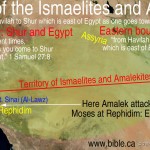
18  And they dwelt from Havila to Shur, which faces Egpt, back to where you come toward Assyria;
in the presence of all his brothers did (his inheritance) fall.


The next mention of Ishmael would be at the burial of Abraham where he and Isaac were both present.  Presumably, he had kept in touch with his father even if he and Hagar were expelled from the household. And the half brothers both pay respects to their common father.


The problem with some biblical narratives is—for those hungry for more details about figures like Ishmael who are on the periphery of the chosen lineage, there is not much more to wring out of the sparse verses devoted to them, and so we resort to seeking out extra-biblical sources.  Jewish commentators have much to say about Yishmael but they tend to go off-tangent and also tend to view Jew and non-Jew in black and white terms;  Yishmael and everyone else not in the promised lineage appear evil at most and a bad influence at the least.  But then this is the whole idea of separating a people to be distinct and peculiar and recognizable in the ways prescribed to them by Abraham’s God.


Christian commentaries are just as frustrating to read, knowing what we know now, but they can’t help it since their world view arises from their New Testament which is the real culprit.  It is said that three monotheistic religions can be traced back to Abraham: Judaism, Islam and Christianity. Islam is monotheistic but its founder is the prophet Muhammad who lived in 6 C.E. and founded the religion only then, so we have yet to make the connection with Yishmael. How Christianity figures monotheism in its trinitarian concept of Abraham’s God is a mystery even to its adherents.  


Google listings usually give us more than we’d care to know, including amusing input from weirdos; nevertheless ‘googling’ did yield one really good commentary published in 2006 by SUNY Press  (State University of New York in Albany) that puts Yishmael in proper perspective, together with other “marginalized men” in the bible (Esau); it is worth reading: [http://www.sunypress.edu/pdf/61278.pdf]. 


Descendants of Ishmael, the “Ishmaelites” are mentioned in the Joseph narratives but since there is confusion in the use of Ishmaelites and Medianites, here’s some clarification:  [http://carm.org/bible-difficulties/genesis-deuteronomy/who-purchased-joseph-ishmaelites-or-midianites]


Who purchased Joseph, the Ishmaelites or the Midianites?

 
  1. Ishmaelites (Genesis 37:28) – “Then some Midianite traders passed by, so they pulled him up and lifted Joseph out of the pit, and sold him to the Ishmaelites for twenty shekels of silver. Thus they brought Joseph into Egypt.”

    Image from bigfaithministries.com

  2. Midianites (Genesis 37:36) – “Meanwhile, the Midianites sold him in Egypt to Potiphar, Pharaoh’s officer, the captain of the bodyguard.”
  3. Ishamaelites (Genesis 39:1) – “Now Joseph had been taken down to Egypt; and Potiphar, an Egyptian officer of Pharaoh, the captain of the bodyguard, bought him from the Ishmaelites, who had taken him down there.”

According to Achtemeier,

1 the term “Ishamelite” was synomous with the term “Midianites.” They were probably references to the same general group known to have decended from Abraham. Ishmael was born to Abraham through Hagar (Genesis 16), the hand maiden. The Midianites were descendants of Midian, a son of Abraham and his concubine Keturah (Genesis 25:1-2). Additionally, “The term ‘Midianite’ probably identified a confederation of tribes that roamed far beyond this ancestral homeland, a usage that explains the biblical references to Midianites in Sinai, Canaan, the Jordan Valley, Moab, and Transjordan’s eastern desert.

2 WIKIPEDIA has these to add about what eventually happened to the descendants of Ishmael:


Ishmaelites are no longer mentioned after the time of King David, having assimilated into other peoples according to the book of Jubilees. Some are shown in Judges as having become part of the Midianites. Others are mentioned living amongst the Israelites. The Hagarites split off as a separate group from the rest of the Ishmaelites and were conquered and assimilated by the Israelites during the reign of Saul.


The extra-biblical Book of Jubilees claims that the sons of Ishmael intermingled with the children of Keturah from Abraham and were called “Arabs” and Ishmaelites. 


Yishmael/”God Hearkens” – “Shema El” indeed —- for YHWH did hear his father’s and his mother’s pleas on his behalf as well as the “voice of the lad.”  In fact, God did not only hear but blessed Ishmael far beyond his parents (and even our) expectations, even though he was the offspring from Sara’s machination and Abram and Hagar’s accommodation.


What a great God YHWH is, praise Him for being gracious, loving, merciful, all wise, and just.


Thus says YHWH:

I will make a great nation of him . . .  
But my covenant I will establish with Yitzhak.

And it was so.


Sig-4_16colors  

logo 


YHWH, God of Wrath, God of Mercy

Image from safetynetcounseling-blog.tumblr.com

Image from safetynetcounseling-blog.tumblr.com


[First posted 2013.  This has been sent in by a former Christian Pastor who has contributed previous articles, please refer to:  


Reformatting and highlights added.—Admin 1]


————————

Passage: Genesis 6-9 — Study Of Noah


7 PRINCIPLES OF SCRIPTURE STUDY


Before we tackle our passage today, there are seven principles I would like to re-emphasize when we study Scriptures: (Repetition is the foundation of all learning!)

1) We should always start from the point of view of YHWH (God), rather than from “our own” point of view. Scripture is His manual for us.

2) We should use “inductive” study method i.e. look at the facts first, before making a conclusion, not the other way around, which is called “deductive”.

3) We should always interpret a passage considering the “context” and not take verses out of context, as this could “distort” the meaning.

4) We should consider the “culture” of the Hebrews rather than our own to understand what the writer is trying to say.

5) We should Consult  a “Concordance” (dictionary or Lexicon) to check the meaning of the Hebrew Words  rather than rely on the English translation alone.

6) We should focus on WHAT IS WRITTEN rather than “subjective” conjectures about what the text means. YHWH’s words (in the original, not the translation) are PERFECT AND PRECISE because God is perfect and precise. We should not “read” something into the text that is not there …

7) All study must have a practical application — It should answer the question — So? What will I now do in my life? Study for knowledge sake without application will just make us “proud”.


A good example of reading something into a verse that is not there is …


Genesis 3:22-24 MKJV


(22)  And Jehovah God said, Behold, the man has become as one of Us, to know good and evil. And now, lest he put forth his hand and take also of the tree of life, and eat, and live forever,

(23)  therefore Jehovah God sent him out from the garden of Eden to till the ground from which he had been taken.

(24)  And He drove out the man. And He placed cherubs at the east of the garden of Eden, and a flaming sword which turned every way, to guard the way to the tree of life.

People then say … See “US” is plural and therefore it means there are three persons in one God! … Wow! Plural means more than one — where did they get 3? Why not 2 or 7?


What is the “better” interpretation?


1) Context — the passage is not talking about how many persons there are about God. It is talking about what man (Adam)  had done and what God will do to him because of what he had done. Based on context the “US” probably refers to God talking to the “cherubs” whom He would assign to guard the gate to the garden. The “US” is clearly defined in the text as those who “know good and evil”.  Man, after he disobeyed, now knew good and evil. “man has become like one of US”  does not make man = to God. Big probability that the “US” are angels or Cherubim who “know good and evil”.

Bigger context is that this verse is found in Genesis, and the person they call “Jesus” who they claim to be the second person of the trinity was not even “born” or made flesh until about 3,500 years later … Therefore, it is extremely illogical, to our God-given minds, to even propose that the “US” is evidence of triune persons in one God and that “Jesus” is one of those three!

2) Culture — the Hebrews never even came close to believing or teaching that there are more than One God! Moses could never have meant that the “US” is a triune God. All Jews, even today,  recite the Shema 2 time a day and it says GOD IS ONE!


Deuteronomy 6:4-5 MKJV


(4)  Hear, O, Israel. Jehovah our God is one (echad in Hebrew means “there is only one”) Jehovah.

(5)  And you shall love Jehovah your God with all your heart and with all your soul and with all your might.


3) Consultation — Concordance shows that the word “Trinity” never appears in Scripture. Consulting “google” we discover the history of the Trinity doctrine which I quote below for your information:


A brief history


The doctrine of the Trinity was formally developed in the early church (RAS NOTE: ROMAN CATHOLIC church) in reaction to errant teaching on the nature of God as found in Arianism. Arianism attempted to protect monotheism (the belief in one God) by denying the full deity of Jesus, a belief most Christians held at this time. Arianism taught that Jesus was divine, but that he was a lesser deity than the Father. To affirm the Church’s stance on the nature of God, the Trinity was formally stated in the Nicene Creed (325 A.D.) and the later Athanasian Creed. As a result of these early ecumenical creeds, any departure from the Christian doctrine of the Trinity was considered heresy. These creeds affirm the early Christian conviction that Jesus was God. Arianism caused the church to dogmatically affirm what was already believed and inherent to the earliest of Christian theology.


The term “Trinity”, is not found in the Bible. Theophilus of Antioch around 180 A.D. first used the Greek term trias(a set of three) in reference to God, his Word, and his Wisdom. However, Tertullian in 215 A.D. was the first one to state this doctrine using the Latin term, Trinitas(Trinity), referring to the Father, Son, and Holy Spirit (W. Fulton in the Encyclopedia of Religion and Ethics).


CONCLUSION: After looking at the facts, one can conclude that the “US” has nothing to do with the doctrine of the Trinity and it is illogical to use it as “proof text” for such a doctrine that is so foreign to the Hebrews and their Scripture.


LESSONS FROM NOAH PART 1


Many in the group have been wondering about the PURPOSE of their existence.

The passage today, Genesis 6-9, will help us answer this very important question.


WHAT IS YHWH’S PURPOSE FOR ME? Why did He create me?


There are several answers we can get about this from Genesis 1-5 and from Genesis 6-9.


1] YHWH is a precise and perfect creator. He went through 6 days of elaborate preparation to create man and an environment for man to live in. Science of the 21st century tells us that our bodies are extremely intricate and complex and that there are many “unseen laws” in our universe that govern all that happens so everything is orderly. We know there is no life elsewhere in the universe except here in our earth. The precision and orderliness that we see, strongly suggests that there is a DESIGNER of life here on earth rather than “it just happened by random chance”.


Therefore, if there is a designer, such a wise creator MUST have a purpose for creating man.


If you are interested, I have many studies that clearly show that there is a designer and that the theory of “evolution” is just that … a theory with many missing links.


2] YHWH is a PURPOSEFUL creator. What is YHWH’s purpose?


To answer this question Let us look closely at the Torah as a whole first (see the forest) then we will look at the details (see the trees.) We are looking at the Big Picture — the context of Genesis is the Torah — the first 5 books of Scripture.


The very first letter of Genesis is “B” Beyt, meaning house, and it is written MUCH MUCH LARGER than any of the other letters suggesting that it is important. The very last letter of the fifth book of the Torah is “L” Lamed means a shepherd’s staff. Together these 2 letters form the Hebrew word “heart”.

What YHWH seems to be saying implicitly is that He wants to create a “big house” (or a big nation) which is ruled by the “heart”.


3] From Genesis 1 and 2, we see clearly 2 reasons why God created man.


i] YHWH is a PERSONAL God, not just a “force” and His first purpose is to FELLOWSHIP with man; to have a meaningful relationship with man.


  • YHWH put His “breath” into man i.e. spirit, so that man could relate in a meaningful way to a spiritual being. Only man can “relate” to God spiritually. Only man is created in God’s image.

  • YHWH planted a perfect garden and placed man there.

  • YHWH wanted to “be with” man to “walk with” man in the garden. Just as we would enjoy walking with a loved one, so YHWH wanted to walk with man.

  • YHWH instituted the Sabbath so that He and man would have a time of fellowship together.


ii] The second purpose of YHWH is to BLESS man, here on earth! YHWH is a God who blesses Man.


Genesis 1:27-28 MKJV


(27)  And God created man in His image; in the image of God He created him. He created them male and female.

(28)  And God blessed them. And God said to them, Be fruitful, and multiply and fill the earth, and subdue it. And have dominion over the fish of the sea and over the fowl of the heavens, and all animals that move upon the earth.


Blessing means that YHWH wants man to feel “significant” and to have a “meaningful” life. Therefore, He gave man “dominion” over the earth and the animals. Man was “like” God in that he was the “boss” over the animals and the earth. His task would be to use his God-given abilities and brains to “subdue the earth” tend and keep the garden of God!


Woman was created by YHWH to help man fulfill his destiny of fruitfulness and multiplication.  Women would be the channels for blessings (and pleasure). By the way, the meaning of the word Eden in Hebrew is “pleasure”.


In Genesis 2:24, YHWH instituted the means of maximizing relationships and pleasure — marriage. In marriage, man and wife could be “one”.  The marriage relationship is a good picture of the relationship that YHWH wants to have with us.

  • Marriage would be higher priority than parents;

  • Marriage would be with only one partner; very personal and intimate

  • Marriage would be permanent;

  • Marriage would be extremely pleasurable; (physically and spiritually)

  • Marriage would be productive; produce fruit;


In fact, YHWH blessed the TIME that He set apart to fellowship with man:


Genesis 2:3 MKJV


(3)  And God blessed the seventh day and sanctified it, because in it He had rested from all His work which God created to make.


So we know that the purposes of YHWH are to fellowship with man and to bless him.


Since YHWH is God, He never changes. He is perfect. Therefore, it is not surprising that after the flood, when all living things, except Noah and those in the ark, had perished, YHWH repeated the command He have in Genesis 1:


Genesis 9:1 MKJV


(1)  And God blessed Noah and his sons. And He said to them, Be fruitful and multiply, and fill the earth.


We see the heart of YHWH again when He deals with Abram in Genesis 12. We know YHWH chose Israel as His people, out of all the nations. And that He planned it so that “in you all the families of the earth would be blessed.” (Genesis 12:3)


APPLICATION FOR US


So if these are YHWH’s PURPOSES for man, how do we apply to our lives?


Our application is to understand that our purpose is to develop and deepen our personal relationship with YHWH, our creator. That is why so often, Scripture refers to YHWH as “our Father”. Let us therefore have a “YHWH-driven-life”

Stated simply, our goal in life is as Jeremiah said …


Jeremiah 9:23-24 MKJV


(23)  So says Jehovah, Do not let the wise glory in his wisdom, nor let the mighty glory in his might; do not let the rich glory in his riches;

(24)  but let him who glories glory in this, that he understands and knows Me, that I am Jehovah, doing kindness, judgment, and righteousness, in the earth; for in these I delight, says Jehovah.


The first part, verse 23, shows us the “traditional” or the “world’s” goals — gain wisdom (pHd), gain strength (athlete), gain riches (money is key).


The second part, verse 24, includes YHWH in the equation and recognizes our true purpose is to know and understand YHWH, that He is God, who loves  kindness, justice, and righteous living here on this earth.


The way we are to know Him is simple … just like knowing another person … Walk with Him and Communicate with Him …DAILY…and do the things that PLEASE Him.


Since He is so much “higher” than we are, the only way we can ever know Him is through His own revelation of who He is … He has revealed Himself, what He likes and dislikes, in Scripture.


If we meditate on Scriptures daily, and do what YHWH commands, then we will gain a more intimate knowledge of Him and HE WILL BLESS US as we live on this earth.


Moses in the Torah summarizes what YHWH asks of us, His people:


Deuteronomy 10:12-13 MKJV


(12)  And now, Israel, what does Jehovah your God ask of you, but to fear Jehovah your God, to walk in all His ways, and to love Him, and to serve Jehovah your God with all your heart and with all your soul,

(13)  to keep the commandments of Jehovah, and His statutes, which I command you today for your good?

Here’s the list of what YHWH asks of us:


(1) Fear YHWH, our God;

(2) walk in all His ways;

(3) Love and serve (worship) Him with all your heart and all your soul;

(4) Keep His commandments & statues.


The Prophet Micah REPEATS plainly how we can please YHWH:


Micah 6:6-8 MKJV

(6)  With what shall I come before Jehovah, to bow myself before God the Most High? Shall I come before Him with burnt offerings, with calves of a year old?

(7)  Will Jehovah be pleased with thousands of rams, with ten thousands of rivers of oil? Shall I give my firstborn for my transgression, the fruit of my body for the sin of my soul?

(8)  He has shown you, O man, what is good. And what does Jehovah require of you but to do justice and to love mercy and to walk humbly with your God?


The three things are:

(1) Do justice

(2) Love mercy

(3) Walk humbly with YHWH.


If we meditate on His word and delight in it, He promises that we will PROSPER (be bIessed) IN WHATEVER we do!


Psalms 1:1-3 MKJV


(1)  Blessed is the man who has not walked in the counsel of the ungodly, and has not stood in the way of sinners, and has not sat in the seat of the scornful.

(2)  But his delight is only in the Law of Jehovah; and in His Law he meditates day and night.

(3)  And he shall be like a tree planted by the rivulets of water that brings forth its fruit in its seasons, and its leaf shall not wither, and all which he does shall be blessed.

King David REPEATS the same promise to those who walk in the way of YHWH …


Psalms 119:1-2 MKJV


(1)  ALEPH: Blessed are the upright in the way, who walk in the Law of Jehovah.

(2)  Blessed are they who keep His testimonies, and who seek Him with all the heart.


Like Enoch, Noah and Abraham let us walk daily with YHWH, our God and our Father!


If you have any questions about your purpose and how to apply it in your life, please do not hesitate to contact me.


Ricky Samson

Skype: rickysamson

Email – help.others.ras@gmail.com

The WAY of YHVH

Image from amazon.com

Image from amazon.com

[First posted in 2012 and this was the Introduction then:

In We have heard it said” – A Sinaite’s Apologetics – 4

– this comment was directed at us by our former christian/messianic bible teacher:

  • How deceptive teachers can be when they reject “The Way, The Truth, and The Life”!!!!!!!!!!!!  
  • They do not have spiritual enlightenment, only academic ability.

At the end of that article, we briefly stated that the “Way” according to the God revealed in the Hebrew Scriptures as YHWH is in His TORAH—teachings, instructions, guidelines, laws in the first five books attributed to Moses.


One of the best expositions we have read on this very topic is Chapter Two of the first book we have highly recommended in this website:  Restoring Abrahamic Faith by James Tabor. This may be ordered from his website jamestabor.com;  a MUST HAVE book.


We cannot improve nor add to what James Tabor has written so we’re doing the next best thing—-feature a condensed and edited version of Chapter Two titled “THE WAY“.  Please check out these other posts in this series:

Reformatting, highlights ours.Admin 1]


———————————————————————-

He will command his children and his household after him and they will keep the WAY of YHVH to do righteousness and justice.  (Genesis 18:19)


The WAY of God is intimately bound up with, and grounded in, the revealed character of YHVH.


God tells Moses that—


He is YHVH, YHVH, a God merciful and gracious, slow to anger, abounding in steadfast love and faithfulness,” but that He will by no means ignore sins.


 This very specific “character sketch” spoken by YHVH Himself, about Himself, is reflected throughout the Holy Scriptures in three Hebrew words.  These three words are unquestionably the three key concepts of BIBLICAL FAITH, yet ironically, they are virtually unknown to most English readers of the Bible.


To introduce them [here’s a] profound passage from the prophet Jeremiah that puts things succinctly in words directly attributed to YHVH Himself:


Thus says YHVH:  “Let not the wise man glory in his wisdom, let not the mighty man glory in his might, nor let the rich man glory in his riches; but let him who glories, glory in this, that he understands and knows Me, that I am YHVH exercising steadfast love (chesed), justice (mishpat), and righteoushess (zedaqah) in the earth; for in these I delight,” says YHVH (Jeremiah 9:23-24).


[Regarding] the Shema: This is the WAY, all else is commentary. There is more in these two verses than in the shelves of theological books.  


First, note how God specifically identifies Himself by Name that one understands and knows Me . . . that I am YHVH” that is, the Everlasting ONE GOD.  Further, observe how the three ways of humankind are sharply contrasted  with the three components of the WAY of God.  Humans seek for wisdom, power, and wealth.  This is the human way, and separate from God, the root of all sorts of evil.


 . . . [The] three great words : chesed, mishpat, and zedaqah.  In these, God Himself delights.  After all, they are a description of His very character, as well as a prescription of His WAY for humankind.

  • Chesedwhich is often translate mercy, love, or kindness is a tender word.  It is the very heart of God’s character, much connected to the concept of grace and forgiveness.  The translation of “steadfast love” is a good one . . . because the word implies the notion of loyalty.  Through the prophet Hosea YHVH declares I delight in chesed rather than sacrifice (6:6).  Micah declares, in answer to Moses’ question, What does YHVH require of you, that one must love “chesed,” which might strike one as an odd way to put it, yet the point is a profound one (6:8).  Those who come to know God, which is to know the WAY of God, also are drawn in love toward chesed.
  • Mishpat is usually translated justice.  It means to act with fairness, equity, and impartiality in any situation.  Again, Micah, in the same passage, declares that YHVH requires that one “do justice” (6:8).  The Prophets constantly speak of mishpat.  In a well-known passage Amos cries out: Let justice roll down like waters (5:24).
  • Zedaqah (or zedeq) is often linked directly with mishpat.  They are closely related, sometimes overlapping.  For example in Deuteronomy 16:18 Moses speaks of “righteous judgment.”  It is usually translated righteousness, referring to the good and upright WAY of behavior, in other words, God’s moral standards for humankind is revealed in the TORAH.


The three together form a balanced and composite triad.  They combine with one another and play off one another. Steadfast love can sometimes temper justice; and yet what is truly just and right often defines the very way of steadfast love in the first place.  The following quotations illustrate this point quite well:  


He loves righteousness and justice; the earth is full of the steadfast love of YHVH (Psalm 33:5)


Righteousness and justice are the foundation of Your throne; steadfast love and truth go before Your face (Psalm 89:14).


When the Davidic Messiah comes, his basic task is to establish the Kingdom, or Rule of YHVH, based on these very principles of the WAY of YHVH:


 In steadfast love the throne will be established: and one will sit upon it in truth, in the tabernacle of David, judging and seeking justice and hastening righteousness 

(Isaiah 16:5; cf. 9:7).


Defining the WAY of YHWH


There is a fascinating text in the early part of Genesis.  God deliberates whether to share with Abraham, His intimate friend, His plans for the utter destruction of the wicked cities of Sodom and Gomorrah.  God reasons within Himself,  Shall I hide from Abraham what I am about to do (18:17)?  What follows, as a kind of self-deliberation of God, is profound and fundamental:  


For I have known him, in order that he may command his children and his household after him, that they keep the WAY of YHVH to do righteousness and justice, that YHVH may bring to Abraham what He has spoken to him (Genesis 18:19).


There we have it. The very WAY of YHVH is defined precisely: it is doing, or practicing, zedaqah and mishpat. The PLAN of God, that involves the entire calling and mission of Abraham, depends on the preservation and extension of this WAY.


What is involved here?  The terms “justice” and “righteousness” mean many different things to different people.  Each individual or culture tends to reason out their own sense of what they consider to be just and right.  Human beings have been adept at developing their own systems of ethics and morals. However, when the Bible uses these terms something specific and concrete is intended.


There is a definite WAY of YHVH.

  •  The shifting sands of human culture and opinion do not determine it.  
  • At its core, it remains constant through the ages.  We can know that WAY.
  •  Its general contours are specifically set forth in the Hebrew Scriptures, with many illustrative details and cultural applications.


The TORAH of YHVH


According to the Hebrew Bible there is one primary source for knowing and understanding the WAY of YHVH.  One must turn to what is called in the Hebrew Scriptures the TORAH and the TESTIMONY (Isaiah 8:16-20).  


Surely one of the most misleading English translations of any term in the entire Bible is the rendering of the Hebrew word TORAH as “the Law.”  The modern English word “law” in no way conveys the beautiful, highly positive, and compelling meaning of the original Hebrew concept.  


The very first Psalm describes the WAY of the righteous person:  

But his delight is in the TORAH of YHVH, and in His TORAH he meditates day and night (Psalm 1:2).  


The Holy Scriptures always speak of the TORAH of YHVH in the most positive way.  Note the following verses:


The TORAH of YHVH is perfect, converting the soul (Psalm 19:7).


Blessed is the man whom You instruct, O YHVH, and teach out of Your TORAH! (Psalm 94:12).


Your TORAH is truth (Psalm 119:12).


O how I love Your TORAH!  It is my meditation all the day (Psalm 119:97).


Open my eyes, that I may see, wonderful things out of Your TORAH (Psalm 119:18).


Eighteen times in Psalm 119 David exclaims his love for, and delight in, the TORAH.  So what precisely is the TORAH?


[Continued in The WAY of YHVH – 2]

Q: Problems with Daniel

Image from Shutterstock

Image from Shutterstock

[This was first posted November 7, 2012.  The OT book of Daniel  has been a huge part of our Christian studies on prophecy; how many seminars did we attend w/our bible teacher “RW” who was obsessed with this book because supposedly, it’s crucial to the understanding of the last book of NT, Revelation. Well, we never really understood Daniel, ditto with Revelation.  Later as Sinaites, we discovered Daniel is not even a major prophet;  and the book is relegated to  “the Writings”, the “K”,Ketuvim” in TNK, the Hebrew Scriptures.   Aaaaaccccchhhhh!  But good to know no matter how late, because now we know how to read it—not as prophecy but as  . . . well . . . just like the Book of Revelation. —-Admin1.]

———————–


Among many things that surprise any reader delving into unfamiliar literary and religious territory— the original ‘Hebrew Scriptures’ or the ‘Jewish Bible’—
    • is not only the number of books
    • but also the arrangement of the books,
    • as well as the placement of some books.

We have been so used to the chronological order of our Christian ‘Old’ Testament that when we look for books where we’re used to finding them, we have to reorient ourselves to a new way of approaching and understanding the Tanach/Tanakh, TNK (TORAH, NEVIIM, KETUVIIM).


Surely there are good reasons for the original order and placement of the books that comprise the canon of the TNK; the People of the Book well know what they are, but who else bothers or even tries to understand? Truly there is so much to relearn and unlearn for those who venture into the sacred scriptures of an unfamiliar ancient biblical faith that have been re-presented in another guise.


In previous articles, we have discussed that—
  • the TNK has 24 books;
    • Christian OT has 39 books;
  • the reason for the difference of 15 is —
    • OT split Samuel, Kings, Chronicles, Ezra-Nehemiah into 2 separate books
      • when they are only single books in the TNK;
    • OT split the minor prophets into 12 separate books
      • while in the TNK, the 12 comprise 1 book under NEVIIM .
The same question in those articles bears repeating: WHY would a major world religion that develops some 4000 years later —
    • not only borrow the Scriptures of a people of differing beliefs,
    • append it to its own chosen canon of “divinely inspired” books,
    • consider it foundational to its beliefs,
    • yet minimize its importance,then tamper with its very words to make new interpretations to suit its new theology,
      • first by retitling it as “old”
      • then by considering it obsolete
      • applicable only to the Jews, not to their gentile flock
      • teaching that to observe TORAH is “legalistic”
    • creating a totally new religion but making the “Old” scriptures support and justify its “newness”
    • by teaching the “old” as mere prophetic literature.

Do any of these make any sense except in ‘replacement’ theology?


Should it not raise red flags among open-minded Truth-seekers who have started thinking outside of their religious box?


The specific question here concerns the book of Daniel. We are not yet ready to tackle this book but are probing into what it would have meant to the original hearers/readers (Israel) MINUS the connection Christians have made with the NT book of Revelation, which is said to be understandable only when linked with Daniel.


This strange book has been the focus of non-stop Christian eschatological interpretation; we have been exposed to so many of them, the last being a CD titled “Daniel’s Timeline” which our Messianic friends were all agog to learn in order to prepare for the “end times.”


The placement of Daniel in the Christian OT is with the “Major Prophets,” 4th after Isaiah, Ezekiel and Jeremiah; however in the Hebrew Scriptures, it is positioned among “The Writings,” the 3rd category titled Ketuvi’im.  


When our Sabbath TORAH study group discussed the possible answers for this placement, we came up with the following —-

    • Daniel was not a “Prophet” like Isaiah, Ezekiel and Jeremiah, who spoke the very words of YHWH and therefore boldly proclaimed “Thus saith the LORD”;
    • like Joseph the dreamer and interpreter of dreams and visions (sometimes their own, sometimes of gentiles) one research showed that Daniel was a very late addition to the CANON of the TNK, that there were discussions as to whether or not it should be included, since it already reflected Hellenistic influences.
    • Daniel was much the same, given a special gift for specific purposes for his time and the situation of his people in exile who had lost land, Temple, but not their TORAH and their Elohiym;

We agree that Daniel as apocalyptic literature opens itself to all kinds of interpretations by religionists but surely, the God of revelation does not communicate in mysteries, for what would be the purpose of communicating at all? The scriptures are difficult enough to understand without the Author throwing in cryptic language.

 
There is a key to understanding the book of Daniel, but where or what is it?


The Rabbinical view provided in ArtScroll Tanach/

INTRODUCTION to the book of Daniel:


In the concluding chapters of the book, Daniel saw visions that remain the subject of intense speculation, for he was shown prophetic scenes of the “Four Beasts” representing the “Four Monarchies” that will dominate Israel during its long series of exiles. And he was shown the calculations of the “End of Days,” when Israel will be redeemed and the world will finally achieve the Divine goal for which it was created.
  • What did the numbers mean?
  • When and how will the events come about?
These visions remain clothed in mysteries that will not be stripped away until the time of the final Redemption is at hand. Then we will know how God’s seeds will sprout into the glorious fulfillment of the Scriptural prophecies.


Needless to say but we’ll say it anyway, Christians believe their New Testament provide the answers to OT mysteries, particularly in the last book of Revelation, an apocalyptic book that demonstrates dualism to its extreme: good and evil forces in final battle at Armageddon; the Dragon and his demonic forces fighting the LAMB, even if the Devil knows his inevitable END since, according to the gospels, Satan mouths scripture to the very Son of God Himself!


Ah, but then, did we just say we want to focus on Daniel’s interpretation minus Revelation? See how hard it is to get rid of baggage from former religious orientation.


So where is this whole discussion leading to? Read the title again . . . notice we didn’t write “Q&A”, just “Q”.
Frankly, we have no answers at this time, not yet, but at least we now know that Daniel was not even considered a “prophet” and so if this book has been relegated to Ketuviim, ‘the Writings’ by the Jews who put together the canon for their Hebrew Scriptures, then Christian borrowers of another people’s Scriptures-History Book have no business tampering with the number, arrangement and position of the original books, relegating and elevating Daniel to one of Israel’s “major” prophets.  READ that long sentence again!


So now, this discovery is so new to us, we have to reread and restudy the book of Daniel with a totally different approach.


Give us time, we’ll get to this book eventually and provide the “A” part.  But in the meantime, check out this post:
It has everything you need to know about Daniel; in fact, it saves us from writing the “A” part to this “Q”.


Sig-4_16colors

logo

The Messiahs – The Origin of the Messiah Idea

Image from amazon.com

Image from amazon.com

[First posted in 2014.  If there is one–and only one–people group or nation that has looked forward to a figure they call “Messiah” that would be Israel.  No other nation in the world has had a similar expectation, not one.  


So if there is only one nation waiting for the appearance of a “Messiah” who would be recognizable because of conditions prevailing at that specific time, then only that nation and no other’ people-grouping’—whether gentile nation or religion/church—has the prerogative of defining and hence identifying by recognizable signs, this anticipated figure.


That said, then what are the identifying criteria applied to this messianic figure, according to the anticipators, the Jews? There are many “counter-missionary” Jewish websites that explain the Jewish expectation; this seems to be one topic where Jews are quite unified in their viewpoint. For full discussions of the Jewish perspective, please go to the Jewish links recommended in this website because we cannot feature all of them here, but it is enlightening to read everything they’ve written on this subject.


It is one thing to listen to the Jews who have rejected Jesus as Israel’s ‘Messiah’, that is only to be expected of the Jews;  it is quite another to listen to a non-Jewish historian, someone who has studied the New Testament and is in fact an archeologist— to agree with the Jews why Jesus is not the Messiah pointed to by the Hebrew Scriptures.  So what we are featuring here is not only from a gentile perspective but specifically a New Testament scholar.  It takes one to know one, and just as we Sinaites as former Christians truly understand why Christians believe Jesus is Israel’s long anticipated Messiah, more so does James D.  Tabor, a professor in Christian origins and ancient Judaism who wrote an eye-opening, mind-clearing, truth-awakening book:  Restoring Abrahamic Faith.   He, more than any other NT scholar we have read, presents the most balanced and comprehensive viewpoint.  For the benefit of our website visitors who might not yet have found a copy of this MUST HAVE book, we are quoting excerpts from Chapter 4 which gives the clearest explanation about — not one messiah, but “The Messiahs.”  This should clear up some of the fog and correct misconceptions about this figure for those who have simply accepted Christian teaching without checking out the Hebrew Scriptures. Condensed and reformatted.

Sequels to this post are:

Admin 1.]  

 
Image from heavenawaits

Image from heavenawaits

 And there shall come forth a rod out of the stem of Jesse,

and a Branch shall grow out of his roots:

and the Spirit of knowledge

and the fear of YHVH shall rest upon him.

(Isaiah 11:1-2)


Millions think of the Messiah as a single superhuman figure whose appearance brings about an instant solution to all of the problems of the world.  For Christians and Muslims, his arrival will be a “second coming,” while Jews await his first appearance.  The original concept of the Messiah, or more properly, the Messiahs, as set for in the Hebrew Bible, has been almost totally obscured and forgotten.


For many Christians the word “Christ” is synonymous with Jesus, almost as if it were his last name.  The English word “Christ” is a title, a descriptive designation, not a name.  It is based on the Greek word Christos, which is a translation of the original Hebrew term Messiah” (maschiach) which simply means an “anointed one,” or one who is specially selected by God.  Therefore, to speak of “Jesus Christ” is actually to claim that Jesus was the one whom God anointed or chose for an exalted mission.  Likewise, the word “Christian” means “Messianist,” or one who is a member of a messianic movement or a follower of a Messiah.  Indeed, early Christianity was just that, a messianic movement within Judaism.  


[Footnote: Since the discovery of the Dead Sea Scrolls we know a great deal more about such Jewish messianic movements during the time of Jesus the Nazarene.  The Scrolls are part of the hidden library of just such a group, often referred to as the Essenes.  They were highly messianic and apocalyptic, expecting the imminent arrival of the Kingdom of God.]

 
  • What then was the anticipated mission of the Messiah according to the Hebrew Prophets?  
  • Why is he chosen?  
  • What is he to accomplish?  
 

It seems that Christians, Jews, and Muslims all hold different and conflicting ideas on this subject and few seem to recognize that biblical “messianism” is irrevocably tied to the concept of the Kingdom of God.


Some Christians are likewise confused about the relationship between God and the Messiah, or Christ.  

The first great Christian departure from the ancient HEBREW FAITH was to declare that the Messiah was, in fact, God Himself.   

The concept of a divine Messiah, eternally existing as God, but born as a human being, is foreign to the Hebrew Scriptures.  This confusion between the ONE GOD of Israel and His Messiah (or Messiahs as we will shortly see), has led to further confusion about the messianic role in inaugurating the Kingdom of God.  It has clouded the central issue of the mission of the Messiahs, why they are chosen, and what they are to accomplish.


The concept of the “Second Coming of Christ” is a familiar one in our culture, especially among Christians and Muslims.  And yet in the Hebrew Scriptures one reads of a different “Second Coming, not that of a Messiah, but rather the Second Coming of YHVH GOD  Himself.  This is the major concept of eschatology in the Hebrew Scriptures, and yet one seldom, if ever, hears it mentioned.


[Footnote:  Eschatology is the term scholars use to refer to all the things pertaining to the “end of the age,” or the last days of human history, leading into the kingdom of God.]


The problem is that Christianity as largely lost its Hebraic roots.  The idea of Messiah is a thoroughly Hebrew or Jewish concept.  The place to begin is with the Hebrew Scriptures, that is, the TORAH, Prophets, and Writings of the Tanakh (which Christians call the O.T.).  In these writings the original, fundamental messianic teaching emerges clearly, without ambiguity.  Indeed this all-important doctrine of the Messiah/s is one of the pillars of BIBLICAL FAITH.  Before one tries to understand the development of the messianic ideas that one finds in the New Testament writings, it is essential to first have a thorough grounding in what the Hebrew Scriptures say on this topic.


In this chapter I will set forth the messianic teaching based on the Hebrew Scriptures, while at the same time highlighting what I hope will become a restored Biblical emphasis—the concept of a different “Second Coming,” one that involves the literal return of YHVH Himself to this planet and the subsequent rule of His Kingdom.


The Origin of the Messiah Idea


To grasp the basic Biblical messianic teaching we have to go back to the origins of the very idea.  The word itself means, “anointed one,” and comes from the Hebrew verb mashah which means “to smear with oil.”  It is first mentioned in the TORAH.  There Moses is commanded:  “And you shall make of these [spices] a holy anointing oil, a perfume mixture, the work of a perfumer; it shall be a holy anointing oil” (Exodus 30:25).  This holy oil, rich with the fragrant smell of exotic spices, had a number of functions.  It was smeared upon the furniture of the Tabernacle, including the Ark of the TESTIMONY, in order to consecrate and separate these items for their sacred use (Exodus 30:26).  It was also used by Moses to consecrate Aaron and his sons as perpetual priests of Israel.  


Note the following verses: 


Then you shall take the anointing oil, and pour it on his [Aaron’s] head and anoint him (Exodus 29:7).


. . . and you shall anoint them and ordain them and consecrate them, that they may serve Me as priests (Exodus 28:41).


. . .and you shall anoint them even as you have anointed their father, that they may minister as priests to Me; and their anointing shall qualify them for a perpetual priesthood throughout their generations (Exodus 40:15).


We see here that the priests of Israel, beginning with Aaron, are properly understood to be “messiahs” or “anointed ones.”  David refers to this priestly anointing ceremony in one of his Psalms, comparing the sweetness of brotherhood to the precious oil upon the head, coming down upon the beard, even Aaron’s beard, coming down upon the edge of his robes (Psalm 132:2).  The anointing ceremony conveyed a most positive image in ancient Israel, with the precious perfumed oil, running down the hair, beard, and clothing, signifying the Spirit or Presence of YHVH God Himself.


In the time of the prophet Samuel (10th century BCE) this holy anointing oil was used to consecrate and set apart those God had chosen as kings of Israel.  The ceremony was carried out by a prophet or a priest, or perhaps by both (see 1 Kings 1:34-39). For example, when Samuel the prophet anoints Saul, and later David, as King of Israel, we read:


 Then Samuel took the flask of oil, poured it on his [Saul’s] head, kissed him and said, “Has not YHVH anointed you ruler over His inheritance?” (1 Samuel 10:1).


Then Samuel took the horn of oil and anointed him in the midst of his brothers; and the Spirit of YHVH came mightily upon David from that day forward (1 Samuel 16:13; cf. Psalm 89:20). 


David regularly and respectfully refers to King Saul as “YHVH’s anointed,” which might just as well be translated as “YHVH’s messiah,” or anointed one (see 1 Samuel 24:6; Psalm 2:2).


It is also probably that in certain case a similar anointing ceremony was used to pass on the office or position of a prophet. Elijah is told at the end of his work.


Jehu the son of Nimshi you shall anoint king over Israel; and Elisha the son of Shaphat of Abel-meholah you shall anoint as prophet in your place (1 Kings 19:16).


Even the Patriarchs, Abraham, Isaac, and Jacob, are called “messiahs” because of their chosen prophetic roles (Genesis 20:7).  Notice Psalm 105:13-15, where the reference is to these Fathers:  


When they went from one nation to another, from one kingdom to another people, He permitted no one to do them wrong; yes, He rebuked kings for their sakes, saying “Do not touch My anointed ones (“messiahs”), and do My prophets no harm.”


YHVH even calls the Gentile King Cyrus of Persia “His messiah:”

 Thus says YHVH to Cyrus, His anointed (Hebrew mashiach or “messiah,” Isaiah 45:1). 


It is obvious from these verses that to be anointed  of YHVH (whether it involved an actual ceremony with the holy oil or not) is to be appointed and chosen for a special role, office, or mission.  These anointed ones, or “messiahs,” are empowered by God Himself to carry out special and particular functions within God’s historical PLAN.  So, we can clearly see that according to the normal Hebrew use of the term, Abraham is a messiah,” as well as every priest, king, and prophet of Israel.  In other words, there are many dozens of “messiahs” in Israelite history carrying out many diverse, but divinely appointed, tasks and missions.  Clearly, the key question we must ask, in any given case, is for what is one anointed or appointed?


The concept of a “messianic” person is never separated from the “messianic” mission or task such a one is to carry out.  This is a common misunderstanding among some Christians.  The “personhood” of Jesus is emphasized, along with the affirmation that he was the “Christ” or “Messiah,” while his messianic task and mission are often ignored.  He was given the title or name, but the root meaning of the concept was lost to the largely Gentile Church of the 2nd through the 4th centuries C.E.


It is the case that the Hebrew Prophets give special emphasis to a single extraordinary figure, a descendant of David, who can properly be called “the Messiah,” not just another among the many.  Nonetheless, this general concept of various “anointed” figures throughout the Scriptures is essentially background for understanding this very special and singular Davidic figure to come.


[Next:  The Messiahs – 2 – The Davidic Messiah]

]