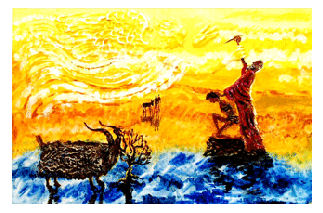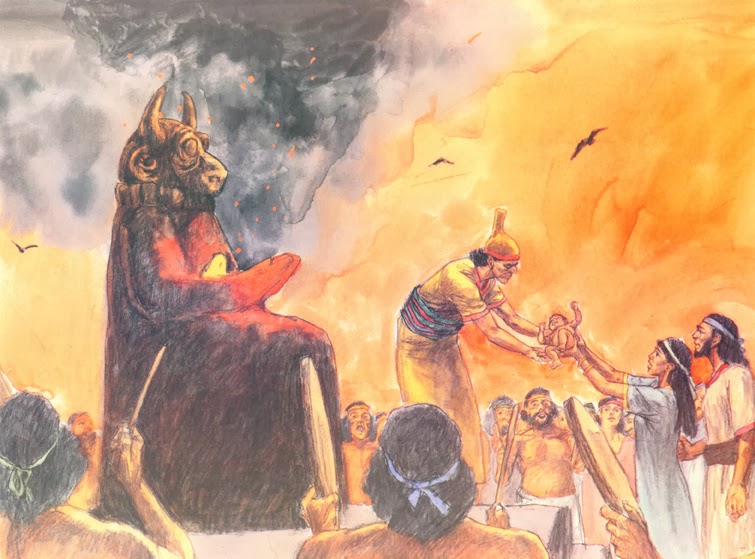
Genesis/Bereshith 27: "for should I be bereaved of you both in a single day?"

[From the very first careful and in-depth reading of the narratives about the twins Esau and Isaac, the twin who caught our attention was Esau, not Isaac.  We know that Rabbinic as well as Christian commentators tend to stereotype him as a man who gives in to his carnal desires, and because of the Edomites who descended from him, he is relegated to the ‘villains’ among biblical figures.  But study the texts that characterize him and you might be more sympathetic toward him; in fact, the other twin who is more difficult to figure out and learn to like is guess who?


 ‘Heel’ and ‘supplanter’ are appropriate descriptions for Yaakov/Jacob, at least up to this point of ‘the twins’ narrative. The Rabbinic commentaries, understandably, tend to explain, rationalize and justify his and mother Rebekah’s deceptive scheme to circumvent Esau’s right of primogeniture.  Come on, if the God of Abraham Himself makes promises that have proven to be 100% fulfilled so far, could Rebekah and ‘yes mommy’ Yaakov not simply trust Abraham’s God? Talk about another ‘deja vu’, this is just like Sarah resorting to her way of producing an heir for Abraham through Hagar.


We should learn from these examples in Scripture, right? Except that we don’t hear YHWH’s voice speaking directly to us regarding specific promises and events that will come to pass.  But we DO HEAR YHWH’s voice regarding His commandments for all humankind on almost every area of life, including diet, health, sanitation.  So, let us not be like disobedient Sarah and disobedient Rebekah, and obedient sonYaakov and obedient husband Abraham — heeding the voice of humans, specially when we know what the Divine Voice has already stated for us.  Shades of Eden, eh?


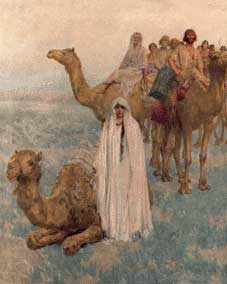
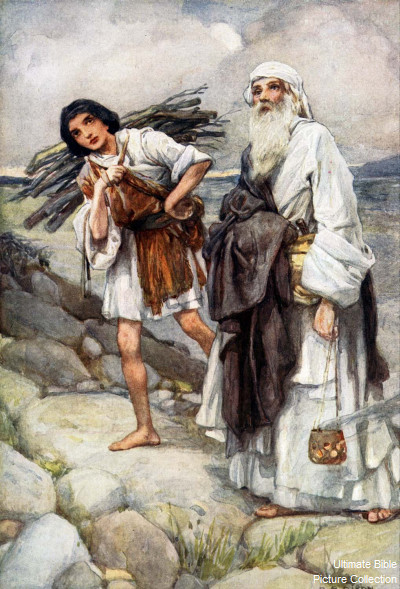
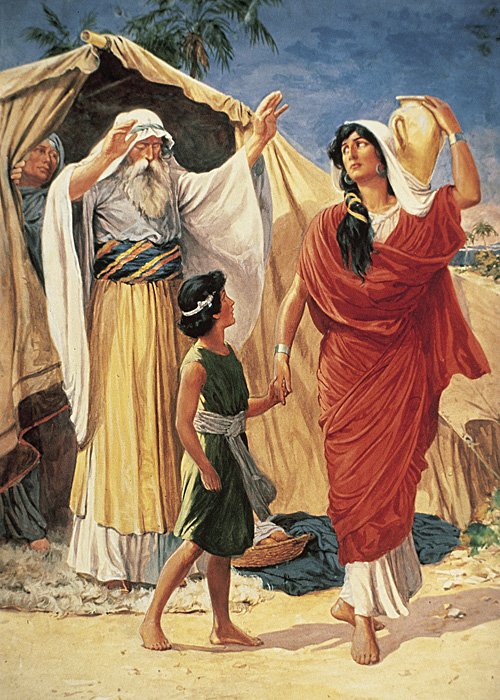
The ‘twins’ story is another of those tell-able tales that are easily taught to children, hence inspiring children’s bible illustrations which we used here.  Unbracketted commentary is from Pentateuch and Haftorahs, ed. Dr. J.H. Hertz; translation is Everett Fox, The Five Books of Moses with commentary indicated by “EF”; additional commentary “RA” from Robert Alter who also published a translation with the same title as Fox.– Admin1.]

———————————————-

Genesis/Bereshith 27


THE BLESSING OF ISAAC


1 Now when Yitzhak was old and his eyes had become too dim for seeing,

he called Esav, his elder son, and said to him:

My son!

He said to him:

Here I am. 

[RA] his eyes grew too bleary to see.  Isaac, the man of taste (25:28) and of touche (26:8), is deprived of sight in his infirm old age.  In the central episode of this story, he will rely in sequence on taste, touch and smell, ignoring the evidence of sound, to identify his supposed firstborn.


2 He said:

Now here, I have grown old, and do not know the day of my death. 
 

I know not the day of my death.  ‘I know not how soon I may die’ (Moffatt).


3 So now, pray pick up your weapons-your hanging-quiver and your bow,

go out into the field and hunt me down some hunted-game, 

4 and make me a delicacy, such as I love;

bring it to me, and I will eat it,

that I may give you my own blessing before I die. 
Image from www.freebibleimages.org

Image from www.freebibleimages.org

my soul may bless thee.  Only an emphatic form of “I may bless thee’; see XII,13.  The dying utterance was deemed prophetic.

[EF] delicacy: See 25:28.  Yitzhak is tied to the senses, a trait that he prizes in Esav. my own blessing:  Or “my special blessing.” Heb. nefesh frequently means “self” or “personality.”


[RA] I may solemnly bless you. The Hebrew says literally, “my life-breath [nafshi] may bless you.” Nafshi here is an intensive synonym for “I,” and hence something like “solemnly bless” or “absolutely bless” is suggested.


5 Now Rivka was listening as Yitzhak spoke to Esav his son,

and so when Esav went off into the fields to hunt down hunted-game to bring (to him), 


heard.  More accurately, ‘was listening.’  To understand Rebekah’s action, it is necessary to bear in mind what had been stated in XXV,23.  When she had inquired of the LORD about her unborn children, she had been told, ‘the elder shall serve the younger.’  This prophecy appeared on the point of being falsified by Isaac’s intention to bestow his chief blessing upon Esau.  Knowing how attached Isaac was to the elder son, she must have felt that it would be useless to try and dissuade her husband from his intention.  She, therefore, in desperation, decided to circumvent him.

[RA]  And Rebekah was listening as Isaac spoke to Esau. According to the convention of biblical narrative, there can be only two interlocutors in a dialogue (as in Aeschylean tragedy), though one of them may be a collective presence–e.g., a person addressing a crowd and receiving its collective response.  Within the limits of this convention, the writer has woven an artful chain.  The story, preponderantly in dialogue, is made up of seven interlocking scenes:  Isaac-Esau, Rebekah-Jacob, Jacob-Isaac, Isaac-Esau, Rebekah-Jacob, Rebekah-Isaac, Isaac-Jacob. (The last of these occupies the first four verses of Chapter 28).  The first two pairs set out the father and his favorite son, then the mother and hr favorite son, in opposing tracks.  Husband and wife are kept apart until the penultimate scene; there is no dialogue at all between the two brothers—sundered by the formal mechanics of the narrative—or between Rebekah and Esau.  Although one must always guard against excesses of numerological exegesis, it is surely not accidental that there are just seven scenes, and that the key word “blessing” (berakhah) is repeated seven times.


to bring. The Septuagint reads instead “for his father,” which is phonetically akin to the word in the Masoretic Text (either variant is a single word in the Hebrew).  The Septuagint reading has a slight advantage of syntactic completeness, but subsequent exchanges in the story insist repeatedly on the verb “to bring” as an essential element in the paternal instructions.


6 Rivka said to Yaakov her son, saying:

Here, I was listening as your father spoke to Esav your brother, saying: 

7 Bring me some hunted-game and make me a delicacy, I will eat it

and give you blessing before YHVH, before my death. 


[EF] before YHWH: Note that Rivka adds these words to her husband’s.


[RA] and I shall bless you in the LORD’s presence. Rebekah substitutes this for “that I may solemnly bless you” in the actual speech on which she eavesdropped, thus heightening the sense of the sacred and irrevocable character of the blessing she wants Jacob to steal.


8 So now, my son, listen to my voice, to what I command you: 

9 Pray go to the flock and take me two fine goat kids from there,


[EF] take: Fetch


[RA]  two choice kids. Kids will again be an instrument of deception, turned on Jacob, when his sons bring him Joseph’s tunic soaked in kid’s blood.  And in the immediately following episode (Genesis chapter 38), Judah, the engineer of the deception, will promise to send kids as payment tot he woman he imagines is a roadside whore, and who is actually his daughter-in-law Tamar, using deception to obtain what is rightfully theirs.


I will make them into a delicacy for your father, such as he loves; 

10 you bring it to your father, and he will eat,

so that he may give you blessing before his death. 

11 Yaakov said to Rivka his mother:

Here, Esav my brother is a hairy man, and I am a smooth man, 


[EF] Look, Esau my brother is a hairy man.  It is surely noteworthy that Jacob expresses no compunction, only fear of getting caught.


12 perhaps my father will feel me-then I will be like a trickster in his eyes,

and I will bring a curse and not a blessing on myself! 

13 His mother said to him:

Let your curse be on me, my son!

Only: listen to my voice and go, take them for me. 
 

[EF] Let your curse be on me: Ominously, Rivka disappears from the narrative after v. 46.


14 He went and took and brought them to his mother, and his mother made a delicacy, such as 

his father loved. 

15 Rivka then took the garments of Esav, her elder son, the choicest ones that were with her in the house, 


choicest garments. As distinct from the rough and blood-stained garments he wore when hunting.


which were with her in the house.  Though Esau was married and presumably had a home of his own, he would keep some of his clothes at his father’s house, which he would don during his visits from hunting, after removing his soiled garments.


[RA] 15-16.  the garments of Esau . . . the skins of the kids.  Both elements point forward to the use of a garment to deceive first Jacob, then Judah, with the tunic soaked in kid’s blood combining the garment motif and the kid motif.


16 and clothed Yaakov, her younger son;

and with the skins of the goat kids, she clothed his hands and the smooth-parts of his neck. 

17 Then she placed the delicacy and the bread that she had made in the hand of Yaakov her son. 

Image from aschaper1.blogspot.com

Image from aschaper1.blogspot.com

18 He came to his father and said:

Father!

He said:

Here I am. Which one are you, my son? 


[EF] Which one are you? Three times—here, in v. 21, and in v. 24—the father asks for assurances about the son’s identity.my son: This phrase reverberates throughout the story, underlining the confusion over the identity of the sons.


[RA] Who are you, my son? The inclination of several modern translations to sort out the logic of these words by rendering them as “Which of my sons are you?” can only be deplored.  Isaac’s stark question, as Tyndale and the King James Version rightly sensed, touches the exposed nerve of identity and moral fitness that gives this ambiguous tale its profundity.


19 Yaakov said to his father:

I am Esav, your firstborn.

I have done as you spoke to me:

Pray arise, sit and eat from my hunted-game,

that you may give me your own blessing. 


Image from bible-lessons-for-kids.blogspot.com
 

I am Esau thy first-born.  These words misled Isaac, and were spoken with the intention of inducing his father to believe that it was Esau who stood before him.  Jacob, having been persuaded to adopt his mother’s plan, is forced to play his part to the end (Ibn Ezra).


[EF]  Esav your firstborn: From the first word the lie is blatant; contrast Esav’s tension-filled reply to the same question in v. 32.


[RA]  I am Esau your firstborn.  He reserves the crucial term “firstborn” for the end of his brief response.  As Nahum Sarna notes, the narrator carefully avoids identifying Esau as firstborn, using instead “elder son.”  The loaded term is introduced by Jacob to cinch his false claim, and it will again be by Esau (verse 32) when he returns from the hunt.


Rise, pray, sit up. It is only now that we learn the full extent of Isaac’s infirmity: he is not only blind but also bedridden.


20 Yitzhak said to his son:

How did you find it so hastily, my son?

He said: Indeed, YHVH your God made it happen for me. 


so quickly.  This was not an oversight of Rebekah’s.  She was obliged to hurry lest Esau should return and upset the plot.

the LORD thy God sent me good speed.  Such words were not of the kind likely to have been spoken by the rough Esau.  The name of God was probably rare on his lips.  Hence Jacob’s statement arouses his father’s suspicions, who requires to be assured by the very test which Jacob dreaded, in v. 12.


[EF]made it happen: An appropriate expression to use with Yitzhak, see 24.12.


21 Yitzhak said to Yaakov:

Pray come closer, that I may feel you, my son,

whether you are really my son Esav or not. 

22 Yaakov moved closer to Yitzhak his father.

He felt him and said: The voice is Yaakov’s voice, the hands are Esav’s hands— 

23 but he did not recognize him, for his hands were like the hands of Esav his brother, hairy. 

Now he was about to bless him, 
 

so he blessed him. If that be the meaning of the Hebrew, we should expect the wording of the blessing to follow immediately.  We do not, however, have that until v. 28.  It is therefore possible that the Hebrew should here be rendered:  ‘he greeted him.’


[EF]  hairy: In the end “yitzhak relies more on the sense of touch than on his hearing.  Yet the latter is usually regarded as the source of truth in the Bible (see Deut. 4:12, for example.)


[RA] Are you my son Esau? Doubt still lingers in Isaac’s mind because of the voice he hears, and so he is driven to ask this question again.  His doubt may seem assuaged when he asks his son to kiss him just before the blessing, but that, as Gerhard von Rad observes, is evidently one last effort to test the son’s identity, through the sense of smell.  The extent of Rebekah’s cunning is thus fully revealed:  one might have wondered why Jacob needed his brother’s garments to appear before a father incapable of seeing them—now we realize she has anticipated the possibility that Isaac would try to smell Jacob: it is Esau’s smell that he detects in Esau’s clothing.


24 when he said: Are you he, my son Esav? He said: I am. 

25 So he said: Bring it close to me, and I will eat from the hunted-game of my son,

in order that I may give you my own blessing.

He put it close to him and he ate,

he brought him wine and he drank. 

26 Then Yitzhak his father said to him:

Pray come close and kiss me, my son. 

27 He came close and kissed him.

Now he smelled the smell of his garments

and blessed him and said:

See, the smell of my son

is like the smell of a field

that YHVH has blessed. 


[EF] a field: Fitting for Esav, the “man of the field” (25:27).


28 So may God give you

from the dew of the heavens,

from the fat of the earth,

(along with) much grain and new-wine! 


the dew of heaven.  In those countries where the days are hot and the nights are cold, the dew is very abundant and drenches the ground.  It is essential to vegetation during the rainless summer, and was therefore regarded as a Divine blessing.


29 May peoples serve you,

may tribes bow down to you;

be master to your brothers,

may your mother’s sons bow down to you!

Those who damn you, damned!

Those who bless you, blessed! 


peoples. Refer to foreign nations, like the Canaanites.


brethren.  Kindred peoples.


thy mother’s sons.  ‘Sons’ is here used in the sense of descendants.


cursed . . . blessed.  Jacob was thus to inherit the Divine promise made to Abraham in XII,3.


[EF] Those who bless you, blessed: Perhaps hearkening back in God’s speech to Avraham in 12:3. Note that this blessing, at least in this particular wording, is never spoken to Yitzhak.


30 Now it was, when Yitzhak had finished blessing Yaakov,

yes it was-Yaakov had just gone out, out from the presence of Yitzhak his father—

that Esav his brother came back from his hunting. 


[RA]  as soon as Isaac finished.  This entire sentence makes us aware of the break-neck speed at which events are unfolding.  Rebekah and Jacob have managed to carry out her scheme just in the nick of time, and the physical “bind” between this scene and the preceding one is deliberately exposed, just as the bind between the first and second scene was highlighted by Rebekah’s presence as eavesdropper.


31 He too made a delicacy and brought it to his father.

He said to his father:

Let my father arise and eat from the hunted-game of his son,

that you may give me your own blessing. 


[RA] Let my father rise and eat of the game of his son . . . bless me. Jacob’s more nervous and urgent words for his father to arise from his bed were cast in the imperative (with the particle of entreaty, na’, “pray”).  Esau, confident that he has brought the requisites for the ritual of blessing, addresses his father more ceremonially, beginning with the deferential third person. (The movement from third person to second person at the end of the sentence is perfectly idiomatic in biblical Hebrew when addressing a figure of authority.)


32 Yitzhak his father said to him:

Which one are you?

He said:

I am your son, your firstborn, Esav. 


[EF] Esav: The exact identification is put off until the end of the sequence, heightening the drama.  Similarly, see 22:2.

[RA] Who are you? This is the very question Isaac put to Jacob, but, significantly, “my son” is deleted:  Isaac is unwilling to imagine a second “Esau” stands before him, and so at first he questions the interlocutor as though he were a stranger.


I am your son, your firstborn, Esau.  The small but crucial divergences from Jacob’s response (verse 18) could scarcely be more eloquent.  Esau begins by identifying himself as Isaac’s son—the very term his father had omitted from his question, and which Jacob did not need to invoke because it was part of the question.  Then he announces himself as firstborn–a condition to which he has in fact sold off the legal rights–and, finally, he pronounces his own name.  Jacob, on his part, first got out the lie, “Esau,” and then declared himself “firstborn.”


33 Yitzhak trembled with very great trembling

and said:

Who then was he

that hunted down hunted-game and brought it to me-I ate it all before you came

and I gave him my blessing!

Now blessed he must remain! 


yea, and he shall be blessed.  The benediction, having been uttered was irrevocable.  It may also imply that Isaac saw in what had happened the will of God.


[EF] blessed he must reman: Once uttered, the words of blessing cannot be rescinded.


[RA] Who is it, then, who caught game. As a final move in the game of false and mistaken identities, Isaac pretends not to know who it is that has deceived him, finding it easier to let Esau name the culprit himself.  Isaac must of course realize at once who it is that has taken the blessing because he already had his doubts when he heard the son speaking with the voice of Jacob.


34 When Esav heard the words of his father,

he cried out with a very great and bitter cry,

and said to his father:

Bless me, me also, father! 


[EF] 33,34. very great: Movingly, the father’s terror and the son’s anguish mirror one another via use of the same phrase (Heb. ad me’od,which is rare).


[RA] he cried out . . . “Bless me, too, Father!” Esau whose first speech in the narrative was a half-articulate grunt of impatient hunger, had achieved a certain stylistic poise when he addressed his father after returning from the hunt, imagining he was about to receive a blessing.  Now, however, faced with irreversible defeat, his composure breaks;  first he cries out (the Hebrew meaning is close to “scream” or “shout”), then he asks in the pathetic voice of a small child, “Bless me, too, Father.”  Esau strikes a similar note at the end of verse 36 and in verse 38.


35 He said:

Your brother came with deceit and took away your blessing. 

36 He said:

Is that why his name was called Yaakov/Heel-sneak? For he has now sneaked against me twice:

My firstborn-right he took, and now he has taken my blessing!

And he said:

Haven’t you reserved a blessing for me? 


supplanted. i.e. Outwitted.


my birthright.  In his passionate anger, he blames Jacob for ‘taking away’ that which he sold and ratified with an oath.


[EF] Heel-Sneak: In effect, Esav puts a curse on his brother’s name, which will be removed only in 32:29, twenty years later.  he has now sneaked against me: Or “cheated me.”


[RA] Was his name called Jacob/that he should trip me now twice by the heels? At birth, Jacob’s name as “heel-grabber” (playing on ‘aqeb, “heel”)/  Now Esau adds another layer of etymology by making the name into a verb from ‘aqob, “crooked,” with the obvious sense of devious or deceitful dealing.


Image from kidsbibledebjackson.blogspot.com

Image from kidsbibledebjackson.blogspot.com

37 Yitzhak answered, saying to Esav:

Here, I have made him master to you,

and all his brothers I have given him as servants,

with grain and new-wine I have invested him—

so for you, what then can I do, my son? 


[EF] invested: Or “sustained.”


38 Esav said to his father:

Have you only a single blessing, father?

Bless me, me also, father! 

And Esav lifted up his voice and wept. 


wept.  ‘Those tears of Esau, the sensuous, wild impulsive man, almost like the cry of some “trapped creature”, are among the most pathetic in the Bible’ (Davidson).  The Rabbis declare that bitter retribution are in later years exacted from Jacob for having caused these tears of Esau.


39 Then Yitzhak his father answered, saying to him:

Behold, from the fat of the earth

must be your dwelling-place,

from the dew of the heavens above. 
 

[EF] Behold, from the fat of the earth: Some interpret this negatively as “Behold, away from the fat of the earth . . . “

[RA] from the fat of the earth . . . from the dew of the heavens.  The notion put forth by some commentators that these words mean something quite different from what they mean in the blessing to Jacob is forced.  Isaac, having recapitulated the terms of the blessing in his immediately preceding words to Esau (verse 37), now reiterates them at the beginning of his blessing to Esau: the bounty of heaven and earth, after all, can be enjoyed by more than one son, though overlordship, as he has just made clear to Esau, cannot be shared.  (The reversal of order of heaven and earth is a formal variation, a kind of chiasm, and it would be imprudent to read into it any symbolic significance.)


40 You will live by your sword,

you will serve your brother.

But it will be

that when you brandish it,

you will tear his yoke from your neck. 

by the word shalt thou live. i.e. by campaigns of plunder.  The life of marauders dwelling in mountain fastnesses will be his.  He will raid his brother’s borders, and cut off the merchants travelling with caravans (Ryle).


thou shalt serve thy brother.  The promise of lordship made to Jacob could not be recalled; but Isaac foretells that it will be of limited duration.  We read of revolts on the part of the Edomites in I Kings XI,14 and II Kings VIII,20.

[EF] brandish: I.e., a sword; Hebrew obscure.

[RA] By your sword shall you live.  Yet Esau’s blessing, like Ishmael’s, is an ambiguous one.  Deprived by paternal pronouncement of political mastery, he must make his way through violent struggle.


And when you rebel.  The Hebrew verb is obscure and may reflect a defective text.  The present rendering steps up the conventional proposal, “grow restive,” lightly glancing in the direction of an emendation others have suggested, timrod, “you shall rebel,” instead of tarid (meaning uncertain).  This whole verse, however obscurely, alludes to the later political fortunes of Edom, the trans-Jordanian nation of which Esau is said to be the progenitor.  One of the miracles of the story, and of the story of Joseph and his brothers that follows, is that the elements that dumbrate future political configurations in no way diminish the complexity of these figures as individual characters.  To the extent that there is a kind of political allegory in all these tales, it remains a secondary feature, however important it might have been for audiences in the First Commonwealth period.


41 And Esav held-a-grudge against Yaakov because of the blessing with which his father had 

blessed him. Esav said in his heart:

Let the days of mourning for my father draw near

and then I will kill Yaakov my brother! 


Image from kidsbibledebjackson.blogspot.com


mourning for my father.  It is at least to Esau’s credit that he decided to spare his father’s feelings, and wait for his death before avenging himself on Jacob. (Midrash).


[EF] Let the days . . .: That is, wait until my father dies!


42 Rivka was told of the words of Esav, her elder son. She sent and called for Yaakov, her 

younger son,

and said to him:

Here, Esav your brother is consoling himself about you, with (the thought of) killing you. 
 

[RA] And Rebekah was told the words of Esau. This is a shrewd ploy of oblique characterization of Esau.  He had “spoken” these words only to himself, in what is presented as interior monologue.  But one must infer that Esau was unable to restrain himself and keep counsel with his own heart but instead blurted out his murderous intention to people in the household.


43 So now, my son, listen to my voice:

Arise and flee to Lavan my brother in Harran, 


[RA]  So now, my son, listen to my voice.  Introducing her counsel to flight, Rebekah uses exactly the same words she spoke at the beginning of her instructions to Jacob about the stratagem of deception to get the blessing.

 
44 and stay with him for some days, until your brother’s fury has turned away, 

a few days.  It was the mother’s hope that the difference between the brothers would soon be smoothed over, and the pain of separation be quickly succeeded by the joy of reunion. But she was fated never to see him again.


[EF] days: May be an idiomatic usage meaning “years.”


45 until his anger turns away from you and he forgets what you did to him.

Then I will send and have you taken from there—

for should I be bereaved of you both in a single day? 


bereaved of you both. Isaac and Jacob; the death of the former being the signal for the murder of the latter.


[EF] Then I will send: This never occurs in the later course of the story.


[RA] Why should I be bereft of you both in one day? The verb shakhal is used for a parent’s bereavement of a child and so “you both” must refer to Jacob and Esau: although a physical struggle between the two would scarcely be a battle between equals, in her maternal fear she imagines the worst-case scenario, the twins killing each other, and in the subsequent narrative, the sedentary Jacob does demonstrate a capacity of unusual physical strength.


46 So Rivka said to Yitzhak:

I loathe my life because of those Hittite women;

if Yaakov should take a wife from the Hittite women-like these, from the women of the land,

why should I have life? 

daughters of Heth.  See XXVI,34.  To save Isaac from the knowledge of the true reason why Jacob was leaving his home, Rebekah pretends that he is going to Haran in search of a wife.


[RA] I loathe my life because of the Hittite women!  Rebekah shows the same alacrity in this verbal manipulation that she evinced in preparing the kidskin disguise and the mock-venison dish, and, earlier, in her epic watering of the camels.  Instead of simply registering that Jacob ought not to take a wife from the daughters of the Canaanite (compare 24:3 and 28:1), she brandishes a sense of utter revulsion, claiming that her life is scarcely worth living because of the native daughters-in-law Esau has inflicted on her.  This tactic not only provides a persuasive pretext for Jacob’s departure but also allows her—obliquely, for she does not pronounce his name—to discredit Esau.

what good to me is life?  The phrase she uses, lamah li ayim, contains an echo of her question during her troubled pregnancy, lamah zeh ‘anokhi, “why then me?”
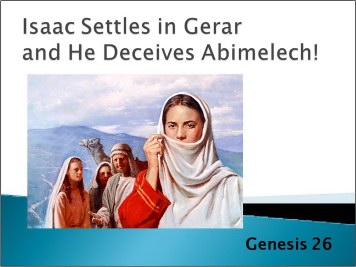
Genesis/Bereshith 26: "I am the God of Avraham your father"

Image from lastdayscalendar.tripod.com

[This chapter begins with a strange ‘deja vu’ except the first two times, the experience was related to Abraham . . . now almost exactly the same experience happens to 2nd generation Yitschaq.  It is this kind of repetition that sometimes makes you wonder if the copyists of the Hebrew Scriptures might have made mistakes, except when you read about how scrupulous those copyists were at handling the ‘very words of YHWH’, you have to rethink and conclude: ‘well, maybe in those days, this was a common experience for men with beautiful wives who catch the eye of powerful rulers like Pharaoh.’  Then again there are the skeptics and scholars who attribute these strange repetitions to human authors who penned the sacred scriptures of Israel, etc.  The point in these ‘deja vus’ is the disobedience of father and son to the command of YHWH for them not to go down into Egypt.  Both times however, despite the patriarchs disobedience, it is demonstrated that their God is with them which becomes evident to those ‘with eyes to see’ the workings of the Divine in a person’s life.  There are those with eyes to see but are blind to such obvious connections or unbelievable coincidence, you know?


Another ‘deja vu’,  a repetition of the promise to Abraham now continues to his second generation, the promised son. It is clear that Isaac/Yischak gets blessed:

Genesis 26:
4 I will make your seed many, like the stars of the heavens, and to your seed I will give all these
lands;
all the nations of the earth shall enjoy blessing through your seed—
5 in consequence of Avraham’s hearkening to my voice and keeping my charge: my
commandments, my laws, and my instructions

Lesson for us:  Is it that simple to be blessed? Hear, obey, heed the teachings and instructions or the Torah? Well, according to these instructional narratives— yes!  It worked for the patriarchs, it worked for Israel for the times they were obedient, surely it would work for us Gentiles, since Torah is intended for all humankind, not just the custodians of YHWH’s revelation.  There is blessing for obedience and  . . . well, obviously none for disobedience; worse, it might even transmutate to ‘curse’ as the Rabbis surmise, see:  Is YHWH the source of evil?

One other ‘deja vu’ here is the redigging of Abraham’s wells by Yitschak.  It is said that there will come a time when wars will be fought over drinking water or the lack of it; that sounds pretty strange when you consider that all the water in this world are just constantly recycled or transform into any of the three states that H2O exists:  solid, liquid, gas. Of course, potable water could be threatened by the growing toxicity of the natural environment of planet earth.  And so perhaps we can understand the importance of wells during the times of Israel’s Patriarchs.  Following the logic of — in the land of the blind, the one-eyed man is king, in times of drought and in the absence of potable water, the well-owner is is a well-thy man indeed!


Commentary is from Pentateuch and Haftorahs, ed. Dr. J.H.Hertz; translation and additional commentary by “EF” – Everett Fox, The Five Books of Moses; “RA’ commentary is Robert Alter, all listed in our MUST READ/MUST OWN resources.—Admin1.]

Genesis/Bereshith 26

ISAAC AND THE PHILISTINES

[RA]  This chapter is the only one in which Isaac figures as an active protagonist.  Before, he was a bound victim; after, he will be seen as a bamboozled blind old man.  His only other initiated act is his brief moment as intercessor on behalf of his wife in 25:21.  Textual critics disagree about whether this chapter is a mosaic” of Isaac traditions or an integral literary unit, and about whether it is early or late.  What is clear is that the architectonics of the larger story require a buffer of material on Isaac between Jacob’s purchase of the birthright and his stealing of the blessing—a buffer that focuses attention on Isaac’s right to the land and on his success in flourishing in the land.  All of the actions reported here, however, merely delineate him as a typological heir to Abraham.  Like Abraham he goes through the sister-wife experience, is vouchsafed a covenantal promise by God, prospers in flock and field, and is involved in a quarrel over wells.  He remains the pale and schematic patriarch among the three forefathers, preceded by the exemplary founder, followed by the vivid struggler.

1 Now there was a famine in the land, aside from the former famine which there had been in the
days of Avraham,
so Yitzhak went to Avimelekh, king of the Philistines, to Gerar.

the first famine. Mentioned in XII,10.

Abimelech.  See XX,2.  Possibly the dynastic name of the Philistine rulers.

Gerar.  See XX,1.

[EF]  a famine . . . Yitzhak went to Avimelekh: Parallel to the story in Chap. 20.

[RA]  besides the former famine.  The writer (some would say, the editor) signals at the outset that this story comes after, and explicitly reenacts, what happened before to Abraham.

king of the Philistines.  In this version, the anachronistic identification of Gerar as a Philistine city, not strictly intrinsic to the Abimelech story in chapter 20, is insisted on.  There is no obvious literary purpose for this difference; one suspects it simply reflects the historical context in which this version was formulated, in which the western Negeb would have been naturally thought of as Philistine country.

2 And YHVH was seen by him and said: 
Do not go down to Egypt; continue to dwell in the land 
that I tell you of,

go not down into Egypt. Isaac would naturally resolve to do what his father had done in similar circumstances, as described in XII,10.

[RA] Do not go down to Egypt.  That is, emulate the pattern of Abraham’s second-sister-wife episode, not the first.  Following a coastal route, Isaac could well have used Gerar as a way station to Egypt, and Abraham;s pact with Abimelech (chapter 21) would have provided some assurance that the Gerarites would grant him safe transit.

3 sojourn in this land, and I will be with you and will give you blessing—
for to you and to your
seed I give all these lands
and will fulfill the sworn-oath that I swore to Avraham your father:

sojourn.  Stay for the time being; see XII,10.

4 I will make your seed many, like the stars of the heavens,
and to your seed I will give all these lands;
all the nations of the earth shall enjoy blessing through your seed—

as the stars of heaven. V,5.

bless themselves. See on XII,3.

[RA]  all these lands.  “lands” occurs in the plural in this version of the promise because Isaac is in the land of the Philistines.

5 in consequence of Avraham’s hearkening to my voice
and keeping my charge: my commandments, my laws and my instructions.

because that Abraham. Emphasizing the unity and continuity of Abraham and his descendants.

commandments. Laws dictated by the moral sense, e.g. against the crimes of robbery, bloodshed, etc.

statutes.  Laws ordained by God which we are to observe although reason cannot assign an explanation, e.g. the prohibition of swine’s flesh. [Admin1: When this commentary was written in 1936, genetic science had not yet progressed to where it is now; please go to the posts under Waiqrah/Leviticus 11 [ Biblical Diet 2—UNclean Meat] and be illuminated as to why medically and healthwise, pig meat and its processed foods (bacon, ham, pork sausages, pork rinds) are the first to be listed on the NONO menu of sufferers of arthritis, rheumatism, gout, and a host of others. It might save you some big medical bills to simply adjust the menu on your plate and your palate.

laws. Customs and traditional ordinances orally transmitted from generation to generation.  These definitions are given in the Midrash.

[EF]  in consequence of Avraham’s hearkening . . . : The blessing mirrors 22:17. my commandments . . .: These are not specified; this is probably a poetic phrase describing a general idea.

6 So Yitzhak stayed in Gerar.
 

[EF]  The Wife—III (26:7-11):  Here is the final “Yitzhak version” of the tale, constructed around the same king whom Avraham had encountered in Chap. 20.  Its individual coloring is supplied by the “laughing-and-loving” of v. 8, playing on Yitzhak’s name.  Otherwise, just as in the following episode, he is merely repeating his father’s experience.

7 Now when the men of the place asked about his wife, he said: She is my sister,
for he was afraid to say: my wife—
(thinking): Otherwise the people of the place will kill me on account of Rivka, for she is beautiful to look at.

Isaac meets with the same experience as his father (XII,13; XX,5), and unwisely adopts the same plan for safeguarding his person.

[RA]  the men of the place.  The sexual threat against the matriarch is displaced in this final version from the monarch to the local male populace.  The likely reference of “one of the people” in verse 10 is what it seems to say, any male Gerarite, despite an exegetical tradition (influenced by the earlier Abimelech story) that construes it as an epithet for the king.

she is comely to look at.  Isaac’s interior monologue uses the identical epithet invoked by the narrator in introducing Rebekah in chapter 24.

8 But it was, when he had been there a long time,
that Avimelekh, king of the Philistines, looked
out through a window
and saw: there was Yitzhak laughing-and-loving with Rivka his wife!

Abimelech has not taken Rebekah into his household as had been done with Srah.

at a window.  Or, ‘through the window.’

sporting. The same word as used in XXI,9, but having here a different meaning.  Their conduct was such that Abimelech suspected they were husband and wife.

[RA]  as his time there drew on. Rashi, with his characteristic acuteness of response to nuances of phrasing, construes this as a suggestion that Isaac became complacent with the passage of time (“From now on I don’t have to worry since they haven’t raped her so far”) and so allowed himself to be publicly demonstrative with Rebekah.

looked out the window. This is the most naturalistic of the three versions of the story.  The matriarch’s marital status is conveyed not by a dream-vision from God, but by ocular evidence.

playing. The meaning of the verb is clearly sexual, implying either fondling or actual sexual “play.”  It immediately follows the name “Isaac,” in which the same verbal root is transparently inscribed.  Thus Isaac-the-laugher’s birth is preceded by the incredulous laughter of each of his parents; Sarah laughs after his birth; Ishmael laugh-smocks at the child Isaac; and now Isaac laughs-plays with the wife he loves.  Perhaps there is some suggestion that the generally passive Isaac is a man of strong physical appetites; he loves Esau because of his own fondness for venison; here he rather recklessly disports himself in public with the woman he has proclaimed to be his sister.

Image from www.keyway.ca

9 Avimelekh had Yitzhak called and said:
But here, she must be your wife!
So how could you say: She is my sister?
Yitzhak said to him:
Indeed, I said to myself: Otherwise I will die on account of her!
10 Avimelekh said:
What is this that you have done to us!
One of the people might well have lain with your wife,
and then you would have brought guilt upon us!

[RA] One of the people might well have lain with your wife.  Though Abimelech’s words approximately mirror those of the indignant king in chapter 20, this version is pointedly devised to put the woman first announced as Isaac’s beautiful, strictly virgin bride in less danger than Sarah was in Chapters 12 and 20: Rebekah is never taken into the harem’ it is merely a supposition that one of the local men might seize her for sexual exploitation.

11 Avimelekh commanded the entire people, saying:
Whoever touches this man or his wife must
be put to death, yes, death!

[EF]  touches: Or “harms.”

12 Yitzhak sowed in that land, and reaped in that year a hundred measures;
thus did YHVH bless him.

in the same year, i.e. in the year of famine. That is why his prosperity was regarded as not a natural thing but a Divine blessing.

a hundredfold. ‘In the rich lava-soil of Hauran, wheat is said to yield on an average 80 fold, and barley, 100 fold (Wetzstein).

[EF] reaped:  Lit. “attained.”

Blessing (26:12-33): Confirmation of Yitzhak’ status as heir comes in vv.12-14, in the form of material blessings (already referred to immediately after Avrham’s death, 25:11).  It will be Yaakov’s task to reclaim and continue the spiritual side of the tradition.

The first episode is centered around not Yitzhak but Avraham.  The phrase “his father” reverberates; and Avimelekh returns.  In the second episode; Avraham’s treaty with that king (Chap. 21) is replayed, with the same result as before: an explanation of the name Be’er-Sheva.

[RA]  And Isaac sowed.  In keeping with the emphasis of this version on human action, the bounty that comes to the patriarch after the deflection of the sexual danger to his wife is not a gift from the monarch but the fruit of his own industry as agriculturalist and pastoralist.  There is a continuity between his sojourning in the western Negeb near Gerar and his movement somewhat to the east, to Beersheba, where his father had long encamped.  All this creates a direct connection between the sister-wife episode and the theme of Isaac inheriting and growing prosperous in the land.

13 The man became great, and went on, went on becoming greater, until he was exceedingly
great:
14 he had herds of sheep and herds of oxen and a large retinue-of-servants,
and the Philistines envied him.

[RA] and the Philistines envied him.  The jealousy over Isaac’s spectacular prosperity and the contention over precious water resources that follows lay the ground for the story of the two brothers struggling over the blessing of land and inheritance in the next episode.  Isaac’s being “sent away” by the Philistines adumbrates Jacob’s banishment to the east after having procured the blessing by stealth.

15 And all the wells which his father’s servants had dug in the days of Avraham his father, the
Philistines stopped up and filled with earth.
16 Avimelekh said to Yitzhak:
Go away from us, for you have become exceedingly more mighty
(in number) than we!

The prosperity of the Patriarch creates envy among his neighbours.  Modern anti-Semitism is, likewise, largely dictated by envy, thus illustrating the Rabbinic saying, ‘What happened to the Patriarchs, repeats itself in the life of their descendants.’

17 So Yitzhak went from there, he encamped in the wadi of Gerar
and settled there.

valley. The Heb. word nahal means a wady or river-bed, which in the winter, or even after a storm, is a rushing stream, but in summer is usually reduced to a mere thread of water, or may even be entirely dry.  In the bed of such wadys, water may often be found by digging (Driver).

[EF] there:  The word occurs seven times through v. 25.  It may be a counterpoint to Chap. 24’s usage, or to stress that Yitzhak stays in the land.

[RA] wadi.  The Arabic term, current in modern English and Hebrew usage, designates, as does the biblical naal, a dry riverbed that would be filled with water only during the flash floods of the rainy season.  But the floor of a wadi might conceal, as here, an underground source of water.

18 Yitzhak again dug up the wells of water which had been dug in the days of Avraham his 
father, the Philistines having stopped them up after Avraham’s death, and he called them by the names, 
the same names, by which his father had called them. 
19 Yitzhak’s servants also dug in the wadi, and found there a well of living water.
 

living water.  Or, ‘springing water’; the opposite of stagnant water.

[EF]  wadi:  An often-dry riverbed.  living water; fresh-water.

20 Now the shepherds of Gerar quarreled with the shepherds of Yitzhak, saying: The water is 
ours!
 
So he called the name of the well: Esek/Bickering, because they had bickered with him. 

[RA]  Esek. Roughly, “contention,” as in the verb that follows in the etiological explanation of the name.

Image from destination-yisrael.biblesearchers.com
21 They dug another well, and quarreled also over it,
so he called its name: Sitna/Animosity. 

[RA] Sitnah. The transparent meaning is “accusation” or “hostility,” though the sentence lacks an etiological clause.

22 He moved on from there and dug another well, but they did not quarrel over it,
so he called its name: Rehovot/Space,
and said: Indeed, now YHVH has made space for us, so that we may bear fruit in the land! 

Rehoboth. i.e. ‘Room’, latitude; lit. ‘broad palces’.  In Heb. the word denoting ‘spaciousness’ is used to express comfort and security.  Twenty miles S.W. of Beersheba there is a well known as Ruhaibeh.

[RA] another well. The struggle over wells, which replays an episode in the Abraham stories but is given more elaborate emphasis, works nicely as part of the preparation for the next round of the Jacob-Esau conflict:  a water source is not easily divisible; the spiteful act of the Philistines in blocking up the wells expresses a feeling that if we can’t have the water, nobody should; at the end, Isaac’s workers discover a new, undisputed well and call it Rehoboth, which means “open spaces.”  We are being prepared for the story in which only one of the two brothers can get the real blessing, in which there will be bitter jealousy and resentment; and which in the long run will end with room enough for the two brothers to live peaceably in the same land.

23 He went up from there to Be’er-sheva. 
24 Now YHVH was seen by him on that night and said:
I am the God of Avraham your father. 
Do not be afraid, for I am with you,
I will bless you and will make your seed many, for the sake of 
Avraham my servant. 

fear not.  In view of the hostility recently shown him.

25 He built a slaughter-site there
and called out the name of YHVH.
He spread his tent there, and Yitzhak’s servants excavated a well there. 

called upon the name of the LORD.  See XII,8.

26 Now Avimelekh went to him from Gerar, along with Ahuzzat his aide and Pikhol the commander of his army. 

his friend. i.e. his intimate counsellor.

Phicol.  The same as in XXI,22.  If the Abimelech and Phicol are identical with those mentioned in Chap. I, they must have been old men in the time of Isaac.

[EF] aide: Lit. “friend.”

27 Yitzhak said to them:
Why have you come to me?
For you hate me and have sent me away from you! 

[RA]  sent me away from you.  It is a mistake to render the verb, as several modern translations do, as “drive away.”  The verb Isaac chooses is a neutral one, even though the context of the sentence strongly indicates hostile intention.  Abimelech in his response (verse 29) uses exactly the same word, adding the qualifier “in peace” in order to put a different face on the action:  this was no banishment, we sent you off as a reasonable act of good will.  The narrator then uses the same verb and qualifier—which might conceivably be a formula for parting after the completion of a treaty—in verse 31, “and Isaac sent them away, and they went from him in peace.”  (Compare David and Abner in 2 Samuel 3.)

28 They said:
We have seen, yes, seen that YHVH has been with you,
so we say: Pray let there be an oath-curse between us, between us and you,
we want to cut a covenant with you: 

the LORD was with thee.  The same motive for seeking friendship as in XXI,22.

oath.  A compact sealed by an oath.

29 If ever you should deal badly with us . . . !
Just as we have not harmed you and just as we have only dealt well with you and have sent you away in peace—
you are now blessed by YHVH! 

we have not touched thee.  v. 11.

30 He made them a drinking-feast, and they ate and drank. 

[EF] they ate and drank: The cutting of a covenant is often accompanied by a meal in biblical and other societies.

31 Early in the morning they swore (an oath) to one another;
then Yitzhak sent them off, and they went from him in peace. 
32 Now it was on that same day
that Yitzhak’s servants came and told him about the well that they had been digging,
they said to him: We have found water! 
33 So he called it: Shiv’a/Swearing-seven;
therefore the name of the city is Be’er-sheva until this day. 

Shibah. Better, Good Fortune.  The Semitic root— in addition to its other meanings—denotes ‘to be fortunate’.

Beer-sheba. i.e. Fortune’s Well.

[RA]  Shibah. Though the word in this form means “seven,” the etiology of the name intimated by the narrative context obviously relates it to “shevu’ah,  “oath,” whereas the earlier story about Beersheba (Chapter 21) appears to link the name with both “seven” and “oath.”

34 When Esav was forty years old, he took to wife Yehudit daughter of B’eri the Hittite and Ba’semat daughter of Elon the Hittite. 

Judith. It is not found again in the Bible, but is the name of the heroine of one of the books of the Apocrypha.

Basemath.  In XXXVI,2, we are given the names of more wives of Esau.

[EF] forty years old: The same age that his father was at the time of his marriage.

[RA]  And Esau . . . took as wife. This brief notice about Esau’s exogamous unions obviously is distinct from the preceding stories about Isaac.  It is probably placed here to remind us of his unworthiness to be the true heir (thus forming a kind of envelope structure with the spurning of the birthright int he last verse of chapter 25), and in this way serves to offer some sort of justification in advance for Jacob’s stealing the blessing in the next episode.  It also lays the ground for the end of the next episode in which Rebekah will invoke the need for Jacob to find a wife from his own kin as an excuse for his hasty departure for Mesopotamia.

35 And they were a bitterness of spirit to Yitzhak and Rivka. 

a bitterness of spirit.  Or, ‘a grief of mind.’  It was against the family tradition to intermarry with these races; see XXIV,3; XXVII,46.  The mention of Esau’s wives is introduced here to show how faithless he was to the teachings and example of Abraham and Isaac, and therefore unworthy to be regarded as their spiritual heir and to receive his father’s blessing.

[RA] provocation.  Some commentators construe the first component of the compound noun morat-rua as a derivative of the root m-r-r, “bitter”—hence the term “bitterness” favored by many translations.  But the morphology of the word points to a more likely derivation from m-r-h, “to rebel” or “to defy,” and thus an equivalent such as “provocation” is more precise.


Genesis/Bereshith 25b – " Two nations are in your body"

[Unbracketted commentary is from Pentateuch and Haftorahs, ed. Dr. J.H.Hertz which is a collection of rabbinic and non-Jewish scholarly interpretation of the Torah books. When commentators go beyond the plain meaning of the text, you wonder what is the agenda for doing so; usually it’s the religious perspective that gets in the way of objectivity.  This is not difficult to spot in the commentary.   Reading different perspectives of the foundational books in the TORAH is informative and educational; you either agree or disagree, chew and digest or spit out.  

For our own commentary, please read these two earlier posts on this set of ‘biblical’ twins:

The translation used here is Everett Fox, The Five Books of Moses with commentary indicated y “EF”; additional commentary by “RA” for Robert Alter who also wrote a translation with the same title as Fox..Admin1.]

———————————————-

Genesis/Bereshith 25: 19-34

THE BIRTHRIGHT

With this verse, a new section of the Book of Genesis commences, which extends to the end of Chapter XXXVI.  Therefore, we are given a brief summary of what has gone before, to prepare us for the new events to be described.

19 Now these are the begettings of Yitzhak, son of Avraham.
Avraham begot Yitzhak.

Abraham’s son. i.e. his son and heir, to distinguish him from the children of Hagar and Keturah.

Abraham begot Isaac. It was not until the Patriarch’s name was altered from Abram to Abraham, ‘father of a multitude of nations’ (XVII,5), that Isaac was born.

20  Yitzhak was forty years old when he took Rivka daughter of Betuel the Aramean, from the country of Aram, sister of Lavan the Aramean, for himself as a wife.

Paddan-aram. Identical with Aram-Naharaim, or Mesopotamia: XXIV,10.

21  Yitzhak entreated YHWH for his wife, for she was barren,
and YHWH granted-his-entreaty:
Rivka his wife became pregnant.

Image from interactiveworship.weebly.com

she was barren.  Like Sarah before her (XVI,1) and Rachel after her (XXIX,31).  This sterility may have been intended to emphasize that the children who were eventually born were a gift of grace from God for the fulfillment of His purpose.

22 But the children almost crushed one another inside her,
so she said:
If this be so,
why do I exist?
And she went to inquire of YHVH.

struggled together. A premonition of the rivalry which was to exist between the brothers and their descendants.

if it be so, wherefore do I live?  Life was unbearable for her, and she wished to die (Nachmanides).

to inquire of the LORD.  A technical term for seeking an answer from a Divine source.  According to the Midrash, she went to the School of Shem, where the knowledge of God was taught.  It is very probable that she went to ‘inquire of the Lord’ through Abraham, who was still alive at this time (see on v. 7).

23 YHVH said to her:
Two nations are in your body,
two tribes from your belly shall be divided; 
tribe shall be mightier than tribe,
elder shall be servant to younger!

two nations.  i.e. the founders of two nations.  The oracular answer is in four poetic lines.

shall be separated.  Shall be mutually antagonistic from birth.

the elder shall serve the younger. This prophecy was fulfilled when David defeated Edom. See II Sam. VIII,14.

24  When her days were fulfilled for bearing, here: twins were in her body.

25 The first one came out ruddy, like a hairy mantle all over,
so they called his name: Esav/Rough-one.

Image from summerofscripture.blogspot.com

ruddy. Heb. admoni.  The Midrash explains the ruddiness as a premonition of his love for hunting and shedding of blood.

Esau.  Some authorities derive it from a Semitic root meaning ‘thick-haired’.

26 After that his brother came out, his hand grasping Esav’s heel,
so they called his name: Yaakov/Heel-holder.
Yitzhak was sixty years old when she bore them.

his hand had hold on Esau’s heel. As it were to pull him back and prevent him from being the firstborn: Hosea XII,4.

27 The lads grew up:
Esav became a man who knew the hunt,
a man of the field, but Yaakov
was a plain man, staying among the tents.

a cunning hunter.  lit. ‘knowing hunting’. The word ‘cunning’ is used in its old meaning, ‘skillful.’

quiet.  lit. ‘perfect’; i.e. harmless.

dwelling in tents. i.e. a shepherd. The Midrash explains ‘tents’ to mean ‘schools of religious study’; on v. 22.

28 Yitzhak grew to love Esav, for (he brought) hunted-game for his mouth,
but Rivka loved Yaakov

now Isaac loved Esau. Although in Rabbinic literature Esau the roving huntsman is, like Nimrod, depicted as a bad character because of the bloodshed and cruelty to animals that the hunter’s life entails, yet he is praised for his devotion to Isaac.  To have merited his father’s love is regarded as the consequence of Esau’s filial piety.

and Rebekah loved Jacob. Each parent had a favourite child, which was to lead to the break-up of the household.  ‘Love thy children with an impartial love,’ is the wise admonition of a medieval Jewish leader.

29  Once Yaakov was boiling boiled stew,
when Esau came from the field, and he was weary.
30 Esav said to Yaakov:
Pray give me a gulp of the red-stuff, that red-stuff,
for I am so weary! 
Therefore they called his name: Edom/Red-one

swallow. The Heb. word, which does not occur elsewhere in the Bible, implies animal-like voracity.

Edom. ‘The Hebrews saw in the name of the rival nation a standing reminder of the impulsive shortsightedness of its ancestor’ (Driver).  The term ‘mess of pottage’, used proverbially of this transaction, does not occur in the Authorised Version of the Bible.

31 Yaakov said:
Sell me your firstborn-right here-and-now.

Image from freepages.religions.rootsweb.ancestry.com

sell me first thy birthright. At first sight, Jacob’s conduct appears indeed reprehensible.  On closer examination, however, we learn that the privileges of the birthright so coveted by Jacob were purely spiritual.  In primitive time, the head of the clan or the firstborn acted as the priest.  Esau’s general behaviour hardly accorded with what was due from one who was to serve the Supreme God; and Jacob suspected that his brother did not value the dignity and privilege of being the firstborn as they should be valued.  When, therefore, an opportunity suggested itself, Jacob determined to put his brother to the test.  He knew full well that the withholding of the pottage would not have fatal consequences.  He would, however, find out what Esau really thought of his birthright.  ‘As to power and command, Jacob never exercised any over Esau; but on the contrary, humbly and submissively addresses him as “my Lord”‘ (Abarbanel).

32 Esav said:
Here, I am on my way to dying, so what good to me is a firstborn-right?

I am at the point to die.  The exaggeration of a hungry man of uncontrolled appetite.

33 Yaakov said:
Swear to me here-and-now.
He swore to him and sold his firstborn-right to Yaakov.
34 Yaakov gave Esav bread and boiled lentils;
he ate and drank and arose and went off.
Thus did Esav despise the firstborn-right.

So Esau despised his birthright. Which he would not have done had it carried with it material advantages.  The spiritual inheritance of Abraham, which would normally have passed into the hands of Esau, was not worth to him as much as a dish of pottage.  Like the true sensualist, this fickle and impulsive hunter readily sacrifices to the gratification of the moment that which to a man of nobler build would be of transcendent worth.

Genesis/Bereshith 25a: "Yitschaq and Yishma’el buried him in the cave of Makpelah"

[At the bottom of this page, the image of a book might interest you —- well, not so much the image but the title of the book!  For the longest time, we have agreed with the attribution to Abraham as the patriarch to whom three major monotheistic world religions trace their roots: Judaism, Christianity, Islam . . . chronologically that seems to be the order.  But the book claims more, find out for yourself, no spoonfeeding, remember?


The Commentary here come from Pentateuch and Haftorahs, ed. Dr. J.H. Hertz; translation with commentary is EF/Everett Fox, The Five Books of Moses; additional commentary by RA/Robert Alter..


Update November 25, 2015:  In a recent book that came out October 2015 titled:  NOT IN GOD’S NAME: CONFRONTING RELIGIOUS VIOLENCE, the  author Rabbi Jonathan Sacks presents a Midrash interpretation that identifies the name “Keturah”, mentioned as the wife that Abraham takes after Sarah’s death.  The Rabbis/Jewish scholars identify “Keturah” as Hagar, the Egyptian maid of Sarah who bore for Abraham his true firstborn son:  Ysmael.  That is why at the time of Abraham’s death and burial, the half-brothers Isaac and Ishmael are together.  What are the clues in Scripture that lead to such conclusion?  You will have to read Chapter 6 of Rabbi Sack’s book, titled “The Half-Brothers” and give him a hearing.  Take our word for it, the book is worth adding to your research library if you are a truth-seeker, making sense of the narratives in the book of Genesis/Bereshiyth and connecting them with the developments confronting this millenial generation, baffling events today that one would never think of tracing their root cause to  ancient biblical stories of sibling rivalry. Here’s a review of the book by David Brooks, OP-Ed columnist of the New York Times, published November 17, 2015: 

http://www.nytimes.com/2015/11/17/opinion/finding-peace-within-the-holy-texts.html?

Admin1.]

———————————————————


Genesis 25


DEATH OF ABRAHAM

AND

DESCENDANTS OF ISHMAEL


Image from www.khandipages.com

ABRAHAM took another wife and her name was Qetuwrah.


and Abraham took another wife.  It does not necessarily mean that it was not until after the death of ?Sarah that he married again.  It is quite possible that he took his secondary wife (in I Chron. I,32 Keturah is called a ‘concubine’) during her lifetime; and it is only mentioned here in connection with the disposal of the Patriarch’s property.


[RA] And Abraham took another wife.  The actual place of this whole genealogical notice in the chronology of Abraham’s life might be somewhere after the burial of Sarah at the end of chapter 23, or perhaps even considerably earlier.  The genealogy is inserted here as a formal marker of the end of the Abraham story.  Perhaps a certain tension was felt between the repeated promise that Abraham would father a vast nation and the fact that he had begotten only two sons. This tension would have been mitigated by inserting this document at the end of his story with the catalogue of his sons by Keturah.  In this list, Abraham figures as the progenitor of the seminomadic peoples of the trans-Jordan region and the Arabian peninsula.  The second genealogical notice (verses 12-18), that of the descendants of Ishmael, covers a related group of tribes—twelve in number, like the Israelite tribes—in the same geographical region, but also extending up to northern Mesopotamia.  Thus, as Ishmael definitively leaves the scene of narration, the list provides a “documentary” confirmation of the promise that he, too, will be the father of a great nation.


2. And she gave birth for him Zimran, Yoqshan, Medan, Midyan, Yishbaq, and Shuwach.

The domestic tradition in these verses preserves the recollection of the early relationship between the ancestors of Israel and the tribes of the North Arabian desert (Ryle).

Medan. The ‘Medianites’ are referred to in XXXVII as traders with Egypt.

Median.  The name of a nomad tribe frequently occurring in the Bible.

Shuah. One of Job’s friends is described as a Shuhite (Job II,11).

3. Yoqshan was the father of Sheba’ and Dedaneh. The sons of Dedaneh were ‘Ashshuwriy, Letuwshim, and Le’ummiym.

Sheba and Dedan.  Mentioned in X,7. The other names are found on Arabian inscriptions.

4. The sons of Midyan were ‘eyphah, ‘Epher, Chanowk, ‘Abiyda, and ‘Elda’ah. All these were the sons of Qetuwrah.

5. And ‘Abraham gave all that he had to Yitschaq.

XXIV,36.

6. But to the sons of his concubines ‘Abraham gave gifts, and while he was still living he sent them to the east country, away from Yitschaq his son.

concubines.  i.e. Hagar and Keturah.

while he yet lived. i.e. in his lifetime, a wise precaution to ensure the safety of Isaac and prevent disputes amongst the members of the family.

eastward, i.e. to Arabia.  The Arabs are sometimes described as ‘children of the East’; see Judges VI,3; Job I,3.

[RA]  concubines.  The plural form may imply that Keturah’s status, like Hagar’s, was that of a concubine.

Image from mygodlesslife.blogspot.com

7. The days of the life of ‘Abraham were one hundred seventy-five years.

a hundred three score and fifteen years. Abraham must have lived to see his grandchildren.  Isaac was born when his father was a hundred (XXI,5), and was sixty at the birth of Esau and Jacob (see v. 26); hence they were fifteen when the Patriarch died.

8. Then ‘Abraham breathed out and died at an advanced age; a satisfied old man, and was gathered to his people.

was gathered to his people. Not to be understood literally, as his people were buried in Mesopotamia.  It is a parallel phrase to ‘thou shalt go to thy fathers’ in XV,15; and, like it, is an intimation of immortality.

[RA] sated with years.  The Masoretic Text has only “sated,” but the Syriac, Samaritan, and Septuagint versions as well as some manuscripts read “sated with years,” which the context clearly requires.

9. And his sons Yitschaq and Yishma’el buried him in the cave of Makpelah, in the field of ‘Ephrown ben Tsochar the Chittiy, which is east of Mamre’,

Isaac and Ishmael.  At the gravesite of their father, the half-brothers were reconciled (Midrash).

Machpelah. See XXIII,9.

10. the field which ‘Abraham purchased from the Chittiy. There ‘Abraham was buried with Sarah his wife.

11. After the death of ‘Abraham, ‘Elohiym [Mighty One] blessed his son Yitschaq, and Yitschaq lived at Be’er la-Chai Ro’iy.

God blessed Isaac. i.e. the promises made to Abraham were now transferred to him.

12-18.  DESCENDANTS OF ISHMAEL

12. Now this is a history of the sons of Yishma’el, the son of ‘Abraham, whom Hagar the Mitsriyth, the handmaid of Sarah, bore to ‘Abraham.

generations.  Descendants.  Some of the names that follow are found in Assyrian and Arabian inscriptions.

13. These are the names of the sons of Yishma’el, named in the order of their births: Nebayoth, the firstborn of Yishma’el, and Qedar, ‘Adbe’el, Mibsam,

Nebaioth.  Later known as Nabataeans.

Kedar. In Ps. CXX,5, they are taken as a type of hostile neighbours.

14. Mishma’, Duwmah, Massa’,

15. Chadad, Teyma’, Yetuwr, Naphiysh, and Qede­mah.

Tema.  An important station on the trade route from Yemen to Syria.

16. These are the sons of Yishma’el, and these are their names, by their villages, and by their encamp­ments; twelve princes of their tribes.

encampments.  Probably a technical term to denote the circular enclosure used by a nomad people.

princes.  Sheiks of clans.

[RA] habitations.  The Hebrew term in urban architectural contexts means “court,” but the older meaning is “dwelling place,” or perhaps something like ‘unfortified village.”  The cognate in the Ugaritic texts means “house.”

17. And Yishma’el lived one hundred thirty-seven years; then his spirit left him, and he died and was gathered to his people.

was gathered.  See on v. 8.

18. They lived from Chaviylah to Shuwr, in the face of Mitsrayim towards ‘Ashshuwr. In the face of all his brothers he fell.

Havilah.  See II,11; situated in N.E. Arabia.

Shur. See on XVI,7; also I Sam. XV,7.

Asshur.  The reference is probably to the land of Asshurim mentioned in v. 3.

did settle.  lit. ‘fell.’ For this sense of the word, Judges VII,12.

[RA]  And they ranged.  The verb shakhan suggests an activity less fixed that “to settle” or “to dwell,” and this translation follows the lead of E.A. Speiser in using a verb that implies nomadism.

In despite of all his kin he went down.  The translation reproduces the enigmatic character of the whole clause in Hebrew.  “In despite of all his kin” repeats exactly the words of Ishmael’s blessing in 16:12, and so the ambiguous “he” here may also be Ishmael, who is mentioned in the previous verse.  But some construe the initial preposition of the clause as “alongside” or “in the face of.”  The verb is equally opaque: its most common meaning is “to fall” some have imagined it has a military meaning here (“to attack” or “to raid”); others have construed it as a reference to the “falling” of the inheritance.


Image from amazon.com

Image from amazon.com

This chapter concludes the Biblical account of the first of the Patriarchs.  It is difficult, indeed, because of our lifelong familiarity with the story, rightly to estimate the nobility and grandeur of the personality revealed in these chapters.


He was the pioneer of the monotheistic faith.


Undazzled by the heathen splendour of a Nimrod or a Hammurabi,

he broke away from the debasing idol-worship of his contemporaries,

and devoted his life to the spread of the world-redeeming truth of the One God of Justice and Mercy.


He forsook home and family to brave unknown dangers because the voice of God bade him do so; and, throughout his days, he showed that faith in God must manifest itself in implicit and joyful surrender to the Divine will.  


He set an example to his children to sacrifice the dearest things in life,

and, if need be, life itself, in defence of the spiritual heritage entrusted to their care.  


While he preached renunciation in the service of God, he practised lovingkindness and truth towards his fellowmen.  


Witness his magnanimity in his treatment of Lot; his fine independence in the refusal to accept any of the spoils won by the men of his household;

his benevolence in the reception of strangers;

his stand for justice, when pleading for the doomed cities;

and his all-embracing human pity, which extended even to those who had forfeited all claim to human pity.


 Finally, the closing stage of his life shows his anxiety that the spiritual treasures he has acquired should be transmitted unimpaired through his son to future generations.  Verily he is the prototype of what the Jew should aim at being.  

‘Look unto the rock whence ye were hewn . . . look into Abraham your father,’ is the Divine exhortation addressed to Israel (Isaiah LI,1-2).


——————————————————


P.S.  If the book cover/title got your attention, here’s a short write-up on its contents in amazon.com:


Genesis/Bereshith 24: " . . . go to my land and to my kindred, and take a wife for my son, for Yitzhak."

[Unbracketed commentary is from Pentateuch and Haftorahs, ed. Dr. J.H. Hertz; the translation/commentary is EF/Everett Fox, The Five Books of Moses, with additional commentary from RA/Robert Alter.—Admin1.]

—————————————————————-

Genesis/Bereshith 24

1 Now Avraham was old, advanced in days, and YHVH had blessed Avraham in everything

well stricken in age. See XVIII,11.

2 Avraham said to his servant, the elder of his household, who ruled over all that was his: Pray
put your hand under my thigh!

the elder of his house.  The one who possessed the greatest authority.  Although the servant is not named here, it is clear from what was stated in XV,2 that Eliezer is intended.

put thy hand under my thigh. According to the Biblical idiom, children are said to issue from the ‘thigh’ or ‘loins’ of their father (XLVI, 26).  Therefore the formality of placing the hand upon the thigh was taken to signify that if the oath were violated, the children who have issued, or might issue, from the ‘thigh’ would avenge the act of disloyalty.

[EF] put your hand under my thigh: A symbol used in taking of an oath (see also 47:29).  The use of “thigh” might allude to a curse of childlessness as the punishment for not keeping the oath.

[RA] Put your hand . . . under my thigh.  Holding the genitals, or placing a hand next to the genitals, during the act of solemn oath-taking is attested in several ancient societies (a fact already noted by Abraham ibn Ezra in the 12th century), though here it may have the special purpose of invoking the place of procreation as the servant is to seek a bride for the only son Isaac.

3 I want you to swear by YHVH, the God of Heaven and the God of Earth, that you will not
take a wife for my son from the women of the Canaanites, among whom I am settled;

God of heaven.  Abraham makes his servant swear in the name of the God he himself worshipped; he had converted his servant tot he true Faith (see on XII,5), evidenced by Eliezer’s devout conduct throughout the narrative which follows.

daughters of the Canaanites.  Who might divert Isaac from the path which his father had mapped out for him; XXVIII,1.  This fear of the evil consequences which would result from intermarriage with heathens is frequently expressed in the Bible; e.g. Deut. VII,3.

4 rather, you are to go to my land and to my kindred, and take a wife for my son, for Yitzhak.

my country. . . kindred. Here the reference is to Haran and to the family of his brother Nahor.

[RA] to my land and to my birthplace you shall go.  These words are still another echo of the first words God speaks to Abraham at the beginning of chapter 12 sending him forth from his native land.

5 The servant said to him: Perhaps the woman will not be willing to go after me to this land;
may I then bring your son back there, back to the land from which you once went out?

The meaning is, If I find a suitable wife for Isaac in Haran but the woman is not willing to leave her home, am I to take Isaac to Haran?

[EF]  back there:  The Hebrew text has “there” in the next line:  it has been moved up in the English text for reasons of style.  The word occurs four times in vv. 5-8, as a signal of what is most important to Avraham that his son must stay in the land of Canaan.

6 Avraham said to him: Watch out that you do not ever bring my son back there.

On no account is Isaac to return to Haran, lest he abandon the Land of Promise.

7 YHVH, the God of Heaven, who took me from my father’s house and from my kindred, who
spoke to me, who swore to me, saying: I give this land to your seed—he himself will send his messenger
on before you, so that you take a wife for my son from there

Abraham felt strongly that Isaac’s marriage would be an important factor in the fulfillment of the Divine promise.  Hence God would help Eliezer in his mission to find a worthy wife for Isaac.

He will send His angel before thee.  An expression denoting that God’s protection and aid would be given him; Exod. XXIII,20.

[EF]  I give this land to your seed:  Quoting 12:7.

[RA]  Abraham’s language explicitly echoes the reiterated covenantal promises he has received.  Later in the story, when the servant gives the family a seemingly verbatim report of this initial dialogue with his master, he discreetly edits out this covenantal language.

8 Now if the woman is not willing to go after you, you will be clear from this sworn-oath of mine, only: You are not to bring my son back there! 
9 The servant put his hand under the thigh of Avraham his lord, and swore to him (an oath)
about this matter.

concerning this matter.  lit. ‘in accordance with this word,’ i.e. on the terms just laid down; namely, if the woman declines to follow him, Eliezer should be free from his obligation.

10 The servant took ten camels from his lord’s camels and went, all kinds of good-things from
his lord in his hand. He arose and went to Aram Of-Two-Rivers, to Nahor’s town

and the servant took.  Gifts for the bride and her family.

Aram-naharaim. i.e. Aram of the two rivers, Euphrates and Tigris, Mesopotamia.

the city of Nahor.  i.e. the city in which Nahor and his family dwelt, Haran.

[EF]  Aram Of-Two-Rivers: Others leave untranslated, “Aram-Naharahim.”

[RA] camels. The camels here and elsewhere in Genesis is a problem.  Archeological and extra-biblical literary evidence indicates that camels were not adopted as beasts of burden until several centuries after the Patriarchal period, and so their introduction in the story would have to be anachronistic.  What is puzzling is that the narrative reflects careful attention to other details of historical authenticity:  horses, which also were domesticated centuries later, are scrupulously excluded from the Patriarchal tales, and when Abraham buys a gravesite, he deals in weights of silver, not in coins, as in the later Israelite period.  The details of betrothal negotiation with the brother acting as principal agent for the family, the bestowal of a dowry on the bride and betrothal gifts on the family, are equally accurate for the middle of the second millennium B.C.E.  Perhaps the camels are an inadvertent anachronism because they had become so deeply associated in the minds of later writers and audiences with desert travel.  There remains a possibility that camels may have already had some restricted use in the earlier period for long desert journeys, even though they were not yet generally employed.  In any case the camels here are more than a prop, for their needs and treatment are turned into a pivot of the plot.

11 He had the camels kneel outside the town at the water well at setting time, at the time when
the water-drawers go out,

by the well of water. The place where a stranger would naturally wait who required information concerning an inhabitant of the city.

[EF] setting time: Sunset.  water-drawers: Female.

[RA] by the well of water at eventide, the hour when the water-drawing women came out. This is the first occurrence of the betrothal type-scene.  The conventionally fixed sequence of motifs of this type-scene is:  travel to a foreign land, encounter there with the future bride (almost always referred to as na’arah, “young woman”) at a well, drawing of water, “hurrying” or “running” to bring the news of the stranger’s arrival, a feast at which a betrothal agreement is concluded.  As a social institution, the well was probably a plausible place to encounter nubile maidens, though the well in a foreign land also has an archetypal look, suggesting fertility and the nuptial encounter with the otherness of the female. This version is the most elaborate and leisurely of the betrothal type-scenes, rich in detail, full of stately repetition.  It is also the only version in which the bridegroom himself is not present but rather a surrogate, and in which the young woman, not the man, draws the water, with the verb of hurrying that is linked with the bringing of the news amply describing her actions at the well.  There is surely some intimation in all this of the subsequent course of the marriage of Isaac and Rebekah—he in most respects the most passive of all the patriarchs, she forceful and enterprising.

12 and said: YHVH, God of my lord Avraham, pray let it happen today for me, and deal
faithfully with my lord Avraham!

send me good speed.  lit. ‘make it happen before me’ (as I desire).

[EF] let it happen: Or “let it go well.”

13 Here, I have stationed myself by the water spring as the women of the town go out to draw
water

Image from www.thebuttonmonger.com

14 May it be that the maiden to whom I say: Pray lower your pitcher that I may drink, and she
says: Drink, and I will also give your camels to drink— let her be the one that you have decided on for
your servant, for Yitzhak, by means of her may I know that you have dealt faithfully with my lord.

camels drink also. Eliezer would only ask a drink of water for himself.  The maiden on her own initiative was to suggest water for the camels. Her doing so would be evidence of a tender heart.  Kindness to animals is a virtue upon which Judaism lays stress.  The Talmud declares that a man must not sit down to his meal before giving food to his animals.  It is noteworthy that Eliezer decided to make beauty of character the criterion in his selection of a wife for Isaac.  He anticipated the writer of Prov. XXXI,30, who declared, ‘Grace is deceitful, and beauty is vain; but a woman that feareth the LORD, she shall be praised.’

15 And it was: Not yet had he finished speaking, when here, Rivka came out, -she had been born
to Betuel, son of Milca, wife of Nahor, brother of Avraham- her pitcher on her shoulder.

Bethuel.  See XXII,20.

16 The maiden was exceedingly beautiful to look at, a virgin-no man had known her. Going
down to the spring, she filled her pitcher and came up again.

very fair to look upon.  Rebekah possessed physical beauty as well as goodness of heart.

17 The servant ran to meet her and said: Pray let me sip a little water from your pitcher!

[RA] Pray, let me sip a bit of water.  With perfect politeness, the parched desert traveler speaks as though he wanted no more than to wet his lips.  In the event, prodigious quantities of water will have to be drawn.

18 She said: Drink, my lord! And in haste she let down her pitcher on her arm and gave him to
drink.
19 When she had finished giving him to drink, she said: I will also draw for your camels, until
they have finished drinking.

[RA] 18-19.  Drink, my lord . . . and let him drink.  And she let him drink his fill.  As Meir Sternberg (1985) acutely observes, this long delay before she finally produces the requisite offer to water the camels is a heart-stopper, enough to leave the servant in grave momentary doubt as to whether God has answered his prayer.

onto her hand. The motion, as Rashi notes, is lowering the jug from her shoulder to her hand, so that she can pour water out.

20 In haste she emptied her pitcher into the drinking-trough, then she ran to the well again to
draw, and drew for all his camels.

[RA]  and drew water for all his camels.  This is the closest anyone comes in Genesis to a feat of “Homeric” heroism (though the success of Rebekah’s son Jacob in his betrothal scene in rolling off the huge stone from the well invites comparison).  A camel after a long desert journey drinks many gallons of water, and there are ten camels here to water, so Rebekah hurrying down the steps of the well would have had to be a nonstop blur of motion in order to carry up all this water in her single jug.

21 The man kept staring at her, (waiting) silently to find out whether YHVH had granted success
to his journey or not.

holding his peace.  i.e. wondering in silence.

22 It was, when the camels had finished drinking, that the man took a gold nose-ring, a half-coin
in weight, and two bracelets for her wrists, ten gold-pieces in weight,

ring. i.e. nose-ring.

half a shekel weight.  The shekel weighed about half an ounce.  These gifts were both a token of gratitude and a means of obtaining the maiden’s favourable opinion.

[RA] beqa. The term beka’ is derived from a verb that means “to split” and so may refer to half a shekel, the standard weight, though that is not certain.  Following the convention of earlier English translations, I have not used the mark for ‘ayin in the text. [S6K note:  The last sentence refers to Robert Alter’s own translation of the Torah, with exact title as Everett Fox, The Five Books of Moses.]

23 and said: Whose daughter are you? Pray tell me! And is there perhaps in your father’s house a
place for us to spend the night?
24 She said to him: I am the daughter of Betuel, son of Milca, whom she bore to Nahor.
25 And she said to him: Yes, there is straw, yes, plenty of fodder with us, (and) yes, a place to
spend the night.

[EF]  Yes, there is straw: Not until Rivka has extended the offer of hospitality (and enthusiastically, with the triple “yes”) is the servant sure that “YHWH has granted success to my journey.”  Hospitality, once again, is the determinant, over and above beauty or virginity.

[RA] bran. The Hebrew teven appears to have two different meanings in the Bible.  In the brickmaking process mentioned in Exodus, and in several other occurrences, it means “straw,” and this becomes its only meaning in later Hebrew.  But there are several texts in which teven is clearly edible (Isaiah 11;7), 65;25; 1 Kings 5:8), and despite the preponderance of English versions, both Renaissance and modern, that opt for “straw” here, edible grain makes more sense.

26 In homage the man bowed low before YHVH
27 and said: Blessed be YHVH, God of my lord Avraham, who has not relinquished his
faithfulness and his trustworthiness from my lord! While as for me, YHVH has led me on the journey
to the house of my lord’s brothers!

mercy. Better, ‘kindness.’  The phrase ‘kindness and truth’ is the Heb. idiom for ‘true kindness’.

brethren. i.e. kinsfolk.

[EF] his faithfulness and his trustworthiness;  Others combine and translate as “steadfast kindness.”  The phrase is often found in the Psalms, describing God.  brothers: Relatives.

28 The maiden ran and told her mother’s household according to these words.

her mother’s house. i.e. the part of Bethuel’s house reserved for the women.

29 Now Rivka had a brother, his name was Lavan. Lavan ran to the man, outside, to the spring:

Image from www.heatherhodges.com

30 and it was, as soon as he saw the nose-ring, and the bracelets on his sister’s wrists, and as soon as he heard Rivka his sister’s words, saying: Thus the man spoke to me, that he came out to the 
man-there, he was still standing by the camels, by the spring-

he saw the ring.  Laban lacked the true spirit of hospitality, and was actuated solely by sordid motives.

[EF] Lavan:  Trad: English “Laban.”  He will be a key figure in the story of Rivka’s son Yaakov.

[RA] when he saw the nose ring, and the bracelets.  A brilliant moment of exposition of character.  The narrator makes no comment about what kind of person Laban may be.  His sharp eye on the precious gifts surely invites us to wonder about him—though for the moment, we might conclude he simply sees here evidence that Isaac comes of good family.  Hovering suspicions about Laban’s rapacity will be confirmed many decades later in narrated time in the course of his slippery dealings with Jacob.  In contrast to the marriage so easily arranged for Isaac, Jacob will face immense difficulties, created by Laban, in working out the terms of his betrothal.

31 and said: Come, you who are blessed by YHVH, why are you standing outside? I myself have 
cleared out the house and a place for the camels!

blessed of the LORD.  an expression denoting profound respect.  So again, XXVI,29. Rebekah had heard Eliezer use the Divine Name (see v. 27) and had probably repeated it in her narrative (v. 28).

[RA] Come in, blessed of the LORD. Laban’s gesture of hospitality stands in a direct sequence with Abraham’s and Lot’s.  The language is courtly, the hospitality “Oriental,” but we are not meant to forget his just noted observation of the nose ring and bracelets.

32 The man came into the house and unbridled the camels, they gave straw and fodder to the
camels and water for washing his feet and the feet of the men that were with him.

he gave straw.  The pronoun, as often in Hebrew, are vaguely used.  It was probably Laban who ungirded the camels; and it was certainly he who provided the water.

[RA] the men who were with him.  The servant would of course have had men with him and his ten camels, but in keeping with the rigorous economy of biblical narrative, these are not mentioned until now, when they become requisite participants in the hospitality scene.  Before this, they are only fleetingly intimated in the “us” of verse 23.

33 (Food) was put before him to eat, but he said: I will not eat until I have spoken my words. He said: Speak!
34 He said: I am Avraham’s servant
 

I am Abraham’s servant.  The Arab host does not ask his guest’s name, at any rate till the latter has eaten of his food, lest there should prove to be a blood-feud between them or their tribes.  After the guest has eaten with his host, he is safe (Bennett).

[EF]  He said . . . :  The servant’s speech diplomatically omits certain emotional details of Avraham’s speech, most notably his warning against Yitzhak himself’s going back “there.”

35 YHVH has blessed my lord exceedingly, so that he has become great, he has given him sheep
and oxen, silver and gold, servants and maids, camels and donkeys.

[RA] The servant’s speech in keeping with the biblical technique of near verbatim repetition, echoes in detail the language first of the narrator and then of his own dialogue with Abraham at the beginning of the chapter.  But as several modern commentators have noted, he makes numerous adjustments of the language he is quoting because of the practical and diplomatic requirements of addressing this particular audience.  Thus, the narrator simply said that “The LORD had blessed Abraham in all things.”  The servant, cognizant that this is a preamble to a proposal of marriage, fleshes out that flat statement by speaking of how his master has “grown great” in sheep and cattle and other livestock, in slaves and silver and gold.

36 Sara, my lord’s wife, bore my lord a son after she had grown old, and he has given him all
that is his.
37 Now my lord had me swear, saying: You are not to take a wife for my son from the women
of the Canaanites, in whose land I am settled!
38 No! To my father’s house you are to go, to my clan, and take a  wife for my son. 
39 I said to my lord: Perhaps the woman will not go after me!

peradventure the woman will not follow me.  From this and v. 57 below, it is evident that whatever the preliminary negotiations in the ‘arrangement’ of the marriage, the whole matter was contingent on the consent of the maiden.

40 He said to me: YHVH, in whose presence I have walked, will send his messenger with you,
he will grant success to your journey, so that you take a wife for my son from my clan and from my
father’s house.

my kindred. lit. ‘my family’.

[EF] will send his messenger: Speaking figuratively.

[RA]  The LORD, in whose presence I have walked.  To “walk before,” or live in devoted service to, a particular deity is an idea that would have been perfectly familiar to Abraham’s polytheistic kinfolk back in Mesopotamia.  What the servant is careful to delete in his repetition of the dialogue with his master are all the monotheistic references to the God of heaven and earth and the covenantal promises to give the land to the seed of Abraham.  Similarly excluded is Abraham’s allusion to having been taken by God from his father’s house and the land of his birth—a notion the family, to whom this God has deigned to speak, might construe as downright offensive.

from my clan and my father’s house. Abraham had actually said, quite simply, “from there,” but at this point the servant chooses to elaborate his master’s meaning in terms that emphasize to the kinfolk Abraham’s admirable sense of family loyalty.

41 Only then will you be clear from my oath-curse: When you come to my clan, if they do not
give her to you, you will be clear from my oath-curse.

[EF] oath-curse: Changed from Avraham’s simple “sworn-oath,” perhaps because it is reported from the servant’s point of view.

42 Now I came to the well today and said: YHVH, God of my lord Avraham, pray, if you wish
to grant success to the journey on which I am going,
43 here: I have stationed myself by the water spring; may it be that the girl who comes out to
draw, to whom I say: Pray give me a little water from your pitcher to drink,

maiden. A different Hebrew word from that rendered ‘damsel’ in v. 14.  It denotes a girl of marriageable age, and is the word which occurs in Isaiah VII,14.

44 and she says to me: You drink, and I will also draw for your camels— let her be the woman
whom YHVH has decided on for the son of my lord.
45 (And) I, even before I had finished speaking in my heart, here, Rivka came out, her pitcher on
her shoulder, she went down to the spring and drew. I said to her: Pray give me to drink!
46 In haste she let down her pitcher from herself and said: Drink, and I will also give your
camels to drink. I drank, and she also gave the camels to drink.
47 Then I asked her, I said: Whose daughter are you? She said: The daughter of Betuel, son of
Nahor, whom Milca bore to him. I put the ring on her nose and the bracelets on her wrists,

In point of fact, he had given her the presents before asking who she was; see v. 22.

[RA]  And I asked her . . . And I put the ring in her nose.  The one significant divergence in the servant’s report of the encounter at the well is that he claims to have asked Rebekah about her lineage before placing the golden ornaments on her, whereas he actually did this as soon as she had drawn water for all the camels, and only afterward did he inquire about her family.  This alteration of the order of actions is again dictated by considerations of audience.  The servant, having seen the stipulation of his prayer completely fulfilled by the beautiful girl at the well, is entirely certain that she is the wife God has intended for Isaac.  But tot he family, he does not want to seem to have done anything so presumptuous as bestowing gifts—implicitly betrothal gifts—on a young woman without first ascertaining her pedigree.  This is a small but strategic indication of the precision with which social institutions and values are adumbrated in the dialogue.

48 and in homage I bowed low before YHVH, and blessed YHVH, God of my lord Avraham,
who led me on the true journey to take the daughter of my lord’s brother for his son. 

brother’s daughter. i.e. kinsman’s daughter. ‘Brother’ is used here, as in XIV,14; XXIX,12, to denote ‘nephew’.

49 So now, if you wish to deal faithfully and truly with my lord, tell me, and if not, tell me, that I 
may (know to) turn right or left.

that I may turn. i.e. that he may consider what course he is next to pursue.

[RA] turn elsewhere.  The Hebrew says literally, “turn to the right or the left,” a biblical idiom for seeking alternatives to the course on which one is set.

50 Lavan and Betuel answered, they said: The matter has come from YHVH; we cannot speak
anything to you evil or good.

Laban and Bethuel answered.  It is to be noted that Laban is mentioned first.  He disrespectfully answered before his father.

bad or good.  An idiomatic expression meaning ‘anything at all’; III,22.  They cannot act against the manifest decree of God.

[EF]  YHWH:  The family apparently worships the God of Avraham, in addition to others (see 31:19,30).

[RA] and Bethuel.  The convincing conclusion of many textual critics is that the appearance of Bethuel is a later scribal or redactorial insertion.  The surrounding narrative clearly suggests that Bethuel is deceased when these events occur.  Otherwise, it is hard to explain why the home to which Rebekah goes running to is referred to as “her mother’s household.”  It is her brother who is the male who speaks exclusively on behalf of the family; only her mother and brother are mentioned, never her father, elsewhere in the report of the betrothal transaction, and even in this verse, “answered” is in the singular, with an odd switch to the plural occurring only for “said.”

neither good nor evil.  The sense of this idiom is “nothing whatsoever.”

51 Here is Rivka before you, take her and go, that she may be a wife for the son of your lord, as
YHVH has spoken.

take her, and go. As is usual in the Orient, the preliminary negotiations in regard to the marriage take place without consultation with the maiden; but see v. 39,57.

52 It was when Avraham’s servant heard their words, that he bowed to the ground before
YHVH.
53 And the servant brought out objects of silver and objects of gold and garments, and gave
them to Rivka, and he gave presents to her brother and to her mother.

Eliezer hands her mother and brother the mohar, or compensation for her loss to the family.

[EF] objects of silver and . . . gold and garments:  A stock biblical phrase (see, similarly, Ex. 3;22) for wealth or presents.

54 They ate and drank, he and the men that were with him, and spent the night. When they arose
at daybreak, he said: Send me off to my lord

Only after he has discharged his duty to his master does Eliezer think of himself and partake of the food offered to him.

55 But her brother and her mother said: Let the maiden stay with us a few days, perhaps ten-after
that she may go.

her brother and her mother.  Again Laban interposes before his parent; see v. 50.  We might have expected mention of the father instead of the mother.  He was in all probability quite satisfied to let Rebekah go immediately.

a few days, at the least ten. Or, ‘a full year or ten months.’  This is the rendering of Onkelos and other ancient Jewish versions and is quite justified by Heb. idiom.  Rebekah’s mother and relatives were both suddenly to part from her, as they might never see her again.

[EF] a few days, perhaps ten: Some interpret as “a year or ten months.”

[RA] ten days or so.  The time indication in the Hebrew is not entirely clear, as the phrase—literally “days or ten”—has no parallels.  The present translation reflects a modern consensus, but some medieval commentators note, correctly, that “days” (precisely in this plural form) sometimes means “a year,” in which case the ten would refer to ten months.  the request for such an extended prenuptial period at home might be more plausible than a mere week and a half.

56 He said to them: Do not delay me, for YHVH has granted success to my journey; send me
off, that I may go back to my lord.
57 They said: Let us call the maiden and ask (for an answer from) her own mouth.

inquire at her mouth. i.e. consult her, as to the time of her going.  The Rabbis take it to mean, as to whether she wishes to follow Eliezer, and deduce from this text the rule that a woman cannot legally be given away in marriage without her consent.

58 They called Rivka and said to her: Will you go with this man? She said: I will go.
59 They sent off Rivka their sister with her nurse, and Avraham’s servant with his men,

their sister.  Laban had throughout been most prominent in the negotiations.

her nurse.  Her name was Deborah; see XXXV, 8.

[EF] with her nurse: Yitzhak’s life as the father of his people begins with the marriage arranged in this chapter; curiously, when he dies in Chap. 35, the nurse dies as well, perhaps to hint that Rivka dies too.

[RA]  her nurse.  As in other societies, for a young woman to retain her old wet-nurse as permanent companion is a sign of social status. The nurse’s name will be given when she is accorded an obituary notice in chapter 35.

60 and they gave Rivka farewell-blessing and said to her: Our sister, may you become thousandfold myriads! May your seed inherit the gate of those who hate him!

be thou the mother of. The Heb. is simply ‘become’, as in XVII,16.

let thy seed possess.  See on XXII,17.

[EF] May your seed inherit the gate:  See Avraham’s blessing in 22:17.  Again, the matriarch shares in the blessing.

[RA]  Our sister.  Rebekah’s family sends her off to her destiny in the west with a poem that incorporates the twofold blessing of being progenitrix to a nation multifarious in number and mighty in arms.  The poem itself may in fact be authentically archaic: the prosodic form is irregular—the two “lines,” approximately parallel in meaning, are too long to scan conventionally and each invites division into two very short versets–and the diction is elevated and ceremonial.  “Myriads teeming” is literally “thousands of myriads,” and the term for enemy at the end of the poem—literally, “haters”—is one that is generally reserved for poetry, hence the faintly archaic “foes” of this translation.  The virtually identical phrase in the prose blessing bestowed on Abraham in 22:17, uses the ordinary word for “enemy.”

61 Rivka and her maids arose, they mounted the camels and went after the man. The servant
took Rivka and went away.

and followed the man.  In the East it is still the custom for the woman to walk or ride in the rear.

62  Now Yitzhak had come from where you come to the Well-of-the-Living-One Who-sees-me—for he had settled in the Negev.

Beer-lahai-roi. The well associated with the story of Hagar.

the South. i.e. the Negeb; see XII,9.

[EF]  Well of the Living-One. Already a site of God’s activity (16:14).

63 And Yitzhak went out to stroll in the field around the turning of sunset. He lifted up his eyes
and saw: here, camels coming!

to meditate.  The Targums and the Rabbis understood the word to mean ‘pray’, and declared that Isaac instituted the Afternoon Service as Abraham had instituted the Morning Service (derived from XIX,27), and Jacob later on instituted the Evening Service (deduced from XXVIII,11).

[EF] stroll:  Hebrew obscure; some use “ponder.”

[RA] to stroll. The translation reproduces one current guess, but the verb occurs only here, and no one is sure what it really means.

and he raised his eyes and saw, and, look, camels were coming.  The formulaic chain, he raised his eyes and saw, followed by the “presentative” look (rather like voici in French), occurs frequently in these stories as a means of indicating a shift from the narrator’s overview to the character’s visual perspective.  The visual discrimination here is a nice one:  in the distance, Isaac is able to make out only a line of camels approaching; then we switch to Rebekah’s point of view, with presumably a few minutes of story time elapsed, and she is able to detect the figure of a man moving across the open country.

64 Rivka lifted up her eyes and saw Yitzhak;

alighted from. A mark of respect; Joshua XV,18; I Sam. XXV,23. In the East men and women dismount on the approach of a person of importance.

65 she got down from the camel and said to the servant: Who is the man over there that is
walking in the field to meet us? The servant said: That is my lord. She took a veil and covered herself.

took her veil. Rebekah again acted in accordance with Eastern etiquette.  It was not necessary for her to have her face veiled in the presence of Eliezer, since he was only a servant.

[RA] covered her face.  This is an indication of social practice, not of individual psychology: unmarried women did not wear a veil, but there is evidence that it was customary to keep the bride veiled in the presence of her bridegroom until the wedding.

66 Now the servant recounted to Yitzhak all the things that he had done.
67 Yitzhak brought her into the tent of Sara his mother, he took Rivka and she became his wife,
and he loved her. Thus was Yitzhak comforted after his mother.
 

Image from supertradmum-etheldredasplace.blogspot.com

into his mother Sarah’s tent.  He installed her as mistress of the household.

The order of the words, He took Rebekah, she became his wife, and he loved her, calls for comment.  In modern life we would place ‘he loved her’ first and write: ‘He loved Rebekah, he took her, and she became his wife.’  But, however important it is that love shall precede marriage, it is far more important that it shall continue after marriage.  the modern attitude lays all the stress on the romance before marriage; the olden Jewish view emphasizes the life-long devotion and affection after marriage (S.R. Hirsch).

comforted.  Rebekah filled the gap caused in Isaac’s life be the death of his mother.  The Rabbis explain that on the death of Sarah the blessings which had attended the household of the Patriarch, and the pious customs which distinguished it, came to an end; but when Rebekah was brought to the tent, they were restored.  ‘The Sabbath lamp once more illumined the home of the Patriarch,’ and Rebekah continued as well all the other religious rites which Sarah had initiated.

[EF] Sara:  As the story opened with Yitzhak’s father in his last active moments, it closes with the memory of his mother:  Yitzhak is on his own.

[RA] in the tent of Sarah his mother.  The proposal of some textual critics to delete “Sarah his mother” as a scribal error should be resisted.  Rebekah fills the emotional gap left by Sarah’s death, as the end of the verse indicates, and with the first matriarch deceased, Rebekah also takes up the role of matriarch in the family.  It is thus exactly right that Isaac should bring her into his mother’s tent.  Interestingly, no mention whatever is made of Abraham at the end of the story.  Many have construed his charging of the servant at the beginning of the story as a deathbed action:  it would not be unreasonable to surmise that he is already deceased when the servant returns (the genealogical notation concerning Abraham in the next chapter would be out of chronological order—a kind of pluperfect that ends by placing Isaac around Beer-Lahai-Roi, where in fact we find him upon Rebekah’s arrival).  The conclusion of the betrothal tale in this way creates a curious symmetry between the household of the bride and the household of the groom.  She, evidently, is fatherless, living in “her mother’s household.”  It is quite likely that he, too, is fatherless; and though he was bereaved of his mother still earlier, it is to “his mother’s tent” that he brings his bride.

Genesis/Bereshith 23: "Abraham buried Sarah his wife in the cave of the field of Makpelah"

[Until we started reading Rabbinic commentary on the Torah, we missed the connection between the previous chapter and this one.

Supposedly, the reason Sarah dies (aside from old age) is because of the heartbreak she–as any mother of a one and only son–goes through from knowing that Abraham will dutifully fulfill the most shocking instruction ever given him by the God who has been leading him step by step from the time of his calling.  

Except for giving in to Sarah’s recourse to producing a son by Hagar, Abraham’s record of obedience to YHWH’s instructions deserves an ‘A’; but submitting to this strange commandment from a God who has promised him progeny as many as stars in the sky he can barely count . . . places him on the exemplary level of faith!  How many of parents would go to this extent? In fact just recently, I heard a mother lament over the death of her 30-something son:  “I wish God had taken me instead of my son; I have already lived a full life.”  

What about Sarah? At her age, indeed having lived a full life, this heartbreaking incident was too much of a demand from the God Who made many promises about this son. Could she not have known?  And if she did, might she have thought this was punishment for her failing to wait for the promise to be fulfilled, offering her maidservant Hagar to produce an heir for Abraham? We can only speculate.

Commentary is from Pentateuch and Haftorahs, ed. Dr. J.H. Hertz; translation is EF/Everett Fox, The Five Books of Moses with  commentary ; additional commentary by RA/Robert Alter. —Admin1.]

Genesis/Bereshith 23

1 Now Sara’s life was one hundred years and twenty years and seven years, (thus) the years of Sara’s life.

“Abraham weeping for Sarah” by Marc Chagall

a hundred and seven and twenty years.  lit. ‘a hundred years, and twenty years, and seven years’; since the word ‘year’ is inserted after every figure, the Rabbis comment:  ‘She was as handsome at one hundred as at the age of twenty; and as sinless at twenty as at seven.’ (This, according to Luzzatto and Berliner, was the original form of the saying.)

[EF] (thus) the years of Sara’s life:  She is the only biblical woman whose life span is given, again as a sign of importance.

[RA]  years, the years.  The Hebrew is still more extravagant in its use of repetition, unusually repeating “year” after a hundred, after twenty, and after seven.  The same device of stylistic emphasis is used in the obituary notices of Abraham and Ishmael.

Image from www.chabad.org

2 Sara died in Arba-town, that is now Hevron, in the land of Canaan. Avraham set about to lament for Sara and to weep over her;

Kiriath-arba. lit. ‘the city of four’.  In Judges I,10, it is stated that Kiriath-arba was the old name of Hebron, and in that city the Israelites slew three giant chieftains, the sons of a man named Arba (See Josh. XV,13).  Hence the city was named after Arba:  or it signified the city of these four giants.

Hebron. See XIII,18.

to mourn. The Hebrew word indicates the loud wailing still usual in the East as a manifestation of grief.

[RA] Kiriath-Arba, which is Hebron. The older name of the town means “city of four,” perhaps a reference to its being a federation (a possible meaning of “Hebron”) of four townlets.  (Alternately, the name might refer to “four hills.”) But some scholars think the earlier name is a Hebraization of a non-Semitic place-name, which would have been given to the town by its “Hittite” inhabitants.

3 then Avraham arose from the presence of his dead and spoke to the Sons of Het, saying:

rose up. This verb is used because the mourner sat and slept on the ground; see II Sam. XII,16; Lam. II,10.

children of Heth. i.e. the Hittites; see on X,15.

[EF] Sons of Het:  Or “Hittites,” not to be confused with the great Hittite empire in Asia Minor.  Here the name describes a Canaanite group.

4 I am a sojourner settled among you;
give me title to a burial holding among you, so that I may 
bury my dead from my presence.

stranger and a sojourner. A proverbial phrase describing one whose origin is foreign, and whose period of residence is uncertain (Ryle).

out of my sight.  Better, ‘from before me.’  

This is the first reference in the Bible to burial’ and the reverential concern which the Patriarch shows to give honourable sepulchre to his dead has been a distinguishing feature among his descendants.  Meth mitzvah, care of the unburied body of a friendless man, takes precedence over all other commandments.  Burial is the Jewish method of disposal of the dead.  Tacitus (Hist. V,5) remarked upon the fact that the Jews buried their dead, instead of burning them.  Cremation has always been repugnant to Jewish feeling, and is at total variance with the law and custom of israel.

[EF]  a sojourner: Even after many years, Avraham is still acutely aware of his nonnative status in the land.

[RA] sojourning settler. . . Grant me a burial-holding.  The Hebrew, which reads literally, “sojourner and settler,” is a legal term that means “resident alien,” but the bureaucratic coloration of that English equivalent misrepresents the stylistic decorum of the Hebrew.  At the very beginning of Abraham’s speech, he announces his vulnerable legal status, a hard fact of institutional reality which stands in ironic tension with his inward consciousness that the whole land has been promised to him and his seed.  “Grant”—literally “give”—is pointedly ambiguous both here and in the subsequent exchange with Ephron.  Abraham avoids the frank term “sell,” yet speaks of acquiring a “holding” (‘auzah), a word that clearly indicates permanent legal possession.

5 The Sons of Het answered Avraham, saying to him:

[EF] 5-6 saying to him/Hear us: Others use “saying/No, hear us.”

6 Hear us, my lord!
You are one exalted by God in our midst—
in the choicest of our burial-sites you may bury your dead,
no man among us will deny you his burial-site
for burying your dead!

a mighty prince. lit. ‘a prince of God’; similarly, ‘mountains of God’ means ‘great mountains’.

in the choice of our sepulchres.  Family or tribal vaults were common in ancient times, and the Hittites gave Abraham permission to select any one of these vaults; but the Patriarch insists on a separate resting-place for his wife.  He probably had the intention of being buried there himself.  If such was his intention, it was fulfilled; see XLIX,29.

6-18.  The bargaining which follows, with grandiloquent phrases and lavish offers, not to be taken too seriously by the person addressed, is still typically Oriental.

[EF] one exalted: Others use “a prince.”

[RA] Pray.  This translation follows E.A. Speiser, as well as the ancient Aramaic version of Yonatan ben Uziel, in reading lu for lo )”to him”) and moving the monosyllabic term from the end of verse 5 to the beginning of verse 6.  The identical emendation is made at the end of verse 14 moving into the beginning of verse 15.  Though one critic, Meir Sternberg (1991), has made an ingenious attempt to rescue the Masoretic Text at these two points, there is a simple compelling argument against it:  the formula for introducing direct speech, le’mor, “saying,” is always immediately followed by a direct speech, not by a preposition “to him” (lo).  And the repetition of the optative particle lu, “pray,” is just right for beginning each round of this elaborately polite bargaining.

You are a prince of God among us! In the pick of our graves bury your dead. On the surface of this is a courtly gesture of extravagant generosity.  But as Meir Sternberg (1991), who provides an acute reading of the sinuous turns of the subsurface bargaining, nicely shows, there is ambiguity of intention here: a certain exaggeration in calling Abraham a prince of God—which could simply mean “preeminent dignitary”—“among us” (he had claimed to be only “with” them); and a pointed deletion of any reference to a “holding” or to transfer of property.

7 Avraham arose,
he bowed low to the People of the Land, to the Sons of Het,


people of the land.  Heb. Am ha-aretzwhich elsewhere means ‘the people of the land’, and in later Hebrew, ‘an ignorant person,’ here means the Council of the Hittites in session.  Abraham desired to secure a burial place that should for ever remain a possession of his family.  Such ‘freehold’ purchase was impossible without the assent of the local Hittite national Council.  ‘The expression am ha-aretz occurs 49 times in Scripture.  In 42 of these instances it means neither the nation nor an individual boor, but is simply a technical term of Hebrew Politics and signifies what we would call Parliament.’  Judge Mayer Sulzberger, The Am ha-aretz, the Ancient Hebrew Parliament, Philadelphia, 1910.

[EF] People of the Land: Possibly a title indicating notables, as in later usage, the “common folk.”

8 and spoke with them, saying:
If it be then according to your wish
that I bury my dead from my presence,
hear me and interpose for me to Efron son of Tzohar, 
9 that he may give me title to the cave of Makhpela, that is his, that is at the edge of his field,
for the full silver-worth let him give me title in your midst for a burial holding

the cave of Macpelah. It was a common practice to bury in caves.  The word which is the name of the cave and of the locality denotes ‘double’: possibly because it consisted of two storeys.

full price.  lit. ‘full silver’; Abraham wished to establish an unassailable right tot he land by the payment of its value.

[RA] at the far end of his field. In settling on this particular location for a burial cave, Abraham wants to make it clear that he will not need to pass through or encroach on the rest of the Hittite property.  Field,” sadeh, a flexible term for territory that stretches from field to steppe, could mean something like “land” or “property” in context, but rendering ti as “field’ preserves the distinction from ‘erets, “land,” as in the repeated phrase, “folk of the land.”

At the full price.  At this point Abraham makes it altogether unambiguous that the “grant’ he has been mentioning means a sale.  The Hebrew is literally “with full silver,” and the phrase in verse 16, “the silver that he spoke of,” refers back to this speech.

10 Now Efron had a seat amidst the Sons of Het,
and Efron the Hittite answered Avraham in the ears of the Sons of Het,
of all who had entry to the council-gate of his city,
saying:

Ephron was sitting. Presiding over the session of the Assembly.

in the hearing. i.e. publicly; ‘all that went out of the gate of his city,’ XXXIV,24.

[EF] of all who had entry: Similar to “People of the Land” —the aristocrats.

[RA] in the hearing of the Hittites, all the assembled in the gate of his town.  Legal business as conducted in the gateway: the men assembled there constitute, as E.A. Speiser proposes, a kind of town council: and these two phrases in apposition are a legal formula.  Scholarship has abundantly observed that the actual language used by Ephron and Abraham and the narrator bristles with set terms familiar from other ancient Near Eastern documents for the conveyance of property.

11 Not so, my lord, hear me!
The field I give to you,
and the cave that is therein, to you I give it; 
before the eyes of the Sons of My People I give it to you—
bury your dead!

give I thee.  An expression of conventional politeness, neither intended nor taken literally.

[RA] Pray, my lord, hear me. Reading here lu for the Masoretic lo’ (“no”).  This polite formula for initiating speech is not the sort of repetition that allows significant variation.

The field.  As Meir Sternberg shrewdly notes, Abraham had wanted to buy only the cave at the far end of the field, and so Ephron’s seeming generosity in throwing the unrequested field into the bargain is a ploy for demanding an exorbitant price.

I grant you…I grant it … I grant it.  This is a performative speech-act, the repetition indicating that Ephron is formally conveying the plot to Abraham.  Ephron, of course, knows that what Abraham really wants is to be able to buy the land and thus acquire inalienable right to it, and so this “bestowal” is really a maneuver to elicit an offer from Abraham.
12 Avraham bowed before the People of the Land
13 and spoke to Efron in the ears of the People of the Land, saying: 
But if you yourself would only hear me out!
I will give the silver-payment for the field,
accept it from me, so that I may bury my dead there. 
14 Efron answered Avraham, saying to him: 
15 My lord-hear me!
A piece of land worth four hundred silver weight,
what is that between me and you!
You may bury your dead!

what is that betwixt me and thee?  What can such a sum as that just mentioned matter to persons such as we?  In this apparently unconcerned tone, the seller indicates the price he wants.  The sum demanded, four hundred shekels of silver, is a very substantial sum, perhaps equivalent in purchasing power to from £1,000 to £2000 in our time.  In the contemporary Code of Hammurabi (see XIV,1) the wages of a working man for a year are fixed at six or eight shekels (Bennett).

[RA] Land for four hundred silver shekels. A comparison with the prices stipulated for the purchase of property elsewhere in the Bible suggests that this pittance is actually a king’s ransom.  Abraham, having twice declared his readiness to pay “the full price,” is in no position to object tot he extortionate rate.  In fact, his only real bargaining aim has been to make a legitimate purchase, and he is unwilling to haggle over the price, just as he refused to accept booty from the king of Salem.  Perhaps Ephron refers to the property as “land” (‘erets) instead of sadeh in order to provide rhetorical mitigation for the huge sum, intimating, by way of a term that also means “country,” that Abraham is free to imagine he is getting more than a field with a burial cave for his money.

16 Avraham hearkened to Efron:
Avraham weighed out to Efron the silver-worth
of which he had spoken in the ears of the Sons of Het—
four hundred silver weight at the going merchants’ rate.

weighed.  There were no coins of standard size and shape; therefore the pieces of silver had to be weighed before their value could be ascertained.

current money with the merchant. The phrase probably denotes that the silver was in convenient-sized pieces, readily usable in business transactions.

[RA]  heeded. That is, agreed.  But it is the same verb, “to hear” (shama’), repeatedly used at the beginning of the bargaining speeches.

weighed out …four hundred silver shekels.  The transaction antedates the use of coins, and the silver is divided into weights (the literal meaning of shekel).

Image from www.all-art.org

[RA] 17-20.  The language of these concluding verses is emphatically legalistic, recapitulating the phraseology that would appear in a contract for the conveyance of property.  The verbal stem, qanah, “to buy,” which was studiously avoided in the bargaining, finally surfaces in the term for “possession” (miqnah).  Many interpreters view this whole episode as a final gesture of the aged Abraham toward laying future claim to possession of the land.  Meir Sternberg, on the other hand, reads it as thematically coordinated with the previous episode of the binding of Isaac:  first the promise of seed seems threatened in the command to sacrifice Isaac; then the promise of the land seems to be mocked in Abraham’s need to bargain with these sharp-dealing Hittites for a mere gravesite.

17 Thus was established the field of Efron, that is in Makhpela, that faces Mamre,
the field as
well as the cave that is in it, and the trees that were in all the field, that were in all their territory round
about,
18 for Avraham as an acquisition,
before the eyes of the Sons of Het, of all who had entry to the council-gate of his city.

were made sure. i.e. were assured to Abraham.  this verse may well be a citation from the deed of assignment which was drawn up at the purchase.  Contracts of this kind, dating from very early Semitic times, have been discovered in large numbers.

in the presence of.  The sale was duly witnessed; Jer. XXXII,12.

For generations, nay centuries, the children of Israel were to have no point of fixity save the sepulchre of the Patriarchs.  The Cave of Machpelah is regarded with immense veneration by the Mohammedans, who built a large mosque over it, and until recently altogether excluded both Jews and Christians from viewing it.  A visit is still fraught with considerable difficulty for a Jew.

19 Afterward Avraham buried Sara his wife
in the cave of the field of Makhpela, facing Mamre, that is now Hevron, in the land of Canaan.
 20 Thus was established the field as well as the cave that is in it for Avraham as a burial holding,
from the Sons of Het.

Genesis/Bereshith 22: "Here are the fire and the wood, but where is the lamb for the elevation-offering?"

[Once again, prepare for a lonnnnggggg read—-parts of the TORAH need more explanation than others; and definitely this chapter is crucial to the understanding of what the sacrifice of Isaac by Abraham was TRULY about and . . . sorry to have to keep correcting Christian teaching, but this is not a prefiguration of the sacrifice of the Son by the Father in the Trinitarian godhead; it has been made so only in Christian doctrine.  

Listen for a change to the Jewish voice, after all this is in the first five books of their TNK.  What is the “AKEDAH”?  According to the jewishvirtuallibrary.org: 


AKEDAH (ʿAqedah; Heb. הָדֵקֲע, lit. “binding (of Isaac)”), the Pentateuchal narrative (Gen. 22:1–19) describing God’s command to *Abraham to offer *Isaac, the son of his old age, as a sacrifice. Obedient to the command, Abraham takes Isaac to the place of sacrifice and binds him (va-ya’akod, Gen. 22:9, a word found nowhere else in the Bible in the active, conjugative form) on the altar. The angel of the Lord then bids Abraham to stay his hand and a ram is offered in Isaac’s stead. The Akedah became in Jewish thought the supreme example of self-sacrifice in obedience to God’s will and the symbol of Jewish martyrdom throughout the ages.


Unbracketed commentary is from Pentateuch and Haftorahs, ed. Dr. J.H. Hertz; translation is Everett Fox The Five Books of Moses with commentary indicated by “EF” while Robert Alter comments are “RA” —Admin1.]


——————————


THE BINDING OF ISAAC (AKEDAH)


This Chapter is of great importance both in the life of Abraham and in the life of Israel.


The aged Patriarch, who had longed for a rightful heir (“O Lord God, what wilt Thou give me, seeing I go hence childless?”), and who had had his longing fulfilled in the birth of Isaac, is now bidden offer up this child as a burnt offering unto the Lord.  The purpose of the command was to apply a supreme test to Abraham’s faith, thus strengthening his faith by the heroic exercise of it.


The proofs of a man’s love of God are his willingness to serve Him with all his heart, all his soul and all his might; as well as his readiness to sacrifice unto Him what is even dearer than life.  It was a test safe only in a Divine hand, capable of intervening as He did intervene, and as it was His purpose from the first to intervene, as soon as the spiritual end of the trial was accomplished.


So much for what may be called the positive lesson of the Akedah.  We shall now examine another side, the great negative teaching of this trial of Abraham.


The story of the Binding of Isaac opens the age-long warfare of Israel against the abominations of child sacrifice, which was rife among the Semitic peoples, as well as their Egyptian and Aryan neighbours.  In that age, it was astounding that Abraham’s God should have interposed to prevent the sacrifice, not that He should have asked for it.  


A primary purpose of this command, therefore, was to demonstrate to Abraham and his descendants after him that God abhorred human sacrifice with an infinite abhorrence.  Unlike the cruel heathen deities, it was the spiritual surrender alone that God required.  


Moses warns his people not to serve God in the manner of the surrounding nations.


 ‘For every abomination to the LORD, which He hateth, have they done unto their gods; for even their sons and their daughters do they burn in the fire to their gods’ (Deuteronomy II,31).  


All the Prophets alike shudder at this hideous aberration of man’s sense of worship, and they do not rest till all Israel shares their horror of this savage custom.  It is due to the influence of their teaching that the name Ge-Hinnom, the valley where the wicked kings practised this horrible rite, became a synonym for ‘Hell’.


Image from vaticproject.blogspot.com


A new meaning and influence begin for the Akedah, and its demand for man’s unconditional surrender to God’s will and the behests of God’s law, with the Maccabean revolt, when Jews were first called upon to die for their Faith.  


Abraham’s readiness to sacrifice his most sacred affections on the altar of his God evoked and developed a new ideal in Israel, the ideal of martyrdom. 


 The story of Hannah and her seven sons, immortalized in the Second Book of Maccabees, has come down to us in many forms.  In one of these, the martyr mother says to her youngest child,


Go to Abraham our Father, and tell him that I have bettered his instruction. He offered one child to God; I offered seven.  He merely bound the sacrifice; I performed it’ (Midrash).  


As persecution deepened during later centuries, the Binding of Isaac was ever in the mind of men and women who might at any moment be given the dread alternative of apostasy or death.  


Allusions to the Akedah early found their way into the Liturgy; and in time a whole cycle of synagogue hymns (piyyutim) grew round it.  In the Middle Ages, it gave fathers and mothers the superhuman courage to immolate themselves and their children, rather than see them fall away to idolatry or baptism.  English Jews need but think of the soul-stirring tragedy enacted at York Castle in the year 1190 to understand the lines of the modern Jewish poet:


“We have sacrificed all. We have given our wealth,

Our homes, our honours, our land, our health,

Our lives—like Hannah her children seven—

For the sake of the Torah that came from Heaven’ (J.L. Gordon).


Many today have no understanding of martyrdom.  They fail to see that it represents the highest moral triumph of humanity—unwavering steadfastness to principle, even at the cost of life.  They equally fail to see the lasting influence of such martyrdoms upon the life and character of the nation whose history they adorn.  Those who are thus blind to unconquerable courage and endurance naturally display hostility to the whole idea of the Akedah and its place and associations in the Jewish thought.  ‘Only a Moloch requires human sacrifices’ (Geiger), they exclaim.  But in all human history, there is not a single noble cause, movement or achievement that did not call for sacrifice, nay sacrifice of life itself.  Science, Liberty, Humanity, all took their toll of martyrs; and so did and does Judaism.


Israel is the classical people of martyrdom.  No other people has made similar sacrifices to Truth, Conscience, Human Honour and Human Freedom (Martin Schreiner).  Even in our own day, Jewish parents in Eastern and Central European lands have refused, and refuse, fortune and honours for the sake of conscience.  What is far harder, they sacrifice the careers of their children, whenever these involve disloyalty to the God of their Fathers.  Few chapters of the Bible have had a more potent and more lasting influence on the lives and souls of men than the Akedah.


————————————–


Genesis/Bereshith 22

 
1 Now after these events it was
that God tested Avraham
and said to him:
Avraham!
He said: 

Here I am. 


prove.  The Authorised Version has the older English ‘tempt’, i.e. test; a trial (in older English, ‘a temptation’) is that which puts to the test.  A test is never employed for the purpose of injury, but to certify the power of resistance.  All his other trials of faith were to be crowned by Abraham’s willingness to sacrifice his dearest hope to the will of God.  The Rabbis speak of it as the tenth and the greatest of the trials to which he was exposed.

and said unto him.  From v. 3, we may deduce that God communicated with Abraham during the night, perhaps in a vision.


[EF] after these events: Others use “Some time afterward.” Here I am: A term frequently used to convey readiness, usually in relation to God’s command or address.


[RA]  The abrupt beginning and stark, emotion-fraught development of this troubling story have led many critics to celebrate it as one of the peaks of ancient narrative.  Among modern commentators, Gerhard von Rad, Claus Westermann, and E.A. Speiser have all offered sensitive observations on the details of the story, and the luminous first chapter of Erich Auerbach’s Mimesis, which compares this passage with one from the Odyssey, remains a landmark of twentieth-century criticism.

 
2 He said:
Pray take your son,
your only-one,
whom you love,
Yitzhak,
and go-you-forth to the land of Moriyya/Seeing,
and offer him up there as an offering-up
upon one of the mountains
that I will tell you of. 

take now.  The Heb. is peculiar: the imperative ‘take’ is followed by the Heb. particle which means, ‘I pray thee’—God was speaking to Abraham ‘as friend to friend’.

thy son, thine only son, whom thou lovest, even Isaac. The repetition indicates the intense strain that was being placed upon Abraham’s faith, and the greatness of the sacrifice demanded.

the land of Moriah.  Jewish Tradition identifies the locality with the Temple Mount (II Chron. III,1).

and offer him there. lit. ‘lift him up’ (upon the altar).  God, in His command, did not use the word which signifies the slaying of the sacrificial victim.  From the outset, therefore, there was no intention of accepting a human sacrifice, although Abraham was at first not aware of this.


[EF] Yitzhak: The name is left until the end of the phrase, to heighten tension.  Similarly, see 27:32. Moriyya: Trad. English “Moriah.” The mountain here is later identified with the site of Solomon’s Temple.


[RA] your son, your only one, whom you love, Isaac. The Hebrew syntactic chain is exquisitely forged to carry a dramatic burden, and the sundry attempts of English translators from the King James Version to the present to rearrange it are misguided.  The classical Midrash, followed by Rashi, beautifully catches the resonance of the order of terms.  Rashi’s concise version is as follows: “Your son. He said to Him, ‘I have two sons.’ He said to him, ‘Your only one.’ He said, ‘This one is an only one to his mother and this one is an only one to his mother.’ He said to him, ‘Whom you love.’ He said to him, ‘I love both of them.’ He said to him, Isaac.'” Although the human object of God’s terrible imperative does not actually speak in the biblical text this midrashic dialogue demonstrates a fine responsiveness to how the tense stance of the addressee is intimated through the words of the addresser in a one-sided dialogue.

your only one. Some scholars, bothered by the technical inaccuracy of the term, have followed an ancient reading of yadid, “favored one,” instead of the Masoretic yaid. This seriously misses the point that in regard to Abraham’s feelings, Isaac, this sole son by his legitimate wife, is his only one.  The phrase “your son, your only one,” will return as a thematic refrain at the end of the story (verses 12,16).

Moriah. Through traditional exegesis, supported by the reference to the Mount of the LORD at the end of the tale, identifies this as Jerusalem, the actual location remains in doubt.  In any case, there is an assonance between “Moriah” and yir’eh, “he sees,” the thematic key word of the resolution of the story.


Image from thywordisalamptomyfeet.blogspot.com

3 Avraham started-early in the morning,
he saddled his donkey,
he took his two serving-lads with him and Yitzhak his son,
he split wood for the offering-up
and arose and went to the place that God had told him of. 

and Abraham rose early in the morning.  There is no response in words on the part of Abraham.  His answer is in deeds.  He lost no time in obeying the will of God.

cleaved the wood. This task, usually left to a servant to perform, he now did himself.


[RA] and Isaac his son. The crucial item is left tot he very end.  The narrator does not miss a chance in the story to refer to Isaac as “his son” and Abraham as “his father,” thus sharpening the edge of anguish that runs through the tale.

and he split wood. In a narrative famous for its rigorous economy in reporting physical details, this act of Abraham, wielding an axe and cutting things apart, is ominously singled out for attention.

 
4 On the third day Avraham lifted up his eyes
and saw the place from afar. 

5 Avraham said to his lads:

You stay here with the donkey,
and I and the lad wish to go yonder, 

we wish to bow down and then return to you.


abide ye here.  Desiring to be alone with Isaac at the dread moment of sacrifice.

and come back. Was there an undercurrent of conviction that God would not exact His demand of him?  The Rabbis declare that at the moment the Spirit of Prophecy entered into him, and he spoke more truly than he knew.


[EF] bow down: Worship.

 
6 Avraham took the wood for the offering-up,
he placed them upon Yitzhak his son,
in his hand he took the fire and the knife.
Thus the two of them went together.

the fire. i.e. the vessel containing glowing embers, by means of which the wood on the altar was to be kindled.


[EF] 6,8  Thus the two of them went together: Between these two statements is Avraham’s successful deflection of Yitzchak’s question, and perhaps the hint of a happy ending.


[RA] the cleaver. E.A. Speiser notes, quite rightly, that the Hebrew term here is not the usual biblical term for knife, and makes a good argument that it is a cleaver.  Other terms from butchering, rather than sacrifice, are used: to slaughter (verse 10) and to bind (verse 9–a verb occurring only here but used in rabbinic Hebrew for trussing up the legs of animals).

 
7 Yitzhak said to Avraham his father, he said:
Father!
He said:
Here I am, my son.
He said: 

Here are the fire and the wood,

but where is the lamb for the offering-up? 


the lamb for a burnt offering. This simple expression of boyish curiosity heightens the intense pathos of the situation.


[EF] fire: i.e. a torch or brand.


[RA] Father! The Hebrew is literally “My father,” but that noun with the possessive ending is the form of intimate address in biblical Hebrew, like Abba in postbiblical Hebrew.

the fire and the wood. A moment earlier, we saw the boy loaded with the firewood, the father carrying the fire and the butcher knife.  As Gerhard von Rad aptly remarks, “He himself carries the dangerous objects with which the boy could hurt himself, the torch and the knife.” But now, as Isaac questions his father, he passes in silence over the one object that would have seemed scariest to him, however unwitting he may have been of his father’s intention—the sharp-edged butcher knife.

 
8 Avraham said:
God will see-for-himself to the lamb for the offering-up,
my son.
Thus the two of them went together. 

so they went both of them together.  This phrase is repeated from v. 6.  Abraham’s answer caused the truth to dawn upon Isaac’s mind that he was to be the offering.


[EF] see-for-himself:  Or “select.” See the name of the mountain in verse 14. “YHWH Sees.”  offering-up/my son: One might read it with a dash instead of a comma, to preserve what may be an ironic answer.


[RA]  God will see to. Literally, “see for himself.” The idiomatic force is “provide,” but God’s seeing lines up with Abraham’s seeing the place from afar, his seeing the ram, and the seeing in the Mount of the LORD.  Beyond the tunnel vision of a trajectory toward child slaughter is a promise of true vision.

And the two of them went togehter. The impassive economy of this refrainlike repeated clause is haunting:  two people, father and son, together for what threatens to be the last time, together “in one purpose” (Rashi), the father to sacrifice the son.

 
9 They came to the place that God had told him of;
there Avraham built the slaughter-site
and arranged the wood
and bound Yitzhak his son
and placed him on the slaughter-site atop the wood.

bound. Tied together the limbs.


[RA] In contrast to the breathless pace of the narrative as a whole, this sequence inscribes a kind of slow motion: buildng the altar, laying out the wood, binding the child on top of the wood, reaching out the hand with the butcher knife—until the voice calls out from the heavens.

 
10 And Avraham stretched out his hand,
he took the knife to slay his son. 

[EF]  slay: A verb used to describe animal sacrifice; the throat is slit.

 
11 But YHVH’S messenger called to him from heaven
and said:
Avraham! Avraham!
He said: 

Here I am. 


Abraham, Abraham. This exclamation (Abraham, Abraham!) shows the anxiety of the angel of the Lord to hold Abraham back at the very last moment.


[RA] and the LORD’s messenger called out to him from the heavens. This is nearly identical with the calling-out to Hagar in 21:17.  In fact. a whole configuration of parallels between the two stories is invoked.  Each of Abraham’s sons is threatened with death in the wilderness, one in the presence of his mother, the other in the presence (and by the hand) of his father.  In each case the angel intervenes at the critical moment, referring to the son fondly as na’ar, “lad.”  At the center of the story, Abraham’s hand holds the knife, Hagar’s is enjoined to “hold her hand” (the literal meaning of the Hebrew) on the lad.  In the end, each of the sons is promised to become progenitor of a great people, the threat to Abraham’s continuity having been averted.

Herelam. The third time Abraham pronounces this word—hineni—of readiness: first to God, then to Isaac, now to the divine messenger.

 
12 He said:
Do not stretch out your hand against the lad,
do not do anything to him!
For now I know
that you are in awe of God—
you have not withheld your son, your only-one, from me. 

now I know.  All that God desired was proof of Abraham’s willingness to obey His command; and the moral surrender had been complete.


Image from talkwisdom.blogspot.com


13 Avraham lifted up his eyes and saw:
here, a ram was caught behind in the thicket by its horns!
Avraham went,
he took the ram
and offered it up as an offering-up in place of his son. 

[EF] a ram caught behind: Some read “one ram caught.”


[RA] aram. The Masoretic Text reads “a ram behind [aar],” but scholarship is virtually unanimous in following numerous ancient versions in reading ead, “one,” a very similar grapheme in the Hebrew.

 
14 Avraham called the name of that place: YHVH Sees. 
As the saying is today: On YHVH’S mountain (it) is seen.

 to this day. i.e. it has become a proverbial expression.

where the LORD is seen. i.e. where He reveals himself—referring to the Temple, which was afterwards erected on this mount.

[14] sight. The place-name means “the LORD sees.” The phrase at the end means literally either “he sees” or “he will be seen,” depending on how the verb is vocalized, and this translation uses a noun instead to preserve the ambiguity.  It is also not clear whether it is God or the person who comes to the Mount who sees/is seen.

 
15 Now YHVH’S messenger called to Avraham a second time from heaven 

16 and said:

By myself I swear
—YHVH’S utterance—
indeed, because you have done this thing, have not withheld your son, your only-one, 


by Myself have I sworn. Moses referred to this oath when he pleaded for Israel; see Exod. XXXII,13.  The expression is equivalent of, ‘as I live, saith the Lord,’ Num. XIV,28, and elsewhere.


[EF] YHWH’s utterance: A phrase often found in the Prophetic books. See note on 15:1.


[RA] because you have done this thing. The LORD’s invocation of causation thickens the ambiguities of the story.  Abraham has already been promised an innumerable posterity (Chapters 15,17).  Perhaps now he has proved himself fully worthy of the promise.  One might note that here for the first time a future of military triumph is added to the promise.

 
17 indeed, I will bless you, bless you,
I will make your seed many, yes,
many, like the stars of the heavens and like the sand that is on the shore of the sea;
your seed shall inherit the gate of their enemies, 

as the sand which is upon the seashore. ‘As the sand has been placed as a boundary for the sea, and though the waves thereof roar and toss themselves, yet can they not prevail (Jer. V,22), so would multitudes of enemies strive in vain to destroy Abraham’s descendants; but thy seed shall possess, etc.’ (Malbim); XXXII,13.

possess the gate of his enemies. XXIV,60. The ‘gate’ of the city was its most important site (See XIX,1), and its capture gave one command of the city.


[EF] indeed, I will bless you: Avra-ham has received such blessings before, but never before “because you have hearkened to my voice” (v.18) inherit the gate: i.e. possess or take the city.

 
18 all the nations of the earth shall enjoy blessing through your seed, 
in consequence of your hearkening to my voice.

be blessed. See XII,2.


[EF] all the nations . . . .: See 12:3.

 
19  Avraham returned to his lads,
they arose and went together to Be’er-Sheva.
And Avraham stayed in Be-ersheva.

20-24.  These verses are inserted to give the genealogy of Rebekah, whose life was to be linked with Isaac’s.


[EF] Avraham returned: The fact that Yitzhak is not mentioned here has given rise to speculation for centuries (see Shalom Spiegel, The Last Trial).  The omission may simply arise from the fact that Yitzhak as a personality is not important to the story, which is first and foremost a test of Avraham.


[RA] 20-24.  The genealogical list inserted here, which reflects a Mesopotamian confederation of twelve tribes akin to the twelve tribes of Abraham’s descendants, is directed toward the introduction of Rebekah (verse 23), soon to join the Patriarchal narrative as a principal figure.  The genealogy marks a kind of boundary in the larger narrative.  Abraham has accomplished his chief actions; all that is really left to him is to acquire a suitable burial plot for Sarah, which will be his final gesture in laying claim to the land.  At that point, even before Abraham’s death, the concerns of the next generation will take center stage (chapter 24).

 
20 Now after these events it was, that it was told to Avraham, saying:
Here, Milca too has borne, sons to Nahor your brother: 

Milcah and Nahor. See XI,29.

 
21 Utz his firstborn and Buz his brother, Kemuel father of 

22 Aram, /and Cesed, Hazo, Pildash, Yidlaf, and Betuel. 


Bethuel. Mentioned again in Chap. XXIV.


23 Now Betuel begot Rivka.—
These eight Milca bore to Nahor, Avraham’s brother. 


[EF] Rivka: Trad. English “Rebecca.”


24 And his concubine-her name was Re’uma-bore too: Tevah, Gaham, Tahash, and Maakha.


Yo Searchers! Can we help you? – December 2013

[Yo searchers, happy 12th month, happy end of the year, happy holidays!  Hope this post will help you in your search for specific topics; actually the best aid for you is Updated Site Contents – December 2013 This is updated daily; if you failed to find your post today, come back—we give a helpful FYI on it; in fact you might learn a thing or two from the short comments here. – Admin1]

—————————————————————-

12/31 “his name tanakh” – His Name Tanakh

12/31  “fixated on yhwh”- This website IS fixated on YHWH and all articles endeavor to lead a searcher to knowledge of Him. Here are a few ‘starters’ to whet this searcher’s appetite:

12/30  “joshua 1:8-9” – Here is what we posted in November and October:

11/04  “joshua 1 8-9” – Reprinting our answer from last month:

10/19  ”joshua 1:8″ – This verse has landed in ‘search engine terms’ repeatedly; we do not have a post on it, but let me write some thoughts here since it will most likely be showing up often.  Why?  Because it is a key verse emphasizing the importance of the Torah in the historical context of the chosen people’s beginnings.  The time-frame of this verse is at the end of the wilderness wandering of 40 years when a new generation was about to enter and conquer the Land.  Moses, their leader/prophet/mediator had finished his assignment from YHWH and a new leader, this time a warrior, would lead the 2nd generation who were born free in the wilderness.  Yehuwshuwa/Joshua (together with Caleb) was of the first generation that left Egypt but all have died including Moses, before entering the Promised Land.  What was given to the first generation who stood on Sinai to accept the Covenant with YHWH as well as Israel’s Book of instructions and laws to live by, is passed on to the 2nd generation who are reminded by the same God of their fathers to live by the same guidelines and commandments.

Notice the key words:  contemplate, observe, do = successful, act wisely, strong, courageous. 

Why? ”For YHWH is with you. . . .”

[AST] This Book of the Torah shall not depart from your mouth; rather you should contemplate it day and night in order that you observe to do according to all that is written in it; for then you will make your way successful, and then you will act wisely.  Behold, I have commanded you, ‘Be strong and courageous,’ do not lose resolve, for HASHEM, your God, is with you wherever you will go.”


[HNT]  8. This Çepher haTowrah [Scroll; Writings of the Teachings; Instructions] will not depart out of your mouth, but you will meditate on it day and night that you may observe to do according to all that is written. Your way will push forward and then you will be mindful.  9. Have I not commanded you? Be strong and alert; do not be afraid, nor dismayed, for יהוה your ‘Elohiym [Mighty One] is with you wherever you walk.


12/30  “trinity and nicea 325 and constantinople 381” 

12/30  “what does uncircumcised lips mean in the bible” – Exodus/Shemoth 6-b: Do you have “uncircumcised lips”?

12/28  “messiahtruth.org – Discourse: Sinaite/Messianic – [VAN/RW] = 2 – “Yeshua is not in the TNK”

12/28  “what does uncircumcised lips” – 12/27  “uncircumcised lips of moses” – 

This must be the most researched phrase on our website, it shows up quite regularly; don’t know if searchers think up the term themselves or they spot it on our title list, remember and return. I picked it up from a verse I knew would catch readers’ attention and sure enough it does: Exodus/Shemoth 6-b: Do you have “uncircumcised lips”?
 
I suppose the word “circumcised” has never been used on any other body part except you-know-where and what the hell would ‘uncircumcised lips’ mean? If we understood a simple contrast that the God of Israel taught His chosen people in His Sinai revelation — it is the difference or contrast between two states of being (for humans, that is), but it is illustrated in animals, rituals, disease, etc.  So, the Scriptures use these words:  pure and impure, clean and unclean, circumcised and uncircumcised, all relating to the life He requires of Israel first, and of the Nations in time, as they know about Him through Israel, and learn the life He requires of all—whether Jew or Gentile — to ultimately live, all taught painstakingly in detail after detail of aspects of life in His Torah.

12/28  david damrosh ritual, symbolic, prophetic elements in leviticus”  – A Literary Approach to the book of Leviticus/Wai’qrah

12/28  “man’s duties in life”

12/27  “uncircumcised lips of moses” – 

This must be the most researched phrase on our website, it shows up quite regularly; don’t know if searchers think up the term themselves or they spot it on our title list, remember and return. I picked it up from a verse I knew would catch readers’ attention and sure enough it does: Exodus/Shemoth 6-b: Do you have “uncircumcised lips”?
 
I suppose the word “circumcised” has never been used on any other body part except you-know-where and what the hell would ‘uncircumcised lips’ mean? If we understood a simple contrast that the God of Israel taught His chosen people in His Sinai revelation — it is the difference or contrast between two states of being (for humans, that is), but it is illustrated in animals, rituals, disease, etc.  So, the Scriptures use these words:  pure and impure, clean and unclean, circumcised and uncircumcised, all relating to the life He requires of Israel first, and of the Nations in time, as they know about Him through Israel, and learn the life He requires of all—whether Jew or Gentile — to ultimately live, all taught painstakingly in detail after detail of aspects of life in His Torah.

12/27  “sacrificial cult”  – Additional Notes to Wai-qrah/Leviticus – 3/Understanding the Sacrificial Cult

12/26 “malbim on “april fools” – Not for April Fools

12/24  “jewish mystique” – MUST READ – The Jewish Mystique by Ernest Van Den Haag

12/23  “shortcut for christ” – Is it wrong to shortcut “X” for “Christ”?

12/23   “chanting bamidbar, ashkenazi” – 

12/22  “uncircumcised lips” – This must be the most researched phrase on our website, it shows up quite regularly; don’t know if searchers think up the term themselves or they spot it on our title list, remember and return. I picked it up from a verse I knew would catch readers’ attention and sure enough it does: Exodus/Shemoth 6-b: Do you have “uncircumcised lips”?


I suppose the word “circumcised” has never been used on any other body part except you-know-where and what the hell would ‘uncircumcised lips’ mean? If we understood a simple contrast that the God of Israel taught His chosen people in His Sinai revelation — it is the difference or contrast between two states of being (for humans, that is), but it is illustrated in animals, rituals, disease, etc.  So, the Scriptures use these words:  pure and impure, clean and unclean, circumcised and uncircumcised, all relating to the life He requires of Israel first, and of the Nations in time, as they know about Him through Israel, and learn the life He requires of all—whether Jew or Gentile — to ultimately live, all taught painstakingly in detail after detail of aspects of life in His Torah.

12/21  “yhwh is the designer of man” – Yes, YHWH the Creator of the universe, made all living creatures on earth, every species was specifically designed by Him for a purpose — the last being not created from nothing but formed from the dust is humankind, the only one made in His image and endowed with free will.  Here are a few posts that might help:

12/20 “adonai symbols” – Signs and Symbols from the SHEMA

12/18  “when did names in tanack change to” – there is not enough here to figure out what this searcher needs—what names in TNK changed?  Certain figures went through name-changes when their character fitted their destiny; Abram to Abraham, Saray to Sarah, Jacob to Israel  Noah remained Noah, Isaac remained Isaac. Names in Hebrew are descriptive, not just labels for identification. Even the Names of the God of Torah are descriptive of an aspect of His character or a Divine attribute; the Name YHWH in His words, means “I will be whom I choose to be” and sometimes is described simply as “the Eternal” or “the All-Existent One”.


If the searcher meant — how did the original names of the books of the TNK change, that happened in the process of translating from the original Hebrew to Greek (in the Septuagint), and then into Latin (in the Vulgate), and Anglicized (for the English versions).  Since the TNK was attached to the New Testament Scriptures and retitled “Old Testament”, the Greek/Anglicized titles became more familiar.  In this website, we prefer to use the original Hebrew titles of the books so that our visitors can become increasingly familiar with the original Hebrew Scriptures and wean themselves from the Christianized OT.  There is a big difference, not only in title, but in actual translation of specific verses used as ‘prooftext’ in Christian teaching.

12/18  “cleansed from original sin at mt sini” – What happened on Sinai had nothing to do with the Christian doctrine of original sin; in a nutshell,  it had everything to do with the True God revealing Himself to a people He had formed through the line of Abraham, Isaac and Jacob, making a covenant to be their God, and giving them guidelines for living recorded in the Torah of the Hebrew Scriptures. See if this post can help you understand: Revelation in a Nutshell

12/17  “meaning of uncircumcised lips” – Exodus/Shemoth 6-b: Do you have “uncircumcised lips”? & The Soul of Evil

12/17  “dead sea scrolls” – DDS (Dead Sea Scrolls) in English ONLINE? Thank Israel Museum and Google!

12/17  “spanish american war timeline” – Ooops, wrong landing . . . but here’s a link to the specific area of our sinai6000.net home country, the Philippines:Timeline of the Philippine–American War – Wikipedia, the free ...en.wikipedia.org/wiki/Timeline_of_the_Philippine–American_War

  1. Spanish–American War, the Philippine Revolution had been suspended by the Pact of Biak-na-Bato. Following on that pact, Emilio Aguinaldo, who had been  

12/16  “verses in the bible that says we should not wear attactment and jewries” – The scriptural passages that mention wearing of jewelry and enhancing physical attraction, whether in the NT or OT simply remind us that true beauty is not in accoutrements but in God-like character. There is a prohibition on transgender dressing although this seems to refer more specifically to homosexuality:

12/16  “non jews wanna bes” – Are you Jew-wannabes? If not, what are you?

12/16 “how to observe the biblical feast” – How now do we observe “My” feasts?

12/16  “genesis 315 the 1st messianic prophets in the bible” – Q&A: Genesis 3:15–the 1st “messianic prophecy”?

12/16  “non jews wanna bes” – Are you Jew-wannabes? If not, what are you?

12/15 “leap of faith in nebrew” – Not sure what this searcher is looking for, a ‘leap of faith’ in the language of Hebrew? or in Jewish thinking?

12/15  “david damrosh ritual, symbolic, prophetic elements in leviticus” – A Literary Approach to the book of Leviticus/Wai’qrah


We have no specific article on this although this whole website began on our own ‘leap of faith’ from our former Christ-centered religion to leaving everything we’ve ever believed and lived for decades of our lives, to venture back to the original revelation which we settled in our mind as found ONLY in the TORAH, as in the first five books of the Hebrew Scriptures which record the revelation on Sinai.  Any major shift in belief is a leap of faith; ours was a totally radical shift, it left many of our former colleagues not only stunned but seriously worried about our ‘salvation’.  We have not convinced anyone from our former religious affiliations, but as this website visitor statistics shows, there are those like us who are searching and somehow land in this website and find articles that help them in their own quest for truth. Praise YHWH for the internet highway, that is where we meet YOU, dear visitor.  We value your visit, hopefully you have enough to read in the resources we share.  We are on the same journey, treading the same pathway . . . it leads to Sinai, the neutral territory where all humankind—Jew and Gentile—receive the one and only Revelation which is ALL we need to know about Him and how to relate to one another.


 In the words of Benmara’s His Name Tanakh, would that the world pay attention to the Shema initially addressed to Israel but is intended for all the nations:

“Hear intelligently with attention and interest, comprehend and obey. . . the statutes and the ordinances which I speak in your ears this day that you may learn them, and observe to do them.”

,12/15 “hebrew hasatan” – Is God the author of “evil”?

12/15   “illusion in hebrew bible” – The Bible as ‘Literature’

12/14 “moses instructions to joshua” – A Literary Approach to Yahushuwa’/Joshua and Shophtiym/Judges

12/13 “let us make man in our image bere as hith” – The Creator 5: That pesky “Let US . . . ” in Genesis/Bere’shiyth 1:26

12/13 “image vs idol in hebrew” – Revisited: The “I” in Image vs. the “I” in Idolatry

12/13  “which part of isaiah is a mixture of prose and poetry that berates israel for falling into idolatry?” – A Literary Approach to the book of Isaiah/Yesha’yahuw

12/12  “dead sea scrolls online translated into english” – DDS (Dead Sea Scrolls) in English ONLINE? Thank Israel Museum and Google!

12/11  “ain quadis” – Not sure what this searcher is looking for but we have a series of posts using the Latin phrase “Quid est veritas” meaning “What is Truth?” so hope these help:

12/10  “tnk passages” – Q&A: Re: TNK verses specific to Israel borrowed by Gentiles/Christians

12/09  “shema symbol” – Signs and Symbols from the SHEMA

12/08  “where does the hebrew concept of a messiah originate?” – The Messiahs – 1 – The Origin of the Messiah Idea

12/07 –  “jeremiah 2 the literary” – 

12/05  “old name of ikhaton” –  “There may have been independent recognition of the unity of the Divine nature among some peoples; e.g. the unitary sun-cult of Ikhaton in Egypt, or some faint glimpses of it in ancient Babylon.” — this is from our post:  SHEMA – Perspective from Judaism

12/05 “my god is a vengful god” – Is our God a “jealous, wrathful, and a vengeful God”?

12/04 “grandeur prayers” – REVISITED: Moral Grandeur and Spiritual Audacity – Abraham Joshua Heschel

12/04 “judaism wrathful god” – Judaism does not have a “wrathful god” — that is a misconception of the God of Israel arising from a wrong reading or a lack of understanding of TNK, the Hebrew Scriptures.  The ‘God of the Old Testament’ is often compared to the ‘God of the New Testament’ namely, Jesus Christ . . . well, are they two different Gods or is God the same, never changes? Did He morph from One to a Trinitarian God, one of three persons became human, therefore mortal, but resurrects, and is said to deserve all worship and glory while the other two persons fade into the background . . .  and yet they are supposedly One?


The self description of the God of Israel: “YHWH, YHWH, the compassionate and gracious God, slow to anger, abounding in love and faithfulness”;  and yet some people dare call Him ‘vengeful, wrathful, angry God”?  We owe it to Him to attempt to understand Him and His acts in history as recorded in the TNK. Here’s a helpful post: Is our God a “jealous, wrathful, and a vengeful God”?

12/03  “man and woman symbol” – דברים Dabariym 22: “A woman will not wear what pertains to a man, neither will a man put on a woman’s garment . . .”

12/03  “shawn lichaa karaism” – Nehemiah Gordon and Meir Rekhavi

12/02  “is there justice on earth” – Is there true justice on earth?

12/02  “how do noahides celebrate hanukkah” – Gentiles of the Nations – Come celebrate ‘Thanksgivukkah’!

12/01 – “messianic study the frogs of egypt” –  EXODUS: The 10 Plagues–Judgment of YHWH upon Egypt’s gods


Genesis/Bereshith 21: "Avraham circumcised Yitzhak his son at eight days old"

[Finally, the child of promise is born, and we’re not talking about you-know-who.  Just the thought of Sarah having a firstborn son at her age, that’s the true miraculous conception and birth! The most ideal age for childbearing is said to be from teens and before the age of 30; in fact birth defects are a real threat for women bearing children at age 40.  It is Sarah who’s the crucial figure here, since men are known have children way into their old age but women? There’s an age limit, and yet she would have to live long enough to raise her one and only son who continues the line that would eventually birth the chosen people of Israel but let’s not get ahead of the storyline.


The son of Sarah’s scheme, Ysmael, once again is sent away with his mother. This is a side of Sarah that is not to be emulated. From the beginning this was her idea, then she causes much unhappiness for three people: Abraham, Yshmael and Hagar.  


Unbracketed commentary is from Pentateuch and Haftorah’s, ed. Dr. J.H. Hertz; translation is Everett Fox The Five Books of Moses with commentary indicated by “EF”; additional commentary by Robert Alter, “RA.”Admin1.]


Genesis/Bereshith 21

ISAAC AND ISHMAEL

1 Now YHVH took account of Sara as he had said,
YHVH dealt with Sara as he had spoken. 

as He had said.  See XV,4; XVIII,10.

2 Sara became pregnant and bore Avraham a son in his old age,
at the set-time of which God 
had spoken to him. 

at the set time.  See XVIII,14.

Image from thet2women.com

3 And Avraham called the name of his son, who was born to him,
whom Sara bore to him: 

Isaac.  See XVII,19.

4 And Avraham circumcised Yitzhak his son at eight days old, as God had commanded him.
5  Avraham was a hundred years old when Yitzhak his son was born to him.
 6 Now Sara said:  
God has made laughter for me,
all who hear of it will laugh for me.  

laughter. i.e. joy; an additional reason why the name Isaac was appropriate for the child.

laugh . . . me. i.e. rejoice with me.

[EF] laugh for me: Out of joy or disbelief. Some suggest “laugh at.”

[RA] Laughter has God made me.  The ambiguity of both the noun tseoq (“laughter”) and the accompanying preposition li (“to” or “for” or “with” or “at” me) is wonderfully suited to the complexity of the moment.  It may be laughter, triumphant joy, that Sarah experiences and that is the name of the child Isaac (“he-who-laughs”).  But in her very exultation, she could well feel the absurdity (as Kafka noted in one of his parables ) of a nongenarian becoming a mother.  Tseoq also means “mockery,” and perhaps God is doing something to her as well as for her.  (In poetry, the verb tsaaq is often linked in parallelism with la’ag, to scorn or mock, and it should be noted that la’ag is invariably followed by the preposition Ieas tsaaq is here.)  All who hear of it may laugh, rejoice, with Sarah, but the hint that they might also laugh at her is evident in her language.

7 And she said:
 Who would have declared to Avraham:
Sara will nurse sons?  
Well, I have borne him a son in his old age!  

[RA]  uttered.  The Hebrew milel is a term that occurs only in poetic texts and is presumably high diction, perhaps archaic.

for I have borne a son in his old age. In a symmetrical reversal of God’s report in chapter 18 of Sarah’s interior monologue, where Abraham’s advanced age was suppressed, Sarah’s postpartum poem, like the narrator’s reprot that precedes it, mentions only his old age.  Hers is implied by her marveling reference to herself as an old woman suckling infants, a pointed reversal of her own allusion in chapter 18 to her shriveled body.

8  The child grew and was weaned,
and Avraham made a great drinking-feast on the day that Yitzhak was weaned.  
 

the child . . . was weaned.  Usually at two or even three years; II Maccabees, VII,26.  Weaning a child is in the East still made the occasion of a family feast.

9  Once Sara saw the son of Hagar the Egyptian-woman, whom she had borne to Avraham, laughing . . . .

making sport.  ‘Mocking’ (RV).  The Heb. term usually refers to an act of impurity or idolatry.  Or, ‘Ishmael laughed derisively at the feasting and rejoicing over the child Isaac, inasmuch as he was the elder son and the heir to his father’s estate.  Hence Sarah’s natural desire to drive him out of the house’ (Erlich).

[EF] laughing: Perhaps mockingly. The theme of Yitzhak’s life continues.

[RA] laughing. Hebrew metsaeq.  The same verb that meant “mocking” or “joking” in Lot’s encounter with his sons-in-law and that elsewhere in the Patriarchal narratives refers to sexual dalliance.  It also means “to play.” (Although the conjugation here is pi’el and Sarah’s use of the same root in verse 6 is in the qal conjugation, attempts to establish a firm semantic differentiation between the deployment of the root in the two different conjugations do not stand up under analysis.)  Some medieval Hebrew exegetes, trying to find a justification for Sarah’s harsh response, construe the verb as a reference to homosexual advances, though that seems far-fetched.  Mocking laughter would surely suffice to trigger her outrage.  Given the fact, moreover, that she is concerned lest Ishmael encroach on her son’s inheritance, and given the inscription of her son’s name in this crucial verb, we may also be invited to construe it as “Isaacing-it”—that is, Sarah sees Ishmael presuming to play the role of Isaac, child of laughter, presuming to be the legitimate heir.

10  She said to Avraham:
 Drive out this slave-woman and her son,
for the son of this slave-woman shall not share-inheritance with my son, with Yitzhak!  

[RA] Drive out this slavegirl. In language that nicely catches the indignation of the legitimate wife, Sarah refers to neither Hagar nor Ishmael by name, but instead insists on the designation of low social status.

11 The matter was exceedingly bad in Avraham’s eyes because of his son.

the thing was very grievous.  For Abraham was attached to Ishmael; see XVII,18.

[EF] bad in Avraham’s eyes: Displeasing or upsetting to him.

12 But God said to Avraham:
Do not let it be bad in your eyes concerning the lad and concerning your slave-woman;
in all that Sara says to you, hearken to her voice,
for it is through Yitzhak that seed will be called by your (name). 

God said unto Abraham.  Probably in a dream during the night; v. 14.

in Isaac shall seed be called to thee.  Isaac was to be the Patriarch’s heir; and consequently Abraham might act upon Sarah’s wish, and send Ishmael away, thus avoiding any dispute later on concerning the inheritance.

[EF] seed will be called: i.e. your line will be continued.

[RA] listen to her voice. The Hebrew idiom has the obvious meaning “to obey,” but the literal presence of hearing a voice is important because it resonates with the occurrence of the same verb and object at the heart of the wilderness scene that immediately follows.

acclaimed.  The literal meaning of the Hebrew is “called.”

13 But also the son of the slave-woman-a nation will I make of him,
for he too is your seed. 
14 Avraham started-early in the morning,
he took some bread and a skin of water and gave them 
to Hagar-placing them upon her shoulder—together with the child and sent her away.
She went off and 
roamed in the wilderness of Be’er-sheva. 

Image from www.lds.org

bottle of water.  Still used in the East.

and the child. Abarbanel shows that the Heb. text can be translated to mean that both Hagar and the lad carried the food and water.

wilderness of Beer-sheba.  The town Beer-sheba, in the extreme South of Palestine, is situated on the border of the desert.

[EF] Be’er-Sheva: Trad. English “Beersheba.”

[RA] rose early in the morning. This is precisely echoed in the story of the binding of Isaac (22:3), as part of an intricate network of correspondences between the two stories.


and he gave her the child. The Hebrew has only “the child,” with an accusative prefix.  This has led many commentators to imagine that Abraham is putting Ishmael on Hagar’s shoulders together with bread and water—a most unlikely act, since the boy would be about sixteen.  But biblical syntax permits the use of a transitive verb (“gave [them] to Hagar”) interrupted by a participial clause (“placing [them] on her shoulder”), which then controls a second object (“the child”).  The only way to convey this in English is by repeating the verb.

15 Now when the water in the skin was at an end, she threw the child under one of the bushes, 

one of the shrubs.  To protect him from the fierce sun.

16 and went and sat by herself, at-a-distance, as far away as a bowshot,
for she said to herself: 
Let me not see the child die!
So she sat at-a-distance, and lifted up her voice and wept. 

as it were a bowshot.  i.e. within hearing.

[RA] a bowshot away. This particular indication of distance is carefully chosen, for it adumbrates the boy’s vocation as bowman spelled out at the end of the story.


when the child dies. Like the narrator in verses 14 and 15, Hagar refers to her son as Iyeled, “child” (the etymology—“the one who is born”—is the same as enfant in French).  This is the same term that is used for Isaac at the beginning of verse 8.  From the moment the angel speaks in verse 17, Ishmael is consistently referred to as na’ar, “lad”—a more realistic indication of his adolescent status and also a term of tenderness, as in the story of the binding of Isaac in the next chapter.

17 But God heard the voice of the lad,
God’s messenger called to Hagar from heaven and said to her:
What ails you, Hagar? Do not be afraid,
for God has heard the voice of the lad there where he is. 

heard the voice of the lad.  God has pity on the anguish of the alien slave mother, and hears her prayer no less than that of an Abraham.

where he is.  lit. ‘as he now is.’ The Rabbis deduce from this the doctrine that God, in answering prayer, judges the penitent worshipper as he is at that moment of his penitence.


[RA] And God heard the voice of the lad. The narrator had reported only Hagar’s weeping.  Now we learn that the boy has been weeping or crying out, and it is his anguish that elicits God’s saving response.  In the earlier version of the banishment of Hagar (chapter 16), the naming of her future son Ishmael stands at the center of the story.  Here, as though the writer were ironically conspiring with Sarah’s refusal to name the boy, Ishmael’s name is suppressed to the very end.  But the ghost of its etymology—“God will hear”—hovers at the center of the story.

18 Arise, lift up the lad and grasp him with your hand,
for a great nation will I make of him! 
19 God opened her eyes, and she saw a well of water;
she went, filled the skin with water, and gave the lad to drink. 
 

Image from vineyardmsa.org

and God opened her eyes. i.e. she now perceived the well of water which was quite near her, but which in her anguish of mind she had overlooked.  ‘the Hebrew phrase to open the eyes is exclusively employed in the figurative sense of receiving new sources of knowledge, not in that of regaining the sense of sight’ (Maimonides).

20 And God was with the lad as he grew up,
he settled in the wilderness, and became an archer, 
a bowman.

[RA] a seasoned bowman. There is an odd doubling of the professional designation in the Hebrew (literally archer-bowman”), which I construe as an indication of his confirmed dedication to this hunter’s calling, or his skill in performing it.

21 He settled in the wilderness of Paran, and his mother took him a wife from the land of Egypt

wilderness of Paran.  See on XIV,6.

his mother took him for a wife.  It was usually the concern of the parent to find a wife for the son, XXIV,3; XXXIV,4.

out of the land of Egypt. Her native land.

[EF] Yishmael Banished(21:9-21).  Once Yitzhak has been born, separation must be made between heir and firstborn.  Despite Avraham’s obvious love for him, Yishmael must leave; his mother must repeat her ordeal of Chap. 16 as well.  Nonetheless the text emphasizes that God is there “with the lad” (v. 20); twice the Yishmael motif of “God hearkening” resounds (v.17); and God promises that the boy will eventually attain the same exalted status as his brother (vv 13,18).


Structurally, this brief tale foreshadows the next chapter, the ordeal of Yitzchak.  It speaks of a journey into the unknown, a child at the point of death, the intervention of God’s Messenger,” the parent’s sighting of the way out, and the promise of future blessing.  Of course the differences between the two stories are equally important.

v. 22-34.  ALLIANCE BETWEEN ABRAHAM AND ABIMELECH

[EF] Treaty (21:22-24): This interlude, which usefully separates the life threats to Avraham’s two sons (for a similar example, see I Sam. 25), is one of many scenes demonstrating Avraham’s relationship with local princes.

22 It was at about that time that Avimelekh, together with Pikhol the commander of his army, 
said to Avraham: 
God is with you in all that you do. 

God is with thee.  Evidenced by the birth of a son to the Patriarch in his old age.

[RA] This episode is clearly a continuation of the Abimelech story in chapter 20, interrupted by the linked episodes of the birth of Isaac and the expulsion of Ishmael.  Abimelech had offered Abraham the right of settlement in his territories (“Look, my land is before you”).  Now, as Abraham manifestly prospers (“God is with you in whatever you do”), Abimelech proposes a treaty which will ensure that the Hebrew sojourner does not unduly encroach on him or his land.


23 So now, swear to me here by God:
If you should ever deal falsely with me, with my progeny and my posterity . . . !
Rather, faithfully, as I have dealt with you, deal with me, and with the land in which you have sojourned. 

here.  In this place, i.e. Beer-sheba.

kindness.  Referring to gifts and permission to dwell in the land, see XX,14.

[EF] with my progeny and my posterity: Heb. u-le-nini u-le-nekhdi.

24 Avraham said:
I so swear. 
25 But Avraham rebuked Avimelekh
because of a well of water that Avimelekh’s servants had seized. 
 

reproved.  While agreeing to the suggested alliance, Abraham stated a grievance; Lev. XIX,17, ‘Thou shalt not hate thy brother in thy heart; thou shalt surely rebuke thy neighbour.

[RA]  concerning the well.  The particular instance of the clash between Abimelech’s retainers and Abraham links this story with the immediately preceding one, in which Ishmael is rescued by the discovery of the well in the wilderness.

26 Avimelekh said:
I do not know who did this thing,
nor have you ever told me, nor have I heard of it apart from today. 
27 So Avraham took sheep and oxen and gave them to Avimelekh,
and the two of them cut a covenant.  

sheep and oxen.  The exchange of gifts on making a treaty.

28 Then Avraham set seven ewe-lambs of the flock aside. 
29 Avimelekh said to Avraham:
What mean these seven ewe-lambs that you have set aside? 
30 He said:
Indeed, these seven ewe-lambs you should take from my hand,
so that they may be a witness for me that I dug this well. 

witness.  The acceptance of the lambs would be equivalent to acknowledging Abraham’s right to the possession of the well.

[EF] take: Accept.

31 Therefore that place was called Be’er-sheva/Well of the Seven-swearing,
for there the two of them swore (an oath). 

Beer-sheba. The name is given a double etymology; ‘the well of seven (lambs)’ and ‘the well of swearing’.

[RA] the name of that place Beersheba. The Hebrew makes a transparent etymological pun.  Be’er means “well.”  Sheba’ can be construed as “oath” but it is also the number seven, ritually embodied here in the seven ewes Abraham sets apart.  A second etymology may be intimated, not for the place-name Beersheba but for the term shev’uah, “oath,” which seems to be derived by the writer from the sacred number seven, made part of the oath-taking.

32 Thus they cut a covenant in Be’er-sheva.
Then Avimelekh and Pikhol the commander of his army arose and returned to the land of the Philistines. 


[RA] the land of the Philistines. This is an often-noted anachronism, the incursion of the Philistines from Crete to the coastal area of Canaan postdating the Patriarchal period by more than four centuries.  The writer may mean merely to refer casually tot his region in geographical terms familiar to his audience; it is not clear that Abimelech with his Semitic name is meant to be thought of as a “Philistine” king.

33 Now he planted a tamarisk in Be’er-sheva
and there he called out the name: YHVH God of the Ages. 


and called there on the name of the LORD.  See on II,8.

It is noteworthy that the story of Hagar and Ishmael is the Reading for the First Day of Rosh Hashanah; while the next chapter, the intended Sacrifice of Isaac, is read on the Second Day. The highest manifestation of the Divine is not to be found in the calling into existence of Nature’s elemental forces; far higher are God’s ways manifest in the hearts and souls of men, in the home life of those who do justice, love mercy, and walk humbly with their God.

[EF] tamarisk: A tree rarely mentioned in the Bible.  It may indicate a holy place, similar to the oaks where Avraham dwells earlier.  God of the Ages: A name unique to this passage.

[RA] at Beersheba. The cultic tree is planted “at” rather than “in” Beersheba because it is evident that the site of the oath is a well in the wilderness, not a built-up town.

34 And Avraham sojourned in the land of the Philistines for many days.


On the Binding of Isaac (Akedah)

[What do we know about the biblical Abraham except what we read in the Bereshiyth chapters focused on him?  And yet the Midrash of the Jews elaborate on the basic text with additional information and that is what you will read in the ADDITIONAL NOTES to the Commentary we have been featuring: Pentateuch and Haftorahs, ed. Dr. J.H. Hertz.  What is the ‘Midrash’? Wikipedia:  “an ancient commentary on part of the Hebrew scriptures, attached to the biblical text. The earliest Midrashim come from the 2nd century AD, although much of their content is older.” —Admin1.]


THE BINDING OF ISAAC (AKEDAH)


Image from www.mythicjourneys.org

This Chapter is of great importance both in the life of Abraham and in the life of Israel.  The aged Patriarch, who had longed for a rightful heir (‘O Lord God, what wilt Thou give me, seeing I go hence childless?’), and who had had his longing fulfilled in the birth of Isaac, is now bidden offer up this child as a burnt offering unto the Lord.  The purpose of the command was to apply a supreme test to Abraham’s faith, thus strengthening his faith by the heroic exercise of it.  The proofs of a man’s love of God are his willingness to serve Him with all his heart, all his soul and all his might; as well as his readiness to sacrifice unto Him what is even dearer than life.  It was a test safe only in a Divine hand, capable of intervening as He did intervene, and as it was His purpose from the first to intervene, as soon as the spiritual end of the trial was accomplished.


So much for what may be called the positive lesson of the Akedah.  We shall now examine another side, the great negative teaching of this trial of Abraham.  The story of the Binding of Isaac opens the age-long warfare of Israel against the abominations of child sacrifice, which was rife among the Semitic peoples, as well as their Egyptian and Aryan neighbours.  In that age, it was astounding that Abraham’s God should have interposed to prevent the sacrifice, not that He should have asked for it.  A primary purpose of this command, therefore, was to demonstrate to Abraham and his descendants after him that God abhorred human sacrifice with an infinite abhorrence.  Unlike the cruel heathen deities, it was the spiritual surrender alone that God required.  Moses warns his people not to serve God in the manner of the surrounding nations.  ‘For every abomination to the LORD, which He hateth, have they done unto their gods; for even their sons and their daughters do they burn in the fire to their gods’ (Deuteronomy XII,31).  All the Prophets alike shudder at this hideous aberration of man’s sense of worship, and they do not rest till all Israel shares their horror of this savage custom.  It is due to the influence of their teaching that the name Ge-Hinnom, the valley where the wicked kings practised this horrible rite, became a synonym for ‘Hell’.


Image from www.impactcampusministries.com


A new meaning and influence begin for the Akedah, and its demand for man’s unconditional surrender to God’s will and the behests of God’s law, with the Maccabean revolt, when Jews were first called upon to die for their Faith.  Abraham’s readiness to sacrifice his most sacred affections on the altar of his God evoked and developed a new ideal in Israel, the ideal of martyrdom. The story of Hannah and her seven sons, immortalized in the Second Book of Maccabees, has come down to us in many forms.  In one of these, the martyr mother says to her youngest child, ‘Go to Abraham our Father, and tell him that I have bettered his instruction. He offered one child to God; I offered seven.  He merely bound the sacrifice; I performed it’ (Midrash).  As persecution deepened during later centuries, the Binding of Isaac was ever in the mind of men and women who might at any moment be given the dread alternative of apostasy or death.  Allusions to the Akedah early found their way into the Liturgy; and in time a whole cycle of synagogue hymns (piyyutim) grew round it.  In the Middle Ages, it gave fathers and mothers the superhuman courage to immolate themselves and their children, rather than see them fall away to idolatry or baptism.  English Jews need but think of the soul-stirring tragedy enacted at York Castle in the year 1190 to understand the lines of the modern Jewish poet:—


‘We have sacrificed all.  We have given our wealth.

Our homes, our honours, our land, our health,

Our lives—like Hannah her children seven—

For the sake of the Torah that came from Heaven’

(J.L. Gordon).


Many today have no understanding of martyrdom.  They fail to see that it represents the highest moral triumph of humanity—unwavering steadfastness to principle, even at the cost of life.  They equally fail to see the lasting influence of such martyrdoms upon the life and character of the nation whose history they adorn.  those who are thus blind to unconquerable courage and endurance naturally display hostility to the whole idea of the Akedah and its place and associations in Jewish thought.  ‘Only a Moloch requires human sacrifices’ (Geiger), they exclaim.  But in all human history, there is not a single noble cause, movement or achievement that did not call for sacrifice, nay sacrifice of life itself.  Science, Liberty, Humanity, all took their toll of martyrs; and so did and does Judaism.  Israel is the classical people of martyrdom.  No other people has made similar sacrifices for Truth, Conscience, Human Honour and Human Freedom (Martin Schreiner).  Even in our own day, Jewish parents in Eastern and Central European lands have refused, and refuse, fortune and honours for the sake of conscience.  What is far harder, they sacrifice the careers of their children, whenever these involve disloyalty to the God of their Fathers.  Few chapters of the Bible have had a more potent and more lasting influence on the lives and souls of men than the Akedah.