Deuteronomy/Davarim 8: "You must bear-in-mind YHVH your God, that he was the one who gave you the power to produce wealth"

[Commentary from Pentateuch and Haftorahs, ed. Dr. J.H. Hertz, the best compilation of Jewish interpreters of their own Hebrew Scriptures; translation is different from our translation of choice, EF/Everett Fox, The Five Books of Moses.Admin1.]


Deuteronomy/Davarim 8

FATHERLY DISCIPLINE OF GOD–THE LESSONS OF THE WILDERNESS

The long wandering in the Wilderness had been designed to teach Israel humility and a self-distrusting reliance on Him.  In those years, when the Israelites were wholly dependent upon God, they had lacked nothing that was essential for their. life.  Now they were about to take possession of a fertile land; let them take heed not to forget the Divine goodness and guidance.


1 All the commandment that I command you today, 
you are to take-care to observe, 
in order that you may live and become-many and enter and possess the land 
that YHVH swore to your fathers.

all the commandment.  Ibn Ezra joins this v. to the one following.  ‘If ye desire to keep all the commandments that ye may live, then remember all the way which the LORD . . . commandments or no.’

live and multiply.  This is said because of the fate of the preceding generation, which had been doomed to die in the Wilderness (Ehrlich).

2 You are to bear-in-mind the route that YHVH had you go
these forty years in the wilderness,
in order to afflict you, by testing you, 
to know what was in your heart, whether you would keep his commandments, or not.

all the way.  The spiritual purpose of the long journey in the Wilderness is now expounded to the people, presenting a fresh aspect of Divine Providence.

that He might afflict thee.  This is defined in v. 3, 15-16.  God brought provisions upon them to teach them how dependent they were upon Him, and how helpless without Him.

to prove thee, i.e. to test thee.  It is in adversity that the true nature of a man is seen.  When hardships came upon the Israelites, they had stood the test.  Although they had murmured and complained, under the restraining influence of Moses they had adhered to God.

3 So he afflicted you and made-you-hungry, 
and had you eat the mahn 
which you had not known and which your fathers had not known,
in order to make you know 
that not by bread alone do humans stay-alive,
but rather by all that issues at YHVH’S order do humans stay-alive.

and He afflicted thee.  Better, so He afflicted thee.

man doth not live by bread only.  Physical food is not the only thing that ensures man’s existence.  Apart from the normal sustenance, there are Divine forces which sustain man in his progress through life.  The words in the Text are of wider application than their reference to the manna.  They teach that man has a soul as well as a body, and the needs of the spiritual life should not be neglected.  This truth is of especial importance in an age when, in so many countries, men are passionately declaring that man can live by bread alone, and that he will.

4 Your garment did not wear out from upon you,
your foot did not swell, 
these forty years.

thy raiment waxed not old.  ‘There are some who explain this in the manner of a symbol; i.e. the expressions are rhetorical, and not to be understood in their literal sense.  They are a vivid metaphor to denote the sustaining Providence of God during the wanderings in the inhospitable desert’ (Ibn Ezra).

5 You are to know in your heart
that just as a man disciplines his child,
(so) YHVH your God disciplines you.

and thou shalt consider in thine heart.  Better, and thou shalt know with thine heart: i.e. with the conviction which comes from knowledge—the ‘heart’ being the seat of intelligence (IV,29).

chaseneth his son. Better, disciplineth his son. Even the hunger and hardship during the wanderings in the desert were part of God’s fatherly discipline of His people.  Suffering is thus transfigured into what the Rabbis called ‘chastisements of love’.  ‘God delivereth the afflicted by His affliction’ (Job XXXVI,15).  Especially to the Rabbis is the pathway of suffering the necessary road to the beatitudes of higher life.  ‘Beloved is suffering; for only through suffering were the good gifts of the Torah, the Holy Land, and Eternal Life given unto Israel.  Those who . . . rejoice in their sufferings, they are the lovers of God’ (Talmud).

6 So you are to keep the commandment of YHVH your God,
to walk in his ways and to hold him in awe!

7-19.  This fatherly discipline of God is necessary to keep vividly in mind: lest, in the plenty of Palestine, God be forgotten.

7 When YHVH your God brings you into a good land, 
a land of streams of water, springs and Ocean-flows,
issuing from valleys and hills;

a good land . . . hills.  ‘An attractive and faithful description of the Palestinian landscape’ (Driver); III,25.

brooks of water. i.e. wadys.

depths. Heb. tehomoth; the underground waters that feed the rivers and fountains.

8 a land of wheat and barley, (fruit of the) vine, fig, and pomegranate, 
a land of olives, oil and honey,
9 -a land in which you will never eat bread in poverty,
you will not lack for anything in it-
a land whose stones are iron, 
and from whose hills you may hew copper:

without scarceness.  Among the desert Arabs, ‘some tribes taste bread but once a month, others not so often, and it is regarded as a luxury’ (E. Robinson).

whose stones are iron. i.e., the stones contain, and with treatment yield iron.  What is meant is probably the black basalt, a volcanic product, which contains about 1/5th iron, and i still called iron-stone by the Arabs.

brass.  Better, copper. Traces of copper works are to be found in Lebanon and Edom.

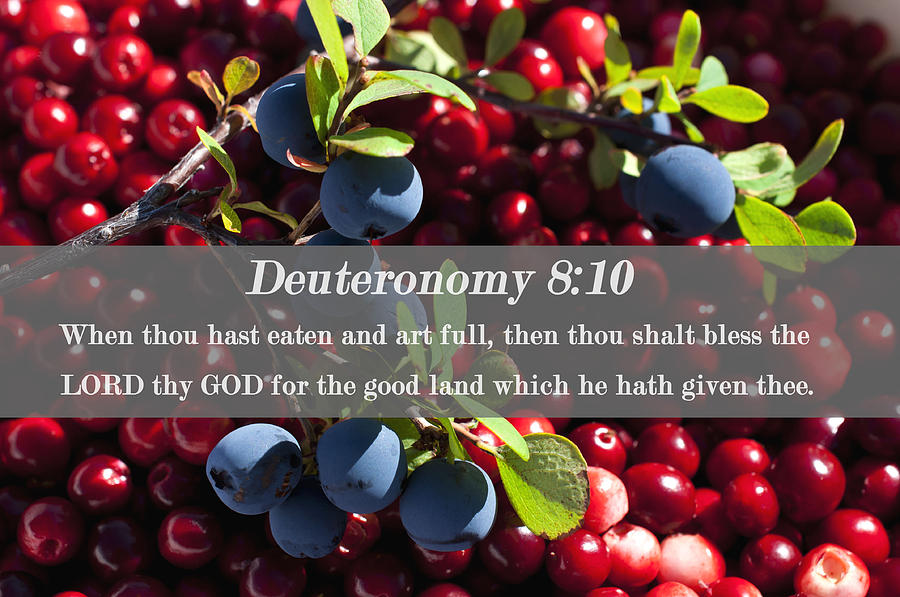
10 when you eat, and you are satisfied, 
you are to bless 
YHVH your God
for the good land that he has given you.

Image from fineartamerica.com

and thou shalt eat.  The good things of the world are provided for man’s enjoyment; and, far from teaching that man is doing wrong by finding happiness in them, Judaism desires man to do so. 

bless.  i.e. thank; thou shalt be moved to praise Him with a grateful heart.  The Rabbis understood these words as a command, and based upon them the precept that every meal must be followed by Grace.  As ‘the earth is the LORD’s and the fulness thereof’, the Talmud declares, ‘Whoever enjoys any worldly pleasure without uttering a benediction of its Divine Giver, commits a theft against God.’

The Grace consists of four parts: thanksgiving for food, for the land of Israel, for the Temple, and general praise and petition.  In the light of Judaism, the table is an altar; and every meal is hallowed by prayer, before and after.  The ancient Jewish Mystics added a touch of ecstasy to the statutory Grace by singing gleeful table-hymns, Zemiroth.  The unique combination, in these songs, of adoration of God with genial appreciation of good cheer is a product of the Jewish genius, which interweaves the secular with the sacred, and spreads over the ordinary facts of life the rainbow of the Divine.  This saintly custom of table-hymns was soon adopted for the Sabbath by the whole house of Israel.  In this way, a Sabbath meal became, literally, a service of joy and with joy.  To those who sing, and teach their little ones to sing, these beautiful hymns and melodies, the Sabbath day is, as it was to their fathers of old, a foretaste of ‘that Day which is wholly a Sabbath, and rest in life everlasting’.

11 Take-you-care,
lest you forget YHVH your God,
by not keeping his commandments, his regulations, and his laws that I command you today,
12 lest (when) you eat and are satisfied, 
and build goodly houses and settle (there),
13 and your herds and your flocks become-many 
and silver and gold become-much for you, 
with all that belongs to you becoming-much-
14 that your heart become haughty
and you forget YHVH your God, 
the one who brought you out from the land of Egypt, from a house of serfs,

thy heart be lifted up . . . forget the LORD.  Wherever there is pride, there is forgetting of God.  ‘Of a man dominated by pride, the Holy One, blessed be He, says, “I and he cannot dwell in the same universe”‘ (Talmud).  ‘Prosperity always tempts man to fretfulness against every idea of restraint.  Whenever men forgot God, their whole way of life dropped to a lower level and served baser issues.  A reverent and humble recognition of Him and gratitude to Him would prevent their obedience becoming a weariness’ (Welch).

15 the one who had you travel in the wilderness, great and awe-inspiring, 
(of) burning snakes and scorpions, 
and thirsty-soil where there is no water; 
the one who brought forth water for you, from the flinty rock,

fiery serpents.  See Num. XXI,6.

thirsty ground where was no water. The desert was first of all a place of thirst without shade from the sun, the fierce rays of which cause excessive longing for drink; secondly, the desert was a waterless place.

16 the one who had you eat mahn in the wilderness,
 which your fathers had not known,
 in order to afflict you and in order to test you,
 for it to go-well with you, in your future.

at thy latter end.  lit. ‘in thy later days’; viz. when Israel is settled in the Land.  The hard experience they had been called upon to endure was part of their training for their independent national existence.

17 Now should you say in your heart: 
My power and the might of my hand have produced all this wealth for me;
18 then you must bear-in-mind YHVH your God, 
that he was the one who gave you the power to produce wealth, 
in order to establish his covenant that he swore to your fathers, as (is) this (very) day.

but thou shalt remember.  God would fulfil the promise He made to the Patriarchs; but the continuance of the good fortune of the Israelites would depend upon their own merit.  Hence the warning immediately follows, that forgetfulness of God would change national prosperity of that Covenant.

as it is this day. As the occupation of the Transjordanian lands, and the impending conquest of the Promised Land, are the result of that Covenant.

19 Now it shall be 
if you forget, yes, forget YHVH your God
and walk after other gods,
serving them and prostrating yourselves to them,
I call-witness against you today 
that perish, you will perish;

other gods . . . forewarn.  Local Baals of the Canaanites.

20 like the nations that YHVH is causing to perish before you, 
 so shall you perish,
 because you did not hearken to the voice of YHVH your God!

 as the nations . . . perish. Because you will then not be better than those nations.

Deuteronomy/Davarim 7: "YHVH your God chose for him as a treasured people from among all peoples."

[Commentary from the best of Jewish minds, collected in an excellent resource: Pentateuch and Haftorahs, ed. Dr. J.H. Hertz; our translation of choice is EF/Everett Fox, The Five Books of Moses..Admin1]


Deuteronomy/Davarim 7

Observance of the Fundamental Laws–the Ten Commandments and Shema–demands avoidance of intermarriage, and the destruction of all idolatrous worship in the Promised Land.


1 When YHVH your God brings you to the land that you are entering to possess,
and dislodges great nations before you
-the Hittite, the Girgashite, the Amorite, the Canaanite, the Perrizite, the Hivvite, and the Yevusite-
seven nations more numerous and mightier (in number) than you,

before thee.  lit. ‘from before thee,’ i.e. to make way for thee.  The nations here enumerated are mentioned in Gen. X,15-18, XV,19; Exod. III,8,17; XIII,5 and elsewhere.  The Midrash states that the Girgashites left Canaan before the entry of the Israelites.

2 and YHVH your God gives them before you and you strike them down: 
you are to devote-them-to-destruction, yes, destruction, 
you are not to cut with them a covenant, you are not to show-them-mercy!

utterly destroy. Heb. i.e., consider them as cherem, something that must not come near thee.  On the ‘ban’ against the Canaanites, see XX,18.

show mercy.  Better, show grace; or, ‘give gifts to’ (Talmud).  The Rabbis restrict this prohibition, as all others in this connection, to actual idolaters like the ancient Canaanites.  It does not apply to ordinary heathens who observe the fundamental laws of human society.

3 And you are not to marry (with) them: 
your daughter you are not to give to their son, their daughter you are not to take for your son-

marriages. The evil results of such marriages were perceived by the Patriarchs; Gen. XXIV and XXVIII.  Moses had previously warned the people against allying themselves by marriage with their neighbours (Exod. XXXIV,16), and the warning was repeated by his successor (Josh. XXIII,12).  In our own days, in conditions that are worlds asunder from those in Canaan of old, intermarriage is no less fatal to the continued existence of Israel. ‘Every Jew should feel himself bound, even though the duty involves the sacrifice of precious affections, to avoid acts calculated, however remotely, to weaken the stability of the ancestral religion.  Every Jew who contemplates marriage outside the pale must regard himself as paving the way to a disruption which would be the final, as it would be the culminating, disaster in the history of his people’ (M. Joseph).

4 for they would turn-aside your son from (following) after me 
and they would serve other gods, 
and the anger of YHVH would flare up against you, and he would destroy you quickly.

he will turn away.  i.e., the heathen who marries thy daughter.

thy son.  The Talmud explains this to mean thy grandson.  Since the Torah, on this interpretation calls the child of an Israelite mother and gentile father the ‘son’ of an Israelite grandfather, it was deduced therefrom that the child is to be regarded as being of the same race and faith as the mother.  Consequently, the child of a Jewish father and a non-Jewish mother follows in Jewish Law the religious status of the mother.

5 Rather, thus are you to do to them:
their slaughter-sites you are to wreck,
their standing-pillars you are to smash,
their sacred-trees you are to cut-to-shreds, 
and their carved-images you are to burn with fire!

pillars.  Symbols of the sun-god Baal.

Asherim.  A tree planted (XVI,21), or a pole set up (II Kings XVII,10), as sacred symbols of Astarte, the goddess of fertility.

6-11.  REASONS FOR PREVIOUS COMMANDS

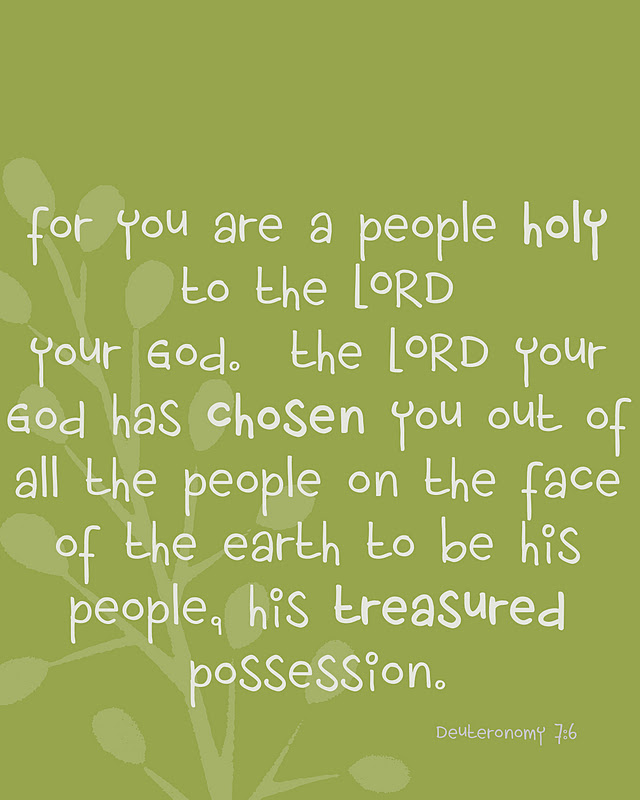
6 For you are a people holy to YHVH your God, 
(it is) you (that) YHVH your God chose for him as a treasured people
from among all peoples that are on the face of the soil.

thou art a holy people.  See Exod. XIX,5—the classical passage announcing the covenant between God and Israel.  Being a holy people, Israel was not to be contaminated by foul and cruel worship.  It was to be a People apart from the other nations, and untainted by their heathenish practices.

Image from tharderdesign.blogspot.com

His own treasure.  See on Exod. XIX,5. ‘The character of Israel as the Chosen People does not involve the inferiority of other nations.  The universality of Israel’s idea of God is sufficient proof against such an assumption.  Every nation requires a certain self-consciousness for the carrying out of its mission.  Israel’s self-consciousness was tempered by the memory of its slavery in Egypt, and the recognition of its being the servant of the LORD.  It was the noblesse oblige of the God-appointed worker for the entire human race ‘ (Guedemann).

7 Not because of your being many-more than all the peoples
has YHVH attached himself to you and chosen you, 
for you are the least-numerous of all peoples!

set His love upon you.  The root is used of the ‘blind’, non-rational love.  God’s love of Israel is like that love (cheshek) for which no reason is to be sought, as it is due solely to the desire of the lover (Albo).

the fewest of all peoples.  lit. ‘ the few out of the totality of peoples’; i.e. only a small fragment of the whole of humanity (Herxheimer, Dillmann). Israel is a small nation, but it has been chosen to accomplish world-embracing and eternal things.  ‘All the great things have been done by the little nations’ (Disraeli). ‘God has chosen little nations as the vessels by which He carries the choicest wines to the lives of humanity, to rejoice their hearts, to exalt their vision, to stimulate and strengthen their faith’ (Lloyd George).

8 Rather, because of YHVH’S love for you 
and because of his keeping the sworn-oath that he swore to your fathers 
did YHVH take you out, with a strong hand,
and redeem you from a house of serfs, 
from the hand of Pharaoh, king of Egypt.
9 Know 
that YHVH your God,
he is God, the trustworthy God,
keeping the covenant of loyalty with those who love him and with those who keep his commandments, 
to the thousandth generation,

know therefore.  ‘This phrase does not mean to know so as to see the fact of, but to know so as to feel the force of.  It is knowledge that is followed by shame, or by love, or by reverence, or by the sense of a duty’ (G.A. Smith).

10 and paying back those who hate him to his face, by causing them to perish- 
he does not delay (punishment) to those who hate him to his face; he pays them back!
11 So you are to keep the command: the laws and the regulations that I command you today, by observing them.

12-16. THE BLESSINGS OF OBEDIENCE

The reward of obedience will be prosperity, vital power, and health.

12 Now it shall be:
because of your hearkening to these regulations, keeping and observing (them), 
then YHVH will keep for you the covenant of loyalty that he swore to your fathers;
13 he will love you, he will bless you,
he will make-you-many, he will bless the fruit of your
belly and the fruit of your soil, 
your grain, your new-wine, and your shining-oil, 
the offspring of your cattle and the fecundity of your sheep, 
upon the soil that he swore to your fathers, to give you.

corn . . .wine . . .oil. The principal products of Canaan.

14 Blessed shall you be above all peoples: 
there shall not be among you (any) barren-male or barren-female, nor among your animals.
15 YHVH will remove from you all sickness
and all evil illnesses from Egypt that you know, he will not put (any of) them upon you, 
but will place them upon all those who hate you.

diseases of Egypt.  The climate of Egypt is unhealthy, especially at certain seasons of the year.  Pliny describes Egypt as ‘the mother of worst diseases’.

16 You shall devour all the peoples that YHVH your God gives to you; 
your eye is not to pity them, 
you are not to serve their gods, 
for that is a snare to you!

17-26.  ISRAEL’S STRUGGLE WITH THE CANAANITE NATIONS

God will be his Helper.  Let not Israel in the hour of victory come to terms with Idolatry.

17 If you should say in your heart: 
More numerous are these nations than I,
how will I be able to dispossess them?

are more than I. “They are too many for me.’

18 Do not be afraid of them; 
bear-in-mind, yes, in mind, what YHVH your God did to Pharaoh and to all Egypt-
19 the great trials that your eyes saw,
the signs and the portents, the strong hand and the outstretched arm
by which YHVH your God took you out-
thus will YHVH your God do to all the peoples of whom you are afraid.
20 And also the hornet, YHVH your God will send-loose upon them, 
until they perish, those left and those hidden from you.

hornet.  Exod. XXIII,28. A plague of hornets would drive the Canaanites from their hiding-places into the open.  Some of the species of hornets found in Palestine have their nests in rock-caves.  There is a novel and illuminating explanation of the meaning of the ‘hornet’.  It was the badge of Thotmes III and his successors, and would thus be a veiled reference to the systematic series of invasions and conquests in Palestine undertaken by that Pharaoh.  These invasions had reduced the fighting power and resistance of the Canaanites (Garstang).

21 Do not be terrified before them, 
for YHVH your God is among you,
a God great and awe-inspiring.

affrighted at them.  So as to seek safety in flight.

and awful. God alone is to be feared, and the fear of Him would drive out any other.

Image from eborg3.com

22 YHVH your God will dislodge these nations before you, little by little; 
you may not finish them off quickly, lest the wildlife of the field become too-many for you.

little and little.  Otherwise, large areas would be left desolate, in which wild beasts would multiply; see II Kings XVII,24, also Exod. XXIII,29.

beasts of the field.  Wild beasts, as ‘field’ is here used in the sense of uncultivated territory.  The country was at no time in the Biblical age so settled that the jungle lay wholly beyond the range of ordinary experience.  ‘How constant the war of man against wild animals was in ancient Palestine, may be felt from the promise of their being tamed as one of the elements of the Messianic Age; Isa. XI,6-8’ (G.A. Smith).

23 YHVH your God will give them before you, 
he will panic them with a great panic 
until they are destroyed.

discomfit them with a great discomfiture. ‘Rout them in a crushing defeat’ (Moffatt).

24 He will give their kings into your hand, 
so that you cause their name to perish from under heaven;
no man will be able to take-a-stand against you
until you have caused them to perish.
25 The carved-images of their gods, you are to burn with fire, 
you are not to come-to-yearn for (the) silver and gold on account of them,
and so take it for yourself,
lest you be ensnared by it-
for it is an abomination to YHVH your God!

the silver or the gold that is on them.  The wooden image was usually overlaid with one of the precious metals; see Isa. XL,19.

snared therein. i.e. brought into misfortune, through God’s judgment being provoked by the heathenish relic in the Israelite’s home.

26 You are not to bring an abomination into your house
-you would become devoted-for-destruction like it!- 
you are to hold-it-in-disgust, yes, disgust, 
you are to consider-it-abominable, yes, abominable, 
for it is (something) devoted-for-destruction!

an abomination. Heb., a contemptuous term for an idolatrous image, unchastity, or dishonest dealing.

be accursed like unto it.  Better, be an accursed thing; i.e. become a herem.  He who brings an abomination into his house, himself becomes abominable; see the story of Achan, Josh. VII.

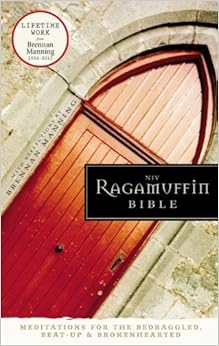
"beaten down, bedraggled, and broken"- Could it be they are worshipping the wrong God?

[This is the latest article contributed by “RS” who has sent previous articles and teachings;  please check out his previous posts if you haven’t yet read them:

This is his most recent message sent to his faith community as well as to friends, VAN and BAN@S6K.  We are privileged to share it on this website.–Admin 1.]

—————————————————————–
Shalom to all,
Greetings in the name of YHWH,
the only true God, the God of Abraham,
Isaac and Jacob,our Father in heaven.

Another study bible was just released by NIV —

bringing a NEW GOSPEL —


The NIV Ragamuffin Bible with notes from Brennan Manning, inspired by his book The Ragamuffin Gospel, will help beaten down, bedraggled, and broken Christians rebuild their relationship with God through simple honesty and understanding his furious love for us all.”


Many will buy this “new bible” as they search for solutions to life’s problems.

Then a year later they will still be “beaten down, bedraggled, and broken” …

They never get to the real issue …

Why are they “beaten down, bedraggled, and broken”in the first place?


Notice that the write-up about this new bible says that it is “inspired by his book The Ragamuffin Gospel, — In other words it is inspired by man rather than by God.
 

Could it be they are worshiping the wrong God?


Once they discover this New Bible / Gospel does not work either, then they

will release a new edition in 2014 — a never ending series of books

that try in vain to solve man’s problems — in the process the author
and publishers make money — maybe that’s what they really care about??


Compare this to the testimonies of real people you have heard from our group.

You have heard how lives are being changed — I dare say that there is NOBODY

in our group who is “beaten down, bedraggled, and broken” —


We do not need crazy solutions coming from books of men because we have a great God,YHWH, who owns and controls everything in heaven and on earth

and He has given us His Truth …


Psalms 145:14-20 NKJV
14]  The LORD [YHWH] upholds all who fall, And raises up all who are bowed down.
15]  The eyes of all look expectantly to You, And You give them their food in due season.
16]  You open Your hand And satisfy the desire of every living thing.
17]  The LORD [YHWH] is righteous in all His ways, Gracious in all His works.
18]  The LORD [YHWH] is near to all who call upon Him, To all who call upon Him in truth.
19]  He will fulfill the desire of those who fear Him; He also will hear their cry and save them.
20]  The LORD [YHWH] preserves all who love Him, But all the wicked He will destroy.


When you read this Psalm, do you see the solution?

There is only one. I have tried to put it in Bold and underline.


Read it again and again until you see it …

If you do not see it, see me on Saturday …

May Yahweh (YHWH, Hebrew name of God)
creator of heaven and earth,
bless you and your family abundantly!
“RS”
26-year Life Coach
Mobile +63999-881-9345

Deuteronomy/Davarim 6: "Hearken O Israel: YHVH our God, YHVH (is) One!"

[Continuing our featured resource, commentary from the best of Jewish minds all in one book, edited by Dr. J.H. Hertz, titled Pentateuchs and Haftorahs; our translation of choice is EF/Everett Fox, The Five Books of Moses—Admin 1.]


THE SHEMA

THE ONENESS OF GOD AND ISRAEL’S UNDIVIDED LOYALTY TO HIM


Deuteronomy/Davarim 6

1 Now this is the commandment, the laws and the regulations 
that YHVH your God has commanded (me) to teach you
to observe in the land that you are crossing into to possess,

now this is. Better, and this is.  

2 in order that you may hold YHVH your God in awe, 
by keeping all his laws and his commandments that I command you,
you, and your child, and your child’s child, 
all the days of your life; 
and in order that your days may be prolonged.

that thou mightest fear.  This sums up the aim and purpose of the general principles of the legislation, as well as of the separate statues.

3 You are to hearken, O Israel, 
and are to take-care to observe (them), 
that it may go-well with you, 
that you may become exceedingly many,
as YHVH, the God of your fathers promised to you-
(in) a land flowing with milk and honey.

4-9. After the repetition of the story of the Giving of the Ten Commandments, Moses proceeds to declare the other great foundation of the Torah; viz. the oneness of God and Israel’s undivided loyalty to Him.

4 Hearken O Israel: 
YHVH our God, YHVH (is) One!

The opening verse of this paragraph, called after its first Heb. word Shema, sounds the keynote of all Judaism, and has been its watchword and confession of faith throughout the ages.  Here the fundamental Truth of the Unity of God is proclaimed.  It is followed in v. 5-9 by the fundamental Duty founded upon that Truth;  viz. the devotion to Him of the Israelite’s whole being.

  • He is bidden to love God with heart, soul, and might; t
  • o remember all the commandments and instruct his children therein;
  • to recite the words of god when retiring or rising;
  • to bind those words on the arm and the head,
  • and to inscribe them on his door-posts and the city gates.

The later leaders of Jewry showed their spiritual insight when they gave the place they did to this high and winsome message’ (Welch).

In the Liturgy, the Shema is said twice daily, and consists of three sections:

  • Deut. VI,4-9; XI,13-21; and Num. XV,37-41.
  • The second section Deut. XI,13-21, contains the promise of reward for the fulfillment of the laws, and punishment for their transgression.
  • The third section Num. XV,37-41, enacts the law concerning the tzitzith, as a warning against the following evil inclinations of the heart, and an exhortation to submit to the laws of God in remembrance of the Exodus.

Hear, O Israel: the LORD our God, the LORD is One.  Or, ‘Hear, O Israel: the LORD is our God, the LORD is One’ (Sifri, Septuagint, and most Jewish translators and commentators).  It sums up the teaching of the First and Second Commandments; The LORD is our God, and He is One.  The translation given by AJ, ‘Hear, O Israel, the LORD our God, the LORD is One,’ is less acceptable; for if the declaration only enunciated the Divine Unity, it would be sufficient to have said, ‘Hear, O Israel, the LORD our God is One.’  Some moderns follow Rashbam’s translation: ‘Hear O Israel, the LORD is our God, the LORD alone.’

the LORD our God.  The Heb is the Divine Name of Four Letters, the Father and Sustainer of the lives and spirits of all flesh, the everlasting Power Who guides the destinies of men and nations.

the LORD is One. ‘In the opening v. of the Shema we have a third revelation of God’s being.  In Gen. XVII, He is made known to us as Almighty; in Exod. VI, as Eternal; and now as the One’ (Philippson).

  • He is One, because there is no other God than He;
  • but He is also One, because He is wholly unlike anything else in existence.
  • He is therefore not only One, but the Sole and Unique God.

One.  Heb. echad.  Therefore to Him alone it is right to pray, and not to any being besides Him.  The belief that God is made up of several personalities, such as the Christian belief in the Trinity, is a departure from the pure conception of the Unity of God.  Israel has throughout the ages rejected everything that marred or obscured the conception of pure monotheism it had given the world, and rather than abandon that pure monotheism, rather than admit any weakening of it, Jews were prepared to wander, suffer, to die” [please go to  SHEMA – Perspective from Judaism to read The Shema and martyrdom–Admin 1.]

5 Now you are to love YHVH your God with all your heart, 
with all your being, with all your substance!

and thou shalt love.  This is the first instance in human history that the love of God was demanded in any religion.  The love of God is the distinctive mark of His true worshippers.  The worshipper, as he declares the Unity of God, thereby lovingly and unconditionally surrenders his mind and heart to God’s holy will.  Such spiritual surrender is called ‘taking upon oneself the yoke of the kingdom of heaven.’  If the Unity of God is the basis of the Jewish creed, the love of God is to be the basis of the Jewish life.  And the noblest spiritual surrender and love of God, the Rabbis held, was so to live and act toward our fellowmen as to make God and His Torah beloved in their eyes.


‘The meaning of the love of God is that a man should be longing and yearning after the nearness of God, blessed be He, and striving to reach His holiness, in the same manner as he would pursue any object for which he feels a strong passion.  He should feel that bliss and delight in mentioning His name, in uttering His praises and in occupying himself with the words of the Torah, which a lover feels toward the wife of his youth, or the father towards his only son.  The earlier saints attained to such disinterested love of God; as King David said in Psalm XLII, 2: “As the heart panteth after the water brooks so panteth my soul after Thee, O God” (Moses Chayim Luzzatto).


‘When the soul sinks in the depths of awe, the spark of the love of God breaks out in flames, and the inward joy increases.  Such lovers of God desire only to accomplish His holy will, and lead others unto righeousness (Moses Chayim Luzzatto).


with all thy heart.  Because there is one God, we must give Him undivided allegiance.  ‘The One God demands the whole of man’ (Smend).  The Rabbis explain with all thy heart  to mean ‘with all thy desires, including the evil inclination’; i.e. make thy earthly passions and ambitions instruments in the service of God.


with all thy soul.  We should be prepared to give up our dearest wishes and inclinations for the love of God.  The Rabbis take the words with all thy soul  to mean ‘with thy whole life’; i.e. love Him with thy heart’s last drop of blood, and give up thy life for God, if He requires it.  The classical example is that of Rabbi Akiba.  He longed for the sublime moment when his daily profession of the love of God might be put tot he proof and confirmed by act.  That moment came when, after his noble part in the last Jewish War of Independence against Imperial Rome, the Roman executioner was tearing his flesh with combs of iron.  ‘All my days,’ Akiba told his weeping disciples, ‘I have longed for this moment, when I loved Him with all my heart, and I loved Him with all my might; now that I have the opportunity of loving Him with all my soul, shall I not rejoice?”  It was such understanding of the words of the Shema that gave the Jewish martyrs throughout the ages the comfort and courage to lay down their lives for their Faith.  Bachya tells of a medieval Jewish saint who used to pray:  ‘My God, thou hast given me over to starvation and penury.  Into the depth of darkness hast Thou plunged me, and Thy might and strength Thou hast taught me.  But even if they burn me with fire, only the more will I love Thee and rejoice in Thee.’  Such spiritual surrender is, of course, without any thought of reward or punishment in the Hereafter.  As another of the saints boldly expressed it, ‘I have no wish for Thy Paradise, nor any desire for the bliss in the world to come.  I want Thee and Thee alone.’


. . . . The supreme sacrifice, however, is demanded only to avoid idolatry, incest, and murder.


with all thy might. With the full concentration of feeling and power.  One Rabbinic explanation is, ‘with whatever lot Providence has assigned to thee’; i.e. love Him in times of bliss and happiness, and in times of distress and misfortune.  Another explanation is ‘with all thy possessions’; i.e. despite whatever material sacrifice thy loyalty to Israel’s God and Torah might entail.  An 18th-century moralist understood ‘with all thy possessions’ to mean, ‘even when great wealth is thine’ (Panim Yafoth).

6 These words, which I myself command you today, are to be upon your heart.

these words.  In v. 4 and 5; viz.  the Unity of God and the duty of undivided allegiance to Him, as the epitome of the teaching of the Book.

this day. ‘Do not regard the Divine commands as old and stale news; but consider them as something fresh, as a new Royal Proclamation reaching you this very day’ (Sifri).

upon thy heart.  The heart is conceived as a tablet on which these Divine words shall be inscribed; Jer. XXXI,32-33.

7 You are to inculcate them in your children 
and are to speak of them
in your sitting in your house and in your walking in the way, 
in your lying-down and in your rising-up.

teach them diligently.  lit. ‘prick them in’; so that the words remain indelibly upon their hearts. ‘Let them have a clear, and not a confused or stammering, knowledge of the duties and teachings of their Faith’ (Sifri).

Image from hebrewforchristians.com


and shalt talk of them. They are to be a theme of living interest, early and late, at home and abroad.


when thou sittest in thy house. ‘A man should conduct himself with due propriety in his house, so as to set an example to his household; and he should also be gentle with them, and not overawe them’ (Zohar).


when thou liest down. The Rabbis based on this institution of Evening Prayer.  It consists of the Shema, preceded by Two Benedictions (the one, referring to the Divine ordering of day and night; and the second, eulogizing the love of God shown in the revelation of the Torah.  The Shema is also followed by two Benedictions (the proclamation of faith; and the prayer for peaceful repose).  The Service continues with the Amidah (The 18 Benedictions—3 Blessings of Praise; 12 (now 13) Petitions; and 3 Blessings of Thanks) and Oleynoo.  The Shema is also recited before retiring to rest.   To fill one’s mind with high and noble thoughts is a wise preparation for the hours of darkness.  ‘The Shema is a double-edged sword against all the terrors and temptations of the night’ (Talmud).


when thou risest up. It is preceded by 2 Benedictions, and followed by one.  These Benedictions are

(1) a eulogy of God as the Creator of the light of day;

(2) a eulogy of God as Giver of the Torah; and

(3) a eulogy of God as the Redeemer of the 18 Benedictions.  On some days, Tachanun and the Reading of the Torah follow.  The Service concludes with Oleynoo, Kaddish and some psalms.

8 You are to tie them as a sign upon your hand, 
and they are to be for bands between your eyes.

bind them. The precept of tephillin: The purpose of the tephillin is given in the Meditation recited before putting on the tephillin (Authorised Prayer Book):—“Within these Tephillin are placed 4 sections of the Law, that declare the absolute unity of God, and that remind us of the miracles and wonders which He wrought for us when He brought us forth from Egypt, even He who hath power over the highest and lowest to deal with them according to His will.  He hath commanded us to lay the Tephillin on the hand as a memorial of His outstretched arm; opposite the heart, to indicate the duty of subjecting the longings and designs of our heart to His service, blessed be He; and upon the head over against the brain, thereby teaching that the mind, whose seat is in the brain, together with all senses and faculties, is subjected to His service, blessed be He.’ The tephillin are not worn at night, nor on Sabbaths or Festivals, as these are themselves called ‘a sign’ of the great truths symbolized by the tephilin.  The commandment of tephillin applies to all male persons from their 13th birthday, when they attain their religious majority (Barmitzvah).  On the Sabbath following that birthday, the Barmitzvah is called to the Law, publicly to acknowledge God as the Giver of the Torah.

The wording of v. 8 and 9 is not  to be taken as a figure of speech.  ‘It seems on the whole to be more probable that the injunction is intended to be carried out literally; and that some material, visible expression of the Israelite’s creed is referred to’ (Driver).

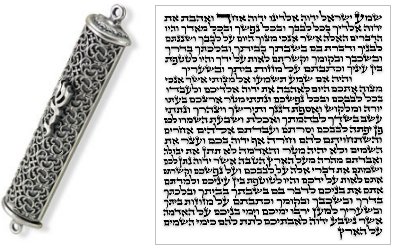
9 You are to write them upon the doorposts of your house and on your gates.write them upon the doorposts. 

By means of the mezuzah affixed to the doorpost in Jewish homes.  The mezuzah is placed in a metal or glass case, and fixed to the right-hand doorpost of the outer entrance of every dwelling room in the house.  It contains this section of the Shema and XI,13-20.  the word ‘Almighty’ written on the back of the parchment is rendered visible by means of a small opening in the case.  The mezuzah  is a symbol of God’s watchful care over the house and its dwellers.  It is a solemn reminder to all who go out and in, that the house is devoted to the ideals of the Shema.

Image from oneyearbibleblog.com

I. Abrahams thus sums up the basic importance of Deut. VI,4-9: ‘It enshrines the fundamental dogma (monotheism), the fundamental duty (love), the fundamental discipline (study of the Law), and the fundamental method (union of “letter” and “spirit”), of the Jewish Religion.’

10 Now it shall be
when YHVH your God brings you to the land that he swore to your fathers, to Avraham, to Yitzhak, and to Yaakov, to give you,
towns great and good that you did not build,

10-19. PERIL OF FORGETTING

The pleasantness of their inheritance in the New Land might breed forgetfulness of their dependence upon the goodness of God, and a disposition to follow the gods of the surrounding nations.

11 houses full of every good-thing that you did not fill, 
cisterns hewn out that you did not hew, 
vineyards and olive-groves that you did not plant, 
and you eat and you are satisfied,

cisterns hewn out.  In the Holy Land water had to be collected during the rainy seasons and stored.  For this purpose, cisterns cut out of the rocks are of special value.

12 take-you-care,
lest you forget YHVH
who brought you out of the land of Egypt, out of a house of serfs.
13 YHVH your God you are to hold-in-awe,
him you are to serve,
by his name you are to swear!

thou shalt fear the LORD thy God.  This command is complementary to VI,5 ‘thou shalt love the LORD thy God’.  Love and fear of God combined constitute the highest reverence.  ‘The fear of God acts as a powerful deterrent from evil; the love of God, as the highest incentive to living in accordance with the Divine will’ (Talmud).  ‘Indeed, the fear of the LORD, is the nearest equivalent in Hebrew to what we mean when we speak about religion’ (Welch).

serve.  In prayer (Sifri).

by His name shalt thou swear.  This is no command to swear; only a bringing out of the religious significance of an oath (Oettli).  Primitive man constantly appeals to his gods for the truth and honesty of his transactions; and such appeal to his gods really constituted a profession of his loyalty to those gods.  An Israelite is to swear by the Name of God alone, always remembering that it was an unpardonable sin to take God’s Name in vain–and that the truly pious refrain from all oaths.

14 You are not to walk after other gods
from the gods of the peoples that are around you,

peoples that are round about you. Not that it was permissible to follow the gods of distant nations, but that the danger of adopting the worship of neighboring peoples was more insidious and real (Rashi).

15 for a jealous God is YHVH your God in your midst-
lest the anger of YHVH your God flare up against you
and he destroy you from off the face of the soil.

a jealous God.  The Heb. el kanna means, ‘a zealous God’, full of zeal for holiness and justice, to whom man’s doings and dealings are not a matter of indifference, but Who renders strict retribution for all idolatry and iniquity.  It also means, ‘a jealous God.’ That may appear a startling description of God.  It signifies that God claims the exclusive love of His children, their entire sincerity—and complete self-surrender.  He will not allow the veneration and loyalty due to Him alone to be shared with other objects of worship. . . .the blessed doctrine of ‘a jealous God’ is of vital importance for the Jew’s attitude towards the neo-paganism of today and tomorrow.  ‘Judaism’s mission is just as much to teach the world that there are false gods and false ideals, as it is to bring it nearer to the true one.’

destroy thee. As a nation and an independent power.

of the earth.  Better, of the land; i.e. Palestine.

16 You are not to test YHVH your God 
as you tested him at Massa/Testing!

ye shall not try.  i.e. test, by questioning His power or protection; likewise, anyone who obeys the Divine commandments ‘on trial’, i.e. to see if he will be rewarded for doing so, transgresses this prohibition (Mal. III,10, is an exception).

17 Keep, yes, keep the commandment of YHVH your God, 
and his precepts and his laws that
he commanded you.
18 You are to do what is right and what is good in the eyes of YHVH,
in order that it may go-well with you, 
so that you may come and take-possession of the good land that YHVH swore to your fathers;

that which is right and good in the sight of the LORD.  Note the words and good in addition to that which is right.  It is not enough to do that which is right; i.e. to act according to the strict letter of the law; as such action often involves hardship and harshness, and the truly pious avoid taking advantage of the letter of strict legality.  There is a higher justice, which is equity, and this bids man to be true to something more than the mere letter of his bond. ‘Man must act beyond the rule of law’, say the Teachers of the Talmud.  Jerusalem, they said, was destroyed because its Courts adhered too closely to strict Din (justice), and disregarded the principles of Yosher (equity).  Two examples will make clear what they understood by ‘equity’.  A Rabbi on being consulted by a poor woman whether a certain coin was good answered her that it was.  The next day, she came and told him it had been declared bad.  He took it from her, and gave her a good one in exchange. He was not compelled to act so.  He was going beyond the letter of the law, and doing ‘that which is right and good in the sight of the LORD’.

19 to push out all your enemies before you, 
as YHVH has promised.

20-25.  THE EXODUS—AN OBJECT LESSON

The future generation is to be trained to gratitude and reverence towards God by means of the story of the Deliverance from Egypt.  The Seder Service is a domestic feast based on the actual usage in the Temple of Jerusalem, and accompanied by a running commentary of prayer and legend and exhortation known as the Haggadah shel Pesach.  This opens with the questions asked by the youngest child present, who is answered in a recitation of the events of the Exodus, with the Midrashic interpretations of Biblical passages (Josh. XXIV,2-4); Deut XXVI,5-8) relating to the Deliverance.  Hallel early formed part of the Seder; Nishmath, various hymns, folk-songs and children’s rhymes were added in the course of the centuries.

The Seder in history would require a monograph.  In the Middle Ages, the Seder nights were a time of terror to the Jewries of Christian Europe.  From the 12th century onwards, the Satanic charge of using human blood on Passover, was responsible for a long series of hideous massacres.  Also, it was on the eve of Passover, 1190 that the Jews of York resolved to anticipate massacre at the hands of the murderous mob by suicide, and perished almost to a man. ‘But the eternal message of hope, revived in the Jewish breast all the more ardently by the Festival of Freedom, saved the martyred people from despair, even in this darkest hour’ (Cecil Roth).

20 When your child asks you on the morrow, saying: 
What (mean) the precepts, the laws, and the regulations that YHVH our God has commanded you?

in time to come. lit, ‘tomorrow.’

what means the testimonies . . . ordinances. This whole section is analogous to Exod. XIII,14, where the child asks ‘What is this?’ Evidently the son here is of riper age than in Exod. XIII.  The Rabbis describe the latter as ‘simple’; and the son in this v. as ‘wise.’

21 Then you are to say to your child: 
Serfs were we to Pharaoh in Egypt, 
and YHVH took us out of Egypt with a strong hand;

we were Pharaoh’s bondmen. These words form the first sentence of the answer to the ‘four questions’ in the Haggadah.  The Seder Service is typical of Jewish education:  the ceremonies become object-lessons in religion, national history, and morality.  The garnered religious thought and emotion of past generations is made the horizon for the opening mind of the Jewish child.  At one point of the Seder, which is largely history raised into religion, it is remarked:  ‘Every Jew should regard himself as if he had personally come out of Egypt.’  That spirit dominates the whole of Jewish ceremonial. It all tends to the self-identification of the child with his fathers in the days of old, and to foster in the soul of the Jewish child the resolve to take his part in the Jewish life—whether in the sphere of worship, humanitarian endeavour, or Messianic achievement in and out of the Holy Land.

22 YHVH placed signs and portents, great and evil-ones, on Egypt, on Pharaoh and all his house, before our eyes.

signs.  ‘The father’s reply points to an Almighty Power that can change the course of Nature for the accomplishment of His Divine purposes’ (Koenig).

23 And us he took out of there 
in order to bring us, to give us the land that he swore to our fathers;
24 so YHVH has commanded us to observe all these laws,
to hold YHVH our God in awe, 
to have it be-well with us all the days (to come),
to keep-us-alive, as (is) this day.

preserve us alive.  ‘God, that He might complete His redemptive work towards Israel, gave it this law, to keep alive in it the spirit of true religion, and to secure in perpetuity its national welfare’ (Driver).

25 And righteous-merit will it be (considered) for us
when we take-care to observe all this commandment 
before the presence of YHVH our God, 
as he commanded us.

and it shall be righteousness unto us.  It will be accounted to us meritorious, and deserving of God’s approval.  The phrase is similarly used in Gen. XV,6, ‘and he (Abraham) believed in the LORD; and He counted it to him for righteousness.’

Yo Seachers! Can we help you? – October 2013

[This post started as an aid for searchers who land on our website because of  “Search Engine Terms.”  This serves as an aid to searchers with specific topics in mind. This is updated daily so if you failed to find your post today, come back and check the articles listed on your search term, if not we give a helpful FYI on it; you might learn a thing or two from the short comments here. – Admin1]

———————————————————

10/31  “the egyptians /horus/jesus/yahuwshuwah” – Please check out this post SHEMA – Perspective from Judaism which explains the difference between Jewish Monotheism from the different belief systems in the religions of the world, including the virgin cult which began with Isis/Horus.

10/31  “jacob hertz the pentateuch and haftorahs pdf download” – Rabbi/Dr. Jacob H. Hertz edited the excellent resource book Pentateuch and Haftorahs.  The commentaries on the books of Leviticus, Numbers and Deuteronomy plus Introduction and additional information come from various Jewish scholars and Rabbis.  We have found this book so valuable that we’ve recommended it in our MUST READ/MUST OWN list.  Our library copy is the 2nd edition, published in London by Soncino Press in year 5734/1973; in fact it’s an imperfect copy with quite a number of typographical errors, and that’s why we got it cheap at a Messianic Conference book sale some 5 years ago. It is available only in the hardback edition, a few new and used copies are available at amazon.com, the cheapest is $9.00.

 – 10/31 ” Introduction to the old testament literary prophecy” – Notice in the posts below that there are only 3 major prophets featured, 1 is missing, who and why?  The Book of Daniel which, in the Christian “Old Testament” is the 4th and probably the most important prophet (because it is used as the key for understanding the NT book of Revelation)—is not categorized under the Prophets.  In the Hebrew Scriptures, acronym “TNK” for Torah-Neviim-Ketuviim, the book of Daniel in TNK is relegated to “Ketuviim” or “the Writings” where inspired literature (and not the very words of YHWH) are categorized.  Surprised?  When you think about it, Daniel merely interpreted dreams of King Nebuchadnezzar, much like Joseph interpreted dreams of Pharoah. They were not considered “prophets” like Isaiah, Jeremiah and Ezekiel and the 12. Ironically, in the rearrangement of TNK books in the Christian Bible’s Old Testament, the canon-fixers not only expanded the TNK from 24 to 39 books, added Daniel to the 3 major prophets to give it more importance because hey, the climax of the NT canon— the Book of Revelation cannot be understood without it.

10/31 –  “nehemiah told iin narritive form” – A Literary Approach to Ezra and Nehemiah

10/30  “if you will walk in my statutes” – ויקרא Leviticus/Wa’iyqrah 26: “If you walk in My statutes . . .” vs. “If you reject My decrees . . . “

10/29  “the jewish mystique” – MUST READ – The Jewish Mystique by Ernest Van Den Haag

10/29  “what we might do together abraham heschel” – No Religion is an Island – Abraham Joshua Heschel

10/29  “tanach verse ‘ihate your new moons and sabbaths'” – This verse comes from Yeshayahuw (Isaiah) 14; Israel had acted like a “harlot” whoring after other gods and YHWH through his mouthpiece the prophet Isaiah declares to His chosen people that even if He had given them commandments in Waiqrah/Leviticus 23 regarding “My” appointed times such as the Sabbath and other festivals, their performance of rituals have become abhorrent to Him. This is tantamount to mindless church-going on Sunday to worship for 1 hour while living in disobedience to Torah the rest of the week. Such angry declarations by the God of Israel nevertheless includes an offer to repent and blessing that comes with repentance.  Isaiah texts have often been used to apply to the Christian savior but careful and consistent continuous reading of the whole book (as opposed to isolated verses taken out of context) shows that the only “son” and “servant” referred to is no other than Israel.

HNT 1:12-19

12. When you come to appear before Me, who has required this at your hand, to trample My courts?

13. Do not bring any more vain oblations; incense is an abomination to Me; new moon and Shabbath, the calling of assemblies, I cannot [bear]— away with iniquity and the solemn meeting.

14. Your new moons and your appointed feasts My Nephesh hates; they are a trouble to Me; I am weary of bearing them.

15. And when you spread out your hands, I will hide My eyes from you; yes, when you make many prayers, I will not listen to attentively. Your hands are full of blood.

16. Wash and do well; put away the evil of your doings from before My Face and My eyes; desist from making right for nothing;

17. learn to do well; seek justice, relieve the oppressed, judge the fatherless, and plead for the widow.

18. Come now, and let us reason together, says יהוה: Though your straying and missing the purpose and the objective is as scarlet, they will be as white as snow; though they are red like crimson, they will be as wool.

19. If you are willing and obedient, you will eat the right of the land:

20. But if you refuse and rebel, you will be devoured with the sword; for the mouth of יהוה has 

10/26  “ revelation in a nutshell” – Revelation in a Nutshell

10/25  “bible scholar charles freeman” – Must Read: A New History of Early Christianity by Charles Freeman

10/25  “2013 +2 october teruw result title.com” – Clueless about this entry so can’t help this searcher.

10/25  ”genesis 3:15 is refered to whom” – Prooftext 1: Genesis 3:15 – Seed of the Woman vs. Seed of the Serpent

10/23  “buy tnk bible” – Good news for this searcher!  His Name Tanakh by Benmara is a FREE download; he has just upgraded to a 9.0 version.  Please go to this link http://hearoyisrael.net/hisname/his-name-tanakh.html and follow the instructions provided there.

10/23   “what was the sermon about jesus preach on mount sanai” –  Correction please; according to the gospels, Jesus did preach  “sermons”, one was supposedly on a mountain while another was supposedly on a plain.  The word “sermon” itself is churchy, speficially Christian . . .  which Jesus, being a Jew, surely could not have been, since Christianity as an official religion did not begin until the 4th century BC or CE.  However, we did write an article to make a distinction between what Jesus supposedly preached on a montain or plain or wherever, and the revelation on Mount Sinai by the God of Israel Who, by the way, was not a trinitarian god as He Himself kept emphasizing all through the Hebrew Scriptures.  And yes, there is a big difference between a ‘sermon’ and a ‘revelation’, find out for yourself in:  The Sermon on Sinai vs. The Sermon on the Mount

10/23  “shedur hebrew meaning” – The correct spelling of the Hebrew word is “Siddur” which is the Jewish Prayer Book.  The meaning of the word is “order’.

10/22  “why did the priest use a goat instead of a lamb for the scapegoat”-  Sacrificial goat, Scapegoat . . . what about the Lamb? Not on Yom Kippur.

10/21  “identical goats in the ritual of the scapegoat” – Sacrificial goat, Scapegoat . . . what about the Lamb? Not on Yom Kippur.

10/20  “jeremiah was an uncompromising prophet. discuss” – A Literary Approach to the books of two major prophets: Jeremiah (Yirmeyahuw) and Ezekiel (Yechezqe’l- 1

10/19  “joshua 1:8″ – This verse has landed in ‘search engine terms’ repeatedly; we do not have a post on it, but let me write some thoughts here since it will most likely be showing up often.  Why?  Because it is a key verse emphasizing the importance of the Torah in the historical context of the chosen people’s beginnings.  The time-frame of this verse is at the end of the wilderness wandering of 40 years when a new generation was about to enter and conquer the Land.  Moses, their leader/prophet/mediator had finished his assignment from YHWH and a new leader, this time a warrior, would lead the 2nd generation who were born free in the wilderness.  Yehuwshuwa/Joshua (together with Caleb) was of the first generation that left Egypt but all have died including Moses, before entering the Promised Land.  What was given to the first generation who stood on Sinai to accept the Covenant with YHWH as well as Israel’s Book of instructions and laws to live by, is passed on to the 2nd generation who are reminded by the same God of their fathers to live by the same guidelines and commandments.

Notice the key words:  contemplate/observe/do=successful/act wisely;

strong/courageous, why? “For YHWH is with you. . . .”

[AST] This Book of the Torah shall not depart from your mouth; rather you should contemplate it day and night in order that you observe to do according to all that is written in it; for then you will make your way successful, and then you will act wisely.  Behold, I have commanded you, ‘Be strong and courageous,’ do not lose resolve, for HASHEM, your God, is with you wherever you will go.”

[HNT]  8. This Çepher haTowrah [Scroll; Writings of the Teachings; Instructions] will not depart out of your mouth, but you will meditate on it day and night that you may observe to do according to all that is written. Your way will push forward and then you will be mindful.  9. Have I not commanded you? Be strong and alert; do not be afraid, nor dismayed, for יהוה your ‘Elohiym [Mighty One] is with you wherever you walk.

10/19  “sermon on mount sinia” – The Sermon on Sinai vs. The Sermon on the Mount

10/19   “esau a caveman” – Esau/Edom – A Second Look

10/19 “tanakh hell” – Q & A: The Tanakh on the afterlife – 2

10/18  “heschel and sinai” – The Moment at Sinai” — An Essay by Abraham Joshua Heschel

10/17  “why did superstitious anti-semitism decline, and in what ways has superstitious anti-black racism largely taken it  place?” – Try this post:  Why Anti-Semitism?

10/17  “punishment for evil people” – Q&A: If there’s no hell as eternal punishment, what happens to evil people after they die?

10/15  “rabbi ken shapiro” – He is the author of a series or articles in aish.com titled: “History Crash Course”; he has also authored an excellent book, a MUST READ we have yet to feature here, titled: WorldPerfect: The Jewish impact on Western civilization,

10/15  “who is woman in genesis 3 15” – Prooftext 1a – Genesis 3:15 – Who is the “woman”?

10/14  “what is the hebrew symbol for shema” – Signs and Symbols from the SHEMA

10/14   “my god is a vengeful god” – Is our God a “jealous, wrathful, and a vengeful God”?

10/14  “pilate and veritas” – Pilate: ‘Quid est veritas?’ – Gospel Truth? – 1

10/12  “sinonly in israel” – Clueless about this one but try this post: Not “original sin”, only “evil inclination” – 1

10/12  “uncircumcised lips”- Exodus/Shemoth 6-b: Do you have “uncircumcised lips”?

10/12  “how do biblical narratives and poetry draw on near eastern mythology?” – Biblical Poetry, anyone?

10/10  “jewish mystique” – MUST READ – The Jewish Mystique by Ernest Van Den Haag

10/10  “symbols of the shema” – Signs and Symbols from the SHEMA

10/10  “shiphrah and puah”- ART by BBB@S6K – Hebrew Midwives: Shiphrah and Puah

10/10  “no christianity before nicaea 325″ – Messianics claim that the ‘movement’ that sprang out of Jesus/Yeshua from the time of his ministry to his crucifixion and expanded in the NT book of Acts is Messianic Judaism.  They claim that Christianity officially began in the councils that met and discussed who was Jesus and decided by vote, etc.  This MUST READ item gives some background but if you’re interested in the whole story, then it becomes MUST BUY:  Man-made Creeds: Nicaea (325), Constantinople (381) and Athanasius (c.430?)

10/9  “hoveh in hebrew” –  Q&A: “usage of the hebrew verb hoveh, (i am) would imply referring to oneself as being the almighty”

10/9  “seth first born son in the bible” – Seth was not the firstborn of the first couple, the 2nd generation firstborn was Cain.  However, there is a Q&A post explaining why the Bereshiyth narrative says it was Seth who was in the image of Adam and not firstborn Cain: Q&A: Why is Seth the one “in the likeness of Adam” instead of firstborn son Cain?

10/8  “what does orthonymous mean” –  Gospel Truth – 3:

  • “Orthonymous” (literally, “rightly named”) writing is one that really is written by the person who claims to be writing it.  There are 7 letters of Paul, out of the 13 in the New Testament that bear his name, that virtually everyone agrees are orthonymous, actually written by Paul.

10/8  “nehemiah 11:3-24 explain” – A Literary Approach to Ezra and Nehemiah

10/8  “for my servent caleb” – My servant Caleb – a different spirit

10/8  ‘literary structure of nehemiah” – A Literary Approach to Ezra and Nehemiah

10/4   “proverbs, songs of solomon and ecclisiastic is books of wise sayings and what is not a well of life, but is lik . . ” – Too bad the rest of this inquiry could not be accessed, too long to fit into the site-stats slot.  Nevertheless, perhaps this searcher could check these posts from The Literary Guide to the Bible:

10/2 – “was job justifying himself or expressing trust in god-job 13:15-24?” –  Ready to tackle the book of Job?

10/2  “jewish symbol shema” – Signs and Symbols from the SHEMA

10/2 – “joshua 1:8-9” – This verse has landed in ‘search engine terms’ repeatedly; we do not have a post on it, but let me write some thoughts here since it will most likely be showing up often.  Why?  Because it is a key verse emphasizing the importance of the Torah in the historical context of the chosen people’s beginnings.  The time-frame of this verse is at the end of the wilderness wandering of 40 years when a new generation was about to enter and conquer the Land.  Moses, their leader/prophet/mediator had finished his assignment from YHWH and a new leader, this time a warrior, would lead the 2nd generation who were born free in the wilderness.  Yehuwshuwa/Joshua (together with Caleb) was of the first generation that left Egypt but all have died including Moses, before entering the Promised Land.  What was given to the first generation who stood on Sinai to accept the Covenant with YHWH as well as Israel’s Book of instructions and laws to live by, is passed on to the 2nd generation who are reminded by the same God of their fathers to live by the same guidelines and commandments.

Notice the key words:  contemplate/observe/do=successful/act wisely; strong/courageous, why? “For YHWH is with you. . . .”

[AST] This Book of the Torah shall not depart from your mouth; rather you should contemplate it day and night in order that you observe to do according to all that is written in it; for then you will make your way successful, and then you will act wisely.  Behold, I have commanded you, ‘Be strong and courageous,’ do not lose resolve, for HASHEM, your God, is with you wherever you will go.”

[HNT]  8. This Çepher haTowrah [Scroll; Writings of the Teachings; Instructions] will not depart out of your mouth, but you will meditate on it day and night that you may observe to do according to all that is written. Your way will push forward and then you will be mindful.  9. Have I not commanded you? Be strong and alert; do not be afraid, nor dismayed, for יהוה your ‘Elohiym [Mighty One] is with you wherever you walk.

Deuteronomy/Davarim – Additional Notes

[After typing this whole article, I wondered if any visitor would bother reading . . . and if so, if he would persist reading to the end or give up after wondering about critical scholarship’s various theories debated herein.  


Admittedly, reading this is like attending a lecture on a topic you are totally clueless about (unless I was the only ignoramus unaware of all the information here!). Nevertheless, spending time to read this will open your mind to so much historical criticism and scholarship that has been done on the book of Deuteronomy alone.  


You will be surprised that many questions arose regarding its authorship and not surprisingly, skeptics have made up theories about it that have passed on as —well, hate to use this term—‘gospel truth’.  When you tell a lie over and over and nobody ever questions it, it might eventually get accepted and passed on as truth.  Unfortunately in the world of religion, so much of that has already come to pass.  


When reading this commentary which, by the way and of course, comes from our MUST READ/MUST OWN resource Pentateuch and Haftorahs, ed. Dr. J.H. Hertz, you have to fast-forward your timeline to the monarchial stage of Israel’s history in the Land, and the discovery of ‘the book of the law’ by one of the kings.  Imagine a people forgetting their God because they have forgotten to keep sacred their national record of their Scriptures, add that to the ‘sins’ of Israel in the Land.  No wonder their God, after giving them time to repent (centuries!) finally drops the AXE hanging over the nation’s head, for judgment on habitual sin.  The innocent minority (prophets with a following if any) suffer with the majority apostate of the nation.—Admin1.]


DEUTERONOMY: ITS ANTIQUITY AND MOSAIC AUTHORSHIP

1. DEUTERONOMY AND THE RELIGIOUS REVIVAL UNDER KING JOSIAH (621 B.C.E.)

Image from collegian.csufresno.edu

King Josiah was the grandson of idolatrous King Manasseh, whose reign of 55 years was the longest in the annals of the Jewish People, and the darkest.  Manasseh was swayed by a fanatical hatred for the Faith of the fathers.  He nearly succeeded in uprooting True Religion in Israel and flooded the land with obscene and gruesome idolatries.  


The Temple itself did not escape profanation:

  • the sacred Altar was desecrated;
  • the Ark itself was removed from out of the Holy of Holies;
  • and new altars were erected for various weird cults.

His years were one long Reign of Terror to the loyal minority who attempted to withstand the tide of religious barbarism.  ‘Manasseh shed innocent blood very much, till he had filled Jerusalem from one end to another,’ says the author of the Book of Kings; and, according to a tradition preserved by Josephus, day by day a fresh batch of the Prophetic Order was led to execution.  The aged Isiah, it is said, met a martyr’s death by being sawn asunder in a forest-tree in which he hid himself when attempting to escape from the fury of the tyrant.


No wonder that when, two years after the death of Manasseh, Josiah, a child of eight, came to the throne, the sacred books and teachings of Israel’s Faith had been all but forgotten. However, in the group of influential persons responsible for the education and policy of the young King, there was a strong revulsion of feeling from the apostasy of the previous two generations, and a sincere yearning for a return to the historical Jewish national worship.  It was, no doubt, due to the fact of having grown to manhood under such influences, that Josiah decided in the 18th year of his reign to repair the Temple, a discovery was made that was to prove of far-reaching importance for the spiritual revival of Israel.  Under the accumulated rubbish and ruins of the decayed Temple-walls, Hilkiah the High Priest came upon a scroll, which he handled to the King’s scribe with the words, ‘I have found the book of the law in the house of the LORD.’  Shaphan the scribe brought the scroll to King Josiah, saying:

‘Hilkiah, the priest, hath delivered me a book’.  The Shaphan read it before the king.  And it came to pass, when the king had heard the words of the book of the Law, that he rent his clothes.  And the king commanded Hilkiah the priest . . . and Shaphan the scribe, . . . saying:  Go ye, inquire of the LORD for me, and for the people, and for all Judah, concerning the words of this book that is found; for great is the wrath of the LORD that is kindled against us, because our fathers have not hearkened unto the words of this book, to do according unto all that which is written concerning us’ (II Kings XXII,10-13).

 
The following questions arise in connection with this narrative:
 

(a)  What is here meant by ‘the book of the law’?

Jewish and non-Jewish tradition and opinion hold that the scroll brought to the King was the Book of Deuteronomy.  Some interpret Hilkiah’s words (‘I have found the book of the law!’) to mean that he had found the autographed copy of Deuteronomy in the account given in II Chron. XXXIV,14 being taken to mean ‘written by the hand of Moses himself!’).  Hence the extraordinary interest of all concerned in the discovery of this Book of the Law, and the effect of such discovery on the conscience of the King.

Neither is it accidental that the rediscovery of Deuteronomy in Josiah’s day coincided with the rebuilding of the Jerusalem Sanctuary.  Throughout the Ancient East, books of religious law and sacred documents were deposited in Temples at their erection, and were often found when the buildings were repaired. Naville, the renowned Egyptologist, instances from the Egyptian ‘Book of the Dead; an exact parallel to the Hilkiah incident. He further adduces evidence that this custom was known and observed in Palestine at the time of Solomon.  In that case, the copy of the Book of Deuteronomy in question would at least date from that reign.  It has been immured in a foundation wall when the Temple was first built.  In the time of Josiah, the breaches in the Temple-walls had become so considerable that great sums were required for ‘the carpenters, the builders and the masons; and for buying timber and hewn stone to repair the House’ (II Kings XXII,6). In the process of demolition, either the workmen must have come upon a foundation deposit, or the Book must have fallen out from a crevice; and the High Priest picked it up among the rubbish.  In view of this general Eastern custom, and especially of the Egyptian parallel,’there is no longer any justification for seeing any mystery or mystification in the incident of the finding of the Book of the Law by Hilkiah, the High Priest’ (Jirku).


(b)  How are we to explain the behaviour of the King?

The behaviour of the King—he is stirred to the depths of his being by the message of the Book, and yet that message is new to him—is easy of explanation.  Though during the half-century and longer of the royal apostasy the public reading of the Torah had been interrupted, and though the Book itself had disappeared or had been destroyed by idolatrous priests, men still knew of the existence of such a Book, and had sufficient idea of its contents to be able to recognize it when the old Temple copy was suddenly brought to light.  But so little were its contents common knowledge that, on its first reading, the King was struck with terror at its solemn prediction of the evils which would overtake a sinful Israel.  ‘The ignorance of the King, brought up by the priesthood, may well be accounted for by supposing him to have been vaguely taught the general precepts of the Law, but to have seen or heard for the first time this special Book’ (Milman).

Ancient and medieval history records several instances of codes of law or sacred documents disappearing, and of their rediscovery generations and even centuries later.  Such, for example, was the fate that overtook the code of Charlemagne in the 9th century.  ‘Before the close of the century in which he died, the whole body of his laws had fallen into utter disuse throughout the whole extent of his dominions.  The charters, laws and chronicles of later Carlovingian princes indicate either an absolute ignorance or an entire forgetfulness of the legislation of Charlemagne’ (Sir James Stephen).  The general neglect of the Scriptures in the age before the Reformation furnishes a partial illustration of the disappearance of Deuteronomy; even as the recovery, at the time of the Renaissance, of the original Hebrew Text of the Bible for the Western peoples is a parallel to its re-emergence under Josiah.  In our own day, wherever the extirpation of religion is part of the state policy, as in Soviet Russia, we can quite imagine men and women who may have superficial knowledge of the observances and beliefs of Judaism, but who had never read, or heard of, Deuteronomy, or any other Scripture.

 
2.  DOUBTS IN REGARD TO THE DISCOVERY OF DEUTERONOMY

Nothing could be simpler than the above explanation of the finding of the scroll of Deuteronomy during the repair of the Temple.  Bible Critics think otherwise.  For over 150 years, they have declared that Deuteronomy, the Book of the Farewell Orations of Moses, was not the work of the Lawgiver, but was a spurious production written during the generation of Josiah.  Some of them maintain further that this spurious work was hidden in the Temple with the intention that it should be brought to light, reach the King, and influence him in a definite way.


Not a word of all this appears in II Kings XXIIwhich describes the finding of the Book of the Law in the Temple; and there is nothing in that account that can justifiably serve as a basis for so strange a hypothesis.  Hilkiah speaks of ‘the book of the law’,  i.e. the well known Torah.  He could not have used such a phrase—it would not have been understood—if it were not known that such a book had been in existence before.  It is clear that the finding of the book was regarded as the discovery of an old lost Scripture, a book of the Law of Moses.  It was this fact alone which gave it authority.  The King, when the book had been read to him, rent his garments, and sent to inquire of the LORD what it portended for him and his people; for ‘great is the wrath of the LORD that is kindled against us because our fathers have not hearkened unto the words of this book’.  The King was thus convinced of the Divine character of the Book, and also of its existence in the time of his forefathers.  And it was this conviction alone that led to the religious revolution associated with his name—a revolution which succeeded despite all the machinery of heathenism that would recoil from nothing to thwart it.  Not a whisper of doubt as to the Mosaic origin of the book is heard on any side, not from priests, whose revenues it seriously interfered with, nor from prophets, on many of whom it bore hardly less severely.  ‘It is plainly inconceivable that the whole nation should have at once adopted, without objection or criticism, a book of the existence of which no one knew anything before that time, a book which demanded radical modification of worship as well as of the whole religious life’ (B. Jacob).


Though many of the Critics do not hesitate to bring the grave moral charge of forgery in connection with the Book, they are themselves not at all agreed on the question

  • whether the author belonged to the prophetic circle or to the priestly class;
  • whether the Book was the work of one man, or of a ‘school’;
  • whether it was produced in the time of Josiah, Manasseh, Hezekiah or even earlier;
  • whether it originally was the same as we now have it, or it consisted of merely the code of laws—the historical orations having been added later;
  • whether that code of laws came from one hand, or represented the gradual growth of centuries;
  • whether some portion of the Book was Mosaic, or none of it;
  • and whether it even claimed to be the work of Moses, or it made no such claim.


It was the English deists of the 16th century who first set afloat the theory that Deuteronomy was an essential forgery of the subtle priest Hilkiah.  That theory will not bear serious examination.

  • This priest, whose ministrations in the Zion Sanctuary are not marked by any particular devotion or zeal,
    • would not be the man to undertake to make it the one and only Place of Worship in Israel;  
  • neither was he the man to write those exhortations to godliness and humanity that have made Deuteronomy a pure stream of righteousness to the children of men.  
  • And surely this crafty ecclesiastic would not have invented laws (Deuteronomy XVIII,6) which seriously infringed the vested privileges of the Jerusalem priesthood—
    • unless we are to attribute to him a height of folly that would be psychologically inexplicable.  

In our generation. W.R. Smith, Dillmann, Kittel, Driver and many others have repudiated this absurd theory.


Even less convincing, but for more shocking to the moral sense, is the attempt to find the forger among the prophets.  A pioneer of 19th century Bible criticism in England, Bishop Colenso, thinks it likely that Jeremiah was the falsifier.

‘What the inner voice ordered him to do,’ Colenso has the shamelessness to write, ‘he would do without hesitation, as by direct command of God, and all considerations of morality or immorality would not be entertained.’ Verily, there are some things that do not deserve to be refuted: they should be exorcized.

 
It is refreshing to turn to the words of Rudolf Kittel, written in 1925:

‘There is no real evidence to prove that a pious or impious deceit was practised on Josiah.  The assumption of forgery may be one of those hypotheses which, once set up, is so often repeated that finally everyone believes it has been proven.  Then one seems ultra-conservative and unscientific not to believe it.  Who, nowadays, would take upon himself the odium of being behind the times?’

 
3. INTERNAL EVIDENCE AS TO THE ANTIQUITY OF DEUTERONOMY

The internal evidence against the late composition of Deuteronomy, and for its Mosaic authorship, is overwhelming.  From whatever side the question is examined, we find that the Book and the history of Josiah’s times do not fit each other.  To take a few examples.

  • In the reign of Josiah, or in that of his immediate predecessors, the injunction to exterminate the Canaanites (XX,16-18) and the Amalekites (V,17-19), who had long since disappeared, would have been as utterly out of date as a royal proclamation in Great Britain at the present day ordering the expulsion of the Danes (W.H. Green).  
  • And how can a Code belong to the time of Josiah which, while it provides for the possible selection of a king in the future, nowhere implies an actual monarchial government?
  •  It finds it necessary to ordain that the king must be a native and not a foreigner (XVII, 15), when the undisputed line of succession had for ages been fixed in the family of David.
  •  It furthermore prescribes that the king must not ’cause the people to return to Egypt’, as they seemed ready to do on every grievance in the days of Moses (Num. XIV,4), but which no one ever dreamed of doing after they were fairly established in Canaan.


 In brief, regarding this whole law of monarchy, H.M. Wiener rightly says, ‘As part of the work of Moses, all is clear; place it in later stage, all is confusion.’


This same judgment must be pronounced in regard to dozens of other matters in Deuteronomy.

  • Thus, Israel is treated in its unbroken unity as a nation; one Israel is spoken of.  There is not the slightest hint of the great secession of the Ten Tribes, which had rent Israel in twain.
  • Furthermore, in Deuteronomy the hope and the promise is that Israel is to be ‘high above the nations’; and the Law actually contemplates foreign wars (XX,10-15).  
    • This is quite understandable of the Mosaic generation, just about to embark on the conquest of Canaan.
    •  In the days of Josiah, however, it was a question whether Judah could even maintain its own existence.  It had been brought to the edge of ruin by the Assyrian world-power, and within two decades of Josiah’s day, its inhabitants were to be exiled to the banks of the Euphrates.  
  • Again, Edom is mentioned as the people to be most favoured by Israel; whereas from the time of David onwards, Edom was Judah’s bitterest enemy, and is unsparingly denounced by Jeremiah, as by Isaiah before him.  
  • Lastly, in a book assumed to be specially produced to effect reformation in worship, how are we to explain the presence of such laws as regulate birds’ nests or parapets upon a roof?  Or, for that matter, in Moses’ historical retrospect?


 ‘As part of the work of Moses, all is clear; place it a later age, all is confusion.’
 

4.  CENTRALIZATION OF WORSHIP

The above considerations, and scores more of the same force and moment, have long been urged against the hypothesis of the late production of Deuteronomy.  How is it that they have made so little impression upon the mass of the Critics?
 
The reason is as follows:

  • the assumption that Deuteronomy is a product of Josiah’s age is the basis of the theory on which the Critics have built their whole reconstruction of Bible history and religion.  
  • That theory—viz., the Centralization of Worship in ancient Israel—they have raised to a dogma, which it is in their opinion sheer heresy to question.  
  • Till the time of Josiah, they tell us, the ancient Israelite could sacrifice at any place he desired; numberless local shrines, ‘high places,’ dotted the land; and, though there was a good deal of pagan revelry, natural piety was a living thing among the people.  But with the appearance of Deuteronomy the local cults were uprooted, religion was separated from ‘life’, and worship was centered in Jerusalem.
  •  There arose the idea of a Church; religion was now contained in a book; and it became an object of study, a theology.  
  • All these things, we are told, flowed from the centralization of worship; and such centralization was the result exclusively of the finding of Deuteronomy in the days of Josiah.


What is the truth in regard to centralization of worship, and these claims of the Wellhausen school of Bible Critics?


Briefly, not a single one of the Critical claims in connection with their dogma of centralization is in agreement with the historical facts.  Centralization of worship did not originate in the age of Josiah; it was not the dominant motive of his reformation; neither was there any freedom of indiscriminate sacrifice before his day.
 

(a)  Centralization of worship did not originate in the age of Josiah.  It was present from the beginnings of Israel as a nation (Baxter).  One need not be a great Bible scholar to know that, four hundred years before Josiah, the splendid Temple of Solomon was built on Mount Zion.  That Temple was built by ‘a levy out of all Israel’ (I Kings V,27); and for its dedication, Solomon assembles ‘the elders of Israel and all the heads of the tribes‘ (VIII,1).  It is the central shrine of the whole house of Israel.  (Wellhausen says, ‘this view of Solomon’s Temple is unhistorical,’ because no king after Solomon is left uncensured for having tolerated the continuance of ‘the high places’.  It is the old familiar argument that the Law could not have existed because it can be shown that it was broken!  According to such logic, there could never have been any Prohibition law in America.)

And for centuries before Solomon, there was the Central Sanctuary at Shiloh. Elkanah, the father of Samuel, ‘went up out of his city from year to year to worship and to sacrifice unto the LORD of hosts in Shiloh’ (I Samuel I,3).  We are told of ‘all the Israelites coming thither (II,14); and that the presiding priest represented ‘all the tribes of Israel.’

But even centuries before Shiloh, we have the Sanctuary at Sinai.  Nothing in Scripture is more minutely or more solemnly described than the building of the Mosaic tabernacle.  Hypercritics have, in obedience to their programme, denied its existence.  However, the study of comparative religions and their sacred structures has rendered their position absurd.

 Kittel’s considered opinion is:

‘it is part of the knowledge which has been confirmed in recent times, that in Moses’ day and during the Desert wanderings there was a sacred tent (Tent of Meeting), which was the religious centre of the congregation in the Desert.


(b)  Centralization of worship was not the dominant motive in Josiah’s reformation.  Josiah’s reformation from beginning to end was a crusade against idolatry which had flooded the land, the Jerusalem sanctuary included; and the ‘high places’ were put down as part of this stern suppression of all idolatrous practices.  Of a movement for centralization of worship as such, the narrative gives not a single hint.  The whole condition of Jerusalem and Judah, as described in II Kings XXIII, was in flagrant violation of far more fundamental statutes than that of the central Sanctuary in Deuteronomy.  And it cannot be repeated with sufficient emphasis that there are far more fundamental laws in Deuteronomy than this law concerning the Sanctuary.  It has its place in Chap. XII, and recurs in the regulations for feasts, tithing, and priestly duty; but it is quite incorrect to say that this was the one grand idea which inspires the Book.


(c) There was no freedom of indiscriminate altar-building in early Israel.  The alleged legitimacy, before the reformation of Josiah, of sacrificing wherever one desired is based upon a wrong interpretation of Exodus XX,21 (in English Bibles, XX,24).  ‘An altar of earth thou shalt make unto Me, and shalt sacrifice thereon thy burnt-offerings and thy peace-offerings, thy sheep and thine oxen; in every place where I cause My name to be mentioned I will come unto thee and bless thee’ (the last clause should be translated, ‘in whatever place I record My name, I will come unto thee, and will bless thee‘).

This law does not authorize worship ‘at the altars of earth and unhewn stones in all the corners of the land‘, as claimed by W. Robertson Smith and those of his school.  The law does not speak of ‘altars’, but only of ‘an altar’; and that altar was to be erected ‘in whatever place I record My name‘: i.e. in any place sanctified by a special revelation of God.

There is here nothing that conflicts with the command concerning centralization of worship in Deut. XII.  There we have the general rule of worship at the Central Sanctuary; but that general rule does not forbid that, under proper Divine authority, exceptional sacrifices might be offered elsewhere.  The clearest proof of this is that Deuteronomy itself orders the building of an Altar on Mount Ebal, precisely in the manner of Exodus XX,21.  Critics unanimously assign Exod. XX,21 to what they call ‘the Book of the Covenant’, which they deem to be many centuries older than Josiah.  But the ‘Book of the Covenant’ has the same ideal of centralization as Deuteronomy!  It takes for granted a Central Shrine, and prescribes that three times in the year all males shall present themselves there before the Lord (Exod. XXIII,17).

 
In view of all the above, one need not be surprised to learn that the alleged evil effects which followed the eventual enforcement of this ancient law of centralization of worship are purely imaginary.

 ‘Centralization is the necessary consequence of monotheism and of the actual or ideal unity of Israel.  The regulation of life according to Divine Law, the rise of a canon and a theology, are incidental to the development of every religion that has ever controlled and modified the life of a people’ (B. Jacob).

 
Not all Scholars have remained blind to the true facts regarding the alleged lateness of the law of Centralization summarized above.  From the very first, the hollowness of the Critical Hypothesis was recognized by Sayce (Oxford), Hoffman (Berlin), Naville (Geneva), Robertson (Glasgow), and W.H. Green (Princeton).  Their protests were disregarded, but new recruits were found in Hommel, Dahse, Wiener, Moeller, Orr, Jacob, and many others.  In recent years, several outstanding Critics—Max Lohr, Th. Oesterreicher, W. Staerk–have come to realize that especially this fundamental pillar of the Bible Critical view has proved a delusion and a snare.  In 1924, W. Staerk wrote:—‘For over 100 years Old Testament studies have been under the spell of this hypothesis (i.e. centralization of worship), which in its results has been fatal to the proper understanding of Israel’s religion.’
 

5.  THE UNITY AND MOSAICITY OF DEUTERONOMY

No Book of the Bible bears on its face a stronger impress of unity—unity of thought, language, style and spirit—than Deuteronomy.  And there is no reason to doubt that the various Discourses proceed from one hand, and that the same hand was responsible for the Code of laws.  The alleged discrepancies between some of its statements and those in other books of the Pentateuch are largely the result of what Delitzsch called ‘hunting for contradictions’.  These alleged differences between the historical accounts in the earlier books and the rhetorical presentation of the same matter in the Farewell Addresses of the dying Lawgiver are all of them capable of a natural explanation.


In recent decades, attention as been called to the fact that some portions of Deuteronomy Israel is addressed in the singular (collectively) and in other portions in the plural; and it is urged that this is evidence of dual authorship.  Anyone who is familiar with the Prophetic writings knows that the singular and the plural constantly interchange.  This feature is found likewise in other literatures, English included.  H.M. Wiener adduces the following from Sir Walter Scott’s ‘St. Ronan’s Well’  (the italics are Wiener’s)”

‘Why, thou suspicious monitor, have I not repeated a hundred times . . . And what need you come upon me, with your long lesson. Thou art, indeed, a curious animal.  No man like you for stealing other men’s inventions, and cooking them up in your own way.  However, Harry, bating a little self-conceit and assumption, thou art as honest a fellow as ever man put faith in—clever, too, in your own style, though not quite the genius you would fain pass for.  Come on thine own terms, and come as speedily as thou canst.’

 
As to the Mosaic authorship, the discoveries, since the beginning of this century, of the ancient Semitic codes confirm the antiquity of Deuteronomy.  Thus, when King Amaziah punished his father’s murderers, he refrained from having their families killed with them (II Kings XIV.6) because the Law of Moses (Deut. XXIV,16) forbade such procedure.  Today we know that the old Hittite law of the 15th pre-Christian century–contemporaneous with Moses—contains this same principle.  Furthermore, the law concerning the rape of a betrothed or married woman in Deuteronomy has striking similarities to the law on the subject of Hammurabi, the Hittite, and the Assyrian Codes. What reason, therefore, is there to assume that these laws of Deuteronomy are later than the Mosaic period? Paul Volz, who—together with Benno Jacob and Umberto Cassuto—has recently dealt a staggering blow to the Documentary Theory by demolishing all proof for the so-called Elohist source, has once again recorded his conviction that, on the strictly scientific evidence now available, Moses must have been a genius of the first order, a supreme Lawgiver who shaped an inchoate human mass into a great spiritual nation.  Can we deny such a genius the ability to deliver his ‘Farewell Discourses’?  ‘When we carefully examine the arguments that have been collected in the work of more than a century of criticism, we find that not a shadow of a case can be made against the authenticity of the Mosaic speeches’ (Wiener).  The same holds true in reference to the Code of Laws.  Max Lohr and W. Staerk see no valid reason why the Deuteronomic legislation should not be Mosaic.  And they are not the only scholars who have come to see the force of Dean Milman’s words:  ‘If there are difficulties in connection with the Mosaic date of Deuteronomy, endeavour to assign Deuteronomy to any other period in the Jewish annals, and judge whether difficulties do not accumulate twenty-fold.’


Die-hard adherents of the Wellhausen school of Pentateuch criticism may derive what comfort they may from the following two concluding selections.  The first is:  ‘Speaking for all branches of science, we may say that a hypothesis which has stood for half a century has done its duty.  Measured by this standard, Wellhausen’s theory is as good as the best.  However, there is increasing evidence that it has had its day; and that those scholars who, from the first, expressed serious doubts of it are right’ (Kittel).


The other selection cuts at the root of the whole method of deciding historical questions merely by so-called literary tests.  It reads as follows: ‘Must there not be something essentially illusory in a method which never gives or can give any independent proofs of its conclusions; and which too leads each new set of inquirers to reject what their next’ predecessors had been thought to have most clearly established?’ (Speaker’s Commentary).

Deuteronomy/Davarim 3:23-29/4: "Surely this great nation is a wise and comprehending people."

[This is another lonnnggggg read but worth the time you spend on it; please read slowly and absorb not only the scriptural text but the valuable commentary by the Rabbis and Torah scholars.  If it took time and patience for me to painstakingly type every word and punctation mark from the vast commentary of one of our most valuable resources, I certainly hope one reader would bother to make all this effort worthwhile . . . although the effort itself has been worthwhile for me, even if no other person benefits from all this! I may be speaking to myself in saying this, for all I know . . . and so be it—readers’ loss, not mine.  I tried to cut it in shorter chewable pieces but such chop-ups get in the way of following the progress and continuity of thought. There is so much to absorb from this post so please take your time to chew and digest not only the words of Mosheh but more importantly, the words of YHWH.  


As I keep emphasizing in the reading of the Hebrew Scriptures—- in no other way are we so privileged to meet Israel’s God and begin to scratch the surface of KNOWLEDGE about Him, His Character and Attributes, what He requires of Israel compared to what He requires of the nations who were not privy to His Revelation and Covenant Relationship.  The privileged position of Israel and leaders like Moshe required responsibilities and duties not expected of the UNchosen.  This much, we learn from the interaction between YHWH and Israel, between YHWH and His leaders/tribes chosen for specific purposes.


The religion that was birthed out of this unique relationship — Judaism — has much to contribute to the understanding of their Scriptures and their God.  Interspersed in the usual running commentary from Pentateuch and Haftorahs, ed. Dr. J.H. Hertz, are perspectives of Judaism regarding ‘a jealous God’, Idolatry, and Religious Tolerance, original has been reformatted here.  Translation is EF/Everett Fox, The Five Books of Moses.

Read on!–Admin1.]


Deuteronomy/Davarim 3

CONTINUED FROM DABARIYM 3: 23-29.

MOSES’ PRAYER AND ITS REJECTION

The signs of God’s favour to His people, shown in the victories over the Amorite kings, stirred the personal hope of Moses that he too might see ‘the good land that is beyond the Jordan’.  But it was not to be.  He might view the land, but he would never cross there.  He was to commit the future to Joshua, his successor.

23 Now I pleaded with YHVH at that time, saying:

I besought.  He does not base his request on his life of service to Israel, but begs it as an act of grace on the part of God (Rashi).

24 My Lord YHVH, 
you yourself have started to let your servant see 
your greatness and your strong hand,
that who is a god in heaven and on earth
that can do according to your deeds and according to your power!

begun to show.  He yearned to see the consummation of the Divine promise.

25 Pray let me cross over 
that I may see the good land
that is in (the country) across the Jordan,
this good hill-country, and the Lebanon!

let me go over.  Not as a Leader, but as one in the ranks, to whom the Divine decree might not apply.  Hence, ‘I besought the LORD at that time’ (v.23); i.e. after he had appointed Joshua as his successor (Malbim).

beyond the Jordan.  Here, as in v. 20 above, referring to Western Palestine.

that goodly hill-country.  i.e. that goodly mountain-land.  From where Moses stood the whole of W. Palestine appeared as one compact mountain mass–a thing of surpassing beauty to his mind; XI,11.  The three great landmarks in his life were all connected with mountains.  Horeb, where he was called to be the Leader of his people; Sinai, whence issued forth the Divine Proclamation for all time of the Law of conduct; and Nebo, the peak from which he was to behold the Promised Land from afar.

Throughout the Hebrew Scriptures we find a deep love of mountains and mountain scenery.  The Rabbis even introduced a special Blessing to be recited on beholding lofty mountains; Authorised Prayer Book p. 290.  All this is something quite exceptional in the Ancient World.  No Greek could have written Psalm CXVI, I will lift up mine eyes unto the mountains; and no Roman could have exclaimed with the Prophet, Hear O ye mountains, the LORD’s controversy, and ye enduring rocks the foundations of the earth (Micah VI,2).  ‘The Greeks cared nothing for their native ranges; and the Romans were disgustingly practical, and regarded the Alps as an inconvenient barrier to conquest and commerce’ (A. Lunn).  Ruskin, who is supreme in modern times among the revealers of the glory and mystery of mountain landscape, largely drew his inspiration from the Hebrew Bible, which his mother taught him to read daily.

Lebanon. In the clear air of Palestine, the summit of Lebanon, the most prominent of all the mountains in Syria and Palestine, is visible from the plains of Moab.

26 But YHVH was cross with me on your account, 
and he would not hearken to me, 
YHVH said to me:
Enough for you!
Do not speak to me any more again about this matter!

for your sakes.  Heb. – the word is not the same as in I,37, and is understood by Hirsch to mean for your good.  ‘Had the unbelief of Moses gone unpunished, the people would have been hardened in their own transgression.  For their sakes, therefore, it was impossible to overlook it’ (Dummelow).

27 Go up to the top of the Pisga (Range) 
and lift up your eyes-toward the sea, toward the north, toward the south, and toward sunrise; 
see (it) with your eyes, 
for you will not cross this Jordan!
28 But command Yehoshua, 
make-him-strong, make-him-courageous,
for he will cross over before this people 
and he will cause them to inherit the land that you see.

charge.  lit. command’ him, to do what you may not do! He is to begin the carrying out of the instructions given in Num. XXVII,19.

he shall go over.  The he is emphatic.

29 And we stayed in the valley, 
opposite Bet Pe’or.

valley.  Glen or ravine.

Beth-peor.  This v. ends the historical review in the First Discourse that began in I,6.  Accordingly, the valley ‘over against Beth-peor’ must define more closely the location mentioned in I,5, ‘beyond the Jordan, in the land of Moab.’

Deuteronomy/Davarim 4

The historical review in the preceding three chapters is now followed by an eloquent appeal not to forget what they and seen and heard at Horeb. The Divine Law, if obeyed, shall be their wisdom and understanding in the sight of the peoples. Let them remember the marvellous events at Horeb, and keep far from all idolatry.  Idolatry would inevitably be followed by exile.  Nevertheless, even in exile, if they sought God in contrition and repentance, they would find Him.  Moses concludes with an appeal to their experience of the uniqueness of their God and pleads for whole-hearted obedience to Him.

1-4.  An appeal to their experience, that should have taught them the disastrous consequences of disobedience.  As to the idea of reward and punishment which pervades this and the succeeding chapters, [here’s what Judaism says:.

Judaism teaches that obedience to the will of God is rewarded, and disobedience punished.  This doctrine is bound up with the fundamental belief of Judaism in a God of Justice.  Because God is just, He will not treat the righteous and the wicked in the same manner.  In some way it must be better with the former than with the latter, through the justice of God.  But such reward–whether conceived as material blessing or as in later ages, when it became more and more spiritualized—is not made the motive for virtue.  That must be love of God and His commandments, a free enthusiasm for doing His will.

Throughout his Farewell Discourses, Moses demands obedience to the Divine will out of pure and disinterested love of God.  His words in Deuteronomy breathe an ardent love and spiritual awe of the invisible God, a heart-religion such as we met in the greatest of the Psalms  and the highest portions of Prophecy.  Throughout these same Discourses, however, we find, as in no other Biblical book, the appeal to material reward for obedience, and material punishment for disobedience, repeatedly and urgently pressed. ‘This is due,’ it has been explained, ‘to the personal position of Moses.  In himself he is a lofty, spiritual nature, yearning with a parent’s love to a people incapable of rising to his spiritual plane; a people yet in the childhood of what we call real life, to be enticed with promises and frightened with threats.  And alternately he pours his spiritual fervour into their dull ears, and then falls back helplessly on to the material considerations which alone will move them’ (Moulton).  He boldly makes use of eery motive that actually influences men–gratitude to God, feeling of dependence on Him, and fear of God—in order to win them to the higher life.  ‘He does not ask men to serve God because it will be profitable to them, but because they love God: and he endeavours to make them love God by reciting all His love and friendliness and patience to His people, and by pointing out the evil which His love is seeking to ward off.  Having before his mind the results of evil conduct, he does urge men to escape from the wrath that may rest upon them.  But the only means so to escape is to yield to the love of god’ (Harper).

1 And now, O Israel, hearken to the laws and the regulations
that I am teaching you to observe,
in order that you may live 
and enter and take-possession of the land that YHVH, the God of your fathers, is giving to you.

hearken. Heb. understand, take to heart.

statutes.  lit. ‘engraved decrees’; originally referring to enactments passed by an authoritative body, engraven upon a stone tablet, and exposed in public for the information and guidance of the people.  According to the Traditional explanation, chukkim are the precepts the reason for observance of which is withheld from us; such as the prohibition of swine’s flesh.  One of their main objects is to inculcate discipline and obedience in the heart of every member of the Holy People, ‘To obey is better than sacrifice’ (I Sam.XV,220.

ordinances.  Judicial decisions arrived at in connection with a matter which had not previously been adjudicated upon, such decisions remaining precedents for the future.  The phrase is a standing one in Deuteronomy . . . in order to indicate the basic importance of unquestioning obedience to the Divine Will.

which I teach.  The Jewish people have selected this teaching role of their Lawgiver as the holiest of all his activities, and speak of him not as King Moses, or Moses the Prophet, but as Mosheh Rabbenu, ‘Moses our Teacher.”

to do them.  This is the main purpose of the teaching.  ‘Not learning, but doing is the principal thing’ (Ethics of the Fathers).

that ye may live.  ‘As a nation!  As a matter of fact Israel preserved its identity among the nations, and survived the influences which overwhelmed the religions of its neighbours, by its obedience.  The Law was a fence about the people’ (G.A. Smith).

the God of your fathers.  The God who had promised the Patriarchs that the Land would come into the possession of their descendants was now fulfilling that promise.  The same God was imposing His commandments upon them, and would reward their fidelity and punish their disobedience in the years to come.

2 You are not to add to the word that I am commanding you,
 and you are not to subtract from it, 
 in keeping the commandments of YHVH your God that I am commanding you.

ye shall not add.  ‘A warning against weakening the force of the Divine commandment by additions, omissions, or explanations that would dilute its original meaning, or make it more palatable to human seflshness and desire (Dillmann). That, however, does not imply that the enactments of the Mosaic code could never be added to or modified as new conditions warranted the change, provided all such modifications were not proclaimed as new revelations from on High (Joseph Karo).  ‘Israel was not to invent additions to the laws, nor arbitrarily diminish them; e.g. using five species, instead of four, in observing the command of the Lulav, or placing five fringes on a Tallis’ (Rashi).

3-4.  These verses are to be linked on to v. 1 as providing evidence that faithfulness to the Torah spells life, whereas rebellion brings death in its train.

3 Your eyes (it is) that have seen what YHVH did at Baal Pe’or:
indeed, every man that walked after Baal Pe’or- 
YHVH your God destroyed him from among you!

Baal of Peor.  The heathen deity worshipped in Peor with loathsome rites.

4 But you, the ones clinging to YHVH your God, 
are alive, all of you, today!

ye that did cleave.  The Heb is used in connection with whole-souled, disinterested love; e.g. to describe Jonathan’s loyal affection for David.  This v. is recited in the synagogue immediately before the Reading of the Law.

5-8.  Israel’s greatness and wisdom will be manifest in obedience to the Divine Commandment.

5 See, 
I am teaching you laws and regulations
as YHVH my God has commanded me, to do thus,
amid the land that you are entering to possess.

I have taught you. The past is somewhat strange after the participle used in v.1.  However, this was not the first occasion on which Moses had proclaimed the Divine enactments.  He is now merely recapitulating.  “When you reach the goal of your wanderings, remember that I have taught you statutes and judgments for you to observe in the midst of the land’ (Nachmanides).

as the LORD my God commanded me.  The Jewish teacher is commanded to teach the statutes and judgments to young and old in Israel (Hirsch).  For many centuries it was held that teaching had to be free, without taint of pecuniary remuneration.  Hence the astounding phenomenon that the greatest Doctors of the Talmudic Academies were artisans and handicraftsmen, who eked out their living from these occupations.  It was only under the stress of persecution and economic necessity that at last, in the 15th century, some rabbis were compelled to take salaries in compensation for the time which they otherwise might have devoted to find their sustenance.

6 You are to keep (them), you are to observe (them),
for that (will be) wisdom-for-you and understanding-for-you in the eyes of the peoples
who, when they hear all these laws, will say:
Only a wise and understanding people is this great nation!

observe therefore and do them.  Better, take ye heed to do them (Koenig).

this. i.e. your faithful observance of the Divine commandments.

in the sight of the peoples.  In the estimation of the peoples.  After Alexander’s conquest of Asia, enlightened Greeks looked upon the Jews as ‘philosophers of the East’, because of their unique monotheism (G.A. Smith).  But the aggrandizement of Israel was not an end in itself: it was to demonstrate to the children of men the Divine in Human History.  The sudden rise to power of a horde of slaves, their well-government, prosperity and security, would attract attention.  The peoples would ask, What is the secret of Israel’s greatness?  And, discovering that it rested upon fidelity to the Will of God, they might be induced to pay allegiance to the God of Israel.  ‘We have here in substance the idea of the missionary purpose of Israel’s existence’ (Oettli); I Kings X,1-3; Isa.II,1-3.  This idea was developed and frequently emphasized, in Prophetic and Rabbinic literature.

7 For who (else) is (such) a great nation 
that has gods so near to it
as YHVH our God 
in all our calling on him?

so nigh unto them.  Israel’s religion is unique because of the nearness of man to his Maker that it teaches.  It proclaims, No intermediary of any sort is required for the worshipper to approach his God in prayer.  ‘The LORD is nigh unto all them that call upon Him, to all that call upon Him in truth,’ is the teaching of the Psalmist.  The Rabbis only deepened the teaching of the Prophets and Psalmists on this head.  The charge often brought against Judaism that it knows only a ‘distant God’ is thus without any foundation.

8 And who (else) is (such) a great nation
that has laws and regulations so equitable 
as all this Instruction
that I put before you today?

what great nation is there, that hath statutes and ordinances so righteous?  Israel’s religion is likewise unique through the ethical character and righteousness of its laws for the government of human society.  Cardinal Faulhaber, after reviewing the poor laws, the rights of labour, and the administration of justice found in the Pentateuch, placed the following alternative before the Nazi detractors of the Hebrew Scriptures:  either such laws are Divinely inspired, or they are the product of a people endowed above all other peoples with positive genius for ethical and social values! ‘The cradle of humanity,’ he declared, ‘is not in Greece; it is in Palestine.  Those who do not regard these books as the word of God and as Divine revelation, must admit that Israel is the super-people in the history of the world!’  For the tribute to Israel paid a generation before Faulhaber by Leo Tolstoy: “The Jew is that sacred being who has brought down from heaven the everlasting fire, and has illumined with it the entire world.  He is the religious source, spring, and fountain out of which all the rest of the peoples have drawn their beliefs and their religions.’

9 Only: take you care, take exceeding care for your self,
lest you forget the things that your eyes saw, 
lest you turn-aside in your heart
all the days of your life;
make-them-known to your children, and to your children’s children:

keep thy soul diligently.  lit. guard well thy life.’ The survival of the nation depends on Israel’s memory of and loyalty to the Law of Sinai.

from thy heart.  From thy memory; the ‘heart’ being conceived as the seat of memory.

make them known unto thy children. A second command:  These things must also be kept alive in the memory of posterity, so that future generations do not lose their spiritual identity and sink back into heathenism.  This transcendent duty towards children and children’s children is repeated with the utmost emphasis throughout Deuteronomy.  Eventually such insistence on the sacred obligation of religious education led to the first efforts in the world’s history to provide elementary instruction to all the children of the community. all thy children shall be taught of the LORDor, ‘all thy children shall be disciples of the LORD.’  Zion’s peace will be based not on armed force, but on the God-fearing lives of all its inhabitants.  . . every Jewish child must be reared to become such a builder of his People’s better future. This verse is an important landmark in the history of civilization.  In obedience to it, Israel led in universal education.  In his History of the World, H.G. Wells records:  ‘The Jewish religion, because it was a literature-sustained religion, led to the first efforts to provide elementary instruction for all the children of the community.’

10 The day that you stood before the presence of YHVH your God at Horev, 
when YHVH said to me: 
Assemble the people to me,
that I may have them hear my words 
that they may learn to hold me in awe
all the days that they are alive on the soil, 
-and their children, they are to teach!-

the day . . . in Horeb.  When Israel was consecrated as a ‘kingdom of priests’.  The two-fold obligation is insisted upon:  first, they are to learn God’s Will and shape their lives in accordance therewith; secondly, to teach their children the Divine Will, so that they too may shape their lives in the light of that Will.

11 you came-near, you stood beneath the mountain:
now the mountain was burning with fire, 
up to the (very) heart of the heavens, 
(in) darkness, cloud and fog.

under.  At the foot of (Onkelos, Biur).

with darkness. Better, amid darkness, that surrounded the mountain below (Mendelssohn, Driver).

12 And YHVH spoke to you from the midst of the fire: 
a voice of words you heard,
a form you did not see, 
only a voice!

ye saw no form.  Nothing to indicate a material body. He who was heard at Horeb was not seen.

13 He announced to you his covenant
which he commanded you to observe,
the Ten Words, 
and he wrote them down on two tablets of stone.

covenant. Heb. berith;  a compact of any kind between man and man, and between God and man.  Here the word is used for the conditions of the Covenant, the terms of the agreement made at Sinai, as binding on Israel; viz. the Ten Commandments.

14 And me, YHVH commanded at that time
to teach you laws and regulations
for you to observe them 
in the land that you are crossing into to possess.

and the LORD commanded me. lit. ‘and me the LORD commanded’; i.e. to you He spake the Ten Commandments and these alone; but me He gave during those forty days on the Mount additional instruction for guidance of the Israelite’s life throughout all time.

15 Now you are to take exceeding care for your selves-
for you did not see any form 
on the day that YHVH spoke to you at Horev from the midst of the fire-

for ye saw.  These words till the end of the v. are parenthetical.  As no form of God was seen at the Revelation on Mt. Sinai, it follows that representing Him under any image is forbidden, as He is a spiritual Being who cannot be pictured under any image.

16 lest you wreak-ruin 
by making yourselves a carved form of any figure,

deal corruptly.  Act perniciously.

figure.  The Heb is found in old Phoenician and Cypriote inscriptions in the sense of ‘statue’.

female.  How blasphemous and unnatural such a representation is to the Israelite mind can be gathered from the fact that the Heb. language does not even possess a word for ‘goddess’; i Kings XI,5, where the Heb. for goddess is ‘god’.

17 (in the) pattern of male or female, 
 the pattern of any animal that is on earth,
 the pattern of any winged bird that flies in the heavens,

likeness of any beast. ‘All the great deities of the Northern Semites had their sacred animals, and were themselves worshipped in animal form, or in association with animal symbols, down to a late date’ (W. Robertson Smith).

18 the pattern of any crawling-thing on the soil,
the pattern of any fish that is in the waters beneath the earth-
19 or lest you lift up your eyes toward the heavens
and see the sun and the moon and the stars, all the forces of the heavens,
and be lured-away to prostrate yourselves to them 
and serve them,
whom YHVH has apportioned for all the (other) peoples beneath all the heavens.

and lest.  Still the continuation of take ye therefore good heed in v. 15.

lift up thine eyes unto heaven. The heavenly luminaries exercised a great fascination upon early man.  ‘Astronomy and adoration entered the world together’ (Martineau).  The ‘host of heaven’ was the dominant influence in Babylonian religion.  The Egyptians also reverenced the sun, the moon, and the stars as symbols of deities.  Associated with this worship was also the superstition that the heavenly bodies influenced the lives of mortals, a superstition which is not yet altogether extinct.

thou be drawn away.  lit. ‘Thou sufferest thyself to be drawn away,’ by their wonderful beauty, their inexplicable movements, and their varied effects upon the world, to worship them.

hath allotted (Onkelos)

unto all the peoples.  To be worshipped by them (some Talmud teachers, Rashbam and Mendelssohn).

—————————————-

RELIGIOUS TOLERANCE

God had suffered the heathens to worship the sun, moon, and stars as a stepping-stone to a higher stage of religious belief.  That worship of the heathen nations thus forms part of God’s guidance to humanity.

  • But as for the Israelites, God had given them first-hand knowledge of Him through the medium of Revelation.
  •  It is for this reason that idolatry was for them an unpardonable offence; and everything that might seduce them from that Divine Revelation was to be ruthlessly destroyed.  
  • Hence the amazing tolerance shown by Judaism of all ages towards the followers of other cults, so long as these were not steeped in immorality and crime.  

Thus the Prophet Malachi declares even the sacrificial offering of heathens to be a glorification of God

  • (see on Mal. I,11: great among the nations. i.e. even the heathen nations that worship the heavenly hosts pay tribute to a Supreme Being, and in this way honour My Name; and the offerings which they thus present (indirectly) unto Me are animated by a pure spirit, God looking to the heart of the worshipper.  
  • This wonderful thought was further developed by the Rabbis, and is characteristic of the universalism of Judaism.)

 Equally striking is the attitude of the Rabbis toward the heathen world.

  • War had been declared against Canaanites not because of matters of dogma or ritual, but because of the savage cruelty and foul licentiousness of their lives and cult.  
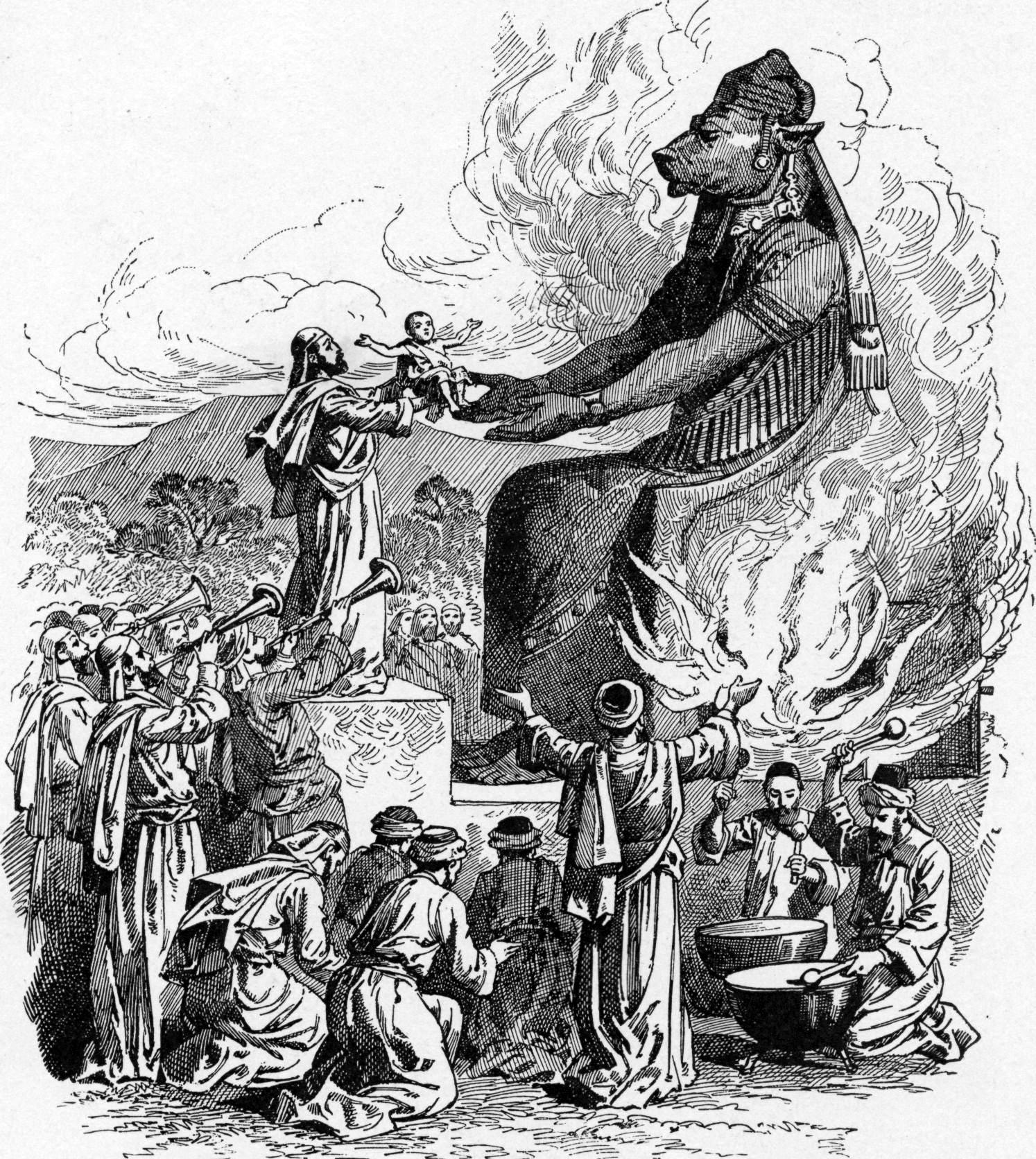
    Image from en.wikipedia.org

  • But the Rabbis never regarded the heathens of their own day as on the same moral level with the Canaanites.  
  • Their contemporary heathens in the Roman and Persian Empires obeyed the laws of conduct which the Rabbis deemed vital to the existence of human society, the so-called ‘seven commandments given to the children of Noah’ (Rabbinical interpretation of Genesis IX:7 “And you, be ye fruitful, and multiply; swarm in the earth and multiply therein.” viz.  
    • (1) the establishment of courts of justice;
    • (2) the prohibition of blasphemy;
    • (3) of idolatry;
    • (4) of incest;
    • (5) of bloodshed;
    • (6) of robbery;
    • (7) of eating flesh cut from a living animal.  
  • The Rabbis called these seven laws the ‘Seven Commandments given to the descendants of Noah’.  

These constituted what we might call Natural Religion, as they are vital to the existence of human society.  Whereas an Israelite was to carry out all the precepts of the Torah, obedience to these Seven Commandments.)  

They wisely held that in their religious life these heathens merely followed the traditional worship which they had inherited from their fathers before them, and they could not therefore be held responsible for failure to reach a true notion of the Unity of God.  Such followers of other faiths—they taught—were judged by God, purely by their moral life.  ‘The righteous of all nations have a share in the world to come,’ and are heirs of immortality, alongside the righteous of Israel.

A later Midrash proclaimed:  ‘I call heaven and earth to witness that, whether it be Jew or heathen, man or woman, freeman or bondman—only according to their acts does the Divine spirit rest upon them.’ And in the darkest days of the Middle Ages, Solomon Ibn Babirol, the great philosopher and Synagogue hymn-writer, sang:

Thou art the LORD
And all beings are Thy servants, Thy domain;
And through those who serve idols vain
Thine honour is not detracted from, 
For they all aim to Thee to come.’

This is probably the earliest enunciation of religious tolerance in Western Europe.

—————————————————

20 But you, YHVH took 
and brought you out of the Iron Furnace, out of Egypt,
to be for him a people of inheritance, 
as (is) this (very) day.

iron furnace. One whose fire is fierce enough to melt iron—a symbol of intense suffering and bitter bondage.

a people of inheritance.  Involving a relationship that is doubly inalienable.  It cannot be renounced by Israel; ‘and that which cometh into your mind shall not be at all; in that ye say: We shall be as the nations, as the families of the countries, to serve wood and stone.  As I live, saith the LORD God, surely with a mighty hand and with an outstretched arm, and with fury poured out, will I be king over you’ (Ezekiel XX,32-33).  Nor will God ever forsake Israel; ‘for the LORD will not forsake His people for His great name’s sake; because it hath pleased the LORD to make you a people unto Himself’ (I Sam. XII,22).]

21 Now YHVH was incensed with me because of your words 
and he swore not to let me cross the Jordan, 
not to enter the good land that YHVH is giving you as an inheritance.
22 For I am going to die in this land, 
I will not cross the Jordan!
But you (are the ones who) will cross over and take-possession of this good land. 

in this land. He is not to participate in the inheritance! The words tremble with suppressed emotion, and his soul is full of that thought.

I must not go over Jordan.  lit.  ‘I am not to go over Jordan.’  This clause seems unnecessary after, I must die in this land.  Hence Rashi’s comment, Not even my bones will be carried over Jordan to be laid to rest in the sacred soil, as will happen with the bones of Joseph.  LORD of the Universe—Moses prayed—the bones of Joseph shall rest in the Holy Land, why then shall I not enter it?  The Divine answer was, ‘Joseph always acknowledged himself a Hebrew, as it is said, “I was stolen out of the land of the Hebrews.”  Whereas thou, Moses, didst not always act thus.  When the daughters of Jethro told their father, “An Egyptian helped us,” thou wast silent and didst not contradict them.  Therefore thou shalt not be buried in the Holy Land’ (Midrash).

23 Take you care,
lest you forget the covenant of YHVH your God which he cut with you, 
and you make yourselves a carved-image, the form of anything 
about which YHVH your God commanded you!

take heed.  This v. is not a mere repetition of v. 15.  The fate meted out to Moses should make Israel the more grateful for God’s goodness, and at the same time more heedful not to incur God’s wrath.

hath forbidden thee.  lit. ‘hath commanded thee’, not to do (Rashi).

24 For YHVH your God-he is a consuming fire,
a jealous God!

a devouring fire.  Consuming whatever rouses His indignation.

——————————————-

A ‘JEALOUS’ GOD

a jealous God.  The Heb. el kanna  means, ‘a zealous God’, full of zeal for holiness and justice, to whom man’s doings and dealings are not a matter of indifference, but Who renders strict retribution for all idolatry and iniquity.  It also means, ‘a jealous God.’  It signifies that God claims the exclusive love of His children, their entire sincerity—and complete self-surrender.  He will not allow the veneration and loyalty due to Him alone to be shared with other objects of worship . . .
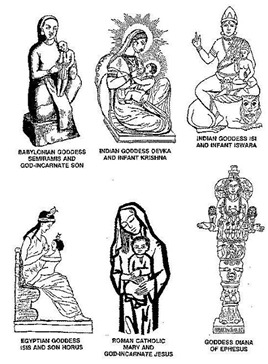
Image from freedomfromdelusion.blogspot.com

(Exodus XX,5: a jealous God.  The Heb. root for ‘jealous’, kanna, designates the just indignation of one injured; used here of the all-requiting righteousness of God.  God desires to be all in all to His children, and claims an exclusive right to their love and obedience.  He hates cruelty and unrighteousness, and loathes impurity and vice; and, even as a mother is jealous of all evil influences that rule her children. He is jealous when, instead of purity and righteousness, it is idolatry and unholiness that command their heart-allegiance.  It is, of course, evident that terms like ‘jealousy’ or ‘zeal’ are applied to God in an anthropomorphic sense.  It is also evident that this jealousy of God is of the very essence of His holiness.  Outside Israel, the ancients believed that the more gods the better; the richer the pantheon of a people, the greater its power.  It is because the heathen deities were free from ‘jealousy’ and, therefore, tolerant of one another and all their abominations, that heathenism was spiritually so degrading and morality so devastating.)

This conception of ‘a jealous God’ saved Israel from going under in the days of ancient heathendom, as well as in the days of Greece and Rome.  ‘None of the founders of the great heathen religions had any inkling of this idea of a jealous God, a God who would have “none other gods,” a God of terrible Truth who would not tolerate any lurking belief in magic witchcraft, or old customs, or any sacrificing to the god-king, or any trifling with the stern unity of things’ (H.G. Wells).  Our fathers’ realization that truth can make no concession to untruth, nor enter into compromise with it, without self-surrender, is responsible for the religious stand they took up in the days of Greece and Rome.  ‘When Jerusalem fell, Rome was quite prepared to give the God of Israel a place in her Pantheon. Israel absolutely refused such religious annexation: the one, unique and universal God of Israel alone was the living God; Jupiter and his like were things of naught, figments of the imagination.  And the same reasons that would not permit the Jews to bend the knee to the gods of pagan Rome, prevented them in later generations from allowing themselves to be absorbed by the two great Religions that issued from Israel’s bosom.  Here too they found, both in dogma and morality, novelties and concessions that were repugnant to the austere simplicity of their absolute monotheism (T. Reinach).

And the blessed doctrine of ‘a jealous God’ is of vital importance for the Jew’s attitude towards the neo-paganism of today and tomorrow.  ‘Judaism’s mission is just as much to teach the world that there are false gods and false ideals, as it is to bring it nearer to the true one.  Abraham, the friend of god, began his career according to the legend, with breaking idols; and it is his particular glory to have been in opposition to the whole world’ (Schechter).

———————————————–

25-31.  RENEWED WARNING OF IDOLATRY:  THREAT OF EXILE, WITH PROMISE OF GRACE ON REPENTANCE

They would be scattered among the peoples, if they fell away from the LORD.  But even in those days of tribulation God’s mercy would not forsake His people, if they turned to Him in true penitence.

25 When you beget children and children’s children
and you grow old in the land:
should you wreak-ruin by making a carved-image in the form of anything, 
thus doing what is ill in the eyes of YHVH your God, vexing him:

ye shall have been long in the land. And your long continuance results in a loss of vigour, due to unbroken peace and prosperity.  “Prosperity sometimes acts like a narcotic, and sends the soul to sleep’ (Dummelow).  The Hebrew word is not ‘to grow old and increase in wisdom’ but lit. ‘to grow stale.’  They must not imagine that having dwelt for many centuries in Canaan, their tenure was now fixed, and they could neglect the conditions of the Covenant with impunity.  (Benjamin Suzold makes the opening words ‘when thou shall beget’, equivalent to ‘even when thou shalt beget’).

do that which is evil. These words are explanatory of what precedes; viz. the making of images.  Ibn Ezra explains them as signifying other offences–e.g. murder, impurity—which would provoke God.]

26 I call-as-witness against you today the heavens and the earth,
that you will perish, yes, perish quickly 
from off the land that you are crossing the Jordan thither to possess;
you will not prolong days upon it, 
but you will be destroyed, yes, destroyed!

heaven and earth.  As abiding and outlasting the changes of human life.

ye shall soon utterly perish.  Not every individual would be destroyed, but the national life would be brought to an end.

27 YHVH will scatter you among the peoples, 
you will be left as menfolk few-in-number 
among the nations whither YHVH will lead you.

scatter you.  The consequences of idolatry are exile from their native land, dispersion to the four winds of heaven, and diminution in numbers.

28 You will serve there gods made by human hands, of wood and of stone,
which cannot see and cannot hear, and cannot eat and cannot smell.

wood and stone. In their own land, they served images as symbols of something higher.  But in exile the Israelite would sink to the level of fetish-worshippers and grovel to the idols of wood and stone (Hoffmann).  Such things cannot, however, permanently satisfy human souls that have known higher things.  This very lowering of moral standards called forth a spiritual reaction among the religiously-minded ‘remnant’ in the Exile.

smell.  Or ‘breathe’.]

29 But when you seek YHVH your God from there 
you will find (him),
if you search for him with all your heart and with all your being.

ye will seek the LORD.  This is a great pronouncement of Scripture, proclaiming the omnipotence of (God), Repentance.  But the sinner must seek God, i.e. he must feel the ‘loss’ of God, and take active measures to ‘find’ Him and regain His favour.  And that search must be with the sinner’s whole heart and soul.  Sincere repentance always and everywhere secures the Divine Mercy.  It would be so in the Exile, if they sought God with a radical change of heart, and the devotion of the whole being.  And indeed it was in the Exile that repentant Israel found God, rediscovered the Torah, rediscovered itself.

30 When you are in distress 
because there befall you all these things, in future days, 
you shall return to YHVH your God and hearken to his voice.

in the end of days.  Here equivalent to the phrase, ‘later on’ (Koenig).

31 For a compassionate God is YHVH your God;
he will not weaken you, he will not bring-ruin on you,
he will not forget the covenant (with) your fathers that he swore to them.

a merciful God.  Although He is ‘a devouring fire’ to those who are perversely wicked, He is merciful and gracious to the sincerely penitent; and His hand is outstretched to receive the sinner returning unto Him.

fail thee.  He will not give thee up (Hoffmann); or, He will not withdraw His hand from upholding thee (Rashi).

neither destroy thee.  Nor permit thee to go to destruction.

nor forget the covenant. With the Fathers of Israel.  This is the basis of Israel’s selection and eternal preservation.]

32-40.  THE UNIQUENESS OF THE GOD OF ISRAEL

Again there is an appeal to history to justify the Divine claims.  From the beginning of time, from one end of heaven to the other, no nation had experienced the paralleled redemption and revelation that were vouchsafed unto Israel.  ‘He hath not dealt so with any nation’ (Psalm CXLVII,20).

32 For inquire, pray, of past days, which were before you:
from the day that God created humankind on the earth, and from one edge of the heavens to the (other) edge of the heavens: 
has there ever been such a great thing,
or anything heard like it?
33 Has a people ever heard the voice of a god speaking from the midst of the fire
as you have heard, yourself,
and remained-alive?

and live. The idea often finds expression in Scripture that man cannot have direct communication with God and survive; Exod. XXXIII,20.

34 Or has a god ever essayed to come and take himself a nation from within a nation,
with trials, signs, portents and deeds-of-war, 
with a strong hand and an outstretched arm 
and with great awe-inspiring (acts),
according as all that YHVH your God did in Egypt before your eyes?

assayed . . . to take Him a nation.  Or, ‘adventured’ or, ‘attempted,’ to select a nation for His special service.  A bold anthropomorphism that gives striking expression to the profound thought that Israel is, so to speak, ‘a Divine experiment in history’ (M. Lazarus).

trials. e.g. testing the character of Pharaoh by the manifestation of His might; or testing Israel in the iron furnace of suffering, v. 20.

signs.  Events, either ordinary or extraordinary, having for their purpose the fulfillment of a Divine aim.

wonders.  Portents, supernatural phenomena.

war.  The overthrew of the Egyptian host.

a mighty hand.  The Biblical term to denote any Divine intervention in history (Koenig).

great terrors. e.g. the heaping of the waters at the Red Sea.  An old Jewish interpretation found in the Septuagint and the Passover Haggadah, understands this phrase to refer to God’s self-manifestation.

35 You yourself have been made-to-see, to know
that YHVH-he is God, 
there is none else beside him!

it was shown.  The experience of god’s unique power was first-hand with them, and not derived from speculation or hearsay.  Yehudah Hallevi bases on this circumstance the supreme credibility of the Revelation at Sinai:  it took place before an entire people.

there is none else beside Him.  A clear expression of absolute monotheism; repeated in v. 39; VI,4; VII,9′ X,17; and XXXII,39.  A Talmudical note on these words is, ‘not even magical powers’; i.e. the Israelites were to put no faith in witchcraft.

Image from marshill.com

36 From the heavens he had you hear his voice, to discipline you;
on earth he had you see his great fire,
and his words you heard from the midst of the fire.

instruct.  Better, discipline. What Israel had seen and heard was not merely to impress the mind, but to affect their course of life, and check any tendency to stray after idolatry.]

37 Now since he loved your fathers, 
he chose their seed after them
and brought you out with his presence with great power from Egypt,

loved thy fathers.  The Patriarchs.

with His presence.  In His own person; not through an intermediary.

38 to dispossess nations greater and mightier than you from before you, 
by bringing you out, by giving you their land as an inheritance, as (is) this (very) day-

as it is this day. i.e. as thou hast already made conquests in the territory east of Jordan, the lands of Sihon and Og.

39 know today and lay it up in your heart,
that YHVH-he is God 
in the heavens above and on the earth beneath,
(there is) none else!

know this day.  This v. and the one following from the peroration of the First Discourse, and summarize the lesson to be learnt from all that has gone before.  According to most expositors, this First Discourse gives the historical framework and instruction for the new legislation.  The aged Lawgiver exhorts the people to gratitude toward God (I,6-III,29), and closes with solemn warnings of the dangers of idolatry that threaten them on entering the Promised Land (IV,1-40). v.39 has been introduced into the Oleynoo, the closing prayer of every Synagogue Service.

40 You are to keep his laws and his commandments that I command you today, 
that it may go-well with you and with your children after you,
in order that you may prolong days on the soil
that YHVH your God is giving you, 
all the days (to come).

41-43.  MOSES ASSIGNS THREE CITIES OF REFUGE EAST OF JORDAN

The presence of these verses between the First and Second Discourses of Moses offers considerable difficulty, except on the interpretation of Luzzatto; I,5.  Having finished the exposition of the words, it is eleven day’s journey from Horeb unto Kadesh-barnea by the way of Mount Seir (I,2), Moses records that he thereupon set aside the three Cities of Refuge, thus completing the establishment of a portion of Israel on the east of Jordan.

41 Then Moshe set apart three towns in (the country) across the Jordan, toward the rising of the sun,

separated.  Set apart.

three Cities.  There were to be six Cities of Refuge (see Num. XXXV,9), three on each side of the Jordan.  The purpose of these cities is expounded in Chap. XIX.

42 for fleeing to (for) the (accidental) murderer who murders his neighbor with no forethought, where he did not bear-hatred toward him from yesterday and the day-before, 
and so can flee to one of these towns and stay-alive:

unawares.  Better, unintentionally.

43 Betzer in the wilderness of the plateau land, belonging to the Re’uvenites,
Ra’mot in Gil’ad, belonging to the Gadites, 
and Golan in Bashan, belonging to the Menashites.

Bezer. Mentioned in Josh. XX,8.

Ramoth in Gilead. Usually identified with the modern es-Salt; Josh. I,38.

Golan.  Josephus mentions a district called Gaulanitis east of Lake Tiberias, now named Jaulan, 17 miles east of the Lake.

44 This is the Instruction that Moshe set before the Children of Israel,
45 these are the precepts and the laws and the regulations that Moshe declared to the Children of Israel when they went out from Egypt,
46 in (the country) across the Jordan, in the valley opposite Bet Pe’or, 
in the land of Sihon, king of the Amorites, who sat-as-ruler in Heshbon,
whom Moshe and the Children of Israel struck, when they went out from Egypt;
47 they took possession of his land and the land of Og king of Bashan- 
the two kings of the Amorites who (were) in (the country) across the Jordan, (toward) the rising of the sun,
48 from Aro’er that is on the bank of the Wadi Arnon, as far as Mount Si’on/Peak-that is Hermon,
49 and all the Plain across the Jordan, toward sunrise, as far as the Sea of the Plain, beneath the slopes of the Pisga (Range).



Deuteronomy/Davarim 2-3,1-22: "You are not to be afraid of them, for YHVH your God, he is the one who wages-war for you!"

[An Elohiym Who fights for His people . . . what a God!


 In reading about religions of the world, believers/worshippers of specific gods do not have this much assurance since their beliefs are based on man-made speculations on what their god is like.  They probably never hear from that god, except in their imagination.  In fact, from our readings, we find out that when warring tribes decide to fight it out, those whose god is the god of the plain would like to fight their battle on the plain while those whose god is of the mountain would like to fight on the mountain, thinking one has an edge over the other territorial god.


 The God of Israel is the Creator of the universe so wherever and whenever He decides to back up His chosen people, against all odds, Israel has proven again and again, even in their modern battles, that there is a FORCE—that is, aside from their battle-preparedness and excellent war strategies—that assures them victory, particularly if they have been obedient to the God Who has chosen them and taught them to live His Way.


This chapter is not even exciting to read, since there is no suspense about who wins in the end.  ‘The battle is the LORD’s’, so goes the lyrics of a Christian hymn.  We have rewritten the lyrics, in case you know the music, sing along:

The battle is the LORD’s! Fear not, He leads the way,
To conquer hearts and minds and souls, of all who stray.
Our duty is to learn, and share all that we know,
Image from godsbreath.net
With every seeker we befriend, do not let go.
—–
The battle is the LORD’s!
Not ours is strength nor skill,
But His alone, in sovereign grace
to work His will.
Ours, counting not the cost, unflinching to obey;
And in His time within our time, we shall win the day.
—-
The battle is the LORD’s! It’s always been that way,
Since Moses, Joshua and the Prophets, to this day.
They all relied on Him, commandments they did heed,
And when they heeded not they suffered loss indeed.
—-
The battle is the LORD’s!  Stand still, my soul and see
The great salvation God hath wrought revealed to me.
Then resting in His might, lift high His triumph song,
For pow’r dominion, kingdom, strength to HIM belong!


The commentary, as usual, is from Pentateuch and Haftorahs, ed. Dr. J.H.Hertz; translation is EF/Everett Fox, The Five Books of Moses.Admin1.]

—————————————————

In the first portion of his Discourse, Moses dwelt on the abortive attempt to enter Canaan.  He now recalls (II-III,29) the victories that marked the close of their wanderings, victories that presaged Israel’s conquest of the Promised Land.  He thus points out that unbelief and rebellion brought shame and punishment; while repentant return to God and obedience to His will were crowned by blessing and triumph.


Deuteronomy/Davarim 2

II,1-8.  ROUND MOUNT SEIR

After the repulse at Kadesh, the Israelites turned back towards the Red Sea, skirting Mt. Seir, until God commanded them to turn northward, and pass peacefully through Esau’s territory.

1 and we faced about and marched into the wilderness, by the Reed Sea route, 
as YHVH had spoken to me; 
we circled around the hills of Se’ir for many days-and-years. 

by the way to the Red Sea. i.e. in the direction of the north-eastern branch of the Red sea, the Gulf of Akabah.

we compassed mount Seir.  Indicates the long and arduous journey in order to go round Edom; see Num. XXI,4.

many days.  Thirty-eight years.

2 Now YHVH said to me, saying: 
3 Enough for you, circling around these hills! 
Face about, northward! 

turn you northward.  ‘The Israelites must be imagined by this time to have made their way along the south-western and southern border of Edom, as far as the south-east end of the Arabah, so that a turn northwards would at once lead them along the eastern border of Edom in the direction of Moab’ (Driver); Judges XI,18.

4 And as for the people, command (them), saying: 
You are (about) to cross the territory of your brothers, 
the Children of Esav, who are settled in Se’ir. 
Though they are afraid of you,
 take exceeding care! 

ye are to pass through. This is quite distinct from the earlier attempt to shorten the journey by passing through Edomite territory from Kadesh on the western frontier, permission for which was refused by the king of Edom; Num. XX.

the children of Esau.  The eastern portion of Edom was inhabited by free Bedouins, kinsmen of the Israelites. These did not threaten them with war, as the Edomites in western part of the land had done, if they dared pass through their land (Rashbam, Luzzatto).

be afraid of you. The western border of Edom is a series of natural fortresses, making it easy to repel any invading host.  Not so the eastern border.

5 Do not stir yourselves up against them, 
For I will not give you of their land so much as the sole of a foot can tread on,
 for as a possession to Esav I gave the hill-country of Se’ir. 

contend not.  lit. ‘incite not.’  God is the ruler of the whole world.  All the nations—not only Israel—were under God’s Providential rule, and have had their territories assigned to them.  Israel therefore must respect these possessions and not become a mere conquering people.  Israel must confine his ambitions to the one Land Divinely assigned to him at the very beginning of his being as a family (S.R. Hirsch).

as for the sole of the foot.  They were not permitted even to pass through their land, without their permission.

unto Esau.  David fought against the descendants of Esau and made them his ‘servants’ (II Sam. VIII,14), but he did not dispossess them of their land; and later, in the reign of Jehoram, they again became independent (II Kings VIII,20).

6 Food you may market from them for silver, that you may eat; 
and also water you may purchase from them for silver, that you may drink. 
7 For YHVH your God has blessed you in all the works of your hands- 
he has known your travels in this great wilderness! 
(For) forty years is YHVH your God with you; 
you have not lacked a thing! 

hath blessed thee. Gives the reason for Israel’s proud independence of Edom.  The Israelites were well able to pay for their necessities.

He hath known. i.e. He hath cared for; the same usage of ‘know’ is found in Gen. XVIII,19.

8 So we crossed on by, away from our brothers, the Children of Esav, who are settled in 
Se’ir,
 (away) from the route of the Plain, from Eilat and from Etzion Gever, 
and we faced about and 
crossed the route of the Wilderness of Moav. 

way of the Arabah. The route from south of the Dead Sea to Hebron.

Elath.  The modern Akabah.

Ezion-geber.  Also mentioned in I Kings IX,26  as being ‘on the shore of the Red Sea, in the land of Edom’.  A fleet which Jehoshaphat had built was wrecked there (I Kings XXII,49).

The word Ezlon-geber is followed by a Massoretic note, known as ‘a break int he middle of the verse’, which indicates that a new paragraph begins with the second half of the verse.

8-12.  ON THE BORDER OF MOAB

Image from answers.com

wilderness.  The Heb. does not always mean ‘a desert’.  It often denotes ‘a place where cattle is driven to pasture’, uncultivated land, ‘Isael kept so far east, not only to avoid the fertile and settled districts of edom and Moab, but so as not to have to cross the lower stretches of the great canyon between Edom and Moab.  These lower stretches are deep, the sides steep, and the roads over them difficult for caravans.  The route of Hajj, apparently that of Israel, crosses the much shallower head of this wady and the desert border.  Once over it, they were in the  wilderness of east of Moab’ (G.A. Smith).]

9 YHVH said to me: 
Do not harass Moav, do not stir yourself up against them (in) war, 
for I will not give you (any) of their land as a possession, 
for to the Children of Lot I have given Ar as a possession. 

Ar.  The capital of Moab, situated in the valley of Arnon, on the Moabite frontier; Num. XXI,15,28.

the children of Lot.  Genesis XIX,37:  Moab. The name is explained as though it were the equivalent of me-ab, ‘from a father.’

10-12.  These three verses are a parenthetic note on the earlier inhabitants of Moab and Edom, and introduced by Moses probably on writing down his Discourse.

10 -The Emites/Frightful-ones were formerly settled there, 
a people great and many, and tall like the Anakites. 
11 Like Refa’ites/Shades are they considered, as the Anakites (are),
 but the Moavites call them Emites. 

Emim. ‘The dreaded ones’l Gen. XIV,5: The peoples named in this verse—Rephaim, Zuzim, Emim, Horites—are the aboriginal inhabitants of the region afterwards occupied by Edom, Moab and Ammon.

12 Now in Se’ir the Horites were formerly settled; 
but the Children of Esav dispossessed 
them, destroying them from before them and settling in their place, 
(just) as Israel did to the land of their possession, 
which YHVH gave to them.- 

Horites. The name has been translated ‘cave-dwellers.’  Macalister has discovered that at Gezer the remains of a pre-Semitic cave-dwelling race, using stone implements; and he identifies these with the Horites.  A far different view is propounded by J.W. Jack, who regards them as being ‘one of the most important cultural races of Western Asia during the earlier part of the second millennium. Some time before the Semites arrived on the scene, they occupied the whole of northern Mesopotamia.  It was to the Horites or Hurrians that the Hittites directly owed their civilization, including their religion and most of their literature.  This ancient race, who were in the country of Seir as early as the time of Abraham, must have exerted a considerable influence on the Hebrews’.

succeeded them.  Rashi notes that the verb is unexpectedly in the imperfect tense and implies ‘continued to dispossess them’.

as Israel did. Refers to the conquest of trans-Jordanic territory (Num. XXXII).

13-15.  THE CROSSING OF ZERED

This was an important step; hence the mention of the time that had elapsed since Israel left Kadesh, and also that now the doom passed on the men of war because of their murmuring had exhausted itself.  Since this doom was no longer resting on their efforts, the people could with every expectation of the Divine help go forward to the conquest of the new country (Welch).

13 Now, arise, cross you the Wadi Zered! 
So we crossed the Wadi Zered. 

brook.  A toreent-valley — the hollow between hills that is usually dry in summer, but a fast-rushing torrent in the rainy season—wady.

14 And the days that we traveled from Kadesh Barne’a until we crossed the Wadi Zered 
(were): 
thirty-eight years,
until had ended in all that generation, the men of war, from amid the camp, 
as YHVH had sworn to them. 
15 Yes, the hand of YHVH was against them, to panic them from amid the camp, 
until they had ended. 

was greatest against them.  The generation of murmurers did not perish entirely from natural causes.  God hastened their annihilation, so as to enable their children to pass over the Jordan.

16-25.  AMMONITES AND AMORITES

16 Now it was, when all the men of war had ended (their) dying
 from amid the people, 
17 YHVH spoke to me, saying: 
18 You are crossing today the territory of Moav, Ar. 
19 When you come-near, opposite the Children of Ammon,
 do not harass them, do not stir yourself up against them, 
for I will not give (any) of the land of the Children of Ammon to you as a 
possession,
for to the Children of Lot I have given it as a possession. 

children of Ammon.  Inhabited the district between the Arnon and Jabbok, the tributaries of the Jordan.

20 It, too, is considered the land of the Refa’ites,
 Refa’ites were settled in it in former-times, 
but the Ammonites call them Zamzummites/Barbarians 

Zamzummim.  Nothing is known of them.  Their name is held by some to be formed on the analogy of the Grek ‘barbaroi’, as a people whose speech sounded uncouth (G.A. Smith).

21 -a people great and many, tall like the Anakites,
 yet YHVH destroyed them from before 
them, and they dispossessed them, 
and settled in their place, 
22 as he did to the Children of Esav who are settled in Se’ir,
that he destroyed the Horites from before them, and they dispossessed them and settled in their place, 
until this (very) day. 
23 As for the Avvites who were settled in villages as far as Gaza, 
Kaftorites who came from Kaftor destroyed them and settled in their place. 

Avvim.  Only mentioned again in Josh. XIII, as a Philistine people.

Caphtor.  i.e. Crete; see Gen. X, 14.

24 Arise, march on and cross the Wadi Arnon! 
See, I have given into your hand Sihon king of Heshbon, the Amorite, and his land; 
Start! Take-possession! 
And stir yourself up against him (in) war! 

rise ye up.  This verse is the continuation of v. 19.  From Num. XXI,26 we learn that Heshbon and the surrounding territory had belonged to the Moabites, from whom it had been wrested by Sihon.

25 This (very) day
 I will start to put the terror of you and the awe of you upon the peoples 
(that are) under all the heavens, 
so that when they hear heard-rumors of you, 
they will shudder and writhe before you. 

Kedemoth.  The precise site is unknown, but probably somewhere near the upper course of the Arnon.  The name occurs later a that of a Levitical city in the territory of Reuben; Josh.XIII,18.

with words of peace. i.e. messengers with proposals for a peaceful passage through his land, and undertaking to pay for such provisions as would be required.

26 Now I sent messengers from the Wilderness of Kedemot to Sihon, king of Heshbon, 
words of peace, saying: 

by the highway.  The Heb. is, ‘by the way, by the way’; i.e. by the appointed road and nowhere else.  In Num. XXI,22 the phrase is ‘by the king’s highway’.

27 Let me cross through your land;
on the main-route, on the main-route I will go,
 I will not turn aside right or left. 
28 As for food, for silver you may market (it) to me, that I may eat, 
as for water, for silver you may give (it) to me, that I may drink, 
only: let me cross on foot- 
29 as the Children of Esav, who are settled in Se’ir, did for me, 
and the Moavites, who are settled in Ar, 
until I have crossed the Jordan 
into the land that YHVH our God is giving us. 

as the children of Esau . . . did unto me. As distinct from the kingdom of Edom.

30 But Sihon king of Heshbon was not willing to let us cross through him, 
for YHVH your God hardened his spirit and stiffened his heart, in order to give him into your hand, as (is) this day. 

hardened his spirit.  Similar to the phrase used of Pharaoh.  ‘The meaning is, As God rules all, so to Him must be traced all that happens in the world.  In some sense all acts, whether good or bad, all agencies, all beneficent or destructive, have their source and derive their power from Him.  But nevertheless men have moral responsibility for their acts, and are fully and justly conscious of ill-desert.  It is to be noted that God is never said to harden the heart of a good man.  It is always those who are guilty of acts of evil-doing upon whom this works’ (Harper).

obstinate.  Heb. ‘strong.’

as appeareth this day. As experience has now shown.

31 Now YHVH said to me: 
See, I have started to give before you Sihon and his land, 
start, take-possession, to possess his land! 

I have begun.  Sihon’s refusal was the beginning of God’s move to give Israel his country.

32 And Sihon went out to meet us, 
he and all his people in war, at Yahatz, 
33 but YHVH our God gave him before us, 
we struck him and his sons and all his people. 
34 We conquered all his towns at that time, 
we devoted-to-destruction every town: menfolk, 
women, and little-ones; we left no remnant. 

utterly destroyed.  Heb. ‘treated as ‘herem’; i.e. placed them under the ban of extermination.  Such was the rule of warfare in the days of old, when war was a sacred act.  The ruthlessness of those methods is as hideous to us today as war itself will–we hope and pray– be to the men and women of the future.  And if it is the wholesale nature of the destruction that especially shocks our moral judgment, it is well for us to consider that in the next World War it is especially the defenceless population that will be exposed to annihilation.

35 Only the animals did we plunder for ourselves, 
and the booty of the towns that we conquered. 
36 From Aro’er, that is on the bank of the Wadi Arnon, 
and the town that is in the Wadi, as far as Gil’ad, 
there was not a city that was too lofty for us,
 all (of them) YHVH our God gave before us. 

the city.  The capital, Ar.

37 Only the land of the Children of Ammon you did not come-near, 
all the environs of the Wadi Yabbok, and the towns in the hill-country,
and all about which YHVH our God commanded us. 

thou camest not near.  In accordance with the warning in v. 19.

forbade us.  The Heb. is ‘commanded us’; and the words ‘not to conquer’ are understood.

Deuteronomy/Davarim 3

FURTHER VICTORIES

The Israelite hosts, advancing northwards towards Bashan, encounter and defeat Og and conquer his cities.

1 We faced about and went up the route to Bashan, 
and Og king of Bashan came out to meet us, 
he and all his fighting-people in war, at Edre’i.

and went up.  This phrase denotes traveling northward, since there is an almost continuous ascent from South to North (Rashi).

Bashan.  The fertile district north of Gilead.

2 And YHVH said to me:
Do not be afraid of him,
for into your hand I give him and all his fighting-people, and his land, 
you will do to him 
as you did to Sihon king of the Amorites, that sat-as-ruler in Heshbon.

fear him not.  Og was a more formidable opponent than Sihon, belonging as he did to the race of giants.

3 And YHVH our God gave into our hand 
Og king of Bashan as well, and all his fighting-people, 
we struck him until there was not left him any remnant.
4 We conquered all his towns at that time,
there was no city that we did not take from them, 
sixty towns, all the region of Argov,
the kingdom of Og at Bashan.

region of Argob.  Probably identical with the modern el-Leja, south of Damascus, and east of Lake Tiberias.

5 All these (were) fortified towns (with) a high wall, doubled-doored with a bar,
aside from the towns of the open-country-dwellers, exceedingly many.

gates.  The Heb. is in the dual, ‘double gates,’ an indication of the strength of the doors to keep out the enemy.

and bars.  The Heb. is in the singular; and there is no reason why it should not be so rendered.  Each city had a double gate, with a bar across it when closed.

unwalled towns.  Or, ‘country towns.’

6 We devoted them to destruction, 
as we had done to Sihon king of Heshbon, 
devoting-to-destruction every town:
menfolk, women and little-ones,
7 while every (head of) cattle, and the plunder of the towns, we took-as-plunder for ourselves.

8-17.  ALLOTMENT OF THE CONQUERED LAND

8 And we took at that time the land
from the hand of the two kings of the Amorites that were in (the country) across the Jordan, 
from Wadi Arnon to Mount Hermon;

two kings of the Amorites.  Sihon and Og.

9 -Sidonians call Hermon Siryon, 
but the Amorites call it Senir-

Sirion . . . Senir.  An archeological note.  ‘The several names in the Text, as also that of Sion (Deut. IV,48), are all descriptive.  Rising with its gray snow-capped cone to a eight of about 9,500 feet, it is visible from most parts of the Promised Land, and even from the depths of the Jordan Valley and the shores of the Dead Sea.  Hence it was Sion, the up0raised; or Hermon, the lofty peak; o Senir, and Sirion, the glittering “breastplate” of ice; or above all Lebanon the “Mont Blanc” of Palestine, the “White Moujntain” of ancient times” (Stanley).

10 all the towns of the plateau and all of Gil’ad, and all of Bashan,
as far as Salkha and Edre’i, 
towns of the kingdom of Og at Bashan.
11 For only Og king of Bashan was left of the rest of the Refa’ites 
-here, his couch was a couch of iron,
is it not (still) in Rabba of the Children of Ammon, 
nine cubits its length, four cubits its width, by the cubit of a man?-

for only Og.  This explains why the Israelites were able to enter into possession of the territory.  With the death of Og, the formidable race of Rephaim came to an end.

bedstead.  This is the meaning which the word has in the Bible.  In Aramaic the word signifies ‘coffin’; hence there are some who suppose that what is here meant is the king’s sarcophagus.  Some sites in Eastern Palestine are strewn with stone-coffins. The bedstead is mentioned in order to indicate the huge size of Og; and it is not improbable that his bed would have been preserved as a curiosity.

Rabbah. Situated 25 miles north-east of the Dead Sea.

the cubit of a man. An ordinary cubit, the length of which was about 18 inches.  This does not necessarily mean that the height of Og was nine cubits, as the bed is always longer than the man who occupies it.

12 Now this land we possessed at that time, 
from Aro’er which is by the Wadi Arnon;
half of the hill-country of Gil’ad and its towns I gave to the Re’uvenites and to the Gadites.

this land.  From the valley of Arnon unto Mount Hermon.

13 And the rest of Gil’ad and all of Bashan, the kingdom of Og, 
I gave to half of the tribe of Menashe, all the region of Argov, including all of Bashan, 
-it is called the Land of the Refa’ites.

the rest of Gilead.  i.e. the part north of Jabbok.

14 Ya’ir son of Menashe took all of the region of Argov 
as far as the territory of the Geshurites and the Maakathites, 
and called them by his name, (the) Bashan (towns): 
Havvot Ya’ir/Tent-villages of Ya’ir,
until this (very) day.

son.  Here used, as frequently in the Bible, in the sense of ‘descendant’.  In I Chron. II,21, he is said to be the great-grandson of Manasseh’s son Machir.

Geshurites and the Maacathites.  Two Aramean tribes.

Havvoth-jair. Tent-villages, each being the homestead of a clan.

unto this day. Until now.

15 Now to Makhir I gave Gil’ad,

Gilead.  From the context it is clear that the northern half of Gilead is meant.

Machir.  The name seems to be used here to denote the half-tribe of Manasseh that had its habitation beyond the Jordan.’

16 and to the Re’uvenites and to the Gadites I gave from Gil’ad, 
as far as Wadi Arnon, the middle of the Wadi as
the boundary, as far as Yabbok the Wadi, the boundary of the Children of Ammon;

unto the Reubenittes.  This and the following v. are a repetition of v. 12 with greater detail of definition.

for a border.  i.e. the stream passing through the valley being the boundary.

river Jabbok. The upper part of this river is the western boundary of the territory of the Ammonites.

17 and the Plain and Jordan as (its) boundary 
from the Kinneret as far as the Sea of the Plain, the Sea of Salt,
beneath the slopes of the Pisga (Range), toward sunrise.

Chinnereth.  The city named after the Lake of Kinnereth, known today as Lake Tiberias.

the Salt Sea.  The Dead Sea.

slopes. Or, ‘springs.’

18 And I commanded you at that time, saying: 
YHVH your God has given you this land to possess; 
you specially-drafted (men) are to cross over before their brothers, the Children of Israel, all those of caliber.
19 Only your wives, your little-ones, and your livestock
-I know that you have many (head of) livestock-
are to settle in your towns that I am giving you,
20 until YHVH gives-rest to your brothers as yourselves, 
and they take-possession, they as well, of the land that YHVH your God is giving you, in (the country) across the Jordan. 
Then shall each-man return to his possession that I give you.

beyond the Jordan.  Unlike the same phrase in I,1; here it denotes the western side of the river.

21 Now Yehoshua I commanded at that time, saying: 
Your eyes (it was) that have seen all that YHVH your God did to these two kings; 
thus will YHVH do to all the kingdoms into which you are crossing!

I commanded Joshua.  This is not mentioned in Num. XXXII, as not being relevant to the incident which that chapter relates.

22 You are not to be afraid of them, 
for YHVH your God,
he is the one who wages-war for you!
 
[This is not the end of Chapter 3, verses 23-29 are included in the next post.–Admin1.]
 

Deuteronomy/Davarim 1: "These are the words that Moshe spoke to all Israel "

[You will notice that in these posts, there is a discrepancy between the wording of the translation we use, EF/Everett Fox, The Five Books of Moses, and the translation used in the commentary Pentateuch and Haftorahs, ed. Dr. H.W.Hertz. It is not difficult to make the connection, the message is much the same.


Also, while the commentators refer to Moses/Moshe as the “Lawgiver”, we disagree with that attribution.  The Giver of Torah is YHWH and as such, He should be called the “LAW-GIVER”, not Moshe who is the mediator between God and Israel, and the chosen mouthpiece, much like Israel’s prophets, who would articulate YHWH’s message, instructions, laws, and communication in general.  Moshe is simply the transmitter of Torah, he did not make up the laws for Israel to live by.  Commentators should give credit where credit is due, not saying “the Torah of Moses” but the Torah of YHWH, the LAWGIVER through His servant Moshe. —Admin1.]

CHAPTER I,1-5.  INTRODUCTORY

These verses are usually taken to be the general superscription to Deuteronomy. They specify the place and time of the Farewell Discourses of the Lawgiver recorded in this Book.


Deuteronomy/Davarim 1

1 These are the words that Moshe spoke to all Israel 
in (the country) across the Jordan 
in the wilderness, in the plains near Suf, 
between Paran and Tofel, Lavan, Hatzerot, and Di-zahav-

Image from enrichmentjournal.ag.org

words. i.e. discourses, of exhortation and reproof, which form the main contents of Deuteronomy.

unto all Israel. ‘These words redound to the praise of Israel.  Knowing that they were called together for the purpose of hearing a discourse which would contain strong words of reproof, they nevertheless attended in full number (Sifri).

beyond the Jordan.  Heb. ‘at the crossing of the Jordan’; or, at the banks of the Jordan,’ eastern or western.  Which one of these is meant in any particular passage can be determined only by the context (Gesenius, Luzzatto, Friedlander); Num. XXXII,19; Deut. XI,30.  Some commentators see in the words (lit. Transjordania) a fixed geographical name of the Moabite side of the Jordan, even for the inhabitants of that land.  Along with this went a local usage, determined by the position of the speaker.

in the Arabah. ‘The deep valley running North and South of the Dead Sea (RV Margin). Here the southern portion of this valley is meant, extending to the Gulf of Akabah, which is the north-eastern arm of the Red Sea.

Suph.  A shorter form of yam suph, i.e. the Red Sea.

Paran.  The wilderness of Paran is now called the wilderness of el-Tih, north of the Sinai Peninsula, and west of the Arabah.

Tophel.  Some identify this unknown place with el-Tafile, a village about 15 miles south-east of the Dead Sea.

Laban and Hazeroth. Possibly the Libnah and Hazeroth in Num. XXXIII,17-20.

Di-zahab.  The spot has not been identified.  The Hebrew implies ‘a place productive of gold’.

The five names mentioned above seemed to delimit the place where Moses gave one of the discourses to Israel.  Their identification is uncertain and full of difficulties.  Some of the ancient and medieval teachers have been inclined to treat these names homiletically.  By playing on their meaning, they associated these places with the murmurings and transgressions of the children of Israel.  Thus, Onkelos translates this v. as follows:  ‘These are the words which Moses spake to all Israel beyond the Jordan.  He reproved them because they had sinned in the Wilderness, and had provoked God to anger in the Plain (Arabah) of Moab; over against the Red Sea (Suph) they murmured against God; in Paran, they had spoken contemptuously (tophel) concerning the manna (laban); and in Hazeroth, they angered Him on account of flesh and because they amde the Golden Calf (di-zahab).’

2 eleven days (it is) from Horev, by the route of Mount Se’ir, (going) by Kadesh-barne’a.

it is eleven days’ journey. From Horeb, i.e. Sinai, the scene of the Giving of the Law, to Kadesh-barnea.  The distance between 160 and 170 miles.  In 1838, the traveller Robinson followed the route here specified, and the journey lasted exactly eleven days of ordinary camel-riding.

by the way of mount Seir.  Or, ‘by the Mount Seir road’—the easternmost track from the Sinai Peninsula to Kadesh.

3 And it was in the fortieth year,
 in the eleventh New-moon, on (day) one after the New-moon, 
Moshe spoke to the Children of Israel 
according to all that YHVH had commanded him concerning them,

[in the fortieth year.  The date of the discourses.  Moses reserved his exhortation for the closing days of his life, in the same way as Jacob (Gen.XLIX,), Joshua (Josh.XXIV), Samuel (I Sam.XII), and David (I Kings II).  Words spoke at the solemn time of departure from earth have a deep influence upon the hearers.

eleventh. . . .Koenig rightly points to this fact, among many others, as proof that, unlike the Samaritan and Septuagint Texts, the Heb. text has from the first been handed down to us with absolute accuracy, and that no attempt was made to ‘harmonize’ different forms of the same word or phrase.

4 after he had struck 
Sihon king of the Amorite, who sat-as-ruler in Heshbon, 
and Og king of Bashan, who sat-as-ruler in Ashtarot, in Edre’i.

Sihon . . . Og.  These signal victories, still fresh in the memory of all, are repeatedly mentioned in Deuteronomy; because the success of Moses’ leadership on these occasions heightened his authority and enabled him to address his people on their faults in the past and their duties in the future.

at Edrei.  The place where Og was slain (Num.XXI,35); the modern Dera, 30 miles east of the Lake of Tiberias.

5 In (the country) across the Jordan, in the land of Moav, 
Moshe set about to explain this Instruction, saying:

this law.  ‘The Heb. word Torah does not and never did mean “Law”.  It means and always has meant, “Teaching”‘ (Herford).  The word torah may refer to moral guidance, or to a single specific teaching, as in Prov. I,8, ‘forsake not the teaching (torah) of thy mother.’  It is also applied to a body of religious precepts or teachings—such as form the central portion of this Book (Chaps.XII-XXVI). Often it denotes the entire sum of Israel’s religious doctrine and life—the Torah of Moses.

1-5.  Apart from the geographical uncertainties there are many other difficulties in these verses, so long as we regard them as forming the title-page to the whole of Deuteronomy.  Thus, v.5 states that ‘Moses took upon him to declare this law . . . ‘ In the light of the current view of these verses, this can only mean that the exposition in question follows immediately upon that verse.  And yet the succeeding chapters contain no exposition of the Torah; nor, strictly speaking, can the laws in chaps. XII-XXVI be called an ‘exposition’ of the Torah, seeing that, of the one hundred laws contained in those chapters, seventy are not mentioned int he previous Books of the Pentateuch.

For these and other reasons, many commentators regard v.1-15 as introductory not to the whole Book, but merely to the First Discourse of Moses (I,6-IV,40); and, in consequence, their interpretation differs considerably from that given above.  One of these commentators is Sforno, who paraphrases v. 1 and 2 as follows:  ‘These are the words which Moses repeatedly spoke unto all Israel, beyond Jordan, in the Arabah, over against Suph, between Paran and Tophel and Laban and Hazeroth and Di-zahab; viz. “it is eleven days’ journey from Horeb unto Kadesh-barnea by way of Mount Seir.” And yet it had taken them forty years to accomplish that journey!  Such was the veiled admonition that Moses intended to convey to them by these words in each of the places mentioned.’ Targum Jonathan, Sifri, and Rashi seem to have understood these verses in the same sense.  ‘Had Israel been worthy, they could have entered the Land within eleven days; but they were sadly found wanting, and they drew upon themselves the punishment of forty years’ wandering’ (Sifri).  Luzatto sees this thought continued in v.3-5, which he paraphrases as follows: ‘In the fortieth year, after the victories over Sihon and Og, Moses undertook to make clear and expound the veiled meaning embodied in this “teaching”.’  Such declaration and exposition are contained in the First Discourse (I,6-IV,40) which he addressed to the People about to undertake the conquest of Canaan.  And in fact, that First Discourse is a historic retrospect of the main incidents from Horeb to Jordan, bringing home to the new generation why it was that the Israelites were doomed to wander forty years in the Wilderness before they could enter the Promised Land, though the direct route was only an eleven days’ journey.

A.  MOSES FIRST DISCOURSE

REVIEW OF JOURNEY FROM SINAI TO KADESH WITH EXHORTATION TO OBEDIENCE

Chapters I,6-IV,40)

Moses reviews the experiences of the Israelites in the terrible wilderness through which they passed till they reached Kadesh-barnea.  Thence the spies were sent on to Canaan.  These brought back word of a good land, but also of cities great and fenced up to heaven, and a population counting giants among them.  They so filled the heart of the people with fear, that Israel forgot God and was prepared to return to Egypt.  The unfaithful spies and the whole of that generation were therefore to perish in the Wilderness; their children alone were to enter the Promised Land.  Moses continues to tell of their presumptuous attempt to defeat that sentence, and the ignominious failure and our with which it had been visited.  Moses himself had been entangled in the rebellious outbreak of the people; and his doom is made known to him, to leave the passage into the Land of Promise to another leadership.  But even the eight and thirty years wandering in the Wilderness lacked not the LORD’s watchfulness.  Towards the end of the wandering, they passed by Edom, but were forbidden to attack Moab and Ammon.  With the crossing of the brook Zered, however, the new era began; the dread of Israel fell upon the heathen peoples.  In vain Sihon, King of the Amorites, and Og, king of Bashan, resisted; their cities were taken, their people extirpated, their land divided among the tribes of Reuben, Gad and half-Manasseh.

6-8/  COMMAND TO START FROM HOREB

6 YHVH our God spoke to us at Horev, saying:
 Enough for you, staying at this mountain!

the LORD our God. Placed emphatically at the beginning of the sentence as the motive of the whole Discourse.  ‘The phrase the LORD our God has the intimate accent of a common affection.  No phrase has been more helpful to piety in all generations’ (G.A. Smith).

7 Face about, march on 
and come to the Amorite hill-country and to all its dwellers
 in the Plains, the Hill-country and the Lowlands, the Negev/Parched-land and the shore of the sea, 
the land of the Canaanite and the Lebanon, 
as far as the Great River, the river Euphrates.

hill-country.  The central mountain-range of Palestine.

Amorites. The general term for the inhabitants of Canaan prior to the entry of the Israelites; Amos II,9; the Amorite. Representing the previous inhabitants of Palestine, as the Amorite was the most powerful tribe.]

Arabah. Here refers to its northern part, the Jordan Valley, ending in the Dead Sea.

Lowland. Heb. Shephelah. The foothills between the Central Range and the Maritime Plain.  It is one of the most fertile tracts in the land.

the South.  The Negeb; the dry steppe-district south of Judah.

the sea-shore. The Plain extending inwards from the coast of the Mediterranean to a distance of from four to fifteen miles.

Lebanon.  The range of mountains to the north of the Holy Land.

the river Euphrates. The ideal limit assigned to the territory of Israel.

8 See, 
I give before you the land, 
enter, take-possession of the land 
about which YHVH swore to your fathers, to Avraham, to Yitzhak, and to Yaakov, 
to give to them and to their seed after them.

[he land which the LORD swore unto your fathers.  This phrase occurs more than 20 times in Deuteronomy.  The Divine love towards the Patriarchs and the Promise to give, their children possessed of Canaan, led to the selection, and are guarantees for the preservation of Israel.

9-18.  APPOINTMENT OF ASSISTANTS

The first movement forward towards the conquest of the Holy Land revealed the growing numbers of the Israelites.  Moses could no longer, unaided, support the burden of so vast a nation.  Others had to share responsibility with him.  He has in mind not only the appointment of judges on the advice of Jethro (Exod. XVIII), but also the election of the 70 elders to help in the administration of the community.

9 Now I said to you at that time, saying:
 I am not able, I alone, to carry you;

not able to bear.  A reminiscence of Num. XI,14.

10 YHVH your God has made-you-many- 
and here you are today, like the stars in the heavens for multitude!

as the stars of heaven.  A simile of wonderful beauty.  God had fulfilled His promise to increase the children of the Patriarchs; Gen. XV,5.

11 YHVH, the God of your fathers, may he add to you as you are a thousand times, 
and bless you, as he promised to you!

the LORD . . . bless you. A pious interjection, as in II Sam. XXIC,3.  Moses hastens to bestow his blessing upon Israel in order that his words be not misunderstood as if he lamented the increase of his people (Hoffman).  The phrase ‘The LORD, the God of your fathers,’ has in substance been taken over into the Prayer Book.  It implies the unbroken continuity of the generations in Israel; and, likewise, the unchanging relationship between God and His ‘kingdom of priests’.

12 How can I carry, I alone, your load, your burden, your quarreling?

myself alone bear.  Moses now proceeds to recall how the task of government had grown beyond his powers.

your cumbrance.  Your troublesomeness; the people made the leader’s task heavier by placing obstacles in his way (Sifri).  He did not have their cooperation and assistance.

burden. ‘The responsibility of providing the people with food and water, the lack of which caused hostile demonstrations to be made against Moses’ (Ibn Ezra).

strife.  They were quarrelsome, and at this stage it was essential for him to be relieved of petty judicial functions.

13 Provide yourselves (with) men, wise, understanding and knowledgeable, for your tribes, 
and I will set them as heads-over-you.

get you.  It is clear from v. 15 that Moses, and not the people, made the selection.  As the Sifri points out, the Hebrew word denotes taking counsel about a project, not taking action in connection with it.

full of knowledge.  Or, ‘known.’ Because of their outstanding merit.

14 And you answered me, you said: 
Good is the word that you have proposed to do!
15 So I took heads of your tribes, men wise and knowledgeable, 
and I placed them as heads over you, 
as rulers of thousands, rulers of hundreds, rulers of fifties, and rulers of tens, and as officials for your tribes.

wise men and full of knowledge.   Compare this with what is stated in v.13, ‘wise men, and understanding, and full of knowledge.’ The Rabbis explain that Moses was unable to find men who possessed all the desired qualifications.

officers.  Officials in the administration of justice and maintenance of civil order, whose duty it was to put in force the instructions of their superiors (Talmud).  Some render the Heb. shoterim ‘recorders’, from ‘document.’

16 Now I commanded your judges at that time, saying:
hear-out (what is) between your brothers,
 judge with equity between each-man and his brother or a sojourner.

hear the causes between.  lit. ‘hear between’; i.e. not to listen to ex parte statements, but to listen to all that is said on both sides (Talmud).

the stranger. In matters involving equity, there must be no difference between an Israelite and the resident alien.  ‘The care taken by Israelite law to protect strangers finds no parallel in Babylonia’ (S.A. Cook).  Today, a great modern state outlaws a section of its own population, and oppresses it far more than it would dare to oppress total aliens.

that is with him.  The Rabbis sometimes understand it in the sense of ‘inhabiting his house’, and therefore, more in his power.  The very life of such a man may depend on justice being granted him.  the wife of a Chassidic rabbi, having quarrelled with her maid, was setting out to the magistrate to lodge her complaint.  Noticing that her husband was about to accompany her, she asked him whither he was bound.  ‘To the magistrate,’ he said.  His wife declared that it was beneath his dignity to take any part in a quarrel with a servant.  She could deal with the matter herself.  The Zaddic replied:  ‘That may be, but I intend to represent your maid, who, when accused by you, will find no one willing to take her part.’  And then, bursting into a passion of tears, he quoted Job XXXI,13: ‘If I did despise the cause of my man-servant, or of my maid-servant, when they contended with me—what then shall I do when God riseth up?”

17 You are not to (specially-)recognize a face in judgment, 
as the small, so the great, you are to hear-them-out; 
you are not to be-in-fear of any-man, 
for judgment-it is God’s! 
And (any) legal-matter too hard for you, bring-near to me,
 and I will hear-it-out.

ye shall not respect . . . in judgment. ‘You must never show partiality to any person in a case’ (Moffatt).  The judge must avoid everything that can possibly be construed as a bribe.

small and great alike.  i.e. an insignificant person, and a person of importance.  There was not to be one law for the rich, and another for the poor.  ‘Small’ and ‘great’ may also refer to the matters under dispute.  A dispute involving a small sum requires the same earnest attention as that involving  large sum (Talmud).

the judgment is God’s.  The judge should feel that he is God’s representative, and that every judicial decision is a religious act: II Chron. XIX,6 (and the king said to the judges,’Consider what ye do; for ye judge not for man, but for the LORD; and [He is] with you in judgment). In Jewish teaching all those who administer the law in accordance with right and thereby maintain the moral foundations—Truth and Justice—upon which human society rests, are performing a Divine task.  ‘Every judge who renders righteous judgment, Scripture deems him a co-partner of the Holy One, blessed be He, in the work of Creation’ (Talmud).

18 So I commanded you at that time concerning all the matters that you should do.

19-46.  FROM HOREB TO KADESH-BARNEA

19 We marched on from Horev 
and traveled through the whole wilderness, that great and awe-inspiring one that you saw,
 by the Amorite hill-country route
 as YHVH our God commanded us, 
and we came as far as Kadesh-barne’a.

dreadful wilderness.  ‘Wherein were fiery serpents and scorpions, and thirsty ground where was no water ‘ (VII,5).

20 And I said to you: 
You have come to the Amorite hill-country that YHVH our God is giving us.
21 See, 
YHVH your God has given before you this land, 
go up, take-possession (of it), 
as YHVH the God of your fathers promised you.
 Do not be afraid, do not be dismayed!

22-25.  The Mission of the Spies

22 Then you came-near to me, all of you, and said:
 Let us send men before us 
that they may explore the land for us
 and return us word
 about the route that we should (use to) go up against it 
and about the towns that we will come to.

ye came near unto me.  By combining what is related here with Num. XIII, we get a full understanding of the incident.  The plan originated with the people; it commended itself to Moses; and was sanctioned by God.  Moses does not here repeat all the details, because a reminder of all those details is not required for his address of admonition; whereas the historical account in Numbers could well dispense with narrating the circumstance that it was the Israelites who had demanded the sending of the  Spies.  ‘It is evident that a circumstance may be passed over in silence by the historian, which nevertheless the orator selects as lending emphasis to his oration’ (Hoffmann).  It was important to remind them that the sending of the spies, which led immediately to their rebellion, was their own suggestion (Sifri).

23 The matter was good in my eyes, 
and so I took from among you twelve men, one man per tribe.

the thing pleased me well.  But it did not please God.  It is to be noted that in Num. XIII,2 the Hebrews is lit. ‘send for thyself men’, and God, as it were, dissociated Himself from the scheme; whereas in the appointment of men to assist Moses, which had God’s approval, Scripture relates, ‘The LORD said unto Moses, gather for Me seventy men’ (Num. XI,16).

24 They faced about and went up into the hills, and came as far as the Wadi of Clusters 
and spied it out.

into the mountains. Better, into the hill-country; as in v. 7.

valley of Eshcol.  Near Hebron; Num. XIII,23.

25 They took in their hand (some) of the fruit of the land and brought (it) down to us
 and returned us word, they said:
 Good is the land that YHVH our God is giving us!

26-33.  The Disaffection of the People.

26 Yet you were not willing to go up, 
you rebelled against the order of YHVH your God.
27 You muttered in your tents, you said: 
Because of YHVH’S hatred for us he took us out of the land of Egypt, 
to give us into the hand of the Amorites, to destroy us!

in your tents.  Being unwilling to unite for common action.  The well-known phrase, to your tents, O Israel (I Kings XII,16) is a formula of dispersion, not a call for military action (H.W. Robinson).

the LORD hated us.  To this extreme of unbelief and ingratitude were the people driven by the report of a few among themselves, in spite of their long experience of God’s leading.  ‘The passage is eloquent of the fickleness with which a people will suffer the lessons of its past—facts of Providence it has proved and lived upon—to be overthrown by the opinion of a few “experts” as to a still untried situation’ (G.A. Smith).

28 To where are we going up? 
Our brothers have made our hearts melt, saying:
 A people greater and taller than we, 
towns great and fortified to heaven, 
and even Children of the Anakites we saw there!

whither are we going up? i.e. what unknown dangers are in front of us?

Anakim.  Giants; INum. XIII,22.

29 Now I said to you: 
Do not shake-in-fear, do not be afraid of them!
30 YHVH your God, who goes before you,
 he will wage-war for you,
 according to all that he did with you in Egypt, before your eyes,

He shall fight for you. The words of encouragement used by Moses at the Red Sea; Exod. XIV,14.

before your eyes.  This phrase occurs ten more times in Deuteronomy.  Moses, throughout his address, appeals to the people’s experience of God.  He is not weaving abstract theories, but drawing on their history.

31 and in the wilderness, where you saw 
how YHVH your God carried you 
as a man carries his child, 
on all the way that you went upon,
 until your coming to this place.

the LORD thy God bore thee.  Exod. XIX,4, ‘how I bore you on eagles’ wings.’

as a man doth bear his son. The relationship between God and man is here conceived int he tenderest terms, that of a father carrying his infant son when he is too weak or tired to walk; Hosea XI,1-3. ‘It was this usage that prepared the way for the term “Our Father who art in heaven”, first used in Pharisaic circles’ (Herford).

32 Yet in this matter 
you have been showing-no-trust in YHVH your God,

yet in this thing.  Notwithstanding past experience of the Divine protection and support, ye believed not in the LORD your God.

33 who goes before you on the way 
to scout out for you a place to pitch-your-camp,
 in fire by night, to have you see the way on which you should go, 
and in a cloud by day!

34-46.  God’s Anger and Judgments.

34 When YHVH heard the voice of your words, 
he became furious and swore, saying:
35 If they should get-to-see-a (single) man of all of these men, of this evil generation- 
the good land that I swore to give to their fathers . . . !
36 Only Calev son of Yefunne, he will get-to-see it,
 to him will I give the land that he has tread upon, and to his children,
 in consequence that he fully-followed after YHVH.

Caleb.  See Num. XIV,24.)

37 At me also YHVH was incensed for your sakes, saying:
 You also will not enter there!

for your sakes.  Better, on your account. Moses had certainly disobeyed God’s command, and thereby incurred His wrath; but this had happened as a consequence of the people’s action. ‘They angered Him also at the waters of Meribah, so that it went ill with Moses because of them’ (Psalm CVI,32).  The leader must share responsibility for the failings of his flock; see also on III,26.  ‘Moses alone realizes all that life in the Promised Land may be; and Moses alone of all the vast assembly is the one who will never see it.

the LORD was angry with me for your sakes, this is the phrase under which the speaker veils the breakdown of his life-task’ (Moulton).  Moses refers to the Divine displeasure here, because it leads up to the mention of his successor.

38 Yehoshua son of Nun, who stands before you, he will enter there; 
him (you are to) strengthen, 
for he will allot-it-as inheritance to Israel.

standeth before thee. The Heb. idiom for ‘attend upon’, as a servant.

encourage thou him.  In its literal sense; i.e. make him strong.

39 Now your little-ones, of whom you said: For plunder will they be, 
and your children who as of today do not (yet) know good or ill, 
they shall enter there,
 to them I will give it, they will take-possession of it!

ye said should be a prey.  See Num. XIV,3,31.

have no knowledge of good or evil.  Who are not of an age to incur communal responsibility; youths under twenty.

40 As for you, face about, march into the wilderness, by the Reed Sea route.

by the way to the Red Sea.  See Num.XIV,25.  The explorer, Trumbull, identified this road with the modern pilgrim-track from Suez to Akabah.

41 But you spoke up, you said to me:
We have sinned against YHVH,
 we will go up and wage-war, 
according to all that YHVH our God commanded us! 
So each-man girded on his implements of war 
and you made-bold to go-up to the hill-country.

we will go up. The word ‘we’ is emphasized in the Hebrew.  ‘The quick revulsion of popular feeling is true to life.  The change was too facile to be real.  Mere enthusiasm is no atonement for guilt.  Men cannot run away from their moral unworthiness on bursts of feeling on bursts of feeling’ (G.A. Smith).

42 But YHVH said to me: 
Say to them: 
You are not to go-up, you are not to wage-war,
 for I am not in your midst-
 that you not be smitten before your enemies!
43 So I spoke to you, 
but you did not hearken, 
you rebelled against the order of YHVH,
 brazenly going-up to the hills.

presumptuous.  See Num.XIV,41,44.

44 Now the Amorites came out, those who were settled in those hills, to meet you,
they pursued you-as bees do!- 
and they crushed you at Se’ir, as far as Horma.

the Amorites.  In Num. the opponents are called ‘the Amalekite and Canaanite’, but as explained on v. 7, ‘Amorite’ is the general term for the inhabitants of Canaan.

as bees do.  The same forcible image for number and ferocity occurs in Isa. VII,18 and Psalm CXVIII,12.

45 When you returned, you wept before the presence of YHVH, 
but YHVH did not hearken to your voice,
he did not give-ear to you.

wept before the LORD.  “Tears follow foolhardiness, as foolhardiness does timidity; the psychology of Israel is that of a child’ (Bertholet).

hearkened not.  Because their weeping was not the outcome of sorrow over sin; but of sorrow over the consequences of sin.  This feeling the old theologians named ‘attrition’; in contrast with the sincere penitence—the sorrow over sin itself—which they called contrition. There is all the difference in the world between a man who is contrite and one who is merely ‘attrite’.

46 So you stayed in Kadesh for many days, like the days you had stayed (there before),
 many days.  An indefinite time.  The Traditional explanation states he time to have been 19 years.

according unto the days that ye abode there. Hoffman and Driver take this as an example of the Semitic idiom often employed by a writer who is either unable, or has no occasion, to speak explicitly.  Rashbam, Mendelssohn, and Luzzatto accordingly render, ‘And ye remained in Kadesh the many days that ye abode there’; i.e. as is well known to you.

————————-

[Straight reading, without verse numbering]

ROBERT ALTER: THE FIVE BOOKS OF MOSES

DEUTERONOMY 

CHAPTER 1
 
These are the words that Moses spoke to all the Israelites across the Jordan in the wilderness in the Arabah opposite Suph between Paran and Tophel and Laban and Hazeroth and Di-Zahab, eleven days from  Horeb by way of Mount Seir to Kadesh-Barnea. And it was in the fortieth year in the eleventh month on the first of the month that Moses spoke to the Israelites according to all that the LORD had charged him   concerning them, after he had struck down Sihon king of the Amorite who dwelled in Heshbon and Og king of the Bashan who dwelled in Ashtaroth in Edrei. Across the Jordan in the land of Moab did Moses undertake to expound this teaching, saying:
 
“The LORD our God spoke to us in Horeb, saying, ‘Long enough you have stayed at this mountain. Turn and journey onward and come to the high country of the Amorite and to all his neighbors in the Arabah, in the high country, and in the lowland and in the Negeb and on the shore of the sea, the land of the Canaanite, and the Lebanon, as far as the Great River, the River Euphrates. See, I have given the land before you. Come and take hold of the land that the LORD swore to your fathers, to Abraham, to Isaac, and to Jacob, to give to them and to their seed after them.’ And I said to you at that time, saying, ‘I cannot carry you by myself. The LORD your God has multiplied you, and here you are today like the stars of the heavens in multitude. May the LORD God of your fathers add to you a thousand times more than you are and bless you as He has spoken concerning you. O, how can I carry by myself your trouble and your burden and your disputing? Get you wise and understanding and knowing men according to your tribes, and I shall set them at your head. And you answered me and said, “The thing that you have spoken Is good to do. And I took the heads of your tribes, wise and knowing men, and I made them heads over you, captains of thousands and captains of hundreds and captains of fifties and captains of tens and overseers for your tribes. And I charged your judges at that time, saying, ‘Hear between your brothers, and you shall judge right between a man and his brother or his sojourner. You shall recognize no face in judgement. You shall hear out the small person like the great one. You shall have no terror of any man, for judgment is God’s. And the matter that will be too hard for you, you shall bring forward to me and I shall hear it. And I charged you at that time all the things that you must do. And we journeyed from Horeb and we went through all that great and fearful wilderness which you have see, by way of the high country of the Amorite, as the LORD our God had charged us, and we came as far as Kadesh-Barnea. And I said to you, ‘You have come to the high country of the Amorite which the LORD our God is about to give us. See, the LORD your God has given the land before you. Go up, take hold, as the LORD God of your fathers has spoken to you. Be not afraid nor be dismayed.’ And you came forward to me, all of you, and you said, ‘Let us send men before us that they probe the land for us and bring back word to us of the way on which we should go up and the towns into which we should come.’ And the thing was good in my eyes, and I took from you twelve men, one man for each tribe. And they turned and went up to the high country and came to Wadi Ashcol and spied it out. And they looked in their hand from the fruit of the land and brought it down to us and brought back word to us, and they said, ‘The land that the LORD our God is about to give us is good.’ And you did not want to go up and you rebelled against the word of the LORD your God. And you grumbled in your tents and said, “In the LORD hatred of us He took us out of the land of Egypt to give us into the hand of the Amorite to destroy us. Where are we going up? Our brothers have made our heart faint, saying, “A people greater and loftier than we, towns great and fortified to the heavens; and also giants did we see there.” And I said to you, ‘You shall not dread and you shall not fear them. The LORD your God Who goes before you, He it is Who will battle for you as all that He did with you in Egypt before your very eyes, and in the wilderness that you have seen, where the LORD carried you as a man carries his son all the way that you went as far as this place. And despite this thing you do not trust the LORD your God, Who goes before you on the way to search out for you a place for you to camp in the fire by night to show you the way that you should go and in the cloud by day. And the LORD heard the sound of your words, and He was furious and swore, saying, ‘Not a man of these men, this evil generation, shall see the land that I swore to give to their fathers, save Caleb son of Jephunneh. He shall see it, and to him I will give the land on which he has trod and to his sons, inasmuch as he fulfilled the behest of the LORD. Against me, too, the LORD was incensed because of you, saying, ‘You, too, shall not come there. Joshua son of Nun, who stands before you, he it is who will come there. Him you must strengthen, for he will give it in estate to Israel. And your little ones of whom you said they will become prey, and your sons who  know not this day good or evil, they it is who will come there, and to them I will give it, and they will take hold of it. As for you, turn you and journey on to the wilderness by way of the Red Sea. And you answered and said to me, ‘We have offended the LORD. We ourselves will go up and do battles as all that the LORD our God has charged us. And you gird, each man, his weapons and you presumed to go up to the high country. And the LORD said to me, ‘Say to them: “You shall not go up and you shall not do battle, for I am not in your midst, lest you be routed by your enemies.” And I spoke to you, and you did not heed, and you rebelled against the LORD’s word and you were defiant and went up to the high country. And the Amorite who dwells in the high country came out to meet you, and then pursued you as the bees do, and they pounded you in Seir as far as Hormah. And you came back and wept before the LORD, and the LORD did not listen to your voice and did not give ear to you And you stayed in Kadesh many days, as the days that  you stayed. And we turned and journeyed on to the wilderness on the way to the Red Sea, as the LORD has spoken to me, and we swung round the high country of Seir many days.”

Deuteronomy/Davarim – Introduction

[Finally we reach the last book of the TORAH.  

Like Israel, we gentile readers/students of the “T” in the TNK have made our own pilgrimage from the account of Bereshiyth— the beginning of the created world, through the formation of the nation of Israel and its pre-Land history in Shemoth/Wai-qrah/Bemidbar.  Hopefully in paying attention to details along the way, we’ve learned and continue to learn from the ups and downs in the life of the protagonists we meet in each book, individual Israelites as well as Israel as a whole, and the non-Israelites we meet along the way.  


Most of all, if not best of all, we have met the God of the Hebrew Scriptures and have gained knowledge of Him through His dealings with mankind and specifically His acts in the history of Israel.  “The most important knowledge is knowledge of YHWH” and “the beginning of wisdom is reverence for Him” as we state in our UPDATED SITE CONTENTS. We have stopped requesting in our prayers “give us wisdom”, for truly the God of the Hebrew Scriptures has already given that in His Torah.  All we have to do is indulge nonstop in that nourishment, partake of the fruit of the tree of the knowledge of good and evil — the Torah is that tree.  We learn about both good and evil, right and wrong, about God and about ourselves, and get some wrong thinking right, such as who is ‘ha satan’. Wisdom comes from devoting ourselves in the study of Torah but wisdom that remains in the mind is useless unless it is applied to life. 


The introduction to the last book of Torah is from Pentateuch and Haftorahs, ed. Dr. J.H. Hertz. This MUST OWN book belongs to every bible student’s resource library.   We started featuring its running commentary and notes while navigating through the difficult-to-comprehend-much-less-explain books of Wai-qrah and Bemidbar.


Dr. J.H. Hertz was the former Chief Rabbi of Great Britain; his full name:  Rabbi Joseph Herman Hertz 91872-1946).   A blogger has written this piece which about sums up why it is a valuable resource:

The Pentateuch & Haftorahs by the late Rabbi Dr. J H Hertz is a masterpiece of a biblical resource. It is bound oriental style so reads from right to left (the reverse of our modern English books) due to the fact it contains Hebrew script, with English verses to the side and a vast ocean of commentary to the bottom.  The commentary gives a feel for the original Jewish context of the first 5 books of the bible, while drawing on some Christian commentators where relevant.

I would recommend this book to anyone interested in wanting to know more about the Old Testament, and understand the Jewish aspect of the Bible.

Ditto. — Admin1.]

——————————————————————-

NAME.  The name of the Fifth Book of Moses literally means ‘these are the words,’ from the opening phrase in the Hebrew text.  This title has been shortened in current use to Devarim, ‘Words.’  The oldest name of the Book, however, was ‘the Repetition of the Torah,’ a phrase based on XVII,18.  The Greek-speaking Jews translated this name by Deuteronomion, i.e. ‘Second Law’; and this title was taken over by the Latin Bible as Deuteronomium, and thence by the English Versions as Deuteronomy.


CONTENTS.  A full title might be,  Moses’ Farewell Discourses and Song to Israel.  The Lawgiver had brought his People to the borders of the Holy Land.  He then recounts in three Discourses the events of the forty years’ wanderings; and warns against the temptations awaiting them in Canaan, with promise of Divine judgment for disobedience, and Divine blessing for faithful observance of God’s commandments.  Included in the second Discourse is a rehearsal of the principal laws (XII-XXVI), as these were to be observed in the new Land.  These laws are given in three reproduction, with hortatory amplification, abbreviation,or even modification to meet new conditions.  In his Farewell Song, the dying Leader celebrates God as the Rock of Israel.  This is followed by the Farewell Blessing.  Standing on the brink of the grave, he gives his parting benediction to the tribes whose religious and political welfare had been the devoted labour of his life.  He then ascends the height to the sepulchre which no man knoweth.  ‘And there hath not arisen a prophet since in Israel like unto Moses.’


NATURE AND INFLUENCE.  Deuteronomy is a unique book — distinct from the narrative and historical, the legal, prophetic, and devotional writings of Holy Writ, though it has affinities with each of them.  In its literary aspect, it is oratory; and as such it is unsurpassed in its rush of rhythmic sentences, its ebb and flow of exalted passion, its accents of appeal and denunciation:  Moses’ speech shines as well as his face.  And this noble language gives utterance to truths which are always and everywhere sovereign—that God is One, and that man must be wholly His; that God is Righteousness and Faithfulness, Mercy and Love.  The central declaration of all this oratory, enshrined by Judaism in its daily devotions, is the Shema—which, as we shall see, teaches the unity of the Creator, the unity of Creation, and the unity of mankind.


The God proclaimed by Deuteronomy stands in a relation to Israel and humanity not merely of Judge or Ruler, but of Friend and Father.  ‘And thou shalt love the LORD thy God with all thy heart, and with all thy soul, and with all thy might.’ This whole-souled love and devotion to God is to be accompanied by a large-hearted benevolence towards man, and indeed towards all sentient beings; by the recognition of retributive righteousness of God; and by the insistence on the vital importance of family life, and of religious instruction within the home.  The influence of this Book of the Farewell Discourses of Moses on both domestic and personal religion in Israel throughout the millennia has never been exceeded by that of any other Book in Scripture.


DIVISIONS.  Chapter I,1-5.  Introductory.

I,6-IV,40.  First Discourse—a review of Israel’s journeying, with an appeal not to forget the truth promulgated at Horeb.

IV,44-XXVI.  Second Discourse--on the religious foundations of the Covenant, together with a Code of Law, dealing with

worship (XII,1-XVI,17),

government (XVI,18-XVIII),

criminal law (XIX-XXI,1-9),

domestic life (XXI,10-XXV),

and rituals at the Sanctuary (XXVI).

XXVII-XXX. Third Discourse—the enforcement of the Law, and the establishment afresh of the Covenant between Israel and God.

XXXI-XXXIV.  The Last Days of Moses—the charge to Joshua, the delivery of the Law to the Priests, the Song, the Blessing, and the death of Moses.