Apple Byte


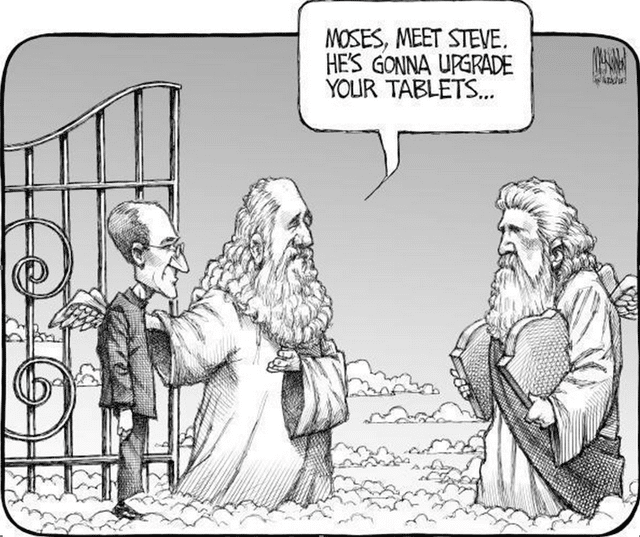
[FirJobs in Heavenst posted in 2012; ‘dated’ with the release of Iphone 5;  then reposted in 2015 when Iphone 6 came out,  followed by more iPhone upgrades 6+ and 6S+ and  now we’re into iPhone7 (update 2018: iPhone 8 & 10) and iWatch and who knows what newer more fantabulous techtoys we will yet be tempted to procure,  get addicted enough to spend our hard-earned money on,  while Steve-Jobs-clones continue nonstop to revolutionize digital earth!  


Since the first posting of this article, the genius who brainstormed and birthed his brainchild  “Apple” has passed on . . . or should we rather say . . .  ‘risen to iCloud Heaven’ uttering the supposed last words “oh wow oh wow oh wow” . . . whatever it might have meant.  Now what has this article got to do with Steve Jobs and his company?  Actually, it’s all about the perfect icon he chose (from biblical sources no doubt) which relates to our topic here.   Rather than write yet  another article on the original topic (you have to read to know what it is), we’ve just elaborated on the same which is still very much relevant  and therefore,  worth a revisit.—-Admin1.]


—————————

 

Image from www.boladafoca.com

Image from www.boladafoca.com

On the eve of September 12, 2012 while fast-clicking the remote to see what’s on TV, I caught a glimpse of a talk show hostess holding up what looked like a New York tabloid front page photo of a full page size red apple with a bite.  That recognizable icon that is on all products and plush outlets of this giant tech-company needs no accompanying brand name.  The most recent media hype had been building up to the release of its cellphone version #5 the day after 9/11 [anniversary] and everyone is salivating including yours truly who needs a cellphone upgrade like a hole in the head.  

 

Image from root.vn.ua

Image from root.vn.ua

[Update 2015:  have just upgraded AGAIN to Iphone 6, passed on my iPhone5 to my son.

Update 2015:  Got myself iP6S+;  passed on my iP6 to son who passed on his iP5 to his daughter. 

Update 2016: Didn’t succumb to iPhone 7, kept my 6S+ but got an iWatch which still needs an iPhone to operate it.  Go figure!

Update 2018: Into iPhone 8, but not tempted to change again to iPhone 10. At some point, this upgrading insanity and addiction has to be curbed!]


Now this is not so much about consumer suckers like yours truly,   as it is about the line that accompanied the front page photo:


Temptation is a sin only when you give in.”  


It not only rhymes, it’s savvy advertising, which brings us to what immediately comes to mind.  


The most obvious connection is of course the forbidden fruit that Eve first, then Adam, took a bite of and supposedly caused original sin, death, damnation, if we are going to believe  Christian dogmatic interpretation.  And another example is firstborn Cain.   While entertaining envy and jealousy toward Abel and at the same time resentment toward the God he made an offering to (who preferred Abel’s to his), he was warned that sin was crouching at the door but that he need not open the door to let it in.  There is that period of building up to committing a sin and a moment of making a decision whether or not to give in.  Well, unfortunately for the first parents and the first firstborn, they chose to give in and only then did they commit sin.  Remember man has free will and does not have to give in to temptation.  


For the strangest reason, a second connection I made was something else that has been in my head waiting to be expounded,  about a teaching attributed to Jesus in the Sermon on the Mount:  [Please check out this link for a more thorough discussion:  Revisit: The Sermon on Sinai vs. The Sermon on the Mount]


[KJV]  Matthew 5:21-22, 27-30:  


21  Ye have heard that it was said by them of old time, Thou shalt not kill; and whosoever shall kill shall be in danger of the judgment: 

22  But I say unto you, That whosoever is angry with his brother without a cause shall be in danger of the judgment:


 27 Ye have heard that it was said by them of old time, Thou shalt not commit adultery: 

28  But I say unto you, That whosoever looketh on a woman to lust after her hath committed adultery with her already in his heart. 

29  And if thy right eye offend thee, pluck it out, and cast it from thee: for it is profitable for thee that one of thy members should perish, and not that thy whole body should be cast into hell. 

30  And if thy right hand offend thee, cut it off, and cast it from thee: for it is profitable for thee that one of thy members should perish, and not that thy whole body should be cast into hell.


I had always thought these teachings were extreme but who was I to question the Son of God? Jesus accused the Pharisees of putting a yoke on the necks of their people by fencing the commandments of God, but this teaching is a double yoke, far stricter than extreme Pharisee-ism.  But if indeed Jesus said so, well . . . that’s ‘gospel truth’!  


It was not until I studied the TORAH that I was surprised to discover it just wasn’t so; that is, simply being tempted is not tantamount to actually sinning.  There will always be temptation in all forms and degrees in our lives, depending on our ‘Achilles heel’.  What tempts one person is not necessarily temptation to someone else. The conscience-stricken among us suffer the most, thinking if you as much as think the forbidden, you’ve already sinned.   

 

Image from sumtimez.blogspot.com

Image from sumtimez.blogspot.com

Temptation

is a sin

only when

you give in.”  


Here’s not-the-best analogy because it’s not what we would categorize as “sin” but it’s applicable.  For the heavyweights among us, we have to go on a diet and exercise to work off the fat. If we resolve to do so (and this is exactly how it works) the minute we decide, all of a sudden all we can think of is food, food, food! TV watching is the worst tempter; lean people who indulge and never gain weight eat with gusto around us. Temptation, temptation, temptation!  BUT unless we give in, we’re bound to lose . . . the pounds I mean. 


Admittedly, placing ourselves in temptation’s way could make us fall, so better to avoid it.  But if we cannot avoid it, self-restraint amidst the temptation is even the better way.  Have we really sinned because we looked, perhaps desired, but did not give in?  The sin is in the act, not the thought.  We find a bag full of cash, we need it, we could use it, nobody would know, we’re tempted, tempted, tempted, we keep it for ourselves, then we sin!  However, being tempted, thinking about it, but deciding to return the bag in the end (even grudgingly), we have not committed a sin even if we’ve thought about it, continue to think about it, wish we had not returned the bag.  The act, the deed in the end is the clincher! Clincher for what? The final decision of the tempted: give in (sin), do not give in (no sin committed).


The NT teaching causes unnecessary guilt; we feel guilty when we haven’t done anything wrong. Everybody gets angry at someone, justifiable or not, but that is not tantamount to murder.  Anger could lead to murder if you keep stoking it, but how many really take anger to the extent of taking a life?  Anger is one thing, murder is another, you can’t equate one with the other. 

 

Image from evolveconsciousness.org

Image from evolveconsciousness.org

Apply the same principle on the opposite of the evil inclination, sincerely intending to do something good, the good inclination.   What benefit is it to the supposed beneficiary if a good person with all good intentions have the good heart to give, the good mind to give, the good will to give, but never reaches the GOOD ACT of actually giving?  This benevolent generous person with all the charitable intentions is of no worth at all to anyone except him/herself! “I’m good, I’d like to give, I intend to give” . . . but doesn’t ever give!  Should this person be rewarded for “good deeds”, really? 


What is the definition of “deed”? Do, not just think, do not just intend, do not just want to, but actually do, Do, DO! Should that person be rewarded for “good thoughts”? What good did “good thoughts” do to anyone else but that person? Remember, TORAH is Other-centered; it’s not about me, it’s about the ‘other’ whether it be God or another human being or my pet.  Isn’t it strange that Torah-observers agree that a pet owner should feed his pet first before feeding himself?  That’s how ‘other’-conscious the Torah-giver requires us to be . And wouldn’t it be a wonderful world if each human being were thinking AND ACTING on his/her thinking as long as it is good?


Thinking with no action benefits no one . . . except in the area of “sin” where the benefit redounds to the would-be-sinner.  Chew on that.


NSB@S6K

logo

Sig-4_16colors


—————————–


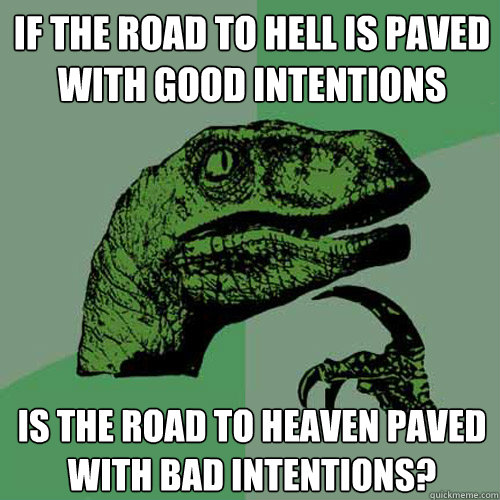
Image from www.quickmeme.com

Image from www.quickmeme.com

P.S.   I found this Q&A on the web dealing with exactly this point.   There was a time in the past I would have given the same answer to the question, but not anymore after understanding the teachings in YHWH’s TORAH.  Now I feel sorry for this guilt-ridden guy.  Find out WHY, read on.


Question:

I have a question maybe you can answer because I think I’m in a very strange and confusing situation.


Since very young I like women, very much. I also did watch a lot of pornography but not anymore. So I did and sometime still look at women a lot.


I’m married now, and I have been looking.  I’m afraid I had commited adultery because of looking. I say so because I don’t know if when I look if it is with lust or not. I look at women and some of them are very attractive and have some specific things I like. I focus lots of time on what I like in women. I really don’t know if it’s lust because when I look at them I have to confess that I’m very focused, but it is not like I want to take that woman home to my bed or commit adultery with her. I know it is wrong to do so, but I also don’t really have the feeling to do so. I’m really stupid when looking (looking and not thinking very much things at the same time) and very often I just say to myself: “Wow. If only my wife had a body like that!” But I don’t have an urge to would want to go to bed with one of those women, so I don’t think that that desire is that strong. Will you please tell me? Well, I do sometimes think: “If my wife was like that, I wouldn’t be able to get to work the next day!”


Sometimes I get kind of angry or upset when I see other much more beautiful women around us (when I’m with my wife) and I don’t know if it is because I’m jealous and would want my wife to be as attractive or if this is also lust.

This is why I’m mailing you, because I don’t know what this is. I don’t want to commit the sin of adultery. Surely not physically, and I’m pretty confident I probably won’t, but mentally I don’t know what to do!
I asked for forgiveness, and I don’t want to lust after any other women than my wife. But again, how can I combat it? Besides, I’m not sure if it’s lust or not. Please enlighten me on this, and what do I have to do to stop.

I really really want to stop this if it is wrong because I really want to be saved! I don’t want to sin — I don’t.


Answer:

You have heard that it was said to those of old, ‘You shall not commit adultery.’ But I say to you that whoever looks at a woman to lust for her has already committed adultery with her in his heart” (Matthew 5:28).

One of the problems Jesus had with the Jews of his day were the word games they would play. The Jewish men thought that as long as they weren’t climbing into other women’s beds, they weren’t sinning, no matter how sinful their thoughts about those women were. What Jesus was pointing out is that even though they had not physically committed adultery, they were still doing so in their heads. A sin doesn’t start with the physical action but with the thoughts of sinning.


For from within, out of the heart of men, proceed evil thoughts, adulteries, fornications, murders, thefts, covetousness, wickedness, deceit, lewdness, an evil eye, blasphemy, pride, foolishness. All these evil things come from within and defile a man” (Mark 7:21-23).

That you have no intentions of carrying out such sins doesn’t matter when you are playing out those sins in your head.


But adultery isn’t the only sexual sin that you can do in your head. There is also the sin of sensuality or lewdness — the pursuit of things that get you sexually aroused. “Let us behave properly as in the day, not in carousing and drunkenness, not in sexual promiscuity and sensuality, not in strife and jealousy. But put on the Lord Jesus Christ, and make no provision for the flesh in regard to its lusts” (Romans 13:13-14).


Let me put it this way, what benefit is it to your wife or your relationship with her when you compare her body to what you imagine other women’s bodies are like? How would you like it if she went around looking at other men’s abs or bulges and wondering what it would be like if her husband was built like that? It is foolish to compare one person to another. It is even more foolish to compare a single aspect of a person when all people are a complex mixture of things. To focus on physical traits is both shallow and worldly.


You have a woman you love and who loves you. Why aren’t you satisfied with that wonderful gift?

I have made a covenant with my eyes; why then should I look upon a young woman?” (Job 31:1).

Follow up Q:  Thank you for the answer! I understand, but what do I have to do now? I have asked for forgiveness. I don’t know what else to do. And about the looking, how can I try to stop it because I really don’t want to do it so I sin?

So concluding from your reply, I did commit adultery in my head?

I understand about being satisfied with my wife and not comparing her to others. I will try not to do so anymore. God help me to avoid it.


About the other issue, then I have a BIG problem. As I informed you, I look at specific things, I have done so since my childhood. I’m very observant, especially of little details in my surroundings. Even if somebody cuts a plant or tree down that’s on my way to work, for example, I notice that change has been made. This  also (and not on purpose) applies to when it comes to females. If I’m sitting drinking something somewhere and suddenly a woman enters the place, I automatically look at the specifics without even thinking. After seeing what I saw THEN maybe the other things comes into place. Is this then pursuit of things that get you sexually aroused? If so, how can I stop this? Is this lewdness or adultery too? I’m very worried because in the Bible it says that whom comit adultery will not see or get in the kingdom of God. I’m extremely worried that I even think and feel I’m falling into a depression. It’s SEEMS impossible for me to do it right because all day everywhere and nowhere there are females walking around.

I’m sorry for talking so much time of you


A:  No one is saying that you are to have blinders when it comes to women around you. It is what you look at and why you do so that can make looking wrong. I can’t see into your head. I can only go by what you have mentioned. Thus, I can’t say with any certainty that you are or are not sinning. I can only explain the guidelines.

If you want to avoid sensuality and adulterous thoughts, then stop considering the physical attributes of women in a sexual context. Keep your thoughts rational and if you are tempted to stray, remind yourself that you have promises to God and your wife to keep, which are far more important. Don’t compare any woman to your wife. “Let your fountain be blessed, And rejoice with the wife of your youth. As a loving deer and a graceful doe, Let her breasts satisfy you at all times; And always be enraptured with her love. For why should you, my son, be enraptured by an immoral woman, And be embraced in the arms of a seductress?” (Proverbs 5:18-20).


P.S. from Q:  Thank you very much! I will definitely try to stop considering the physical attributes of women in a sexual context, but I know it is going to be hard for me seeing my history and how I am. But I will try. I’m already busy with it. I ask God to help me to overcome this because I really need to do so. Thank you very much and God bless you!


 http://lavistachurchofchrist.org/LVanswers/2010/10-26.html

Q&A: The Sabbath of YHWH

Image from Pinterest

Image from Pinterest

[This is part of a longer post revisited every year during the fall feasts:  REVISIT: How now do we observe “My” feasts? Because of the length of such posts that cover so much ground in one reading, it helps to select and reprint excerpts for easier and shorter reading.  


It appears the Sabbath of YHWH is an inexhaustible topic because many are still unclear about this 4th commandment, when and how to apply it to life in these times of religious confusion.  So we address all questions that keep coming our way in our uniquely Sinaite thinking and understanding of the Sabbath.  Are we correct in our conclusions?  As we always do, we leave it up to our readers to decide.  After all, we present our case based on our reading, study, understanding and long discussions among kindred spirits with differing views.  For Gentiles such as ourselves, we have made our conclusions regarding the Sabbath.–Admin1]


—————————


The weekly Sabbath was instituted as a feast for all created humanity to remember Who is the Creator, as early as Bereshiyth/Genesis 2:1-3:         


[EF] 1  Thus were finished the heavens and the earth, with all of their array.  

2   God had finished, on the seventh day, from all his work that he had made.  

3   God gave the seventh day his blessing and he hallowed it, for on it he ceased from his work, that by creating, God had made.

[RA]   Then the heavens and the earth were completed, and all their array.  And God completed on the seventh day the task He had done, and  He ceased on the seventh day from all the task He had done.  And God blessed the seventh day and hallowed it, for on it He had ceased  from all His task that He had created to do.  This is the tale of the heavens and the earth when they were created.


Every time the Sabbath is celebrated, it brings the celebrants back to Creation week, when the Sabbath itself was ‘created’ so to speak,  and set apart (sacred, holy, sanctified) to make it different from other days.  To observe the Sabbath is to give tribute to the Lord of the Sabbath Who is also Creator of all that exist.


Before there was Israel, there was the Sabbath.


Before the giving of the Torah on Sinai, there was the Sabbath.


On the way to Sinai, Israel’s God trained the mixed multitude to observe the seventh day by teaching them to take two day’s portion of manna on the 6th day, so that they could rest on the 7th:


[AST]  Exodus 16: 4-5  HASHEM [YHWH] said to Moses, “Behold!—I shall rain down for you food from heaven; let the people go out and pick each day’s portion on its day, so that I can test them, whether they will follow My teaching or not.  And it shall be that on the sixth day when they prepare what they bring, it will be double what they pick everyday.


25-30  Moses said, “Eat it today, for today is a Sabbath for HASHEM [YHWH] ; today you shall not find it in the field.  Six days shall you gather it, but the seventh day is a Sabbath, on it there will be none. It happened on the seventh day that some of the people went out to gather, and they did not find.  HASHEM [YHWH] said to Moses, “How long will you refuse to observe My commandments and My teachings?  See that HASHEM [YHWH] has given you the Sabbath; that is why He gives you on the sixth day a two-day portion of bread.  Let every man remain in his place; let no man leave his place on the seventh day.”  The people rested on the seventh day.


The Sabbath is experientially taught to the mixed multitude; they did not have to “leave” their place on the seventh day, only because they were supposed to have already gathered their double portion of manna the day before.  Some observant Jews (because they ARE of Israel) take this to mean they do not leave their homes on the Sabbath; well, this is in their national experience and they are probably playing safe by applying it to themselves even today.


Finally on Sinai, the 10 “Words” were inscribed on tablets of stone and the 4th was the Sabbath . . . it officially became Law:


[AST] Shemoth/Exodus 20:8-11

Remember the Sabbath day to sanctify it.  Six days shall you work and accomplish all your work; but the seventh day is Sabbath to HASHEM [YHWH], your God; you shall not do any work—you, your son, your daughter, your slave, your maidservant your animal, and your convert within your gates—-for in six days HASHEM [YHWH] made the heavens and the earth, the sea and all that is in them, and He rested on the seventh day.  Therefore, HASHEM [YHWH] blessed the Sabbath day and sanctified it.


Later as Israel fails to live up to the Torah and is warned by prophet after prophet to mend its ways and return to YHWH,  Isaiah [58:13-14]  adds this:


If you restrain your foot because it is the Sabbath; refrain from accomplishing your own needs on My holy day; if you proclaim the Sabbath a delight, and the holy [day] of HASHEM [YHWH]  ‘honored,’ and you honor it by not engaging in your own affairs, from seeking your own needs or discussing the forbidden—then you will delight in HASHEM [YHWH], and I will mount you astride the heights of the world; I will provide you the heritage of your forefather Jacob, for the mouth of HASHEM [YHWH] has spoken.


And still speaking to Israel, the universal scope of Sabbath observance is emphasized:


[56:1-8] 

Thus said HASHEM [YHWH]:  Observe justice and perform righteousness, for My salvation is soon to come and My righteousness to be revealed.  Praiseworthy is the man who does this and the person who grasps it tightly:  who guards the Sabbath against desecrating it and guards his hand against doing any evil.  


Note vs. 3:


Let not the foreigner, who has joined himself to HASHEM [YHWH], speak, saying, ‘HASHEM [YHWH] will utterly separate me from His people’; and let not the barren one say, ‘Behold I am a shriveled tree.’  For thus said HASHEM [YHWH] to the barren ones who observe My Sabbaths and choose what I desire, and grasp My covenant tightly:  In My house and within My walls I will give them a place of honor and renown, which is better than sons and daughters; eternal renown will I give them, which will never be terminated.  


And vs.6:


And the foreigners who join themselves to HASHEM [YHWH] to serve Him and to love the Name of HASHEM [YHWH] to become servants unto Him, all who guard the Sabbath against desecration, and grasp My covenant tightly—I will bring them to My holy mountain, and I will gladden them in My house of prayer; their elevation-offerings and their feast-offerings will find favor on My Altar, for My house will be called a house of prayer for all the peoples.  


That clear, how now does a gentile observe the Sabbath?


If you check out the Jewish observance, they have their traditional ways— from the welcoming of the “queen of days” on “erev shabbat” or Friday sundown, to saying goodbye at “havdalah” or Saturday sundown.  Some go to extremes, observant Jews are meticulous as they feel they should be.  The Jewish websites on our link are full of instructions but remember, Jews write for Jews, not for gentiles.


What about us . . .  non-Jews?


Gentiles of other faiths have their Sunday service, or Friday service, some on Thursday, and the Christian sect that calls itself Messianic Judaism “church” on Saturday and sound so  Jewish in their service you would think you were in a synagogue.


Sinaites  have trailblazed in many ways as you will realize when you read through our category “Sinai 6000” so we figured , why not design our own Sabbath celebration, borrowing from Jewish tradition but with our own unique liturgy.


So for now, our Sinaite core group have decided on the following, realizing we function as the world does, on a Sunday-day-off system:


  • The essence of the Sabbath is to spend the day fully concentrating on YHWH and His Torah, and the very reason for the Sabbath:  rest.
  • We obey the command to “cease” from doing what we normally do six days a week,
    • that is, as much as it is possible for us to do so in a Sunday-world-system when some of us have jobs that require us to work on the Sabbath.
  • We welcome the sabbath on ‘erev’ like the Jews do, either individually, with family, or with community.
  • We take our 6-8 hours sleep the rest of that evening.
  • Those of us who don’t work spend Saturday AM hours in study, prayer, devotional time.
  • Those of us who work take our noon lunch-hour off to worship together and read Torah; we figure we’ve already observed 16 hours of the Sabbath as best as we could within the Sunday system we are caught in; we dedicate our work-hours ever-conscious of our Creator God and grateful for all He has done for us the past week, if not for all of our lifetime.
  • Those of us who are free all day come together (Saturday PM hours) to a fellowship meal and study Torah together; regarding this —- we’ve been made conscious by a Jewish friend that all we’ve done is move our Sunday activities to Saturday, but we find nothing wrong with coming together because our God is the God of the Sabbath, and because we do not see each other all week so what better day to enjoy one another than His appointed day?
  • When we break up at ‘havdalah’ like the Jews, we say goodbye to the Sabbath and look forward to the next.


Image from Yisrayl Hawkins

Image from Yisrayl Hawkins

We ‘delight’ in the Sabbath because He declares it as an “appointment” with Him.  So instead of finding it as a restrictive day where we can’t do anything “as usual”,  it is a day to enjoy the blessings of a ‘date’ with YHWH, and do whatever we can to honor Him and HIs day.  It is “My” appointed time when He commits Himself to meeting with Sabbath-keepers . . . and so we meet with Him individually, with family, with community.


Think of it this way:  someone you truly love who loves you back sets an appointment day/time to meet you every week.  He specifies one day, let’s just say Saturday and no other day. He commits himself to meeting you at the appointed agreed-upon day of each week.  So he shows up as he expects you to do the same.  You decide no, you’d rather meet him on Sunday or maybe Friday, or any other day. Well, he won’t be there on the day of your choice, he says only on this day every week.  You’re stubborn, you keep changing because his day is not convenient for you. Well then, you will never get to meet with him.  Trivial, probably bad example, but easy to understand if you got the point.


Okay, so that settles the Sabbath, at least for us Sinaites.  What about you, dear reader?


Sig-4_16colorslogo

Does Judaism believe in heaven and hell?

Image from fineartamerica.com

Image from fineartamerica.com

[Revisiting this article first posted May 29, 2012.


In a previous article ‘If there’s no Devil, then there’s no hell?‘, the title was a question and the article ended up with no answer,  leaving it to readers to make their own conclusions.  Unfortunately,  nobody left a comment even if only to hazard a guess, although the answer really was a foregone conclusion.  But even if the existence of hell is already settled in our minds, It is wise and a good habit to always check out all other opinions about a topic,  so here is an article from Jews for Judaism, a website that educates the curious about the Jewish religion.  


The author is Rabbi Bentzion Kravitz, the education director of their Los Angeles base.  The subtitle  “Belief in Heaven is Fundamental to Judaism” already answers the title’s question.  Rabbi Kravitz gives invaluable insights into the Jewish interpretation of their Scriptures which most of us non-Jews are not familiar with.–Admin1]

 _______________________________________________


I am often asked by Jews and non-Jews to explain the Jewish view of heaven and hell.  A few prefatory remarks will help guide us on our exploration and understanding of this seemingly obscure concept.


 The Torah says,

“and the Almighty formed man of dust from the earth, and He blew into his nostrils the SOUL of life” (Genesis 2:7).

Human beings are composed of two aspects: The physical body which is formed from the dust of the earth and the spiritual soul (our real essence) which is directly from God.


This is why the soul is described by King Solomon as,

The candle of God is the soul of man” (Proverbs 20:27).

The soul is a part of God, pure and unblemished.


The body does serve an important purpose. It enables us (our souls) to live a life in this physical world. This presents us with the unique opportunity to serve God by following His divine game plan as outlined in the Torah. Following God’s will by fulfilling His commandments in this physical world connects us to God spiritually (the root of the Hebrew word “mitzvah” is “tzavta” which literally means “to connect”), refines the physical world, and proclaims the glory of God — that He exists everywhere. This is our mission while on earth.


 At death the soul and body separate. King Solomon said,

The dust will return to the ground as it was, and the spiritwill return to God who gave it” (Ecclesiastes 12:17). 


This means the soul returns to heaven, back to God, where it is enveloped in the Oneness of the Divine.


 Solomon also said there is an

“advantage of light over darkness” (Ecclesiastes 2:13).

This means that when a person perseveres and serves God in a world full of darkness, the soul is rewarded with an enhanced sensitivity to appreciate Godliness.  In heaven the soul experiences the greatest possible pleasure—a greater perception and feeling of closeness to God than it had previously.


 Although Judaism believes in heaven, the Torah speaks very little about it. The Torah focuses less on how we get to heaven and considerably more on how to live our lives. We perform the mitzvot because it is our privilege and our sacred obligation to do so. We perform them out of a sense of love and duty, not out of a desire to get something in return.


 There is a practical reason for this. If we lived a righteous life for the sake of a monetary or heavenly reward it would be serving God for an ulterior motive.

 A story is told of a Jew who gave away his portion in the World to Come in order to rescue a kidnapped family being held for ransom. When asked why he was not sad over losing his place in heaven, he responded, “I was always concerned that I was serving God for the wrong reasons. Now that I don’t have a portion in the World to Come I can serve Him reassured that I am doing it purely out of love and devotion.”

 This is true service of God.


 After we die we are judged by God, since He is the only true judge who knows our actions as well as our motives. Our place in heaven is determined by a merit system based on God’s accounting of all our actions and motives. God also knows if we have repented for transgressions committed during our lifetime and takes this into account.


 Repentance has always been God’s preferred and primary means for obtaining forgiveness. Even in the time of the Temple, sacrifices were only offered for certain “unintentional” sins (Leviticus 4:2).   Obviously, if a sacrifice was presented without remorse and repentance the sin was not atoned for. The sacrifice served as a tool to motivate the sinner to repent. This was necessary because a person might rationalize that he didn’t need to repent because it was only an accident. Sins performed intentionally never require a sacrifice, only repentance.


 After the Temple was destroyed the repentance aspect of atonement remained intact and sacrifices were replaced by sincere prayer. This is clearly stated in the following two correctly translated passages:


 “Take with you words, and return unto the LORD; say unto Him: ‘Forgive all iniquity, and accept that which is good; so will we render for bullocks (sacrifices) the offering of our lips.” (Hosea 14:3)


 “I will sacrifice to you with the voice of thanksgiving.” (Jonah 2:10)

 Sins that were not cleansed prior to death are removed by a process described as Sheol or Gehinom. Contrary to the Greek and Christian view of eternal damnation in Hades or Hell, the “punishment” of Sheol, as described in the Jewish Scriptures, is temporary.


 This is why King David said,

“You will not abandon my soul to Sheol; nor will You allow Your Holy One to undergo decay” (Psalm 16:10).


 Additionally, the prophet Samuel says,

“He [the Lord] brings down to Sheol and brings up again” (I Samuel 2: 6),

and the prophet Jonah described it in the following way,

“I called out of my affliction to the LORD, and He answered me; out of the depth of Sheol cried I, and you heard my voice” (Jonah 2:3).


 Judaism’s view of hell more closely resembles purgatory. However, the pain the soul experiences is not physical.  It has been compared to psychological anguish, shame and healing upon reviewing the history of one’s life in a body, and how it wasted opportunities to serve God. This may explain why people who have near death experience often claim their entire life flashed in front of them.


 This self-inflicted chastisement cleanses and refines the soul of blemishes that interfered with the soul’s perception of God. The concept of refinement is found in the prophets,

“I (God) will refine them as silver is refined” (Zechariah 13:9).


 Everyone can merit a portion in the World to Come. However, the completely evil (like Hitler) cannot merit this. As it says,

“multitudes who sleep in the dust of the earth will awake: some to everlasting life, others to shame and everlasting contempt” (Daniel 12:2).


 It is essential to our understanding to appreciate that the Hebrew word for repentance is Teshuvah, which literally means “to return to God.” Most people are not completely evil or completely good. God does not expect perfection or He wouldn’t have provided repentance as a way of returning to Him. God’s message of love and compassion is:

Return to Me, says the LORD of hosts, and I will return to you,” (Zechariah 1:3).

This is an invitation from God to return directly to Him without the need for an intermediary to help us.


 This personal and direct relationship with God is within everyone’s grasp as it says:

“For this commandment which I command you this day, it is not too hard for you, neither is it far off. It is not in heaven, that you should say: ‘Who shall go up for us to heaven, and bring it to us, and make us to hear it, that we may do it?’ Neither is it beyond the sea that you should say: ‘Who shall go over the sea for us, and bring it to us, and make us hear it, that we may do it?’ It is within your close reach to serve God in your mouth and heart, to do” (Deuteronomy 30:10-14).

 In very clear and distinct language King Solomon summarizes how we should live our life in service of God saying,

The end of the matter, all having been heard: be in awe of God, and keep His commandments; for this is the whole man” (Ecclesiastes 12:13).

For more articles, please go to jewsforjudaism.org.

Does Hell Exist? – A Jewish Perspective

[First posted in 2016, part of our series focusing on two presumptions:  
  • there are no fallen angels and
  • there is no place like hell,  i. e.  hell does not exist except in the belief systems/religions that believe in the existence of a devil and demonic spirits.  

Sinaites have arrived at this conclusion despite our Christian orientation that justifies hell’s existence because the Christian New Testament repeatedly warns that it is the destination of unbelievers in its Trinitarian God, specifically its messiah-savior, Jesus Christ, The Sinaite’s view on this topic is extensively covered in the following posts:

 Here, we feature one Jewish perspective on the same topic; we say ‘one’ because if we know Jewish thinkers (just like other religious thinkers), there are varying views on controversial topics.  We are reproducing an article from chabad.org, one of the links we recommend in this website, taking the cue from their virtual permission to repost:
© Copyright, all rights reserved. If you enjoyed this article, we encourage you to distribute it further, provided that you comply with Chabad.org’s copyright policy.
Reformatted for this reprint.—–Admin1]
————————
Does Hell Exist?
[Rabbi Shmuel Pollen received a law degree from Benjamin N. Cardozo School of Law, and resides in Rockaway, New Jersey. He is the founder of Bnei Noah, a nonprofit organization that provides food and medicine to the needy of Gujarat, India, and eastern Ukraine. Bnei Noah educates non-Jews about their G-dly purpose and the 7 Noahide Laws. For more of Rabbi Pollen’s writings, visit his website.]

First, let’s ask, does an afterlife exist? I personally know it does because the guy who fills up my gas told me so. One night filling up gas, I looked tired. The attendant said I had no right to be more tired than him, after all, “Just yesterday I hit my head and was dead for a minute and fifteen seconds.” Now I was wide awake. I immediately asked, “Did you see the bright light?” He said yes. Then he said G‑d told him he could go towards it, or back to his body. He chose to go back. Meanwhile the paramedics were doing CPR. On the very last thrust the paramedics are required to do before they call it off, his eyes opened.


I got a lot more than gas that night. I got another eyewitness testimony of life after death. Thousands of such testimonies have been documented, all describing a lot of the same stuff. This means we can know the afterlife exists, just like we know Antarctica exists. Everyone who goes there comes back with a similar report. So fear not. Death is just a new kind of life.


What about hell, though? Who isn’t terrified at the notion of being in a fiery furnace for all eternity? Don’t fear this either. Souls without bodies cannot experience physical pain. But do fear hell. The real word for “hell,” Gehinom, means crying. People cry from pain there. But what kind of pain?


Once there was a man who saved up all his life for a trip to a distant island. Legend has it that on this island the sand is made of diamonds. He figures he’ll be rich beyond belief. He arrives and indeed diamonds are everywhere. He starts hoarding them by the barrel. The locals say, “Are you crazy?! Why do you want this sand? It’s just sand!” He ignores them. But, after living there a while, he adopts their ways. There, the most desirable commodity is pig fat, not diamonds. He goes into business and becomes the richest person on the island.


Years later, he arrives home in a huge boat. He proudly tells his wife how successful he was and what a fortune he brought. She just says, “What’s that smell?” Indeed, his boat full of rotten pig fat is smelling up the entire beach. In that moment, it hits him. He falls to the ground, bawling uncontrollably. She cries, “Did you bring back any diamonds at all?” He searches for hours and eventually finds a few small diamonds in his shoe, on which they live a modest life.


Yes. There is fire in hell.  It’s the very things we did wrong.  And hell is just a huge magnifying glass.  A magnifying glass takes sunlight and makes it hot enough to burn. Hell magnifies our wrongdoings until our soul burns. The sins we do so casually here are different there. It’s a more G‑dly world. A more sensitive world. A more intense world. It’s like the pain and regret of that pig fat man, only many times worse.


No poet can capture that level of pain in words. But it might be a tiny bit like having a movie made out of all your most regrettable thoughts and actions.  in all theaters around the world.  G‑d will be watching that movie.  He sent you to this earth for 70 or 80 years to get diamonds.  Now He can’t bear the stench. It must hurt like hell.1


But it also hurts good. Overwhelming experiences bring about what’s called catharsis. That’s the release you get after a good cry.  Gehinom also brings relief and revival.  And a new perspective you’ll later be thankful you got.  See, G‑d isn’t rubbing it in your face. He’s scrubbing out ingrained dirt that you’ve had on your face too long to notice.  It’s also temporary. Twelve months max,2  and only six days a week.  You spend Shabbat in heaven, and then it’s back to work.3  Always remember, Gehinom is a preparation, not a destination.  We’re all going to paradise.  Some just need some time to get dressed for the occasion.

That said, it’s my job to keep you out of there.  So I’ll teach you how to invest in your afterlife, so there’s massive fortunes waiting, and no pig fat.

  •  First, you need the right mindset.  Remember, all your thoughts and actions are recorded.  Each one matters, and you’re on G‑d’s time.  Your goal is to grab every moment you can to do whatever you think He’d want. The opportunities to do shiny, sparkling G‑dly deeds are plentiful as the sand. You just have to notice them and take action.
  • Second, understand the currency. Your money is worthless (unless you use it to do a mitzvah). The real diamonds are humility, self-sacrifice, kindness.
  • Third, buy low and sell high. When something happens you don’t like, don’t curse G‑d for it. Bless G‑d for it. That’s how you profit. Because tiny inconveniences here wipe out loads of Gehinom, or give you a big promotion in paradise.  Either way, it’s a gift. Say thanks.
  • Fourth, know the biggest profits will come from the biggest sacrifices.  Give charity until it hurts.  Pray until you’re exhausted.  Study Torah when it makes no sense to you and you’re not in the mood.  Do this daily, and you’ll be wealthy beyond words.


There’s an interesting story about the next world. If you could visit the very highest rung in heaven, a rank higher than even Moses and Moshiach, do you know who you’ll find?  A very fat man.  An ignoramus and glutton, who did nothing with his life.  So why is he there, at the very highest level of the World to Come? You see, as a child, he saw his father burn at the stake for G‑d’s holy name.  He noticed his father was frail and thin, so he burned quickly.  He decided then that he would always eat as much as possible, so, he said, if he ever would have to burn for G‑d’s holy name, “I will burn and burn and burn. Boy, will I burn!”  Every bite that he ate was for G‑d.  In the world of truth, his very being is diamonds, and, boy, must he shine.


In the future, in the Messianic era, death and suffering will end.4   Heaven, with all the souls in it, will become part of this world. There will be literal heaven on earth. And you directly decide when it happens.   Because when you start chasing G‑dliness instead of dollar signs, you become heavenly. When we all do it, the world becomes heavenly.  Then the souls can move in and feel at home.   We’ll be reunited for an eternal paradise right where we are.   Let’s do it today.


FOOTNOTES

1.

See Zohar 2:591; Akeida, Nitzavim shaar 101; Sefer Haikrim 4:33; Likutei Torah. Pinchas 75c; Ohr Hatorah, Vayira vol. 2 p. 482.

2.

See Talmud Shabbat 33b and Talmud Rosh Hashanah 16b.

3.

Zohar Mikeitz 100; Yalkut Shemoni, Job Ch. 10 Remez 906.

4.

————————-

Rabbi Shmuel Pollen received a law degree from Benjamin N. Cardozo School of Law, and resides in Rockaway, New Jersey. He is the founder of Bnei Noah, a nonprofit organization that provides food and medicine to the needy of Gujarat, India, and eastern Ukraine. Bnei Noah educates non-Jews about their G-dly purpose and the 7 Noahide Laws. For more of Rabbi Pollen’s writings, visit his website.
Artwork by Sefira Ross, a freelance designer and illustrator whose original creations grace many Chabad.org pages. Residing in Seattle, Washington, her days are spent between multitasking illustrations and being a mom.
© Copyright, all rights reserved. If you enjoyed this article, we encourage you to distribute it further, provided that you comply with Chabad.org’s copyright policy.

What does the God of Israel require of Gentiles?

Image from www.myjewishlearning.com

Image from www.myjewishlearning.com

[First posted in 2014;  —Admin1]


————-


Sinaites were invited to a gathering of Jewish men (and their partners) who have formed a local Jewish club in our city of residence.  The occasion for the gathering was to meet a young Jewish rabbi . . . he looked like the stereotype you see in movies:  black hat, black suit, white shirt, beard.


We were introduced, and since the president of the Jewish Club was still under the impression we were ‘Jew-wannabe’, he added “they are interested in joining Judaism.”


I immediately corrected ‘no, we’re not interested in joining; we have done our homework on Judaism, it is not for us.’


The Rabbi asked, ‘so what are you then?’


And that’s always the opening for us to get a foot in the door, so to speak, of anyone even vaguely interested in what we stand for:  “We refer to ourselves as Sinaites.”


R:  “And what is a Sinaite.?”


In a nutshell, we explained:  “We are gentiles who live the Torah.  We don’t aspire to become Jewish or join Judaism; we recognize that the God of Israel has already delineated the lines between Israel and the rest of the world, the nations, Gentiles.  We know which laws and commandments apply to us from the Torah; we have isolated these from the ones specific for Israel and Israel only.”


We related our surprise upon discovering that the masses of slaves that left Egypt during the Exodus were a ‘mixed multitude’ of Jacob’s descendants and slaves from other nations, Gentiles.


No visible reaction.


R:  “So what have you concluded as applicable to you?”


S6K:  “Briefly:

    • the 10 commandments,
    • the dietary laws of Leviticus 11, and
    • 3 out of the 7 feasts of Leviticus 23.”
 

R:  “Which feasts?”


S6K:

1)The weekly Sabbath,

2) Shavuot which is the anniversary of the giving of the Torah, and

3) Yom Kippur since all men, whether Jew or Gentile sin against God and fellow-humans and need to repent of their sins.


This time he nodded, then asked further:  “And how did you arrive at all this?”


We said, ” by studying what is uniquely for Israel and what is universal for all humankind.”


He thought for a while, then said, “This is an interesting perspective, I have not heard of it.  I was exposed to the teaching of Rabbi Menachem Mendel Schneerson” and he gave us a calling card.


On one side of the card is a picture of Rabbi Schneerson with the text:


“The Rebbe calls You.  The seven Universal Noahide Laws that G-d gave to Moses on Mt. Sinai apply to all mankind.  The leader and prophet of our time, Rabbi Menachem Mendel Schneerson, calls on us to unite around these precepts, for they are the secure foundation upon which to build society and a happier life for everyone.”

Moschiach is on his way.  Our part is to greet him by adding acts of goodness and kindness.”  — The Rebbe, CNN 1991


Long live our master, teacher, and Rebbe.  King Moschiach, forever!”


www.7for70.com


On the other side of the card is this:   THE SEVEN UNIVERSAL LAWS The Way to True Peace


1.  Believe in One G-d:

Reject any form of idol worship.

2.  Honor G-d:

Do not blaspheme.

3.  Preserve Human Life:

Do not murder.

4.  Respect Family Relationships:

Do not commit adultery, incest, homosexuality, etc.

5.  Respect Property:

Do not steal.

6.  Respect G-d’s Creatures:

Do not eat the flesh of an animal that is still alive.

7.  Establish honest Courts.

And a Just Legal System.


What was on the card struck us as strange, coming from a Rabbi, this one in front of us and the Rabbi Schneerson whose writings we have read in our Jewish resources.


Our discussion was cut short because the social gathering had ended, so we did not have time to express our view on the Universal Laws that apply to gentiles, embraced by the Noahide Movement.


We would have wanted to comment that we never read in the Torah text that such laws were given on Sinai, unless Rabbis made an out-of-context determination which they do in their books.


It makes sense since, in the NT Book of Acts, the Jerusalem Council made a resolution about gentiles coming to the synagogue (we have a post about this) and what should they be required to obey since they’re not Jews? (Acts 15).  We were taught by our Christian bible teachers that actually those requirements fall under Noahide laws, that’s the first time we heard of Noahide.


To move on:  the Sinaite position is expounded in the articles under the category SINAI6000 but briefly:   In the progressive revelation of our Lord YHWH’s Will for humanity, we learn gradually through His interaction with handpicked figures or people groupings He communicated with in the Torah books:

  • He had specific commands given to the first couple for testing their free will to obey or disobey His instructions, with specific consequences for the latter;
  • Then as early as Cain we learn God’s position on the principle on which Torah living is based:  “Am I my brother’s keeper?”
  • With Noah, we learn of His wrath toward evil caused by sinful humanity, but also we see His mercy and get a glimpse of His being a covenant-making Deity who makes promises He keeps and who uses visual signs in nature, such as the rainbow, to serve as a perpetual reminder to  humankind (or those paying attention and believing that the flood account was real).

 In general, that is as much as one can glean from the narratives starting with the Creation to the Flood.  If the Creator/God who interacted with these figures stopped there, then that is all we are privileged and limited to know, but since He didn’t stop there and in fact went on with more teaching points in the tower of Babel, the call of Abraham, the specific line that issued from Abraham and Sarah that led to the formation of the distinct people who would carry the name of the third patriarch Yaakov/Yisrael—-well, then it is only reasonable and logical to conclude that with more light and more revelation, we go as far as the Self-Revealing God allows us to go.  And that would lead us to Sinai where the Torah was given, simultaneous with the birth of the chosen nation.


We could have joined Noahides, remembering them from our Christian bible study; in fact we checked them out and considered the possibility of affiliating ourselves with them . . . but after much research and discussion and deliberation, we concluded the Sinai revelation superseded the Seven Universal Laws determined by Noahides (or Rabbis) for Gentiles.  In fact, admittedly we were puzzled to read on the Rabbi’s card about Noahides because as far as we understand, the TORAH is for all humanity, Jew and Gentile; that is why the multitude that left Egypt and stood before the REVELATOR on Sinai was, according to Exodus, a MIXED multitude, not just Israelites.  The message is clear: Torah is to be modeled by Israel for the Gentiles/Nations to witness that the Torah life focusing on other-centeredness is the ideal for life in community.  What are commandments 5-10 for when one lives alone?


Perhaps now that one Rabbi has heard  and understood our position, who knows, Sinai 6000 might be added to his calling card, to distribute to Gentiles who might  consider Sinaite-ism instead of Noachide-ism as the alternative to Judaism.  


You think!?

 
NSB@S6K
AIbEiAIAAABDCNPkvrXuucmdeSILdmNhcmRfcGhvdG8qKGJkZTc0YTk3NmUxMGM4OTAzZjk5MDhkMjdkZDI2ODQ3OTliYmQ2MDkwAe5UdNp0lvYvCf8bjAFEJOY_fdsj 


The CREATOR – 1 “God is a Fellowship” (?)

[First posted in 2012;  contains our views at the beginning of our journey to rediscover the revelation of the One True God on Sinai;  we haven’t changed our position, so this is as relevant to day as it was 6 years ago.—Admin1]


 In the book of beginnings, the Creation account is probably the most challenging “beginning” to discuss; we were in a quandary as to how to approach its complexities amidst the seeming simplicity of the narrative.  A child probably understands and accepts it far better than adults do and more easily relates to the God introduced there simply as “the Creator.” In a child’s mind, if something exists, surely someone made it; there is no creation without a Creator. Try that argument on agnostics and atheists!


Christian translators have rendered the first 4 words as “In the beginning God . . . .”  The Hebrew rendering is more specific as to what was beginning in timeless eternity:  [AST]  “In the beginning of God’s creating the heavens and the earth . . . .”  


Sinaites have learned to read Genesis/Bere’shiyth 1 and 2 with only a Creator-character speaking “let there be” or “become” and it was so.  Who that Creator is, progressively reveals Himself in the next 48 chapters.  We read and add to the Creator’s profile only what He says about Himself as well as how His observable acts in the affairs of humankind reveal His attributes and His Nature.  That is how we get to know flesh and blood fellow-humans whom we can observe, get to know, etc.  But an invisible God has to make Himself known to clueless humanity.


All the way to the conclusion of this book of beginnings, we have not encountered what is suggested in the title of this article, although we can understand how that might be misconstrued from a lack of understanding of Hebrew words and their implications/applications in the plural form.


“God is a fellowship” comes from the book we are featuring here, if only to show the Christian approach to Genesis  which incorporates progressive revelation. There is a saying ‘don’t judge a book by its cover.’  In this day of downloadable ebooks, one doesn’t look at a book cover; one reads the reviews if any, or the introduction.  We were convinced to get a copy because of its title:  Seven Days that Divide the World: The Beginning According to Genesis and Science, and the following book description, :


Author:   John C. Lennox

Publication Date: August 8, 2011
What did the writer of Genesis mean by ‘the first day’? Is it a literal week or a series of time periods? If I believe that the earth is 4.5 billion years old, am I denying the authority of Scripture?  In response to the continuing controversy over the interpretation of the creation narrative in Genesis, John Lennox proposes a succinct method of reading and interpreting the first chapters of Genesis without discounting either science or Scripture. With examples from history, a brief but thorough exploration of the major interpretations, and a look into the particular significance of the creation of human beings, Lennox suggests that Christians can heed modern scientific knowledge while staying faithful to the biblical narrative. He moves beyond a simple response to the controversy, insisting that Genesis teaches us far more about the God of Jesus Christ and about God’s intention for creation than it does about the age of the earth. With this book, Lennox offers a careful yet accessible introduction to a scientifically-savvy, theologically-astute, and Scripturally faithful interpretation of Genesis.

“Scientifically-savvy,” “theologically-astute,” “scripturally faithful” — sounds like our kind of resource book! Viewing  the table of contents, Chapter 5 outlines what Genesis reveals about God:

  • God Exists
  • God is the Eternal Creator
  • God is distinct from His creation
  • God is personal 
  • God is a Fellowship
  • God has a goal in creation
  • God creates by His Word
  • God is the source of Light
  • The Goodness of Creation
  • The Sabbath 


Here’s what Lennox wrote about GOD IS A FELLOWSHIP:

[Reformatting ours.]


Genesis I talks about the Spirit of God “hovering over the waters” (v. 2) and records God as saying, Let us make man in our image” (Gen 1:26; emphasis added).  


No explanation is given at this point, but these statements surely anticipate New Testament teaching on the Trinity.  This impression is heightened by the repeated use of the phrase: “And God said . . .”  


Creation involves the word of God.  Concentrating on that fact, the apostle John begins his Gospel with the magnificent statement,

“In the beginning was the Word, and the Word was with God, and the Word was God.  He was in the beginning with God. All things were made through Him” (John 1:1-3a).


John immediately identifies the Word with Jesus Christ:

 “The Word became flesh and dwelt among us, and we have seen his glory, glory as of the only Son from the Father, full of grace and truth” (John 1:14).  


Thus, God is revealed to us as a tri-unity, a fellowship of Father, Son, and Holy Spirit. The Apostle Paul says of Christ,

“He is the image of the invisible God, the firstborn of all creation.  For by him all things were created, in heaven and on earth, visible and invisible, whether thrones or dominions or rulers or authorities—all things were created through him and for him.  And he is before all things, and in him all things hold together” (Col. 1:15-17).


These are staggering claims to make about anyone in any age, let alone in the twenty-first century.  They clearly imply that Jesus Christ created space-time.  It was he who conceived and, with unimaginable energy and power, spoke into being a material universe, governed by intricate laws that he himself designed.  It was his mind that was the mind of God that thought into existence the blueprint for matter, life, and consciousness.  Nothing makes sense about Jesus Christ unless he is precisely who he claimed to be—the Word of God incarnate.  

Science has often been said, cannot rule God out.  Jesus Christ has ruled him in.


————————–


S6K comment:   For any reader to see “Holy Spirit” and “Jesus” in Genesis 1  is possible only when he has read backward instead of forward, starting with the New Testament then backtracking to the Old.  We used to do the same because like most Christians, we were taught to start with the Gospel of John.  That is where we meet Jesus as the WORD, and the Gospel of John connects him with Genesis 1; in fact John 1:1 not only echoes its opening line but immediately settles the issue of WHO JESUS IS, was?


There are actually ‘NT-only’ bibles, as well as ‘John-only’ bibles.  That is where a Christian’s orientation begins, not with Genesis.  As we have repeatedly suggested in all articles here, reading the Christian version of the TNK, retitled “Old Testament” does not introduce anyone to the True God YHWH of the TNK because He has already been  reinvented and redefined into the Christian God according to the Council of Nicea doctrinal decisions, 4th century C.E.  The Christian OT differs from TNK in many ways but you would not notice unless you have the Hebrew Bible to compare significant verses mistranslated or slightly changed and claimed to be “messianic prooftexts” (please follow “Lost in Translation” series). 


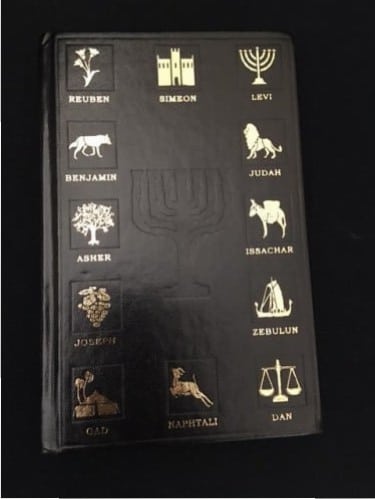
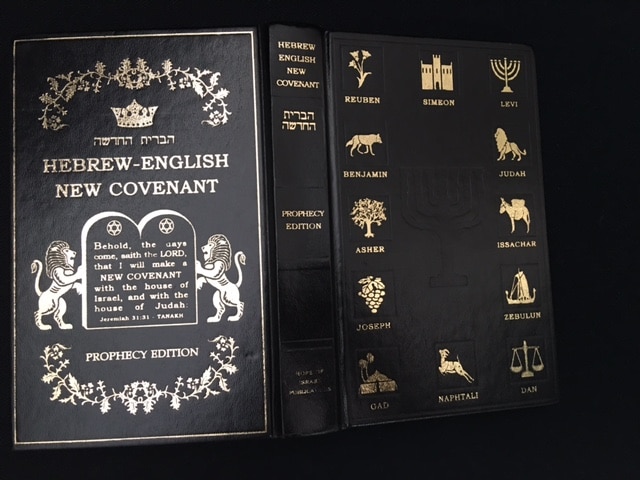
book2 book Speaking of judging a book by its cover, here is a peculiar bible which we  purchased, thinking it was the TNK.  At first glance, wouldn’t you think so? The cover is misleading visually because it is designed exactly like the Hebrew Bible where the Title is on the back cover and you read from back to front, just like Hebrew Scripture formatting.  

The cover design has all the symbols that Jews would identify with, from the Hebrew alphabet, star of David, 12 tribal emblems.  

Open this bible and on the right page is the New Testament in Hebrew alphabet and on the left, its English translation.


On the cover only the title betrays its content:  THE HEBREW ENGLISH NEW COVENANT(whaaaat ???? missed reading that!!!).  Inside the back cover, this letter explains the camouflage:  


Dear Jewish Friend,

The LORD raised up the nation of Israel and through the Jewish people, gave the world these three great blessings:

 1.  The Holy Scriptures,  

2.  The Way of Salvation,  

3.  The Messiah, our Saviour. 

Therefore, it is with great joy that we present to you this historic edition of the New Covenant, which God promised to Israel, through Jeremiah the prophet, in the Holy Scriptures.  Then it quotes Jeremiah 31:31-34, and concludes 

With much gratitude, Dr. K. Daniel Fried.”  


[In this website, part of our visual alerts is to color code NT in red (beware) and Hebrew Scriptures in Israel blue (original).]


On the last page is a partial list of OLD TESTAMENT PROPHECY (OT verses) corresponding with NEW TESTAMENT FULFILLMENT with the caption:

“These are only a few of many prophecies;

yet the Lord Jesus Christ fulfilled them all!”


——————

This bible was evidently designed to evangelize the Jews, distributed by Hope of Israel Publications [www.hopeofisrael.net].


Admittedly, Christians mean well; they are fully convinced who their God is and therefore are sincerely concerned that everyone else, like the Jews, who have not embraced the key figure for salvation,  2nd person of the Trinitarian Godhead, are not “saved” and therefore hell-bound.  So their evangelization efforts extend beyond the gentile world, penetrating the Jewish population who, as Paul in the Book of Romans characterize, have blinders, been left ignorant by the very God Who chose them!


It would be interesting to know how many Jews have come to believe in Jesus Christ as their long-awaited “messiah” (christ!) through this disguised, if not outwardly deceiving book!


Seriously, dear Christian brethren, if you reread the Jeremiah verse CAREFULLY, you will notice that the supposed “new” covenant is not really “new”.  Messianics are correct in teaching the “old” covenant as simply “renewed” . . . except they go along with a totally new and different package since they are still, after all, Christ-worshippers with a Christian agenda even if they try to look and sound Jewish.  We consider them as the real “Jew-wannabe’s”.


Now, please reflect on this:


The original covenant on Sinai—

  • was between YHWH 
  • and Israel 
  • about the TORAH, 10 words written on tablets of stone.  

The “new covenant” in Jeremiah is defined by the following “very words of YHWH”—-

    • I will place My Torah within them 
    • and I will write it onto their heart; 
    • I will be a God for them 
    • and they will be a people for Me.  
    • They will no longer teach—each man his fellow, each man his brother–saying, ‘Know YHWH!”  
    • For all of them will know Me, from their smallest to their greatest—the word of YHWH—
    • when I will forgive their iniquity and will no longer recall their sin.” 
    •  [vs. 35]  If these laws could be removed before Me—the word of YHWH— so could the seed of Israel cease from being a people before Me forever.


So the “new” covenant is still between whom and about what?—- 

  • between Israel, 
  • and the God of Israel YHWH,
  •  and it is still about the TORAH, no longer written on tablets of stone
  • but internalized by Israel after learning their lessons from the exile
  • (to model to the nations, since Israel is YHWH’s “light to the gentiles”


Honestly, how could these verses be re-interpreted and misinterpreted—-

  • to create a whole new religion, 
  • with a different God, 
    • with a new name
    • and a different nature
    • no longer really ONE but 3-in-1,
  • and a new Way and—lest we’ve forgotten what this article is about, a new identity for the Creator? 
    • declaring the TORAH passe, obsolete, no longer applicable.

To quote another major prophet, Isaiah 8:20:

To the law and to the testimony!

If they do not speak according to this word,

it is because they have no dawn.


AMEN!


Sig-4_16colors


AIbEiAIAAABDCNPkvrXuucmdeSILdmNhcmRfcGhvdG8qKGJkZTc0YTk3NmUxMGM4OTAzZjk5MDhkMjdkZDI2ODQ3OTliYmQ2MDkwAe5UdNp0lvYvCf8bjAFEJOY_fdsj

Q&A: How can you be saved if you don’t believe in the “Christian” Savior?

Image from crosschek.net

Image from crosschek.net

[First posted 2015, and being reposted in the Christmas season when Christians celebrate the birth of the 2nd Person of their Trinitarian God.  

We are constantly asked the question in the title of this post by Christian friends who knew us when we were super-dedicated Christians in active ministries who,  whether individually or as a group,  were responsible for conversions in great numbers that filled up fellowships we were involved in, and bible studies we were in charge of.    This was contributed by Sinaite BAN@S6K at the start of our 2010 pilgrimage out of our Christian roots toward the Revelator God on Sinai.  She wrote this to settle the constant recurring question from our former Christian colleagues who are concerned about the state of our souls and keep praying that we will find our way back under the ‘salvation umbrella’ of the Christian Savior because we might end up in Christian hell.  As we keep answering our dear colleagues, there is no turning back for us.  So be it, amen!—Admin1.]


———————-


Q:  How can you be saved if you don’t believe in the “christian” Savior?


A:   The Christian belief that atonement can only be through Yeshua runs counter to the provisions for atonement prescribed by the Hebrew Scriptures.  First and foremost, God and no one else provides the means of reconciliation and fellowship as attested by 2 Chronicles 7:14: 


And my people upon whom My Name is proclaimed, humble themselves and pray and seek My Presence and repent of their evil ways — I will hear from heaven and forgive their sins and heal the land.  This negates any claim of forgiveness through the death of anyone.
In contrast to the Christian concept that man is hopelessly entrapped in sin, the Hebrew Scriptures provide ample testimony that although man may have an inclination towards evil, as stated by Genesis 8:21 


Adonai smelled the pleasing aroma, and Adonai said in His heart, “I will not continue to curse again the ground because of man, since the imagery of man’s heart is evil from his youth, nor will I again continue to smite every living being as I have done.”


The means of personal reconciliation with God is always at hand as proclaimed by Psalm 51:16-19:


 Rescue me from blood guilt, O God, God of my salvation, let my tongue sing joyously of Your righteousness.  O Lord, open my lips, that my mouth may declare Your praise.  For You do not desire a sacrifice, else I would give it; a burnt offering You do not want.  The sacrifices of God are a broken spirit, a heart broken and humbled, O God, You will not despise.  
And Jeremiah 29:13 says, 


You will seek Me and find Me, if you search for Me with all your heart.
Hosea 6:6: 


 For I desire kindness and not sacrifice and knowledge of God more than burnt offerings.
GodSavesBindsDwellsSplashThe Christian’s proclamation,


“There is no salvation except in receiving Yeshua as Lord and Savior”
—has no basis in the Hebrew Scriptures.  Its origin lies in the New Testament and has no bearing in the spiritual life of a true believer in the One True God.


Through repentance, prayer, fasting, and doing what is right, the Scriptures teach that everyone has the ability to return to God directly.


Ezekiel 33:8-20


vs. 8 When I say to the wicked, O wicked man, you shall surely die; if you do not speak to warn the wicked man to turn from his way, that wicked man shall die in his iniquity; but his blood will I require at your hand.
vs. 9 But, if you warn the wicked to turn from his way, and he does not turn from his way, he shall die in his iniquity; but you would have saved your soul.
vs 10  Therefore, O son of man, speak to the house of Israel; Speak thus, saying: if our transgressions and our sins are upon us, and we pine away in them, how should we then live?
vs. 11  Say to them, As I live, says the Lord God, I have no pleasure in the death of the wicked; but that the wicked should turn from his way and live; turn, turn from your evil ways; for why will you die, O house of Israel?
vs 12  Therefore, son of men, say to your people, The righteousness of the righteous shall not save him in the day of his transgression; as for the wickedness of the wicked, he shall not fall by it when he turns from his wickedness; nor shall the righteous be able to live for his righteousness in the day when he sins.
vs 13  When I shall say to the righteous, that he shall surely live; if he trusts in his own righteousness, and commits iniquity, all his righteousness shall not be remembered; for the iniquity that he has committed.
vs 14  And, when I say to the wicked, You shall surely die, if he turns away from his sin, and does that which is lawful and right;
vs 15  If the wicked restores the pledge, gives back what he has robbed, follow the statutes of life, without committing iniquity, he shall surely live, he shall not die.
vs 16  None of the sins that he has committed shall be remembered against him; he has done that which is lawful and right; he shall surely live.
vs. 17  Yet your people say, The way of the lord is unfair; but it is their way that is unfair.
vs 18  When the righteous turns from his righteousness, and commits iniquity, he shall die by it.
vs 19  But if the wicked turns away from his wickedness, and does that which is lawful and right, he shall live by it.
vs 20  Yet you say, The way of the Lord is unfair.  O you house of Israel, I will judge you, everyone according to his ways.


BAN@S6K
 logo


Sinaite Notes – 613 Commandments, really?

Image from Faith In His Blood . Org

Image from Faith In His Blood . Org

[We dug this up from 2012 files; helpful to those who are overwhelmed in finding out the Torah actually listed not 2, nor 10, but 612 commandments as of a Jewish scholar’s count!  Whaaaat????  But before you panic, please read why not ALL 612 are applicable to us, Gentiles, and hey, not even to Jews.  


There is logic to the Torah-Giver’s progressive revelation of do’s and don’ts to Israel during their wilderness wandering, as specific situations and needs, crises and exigencies arose.  This is why we, readers in this day and age, need to learn how to read these 612 in context to determine what is universal and apply to people of all nations at all times in all cultures, and what is specific to Israel during the wilderness wandering, in the Land, in diaspora; which are specific to Levites, to women, men, etc., you get the picture.  And which are addressed to both the Israelite and “the stranger in your midst”.  One resource book we have featured here well clarifies that for us, our  MUST READ/MUST OWN:  TORAH for Dummies, Arthur Kurzweil (http://www.dummies.com)gives a breakdown of the 613 commandments. Reformatted for post.-—Admin1] 


——————————————


51X5MKo74OL._SX260_The term used to refer to these 613 commandments is Taryag.  


It’s an acronym made up of 4 Hebrew letters:  

  • Tav [T],
  • Resh [R],
  • Yud [Y],
  • Gimmel [G].

Each letter in the Hebrew alphabet corresponds to a number, so

  • taf is 400,
  • resh is 200,
  • yud is 10, and
  • gimmel is 3.  

These numbers add up to 613 which are the DO’s and DON’Ts of the Torah.


Categories of commandments:

  • Positive commandments
  • Negative commandments
  • Time bound commandments (for specific times)
  • Non-time bound commandments (for any time)
  • Simple commandments 
  • Complex commandments
  • Rational commandments
  • Non-rational commandments
  • Ritual commandments
  • Commandments between humans and God
  • Commandments for all Jews at all times
  • Commandments for the priesthood only
  • Commandments for women only
  • Commandments for all humankind
  • Commandments for the King of Israel only
  • Commandments in the Holy Temple
  • Commandments for specific times and places
  • Commandments that are constant


Another way to classify commandments is by negative and positive:


  • There are 365 negative commandments called mitzvoth lo ta’aseh —by negative, these are commandments that tell us what not  to do. They’re said to correspond to the 365 days of the year. The symbolism of these commandments lies in the idea that, according to the Torah, these prohibitions must be observed everyday.
  • There are 248 positive commandments called mitzvoth aseh —by positive, these are commandments that tell us specific actions or beliefs that we must do.  These commandments correspond to the 248 parts of the body [as counted by the Talmudic rabbis].  The symbolism of these commandments lies in the idea that the Torah is saying that the positive commandments must be performed with a wholeness of being. The Torah must be integrated into our life everyday and with our whole body.

According to Kurzweil, Jewish teaching says that all 248 positive commandments are contained within the first of the Ten Commandments:


 “I am the Lord thy God,”


and all 365 negative commandments are contained within the second of the Ten Commandments:


“Thou shall have no other gods before me.

Q&A: Isn’t the Trinity ONE GOD?

[We have heard it said . . . and here’s our answer, first posted in 2012,   The Trinity has always baffled us just as it does many other Christians who accept it as “mystery”  that we will never understand on this side of eternity.  Just accept it as biblical truth!   That is, “biblical” according ONLY to the New Testament Scriptures, certainly not the Hebrew Scriptures, wrongly and unfortunately referred to as the “Old Testament”.  —Admin1]


—————————–


Q:  Isn’t the Trinity ONE GOD?


A:  Since the 3rd-4th centuries when the doctrine of the Trinity was debated in Church Councils, there has undoubtedly been confusion over how the ONENESS or UNITY of God—which is repeatedly emphasized throughout the Hebrew Scriptures by God Himself— could morph into a Biannity first, then on to a Trinity.  Hard as you try to reconfigure how 3-in-1=1, it just doesn’t add up, least of all mathematically!

 
Many explanations have been offered to illustrate a triune God:
  • such as one triangle with 3 sides or 3 angles;
  • a “Godhead” of 3 persons;
  • or H2O in solid, liquid and gaseous state, 3 manifestations of the same God.


If you still don’t ‘get it’, then relegate it to the category that men will never understand called “mystery” and shut up already.  

 
Not a problem . . . but it’s confusing to read in the Gospels how —
  • God-Son prays to God-Father,
  • God-Father forsakes God-Son while dying on the cross;
  • God-Spirit descends on God-Son at baptism;
  • God-Father sends God-Spirit on various errands.


How can God pray to God, God abandon God, God send God . . . well, God can do anything, right?   And if that’s how he chooses to function, so be it….except this just doesn’t fit the God of the Hebrew Scriptures.

 
So back to the question: isn’t the Trinity One God? Let’s listen to how God defines Himself in the “foundational” scriptures claimed by Christianity from which it spins off its “New Testament”:
 
Exodus 20:3 You shall not recognize the gods of others in My presence.  
 
Num.23:19  God is not a man that He should be deceitful, not a son of man that He should relent, Would He say and not do, or speak and not confirm?
 
Deuteronomy 6:4  Hear O Israel, YHWH is our God, YHWH is the One and Only.
 
Deuteronomy 32:39  Know therefore, this day, and consider it in your heart, that the Lord is God in heaven above and on earth beneath, there is none else;
 
1 Sam 15:29  Moreover, the Eternal One of Israel does not lie and does not relent, for He is not a human that He should relent.
 
1 Kings 8:27, 60  Would God truly dwell on earth?  Behold, the heavens and the highest heavens cannot contain You . . . all the people of the earth shall know that YHWH is God–there is no other.     
 
Isaiah 40:25  See now that I, even I, am He, and there is no God besides Me.
 
Isaiah 43:10  “To whom then will you liken Me, that I will be equal?” says the Holy One.
 
Isaiah 44:6  Before Me, no God was formed, neither shall any be after Me
 
Isaiah 44:24 I am the First, and I am the Last, and besides Me there is no God.


These are only a few sample verses.   If you truly seek to know the God of Israel, the Self-revealing God on Sinai better, then read the Torah.


The beginning of wisdom is the ‘fear’ of God, not just any god of men’s imagination, the God of the Hebrew Scriptures.  You WILL find HIM if you seek Him with all your heart.


He is One, not a Trinity.


Sig-4_16colors
AIbEiAIAAABDCNPkvrXuucmdeSILdmNhcmRfcGhvdG8qKGJkZTc0YTk3NmUxMGM4OTAzZjk5MDhkMjdkZDI2ODQ3OTliYmQ2MDkwAe5UdNp0lvYvCf8bjAFEJOY_fdsj

Journey of Faith – Whose test of faith, Abraham’s or Isaac’s?

[This was first posted August 7, 2012;  the updated commentary here is from the Sinaite’s perspective.—Admin1.]


——————————


What else could we possibly add to everything that has already been written about the test of Abraham’s faith  except to focus, for a change, on the would-be-sacrificed promised heir?   And specifically the ordeal he might have gone through?


Isaac/Yitzak is not to be considered a “sacrificial lamb” (‘human sacrifice’ he might have become, but lamb, he definitely was not).   No ifs and buts about it, he was to be offered as an actual human sacrifice.  


What???   Isn’t human sacrifice  an abomination to the God of the TNK!? So why does He require it from the first of Israel’s Patriarchs from whom would issue a special line of people yet to be formed into the nation of Israel?  Why nip the bud in the 2nd generation?  Precisely . . . surely Abraham must have thought the same.


Already, many questions crop up,  for starters:

  • What was the purpose of ‘offering’ a ‘firstborn’?
  • Isaac is the first of the 2nd generation that was supposed to perpetuate the chosen line.
  • Was Abraham sooooooo certain it was only a test and therefore goes through the motions just to show his faith in this God who is now requiring him to give up a promised son?
  • Did Sarah know about this at all and what could she have thought as the only unfertile woman in her old age, in her generation, in her culture, who miraculously gave birth to a son; was her faith in Abraham’s God as strong and logical as husband’s? 
  • And what about Isaac, what was he thinking all the while, for according to the text, he did not know until  . . .well . . .until he was being placed on the altar as THE sacrifice? 


Let us remember that at this time the Torah had not yet been given and no Tabernacle existed where ‘offerings’ were required for different reasons (read Leviticus and Numbers for details).  So what would have been the purpose this early?  The pagan cultures were all into ‘sacrifices’ and particularly the sacrifice of innocent babies and virgins to appease their gods. The God of Israel hated all of these ignorant offerings and that is why He would straighten it all out in the Torah at the proper time with the chosen custodians of His detailed instructions, if only to both accommodate their tendency for offering but regulate it and eventually redirect it when the Temple itself would be taken out of Jerusalem.


But before we lose the focus on the specific topic here — let’s go back to the timing of the required ‘human offering’ of Isaac—

  • pre-Sinai Revelation
  • and pre-Torah
  • and pre-Sanctuary and pre-Levitical priesthood times.
 

Picture Isaac, not a small innocent child as usually depicted, but according to accepted chronology, he was already 37 years old at this time.  


  Genesis/Bereshith 22

 [Translation is Everett Fox, The Five Books of Moses]


Image from biblestudynpt.wordpress.com

1 Now after these events it was
that God tested Avraham
and said to him:
Avraham!
He said:

Here I am.

2 He said:

Pray take your son,
your only-one,
whom you love,
Yitzhak,
and go-you-forth to the land of Moriyya/Seeing,
and offer him up there as an offering-up
upon one of the mountains
that I will tell you of.

3 Avraham started-early in the morning,

he saddled his donkey,
he took his two serving-lads with him and Yitzhak his son,
he split wood for the offering-up
and arose and went to the place that God had told him of. 
4 On the third day Avraham lifted up his eyes
and saw the place from afar.

5 Avraham said to his lads:

You stay here with the donkey,
and I and the lad wish to go yonder,

we wish to bow down and then return to you.

6 Avraham took the wood for the offering-up,

he placed them upon Yitzhak his son,
in his hand he took the fire and the knife.
Thus the two of them went together.


The wording here is “offering-up” while the Artscroll [AS] merely says “offering.”  


For now, without consulting outside sources except the text, the very word used and the place Abraham was directed to go for the offering tells us it’s up on a mountain in the region of Moriah.  


Later on throughout the TNK, God speaks in anger about His people seeking other gods and sacrificing on elevated areas so the practice of going up to mountain tops must have been common.  But there must be more to the word use of “elevation” than the simple height of an actual  mountain.   In Abraham’s case, he is now being required to offer to YHWH:  Pray take your son, your only-one, whom you love . . . think about it, that is indeed an ‘elevated’ offering to the utmost, the supreme sacrifice to be asked of any father.  


As for Isaac,  to be worthy of being elevated as an offering must mean that Isaac was spiritually fit, uncorrupted, a ‘clean’ offering at age 37; credit him and his parents for that. . . unless that was not a requirement and we are reading back into the text something that is not even hinted at.  We do have to shed our ‘Christian baggage’ when we go back to the Hebrew Scriptures with fresh reading lenses and a clean ‘slate and state’ of mind.


We would expect that Abraham who bargained for mercy upon the righteous in Sodom to likewise bargain for Isaac’s life, but strangely he does not, he simply obeys.  Hint, hint!


To echo Job’s words, “the Lord giveth. . . . “


Some commentaries point out that this is because Abraham had heard the promises enough and he knew his God enough at this point to just trust and obey.


 Easy for him to figure that out, but what about poor Isaac? 

 
7 Yitzhak said to Avraham his father, he said:
Father!
He said:
Here I am, my son.
He said:

Here are the fire and the wood,

but where is the lamb for the offering-up?

8 Avraham said:

God will see-for-himself to the lamb for the offering-up,
my son.
Thus the two of them went together.

9 They came to the place that God had told him of;

there Avraham built the slaughter-site
and arranged the wood
and bound Yitzhak his son
and placed him on the slaughter-site atop the wood.


Whoa!  Isaac thinks, Isaac asks, Isaac allows himself to be bound and lain on the altar . . . a young man watching his 137+old father do all this?   By the time Abraham takes hold of a knife, Isaac has figured out what’s going on, but where is his instinctive sense of self-preservation? 


Isaac is a second generation receiver of Abraham’s promises from their family’s God; presumably his faith is not built up to the level of the faith of his father; isn’t he being too acquiescent here?


 If there’s a real hero in this scenario, wouldn’t we agree it’s Isaac? And yet Abraham always gets the acclamation just because he passed the ‘trust test’.

 
10 And Avraham stretched out his hand,
he took the knife to slay his son.

11 But YHVH’S messenger called to him from heaven

and said:
Avraham! Avraham!
He said:

Here I am.

12 He said:

Do not stretch out your hand against the lad,
do not do anything to him!
For now I know
that you are in awe of God—
you have not withheld your son, your only-one, from me.

13 Avraham lifted up his eyes and saw:

here, a ram was caught behind in the thicket by its horns!
Avraham went,
he took the ram
and offered it up as an offering-up in place of his son.

14 Avraham called the name of that place: YHVH Sees.

As the saying is today: On YHVH’S mountain (it) is seen.


For more background on the name ‘YHWH Yireh’, please check outwww.myredeemerlives.com/namesofgod/yhwh-jireh.html where ‘yireh‘ is further explained as ‘forsee’ . . . The Lord sees, the Lord provides, the Lord will provide.  


Abraham has experienced enough in his faith journey and knows the God who speaks to him constantly, so that he is expected to pass such an extreme test . . . okay, but what about Isaac?  How could he have been prepared for this?   Not even Abraham anticipated such an unusual divine command. . . unless Abraham knew all along that YHWH hates human sacrifice and there is just no way He would be pleased with the offering of Isaac.  Did he assure Isaac there is nothing to be afraid of? The text does not indicate so.


All throughout TNK it is reiterated how YHWH hates the way of the nations sacrificing their children and virgin daughters to their gods.  We readers know that, and even without any explicit text proving it, Abraham must have been primed of it as the father of many nations and the progenitor of  2 more patriarchs from whom Israel will descend.

 
15 Now YHVH’S messenger called to Avraham a second time from heaven

16 and said:

By myself I swear
—YHVH’S utterance—
indeed, because you have done this thing, have not withheld your son, your only-one,

17 indeed, I will bless you, bless you,

I will make your seed many, yes,
many, like the stars of the heavens and like the sand that is on the shore of the sea;
your seed shall inherit the gate of their enemies,

18 all the nations of the earth shall enjoy blessing through your seed, in consequence of your hearkening to my voice.


A note from Artscroll Tanach:


 “God did not say, ‘Slaughter him,’ because He did not intend for Isaac to be slaughtered, but only that he be brought up to the mountain and be prepared as an offering.  


Whew!  But who knew?


Mount Moriah is the Temple Mount in Jerusalem.

 
19  Avraham returned to his lads,
they arose and went together to Be’er-Sheva.
And Avraham stayed in Be-ersheva.

Now here comes the abrupt no-big-deal transition from this excruciating account to what happens next:  Vs. 20, the last verse in this chapter appears anti-climactic, like —’ OK, life’s back to normal’, there’s news about Abraham’s brother Nachor and Milkah, and their genealogy is given.  


We must remember that the original writings were not divided in chapters nor numbered in verses;  “The person credited with dividing the Bible into chapters is Stephen Langton, the Archbishop of Canterbury from 1207-1228. While Langton’s isn’t the only organizational scheme that was devised, it is his chapter breakdown that has survived.”  


The worse part is, often as you will notice, the chapter divisions are even badly organized!  


For more details, check out http://www.biblegateway.com/blog/2010/10/bible-trivia-where-did-chapter-and-verse-numbers-come-from/.


20 Now after these events it was, that it was told to Avraham, saying:
Here, Milca too has borne, sons to Nahor your brother:

21 Utz his firstborn and Buz his brother, Kemuel father of

22 Aram, /and Cesed, Hazo, Pildash, Yidlaf, and Betuel.

23 Now Betuel begot Rivka.—

These eight Milca bore to Nahor, Avraham’s brother.

24 And his concubine-her name was Re’uma-bore too: Tevah, Gaham, Tahash, and Maakha.

That’s it???


Yup, that’s about it!


NSB@S6Klogo