Oy Searchers, whatsup? – May 2018

Image from Pinterest

Image from Pinterest

05/31/18 – It’s goodbye May today, not much activity on this blog since it’s dependent on “search terms” which we no longer have too many of,  unlike in previous years and particularly at the creation of this post.  Meanwhile, lots of happenings worldwide which we could have commented on but perhaps, we will do that more actively starting June.  So GOODBYE MAY 2018 indeed, see your month again in 2019!


05/22/18  – “david star” 


05/15/18 –  “Creation-Day-4”Another image checked out by a searcher; click it and be surprised!


05/15/18 – “d2323d058926bbdd942bf7c8df169c4a” – This is a web-borrowed “Shabbat shalom” greeting we used in a Sabbath Liturgy; click it and see what shows up!


05/14/18 – “edom esau” 


05/14/18 – As Israel celebrates its 7 decades of existence as a nation, we pray for the peace of Jerusalem and the whole “promised land” which has been a land of promise for the Jewish people . . . except that its enemies refuse to allow it to exist or live in peace.  Here are past articles to check out:


05/14/18 — “must read zion book” 

05/14/18 — Links that were clicked on this date, in case you wish to check them out for yourself:


Image from Pinterest

Image from Pinterest

05/13/18 — In the introduction to our post on the celebration of Mother’s Day, we wondered if the decision makers who assign specific days and months for specific celebrations had intended Mother’s Day to follow Labor Day?  If that was an unconscious decision, it’s still a good connection!  Mother not only labors to carry her unborn child to full term  (9 months,  Pop, try to beat that!),  but after birthing-day, every child no matter how old in years remains in mother’s heart and mind and concern till her dying day. Truly, mother deserves recognition from every living being, since the Creator designed the female species to be in His Image, specifically His ‘nurturing nature’ and ‘mothering instinct’,  yes?


Image from Pinterest

Image from Pinterest

Here are our posts in tribute to her, with sample excerpts from each:

Excerpt:  Bless all Mothers, O GIVER and SOURCE of LIFE,

for their special place in the lives of children,

for providing never-ending unconditional love to them.

May children young and old,  see in Mothers 

that very IMAGE of You, a loving GOD Who cares

that each child fulfills the purpose for which he was created:

to know You first and foremost

yet freely choose his destiny,

with You or without You in it.

It is our prayer that our children will choose ‘Life’,  

YOUR LIFE,  for in doing so,  

their destiny is rightly directed and ultimately blessed,

and that brings great comfort to a mother’s heart.


Excerpt from the Introduction:  We are resurrecting this post which analyzes how women in scripture fared in their roles as individuals with free choice, as wives, as mothers, and other roles they were limited to in their culture. Not surprisingly even in patriarchal narratives, women actually had a ‘voice’ and in fact ‘led’ men (husbands, sons) in decision making. It didn’t always go well, but the record of their counterparts—male biblical figures—were just the same, all humans are prone to committing mistakes and making unwise decisions when they follow their will over and above the revealed Divine Will in any circumstance. So here’s a short list of notable women, named or unnamed . . . .


Excerpt:   Hamlet’s is hardly a dilemma; we simply exist or we don’t without our making any personal choice.  We were conceived without our permission,  we simply found ourselves participating in the development of a life—our life—as a result of our parents’ choice or sometimes, a mere consequence of a sexual union. We’re nurtured in the womb by one of our parents, the temporary life-sustainer—our mother—and, depending on how she decides to nurture us or how she takes care of herself during her pregnancy, we’re merely blessed recipients of her natural motherliness or in some cases, suffer from lack of motherly concern (uniquely a woman’s choice).

Back in the womb . . . at the very moment of our conception there is that ‘hold-your-breath’ phase when we are held hostaged by the conscious decision of the carrier, the impregnated female, our would-be mother in whose hands our fate hangs.  While the Creator of Life had put that whole process of propagating human life on ‘automatic’ mode, yet decisions are left in the hands of responsible and unfortunately, irresponsible self-centered unthinking females.  For a short while we might be relegated to the category of unexpected or unwanted pregnancy.

 Whether or not we make it beyond the medical confirmation that biologically, there was indeed a successful fertilization of an egg by a sperm—-becomes the sole prerogative of ‘woman’. And if she so decides she will have this baby, then we are on our way to being born (thanks, mother)!


————————

INTRODUCTORY COMMENT TO THIS POST

[Nobody noticed and neither did we, that we neglected to post this  monthly aid for searchers, originally intended to direct them to articles that address their entry in ‘search terms’.  And so it’s mid-May, when we noticed . . . wondering if we should even continue this blog.  Well, why not! This gives us the opportunity to have a running commentary on current events, any concern, any question that might crop up from visitors  to this site.  The trend from month to month and year to year though is — there are hardly any entries/queries from our web visitors and perhaps  that is a good sign that they find it easy to navigate their way through our website and don’t need to be directed; just click Site Map, the right-most box above the scroll which is like a ‘table of contents’ listing of over 1000 posts under 22 categories.  The other possibility is — heavens forbid, there are no or hardly any visitors!  But this is disproven by Google Cluster Map which shows frequent daily clicks on our site and specific posts by searchers from all over the world.  That is heartening, our work is not in vain.  So,  as late as this is being posted, we decided to continue this blog, if nothing else except to comment on current ‘anything’  that might connect to a Torah perspective.  And even if nobody asks, we’ll still give the answer!–Admin 1.] 


———————-


TSTL: The Seventh Day

 [“TSTL” is our acronym for “Thus saith the Lord.”  Here are 2 translations focusing on scripture about the Sabbath.—Admin1.]


Translation 1:  Artscroll’s The Stone Edition, TANACH


Genesis 2:1-3 Thus the heaven and the earth were finished, and all their array.  By the seventh day God completed His work which He had done, and He abstained on the seventh day from all His work which He had done.  God blessed the seventh day and sanctified it because on it He abstained from all His work which God created to make.


Exodus 20:8-11  Remember the Sabbath day to sanctify it.  Six days shall you work and accomplish all your work; but the seventh day is Sabbath to HaShem, your God; you shall not do ay work — you, your son, your daughter, your slave, your maidservant, your animal, and your convert within your gates — for in six days HaShem made the heavens and the earth, the sea and all that is in them, and He rested on the seventh day. Therefore, HaShem blessed the Sabbath day and sanctified it.


Leviticus 23:1-8  HaShem spoke to Moses, saying:  Speak to the Children of Israel and say to them: HaShem’s appointed festival that you are to designate as holy convocations–these are My appointed festivals.  For six days labor may be done, and the seventh day is a day of complete rest, a holy convocation, you shall not do any work; it is a Sabbath for HaShem in all your dwelling places.  


Deuteronomy 5:12-15  Safeguard the Sabbath day to sanctify it, as HaShem, your God has commanded you.  Six days shall you labor and accomplish all your work, but the seventh day is Sabbath to HaShem, your God; you shall not do any work — you, your son, your daughter, your slave, your maidservant, your ox, your donkey, and your every animal, and your convert within your gates, in order that your slave and your maidservant may rest like you.  And you shall remember that you were a slave in the land of Egypt, and HaShem, your God has taken you out from there with a strong hand and an outstretched arm; therefore HaShem, your God, has commanded you to make the Sabbath day.


Translation 2:  The Five Books of Moses, Everett Fox


Genesis 2:1-3  Thus were finished the heavens and the earth, with all their array.

2  God had finished his work that he had made,, on the seventh day, his work that he had made, and then he eased, on the seventh day, from all his work that he had made.

3  God gave the seventh day his blessing, and he hallowed it, for on it he ceased from all his work, that by creating, god had made.


Exodus 20: 8-11  Remember the Sabbath day, to hallow it.

9  For six days, you are to sere, and are to make all your work,

10 but the seventh day is Sabbath for YHWH your God: you are not to make any kind of work, (not) you, nor your son, nor your daughter, (not) your servant, nor your maid, nor your beast, nor your sojourner that is within your gates.


11  For in six days YHWH made the heavens and the earth, the sea and all that is in it, and he rested on the seventh day; therefore YHWH gave the Sabbath day his blessing, and he hallowed it.


Leviticus 22:1-3  YHWH spoke to Moshe, saying:  

2  Speak to the Children of Israel and say to them: ‘The appointed-times of YHWH, which you are to proclaim tot hem (as) proclamations of holiness— these are they, my appointed times:  

3  For six days may work be done, but on the seventh day (is) Sabbath, Sabbath-Ceasing, a proclamation of holiness, any-kind of work you are not to do.  It is Sabbath to YHWH, throughout all your settlements.

Image from theblog.founders.org

Deuteronomy 5:12-15  Keep the day of Sabbath, by hallowing it, as YHWH your God has commanded you.

13  For six days you are to serve and to do all your work;

14  but the seventh day (is) Sabbath for YHWH your god—you are not to do any work: (not) you, nor your son, nor your daughter, nor your servant, nor your maid, nor your ox, nor your donkey, nor any of your animals, nor your sojourner that is in your gates—in order that your servant and your maid may rest as one-like yourself.


The Ever-Renewed Covenant

Image from www.christianbooks.co.za

[First posted 2015.  The “new”covenant claimed by Christianity as God’s covenant with the Church is found nowhere in the Hebrew Scriptures, even as Jeremiah 31:30-33 is cited as the ‘Old Testament’ prooftext.  When you read those verses carefully and closely, you will discover that the same parties that cut a covenant at Sinai are named as covenant-partners:  YHWH, and Israel.  When you read further what the covenant is about,  you will find out it is about the same “law” or Torah given on Sinai.  


What is different is clearly stated, instead of the Law or Torah being written on tablets of stone, this is what the God of Israel says:


I will place My Torah within them

and I will write it onto their heart;

I will be a God for them

and they will be a people for Me.  

They will no longer teach —

each man his fellow, each man his brother

—saying ‘Know YHWH!”

For all of them will know Me,

from their smallest to their greatest

—the word of YHWH —

when I will forgive their iniquity

and will no longer recall their sin.


Who is being referred to by  ‘they’, ‘their’ and ‘them’? Vs 30:

 ‘when I will seal a new covenant

with the House of Israel and

with the House of Judah.

When?  

‘Behold, the days are coming” and

For this is the covenant that I shall seal

with the House of Israel after those days’. 


Who are YHWH’s ‘covenant people’?  

The same chosen people with whom

the Covenant on Sinai was made and

renewed in the prophet Jeremiah’s time.  


How long will this covenant between YHWH and Israel about His Torah last?  Are His Laws to be done away with, replaced by ‘grace’?


vs. 35  If these laws could be removed

from before Me –the word of YHWH —

so could the seed of Israel cease

from being a people before me forever.  


This is chapter 11 of Jon D. Levenson’s Sinai and Zion, our MUST READ/MUST OWN feature.  It is downloadable as ebook from amazon.com for those who have gotten curious enough to want to read the whole book! It is worth not only the expense but more importantly the time spent on reading from beginning to end.  Additional posts from this same source are: 

Reformatting and highlights ours.—Admin1.]


Image from www.cswisdom.com

Image from www.cswisdom.com

The renewal of covenant was a central aspect of Israel’s worship in biblical times. Psalm 81, chanted today on Thursday mornings, seems to have related the Sinaitic experience in some kind of regular liturgical celebration, also in its original setting. Although much of this psalm is obscure, v 4 would seem to locate its context in the celebration of the first day of the lunar month, on analogy with the celebration of New Year’s Day (Rosh HaShanah) so well known from later tradition, and comparable festivities for the day of the full moon, two weeks later.


What is most pertinent to us is that the liturgy for these holy days seems to have stressed the Decalogue. Vv 10-11 are a transparent restatement of the Second and First Commandments, according to the Jewish enumeration. Vv 6b-8, in which YHWH becomes the speaker, perhaps through the mouth of a priest or prophet, and v 17 restate the historical prologue, with its emphasis upon all that the suzerain, in his graciousness, has done for his vassal.  The curses of covenant can be heard in vv 12-13, in which YHWH disowns a disobedient people, but in vv 14-16, the blessings balance this with their promise of victory if only Israel walks YHWH’s path. In short, Psalm 81 evidences a regular liturgical occasion in which the Sinaitic covenant and the great choice it entails were represented to the Israelite congregation.


In the case of the book of Deuteronomy, the book of covenant par excellence, this insistence upon the relevance of the covenant of Sinai (“Horeb” in Deuteronomy) to the present  generation reaches a pitch of intensity:


1  Moses called together all Israel and said to them:

Hear, Israel,

the laws and ordinances which I am proclaiming to you personally today.

Study them,

observe them,

put them into practice.

2  YHWH our God made a covenant with us on Horeb.

3  It was not with our fathers that YHWH made this covenant,

but with us—us!—those who are there today, all of us, the living.

4  Face to face YHWH spoke with you on the mountain, from the midst of the fire.

(Deut 5:1-4)


The concern in this passage is that Israel may come to think of themselves as obliged in a distant way by the covenant of Sinai/Horeb, but not as direct partners in it.  Lest the freshness of the experience be lost, v 3 hammers home the theme of contemporaneity in staccato fashion, with no fewer than six separate expressions:

with us”

“us!”

“those who are here”

“today”

“all of us”

“the living.”   

The goal of this speech, as of the covenant renewal ceremony in which it probably originated, is to induce Israel to step into the position of the generation of Sinai, in other words, to actualize the past so that this new generation will become the Israel of the classic covenant relationship (cf. Deut 30:19-20). Thus, life in covenant is not something merely granted, but something won anew, rekindled and reconsecrated in the heart of each Israelite in every generation.


Covenant is not only imposed,

but also accepted.


It calls with both the stern voice of duty and the tender accents of the lover, with both stick (curse, death) and carrot (blessing, life) in hand. But it biases the choice in favor of life (Deut 30:19).


It is conventional to trace the influence of the covenant renewal ceremony and the formulary until the time of the disappearance of the Dead Sea community (first century C.E.) and no further. The tacit assumption is that these institutions did not survive into the next phase of Jewish history, the rabbinic era. In this, there is a certain truth. The idea of covenant does not seem to have had in rabbinic religion the centrality it had held since at least the promulgation of Deuteronomy in the seventh century B.C.E., although its importance for the rabbis must not be minimized. There is no rabbinic ceremony in which the Jews are said explicitly to be renewing their partnership in the Sinaitic covenant, as the eight day old boy is said, for example, to be entering the covenant of Abraham (Gen. 17:1-14) during his circumcision. There is, however, a text which is central to the rabbinic liturgy, in fact arguably the central text of the rabbinic liturgy, which is composed of three Pentateuchal passages (Deut 6:4-9; 11:13-21; Num 15:37-41) expressive of the classical covenant theology.


The prayer is known as the Shma, after its first word.  The first verse of the Shma is correctly rendered,

“Listen, Israel:

YHWH is our God,

YHWH alone”

(Deut 6:4).

Image from www.shemayisrael.net

Image from www.shemayisrael.net

It is manifestly an echo of the requirement of the old suzerainty treaties to recognize one lord alone. Since in the biblical case the lord is divine, the verse is a classic statement of covenantal monotheism, i.e., the prohibition upon the service of other suzerains.

In fact, we sense apprehension about the possibility of just such defection in each of the three paragraphs.


In the second one, we hear of the danger of seduction, in language that recalls the career of Hosea (Deut 11:16-17), and in the last paragraph, such defection is termed “whoring” (Num 15:39). It is the passage from Numbers which establishes the ground of obedience to YHWH precisely where we expect it, in the redemption from Egypt (v 41). This verse, like the First Commandment of the Decalogue (Exod 20:2), is a condensation of the historical prologue.


The central stipulation of the Shma is one familiar to any student of Near Eastern covenants,

the obligation to love YHWH,

which is inextricable from the requirement

to carry out all his commandments.


As we shall see, the rabbis, like the more ancient architects of covenant, saw in the acclamation of divine lordship and the love commandment of the first paragraph the basis for the acceptance of all other commandments.


The second paragraph, which stresses performance of the stipulations, derives mostly from the blessings and curses of the covenant formulary.  


Fidelity to YHWH

and the exclusive service of him

will bring abundance;

defection will result

in drought, famine, and death.


Finally, we should note that the insistence that the “words” be—


  • constantly recited,
  • bound to one’s body,
  • written upon one’s house,
  • and the commandments symbolized in one’s clothes,

—is also a reflex of part of the covenant formulary, the deposition of the text and the requirement for its periodic reading. In short, the idiom and the theology of covenant permeate the Shma.


What is interesting in light of the putative disappearance of the covenant renewal ceremony is that the rabbis selected these three texts to make up one prayer, for the three are not contiguous in the Torah, and the first of them there, Num 15:37-41, appears last here. What links the three paragraphs is that they constitute the basic affirmation of covenant. They confront us with the underpinnings of the entire Sinaitic dimension of the religion of Israel. The link between them is theological, and it is that theology that the rabbis considered basic to their own appropriation and adaptation of the biblical heritage.  For they made the Shma a staple in the liturgy they wove for Jewry.  


In the requirement to “recite them…when you lie down and when you get up,” they saw a mitzvah to recite the Shma twice daily, in the morning and evening every day of the year. The Shma thus became one of the pillars around which those two services developed.


What, precisely, did the rabbis think happened when one recites the Shma? We find an answer in the reply of the Tannaitic master Rabbi Joshua ben Korhah to the question of why Deut 6:4-9 is positioned before 11:13-21:


  • so that one might accept upon himself the yoke of the kingdom of heaven first;
  • afterwards, he accepts upon himself the yoke of the commandments.


“Heaven” in Talmudic language is usually a more delicate way of saying “God.” Rabbi Joshua sees the Shma, therefore, as the acclamation of God’s kingship.  Only in light of such an acclamation do the mitsvot make sense. In light of the biblical ideas, we can say that one must first accept the suzerainty of the great king, the fact of covenant; only then can he embrace the particulars which the new lord enjoins upon him, the stipulations.  If God is suzerain, his orders stand. But his suzerainty is not something irrational and threatening. It follows from his gracious character:


I am the Lord Thy God.


Why were the Ten Commandments not said at the beginning of the Torah?  They give a parable. To what may this be compared?  To the following:


A king who entered a province said to the people: May I be your king? But the people said to him: Have you done anything good for us that you should rule over us? What did he do then? He built the city wall for them, he brought in the water supply for them, and he fought their battles. Then when he said to them: May I be your king? They said to him: Yes, Yes. Likewise, God…


His past grace grounds his present demand. To respond wholeheartedly to that demand, to accept the yoke of the kingdom of heaven, is to make a radical change, a change at the roots of one’s being.  To undertake to live according to Halakhah is not a question of merely raising one’s moral aspirations or of affirming “Jewish values,” whatever that means.


To recite the Shma and mean it is to enter a supra-mundane sovereignty, to become a citizen of the kingdom of God, not simply in the messianic future to which that term also refers (e.g., Dan 2:44), but also in the historical present. Thus, one can understand the horror a rabbinic Jew would have of failing to say the Shma, as exemplified in this story: There was a law that a bridegroom was exempt from the commandment to recite the Shma, probably because he was in no mental condition to give the prayer the concentration it required. But concerning one early rabbi, we read this exchange in the Mishnah:


It happened that Rabban Gamaliel got married and recited the Shma on the first night. His students said to him, “Our master, have you not taught us that a bridegroom is exempt from the recitation of the Shma on the first night?” He said to them, “I am not going to listen to you and annul the kingdom of Heaven from myself for even a moment!”


In other words, one who neglects the Shma when its recitation is due is rebelling against the sovereignty/suzerainty of God.  Or, to put it positively, the Shma is the rabbinic way of actualizing the moment at Sinai when Israel answered the divine offer of covenant with the words—


“All that YHWH has spoken we will do” (Exod 19:8).


In short, the recitation of the Shma is the rabbinic covenantal renewal ceremony. It is the portal to continuing life in covenant.


There is, therefore, no voice more central to Judaism than the voice heard on Mount Sinai.  Sinai confronts anyone who would live as a Jew with an awesome choice, which, once encountered, cannot be evaded—the choice of whether to obey God or to stray from him, of whether to observe the commandments or to let them lapse.


Ultimately, the issue is whether God is or is not king, for there is no king without subjects, no suzerain without vassals. In short,


Sinai demands that

the Torah be taken

with radical seriousness.


But alongside the burden of choice lies a balm that soothes the pain of decision.


  • The balm is the history of redemption, which grounds the commandments and insures that this would-be king is a gracious and loving lord and that to choose to obey him is not a leap into the absurd.
  • The balm is the surprising love of YHWH for Israel, of a passionate groom for his bride, a love ever fresh and never dulled by the frustrations of a stormy courtship.

Mount Sinai is the intersection of —

  • love and law,
  • of gift and demand,
  • the link between a past together and a future together.
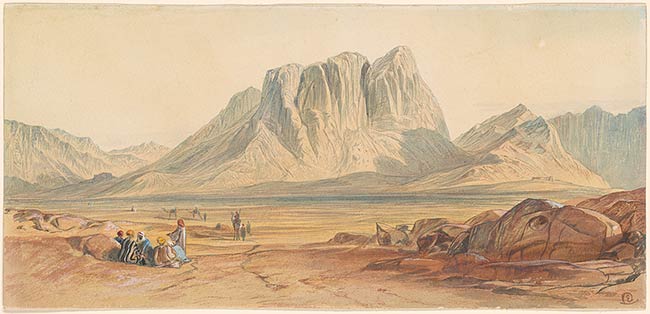
Image by Edward Lear, from www.wikigallery.org

Image by Edward Lear, from www.wikigallery.org

No Religion is an Island – Conclusion – “Revelation to Israel continues as a revelation through Israel.”

[This is a revisit; first posted  2012; part of a series  from No Religion is an Island by Abraham Joshua Heschel (AJH).  Related posts are:

Our most recent acquisition by AJH is Man is not Alone: A Philosophy of Religion.  We will feature excerpts from that book soon.  


Meanwhile, here’s the original INTRODUCTION in 2012:

Image from www.quotessays.com

Image from www.quotessays.com

Words of great men preserved for posterity continue to teach later generations even when the speakers/writers have finished their appointed time on earth.  We are grateful to Susanah Heschel for the publication of the collection of essays and speeches of her father, Abraham Joshua Heschel, whose writings in Moral Grandeur and Spiritual Audacity have greatly inspired us to expand our thinking beyond the religious boundaries we finally overstepped and moved on from.  This concludes random excerpts from the speech delivered by AJH in 1965 to a congregation of Christian theologians. It is our hope that as we continue featuring the mind of this great Jewish philosopher through his words, readers will be curious to read more and purchase personal copies of his books.  Reformatting and highlighting  and chosen illustrations added. —Admin1.]


———————————


Image from ironline.american.edu

Image from ironline.american.edu

A major factor in our religious predicament is due to self-righteousness and to the assumption that faith is found only in him who has arrived, while it is absent in him who is on the way.  Religion is often inherently guilty of the sin of pride and presumption.  To paraphrase a prophet’s words, the exultant religion dwelt secure and said in her heart:  “I am, and there is no one besides me.”


Humility and contrition seem to be absent where most required—in theology.  But humility is the beginning and end of religious thinking, the secret test of faith.  There is no truth without humility, no certainty without contrition.


Ezra the Scribe, the great renovator of Judaism, of whom the rabbis said that he was worthy of receiving the Torah had it not been already given through Moses, confessed his lack of perfect faith.  He tells us that after he had received a royal firman from King Artaxerxes granting him permission to lead a group of exiles from Babylonia: 

I proclaimed a fast there at the river Ahava, that we might afflict ourselves before our God, to seek of Him a right way for us, and for our little ones, and for all substance.  For I was ashamed to require of the king a band of soldiers and horsemen to help us against the enemy in the way: because we had spoken unto the king, saying, “The hand of God is upon all them for good that seek Him” (8:21-220).


Human faith is never final, never an arrival, but rather an endless pilgrimage, a being on the way. We have no answers to all problems.  Even some of our sacred answers are both emphatic and qualified, final and tentative; final within our own position in history, tentative because we can speak only in the tentative language of man.


Heresy is often a roundabout expression of faith, and sojourning in the wilderness is a preparation for entering the Promised Land.


Is the failure, the impotence of all religions, due exclusively to human transgression?  Or perhaps to the mystery of God’s withholding His grace, of His concealing even while revealing?  Disclosing the fulness of His glory would be an impact that would surpass the power of human endurance.


His thoughts are not our thoughts.  Whatever is revealed is abundance compared with our soul and a pittance compared with His treasures.  No word is God’s last word, no word is God’s ultimate word.


Following the revelation at Sinai, the people said to Moses:

 You speak to us, and we will hear; let not God speak to us, lest we die (Exodus 20:19).


The Torah as given to Moses, an ancient rabbi maintains, is but an unripened fruit of the heavenly tree of wisdom.  At the end of days, much that is concealed will be revealed.


The mission to the Jews is a call to the individual Jew to betray the fellowship, the dignity, the sacred history of his people.  Very few Christians seem to comprehend what is morally and spiritually involved in supporting such activities.  We are Jews as we are men.  The alternative to our existence as Jews is spiritual suicide, extinction.  It is not a change into something else.  Judaism has allies but no substitutes.”


The wonder of Israel, the marvel of Jewish existence, the survival of holiness in the history of the Jews is a continuous verification of the marvel of the Bible.  Revelation to Israel continues as a revelation through Israel.


The Protestant pastor Christian Furchtegott Gellert was asked by Frederick the Great, “Herr Professor, give me proof of the Bible, but briefly, for I have little time.”  Gellert answered, “Your Majesty, the Jews.”


Indeed, is not the existence of the Jews a witness to the God of Abraham?  Is not our loyalty to the Law of Moses a light that continues to illumine the lives of those who observe it as well as the lives of those who are aware of it.


—————————————————


None of us pretends to be God’s accountant, and His design for history and redemption remains a mystery before which we must stand in awe.  It is as arrogant to maintain that the Jews’ refusal to accept Jesus as the Messiah is due to their stubbornness or blindness as it would be presumptuous for Jews not to acknowledge the glory and holiness in the lives of countless Christians.  

The Lord is near to all who call upon Him, to all who call upon Him in truth (Psalm 145:18).


. . .  The ancient rabbis proclaimed:  

“Pious men of all nations have a share in the life to come.” . . .  

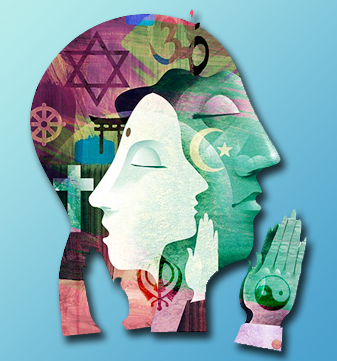
Holiness is not the monopoly of any particular religion or tradition.  Wherever a deed is done in accord with the will of God, wherever a thought of man is directed toward Him, there is the holy.


The Jews do not maintain that the way of the Torah is the only way of serving God.

 Let all the peoples walk each one in the name of its god, but we will walk in the name of the Lord our God for ever and ever (Micah 4:5).


. . . Conversion to Judaism is no prerequisite for sanctity.  In His Code Maimonides asserts:

 “Not only is the tribe of Levi (God’s portion) sanctified in the highest degree, but any man among the dwellers on earth whose heart prompts him and whose mind instructs him to dedicate himself to the services of God and to walk uprightly as God intended him to and who disencumbers himself of the load of the many pursuits which men invent for themselves. . . God asks for the heart, everything depends upon the intention of the heart . . .  all men have a share in eternal life if they attain according to their ability knowledge of the Creator and have ennobled themselves by noble qualities.  There is no doubt that he who has thus trained himself morally and intellectually to acquire faith in the Creator will certainly have a share in the life to come.  This is why our rabbis taught:  A Gentile who studies the Torah of Moses is (spiritually) equal to the High Priest at the Temple in Jerusalem.”


—————————————–


Image from www.brandeis.edu

Image from www.brandeis.edu

Christianity and Islam, far from being accidents of history or purely human phenomena, are regarded as part of God’s design for the redemption of all men.  Christianity is accorded ultimate significance by acknowledging that

“all these matters relating to Jesus of Nazareth and [Mohammed]  . . . served to clear the way for King Messiah.”

 In addition to the role of these religions in the plan of redemption, their achievements within history are explicitly affirmed.  Through them

“the messianic hope, the Torah, and the commandments have become familiar topics . . . (among the inhabitants) of the far isles and many peoples.”  

Elsewhere Maimonides acknowledges that

“the Christians believe and profess that the Torah is God’s revelation (torah min ha-shamayim) and given to Moses in the form in which it has been preserved; they have it completely written down, though they frequently interpret it differently.”


.[Rabbi Jacob Emden]  

” . . they have emerged out of Judaism and accepted “the fundamentals of our divine religion . . . to make known God among the nations . . . to proclaim that there is a Master in heaven and earth, divine providence, reward and punishment . . . Who bestows the gift of prophecy . . . and communicates through the prophets laws and statutes to live by . . . This is why their community endures . . . . Since their intention is for the sake of heaven, reward will not be withheld from them.”  

He also praises many Christian scholars who have come to the rescue of Jews and their literature.


What, then, is the purpose of interreligious cooperation?


It is neither to flatter nor to refute one another, but to help one another; to share insight and learning, to cooperate in academic ventures on the highest scholarly level and, what is even more important, to search in the wilderness for wellsprings of devotion, for treasures of stillness, for the power of love and care for man.  What is urgently needed are ways of helping one another in the terrible predicament of here and now by the courage to believe that the word of the Lord endures forever as well as here and now; to cooperate in trying to bring about a resurrection of sensitivity, a revival of conscience; to keep alive the divine sparks in our souls, to nurture openness to the spirit of the Psalms, reverence for the words of the prophets, and faithfulness to the Living God.

Oy Searchers, whatsup? – April 2018

[This post slightly changed its title, it used to be “Oy Searchers, need help?”   The reason for the change is —  search terms are few and far between. That could signify one of two trends — visitors find their way to this website without entering a search term, and that’s good . . . or perhaps visitors have become habitual returnees and therefore enter no search terms and that’s very good!  So, what to do? Turn this post into a commentary on anything  that invites biblical commentary during the current month.  Sinaites may contribute as well as readers/visitors.—Admin1.]


——————————————


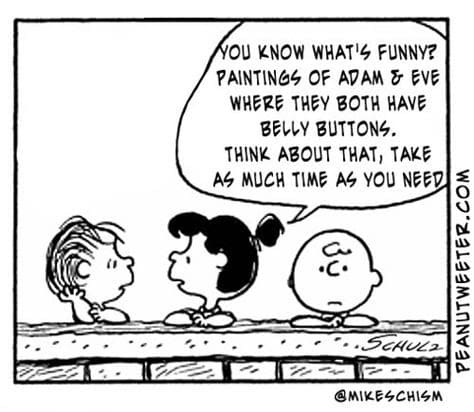
A&E w:bellybutton


04/25/18 – While googling for Snoopy  images on the web,  I came across this

‘poser’,  straight from the mouth of the crabby character named Lucy.  Her question though is typical of the wisdom and wit of the

originator/creator of PEANUTS,  the best comic strip of all time, at least in my book.  Charles M. Schultz, by the way, is based in Santa Rosa, CA  where I resided for seven years but regrettably missed visiting the Charles M. Schultz Museum there.

A CMS quote:  “If you read the strip, you would know me; everything I am goes into the strip.”

Apply that to the God of the Sinai revelation:  “If you read the TORAH, you would know Me; everything I AM (that is within the experience and understanding of humanity) went into that record.”


04/17/18 –  It’s been two weeks since we last updated this post; the reason is, our SITESTATS page where inquiries and search terms land has not been accessible.  So while we see all the visitors who do land on this website, without the SITESTATS page, we cannot check what posts are being clicked and what search terms were used for seekers to be directed here.  So until we get this fixed, this post will not have any updates.  So sorry about this glitch!


04/03/18   “Joshua scroll”

i2.wp.com/sinai6000.net/wp-content/uploads/2014/08/Inside-Left-Wall-2.jpg


04/01/18   
For starters, since it is the first of April,  we’ll indulge in some foolishness and  feature characteristics of those born in each month of the year.  Notice that such lists almost always (we have yet to see one), NEVER feature negative traits, such as — grumpy, lazy, bad tempered, greedy, backstabber, untrustworthy, etc. etc.  True or not, see how these positive virtues fit your April born family member or friend or yourself, this is by from   [


https://en.amerikanki.com/traits-people-born-april/

———————————-


the-month-april8 Amazing Traits of People Born in April

Everyone is unique and has their own traits, however there are several traits people born in April have in common. They are smart, brave, bold, creative and kind. A number of researches show that April-born people tend to be a bit more introverted than extroverted. They’re also too critical towards themselves and others and they strive for perfection in anything they do. They enjoy traveling, can’t stand unfairness and avoid fake people.

People born in April can reach any goal and accomplish any difficult task, if they know their work will be appreciated. People born in April are very stubborn and this trait often prevents them from being happy. It can be difficult to deal with these people, especially if they don’t like you, but if they trust you, then they will be your best friends forever. Nevertheless, they have many great traits and here are some of the best ones:

Most people are curious, but those born in April are extremely curious. They want to know everything, they often poke their noses into other people’s affairs and don’t give up until they find out what they need. People born in April are not afraid to show their curiosity and this trait helps them be smarter and more successful.


April-born people may hide their adventurous personality. Although they may seem to be quiet and steady, they avoid living a monotonous life. They will never do a job their hate and they will never stick to any boring routine – be it a workout or a diet.


People born in April are highly assertive. You may think they are rude, selfish and aggressive, but in reality they are kind and sensitive personalities – they just don’t show it. April-born people are great leaders who can reach any career goal.


April-born people have a huge passion for food, science, books, and they’re really passionate about what they do. Following their passions helps them find a dream job, be successful and make a lot of money, though money is not the main goal for them.


People born in April are not afraid to deal with problems and obstacles. They are not afraid to speak up – they always say what they think and it sometimes causes them many troubles. While many people stay away from dangerous situation, April-born people are always ready to cope with them no matter what.


Spending the whole day sleeping or watching TV is not for people born in April. They are active and they don’t waste their time on unnecessary things. They love to multitask and they manage to accomplish a long to-do list in a day. They only problem is that when they have a bad mood or they don’t like something, they don’t do as many tasks as they can do.


Most celebrities born in April are proud of their level of creativity. April-born people are creative since their childhood. They never feel bored and always know what to do today. While children born in November can drive you mad with their constant “I’m bored,”April-born kids are independent and they always have many hobbies and plans.


Most people who have their birthdays in April are independent. They don’t like to be dependent on their parents, husbands or grandparents. They prefer to make their own money and work hard to have anything they want or need in life.

Why Anti-Semitism?

61XHIVkINxL._AA160_[This was first posted in 2013; we are revisiting as a result of many searchers interested in  The Jewish Mystique by Ernest Van Den Haag.  Sharing Chapter 5 of this MUST READ book.  For visuals connected to this topic, check this link:  http://www.tabletmag.com/jewish-arts-and-culture/155833/postcards-anti-semitic—-Admin1]


————————–


 WHY ANTI-SEMITISM?


 Jews “cause” both anti-Semitism and pro-Semitism; without them we would have neither, since both are reactions to Jews. The Jews are the cause of anti-Semitism in the sense–no more, no less–in which marriage is the cause of divorce. No divorce without marriage. No anti-Semitism without Jews. But to end in divorce, there must be specific elements in one or both partners of the marriage, or in their relationship to each other, or to other persons, that lead to divorce. So with the relationship of Jews to their environment. The Jews are necessary to anti-Semitism–but not sufficient. Why is the relationship what it is? Why is it so often hostile?


An anti-Semite is hostile to Jews because of some characteristics which he dislikes and which he thinks Jews have exclusively, or in greater measure than non-Jews. Whether they do or do not have these traits (and whether one regards them as valuable or vile), there must be something in the Jews, or in their situation, that invites the attribution of these characteristics to them rather than to bicyclists; in addition, there must be something in the character of anti-Semites that makes it possible, or necessary, for them to associate Jews with disliked characteristics, or to dislike characteristics which Jews have because it is they who have them.


The characteristics attributed to “witches” burned in the seventeenth century, though sometimes accepted by the “witches” themselves, were the products of the fantasy of their persecutors. But there also was something in the personalities of those singled out as witches, or in their relationship to the world, which invited the attribution; just as there was something in the personalities of the witch-hunters which convinced them of the need to fear and hunt witches. The only thing we can be sure of is that the “something” was not that the women actually were “witches”. Similarly we can be sure that what arouses anti-Semitism is not what Jews actually are; it is, as it were, the negative part of their mystique.


To say that the victim had some characteristics that led to his victimization, is not to excuse, or justify, those who victimized him any more than it excuses, or justifies, a murderer to point out what characteristics of the victim caused the murderer to single him out and kill him. It means, however, that there was something about the victim–actual or, if the murderer is insane or misled, only believed–that led the murderer to select him. It may be a “good” or “bad” characteristics or a neutral one: political prominence, virginity, promiscuity, beauty, or wealth, may happen to attract the murderer, and may lead him to kill the victim.


There certainly are traits, actual or putative, that distinguish Jews. If one loves or hates a person or group, one has oneself the ability to do so, and one’s object has the ability to arouse and focus these feelings–whether because of actual or of putative qualities. What Gentiles see in seeing Jews is likely to be a compound of the Gentile mystique about Jews and of reality–the latter being shaped by both the Gentile and the Jewish mystique.


PRE-CHRISTIAN ANTI-SEMITISM


Fundamental to either view or feeling, though seldom explicit and conscious, is hostility to the Jewish belief in one God, a belief to which anti-Semites very reluctantly converted and which they never ceased to resist. Anti-Semitism is one form this resistance takes. Those who originated this burdensome religion–and yet rejected the version to which the Gentiles were converted–easily became the target of the resentment. One cannot dare to be hostile to one’s all-powerful God. But one can to those who generated Him, to whom He revealed Himself and who caused others to accept Him. The Jewish God is invisible and unrepresentable, even unmentionable, a power beyond imagination, a law beyond scrutiny. He is universal, holding power over everybody and demanding obedience and worship from all. Nonetheless, He entered history and listened to, argued with, and chose the Jews–and the Jews alone. They are His people (though He must have known that He would be in for an endless argument). No wonder they also are the target of all those who resent His domination.


The Jewish God was both universal–the only real God–and tribal: He had chosen the Jewish people and in exchange bound them to worship Him exclusively. Thus the Jews invented both monotheism and religious intolerance, or at least a passive form of it.* They had the only true religion, the only true promise; the only real God had chosen them–leaving the rest of the world to be comforted by false gods and messiahs. The Jews have suffered from their own invention ever since; but they have never given it up, for it is, after all, what makes the Jews Jewish. The Christians, when they became dominant, transformed the passive Jewish intolerance into active Christianity intolerance–of which the Jews became the first victim.


[*The Jews did not actively object to what non-Jews believed. They merely thought the beliefs wrong–to us a very tolerant view. In the context of antiquity it seemed arrogant and ill-mannered. The passivity itself rested on arrogance.]


The ancients had many gods. These gods were powerful to an unspecified degree, and loved, hated, intrigued, and fought with each other, just as mortals did. They even competed for the devotion of the people who worshiped them. People thus had a choice as to which god to appeal to on each occasion–and they attributed their victories and defeats to the relative strength and benevolence of the tutelary deities invoked. No god had a monopoly: worshippers of one god recognized the existence of others, and did what was necessary to pay their respects and to conciliate them.


Each tribe or nation was quite willing to acknowledge not only the actual existence, but also the power of the gods of other tribes or nations, though every nation usually retained a preference for the home-grown deity. The recognition was quite sincere, for the ancients found the existence of diverse tribal and specialized deities quite as natural as the existence of diverse tribes or occupations.


It was regarded both as prudent and as a matter of common courtesy to honor the gods worshiped by others. One joined in the appropriate rituals and sacrifices when meeting with aliens who worshiped alien gods. Further, the gods served as political symbols. To accept the political domination of Rome did not mean that the subject peoples had to give up their customs, language, and culture. On the contrary, these were often accepted by the Romans. It meant an exchange: the subject people would add the Roman gods to their own and recognize them, at least as honored guests in their midst.


The vast religious tolerance prevalent in antiquity went far beyond what we conceive of as tolerance today. People not only granted the right to others to keep their own religion; they were convinced that the religion of the others was no less true than their own, their gods no less real–though each people hoped that their gods were the most powerful where it counted.


The Jewish religion did not fit into this framework at all. It made the Jews misfits in the world of the ancients and probably was one cause for the ultimate destruction of their country and their dispersal by the Romans.


The Romans treated the Jews tolerantly enough; but as victors, they insisted on those of their customs which symbolized submission to Roman power. Symbols of the Roman Empire–statues of Roman gods and semi-divine emperors–had been accepted everywhere else without difficulty. But to the Jews the statues were a blasphemous abomination, because of the Mosaic commandment that enjoins against making “any likeness of anything,” and against “bowing down thyself to them or serving them.” Hence the Jews rebelled with religious zeal again and again, until their community was finally destroyed.


Later indeed the Jews destroyed the Roman framework that had made them misfits: their own religion, or much of it, was universally accepted, with the exception of the troublesome commandment against likeness (although there have been iconoclastic moments in Christian history). But the Jews managed not to fit into the new Christian framework–so largely their own creation–any better. The Jewish Messiah the Gentiles recognized was not recognized as genuine by the Jews. He was not good enough for them–a view the Gentiles rather resented.* The gods the others believed in remained false gods to the Jews. He had revealed Himself to them only and He had chosen them alone. Which left the rest of the world out in the cold.


[*The Jews, of course, merely maintained that he was not genuine.]


The religion of the Jews appeared to Gentiles absurd as well as outrageous; and ridiculous, too, if one considered that it was the religion of a small, insignificant, rustic nation, not distinguished for any major contribution to civilization. The Jewish views were certainly neither diplomatic nor endearing, and in the framework of antiquity, unreasonable, intolerant, and irrational. A tolerant and cultivated man, the emperor Julian Apostata, plaintively wrote of the Jews: “While striving to gratify their own God, they do not, at the same time, serve the others.” This, according to Julian, was “their error.” Politically, it was. And Jewish views were held with unaccustomed fanaticism. For the Jewish God did not serve His people. His people served Him–a wholly unancient conception.


Not content with holding such absurd and intolerant beliefs–which, at best, could provoke only the ridicule, and, at worst, the hostility of all other peoples–the Jews rigidly refused even to tolerate the reasonable beliefs of others. The Romans had conquered them; but the Jews had the audacity to object to any attempt of the Romans to allow their soldiers to worship in their own fashion. All this in the name of what the Jews declared to be God’s law against erecting false idols. It was as though the American Indians were to try to prohibit their conquerors from engaging in Christian worship in America. Such intolerance and apparent arrogance could not but provoke hostility. It did. Of course, in their view, the Jews merely objected to desecration of their holy sites. But try explaining that to a Roman.


Pre-Christian anti-Semitism was reinforced by a number of other Jewish traits. Their all-power God was invisible. He had forbidden the making of images not only of Himself but even of humans, let alone other gods. This prohibition helped to protect the belief in one God, for images soon come to be worshiped themselves, and different images would develop into different gods. Images of human beings could easily assume divine stature. And they could be used for magical purposes. Thus the Jewish religion differed from the others in kind; it did not compete with them, or recognize them, or have different rituals of the same genre. It was sui generis, a different kind of religion altogether, and it set its chosen people apart.


This “apartheid” was enjoined on the Jews as a moral duty, too. They were not meant to mingle with non-Jews and did not, to the extent to which they followed their religious leaders. To be sure, tribal pride and its enlargement, nationalism, as well as insistence on the superiority and preservation of one’s culture, have always been with us. But these elements were religiously elaborated and adhered to by the Jews in far greater measure than by any other people–if such things can be measured. The Greeks did not think highly of “Barbarians” either. But the Jews went further and were more exclusive.


The Romans were hospitable to other cultures, religions, and peoples: not without grumbling, but still they were about as hospitable as present-day Americans. The Jews were stiff-necked, literal minded, bothersome, and unrealistic. They refused to make the slightest concession, objecting even to Roman money because it bore the portraits of the emperors. In short, they gave no end of trouble–willfully, the Romans must have thought.


Most unpleasant, their invisible God not only insisted on being the one and only and all-powerful God–creator and lord of everything and the only rightful claimant to worship–He also developed into a moral God.


This, too, distinguished Him, and his worshipers, from the deities familiar to the pre-Christian world. These gods usually were personifications of the forces of nature, such as fertility; or of elements of the human personality, such as cunning; or of the social environment, such as war, craftsmanship, or art. Often these elements were blended, and the gods assumed magnified human personalities or natural powers; a moral element was present at times, but no more so than it is in most human beings. And one invoked the help of these gods by pleading, currying favor, and bribing them through sacrifices and through the fulfillment of their special demands.


The God of Israel, though only slowly shedding these elements, developed into something far more demanding, far harder to understand and obey. He developed from a natural into a truly supernatural spirit, and He demanded that his people follow moral rules and live a righteous life, in obedience to His law. Unlike the gods of others, who represented and accepted all parts of the human personality as they coexisted, fused, or struggled with each other, the God of the Jews came to represent a stern, dominating, and demanding paternal Superego–long before one of His chosen people invented, fathered (or at least baptized) the superego. The Jews exclusively worshiped a father God–not, as others did, a family of gods. This, too, set the Jews apart, not just because of their beliefs, but also because of the style of life that these beliefs enjoined.


The gods of the ancients were more or less helpful to, and protective of, their devotees, and were worshiped and sacrificed to for that reason. The Jews too had been chosen to receive certain promises from their God. But their choice involved incessant fidelity on the part of the Chosen, whose major preoccupation became the interpretation and fulfillment of their part of the bargain–the Law. Jewish life became God-centered, dominated by a priesthood which insisted on rituals and sacrifices, and by prophets who called on the people and their leaders to return to the spirit of Jehovah’s laws; they interpreted all misfortunes as deserved punishments for disobedience, inflicted by an angry God. Jehovah exacted His end of the bargain and was not satisfied with anything but full value.


The Jews were constantly driven by their God, as His perpetual debtors. Their whole life revolved about doing His will, performing their duties to Him, attempting to satisfy Him. But speaking through His prophets, God spoke only of His displeasure. His Chosen People were dutiful enough; they were ungrateful, faithless–in short, their God acted as an insatiable Superego. And the God of Israel punished His people accordingly with wars, floods, bondage, and famines, though saving them at the last moment, despite their sinfulness, because of the merits of one or two among them. He was infinitely merciful, this awe-inspiring father. He had to be, for in His eyes His people were infinitely guilty.


All this was hard to understand for the more easygoing ancients, and struck them as superstitious, a little ridiculous, ignorant, and unrealistic, as, indeed, it often strikes today’s easygoing sophisticates, who may regards the whole business as “neurotic.” The Jewish law seemed almost perverse in the value it placed on the invisible benefits of moral righteousness relative to the accessible pleasures of the senses. And yet, the Jews seemed uncanny. For there was no denying the moral fervor with which they stuck to their supernatural beliefs in the midst of a world concerned with quite different things. (In a similar way, the Roman Catholic Church, which certainly understands the power of more ascendency, has gained much from the almost eerie respect  the ordinary man pays to the priest whose choice it is, on religious grounds alone, to live in celibacy.)


CHRISTIAN ANTI-SEMITISM


Pre-Christian anti-Semitism is explained largely by the Jews’ contempt for Gentile gods and values, and by their continued insistence that they had a monopoly on the true God, and had been chosen by means of a special covenant. It is all right to love one’s own God. It is certainly dangerous, however, to assert that the gods worshiped by others are false, and that their worshipers are being fooled–and to insist further that, unlike oneself, these worshipers of other gods were not chosen by the only true God, as evidenced by the unalterable fact of being born into the wrong group. Too bad for them.


When expressed by a small and powerless people, such as the Jews, such ideas cannot but lead to hostility and ridicule. When held by a dominant one, such ideas can lead to, or be used for, all the evils of racism. Which is what happened. The anti-Gentilism of the Jews was as real as–and preceded–the anti-Semitism of the Gentiles. But the Gentiles were materially stronger. The Jews were hoist by their own petard in more senses than one.


Christianity added elements to anti-Semitism which have their roots in the historical relationship between the Christian and the Jewish religions. Yet the Christian anti-Semites were no more conscious of the nature of these elements than the Jews. As was pre-Christian anti-Semitism, so Christian hostility to the Jews was overdetermined: in addition to the historical-religious, many other elements contributed to it; each of these, economic, religious, political, or psychological, might itself be a sufficient cause of anti-Semitism.


Christianity accused the Jews of having slain God. (As late as Vatican II, this accusation was seriously discussed, and cardinals of the Roman Catholic Church were on both sides of the question.) Deicide was attributed to the Jews because one of them, who proclaimed himself the Messiah and later was deified by His followers, was crucified in Jerusalem. The execution was carried out in the Roman manner (crucifixion was not a Jewish manner of execution) by the Roman troops occupying Jerusalem, probably because Jesus, as did other religious leaders of the time, appeared to the Romans as a dangerous subversive who might stir up the people against the Romans.


The Gospel tales–written long after the events–which have the arrest made and the death sentence pronounced at the behest of the Jewish Sanhedrin are scarcely plausible from a legal or historical viewpoint. The writers of the Gospels knew that Christianity was not making much headway among the Jews, whereas the number of Gentile converts, particularly Roman converts, was steadily mounting. It would have been undiplomatic, therefore, to saddle the Romans with deicide–while to accuse the Jews of hating the new God who came from their midst was to make that God more acceptable to the Romans. We don’t know whether such considerations actually entered the minds of the Gospel writers. But these considerations would plausibly explain why the Jews, and not the Romans, were accused of what certainly must have been a Roman action– the condemnation and execution of Jesus.


It is quite likely, however, that the Jewish authorities did not greatly oppose the anti-subversive measures of the Romans. They, no less than the Romans, were opposed to whatever might stir up the people and lead them to attempt armed rebellion. For they saw–and history proved them right–that such a rebellion was quite hopeless. The prophets who arose from the people had little grasp of the distribution of power and relied, more than did the priestly hierarchy which dominated the Sanhedrin, on supposed divine revelation–which had led to disastrous adventures in the past. The many sects, the many enthusiasts, the many would-be prophets, the many fanatics and anti-Romans kept the established authorities, both Jewish and Roman, quite busy. If the Roman authorities wanted to avoid trouble, so did the Jewish authorities, for they feared the defeat which would–and in the end did–cost them the remnants of their independence. So much for the history of the matter, which is perhaps less important than the psychological genesis of anti-Semitism.


The Jews were accused of having killed God. Actually, the hostility to them may be based as much on having given birth to Him. For the Messiah, too, was a demanding and moral god who exacted sacrifices undreamed of before Christianity. Those making these sacrifices may well have turned into unconscious resentment not against the Savior–clearly an impossibility–but against His progenitors and relatives. After all, these relatives had mistreated the Savior, and murdered Him–which rationalizes any amount of hostility.


Further, the Jews remained faithful to their old God and repudiated His son. By this faithfulness, they show that they regard themselves still as chosen–and that the Christians worship a false god, a phony Messiah. Theirs remained a Father religion. Christianity became a Son religion. By their rejection of the Son, the Jews identified themselves with the Father, thus calling upon themselves all the resentment–all the ambivalence, at least–that comes with being identified with the Father.


But there is more. According to Freud, the Jews probably murdered not the Son, but God the Father–symbolized by Moses, the man who led them out of Egypt and out of the wilderness and gave them their Law. The grave of the father of Judaism was never found. According to Freud’s speculation, the Jews in one of their many rebellions against his leadership actually murdered Moses. They never overcame their guilt feelings and became zealous and obedient sons to the father they had slain.


Even if Freud’s speculation is no more than Freud’s own fantasy, it seems a fantasy that meets, articulates, and explains, if not the facts, the conscious and unconscious fantasies of mankind and certainly of the Jews. The idea of parricide, and of expiation by the guilt-ridden sons through sacrifice of one of their own, was widespread among Oriental peoples, and quite popularly accepted among the Romans at the time the Gospels were created.


The Christians, through acknowledging the hereditary sin against God the Father, were purified of it and made, they thought, reacceptable to Him by their identification with the sacrifice of the Son. Jesus voluntarily allowed Himself to be slain. He was sent by His Father to redeem the world. The people who actually killed Him, according to the Gospels, however, did not accept their Oedipal guilt, and, above all, the expiatory sacrifice of Jesus. Thus they were not redeemed. They continued to refuse purification, and thus to bear their sin, and, by their insistence that Jesus was a false Messiah, to add to it.


This insistence on the invalidity of Christ’s redemptory sacrifice–for the sake of which the Jews suffered so much–could not but throw some doubt on the certainty of salvation. There were some–the Jews–that denied that Jesus had saved anyone; they were willing themselves to die for the sake of this denial. Thus in Christian eyes the Jews became representatives of the offended, vengeful, and, according to them, unappeased Father.


In sort, the Jews repeated – however involuntarily and unwittingly – in the Christian world the arrogance which had caused the ancient world to hate them. They told the Christians that they had fallen for phony Messiah, just as they had told the ancients that they worshiped false gods.* They, the Jews, alone were in possession of the true religion. What chutzpah.


[*Perhaps “signified”–by  their very existence and beliefs–is a better word than “told”: the Jews did not proselytize, but their beliefs could not be ignored either.]


But the Christians understandably were far more irked than the ancients. To the ancients, the Jewish religion was arrogant, foolish, and alien. To the Christians, it cast doubts on their most cherished beliefs. For many centuries Christians regarded the promise of life everlasting–paradise–as the most important thing on earth. Yet doubt was thrown on their belief in their salvation out of the same tradition from which the belief itself sprung, by the very people among whom the Messiah had arisen. An uncomfortable situation. It is not astonishing that the Jews were treated as one is always tempted to treat those who arouse doubts about one’s own most cherished beliefs.


Things would have been different if one of them, Paul, had not decided that the Messiah rejected by the Jews could be accepted by the Gentiles, provided they would not first have to become Jews and be circumcised. The story of salvation could be universalized. Paul proceeded to do this quite successfully.


Thus Gentiles accepted what the Jews had rejected and, in turn, rejected the people that did not want to give up being chosen. The Jews were burdened thenceforth not only with the sin which is the heritage of mankind, but also with their refusal to accept redemption, with slaying Him who wanted to redeem mankind, and finally with casting unrepentant doubt on the genuineness of the salvation vouch-safed the Gentiles.


The Christians now felt they could do to the representatives of the Father, in the name of the Son, what Christians would normally be punished for–were it not that the Son had removed the credentials of these representatives, the unredeemed Jews, and thus allowed them to be punished. To the Jews were attributed, unconsciously and sometimes consciously, all the things the sons fear: the father will castrate and kill them. And vengeance was taken on the Jews for these dreaded paternal intentions and fantasied deeds.


The Jews obdurately denied their share of guilt and their need for salvation and insisted that they had a special arrangement with God, the Father, which would save them and (the Christians thought) nobody else. If the Jews were right to extent, the many renunciations that Christianity had imposed on its Gentile converts were in vain. The pleasures of this world would have been renounced for the sake of a paradise which was, after all, reserved for Jews.


No wonder the very existence of the Jews became a thorn in the side of Christianity. A useful thorn, as it were. For the Jews, by attracting hostility to themselves, solidified the identification of Christians with each other. Nothing does as much for internal solidarity as the existence of an external enemy. To the enemy, the group can attribute whatever it fears or detests in itself. Against him it can unite. Against him it can discharge hostility. As the chastity of nineteenth-century women required prostitutes, so the purity of Christian faith required Jews.


THE JEWISH CONSPIRACY: AN ANTI – SEMITIC FANTASY


In the primitive way in which they conceive it, the community of attitudes and characteristics among Jews was a myth invented by the Nazis for their own convenience. Radical parties, right or left, always simplify experience, however illegitimately, so as to manipulate a series of stereotypes in the end. It is their way of making life intelligible–and of proving that they could change it for the better and, therefore, ought to be on top.


Above all, Nazis, contrary to logic and fact, believed that the common attributes of the Jews (some real and some imagined for convenience) would lead to concerted actions and common purposes, to a conspiracy aimed at dominating and exploiting Gentiles. This “theory” was occasionally supported by faked documents–e.g., the “Protocols of the Elders of Zion.”


Support for this sort of idea is produced by the general human inclination to attribute whatever is unpleasant or undesired to malevolent demons. With increasing secularization, the demons have been replaced by malevolent human groups–e.g., Jews, or capitalists. Witches form the bridge between these two versions. Thus the Germans, according to Hitler, did not lose World War I because they had been defeated by their enemies–an unacceptable blow to their superiority feelings–but because they were stabbed in the back by the Jews. And again, the Great Depression of the 1930’s was caused by Wall Street Jews somehow acting in concert with Communists, who were also, it seems, Jews. And so on.


The Nazis were not very original in these fantasies. One model of the technique had been furnished – in secular form – by Karl Marx, a Jew. Of course, the Nazis are right: Jews are on all sides. The Nazis were wrong only in believing that they act in common: Germans, too, may be on all sides and so may women.


Marx attributed all the evils of the world to the capitalistic system; his less sophisticated followers (at times including Marx himself) went on to attribute the evils of the world directly to the malevolence of capitalists. They humanized the theory, as Madison Avenue would say. Hitler blamed “the system,” and “the Jews” who were supposed to be dominating it, for every wrong. Marx before him had blamed the capitalist system and “the capitalists” who were supposed to be dominating it. The “logical” structure is the same.


The socialist leader August Bebel – a German who died long before Hitler became known – was more accurate than he realized when he said: “Anti-Semitism is the socialism of the lower middle class.” Psychologically it is indeed the equivalent of socialism, and takes its place for those to whom socialism is, or, as a result of its failures, becomes, unacceptable. (All utopian systems, and all systems supported by utopian enthusiasts, “fail”: nothing ever lives up to our fantasy.) The symbols are different by the psychological essence of either ideology is the same: the evils of the world are presumed to be caused by a wrong system maintained by a small group who benefit from it and deliberately use the system to exploit the great majority. That majority – the people – are actually superior to the exploiters, either by virtue of their “race” and historical mission (Hitler) or by virtue of their “proletarian” descent, economic position, and historical mission (Marx).* The superior majority has the historical mission of eliminating the historically or racially corrupt minority, after which the millennium begins.


[*Marx was considerably more sophisticated than Hitler and, above all, unlike Hitler, he was part of the rationalistic humanitarian tradition even though he repudiated it as sentimental in favor of science. Wherefore he appeals more to intellectuals. But his popular appeal has the same source as Hitler’s: secularized Manichaean eschatology.]


The origins of this conspiracy theory are found in primitive anthropomorphism. A traffic accident, or for that matter, a war, an economic depression, low farm prices, or the obsolescence of a given industry–all these things happen without being necessarily willed by anyone; yet they may injure or damage almost everyone, although in different degrees. As everyone pursues his course, the collision happens. As every farmer produces, prices fall, given certain circumstances. As each nation tries to achieve goals regarded as necessary by its government, it may collide with another nation pursuing its goals. An industry becomes obsolete because of technological developments not necessarily aimed at making it obsolete.


However, all of us find it hard to accept that anything really occurs without anyone willing it. Human beings usually have, or think they have, a purpose in their actions. They tend, therefore, to ascribe purposes to the world at large and to nature – and even more to actions undertaken or set in motion by fellow humans, such as wars or traffic collisions. It is hard for us to see that these may be simply the unintended result of deliberate acts. When these results are particularly unpleasant, they are ascribed to malevolent spirits and–with the secularization of our imagination – to malevolent people. Jews, for the reasons given, were easily the most likely malefactors.


Long after Marx, and not so long after Hitler, new versions of this ever-popular story, which in the childhood of the human race started with myths of demons and their human servants, abound. What else is C. Wright Mills’ fascinating fable of the “power elite”?* In each of these versions, the believer has discovered that there are men more powerful than others, and that they often have more prestige and income than others, too. He then discovers that men outstanding in one activity are or become important in others, too: generals become corporate directors, directors of one corporation become directors of another, a man powerful in California may be influential in Washington and New York. The believer then concludes that these people, who have in common the fact that they are powerful, have little to divide them from each other, and that they share an overriding aim: to act in concert to their advantage and to the detriment of the less powerful. And that explains whatever happens that is unpleasant. “They” done it, whatever it is: started the war, or lost it… caused the depression, or the inflation… brought about the imperialistic expansion, or the cowardly retrenchment.


[*Mills updated the matter: since the nation is more prosperous, it is harder for most people to believe that economic circumstances determine everything; they have found otherwise. Hence the “power elite” is not, in the main, an economic class. It is a status group.]


Just as Hitler and C. Wright Mills did, I too have come to the conclusion that we are dominated and exploited by a “power elite.” Only, unlike my fellow scholars, I don’t identify the members as either rich or Jewish. Upon extensive research, I found that we are dominated by men wearing glasses; they succeed in getting each other into corporate directorships, become generals, music critics, stockbrokers, senators, Supreme Court justices, and cabinet members. They conspire against anyone not shortsighted. I can prove that easily. (For statistical tables about eyeglasses worn by men in leading positions, which clearly demonstrate my theory, see Appendix.)


Until Hitler nearly killed them all, the Jews were excellent targets for this sort of thing. To Gentiles, they were strange and uncanny: in, but not really accepted as part of, the society in which they lived. They were active, often reached outstanding positions, yet were different and therefore did not quite belong. And they certainly had something in common that could not be denied and that differentiated them: they were Jews. It is as though they were some kind of family mysterious to nonmembers, some kind of network with an eerie communications system, omnipresent, powerful, sinister, and yet almost anonymous at the center of the body politic. Were they not on all sides? Did they not therefore cause everything? It is the “therefore,” of course, that constituents the fallacy: men with glasses are prominent on all sides but do not “therefore” act in common to cause everything. Even if people have things in common, it does not follow that they will act in common, let alone conspire. But it’s too nice a theory just to drop.


Among many widely recognized and ambivalently admired characteristics of the Jews are a desire for education, a low rate of alcoholism, an almost invisible rate of what we not call juvenile delinquency (“radical” activity is the Jewish form of defying authority). These characteristics do not make the anti-Semites like Jews – on the contrary. After all, such traits can be explained: the desire for education is part of Jewish pushiness and of the plan for world domination; if you are engaged in a serious conspiracy, you can’t afford to get drunk–in vino veritas: people who have so much to hide won’t dare to get drunk; and there is no need for juvenile delinquency if you, together with your parents, are conspiring to do in the rest of the world.


The interesting thing is that all of these paranoid fantasies are also negative versions of half-truths: Jews are ambitious; they have messianic dreams; and their abstemiousness may have something to do with fear of baring guilty secrets to a hostile world. These semiconscious Jewish feelings are perceived by anti-Semites and projected as realities. Thus, anti-Semitism on the psychological level is the product of a cooperative effort involving Jews and their enemies; on a rational level it is nonsense, a pseudo explanation of history which, particularly in time of distress, helps people shift the blame from themselves.


This nonsense was accepted by enough people to make possible the horrors of concentration camps and the murder of six million Jews. It is hard to believe in God; it is harder still to believe in human rationality.

No Religion is an Island – 2 – “To equate religion and God is idolatry” – AJHeschel

[First posted in  2015 on the occasion of the visit of ‘Rockstar’ Pope Francis to the Philippines.  Here is the original introduction:

During the visit of Pope Francis to the Philippines, a ‘sea of humanity’ —as media practitioners term the nonstop-overwhelming-welcome and send-off—was phenomenal.  Those of us on the sidelines (the non-Catholic flock) watched the TV coverage that was ‘in your face’, like it or not.  In fact, Philippine media on ‘hangover’ had already started speculating about a return visit.  Nothing wrong in watching a pope that—thankfully and long-overdue—expresses views that run counter to traditional thinking with regards the Church’s stand on controversial ‘No-No’ issues such as divorce, homosexuality, birth control.


It is one thing to obey church dogma and another to obey YHWH’s Torah. ‘Oh, but aren’t they one and the same?’ you might think?  Think again. This Pope also continued to open  the way for dialogue between differing faiths while on this visit, by inviting the heads of other world religions. (Note:  Photo below is not from this visit.)


Here’s an old MUST READ first posted September 22, 2012; a sequel to No Religion is an Island – Abraham Joshua Heschel.  And to save you time and trouble looking for the Conclusion, here’s the post:  No Religion is an Island – Conclusion – “Revelation to Israel continues as a revelation through Israel.”


To give credit where credit is due:   “Continuing excerpts from the speech of Abraham Joshua Heschel delivered in 1965 to a congregation of Christian theologians, please refer to first article; this was included in the collection of essays published and edited by his daughter Susanah Heschel, a MUST OWN treasure of a book for people of faith. This lecture is included in the section of essays categorized under the same title. Reformatting and highlights ours.”—Admin1]


Image from www.mb.com.ph

Image from www.mb.com.ph

The first and most important prerequisite of interfaith is faith.


It is only out of the depth of involvement in the unending drama that began with Abraham that we can help one another toward an understanding of our situation.  Interfaith must come out of depth, not out of a void absence of faith.  It is not an enterprise for those who are half learned or spiritually immature.  If it is to lead to the confusion of the many, it must remain a prerogative of the few. . . .


Both communication and separation are necessary.  We must preserve our individuality as well as foster care for one another, reverence, understanding, cooperation.  In the world of economics, science, and technology, cooperation exists and continues to grow.  Even political states though different in culture and competing with one another, maintain diplomatic relations and strive for coexistence.  Only religions are not on speaking terms.  Over a hundred countries are willing to be part of the United Nations; yet no religion is ready to be part of a movement for United Religions.  Or should I say, not yet ready?


 Ignorance, distrust, and disdain often characterize their relations to one another.  Is disdain for the opposition indigenous to the religious position?  Granted that Judaism and Christianity are committed in contradictory claims, is it impossible to carry on a controversy without acrimony, criticism without loss of respect,  disagreement without disrespect?  The problem to be faced is how to combine loyalty to one’s own tradition with reverence for different traditions.  How is mutual esteem between Christian and Jew possible?


A Christian ought to ponder seriously the tremendous implications of a process begun in early Christian history.  I mean the conscious or unconscious de-Judaization of Christianity, affecting the Church’s way of thinking, its inner life as well as its relationship to the past and present reality of Israel—the father and mother of the very being of Christianity.  


The children did not arise to call the mother blessed; instead they called the mother blind.  


Some theologians continue to act as if they did not know the meaning of “Honor your father and mother”; others, anxious to prove the superiority of the Church, speak as if they suffered from a spiritual Oedipus complex.


A Christian ought to realize that a world without Israel would be a world without the God of Israel.  A Jew, on the other hand, ought to acknowledge the eminent role and part of Christianity in God’s design for the redemption of all men. . . . Opposition to Christianity must be challenged by the question:


What religious alternative do we envisage for the Christian world?  

Did we not refrain for almost two thousand years from preaching Judaism to the nations?


A Jew ought to ponder seriously the responsibility involved in Jewish history for having been the mother of two world religions.  Does not the failure of children reflect upon their mother?  Do not the sharp deviations from Jewish tradition on the part of the early Christians who were Jews indicate some failure of communication within the spiritual climate of first-century Palestine?


Judaism is the mother of the Christian faith.  


It has a stake in the destiny of Christianity.  Should a mother ignore her child, even a wayward, rebellious one?  On the other hand, the Church should acknowledge that we Jews, in loyalty to our tradition, have a stake in its faith, recognize our vocation to preserve and to teach the legacy of the Hebrew Scripture, accept our aid in fighting anti-Marcionite trends as an act of love.


Is it not our duty to help one another in trying to overcome hardness of heart, in cultivating a sense of wonder and mystery, in unlocking doors to holiness in time, in opening minds to the challenge of the Hebrew Bible, in seeking to respond to the voice of the prophets?


No honest religious person can fail to admire the outpouring of the love of man and the love of God, the marvels of worship, the magnificence of spiritual insight, the piety, charity, and sanctity in the lives of countless men and women, manifested in the history of Christianity.  Have not Pascal, Kierkegaard, Immanuel Kant, and Reinhold Niebuhr been a source of inspiration to many Jews?


Over and above mutual respect we must acknowledge indebtedness to one another.  It is our duty to remember that—-

—it was the Church that brought the knowledge of the God of Abraham to the Gentiles.  

—-It was the Church that made Hebrew Scripture available to mankind.


 This we Jews must acknowledge with a grateful heart.


The Septuagint, the works of Philo, Josephus, as well as the Apocrypha and Pseudepigrapha, and the Fons vitae by Ibn Gabirol would have been lost had they not been preserved in monasteries.  Credit for major achievements in modern scholarship in the field of Bible, in biblical as well as Hellenistic Jewish history, goes primarily to Protestant scholars.


Image from barclaylittlewood.com

Image from barclaylittlewood.com

The purpose of religious communication among human beings of different commitments is mutual enrichment and enhancement of respect and appreciation rather than the hope that the person spoken to will prove to be wrong in what he regards as sacred.


Dialogue must not degenerate into a dispute, into an effort on the part of each to get the upper hand.  There is an unfortunate history of Christian-Jewish disputations, motivated by the desire to prove how blind the Jews are and carried on in a spirit of opposition, which eventually degenerated into enmity.  Thus any conversation between Christian and Jew in which abandonment of the other partner’s faith is a silent hope must be regarded as offensive to one’s religious and human dignity.


Let there be an end to disputation and polemic, an end to disparagement.  We honestly and profoundly disagree in matters of creed and dogma.  Indeed, there is a deep chasm between Christians and Jews concerning, e.g., the divinity and messiahship of Jesus.  But across the chasm we can extend our hands to one another.


Religion is a means, not an end.  


It becomes idolatrous when regarded as an end in itself.  Over and above all being stands the Creator and Lord of history, He who transcends all.  


To equate religion and God is idolatry.


Does not the all-inclusiveness of God contradict the exclusiveness of any particular religion? The prospect of all men embracing one form of religion remains an eschatological hope.  What about here and now?  Is it not blasphemous to say:  I alone have all the truth and the grace, and all those who differ live in darkness and are abandoned by the grace of God?


Is it really our desire to build a monolithic society: one party, one view, one leader, and no opposition?  Is religious uniformity desirable or even possible?  Has it really proved to be a blessing for a country when all its citizens belonged to one denomination?  Or has any denomination attained a spiritual climax when it had the adherence of the entire population?


Does not the task of preparing the Kingdom of God require a diversity of talents, a variety of rituals, soul-searching as well as opposition?


Perhaps it is the will of God that in this eon there should be diversity in our forms of devotion and commitment to Him.  In this eon diversity of religions is the will of God.


In the story of the building of the Tower of Babel we read:

 The Lord said:  they are one people, and they have all one language, and this is what they begin to do? (Genesis 11:6).  

These words are interpreted by an ancient rabbi to mean:  What has caused them to rebel against me?  The fact that they are one people and they have all one language . . . 


For from the rising of the sun to its setting y name is great among the nations, and in every place incense is offered to my name, and a pure offering, for my name is great among the nations, says the Lord of hosts(Malachi 1:11).


This statement refers undoubtedly to the contemporaries of the prophet.  But who are these worshippers of one God?  At the time of Malachi there was hardly a large number of proselytes.  Yet the statement declares:

 All those who worship their gods do not know it,

but they are really worshipping me.


It seems that the prophet proclaims that all men all over the world, though they confess different conceptions of God, are really worshipping one God, the father of all men, though they may not be aware of it.


Religions, I repeat, true to their own convictions, disagree profoundly and are in opposition to one another on matters of doctrine.  However, if we accept the prophet’s thesis that they all worship one God, even without knowing it, if we accept the principle that the majesty of God transcends the dignity of religion, should we not regard a divergent religion as His Majesty’s loyal opposition?  However, does not every religion maintain the claim to be true, and is not truth exclusive?


The ultimate truth is not capable of being fully and adequately expressed in concepts and words.  The ultimate truth is about the situation that pertains between God and man.


 “The Torah speaks in the language of man.”


Revelation is always an accommodation to the capacity of man.  No two minds are alike, just as no two faces are alike.  The voice of God reaches the spirit of man in a variety of ways, in a multiplicity of languages.  One truth comes to expression in many ways of understanding.


[Continued in Part 3:  No Religion is an Island – Conclusion – “Revelation to Israel continues as a revelation through Israel.”]

Q&A: “Israel means, ‘he will rule as god’ and so the question is . . .”

[First posted in 2014. There is much misunderstanding of the significance of “chosenness” particularly in terms of Divine selection/election of a particular people.  We have a book that well explains that, please check out the following posts:  


Admin1]


——————————-


One of the longest ‘search terms’ landed on our website on 1/12/14.  Automatically, it was added to the daily updated post intended as aid for searchers:  Yo Searchers! Can we help you? – January 2014.  Since it was in the form of a question which had loaded implications coming from a mindset that was obviously Christian-oriented, I wrote a short reply instead of directing the searcher to a whole bunch of articles we had already written.  However, upon rereading I realized I had not REALLY addressed all aspects of the question,  so this is a follow-up.


The Q has been reformatted according to points that need to be elaborated on:


Q:   Israel means, 

“he will rule as god.”

*and so the question is, 

who will rule as god?


A:  [searcher answers his own question with presumptions]:

  1.  people who have repeatedly,  throughout history,  abandoned their covenant with god
  2.   people who may have been born under a certain genetic lineage?
  3. people who futilely put their hope in perfect obedience to an impossible set of laws? 

——————-


Let’s start with point # 2 first, that’s the easiest:

—people who may have been born

under a certain genetic lineage?

Genetic lineage —

referring to the people

who issued from 3 generational line of patriarchs:

Abraham,

Isaac (not Yishmael),

Yaakov (not Esau);

the 12 sons of Yakov AKA Yisrael,

the 12 tribes — Yisrael.


The name “Yisrael” was given only to the 3rd patriarch, Yaakov in Bereshiyth/Genesis 31. Please do your homework and read that chapter and previous ones, to understand the reason for renaming “Yaakov” (heel, supplanter) at this crucial point in his life.  Not all biblical figures were renamed; only ones who underwent a change in character or awakening or assignment as well as other reasons.


Most translators claim ‘Yisrael’ means ‘he wrestles with God’;  jewfaq.com says it means “the one who wrestled with G-d” or “the champion of G-d.”

Later in the Hebrew scriptures, certain names interchange in referring to the chosen people—sometimes it is “Yaakov”, sometimes “Yisrael”.   The point? It is about the people who descended from this renamed patriarch, Yaakov/Yisrael.


Does the meaning of the name carry over to them? This is the difficulty the searcher was facing:  how could these people be so called when they have shown no reason to deserve the name?


Well, since the searcher’s definition of ‘Israel’ is  “he will rule as god”,  it is understandable why he had difficulty swallowing what he considered as ‘predestination’ of the people of Israel.  But since the real definition according to Jewish sources is “he wrestles with God”,  then that is not too difficult to swallow.


In fact,  the name could indeed be prophetic and yes,  the ‘chosen people’ do wrestle with what is expected of them because of the meaning of the name they inherited from the renaming of Yaakov, their progenitor.


On the other hand, just as Mr. ‘Ugly’ bore children who carry his name ‘Ugly’,  that’s just an identifying name;  the children may be anything but ugly! However, when you truly follow the destiny of the chosen people who inherited the name of Yaakov AKA Yisrael,  there does appear to be a connection with their history and modern-day ‘reborn Israel’,  a remnant who made aliyah back in a remnant of the LAND granted them by the United Nations but originally promised to them by their God.


Students of biblical prophecy closely watch how the modern state of Israel is somehow always dragged into world affairs whether or not they are even involved.  Ultimately what they struggle with is the world’s expectations of them, a world that is skeptical of the claims of the Hebrew Scriptures for them; not to forget a major world religion has discredited them, their covenant, their God, and their Torah.


As for presumption no. 1:


–people who have repeatedly,

 throughout history, 

abandoned their covenant with god?


If being disobedient to the God who made a covenant with Israel on Sinai is tantamount to abandoning their covenant with God, no, we don’t agree.


  • Yes the Israelites had difficulty obeying the Torah of YHWH. (Don’t some of us have the same difficulty with some commandments today?)
  • The first generation who died in the wilderness were judged for that very reason (except for Joshua and Caleb);
  • the 2nd generation who were born free, in the wilderness—-did enter, conquered the land and divided it according to divine instructions.


While they  endeavored to obey the Torah of YHWH, as the books of Kings and Chronicles attest—


  • there was failure of king after king to legislate and enforce the Torah as Israel’s way of life,
  • and generation after generation of Israelites likewise failed to be faithful to their God and their Covenant with Him.


One might indeed conclude that Israel virtually abandoned their covenant with YHWH.  Since the covenant on Sinai was ‘conditional’ —IF you do this, the result is this, if not the result is that.


Actually it was as simple as —-

  • obey and receive blessing,
  • OR disobey and do not receive blessing;


In fact the withholding of blessing might even result in ‘curses’ since the English text spells it out specifically as that.


Later texts add meaning to ‘obedience’ by implying it redounds to this:  ‘choose life’.  There is a right way, and that is the Torah Way.


Choose the opposite, as in disobey, then there is danger and darkness and automatic consequences connected with disobedience.  ‘Curse’ is a pretty strong if not frightful word for the consequence of disobedience.


Now, failure to obey is not tantamount to abandoning a master or lord or father; is it?   It simply means the subject (the child or an Israelite or any one of us) has difficulty aligning his moment-by-moment choices that eventually become a pattern that ultimately define his life, for whatever reason causes his failure.  We know many people who have the best intentions and constantly resolve to change or do better; in fact this happens year after year with ‘new year resolutions’.  From the simplest to the most difficult resolutions, people fail . . . not because they wish to abandon the higher power but simply because they give in to moments of  weakness, and make wrong choices willfully or unintentionally, and sometimes leave circumstances to chance.


When Israel failed individually or corporately, they simply failed; but that should not be read as ‘abandoning the covenant’.


As for God, did He abandon that covenant inspite of His chosen people’s failure to keep it?  Absolutely not!   In fact, He renews it by the time of Jeremiah, with the same chosen people, about the same Torah to be internalized in hearts and not simply etched on external surfaces as reminder.  The Divine Hand has always been extended toward Israel which says much about the God of Israel:   He is faithful to His covenant even if the other party was not always faithful.


Admittedly Israel’s record of shame is a blight on their record as the chosen people and yet, you have to admire them nevertheless for recording their failures for all the world to read in no less than their history and sacred scriptures.


Now nobody would have known about it had their Scriptures remained in purely Jewish hands; who else would be interested anyway, and what business is it of anyone else who does not even believe in Israel’s God nor swallow the claim that Israel is the chosen people of this God Who figures prominently only in the Hebrew Scriptures?


Well, that national failure became known worldwide when the Hebrew Scriptures  (TNK) was later appended to the Christian New Testament as a prequel and re-titled “Old Testament” and re-taught as obsolete and passe, yet the Jews were still blinded in observing them.


As for presumption 3,


people who futilely

put their hope in perfect obedience

to an impossible set of laws”


Why  “futilely”?   This derives from a common misconception, identifiably Christian, that it is futile to try to obey the set of laws given by the God on Sinai to the mixed multitude, representative humanity.  Why does Christianity think it is ‘futile’ or useless to hope?


For one, because they think humans are simply not programmed to be able to obey the Torah because humanity is under the curse of ‘original sin’ which places every person born in ‘damnation’ and ‘destined for hell’ and ‘automatically cut off from God’.


For another, there is a misconception that the Old Testament God who is ‘angry and vindictive and full of vengeance’ conceived laws that are impossible for man to obey.   Why impossible? Because according to Christian belief, man is hopeless and helpless in his inborn state of inherited original sin,  and therefore unless one embraces the Christian Savior and appropriate for himself Jesus’ saving work on the cross then one does not receive ‘salvation’ and its accompanying ‘bonus’ the Holy Spirit, 3rd person of the Godhead.  What is the supposed work of the Holy Spirit?   He enables and empowers the believer to rise from his fallenness, helplessness, and inability to obey any of God’s commandments.  That Old Testament God supposedly demands perfect obedience which no person can accomplish on his own.


While it is true that absolute obedience is a must, if you get to know the ‘OT God’ who gave His Torah on Sinai, and look at the record of Avram, Yitzchak, Yaakov, Mosheh — you will quickly discover that those Patriarchs did not always demonstrate perfect obedience. Yet, were they damned to hell by their God?  No.  Did they obey as best as they possibly could?  Not always.


The God revealed in the Hebrew Scriptures is exactly as He self-describes and self-reveals His name, nature, attributes, actions, conditions as well as unconditional declarations!


Such as —

    • One, the First and the Last, there is no Other;
    • Merciful
    • and just,
    • righteous
    • a covenant-making God Who is faithful to His covenant;
    • Who declares what He will do if He makes unconditional promises, and what He requires as conditions before He bestows blessing and fulfillment.


Let us not forget the attribute of this God that is a blessing to sinful man —He is MERCIFUL, and forgives the TRULY REPENTANT; review Ezekiel 18.


As for the  “impossible set of laws” commanded by the God of Sinai,   think about it:  what is so impossible with the Torah laws, ordinances, statutes, etc.?   Would the God in the Hebrew Bible really be so ‘unrealistic’ and ‘inconsiderate’ and ‘mean’ so as to impose  an “Impossible set of laws” upon His chosen people?   And for what purpose? To show that they are puppets in the hands of a manipulative deity, made fools of after being told how He loves them as His firstborn and suffering servant, only to be replaced by a future NT firstborn son and suffering servant?    Awwww come on, let’s be fair!   Give the God of Israel, the God in the TNK more credit than that!  This is small-mindedness, showing ignorance or little understanding of the Self-Revealing God on Sinai!  This comes from replacement theology and supersessionist doctrine, typical of Christian teaching.   And where does that come from?


This human judgment of the God of Israel is a result of the teaching of Paul in the books attributed to him in the ‘New Testament’, particularly the Book of Romans. It also results from the NT Book of “Hebrews” (author anonymous) which promotes the same thinking; there is more to this than we can write here, please refer to all other posts that have already explained these in detail and at length.


Sig-4_16colors

AIbEiAIAAABDCNPkvrXuucmdeSILdmNhcmRfcGhvdG8qKGJkZTc0YTk3NmUxMGM4OTAzZjk5MDhkMjdkZDI2ODQ3OTliYmQ2MDkwAe5UdNp0lvYvCf8bjAFEJOY_fdsj

The Creator 5- How is Man in God’s “Image” or “Likeness?


Image from www.agodman.com

Image from www.agodman.com

[This was first posted in 2012 and time for a repost  as  part of  our “looking back” series during this season of introspection in preparation for the biblical feast of Shavuot, the giving of the Torah on Sinai.


What does it mean for humankind to be made in God’s “image” or “likeness” —-

  • when He has no physical representation that resembles humans,
  • when humans do not share His Divine Power nor any of His ‘omni’ attributes,
  • what is it about HIM, what of the Divine Image is man “like?

Some answers given;

  • Free Will
  • Co-creators of human life
  • gift of speech
  • male and female

Jewish Rabbis have of course discussed this topic to death; after all the TORAH is their sacred Scripture and more than any people group, they would want to understand what it means for the one special created species, humans, to be made in the image of the Creator.  It would be superfluous to add anything more to their dissection of one simple sentence in the creation narrative,  so here is one section of a book that is mind-expanding, please read the excerpts all the way to the end because just like forensic experts,  the Rabbis have left no stone unturned!  


For those interested in downloading this ebook from amazon.com, readable on your free kindle app, here is the title and list of CONTENTS:


MUST READ: TORAH THROUGH TIME:

Understanding Bible Commentary, 

From The Rabbinic Period to Modern Times

by Shai Cherry


Foreword by Marc Zvi Brettler


Acknowledgments


Introduction


  1. No Word Unturned
  2. The Creation of Humanity
  3. The Sons of Adam and Eve
  4. The Hebrew Slave
  5. Korah and His Gang
  6. The Daughters of Zelphehad

Epilogue


The featured excerpts are from Chapter 2: The Creation of Humanity – Genesis 1:26-31-Admin1.]


——————————


For those who take it for granted that God is incorporeal, the notion that we humans are created in the Divine image must refer to something other than our physical body.  Yet there are biblical verses which can plausibly be read as suggesting that God does have physical form (Exod. 33:20 and Isa. 6:5).


 Perhaps the presence of these verses explains why the assumption of Divine incorporeality does not inform Rabbinic comments.  “In all of rabbinic literature there is not a single statement that categorically denies that God has body or form . . . . Instead of asking, ‘Does God have a body?’we should inquire, ‘What kind of body does God have?.'”


Resh Lakish said in the name of Rabbi Shimon ben Menasya:  The knob of Adam’s heel outshines the sun, how much more so his countenance.  (Leviticus Rabbah 20:2, Rabbinic compilation edited by 5th century, Land of Israel; cf. Baba Batra 58a.


According to this tradition, Adam had a body of light.  Working backwards, God’s image must similarly be luminous.  Indeed, in one of the oft-repeated passages from the Torah, we have the all-too-familiar phrase translated literally by Everett Fox:  “May YHWH shine his face upon you and favor you!” (Num. 6:25.)  God is associated throughout the Torah with light and fire imagery.  God reveals himself to Moses through the burning bush (Exod. 3:1-4), later speaks to all of Israel from ‘the midst of the fire(Deut. 5:4), and appears to Ezekiel as “what looked like fire” (Ezek. 1:26-28).


With this understanding, God has a body or form but it is not quite corporeal.


 The first humans, made in the Divine image, somehow lost their luster.  Opinions vary as to the reason.  But one human, according to the Torah, does regain the aura.  When Moses descends from Mt. Sinai with the second set of tablets, he is unaware that his face is radiating light (Exod. 34:29).  The disappointing epilogue to the story is that Moses was forced to veil his face in public after descending from the mountain of God.  The Israelites were not ready to recognize the illuminating stage of God in their leader (Exod. 34:33).  Perhaps that is why the culmination and climax of Judaism’s central prayer, a map which traces the necessary blessings for a world at peace, reads: “God will bless us all, as one, through the light of the Divine countenance.”


 In the Rabbinic imagination, the moment we regain the image and recognize the image in all humanity, we will have entered the Messianic era.


7. But tselem [image] designates natural form, i.e., the principle which substantiates a thing and makes it what it is, its reality as that thing. In man’s case this is the source of human awareness that it isaid of man that “He created him in the form of God.”  (Rambam, 1138-1204, Egypt)


Rambam was one of the leading Aristotelian philosophers of the Middle Ages.  He maintained that it was nothing short of heresy to understand God in corporeal terms.  Indeed, he devoted the first section of his philosophical work, The Guide for the Perplexed, to explain away the anthropomorphisms and anthropopathisms of the Torah (attributing human form and emotions to God).


In our comment, Rambam understands image not as bodily, but as Aristotelian form, that underlying principle which informs the object in question.  For us humans, according to the Aristotelian philosopher, our form is the intellect.  We think, therefore we are human.  Our intellectual awareness and capacity are what distinguish us from the rest of God’s creation.  For Rambam, our intellect is the human soul.


Rambam is not only reflecting Aristotle in this comment, but Hellenistic philosophy in general.  The Hebrew Bible has a monistic anthropology—our body and soul are a unified whole.  The dualism of body and soul, or more extreme, body versus soul, is foreign to the TANAKH.  Anthropological dualism is a product of Hellenism, generations before Aristotle, which distinguished between the immortal soul and the mortal body.  Pauline Christianity incorporates this Hellenistic anthropology (see, e.g., II Corinthians 5:1-4) in a way that Rabbinic Judaism resisted.  According to one contemporary scholar, “Rabbinic Judaism, in contrast, defined the human being as an animated body and not as a soul trapped or even housed or clothed in a body.”


Maimonides’ interpretation of the image of God as incorporeal also countered certain trends that emerged in the early Rabbinic period associated with ancient Jewish mysticism.  The depiction of God in grossly anthropomorphic terms, with gigantic dimensions, was central to the Shiur Komah, a text from the early centuries of the Common era.  A talmudic legend imagines the first human to be humongous, having ostensibly been created in the image of God.  Shiur Komah gives the cosmic dimensions of the God after which that human was modeled.


Medieval Jewish mysticism, beginning with the late-12th century text, Bahir, rehabilitates the image of the Divine body and provides a foundation for the distinctive vocabulary of the Kabbalah.


8.  [The plural language in our verse] can be compared to a king who is sovereign over all.  He wants to demonstrate that everything is included in him and he is everything. Therefore he speaks about himself in the plural.  So, too, the Holy One, blessed be He, when He wanted to show that the entire universe is His, that everything is included in His hand, He spoke in the plural to show that He is everything.  (Zohar Hadash, Midrash Han’elam, 16, 13th c., Spain).


Although much of the Zohar, as well as later Kabbalah, often depicts the Divine in the shape of a human, this comment suggests that humans don’t just corresponded to the image of God, but are actually in the image of God, i.e., inside the Divine.  All of creation, not just humans, is included in and encompassed by God.  This theological stance, sometimes called panentheism, indicates that all of creation is within God, but that God also transcends the limitations of what we perceive as creation.  The Zohar calls that which is beyond all human ability to comprehend, the Ein Sofor endlessness.


In the Rabbinic period, God’s image was often understood as physical, somehow corresponding to our own physical being but on a much larger scale.  Alternatively, God was depicted as a light being, having an image but not a body.  In the Middle Ages, the philosophical tradition rejected any kind of bodily form for God, instead emphasizing our intellectual form as that which links us to the Divine.  The Kabbalistic tradition insists that we can know something about the inner life of God by better understanding ourselves.  In some symbolic way, the image of the Divine incorporates the intellectual aspects so important for the philosophical tradition, but within a framework that includes the motional and sexual aspects of embodiment, as well.  Finally, we saw an example of how the Kabbalists suggested that all of creation is comprehended by God, in God’s image.  In this interpretation, image is not a representation of God’s being, it is God’s being.


MODERN IMAGES OF LIKENESS


In addition, and perhaps in response, to Ramban’s emphasis on the intellect, the mystical tradition emphasized the power of imagination.  The Hebrew for imagination is dimyon, which echoes both the name adam (human) and our likeness (d’muti) to the Divine.  (We are called adam in Genesis one because we are created in the Divine likeness.  The second creation story (2:7) links our name to the substance from which we were created, adamah, the earth.)  The union of intellect and imagination corresponds to human being made in the image and likeness of God.


9.  “Adam” is from the same root as dimyon (imagination), and the aleph is extra.  The advantage of humanity over all other creatures is our power of imagination. (Rabbi Bunim of Przysucha, 1765-1827, Poland).

10.  There is no doubt that the term “image of God” in the first account refers to man’s inner charismatic endowment as a creative being.  Man’s likeness to God’s expresses itself in man’s striving and ability to become a creator.  (Rav Joseph B. Soloveitchik, 1903-1993, Lithuania and United States).


Rabbi Bunim represents the stream of thought which resists the glorification of the intellect at the expense of the rest of the human being.  Realistically, not everyone can be a scientist.  So, is it fair to use intellect as the exclusive, or even primary measure of one’s humanity?  Rabbi Bunim isn’t only interested in expanding our pool of who can be considered fully human, his anthropology underscores that we are more than just disembodied intellects.  Our imaginative faculty brings out what is distinctive about us humans.  We can imagine a different world.  No other animal has that capacity.


Rav Soloveitchik brings Rambam together with Rabbi Bunim.  Marrying our intellect and imagination, we can work toward a better world.  But it is not just the capacity with which we’re endowed, it is the need, the yearning to express ourselves creatively that is the marker of the Divine likeness.  God imagines a world and creates it.  We can, too.


11.  We humans are the only creation able to do what we consider to be good, according to our will.  And in this, we are likened to our Creator.  “The superiority of humans over beasts is naught” (Eccles. 3:19).  Only the “naught,” the power to oppose and say, “No!”  This is according to His likeness.  (Aharon Lewin, 1879-1941, Poland)


Rabbi Lewin creatively rereads that biblical existentialist, Kohelet, who asserts that there is no difference between humans and beasts.  For the Rabbi, the difference is our ability to say “no.”  We are like God because we have free will.  Indeed, as one modern commentator points out, we don’t look all that different from monkeys, so our verse must mean something other than physical resemblance.  Unlike monkeys, we can engage in long-range planning.  Or, as we tell college students (and graduate students), you are deferring benefit.  It’s true that we’re often impulsive, but we do not have to be.  It’s that measure of self-restraint that makes us fully human.  And when we resist the temptation to cash in early, to cut corners or indulge in immediate gratification, that is when we are most like God, slowly and patiently working toward the fulfillment of the vision.  That is why we read about the six days of creation.  Eventually, Genesis promises us, the seventh day will arrive.

Alternatively, or additionally, Rabbi Lewin’s comment might be about saying “no” to others, rather than to ourselves.  To be godly, we must oppose the behavior of the beasts, in human garb, who follow their animal instincts.  They have their designs for domination, but we are warned against following the multitude or the mighty to do evil (Exod. 23:2).  We have the power to oppose and say, “No!” Relinquishing that prerogative, abdicating that responsibility, puts us on the same plane as the beasts.  According to the halakhah, “just following orders” is no excuse for criminal behavior.  A chilling postscript for our commentator:  Rabbi Lewin, a communal leader in Poland, was murdered by the Nazis in July of 1941.


All of the commentators in this section focus on our likeness to God.  Although one could chalk up the repetition (“in our image, after our likeness”) to poetic style, a traditional assumption about the Torah is that all repetition is meaningful.  Being created in the image must then mean something different than being created after the likeness.  Similarly, the different prepositions in and after, must bear significance.  The medieval commentator S’forno makes the point that, unlike God, not all of our choices, by which we exercise our likeness to God, are for the best.  That’s why our deeds are only “after” God’s likeness rather than “in” God’s likeness.


FRAMING CREATION


Verse 27 introduces the feminine into Torah. But it introduces the masculine, too.  Throughout this chapter, I have awkwardly translated the adam (with a lower case a) of our previous verse as humanity or humankind, as does Fox.  In our present verse, we are informed that humankind, as a species, come in two genders and both are created at the same time.  That is exactly how several medieval commentators, who focus on the immediate context, understand adam, as humanity.  That is how Everett Fox translates it.  So why do we have this idea that Eve, a single woman, was created after Adam, a single man?  Because she was, at least according to the second story of creation that begins with the second half of Genesis 2:4.


There are two differing accounts of creation in the Hebrew Bible.  (The Christian Bible doubles that!  There are four different gospels retelling the birth, ministry, death, and resurrection of Jesus.)  Before feminist sensibilities raised our awareness about language, man could refer to men or to men and women.  Hebrew works the same way.  If we take the first creation story in isolation, it’s clear that the term adam refers to the species known as humans.  All the animals in Genesis one were created as entire species.  It’s equally clear that the adam in Genesis 2 is a single individual, not yet masculine, perhaps, but singular.  It is only when we read Genesis one anticipating the second creation story in Genesis 2 that we conflate these 2 discrete narratives.  One popular method to resolve the real contradictions between these 2 accounts of human creation is to understand the adam of 1:26 as singular and 1:27, which introduces the feminine, as a preview of the future creation in Genesis 2.  The Torah is telling us, according to this line of thinking, that there will be a woman created later in the 6th day, but we’ll have to await the next chapter to get the full story.


Given the juxtaposition of these 2 creation narratives, attempts at interpreting the adam of Genesis one as a single male are understandable.  Rabbinic assumptions about the perfection of the Torah preclude the possibility that there should be contradictions.  As we saw, a few of the medieval pashtanim (peshat seeker) anticipated modern Bible scholars by acknowledging that we have two different stories of creation, though without suggesting that the human authors of these different areas lived hundreds of years apart and in different parts of the Land of Israel.  As a result of reading these stories together as a single description of the creation of Adam and Eve, interpretative possibilities emerge from the biblical landscape.


12.  Rabbi Jeremiah, son of Elazar said: “At the time that the Holy One, blessed be He, created the first human, He created it as a hermaphrodite, as is written, ‘male and female He created them . . . and called their name Adam on the day He created them.'” (Gen. 5:2)

Rav Samuel, son of Nachman said:  “At the time that the Holy One, blessed be He, created the first human, He created it with two faces and then cut it and made backs for each.”

They challenged him: “One of his sides.’ Like it says, ‘the side of the Tabernacle’ (Exod. 26:20).”

(Genesis Rabbah)


The first human being, in the singular, was a hermaphrodite.  That explains why verse 27 includes both male and female.  The name of that entity, according to Gen. 5:2, was Adam.  The male and female were distinct personalities sharing the same body.  Rav Samuel then goes further into the anatomy of Adam. It had two faces, one on each side, with corresponding genitalia.  What God then did was to split this primordial androgyne in two and sewed up each of their back sides.


So far, this midrash has explained how Adam, understood to be a single person cold be both male and female.  The midrash then voices opposition. “Wait a second! You’re ignoring the verse that says God took man’s rib and made woman.”  But Rav Samuel has a ready retort: “I’m not ignoring anything. You’re misunderstnding the verse.  Just like tsela means side in the description of the Tabernacle, so, too, it means side here.  God took one of the sides of the hermaphrodite and split it down the middle.”  Now, our midrash has the additional benefit of reconciling the two creation narratives.  That’s efficiency!


This Rabbinic midrash has had far-reaching influence on subsequent Jewish understandings of the creation of humans.  Many midrashim suggest that to be fully human, man and woman require one another in order to reflect the first Divinely-created human.  A similar image of a hermaphrodite being split apart occurs in Plato’s Symposium. When the halves of these former wholes find each other, lifelong partnerships result.  For Rav Samuel, it seems any human couple can house the Divine Presence, as did the sides of the Tabernacle.


This midrash of the hermaphrodite could not have been the original intention of the author of either creation story.  But I can’t say that such a conception was necessarily foreign to the biblical editor or redactor who juxtaposed our stories in purposeful sequence. There is a possibility that the redactor sought to conflate these two stories, rather than to present two opposing stories side by side.  If conflating or merging was the redactor’s intention, something like a hermaphroditic human may have been how the redactor intended his audience to read Genesis I.  Said differently, our redactor may have believed that these 2 stories express different aspects of creation that are complementary, not contradictory.  The word tzela usually means side, so why not in the second creation story, too? Genesis 1, in isolation, doesn’t mention Eve (or Adam).  But reading Genesis 1, after knowing the story of Genesis 2, frames the creation of humanity in such a way that the reader is now receptive to either a single hermaphrodite, or a single couple, the Adam and Eve of Genesis 2.


ENGENDERING THE IMAGE


13.  Image is male and likeness is female. Zohar 3:35b, Tzac)

Each Hebrew noun is either masculine or feminine; Hebrew has no neutered it.  The Zohar’s grammar is correct:  image is male and likeness is female.  The grammar of theology and anthropology is, therefore, gender inclusive.  But the Zohar is doing more than teaching grammar.


According to Kabbalah, each human appendage corresponds to the Divine image which is also understood as a map of the energy flows within God.  The name for these energy stations is the s’firot. In the world of the s’firot, the upper nine s’firot reflect the male image.  The 10th sefirah, sometimes called the shekinah, or Divine Presence, is depicted as female.  Altogether, the male and female s’firot comprise the totality of the Divine image and likeness.  For the Zohar, only when the masculine and feminine aspects of God are in union will the Divine blessings flow.  The mystic’s charge is to unite the male and female s’firot through ritual acts and also through proper sexual union.  The male mystic coming together with his wife stimulates the corresponding elements in the world of the s’firot to join.  When male and female, image and likeness, achieve union, the bounty of Divine munificence overflows from the s’firotic world and brings blessings into our own.  Stripping the myth and metaphysics from this mystical interpretation, sex is good for a marriage.


14.  Jung taught that in each of us there are personality traits more commonly associated with the opposite gender.  The goal of a healthy individual is to integrate the animal/animus within each psyche.  In the language of Genesis, masculine” and “feminine” together make up the Divine image—not “male” and “female” that distinguishes the sexes in other animals (Gen. 7:2).  Each human has masculine and feminine within him or herself, and our goal is to integrate those elements in our dedication to following in God’s ways (Deut. 28:9).  A couple, regardless of gender, should also enjoy a holy balance of traditionall masculine and feminine energies.  (Meshi, contemporary, United States)


When God created the human zakhar u’nekevah, our other commentators read the Hebrew as male and female.  Meshi reads it as masculine and feminine.  Meshi is more concerned with psychology than anatomy.  His comment strikes the contemporary chord of getting in touch with your inner, opposite gender.  While the mystical tradition focuses on the interplay between male and female, it is, nevertheless, true that both male and female aspects are operating within the Divine world as represented by the s’firot.  The unity of God is a cardinal principle of Judaism.  Meshi is suggesting that the unification of our traditionally masculine and feminine attributes is essential for us as we strive to imitate God.


THE OTHER WOMAN


15.  Lilith and Adam were created as equals.  When Lilith desired to lie on top during intercourse, Adam refused, saying that he was superior.  Lilith flew away by pronouncing the ineffable name of god.  Angelic attempts to persuade Lilith to return to Adam failed. (from The Alphabet of Ben Sira [c. 9th c.]; cf. Genesis Rabbah 18:4).


Lilith appears only once in the TANAKH (Is. 34:14) as a night demon, having no connection to the creation stories.  Rabbinic creation legends include the story of a woman, created prior to Eve of the Garden of Eden, whom Adam rejected.  These story lines merge in the early Middle Ages as another approach to resolve the tension between our two creation stories.  The adam that was created male and female in Genesis I was a couple.  The woman, Lilith claimed equality with her male counterpart—the plain sense of Genesis 1—and Adam couldn’t tolerate it.  So Lilith gets replaced by Eve, who is made from Adam; this somehow makes him superior.


Not only does the Lilith legend resolve the seeming contradiction between our two creation stories, it also provides an explanation for what remains a medical mystery:  crib death.  In medieval tradition, Lilith becomes the embodiment of the femme fatale, avenging herself by killing infants and by seducing men in their sleep to cause nocturnal emissions.  The mystical tradition further develops the legend of Lilith so that she becomes the queen of demons.  The Alphabet of Ben Sira may have been written as a farce, but the Lilith legend took on a life of its own.  The latest twist in this legend comes as Jewish (and gentile) women have re-appropriated Lilith and claimed her as the archetypal feminist.  Indeed, according to The Alphabet of Ben Sira, Lilith was more powerful than Adam: she knew how to use the power of the Divine name.


The Christian Devil Finally Goes to Christian Hell

Image from poetrybydeborahann.wordpress.com

Image from poetrybydeborahann.wordpress.com

[First posted in 2014, usually timed for Good Friday which you might think should be Bad Friday since it commemorates the Christian Savior’s death . . . but surprise, surprise, it turns out to be Good after all because it was a triumph over Evil, among other ‘good’ victorious accomplishments included in the God-Man’s  final words “It is finished” .  


 As former gungho Christian bible teachers and pastors, Sinaites used to teach that the Devil—-who is as prominent a figure as NT’s 2nd person in the Trinity—thought he won a victory when the human Jesus died on the cross, only to be surprised that it was actually a prelude to what is predicted in the Book of Revelation.  So this ‘resurrected article’ is food for thought for our S6K visitors who might still be thinking the same way.  We are a ‘take it or leave it’ presenter of challenges to the beliefs we ourselves propagated for the many decades when we were still deluded!   So here’s a timely poser for those who are believers . . .  in the existence of the Devil, that is.—Admin1]


———————-


 This  article ends our case against the existence of fallen angels.  Please read the previous  posts if you haven’t yet done so.  To save you the trouble of looking them up at the SITEMAP,   here’s a list of 12 articles; we thought 12 is a significant biblical number but this post is the 13th, traditionally ‘unlucky’ — for whom?  Well, in this case, the non-existent devil who should be relegated to myth, superstition, and poor hermeneutics.


We started with introducing the figure of ha satan’ in the Tanach. Then we dealt with  “prooftexts” justifying the Christian doctrine on evil as caused by ‘demonic forces’; we did this by presenting alternative interpretations consistent with the literary, historical, cultural context of each OT verse under scrutiny. 


The single underlying premise in all 10 articles is consistent:  

Free will has been given to only one created being,

and that is humankind.


Image from www.pinterest.com

Image from www.pinterest.com

Since angels cannot make choices, then they cannot possibly disobey their Creator and consequently cannot “fall.”  And if so, then there is no hell except in Christian tenets. There is no third force intervening between God and man, thwarting God’s plans and keeping man enslaved.  Man from the beginning simply had to choose between God’s Way, or man’s way. 


So how does one now deal with the ‘Revelation of Jesus Christ’ as given to the apostle John on the island of Patmos?   If there are no demonic forces, what is this apocalyptic book all about? 


Of all the books in the New Testament canon, this book has invited non-stop interpretation among bible enthusiasts who, to this day, have not been content with previous scholarship and continue to keep figuring out its mystique! They tie it up with the “Old” Testament book of Daniel to show continuity from the previous revelation but supplanted with newer revelation by Jesus Christ.  Please note that in the Hebrew Scriptures, Daniel belongs to the category of Ketuviim (Inspired Writings) and not to Neviim (The Prophets); strangely,  the Christian Old Testament places ‘dream-interpreter’ Daniel on the level of God’s mouthpieces, the 4th among the 3 major prophets: Isaiah, Ezekiel and Jeremiah,  instead of with Joseph the Dreamer with whom Daniel belongs.]


Are all of these efforts through the centuries a waste on the part of sincere well-meaning Jesus-worshipping devotees?  Need we really answer that? Is it anticlimactic to simply say—the answer has been given as early as article one in our series on:  The Devil does not exist? 


If nothing else, the Book of Revelation is a fascinating read, with a happy ending that makes you applaud the triumph of good over evil. It presents the end of the reign of terror of a rebellious ring leader named Satan AKA Devil AKA Lucifer who has controlled the earth and humankind.  He and his 1/3 evil company finally get thrown to the abyss, the bottomless pit, along with all the evil people and non-believers in Jesus Christ [uh-oh, Sinaites belong to this latter category.]


As for Jesus Christ, his transformation from the helpless sacrificial Paschal Lamb of the Gospels to the Lamb of Final Judgment and Wrath, King of kings and Lord of Lords, is predictable.  Of course, how can mere created beings be victorious over their Creator even if he comes down in human guise and appear defeated on earth the first time around, [the “first” at least for the 2nd person of the Trinity although if, as Christian teaching claims, Jesus is YHWH in OT, then this descent as human was the 2nd coming and Christians are actually waiting for the 3rd coming?  Hard to keep up!].


It is everything that happens in between that provides the excitement, just like watching fantasy movies like J.R.R. Tolkien’s  trilogy Lord of the Rings where the special effects crew deserve the most credit.  If it hasn’t yet been done in these days where film technology has perfected the art of visual possibilities, in 3D no less, it is time to do the book of  Revelation where the climax is the final battle at Armageddon, a war of cosmic proportions. 


Image from www.flickr.com64

Image from www.flickr.com64

Just imagine how film could so well present the creative imagery associated with Satan: the star that fell from heaven, Wormwood; the “serpent of old”  in Eden now developed into a great red dragon with seven heads and ten horns and seven diadems.

   
IMQT3 R4OM XV

IMQT3 R4OM XV

There are so many unsavory mysterious characters introduced that interpreters have associated with some religious figures over the centuries—“beast from the sea”, “beast from the earth with two horns like a lamb but spoke like a dragon”; “woman riding a scarlet beast with blasphemous names, the harlot, Babylon”, “Armageddon”, “bottomless pit”, “abyss” . . . the stuff of apocalyptic literature with its terrifying images intended to scare the devil out of any reader or spectator.


Image fom www.pinterest.com

Image fom www.pinterest.com

That said . . . perhaps the best consequence from reading this book:  it scares the devil out of us.  Quit blaming that  non-existent evil creature and fearing him;  simply get him out of your belief system and focus more on your responsibility to choose good over evil, to give in to the “I” in the Creator’s Image and not to the “I” in the Idol that is in “I, me, myself”. 


Then start over: point the finger this time at—- SELF, for we are ultimately responsible for our individual choices, being the only created being granted free will.  Then listen to the original empowering message of the Torah and the other books in the canon of the Hebrew Scriptures that opens you up to the teachings and wisdom imparted by the Sinai Revelator.


Fear YHWH and Him alone. YHWH is the First and the Last, the Alpha and Omega.  There is only ONE Throne.  He has never shared His Throne with two other divine entities created by man-made religion.


No created fallen angels can frustrate His plans  because there are none and hypothetically —even if there were, the fight would still be uneven and already decided who the winner would be:  the Creator over the creature, right?


 And unless He sends the adversary, ha satan, to execute His orders to test humankind, this angel-messenger like all other angels,  simply does His bidding.  Really, how could 1/3 of created angels with no free will join one angel who has no free will . . . how could any of them make a choice to rebel if they have no free will?


Finally,  ah, yes, the Tree of Life resurfaces in this last book, one more credit due the author for the divine reminder: choose life!


We already have knowledge of evil from observing how a world without the knowledge of God’s Way operates.  We have tasted of the tree of knowledge of good and evil just by living through this world and making choices out of ignorance or outright violation of commandments we do know.  


treeoflife_b_sml1The other Tree in the garden of Eden was within reach of Adam and Eve, as it is within our reach. 


That Tree of Life, as we have written in another article, is  the Torah,  instructions and teaching for all humankind, given on Sinai by YHWH who revealed Himself and His Name.


UPDATE 2015:  


A reader wondered about the title of this post; why refer to the devil as “Christian”  – isn’t that a contradiction?


Not if you think of it this way:  the devil is prominent only in the Christian New Testament and its version of the Hebrew Scriptures retitled ‘Old’ Testament.  Hence, the Devil is “Christian” because the foundational scriptures [TNK, the Hebrew Scriptures] do not promote belief in the existence of such a being; besides, only the New Testament teaches the existence of eternal hell fire, the supposed destination of the Christian Devil and his heirarchy of demonic spirits, including all non-believers in Jesus Christ. (Matthew 10:28/13:40,42/25:46; Mark 9:43; 2 Thessalonians 1:9; Jude 1:7; Revelation 20:13-14, etc.).


In Ephesians 1:19b-23, Paul says,


He demonstrated this power in the Messiah by raising Him from the dead and seating Him at His right hand in the heavens – far above every ruler and authority, power and dominion, and every title given, not only in this age but also in the one to come.  And He put everything under his feet and appointed Him as head over everything for the church, which is His body, the fullness of the One who fills all things in every way. (HCSB).*


In Ephesians 6:10-13, Paul again refers to spiritual powers:

Finally, be strengthened by the Lord and by His vast strength.  Put on the full armor of God so that you can stand against the tactics of the Devil.  For our battle is not against flesh and blood, but against the rulers, against the authorities, against the world powers of this darkness, against the spiritual forces of evil in the heavens.  This is why you must take up the full armor of God, so that you may be able to resist the evil day, and having prepared everything, to take your stand” (HCSB).*


Here’s a conundrum:  The Christian Devil believes in Jesus Christ . . . and supposedly used by the Trinitarian Godhead to execute Plan B, the New Testament in progressive revelation.  Shouldn’t he be given a hearing, a second chance?


Well, I used to believe and therefore teach:  devils cannot repent, only humans can; based on what?  At that time, I had not thought that only man was given the gift of free will; so if angels cannot repent because they have no free will, then neither can they sin to begin with!  In fact, a young writer once wrote a play about a devil who repents and receives salvation.  Ignorant and intolerant Christian that I was at the time, I corrected him saying: there is no salvation for devils, it is provided only for humans.  Why?  Because! But why?  Because!!!  Then since he was persistent, I decided to add — devils belong to different created being-categories; angels are pure spirits while humans are body and soul and made in the image of the Creator. Of course that was not a satisfactory answer, then or now.


I don’t know if this aspiring playwright was satisfied with that or if he ever progressed to actually producing his play onstage; I do know he’s now an atheist and is in fact featured in our Discourse category.


Knowing what I know now. . . .rethinking that answer to his questions brings up more questions!  So let’s just end it right here.


Indeed, leave the imaginary Christian devil where he belongs, in imaginary Christian hell.


Sig-4_16colors

 logo