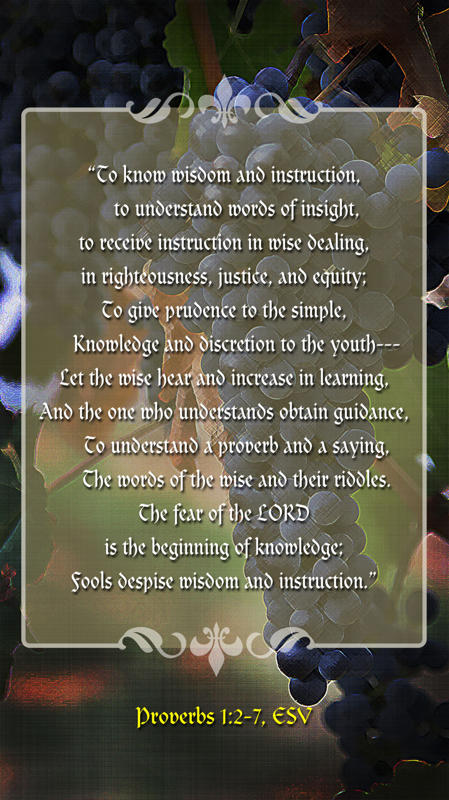
UC Sanctuary Proverbs 1:2-7
This scroll hangs on the wall entry to the Sanctuary of the University of the Cordilleras, Baguio City.

UC Sanctuary Proverbs 1:2-7
This scroll hangs on the wall entry to the Sanctuary of the University of the Cordilleras, Baguio City.
[This article was first posted in 2012 under the series “We have heard it said . . . A Sinaite’s apologetics – 2.” Sinai 6000 is an option for unaffiliated gentiles (the ‘unchurched’) who feel they need to ‘associate’ and relate with like-minded believers in the One True God, or at least connect with others who have blazed the trail, so to speak, to yet another option and an alternative destination besides Rome or Jerusalem or Mecca.
From the time we left Christianity in 2011 to this day, we have had to constantly defend our drastic turnabout from the direction we had taken all our lives to a totally different pathway we have referred to as “the road less travelled,” to borrow from Robert Frost’s famous poem.
The 2 questions we addressed here came from a former Messianic colleague who, like all Christ-worshippers, believe in “progressive revelation” which teaches that the Sinai revelation was superseded by later revelations, particularly the teachings in 13 NT epistles attributed to Paul of Tarsus who all but negated the TORAH of YHWH and his own Hebrew scriptural legacy in NEVIIM and KETUVIM. Strangely, when it was ‘convenient’ to use the TNK to justify the New Testament claims about theirTrinitarian God and specifically the divinity of Jesus of Nazareth, the TNK was invoked as “prooftext.”
For those in transition, not knowing what “religion” to join, this post might help. Timely reminder: we are not a “religion” nor a “church” . . . we simply have embraced the God of the Hebrew Scriptures and His Way of Life. Sinai is the destination of our journey, not Rome, not Jerusalem. We believe the Sinai Revelation has superseded Noachide laws but was not superseded by the “New” testament. Hence, this is part of our apologetics. These other posts might help:
—Admin1.]
——————————————————
We have heard it said, (from a Messianic colleague):
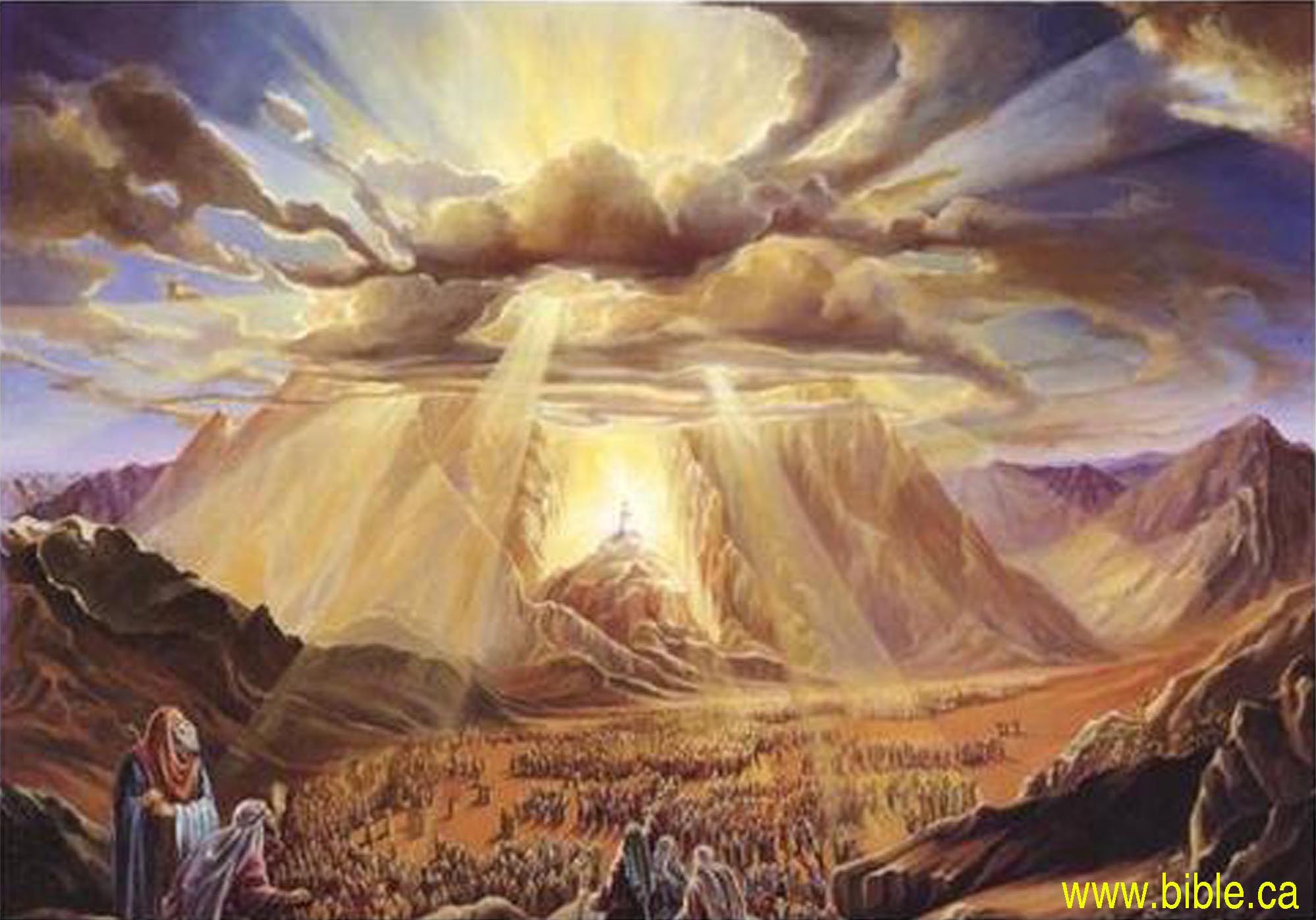
Image from www.bible.ca
Since we’ve already tackled the subject about who’s a Jew and who’s a gentile, consider this a continuation of that discourse because our choice of Sinai as the focal point of our spiritual quest has everything to do with the fact that we are not Jews but gentiles and intend to partake of what God has allotted to the gentile nations.
We have explained that when we got out of Christianity altogether [please read previous articles], the first question we faced was “what now?” Where do we go from here? We’ve left Rome, are we now headed toward Jerusalem?
Since we turned to the Hebrew Scriptures for foundational truth, it seemed logical to turn to Judaism. In fact, some are still mulling over that and have not closed the door on that option. If there were a synagogue right in our city of residence, some of us would have already gravitated toward the Jewish religion but then we felt we were simply moving out of one religion to join another!
Granting Judaism is Torah-based, still, we felt we could not fit there, not so much because we’re not ethnic Jews, but more because in our Torah studies, we started noticing slight differences between what’s biblical and what’s Jewish. We didn’t want to be Jewish, we wanted to be BIBLICAL. We’re still in the process of trailblazing for ourselves and for others who are in the same place as we are, figuring out what God means by “one law for the Israelite and for the foreigner.”
Jews themselves caution non-Jews to think very seriously about taking such a step. It is not easy to be a Jew, they say, and even secular Jews deem it difficult to be’ religious Jews’, even if there are sects in Judaism one could possibly fit in, from ultra-conservative to liberal, even mystical.
As former Messianics, we had collected many Jewish artifacts, were wearing jewelry with Jewish symbols; mezuzahs were on our doors, 7-stem menorahs and 9-stem hanukkiahs adorned our homes, men added blue tassels to their belts, wore the kippah, etc. The crucifix had long been put away since our messianic teacher said it was a pagan symbol, more suited to Roman Catholicism and Protestantism and not Messianic Judaism. Like it or not, we already fitted the Jew-wannabe profile.
So why the reluctance in taking the final step: be a Jew, join Judaism? Rabbi Stuart Federow gave us a long lecture about what our next step should be, citing the book of Esther, 2:5. In case you missed reading it, here’s an excerpt:
Mordecai was called a Jew even though he was from the tribe of Benjamin. All those who follow the faith of Abraham, regardless of which tribe they came from, are known as Jews. The people at Mt. Sinai were all Jews, including and eventually the Mixed Multitude because having left Egypt and having joined the Jewish People and having witnessed the Exodus and joined themselves to it, to the people and to the religion, they became Jews as well. That is why there is no mention of them after Numbers, because they had all converted to Judaism and simply became a part of the Jewish People. Abraham is the first Jew and all the Patriarchs and matriarchs and all the sons of Jacob and all the members of all the tribes of Israel were all Jews, and the ex-slaves of egypt were all Jews, too. The only Gentiles at Sinai were the mixed multitudes and they, too, eventually became Jews, and all because the word Jew is used to describe those people, in the Bible and after, who were believers in Torah, the written, and then the Oral Torah as it developed and as Gd wished it to develop over the last 2,000 ++ years.
But more importantly for you and for your website and for all those who are a part of your group worldwide, yes, indeed, it is possible for one to convert to Judaism and become a Jew! And the Bible explicitly says so. Look again at the Book of Esther 8:17
The Biblical text is clear, “”And many from among the peoples of the land became Jews…”” and so it is, in fact, possible to become a Jew through the conversion to Judaism. The Bible explicitly says so. Gentiles can become Jews, as they did in the Bible!
Do you and yours reject Rabbinic Judaism, the way in which Judaism survived over the last 2,000 ++ years as Gd has willed it to survive? IF there was any Judaism that could have been called “Biblical-only Judaism,” which there never was, it ceased to exist as soon as Ezra came back from the exile and not only read the Torah to the people, but he also expounded and explained it (Nehemiah 8:8), using the Oral Tradition. If you reject Rabbinic Judaism, the Judaism that has survived these last 4,000 years, and for the last 2,000 years, then yours will just be another fringe group that will be lost in the passage of time.
If you do, in fact, accept Rabbinic Judaism, then the path for you and all your groups is clear, seek out the rabbis and convert and become real Jews. It is the path that Gd Himself has been leading you down, it is the path that Gd has been leading all of your groups down, and that path leads straight to Judaism, fully Judaism, to the conversion to Judaism and to become Jews!
Take a look at: http://www.bechollashon.
——————————————
Not totally convinced of the rabbi’s very persuasive argument which is always an option anytime for any of us, we checked out a movement called the Noachides, more suited for gentiles.
In time, we decided to just keep studying, visualizing ourselves on a pilgrimage with one question left: which direction should we take, Jerusalem or . . . a neutral territory. . . like Sinai where the original revelation was given? Not so much the actual mountain which archeologists say is no longer identifiable, but more the spiritual place of meeting the One Who declared His Name as YHWH and simultaneously issued His guidelines for living.
Our journey is expounded in —
We are convinced religion is not the best place to seek the True God, so we’ve stayed clear of religion. We are on individual journeys, but travelling together. We have not arrived, we’re in transition. We know where we came from and cannot be persuaded to return, knowing what we know now.
We’re meeting others all over the world through this website and we think many seekers are on the same page or path as we are. We surprised even ourselves and our website server, that in the few years we’ve been on the web, visitors from all over the world are a-plenty! Many are probably landing by mistake and moving on; others bother to check us out a little bit, but not a few linger, return, and become regular visitors, some registering 500 returns, and some clicking hundreds of posts in one visit, seemingly downloading every category on our menu! We see their locations, wonder who they are, spiritually link up with them, and are thankful that we are able to reach others out there who are seeking more ‘lamps’ on pathways leading to the One True God.
Truth to tell, we can barely convince anyone in our own vicinity — we started as a core group of 8, have convinced few others now living in different places in our base country and the world; there are about 20 of us, lost 3 whose breath of life returned to the Creator but who left content and secure in their renewed journey to know the God of Sinai and His teachings in the Torah.
As we continue to share what we learn, we hope that somehow we are contributing to the six millennia-old movement of YHWH to make His Name known to the world. We are comfortable using ‘God’ and ‘Lord’ instead of borrowing Hebrew words and phrases but we do declare the Tetragrammaton as THE NAME that identifies the God we embrace, love, and worship.
We don’t speak Hebrew, no one knows how God’s Name is really pronounced, so we simply stick with “Yahuwah” for YHWH, for presumably He hears whoever invokes the Name He declared as His. Naming Who our God is—is important to us because we’ve been declaring the wrong name all our lives. We don’t want to simply use a title, like “God” or “Lord” or “Father” which others use for their God. Some say we all worship the same God, think about it . . . no we don’t, not if a different name other than YHWH is invoked.
We know Jews are reluctant to say the Name out of reverence, we are not reluctant to say it for exactly the same reason—out of reverence. Since we’ve discovered the True Name, we are proud to finally be associated with THE NAME. But it is not enough for us to simply know The Name, we feel strongly compelled to say it, declare it, keep repeating it to as many as who would care to listen and learn.
Biblical faith is about living Torah as best as we can, loving and worshipping YHWH, and declaring Him as our GOD; then doing as much good as we can within the opportunities God opens to us, thankful for the giftings, financial capability or even lack of it, and what little influence we do have.
We are not heaven-bound, but Sinai-bound (Spiritual Sinai), earth-based and ‘other’-centered. Our only opportunity is ‘in the moment’, the ‘here and now’ in our lifetime. What use will we be to our LORD YHWH and our neighbor when the breath of life has already left us?
We equate Sinai with YHWH and His TORAH. There is enough there to learn for a lifetime of study. Jews have done it for themselves for centuries, [hence the Neviim and Ketuviim were added to Torah]; it is time we gentiles do the same and trailblaze for the likes of us, gentiles.

Image from Fooducate
The journey of a thousand miles
starts for you now . . . .
take the first step . . .
keep going . . . .
catch up with us . . . .
we’re just a few mile-years ahead of you . . .
overtake us . . . .
yes you can!
In behalf of Sinai 6000 Core Community,


Image from www.christianbooks.co.za
[First posted in 2015; part of a series, check out these related links:
What happened on Sinai? A lot. Not the least of which the Creator speaks to representative humanity —the mixed multitude —and cuts a covenant with the people He formed from Abraham, Isaac and Jacob. The wonder of this God is He condescends and goes down to the level and limitations of human understanding, within the times and culture of individuals and people-groups He deals with. In this case, He uses existing man-made covenantal traditions. That is the focus of this chapter from our current resource MUST READ which should always lead to MUST HAVE: Sinai and Zion by Jon D. Levenson. We recommend this book that belongs in the library of serious students of the original Sinai revelation.

Image from www.cityofgracechurch.org
About three decades ago scholars, especially George Mendenhall in the United States and Klaus Baltzer in Germany, began to compare biblical literature with certain treaties whose structure had been known for about two decades. These treaties derived from the Hittite Empire, which occupied essentially what is now the eastern part of Turkey and whose language was of the Indo-European family, like Greek and unlike Hebrew, which is form the Semitic family. In the Late Bronze Age (ca. 1500-1200 B.C.E.), the Hittite emperors were attempting to control the critical land-mass to their south, Syria, by entering into treaties with the kings of the lesser states of that region. The purpose of these treaties was to secure the allegiance of the smaller states to make sure that they stood faithful in alliance with the Hittites and did not pursue an independent foreign policy. Treaties, in the ancient world, were of principally two types, parity and suzerainty.
From now on, we shall be concerned with suzerainty treaties only.
This expression of the stipulations is quite minimal, as covenants go; Joshua 24 required merely that Israel acclaim YHWH as her suzerain. But these minimal stipulations are all that is required, as the text must presuppose some corpus of Sinaitic law already revealed in the lifetime of Moses. It should be noted that the people swear they will not abandon YHWH (v 16); this is a persuasive indication that they have already entered into a relationship of fealty with him. These are not newcomers to YHWHism, at least in the text as we presently have it. Instead of mediating a new covenant, Joshua is reinstituting the old one, reclaiming a wayward people for the essential relationship to God. Hence, his main concern is to insure that YHWH is her suzerain, YHWH alone. “Banish the gods” is the equivalent of Mursilis’ demand, “Do not turn your eyes to anyone else!…” But whereas Mursilis goes on to lay down detailed terms in which this exclusive fidelity must find expression, Joshua relies upon the stipulations of his predecessor’s time. By banishing YHWH’s rivals, Israel rededicates herself to him.
Image from www.pinterest.com
Israel has become the vassal of YHWH;

Гидра онион (Hydra onion) – это самая популярная площадка запрещенных товаров в “черной” сети (Draknet). Данный магазин в основном ведет свою деятельность в Tor browser, так как он является безопасным браузером и всвязи с тем, что товар которым торгуют на hydra shop является незаконным, данный браузер идеально к нему подходит. Tor browser работает через vpn постоянно, поэтому это позволяет сохранять полную анонимность для каждого пользователя сайта гидра. Также, на сайте работает двухфакторное шифрование, для тех кто не хочет разбираться с тор браузером. С обычного браузера вы тоже можете попасть и с помощью алгоритмов защиты, вы останетесь незаметным, но для полной конфиденциальности рекомендуем использовать Tor.
Гидра полностью безопасна, они тщательно относятся к конфиденциальности каждого клиента, основная проблема hydra shop является то, что проблематично найти официальную ссылку сайта гидра, для этого вы публикуем зеркала на сайт гидра, которые мы рекомендуем вам сохранить к себе в избранное.
Магазин моментальных покупок постоянно прогрессирует и уже сегодня гидра работает по таким странам: Россия, Беларусь, Украины, Казахстана. Мы расширяемся и планируем расти дальше.
Популярные города: Краснодар, Санкт-Петербург, Минск, Казань, Астрахань, Томск, Астана, Пермь, Киев, Харьков, Москва, Ростов-на-Дону, Иркутск, Тамбов, Нурсултан, Красноярск, Владивосток.
Темный магазин работает по принципы автоматических продаж, вы можете приобрести то, что пожелаете в любое время суток и не нужно ждать продавца.
Есть гарант продаж, в виде того, что продавец не получить оплаченные вами средства, пока вы лично не подтвердите “наход” закладки. На Hydra работает техническая поддержка круглосуточно, поэтому по всем интересующим вопросам на тему Гидры, вы можете обратиться к ним. Вам обязательно помогут и в случае если у вас какие-то проблемы с “находом” или вы считаете, что вам продали товар плохого качества – напишите в тех поддержку, они решат ваш спор и предложат варианты развития данной ситуации.
Сайт Гидра работает через такую валюту как – биткоин. Для того чтобы перейти к покупкам вам необходимо пройти короткую регистрацию и пополнить свой личный счет криптовалютой. Одной из особенностей является то, что переводу для гидры не требует подтверждения blockchain.
В “темном магазине”, вы можете приобрести: траву, бошки, шишки, мефедрон, гашиш, амфетамин, лсд, мдма, кокс, экстази, гидрапоника и многое другое. Hydra ещё предлагает своим клиента различные запрещенные услуги, по типу: подделка документов, взлом почты, соц. сетей и тому подобное.
Также, из-за того, что мы постоянно растем, уже сегодня мы можем предложить вам уникальную возможность выбрать район в котором будет сделан клад. Вы можете использовать данную функцию в целях удобства или же наоборот, отведения внимания, заказ товар в другом районе, выбирать вам.
Для пополнения личного счета аккаунта на гидре, мы рекомендуем вам использовать “чистые” криптомонеты, чтобы повысить процент анонимности и вас никто не смог отследить, мы рекомендуем сервис по очистке биткоинов, биткоин миксер – BitMix.
Это популярный сервис в даркнете, у него огромный опыт работы с клиентами и большой резерв криптовалюты.
Данная прачечная биткоинов, также работает в черной сети и базируется в Tor браузере, но есть ссылки и для обычных браузеров, мы с вами поделимся ссылками данного сервиса, чтобы вы смогли как следует позаботиться о своей анонимности.
bitmix.biz – Биткоин миксер
bitcoinmix.biz – Зеркало на bitmix
Хотим предупредить вас о том, что в сети полно фейков сайта гидра, поэтому пользуйтесь только официальными ссылками на гидра магазин. Также, проверяйте правильность адресов, тем более при пополнении счета. Это сегодня самый актуальный вопрос для нас, будьте осторожны.
Бывает ещё так, что наши сайты недоступны и возможно находятся под атакой злоумышленников, в таком случае вы можете просто перейти на зеркало веб-сайта Гидра.
Сохраните данный список к себе в избранное и удачных покупок, проверяйте url адреса и будьте внимательнее.

Image from www.agodman.com
[This was first posted in 2012.
What does it mean for humankind to be made in God’s “image” or “likeness” —-
Some answers given;
Jewish Rabbis have of course discussed this topic to death; after all the TORAH is their sacred Scripture and more than any people group, they would want to understand what it means for the one special created species, humans, to be made in the image of the Creator. It would be superfluous to add anything more to their dissection of one simple sentence in the creation narrative, so here is one section of a book that is mind-expanding, please read the excerpts all the way to the end because just like forensic experts, the Rabbis have left no stone unturned!
For those interested in downloading this ebook from amazon.com, readable on your free kindle app, here is the title and list of CONTENTS:
MUST READ: TORAH THROUGH TIME:
Understanding Bible Commentary,
From The Rabbinic Period to Modern Times
by Shai Cherry
Foreword by Marc Zvi Brettler
Acknowledgments
Introduction
Epilogue
The featured excerpts are from Chapter 2: The Creation of Humanity – Genesis 1:26-31-—Admin1.]
——————————
For those who take it for granted that God is incorporeal, the notion that we humans are created in the Divine image must refer to something other than our physical body. Yet there are biblical verses which can plausibly be read as suggesting that God does have physical form (Exod. 33:20 and Isa. 6:5).
Perhaps the presence of these verses explains why the assumption of Divine incorporeality does not inform Rabbinic comments. “In all of rabbinic literature there is not a single statement that categorically denies that God has body or form . . . . Instead of asking, ‘Does God have a body?’we should inquire, ‘What kind of body does God have?.'”
Resh Lakish said in the name of Rabbi Shimon ben Menasya: The knob of Adam’s heel outshines the sun, how much more so his countenance. (Leviticus Rabbah 20:2, Rabbinic compilation edited by 5th century, Land of Israel; cf. Baba Batra 58a.
According to this tradition, Adam had a body of light. Working backwards, God’s image must similarly be luminous. Indeed, in one of the oft-repeated passages from the Torah, we have the all-too-familiar phrase translated literally by Everett Fox: “May YHWH shine his face upon you and favor you!” (Num. 6:25.) God is associated throughout the Torah with light and fire imagery. God reveals himself to Moses through the burning bush (Exod. 3:1-4), later speaks to all of Israel from ‘the midst of the fire” (Deut. 5:4), and appears to Ezekiel as “what looked like fire” (Ezek. 1:26-28).
With this understanding, God has a body or form but it is not quite corporeal.
The first humans, made in the Divine image, somehow lost their luster. Opinions vary as to the reason. But one human, according to the Torah, does regain the aura. When Moses descends from Mt. Sinai with the second set of tablets, he is unaware that his face is radiating light (Exod. 34:29). The disappointing epilogue to the story is that Moses was forced to veil his face in public after descending from the mountain of God. The Israelites were not ready to recognize the illuminating stage of God in their leader (Exod. 34:33). Perhaps that is why the culmination and climax of Judaism’s central prayer, a map which traces the necessary blessings for a world at peace, reads: “God will bless us all, as one, through the light of the Divine countenance.”
In the Rabbinic imagination, the moment we regain the image and recognize the image in all humanity, we will have entered the Messianic era.
7. But tselem [image] designates natural form, i.e., the principle which substantiates a thing and makes it what it is, its reality as that thing. In man’s case this is the source of human awareness that it isaid of man that “He created him in the form of God.” (Rambam, 1138-1204, Egypt)
Rambam was one of the leading Aristotelian philosophers of the Middle Ages. He maintained that it was nothing short of heresy to understand God in corporeal terms. Indeed, he devoted the first section of his philosophical work, The Guide for the Perplexed, to explain away the anthropomorphisms and anthropopathisms of the Torah (attributing human form and emotions to God).
In our comment, Rambam understands image not as bodily, but as Aristotelian form, that underlying principle which informs the object in question. For us humans, according to the Aristotelian philosopher, our form is the intellect. We think, therefore we are human. Our intellectual awareness and capacity are what distinguish us from the rest of God’s creation. For Rambam, our intellect is the human soul.
Rambam is not only reflecting Aristotle in this comment, but Hellenistic philosophy in general. The Hebrew Bible has a monistic anthropology—our body and soul are a unified whole. The dualism of body and soul, or more extreme, body versus soul, is foreign to the TANAKH. Anthropological dualism is a product of Hellenism, generations before Aristotle, which distinguished between the immortal soul and the mortal body. Pauline Christianity incorporates this Hellenistic anthropology (see, e.g., II Corinthians 5:1-4) in a way that Rabbinic Judaism resisted. According to one contemporary scholar, “Rabbinic Judaism, in contrast, defined the human being as an animated body and not as a soul trapped or even housed or clothed in a body.”
Maimonides’ interpretation of the image of God as incorporeal also countered certain trends that emerged in the early Rabbinic period associated with ancient Jewish mysticism. The depiction of God in grossly anthropomorphic terms, with gigantic dimensions, was central to the Shiur Komah, a text from the early centuries of the Common era. A talmudic legend imagines the first human to be humongous, having ostensibly been created in the image of God. Shiur Komah gives the cosmic dimensions of the God after which that human was modeled.
Medieval Jewish mysticism, beginning with the late-12th century text, Bahir, rehabilitates the image of the Divine body and provides a foundation for the distinctive vocabulary of the Kabbalah.
8. [The plural language in our verse] can be compared to a king who is sovereign over all. He wants to demonstrate that everything is included in him and he is everything. Therefore he speaks about himself in the plural. So, too, the Holy One, blessed be He, when He wanted to show that the entire universe is His, that everything is included in His hand, He spoke in the plural to show that He is everything. (Zohar Hadash, Midrash Han’elam, 16, 13th c., Spain).
Although much of the Zohar, as well as later Kabbalah, often depicts the Divine in the shape of a human, this comment suggests that humans don’t just corresponded to the image of God, but are actually in the image of God, i.e., inside the Divine. All of creation, not just humans, is included in and encompassed by God. This theological stance, sometimes called panentheism, indicates that all of creation is within God, but that God also transcends the limitations of what we perceive as creation. The Zohar calls that which is beyond all human ability to comprehend, the Ein Sof, or endlessness.
In the Rabbinic period, God’s image was often understood as physical, somehow corresponding to our own physical being but on a much larger scale. Alternatively, God was depicted as a light being, having an image but not a body. In the Middle Ages, the philosophical tradition rejected any kind of bodily form for God, instead emphasizing our intellectual form as that which links us to the Divine. The Kabbalistic tradition insists that we can know something about the inner life of God by better understanding ourselves. In some symbolic way, the image of the Divine incorporates the intellectual aspects so important for the philosophical tradition, but within a framework that includes the motional and sexual aspects of embodiment, as well. Finally, we saw an example of how the Kabbalists suggested that all of creation is comprehended by God, in God’s image. In this interpretation, image is not a representation of God’s being, it is God’s being.
MODERN IMAGES OF LIKENESS
In addition, and perhaps in response, to Ramban’s emphasis on the intellect, the mystical tradition emphasized the power of imagination. The Hebrew for imagination is dimyon, which echoes both the name adam (human) and our likeness (d’muti) to the Divine. (We are called adam in Genesis one because we are created in the Divine likeness. The second creation story (2:7) links our name to the substance from which we were created, adamah, the earth.) The union of intellect and imagination corresponds to human being made in the image and likeness of God.
9. “Adam” is from the same root as dimyon (imagination), and the aleph is extra. The advantage of humanity over all other creatures is our power of imagination. (Rabbi Bunim of Przysucha, 1765-1827, Poland).
10. There is no doubt that the term “image of God” in the first account refers to man’s inner charismatic endowment as a creative being. Man’s likeness to God’s expresses itself in man’s striving and ability to become a creator. (Rav Joseph B. Soloveitchik, 1903-1993, Lithuania and United States).
Rabbi Bunim represents the stream of thought which resists the glorification of the intellect at the expense of the rest of the human being. Realistically, not everyone can be a scientist. So, is it fair to use intellect as the exclusive, or even primary measure of one’s humanity? Rabbi Bunim isn’t only interested in expanding our pool of who can be considered fully human, his anthropology underscores that we are more than just disembodied intellects. Our imaginative faculty brings out what is distinctive about us humans. We can imagine a different world. No other animal has that capacity.
Rav Soloveitchik brings Rambam together with Rabbi Bunim. Marrying our intellect and imagination, we can work toward a better world. But it is not just the capacity with which we’re endowed, it is the need, the yearning to express ourselves creatively that is the marker of the Divine likeness. God imagines a world and creates it. We can, too.
11. We humans are the only creation able to do what we consider to be good, according to our will. And in this, we are likened to our Creator. “The superiority of humans over beasts is naught” (Eccles. 3:19). Only the “naught,” the power to oppose and say, “No!” This is according to His likeness. (Aharon Lewin, 1879-1941, Poland)
Rabbi Lewin creatively rereads that biblical existentialist, Kohelet, who asserts that there is no difference between humans and beasts. For the Rabbi, the difference is our ability to say “no.” We are like God because we have free will. Indeed, as one modern commentator points out, we don’t look all that different from monkeys, so our verse must mean something other than physical resemblance. Unlike monkeys, we can engage in long-range planning. Or, as we tell college students (and graduate students), you are deferring benefit. It’s true that we’re often impulsive, but we do not have to be. It’s that measure of self-restraint that makes us fully human. And when we resist the temptation to cash in early, to cut corners or indulge in immediate gratification, that is when we are most like God, slowly and patiently working toward the fulfillment of the vision. That is why we read about the six days of creation. Eventually, Genesis promises us, the seventh day will arrive.
Alternatively, or additionally, Rabbi Lewin’s comment might be about saying “no” to others, rather than to ourselves. To be godly, we must oppose the behavior of the beasts, in human garb, who follow their animal instincts. They have their designs for domination, but we are warned against following the multitude or the mighty to do evil (Exod. 23:2). We have the power to oppose and say, “No!” Relinquishing that prerogative, abdicating that responsibility, puts us on the same plane as the beasts. According to the halakhah, “just following orders” is no excuse for criminal behavior. A chilling postscript for our commentator: Rabbi Lewin, a communal leader in Poland, was murdered by the Nazis in July of 1941.
All of the commentators in this section focus on our likeness to God. Although one could chalk up the repetition (“in our image, after our likeness”) to poetic style, a traditional assumption about the Torah is that all repetition is meaningful. Being created in the image must then mean something different than being created after the likeness. Similarly, the different prepositions in and after, must bear significance. The medieval commentator S’forno makes the point that, unlike God, not all of our choices, by which we exercise our likeness to God, are for the best. That’s why our deeds are only “after” God’s likeness rather than “in” God’s likeness.
FRAMING CREATION
Verse 27 introduces the feminine into Torah. But it introduces the masculine, too. Throughout this chapter, I have awkwardly translated the adam (with a lower case a) of our previous verse as humanity or humankind, as does Fox. In our present verse, we are informed that humankind, as a species, come in two genders and both are created at the same time. That is exactly how several medieval commentators, who focus on the immediate context, understand adam, as humanity. That is how Everett Fox translates it. So why do we have this idea that Eve, a single woman, was created after Adam, a single man? Because she was, at least according to the second story of creation that begins with the second half of Genesis 2:4.
There are two differing accounts of creation in the Hebrew Bible. (The Christian Bible doubles that! There are four different gospels retelling the birth, ministry, death, and resurrection of Jesus.) Before feminist sensibilities raised our awareness about language, man could refer to men or to men and women. Hebrew works the same way. If we take the first creation story in isolation, it’s clear that the term adam refers to the species known as humans. All the animals in Genesis one were created as entire species. It’s equally clear that the adam in Genesis 2 is a single individual, not yet masculine, perhaps, but singular. It is only when we read Genesis one anticipating the second creation story in Genesis 2 that we conflate these 2 discrete narratives. One popular method to resolve the real contradictions between these 2 accounts of human creation is to understand the adam of 1:26 as singular and 1:27, which introduces the feminine, as a preview of the future creation in Genesis 2. The Torah is telling us, according to this line of thinking, that there will be a woman created later in the 6th day, but we’ll have to await the next chapter to get the full story.
Given the juxtaposition of these 2 creation narratives, attempts at interpreting the adam of Genesis one as a single male are understandable. Rabbinic assumptions about the perfection of the Torah preclude the possibility that there should be contradictions. As we saw, a few of the medieval pashtanim (peshat seeker) anticipated modern Bible scholars by acknowledging that we have two different stories of creation, though without suggesting that the human authors of these different areas lived hundreds of years apart and in different parts of the Land of Israel. As a result of reading these stories together as a single description of the creation of Adam and Eve, interpretative possibilities emerge from the biblical landscape.
12. Rabbi Jeremiah, son of Elazar said: “At the time that the Holy One, blessed be He, created the first human, He created it as a hermaphrodite, as is written, ‘male and female He created them . . . and called their name Adam on the day He created them.'” (Gen. 5:2)
Rav Samuel, son of Nachman said: “At the time that the Holy One, blessed be He, created the first human, He created it with two faces and then cut it and made backs for each.”
They challenged him: “One of his sides.’ Like it says, ‘the side of the Tabernacle’ (Exod. 26:20).”
(Genesis Rabbah)
The first human being, in the singular, was a hermaphrodite. That explains why verse 27 includes both male and female. The name of that entity, according to Gen. 5:2, was Adam. The male and female were distinct personalities sharing the same body. Rav Samuel then goes further into the anatomy of Adam. It had two faces, one on each side, with corresponding genitalia. What God then did was to split this primordial androgyne in two and sewed up each of their back sides.
So far, this midrash has explained how Adam, understood to be a single person cold be both male and female. The midrash then voices opposition. “Wait a second! You’re ignoring the verse that says God took man’s rib and made woman.” But Rav Samuel has a ready retort: “I’m not ignoring anything. You’re misunderstnding the verse. Just like tsela means side in the description of the Tabernacle, so, too, it means side here. God took one of the sides of the hermaphrodite and split it down the middle.” Now, our midrash has the additional benefit of reconciling the two creation narratives. That’s efficiency!
This Rabbinic midrash has had far-reaching influence on subsequent Jewish understandings of the creation of humans. Many midrashim suggest that to be fully human, man and woman require one another in order to reflect the first Divinely-created human. A similar image of a hermaphrodite being split apart occurs in Plato’s Symposium. When the halves of these former wholes find each other, lifelong partnerships result. For Rav Samuel, it seems any human couple can house the Divine Presence, as did the sides of the Tabernacle.
This midrash of the hermaphrodite could not have been the original intention of the author of either creation story. But I can’t say that such a conception was necessarily foreign to the biblical editor or redactor who juxtaposed our stories in purposeful sequence. There is a possibility that the redactor sought to conflate these two stories, rather than to present two opposing stories side by side. If conflating or merging was the redactor’s intention, something like a hermaphroditic human may have been how the redactor intended his audience to read Genesis I. Said differently, our redactor may have believed that these 2 stories express different aspects of creation that are complementary, not contradictory. The word tzela usually means side, so why not in the second creation story, too? Genesis 1, in isolation, doesn’t mention Eve (or Adam). But reading Genesis 1, after knowing the story of Genesis 2, frames the creation of humanity in such a way that the reader is now receptive to either a single hermaphrodite, or a single couple, the Adam and Eve of Genesis 2.
ENGENDERING THE IMAGE
13. Image is male and likeness is female. Zohar 3:35b, Tzac)
Each Hebrew noun is either masculine or feminine; Hebrew has no neutered it. The Zohar’s grammar is correct: image is male and likeness is female. The grammar of theology and anthropology is, therefore, gender inclusive. But the Zohar is doing more than teaching grammar.
According to Kabbalah, each human appendage corresponds to the Divine image which is also understood as a map of the energy flows within God. The name for these energy stations is the s’firot. In the world of the s’firot, the upper nine s’firot reflect the male image. The 10th sefirah, sometimes called the shekinah, or Divine Presence, is depicted as female. Altogether, the male and female s’firot comprise the totality of the Divine image and likeness. For the Zohar, only when the masculine and feminine aspects of God are in union will the Divine blessings flow. The mystic’s charge is to unite the male and female s’firot through ritual acts and also through proper sexual union. The male mystic coming together with his wife stimulates the corresponding elements in the world of the s’firot to join. When male and female, image and likeness, achieve union, the bounty of Divine munificence overflows from the s’firotic world and brings blessings into our own. Stripping the myth and metaphysics from this mystical interpretation, sex is good for a marriage.
14. Jung taught that in each of us there are personality traits more commonly associated with the opposite gender. The goal of a healthy individual is to integrate the animal/animus within each psyche. In the language of Genesis, masculine” and “feminine” together make up the Divine image—not “male” and “female” that distinguishes the sexes in other animals (Gen. 7:2). Each human has masculine and feminine within him or herself, and our goal is to integrate those elements in our dedication to following in God’s ways (Deut. 28:9). A couple, regardless of gender, should also enjoy a holy balance of traditionall masculine and feminine energies. (Meshi, contemporary, United States)
When God created the human zakhar u’nekevah, our other commentators read the Hebrew as male and female. Meshi reads it as masculine and feminine. Meshi is more concerned with psychology than anatomy. His comment strikes the contemporary chord of getting in touch with your inner, opposite gender. While the mystical tradition focuses on the interplay between male and female, it is, nevertheless, true that both male and female aspects are operating within the Divine world as represented by the s’firot. The unity of God is a cardinal principle of Judaism. Meshi is suggesting that the unification of our traditionally masculine and feminine attributes is essential for us as we strive to imitate God.
THE OTHER WOMAN
15. Lilith and Adam were created as equals. When Lilith desired to lie on top during intercourse, Adam refused, saying that he was superior. Lilith flew away by pronouncing the ineffable name of god. Angelic attempts to persuade Lilith to return to Adam failed. (from The Alphabet of Ben Sira [c. 9th c.]; cf. Genesis Rabbah 18:4).
Lilith appears only once in the TANAKH (Is. 34:14) as a night demon, having no connection to the creation stories. Rabbinic creation legends include the story of a woman, created prior to Eve of the Garden of Eden, whom Adam rejected. These story lines merge in the early Middle Ages as another approach to resolve the tension between our two creation stories. The adam that was created male and female in Genesis I was a couple. The woman, Lilith claimed equality with her male counterpart—the plain sense of Genesis 1—and Adam couldn’t tolerate it. So Lilith gets replaced by Eve, who is made from Adam; this somehow makes him superior.
Not only does the Lilith legend resolve the seeming contradiction between our two creation stories, it also provides an explanation for what remains a medical mystery: crib death. In medieval tradition, Lilith becomes the embodiment of the femme fatale, avenging herself by killing infants and by seducing men in their sleep to cause nocturnal emissions. The mystical tradition further develops the legend of Lilith so that she becomes the queen of demons. The Alphabet of Ben Sira may have been written as a farce, but the Lilith legend took on a life of its own. The latest twist in this legend comes as Jewish (and gentile) women have re-appropriated Lilith and claimed her as the archetypal feminist. Indeed, according to The Alphabet of Ben Sira, Lilith was more powerful than Adam: she knew how to use the power of the Divine name.
—————————————————————

12/18/17 – artscroll.com – Why this searcher landed on our website while looking for “artscroll” is because we have featured their website and the Artscroll TANACH as one of our MUST READ/MUST OWN books. Aside from our preferred official translations of ‘The Five Books of Moses’ by Everett Fox and Robert Alter, we feature Artscroll for the whole TNK, not just the Torah.
12/17/17 – “hearoyisrael.net“ – We featured this website in 2013-2014; it has been showing up in “search terms” since and landing on our website. It appears the website has been discontinued; we have had no connection since 2014 with the owner/administrator who went by the pseudonym “Benmara” in his website.
Here’s a link for those who have the same Q in mind:
Another friend, the president of the Jewish Club in our city reacted with this:
“beautiful . . . now put star of David on top of x-mas
and become instant Hanukkah bush”.
12/16/17 “http://theologicalmisc.net/2015/10/love-for-enemies-in-the-old-testament/” – Check this out to correct misconceptions about Jesus sermon on the mount. We have a post that tackles the same topic: Revisit: The Sermon on Sinai vs. The Sermon on the Mount
12/16/17 – “noahide sabbath liturgy” – We’re not “noahides”, we’re “Sinaites” and what we offer in this website is a whole Category of Sabbath liturgies for every Sabbath of the year. Please go to Site Map , scroll down the to where you will find the CATEGORY titled A Sinaite’s Sabbath Liturgy.
Hereunder are our liturgy for Sabbaths in December:
12/10/17 – “jewish mystique” –
12/07/17 – Searcher landed in this website while looking for this, check it out to learn a lot about things Jewish: zunal.com/newpage.php?w=166419&n=16025
——————–
Ah December! The month Christianity celebrates as a joyous season for the coming of its Messiah. Today, the rest of the non-Christian world simply celebrate the ending of another year through family reunions, gift-giving, decorating public and private spaces, overeating and getting drunk! To the Jews (and Sinaites follow their tradition), it is the season to celebrate the “festival of Lights” — Hanukkah/Chanukkah. To each his/her own, live and let live, let’s all just celebrate December! Here are posts to check out for the “wonderers”:
[This was first posted October 2012, reposted a few more times whenever another act of terror by someone claiming to hear voices in his head is what compelled him to commit mass murder. Lately, international media have been busy covering such horrific acts by lone perpetrators against untold numbers of innocent victims. Is this the new normal in this 6th millennium?
This is the original introduction in our 4th repost in January 2017; it is from Exodus/Shemoth 6: Who’s Who!
What triggered reposting this excerpt is the latest ‘terroristic’ act of yet another lone gunman who fired his legal firearm at hapless travellers in Fort Lauderdale, FLA, USA, killing 5 and wounding 8, as of last report. This man claimed to be hearing voices in his head, except the instructions were about joining ISIS, according to news reports. Military, police, and medical authorities to whom he submitted himself for psychological evaluation all declared him mentally fit enough to continue with life and in fact allowed him to continue owning and carrying his legal firearm.
Well . . . from what resulted in the loss of lives, we wonder whose voice was he hearing? Is ‘hearing voices’ normal in human experience? What do you think? This post simply speculates on that question, revised and expanded for this posting.—Admin1.]
——————————–

Image from slideplayer.com
If you suddenly heard an audible voice speaking to you from out of nowhere (not just in your head), what would you think? How would you react? Would you conclude it’s God speaking to you? If there is not a soul around, you might, but it depends on the message.
If you know the True God and what He has said as recorded in the Hebrew Scriptures, you would recognize His “voice” through His “message.” So how vital is it to know that message, that original revelation?
Now if you were a Christian believing in the devil and his heirarchy of demonic spirits, there are books and books about deception coming from that “demonic” realm so you’d have to be discerning about who’s speaking to you, might be the ENEMY of your soul. That “Christian Devil” as Sinaites call him is well caricatured only in the New Testament scriptures, enough to be recognizable. Just make sure you’re not hearing your own deluded thinking because as our 13-post series on ‘guess what? the ‘devil’ does not exist!‘, we posit all the arguments based on reason (and the Hebrew Bible, i.e. the ‘old’ testament) that the devil is a figment of imagination of those who produced the NT scriptures.
When we receive a phone-call, isn’t the first thing we ask if the voice is unfamiliar, “who is this please?” But the biblical narratives thus far make it appear that hearing God’s voice was the most natural thing for these biblical figures to experience, so they interact with that speaking God . . . just like Moses [in Exodus 6].
Here’s an enigma:
Has any other god (of man’s imagination) ever spoken to humankind except in legends and myths passed on by word of mouth or in written literature (man-made scriptures included) and unquestioningly accepted by generation after generation?
Why should the One True God even feel threatened by the non-existence of non-gods? What other god exists to compete with Him? Obviously none . . . except that He has to constantly compete with gods in men’s minds and belief systems.
How ironic, God creates humankind, and humankind create their gods, subjecting themselves to ideas that control their behaviour by superstition, myths and legends, and scriptures of questionable sources.
Agnostics and atheists are way ahead of religionists.
The study of world religions is truly fascinating, one man or a group of men decide who god is, what god is like, then make rules, convince or coerce others to believe, and a religious system is born. (Please read this post: Revisit: A Crash Course in Comparative Religion).
When you look at the pantheon of any belief system’s gods, could you really believe that men would worship created things, are men that gullible? Especially if the Creator has taken pains to add to the witness of His awesome creation that He indeed exists, His Revelation which now we read in His TORAH, in this time and age?
But alas, who bothers to read the TORAH of YHWH? Out of the manyJews we personally have met, only two, though of course the internet is full of Jewish websites teaching Torah.
As for gentiles, what do you think, dear reader? If you think you’re hearing “God’s voice” in this day and age, you better make sure the message jibes with what He has already said once and for all in His Sinai Revelation. If you haven’t read it, click our current posts on THE TORAH: Chapter by Chapter and start getting to know and hear the true voice through the true message of the One True God. His Name is YHWH, we declare that in this website with all reverence and awe!

 [This was first posted in 2012, a 5-year-old series on the MUST READ/MUST OWN book by Arthur Kurzwell titled: TORAH FOR DUMMIES. Time to revive and refocus on foundational truth which is what Sinai 6000 is all about.
While scrolling through images available on the internet, I ran across two that I picked out for illustrating this article. As you can see, it represents two sides of a coin that composes the strange combination of two books that are part of ‘THE CHRISTIAN BIBLE”. The first part is usually called “The Old Testament” so that the 2nd part could be justified as “The New Testament”. What are testaments? The term refers to legacy, living will, related to the word “testify” (evidence, proof, truth). Jeruslav Pelikan, author of our MUST READ/MUST OWN book explains it this way:
We are so accustomed to tossing around the terms “Old Testament” and “New Testament” that we may forget their root meaning, which comes out in the legal title “last will and testament.” Such a “will and testament” is a contract between the living and the dead, and both the testator and heirs are entitled to have the confidence that this document authoritatively represents “the whole testament and nothing but the testament” of the one who has made it and dictated its terms.
[IN HIS NAME – Whose ‘Word’ is the Bible? – 2]
One has to seriously question: if there is a prequel such as an ‘old’ testament on which is based and in fact is claimed as the foundation of a ‘new’, then one has certain expectations such as continuity, perhaps fulfillment, even rehashed or renewed foundations. Yet, if you really and truly and seriously have read the Hebrew Scriptures (without Christian teaching baggage) which is claimed to be foundational to the “New Testament” of Christianity, you will indeed discover basic truth from the very mouth of the God who reveals Himself there — and will have difficulty connecting Him with the Trinitarian God of the sequel, including all the teachings supposedly coming out of the Second Person of the Trinity who supposedly “corrects” or “changes” foundational Sinai revelation as justified in the Christian use of “progressive revelation”.
The result? Confusing claims such as the claims you read in the two images we picked out for this post. Fear not, dear seeker of Truth for the One True God! It is always healthy to be exposed to two sides, two choices, maybe even more, so that you can make personal decisions for yourself. The search for God is personal, one that you must undertake for yourself and not depend on others. But expose yourself to as many voices claiming to “tell the truth” and, like a juror and a judge, come to a decision for yourself. In this website if you haven’t yet noticed, we color-code New Testament words in red (for caution) and “Old” Testament or Hebrew Scriptures words in blue (perhaps it should be green for proceed) but we go by Israel’s chosen color for its flag featuring the Star of David. Yes, obviously we do have a bias here and why not? Guess who should have the final decision in this tug-of-war for your final judgment on Truth? You!

Image from Pinterest
We echo the words of Pontius Pilate in our series Quid est veritas:
Pontius Pilate: Then you are a king.
Jesus: It’s you that say I am. I look for truth, and find that I get damned.
Pontius Pilate: And what is ‘truth’? Is truth unchanging law? We both have truths. Are mine the same as yours?
Hereunder are links to that series for those interested:
—Admin1]
———————–
 Arthur Kurzweil
[TORAH for Dummies, http://www.dummies.com]
Arthur Kurzweil says that sometimes, an effective way of understanding what something is —is by knowing what it isn’t. He adds a section correcting misconceptions, here are excerpts:
At its core, the Torah is a set of instructions from God meant to provide divine wisdom; it simply uses several methods, such as stories, commandments, and history, to impart those instructions.
The Torah isn’t a storybook.
The Torah begins with the phrase “in the beginning,” but this doesn’t simply mean “Once upon a time.” The Torah contains many stories, but they’re far more than casual narrations. It’s a fundamental principle that every letter of the Torah is rich with meaning.
Example: The Hebrew letter “bet” that begins the Torah is the first letter of the Hebrew word bereshit [in the beginning]. Often you’ll see the first sentence of the Torah translated as “In the beginning God created the heaven and the earth.” But the great Torah commentator Rashi says that the phrase should be read as, “in the beginning of God’s creation of heaven and earth . . . .” In other words, God created the beginning and therefore existed before the beginning. The great sages of Jewish tradition teach that God is, was, and will be. God is beyond space and beyond time. The Torah begins with the 2nd letter of the Hebrew alphabet, not the first, signifying that the Torah doesn’t begin at the beginning; it begins when God created existence and time.
I offer this example to you that the very first letter of the Torah is more than just the start of the first word of a story. The letter itself contains a profound teaching. Divine insight and wisdom lie within every letter and every word and every so-called story in the Torah.
This doesn’t mean that the Torah is devoid of stories. There are lots of stories in the Torah. But they’re more than just stories. The Torah is a message written by God to the world.
The Torah isn’t a law book.
One of the greatest misconceptions about the Torah comes from the mistranslation of the word “Torah.” Too often throughout history the word has been translated as “law,” when it should actually be translated as “instruction.”
The Torah is God’s instructions to the world. If you want to learn about the details of how to observe Jewish law, by the way, don’t go to the Torah. The Five Books of Moses don’t give the details of how a law is to be clearly understood and observed. And don’t go to the Talmud, which is often thought to be the repository of Jewish Law. Neither the Torah nor the Talmud contains the specifics of how Jewish laws are to be followed. Both the Five Books of Moses and the Talmud form the basis of Jewish law, but Jewish law is to be found in the various codes of law compiled throughout Jewish history.
. . . . Torah does contain lots of commandments. And the Talmud certainly contains lots of discussions, debates, and explanations on the commandments. But the Written Torah and the Talmud (the record of the Oral Torah) contain the raw material from which Jewish law is derived.
The Torah isn’t a history book.
A fundamental principle regarding the Five Books of Moses is expressed in this well-known saying among Torah scholars. “There is no earlier or later in the Torah.” It means that the Torah isn’t a historical narration and isn’t in chronological order.
This expression doesn’t mean, of course, that it’s impossible to find facts of history within the Torah. After all, the story of the exodus of the Children of Israel, for example, is a major part of the Torah and is basically the history of the birth of the Jewish people as a growing family. The Torah contains the earliest recorded history of the family history of the Jews. But the Torah is not primarily a source for history; rather, it’s a spiritual document with the purpose of communicating divine eternal wisdom.
The Torah isn’t literal (even though it’s essentially true).
An important principle repeated often in books of Jewish wisdom and Torah commentaries can be found in many places in the Talmud: “The Torah speaks in the language of man.” What this means is that when you read the Torah, you need to be aware of the fact that just as in conversation and literature and poetry, the literal meaning often limits your understanding of what’s being said.
Example: “a bird in the hand is worth two in the bush”—as an expression taken as a metaphor or an analogy, the statement has wisdom. It means that it’s better to be satisfied with what you have than to risk losing it by trying (perhaps unsuccessfully) to get something better. There’s truth to the expression, but only when you break it open and discover its true meaning.
The Written Torah works in a similar way. By speaking in the language of man, the Torah often makes a point, but taking it at face value misses the point. However, when you understand how to read the text based on traditional teachings and the Oral Torah, the literal meaning falls away and you’re left with the true meaning of the text.
The best example of the fact that Jews don’t read the Torah literally is the famous quote, “An eye for an eye, a tooth for a tooth” (Leviticus 24:20). According to the Jewish tradition, taking this biblical phrase literally is totally against Torah law! Jewish tradition interprets the Torah by using ancient principles that go beyond the literal meaning of the words.
According to Jewish law, if I knock your tooth out, you don’t get to return the favor. Rather, I have to compensate you monetarily for the injury I caused. The rabbis suggest that “an eye for an eye” really refers to a system of monetary compensation; payment is required for the injury, the pain, the cost of medical care, and lost wages as well as the shame of it all.
[First posted in 2012. Those among us who were reluctant to say the Tetragrammaton Name at the beginning are more comfortable in declaring it today, as long as the condition of reverence is observed. Like the Jews, we do not wish to violate the 3rd commandment.
This is part of a series titled IN HIS NAME, other related posts are listed hereunder:
—Admin1.]
————————–
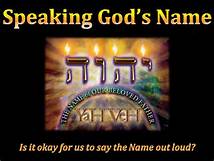
Image from 924jeremiah.wordpress.com
As you might have noticed reading through the posts in this website, we have no reluctance in writing, saying, proclaiming, declaring the Name of our Lord and God and write “YHWH.” We have repeatedly explained why although this is not the general sentiment even among our small community where some of us wonder if we should blurt out the Name like we do familiar names of people; after all, we are referring to the Creator, God of the Universe, LORD of Lords and KING of kings. Should we not be more reverent? Just as important, should we also not be considerate of the Jews, knowing their sentiments about uttering the Name?
There seem to be 7 positions relating to the TetragrammatonYHWH, the self-declared Name of the True God:
2. Those who don’t know, never heard, are actually in a position to find out if they care to but have not bothered;
3. Those who know because they have heard, but do not think it applies to the God they know and worship;
4. Those who do know because they have heard and read it but it’s unfamiliar to others in their worship community, therefore they never say it;
5. Those who do know but don’t dare say it out of extreme awe and reverence and therefore resort to circumlocutions like HaShem or Heaven or Creator, etc.;
6. Those who do know and say it without additional titles such as Lord, God, Father, since they think simply saying the Name by itself without titles sounds too familiar, not befitting the True God who must not be brought down to our level; some Sinaites feel this way.
7. Those who say it because YHWH Himself has expressly commanded all believers in Him to call on His Name; if you were on the brink of death or in danger, just see how you would naturally and without thinking call out the Name. Some of our Sinaite members agree with this position.
We have been told “what does it matter, we all worship the same God.” If that is true, then ask those who make that statement what is the name of the God they worship and you will find out if we all really do worship the same God.
Apply this same thinking to people: would you call someone you know with words other than their name? “Hey, Mr.,” or “lady,” “sister of John,” “friend,” “boss,” “servant,”; would people not prefer and will respond better to being called by their name? If there are others in the room who could be called “Miss,” should we not be more specific and follow that up with the name of the particular “Miss” since the word is merely a title shared by all single women? If there are so many gods worshipped by people, should we not be all the more specific about the God we do worship?
True, only since 2011 have we started calling on the true name of the True God. We were ignorant for a long while even if we were ardent worshippers of the God we had been introduced to in Christianity, and were connecting to another name. Had we died before we learned the truth would it have mattered?
YHWH has promised—
“I will make Myself available to you,” (Jeremiah 29:14).
To whom has he assured this? To those who will —
“call out to Me and follow [Me];
you will pray to Me and I will listen to you.
You will seek Me and you will find [Me],
if you search for Me with all your hearts.”
While that was directed to His chosen people, those among gentiles who choose Him as God and Lord can claim such divine assurance for themselves. YHWH is not an ‘exclusive’ God, He is the God of Israel Who wishes Israel to declare Him and His Name to the gentiles, to the nations.
Surely He knows who are the true seekers and are on the way of knowing Him as they mature and grow and continue to search the Scriptures for Him. If we die on the way, surely He honors our seeking hearts. It is those who never bothered to even start to search, or have searched but have stopped . . . they are the ones who lose out, thinking they have arrived, complacent that they have nothing more to learn about God. Still, YHWH surely knows who’s who and He knows best and judges according to what truly matters to Him about the life of each person He has allowed to be born.
How did each of us Sinaites get to where we are today? We have had different journeys but the common thread seems to be:
However you pronounce the Name—whether “Yahweh” or “Yahuah” or if you prefer to say “Yod Heh Vav Heh,” you leave absolutely no doubt in the mind of the hearer what is the Name of the God you worship, so do not hesitate to declare as Joshua did in Joshua 24:15:

Image from jeremyrenners.blogspot.com
And if it displeases you
to serve YHWH,
choose this day
whom you will serve,
whether the gods which your fathers served
that were on the other side of the river,
or the gods of the Amorites,
in whose land you dwell,
but as for me and my household,
we shall serve YHWH.“
In behalf of Sinai 6000
Core Community—-
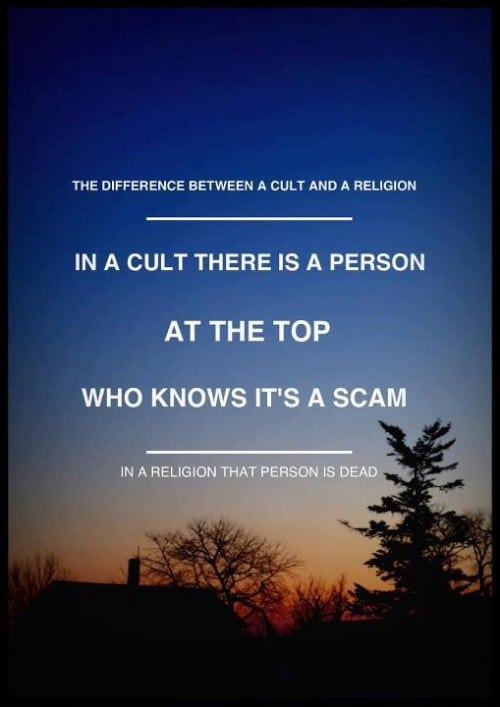
Image from writeopinions.com
[First posted in 2012. When we still functioned under the wide umbrella of “Christ-centered” religion, it baffled us that while all the various denominations worshipped the same trinitarian godhead, some of those denominations were labeled “cults”. As we researched it, we found out that mainstream Christianity considered any “Christian” group/church/fellowship as “cultic” IF it deviated from any of the foundational teachings of the “Church Fathers.” But it was strange to us that the finger-pointing often met each other: Catholics considered breakaway Reformed Protestantism as cultic while Protestants considered Catholics as cultic. The finger-pointing extended to the multiplying groups of evangelicals. Then when “Messianic Judaism” got into the already crowded and confusing picture, it got relegated to the Sabbath-keepers (established religions such as Seventh Day Adventists, Jehovah Witness, etc.), all frowned upon as cultic because they were Saturday-worshippers instead of Sunday-church-goers. Add to the cultic criterion the practice of “Old Testament” prescriptions such as the SDA’s veganism of Genesis 2 instead of the Leviticus 11 clean meat diet prescribed for Israelites. Then, Jesus supposedly declared all food ‘good’ so Christians justify eating unclean meat, conveniently forgetting that Jesus was a Jew who presumably ate the kosher diet so that food for him was already defined in the “OT”. As for Messianics, they virtually try pushing square pegs into round holes, figure that one out. How confusing indeed is the world of organized religion! Throw in as well, unorganized and disorganized religion, sporadic small fellowships organized by self-proclaimed pastors, here, there and everywhere! Enough, we give up!
We have always claimed we are not “a religion” nor “a church” so are we a cult? Christians might conclude so, we know, we used to think like them. Yes, Sinai 6000 is a breakaway group from Christ-centered religion/church/fellowship, so are we then a non-Christian ‘cult’? It depends on who’s asking. Here are our thoughts 5 years ago when this article was first posted; we have not changed our position. You, reader, decide for yourself.
Related posts:
—Admin1]
———————————————————–
It was a Rabbi who first told BAN@S6K that a start-up group like Sinaite 6000 will eventually fade out of the scene once the original organizers have passed on and there are no 2nd generation members to continue the work.
Exactly what is the nature of the “work”?
Without resorting to Christian terminology such as “witnessing” or “ministry”, S6K “work” is simply one of teaching anyone who would care to seriously study the TORAH/TNK from the point of view of former Christians/Messianics. S6K offers an approach to reading the Hebrew Scriptures without bringing former Christian orientation and without the influence of Rabbinic interpretation, and yet being open to insights from both sources, as long as they do not deviate from the plain meaning of the text, within its context and never out of context.
In the case of this website, the ‘work’ means not only sharing resources not otherwise easily accessible to seekers/visitors, but also recording the insight-by-insight re-education of a Sinaite as he/she sheds former religious beliefs to start over in getting to know the One True God whose name is revealed in the Hebrew Scriptures as YHWH.
But back to the Rabbi, what exactly was the his recommendation for new ‘movements’ like us who ventured out of the boundaries of Christianity and don’t quite know where to fit in? Just one: join Judaism, a Torah-based already established religion. Some S6K members outside of our city-base have already done just that. For lack of regular weekly teaching from us, they felt the next best recourse is to learn Torah from Jewish teachers and the best place to do that is the local Synagogue if one exists in their city of residence. They have gone through the process of eventually being assimilated in this Jewish religion and they are content in being counted among the remnant’ Torah-observant Israel’; ‘remnant’ because not all Jews are ‘religious’ and in fact so many are secular, some even atheist.
Our core group however are agreed on one thing: that since we are gentiles and not Jews, we need to maintain our identity and stand on a gentile’s place in YHWH’s plan for all humanity. While He did begin with a chosen people, a nation that would live His Torah and model it to the nations, the intention was not to make all peoples ‘Jews’ or even ‘Jewish’, the intent was to make all nations live Torah, and Torah is universal, biblical, not necessarily Jewish nor confined to Israel. So we choose to maintain our gentile-ness, but live Torah as best as we can live its prescribed lifestyle in whatever environment we find ourselves in.
Well, what environment is that?
Let us stop there since these in themselves already tend to ‘isolate’ a Sinaite, so that as individuals who have been used to ‘fellowshipping’ with others of similar beliefs in our former Christian communities, each one now has to seek out a company where he/she might best fit in. Our core group is fortunate we have each other to fellowship with on Shabbat and biblical feasts and seasons; we also spend time discussing our understanding of TORAH, issues that unite us as well as divide us, decisions that we collectively make and publicly share so others might learn from us.
Would a start-up group which is yet untested be a reliable source of information? That is up to our readers to determine for themselves. We are quite honest in admitting we teach as we go along. We have just undergone a transition but whatever we have learned every step of the way, we discuss, scrutinize, then decide to share with others. Obviously there are few takers if any at all, as we had anticipated from the very start. Not even among our families and much less among our friends, and heaven forbid that any of our former Christian colleagues would even hear us out . . . .hence, this website.
Would we be considered a ‘cult’? In the Christian definition, most likely. But there are more things involved in a ‘cult’ which, thankfully, has already been discussed in a Q&A in Aish Ha Torah [Aish.com]. We will just feature the article which best explains the word.
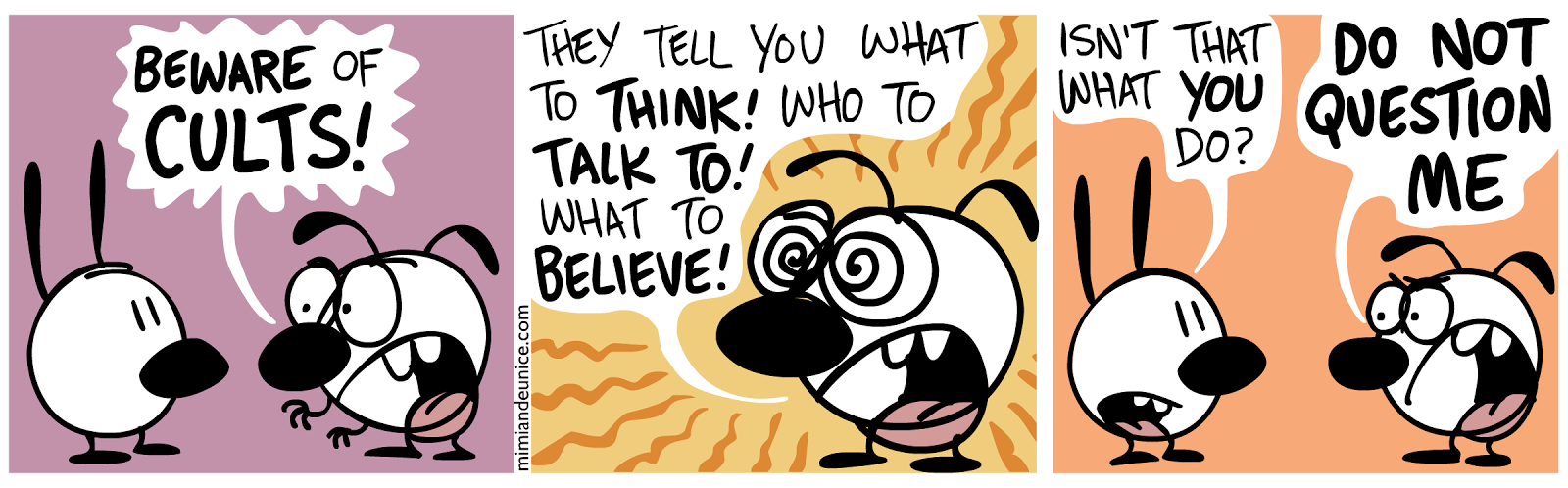
Image from www.criminalizeconservatism.com
Q. Is Aish HaTorah a Cult?
[S6K: highlights and emphasis/underscore added].
I read an article online by cult-buster who claims that Aish HaTorah is a cult. I’ve even heard the term “I’ve been Aish’d.” All the people I’ve met through Aish seem normal and balanced. How can I be sure that you guys aren’t just some Jewish version of Hare Krishna?
A. The Aish Rabbi Replies:
People tend to label anything as a “cult” that challenges them to rethink their belief system.
But if that’s the case, then for a European Socialist, American democracy is a cult.
Of course that notion is absurd.
So let’s define our terms: What is a cult, and how does Aish HaTorah compare to that?
1) Cults always force you to cut off ties with your family. Ask any parents of Aish HaTorah students and they will tell you that they are recipients of more honor and respect from their children than ever before.
2) Cults indoctrinate you not to think for yourself. The very foundation of Aish HaTorah’s philosophy is that a person has to think for themselves and work out rationally the key issues of life. The Torah emphasizes building a rational basis of belief, to engage one’s intellect through questioning and debate. It does not endorse leaps of faith, all-or-nothing decisions or disengagement from the world. Jewish life requires both the mind and heart, but the mind must lead the heart.
The Discovery Seminar is based on this, as are Rabbi Weinberg’s 48 Ways to Wisdom classes. [check out: http://www.aish.com/sp/48w/]
Aish does not use hard-sell because it believes it has the most powerful “product” in the universe – the Torah. As the Almighty’s instructions for living, Torah teaches us how to maximize our pleasure and potential in life. As such, it is the most revolutionary book in history.
Aish helps young Jews see Judaism as a basis to answer the most important questions: How can I live a meaningful life; build successful relationships; deal honestly in business; fulfill my personal potential; really make a difference in the world?
So what does it mean to be Aish’d? It means to become educated. To strengthen one’s Jewish pride through knowledge and understanding. To grow Jewishly, one step at a time. To replace apathy with idealism. To defend Israel. To respect every Jew. To take responsibility for the world, using the Torah as our guide, to fulfill the mission of the Jewish people. And most of all, being Aish’d means to love being Jewish.
If Aish is a cult, then it is the same cult practiced by Abraham, Maimonides and our Bubbies in Europe!