
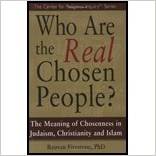
Must Read: Who are the REAL Chosen People? – by Reuven Firestone

Image from amazon.com

Image from amazon.com

[This book we recommend not only as MUST READ but also as MUST OWN.  One of the questions often asked of us is why should God choose a people over and above all other people groupings, nations, races—and what makes Israel special in God’s eyes?  We’ve often tried to explain that chosen-ness does not imply superiority as it is often misunderstood to be; in fact the question is asked with some resentment and disbelief.  Well, if there is one book that thoroughly explains Israel as “chosen” this is it! And the explanation makes the most sense and in fact surprises even us! We will feature as many excerpts here to provide enough incentive for you to secure your own copy for your library, it is worth it! We bought our copy from DAYENU, the gift shop at the Jewish Community Center in San Francisco CA; it is available in amazon.com in both book and ebook downloadable on kindle.–Admin1.]


Front Cover:


The Center for Religious Inquiry Series: This series explores topics of religion and spirituality in an effort to develop new understandings of the various faith traditions.  Each book is developed in conjunction with the acclaimed Center for Religious Inquiry, a model for religious exploration across traditional religious lines that is being replicated across the United States.


Who Are the REAL Chosen People?

The Meaning of Chosenness in Judaism, Christianity and Islam

Reuven Firestone, PhD, is professor of medieval Jewish and Islamic studies at Hebrew Union College—Jewish Institute of Religion.  He is the author of An Introduction to Islam for Jews and Children of Abraham: An Introduction to Judaism for Muslims, among other books.  He is a frequent speaker on the topics of early Islam and its relationship to Judaism and Christianity, scriptural interpretation of the Bible and Qu’ran, and the phenomenon of holy war in the Abrahamic religions.

Inside front cover:

Jews, Christians, and Muslims each claim in one way or another to be God’s chosen community.  Whether called chosenness or election, the special nature of that divinely authorized status—its implied or stated superiority—has been glorified by religious civilizations when in positions of imperial power and has sustained religious communities suffering persecution.

To understand how and why the concept of chosenness became so important in religion, Reuven Firestone examines the emergence of the authoritative marker of authenticity for the competing expressions of monotheism.  He discusses how chosenness became a category over which great arguments, inquisitions, and religious wars have been fought.  He shows how understanding the notion of chosenness can help you navigate between your beliefs and those of others, and help you make sense of your own unique place in a religiously complex world.


Back page:


What does it mean to be “Chosen”? Why did God have to choose?


“To be chosen can have a range of meaning from the mundane to the holy, but in all cases it means to be singled out and preferred over others.  In a deep sense that permeates much or most of Western culture, having been chosen communicates a sense of something that is extraordinary, is transcendent, and entitles a reward.  What is assumed in this sense of the term is that God has done the choosing and the reward is something that is unequaled, for what could possibly equal divinely ordained eternal happiness?”—from the Introduction


Religious people who define themselves as monotheists have often advanced the idea that their relationship with God is unique and superior to all others.  Theirs supersedes those that came before, and is superior to those that have followed.  This phenomenon tends to be expressed in terms not only of supersessionism, but also of “chosenness” or “election.”  Who is the most beloved of God?  What expression of divine will is the most perfect?  Which relationship reflects God’s ultimate demands or desire?


Image from ahmadiyyatimes.blogspot.com

Image from ahmadiyyatimes.blogspot.com

CONTENTS

Introduction:  The Language of Chosenness


1  In the Beginning

2  Chosenness in the Ancient Near East

3  Best Practice Models and Religious Success

4  Chosenness and Covenant in the New Testament

5  Chosenness and Covenant in the Qur’an

6  Chosenness and Covenant in Rabbinic Literature

7  The Merit of the Ancients

8  The Legacy of Chosenness

9  Does Redemption require Election?


Conclusion:  Retaining Our Uniqueness while Affirming the Other

Notes

Suggestions for Further Reading

———————————————–


Reviews:


“Fair and careful . . . allows the reader to understand the worldview of these different traditions and to recognize ways of navigating the difficult issues that arise from the claims of chosenness . . . Will aid those interested in greater self-understanding and those wishing to engage the difficult issues of interfaith dialogue.  Highly recommended.” —Congregational Libraries Today


“Clear and cogent . . . .Insightful . . . .Deserves a wide readership to help Jews, Christians and Muslims not to renounce but to understand more deeply one of the central elements of their religious heritage.—Dialogue & Alliance


“With elegant concision and scrupulous fairness, Reuven Firestone has taken up the most contentious question in all of Western religious history and drawn off at least some of its poison.  No teacher or serious student of the tangled relations among Judaism, Christianity and Islam should be without this little book.”—Jack Miles, author, God: A Biography.


“Rabbi Firestone takes us on a journey through the three monotheistic traditions of Judaism, Christianity, and Islam to uncover the meaning of ‘chosenness.’  He makes a compelling argument against parochial interpretations of this important concept, and illustrates how erroneously it has been associated with the self-exaltation of one religious community or another.  This book is both informative and thought provoking.” Louay Safi, PhD, executive director, Leadership Development Center, Islamic Society of North America


“With a rare depth and range of scholarly knowledge and theoretical sophistication as well as a sympathetic yet judicious eye, Reuven firestone presents a portrait of the notion of chosenness in the three great Abrahamic Western religious traditions—Judaism, Christiantiy, and Islam—-in a manner that is both magisterial and accessible.  Scholars and laypeople, believers and skeptics alike will profit greatly from this informative and thought-provoking book.”—Rabbi David Ellenson, PhD, president, Hebrew Union College—Jewish Institute of Religion


“As we enter a new era of interreligious dialogue, the concept of ‘chosenness’ poses a serious problem.  This is the first, careful, fair and thorough comparison of how the concept functions in the three major Abrahamic religions, all of which have their version of it.  It will help move interreligious relations beyond the cliches in which it can sometimes become mired and into a needed honest grappling with the seemingly more intractable issues.  It will be required reading for anyone interested in nurturing religious diversity in a globalizing world.”—Harvey Cox, Hollis Professor of Divinity, Harvard University


“Reuven Firestone has waded into the most difficult troubled waters of interreligious conflict and navigated them fairly.  This is a highly readable and well-balanced treatment of the tough issues—chosenness and exclusive claims—that have long marred the great moral achievements of monotheism.  A worthwhile sourcebook for all who participate in dialogue.”—Dr. Arthur Green, rector, Hebrew College Rabbinical School, author, Seek My Face: A Jewish Mystical Theology and Ehyeh: A Kabbalah for Tomorrow.


Who are the Real Chosen People? raises a central discussion when examining the relationship between the three great Abrahamic faiths and interfaith dialogue.  Rabbi Reuven Firestone has done the reader a favor by not glossing over the hard issues that confront us, rather offering a timely analysis of the concept of ‘chosenness.’  The reader needs to engage with Firestone’s clear and sympathetic arguments in order to make sense of what is happening in the world today.  Rabbi Firestone is truly a leader of moral courage and vision for our troubled times.”—Akbar Ahmed, PhD, Ibn Khaldun Chair of Islamic Studies, American University


“A fascinating topic and a highly stimulating exploration of chosenness in Judaism, Christianity and Islam.  Professor Firestone’s research is thorough, and his discussion and conclusions provide much food for thought.”—Ghada Osman, PhD, Center for Islamic and Arabic Studies, San Diego State University

Must Read: Robert Schoen – 5 – Jews, Jesus, and Christianity/Judaism

Image from amazon.com

Image from amazon.com

[Continuing  our featured MUST READ: What I Wish My Christian Friends Knew about JUDAISM by Robert ShoenAdmin1.]

Most modern Jews would agree that Jesus was a great man, a teacher, and even a prophet who traveled the land performing wonderful, miraculous deeds and preached love and kindness.  Christians recognize Jesus as Christ, the Son of God, their savior, and the Messiah.
 
The Jewish people believe that when the Messiah comes there will be an end to world suffering.  They look to Isaiah 2:4, which says, “they shall beat their swords into plowshares, and their spears into pruning hooks; nations shall not lift up sword against nation, neither shall they learn war no more.”  When the Messiah comes, the world will no longer be a place of hunger, hatred, and injustice, and the wolf, lamb, lion, and calf will all live together.  Jews do not believe, therefore, that the Messiah has come, and they do not recognize Jesus as their savior or as the Son of God.


Thus, Jews who believe in either the coming of the Messiah or a messianic age continue to await the event, while Christians await the second coming of their Messiah.
 
Fortunately, there are signs of growing understanding, respect, and acceptance among many members of the Jewish and Christian faiths.  Recent affirmations between leaders of Catholic and Jewish groups indicate agreement that both faiths are beloved of God and assured of God’s grace.  In many communities, interfaith councils and coalitions of religious congregations work to promote and maintain religious tolerance, mutual support, political action, and education.
 
If Jews are permitted to believe what they believe, and Christians are permitted to believe what they believe, all will benefit.  History has shown that when one group forces their beliefs on another, serious problems occur.
 
Because of the nature of American society, many Christians and Jews work together, socialize, live in the same neighborhoods, and send their children to the same schools.  If a Christian attends a synagogue service for a bar or bat mitzvah, a wedding, or a funeral service, he or she will recognize or be comfortable with many of the things being said.  After all, such ceremonies use the same prayers and the same books of Moses that Jesus once studied.  When Jews attend the church of a friend for a confirmation, wedding, funeral, or first communion, it’s a little different; as guests they will not take communion, kneel, cross themselves, or actively participate in the Christian New Testament liturgy.  It is foreign to their beliefs to do so.  Many Bible stories, prayers, and psalms, however, are familiar to them.
 
Fortunately, Christians and Jews begin their relationship with several things in common:

  • the Hebrew Scriptures (the Old Testament),
  • the Ten Commandments,
  • a Sabbath day,
  • the importance of charitable giving,
  • and similar versions of what is known as the golden rule.
  • Most importantly, we share the same God.

During interfaith services, and when attending community services in response to local, national, and international disasters or tragedies, Christians and Jews as well as members of other faiths find themselves praying together.  Under such circumstances, members of all faiths seem to rise to the occasion, focus on what they have in common, and worship together.
 
I hope that we continue to look to our similarities instead of our differences, and I pray that someday we all live together in peace, or as we say in Hebrew, shalom.
 
THE JEWISH RELIGION
 
From Orthodox . . .
 
Until the nineteenth century, virtually every Jew was an observant Jew as we would describe one today.  A Polish Jew and a Persian Jew would follow similar rituals, even though the former might be described as Ashkenazic (originating from Eastern Europe) and the latter as Sephardic (originating from Spain, Southern Europe, the Near East, or North Africa (see “Ashkenazic and Sephardic Jews”).
 
Orthodox Judaism resists change of its beliefs and practices.  A central tenet of Orthodox Judaism is that the law of God was given to Moses on Mount Sinai, and the Torah, therefore, is divine.  Thus, no law derived from the Torah should be tampered with, regardless of modern lifestyles, needs, or changes in society.  Because of this, Orthodox rabbis believe that rulings of other Jewish groups are based on a different set of guidelines and are therefore not valid.
 
As in any group, in Orthodox Judaism, there is a range of beliefs and teachings, from ultra-Orthodox (see “Hasidim and Hasidism”) to more modern or centrist Orthodox.  However, the traditional body of Jewish writings and the codification of law and practice remain the basis for belief, practice, and decision making, regardless of changes in modern life or personal conscience.
 
There are many rules that govern the practice of Judaism.  An Orthodox Jew must learn these rules, which is no simple task, and keeping a given rule is not optional; that person must decide how best to apply the rule.
 
Since Orthodox Jews traditionally do not travel by car on the Sabbath, their synagogues generally are located within walking distance of home.  Thus, while the congregations may be small, there are a significant number of them.  The Orthodox Union, founded one hundred years ago, serves as the central organization for affiliated member synagogues in North America.  Besides serving as a central coordinating organization, the Orthodox Union provides educational and social services, programs, and activities.  There are more than one thousand affiliated and independent Orthodox Jewish congregations in the United States.
 
To Reform . . .
 
After the French Revolution and other political and social movements across the globe, many Jews began to modify certain religious and ceremonial practices, and a new movement in Judaism emerged.  The principal and innovative difference was the belief that the Bible was not divine.  From this major alteration in philosophy came changes in the rituals and practices of Judaism, some quite drastic (at one point, some Jews even celebrated the Sabbath on Sunday instead of Saturday).
 
Religious service began to be conducted in the local language instead of strictly in Hebrew; men and women were seated together; musical instruments provided accompaniment to the cantor and congregation; and restrictions on diet and on Sabbath activities were relaxed.
 
The Reform movement originated in Germany during the early nineteenth century.  It then began to flourish among German Jewish immigrants to the United States.  The Union of American Hebrew Congregations estimates that approximately one and a half million Reform Jews are now affiliated with more than nine hundred congregations in North America.
 
Today, Reform Judaism is a combination of traditional practice and modification of that practice, and it emphasizes a need to interpret the Jewish tradition from a modern and individual perspective.  Complete equality of the genders is the rule,, and many female rabbis and cantors lead Reform congregations.  . . . New changes, hymns, and melodies are continually added to the traditional prayers and sacred music of worship services, and these prayers are written in language that is gender-neutral.
 
While at one time the Reform movement did away with traditional prayer garb, it now encourages worshippers to follow their own beliefs and to wear prayer shawls and head covering if they wish to do so.
 
Reform Judaism places decisions regarding rituals and observances more on the individual than Orthodox or Conservative Judaism does.  With this individual religious autonomy, many Reform Jews shape a spiritual life for themselves by choosing from among the many holidays, rituals, and “rules” and by finding, over a period of time, which ones allow them to lead the Jewish life and lifestyle that is most comfortable for them.  One rabbi I know stresses “informed choice”: first study, then choose.
 
To Conservative  . . .
 
In the late nineteenth century, there was a large increase in the Jewish population in the United States as a result of immigration from Russia and Eastern Europe.  Not all of these Jewish immigrants were happy or comfortable with the Reform movement.  Eventually, a schism occurred between the more traditional and the more radical leaders, and in the early twentieth century, this breakup led eventually to the Conservative movement in Judaism.  The United Synagogues of Conservative Judaism estimates that today there are approximately eight hundred affiliated Conservative congregations representing some one and a half million members.
 
Conservative Judaism represents a mix of both traditional and more modern views.  It accommodates the needs of Jewish life in contemporary society but at the same time accepts the divine inspiration of the law of the Torah.  For example, it’s OK to drive to the synagogue. This is because of the differences in lifestyles in the United States versus the traditional small Eastern European Jewish communities of a hundred or more years ago. Today, the need to get to the synagogue on Shabbat from a distance too far to walk overrides the prohibition of “lighting a fire” (starting the car ignition).
 
The emphasis of Conservative belief lies between the Reform and the Orthodox.  Personal decisions are based not as much on individual conscience as on the accepted practice of the Jewish community, the ritual committees within each congregation, and the guidance of Jewish scholarship through the ages.  Conservative Judaism thus tends to be more traditional than Reform Judaism in its services, practices, and beliefs.  However, some Conservative congregations appear more “reform” than some Reform congregations and vice versa, and it is not uncommon to find many Conservative congregants quite orthodox in their religious behavior and practices.
 
To Reconstructionist
 
Many people in the general population may not have heard of the Reconstructionist movement.  It was inspired by the vision of Rabbi Mordecai Kaplan, a faculty member of a Conservative rabbinical seminary who helped found a new rabbinical college at the urgings of his students and supporters.  Kaplan’s concept was that Judaism is more than just a religion; it is a “civilization” that evolves and progresses and must therefore be “reconstructed”—rediscovered, and reinterpreted on an ongoing basis—to be kept alive.
 
In much the same manner as contemporary Conservative and Reform congregations, Reconstructionist congregations embrace a wide variety of traditional and nontraditional Jewish backgrounds, experiences, and lifestyles, and they operate in a gender-neutral environment.  The Reconstructionist congregation often decides how it will honor traditional Jewish customs, molding them to accommodate
what it considers the realities of modern life.
 
While Reconstructionist Jews have a strong commitment to tradition, they also search for contemporary meaning in the liturgy and religious service.  If a particular Jewish custom is questionable in view of contemporary society, it will be examined and “reconstructed’; new meanings will be found in the old forms or they will be developed into more meaningful innovative practices.
 
Reconstructionism diverges from Conservative and Reform Judaism in how it views the interpretation of traditional Jewish law and in how far Jewish law can be amended.  Reconstructionism also differs from Conservative and Reform Judaism in the concept of ethical monotheism and its belief that the basic tenets of Judaism need to be reexamined and restated for our age.  In general, Reconstructionist congregations fall somewhere between Reform and Conservative in terms of religious practice; they may be described as liberal in their theology.  As with many aspects of Judaism, there is considerable range of practice and belie within the Reconstructionist movement.
 
The Jewish Reconstructionist Federation lists more than one hundred congregations in North America.  A number of these congregations are organized as havurot.  havurah (singular) is a gathering of Jews who meet to worship and study together.  The havurah is a religious group, but it also functions as a fellowship group and an extended family (see “Contemporary Synagogues and Congregations”).
 
Although Reconstructioist congregations tend to be small, the concepts and philosophy of the movement have affected modern Jewish belief and practice.
 
Contemporary Synagogues and Congregations
 
As the nature of society has changed in modern times, so have the Jewish community and, consequently, the synagogue.   At one time, Jews lived in small shtetlach (singular shtetl; Yiddish for ghettos, villages, or settlements), closed communities in Eastern Europe or elsewhere.  This is generally no longer the case in the United States, except for a few Hasidic communities located in New York and other cities.  As Jews became more assimilated into mainstream society, the Jewish community became more disseminated, and Jews now live almost everywhere.  As a result, the synagogue has become a place of gathering for Jewish people, a center not only for prayer and study but also for sharing heritage and culture, socializing, and growing within the faith.
 
The word synagogue derives from a Greek word that means “to congregate or to gather together.”  Evidence has been discovered of synagogues from two thousand years ago.  Some congregations call their institution a synagogue, while others call it a temple, a word derived from Latin.  The use of the word temple may refer to or be a symbolic reminder of the original temples of Jerusalem that were destroyed centuries ago (see “The Temple”).


Through the years, synagogues have been built everywhere Jewish people live.  Many reflect the architecture of the times or a country’s specific style, whether baroque, Gothic, art deco or contemporary/modern.
 
Some Jewish groups simply call themselves a congregation while others refer to the synagogue as a shul,  which is aYiddish word that means “school.”  Still others organize and support a local community center, which provides a place for community events, nursery or other schools, youth activities, adult education, and often Shabbat services.
 
It is not necessary that a congregation have a full-time rabbi and/or cantor on the payroll to function.  Often, a small congregation runs its worship services, religious school, and social functions with volunteers or with part-time or occasional “professioanl” help.
 
The word havurah refers to a small group that functions either independently of a larger religious congregation or as part of an organized synagogue.  The word comes from the Hebrew root word for “friend.”  The havurah serves as a fellowship group and extended family with which to celebrate holidays, share support in times of crisis, enjoy religious and nonreligious events, and maintain a network of people who share the faith.
 
In addition, there are “alternative” congregations or organizations that combine Jewish traditions and beliefs with mysticism, vegetarianism, New Age philosophy, or social and political action.  For example, Jewish meditation, spirituality, and education combine to form the basis of a very popular Jewish community group where I live in Northern California’s Bay Area.
 
In other words, there is ore than one place for Jewish people to meet, study, socialize, solve problems large and small, and worship.

Must Read: Robert Schoen – 4 – Going to Church: The Jewish Roots of Christian Worship

Image from amazon.com

Image from amazon.com

[Continuing our MUST READ series featuring Robert Shoen who wrote the  book we are currently featuring:  What I Wish My Christian Friends Knew about JUDAISM by Robert Shoen.  
 
While Sinaites’ don’t fully agree with some opinions of this writer, as a resource center for seekers of the Truth and the One True God, we believe in providing all sides of any argument to expose our readers to a wide range of thinking on any subject.  From his title alone, this writer  embraces the middle ground and has a conciliatory attitude and healthy respect for other faiths.  It is an attitude worth emulating, if the religious population will learn to be tolerant of one another’s belief system and simply be open to understanding each other’s religious choice.
 
We are providing only chapter samples of the book to encourage you to get a copy of your own. It is available in amazon.com in hard copy and downloadable as a kindle ebook.Admin1]
 

Image from derronisha.wordpress.com380

Image from derronisha.wordpress.com380

 
Excerpts (reformatted):
 
During my church service attendance, research, observation, and communications with knowledgeable religious leaders, laypeople, and writers, I’ve become familiar with a few of the principal features that Jews and Christians share.
 

  1. First and foremost, we worship the same God—the God of the Hebrew Scriptures, the God of Abraham, the God who brought the children of Israel out of slavery in Egypt.  This is the God who gave us the Ten Commandments. This is the God who Moses worshipped.  It is the same God who Jesus worshipped.  This came clearly into focus when I visited the Sistine Chapel in Rome:  on one great wall, Michaelangelo painted scenes from the life of Jesus, and on the opposite wall, he presented scenes from the life of Moses.
  2. When they pray, both Christians and Jews give thanks to God and recite the works of God, recalling what God has done.
  3. Worship services follow a certain sequence.  Christians use the Latin word ordo to describe their worship sequence; Jews use the Hebrew word seder (or siddur).  These words mean “order.”  The order of the services is different, which is to be expected considering the many hundreds of years during which religious practices developed and holiday calendars were modified.  (This is the case for Christian holidays that may have once paralleled Jewish holidays, such as Easter and Lent, which have been connected to Passover.)
  4. Both Jewish and Christian services begin with a “call to prayer.”  This is followed by prayers, recitation of portions of the Hebrew Scriptures, and readings from the Psalms.  Christian  services I’ve attended have included readings from Isaiah and the book of Kings.
  • In Jewish services, a portion from the Torah is read on the Sabbath as well as during other weekly services (see “The Torah and the Law”).  In Christian services, there is a reading from one of the Gospels, the books that narrate the life and present the teachings of Jesus.
  • At some point in the Jewish service, the rabbi delivers a sermon.  If a Torah portion has been read during the service, the sermon generally incorporates an idea or message from that portion.  In the Christian service, a minister or priest delivers a sermon or homily in a similar manner, offering an understanding of the Scripture reading and and an application to contemporary life and the community.  (Many of the priests and ministers I’ve heard have a good sense of humor, as do most rabbis I’ve met.  I guess it goes with the job.

 
5.  While attending Christian religious services, I have found some Christian prayers and blessings that closely parallel those included in Jewish services.  For example, here is a prayer from Christian worship that may also be sung as a hymn; this prayer has its roots in Isaiah 6:3:
 

Holy, Holy Holy, Lord of power and might, 
Heaven and earth are full of your glory . . .
Blessed is he who comes in the name of the Lord.

Here is the portion Jews recite in English (or sing in Hebrew) on the Sabbath and at other services:


Holy, Holy, Holy is the God of all being.
The whole earth is filled with Your glory.
Source of our strength, Sovereign God, how majestic is Your presence in all the earth.
Praised be the glory of God in heaven and earth. (Gates of Prayer)


Here is another important part of the worship service that is similar in both the Christian and the Jewish traditions.  For Christians, it is the Lord’s Prayer:


Our Father, who art in heaven,
Hallowed be thy name.
Thy Kingdom come,
Thy will be done, 
On earth as it is in heaven.
Give us this day our daily bread.
And forgive us our trespasses, as we forgive those who trespass against us.
And lead us not into temptation, but deliver us from evil.
For thine is the kingdom, the power, and the glory.
For ever and ever. Amen.


During their religious services, Jews recite the Kaddish several times.  As with other parts of Sabbath worship services, the Kaddish is not a prayer per se; it extols the glory and name of God, but it does not ask for anything.  While the theology behind the Kaddish is very different from that behind the Lord’s Prayer, look at the similarity:


Let the glory of God be extolled, and God’s great name be hallowed in the world whose creation God willed.  
May God rule in our own day, our own lives, and the life of all Israel, and let us say: Amen.
Let God’s great name be blessed for ever and ever.
Beyond all praises, songs, and adorations that we can utter is the Holy One, the Blessed One, whom yet we glorify, honor, and exalt.  And let us say: Amen.
For us and for all Israel, may the blessing of peace and the promise of life come true, and let us say: Amen.
May the One who causes peace to reign in the high heavens, cause peace to reign among us, all Israel, and all the world, and let us say: Amen. (Gates of Prayer)

6.  As both Jews and Christians know, bread and wine are common to both religions, but in very different ways.  For centuries, Jews have been accustomed to making blessings over bread and wine, both in the synagogue and at mealtime at home with friends and family.  At the end of a Jewish service, the leader
or members of the congregation recite the blessings.


  • According to the Gospels, at the Last Supper, Jesus inaugurated and defined a rite that is central to Christian belief and to church services, the Eucharist.  Here is the passage from Matthew 26:26-28:


While they were eating, Jesus took a loaf of bread, and after blessing it he broke it, gave it to the disciples, and said, “Take, eat: this is my body.”  Then he took a cup, and after giving thanks he gave it to them, saying, “Drink from it, all of you; for this is my blood of the covenant, which is poured out for many for the forgiveness of sins.”


I have observed the solemnity with which churchgoers receive communion, the rite that has links to the Jewish ritual consumption of bread and wine and to the temple sacrifices in ancient Jerusalem.  I also have learned that a key to understanding the Eucharist is in Jesus’ command, “Do this in remembrance of me,” (Luke 22:19).

 
7.  Water is an important part of both Jewish and Christian rituals.  
 

    • In Judaism, water is used for conversions as well as for cleansing and renewal, and it is usually linked to the use of the mikvah, the ritual bath (see “Shabbat—The Sabbath”), although immersion can take place in any body of moving water (the Jordan River, for example). There is evidence that the mikvah was being used in the first century CE, and evidence of a mikvah was being found at the ruins of Masada (see “Israel”).  The idea of using a bath and immersion in water as a means of repentance was used in ancient times and is common today to cleanse and prepare for prayer.
    • In Christianity, water is used in the baptism ritual, which is the sacrament of regeneration and admission into the Christian community.  In this manner, the person being baptized receives a new and spiritual life.  A baptism can be performed with symbolic sprinkling of or actual immersion in water.

 
Christianity and Judaism share many roots—in worship, liturgy, and rituals.  Of course, there remain much controversy and grounds for scholarly debate about two thousand years of history, belief, and learning.  But I will leave the debate, research, and controversy to the scholars and end with a blessing common to both the Jewish and Christian traditions.
 
I have heard the Priestly Blessing recited by rabbis at synagogue services for my entire life, and I hear it now at many of the church services I attend.  Also known as the Aaronic Benediction, it is the blessing of the Lord with which Aaron and his sons were to bless the children of Israel (Numbers 6:24-26):
 

The LORD bless you and keep you;
the LORD make his face to shine upon you, and be gracious to you;
the LORD lift up his countenance upon you, and give you peace.


Must Read/Robert Shoen -3: A Range of Jewish Lifestyles, Beliefs, and Behaviors

Image from amazon.com

Image from amazon.com

[Continued from previous posts on READ: What I Wish My Christian Friends Knew about JUDAISM by Robert Shoen.  This chapter is interesting; it answers the question what makes a person ‘Jewish’.  Admin1.]
 
Even if I have never been a “practicing” or observant Jew, I’m still Jewish.
 
Whether I attend religious services or speak or read Hebrew, I’m still Jewish.  Regardless of whether I have become a bar mitzvah or been married in a Jewish ceremony (or, for that matter, married another Jewish person), I am still considered Jewish.  Even if I’ve never stepped into a synagogue in my life, if I was born a Jew, I’m still a Jew.  And if I’ve converted to Judaism, then I am considered as much a Jew as someone who is born a Jew.
 
I can renounce my Jewish heritage and religion and convert to another faith, in which case I might consider myself something else.  I may even seek my own form of observance, define and embrace a personal concept of God, or combine tenets of several different religions.  However, according to traditional Jewish law, I am still considered Jewish.
 
And when my time is up, even if I don’t know the first thing about the history of Judaism, the literature of the Old Testament, or the difference between Hanukkah and harmonica, I can be buried as a Jew.
 
The problem with all this is that it causes a lot of confusion to non-Jewish observers.  For example, if I have a Jewish friend who is very observant, attends synagogue services every day, always covers his or her head with some kind of hat, recites prayers periodically throughout the day for myriad activities, keeps a strictly kosher home, and never works on the Sabbath, my friend will be considered a more observant Jew than I am.  However, I am just as much a Jew as my friend is.
 
Many of the customs, procedures, beliefs, and behavioral aspects of the Jewish religion date back hundreds and even thousands of years.  Most Jews throughout history lived in small, closed communities or ghettos and did not mix with general society, except perhaps for work or mercantile purposes.  Today, of course, this is not true, especially in the United States (although there are always exceptions).
 
Thus, describing what it is like to be Jewish is like describing snow.  While you can describe snow in terms of intensity, duration, witness or dryness, inches of snowfall, historical perspectives, granularity, color, effect on visibility, and even the possibilities of school closings and ski conditions, you can also just say “It’s snowing.”
 
It is really the range or spectrum of Jewishness that makes it difficult to describe or explain.  An Israeli friend of mine describes it as a continuum.  You can go from the ultra-Orthodox Jew all the way to the most liberal Reform Jew, from the extremist to the virtually nonobservant Jew, and still find some similarities of belief.  Even though there are more differences than commonalities, all of these people are Jews.  While there may be very little that ties them together (even tradition is not a leveling factor), what they do have is a common lineage and a common ancestry—a common history.
 
When describing things Jewish, I often find myself saying things like, “Some Jews beleive . . .” or “Reform Jews do not believe . . .” or “It is not uncommon for some Jews to . . . ” The reason for all this hedging is that Jews typically do not agree on many aspects of what it means to be Jewish or of Judaism itself.  That doesn’t mean, however, that I can’t give you an overview, a snapshot, or perhaps a sketch of the Jewish way of life—the customs and beliefs, the holidays and festivals, the history and people.
 
In many instances throughout the book, I introduce a term in one section and more fully explain it in a later chapter.  Hebrew and Yiddish words are defined in the glossary along with their correct pronunciations.


Must Read/Robert Schoen – 2: The Purpose for this Book

Image from amazon.com

Image from amazon.com

[If you haven’t done so, please read the introductory post to this series:  MUST READ: What I Wish My Christian Friends Knew about JUDAISM by Robert Shoen.
 
I’ve said this before: the Jews do not read the “Old Testament”.  The reason is, their sacred scriptures are not “old” nor considered a “testament”.  What they do read is their TNK, the Hebrew Scriptures. What is the difference?  We have posts explaining that there is a world of difference, please refer to those if you care to know.  This is tackled by the author of this book as well.—Admin1]


The Purpose of this Book
 
I have never met a Christian who was not in some way curious about Judaism, the Jewish people, or some aspect of the Jewish way of life.  Even though Christianity evolved from Judaism and Jesus himself was a Jew, during their religious education and upbringing most Christians learn little about Judaism and the Jews.  Often what they do learn is based on myth or hearsay and serves only to increase their curiosity (or multiply their misconceptions) about why Jews do what they do and believe what they believe.
 
I have also discovered that the more a Christian knows about his or her religion, the more curious that person tends to be about Judaism.
 
Christians have good reason to be curious.  After all, Judaism and Christianity come from the same roots.  Our religions share many of the same biblical stories, taken from the Hebrew Scriptures (commonly referred to as the Old Testament).  Thus, both Christians and Jews feel comfortable telling the age-old stories of Adam and Eve, David and Goliath, Sodom and Gomorrah, Daniel, Noah, Moses, and Joseph.  Both Christians and Jews are steeped in this shared heritage.  We can rejoice together in the marvelous stories, lessons to be learned, and wit and wisdom.  We also can learn important lessons from those early accounts of tragedies, wars, and other situations that revealed the ultimate power of God.
 
Many Christians wonder why Jews do not believe in Jesus, and why Jewish children and adults do not study the teachings and stories of the New Testament.  When a person is growing up Jewish in America, these questions can be very puzzling and difficult to answer.
 
Through the years, I have wondered about how best to answer questions that my Christian friends asked. Sometimes, I have given simple explanations about how Christian teachings are not part of the Jewish belief system.  I’ve said that Jews have nothing against Jesus, the New Testament, Catholics, Protestants, or any other Christian denomination or sect—or any non-Jewish religion, for that matter.  Questions beget more questions, though, and answers are rarely simple.
 
Many Christians don’t realize that Jews, as a group, are unfamiliar with the New Testament and the teachings of Christianity. Why is this?  The New Testament is not part of our heritage, not included in our worship services, and not included in our many religious books.  Certainly there are Jewish scholars who study Christian texts and writings.  In addition, rabbis and Jewish educators learn about Christianity and other religions as part of their formal training.
 
However, the average Jewish person has not read the New Testament.  I am pleased to say that I have.  Not long ago, as part of a university course called “The Bible for Students of Literature,” I read the New Testament for the first time.  How surprised and pleased I was to find the source of so many common sayings, words of wisdom, and stories.  I had no idea!  Both the Hebrew Scriptures and the New Testament surely provide the “greatest stories ever told.”
 
Being one of the only Jews taking that course, however, also invited a new series of questions from my classmates.  These were questions I had heard through the years about why Jewish people believe certain things, why they perform the rituals they do, what is the significance of the Jewish calendar, and what are the origins of many customs and practices.
 
I can say this:  I believe that in the heart of the Jewish people there exists a deep-seated desire to be permitted to pray in our own way, to observe God the way we wish, and to live a life of peace.  I would guess that this desire is similar to that of non-Jews as well.  You could call this a basic desire for religious tolerance, and Christians certainly understand this, since virtually every religious group in history has sought religious tolerance and the freedom to worship in its own way.  In its time, each group has experienced terrible ordeals, but I am most familiar with the history of the Jewish people, a nation that has been enslaved, expelled from numerous countries, and suffered at the hands of those who wished to exterminate it completely, and a nation that continues to endure persecution in its many subtle and overt forms.  The story of Judaism and the Jewish way of life is a complicated one.
 
Besides normal curiosity, many Christians and other  non-Jews desire a basic understanding about the Jewish people and their holidays, customs, and history.  This desire often arises as a result of marriage and family relationships, friendships at work, social situations, or church activities.
 
For example, Christians who have married members of my family have questions about the holidays that they now help celebrate even while maintaining their own religious beliefs.  To cite another example, my wife and I have participated in interfaith meetings in an attempt to coordinate efforts and rally political support to help improve social and educational services in our city.  In addition, while it is common to have Christmas parties in the workplace or in schools, often Jewish holidays such as Rosh Hashanah (the Jewish New Year) and Hanukkah  are also celebrated, raising the curiosity of non-Jews present at the occasions.
 
I am a layman, and I write from the perspective of someone who considers himself an “average Jewish American.”  Whether you have a Jewish friend, spouse, employer, employee, or coworker, knowledgeable about the issues of what it means to be a Jew, what the basic tenets and philosophy of Judaism are, and what probably contemporary American Jews face in today’s society.
 
So, I have written this book to satisfy curiosity, answer questions, and offer a resource for inquisitive people.
 
Next:  A Range of Jewish Lifestyles, Beliefs, and Behaviours

MUST READ: What I Wish My Christian Friends Knew about JUDAISM by Robert Shoen

Image from amazon.com

Image from amazon.com

Kermit the Frog has said that it’s not easy being green.  Well, it’s not easy being anything.  Being Jewish presents its own problems, and through the years I have often wished I could explain to my non-Jewish friends, in a simple, nonthreatening manner, what my religion is all about. “
 
This is the opening statement in the book’s Preface which made my youngest son pick up the book (along with two others we will feature); he suggested to me that instead of trying to explain Torah life to the clueless, if anyone is truly interested—just suggest books they could read such as this one.
 
What interested me in the opening statement is “its not easy being green” . . . that should have been qualified by a something like “in a red world.”  What do I mean?
 

Image from www.quia.com

Image from www.quia.com

 
We have written articles about how difficult it is to be a Sinaite—we are not Christian, we are not Jewish, nor are we Jew-wannabes.  And yet we’re so easily dismissed as wannabe’s if we as much as say we’re simply living the Torah life as prescribed by the self-revealing God on Sinai who gave it as guidelines for living on His planet earth.  We’re also constantly qualifying further —- what is clearly biblical/scriptural, and what is Jewish. We have repeatedly explained this experience in many posts.
 
If it’s not easy to be Jewish in a gentile world, it’s not easy to be a Sinaite in a predominantly Christ-centered world, or in  a non-Torah-observant world. Between Christians and the unbelieving population both of which are aplenty, we have much difficulty explaining where we fit in as well as our stand on Christianity/Judaism/religion in general.  In fact we keep ending up defending Israel and Judaism aside from ourselves!
 
As my son wisely suggested, just tell them —IF THEY ARE TRULY INTERESTED — to read these books, the first of which is what is featured here.
 
So, to finish the Preface:
 
From the Sabbath to circumcision, from Hanukkah to the Holocaust, from bar mitzvah to bagel, how do Jewish religion, history, holidays, lifestyles, and culture make Jews different, and why is that difference so distinctive that we carry it from birth to the grave?”
 
“So, I present here a compendium of facts, lore, and opinion.  I’ve checked the facts and the lore in a number of sources.  The opinions (and humor) are mine.  If you disagree with anything written on these pages, it’s OK.  As a matter of fact, it’s part of the Jewish tradition to disagree.“—-Robert Shoen –Oakland, California
 
As it is our practice, we feature enough excerpts or even whole chapters from our MUST READ books, if only to whet our readers’ appetites enough to convince them to get a copy for their own library.  What interests me personally might be different from what interests you, reader, so if there is any particular topic/chapter in the CONTENTS below that you wish us to feature here, please speak up in the “Leave a Reply” box.  We will accommodate you.  We realize the book might not be accessible to you; I got my copy from DAYENU, a gift shop at the Jewish Center in San Francisco.
 
What to expect from the CONTENTS ?
 
 Christians and Jews

  • Going to Church:  The Jewish Roots of Christian Worship
  • Jews, Jesus and Christianity

The Jewish Religion

  • From Orthodox
  • To Reform
  • To Reconstructionist
  • Contemporary Synagogues and Congregations
  • A Personal Observation

Inside the Synagogue

  • The Torah and the Law
  • Prayers and Blessings
  • Symbols—The Mezuzah and the Star of David
  • The Role of the Cantor
  • Jewish Education
  • Congregation Membership and Paying the Bills
  • The Temple
  • Jewish Priests
  • Time for Confession
  • Who’s in charge?

Holidays and Festivals

  • Holidays and the Jewish Calendar
  • Shabbat—the Sabbath
  • The High Holidays—Rosh Hashanah and Yom Kippur
  • Sukkot
  • Simchat Torah
  • Hanukkah—Is it Really the “Jewish Christmas”?
  • Purim
  • Passover
  • Shavuot–the Harvest Festival
  • Other Religious Events

Jewish Life Cycle Events

  • A Jewish Wedding
  • Let’s Go to a Circumcision!
  • Adoption
  • An Invitation to a Bar Mitzvah and a Bat Mitzvah
  • A Jewish Funeral —Saying Good-bye to Uncle Harry
  • You can Only Get a Divorce if You’re Married

Home Life, Jewish Beliefs, and Other Interesting Matters

  • Is a Kosher Hot Dog really Kosher?
  • Jewish Food
  • Degrees of Orthodoxy
  • Conversion to Judaism
  • Intermarriage
  • Religious Apparel and Dress
  • Hasidim and Hasidism
  • Creation, Heaven, Hell, and Life after Death
  • Where, When, and How Many
  • Ashkenazic and Sephardic Jews
  • Women and Judaism

Judaism in the World

  • Israel
  • Jewish Art and Music
  • Mysticism and the Repair of the World
  • Money—Stereotypes, Charity, and the Scriptures
  • Perform a Mitzvah
  • Controversial Social Issues
  • Old Wars and New Wars
  • The Chosen People
  • Anti-Semitism
  • The Holocaust

 
A Call for Understanding and Community
 
Next:  The Purpose of this Book/A Range of Jewish Lifestyles, Beliefs, and Behaviors.


NSB@S6K

 logo


A Sinaite's Liturgy – 1st Sabbath of June

KINDLE THE SABBATH LIGHTS

Image from www.kingjamesbibleonline.org

Image from www.kingjamesbibleonline.org

In the beginning,


the SOURCE of LIGHT,

whose blinding brilliance dazzled a darkened world when there was not a soul–animal or human—

to witness and wonder at the awesome spectacle—


the Creator YHWH spoke all matter into existence, 

one after another

according to their function and purpose,

designed to fit into His Grand Design

as only He can orchestrate it all,

with harmony and balance,

with variety and diversity,

with beauty and utmost creativity,

with perfection.  


Truly, how can we begin to describe the testimony of the created order,

the witness of  science, of nature and of humankind—

to the existence of a God Who merely speaks and suddenly there “is”?


3 God said: Let there be light! And there was light.
4 God saw the light: that it was good.
God separated the light from the darkness.
5 God called the light: Day! and the darkness he called: Night!

There was setting, there was dawning: one day.
6 God said: 

And so it was.


Image from www2.kenyon.edu

Image from www2.kenyon.edu


These Sabbath lights do not dazzle nor blind, 


but they dispel enough darkness in space where once there was light from the brilliance of a created sun which has withdrawn from our horizon on this erev Shabbat, as it regularly does in obedience to the Divine command: 


14 God said:Let there be lights in the dome of the heavens, to separate the day from the night, Let there be lights in the dome of the heavens, to separate the day from the night, that they may be for signs-for set-times, for days and years, 15 and let them be for lights in the dome of the heavens, to provide light upon the earth!  It was so.

16 God made the two great lights,  the greater light for ruling the day and the smaller light for ruling the night, and the stars.

17 God placed them in the dome of the heavens
18 to provide light upon the earth, to rule the day and the night, to separate the light from the darkness.   God saw that it was good.

19 There was setting, there was dawning: fourth day.


O Lord YHWH, Creator-God,

we read these verses in the opening chapter of Your Torah and believe with our mind and our heart every word You have spoken, as recorded by Moshe to whom is attributed the authorship of Your Sinai Revelation.


We celebrate this Sabbath day in loving tribute to You,  the first Celebrant of the first Sabbath, and as a memorial to Your first Sabbath, the seventh day when You rested from Your creative work, in the company of the first man and woman who would be the first father and mother of all humanity.


Image from artbyjoani.squarespace.com

Image from artbyjoani.squarespace.com

We conclude that You did not cease from Your work because You needed rest;
We surmise that by doing so, You were impressing upon us who now read this account, the importance of rest from a six-day workweek.


We imagine that You did not celebrate the Sabbath alone, all by Yourself;


We imagine what a blessing it must have been for the representatives of Your ‘crown of creation’, humankind, to have been there to be commanded the Sabbath law that was to be the fourth of Your Ten Declarations on Sinai.


The first human made from existing material, the earth,

was split by You into two beings to complement one another in all ways,

that they might participate in the supreme act of reproducing another being,  of their kind, but of different genders, male and female.

And that is Your original design.


And we guess that the first couple who were made on day six

were a day old when they celebrated their first Sabbath with You.


From that first Sabbath of Creation week,

You have made certain that Your Sabbath will be enshrined in Torah

as a commandment, not a mere suggestion.


We join Your chosen nation obedient Israel,

in taking joy and delight in celebration of Your Queen of days.

Come, O Lord of the Sabbath, You are welcome in this home.


This community embraces Your Lordship and Your Kingship,

and love Your Law, Your Book of Instructions

intended for all humankind.


Would that the day will come that the prophets of Israel spoke of,

that all nations will know You and honor Your Name YHWH,

by living according to Your Torah.


BLESSINGS

 
The Sabbath is a blessing, a joy and a delight.


Our Sinai community of believers in YHWH, delight in the company of one another.


The families represented here, have been blessed with life through each generation— parents, sons and daughters, grandchildren, extended families through spouses and kin.


For them all, O Giver of Life and Lord of Love,

we bless You YHWH,

and share this bread of fellowship,

and drink this wine in joyful celebration

of Your loving-kindness and mercy,


Your daily provisions, Your protection of our homes and our loved ones.
Amen.

SABBATH MEAL /TORAH STUDY

magicmoonbeams.blogspot.com

magicmoonbeams.blogspot.com

Image from anshesholomnewrochelle.org

Image from anshesholomnewrochelle.org

shabbat-Shalom


HAVDALAH


[For Havdalah, read the following quotation from Isaiah 60:19-20  addressed to YHWH’s firstborn son Israel. Sinaites pray that this will happen soon, that the end of the age might come.]
 

 19 The sun shall be no more thy light by day,

neither for brightness shall the moon give light unto thee;

but the LORD shall be unto thee an everlasting light,

and thy God thy glory.

20 Thy sun shall no more go down,

Neither shall thy moon withdraw itself;

for the LORD shall be thine everlasting light,

and the days of thy mourning shall be ended. 


NSB@S6K 


A Sinaite's Celebration of Shavuot – June 3, 2014

[ As of this year 2014, after much study and discussion of  the seven “My feasts” commanded in Leviticus 23,  Sinaites arrived at an understanding of which of the feasts apply to non-Israelites, that is, gentiles like ourselves.

 While all of the seven are in Israel’s national experience and historical roots, three of them are in the individual and community experience of non-Israelites/gentiles. These are:  

(1) the weekly Sabbath modeled by the Creator Himself in Genesis 2;  

(2) Yom Kippur or the Day of Atonement which every Jew or Gentile should observe since everyone is prone to violate YHWH’s Torah and should sincerely repent; and

(3) Shavuot which commemorates the giving of the Torah on Sinai, an anniversary that all humankind should celebrate.

There is no TORAH study included in this celebration, and no Havdalah because we just want meet in joyful celebration of the giving of YHWH’s LAW, an act of grace and mercy from YHWH, the God of Israel,  the God Who spoke on Sinai, our (Sinaite’s) God and the God of all gentiles who choose Him and who choose to live in conformity with His revealed will. 

We believe that all humankind are under grace AND law, for by YHWH’s grace, He shared with humanity what He expects of each individual!  How else would humanity live together had not the Law-Giver commanded what is just for all, through righteous living, for the good of the other, in community with one another, where the ends of justice is served equally.  The Torah is doable, not impossible to obey; the Law-Giver is a benevolent King Who best understands that those Who would choose to live under His Kingship are capable of doing all that He commands. He specially designed humanity with freedom of choice, endowed with free will to obey Him or not.

We maintain that faith is based on divinely given truth: YHWH’s Sinai revelation and no other. Deuteronomy warns, do not add or subtract!

Indeed there is cause for celebrating for Jew and Gentile.  Shavuot is one of YHWH’s “MY” feasts, and so our Torah prayer is excerpted from Psalm 119.—Admin1]


Image from www.chabadmidtown.com

Image from www.chabadmidtown.com

KINDLE THE LIGHTS OF SHAVUOT-SABBATH

Blessed be the Name of the Creator and Master Designer of the universe, Redeemer of Israel, Revelator on Sinai, our great and awesome God.
 
Blessed be Your Name,YHWH, the Eternal, Who was, is, and will be, Who chooses to be what You choose to be.
 
You manifested as a burning bush, as Shekinah,  an Invisible Presence amidst thunder and lightning at the giving of Your Torah, though Your voice was heard by all.
 

Image from beithashoavah.org

Image from beithashoavah.org


Tonight as we kindle the sabbath lights, we join Your firstborn son Israel, Your chosen people, in commemorating the giving of Your Torah, as part of Your covenant with Your chosen nation, a nation You formed through their patriarchs, Avraham, Yitzchak and Yaakov.
 
We claim our place with the gentiles among the mixed multitude gathered at Sinai, likewise delivered from bondage to Egypt seven weeks earlier, on the night of Passover.
 
We submit to You, YHWH as our LORD and our GOD, we embrace Your TORAH as our Way of Life, for it is Your gift not only to Israel but to the nations, to all peoples; we celebrate with Israel this ‘feast of weeks’.


Image from cardiphonia.org

Image from cardiphonia.org

Psalm 119

[http://www.basicsofthebible.orgexcerpted version]

Blessed are those whose way is blameless, who walk according to YHWH’s law,

Blessed are those who keep His statutes, who seek Him with their whole heart.

Yes they do nothing wrong, they walk in His ways.

You have commanded Your precepts, that we should fully obey them,

Oh that my ways were steadfast, to obey Your statutes,

I will give thanks to You with uprightness of heart, when I learn Your righteous judgments.

How can a young man keep his way pure? By living according to Your word.

With my whole heart, I have sought You.

Don’t let me wander from Your commandments.

I have hidden Your word in my heart that i might not sin against You.

Blessed are You, YHWH, teach me Your statutes.

With my lips I have declared all the ordinances of Your mouth.

I have rejoiced in the ways of Your testimonies, as much as in all riches.

I will meditate on Your precepts and consider Your ways.

I will delight myself in Your statutes, I will not forget Your word.

Do good to Your servant, I will live and I will obey Your word.

Open my eyes that I may see wondrous things out of Your law.

I am a stranger on earth, don’t hide Your commandments from me.

My soul is consumed with longing for Your ordinances at all times.

 My soul is laid low in the dust, revive me according to Your word.

I declared my ways, and You answered me.

Teach me Your statutes.

Let me understand the teaching of Your precepts, then I will meditate on Your wondrous works.

My soul is weary with sorrows, strengthen me according to Your word.

Keep me from the way of deceit, grant me Your law graciously.

I have chosen the way of truth.

I have set Your ordinances before me.

I cling to Your statutes, YHWH,

I run in the path of Your commandments for You have set my heart free.

Teach me, YHWH, the way of Your statutes, I will keep them to the end.

Give me understanding, and I will keep Your law.

Yes, I will obey it with my whole heart.

Direct me in the path of Your commandments, for I delight in them.

Turn my heart toward Your statutes, not toward selfish gain.

Turn my eyes away from looking at worthless things, revive me in Your ways.

Let Your loving-kindness also come to me, YHWH, Your salvation, according to Your word.

So I will have an answer to him who reproaches me, for I trust in Your word.

Don’t snatch the word of truth out of my mouth, for I put  my hope in Your ordinances.

So I will obey Your law continually, forever and ever.

I will walk in liberty, for I have sought Your precepts, I will also speak of Your statutes before kings, and will not be disappointed.

I will delight myself in Your commandments because I love them.

I reach out my hand for Your commandments which I love.

I will meditate on Your statutes.

Remember Your word to Your servant, because You gave me hope.

This is my comfort in my affliction, for Your word has revived me.

The arrogant mock me excessively, but I don’t swerve from Your law.

I remember Your ordinances of old, O YHWH, and have comforted myself.

Indignation has taken hold on me because of the wicked who forsake Your law.

Your statutes have been my songs in the house where I live.

I have remembered Your name, YHWH, in the night, and I obey Your law.

This is my way, that I keep Your precepts.

YHWH is my portion, I promised to obey Your words.

I sought Your favor with my whole heart.

Be merciful to me according to Your word.

I considered my ways and turned my steps toward Your statutes.

I will hurry and not delay to obey Your commandments.

At midnight I will rise to give thanks to You because of Your righteous ordinances.

I am a friend to all those who fear You, of those who observe Your precepts.

The earth is full of Your lovingkindness, YHWH, teach me Your statutes.

Do good to Your servant, according to Your word, YHWH,

Teach me good judgment and knowledge, for I believe in Your commandments.

Before i was afflicted, I went astray, but now I observe Your word.

You are good and do good, teach me Your statutes.

Your hands have made me and formed me,

Give me understanding that I may learn Your commandments.

Those who fear You will see me and be glad, because i have put my hope in Your word.

YHWH, I know that Your judgments are righteous, that in faithfulness You have afflicted me.

Please let Your loving kindness be for my comfort, according to Your word to Your servant.

Let Your tender mercies come to me, that I may live, for Your law is my delight.

I will meditate on Your precepts.

Let those who fear You turn to me. They will know Your statutes.

Let my heart be blameless toward Your decrees, that I may not be disappointed.

My soul faints for Your salvation, I hope in Your word. My eyes fail for Your word.

I don’t forget Your statutes.  All of Your commandments are faithful.

Preserve my life according to Your loving kindness, so I will obey the statutes of Your mouth.

YHWH, Your word is settled in heaven forever.

Your faithfulness is to all generations.

You have established the earth, and it remains.

Your laws remain to this day, for all things serve You.

I will consider Your statutes, I have seen a limit to all perfection, but Your commandments are boundless.

How I love Your law, it is my meditation all day.

Your commandments made me wiser than my enemies, for Your commandments are always with me.

I have more understanding than all my teachers, for Your testimonies are my meditation.

I understand more than the aged, because I have kept Your precepts.

I have kept my feet from every evil way, that I might observe Your word.

I have not turned aside from Your ordinances, for You have taught me.

How sweet are Your promises to my taste, more than honey to my mouth.

Through Your precepts, I get understanding, therefore I hate every false way.

Your word is a lamp to my feet, and a light to my path.

I have sworn and have confirmed it, that I will obey Your righteous ordinances.

Revive me, YHWH, according to Your word.

Accept, I beg You, the willing offerings of my mouth.

YHWH, teach me Your ordinances.

My soul is continually in my hand, yet I won’t forget Your law.

I have taken Your testimonies as a heritage forever, for they are the joy of my heart.

I have set my heart to perform Your statutes forever, even to the end.

You are my hiding place and my shield, I hope in Your word.

Depart from me, you evildoers, that I may keep the commandments of my God.

Uphold me according to Your word, that I may live.

Let me not be ashamed of my hope.

Hold me up and I will be safe and will have respect for Your statutes continually.

You reject all those who stray from Your statutes, for their deceit is in vain.

You put away all the wicked of the earth like dross, therefore I love Your testimonies.

My flesh trembles for fear of You, I am afraid of Your judgments.

I have done what is right and righteous, ensure Your servant’s well-being,

My eyes fail looking for Your salvation, for Your righteous word.

Deal with Your servant according to Your loving-kindness.

Teach me Your statutes. I am Your servant. Give me understanding, that I may know Your testimonies.

Your testimonies are wonderful, therefore my soul keeps them.

The entrance of Your words gives light. It gives understanding to the simple.

I opened my mouth wide and panted, for I longed for Your commandments.

Turn to me and have mercy on me. as You always do to those who love Your name.

Establish my footsteps in Your words.

Don’t let any iniquity have dominion over me.

Redeem me from the oppression of man, so I will observe Your precepts.

Make Your face shine on Your servant.

Teach me Your statutes.

Streams of tears run down my eyes, because they don’t observe Your law.

You are righteous, YHWH, Your judgments are upright.

You have commanded Your statutes in righteousness.

They are fully trustworthy.

My zeal wears me out, because my enemies ignore Your words.

Your promises have been thoroughly tested, and Your servants love them.

Your righteousness is an everlasting righteousness.

Your law is truth.  Your commandments are my delight.

Your testimonies are righteous forever.

Give me understanding that I may live.

I have called with my whole heart.

Answer me, YHWH, I will keep Your statutes.

I put my hope in Your words.

My eyes stay open through the night watches, that I might meditate on Your word.

Hear my voice according to Your loving kindness, revive me, YHWH, according to Your ordinances.

They draw near who follow after wickedness.

They are far from Your law.

You are near, YHWH, all Your commandments are truth.

Of old I have known from Your testimonies, that You have founded them forever.

Salvation is far from the wicked, for they don’t seek Your statutes.

Great are Your tender mercies, YHWH, revive me according to Your ordinances.

I look at the faithless with loathing, because they don’t observe Your word.

Consider how I love Your precepts.

Revive me, YHWH, according to Your loving kindness.

All of Your words are truth.

Everyone of Your righteous ordinances endures forever.

I rejoice at Your word as one who finds great plunder.

I hate and abhor falsehood.  I love Your law.

Seven times a day I praise You, because of Your righteous ordinances.

Those who love Your law have great peace.

Nothing causes them to stumble.

I have hoped for Your salvation, YHWH, I have done Your commandments.

My soul has observed Your testimonies. I love them exceedingly.

I have obeyed Your precepts and Your testimonies, for all my ways are before You.

Let my cry come before You, YHWH, Give me understanding according to Your word.

Let my supplication come before You. Deliver me according to Your word.

Let my lips utter praise, for You teach me Your statutes.

Let my tongue sing of Your word, for all Your commandments are righteousness.

Let Your hand be ready to help me, for I have chosen Your precepts.

I have longed for Your salvation, YHWH, Your law is my delight.

Let my soul live that I may praise You. Let Your ordinances help me.

I have gone astray like a lost sheep. Seek Your servant, for I don’t forget Your commandments.


Image from www.feldheim.com

Image from www.feldheim.com

BLESSINGS
 
There is no greater blessing than the knowledge of You, O YHWH,
 
and yet You bless us further with Your Torah, Your Tree of Life, our chosen Way of Life.
 
Further You bless us with one other—a small community of like-minded believers in Your Sinai revelation, who hold steadfastly to Your declarations.
 
And more . . .You have blessed us with family —beloved parents, spouses, children, and extended relationships, all loved ones—-we thank You for each one of them, and seek Your blessing upon them—for protection, for provision, for Your saving grace,  that they might seek You with all their heart and all their mind and all their soul, and find You just as we have found You where You spoke Your words of life —Your Sinai Revelation— may they find You in their lifetime.
 
We celebrate the life You have granted each generation of our family, may each of our beloved ones choose Your Life, Your Torah Tree of Life, just as we have done.  Amen.
 
L’chaim, to LIFE!
 

Image from motheringwithgrace.com

Image from motheringwithgrace.com


SHAVUOT MEAL


A joyful Shavuot celebration to all who choose to obey YHWH’s Torah . . . it is for all humankind, Jew and Gentile.


SINAI 6000


Yo searchers, need help? – June 2014

6/7  “descendants of shem ham and japheth map” – Genesis/Bereshith 10: “. . . these are the begetting of the sons of Noah. . . Sons were born to them after the Deluge.”


6/7  “which biblical figure asks, “am i my brother’s keeper?” – Am I my brother’s keeper?

6/7  “chronicles approach to king david” – Check this out:  A Literary Approach to 1 and 2 Chronicles

6/7  “blessed sabbath images” – Google “images for weekly Sabbath” or “images for Sabbath Lights” or “Images for Sabbath Meal” and you’ll find so many images to choose from; takes lots of patience to do this but you’ll find exactly what fits your need, if you’re blogging.

6/6  “happy sabbath” – This searcher got it right with this entry, “happy sabbath” indeed! We’ve posted this week’s liturgy, enjoy your Sabbath, all!

6/6  “the jewish mystique” – Revisited: The Jewish Mystique by Ernest Van Den Haag

6/6  “a.d 381 heretics, pagans, and the dawn of the monotheistic state summary” – Must Read: A.D. 381: Heretics, Pagans, and the Dawn of the Monotheistic State by Charles Freeman

6/6  “uncircumcised lips” – Exodus/Shemoth 6-b: Do you have “uncircumcised lips”?

6/5  “abraham sacrifice of isaac” –

6/4 “toby.weebly.com/uploads/2/7/4/8/2748917/everett_foxxstor” – When we changed our translation of choice to Everett Fox, The Five Books of Moses, the above site was still available and many of our visitors were able to download a copy; however lately, the site seems to have been taken out or has become inaccessible.  We have featured the whole translation in our posts on the TORAH; please refer to TORAH STUDY or the specific book/chapter you’re interested in.  We have provided commentaries as well . . . it’s like reading through a Sinaite’s notes and you’ll benefit as much as we have.

6/4  “tnk/tanach/tanakh” – “TNK” is the acronym for the 3 parts of the Hebrew Scriptures: Torah/Neviim/Ketuviim.  When it is spelled out, some use “Tanach” while others “Tanakh”. There are posts by Jewish writers and Rabbis explaining the TNK. One good introduction is Torah for Dummies by Arthur Kurzweil; please browse through MUST READ Category for other books that educate newcomers on the TNK.

6/4  “the first father adam” – Revisited: Adam the First Father

6/4  “jewish response to christainity” – Actually, Jews are super-tolerant and respectful of all religions; however, when Christian missionaries or sects such as Jews for Jesus go out to specifically evangelize the Jews to convert them to Christianity, then the Jewish response is to counteract the effort by discussing why Christianity and its New Testament and its revised version of the Hebrew Scriptures –“Old” Testament—are antithetical to YHWH’s Torah. Aryeh Kaplan and anti-missionary Jewish websites don’t mince words while Rabbi Boteach and Heschel have a softer approach.  Check out these posts:

6/4  “commentary on tochacha admonitions” – Sorry, we have no posts on this topic.

6/4 “hear o israel benmara website who is benmara?” – This name is associated with the website he owns; we used to feature his translation of the Tanakh but after discovering it was an unfinished work, still in progress, we decided to switch to Everett Fox who uses the Name YHWH in his The Five Books of Moses which follows a poetic format.  Could we ask for more?

6/3  “sacrifice from the bible” 

6/3  “sinai and heschel” – “The Moment at Sinai” — An Essay by Abraham Joshua Heschel

6/3  “exodus 6:9 david stern commentary” – David Stern’s Complete Jewish Bible is Messianic Judaism’s version of the Christian Bible; we describe it the same way we describe Messianics: “Christian in Hebrew dress.”  Stern’s intention among others was to make Christians realize that the Jewish roots of the Christian savior and so he translated names of people, places and significant terms from their English equivalent to Hebrew. It is a good introduction to any reader who has not been aware of the ‘Jewishness’ of the Old Testament, as well as the Jewish roots of the New Testament. Stern has a commentary on the New Testament books; as far as we know he was still working on the commentary on the Old Testament but since it would be expectedly from a Christian perspective, we have not featured it among the commentaries on TNK/TORAH for obvious reasons.

6/3  “ebooks you take jesus i’ll take god by samuel levine pdf” – This is among our kindle ebook library but we have not had time to feature it —however here is a customer’s review from amazon.com to give you an idea of what the book is about.  It follows the pattern of other Jewish writings that refute the claims and teachings of Christian missionaries who wish to convert Jews to Christianity (Jews for Jesus, Messianic Judaism).  There is another similar book we did feature here which you might want to check out which is also recommended by the customer reviewer:  Aryeh Kaplan –THE REAL MESSIAH? A Jewish Response to Missionaries.

Customer Review from amazon.dom
4.0 out of 5 stars Before considering Christianity, read this book!, January 25, 2002
This review is from: You Take Jesus, I’ll Take God: How to Refute Christian Missionaries (Paperback)
Levine’s book is very short and has a simple message. Its main task is to assist any ‘lost’ Jews that may be considering ‘the other side’ i.e. Christianity. The tone of the book is set early on, Levine isn’t too concerned about whether he offends the proponents of Christianity. He is quite blunt with regards to some of the points that he makes, however he assures the reader that he is not out to attack Christianity but instead is out to combat the menace of Missionary Christianity (specifically ‘Jews for Jesus’).
 
Levine divides his book into three main parts. The first deals with the verses that Christian Missionaries use in an attempt to convert unsuspecting Jews to the ‘truth’ of the Christian Messiah. The author analyses each pertininent verse adding personal comments and referring to other Jewish scriptural and non-scriptural sources. Some of his comments are speculative at best, for example his treatment of Josephus’ writings about Jesus. He believes that the two ‘lonely passages’ that discuss him were interpolations (as suggested by one of his sources), and hence claims that there is no true evidence of Jesus’ great ministry. Other comments he makes are more solid and are backed up by logic and evidence from scripture itself.
 
The second section is different from the first, in that it is pro-active in dealing with the missionary problem. It prepares the reader with some ammunition in the form of questions, that the missionary may have a few problems answering regarding Christianity. Some points he brings up include the difficulties of the trinity, faith versus works: why do we need the latter at all?, unfulfilled prophecies and the list goes on.
His final section is a collection of letters wherby he has a discussion with an actual Christian Missionary. This is an interesting approach to show the tactics used by missionaries to win converts. It is a lengthy correspondance that becomes heated at times, however it shows how pointless it is to argue with someone that has discarded logic, reason and critical thinking for blind faith.
 
Overall this book is a useful introduction to the very weak and unsubstantiated arguments offered by Christian Missionaries to convert unprepared Jews. Although most of his arguments are convincing, he sometimes goes to extremes with his constant reminders about early Christianity and its treatment of the Jews. Although the Spanish Inquisition, crusades and the Holocaust are horrible reminders of Christian iniquity towards the Jewish people, I believe it is possible to logically defeat Christian dogma without constantly appealing to past indiscretions. If you are looking for a good starting point into the arguments regarding Christianity, this is it. However, if you are looking for more substance check out some other books such as Aryeh Kaplan’s _Real Messiah_, _The Jesus Puzzle_ by Earl Doherty and _The Jesus Mysteries_ by Timothy Freke.

6/2  “strike moshe@gmail.com” – Exodus/Shemoth 17 – Who is the Rock? Who are the Amalekites?
 
6/1  “torah study concepts shavuot” – Shavuot – Anniversary of Giving of the TORAH on Sinai


Yo searchers! Can we help you? – May 2014

5/31 “qodeshiym” – Qodesh/ko’desh – apartness, holiness, sacredness, separateness, applied to holiness of God, of places, of things.

5/31 “torah study pdf” – this is too general; we have posts on every chapter and topic of Torah books, as well as commentaries on Torah; please check the sitemap or updated site contents.


5/29 litery content nehemiah 6″ – A Literary Approach to Ezra and Nehemiah

5/29 which biblical figure asks, “am i my brother’s keeper?” – 

“5/28  full hd mobile joshua1:8- wallpapers” – We designed this scroll and it hangs on the foyer wall of the Sanctuary of our university:  Scroll: Joshua 1:8-9

5/28 images of soul thirstw” – This is a watercolor painting by one of our Sinaites who has immigrated from Baguio City to Houston Texas; we are told he has sold most of his work:  “Soul Thirst” – Art by AHV@S6K

5/27  “tomb discovered -scheme -youtube -schemes -hotel -food -nutrition” – Geez, this searcher has a tall order, all in one search entry. Don’t think we can help, maybe this is one of those false landings, but if this visitor wishes to browse through our website, we hope the time he/she spends here has been worth it, even if it did not address any of the 7 categories listed; 7 is a perfect number, you know? Perhaps this was a providential ‘landing’ after all!

5/26 “god in the details of our lives” – FINDING GOD IN THE DETAILS OF OUR LIVES

5/27  family tree quotes and sayings” – The ‘family’ images/quotes we use in our Sinaite Sabbath liturgy are lifted from google sources, just type in “images for family” and you’ll find family trees and quotes there—and don’t forget to acknowledge source or it will disappear from your post in due time.

5/24  “what does orthonymous mean” – If you have the MUST READ/MUST OWN book titled FORGED by Christian scholar-turned-atheist Bart D. Ehrman, he defines words that would crop up in his discussions regarding forgeries that were rampant in the times when the New Testament books were being decided upon to be included in the NT canon.  Here are some tidbits to whet your appetite into getting a copy of the book for your library:

  • orthonymous – (literally, “rightly named”) writing is one that really is written by the person who claims to be writing it.  There are seen letters of Paul, out of the thirteen in the New Testament that bear his name, that virtually everyone agrees are orthonymous, actually written by Paul.
  • homoymous (literally, “same named”) writing is one that is written by someone who happens to have the same name as someone else.  In the ancient world, the vast majority of people did not have last names, and a lot of people had the same first names.  This was true among Christians as it was for everyone else.  Lots of people were named John, James, and Jude, for example.  If someone named John wrote the book of Revelation and simply called himself John, he wasn’t necessarily claiming to be anyone but himself.  When later Christians assumed that this John must be the disciple John, the son of Zebedee it wasn’t really the author’s fault.  He just happened to have the same name as another more famous person.  The book is not forged, then.  It is simply homonymous, assuming that John the son of Zebedee did not write it, a safe assumption for most critical scholars.  It was included in the canon because of this mistaken identity.
  • anonymous – literally “having no name.”  These are books whose authors never identify themselves. That is, technically speaking, true of one-third of the New Testament books.  None of the Gospels tells us the name of its author.  Only later did Christians call them Matthew, Mark, Luke, and John; and later scribes then added these names to the book titles.  Also anonymous are the book of Acts and the letters known as 1,2 and 3 John.  Technically speaking, the same is true of the book of Hebrews; the author never mentions his name, even if he wants you to assume he’s Paul.
  • pseudonymous (literally, “falsely named”) is a little more slippery, and I need to explain how I will be using it.  Technically it refers to any book that appears under the name of someone other than the author, but there are two kinds of pseudonymous writings.
    • Sometimes authors simply take a pen name. When Samuel Clemens wrote Huckleberry Finn and signed it “Mark Twain” he was not trying to deceive his readers into thinking that he was someone famous; it was just a pen name to mask his own identity.  So too when Mary Ann Evans wrote Silas Marner and signed it “George Eliot.”  This use of a pen name did not happen a lot in the ancient world, but it did happen on occasion  The Greek historian Xenophon, for example, wrote his famous work the Anabasis using the pen name Themistogenes; and the Greek philosopher Iamblichus wrote his treatise On the Mysteries under the made-up name Abammon.  In these instances there does not appear to have been any real attempt to deceive readers into thinking that the author was someone famous.
    • The other kind of pseudonymous writing involves a book that is circulated under the name of someone else, usually some kind of authority figure who is presumed to be well known to the reading audience.  For this particular kind of pseudonymous writing I will be using the technical term “pseudepigraphy” (literally, “written under a false name”).  A pseudepigraphical writing, then, is one taht is claimed to be written by a famous, or authoritative person who did not in fact write it.
    • But as it turns out,there arealsotwokindsofpseudepigraphical writing:
      • Sometimes a writing was published anonymously, with no author’s name attached, for example, the Gospel of Matthew.  But later reader and copyists asserted that they knew who had written it and claimed it was by a well-known, authoritative person, in this case, the disciple Matthew.  In writings of this sort, which are wrongly attributed to a well-known person the author is not trying to deceive anyone.  He or she remained anonymous.  It is only later readers who claimed the author was someone else.  This kind of pseudepigraphy, then, involves a “false ascription”; a work is “ascribed” to someone who didn’t write it.
      • The other kind off pseudepigraphy does involve a kind of intentional deceit by an author.  This is when an author writes a work claiming to be someone else.  This is what I am here calling forgery.
  • My definition of a forgery, then, is a writing that claims to be written by someone (a known figure) who did not in fact write it. . . . it is a technical term referring to one kind of pseudepigraphal writing one in which an author knowingly claims to be someone else.

5/24  “blessed sabbath, pictures” – amazingly, there’s a lot of ‘blessed Sabbath’ images available on the internet, we’ve used them week after week in our Sinaite’s Sabbath Liturgy. Just google any of the following search terms:  Images for Sabbath celebration; images for Sabbath lights; images for Sabbath Havdalah, images for Sabbath meal, etc. and you’ll find so much more than you expect.

5/24  “+what are the most significant generic literary in historical old testament writings” – Not sure what this search phrase means, but we have all the chapters of the MUST READ/MUST OWN book: ed. Dr. J.H.Hertz – MUST OWN: PENTATEUCH AND HAFTORAHS – Versions and Commentators Consulted

5/22  jesus christ superstar – Revisited: “Superstar” – Confessions of an Idolater/

5/22  “what was israel’s occupation, which was abominable to the egyptians” – The Israelites were shepherds and as such, were separated from the Egyptian population. They were assigned to occupy Goshen. Part of the Egyptian pantheon of gods is the lamb/ram; can we just imagine the requirement of YHWH on passover night when a lamb was to be slaughtered, blood splatttered at doorposts, roasted and eaten by each family? What, slaves are saughtering, cooking and eating one of Egypt’s gods?

5/22  “family” – Part of our Sabbath liturgy is the blessing of family; please check the posts under that category. 5/21  “biblical sacrifices” 

5/20  “bamidbar 13 25-33 explained” – 

5/20  “pictures of the shema” – Signs and Symbols from the SHEMA

5/20  “jacob et esau” – Lots of posts on this first of biblical twins:

5/20  “what does uncircumcised lips mean” – Exodus/Shemoth 6-b: Do you have “uncircumcised lips”?

5/20  “which biblical figure asks, “am i my brother’s keeper?” –  This was asked again on 5/11, so we’re posting the same answer: – Am I my brother’s keeper?   Firstborn of all biblical firstborns, Kayin/Cain,  gave this in answer to the Creator’s question about his brother Abel. Kayin asked the right question and the short answer is: YES.  This will be echoed over and over throughout the Torah and Neviim and Ketuviim, about how we are to be “other-centered” and not “self-centered.”  If the whole world operates with this in mind, then Torah has been fulfilled and guess what? We are probably finally at the threshold of the messianic age, i.e. the Jewish concept of ‘messiah’, not the Christian version. The concluding statement of the post:  “Poor Cain might not have been told that he was indeed his brother’s keeper or, if he was told, he did not listen, or if he did, he did not heed.  So . . . yes Cain, to answer the question “Am I my brother’s keeper?”  Torah is much about being that to one’s kin, the neighbor, the stranger, and specially the underprivileged in society.”   

5/17  “karaites opinion of jesus christ” – 2 posts on Karaism:

5/16  “ishmael in thr bible his hand will consistently be on the neck of his brothers” – Revisited: “Call me Ishmael”

5/16  “the obscurity of israelite prophecy” – Q&A: “Israel prophecy” – “veiled in obscurity”?

5/15   “i am yosef your brother” – Genesis/Bereshith 42-43 – “and in homage they bowed low.”

5/15  “jewish ethics enlarges the notion of murder so as to include the doing of anything by which the health and well-being of a fellow man”  Exodus/Shemoth 20c – The DECALOGUE – Commandments V-X (Jewish Perspective)

5/15  “hebrew meaaning of uncircumcised lip” – Exodus/Shemoth 6-b: Do you have “uncircumcised lips”?

5/15  “gentile question and chabad answer pdf” – Not sure what this searcher is looking for, we have many Q&As, here are a few samples from the Q&A category:

5/14  “bible bere let us rejore” –  Revisited: The Creator 4: That pesky “Let US . . . ” in Genesis/Bereshith 1:26

5/14  “bart erdman” – Bart D. Ehrman – Must Read: Misquoting Jesus

5/14  “christains understanding jesus of nazareth” – Christian’s understanding of Jesus of Nazareth is in the New Testament of the Christian Bible, taught in their theology, worshipped as God the Son in their Trinitarian Godhead.  The epistles of Paul of Tarsus provide the doctrinal foundations. We have many posts on Christianity, please check out the  Updated Site Contents – May 2014.

5/13  “word graphic based on jesus’s crucifixion” – We don’t have a post on this but there are many posts about the Christian Savior Jesus, please check out:  Updated Site Contents – May 2014

5/13  “stupid galatians” – The very words of Paul of Tarsus except the English translated term from Greek is “foolish” : Paul 4 – You foolish Galatians!

5/12  what does the tree of life look like in the garden of eden” – We’ve taught in our articles on this subject that the clue to knowing if a biblical narrative is intended to be read as “literal” or “figurative” is —a reality check.  If the garden of Eden narrative features a talking serpent and two trees the likes of which we don’t see in this world, then read the story figuratively.  The Revelator chooses to communicate universal truths using the same literary tools just like human writers, using even well-known myths and legends in the world of antiquity.  In this case, how does one imagine the ‘tree of life’ as well as the other tree of ‘the knowledge of good and evil’? It reads like Aesop’s Fables, or the Wizard of Oz.  But just like myths and legends and fairy tales, they communicate universal truths.

5/11  “which biblical figure asks, ‘am i my brother’s keeper?'” – Am I my brother’s keeper?   Firstborn of all biblical firstborns, Kayin/Cain,  gave this in answer to the Creator’s question about his brother Abel. Kayin asked the right question and the short answer is: YES.  This will be echoed over and over throughout the Torah and Neviim and Ketuviim, about how we are to be “other-centered” and not “self-centered.”  If the whole world operates with this in mind, then Torah has been fulfilled and guess what? We are probably finally at the threshold of the messianic age, i.e. the Jewish concept of ‘messiah’, not the Christian version. The concluding statement of the post:  “Poor Cain might not have been told that he was indeed his brother’s keeper or, if he was told, he did not listen, or if he did, he did not heed.  So . . . yes Cain, to answer the question “Am I my brother’s keeper?”  Torah is much about being that to one’s kin, the neighbor, the stranger, and specially the underprivileged in society.” 

5/11  “why did rachel steal laban’s household gods” – Rachel belonged to the idolatrous family left behind by Abraham and had not yet learned about monotheistic faith related to her would-be husband Isaac. At the time she did this, she was simply sought out by the servant Eliezer as the suitable wife for Isaac. Here’s the chapter that covers this incident:   Genesis/Bereshith 24: ” . . . go to my land and to my kindred, and take a wife for my son, for Yitzhak.”

5/11  “the sacrificial lamb of yom kippur” – There was no “sacrificial lamb” during the feast of ‘Yom Kippur” or the “Day of Atonement.”  This is one of the confusions of Christian teaching.  Jesus’ crucifixion is supposedly symbolic of the OT “Paschal Lamb” or the Passover Lamb roasted and eaten at the commemorative passover meal within the family context . . . and yet he is portrayed as the offering during Yom Kippur to atone for sins of humankind.  Yom Kippur instructions are about two goats—the scapegoat and the goat that is left to be offered, yet we never hear the phrase “sacrificial goat” applied to Jesus.  Such confusing mix of metaphors shows ignorance and lack of understanding of the Leviticus 23 “My feasts” or the feasts of YHWH.  Here’s a post that might clarify:

5/10  “blessed sabbath” – We have a lot of posts on how blessed is the Sabbath, but if this searcher is looking for the current Sabbath Liturgy, here’s the latest, on the occasion of Mother’s Day: A Sinaite’s Liturgy – 2nd Sabbath in May

5/8  “the origins of prophecy are veiled in obscurity”  – Q&A: “Israel prophecy” – “veiled in obscurity”?

5/8  “god’s heavenly court” – Ha Satan in YHVH’s Heavenly Court?

5/8  “esau” – Journey of Faith: Esau/Edom – A Second Look

5/7  “the origins of prophecy are veiled in obscurity discuss” – Q&A: “Israel prophecy” – “veiled in obscurity”?

5/7  “i am not a vengeful god” 

Jeffrey Cranford

5/7  “judaism topic on how messiah “smells and judges” – Sorry, we have no post on this specific topic, but we have a series on the Jewish messiah:

5/7  “shabbat bride” – Here’s a good article on this: Ask the Rabbi, JewishAnswers.org » The Sabbath as a Bride:  www.jewishanswers.org › The Sabbath

  • “Come my Beloved to greet the bride…” Our Beloved is G-d and the kallah/ bride is the Sabbath, the bride of the Jewish People. This idea is based on a Midrash …

5/6  “org.of the name yahshua” – This is the Hebrew for “Joshua”, meaning “God saves.”

5/6  “feminist bible version” – We have no post on this subject, sorry. 5/6  “how to offer food offering into fire?” –Numbers/Bamidbar 28-29: “My sacrifice, My food for My offerings made by fire, of a pleasing smell to Me, you will observe to offer to Me in their due season.”

5/5  “jews light of the world” – 

5/5  “yahuwshuwa” – This is Hebrew for Joshua; if you google it, you will find posts explaining it is the equivalent of Jesus though Messianics refer to Jesus “Yeshua.” It gets confusing —another group claims they are Yeshua YHWH believers but say Jesus is not their God, explaining that Yeshua simply means “God Saves” and so “Yeshua YHWH” is their God; except their Bible has both Testaments, Old and New, but they are not “Christ-ian.”  Go figure. Organized or manmade religion has a way of complicating the very simple Torah life required by YHWH. So back to the Q, “Yahushuwa” is Hebrew for Joshua.  Who is Joshua?

5/5  “silver trumpets in numbers 10-shofars?” – Bemidbar/Numbers -10- Two silver trumpets, not the Shofar . .

5/5  “aish journeyed from rameses to succoth,about sixhundred thousand men” – This is from Exodus/Shemoth 12:37 where it specifies the composition of the people that left Egypt: 37 The Children of Israel moved on from Ra’amses to Sukkot,  about six hundred thousand on foot, menfolk apart from little-ones, 38 and also a mixed multitude went up with them, along with sheep and oxen, an exceedingly heavy (amount of) livestock.

5/4  “our god is a vengeful god” – 

5/4  “eliezer gives gifts to rebekah” – Genesis/Bereshith 24: ” . . . go to my land and to my kindred, and take a wife for my son, for Yitzhak.”

5/3  “sabbath is tabernacle” – Abraham Joshua Heschel called the Sabbath “a tabernacle in time”  — MUST READ/MUST OWN: The Sabbath. Here’s the Prologue and Epilogue of the book:

5/3  “prophecy n israel was obscure.discuss” – Q&A: “Israel prophecy” – “veiled in obscurity”?

5/3  “blessed sabbath” – Abraham Joshua Heschel

5/3  “sabbath blessings” – We write a liturgy for our weekly Sabbath celebration and post it for others who want to use it:  A Sinaite’s Sabbath Liturgy – 4th in April

5/2  “must future tense” – Must Read: Future Tense – Prologue

5/2  “rebekah and her pitcher” – Genesis/Bereshith 24: ” . . . go to my land and to my kindred, and take a wife for my son, for Yitzhak.”

5/1  “which biblical figure asks, ‘am i my brother’s keeper?'” – Am I my brother’s keeper?   Firstborn of all biblical firstborns, Kayin/Cain,  gave this in answer to the Creator’s question about his brother Abel. Kayin asked the right question and the short answer is: YES.  This will be echoed over and over throughout the Torah and Neviim and Ketuviim, about how we are to be “other-centered” and not “self-centered.”  If the whole world operates with this in mind, then Torah has been fulfilled and guess what? We are probably finally at the threshold of the messianic age, i.e. the Jewish concept of ‘messiah’, not the Christian version. The concluding statement of the post:  “Poor Cain might not have been told that he was indeed his brother’s keeper or, if he was told, he did not listen, or if he did, he did not heed.  So . . . yes Cain, to answer the question “Am I my brother’s keeper?”  Torah is much about being that to one’s kin, the neighbor, the stranger, and specially the underprivileged in society.”