Yo searchers, can we help you? November 2015

[Please remember, web visitors, that SITE MAP lists all the articles under specific categories; it is the Sinaite’s virtual library. You will find over 800 articles to keep you busy for a long while.  Where is SITE MAP?  Scroll upward, last box on right.—Admin1]


——————-

11/30/15   “images of the torah” –  We get our images through google search, lots to choose from — just make sure the source is acknowledged, just as we do all the time.


11/28/15  “abraham joshua heschel no man is an island” – 


11/18/15  “joshua 1:8-9″ – Scroll: Joshua 1:8-9


11/14/15  “pdf everett fox five books of moses” – 


11/13/15  “prophecy in obscurity” – Q&A: “Israel prophecy” – “veiled in obscurity”?


11/11/15  “the story of the coming as recorded in micah 5:2-4″ – REVISIT: If there is a ‘second coming’ when was the ‘first’ and Who came?


11/09/15 “no religion is an island heschel” – 


—————————–


[Besides updates and FYIs, this post is intended to aid searchers who are new or who are returning visitors looking for specific articles, whose ‘search terms’ land on our sitestats. We are a month away from saying goodbye to another year; November is a good month to reminisce before hectic December takes over everything . . . so take time to pause and look back to year 2015 of your life, both good and bad, joys and sorrows, things done and left undone, accomplishments or lack of it. General birthday greetings to the November-born.  Besides All Saints And All Souls Day, there’s Thanksgiving to remind us in case we do forget to give thanks to the Source of all Blessings, YHWH, Creator and Instructor and Giver of Life.—Admin1.]

Exodus/Shemoth 17 – Who is the Rock? Who are the Amalekites?

[First posted November 4, 2012.]

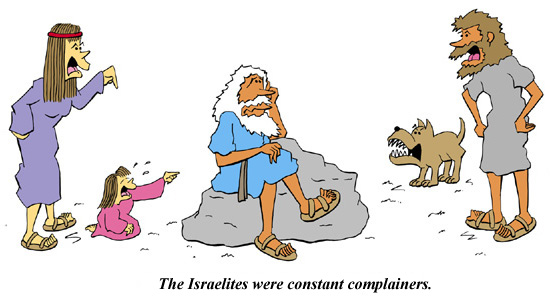
This chapter covers two incidents; this first one should have been attached to the manna incident in the previous chapter since it is similar and almost sounds like a refrain; in fact, this pattern of ‘need-complaint-wishwewerebackinEgypt’ will keep recurring, but for now the narrative says:

 
  • the people complain again because they are thirsty; 
  • they ask Moses why they were taken out of Egypt where they at least had water to drink; 
  • this gives their gracious and surely, still PATIENT Provider yet another opportunity to demonstrate yet another miracle, 
  • as if they didn’t see enough divine intervention in their lives to be convinced that they have been undeservedly blessed from the night of their liberation through their days of hunger to this day of thirst!
  • Image from www.coopertoons.com

Evidently they were never taught by their forbears how to be grateful, appreciative and uncomplaining or if they were, they didn’t learn.  Honestly, was their life of bondage really better? What short memories these people have! Is it just these people or is it human nature in general, notice any similarities with people in this day and age? Of course when we keep reading how these liberated slaves continue to behave throughout their wilderness wanderings, it is easy to judge them and condemn their behavior.  The rabbis teach that one should not judge another until one has been in that other’s shoes. What baffles readers of today is — how can witnesses of one miracle after another even have the slightest doubt that their God will fulfill every promise, prophecy, and warning He has uttered through Mosheh; He hasn’t failed in a single one as yet! But perhaps when miracles (unusual events) become somewhat part of life, as in the “new normal”,  there are no more surprises since they are ‘expected’ and  eventually are taken for granted. 


This next discussion is irrelevant to the text under study, but it might be helpful to website visitors who are Christian and are wondering about the “Rock” symbolism they have been taught in their bible studies.  It first springs out of the misinterpretation of Matthew 16:18 the translation of which has confused interpreters, making you wonder who is the “rock”:

  • Peter
  • Jesus
  • or the answer of Peter to Jesus’ question “Who do they say I am?” which is “Thou art the Christ, the Son of the living God.”
 

That Matthew verse is followed up by Paul’s interpretation of OT, as well as the writer of 1 Peter whose identity has been questioned by textual critics:

  • Matt. 16:18, “And I also say to you that 
    • you are Peter (petros), 
    • and upon this rock (petra) 

      image from steadfastlutherans.org

    • I will build My church; 
    • and the gates of Hades shall not overpower it.”
  • 1 Cor. 10:4,
    • “and all drank the same spiritual drink, 
    • for they were drinking from a spiritual rock (petras) 
    • which followed them; 
    • and the rock (petra) was Christ.”
  • 1 Pet. 2:8, speaking of Jesus says that 
    • he is “A stone of stumbling 
    • and a rock (petra) of offense”;
    •  for they stumble because they are disobedient to the word, and to this doom they were also appointed.”
 

The answer? None of the above, if the original TORAH context is to be the basis.

The NT is consistent in making the Israelites appear blinded and unable to see in their own Hebrew Scriptures, the Christian interpretation of fulfillment in Jesus Christ, supposedly “obvious” in such imagery as the passover lamb and now this water-providing-rock.  


Allegorization is the general tendency among Christian interpreters because that is the only way the Hebrew Scriptures could be reinterpreted into something totally alien to its teachingsAs we have repeatedly emphasized, the NT is antithetical to TNK so there is no way it is a “continuation” except in Christian reorientation of OT.


NSB@S6K

logo

————————–


[Translations:  EF/Everett Fox, The Five Books of MosesAST/Artscroll Tanach] 


Exodus/Shemoth 17

 
1 They moved on, the whole community of the Children of Israel, from the Wilderness of Syn, by their moving-stages, at YHVH’S bidding.
They encamped at Refidim, 
and there is no water for the people to drink!
2 -The people quarreled with Moshe, they said:
Give us water, that we may drink! 
Moshe said to them:
For-what do you quarrel with me? 
For-what do you test YHVH?
3 The people thirsted for water there, and the people grumbled against Moshe, and said: For-what-reason then did you bring us up from Egypt, 
to bring death to me, to my children and to my livestock by thirst?
4 Moshe cried out to YHVH, saying:
What shall I do with this people?
A little more and they will stone me!
5 YHVH said to Moshe: 
Proceed before the people,
take some of the elders of Israel with you,
and your staff with which you struck the Nile, take in your hand, 
and go!
6 Here, I stand before you there on the rock at Horev, 
you are to strike the rock, and water shall come out of it, and the people shall drink.
Moshe did thus, before the eyes of the elders of Israel.
7 And he called the name of the place: Massa/Testing, and Meriva/Quarreling, 
because of the quarreling of the Children of Israel, 
and because of their testing of YHVH, saying: 
Is YHVH among us, or not?

The second incident this chapter deals with concerns Israel’s encounter with the Amalek; here’s some background on these people who were hostile to Israel, from http://www.jewishencyclopedia.com/articles/1351-amalek-amalekites (reformatted):


  •  Name of a nomadic nation south of Palestine.
  • That the Amalekites were not Arabs, but of a stock related to the Edomites (consequently also to the Hebrews), can be concluded from the genealogy in Gen. xxxvi. 12 and in I Chron. i. 36.
  • Amalek is a son of Esau’s first-born son Eliphaz and of the concubine Timna, the daughter of Seir, the Horite, and sister of Lotan (Gen. xxxvi. 12; compare Timnah as name of an Edomite chief or clan, verse 40).
  • On the other hand, Gen. xiv. 7 speaks of Amalekites, in southern Palestine, in the time of Abraham.
  • That they were of obscure origin is also indicated in Num. xxiv. 20, where the Amalekites are called “the first of the nations.”
  • The Amalekites were the first to come in contact with the Israelites (Ex. xvii. 8), vainly opposing their march at Rephidim, not far from Sinai (compare Deut. xxv. 17, “smiting the hindmost, all that were feeble behind,” and I Sam. xv. 2).
  • Consequently, they must be considered as possessors of the Sinaitic peninsula, of the modern desert et-Tih, or at least of the northern part of it. According to Num. xiii. 29, xiv. 25, which speaks of Amalekites defeating the Israelites in the lowland (verses 43, 45), they occupied also southern Palestine, partly together with the Canaanites; see also Gen. xiv. 7 (Amalekites in “En-mishpat, which is Kadesh”).
  • The extreme south seems to be meant, the pasture lands of the Negeb, not the arable parts.
  • The relation of the Kenites to the Amalekites is not quite plain. According to I Sam. xv. 6, they live with them (or at their side; compare Judges, i. 16; Num. xxiv. 21), while elsewhere they are associated with Israel (I Sam. xxvii. 10) or even specially with the tribe of Judah (I Sam. xxx. 29; I Chron. ii. 55).
  • This would indicate that the Kenites formed a connecting-link between the Israelites, or their southern tribes, and the Amalekites. Gen. xv. 19, which foretells dispossession of the Kenites by Israel, would agree with this (see CainKenites).
  • A similar relationship might be assumed for the Kenezites.
8 Now Amalek came and made-war upon Israel in Refidim.
9 Moshe said to Yehoshua:
Choose us men, 
and go out, make-war upon Amalek! 
On the morrow I will station myself on top of the hill, with the staff of God in my hand.
10 Yehoshua did as Moshe had said to him
to make-war against Amalek. Now Moshe, Aharon and Hur went up to the top of the hill.
11 And it was, whenever Moshe raised his hand, Israel prevailed, and whenever he set down his hand, Amalek prevailed.
12 Now Moshe’s hands are heavy; 
so they took a stone and placed it under him, and he sat down on it,
while Aharon and Hur supported his hands, one on this-side and one on that-side.
So his hands remained steadfast, until the sun came in.
13 And Yehoshua weakened Amalek and his people, with the edge of the sword.
 

S6K:  Yahoshua’, in case you are not familiar with the Hebrew name, is Joshua, some sort of a personal “bodyguard” to Mosheh and the warrior leader who would eventually take over from Mosheh in leading the children of Israel into battles to claim tribal territories in the Promised Land. 


AST comment: “Was it Moses hands that won the battle or lost the battle?  Rather [the Torah] teaches you: As long as Israel looked heavenward and subjected their heart to their Father in Heaven, they would prevail.  But when they did not, they would fall” (Mishnah Rosh Hashanah 3:*).


14 YHVH said to Moshe: 
Write this as a memorial in an account 
and put it in Yehoshua’s hearing: 
Yes, I will wipe out, wipe out the memory of Amalek from under the heavens!
15 Moshe built a slaughter-site
and called its name: YHVH My Banner.
16 He said:
Yes,
Hand on YAH’S throne!
War for YHVH against Amalek
generation after generation!

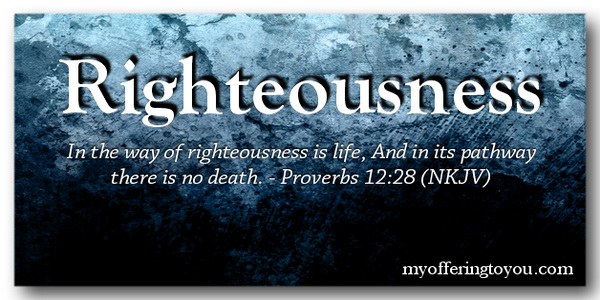
Genesis/Bereshith 15: "Now he trusted in YHWH, and he deemed it as righteous-merit on his part."

Image from myofferingtoyou.com

Image from myofferingtoyou.com

[What is Abrahamic faith?


 Verse 6:  And he believed יהוה, and He counted it to him as righteousness.


The commentator Kalisch explains: 


believed. i.e. trusted. The childless Abram had faith in God’s promise that his descendants would be countless like the stars in heaven.  He was ready to wait God’s time, without doubting God’s truth.  That is the mark of true faith—steadfast trust in God, despite darkness and disappointment, and despite the fact that circumstances all point in the opposite direction.  True faith ‘discovers through the mists of the present the sunshine of the future; and recognizes in the discordant strife of the world the traces of the Eternal Mind that leads it to an unceasing harmony’ (Kalisch).


To play the (nonexistent) devil’s advocate:  Is faith really as simple as that?  


We had a messianic teacher who used to be picky about words he used; he didn’t like ‘faith’ and ‘believe’, he preferred ‘trusted’.  Are the three words different or simply synonyms that mean the same thing? Have you ever heard this example given in bible study to specify what God requires?


The example goes like this:  A tightrope walker who had an excellent track record challenged spectators as he proposed to do his daredevil stunt-walk across a rope that connected the ledge of one mountain to the ledge of another, the height of the fall would be several hundred feet above the ground.  He asks the crowd if they believe with his skills he could walk across to the other side? They all yelled YES! Do they believe he could make it back, YES they yelled. And, since they have seen him many times do the same stunt with an associate seated on his shoulders, he asked if they believe he could do the same and they yelled YES.  Then he asked if one of the YES-ers would get on his shoulders?  Silence, NO takers.  Belief, trust, have faith, the YES-ers all had it as long as they were not going to be tested.  


In Abraham’s case, there was no life to risk in believing, having faith, trusting in a promise of a son in his old age with Sarah in her old age; he simply had to take God’s word for it and keep doing what couples do to procreate.  At this point, that belief/trust/faith had not yet been tested by time passing . . . . well, we know what happens later after waiting and waiting for years. . . but at this point, Abraham’s belief was already counted to him as ‘righteousness’.


Now, this word ‘righteousness’ is one of those big words that most people really don’t truly understand.  Because when we look at the handpicked figures in Scripture’s hall of fame, some of them sometimes moved to the hall of shame:  they were not perfect, they slipped, they made unwise decisions, they committed sins unexpected of ‘righteous’ people (take David as an example).  And yet, it seems it is a certain pattern in their life that God looks at, that reflects the inclination of their heart, that manifests in the choices that they make — yes, despite their mistakes— that they REPENT and turn their lives around.  Of course we cannot discount the fact that there are consequences of their sin that affect not only their lives but others and sometimes generations down the ages as well.  


So, to simplify the word ‘righteousness’ — we redefine it as ‘being in the RIGHT’ because there is a RIGHT way and a wrong way. Who defines what is RIGHT?  Who else, the God who gave the Torah.  Live the Torah, and you’re righteous.  Live whatever little you know of Torah each step of your journey, as long as you are on that same pathway and learning more each day and gaining wisdom and beginning to think His thoughts, live His prescribed Torah life even imperfectly—heart and mind inclined to obey, falling along the way but getting up and staying on the path.


The point?  Abrahamic faith, despite man’s weaknesses and mistakes and wrong choices—ultimately it is all about KNOWING the One True God, believing only in Him and His promises amidst societies and cultures that remain ignorant of Him.  Is that applicable to us in our day and age? What do you think?  How many of our Christian/Messianic colleagues are bothering to give us a hearing? Or checking out our belief through this website?  Have we convinced even one of them in the last two years? No. Though, strangely and happily, the God of Truth links us with strangers in the internet highway and with individuals who seek us out because they have heard about us and wish to know what it is we teach.  That truly amazes us.  As we say to them, when you are spiritually awakened from your religious affiliation and think there is more to God that what has been taught you, that stirring in your heart is known by the God of Truth and He will connect all of us with one another.  


Believe Him and hey, He will count it to us ‘as righteousness’ too!


This is a re-revisit, first posted December 16, 2013, reposted July 26 2015.   Commentary is from Pentateuch and Haftorah’s, ed. Dr. J.H. Hertz; translation is The Five Books of Moses by Everett Fox; additional commentary from him is indicated by “EF” and we have one more, “RA” for Robert Alter whose The Five Books of Moses also has commentary..Admin1.]


Genesis/Bereshith 15


PROMISE OF AN HEIR TO ABRAM

Image from www.resourcewell.org

1  After these events YHWH’s word came to Avram in a vision, saying:  
Be not afraid, Avram,
I am a delivering-shield to you,
your reward is exceedingly great.

after these things.  This phrase commonly joins a new chapter with the preceding.  It does not necessarily imply an immediate sequence.

in a vision. A frequent medium through which God communicated with man.  Nachmanides points out that the vision happened during the daytime.

fear not. The possibility of reprisals, because of his intervention in the war.  Or, it may refer to the Patriarch’s anxiety with regard to his childlessness.

thy shield.  A symbol of defence and protection, often used in the Psalms.

thy reward. For obedience to God’s call and for uprightness of life.

[EF]  YHWH’s word came:  A formula often used by the Prophets.  Avram is portrayed as their spiritual ancestor (Buber, 1982).

[RA]  the word of the LORD came to Abram.  This is a formula for revelation characteristic of the Prophetic books, not of the Patriarchal Tales.  It is noteworthy that in Genesis 20 God refers to Abraham as a “prophet.”  The night-vision (maazeh) invoked here is also a prophetic mode of experience.

2  Avram said:
My Lord, YHWH,
what would you give me—
for I am going (to die) accursed,
and the Son Domestic of My House is Damascan Eliezer.

what wilt Thou give me?  This agonizing cry enables us to look into the soul of the Patriarch.  Of what value were earthly possessions to him if a worthy child who would continue his work after him was denied him? This attitude of the Father of the Jewish people towards the child, that it is the highest form of human treasures, has remained that of his descendants to the present day.  Among the most enlightened nations of antiquity, the child had no rights, no protection, no dignity of any sort.  In Greece, for example, weak children were generally exposed on a lonely mountain to perish.  The Roman historian (Tacitus) deemed it a contemptible prejudice of the Jews that ‘it is a crime among them to kill any child!’  The Rabbis, on the other hand, spoke of little children as ‘the Messiahs of mankind’, i.e. the child is the perennial regenerative force in humanity because in the child God continually gives mankind a chance to make good its mistakes.


of Damascus.  Chap. XXIV shows the important position which he occupied in Abram’s household.  But, if he was to be Abram’s heir, what of the great mission that was the motive of Abram’s call from Ur of the Chaldees?  The incident which follows allays these anxieties.


[EF]  accursed:  Heb. ariri; B-R uses “bare-of-children.” Son Domestic . . . Damascan: Hebrew difficult.  The translation here reflects the play on shound (Heb. ben meshek . . . dammesek).


[RA] And Abram said.  Until this point, all of Abram’s responses to God have been silent obedience.  His first actual dialogue with God—in this, too, Prophetic precedents may be relevant—expresses doubt that God’s promise can be realized:  this first speech to God reveals a hitherto unglimpsed human dimension of Abram.


I am going to my end.  The Hebrew says simply “I am going,” but elsewhere “to go” is sometimes used as a euphemism for dying, and, as several analysts have argued, the context here makes that a likely meaning.


steward.  The translation follows a traditional conjecture about the anomalous Hebrew mesheq, but the meaning is uncertain.  The word might be a scribal repetition of the last three consonants in “Dammesek,” or, alternately, it could be a deliberate play on words (Dammesek and mesheq, “household maintenance”).  The enigma is compounded by the fact that only here is Abraham’s majordomo named as Eliezer—a West Semitic name,  moreover, that would be surprising in someone from Damascus.


3  And Avram said further:  
Here, to me you have not given seed,
here, the Son of my House must be my heir.

one born in my house. i.e. my servant.  It is noteworthy that Abram does not think of Lot as his possible heir; he had returned to Sodom.

[EF]  Son of My House: The chief servant, who could inherit the estate in certain circumstances.  Note the play on “son”:  the Hebrew here is ben beti, while ben alone means “son.” heir: Three times here, indicating Avram’s main concern.


[RA] And Abram said.  God remains impassively silent in the face of Abram’s brief initial complaint, forcing him to continue and spell out the reason for his skepticism about the divine promise.

4  But here, YHWH’s word (came) to him, saying:
This one shall not be heir to you,
rather the one that goes out from your own body, he shall be heir to you.
5 He brought him outside and said:  
Pray look toward the heavens and count the stars,
can you count them?
And he said to him:
So shall your seed be.

Since the words which follow, ‘Look now toward heaven, etc.’ are part of the vision, we are not to suppose that Abram was actually led into the open. He imagined himself as gazing up at the stars.


[RA] count the stars.  This is a complementary image to that of the numberless dust in chapter 13 but, literally and figuratively, loftier, and presented to Abraham in the grand solemnity of a didactic display, mot merely as a verbal trope to be explained.


6  Now he trusted in YHWH,
and he deemed it as righteous-merit on his part.

believed. i.e. trusted. The childless Abram had faith in God’s promise that his descendants would be countless like the stars in heaven.  He was ready to wait God’s time, without doubting God’s truth.  That is the mark of true faith—steadfast trust in God, despite darkness and disappointment, and despite the fact that circumstances all point in the opposite direction.  True faith ‘discovers through the mists of the present the sunshine of the future; and recognizes in the discordant strife of the world the traces of the Eternal Mind that leads it to an unceasing harmony’ (Kalisch).

and He counted it to him for righteousness. ‘Counted his trust as real religion’ (Moffati).  Trustful surrender to the loving Will and Wisdom of God is the proof as it is the basis, of true religion.  Such spiritual faithfulness where there is unrighteousness..

[EF] he deemed it:  “He” refers to God.

[RA]  7-21.  Since this covenant is sealed at sunset, it can scarcely be a direct continuation of the nocturnal scene just narrated.  The two scenes are an orchestration of complementary covenantal themes.  In the first, God grandly promises and Abram trusts; in the second, the two enter into a mutually binding pact, cast in terms of a legal ritual.  In the first scene, progeny is promised; in the second, the possession of the land, together with the dark prospect of enslavement in Egypt before the full realization of the promise.  The first scene highlights dialogue and the rhetorical power of the divine assurance; the second scene evokes mystery, magic, the troubling enigma of the future.


7  He said to him:  
I am YHWH
who brought you out of Ur of the Chaldeans
to give you this land, to inherit it.
 

[EF]  who brought you out: Like the later “I am YHWH your God, who brought you out of the land of Egypt” (Ex. 20:2).  The language is undoubtedly intentional.

[RA]  I am the LORD who brought you out.  This formula—the initial words of self-identification are a commonplace of ancient Near Eastern royal decrees—used here for the first time, looks forward to “who brought you out of the land of Egypt” of the Decalogue and other texts.  Compositionally, it also picks up “He took him outside” (the same verb in the Hebrew) at the end of the preceding scene.


8  But he said:  
My Lord, YHWH,
by what shall I know that I will inherit it?  

whereby shall I know? He does not doubt God, but desires confirmation of the vision that had been granted him.

[EF] But he said:  Avram, having just demonstrated trust in v. 6, now expresses deep doubt.  inherit: Or, “possess.”

[RA] how shall I know that I shall inherit it?  In this instance, Abram’s doubt is to be assuaged by a formal pact.  Covenants in which the two parties step between cloven animal parts are attested in various places in the ancient Near East as well as in Greece.  The idea is that if either party violates the covenant, his fate will be like that of the cloven animals.  The Hebrew idiom karat berit, literally “to cut a covenant” (as in verse 1), may derive from this legal ritual.


9  He said to him:  
Fetch me a calf of three, a she-goat of three, a ram of three, a turtle-dove, and a fledgling.

three years old. Possibly because the number three has a sacred signification.

[EF] of three: I.e., three years old, and presumably mature and ritually fit for sacrifice.


10  He fetched him all these.  
he halved them down the middle, putting each one’s half toward its neighbor,
but the birds he did not halve.

and he took him. ‘Him’ means, to himself.

and divided them in the midst.  The ancient method of making a covenant was to cut an animal in half and the contracting parties to pass through the portions of the slain animal.  Thereby the parties were thought to be united by the bond of a common blood.

but the birds divided he not. Lev. I,17.

[RA] each set his part.  Existing translations fudge the vivid anthropomorphism of the Hebrew here: ‘ish, literally, “man,” means “each” but is a word applied to animate beings, not to things, so it must refer to the two parties to the covenant facing each other, not to the animal parts.


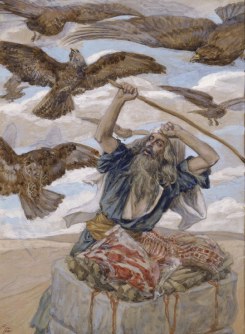
11 Vultures descended upon the carcasses,
but Avram drove them back.

Image from lastdayscalendar.tripod.com

and the birds of prey came down. Symbolically foreshadowing the obstacles in the way of the taking possession of the land.

Abram drove them away. The attempts to frustrate God’s design would not succeed.

[RA] carrion birds.  Unaccountably, most English translators render this collective noun as “birds of prey,” though their action clearly indicates they belong to the category of vultures, not hawks and eagles.

12  Now it was, when the sun was coming in,
that deep slumber fell upon Avram—
and here, fright and great darkness falling upon him!
 
a deep sleep.  The same word is used of Adam in II,21.
a dread, even a great darkness. The nation which was to issue from him would have to pass through bitter times of oppression.[EF]  deep slumber: Not conventional sleep, it is almost always sent by God in the Bible (see 2:21, for example).  The result here is “fright and great darkness.”[RA] deep slumber.  This is the same Hebrew word, tardemah, used for Adam’s sleep when God fashions Eve.

Image from treasureboxmy.blogspot.com

13  And he said to Avram:  

You must know, yes, know
that your seed will be sojourners in a land not theirs;
they will put them in servitude and afflict them
for four hundred years.

a stranger.  Better, a sojourner.’  The word means a temporary resident.  The reference is, of course, to the stay of the Israelites in Egypt.

four hundred years. A round number; Exod. XII,40, gives the more precise number 430 years.

[EF]  afflict:  Looking toward the “affliction” of the Israelites in Egypt (Ex. I:11,12).

14  But the nation to which they are in servitude—I will bring judgment on them,
and after that they will go out with great property.

with great substance.  Referring to the gifts of the Egyptians, Exod. XII,35.

15  As for you, you will go to your fathers in peace; you will be buried at a good ripe-age.

shalt go to thy fathers. ‘The death of Abram is predicted in one of those remarkable phrases which seem to prove that the Hebrews were not unacquainted with the doctrine of immortality.  Here the return of the soul to the eternal abodes of the fathers is, with some distinctness, separated from the interment of the body.  That both cannot be identical is evident; for while Abraham was entombed in Canaan, all his forefathers died and were buried in Mesopotamia’ (Kalisch).

in peace. Thou wilt not witness any of the tribulations that befall thy children (Kimchi).

[EF]  ripe-age: Lit. “grayness” or “hoariness.”

16  But in the fourth generation they will return here,
for the iniquity of the Amorite has not reached full-measure heretofore.  

and in the fourth generation.  ‘The Arabic dahr (corresponding to the Hebrew) is also used for a hundred years and over’ (Burckhardt); thus, the 400 years mentioned in v. 13 are referred to here as four generations.  Or, these four generations are not to be computed from the time of the vision of Abram, but from the time when his posterity first came into Egypt (Rashi).

the iniquity of the Amorite. ‘Amorite’ denotes the inhabitants of Canaan generally.  Some of their abominations are enumerated in Leviticus XVIII,21-30.  The postponement of the penalty indicates Divine forbearance.  God would give the Canaanites full time to repent.  Hence he sent Abraham, who ‘proclaimed the Lord’, and, with his disciples and descendants, taught by precept and example ‘the way of the Lord to do justice and mercy’.  Meanwhile, the gradually accumulating guilt of the Amorites rendered dire punishment inevitable. God’s prescience was certain that their hearts were forever turned from Him.

[EF] But in the fourth generation . . . : God here speaks of the future conquest of Canaan by Avram’s descendants.  The natives (here termed “Amorites) are viewed as having forfeited their right to the land by their immorality (see Lev. 18:25-8).

[RA] the fourth generation.  This would seem to be an obvious contradiction of the previously stated four hundred years.  Some scholars have argued that the Hebrew dor does not invariably mean “generation” and many here refer to “life span” or “time span.”

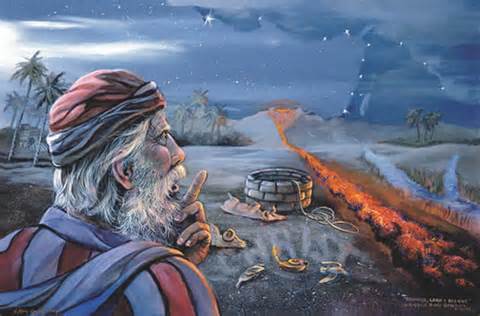
17  Now it was, when the sun had come in, that there was night-blackness, and here, a smoking oven, a fiery torch that crossed between those pieces.

a smoking furnace, and a flaming torch. This symbol of the Godhead was seen to pass between the pieces, to ratify the covenant which was being made.


Image from www.toughquestionsanswered.org

[RA] a smoking brazier with a flaming torch. All this is mystifying and is surely meant to be so, in keeping with the haunting mystery of the covenantal moment.  It seems unwise to “translate” the images into any neat symbolism (and the same is true of the ominous carrion birds Abram drives off).  There may be some general association of smoke and fire with the biblical deity (Nachmanides notes a link with the Sinai epiphany), and the pillars of fire and cloud in Exodus also come to mind, but the disembodied brazier (or furnace) and torch are wonderfully peculiar to this scene.  The firelight in this preternatural after-sunset darkness is a piquant antithesis to the star-studded heavens of the previous scene.

18  On that day YHWH cut a covenant with Avram, saying:  I give this land to your seed, from the River of Egypt to the Great River, the river Euphrates,

have I given.  The perfect tense is used, although it refers to the future, in order to denote the certainty of the event.

river of Egypt. ‘Brook of Egypt’ (Num. XXXIV,5) the Wady-el-Arish, which is the boundary between Egypt and Palestine.

Euphrates. The ideal limit of Israelite territory, reached in the days of Solomon (I Kings V,1).

[EF] cut: Concluded; the usage is influenced by the act of cutting animals by the parties involved, as in this story.

[RA]  To your seed I have given.  Moshe Weinfeld shrewdly observes that for the first time the divine promise—compare 12:1-3, 12:7, 13:414-17, 15;4-5—is stated with a perfective, not an imperfective, verb—that is, as an action that can be considered already completed.  This small grammatical maneuver catches up a large narrative pattern in the Abraham stories:  the promise becomes more and more definite as it seems progressively more implausible to the aged patriarch, until Isaac is born.

19  The Kenite and the Kennizzite and the Kadmonite,

Kenite, and the Kenizzite. Friendly tribes inhabiting the S. of Palestine, which merged with the Israelites.

Kadmonite.  Not mentioned elsewhere.

[EF] the Kenite . . .:  Canaanite tribes, here presented as a round ten in number.

20  and the Hittite and the Perizzite and the Refa’ites,

Perizzite. see on XIII,7.

Repahim. see on XIV,5.

21  and the Amorite and the Canaanite and the Girgashite and the Yevusite.

For the peoples enumerated in this verse, see on X,16.

Journey of Faith – Abraham's déjà vu

[First posted August 6, 2012, has it been that long? So here’s a revisit; thanks to the webvisitor who clicked it and brought it back to our attention.


Readers must be wondering why we have a running series under the title “Journey of Faith.” We separate Sinai commentary from the three commentaries we feature here so, rule of thumb — whenever you see “Journey of Faith” expect our two-cents-worth insights.  Then, go ahead and check out what all other commentaries have to say in the regular chapter-by-chapter posts.

Image from georgesjournal.net

One of the helpful clues to reading the TORAH is this:  The Torah isn’t a history book. 


“A fundamental principle regarding the Five Books of Moses is expressed in this well-known saying among Torah scholars.  ‘There is no earlier or later in the Torah.’  It means that the Torah isn’t a historical narration and isn’t in chronological order. This expression doesn’t mean, of course, that it’s impossible to find facts of history within the Torah.  After all, the story of the exodus of the Children of Israel, for example, is a major part of the Torah and is basically the history of the birth of the Jewish people as a growing family.  The Torah contains the earliest recorded history of the family history of the Jews.  But the Torah is not primarily a source for history; rather, it’s a spiritual document with the purpose of communicating divine eternal wisdom.” — Arthur Kurzweil in TORAH for DUMMIES; see Sinaite’s Notes – What the Torah is NOT – 7.  


Our translation of choice in this website is Everett Fox’s The Five Books of Moses, free download courtesy of publisher Schocken Bible, just google “Shocken Bible” and you’ll get there in a click!–Admin1.]


—————————————-


It helps to remember this when there are seeming repetitions in biblical narratives which give skeptics the occasion to cast suspicion on the divine source of the Hebrew Scriptures.


Sample two similar episodes in Abraham’s travels that makes the 2nd appear like déjà vu.


Earlier in Genesis/Bereshith 12:10-26:  

10 Now there was a famine in the land,
and Avram went down to Egypt, to sojourn there,
for the famine was heavy in the land.
11  It was then he came near to Egypt that he said to Sarai his wife:
Now here, I know well that you are a woman fair to look at.
12  It will be, when the Egyptians see you and say: She is his wife,
that they will kill me, abut you they will allow to live.
13  Pray say taht you are my sister
so that it may go well with me on your account that I myself may live thanks to you.
14  It was when Avram came to Egypt, that the Egyptians saw how exceedingly fair the woman was;
15 when Pharaoh’s courtiers saw her, they praised her to Pharaoh,
and the woman was taken away into Pharaoh’s house.
16  It went well with Avram on her account, 
sheep and oxen, donkeys, servants and maids, she-asses and camels, became his.
17  But YHWH plagued Pharaoh with great plagues, and also his household, because of Sarai, Avram’s wife.
18  Pharaoh had Avram called, and said:  
What is this that you have done to me!
Why did you not tell me that she is your wife?
19 Why did you say:  She is my sister?
—So I took her for myself as a wife.
but now, here is your wife, take her and go!
20  So Pharaoh put men in charge of him, who escorted him and his wife and all that was his.

Later in 20:1-18:

1 Avraham traveled from there to the Negev, and settled between Kadesh and Shur, sojourning
in Gerar.
2 Avraham said of Sara his wife: She is my sister.
So Avimelekh king of Gerar sent and had Sara taken. 
3 But God came to Avimelekh in a dream of the night and said to him:
Here, you must die
because of the woman whom you have taken,
for she is a wedded wife!
4 Avimelekh had not come near her. He said:
My Lord,
Would you kill a nation, though it be
innocent?
5 Did he not say to me: She is my sister,
and also she, she said: He is my brother!
With a whole
heart and with clean hands have I done this.
6 God said to him in the dream:
I also know that it was with a whole heart that you did this,
and so I also held you back from being at fault against me,
therefore I did not let you touch her.
7 But now, return the man’s wife—
indeed, he is a prophet, he can intercede for you—
and live!
But if you do not return her:
know that you must die, yes, die, you and all that is yours!
8 Early in the morning Avimelekh called all his servants,
he spoke all these words in their ears,
and the men became exceedingly afraid.
9 Then Avimelekh had Avraham called and said to him:
What have you done to us?
In what did I fail you,
that you have brought me and my kingdom into such great fault?
Deeds which are not to be done, you have done to me!
10 And Avimelekh said to Avraham:
What did you foresee, that you did this thing?
11 Avraham said:
Indeed, I said to myself:
Surely there is no awe of God in this place,
they will kill me on account of my wife!
2 Then, too, she is truly my sister, my father’s daughter,
however not my mother’s daughter-so
she became my wife.
13 Now it was, when the Power-of-god caused me to roam from my father’s house,
that I said to her:
Let this be the faithfulness that you do me:
in every place that we come, say of me: He is my
brother.
14 Avimelekh took sheep and oxen, servants and maids, and gave them to Avraham,
and returned Sara his wife to him.
15 Avimelekh said:
Here, my land is before you,
settle wherever seems good in your eyes.
16 And to Sara he said:
Here, I have given a thousand pieces of silver to your brother,
here, it shall serve you as a covering for the eyes for all who are with you
and with everyone, that you have
been decided for.
17 Avraham interceded with God
and God healed Avimelekh: his wife and his slave-women, so that they gave birth.
18 For YHVH had obstructed, obstructed every womb in Avimelekh’s household
on account of
Sara, the wife of Avraham

Clearly, while Abraham repeats an earlier trick that worked for his self-preservation, these two occasions are different: the first occurs in Egypt, with Pharaoh; the second with the king of Gerar, Abimelech.


Image from divineseasons.blogspot.com

Insights we gain from these two similar episodes in Abraham’s journey of faith:


First, Abram/Abraham:

  • He is aware that the beauty of Saray/Sarah could cause him problems, early on according to vs. 20:13, he already prompts Saray what to say, out of “kindness” to him.
  • Self-preservation at the expense of wife Saray/Sarah is the rule of thumb in their relationship.
  • Pretense in the cause of self-preservation appears to be tolerated by YHWH, at least in these 2 contexts; this patriarch has yet to learn to trust Him.
  • Presumption on Abraham’s part that Pharaoh and Abimelech were not God-fearing rulers.
  • As many commentators have pointed out, he has told only a half-lie, for Saray/Sarah is truly his half sister;
  • Had Abraham chosen the “I cannot tell a lie” route, it would be interesting to know if it would have had the same ending, since YHWH had promised him unconditional blessings;
    •  in the sin category of Catholics, a “venial” sin, not as serious as mortal sin;
    • in secular language, a little “white” lie, permissible so as not to hurt another, or for self-serving purposes.
  • So Abram/Abraham should have known better both times, trust YHWH to do His part, just do what is right under any circumstance.
  • It should have been easy for Abram/Abraham to have thought that way since he was given a glimpse into his future as well as those of his decendants;
  • We are not entitled to the same specific promises to Abraham, but we know the same God of Abraham Whose faithfulness is recorded throughout the Hebrew Scriptures.


Second,Saray/Sarah:

  • Her beauty must truly have been irresistible (even in her senior years) for these two rulers to invite her to be part of their court.
  • She accedes to her husband’s request on both occasions; if it worked the first time, why not the second.
  • But how does she really feel in Pharaoh’s presence and Abimelech’s, is not noted.
  • Wives, women in those days readily accepted their status without much complaint, credit must be due them in a patriarchal culture where their role is barely mentioned.

    Image from chestofbooks.com

  • We also never know how Mrs. Pharaoh and Mrs. Abimelech must have felt, but watching on current TV programs some specials featuring  polygamous families, wife number 2-3-4 are all smiles as they share what a relief it is for them to take on common husband on schedule. It’s all a matter of attitude and let’s not forget, religious or cultural brainwashing.

Third, Pharaoh and Abimelech:

  • Surprise, surprise, they do have fear of God, but which god?
  • They do act honorably toward Saray/Sarah.
  • They learn fast, have wisdom enough to connect judgment on their household with taking on another man’s wife, although it helped that YHWH Himself personally dealt with each.
  • They end up rewarding Abraham with more wealth despite his tricking them.
  • They recognize the God of Abraham is to be obeyed; both occasions should have given these 2 rulers the realization that they met the TRUE GOD and possibly worshipped Him from then on, but that’s speculation.

Finally and most importantly, YHWH:

  • Sometimes He allows His chosen to make their own mistakes from their own free will, particularly at the beginning of their getting-to-know-Him stage;
  • Other times He steps in and interferes;
  • He does communicate with all people, gentile rulers, gentile prophets, not just with Abraham and his descendants but then everyone was gentile at this point. Read the six last words again!
  • In Pharaoh’s case, he was quick enough to make the connection between the plague upon his household with his taking on another man’s wife, so YHWH’s dealing with him was indirect;
  • In Abimelech’s case, Elohim spoke to him in a dream, in fact they converse, he defends himself, and he does emerge from this experience with reverence and awe of Abraham’s God.
  • In YHWH’s wisdom and gracious dealing with mankind, Abraham’s trickery leads to knowledge of his God by the 2 gentile rulers so now we know that God can turn around even our bad choices into good results if it leads to knowledge of Him.


Praise be the God of Abraham, His Name is YHWH.


logo art by BBB@S6K

logo art by BBB@S6K

NSB@S6K

for Sinai 6000

Core Community

Journey of Faith – Sarah’s déjà vu

 [First posted August 6, 2012; yes it has been that long and therefore deserves a revisit. If Abraham had a ‘deja vu’, so did Sarah.
 
As previously explained, this series titled “Journey of Faith” is the Sinaite’s interpretation, separated from the three commentaries normally featured in chapter by chapter discussions.  Our translation of choice is Everett Fox The Five Books of Moses.  
 
It is ideal for students to read the chapter first without resorting to commentaries, if only to check for themselves if they can arrive at an understanding of the scripture without help.  The tendency of all, understandably, is to rely on outside help for comprehension, because we receive the text in translation and we are six millennia removed from the culture and times and people of these books of antiquity.  Still, we Sinaites believe that YHWH the Great Communicator can speak through the ages and right into our minds and hearts, in our times, in whatever culture we’re in, even if the language we speak and read His words in are non-Hebraic.  
 
We might miss much in translation but the basic message comes through:  Worship YHWH, He is One, and learn what He has revealed on Sinai.  The Torah is the source.—Admin1.]
 

——————————-


At the appointed time, Sarah gives birth to the promised heir, Isaac.


1 Now YHVH took account of Sara as he had said,
YHVH dealt with Sara as he had spoken. 
2 Sara became pregnant and bore Avraham a son in his old age,
at the set-time of which God 
had spoken to him.
3 And Avraham called the name of his son, who was born to him,
whom Sara bore to him:
Yitzhak/He Laughs.
4 And Avraham circumcised Yitzhak his son at eight days old, as God had commanded him.


A word about divine requirement for circumcision for babies 8 days old:  [http://www.bibleevidences.com/medical]


For centuries scholars must have been perplexed by God’s law of circumcision which required the procedure to be performed on the 8th day after birth (Gen 17:12, Gen 21:14, Lev 12:3, Luke 2:21). Medical researchers recently discovered that the two main blood clotting factors, Vitamin K and Prothrombim, reach their highest level in life, about 110% of normal, on the 8th day after birth. These blood clotting agents facilitate rapid healing and greatly reduce the chance of infection. You can verify with any Obstetrician that the 8th day of life is the ideal time for a circumcision, and that any circumcision done earlier requires an injection of Vitamin K supplement.


A medical survey has also reached the conclusion the there is less infection among females whose sexual partners are circumcised [http://www.guttmacher.org/pubs/journals/2817902.html].


The Creator of the magnificent human body and its processes did not leave mankind ignorant about how to live a healthy life. Way before medical research wised up about sterilization and quarantine, the Israelites were already given instructions about how to avoid and contain disease in YHWH’s Book of Life as early as the instructions recorded in Leviticus.


5  Avraham was a hundred years old when Yitzhak his son was born to him.
 6 Now Sara said:  
God has made laughter for me,
all who hear of it will laugh for me.  
7 And she said:
 Who would have declared to Avraham:
Sara will nurse sons?  
Well, I have borne him a son in his old age!  
8  The child grew and was weaned,
and Avraham made a great drinking-feast on the day that Yitzhak was weaned.  
9  Once Sara saw the son of Hagar the Egyptian-woman, whom she had borne to Avraham, laughing . . . .
10  She said to Avraham:
 Drive out this slave-woman and her son,
for the son of this slave-woman shall not share-inheritance with my son, with Yitzhak!  


Here we go again:


    • Hagar got in trouble with Sara the first time around when she developed an ‘attitude’ for having produced for Abraham an heir in Ishmael;
    • now it’s Ishmael who’s in trouble with Sarah for showing an ‘attitude’ toward her son Isaac.


What’s really going on here? Is the problem with Sara/Sarah feeling envious, jealous, or simply being protective of her and Isaac’s interests, or is the problem with Hagar and Ishmael?


Regardless of which, Abraham in both cases  accedes to his wife’s command without as much as a plea for the mother/son, even if he did not agree with her.


11 The matter was exceedingly bad in Avraham’s eyes because of his son.


The reason is, God confirms it is the wise thing to do and after all, YHWH has promised blessings upon Ishmael, simply because he is Abraham’s son as well, even if he’s not the promised heir.


 Note that Abraham has two firstborns, but of different mothers. If YHWH promised to take care of Ishmael, then mother and son will be alright in God’s care, even in the wilderness of Beersheba.


12 But God said to Avraham:
Do not let it be bad in your eyes concerning the lad and concerning your slave-woman;
in all that Sara says to you, hearken to her voice,
for it is through Yitzhak that seed will be called by your (name).
13 But also the son of the slave-woman-a nation will I make of him,
for he too is your seed.
14 Avraham started-early in the morning,
he took some bread and a skin of water and gave them
to Hagar-placing them upon her shoulder—together with the child and sent her away.
She went off and 
roamed in the wilderness of Be’er-sheva.
15 Now when the water in the skin was at an end, she threw the child under one of the bushes,
16 and went and sat by herself, at-a-distance, as far away as a bowshot,
for she said to herself:
Let me not see the child die!
So she sat at-a-distance, and lifted up her voice and wept.
17 But God heard the voice of the lad,
God’s messenger called to Hagar from heaven and said to her:
What ails you, Hagar? Do not be afraid,
for God has heard the voice of the lad there where he is.
18 Arise, lift up the lad and grasp him with your hand,
for a great nation will I make of him!
19 God opened her eyes, and she saw a well of water;
she went, filled the skin with water, and gave the lad to drink. 
20 And God was with the lad as he grew up,
he settled in the wilderness, and became an archer, 
a bowman. 
21 He settled in the wilderness of Paran, and his mother took him a wife from the land of Egypt


It is natural that Hagar would marry off Ishmael with a woman from her own people.


22 It was at about that time that Avimelekh, together with Pikhol the commander of his army,
said to Avraham: 
God is with you in all that you do. 
23 So now, swear to me here by God:
If you should ever deal falsely with me, with my progeny and my posterity . . . !
Rather, faithfully, as I have dealt with you, deal with me, and with the land in which you have sojourned. 
24 Avraham said:
I so swear. 
25 But Avraham rebuked Avimelekh
because of a well of water that Avimelekh’s servants had seized. 
26 Avimelekh said:
I do not know who did this thing,
nor have you ever told me, nor have I heard of it apart from today. 
27 So Avraham took sheep and oxen and gave them to Avimelekh,
and the two of them cut a covenant. 
28 Then Avraham set seven ewe-lambs of the flock aside. 
29 Avimelekh said to Avraham:
What mean these seven ewe-lambs that you have set aside? 
30 He said:
Indeed, these seven ewe-lambs you should take from my hand,
so that they may be a witness for me that I dug this well. 
31 Therefore that place was called Be’er-sheva/Well of the Seven-swearing,
for there the two of them swore (an oath). 
32 Thus they cut a covenant in Be’er-sheva.
Then Avimelekh and Pikhol the commander of his army arose and returned to the land of the Philistines. 
33 Now he planted a tamarisk in Be’er-sheva
and there he called out the name: YHVH God of the Ages. 
34 And Avraham sojourned in the land of the Philistines for many days.


Word gets around about the God of Abraham. It is possible people worshipped the same God as Abraham, they just didn’t know Him as He had revealed Himself to Abraham.


Abimelech and Pikhol didn’t say “your God is with you in all you do” but that “God is with you in all you do.”  God is not with them, but they can see He’s with Abraham.  They believe Abraham as he swears “in Elohim.”  Do they have the opportunity to know more about this God? Of course, all they need to do is seek to know Him and ask Abraham.


In our day, is there any reason to be ignorant about the God of Abraham . . . the God of Isaac and Jacob? The same God of Israel and the Hebrew Scriptures? There is no excuse not to know except the excuse of not wanting to know which is no excuse.


People have said to us “leave me in my religion” or “I don’t want to be confused” or “why do you think you know better” or “how do you know your truth is the real truth”? There are so many competing voices out there claiming to know THE TRUTH.


Well, we could be like Abimelech and Piyskol, recognize that Abraham’s God is the True God so follow Abraham’s journey of faith and get to know Abraham’s God.


While the few sample verses apply to Israel in context, every true seeker can personalize them; after all, YHWH is the God of all people, not just of Israel, not just of the patriarchs and surely, even if Israel was His firstborn son who was to be the “light to the nations”, it is the very nature of the God of Israel to wish to be known,  His Name declared beyond the boundaries and the nation of Israel,  for that has been the very purpose for which they were “called” and “chosen” — for the whole world to learn about YHWH, the God who has spoken on Sinai and whose revelation has been recorded by Israel in the TNK:


[EF]  Deuteronomy/Dabarim 4:29

 But when you seek YHWH your God from there you will find (him), if you search for him with all your heart and with all your being.


[AS]  Isaiah/Yeshayahu 45:22: 

Turn to me and you will be saved, all ends of the earth, for I am God and there is no other.  


[AS] Isaiah/Yeshayahu 65:24  

It will be that before they call I will answer; while they yet speak I will hear.

[AS] Jeremiah/Yirmeyahuw 33:3

Call to Me and I will answer you; and I will tell you great and mighty things that you do not know.


NSB@S6K

logo

Leviticus/Wayyiqrah 11a – Dietary Laws

Image from cateringeden.com

Image from cateringeden.com

[First posted November 28, 2012; about time to review!


 Dr. Jordan Rubin in his book The Maker’s Diet was the first to catch our attention regarding what’s in ‘unclean meat’ when he wrote that the death enzymes “cadaverine” and “putrescine” are byproducts from the meat of unclean animals;  he says they are useful in nature because without their assistance, no flesh would revert to dust.  Further, that they are extremely useful in breaking down a corpse but terribly inconvenient in a living human body.


The other wake-up call came from the Seventh Day Adventists;  Ellen White told her audiences “the tissues of the swine swarm with parasites” and this was before the microscope revealed the trichina parasite (a worm found in pork muscle which creates a still incurable disease).


Eat unclean meat at your own risk!!!  Here’s more to whet your appetite for more information from the Creator Who created animals for food as well as scavenging animals to clean up the garbage from the earth.  Know which is which! This is from Pentateuch & Haftorahs, ed. Dr. J.H. Hertz, published by The Soncino Press. Reformatting and highlights ours.–Admin1.]


————————–


Among the laws of purity, first place is given to the subject of food, because the daily diet intimately affects man’s whole being.  The subscription to this chapter, v. 43 f, clearly reveals the object of the Dietary Laws.


God brought Israel out of Egypt to be

  • a ‘holy people’,
  • a consecrated people,
  • ‘a people apart,
  • distinguished from all others by outward rites,
    • which in themselves helped to constitute Holiness.


Outward consecration was symbolically to express an inner sanctity.’

  • This thought of being a ‘holy people’—
  • a light supernaturally kindled, lest darkness should become complete—
  • a witness to God’s sovereignty and purity lest He become utterly unacknowledged in the world He had made—
  • a ‘kingdom of priests’, sanctified in themselves, and sanctified for the rest of the world’s sake–
  • -this sublime thought would be daily impressed on their minds by these Commandments which separated them from other nations.


These would, furthermore, prevent that close and intimate association with heathens which would result in complete absorption.


Indeed, the Dietary Laws have proved an important factor in the preservation of the Jewish race in the past, and are, in more than one respect, an irreplaceable agency for maintaining Jewish identity in the present.


An illustrious Jewish scientist wrote:


‘It may appear a minute matter to pronounce the Hebrew blessing over bread, and to accustom one’s children to do so. Yet if a Jew, at the time of partaking of food, remembers the identical words used by his fellow Jews since time immemorial and the world over, he revives in himself, wherever he be at the moment, communion with his imperishable race. In contrast to not a few of our co-religionists, who have no occasion for weeks and months together to bestow a thought on their Creed or their People, the Jew who keeps Kashrus has to think of his religious and communal allegiance on the occasion of every meal; and on every such occasion the observance of those laws constitutes a renewal of acquiescence in the fact that he is a Jew, and a deliberate acknowledgment of that fact’ (Haff’kine).


The Rabbis were content to say that these laws belong to the class called ‘statutes,’ which must be obeyed, although the reason for them transcend human understanding, and although they provoke the derision of heathens, Jewish and non-Jewish.


Image from joyfullygrowingingrace.wordpress.com

Image from joyfullygrowingingrace.wordpress.com

There have, however, at all times been those who have seen a hygienic purpose in these prohibitions and have held that the forbidden meats were not prohibited arbitrarily, but were unwholesome and repulsive in themselves.  Modern research, too recognizes that certain animals harbour parasites that are both disease-creating and disease-spreading.  Their flesh is consequently harmful to man. Such animals are excluded from the Hebrew dietary.


Furthermore, as it is in the blood that the germs or spores of infectious disease circulate, the flesh of all animals must be thoroughly drained of blood before serving for food. This is most effectively done by the Jewish method of Shechitah, and especially by the Traditional koshering of the meat before it is prepared for food.


Statistical investigation has demonstrated that —


Jews as a class are immune from, or less susceptible to, certain diseases; and their life-duration is frequently longer than that of their neighbours.


Competent authorities have not hesitated to attribute these healthy characteristics to the influence of the Dietary Laws.


In the Middle Ages, when epidemics devastated many a country, the Jews were far less affected than the rest of the population; and this immunity gave rise to the malicious accusation that the Jews had caused the plague by poisoning the wells!


Although much remains to be discovered to explain in every detail the food-laws in Leviticus, sufficient is known to warrant the conviction that their observance produces beneficial effects upon the human body.


The supreme motive, however, of the Dietary Laws remains Holiness, not as an abstract idea, but as a regulating principle in the everyday lives of men women, and children.


  • ‘The Dietary Laws train us in the mastery over our appetites;
  • they accustom us to restrain both the growth of desire and the disposition to consider pleasure of eating and drinking as the end of man’s existence’ (Maimonides).
  • Whosoever eats forbidden foods becomes imbued with the spirit of impurity, and is cast out of the realm of Divine Holiness (Zohar).
  • Rejection of the Dietary Laws has at various times been considered as equivalent to apostasy.
  • The Maccabean martyrs died rather than transgress them.


At the present day, the majority of Jews continue to abstain from forbidden food, not only from personal aversion, but because ‘our Father in Heaven has decreed that we should abstain from it (Sifra). These laws constitute an invaluable training in self-mastery.


“Is there not something spiritually attractive in the idea of the Jew of this age voluntarily submitting to restrictions on his appetites for the sake of duty—forming one of a religious guild, whose special characteristic is its self-control?

It ought to be the pride of the modern Jews and every child should be taught to feel it—that his religion demands from him a self-abnegation from which other religionists are absolved; that the price to be paid for the privilege of belonging to the hierarchy of Israel is continuous and conscious self-sacrifice. the Dietary Laws foster this spirit of self-surrender. Respect for them teaches and helps the Jew, in Rabbinic language, to abase his desires before the will of his Father in Heaven’ (M. Joseph).

A Sinaite's Liturgy – Sabbath during the Season of Joy, Sukkot – Israel's Feast of Booths

Image from www.chabad.org

Image from www.chabad.org

KINDLE THE SABBATH LIGHTS

`

O YHWH,


just as You ceased from work and set apart day 7 of Creation week,

and in obedience to your 4th commandment as given on Sinai,

we join Your chosen people, O God of Israel,  

as they welcome Your Queen of days, Your blessed Sabbath.


We delight in their ‘season of joy’ – Sukkot –  the feast of Booths, 

when they commemorate Your providence during their 40-year wandering through the wilderness of the Sinai peninsula.


This feast reveals to us Your faithfulness to Your promises and pronouncements—

 regarding a nation that You Yourself formed

through three generations of Patriarchs,

then birthed on Sinai, unique in its chosenness, 

whose only protection for forty years was Your Presence and Power, visible to Israel as well as the nations, 

when You dwelt among them in shekinah glory by day and pillar of fire by night.


Truly, how blessed could a nation be  

to have the Creator of the universe as their Liberator, 

their Lord, their King, their Provider and their Protector!


We are inspired by the thought that possibly,

Your Omnipresence inhabits every celebration 

of those who obey Your fourth commandment,  

who faithfully and expectantly meet with You at this appointed time,

O Lord of the Sabbath.


We bless You for blessing us with more knowledge and wisdom,

with the joy of knowing You and learning that Your guidelines for living,

your Tree of Life, Your Torah, is for all humanity and not just for Israel.

We are privileged and honored to declare Your Name and live Your Torah life,

as gentiles belonging to the ‘nations’,  O YHWH, God of Sinaites.


We kindle these Sabbath lights

to remind ourselves to bless Israel for being Your light to us,

Sinaites who have been much enlightened by the Hebrew Scriptures which led us to You, 

O  YHWH, Creator God, Revelator on Sinai,

One and Only True God.


We bless Israel  for preserving and transmitting Your Torah 

from the time of their ‘wilderness wandering’ to their conquest of Canaan,

through their settlement in the Land of Promise, 

and even through their successes and failures to live the Torah

that earned them blessings or curses in the course of their history,

becoming a people in diaspora until they were reborn as a nation

and are now back in portions of Your promised land.


We are grateful to Israel for making Your revelation accessible to  earnest seekers of Truth 

and to unrelenting searchers after the  One True God  such as gentiles like ourselves.  

For truly in unexpected ways, 

even as Israel’s narratives record its struggle to obey Your Torah, 

suffering the consequences for disobedience, 

Israel continues to fulfill its mission even in this day and age, 

catching the attention of a clueless world that now watches in wonder and amazement

at Israel’s continuing survival despite all odds stacked against it, 

with hostile neighboring nations threatening its very existence, 

ever the focus of the world’s curiosity 

if not controversy and undeserved antisemitism.

 
Image from www.pinterest.com

Image from www.pinterest.com

We join believers of other faiths who pray for peace to finally reign supreme in the Holy Land:


 “O Jerusalem, may there be peace within your walls

and prosperity in your palaces.”[Psalm 122:6-7]


May peace extend as well

to all parts of this troubled world in these disturbing times,

plagued by conflicts and pandemic threats,

man-caused evil and natural disasters.  

May Your Peace, Protection and Providence

be extended to us and our loved ones who are not of Israel, 

amidst the turbulence we witness around us.


May Israel’s servant light

continue to shine brightly for Your sake,

O YHWH, God of Israel; 

and may we as mere reflectors of Your light 

succeed in our endeavours to be image-bearers of You, 

the God we embrace and love and worship, 

Whose Name we proudly proclaim:

Wonderful Counselor,

Almighty God,

Everlasting Father— YHWH.


Scripture Reading:  Zechariah 14:1-21


1 Lo, a day of the Lord is coming when your spoil shall be divided in your very midst! 

2 For I will gather all the nations to Jerusalem for war:

The city shall be captured, the houses plundered, and the women violated; and a part of the city shall go into exile.

But the rest of the population shall not be uprooted from the city.

3 Then the Lord will come forth and make war on those nations as He is wont to make war on a day of battle. 

4 On that day, He will set His feet on the Mount of Olives,

near Jerusalem on the east;

and the Mount of Olives shall split across from east to west,

and one part of the Mount shall shift to the north

and the other to the south, a huge gorge. 

5 And the Valley in the Hills shall be stopped up,

for the Valley of the Hills shall reach only to Azal;

it shall be stopped up as it was stopped up as a result of the earthquake in the days of King Uzziah of Judah.

— And the Lord my God,

with all the holy beings,

will come to you. 

6 In that day, there shall be neither sunlight nor cold moonlight, 

7 but there shall be a continuous day —

only the Lord knows when —

of neither day nor night,

and there shall be light at eventide.

8 In that day, fresh water shall flow from Jerusalem,

part of it to the Eastern Sea and part to the Western Sea,

throughout the summer and winter.

9 And the Lord shall be king

over all the earth;

in that day there shall be one Lord

with one name.

10 Then the whole country shall become like the Arabah,

from Geba to Rimmon south of Jerusalem.

The latter, however, shall perch high up where it is,

and shall be inhabited from the Gate of Benjamin to the site of the Old Gate,

down to the Corner Gate, and from the Tower of Hananel to the king’s winepresses. 

11 Never again shall destruction be decreed,

and Jerusalem shall dwell secure.

12 As for those peoples that warred against Jerusalem,

the Lord will smite them with this plague:

Their flesh shall rot away while they stand on their feet;

their eyes shall rot away in their sockets;

and their tongues shall rot away in their mouths.

13 In that day, a great panic from the Lord shall fall upon them,

and everyone shall snatch at the hand of another,

and everyone shall raise his hand against everyone else’s hand. 

14 Judah shall join the fighting in Jerusalem,

and the wealth of all the nations roundabout —

vast quantities of gold, silver, and clothing — shall be gathered in.

15 The same plague shall strike the horses, the mules, the camels, and the asses;

the plague shall affect all the animals in those camps.

16 All who survive of all those nations

that came up against Jerusalem

shall make a pilgrimage year by year

to bow low to the King Lord of Hosts

and to observe the Feast of Booths. 


Psalm 122

A Song of Ascents; of David:

 I rejoiced when they said unto me: 

‘Let us go unto the house of the LORD.’ 

2 Our feet are standing within thy gates, O Jerusalem; 

3 Jerusalem, that art builded as a city that is compact together; 

4 Whither the tribes went up, even the tribes of the LORD,

as a testimony unto Israel, to give thanks unto the name of the LORD. 

5 For there were set thrones for judgment, the thrones of the house of David. 

6 Pray for the peace of Jerusalem; may they prosper that love thee. 

7 Peace be within thy walls, and prosperity within thy palaces.

 8 For my brethren and companions’ sakes, I will now say: ‘Peace be within thee.’ 

9 For the sake of the house of the LORD our God I will seek thy good.


121015_pc

BLESSINGS


For countless ways that You manifest in our lives—through many blessings in disguise that we take for granted —

the air we breathe, sunshine and rainfall,

the nightly spectacle of the heavens which indeed declare Your glory;  

daily providence and protection, 

lovingkindness, mercy and grace that flow from Your heart,

and especially for the forgiveness that affords us peace

upon heartfelt repentance for our transgressions,

granted on Yom Kippur and every occasion

when we repent, confess and ask for forgiveness

and turn our lives around—-

For all these and more, O YHWH, we are humbled and deeply grateful!


For the blessing of family —

for the gift of special people who have loved us and whom we dearly love back— [name them]

parents and siblings,

spouses and children,

extended kin, friends, special people—

we are thankful for all these relationships that have graced our life on earth; may we be reunited in the world to come.


For the joy and delight we experience each Sabbath celebration,

for our ‘fellowship in faith’ with Sinaites wherever they are all over the world,

for nameless  and unknown seekers of Truth

who sincerely wish to know You, YHWH,  the One True God,  who visit the website which links us beyond all boundaries and limitations,

for each one of them — we seek the blessing of progressive knowledge and accompanying wisdom that rewards all who discover the path that leads to Your Sinai Revelation.


As we partake of the symbols of our joy—

this bread, this wine,

we join our Jewish and Gentile brethren in saying

“to LIFE” — “l’Chaim” “mabuhay”!

And may our names and those of our loved ones

be written in YHWH’s Book of Life,

as we each live the Torah life 

in obedience to our Lord and King,

and proclaim His Name, YHWH.

shabbat_hakallah_by_badusev-d5veid1

shabbat_hakallah_by_badusev-d5veid1

Image from www.cllnswbpgfx.com

Image from www.cllnswbpgfx.com


HAVDALAH


As we mark the end of our Sabbath celebration,

we look forward to counting the next six days,

until the next Sabbath.


We join Israel in praying:


“Blessed art thou, YHWH, our Lord,

King of the Universe,

Who distinguishes Holiness from the everyday,

Light from dark,

Israel from the nations,

the seventh day from six workdays.

Blessed art thou, Lord YHWH,

Who distinguishes holiness from the everyday.”


As Gentiles, we proclaim:


Behold, YHWH is the God we serve,  

YHWH is the Name we call upon,

we will trust YHWH and not be afraid,

may Your blessing rest upon people who choose You,

blessed are those who trust in You, 

O YHWH,  our Lord and our God.

Amen.


Image from holysabbath.blogspot.com

Image from holysabbath.blogspot.com


Shabbat shalom Israel & Gentiles of the nations,

& Sinaites!


NSB@S6K



Yo searchers, need help? – October 2015

Image from www.picturescafe.com

Image from www.picturescafe.com

[Reminder: Visitors not familiar with our website format, if you want to scroll down the 800+ articles in different categories to find a topic, the best way is to click SITEMAP (up-right on desk computers, down left on Ipads, or just type it in). You’ll see a loooonnnnnng list to choose from.


In the case of the category “A Sinaite’s Liturgy” — there is one written for every Sabbath of the year, but our web-visitors are welcome to use any of them for any Sabbath of the year.  It is our practice to update each month, depending on current events, different dating of biblical feasts, etc.; there will come a time when we will simply retitle: 1st, 2nd, 3rd, 4th Sabbath of the (month) and for months that have 5th, there will be enough 5th liturgies to choose from.  —Admin1.]


———————–


10/30/15  “yhwh” – 

10/30/15  “the picture of chief cupbearer” –Genesis/Bereshith 40 – “DDD”

10/25/15  “beresh kodesh in the zoar” – Genesis/Bereshith 14: ” Now Malki-Tzedek, king of Salem . . . he was priest of God Most-High, “


10/24/15  “the tabernacle of israel” – 


10/24/15  “happy sabbath quotes” – We get our images and Sabbath quotes through google, but you are welcome to use any of our selections.


10/24/15  “sabbath in psalms” – In the category “A Sinaite’s Liturgy” we usually include a reading of a psalm after the opening prayer/praise. Psalm 92 has been subtitled “a song for the Sabbath” and rightly so; here is the ESV version:

How Great Are Your Works

A Psalm. A Song for the Sabbath.

92  It is good to give thanks to the Lord,

to sing praises to your name, O Most High;

to declare your steadfast love in ithe morning,

and your faithfulness by night,

to the music of the lute and the harp,

to the melody of the lyre.

For you, O Lord, have made me glad by your work;

at lthe works of your hands I sing for joy.

How great are your works, O Lord!

Your thoughts are very deep!

The stupid man cannot know;

the fool cannot understand this:

that though the wicked sprout like grass

and all evildoers flourish,

they are doomed to destruction forever;

but you, O Lord, are on high forever.

For behold, your enemies, O Lord,

for behold, your enemies shall perish;

all evildoers shall be scattered.

10  But you have exalted my horn like that of the wild ox;

you have poured over me fresh oil.

11  My eyes have seen the downfall of my enemies;

my ears have heard the doom of my evil assailants.

12  The righteous flourish like the palm tree

and grow like a cedar in Lebanon.

13  They are planted in the house of the Lord;

they flourish in the courts of our God.

14  They still bear fruit in old age;

they are ever full of sap and green,

15  to declare that the Lord is upright;

he is my rock, and there is no unrighteousness in him.


10/21/15  “joshua1:8” – Scroll: Joshua 1:8-9


10/14/15  “when abram came to caanan” – Here is our series on Abraham titled “Journey of Faith”:

10/11/15 “the story of scorpion and frog” – Revisit: The Scorpion and the Frog


10/11/15  “joshua ben nun” –  Numbers/Bamidbar 27: “Take yourself Yehoshua son of Nun, a man in whom the spirit is, and lean your hand upon him.”


10/11/15  “the five books of moses everett fox pdf” –


10/07/15  “uncircumsised of lips meaning” – 


10/05/15  “genesis 4:8-14/ the first murder” – 


10/03/15  “sabbath greeting messages” – We have a category titled Sinaite Liturgy (for every Sabbath of the year); there are original messages we’ve written as well as googled messages on images; all are welcome to use any of them, that is why we share them.


10/02/15  “revelation in a nutshell” – 


10/01/15  “covenant” –  


10/01/15  “artscroll tanach genesis translation of am my brother’s keeper” –  Am I my brother’s keeper?


—————————


[‘Octo’ is the prefix for  number 8 — as in ‘octopus’, ‘octogenarian’ and ‘octomom’ — but confusingly, the month of October is the tenth . . . so how did that happen? Who really cares and does it matter except in quiz shows?  As long as we know the date universally agreed upon and we’re in sync with world-recognized time, October is what it is, just another month nearing the end of this year. In picking out an image for October, the majority reflect the season and traditional celebrations in parts of the world that typically commercialize anything and everything,  so the glut of images are about harvest time, autumn, pumpkins, halloween and Oktoberfest. Our Sinai core community is based in Southeast Asia where there are no specific images associated with the month . . . well, except perhaps, visits from seasonal weather disturbances known as typhoons and images of their aftermath.  


We have of late explained our on-again-off-again access to our website; unfortunately we’re still in limbo as to the dependability of our wifi-service company. We thank our web-visitors for not giving up on us; we see you persistently checking us out and for that we are gratified that our efforts are not in vain.  Type in your search terms and we will deal with them in this post.  Here’s wishing all of us a rich harvest of more scriptural knowledge, understanding,  and divine wisdom for the month of October.  


Actually we will be featuring in MUST READ/MUST OWN a book that blew our minds as it will yours.  It made us consider yet another adjustment in how we approach what we have accepted as the record of divine revelation, specifically the Torah.  Admittedly, it shook up our way of thinking but not our faith.  We will share excerpts of it starting this month, and our individual and collective reactions to its claims.—Admin1]


———————–


Signs and Symbols from the SHEMA

[An oft-visited post, this was among the first few articles written when we started this website, posted April 5, 2012. —Admin1]

Image from ancientcovenant.com

Image from ancientcovenant.com

Shema Yisrael Adonai Eloheinu, Adonai Echad

 (Hear O Israel, Hashem is our GOD, Hashem is the ONE and ONLY). 


These are the first words of the Shema, one of the most important prayers for a Jew.  The Shema is prayed every morning and evening and it is prayer differentiated from other prayers.  The Shema is an affirmation of faith of the Jews in ONE God, YHWH:


“Hear O Israel, Hashem is our God, Hashem is the One and Only.  You shall love Hashem your God, with all your heart, with all your soul, and with all your resources.  And these matters that I command you today shall be upon your heart.  You shall teach them thoroughly to your children and you shall speak of them while you sit in your home, while you walk on the way, when you retire, and when you arise.  Bind them as a sign upon your arm and let them be ornaments between your eyes.  And write them on the doorposts of your house and upon your gates.” (Deuteronomy 6:4-9)


“It will be, if you hearken to My commandments that I command to you today, to love Hashem, your God, and to serve Him with all your heart and with all your soul, then I shall provide rain for your land in its proper time, the early and the late rains, that you may gather in your grain , your wine and your oil.  I shall provide grass in your field for your cattle and you will eat and be satisfied.  Beware for yourselves lest your heart be seduced and you turn astray and serve gods of others and prostate yourselves to them.  Then the wrath of Hashem will blaze against you; He will restrain the heaven so there will be no rain, and the ground will not yield its produce; and you will be swiftly banished from the goodly land that Hashem gives you.  You shall place these words of mine upon your heart and upon your soul; you shall bind them upon your arm and let them be an ornament between your eyes.  You shall teach them to your children to discuss with them, while you sit in your home, while you walk on the way, when you retire and when you arise.  And you shall write them upon the doorposts of your house and upon your gates.  In order to prolong your days and the days of your children upon the land that Hashem has sworn to your forefathers to give them like the days of the heaven over the earth.” (Deuteronomy 11:13-21)


“Hashem said to Moses, saying, “ Speak to the children of Israel and say to them that they shall make tzitzis on the corners of their garments, throughout their generations.  And they shall place upon the tzitzis of each corner a thread of turquoise wool.  It shall constitute tzitzis for you, that you may see it and remember and perform all the commandments of Hashem and perform them; and not explore after your heart and after your eyes after which you stray.  So that you may remember and perform all My commandments and be holy to your God, Who has removed you from the land of Egypt to be a God unto you.  I am Hashem your God.” (Numbers 15: 37-41)     


From the above lines of the Shema, a number of signs and symbols are already mandated by YHWH according to Jewish tradition.  What are these?


  • The MEZUZAH: Mezuzah  The words of the Shema are written on a tiny scroll of parchment, along with the words of a companion passage, Deut. 11:13-21.  On the back of the scroll, a name of God is written. The scroll is then rolled up and placed in the case, so that the first letter of the Name (the letter Shin) is visible (or, more commonly, the letter Shin is written on the outside of the case).  The mezuzah is then placed at an angle in the doorway of a house.  There are other rituals in Judaism attendant to the mezuzah, but for the purposes of this article, this will suffice.

 
  • TefillinThe TEFILLIN:  The word “tefillin” is usually translated “phylacteries.” “Phylacteries” isn’t very enlightening if you don’t already know what tefillin are, and the word “phylacteries” means “amulet,” suggesting that tefillin are some kind of protective charm, which they are not. The word “tefillin,” on the other hand, is etymologically related to the word “tefilah” (prayer) and the root Pe-Lamed-Lamed (judgment).  Tefillin are bound on the arm and the forehead to remind those who wear them that  their intellect and physical strength are committed to fulfilling YHWH’s commandments (mitzvot).
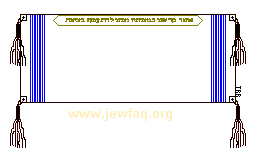
 
  • Tallis with TzitzitThe TZITZIT and the TALLIT:  The Torah commands Jews to weartzitzit (fringes) at the corners of their garments as a reminder of the commandments of God, kind of like tying a string around your finger to remember something. The passage also instructs that the fringe should have a thread of “techeilet,” believed to be a blue or turquoise dye, but the source of that dye is no longer known, sotzitzit are today are all white. The mitzvah to weartzitzit applies only to four-cornered garments, which were common in biblical times but are not common anymore. To fulfill this mitzvah, adult men wear a four-cornered shawl called a tallit during morning services along with the tefillin. There is no particular religious significance to the tallit (shawl) itself, other than the fact that it holds thetzitzit (fringes) on its corners.
  • (SOURCE: http://www.jewfaq.org/signs.htm)
 

There  are no magic charms associated with wearing, or using, these signs and symbols.  They are just reminders of YHWH’s commandments because men have such short memories and are always in need of constant reminders of God’s goodness, kindness AND instructions.


DVE@S6K

logo

Yo searchers!! Need help? – September 2015

Image from whiteangel159.blogcu.com

Image from whiteangel159.blogcu.com


[Yo indeed searchers, if you are unable to access this website every so often, this time ‘mother nature’ is not at fault; ; our server seems to be undergoing some huge technical difficulties.  Please continue to bear with us. We’re not sure how long this will go on, just don’t give up on checking out this website. We’re determined to be around as long as it depends on us!


 We are catching up on lost time so we have no new original articles to post for now, we will be reposting lots of “Revisits.”  We have enough to read and learn from simply scrolling through Site Map  which features over 800+ articles posted since we started this website in 2012. Thank you for your persistent interest in our sharing of knowledge and learning and gradually-acquired wisdom as we endeavor to understand what is relevant to us, gentiles of the 6th millennium — from the original revelation of the One True God Who revealed His Name as YHWH.  One thing sure is we will not quit till our last breath and hopefully our gracious Life-Giver will grant us an extended lifetime to add to the gentiles’ understanding of and perspective on His Sinai Revelation.–Admin1]


——————————

09/29/15  “the jewish mystique” – 


09/27/15  “bereshith 25″ – 


09/26/15  “happy sabbath greeting cards” – We offer no ‘greeting cards’ for Sabbath celebration, but we do offer liturgy for every Sabbath of the month for every month of the year.  All are welcome to use what is written on those liturgies as ‘greeting cards’.


09/24/15  “inscribe us in the book of life” – 


09/19/15  “sabath messages”,  “sabbath blessings images” – We have a whole category on  a Sinaite’s Liturgy for every Sabbath of the month for a whole year.  Every other Sabbath is “musical” where we sing our prayers with borrowed familiar Christian tunes (our heritage) but with lyrics rewritten to suit our Sinaite’s creed.  Please feel free to use any of these for your family or community Sabbath celebration.


09/14/15 “how are gentiles suppose to pray to hashem” – Q&A: “How does a gentile pray to Hashem?”


09/05/15  “judaism torah” –