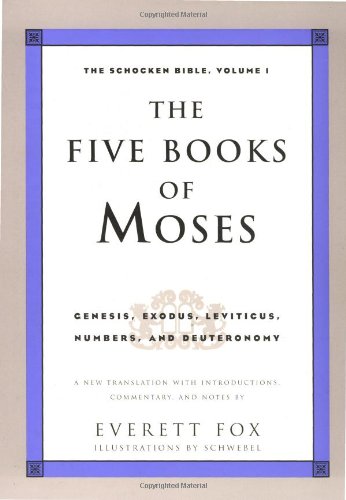
MUST OWN: The Five Books of Moses by Everett Fox

[First posted February 18, 2014, when we decided on another translation of the TORAH as S6K’s choice.—Admin1]


Welcome to Sinai 6000, Everett Fox [EF]! Good news for all: EF’s translation is downloadable for free as PDF; please go to this link:

 
THE SCHOCKEN BIBLE
toby.weebly.com/uploads/2/7/4/8/2748917/everett_foxxstorah.pdf


I’ve had EF’s translation of THE FIVE BOOKS OF MOSES for about a decade now; read it when I was still a fanatic Christian though unlike fanatics of that major world religion, I read the “Pentateuch” not for its true worth, but—can you relate to this —just so I can claim I’ve read Moses’.  
 

At that time I regarded it like Christians tend to do—with an attitude of “religious obligation” since it is supposed to be the foundation of New Testament books.  Strangely, TORAH is regarded as passé, obsolete, only for the Jews, in fact superseded by the Gospels;  “OT” theology was not only distortedly ‘updated’,  it was irreverently supplanted by the counter-theology in the Pauline epistles, surprising for a supposed Jewish Rabbi that Paul claimed to be.  So who among Christians  really bother to go through OT more than once except perhaps professors who have to teach OT in seminaries?  


What did I know then? Like most Christians I swallowed Christianity’s ‘Progressive Revelation’ and ‘Replacement Theology’ hook-line-sinker!   Like fish out of water, I shriveled up outside of what should have been my Scriptural ‘home’ environment and primary source of Divine Revelation from the beginning of my quest for the One True God.   Further on the piscene metaphor, just like fish that don’t get eaten up by fishermen who fish for sport rather than food,  I was providentially thrown back to savor and drink from that  true biblical ‘water from the Rock’—The Torah.


I praise YHWH Who never gives up on Truth-seekers who never give up on their quest for more light until they are finally led back to His one and only complete original Revelation on Sinai;  yes, the same one they and I have read but ignored, to my  great loss.  But never mind me, I’m forgetting this is about Everett Fox. . . .


As our website habitués know, we’ve used different Hebrew translations of the TNK in this website:  

  • AST/ArtScroll, JPS/Jewish Publication Society,
  • P&H/Pentateuch and Haftorahs;
  • and for a year, because it prints the Tetragrammaton Name “YHWH”, we’ve used the HNT/His Name Tanakh by Benmara of hearoyisrael.net; however, it is an unfinished work, still in progress, on its 9.0 version.


Why are we switching now to Everett Fox?   Read below and you’ll soon find out.    Better yet, get a copy — there is no ebook version on Amazon, just hard copies for sale at different prices.  I bought mine from Borders in Santa Rosa, CA. way back in 2003, and  am resurrecting it now to become S6K’s official translation but only for the TORAH.   We will “Alter”-nate with Robert Alter’s THE FIVE BOOKS OF MOSES, also with commentary; this is another MUST HAVE for your personal library, Alter’s literary language is ‘par excellence’.  The reason we chose Fox over Alter is the NAME — Fox uses it all over while Alter does not.  


For the TNK, we will be falling back on AST/JPS, that is, until James D. Tabor and Robert Alter finish their translation-projects on the whole TNK.


NSB@S6K

AKA ‘Admin1′

logo

————————————————


For starters:


Widely acclaimed by Bible scholars and theologians of every denomination, Everett Fox’s masterful translation re-creates the echoes, allusions, alliterations, and wordplays of the Hebrew original. Together with its extensive commentary and illuminating notes, this unique translation draws the reader closer to the authentic living voice of the Bible.


Hereunder are sample reviews from amazon.com—please note the statistics on this book; of the 50 reviews, here’s the rating:

5 star 5.0 out of 5 stars 
(43); 4-star (3);  
3-star (2); and
2 stars and 
1 star (1) 


We will feature only the 5 stars, and 1-star.


This review is from: The Five Books of Moses: Genesis, Exodus, Leviticus, Numbers, Deuteronomy (The Schocken Bible, Volume 1) (Paperback)
5.0 out of 5 stars Simply The Best Ever, November 16, 2004


Everett Fox’s translation of the Torah is plain and simple the finest translation from Hebrew I have ever seen.  None of the other notable English translations, from the JPS Tanakh to the excellent Bloch translation of Song of Songs even comes close to the power and faithfulness of Fox’s Five Books of Moses.  He comes as close as is linguistically possible to capturing the rhythm, nuance, and grace of the Hebrew original as is possible in another language.   Furthermore, when he knows that pure translation will be insufficient to capture a play on words– how many native English readers even know the Bible is full of plays on words?— he provides transliterations of the relevant Hebrew phrases as well, so the device becomes apparent.


Some have complained that in forcing the English language to follow the patterns of a different grammatical system– to say nothing of worldview– he has twisted even poetic English beyond recognition.  But not only is this text highly readable poetry, it reinforces with every word the nearly-always neglected fact that the Tanakh (the “Old Testament”) was not written in English, or Latin, or Greek, and represents a vastly different set of literary (and religious) endeavors than the Christian scriptures.   It forcefully gives the reader a much-needed reminder that this is not the book you think it is.


Most translations, in smoothing the text out into English prose and poetry, either sacrifice accuracy (e.g. the King James), or sacrifice the poetry (e.g. the JPS, which contains some of the least poetic poetry I can think of), resulting in an anemic set of verses bearing little resemblance to the wild, vibrant song of the Hebrew original.   Fox’s unique word-flow unpacks the dense Hebrew into a torrent of breathtaking imagery (e.g.,   “At the beginning of God’s creating
of the heavens and the earth,
when the earth was wild and waste,
darkness over the face of Ocean,
rushing-spirit of God hovering over the face of the waters–“).


He retains the proper transliterations of the Hebrew names, for an authentic-sounding “Yitzchak” instead of “Isaac,”  “Yaakov” instead of “Jacob,”  “Moshe and Aharon” instead of “Moses and Aaron.”  Perhaps most importantly, he refuses to translate the Tetragrammaton, and so instead of “the LORD said this” or “the LORD said that,” his text references YHWH (the w instead of the v I expect results from his basing his work on Rosenzweig, who of course used the w because it is pronounced v in German).


My one niggling complaint is his decision regarding the translation of emphatic doubling, so that repetitions like “mot yumat” are translated “he shall die, yes die.”  It certainly reflects a doubled verb form, and it is certainly different from the traditional, “shall surely die,”  but I am not wild about the sound of it.   But that’s a small thing amidst a sea of greatness.


The footnotes and commentary are also very useful, although more so, I think, if you are not a fluent Hebrew speaker familiar with the original text.  Nonetheless, I am both, and I still found several highly valuable pieces of information that I did not know, and many more additional comments that presented the text in ways that I had not quite thought of before.


One word of warning: if you are looking for a Torah with the traditional Jewish type of commentary (like Hertz or Hirsch or the Artscroll), this is not it.   The commentary is not religious, but literary, linguistic, historical, and cultural.  You should still get this translation, just be aware of what it is and is not.  Nobody who reads the Bible and speaks English should be without a copy of this.  That goes double for anyone who speaks English but not Hebrew.
——————————–
1.0 out of 5 stars Uncomfortable with this version, September 7, 2012
 

I tried working with it a couple of times before returning.  Some of the author’s comments made me uncomfortable with his theology. The translation didn’t line up with ancient Hebrew, so this would not be a work I would feel secure in quoting. Although it will take more effort, I would rather have the ancient Hebrew text and work through the translation. Ancient-Hebrew.org  is working on a translation, and I am excitedly awaiting that.


——————————–


5.0 out of 5 starsA new beginning…, June 17, 2003


Schocken Press has undertaken an ambitious project, to retranslate the Bible into modern language capturing the sound and quality of idiom of the original languages as much as possible.  The first volume of this project is available in The Five Books of Moses, Shocken Bible: Volume I, translated and with commentary by Everett Fox.


‘Based upon principles developed by Martin Buber and Franz Rosenzweig, this new English translation restores the poetics of the Hebrew original—the echoes, allusions, alliterations, and word-plays that rhetorically underscore its meaning and are intrinsic to a text meant to be read aloud and heard.’
The underlying premise of most translations of the Bible have been to clarify the meaning of the text. While this is certainly not overlooked here, it can be the case that in the pursuit of textual clarity, the ability to make it audibly intelligible gets lost — a lot of passages from the New Revised Standard Version, for instance, are so precise in construction that they defy oral expression.


Fox says in his Translator’s Preface:  ‘I have presented the text in English dress but with a Hebraic voice.’


Careful attention has been given to rhythm and sound. Too many English translations overlook the auditory quality of the words, and while striving to capture the idea of the text, they miss the crucial ‘hearing cues’ that an oral rendering would give the listener.  To this end, the text is printed as if it were in blank verse (save where a poetic style was already present and could be carried forward).   Proper nouns (the names of persons and places) retain their Hebraic forms;  odd, though, that the title of the book is The Five Books of Moses rather than The Five Books of Moshe.   Also, a principle of the ‘leading-word’ is employed here.
A good example follows:The New English Bible translated Genesis 32.21-22 as:
for he thought, ‘I will appease him with the present I have sent on ahead, and afterwards, when I come into his presence, he will perhaps receive me kindly.’ So Jacob’s present went on ahead of him…
Here, one would get the idea that the ‘present’ is the key word. But, in Hebrew, it isn’t. Fox’s translation reads thusly:
For he said to himself:
I will wipe (the anger from) his face
with the gift that goes ahead of my face
afterward, when I see his face,
perhaps he will lift up my face!
The gift crossed over ahead of his face…
A very different sense of meaning, cadence, and purpose comes out from this translation.


Fox is heavily indebted to the work of Buber and Rosenzweig (who worked on a German translation similar in character to this English translation) in the early part of this century.   Fox dismisses the idea that this is simply an English variant of their German masterpiece, but does acknowledge great inspiration and methodological similarities.  ‘Buber and Rosenzweig translated the Bible out of the deep conviction that language has the power to bridge worlds and to redeem human beings. They both, separately and together, fought to restore the power of ancient words and to speak modern ones with wholeness and genuineness.’


Fox begins each of the five books with an essay discussing historical context, textual contents, themes and structures, and other important items.  Fox continues a running commentary of the text on pages opposite the Biblical text, and has extensive notes.


This is a work of care and precision, and very useful for Biblical research.  Worthwhile for scholars, Bible enthusiasts, and occasional readers, this book is an interesting addition to any collection, and a vital piece for research and exegesis of the Torah.
—————————-
5.0 out of 5 starsDefinitive Translation, August 23, 2001
By J. A Magill (Sacramento, CA USA) – See all my reviews

How many people have actually read the bible?  While many describe this text as the most important work of western civilization, too many people find it both impenetrable and poorly written.  That is not the fault of the actual text; indeed the Hebrew poetry of the bible is among some of the best ever written. The problem lies instead in the translation.   Myriad efforts at popular translations have been made, from putting the bible into common English to straight line-by-line English.  While these methods render the text more easily read, they also cost it the poetic language and much of its drama.


Everett Fox has solved these problems with a translation that is nothing short of masterful. The language is lucid, the prose poetic, and the story intact. Moreover, Fox is an honest translator, detailing his decisions and pointing out where multiple meaning exist. I have read literally dozens of translations of the bible. In my opinion, this is far and away the best.


Fox’s contribution to the text will surely be remembered and appreciated both now and for decades to come.


—————————


5.0 out of 5 starsFor anyone who’s ever tried reading the Bible and gave up., May 31, 2000


While this is the most authentic and poetic translation of the Torah, the five books of the Bible that Jews hold as sacred but Christians & Muslims see as a lot of rules and stories that served as the basis for their guy, it can be read by anyone.


Everett Fox does an amazing job of capturing the Hebrew syntax and poetry down to repeating words which are repeated in the context and bring more insights than many translations which gloss over the word plays.(like the fact that Moses’ “basket” and Noah’s “ark” is the same word. Or that it is the REED sea not the red sea.)


But the most important part of this book is the fact that it makes the “boring” parts of the Bible exciting and vibrant. You will never badmouth Leviticus, Numbers or Deuteronomy again after you read this translation. Trust me.
————————–
5.0 out of 5 starsThe Five Books Of Moses/ Fox’ Version– Critical Review, June 29, 2005


Until recently, I was unaware of the competing versions of the Bible by Biblical scholars Dr. Robert Alter and Dr. Everett Fox.   Both have authored many books and critical essays about the Bible, culminating with parallel academic versions of The Torah (interestingly, they both chose the title, “The Five Books of Moses.”), biography of David’s life (both chose to use 1,2 Samuel) and both offered competing translations of Genesis.


The good news is, is that both men offer surprisingly interesting renditions of these books.  I was especially pleased to recently receive Dr. Fox’ version of the Torah after having Dr. Alters for two months.  Both books offer slightly different translations along with the running commentary, Dr. Fox’ reserves most of his at the beginning of each book, but what stands out is perhaps cadence.  Dr. Fox’ is a bit easier to read. Yes, he does substitute/ replace the English/ Latin names with the original Hebrew names.  I also found his line of reasoning an interesting contrast to Dr. Alter– 21st century Talmudic debate!


The soft cover is very durable, but it is heavy to carry. It is also printed in large fonts.If you’re like me, not crazy about the JPS standard version and you want a lively Chumash, I strongly recommend this version. Do I recommend this over Dr. Alter’s? No. It’s like hearing “Our Love is Here To Stay” and loving Sinatra’s version, but also loving Louie Armstrong’s.
——————————
5.0 out of 5 stars A fine translation that sounds well when read out loud, March 6, 2004


Since I do not read Hebrew or Greek I have to read the scriptures in English and like all readers of translations my views of them are affected by the goals and purposes they took in preparing their translations.  I have read many over the years and there are many that are quite good and have different points to recommend them.   And their critics are always able to point out their limitations and even some questionable points.


This translation is quite interesting in its approach to capture the pulse, feel, and literary style of the Hebrew in English.  I cannot say how effectively it was done, because I can’t read Hebrew.  Many others have praised it.  I can say that it reads in a very vivid and dramatic way.  It has a lively and powerful feel to its language.  There are times it does not read as idiomatic English, but you would expect that if it were trying to capture Hebrew, right?


There are also many helps for the reader including introductory essays, helpful footnotes, and a great suggested reading list for further study.  The hard cover edition I have is very handsomely printed in easy to read type, fine paper, with some black and white illuminations to start the books.  I think this is wonderful addition to the shelves of English translations out there and deserves to be read by anyone interested in getting at a more aural approach to these scriptures. This translation really does sound better being read out lout than it reads for the eye.   As I understand things, that is what the translator was after, and he succeeded.
———————————–
 
5.0 out of 5 stars Original Textual Accuracy, September 20, 2001
By Eddy Hopkins (Tampa, FL United States) – See all my reviews


Though I am only a second-year student of ancient Hebrew,  I can say confidently that the Fox translation is not only accurate to the Hebrew grammar and syntax,  but it also consistent with the original literary devices used by Moses.
—————————-
5.0 out of 5 starsFox’s Five Books of Moses is SUPERB, April 26, 2000
Whether your interest is in the Bible as literature, as inspiration, or as a study in religion — Everett Fox’s translation/commentary is superb. It is like rediscovering the first five books of the Bible. The commentary is especially strong in explaining the literary devices used in the original Hebrew, and the translation does a remarkable job of bringing the literary strengths and techniques into English — with striking results.
————————–
5.0 out of 5 stars Excellent, August 21, 2007
By The Immigrant (Jerusalem) – See all my reviews


I used to say that it was pointless to try to study the Bible without Hebrew — that it was impossible to “feel” the text, to get the humor, the irony, the poetry. Not anymore. This is a must for any student of the Bible, as it captures the liveliness and strangeness of the original and expose it as the allusive, alliterative, jabberwocky text that it is.  It has been said that for one who is serious about Biblical religion, the Bible is to be read as a love letter, not a thematic novel.  One should pick over each word, each letter, and ask, with the obsession of one reading a love letter, “Why did he choose this word?  Why a comma here and not a period? What echoes with what?”   This gets the non-Hebrew reader much closer to being able to do so Hebrew is best, but this is, finally, a good second choice.  It would be perfect if it had Hebrew written alongside – a great way to learn for students.  Maybe future editions could be dual-language, as I’d assume that most people who are this hard-core into studying also are Hebrew students.
————————–
5.0 out of 5 starsA top-notch commentary., January 21, 2007


This is the only Torah Commentary that I have bought thus far.  After reading the reviews and finding a great price on the H/C in Amazon Marketplace I bought it.  It is hard for me to imagine a better commentary on the Five Books of Moses!   I may add more Torah commentaries to my library, but this one will always have a home for my Torah studies.  The print is large enough for easy reading.  Everett Fox uses the Hebrew names throughout the book.  He points out that most English translations convey the idea of the text and translate out the sound.   I appreciate the amount of information this commentary provides.   An example is the subject of Moshe’s physical appearance in Exodus 34:29.   Mr. Fox footnotes an alternative meaning.   The footnotes are plentiful and most of all, helpful.  The Translator’s Preface is well done and explains the background of this translation.  I really like the Introductions to each book.  Another feature that I appreciate is the Guide to the Pronunciation of Hebrew Names.  This is very helpful if you are like me and know little Hebrew. The Hebraic thought in Torah makes this commentary so much more vibrant than what you would read in a standard English rendition of Torah in most modern Bibles.  This book is a refreshing read and I highly recommend it!!
—————————-
S6K Admin1:  If you’re not convinced and care to read ALL 50 of the reviews, please go to:
Please read the sequel following this post, featuring excerpts from the book, mainly:
  • TRANSLATOR’S PREFERENCE and
  • ON THE NAME OF GOD AND ITS TRANSLATION

—as explained by author Everett Fox.

Q: Does the TORAH promote belief in “Guardian Angels”?

Image from Pinterest

Image from Pinterest

[Our former Bible teacher (identified in many posts as “RW”, particularly in the DISCOURSE category), has recently restored us on his “send” list.  Usually his missives are exclusive for his flock among the congregations of Messianic Judaism, (i.e. ‘Christian Theology in Jewish Dress’) that he ‘planted’ all over the Asia Pacific region.  This is only a short anecdote about an experience he connects with “guardian angels”.  We used to think the same way;  it is typical of the Christian mindset to conclude ‘miracles’ and the personal God’s provisions for what each believer exactly needs at crucial times, by sending His ‘messengers’, His ‘ministering good angels’—in disguise.   Where do you stand, dear reader?


This is only the “Q” part,  the sequel in another article will be our “A”;  it gives us reason to timely explore/explicate the subject of angelology and balance our series on the non-existence of  “fallen angels”.  If you haven’t read those posts, check the following links:

Reformatting and highlights added to original text.  If you’re familiar with our color-coding, we assign “red” for NT and “blue” for OT or our preferred designation:  HB for the Hebrew Bible/Hebrew Scriptures.—Admin1.)


———————-


Our Guardian Angels!!!   –  By “RW”


We believe in Guardian Angels whether others do or not because we believe the Bible, every word of it!!


Hebrews 1:13-14. 

And to which of the angels has he ever said, “Sit at my right hand until I make your enemies a footstool for your feet”?  Are they not all ministering spirits sent out to serve for the sake of those who are to inherit salvation?


This is our biblical basis, which I will explain, and later tell you our experience with a Guardian Angel.


Inheritance is based on family membership.  Those in the family will inherit based on the stipulations of the Patriarch who writes his Will before he dies.  After he dies, no changes can be made.


The Creator of the Universe, the LORD Yeshua/Jesus The Messiah, Redeemer and Savior was born a human, lived among us for 33 years, teaching Truth and offering Eternal Life and then died to validate His offer, His Will, which is retroactive since Adam & Havah (Eve).


Yeshua has only ONE Family, those BORN-from-Above by His Spirit from among the people of Israel and from among the peoples of the Gentiles.  Another illustration He uses for His Family is His Good Olive Tree in Romans 11, with the natural branches being Believers from Israel and the engrafted branches being Believers from the Gentiles.


With these two illustrations of actual events in individual personal lives, we know those who qualify for having Guardian Angels.  We qualified when in our teens other Believers showed us the Good News in the Bible and by the Grace of God, not our merit, we understood, believed and gave our lives to Him, to love, serve and obey Him forever!


Now in 2017, at 88 and 86 years, we are like Paul the Apostle who said, 2 Timothy 4:7-8. 


I have fought the good fight, I have finished the race, I have kept the faith.  Henceforth there is laid up for me the crown of righteousness, which the Lord, the righteous judge, will award to me on that Day, and not only to me but also to all who have loved his appearing.


Now about our Guardian Angel, the only one we have seen physically even though we are aware of their watch care over us at all times.  About 10 years ago, “NW” [RW’s wife] and I were on our way to Gainesville in our large conversion van.  A few miles from Gainesville, the front right tire blew!  I was not going fast so I pulled over on the grass beside the pavement and got out my jack and tools.  Soon I realized that my jack was not enough so I said, “Lord, what do I do now??”


Image from aprojectforkindness.wordpress

Image from aprojectforkindness.wordpress

Almost immediately an older pickup pulled up about 20 feet behind us.  A biker type guy with long hair, beard and tattoos all over came over to help.  He hardly said a word during his whole time helping me and I did not push conversation, being very grateful for his help.  He went back to his pickup and brought another jack and tools and went ahead and changed the tire with hardly a word while I watched.  When he finished I thanked him, he nodded, went back to his pickup, turned around and went back the way he came as if he had come there purposely to help me…. in answer to my prayer???


At first we thought he was a “good Samaritan” who had come along and stopped to help us but as we both thought more about it….. no!!  He came specifically to help us and returned back the way he came!!  He had to be our Guardian Angel, showing up almost as soon as I had said my quick, short prayer!


Now why would God send His Guardian Angel to us as a long haired, bearded, tattooed biker kind?  NW had been quite leery of these guys so after this she realized that there might be some really decent guys among them, that this is their style, so our Angel took this form as he took on a human body to “serve me in my need,” to encourage us and help NW change her opinion about such people.  We have no other explanation for this wonderful experience.

Q&A: Is it really impossible to obey ‘the Law’ of the ‘OT God’??

Image from www.stufffundieslike.com

Image from www.stufffundieslike.com

This began as simply posting  an excerpt  from the long introduction to a chapter in the last book of the TORAH:

Sometimes in our zeal to over-explain the ‘obvious’, i.e. what should be clear in the ‘instructions for living on planet earth’ of the One True God, YHWH, we end up writing long introductions as though the reader won’t ‘get it’ from simply reading a chapter of the TORAH.  And yes, unfortunately, learning from experience, readers don’t always ‘get it’ —  why?  Because of previous religious orientation (whatever their religion is) that prevent them from applying basic reading rules required for understanding and interpreting any reading material, including books that claim to be “the very words of God”.


Readers fail to disengage their thinking from what they have been taught when they read the Hebrew Scriptures, and particularly when they read Christian translations (with a dogmatic  agenda) instead of translations by Jews immersed in the culture and language of their own Sacred Scriptures-cum-national origins/history.


I’m not sure if readers of the Koran have the same tendency if and when they read the Jewish Tanach.  I can only speak from and relate to my experience, having been deeply and lengthily rooted in the 2-part Christian Bible.  Like my Sinaite colleagues who were formerly readers with a Christian orientation — we tended to carry with us ‘baggage’ from New Testament teaching rather than reading the Old Testament with a clear mind, a fresh approach, attempting to understand the text in its original context,  and from the point of view of the original hearers, not fast-forwarding it to our own time frame,  to our  modern context, and to our specific religious orientation.  We should know, been-there-done-that.


Sinaites lived, studied, taught exactly this belief system, hook-line-sinker, for decades of our life.   It is the result of swallowing without question, the Christian doctrine of “progressive revelation” which claims that —

  • the revelation on Sinai was not complete,
  • that the receivers of that revelation were kept in ignorance,
  • ‘blind’ by deliberate divine design as per the apostle Paul’s teaching in Romans;
  • that a sequel was reserved for later revelation through a God-Man,
    • unbeknownst to the original receivers of the original revelation.

What was supposedly kept secret from Israel by the Sinai Revelator?

  • That a Roman political-religious power would form a new religion around their reconfigured NT Godhead;
  • and a Gentile “church” would usurp the chosen nation’s place and title,  calling itself the ‘New Israel’,
  • which would displace the original ‘son’ and ‘servant’ and replace everything in the TORAH and the Hebrew Scriptures with a new everything,
    • new testament,
    • new covenant,
    • new revelation (or continuing the ‘unfinished’ one (prequel) with the final installment’  or sequel, if you will);
    • a new chosen or people whose election is based on choice and not ethnicity;
    • a new and exclusive way to  approach a new reconfigured God,
    • whose ‘salvation’ requires belief in a Savior,
    • membership in His Church,
    • and acceptance of its doctrines.

Why?  Because it is claimed that the “old” was simply too difficult, nay “impossible” to obey,  not doable without the aid of, well, God Himself,

  • who comes down in the form of humanity,
  • tasting what it feels like to be human,
  • as though the all-wise and understanding Designer of individual human beings would not understand
  • unless He had to experience being human Himself,
  • Then,  as God-man, fix the sin/fallen-nature problem as Savior of fallen humanity;
  • fallen and damned because of the doctrine of original sin . . .

—-but let’s not get into that here, I’m forgetting what the original ‘Q’ is here, for which I’m supposed to provide the ‘A’.


The points here are simple and logical:

  • What did the Revelator really say about His own ‘Law’?
  • Would He give instructions impossible to obey?
  • If so, what would be the purpose of that?
  • Is that wise and just?
  • And could the Judge blame humans for failing to obey just because the first man and woman failed His test?

That doesn’t sound at all like a God of Justice!  Human parents would not punish the rest of their children just because their eldest failed to pass their obedience test, would they?  Yet the “OT God” constantly demands obedience nonstop from His chosen original Israel!   Now why would the all-Wise Just God be doing that,  knowing how impossible He has made it for any human, Jew or Gentile, to obey His ‘Law’, His Torah, His instructions for living?


What does the One True God of the Original Torah/Hebrew Scriptures  actually say, even after the supposed “fall” of the first representative humanity?


This is what He reiterates to everyone else after the first parents — ‘simply do as you are told’ or ‘follow the instructions’.


And this is what He says through His mouthpiece, Moses,  to the 2nd generation of the ‘mixed multitude’ who left Egypt and gathered around Sinai to receive the original Revelation and given instructions on how to live together in community:


Deuteronomy/Davarim 30:

11  For the commandment that I command you this day:

it is not too extraordinary for you,

it is not too far away!

12 It is not in the heavens,

(for you) to say:

Who will go up for us to the heavens

and get it for us 

and have us hear it,

that we may observe it?

13  And it is not across the sea, (for you) to say:  

Who will cross for us, across the sea,

and get it for us and have us hear it,

that we may observe it?

14  Rather, near to you is the word,

exceedingly,

in your mouth

and in your heart,

to observe it!


Having been rooted in Christian/Messianic orientation and with an ‘NT’ approach to the “Old Testament” of the two-part Christian Bible, it is difficult for Sinaites NOT to keep connecting what we have been taught by man-made religion, and what we have learned —not from ‘religion’ but from the Revelation given on Sinai, the Torah.


Really, how does one reconcile the declarations of YHWH in this chapter with the Christian teaching that —-

  • man is utterly helpless and definitely hopeless because of ‘original sin’;
  • that man cannot rise above his inherited depraved nature
  • because he has no ‘power’ within himself;
  • that self-changing power is not internal but external,
  • has to come from above, i.e. Holy Spirit;
  • and that 3rd person HS inhabits only those who believe in the 2nd person of the Trinitarian God, Jesus Christ;
  • and only then is one ‘enabled’ to obey . . .

Okay, but obey what? And where does ‘free will’ fit in?


If the expounder of Christian theology, Paul of Tarsus, declares ‘we are under grace, not law’,  then what are adherents of NT theology supposed to obey? Certainly not the Torah of YHWH, since that is ‘obsolete’ and ‘passé’ to Paul.


So, obey what or obey whom?  If not YHWH of the “OT”, then who?


Who else, or what else—the teachings of Christianity’s Man-God Jesus as transmitted to his apostles/disciples.


Oh, but isn’t Jesus God Himself, in the flesh?


Think about it,  who was Jesus?


A Jew who would have obeyed the Torah and if he was God in the flesh, he would remember that as Revelator on Sinai, these were his laws!  In fact according to the gospels, he supposedly declared in Matthew 5:17-18: 


“Think not that I came to destroy the law or the prophets;

I came not to destroy,

but to fulfill.

For verily I say unto you,

till heaven and earth pass away,

one jot or one tittle shall in no wise

pass away from the law,

till all things be accomplished.” 


And supposedly according to the teaching,  ‘all things’ were accomplished at his sacrificial death on the cross as the Paschal Lamb of God, etc. etc.  Please read other posts in this website if you need to be clarified because you’re still confused, or if you’re in shock to hear this for the first time.

The very fact that the 10 commandments or the ‘decalogue’ —

  • has been edited according to the Christian sect using it;
  •  has been adopted by Christianity as part of its commandments,
  • must signify that the original teaching of the TORAH is still recognized as valid,  as ‘law’.
Where did this ‘law’ come from? Where else, the Old Testament that was retitled “old” to suggest obsolescence and that it is for the Jew and not for the Christian.

Really?

The Decalogue states the ten foundational  principles of the Sinaitic Covenant, intended for ALL people.   Sometimes one has to wonder if the new religion of the NT is indeed the ‘New Israel’ . . . when it sounds more like the ‘New Babylon’.


The Lawgiver Himself (YHWH, not mediator Moses) assures the recipients of the TORAH that really, folks,  the commandments are not too hard nor too difficult to understand and  to apply,  THEN–AND–NOW!  This was repeatedly emphasized —

  • to the wilderness-wandering mixed multitude’
  • and to the children of that mixed multitude’ before they entered the Land of Promise,
  • and today, to the  TORAH-recognizing and TORAH-obedient mixed multitude’ of Jews and non-Jews all over the world,
  • i.e.  all humanity in general,  

—for whom TORAH was intended to begin with, or should we say, to end up with!


The prophets Isaiah and Zechariah among others envision the “end of days” when all nations will have knowledge of and recognize Who is the One True God,  obey His Torah, and worship Him and Him alone.

The problem is NOT the commandments.   The problem is the heart of each person who hears, hopefully understands, either accepts or refuses not only the command, but the LAW-GIVER as well.  The commandments are DOABLE as the Law-Giver Himself says in this text!  But unfortunately, even just the dietary prescriptions become a big issue; can’t give up pork, shrimp, oysters, unclean meat!   And the Sabbath? . . . goodness gracious . . . !  Man prefers to embrace a religion that caters to his convenience because the world goes by a Roman-sourced calendar that shifted the sabbath from Saturday to Sunday.

Oh well . . . .to each his choice, that is why the Creator endowed individual humanity with free will.

But choice boils down to only two options:

  •  ‘my’ will or what I want, over and above—
  • His Will and what He has commanded.

Be ready to face the consequences of choosing SELF over the CREATOR of SELF, the “I” in Idolatry vs. the “I” in God’s Image.

INFORMED CHOICE:  that is what we recommend in this website.

We are a ‘resource center’ for seekers of Truth.

Read, chew, then take it or leave it, digest or spit out!

Never mind our words, but do not ignore YHWH’s WORDS of Life, the Torah, the Tree of Life.

As the Life-Giver proposes for individual choice:  Choose life.


Sig-4_16colors

AIbEiAIAAABDCNPkvrXuucmdeSILdmNhcmRfcGhvdG8qKGJkZTc0YTk3NmUxMGM4OTAzZjk5MDhkMjdkZDI2ODQ3OTliYmQ2MDkwAe5UdNp0lvYvCf8bjAFEJOY_fdsj

Q: What is the Sinaite view on what happens to us after we die?

Image from Kalilayan Founders Center, University of the Cordilleras, designed by Christian Bumatay

Image from Kalilayan Founders Center, University of the Cordilleras, designed by Christian Bumatay

[First posted November 2016 on the occasion of All Saints Day.  This is another excerpt from a long article that began as an eulogy for a dearly departed Sinaite but went on to explaining the Sinaite’s view of what happens after death.  For the original post, please go to this link:  “And just like that, he is no longer alive”.

Christianity’s Holy Week culminated on Resurrection Sunday with a promise of resurrection for all believers in Jesus Christ.  Well, what happens to non-believers in the Christian Savior,  the non-Christian population, do they resurrect at all?  The Christian teaching is: a resurrection for judgment where their ultimate destiny is hell.  What is the Sinaite’s stand on “life beyond the grave”?Admin1]


——————————-


From the time of our breakaway from Christ-centered faith, there have been unspoken speculations— (we’re merely guessing, knowing how we used to think as former Christians)—- that the deaths among our very small core community are indicators of Divine Judgment upon the ‘already-saved’ who turn their backs on the Savior.   Actually a worse fate than those who never “converted” according to these few selected NT exhortations:

1 Timothy 4:1-5 (ESV)

Some Will Depart from the Faith

Now the Spirit expressly says that in later times some will depart from the faith by devoting themselves to deceitful spirits and teachings of demons, through the insincerity of liars whose consciences are seared . . . .

Colossians 2:8-1  (ESV)

See to it that no one takes you captive by philosophy and empty deceit, according to human tradition, according to the elemental spirits[a] of the world, and not according to Christ.

Hebrews 6:4-6 (NIV)

It is impossible for those who have once been enlightened, who have tasted the heavenly gift, who have shared in the Holy Spirit, who have tasted the goodness of the word of God and the powers of the coming age and who have fallen[a]away, to be brought back to repentance. To their loss they are crucifying the Son of God all over again and subjecting him to public disgrace.

Hebrews 10:26-31 

For if we go on sinning willfully after receiving the knowledge of the truth, there no longer remains a sacrifice for sins, 27 but a certain terrifying expectation of judgment, and the fury of a fire which will consume the adversaries. 28 Anyone who has set aside the Law of Moses dies without mercy on the testimony of two or three witnesses. 29 How much severer punishment do you think he will deserve who has trampled under foot the Son of God, and has regarded as unclean the blood of the covenant by which he was sanctified, and has insulted the Spirit of grace? 30 For we know Him who said, “Vengeance is mine, I will repay.” And again, “The Lord will judge his people.” 31 It is a terrifying thing to fall into the hands of the living God.


Shiver.   Now think about it:

  • would the God of Righteousness, Justice and Mercy
  • really ‘punish by death’
  • those whom He did not choose (like the Israelites),
  • but who chose Him as LORD (like Sinaites),
  • no matter how late we showed our recognition of YHWH as the One True God
  •  in our non-stop quest to ‘Know God’,
  • a pilgrimage that has taken a lifetime,
  • holding on to Divine declarations in—-Deuteronomy 4:29 [EF] 

But when you seek YHWH your God

from there you will find (him),

if you search for him with all your heart

and all your being.


and Jeremiah 29:14 [AS] :

 “You will seek Me and you will find [Me],

if you search for Me with all your hearts;

I will make Myself available to you,

the word of HASHEM [YHWH].


The character of the God of Israel whom Sinaites have come to know is defined through His actions as well as His Self-declarations recorded in the Torah, His Book of Life:


6 And YHWH passed before his face

and called out:

“YHWH YHWH God, 

showing-mercy, showing-favor,

long-suffering in anger,

abundant in loyalty and faithfulness,

7  keeping loyalty to the thousandth (generation),

bearing iniquity, rebellion and sin, 

yet not clearing, clearing (the guilty),

calling-to-account the iniquity of the fathers

upon the sons and upon sons’ sons,

to the third and fourth (generation)!


So what has YHWH declared about the destiny of the likes of us or,  for that matter,  the likes of all—Jew, Gentile, Christian, non-Christian, Muslim, Atheist, Agnostic, clueless non-religious humanity?


Here is the developing Sinaite’s view on  ‘after-life’ lingering questions.  The reason for bringing this up now is because we have been constantly asked:  “What do Sinaites believe happens after death?”  Specifically, where does one go if he does not embrace the Christian Savior?


Sinaites can only go by what is on record as “the very words of God”; we do not and dare not speculate beyond what is revealed .  We have explained in many posts what we consider as “Divine Revelation” and that is limited to the Torah which is not word-for-word attributed to the God of Israel, but a book that contains or records the words of the God of Israel. . . and His instructions for living, for Jew and Gentile.


Image from QuoteAddicts.com

Image from QuoteAddicts.com

That oft-repeated question of “what next” after “this life”?  Death is the inevitable destiny everyone alive faces, ready or not.   Some religions are quite preoccupied with the subject, particularly those that claim specific revelation about what lies beyond.  Myths and legends abound regarding ghosts and spirits that linger; some advocate that the dead believer is ‘instantly’ with their ‘Lord’ and that non-believers are  condemned for eternal suffering in the fires of hell.


Sinaites have struggled with explaining our view of what happens in the “afterlife.”   If we don’t believe in the devil and a place called hell where non-believers in the Christian Savior are supposedly destined to go, then where is  the non-Christian’s ‘eternal destination’?


Where do we think that intangible immaterial part of us —

  • we might call “soul” or “spirit”
  • that leaves our physical body
  • . . . goes . . .
  • when the inevitable separation
  • of our essence from the body it inhabits
  • happens at the crucial ‘end of life’?


Our simple and candid answer?  We do not know.  We do not ‘worry’ about that particular ‘unknown’.  Why not?


If the Revelator on Sinai emphasized LIFE in all His declarations,  then who is man to speculate and imagine what happens beyond the boundaries of what is divinely revealed,  and dare venture into the unknown?  YHWH the Creator of LIFE is LIFE-focused, emphasizing what each human can do during his life span which is about the only time he can exercise his God-given free will, to choose–

  • how to live his life,
  • to do or not to do . . .
  • his will or God’s Will . . .
  • to be the ‘I’ in the Idol
  • or the ‘I’ in God’s Image.


The Revelator’s mouthpiece, Moses,  urges choose life”  —

  • to the second generation
  • issuing from the original mixed multitude who were freed from bondage to Egypt 40 years before;
  • born in the wilderness,
  • children of freemen,
  • who were all still alive and breathing
  • as they were about to enter the Land of promise.


What does “choose life” mean to generations who are still alive? We have articles explaining “choose life” so we won’t go into that here, please check out these links:


Not so strangely, the Torah is silent about what happens beyond life on this earth.  Except for some debatable and vague phrases about how each of Israel’s patriarchs “went the way of his fathers”,   the generational narratives just keep moving on.


Why so?


We can only know the Mind and Will of God according to what He chooses to reveal, right?  So we figure that YHWH,  Creator of humanity, Revelator on Sinai, Source of life and breath,  the God Who revealed Himself and His Way to Israel,  chooses to emphasize in His Manual for Living, His TORAH—

  • what each individual can do
  • while he has breath
  • for each moment-by-moment
  • constantly time-passing ‘present’
  • —-the PRESENT —- which is the only real-time one has or actually possesses;  which is ever fleeting second per second,
  • to choose to do or not to do,
  • to act or not act,
  • in accordance with one’s own inclination
  • whether knowingly
  • or ignorantly (uneducated by Divine Revelation)
  • or in accordance with God’s revealed and known Will, all contained in the Torah.


In short, if God doesn’t say so, neither do we.  Leave that part to the Lord of LIFE!


We do know the consequence for choose life’ and that is blessing’.  Can we leave it at that?  And we might also find comfort in the words of wisdom from the author of the book of Ecclesiastes 12:5-7, (presumably, King Solomon):


Remember Your Creator in Your Youth
6  Remember Him

before the silver cord is broken

and the golden bowl is crushed,

the pitcher by the well is shattered

and the wheel at the cistern is crushed;

7  then the dust will return to the earth as it was,

and the spirit will return to God who gave it.

8  “Vanity of vanities,” says the Preacher, “all is vanity!”…


Ponder this opening line in the last chapter titled “Memory”—THE GRAMMAR OF GOD  by Jewess author Aviya Kushner:


“And just like that,

my grandfather is no longer alive.

I write no longer alive, 

not dead, 

not gone,

 because neither of those

has really been true.”


IN MEMORIAM,

all our dearly beloved,

who are “no longer alive”, 


Sig-4_16colors


logo-e1422801044622

A Sinaite’s Musical Liturgy – 3rd Sabbath of November

[Here’s another Sabbath liturgy in song.  For those familiar with the original Christian lyrics, the rewrites might sound awkward, even forced, but it’s always a matter of getting used to something different, if not a variation of the familiar.  


We worship the Originator of Diversity, just look at His Creation!  Remember, our revised hymns are intended not only for worship but for teaching as well as for enjoyment; even little children can learn and commit to memory biblical lessons from our revised lyrics.  For hymns compatible with Torah teaching, we left the text as originally written.  


Consider this as the Sinaite’s way of paying tribute to Christian hymn writers for their beautiful inspiring music; we apologize for revising their lyrics to reflect Torah teaching instead of New Testament theology.  To YHWH be the glory!–-Admin1.]


—————————–


Image from owprince.wordpress.com –

 
KINDLE THE SABBATH LIGHTS
Image from www2.kenyon.edu

Image from www2.kenyon.edu

[Original Tune:  ‘Be Thou my Vision’ – Original Lyrics]


1.  Be Thou my vision, O Lord of my heart;

Naught be all else to me, save that Thou art;
Thou my best thought, by day or by night,
Waking or sleeping, Thy Presence my Light.


2.  Be Thou my Wisdom, and Thou my true Word;
I ever with Thee and Thou with me Lord; 
Thou my great Father and I Thy true child; 
Thou in me dwelling, and I with Thee one.


3.  Be Thou my battle shield, sword for the fight;
Be Thou my dignity, Thou my delight;
Thou my soul’s shelter, Thou my high tower,
Raise Thou me heavenward, O Power of my power.


4. Riches I need not, nor man’s empty praise;
Thou mine inheritance, now and always;
Thou and Thou only, first in my heart,
High King of heaven, my Treasure Thou art.


5.  High King of Heaven, my victory won,
May I reach Heaven’s joys, O bright Heaven’s Sun!
Heart of my own heart, whatever befall,
Still be my Vision, O Ruler of all.


PRAISE   [Original tune:  “Give to our God Immortal Praise”/Revised Lyrics ]
page18_picture0_2 1.  Give to YAHUWAH immortal praise,
kindness and mercy grace His ways,
honor and glory, fear and awe,
to Him belong,
sing of His wonders in this song.


2.  Give to the LORD of lords renown,
the KING of kings — with glory crown!
His GREAT-ness ever-ever-ever shall endure,
When lords and kings are known no more.


3.  He made the earth, it’s surrounded with sky,
He fixed the star-filled dome on high; 
 bird, beast and fish and all inhabitants on earth,
know their Creator from their birth.


4.  He fires the sun, red hot, blazing and bright!
He bids the moon —“shine bright at night!”
Twinkling gazillion stars in galaxies above,
signs of our dear Creator’s love.


5.  Israelites freed from that ‘bad’ Pharoah’s hand,
He led them to the promised land;
manna for food, they drank fresh water from a rock,
more quail for meat, they had no lack.


6.  Land that He promised to Patriarchs before,
Abraham, Isaac, and one more,
Jacob whose name He later changed to ‘Israel’,
on whom 12 sons and 12 tribes fell.


7.  He saw the Gentiles oblivious to sin,
needing His Torah light within,
chose He a people who would lead them to His Way,
Torah for nations to this day.


8.  If we would still heed His Words, choose His Life,
this world would end all war and strife,
Torah, the Tree of Life is meant for one and all,
So that not one need ever fall.


BLESSINGS    [Original tune: In His Time/Revised Lyrics]


Image from www.stmargaretsnewtoronto.ca

Image from www.stmargaretsnewtoronto.ca

Bless this bread, bless this wine,

Bless our fellowship today
it’s Your Time,
Sabbath keepers—now are we,
Torah teaching—now we see,
Oh how truly blessed to be,
in Your Time.


Bless the men, bless the wives,
bless the children,
they’re Your gifts to our lives,
Lord we bless You everyday,
Lord of Sabbath, that we may
be so full of joy today, 
in Your Time.

How could we not meet this day,

 it’s Your Time.


 SABBATH MEAL


TORAH STUDY
[Original tune:  God Has Spoken By His Prophets/Revised Lyrics]


Image from www.westchabad.org

Image from www.westchabad.org

1.  God has spoken by His Prophets,

spoken His unchanging Word,
Each from age to age proclaiming
God is One, He’s Only One!
He’s the Alpha, He’s the Omega,
There is no other God but He,
He is future, past and present,
He alone is First and Last.


2.  First there’s  Moses, then there’s Samuel,
and the major prophets three,
Jeremiah and Isaiah, Ezekiel
who all could ‘see’!
Minor prophets– no less important—
Amos, Hosea, Nahum and . . .
Micah, Jonah, Zephaniah, Haggai, Zacari-ah!


3.  Malachi and Obadiah,
Joel, Habakkuk, there’s more—
others who were not included
in TNK’s great hall of fame.
What’s important is God’s message,
Who they were, God knows their names,
Praise God for His human-mouthpiece,
 whose words we still hear today.  
 
4.  God has spoken through the ages,
messages for Israel,
warnings, blessings, dire reminders,
Father to His firstborn son.  
What a faithful Covenant-Keeper,  
how to repay a God like this!?  
Hearken to His loving message,
love Him back and worship Him!
 
 
HAVDALAH


The Lord bless you and keep you,
The Lord lift His countenance upon you,
And give you peace, and give you peace,
The Lord make His face to shine upon you,
And be gracious unto you, be gracious,
The Lord be gracious, gracious unto you.
Amen, amen, amen,
ah——–men, amen,
ah——–men, amen.
Image from www.homesteadoriginals.com

Image from www.homesteadoriginals.com

Sig-4_16colors
AIbEiAIAAABDCNPkvrXuucmdeSILdmNhcmRfcGhvdG8qKGJkZTc0YTk3NmUxMGM4OTAzZjk5MDhkMjdkZDI2ODQ3OTliYmQ2MDkwAe5UdNp0lvYvCf8bjAFEJOY_fdsj
 

If there is a ‘second coming’ when was the ‘first’ and Who came?

Image from slideplayer.com

Image from slideplayer.com

[First posted in 2012,  check out:   Exodus/Shemoth 19: The First Coming.  Reposting because of the Christian expectation that their “rapture” would occur on September 23, 2017 .  Well, that date came and went and as usual, no Christian is missing from earth.  Of course, with all the natural and man-caused disasters occurring at this time, all these are being ‘read’ as ‘signs’ to watch to indicate the time of the ‘rapture’.  Really dear folks, how many predictions on specific dates of the “second coming of Jesus Christ” have passed and still, the faithful are waiting to meet him in the air?  We know what the “New” Testament says about that future event, what about the “Old”, does it predict the same?  Translation: EF/Everett Fox, The Five Books of Moses.—Admin1]


————————–


 Christians talk about “the second coming” referring to the return of their “Messiah” Jesus Christ.  His “first coming” was supposedly when this Son-God came to live among mankind, starting as a baby born of a virgin (the Christmas story).  Messianics share the same belief about a second coming, though they set the time of the first coming or the birth of baby Jesus not on December 25 but sometime in September, the feast of Tabernacles.  If that ‘sideplayer’ poster is to be believed, who would have known Muhammad prophesied a ‘second coming’ . . .  of whom we have yet to determine; and that Krishna and Buddha are also expected to return.  Really!!!???


James Tabor of Restoring Abrahamic Faith explains the ‘second coming’ differently and we go along with him on this one.  In the last page of his book, he writes the Principles of Abrahamic Faith:  


  • The Second Coming of YHVH as Lord, Redeemer, Savior and King of Kings, to rule over all the earth is the hope of humankind.  
  • This great turn in history will be ushered in by His prophetic Messiahs/Anointed Ones, as His chief human agents who prepare the way for His coming—the Branch of David as Prince, and the final Priest/Teacher, who stands beside him.  
  • They will be empowered by YHVH—
    • to fully restore TORAH faith in the land of Israel,
    • complete the re-gathering of the Twelve Tribes,
    • rebuild the Sanctuary as a House of Prayer for all Peoples,
    • and call upon all nations to repent and turn to God.


Where does he base this statement?

 Isaiah 11; Micah 5:2-4; Jeremiah 23:5-6; 33:14-26; Zechariah 2-4; 6:11-14; Malachi 3-4.


So, it makes sense that if there’s a second, there must have been a first.  When did that happen?  


Scripturally,  the ‘first coming’ is recorded right in the 19th chapter of Exodus.  Notice all the details as you read and picture yourself — if you were among the slaves not anticipating what they were gathered there for, this narrative clearly describes their experience.  


Now here’s something truly encouraging, for us Gentiles who feel excluded from the Covenant with Israel:


Deuteronomy/Devarim 29 states: 

13 Not with you, you-alone 

do I cut this covenant and this oath,

14 but with the one that is here, standing with us today 

before the presence of YHVH our God, 

and (also) with the one that is not here with us today.


 Isn’t that a strange reference,

“also with the one that is not here with us this day.”


Israelites would think it refers specifically to their progeny but we surmise that if TORAH is for all humankind, and Israel is merely to model it to the nations, the Gentiles, then we claim that verse as applicable to us as well.  If the TORAH of YHWH is beneficial for Israel, it is beneficial for all who would choose submit to it, whether Jew or Gentile!


Agreed: the God of Abraham, Isaac and Jacob chose the people that issued from the Patriarchs of Israel  . . . but surely He did not intend for His Torah to be exclusive to the chosen people; people outside of the nation of Israel can choose the God of Israel and His Torah and become—-not Jews as the uninformed mistakenly think—but Torah-observant gentiles.  Like us, Sinaites.


Exodus/Shemoth 19

1 On the third New-moon after the going-out of the Children of Israel from the land of Egypt, 

on that (very) day  they came to the Wilderness of Sinai.
2 They moved on from Refidim and came to the Wilderness of Sinai, 

and encamped in the wilderness.

There Israel encamped, opposite the mountain.


The date/time frame is given in verse 1.  Pardon our gentile ignorance, we tried figuring out how to fit into “the third month” the number of days counted in the celebration of the feast of Pentecost (50), the anniversary of the giving of the TORAH.  Three months equals 90 days if we figure the month according to 30-31 days  The mixed multitude left Egypt on the day after Passover (15th of Nissan), so 15 days  plus a month (30 days) trekking to Mount Sinai equals 45; that leaves about 5 days on the 3rd month.  


For sure the Rabbis figure it far better than we do so according to their biblical calendar. 

Judaism 101 explains —

[http://www.jewfaq.org/holidayc.htm]:


Shavu’ot is not tied to a particular calendar date, but to a counting from Passover. Because the length of the months used to be variable, determined by observation (see Jewish Calendar), and there are two new moons between Passover and Shavu’ot, Shavu’ot could occur on the 5th or 6th of Sivan. However, now that we have a mathematically determined calendar, and the months between Passover and Shavu’ot do not change length on the mathematical calendar, Shavu’ot is always on the 6th of Sivan (the 6th and 7th outside of Israel. See Extra Day of Holidays.)


Another interesting perspective from jewfaq:


The period from Passover to Shavu’ot is a time of great anticipation. We count each of the days from the second day of Passover to the day before Shavu’ot, 49 days or 7 full weeks, hence the name of the festival. See The Counting of the Omer. The counting reminds us of the important connection between Passover and Shavu’ot: Passover freed us physically from bondage, but the giving of the Torah on Shavu’ot redeemed us spiritually from our bondage to idolatry and immorality. Shavu’ot is also known as Pentecost, because it falls on the 50th day; however, Shavu’ot has no particular similarity to the Christian holiday of Pentecost, which occurs 50 days after their Spring holiday.


It is noteworthy that the holiday is called the time of the giving of the Torah, rather than the time of the receiving of the Torah. The very wise Jewish sages point out that we are constantly in the process of receiving the Torah, that we receive it every day, but it was first given at this time. Thus it is the giving, not the receiving, that makes this holiday significant.


3 Now Moshe went up to God, 

and YHVH called out to him from the mountain,

saying: 

Say thus to the House of Yaakov,

(yes,) tell the Children of Israel:
4 You yourselves have seen 

what I did to Egypt,

how I bore you on eagles’ wings and brought you to me.
5 So now,

if you will hearken, yes, hearken to my voice 

and keep my covenant, 

you shall be to me a special-treasure from among all peoples.

Indeed, all the earth is mine,
6 but you, you shall be to me

a kingdom of priests, 

a holy nation.

These are the words that you are to speak to the Children of Israel.
7 Moshe came, and had the elders of the people called, 

and set before them these words, with which YHVH had commanded him.
8 And all the people answered together, they said:

All that YHVH has spoken, we will do. 

And Moshe reported the words of the people to YHVH.
9 YHVH said to Moshe:

Here, I am coming to you in a thick cloud,

so that the people may hear when I speak with you, 

and also that they may have trust in you for ever. 

And Moshe told the words of the people to YHVH.
10 YHVH said to Moshe:

Go to the people,

make them holy, today and tomorrow,

let them scrub their clothes,
11 that they may be ready for the third day,

for on the third day 

YHVH will come down before the eyes of all the people, upon Mount Sinai.
12 Fix-boundaries for the people round about, saying:

Be on your watch against going up the mountain or against touching its border!

Whoever touches the mountain-he is to be put-to-death, yes, death;
13 no hand is to touch him, 

but he is to be stoned, yes, stoned, or shot, yes, shot, 

whether beast or man, he is not to live! 

When the (sound of the) ram’s-horn is drawn out, they may go up on the mountain.
14 Moshe went down from the mountain to the people,

he made the people holy, and they washed their clothes,
15 then he said to the people:

Be ready for three days; do not approach a woman!
16 Now it was on the third day, when it was daybreak: 

There were thunder-sounds, and lightning,

a heavy cloud on the mountain 

and an exceedingly strong shofar sound.

And all of the people that were in the camp trembled.
17 Moshe brought the people out toward God, from the camp,

and they stationed themselves beneath the mountain.
18 Now Mount Sinai smoked all over,

since YHVH had come down upon it in fire;

its smoke went up like the smoke of a furnace, 

and all of the mountain trembled exceedingly.
19 Now the shofar sound was growing exceedingly stronger

-Moshe kept speaking,

and God kept answering him in the sound (of a voice)-
20 and YHVH came down upon Mount Sinai, to the top of the mountain.

YHVH called Moshe to the top of the mountain, 

and Moshe went up.
21 YHVH said to Moshe:

Go down, warn the people 

lest they break through to YHVH to see, and many of them fall;
22 even the priests who approach YHVH must make themselves holy,

lest YHVH burst out against them.
23 But Moshe said to YHVH: 

The people are not able to go up to Mount Sinai, 

for you yourself warned us, saying: Fix boundaries for the mountain and make it holy!
24 YHVH said to him:

Go, get down, 

and then come up, you and Aharon with you, 

but the priests and the people must not break through to go up to YHVH, lest he burst out against them.
25 Moshe went down to the people and said to them.


Imagine ourselves there . . . gathered with the “mixed multitude” . . . anxiously anticipating meeting the Creator, Liberator, Revelator.


Ponder this:  how do we ‘meet’ YHWH the Revelator on Sinai today?


We ‘meet’ Him in the Hebrew Scriptures, specifically the Torah. That is how He still addresses humankind.   As often as we wish to hear His voice to us, we read and study, we hear and listen and receive in our heart and mind His instructions and guidelines for living,  which continue to resonate on to our time and our generation.


thetorah.com

thetorah.com

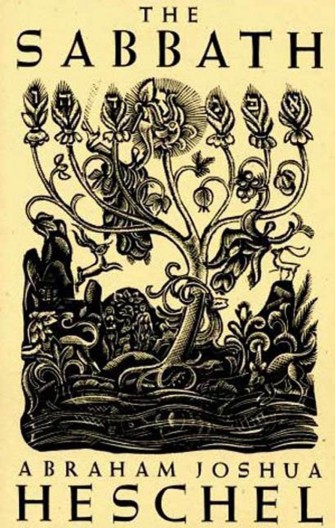
As the wise custodians of the Hebrew Scriptures remind us, the Torah was given once in biblical history, but the receiving continues from that point in time, that ‘moment on Sinai’ as Abraham Joshua Heschel refers to it.  The receiving is for every human, Jew or Gentile who not only hear but listen and most importantly, heed!  Don’t we belong to that category stated by Scripture:


“also with him that is not here with us this day.”


Lord YHWH, 

God of Israel and all Nations,

indeed, may it be so for us

who were not at Sinai

during Your giving of Your Torah, 

but have chosen to receive Your Law as Grace, 

for Law is Grace to all

who seek to know You

and have chosen You

as God, as King,

and Gracious Lord of Law and Life!


Sig-4_16colors

logo

Oy Searchers, need help? – November 2017

Image from PicturesCafe.com

Image from PicturesCafe.com

[Welcome Visitors!  This post is intended to help you find articles that address your query as you learn to navigate your  way through our website. The best way to do this is to click the box, upper right, above the Sinai desert image:  Site Map.  This opens up the table of contents listing over a thousand articles under different categories.  When there are no search entries, this post becomes a blog that comments on current events and their biblical implications, if any.–Admin1.]


————————-

11/29/17 “the death of death by neil gillman”

11/19/17 – “ligonier.org/learn/articles/unholy-pursuit-god-moby-dick/” – This is one of the references in the post worth revisiting if you missed reading it:

It is part of our series on the “UNchosen” in biblical narratives, if you care to read other similar posts:

prayershawl:starofdavid11/18/17 – “symbole israel” – The most recognizable symbol for the modern state of Israel is probably their official choice of the “star of David” in blue superimposed upon a white background in their national flag.  And the six-point-star plus the colors blue and white communicate a lot about Israel today as well as its history (recorded in the Hebrew Scriptures).  And for observant Israel (Judaism) there are several besides the menorah.

Here are posts to check out on this website:


11/08/17  “Expose your pig” – 
That phrase is not about Leviticus 11 food prohibitions (unclean meat of swine and scavenger animals); it’s about the 2-legged gender who behaves like a filthy animal instead of the “crown of creation” that he/she was intended to be.  Now why include the female here when the phrase is a rallying cry against sexual harassment by the male species (in France)?  This is a HUGE topic that needs a whole series of discussions, so why bring it up in a website like this?  Because ultimately, it boils down to a misreading which leads to misinterpretation, which leads to wrong behavior, which leads to the abuse of “the other” whoever that would be in any relationship, but specifically between the genders.   In short, bad hermeneutics of Genesis 2 (the creation of humanity) and Genesis 3 (the testing of humanity).  We don’t claim to be wiser the most, we just read scripture like any other literary text that uses figures of speech to communicate universal truth.

Here’s our take on the specific chapters cited as well as what the Torah teaches about male-female relationship:

11/01/17 – While waiting for search entries, we usually feature trivia about the month we’re into, courtesy of month-facts enthusiasts who share their research on the web.  Here’s our pick:


Source:  NobelCom Blog > > Fun Facts about the Month of November


Fun Facts about the Month of November

Fun facts about the month of November

• The name of the month of November comes from the Latin “novem”, meaning “nine”, because in the Roman calendar November was the ninth month of the year out of a total of ten months. With the adding of January and February at the beginning of the calendar after the Julian calendar reform, November became the eleventh month of the year, as we know it today. 

• Throughout history, November was associated in large parts of the world with the beginning of winter and people would spend the month storing food and preparing their homes to survive the cold season. The Anglo-Saxons called November ‘Blotmonath’ (“Blood month”) after the blood of slaughtered animals.

• Another fun fact about November is that in Australia, United States and Canada, this month is associated with Movember (moustache November), a movement that encourages men to grow a moustache as a symbol of celebrating men’s health and raise awareness regarding different male diseases.

• The zodiac signs for November are Scorpio (October 23 – November 21) and Sagittarius (November 22 – December 21).

• Famous people born in November include Mark Twain, Winston Churchill, L. M. Montgomery, Boris Becker, Charles de Gaulle, Scarlett Johansson, Dale Carnegie, Martin Luther, Demi Moore, Kurt Vonnegut, Leonardo DiCaprio, Carlos Fuentes, John Galliano.

• The birthstones of November are the topaz and the citrine, both known for their calming energies, bringing warmth and fortune to those who wear them. The topaz in particular symbolizes friendship and it is said to cure madness and eliminate nightmares. Pure topaz is colorless but in its most common form ranges in color from brownish orange to yellow. This is why it is often mistaken for the citrine, another yellow colored stone. The citrine is supposed to spark imagination and symbolizes new beginnings.

• The traditional flower of the month of November is the chrysanthemum. Depending on their color, chrysanthemums have different meanings: the red ones symbolize love, the white ones stand for innocence, and the yellow ones denote unrequited love.

• Special holidays in November include All Saints’ Day (November 1st), All Souls’ Day (November 2nd), Thanksgiving (the forth Thursday in November), Universal Children’s Day (November 20th).

A Sinaite’s Musical Liturgy – 1st Sabbath of November

[As former Catholics/Evangelicals/Messianics, we Sinaites have committed many Christian hymns to memory.  We love the music, yet can no longer sing the lyrics . . . so what to do? The next best thing!  Since imitation is the best compliment (that is our excuse anyway), we’ve borrowed the music, rewritten the lyrics according to our current belief system. . . . though for hymns whose original lyrics we are in agreement with, we do not tamper with the message.  Music is a teaching tool—meaningful lyrics are not only sung but remembered, probably more effectively and with lasting impact than a sermon from the pulpit.
For those who wish to use our liturgy for your Sabbath celebration, you are most welcome to it.  If you are not familiar with the original tune, simply recite the words; either way it works.  Have a joy-full Sabbath!–Admin1.]


——————————
KINDLE THE SABBATH LIGHTS


Image from flyinghorsesense.com

Image from flyinghorsesense.com

 [Tune:  Immortal, Invisible God Only Wise/Original Lyrics]


1.  Immortal, invisible God only wise;

In light inaccessible hid from our eyes;

most blessed, most glorious, the Ancient of Days,

Almighty, victorious, Thy great Name we praise!


2.  Unresting, unhasting, and silent as light; 

Nor wanting, nor wasting, Thou rulest in might:

Thy justice like mountains high soaring above,

Thy clouds which are fountains of goodness and love.


3.  To all life Thou givest, to both great and small,

In Thee all life livest, the True Life of all.

We blossom and flourish as leaves on the tree,

and wither and perish but naught changeth Thee.


4.  Great Father of glory, pure Father of Light!

Thy angels adore Thee, all veiling their sight:

All praise we would render:  O help us to see,

T’is only the splendor of light hideth Thee!

Image from pabloperez.com

Image from pabloperez.com

[Original Tune: Crown Him with Many Crowns/REVISED Lyrics]


1. Crown Him with many crowns,  

Yahuwah on His throne,

Hark! how the heavenly anthem drowns 

all music but its own!

Awake my soul and sing 

of Him Who madeth me,

O hail Him as our matchless King

 through all eternity.


2.  Crown Him the LORD of Love,

receive His grace, don’t hide,

Rich blessings are within our reach 

when He is glorified:

All angels in the sky

 bow down before His might,

As downward scans His wandering eye, 

when lives are set aright.  


3.  Crown Him the LORD of LIFE,

all hail His gift of Breath,

Let’s dedicate our life unto HIM

between our birth and death,

His glories we now sing, 

our Source of Life on high,

Who promised blessings for all those

who who live His Torah Life.


4.  Crown Him the Lord on High 

Who sits upon His Throne,

Whose spoken word created all worlds, 

yet His Name is unknown . . .

To Him be endless praise, 

from every tongue and race,

Yahuwah is the God we serve 

all through our end of days.


Psalm 47  (NASB)

[For the choir director. A Psalm of the sons of Korah.]

God the King of the Earth.


47 O clap your hands, all peoples;
Shout to God with the voice of joy.
For the Lord Most High is to be feared,
A great King over all the earth.
He subdues peoples under us
And nations under our feet.
He chooses our inheritance for us,
The glory of Jacob whom He loves. Selah.

God has ascended with a shout,
The Lord, with the sound of a trumpet.
Sing praises to God, sing praises;
Sing praises to our King, sing praises.
For God is the King of all the earth;
Sing praises with a skillful psalm.
God reigns over the nations,
God sits on His holy throne.
The princes of the people have assembled themselves as the people of the God of Abraham,
For the shields of the earth belong to God;
He is highly exalted.

Image from persevereandtrust.blogspot.com

Image from persevereandtrust.blogspot.com


MEDLEY [Original Lyrics]
Sing hallelujah to the LORD;
sing hallelujah to the LORD;
Sing hallelujah, sing hallelujah,
Sing hallelujah – YAHUWAH!
[” Bread of the World” – Revised Lyrics]


We praise the GOD 
of Lovingkindness,
Whose Grace and Mercy overflows,
this wine we drink, this bread we share,
are symbols of His Loving Care.
LORD,  bless our men, LORD,  bless our women,
LORD, bless our children where they are,
May they know You, adore and love You,
For that would bring much joy to our lives.
[Break bread, raise wine glass and make a toast :
“To LIFE!”]


SABBATH MEAL
Image from galleryhip.com

Image from galleryhip.com

TORAH STUDY
Image from www.cllnswbpgfx.com

Image from www.cllnswbpgfx.com

HAVDALAH
[Tune:  Be Still My Soul/REVISED lyrics]

1.  Be still, believer in the One True God, 

bear patiently this darkened world we see . . .

be not surprised at doubts and much resistance, 

for minds have been misled for centuries,

it takes much time to open ears and eyes, 

that have been used to falsities and lies.


2.  Be still, believer in the God Who gave 

His revelation once and for all time,

to a mixed multitude who heard His voice, 

His Presence sensed in thunder and in light,

that Revelation is for Jews and Gentiles,

the very first step for unending miles.


3.  Be still, believer in the God Who spoke

His words through Moses who preserved them all,

Whose very Fingers etched His Words on stone,

commandments for the sake of humankind,

for good, for peace, for comfort and direction,

to light the path for those who’ve lost their way.


4.  Be still, believer in the God of wonders,

Creator, Lord, Provider, Shepherd, King,

so full of grace, of love, of truth and more . . .

Whose mercy and compassion never fails,

witholding justice to repentant sinners,

a patient God Who waits for lives to change.


5.  Be still, believer in our God Yahuwah,

call on His Name, declare His Name to all,

from Sinai’s heights, down to the lowest valleys,

Yahuwah’s voice rings loud and clear today,

For earnest seekers with an open mind,

‘forgotten’ Truth is not so hard to find.

Image from www.youtube.com

Image from www.youtube.com

Sig-4_16colors
logo


An Inconvenient Truth: THE SABBATH of YHWH

finding-rest-1280x720-1030x579[First posted 2015, revisiting every year to remember the only commandment in the decalogue that says “REMEMBER” that many have ignored, forgotten, changed, or simply could not care less about, much less bother with.


Sabbath-keepers who observe the True Sabbath on the 7th day, as in Saturday, are not always able to properly and fully obey the 4th Commandment in the context of a workweek that considers the 1st day as Monday and culminates on Sunday as “church-day” according to the Christian religious calendar.  To them, the true Sabbath is an inconvenience, especially if they work 6 days, Monday through Saturday and their rest day is Sunday.   However,  this article is not about them but about any awakened religious individual, a regular Sunday church-er who discovers that the true Sabbath is not Sunday but Saturday . . .  and has to make a decision, the beginning of many adjustments as more truth unravel at each point of one’s quest for the One True God and His true revelation.—Admin1]


———————— 


As Christians we never questioned Sunday as the “Sabbath,” the seventh day of rest; after all, it was the day Jesus resurrected.  He was Lord of the Sabbath who taught that the Sabbath was made for man and not man for the Sabbath.  He debated with the Jewish religious leaders about the burdens they placed on people because of their excessive fencing of the commandments to protect against the slightest violation.  As a Torah-observant Jew, Jesus would have taught the importance of sanctifying the Sabbath as well as the whole concept of rest in biblical symbolism.  


It is ironic that Sunday-observance resulted from Jesus’ having resurrected on a Sunday, according to tradition.  As taught, he finished his work of salvation by suffering, shedding blood by crucifixion, and releasing his spirit on Good Friday; then resting in the grave on Black Saturday [in keeping with Shabbat!], then leaving an empty tomb with his  resurrected body to show himself to his disciples on Sunday. Had he known the result would be a complete shift from Saturday to Sunday, if he was truly God in the person of the Son, he should have known better that his church would misconstrue the day he chose to return from the dead.  


The fact is most people are clueless when the the real original Sabbath occurs.  The common thinking is — Monday is the first day of the week and the week culminates on Sunday, the official day-off.  Fortunately, some Christian sects got it right —the Seventh Day Adventists and the Jehovah Witnesses — but unfortunately as a result of Saturday-Sabbath plus a few other beliefs that deviated from the mainstream Christianity belief system, these two ended up in the category of “cults.”  Messianics, being conversant with Old Testament law, followed suit and ended up also being stereotyped as “cultic.”  Imagine, three sects which have recognized the original day on which the Creator Himself rested on creation week and adjusted their belief system—-are the ones regarded as falling short of qualifying as fully Christian like the Sunday-keepers.  


The Roman political-religious power that went anti-semitic in the first three centuries of Anno Domini  left its influence in our management of time, among other areas.  That persecuting idolatrous Roman power through its emperor left its unmistakable fingerprints all over what eventually became a major world religion.  SUN-day is only one of those unfortunate shifts from the original biblical faith.  And yet the Sabbath is not just a matter of which day to rest, or go to “church” . . . .discover its essence in the book recommended here.


————————————————————————


Image from amazon.com

Image from amazon.com

Sinaites were first introduced to the writings of Abraham Joshua Heschel in a thin ornately illustrated pamphlet-size book titled The SABBATH. 


This book by Heschel, so beautifully written, returns the Sabbath where the Creator of Time originally placed it. One cannot read it without making some adjustments in life.  The Sabbath is another “inconvenient truth” in a Sunday-system on which the whole world operates, except in Israel and among the Jewish people.


Here are some excerpts to encourage all to get a copy of this book that should be in everyone’s personal library:


Prologue:  Architecture of Time


There is a realm of time where the goal is not to have but to be, not to own but to give, not to control but to share, not to subdue but to be in accord.  Life goes wrong when the control of space, the acquisition of things of space, becomes our sole concern. . . . Let us not forget that it is not a thing that lends significance to a moment; it is the moment that lends significance to things.


. . . . The Bible is more concerned with time than with space.  It sees the world in the dimension of time.  It pays more attention to generations, to events, than to countries, to things; it is more concerned with history than geography.  To understand the teaching of the Bible, one must accept its premise that time has a meaning for life which is at least equal to that of space; that time has a significance and sovereignty of its own.  


. . . . The God of Israel was the God of events:  the Redeemer from slavery, the Revealer of the Torah, manifesting Himself in events of history rather than in things or places.  Thus, the faith in the unembodied, in the unimaginable was born.


. . . . The bible senses the diversified character of time. There are no two hours alike. Every hour is unique and the only one given at the moment, exclusive and endlessly precious. . . . The Sabbaths are our great cathedrals . . . . it seems as if to the Bible it is holiness in time, the Sabbath, which comes first. . . . The sanctity of time came first, the sanctity of man came second, and the sanctity of space last.  Time was hallowed by God . . . 


The meaning of the Sabbath is to celebrate time rather than space.  Six days a week we live under the tyranny of things of space; on the Sabbath we try to become attuned to holiness in time.  It is a day on which we are called upon to share in what is eternal in time, to turn from the results of creation to the mystery of creation; from the world of creation to the creation of the world.


I.   A Palace in Time  – . . . . on the Sabbath we especially care for the seed of eternity planted in the soul.  The world has our hands, but our soul belongs to Someone Else.  Six days a week we seek to dominate the world, on the seventh day we try to dominate the self.


II.  Beyond Civilization . . . . Man’s royal privilege to conquer nature is suspended on the seventh day . . . . The Sabbath itself is a sanctuary which we build, a sanctuary in time.


III.  The Splendor of Space . . . . The ancient man was inclined to believe that monuments will last forever.  It was, therefore, fit to bestow the most precious epithet on Rome and to call it: the Eternal City.  The State became an object of worship, a divinity; and the Emperor embodied its divinity as he embodied its sovereignty. . . . . The world is transitory, but that by which the world was created—the word of God—is everlasting.  Eternity is attained by dedicating one’s life to the word of God, to the study of Torah.


IV.  Only Heaven and Nothing Else?  . . . .    The world this side of heaven is worth working in.


V.  “Thou Art One” . . . . The Sabbath is meaningful to man and is meaningful to God. It stands in a relationship to both, and is a sign of the covenant entered into by both.  What is the sign?  God has sanctified the day, and man must again and again sanctify the day, illumine the day with the light of his soul.  The Sabbath is holy by the grace of God, and is still in need of all the holiness which man may lend to it.  


VI.  The Presence of a Day . . . . What is it that these epithets are trying to celebrate?  It is time, of all phenomena the least tangible, the least material.  When we celebrate the Sabbath we adore precisely something we do not see.  


VII.  Eternity Utters a Day . . . . When all work is brought to a standstill, the candles are lit.  Just as creation began with the word, “Let there be light!” so does the celebration of creation begin with the kindling of lights.  It is the woman who ushers in the joy and sets up the most exquisite symbol, light, to dominate the atmosphere of the home.  And the world becomes a place of rest . . . the Sabbath sends out its presence over the fields, into our homes, into our hearts.  It is a moment of resurrection of the dormant spirit in our souls.


VIII.  Intuitions of Eternity . . . . The Sabbath is not holy by the grace of man. It was God who sanctified the seventh day.


IX.  Holiness in Time . . . . The emphasis on time is a predominant feature of prophetic thinking. “The day of the Lord” is more important to the prophets than “the house of the Lord.”


X.  Thou Shalt Covet . . . .a form of longing for the eternal Sabbath all the days of our lives . . . seeks to displace the coveting of things in space for coveting the things in time, teaching man to covet the seventh day all days of the week.  


Epilogue . . . . Our world is a world of space moving through time—from the Beginning to the End of Days. . . . Things perish within time; time itself does not change. . . . it is not time that dies; it is the human body which dies in time. . . . Time is man’s greatest challenge. . . . Time, however, is beyond our reach, beyond our power.  It is both near and far, intrinsic to all experience and transcending all experience.  It belongs exclusively to God. . . .  On the Sabbath it is given us to share in the blessings that is in the heart of time.


Get your copy of AJHeschel’s  The Sabbath, a MUST HAVE forTorah-observant believers in YHWH.


Sig-4_16colors

logo

A: What does Scripture say about ‘Angels’?

[If this is the “A”, what was the “Q”?  Please check out this post:  Q: Does the TORAH promote belief in “Guardian Angels”?Admin1.]

—————————–


Most  Christian children grow up with this prayer, which goes…

                     “ Angel of God,

                      my guardian dear,

           To whom His love commits me here,

                      ever this day,

                      be at my side

                to light and guard

                to rule and guide.  Amen.”


  • Does this prayer conform to the biblical view of prayer? 
  • Do we pray to angels? 
  • Do we have a personal guardian angel? 
  • What are angels? 
  • What do the Scriptures say about angels?
  • Are they involved in our lives?

Let us try to understand exactly, what an angel is.


Image from www.elmazzika.com

Image from www.elmazzika.com

A lot of biblical writers assume the existence of beings superior to man in knowledge and power, but subordinate to  GOD, who created them. 


These beings serve as HIS attendants, like couriers of an earthly king,  and also as HIS agents to convey HIS messages to men and to carry out HIS will.


When were the angels created? 


The Torah depicted the angels praising GOD before creation, which suggest that they existed prior to creation. Job 38:4-7.


These beings are defined as metaphysical beings who are messengers of GOD.  They are spiritual, but they have no free will.  They can only do exactly  what they have been commanded to do by their Creator.


The word “Malach” (Hebrew for “angel”) means messenger and it also can be translated as “work”, which means:

—an angel is a messenger of GOD,

—who carries out HIS work. 


The English word angel comes from the Greek word “angelos” meaning messenger or agent.  Angels are referred to as the “Heavenly Court” due to the fact that they administer the work of the King,  GOD.   GOD makes the plans and sends His angels to do them. 


In English, the expression “You are an angel” is always used in a positive sense.  It seems many people are under the impression that the spiritual realm is only good.  Yet an angel was sent to destroy Sodom.  And of course, we are familiar with the famous bad angel “Satan”,  so we see that angels can do both “good” and “bad.”   


Since an angel is merely a messenger of GOD, sometimes, he is sent to do something positive like declaring to Abraham and Sarah in Genesis 18:2, that she will bear a son.   


Sometimes, it is sent to carry out a punishment or negative consequence, Genesis 19:13,  and sometimes, it is sent to test a person as what has happened to Job.


Free will is what differentiates humankind from angels, which makes us more like God.  Angels are bound to do God’s will and can do nothing else.  Even Satan, the angel created to test us with moral challenges, is only doing exactly what God wants him to do.  He is a messenger. 


Though angels have a high spiritual level, the holiness of man’s soul supersedes that of the angel.  Only man’s soul has the ability to descend to our physical and corporeal world, and refine and elevate it, for man’s divine soul is a veritable piece of God, an image of the Creator, as opposed to the angels which are creations, though holy. 


Angels are one-dimensional;   each angel has one specific form of Divine service.   Man’s soul, serves God in many different ways, expressing itself through love, awe, kindness,compassion, and many more of God’s godly character.   Angels have no free choice and are pre-programmed to serve God, whereas man is entrusted with the mission of serving God, but is given the freedom to choose to do so.  As such, good deeds, performed by man has much more greater value than the angels’ service, and can propel man to infinitely greater spiritual heights, as opposed to angels who are  trapped in a consistent level of spiritual consciousness.


Angels are absorbed in the spiritual realm.  They have form without physicality, they are pure conduits for the infinite to have an influence in our realm.  God does not need them, but uses them to bridge the gap between the finite and the infinite. 


If you see little children flying around your head flapping their wings happily behind them, do not even think, these are angels.  They are hallucinations!  Real angels do not have bodies, wings, or one drop of physicality.  The reason why they are being described as winged humans, such as in Exodus 25:17, Isaiah 6:2, Ezekiel 1:5 and 10:18,  is to help us understand something about their essence. The angelic descriptions provided by the prophets, such as wings, arms etc. are images, referring to their spiritual abilities and tasks. 


This is similar to how the Old Testament describes God as having a “strong hand and outstretched arm.”  We know God does not have an arm, rather it implies to us something about God’s mighty strength in a way, we can understand. 


The first angels mentioned by name in the Scripture are Gabriel and Michael, in the book of Daniel. In earlier books of the Old Testament, when people  asked the angel to disclose their names, they refused, such as in the encounter of Jacob with the angel and the story of the angel who appeared to Samson’s parents in the book of Judges.   


The hierarchy of angels are not mentioned in the Hebrew Scriptures.  According to the Jerusalem Talmud, reference to angels’ name only became common in the period following the return of the Jewish people to Israel in 346 BCE after the Babylonian exile.  


So, should we believe in angels?  Of course, we should as the Torah contains many references to such spiritual beings. 


Do we pray to them?  This is absolutely forbidden by Yahweh, our One and Only GOD, the only One we should worship and pray to. 


Do we have a personal guardian angel?  This ideaof having a personal guardian angel is not revealed in the Torah.  Instead, we believe in a personal GOD, who watches over each and everyone of us, and over all HIS creation.  On occasions, HE may send an angel to help or save us, but the angel is merely His emissary. However,  Torah teachers do teach that for every good deed that we do, creates an angel that serves as a shield and protection for us. In this sense,  when we obey what Yahweh  commands in every aspect of life, we do create our own guardian angel. 


The bottom line is—to obey Yahweh’s lifestyle commands, is our shield and protection.


BAN@S6K

logo-e1422801044622