A Sinaite’s Musical Liturgy – 3rd Sabbath of September

[This Sabbath liturgy is musical, intended to be sung — but if you’re not familiar with the music, reciting the lyrics works just as well.  Remember, the hymn title cited is the original Christian title; the lyrics are revised to reflect the Sinaite’s creed.  We use hymnology to reinforce teaching that is missed in study; not surprisingly it’s an effective tool!—Admin1.]

shabat
 

KINDLE THE SABBATH LIGHTS


[Tune:  Of the Father’s Love Begotten/revised lyrics]

1.  At the time before creation, ere the world began to be,

He is Alpha and Omega, He the Source,  Eternal One, He.

Of the things that were, that have become and shall be,

all the future years shall see,

Evermore and evermore.  


2.  O those first words ever spoken,

Words that brought this world to be,  

“Let there be light and there was light,” 

and in sequence all came to be:

heaven, earth, land, sea, and everything in between,

Oh how awesome He must be . . .

Evermore and evermore!


3.  Sun and moon and stars in heaven,

Day and night each one set apart,

Creatures of the land and waters, all in variation be.  

Balance, harmony, such beauty, diversity,

were the order of six days,

Evermore and evermore!


  4.  Then His Vision turned toward the dust,

This one He spoke not but He formed—

from the earth made, not created, breath of LIFE infused within.

This one given free choice, freedom of the will,  

Yes the one and only one,

In God’s image ‘human’ was made.  


5.  Each day God declared how “It is good”

and declared the 6th “very good!”

Signifying satisfaction, and completion of His new world.  

Still He set apart a different kind of day,

Yes this blessed Seventh Day,  

Rested YHWH on His Sabbath.


[Tune:  Whiter than Snow/Revised Lyrics]

1.  Dear Lord how I long to be perfectly whole;

I beg for Your mercy and grace for my soul.

I broke down my idols cast out every foe,  

Forgive me, if there are more sins I don’t know.

2.  I made sure that no things ‘unholy’ remain,

I cleaned up my act and removed every stain;

To finish this cleansing, all sins I forgo—

forgive me, if I missed some sins I don’t know.

REFRAIN: What should I know, 

what more could I know,

Forgive me transgressions that I still don’t know.


3.  Dear God, please look down from Thy throne in the skies,

And help me to make a complete sacrifice.

I set right all wrongs, knowing I should let go,

I do this because truly, I love You so!

4.  Dear God, just to You do I humbly entreat,

I wait, blessed Lord, to kneel down at Your feet.

Repentance, confession, my tears surely show,

I do this because truly, I love You so!

REFRAIN:  Yes, I should know,

my sins, I should know,

Forgive my transgressions,

please Lord, make it so!


5.  It’s I who should change my own heart that You made,

There’s none who can save me, my debt can’t be paid.

I need to repent, I need to change ‘me’!

My will and my heart I should change, now I ‘see’!

REFRAIN:  Yes, I now see,

 it’s all up to me,

Forgive me for not being all I could be!


BLESSINGS


[Tune: In His Time/Revised Lyrics] 

Image from www.bdtrends.com

Image from www.bdtrends.com

All we are,  

All we have,

All we treasure surely come from Your Hand, 

Lord Yahuwah, we’re so blest,

 for this Sabbath, for our ‘Rest’,

Joyful sign, this bread and wine,

All is fine!


Bless each one of us here,

Bless our children, whether far, whether near,

Keep them safe where’er they are,

May they know just Who You Are,

May they choose to live Your Way,

In their time.

May we all choose Life, Your LIFE,

In Your Time.


SABBATH MEAL

img_2989

DVE@S6K/Sinaites on Erev Shabbat


TORAH STUDY 

Image from www.sabbathofrest.net


HAVDALAH

[Tune:  Lord, make us instruments of Your peace

/based on prayer of St. Francis of Assisi,

Original Lyrics]


REFRAIN:

 Lord, make us instruments of Your peace,

Where there is hatred, let Your love increase;

Lord, make us instruments of Your peace,

Walls of pride and prejudice shall cease

when we are Your instrument of peace.


1.   Where there is hatred, we will show His love;

Where there is injury, we will never judge;

Where there is striving, we will speak His peace

to the millions crying for release,

We will be His instruments of peace. 

[Repeat REFRAIN]


2.  Where there is blindness, we will pray for sight;

Where there is darkness, we will shine HIS LIGHT;

Where there is sadness, we will bear their grief

to the millions crying for relief,

We will be Your instruments of peace,

of Your peace, of Your peace, of Your peace.      
 
Image from www.pinterest.com

Image from www.pinterest.com


Shabbat Shalom!

Sig-4_16colors

AIbEiAIAAABDCNPkvrXuucmdeSILdmNhcmRfcGhvdG8qKGJkZTc0YTk3NmUxMGM4OTAzZjk5MDhkMjdkZDI2ODQ3OTliYmQ2MDkwAe5UdNp0lvYvCf8bjAFEJOY_fdsj


Oy searchers, need help? – September 2017

Image from Cliparts and Others Art Inspiration

Image from Cliparts and Others Art Inspiration

09/15/17 – A searcher clicked this link, it’s the image of a book by Robert Schoen titled “What I wish my Christian friends knew about Judaism” –  i1.wp.com/sinai6000.net/wp-content/uploads/2014/07/51hho8XiThL._AA160_.jpg

Here’s a post from the book:


09/11/17 – A searcher clicked this link, it’s our image of a scroll hanging at the Sanctuary wall of the UC (University of the Cordilleras), check it out for yourself:

And here’s the post:


09/10/17 – 
Two entries by searchers are about images we’ve used; most of our images come from collections available on the web; we always acknowledge the source, giving credit where it’s due:


i1.wp.com/sinai6000.net/wp-content/uploads/2014/07/torah.gif


This first one  is an image of the Torah we’ve used in numerous posts;  and the next entry (link below) is a fabulous image of the crucifixion of Jesus, view from the top, which we also used in a post under the category “Christianity”, check it out:


i1.wp.com/sinai6000.net/wp-content/uploads/2014/05/Jesus-Picture-On-The-Cross-It-Is-Finished-Crucifixion-Wallpaper.jpg


09/01/17 – “why did satan revisit heaven” – 
Hmmmm, where in scripture does that occur? Perhaps, a total misunderstanding of the OT book of Job,  where the character ha satan appears among the “sons of God” or angels, and the only one among them with whom God interacts, converses with, even makes a bet with about righteous Job.  Yeah, what’s that all about????  If you’re familiar with Sinaite thinking/reasoning/logic based on the Hebrew Scriptures, we do not promote the belief in fallen angels and the existence of a ring leader, the Devil, named “Satan”, a total misunderstanding by Christians.  Based on the Hebrew Scriptures, as far as we understand it, there is only one created being given free will and that is man, as in human, as in representative humanity.  If so, then how can angels who are messengers to do God’s bidding, “choose” or “will” (just like humans) to go against their Creator’s Will and disobey Him? Make sense?  If not,  here are some posts to check out:


09/01/17 “start.yoursearch.me/web?q=www.sinai6000%40net.com”  – It appears our website was subjected through a “review” by this website [https://www.woorank.com/en/www/sinai6000.net] and and they gave us a 70.2 passing rate, the remaining points reflecting  some errors and improvements we have to do.  Thank you whoever you are!


09/01/17 –  namb.net/apologetics/joshua-s-conquest-was-it-justified

09/01/17 genesis2000.org” – This is the website where interested parties can access our recommended book by James D. Tabor: 

  • Genesis 2000:  Restoring Abrahamic Faith in the 21st Century


09/01/17  – “ 0.wp.com/sinai6000.net/wp-content/uploads/2012/07/9k.jpg” –  This features our MUST READ/MUST OWN book by James D. Tabor, Restoring Abrahamic Faith.  “A biblically based exposition of the ancient Hebrew faith of Abraham”


RAFShaddedReviews

This terrific little book is a “must read.” We love this book because it takes the Bible completely seriously, explores it fearlessly, following the text itself, and other sources, and explains things – including, e.g., the nature and early history of Christianity, but also many aspects of the Torah Tradition itself – directly, simply, and rigorously honestly. This is an openhearted, large-souled book, very American, in its way (in its trust in the power of logic, truth and the black-letter Scripture itself to create change), which convincingly explains why the whole human race needs to re-think the Bible and rediscover the ancient faith of Abraham.—Michael Dallen, 1st Covenant Foundation


You’ve produced a superb manifesto in this book, very similar in many ways to my own personal credo. It is truly a wonderful, inspirational book that should draw people back to the fundamental biblical message, one which puts Jesus, James and John the Baptizer into context. I have added it to my “Recommended Reading” on my Web site. I think the chapter on The Messiahs is especially well done and I’ll direct my students to the book, especially for that chapter. What constitutes a Messiah, as opposed to a Savior, remains a perennial favorite amongst my students.
 
I personally learned a lot from the chapter on The Plan – hadn’t thought of thinking about the future quite that way – and Turning To God is very similar to the kind of message I advocate when speaking in churches/synagogues.—Prof. Barrie Wilson, York University, Toronto


 I just finished reading an amazing book entitled Restoring Abrahamic Faith by Professor James Tabor of the University of North Carolina at Charlotte. Tabor’s book is a manifesto of biblical theology deeply rooted in the text of the Hebrew Bible (Old Testament). The book is full of profound wisdom and penetrating observations that skillfully elucidate the meaning of numerous biblical verses. Whether or not one agrees with all of the author’s conclusions, there is much to be learned from his encyclopedic knowledge of the biblical text and archaeology. I strongly encourage anyone who has a love for God’s holy Word to read this book!—Nehemiah GordonBiblical scholar, Author


I have just finished Restoring Abrahamic Faith. I’m not sure that my words will convey how profoundly your book has reached me. You have put into words something that I have “felt” and understood but didn’t have words or ways to convey what I felt and understood. I was raised in the Episcopalian tradition and have attended many other main line churches in my lifetime but I have always “talked to God.” Your book has given me a new understanding of what Biblical Faith is. A new pathway has opened for me through your words and I can’t wait to see where it takes me.—Lori Bollinger
Executive Assistant
Trinity Episcopal Church in the City of Boston


Here are a few posts featuring chapters from this book:


————————-


[In the musical play titled “The FANTASTICKS”, the theme song opens with the lyrics:  “Try to remember that time in September . . . .”    Try to remember indeed, the transition we made from our Christian roots, from belief and worship of Jesus Christ and the Trinitarian God to the One True God, the One and Only YHWH.  

Here is the introduction to our September 2013 post, a look-back to the beginning of Sinai 6000:


September ushers in the autumn feasts . . . September leads us into the season of our beginnings as Sinai 6000.   In Tishri 5772 we ventured into a different direction that led us back to the revelation on Mount Sinai, as recorded in book of Shemoth/Exodus.  It has been a lonely path with few takers among former colleagues who have all but ‘dropped’ us, but what a journey it has been so far and the wonder of it is — there are all of you out there, some 6000+ landing here by chance or seeking us out intentionally, checking out this and that post.  Dear Visitor,  we are blessed to cross paths with you whoever you are, on the internet highway.  May you find your way to Spiritual Sinai, just as we did and discover the One True God who spoke and whose words reverberate through 6 millennia right into our days and times.  His Name is YHWH.


This post started as an aid for searchers who land on our website because of the Search Engine Terms ( terms people used to find this site).  This serves as an aid to searchers with specific topics in mind. This is updated daily so if you failed to find your post today, come back and check the articles listed on your search term, if not we give a helpful FYI on it.  Please go to Site Map to scroll down the long list of over-1000 posts on various topics and categories.  Welcome September!—Admin1.


Q&A: Could the first 2 generations of humanity have avoided disobeying the Creator’s simple instructions specific to their situation?

Image from www.relatably.com

Image from www.relatably.com

[This is an excerpt from a revisited post that is so long that perhaps readers don’t bother reading to the very end.  Except that this was at the beginning of the discourse, and if you’re curious, here’s the link for the complete discussion which is worth  your patience and time, promise: 

What prompted culling this excerpt out of the complete post is a judgmental attitude prevalent in the ‘self-righteous’ among us who posit that they would have done better than the first couple had they been the ones tested in Eden.   Oh yeah? Easy to say in hindsight, with wisdom gained from mistakes of others.  


The Rabbis teach that one should not judge another unless one has walked in that person’s shoes;  meaning, we should never compare ourselves and presume how much better we would react under the same circumstances because there are many factors involved in any peculiar situation; then,  factor in the personalities involved the story/incident. Perhaps I should write a sequel to this post titled “What if I were Adam or Eve?”  Well guess what, Mark Twain has done exactly that.  Check out his ‘take’ on the progressive education of the first male and female in :  The Diaries of Adam and Eve which  we will soon feature in our MUST READ category.   Meanwhile, learn from this excerpt— it drives home our point about the universality of human curiosity and not listening to wise words even if the source is YHWH Himself!  Just look at the state of affairs all over the world today, does it look like we have learned from the lessons of history, or the Bible, eh? And that today’s generation is wiser than all our forbears?—-Admin1


———————


Why did the Omniscient Creator have to give the first couple a commandment He knew would be disobeyed?


Specific instruction such as that given to Adam and Eve was intended to test that gift of free will they might not even have been conscious of at that time.


If everything in Eden was perfect, who could possibly want more than that ideal life?


Name the animals, tend the garden, eat only seed-bearing fruit, interact with this invisible Presence Who speaks to us. That should be simple enough and easy to do. What a life!


But the problem is, Adam and Eve knew no other kind of life, they probably hadn’t even realized that they had it so good!


You know that saying “the grass is greener on the other side?”  In fact, food tastes better at our neighbor’s dinner table even if it isn’t so, it’s just different from what we’re used to.  It is part of human nature to be curious, and think “what else am I missing?”  Until we fall or lose what we had, we don’t appreciate.


So Adam and Eve are given so many do’s and only one don’t, with an ‘or else’!


Strangely, this early on in the unfolding biblical story, there was no mention of blessing for obedience, understandably, for what else could they possibly need or want in Eden? Presumably, they had already dealt with all the ‘do’s’!


The one and only ‘don’t command was specific regarding not eating of the tree of knowledge of good and evil.  We know how that story ended, so the simple lesson to be learned in hindsight is obey whatever God commands, no ifs and buts!


If the Creator says so, DO SO!  For more discussions of the first couple’s disobedience,  check out these posts:


Image from Pinterest

Image from Pinterest

And now to 2nd generation Cain; why could Cain not have learned from the mistakes of the First Parents?


If the first couple shared their loss of Eden [and why] to firstborn Cain to teach him that hard-learned lesson, Cain failed to ‘get it’.   Why?


  • To begin with, he couldn’t  relate to the tree that got his parents in trouble; he was born and raised out of Eden where life is difficult.  Besides, what kind of tree is called “knowledge of good and evil” and what kind of fruit does it bear? Who would believe there is even such a tree?
  • Secondly, Cain  had to deal with his own personal circumstances—back-breaking toil to get something growing to offer his parents’ God.  Remember, that is part of the curse on Adam, out of Eden where everything is provided, no more easy life, work for your food from now on!
  • Thirdly, that same God who expelled his parents out of their original home was now showing favoritism, not appreciating the fruit of Cain’s toil from the soil as He was with the offering of Abel.
  • Fourthly, he’s now struggling with resentment, even anger toward this younger brother who obviously outshone him.  Ever experienced those two hard-to-overcome emotions?  Sibling rivalry was born here and continued through the next generations.
  • The warning God gave Cain would be a general teaching not only to Cain but to all humanity, about uncontrolled sinful tendencies that could and should be curbed if only we would.
  • For a more thorough discussion of Cain, heres’ a post:


Did disobedience of the Creator’s commands end with Cain?   Meaning, everyone else lived happily ever after, having learned hard lessons from Adam & Eve & firstborn?   At that time, the instructions were quite simple, right?  What’s so difficult about  ‘do not eat the forbidden fruit’ and ‘watch out for sin crouching at your door’?    Alas, those two basic instructions have been violated from the first generation to our times, six millennia later.


Ask yourself, what is the forbidden fruit that you are struggling with?  And have you opened the door to sin crouching out there?  If you had kept the door shut, would you have been much happier . . . or still curious?


Sig-4_16colors

AIbEiAIAAABDCNPkvrXuucmdeSILdmNhcmRfcGhvdG8qKGJkZTc0YTk3NmUxMGM4OTAzZjk5MDhkMjdkZDI2ODQ3OTliYmQ2MDkwAe5UdNp0lvYvCf8bjAFEJOY_fdsj


“Sometimes There is no Reason”

[The author of Ecclesiastes 3:1-8, known as “Koheles (Koheleth), son of David, king in Jerusalem” — presumed to be the wise Solomon — writes about the reality as well as the enigma of life on earth:  
“Everything has its season, and there is a time for everything under the heaven:  
A time to be born and a time to die;
a time to plant and a time to uproot the planted.  
A time to kill and a time to heal;
a time to wreck and a time to build.
A time to weep and a time to laugh;
a time to wail and a time to dance.
A time to scatter stones and a time to gather stones;
a time to embrace and a time to shun embraces.
A time to seek and a time to lose;
a time to keep and a time to discard.
A time to rend and a time to mend;
a time to be silent and a time to speak.
A time to love and a time to hate; 
a time for war and a time for peace.
“PP&M”, folksingers during the 60’s Hippie-generation made it famous, set in melancholic music with the  refrain:
“to everything, turn, turn, turn,
there is a season, turn, turn, turn,
 and a time for every purpose under heaven”
—reflecting the cycles of predictable and unpredictable repetition of the ‘ups and downs’ in human experience, generation after generation.  We all know it, we all go through it, and yet we wonder why this world has to be the way it functions. . . . well, not the ‘world’ but spefically the world of humanity.  Death is the inevitable end of Life, that’s an accepted fact; what is difficult to accept relates to “when” and “how”,  “untimely”, “unseemly”, “unexpected”, and worse,  “brutal”, “unfair”, “horrifying”. . .  the tragic end.


In this 6th millennium, year 2017, we have seen the worst that humanity is capable of doing not only to Earth but to its creatures as well and worse, to its own kind.  Perhaps it has been the same since man was driven out of an  Edenic perfect world, the heart of man has not changed, it still has the same propensity for evil as well as for good:  the “I” in the Idol and the “I” in the Image  [Revisit: The “I” in Image vs. the “I” in Idolatry].


How to make sense of a world gone berserk?  One lunatic, or three terrorists, or a whole army of jihadists wreak havoc in different countries one after another,  resulting in the death of innocent lives and injury to countless victims whose only fault happens to be being in the wrong place at the wrong time.  And the slaughter keeps going on and on and still counting; surely we have not seen the last of such terrorism that seems to have become an expectation since the 9/11 Twin Towers surreal horrific attack at the turn of the millennium.  We have tackled the question “why” in other posts, never resolving nor satisfactorily answering even for ourselves, knowing that the answer lies somewhere in the Book of Job but finding it inadequate.
 Related posts:
The title of this post comes from a Chapter of our latest MUST READ/MUST OWN.  Perhaps there is no answer to “why” . . . though one Jewish writer, Harold Kushner attempts to answer in his two books:
  • When Bad Things Happen to Good People
  • Nine Essential Things I’ve Learned About Life

It is our practice to feature whole chapters of books, sometimes ‘book-ends’ (first and last chapters), sometimes a handful of chapters, enough to whet a reader’s appetite for more and  therefore encourage all to add the book to their personal library. —Admin1.]


————————


Image from amazon.com

Image from amazon.com

SOMETIMES THERE IS NO REASON


“If the bad things that happen to us are the results of bad luck, and not the will of God,” a woman asked me one evening after I had delivered a lecture on my theology, “what makes bad luck happen?” I was stumped for an answer. My instinctive response was that nothing makes bad lack happen; it just happens. But I suspected that there must be more to it than that.


This is perhaps the philosophical idea which is the key to everything else I am suggesting in this book. Can you accept the idea that some things happen for no reason, that there is randomness in the universe? Some people cannot handle that idea. They look for connections, striving desperately to make sense of all that happens. They convince themselves that God is cruel, or that they are sinners, rather than accept randomness. Sometimes, when they have made sense of ninety percent of everything they know, they let themselves assume that the other ten percent makes sense also, but lies beyond the reach of their understanding. But why do we have to insist on everything being reasonable? Why must everything happen for a specific reason? Why can’t we let the universe have a few rough edges?


I can more or less understand why a man’s mind might suddenly snap, so that he grabs a shotgun and runs out into the street, shooting at strangers. Perhaps he is an army veteran, haunted by memories of things he has seen and done in combat. Perhaps he has encountered more frustration and rejection than he can bear at home and at work. He has been treated like a “nonperson”, someone who does not have to be taken seriously, until his rage boils over and he decides, “I’ll show them that I matter after all”.


To grab a gun and shoot at innocent people is irrational, unreasonable behavior, but I can understand it. What I cannot understand it why Mrs. Smith should be walking on that street at that moment, while Mrs. Brown chooses to step into a shop on a whim and saves her life. Why should Mr. Jones happen to be crossing the street, presenting a perfect target to the mad marksman, while Mr. Green, who never has more than one cup of coffee for breakfast, chooses to linger over a second cup that morning and is still indoors when the shooting starts? The lives of dozens of people will be affected by such trivial, unplanned decisions.


I understand that hot, dry weather, weeks without rain, increases the danger of forest fire, so that a spark, a match, or sunlight focused on a shard of glass, can set a forest ablaze. I understand that the course of that fire will be determined by, among other things, the direction in which the wind blows. But is there a sensible explanation for why wind and weather combine to direct a forest fire on a given day toward certain homes rather than others, trapping some people inside and sparing others? Or is it just a matter of pure luck?


When a man and a woman join in making love, the man’s ejaculate swarms with tens of millions of sperm cells, each one carrying a slightly different set of biologically inherited characteristics. No moral intelligence decides which one of those teeming millions will fertilize a waiting egg. Some of the sperm cells will cause a child to be born with a physical handicap, perhaps a fatal malady. Others will give him not only good health, but superior athletic or musical ability, or creative intelligence. A child’s life will be wholly shaped, the lives of parents and relatives will be deeply affected, by the random determination of that race.


Sometimes many more lives may be affected. Robert and Suzanne Massie, parents of a boy with hemophilia, did what most parents of afflicted children do. They read everything they could about their son’s ailment. They learned that the only son of the last Czar of Russia was a hemophiliac, and in Robert’s book Nicholas and Alexandra, he speculated on whether the child’s illness, the result of the random mating of the “wrong” sperm with the “wrong” egg, might have distracted and upset the royal parents and affected their ability to govern, bringing on the Bolshevik Revolution. He suggested that Europe’s most populous nation may have changed its form of government, affecting the lives of everyone in this century, because of that random genetic occurrence.


Some people will find the hand of God behind everything that happens. I visit a woman in the hospital whose case was run into by a drunken driven running a red light. Her vehicle was totally demolished, but miraculously she escaped with only two cracked ribs and a few superficial cuts from flying glass. She looks up at me from her hospital bed and says, “Now I know there is a God. If I could come out of that alive and in one piece, it must be because He is looking out for me up there”. I smile and keep quiet, running the risk of letting her think that I agree with her (what rabbi would be opposed to belief in God?), because it is not the time or place for a theology seminar. But my mind goes back to a funeral I conducted two weeks earlier, for a young husband and father who died in a similar drunk-driver collision; and I remember another case, a child killed by a hit-and-run driven while roller-skating; and all the newspaper accounts of lives cut short in automobile accidents. The woman before me may believe that she is alive because God wanted her to survive, and I am not inclined to talk her out of it, but what would she or I say to those other families? That they were less worthy than she, less valuable in God’s sight? That God wanted them to die at that particular time and manner, and did not choose to spare them?


Remember our discussion in chapter 1 of Thornton Wilder’s Bridge of San Luis Rey? When five people fall to their deaths, Brother Juniper investigates and learns that each of the five had recently  “put things together” in his life. He is tempted to conclude that the rope bridge’s breaking was not an accident, but an aspect of God’s providence. There are no accidents. But when laws of physics and metal fatigue cause a wing to fall off an airplane, or when human carelessness causes engine failure, so that a plane crashes, killing two hundred people, was it God’s will that those two hundred should chance to be on a doomed plane that day? And if the two hundred and first passenger had a flat tire on the way to the airport and missed the flight, grumbling and cursing his luck as he saw the plane take off without him, was it God’s will that he should live while the others died? If it were, I would have to wonder about what kind of message God was sending us with His apparently arbitrary acts of condemning and saving.


When Martin Luther King, Jr., was killed in April 1968, much was made of the fact that he had passed his peak as a black leader. Many alluded to the speech he gave the night before his death, in which he said that, like Loses, he had “been to the mountaintop and seen the Promised Land”, implying that, like Moses, he would die before he reached it. Rather than accept his death as a senseless tragedy, many, like Wilder’s Brother Juniper, saw evidence that God took Martin Luther King at just the right moment, to spare him the agony of living out his years as a “has-been”, a rejected prophet. I could never accept that line of reasoning. I would like to think that God is concerned, not only with the ego of one black leader, but with the needs of tens of millions of black men, women, and children. It would be hard to explain in what way they were better off for Dr. King’s having been murdered. Why can’t we acknowledge that the assassination was an affront to God, even as it was to us, and a sidetracking of His purposes, rather than strain our imaginations to find evidence of God’s fingerprints on the murder weapon


Soldiers in combat fire their weapons at an anonymous, faceless enemy. They know that they cannot let themselves be distracted by thinking that the soldier on the other side may be a nice, decent person with a loving family and a promising career waiting at home. Soldiers understand that a speeding bullet has no conscience, that a falling mortar shell cannot discriminate between those whose death would be a tragedy and those who would never be missed. That is why soldiers develop a certain fatalism about their chances, speaking of the bullet with their name on it, of their number coming up, rather than calculating whether they deserve to die or not. That is why the Army will not send the sole surviving son of a bereaved family into combat, because the Army understands that it cannot rely on God to make things come out fairly, even as the Bible long ago ordered home from the army every man who had just betrothed a wife or built a new home, lest he die in battle and never come to enjoy them. The ancient Israelite’s, for all their profound faith in God, knew that they could not depend on God to impose a morally acceptable pattern on where the arrows landed.


Let us ask again: Is there always a reason, or do some things just happen at random, for no cause?


“In the beginning”, the Bible tells us, “God created the heaven and the earth. The earth was formless and chaotic, with darkness covering everything.”  Then God began to work His creative magic on the chaos, sorting things out, imposing older where there had been randomness before.  He separated the light from the darkness, the earth from the sky, the dry land from the sea. This is what it means to create: not to make something out of nothing, but to make order out of chaos. A creative scientist or historian does not make up facts but orders facts; he sees connections between them rather than seeing them as random data. A creative writer does not make up new words but arranges familiar words in patterns which say something fresh to us.


So it was with God, fashioning a world whose overriding principle was orderliness, predictability, in place of the chaos with which He started: regular sunrise and sunsets, regular tides, plants and animals that bore seeds inside them so that they could reproduce themselves, each after its own kind. By the end of the sixth day, God had finished the world He had set out to make, and on the seventh day He rested.


But suppose God didn’t quite finish by closing time on the afternoon of the sixth day? We know today that the world took billions of years to take shape, not six days. The Creation story in Genesis is a very important one and has much to say to us, but its six-day time frame is not meant to be taken literally. Suppose that Creation, the process of replacing chaos with order, were still going on. What would that mean? In the biblical metaphor of the six days of Creation, we would find ourselves somewhere in the middle of Friday afternoon. Man was just created a few “hours” ago. The world is mostly an orderly, predictable place, showing ample evidence of God’s thoroughness and handiwork, but pockets of chaos remain. Most of the time, the events of the universe follow firm natural laws. But every now and then, things happen out contrary to those laws of nature but outside them. Things happen which could just as easily have happened differently.


Even as I write this, the newscasts carry reports of a massive hurricane in the Caribbean. Meteorologists are at a loss to predict whether it will spin out to sea or crash into populated areas of the Texas-Louisiana coastline. The biblical mind saw the earthquake that overthrew Sodom and Gomorrah as God’s way of punishing the people of those cities for their depravities. Some medieval and Victorian thinkers saw the eruption of Vesuvius and the destruction of Pompeii as a way of putting an end to that society’s immorality. Even today, the earthquakes in California are interpreted by some as God’s way of expressing His displeasure with the alleged homosexual excesses of San Francisco or the heterosexual ones of Los Angeles. But most of us today see a hurricane, an earthquake, a volcano as having no conscience. I would not venture to predict the path of a hurricane on the basis of which communities deserve to be lashed and which ones to be spared.


A change of wind direction or the shifting of a tectonic plate can cause a hurricane or earthquake to move toward a populated area instead of out into an uninhabited stretch of land. Why? A random shift in weather patterns causes to much or too little rain over a farming area, and a year’s harvest is destroyed. A drunken driver steers his car over the center line of the highway and collides with the green Chevrolet instead of the red Ford fifty feet farther away. An engine bolt breaks on flight 205 instead of on flight 209, inflicting tragedy on one random group of families rather than another. There is no message in all of that. There is no reason for those particular people to be afflicted rather than others. These events do not reflect God’s choices. They happen at random, and randomness is another name for chaos, in those corners of the universe where God’s creative light has not yet penetrated. And chaos is evil; not wrong, not malevolent, but evil nonetheless, because by causing tragedies at random, it prevents people from believing in God’s goodness.


I once asked a friend of mine, an accomplished physicist, whether from a scientific perspective the world was becoming a more orderly place, whether randomness was increasing or decreasing with time. He replied by citing the second law of thermodynamics, the law of entropy:   Every system left to itself will change in such a way as to approach equilibrium.  He explained that this meant the world was changing in the direction of more randomness. Think of a group of marbles in a jar, carefully arranged by size and color. The more you shake the jar, the more that neat arrangement will give way to random distribution, until it will be only a coincidence to find one marble next to another of the same color. This, he said, is what is happening to the world. One hurricane might veer off to sea, sparing the coastal cities, but it would be a mistake to see any evidence of pattern or purpose to that. Over the course of time, some hurricanes will blow harmlessly out to sea, while others will head into populated areas and cause devastation. The longer you keep track of such things, the less of a pattern you will find.


I told him that I had been hoping for a different answer. I had hoped for a scientific equivalent of the first chapter of the Bible, telling me that with every passing “day” the realm of chaos was diminishing, and more of the universe was yielding to the rule of order. He told me that if it made me feel any better, Albert Einstein had the same problem. Einstein was uncomfortable with quantum physics and tried for years to disprove it, because it based itself on the hypothesis of things happening at random. Einstein preferred to believe that “God does not play dice with the cosmos.”


It may be that Einstein and the Book of Genesis are right. A system left to itself may evolve in the direction of randomness. On the other hand, our world may not be a system left to itself. There may in fact be a creative impulse acting on it, the Spirit of God hovering over the dark waters, operating over the course of millennia to bring order out of the chaos. It may yet to come to pass that, as “Friday afternoon” of the world’s evolution ticks toward the Great Sabbath which is the End of Days, the impact of random evil will be diminished.


Or it may be that God finished His work of creating eons ago, and left the rest to us.  Residual chaos, chance and mischance, things happening for no reason, will continue to be with us, the kind of evil that Milton Steinberg has called “the still unremoved scaffolding of the edifice of God’s creativity”.  In that case, we will simply have to learn to live with it, sustained and comforted by the knowledge that the earthquake and the accident, like the murder and the robbery, are not the will of God, but represent that aspect of reality which stands independent of His will, and which angers and saddens God even as it angers and saddens us.

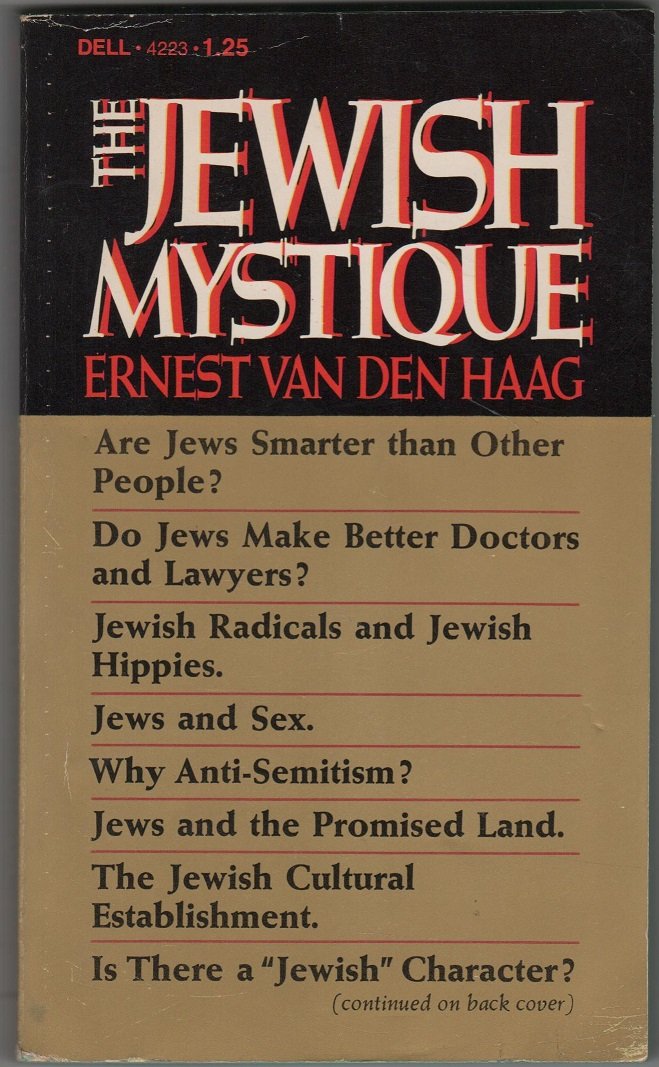
MUST READ: The Jewish Mystique by Ernest van den Haag – Preface & Epilogue

61XHIVkINxL._AA160_[Please read these related posts:
Admin1]
——————


PROLOGUE
I propose to write about Jews without hostility or apologetics, and with affection and seriousness, although my temperament makes me unable to resist occasional irony.
 
I hope to be accurate. But I should deceive myself were I to believe that accuracy in detail, and veracity about matters as a whole, are enough. For too many centuries the Jews have been used as a Rorschach blot by Gentiles, who attribute to them sometimes the most, and more often the least, desired traits of their own personalities. And for too many centuries the Jews have incorporated the image of themselves created by others and added it to their self-image. Under these circumstances any description will displease many who miss their favorite vices, virtues, and characteristics—or find those they prefer to ignore.
 
If this causerie be anywhere near as engaging as its subject, I shall have exceeded my most arrogant ambitions; if it be only half as ambiguous, I shall have done better than I feared. However, I shall be satisfied if it be recognized that I wrote sine ira et studio, and with apprehension.
EPILOGUE
I have tried to suggest throughout what makes the Jews so Jewish— what their essential characteristics are and how they came to acquire and preserve them. The characteristics which identified and unified Jews, despite world-wide dispersion, were at least in part reactions to the non-Jewish environment and to its unremitting and often hostile pressures. But not altogether. The character and fate of the Jews were already distinctive when they invaded Canaan, long before their defeat and expulsion from Palestine by the Romans. Judaism (and anti-Semitism) existed long before Christianity, and there was a distinctive Jewish character before Jews became the scapegoats of the Western world. Belief in one God, in there being no others, and belief in the moral requirements of this God and in their chosenness set Jews apart from the beginning of their recorded history, long before their rejection of Jesus made them outcasts.
 
Reentry in Israel certainly will not reduce endogenous Jewish characteristics which distinguished Jews independently of ghettoization. It will, however, cause the Jews to be shorn of those traits of their character—mythical or actual—which were acquired in reaction to living among alien and usually hostile populations. Often these characteristics have identified “Jewishness” in the eyes of Jews and non-Jews alike.
 
Thus, some visitors (including Arthur Koestler, as well as French and American sociologists) have already remarked that the Israelis do not seem very “Jewish”: they are bereft of ghetto characteristics and of those acquired from living as a marginal group among an alien majority. The observation is true, and it is fraught with ambivalence: thank God we are no longer exceptional; we no longer have to bear the special burden of Jewishness. But also: my God, have we lost our special destiny? are we no longer the chosen people? with our special burdens and sorrows—and our ultimate salvation?
 
In most minds the special destiny which made for Jewishness was related to, if not identified with, the status of Jews in the Gentile world. Surprise, even shock, and certainly nostalgia are among the reactions to Israel that one must expect—as well as pride and relief. As a nation among nations, the Jews can be special only in the sense in which each nation is. They no longer are a special element within all nations, nor a universal leaven.
 
The Jews who have returned to Israel are not the Jews who were compelled to leave thousands of years ago; nor is the country the same. These Jews have not created, therefore, a Middle Eastern kingdom such as existed in Biblical times, nor one akin to those organized in the Arab world, nor a theocratic state. They have created a modern parliamentary democracy. They are on the way to industrialize the country. Israel, although in the Middle East, essentially is a Western country, sharing the values, the ideas, the social, economic, and the political systems prevalent in the West.Israel will differ from other countries in the same way in whichItaly differs from Germany, or France from England. Which is enough for some, but disappointing to others. The Israeli Jews will remain Jews, but Jews who have shed many old characteristics and acquired new ones.
 
The two principal groups of Jews remaining in the Diaspora are in the Soviet Union and in the United States. Those in the Soviet Union are not allowed to leave, although many clearly would like to. Those in the United States could leave but do not want to. Chances are that Soviet Jews will continue to resist the governmental efforts to stamp out their culture, their life style, and their religion. They will, in all likelihood, succeed no less, and perhaps more, than other Soviet nationalities—despite major Soviet efforts directed toward destroying their identity and their religious beliefs. Jews have survived such attempts before, although with great losses and much suffering each time.
 
Unless present trends are reversed, chances are that Jews in theUnited States will assimilate themselves out of existence. This may happen through a combination of intermarriage, secularization, and social integration. Each of these elements reinforces the other. The reduced impact of religion necessarily reduces endogenous cohesion and identification, and the reduction of external pressure reduces the exogenous element that contributed so much to Jewish survival in the past. As Jewish children mingle more freely with Gentile ones, as Jews are less and less restricted externally and find less and less reason in their religion to restrain them from integration with the non-Jewish world, that integration will spread. In the next few generations American Jews will become hard to distinguish from other Americans. They will also lose their own feeling of distinctiveness. This will not occur at the same pace throughout. And orthodox sects may well succeed in maintaining a separate Jewish life-style in America by insisting on segregating themselves, as some orthodox Protestant sects did. And some Jews will go to Israel. But for most American Jews, the trend is unmistakably toward disappearance as Jews.
 
That much about the trend. Prediction as distinguished from prophecy must always be base on the visible trends, as qualified by foreseeable counter-trends, or obstacles. Yet history in the past has not shown itself to be easily predictable. Often the one prediction that has been correct has been that predictions, however sensible, cannot be relied on—history abounds with unforeseen elements which, by definition, cannot be predicted and which can make nonsense of the most rational prediction. Who could have predicted Hitler in 1920—fifteen years before he started killing Jews? Who in 1930 did foresee what he would actually do? What the past teaches is that the future is all unknown. Who, therefore, would be presumptuous enough to predict the fate of the Jews from now on? 
E. V. D. H.
images-2

MUST READ: The Jewish Mystique by Ernest van den Haag: “Are Jews Smarter Than Other People?”

  • 61XHIVkINxL._AA160_[Please read the Introduction to this book if you haven’t done so:

MUST READ: The Jewish Mystique by Ernest Van Den Haag

Admin1]
——————-
Are Jews Smarter Than Other People?
 
Asked to make a list of the men who have most dominated the thinking of the modern world, many educated people would name Freud, Einstein, Marx, and Darwin. Of these four, only Darwin was not Jewish. In a world where Jews are only a tiny percentage of the population, what is the secret of the disproportionate importance the Jews have had in the history of Western culture? Are they, as both their friends and enemies seem to suspect, smarter than other people?
 
The ability to perceive new situations as new, and to find effective ways to meet them—the ability, further, to manipulate abstract concepts so as to discover principles and construct appropriate theories to connect them—this ability, as measured by I.Q. tests, is largely inherited. It can be trained. But what is trained is what has been inherited. (The success of training depends on motivation, too.) It is hard to distinguish the effect of training from the effect of inheritance, but not impossible; and the I.Q. test is far from a perfect measure. Still, when we find that genetically identical twins reared in different environments have nearly identical scores, while brothers or sisters reared in the same environment display greater I.Q. score differences, the conclusion that inheritance plays a major role is inescapable. And the average I.Q.’s of Jewish children are consistently higher than those of non-Jewish children.
 
Of course this does not mean that there are no stupid Jews or intelligent Gentiles. One meets plenty of both. It simply means that, all other things being equal, the chances of a Jewish child’s being intelligent are somewhat—we don’t know exactly how much—higher than the chances of a non-Jewish child. Is this the manner in which they were “chosen” by God?
 
Well, one doesn’t know how much God had to do with it. But the rabbis certainly did.
 
Among the Jews, literally for millennia, the brightest had the best chances to marry and produce children, and their children had the best chance to survive infancy. In contrast, in the Western world at least, the brightest non-Jews had the least chance to have children throughout the Middle Ages. (Outside the Western world, intelligence has been neither much of an advantage nor a hindrance in bringing children into the world and having them survive.)
 
Why did the most intelligent non-Jews, for nearly a thousand years, have the least chance in the Western world to produce offspring who would inherit their intelligence? Throughout the Middle Ages, the ecclesiastical career promised the greatest, fastest—indeed, nearly the only—advancement possible for those sons of the lowly born who were endowed with enough talent and intelligence to rise above the subservient position in which most peasants found themselves. The church offered the only career in which intellectual ability was rewarded, regardless of the origin of its bearer. No wonder the priesthood attracted the most ambitious, talented, and intelligent sons of the lower estates, and the most intellectual ones from the other estates.
 
But the priesthood exacted a price: celibacy. Which meant that the most intelligent portion of the population did not have offspring; their genes were siphoned off, generation after generation, into the church’s, genetic supply. The result was a reduction of the average intelligence level of the non-Jewish Western population to a level considerably below that which would have been achieved otherwise.
 
The church’s demand for ecclesiastical celibacy was based on at least three things. First, there was the general hostility of the church to sex. While the weakness of ordinary mortals might make it better to marry than to burn, priests were expected to have greater ability to resist temptation.
 
Secondly, a celibate priest would not be tempted to accumulate riches and power for children he does not have (at least he would be less tempted); he would love all Christians as a father without favoring his own offspring.
 
Finally, all medieval Christians believed in the salvation of their individual souls and the resurrection of their bodies. Such a specific belief in one’s own individual immortality made it unnecessary to attempt to secure an immortality of sorts by producing and shaping one’s own children. Yet Christians who were not priests were not quite willing to pin all their hopes on the promise of resurrection: faith was strong but not that strong. But priests, professional Christians as it were, were expected to set an example; they had to renounce immortality through offspring in favor of individual salvation—with the consequent unforeseen, unintended, and unfortunate result that the intellectual elite had no offspring.
 
Celibacy was not always strictly enforced. And some priests or monks might not have wanted to have children anyway. But even when all possible qualifications are taken into account, there is little doubt that the rule of celibacy reduced the average intelligence of the non-Jewish Western populations. Consider how many outstanding scholars (let alone those who made minor contributions) descended from married Protestant ministers or Jewish rabbis. Had they, too, been childless, the contributions of their proverbially numerous offspring would have been lost. The magnitude of the contributions of the non-Catholic clergy’s actual offspring suggests the size of the loss society suffered because of the celibacy of the Catholic clergy in the many centuries during which Catholicism dominated the Western world.
 
Today, while the abolition of clerical celibacy is being discussed in Catholic circles, celibacy no longer does much genetic damage. There are many opportunities other than the priesthood available to people who want to go beyond the status achieved by their parents. The church no longer offers the only nor the best chance for advancement of an intelligent but poor boy in most places, and there are many intellectual careers outside the church. It may be surmised that children of low-income families who enter the priesthood now do so more often because of an unworldly vocation; worldly ambition even among the poor can be achieved more easily in other ways—ways which do not preclude offspring.
 
Among the Jews, the most intelligent were encouraged to have the most children: they became rabbis, who could afford—indeed were expected—to have lots of children. Rabbinical study even more than the priesthood among Gentiles attracted the brightest and most ambitious Jews. After all, the rabbi was the leader of the Jewish community in every sense of the word.
 
Abstract philosophical issues, questions of ritual, commercial disputes, marital problems—whatever matters were of importance—ultimately were decided by interpretation of precedents, and the rabbi’s interpretation was the most authoritative. Hence the rabbis had the prestige, the power, and the prerogatives of leaders. Unlike their Christian colleagues, they did not have the competition of secular leaders, kings, and judges. The rabbi was the religious and the secular leader of the Jewish community. Thus, boys who today might become judges, lawyers, political leaders, physicians, teachers, scholars—all became rabbis.
 
Unlike priests, rabbis were enjoined to marry and have children. In turn, rich men were enjoined to marry and have children. In turn, rich men were enjoined to give their daughters in marriage to rabbinical scholars, the Jewish aristocracy. Both these injunctions were followed in practice; they were in the spirit that informed Judaism as a whole throughout the Middle Ages. The results were:
1.      The most intelligent, ambitious, and intellectually inclined Jews became rabbis.
2.      Rabbinical students and rabbis married earlier than other Jews—they were regarded as more eligible.
3.      Rabbinical students were bale to marry the daughters of the most successful Jews and generally had the widest choice. These choices were not based on personal attraction but on the reputed health and wealth of the prospective bride. Some correlation is likely between intelligence and success; the daughters of rich men must often—by no means always—have inherited intelligence as well as money.
4.      Rabbis, able to support more children more easily than other Jews, had more children.
5.      More of their children survived because many rabbis had some knowledge of medicine; further, as leaders, they could give their families more protection than other Jews. (The selective process was compounded when high marriage taxes were imposed on Jews in Central Europe, as was often done into the nineteenth century. These taxes made marriage easier for the well-to-do who could better afford them.)
Above all, rabbis sedulously followed the Talmudic injunction to be fruitful. Altogether, if Jews had deliberately decided to breed children so as to maximize genetic intelligence, they could not have done much better. Of course, they had no such conscious purpose—any more than the Catholic rule of celibacy was intended to reduce the average intelligence of Christians. These results were incidental to other avowed and conscious purposes. Nevertheless they have profoundly affected the history of the Jews, and indeed, of the world.
 
“Intelligence” actually consists of a variety of mental abilities: e.g., verbal ability (retention and relations of words); reasoning (conceptualization, interpretation, and inference); mathematical ability (manipulation of numbers); space conceptualization (ability to relate, visualize, and manipulate sizes and shapes). Many other mental abilities are also involved. Some are hard to measure. The various tests give a specific weight to each tested ability and call “intelligence” some sort of compound—which in the nature of the matter is rather arbitrary and has a purely theoretical existence: only the components exist and operate separately.
 
Certainly one person may excel in, say, mathematics, but have little literary intelligence. Another may be a mathematical moron but extremely clever verbally. Yet both may test as equally “intelligent” if, say, the higher mathematical aptitude of the first offsets his lower verbal score and the higher verbal score of the second offsets his poor mathematical score. Whether or not this occurs depends on the relative weights assigned to the different aptitudes by the particular tests. Yet the better tests succeed fairly well in identifying and grading something that deserves the label “ability to reason abstractly or conceptually”. And this ability is highly important in a number of careers. Therefore these tests have significant predictive value.
 
Though these tests are useful, one must not conclude that they define fully an individual’s abilities, or measure adequately such human virtues as creativity, imagination, emotional predispositions, and ultimately character. (Other tests may help in evaluating such elements of “personally”)
 
For what it is worth, Jewish children generally do better than other groups on I.Q. tests. And the more weight that is given to verbal and reasoning abilities, the better they do. They do better on practically all scores except space conceptualization, where Chinese children are usually superior. These differences among ethnic groups are specifically ethnic—they remain, regardless of social class, status, or schooling.
 
“Ethnic” should no be confused, however, with “genetic.” We do not know how much of the greater intelligence found, on the average, among Jews as an ethnic group is inherited through the genes. In all likelihood the result is, in some unknown proportion, owed to cultural as well as genetic factors.
 
That cultural factors play a major role (and may, in time, have influenced genetic ones, since culture may cause the preferential selection of the possessors of the most highly valued traits for marriage and breeding) is clear to anyone even slightly familiar with the enormous emphasis on learning, intellectuality, articulateness, and argument—even argumentativeness—that is characteristic of Jews.
 
The emphasis on intellect within the home, the family, and the community is transmitted to children at an extremely early age and greatly intensifies their motivation toward the achievement of educational goals. According to the values of the community, this is the way to gain the approval of one’s elders, to the respected and, in the end, to be successful.
 
This certainly has been the case of the Ashkenazim, the Jewish group that lived in Western and Eastern Europe. That group, surrounded by a Christian world, not only preserved its religion but lived—partly voluntarily and partly of necessity—a separate life in which the Jewish ideas, the Jewish character, and the Jewish intellect were formed. While the majority of Christians lived on farms in the countryside, the majority of Jews, neither serfs nor allowed to own land, lived in the city. Thus Jews have long been accustomed to urban values, which are relatively new to most Gentiles.
 
Another Jewish group, the Sephardim, lived mainly along the North African perimeter, surrounded by an Islamic world. They were assimilated in all but religion. Even where not assimilated, the Sephardic Jews did not pursue separate Jewish ideals; in particular, their respect for the interest in scholarship did not compare to that of the Ashkenazim, but rather to that of the surrounding Moslems, who usually were more tolerant of Jews than were medieval Christians. (How things have changed)
 
The results of this difference can be seen easily, not only in Israel, where the Sephardim sometimes feel treated like a minority, but also in the United States. In both countries the scholastic achievement of Sephardic children is far below that of the Ashkenazim. In Israelthe Sephardic children come from a deprived background, from families with little education, income, and status. But recent tests in the United States have shown that this is not likely to be the cause of their low educational achievement. The United States’ tests compared two groups of Jewish children—one Sephardic and the other Ashkenazic—attending separate private schools. Both groups came from middle-class parents, were American born of American-born mothers, spoke English at home, and lived in the same middle-class neighborhood. Yet the Sephardic children scored, on the average, 17 points less on the I.Q. tests than the Ashkenazic—about the same difference as in Israel.
 
Oddly, the difference is about the same, on the average, as that between white and black children in the United States. One may speculate that the explanation is similar, particularly since recent research suggests that the differences between whites and blacks are ethnic far more than they are related to schooling, or even to segregation, or class.
 
The only possible explanation for the different tests results among Jewish groups—since differential opportunities or economic deprivations were excluded—is a difference in cultural ideals and emphases, internalized as difference in motivation. (Genetic differences are unlikely, since both groups are Jewish, although they have lived apart for thousands of years.) Unlike the Ashkenazim, the Sephardim have never focused on educational achievement. This result suggests that the difference in Jewish-Gentile achievement and intelligence, too, may be largely due to a difference in values cultivated at home, whatever additional role genetic factors may play.
 
The higher average Jewish intelligence and scholarly motivation lead to considerable scholarly achievement. Sixty-seven American scientists received Nobel Prizes between 1901 and 1965; eighteen of these—27 percent—were Jewish. Jews constitute about 3 percent of the population. Thus they produced about nine times as many Nobel Laureates in science as statistically could be expected. The overrepresentation would be reduced if Jewish Nobel Prize winners in science were taken as a proportion not of the Jewish population but of Jewish scientists. However, this would be useful only to the extent to which Jewish overrepresentation among scientists depends on factors other than intelligence and motivation. I don’t think it does.
 
Thirty percent of all high school students plant to go to college—but 75 percent of all Jewish high school students have these plans (both figures increase year by year). And their plans are carried out: Jews, as a proportion of the population, are overrepresented by about 260 percent in the college population and by 365 percent in the elite institutions.
 
Jewish students succeed well in college, as measured by future earnings—higher on the average than those of Gentile college graduates. They also enter professions more often: they are overrepresented by 231 percent in medicine, within medicine by 308 percent within the specialties, and among these by 478 percent in psychiatry, and 299 percent in dentistry. Outside medicine, Jews are overrepresented by 265 percent in law, by 283 percent in mathematics—but only by 70 percent in architecture (which is explainable in terms of their no more than average talent for space conceptualization) and 9 percent in engineering. The low overrepresentation in engineering might be explained by past employment discrimination in industry and by the comprehensiveness of the term “engineer”, which includes skilled workers as well as professionals. Despite the fact that relatively few Jews are engineers, they are 110 percent overrepresented in invention.
 
Jewish overrepresentation is partly a matter of motivation. Lewis M. Terman, who followed the careers of gifted children in California, found that of those who were Jewish, 57 percent entered professions, while only 44 percent of the gifted Gentile children did. Yet only 15 percent of the Jewish parents were professionals, while 35 percent of the Gentile ones were: a clear indication that Jewishness reinforced motivation toward professional careers independently of the professional or nonprofessional parental status. Terman also found that about twice as many gifted children were Jewish as would be expected on the basis of Jewish representation in the California population. This, once more, must be attributed to genetic and motivational factors in unknown proportions.
 
An increase in Jewish representation in the professions took place as soon as Jews became emancipated in theUnited States—as soon as purely religious careers lost their attractiveness for many, and barriers to college admission were lowered. Thus, in 1922, Jews were represented in the Phi Beta Kappa scholarly elite about in proportion to their representation in the population. But in 1962, the number of Jews in Phi Beta Kappa was 33 percent above what could be expected on the basis of their representation in the total population.
 
It might be worth mentioning that although by no means minorities display extraordinary gifts, the Jews are not the only minority that does. The Parsi, originally a Persian group, settles in India where they kept their religion and many cultural peculiarities. This group, too, has been disproportionately successful in business and in the professions. The fate and the environment of the Parsi, let alone their original cultural and religious customs and beliefs, are quite different from those of the Jews. Yet like the Jews they differ from the society in which they live, and feel, as Jews have, psychologically marginal to it.
 
It is possible, as some philosophers and sociologists have speculated, that this marginality contributes to the motivation and cultivation of achievement as an attempt to compensate and prove oneself. Yet it cannot be minority status alone that brings about this effect, for the motivation is more common than the supposed reaction to it. Thus minority status, however necessary, cannot be sufficient to bring about intellectual eminence.  

MUST READ: The Jewish Mystique by Ernest Van Den Haag

71eIcLAdPdL [My Catholic elder brother passed on to me this old book:

4th printing, 2nd edition 1967, hard cover, faded yellowish pages that he had to dry under the sun to make sure no mold and parasites had crept in.

I appreciate this gesture from an older brother as much as I appreciate another thoughtful gesture from my agnostic younger brother who carried in his  luggage, a pewter Seder plate all the way from a recent trip abroad.

For a family of mixed faiths:  Catholic, Evangelical, agnostic, un-churched Christian, and in my case—unheard of Sinaite, it brings great comfort to be accepted and not unfairly judged for my new-found belief, (i.e. relatively ‘new’ to me but as old as the time in biblical history of the giving of TORAH on Sinai).  It is also a most pleasant surprise that my own siblings show even a passing interest regarding things ‘Jewish’ since they seem to think I’m a Jew-wannabe.

Such respect of different faiths could only stem from nonjudgmental parents —

  • a mother who in her elderly years after a stroke, still seeking God,  attended church services of different Christian denominations, evidenced by the wad of Sunday worship programs in her purse when she died;
  • and a father who never went to church because he equated God with man-made religion, yet he stated in his last month of life “my religion is to be good and to do good.”

Such impact of parental influence on children is hardly noticeable but the legacy is there—in this case,

  • a healthy respect for all faiths,
  • but with courage to stand firm in one’s conviction.

Is that not the essence of living TORAH, written by YHWH in hearts and minds of persons who have never been exposed to it? Truly there is inherent good in man, but also the potential to do evil.

How we relate to the God of our faith is, after all, always a matter of individual CHOICE guided by the written TORAH for those fortunate enough to have been exposed to it, as well as the TORAH written in our conscience.—NSB@S6K


—————————————–


As we do with our MUST READ/MUST OWN featured books, we reprint the “bookends” — Prologue and Epilogue, and occasionally selected chapters.  Meanwhile, here are some tidbits to whet your appetite:


61XHIVkINxL._AA160_Inside Cover:

Einstein was an agnostic, Freud an atheist, Karl Marx a Protestant — were they Jewish?  Was Elizabeth Taylor or Marilyn Monroe?  Are Jews a denominational group, a nation, or a race?  What makes them Jewish?  Why can’t Sammy Davis, Jr. make it?  How do they (or do they?) differ from Gentiles?  What makes anti-Semites anti-Semitic?

Dr. van den Haag investigates the mystique about Jews created by their friends, their enemies, and, not least, the Jews themselves.  Are they smarter than otherpeople?  Do they have the golden touch?  Why do they seem to have influence disproportionate to their numbers?  It is remarkable how little is really understood about a people who have had so much impact on the history and destiny of the world.


Ernest van den Haag, for fifteen years professor of Social Philosophy at New York University and lecturer in Sociology and Psychology at the New school, has been a visiting professor at some of America’s most distinguished universities.  A Guggenheim fellow in 1967, he is a practicing psycho-analyst, the author fo three books, and many papers in learned journals.


————————————————————-


images-2Wikipedia:  Ernest van den Haag (September 15, 1914, The Hague – March 21, 2002, Mendham, New Jersey) was a DutchAmerican sociologist, social critic, and John M. Olin Professor of Jurisprudence and Public Policy at Fordham University. He was best known for his contributions to National Review.


Van den Haag was born in The Netherlands and raised in Italy, where, as a left-wing activist, he was nearly killed by a political assassin from Benito Mussolini‘s Fascist regime.[1] In 1937, he was jailed by Mussolini’s government and spent almost the next two full years in solitary confinement.[2] After escaping from Italy, and then fromNazi-occupied France, he settled in the United States in 1940. He eventually met and befriended William F. Buckley, Jr. He began writing articles for Buckley’s National Review, though he was never hired as a staff member. He would contribute columns to the publication for the next 45 years. Van den Haag was also a well-known defender of the continued use of the death penalty in the United States.[3] He also defended racial segregation in the 1960s arguing that integration would cause psychological harm to black children.[4]

———————————————————–

Amazon.com—Customer Reviews:

This review is from: The Jewish Mystique (Hardcover)

This is an insightful work about Jewish history and character by a non- Jewish author. Van den Haag like Paul Johnson and Thomas Cahill later writes from outside the Jewish experience with real appreciation and understanding. Having read the book many years ago I will simply give one small insight of his. According to Van den Haag the intelligence involved in disproprotionate Jewish contribution to scientific and cultural creation came in part because among the Jews the most intelligent the learned were encouraged to have large families, while in the Christian world the most intelligent were priests and encouraged to be celibate. A counter- argument could be made pointing out the relatively small size of the families of the non- Hasidic Jewish leadership. In any case this is one small example of a book rich with insight and certainly worth reading.


  REPLACING AN OLD FAVORITE, March 13, 2010
This review is from: Jewish Mystique (Paperback)

FOR ANYONE INTERESTED IN JEWISH CULTURE AND THE ROLE “THE CHOSEN PEOPLE” HAVE PLAYED IN WORLD HISTORY, THIS LITERATE, WRY AND AMUSING OVERVIEW IS FASCINATING. I FIRST READ IT IN THE ’60′S AFTER HAVING MOVED INTO A PREDOMINATELY JEWISH COMMUNITY AND WANTED TO LEARN MORE ABOUT MY NEIGHBORS. THIS WAS THE PERFECT CHOICE AND ITS AUTHOR WAS A PROFESSOR IN NEW YORK CITY NEAR MY HOME. I TRACKED HIM DOWN AND TOLD HIM HOW MUCH I HAD ENJOYED IT AND WE HAD A DELIGHTFUL CONVERSATION THAT ENRICHED WHAT I’D ALREADY LEARNED. IT’S A BOOK OF ITS TIME IN SOME WAYS, BUT, SINCE IT CHRONICLES THE PAST AND PRESENT OF OVER 5,000 YEARS, THAT’S JUST AN INTERESTING FOOTNOTE. THIS COPY REPLACES ONE THAT GOT LOST IN A SUBSEQUENT MOVE.


 Dated but Interesting Insight, December 26, 2009
This review is from: Jewish Mystique (Paperback)

In today’s politically correct culture, ‘The Jewish Mystique’ might be considered inappropriate. Written almost fifty years ago, it attempts to give insight into the commonly held beliefs, tendencies, quirks and stereotypes typical to the Jewish people.

For instance, it examines the Jewish reverence for education, how they feel about and interact with non-Jews, their belief systems, their fears and obsessions, their general hangups and pet peeves……Since a work such as this would be unthinkable in this day and age, the glimpse it provides into the collective psyche of this great but tortured people is rather rare.

This work was also written before the curse of Zionism took general hold of the Jewish diaspora. The Israel-centric obsessionism, the virtual hysteria created by Zionist fear-mongering, the rise of holocaust religion and industry, the anti-Palestinian racism, the ethnic cleansing, the massacre of civilians, the Apartheid Wall…..All of this was to come in the years after this book was published but it is somewhat easy to see, after reading ‘The Jewish Mystique’, how the Zionists were able to capture the Jewish heart and soul by exploiting many of that people’s hopes, fears and dreams.

The Jewish people remain an enigma. Obviously very great and gifted, prone to tortured introspection and self-doubt, capable of giving so much but also taking it away, with a habit of clinging tenaciously to myth and legend about both its history and its adopted homeland, forever at the centre stage of world history, what a people this is! Admirable at one time, disgusting at another, religiously zealous but also doggedly atheistic, The Jewish Mystique provides an attempt at understanding this dynamic and very formidable people.

An educating and interesting read.


“Gene Stewardship” vs “Sacrifice on Altar-of-the-Pork-Barrel”, September 14, 2005


This review is from: The Jewish Mystique (Paperback)
Why are Jews smarter than Catholics ? Because Catholicism is a religion of Pork-Barrel-Sacrifice, while among Jews the-best-have-more-babies. Anyway Haag makes this point up-front in the first few pages of the book, and the review-author knows of no more concisely elegant description of this distinction, having stumbled across the book via Google, but not claiming exhaustive literacy on this.The first part of the argument is that in primitive times, religious study was a primary way of expressing intelligence – there being no technology as of yet. Among Catholics, the best students became celibate priests. Among Jews, the best students became rabbis, AND RABBIS WERE ENCOURAGED TO MAKE BABIES.This basic theme of course continues today. A lot of bright folks choose to become doctors, but medical school is a lengthy process – therefore doctors don’t seem to have especially many babies themselves. Garrett Hardin’s commonism, the doctrine of outcome-equalization, that an indiscriminate nation-or-world-wide-pork-barrel should in particular redistribute the benefits of medicine – this makes medicine or at least the doctrine of a universal-medical-insurance-pork-barrel analogous to Catholicism, hmm?


The review-author belongs to no church, is not Jewish, not a Doctor, parents were Unitarian.


Biblical Poetry, anyone?

Image from amazon.com

Image from amazon.com

[First posted in 2013.  This is part of the series The Bible as ‘Literature’ from the excellent MUST READ/MUST OWN:

 The Literary Guide to the Bible,

eds. Robert Alter & Frank Kermode. 

Imagine!  Note:  Robert Alter is the translator of THE FIVE BOOKS OF MOSES, our alternate translation together with Everett Fox’s THE FIVE BOOKS OF MOSES.  We highly recommend these translations of the TORAH as MUST OWN!


Hebrew writers of antiquity already had a grasp of the poetic forms and expressions which best expressed the language of Divinity in their Scriptures and yet western scholars had for so long ignored the value of understanding biblical language as ‘literature’.  Serious students of the Bible stand to gain from taking a break from ‘religious orientation’ and learn how to read The Hebrew Scriptures (not the Old Testament) through the lens of professors/teachers of Literature.  Please check out related posts:

This book is downloadable on a kindle app from amazon.com.  Reformatting and highlights added–Admin1.]


————————–


The Characteristics of Ancient Hebrew Poetry

Robert Alter


Exactly what is the poetry of the Bible,

and what role does it play

in giving form to the biblical religious vision? 

The second of these two questions obviously involves all sorts of imponderables. One would think that, by contrast, the first question should have a straightforward answer; but in fact there has been considerable confusion through the ages about—


  • where there is poetry in the Bible
  • about the principles on which that poetry works.

To begin with, biblical poetry occurs almost exclusively in the Hebrew Bible. 

There are, of course, grandly poetic passages in the New Testament—perhaps most impressively in the Apocalypse—but only the Magnificat of Luke 1 is fashioned as formal verse.


Readers of the Old Testament often cannot easily see where the poetry is supposed to be because in the King James Version, which has been the text used by most English-speaking people, nothing is laid out as lines of verse. This confusing typographic procedure is in turn faithful to the Hebrew manuscript tradition, which runs everything together in dense, unpunctuated columns. (There are just a few exceptions where there is a spacing out roughly corresponding to lines of verse, as in the Song of the Sea, Exod. 15; Moses’ valedictory song, Deut. 32; and an occasional manuscript of Psalms.)


What has accompanied this graphic leveling of poetry with prose in the text is a kind of cultural amnesia about biblical poetics.


  • Over the centuries, Psalms was most clearly perceived as poetry, probably because of the actual musical indications in the texts and the obvious liturgical function of many of the poems.
  • The status as poetry of the Song of Songs and Job was, because of the lyric beauty of the one and the grandeur of the other, also generally kept in sight, however farfetched the notions about the formal character of the verse in these books.
  • Proverbs was somewhat more intermittently seen as poetry, and it was often not understood that the Prophets cast the larger part of their message in verse.
  • Finally, it is only in our century that scholars have begun to realize to what extent the prose narratives of the Bible are studded with brief verse insets, usually introduced at dramatically justified or otherwise significant junctures in the stories.

Over the last two millennia—and, for many, down to the present—being a reader of biblical poetry has been like being a reader of Dryden and Pope who comes from a culture with no concept of rhyme: you would loosely grasp that the language was intricately organized as verse, but with the uneasy feeling that you were somehow missing something essential you couldn’t quite define.


The central informing convention of biblical verse was rediscovered in the mid-eighteenth century by a scholarly Anglican bishop, Robert Lowth. He proposed that lines of biblical verse comprised two or three “members” (which I shall call “versets”) parallel to each other in meaning.  Like many a good discovery, Bishop Lowth’s perception has not fared as well as it might. The realization soon dawned that some of what he called parallelism was not semantically parallel at all. This recognition led to a sometimes confusing proliferation of subcategories of parallelism and, in our own time, to various baby-with-bath water operations in which syllable count, units of syntax, or some other formal feature was proposed as the basis for biblical poetry, parallelism being relegated to a secondary or incidental position.


In another direction, at least one scholar, despairing of a coherent account of biblical verse, has contended that there was no distinct concept of formal versification in ancient Israel but merely a “continuum” of parallelistic rhetoric from prose to what we misleadingly call poetry. Some of these confusions can be sorted out, and as a result we may be able to see more clearly the distinctive strength and beauty of the biblical poems, for an understanding of the poetic system is always a precondition to reading the poem well.


Semantic parallelism, though by no means invariably present, is a prevalent feature of biblical verse. 


That is, if the poet says “hearken” in the first verset, he is likely to say something like “listen” or “heed” in the second verset. This parallelism of meaning, which is often joined with a balancing of the number of rhythmic stresses between the versets and sometimes by parallel syntactic patterns as well, seems to have played a role roughly analogous to that of iambic pentameter in Shakespeare’s dramatic verse: it is an underlying formal model which the poet feels free to modify or occasionally to abandon altogether.


In longer biblical poems, a departure from parallelism is sometimes used to mark the end of a distinct; elsewhere parallelism is occasionally set aside in favor of a small-scale narrative sequence within the line; and few poets appear simply to have been less fond than others of the symmetries of parallelism.


Before attempting to sharpen this rather general concept of poetic parallelism, let me offer some brief examples of its basic patterns of development.


David’s victory psalm (2Sam. 22) presents a nice variety of possibilities because it is relatively long for a biblical poem and it includes quasi-narrative elements and discrete segments with formally marked transitions. In the fifty-three lines of verse that constitute the poem, few approach a perfect coordinated parallelism not only for meaning but also of syntax and rhythmic stresses. Thus: “For with you I charge a barrier, /with my God I vault a wall” (v.30). Here each semantically parallel term in the two versets is in the same syntactic position: with you/with my God, I charge / vault, a barrier / a wall. Though our knowledge of the phonetics of the biblical Hebrew involves a certain margin of conjecture, the line with its system of stresses, as vocalized in the Masoretic Hebrew text, would sound something like this: ki bekha ‘aruts gedud/ be’ lohai adaleg-shur, yielding a 3 + 3 parallelism of stressed syllables, which in fact is the most common pattern in biblical verse. (The rule is that there are never less than two stresses in a verset and never more than four, and no two stresses follow each other without an intervening unstressed syllable; and there are often asymmetrical combinations of 4 + 3 + or 3 + 2.)

It is hardly surprising that biblical poets should very often seek to avoid such regularity as we have just seen, through different kinds of elegant—and sometimes significant—variation. Often, syntactically disparate clauses are used to convey a parallelism of meaning, as in verse 29: “For you are my lamp, O Lord, / the Lord lights up my darkness,” where the second-person predicative assertion that the Lord is a lamp is transformed into a third-person narrative statement in which the Lord now governs a verb of illumination. Even when the syntax of the two versets is much closer than this, variations may be introduced, as in two lines from the beginning of the poem (vv.5-6) that describe the speaker having been on the brink of death. I will reproduce the precise word order of the Hebrew, though at a cost of awkwardness, for biblical Hebrew usage is much more flexible than modern English as to subject-predicate order.

For there encompassed me the breakers of death,

The rivers of destruction terrified me.

The cords of Sheol surrounded me,

    there greeted me the snares of death.

The syntactic shape of these two lines, which preserve a regular semantic parallelism through all four versets as well as a 3-3 stress in both lines, is a double chiasm:


(1) encompassed-breakers-rivers-terrified;

(2) cords-surrounded-greeted-snares.

In the first line the verbs of surrounding are the outside terms, the entrapping agencies of death, the inside terms of the chiasm (abba); and in the second line this order is reversed (baab). This maneuver, which, like the interlinear parallelism, is quite common in biblical verse, may be nothing more than elegant variation to avoid mechanical repetitiousness, though one suspects here that the chiastic boxing in and reversal of terms help reinforce the feeling of entrapment that is being expressed: as the two lines unfold, the reader can scarcely choose between a sense of being multifariously surrounded and a sense of the multiplicity of the instruments of death.

Another frequent pattern for bracketing the two versets together involves an elliptical syntactic parallelism, usually through the introduction of a verb at the beginning of the first verset which does double duty for the second verset as well, as in verse 15: “He sent forth bolts and scattered them, / lighting, and overwhelmed them.” The ellipsis of “hesent-forth” (one word and one accented syllable in the Hebrew) produces a 3-2 stress pattern, which also involves a counterposing of three Hebrew words to two. (It should be said that biblical Hebrew is much more compact than any translation can suggest, with subject, object, possessive pronoun, preposition, and so forth indicated by suffix truncation of the second verset conveys a certain abruptness which the poet may have felt intuitively was appropriate for the violent action depicted. Elsewhere in biblical poetry, when ellipsis through a double-duty verb occurs while the parallelism of stresses between versets in maintained, the extra rhythmic unit in the second verset is used to develop semantic material introduced in the first verset.


Here is a characteristic instance from Moses’ valedictory song (Duet. 32:13): “He suckled him with honey from a rock, / and oil from a flinty stone.” That is, since the verb “he-suckled-him-with” (again a single word in the Hebrew) does double duty for the second verset, rhythmic space is freed in the second half of the line in which the poet can elaborate the simple general term “rock” into the complex term “flinty stone,” which is a particular instance of the general category, and one that brings out the quality of hardness. (The development of meaning within semantic parallelism is discussed in detail later.)


It is beyond my purposes here to classify all the subcategories of parallelism that present themselves in David’s victory psalm, but two additional cases are worth looking at to round out our provisional sense of the spectrum of possibilities. Verse 9, like the one that precedes it in 2 Samuel 22, is triadic: “Smoke came out of his nostrils, / fire from his mouth consumed, / coals glowed round him.”


First, let me comment briefly on the role of triadic lines in the biblical poetic system. Dyadic lines, as in all our previous examples, definitely predominate, but the poets have free recourse to triadic lines with none of the uneasy conscience manifested, say, by English Augustan poets when they introduce triplets into a poem composed in heroic couplets. In longer poems such as this, triadic lines can be used to mark the beginning or the end of a segment, as here the triadic verses 8-9 initiate the awesome seismic description of the Lord descending from on high to do battle with his foes. Elsewhere, triadic lines are simply interspersed with dyadic ones, and in some poems they are cultivated when the poet wants to express a sense of tension or instability, using the third verset to contrast or even reverse the first two parallel versets. Now, the smoke-fire-coals series quoted above involves approximately parallel concepts and actions, but the terms are also sequenced, temporally and logically, moving from smoke to its source to an incandescence so intense that everything around it is ignited. This progression, too, reflects a more general feature of poetic parallelism in the Bible to which we shall return.

Finally, biblical poetry abounds in lines like the one immediately following the line just quoted: “He tilted the heavens, came down, / deep mist beneath his feet” (v. 10). Here the only “parallelism” between the second verset and the first is one of rhythmic stresses (again 3-3). Otherwise, the second verset differs from the first in both syntax and meaning. The fairly frequent occurrence of such lines is no reason either to contort our definition of parallelism or to throw out the concept as a governing principle of Hebrew verse. The system, as I proposed before, is rather one in which semantic parallelism predominates without being regarded as an absolute necessity for every line. In this instance the poet seems to be pursuing a visual realization of the narrative momentum of the line (and, indeed, the momentum carries down through a whole sequence of lines); first he presents the Lord tilting the heavens and descending, and then, as the eye of the beholder plunges, a picture in the locative second clause of the deep mist beneath God’s feet as he descends. This yields a more striking effect than would a regular parallelism such as “He tilted the heavens, came down, / he plummeted to the earth,” and is a small but characteristic indication of the suppleness with which the general convention of parallelism is put to use by biblical poets.


Now, the greatest stumbling block in approaching biblical poetry has been the misconception that parallelism implies synonymity, saying the same thing twice in different words. I would argue that good poetry at all times is an intellectually robust activity to which such laziness is alien, that poets understand more subtly than linguists that there are no true synonyms, and that the ancient Hebrew poets are constantly advancing their meanings where the casual ear catches mere repetition.


Not surprisingly, some lines of biblical poetry approach a condition of equivalent statement between the versets more than others. Thus: “He preserves the paths of justice, / and the way of his faithful ones he guards” (Prov. 2:8). By my count, however, such instances of nearly synonymous restatement occur in less than a quarter of the lines of verse in the biblical corpus. The dominant pattern is a focusing, heightening, or specification of ideas, images, actions, themes from one verset to the next, If something is broken in the first verset, it is smashed or shattered in the second verset; if a city is destroyed in the first verset, it is turned into a heap of rubble in the second. A general term in the first half of the line is typically followed by a specific instance of the general category in the second half; or, again, a literal statement in the first verset becomes a metaphor or hyperbole in the second.


The notion that repetition in a text is very rarely simple restatement has long been understood by rhetoricians and literary theorists. Thus the Elizabethan rhetorician Hoskins—might the King James translators have read him?—acutely observes that “in speech there is no repetition without importance.” What this means to us as readers of biblical poetry is that instead of listening to an imagined drumbeat of repetitions, we need constantly to look for something new happening from one part of the line to the next.


The case of numbers in parallelism is especially instructive. If the underlying principle were really synonymity, we would expect to find, say, “forty” in one verset and “two score” in the other. In fact the almost invariable rule is an ascent on the numerical scale from first to second verset, either by one, or by a decimal multiple, or by a decimal multiple of the first number added to itself. And as with numbers, so with images and ideas; there is a steady amplification or intendification of the original terms. Here is a paradigmatic numerical instance: “How could one pursue a thousand, / and two put ten thousand to flight?” (Duet. 32:30).


An amusing illustration of scholarly misconception about what is involved poetically in such cases is a common contemporary view of the triumphal song chanted by the Israelite women: “Saul has smitten his thousands, / David, his tens of thousands” (1 Sam. 18:7). It has been suggested that Saul’s anger over these words reflects his paranoia, for he should have realized that in poetry it is a formulaic necessity to move from a thousand to ten thousand, and so the women really intended no slight to him. Such a suggestion assumes that somehow poetry conjures with formulaic devices indifferent to meaning. Saul may indeed have been paranoid, but he knew perfectly well how the Hebrew poetry of his era worked and understood that meanings were quite pointedly developed from one half of the line to the other. In fact the prose narrative in 1 Samuel 18 strongly confirms the rightness of Saul’s “reading,” for the people are clearly said to be extravagantly enamored of David as they are not of Saul.


Let me propose a few examples of this dynamic movement within the line, and then try to suggest something about the compelling religious and visionary ends that are served by this distinctive poetics. (For the sake of convenience, I have chosen almost all my examples from Psalms.) In the first group, the italics in the second versets indicate the point at which seeming repetition becomes a focusing, a heightening, a concretization of the original material:


  • Let me hear joy and gladness, / let the bones you have crushed exult” (Ps. 51:10);
  • “How long, O Lord, will you be perpetually incensed, / like a flame your wrath will burn (Ps. 79:5);
  • He counts the number of the stars, / each one he calls by name” (Ps. 147:4).

These three lines illustrate a small spectrum of possibilities of semantic focusing between the two versets.


  • In the first example, the general joy and gladness of the first verset become sharper through the constructive introduction of the crushed bones in the second verset, and bones exulting is, of course, a more vividly metaphorical restatement of the idea of rejoicing.
  • In the second example, the possible hint of the notion of heat in the term for “incensed” (te’enaf, which might derive etymologically from the hot breath from the nostrils) becomes in the second verset a full-fledged metaphor of wrath burning like a flame.
  • In the third example, there is no recourse to metaphor, but there is an obvious focusing in the “parallel” verbs of the two versets: calling something by name, which in biblical world implies intimate relation, knowledge of the essence of the thing, is a good deal more than mere counting. The logical structure of this line, which is quite typical of biblical poetics, would be something like this: not only can God count the innumerable stars (first verset) but he even knows the name of (or gives a name to) each single star.

Since the three examples we have just considered move from incipiently metaphorical to explicitly metaphorical to literal, a few brief observations may be in order about the role of figurative language in biblical poetics.


Striking imagery does not seem to have been especially valued for itself, as it would come to be in many varieties of European post-Romantic poetry. Some poets favor nonfigurative language, and very often, as we have seen, figures are introduced in the second verset as a convenient means among several possible ones for heightening some notion that appears in the first verset.


In any case, the biblical poets whole were inclined to draw on a body of more or less familiar images without consciously striving for originality of invention in their imagery.

  • Wrath kindles, burns, consumes;
  • protection is a canopy, a sheltering wing, shade in blistering heat;
  • solace or renewal is dew, rain, streams of fresh water; and so forth.

The effectiveness of the image derives in part from its very familiarity, perhaps its archetypal character, in part from the way it is placed in context and, quite often, extended and intensified by elaboration through several lines or by reinforcement with related images. However, there is no overarching symbolic pattern, as some have claimed, in the images used by biblical poets, and there is no conventional limitation set on the semantic fields from which the images are drawn.


Though biblical poetry abounds in pastoral, agricultural, topographical, and meteorological images, the manufacturing processes of ancient Near Eastern urban culture are also frequently enlisted by the poets: the crafts of the weaver, the dryer, the launderer, the potter, the builder, the smith, and so forth. This freedom to draw images from all areas of experience, even in a poetic corpus largely committed to conventional figures, allows for some striking individual images.


The Job poet in particular excels in such invention, likening the swiftness of human existence to the movement of the shuttle on a loom, the fashioning of the child in the womb to the curdling of cheese, the mists over the waters of creation to swaddling cloths, and in general making his imagery a strong correlative of his extraordinary sense both of man’s creaturely contingency and of God’s overwhelming power.


As for the operation of poetic parallelism within the line, the possibilities of complication of meaning are too various to be discussed comprehensively here, but an important second category of development between versets deserves mention. In the following pair of line, the parallelism within the line is of a rather special kind, involving something other than intensification:

 The teaching of his God is in his heart,

   His footsteps will not stumble.

The wicked spies out the just,

   and seeks to kill him.   (Ps. 37:31-32)

In the first of these lines, the statements of the two versets do correspond to each other, but the essential nature of the correspondence is casual: if you keep the Lord’s teaching, you can count on avoiding calamity. In the next line, causation is allied with temporal sequence. That is, to try to kill someone is a more extreme act of malice than to lie in wait for him for him and hence n “intensification,” but the two are different points in a miniature narrative continuum: first the lying in wait, then the attempt to kill.


We see the same pattern in the following image of destruction, where the first verset presents the breaking down of fortress walls, the second verset the destruction of the fortress itself: “You burst through all his barriers, / you turned his strongholds to rubble” (Ps. 89:41).


It is sometimes asked what happened to narrative verse in ancient Israel, for whereas the principal narratives of most other ancient cultures are in poetry, narrative proper in the Hebrew Bible is almost exclusively reserved for prose.


One partial answer would be that the narrative impulse, which for a variety of reasons is withdrawn from the larger structure of the poem, often reappears on a more microscopic level, with the line, or in a brief sequence of lines, in the articulation of the poem’s imagery, as in the examples just cited. In quite a few instances this narrativity within the line is perfectly congruent with what I have described as the parallelism of intensification. Both elements are beautifully transparent in these two versets from Isaiah: “Like a pregnant woman whose time draws near, / she trembles, she screams in her birth pangs” (Isa. 26:17). The second verset, of course, not only is more concretely focused than the first but also represents a later moment in the same process—from very late pregnancy to the midst of labor.

This impulse of compact narrativity within the line is so common that it is often detectable even in the one-line poems that are introduced as dramatic heightening in the prose narratives. Thus, when Jacob sees Joseph’s bloodied tunic and concludes that his son has been killed, he follows the words of pained recognition, “It’s my son’s tunic “ with a line of verse that is a kind of miniature elegy: “An evil beast has devoured him, / torn, oh torn, is Joseph” (Gen. 37:33). The second verset is at once a focusing of the act of devouring and an incipiently narrative transition from the act to its awful consequence: a ravening beast has devoured him, and as the concrete result his body has been torn to shreds.


We see another variation of the underlying pattern in the line of quasi-prophetic (and quite mistaken) rebuke that the priest Eli pronounces to the distraught Hannah, whose lips have been moving in silent prayer: “How long will you be drunk? / Put away your wine!” (1 Sam. 1:14). Some analysts might be tempted to claim that both versets here, despite their semantic and syntactic dissimilarity, have the same “deep structure” because they both express outrage at Hannah’s supposed state of drunkenness, but I think we are in fact meant to read the line by noting differentiation. The first verset suggests that to continue in a state of inebriation in the sanctuary is intolerable; the second verset projects that attitude forward on a temporal axis (narrativity in the imperative mode) by drawing the consequence that the woman addressed must sober up at once.


Beyond the scale of the one-line poem, this element of narrativity between versets plays an important role in the development of meaning because so many biblical poems, even if they are not explicitly narrative, are concerned in one way or another with process. Psalm 102 is an intrusive case in point. The poem is a collective supplication on behalf of Israel in captivity. (Since it begins and ends in the first-person singular, it is conceivable that it is a reworking of an older individual supplication.) A good many lines exhibit the movement of intensification or focusing we observed earlier.


  • Verse 3 is a good example: “For my days have gone up in smoke, / my bones are charred like a hearth.”
  • Other lines reflect complementarily, such as verse 6: “I resembled the great owl of the desert, / I became like an owl among ruins.”

But because the speaker of the poem is, after all, trying to project a possibility of change out of the wasteland of exile in which he finds himself, a number of lines show a narrative progression from the first verset to the second because something is happening,  and it is not just a static condition that is being reported.


Narrativity is felt particularly as God moves into action in history:


  • “For the Lord has built up Zion, / he appears in his glory” (v. 16). That is, as a consequence of his momentous act of rebuilding the ruins of Zion (first verset), the glory of the Lord again becomes globally visible (second verset).
  • Then the Lord looks down from heaven “to listen to the groans of the captive, / to free those condemned to death” (v. 20)—first the listening, then the act of liberation.
  • God’s praise thus emanates from the rebuilt Jerusalem to which the exiles return “when nations gather together, / and kingdoms, to serve the Lord” (v. 22).
  • Elsewhere in Psalms, the gathering together of nations and kingdoms may suggest a mustering of armies for attack on Israel, but the last phrase of the line, “to serve [or worship] the Lord,” functions as a climactic narrative revelation:
  • this assembly of nations is to worship God in his mountain sanctuary, now splendidly reestablished.

In sum, the narrative momentum of these individual lines picks up a sense of historical process and helps align the collective supplication with the prophecies of return to Zion in Deutero-Isaiah, with which this poem is probably contemporaneous.


The last point may begin to suggest to the ordinary reader, who with good reason thinks of the Bible primarily as a corpus of religious writings, what all these considerations of formal poetics have to do with the urgent spiritual concerns of the ancient Hebrew poets. I don’t think there is ever a one-to-one correspondence between poetic systems and views of reality, but I would propose that a particular poetics may encourage or reinforce a particular orientation toward reality. For all the untold reams of commentary on the Bible, this remains a sadly neglected question.


One symptomatic case in point: a standard work on the basic forms of prophetic discourse by the German scholar Claus Westermann never once mentions the poetic vehicle used by the Prophets and makes no formal distinction between, say, a short prophetic statement in prose by Elijah and a complex poem by Isaiah. Any intrinsic connection between the kind of poetry the Prophets spoke and the nature of their message is simply never contemplated.


Biblical poetry, as I have tried to show, is characterized by an intensifying or narrative development within the line; and quite often this “horizontal” movement is then projected downward in a “vertical” focusing movement through a sequence of lines or even through a whole poem. What this means is that the poetry of the Bible is concerned above all with dynamic process moving toward some culmination.

The two most common structures, then, of biblical poetry are a movement of intensification of images, concepts, themes through a sequence of lines, and a narrative movement—which most often pertains to the development of metaphorical acts but can also refer to literal events, as in much prophetic poetry.

The account of the Creation in the first chapter of Genesis might serve as a model for the conception of reality that underlines most of this body of poetry: from day to day new elements are added in a continuous process that culminates in the seventh day, the primordial sabbath. It would require a close reading of whole poems to see fully how this model is variously manifested in the different genres of biblical poetry, but I can at least sketch out the ways in which the model is perceptible in verse addressed to personal, philosophical, and historical issues.


The poetry of Psalms has evinced an extraordinary power to speak to the lives of countless individual readers and has echoed through the work of writers as different as Augustine, George Herbert, Paul Claudel, and Dylan Thomas. Some of the power of the psalms may be attributed to their being such effective “devotions upon emergent occasions,” as John Donne, another poet strongly moved by these biblical poems, called a collection of his meditations.


The sense of emergency virtually defines the numerically predominant subgenre of psalm, the supplication. The typical—though of course not invariable—movement of the supplication is a rising line of intensity toward a climax of terror or desperation. The paradigmatic supplication would sound something like this: You have forgotten me, O Lord; you have hidden your face from me; you have thrown me to the mercies of my enemies; I totter on the brink of death, plunge into the darkness of the Pit. At this intolerable point of culmination, when there is nothing left for the speaker but the terrible contemplation of his own imminent extinction, a sharp reversal takes place. The speaker either prays to God to draw him out of the abyss or, in some poems, confidently asserts that God is in fact already working this wondrous rescue. It is clear why these poems have reverberated so strongly in the moments of crisis, spiritual or physical, of so many readers, and I would suggest that the distinctive capacity of biblical poetics to advance along a steeply inclined plane of mounting intensities does much to help the poets imaginatively realize both the experience of crisis and the dramatic reversal at the end.


Certainly there are other, less dynamic varieties of poetic structure represented in the biblical corpus, including the Book of Psalms. The general fondness of ancient Hebrew writers in all genres for so-called envelope structures (in which the conclusion somehow echoes terms or whole phrases from the beginning) leads in some poems to balanced, symmetrically enclosed forms, occasionally even to a division into parallel strophes, as in the Song of the Sea (Exod. 15).

The neatest paradigm for such symmetrical structures in Psalm 8, which, articulating a firm belief in the beautiful hierarchical perfection of creation, opens and closes with the refrain “Lord, our master, / how majestic is your name in all the earth!”


Symmetrical structures, because they tend to imply a confident sense of the possibility of encapsulating perception, are favored in particular by poets in the main line of Hebrew Wisdom literature—but not by the Job poet, who works in what has been described as the “radical wing” of biblical Wisdom writing. Thus the separate poems that constitute chapters 5 and 7 of Proverbs, though the former uses narrative elements and the latter is a freestanding narrative, equally employ neat envelope structures as frames to emphasize their didactic points.


The Hymn to Wisdom in Job 28, which most scholars consider to be an interpolation, stands out structure, being neatly divided into three symmetrical strophes marked by a refrain. Such instances, however, are no more than exceptions that prove the rule, for the structure that predominates in all genres of biblical poetry is one in which a kind of semantic pressure is one in which a kind of semantic pressure is built from verset to verset and line to line, finally reaching a climax or a climax and reversal.


This momentum of intensification is felt somewhat differently in the text that is in many respects the most astonishing poetic achievement in the biblical corpus, the Book of Job. Whereas the psalm-poets provided voices for the anguish and exultation of real people, Job is a fictional character, as the folktale stylization of the introductory prose narrative means to intimate.


In the rounds of debate with the three Friends, poetry spoken by fictional figures is used to ponder the enigma of arbitrary suffering that seems a constant element of the human condition. One of the ways in which we are invited to gauge the difference between the Friends and Job is through the different kinds of poetry they utter—the Friends stringing together beautifully polished clichés (sometimes virtually a parody of the poetry of Proverbs and Psalms), Job making constant disruptive departures in the images he uses, in the extraordinary muscularity of his language line after line.


The poetry Job speaks is an instrument forged to sound the uttermost depths of suffering, and so he adopts movements of intensification to focus in and in on his anguish. The intolerable point of culmination is not followed, as in Psalms, by a confident prayer for salvation, but by a death wish, whose only imagined relief is the extinction of life and mind, or by a kind of desperate shriek of outrage to the Lord.

When God finally answers Job out of the whirlwind, he responds with an order of poetry formally allied to Job’s own remarkable poetry, but larger in scope and greater in power (from the compositional viewpoint, it is the sort of risk only a writer of genius could take and get away with).


That is, God picks up many of Job’s key images, especially from the death-wish poem with which Job began (chap. 3), and his discourse is shaped by a powerful movement of intensification, coupled with an implicitly narrative sweep from the Creation to the play of natural forces to the teeming world of animal life. But whereas Job’s intensities are centripetal and necessarily egocentric,

God’s intensities carry us back and forth through the pulsating vital movements of the whole created world. The culmination of the poem God speaks is not a cry of self or a dream of self snuffed out but the terrible beauty of the Leviathan, on the uncanny borderline between zoology and mythology, where what is fierce and strange, beyond the ken and conquest of man, is the climactic manifestation of a splendidly providential creation which merely anthropomorphic notions cannot grasp.

Finally, this general predisposition to a poetic apprehension of urgent climactic process leads in the Prophets to what amounts to a radically new view of history. Without implying that we should reduce all thinking to principles of poetics, I would nevertheless suggest that there is a particular momentum in ancient Hebrew poetry that helps impel the poets toward rather special construals of their historical circumstances. If a Prophet wants to make vivid in verse a process of impending disaster, even, let us say, with the limited conscious aim of bringing his complacent and wayward audience to its sense, the intensifying logic of his medium may lead him to statements of an ultimate and cosmic character.


Thus Jeremiah, imagining the havoc an invading Babylonian army will wreak:

I see the earth, and, look, chaos and void,

   the heavens—their light is gone.

I see the mountains, and, look, they quake,

   and all the hills shudder   (Jer. 4:23-24)

He goes on in the same vein, continuing to draw on the language of Genesis to evoke a dismaying world where creation itself has been reversed.


A similar process is at work in the various prophesies of consolation of Amos, Jeremiah, Ezekiel, Isaiah: national restoration, in the development from literal to hyperbolic, from fact to fantastic elaboration, that is intrinsic to biblical poetry, is not just a return from exile or the reestablishment of political autonomy but—

  • a blossoming of the desert,
  • a straightening out of all that is crooked,
  • a wonderful fusion of seed-time and reaping,
  • a perfect peace in which calf and lion dwell together and a little child leads them.

Perhaps the Prophets might have begun to move in approximately this direction even if they had worked out their message in prose, but I think it is analytically demonstrable that the impetus of their poetic medium reinforced and in some ways directed the scope and extremity of their vision. The matrix, then, of both the apocalyptic imagination and the messianic vision of redemption may well be the distinctive structure of ancient Hebrew verse. This would be the most historically fateful illustration of a fundamental rule bearing on form and meaning in the Bible.


We need to read this poetry well because it is not merely a means of heightening or dramatizing the religious perceptions of the biblical writers—it is the dynamic shaping instrument through which those perceptions discovered their immanent truth.

 

If there is a ‘second coming’ when was the ‘first’ and Who came?

Image from slideplayer.com

Image from slideplayer.com

[First posted in 2012,  reposted 2015 as part of the series on the Torah books:  Exodus/Shemoth 19: The First Coming and in time with the feast of the biblical Shavuot/Pentecost (in Christian NT).  Translation: EF/Everett Fox, The Five Books of Moses.—Admin1]


————————–


 Christians talk about “the second coming” referring to the return of their “Messiah” Jesus Christ.  His “first coming” was supposedly when this Son-God came to live among mankind, starting as a baby born of a virgin (the Christmas story).  Messianics share the same belief about a second coming, though they set the time of the first coming or the birth of baby Jesus not on December 25 but sometime in September, the feast of Tabernacles.  If that ‘sideplayer’ poster is to be believed, who would have known Muhammad prophesied a ‘second coming’ . . .  of whom we have yet to determine; and that Krishna and Buddha are also expected to return.  Really!!!???


James Tabor of Restoring Abrahamic Faith explains the ‘second coming’ differently and we go along with him on this one.  In the last page of his book, he writes the Principles of Abrahamic Faith:  


  • The Second Coming of YHVH as Lord, Redeemer, Savior and King of Kings, to rule over all the earth is the hope of humankind.  
  • This great turn in history will be ushered in by His prophetic Messiahs/Anointed Ones, as His chief human agents who prepare the way for His coming—the Branch of David as Prince, and the final Priest/Teacher, who stands beside him.  
  • They will be empowered by YHVH—
    • to fully restore TORAH faith in the land of Israel,
    • complete the re-gathering of the Twelve Tribes,
    • rebuild the Sanctuary as a House of Prayer for all Peoples,
    • and call upon all nations to repent and turn to God.


Where does he base this statement?

 Isaiah 11; Micah 5:2-4; Jeremiah 23:5-6; 33:14-26; Zechariah 2-4; 6:11-14; Malachi 3-4.


So, it makes sense that if there’s a second, there must have been a first.  When did that happen?  


Scripturally,  the ‘first coming’ is recorded right in the 19th chapter of Exodus.  Notice all the details as you read and picture yourself — if you were among the slaves not anticipating what they were gathered there for, this narrative clearly describes their experience.  


Now here’s something truly encouraging, for us Gentiles who feel excluded from the Covenant with Israel:


Deuteronomy/Devarim 29 states: 

13 Not with you, you-alone 

do I cut this covenant and this oath,

14 but with the one that is here, standing with us today 

before the presence of YHVH our God, 

and (also) with the one that is not here with us today.


 Isn’t that a strange reference,

“also with the one that is not here with us this day.”


Israelites would think it refers specifically to their progeny but we surmise that if TORAH is for all humankind, and Israel is merely to model it to the nations, the Gentiles, then we claim that verse as applicable to us as well.  If the TORAH of YHWH is beneficial for Israel, it is beneficial for all who would choose submit to it, whether Jew or Gentile!


Agreed: the God of Abraham, Isaac and Jacob chose the people that issued from the Patriarchs of Israel  . . . but surely He did not intend for His Torah to be exclusive to the chosen people; people outside of the nation of Israel can choose the God of Israel and His Torah and become—-not Jews as the uninformed mistakenly think—but Torah-observant gentiles.  Like us, Sinaites.


Exodus/Shemoth 19

1 On the third New-moon after the going-out of the Children of Israel from the land of Egypt, 

on that (very) day  they came to the Wilderness of Sinai.
2 They moved on from Refidim and came to the Wilderness of Sinai, 

and encamped in the wilderness.

There Israel encamped, opposite the mountain.


The date/time frame is given in verse 1.  Pardon our gentile ignorance, we tried figuring out how to fit into “the third month” the number of days counted in the celebration of the feast of Pentecost (50), the anniversary of the giving of the TORAH.  Three months equals 90 days if we figure the month according to 30-31 days  The mixed multitude left Egypt on the day after Passover (15th of Nissan), so 15 days  plus a month (30 days) trekking to Mount Sinai equals 45; that leaves about 5 days on the 3rd month.  


For sure the Rabbis figure it far better than we do so according to their biblical calendar. 

Judaism 101 explains —

[http://www.jewfaq.org/holidayc.htm]:


Shavu’ot is not tied to a particular calendar date, but to a counting from Passover. Because the length of the months used to be variable, determined by observation (see Jewish Calendar), and there are two new moons between Passover and Shavu’ot, Shavu’ot could occur on the 5th or 6th of Sivan. However, now that we have a mathematically determined calendar, and the months between Passover and Shavu’ot do not change length on the mathematical calendar, Shavu’ot is always on the 6th of Sivan (the 6th and 7th outside of Israel. See Extra Day of Holidays.)


Another interesting perspective from jewfaq:


The period from Passover to Shavu’ot is a time of great anticipation. We count each of the days from the second day of Passover to the day before Shavu’ot, 49 days or 7 full weeks, hence the name of the festival. See The Counting of the Omer. The counting reminds us of the important connection between Passover and Shavu’ot: Passover freed us physically from bondage, but the giving of the Torah on Shavu’ot redeemed us spiritually from our bondage to idolatry and immorality. Shavu’ot is also known as Pentecost, because it falls on the 50th day; however, Shavu’ot has no particular similarity to the Christian holiday of Pentecost, which occurs 50 days after their Spring holiday.


It is noteworthy that the holiday is called the time of the giving of the Torah, rather than the time of the receiving of the Torah. The very wise Jewish sages point out that we are constantly in the process of receiving the Torah, that we receive it every day, but it was first given at this time. Thus it is the giving, not the receiving, that makes this holiday significant.


3 Now Moshe went up to God, 

and YHVH called out to him from the mountain,

saying: 

Say thus to the House of Yaakov,

(yes,) tell the Children of Israel:
4 You yourselves have seen 

what I did to Egypt,

how I bore you on eagles’ wings and brought you to me.
5 So now,

if you will hearken, yes, hearken to my voice 

and keep my covenant, 

you shall be to me a special-treasure from among all peoples.

Indeed, all the earth is mine,
6 but you, you shall be to me

a kingdom of priests, 

a holy nation.

These are the words that you are to speak to the Children of Israel.
7 Moshe came, and had the elders of the people called, 

and set before them these words, with which YHVH had commanded him.
8 And all the people answered together, they said:

All that YHVH has spoken, we will do. 

And Moshe reported the words of the people to YHVH.
9 YHVH said to Moshe:

Here, I am coming to you in a thick cloud,

so that the people may hear when I speak with you, 

and also that they may have trust in you for ever. 

And Moshe told the words of the people to YHVH.
10 YHVH said to Moshe:

Go to the people,

make them holy, today and tomorrow,

let them scrub their clothes,
11 that they may be ready for the third day,

for on the third day 

YHVH will come down before the eyes of all the people, upon Mount Sinai.
12 Fix-boundaries for the people round about, saying:

Be on your watch against going up the mountain or against touching its border!

Whoever touches the mountain-he is to be put-to-death, yes, death;
13 no hand is to touch him, 

but he is to be stoned, yes, stoned, or shot, yes, shot, 

whether beast or man, he is not to live! 

When the (sound of the) ram’s-horn is drawn out, they may go up on the mountain.
14 Moshe went down from the mountain to the people,

he made the people holy, and they washed their clothes,
15 then he said to the people:

Be ready for three days; do not approach a woman!
16 Now it was on the third day, when it was daybreak: 

There were thunder-sounds, and lightning,

a heavy cloud on the mountain 

and an exceedingly strong shofar sound.

And all of the people that were in the camp trembled.
17 Moshe brought the people out toward God, from the camp,

and they stationed themselves beneath the mountain.
18 Now Mount Sinai smoked all over,

since YHVH had come down upon it in fire;

its smoke went up like the smoke of a furnace, 

and all of the mountain trembled exceedingly.
19 Now the shofar sound was growing exceedingly stronger

-Moshe kept speaking,

and God kept answering him in the sound (of a voice)-
20 and YHVH came down upon Mount Sinai, to the top of the mountain.

YHVH called Moshe to the top of the mountain, 

and Moshe went up.
21 YHVH said to Moshe:

Go down, warn the people 

lest they break through to YHVH to see, and many of them fall;
22 even the priests who approach YHVH must make themselves holy,

lest YHVH burst out against them.
23 But Moshe said to YHVH: 

The people are not able to go up to Mount Sinai, 

for you yourself warned us, saying: Fix boundaries for the mountain and make it holy!
24 YHVH said to him:

Go, get down, 

and then come up, you and Aharon with you, 

but the priests and the people must not break through to go up to YHVH, lest he burst out against them.
25 Moshe went down to the people and said to them.


Imagine ourselves there . . . gathered with the “mixed multitude” . . . anxiously anticipating meeting the Creator, Liberator, Revelator.


Ponder this:  how do we ‘meet’ YHWH the Revelator on Sinai today?


We ‘meet’ Him in the Hebrew Scriptures, specifically the Torah. That is how He still addresses humankind.   As often as we wish to hear His voice to us, we read and study, we hear and listen and receive in our heart and mind His instructions and guidelines for living,  which continue to resonate on to our time and our generation.


thetorah.com

thetorah.com

As the wise custodians of the Hebrew Scriptures remind us, the Torah was given once in biblical history, but the receiving continues from that point in time, that ‘moment on Sinai’ as Abraham Joshua Heschel refers to it.  The receiving is for every human, Jew or Gentile who not only hear but listen and most importantly, heed!  Don’t we belong to that category stated by Scripture:


“also with him that is not here with us this day.”


Lord YHWH, 

God of Israel and all Nations,

indeed, may it be so for us

who were not at Sinai

during Your giving of Your Torah, 

but have chosen to receive Your Law as Grace, 

for Law is Grace to all

who seek to know You

and have chosen You

as God, as King,

and Gracious Lord of Law and Life!


Sig-4_16colors

logo

Why give the Torah in the desert?

[First posted in 2014.  Some of the time, in a post where the same topic has been written about by Sinaites or Jewish websites, we refer the reader to those posts; we are never sure if readers do bother to check them out.  So occasionally, we simply feature those posts in a separate article.


This one is a MUST READ, published in one of our links Jewish World Review. It answers the question in our title — why indeed does the Torah-Giver choose to address thousands of this mixed multitude of Israelites and non-Israelites in ‘no man’s land’? The answer is right there: because it is ‘no man’s land’ and all its implications.

Can we hear God amidst the noise of our society today where He has to compete with real and virtual voices in our digital toys and appliances? “Be still and know that I am God” — is that possible in concrete jungles of today’s modern society? How does one find solitude in our artificial world of man-designed, man-built cities?  Actually the only voice God has to compete with in being ‘heard’ and ‘obeyed’ is the voice of the ‘I’ in I-dolatry that is I-centered, whether in the city or the dessert.


When we get stumped by a question that needs a better answer than the obvious, we check out Jewish teaching, they’ve been studying the Torah for four millennia and are way ahead of us; we do keep in mind that Jews write for Jews and we’re outsiders looking in.


Here, Rabbi Nathan Lopes Cardozo explains “Why the giving of the document that would permanently change the world could only be done in desolation . . . “


A side comment: “At Shavous, in which Jews recreate the Revelation at Sinai, a world-renowned philosopher offers a meditation on religion abuse.”


JWR contributor Rabbi Rabbi Nathan Lopes Cardozo is a world-renowned lecturer and ambassador for Judaism, the Jewish people, the State of Israel and Sephardic Heritage.

Reformatting and highlights added.Admin 1.]


poe-desert shot POST

poe-desert shot POST

http://www.JewishWorldReview.com | A desert is a lonely place, completely forsaken. There is neither food, nor water, nor any other form of sustaining substance. There is only the unbearable sun and its heat. There is no grass, and there are no trees. There are only deadly snakes and scorpions. In a desert, death stares you in the face. It is a dangerous place, unlivable and outrageous.


But the desert is also a magnificent place, filled with grandeur and full of life. It is a place where many things can happen which are not possible in any other location.


  • First and foremost, it is a place of authenticity. Because it is a place where a sound, a Voice, can travel as in no other place. It has all the sound options that a musician can dream of. It can reach the deepest of its meanings and the highest of its dreams. In a desert a sound can travel to the end of the world. There are no obstacles standing in its way. In a desert a Voice can turn in any direction it desires and take on any dimension with no fear of corruption.


In a desert there are no walls by which the sound will be cut short. It is, above all, a place where a sound will not be disturbed or troubled by other sounds that may overwhelm it or even silence it.

Why? Because a desert is a place of devastating silence. There are no distractions; there is no clash of voices. No “voice competition”.

If there is ever to be an authentic Voice to be heard, it is here in the desert. It can’t be undermined and falsified, using it for selfish purposes. It is because of the desert’s thundering silence that it is possible to hear a “still voice” with no obstruction. It cannot bear mediocrity, even when it is original and thought of as novel. Instead, it seeks singular excellence even when most men cannot recognize it as such. It protests against those who are appeased when they can find something old in the new, whereas it is clear that this old could not have given birth to this new.

The Egyptian French poet, Edward Jabes, noted the relationship between the Hebrew words “dabar“, word, and “midbar“, desert. This, he claims, goes to the core of what a Jew is all about:

“With exemplary regularity the Jew chooses to set out for the desert, to go toward a renewed word that has become his origin… A wandering word is the word of God. It has for its echo the word of wandering people. No oasis for it, no shadow, no peace. Only the immense, thirsty desert, only the book of his thirst….” (From The Book to the Book, Wesleyan University Press, 1991, pp 166-7)


Here, in the emptiness and silence of the desert, the authentic Word can be heard. A Word stripped of all distractions. Naked, without any excuse.

  • But it can only be heard by a people of the wilderness;
    • a people who are not rooted in a substance of physical limitations and borders;
    • a people who are not entirely fixed by an earthly point, even while living in a homeland.
    • Their spirit reaches far beyond the borders of any restricted place.
    • They are particularistic so as to be universalistic.
    • They are never satisfied with their spiritual conditions and are therefore always on the road, looking for more.
    • A wandering people carried by a wandering Word which can never permanently land because the runway is too narrow and they cannot fit into any end destination.
    • A people who always experience unrest because they carry the Word which doesn’t fit anywhere and wanders in the existential condition of an unlimited desert.


A Word which unnerves because it is rooted in the desert where, if not properly handled, it becomes deadly


    • It needs a people who received the Word before having received their land.
    • More than that, a people to whom the Word itself gave birth.
    • The Word is the mother of the people.
    • A people who can make their land into a portable homeland, carrying it to any corner of the earth because their land is a Word.
    • It is the land which depends on the Word and not the Word which depends on the land.
    • Here the Word is the author of the people; the people are not the author of the Word.
    • The homeland is the “Text”- the Word. (George Steiner) They dwell in the Word and become real, because the Word is the father of its readers and not vice versa.


A desert is even more. It is a place where nothing can be achieved. In a desert man cannot prove himself, at least not in the conventional sense of the word. It doesn’t offer jobs that people can fight over and compete for. It has no factories, offices or department stores. There are no bosses to order us around and no fellow workers with whom we are in competition. It is “prestige deprived”. In a desert there is no “kavod/honor” to be obtained. It doesn’t have cities, homes, fences. Once it has these, it is no longer a desert. Human achievements will end its desert status and will undermine and destroy the grandeur of its might and beauty.


Man can only “be” but never “have” anything in a desert.


There is no food to be eaten but the manna, the soul food, and one can easily walk in the same shoes for 40 years because authenticity does not wear out. Men’s garments grow with them and do not need changing or cleaning because they are as pure as can be. And that which is pure continues to grow and stays clean.


The desert is therefore a state of mind.


It removes the walls in our subconscious, and even in our conscious way of thinking. It is an “out of the box” realm. In a desert one can think unlimitedly. As such, one is open to the “impossible” and hears murmurs of another world which one can never hear in the city or on a job. The desert allows for authentic thinking, without obstacles, and therefore it is able to break through and remove from us any artificial thoughts which do not identify with our deeper souls. Nothing spiritual gets lost in us, because the fences of our thoughts become neutralized and no longer bar the way to our inner life. It is ultimate liberty. It teaches us that openness does not mean surrender to what is most “in”, or powerful. Nor does it consist of vulgar successes made into a principle.


This is the reason why the Torah could only have been given in a desert – Midbar.


Why did the Divine not give the Torah in a civilized place? Had He given it on Wall Street, He would have had to decide who would sit on the Board of Investors. He would have had to deal with the “politics of friendships” and personal agendas of how much interest to give and where to invest.


The Divine didn’t want shareholders or agendas to pollute His words and make them “user friendly” in ways which would compromise His very Word. So He chose the desert. A place without any personal motives.


The ideal place to fall in love because there is no competition. And because love is the irresistible desire to be desired irresistibly (Louis Ginsberg), only a Midbar can become the home of lovers – the Giver of the Word and the receivers of the Voice to be married under the canopy of authenticity.


“Anyone who does not make himself open to all (“hefker”, ownerless), like a wilderness, cannot gain wisdom and Torah”—-(Bamidbar Rabbah, 1:7)— say the Sages.


With this statement the Sages introduce a most important insight concerning the Almighty, the nature of Torah and the desert. They cannot bear artificial, unauthentic ideas which are sold in the superficiality of this world.


In a Midbar one can hear an authentic Voice and immediately distinguish it from the artificial word, because the authentic Voice will protest without delay. It has no place to hide, so it will run up against a wall and instead of being silenced will become nearly violent and unrelenting. The wall will start to shake and will ultimately collapse because it is not really rooted in a desert


The “authentic” is perhaps not to be found when deliberately pursued, but there is no missing it when it is present. As such, it will become a “commanding voice” which can make us nervous since it becomes disturbing and unbearable. It becomes a deadly, poisonous snake for those who have not shaped themselves as desert people.


A desert is still more. It is also a place where the word cannot be caught and locked up. In can’t be framed and manipulated. Yes, to activate the world and make an imprint on it, it has to come down and respond to the “here and now”. It must allow for fences and limitations whenever needed. Limitations can be great emancipators. But it must always carry the “tomorrow and over there”.


To have any effect, it must borrow from the world of man and his language. But it needs to have an escape. It must be like a fishnet which captures its mundane needs, but with holes so that the ongoing flow of water will not get caught up in the net itself. It must be a thoroughfare for all genuine thoughts, always looking for a new destination.


The only quality which can save us from the snakes in this desert is the awe of Heaven. Only this quality can save us from falling into the hands of the serpent. But it can be done and therefore it must be done so as to reveal the Word given in the desert and to allow it all the space it deserves.


Abraham found the Divine in the desert and so the people of Israel received the Torah in a place of ultimate authenticity: The Desert of devastating conditions and great opportunities. It is a dangerous place, but a desert it must be.


Whoever thinks that the Divine Word is commonplace and easily lived by, has never been in the Ultimate desert of his life.