An Inconvenient Truth for Cain – 2

[First posted in 2012;  best read with its sequel Revisit: Genesis/Bereshith 4: ‘Am I my brother’s keeper?’

Translations:  AST/ArtScroll Tanach; EF/Everett Fox, The Five Books of Moses—Admin1]


——————–


What did Cain, the firstborn of Adam and Eve, learn from his parents?  

If nothing else, it should have been OBEY!  But obey what? 

 Genesis 4:1-5


[AST]   Now the man had known his wife Eve, and she conceived and bore Cain, saying, “I have acquired a man with HASHEM.” And additionally she bore his brother Abel.  Abel became a shepherd, and Cain became a tiller of the ground.  After a period of time, Cain brought an offering to HASHEM of the fruit of the ground; and as for Abel, she also brought of the firstlings of his flock and from their choicest.  HASHEM turned to Abel and to his offering, but to Cain and to his offering He did not turn.  This annoyed Cain exceedingly, and his countenance fell.  


[EF] – 1 Now the human knew Havva his wife,
she became pregnant and bore Kayin.
She said: Kaniti/I-have gotten
a man, as has YHWH!  
2 She continued bearing—his brother, Hevel.  
Now Hevel became a shepherd of flocks, and Kahyin became a worker of the soil.  
3  Now it was, after the passing of days
that Kayin brought, from the fruit of the soil, a gift to YHWH
4 and as for Hevel, he too brought—from the firstborn of his flock, from their fat-parts.  
YHWH had regard for Hevel and his gift,
5  for Kayin and his git he had no regard.  
Kayin became exceedingly upset an his face fell.

——————————————-


From the text we read nothing about God giving any commandment to the second generation, the brothers Kayin and Hevel/Cain and Abel.  We just read that “after a period of time” they brought “offerings” to God.  What was the purpose of such offerings? The text does not indicate the ‘why’, only the ‘what’.  We presume the brothers knew about the God of their parents, enough to know that they should offer the fruits of their labors; otherwise why would they be bringing “offerings”?


Each brother brought an offering to God from what appears to be their chosen occupation.  Kayin/Cain was a tiller of the soil, naturally a farmer offered from his crops; Hevel/Abel was a shepherd, naturally he offered from his flock.  There is no hint, much less divine stipulation regarding  a “blood sacrifice” at this point.  Note that the word used is “offering” and not “sacrifice.” It suggests gift-giving, out of gratitude; nothing to do with repentance or guilt. The brothers had not done anything wrong; had not violated a command, for there wasn’t any given according to the text; had not committed a sin to make atonement for.  


What made God favor Hevel/Abel’s offering over Kayin/Cain’s is suggested in “the best” of Abel’s flock, “the firstlings,” “the choicest” while Kayin/Cain’s was simply “the fruit of the ground,” not the first harvest nor the best harvest.  So the difference appears to be the extra effort and care of Hevel/Abel to give the best he could offer, as opposed to Kayib/Cain’s plain and simple crops.  We suppose Kayin/Cain could have given the freshest, biggest, best looking yield but the text does not say so. We have pointed out in a previous article the difference between a farmer’s back-breaking toil and a shepherd’s comparatively lighter tasks.


Much later in the Torah,  in Leviticus, we would learn about YHWH’s specific instructions relating to the offerings at the Tabernacle in the wilderness but we shouldn’t apply that to this episode.  For now, we have to work only with what the text in Genesis 4 says, no more, no less because the point in understanding and interpreting the text is this:  what would Cain and Abel have known at this time?  We can only base it on what they DO or fail to do. We cannot read minds but we can observe acts and reactions.  


Our verse ends with Cain’s countenance appearing downcast, enough for YHWH to teach him this “inconvenient” truth:  


[AST]  7 Surely, if you improve yourself, you will be forgiven. But if you do not improve yourself, sin rests at the door. Its desire is toward you, yet you can conquer it.”

[EF] 7 Is it not thus:  If you intend good, bear-it-aloft,
but if you do not intend good,
at the entrance is sin, a crouching-demon,
toward you his lust—
but you can rule over him.
 
Now what’s so inconvenient about such simple advice [with a fatherly concern from the Creator God] about adjustment of attitude?  Kayin/Cain could do better next time, it’s between him and God, not between him and his brother. Get over it, correct the flaw next time. 
 
How we wish we could read the original Hebrew, because we are at a disadvantage—just look at the wording of the 2 translations: 

[AST]  improve yourself = forgiven /   do not improve yourself = sin rests at the door / desires you; YET YOU CAN CONQUER IT.


[EF]  intend good= bear it aloft / do not intend good = at the entrance is sin/ a crouching demon, toward you his lust = BUT YOU CAN RULE OVER HIM.

Consider the words used:


  1. improve yourself –– do well
  2.  forgiven  – lifted up
  3.  Sin – not do well
  4.  Conquer – – master it

As the words vary, so do the meaning, as will be our understanding of what God was communicating to Cain. At this point, Cain had not “sinned” or disobeyed a command; he had simply ‘missed the bullseye’ or the target, or the standard—so that’s ‘fixable’.   He was simply either ignorant, unaware, perhaps mindless, even lazy, or under pressure, considering that even the best crops are more perishable than a prize animal;  perhaps Cain just didn’t realize the importance of bringing a good offering. This is all speculation for now because the rendering of the same verses differ, even if each translator used words with similar meaning, just like choosing a specific word from a Thesaurus.  


God looked favorably at which brother gave the better offering [not the “right” offering]; not at all preferring animal life over plant life; God simply found pleasure in the quality of offering which reflected the attitude of the offerer.  


  • Were both brothers sincere? Probably.
  •  Did it show in the choice of their offering? Perhaps not.  
  • How do we know?  Well, God reacted differently at each one.  
  • Was it a teaching moment for God? Definitely.
  •  Was it a learning moment for Cain?  Absolutely!  For Abel as well, who must have felt pretty good! 
    • We keep forgetting about Abel when we read this narrative, so reflective of the way we tend to overlook the good and concentrate on the bad, miss the positive and focus on the negative.  

Choosing from the words of the three translations, we might arrive at this:  “If you DO WELL, your countenance will be LIFTED UP; but if you do NOT DO WELL, there is this thing called “sin” and it’s just waiting for you to let it in but guess what, you’re not ‘hostaged’ to it, in fact you can CHOOSE to master it with every right choice you make!”  Is it possible to deduce the doctrine of original sin from this, at all?  Make your own conclusion.


So what do we do about our language limitation which greatly affects our understanding? This is why it is best to check out different translations and arrive at a clear idea of the meaning of the verse, particularly when it is God speaking because we want to make sure we understand what He says so we can properly react.   


What, in God’s Words, was inconvenient for Cain?  Something is inconvenient only when it causes us trouble, conflict, difficulty.  Improve yourself, do right, do well — result in being forgiven, becoming exalted, having one’s countenance lifted.  What’s wrong with that? Positive action equals positive results. Why should something good be an inconvenience?  


The opposite is also spelled out:  negative thoughts lead to negative action with negative consequences—do not improve, not do right, not do well result in sin, habitual sin, and this “sin” crouches at the door . . . what door or whose door?  Obviously this is just a figure of speech to indicate that  something is about to enter but has not yet entered, and depending on whether we open the door or shut it, it will enter or not, can enter or not.  


We know how this story ends:  Cain did not listen to God’s warning, Cain chose to give in to his ‘baser instinct’ just like Eve, just like Adam —that instinct that starts with “I, me, myself,”  “what I want to do  even if I know it’s wrong, even if it hurts me or worse, someone innocent” . . .  even if it goes against God’s clear warning about consequences.


After Cain took his brother’s life, he followed the pattern of his parents’ behavior, perhaps that is human nature.  But let us not forget the insight we get from this story about God!  Just marvel at the loving Fatherly concern of our great Creator God; He knew what Cain had done, just as He knew what Adam and Eve had done; and yet He sought out Cain to give him a chance to confess, repent, ask forgiveness, and face judgment. And despite Cain’s pretense in saying a key statement:  “am I my brother’s keeper?” God spares his life but he will never find peace even if his life is protected with a mark.  This God continues to be gracious and merciful, but at the same time requires right action; is forgiving but is also just; gives ample warning about consequences. 


Always consider the alternative to wrong choice:  Cain could have adjusted his attitude, said “OK Lord, next time I will do better.”  But . . . as the biblical narration concluded, unfortunately that did not happen. 


—————————————


[AST]
8 Cain spoke with his brother Abel. And it happened when they were in the field, that Cain rose up against his brother Abel and killed him.
9 HASHEM said to Cain, “Where is Abel your brother?” And he said, “I do not know. Am I my brother’s keeper?”
10 Then he said, “What have you done? The voice of your brother’s blood cries out to Me from the ground!
11 Therefore, you are cursed more than the ground, which opened wide its mouth to receive your brother’s blood from your hand.
12 When you work the ground, it shall no longer yield its strength to you. You shall become a vagrant and a wanderer on earth.”
13 Cain said to HASHEM, “Is my iniquity too great to be borne?
14 Behold, You have banished me this day from the face of the earth – can I be hidden from Your presence? I must become a vagrant and a wanderer on earth; whoever meets me will kill me!”
15 HASHEM said to him, “Therefore, whoever slays Cain, before seven generations have passed he will be punished.” And HASHEM placed a mark upon Cain, so that none that meet him might kill him.
16 Cain left the presence of HASHEM and settled in the land of Nod, east of Eden.
[EF]
Kayin said to Hevel his brother  . . .
But then it was, when they were out in the field
that Kayin rose up against Hevel his brother
and he killed him.
 9  YHWH said to Kayin:  
Where is Hevel your brother?  
He said;  
I do not know.  Am I the watcher of my brother?  
10  He said:  
What have you done!  
A sound—your brother’s blood cries out to me from the soil!  
11  And now,
damned be you from the soil,
which opened up its mouth to receive your brother’s blood from your hand.  
12  When you wish to work the soil
it will not henceforth give its strength to you;
wavering and wandering must you be on earth!  
13  Kayin said to YHWH:  
My iniquity is too great to be borne!  
14  Here, you drive me away today fom the face of the soil,
and fom your face must I conceal myself,
I must be wavering and wandering on earth—
now it will be
that whoever comes upon me will kill me!  
15  YHWH said to him:  
No, therefore,
whoever kills Kayin, sevenfold will it be avenged!  
So YHWH set a sign for Kayin, s
o that whoever came upon him would not strike him down.  
16  Kayin went out from the face of YHWH
and settled in the land of Nod/Wandering, east of Eden.


Sig-4_16colors

logo


Q&A: What is Sinai6000 about?

Those who don’t know how to navigate through this website miss the headings at the upper right boxes which provide “FYI” background on what this website is about and the core community that is behind it.  So for the benefit of the visitor who posed this question, here’s a ready answer written at the beginning of this website and the movement behind it:

About Us

HISTORY of SINAI 6000


Sinai 6000 emerged as a faith community on Tishrei 5772.


The year 2010 in the Gregorian calendar, was marked by a series of “awakenings” about the foundations of Christianity to which most— if not all— of our affiliates were exposed through books and articles, information never before accessed but are now readily available through the internet.


The result in the life of each God-seeker was a major decision each one made to start unlearning, if that was at all possible, his/her previous religious doctrinal orientation and to start learning from the Torah, the foundational Scriptures of Israel.


Crucial to this turnabout is the question:


WHO is your God?


The Sinaite’s answer:


YHWH.


MISSION:


To learn as much about the One True God as one can from His Original Revelation– the TORAH in the Hebrew Scriptures—and to declare Him to others who are seeking the right path that leads to Him.


VISION:


We share the same vision of our God YHWH: that the whole world will know Him and worship Him.


Psalm 67

[AST/We have substituted YHWH for ‘God’ in the original text.]

May YHWH favor us and bless us,
May He illuminate His countenance with us, Selah.
To make known Your way on earth,
among all nations Your salvation.
The peoples will acknowledge You—all of them.
Regimes will be glad and sing for joy,
because You will judge the peoples fairly
and guide with fairness the regimes on earth, Selah.
The peoples will acknowledge You, O YHWH;
the peoples will acknowledge You — all of them.
The earth will then have yielded its produce;
May YHWH, our God, bless us.
May YHWH bless us,
and may all the ends of the earth fear Him.
For more background reading:
About Us


SINAI 6000 Core Community
logo

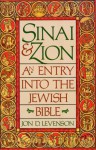
MUST READ: Sinai and Zion 3 – YHWH’S Home in No Man's Land

Image from www.christianbooks.co.za

Image from www.christianbooks.co.za

[First posted July 16, 2015, revisited October & November 2015; can’t resist another review.


This chapter in Jon D. Levenson’s SINAI and ZION, is on the same page, so to speak, with Sinai 6000.  This discussion validates Sinaites’ raison d’etre as the non-religious ‘movement’ for gentiles who are seeking or are in transition, who do not wish to affiliate with any of the three major world religions that trace their roots to Abraham: Judaism, Christianity, Islam.  


There is a 4th choice:  return to Sinai and the self-revealing God who spoke to Moses first, and to the mixed multitude after the exodus from Egypt.  Keep away from religion and get to know the God Who revealed His Name as YHWH and learn what is His Will in His Torah.  Serve Him within the limitations of your knowledge at every stage of your spiritual journey, just don’t stop learning from the wisdom of His Sinai Revelation.  This One True God knows the heart and understands the mind of each true seeker and connects us with one another.


This is the spirit of Sinai 6000 in a nutshell:  whether you are alone in your faith journey or travelling with other seekers who are just as hungry as you are for more truth, do not worry about losing your way; we’ve been on this road to Sinai for almost five years now and we keep looking back if others have gotten on the same road who might need a helping hand, a push and a shove.  We are here for you! Together our dimly lit lamps provide brighter illumination as our numbers increase, even when some of our life-lamps finally go out, because our last testimony, our legacy is about the final lap of our journey of a lifetime.  No membership is needed, simply walk YHWH’s Way with the rest of us.  Just as He was with His chosen people in the wilderness wandering of the mixed multitude, YHWH is with all who choose Him as personal God and are retracing their paths back to Sinai to finally understand what it means to “choose life.” 


First posted April 19, 2015; related posts:  MUST READ: SINAI & ZION – 1 & SINAI AND ZION 2 – The Sinaitic Experience and Traditions About It .  Reformatting and highlights added. —Admin1.]

Image from wordpress.com

Image from wordpress.com

Those who wish to speculate about the meaning of Sinai in the period of Israel’s first association with it will take special interest in those passages which mention the mountain and can be dated on independent, formal grounds to a very early period.


Psalm 68 is a choice example, as linguistic, orthographic, and other criteria suggest to some scholars that it is one of the oldest pieces of Israelite poetry. Vv 8-9 and 16-19 are quite relevant to any discussion of the conception of Sinai that diverges from, and thus most likely predates, the conception in our Pentateuchal narrative sources.  These verses, obscure as they are, clearly record a march of YHWH from Sinai, a military campaign in which the God of Israel and his retinue, divine, human, or something of each, set out across the desert.


The point not to be overlooked is that YHWH’s home, the locus of this presence, is not a site inside the land of Israel, but rather Mount Sinai, which is separated from Israel’s home by forbidding wasteland. The mention of Sinai (vv 9, 18) clearly implies a connection between YHWH and that mountain much closer than what we would expect from the Pentateuchal narratives in which Mount Sinai seems to be no more than the place in which the revelation of law took place.


Instead, in Psalm 68, YHWH is “the One of Sinai” (v 9), an epithet that provokes jealousy on the part of Mount Bashan, in the lands of the Trans-Jordanian branch of the tribe Manasseh.


In spite of his ritual march to the land of Israel, YHWH’s favored abode is still Mount Sinai. “The One of Sinai” is the numen, the deity, of that mountain, the God of whom Sinai is characteristic.


Image from lds.ne

Image from lds.ne


The same expression occurs in an identical context in the famous Song of Deborah (Judg 5:4-5). It is possible that “Sinai” in Ps 68:9, 18 and Judg 5:5 is a gentilic adjective related to the “Wilderness of Sin,” a desert probably in the Sinai peninsula (e.g., Exod 16:1). If so, the expression refers to a broader area than the mountain itself in its designation of the divine abode.


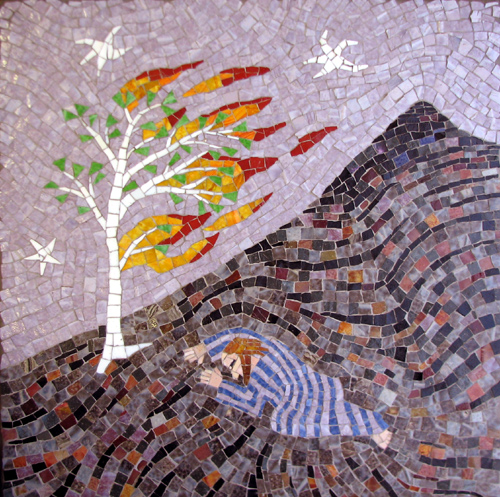
On the other hand, there is an unmistakable play on Sinai in the account in Exod 3:1-6 of the burning bush (sene), which Moses encountered at Horeb. The marvel that attracts Moses’ attention here is a bush that burns and burns, but is never burnt up—the prototypical renewable source of energy. The document from which this narrative is drawn refers to the mountain of God not as Sinai, but as Horeb (v 1). , the closeness in sound of sene (“bush”) and Sinay(“Sinai”) cannot be coincidental. Perhaps the play on words here derives from the notion that the emblem of the Sinai deity was a tree of some sort; hence the popular association of Sinay and sene.


Image from www.riversonfineart.com

Image from www.riversonfineart.com

In fact, a blessing on the tribe of Joseph identifies YHWH with “the one who dwells in the bush” (Deut 33:16). If “bush” is not a scribal error for “Sinai,” the tree here is not merely a device to attract attention, as one might think from Exodus 3, but is, rather, an outward manifestation of divine presence. YHWH is the numen of the bush. The conjunction in Exodus 3 of bush or tree (we do not know the precise meaning of sene) and fire is not surprising in light of later YHWHistic tradition. “YHWH your God,” thunders a Deuteronomistic homilist, “is a devouring fire, a jealous God” (Deut 4:24).


In the encounter of Moses and the burning bush, two of YHWH’s emblems—tree and fire—clash, and neither overpowers the other. The two will appear again in tandem in the menora, the Tabernacle candelabrum which is actually a stylized tree, complete with “branches,” “almond-shaped cups,” “calyces,” and “petals” (Exod 25:31-39). This arborescent lampstand appears not only in the Tabernacle which served as Israel’s central sanctuary in the period of wandering in the wilderness, but also in the Temple that was to be built by Solomon in the early monarchical era (1 Kgs 7:49). The Temple at Jerusalem was lit by the fires of the burning tree.


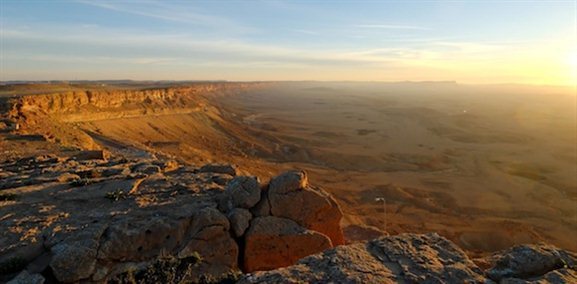
What accounts for our inability to locate the site of the great mountain of Mosaic revelation with any certainty?  The failure is not simply one of the modern science of topography.  Rather, there is a mysterious extraterrestrial quality to the mountain in the most developed and least allusive biblical references to it. Sinai/Horeb seem(s) to exist in no man’s land.


Moses’ first trip “to the mountain of God” occurs after he has fled Egypt.  The mountain of God is not under Pharaoh’s control.  It seems to be closer to Midian, a confederation of tribes living near what is today known as the Gulf of Eilat (or Gulf of Aqaba), the body of water that separates the Sinai from Arabia.  Still, according to Exod 3:1, Horeb does not seem to lie within Midianite territory, since Moses must drive his Midianite father-in-law’s flocks into the wilderness to arrive at the sacred spot.


Further proof of this follows from Num 10:29-33, in which Jethro (also known as Hobab and Reuel) announces that he will return to his native land and not accompany Israel in her march from the Sinai into Canaan, the promised land.  Mount Sinai may be near, but it is not within Jethro’s territory.  Instead, “the mountain of God,” under whatever name and with whatever difference that names may indicate,  is out of the domain of Egypt and out of the domain of the Midianites,  an area associated,  by contrast,  with the impenetrable regions of the arid wilderness, where the authority of the state cannot reach.


YHWH’s self-disclosure takes place in remote parts rather than within the established and settled cult of the city. Even his mode of manifestation reflects the uncontrollable and unpredictable character of the wilderness rather than the decorum one associates with a long-established, urban religion, rooted in familiar traditions.


As Moses and Aaron put it to Pharaoh:


The God of the Hebrews has chanced upon us.
Please let us go a journey of three days into the wilderness
to offer sacrifice to YHWH our God,
lest he strike us with plague or sword. (Exod 5:3)
In other words, the deity is like his worshippers: mobile, rootless and unpredictable. “I shall be where I shall be” (3:14)—nothing more definite can be said.


This is a God who is free, unconfined by the boundaries that man erects. To man, especially to a political man in a civilization as urban and complex as that of Egypt, this request of the Hebrews must have seemed unspeakably primitive.  And so Pharaoh, ruler of a great power, responds contemptuously to Moses and Aaron’s plea that the people be allowed to journey into the desert to appease their God, lest he afflict them:


Who is this “YHWH” that I should obey him and let Israel go?
I do not recognize YHWH and I will not let Israel go! (Exod 5:2)

Artlessly, an opposition has been set up between service to YHWH and service to Pharaoh.  Two masters, two lords, are in contention for the service of Israel in these first chapters of Exodus.  As the narrative develops, it becomes clear that—

  • one master represents human pride, the security of an ancient and settled regime which has lasted for millennia and will, so its ruler believes, outlast the demand of these Asiatic barbarians for the liberty to serve their God in his desolate home.
  • The other master is that unpredictable deity himself, unknown in the urban world of Egypt, a deity whose home and whose power lie outside Egyptian sovereignty, increasingly threatening it and continually reminding Pharaoh of the limits of his power, which he and his subjects regard as infinite and, in fact, divine.


The contrast is also between the desert and the urban state.  As Zev Weisman puts it,


“the desert serves as a cradle for this primitive universalism of social elements which are outside the control of government, in that it is a space free of any political authority whatsoever and of any organized governmental-cultic establishment.”


Image from bible.org

Image from bible.org

Note that I am not saying that the desert was the goal or ideal of life in ancient Israel. It was not. The desert was mostly conceived as a forbidding, even demonic area.  Nor am I saying that YHWH’s essential nature was perceived throughout biblical history as that of a desert deity.  It was not.


What I do claim is that the desert, which some poetry (which is probably early) regards as the locale of YHWH’s mountain home, functions in early prose as a symbol of freedom, which stands in opposition to the massive and burden-some regime of Egypt, where state and cult are presented as colluding in the perpetuation of slavery and degradation.


The mountain of God is a beacon to the slaves of Egypt, a symbol of a new kind of master and a radically different relationship of people to state.


Sinai is not the final goal of the Exodus, but lying between Egypt and Canaan, it does represent YHWH’s unchallengeable mastery over both.


The Great Partnership – 'Why God?' – 4

[First posted September 6, 2014.


To religionists, the answer to the Q: ‘Why God?’ would be ‘Why not God?’ But even as believers, occasionally we might wonder ‘God, are you there? Are you real? Are you in control?’ — particularly when we look at the state of the world today and when we don’t get the expected answers to our prayers.


 Someone observed it’s worse in these times than ever before; we say, humanity has not changed much since the days of Noah. It’s just that we are now in a position to know what goes on anywhere in the globe at any time because of our hi-tech toys that grab our attention 24/7. But isn’t it great to live in such times as these, though unsettling because bad news  on a global scale is all we hear which disturbs our peace.  Perhaps media should balance its coverage and feature  more good news . . . unless there aren’t any . . . more likely it simply doesn’t draw as much attention. 


Rabbi Sacks in this concluding chapter gives reasons for ‘Why God?’ — not in the sense of asking God why are things the way they are on planet earth; rather, that  it makes more sense to believe there is a Creator and Designer of this universe;  there are reasons to believe in the existence of God.   Frankly, Sinaites think it takes more faith NOT to believe there is a God.  Rabbi Sacks is correct in saying God has authored two books:  the Torah and Nature.  If one misses reading His Sinai revelation, the natural world is a magnificent testimony — indeed, as the psalmist proclaims:


 Psalm 19:1-4

‘The heavens declare the glory of God;

the skies proclaim the work of His hands!

Day after day they pour forth speech;

night after night they display knowledge.  

There is no speech or language where their voice is not heard.

Their voice goes out into all the earth,

their words to the ends of the world.’


This Must Read/Must Own is downloadable as ebook from amazon.com; best to get yourself a copy, worth the ‘spend’. If you haven’t checked out the previous posts from the book; here’s a list:
Reformatting, highlights and images added.–Admin1]


——————————


Image from www.dailymail.co.uk

Image from www.dailymail.co.uk

In January 2009 the British Humanist Association paid for an advertisement to be carried on the side of London buses.  It read, ‘There’s probably no God.’  It was that advertisement which finally persuaded me to write this book, because it raised the greatest of all existential choices:

  • How shall we live our lives?
  • By probability?
  • Or by possibility?

What has transformed humanity has been our capacity to remain open to the unlikely, the improbable.  Never has this been more true than in the scientific discoveries of the past century.


Cosmology


Take creation.  For more than two thousand years, religious thinkers had to face the challenge of the prevailing view, that of Aristotle, that there was no creation because the universe had no beginning in time.  Matter was eternal.  Moses Maimonides in the twelfth century says something interesting about this.  His immediate response is that, if Aristotle were right, he would simply reinterpret Genesis 1.  He has no difficulty in stating that religious faith is compatible with scientific truth, even when it seems to deny an item of faith as fundamental as creation.


But he does not stop there.  He says that in his view Aristotle has not proved the point. Maimonides was a huge admirer of Aristotle.  He drew from his ideas in ethics, psychology and metaphysics.  But he was critical enough to insist that just because a thinker is right about most things, he is not necessarily right about all.  Maimonides remained unconvinced about the eternity of matter, and his scepticism was justified.


In 1964, almost eight centuries after Maimonides wrote The Guide for the PerplexedArno Penzias and Robert Wilson identified the cosmic microwave background radiation of the universe, the remaining trace of the Big Bang 13.7 billion years ago, that finally proved that the universe did have an origin in time.  Regardless of how it happened, there was an act of creation.  Improbable but true.


Alongside this came the discovery that the entire physical universe, from the largest galaxies to the smallest particles, is governed by six mathematical constants:

  • the ratio of electromagnetic force to the gravitational force between two electrons;
  • the structural constant that determines how various atoms are formed from hydrogen;
  • the cosmological constant;
  • the cosmic antigravity force;
  • the value that determines how tightly clusters of galaxies are bound together;
  • and the number of spatial dimensions in the universe.


Had the value of any of these constants been different by a small, almost infinitesimal degree, there would have been no universe capable of giving rise to life.  Matter would have expanded too fast to coalesce into stars, or the universe would have imploded after the initial explosion, and so on.  This fine tuning of the universe for life became known as the ‘anthropic principle’.  It all seems too precise for it to have happened by mere chance.


This led several scientists, among them Lord Rees and Stephen Hawking, to resolve the problem by predicating an infinite number of parallel universes, each instantiating a different value for the various constants.  Our universe is improbable only if it is the only one there is.  If there were an infinity of them, at least one would fit the necessary parameters, and it happens to be ours.


  This disposes of the improbability of the universe in which we live, but only by postulating another and higher improbability.  For we have to no reason to suppose that there are parallel universes, and we could never establish whether there were.  If we could make contact with a parallel universe then, by definition, it would not be a parallel universe but part of our own, which simply turned out to be larger than we thought it was.


  The improbability is multiplied by those scientists who argue that the universe was self-creating: it spun itself into being out of nothing.  Again this is eminently possible.  It is what the birth of the universe would look like according tot he Bible if the words ‘Let there be’ were edited out — if, as it were, we were watching the event with vision but no sound.  But it shows that to explain the existence of the universe that precisely fits the given mathematical parameters without acknowledging the existence of a creator, we are forced to hypothesise the existence of an infinity of self-creating universes for which we have no evidence whatsoever.  The rule of logic known as Ockham’s Razor — do not multiply unnecessary entities — would seem to favour a single unprovable God over an infinity of unprovable universes.  Be that as it may, cosmology has become one of those areas in which the improbable has prevailed over previous conceptions of the probable.


The Argument from Life


Image from www.st-andrews.ac.uk

Image from www.st-andrews.ac.uk

So has biology.  Among the more than a hundred billion galaxies, each with a hundred billion stars, only one planet thus far known to us, Earth, seems finely tuned for the emergence of life.  And by what intermediate stages did non-life become life?


There is a monumental gap between inanimate matter and the most primitive life form, bacteria, the simplest of which, mycoplasma, contains 470 genes.  How did inert matter become living self-producing life, and within a relatively short space of time?  So puzzling was this that Francis Crick, co-discoverer of DNA and a convinced atheist, was forced to conclude that life did not originate on Earth at all.  It came to Earth from Mars.  Since no trace of life has yet been found on Mars, this too sounds like replacing one improbability with another.


How did life become sentient?  And how did sentience grow to become self-consciousness, that strange gift, known only to Homo sapiens, that allows us to ask the question ‘Why?’


So many improbabilities had to happen that Stephen J. Gould was forced to the conclusion that if the process of evolution were run again from the beginning, it is doubtful whether Homo sapiens would ever have emerged.


You do not have to be religious to have a sense of awe at the sheer improbability of things.  James Le Fanu, in Why Us?, argues that we are about to undergo a paradigm shift in scientific understanding.  The complexities of the genome, the emergence of the first multicellular life forms, the origins of Homo sapiens and our prodigiously enlarged brain:  all these and more are too subtle to be accounted for in reductive, materialist, Darwinian science.


  Particularly unexpected was the result of the decoding of the human genome.  It was anticipated that at least 100,000 genes would be found, allowing us to explain what made humans human, and establishing a one-to-one correlation between specific genes and physical attributes.  Improbably, there turned out to be a mere 26,000 –not much more than the blind millimetre-long roundworm C. Elegans that has 19,100.


  Still more improbably, ‘master’ genes that orchestrate the building of complex life forms turn out to be the same across different species.  The same genes that cause a fly to be a fly cause a mouse to be a mouse.  A single gene, Pax 6, that in a mouse gives rise to a camera-type eye, when inserted into a fly embryo produces the compound eye characteristic of a fly.  Far from being ‘selfish’, genes turn out to be ensemble players capable in mysterious ways of knowing contextually where they are and of what larger entity they are part.  Stephen J. Gould said that the significance of these results ‘lies not in the discovery of something previously unknown — but in their explicitly unexpected character’.  Improbability again.


Nor are we any nearer an understanding of why the evolution of life as a biological phenomenon should give rise to an organism capable of self-consciousness, of thinking, reflecting, remembering, of asking the question ‘Why?’  This is perhaps the most improbable phenomenon of all, yet it is also the most consequential.  Without that ‘thinking and contemplating entity, man’, wrote Diderot, the universe would be ‘changed into a vast solitude, a phenomenon taking place obscurely, unobserved’.


In Homo sapiens, for the first time the universe became self-aware.


Stephen J. Gould and Richard Lewontin have argued that the higher states of consciousness are to human life what a spandrel is to a cathedral: an accidental byproduct, a decorative motif.  Can we prove otherwise?  No.  But we can say with some certainty that this is a very odd way of understanding the human condition.


Human self-consciousness lies at the heart of all art, metaphysics, poetry; of all science, mathematics and cosmology; of everything that makes humanity different, distinct, unique.  The least significant fact about Homo sapiens is that we have evolved to survive.  So has everything else that lives.  All that lives, said Spinoza, has a conatus, a will to live.  What makes us different is that we are the meaning-seeking, culture-creating animal.  That is constitutive of our humanity.  To think of self-consciousness as a spandrel is as tone deaf as to think about a cathedral as a building to keep out the rain.  A cathedral is a building constructed ad majorem Dei gloriam, ‘for the greater glory of God’.  Ignore that, and you will not understand what a cathedral is.  Why should humanity be different?


  Equally unexpected, and a direct consequence of the discovery of DNA, is the finding that virtually all life from the most primitive bacterium to us has a single source, DNA itself.  Every living thing shares the same genetic script, what Francis Collins — head of the project to map the human genome — called ‘the language of God’.  Collins is just one of several distinguished scientists to have arrived at a religious conclusion, having embarked on a scientific journey.  We now know the truth of a proposition that, though it proves no theological truth, nonetheless has deeply spiritual resonance, namely that unity begets diversity.  The many derive from the One.


Nor does unity end there.  Sustained reflection on the Earth’s ecology has made us aware that life in all its almost unimaginable diversity is interlinked.  Not only is all humanity part of a single fate — John Donne’s ‘any man’s death diminishes me, because I am involved in Mankind.’  So too is all of nature.  Life is a series of interlinked systems in which each plays a part in the whole, and the loss of a single species may affect many others.  Again, the many point to the One.


  The sheer improbability of the scientific discoveries of the twentieth and twenty-first centuries is overwhelming.  In 1894, Albert A. Michelson, the German-born American physicist, said,


‘The more important fundamental laws and facts of physical science have all been discovered, and these are now so firmly established that the possibility of their ever being supplanted in consequence of new discoveries is exceedingly remote.’


In 1900, speaking to the British Association for the Advancement of Science, Lord Kelvin said,

‘There is nothing new to be discovered in physics now.  All that remains is more and more precise measurement.’


The long list of failed predictions should tell us to expect the unexpected.  We are the unpredictable animal navigating our way through a universe that, from quantum physics to black holes to the Higgs boson, is stranger than any nineteenth-century scientist could have dreamed.


Image from awhitecarousel.com

Image from awhitecarousel.com

Everything interesting in life, the universe and the whole shebang is improbable, as Nassim Nicholas Taleb reminds us in The Black Swansubtitled ‘The Impact of the Highly Improbable’.  The books title drawn from the fact that people were convinced that, since no one had ever seen a black swan, they did not exist — until someone discovered Australia.


My favourite improbability is the fact that the man who invented probability theory, a brilliant young mathematician called Blaise Pascal, decided at the age of thirty to give up mathematics and science and devote the rest of his life to the exploration of religious faith.


  None of this is intended as proof of the existence of God.  The Bible itself satirises the Egyptian magicians who, unable to reproduce the plague of lice, declare, ‘It is the finger of God’ (Exodus 8:19).  So much for the ‘God of the gaps’ –invoking God to explain the not-yet-scientifically-explicable.  That is the way of the Egyptians, not the faith of Abraham.


Science gives us a sense of wonder.   It does not disclose the source and origin of that wonder.  Maimonides said that science, by disclosing the vastness of the universe and the smallness of mankind, leads to the love and awe of God.  He did not say it leads to belief in God.


Contemplation of the natural universe is an intimation, no more and no less, of the presence of a vast intelligence at work in the universe, an intelligence capable of constantly surprising us, showing us that the more we know, the more we know we do not know, yet still beckoning us onwards to a point beyond the visible horizon.


  The Argument from History


  Thus science.  What of history?  How probable is it that one man

Image from www.christians-standing-with-israel.org

Image from www.christians-standing-with-israel.org

who performed no miracles, uttered no prophecies, had no legion of disciples and wielded no power — Abraham — would become the most influential figure who ever lived, with more than half of the six billion people alive today tracing their spiritual descent from him?

 
Image from www.judaicawebstore.com

Image from www.judaicawebstore.com

How probable is it that a tiny people, the children of Israel, known today as Jews, numbering less than a fifth of a per cent of the population of the world, would outlive every empire that sought its destruction?

             
Image from www.pewforum.org

Image from www.pewforum.org

Or that a small, persecuted sect known as the Christians would one day become the largest movement of any kind in the world?


  Nikolai Berdyaev (1874-1948) was a Russian Marxist who broke with the movement after the Russian Revolution and its aftermath.  He became an unconventional Christian — he had been charged with blasphemy for criticising the Russian Orthodox Church in 1913 — and went into exile, eventually settling in Paris.  In The Meaning of History, he tells us why he abandoned Marxism:


I remember how the materialist interpretation of history, when I attempted in my youth to verify it by applying it to the destinies of peoples, broke down in the case of the Jews, where destiny seemed absolutely inexplicable from the materialistic standpoint . . . Its survival is a mysterious and wonderful phenomenon demonstrating that the life of this people is governed by a special predetermination, transcending the processes of adaptation expounded by the materialistic interpretation of history.  The survival of the Jews, their resistance to destruction, their endurance under absolutely peculiar conditions and the fateful role played by them in history:  all these point to the particular and mysterious foundations of their destiny.


Consider this one fact.  The Bible records a series of promises by God to Abraham:  that he would become a great nation, as many as the stars of the sky or the sand on the sea shore, culminating in the prophecy that he would become ‘the father of many nations’.  Yet in Deuteronomy 7:7, Moses makes a statement that seems flatly to contradict this:


 ‘The Lord did not set his affection on you and choose you because you were more numerous than other peoples, for you are the fewest of all peoples’.


  There seems no way of reconciling these two statements, none at any rate that could have been true at the time of the canonisation of the Mosaic books.  Yet in the twenty-first century we can give precise meaning to these two prophecies.


More than half of the six billion people alive today claim descent, literal or metaphorical, from Abraham, among them 2.2 billion Christians and 1.3 billion Muslims.  Abraham did become ‘the father of many nations’.  Yet Jews — those whose faith is defined by the law of Moses — remain, at 13 million, ‘the fewest of all peoples’.    As the late Milton Himmelfarb once remarked, the total population of world Jewry is the size of the statistical error in the Chinese census.


  Somehow the prophets of Israel, a small, vulnerable nation surrounded by large empires, were convinced that it would be eternal.


‘This is what the Lord says, he who appoints the sun to shine by day, who decrees the moon and stars to shine by night …”Only if these decrees vanish from my sight,” declares the Lord, “will Israel ever cease being a nation before me” (Jeremiah 31:35-6).


They were certain that their message of monotheism would eventually transform the imagination of humankind.  There was nothing to justify that certainty then, still less after a thousand years of persecution, pogroms and the Final Solution.  Yet improbably, Jews and Judaism survived.


King Frederick the Great once asked his physician Zimmermann of Brugg-in-Aargau, ‘Zimmermann, can you name me a single proof of the existence of God?’   The physician replied, ‘Your majesty, the Jews.’


  The Argument from Entropy


Consider the pattern of civilisation itself.  One of the first historians to give a cyclical account of history, Giambattista Vico, argued that all civilisations were subject to a law of rise and decline.  They are born in austerity.  They rise to affluence and power.  Then they become decadent and eventually decline.


 ‘People first sense what is necessary, then consider what is useful, next attend to comfort, later delight in pleasures, soon grow dissolute in luxury, and finally go mad squandering their estates.’


The only antidote to this, he argued, was religion, which motivates people to virtue and concern for the common good.  Providence ‘renews the piety, faith and truth which are both the natural foundations of justice, and the grace and beauty of God’s eternal order’.


It is an argument that has been repeated in our time by figures like Vaclav Havel and Jürgen Habermas.  Havel, protesting the materialist conception of human life, argues that such a view leads inevitably to


‘the gradual erosion of all moral standards,

the breakdown of all criteria for decency,

and the widespread destruction of confidence in the meaning of such values as truth, adherence to principles, sincerity, altruism, dignity and honour’.

He adds,


‘If democracy is not only to survive but to expand successfully … it must rediscover and renew its own transcendental origins.  It must renew its respect for the non-material order that is not only above us but also in us and among us.’


Habermas, like Havel a secular intellectual, has nonetheless spoken of how ‘enlightened reason’ reaches a crisis when it discovers it no longer has sufficient strength ‘to awaken, and to keep awake, in the minds of secular subjects, an awareness of the violations of solidarity throughout the world, an awareness of what is missing, of what cries out to heaven’.  His conclusion is that—


‘Among modern societies, only those that are able to introduce into the secular domain the essential contents of their religious traditions which point beyond the merely human role will also be able to rescue the substance of the human.’


  There have been many superpowers:

  • Spain in the fifteenth century,
  • Venice in the sixteenth,
  • Holland in the seventeenth,
  • France in the eighteenth,
  • Britain in the nineteenth,
  • the United States in the twentieth.
Image from www.pravmir.com

Image from www.pravmir.com

 Yet Judaism has existed in some form for the better part of four thousand years, Christianity for two thousand, and Islam for fourteen centuries.  Religions survive.  Superpowers do not.  Spiritual systems have the capacity to defeat the law of entropy that governs the life of nations.  


  We can trace this process in the present.  Harvard sociologist Robert Putnam became famous in the late 1990s for a phrase he coined to describe the loss of social capital — networks of reciprocity and trust — in the liberal democracies of the West.  He called it ‘bowling alone’.  More people were going ten-pin bowling, but fewer were joining teams and leagues.  This was his symbol of the West’s increasingly individualistic, atomistic, self-preoccupied culture.  Things people once did together, we were now doing alone.  Our bonds of belonging were growing thin.


In 2010, in his book American Grace, Putnam set out the good news that a powerful store of social capital still exists.  It is called religion:  the churches, synagogues and other places of worship that still bring people together in shared belonging and mutual responsibility.


An extensive survey carried out throughout the United States between 2004 and 2006 showed that frequent church- or synagogue-goers are more likely to give money to charity, regardless of whether the charity is religious or secular.  They are also more likely to do voluntary work for a charity, give money to a homeless person, give excess change back to a shop assistant, donate blood, help a neighbour with housework, spend time with someone who is feeling depressed, allow another driver to cut in front of them, offer a seat to a stranger, or help someone find a job.  Religious Americans are simply more likely than their secular counterparts to give of their time and money to others, not only within but also beyond their own communities.


Their altruism goes further.  Frequent worshippers are also significantly more active citizens.  They are more likely to belong to community organisations.  Within these organisations they are more likely to be officers or committee members.  They take a more active part in local civic and political life, from local elections to town meetings to demonstrations.  They are disproportionately represented among local activists for social and political reform.  They get involved, turn up and lead.  The margin of difference between them and the more secular is large.


Tested on attitudes, religiosity as measured by church or synagogue attendance turns out to be the best predictor of altruism and empathy: better than education, age, income, gender or race.  Religion creates community, community creates altruism, and altruism turns us away from self and towards the common good.  Putnam goes so far as to speculate that an atheist who went regularly to church (perhaps because of a spouse) would be more likely to volunteer in a soup kitchen than a believer who prays alone.  There is something about the tenor of relationships within a religious community that makes it an ongoing tutorial in citizenship and good neighbourliness.


This is path-breaking research by one of the world’s greatest sociologists, and it confirms what most members of religious congregations know, that they give rise to networks of support often breathtaking in their strength and moral beauty:  visiting the sick, comforting the bereaved, helping individuals through personal crisis, supporting those in financial need, assisting people who have lost jobs, caring for the elderly, and proving daily that troubles are halved and joys doubled when they are shared with others.  Even today, religion still has the improbable power to renew the habits of the heart that drive civil society, defeating entropy and civilisational decline.


The Argument from Happiness


Thus far probability.  But there was a second sentence adorning London buses courtesy of the British Humanist Association.  In full the advertisement read, ‘There’s probably no God.  Now stop worrying and enjoy your life.’


I am perplexed by this non sequitur.  To me, faith is about, in the Bible’s phrase, ‘rejoicing in all the good the Lord your God has given you’ (Deuteronomy 26:11).  It is about celebration, gratitude, praise, thanksgiving and what Wordsworth and C.S. Lewis called being ‘surprised by joy’.  For many people, religion is an essential part of the pursuit of happiness.  A host of surveys show that people who have religious faith and regularly attend religious services report higher life satisfaction and live longer than those who do not.


For two generations, while Europe has secularised, it has witnessed the rise, especially among the young, of depressive illness, stress-related syndromes, drug and alcohol abuse, violent crime and attempted suicide.  Stable families have been replaced by an almost open-ended range of variants, leaving in their wake troubled and disadvantaged children.  Fewer people find themselves surrounded by the networks of support once provided by local communities.  Robert Bellah and his co-authors, in Habits of the Heart, diagnosed the multiple ways in which our social ecology is being damaged ‘by the destruction of the subtle ties that bind human beings to one another, leaving them frightened and alone’.


The current preoccupation with happiness — a massive spate of books in recent years — testifies to a genuine questioning of whether we may not have taken a wrong turning in the unbridled pursuit of economic gain.  The consumer society, directed at making us happy, achieves the opposite.  It encourages us to spend money we do not have, to buy things we do not need, for the sake of a happiness that will not last.  By constantly directing our attention to what we do not have, instead of making us thankful for what we do have, it becomes a highly efficient system for the production and distribution of unhappiness.


What do we know about happiness?  There are basic preconditions:  food, clothing, shelter, health, what Abraham Maslow called the physiological and safety needs.  Similarly, Moses Maimonides said that perfection of the body takes chronological precedence over perfection of the soul.  It is impossible to focus on the higher reaches of spirituality if you are cold, hungry, homeless and sick.  One of the things I respect about Judaism is its refusal to romanticise poverty.

 
  •   But beyond a basic minimum, the relationship between income and happiness is slight.  Research bears out Maslow’s analysis that the higher needs are love and belonging, esteem and self-actualisation.  The most significant determinants of happiness are strong and rewarding personal relationships, a sense of belonging to a community, being valued by others and living a meaningful life.  These are precisely the things in which religion specialises:  sanctifying marriage,
  • etching family life with the charisma of holiness,
  • creating and sustaining strong communities in which people are valued for what they are, not for what they earn or own,
  • and providing a framework within which our lives take on meaning, purpose, even blessedness.

Even Karl Marx admitted that religion was ‘the heart of a heartless world, and the soul of soulless conditions’.


  Two British authors, Richard Wilkinson and Kate Pickett, have argued recently that societies that are more equal tend to have higher reported life satisfaction.  Religious faith does not of itself create economic equality.  But it does tell us that we are all equal in the sight of God.  Each of us counts.  A house of worship is one of the few places nowadays where rich and poor, young and old, meet on equal terms, where they are valued not for what they earn, but for what they are.

 
  • It makes a difference to happiness to know that we are at home in the universe, that we are here because someone wanted us to be, and that something of us will live on.  The practices of religion — prayer as an expression of gratitude,
  • ritual as enactment of meaning,
  • sacred narrative as a way of understanding the world and our place in it,
  • rites of passage that locate our journey as a shared experience connecting us to past and future generations,
  • deeds of reciprocal kindness that bind us to a group in bonds of faith, loyalty and trust

— create structures of meaning and relationship within which our individuality can flourish.  This is where, for many of us, happiness is to be found.


‘There’s probably no God.  Now stop worrying and enjoy your life’ is one of the less profound propositions to have been produced by the collective intelligence of people who pride themselves on their intelligence.  It is at least as true as saying, ‘Exams don’t matter, work is a waste of time, love does not last, commitment only leads to disappointment.  Now stop worrying and enjoy your life.’  Nothing worth striving for is easy, and nothing not worth striving for brings happiness. Pleasure, maybe; fun, perhaps; but happiness in any meaningful sense, no.  If I wanted to stop worrying, I would not choose a world blind to my existence, indifferent to my fate, with no solace in this life or any other.  Nor would I put my trust in those who ridiculed my deepest commitments.


  The Greatest Improbability of All


Writing in 1832, the young Frenchman Alexis de Tocqueville made a mordant comment.


‘Eighteenth century philosophers,’ he wrote, ‘had a very simple explanation for the gradual weakening of beliefs.  Religious zeal, they said, was bound to die down as enlightenment and freedom spread.  It is tiresome that the facts do not fit this theory at all.’


Tocqueville was writing in the 1830s, in the full shock of his discovery that America — the very country that established the principle of separation of church and state — remained a deeply religious society.  It still is.  Today more Americans go weekly to a place of worship than do the people of Iran, a theocracy.


The survival of religion is the greatest improbability of all.  The world has changed beyond recognition since the Middle Ages.  Religion has lost many of the functions it once had.

  • To explain the world, we have science.
  • To control it, we have technology.
  • To negotiate power, we have democratic politics.
  • To achieve prosperity, we have a market economy.
  • If we are ill, we go to a doctor, not a priest.
  • If we feel guilty, we can go to a psychotherapist; we have no need of a confessor.
  • If we are depressed, we can take Prozac; we do not need the book of Psalms.
  • Schools and welfare services are provided by the state, not by the church.
  • And if we seek salvation, we can visit the new cathedrals — the shopping malls –at which the consumer society pays homage to its gods.
 

Faith would seem to be redundant in the contemporary world.  And yet far from disappearing, it is alive and well and flourishing, in every part of the world except Europe.  In America there are mega-churches with congregations in the tens of thousands.  In China today there are more practising Christians than members of the Communist Party and almost as many Muslims as there are in Saudi Arabia.  In Russia, where religion was exiled for seventy years, a poll in 2006 showed that 84 per cent of the population believed in God.  And, as the editor of The Economist writes, whereas in the past religion was often associated with poverty, today ‘the growth in faith has coincided with a growth in prosperity’.


  Why is this so?  Because religion does what none of the great institutions of contemporary society does:  not politics, not economics, not science and not technology.  It answers the three great questions that any reflective human being will ask:

  • Who am I? (the question of identity),
  • Why am I here? (the question of purpose), and,
  • How then shall I live?  (the question of ethics and meaning).
 

Today’s atheists — the neo-Darwinians, sociobiologists and evolutionary psychologists –all too often engage in a sustained act of self-contradiction.  For them, what works is what survives:  genes biologically, and ‘memes’ culturally.  But manifestly, religion survives.  Faith lives on.  The religious in most countries have more children than the non-religious.  They are better at handing on their genes and memes to the next generation.  Meanwhile, after three centuries of sometimes aggressive secularism, we have moved into what Jürgen Habermas calls a ‘post-secular age’.  Yet in defiance of all the evidence on their own terms, the new atheists argue that religion is an epiphenomenon, an accidental by-product of something else:  once functional, now dysfunctional.  If this were so, it would have disappeared long ago.  Its survival is the supreme improbability.


The Defeat of Probability by the Power of Possibility


So if probability were the measure, there would be no universe, no life, no sentience, no self-consciousness, no humanity, no art, no questions, no poetry, no Rembrandt, no sense of humour, no sanctity of life, no love.  How probable is it that the most primitive bacterium would one day evolve into a humanity capable of decoding the genome itself?  Or that small religious groups would outlive great empires, that one day people would hold these truths self-evident that all men are created equal and are endowed by their Creator with certain unalienable rights, that slavery would be abolished, tyrannies would fall and apartheid would end?


Faith is the defeat of probability by the power of possibility.  


The prophets dreamed the improbable and by doing so helped bring it about.  All the great human achievements, in art and science as well as the life of the spirit, came through people who ignored the probable and had faith in the possible.


How did this happen?  It happened in the West because Abraham and his descendants believed in a God who stood outside the entire natural order, the domain of cause and effect and of probability itself.  They believed in a God who defined himself in the phrase ‘I will be what I will be’, meaning, ‘I will be what, where and how I choose’ — hence, the God who defies predictability and probability.   By setting his image on humanity, he gave us too the power to defy probability to stand outside the taken-for-granted certainties of the age and live by another light.  The belief that gave the West its faith in the great duality charged by science and religion, the orderliness of the universe on the one hand, the freedom of humanity on the other.


‘Once you eliminate the impossible,’ said Sherlock Holmes, ‘whatever remains, no matter how improbable, must be the truth.’  That is the left-brain way of putting the argument.  The sheer cumulative weight of the evidence from cosmology, biology, history, the decline and fall of civilisations, the failure of secular revolutions, the forces making for altruism in an age of individualism, event he pursuit of happiness itself — all these point towards the presence of a vast intelligence at work in the universe that has revealed itself directly or obliquely to our ancestors and through them to us.

Despite E.O. Wilson’s noble effort at ‘consilience’, a scientific theory-of-everything, there is no hypothesis remotely as simple, elegant and all-encompassing as the idea that an intelligent Creator endowed creation with creativity.  For those who seek proof, this is as close as we can come, given our present state of knowledge of the universe and ourselves.


Speaking personally, however, as I have argued throughout, I believe that the demand for proof is misconceived.  It came from the strange combination of events in the first century when two very different cultures, ancient Greece and ancient Israel, came together in the form of a synthesis that eventually encouraged people to believe that science and religion, explanation and interpretation, impersonal and personal knowledge, were the same sort of thing, part of the same world of thought.  I have argued otherwise, that it is precisely because they are not the same sort of thing that the counterpoint between them gave and still gives human life its depth and pathos.  We can no more dispense with either than we can with one of the two hemispheres of the brain.


If so, then the improbabilities that have accumulated are not proof of the existence of God but a series of intimations.

  • Science does not lead to religious conclusions;
    • religion does not lead to scientific conclusions.
  • Science is about explanation.
    • Religion is about interpretation.
  • Science takes things apart to see how they work.
    • Religion puts things together to see what they mean.

They are different intellectual enterprises that engage different hemispheres of the brain.


  • Science — linear, atomistic, analytical — is a typical left-brain activity.
    • Religion — integrative, holistic, rational — is supremely a work of the right brain.

This is meant only as a metaphor, but it is a powerful one.


The mutual hostility between religion and science is one of the curses of our age, and it is damaging to religion and science in equal measure.  The Bible is not proto-science, pseudo-science or myth masquerading as science.  It is interested in other questions entirely.  Who are we?  Why are we here?  How then shall we live?  It is to answer those questions, not scientific ones, that we seek to know the mind of God.  But there is more to wisdom than science.  It cannot tell us why we are here or how we should live.  Science masquerading as religion is as unseemly as religion masquerading as science.


  At their best, science and religion are both instances of the human passion to decode mysteries, constantly travelling in search of a destination that continues to elude us, that is always over the furthermost horizon.  It is that willingness to search, ask, question, that makes us what we are.


Wallace Stevens, in his poem Thirteen Ways of Looking at a Blackbird, wrote:

I do not know which to prefer,

The beauty of inflections

Or the beauty of innuendoes,

The blackbird whistling

Or just after.


After the inflections, the innuendoes remain, the hints, the intimations, Elijah’s ‘small still voice’,  Paul’s ‘through a glass darkly’, Wordsworth’s ‘sense of something far more deeply interfused’.  When all the scientific explanations are in, the great questions still remain.


  Faith is the Courage to Take a Risk


Somewhere just beyond the edge of the universe, at the far side of the knowable, there either is or is not the Presence who brought it, and life, and you, into being.  You have to make a choice and it will affect the whole of your life.


  You may say, I refuse to believe what I cannot test, what I cannot subject even in principle to some kind of proof.  So be it.  But the big decisions in life — as I learned from Bernard Williams and the Gauguin dilemma — are like that.  You can never know in advance the facts that would make your decision the right one under the circumstances.  That applies to the decision to marry, to have a child, to start a business, to undertake a research project, to write a symphony, to paint a picture.  There is no creation without risk.  What impresses me about the Bible is that it suggests that, even for God, creating humanity was a risk, and one that at least once he regretted having taken.


The same is true about the basic attitudes we take towards life.  How can I know in advance, beyond doubt, whether it is right to trust people, to befriend them, to love, to forgive those who have harmed me, to grant those who have failed me a second chance, to act honourably, to resist temptation, to refrain from doing wrong even when I am sure I will not be found out, to make sacrifices for the sake of others, and to refuse to become cynical even when I know the worst about the world and the people in it?  There is no ‘rational choice’, no decision procedure, to take the uncertainty out of such choices — not least because they affect not only what happens but also the kind of person I become.


To be human is to live in a world fraught with risk.  We face a future that is unknowable, not just unknown.  Faith is a risk and there is no way of minimising that risk, of playing it safe.  Hamlet’s soliloquy — ‘For in that sleep of death what dreams may come?’ –tells us that there is no death, let alone life, without risk.  Those who are unprepared to take a risk are unprepared to live fully.


Faith is the courage to take a risk.


And what if I am wrong?  I would rather have lived believing the best about humanity and the universe than believing the worst.  It is perfectly possible and coherent to believe that there is no creative intelligence at work in the universe, or if there is, it is blind; that life is vicious, cruel and unjust; that homo homini lupus est, ‘man is wolf to man’; that pessimism protects us from being disappointed and cynicism is our best defence against being betrayed.


There is nothing irrational about believing that life has no meaning, that we can make no significant difference to the world, that life is short and death is long, so let us pursue what pleasures we can while hardening ourselves against what malice and misfortune may bring; living, in short, as did the Hedonists, Epicureans and stoics of Greece of the third pre-Christian century.  But these are tired philosophies of life, to be found in civilisations nearing their natural end.


141_spiritualnotreligious_wideThere are, to be sure, secular humanists who live deeply altruistic lives, fighting injustice or poverty or disease, pursuing truth or goodness or beauty for their own sake, without any super- or infrastructure of belief about the larger metaphysics of existence.  I –and I hope all religious believers — feel enlarged, indeed blessed, by such people.  To believe that religion holds a monopoly of virtue is as narrow-minded as to believe that science holds a monopoly of truth.


However, this does not mean that religious faith makes no difference to the kind of people we become.  Dozens of research exercises have shown that students grow or shrink to fit the expectations their parents and teachers have of them.  When their teacher believes they are capable of greatness and communicates that in the classroom, students perform above the norm.  When they are written off as failures, they fail, or at least do worse than they might have done otherwise.


  Monotheism expects great things from us, and by doing so makes us great.  It calls us the image of God, the children of God, God’s covenantal partners.  It challenges us to become co-builders with God of a gracious society and a more just world.  It tells us that each of us is unique, irreplaceable, precious in God’s sight.  We are not just the phenotype of a genotype, a member of a species, to a biologist a specimen, to a government a source of income, to an employer a cost, to an advertiser a consumer, and to a politician a vote.


I see people transformed by this belief, spending their lives in gratitude to God for the gift of being alive and seeking to repay that debt by giving to others.  I see them holding marriage sacred;  I see them taking parenthood seriously as God told Abraham to take it seriously.  I see them form communities on the basis of chesed, loving kindness.  I see the power of faith to generate moral energies in a way nothing else does.


And when I see people grow taller under the sunlight of divine love than they might have done under a godless sky, then — like the searcher in Jorge Luis Borges’ ‘Approach to Al-Mutasim’ — I find the traces that lead eventually to his presence:  in people who do not act the way Marx, Darwin, Freud or their disciples taught us to expect.  They are the flecks of gold amidst the dust.  They are the signals of transcendence.


  I cannot see that value attributed to the human person in any of the secular ideologies conjectured, let alone put into practice.  How could there be?  Biologically, as the neo-Darwinians remind us, we share 98 per cent of our genes with the primates an quite a lot of them with fruit flies.  In any case, science deals with universal propositions, not with what James Joyce called epiphanies of the ordinary.  The scientific method must screen out the uniqueness of the unique, the very thing poetry and art render radiant.


Homo sapiens, discovering God singular and alone, discovered the human being singular and alone.  There is no greater dignity than that — we saw it in Pico Della Mirandola’s Oration, the high point of the Renaissance view of man.  Monotheism summons us, all of us, not an elite, to greatness.


  I Believe


This, then is my credo.  I believe that the idea that the universe was created in love by the God of love who asks us to create in love is the noblest hypothesis ever to have lifted the human mind.


We are the meaning-seeking animal, the only known life form in the universe ever to have asked the question ‘Why?’  There is no single, demonstrable, irrefutable, self-evident, compelling and universal answer to this question.  Yet the principled refusal to answer it, to insist that the universe simply happened and there is nothing more to say, is a failure of the very inquisitiveness, the restless search for that which lies beyond the visible horizon, that led to science in the first place.


The meaning of a system lies outside of the system.  Therefore the meaning of the universe lies outside the universe.  That is why Abrahamic monotheism, belief in a God who transcends the physical universe and who brought it into being as an act of free creativity, was the first and remains the only hypothesis to endow life with meaning.  Without that belief there is no meaning, there are merely individual choices, fictions embraced as fates.  Without meaning there is no distinctively human life, there is merely the struggle to survive, together with the various contrivances human beings have invented to cover their boredom or their despair.


Without belief in a transcendent God — the God of freedom who acts because he choses — it is ultimately impossible to sustain the idea that we are free, that we have choice, that we are made by our decisions, that we are morally  responsible agents.  Science leaves no space for human freedom, and when freedom ceases to exist as an idea, eventually it ceases to exist as a reality also.  Those civilisations built on the abandonment of God and the worship of science — the French Revolution, the Soviet Union, the Third Reich and Chinese Communism — stand as eternal warnings of what happens when we turn a means into an end.  Science as humility in search of truth is one thing.  Science as sole reality is another.  It can then become the most pitiless and ruthless of gods.


Without freedom, there is no human dignity:   there is merely the person as thing, a biological organism continuous with all other organisms.  The discovery of human dignity is perhaps the single most transformative idea given to the world by Abrahamic monotheism.  That faith was the first to teach that every human being regardless of colour, culture or creed is in the image and likeness of God, the first to teach the sanctity of human life and the dignity of the human person, and to show how these ideals might be honoured and made real in the structures we build for our common life.


The God of Abraham is the God of surprises, the supreme power who intervened in history to liberate the powerless and set them on the long journey to freedom.  He taught us the paradoxical truth that nations survive not by wealth but by the help they give to the poor, not by power but by the are they extend to the weak.  Civilisations become invulnerable only when they care for the vulnerable.


Belief in God has historically been the only way to establish the moral limits of power.  Belief in the sovereignty of God is infinitely preferable to belief in the sovereignty of humankind.  Human beings worship.  Sometimes they worship wealth, at other times power.  Sometimes, as today, they worship the self.  There are people who worship science itself.  All these things are part of life, not its totality, and any worship of the part rather than the whole has led in the past to disaster.  Monotheism teaches us the single compelling truth that nothing is worthy of worship that is less than everything, the Author-of-all.


Abrahamic monotheism speaks on behalf of the poor, the weak, the enslaved.  It tells a story about the power of human freedom, lifted by its encounter with the ultimate source of freedom, to create structures of human dignity.  It bodies forth a vision of a more gracious world.  It tells us that no one is written off, no one condemned to be a failure.  It tells the rich and powerful that they have responsibilities to those who lack all that makes life bearable.  It invites us to be part of a gentle revolution, telling us that influence is greater than power, that we must protect the most vulnerable in society, that we must be willing to make sacrifices to that end and, most daringly of all, that love is stronger than death.  It sets love at the epicentre of the world:  love of God, love of neighbour, love of the stranger.  If natural selection tells us anything, it is that this faith, having existed for longer than any other, creates in its followers an astonishing ability to survive.


Civilisations have come and gone:  Mesopotamia, the Egypt of the pharaohs, Assyria, Babylon, Persia, the empire of Alexander the Great, and of the Caesars and Rome.  In the modern world nation after nation rose to eminence:  Venice, the Netherlands, France, Germany, Britain.  They bestrode the narrow world like a colossus, then they faded, weary and spent.  The faith of Abraham, some four thousand years old, continues to flourish, whether as Judaism, Christianity or Islam, looking as young as it ever did, having defied the predictions of centuries of intellectuals who pronounced its imminent demise.


Religion and science, the heritages respectively of Jerusalem and Athens, products of the twin hemispheres of the human brain, must now join together to protect the world that has been entrusted to our safekeeping, honouring our covenant with nature and nature’s God — the God who is the music beneath the noise; the Being at the heart of being, whose still small voice we can still hear if we learn to create a silence in the soul; the God who, whether or not we have faith in him, never loses faith in us.


Abraham Joshua Heschel

Yo Searchers, can we help you? – February 2016

Image from www.pinterest.com

Image from www.pinterest.com

[Update:  We apologize for times when this website is inaccessible; we are undergoing some upgrades; please bear with us and don’t give up checking us out.—Admin1]


——————


02/27  “sinai6000” – This entry does make any searcher land on this website and for new visitors, here are posts that introduce what we stand for:

About Us


02/22/16  “moses uncircumcised lips meaning”  Exodus/Shemoth 6-b: Do you have “uncircumcised lips”?
02/16/16 “revelation in a nutshell” –  


02/08/16  “what does god require of

gentiles?” –

Revisited: What does the God of Israel require of Gentiles?


02/06/16  “orthonymous”  – This word is mentioned among others in the MUST READ book by Bart Erdman [click #3] , a New Testament professor who turned atheist after researching the books that were chosen to compose canon of NT scriptures.  Other posts featuring his book are included here:


02/06/16


02/01/16 – This is an update on our position regarding free will; this was added on the comment to the post:


Update November 3, 2015: There is a shift in our thinking from what is asserted in this article that— for free will to be exercised, there has to be a minimum of TWO choices.

We in Sinai 6000 core community have changed our position on the minimum of TWO choices . . . we now believe that free will could still be exercised with a minimum of ONE choice. How? Simple: either choose that one option available, or reject it. That’s STILL exercising free will, because inherent in free will are two freedoms: freedom to choose and freedom not to choose, or make yet another choice. The limitation of available options to ONE does not limit our ability to still choose or not choose.

Sample: You’re in a restaurant and the waiter tells you that for the SPECIALS for the Day, they’re out of the meat option on the menu and what’s left is the seafood option. And you reply—what? “OK, I would have preferred meat but since seafood is left, I’ll take that.” You exercised your free will by going along with the only option available. BUT THEN. . . you still have this option: “I would have preferred meat, and I HATE SEAFOOD! There’s NO WAY I’ll eat that” so you ask for what else is on the regular menu, not the SPECIAL for the day. And actually, you have a 3rd way to exercise your free will: “I don’t like seafood and I think I’ll just go to another restaurant.”

Now, when is there ABSOLUTELY NO CHOICE? When there is nothing available to choose from. VEGANS experience this in meat-eating cultures, so they end up cooking their own food if they wish to really remain vegan.

Of course, free will is applied to bigger and more crucial concerns other than food. We see refugees fleeing from danger, a choice they seriously make to simply survive. Do they have a choice? Actually they face a series of choices. To flee or not to flee and face dying . . . and once they flee, the question is where to? And they head for ‘where-to’ and face rejection or unwelcoming hosts, etc. ‘What now?’

It is so unsettling to see such images of refugees uprooted from their birth-countries, seeking sanctuary in any country that would allow them to start over . . .

This was once the experience of the ‘wandering Jew’, now applied to gentile nations. Where is choice and freedom of the will in such cases? One choice to survive against all odds. . . and another choice to give up and die.

So much more to be said about this topic but will stop here.


02/01/16  “why have humans have always built ‘artificial mountains’ such as ziggurats, pyramids, and cathedrals as a means of worshiping god/the gods. why?”


Here is the Jewish perspective on why humans build such high edifices:

—————————


On the month of February six years ago, the core community of Sinai 6000 decided to put up this website.  We figured, if we could not convince one more soul to give us a hearing within the Christian/Messianic circles we formerly belonged to, perhaps there are truth-seekers all over the world who might benefit from our sharing of our Sinaite perspectives.   We continue to share as much as we learn from the study of YHWH’s Revelation on Sinai, as recorded in the Torah of the Hebrew Scriptures. Truly a labor of love, for the God we serve and for all the Truth-seekers out there.  Surprisingly, the number of visitors from various countries who have intentionally or accidentally landed on this website and whose readings have registered on our site-stats has exceeded our expectations.  This monthly aid for searchers used to have more entries in the past; search terms have dwindled down to almost a handful in recent months.  Whether this is a good sign or not, we prefer to think that our visitors are able to navigate around our 800+articles listed in different categories of our SITEMAP without our help.  Sure hope so.  As we start on the second month of the Gregorian calendar, we wish one and all a YAH-blessed February!


February trivia 

[http://www.famousbirthdays.com/facts/facts-about-february.html]

The 2nd month of the year is an outstanding one

In the Georgian calendar, the calendar that most of the world uses, February is the second month of the year. Most of the months have 30 or 31 days in a month but February is shorter. February has 28 days until Julius Caesar gave it 29 and 30 days every four years. This is because the Roman emperor Augustus took one day from February and added that to August because August was a month that was named after him. February is a very cold month followed by January in the northern half of the world. However, there are sunny days in February that indicates that spring is almost here. Different from the northern half, the southern hemisphere usually enjoys midsummer weather.

Below are some fun facts about February:

1. The birthstone for February is Amethyst.
2. Two zodiac signs for February are Aquarius (January 20 – February 18) and Pisces (February 19 – March 20)
3. The month has 29 days in leap years, when the year number is divisible by four. In common years the month has 28 days.
4. Viola (plant) and the Primrose are the birth flowers.
5. Black History Month is celebrated in Canada and United States.
6. National Day of the Sun is celebrated in Argentina.
7. In order to complete the Soviet Union’s victory in Stalingrad during World War II, the last German troops surrendered in the Stalingrad pocket.
8. On February 4, 1861, a temporary committee met at Montgomery, Alabama where they organized a Confederate States of America.
9. On February 6, 1933, Amendment 20 to the United States was proclaimed which moved the Inauguration Day to January 20th.
10. In February 1910, the Boy Scouts of America was incorporated.
11. On February 6, 1899. The U.S. Senate ratified the peace treaty that led to the end of the Spanish-American War.
12. On February 6, 1952, Princess Elizabeth became Queen Elizabeth II of Great Britain.
13. February 11 – National Foundation Day in Japan
14. February 12 – Abraham Lincoln’s Birthday
15. February 14 – Valentine’s Day
16. February 21 – International Mother Language Day
17. February 22 – Independence Day in Saint Lucia
18. February 22 – George Washington’s Birthday
19. February 24 – Flag Day of Mexico
20. February 25 – People Power Revolution (Phillippines)

FINDING GOD IN THE DETAILS OF OUR LIVES

[First posted February 2, 2014; reposted February 15 and June 27, 2015—Admin1]


—————————-


This topic has been written about and rehashed millions of times, but it is surely a relevant discussion point no matter how often, or how much it has been written about.


Image from www.quotesfrenzy.com

Image from www.quotesfrenzy.com

Each day we face challenges and difficulties, big and small, and it is good to be reminded that GOD is INDEED near us, that He IS a personal GOD, even if there are moments that we ask ourselves, “Where is GOD in all these?”


We all go through pain, suffering, difficulties, grief, in the cycles of our lives. During these times, we often ask ourselves “WHY GOD?” Yet, during moments when we are feeling at peace with everyone and everything in the world, when we are in comfort and pleasure, we do not question and just enjoy them. We sometimes even forget to be truly grateful to the Source of these good tidings. But GOD, from whom ALL BLESSINGS flow, is there in good times and in bad.


It is easy to see Him in our lives when we are rolling in the good times. However, when we are at the lowest points in our lives, when there seems to be no hope and light, when everything seems to go wrong, and our pleas and prayers seem to be going nowhere, it is then that we question if GOD is indeed with us.


I read an article in aish.com entitled “ Questioning GOD” written by Riva Pomerantz which had this catching by-line:


I don’t want to live in the question anymore.

I want to live in the answer.


Don’t we often go through that? We want so hard to hear from GOD, to have our prayers answered, to see His hand in the midst of our difficulties. Yet so often, in our daily lives, His ways are hidden and that is when we cry out in anguish, “Why GOD?” There are so many philosophical, theological, even practical answers to this oft-repeated question as we are going through times of difficulty and adversity, when justice fails, when yatzer hara [the evil inclination] seems to flourish and abound.


Image from www.momentumlife.tv

Image from www.momentumlife.tv

I know I may not have the right answers, nor can I say I know the right answers. All I know is that even in the most difficult of times, even when it is the hardest to do, I just continue to trust, to pray, to believe that GOD is in ALL the details of my life. He is a personal GOD to me, He may sometimes be silent, and times when He does intercede and answers my prayers in amazing and unexpected ways. I also know that I can only learn to be in His perfect will for me and my life as I study, read and learn from His Torah.


In his video “Getting Personal with GOD”, Rabbi Yaakov Salomon says that he heard someone say that she never plans for anything because ultimately, it is all up to GOD.  Rabbi Salomon answers it this way:


“When we pray to GOD we should pray as if EVERYTHING depended on Him; but when we LIVE we must live as if it all depends on us.”


We have to live our lives creating a balance between leaving everything to God, and doing things simply on our own; we should understand that even if our lives, and its details, are in God’s hand, we still have to DO everything possible for ourselves.


DVE@S6K

logo

Abrahamic Faith – 1 – Knowing God

[This was first posted 2012, reposted 2015.

Image from www.amazon.com

Image from www.amazon.com

In the addendum to our Statement of Faith on this website’s HOME page (see Further to our Statement of Faith) we wrote this:

“One of the books that greatly influenced our Sinai 6000 community is a book authored by James D. Tabor, Restoring Abrahamic Faith, available on the web at www.Genesis2000.org.

Other articles from this MUST HAVE book are:

 Before we start our series on the saga of the Patriarch Abraham, here is the opening chapter of Dr Tabor’s book.  When we think of Abraham, it is his journey of faith that comes to mind, but Dr. Tabor emphasizes what is of supreme importance when we read through the Hebrew Bible—-it is a portrait of YHWH, the God of Abraham and of Israel, the self-revealing God on Mt. Sinai. Reformatted for posting.—Admin1]


——————————


Image from www.snydertalk.com

Image from www.snydertalk.com

 I am YHWH. That is My Name,

My Glory I will not give to another.

 Isaiah 42:8


The foundational pillar of ABRAHAMIC FAITH is to know the Creator.  Our problem today is that when we use the English word “God,” or even bring up the concept of the Divine we invite endless confusion and controversy.  There are as many ideas and concepts of God as there are people who hold them.  


Who or what is God?

Is God a Force, a Cosmic Mind, the Life Principle, the Process of evolution, or a metaphor for our inner selves?  


Over the centuries humans have believed in and served multiple thousands of gods and goddesses.  The Larouse World Mythology offers a lavishly illustrated 500-page survey of the myths and beliefs about these deities throughout human history.  It is overwhelming just to thumb through this work and begin to get some grasp of the scope of human ideas about the Divine, and how “It” has been personified in such rich, varied, but contradictory ways.


The Hebrew Bible speaks of ONE GOD, beside Whom there is no other.  In contrast to all other deities, or claims about divinity, this ONE GOD is called the true and living God (Jeremiah 10:10; Joshua 3:10).  


The gods and goddesses of all the nations of the world are declared by the Hebrew prophets to be idols, empty vanity, and void of reality.  They are largely personifications of Nature, and from a biblical point of view, they represent the various forces of the creation rather than the Creator.  To put it in modern Freudian terms, they are illusions based on human imagination, fears, hopes, and dreams.  They represent our all-too-human need to project onto the vastness of our violent and terrifying universe some way of coping with the workings of nature or the operation of Fate in our lives.


[Footnote:  See Ernest Becker, The Denial of Death (New York: The Free Press, 1973) and Sigmund Freud, The Future of an Illusion (New York: Anchor 1964).]


The Biblical claim about ONE Creator God is markedly different in this regard.  This is not a case of primitive ancient Hebrew chauvinism.  It involves a profound revelation about the Creator, of whom and by whom are all things–the God who has acted in the complex and vast sweep of human history, yet can personally encounter us individually and directly.


The foundational confession of BIBLICAL FAITH is called in Hebrew the Shema.  This “Great Confession” is repeated by observant Jews three times a day in prayer, but has been largely lost to Christian memory, even though Jesus the Nazarene declared it to be the absolute core of the true religion (Mark 12:29-31).  It comes from the last sermon of Moses to ancient Israel:


Hear (Shema), O Israel!

YHVH is our God, YHVH is One!  

You shall love YHVH your God with all your heart,

with all your soul and with all your strength.  

And these words, which I command you today,

shall be in your heart 

—Deuteronomy 6:4-6


[Footnote:  This confession of the Oneness of God can be translated in a variety of ways


  • YHVH our God, YHVH is One; 
  • YHVH is our God, YHVH alone; or 
  • YHVH our God is One YHVH.


The Name of God, written here without vowels as YHVH, I will discuss [later], but the concept of the ONE GOD, whom one is to love with one’s entire being, comes through here with absolute clarity.  


This is ABRAHAMIC FAITH:  all else is commentary.  


The profound meaning and significance of this core and central affirmation—the greatest of all the “commandments” given by God—truly gets to the heart of BIBLICAL FAITH. The very reason God literally “created” the people of Israel, choosing them for a great historical mission, was so that they could witness to this central pillar of BIBLICAL FAITH, with all its implications (Isaiah 43:1).  Notice the wording the following quotation from Isaiah in which God speaks in the first person, addressing the nation of Israel:


You are my witnesses,” says YHVH,

“and My servant whom I have chosen

that you may know and believe Me,

and understand that I am He.

Before Me there was no God formed,

nor shall there be after Me.

 I, even I, am YHVH;

and besides Me there is no Savior”

Isaiah 43:10-11


This is rather forthright declaration.  It seems to encapsulate the bedrock foundation of the HEBREW FAITH.  The people of Israel were to deeply absorb this vital notion of the singularity or “Oneness” of God, in order that they might declare it to the Gentile nations,


“that they may know from the rising of the sun to its setting,

that there is none besides Me,

I am YHVH and there is no other.”

 Isaiah 45:6


Throughout the latter half of Isaiah the same point is made repeatedly.  Note carefully, how Isaiah records God Himself declaring His uniqueness, without the slightest trace of ambiguity:


I am the First and I am the Last,

besides Me there is no God (44:6).


And you are My witnesses.

Is there a God besides Me?

Indeed, there is no other Rock;

I know not one (44:8).


I am YHVH who makes all things,

Who stretches out the heavens all alone,

who spreads abroad the earth by Myself (44:24).


I am YHVH, and there is no other;

there is no God besides Me (45:5).


Since the teaching about the ONE GOD is so basic to the three Abrahamic Faiths—Judaism, Christianity, and Islam—the implications of these unequivocal declarations can easily be assumed rather than absorbed.  One has to seriously question, despite the flexibility of theological language, whether this declaration of the ONE GOD can be reconciled with the doctrine of the Trinity — God as three persons: Father, incarnate human Son, and Holy Spirit.  Such declarations also make it crystal clear that there is no confusion or equation of the Messiah (Christ/anointed one) with the ONE GOD. . . .


It is an under-acknowledged historical fact that Jesus of Nazareth, a Jew, passionately affirmed this revelation of the ONENESS of God without the slightest compromise.  Notice the following core declarations, each of which is found in our earliest and most reliable strata of gospel traditions:


Now a certain ruler asked him saying, “Good Rabbi, what shall I do to inherit eternal life?”  Jesus said to him, “Why do you call me good?  No one is good except One, that is God.  But if you want to enter into life, keep the Commandments.   (Luke 18:18-19; Mark 10:17-18; cf. Matt 19:17).


[Footnote: Notice how Matthew, according to some textual manuscripts, has been altered from the tradition in Mark and Luke to read,  “Why do you ask me about what is good” (Matthew 19:17).  Matthew reflects the beginning of an editorial rewriting of core Gospel traditions in order to give Jesus a more exalted status than he claimed for himself.]


[An expert in TORAH asks Jesus] 

Which commandment is the most important of all?”  Jesus answered, “The most important is, ‘Hear O Israel: YHVH our God, YHVH is One.  And you shall love YHVH our God with all your heart and with all your soul and with all your mind and with all your strength.’ The second is this, ‘You shall love your fellow as yourself.’ There is no other commandment greater than these” 

(Mark 12:28-30)


[Another expert in TORAH asks Jesus] 

“Rabbi, what shall I do to inherit eternal life?” Jesus said to him, “What is written in the TORAH?  What is your reading of it?” So he answered and said, “Hear O Israel, YHVH our God, YHVH is One!  You shall love YHVH your God with all your heart, with all your soul, with all your strength, and with all your mind;  and your fellow as yourself.”  And Jesus said to him, “You have answered rightly; do this and you will live” 

(Luke 10:25-28).


Christians who revere Jesus and his teachings cannot miss the clear and definitive content of these declarations.  And yet, within fifty years of Jesus’ death we see a process at work by which Jesus was stripped of his most basic identity as a Jew who affirmed the Shema  and upheld the Commandments of the TORAH and the WAY to eternal life.  Jesus himself was declared to be God, even though he had declared so clearly,


“You shall worship YHVH your God and him only  shall you serve” (Luke 4:8).


 One has to conclude, just on the basis of these key statements of Jesus, that to know God as One, to love God with one’s whole being, and to follow the Commandments of God, are the fundamental core elements of the BIBLICAL FAITH that he practiced and upheld.


And yet, this teaching about the ONE GOD is not merely a technical doctrine one affirms.  The verbs used by Isaiah, and echoed by Jesus, involve a deeply personal engagement.  Isaiah echoed by Jesus, involve a deeply personal engagement.  Isaiah writes of knowing, believing, and understanding just who God is, and from that comes the personal response of love and obedience (Isaiah 43:10; Deuteronomy 6:4-5).


 BIBLICAL FAITH is a vital matter of personal involvement and commitment.  To come before the ONE GOD, the Creator, YHVH, the God of Israel, is a very concrete and distinct experience.  It involves the whole being—mind, soul, heart, and the very strength of one’s being.


Continued in:  
The Awesome Self-Description of God

A Sinaite's Liturgy – 5th Sabbath in January

Image from www.judaism.com

Image from www.judaism.com

[A 5th Sabbath in any month is always a ‘bonus’ and just as we have borrowed from “Prayers and Blessings from Around the World” and featured these in other liturgies, we now feature sample prayers from the SIDDUR, the traditional prayers of Israel.  

The excerpts here are from The Expanded ArtScroll Siddur, Wasserman Edition, published by Mesorah Publications, ltd. and Gates of Repentance, The New Union Prayer Book for the Days of Awe.


The quotes are randomly selected from different prayers; in effect, we’re borrowing phrases that have universal application, since expectedly, the Siddur is all about Israel’s unique relationship with the God of Israel and therefore, very ‘Jewish’.  Also, since Sinaites believe in declaring the Tetragrammaton Name YHWH with all due respect and reverence, this liturgy substitutes YHWH wherever HaShem is written in the ArtScroll text.  We, Sinaites, are deeply grateful to Israel for the beautiful family tradition of welcoming the Sabbath at sundown, truly the best place to be—at home with loved ones, at the best time sanctified by the Creator Himself Whose Presence is a ‘given’ as Lord of the Sabbath. –Admin1]


 ————————————-


Image from www.kibitzspot.com

Image from www.kibitzspot.com

KINDLE THE SABBATH LIGHTS 

Blessed are You, YHWH our God,

King of the universe,

Who has sanctified us

with His commandments,

and has commanded us

to kindle the light of the Sabbath.


 Come my Beloved to greet the bride—

The Sabbath presence, let us welcome!  


“Safeguard” and “Remember” — in a single utterance

The One and Only God made us hear.  

YHWH is One and His Name is One,

For renown, for splendor, and for praise.


Image from fineartamerica.com

Image from fineartamerica.com

To welcome the Sabbath, come let us go, 

for it is the source of blessing;

from the beginning,

from antiquity she was honored, 

last in deed, but first in thought.


You sanctified the Seventh Day for Your Name’s sake,

the conclusion of Your creation of heaven and earth.  

Of all days, You blessed it;

and of all seasons, You sanctified it—

and so it is written in Your Torah:


Thus the heaven and the earth were finished and all their legion.  

On the Seventh Day God completed His work which He had done,

and He abstained on the Seventh Day

from all His work which He had done.  

God blessed the Seventh Day and sanctified it,

because on it He had abstained from all His work

which God created to make.


Our God and the God of our forefathers [and the God of all nations],

may You be pleased with our rest.  

Sanctify us with Your commandments

and grant us our share in Your Torah;

satisfy us from Your goodness

and gladden us with Your salvation

and purify our hearts to serve You sincerely.  


O YHWH, our God,

with love and favor,

grant us Your holy Sabbath as a heritage

and may Israel, the sanctifiers of Your Name,  

[and all the nations] rest on it.  

Blessed are You, YHWH, Who sanctifies the Sabbath.


Psalm 95


Come! Let us sing to YHWH,

let us call out to the Rock of our salvation.  

Let us greet Him with thanksgiving,

with praiseful songs let us call out to Him.  

For YHWH is a great God,

and a great King above all heavenly powers.  

For in His power are the hidden mysteries of earth,

and the mountain summits are His.  

For HIs is the sea and He perfected it,

and the dry land—His hands fashioned it.  

Come! — let us prostrate ourselves and bow,

let us kneel before YHWH, our Maker.  

For He is our God and we can be the flock of His pastures,

and the sheep in His charge —- even today,

if we but heed His call!


Words from the Wise:


Ben Zoma says:  

Who is wise?

 He who learns from every person, as it is said:

“From all my teachers I grew wise.”


Who is strong?  

He who subdues his personal inclination, as it is said:  

“He who is slow to anger is better than the strong man,

and a master of his passions is better than a conqueror of a city.”


Who is rich?

He who is happy with his lot, as it is said;  

“When you eat of the labor of your hands,

you are praiseworthy and all is well with you.”  


Who is honored?  

He who honors others, as it is said:

 “For those who honor Me will I honor,

and those who scorn Me shall be degraded.”


Image from www.essex1.com

Image from www.essex1.com

 We gratefully thank You,

for it is You Who are YHWH,

our God for all eternity;

Rock of our lives,

Shield of our salvation are You from generation to generation.  


We shall thank You and relate Your praise —

for our lives, which are committed to Your power

and for our souls that are entrusted to You;

for Your miracles that are with us every day;

and for Your wonders and favors in every season —

evening, morning, and afternoon.  

The Beneficent One,

for Your compassions were never exhausted,

and the Compassionate One,

for Your kindnesses never ended —

we have always placed our hope in You.

For all these, may Your Name, YHWH,

be blessed and exalted,

our King, continually forever and ever.  


May it be Your will, YHWH, our God,

that You show favor to our family —

(name them —-father, mother, husband, wife, sons, daughters)

and all our relatives (name them),

and that You grant us a good and long life;

that You remember us with a beneficent memory and blessing;

that You consider us with compassion;

that You bless us with great blessings;

that You make our households complete;

that You cause Your Presence to dwell among us.


Privilege us to children and grandchildren

who are wise and understanding,

who love You YHWH,

and have a fear of God,

be people of truth,

holy offspring,

attached to YHWH Who illuminates the world

with Torah and good deeds

and with every labor in the service of the Creator.


Blessed are You, YHWH, our God, King of the universe, 

Who creates the fruit of the vine

and who brings forth food for our nourishment from the earth.


A special prayer . . .
For the purpose-full lives of fellow Sinaites
whose presence are gone from our midst,
who sought You and served You
all of their time on earth,
even if they did not know You
as fully as they knew You at the end of their sojourn,
who eventually became Sinaites
because they rediscovered Your Sinai Revelation
and lived Your Torah;
who loved you till their final hour
and last breath of life,
to each of them (name them) . . .
we raise our glasses of wine,
symbol of the joy they each brought into the fellowship of Sinai 6000 core community,
for the writings they contributed to the website,
for the life they lived for You
and the cause of making Your Great Name known, 
O YHWH, God of Israel, God of Sinaites,
we say “to life” . . . “to their individual lives”,
“l’chaim” . . . “mabuhay”!
 
Image from thepapercollector.blogspot.com

Image from thepapercollector.blogspot.com


Image from nleresources.com

Image from nleresources.com


Havdalah


With the setting of this evening’s sun,

united with Jews

[and Gentiles] of every place and time,

we proclaim a new day of hope.  

May the light of the Divine shine forth to lead us,

to show us the good we must do,

the harmony we must create.

 Let the fire we kindle be for us a warming flame,

whose brightness shows us the path of life.


Lay us down to sleep, YHWH, our God, in peace,

and raise us up, our King, to life;

and spread over us the shelter of Your peace.  


Direct us well with good counsel from before Your Presence,

and save us for Your Name’s sake.


Shield us, remove from us foe, plague, sword, famine, and woe;

and remove spiritual impediments from before us and behind us,

and shelter us in the shadow of Your wing —

for God Who protects and rescues us are You;

for You are God,

the Gracious and Compassionate King.  


Safeguard our going and coming,

for life and for peace, from now to eternity.  

And spread over us the shelter of Your peace.  


Blessed are You, YHWH,

Who spreads the shelter of peace upon us,

upon all of His people Israel

and upon Jerusalem

[and upon all Gentiles who embrace You as God and King.]


May His great Name grow exalted and sanctified

in the world that He created as He willed.  


May He give reign to His Kingship

in our lifetimes and in our days,

and in the lifetimes of the entire Family of Israel,

[and Gentile nations, and the families of Sinaites]

swiftly and soon.  


Amen.  


Image from madmimi.com

Image from madmimi.com


logoShabbat shalom to our Jewish friends,

and Gentile Sabbath-keepers

from all over the world,


NSB@S6K


Yo searchers, need help? – January 2016

Image from www.lovethispic.com

Image from www.lovethispic.com

01/28/16  “why have humans have always built ‘artificial mountains’ such as ziggurats, pyramids, etc.” –  

Here is the Jewish perspective on why humans build such high edifices:

  • http://www.meaningfullife.com/personal/yitro-skyscraper-heaven-meets-earth/

01/16/16  “christian vegans and peter’s vision of acts 10:10-15” – 


01/15/16  “what was israel’s occupation, which was abominable to the egyptians?” – Israelites were shepherds, so why should that be abominable to the Egyptians?  Because one of the gods Egypt worship ped was the ram/lamb.  Hence, the area designated for Jacob’s clan was Goshen.  And if you haven’t made the connection yet, the reason Israel’s God specifically commanded the details of their Passover —lamb is to be roasted so that its scent would waft all over neighborhoods and Egyptians would be horrified that one of their gods is slaughtered and eaten at passover dinner!  Add insult to injury, they’ve already been shown the power of Israel’s God YHWH through the 10 plagues which specifically targetted the gods of Egypt.  Read those chapters again in the book of Exodus and connect the dots if you missed it the first time around.  This is from: 

3 Now it will be, when Pharaoh has you called and says: What is it that you do?
[EF] What is it that you do: What is your occupation?

34 Then say: Your servants have always been livestock men, from our youth until now, so we, so our fathers- 

in order that you may settle in the region of Goshen. 

For every shepherd of flocks is an abomination to the Egyptians.

More posts to check out:

01/06/16  “hasatan in the tanakh” – 

———————


A wonderful progressive Truth-search  2016 to one and all, especially our webvisitors who keep returning to check out our over 800 posts!  Toward the end of the year 2015, there were less search items registering on our ‘site-stats’ . . . whatever that indicates, we choose to believe that visitors, old and new,  have figured out how to navigate your  way through the 800+ posts on our Site Map and few or none need help anymore.  May it be so!


And so we have reached the year 2016; it seems only yesterday when the world was bracing for all the unexpected dire predictions regarding the turn of the millennium to Y2K.  Remember?


Trivia:  Wikipedia provides the following background to the month of “January”:


January (in Latin, Ianuarius) is named afterJanus, the god of beginnings and transitions; the name has its beginnings in Roman mythology, coming from the Latin word for door (ianua) since January is the door to the year.


Traditionally, the original Roman calendar consisted of 10 months totaling 304 days, winter being considered a month-less period. Around 713 BC, the semi-mythical successor of Romulus, King Numa Pompilius, is supposed to have added the months of January and February, allowing the calendar to equal a standard lunar year (354 days). Although March was originally the first month in the old Roman Calendar, January became the first month of the calendar year under either Numa or the Decemvirs about 450 BC (Roman writers differ). In contrast, specific years pertaining to dates were identified by naming two consuls, who entered office on May 1 and March 15 until 153 BC, when they began to enter office on January 1.


Various Christian feast dates were used for the New Year in Europe during the Middle Ages, including March 25 and December 25. However, medieval calendars were still displayed in the Roman fashion of twelve columns from January to December. Beginning in the 16th century, European countries began officially making January 1 the start of the New Year once again—sometimes called Circumcision Style because this was the date of the Feast of the Circumcision, being the seventh day after December 25.


Historical names for January include its original Roman designation, Ianuarius, the Saxon term Wulf-monath (meaning wolf month) and Charlemagne‘s designation Wintarmanoth (winter / cold month). In Slovene, it is traditionally called január. The name, associated with millet bread and the act of asking for something, was first written in 1466 in the Škofja Loka manuscript.[1]


According to Theodor Mommsen,[2] 1 January became the first day of the year in 600 AUC of the Roman Calendar (153 BC), due to disasters in the Lusitanian War. A Lusitanian chief called Punicus invaded the Roman territory, defeated two Roman governors, and slew their troops. The Romans resolved to send a consul to Hispania, and in order to accelerate the dispatch of aid, “they even made the new consuls enter on office two months and a half before the legal time” (15th of March).


———————


A Sinaite’s Kiddush – by VAN@S6K

[This was first posted 2012;  a ‘bonus’ blessing to add to our Sabbath liturgy.  The contributor of this was Sinaite VAN who passed away January 29, 2016; it is in loving memory of him that this is reposted on the week of his ‘passing-on’ anniversary.  But ‘passing on to where’ you might wonder?  Well, if the life of a Sinaite is all about re-acquainting oneself with the Self-revealing God on Sinai through His Torah, then the final phase of our rites of passage from this side of eternity is to meet that God Who revealed His Name as YHWH, a fast-forward trek leaving us all behind, still on pilgrimage and looking forward to the same final encounter.—Admin1.]


——————


Image from menorah.org.uk

Image from menorah.org.uk

Blessed are You

O Lord our God, 

King of the Universe,

Who created the fruit of the vine.

Blessed are You,

O Lord our God,

King of the universe,

Who has sanctified

 and set us apart,

Who redirected us

from serving other gods

to serving You,

YHWH,

the One True God, 

Blessed be Your Holy Name.

Blessed are You,

O Lord our God,

King of the universe,

Who brings food from the earth

for the nourishment of all your creatures.

Blessed are You,

O Lord our God,

King of the universe,

Who has removed us 

from the influence 

of false prophets

and false teachers.

Blessed are You,

O Lord our God,

King of the Universe,

Who brought us to a new life – 

a new beginning – 

a life of obedience – 

a life under YHWH, 

Blessed be Your Holy Name.

Blessed are You, our God, 

King of the universe,

Who has given us

the TORAH,

the Tree of Life,

to hear — 

to learn —

to teach —

to keep —

to do and fulfill —

with love —

all the words of instructions

of Your TORAH.