Discourse: Sinaite to Christian Pastor – 8

6th January, 2015


Hi, [“CP” and “D”],


Here now are my thoughts and comments on the book you gave us, “The Case for Jesus” by Lee Strobel .


The book is interesting and even appealing,  a good material for evangelism but still a marketing strategy for inviting people to join Christianity as in this case.


The persons interviewed are mostly—

  • scholars
  • authorities on Christianity,
  • professors of theology and biblical Christianity,
  • pastors
  • and leaders in Christian churches.


All of one “religious faith.”   Of course “biased”.


The evidences and eyewitnesses are mostly, if not all, FOR the defense.  I do not see anyone presented AGAINST or I would say for the prosecutor. Anyway its still the judge or jury who would decide or the one who would hand down the verdict.


The author himself stated, and I quote,


“Ultimately it’s the responsibility of jurors to reach a verdict.

That doesn’t mean that they have one-hundred-percent certainty,

because we can’t have absolute proof about anything in life.

In a trial, jurors are asked to weigh the evidence

and come to the best possible conclusion.”


Conversion testimonies – life changing experiences.


Life changing experiences are the most common anecdotes resorted to in evangelism to show proof that the ‘new found faith’ is real, and tangible.  And, certainly I could relate to this as I was there also before. The night you invited us to an evangelistic crusade, the message I heard was about a poor man called Bartimaeus from the gospel of Mark. Somehow the message appealed to me because my life then was so “messed up.”  I felt lost, nowhere to go, helpless. The only people concerned about me were my creditors.


The message gave me hope.   And, you and D showed us your love and your concern.   It changed my life.  


Looking back, what changed me was the stronger desire – the love I have for my wife and my children.   It was your love that you gave us and your life that you shared with us.  It was not the messenger but the message that you expressed so vividly from your own lives. And the message came from the writer or author Himself through you and not from the messenger. More often than not its the messenger that gets the credit, not the writer or author.


We are so personality-oriented than source-oriented;  brand name rather than manufacturer. It is the same with every religion that puts too much weight on the life-changing personal experiences because of the ‘person’, the ‘object of their faith’, rather than on the truth of their doctrinal stand.   Again it is about the person not about the message.   Of course I am referring to the One and the only source of life, God.   But still a good “selling point” or a “good marketing strategy.”


Think about this:    if there is only one True God according to the Torah, why does He allow all these “religions” to flourish which are worshipping more than one god or many gods?  


Deuteronomy 4: 27-29 tells us that God told His people that He will scatter them among the peoples (nations), and there serve other gods.


“But from there you will seek the Lord your God,

and you will find Him

if you search for Him with all your heart and with all your soul.”


Deuteronomy 13:1-4, tells us that He even allows prophets or dreamer of dreams to give you signs and wonders to come true and produce miracles.


“The Lord your God is testing you

to find out if you love the Lord your God

with all your heart and with all your mind.” (vs 3).


So, if it is YHVH, the God of the Torah, you must follow, keep and obey His commandments, and Him alone you must worship and serve.


Life changing experience is a test from God whether you love Him or not.  A test to allow us to make a choice,  an expression of ‘free will’ which God has given man from creation.  It is man’s domain where God will never intervene. This is why God raised prophets and were given the power to preach repentance to those who do not want to hear the message and warn them of God’s wrath for disobedience.   Committing a sin is an individual decision alone.  


Deuteronomy 30:15-20 says:

 “I have set before you today, life and death, good and evil,

and command you today to love the Lord your God,  to walk in His ways,

and to keep His commandments, His statutes, His judgments,

that you may live and multiply;

and the Lord your God will bless you.

But if your heart turns away and you will not obey,

but are drawn away and worship other gods and serve them,

I declare to you today that you shall surely perish and shall not prolong your days.

I will call heaven and earth to witness against you today

that I have set before you life and death, the blessing and the curse.

So, choose life in order that you may live.”


God allows man to choose what is right or wrong, good and evil.   Freedom of choice or freewill.  To commit sin is a choice.   Does it violate the law of God or does it not?   Without choice how would you know?   No choice, no wrong.


All these however leads to one, and one thing only: If you believe in God, who is your God?


God’s (YHVH) blessings on you and your loved ones.


VAN & BAN


AIbEiAIAAABDCNPkvrXuucmdeSILdmNhcmRfcGhvdG8qKGJkZTc0YTk3NmUxMGM4OTAzZjk5MDhkMjdkZDI2ODQ3OTliYmQ2MDkwAe5UdNp0lvYvCf8bjAFEJOY_fdsj


Next:  Discourse: Sinaite to Christian Pastor – 10

Discourse: Sinaite to Christian Pastor – 7

[This is like listening to a phone conversation between two friends, both formerly Christian, both in active ministry, but one defecting to Sinai 6000.  If you not been following this series, please refer to the earlier exchanges:

—Admin1]

—————–


 In my previous letter I had  mentioned my involvement with the Messianic movement. In fact BAN and I  (with five others) started the first Messianic congregation in Baguio,  most likely the first in the Philippines. As I also have mentioned, we were with this group for 7 to 8 years, when we left in 2010.  As elders,  we are assigned to teach every Sabbath the portion of the scriptures assigned for the week.


This is taken from —

  • the Torah called Parasha,
  • a portion from the Tanach (Prophets), called Haftorah,
  • and a portion from the New Testament.


In Messianic teaching,  the main theme is—- that the roots and foundation of our faith in the Messiah (Yeshua/Jesus) connects with the Land, the People, and the Scriptures of Israel.  We believe, as I still do, according to the New Testament—-

  • that Jesus/Yeshua was a Jew,  
  • believed in the God(YHVH) of the Torah,
  • taught from the Torah,
  • and lived a Torah lifestyle.


This why as Messianics,

  •  we celebrate the Sabbath (instead of Sunday worship),
  • the biblical festivals of Pesach (Passover),
  • Shavuot (Pentecost),
  • Rosh Hashanah /Yom Teruah (Trumpets),
  • and Sukkot (Tabernacle).


Although then we still believed in Jesus as God, we celebrated his birth on September/October,  at the feast of Tabernacles/Sukkot  and not in December as Christians do.  I may be able to explain this the next time there’s an opportunity.


In Messianic teaching, the focus was on the Tanach ( Hebrew Scriptures) or OT in Christian bibles. This had given me the opportunity to concentrate my study in the OT of the Christian bible.   Having said this, let me now take you to the time I first discovered a discrepancy or an inconsistency in the application of a doctrinal teaching based on scriptures.


This was at the time I was asked again to teach on the Passover festival during a Sabbath fellowship. The topic was not new to me anymore because as an elder this is usual, teaching on the same subject almost every year. However, I just don’t know what occurred then but suddenly I could not connect Jesus as the fulfillment of the Passover lamb. All the years that I was teaching the Passover I found myself facing a blank wall.  Let me explain.


Messianics, as well as Evangelicals, teach and believe that Jesus is the fulfilment of the Passover Lamb.   The Gospel of John supports this claim when John the baptizer,  pointing at Jesus said:  ”Behold the Lamb of God, who takes away the sin of the world” (John 1:29).


In my understanding therefore, the flesh (lamb or goat) was to be eaten in haste for a quick or fast departure  from Egypt to avoid being overtaken by the Egyptians. The blood on their houses was a sign to spare them from God’s judgment on the firstborn of any family.


On the day I was going to teach, I was very much disturbed on what I had discovered. And, so I asked the congregation in the presence of the Elders, and presented my problem and asked them what they thought because it did not coincide with the doctrinal position we have been taught. I found out later that everybody was shaken up by what I said.  Nobody could give me an explanation.  I decided therefore to step down from my position, as an elder, and asked to leave the congregation so I could concentrate more on studying the Scriptures without being influenced by anyone; an opportunity to study without any preconceived ideas or notions; in effect, an opportunity to just start all over again, getting out of my ‘comfort zone’.


Going back in studying the Scriptures on the subject of the Passover lamb, I started asking myself these questions:

  • Why did God chose a lamb or goat ?
  • Why just not any other animal?


In Exodus 8:25-26,  why did Moses refuse Pharaoh’s offer that they sacrifice to their God within the land;  then further explain that for them to do so would be an abomination to the Egyptians who might even “stone” (execute) them (the Israelites).


In Gen. 46:34, shepherds are “loathsome” to the Egyptians.


Also in Gen.43:32, when the brothers of Joseph came to have a meal with him, they were served separately: the Egyptians by themselves, Joseph by himself, and the brothers by themselves. Why?  Because the brothers of Joseph were shepherds.  


I later on found out that the lamb or goat is sacred and is worshipped as a god. God’s judgments were on the gods of Egypt who held the Israelites captive in idolatry.  God’s command to kill this one Egyptian god was intended to show that the Israelites have abandoned their gods and therefore have to make a new commitment to follow YHVH by putting the lamb’s blood on their houses. None of these can show that the lamb was offered as a sacrifice and that the lamb’s blood as in effect an atonement for sin.


Many of the Gospel accounts pertaining to the crucifixion leading to the death of Jesus as the Messiah tend to support the claim that the Passover lamb is “the shadow of things to come.”   In Messianic teaching,  we learned that every aspect of the Seder or the Last Supper also point to Jesus and yet much of it also have  no connection whatsoever with the Passover lamb.  


All these would seem to fall within the biblical interpretation of scripture defined as EISEGESIS-”when one reads his own meaning with the text” instead of EXEGESIS-the act of critically interpreting a text in an attempt to “draw the meaning out” of the text.


The scriptural passages discussed above is just one of the many problematic interpretations and/or applications of a doctrinal position.  The problem is in  trying to justify two conflicting positions on one specific passage, one coming from the Torah and the other from the New Testament which claims to be the fulfilment of the Torah. For this reason I decided to focus my study on the Torah which is accepted after all,  as the word of YHVH,  as well as the rest of the Tanach as commentaries.


Studying the Torah is like breathing fresh air for the first time. Yes, I read and refer to other sources for meanings and better understanding of some Hebrew words. I also seek the positions or opinions of Rabbis or non-Rabbis, Jews or non-Jews, even Atheists or Agnostics, Christians or non-Christians, practically almost anyone and everyone. In this manner I get to know whether I gain a better understanding of the Torah. This is the reason why we (BAN & I) no longer belong to any church or organization.  It is for this reason that we and some others have banded together to set up the website sinai6000.net. with just one purpose for seekers of the truth. We are gentiles and will continue to remain as such believers in GOD (YHVH)  Who revealed Himself in Mt. Sinai and Who has given us the Torah for all the peoples and for all the nations.


I am glad to hear from you that you are now preaching a lot on the Old Testament. I would suggest, if I may, to focus merely on the specific passage of the Scriptures and set aside for the meantime,  any connection with any New Testament passage.  Then ask yourself;  What does it say and What does it mean?  Don’t bother referring to any preconceived idea or notion. You will discover first of all that the scripture is easy to understand because this is how God (YHVH) intended it to be – understandable.


When my grandson, age 15, came to visit us I decided to take him through Genesis chapters 1 to 3. When we got to the part that God covered their nakedness with garmentS of skin,  I then asked him what kind of skin?   Much to my surprise he said it was “snake’s skin.”  When I asked him why snake  skin’;  he said it is the only animal so far mentioned and named in the garden, after God created all the animals. This is  the answer of a child with no preconceived idea or notion. This caught me by surprise. I was always made to understand that the animal skin must have come from a lamb to connect it to Jesus, since he was the Lamb sacrificed whose blood was offered for the sin of the world. This what I mean  when I urge you to read the Scriptures, specially the Tanach or OT of the Christian bible.


I completely agree with you that this exchange of correspondence is purely an exchange of opinions or concerns, and certainly between friends, and hopefully NOT between combatants.


Let us  keep this exchange of correspondence open by all means. And certainly I will follow this up with what I think about the book ‘The case for Christ” by Lee Strobel” as soon as I have finished reading it.  I’m just getting slow nowadays. Just getting old!


Let me now close by wishing  you, your family, and loved ones, a Pleasurable, Productive, and Prosperous New Year!


VAN and BAN@S6K

AIbEiAIAAABDCNPkvrXuucmdeSILdmNhcmRfcGhvdG8qKGJkZTc0YTk3NmUxMGM4OTAzZjk5MDhkMjdkZDI2ODQ3OTliYmQ2MDkwAe5UdNp0lvYvCf8bjAFEJOY_fdsj


Next:  Discourse: Christian Pastor to Sinaite – 8

Discourse – Christian Pastor to Sinaite – 6

[Continuing from Discourse: Sinaite to Christian Pastor – 5

the original text is unedited but has been reformatted for easier reading. —Admin.]


——————————-

Hi VAN and BAN,


Let me first greet you a blessed merry Christmas and happy new year to you and your family.


Regarding your reply , here are some of my comments and concerns :


Remember no what matter what you will say or eventually believe in you always be a friend. This sharing – reply is  out of my love and concern:


1. You have not explained as why you believe in certain writings and chose not to believe in other writings – biographies etc…
    EX.   Why not believe in the writings of the early Apostles     – biographies about Jesus or  the  the new testaments.
 
Why believe in the writings of other rabbis?  men,  historians ?
2. Who is Jesus to you. His claims ?


 It is not true that the apostles were confused as to who is Jesus – they all worship Him. It was 300 years later that King Constantine convened the council to clarify once and for all what the early church fathers and apostles believed in as to the divinity of Jesus.


3. Empty tomb not the missing tomb of Jesus is crucial.
 
They knew the exact tomb  where Jesus was laid. It would be very easy to counter attack the resurrection of Jesus by showing the people the bones or remains of Jesus. But the record says it was empty because He rose again from the dead. They had to bribe the guards to claim that the disciples stole the body.
How do you explain the fact that the early apostles were martyred for their witness that Jesus died and rose again. Thomas doubted his resurrection.  But when Jesus appeared to him, He showed the nail prints in his hands and the spear wound in his side to prove that he truly resurrected and that he was not a substitute person.  That was when Thomas proclaimed, “My Lord and My God.”


4. I am sorry you were taught to neglect the old testament. I preach a lot on the old testament because it is inspired. It is the foundation of our faith. It points to Jesus and the coming King of kings – Messiah.


5. Please  read the book ” the case for Christ” by Lee Strobel   and let me know what you think about his arguments for Christ.
Or what is wrong with his presentation .


6. The translation of the bible  and new testament came from different sources – before it was the king James version, latin vulgate  but later on after the discovery of older manuscripts and specially the dead sea scrollsl the translations were from the older hebrew text and greek text.


The accuracy of our present bible is today beyond dispute by reputable scholars.
 The issue is not lack of evidence but refusal to consider the evidence.


7. Lastly I fully agree also with you that faith without works is dead. Do not blame Jesus or the new testament for our wrong teachings. We are saved by faith in Jesus alone but the faith that saves is never alone, it is evidenced by good works and obedience to God’s Word.  Jesus said, “By their fruit you will know them.”


God bless you brother and sister!
 
“CP”
 

Discourse: Sinaite to Christian Pastor – 5

[Sinaites VAN and BAN respond to “CP”s letter;  if you have not followed this exchange between two couples who have been long-time friends as well as former co-workers in a Christian ministry/Church, please read these previous posts:

Admin1]


—————————


Dear “CP” and “D”,


Reading your letter of the 10th December brings back to mind the never-ending disputes as to who Jesus was. The same issues which started the formation of the first church council, the Council of Nicea in 325 CE, in order to resolve  these issues.

  • Is Jesus man or God ?
  • Has he risen from from the dead or did God raise him from the dead?
  • The apostles could not even agree whether he rose from the dead or did God raise him from the dead?
  • We see also the Pharisees and the Sadducees arguing on the issue of the resurrection for there are those who believe and those who do not.
  • And, even to those who believe still the problem was whether the resurrection is bodily or spiritually?


Everybody seems to be focusing on the man and not on his message. While everyone is arguing Jesus was saying, feed the hungry, give water to the thirsty, visit the sick! In other words, he was saying, if you believe in God, obey His commandments.


Teaching from the Torah, he was saying,


Love God with all your heart, with all your soul,

and with all your might”.

“Love one another…”.


Simply put, stop arguing and start doing what God has commanded us to do. Arguing with one another is a waste of time and instead start doing something to help one another. The world would be a better world to live in.


Christianity is founded on the claim that Jesus was raised from the dead. This belief in the resurrection is what made Jesus unique from any other religious belief. It is this belief in the resurrection that made his followers eventually claim that he was God. And, this is what made Christianity different from other religions teaching the same message. It is in the uniqueness of the teacher and not the message. This is why Paul, I believe, was persistent in proclaiming that Jesus was raised from the dead,when he said,


“And if Christ has not been raised, your faith is worthless; you are still in your sins” 

(1Cor.15:14-17).


I can believe that Jesus lived, died, and was buried. However with the resurrection one has to prove that there was a tomb and the tomb was empty. And this is where the problem starts . . . If he was buried nobody knows where the grave or tomb was. Up to now, people are still looking for the grave or tomb where he was buried and point to an empty tomb. Some even claim that if Jesus was crucified for a crime committed against the State then he could have been buried in a common grave with the rest of the criminals, which is harder to prove.  If ever a grave is found as his burial place, and again one can say that he resurrected spiritually.   Anything is always acceptable when convenient. One can even invoke “convenience” for “personal knowledge” known only to the person claiming it, and for which, no other person would ever know. This is what is commonly known as “faith” or “religious faith.” This is where eyewitnesses of the same “religious faith” come in handy.   Evidence of this nature is allowed in our judicial courts. It is ordinary for a lawyer to gather as many eyewitnesses of the same “faith” to prove his case. There’s nothing spectacular about that.


I am sorry if I did not make it clear to you on my position on the Book of Leviticus.  The Book of Leviticus provides specific details regarding “sacrifices and offerings.” It also gives specific requirements for every offence or “sin,” a specific sacrifice or offering, from animal to non-animal.   Although the book prescribes a type of animal for every sacrifice or offering,  it does not and it has not required a human sacrifice. There is no scriptural support for a human sacrifice in the entire Hebrew Scriptures (Tanach), from the Torah ( 5 books of Moses), to the Prophets, and the Writings. A human sacrifice is absolutely prohibited as it is an abomination to the LORD (YHVH).


Leviticus 17:11.   It is clear from this verse that animal (not human) blood only “makes atonement” when applied or sprinkled on the altar.  It does say that blood is used to obtain atonement but does not say it is the only means of obtaining atonement. However, this verse 11 should be read as a continuation and forming part of verses 10 and 12. In this context the passage simply says not to eat blood because it is used in the rituals. So, is blood sacrifice required to obtained forgiveness?  Of course not!  GOD’s answer is always REPENTANCE, a turning away from sin and a new commitment to obey His commandments — obedience.

The book of Jonah tells us of an entire community condemned yet were forgiven when they simply repented and fasted.  Forgiveness is obtained through—

  • PRAYER,
  • REPENTANCE,
  • and CHARITY or GOOD DEEDS.


Please refer to my letter of the 10th October for a list of scriptural support on this subject. I am referring to the Hebrew Scriptures( the Old Testament book in the Christian bible ).


I would no longer take up the issue on Psalms 22 and Isaiah 53 here but just let me say that  these passages points to Israel, the nation, and its people.  Definitely, not to  Jesus! In the Tanach the concept of the Messiah is a person, a human being, if you please, not a god or God.  And, this person comes from the line of King David.  And, according to the scriptures, he is still expected to come for the actual, physical deliverance of the entire people, the nation of Israel.   An entirely different concept from Christianity.   According to the New Testament of the Christian bible, Jesus  the Messiah is man and also God; he came, lived, died, resurrected; and is coming again to redeem his people.  Certainly two different concepts!


As a Christian then, my understanding of my faith was founded on the New Testament.


In Romans 10:8-11—

 “But was does it say?”

The word is near you, in your mouth and in your heart  (Deuteronomy 30:14),  


”that is, the word of faith which we are preaching, , that if you confess with your mouth Jesus is Lord, and believe in your heart that God raised Him from the dead, you shall be saved; for with the heart man believes, resulting in righteousness, and with the mouth he confesses resulting in salvation.  For the Scriptures say,


“Whoever believes in Him will not be disappointed” (Isaiah 28:16).


As a Messianic Christian I started going back to the foundation of my faith, re-examining the passages in support of my belief.  The cross-reference on the side margin on the passage, Rom.10,  quoted above, namely, Deut.30;14 and Isa. 28:16, do not support nor validate. Both of the passages from the Old Testament refer to the Torah and not to any person. The reference to the OT was  out of context,  purposely done for convenience to support or fit into the NT doctrine.


This is a problem I usually encounter when a message in scripture is found only in the reading of specific isolated passages.  An understanding of the message of scripture must be based on the totality of scripture. This is also done in claiming the Christian’s position that the New Testament is the fulfillment of the Old Testament.


In the Torah, Deut. 4:2

“You shall not add to the word

which I am commanding you,

nor take away from it,

that you may keep the commandments

of the Lord your God which I command you.”


Also in Deut. 12:32

“Whatever I command you,

you shall be careful to do;

you shall not add nor take away from it.”  


The Torah, the five books of Moses,  is all that we need on how to live in His way. It is the Tree of Life!


We were told that the ‘ Old Testament’ was obsolete and was already superseded by the ‘New Testament’.  And for many years we hardly read, not even seriously studied, the Old Testament because there was enough to study in the New Testament. If we ever go to the Old Testament it is to check out “prophecies” that would point to Jesus as the Messiah of Israel. It is at this point that I would like thank my missionary teacher for leading me to the Messianic Christianity that brought me to seriously study the Hebrew Scriptures, the Old Testament book in the Christian bible.


 In my desire to learn I got myself a Stone Edition, Artscroll series of The Tanakh, which is an English translation of the Hebrew Scriptures and also a good commentary on the Torah (The Five Books of Moses) by Dr. J.H. Hertz, C.H. the late Chief Rabbi of the British Empire, The Pentateuch and Haftorahs.


Here is where I started to notice some glaring and some not so glaring differences.  The Christian bible has 27 in the New Testament and 39 books or a total of 66.  In the Hebrew Scriptures only 22 to 24.


I came to know in my studies that the Christian bible was first translated from the original Hebrew to Greek, to Latin, German, then to English which we know now as the King James version. The King James version became the basis for all other Christian bible translations. This is where I noticed that some verses were tampered with, changed, mistranslated, most probably as the result of the translating process.


I choose to believe in YHVH, the GOD Who revealed Himself to the ‘multitudes’ on Mt. Sinai, Who gave us the Commandments to obey.  And He said,

“if you obey my commandments

I will bless you

and if you disobey

I will curse you.”

(Deut. 28).


He also said,


“love your neighbor

as you love yourself.” 

(Lev.19:18)


I was reminded of something that your father told me in one of those times when I was down in Manila coming from Baguio and usually stayed in your home. You usually put me in the same room with your father so I could talk to him about Jesus. I still remember what he told me.  He said, “What we need to do is learn how to live with one another.”  Expressed in another way would be “love your neighbor as yourself.”

What he said crossed my mind only when I started studying the Torah. This makes a lot of sense, doesn’t it?


Without the Torah how can we learn to live His way. We would probably have a better world today if we would only learn how to live with one another.  “Tolerance” is the word we need, and which we seem to have forgotten. Instead we often hear the word “arrogance.”


Your father is truly a “grand old man” and he will continue to have a place in my heart.


I would close by quoting this prayer from the website of sinai6000.net on the 2nd Sabbath of December 2014  Sabbath Liturgy;


As we enter into this season of joy

that the world celebrates for different reasons,

may the words we hear at this time of the year

not only reverberate in the minds and hearts of all humankind,

but be lived out in the context of all relationships:

“Peace on earth, good will to men.”

May love and compassion, forgiveness and reconciliation,

tolerance and respect for one another, and specially the ‘other’

be part of this season’s gatherings—

for Torah life prescribed by the Source and Giver of Life

is what will ultimately bring

‘Joy to the world!’


Please extend my best wishes to your father.

May YHVH bless you and your love ones!

HAPPY HOLIDAYS ! ! !


VAN & BAN

 AIbEiAIAAABDCNPkvrXuucmdeSILdmNhcmRfcGhvdG8qKGJkZTc0YTk3NmUxMGM4OTAzZjk5MDhkMjdkZDI2ODQ3OTliYmQ2MDkwAe5UdNp0lvYvCf8bjAFEJOY_fdsj


Next:  Discourse – Christian Elder to Sinaite – 6

Yo Searchers! Can we help you? – December 2014

Image from www.dazzlejunction.com

Image from www.dazzlejunction.com

[Welcome Decemburrrrrr! As a popular song goes, “it’s the most wonderful time of the year!” And so it is, with two religious celebrations timed this month: the Jewish festival of lights—

Image from content.time.com

Image from content.time.com

Hanukkah (December 16-24); and the Christian celebration of the birth of their Savior-God Jesus on December 25, though

Image from www.telegraph.co.uk

Image from www.telegraph.co.uk

commercialization of the latter event begins as early as September.  The un-attached—to any religious observance—simply enjoy the year-end festivities, bidding goodbye to 2014 while welcoming 2015 with a blast!  


‘Live and let live,’ that’s our motto in this website but with the constant hope that the God of Israel, the God of Sinaites, the God of the nations, the True Giver of Light and the True Light of the world—YHWH–will be ultimately known amidst the multifarious celebrations.


Hereunder are the ‘search terms’ that land on our website; whether or not they were intentionally seeking us out, we offer our own articles on the topic.—Admin1]


————————————-

12/20/14  “pictures of joshua and caleb” – My servant Caleb – a different spirit

12/28/14  “how can gentiles please hashem” – 

12/28/14  “judaism torah” – 

12/28/14  “hebrew letter chai” – Here’s a link: judaism.about.com/od/judaismbasics/g/chai.htm

12/28/14  “ishmael and isaac” 

12/27/14  “god of old testament was merciful or vengeful” – Awwww, whoever started this rumor ought to be sentenced to reading the Torah 100X for ‘penance’ then maybe, he’ll discover the true character of this self-revealing God on Sinai.  But, since we did feature a book with a suggestive title, and a couple of posts defending the “OT God,” here are a few posts:

12/27/14  “sabbath quotes” – This searcher is most welcome to use our Sabbath liturgy; we have one for every Sabbath of the year and quite a variety of musical ‘quotables’ with one specific recommendation: “Remember the Sabbath” the music of which we borrowed from the Seventh Day Adventist Hymnody.  

If this searcher is looking for images w/quotes, Google is the best resort as everyone well knows:

Sabbath Quotes from BrainyQuote, an extensive collection of quotations by famous authors, celebrities, and newsmakers.


28 quotes have been tagged as sabbath: Henry David Thoreau: ‘I was once reproved by a minister who was driving a poor beast to some meeting-house …


12/26/14  “uncircumsised lips” – Exodus/Shemoth 6-b: Do you have “uncircumcised lips”?

12/26/14  “malki-tzedek king of salem” –  Genesis/Bereshith 14: ” Now Malki-Tzedek, king of Salem . . . he was priest of God Most-High, “

12/22/14  “zaphenath pa’neach” – Clueless about this search term but after googling it, we landed on the correct website, so here it is: https://www.dandb.com/businessdirectory/zaphenathpaneahinc-hawthorne-ca-21525346.html?gclid=CJr-366A2sICFRVxvAodTIkA2Q

12/20/14 “happy sabbath”/  “happy sabbath quotes” – We have Sabbath liturgy for every Sabbath the whole year round; please feel free to quote from any of our prayers, revised song lyrics; and if this searcher is looking for images with happy sabbath quotes,  google offers hundreds of them; in fact that is where we pick out our images.

12/19/14  “torah judaism” – Must Read – 6 – Robert Schoen/The Torah and the Law; Jewish symbols


12/18/14  “who are the chosen people of god” – Must Read: Who are the REAL Chosen People? – by Reuven Firestone

12/18/14 “ jewish symbols” –  Must Read – 6 – Robert Schoen/The Torah and the Law; Jewish symbols


12/17/14 havilah,x” – Could this searcher have meant “havdalah” which is the conclusion of the Sabbath,  bidding goodbye to the Queen of Days? If so, we have many sample concluding prayers in our Sabbath Liturgy, please feel free to borrow from any of them if that is the intent.  We simply provide alternative sample prayers to  our Messianic and Jewish counterparts who are Sabbath keepers and once in a while, we do feature “havdalah” from the Siddur or the Jewish Book of Prayers. 


12/17/14  genisis 3:15 correct translation” – Here are translations we use in this website:


[EF] I put enmity between you and the woman, between your seed and her seed:

they will bruise you on the head, you will bruise them in the heel.

[AST]  I will put enmity between you and the woman, and between your offspring and her offspring.  He will pound your head, and you will bite his heel.

[JPS]  I will put enmity

Between you and the woman,

And between your offspring and hers;

They shall strike at your head,

And you shall strike at their heel.


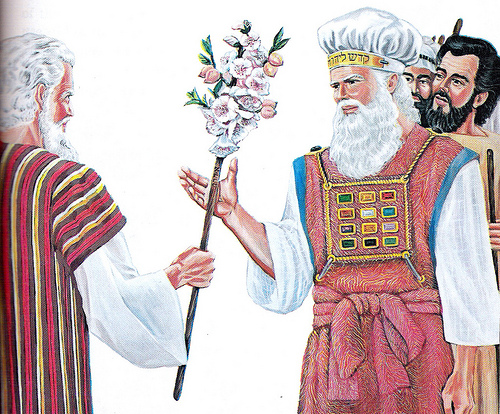
12/14/14 ” aaron’s staff that budded” – Please scroll down to date 12/13/14 “almond tree” where the article on this was excerpted and actual post provided. 

12/14/14  “in 165 bc by the maccabees after its desecration by the syrians.” –  Check this out:


12/14/14  “the greeks gods” –  Must Read: Reuven Firestone – 4 – Chosenness in the Ancient Near East


The Greek kings then fancied themselves as pharaohs as well, with the result that the Egyptian god Osiris, for example, was merged with the Greek God Dionysis, and the Egyptian god Thoth with the Greek god Hermes. The result was the weakening of the local religions and assimilation to a system that was closer to the religion of the conquerors.


Image from www.sporcle.com

 The Greeks brought not only their gods, but also their culture. The power and popularity of Hellenic culture influenced local cultures and “hellenized” them. This resulted in the emergence of what historians call “Hellenism,” a synthesis of pure Greek (Hellenic) culture with the local Near Eastern cultures.  Many locals learned the Greek language and integrated their traditional indigenous cultures with that of the Greeks. They were inevitably attracted to the Greek religious system as well. Because of the overwhelming and unifying power of Hellenism, local tribal religions began to lose some of the distinctiveness of their culture. Eventually, the independent integrity of the local Near Eastern religious systems would die out entirely to this assimilation, though that process would not be complete until the arrival of the Romans.


  The assimilation process encouraged by the Greek and Roman conquerors was not successful, however, under the strident monotheism of Israel. By the time the Greeks had come to the area, the Israelites had become localized in a region called Judea and increasingly referred to themselves as Judeans, from which we get the term Jew. One of the problems that Jews faced after the Greek conquest was that they were expected, like all foreign peoples, to make offerings to the Greek gods. Because they simply and adamantly refused to do so, a compromise was eventually reached that allowed the Jews to worship in their own unique manner and make donations to their temple in Jerusalem.


12/13/14  “almond tree” – Numbers/Bamidbar 17 – ” And it will be that the rod of the man whom I will choose will bud;

Image from safeguardingtheeternal.wordpress.com

21 Moshe spoke to the Children of Israel, 
and they gave him, all the leaders, a staff per (each) one leader, 
a staff per (each) one leader, 
for their Fathers’ House, twelve staffs, with the staff of Aharon in the midst of their staffs.
22 Moshe laid out the staffs before the presence of YHVH,
 in the Tent of the Testimony.
23 Now it was on the morrow:
 when Moshe entered the Tent of the Testimony,
 here: it had sprouted, the staff of Aharon, of the House of Levi! 
It had put-forth a sprouting-flower, it had blossomed a blossom, it had ripened almonds!


12/13/14  “gods and goddess ,(greek)” –  Must Read: Reuven Firestone – 4 – Chosenness in the Ancient Near East


12/13/14   “shabbat shalom with love” – We have a whole year of Sabbath liturgy that our web visitors may choose from; please feel free to use them for your sabbath celebrations, on whichever date —you don’t have to follow the weekly or monthly sequence.  We are not copyright-conscious, love and service for God should not be a business venture. Information we have sought and found have sometimes been free, sometimes not, but what we pass on to others has no strings attached. No donations are solicited.  We are grateful to YHWH that this website has been sponsored for free by our current server;   may YHWH prosper the Jewish owner, friend of Sinaites —Bruce and his staff Rio and Clarice.

 Web Design Done by Silver Connect Web Design LLC
 

12/13/14 “benmara llc florida” – The person by this name is no longer affiliated with nor featured in this website.


12/12/14  “monkey adam et eve” – Revisited: Q: ” “a 15th century rabbi claimed adam and eve had the faces of monkeys” 


12/12/14  “painting-as the deer panteth” – This is a water color painting by a Sinaite who did ‘nature art’ when he was still a Christian; aside from art exhibits, he printed his artworks on cards. He has since moved from Manila, Philippines to Houston. TX, USA and both he and his wife have joined a synagogue there.


12/11/14  “ishmael isaac” – 


12/09/14  “abram believed the lord, and he credited it to him as righteousness” – 


12/08/14  sina6000 net must read robert schoenthe-and-the-law/ http://sinai6000+net+must+read+robert+schoenthe-and-the-law/ – 


12/06/14  шаббат шалом” not sure about this search entry but it reads like “Shabbat shalom” and we do wish him/her back the same!  Please feel free to use any of our Sabbath liturgy for any Sabbath, you don’t have to use the specific one for any specific date.  We also are not copyright-obsessed, help yourself to over 800 posts on our site contents; we just want to point to the direction of YHWH to lost or transitioning Truth and God-seekers who are on the same pilgrimage as we are but are at a loss as to what pathway to take since there are many conflicting voices making the same claims as we are.  One has to be discerning and use logic and reason, not ‘faith’ alone.  Shabbat shalom!


12/05/14  “what does uncircumcised lips mean” – Exodus/Shemoth 6-b: Do you have “uncircumcised lips”?


12/05  “god’s creation quotes” – How can we outdo the psalmist whose inspired words in Psalm 8 were rewritten in song lyrics:

“When I gaze into the night skies 

I see the work of Your fingers—

the moon and stars suspended in space. 

Oh Lord YHWH, 

what is man that You are mindful of him?” 


And yet following their lead, our Sabbath liturgy constantly pay tribute to the Creator for the visible and invisible glaring evidences of an Intelligent Designer of our planet earth and His universe!  As we keep saying, it takes more faith to be an atheist to believe that all existence is an accident of nature, that there is no First Cause for evolution, if that’s the route one chooses to take.  


And so, we have expanded Psalm 8 in one of our Sabbath liturgies to this:  [from A Sinaite’s Liturgy – 1st Sabbath of September]


With the first sighting of your new moon

signalling the beginning of a new month,

we are humbled at the thought

that You prepared a perfect universe

and a perfect planet designed

not only for the sustenance of all life,

but also for the enjoyment and pleasure

of the only being created in Your image, 

sentient, self-conscious, self-willed—humanity.


Image from heartwhispers.weebly.com

Image from heartwhispers.weebly.com

O YHWH, Creator of all existence,

need there be any doubt in our mind

regarding Your love for us?


We marvel at this perfect environment

in which we live, 

complete with everything that would nurture and sustain

the diversity of life forms that inhabit it,

but most specially the life of each human being

born into this world.


We are amazed at the capabilities of the human body,

which houses mind and heart and soul,

with its intricate workings,

its built-in protective self-healing immune system

which modern medicine can tap into

as the first line of defense against disease;

all work together to ensure

that we live out our existence in the best of health 

while Your breath of life is still in us.


We are humbled as we recognize and acknowledge

that You, O YHWH, are the Creator and Designer

of everything that exists,

whether visible or invisible to the eye.  


How should we respond?

How can we show our deep gratitude

for all that You have done for us?

Who are we that You should give us this much blessing

just in our natural environment alone, and within ourselves,

and so much more?

Indeed, who are we

that You are mindful of us?


You have put man in charge of all creation, 

given the mandate to ‘tend the garden’ . . . 

yet in this day and age

we witness the deterioration, degradation and destruction

of the only habitable planet in Your vast universe

that You have designed perfectly

out of love for us.


As we begin to approach the season

for self-examination, 

for accountability to You

we ask for forgiveness,

 O Creator God!

We respond in all humility,

wondering how best

could we express our love for You?

For one of many ways,

by tending Your garden in our little patch of earth,

so that our generation and future generations 

might continue to survive

till the End of Days.

We resolve to do in small and big ways,

in the space we occupy

through the life we live

and the lives we are able to influence,

to respect, nurture and sustain the diversity of life in all its forms,

realizing that only from YOU comes the very breath of life,

granted every creature, big and small, simple and complex.

May we have a deep respect for life in all its manifestations

in Your magnificent ‘garden’ 

O YHWH,

Creator or our planet Earth, Source of all life.


There are many more similar tributes in our series: A Sinaite’s Liturgy, please check them out on our [Site Map]


12/05  “sunset over a mountain” – Our Sabbath liturgy are full of images of exactly this to signify the beginning and end of Shabbat, “sundown to sundown.”  Where do we get them? Where else, old reliable google of course! You’ll get a glut of images for every conceivable specific requirement.


12/04  “what are the self descriptions of god” – Revisited – The Awesome Self-Description of God


12/04  “what was israel’s occupation, which was abominable to the egyptians?” – This is from  Genesis/Bereshith 46 – “Now I can die, since I have seen your face, that you are still alive!”

 
34 Then say: Your servants have always been livestock men, from our youth until now, so we, so our fathers- 
in order that you may settle in the region of Goshen. 
For every shepherd of flocks is an abomination to the Egyptians.
 

12/03  “esau hunting” – 


12/ 03  “greek gods and their powers” – The Greek gods, being non-gods, meaning non-existent, have no powers except in the imagination of humans who conceive them in the image of humanity.  However, in the thinking of polytheists who do create a pantheon of gods and goddesses, just like the Greeks did, as the Romans who had counterparts did, these divine beings were assigned domains, tasks, talents, etc.  Check out this post: 

12/03  “esav meets yaakov” – 


12/03  “old testament saints resurrection” – This searcher got it partially correct! “Saints” who resurrected at the time of Jesus (according to the NT Gospels) would have been “Old Testament”, meaning, since Christianity and New Testament  were not yet in place, who else but the generation of Jesus who believed in him would have resurrected with him. But this whole scenario  gives us the idea for another article in itself, so we will tackle this another time. Meanwhile, this searcher was most likely looking for this post:

12/03  “mace between his legs…mentioned in genesis” – The word “mace” is a bit misleading, as the word is used for food seasoning or a university president’s symbolic official staff.  Except for NABRE [New American Bible Revised Edition],  most translations use “scepter” or  “ruler’s staff” but most likely, since the context is related to Judah, the implied meaning is that rulers on Israel’s throne will permanently emerge from the tribe of Judah, as David did, and as the Davidic Covenant cemented the divine declared intent.  

Check this out, specifically verse 10:

  • Genesis/Bereshith 49: Jacob/Israel’s Legacy and Last Farewell
      • [EF] 10 The scepter shall not depart from Yehuda, nor the staff-of-command from between his legs,until they bring him tribute, -the obedience of peoples is his.
      • [NABRE] The scepter shall never depart from Judah,
            or the mace from between his feet,
        Until tribute comes to him,
            and he receives the people’s obedience.
 

12/02/14  “the ark of the covenant is in heaven” – There are speculations as to where is the ‘original’ ark of the covenant but even the custodians of it (the Israelites/Jews today) don’t seem to know.  

We do have a post that explains where it was NOT, check it out:


The Ark of the Covenant: Was it in the Holy of Holies on the day Jesus died?


Google has these entries if you’re interested in going farther but just keep one thing in mind — it appears the God of Israel allowed not only the Ark of the Covenant but the Temple itself to be taken out of the midst of Israel’s ‘Holy City’ — earthly representations have their purpose for a time and when that purpose is no longer necessary, it is taken away lest idolatrous humanity turn it into another object of worship to compete with the One to Whom all worship is due.

Where Is the Ark of the Covenant Located Today?Why Is the Ark of Covenant Important?
What Happened to the Ark of the Covenant?Ark of the Covenant Found
Location of the Ark of the CovenantArk of the Covenant in Ethiopia
Ark of the Covenant HistoryArk of the Covenant Drawings


12/01/14  “bedraggled and broken” – “beaten down, bedraggled, and broken”- Could it be they are worshipping the wrong God?


The Messiahs – 2 – The Davidic Messiah

[First posted 2013.  In our effort to go back to Hebraic roots, we are re-birthing old posts since it is the ‘season’ when the whole Christian world is singing the ‘hallelujah chorus’ and reliving the birth of the ‘Christian Messiah’ –Jesus ‘Christ’.  We once joined in the chorus, since Handel’s music alone is a hair-raising musical inspiration even for atheists and agnostics, so can you imagine the jubilation experienced by believers in this Christian Messiah?  Why do we refer to Jesus as the Christian Messiah?  Because that is who he is to that religion; but please, let us not insult Jewry and the God of Israel by referring to him as the ‘messiah’ anticipated in the Hebrew Scriptures, for he doesn’t fulfill the recognition-criteria.  


This is from James D. Tabor, Restoring Abrahamic Faith, a MUST READ/MUST OWN book is eye-opening and mind-boggling, if you have been fed all the wrong information in any religion you’re in whose teaching goes against the revelation of the God of the Hebrew Scriptures.  Related posts are:

Admin1.]


————————————-


Image from Quora

Image from Quora

The Biblical messianic doctrine is rooted particularly in an extraordinary series of promises made to King David.  Despite his sins and failures, David remained a “man after God’s own heart” and he became the model for the future messianic king (1 Samuel 13:14).  The core of the promise to David was that his bloodline or “dynasty” would endure forever.

YHVH tells him:


 When your days are complete and you lie with your fathers, I will raise up your seed after you, who will come forth from you, and I will establish his kingdom . . . I will be a father to him and he will be a son to Me . . . and your house and your kingdom shall endure before Me forever; your throne shall be established forever (2 Samuel 7:12-16).


This promise is understood to be an unconditional covenant, as sure and certain as the Covenant with the people of Israel.  It can never be broken; it is to endure as the sun and the moon.  YHVH actually swears to this covenant by His own Holiness:  


My covenant I will not violate, nor will I alter the utterance of My lips.  One thing I have sworn by My holiness; I will not lie to David.  His seed shall endure forever, and his throne as the sun before Me.  It shall be established forever like the moon, and the witness in the sky is faithful (Psalm 89:34-37).  


Thus says YHVH, “If My covenant for day and night stand not, and the fixed patterns of heaven and earth I have not established, then I would reject the seed of Jacob and David My servant, not taking from his seed rulers over the descendants of Abraham, Isaac, and Jacob (Jeremiah 33:25-26).


These notions of the Messiah as exalted King, sitting at God’s right Hand, and firstborn son of God, that many later understood as references to Divine status, are thoroughly rooted in the language of the promises made directly to David, and thus by extension, to his descendants —each of whom was a mortal human being.  Note the language in the following Scriptures:  


He will cry to Me, “You are my Father, my God and the rock of my salvation.” I will make him My first-born [son], the highest of the kings of the earth (Psalm 89:26-27).


 I will surely tell of the decree of YHVH, He said to me, “You are My son, today I have begotten you, ask of Me, and I will surely give the nations as your inheritance, and the very ends of the earth as your possession” (Psalm 2:7-8).


The ideal expression of Davidic Kingship is found in Psalms 2, 45, 72.  These should be studied carefully.  Although they undoubtedly apply directly to David and his descendants, ultimately these texts, like a number of the Psalms, seem to reach beyond to the coming ideal Davidic Messiah of the last days.


The hope and promise of the coming final Davidic Messiah, the great and exalted King of Israel of the last days, develops out of the Babylonian Exile.  By all appearances, as Psalm 89 so plaintively expresses it, YHVH had broken His covenant with King David.  The last kings of Judah had been taken captive and slaughtered (2 Kings 25).  And yet, one by one, the Hebrew Prophets begin to speak of a restoration of the Davidic throne and the coming of an ideal King, one they call a Branch or Shoot from the “stump” of the royal line.


There are 10 basic texts in the Hebrew Prophets [marked I-X below] that deal directly and specifically with this future Davidic King or Messiah.  They are quite specific as to what this coming King is to accomplish so he fulfills his messianic task and mission.  It is from these foundational texts that one can begin to derive a balanced and Biblical messianic concept.  [What do the Prophets say?] The most complete picture comes from Isaiah:


[I]  For unto us a child is born, unto us a son is given; and the government will be upon his shoulder.  And his name shall be called:  Wonderful Counselor [is] the Mighty God, the Everlasting Father, the Prince of Peace.  Of the increase of his government and peace there will be no end, upon the throne of David and over his kingdom, to order it and establish it with justice and righteousness from that time forward, even continually. (Isaiah 9:6-7)

[Footnote:  The child himself is not being called “Mighty God” and “Everlasting Father,” despite the impression of most Christian translations.  There are titles the Hebrew Bible reserves exclusively for YHVH alone, and the passage in the original Hebrew makes this clear.  Rashi notes that the verb “will call” is active, not passive, and can be rendered most naturally with “the Mighty God/Everlasting Father” as the subject and “Prince of Peace” as the object.  The phrase in Hebrew is Pele Joe’etz El Gibbor Avi-Ad Sar-Shalom.”   Hebrew names often celebrate the character and activity of God.  See the extended name Maher-shalal-hash-baz” in (Isaiah 8:3).  This name celebrates the Wonderful Counsel or Plan of God in bringing forth this Davidic ruler (see Isaiah 28:29).  To think that the child is YHVH God, because his name celebrates and signifies the unfolding Plan of God, would be akin to asserting that the prophet Isaiah is God because his name means “YHVH’s salvation.”]


 [II]  There shall come forth a Rod from the stem of Jesse, and a Branch (netzer) shall grow out of his roots.  The Spirit of YHVH shall rest upon him, the spirit of wisdom and understanding, the spirit of counsel and might, the spirit of knowledge and of the fear of YHVH.  His delight is in the fear of YHVH, and he shall not judge by sight of his eyes, nor decide with equity for the meek of the earth; he shall strike the earth with the rod of his mouth, and with the breath of his lips he shall slay the wicked.  Righteousness shall be the belt of his loins, and faithfulness the belt of his waist. the wolf also shall dwell with the lamb, the leopard shall lie down with the young goat.  The calf and the young lion and the fatling together, and a little child shall lead them . . . they shall not hurt nor destroy on all My holy mountain, for the earth shall be full of the knowledge of YHVH as the waters cover the sea.  And in that day there shall be a Root of Jesse, who shall stand as a banner to the people; for the Gentiles shall seek Him, and his resting place shall be glorious . . . He will set up a banner for the nations, and will assemble the outcasts of Israel, and gather together the dispersed of Judah from the four corners of the earth.  (Isaiah 11:1-12)


  [III]  In steadfast love the throne will be established; and no one will sit on it in truth, in the tabernacle of David, judging and seeking justice and hastening righteousness (Isaiah 16:5).


A number of points should be emphasized from these first 3 texts from Isaiah.  This ruler or judge is an extraordinary king of the line (seed/branch) of David. Accordingly, he can simply be called “the Branch.”  The earliest Jewish followers of Jesus were known as Nazarenes, taken from the Hebrew word netzer  or “Branch” drawn from this very passage of Isaiah 11.  This name might roughly be translated into English as “Branchites.”  


This “Branch of David” is a faithful, dedicated, servant of YHVH, remarkable in his gifts and powers, justice, righteousness, and peace characterize his rule.  His program is to regather the tribes of Israel to the Land, to crush the wicked, and to spread the WAY of YHVH to all nations.  Through his reign humankind, as well as the creation itself, reaches a harmony and fulfillment unknown since Eden.


Jeremiah contains one clear passage on the Davidic Messiah that he repeats word for word in a later passage:


[IV] “Behold the days are coming,” says YHVH, “that I will raise to David a Branch (zemach) of righteousness; a king shall reign and prosper, and execute judgment and righteousness in the earth.  In his days Judah will be saved, and Israel will dwell safely: Now this is his name by which He will call him, YHVH Zedeqenu [YHVH is our righteousness]” (Jeremiah 23:5-6, repeated in 33:14-16).


Here, as with Isaiah, we have the same emphasis on this one being a descendant (“Branch”) of David, who brings about the restoration of Israel to the land resulting in the establishment of justice, righteousness, and peace.  Clearly, this is the fundamental messianic mission or task.  Zechariah likewise prophesies about this figure called “the Branch“:


[V] . . For behold, I am bringing forth My servant the Branch (zemach). For behold, the stone that I have laid before Joshua: upon the stone are seven eyes.  Behold I will engrave its inscription, says YHVH of Hosts, and I will remove the iniquity of that land in one day.  In that day, says YHVH of Hosts, everyone will invite his neighbor under his vine and under his fig tree” (Zechariah 3:8-10).


[VI]  Behold the man whose name is the Branch (zemach);from his place he shall branch out, and he shall build the temple of YHVH; yes he shall build the temple of YHVH.  He shall bear the glory and shall sit and rule on his throne.  There shall be a priest by his throne, and the counsel of peace shall be between them both [i.e., the king and the priest] (Zechariah 6:12-13).


Here we can add a few additional elements to the overall portrait from Isaiah and Jeremiah.  This Davidic figure will rebuild the Temple of God and although not a descendant of Aaron, he appears to have some special priestly functions, as did King David.  He also shares a co-rule with the anointed Priest—also a Messiah, but as king he appears to have his own priestly functions as well.  This appears to be the implications of another extraordinary messianic prophecy found in Psalm 110.  There King David of old calls one of his descendants, the Messiah figure, his lord or master (adoni), apparently acknowledging his superiority and emphasizing his priestly role:


[VII]  YHVH says to my lord [master]:  “Sit at My right hand, till I make your enemies your footstool. YHVH shall send the rod of your strength out of Zion.  Rule in the midst of your enemies!” . . . YHVH has sworn and will not relent, “You are a priest forever according to the order of Melchizedeq.” YHVH is at your right hand; He will execute kings in the day of His wrath. He shall judge among the nations. He shall fill the spaces with dead bodies, he shall execute the heads of many countries (Psalm 110:1-2,4-6; compare Psalm 80:17).


[Footnote:  Although the word malkizedeq appears here, it is not entirely clear that it is a proper noun.  It is possible to translate it as “You are a priest forever, a king of righteousness by my decree, as the new JPS (Jewish Publication Society) translation renders it.]


Note the militant nature of the mission of the Messiah.  This future “man of YHVH’s right hand, though not of Aaron’s line, apparently serves as a priest much like Melchizedek did in the days of Abraham (see Genesis 14).  The shadowy figure of Melchizedek was understood by the followers of Jesus the Nazarene, as well as by the Dead Sea community at Qumran, as a messianic forerunner (see Hebrews 7 in the N.T. and 11 QMelch in the DSS).


[Footnote:  The latter reference is to a fascinating text fragment found in Cave 11 of the Dead Sea Scrolls.  A translation is found in Vermes, ed. The Dead Sea Scrolls in English, 4th ed. (Penguin, 1999), pp. 500-502.  The text seems to interpret the figure of Melchizedek in a heavenly, exalted, messianic sense, much like the early Christians.]


It is possible, based on this Psalm, that King David himself claimed some sort of priestly privilege based on this notion of the non-Aaronic priesthood of Melchizedek.  He does officiate at sacrifices and go into the inner sanctum of the Tent, before the Ark of the TESTIMONY (2 Samuel 6:13-18, 7:18).  And even more striking, his sons are called “priests” (2 Samuel 8:18).


Zechariah also presents an additional image of this coming king:


[VIII] Rejoice greatly, O daughter of Zion! Shout, O daughter of Jerusalem!  Behold your King is coming to you; he is just and having salvation, lowly and riding on a donkey, a colt, the foal of a donkey.  I will cut off the chariot from Ephraim, and the horse from Jerusalem; the bow of war will be cut off.  He shall speak peace to the nations; his dominion shall be from sea to sea, and from the River [Euphrates] to the ends of the earth (Zechariah 9:9-10).


Here, as in Isaiah, we see the King combines the traits of humility, peace, and lovingkindness with those of militant forceful and triumphant reign over his enemies.


Finally, both Amos and Micah speak of this coming Davidic King.  Amos offers a simple statement of restoration:


[IX] On that day [when Israel is regathered to the Land, v. 9] I will raise up the tabernacle of David, which has fallen down, and repair its damages; I will raise up its ruins, and rebuild it as in the days of old; that they may possess the remnant of Edom, and all the Gentiles who are called by My Name,” says YHVH Who does this thing (Amos 9:11-12). 


Micah offers details connecting the Exile and a long period of banishment with the culminating birth of this Davidic King:


 [X] But you, Bethlehem Ephrathah, though you are little among the thousands of Judah, yet out of you shall come forth to Me, the one to be ruler in Israel, whose goings forth [lineage] are from old, from ancient days.  Therefore He shall give them up, until the time that she who is in labor has given birth; then the remnant of his brethren shall return to the children of Israel.  And he shall stand and feed his flock, in the strength of YHVH, in the majesty of the Name of YHVH his God; and they shall abide, for now he shall be great to the ends of the earth (Micah 5:2-4).


Bethlehem Ephrathah primarily refers not to the city of David’s birth, but to the clans by that name, little and insignificant among the powerful tribe of Judah (see 1 Chronicles 4:4).  This King comes from the line of David, with its ancient roots, which appears to have been broken or destroyed.  Notice, as in Isaiah and Jeremiah, the birth of this Davidic King coincides with the restoration of all the Lost Tribes of Israel to the Land, and the subsequent worldwide peace.


In addition to these 10 major texts there are 4 other passages that speak repeatedly of YHVH raising up King David himself as prince over Israel in the last days.  I will quote these additional texts in full:


“Alas!  For that day is great, so that none is like it; and it is the time of Jacob’s trouble, but he shall be saved out of it.  For it shall come to pass in that day,” says YHVH of Hosts, “that I will break his yoke from your neck and will burst your bonds; foreigners shall no more enslave them.  But they shall serve YHVH their God, and David their king, whom I will raise up for them” (Jeremiah 30:7-9).


I will establish one shepherd over them, and he shall feed them —My servant David.  He shall feed them and be their shepherd.  And I, YHVH, will be their God, and My servant David a prince among them; I YHVH have spoken (Ezekiel 34:23-24).


David My servant shall be king over them an they shall all have one shepherd; they shall also walk in My judgments and observe My statutes, and do them.  Then they shall dwell in the land that I have given to Jacob My servant, where your fathers dwelt; and they shall dwell there, they, their children, and their children’s children, forever; and My servant David shall be their prince forever (Ezekiel 37:24-25).


For the children of Israel shall abide many days without king or prince, without sacrifice or sacred pillar, without ephod or teraphim.  Afterward the children of Israel will return and seek YHVH their God and David their king.  They shall fear YHVH and His goodness in the latter days (Hosea 3:4-5).


Many interpreters have understood these texts to refer in a symbolic way to a “new” David, i.e., the Branch or Davidic Messiah of the last days.  On the other hand, they might well refer to King David himself, as one raised from the dead, and placed over the nation of Israel.  Indeed, that seems to be the most natural way to read them.  However, one must then find a way of fitting them in with the passages that speak of a branch or descendant of David being raised up.  It could be that this final Messiah, whom David calls “my lord” (Psalm 110:1), will exercise rule over all the nations of the world, while David himself will be over the nation of Israel.


There are a few other texts beyond these basic ten that expand the notion of a Messiah a bit further.  Isaiah 61 speaks of an “anointed one” who will bring good news to the afflicted, bind up the brokenhearted, proclaim liberty to captives and announce the Day of YHVH.  Whether this passage refers to the Davidic Messiah or not is unclear.  It might well connect with the forerunner of the Messiah, the priestly Elijah figure spoken of in Malachi 4:5-6, who comes before the “great and terrible Day of YHVH.


[Footnote:  A text from Qumran Cave 4 on Isaiah 61 and applies ti to the Messiah, in a similar way to what one finds in the Synoptic Lukan tradition (Luke 4:16-19; 7:18-23).  See James Tabor and Michael Wise, Biblical Archeology Review, November/December 1992, pp. 60-65 (now on line at: www.religiousstudies.uncc.edu/jdtabor).]


There are also 2 texts in the TORAH itself which have usually been understood in a messianic way: 


The scepter shall not depart from Judah, nor a lawgiver from between his feet, until Shiloh comes, and to him shall be the obedience of the peoples (Genesis 49:10).


 Behold I see him, but not now; I behold him, but not near; a star shall come out of Jacob; a scepter shall rise out of Israel, and batter the brow of Moab, and destroy all the sons of Seth (Numbers 24:17; compare Jeremiah 48:45).
What is striking about all these texts is their remarkable consistency.  The overall portrait they present is amazingly unified and complete.  Taken together they have a composite core, a singular view of this coming Messiah who appears in the latter days:
Image from mymorningmeditations.com

Image from mymorningmeditations.com


The coming Davidic Messiah is a human being, born of the seed of David following a long period of Exile in which David’s line seems hopelessly forgotten, and Israel is scattered among the nations.  He is a mighty servant of YHVH, a Prince of Israel, who is filled with the Holy Spirit and possesses great gifts and qualities.  He is instrumental in regathering all the Tribes of Israel, rebuilding the Temple of God, putting down all wickedness and opposition to YHVH, and bringing in an era of everlasting peace, righteousness, and justice among all nations.  When such a one appears, and these things are accomplished, then we can truly recognize that one as the Davidic Messiah.


There are five points  of special note in this regard; all related to the ways Christians have developed their ideas on the Messiah down through the centuries.


  • First, despite all the talk about waiting for the “Messiah” among Christians, Jews, and Muslims it is certainly instructive to observe that not a single one of these core texts uses that actual term! In other words, none of these texts actually speak of “the Messiah” as a designated term.  Obviously the Biblical writers did understand the coming Davidic ruler, or perhaps even David himself, to be “an anointed one” in the highest sense of that term, yet they still do not use the description word “messiah.”  Maybe there is something to learn from this about our own use of language in contrast to that of the Biblical writers.


  • Second, none of these texts speak of the “messiah” in a heavenly, other-worldly, or cosmic sense.  The descriptions of his mission and accomplishments all have to do exclusively with this world and are cast in the most concrete historical settings—bringing back the Lost Tribes of Israel, exercising justice and righteousness in the Land, and bringing peace.


  • Third, none of these texts speak of “believing in the Messiah,” “accepting the Messiah,” “receiving him into your heart,” or any other such language so common among evangelical Christians.  These are not Biblical concepts.  Faith is in YHVH alone, and when the Davidic Messiah appears the entire world will recognize him as YHVH’s agent—but YHVH alone will be exalted in that Day, and it is YHVH Who will be king over all the earth (Isaiah 2:10-11; Zechariah 14:9).


  • Fourth, despite a common Christian impression that Jesus fulfilled the role of the Davidic Messiah as set forth in the Prophets, the fact is he did not fulfill a single one of these messianic texts—not one of the 10!  He did not destroy the wicked, re-gather the tribes of Israel and Judah to the Land, rebuild the Temple, teach TORAH to the nations, and usher in a worldwide reign of everlasting peace, justice, and righteousness among nations.  This is why Christian theologians in the 2nd through the 4th centuries began to heavily allegorize the concept of the Messiah.  Everything was made to refer to the heavenly world, rather than “on earth as it is in heaven.”  This served to marginalize the concepts associated in the Hebrew Bible with the Messiah.  The texts themselves plainly deal in the greatest detail with the fortunes of national Israel, when all 12 tribes are back in the Land.  Yet many abandoned any expectation of a literal fulfillment.  The task and mission of the Messiah was applied in a vague and “spiritual way” to the Church as Christ’s Kingdom on earth.


  • And yet any fair reading of these texts, taken in their historical contexts, has to conclude that symbolic readings of this sort do violence to the intent of the original language.  The Prophets give so many details in their descriptions of the messianic era that their language itself belies attempts to allegorize their predictions.


[Footnote:  For example, note the precise description of the rebuilt and permanent city of Jerusalem in Jeremiah 31:36-40 and the description of the final battles in Zechariah 14 and Ezekiel 38-39.  There is an excellent British film titled The Disputation that accurately depicts the series of debates in Barcelona, Spain in 1263 between Rabbi Nachmanides and Christian theologian, and Jewish convert, Pablo Christiano.  It is available through outreachjudaism.org.]


  • Finally, the complete Biblical messianic hope involves the appearance of two Messiahs rather than one.  The exclusive focus of many has been on the arrival of the Davidic figure.  However, what is often overlooked is that the Prophets declare an anointed priestly figure is to come as well, a descendant of Aaron of the tribe of Levi (Zechariah 6:9-12).  Some English translations of the prophecy of Zechariah do not make this plain.  It should read:


 Behold a man called the Branch [Davidic Messiah] shall branch out from the place where he is, and he shall build the Temple of YHVH.  He shall build the Temple of YHVH and shall assume majesty, and he shall sit on his throne and rule.  And there shall also be a priest seated on his throne, and harmonious understanding shall prevail between them (Zechariah 6:12-13, New Jewish Publication Society translation).


  • This 2nd figure is properly called a Messiah as well.  His role is vividly described in Malachi 3, where he is called “Lord” (adon) and “Messenger” (malak) of the Covenant.  It should not be forgotten that the promise of a perpetual descendant of David to rule as prince of Israel has an exact parallel—that of the promise of a perpetual priesthood to the Levitical sons of Aaron (Jeremiah 33:14-26).  The priestly Messiah is likely the same as the Elijah figure, mentioned at the very end of Malachi.  He seems to be mentioned in other texts as well (e.g., Isaiah 42, 49 and 61 could refer to either or both Messiahs).  It is his coming that heralds the final events of human history; indeed he appears to prepare the way in the Land of Israel for the Davidic figure to be manifested.


  • The notion of two messiahs was well known to the Qumran community, who composed the Dead Sea Scrolls, as well as to the early Nazarenes, who saw in Jesus and John the Baptist a fulfillment of this double role.One Dead Sea Scroll fragment, which interprets messianic prophecies, refers to 2 Samuel 7:14 and offers the interpretation:  “He is the Branch of David who shall arise with the Interpreter of TORAH in Zion at the end of time” (4Q175 Floreligium).  Here the Interpreter is obviously the priestly Righteous Teacher whom the community awaits.  In another text, the fascinating Damascus Document, they speak of both the “star” and the “scepter” to come in the last days, based on Numbers 24:17.  The “star” they say, is the Interpreter of the TORAH, while the “scepter” is the messianic Prince or Davidic Messiah (CDam 7:18-19).


[Footnote:  See James Tabor and Michael Wise, “The Messiah at Qumran,” Biblical Archeology Review, November-December 1992, pp. 60-65 (now on line at: www.religiousstudies.uncc.edu/jdtabor) as well as James Tabor, The Jesus Dynasty, Chapter 9.  The Dead Sea scrolls unambiguously refer to the “coming of the messiahs (plural) of Aaron and Israel” (Community Rule (IQS) 9:11).  They consistently distinguish between the two figures, both of whom are anointed.  The Nazarene/early Christian belief arises out of this interpretive context, now known to us in such detail from the Scrolls.


Image from jcinstituteofapologetics.webs.com

Image from jcinstituteofapologetics.webs.com

Surely it would be a positive step for those who claim to be “messianists,” to revise their ideas and language  to reflect these most basic texts from the Hebrew Bible.  Speculations about the Messiah, both Jewish and Christian, have been abundant throughout history.  However, a solid BIBLICAL FAITH will surely center its messianism on this absolutely consistent core set of texts.  I am convinced that a real restoration of this “Biblical messianism” would clear the way for Jews and non-Jews (particularly those from Biblically oriented Christian backgrounds) to find a measure of working harmony in their understanding of these important matters.


[Next:   The Messiahs – 3 – The Second Coming of YHVH]


Discourse – Christian Pastor to Sinaite – 4

[Continuing the discourse between two friends who parted ways late in their lifelong faith journey —Sinaite “VAN” and “CP”–Head of a super successful ministry and founder of a  Church that has grown by leaps and bounds.  Discourse is good, and healthy for relationships, particularly for those who have embraced contrasting views.  If friends can remain friends despite differences in beliefs, that is the true test of religious tolerance and mutual respect for one another’s faith choice.  It is the Torah teaching on how to treat “the other.” Meanwhile, we in the ‘peanut gallery’ listening, chewing, agreeing or disagreeing,  hopefully with open minds —might resolve to check out either side’s claims . . . or maybe not.  Exposure to two or as many sides as there are on any topic enables us to use the most precious gift our Creator blessed us with—freedom to choose.  What is there to choose from if the option we have is only one? We may remain in willful ignorance or endeavor to understand why dedicated Christians who served “Jesus their Savior” for decades would abandon him to turn to YHWH, Revelator on Sinai.


If you have not read the earlier posts, here they are:

Reformattted for this post.—Admin1]


——————————————–


Hi VAN and BAN,


It comes as a surprise to me that you basically disregarded the witness of the apostles as trustworthy and has set aside the New Testament. This is despite the fact that Peter, James, John and other writers of the NT are all familiar with the writings of the Old Testament and most of them were Jewish and contemporaries of Jesus Christ.  In the case of the Apostle Paul, he was a rabbi and a Pharisee of high caliber–being a student of the respected Gamaliel. All of them were able to explain the implications of the Old Testament teachings to the coming of Jesus as the much-awaited Messiah. Of course, many Jews of their time rejected Jesus, but I don’t presume to argue any better than they who have “heard, seen and touched” him. They have personally witnessed Jesus’ life and miracles, death and resurrection and have come to a conclusion and daring proclamation, with their lives at stake – that, indeed, he is the living Son of the Most High God.


The New Testament was written in the first century, during the lifetime of eyewitnesses of Jesus.   All had personal interaction and encounter with the risen Lord and Savior.   If you were to disregard the writings of these men, what will be your basis?


What will be the basis of how we judge historical documents or writings of men about what transpired? They all pass the test of scientific and legal basis such as:


(1) eyewitness account;

(2) written within the lifetime of the incident, unlike legends that develop after the incident has happened 1,000 years or so

(3) collaboration of other sources of documents (which is more clearly discussed further in this email and from other books written by men such as the respected lawyer Lee Strobel).


Some people today have been saying that the resurrection did not really happen and Jesus did not even exist in history. He was just a legend, they claim.  However, legends don’t and can’t develop and definitely will not survive in the first two generations.


If I were to tell you,


Vic, did you know that Ninoy Aquino was not assassinated? Instead, he was drowned in the sea. Actually, he committed suicide by jumping into the Manila Bay.”


You and the rest of the first generation of witnesses will say,


No, you are lying. I saw it in TV, I saw Aquino coming out of the airplane and then boom! I heard a gunshot and then I saw the body in tarmac.”


For sure, my story will not prosper and it will not be accepted. Why? Because, it is still too early to fabricate such a story. The time gap is just too short for it to be credible or even believable.


Not with the case of Jesus: the records about his life were written in the first generation. The resurrection, in particular, has well-documented face-to-face encounters.

  • In fact, a well-respected lawyer-reporter for the Chicago Tribune (a well-known newspaper in the US), by the name of Lee Strobel, said in his book The Case for Christ that if you allow all the witnesses who saw Jesus as recorded in the Bible and give them 15 minutes each to testify in the court and another 15 minutes for cross-examination, it will take three weeks of non-stop testimony.  Remember that in courts, the testimony of living witnesses is very powerful. In 1 Corinthians 15:4-8, Paul is essentially saying with much confidence, If you don’t believe me, check with the others.”
  • There is simply no room for it to be a mere legend. Simon Greenleaf, the author of the classic “A Treatise on the Law of Evidence” and royal professor of law at Harvard and who wasn’t a believer before his investigation of the evidence, came to the conclusion that “the resurrection is one of the best documented events in the history of man.”
  • Another famous lawyer, Sir Lionel Luckhoo, who was considered the most successful lawyer according to the Guinness Book of World Record, having 245 consecutive murder acquittals, and was also not a believer before, studied the evidence for and against Jesus. He concluded, “I say unequivocally that the evidence for the resurrection of Jesus Christ is so overwhelming that it compels acceptance by proof which leaves absolutely no room for doubt.” 


I appeal that you consider the historical evidence and findings of these lawyers who both gave their lives to Jesus after studying the evidence.


You may have noticed that I went at length trying to build a case for the resurrection. Why? Apostle Paul himself put it,


And if Christ has not been raised,

then our preaching is vain, your faith also is vain.

And if Christ has not been raised,

your faith is worthless; you are still in your sins.” 

-1 Corinthians 15:14-17


Tim Keller put the issue very well by saying,

“If Jesus rose from the dead,

then you have to accept all that he said;

if he didn’t rise from the dead,

then why worry about any of what he said?

The issue on which everything hangs is not

whether or not you like his teaching

but whether or not he rose from the dead.”


Certainly, I could spend more time in probing why you refuse to believe the New Testament writings and the more than 300 prophecies in the Old Testament which can be appropriately ascribed to Jesus as the Messiah (cf. Psalms 22 and Isaiah 53). I don’t presume to be able to make a better and more persuasive case than what is in that the Scriptures.


[Apollos] vigorously refuted the Jews publicly, showing from the Scriptures that Jesus is the Christ. (Acts 18:28)

And according to Paul’s custom, he went to them, and for three Sabbaths reasoned with them from the Scriptures, explaining and giving evidence that the Christ had to suffer and rise again from the dead, and saying, “This Jesus whom I am proclaiming to you is the Christ.” (Acts 17:2-3)


In this letter, I have chosen to focus on where everything rises and fall—who is Jesus, His claims, His death and resurrection.


In the final analysis, faith is a choice. You choose to believe the Old Testament but not the New Testament. You choose to believe the revered traditions and commentaries of the Jewish Rabbis and have chosen to disregard the writings of the New Testament despite the many evidence supporting the accuracy of the New Testament compared to other ancient literature and documents (see the chart below).


Why do we not question the accuracy of Homer’s Iliad, Pliny’s History, or Plato’s Republic? Why do we believe that Jose Rizal existed? George Washington? Mahatma Gandhi? Buddha? Moses? King David? Ezekiel?


Why do you believe in these historical figures and refuse to believe in the historical accounts about Jesus? The New Testament was written during the lifetime of the eyewitnesses. Nothing comes close to the eyewitness accounts and firsthand encounters of the New Testament.

 
(Signed,
“CP”,
 
Next:  Discourse: Sinaite to Christian Pastor – 5

The First Torah-based Religion – Judaism

[Continuing the discussion on world religions, specifically monotheisms that trace their roots to Abrahamic faith, this is from chapter 6 of MUST READ/MUST OWN Who are the REAL Chosen People? – by Reuven Firestone.  The chapter’s title:  Chosenness and Covenant in Rabbinic Literature.  Reformatted and highlighted for this post.—Admin1]

Image from www.threefaithsonegod.com

Image from www.threefaithsonegod.com

The claim for continuity


As mentioned previously, rabbinic Judaism represents a new expression of biblical religion, but unlike either Christianity or Islam, it never claimed that status. Its position, rather, was that it was biblical religion , but with some adjustments after the Roman destruction of its Temple in Jerusalem, and therefore, the forced termination of its ancient mode of worshiping God through animal sacrifice. Rather than claim a new dispensation as did Christianity, or a correction of the errors of the old as did Islam, rabbinic Judaism claimed continuity with the original and authentic monotheism represented by Abraham and the biblical patriarchs, Moses at Mount Sinai, David and Solomon, who built up Jerusalem and  established God’s Temple  there, and the great prophets of Israel.


Judaism, therefore, was not static but continued to evolve, and its evolution included the emergence of a body of literature in the Talmud that was so deeply linked with the scripture of the Bible that it developed a scriptural status itself. The emergence of the Talmud took centuries. Its earliest parts date from a century or more before Jesus, and its end-date was in the period shortly before the Arab Muslim conquest of the seventh century. The Talmud is so thoroughly integrated with the Hebrew Bible that the biblical subtext of any passage is usually included as part of the text itself. This can be observed quite clearly in the passages that treat chosenness.


The following section from the Talmud (Avodah Zarah 2a-b) is fully caught up in the argument over who best merits God’s love for living out the divine will, and who best merits God’s reward for doing so:

In times to come the Holy One will bring a Torah scroll, embrace it to His chest and say,“Whoever has been occupied with this come forth and receive its reward!“ Immediately, all the idolaters will gather together in confusion, as it is said (Isaiah 43:9), All the nations gathered together. The Holy One will say to hem, “Do not gather before Me in confusion. Let each nation enter separately with its scribes, as it is said (in the continuation of Isaiah 43:9), and let the peoples be gathered together. . . The Holy One will say to [the Romans who come first], “How have you been occupying yourselves?” They will answer, “Lord of the Universe, we have established many marketplaces, we have built many baths, we have accumulated much gold and silver. We did this only [to support the Jews] so that they could devote themselves to the study of Torah.” The Holy One will reply, “You fools! All that you did was only for your own sake. You have established marketplaces to provide whores, baths to revel with them, and as for the silver and gold, it is Mine, as it is written (Hag. 2:8), The silver and the gold are Mine, says the Lord of Hosts.

Then the Persians step forward and make the case for carrying out God’s design by supporting the Jews so that they can live out God’s will. But they, too, are chastised for being selfish and thinking only of themselves. All the nations do likewise and all are invalidated for not personally taking responsibility for engaging in Torah as did the Jews. The nations then argue a different position to God. “But [the Gentiles] will argue, ‘How can You blame us for not carrying out the Torah when we never agreed to accept it?’ The response that follows is, ‘Then why did you not accept it?’”


The passage then goes on to state that the other nations took on the responsibility to observe a much reduced version of the Torah that the Talmud refers to as “the Seven Commandments given to Noah,” but even these they failed to obey. The chosen status of the Jews is thus proven through the invalidation of all other communities.


This is an interesting passage for a number of reasons.

    • First, it serves as a consolation to the Jews, who had suffered the destruction of the Temple, dispersion into exile, and insult and mistreatment after the ascendance of Christianity. How could they continue to see themselves as God’s favored people when they are in such straits and their competitors the Christians seem to bask in the light of God after the Christianization of the Roman Empire in the fourth century?
    • Christianity is not openly condemned in this passage, but it was dangerous for a despised and powerless minority to criticize the religion of the empire. Rome, therefore, became a code word for “Christianity” in rabbinic literature because the Roman Empire did Christianize.
    • It should also be noted that after Christianity became the religion of the empire, Jews had to self-censure their criticism of Christians to protect themselves.
Image from mudpreacher.org

Image from mudpreacher.org

Chosenness as Consolation


Many Talmudic passages that treat Israel’s chosenness are forms of consolation. The following coveys two reassuring messages about the important role of the Jews for the world’s well-being:

  • Resh Lakish said, Why is there an additional letter “hey” in It was evening and then morning, the sixth day (Gen. 1:31)? This teaches that the Holy One stipulated with works of Creation by saying to them, “If Israel accepts the Torah, you will exist, but if not I will turn you back into emptiness and formlessness.” (Shabbat 88a)

The first message is to the Jews—

    • and it tells them to hold fast to their religion, despite their humiliation,
    • for God is willing to keep the world in existence only on account of Israel’s loyalty to God
    • through observing the Torah.
    • That is to say, Israel is still God’s chosen despite the Jews’ current degradation.
 

The second message is directed to the entire world, including those who are in superior political and social position to the Jews.  That message asserts that the very existence of those who degrade the Jews is ironically dependent upon the Jews whom they despise.


Of course, that audience is not reading this text anyway, so the message is really directed internally. It provides Jews hope for a day in which God will redeem them from their unhappy state.


It should be noted that rabbinic literature in the Talmud and related literatures is a large collection of tradition. Various positions and opinions are presented in ways that are not intended to be absolutely consistent, so anyone reading through the material will observe differing positions and many issues and variant interpretations of biblical verses.


In one series of biblical interpretations, it is maintained that God loves Israel even more than God loves the divine angels. A rabbinic midrash (exposition) from the eighth century cities many cases from the Bible where the same word refers to Israel and to God’s angels. With poetic symmetry, the work sets out to prove that the ways in which those words are used shows that God loves his chosen people Israel more than his angelic servants: 


Israel is called “servants,” as it is said, For to Me Israel are servants (Lev. 25:55), and the ministering angels are called servants, as it is said, And if He cannot trust His own servants (and casts reproach on his angels) (Job 4:18). How do you know who is more beloved? [God] says, They are my servants whom I freed from the land of Egypt (Lev. 25:55). Israel, you are more beloved to Me than the ministering angels. 


Israel is called “children,” as it is said, You are children of the Lord your God (Deut. 14:1), and the ministering angels are called “children,” as it is said, The children of divined beings came to God (Job 1:6). How do you know who is more beloved? [God] says, Israel is My firstborn son (Exod. 4:22). Israel, you are more beloved to Me than the ministering angels.


Israel is called “kings” …and ministering angels are called “kings” …Israel, you are more honored by Me than the ministering angels.


Israel is called “hosts” and the ministering angels are called “host”…Israel, you are greater to Me than the ministering angels. 


Israel is called “holy” and the ministering angels are called “holy” …Israel, you are more holy to Me than the ministering angels. 


This exegesis sets out to show how God could not possibly have stopped loving Israel. Israel is more beloved to God even than the ministering angels, thus showing God’s love for the Jews as unique and everlasting. This consolation takes on particular meaning as we observe how the positions of Jews and Christians were reversed in the fourth century. Judaism had been favored by the pagan Roman Empire early on, while Christianity was brutally persecuted. Subsequently, both Jews and Christians represented threats to the empire and both were persecuted. But when the empire Christianized, the tables were completely turned. With that change, Christianity represented the establishment religion, after which Judaism was depicted by Christians as a despised religion. 


Rabbi Elazar Ben Azaria … said, You have affirmed this day that the Lord is your God … and the Lord had affirmed this day that you are, as He promised you, His treasured people (Deut. 26:17-18). The Holy One said to Israel, “You have made Me the sole object of your love, as it is written, Hear O Israel, the Lord our God is One (Deut. 6:4). And I will make you the sole object of love, as it is said, Who is like Your people, Israel, a unique nation on earth (1 Chron. 17:21). (Talmud, Hag. 3a-b)


In the rabbinic model, therefore, despite the profound decline of the Jews with the destruction of the beloved Jerusalem Temple and their persecution by the pagan Roman Empire, their institutionalized discrimination by the Christianized Roman Empire of Byzantium, and the dispersion of Jews throughout the Mediterranean world and beyond, God never rejected His “chosen people.”


The Jews never lost their exceptional status. Although they may continue to suffer, their suffering is a suffering of love (yisurey ahavah) that would end in some unknown future when the true messiah will come to redeem Israel, and through that redemption, redeem the entire world.

The 3rd Monotheistic Religion that is from Abraham

[Bet you didn’t know:

“Jews and Christians are sometimes referred to in the Qur’an by Arabic translations of these names, but they are also referred to as “People of the Book.” This term originates in the Qur’an, and it comes from the recognition that Jews and Christians were recipients of scripture before the revelation of the Qur’an.”

This, you might have known:

“The Arabic term for one who surrenders or submits is muslim, and submission to God’s will is a core principle of Islam.”

Bet this one you don’t know:

“Abraham was not a Jew nor a Christian, but was a monotheist, a submitter [muslim], not an idolater.”

Or perhaps this?

“In theory, at least, there is a place for the covenanted chosenness of Judaism and Christianity within Islam.”


Where is this leading to?  


The topic of this post:  Chosenness and Covenant in the Qur’an, the 5th chapter of our MUST READ/MUST OWN Who are the REAL Chosen People? – by Reuven Firestone.  What is great about Reuven Firestone is — he simply says it like it is, with no judgment nor moralizing, and this kind of scholar is the kind to learn from (and emulate!) for the likes of us who came from religions/cultures that point the finger at one another and say “I’m right and you’re wrong.”  Let the reader, the audience, decide, right? But first, give everyone a hearing!  


Reformatted and highlighted for this post.—Admin1]
 
Image from www.vu39.com

Image from www.vu39.com


The Qur’an represents the divine message spoken by God through his angel Gabriel to Muhammad, who then recited the words he received to the people. In fact, the meaning of the word, Qur’an, is ”recitation”—divine revelation delivered through the recitations of God’s prophet Muhammad. The Qu’ran emerges into history in the seventh century CE in the west-Central Arabian region called the Hijaz.


Islam and the Religious Context of Arabia


The Roman Empire never controlled Arabia; neither did the Persian Empire or any other foreign power. Arabia remained outside the control of empire, but foreign cultures and religions nevertheless had a significant impact on community customs and the local way of life.


The establishment religions that opposed the emergence of the new religious movement of Islam were three:

  • Arabian polytheism,
  • Judaism,
  • and Christianity.

Jews and Christians had lived in Arabia for centuries and had attracted local Arabs to join their religions through conversion. Arabian Jews and Christians were thus highly acculturated to the local language and cultural practices and functioned, for all intents and purposes, as Arabs  practicing local versions of Judaism and Christianity.


Of the three establishment religious communities, the polytheists were the greatest obstacle to the emergence of Islam, and the Qur’an directs its resentment and anger mostly toward the indigenous religion of the Arabs and those who practiced it.

  • The most common term for idolatry in the Qur’an is the word shirk, which has the sense of “sharing, participating, associating.” That term carries something of the notion of polytheism known in the Israelite world as well, since polytheist are assumed to associate divinity in things other than God, and worship them in addition to the deity.
  • One who associates other powers with God is a mushrik.
  • Another term for those who did not follow Muhammad and accept the validity of the Qur’an is kafir, which has the sense of “denying,” as in denying the truth of God. This term has often been translated as “infidel,” though in modern Qur’an translation it is more often translated as “unbeliever.”

When the Qur’an refers to unbelievers, it may be referring to practitioners of traditional Arabian Polytheism (mushriks) or it may be referring to Jews and Christian.


The Qur’an notes that unbelievers tried actively to destroy the new movement.


”When you go forth in the land, its is no sin to cut back in your prayers if you fear that the unbelievers will attack you, for the unbelievers are clearly an enemy” (4:101).


This verse is followed with divine instruction about how to protect the community that had been previously attacked while engaging in prayer. This is followed by the words,


“The unbelievers want you to neglect your arms and your belongings so they may attack you once and for all… take precaution! (4:102).


According to Islamic tradition, Muhammad began receiving divine revelation in his hometown of Mecca, a major polytheistic religious center in his day.  Beginning about the age of forty, he began to receive revelations and continued to do so intermittently until his death nearly twenty-three years later. He performed no miracles, but his extraordinary charisma attracted many followers. His community was dedicated to a simple ethical way of life under the authority of the One Great God, the same God that had given prior revelation through the Israelite prophets and Jesus.


There is no evidence that there were Jewish or Christian communities living in Mecca in the seventh century. The reason is most likely that they did not feel comfortable living in a center of polytheistic religious practice, though individuals would regularly go there in order to trade. On the other hand, there was a large Christian community living in the region called Najran to the south, and a large Jewish community living in Yathrib to the north. Mecca’s status as religious center attracted tribes from throughout the region to make pilgrimage to it in order to worship the deities that were represented there by figures and pillars and images and temples. This was an important cultural and religious aspect of life in the region, and what we would call the “religious pilgrimage industry” was a mainstay of the Meccan economy. 


Trading fairs rose up around Mecca during the height of the pilgrimage season, and entire extended families and clans would move into Mecca and the surrounding area for a numbers of days. They would go to the markets to trade, and they would need materials for sacrifices and guides to instruct them through the many varied rituals.


When Muhammad began to attract followers to monotheism who then shunned the traditional religious practices in favor of simple prayer to the One Great God, he attracted the ire of the religious establishment. The threat was not merely one of competing religious ideology, but of competing business as well. The new religious movement soon grew large enough to represent a danger to the religious and the economic establishment of Mecca. He was vigorously opposed. The Qur’an contains passages that reproduce some of the accusations that were leveled against Muhammad by the polytheists of Mecca.


So they were surprised that a warner has come to them from their midst. Those unbelievers say, “This is a lying conjuror! Has he made the deities into one God? This is indeed a strange thing!” The chiefs among them go around saying, “Go, and remain faithful to your gods. This is certainly something concocted. We have not heard such a thing among people recently. It is only a fabrication.” (38:4-7)


God reassured Mohammed and supported him in his struggle. “And while the unbelievers plot against you to arrest you, kill you or drive you out, God plots too; and God is the better of the planners” (8:30). But Muhammad’s status in Mecca continued to deteriorate and eventually became so precarious that his life was in danger. He needed to find refuge from the relentless harassment of the Meccan establishment that opposed him.


An opportunity presented itself for him to move with his followers to the town of Yathrib, where Jews had a powerful presence. He agreed to make the move and in 622 CE he arrived in Yathrib, after which the town began to be called Medina, a shortened form of Madinat al-Nabi (City of the Prophet).


Competition and the “People of the Book” 


Muhammad naturally expected the Jews of Medina to recognize his prophethood. After all, the idolatrous Meccans may have been hopelessly steeped in their worship of false gods, but it was well known in Arabia that the Jews were an ancient people with a history of prophets and revelations that were not unlike the revelations that he had received.


Muhammad was sorely disappointed. From the perspective of the Jews, he was simply the leader of a threatening new religious movement. They accepted neither his prophetic teachings nor his prophetic status, just as their forebears in the Holy Land accepted neither the teachings nor the special status that Jesus claimed. Rather than an authentic prophet, Muhammad represented a threat to them and, unsurprisingly, they opposed him.


Jews and Christians are sometimes referred to in the Qur’an by Arabic translations of these names, but they are also referred to as “People of the Book.” This term originates in the Qur’an, and it comes from the recognition that Jews and Christians were recipients of scripture before the revelation of the Qur’an. The Qur’an makes it quite clear that Jews and Christians were not happy with the presence of a new form of monotheism in their midst.


“Many of the People of the Book would like to render you again unbelievers after your having believed, because of envy on their part after the truth has become clear to them. But forgive and be indulgent until God gives His commands, for God is the Power over everything” (2:109).


Because Muhammad lived in Medina where a large Jewish community had settled rather that in Najran or another area highly populated with Christians, most scholars believe that this and a number of similar verses are directed against Jews that he had encountered and who opposed him. This is also likely the reason why the Qur’an contains more criticism of Jews than Christians. Had Muhammad moved to a Christian area, the Christians would have opposed his claim to religious authority no less than the Jews. And in fact, in subsequent generations when Islam expanded beyond the Arabian peninsula, the Christian Byzantine Empire was the Muslims’ most dangerous enemy, both as competing empire and as representative of competing religion.


Abraham and authenticity


The Qur’an shares many symbols and ideas with the Hebrew Bible and the New Testament, and like them, it associates Abraham with its central symbols and religious values. Abraham is loyal, earnest, and witness to the absolute unity of God in the Qur’an, and he submits unceasingly to the divine will.


Like the New Testament, the Qur’an provides its own answer to the mystery of why God chose Abraham. According to the Qur’an, Abraham’s merit is found first in his ability to find God through reason. In polytheistic systems, celestial bodies such as the moon or stars and constellations were often worshiped. According to a passage in the Qur’an, as a young man, Abraham became attracted to the stars, which were soon eclipsed by the moon and then brightness of the sum. When Abraham observed the cycle of rising and setting, he realized that one great creator must have brought them all into existence, and it is to that God that Abraham must turn (3:75-79).


The Qur’anic Abraham is the dedicated monotheist. He resisted the oppression of his own people in order to demonstrate the unity of God. He physically demolished the idols of his father and his people, and when they responded by threatening to kill him for destroying the idols, he fled in search of God (37:83-99). One cannot help but see the parallel between Muhammad’s difficulties in Mecca and Abraham’s stalwart insistence on monotheism despite the religious oppression of his own people. They both bring down the idols of their own community and are forced to flee for their devotion and commitment.


Abraham is depicted in the Qur’an as establishing the foundations of Islam’s holiest shrine in Mecca along with his son Ishmael. This is consistent with his building of altars and sacred sites in the Holy Land according to the Bible (Gen. 12:7-8), and the Qur’an tells us that he prayed that his descendents be loyal to God and follow the ritual and theological requirements that would epitomize the religion of Islam.


And when Abraham and Ishmael were raising up the foundations of the House [they prayed]:


“Our Lord, Accept [this] from us, for You are the Hearer, the Knower. Our Lord, Make us submitters [muslimayn] to You and our progeny a submissive people to You. Show us the ritual places and turn toward us, for You are the most relenting, the Merciful. Our Lord, send them a messenger from among them who will recite for them Your signs and teach them the Book and wisdom and make them pure and good. For You are the Mighty, the Wise.” Who could dislike the religion of Abraham other than those who fool themselves? We have chosen him in [this] world. And in the hereafter, he is among the righteous. When the Lord said to him: Surrender [aslim]! He answered: “I surrender to the Lord of the universe.” Abraham charged his sons, as did Jacob: “O my sons! God has chosen [the right] religion for you. [When you die,] die in submitters [to God]. (2:127-132) 


Abraham proclaimed that God had chosen true religion, and that religion is represented in the passage with Abraham’s devotion. The first thing that Abraham prayed for was that he and his descendants remain “submitters” to God. The Arabic term for one who surrenders or submits is muslim, and submission to God’s will is a core principle of Islam. But even beyond  the notion of submission as a key to Muslim identity is the symbolism of the actual word used to convey the notion. The difference in English transliteration between muslim as “submitter” and Muslim as a member of Islamic religion is conveyed by the use of lower or uppercase letters. In Arabic, there is no lower or upper forms, and therefore, no difference at all.  


Abraham, then, though he existed long before the emergence of Islam, represents the the quintessential Muslim because he submitted fully to God. He symbolizes and authenticates some of the most iconic features of Islam in this passage: worship at the Ka’ba (House) in Mecca and submission to the divine will.

As in the Hebrew Bible and the New Testament, Abraham appears in the Qur’an as God’s “friend.” He thus represents for all three faith systems the pinnacle of relationship with God.


“Who is better in religion than one who surrenders to God [using the same word, muslim] while being righteous and following the tradition of Abraham the monotheist. God chose Abraham as friend” (4:125).


Given Abraham’s pivotal role as quintessential monotheist, it is not surprising that he figures deeply in Qur’anic polemic against not only polytheism, but also the establishment monotheism of the day. When in another passage Abraham prays that his descendants receive the same blessings as him, God answers, “My covenant does not include wrongdoers” (2:124). This is a critique of Jewish claims to chosenness based on their kinship with Abraham, a critique that we also observed in the New Testament. The most striking example of Abraham’s role in the polemics of all three expressions of monotheism, however, is in Qur’an 3:65-67:


O People of Scripture! Why do you argue about Abraham, when the Torah and the Gospel were not revealed until after him? Have you no sense? Do you not argue about things of which you have knowledge? Why, then, argue about things of which you have no knowledge! God knows, but you know not! Abraham was not a Jew nor a Christian, but was a monotheist, a submitter [muslim], not an idolater.


In this one short passage, the Qur’an makes an end–run around Jewish and Christian claims in order to claim Abraham for Islam. According to the logic expressed here, Abraham could not have been a Jew or a Christian because the very definition for these two religious categories is based on the receipt of scriptural revelation.  


Jews are Jews because they follow the Torah, and Christians are Christians because they follow Jesus, whose mission is detailed in the Gospel.


The definition of muslim, however, is simply “one who submits [to God],” and its meaning is not dependent on any scripture. Abraham was, by definition, a (small m) muslim because he submitted to the divine will. Since he lived before the revelations that would define Judaism and Christianity, he could not truly be claimed for either.


Whether a non-Muslim would agree with this argument or consider it merely an issue of semantics, the point here is that Abraham becomes a symbol of the natural competition between newly emerging religious and establishment religions. He appears in the important role of legitimizing each religious system because he so powerfully represents the relationship between God and humanity. And as we have observed, he appears in all three scriptures in roles that endorse some very specific and particular traits of each religion.


When the three are compared, however, we cannot help but find that he authenticates religions that have different, even conflicting views on some of the most basic issues. Abraham, therefore, is not exactly the same person in the three scriptures.

    • In the Hebrew Bible he represents ultimate obedience to the divine call despite his occasional doubt (as in Gen.17:17-18).
    • In the New Testament he symbolizes absolute faith in God even before he was called, and thus serves as a role model for the necessary faith in Christ.
    • And in the Qur’an Abraham authenticates the sanctity of Islamic religious practice and epitomizes the need for humanity to submit humbly to the will of God.
 

His role as God’s chosen, God’s love or intimate friend, makes him the variable symbol of right religion for each religious tradition. His character and personality thus become central and basic to each as a means of authentication and legitimization.


Qur’anic expressions of the chosenness of Islam are not dependent only on the figure of Abraham. Plenty of other expressions may be found to demonstrate God’s choice as well.


  • For example, in a discussion on permitted foods that finds some parallels with the dietary laws found in the Hebrew Bible is the statement,

“This day I have perfected your religion for you, completed My favor upon you and have chosen for you Islam as your religion” (5:3).

 
  • And in reproof directed against the People of the Book who were harassing the new community of believers, God assures Muhammad’s followers,

“You are the best community that has been brought forth for humanity, commanding the reputable and forbidding the disreputable  and believing in God. If the People of the Book had believed it would have been better for them. Some of them are believers, but most are degenerate” (3:110).


In this passage, the elite status that is conveyed upon the new community of believers is dependent on engaging in proper behaviors.


In the following passage it is the combination of proper behavior and proper faith that merits the inheritance of the special status previously reserved for others.


“God has promised those of you who believe and do good works that He will make them heirs of the land, just as He made those before them to be heirs, and He will surely establish for them their religion that He has approved for them, exchanging security for them in a place of fear. They shall worship me and not associate anything with Me. Those who disbelieve after that are the reprobate” (24:55).


The message here is consistent with the repeated Qur’anic critique of the earlier covenants. Membership within a covenanted community is never static in the Qur’an. You must validate your membership through belief and action, a criterion that allows for Muslims to inherit the status of Jews and Christians, who are accused of neglecting or abandoning the requirements that were earlier placed upon them.


Supersession or Correction?


These passages illustrate how concerned the Qur’an is with the covenantal claims of Jews and Christians. But it does not claim to supersede them as the New Testament claims to supersede the “old” covenant of the Hebrew Bible. The Qur’an certainly excludes most Jews and Christians from the very covenants they claim to represent and uphold by citing their lack of commitment to them (2:124, 4:54-55, 5:12-14), but it does not claim to replace them. Rather, it claims to “correct” them and to provide a means of bringing errant monotheists (not to mention polytheists!) back to the proper path to God.


Abraham, for example, epitomized the true monotheist who submitted himself fully to God’s will. According to the Qur’an, most Jews and Christians have lost sight of the true essence of the Abrahamic commitment.


Despite  the passages that claim to represent Islam as God’s  chosen religion and its followers as God’s chosen community, the  Qur’an is not actually as preoccupied  with the chosenness issue as the Hebrew Bible and the New Testament are.  Recall that the competition for chosen status between Jews and Christians was a “zero-sum” situation based on the unique nature of monotheism in a world that was overwhelmingly polytheistic. It was inconceivable in that environment to think that there could be more than one divinely chosen community. Jews and Christians at the time argued over which one was the chosen one.


By the seventh century, however, much had changed in the Near East. The Roman Empire had become the Christians’ Byzantine Empire, and Jews and Christians had become increasingly dispersed throughout the region. These two developments encouraged a huge influx of erstwhile polytheist into one or another of these two monotheistic systems.


Moreover, Christianity had produced many different expressions and denominations, and Judaism also existed in a variety of forms between the Holy Land, Mesopotamia, and Egypt. Historical demographers believe that the overwhelming majority of peoples in the Near East at this time were monotheist of one form or another, while a significant minority was represented by Zoroastrianism.


 Zoroastrianism is an ancient religious system that emerged independently of either Judaism or Christianity, and it is not monotheistic. Nevertheless, it was the state religion of the Persian Empire and was extremely sophisticated and impressive, represented by great literatures and theologies, administered by a highly educated priesthood, and organized around beautiful temples and monumental structures.  All three great religious systems represented high religious civilization to the old, indigenous polytheisms. In fact, only a few pockets of traditional polytheism remained in the Near East at this time. The largest seems to have been in Arabia.


In other words, it was no longer so unique in the Near East of the late seventh century to believe in the one Great God. Even Arabia had a well-known population of monotheists, and when Arabs traded beyond the borders of Arabia, most of the people they came  into contact with were monotheist as well. Islam was thus born in a world that was radically different from either the world of emerging biblical monotheism or the world of emerging Christianity.


As Islam emerged into its own religious world, its devotees could not claim exclusive truth as monotheists in a world of polytheism, as did ancient Israel. Neither could they claim sole possession of the ultimate relationship with the one Great God in a simple bilateral competition with the Jews, as did Christianity. The Muslim community encountered a multi-monotheist playing field in which the goal had to be, simply, to demonstrate superiority in its claim for share of the market.


The religious fellowship of Islam, the umma in Qur’anic parlance as articulated in Qur’an 3:110, is “the best community that has been brought forth for humanity,” but only as long as its members would “command the reputable and forbid the disreputable, and believe in God.”


Exactly what was meant by these requirements was not articulated unambiguously in the Qur’an. That is to say, would successfully fulfilling these three obligations be possible only within an Islamic framework? Or could Jews and Christians acceptably command the reputable and forbid the disreputable within their own religious system?


Some Qur’anic passages such as 2:62, say that  they may:


“Those who believe, and who are Jews, and Christians  and Sabaeans—whoever  believes in God and the Last Day  and who work righteousness—they have their reward with their Lord, they  shall not fear nor should they grieve.”


The identical message is given again in 5:69 although debatable, 22:17 might even include Zoroastrians among those approved by God.


Other verses, such as 9:29, talked a different position, which according to many interpreters is considered to have abrogated the more welcoming verses mentioned above.


”Fight those given scripture who do not believe in God or in the Last Day and do not make forbidden what God and His messenger have made forbidden, and do not practice the religion of truth, until they pay tribute willingly, in a humbled state.”


This verse may be interpreted as condemning only those People of the Book who are not true to their own scriptural traditions, or it may be interpreted to mean that all those who have been given prior scripture have become unbelievers and rebels against the very divine revelation that they received. However, one may interpret this verse, it places monotheist represented by the religions of the book in a secondary positions to Muslims. It is an elitist position, but it is not supersecessionist. Even in exclusivist readings of the Qur’an, chosenness is shared among all monotheists.


In theory, at least, there is a place for the covenanted chosenness of Judaism and Christianity within Islam.

IN HIS NAME: The Revelation of The Name in Exodus – 6

[We are in the season of revisits and revisions. This was first posted May 21, 2012; we revised the original article in this repost.
 
Question:  Has the Creator-God given humanity knowledge about Himself or has He left humanity ignorant and guessing
  • Who He is,
  • what is He like,
  • how He is to be called, i.e., by what title or name?

How does humanity distinguish Him from other gods competing with Him in the mind of god-seeking but ignorant humanity who then resorts to creating god in man’s image in humanity’s zealous search for God and true knowledge of Him?  Where is one to go to get reliable answers?

 
The series IN HIS NAME was intended to address these questions and more, please check out:


In this particular post, we simply quote the words of the Revelator on Sinai, what He has spoken to the recipient(s) of His revelation. Here, we merely present scripture in 3 translations:
  • AST-ArtScroll Tanach which uses “HaShem” (The Name)
  • NASB-New American Standard Bible,  like all Christian translations, uses “LORD”
  • and our translation of choice, [EF] Everett Fox, The Five Books of Moses which uses YHWH for LORD/HaSHEM which are circumlocutions for the Tetragrammaton Name.
 

Please note what a big difference it is to actually READ or HEAR or KNOW the NAME ‘YHWH’, instead of circumlocutions such as “HaShem” and “the LORD.”  No one can substitute another name which could be done if the circumlocutions ‘the Name’ or ‘the LORD’ are used; you see, if the God that you worship has a name other then YHWH, you can indeed substitute your God’s name for ‘the Name’ and ‘the LORD’.  Get the point? Which is why we insist in this website in declaring the Name YHWH to avoid confusion and for absolute clarity of WHO is the God we, Sinaites, worship!—-Admin1]


Image from www.jcpm.com

Image from www.jcpm.com

Exodus 3:13-15

 
[AST]13 Moses said to God , “Behold, when I come to the Children of Israel and say to them, “The God of your forefathers has sent to me to you,’ and they say to me, ‘What is His Name? – what shall I say to them?
14 God answered Moses , “I Shall Be As I Shall Be.” And He said, “So shall you say to the Children of Israel, ‘I Shall Be has sent me to you.’”
15 God said further to Moses, “So shall you say to the Children of Israel, ‘HASHEM, the God of your forefathers, the God of Abraham, the God of Isaac, and the God of Jacob, has dispatched me to you. This is My Name forever, and this is My remembrance from generation to generation.’
 
 
[NASB] – 13 Then Moses said to God, “Behold, I am going to the sons of Israel, and I will say to them, ‘The God of your fathers has sent me to you.’ Now they may say to me, ‘What is His name?’ What shall I say to them?”
14 God said to Moses, “I AM WHO I AM “; and He said, “Thus you shall say to the sons of Israel, ‘I AM has sent me to you.’ “
15 God, furthermore, said to Moses, “Thus you shall say to the sons of  Israel, ‘The LORD, the God of your fathers, the God of Abraham, the God of Isaac, and the God of Jacob, has sent me to you.’ This is My name forever, and this is My memorial-name to all generations.
 
 
[EF]  13 Moshe said to God: Here, I will come to the Children of Israel and I will say to them: The God of your fathers has sent me to you, and they will say to me: What is his name?—what shall I say to them?
14 God said to Moshe: EHYEH ASHER EHYEH/I will be-there howsoever I will be-there. And he said: Thus shall you say to the Children of Israel: EHYEH/I –WILL-BE-THERE sends me to you.
15 And God said further to Moshe: Thus shall you say to the Children of Israel: YHWH, the God of your fathers, the God of Avraham, the God of Yitzhak, and the God of Yaakov, sends me to you.


Exodus 5:1-4
 
[AST]Afterward Moses and Aaron came and said to Pharaoh, “So said HASHEM, the God of Israel, ‘Send out My people that they may celebrate for Me in the Wilderness.’”
2 Pharaoh replied, “Who is HASHEM that I should heed His voice to send out Israel? I do not know HASHEM, nor will I send out Israel!”
3 So they said, “The God of the Hebrews happened upon us. Let us now go for a three-day journey in the Wilderness and we shall bring offerings to HASHEM, our God, lest He strike us dead with the plague or the sword.”
4 The king of Egypt said to them, “Moses and Aaron, why do you disturb the people from its work? Go to your burdens.”


[NASB] – 1 And afterward Moses and Aaron came and said to Pharaoh, “Thus says theLORD, the God of Israel, ‘Let My people go that they may celebrate a feast to Me in thewilderness.’ “
2 But Pharaoh said, “Who is the LORD that I should obey His voice to let Israel go? I do not know the LORD, and besides, I will not let Israel go.”
3 Then they said, “The God of the Hebrews has met with us. Please, let us go a three days’ journey into the wilderness that we may sacrifice to the LORD our God, otherwise He will fall upon us with pestilence or with the sword.”
4 But the king of Egypt said to them, “Moses and Aaron, why do you draw the people away from their work? Get back to your labors!”
 
[EF] 1 Afterward Moshe and Aharon came and said to Pharaoh; Thus says YHWH, the God of Israel: Send free my people, that they may hold-a-festival to me in the wilderness!

2 Pharaoh said: Who is YHWH, that I should hearken to his voice to send Israel free? I do not know YHWH, moreover, Israel I will not send free!

3. They said: The God of the Hebrews has met with us; pray let us go a three days’ journey into the wilderness, and let us slaughter (offerings) to YHWH our God, lest he confront us with the pestilence or the sword!

4 The king of Egypt said to them: For-what-reason, Moshe and Aharon, would you let the people loose from their tasks? Go back to your burdens!

Exodus 6:1-8
 
[AST] – 1 HASHEM said to Moses, “Now you will see what I shall do to Pharaoh, for through a strong hand will he send them out, and with a strong hand will he drive them from his land.”
2 God spoke to Moses and said to him, “I am HASHEM.
3 I appeared to Abraham, to Isaac, and to Jacob as El Shaddai, but My Name HASHEM I did not make Myself known to them.
4 Moreover, I established My covenant with them to give them the land of Canaan, the land of their sojourning, in which they sojourned.
5 Moreover, I have heard the groan of the Children of Israel whom Egypt enslaves and I have remembered My covenant.
6 Therefore, say to the Children of Israel: ‘I am HASHEM, and I shall take you out from under the burdens of Egypt; I shall rescue you from their service; I shall redeem you with an outstretched arm and with great judgments.
7 I shall take you to Me for a people and I shall be a God to you; and you shall know that I am HASHEM your God, Who takes you out from under the burdens of Egypt.
8 I shall bring you to the land about which I raised My hand to give it to Abraham, Isaac, and Jacob; and I shall give it to you as a heritage – I am HASHEM.’”
 
[NASB] – 1 Then the LORD said to Moses, “Now you shall see what I will do to Pharaoh; for under compulsion he will let them go, and under compulsion he will drive them out of his land.”
2 God spoke further to Moses and said to him, “I am the LORD;
3 and I appeared to Abraham, Isaac, and Jacob, as God Almighty, but by My name, LORD, I did not make Myself known to them.
4 “I also established My covenant with them, to give them the land of Canaan, the land inwhich they sojourned.
5 “Furthermore I have heard the groaning of the sons of Israel, because the Egyptians areholding them in bondage, and I have remembered My covenant.
6 “Say, therefore, to the sons of Israel, ‘I am the LORD, and I will bring you out from underthe burdens of the Egyptians, and I will deliver you from their bondage. I will also redeemyou with an outstretched arm and with great judgments.
7 ‘Then I will take you for My people, and I will be your God; and you shall know that I am the LORD your God, who brought you out from under the burdens of the Egyptians.
8 ‘I will bring you to the land which I swore to give to Abraham, Isaac, and Jacob, and I willgive it to you for a possession; I am the LORD.’ “
 

[EF]  1 YHWH said to Moshe: Now you will see what I will do to Pharaoh: for with a strong hand he will send them free, and with a strong hand he will drive them out of his land.

2 God spoke to Moshe, he said to him: I am YHWH
3 I was seen by Avraham, by Yitzhak, and by Yaakov as God Shaddai, but (by) my name YHWH I was not known to them.
4 I also established my covenant with them, to give them the land of Canaan, the land of their sojournings, where they had sojourned.
5 And I have also heard the moaning of the Children of Israel, whom Egypt is holding-in-servitude, and I have called-to-mind my covenant.
6 Therefore, say to the Children of Israel: I am YHWH; I will bring you out from beneath the burdens of Egypt, I will rescue you from servitude to them, I will redeem you with an outstretched arm, with great (acts of) judgement;
7 I will take you for me as a people, and I will be for you as a God; and you shall know that I am YHWH your God, who brings you out from beneath the burden of Egypt.
8 I will bring you into the land (over) which I lifted my hand (in an oath) to give to Avraham, to Yitzhak, and to Yaakov. I will give it to you as a possession, I, YHWH.