An Inconvenient Truth for Adam and Eve – 1

[This was first posted May 24,2012. Updated for this repost. —Admin1.]


Image from extinctmag.wordpress.com

Image from extinctmag.wordpress.com

“Inconvenience” is defined by the dictionary as “trouble or difficulty caused to one’s personal requirements or comfort” and, may we add, difficulty caused to one’s desire to do as he wishes.  God’s Truth is inconvenient to the man who would rather ignore it or listen instead to man-made ‘truths’.  God’s Way is inconvenient to the man who would rather go his way.  


The True God asks only two things of man:  

  • get to know HIm through His Truth/His Revelation,
  • then act on that knowledge.  

What is the use of striving to know the first without responding with obedience? Head knowledge must lead heart and will to act on God-given Truth.  


Here is the first biblical example of how God’s Truth caused trouble and difficulty to man:  


[AST] Genesis 2:16-17  And HASHEM God commanded the man, saying,Of every tree you may freely eat; but of the Tree of Knowledge of Good and Bad, you must not eat thereof; for on the day you eat of it, you shall surely die.”


[EF]  YHWH, God, commanded concerning the human, saying:
 From every (other) tree of the garden you may eat, yes, eat, 17 but from the Tree of the knowing of Good and Evil–
you are not to eat from it, for on the day that you eat from it, you must die, yes, die. 


To whom was this commandment given?  To ‘the creature made from dust’ or .”adamah.” The next verse tells about how it is not good that man should be alone, so God makes him a helpmeet/helper “corresponding to him.”


So, this first human knew what he was to do and not do.  Did God’s communication on this matter stop there?  No, God adds a warning about the consequence of disobedience:  “for in the day you eat of it, you will die.”  Did this first human understand the word “die”; did he even have a concept of “death”?  The text does not say, but knowing the God who communicates clearly, we may presume He did not leave this first human wondering. In fact, it is we–readers–who wonder what the Creator meant, since physical death is very much a part of our experience in a much shorter lifespan than —well, let’s call him as tradition refers to him —-Adam— who lived 930 years!


We know how the rest of that story went:  It is not Adam but Eve who initiates the eating of the fruit from the forbidden tree.  Did she know the commandment as well as the warning about consequence of disobedience?  From her conversation with the serpent, she knew of the prohibition and there’s that inconvenient truth raising its ugly head this early in the history of humankind.  It got in the way of Eve’s desire.  Might the temptation be so strong that she could not have helped but succumb? She had a choice.  


And where was Adam?  Right beside her.  Could he have reminded her about God’s commandment which he was the original recipient of? Of course.  He had a choice not only to remind her, but to stop her.  Not only did he choose to do none of the two options, he chose to go along with Eve’s choice! Three wrong choices, three failures on his part. 


Could the first couple have rectified this disobedience?  Had God given them instructions about what we now know about repentance—awareness of wrongdoing, regret, confession, do not repeat the sin?  The text does not indicate that they knew what to do next . . . so they end up compounding the first disobedience with hiding, the natural behavior when one does not know what to do next.  


God calls them Where are you? 


Notice Adam’s answer:  


I heard the sound of You in the garden, and I was afraid because I am naked, so I hid.  


Did Adam tell a lie here?  It sounded like the truth, except he could have said “I was afraid because Eve and I violated Your commandment.”  He had been naked all the time he was interacting with God previously, so it sounds ridiculous to make nakedness an excuse for hiding. It’s an insult to God to give such an answer, who did Adam think he was talking to, how dare he beat around the [burning] bush! Does it sound like he was sorry? It sounded more like an attempt to cover up. 


Image from www.speakingtree.inc

Image from www.speakingtree.inc

And so the finger-pointing begins.  


The woman whom You gave to be with me—

she gave me of the tree, and I ate.


 Adam actually points the finger at two “others” instead of owning up to his triple failure:


  • God, for giving him the woman, 
  • and Eve, for passing on the fruit to him.   


It’s God’s fault that he ate, it’s Eve fault that he ate.  He made no choice? 

Eve does not fare any better; she too doesn’t take responsibility, and points to the serpent.


The serpent wasn’t given a chance to defend himself, give a rebuttal, deny or point the finger elsewhere—he immediately got cursed to crawl on his belly and bite the dust, plus—verse 15, the enmity between the serpent and the woman, between his offspring and hers —a verse that will be explained in another article.


So, the first inconvenient truth — God’s first ‘DON’T’ — gets in the way of Adam and Eve’s ‘I WANT TO DO!’ 


The consequences:


To Eve:   


I will greatly increase your suffering and your childbearing:

in pain shall you bear children .

Yet your craving shall be for your husband,

and he will rule over you.


To Adam:  


Because you listened to the voice of your wife and ate of the tree about which I commanded you saying, ‘You shall eat of it,’

accursed is the ground because of you;

through suffering shall you eat of it all the days of your life.  

Thorns and thistles shall it sprout for you,

and you shall eat the herb of the field.

 By the sweat of your brow shall you eat bread until you return to the ground,

from which you were taken:

For you are dust. and to dust shall you return.


That is followed by God’s providing garments of skin replacing the fig leaves the couple used to cover their nakedness.  One interpretation of this act of God is that He was simply preparing them for the environment outside of Eden that would be harsh compared to what they had been used to. The significance of the garments of skin as snake skin has been explained in another article so we will no longer deal with that here.


For ignoring God’s inconvenient truth, Adam and Eve placed themselves under a lifetime of inconveniences not only for themselves but for the generations after them . . . who, like them, were given free will to make a choice to obey or violate God’s known or revealed and expressed will, at any point in the progress of the “in the beginning” narratives.  


There is no such thing as inherited sin, but there is an inclination within us to go against God’s commandments to challenge the inclination to obey.  It is all about free will and the opportunity to exercise it by having more than one option; it is never about helplessness to ‘inherited’ sin.  Read Ezekiel 18 to see how God deals with each generation.


Have you, reader, encountered any truth that is inconvenient for you?  How about the Sabbath? How about the Leviticus 11 prescribed diet? How about ridding yourself of the “I”-dol idol the gets in the way of behaving more in the image of the Creator?  What inconvenient truths have unsettled you while reading through the posts in this website?


NSB@S6K

logo


No Inconvenient Truth for Noah

[This was first posted May 28, 2012.  Recently Sinaites had a discussion about details of this narrative and none of us could remember exactly how old Noah was before and after the flood, how many years did it take him to build the ark . . . we don’t blame our forgetfulness on so-called ‘senior moments’ but on lazy minds and short-term memory which retains information only for as long as it is useful.  So now, our readers benefit from our memory failure. Updated with insights gained in 3 years since this was initially posted.—Admin1]


—————————


Except for his drunken stupor after the flood, what’s not to like about Noah?  


The very first mention of his name—right after the Creator had decided to blot man from the face of the earth—immediately brings hope for mankind:


6:8  But Noah found favor in the eyes of YHWH.

9  Noah was a righteous, wholehearted man in his generation

in accord with God did Noah walk. 


Image from 220lily.wordpress.com

With that introduction, expect more unconditional obedience from this man to the God Who speaks to him,  as in “Yes LORD, anything You ask!


God spoke to Noah just as He spoke to the very first couple and the very first firstborn son Cain.


With no written instructions recorded for humanity, we suppose the Creator had to resort to speaking to specific people for specific reasons, in this case to prepare for the first destructive deluge that would wipe out evil humanity who, it appears, include everyone else outside of the Noah family.


 God shares with Noah His plan to flood the earth, gives Noah specific instructions about how to build an Ark, what to load on it, and best of all He establishes a covenant and saves Noah’s whole family.  


The narrative is silent about whether or not the rest of Noah’s family were worth saving;  God’s grace extends to them, evidently from the simple fact that they were related to Noah.  Here’s the first indicator that possibly, God’s wonderful grace covers not only a righteous person but extends to his loved ones as well regardless of their spiritual worthiness . . . but only to a certain extent and possibly, and applied only to physical protection.  As we will find out later, there are other reasons for saving the whole Noah family.


Later in Genesis, we see the same divine grace extended to Lot, Abraham’s nephew who merits nothing from his own righteousness but is saved from the destruction of Sodom and Gomorrah by virtue of his relationship with his righteous uncle Abraham.  


But back to Noah, a “Yes” man, YHWH’s kind of devotee.


6:22  Noah did it, according to all that God commanded him so he did.  


“Noah did it” no ifs or buts!  Put yourself in Noah’s place.  How ‘inconvenient’, to say the least,  is it to start building an Ark at age 480 years that would take 120 years to finish? He could not have built the Ark by himself with the proportions instructed by God, so perhaps Noah’s family deserved to be saved with him after all, for surely they helped Noah in the construction.  Imagine doing this on dry land, amidst incredulous looks and probably jeers and mocking from people who must have thought them fools!  Why?  We surmise that since the earth was watered by mist or gentle rainfall, the ‘waters above’ described in the creation story were held back up there for this very purpose — a universal deluge.  Folklore in other countries and cultures include a flood narrative according to skeptics who don’t believe in biblical claims, so the point is . . . ???


But back to obedient Noah, the same phrase is repeated one chapter later.


7:5 Noah did it, according to all that YHWH had commanded him.


At age 600 years old,


 6:11 then burst all the well-springs of the great Ocean and the sluices of the heavens opened up.

12  The torrent was upon the earth for forty days and forty nights.


Did Noah complain at any time? The text doesn’t say so, not even when he and family had to load the Ark with a pair of every unclean animals and 7 pairs of clean animals. Not even when they were all cooped up for that length of time with the animals needing to eat and poop!  Someone suggested that God must have put all the animals in hibernation for all that time to lighten the chores of the family of eight.  Regardless, do we get a peep out of Noah? None recorded.


Question:  If we, readers, learn about “clean” and “unclean” animals only later in Leviticus 11,  how did Noah know as early as his time which is which?  Connect the dots when you read these narratives and hazard a guess: Noah must have been told by God Himself, except the narrative is not explicit about that. Noah knew, period.  [Worth investigating is the speculation that since there are two accounts of the loading of animals, the 2nd account mentioning ‘clean’ and 7 pairs comes from proponents of the Documentary Hypothesis; check out http://www.biblearchaeology.org/post/2010/09/24/the-documentary-hypothesis.aspx#Article.]


To Noah, there’s nothing inconvenient about the whole ordeal he and his family were put through! We have to hand it to Noah first, and second, his family who went along with him in accomplishing all that Noah was instructed to do.  But then why not, they WERE saved when everyone else perished.  


7:23  Noah alone remained,

and those who were with him in the Ark.


What a sight it must have been to see animals go in and out of the Ark; this is why the flood story is such a great visual story for children’s books. The imagery is so rich for illustrators.  But let us not miss the teaching for mankind with additional insights about this Creator God.


From Noah’s sons and their wives, the world is repopulated once more:


9:1  Bear fruit and be many and fill the earth!


We heard this first in Eden; then echoed here, implying a second chance for mankind to start afresh—-

  • from a family handpicked by the Life-giving God,
  • a whole family who obey all His instructions
  • presumably because of the leadership of their patriarch
  • whose faith in the God who spoke to him was unquestioning.

 Would that we could be like Noah in terms of trust and obedience!  


The rainbow covenant assures us that God will not do an encore of this particular manner of destroying all living things


8:21 I will never curse the soil again on humankind’s account,

since what the human heart forms is evil from its youth;

I will never again strike down all living-things, as I have done.  


9:12-17  This is the sign of the covenant

which I set between me and you

and all living beings that are with you,

for ageless generations:  

My bow I set in the clouds

so that it may serve as a sign of the covenant

between me and the earth.

 It shall be:  

when I becloud the earth with clouds

and in the clouds the bow is seen,

I will call to mind my covenant

that is between me and you and all living beings—

all flesh: never again shall the waters become a Deluge,

to bring all flesh to ruin!  

When the bow is in the clouds,

I will look at it,

to call to mind the age-old covenant

between God and all living beings—

all flesh that is upon the earth.  

God said to Noah:  

This is the sign of the covenant that I have established

between me and all flesh that is upon the earth.


For the first time, meat is introduced in man’s diet; prior to the flood, man was vegetarian, but since the earth was submerged in water for up to 150 days, all vegetation was soggy and unfit for food.  


The reason for 7 pairs of clean animals now becomes clear; they were fit for food [9:1-6] and the only prohibition is that the animal is not eaten alive. 


9:4 However: flesh with its life, its blood, you are not to eat!  


To us today, that sounds like a ridiculous prohibition, for who would want to eat a live chicken? Though, is eating a dead chicken more palatable . . . come to think of it, the flesh of dead animals is what we DO eat.  


At Weimar,  a 7th-Day Adventist Lifestyle Change Program called NEWSTART, [acronym for Nutrition/Exercise/Water/Sunshine/Temperance/Air/Rest/Trust in a Divine Power] they cure chronic diseases from lifetime lifestyle-abuse simply by returning to biblical principles on health and they do this primarily by recommending a strictly plant-based diet, in effect VEGAN. No animal products of any kind plus no substances that are addictive (throw out coffee and alcohol).  One sentence from one lecturer effectively sticks to one’s mind:  “Why do you turn your stomach into a cemetery for dead animals?”


It makes sense to be vegetarian and eat LIVE plant foods; “live” meaning the potential for life is there, throw the seeds of a tomato in your backyard and soon, a tomato plant sprouts up.  But going back to eating a live animal, God would not add a prohibition about eating live animals unless something was customary during the times.  [Why enact a law against jaywalking if the practice is not rampant and posing hazards to both motorists and pedestrians?]


Clean animals were fit for sacrifice:


 8:20 Noah built a slaughter-site to YHWH.  

He took from all pure animals and from all pure fowl

and offered up offerings upon the slaughter-site.


 Noah was grateful to God for sparing him and his family and his expression of gratitude took the form of “burnt-offerings.”  When Cain and Abel brought “offerings,” we are not sure from the text if they were “burnt” as specified in Noah’s offerings.  Later, offerings to God would be categorized for specific purposes, but for now, at this point in biblical history, the reader is not privy to more details.


We do know God’s reaction:


 8:21 And when YHWH smelled the soothing savor

YHWH said in his heart:  I will never curse the soil again . . .


A side comment about a pair of unclean animals — obviously, a pair means two, presumably male and female of each species and why? Obviously for procreation of their kind.  Let us connect this with the burning issue today about homosexual marriages.  Just think, if only one gender of every species, even if there were two of the same gender were loaded on the ARK, that would have been the end of man and beast. God so designed His living beings in such a way that some organisms could reproduce all by themselves, but others need two genders to successfully do it. 


It is taught that capital punishment as in the death penalty, is exacted here by divine justice: 


9:5 However, too:  for your blood, of your own lives,

I will demand satisfaction-

from all wild-animals I will demand it,

and from humankind, from every man regarding his brother,

demand satisfaction for human life.  

Whoever now sheds human blood,

for that human shall his blood be shed,

for in God’s image he made humankind.


Today, there are such groups called Noachides . . . TRUTH-seeking gentiles like ourselves who wish to abide by YHWH’s commandments except that they make a distinction between commandments for Jews and commandments for non-Jews.  They have figured out that what man would have known of YHWH’s requirements by the time of Noah are what they will apply to their lives.   We, Sinaites, claim that the Sinai Revelation (TORAH) has superseded the Noachide laws, and since TORAH is for all humanity, Jews as well as Gentiles, what we propose in this website is what we understand as applicable to non-Jews, those outside of Israel.


NSB@S6K

 logo


——————————–


Here’s the article about Noachides:


Image from arvin95.blogspot.com

The Seven Noachide Laws By Hillel ben David (Greg Killian)

In the beginning HaShem established a set of rules, with Adam and Eve in the Garden of Eden, to provide justice on the earth. These rules were given to Adam and all subsequent men. In the days of Noach, HaShem expounded an additional rule. These rules were and are incumbent upon all men. These seven rules make up the Noachide laws.


1. Murder is forbidden.

2. Theft is forbidden.

3. Incestuous and adulterous relations are forbidden.

4. Eating the flesh of a living animal is forbidden.

5. Idolatry is forbidden.

6. Cursing the name of HaShem is forbidden (Blasphemy).

7. Mankind is commanded to establish courts of justice.


Gentile who accepts these seven laws, and observes them meticulously, is called a Ger Toshav, literally, a stranger-settler, (a Proselyte of the Gate). He is a resident alien of a different race and of a different religion, since he respects the covenant of the law made by HaShem with all the children of Noach. His obedience to these seven laws, which form the elementary principles of civilized humanity, enable him to be a citizen enjoying all the rights and privileges of civil law. Some would say that he is “semi-convert”.[1]


A Gentile who accepts these seven laws and observes them meticulously will have a portion in the Olam HaBa, the world to come, provided that he accepts and performs them because HaShem commanded so in the Torah. However, if his observance is based upon reason, he is not a resident alien, he is not a pious Gentile, and he is not even one of their wise men. It is not enough to obey these laws because they seem rational or reasonable. He must do them because HaShem commanded them!


It is the obligation of every Jew to teach the Gentile to begin with the laws of Noach! The Rambam explicitly rules:


“Moshe Rabeinu commanded from the mouth of G-d to convince all the inhabitants of the world to observe the commandments given to the Children of Noach.”[2]


These Noachide Gentiles will be the inheritance of Israel.

Noachide theology is based upon the covenant that HaShem made with Noach. That covenant embraced seven categories of laws.


Noach and his sons (and by extension, all of mankind, since there were no others after the flood) had a relationship with HaShem based upon the Noachide covenant and Laws. Noach knew HaShem as Adonai (Lord and Master), Shaddai (Almighty), and as Elohim (Creator and the Judge).

Obedience to the laws of Noach was principally motivated by fear of judgment and punishment according to:

Iyov(Job) 31:23 For destruction from God was a terror to me, and by reason of his highness I could not endure.

Discourse: Christian Pastor to Sinaite – 11

[And so the Discourse between Sinaite “VAN” and “CP”  long time friend and Head of a very successful metropolitan church continue.  Their spouses, partners in life and in ministry, are included since they all worked together under the umbrella of Christianity.  Until we have their permission to reveal their identity, for now we use ‘aliases’.


For those who have not read the previous exchanges, hereunder are the posts: 

Original text has been reformatted; our color coding helps our readers to know which part of the Christian Bible is being quoted:  red for NT verses, Israel blue for TNK verses.—Admin1]


———————————


Dear VAN and BAN,


We share in the hope of keeping this exchange of thoughts open. For nothing can lead us to the truth but the diligent study of God’s Word. As the Lord Jesus has said and promised it is “the truth that shall set us free.”


So, let me humbly respond to some of your questions.


First, a quick reply on you inquiry regarding the discrepancy on the number of books in the Hebrew and Christian Bible: I am sure that in your studies you have also noticed how the Hebrew Old Testament grouped together several books that Christian Bible kept apart. The Hebrew canon grouped the 12 Minor Prophets into a single book. The books of Ezra and Nehemiah, as well as the dual books of Kings and Chronicles were united in a single book as well. The 24 books in it are but the equivalent of the 39 in the Christian Bibles. I hope you were also able to notice the interesting symmetry found in the Christian arrangement of the OT books.

Let me focus more on the question of sacrifices to God and the legitimacy of human sacrifice as it keeps on surfacing in your replies to me, as well to several titles ascribed to Jesus that you wished to discuss.


1.  You mentioned before on why only fasting and repentance was required by God of the people in the city Nineveh. Can we not consider the simple fact that Nineveh was a pagan nation and does not have the Mosaic laws and regulations for sacrifices of atonement required by God from the Israelites? What else could God possibly require of them that is within the range of their current understanding of appeasing God’s displeasure?


Regarding the Exodus narrative where the Passover seems to speak nothing of a sacrifice and that the lamb was offered not as a sacrifice and its blood as atonement for sin, I may have to remind you that the nature of ‘offerings’ in the Old Testament evolved and developed over time. It need not be confined to only sacrifices for the purpose of propitiation or atonement. Please notice how from the earliest times of the Bible, ‘offerings’ have also been given as a sign of gratitude or thankfulness to God and even supplication (take the case of Cain and Abel’s, Noah’s, Abraham’s, etc.). As noted by the OT scholar G. F Oehler, observing the above-mentioned distinction is crucial in properly understanding the nature and purpose of ‘offerings’ in the Old Testament.


In the case of the Passover in the Exodus story, at that moment the Mosaic Law and the regulations for atonement have yet to be in place. That would be given when they are already out of Egypt. That the book does not indicate the idea of ‘atonement’ is not surprising and is actually ought to be expected. What the text wishes to express, however, is that the blood of the lamb is instrumental for the Israelites to be spared from the ‘sword’ that shall strike the first-borns in the whole of Egypt. Nonetheless, the careful nuances made by the writers of the Old Testament shows that even they have a concept of what Christians called as “progressive revelation.”


2. In any case, in your previous letter, we seem to be coming to an agreement that sin would require sacrifices for its atonement. Your concern has more to do with the concept of ‘human sacrifice’ as related to Jesus’ sacrifice on the cross and whether a person dying for someone else’s sins is required, or even allowed, by the Old Testament. Again, as I mentioned in one of my replies to you, I don’t presume to be able to make a better and more persuasive case than what is written in the book of Hebrews. I rest my case on the written testimonies of the early disciples. They are in a better position than us to set forth a case for their arguments, in view of their proximity to the events they are describing and the claims that comes with it. In Hebrews 9:23, it clearly tells us that a sacrifice better than the animal sacrifices of the Mosaic Law is needed:


That is why the Tabernacle and everything in it, which were copies of things in heaven, had to be purified by the blood of animals.  But the real things in heaven had to be purified with far better sacrifices than the blood of animals.


You have mentioned that since in the Mosaic Law human offerings are strictly forbidden and are considered an abomination from the Lord, the practice of human sacrifice must have no Scriptural support and must have come from a source other than the Hebrew Scriptures. You find it problematic that the sacrifice of Jesus on the cross was found acceptable in the NT.


Now, I wonder really, if that is so, then the Jewish scholars during the time of the twelve Apostles and Paul would have easily refuted the core message of their preaching especially that it is anchored on Jesus’ sacrificial death on the cross. Apostle Paul, for an instance, clearly said:

“God sent him to die in our place to take away our sins. We receive forgiveness through faith in the blood of Jesus’ death. This showed that God always does what is right and fair, as in the past when he was patient and did not punish people for their sins. “ (Romans 3:25).
Likewise, Apostles Peter and John themselves refer to Jesus’ shedding His blood for our sins (1 Peter 1:18-19, 2:24, and 1 John 2:1-2).

knowing that you were not redeemed with perishable things like silver or gold from your futile way of life inherited from your forefathers, but with precious blood, as of a lamb unblemished and spotless, the blood of Christ.

(1 Peter 1:18-19)


But if you will observe the apostles’ disputes with the Jewish Rabbis of their time, the issue never was on what Jesus did but instead on who Jesus claims to be –the very Messiah of God and the much awaited Redeemer.


Notice also, that though not expressly commanded in the Mosaic Law, the Jewish people did not find it disturbing, on the contrary considered it a noble act, God’s command for Abraham to offer Isaac. Even the prophet Micah played on such admiration for Abraham’s willingness to sacrifice his own son when rebuke the Israelites of their neglect for what really matters to God (see Micah 6:6-8 for the range of offerings the Israelites were willing to bring to God).


More so, in his desire to set forth a well-written account of gospel they preached (Luke 1:1-4), Luke records in the book of Acts how Paul and Apollos vigorously reasoned from the Hebrew Scriptures Jesus’ sacrifice on the cross, His resurrection, and Him being the promised Messiah. That Luke wrote his books (Luke and Acts) only 30 years after Jesus’ death is worth noting in light of the obvious fact that should he be merely manufacturing stories and weaving flimsy arguments to bolster the claims in his writings, their contemporaries from the Jewish Sanhedrin would have readily used it against them and the message they are preaching. The early disciples would have then been pinned in a great disadvantage brought about by corrupted and flawed arguments. But Luke bravely wrote the truth: the apostles effectively defended their claims to their fellow Jews and was even shown to be fruitful for many Jews of their time, including Jewish leaders and teachers, were actually persuaded and did come to faith in Jesus (please consider Acts 9:22, 13:43, 14:1, 17:1-4 and 12, and 18:28).


You question the ‘hermeneutical’ basis of Apostle John’s claim that Jesus is the Passover Lamb of God in John 1:29,


“The next day John saw Jesus coming toward him. John said, “Look, the Lamb of God, who takes away the sin of the world!”


 and Paul’s similar reference to Jesus as the Passover Lamb in 1 Corinthians 5:7,


“For Christ, our Passover lamb, has been sacrificed.”


Both verses confirm nothing to you. But for me, I rest my case, with the Apostles who have seen Jesus, touched Him, and died passionately defending the truth they were instructed to proclaim.


What was from the beginning, what we have heard, what we have seen with our eyes, what we have looked at and touched with our hands, concerning the Word of Life—and the life was manifested, and we have seen and testify and proclaim to you the eternal life, which was with the Father and was manifested to us—what we have seen and heard we proclaim to you also, so that you too may have fellowship with us; and indeed our fellowship is with the Father, and with His Son Jesus Christ. These things we write, so that our joy may be made complete. (1 John 1:1-4)


VAN, it was the story of the Passover Lamb and the blood of the lamb that saved the firstborn Israelites from death which God used to open my eyes to help me see and understand that the blood of Jesus brings about my salvation from the judgment of God. It was when I was reading this story that I realized, when God looks at us, He doesn’t see our sin anymore because the blood of Jesus has paid the penalty of our sins.


VAN, I make no presumptions to be able to craft a ‘witness’ better than what they have already laid down. As Paul remarked in I Corinthians 2:20, the faith I have and continue to share with you is —


“built on the foundation of the apostles and the prophets, with Jesus Christ himself as the chief cornerstone.”


Be reminded, VAN that Paul studied under the respected Jewish Rabbi Gamaliel (Acts 22:3-5B) and was a Pharisee of good standing (Phil. 3:5-6). We are not. You may feel superior to him or the Apostles John and Peter in the way they interpret the Old Testament, but I could not argue any better than what they have written in the pages of the New Testament.


You doubt why they extended the application of the ‘Passover Lamb’ to Jesus. Can’t we consider that the Holy Spirit’s work of inspiration and the concept of progressive revelation allows for deeper insights into passages of the Old Testament? Apostle Peter reminded us of the fact that ultimately it is God who is the Author of His Scriptures and it is He, not the human authors (prophet he may be), who holds the meanings behind His words (see 1 Peter 1:19-20). Should the Apostles find, as led by the Spirit of God, depth of meanings in certain texts of the Old Testament concerning how Jesus was actually its fulfilment is not a problem for me. After all, standard Jewish practices of interpretations afford varying degrees of level of interpretation and meanings that can be gleaned from a particular text (i.e. ‘Midrash’ allows for instances of ‘typology’ and ‘Sod’ even secret and hidden meanings). No wonder, the apostles’ Jewish opponents, who are Rabbis themselves, objected not to their method of interpretation but to the conclusion of their interpretation. Luke records Jesus, himself, telling His apostles,


“When I was with you before, I told you that everything written about me in the law of Moses and the prophets and in the Psalms must be fulfilled.” Then he opened their minds to understand the Scriptures. And he said, “Yes, it was written long ago that the Messiah would suffer and die and rise from the dead on the third day. It was also written that this message would be proclaimed in the authority of his name to all the nations, beginning in Jerusalem: ‘There is forgiveness of sins for all who repent.’ You are witnesses of all these things.” (Luke 24:44-48)


That the Old Testament is the fulfilment of the New Testament is no problem for Jesus, then it is no problem for me.


VAN, my dear friend, I hope you will re-consider that the testimonies of the early Apostles were written with their very lives at stake. They were not merely playing and testing marketing strategies of religious kind that might ‘sell.’ You wrote at length about ‘conversion testimonies’ and ‘life-changing experiences’ in your previous letter, then, doesn’t the martyrdom of all the Apostles speak vividly of the ‘message’ they defended to their deaths –that Jesus is the Messiah and only through His death on the cross could forgiveness of sin come to humanity?


3. You also mentioned how the much awaited Messiah in the Old Testament is a human being from the line of King David. That he is not a God like what was claimed by Christians for Jesus and that the deliverance he will bring is actual and physical freedom to the nation of Israel. Let me just say at the outset that the relationship between these three things (Messiah, King, and Son of God) need to be considered carefully.


That these elements are closely tied to each other is strongly attested by Old Testament passages (Psalms 89:26-29). Perhaps most clearly, Psalm 2 talks of the coming chosen ‘King’ who is also at the same time God’s ‘Son’.  He says,


“I have appointed my own king

to rule in Jerusalem on my holy mountain, Zion.”


Now I will tell you what the Lord has declared: He said to me,


You are my son. Today I have become your father. If you ask me, I will give you the nations; all the people on earth will be yours.” (verses 6-8)


Worship the Lord with reverence… Do homage to the Son, that He not become angry, and you perish in the way…How blessed are all who take refuge in Him! (verses 11-12)


It should not then come as a surprise when, in Matthew 26:57-68, we would notice how in the mind of the high priest Caiaphas and the rest of the Jewish scholars, there is a close connection between being a Messiah (God’s anointed King) and being God’s Son. To them, laying claim to royalty is to claim divinity as well, hence their charge of blasphemy to Jesus.


It is indeed unfortunate that save from some prophetic verses, the storyline of Israel and the Jewish people as well as their expectations of things to come is so often disjointed from the storyline of Jesus as both Messiah and God’s Son. Nevertheless, recent scholarship in the field of New Testament has been paying more attention to the strong link between Jesus and His Jewish roots –that the story of Jesus is actually the continuation of the story of Israel. As today’s leading Bible scholar N.T. Wright puts it, “the story of Jesus is the story of Israel’s God coming back to his people.”


I could not go at length about this but suffice to say that a casual reading of the book of Psalms would reveal a deep longing on the side of Israel for God to be their king again (i.e. Psalms 24, 47, 145) –a favor they lost after asking Samuel for a human king (1 Samuel 8:6-9). God told Samuel that it was He whom the Israelites rejected as king. True enough, Israel went through and suffered under a series of human and imperfect kings. Hope for redemption, then, came to be tied-up to the aspiration of God ending their “Exile” and Him returning in glory to Israel as King with the kingdom fully restored (see Acts 1:6). This is an expectation that Matthew, in writing to a Jewish audience, masterfully addressed by carefully presenting Jesus, verse after verse, as the true King that is to come–God Himself.


The idea assumed an interesting twist for the Jews when the Roman Emperors, the Caesars, started to lay claim on the title “Son of God” and demanded worship from its constituents. In fact, the common and official title of Augustus Caesar (the current Emperor when Jesus was born) in Greek documents was “Emperor Caesar Augustus, son of god.” It was then when the Jews faced an instance where the concept of kingship and divinity were fused into one personality and rivals what they have held as a religious conviction. Hence, a movement was born among the Jews, the Zealots, who opposed the Roman Empire’s rule and vowed never to take another king but God. Below is an example of a Roman coin during the time of Augustus Caesar. The inscription “Divus Filiu” means “son of god” in Latin.


It is interesting that in Mark 15:39, a book written with the Roman audience in mind, it was a Roman centurion at the cross of Calvary who acknowledged that Jesus is the “Son of God.” This is despite the fact that every coin in his purse says otherwise.


There is much to be said about rethinking the notion of a purely human Messiah, but let me just refer you to N.T. Wright’s book “How God Became King.” Please tell me then what you think. In any case, it is my hopes that reading such recent scholarship remind you that you are not the first one to be baffled with the nature of the promised Messiah in the Old Testament. Recall that even the Jewish leaders themselves were muted by the Lord Jesus in one time that He asked them of the meaning of Psalms 110:1.


Luke 20:41-44 narrates the story:

Then Jesus said, “Why do people say that the Christ is the Son of David? In the book of Psalms, David himself says: ‘The Lord said to my Lord, ‘Sit by me at my right side, until I put your enemies under your control.”’ David calls the Christ ‘Lord,’ so how can the Christ be his son?”


In confining yourself to the notion of a purely human Messiah, aren’t you also taking the very position of the Jewish leaders silenced by the Lord Jesus himself?


4. Lastly, you asked me of what I mean by ‘Son of God’ and why there is a need for a mediator or advocate (middle-man). I can only give you what Apostle John has explained,


“No one has ever seen God, but the one and only Son, who is himself God and is in closest relationship with the Father, has made him known.” (John1:18)


John continues,


“There was a man sent from God whose name was John. He came as a witness to testify concerning that light, so that through him all might believe. He himself was not the light; he came only as a witness to the light. The true light that gives light to everyone was coming into the world. He was in the world, and though the world was made through him, the world did not recognize him. He came to that which was his own, but his own did not receive him…The Word became flesh and made his dwelling among us. We have seen his glory, the glory of the one and only Son, who came from the Father, full of grace and truth.

(John 1:6-11, 14)


The Beloved apostle is simply telling us that only the ‘incarnate’ Son of God could reveal God fully and bridge the persistent gap on human beings’ understanding of who God is and what He is like. People, even the Israelites, have shown to always be in need of some sort of mediator that will bring their concerns to God and who will deliver God’s message for them. Moses tried to fill that role as well as the judges and the prophets that came after him.


In light of that context, the author of the book of Hebrews wrote of a more superior way to bridge the persistent gap in ‘knowing God’:


“In the past God spoke to our ancestors through the prophets at many times and in various ways, but in these last days he has spoken to us by his Son, whom he appointed heir of all things, and through whom also he made the universe. The Son is the radiance of God’s glory and the exact representation of his being, sustaining all things by his powerful word. After he had provided purification for sins, he sat down at the right hand of the Majesty in heaven.”

(Hebrews 1:1-3)


By claiming to be the Son of God, the Jews got very angry at Jesus because they understood the implications of the claims of Jesus.


The Jews answered Him, “For a good work we do not stone You, but for blasphemy; and because You, being a man, make Yourself out to be God.”

(John 10:33)


VAN, would you really think the apostles, being Jewish people themselves with much reverence for the Scriptures, waste their lives holding to a belief that cannot be supported by the very Word of God? I hope you realize that almost all of the apostles died a martyr’s death because they confessed and witnessed to the fact that Jesus died and rose again. The death and resurrection of Jesus is a historical fact. Would someone be willing to die for something knowing it is not true? The apostles did not fabricate this story. They were eyewitnesses to the death and resurrection of Jesus and who died for their faith. To my mind, only an encounter with the risen Christ who triumphed over death and lived to sit at the right hand of God would sustain a conviction as strong as that of Stephen’s in Acts 7. Don’t throw away the eyewitness accounts as written in the New Testament.


In the end, my friend, you and I are faced with a choice:


  • to trust the logic of the Jewish Rabbis or
  • to trust the testimony of the Apostles.


It is with much prayer that I urge you to reflect again on the depth of wisdom behind their confession that the Lord Jesus is—


 “the way, the truth, and the life.”


God bless!


“CP” & D”


Next:  Discourse: Christian Pastor to Sinaite – 11

Journey: Truth Set Me Free – Part 2

[This is the continuation of  JOURNEY: “Truth set me free!”  —contributed by a former Christian pastor who writes for his flock and sends us texts of his teaching.—Admin1]


————————–


My Spiritual Journey — Part 2 —  Is Blood Necessary?

Because my spiritual journey has led me to question the most fundamental tenets of the “christian faith,” some have accused me of starting a cult. They are so angry at anyone who “questions” or “challenges” the “christian beliefs”! The leaders of the church that I had helped establish have “excommunicated” me and warn people against me. These leaders have not even attended any of my sessions and they are basing their condemnation of me on simple “hearsay” or “gossip.”  Not one of them has even tried to “reach out” to me and listen to why I have moved away from the fundamental beliefs of the “christian faith.”


They are not therefore following the example and teaching of Jesus who came to SEEK AND SAVE THE LOST. If they think I have made a mistake, then why don’t they reach out to try and bring me back? The answer is obvious: they are not true followers of the Jesus Christ of the New Testament. They follow their own man-made doctrines, although they hidebehind the words, “we are a bible-believing church.” Maybe this is why Jesus was so frustrated with those who call him ‘lord’: Luke 6:46 NKJV “But why do you call Me ‘Lord, Lord,’ and not do the things which I say?


The scripture clearly teaches that the wise man listens to both sides of the story before making any decisions:


Proverbs 1:5 NKJV.  A wise man will hear and increase learning,

And a man of understanding will attain wise counsel,

Proverbs 9:8-10 NKJV
8) Do not correct a scoffer, lest he hate you;
Rebuke a wise man, and he will love you.
9) Give instruction to a wise man, and he will be still wiser; Teach a just man, and he will increase in learning.
10) “The fear of the LORD is the beginning of wisdom, And the knowledge of the Holy One is understanding.

Proverbs 12:1 NKJV
Whoever loves instruction loves knowledge, But he who hates correction is stupid.


Proverbs 18:17 NKJV
The first one to plead his cause seems right, Until his neighbor comes and examines him.

Proverbs 18:13 NKJV
He who answers a matter before he hears it, It is folly and shame to him.

Deuteronomy 13:12-15 NKJV
12) “If you hear someone in one of your cities, which the LORD your God gives you to dwell in, saying,
13) ‘Corrupt men have gone out from among you and enticed the inhabitants of their city, saying, “Let us go and serve other gods” ‘— which you have not known—
14) then you shall inquire, search out, and ask diligently. And if it is indeed true and certain that such an abomination was committed among you,
15) you shall surely strike the inhabitants of that city with the edge of the sword, utterly destroying it, all that is in it and its livestock—with the edge of the sword.


Instead of discouraging a “dialogue” to seek the truth,
YHWH invites His people to “reason together”:


Isaiah 1:18 NKJV
“Come now, and let us reason together,” Says the
LORD, “Though your sins are like scarlet, They shall be as white as snow; Though they are red like crimson, They shall be as wool.


In Part 2 of my spiritual journey, I would like to focus on one of the MOST FUNDAMENTAL beliefs of the “christian faith”:
“Everyone sins … so how do we get atonement?


In the “Old Testament,” people brought sacrifice. But there is no more temple today, so no sacrifices. The only way to have sin forgiven is for one to accept the death of a “sinless substitute,” Jesus, to pay for all their sins, past, present and future. Evangelicals teach that “innocent blood needs to be shed for the sins of sinners to be atoned for” — the concept of “vicarious or substitutionary death.”


English definition: vi·car·i·ous adj.
1. Felt or undergone as if one were taking part in the
experience or feelings of another;

2. Endured or done by one person substituting for
another.


Hebrews 9:22 NKJV
And according to the law almost all things are purified with blood, and without shedding of blood there is no remission.
John 14:6 NKJV
Jesus said to him, “I am the way, the truth, and the life. No one comes to the Father except through Me.


When you ask “where is this truth found in the torah,” they will point to:


 Leviticus 17:11 NKJV

For the life of the flesh is in the blood, and I have
given it to you upon the altar to make atonement
for your souls; for it is the blood that makes
atonement for the soul.’


At first glance, you might be persuaded that the New Testament author to the Hebrews is quoting the verse correctly. But if we examine the CONTEXT, we see again that it does not say what the author of Hebrews says.

Let’s read the whole of Leviticus 17 . . . .Then try to give it a TITLE, so that we can tell what is is all about, what would that TITLE be?


Yes, the whole chapter is about the prohibition to drink blood or eat an animal with blood in it. In other parts of scripture, we see YHWH making a list of animals that we should not eat, but He does not give us the reason(s) why.


As far as eating / drinking of blood, it is the one time YHWH EXPLAINS WHY there is such a prohibition. The explanation is that you should not eat/drink the blood because it is to be used as an atonement.  The verse DOES NOT SAY that blood of an animal is the ONLY WAY that atonement can be attained!

Incidentally, if we are to pursue that thought that we should not eat / drink blood because it is for atonement, then this CONTRADICTS what the Roman Catholics and Evangelicals are doing every time they have communion because they are “drinking the blood of Jesus.” Even if it is not literal blood, it is still violating the spirit of the law!


That is why some say it is not Jesus who said these words but it was “added” on by non-Jews:


John 6:48-58 NKJV
48) I am the bread of life.
49) Your fathers ate the manna in the
wilderness, and are dead.
50) This is the bread which comes down from
heaven, that one may eat of it and not die.
51) I am the living bread which came down from
heaven. If anyone eats of this bread, he will live
forever; and the bread that I shall give is My
flesh, which I shall give for the life of the world.”
52) The Jews therefore quarreled among
themselves, saying,
“How can this Man give us
His flesh to eat?”
53) Then Jesus said to them,
“Most assuredly, I say to you, unless you eat the flesh of the Son of Man and drink His blood, you have no life in you.
54) Whoever eats My flesh and drinks My blood has eternal life, and I will raise him up at the last day.

55) For My flesh is food indeed, and My blood is drink indeed.
56) He who eats My flesh and drinks My blood abides in Me, and I in him.
57) As the living Father sent Me, and I live because of the Father, so he who feeds on Me will live because of Me.
58) This is the bread which came down from heaven—not as your fathers ate the manna, and are dead. He who eats this bread will live forever.”


Notice from verse 48-52, Jesus is talking about BREAD, claiming that he is the BREAD OF LIFE and comparing this to the bread, i.e. manna, that YHWH gave to the Jews in the desert. The paragraph also ends with BREAD in verse 58. But in verse 53-56, the thought about drinking BLOOD is added to eating BREAD.  It did not rain blood from heaven in the desert. This “blood concept” would not be possible for a “righteous” Jew to say or think as it goes against the Torah Laws including Leviticus 17.


Jesus certainly obeyed all the law even the tiniest tittle of the Law!  Matthew 5:17-19 NKJV Jesus says:


17) “Do not think that I came to destroy the Law or the Prophets. I did not come to destroy but to fulfill.
18) For assuredly, I say to you, till heaven and earth pass away, one jot or one tittle will by no means pass from the law till all is fulfilled.
19) Whoever therefore breaks one of the least of these commandments, and teaches men so, shall be called least in the kingdom of heaven; but whoever does and teaches them, he shall be called great in the kingdom of heaven.


Even more important to note is that the blood being discussed in Leviticus 17 is the blood of an animal. Not a human being! Killing an innocent human being for the sin of the wicked is a perversion of justice and a violation of the commandment, “do not murder.”


QUESTION — Is it true that Scripture teaches that the ONLY WAY to get atonement is through the shedding of innocent blood for the sinner?


ANSWER: Absolutely NOT – there are 3 ways described in the TaNaK whereby sins can be forgiven

1] Confession and Repentance
2] Charity
3] Calves’ Sacrifice


Which is more important? Or are they of equal importance?
In whole book of Leviticus, there is only ONE KIND OF SACRIFICE THAT IS OFFERED FOR SIN … All other “sacrifices” are for thanksgiving, or celebration of the feasts …

What kind of sin were these sacrifices in Leviticus offered for?
There were several categories specifically and precisely commanded by YHWH:


Category #1

Leviticus 4:1-12 NKJV

1) Now the LORD spoke to Moses, saying,
2) “Speak to the children of Israel, saying: ‘If a person sins unintentionally against any of the commandments of the LORD in anything which ought not to be done, and does any of
them,

3) if the anointed priest sins, bringing guilt on the people, then let him offer to the LORD for his sin which he has sinned a young bull without blemish as a sin offering.
4) He shall bring the bull to the door of the tabernacle of meeting before the LORD, lay his hand on the bull’s head, and kill the bull before the LORD.
5) Then the anointed priest shall take some of the bull’s blood and bring it to the tabernacle of meeting.
6) The priest shall dip his finger in the blood and sprinkle some of the blood seven times before the LORD, in front of the veil of the sanctuary.
7) And the priest shall put some of the blood on the horns of the altar of sweet incense before the LORD, which is in the tabernacle of meeting; and he shall pour the remaining blood of the bull at the base of the altar of the burnt offering, which
is at the door of the tabernacle of meeting.
8) He shall take from it all the fat of the bull as the sin offering. The fat that covers the entrails and all the fat which is on the entrails,
9) the two kidneys and the fat that is on them by the flanks, and the fatty lobe attached to the liver above the kidneys, he shall remove,

10) as it was taken from the bull of the sacrifice of the peace offering; and the priest shall burn them on the altar of the burnt offering.
11) But the bull’s hide and all its flesh, with its head and legs, its entrails and offal—
12) the whole bull he shall carry outside the camp to a clean place, where the ashes are poured out, and burn it on wood with fire; where the ashes are poured out it shall be burned.


Category #2

Leviticus 4:13-21 NKJV

13) ‘Now if the whole congregation of Israel sins unintentionally, and the thing is hidden from the eyes of the assembly, and they have done something against any of the commandments of the LORD in anything which should not be done, and are guilty;
14) when the sin which they have committed becomes known, then the assembly shall of er a young bull for the sin, and bring it before the tabernacle of meeting.
15) And the elders of the congregation shall lay their hands on the head of the bull before the LORD. Then the bull shall be killed before the LORD.

16) The anointed priest shall bring some of the bull’s blood to the tabernacle of meeting.
17) Then the priest shall dip his finger in the blood and sprinkle it seven times before the LORD, in front of the veil.
18) And he shall put some of the blood on the horns of the altar which is before the LORD, which is in the tabernacle of meeting; and he shall pour the remaining blood at the base of the altar of burnt offering, which is at the door of the tabernacle of meeting.
19) He shall take all the fat from it and burn it on the altar.
20) And he shall do with the bull as he did with the bull as a sin offering; thus he shall do with it. So the priest shall make atonement for them, and it shall be forgiven them.
21) Then he shall carry the bull outside the camp, and burn it as he burned the first bull. It is a sin offering for the assembly.


Category #3


Leviticus 4:22-26 NKJV

22) ‘When a ruler has sinned, and done something unintentionally against any of the commandments of the LORD his God in anything which should not be done, and is guilty,
23) or if his sin which he has committed comes to his knowledge, he shall bring as his offering a kid of the goats, a male without blemish.
24) And he shall lay his hand on the head of the goat, and kill it at the place where they kill the burnt offering before the LORD. It is a sin offering.
25) The priest shall take some of the blood of the sin offering with his finger, put it on the horns of the altar of burnt offering, and pour its blood at the base of the altar of burnt offering.
26) And he shall burn all its fat on the altar, like the fat of the sacrifice of the peace offering. So the priest shall make atonement for him concerning his sin, and it shall be forgiven him.


Category #4

Leviticus 4:27-35 NKJV

27) ‘If anyone of the common people sins unintentionally by doing something against any of the commandments of the LORD in anything which ought not to be done, and is guilty,

28) or if his sin which he has committed comes to his knowledge, then he shall bring as his of offering a kid of the goats, a female without blemish, for his sin which he has committed.
29) And he shall lay his hand on the head of the sin offering, and kill the sin offering at the place of the burnt offering.
30) Then the priest shall take some of its blood with his finger, put it on the horns of the altar of burnt offering, and pour all the remaining blood at the base of the altar.
31) He shall remove all its fat, as fat is removed from the sacrifice of the peace offering; and the priest shall burn it on the altar for a sweet aroma to the LORD. So the priest shall make atonement for him, and it shall be forgiven him.
32) ‘If he brings a lamb as his sin offering, he shall bring a female without blemish.
33) Then he shall lay his hand on the head of the sin offering, and kill it as a sin offering at the place where they kill the burnt offering.
34) The priest shall take some of the blood of the sin offering with his finger, put it on the horns of the altar of burnt offering, and pour all the remaining blood at the base of the altar.

35) He shall remove all its fat, as the fat of the lamb is removed from the sacrifice of the peace offering. Then the priest shall burn it on the altar, according to the offerings made by fire to the LORD. So the priest shall make atonement for his sin that he has committed, and it shall be
forgiven him.


What is common about these 4 categories?

1] All categories involve UNINTENTIONAL sins. Why does the Scripture make this distinction? This is the only way that a SUBSTITUTION makes sense. Since the sin was not intentional, then the substitute dies for it … There is no sacrifice for INTENTIONAL SIN!
2] The type and method of the offering CHANGES depending on who committed the unintentional sin.
3] Did you notice that for the unintentional sin of the common man, what was to be offered? A FEMALE goat or lamb! Not a male …

4] All of the sacrifices were BROUGHT BY THE ONE WHO SINNED! The sacrifice was costly to them so they would remember. It was not for free!
5] All the sacrifices were animals not human!
6] All the sacrifices were burned!
7] The sacrifice was done on the altar of YHWH!
8] The body of sacrificed animal was taken out of the
camp and burned! Not buried!
9] None of the sacrifices were resurrected!
10] All the sacrifices were offered by the Jewish priests
not by the Romans!


Do any of these elements resemble Jesus’ sacrifice on the cross?


What if the sin one commits is INTENTIONAL? There is no sacrifice sufficient for this kind of sin … Classic example is King David, who committed adultery and murder:


Psalms 40:6-11 NKJV6)


Sacrifice and offering You did not desire; My ears You have opened. Burnt offering and sin offering You did not require.
7) Then I said, “Behold, I come; In the scroll of the book it is written of me.
8) I delight to do Your will, O my God, And Your law is within my heart.”
9) I have proclaimed the good news of righteousness In the great assembly; Indeed, I do not restrain my lips, O LORD, You Yourself know.
10) I have not hidden Your righteousness within my heart; I have declared Your faithfulness and Your salvation; I have not concealed Your lovingkindness and Your truth From the great assembly.
11) Do not withhold Your tender mercies from me, O LORD; Let Your lovingkindness and Your truth continually preserve me.


King David had personally experienced that sacrifices were not what YHWH wanted when people had sinned against Him intentionally …


2 Samuel 11-12 tells us the sin that King David committed and how YHWH dealt with him.


2 Samuel 12:13 NKJV

So David said to Nathan, “I have sinned against the LORD.” And Nathan said to David, “The LORD also has put away your sin; you shall not die. Without any sacrifice of bulls, YHWH forgave King David, as YHWH had done with all the patriarchs:


Psalms 51:15-19 NKJV

15) O Lord, open my lips, And my mouth shall show forth Your praise.
16) For You do not desire sacrifice, or else I would give it; You do not delight in burnt offering.
17) The sacrifices of God are a broken spirit,

A broken and a contrite heart— These, O God, You will not despise.
18) Do good in Your good pleasure to Zion;

Build the walls of Jerusalem.
19) Then You shall be pleased with the sacrifices of righteousness, With burnt offering and whole burnt offering; Then they shall offer bulls on Your altar.


Psalms 51:1-4 NKJV

1) To the Chief Musician. A Psalm of David When Nathan the Prophet Went to Him, After He Had Gone in to Bathsheba.
Have mercy upon me, O God, According to Your lovingkindness; According to the multitude of Your tender mercies, Blot out my transgressions.
2) Wash me thoroughly from my iniquity, And cleanse me from my sin.
3) For I acknowledge my transgressions, And my sin is always before me.
4) Against You, You only, have I sinned, And done this evil in Your sight— That You may be found just when You speak, And blameless when You judge.


King David’s sin was intentional!

  “I have done this evil in Your sight.”   


He recognized that for intentional sin, there was no sacrifice acceptable to YHWH! King David asked for forgiveness on the basis of the loving kindness and tender mercies of YHWH, not on the basis of any sacrifice. He certainly did not ask for forgiveness because Jesus had died for him!


In the New Testament epistle to the Romans, Paul agreed that both Abraham and King David were declared righteous and forgiven not on the basis of works (or sacrifice) but simply because of their faith in YHWH (not Jesus) to forgive their sins:


Romans 4:1-8 NKJV

1) What then shall we say that Abraham our father has found according to the flesh?
2) For if Abraham was justified by works, he has something to boast about, but not before God.
3) For what does the Scripture say? “ABRAHAM BELIEVED GOD, AND IT WAS ACCOUNTED TO HIM FOR RIGHTEOUSNESS.”
4) Now to him who works, the wages are not counted as grace but as debt.
5) But to him who does not work but believes on Him who justifies the ungodly, his faith is accounted for righteousness,
6) just as David also describes the blessedness of the man to whom God imputes righteousness apart from works:
7) “BLESSED ARE THOSE WHOSE LAWLESS DEEDS ARE FORGIVEN, AND WHOSE SINS ARE COVERED;

8) BLESSED IS THE MAN TO WHOM THE LORD SHALL NOT IMPUTE SIN.”


But do you realize why there is so much of a difference between christianity and King David? Because the writer of Hebrews had CHANGED the scriptures to make their “doctrine.”


Psalms 40:6-11 NKJV/Hebrews 10:1-10 NKJV
Note: Scripture never says that those who are forgiven become “perfect” and have no more consciousness of sins.


1) For the law, having a shadow of the good things to come, and not the very image of the things, can never with these same sacrifices, which they offer continually year by year,
make those who approach perfect.
2) For then would they not have ceased to be offered? For the worshipers, once purified, would have,

This is taken from Psalm 40 which was “distorted” to suit their doctrine.  


Psalms 40:6-11


6) Sacrifice and offering You did not desire; My ears You have opened. Burnt offering and sin offering You did not
require.
7) Then I said, “Behold, I come; In the scroll of the book it is written of me. had no more consciousness of sins.
3) But in those sacrifices there is a reminder of sins every year.
4) For it is not possible that the blood of bulls and goats could take away sins.
5) Therefore, when He came into the world, He said: “SACRIFICE AND OFFERING YOU DID NOT DESIRE, BUT A BODY YOU HAVE PREPARED FOR ME.
6) IN BURNT OFFERINGS AND SACRIFICES FOR SIN YOU HAD NO PLEASURE.
7) THEN I SAID, ‘BEHOLD, I HAVE
COME— IN THE VOLUME OF THE BOOK8) I delight to do Your will, O my God, And Your law is within my heart.”
9) I have proclaimed the good news of righteousness In the
great assembly; Indeed, I do not restrain my lips, O
LORD, You Yourself know.
10) I have not hidden Your righteousness within my heart; I have declared Your faithfulness and Your salvation; I have not concealed Your lovingkindness and Your truth From the great assembly.
11) Do not withhold Your tender mercies from me, O LORD; Let Your lovingkindness and Your IT IS WRITTEN OF ME— TO DO YOUR WILL, O GOD.’ “
8) Previously saying, “SACRIFICE AND OFFERING, BURNT
OFFERINGS, AND OFFERINGS FOR SIN YOU DID NOT DESIRE, NOR HAD PLEASURE
IN THEM” (which are offered according to the law),
9) then He said, “BEHOLD, I HAVE COME TO DO YOUR
WILL, O GOD.” He takes away the first that He may establish the second.
10) By that will we have been sanctified through the offering of the body of Jesus Christ once for all.truth continually preserve me.


Key Points:

1] No one knows who the author of “Hebrews” is. Lately, commentators are trying to say they THINK it is Paul. Why this book was included by the Catholic Church in the “cannon” of the NT is unknown.
2] This unknown author says that it was Jesus who said the things said in Psalm 40 when it is very clear that Psalm 40 was written by King David.
5) Therefore, when He (Jesus) came into the
world, He said:


Psalm 40 was written approximately 1015 B.C. [based on Blue Letter Bible, google search] or 1015 years before Jesus “came into the world.”
3] The unknown author of Hebrews not only misrepresents the author of Psalm 40 but clearly DISTORTS the meaning of the Psalm …


8) Previously saying, “SACRIFICE AND OFFERING, BURNT OFFERINGS, AND OFFERINGS FOR SIN YOU DID NOT DESIRE, NOR HAD PLEASURE IN THEM” (which are
offered according to the law),
9) then He said, “BEHOLD, I HAVE COME TO DO YOUR WILL, O GOD.” He takes away the first that He may establish the second. He takes away the first that He may establish the second is clearly a non-sequitur conclusion. (i.e. it is illogical).


When King David says that YHWH did not desire burnt offerings and sacrifice, he certainly did not mean that YHWH was “taking away the Torah which contained the sacrificial system” in favor of a new one i.e. the body of Jesus who “did His will.”
In fact according to King David:


8) I delight to do Your will, O my God, And Your law
[Torah] is within my heart.”


Instead of doing away with the Torah, King David says

“Your law is within his heart!” 


Where would one find YHWH’s will except in the Torah / TaNaK?
4] This unknown author had to CHANGE what Psalm 40 says to “prove his point” from:
6) Sacrifice and offering You did not desire; My ears You have opened. 

to:
5) Therefore, when He came into the world, He said: “SACRIFICE AND OFFERING YOU DID NOT DESIRE, BUT A BODY YOU HAVE PREPARED FOR ME.

There is a big difference between “my ears You have
opened” and “a body you have prepared for me.”

Why does King David say “my ears”? What does that mean, especially in context … What are ears for? — Listening! — Listening to what? — YHWH’s Torah!

If one reads the verses before, here is King David’s
conclusion:


Psalms 40:4 NKJV
4) Blessed is that man who makes the LORD his trust,

And does not respect the proud, nor such as turn aside to lies.


This is very different from throwing away the words of
YHWH in the Torah!

Sacrificial system worked as a teaching de

vice …

Prophet Hosea 3:4-5 actually prophecies that indeed there will be a long period of time when Jewish people shall have NO SACRIFICE … like today …


Hosea 3:4-5 NKJV

4) For the children of Israel shall abide many
days without king or prince, without sacrifice
or sacred pillar, without ephod or teraphim.
5) Afterward the children of Israel shall return
and seek the LORD their God and David their
king. They shall fear the LORD and His goodness
in the latter days.


So what does Hosea say we should do instead of the sacrifice …


Hosea 14:1-3 NKJV

1) O Israel, return to the LORD your God, For you have stumbled because of your iniquity;
2) Take words with you, And return to the LORD. Say to Him,
“Take away all iniquity; Receive us graciously, For we will offer the sacrifices of our lips.
3) Assyria shall not save us, We will not ride on horses, Nor will we say anymore to the work of our hands, ‘You are our gods.’ For in You the fatherless finds mercy.


There is a “footnote” added in the NKJV for “the
sacrifices of our lips” :


Footnotes:
Hosea 14:2  Literally bull calves; Septuagint reads fruit.
Hosea 14 New International Version (NIV)
Repentance to Bring Blessing
14
[a] Return, Israel, to the LORD your God.
Your sins have been your downfall!
2Take words with you
and return to the LORD.
Say to him:“Forgive all our sins
and receive us graciously,
that we may of er the fruit of our lips.
[b] In the footnote “b” you will read:
[b] Hosea 14:2 Or offer our lips as sacrifices of bulls
So when we see these “modern” translations with these
footnotes, it should make us suspicious and we check
the Hebrew …

Hosea 14:1-3 JPS (Jewish Publication Society)
1) (14:2) Return, O Israel, unto the LORD thy God; for thou hast stumbled in thine iniquity.
2) (14:3) Take with you words, and return unto the LORD; say unto Him: ‘Forgive all iniquity, and accept that which is good; so will we render for bullocks the offering of our lips.
3) (14:4) Asshur shall not save us; we will not ride upon horses; neither will we call any more the work of our hands our gods; for in Thee the fatherless findeth mercy.’

Hosea 14:1-3 LITV
1) O Israel, return to Jehovah your God, for you have fallen by your sin.

2) Take words with you and return to Jehovah. Say to Him, Lift up all iniquity and receive us well, that we may repay with the calves of our lips.
3) Assyria shall not save us; we will not ride on horses. We shall not say any more to the work of our hands, Our gods! For in You the fatherless finds mercy.


What is the IMPLICATION OF THIS VERSE FOR
Evangelicals?  It means that Blood is not NECESSARY for the atonement of sins … What would replace the blood of bulls was “words” … not Jesus …

Read 1 Kings 8 when Solomon inaugurated the Temple he built for YHWH … Solomon already prophesied that there will come a time when the Hebrews will be away from the promised land, so what will they do when they can’t offer sacrifices in their temple?

1 Kings 8:41-60 GNB

41) “When a foreigner who lives in a distant land
hears of your fame and of the great things youhave done for your people and comes to worship
you and to pray at this Temple,
42) (SEE 8:41)
43) listen to his prayer. In heaven, where you
live, hear him and do what he asks you to do, so
that all the peoples of the world may know you
and obey you, as your people Israel do. Then they
will know that this Temple I have built is the
place where you are to be worshiped.
44) “When you command your people to go into
battle against their enemies and they pray to
you, wherever they are, facing this city which
you have chosen and this Temple which I have
built for you,
45) listen to their prayers. Hear them in heaven
and give them victory.
46) “When your people sin against you —
and there is no one who does not sin– and in
your anger you let their enemies defeat them and
take them as prisoners to some other land, even if
that land is far away,
47) listen to your people’s prayers. If there in
that land they repent and pray to you,
confessing how sinful and wicked they have been,
hear their prayers, O LORD.48) If in that land they truly and sincerely
repent and pray to you as they face toward this
land which you gave to our ancestors, this city
which you have chosen, and this Temple which I
have built for you,
49) then listen to their prayers. In your home in
heaven hear them and be merciful to them.
50) Forgive all their sins and their
rebellion against you, and make their
enemies treat them with kindness.
51) They are your own people, whom you
brought out of Egypt, that blazing furnace.
52) “Sovereign LORD, may you always look with
favor on your people Israel and their king, and
hear their prayer whenever they call to you for
help.
53) You chose them from all the peoples to be
your own people, as you told them through your
servant Moses when you brought our ancestors
out of Egypt.”
54) After Solomon had finished praying to the
LORD, he stood up in front of the altar, where he
had been kneeling with uplifted hands.
55) In a loud voice he asked God’s blessings on
all the people assembled there. He said,56) “Praise the LORD who has given his people
peace, as he promised he would. He has kept
all the generous promises he made through
his servant Moses.
57) May the LORD our God be with us as he was
with our ancestors; may he never leave us or
abandon us;
58) may he make us obedient to him, so that we
will always live as he wants us to live, keeping all
the laws and commands he gave our ancestors.
59) May the LORD our God remember at all
times this prayer and these petitions I have made
to him. May he always be merciful to the people
of Israel and to their king, according to their
daily needs.
60) And so all the nations of the world will know
that the LORD alone is God—there is no
other.

 
It is with great humility that we ask people to RE-EXAMINE what they believe to be the basis for forgiveness. King David clearly says that he was forgiven on the basis of the mercy of YHWH which is eternal.

For one who commits INTENTIONAL sin, there is NO
SACRIFICE sufficient to erase that sin! As for me, I rejoice in the knowledge that King David, and all of the Patriarchs, Abraham, Isaac, and Jacob were all forgiven on the same basis.  Paul, in the New Testament epistle to the Romans chapter 4 agrees.
YHWH is not a God who changes. He is the same yesterday, today and tomorrow. He does not have a different basis for forgiving sin then and now.

There is much more to say, but let’s stop here for now and in Part 3 of my testimony, I will examine the thought that many christians have when they say “someone has to pay for your sin.” Pick who shall pay for your sin — You or Jesus! 

If anyone has comments or questions pertaining to
what we have discussed in Parts 1-2 of my testimony,
please send me an email.

Ricky Samson
help.others.ras@gmail.com

The WAY of YHVH – 5b -TORAH Faith for Non-Jews – Conclusion

Image from amazon.com

Image from amazon.com

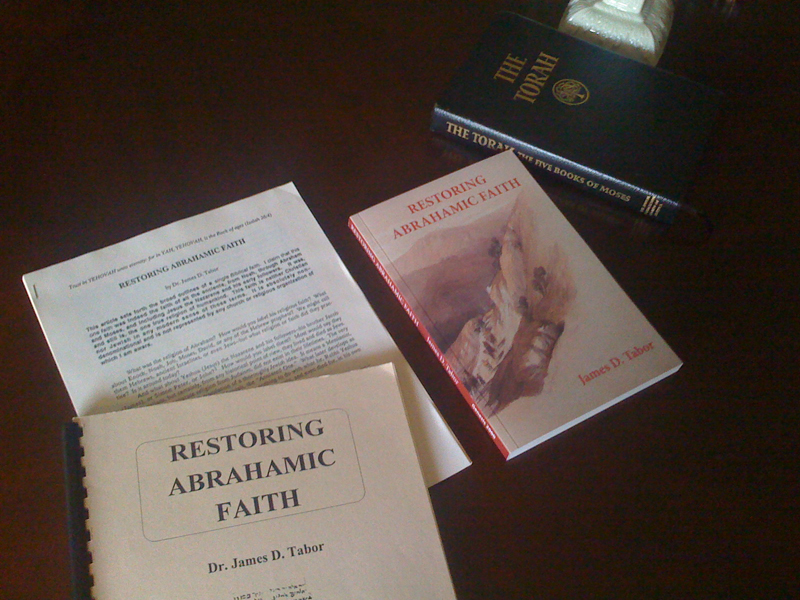
[First posted July 3, 2012.


This concludes Chapter 5, “THE WAY” of the book we have been featuring in this series:  James Tabor, Restoring Abrahamic Faith.  We consider this book a “wake-up call” not only for ourselves but our Christian colleagues with whom we attempted to share its contents.  Our former messianic teacher called this book “demonic” . . . if he ever reached Chapter 5, this would explain that reaction.  But then, typically in Christian thinking,  everything that does not conform with Christocentric belief is immediately labeled as “demonic.”  Read through and see what you, reader, conclude for yourself. Is it “of YHVH” or of the non-existent Christian devil?–Admin1.]

Image from rootsoffaith.org

Image from rootsoffaith.org

Applying the TORAH to one’s personal and community life in our modern secular setting requires spiritual insight and sensitivity for both Jew and non-Jew that involves a lifetime of deep study and meditation on these principles. However, much instructive help is available.


The Jewish commentary and discussion of these Laws is fascinating and exhaustive. Various conceptual categories have been developed such as-


  • “Repairing the World,” 
  • “Caring for the Poor,” 
  • “Guarding the Tongue,” 
  • “Hospitality,” and 
  • “Love of Zion,” 

—around which extensive discussions have developed. The Rabbis have worked through many of the important issues over the centuries and the benefit to the non-Jew of these millennia of accumulated Jewish wisdom is considerable.

But beyond formal study, the ultimate goal is “to write the TORAH on the heart” (Deuteronomy 6:6; Jeremiah 31:33).


When one deeply seeks the principles of TORAH, delighting in it and meditating on it day and night, the essential WAY of TORAH begins to unfold (Psalm 1:2).

The TEN WORDS, the cycle of annual Holy Days (Leviticus 23), the dietary laws (Leviticus 11; Deuteronomy 14:3-21), and many other areas of God’s Law are immediately applicable to our lives and bring great blessings and benefits. Since the TORAH addresses all aspects of human life: social relations; economic justice; health and hygiene; criminal justice; sexual conduct; as well as compassion and care for animals and our planet—it can be seen as a kind of blueprint, framed in an ancient Israelite setting, of the WAY of justice and righteousness for humanity.


Jerusalem vs. Athens

There are really only two compelling visions of human life and its purposes that come down to us from Western antiquity—the early philosophical quest of the ancient Greeks, and the Torah inspired vision of the Hebrews. Scholars refer to this dichotomy as “Athens and Jerusalem.”


And yet, when you add it all up, despite the commendable emphasis on rationality found in Greek philosophy, ancient Greek society falls woefully short with its emphasis on—-


  • divinizing and worshipping the forces of nature, 
  • its class-restricted ethics, 
  • its obsession with the occult and the superstitious, 
  • and its focus on astrology and the world beyond.

In contrast, within the Torah, one finds a rather remarkable emphasis on the ONE God as the ultimately rational Being beyond nature—


  • a rejection of the occult and astrological forces, 
  • an emphasis on caring for
    •  the poor,
    • the disenfranchised 
    • and the “stranger,” 
  • as well as virtually no emphasis on life after death.

The Torah comes across as a rational system, completely oriented to this world, and amazingly grounded in the practical matters of human living. This includes a remarkable emphasis upon health and sanitation that seem to predate, or at least anticipate, the modern post-Enlightenment world.


 Until the whole world turns to the principles of the TORAH, we will continue to suffer all of our collective ills and horrors. It is a demonstrable statistical fact that those societies that have incorporated into their laws, their judicial systems, and their general societal values, that basic ethical principles of the Bible, have been more prosperous, inventive, and advanced in areas of human rights. They also are rated the lowest in the areas of economic and governmental corruption.


 The Prophets make it clear that the coming collapse of our human societies, and the judgment that comes upon all nations on the “Great Day of YHVH,” will come as a consequence of our flouting of the WAY revealed in TORAH (see Isaiah 24; chapters 59-66).


Also, the TORAH contains much more than commandments (mitzvot). It also contains a fundamental unfolding narrative. It is from that core foundational story that we learn the fundamentals of the ABRAHAMIC FAITH—


  • who God is, 
  • what the WAY of God essentially is all about, 
  • and the contours of the historic PLAN of God for the redemption of the world.

 The Hebrew Prophets go hand in hand with the TORAH. They too come to us in their ancient dress, reflecting the conditions of Israel and Judah from the 8th through 5th centuries B.C.E. But they preserved for us an eternally valid commentary, more often than not cast in the 1st person voice of YHVH Himself.

Anyone who has deeply studied Isaiah, Jeremiah, Amos, Hosea, or any of the Hebrew Prophets, comes away with the impression that the Prophets speak with a voice that is perpetually relevant, indeed, as up to date than the morning papers. Furthermore, large sections of the Prophets directly address the “last days,” as they are called. In that sense important sections of these writings are more for our time and our peoples than for ancient Israel.


 In my experience, growing up in a Christian church, the riches that come from a deep study of the TORAH and the Prophets were largely missing. One is reminded of the chilling words of the Nazarene: “Whoever annuls one of the least of these commandments [of TORAH and Prophets] and teaches men so, will be called ‘least’ by those in the Kingdom of God” (Matthew 5:19).


And yet Christian tradition ended up teaching that the TORAH was abrogated and replaced by a New Covenant. This meant that the Bible that Jesus and all his earthly followers used, subsequently called the Old Testament, was seen as a largely obsolete precursor to the New.


The result was that the TORAH as a definitive revelation of God’s WAY was forgotten and in some cases even repudiated. And yet, Jesus, quoting the TORAH, had declared: “Man shall not live by bread alone, but by every word that proceeds from the mouth of YHVH!” (Matthew 4:4; Deuteronomy 8:3).


The deeply spiritual nurture that comes from a lifetime of study and meditation on the direct words of TORAH and Prophets, has unfortunately been lost to so many in our culture. It is worth noting that none of the writers of the New Testament actually had a New Testament. They were Jews and looked to their Holy Scriptures, the Hebrew Bible, preserved by the people of Israel.


In contrast, the “Christian message” that most hear Sunday after Sunday from their pulpits does not focus on the TORAH  or the Prophets. In the more evangelical churches at least, the single emphasis is on salvation in heaven through “accepting” Christ as Savior.


There is a richness, depth, spiritual insight, and practical knowledge of the Hebrew language preserved in the classical Jewish sources. Devout Jews throughout the world follow a weekly cycle of readings and study of the TORAH and Prophets.

Ironically, the early followers of the historical Jesus, unlike modern Christians, were thoroughly familiar with this practice and, as Jews, participated therein. Jesus himself attended the synagogue regularly on the Sabbath and was even called up to read the sacred Scrolls (Luke 4:16-17). He was thoroughly a part of this Jewish world of TORAH learning and discussion.


James (Ya’akov), the brother of Jesus, and leader of the messianic  community, assumed that the Gentiles drawn to TORAH FAITH would attend synagogue and hear the TORAH and Prophets read each Sabbath (Acts 15:21). An incredible wealth of commentary, both profound and practical, has developed around these TORAH portions. They are the lifeblood of the disciplined study of TORAH and are readily available for interested non-Jews.


When it comes to the matter of non-Jews being drawn toward the TORAH and/or Judaism, there is another important factor that I alluded to above. The Prophets state repeatedly and clearly that those known as Jews from the 5th century B.C.E. onward do not make up all of Israel. In other words, the so-called “Lost Tribes of Israel,” usually spoken of in the Prophets as “the house of Israel” (Joseph/Ephraim), in contrast to “the house of Judah” (the Jews), have lost their Israelite identity and consider themselves Gentiles. Yet, all the Prophets declare that in the “last days” these descendants of Jacob or Israel will return to YHVH the ONE GOD, and to TORAH Faith, recover their identity and unite with Judah (see Hosea 1:10-11; 3:4-5; Jeremiah 3:11-18). Their very birthright and Covenant goes back to Sinai and the revelation of YHVH through His Prophet Moses. The implications of these teachings in the Hebrew Prophets regarding the “Lost Tribes” are explored in [another] chapter.


This may well account for the reason so many thousands of Gentiles in the past few decades have experienced a turning toward TORAH Faith. It is possible that we are witnessing the beginning stages of a significant turn in Jewish history. These peoples tend to come from biblically oriented traditions within Christianity and they sense a connection, through their attachment to the Bible, toward the Jewish people and the Hebraic Faith. Accordingly, many who feel deeply drawn in these directions might very well be sensing the stirrings of their ancient Israelite connections in some mystical way that is beyond our ken. 

The WAY of YHVH – 5a TORAH Faith for Non-Jews

Image from amazon.com

Image from amazon.com

[First posted July 3,2012.

More on James Tabor’s Restoring Abrahamic Faith, Chapter 5: THE WAY, concluding section; edited and reformatted for website reading.]


——————-


Jewish tradition tells us that the entire TORAH, or Five Books of Moses, contains 613 Commandments (mitzvot).

At least two-thirds of these deal with—-


  • matters of the Temple, 
  • the priesthood, and 
  • the social-economic system applicable to ancient Israel living in the Land. 

This means that large portions of the TORAH are not directly applicable, even to devoutly observant Jews, at this time in history.


From a historical point of view this means that the TORAH comes to us in its ancient Near Eastern setting and context.


No one today can simply pick up the TORAH and literally follow it. Too many situations and contexts have changed over the centuries.


The TORAH, in the form we have it, was given to ancient Israel, as a special Covenant, and applied to their particular situation and setting, 3500 years ago, when all Twelve Tribes were living in the Land with the full operation of Temple and priesthood.

———————————————————————————

The Rabbis have developed and passed on in Jewish tradition (Mishnah, Tosefta, and the two Talmuds) their own complex and rich traditions regarding the application of TORAH to their ongoing life in the Diaspora.


YHVH is a God of history. His WAY and PLAN are revealed and worked out in time and history. Obviously the texts of the Bible, for that reason, are historically conditioned, given at a specific time and place with applications appropriate to their historical setting. Yet in principle the essential Teachings reflected in the Hebrew Bible are relevant to diverse cultures and time periods.

Non-Jews who love YHVH and want to follow His WAY must surely ask—is there a single commandment (mitzvah) of the TORAH from which one can not learn essential aspects of God’s nature and WAY for humankind?


Which of the commandments (mitzvot) of TORAH are to be spurned or forgotten? One has only to page through whole sections of TORAH such as Deuteronomy chapters 12-25 or Leviticus 18-19, to realize its potential relevance and importance for humankind. It is broad in scope, touching upon social, economic, cultural, and ecological aspects of life on this planet.


The following is a topical summary of these major sections of the TORAH that serves to illustrate this point:


Core Teachings from Deuteronomy:

Chapter 5: The TEN WORDS.

  • No other gods before YHVH, the ONE GOD
  • No making of idols
  • No vain use of God’s holy Name YHVH
  • Observing the Sabbath
  • Honoring parents
  • No murder, adultery, stealing, lying, or coveting

Chapters 12-25:

  • Destruction of all evidence of idolatry and pagan ways in the Land (12:1-4)
  • Tithes and offerings to God brought to a central sanctuary (12:6-28)
  • Prohibition against worshipping YHVH like the pagan nations worshipped their gods (12:29-32)
  • Prohibition against following any prophet or influence that advocates the worship of other gods (chapter 13)
  • Prohibition against eating animals which are unclean; anything that is found dead; or slaughtering a newborn animal for food (14:1-21)
  • Sharing one tenth (tithe) of your produce with the Levite, the poor, the widow, the orphan, and the stranger (14:22-29)
  • Release of those who have fallen into debt or servitude every 7th year (15:1-18)
  • All the first born males of the herds are sacred to God (15:19-22)
  • Prohibition of eating blood (15:23)
  • Celebration of Passover (Spring); Feast of Weeks/Pentecost (Summer); and Feast of Booths/Tabernacles (Fall) at the central sanctuary (16:1-17)
  • Establishment of courts with just and honest judges and officials of government; more difficult cases go to higher court (16:18-20; 17:8-13)
  • Prohibition of setting up pagan symbols and pillars (16:21-22)
  • Sacrifice only the best animals (17:1)
  • Execution of those who turn to idolatry (17:2-7)
  • King is not to exploit the people, amassing wealth, women, and power, but is to meditate on the TORAH and carefully follow it (17:14-20)
  • Levitical priests are to be supported by the other tribes (18:1-8)
  • Prohibition of all forms of spiritualism and the occult—especially divination and consulting the dead (18:9-22)
  • Cities of refuge are to be set up for accidental homicide cases (19:1-13)
  • Ancestral landmarks are to remain (19:14)
  • Evidence only established by testimony of multiple witnesses (cross examination), punishments are to be swift and fair, fitting the crime (19:15-21)
  • Warfare: terms of peace are to be offered before battle; women, children, and animals are to be spared; the seven nations of the Land are to be utterly destroyed ; environments is to be protected (20:1-20)
  • Thorough investigation of homicides, blood guilt to be taken most seriously (21:1-9)
  • Foreign wives and second wives to be treated fairly and given full rights (21:10-17)
  • Execution of rebellious youth (21:18)
  • Proper and swift burial of those executed by hanging (21:22-23)
  • Restoring lost property of others (22:1-4)
  • Clothing of sexes to be kept distinct (22:5)
  • Birds not to be over harvested (22:6-7)
  • Attention to property safety and liability (22:8)
  • Prohibition against mixing seeds, animals, cloth (22:9-11)
  • Tassels required on garments (22:12; see Numbers 15:37-41)
  • Virginity to be authenticated; adultery forbidden with death penalty; engaged woman is as if married; rape is punishable by death; marriage follows pre-marital sex if parents consent (22:13-29)
  • Prohibition of sex with father’s wife (22:30)
  • Certain persons excluded from the congregation (23:1-7)
  • Washing (mikvah) after male ejaculation (23:10-11; see Leviticus 15:16-18)
  • Sanitation and latrines required (23:12-14)
  • Protection of runaway slaves (23:15)
  • No cult prostitution, male or female (23:17-18)
  • No charging of interest on loans to countrymen (23:19-20)
  • Faithful performance of all vows (23:21-23)
  • Hospitality required but not to be abused (23:24-25)
  • Divorced allowed, but women not to be passed from man to man (24:1-4)
  • Newly married given release from civic duties (24:5)
  • Millstone (item vital to livelihood) not to be taken in pledge for loans (24:6)
  • Kidnapping punishable by death (24:7)
  • Control of disease and infections, quarantine (24:8-9)
  • Respect for the property and dignity of the poor (24:10-13)
  • No oppression of poor, laborers to be paid promptly (24:14-15)
  • Fathers not punished for sins of children, nor children for sins of parents (24:16)
  • Justice for the foreigner, orphan, widow (24:17-18)
  • Generosity toward the poor, the orphan, the foreigner, the widow (24:19-22)
  • Corporal punishment limited to 40 blows (25:1-3)
  • Working animal not to be muzzled (25:4)
  • Brothers are required to marry widowed brother’s wife with no children (25:5-10)
  • Male genitals are off limits in a fight (25:11-12)
  • Use of just weights and measures in business (25:13-16)
  • Amalek is to be blotted out from the land (25:17-19)

Additional Teachings from Leviticus

  • Sexual relations forbidden with close relatives (18:1-18)
  • Sexual intercourse forbidden during menstrual days (18:19; see 15:19-30)
  • Male homosexual relations forbidden (18:22)
  • Sexual relations with animals forbidden (18:23)
  • No abusing the deaf, deceiving the blind (19:14)
  • Impartiality required toward the poor, no deference toward the powerful (19:15)
  • Prohibition against slander toward a brother (19:16)
  • One must help anyone in danger (19:16)
  • One is not to hate one’s brother, nor take vengeance, nor bear a grudge. Love your neighbor as yourself (19:17-18)
  • Fruit of trees forbidden for the first three years (19:23-25)
  • Eating blood forbidden (19:26; see 17:10-16)
  • No tattoos, shaving of the head and beard (19:27-28; Deuteronomy 14:1-2)
  • Honor of the aged (19:32)
  • Equal treatment of strangers and foreigners (19:33-34)

This overview shows the wide range of subjects and areas that are covered in the TORAH, though a mere list of this type does not do justice to the underlying principles that undergird the entire system of TORAH based ethics.


Both Moses and Jesus emphasized that humans are to “live by every word that proceeds out of the mouth of God.” (Deuteronomy 8:3; cf. Luke 4:4).

Continued in TORAH Faith for Non-Jews 5b

A Sinaite's Notebook: Genesis/Bereshith: 2 Introductions

[This was first posted October 25, 2014.  These are introductions to the first book comprising the TORAH.  They are from two of our MUST READ/MUST HAVE resources:  

  • one is from our translation of choice — Everett Fox (EF), The Five Books of Moses
  • while the second is from Robert Alter (RA) who has also done his own translation of the same, with exactly the same title as Fox.

 We provide these supplementary readings to aid our web-visitors in understanding the Torah books.  As much as our featured favorite commentators have helped us in our study and discussions, we offer to share our Sinaites resources to those who might not have access to the original books.  Reformatted for this post.Admin1]


Everett Fox [EF]:

Part I: THE PRIMEVAL HISTORY (I-II)

THE COLLECTION OF STORIES WHICH FORMS PART I OF GENESIS HAS BEEN ASSEMBLED for a number of purposes:


1.  History is traced from the creation of the world, in a direct line, down to Avraham, father of the People of Israel.  Through use of the leading-word toledot, “begettings,”  we are meant to view him as the logical end point in God’s preliminary plan in history


2.  The nature of God, as he will appear throughout the Hebrew Bible, is firmly established.  He is seen—

  • as a Creator who is beyond fate, nature, and sexuality;
  • as an all-powerful orderer and giver of meaning to history;
  • as a bestower of blessing to living creatures;
  • as a giver of choice to human beings;
  • as a just punisher of evil
  • and, simultaneously, a merciful ruler;
  • and as a maker of covenants.

The one quality of God which does not unfold until the Patriarchal stories (Parts II-IV) is his shaping of human destiny through focusing on the people of Israel.  It is portrayed as the logical outcome of the characteristics just mentioned.


3.  It appears that the Mesopotamian origins of Israel are reflected in such narratives as the Creation, the Flood, and the Tower of Babel, and are transformed or repudiated in the biblical versions.  What in the older culture appears arbitrary and chaotic has been changed in the Bible into stories that stress morality and order.  Further, human beings in Genesis Chapters I-II, despite their failure to live up to God’s expectations, are nevertheless considered capable of doing so, in contrast to the Mesopotamian view that humankind was created merely to be slaves to the gods.


4.  Like virtually all other creation stories, Part I is concerned with the origin of the world and its institutions.

  • Chapter I expounds on the origins of earth, sky, vegetation, animals, and human beings (as well as the Sabbath);
  • Chapter 2, of sexuality, death, pain in childbirth and work;
  • Chapter 4, of sin, hatred, and murder, as well as of cities and crafts;
  • Chapter 6, of giants; and
  • Chapter 10, of nations (including the low status of the Canaanites) and languages.


In sum, Part I serves as a fitting Prologue, not only to Genesis but to the entire Bible.  The reader’s chief task in interpreting it is to be able to determine the reason for the inclusion of any one section into the whole.


God as Creator (I:I-2-2:4a):  Three principal themes emerge from the great creation account with which Genesis opens.

  • The first is the total and uncompromised power of God as creator;
  • the second, the intrinsic order and balance of the created world; and
  • the third, humankind’s key position in the scheme of creation.

These themes are brought home as much by the form in which they are presented as by their actual mention.


God (Heb. elohim, a generic term) is introduced into the narrative without any description of origins, sex, or limitations of power.  As the only functioning character of the chapter, he occupies center stage.  There is no opposition, no resistance to his acts of creation, which occur in perfect harmony with his express word.


As a sign of both God’s total control and his intent, the world unfolds in symmetrical order.  The division of God’s labor into six days, plus a seventh for rest, itself indicates a powerful meaningfulness at work, as well as providing the external structure for the narrative.


Interpreters have tended to divide these into either three groups of two days or two groups of three, with always the same results:  a balanced and harmonious whole.


In addition, the number seven is significant (as it will be elsewhere in the Bible) as a symbol of perfection, not only in Israel but in the ancient world in general.


The narrative uses several repeating words and phrases to both unify the story and underscore the theme of order.  These include,

  • “God said,”
  • “Let there be . . .,”
  • “God saw that it was good,”
  • “It was so,” and
  • “There was setting, there was dawning . . . .”


Robert Alter [RA] :  

Excerpts from the  INTRODUCTION


A FEW brief remarks about the structure of Genesis as a book are in order.  Genesis comprises two large literary units–

  • -the Primeval History (chapters 1-11) and
  • the Patriarchal Tales (chapters 12-50).

The two differ—

  • not only in subject
  • but to some extent in style
  • and perspective.

The approach to the history of Israel and Israel’s relationship with God that will be the material of the rest of the Hebrew Bible is undertaken through gradually narrowing concentric circles:  

  • first an account of the origins
    • of the world,
    • of the vegetable
    • and animal kingdom
    • and of humankind,
  • then a narrative explanation of the origin
    • of all the known peoples from Greece to Africa to Mesopotamia and Asia Minor,
    • and of the primary institutions of civilization,
    • including the memorable fable about the source of linguistic division.

 The Mesopotamian family of Terah is introduced at the end of this universal history in chapter 11,

  • and then when God calls Abraham out of Ur of the Chaldees
  • at the beginning of chapter 12 we move on to the story of the beginnings of the Israelite nation,
  • though the national focus of the narrative is given moral depth because the universal perspective of the first part of Genesis is never really forgotten.  


Some critics have plausibly imagined this whole large process of biblical literature as a divine experiment with the quirky and unpredictable stuff of human freedom an experiment plagued by repeated failure and dedicated to renewed attempts:

  •  first Adam and Eve,
  • then the generation of Noah,
  • then the builders of the Tower of Babel,
  • and finally Abraham and his seed.


Although the Creation story with which the Primeval History begins does look forward to the proliferation of humanity and the human conquest of the natural world, by and large the first eleven chapters of Genesis are concerned with origins, not eventualities—with the past, not the future:  “he was the first of all who play on the lyre and pipe” (4:21), the narrator says of Jubal, one of the antediluvians.  The literal phrasing of the Hebrew here, as in a series of analogous verses, is “he was the father of ….”   That idiom is emblematic of the Primeval History, which is really a record of the archetypal fathers, a genealogy of human institutions and of ethnic and linguistic identity.


 Although the Patriarchal Tales are in one obvious way also the story of a chain of fathers—Abraham, Isaac, and Jacob—the horizon these tales constantly invoke is the future, not the past.  God repeatedly tells Abraham what He intends to do with and for the offspring of Abraham in time to come, both in the impending near future of Egyptian enslavement and in the long-term future of national greatness.  It is perfectly apt that the Patriarchal Tales should conclude with Jacob’s deathbed poem envisaging the destiny of the future tribes of Israel, which he prefaces with the words, “Gather round, that I may tell you what shall befall you in the days to come” (49:1).


The Primeval History, in contrast to what follows in Genesis, cultivates a kind of narrative that is

  • fablelike or legendary, and sometimes residually mythic.
  • The human actors in these stories are kept at a certain distance, and seem more generalized types than individual characters with distinctive personal histories.
  • The style tends much more than that of the Patriarchal Tales to formal symmetries, refrainlike repetitions, parallelisms, and other rhetorical devices of a prose that often aspires to the dignity of poetry, or that invites us to hear the echo of epic poetry in its cadences.
  • As everywhere in biblical narrative, dialogue is an important vehicle, but in the Primeval History it does not have the central roles it will play later, and one finds few of the touches of vivid mimesis that make dialogue in the Patriarchal Tales so brilliant an instrument for the representation of human—and human and divine—interactions.

 In sum, this rapid report of the distant early stages of the human story adopts something of a distancing procedure in the style and the narrative modes with which it tells the story.


God’s very first words to Abraham at the beginning of chapter 12 enjoin him to abandon land, birthplace, and father’s house.  These very terms, or at east this very sphere, will become the arena of the narrative to the end of Genesis.  The human creature is now to be represented not against the background of the heavens and the earth and civilization as such but rather


  • within the tense and constricted theater of the paternal domain, in tent and wheatfield and sheepfold,
  • in the minute rhythms of quotidian existence,
  • working out all hopes of grand destiny in the coil of familial relationships, the internecine, sometimes deadly, warring of brothers and fathers and sons and wives.

In keeping with this major shift in focus from the Primeval History to the Patriarchal Tales, style and narrative mode shift as well.  


The studied formality of the first eleven chapters—epitomized in the symmetries and the intricate repetition of word and sound in the story of the Tower of Babel—gives way to a more flexible and varied prose.  Dialogue is accorded more prominence and embodies a more lively realism.  When, for example, Sarai gives Abram her slavegirl Hagar as a concubine, and proudly pregnant Hagar then treats her with disdain, the matriarch berates her husband in the following fashion:  “This outrage against me is because of you!  I myself put my slavegirl in your embrace and when she saw she had conceived I became slight in her eyes” (16:5).  Sarai’s first sentence here has an explosive compactness in the Hebrew, being only two words, hamasi ‘alekha, that resists translation.  In any case these lines smoldering with the fires of female resentment convey a sense of living speech and complexity of feeling and relationship one does not encounter before the Patriarchal Tales:  the frustrated long-barren wife at cross-purposes with herself and with her husband, first aspiring to maternity through the surrogate of her slavegirl, then after the fact of her new co-wife’s pregnancy, tasting a new humiliation, indignant at the slave’s presumption, ready to blame her husband, who has been only the instrument of her will.  Such vivid immediacy in the representation of the densely problematic nature of individual lives in everyday settings is an innovation not only in comparison with the Primeval History but also in comparison with virtually all of ancient literature.


What nevertheless binds the two large units of the Book of Genesis is both outlook and theme.

  • The unfolding history of the family that is to become the people of Israel is seen, as I have suggested, as the crucial focus of a larger, universal history.
  • The very peregrinations of the family back and forth between Mesopotamia and Canaan and down to Egypt intimate that its scope involves not just the land Israel has been promised but the wider reach of known cultures.
  • National existence, moreover, is emphatically imagined as a strenuous effort to renew the act of creation.
  • The Creation story repeatedly highlights the injunction to be fruitful and multiply, while the Patriarchal Tales, in the very process of frequently echoing this language of fertility from the opening chapters, make clear that procreation, far from being an automatic biological process, is fraught with dangers is constantly under threat of being deflected or cut off.
  • Abraham must live long years with the seeming mockery of a divine promise of numberless offspring as he and his wife advance childless into hoary old age.
  • Near the end of the book, Jacob’s whole family fears it may perish in the great famine, and Joseph must assure his brothers that God has sent him ahead of them to Egypt in order to sustain life.
  •  Genesis begins with the making of heaven and earth and all life, and ends with the image of a mummy—Joseph’s—in a coffin.

But implicit in the end is a promise of more life to come, of irrepressible procreation, and that renewal of creation will be manifested, even under the weight of oppression, at the beginning of Exodus.  Genesis, then, works with disparate materials, puts together its story with two large and very different building blocks but nevertheless achieves the cohesiveness, the continuity of theme and motif, and the sense of completion of an architectonically conceived book.  Although it looks forward to its sequel, it stands as a book, inviting our attention as an audience that follows the tale from beginning to end. 


Yo searchers! Need assistance? – February 2015

[If the the name of the first month January came from Janus, god of beginnings, this second month February comes from Februa, the feast of purification.  For the source of the name of months in our calendar year, here’s a link: http://www.calendar-origins.com/calendar-name-origins.html. You’ll also learn about the origins of the names of the week and other trivia related to the ‘days of our lives’ so to speak, such as who reversed the progress of centuries and millenia back down to year ‘0’ and why. . . while the normal and logical reckoning of time according to the biblically calculated calendar progresses toward the 7th millennium in another 300+ years.


Image from community.sephora.com1600

Image from community.sephora.com1600

In case you haven’t noticed, soon as christmas decorations were taken off the malls, shoppers were reminded of the next occasion to spend our hard-earned money on: valentine’s day (in fact as early as January!)  What would business establishments do without holidays and themed celebrations, eh?


We did post an article that came out of curiosity why February 14 has become the focus of the 2nd in the Gregorian calendar: Valentine – Who was he, why does he deserve a day, does anybody really care? Admin1.]


———————–


02/28/15  “can gentiles say hashem” – Anyone can say HaShem, the Hebrew equivalent of “The Name”, one of the euphemisms resorted to by Jews who refuse to pronounce or write the Name revealed to Moses by the God on Sinai—YHWH.  Now, if the real question of this searcher is —“Can gentiles say YHWH?”  We’ve explained many times why we, gentiles, Sinaites, have chosen to write and say the Name “YHWH” — please refer to the many posts explaining our position:


02/28/15  “did shepherds eat sheeps aish” –  If the shepherds were Israelites, sheep is clean meat, permitted in Leviticus 11.  If the context of this question is Exodus when Jacob’s descendants had multiplied in Egypt and at the prophesied time would be liberated, most likely there would no ‘Egyptian shepherds’ raising sheep for food consumption, since the lamb was one of the gods of Egypt. That is why the lamb was the chosen animal that would figure in the Passover liberation night, blood splattered on lintels, roasted to be eaten by each family—in effect a bold act for slaves to insult one of the gods of their master-nation. Read the Exodus narrative for details. 


02/28/15  “uncircumcized of lips” –  Exodus/Shemoth 6-b: Do you have “uncircumcised lips”?


02/27/15  “torah jewish bible” – There are Hebrew translations of the TNK (Tanach, Tanakh) or the Hebrew Scriptures, most of them avoid using the Tetragrammaton Name “YHWH”—the two best known are—

  • the “JPS” or Jewish Publication Society which follows the Christian translators’ substitution of “LORD” in place of “YHWH”;
  • and the ArtScroll Mesorah Publications TANACH which substitutes  “Hashem” or “The Name” for “YHWH”.  

This website insists on declaring the Name for, as far as we know, there is no prohibition in the TORAH in uttering or writing the Name “YHWH” as long as it does not violate the 3rd commandment, using it “in vain” or with dishonor or disrespect or casually or flippantly.  How will people know God’s Name as He revealed it Himself to Moses and the Israelites, unless we keep declaring it to as many as are eager to know the One True God?  So we searched for a TORAH translation that prints the Name and found it in Everett Fox’s The Five Books of Moses which has now become our official translation.  He has recently come out with a sequel to Torah, titled The Early Prophets:  Joshua, Judges, Samuel and Kings.  Alternately we also use Robert Alter’s The Five Books of Moses,  though he does not use the Tetragrammaton Name and instead follow the Christian use of “LORD” as substitute.  Alter has come out with his translation with commentary of “The Former Prophets: Joshua, Judges, Samuel, and Kings” titled Ancient Israel. We love both Fox and Alter as translators because, as one reviewer says it best, both have made it their career-long effort to make us think seriously about the Bible as literature.  Amen to that!


image from floralnewsga.blogspot.com

02/27/15  “hebrew symbol for marriage” –  This search phrase made us look it up in google (of course) and got educated on it— there appear to be many symbols, we only thought of the chuppah or the symbolic overhead sheet propped up by 4 poles covering  the couple. This has become more elaborate and part of the wedding decorations; one image also shows the white shawl with blue stripes placed over the couple —- Christian marriages use that shawl as well as the cord as ceremonial symbols uniting two lives united in marriage.  Check out: Images for hebrew symbol for marriage


02/27/15  “images on abraham’s test of faith” – Journey of Faith – Whose test of faith, Abraham’s or Isaac’s?


02/26/15  “lead me lord quotes” – We have many quotes asking for God’s leading, but better yet, here’s a musical one,  rewrite of a Christian hymn; if you know the music (accompaniment provided), here’s the revised lyrics from the post:  A Sinaite’s Musical Liturgy – 1st Sabbath of December.


1.  Lord of my life, please light my way, all through the darkness be,

lest I get lost, can’t find my way, over my life, please be!


2.  Thou art my Shepherd, lead me to pastures of green to feed.

call out my name that I may hear warnings that I should heed.


CHO:  Lest I forget Thy voice I heard,

lest I remember not Thy word,

lest I forsake the True Path I’ve tread,

lead me back, LORD, to Thee.


3.  Teach me just like the Israelites, all that I need to be,

show me just how to sacrifice, show me what pleases Thee.


4.  Best of all that I own and have, unworthy tho’ they be,

best of my mind and soul and will, all are reserved for Thee.


CHO:  Lest I fall short of Thy command,

lest I let go of Thy precious Hand,

light up my path, my eyes, my life,

lead me back, Lord, to Thee.  


02/25/15  “shemoth 20″ – Exodus/Shemoth 20: “I am YHWH”


02/25/15  “jacob and laban speckles streaks and spots color pages” –  Genesis/Bereshith 30: Battle for Babies and Battle of the Wits

02/24/15  “uncircuncised lips” – Exodus/Shemoth 6-b: Do you have “uncircumcised lips”?


02/22/15  “the tree of life grew right beside the tree of knowledge of good and evil” – The Tree of – ‘the Knowledge of’/’the Knowing of’ – Good and Evil

02/22/15 ” joseph’s tunics” –  Genesis/Bereshith 37 – “Yisrael loved Yosef above all his sons”


02/21/15 – “shabat shalom blessings” – We have a Sabbath liturgy for observant gentiles for every Sabbath of the month (except for a few in June and July). Please click the box Search our Site [Site Map] and go to category ‘Sabbath liturgy’.

02/19/15 “i will dwell amidst them” – Exodus/Shemoth 25 – “Make me a sanctuary that I may dwell among them.”

02/17/15  “serpent” – This has been a popular search term lately, so here are the posts we’ve been recommending over and over:


02/17/15 “tabernacle in time” – The Sabbath: A Tabernacle in Time


02/16/15  “molting snake” – Shedding without blood . . .

02/16/15  “all greek gods together” –  Must Read: Reuven Firestone – 4 – Chosenness in the Ancient Near East


02/15/15  “the explanation of seven dangers of human virtue by mahatma gandhi” – Seven Dangers to Human Virtue


02/14/15  “fallen angels in the tanakh” – The posts listed hereunder are not arranged chronologically (according to sequence of thought progression) but they all argue that there is not such thing as “fallen angels” in the TNK.  The thread that runs through all is the premise that only one creature was given free will and therefore could make a choice and that is humankind.  Only the creature made in the image of God can choose to rebel against his Maker/Creator.  “Angelic” beings, also “created”  disembodied spirits have no free will, therefore they cannot not obey the biddings of their Creator God; as messengers they are programmed simply to obey.  


Image from smallbiztrends.com

Image from smallbiztrends.com

If you don’t agree, read through and get educated on what the TNK teaches:

02/14/15  “his name is yhwh” – 


02/14/15  “in to day`s times who is sedom and amorah?” – Sodom and Gomorrah in the biblical narrative was destroyed by YHWH for the sin of homosexuality.  Today, the ‘third gender’ or ‘third sex’ (gays, lesbians, transgender, etc.) are accepted as “being born that way” and anyone who declares this sexual aberration as sinful is branded homophobic, close-minded, bigotted.  Times truly have changed, liberal views predominate. Will the world today experience divine judgment similar to Sodom and Gomorrah? Heaven seems silent for now, although religionists say AIDS is the modern version of divine judgment.  Others say “hate the sin, love the sinner.”  We repeat: if Noah had boarded a pair of the same gender of any species, including his human family, that would have been the end of the human race.  These articles might help:


02/14/15  “bereshiyth 10:25″ – Here is the specific verse and commentary:


25 Two sons were born to Ever: the name of the first one was Peleg/Splitting,
for in his days the earth-folk were split up, and his brother’s name was Yoktan.
 

divided.  By ‘earth’ is meant the population of the earth.  The allusion is probably to the scattering of the peoples described in the next chapter.


Peleg.  In Assyrian, palgu means ‘canal’; and Sayce believes the ‘division of the land’ to refer to the introduction of a system of canals into Babylonia.

[RA]  Peleg . . . in his days the earth split apart.  The three consonants of the name Peleg, which as a common noun means “brook,” form the verbal root that means “to split.”  It is a stronger verb than “divide,” the term used by most English translators.  Rabbinic tradition construes the splitting here as a reference to the Tower of Babel, but it is at least as plausible to see it as an allusion to an entirely different epochal event of “division,” such as a cataclysmic earthquake.


Image from www.pinterest.com

Image from www.pinterest.com

02/14/15 – “shabbat shalom blessings” – Here’s a Sinaite’s valentine tribute to our great God YHWH: A Sinaite’s Musical Liturgy – 2nd Sabbath of February


02/14/15  – “did members of the firestone family once live in israel” – The name “Firestone” rings a bell to motorists who relate it to a tire brand but the name is also shared by a Kabbalah female rabbi named Tirzah Firestone.  Her biography on her website does not indicate she ever lived in Israel.  Here’s a link to a message she delivered on Yom Kippur 5771 where she opens with this quote:


The Kotzker Rebbe was once asked: Where does God dwell?

He answered: God dwells wherever we let God in. 


 http://www.neveikodesh.org/rabbi/writings_podcasts/YomKippur5771.html


We have also featured another “Firestone” in the person of Reuven Firestone, author of our MUST READ/MUST OWN:  


In answer to the Q of this searcher, did the Firestone family ever live in Israel? If referring to Reuven Firestone:  

“Professor Firestone has lived in Israel, Egypt and Germany and regularly lectures in universities throughout the United States, Europe, the Middle East and Asia.”


02/13/15  “анти валентинки” – Hmmm, clueless about this search term, but ever dependable google has a listing; from the images it appears to be related to Valentine’s Day . . .heck,  what do we know???

Image from israelinenglish.blogspot.com

Image from israelinenglish.blogspot.com

02/12/15 “prove yeshua is messiah from tnk” – Oy vey, as the Jews would say . . . we Sinaites did exactly what this searcher is checking out:   Does the TNK, as in Hebrew Scriptures point to “Yeshua” [Hebrew for the Christian Messiah whose Anglicized name is Jesus]?  If one is checking out the “Old Testament” first part of the Christian Bible, the answer will predictably be: YES,  because you will see Jesus all over the OT.  Why?  Because OT has been reprogrammed for you to discover exactly that and your own Christian orientation will make you ‘connect the dots’,  all the OT verses selected out of context or some even within context as ‘prooftext’.  Yes definitely, you will see Yeshua in OT. . . but just as definitely, you will not see him in the TNK or Hebrew Scriptures.  In fact, you will see YHWH instead, and a ‘messiah’ in the Hebrew prophetic expectations who is human and nothing like the Christian messiah-savior-God-man.  But only if you leave your Christian reading lenses behind and decide to read TNK afresh, leaving all the baggage of Christian teaching where it belongs—the New Testament—and not apply what you learned there in reading the TNK.  Get a copy of the Hebrew Bible, it comes as a single package without a sequel. We have written many posts explaining this, please go to SITEMAP or UPDATED SITE CONTENTS and start your re-education in the Hebrew Scriptures and not the Christian version called ‘Old Testament’.  


02/12/15  “blue serpent” –  Wow, when somebody remembers the image of a blue serpent in a post and returns to re-read the post, that’s the kind of Truth/God-seeker who is serious about learning as much as he/she can.  Glad we chose a visual that was deposited in someone’s memory bank:  Prooftext 1b – Genesis 3:15 – Who is the “serpent”?


02/12/15  “image children of israel encamped” – Numbers/Bamidbar 22-23-24: “I behold him: here, a people, alone-in-security it dwells, among the nations it does not need to come-to-reckoning.”


02/11/15  “bamidbarsilvertrumpets” – Numbers/Bamidbar -10- Two silver trumpets, not the Shofar . . .

02/10/15 ” jesus christ superstar” – “Superstar” – Confessions of an Idolater


02/10/15  “did yhwh save yaakov directly from esau” – 


02/10/15  “judas art” – Judas – did he really exist?


02/09/15  “jacob saw god in the face of easu”


02/08/15 “serpent


02/08/15  “jewish symbols” 

02/08/15  “jewish symbols” 

02/07/15 “sabbath day” – We have a liturgy for every Sabbath of the year except for 6 weekends between June and July.  For this this week, here’s the liturgy:  A Sinaite’s Liturgy – 1st Sabbath of February.  


For articles on the Sabbath day, here are a few posts:


02/06/15  “sinai mount painting” – We have used many images for Sinai in both articles and liturgies; all of these are google-sourced logowhile our logo is the sketch of BBB@S6K (artist based in San Francisco, CA); enhanced color shading by our former webdesigner Eric P.  and lettering further improved by our current server  staff from Silverconnect.


02/05/15  “serpent” – 


02/05/15  “jewish torah” –  Must Read – 6 – Robert Schoen/The Torah and the Law; Jewish symbols


02/04/15 “a snake molting” – Shedding without blood . . .


02/04/15  “sermon on mount sinai” – Haha, that’s what we get for using a title like:  The Sermon on Sinai vs. The Sermon on the Mount.  The self-revealing God on Sinai did not give a ‘sermon’!  As the article explains:  

“Quite a provocative title for a controversial discourse—actually it should be reworded to “The Revelation on Sinai vs. The Sermon on the Mount,”  because there is a vast difference between a revelation and a sermon. Anyone can preach a sermon but only God can reveal Himself and His will initially to Israel, though intended for all mankind.”


02/04/15 “jewish symbols” – Signs and Symbols from the SHEMA


02/04/15 “serpent” – 


Image from www.kibitzspot.com

Image from www.kibitzspot.com

02/03/15  “shabbat” – We have completed a year of ‘A Sinaite’s Liturgy’ (except for 6 Sabbaths in June/July.  We are in process of revising and improving what has already been posted.  Please feel free to use all our Sabbath material: prayers, revised lyrics, and even our musical accompaniment for the ‘musical Sabbath’. We’re just too happy to share materials on our website with anyone interested in using them to make known and glorify the God we worship, YHWH, God of Israel, God of the nations, Creator, Revelator on Sinai.


 02/03/15  “serpent” 


02/03/15  “jewish belief based on revelation not blind faith” – Blind Faith vs. Belief based on Evidence


02/03/15   “ernest van den haag jew –  The Jewish Mystique by Ernest Van Den Haag

02/03/15 “judaism torah” – 

02/02/15  “pictures with sabbath messages” –  Our Sabbath liturgy all year round are full of sabbath messages superimposed on beautiful photographs, all taken from the web, thanks to the great service that google does.  There is a glut of images on practically every topic, so take your pick, just as we do!  Thanks google!


02/02/15  “as a deer panteth” – “Soul Thirst” – Art by AHV@S6K

"Soul Thirst" – Art by AHV@S6K

“Soul Thirst” – Art by AHV@S6K


02/01/15 “yahweh wallpaper” – All the images we feature in our posts come from where else, google of course, so this searcher will most likely find what he’s specifically looking for there.  But thanks for dropping by!

Image from www.youtube.com

Image from www.youtube.com


Image from kezi.wordpress.com

Image from kezi.wordpress.com


One Man's Spiritual Odyssey

[This was first posted ay 8, 2013; an essay  from A Modern Treasury of Jewish Thoughts: An Inspiring Collection of Writings in Jewish Deed, Doctrine, and Destiny, edited by Sidney Greenberg, Introduction by Charles Angoff.  The book is one of four donated to our S6K resources by Dr. Tiglao.  a collector of rare books that he finds in estate sales in the US; the ‘most clicked’ book he has donated which we have featured  is The Jewish Mystique. This essay is by Joshua Loth Liebman, “Peace of Mind.”  Reformatting and highlights ours. —Admin1.]


Image from www.odysseyofthesoul.org

Image from www.odysseyofthesoul.org


One man’s spiritual Odyssey may be of interest to others seeking peace of mind, because it may reflect something of the alternating turbulence and tranquillity of our modern age.  I offer my experience — in no way exceptional — for whatever help it may give to my perplexed contemporaries.


To begin with, I have gone through a number of stages in my own thoughts on God.  

  • I shared in my childhood the usual picture of Divinity —a daguerreotype, as it were, of my grandfather — a heavenly replica of an old, bearded patriarchal figure.  
  • Later, as a theological student, I lived through anguished years when nothing in the external world could stifle the question,

“Where is God? What is his nature?”  


I realize now that my adolescent sufferings were a disguise for a deeper distrust of life, a sense of personal uncertainty.  Yet I know that those adolescent years of searching for God were invaluable for my own spiritual maturation.  No religious teacher who has not himself tasted of the bitter cup of rejection, agnosticism, and fear can be of help to other men and women.


During all these years there came a time when I thought that man was enough and that humanism was the answer.  Traditionally, emphasis upon man and humanistic values is one of the fundamental Jewish concepts; yet I have come to see that humanism is not enough to explain man.  Neither his mind nor his creative powers can be truly understood except as the offspring of some universal parent.  I have come to feel that the whole human story, with all its tragedy and its triumph, is like a page torn from the middle of a book without beginning or end–an undecipherable page when cut out of its context.  


The context of man is the Power greater than man.  


The human adventure is part of a universal sonnet — one line in a deathless poem.  Without faith that our human intelligence and haunting human conscience are a reflection of a greater intelligence and a vaster creative power, the key to the cipher is lost and the episode of mankind on earth becomes a hidden code — a meaningless jumble of vowels and consonants . . . .


Only within recent years have i begun to discover a pathway to God that is intellectually satisfying to my own wrestling spirit.  I found the first hints in the pages of Hebrew wisdom.  I came to understand that the prophets in Palestine were also wrestling with the same problem.  They, too, held the conviction that God was all-good, but that He did not abrogate the oral laws of life for any favorites.  Those ancient prophets, in effect. said to the people of Israel.


 “God has established natural laws in the universe, and He expects them to cooperate.  He has given you consciences and minds, and He expects you to use them.  If you abuse them He will not set His world topsy-turvy in order to rescue you from the consequences of your deeds.”


Image from pastordaveonline.org

Image from pastordaveonline.org

I began to see a deep wisdom of that message — the wisdom of maturity–which does not expect God to be a father cajoled and wheedled into violating the necessary principles of human life.  I understood why Jeremiah told the people of Jerusalem (who were so confident that they were God’s favorites) not to believe presumptuously that He would be partial to them and to their beloved city.  There is no partiality in a moral universe.  Gradually I came to understand how my ancestors were able to find the greatness of God and to discern His truth not in the eras of luxury and security but in the catastrophe of exile, when their world was shaken to its foundation.


The unthinking man might say that during this whirlwind of national tragedy the Jews should have lost faith in God.  Is there not something startling and profound in this neglected truth that the giants of the Bible found the handwriting of God not in the sunlit hours of triumph, but in the state of tragedy?  It seems like a paradox of evil and suffering should have been the birthplace of the moral God.


The very experience that now seems to make so many people atheistic is what made the prophets of Israel maturely religious.  Why?  Because they had gone beyond a childish view of Divinity.  At a time when thousands of Jews must have been saying with their emotions, “There is no God,” it was then that the prophets — Titans of the spirit — taught their new message:


 “God cannot do anything that will mock his moral law.  He is not an Oriental monarch, to be bribed into overlooking violations of the principles upon which the earth and human society must rest.” . . . .


When I think with my mind rather than feel with my heart, I cannot conceive of a world where God would interfere capriciously with personal and social destiny, making all human effort and human striving worthless.  We cannot look to God to save us from man-made evil, whether it be a civic catastrophe born out of negligence or greed or whether it be a dictatorship that mankind long knew would slay the innocent if it were not stopped in time.  We dare not run to God to wipe away by a miracle the effects of our human misdeeds.  We cannot have only the blessings that come with mind and conscience and that distinguish us from the lifeless rock and expect God to be our heavy insurance policy against all of the dangers and the failures of life.


God must indeed be filled with sorrow as He sees how the human race has misused its freedom of choice and how it has violated His moral laws.  


“Men, men,” He could cry, “I gave you an earth ribbed with veins of diamonds and gold and black with frozen heat.  I gave you strong and dynamic waters to drive your windmills and make your turbines hum with power.  I gave you rich loam upon which you could grow waving wheat. What have you done?  My coal often you have stolen, leaving only the slag for the poor.  My diamonds, my gold, my living waters, you have imprisoned behind the walls of your selfish greed.  Because you refused to use my gifts in order to build a just earth, you have been forced to spend gold like water for ships blown up in the twinkling of an eye.  You have seen your cities ruined and your precious sons annihilated on a thousand battlefields. Now, at last, the intelligence which I have implanted in you, O race of man, has fashioned the key to unlock my treasure house of energy.  Within the secret heart of my atoms is the power of life and death for all of you.  O men, will you this time choose weapons of death or tools of life, unconditional destruction or unconditional survival?” . . .


It is true that we can never actually define God, since we human beings are so limited and our language is always inexact, and we shall probably always have to use metaphor and analogy in order to interpret Divine reality.  What many people do not understand is that our scientific description of the universe is just as metaphorical as the religious description.  Men thought that they were very exact and scientific when they called the world a great machine.  Is that not an analogy, a metaphor?  Whenever we speak of reality as a machine or as purely material, we are reading something into the world.  


Why should we continue to interpret the universe in terms of the lowest that we know rather than in terms of the highest that we experience?  Intelligence, purpose, and personality, the will to live, the need to love, the yearning to be related—these are just as important clues to reality as atoms and electrons.  It sometimes seems to me that our habit of looking at the universe in terms of purpose and of conscience is a reflection of our inferiority complex — as though we human beings were not worthy to be regarded as mirrors of the Divine.  Perhaps this is part of that spiritual self-deprecation which is always fashionable in certain theological circles.  There is no logical reason, however, why we should explain reality always by reducing the complex to the simple.  Why exalt the atom as the clue to truth and ignore the mind of man?  Why should we not believe that that which is highest in ourselves is a reflection of that which is deepest in the universe—that we are children of a Power who makes possible the growing achievement of relatedness, fulfillment, goodness?


We may not ever come to know God’s essence, but His attributes of activity —namely, the universal laws of social, mental, and moral health — these we can possess.  God, as Hocking insists, is not the Healing Fiction but the Healing Fact, and we come upon Him at work in the majesty of nature and the fruitfulness of mind, in the laws of atoms and the goals of men.


Image from pastormikescorner.blogspot.com

Image from pastormikescorner.blogspot.com

MUST READ – Sabbath: Day of Eternity

Image from ou.org.s3.amazonaws.com

Image from ou.org.s3.amazonaws.com

 [In A Sinaite’s Liturgy – 5th Sabbath in January we featured an image in the Torah discussion which is actually a book written by Aryeh Kaplan entitled:  Sabbath: Day of Eternity.  We had hoped it would be available in downloadable ebook from amazon.com but unfortunately, it is only available in paperback edition.  It was originally issued in 1984.  We can only feature the “Customer Reviews” to give you an idea of the contents. If we ever get our own copy, we will definitely feature the ‘bookends’ — Introduction and Conclusion; till then, we hope our website visitors will beat us to getting your own copy for your Torah library.  Meanwhile, there is another book by Kaplan which we have featured in this website—The Real Messiah:  A Jewish Response to Missionaries.   This book is downloadable for free, just go to this link:  http://www.simpletoremember.com/vitals/the_real_messiah.pdf-Admin1.]

 
————————————– 
 

Sabbath: Day of Eternity Paperback – 1984


Image from amazon.com

Image from amazon.com

Customer Reviews


The title of this work is mislisted on the Amazon site. It is not ‘Sabbath: Days of Eternity’ but rather ‘Sabbath: Day of Eternity’


In this work Aryeh Kaplan seeks to answer basic questions about the substance and meaning of Shabbat. He discusses the connection between Shabbat and belief in God, affirmation of God as Creator of all things. He shows the relation of the Exodus ofEgypt and the coming of the Messiah to Shabbat. He answers the question of why the Shabbat is called by the Gemara a ‘ taste of the world to come’.


And he indicates why the Shabbat is so essential to the Jew’s view of the world.


Aryeh Kaplan is one of the greatest teachers of Torah modern Judaism has had. And here once again he teaches the major ideas of Judaism in a clear and convincing way.


This work is recommended to both Shabbat – observant and non- Shabbat observant alike.


The keeping of Shabbat brings us closer to God, and is a major element of the Jew’s service of God in the world.


I hope the reader who reads this will think of the Shabbat to come and have a most beautiful and wonderful Shabbat.


‘ Gut Shabbos” ‘Shabbat Shalom’ to us all.


Rabbi Kaplan’s analysis of the Sabbath is succinct and thought-provoking (as well as spiritually uplifting). The text reflects on the Sabbath not from a practical standpoint but instead looks for the truly deeper reality of the Sabbath Rest of Israel. Rabbi Kaplan sees the Sabbath as a communication of God’s divine life and a concrete enactment of Israel’s faith in the omnipotent, yet historically active God. From the lenses of Creation and the Exodus, he reflects on the Sabbath as the believer’s liturgical action of affirming these dual aspects of God. Additionally, he unites this affirmation to the mythological “seventh day “of Creation, a “day” on which God finished creation by giving it the possibility of rest and inter-natural peace, a participation in the divine life.


While I must say the final analysis of Sabbath Rest could use some refining in light of Christology, I still cannot discredit the good Rabbi’s reflections. There is something lost in a Christendom which forgets the Sabbath, the resting in the Lord and anticipating the Messianic age. Eucharistic theology can take many gains by this additional practical realization of the supreme reality of the Divine Life.


I highly recommend Rabbi Kaplan’s work, as it is well written, enjoyable, and most definitely written by someone who truly believes in the power of what he says. The truths that lay in this most brief text are a heart to the Judeo-Christian tradition which must not be forgotten but be embraced most dearly, even if the form may have some changes from the extensive laws of the Talmud.


By Joseph Hamaoui on December 26, 2013


Rabbi Aryeh Kaplan is such an amazing author it is a terrible loss that he is no longer with us. This book is a great introduction to Shabbat but it is also a great book for anyone who keeps Shabbat to learn more about the deeper meanings behind Shabbat. Written in easy-to-read English, this book is a must have!


Shabbat restores the soul And brings us closer to Hashem. Shabbat is the holiest time, the time in which we can most feel the great gift of life G-d has given us.


Aryeh Kaplan, profound thinker explores the meaning of Shabbat and provides insights which uplift the soul