Yo searchers, need help? July 2015

Image fromwww.buildyourdreambody.com

Image fromwww.buildyourdreambody.com

[‘Search terms’ are words or phrases that direct  users to this website when they search.  This post addresses those terms entered  on dates indicated.  Please note:  this website is still adjusting to the effects of  the recent transition we did from one host-server to another.  In the process,  some of our posts were affected; in fact the whole category “TORAH”  which is our most important contribution to aid in the study of the revelation on Sinai disappeared from our SITEMAP.  We are working on retrieving these,  so please bear with us.  Meanwhile, we have a back-up guide in UPDATED SITE CONTENTS.  Please use that specifically for the chapter-by-chapter translation/commentary on the five books of the Torah.  Thank you for your continuing interest in what this website has to offer for gentiles in transition who are not attracted to join any religion but simply wish to learn how to read the Hebrew Scriptures for personal study.Admin1.]


—————————


07/31/15  “covenant with god picture” –


07/28/15  “at what age livites center in to service in the sanctuary?”  –  Numbers/Bamidbar 4 – Levites ages 30 to 50 . . .serve in the Sanctuary
07/24/15  “sabbath rest quotes” – We have a liturgy for every Sabbath of the year; all are welcome to use our prayers, quotes, images; the very reason we post these is to give others an idea of how we have chosen to celebrate the Sabbath of YHWH in our own ‘gentile’ way.  We’ve borrowed from Jewish tradition (lighting of Sabbath candles, drinking wine as symbol of joy and saying the Hebrew phrase l’chaim;  we’ve borrowed music from Christian hymnody and wrote our own lyrics expressing our Sinaite’s creed. We’ve borrowed from published prayer collections from all over the world, but we have also written our own distinct expression of our newfound faith in YHWH, the God of Israel, Revelator on Sinai, God of the Nations, Lord of the Sabbath.


07/20/15 “moses’ successor” –  Numbers/Bamidbar 27: “Take yourself Yehoshua son of Nun, a man in whom the spirit is, and lean your hand upon him.”

07/17/15  “revelation climax great harlot” – We do not have a post specifically on the book of Revelation, the final climactic apocalyptic event described in the final days according to the author named John in the Christian New Testament; what we do have is an image of the symbolic ‘harlot’ featured in our final article in the series ‘there is no such being as the devil’, so try this:  The Christian Devil Finally Goes to Christian Hell


07/14/15  “awesome description for god” – The Awesome Self-Description of God


07/12/15  “who’s afraid of the old testament god”  


07/09/15  “land photos of egypt” – All our images are taken from the internet, google has a collection of every image ever put out there.  You are welcome to use the images we have specifically collected to use in our posts, just make sure you always acknowledge the original source as we never fail to do.


07/06/15    “musical sabbath” – In the category “A Sinaite’s Liturgy” we feature almost every other Sabbath of each month, a liturgy that is sung.  We have borrowed from the music of Christian hymnody since we are familiar with it most but have change the lyrics to suit a Sinaite’s creed.  All are welcome to use our liturgy for Sabbath celebrations, this is why we share them.  We also provide the musical accompaniment for the songs.


07/05/15 the revelation in a nutshell” – Revelation in a Nutshell


07/04/15

“happy sabbath” – We have a whole category titled “A Sinaite’s Sabbath Liturgy” which offers praise, prayers, hymns, with music accompaniment as well as quotes and images from the web to ponder for every Sabbath of the year, please refer to any of those.

 As for Sabbath articles, here are a few:


07/03/15

“satan snake” – Poor non-existent devil, relegated in Christian teaching as he arch-enemy to God Himself.  As we’ve corrected in our articles that the Hebrew Bible does not teach that such a being exists, it does however refer to a “satan” the translation of which is simply “the adversary”.  We have a whole series of articles on this, so please check in SITEMAP and you’ll find them. Meanwhile for this searcher who connected “satan” with the snake symbolism, here are some posts that might help clear up the fog:


07/03/15  

1reuven firestone harvard rabbi” 

———————–


[Welcome July, no search entries as yet, so some FYI’s for now.


At this time last year, we transitioned from one web-server to another and experienced a lot of mess-ups — this time, hopefully, our transition to a new server will be smoother!   Meanwhile, dear visitor, please bear with us and don’t give up on checking the many FYI articles we have posted and reposted.


 Even if it doesn’t jibe with the biblical calendar as designed by the Creator, since the world operates on another time-reckoning system, we welcome the 7th month of the Gregorian calendar year, supposedly named after Julius Caesar in 44 BCE, the year of his assassination.  


Trivia according to Borgna Brunner, someone who’s done the homework:

‘July’ is for Julius

The Roman Senate named the month of July after Julius Caesar to honor him for reforming their calendar, which had degenerated into a chaotic embarrassment. Bad calculations caused the months to drift wildly across the seasons—January, for example, had begun to fall in the autumn.

The high priest in charge of the calendar, the pontifex maximus, had become so corrupt that he sometimes lengthened the year to keep certain officials in office or abbreviated it to shorten an enemy’s tenure.

Effective January 1, 45 B.C.

The new calendar went into effect on the first day of January 709 A.U.C. (ab urbe condita—”from the founding of the city [Rome]”)—January 1, 45 B.C.—and put an end to the arbitrary and inaccurate nature of the early Roman system. The Julian calendar became the predominant calendar throughout Europe for the next 1600 years until Pope Gregory made further reforms in 1582.

Certain countries and institutions in fact adhered to this ancient system until well into the twentieth century: the Julian calendar was used in Russia until 1917 and in China until 1949, and to this day the Eastern Orthodox church adheres to Caesar’s calendar.

The month Julius replaced Quintilis (quintus = five)—the fifth month in the early Roman calendar, which began with March before the Julian calendar instituted January as the start of the year. Unfortunately, Caesar himself was only able to enjoy one July during his life—the very first July, in 45 B.C. The following year he was murdered on the Ides of March.

Image from serifin.net

Image from serifin.net

According to the Zodiac and stargazers and those who seriously live by the daily forecasts made up by whoever,  the supposed sign of July-born souls is Cancer and the symbol is the Crab.  


Hmmm, wonder if that really has any bearing on a naturally crabby person’s disposition like yours truly?  


Does the Torah promote belief in astrology? What do you think? Harrummmph! —Admin1]

Updated Site Contents – July 2015

There is no knowledge more important than

the knowledge of God.

(Proverbs 1:7)

Consider these scriptural passages:


The beginning of wisdom is reverence for God.

“Let not the wise man boast of his wisdom
or the strong man boast of his strength
or the rich man boast of his riches
But let him who boasts boast about this:
that he understands and knows
Me,
that I Am YHWH
Who exercises
kindness, justice and righteousness on earth,
for in these I delight,”
declares the LORD.
 
(Jeremiah 9:23)
 

Please Note:

  • Sinai 6000 library resources are available for those who wish to read specific books/articles; many of these are available on the websites recommended in LINKS; if you are unable to download or procure a book, please contact nsbsinai6000@gmail.com and we will assist you.
  • Sinai 6000 believes that to get to TRUTH, one must be exposed to all sides of any issue in order to make a conscious and informed decision on what to believe, based on as much evidence available, conflicting though they are. Hence, included on this listing are readings reflecting opinions contrary to Sinai 6000 core beliefs.
  • We trust that our Abba Father, YHVH, Who is far more interested that we know HIM as the One and Only True God through His Sinai Revelation, will guide your search and enable you to sift through the confusing voices of man-sourced religions.
  • May the path you take lead you to a knowledge of and a relationship with the One who revealed His Name as YHVH.
 
BIBLE TRANSLATIONS USED IN THIS WEBSITE
  • Everett Fox, The Five Books of Moses
  • Robert Alter, The Five Books of Moses
HEBREW
  • AST/ArtScroll Tanach, Stone Edition, Edited by Rabbi Nosson Scherman
  • JPS/Jewish Publication Society


CHRISTIAN
  • NASB/New American Standard Bible
  • ESV/English Standard Version


MESSIANIC
CJB/Complete Jewish Bible by David Stern
 
 
COMMENTARY on TORAH:
  • P&H/Pentateuch & Haftorahs, Edited by Dr. J.H. Hertz
    • MUST OWN: PENTATEUCH AND HAFTORAHS – Versions and Commentators Consulted
  • Commentary on the Torah – Richard Eliott Friedman,
  • The Five Books of Moses with Commentary – Robert Alter
  • The Five Books of Moses with Commentary – Everett Fox
 

 [PLEASE NOTE: The arrangement here is different from the arrangement in SITE MAP which posts articleschronologically under CATEGORIES; this listing is organized topically.]

T O R A H


GENESIS/BERESHITH

JOURNEY OF FAITH – AVRAHAM

EXODUS/SHEMOTH

————————————————————————————
The posts from here on are incomplete; we have merely updated the translation to EF/Everett Fox, with none of the usual commentaries except for S6K/AST/P&H commentary.  Still, it is good to read through “as is” to get familiar with EF’s highly recommended translation which follows a poetic format;  the current commentaries have much to contribute to comprehension.
In due time, we will be posting chapter-by-chapter commentary from Fox, Alter and Friedman, just like those posted above this list.
————————————————————————————
 

LEVITICUS/WAYIQRAH


NUMBERS/BAMIDBAR


DEUTERONOMY/DAVARIM


ASSORTED TOPICS


Posts by DVE@S6K


Posts by ELZ@S6K—-IN MEMORIAM/December 31, 2013:  

God is near, do not fear . . . Friend, Sinaite goodnight


CHRISTIANITY


DISCOURSE


Posts by BAN@S6K


Posts on ATHEISM/AGNOSTICISM


Posts by Guest Contributor: Pastor RICKY SAMSON

IMAGES [Note: We are in process of restoring the images that were affected in our transition to new server]


ISRAEL


JOURNEYS


MUST READ 

[This has been rearranged alphabetically instead of chronologically posted.]


Robert Alter 


Robert Alter and Frank KermodeTHE LITERARY GUIDE TO THE BIBLE


Rabbi Shmuley Boteach


Rabbi Nathan Lopes Cardozo, from Jewish World Review:   Why give the Torah in the desert?


Rabbi Shai Cherry


Jeffrey Cranford


Terence L Donaldson


S.M [Simon Markovich] Dubnow


DDS (Dead Sea Scrolls) in English ONLINE? Thank Israel Museum and Google!


Bart D. Ehrman


Reuven Firestone


Everett Fox


Charles Freeman


Timothy Freke and Peter Gandy


Sigmund Freud: Oh no, now Israel’s Moses being questioned by one of their own?


Neil Gillman


Nehemiah Gordon and Meir Rekhavi – Ever heard of KARAISM?


THOMAS JEFFERSON ON CHRISTIANITY & RELIGION


Moshe Halbertal – Must Read: People of the Book


Yoram Hazony: The Philosophy of Hebrew Scripture


DR. J.H.HERTZ, ed.


Abraham Joshua Heschel


Paul Johnson.


Aryeh Kaplan –THE REAL MESSIAH? A Jewish Response to Missionaries


Donald Kraus


Arthur Kurzweil – The Torah for Dummies


Rabbi Harold Kushner – Revisited: Understanding Christianity and Jesus of Nazareth – A Jewish Perspective


Daniel Lefebvre – 

John C. Lennox


MUST READ: A great ‘Graduation Message’ but not just for graduates . . .


Jon D. Levenson, SINAI & ZION: An Entry into the Jewish Bible.


Amy-Jill Levine:  The Misunderstood Jew: The Church and the Scandal of the Jewish Jesus.  


Ross Nichols: MUST READ: Was Christ our Passover?


Robert M. Price


Guess who wrote this? 


Chief Rabbi Jonathan Sacks


Gerald L. Schroeder [A Physicist Proves We’ve Been Wrong About God All Along]


Robert Schoen

  • MUST READ: What I Wish My Christian Friends Knew about JUDAISM by Robert Shoen
  • Must Read/Robert Schoen – 2: The Purpose for this Book
  • Must Read/Robert Schoen -3: A Range of Jewish Lifestyles, Beliefs, and Behaviors
  • Must Read: Robert Schoen – 4 – Going to Church: The Jewish Roots of Christian Worship
  • Must Read: Robert Schoen – 5 – Jews, Jesus, and Christianity/Judaism
  • Must Read – 6 – Robert Schoen/The Torah and the Law; Jewish symbols


Abba Hillel Silver


James D. Tabor: Restoring Abrahamic Faith


Rabbi Joseph Telushkin:


Ernest Van Den Haag – The Jewish Mystique by Ernest Van Den Haag


 Rabbi Berel Wein:  The People of the Books’ Book for (All of) the People

OPINION


A SINAITE’S SABBATH CELEBRATION

A Sinaite’s Liturgy – Sabbath at the Celebration of a New Year

A Sinaite’s Liturgy – 1st Sabbath of February

A Sinaite’s Liturgy – 1st Sabbath of March

A Sinaite’s Liturgy – on the Celebration of Jewish Passover and Christian Easter

[Last year’s  liturgies listed hereunder are being edited every Sabbath ]

A Sinaite’s Liturgy – 2nd Sabbath of April

A Sinaite’s Liturgy – 3rd Sabbath of April

A Sinaite’s Liturgy – 4th Sabbath of April

A Sinaite’s Liturgy – 1st Sabbath of May

A Sinaite’s Liturgy – 2nd Sabbath of May

A Sinaite’s Liturgy — 3rd Sabbath of May

A Sinaite’s Liturgy – 4th Sabbath of May

A Sinaite’s Liturgy – 5th Sabbath of May


A Sinaite’s Liturgy – 1st Sabbath of June

A Sinaite’s Celebration of Shavuot 

A Sinaite’s Liturgy – 4th Sabbath in July

Sinaite’s Sabbath Liturgy — 1st in August

A Sinaite’s Liturgy – 2nd Sabbath of August

A Sinaite’s Liturgy – 3rd Sabbath of August

A Sinaite’s Musical Liturgy – 4th Sabbath of August

A Sinaite’s Liturgy – 5th Sabbath of August

A Sinaite’s Liturgy – 1st Sabbath of September

A Sinaite’s Musical Liturgy – 2nd Sabbath in September

A Sinaite’s Liturgy – 3rd Sabbath of September

A Sinaite’s Anniversary Celebration – 4th Sabbath of September

A Sinaite’s Liturgy – 1st Sabbath of October

A Sinaite’s Liturgy – 2nd Sabbath of October

A Sinaite’s Liturgy – 3rd Sabbath of October

A Sinaite’s Liturgy – 4th Sabbath of October 

A Sinaite’s Liturgy – 1st Sabbath of November

A Sinaite’s Musical Liturgy – 2nd Sabbath of November

A Sinaite’s Liturgy – 3rd Sabbath of November

A Sinaite’s Musical Liturgy – 4th Sabbath of November

A Sinaite’s Liturgy – 5th Sabbath of November 

A Sinaite’s Liturgy – 1st Sabbath of December

A Sinaite’s Liturgy – 2nd Sabbath of December

A Sinaite’s Liturgy – Sabbath on the week of the Jewish Hanukkah

A Sinaite’s Liturgy – Sabbath on the week of the Christian celebration of Christmas

Not "Hallelujah" . . . but Hallelu YAH!

[First posted May 28, 2014:
Postscript: Since ELZ@S6K, the author of this article has passed away, and we are in the process of updating our official website translation to Everett Fox, we face a conundrum here:
  • Should we even tamper with someone else’s article who can no longer agree or disagree with the revision, or should we leave the previous translation in, as is? The answer to this is—her husband has granted us permission.
  • Another problem — Everett Fox has not translated the whole of TNK, only The First Five Books; in fact we’ve been resorting to ArtScroll Tanach, the JPS Tanakh, for the books in NEVIIM and KETUVIIM;
    • the problem is — JPS and AST do not use the Tetragrammaton Name in their translations and substitute “LORD” like Christian translators do, or “HASHEM” (“the Name”) wherever YHWH occurs;
    • they expect the reader to mentally connect the name of his God whenever he reads LORD or HASHEM . . .
  • Obviously there’s a big BUT in doing this — what if the reader is of another religion believing in another God whose name is not YHWH? What if they’re calling some other God other than YHWH as “LORD”? hence, when that reader sees LORD or HASHEM he automatically connects it to the God of his faith.

We believe in CLARITY, in STRAIGHTFORWARDNESS, in simply telling it like it is instead of resorting to circumlocutions and euphemisms. If YHWH is our Lord and God, we should say so. Sinaites believe in proclaiming the Name YHWH and we do so with deep reverence, gratitude and pride that we finally learned the Creator God’s True Name, by His own declaration.


So what to do? The next best thing. Until Everett Fox and other translators come up with the Neviim and Ketuviim that use the Name of YHWH and not substitute words, our rule of thumb is this: we will use AST and JPS but write in “YHWH” wherever we see “LORD” or “HASHEM”; they are consistent in that way. Surely, the Self-revealing God Who revealed His Name is honored to be known for WHO HE IS, with all the implications associated with His Name. How else will people know the Name of the One True God if they never hear it or read it, and start declaring it with reverence?—Admin1]


Image from poetry4yah.wordpress.com

Image from poetry4yah.wordpress.com

Image from achristian.wordpress.com

Image from achristian.wordpress.com

Psalms 146 to 150 starts with Halelu YHWH, enjoining all creation to praise the mighty Creator.

The reasons to sing praises with thanksgiving are enumerated to manifest his greatness and his provisions. Indeed, for all the many blessings Yahweh bestowed, let everything that has breath, praise him.
Psalm 148:13 declares,
“Hallelu the name of YHWH,
for His Name alone is exalted;
His glory is above earth and heaven.
There is a song that consists of “Hallelujah to the Lord” from beginning to end; if Hallelujah means praise (haleluw) Yah (Yahweh), so there is a problem with the sentence construction of “Praise Yahweh to the Lord.”
In Handel’s Messiah, the alleluia chorus obviously does not refer to haleluw-yah(weh), but to the newborn Messiah. In so many Christian circles, the exclamation of praise is devoid of its original meaning—praise Yahweh.
HALLELUYAH_HEBREW_ENGLISH_-_PNG

Psalm 146

Hallelu YAH. Praise YHWH, O my soul!
I will praise YHWH all my life,
sing hymns to my God while I exist.
 
Put not your trust in the great,
in mortal man who cannot save.
His breath departs;
he returns to the dust;
on that day his plans come to nothing.
 
Happy is he who has the God of Jacob for his help,
whose hope is in YHWH his God,
maker of heaven and earth,
the sea and all that is in them;
who keeps faith forever;
who secures justice for those who are wronged,
gives food to the hungry.
YHWH sets prisoners free;
YHWH restores sight to the bind;
YHWH makes those who are bent stand straight;
YHWH loves the righteous;
YHWH watches over the stranger;
He gives courage to the orphan and widow
but makes the path of the wicked tortuous.
 
YHWH shall reign forever,
your God O Zion, for all generations.
Hallelu YAH.
 

Psalm 147

HALELU YAH!
It is good to chant hymns to our God;
it is pleasant to sing glorious praise.
YHWH builds Jerusalem;
He gathers in the exiles of Israel.
He heals the broken hearts,
and binds up their wounds.
He reckoned the number of the stars;
to each He gave its name.
Great is YHWH and full of power;
His wisdom is beyond reckoning.
YHWH gives courage to the lowly,
and brings the wicked down to the dust.
 
Sing to YHWH a song of praise,
chant a hymn with a lyre to our God,
who covers the heavens with clouds,
provides rain for the earth,
makes mountains put forth grass;
who gives the beasts their food,
to the raven’s brood what they cry for.
He does not prize the strength of horses,
nor value the fleetness of men;
but YHWH values those who fear Him,
those who depend on His faithful care.
 
O Jerusalem, glorify YHWH;
praise your God, O Zion!
For He made the bars of your gates strong,
and blessed your children within you.
He endows your realm with well-being,
and satisfies you with choice wheat.
 
He sends forth His word to the earth;
His command runs swiftly.
He lays down snow like fleece,
scatters frost like ashes.
He tosses down hail like crumbs—
who can endure His icy cold?
He issues a command—it melts them;
He breathes—the waters flow.
He issued His commands to Jacob,
His statutes and rules to Israel.
He did not do so for any other nation;
of such rules they know nothing.
Hallelu YAH.
 

Psalm 148

Image from photobucket.com

Image from photobucket.com

Hallelu YAH.

Praise YHWH from the heavens;
praise Him on high.
Praise Him, all His angels,
Praise Him, all His hosts.
Praise Him, sun and moon,
praise Him, all bright stars.
Praise Him, highest heavens,
an you waters that are above the heavens.
Let them praise the Name of YHWH,
for it was He who commanded that they be created.
He made them endure forever,
establishing an order that shall never change.
Praise YHWH O you who are on earth,
all sea monsters and ocean depths,
fire and hail, snow and smoke,
storm wind that execute His command,
all mountains and hills,
all fruit trees and cedars,
all wild and tamed beasts,
creeping things and winged birds,
all kings and peoples of the earth,
all princes of the earth and its judges,
youths and maidens alike,
old and young together.
Let them praise the name of YHWH,
for His name, His alone, is sublime;
His splendor covers heaven and earth.
He has exalted the horn of His people
for the glory of all His faithful ones,
Israel, the people close to Him
Hallellu YAH.

Psalm 149

Hallelu YAH.
Sing to YHWH a new song,
His praises in the congregation of the faithful.
Let Israel rejoice in its maker;
let the children of Zion exult in their king.
Let them praise Hs name in dance;
with timbrel and lyre let them chant His praises.
For YHWH delights in His people;
He adorns the lowly with victory.
Let the faithful exult in glory;
let them shout for joy upon their couches,
with paeans to God in their throats
and two-edged swords in their hands,
to impose retribution upon the nations,
punishment upon the peoples,
binding their kings with shackles,
their nobles with chains of iron,
executing the doom decreed against them.
This is the glory of all His faithful.
Hallelu YAH.
 

Psalm 150

Hallelu YAH.
Praise God in His sanctuary;
praise Him in the sky, His stronghold.
Praise Him for His mighty acts;
praise Him for His exceeding greatness.
Praise Him with balsts of the horn;
praise Him with harp and lyre.
Praise Him with timbrel and dance;
praise Him with lute and pipe.
Praise Him with resounding cymbals;
praise Him with loud-clashing cymbals.
Let all that breathes praise YHWH,
Hallelu YAH.
 

In Memoriam:  ELZ@S6K


IN HIS NAME: The problem with Ha Shem, G-d, L-rd – 5

[Originally posted May 2012, revisited July 19, 2014.  This is part of the series IN HIS NAME, here are other related articles on this topic:


Admin1.]


————————–


Image from www.bathroomreader.com

Image from www.bathroomreader.com

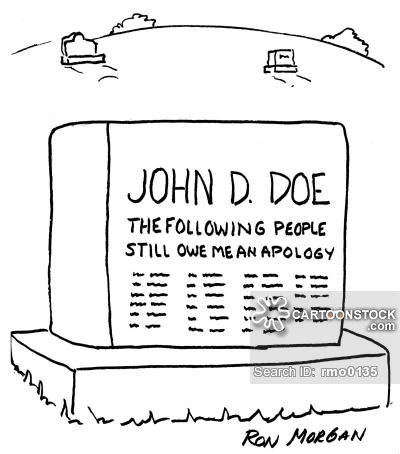
If your name were really John Doe, would you care to be identified as “the unidentified person’s name”?  Or “J-hn D-e”? Or “Mister” or “M-st-r”?  Or “m-n”?


This borders on the ridiculous, after all who is John Doe? He’s not God, there is no restriction to use or spell his name as it was on his birth certificate, who cares how anybody addresses him?  


Well, John Doe should care, and his parents Mr. and Mrs. Doe who named him.  It’s bad enough that he has to share the same name with heaven-knows-how-many John Does there are in the world, perhaps none at all; all the more reason to use his name John Doe, since it has been borrowed or made up and widely used to name any and all unidentified persons . . . well at least in the USA.  Will the real John Doe please stand up?


I

Image from www.cartoonstock.com

Image from www.cartoonstock.com

If man is prone to slapping a name such as “John Doe” on any unidentified person, he is just as prone to assigning a name to imagined deities as well as the All-Existent One True God.  Man simply has a knack for assigning names, since Adam was given the privilege and responsibility of naming all living things. That has been extended to all created things, animate or inanimate, to thought systems, philosophies, etc., out of necessity for the sake of order, systematization, clarification, differentiation, categorization.  We live in a world where NAME matters!


OK, OK,  point made,  you know where this preface is leading to!  


If the Creator God of our incredible universe and other worlds beyond wanted to leave mankind ignorant of—

  • His existence,
  • His character,
  • His attributes,
  • His Way,
  • His acts in history,


—-and leave man guessing about

  • who He is,
  • what is He like,
  • what is His Name if He has one . . .

—can He blame man for not knowing His Name?   


Can He blame man for resorting to different names in their sincere effort to identify Him?


But why leave man in ignorance?

  •  Isn’t the knowledge of GOOD something God would want humanity know?  
  • And isn’t the ultimate GOOD God Himself?  
  • Is it not important for the True God to be known for everything He has done for humanity?  
  • Should He not care enough to make sure man does not attribute this created world and all its wonders to someone else other than to Him the Creator?  


Will the One True God please come forward!


The true gospel is that God has already done so; it is all recorded in the Sinai account Exodus 3-6 and reiterated over and over throughout the TNK.


Image from www.coolchaser.com

Image from www.coolchaser.com

Fortunately for us, there is a movement springing from within Christianity that has trailblazed the research as well as the restoration of the Sacred Name.  We agree with them on the need to declare the True God’s Name —YHWH.  


Hereunder are excerpts from the first part of their presentation, focused only on the Name of the God of Israel.  They continue on to explaining the Hebrew name of Jesus; that part, understandably, we will not include here but for those who are interested, please go to this link:    revelations.org.za/NotesS-Name.htm.   


NSB@S6K


logo


—————————————————–


A “Bible Revelations” Presentation –   Created 1998,  updated 16 May 2010


RESTORATION  OF  THE SACRED NAME


Why were the Sacred Names removed from the Scriptures? – 7000 times in the Old Testament and 1000 times in the New Testament? The Restoration  thereof is flooding the world – You can share in it also!

Introduction

The use of the Sacred Name by Commentators, preachers and in special Sacred Name Bible publications, have been rapidly increasing over the last few decades. So intensive has this increase of knowledge been, that the use of the Hebrew or Jewish Names of The Most High and the Messiah, have become almost common domain in religious education and institutions and amongst dedicated worshippers.

According to Jewish Orthodox tradition, the Sacred Name is not to be uttered and accordingly, the form “G-d ” is used in writing or printing.  In place of pronouncing the Sacred Name in prayer, worship and discussion, the form “Adonai”  (the Hebrew for  ‘Lord’)  is used.


  • With due respect to our Jewish readers and to the Almighty, we teach,  use and print the Sacred Name for the following reasons, which we feel do override all other considerations:
    • To identify and accordingly exalt the bearer of this Name as the PERSONAL God of Israel and of the universe, as opposed to the general interpretation of a rather mystical, almost unidentifiable Being, as held by most religions.
    • To proclaim and make known this Name unto the masses of believers who claim to follow Him but know not His Name – so that they may sanctify and praise His name that His Name may be honoured among the nations (Malachi 1:11; Isaiah 12:4).
    • To conform with what may really be the more correctly interpreted  instruction of Exod. 20:7 concerning the use of His Name:  viz.  “Do not make His Name worthless”  “Lo tisah et Shem YHVH Eloheicha l’shav.”  By withholding the proclamation of His Name, we may well be guilty of “making His Name worthless.” For a more comprehensive overview of this interpretation and the topic in general, please refer to the study: Should we refrain from using the Sacred Name of God as Judaism insists?
    • The Torah and Tanach (‘Old’ Testament) clearly records how Hebraic Patriarchs and Prophets actually proclaimed and pronounced the Sacred Name as a Testimony to non-Jews and non-believers and how His followers will come to know His Name and call upon Him, using this Name!  Please refer to:  Should we refrain from using the Sacred Name of God?
  • The Bible in many places presents an explicit and clear Divine Mandate for stressing and publishing proper knowledge of His name.  Here are two such  instances:


Jeremiah 33:2  “YHVH Who made the earth, Who formed it and set it firm – YHVH is His Name – says this:  ‘Call to Me and I will answer you …'”
Isaiah 12:4  “Give thanks to YHVH – call His Name aloud.  Proclaim His deeds to the nations, declare His Name sublime.  Sing of YHVH, for He has done marvelous things – let it be known to the whole world!”.


  • YAH or YAHU

The ‘Personal’ Name of the ‘God of Israel’ by which He anciently revealed Himself to Moses ( 6:2).  ‘YAH’ is spelt in original Hebrew, with the 10th letter of the Hebrew alphabet – the ‘yood’, smallest letter in the alphabet, represented by the inverted comma ( ‘ ). YAHU also has the meaning of  ‘He is YAH’


  • Obscure Preservation of the Sacred Name ‘YAHU’

Hebrew personal names have meanings, and many such personal names have throughout time, been linked to the Sacred Name YAHU.  In this obscure way, the Sacred Name YAHU has been preserved for modern times, notwithstanding the fact that it has been almost totally removed from most Bible Translations.


This Name, through recent archeological discoveries in Israel, has been found to be part of more Hebrew words and names than were formerly known. There is an untold number of usages in the Tanach (‘Old Testament’) where this form of the Sacred Name is used as a conjunction in Biblical names.  Some of the more common examples of these are:


EliYahu (‘Elijah’)

YeremiYahu (‘Jeremiah’)

YeshiYahu (‘Isaiah’)

YahuShafat (‘Josephat’)

In each of the examples above, the meanings of these names refer to the Name of the Most High, eg.YAHU is Strength, my God is YAHU, etc

Similarly, the Tribe of Judah, the progeny of which to this day, still represents the original Hebraic Faith instituted by Moses according to the Divine Mandate which was handed to him personally by YAHU, God of Israel, some 4000 years ago.  All the disasters of Time failed to wipe out the Tribe of Judah, which today is known as ‘the Jews’ –  in Hebrew: Yahudim. The Tribe of Judah, in Hebrew is‘Yahuda’, a Jew is ‘Yahudi‘. While no specific Hebrew meaning is attached to this term in the modern usage, we do find the following meanings as applied to obscure Bible characters with similar names:

‘YahuAdah’ (YAH unveils) 1 Chron. 8:36
‘YahuYadah’ (YAH knows) 2 Samuel 8:18, etc


  • THE TETRAGRAMMATON

The Sacred Name appears in the Hebrew Scriptures as four Hebrew letters Yud,  hey, vav, hey, which is closest represented by the letters YHVH.  This format is  known as the Tetragrammaton.  According to Jewish tradition it is regarded as ‘not to be uttered’ in order never to profane it in any way.  In Judaism it is therefore pronounced as ‘Adonai’, meaning ‘Lord’. Notwithstanding this prohibition, the Sacred Name is acknowledged in its usage as part of the names of many Biblical characters, as referred to above – and as any Bible concordance or reference book will provide.


Because of these prohibitions, translations of the original Hebrew scrolls have, throughout the ages, replaced the Tetragrammaton with ‘the LORD’ (in capital letters) and the Sacred Name, in so doing, became ‘lost’ for many centuries.


Since the sixties, there has been a movement in modern theology and especially amongst sincere Bible students throughout the world, to restore the newly ‘rediscovered’ Sacred Hebrew Name.  Sacred Name publications which chose to restore the Sacred Name in the almost 7000 instances in the Bible, appeared one after the other and the ‘Sacred Name Movement’, towards the nineties and the turn of the millennium, became a flood which today literally engulfs the world…


Although there is no firm consensus on the actual pronouncement or spelling of the Tetragrammaton YHVH,  there are several representations or transliterations in use by theologians and Bible students.  Some of the more popular forms are YAHVEH, YAHWEH and Jehovah. A comprehensive list of the various usages that abound, are presented further down on this page.


For the purposes of this Web Site and out of respect for the Sacredness and sanctification of the Name, we will print the Tetragammaton form YHVH throughout the studies of this Web Site and leave the reader free to either substitute it or pronounce it in the way they find comfortable.


The mystery attached to the Name of the Almighty, is related to the verb ‘to be’ ( I am, I was, I will be) which is the Hebrew verb ‘Hoveh’  (the ‘v’ pronounced as in ‘victory’),  meaning “to be”, in the present tense.  YHVH therefore, means: “YAH Hoveh”, which means  “YAH is …” (YAH being His abbreviated (actual ?) name as reflected in Psalm 68:4 in some translations.

It is therefore quite possible that the correct rendering of the SH’MAH (the Greatest Commandment – Deut 6:4) should therefore read:

SHMAAYISRAELYAHHOVEHELOHEINUYAHHOVEHECHAD
HEARISRAELYAH ISOUR GODYAHISONE

Source:  http://www.biblicalhebrew.com/links.htmechad YHVH Eloheinu    

In modern Hebrew grammar this matter is so serious and important, that the verb ‘to be’ (‘I am’) is not used in the present tense at all!  An Israeli will therefore state in Hebrew:  “I teacher … I clever”, omitting the verb ‘to be’ (I am) in the present tense.  Usage of the Hebrew verb ‘HOVEH’ (I am) would imply referring to oneself as being the Almighty!  This gives reason for serious contemplation.  The Almighty “is” everything good, without question. The human being, being exactly the opposite, is so easily inclined to self exaltation and self praise (often hidden under a false pretence of humility, love, care, etc.). The use of “I” and “I am” in the vocabulary of the proud and arrogant individual is a popular practice. The indwelling Spirit of the Almighty in the heart and soul of the believer, changes this selfish, haughty, deceiving attitude to an attitude of genuine humility, recreated in His Image, as the Almighty requires of us to possess. Volumes could be written on this subject.


 IAmYahweh-1

Deuteronomy/Davarim 22: "There is not to be a man's item on a woman, a man is not to clothe himself in the garment of a woman, for an abomination to YHVH your God is anyone doing these!"

Image from www.zazzle.ca

[First posted November 11, 2013. 


A national God who regulates every aspect of His chosen people’s life—that is the God of Israel.


Imagine including in the No-No’s such practices as transgender dressing, interweaving two different thread sources, sowing different seed species, and the like.


 In the case of ‘transgender dressing’, most likely it is not the ‘dress’ that is being regulated but transgender preference that is the issue.  What we see today in sexuality is not new, it is as old as biblical times; human nature has not changed much since; what has changed is tolerance or acceptability of individual ‘differences’.


 ‘Second nature’ which is a choice more than an inherited nature, has replaced ‘First Nature’ which is God’s original design.  Just look at what works naturally vis-a-vis this artificial and unnatural world that humankind has recreated, thinking it could improve further on the Creator’s original, how presumptuous indeed!  Surely the all-wise Creator knows what of He speaks but unfortunately, man thinks he knows better and continues to ignore or violate all these rules; after all, the thinking is — ‘it’s so antiquated, it’s passé and obsolete, for Israelites only and not for us.’  And so we reap the consequences of ignorance or violation of the Law-Giver’s Torah.  Just look at the world today—-is there true joy, contentment, peace, justice in the world despite the giant leaps in terms of advances in almost every area of learning, particularly science and technology? 


Commentary here is from the best of Jewish minds as collected in one resource book by Dr. J.H. Hertz, Pentateuch and Haftorahs; our translation of choice is EF/Everett Fox, The Five Books of Moses..Admin1.]


——————————————–


Deuteronomy/Davarim 22


1-3. RESTORING LOST PROPERTY

We have in these three verses a repetition of the law in Exod. XXIII,4,5, regarding our duty of restoring the strayed ox or ass, and of the lifting up of the fallen beast of burden.  The law is here widened to include other lost articles that require restoration to their owners.  Exodus speaks of the things belonging to ‘thine enemy’; here the wider term,’ thy brother,’ is used.  Whether thy neighbour be thy brother or enemy, his property must be protected and restored.


1 You are not to see the ox of your brother or his sheep wandering-away 

and hide yourself from them; 

you are to return, yes, return them to your brother.


ox . . . sheep. These names are typical, and the law applies to all domestic animals alike.

hide thyself from them. Fail to notice them or trouble about them, saying, ‘It is no concern of mine.’


2 Now if your brother not be near to you

or you do not know him,

you are to bring it into the midst of your house,

it is to be-there with you until your brother makes-inquiry about it,

then you are to return it to him.


restore it. Failure to do is accounted theft, and punished with a fine one-fifth over and above the value, if denied on oath; Lev. V,20-24 (Chap. VI,1-5 in English Bible).


3 Thus you are to do with his donkey, 

thus you are to do with his garment,

thus you are to do with anything lost of your brother, that is lost by him, and you find it:

you are not allowed to hide yourself.


4. ASSISTING TO LIFT FALLEN BEASTS


4 You are not to see the donkey of your brother, or his ox, fallen by the wayside, 

and hide yourself from them; 

you are to raise, yes, raise it up (together) with him.


help him. lit. ‘help with him’; i.e. in company with the owner.  The owner must not stand by idle and leave the work to others.  A Chassidic Rabbi lamented that this law was little observed, and he devoted himself to its fulfillment.  He was continually to be seen in the streets, helping one man to load his wagon, another to drag his cart out of the mire.

(c) MISCELLANEOUS LAWS

FIRST GROUP

5.  DISTINCTION OF SEX IN APPAREL


5 There is not to be a man’s item on a woman, 

a man is not to clothe himself in the garment of a woman,

for an abomination to YHVH your God is anyone doing these!


An interchange of attire between man and woman would promote immodesty and, in consequence, immorality.  This law is probably directed against rites in Syrian heathenism, which included exchange of garments by sexes and led to gross impurities.

6-7. SPARING THE MOTHER BIRD

The ground sympathy here is the sacredness of the parental relationship.  The mother-bird is sacred as a mother; and length of days is promised to those who regard the sanctity of motherhood in this sphere, as it is promised to those who observe the Fifth Commandment.  ‘When the mother is sent away, she does not see the taking of her young ones, and does not feel any pain.  The eggs over which the bird sits, and the brood that are in need of the mother, are generally unfit for food.  Consequently, this commandment will cause man to leave the whole nest untouched.  The Torah provides that such grief should not be caused to cattle (Lev. XXII,28) or birds; how much more careful must we be that we should not cause grief to our fellowmen’ (Maimonides); see XXV,4.

[EF]  Mixed Clothing (22:5): This prohibition touches on a frequent theme in Leviticus: the improper mixing of categories.


Image from www.bible-archaeology.info

6 When you encounter the nest of a bird before you in the way, 

in any tree or on the ground, 

(whether) fledglings or eggs, 

with the mother crouching upon the fledglings or upon the eggs, 

you are not to take away the mother along with the children.
7 Send-free, send-free the mother,

but the children you may take for yourself, 

in order that it may go-well with you and you may prolong (your) days.


prolong thy days. Rabbi Akiba, referring to this promise of long life, supposes the case of a man who climbs a tower and takes the young from the nest, sparing the mother bird in accordance with this commandment.  But on his way down, he falls and dies. To the question, ‘Where is the well-being and prolonging of days in this case?’ Akiba answers, ‘In the Life to Come, where all goes well and all is abiding.’

8. PARAPETS TO HOUSE ROOFS

As the houses in all Eastern countries possessed flat roofs, which were used for walking, sleeping, and other domestic purposes, it was necessary to erect a parapet to prevent accidental falling off.  According to the Rabbis, the parapet was to be at least two cubits high.

[EF]  Mother Bird and Child Bird (22:6-7): Another indicator of the humane concerns of Deuteronomy. There is an obvious parallel between the language here and that of the Fifth Commandment (honoring parents): “prolonging days” and “going-well” as a result of following these laws.


8 When you build a new house, 

you are to make a parapet for your roof,

that you not put blood-guilt on your house

if someone-falling falls from it.

blood. Blood-guiltiness; failure to protect human life exposes the builder, owner, or resident of the house to blood-guiltiness in the eyes of God.  The Rabbis extended this prohibition to cover all cases where danger to life exists through our negligence; such as keeping a dangerous dog, or placing a broken ladder against a wall.

9.  AGAINST MIXING SEEDS

This law–as well as the two laws following it against ploughing with an ox and an ass together, and the wearing of a garment composed of a mixture of wool and linen—is based on the idea that God has made distinctions in the natural world which it is wrong for man to obliterate by processes of intermixing; see on Lev. XIX,19.

[EF]  The Safe Roof (22:8): Deuteronomy, with its concern human life, prevents the shedding of innocent blood once again.


9 You are not to sow your vineyard with two-kinds,

lest you forfeit-as-holy the full-yield from the seed that you sow, and the produce of the vineyard.


two kinds. Heb. kilayim, mutually exclusive kinds.

forfeited. let. ‘to become consecrated’; the resultant crop would have to be consigned to the flames.  The man would lose both his grapes and his other crop, as a penalty for his irreligious act.

10.  YOKING AN OX AND AN ASS


10 You are not to plow with an ox and a donkey together.


ox and an ass.  They differ greatly in their nature, in size, and strength; it is, therefore, cruel to the weaker animal to yoke them together.

11.  SHAATNES


11 You are not to clothe yourself (in) shaatnez, 

wool and flax together.


mingled stuff. The etymology and meaning of this word are both uncertain.  Some derive it from the Egyptian. The reason underlying the prohibition may possibly be the same as that against mixing seeds, v. 9.  The Rabbis class it with the prohibition of swine’s flesh and other chukkim, which provoke the ridicule of scoffers, Jewish and non-Jewish, but which the loyal Israelite nevertheless willingly obeys, because they are the commands of his Father Who is in Heaven.

12.  TZITZIS

[EF] More Forbidden Mixtures (22:9-11): AS Greenstein (1984a) explains, hybrids in various areas were understood as appropriate only for God (or, in the case of clothing, the priests).


12 Twisted-cords you are to make yourself 

on the four corners of your tunic-covering with which you cover yourself.


twisted cords.  Heb. gedilim; lit. ‘twisted threads’ identified by the Rabbis with the tzitzis in Num. XV,37-41.  Among all peoples, knots have been used as reminders and symbols.  The tzitzis  are a constant reminder of the special relationship in which the Israelite stands to God and the consequent duty of withstanding temptation to sin.  There is a well-known Talmudic story of a reprobate and riotous liver who was recalled to his better self by the tzitzis he wore, so as to break completely with his wicked past.

(9) HOLINESS OF MARRIAGE

13-21. CHARGES AGAINST A BRIDE

He who falsely accuses his wife of unchastity during betrothal shall be rebuked, fined, and he loses the right ever to divorce her.  However, if such charge be true, it is a case of capital punishment.  Betrothal in Bible times united the bridal couple as husband and wife for all purposes, save living together; and any infidelity on the part of the wife was considered adultery; see v. 22.  ‘In considering these plain-spoken laws (v. 13-21), it is just to remember that they represent an upward stage in the struggle against the animal passions of men.  That we do not need some of them today is due to the fact that their enforcement under religious sanction was needed at the time of their origin.  It is only ignorance or ingratitude which can cavil at their spirit or their form’ (G.A. Smith).

[EF]  Fringes (22:12): Paralleling Num. 15:37-41- but this time with no rationale. In Numbers, the “tassels” were to serve as a constant reminder of the divine commandments.


13 When a man takes a woman (in marriage) 

and comes in to her, and (then) hates her,


and hate her. The man had entered on marriage merely for the satisfaction of his passions, and then turned against his wife by a revulsion of feeling frequent in such characters (Bertholet); see on XXI,14 and II Sam. XIII,15.

[EF]  The “Damaged” Wife (22:13-21): A law that alternately upholds a woman’s dignity (making her husband pay f he has baselessly accused her) and may lead to taking her life (if the accusation is true). In the former case, they must remain married, and the husband has no possibility of divorcing her.

        Virginity for women at marriage was an important value in ancient Israel as elsewhere. Frymer-Kensky (1992a) notes that this case parallels the one of the rebellious son above: the prints’ stars and welfare is jeopardized; the parents can bring about the child’s death; and the elders have the authority to make a ruling, while the public has the power to put the offender to death.


14 and puts on her capricious charges, 

 giving out against her an evil name,

 and says:

 This woman I took-in-marriage

 and came near her,

 but I did not find in her signs-of-virginity:

Image from www.womeninthebible.net

15 the father of the girl and her mother are to take her

and bring out the signs-of-virginity of the girl to the elders of the town, to the gate.


the tokens. Such evidence was regarded as essential by many ancient races, though the absence of those tokens is by no means conclusive of guilt.  Some of the Rabbis, therefore, took the phrase concerning the tokens as a metaphorical expression for clearly establishing the falsity of his charge by witnesses and expert evidence.


16 Then the father of the girl is to say to the elders:

I gave my daughter to this man as a wife, and he came-to-hate-her.
17 Now here: he has put out capricious charges, 

saying:

I did not find in your daughter signs-of-virginity;

but these are the signs-of-virginity of my daughter!

He is to spread out the garment before the presence of the elders of the town;
18 then the elders of that town are to take the man and discipline him.


chastise him. Inflict the corporal punishment, ‘thirty-nine stripes’ upon him (Talmud).


19 They are to fine him a hundred units-of-silver, 

and are to give (it) to the father of the girl- 

for he gave out an evil name

upon a virgin of Israel.

His she is to remain as a wife, he is not allowed to send her away all his days.


a hundred shekels.  Nominally £13 15s ; then the equivalent of a far greater sum.

unto the father.  Whose family name had been defamed.  ‘If the damsel is an orphan, the fine goes to her’ (Talmud).

put her away. Divorce her.


20 But if this matter was true 

-there were not found signs-of-virginity on the girl-


this thing. The charge, see on v. 15.

be true. And—add the Rabbis—if at the time she had been warned by witnesses of the serious consequences of her conduct.


21 they are to bring out the girl to the entrance of her father’s house 

and are to stone her, the men of her town, with stones 

so that she dies,

for she has done a disgrace in Israel

by playing-the-whore in her father’s house.

So you shall burn out the evil from your midst!


to the door of her father’s house. Not at the city gate, because it was her father’s house, which he had dishonoured.

wanton deed. Or, ‘folly’ (AV). Heb. nevalah. The Heb. word does not indicate weakness of reason, but a rooted incapacity to discern moral and religious relations, leading to an intolerant repudiation in practice of the claims which they impose’ (Driver).

wanton deed in Israel. Or, ‘folly against Israel’.  Her action is an offence against the national standard, a crime against the national conscience.  ‘She did not merely degrade herself, but every virgin in Israel’ (Sifri).

22.  ADULTERY

[EF]  Adultery (22:22): The definition used here is the classic biblical one: a married woman and a man, married or not. In Mesopotamia it was possible to pay off the aggrieved husband, but not in ancient Israel, where adultery was seen as attacking the moral foundations of society and perhaps also the symbolism of the close relationship between God and Israel.


22 When there is found a man lying with a woman espoused to a spouse,

they are to die, the two-of-them,

the man who lies with the woman and the woman.

So you shall burn out the evil from Israel!


both of them die. The man as well as the woman; Lev. XX,10.  There is to be no double standard of conjugal morality in Israel.

As in the case of all capital offences, the Rabbis required that the guilty parties be warned of the seriousness of their proposed action.  Without such warning (hathraah), the death penalty could not be carried out.  Furthermore, the law of evidence in capital offences and the proof of premeditation were made so severe that a death verdict was almost impossible.  R. Tarphon and R. Akiba said, ‘If we had been in the Sanhedrin, a man would never have been executed by it.’  A few lines before it is stated, ‘A Sanhedrin that executes a person once in seven years is called destructive.’ R. Eleazar ben Azaryah says, ‘One in seventy years.’


23 When there is a girl, a virgin, spoken-for to a man,

and a(nother) man finds her in the town, and lies with her,


23-27. A BETROTHED VIRGIN

[EF]  Raper-or Not (22:23-27): In this case a woman is all but married, yet a distinction is made between an urban and a rural setting in terms of her fate. Note that her consent is not an issue here; as a betrothed woman, she had no right to give it (Frymer-Kensky 1992a).

Rape of an Unattached Woman (22:28-29): The difference here, of course, is that the woman does not “belong” to a man. The rape must result in marriage, but since no husband’s privilege has been violated, the crime is neither a capital one nor even a criminal one. It is, however, seen as a “disgrace” (see Gen. 34:7).


24 you are to take-out both of them to the gate of that town 

and are to stone them with stones

so that they die 

-the girl because she did not cry out in the town 

and the man because he humbled the wife of his neighbor.

So you shall burn out the evil from your midst!
25 But if (it is) in the field the man finds the spoken-for girl 

and the man strongly-seizes her and lay with her, 

then he is to die, the man who lay with her, he alone.
26 But to the girl you are not to do anything,

the girl did not (incur) sin (deserving) of death, 

for just as (the case of) the man who rises up against his neighbor and murders his life, 

so is this matter:


no sin.  Where there is compulsion, force majeure, there is no sin, or any of the legal consequences of sin.


27 for in the open-field he found her; 

when the spoken-for girl cried out,

there was no deliverer for her.


cried. The woman is given the benefit of the doubt (Rashbam, Sforno).  A similar provision, with similar phrasing, is found in the newly-discovered Hittite Law, going back to the year 1350 B.C.E.  It seems, therefore, that in the laws concerning rape we have the Common Law of the more advanced Semitic nations, just as we have seen in the Code of Hammurabi parallels to the Civil Legislation in Exodus.


28 When a man finds a girl, a virgin who has never been spoken-for,

and seizes her and lies with her, and they are found:


28-29.  A VIRGIN NOT BETROTHED

The man must pay the ‘bride-price’ and marry her, without right of divorce.


29 the man who lies with her is to give to the father of the girl fifty units-of-silver;

his shall she be, as a wife,

because he has humbled her;

he is not allowed to send her away, all his days.

 

Am I my brother's keeper?

Image from www.victorianweb.org

Image from www.victorianweb.org

[This was first posted on April 22, 2012; reposted August 19, 2014. Revisiting on the occasion of the birth anniversary of the author’s brother who was brutally murdered by 7 strangers who by this time, have served their jail time of 17 years and are out on parole.  His family’s unresolved question: has justice  truly been served?  


Check out: 

 Translations:  AST/ArtScroll Tanach; EF/Everett Fox The Five Books of Moses.—Admin1.]


——————————


Poor Cain, the firstborn of Adam and Eve.  


  • Was he the first victim of his parents’ “original sin”?
  • Did he have a choice to be different from the way he turned out, the first fratricide?
  • Does “original sin” really make all descendants of the first parents hopelessly unable to rise above their inherited fallen nature?
  • Are all mankind predestined to damnation?  
  • If that is so, then why was Abel “commended righteous”? 
  • And Seth, to whose good lineage some key biblical figures like Noah are traced? 


Upon revisiting Kayin/Cain, this time without the taint of inherited “original sin” in the picture, a few things emerge.  


For one, Cain was a tiller of the soil while Abel was a keeper of flock.  Which occupation would you think is the more difficult one?


Remember the curse upon Adam: 

Genesis/Bereshith 3:17-19  

To Adam he said;  

Because you have hearkened to the voice of your wife and have eaten from the tree about which I commanded you, saying:  

You are not to eat from it!  

Damned be the soil on your account,

with painstaking-labor shall you eat from it, all the day of your life.  

18  Thorn and sting-shrub let it spring up for you,

when you (seek to) eat the plants of the field!  

19  By the sweat of your brow shall you eat bread,

until you return to the soil,

for from it you were taken.  

For you are dust, and to dust shall you return.


Image from wwyeshua.wordpress.com

Image from wwyeshua.wordpress.com

In effect, for Kayin/Cain to make an offering out of the sweat of his brow, he would have to till the ground, plant, wait for crops to grow, harvest, and bring the fruits of his hard labor as an offering to God. That’s a lot of backbreaking work compared to the idyllic pastoral setting for a shepherd like Hevel/Abel who probably had it easy while on the job—he could rest a lot, play the flute, write psalms, while his flock is in pasture. Poor-sighted sheep [or so we are told] have keen ears that recognize the call of only their shepherd; Hevel/Abel just has to lead the way like the Pied Piper and the flock follows.  At least that’s the image in our minds when we read Psalm 23.  


The Christian teaching on Cain and Abel emphasizes the acceptability of Abel’s offering:


“By faith Abel offered to God a more acceptable sacrifice than Cain, through which he was commended as righteous, God commending him by accepting his gifts.  And through his faith, though he died, he still speaks.”[Hebrews 11:4].  

The word “sacrifice” is used in the NT book of Hebrews because it fits the whole teaching on the shedding of blood for the forgiveness of sins.  


In the Hebrew (not Christian) translation however, another word is used:   


[AST] 3  In the course of time, Cain brought an offering to HASHEM of the fruit of the ground; 5 and as for Abel, he also brought of the firstlings of his flock and from their choicest.  HASHEM turned to Abel and to his offering, 5 but to Cain and to his offering He did not turn.  This annoyed Cain exceedingly, and his countenance fell.


And for one more rendering:


[ET] 3 Now it was, after the passing of days

that Kayin brought, from the fruit of the soil, a gift to YHWH,

4 and as for Hevel, he too brought—from the firstborn of his flock, form their fat-parts.  

YHWH had regard for Hevel and his gift,

5  for Kayin and his gift he had no regard.

 Kayin became exceedingly upset and his face fell.

Image from wwyeshua.wordpress.com

A “sacrifice” suggests having to comply with an actual or imagined divine demand., including the act of slaughtering an animal.  An “offering” suggests simply surrendering a possession, just like giving a ‘gift’. In the prescribed offerings at the Temple, bloodless offerings were allowed such as flour and oil, monetary equivalent such as the shekel:


Leviticus/Waiyqrah 5:11-16


[AST] 11 But if his means are insufficient for  two turtledoves or for two young doves then he shall bring, as his guilt-offering for that which he sinned, a tenth-ephah of fine flour for a sin-offering; he shall not place oil on it nor shall he put frankincense on it, for it is a sin-offering.  12  He shall bring it to the Kohen, and the Kohen shall scoop from it his freefingersful as its memorial portion and cause it to go up in smoke on the Altar, on the fires of HASHEM; it is a sin-offering.  13  The Kohen shall provide him atonement for the sin that he committed regarding any of these, and it will be forgiven him; and it shall belong to the Kohen, like the meal offering.  14  HASHEM spoke to Moses, saying:  15  If a person commits treachery and sins unintentionally against HASHEM’s holies, he shall bring his guilt-offering to HASHEM, an unblemished ram from the flock, with a value of silver shekels, acording to the sacred shekel, for a guilt-offering.  16  For what he has deprived the Sanctuary he shall make restitution, and add a fifth to it, and give it to the Kohen; then the Kohen shall provide him atonement with the ram of the guilt-offering an it shall be forgiven him.


[EF]  11  Now if his hand cannot reach two turtledoves or two young pigeons,

he is to bring as his near-offering (for) what he sinned a tenth of an efa or flour, for a hattat-offering;

he hs not to put on it (any) oil, he is ot to place on it (any) frankincense,

for it is a hattat-offering.  

12  He is to bring it to the priest,

the priest is to scoop out with his fist a fistful of some of it, as a reminder-portion,

and is to turn it into smoke on the slaughter-site, along with the fire-offerings of YHWH,

it is a hattat-offering.  

13  So the priest is to effect-purgation for him for his sin whereby he sinned, in (any) one of these,

and he shall be granted-pardon.  

And it shall be for the priest, like the grain-gift.  

14  YHWH spoke to Moshe, saying:  

15  A person-when he breaks-faith, yes, faith, sinning in error regarding any of the holy-things of YHWH,

he is to bring as his asham/penalty to YHWH:  a ram, wholly-sound, from the flock,

by your assessment in silver shekels by the Holy Shrine shekel, as an asham.  

16  For that whereby he sinned regarding the holy-things, he is to pay, and its fifth he is to add to it, giving it tot he priest;

then the priest is to effect purgation on his behalf with the ram of asham,

and he shall be granted-pardon.


[There are many other similar verses in Exodus, Leviticus and Numbers].


 What was wrong with Cain’s offering was not that it was bloodless. Although the text does not specify, perhaps it simply was not the best of his produce and in addition, his attitude was not right. But if Cain had worked so hard compared to Abel, would he not be justified in feeling dejected?  Of course he could learn from God’s favorable reaction toward Abel’s offering. He could resolve to do better next time, offer only the choicest of his crops. He had a choice to react properly. 


Did God immediately condemn Cain?  On the contrary, just as God issued warnings to Adam and Eve before they chose to disobey, He teaches Cain just like a caring father would.   


Genesis/Bereshith 4:6-7 

[AST]  Why are you annoyed, and why has your countenance fallen?  7 Surely, if you improve yourself, you will be forgiven.  But if you do not improve yourself, sin rests at the door.  Its desire is toward you yet you can conquer it.


[EF]  YHWH said to Kayin:  

Why are you so upset?  Why has your face fallen? 

7  Is it not thus:  If you intend good, bear-it-aloft,

but if you do not intend good, at the entrance is sin, a crouching-demon,

toward you his lust—

but you can rule over him.


Image from www.heartlight.org

Image from www.heartlight.org


Imagine, God Himself says to Cain that he has the ability to rule over sin when Cain had not yet sinned.  Does that sound like Cain was doomed to commit sin because of a fallen nature he had nothing to do with and simply inherited? Cain has free will and can make a choice between doing right and not doing right. Unfortunately, Cain makes the wrong choice: 


Genesis/Bereshith 4 :8-14 

[AST]  8  Cain spoke with his brother Abel. And it happened when they were in the field, that Cain rose up against his brother Abel and killed him.  
9  HASHEM said to Cain, “Where is Abel your brother?”  And he said, “I do not know.  Am I my brother’s keeper?”
10  Then He said, “What have you done? The voice of your brother’s blood cries out to Me from the ground! 11 Therefore you are cursed more than the ground, which opened wide its mouth to receive your brother’s blood from your hand. 12  When you work the ground, ti shall no longer yield its strength to you.  You shall become a vagrant and a wanderer on earth.”  
13  Cain said to HASHEM, “Is my iniquity too great to be borne? 14  Behold, You have banished me this day from the face of the earth—can I be hidden from Your presence?  I must become a vagrant and a wanderer on earth; whoever meets me will kill me!”
 

[EF]  8  Kayin said to Hevel his brother . . .

But then it was, when they were out in the field

that Kayin rose up against Hevel his brother

and he killed him.  

9  YHWH said to Kayin:  

Where is Hevel your brother?  

He said:

 I do not know.  Am I the watcher of my brother?  

10  He said:  

What have you done!  

A sound—your brother’s blood cries out to me from the soil!  

11 And now,

damned be you from the soil,

which opened up its mouth to receive your brother’s blood from your hand.  

12  When you wish to work the soil

it will not henceforth give its strength to you;

wavering an wandering must you be on earth!  

13  Kayin said to YHWH:  

My iniquity is too great to be borne!  

14  Here, you drive me away today from the face of the soil,

and from your face must I conceal myself,

I must be wavering and wandering on earth–

now it willl be that whoever comes upon me will kill me!


God ‘s merciful response to Cain goes as far as protecting him from harm:  


4:15-16

[AST] 15. HASHEM said to him, “Therefore, whoever slays Cain, before seven generations have passed he will be punished.” And HASHEM placed a mark on Cain, so that none that meet him will kill him.  16  Cain left the presence of HASHEM and settled in the land of Nod, east of Eden.


[EF] 15 YHWH said to him:  

No, therefore, whoever kills Kayin, sevenfold will it be avenged!  

So YHWH set a sign for Kayin,

so that whoever came upon him would not strike him down,

16 Kayin went out from the face of YHWH

and settled in the land of Nod/Wandering, east of Eden.


Why did God spare Cain’s life? Is not the taking of a human life condemnable, and most specially when the victim is one’s own blood-brother?   Perhaps it is because the 6th commandment had not yet been given as law. Mankind had yet to be taught right from wrong; Torah had yet to be given as the standard that would govern man’s relationship toward man.


Poor Cain might not have been told that he was indeed his brother’s keeper or, if he was told, he did not listen, or if he did, he did not heed. 


So . . . yes Cain, to answer the question “Am I my brother’s keeper?”  Torah is much about being that to one’s kin, the neighbor, the stranger, and specially the underprivileged in society.  


NSB@S6K

 logo

Numbers/Bamidbar 21: The Brazen Serpent: " it shall be: whoever has been bitten and then sees it, will live."

[This was first posted October 12, 2013.  —Admin1].


———————


Sinaites’ first exposure to the “bronze serpent” was guess where? The New Testament gospel of John whose opening line echoes Genesis/Bereshith . . . “in the beginning”.


Image from www.the-big-picture.org.uk

Image from www.the-big-picture.org.uk

The Word Became Flesh/ John 1:1-5 (NIV)


In the beginning was the Word, and the Word was with God, and the Word was God.

 He was with God in the beginning. 

Through him all things were made; without him nothing was made that has been made. 

In him was life, and that life was the light of all mankind. 

The light shines in the darkness, and the darkness has not overcome it.


Image from www.preservedwords.com

Image from www.preservedwords.com

With these NT verses  placing the “Word,” the “Logos,” or the Christian Man-God Jesus as Creator God himself,  it was logical to make the next series of connections, in this case, the brazen serpent:


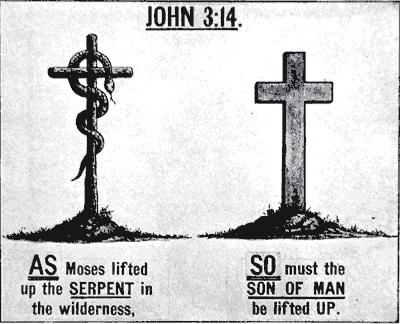
 NIV/John 3:14-15And as Moses lifted up the serpent in the wilderness, even so must the Son of Man be lifted up, that whoever believes in Him should not perish but have eternal life.  


In this website, in case you haven’t noticed, we print NT verses in RED to alert readers to read with caution for good reason. The New Testament added the Old not only as a prequel suggesting OT prophecy and NT fulfilment, but also to lend validity to its claims about its Son-God who assumes many roles, all metaphorically connected with figures, incidents, events, even the Tabernacle in the wilderness, as well as the very God of the Hebrew Scriptures.  To visualize the connection, Christian  illustrations of this incident shapes the ‘pole’ into a cross with the brazen serpent hanging on it.


The above-quoted NT verse is in fact the lead-in to a major memory verse that summarizes Christianity’s “good news of salvation in Jesus Christ”:  


v. 16-18 For God so loved the world that He gave His only begotten Son, that whoever believes in Him should not perish but have everlasting life. For God did not send His son into the world to condemn the world, but that the world through Him might be saved. He who believes in Him is not condemned; but he who does not believe is condemned already, because he has not believed in the name of the only begotten Son of God. 

Image from biblenews1.com


As Christians/Messianics, we knew only of this NT re-interpretation and would refer back to the OT book of  Numbers to prove there is indeed that undeniable link between OT and NT.  We made the connection that if the Israelite who was bitten by the snake’s poison (original sin) would simply look at the bronze snake (prefiguring JC), he would not die.  Bronze symbolizes sin, snake on the pole symbolizes the Savior crucified on the cross, when all the sins of the world were poured upon him. Looking means believing in his atoning sacrifice, the only one acceptable that would avert God’s wrath . . . etc. etc.


It all seemed very rational and logical to us then, so much so we never questioned it nor anything else about the NT; after all we mistakenly considered the NT, actually the two-part Christian Bible as “the very words of God.”  Connecting what we thought were progressive and logical dots, sin-snake-cross-Jesus-OT-NT, how could it not be Gospel truth?


Well, “Gospel truth” indeed it was since “gospel” is associated with Christianity.   But  TRUTH as in ‘Revelation on Sinai’ enshrined in the Torah, it is NOT.


Furthermore, if the OT is the prequel to the NT, it should be the NT conforming to OT and not the other way around . . . unless of course you believe in the Christian/Messianic perspective on “progressive revelation.”


To us, what is progressive is man’s understanding of the one-time-historic-complete revelation on Sinai, as recorded in Torah.  Everything that YHWH the Eternal wanted humankind to know about how to relate to HIm and to one another is in His Sinai revelation.  The last book of the Torah, Davarim/Deuteronomy warns against adding or diminishing: 4:2, 12:32, 13:1-10, 28:1-68.


You will notice that the Neviim (the Prophets) and the Ketuviim (the Writings) in the acronymTNK (Hebrew Scriptures) merely record Israel’s continuing history in relation to the “T” in “TNK,” the TORAH of YHWH.  Israel was careful not to add nor diminish the five books attributed to Moses; unfortunately, the major world religion that claims to be rooted in the Scriptures of Israel did, in the name of “progressive revelation.” And the rest is Christian history.


 NSB@S6K

logo

———————————–


[Commentary is from The Pentateuch & Haftarahs, ed. Dr. J.H.Hertz; translation is from EF/Everett Fox, The Five Books of Moses. —Admin1.]


Numbers/Bamidbar 21


[1-3. BATTLE WITH CANAANITES]


1 Now the Canaanite, the king of Arad, who sat-as-ruler in the Negev, heard that Israel was coming by the Atarim Road, 
so they waged war against Israel and captured from them war-captives.


Arad.  A royal city of the Canaanites (Josh. XII,14), situated on a hill now known as Tel Arad, 17bmiles south of Hebron and 50 miles north-east of Kadesh.


the South.  Or, ‘the Negeb’; lit. ‘the dryness,’ was the southern district of Canaan that bordered on the desert and was itself largely desert.


of Atharim. Or ‘of the spies’ (Targum).  As the territory of the king of Arad extended to the desert of Zin, he must have anticipated an invitation and sought to forestall it.  Most commentators, however, regard the word as the name of a place.


2 Then Israel vowed a vow to YHVH 
and said:
 If you will give, yes, give this people into my hand, 
I will devote their towns (to destruction). 
 

utterly destroy. i.e. ‘devote,’ or place under a ban, dedicate wholly to the Deity.


3 Now YHVH hearkened to the voice of Israel, he gave (them) the Canaanites, 
and they devoted-them-to-destruction along with their cities; 
so they called the name of the place Horma/Destruction.


Hormah. Heb. from the same root as a ban, a devoted thing, i.e. a thing ‘doomed’ to destruction.  The collectivge name of all the destroyed cities was Hormah, which was thus a district and not a single town.


This incident cannot be assigned to the period when the Israelites had begun to compass the land of Edom, for they where nowhere in the neighborhood of Arad.  It therefore must precede that event.  ‘After leaving Sinai, the Israelites proceeded to Kadesh barnea.  From this base, they could march due north and invade Southern Palestine (the Negeb).  This they did, and the result is given in the above three verses. It ended  in the annihilation of the Canaanite ruler, and his chief city was henceforth called Hormah.  Spies were thereupon sent to explore Canaan proper, as related in Chapter XIII.  But their report was unfavourable.  On hearing it, the people lost heart, and it became clear that success could not be expected until a new generation had grown p.  The order was therefore given to evacuate Kadesh, and proceed towards Edom.  But the people suddenly veered round and refused to obey.  In defiance of the Divine command, they embarked on a campaign of conquest. The result was disastrous.  They were utterly routed and chased to Hormah (XIV,45), the scene of their former triumph’ (Wiener).


4-9. THE BRAZEN SERPENT


4 They marched from Hill’s Hill by the Reed Sea Road, 
to go-around the land of Edom, 
and the people (became) short-tempered on the way. 


by the way to the Red Sea.  Forbidden to cut through Edom, they had to pass around it, by journeying in a southern direction until they reached Ezion-Geber, on the eastern gulf of the Red Sea, the Gulf of Akaba.  They then turned eastwards to Mt. Seir; and thereafter northwards towards the steppes of Moab.


to compass. To go round; see on XX,14-21.

impatient. Their endurance gave out because of the unspeakable hardships.


because of the way. The rugged, sandy, and exceptionally dreary plain through which they were passing; and the fact that they were marching, for the time being, away from Canaan and knew not how they were ever to reach it.


5 The people spoke against God and against Moshe:
Why did you bring us up from Egypt to die in the wilderness?
 For there is no food and no water, and our throats loathe the despicable food!


light bread. Or, ‘miserable bread,’ the manna when compared with the appetizing diet of Egypt.


6 So YHVH sent upon the people vipers, burning-snakes; 
they bit the people, 
and there died many people of Israel.


fiery serpents. lit. ‘the serpents, the fiery ones,’ whose sting caused violent inflammation.


7 The people came to Moshe and said: 
We have sinned! 
For we have spoken against YHVH and against you.
 Intercede to God, so that he may remove from us the vipers! 
So Moshe interceded on behalf of the people.


Moses prayed for the people. ‘Hence we learn,’ says the Midrash, ‘that when a man is asked to forgive, he must not cruelly refuse to do so.  The people had spoken against Moses, but yet in the hour of their extremity Moses readily forgave, and prayed for their deliverance.


8 And YHVH said to Moshe: 
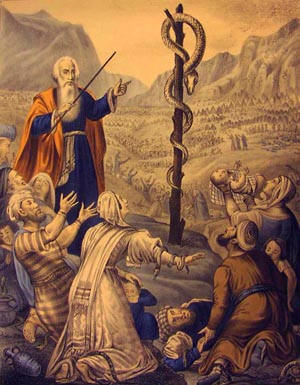
Make yourself a burning-snake and put it on a banner-pole;
 it shall be: whoever has been bitten and then sees it, will live. 


make thee a fiery serpent. An image of a fiery serpent made out of brass (Ibn Ezra).


9 So Moshe made a viper of copper, and he put it on a banner-pole,
 and it was: 
f a viper bit a man
and he looked upon the viper of copper, he would live. 


he looked.  ‘Did then the brazen serpent possess the power of slaying or of bringing to life?  No, but so long as the Israelites looked upwards and subjected their hearts to their Father in Heaven, were they healed. But when they reused, then were they destroyed’ (Mishnah).  The brazen serpent was ‘a token of salvation to put them in remembrance of the commandments of Thy Law, for he that turned toward it was not saved because of that which was beheld but because of Thee, the Saviour of all’ (Wisdom of Solomon).


The brazen serpent made by Moses was naturally preserved as an object of veneration by the Israelites.  But when in the course of centuries it tended to become, and eventually became, an object of idolatrous worship, it was destroyed by King Hezekiah (II Kings XVIII,4).  He is highly praised by the Rabbis for this act.


10-20. HALTING PLACES


10 The Children of Israel marched on and encamped at Ovot.


pitched in Oboth.  ‘Somewhere in the flinty plateau to the East of Edom’ (G.A. Smith).


11 They marched on from Ovot and encamped at Iyyei Ha-Avarim, 
in the wilderness that faces Moav;
 toward the rising of the sun.


toward the sunrising. i.e. on the wady of Zered, which flows into the Dead Sea at its southern extremity.


12 From there they marched on and encamped at Wadi Zered. 


valley of Zered. i.e. on the wady of Zered, which flows into the Dead Sea at its southern extremity.


13 From there they marched on and encamped across the Arnon that is in the wilderness,
 that goes out of the Amorite territory; for the Arnon is the border of Moav between Moav and the Amorites.


on the other side of the Arnon.  i.e. north of it.

which is in the wilderness. i.e. that part of it which is in the wilderness.


‘The Arnon is an enormous trench across the plateau of Moab.  It is about 1,700 feet deep and two miles broad from edge to edge of the cliffs which bound it, but the floor of the Valley over which the stream winds is only forty yards wide.  About nineteen miles from the Dead Sea, the trench divides into two branches, each of them again dividing into two. The whole plateau up to the desert is thus not only cut across, but up and down, by deep ravines, an a very difficult frontier is formed.  All the branches probably carried the name Arnon’ (G.A. Smith).


14 Therefore it is said in the Book of the Wars of YHVH: 
. . . Vahev in Sufa, the wadis, Arnon, 


the book of the Wars of the LORD.  The lines from that book quoted here support the statement that Arnon was the border of Moab.  There is no further mention of this book in the whole of Scripture.  Ibn Ezra says, ‘It was an independent book, in which were written the records of the wars waged by God on behalf of those that fear Him.  Many books have been lost and are no longer extant among us; e.g. the Words of Nathan and Iddo, and the Chronicles of the Kings of Israel.’  Evidently it was a collection of ballads and songs.  ‘The Book of the Wars of the LORD, like the Sefer Hayashar (Josh. X,13 and II Sam. I,18) is a proof that there was no absence of literary activity in the days of Moses.  It furthermore proves that the Torah is not the result of such literary activity, otherwise the alleged compiler could have indicated his sources as he has done in this instance’ (S.R. Hirsch).


Vaheb.  This name of an unidentified town is in the accusative, and requires some verb like ‘we captured’ to be understood before it.


in Suphah. Or, ‘in storm.’ Perhaps it is the same place as Suph, mentioned in Deut. I,1.

 
15 along with its canyon wadis, 
that stretch along the settled-country of Ar, 
leaning on the territory of Moav.


of the valleys.  Not valley, for the name Arnon covers a complex of wadies uniting in the long deep trench that carried their waters to the Dead Sea.


Ar.  Ar of Moab, in v. 28, which according to Deut. II,18, lay on the Moabite frontier.


Zunz and Leeser translate v. 14 and 15 as follows:  ‘Therefore mention is made in the Book of the Wars of the LORD of Vaheb in Suphah, and of the brooks of Arnon, and the descent of the brooks, that turneth toward Sebeth-Ar and leaneth upon the border of Moab.’  All these names occur in the Book of Wars of the LORD, and are unknown to us now (Leeser).

 
16 From there to Be’er/The Well; 
that is the well of which YHVH said to Moshe:
 Gather the people, and I will give them water.


Beer. i.e. ‘Well-town’.

 
17 Then Israel sang this song:
 Spring up, O well, sing-in-chorus to it;


then sang Israel this song. The mention of this town and its well gave occasion for the citation of another short poem, celebrating the way in which the well was opened by the princes and nobles of the people.


sing ye unto it.  lit. ‘respond unto it’, answer as a chorus; cf. Exod. XV,21.  From this arose the legend that it is the well that sang, and that the words of the princes and people were but the chorus to that song by the well.


18 -the well that was dug out by princes! 
-that was excavated by people’s nobles! 
-with scepter!
 -with their rods! Now from the wilderness
-to Mattana;


which the princes digged.  The princes took a part in the effort to obtain water for the people.


with the sceptre.  Or, ‘by order of the lawgiver’ (RV Margin).

and from the wilderness . . . Mattanah.  Or, ‘from the wilderness a gift’ — as the lat line of the Song of the Well (Budde).  The next . would then read: ‘And from the gift (i.e. the Well) to Nahaliel . . . .’

 
19 and from Mattana-to Nahliel;
 and from Nahliel-to Bamot/The Heights;


Nahaliel . . . Bamoth. These places have not been identified.


20 and from Bamot-to the valley that is at the Open-country of Moav, 
the top of Pisga/the Summit, overlooking the face of the wasteland.


Pisgah.  The general name for a series of mountain ranges (called ‘mountain of Abarim’ in Deut. XXXII,49) in the plateau of Moab.  The highest point was Mount Nebo, on which Moses died: Deut. XXXIV,1.


the desert.  Or, ‘Jeshimon’; the waste desolation north-west of the Dead Sea.


21-32.  CONQUERING THE AMORITE KINGDOMS

In contrast to former pictures of murmuring and mutiny, we now get events which bring out the glad surprise of the new people as their strength is tried against the gigantic Sihon and Og, and the foes are utterly exterminated (Moulton).

 
21 Now Israel sent messengers to Sihon king of the Amorites, 
saying:


Amorites.  Denotes the inhabitants of Syria and Palestine before the time of the Exodus.  But from v. 26 it would appear that Sihon and his people had but recently wrested from Moab the territory north of the river Arnon.


22 Let me cross your land!
 We will not spread out into the fields,
 in the vineyards we will not drink well water; 
on the King’s Road we will march, 
until we have crossed your territory.


pass through thy land. Their objective being the fords of Jordan opposite Jericho.

 
23 But Sihon would not give Israel (leave) to cross through his territory. 
Sihon gathered all his fighting-people 
and went out to meet Israel in the wilderness, 
he came to Yahatz and waged-war against Israel.


Jahaz.  On the eastern border of Sihon’s land.

 
24 But Israel struck him with the edge of the sword 
and took-possession of his land, from the Arnon as far as the Yabbok,
 as far as the Children of Ammon; 
for strong is the territory of the Children of Ammon.


the border of the children of Ammon was strong. Arnon was the southern limit of Sihons’ kingdom, and Jabbok was the northern.  The Ammonites lay to the east; but as their border fortresses were strong and impregnable, the Amorites had been unable to penetrate into their territory.  The reason why the Israelites did not enter the land of the Ammonites is given in Deut. II,19.

 
25 Israel took all these towns and Israel settled in all the Amorite towns- 
in Heshbon and in all her daughter-villages;


Hesbon. The modern Hesban, 2940 feet above the sea, 18 miles of Jordan, opposite of Jericho.


‘The victory over Sihon was of incalculable importance to the Israelites; it strengthened their position and inspired them with self-reliance.  they at once took possession of the conquered district and abandoned their nomadic life  The Israelites could now move about freely, being no longer incommoded by the narrow belt of the desert nor by the suspicions of unfriendly tribes (Graetz).


the towns.  lit. ‘the daughters’l the villages near and dependent upon the capital, Heshbon.  By a similar figure, we speak of ‘a mother city.’


26-30. A HISTORICAL NOTE, WITH SONG OF VICTORY

 
26 for Heshbon-it was the town of Sihon king of the Amorites.
 He had made-war on a former king of Moav
 and had taken all his land from his hand, as far as the Arnon.
27 Therefore the parable-makers say: 
Come to Heshbon! be built up, 
be established, Sihon’s town!


wherefore.  Explains that this song is quoted because of its association with the remark in v. 26 concerning the conquest of Moab by Sihon.


they that speak in parables say.  Or, ‘they that recite ballads say’; Heb. moshelim, ‘they that speak the mashal,which word might mean either proverb, parable, riddle, song, ode, or ballad.  The moshelim were bards who expressed in pithy poetic snatches what was uppermost in the popular mind at important occasions in the national life.  In the present instance we have a quotation from a popular ballad, referring to the jubilation of the Amorites over their conquest of Moab; and another, to the exultation of Israel over the defeat of the Amorites.


come ye to Heshbon. This and the next two verses are the victory song of the Amorites when they in their day had wrested that land from the rulers of Moab.  The poet invites the victorious Amorites to lose no time in entering upon and enjoying the greatest trophy in their victory, namely, the captured capital, Heshbon.


the city of Sihon. Let the capital which has fallen into your hands be built up in great splendour, making it worthy to be called City of Sihon (Rashi).


28 For fire went forth from Heshbon,

 Flame from the city of Sihon; devouring Ar of Moav,
 the inhabitants of the heights of Arnon.


for a fire is gone out of Heshbon. A figurative way of saying that no sooner had Sihon gained possession of Heshbon than he was able to send forth destruction upon the other towns of Moab.

 
29 Woe to you, Moav! 
You have perished, people of Kemosh!
His sons (become) fugitives, 
is daughters, captives of the king of the Amorites, Sihon.


Chemosh. The national god of the Moabites.


he hath given . . . into captivity. An expression of half-ironical compassion for the Moabites, whom their idol Chemosh was unable to save.  The ‘sons’ and ‘daughters’ of Chemosh are his votaries who looked to him as to a human father to save them in a time of trouble.

 
30 We shot them, 
Heshbon perished as far as Divon, 
we desolated (them) as far as Nofah,
 fire as far as Medeva!


we have shot at them. This is the second part of the song; viz. the exultation of Israel over the defeat of the Amorites.


even unto Dibon. i.e. the inhabitants of all the places between Heshbon and Dibon have perished.  Dibon was afterwards called ‘Dibon-Gad’ and was situated four miles north of the Arnon.  It was at Dibon that the so-called Moabite Stone was discovered in 1868–the most famous of all inscriptions bearing on Bible history.  It is a contemporary document of the highest importance, giving the Moabite side of the conflict between Israel and Moab in the ninth pre-Christian century, the days of the Prophet Elijah and King Ahab.


Nophah. Unidentified.


Medeba.  The modern Medeba, about four miles S.E. of Heshbon.

 
31 Now Israel settled in the land of the Amorites.
32 And Moshe sent (men) to scout Ya’zer,
they conquered its daughter-villages,
 dispossessing the Amorites who were there.


Jazer.  In Isaiah XVI,8.9 it is mentioned together with Heshbon.  Acording to I Maccabees, v. 8, it was near the Ammonite border.


33-35. DEFEAT OF OG THE KING OF BASHAN

 
33 Then they faced-about and went up the Bashan Road. 
Og king of Bashan went out to meet them, 
he and all his fighting-people in war, at Edre’i.


went up. Towards the north.


Beshan. Celebrated for its rich patures, its healthy herds of cattle, and its oak forests.  It extended from the border of Gilead on the south to Mount Hermon on the north.

Og the king of Bashan.  In Hebrew folklore, Og is the last of the giants, an antediluvian of superhuman strength, who had survived the Flood many centuries before.


Edrei. The modern Edra’ah, situated on the southern border of Bashan, about 30 miles east of the Sea of Tiberias.

 
34 YHVH said to Moshe: 
Do not be afraid of him,
 for into your hand I give him and all his people, and his land; 
you will do to him as you did to Sihon king of the Amorites who sat-as-ruler in Heshbon.


fear him not. Og was formidable, not only on account of his giant stature (Deut. III,11) but also on account of the walled cities in the dominions.


35 So they struck him and his sons and all his people until not a survivor was left to him,
 and they took-possession of his land.

Can these bones come to life? – Ezekiel 37:1-14

[This was first posted 2012; reposted in 2014; always relevant in the current events affecting the resurrected nation of modern Israel.—Admin1]


The Revival of Israel | KeyToTheBible Image from keytothebible.org

The Revival of Israel | KeyToTheBible
Image from keytothebible.org

In contrast to an earlier article about the bodies of “saints” which came out of their graves after Jesus resurrected [Revisited: What?! There were resurrected saints at Jesus’ resurrection?], this text from the Prophets [Neviim] is clear about what these bones are about.

 
Prophecy here has been borne out in the history of Israel to the present day.
 
Skeptics who challenge the authenticity and reliability of the Hebrew Scriptures refuse to connect the Book and particularly the prophecies with the nation that was “born in one day” whose people in diaspora made aliyah back to the portion of the Promised Land allotted to it.  Skeptics must look at Israel today and the continuing threats to this nation’s existence and the antisemitism that prevails to this day.  They must wonder at the sheer survival of these people in spite of the odds stacked against them.
 
These concluding verses in this chapter make an obvious connection to the current state of Israel:
 
My people, and I will bring you to the soil of Israel.
13 Then you will know that I am YHWH, when I open your graves and when I raise you up from your graves, My people,
14 and when I put My spirit into you, and you come to life, and I set you on your soil. Then you will know that I YHWH have spoken and I fulfilled – the word of YHWH.”
 
Image from www.fotolibra.com

Image from www.fotolibra.com

When we are asked why we believe the Torah is the Word of God and why we accept the rest of TNK as validating the first five books?

 
 Our simple answer:  look to Israel and wonder if the people have simply learned to survive?    Or if the God of Israel remains true to His promises?    We believe it is both.


Ezekiel 37 [The dry bones]
 
[There is yet no Hebrew publication that uses the Tetragrammaton Name except perhaps for Everett Fox, except that his translation has been limited so far to the Five Books of Moses. So we have had to resort to other Hebrew translations that substitute “Hashem” (ArtScroll) or “LORD” (JPS), and write in the Name YHWH.]
 
1 The hand of YHWH was upon me; it took me out by the spirit of YHWH and set me down in the midst of the valley – and it was filled with bones.
2 He passed me over them all around and round; and behold, they were very numerous upon the face of the valley, and behold, they were very dry.
3 Then He said to me: “Son of Man, can these bones come to life?” And I said, “Lord YHWH/ELOHIM, You know!”
4 He said to me, “Prophesy over these bones! Say to them, “O dry bones, hear the word of YHWH!
5 Thus said the Lord YHWH/ELOHIM to these bones: Behold, I bring a spirit into you, and you will come to life.
6 I will put sinews upon you, I will bring up flesh upon you, and I will coat you with skin; then I will put a spirit into you and you will come to life; then you will know that I am YHWH.’”
7 So I prophesied as I had been commanded. There was a sound as I was prophesying. Then behold, there was a noise, and the bones drew near, each bone to its [matching] bone. The bones came alive.
8 Then I looked, and behold, upon them were sinews, and flesh had come up and skin had covered them over; but there was no spirit in them.
9 Then He said to me, “Prophesy to the spirit! Prophesy, O Son of Man, and say to the spirit, ‘Thus said the Lord YHWH/ELOHIM: Come from the four directions, O spirit, and blow into these slain people, that they may come to life!’”
10 I prophesied as I had been commanded and the spirit entered them and they came to life. They stood upon their feet, a very, very great legion.
11 He said to me:
Son of Man, these bones –
they are whole House of Israel.
Behold, they are saying, ‘Our bones are dried out and our hope is lost; we are doomed!’
12 Therefore, prophesy and say to them: Thus said the Lord YHWH/ELOHIM: Behold, I am opening your graves and raising you up from your graves,
My people, and I will bring you to the soil of Israel.
13 Then you will know that I am YHWH,
when I open your graves
and when I raise you up from your graves,
My people,
14 and when I put My spirit into you,
and you come to life,
and I set you on your soil.
Then you will know
that I YHWH have spoken and I fulfilled –
the word of YHWH.”
 
Sig-4_16colors
logo

Recommended Read: Judaism and the Gentiles

Image from amazon.com

Image from amazon.com

[First posted August 28, 2012.—Admin1]


Terence Donaldson is the author of several books: 

  • Paul and the Gentiles: Remapping the Apostle’s Convictional World

  • Jews and Anti-Judaism in the New Testament: Decision Points and Divergent Interpretations
  • Religious Rivalries and the Struggle for Success in Caesarea Maritima (Studies in Christianity and Judaism)

  • Jesus on the Mountain: A Study in Matthean Theology (Journal for the Study of the New Testament Supplement Series 8)

  • Judaism and the Gentiles: Jewish Patterns of Universalism (to 135 CE)


The last one is what we are featuring here as MUST READ:


Sub-title: Jewish Patterns of Universalism (to 135 CE

Author:  Terence L Donaldson (Christian perspective)

Contents

1.  Introduction

PART I:  Texts and Commentary

2.  Scripture, Septuagint and Apocrypha

3.  Pseudepigrapha

4.  Qumran

5.  Philo

6.  Josephus

7.  Greco-Roman Literature

8.  Early Christian Literature

9.  Inscriptions

PART II:  Patterns of Universalism

10.  Sympathization

11.  Conversion

12.  Ethical Monotheism

13.  Participation in Eschatological Salvation

14.  Conclusion

[Here are some excerpts from the Introduction to give you an idea of what to expect from this book, available as ebook at amazon.com]


  • Jews everywhere identified themselves with reference to the biblical narrative, a narrative in which the cosmic and universal is oddly intertwined with the national and particular.  
    • On one hand, Jews understood their God to be one, universal deity, a God who had created the whole world and who continued to exercise sovereignty over the created order and all the nations within it.  
    • On the other Jews believed that this God had chosen them out of all the nations of the world to be a special people; that the will and the ways of this God had been revealed uniquely in Israel’s scripture; that the God who had created the cosmos was nevertheless uniquely present in the Jerusalem temple; and that despite the Jews’ temporal misfortunes, eventually Israel would be vindicated and exalted to a position of prominence over all other nations.  
    • Jews could not tell their own national story without reference to the other nations, and if perhaps it was possible to narrate the story in such a way that the nations functioned simply as a foil for Israel, the story itself contained at least latent questions about the relationship between these other nations and the God who had created them.
  • In addition to this intrinsic factor, several other factors of a more extrinsic character tended to force these latent questions out into the open.  
    • One of them was Israel’s actual experience, which in various ways forced them to negotiate emergent tensions between their self-identifying story, in which the nations played their assigned roles, and their ongoing encounters with non-Jewish people and nations  
    • This was especially the case in the diaspora, where Jews interacted daily with their non-Jewish neighbours and where Jewish communities in many cases have achieved a comfortable modus vivendi in the midst of Gentile cities.
    • To the extent that these interactions were positive, as they often were, Jews were prompted to ask whether and on what terms Gentiles might come into a positive relationship with Israel’s God.  
    • And even when their actual experiences with Gentile nations were more painful and distressing, many Jews could not help but dream of an ideal or future world in which Gentiles might recognize the truth and, in one way or another, come to worship the God of Israel.
  • More important here is the phenomenon of Gentile attraction to Judaism.  
    • Many Gentiles found Jewish belief, practice and communal life to be very appealing; and not a few of them were prepared, to greater or lesser extents, to adopt Jewish ways and to attach themselves to the Jewish community.
    • .Although Israel’s self-defining story could not be told without manifold reference to the nations, the story itself provided no normative indication of their religious status and, more specifically, of how they might enter into a positive relationship with Israel’s God.
  • Israel’s religion was restricted to members of the ethnos Israel; the only way in which a person could become part of the Israel was by birth.
    • The idea of conversion or proselytism, which became such a significant factor in the Greco-Roman period, was simply not a conceivable option.  
    • Still, the idea of proselytism when it did develop was significantly influenced by a biblical model, that of the resident alien, who was incorporated into the social and religious life of Israel in significant ways.  
    • This is one instance of several ways in which Israel’s scripture provided raw material for attempts to deal with the question of the Gentiles and their religious status. . . . .”universalism” tends to refer to approaches that ascribe legitimay to the religious “other” without requiring conversion.  
    • A religion in which conversion is the only option is particularlistic rather than universalistic.
  • “Gentiles” — the term derives from the Latin gens, nation, and receives its sense of “non-Jew” from the fact that in biblical tradition “nations” was commonly used to refer to the nations other than Israel.  
    • In time the term came to apply not only to non-Jewish nations but also to individuals.  
    • The term is thus one that has meaning only in a Jewish frame of reference.
    • Non-Jews would not ordinarily think of themselves as “Gentiles,” unless they were associated in some way with the Jewish world. . . . “Gentile” is to be seen as a term of convenience.  It is not inappropriate, in that it derives from Jewish usage.  But this sense of the term was restricted to the linguistic world of the Jews and, even there, existed alongside other terms.


Yo Searchers, need help? – June 2015

Image from www.picturescafe.com

Image from www.picturescafe.com

[This post shows the search terms entered by web visitors and the articles that address their query.–Admin1]


——————–

06/29/15  “ark of the covenant”  –  The Ark of the Covenant: Was it in the Holy of Holies on the day Jesus died?


06/28/15 “judas” – 

06/28/15  “everett fox torah online writings web site” – 


06/27/15  “the origins of prophecy in israel remains veiled in obscurity assignment” – Q&A: “Israel prophecy” – “veiled in obscurity”?


06/24/15 “bemidbar 20:2-12” – 

06/23/15  “raining fire and brimstone” – 


06/23/15 “biblical melchizedek pictures” –  


06/22/15 “the question about the origins of prophecy in lsrael remains veiled in obscurity.dis” – Q&A: “Israel prophecy” – “veiled in obscurity”?


06/20/15 “ark of the covenant” – The Ark of the Covenant: Was it in the Holy of Holies on the day Jesus died?


06/19/15 “no religion is an island” – 


06/18/15  “the picture of the ark of the covenant” – The Ark of the Covenant: Was it in the Holy of Holies on the day Jesus died?


06/17/15 – “free pictures of the scorpion and the frog” –  Revisit: The Scorpion and the Frog


06/17/15  “the ark of the convanent” – The Ark of the Covenant: Was it in the Holy of Holies on the day Jesus died?


06/11/15 “jews how should a gentile pray to god” – 

Q&A: “How does a gentile pray to Hashem?”


06/10/15 “did yhwh ever claim to god ? if not you better leave it alone” – If this searcher has read the whole of Torah from Genesis to Deuteronomy, he/she will get to know Who is the True God and what His self-declared Name is and how He describes Himself.  It’s like this dear seekers — if you’re hungry, you eat; if you’re picky about what you eat, you’ll make sure you eat the right food; if you’re not sure what’s the right food, you check out the ‘Manufacturer’  (Creator) of the ‘Product’ (you) and find out His specifications for you, not only for the proper nutrition that will fuel your body so that you have a quality of life till the end. It works the same way with the search for the True God, is He knowable, where does one look for Him?  After a lifetime of hungry-for-the-Truth-seeking, we found Him in the Hebrew Scriptures.  If you want to know about any subject, you gotta stick your neck out like a turtle and not get stuck where you last withdrew into your very limited space in your shell.  Expand your mind and move from your comfort zone!


06/10/15 – “ages levites served” – When we used to teach from the Christian Bible, specifically New Testament, we used to ask “why did Jesus not start  his ‘son of God’ ministry till he was thirty?” and the answer was supposed to be based on the age that Levites were to begin serving at the tabernacle or tent of meeting, 25, 30, retirable at 50, based on chapters 4 and 8 of Numbers: Numbers/Bamidbar 4 – Levites ages 30 to 50 . . .serve in the Sanctuary

The next question would be: ‘but isnt’ Jesus from the tribe of Judah, and not Levi?’ And our answer would be based on the New Testament book of Hebrews where Jesus is made Priest-King in the order of Melchizedek.  How far our teaching as veered from the New Testament as you can deduce from our more than 800 posts in this website.  It all made sense back then when our mindset was totally Christian-oriented; but knowing what we know now, there is no turning back from YHWH’s Torah Truth.


06/09/15 “613 commandments” – Sinaite Notes – 613 Commandments, really?


06/08/15  –  Our apologies for the website being inaccessible from June 6-7 & 8, we upgraded on WordPress and as it happens in upgrades,  we encountered some problems.


06/03/15  “sabbath truth seekers” – 

There is a category on Sabbath Liturgy for every Sabbath of the year; much of the prayers focus on what truth-seekers would like to learn, even while praying, since the prayers are based on Torah teaching. Please go to SITEMAP and scroll down until you see “A Sinaite’s Liturgy”.


06/03/15  “the question about the origin of prophecy in israel remain in obscurity. discuss” – Q&A: “Israel prophecy” – “veiled in obscurity”?


06/03/15 ” joseph interprets dream” – Genesis/Bereshith 40 – “DDD”


06/03/15  “god bless israel” – Reprint: Israel represents the greatest national success story of all time.


06/02  “israel in the wilderness” – The Torah books Exodus, Leviticus, Numbers, Deuteronomy are all about the wilderness wandering of Israel for 40 years.  However, here’s a post to get started: Numbers/Bamidbar 22-23-24: “I behold him: here, a people, alone-in-security it dwells, among the nations it does not need to come-to-reckoning.”


06/02  ” what wasw israel occupation which was abominable to the egyptians” –  The Lamb/Ram in Egypt’s Pantheon


06/02  “the jewish mystique ernest von haag” – The Jewish Mystique by Ernest Van Den Haag


06/02  “genesis 49:10” – Genesis/Bereshith 49: Jacob/Israel’s Legacy and Last Farewell


06/01  “ark of the covenant” – The Ark of the Covenant: Was it in the Holy of Holies on the day Jesus died?


06/01  “cupbearer’s dream” – Genesis/Bereshith 40 – “DDD”


06/01  “wrathful vengeful god” – 

06/01  “illustrations of the baker’s and cup-bearer’s dreams” – Genesis/Bereshith 40 – “DDD”