Discourse between Sinaites & Messianic Pastor

Image from Compassionate San Antonio

Image from Compassionate San Antonio

[We are reposting this discourse series that were originally emails between “RW” and Sinaites BAN, VAN, NSB.  


RW had been a missionary based in Baguio City, Philippines for decades; then moved toward Messianic Judaism (MJ) which we call “Christianity in Jewish Dress”.  A dedicated bible teacher, to his credit he taught individuals, small groups, anybody truly interested in bible study and later, initiated the MJ movement in Southeast Asia, planting Messianic Congregations among Christian groups he influenced, who followed him to his next conviction/commitment.  A staunch and dedicated ‘warrior’ for Christ-centered faith who had taught bible for decades to members of our Sinaite core community when we were still Christians, he was of course the first among Christian leaders we “confessed” to about leaving the Christian religion and why.  The reaction?  Read the Discourse series.


These email exchanges are dated within the initial and crucial time of what RW calls our “apostasy”  (circa 2009-2010).  The series is a good reminder not only of what we had to deal with at that time, but also of the same reaction we continue to experience to this day from our former Christian colleagues.


These are not chronologically arranged. —-Admin1.]


Discourse – Sinaite/Christian Pastor

Image from ALC Lifegroups - WordPress.com

Image from ALC Lifegroups – WordPress.com

[What is the value of reading “Discourse”?  Just like a neutral listener at a debate where two opposing sides of an issue are presented back and forth until both give up on each other, a reader with patience enough to read through the written communication of the discussants will learn much!  The reader not only gets exposed to two sides of the topic at hand, but also gets a glimpse of the relationship between the discussants/debaters.  When the exchange of ideas is accompanied by mutual respect of the other’s opinion, that is the best kind of discourse.  Written discourse gives each side time to react in a ‘gentlemanly’ manner, so the exchange doesn’t get tense but remains calm.  


Imagine yourself listening in as a third party to a conversation between long time friend/servants of Christ, of the same faith for decades, then one veered off and they are now of differing faiths.  Wouldn’t you be curious about who wins the debate, if any?  To Sinaites, there are no winners in our discourses with former Christian colleagues.  In the end, you reader are the judge, deciding whom to believe, the loyal Christ-worshipper or the ‘renegade’ who returns to the Self-revealing God in the Hebrew Scriptures.


This particular discourse ends on the right note as far as we’re concerned, when Sinaite VAN simply declares:  


Our website has many posts explaining our journey back to the Sinai Revelation.  

As you will conclude from our collective testimony,

there is no turning back for us . . .

not for the others and definitely . . . 

not for me.


And the other side no longer responds. —-Admin1]


Evidence for Christianity [?] -1

[Buried in our posts dating back to 2012 when we launched this website, is this series intended to analyze the claims of Christian apologists.  We got no farther than 3 articles though we hope to pick up where we left off and continue examining the claims of the most famous published defenders of Christ-centered faith.  We have been told over and over by our former colleagues, “who do you think you are . . . to challenge the likes of . . . .”;  to which we answer, we are nobodies compared to them.  Still, it is our right to challenge truth-claims no matter who says it, how often it is said, and how many believe it.   And even if nobody cares to believe us!


 Sequels to this if you care to check them out and prove us wrong by leaving comments we can reply to:

—Admin1.]


————————


Image from amazon.com

Image from amazon.com

How to defend your Christian belief system against skeptics, agnostics, atheists, Jews, and Sinaites?  Read Josh McDowell’s Evidence That Demands a Verdict,  originally published in 1972 and revised in 1979 (the image on left is from an updated version on kindle format). 


A well-meaning Christian gifted us with this book significantly timed on Christmas 2011.  Thinking we were simply going through a crisis of faith, perhaps this reminder would turn us around from our temporary “apostasy” and return to the religion we once zealously upheld, actively defended, and successfully drew converts to.  Little did this sincerely-concerned Christian friend know that we already had the 2006 updated version, triple the size of the original, retitled Evidence for Christianity:  Historical Evidences for the Christian Faith because we believe in checking out all sides of any issue, even what may initially be perceived as the “false” side.  


The key phrase in the title:  “Historical Evidences.” This book has been in our back-burner for months now, waiting to be engaged point by point.  With all the back-and-forth emailing we’ve done with Christian colleagues on random topics, always finding ourselves on the defensive, reacting to “evidence” constantly foisted upon us, perhaps the time has come to be proactive with a more systematic approach. This book gives us a springboard to do so, since it is organized like a lawyer’s brief.   


But first, some background on Josh McDowell whose journey is the exact opposite of ours. The author claims to have been a skeptic; while studying to become a lawyer, he started investigating the claims of Christianity. When he was finally convinced, he converted, wrote his book in the style of a lawyer presenting his case before a judge, providing “incontrovertible evidence”— and enough of it, in his estimation to “demand a verdict.”  Any reader previously unconvinced would turn into a believer after examining all the “evidence.”  


Book sales success encourages more productivity, so McDowell naturally followed up his initial bestseller with sequels along the same lines:

  • More Evidence that Demands a Verdict
  • More than a Carpenter
  • Beyond Belief to Convictions 
  • The Last Christian Generation
  • Answers to Tough Questions,
  • Handbook of Today’s Religions  


Besides becoming a successful author, he also became one of the most popular speakers throughout the world, one of the primary defenders of the Christian faith today.


A formidable but worthy apologist to engage for neophytes like us Sinaites, wouldn’t you think?  Who are we to take  on Josh McDowell?


 During our fledgling transition time, we might indeed have thought exactly that, but knowing what we know now and having read the “evidence” he presents in his apologetics, we are not at all intimidated.  Why?  Because like all other exchanges we have had with Christians [all posted on this website], there is one consistent problem common to all of them and that is — the only evidence they can and do present come from New Testament Scriptures and Christian commentators, all of whom argue from the same theological package decided upon by the early Christian councils.  The reason is because there is no other source for their arguments.  And even when they present “evidence” from the “Old Testament” version of the Christian Scriptures, they simply present the same “prooftexts,”  superimposing these on Jesus and the Trinitarian God regardless of the original context of the verses which have absolutely no connection except in a theology that insists it all fits perfectly as prophecy and fulfilment.


We confess we used to argue from exactly the same orientation, that is why we are in a position to see more clearly now that we have been exposed to the “other” side— provided first by current research on the roots and beginnings of Christianity, and reinforced with a better and clearer understanding of the Hebrew Bible’s version of YHWH’s original revelation.


These are sweeping statements on our part and have yet to be expounded detail by detail, point by point, argument by argument . . . all in small, chewable, digestible doses.  So continue following this series; reflect, agree or disagree, swallow or spit out.  That is the beauty of learning from a resource center that endeavors to present two or as many sides of any argument because readers have to make an informed decision; there is no choice when one has known only one side.  We realize most seekers might not have access to resources so this website provides as much as we can within our capability.  The intent is to make people think beyond the confines of their religious orientation, dare to venture out and discover what else is out there.  


Don’t be afraid to partake of the Tree of Life, the Torah and discover the True God who revealed Himself there so you can learn to be discerning and recognize the counterfeit.  There is a lifetime of learning just from the Torah alone; the Jewish sages never quit studying to this day and yet they have been at it for several millennia now. 


—————-


UPDATE 2017:  Bear with me on this one, for there is a point to it.  My father who was a lawyer just like Mr. Josh McDowell, wrote his philosophy of education for his institution of higher learning, the first college in a sanatorium-city he was advised to move to by his doctors after the end of the Japanese occupation of the Philippines.   I proudly borrow from his words and color code it green, his favorite color which became the university color; green because it is the color of freshness, new life, and in hindsight on my part, significantly the traffic signal GO! proceed, move forward, it’s safe!


 “Education is a shield against the intolerance of the mind.”


 His point? Intolerance of the mind is a dead end; mind  chooses not to go any further, mind is closed to anything else other than what mind has decided is the whole truth and nothing but!  Religious mindsets tend to be like this because religionists think they have the monopoly of truth while  everyone else is wrong.


Closely related is another quote from this non-religious wise father.  When graduates who receive their diploma think they have “arrived” and are finally “educated”, his reminder on their yearbook is this:


“A diploma is only an inventory of the little that we know.  We frame it to remind us that the road to knowledge is endless.  Let us spread out and make use of the charm of knowledge for the common good. Knowledge is lost to those who use it only for the good of themselves.”


This is the same wise father who,  a few days before he passed away in 1994  when I was desperately trying to convert him into believing in the Christian saviour so that he could make it to heaven and not end up in hell, replied to me:


 “My religion is to be good and to do good.”  


At that time I did not know nor realize that what he said is basically the Torah.  From a very complicated  religion with a complicated God and an exclusive salvation message, we Sinaites moved forward to  Christianity’s proclaimed foundation — the TNK, the Hebrew Scriptures —where we rediscovered the simplicity of the  faith of Abraham and of Moses who listened to and obeyed the God Who defined Himself and His Way.  YHWH’s WAY was so simply articulated by my father at a time he suffered a stroke which affected his brain, though evidently while his body was failing, both his mind and spirit were still intact! Indeed it might be enough to simply “be good”,  meaning, one behaves and doesn’t cause harm to another . . . but to go farther and “do good”, that means be a blessing to others, that is Torah.  (Thanks Dad, what a great ‘how-to-live’ legacy you left;  took me a decade and a half to realize how biblically in-sync  you were, evidenced in how you lived your life.  This coconut hasn’t fallen far from your  coconut tree.)


To go back to the message on the scroll that graces this website: 


“From the cowardice that shirks from new truth,

from the laziness that is content with half truth,

from the arrogance that thinks it knows all truth,

O God of Truth, deliver us.”


We have not been cowardly in our truth-search, neither have we been lazy.  As for the “arrogance” that thinks it knows all truth . . . we can only pray “indeed, O God of TRUTH, thank you for delivering us!” 


Sig-4_16colors

logo

Must Read: A New History of Early Christianity by Charles Freeman


Image from The engraving is based on a painting by F. S. Church.

Image from The engraving is based on a painting by F. S. Church.

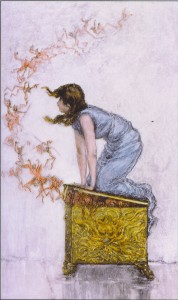
[First posted 2012.  Our former long-time bible teacher “RW”  might say that reading the history of Christianity is the Sinaite’s “Pandora’s Box” . . . . For those unfamiliar with this Greek myth, here’s WIKIPEDIA’s short summary:  


Pandora’s box is an artifact in Greek mythology, taken from the myth of Pandora‘s creation in Hesiod‘s Works and Days.[1] The “box” was actually a large jar (πίθος pithos)[2] given to Pandora (Πανδώρα, “all-gifted, all-giving“),[3] which contained all the evils of the world. Pandora opened the jar and all the evils flew out, leaving only “Hope” inside once she had closed it again. Today the phrase “to open Pandora’s box” means to perform an action that may seem small or innocent, but that turns out to have severely detrimental and far-reaching negative consequences.


If you’re thinking like ‘RW’, you might say that this Greek myth has a striking similarity to Genesis 3:  Eve’s curiosity and resulting violation of the Creator’s prohibition not to eat of the fruit from the Tree of the Knowledge of Good and Evil.  Please check out this link: 


Actually, the Sinaite’s “Pandora’s Box” might be the wrong image to use since it creates a  negative impression:  in this Greek myth, all kinds of “evil” are unleashed when the box is opened.   In our case, it is just the opposite: by reading the history of Christianity, we discovered historical facts that eventually made us decide to further investigate the roots and beginnings of the religion we were in for decades of our life, since our childhood.  The result?  We left our religion and sought out its claimed ‘foundations’ in the Hebrew Scriptures.  Now you, reader, decide:  is the search for Truth evil?  Is ignorance ‘bliss’? So what is the connection to this post?  Well, it’s one of the books we are featuring about the history of Christianity.  Would that result in “evil”?  Or “Truth”?  And is Truth “evil”?   You decide.—Admin1.]


—————-
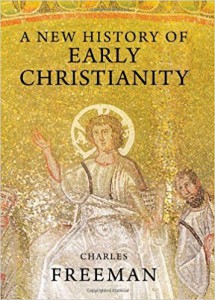
 

Image from amazon.com

Image from amazon.com

Reprinted below as an “appetizer” is the PREFACE:


In AD 30, a Jewish Preacher from Galilee called Jesus arrived in Jerusalem for the Passover.  A crowd of his followers had come with him and the bustle and excitement soon spread to the Jerusalem crowds.  Jesus had talked of ‘a coming kingdom’, a spiritual and political revolution that would renew Israel.  The authorities, the Jewish priesthood and their Roman overlords, felt threatened by the disturbance. They arrested and crucified Jesus, the best way of publicly terrorizing his followers. It appeared they had snuffed out the movement.


Somehow, in the bleak hours and days that followed, a core of Jesus’ followers began to conceive of him as something more than an ordinary mortal.  There was talk that his tomb had been found empty and that favored disciples had seen him risen from the dead.  Then, after forty days at most, the appearances ceased, although some believed he would come again.


As the months and years passed and there was no second coming, his disciples began to speculate on whom Jesus might have been.  They had a mass of Jewish titles to draw on — ‘Son of God’, ‘Messiah’, ‘Son of Man’, ‘Lord’, ‘Prophet’.  For a Jew none of these implied divinity.  ‘Son of God’ meant only one specially favored by God; messiahship was associated with the (inevitably violent) liberation of Israel from foreign domination by one of ‘the royal house of David’.  From the earliest days Christians debated and argued among themselves as to how one could find a coherent understanding of Jesus.  In his anguished First Letter to the Corinthians, one of the oldest Christian texts to survive, the apostle Paul complained that his readers had divided into followers of himself, of the apostle Peter, of an intellectual, Apollos, and of Jesus now seen as Christos, ‘‘the anointed one’ (1 Corinthians 1:12-14).


This picture of Christians in debate may seem startling to some readers.  All too often Christian doctrine is presented as fixed and unchallengeable, but even the slightest contact with the history of Christianity shows that this was never so.  This book takes it for granted that there were competing traditions within the emerging church and explores the difficulty in ever finding any one ‘true’ Christianity.  In fact, it was only when the Roman emperors of the fourth century used the enormous coercive power and patronage at their command to insist on a uniform set of beliefs that one could talk in such terms.


So while, traditionally, the history of the church has been written as if the doctrines chosen by the emperors, in particular the Nicene formulation of the Trinity, were the only ones possible, I have not made this assumption here.  I prefer, for instance, to highlight the impossibility of achieving any form of consensus on the nature of the risen Christ and his relationship to God.  I hope this makes for an altogether more absorbing narrative and one that corresponds to the debates as they are recorded.


At the same time, assertions by biblical scholars that there are no other historical explanations of particular events than supernatural ones need to be challenged.  The sources which describe the physical resurrection of Jesus are, for instance, so late, fragmentary and contradictory that the question of whether it happened must be left open.  ‘Surely, no one would seriously argue that the early Christians did not believe that Christ had been raised’, writes Alan Segal, author of an excellent study of ‘the Afterlife’.  ‘But just as surely few if any modern historians would argue that any evidence could move us from this historical fact to the supposition that Jesus was actually and physically raised from the dead and that he appeared in his transformed fleshly body.’


This raises a vital point.  Historians and theologians are both committed to finding ‘truth’, yet both work with totally inadequate evidence.  For the historian the past recedes quickly and most events are never recorded.  Most historical solutions exist as hypotheses, vulnerable to the discovery of new evidence or to be left for ever unproved.  The theologian has the challenge of establishing knowledge of a different sort: what might exist for humans after death, whether a creator designed the world and whether Jesus Christ had a human or divine nature, or some form of combination of them.  On the whole, theologians appear to find it easier to come to certain conclusions than historians do.  It is rare, for instance, to find a work of theology that proposes a range of hypotheses about the supernatural and leaves it open for the reader to decide.


This was certainly not the case in the early church.  One of the fascinations of writing about these centuries is to see how highly educated minds grappled with the problems of understanding the supernatural.  The range of debate is far greater than anything one finds in discussions on religion today.  Was Jesus’ God the same as the Creator God of the Old Testament?  Can Paul be read so as to deny the physical resurrection of the body?  Did the act of creation involve bringing order to what already existed or was it a totally new beginning?  Can one ever come up with a satisfactory definition of the relationship with the Son and the Father and the human and divine (if any) aspects of Jesus?  This was the grist of early Christian theology.


So a historian of early Christianity must tackle diversity, and I think it helps if one does not feel that there is a correct answer to be found.  Intellectual, not to say spiritual, life lost a great deal when theological debate was suppressed in the fourth and fifth centuries.  I have tried to preserve the breadth of early Christian thought without making judgment on it.


The world was transformed by the coming of Christianity.  The belief that the Son of God had come to earth, had redeemed the human race from its apparent sinfulness, and would be represented by the continuing presence of the Holy Spirit was revolutionary. It was also, of course, very threatening. The rejection of the ancient gods and the cultures that had sustained them was a powerful challenge to the ethos of Greco-Roman society.  In response to opposition, Christians had to define for themselves what their faith meant for them while they were living on earth and how their beliefs could be given continuity and coherence.


The ‘triumph’ of Christianity in the fourth century, when Constantine offered both toleration and patronage, was seen by its historian Eusebius as the inevitable and expected outcome of God’s plan.  Christianity had now become politically, socially and, not least, economically the dominant culture of the empire and its successors.


 Resources were poured into buildings, bishops became powerful figures in their own right.  The state took responsibility for defining orthodoxy.  The afterlife, and whether one would find bliss or misery in it, began to pervade the Christian imagination in a way that pagans found incomprehensible.  No one can begin to understand the history of the western world without grasping this transformation in consciousness.


There has long been a need for a ‘new’ history of Christianity.  In a review of yet another set of essays in a handbook to early Christian studies, one biblical scholar recently bemoaned the fact that there had been no such introduction since Henry Chadwick’s excellent The Early Church, first published in 1960s.  Yet I would never have taken on this book if I had not been challenged to do so by Heather McCallum, my editor at Yale.  It was her vision of the book as a critical but respectful history, and her continued support during the two years of writing it, that have been fundamental to its completion.


Table of Contents include the following topics:


PART ONE:  BEGINNINGS


Chapter 1:  A Trial

Chapter 2: The Seedbed:  Judaism in the First Century AD

Chapter 3:  Jesus before the Gospels

Chapter 4:  Breaking Away:  The First Christianities

Chapter 5:  What Did Paul Achieve?

Chapter 6:  The Letter to the Hebrews

Chapter 7:  Fifty Years On: the Gospel Writers Reflect on Jesus

Chapter 8: John and the Jerusalem Christians

Chapter 9:  Creating a New Testament

Chapter 10:  No Second Coming:  The Search for Stability


PART TWO:  BECOMING CHRISTIAN


Chapter 11:  Toeholds in a Wider Empire

Chapter 12:  Open Borders: The Overlapping Worlds of Christians and Jews

Chapter 13:  Was there a Gnostic Challenge?

Chapter 14:  The Idea of a Church

Chapter 15:  To Compromise or Reject:  Confronting the Material World

Chapter 16:  Celsus Confronts the Christians

Chapter 17:  The Challenge of Greek Philosophy

Chapter 18:  Origen and Early Christian Scholarship

Chapter 19:  New Beginnings:  The Emergence of a Latin Christianity

Chapter 20:  Victims or Volunteers: Christian Martyrs

Chapter 21:  The Spread of Christian Communities


PART THREE:  THE IMPERIAL CHURCH


Chapter 22:  The Motives of Constantine

Chapter 23:  Debating the Nature of God

Chapter 24:  The Stifling of Christian Diversity

Chapter 25:  The Assault on Paganism

Chapter 26: ‘No one is honored before him’: The Rise of the Bishop

Chapter 27:  An Obsession with the Flesh

Chapter 28:  The End of Optimism: Augustine and the Consequences of Sin

Chapter 29:  Divine but Human

Chapter 30:  The Closing of the Schools

Chapter 31:  A Fragile Church:  Christianity and the Collapse of the Western Empire

Chapter 32:  Faith, Certainty and the Unknown God


This book is downloadable on a kindle app as an ebook at amazon.com.

https://www.amazon.com/New-History-Early-Christianity-ebook/dp/B003AU4E4U/ref=sr_1_1?ie=UTF8&qid=1490400481&sr=8-1&keywords=a+history+of+christianity+charles+freeman

Oy Searchers, need help? – March 2016

Image from www.stlucasucc.org

Image from www.stlucasucc.org

[Dear Seeker of the One True God, our co-travellers on the pathway toward the Sinai Revelation on Spiritual Sinai:  We see you in our Site Stats, know where you’re from, how many times you return, what articles you check out.  We are gratified that we can reach beyond the boundaries of our location; we wish we could interact with you and we could, if you would leave a comment or write us.


As we explain every month, this post is all about providing existing articles in this website to address the specific terms entered by netizens which direct them to sinai6000.net.  We appreciate feedback on how we can further improve this website, or write articles that address specific questions/topics we have not covered in our 900+ posts..  Please write us at nsbsinai6000@gmail.com, or leave a reply at the end of any post. We promise to get back to you ASAP!-–Admin1]


—————-

Goodbye March, hello April!


Last search entry:

Image from A Virtuous Woman

Image from A Virtuous Woman

03/31/17 –  “happy preparation day” – This refers to the day before the Sabbath for Jews who take the 7th day seriously, so much so many of them won’t push an elevator button (Israel elevators are programmed to stop at every floor on Shabbat); and won’t drive . . . anything that might be construed as “work” that one is supposed to cease doing.  That includes cooking meals —and so preparation day precedes this holy, set-apart day.


03/31/17 –  “artwork of jesus being kissed by judas” – Please check out these articles for the images we have used:

03/23/17 –  “is the prophecy in israel remain in obscurity” — Whaaatttt????  Again and so soon???  Unbelievable! Sure want to know the “glue” in this post that keeps seekers entering the same search phrases.  It almost feels like someone’s playing a big joke on us!  But then again, thank you for your interest in this post and for the umpity-umpteenth time, heeeeeere’s the link:

03/21/17  – “prophecy in isreal remain in obscurity discuss” – Seriously???!!! Again???!!! Don’t we have 900 other articles to check out in this website aside from this constantly clicked post?  Still wondering what it is in this post that visitors keep coming back to reread; anyway, here’s the link:

Actually, the post is about this original article:


03/17/17 –  “evolution” – 


03/17/17 –  “family and religious studies a level question” – Not sure what this searcher is looking for;  definitely our posts  address “religious” issues even if we don’t claim to be “religious” and simply “biblical”.  For “family” here’s are several posts that deal with family relationships and issues:


03/16/17  –  “the origin of prophecy remain veiled in obscurity” –  Again? So, here’s the post for the umpteenth time!


03/12/17  – “the origins of prophecy remain veiled in obscurity.discuss” – What is it about this post that searchers (or the same searcher) keep returning to it?  Find out:


03/11/17  “bible meaning celestial” – 
The bible uses words found in the dictionary so celestial would have no special meaning other than:

  • positioned in or relating to the sky, or outer space as observed in astronomy: a celestial body.
  • belonging or relating to heaven: the celestial city
  •  supremely good: the celestial beauty of music.


03/06/17 – “the origins of prophecy remain veilled in obscurity discuss” –  This entry has consistently shown up 4 days in a row now; wonder what draws the searcher[s] to this particular post?  Find out for yourself!


03/05/17 –  prophecy in israel is veiled in obscurity.discuss2 – 


03/04/17 –  “the prophecy in israel is veiled in obscurity?discuss 25marks” 


03/02/17  –  “the origins of phochecy remain veiled in obsecurity” (sic) – 

———————————


For the casually curious,  we provide ‘worldly’ TRIVIA about each month of the year even if nobody really cares why any month has been designated its name (same with days of the week), the more important thing is that the world is in sync with regard to times and schedules.  Still, if Sinaites have not dug deeper into the roots of our original faith, we would still be ignorantly there; so we’ve learned the lesson of being curious and checking out why we do what we do.  Learning is a good habit at any age of our life! There is no more reason not to learn as much as one can in these times when information technology can bring virtual libraries into a computer screen; one doesn’t have to go to the library anymore but . . . be discerning about the information available on the web.  Sinai 6000 would recommend to our visitors that you check out our own claims in the information we provide in our over 900 articles posted in the seven years of our existence.  That said, this March trivia is from:


http://www.buzzle.com/articles/what-are-the-meanings-for-the-months-of-the-year.html


—-Admin1.]

———————


Until circa 450 B.C., the month of Februarius had a fixed 28 days at start, and then 23 or 24 days. Later, Julius changed it to be 29 days after every four years and the rest to 28 days.


“March comes in with an adder’s head,

and goes out with a peacock’s tail.”

– Richard Lawson Gales


Image from www.buzzle.com

Image from www.buzzle.com

Mars’ Month
March, the third month of our calendar, was originally the first month of the year. The month of March is named after the Roman God of war – Mars. This month was considered as the time to resume war, and hence named after the War-God. Mars is also identified with the Greek God Ares.
March Symbols

Zodiac – Pisces, Aries
Birthstone – Aquamarine
Flower – Jonquil and Daffodil


The month of Martius, being the first month of the calendar, always had 31 days.


[For the seriously curious, hereunder are more information provided in the recommended website:]


What are the Real Meanings of the Months of the Year?
The origin of months, based on the Moon’s cycle around the Earth, assisted in noting the time and fragmenting long seasons into small time periods. Let’s look into the meanings of the months of the year.

We look at the calendar several times a day to check our scheduled meetings, appointments, and to refer to dates so as to plan vacations. But we hardly think about the significance of the months’ names. Have you thought about why January is called January and why March is March? What are the meanings of these months? Let’s find out.
Origin of the word Month


The word Month came from Munt — the local deity of Hermonthis, in the south of Thebes. It was founded and worshiped in the times of Roman supremacy. Later, it became the war-god of the Egyptian king (symbolized as falcon-headed).
The original Roman year had only ten months, which started from the month of March.
March – Martius
April – Aprilis
May – Maius
June – Junius
July – Quintilis
August – Sextilis
September – September
October – October
November – November
December – December


The second king of Rome — Numa Pompilius (circa 700 BC) — added the two extra months that were unnamed, as it was the winters, and no agricultural activity took place during that period.
January – Januarius
February – Februarius
He also moved the start of the year from March to January and even changed the number of days in a month.

The Sinaites’ Musical Liturgy – 4th Sabbath in March

8568e82c3481510eeb25ac8180f5175bKINDLE THE SABBATH CANDLES


[The ‘musical’ liturgy has become a tradition in Sinaites’ celebration every other Sabbath of the month.  Our roots are Christian and we have learned the value of expressing faith and teaching a belief system through the lyrics of worship hymns.  Traditional worship music strongly linger in our music memory even if we have forgotten the lyrics we used to sing out of love for the Trinitarian Godhead, specifically the 2nd Person, Jesus Christ.  Without a hymn tradition to call our own, we resorted to the next best thing:  adapt the music but rewrite the lyrics to express our Sinaite’s faith in the God we now worship: YHWH of the Hebrew Scriptures; in Christian understanding, the “Father” in the Trinity.   


There are hymns that address a universal God whose lyrics we can agree with and in fact express our exact sentiments; we leave those hymns as is, with their original lyrics; while in some we have made slight changes in wording.  All in all, we are grateful to Christian hymn composers whose love for God is expressed in their awe-inspiring music. —Admin1].


———————–


HOLY, HOLY, HOLY

Reginald Heber (1826)

[Revised Lyrics for Sinai 6000]


Holy, Holy, Holy! Lord God Almighty,

May our words of praise in song

rise up, reach up toThee;

Holy, holy, holy! Righteous God of Mercy,
Lord God YAHUWAH, there’s no God but Thee!


Holy, Holy, Holy! though the darkness hide Thee,
Though the eye of sinful man

Thy glory might not see;

Primal Light whose brightness

shines right through our darkness,

Glorious Shekinah, lead us through Thy Way.


Holy, Holy, Holy! Lord God YAHUWAH,
May all Nations praise Thy Name,

Thou True Divinity,

May Thy chosen people, Israel Thy firstborn,

Light to the Gentiles, lead us all to Thee.


Holy, Holy, Holy,  Lord God Almighty,
All Thy works shall praiseThy Name
on earth, in sky and sea;
Only Thou art holy, there is None beside Thee,
Perfect in power, love and purity.


I Sing the Mighty Power of God

Isaac Watts, 1715

[Original Lyrics]


I sing the mighty power of God

that made the mountains rise.

That spread the flowing seas abroad

and built the lofty skies.

I sing the wisdom that ordained

the sun to rule the day; 

The moon shines full at God’s command,

and all the stars obey.


I sing the goodness of the Lord

Who filled the earth with food,

Who formed the creatures through the Word

and then pronounced them good.

Lord, how Thy wonders are displayed

where’er I turn my eye,

If I survey the ground I tread,

or gaze upon the sky.

There’s not a plant or flower below,

but makes Thy glories known,

And clouds arise, and tempests blow,

by order from Thy throne;

Thile all that borrows life from Thee

is ever in Thy care;

And everywhere that we can be,

Thou, God art present there.


Count Your Blessings

Johnson Oatman, Jr., pub.1897

[Original Lyrics]


When upon life’s billows you are tempest-tossed,
When you are discouraged, thinking all is lost,
Count your many blessings, name them one by one,
And it will surprise you what the Lord has done.

  • Refrain:
    Count your blessings, name them one by one,
    Count your blessings, see what God has done!
    Count your blessings, name them one by one,
    *Count your many blessings, see what God has done.
    [*And it will surprise you what the Lord has done.]


Are you ever burdened with a load of care?
Does the cross seem heavy you are called to bear?
Count your many blessings, every doubt will fly,
And you will keep singing as the days go by.

  • Refrain:
    Count your blessings, name them one by one,
    Count your blessings, see what God has done!
    Count your blessings, name them one by one,
    Count your many blessings, see what God has done.


When you look at others with their lands and gold,
Think that God has promised you His wealth untold;
Count your many blessings—wealth can never buy,
Your reward in heaven, nor your home on high.

  • Refrain:
    Count your blessings, name them one by one,
    Count your blessings, see what God has done!
    Count your blessings, name them one by one,
    *And it will surprise you what the Lord has done.


So, amid the conflict whether great or small,
Do not be discouraged, God is over all;
Count your many blessings, angels will attend,
Help and comfort give you to your journey’s end.

Refrain:
Count your blessings, name them one by one,
Count your blessings, see what God has done!
Count your blessings, name them one by one,
*And it will surprise you what the Lord has done.


Image from quotesgram.com

Image from quotesgram.com

BLESS YOUR LOVED ONES

[Take time to remember

Family and Friends:  

Parents, siblings, spouse,

children, grandchildren,

extended family

(in-laws, relatives);

friends and special people,

acquaintances, both living

and moved on to

their final Sabbath Rest. ]

Image from shalomesbooksandmagazines.wordpress.com

Image from shalomesbooksandmagazines.wordpress.com

Image from www.chabadstanford.org

Image from www.chabadstanford.org


HAVDALAH


Lead Us O Father

[William Henry Burleigh, 1868]

[Revised Lyrics]


Lead us, O Father, in the paths of Peace;
Without Thy guiding hand we go astray,
And doubts appall, and sorrows still increase;
Thank You for Torah teaching on Thy Way.


Lead us, O Revelator to Thy Truth;
Unhelped by Thee, in error’s maze we grope,
While passion strains, and folly dims our youth,
And age comes on, uncheered by faith and hope.


Lead us, O Glory Cloud towards what’s Right;
Blindly we stumble when we walk alone,
Involved in shadows of a darksome night;
Only with Thee we journey safely on.


Lead us, YAHUWAH, to Thy heavenly rest,
However rough and steep the pathway be;
Through joy or sorrow, as Thou deemest best,
Until our lives are set aright forThee.


Image from Pinterest

Image from Pinterest


Sig-4_16colors


logo-e1422801044622

A Voice from the Past

What would you have expected to read in this post if the title grabbed you enough to check it out?  Would you have expected that this would be about the Revelator on Sinai, the God of Israel, the God of all nations, the God of Sinai?  Well, in an indirect way, it is about Him, YHWH and what He had communicated once upon a time on some mountaintop in the desert of Sinai!  But the teaser-title is really about the Sinaite who wrote her doctoral dissertation on the book of Exodus, we will refer to her simply as ELZ@S6K. 


Image from UK Bible Students

Image from UK Bible Students

We are entering into the Lenten Season of Christianity culminating on Easter Sunday, April 16; and the Jewish spring festivals begin with Passover/Unleavened Bread on April 10-18 and counting the omer toward the giving of the Torah on Sinai on the Feast of Shavuot, May 30/June 1.


Sinaite ELZ contributed many articles to this website before she entered her final Sabbath Rest on December 31, 2013. [ God is near, do not fear . . . Friend, Sinaite, goodnight.]


She is “the voice from the past” who still speaks to seekers/learners today.  We are reposting her articles on the book of Exodus in which are included the events being celebrated in the Jewish spring festivals.


Other posts by ELZ:


In memoriam,

Sinai 6000

Core Community


logo-e1422801044622

P.S.  We imagine that our co-travellers on our pilgrimage to Sinai did not “pass away” but “fast-forwarded” their trek to meet the Revelator on Spiritual Sinai ahead of us;  that goes for—

“Ciso”

and “VAN”

Sinaite Notes – The Christian ‘Old’ Testament – 3

Image from biblicalproof.wordpress.com

Image from biblicalproof.wordpress.com

[Originally posted June 10,2012 as  part of our series on where in the Bible is the ‘word of God’.   When you read even just the Torah or Five Books of Moses, much of what you read is narrative and history with laws and instructions and some ‘stuff’ which makes you wonder, ‘why in the world is this in the “Word of God”?    We cling to assurances like “thus saith the Lord” that are followed by actual quotes from the very Mouth of YHWH.  That said, here’s a primer on why we contend that the Christian “Old Testament” is redesigned in such a way that you will see the Christian Savior all over the books.  But WHO does the original, the Hebrew Scriptures, actually assert as the One and Only God?—Admin1.]


———————-


The originators of the Christian Bible who decided to append the Hebrew Scriptures to the canon of the New Testament did not only tack it as a ‘prequel’ but transformed it in subtle ways, then renamed it the “Old Testament.” Understandably so.  If they had left it as it originally was, it would not perfectly fit their New Testament theology and make sense to the Greek or Western mind.  


If you think about it, why transform the scriptures that are not yours to begin with?   Why not simply add to yours in original form and text and translation? Does that make sense unless there’s an underlying agenda?


Jews don’t read the Christian “Old Testament”; they read their Hebrew Scriptures, the “TNK.” Wonder why?


What specific transformations did the original Hebrew Bible undergo in the Christian Old Testament?


1.  Order of Books 

After the first five books of Moses, the OT books were rearranged from the original Hebrew Scriptures order (Neviim or “Prophets” and Ketuviim or “Sacred Writings”)  following the logical progression in chronological order: i.e.  the history of the beginnings of the nation of Israel from Genesis to Deuteronomy, continued through historical narratives, Joshua, Judges, I & II Samuel, I & II Kings, I & II Chronicles, Ezra and Nehemiah.  


Out of the blue, the book of Ruth was sandwiched between Judges and I Samuel, perhaps to follow the ancestry of David from whom Jesus would fit in both bloodline and kingly line.  


Between this category and the last category of Prophets are the Wisdom Books which include Esther, Job, Psalms, Proverbs, ecclesiastes, Song of Solomon.  


The OT four “major” prophets of Israel precede the 12 “minor” prophets.  Actually in the original TNK, there are only 3 major prophets:  Isaiah, Jeremiah, Ezekiel.  Daniel is not even considered a “prophet” and is relegated to the Ketuviim or the Writings;  evidently the organizers of the Hebrew Scriptures’ canon considered Daniel simply as an ‘interpreter of dreams’,  just like Joseph.  In fact the book of Daniel almost did not make it into the Writings or the canon of the Hebrew Scriptures at all!  But without Daniel as a “major” prophet in Christian OT, the book of Revelation in NT would not make much sense, since its interpretation heavily depends on the “prophecies” and images in Daniel.  Because of this, to Christian bible teachers (like our long-time Bible teacher “RW” with whom some of us have had running debates in DISCOURSE), Daniel is probably the most important of the Christian OT’s “major” prophets.  


By ending the Christian Old Testament with Malachi, the connection with its sequel, the New Testament, has been prepared because Elijah is supposed to return and there is speculation in NT who Elijah symbolically is during the time of Jesus . . . possibly  John the Baptist? 


While the Christian OT ends with Malachi which supposedly projects the return of “Elijah”, etc. etc. —-the original Hebrew Bible ends with the book of Chronicles.   There is good reason for this, for one of YHWH’s “anointed” or “messiah,” a gentile king, Cyrus of Persia, has announced the rebuilding of the Temple in Jerusalem.  


The final verse reads [ArtScroll rendition]:


Whoever there is among you of His entire people —

may HaShem his God be with him, and let him go up!


2.  Number of Books —  


    • The Hebrew Scriptures have 24 books; the Christian Old Testament has 39. 
    • The Protestant Bible version split Samuel, Kings, Chronicles into I & II, then numbered the “minor” prophets as 12 separate books instead of being one book in the original Hebrew; it also split  Ezra-Nehemiah which is counted as one book in the Hebrew Bible.
    • The Catholic Bible Old Testament add the apocryphal books to their version, books that were not considered as sacred scripture by the Jews.  Other versions have Pseudepigrapha, also not considered as divinely-sourced scripture by the Jewish sages who reverently organized and decided on the official canon of the TNK. 

3. Change of Hebrew Titles to Greek Titles 

Since the Hebrew Bible was translated into Greek and that translation was known as the Septuagint, the Greek titles simply predominated.   It is those Greek titles that have been retained, strangely even by some Hebrew Bibles that have been translated into English,  perhaps to help new readers who are familiar with the Christian Old Testament identify the book. Along with book titles, names of people, places, objects naturally underwent the same process, first in Greek, then further Anglicized to what we recognize today. 


Image from www.graceonlinelibrary.org

Image from www.graceonlinelibrary.org

4.   Mistranslation of verses used as prooftext, specifically to turn them into “messianic prophecies” pointing to Jesus Christ — Anti-missionary Jewish websites are the best links for specific studies relating to the mistranslation of these verses; we will try to get permission to reprint them in this series of articles but for now,  here are samples in our posts:


We have many other posts related to specifics regarding changes made from the original Hebrew text of the Hebrew Scriptures or TNK to the Old Testament text in the Christian Bible.  You will find them listed under SITEMAP.  For now this is just an overview.


You, reader, seeker of Truth, should do your homework and check out the claims in this post and in fact in this whole website,  and not swallow everything you read without question.  Challenge us and express your views, DISCOURSE is the category for an exchange of differing views.  We love being challenged and proven wrong . . . or right!


For starters, here’s some homework:


Sig-4_16colors

logo

Q&A: “If the devil doesn’t exist, how come the snake/serpent in the story was punished by the Creator for tempting Eve?”

[A searcher recently clicked this post which reminded us it’s time for a review of a great question that stumped us, so we had to resort to asking the Rabbis.  The original introduction:  

A Sinaite who started sharing what she’s learning from our core group discussions was asked the question featured here. For the benefit of that Sinaite and others who have asked the same question and have missed the answers we gave two years ago, we are reviving discussions on the Serpent in the Garden of Eden.  This one is from —

Ask the Rabbi: Why was the serpent cursed when he was just following his animal instinct and has no free will? 

—first posted April 17, 2012., reposted 2014.  Sorry, we can’t provide an answer better than the Rabbis on this one!Admin1.]


———————————

Ask the Rabbi: Why was the serpent cursed when he was just following his animal instinct and has no free will?

Q:  What is “Ask the Rabbi” about?

A:  Since we come from a Christian/Messianic orientation, we have had difficulty re-reading Tanach with a fresh approach.  Many times we have resorted to seeking answers from the Jewish websites which provide a wonderful recourse: “Ask the Rabbi.”  There are websites that do not provide this recourse but are instead maintained by individuals who are not “Rabbis” but are bible teachers; their answers are included here as well.

We have gotten a variety of answers from them which we would now like to share with others.


Image from thelatterdays.blogspot.com

Image from thelatterdays.blogspot.com

Question:

If the story of Adam and Eve and the serpent is not to be taken literally, what is the point of the curse upon the serpent . . . only humans have free will, the serpent as a character that presents an alternative to Eve is fulfilling his role in the story. So why punish the serpent when the test of obedience was for Adam and Eve?


Answer:

Shalom —-  Thank you for your note.

Free choice is given to Man but his choice will impact on the entire universe, for the whole cosmos was created to be the canvas of Man’s free choice. When Man sins the whole of Creation becomes degraded and downgraded.


The physical snake is the representation of the spiritual force which challenges Man to follow God’s will. When Man fails his test and the spiritual universe suffers there will a manifestation of that in the physical world which mirrors the spiritual one. When we see the snake crawling we need to associate back to the original story and see the consequences of Man’s sin . . . .


I hope that this has been a bit helpful.

With blessings from the Holyland,

Rabbi M. Younger

Aish.com


Question:
Just one more question that popped up at our Shabbat Torah study today . . . since we no longer believe in “original sin” we were surprised with:
Psalm 51:7 “Behold in iniquity was I fashioned and in sin did my mother conceive me.”
How do we answer our former [christian/messianic]  teacher when he brings this up as proof text for original sin?
Thank you in advance, Shalom!
Answer:

Shalom –

If one uses “original sin” to mean that all individuals are decreed to damnation unless they believe in the Christian “savior”, that is totally antithetical to Jewish belief. We believe that God presents challenges and that we have the capacity and responsibility – and hence the reward and punishment – to overcome these challenges.


But, if you ask me if there are certain innate drives/forces in a person that are counter-spiritual I will say yes. We are definitely made of a physical component and that part of us makes demands and is part of the challenge. One formulation of our challenge is that our goal is to make our souls master over our bodies.


And there are things that are matters of environment. One who is born in South Bronx will have challenges presented  that are on a “lower” level (e.g.whether or not to mug someone today) than one who is born into Jerusalem aristocracy. The Almighty accounts for that when given the final reward! When one seeks to repent he must minimally fulfill four criteria:


* Regret. Realizing the extent of the damage and feeling sincere regret.Cessation. Immediately stopping the harmful action.

* Confession. Articulating the mistake and ask for forgiveness.

Resolution. Making a firm commitment not to repeat it in the future.

Part of cessation is to be able to identify root causes that induce one to sin. It is said that if you know your enemies and know yourself, you will not be imperiled in a hundred battles. Realizing that we are formed in a way that is inimical to pure spirituality is a matter of knowing the enemy…..

For further study,

read “The Real Messiah” by Rabbi Aryeh  Kaplan

The last, in particular, has a section “Let’s Get Biblical” and essays on original sin that you may find useful. The latter is at http://www.outreachjudaism.org/articles/original-sin.html

I hope that this has been helpful.
With blessings from the Holyland,

Rabbi M. Younger Aish.com

Question:

Why did G-d take an animal’s life to provide clothing of skin for Adam and Eve?

What’s wrong with covering nakedness with leaves?


This gives Christians/Messianics a springboard to justify blood atonement that only Jesus could fulfill, “without the shedding of blood there is no forgiveness of sin.”

Answer:

Shalom –

Thank you for your note.

Our sages teach that it was not just any animal skin. Rather, it was snake skin!

This teaches that even when we sin, it itself can be a springboard for a rectification and even a new path with which to grow.


Regarding forgiveness there are four requirements when seeking atonement:


* Regret. Realizing the extent of the damage and feeling sincere regret.

* Cessation. Immediately stopping the harmful action.

* Confession. Articulating the mistake and ask for forgiveness.

* Resolution. Making a firm commitment not to repeat it in the future.


I think that the following article should help give us some insight into the matter:


The idea of how the animal offerings worked is most often misunderstood. Many believe that sacrifice was the only way to achieve atonement. Actually, atonement always was

accompanied by sincere prayer, teshuva (spiritual return), and charity. Hoshea (8:13) decries people bringing offerings without making an attempt to get closer to God. For this reason, their offerings were rejected.


The animal offering aided the atonement process, as it drove home the point that really the person deserved to be slaughtered, but an animal was being used in his/her place. The offering also helped atonement in many spiritual mystical ways. But we should not mistake the animal offering for more than what it is. It was an aid to atonement. It did not cause atonement.


Logically, how can one think that the death of an animal could atone for their sins? If a person were to commit an atrocity, such as murder, stealing, adultery, or even less severe sin, could one possibly think that slaughtering a cow and a sheep will atone for the sin? Of course not! God is not a child who is appeased by gifts and animal slaughter. God, the true judge,


provides atonement for those who sincerely desire to fix their ways. An offering must be accompanied with the will to get closer to God (prayer), a promise to observe the words of the Torah more carefully (teshuva), and concern for God’s creation (charity).


The verse says: “The sacrifices of God are a broken spirit” (Psalms 51:19).

This teaches us that a person who does teshuva is regarded as if he had ascended to Jerusalem, built the Temple, erected the Altar, and offered all the offerings upon it. (Midrash – Vayikra Rabba 7:2)


When a person transgresses a mitzvah in the Torah, he destroys some of his inner holiness. He cuts himself off from the Godliness that lies at the essence of his soul. When a person does teshuva — “spiritual return” — he renews and rebuilds the inner world that he has destroyed. On one level, he is rebuilding his personal “Temple” so that God’s presence (so to speak) will return there to dwell.


Today, without the Temple service, one of the most powerful ways to teshuva is through the inspiration of prayer. In fact, the Talmud (Brachot 26b) says that’s why the main “Amidah” prayer is recited at the exact same time that the daily offerings weresacrificed!

The text of the “Amidah” was formulated by prophets who knew how to awaken deep yearnings within the Jewish soul. Through prayer, we are to achieve a spiritual desire for a full and total connection to God.


The following is from the Jewish prayer book:


“Master of the Universe, You commanded us to bring the Daily Offering at its appointed time; and have the Kohanim perform their service, and the Levites sing and play music at the platform, and the Israelites attend at their stations. And now, because of our sins, the Holy Temple is destroyed and the Daily Offering discontinued. We have neither a Kohen at his service, nor a Levite on his platform, nor an Israelite at his station.


However, you have said, ‘Let the offerings of our lips replace bulls.’ Therefore, let it be Your will, our God and the God of our ancestors, that the prayer of our lips be considered and accepted and regarded favorably before You as if we had offered the Daily Offering at its appointed time, and stood in attendance at its service.”


Also, the Jews have had an oral tradition from the time of Moses (when the sacrifices started) that God considers the study of offerings as if the offering was actually brought. This is evident from Leviticus 7:37 in which it states, “This is the Law of the elevation-offerings…” (Talmud – Menachot 110a)

(Additional sources: “Noda Beyehuda” I, O.C. 35; “Chatam Sofer” Y.D. 236 & 318; “Kovetz Teshuvot Chatam Sofer” 59.)

With blessings from the Holyland,

Rabbi M. Younger

Aish.com

QUESTIONS:

1. What was the mark on Cain?

2. Why was Seth [and not firstborn Cain] referred to as the one in the likeness and image of Adam?

3. Was the rainbow in the Noah story the very first rainbow ever seen by man, or was the rainbow a regular phenomenon at that time . . . it had not rained and there was a mist that watered earth’s vegetation, the flood released the canopy of water above the heavens . . . so I always thought there could not have been a rainbow previous to the flood?

Thank you in advance for your answer.

—–

Jewish Answers is always here to answer your questions.

Every year, thousands of people from around the world take advantage of this free service.

Please become a partner in our work by making a tax-deductible donation to Project Genesis — producers of JewishAnswers.org. Thank you for your support.

Tue, Jan 3rd 2012 at 5:46 AM

REPLY:

Shalom ,

1. What was the mark on Cain?

It was a Hebrew letter from the Divine Name of G-d inscribed on Cayin’s forehead. I’m not sure which letter.

2. Why was Seth [and not firstborn Cain] referred to as the one in the likeness and image of Adam?

Please give me the Verse you are looking at please.

3. Was the rainbow in the Noah story the very first rainbow ever seen by man, or was the rainbow a regular phenomenon at that time .

There are opinions by the Jewish sages both ways on that one.

Regards,

Eliahu Levenson

On Wed, Jan 4, 2012 at 10:56 AM, JewishAnswers.org wrote:

~~~~ JewishAnswers.org ~~~~

You recently submitted a question to JewishAnswers.org.

Below is the response.

If you’d like to follow up with another question, send it via email to answ80374@jewishanswers.org.

Please note that all follow-up questions must be sent from sinai6000@gmail.com or they will be automatically rejected.

Follow up exchange:

Tue, Jan 3rd 2012 at 10:18 PM

So sorry, Rabbi, for not giving the exact verse about Seth.

Genesis 5 opens with the book of the generations of Adam.

In verse 1, it repeated that man was created in the likeness of G-d.

In verse 3, when Adam lived to be 130 years, it says he “fathered a son in

his own likeness, after his image, and called his name Seth.”

So I’m wondering if there were 2 previous sons born to Adam and Eve, Cain being the firstborn from the first parents should have been the son after Adam’s likeness and his image. But Scripture chooses to say it was Seth.

Why is this so? Some say that it is because it’s from Seth that humanity

comes, but Scripture also gives a genealogy for Cain . . . so humanity

comes from Cain as well. Unless the line being traced is to start over

with Noah and his sons. Did I answer my own question, or is there

something more to it?

Thank you, Rabbi, for answering the other questions.

Respectfully,

Sinai 6000

On Wed, Jan 4, 2012 at 10:56 AM, JewishAnswers.org < answ80374@jewishanswers.org> wrote:

JewishAnswers.orgWed, Jan 4th 2012 at 10:34 AM

Shalom,

That is not necessarily a listing of firstborn sons.

It is a listing of the generational progression to Noah, and also a year count to the Flood.

Regards,

Eliahu Levenson

Question:

Cain is the firstborn of Adam and Eve, not Seth. Adam was made in the image of God—why is it that it’s Seth, not the firstborn Cain, who is mentioned as “made in the image of man” or in Adam’s image? And what does that mean?

Answer:

Shalom –

Thank you for your question.

Rabbi S.R. Hirsch in his commentary to 5:3 points out that the phrase there, “in his form. like his image” is the opposite of 1:26. This possibly teaches us that Sheis was born in an inferior state but nonetheless endowed with the spiritual elements needed (i.e. free will) to fulfill Adam’s

task in the world.

Whereas, we may speculate, Cain had committed his sin and was no longer going to be in that chain of legacy to perform Adam’s original mission. Only the descendents through Sheis were to be the ones to carry on Adam’s mission….

Seforno notes on the words that Sheis was a greater tzaddik than his either of his older brothers (and hence the one to be Adam’s successor). The Ramban says that the phrase just teaches us his great degree of strength and beauty.

I hope that this has been a bit helpful.

With blessings from Jerusalem,

Rabbi M. Younger

Aish.com

———————-

Same questions; different Jewish website (Chabad.org) :

(1) Genesis 3:15 — What does it mean without the Christian messianic interpretation?

(2) Why is it that Seth, and not firstborn Cain, was “in the image of Adam”?

B”H

Hi,

1. Oddly enough, until you asked this question, I was not even aware that there was a Christian messianic interpretation to this verse. G-d is simply telling that there will now be enmity between humankind and snakes. We will try to crush them, and they will attempt to bite our heels, which is indeed the case.” You can see a detailed discussion of this here:

http://www.messiahtruth.com/gen315.html


2. About Seth, there are a number of views regarding why the Torah specifically mentions that he was born in Adam’s image. The Targum writes that, as Abel did not survive, there was no point in recounting that he carried on the image of Adam, and Cain was indeed not in the image of Adam. Following this vein, Nachmanides points out that this verse comes almost immediately after we read that Adam was created in the image of G-d. As Seth was the one who became the ancestor of Noah and all subsequent people, telling us that he was in the image of Adam and Adam was in the image of G-d tells us that we too are in the image of G-d.

Please let me know if this helps.

Yours truly,

Rabbi Menachem Posner

Chabad.org

Question: Who is the Wonderful Counselor, Prince of Peace of Isaiah 9:6? Missionaries say it is Jesus.

Answer:

Shalom –

Thank you for your question.

The proper translation is,

“For a child has been born to us,

a son has been given to us

and the dominion will rest on his shoulder;

the Wondrous-Adviser- Mighty-G-d- Eternal-Father,

called his name Prince of Peace.”

(Isaiah 9:5)

Taken in context, it is clear who the verse is referring to – King Hezekiah.

We mustn’t forget that Isaiah lived in the days of Hezekiah and many of these prophecies are directed to him or to the Jews who lived at that time.

In other words, ” the Wondrous-Adviser- Mighty-G-d-Eternal-Father ” is G-d! And He called Hezekiah the “Prince of Peace.”

To learn more, read the sixth chapter of the book “Their Hollow Inheritance” by Michael Drazin. You can read this book for free at www.drazin.com.

To read an excellent translation of the Bible, by the “Artscroll Stone Tanach” published by Artscroll. You can purchase it at www.artscroll.com.

With blessings from Jerusalem,

Rabbi M. Younger

Aish.com

Question:

Genesis 3:15 — what does it mean if we remove the Christian interpretation of it as the first messianic prophecy?

Answer:

Shalom –

Thank you for your interesting question.

There is nothing here other than a reference to the descendents of Eve. Since she is the one who had the confrontation with serpent (Adam comes into the picture through her) we discuss her offspring rather than Adam’s.


It is true that these verses deal with esoteric matters and a proper discussion is longer than these emails can easily contain. But, let me offer an insight about the serpent, his relationship to Man and this curse, from the commentary of Rabbi S.R. Hirsch:


From the point of view of the educational care for mankind, the eiva, the strong antipathy implemented in mankind towards snakes may be meant to bring home to his mind that it was “animal wisdom” that lead him astray, and to remind him of the gulf that separates Man from animal; and at the same time, by concrete example, to keep the fact constantly before his eyes that there must be a different criterion for good and evil than the dictates of blind instinctive inclinations. The snake bites as a result its natural impulse and still a snake bite is evil for mankind. Thus the moral evil of passion has may give satisfaction to man and still be injurious to higher matters and in other directions. So that the mere dictates of his senses may not tell Man what is good or evil. If we dare take it that the sight of a snake is henceforth to remind mankind to fight his lusts the [the verse] would say very significantly: Man is given greater strength over his lusts, than these have over him. Man can stamp his lusts on the head, they can at the most catch him on his heel. Further [the root] shuf is to catch unforeseen, when the other is careless. Only when Man is off his guard does the snake, and lust, catch him on his heel. By constant watchfulness and being always on one’s guard both can be avoided. And equally so, only when Man does not allow lusts to awake, to become passions, as long as snakes and lusts are still slumbering can he stamp both of them on the head, but not if he awakes and excites them.

I hope that this has been a bit helpful.

With blessings from Jerusalem,

Rabbi M. Younger

Aish.com


The Creator 4: That pesky “Let US . . . ” in Genesis/Bere’shiyth 1:26

Image from armandecastro.wordpress.com

Image from armandecastro.wordpress.com

[First posted 2014, reposted 2015. You know how google-earth zooms into a location anywhere in the world?  Well, that happens to us whenever a visitor recently clicks articles we have forgotten.   We check out what posts have been visited by searchers, reread and repost as is or updated if there is further information/commentary to add.   This article is relevant in this season when Christianity has just entered into its Lenten/Easter observance, totally centered on the 2nd Person of its Trinitarian Godhead.  This is one of our posts that challenges God as Trinity.–Admin1.]


—————


Let’s keep it simple. What part of ONE don’t we understand?


Ask a child to show how many fingers is ONE.  Ask a scientist the same, or a Christian, or a Jew, or a Muslim, or an atheist.  One finger makes ONE whether you use your thumb, pointer, middle finger, ring finger, or pinky.


Now ask the Creator how many is ONE.  Ask the God of Abraham, Isaac and Jacob.  Ask the God on Sinai. Ask the God of Israel. Ask the God of TORAH, and the TNK.  In fact we don’t have to ask, HE has declared over and over all over HIS TORAH how many HE IS.  In fact I would bet if we could ask Jesus how many is ONE, he would have the same answer as all of the above.


To belabor a point . . . even if you try explaining ONE in other ways such as— H2O has been said to manifest in 3 forms: gaseous, liquid, solid . . . so? H20 is H20, one and the same chemical formula.  Betty is one person, but she is a daughter, sister, wife, mother, teacher and friend.  How many persons in Betty?  One, but many roles.


Ah, but is that what the Trinity is/are?  Not quite . . . because the Trinity is explained as a Tri-Unity with 3 different Persons merging as 1.  We could imagine 1 God manifesting in 3 Persons, even more;  in fact,  “I will be whom I will be” has been interpreted as such; God chooses to be one person in OT, and three persons in NT.


The NT doctrine claims something different:

  • three different distinct Persons but one God,
  • with identifiable roles, natures,
  • though only the 2nd has a name that is to be proclaimed as Savior, Messiah, Judge, Priest, Creator, Suffering Servant, etc.


There is/are:  a Father, and a Son, and a Holy Spirit, all in one, separate entities with specific roles and assignments but supposedly functioning as one.


It is easy to connect the Holy Spirit to the Father or the Son, but to merge the Father and the Son . . . 

  • as a baby born of a virgin,
  • as Jesus of Nazareth functioning on earth while his Father is in heaven,
  • as Jesus dying on the cross abandoned by the Father. . .

—it’s mind-boggling.


Don’t understand?  Can’t explain?  Mystery.  Trust and just have “faith.”  But faith has to have an object; as ‘faith in’ . . . what?  whom?  Well,  for one, New Testament claims which originated from the Council of Nicaea decisions.


But wait, what about the “Old Testament prooftexts,  the1st being Genesis 1:1,  Hebrew word “elohiym” which is plural?  And what about the 2nd “prooftext”  “Let US . . .”  in Genesis 1:26-27?  Hereunder are 6 translations of these 2 verses:


  • 2 Christian (KJV/King James Version and NASB/New American Standard Bible),
  • 1 Messianic which is still Christian (MJB/Messianic Jewish Bible);
  • 2 Hebrew renderings:  JPS/Jewish Publication Society, AST/ArtScroll Tanach
  • and our translation of choice, EF/Everett Fox: The Five Books of Moses


Please read the translation of —-


  • verse 26 which is consistent with all;
  • and verse 27 which is consistent in all.

Please notice that—


  • verse 26 renders the Speaker who is GOD/ELOHIM in the plural “us” and “our”
  • but verse 27 renders GOD as “His” and “He.”


Why the inconsistency if indeed there is inconsistency?  And why take vs. 26 as the proof for a Trinity and yet ignore vs. 27? The plural and singular words all occur within the SAME CONTEXT, one verse after another referring to the Creator.


Genesis 1:26-27   


KJV:26 And God said, Let us make man in our image, after our likeness: and let them have dominion over the fish of the sea, and over the fowl of the air, and over the cattle, and over all the earth, and over every creeping thing that creepeth upon the earth. 27 So God created man in his own image, in the image of God created he him; male and female created he them.


NASB:  26 Then God said, “Let Us make man in Our image, according to Our likeness; and let them rule over the fish of the sea and over the birds of the [ak]sky and over the cattle and over all the earth, and over every creeping thing that creeps on the earth.” 27 God created man in His own image, in the image of God He created him; male and female He created them.


CJB:  26 Then God said, Let us make humankind in our image, in the likeness of ourselves; and let them rule over the fish in the sea, the birds in the air, the animals, and over all the earth, and over every crawling creature that crawls on the earth.” 27 So God created humankind in his own image; in the image of God he created him: male and female he created them.


AST:  And God said, “Let us make Man in Our image, after Our likeness. They shall rule over the fish of the sea, the birds of the sky, and over the animal, the whole earth, and every creeping thing that creeps upon the earth.”  So God created Man in His image, in the image of God He created him; male and female He created them.


JPS:  26 And God said: ‘Let us make man in our image, after our likeness; and let them have dominion over the fish of the sea, and over the fowl of the air, and over the cattle, and over all the earth, and over every creeping thing that creepeth upon the earth.’ 27 And God created man in His own image, in the image of God created He him; male and female created He them.


EF: :  26. God said:
Let us make humankind, in our image, according to our likeness!  
Let them have dominion over the fish of the sea, the fowl of the heavens, animals all the earth, and all crawling things that crawl about upon the earth!  
27  So God created humankind in his image,
in the image of God did he create it,
male and female he created them.


It is not difficult to understand how one’s mindset and religious orientation affect the reading and understanding of these verses:

Image from en.wikipedia.org

Image from en.wikipedia.org

Christians who have been programmed to accept God as a Trinity will follow all the other OT “prooftexts” that have already been interpreted for them; they don’t question the doctrine of  “progressive revelation”, that the OT is prophecy and the NT is fulfillment; that the prequel only hints at a Trinitarian concept of God who reveals himself more fully in the sequel.  In fact, anticipating an opinion about the verses rendered, you could almost expect this reaction:

“Exactly! That is the perfect proof, that vs. 26 is the Father speaking and giving the order to the other two Persons in the Trinity, by saying “Let US. . .” and vs. 27 shows the Son who is the Creator himself according to John 1:1-4, executing the Father’s command!” 


NASB: 1 In the beginning was the Word, and the Word was with God, and the Word was God. [a]He was in the beginning with God. All things came into being through Him, and apart from Him nothing came into being that has come into being. In Him was life, and the life was the Light of men.


And where is the Holy Spirit? He was already introduced as early as Genesis 1:2


NASB:  and the Spirit of God was hovering over the waters.


A Jew knows God is ONE because this has been drummed into his consciousness and belief system by the only authoritative scripture he accepts —the TNK.   A Jew will read these verses according to how YHWH has repeatedly proclaimed Himself as ‘ONE, there is No Other’ all over the Hebrew Scriptures.  The use of the plural noun for the One True God in Genesis or sporadic uses elsewhere in the Hebrew Scriptures does not change the unity of YHWH and His consistent declarations about Himself.


Image from faithlovejoyhope.wordpress.com

Image from faithlovejoyhope.wordpress.com

The Jews did not decide YHWH’s nature; they believed and accepted the Self-Revelation and repeated declarations of the God of Israel who spoke to them directly at Sinai, and through Moses, and their prophets all throughout their history.  They did not hold councils and vote;  what is there to vote on to begin with?  Did YHWH ever say anything contrary to “ONE” to make them think, debate, decide otherwise?


If YHWH defines HIMSELF, who is man to change YHWH’s own declarations by their speculations and council decisions? Mere men reconfiguring God’s nature contrary to God’s Self-definition? 


Sinaites have had the privilege of having been exposed to both Christian and Jewish orientations and belief systems, and after closely examining all the evidence in the foundational Hebrew Scriptures about the nature of God, we go along with the Jewish people on their version of MONOTHEISM.


YHWH is ONE.


Simple.


Sig-4_16colors

logo